ManualGo.com
 _PSBC 400 EB - Sander FESTOOL - Free user manual and instructions
Find the device manual for free _PSBC 400 EB FESTOOL in PDF.


Download the instructions for your Sander in PDF format for free! Find your manual _PSBC 400 EB - FESTOOL and take your electronic device back in hand. On this page are published all the documents necessary for the use of your device. _PSBC 400 EB by FESTOOL.
USER MANUAL _PSBC 400 EB FESTOOL
Original operating manual/Spare parts list
CARVEX PSC 400 EB PSBC 400 EB
D CARVEX Originalbedienungsanleitung
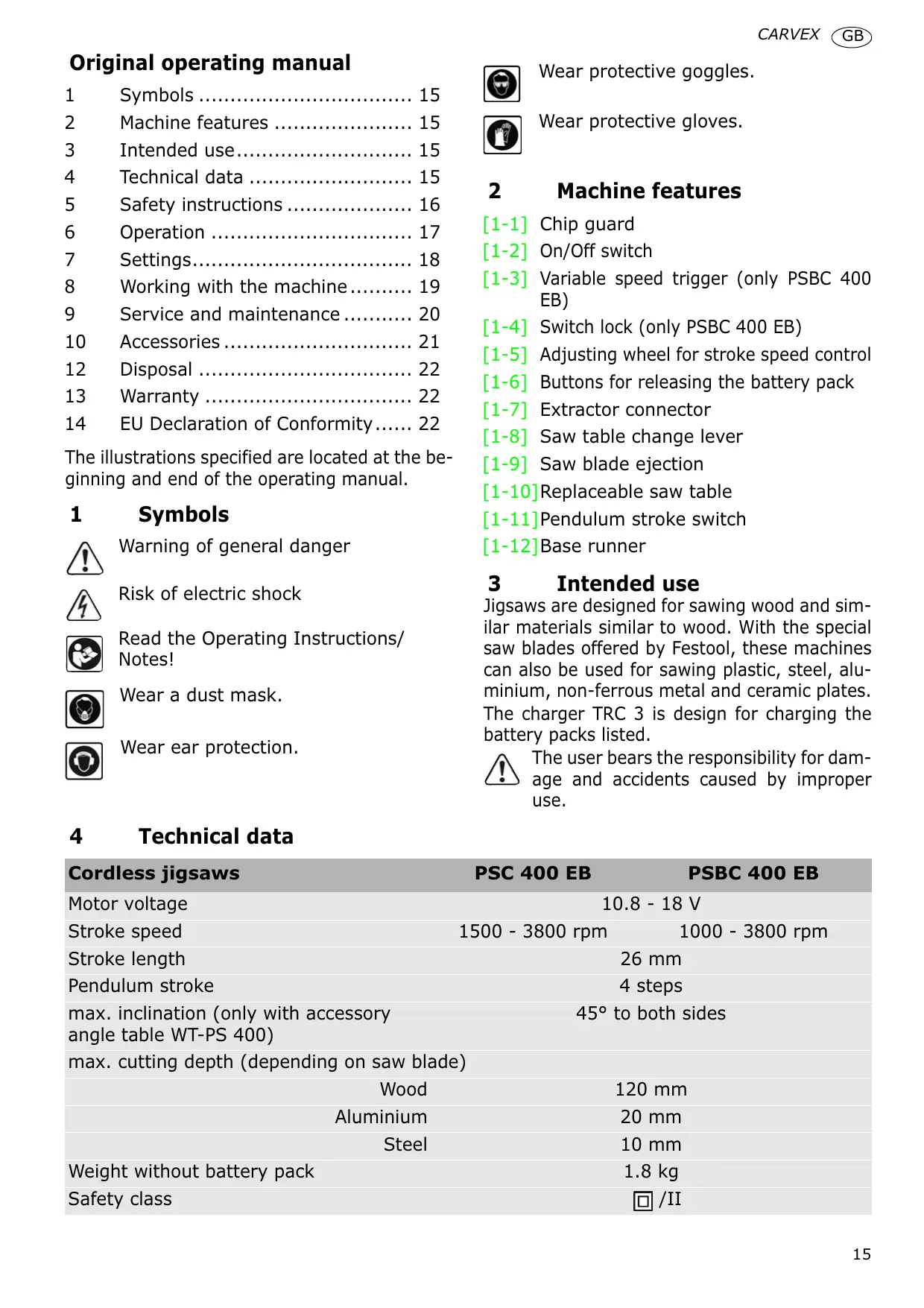
Original operating manual
GB Wear protective goggles.
Machine features 15
Working with the machine 19
Service and maintenance 20
[1-3] Variable speed trigger (only PSBC 400 EB)
Warranty 22 EU Declaration of Conformity 22
Wear protective gloves.
[1-4] Switch lock (only PSBC 400 EB)
[1-5] Adjusting wheel for stroke speed control [1-6] Buttons for releasing the battery pack [1-7] Extractor connector [1-8] Saw table change lever [1-9] Saw blade ejection [1-10]Replaceable saw table [1-11]Pendulum stroke switch [1-12]Base runner
The illustrations specified are located at the beginning and end of the operating manual.
Warning of general danger
Risk of electric shock
Jigsaws are designed for sawing wood and similar materials similar to wood. With the special saw blades offered by Festool, these machines can also be used for sawing plastic, steel, aluminium, non-ferrous metal and ceramic plates.
The charger TRC 3 is design for charging the battery packs listed. The user bears the responsibility for damage and accidents caused by improper use.
Read the Operating Instructions/
Notes! Wear a dust mask. Wear ear protection.
PSC 400 EB Motor voltage
Stroke speed Stroke length
Pendulum stroke max. inclination (only with accessory angle table WT-PS 400) max. cutting depth (depending on saw blade)
Wood Aluminium Steel Weight without battery pack Safety class
1000 - 3800 rpm 26 mm
Charging voltage (output)
Conservation charging current, pulsating
approx. 0.06 A Charging times for
LiIon 1.3 Ah/ 2.6 Ah, 80 %
LiIon 1.3 Ah/ 2.6 Ah, 100 % Permitted charging temperature range Temperature monitoring
approx. 22/ 45 min approx. 35/ 70 min
-5 °C to +45 °C via NTC resistor
General safety instructions
WARNING! Read all safety warnings and all instructions. Failure to follow the warnings and instructions may result in electric shock, fire and/or serious injury. Save all warnings and instructions for future reference. The term "power tool" in the warnings refers to your mains-operated (corded) power tool or battery-operated (cordless) power tool. 5.2
Machine-related safety instructions
– Hold power tool by insulated gripping surface, when performing an operation where the cutting accessory may contact hidden wiring. Cutting accessory contacting "live" wire may make exposed metal parts of the power tool "live" and could give the operator an electric shock. – The charger and power tool are not intended for use by persons (including children) with limited physical, sensory or mental ability or without sufficient experience and/or knowledge, unless they are supervised by a person responsible for their safety or have been instructed on how the charger or power tool is to be used.Children should always be supervised to ensure that they do not play with the charger or the power tools. – Festool electric power tools must only be installed on work tables provided by 16
Festool for this purpose. If the tool is installed in another, or self-made, work table, it can become unstable and result in serious accidents.
Wait until the power tool stops completely until placing it down. The tool can become entangled and lead to a loss of control of the power tool. Do not open the battery pack or the charger. Even after disconnection from the mains, there is still a high capacitor voltage inside the charger. Make sure that metal objects (such as metal chips) do not collect in the battery pack retaining slots or enter the machine through the air vent slits (danger of short circuit). Do not charge battery packs from external manufacturers. The charger is designed for charging original battery packs only. Otherwise there is a danger of fire and explosion. Protect the battery pack from excessive heat or constant heat sources such as sunlight or naked flames. There is a risk of explosion. Never use water to extinguish burning LiIon battery packs, always use sand or a fire blanket. Deformed or cracked saw blades and saw blades with blunt or broken cutting edges must not be used. Always place the pendulum jigsaw on the workpiece with the saw blade running.
CARVEX PSC 400 EB Sawing wood
– Wear suitable protection such as ear protection, safety goggles, a dust mask for work which generates dust, and protective gloves when working with raw materials and when changing tools. – Always secure the workpiece in such a manner that it cannot move while being sawed. – Always connect the machine to a dust extractor when work involves dust generation. – Stroboscopic light can cause epileptic seizures. Do not use this machine if you are susceptible to epileptic seizures. – Do not look into the stroboscope light. Looking into the light source can damage your vision. 5.3
When processing metal, the following measures must be taken for safety reasons: Connect the machine to a suitable dust extractor. Regularly remove dust deposits in the motor housing. Use a metal saw blade. Close the chip guard. Wear protective goggles.
Emission levels Levels determined in accordance with EN 60745 are typically: Sound pressure level Noise level Uncertainty
K = 3 dB CAUTION Operating noise
Damage to hearing X Use ear protection! Vibration emission value ah (vector sum for three directions) and uncertainty K measured in accordance with EN 60745:
GB PSBC 400 EB The emission values specified (vibration, noise) were measured in accordance with the test conditions stipulated in EN 60745 and are intended for machine comparisons. They are also used for making preliminary estimates regarding vibration and noise loads during operation.
The emission values specified refer to the main applications for which the power tool is used. If the electric power tool is used for other applications, with other tools or is not maintained sufficiently prior to operation, however, the vibration and noise load may be higher when the tool is used. Take into account any machine idling times and downtimes to estimate these values more accurately for a specified time period. This may significantly reduce the load during the machine operating period.
Changing the battery pack [2] L The cordless jigsaws can be used with all Festool battery packs of the BPS series. Risk of injury! Always remove the belt clip from battery packs from the BPC series prior to use. 6.2 Switch on/off The electric power tool has one button [1-2] on each side for switching on/off. The PSBC 400 EB also has a variable speed trigger [1-3] with switch lock [1-4]. For continuous operation, use the button [1-2]. 6.3 Charging the battery pack [3] L The battery pack is delivered partially charged. To guarantee the full battery power, charge it completely before using it for the first time.
GB CARVEX The charger TRC 3 can be used to charge all
Festool battery packs of the BPS and BPC series. The charger automatically detects the type of the inserted battery (NiCd, NiMH or LiIon). A microprocessor controls the charging process in line with the charging state, temperature and voltage of the battery pack. The LED [3-1] on the charger indicates the respective operating status of the charger. LED yellow - lit continuously Charger is ready to use. LED green - flashing quickly Battery pack is charged to maximum capacity. LED green - flashing slowly Battery pack is charged with reduced current, LiIon is charged to 80 %. LED green - lit continuously Battery pack is fully charged, or charging is not started again, because the battery is charged to more than 80 %. LED red - flashing General fault display, e.g. incomplete contact, short circuit, battery pack faulty, etc. LED red - lit continuously Battery temperature is outside the permitted range. 6.4 Charger wall mount The charger TRC 3 has two elongated holes on its back. It can be mounted on a wall using two screws (e.g. round head or flat head screw with shank diameter of 5 mm) (see Fig. [3]).
WARNING Risk of injury, electric shock
X Always disconnect the battery pack before any type of work on the machine! 7.1
CAUTION Hot and sharp tools
Risk of injury X Wear protective gloves!
Only use saw blades with a T-shank. The saw blade should not be longer than that required for the intended cut. To ensure safe guidance, during the cut the saw blade should emerge at the bottom of the workpiece at every point. L Only use cross-set saw blades when using the angle and adapter table. We recommend Festool saw blade S 105/4 FSG. Inserting saw blade Always disconnect the battery pack from the machine before every tool change! X If necessary, push the chip guard [4-1] upwards. X Push the saw blade [4-4] into the opening as far as the stop with its teeth in cutting direction [4-2]. X Turn the saw blade [4-4] approx. 30° clockwise until it engages. The guidance jaws adjust automatically to the saw blade used. Check that the saw blade is secure. A loose saw blade can fall out and cause an injury. L In the case of very short saw blades, it is advisable to remove the saw table (see chapter 7.4) before inserting the saw blade. Ejecting saw blade L When ejecting the saw blade, hold the electric power tool such that no persons or animals can be injured. X Push the saw blade ejection [4-3] forwards as far as the stop. If the saw blade is not ejected: run jigsaw 3 - 10 seconds at a high speed. Actuate saw blade ejector mechanism [4-3] once again. 7.2 Using the chip guard The chip guard [4-1] prevents chips flying away and improves the efficiency of the chip extraction system. X Using minimal pressure, push the chip guard [4-1] downwards. 7.3 Inserting splinterguard The splinterguard makes cuts with splinter-free cutting edges possible, even on the exit side of the saw blade. X With the machine switched off, push the splinterguard [5-1] onto the guide up to the saw blade [5-2], X switch on the jigsaw,
with the machine running (Speed range 5), push the splinterguard in on a flat plane until it is flush with the front edge of the saw table. This beds in the splinterguard.
L When it is worn, push the splinterguard approx. 3 mm further to the rear and continue using it. L To guarantee reliable operation of the splinterguard, it must seal tightly on both sides of the saw blade. For splinter-free cuts, therefore, a new splinterguard should also be used after every saw blade change. 7.4 Changing saw table X Open the change lever [1-8]. X Removing the saw table downwards. L Assembly is performed in reverse sequence to removal. Ensure that the saw table is firmly seated in the guide. Instead of the saw table, the angle table WTPS 400 or adaptation table ADT-PS 400 can be installed at the support. Never saw without the saw table, or one of the other tables offered in the Festool accessories program. 7.5
X Dust can be hazardous to health. Always work with a dust extractor. X Always read applicable national regulations before extracting hazardous dust. The extraction adapter [6-3] allows jigsaws to be connected to a dust extractor (hose diameter 27 mm). X Insert the extraction adapter into the rear opening of the saw table so that the hook [6-2] engages in the [6-1] recess. X To remove the extraction adapter, press the hook [6-2]. L Due to the low power consumption of the machine (low energy consumption), dust extractors with an automatic switch-on function will only start up when the actual cut is made. X Set the dust extractor to continuous operation for special applications (e.g. low stroke rate, soft wood).
Adjusting the pendulum stroke In order to process different materials with an optimum feed movement the pendulum jigsaws have an adjustable pendulum stroke. Select the desired setting with the pendulum stroke switch [1-11]: setting 0 = pendulum stroke off setting 3 = maximum pendulum stroke Recommended settings of the pendulum stroke Hard and soft wood,chip board, wood 1 - 3 fibre board Wood core plywood, plywood, plastics 1 - 2 Ceramic Aluminium, NF metals Steel
Stroke speed control The number of strokes can be adjusted steplessly with the adjusting wheel [1-5] between 1500 and 3800 rpm (PSBC 400 EB: 1000 3800 rpm). This enables you to optimise the cutting speed to suit the respective material. In position A, the automatic load detection is activated: The stroke speed is reduced in idling and is controlled to the highest value when the blade enters the workpiece. Recommended stroke speed (position of the adjusting wheel) Hard and soft wood, plywood board, plywood, chip board Hardboard Plastic
3-A Ceramic, aluminium, non-ferrous metals 3 - 5
Working with the machine
CAUTION Material with high dust generation (e.g. plasterboard)
Damage to machine through dust penetration, risk of injury X Do not work overhead! When working on small or thin workpieces, always use a stable base, or the CMS module (accessory).
GB CARVEX When working, hold the electric power tool by the handle and guide it along the desired cutting line. For precise cuts and smooth running, use two hands to guide the electric power tool.
Freely guided sawing along a scribe mark The triangular shape of the splinterguard [5-1] points to the cutting line of the saw blade. This facilitates sawing along a scribe mark. 8.1
WARNING The stroboscope light may make it difficult to determine the saw blade position
Risk of injury X Ensure the work area is well illuminated. A continuous light or stroboscope is installed for illuminating the cutting line: up to approx. 2100 rpm: continuous light from approx. 2100 rpm: stroboscope light L In overhead position (+/- 45°), the lighting is switched off completely. 8.2 Acoustic warning signal Acoustic warning signals sound and the machine switches off in the following operating states: peep ― ―
– Battery flat or machine overloaded.
X Change the battery. X Place the machine under reduced stress. peep peep ―
– Machine is overheating.
X You must allow the machine to cool before using again. peep peep peep
– LiIon battery pack is faulty or has overheated.
X Once the battery pack has cooled, perform a functional check using the charger.
Service and maintenance
WARNING Risk of injury, electric shock
X Always disconnect the battery pack from the machine before any maintenance or care work! X All maintenance and repair work which requires the motor housing to be opened, must only be carried out by an authorised service workshop. Damaged safety devices and components must be repaired or replaced in a recognised specialist workshop, unless otherwise indicated in the operating manual. Observe the following instructions: – Keep the air slits on the machine and the charger free and clean to ensure adequate cooling. – Keep the contacts on the machine, charger and battery pack clean. – Check the guidance roller regularly for wear. – Regularly remove dust deposits from the chip guard. – Regularly clean the base runner to prevent scratches and cores on the surface. Information on battery packs – Where possible, store the battery pack in a cool, dry place at a temperature between 5 °C and 25 °C. – Battery packs are most efficient at temperatures between 20 °C and 30 °C. – Protect the battery pack from moisture, water and heat. – Significantly shorter operating times after each charge indicate that the battery pack is worn and should be replaced with a new one. – The LiIon battery pack is fully compatible with the charger! Integrated electronics prevent overloading and overheating during the charging process. – Do not leave flat battery packs in a charger disconnected from the mains power supply for longer than one month. There is a risk of total discharge and the maximum power of the battery pack may decrease. – Store the battery pack in its packaging to reduce the risk of short circuits.. – If LiIon battery packs are to be stored for long periods without use, they should be charged to 40 % capacity (approx. 15 mins. charging period).
Use only original Festool accessories and Festool consumable material intended for this machine because these components are designed specifically for the machine. Using accessories and consumable material from other suppliers will most likely affect the quality of your working results and limit any warranty claims. Machine wear or your own personal workload may increase depending on the application. Protect yourself and your machine, and preserve your warranty claims by always using original Festool accessories and Festool consumable material!
The order numbers of the accessories and tools can be found in the Festool catalogue or on the Internet under "www.festool.com". 10.1 Saw blades, other accessories In order to saw different materials quickly and cleanly, Festool offers saw blades for all applications that are specially designed for your Festool jigsaw. 10.2 Sawing with special base runners The special base runners protect high-quality surfaces against scratches and scores. X Press in the base runner at position [7-1]. X At the same time, push the base runner forwards. X Mount another base runner and push it to the rear until it engages. 10.3 Sawing with the angle table The angle table WT-PS 400 is used for sawing interior and exterior angles up to 45° and pipes. Dust extraction is not possible when sawing with the angle table! Installing the angle table X Remove the saw table [1-10], (see chapter 7.4). X Position the angle table against the saw table support. X Close the change lever [1-8]. Ensure that the angle table is firmly seated in the guide. Setting the angle X Turn the adjusting wheel [8-1] to set the desired angle. You can set the values -45°, 0° and +45° using the scale [8-2].
Angle, interior angle
WARNING Sawing cutting depths
Risk of injury X Select the saw blade length and cutting depth so that the saw blade always stays in the workpiece. L For 90° cuts, we recommend setting the angle table to a small negative degree value to guarantee stable running. 10.4 Sawing with the adaptation table The adaptation table ADT-PS 400 is used for fitting your jigsaw on the Festool guide rail and the circle cutter KS-PS 400. Installing the adaptation table X Remove the saw table [1-10], (see chapter 7.4). X Mount the adaptation table [9-1] on the saw table support. X Close the change lever [1-8]. Ensure that the adaptation table is firmly seated in the guide. L Use the extractor connector [1-7] also with the adaptation table. Adaptation to the guide rail FS The use of the Festool guide system FS (Picture [10]) makes it easier to produce straight and precise cuts, in particular, with material thicknesses up to 20 mm. X Mount the jigsaw with installed adaptation table [9-1] on the guide rail. Adaptation to the circle cutter The circle cutter can be used to create circular cuts with a diameter between 120 and 3000 mm. The circle cutter can be installed from both sides on the adaptation table. X Mount the jigsaw with adaptation table on the adapter [11-1] at the circle cutter. X Insert the centring mandrel [11-2] in the bore [11-4] of the circle cutter, which is aligned with the saw blade. X Clamp the measuring tape at the circle cutter with the rotary knob [11-5]. 21
GB CARVEX L Store the centring mandrel in the depot [113].
The equivalent amount of lithium in the LiIon battery pack is less than the applicable limit value and certified as per UN manual ST/SG/
AC.10/11/rev. 3 part III, subsection 38.3. The LiIon battery pack is therefore not subject to national and international dangerous goods regulations, neither as an individual component nor as a fitted machine component. However, dangerous goods regulations may apply when several battery packs are transported, in which case you may have to fulfil special conditions. Refer to ADR special regulation 230 for more information relevant for the EU.
Do not throw the power tool in your household waste! Dispose of machines, accessories and packaging at an environmentally responsible recycling centre. Observe the valid national regulations.
EU only: European Directive 2002/96/EC stipulates that used electric power tools must be collected separately and disposed of at an environmentally responsible recycling centre. Return used or faulty battery packs to your local specialist retailer, Festool after-sales service or a designated public waste management facility. The battery packs will then be recycled. (Observe the regulations applicable in your country). The batteries must be discharged on return. EU only: European Directive 91/157/EEC stipulates that faulty or used battery packs/batteries must be recycled.
We offer a warranty for material and production defects for all our tools in accordance with the locally applicable legal provisions, but for a minimum of 12 months. Within the EU member states, the warranty period is 24 months (verification through invoice or delivery note). Damage caused by the operator, natural wear, overloading, incorrect handling or through the use of the equipment not specified in the operating manual, or damage which was known at the time of purchase, is not covered by the warranty. Furthermore, damage caused by the use of non-original accessories and consumable materials (e.g. sanding pads) is also excluded.
Complaints can only be accepted if the tool is returned while still assembled to the supplier or an authorised Festool Customer Service workshop. Keep the operating manual, safety instructions, spare parts list and purchase receipt in a safe place. Otherwise the current warranty conditions of the manufacturer shall apply.
Note Due to continuous research and development work, we reserve the right to make changes to the technical content of this documentation.
EU Declaration of Conformity
PSBC 400 EB PSC 400 EB Serial no.
Year of CE mark: 2010
We declare under sole responsibility that this product complies with the following directives and standards: 2006/42/EC, 2004/108/EC, EN 60745-1, EN 60745-2-11, EN 55014-1. Charger
494635, 494636, 494637 Year of CE mark: 2007 We declare under sole responsibility that this product complies with the following directives and standards: 2004/108/EC, 2006/95/EC, EN 60335-1, EN EN 60335-2-29, EN 61000-3-2, EN 61000-3-3, EN 61204-3. Festool GmbH Wertstr. 20, D-73240 Wendlingen, Germany
Dr. Johannes Steimel
Head of Research, Development and Technical Documentation 08.02.2010 REACh for Festool products, its accessories and consumable materials: REACh is a European Chemical Directive that came into effect in 2007. As "downstream users" and product manufacturers, we are aware of our duty to provide our customers with information. We have set up the following website to keep you updated with all the latest news and provide you with information on all the materials used in our existing products: www.festool.com/reach
CARVEX LPA = 88 dB(A)
K = 3 dB LWA = 99 dB(A)
K = 3 dB LPA = 88 dB(A)
K = 3 dB LPA = 88 dB(A)
K = 3 dB LPA = 88 dB(A)
K = 3 dB Aluminium, NE-metal
Vedlikeholdslading, pulserende Ladetid for
K = 3 dB LPA = 88 dB(A)
LWA = 99 dB(A) K = 3 dB
LWA = 99 (A) K = 3