
XPA2100 - Audio Amplifier DUAL - Free user manual and instructions
Find the device manual for free XPA2100 DUAL in PDF.


User questions about XPA2100 DUAL
0 question about this device. Answer the ones you know or ask your own.
Ask a new question about this device
Download the instructions for your Audio Amplifier in PDF format for free! Find your manual XPA2100 - DUAL and take your electronic device back in hand. On this page are published all the documents necessary for the use of your device. XPA2100 by DUAL.
USER MANUAL XPA2100 DUAL
INSTALLATION/OWNER'S MANUAL
Mobile Power Amplifiers
DUAL AUDIO
LOUD & CLEAR

Preparation
Please read entire manual before installation. Due to the technical nature of amplifiers, it is highly recommended that your DUAL amplifier is installed by a professional installer or an authorized dealer.
Before You Start
- Disconnect negative battery terminal. (consult a qualified technician for instructions)
- Avoid installing the amplifier where it would be subject to high temperatures, such as from direct sunlight, or where it would be subject to dust, dirt or excessive vibration.
- Use extreme caution when drilling holes to avoid damaging fuel lines or existing vehicle wiring.
- All amplifier installations require power, signal and speaker wires (not included).
- An amplifier installation kit (sold separately) is highly recommended to facilitate the installation. Consult your dealer for recommendations.
Mounting Location
- Choose a mounting location for the amplifier. Suggested locations include under a seat or in the trunk.
- The amplifier can be mounted horizontal (recommended) or vertical. For optimum performance, make sure to provide at least 1^ of space to around all sides. Do not mount the amplifier under carpets or where airflow is restricted.
- Do not install the amplifier where it may be exposed to moisture.
- The optimum mounting location varies between vehicles. Remember to test all amplifier functions before completing the final mounting procedure.
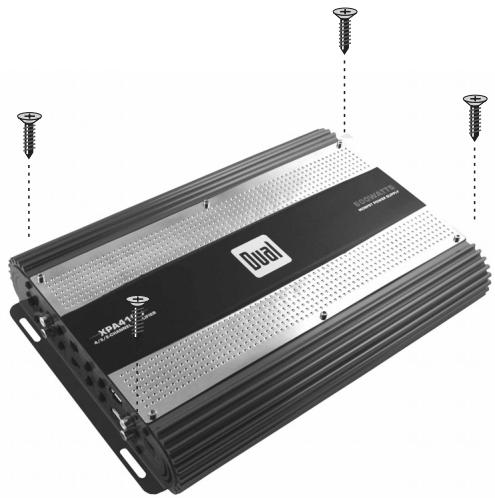
TYPICAL MOUNTING METHOD
Connection Descriptions
NOTE
Be sure to follow specific instructions included with your amplifier installation kit (not included with this amplifier). The information below should be used a general guideline only.
Power Wire (+12V)
- Disconnect negative battery terminal before proceeding. Consult a qualified technician for instructions if you are unsure.
- Plan wire routing before cutting any wires to length. Begin by routing the power +12V wire from the battery to the amplifier location. Use a grommet when running wires through the firewall or metal openings. Avoid running the power wire near existing vehicle wiring to prevent induced noise from entering the audio system.
- Use extreme caution when drilling holes to avoid damaging fuel lines or existing vehicle wiring.
- The +12V wire MUST be fused within 18" of the battery for protection of the vehicle's electrical system.
Ground Wire (GND)
- The amplifier ground wire should be as short as possible. Choose a clean unpainted section of metal or the vehicle chassis when attaching the ground connection. Be sure to clean the area of any dirt or grease.
Remote Turn-on Wire (REM)
- The remote turn-on wire connects to the head unit's amplifier turn-on lead or power antenna output.
Speaker Wires
- Choose adequate gauge speaker wire depending on your exact amplifier/speaker combination. Be sure to observe polarity when connecting.
- Do not ground any speaker wires or connect any speaker wires together.
Input Signal
- The amplifier's input signal connects to the head unit's low level (RCA) or high level (speaker wire) outputs.
- Low level input signal deliver the best performance. If unavailable, use the high level inputs - when interfacing with factory head unit for instance.
CAUTION
- Do not use both low and high level inputs at the same time - connect only one or the other.
- Never run any wires underneath or outside the vehicle.
Power and Speaker Connections
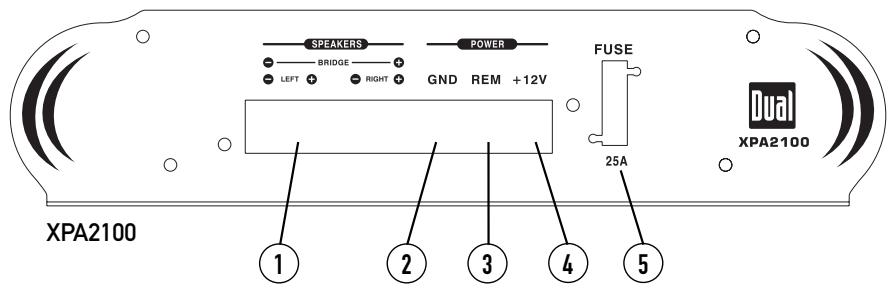
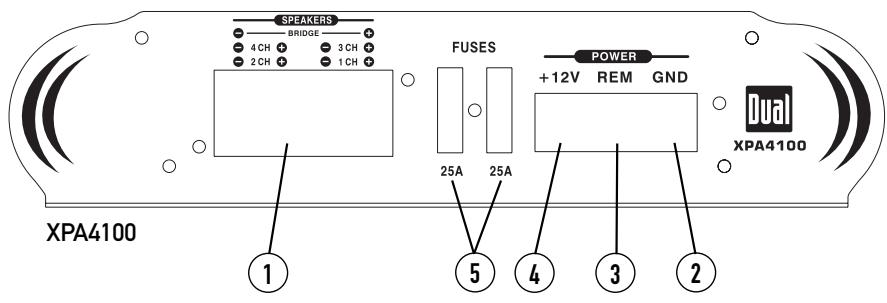
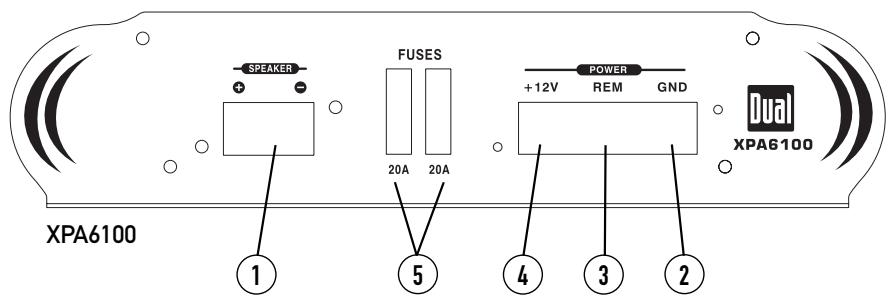
① Speaker Connection(s)
Ground Connection
Remote Connection
4 +12VDC Battery Connection
5 Fuse(s)
Audio Inputs and Controls
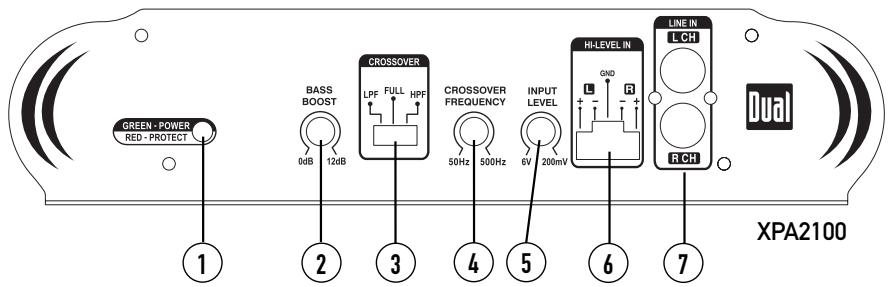
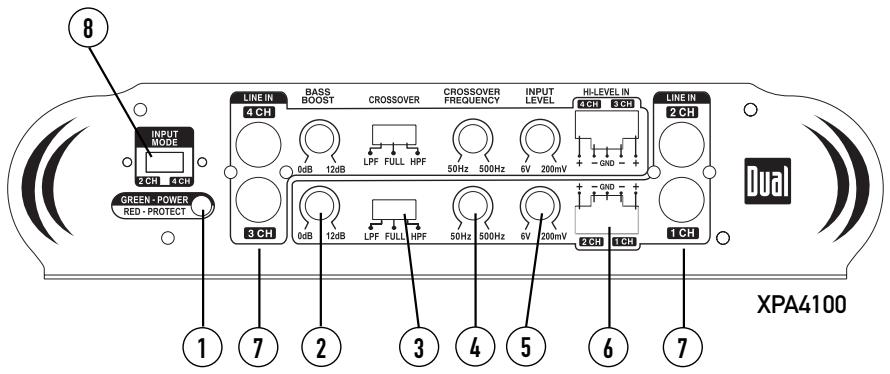
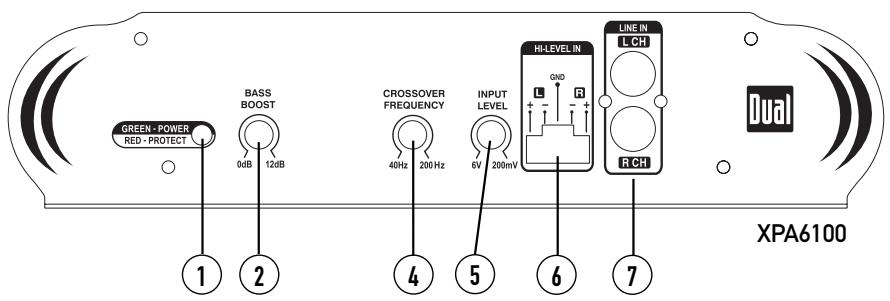
① LED Indicator
2 Bass Boost
3 Crossover Mode Switch
Crossover Frequency
5 Input Level Control
6 High Level Inputs
Low Level Inputs
8 Input Mode Switch
Typical Wire Routing
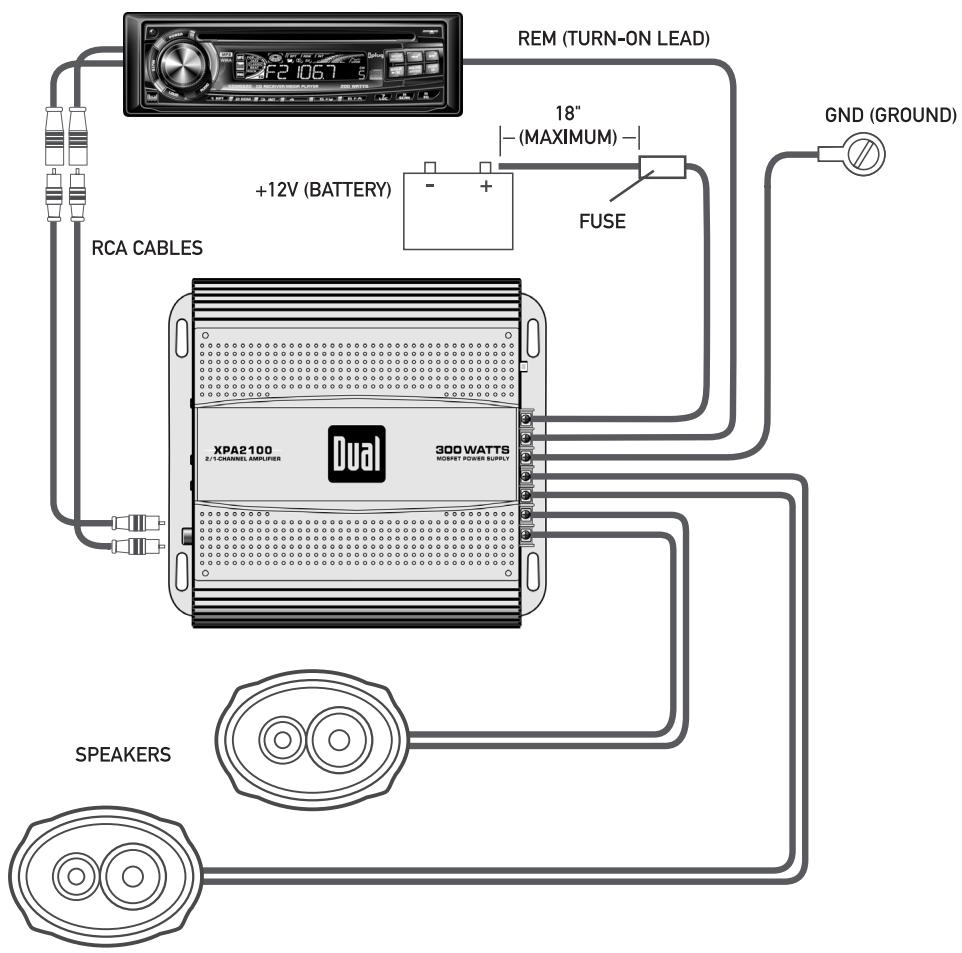
Main Power Connections
Connect +12V. GND and REM wires accordingly. A suitable fuse MUST be installed on the +12V lead within 18" of the battery for protection of the vehicle's electrical system.
Fuse Rating
When replacing fuses, make sure new fuse is the correct type and amperage. Using an incorrect fuse could damage the amplifier.
XPA2100 25 amp ATO x 1
XPA4100 25 amp ATO x 2
XPA6100 20 amp ATO x 2
Power/Ground Wire Size
For optimum performance, use only the wire size listed below or larger. Make sure to use the same size power and ground wire.
XPA2100 10 gauge
XPA4100 8 gauge
XPA6100 8 gauge
Amplifier Connections
Speaker Connections
Connect speaker wires observing polarity. The minimum impedance load for the XPA2100 and XPA4100 is 2 ohms stereo and 4 ohms bridged. The minimum impedance load for the XPA6100 is 2 ohms. Use of loads lower than these is not recommended and may cause amplifier damage. The XPA2100 and XPA4100 can be wired for stereo, bridged or stereo/bridged simultaneous operation.
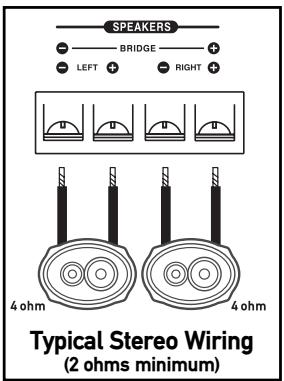
2 Speakers (stereo)
Subwoofer (mono)
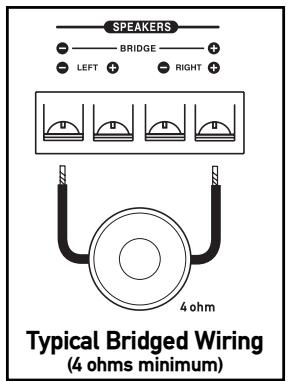
XPA2100 speaker connections shown
Input Signal Connections
Low Level Input (RCA)
Low level (RCA) input signal is preferred for best performance. Typical trunk-mount amplifier installations require a 17-20 foot RCA cable. Most trucks and under-seat applications require a 6-9 foot RCA cable. Using twisted pair construction RCA cables will minimize noise.
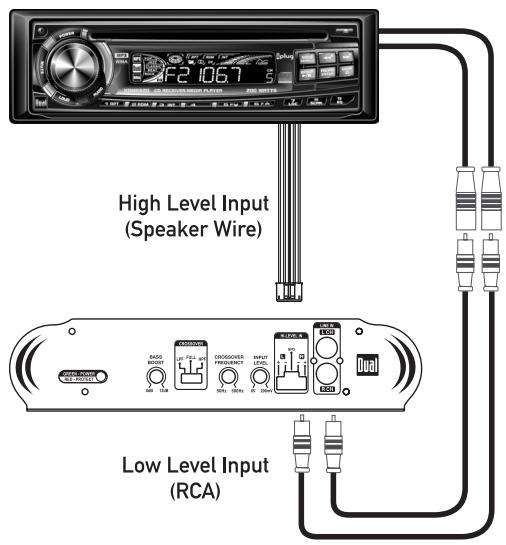
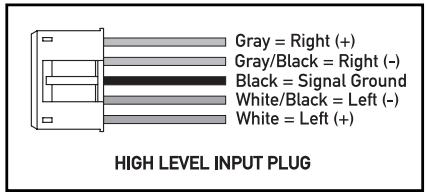
High Level Input (Speaker Wire) High level inputs should only be used when RCA outputs are not available from the head unit. Connect the head unit speaker outputs to the high level input connector as shown below. The black wire (signal reference ground) may or may not require a connection to chassis ground - depending on your particular installation.
CAUTION
Do not use both low and high level inputs at the same time - connect only one or the other.
Configuration/Setup
| Input level Control | The input level control (gain) is used to obtain the best possible match between the head unit audio output and the amplifier input. Begin by turning the input level control fully counterclockwise. Next, turn up the head unit volume control around 3/4 of the way up. Adjust the input level control clockwise until audible distortion is heard, then slightly counterclockwise to provide the best match. Repeat for all input level controls. |
| Input Mode Switch (XPA4100) | Select 2 CH mode if the head unit only has 1 pair of RCA outputs. Plug the RCA's from the head unit into channels 1/2 or 3/4. All 4 amplifier inputs will receive a signal. NOTE: There is no fader function when using 2 CH mode. |
| Crossover Mode (XPA2100 & XPA4100) | Select 4 CH mode if the head unit has 2 pairs of RCA outputs. Plug the RCA's from the head unit into channels 1/2 and 3/4. |
| Crossover Frequency Control | The crossover is used to filter out frequencies above or below a certain point. Choose LPF when using the amplifier with subwooers. HPF when using with midrange/tweeter combinations and FULL when using with coaxial-type speakers. |
| NOTE Choose FULL when using the amplifier in stereo/bridged simultaneous mode. In this mode, passive crossovers are required. Failure to use the correct passive components may damage the amplifier and/or speakers. Consult a qualified professional for recommendations. | |
| This control allows precise adjustment of the crossover frequency. | |
| Bass Boost | This control provides additional boost @ 45Hz when used with subwooers. Adjust this control with caution - as improper use can damage speakers! |
| LED Indicator | The LED indicator illuminates green during normal operation (POWER) and red when the amplifier detects a fault (PROTECT). |
Limited One-Year Warranty
This warranty gives you specific legal rights. You may also have other rights which vary from state to state.
Dual Electronics Corp. warrants this product to the original purchaser to be free from defects in material and workmanship, under normal conditions, for a period of one year from the date of the original purchase.
Dual Electronics Corp. agrees, at our option, during the warranty period, to repair any defect in material or workmanship or to furnish an equal new or renewed product in exchange without charges, subject to verification of the defect or malfunction and proof of the date of purchase.
During the One-Year Warranty Period: For One Year from the date of purchase, your product will be replaced with a new, renewed or comparable product (whichever is deemed necessary) if it becomes defective or inoperative. This is done without charge to you. Replacement products are warranted for the balance of the original warranty period.
Who is covered? This warranty is extended to the original retail purchaser for products purchased and used in the U.S.A.
What is covered? This warranty covers all defects in material and workmanship in this product. The following are not covered: installation/removal costs, damage resulting from accident, misuse, abuse, neglect, product modification, improper installation, incorrect line voltage, unauthorized repair or failure to follow instructions supplied with the product, or damage occurring during return shipment of the product.
What to do?
If purchased within the USA:
- Before you call for service, check your operating instruction booklet. A slight adjustment of any custom controls discussed in your instruction booklet may save you a service call.
- If you require service during the warranty period, you must carefully pack the product (preferably in the original package) and ship it by prepaid transportation with proof of the purchase date from the retailer to the Return Center address listed below.
- Please describe your problem in writing and include your name, a return UPS shipping address (P.O. Box not acceptable), and a daytime phone number with your shipment.
- DUAL will pay the return shipping charges if the product is returned to an address within the 48 contiguous states.
Dual Electronics Corp.
Attn: Returns Center
21318 64th Ave. South
Kent, WA 98032 U.S.A.
Toll Free: 1-866-626-7863
If purchased outside the USA:
Please return the unit to original place of purchase for warranty service.
Exclusion of Certain Damages: This warranty is exclusive and in lieu of any and all other warranties, expressed or implied, including without limitation the implied warranties of merchantability and fitness for a particular purpose and any obligation, liability, right, claim or remedy in contract or tort, whether or not arising from the company's negligence, actual or imputed. No person or representative is authorized to assume for the company any other liability in connection with the sale of this product. In no event shall the company be liable for indirect, incidental or consequential damages.
Specifications
CEA-2006 Power Standard Specifications (reference: 14.4VDC, 20Hz~20kHz)
XPA2100

Power Output: 50 Watts RMS x 2 channels at 4 ohms and ≤ 1% THD+N Signal to noise ratio: 75dBA (reference: 1 watt into 4 ohms)
Additional power output: 75 Watts RMS x 2 channels at 2 ohms and ≤ 1% THD+N 150 Watts RMS x 1 channel at 4 ohms (bridged) and ≤ 1% THD+N
Dynamic power: 300 Watts at 4 ohms
Frequency response: 20Hz 20kHz (-3dB)
Maximum input signal: 6V
Minimum input signal: 200mV
Speaker output impedance: 2~8 ohms (stereo), 4~8 ohms (bridged)
Bass boost: 0~12dB @ 45Hz
Crossover range: 50 500Hz 12dB/octave
Power supply: 11-16 VDC, negative ground
Fuse: 25 amp ATO
Amplifier dimensions: 8.9'' × 2.13'' × 9.17'' (WxHxD)
(226× 54× 233mm)
Typical installation dimensions: 11.5'' × 3.25'' × 9.17'' (WxHxD)
(292× 83× 233mm)
CEA-2006 Power Standard Specifications (reference: 14.4VDC, 20Hz~20kHz)
XPA4100

Power Output: 50 Watts RMS x 4 channels at 4 ohms and ≤ 1% THD+N Signal to noise ratio: 72dBA (reference: 1 watt into 4 ohms)
Additional power output: 75 Watts RMS x 4 channels at 2 ohms and ≤ 1% THD+N 150 Watts RMS x 2 channels at 4 ohms (bridged) and ≤ 1% THD+N
Dynamic power: 600 Watts at 4 ohms
Frequency response: 20Hz 20kHz (-3dB)
Maximum input signal: 6V
Minimum input signal: 200mV
Speaker output impedance: 2~8 ohms (stereo), 4~8 ohms (bridged)
Bass boost: 0~12dB @ 45Hz
Crossover range: 50 500Hz 12dB/octave
Power supply: 11-16 VDC, negative ground
Fuse: 25 amp ATO x 2
Amplifier dimensions: 13.69'' × 2.13'' × 9.17'' (WxHxD)
(348 x 54 x 233 mm)
Typical installation dimensions: 16'' × 3.25'' × 9.17'' (WxHxD)
(406× 83× 233mm)
Specifications
CEA-2006 Power Standard Specifications (reference: 14.4VDC, 20Hz~200Hz)
XPA6100

Power Output: 200 Watts RMS x 1 channel at 4 ohms and ≤ 1% THD+N
Signal to noise ratio: 72dBA (reference: 1 watt into 4 ohms)
Additional power output: 300 Watts RMS x 1 channel at 2 ohms and ≤ 1% THD+N
Dynamic power: 600 Watts at 2 ohms
Frequency response: 20Hz 200Hz (-3dB)
Maximum input signal: 6V
Minimum input signal: 200mV
Speaker output impedance: 2~8 ohms
Bass boost: 0~12dB @ 45Hz
Crossover range: 40 200Hz 12dB/octave
Power supply: 11-16 VDC, negative ground
Fuse: 20 amp ATO x 2
Amplifier dimensions: 13.69'' × 2.13'' × 9.17'' (WxHxD)
(348× 54× 233mm)
Typical installation dimensions: 16'' × 3.25'' × 9.17'' (WxHxD)
(406× 83× 233mm)
Design and specifications subject to change without notice.
Troubleshooting
| Problem | Cause | Action | |
| Unit will not turn on (no power LED indicator) | +12V wire not connected or incorrect voltage REM wire not connected or incorrect voltage | Check connections for proper voltage (11~16VDC) | |
| GND wire not connected | Check connection to ground | ||
| Fuse(s) blown | Replace fuse(s) | ||
| Unit has power - LED is green (but no sound) | Speaker wires not connected | Check connections at speakers | |
| Volume turned all the way down | Increase volume level at head unit | ||
| One or more speaker wires touching each other or touching chassis ground | Insulate all bare speaker wires from each other and chassis ground | ||
| Speaker(s) defective or damaged | Check/replace speaker(s) | ||
| Input signal not connected | Check high or low level inputs for proper connection | ||
| Unit blows fuse(s) | Incorrect fuse rating | Use fuse(s) with correct rating | |
| +12V wire touching chassis ground | Check for pinched wire | ||
| Speaker(s) defective or damaged | Check/replace speaker(s) | ||
| Engine noise | Bad ground connection | Make sure amplifier is grounded to clean bare metal | |
| Signal ground loop or RFI (radio frequency interference) | Re-route RCA cables from existing high current wiring | ||
| LED illuminates red (protect mode) | One or more speaker wires touching each other or touching chassis ground | Insulate all bare speaker wires from each other and chassis ground | |
| Speaker(s) defective or damaged internally (shorted) | Check/replace speaker(s) | ||
| XPA2100 | Speaker load less than 2 ohms (stereo) | Adjust speaker load - amplifier will not operate at less than 4 ohms when bridged | |
| XPA4100 | Speaker load less than 4 ohms (bridged) | ||
| XPA6100 | Speaker load less than 2 ohms | Adjust speaker load - amplifier will not operate at less than 2 ohms | |
| Distorted audio output | Incorrect input signal type or input level too high | Check connections and reduce/adjust input level | |
| Low audio output | Incorrect input signal type or input level too low | Check connections and increase/adjust input level | |
| Weak bass | Speaker(s) are wired out of phase | Check (+) and (-) speaker connections (Observe correct polarity) | |

Dual Electronics Corp.
21318 64th Ave. South
Kent, WA 98032
Toll Free: 1-866-626-7863
www.dualav.com
©2005 Dual Electronics Corp.
NSA0405-V01