
DV601 - Electronic device GENIUS - Free user manual and instructions
Find the device manual for free DV601 GENIUS in PDF.


| Product Type | Digital Camcorder |
| Brand | GENIUS |
| Model | DV601 |
| Sensor | 3.2 megapixels |
| Maximum photo resolution | 3744 x 2808 (10 MP interpolated) |
| Maximum video resolution | 640 x 480 at 30 fps (DVD quality) |
| Digital zoom | 8x |
| LCD screen | 2.4-inch TFT |
| Internal memory | 64 MB (32 MB available for data) |
| External storage support | SD/MMC card up to 2 GB |
| Power supply | 2 AA batteries (alkaline) |
| Dimensions | 95 x 71 x 34 mm |
| Weight (without batteries) | 135 g |
| PC interface | USB 2.0 mini |
| TV output | NTSC/PAL (selectable) |
| File formats | Photo: JPEG, Video: AVI (Xvid), Audio: WAV, Music: MP3 |
| Main functions | MPEG-4 video recording, photo, voice recorder, MP3 player, webcam, eBook |
| Flash | Auto/Off |
| Self-timer | 10 seconds |
| Safety | Do not disassemble, avoid water and humidity, use in a ventilated area |
| Maintenance and cleaning | Wipe with a soft, dry cloth. Do not use chemical products. |
| Included accessories | USB cable, TV cable, 2 AA batteries, quick guide, CD-ROM, earphone, wrist strap, case |
Frequently Asked Questions - DV601 GENIUS
User questions about DV601 GENIUS
0 question about this device. Answer the ones you know or ask your own.
Ask a new question about this device
Download the instructions for your Electronic device in PDF format for free! Find your manual DV601 - GENIUS and take your electronic device back in hand. On this page are published all the documents necessary for the use of your device. DV601 by GENIUS.
USER MANUAL DV601 GENIUS
WEEE Warning Message
Symbol for Separate Collection in European Countries
This symbol indicates that this product is to be collected separately.
The following apply only to users in European countries:
- This product is designated for separate collection at an appropriate collection point. Do not dispose of as household waste.
- For more information, contact the retailer or the local authorities in charge of waste management.
FCC STATEMENT

natural_image
Symbol of a trash bin crossed out by two diagonal lines, with no text or labels present.This device complies with Part 15 of the FCC Rules. Operation is subject to the following two conditions:
(1). This device may not cause harmful interference, and
(2). This device must accept any interference received, including interference that may cause undesired operation.
Note:
This equipment has been tested and found to comply with the limits for Class B digital devices, pursuant to Part 15 of the FCC rules. These limits are designed to provide reasonable protection against harmful interference in a residential installation. This equipment generates uses and can radiate radio frequency energy and, if not installed and used in accordance with the
instructions, may cause harmful interference to radio communications.
However, there is no guarantee that interference will not occur in a particular installation. If this equipment does cause harmful interference to radio or television reception, which can be determined by turning the equipment off and on, the user is encouraged to try to correct the interference by one or more of the following measures:
■ Reorient or relocate the receiving antenna
■ Increase the separation between the equipment and receiver
■ Connect the equipment into an outlet on a circuit different from that to which the receiver is connected
Use of shielded cable is required to comply with Class B limits in Subpart B of Part 15 of the FCC rules.
Do not make any changes or modifications to the equipment unless otherwise specified in the manual. If such changes or modifications should be made, you could be required to stop operation of the equipment.
Product Information
- Product design and specifications are subject to change without notice. This includes primary product specifications, software, software drivers, and user's manual. This User Manual is a general reference guide for the product.
- The product and accessories that come with your camera may be different from those described in this manual. This is due to the fact that different retailers often specify slightly different product inclusions and accessories to suit their market requirements, customer demographics, and geographical preferences. Products very often vary between retailers especially with accessories such as batteries, memory cards, cables,
carrying cases/pouches, and language support. Occasionally a retailer will specify a unique product color, appearance, and internal memory capacity. Contact your dealer for precise product definition and included accessories.
- The illustrations in this manual are for the purpose of explanation and may differ from the actual design of your camera.
- The manufacturer assumes no liability for any errors or discrepancies in this user manual.
- For driver updates, you can check the "Download" section of our website, www.geniusnet.com
SAFETY INSTRUCTIONS
Read and understand all Warnings and Cautions before using this product.
Warnings
■ If foreign objects or water have entered the camera, turn the power OFF and remove the batteries.
Continued use in this state might cause fire or electric shock.
Consult the store of purchase.
■ If the camera has fallen or its case has been damaged, turn the power OFF and remove the batteries.
Continued use in this state might cause fire or electric shock.
Consult the store of purchase
■ Do not disassemble, change or repair the camera.
This might cause fire or electric shock. For repair or internal inspection, ask the store of purchase.
■ Do not use the camera in areas near water.
This might cause fire or electric shock. Take special care during rain, snow, on the beach, or near the shore.


■ Do not place the camera on inclined or unstable surfaces.
This might cause the camera to fall or tilt over, causing injury.
- Keep the batteries out of the reach of children.
Swallowing batteries might cause poisoning. If the battery is accidentally swallowed, immediately consult a physician.
■ Do not use the camera while you are walking, driving or riding a motorcycle.
This might cause you to fall over or result in traffic accident.


Cautions
■ Insert the batteries paying careful attention to the polarity (+ or −) of the terminals.
Inserting the batteries with its polarities inverted might cause fire and injury, or damage to the surrounding areas due to the battery rupturing or leaking.

- Do not fire the flash close to anyone’s eyes.
This might cause damage to the person's eyesight.

■ Do not subject the LCD monitor to impact.
This might damage the glass on the screen or cause the internal fluid to leak. If the internal fluid enters your eyes or comes into contact with your body or clothes, rinse with fresh water.
If the internal fluid has entered your eyes, consult a physician to receive treatment.

■ A camera is a precision instrument. Do not drop it, strike it or use excessive force when handling the camera.
This might cause damage to the camera.

■ Do not use the camera in humid, steamy, smoky, or dusty places.
This might cause fire or electric shock.

■ Do not remove the battery immediately after long period of continuous use.
The battery becomes hot during use. Touching a hot battery might cause burns.

■ Do not wrap the camera or place it in cloth or blankets.
This might cause heat to build up and deform the case, resulting in fire. Use the camera in a well-ventilated place.
■ Do not leave the camera in places where the temperature may rise significantly, such as inside a car.
This might adversely affect the case or the parts inside, resulting in fire.
■ Before you move the camera, disconnect cords and cables.
Failure to do this might damage cords and cables, resulting in fire and electric shock.


Notes on Battery Usage
When you use the battery, carefully read and strictly observe the Safety
Instructions and the notes described below:
■ Different battery types and surrounding temperatures may affect the battery performance.
- Avoid using batteries in extremely cold environments as low temperatures can shorten the battery life and reduce camera performance.
■ The battery may feel warm when using the camera for an extended period of time or using the flash continuously. This is normal and not a malfunction.
■ The digital video camera may feel warm when being used continuously or for an extended period of time. This is normal and not a malfunction.
If you will not be using the batteries for an extended period of time, remove them from the camera to prevent leakage or corrosion.
■ Always keep the terminals in a clean state.
■ Never use manganese batteries.
■ Risk of explosion if battery is replaced by an incorrect type.
■ Dispose of used batteries according to the instructions.
Content
Section 1
Getting to Know Your
Digital Video
Camera 1-4
Overview
Standard Accessories
Front View
KeyPad illustration
Side View
Section 2
Getting Up
and Running 5-7
Loading the Battery
Inserting and Removing a SD
Card(Optional)
Protecting Data on an SD Card
Turning the Digital Video
Camera On and Getting Started
Turning the Digital Video
Camera off
Section 3
Record Mode 8-48
Record Mode Button Function
Option Function
LCD Monitor Information
MPEG-4 Movie Recording
Picture Recording
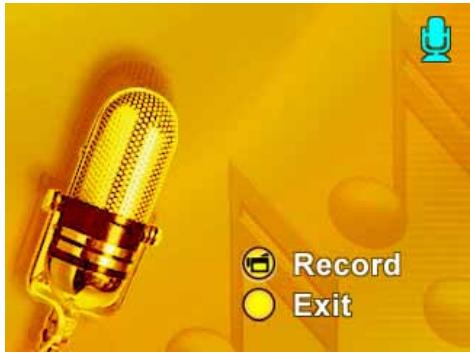
Voice Recording
Taking Close up Pictures
Using Digital Zoom
Options for Record Mode
Operations for Record Mode
Default Setting and Validation
Record Submenu Setting
Movie Resolution
Exposure
Sharpness
White Balance
Motion Stabilization
Motion Detection
Camera Mode
Picture Resolution
Exposure
Two in One (Picture Record
Mode Only)
Photo Frame (Picture
Record Model Only)
Self-timer (Picture Record
Mode Only)
Sharpness
White Balance
Multi-Snap (Picture Record
Mode Only)
Backlight (Picture Record
Mode Only)
Date Printing
Voice Mode
Effect Setting
Setting Menu
Sound Setting
Start-Up Screen
Time Setting
Format Card
TV System
Selecting Interface
Language
Default Setting
Section 4
Playback Mode 49-67
Button Functions
LCD Monitor Information
Movie Playback
Delete Movies
Thumbnail Function
Lock Movies
Repeat Movies
Picture Playback
Delete Picture
Thumbnail Function
Lock Pictures
Make Slide Show
Voice Playback
Direction buttons Function
Section 5
Listening to
MP3 Music 68-71
MP3 Music
Transfer MP3 Music to the
Digital Video Camera
Listen to MP3 Music
Listen to MP3 Music with
earphone
Section 6
Viewing MPEG-4 Movie
on PC 72-74
MPEG-4 Movie
View MPEG-4 Movie on PC
Share MPEG-4 Movie
Section 7
Viewing Pictures and
Movies on a TV 75-76
Section 8
Transferring
Data to a Computer...76
Section 9
Video File
Converter 77-82
Section 10
Burning the Recorded Clip
into DVD 83-86
Section 11
Transferring Data to a
Computer 87-97
Installing the Data to a
Computer
Connecting Your Digital Video
Camera to a Computer
Mass Storage Device Mode
PC Cam Mode
Installing Bundled Software
Getting Started With Photo
Express 5.0
Getting Started With Video
Studio 8.0
Section 12
Specifications and System
Requirements 99-100
Specifications
System Requirements
Section 1
Getting to Know Your Digital Video Camera
Overview
The camera with 3.2 Mega Pixel sensor can take DVD-Quality MPEG-4 movies. By way of using MPEG-4 technology, more videos can be taken within certain amount of memory. High quality images with up to 10 mega-pixels can also be delivered smoothly. With a color LCD monitor, users can compose images and examine them easily.
Exposure and color balance can either be adjusted automatically or allowed to be changed manually. An 8x digital zoom increases user control over the movies and pictures you take. The camera is also ideally suited for using as a PC camera hooked up to your home computer via a high speed USB 2.0 port
Build in 64 MB memory allows you to take pictures and movies without a memory card. The memory card slot allows users to increase the storage capacity up to 2GB.

NOTE
■ Partial memory of the built-in 32MB memory is used for Firmware code
Standard Accessories
Unpack the package and make sure all standard accessories listed are included:
- Camera
- USB Cable
- TV out Cable
- Two AA (Alkaline) Batteries
- Quick Guide
- CD-ROM (Driver, Ulead Software and User Manual)
- Earphone
- Strap
- Pouch

NOTE
■ Accessory and components may vary by different retailer.
Front view
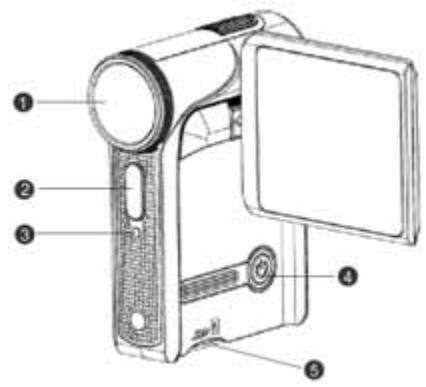
- Lens
- Flash
- Self-timer LED
- Power Button
A. SD card slot
KeyPad illustration
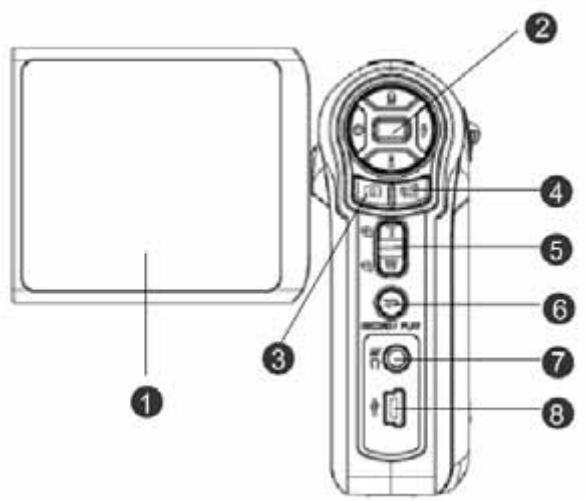
- TFT LCD
2.Direction Buttons - Picture Shutter Button
- Movie Shutter Button
- Tele-Wide Button
- RECORD/PLAY
Button
7.TV out/Earphone Port
8. USB 2.0 Port
Side View
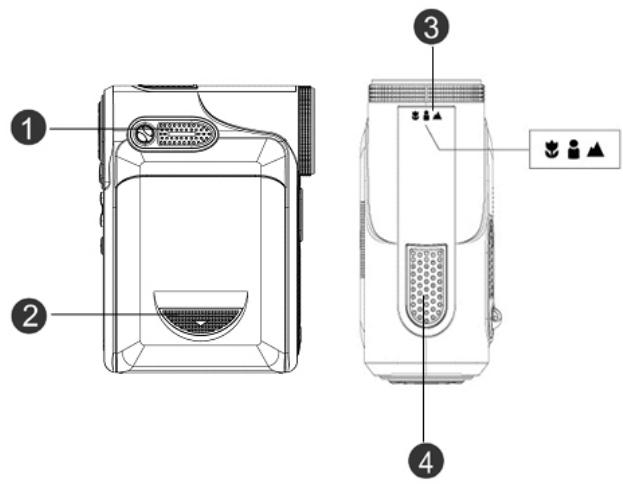
- Speaker
- Battery Cover
- Macro Switch
- Microphone
Section 2
Getting Up and Running
Loading the Battery
Before using the camera, end users must load two AA (Alkaline) batteries.
- Follow the arrow direction and slide to eject the battery cover.
- Insert the batteries according to the correct polarity marks (+ or -)
- Close the battery cover firmly.
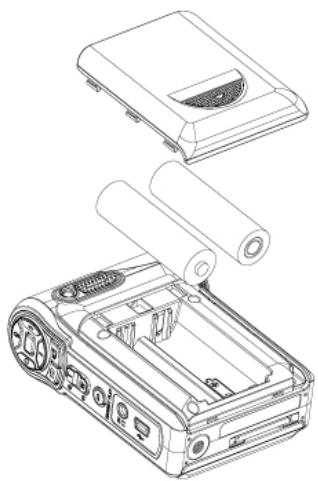
natural_image
Technical line drawing of a device with open lid and rolled paper, showing internal components (no text or symbols)Inserting and Removing an SD Card Optional
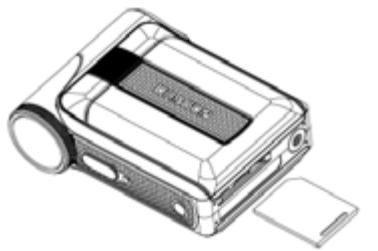
The camera comes with internal memory which allows you to store pictures, movies, voice recordings and music. You can expand the memory capacity by using an optional SD or MMC memory card up to 2GB. To insert a memory card, refer to the figure as below:
- Insert the memory card into the right position.
- To remove an installed SD card, press the card inwards to release it.
- When the card pops out, gently remove it from its slot.
natural_image
Line drawing of a digital camera module with lens and external casing (no text or symbols)
NOTE

■ When a memory card, you use a movies and pictures are saved on card rather than on the built-in memory.
Protecting Data on an SD Card
The SD card is read-only by locking the SD card. No pictures, movies and voice can be recorded when the SD card is locked. Make sure the lock is in writeable position before recording any media.
■ To prevent valuable data from being accidentally erased from an SD memory card you can slide the write-protected tab (on the side of the SD memory card) to "LOCK".
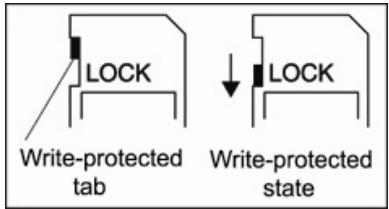
■ Please format an SD memory card by this Digital Video Camera before use.
Turning the Digital Video Camera On and Getting Started
To turn on the camera:
(1) Flip out the LCD panel; the camera will turn on automatically.
(2) When the Digital Video Camera is turned on, the green LED will light up.
(3) Or press Power Button for one second to turn on it.
To take a movie, press the Movie Shutter Button (☐).
To take a picture, press the Picture Shutter Button (☐).
To record the voice, press the Upper Button of Direction Buttons and press the Movie Shutter Button (☐) to start voice recording.
To view stored movies, pictures, listen to stored MP3 and voice recordings, or read eBook, press RECORD/PLAY Button once to switch to Playback Mode. Press a second time to return to Record Mode.
Turning the Digital Video Camera off
- To turn off the Digital Video Camera, you can either press or hold the [Power] Button for one second, or you can place the panel back to its original position.
- If no operation is made in 3 minutes, the digital video camera will turn itself off automatically to conserve battery power.
Section 3
Record Mode
Record Mode Button Function
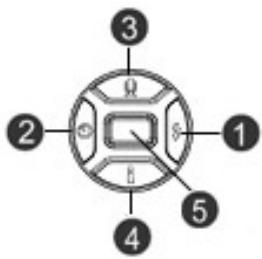 | 1. Right Button: Flash AUTO/OFF2. Left Button :Self-Timer ON/OFF3. Up Button : Voice Recording Mode4. Down Button: LCD Information ON/OFF5. Enter Button: Menu ON |
 | Power Button: Press down for one second to turn on or turn off the camera. |
| [BATH]RECORD / PLAY | RECORD/PLAY Button functions:1. Switch between Record /Playback Mode.2. Return to the previous page. |
 | Tele-Wide Button: Digital Zoom in and out. |
 | Movie Shutter Button:1. Start to take movie, or record voice.2. To stop recording, press it again. |
| Picture Shutter Button: Start to take picture | |
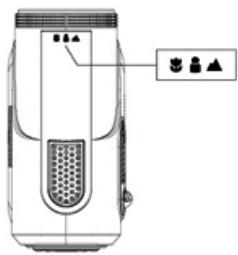 | Macro switch: Switch between Macro Mode, Portrait Mode, and Normal Mode. |
Option Function
 | Movie Mode | |||
 | Resolution | ★★ High | 640 x 480 (1.8 Mbps) | |
| ★★ Std | 640 x 480 (1 Mbps) | |||
| ★ Low | 320 x 240 (500 Kbps) | |||
 | Exposure | +1.0EV +0.6EV+0.3EV 0EV-0.3EV -0.6EV-1.0EV | Select one of the 7 exposure compensation values (-1.0 to +1.0EV | |
 | Sharpness | Adjust with nine sharpness settings to soften or sharpen picture/movie. | ||
| Auto | Automatic adjustment | |||
| WBWhite Balance |  Auto Auto | Automatic adjustment | ||
 Daylight Daylight | Use under outsides light condition | |||
 Fluorescent Fluorescent | Use under fluorescent light condition | |||
 Tungsten Tungsten | User under tungsten light condition | |||
 Motion Stabilization Motion Stabilization | On | Corrects camera shake instantly, giving you smooth and stable video. | ||
| off | Disables motion stabilization | |||
 Motion Detect Motion Detect | On | Start to record video while detecting movement of object(s). | ||
| off | Disable motion detection. | |||
 Camera Mode Camera Mode | ||||
 Resolution Resolution | ★★ High | 3744 x 2808 (10M pixel) | ||
| ★★ Std | 2048 x 1536 (3 M pixel) | |||
| ★ Low | 1024 x 768 (800K pixel) | |||
 Exposure Exposure | +1.0EV +0.6EV +0.3EV 0EV -0.3EV -0.6EV -1.0EV | Select on of the 7 exposure compensation values (-1.0 to +1.0EV | ||
| Two in One Mode | On | Combines two snapshots into one frame | ||
| off | Disables Two in One | |||
 Photo Frame Photo Frame | Adds photo frame to the picture | |||
 Flash Flash |  Auto Auto | The flash fires automatically according to the scenic light condition. | ||
 Off Off | The flash will not fire in any light condition. | |||
| Self-Timer Mode |  On On | Activates 10-second-delayed Self-Timer. | ||
 Off Off | Disables Self-Timer | |||
 Sharpness Sharpness | Adjust with nine sharpness settings to soften or sharpen picture/movie. | |||
 White Balance White Balance |  Auto Auto | Automatic adjustment | ||
 Daylight Daylight | Use under outside light condition | |||
 Fluorescent Fluorescent | Use under fluorescent light condition | |||
 Tungsten Tungsten | User under tungsten light condition | |||
| Multi-Snap | OnOff | Takes 5 continuous pictures at one timeDisables Multi-Snap | ||
 Backlight Backlight | On | Brightens the object when its background is much brighter than the object. | ||
| Off | Disables Backlight mode | |||
 Date Printing Date Printing | On | Imprints the date on picture. | ||
| Off | Disables Date Printing | |||
| [YBWA] | Voice Pen | |
 | Enter | Enters the voice recording section |
 | Exit | Exits the menu. |
 Effect Effect | |
| Normal | No special effects applied to the picture. |
| B/W | Picture is converted to black-and-white. |
| Classic | Sepia look is applied to the image. |
| Negative | The image is converted as the negative of the normal. |
| SET Setting | |
| Sound | On: Enable operation soundOff: Disable operation sound |
| Start-up Screen | Customize Startup Screen |
| Time Setting | Setup Date and Time |
| Format Card | YES: Format SD cardNO: Do not format SD card |
| TV System | TV output setting is NTSC standard |
| TV output setting is PAL standard | |
| Language | English, Brazil Portuguese, German, Italian, Spanish, Russian and Traditional Chinese. |
| Default Setting | Yes: Restore default factory settingNo: Do not restore default factory setting |
LCD Monitor Information
The indicators shown below may display on LCD when movies and pictures are recorded
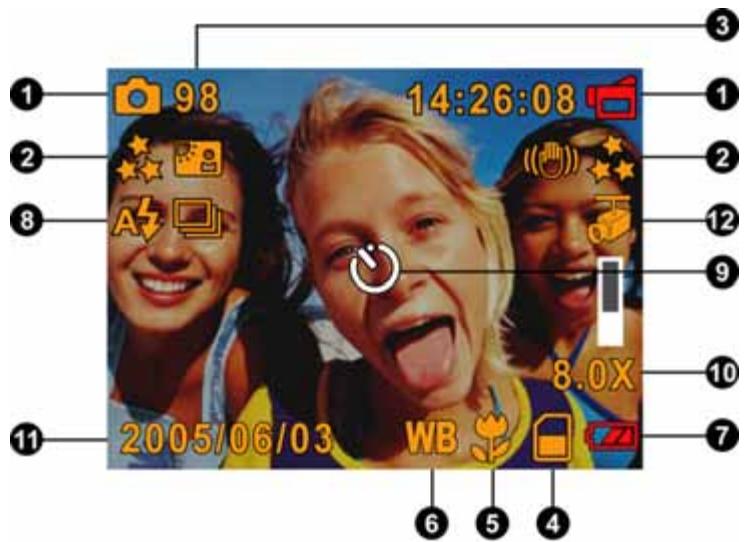
| (1) | Record Mode | |
 | Movie Record Mode | |
 | Picture Record Mode | |
| [WWZZ] | Voice Record Mode | |
 | Motion Stabilization | |
 | Two in One Mode | |
 | Photo Frame | |
 | Multi-Snap Mode | |
 | Backlight Mode | |
| (2) | Resolution | |
| Movie: ★★ High / ★★ Standard/ ★ Low | ||
| Picture: ★★ High / ★★ Standard/ ★ Low | ||
| (3) | Number of images or recording time of movie that can still be taken at current resolution. | |
| (4) | [42H6] | SD card inserted |
| (5) |  | Macro Position Focusing |
| (6) |  | White Balance |
| (7) |  | |
| (8) | [SOZY] | Auto Flash |
 | Flash Off | |
Resolution
| (9) |  | Self-timer enabled |
| (10) | 8X digital zoom | |
| (11) | Date/Time : YYYY/MM/DD HH: MM | |
| (12) |  | Motion Detection |
MPEG-4 Movie Recording
Press Movie Shutter button ( ) to start recording. When a movie is recording, a time indicator will display on LCD monitor. To stop recording, press Movie Shutter Button ( ) again. Press RECORD/PLAY Button to view the recorded movie.
Three resolution settings are available:
| Resolution | Quality |
| 640*480(1.8Mbps) / 30 fps | High Quality  |
| 640*480(1 Mbps) / 30 fps | Standard Quality  |
| 320*240 (500 Kbps) / 30 fps | Low Quality [SKDA] |
The table below shows the approximate number of video recording that you can take at each setting based on 64MB internal memory (32MB available for image storage) or using an optional memory card from 64MB to 2GB SD.
| Resolution | Image Quality | Internal Memory | SD Memory Card | |||||
| 64 MB | 128 MB | 256 MB | 512 MB | 1GB | 2GB | |||
| 640*480 (1.8Mbps) / 30 fps | High Quality | 2min 59 sec | 4 min 10 sec | 8 min 20 sec | 16 min 40 sec | 33 min 20 sec | 66 min 40 sec | 133 min 20 sec |
| 640*480 (1 Mbps) / 30 fps | Standard Quality | 5min 29 sec | 7 min 30 sec | 15 min | 30 min | 1 hour | 2 hours | 4 hours |
| 320*240 (500 Kbps) / 30 fps | Low Quality | 10min 59 sec | 15 min | 30 min | 1 hour | 2 hours | 4 hours | 8 hours |
* The above data shows the standard testing results. The actual capacity varies according to the shooting conditions and settings.
Picture Recording
Press the Picture Shutter Button ( ) to take a picture. Press RECORD/PLAY Button to view the picture.
Three resolution settings are available:
| Resolution | Image Quality |
| 3744*2808 (10M pixel) | High Quality  |
| 2048*1536 (3M pixel) | Standard Quality  |
| 1024*768 (800K pixel) | Low Quality  |
The table below shows the approximate number of shots that you can take at each setting based on 64MB internal memory (32MB available for image storage) or using an optional memory card from 64MB to 2GB SD.
| Resolution | Image Quality | Internal Memory | SD Memory Card | |||||
| 64 MB | 128 MB | 256 MB | 512 MB | 1GB | 2GB | |||
| 3744x2808 | High Quality | 18 | 25 | 50 | 100 | 200 | 400 | 800 |
| 2048x1536 | Standard Quality | 48 | 70 | 140 | 280 | 560 | 1120 | 2240 |
| 1024x768 | Low Quality | 185 | 272 | 545 | 1090 | 2180 | 4360 | 8720 |
* The above data shows the standard testing results. The actual capacity varies according to the shooting conditions and settings.
Voice Recording
- Press Upper Button (☐) of Direction Buttons to switch to Voice Record Mode.
- Press Movie Shutter Button ( ) to record voice.
- Press Movie Shutter Button ( ) again to stop.
- Press RECORD/PLAY Button to view the recorded voice.
The table below shows the approximate number of voice recordings that you can take at each setting based on 64MB internal memory (32MB available for image storage) or using an optional memory card from 64MB to 2GB SD.
| Resolution | Internal Memory | SD Memory Card | |||||
| 64 MB | 128 MB | 256 MB | 512 MB | 1GB | 2GB | ||
| Voice Recording | 33 min | 1 hour | 2 hours | 4.5 hours | 9 hours | 18 hours | 36 hours |
| 45 sec | 7.5 min | 15 min | |||||
* The above data shows the standard testing results. The actual capacity varies according to the shooting conditions and settings.
Taking Close up Pictures
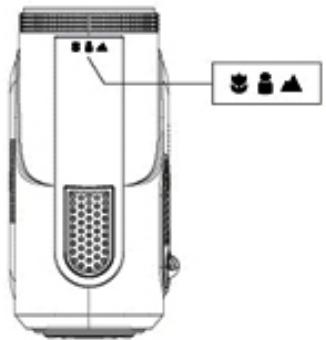
The camera has two close-up picture modes to allow you to take pictures at close range. The Macro Mode (💡) should be used for object located at about 20 cm, while the Portrait Mode (💡) should be used for object located from 60 cm to 100 cm.
To take close-up pictures:
- Rotate the lens ring to switch to
Macro (↓) or Portrait ( )
positions. In Macro Mode, the
macro icon (💡) will appear on the LCD monitor.
- Press Picture Shutter Button (☐)
to take the picture.

NOTE
■ Remember to turn the macro switch back to Normal ( ▲ ) when you are not taking close-up pictures.
Using Digital Zoom
The digital zoom magnifies images, when recording movies or taking pictures.
- To zoom in/out, press the Tele/Wide Button.
The digital zoom can be set from 1x to 8x and the magnification ratio is shown on the LCD monitor.
Options for Record Mode
| Movie Mode | Picture Mode | Voice Pen | Effect | Set |
| ResolutionExposureSharpnessWhiteBalanceStabilizationMotionDetectExit | ResolutionExposureTwo in OnePhotoFrameFlashSelf-timerSharpnessWhiteBalanceMulti-snapBacklightDate printingExit | EnterExit | NormalB/WClassicNegativeExit | SoundStart-upScreenTimeSettingFormatMemoryTVSystemLanguageDefaultSettingExit |
Operations for Record Mode
| Operation | Screen |
| 1. Press Enter Button when in Movie/Picture Record Mode. | 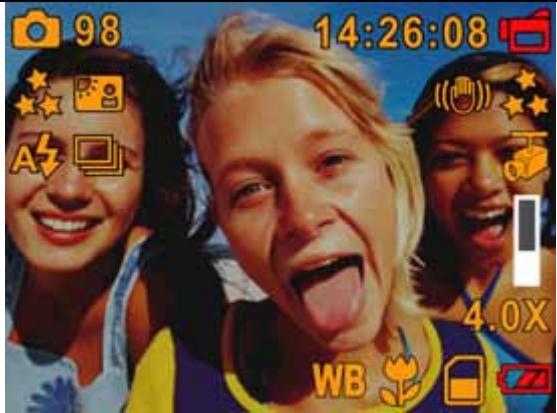 |
| 2. Use Right/Left Buttons to move between main menu options, which are Movie Mode, Camera Mode, Voice Mode, Effect, and Set. Submenu will pop out while move to each main option.3. Press Enter Button to validate sub option you select.4. Select Exit option to exit submenu. |  Enter Button Enter Button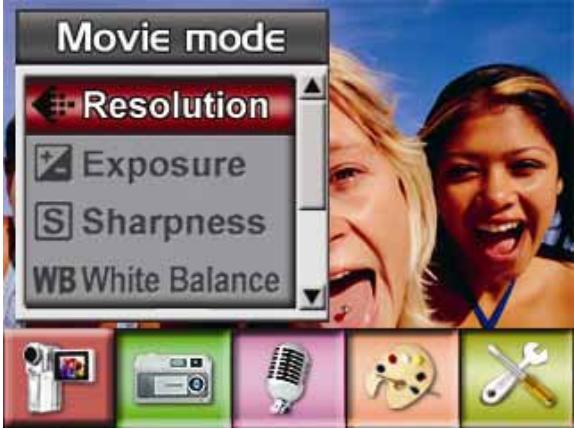 |
Default Setting and Validation
The following table indicates the camera's default setting as well as its validation.
- Always: The setting always keeps valid.
- One Time: The setting is only valid either once or till camera power is off.
| Validation | Default Factory Setting | |
| Resolution | Always | High for MovieStandard for Picture |
| Exposure | One Time | 0EV |
| Sharpness | One Time | Level 5 |
| White Balance | One Time | Auto |
| Motion Stabilization | Always | Off |
| Motion Detect | One Time | Off |
| Two in One | One Time | Off |
| Photo Frame | One Time | Off |
| Flash | Always | Off |
| Self-Timer | One Time | Off |
| Multi-Snap | One Time | Off |
| Backlight Mode | One Time | Off |
| Date Printing | Always | Off |
| Effect | One Time | Normal |
| Sound | Always | On |
| Format Card | One Time | Off |
| TV System | Always | Depends on shipping area |
| Language | Always | Depends on shipping area |
| Volume | Always | Level 6 |
Record Submenu Setting
Record main menu includes camera setting and other advanced setting. You can use Right/Left Buttons to move between options and press Enter Button to validate the setting.
Movie Resolution
To change Movie Resolution:
- In Movie/Picture Record Mode, press Enter Button to switch to record menu screen.
- Use Right/Left Buttons to select Movie Mode. Submenu of Movie Mode will pop out on the screen.
- Use Up/Down Buttons to select Resolution then press Enter Button to switch to Resolution submenu.
- Use Up/Down Buttons to move between three settings.
- Press Enter Button to validate the setting and exit.
Display Screen
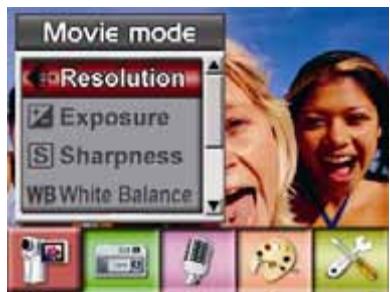
Video Resolution Option
Enter Button

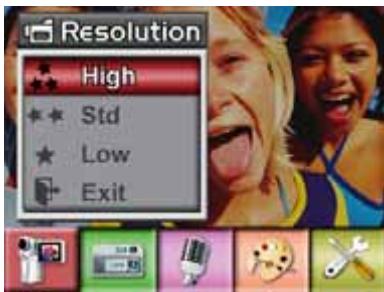
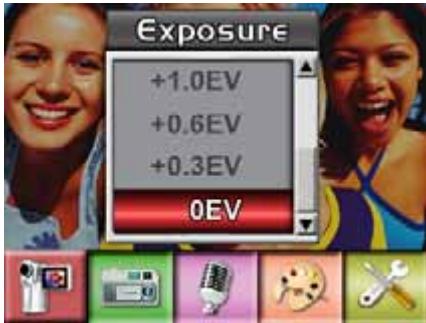
Exposure
The camera adjusts image exposure automatically. In certain circumstances you may wish to adjust the exposure compensation setting.
To change Exposure setting:
- In Movie/Picture Record Mode, press Enter Button to switch to record menu screen.
- Use Right/Left Buttons to select Movie Mode. Submenu of Movie Mode will pop out on the screen.
- Use Up/Down Buttons to move to Exposure Option. Press the Enter Button and then Exposure Submenu will pop out on the screen.
- Use Up/Down Buttons to choose preferred EV value. The change can be previewed immediately.
- Press Enter Button to validate the setting and exit.
Display Screen
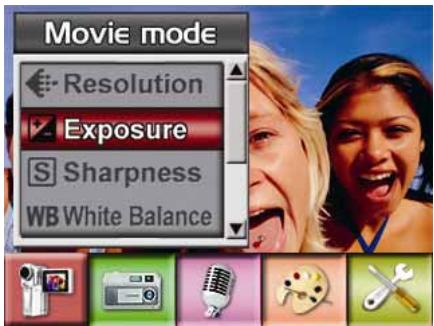
Enter Button

Exposure Option
Sharpness
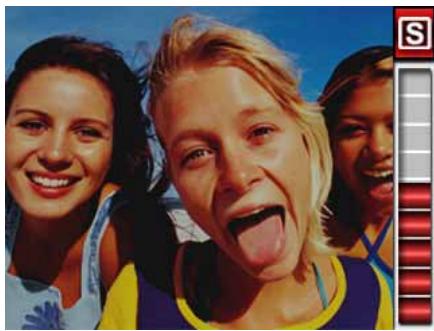
You can soften and sharpen images to achieve different effects.
To change Sharpness setting:
- In Movie/Picture Record Mode, press Enter Button to switch to record menu screen.
- Use Right/Left Buttons to select Movie Mode. Submenu of Movie Mode will pop out on the screen.
- Use Up/Down Buttons to select Sharpness then press Enter Button to switch to Sharpness submenu.
- Use Up/Down Buttons to move between nine levels. The change can be previewed immediately.
- Press Enter Button to validate the setting and exit.
Display Screen
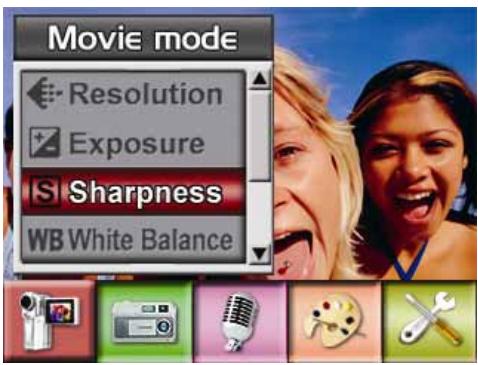
Change Sharpness Setting
Enter
Button

natural_image
Group photo of three smiling young people with one tongue out, against a blue sky background (no text or symbols visible)White Balance
The camera adjusts the color balance of images automatically. Three manual white balance settings are available:
- Auto (Default): The camera automatically adjusts white balance.
- Daylight: Under outdoors
- Fluorescent: Under fluorescent light condition.
- Tungsten: Under tungsten light condition.
To change White Balance Setting:
- In Movie/Picture Record Mode, press Enter Button to switch to record menu screen.
- Use Right/Left Buttons to select Movie Mode. The submenu of Movie Mode will pop out on the screen.
- Use Up/Down Buttons to select White Balance, then press Enter Button to switch to White Balance submenu.
- Use Up/Down Buttons to move between four settings. The change can be previewed immediately.
- Press Enter Button to validate the setting and exit.
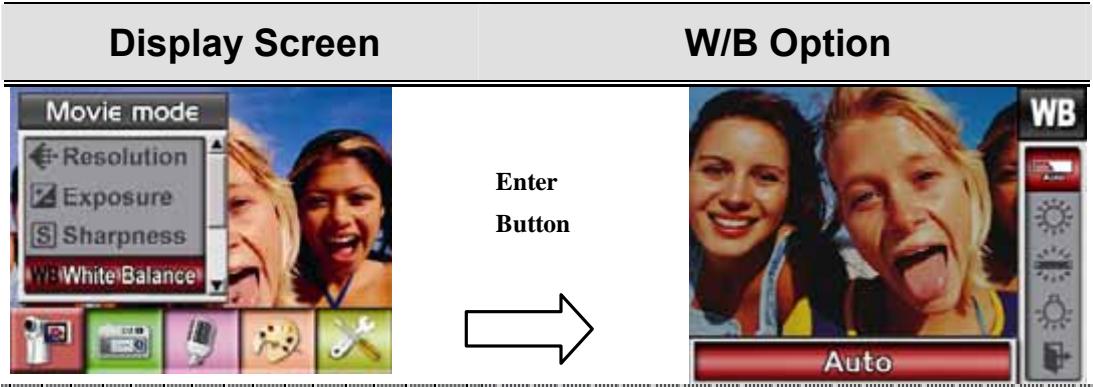
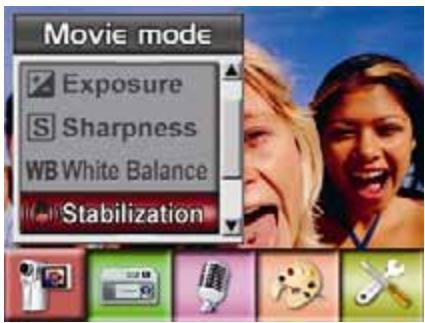
Motion Stabilization
To enable Motion Stabilization:
- In Movie/Picture Record Mode, press Enter Button to switch to record menu screen.
- Use Right/Left Buttons to select Movie Mode. The submenu of Movie Mode will pop out on the screen.
- Use Up/Down Buttons to select Motion Stabilization then press Enter Button to switch to Motion Stabilization submenu.
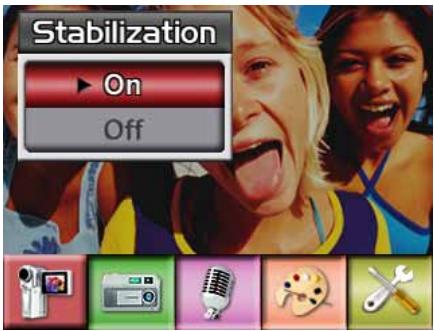
- Use Up/Down Buttons to choose ON or OFF.
- Press Enter Button to validate the setting and exit.
Motion Stabilization
Motion Stabilization Option
Enter
Button


NOTE
■ The captured screen will be smaller when motion stabilization is enabled.
■ Digital Zoom is disabled when motion stabilization is activated.
Motion Detection
To enable Motion Detection:
- In Movie/Picture Record Mode, press Enter Button to switch to record menu screen.
- Use Right/Left Buttons to select Movie Mode. The submenu of Movie Mode will pop out on the screen.
- Use Up/Down Buttons to select Motion Detect then press Enter Buttons to switch to Motion Detect submenu.
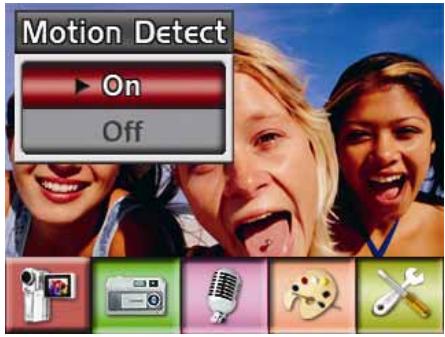
- Use Up/Down Buttons to choose ON or OFF.
- Press Enter Button to validate the setting and exit.
- Camera will start to record video once if there is a movement for 3 consecutive seconds. It will stop recording if there is no movement for 3 seconds.
Motion Detect
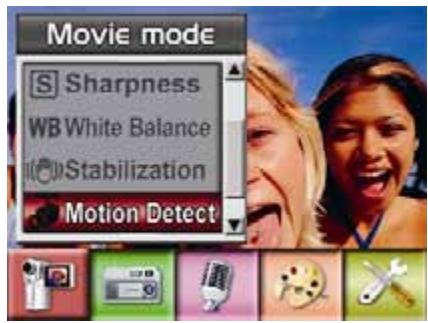
Motion Detect Option
Enter
Button

Camera Mode Setting
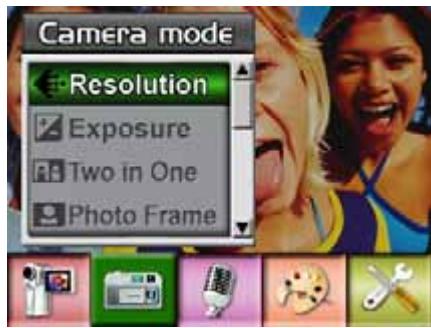
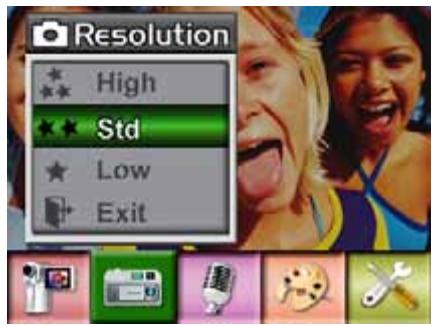
Picture Resolution
To change Picture Resolution:
- In Movie/Picture Record Mode, press Enter Button to switch to record menu screen.
- Use Right/Left Buttons to select Camera Mode. The submenu of Camera Mode will pop out on the screen.
- Use Up/Down Buttons to select Resolution then press Enter Button to switch to Resolution submenu.
- Use Up/Down Buttons to move between three settings.
- Press Enter Button to validate the setting and exit.
Display Screen
Enter
Button

Video Resolution Option
Exposure
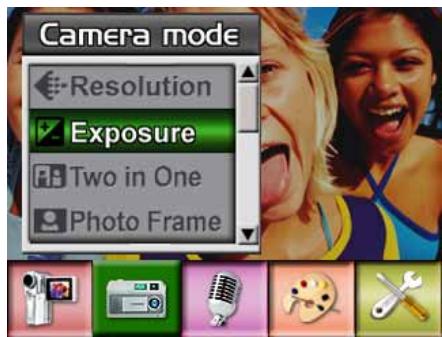
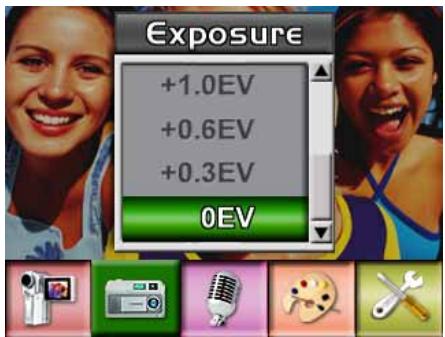
The camera adjusts image exposure automatically. In certain circumstances you may wish to adjust the exposure compensation setting.
To change Exposure setting:
- In Movie/Picture Record Mode, press Enter Button to switch to record menu screen.
- Use Right/Left Buttons to select Camera Mode. The submenu of Camera Mode will pop out on the screen
- Use Up/Down Buttons to move to Exposure Option. Press the Enter Button and then Exposure Submenu will pop out on the screen.
- Use Up/Down Buttons to choose preferred EV value. The change can be previewed immediately.
- Press Enter Button to validate the setting and exit.
Display Screen
Enter Button

Exposure Option
Two in One (Picture Record Mode Only)
With camera set to Two in One mode, you can combine two snapshots into one picture. To enable Two in One:
- In Movie/Picture Record Mode, press Enter Button to switch to record menu screen.
- Use Right/Left Buttons to select Camera Mode. The submenu of Camera Mode will pop out on the screen.
- Use Up/Down Buttons to select Two in One then press Enter Button to switch to Two in One submenu.
- Use Up/Down Buttons to choose ON or OFF.
- Press Enter Button to validate the setting and exit.
Display Screen
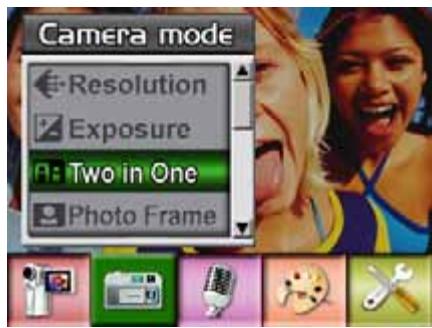
Two in One Option
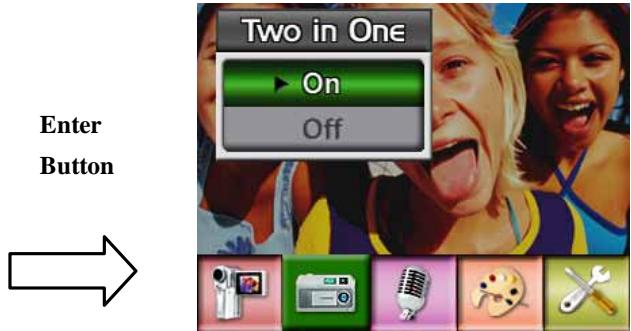
Display Screen
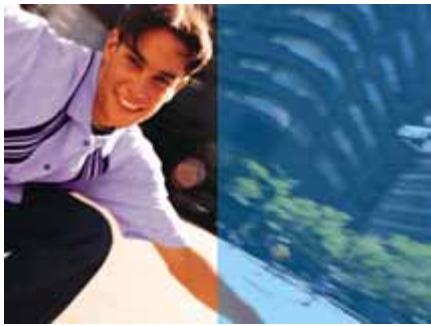
- Press Picture Shutter Button to take first picture.
- Press Picture Shutter Button to take second picture.
- Press the RECORD/PLAY Button to view the Two in One picture.
Two in One Option
natural_image
Man smiling outdoors near a blue water surface with green foliage (no text or symbols visible)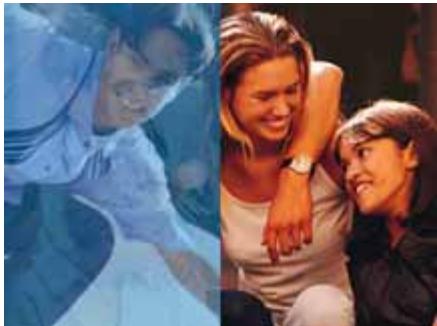
natural_image
Two women laughing and interacting in a dimly lit setting (no visible text or symbols)
natural_image
Three people laughing and interacting in a casual indoor setting (no visible text or symbols)Photo Frame (Picture Record Mode Only)
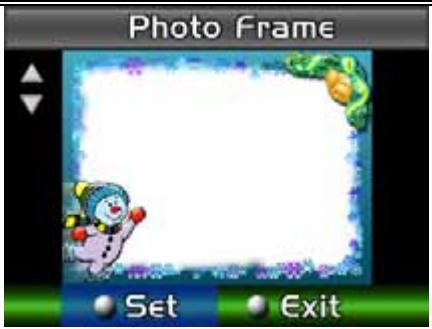
Your camera features popular electronic photo frame. You can take your picture with a preferred electronic photo frames. To enable Photo Frame:
- When in Camera Mode, use Up/Down Buttons to select Photo Frame option, then press Enter Button to switch to Photo Frame submenu.
- Use Up/Down Buttons to locate preferred photo frame. Then select Set option and press Enter Button to validate the setting and exit.
Display Screen
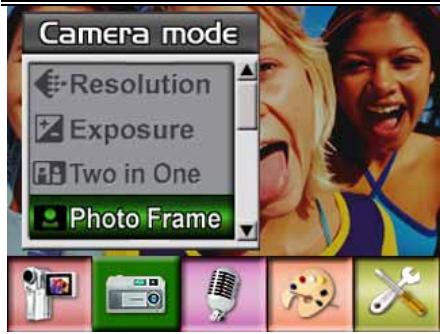
Photo Frame Option
Flash (Picture Record Mode Only)
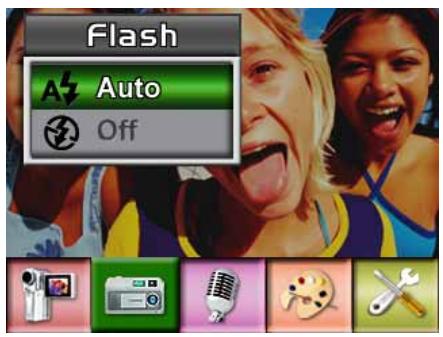
This camera has two flash settings. You can change flash setting by either hot key (Right Button) or Option Setting.
■ Auto-flash(A) the flash fires automatically according to light conditions. Use this mode for general photography.
■ Flash Off(⚡) the flash will not fire under any circumstances. Use this mode when taking images in a place where flash photography is prohibited, or when the subject is distant (beyond the range of the flash).
To change Flash setting:
- When in Camera Mode, use Up/Down Buttons to select Flash Option, then press Enter Button to switch to Flash submenu.
- Use Up/Down Buttons to move between two settings.
- Press Enter Button to validate the setting and exit.
Display Screen
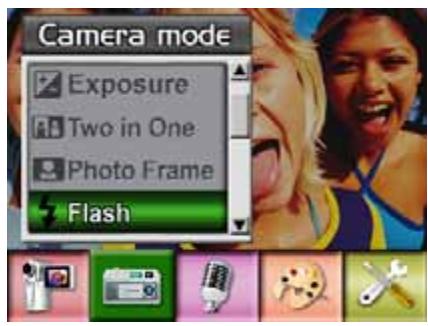
Enter
Button

Flash Options

NOTE
■ The flash will be disabled automatically when battery power is low (☐)
Self-timer (Picture Record Mode Only)
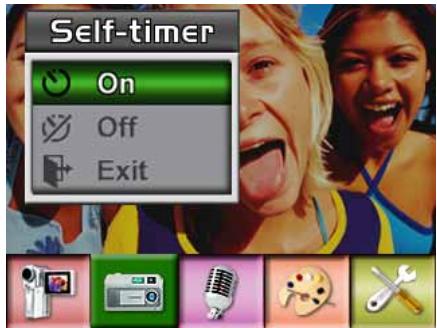
The self-timer allows you to take pictures with a ten-second time delay. You can activate Self-timer by either hot key (Left Button) or Option Setting. The self-timer LED on the front of the camera beneath the flash light will also blink. The speed of blinking will increase just before the picture is taken.
To enable Self-timer:
- When in Camera Mode, use Up/Down Buttons to select Self-timer, then press Enter Button to switch to Self-timer submenu.
- Use Up/Down Buttons to choose On or Off.
- Press Enter Button to validate the setting and exit.
Display Screen
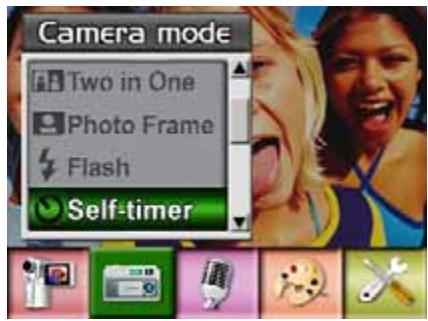
Enter
Button

Self-timer Options
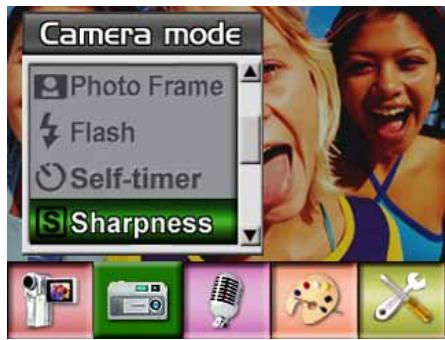
Sharpness
You can soften and sharpen images to achieve different effects.
To change Sharpness setting:
- When in Camera Mode, use Up/Down Buttons to select Sharpness Option, then press Enter Button to switch to Sharpness submenu.
- Use Up/Down Buttons to select Sharpness then press Enter Button to switch to Sharpness submenu.
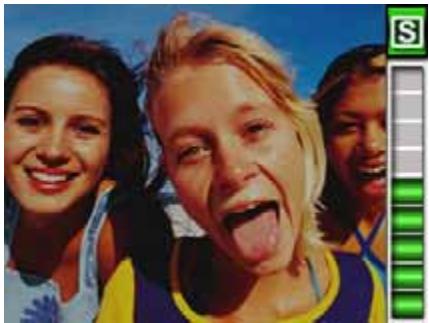
- Use Up/Down Buttons to move between nine levels. The change can be previewed immediately.
- Press Enter Button to validate the setting and exit.
Display Screen
Change Sharpness Setting
Enter Button

natural_image
Group photo of three smiling young people with one tongue out (no visible text or symbols)White Balance
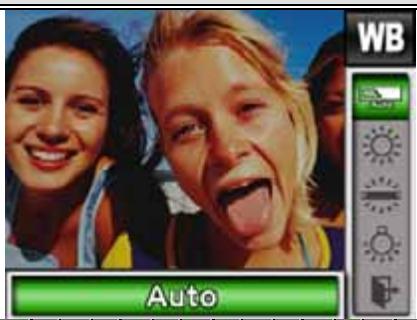
The camera adjusts the color balance of images automatically. Three manual white balance settings are available:
- Auto (Default): The camera automatically adjusts white balance.
- Daylight: Under outdoors
- Fluorescent: Under fluorescent light condition.
- Tungsten: Under tungsten light condition.
To change White Balance Setting:
- In Movie/Picture Record Mode, press Enter Button to switch to record menu screen.
- Use Right/Left Buttons to select Camera Mode. The submenu of Camera Mode will pop out on the screen.
- Use Up/Down Buttons to select White Balance, then press Enter Button to switch to White Balance submenu.
- Use Up/Down Buttons to move between four settings. The change can be previewed immediately.
- Press Enter Button to validate the setting and exit.
Display Screen
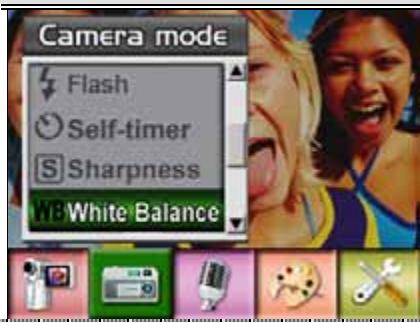
W/B Option

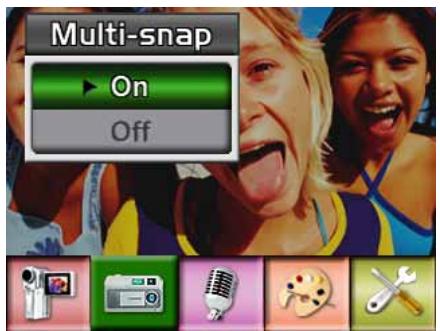
Multi-Snap (Picture Record Mode Only)
With the camera set to Multi-Snap Mode, you can take five continuous pictures.
To enable Multi-Snap:
- When in Camera Mode, use Up/Down Buttons to select Multi-Snap, then press Enter Button to switch to Multi-Snap submenu.
- Use Up/Down Buttons to choose On or Off.
- Press Enter Button to validate the setting and exit.
Display Screen
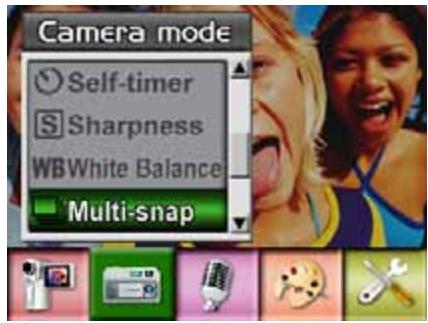
Multi-Snap Option
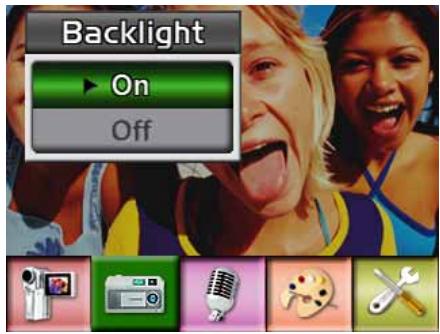
Backlight (Picture Record Mode Only)
With the camera set to backlight Mode, you can take shots when bright light is behind the subject.
To enable Backlight:
- When in Camera Mode, use Up/Down Buttons to select Backlight, then press Enter Buttons to switch to Backlight submenu.
- Use Up/Down Buttons to choose On or Off.
- Press Enter Button to validate the setting and exit.
Display Screen
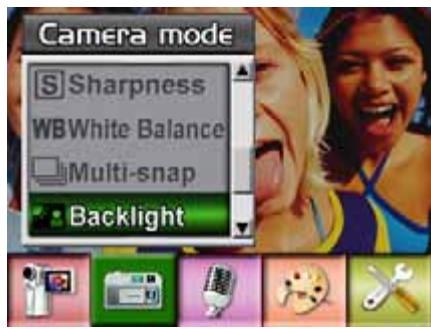
Enter Button
Backlight Option
Date Printing (Picture Record Mode Only)
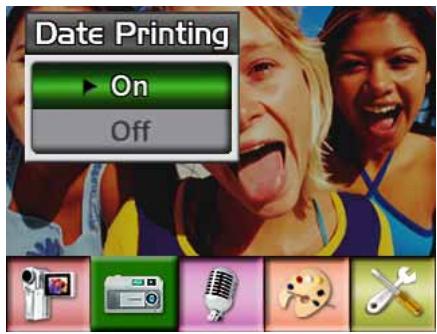
To enable Date Printing:
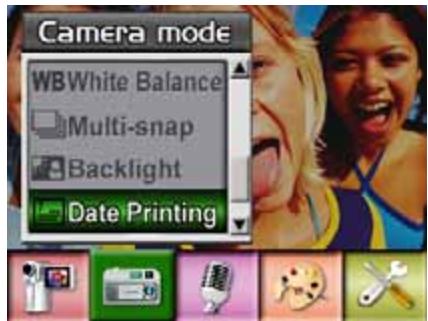
- When in Camera Mode, use Up/Down Buttons to select Date Printing, then press Enter Buttons to switch to Date Printing submenu.
- Use Up/Down Buttons to choose On or Off.
- Press Enter Button to validate the setting and exit.
Display Screen
Date Printing Option
Enter
Button


NOTE
■ Date would be shown on the printed picture once date printing is enabled.
Voice Mode
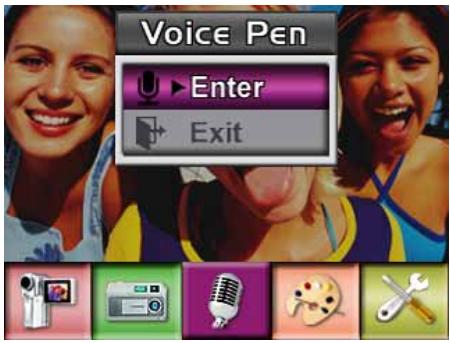
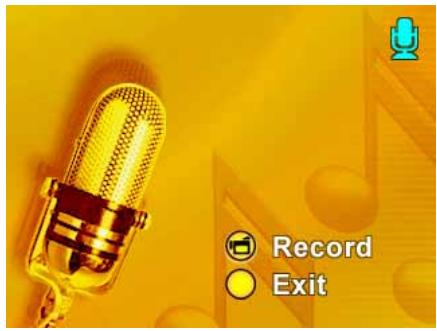
To enable voice recording:
- In Movie/Picture Record Mode, press Enter Button to switch to record menu screen.
- Use Right/Left Buttons to move to Voice Option. Then Voice Submenu will pop out on the screen.
- Use Up/Down Button to move between Enter and Exit Option.
- Choose Enter option to enable voice recording and press Enter Button to validate the setting and exit.
Display Screen
Voice Mode Option
Enter Button

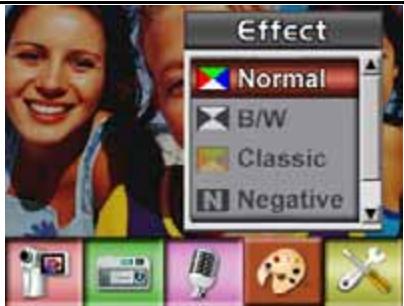
Effect Setting
There are four modes which are Normal, Black/White, Classic and Negative.
To change Effect setting:
- In Movie/Picture Record Mode, press Enter Button to switch to record menu screen.
- Use Right/Left Buttons to move to Effect Option. Then Effect The submenu will pop out on the screen.
- Use Up/Down Buttons to move between four settings. The change can be previewed immediately.
- Press Enter Button to validate the setting and exit.
Display Screen
Setting Menu
The Setting submenu contains options for configuring your camera set up.
To change advanced setting:
- In Movie/Picture Record Mode, press Enter Button to switch to record menu screen.
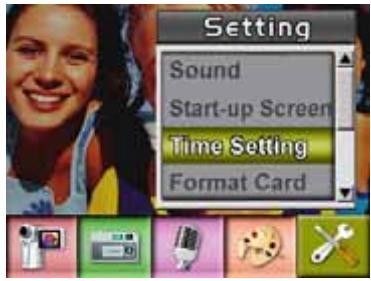
- Use Right/Left Buttons to move to Setting option, then Setting Submenu will pop out on the screen.
- Use Up/Down Buttons to move between settings.
Display Screen
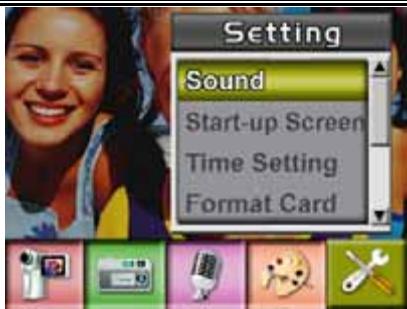
Setting Option
- Sound (operation sound)
- Start-Up Screen
- Time Setting
- Format Card
- TV System
- Language
- Default Setting
- Sound Setting
Enable or disable KeyPad tone and operation sound by using Up/Down Buttons, the press Enter Button to validate the setting.
| Submenu | Display Screen | Sound Setting |
| Sound | 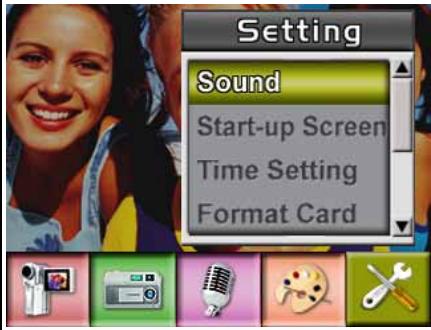 | 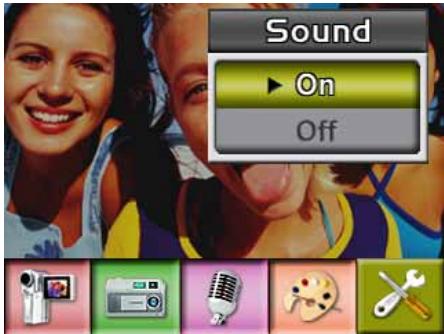 |
- Start-up Screen
Customize the Start-Up Screen with your favorite pictures. Press Right/Left Buttons to select the picture you want and press Enter Button to validate the setting and exit.
| Submenu | Display Screen | Start-Up Screen |
| Start-UpScreen | 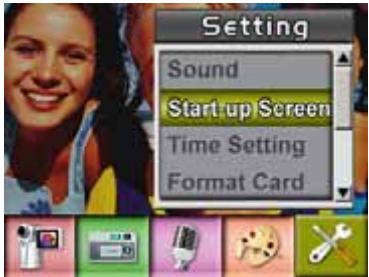 | 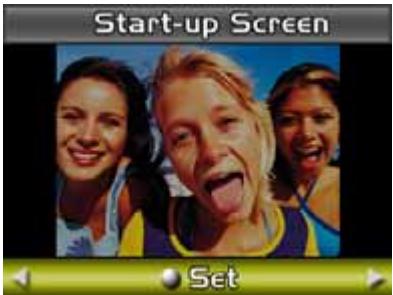 |
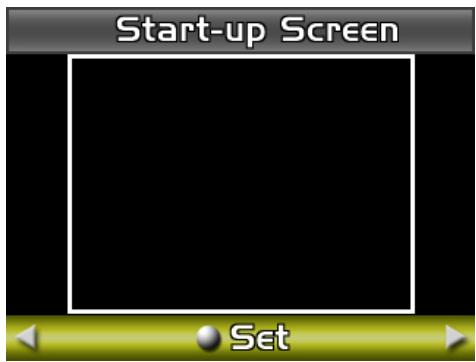
If you do not want to customize the start up screen, press Left/Right Buttons and select No Start-Up Screen.
No Start-Up Screen
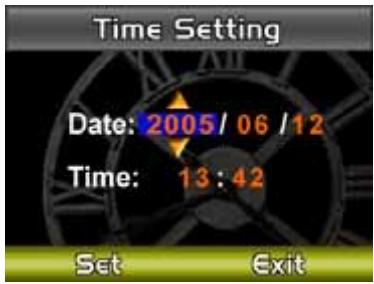
- Time Setting
- Move between Date, Time, Set and Exit by using Left/Right Buttons.
- Adjust date and time by using Up/Down Buttons, then select Set to validate each change.
- Select Exit to leave Time Setting without any change.
Submenu
Display Screen
Time Setting
Time Setting
- Format Card
| Submenu | Display Screen | Format Card Options |
| Format Card | 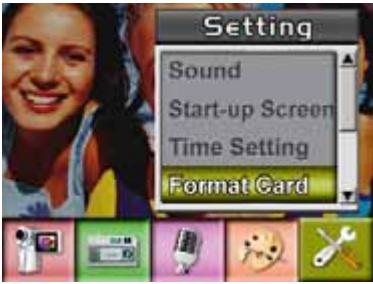 | 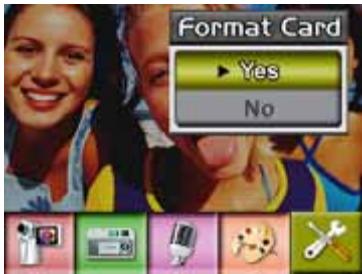 |
Yes Format the SD Card / built-in memory
No (Default) Do not format SD Card / built in memory

NOTE
■ All the data will be erased if the SD card is formatted. Make sure all the data are copied to PC before formatting SD card.
- TV System
Ensure that the appropriate TV standard of your area is selected – either NTSC or PAL.
Wrong TV system setting may cause image flicker.
NTSC standard: USA, Canada, Japan, South Korea and Taiwan etc.
PAL standard: UK, Europe, China, Australia, Singapore and Hong Kong etc.
Submenu
Display Screen
TV System Option
TV System
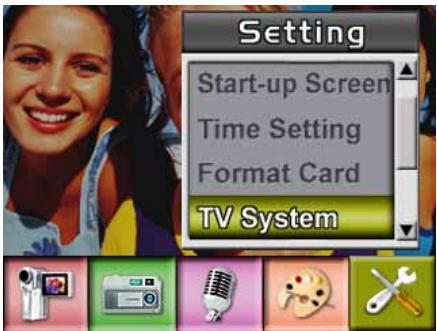
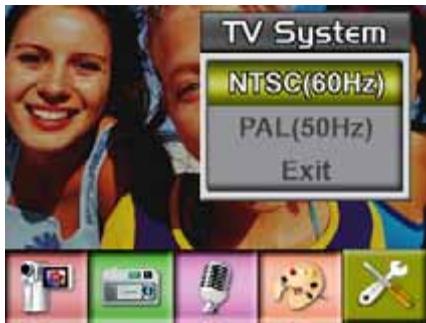
- Selecting Interface Language
Submenu
Display Screen
Language Option
Language
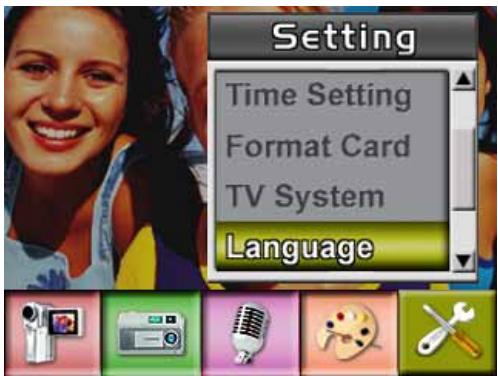
English, Brazil Portuguese, German, Italian, Spanish, Russian and Traditional Chinese.
- Default Setting
To restore the default factory setting, select this option.
| Submenu | Display Screen | Default Setting Options |
| Default Setting | 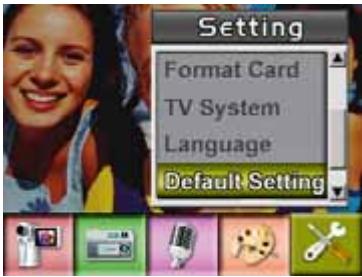 | 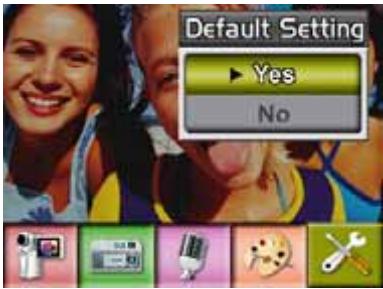 |
Section 4
Playback Mode
Press REC/PLAY button to switch from Record Mode to Playback Mode.
The Playback Mode is for viewing and managing movies and pictures as well as listening to voice and music, or read eBook on the built-in memory or on an optional memory card.
| Operation | Display Screen |
| Press RECORD/PLAY Button to switch from Record Mode to Playback Mode Main Menu.There are five options in the Playback Mode, movie, picture, voice, music, and eBook.Direction Buttons can be used to select the specific option. Press Enter Button to view movies/pictures, listen to voice/music, or read eBook. | 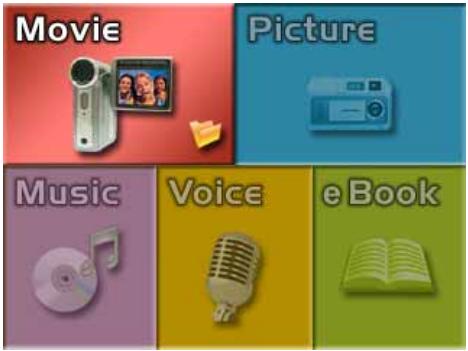 |

NOTE
■ When any recorded movie, picture, voice, music, or eBook is stored in the camera, a folder will be shown on the respective playback mode.
Button Functions
The Direction Buttons have the following functions in Movie and Picture Playback Modes.
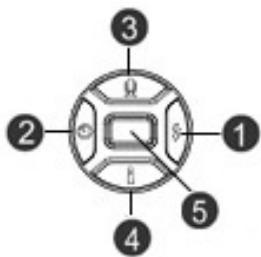 | 1. Right Button:Go to the next movie/ picture.2. Left Button:Go to the previous movie/ picture.3. Up Button:Invalid4. Down Button:Information ON/OFF5. Enter Button:Enter to movie, picture, voice, or music option menu. |
 —RECORD/ PLAY —RECORD/ PLAY | RECORD/PLAY Button functions:1. Switch between Record and Playback modes.2. Return to the previous page. |
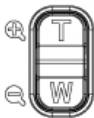 | Tele-Wide Button: Digital Zoom in and out. |
 | Movie Shutter ButtonStart playing the recorded movie or voice |
LCD Monitor Information
Indicators on the LCD screen while in Playback Mode
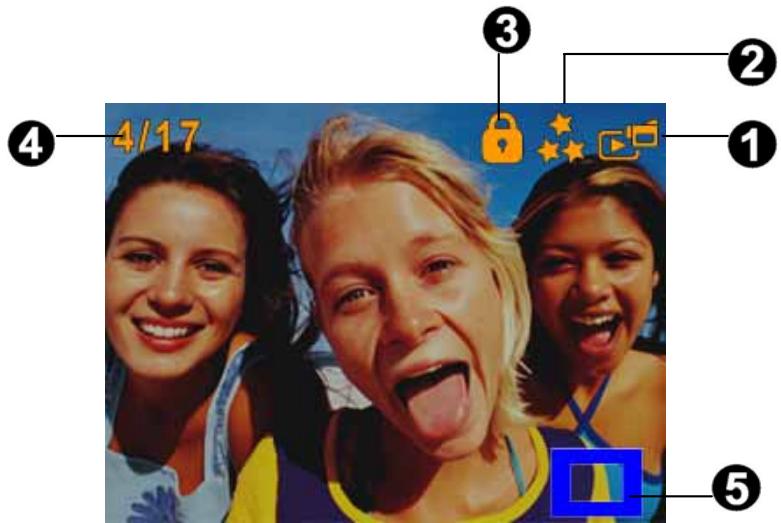
| (1) | Mode Indicator | |
 | Movie Playback Mode | |
 | Picture Playback Mode | |
 | Voice Playback Mode | |
 | Music Playback Mode | |
 | eBook Playback Mode | |
| (2) | Resolution Indicator | |
 | High Resolution | |
 | Standard Resolution | |
| [8F1C] | Low Resolution | |
| (3) |  Indicate the selected movie/picture is locked. Indicate the selected movie/picture is locked. | |
| [0KX4]Indicate the single movie/voice/MP3 is being repeated. | ||
| [X3CE]Indicate all of the movies/voices/MP3 is being repeated. | ||
| [Y2B6]Indicate the slide show is playing. | ||
| (4) | Current Number/ Total number of movie, picture, voice, or MP3. | |
| (5) |  Magnification Indicator. Magnification Indicator. | |
Movie Playback
| Operation | Display Screen |
| 1. Use Direction Buttons to select the Movie option.2. Press Enter Button to go to Movie Playback Mode. | 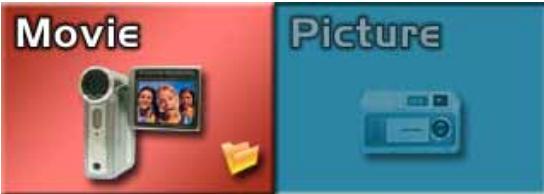  |
| 3. Use Right/Left Buttons to go to the next or last movie.4. Press Movie Shutter Button to play and press it again to pause.5. While playing movie, press Right/Left Buttons to fast forward/backward, then release the button to stop.6. Use Up/Down Buttons to adjust volume. | 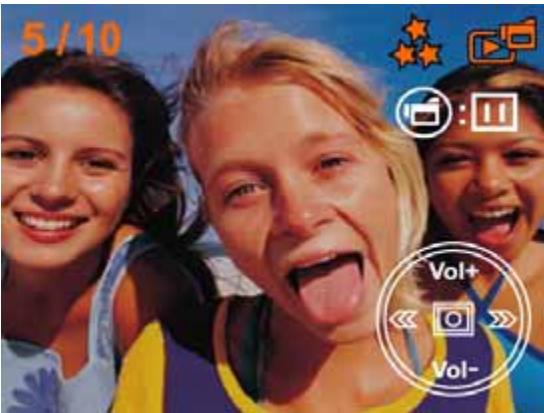 |
| 7. Press Enter Button to go to the movie option menu.8. Use Direction Buttons to select six options, Delete, Thumbnail, Lock, Repeat One, Repeat All, or Exit. |  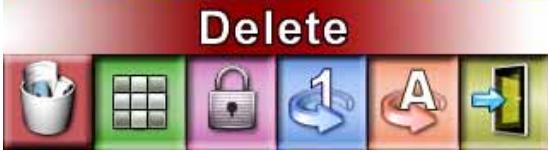 |
Delete Movies
| Operation | Display Screen |
| 1. Use Direction Buttons to select the Delete option ( ). |  |
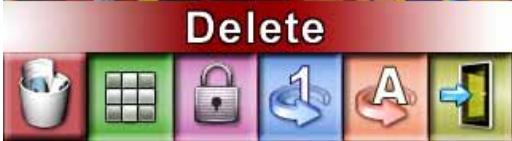 | |
| 2. Press Enter Button to go to the Delete menu.3. Use Right/Left Buttons to select the movie.4. Use Up Button to delete all movies and Down Button to delete single movie.5. Before a movie is deleted, a confirmation screen will appear; choosing “Yes” will execute the operation and “No” to cancel the operation.6. Press Enter Button to exit. |  All One Exit All One Exit |

NOTE
If a memory card is installed, you can delete only those movies stored on the card.
■ Movies on a write-protected memory card cannot be deleted.
■ The delete function will only erase unlocked movies. Locked movies must be unlocked before being deleted.
Thumbnail Function
Single or all movies can be locked. This function can prevent the movies from being deleted accidentally.
| Operation | Display Screen |
| 1. Use Direction Buttons to select the Thumbnail option (☐). |  Thumbnail Thumbnail |
| 2. Press Enter Button to view nine thumbnail movies.3. To play a movie, use Direction Buttons to select the movie and press Enter Button to view. | 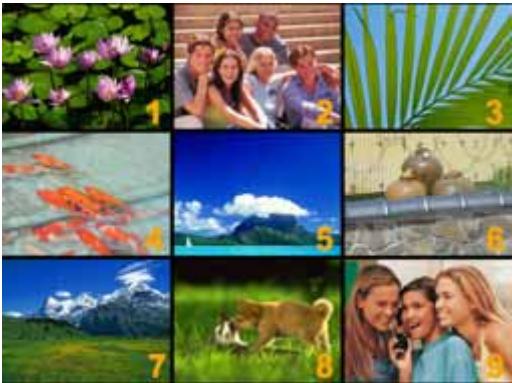 |
Lock Movies
Single or all movies can be locked. This function can prevent the movies from being deleted accidentally.
| Operation | Display Screen |
| 1. Use Direction Buttons to select the Lock option( ).2. Press Enter Button to go to the Lock menu. |  Lock Lock |
| 3. Use Right/Left Buttons to select the movie.4. Use Up Button to lock/unlock all movies and Down Button to lock/unlock single movie.5. Before a movie is locked/unlocked, a confirmation screen will appear; choosing “Yes” will execute the operation, “No” will cancel the operation.6. Press Enter Button to exit. |  All One Exit All One Exit |
Repeat Movies
This function automatically repeats playing single movie or all movies in order.
| Operation | Display Screen |
| 1. Use Direction Buttons to select the Repeat Oneoption ( ) or Repeat Alloption ( ).2. Press Enter Button to start repeating. |  Repeat One Repeat One  Repeat All Repeat All |
Picture Playback
| Operation | Display Screen |
| 1. Use Direction Buttons to select the Picture option.2. Press Enter Button to go to Picture Playback Mode. | 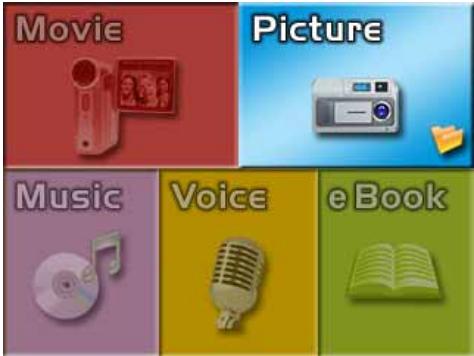 |
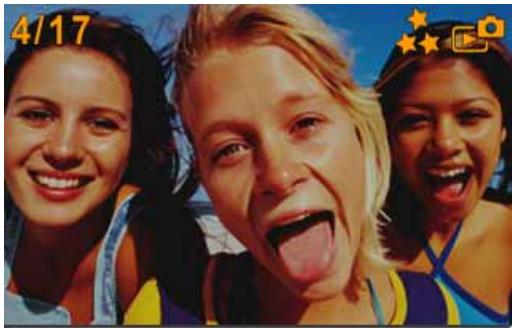
| 3. Use Right/Left Buttons to go to the next or last picture.4. While the picture is selected, use Tele/Wide Buttons to magnify.5. Use Direction Buttons to navigate the magnified picture. | 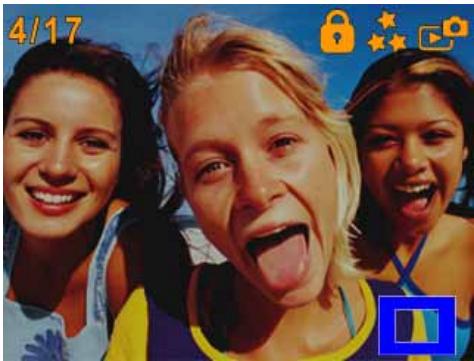 |
- Press Enter Button to go to the picture option menu.
- Use Direction Buttons to select five options, Delete, Thumbnail, Lock, Slideshow, or Exit.

natural_image
Close-up of three smiling women's faces with one tongue out (no text or symbols visible)Delete

natural_image
Row of five colored icons representing different app or system functions (no text or symbols)Delete Picture
| Operation | Display Screen |
| 1. Use Direction Buttons to select the Delete option ( ). |  Delete Delete |
- Press Enter Button to go to the Delete menu.
- Use Right/Left Buttons to select the picture.
- Use Up Button to delete all pictures and Down Button to delete single picture.
- Before a picture is deleted, a confirmation screen will appear; choosing "Yes" will execute the operation, "No" will cancel the operation.
- Press Enter Button to exit.
natural_image
Three smiling young women in a sports outfit, one with tongue out, against a blue sky background (no text or symbols)

NOTE
If a memory card is installed, you can delete only those movies stored on the card.
■ Pictures on a written-protected memory card cannot be deleted.
■ The delete function will only erase unlocked pictures. Locked pictures must be unlocked before being deleted.
Thumbnail Function
| Operation | Display Screen |
1. Use Direction Buttons to select the Thumbnail option  |  |
Thumbnail | |
| 2. While selecting Thumbnail option, press Enter Button to view nine thumbnail pictures.3. To view a picture, use Direction Buttons to select the picture.4. Press Enter Button to view the selected picture. |  |
 | |
 |
Lock Pictures
Single or all pictures can be locked. This function can prevent the pictures from being deleted accidentally.
| Operation | Display Screen |
| 1. Use Direction Buttons to select the Lock option ( ). | 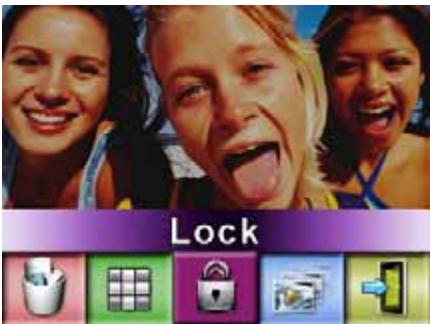 |
| 2. Press Enter Button to go to the Lock menu.3. Use Right/Left Buttons to select the picture.4. Use Up Button to lock/unlock all pictures and Down Button to lock/unlock single picture.5. Before a picture is locked/unlocked, a confirmation screen will appear; choosing “Yes” will execute the operation, “No” will cancel the operation.6. Press Enter Button to exit. | 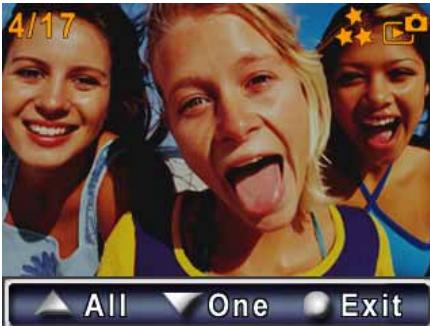 |
Make Slide Show
This function automatically repeats all pictures in order.
| Operation | Display Screen |
| 1. Use Direction Buttons to select the Slide option ).2. Press Enter Button to start the slide show; Press it again to stop. |  Slide Show Slide Show |
Voice Playback
Direction buttons
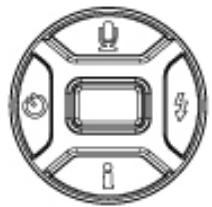
In Voice Playback Mode, the Direction Buttons have the following functions:
natural_image
Circular mechanical component diagram with no visible text or symbolsRight/ Left Buttons
Select the last or next voice.
Up/Down Buttons
Adjust the voice playback volume.
Enter Button
Switch to voice option menu.
| Operation | Display Screen |
| 1. Use Direction Buttons to select the Voice option.2. Press Enter Button to go to Voice Playback Mode. | 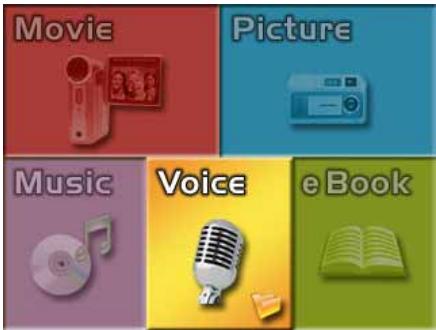 |
| 3. Use Right/Left Buttons to go to the next or last voice recording.4. Press Movie Shutter Button to start playing back the selected voice. Press it again to stop.5. Use Up/Down Buttons to adjust the volume.6. Press Enter Button to go to the voice playback option menu. | 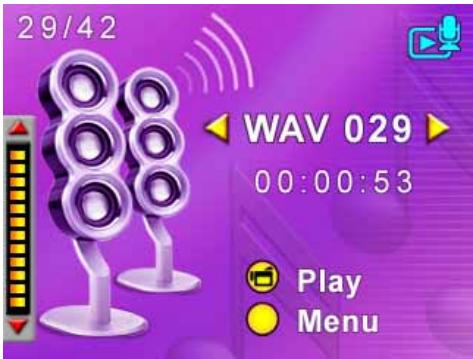 |
| 7. Use Up Button to select Delete option and Down Button to select Repeat option. | 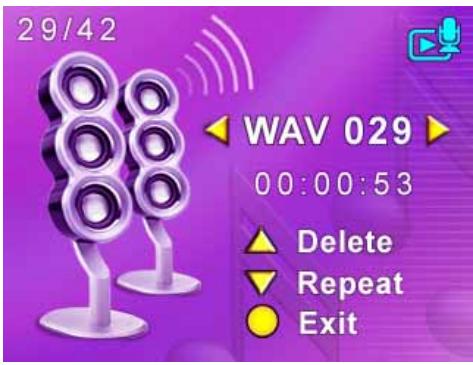 |
| 8. Press Up Button once to repeat single voice; Press twice to repeat all voice recording.9. Press it again to disable the repeat function.10. The repeat icons will be different while selecting Repeat One option and Repeat All option. | 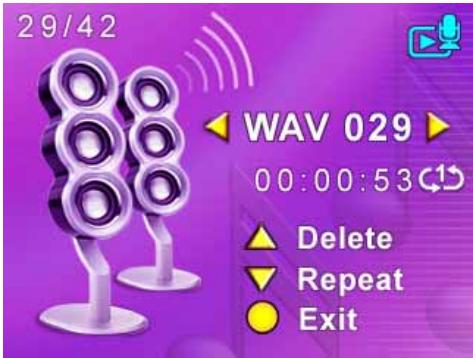 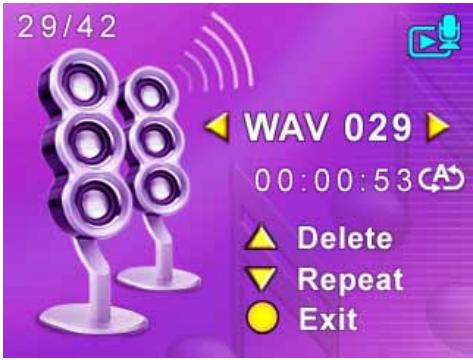 |
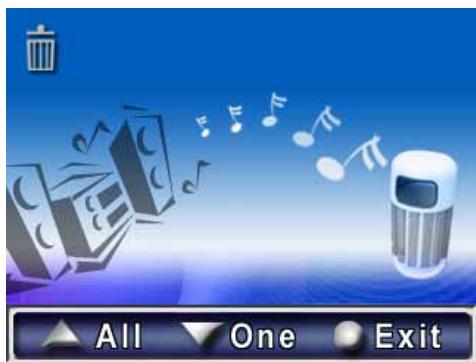
- To delete a voice, use Right/Left Buttons to select the voice.
- Use Up Button to delete all voice recordings and Down Button to delete single voice recording.
- Before a voice is deleted, a confirmation screen will appear; choosing "Yes" will execute the operation, "No" will cancel the operation.
- Press Enter Button to exit.
Section 5
Listening to MP3 Music
MP3 Music
MP3 is a compressed audio file format. The MP3 music can be downloaded from some MP3 web sites. This DV includes the feature of MP3 play with lyrics display. To enable this function, make sure both .mp3 and .lrc files with the same file name are copied to the memory.
Transfer MP3 Music to the Digital Video Digital Video Camera
- Install the camera driver on your computer.
- Connect your camera to the computer USB port.
- The Red LED will light when the camera is connected to the computer and in Mass Storage Mode.
- Transfer MP3 music to My Computer\Removable Disk\MP3.
- Once all the music is transferred, disconnect the USB cable from the PC.
Listen to MP3 Music
| Operation | Display Screen |
| 1. In Playback Mode, use Direction Buttons to select the Music option | 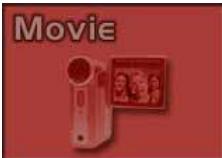 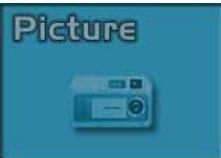 |
   | |
| 2. Use Up/Down Buttons to locate MP3 you want to play, or press Right/Left Buttons to jump to the next/previous page. There is an icon in the front for those MP3 with Lyrics display. | 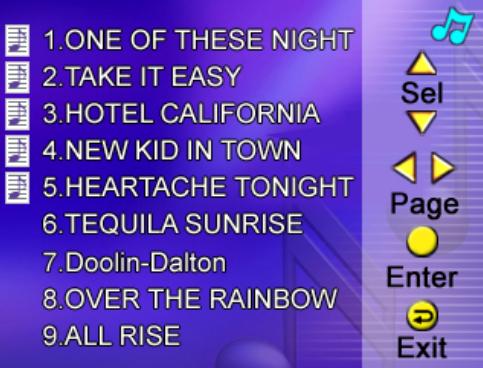 |
| 3. Press Movie Shutter or Enter Button to play MP34. Press Movie Shutter Button again to stop playing.5. Press Up/Down Buttons to adjust volume. | 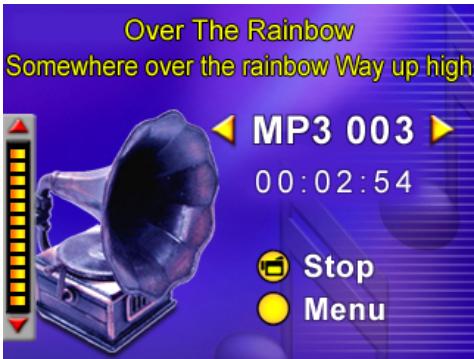 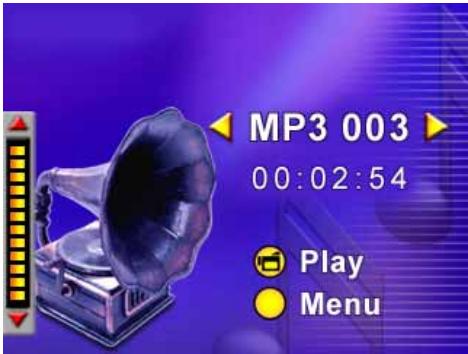 |
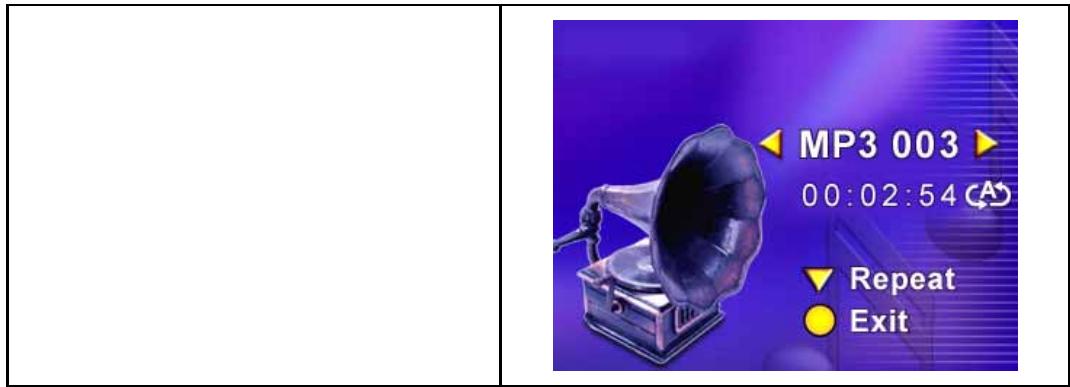
| 6. Press Enter Button to go to repeat menu.7. Press Down Button once to repeat current MP3(1).8. Press Down Button twice to repeat all MP3(2).9. Press Enter Button to exit. | 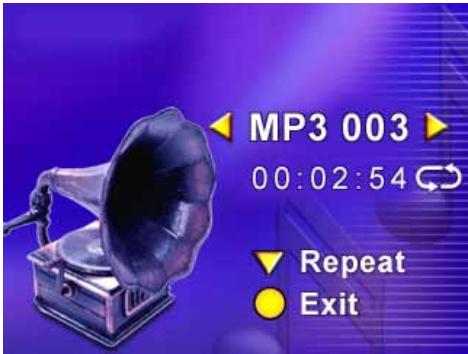 |
Listen to MP3 Music with earphone
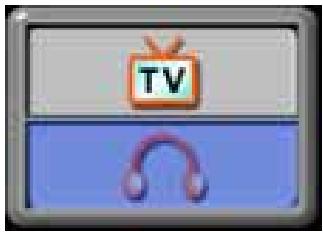
MP3 stored in the camera can be played either by built-in speaker, or Earphone, or TV. When the earphone cable is plugged in the camera, the option menu of Earphone/TV pops out on the LCD Screen. Choose earphone or TV and press Enter Button to validate the setting.
Section 6
Reading eBook
eBook
An eBook is an electronic edition of a physical book. eBooks in your camera have many features that traditional paper books do not: you have the freedom to control the look and feel of your eBook through colors, your own bookmarks, carrying your eBooks anywhere with your camera.
Transfer eBooks to the camera
- Install the camera driver on your computer.
- Connect your camera to the computer USB port.
- The Red LED will light when the camera is connected to the computer and in Mass Storage Mode.
- Transfer eBooks, .txt file format only, to My Computer\Removable Disk\eBook.
- Once all the files is transferred, disconnect the USB cable from the PC.
Read eBooks
| Operation | Display Screen | ||
| 1. In Playback Mode, use Direction Buttons to select the eBook option |  |  | |
 |  |  | |
| 2. Use Up/Down Buttons to select eBook you want to read, or press Right/Left Buttons to jump to the next/previous page. There is an icon in the front for those eBooks with bookmark added. |  | 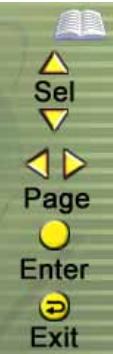 | |
| 3. Press Enter Button to read the eBook.4. Press Up/Down Buttons to scroll up/down the text | 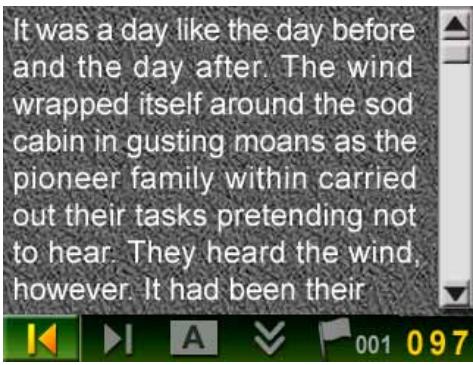 |
| 5. Select◀ to jump to the first page6. Select▶I to jump to the last page7. Select◀ to change the color of text and background.8. Select▼ to auto scroll down the text.9. Select◀ to add a bookmark. | 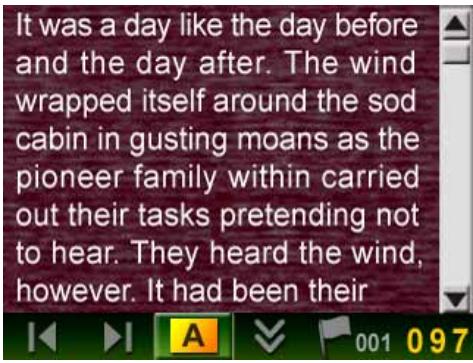 |
Section 7
Viewing MPEG4 Movie on PC
MPEG4 Movie
MPEG-4, the multimedia format and compression standard, is a cutting-edge compression technology developed by MPEG (Motion Picture Expert Group). It not only enhances the image quality but also improves the efficiency of recording capacity.
MPEG-4 is adopted in this Digital Video Camera to take DVD-quality MPEG-4 movies. The MPEG-4 movie format of AVI is used in this Digital Video Camera.
View MPEG-4 Movie on PC
When playing an MPEG-4 movie for the first time, MPEG-4 Video Codec Xvid should be installed in the PC. To do this:
(1) Insert the CD-ROM into the computer's CD-ROM drive. Click "Install Device Driver" (Install MPEG-4 Video Codec Xivd) and follow the on-screen instructions to complete the installation.
(2) Start video player such as Widows Media Player to view MPEG-4 AVI Movies.
Share MPEG-4 Movie
You can share the recorded MPEG-4 movies with your friends via the internet or CD. Make sure MPEG-4 Video Codec Xvid is installed in your friends' PC. MPEG-4 Video Codec Xvid is available in the provided CD or can be downloaded from the Internet.
Section 8
Viewing Pictures and Movies on a TV
You can view stored movies and pictures on a television. To connect to a television:
- Connect one end of the AV cable to your camera's AV Out port.
- Connect the other end of the cable to a television.
- The option menu of Earphone/TV pops out on the LCD Screen.
-
Choose TV option and press Enter Button to validate the setting.
-
The steps for viewing stored pictures and movie on a TV are exactly the same as for viewing them on the LCD monitor.


NOTE
■ The LCD monitor does not work when the Digital Video Camera is connected to a television.
Section 9
Video File Converter
Bundled software CD contains Ulead VideoStudio that features video file converter to convert multiple video formats into MPEG4 Xvid compatible format with your camera. In this way, you can convert any format of video files and playback your favorite movies on your camera.
To convert a video file:
(1) Install Ulead VideoStudio (Refer to section 11)
(2) Click Start→ Select Programs→ Ulead VideoStudio 8.0
(3) VideoStudio 8.0 main Screen will appear on your desktop.
(4) Click "Tools" menu on the right side of the screen then choose
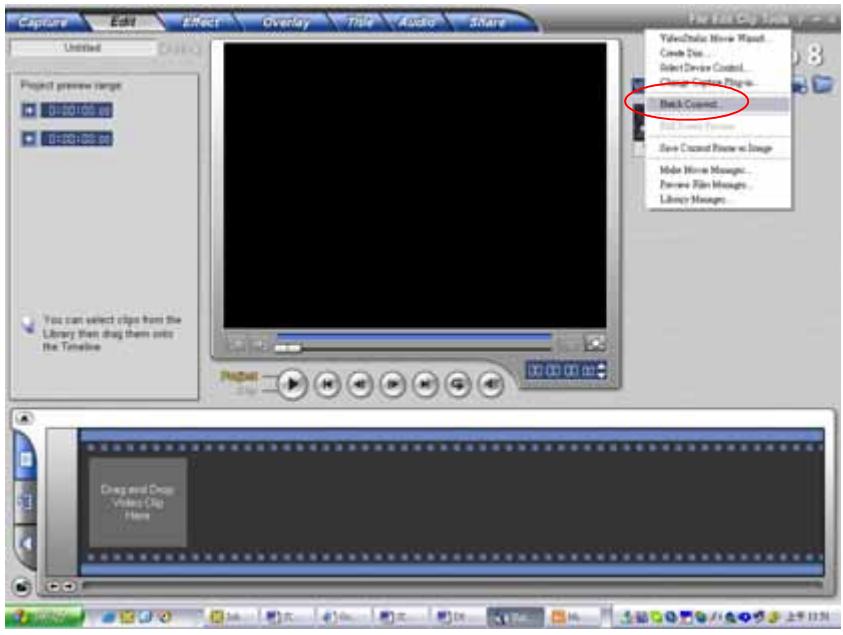
(5) Click "Add" to add the video file you want to convert.
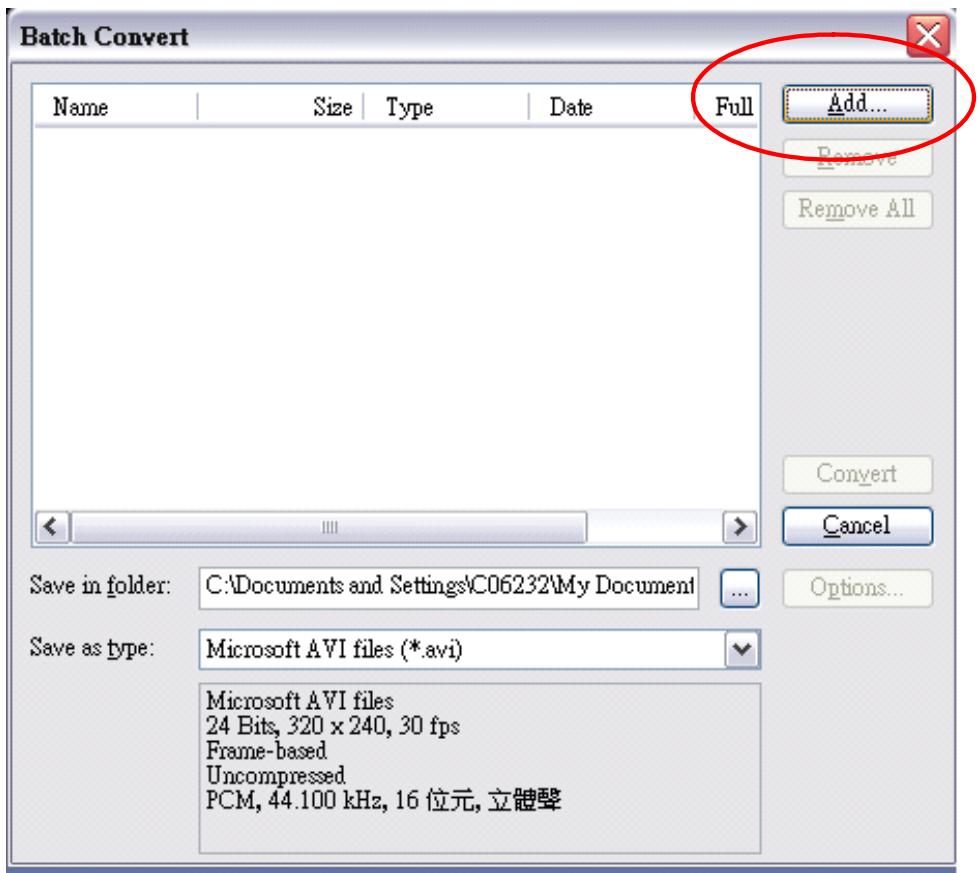
(6) Select "Save as type" to choose output video format and click "Convert" to start file converting.
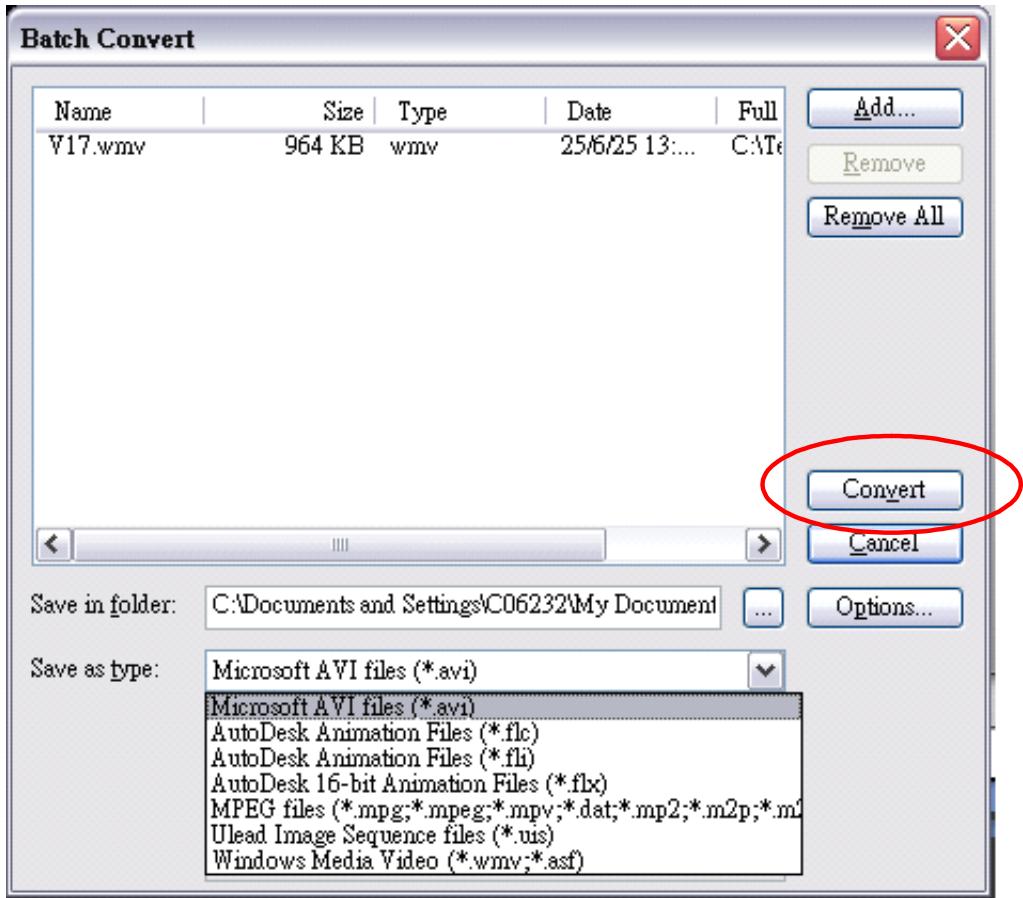
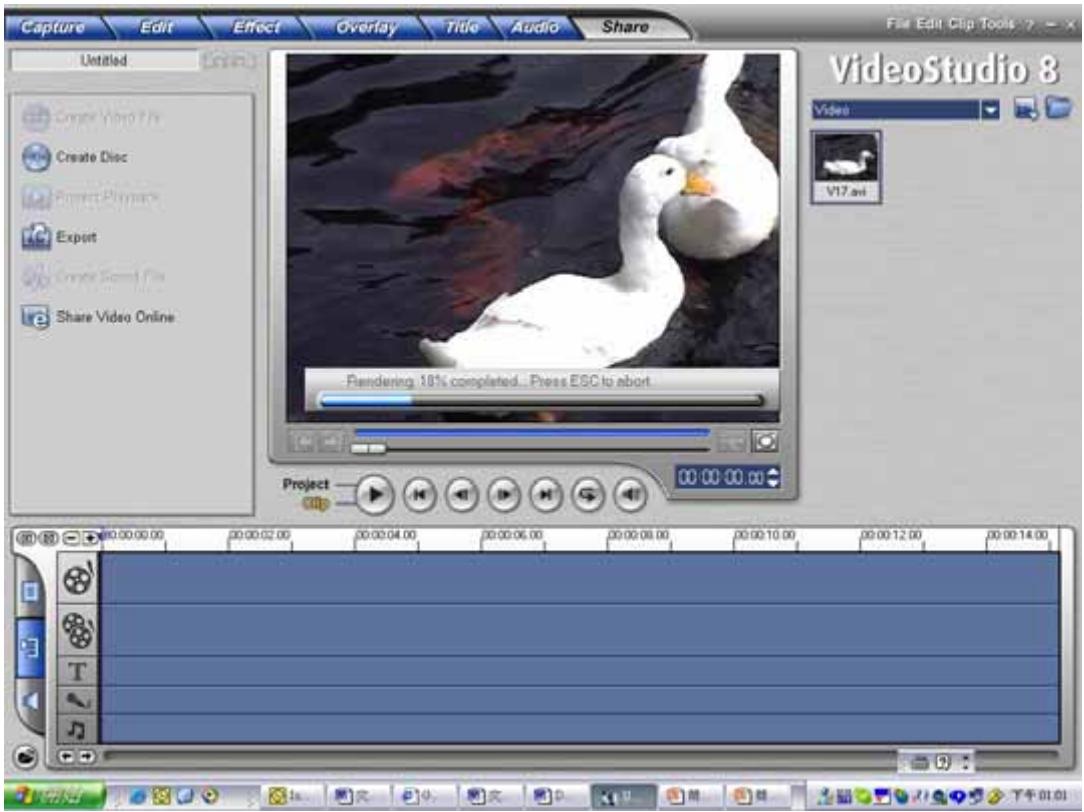
(7) Task Report window will pop out after the task is completed.
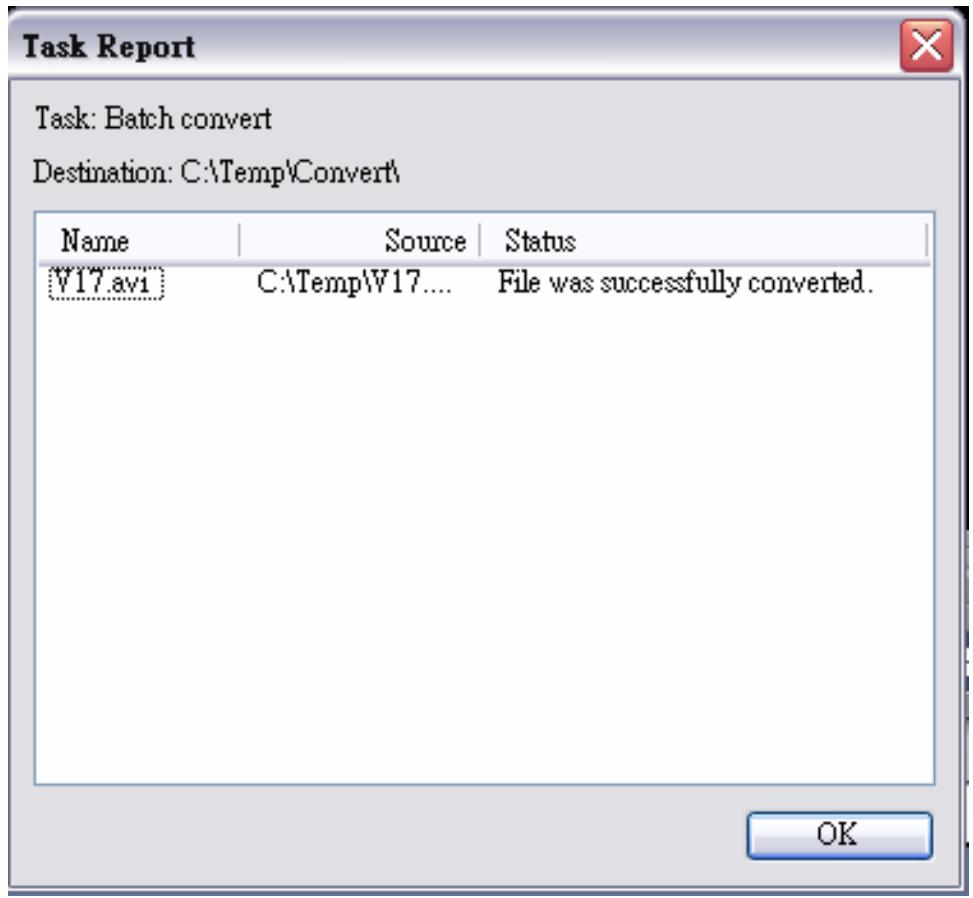
(8) Before transferring the converted file to your camera, rename the converted file to “Clip0001.avi”. (Please note: if Clip0001.avi exists in the camera, then the converted file has to be renamed to clip0002.avi)
(9) Connect your camera to PC and transfer the converted video to "My Computer\Removable Disk\DCIM\200Movie" in your camera. (Refer to Section 10 Transferring Data to a Computer)
(10) After transferring the converted video to the camera, press RECORD/Play Button to enjoy your favorite movie.
Section 10
Burning the Recorded Clip into DVD
Bundled software CD contains Ulead VideoStudio 8.0 SE DVD also feathers burning the movie clip into DVD. You can preserve your precious movies on DVD to share with family and friends. To create a DVD:
(1) Select "Share" Option and click "Create Disc"
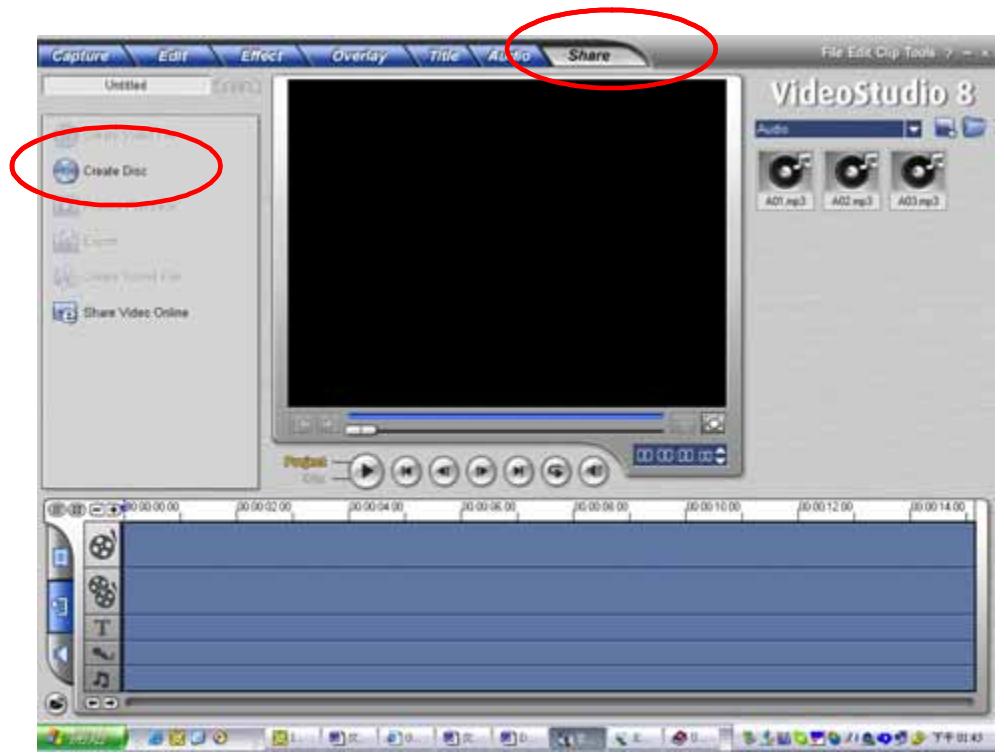
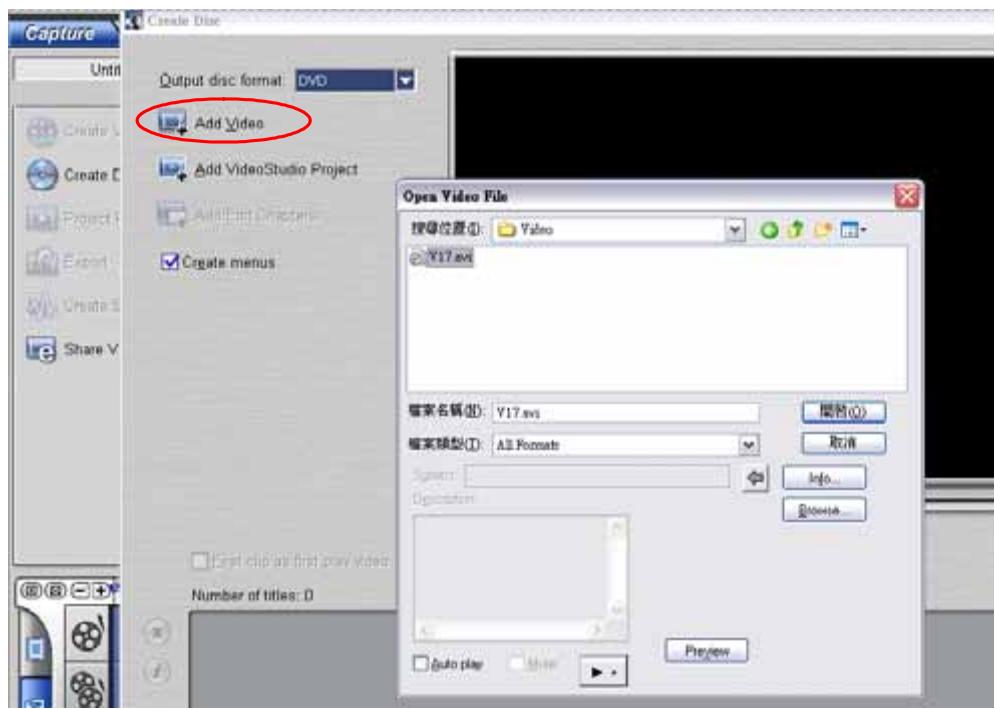
(2) “Create Disc” window pops out and click “Add Video” to add video file you want to burn into DVD. Then click “Next” button and follow on-screen instruction.
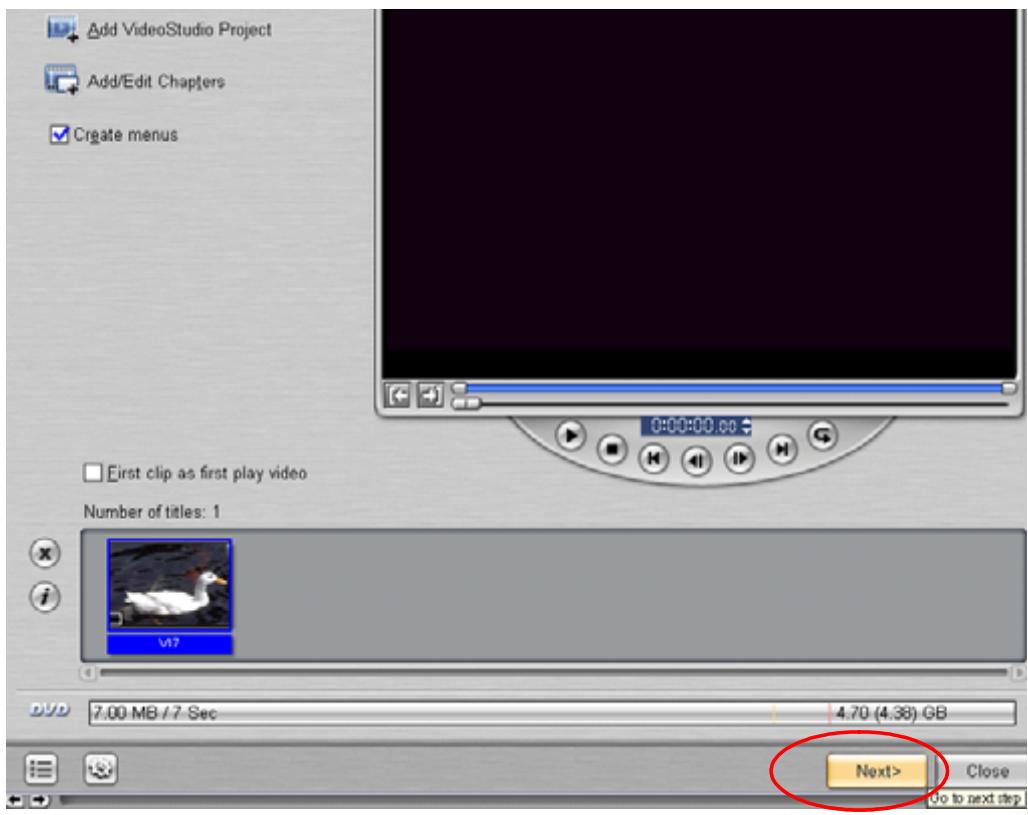
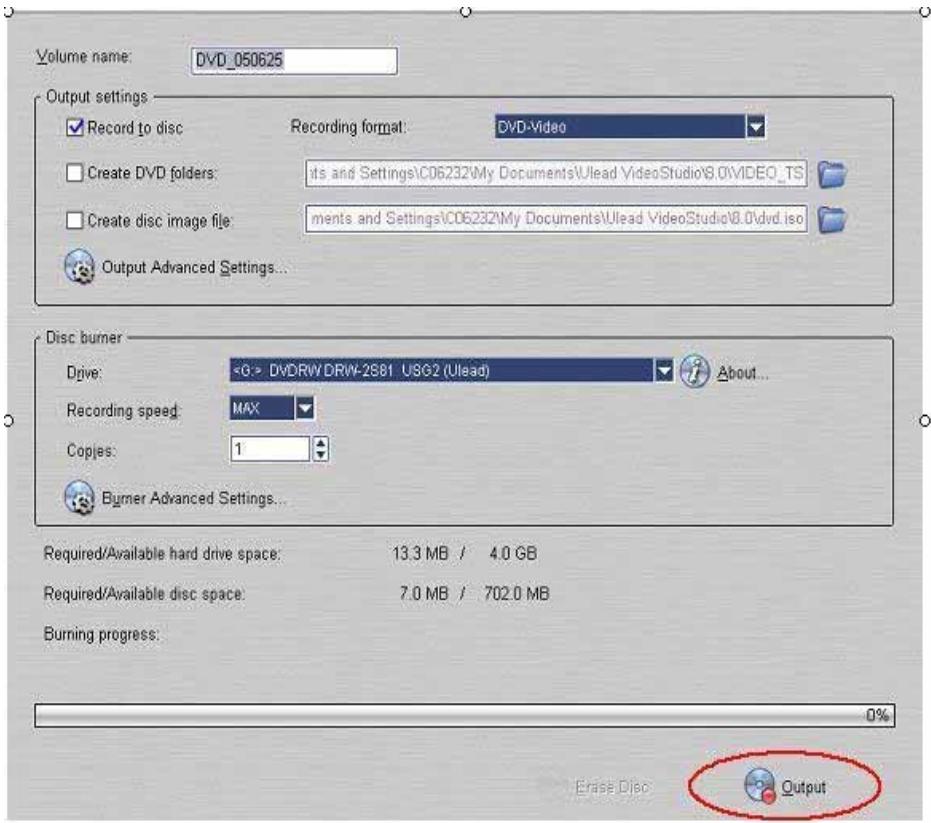
(3) Click "Output" icon

Output
and start to burn DVD.
Section 11
Transferring Data to a Computer
Installing the Data to a Computer
Before connecting this Digital Video Camera to a computer for the first time, you should install a driver on the computer. The driver is on the CD-ROM disc provided in the package. To install the driver:
- Insert the CD-ROM into the computer's CD-ROM drive. The autorun screen will appear.
- Click "Driver". Follow the on-screen instructions to complete the installation. Depending on your operating system, you may have to restart your computer after installing the driver.
Connecting Your Digital Video Camera to a Computer
You can transfer pictures, movies or voice recordings stored on your Digital Video Camera to a computer and send them by emails to friends or post them on websites. To do this you should:
- Install the Digital Video Camera driver on your computer.
- Connect the computer and Digital Video Camera with the supplied mini USB 2.0 cable.
-
Default mode is Mass Storage Mode when the Digital Video Camera connects to PC
-
Transfer pictures or movies or MP3 or voice recordings
Mass Storage Device Mode
The RED LED will light up when the Digital Video Camera is connected to the computer. Movies, pictures and voice recordings can be found on your computer at “My Computer\Removable Disk\DCIM\”. Under this mode, you can read, delete, move, or copy any movie/picture/voice recording you want. Use the bundled Ulead application software to edit the movies or pictures.
PC Camera Mode
When in Mass Storage Device Mode, press the MODE button to switch to PC Camera Mode and the GREEN LED will light up. Under this mode, you can implement live video conference meetings or use video email over the Internet.
To use the Digital Video Camera as a PC Digital Video Camera, follow these steps:
Step 1: Install the PC Digital Video Camera driver (same as USB driver)
Step 2: Connect the Digital Video Camera to your computer
Step 3: Run your application software (i.e. Windows NetMeeting)

NOTE
■ Video conferencing (or video editing) software is not included with the Digital Video Camera.
General System Requirements for Videoconferencing
To use the Digital Video Camera for videoconferencing, your computer system must include:
Microphone
Sound card
Speakers or headphones
■ Network or Internet connection
Step1: Installing the PC Digital Video Camera Driver
The PC-Digital Video Camera driver included on the CD-ROM is exclusively for Windows. The PC Digital Video Camera function is not supported for Mac platforms.
- Insert the CD-ROM into the computer's CD-ROM drive. The autorun screen will appear.
- Click "Driver". Follow the on-screen instructions to complete the installation. Depending on your operating system, you may have to restart your computer after installing the driver.
Step2: Connecting the Digital Video Camera to Your Computer
- Connect one end of the USB cable to an available USB port on your computer.
- Connect the other end of the USB cable to the USB connector on the
Digital Video Camera.
- The PC Digital Video Camera Mode menu appears on the screen.
- Position the Digital Video Camera steadily on top of your computer monitor or use a tripod.
Step3: Running Your Application Software (i.e. Windows NetMeeting)
To use Windows NetMeeting for videoconferencing:
- Go to Start → Programs → Accessories → Communications → NetMeeting to launch the NetMeeting program.
- Click the Start Video button to view live video.
- Click the Place Call button.
- Type the e-mail address or the network address of the computer that you are calling.
- Click Call. The person that you are calling must also have Windows NetMeeting running and be willing accept your call to start the videoconference.

NOTE
■ The video resolution for videoconferencing applications is generally 320 x 240.
■ For more information about the operation of videoconference application software, refer to its respective help documentation.
Installing Bundled Software
The CD-ROM supplied with this camera contains four pieces of software.
→Ulead VideoStudio 8.0 SE DVD is a user-friendly application that helps you read, edit and organize images.
→Ulead Photo Express 5.0 allows you to edit movies and is equally easy to use.
Acrobat Reader is a popular program that you need to have installed to read the User's Manual. Many computer users will find they already have this software installed on their computer.
→MPEG4 Video Codec Xvid, this decode software has to be installed for correctly viewing the movies you record.
Detailed information can be found in the online help of all the bundled software.
To install the bundled software
- Insert the CD-ROM into your computer's CD-ROM drive. The autorun screen appears.
- Select the piece(s) of software you want to install from the list. Follow the on-screen instructions to complete the installation.
Getting Started With Photo Express 5.0
- Click Start Select Programs Photo Express 5.0
- Photo Express 5.0 main Screen will appear on your desktop.
Viewing Images stored in the Digital Video Camera
through Photo Express 5.0
To view images stored in the Digital Video Camera, you must switch to Mass Storage Device Mode.
- Select the image you want to open in the workspace from the browse bar on the left hand side.
- Double click the selected picture.
![Ulead Photo Express SE - [c:\program file\ullead.system\ullead photo express 5 se\images] File Edit View Help BROWSE Get Photo Batch Adjust Print Share Ulead Links BROWSE PHOTO PROJECT 1 BG002.jpg 2 offline1024_2.jpg 3 offline1024_5.jpg 4 offline1024_6.jpg 5 offline600_1.jpg 6 offline600_2.jpg 7 offline600_4.jpg 8 offline600_5.jpg 9 offline600_6.jpg 10 space.gf 0/11 Software - Microsoft O US User Manual 5-26 - Ulead Photo Express 5 100% 下午 06:27](/content/2025/01/175487/images/95648146407ca0b25a8cd7675a8fe7d1c94a9afb5f7c1f10ab2ffd2dd4cecefb.jpg)
Capturing Digital Video Camera Images through
Photo Express 5.0
Before capturing a picture or video from the Digital Video Camera to the Photo Express 5.0 main screen, you must switch to PC Digital Video Camera Mode. Press MODE button to Switch to PC Digital Video Camera Mode. Under this mode, you can capture videos or pictures through Photo Express 5.0:
* Click the [Get Photo
] button.
* Click the [Import] button.
![Visual Photo Express - [C:\Documents and Settings\Classes\My Documents] File Edit View Help BROWSE Get Photo Batch Adjust Print Share Web Links Digital Camera Summer Video Capture My Music My Pictures File name Post File type TP (Tagged Image File Printed) Change Plug-in Import Close](/content/2025/01/175487/images/8b1f8b2fcd8dd4bca1c1a9e218729466cc427bb6cd2c4f09a62fbcee6afc66bd.jpg)
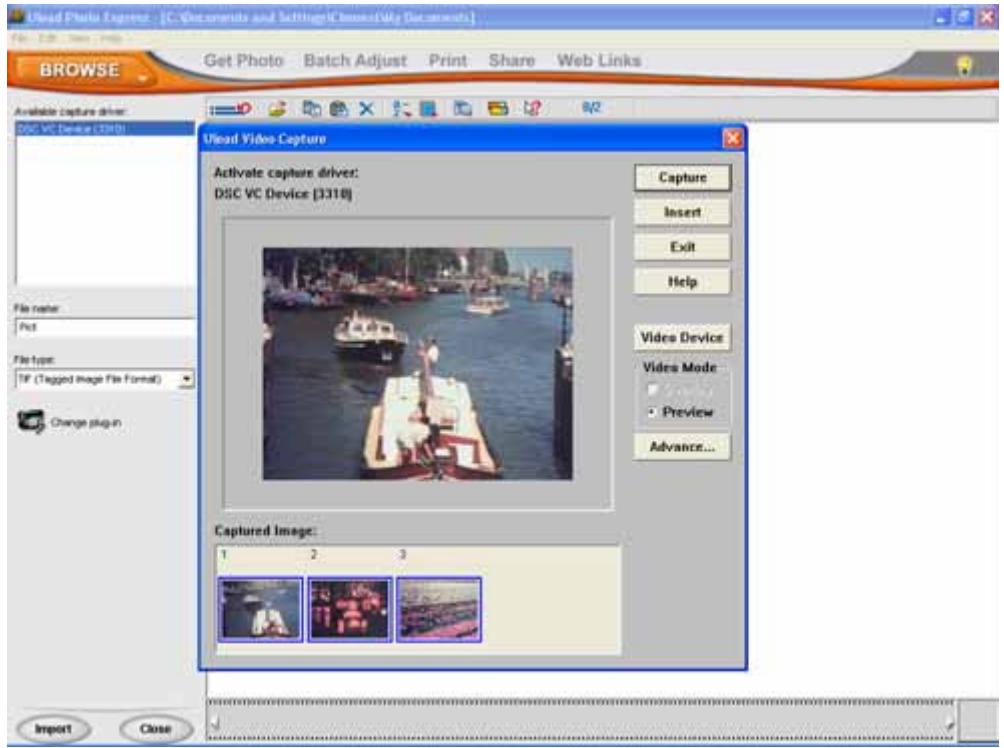
* Click the [Capture] button, and then choose your images.
* Click the [Insert] button, and click the [Exit] button to leave the screen.
Getting Started With Video Studio 8.0
- Click Start→ Select Programs→ Video Studio 8.0
- The Video Studio main Screen will appear on your desktop.
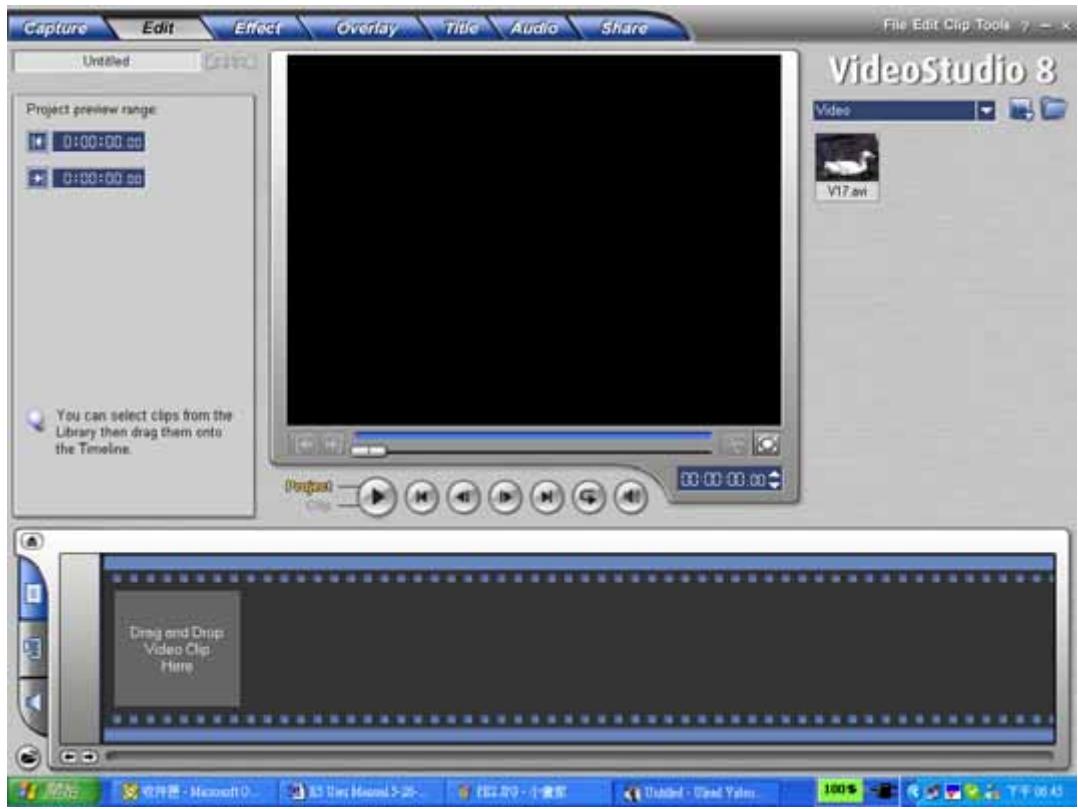
Viewing Images stored in the Camera through
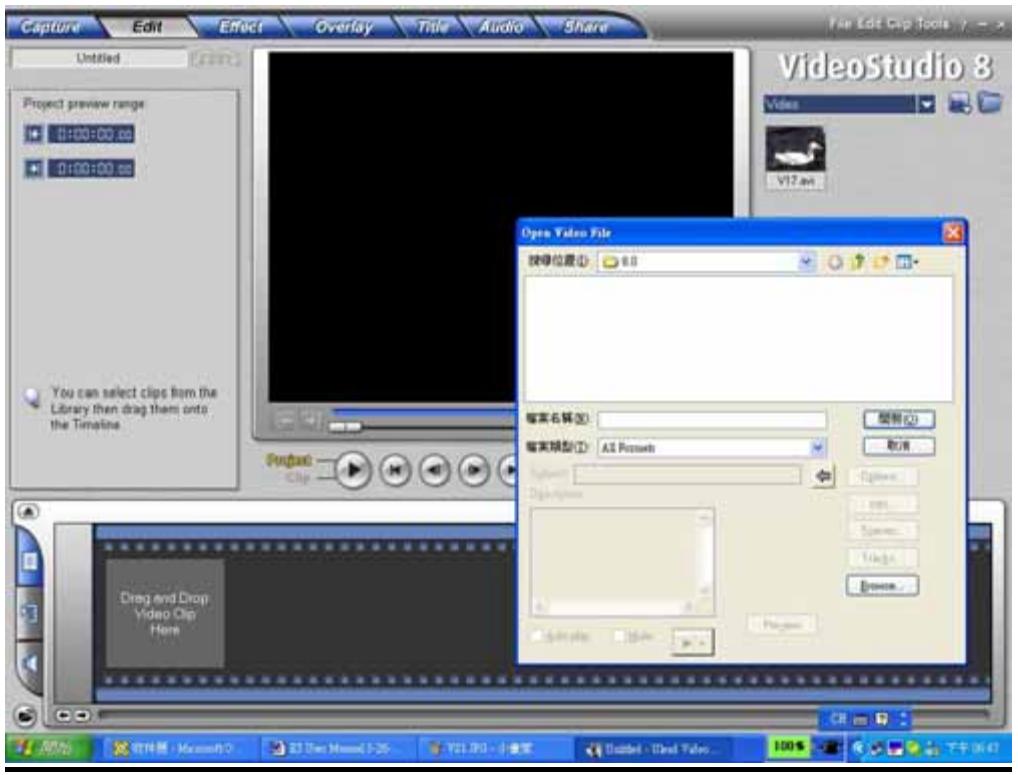
Video Studio 8.0
To view images stored in the camera, you must switch to Mass Storage Device Mode.
- Click the folder on the right hand side of the screen.
- Select the image stored in the camera and press Open button to view.
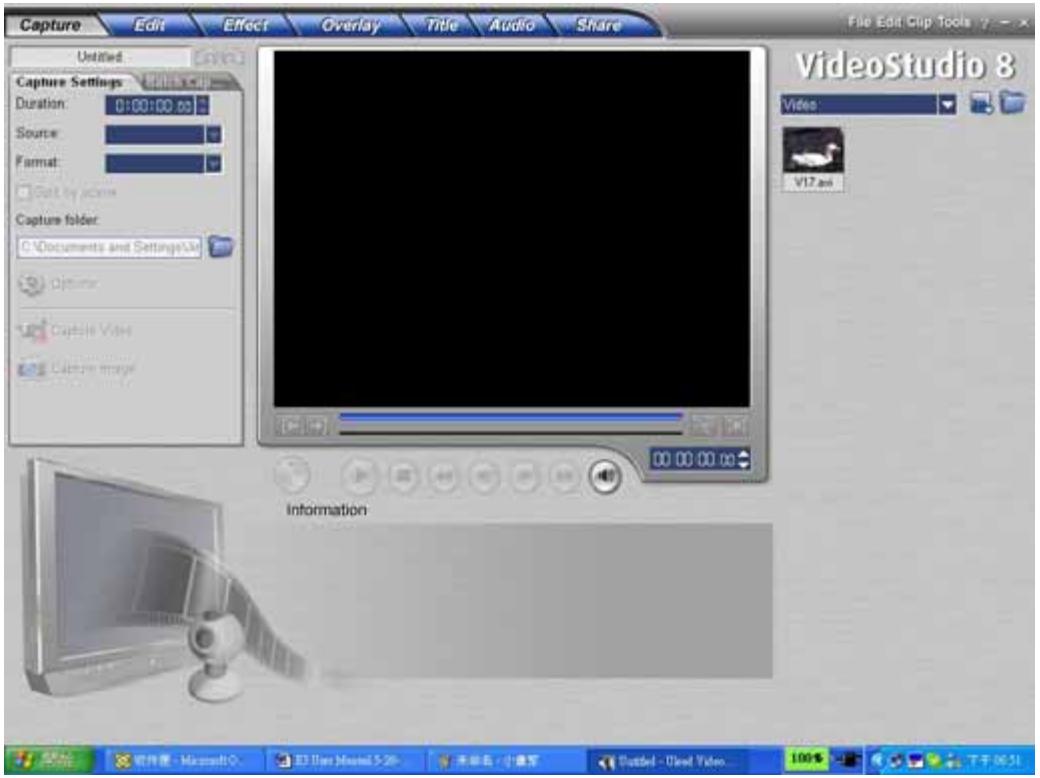
Capturing Video through Video Studio 8.0
Press the MODE button to switch to PC Digital Video Camera Mode. Under this mode, you can view Digital Video Camera video through Video Studio:
To capture a video/picture from the Digital Video Camera:
* Click the Capture Capture item.
* Click the [Capture Video] button.
* Click the [Capture Image] button.
Section 12
Specifications and System Requirements
Specification
| Image Sensor | 3.2 Mega Pixel Sensor |
| Operation Modes | Movie Record Picture Record VoiceRecord MP3 Player PC Camera MassStorage Device |
| Lens | F3.0 (f = 8.54 mm) |
| Focus Range | 100cm~infinite (Normal Mode)60cm ~ 100cm (Portrait Mode)Center: 20 cm (Macro Mode) |
| Digital Zoom | 8X |
| Shutter | Electronic |
| LCD monitor | 2.4" TFT LCD |
| Storage Media | Built-in 64MB Memory (partial memory isused for Firmware code);SD/MMC Card Slot support (up to 2GB) |
| Image Resolution | Still image 3744x2808 (10M Pixels)2048x1536 (3M Pixels)1024x768 (800K Pixels) |
| Movie Resolution | VGA 640x480 pixels 30 fpsQVGA 320X240 pixels 30 fps |
| White Balance | Auto/Manual (Daylight, Fluorescent, Tungsten) |
| Exposure | Auto/Manual |
| Self-Timer | 10 second delay |
| Flash | Auto/Off |
| File Format | Picture JPEGMovie AVI (Xvid)Voice WAVMusic MP3 |
| Image play | Single Image/Thumbnails/Slideshow |
| PC Interface | Mini USB 2.0 Port |
| TV out | NTSC/PAL Selectable |
| Battery | Two AA (Alkaline) Batteries |
| Dimension | 95mm×71mm×34mm |
| Weight | 135g without battery |
System Requirement
| Windows 98SE/2000/ME/XP |
| Pentium MMX Celeron or AMD Athlon®CPU |
| 64MB RAM |
| CD ROM |
| 500MB free HDD space |
| Available USB port |
| 16-bit Color Display |