
AW542120 - Range hood GAGGENAU - Free user manual and instructions
Find the device manual for free AW542120 GAGGENAU in PDF.

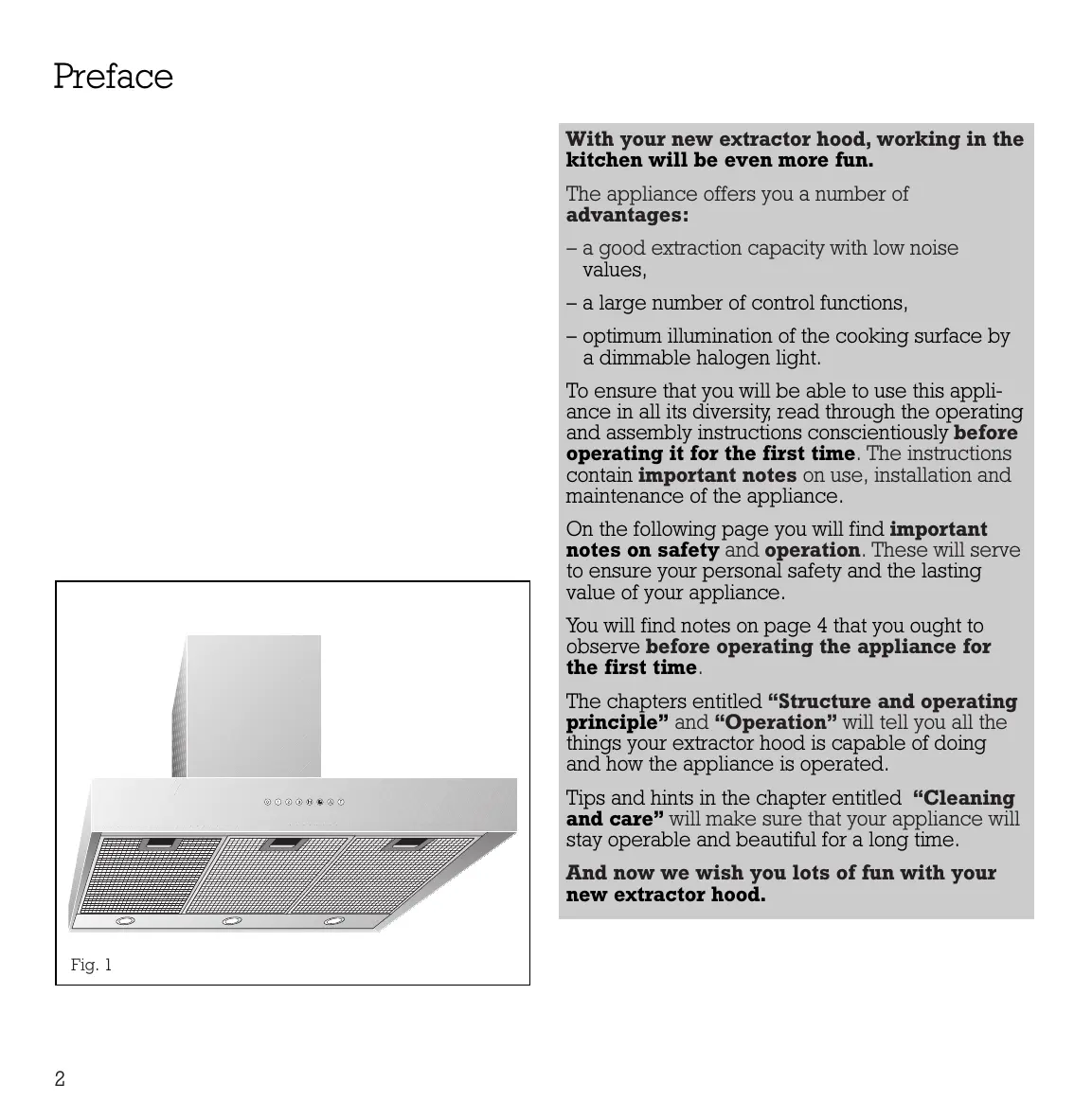

| Product type | Wall-mounted cooker hood |
| Brand | GAGGENAU |
| Model | AW542120 |
| Dimensions (W x D) | 1198 x 550 mm |
| Weight | 25.5 kg |
| Electrical connection | Mains connection, cable type H05 VV-F G 0.75 |
| Extraction power | 3 speeds + intensive level |
| Lighting | Halogen 12 V / 20 W, dimmable |
| Operating modes | Extraction or recirculation (with optional charcoal filter) |
| Special functions | Delayed shut-off (10 min), intermittent ventilation, intensive timer (3/5/10 min) |
| Filters | Stainless steel grease filters (dishwasher-safe), charcoal filter (KF 001-010, annual replacement) |
| Filter saturation display | Flashing F indicator light after 30 h of use |
| Minimum safety distance | 600 mm (electric cooking) / 700 mm (gas cooking) |
| Safety instructions | Do not flambé under the hood, do not use without grease filter, ensure sufficient air intake |
| Care | Clean the exterior with a soft cloth and mild detergent, stainless steel cleaner for stainless steel model |
| Bulb replacement | Halogen bulb 12 V / 20 W, type G4 |
| Installation accessories | Ventilation duct (stainless steel or aluminium options) for ceiling heights 2.25-3.02 m |
| Repairability | Repairs by an authorised specialist, original parts available |
Frequently Asked Questions - AW542120 GAGGENAU
User questions about AW542120 GAGGENAU
0 question about this device. Answer the ones you know or ask your own.
Ask a new question about this device
Download the instructions for your Range hood in PDF format for free! Find your manual AW542120 - GAGGENAU and take your electronic device back in hand. On this page are published all the documents necessary for the use of your device. AW542120 by GAGGENAU.
USER MANUAL AW542120 GAGGENAU
Operating and Assembly Instructions
AW 540-190/120
AW 541-190/120
AW 542-120
AW 543-120
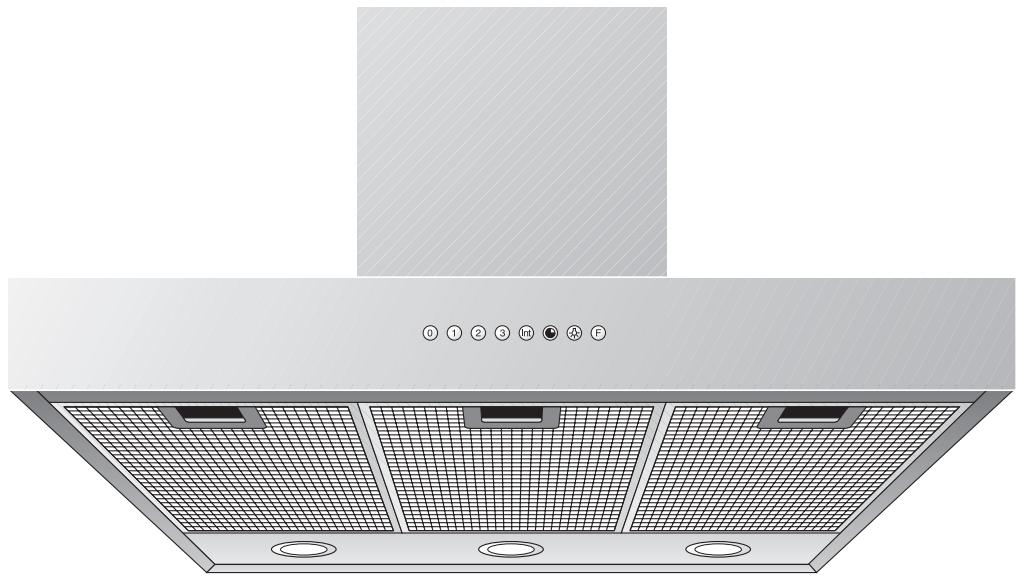
Extractor Hood
natural_image
Illustration of a stainless steel kitchen chimney with ventilation grilles and control panel (no text or symbols)Preface
- Important notes Page 3-4
1.1 For your safety Page 3
1.2 Operating for the first time Page 4
1.3 About use Page 4 - Features Page 5
- Operation Page 6-8
- Cleaning and care Page 9-10
- Maintenance Page 11
- Assembly instructions Page 12-17
6.1 Technical data Page 12
6.2 Installation Page 12-17
Preface
natural_image
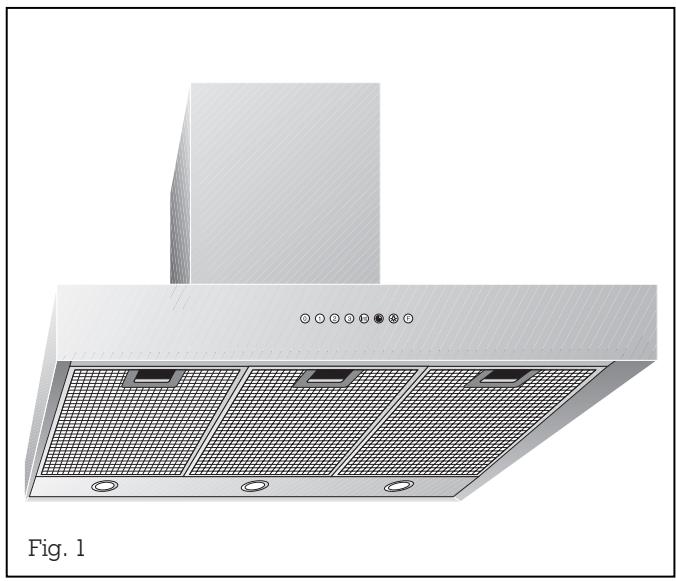
3D rendering of a kitchen air conditioner unit with ventilation grilles and mounting holes (no text or symbols)With your new extractor hood, working in the kitchen will be even more fun.
The appliance offers you a number of advantages:
- a good extraction capacity with low noise values,
- a large number of control functions,
- optimum illumination of the cooking surface by a dimmable halogen light.
To ensure that you will be able to use this appliance in all its diversity, read through the operating and assembly instructions conscientiously before operating it for the first time. The instructions contain important notes on use, installation and maintenance of the appliance.
On the following page you will find important notes on safety and operation. These will serve to ensure your personal safety and the lasting value of your appliance.
You will find notes on page 4 that you ought to observe before operating the appliance for the first time.
The chapters entitled “Structure and operating principle” and “Operation” will tell you all the things your extractor hood is capable of doing and how the appliance is operated.
Tips and hints in the chapter entitled “Cleaning and care” will make sure that your appliance will stay operable and beautiful for a long time.
And now we wish you lots of fun with your new extractor hood.
1.1 For your safety
- Damaged appliances must not be operated.
- The appliance must only be connected by an authorised specialist, paying attention to the relevant regulations of the power supply companies and the regional construction regulations.
Also observe the assembly instructions!
- Connecting cables must not come into contact with hot cooking surfaces.
- Do not operate the extractor hood without inserted lamps.
- Never operate the appliance without a grease filter.
- Hazardous or explosive substances and vapours must not be extracted!
- The user is responsible for expert use and the perfect condition of the appliance.
- Only operate the appliance under supervision.
- Caution! Over-greased filters are a fire risk! Only ever deep-fry under the extractor under constant supervision. Be sure to clean the grease filter on a regular basis and change the activated charcoal filter.
- Fire risk! Do not flambé meals under the extractor hood!
- Operation of the extractor hood above a hearth for solid fuels, which poses a fire risk (e.g. sparks) is only permitted, if the hearth possesses a closed and fixed lid. The current local regulations must be obeyed. This does not apply to gas hobs and gas cookers.
- Hobs may only be used under the extractor hood when pots and pans are placed on them!
- When using more than 3 gas-operated rings at the same time, please operate the extractor hood at level 2 or higher. This prevents a build-up of heat in the appliance.
-
For safety reasons, do not place any heavy objects on the top of the appliance.
-
Do not clean the appliance with a steam cleaning apparatus or with water pressure because this poses a risk of short-circuits.
- Isolate the appliance from the mains during every maintenance operation. To do this, remove the mains plug or actuate the corresponding fuse.
If the mains plug is not accessible, the appliance must be switched off at fuse point. - Repairs must be carried out by authorised specialists, thus ensuring electrical safety.
- No warranty claims can be lodged in the event of damage caused by failure to observe these instructions.
- Adequate incoming air must be ensured if a wood, coal, gas or oil heater or an open hearth is operated in the same room as the one in which the hood is installed.
- Safe operation is possible whenever the partial vacuum in the place where the firing equipment is installed does not exceed 4 Pa (0.04 mbar). This can be achieved whenever the air needed for combustion is able to enter through openings that cannot be sealed, for example in doors, windows, incoming/exhaust air wall boxes or other technical means.
- If the appliance is to be operated only with the window open (to ensure adequate incoming air), you can use the window switch.
A switch (normally open) is fitted on the window. On the appliance, this switch is connected to the window switch terminal on the main electronics. The appliance can now only be operated when the window is open.
Important: the window switch must only be connected by an authorised specialist.
Note: the light function works without restriction. - After a power failure, the extactor will not go on again automatically. You can recommence operation by turning a knob or by pressing any key.
Technical modifications reserved.
1.2 Operating for the first time
Before operating the appliance for the first time, please pay attention to the following notes:
- The appliance must be installed and connected by a specialist before it is operated for the first time.
- Conscientiously read through the operating and assembly instructions before operating the appliance for the first time.
- Remove the packaging from the appliance and dispose of it properly! Pay attention to the fact that there are accessories in the packaging! Keep packaging elements (e.g. plastic foil, styrofoam parts) out of the reach of children!
- Thoroughly clean the appliance before using it for the first time (see chapter "Cleaning and care").
- Before operating the appliance for the first time, check that the mains connection is in proper working order.
1.3 About use
- The appliance is intended solely for use in the household and must not be put to any other uses.
- In the event of malfunctions, first of all check the household fuses. If the problem has nothing to do with the power supply, please contact your specialist dealer or your local Gaggenau after-sales service.
2. Features
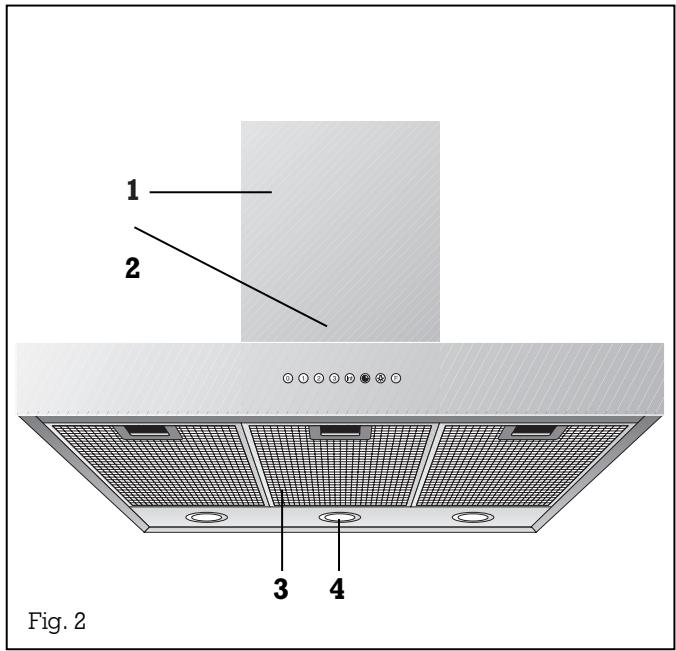
1 Ventilation duct
2 Control panel
3 Grease filters
4 Lighting
Installation accessories for exhaust air mode
Stainless steel-design ventilation duct:
LK 010-012 for ceiling heights of 2.25 - 2.64 m
LK 010-022 for ceiling heights of 2.64 - 3.02 m
Aluminium-design ventilation duct:
LK 011-012 for ceiling heights of 2.25-2.64 m
LK 011-022 for ceiling heights of 2.64 - 3.02 m
Installation accessories for circulating air mode
Stainless steel-design ventilation duct:
LK 010-112 for ceiling heights of 2.36 - 2.64 m
LK 010-122 for ceiling heights of 2.64 - 3.02 m
Aluminium-design ventilation duct:
LK 011-112 for ceiling heights of 2.36 - 2.64 m
LK 011-122 for ceiling heights of 2.64-3.02 m
3. Operation
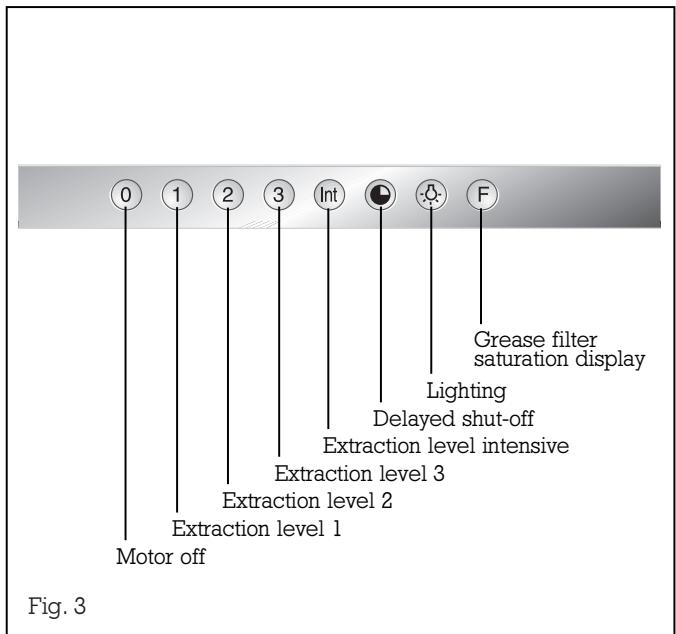
The AW 540/541-190 is 90 cm wide, and the AW 540/541/542/543-120 is 120 cm wide. Operation of both extractor hoods is identical. After they have been pressed, all functions selection keys except 0 (“Motor off”) are backlit in green.
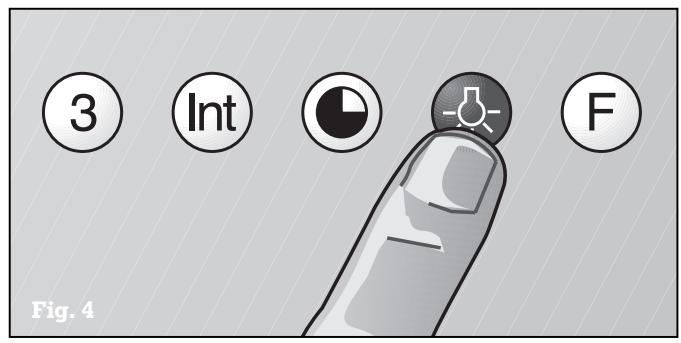
Light
The lighting can be switched on or off, regardless of whether the wall extractor is in operation, by pressing the Ⓞ key (see Fig. 4).
When you briefly press the Ⓞ key, the lighting is increased up to the maximum level.
You can dim the lighting to the required level by keeping the ⏻ key pressed.
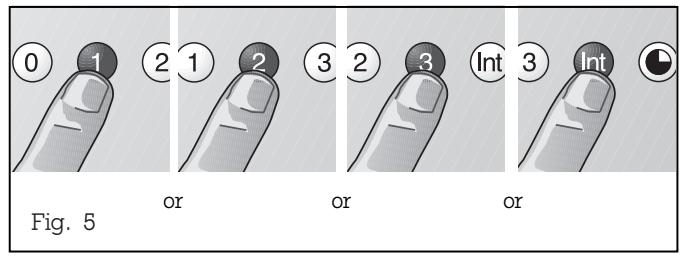
Fan levels
Three fan speeds and one intensive speed are available (see Fig. 5). You set the fan level required for each respective cooking situation by pressing the function selector keys 1, 2, 3 or Int.
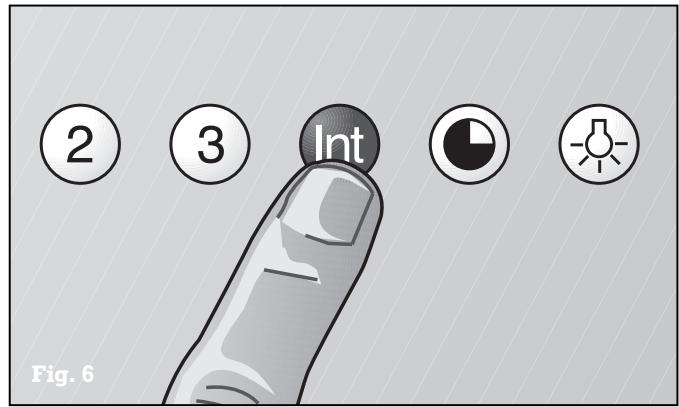
The Int key for the intensive level should be pressed when browning and frying in an open pan (see Fig. 6). If you have switched on the hood by selecting the intensive level, it will be switched off again automatically after 5 minutes.
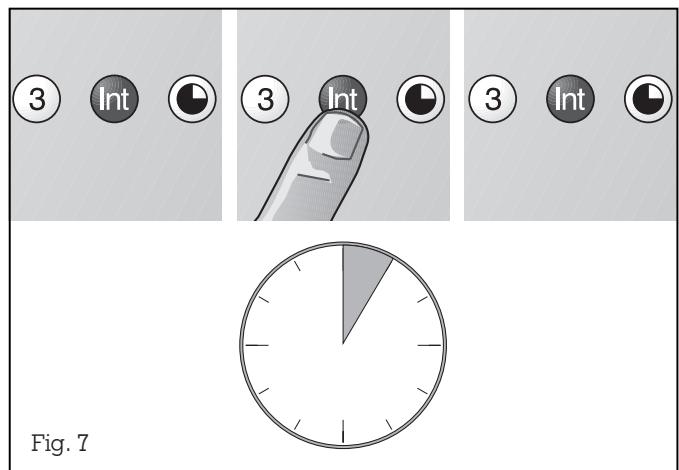
If you press the Int key while the hood is running at fan level 1, 2 or 3, the electronic control will switch back automatically to the previously selected fan level after 5 minutes (see Fig. 7).
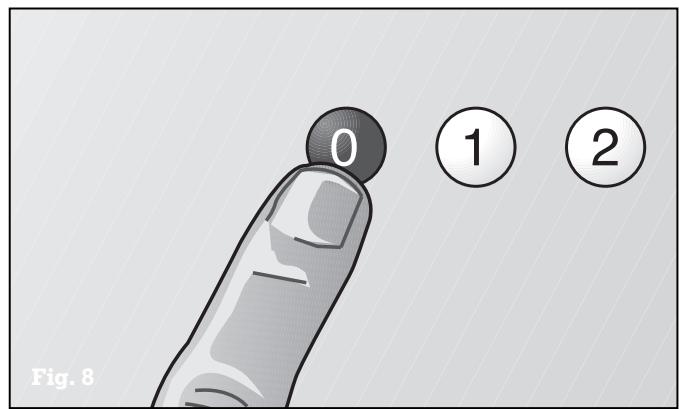
If you would like to end the intensive level before the five minutes have elapsed, press the 0 key ("Motor off") or select a different level (see Fig. 8). It is possible to switch off the extraction function at any time by pressing the 0 key (motor "off").
Special functions:
Intensive time:
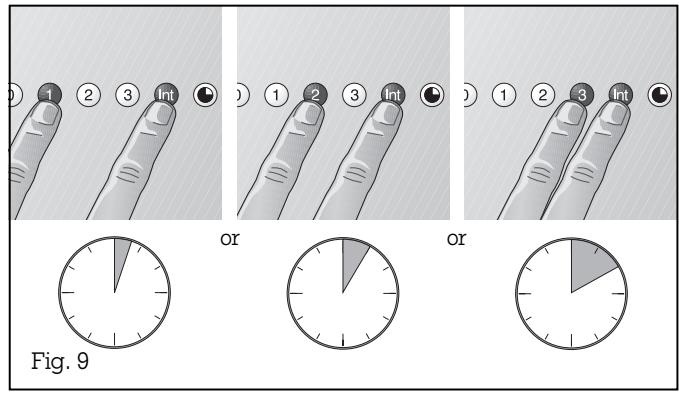
You can set the intensive level running time to 3, 5 or 10 minutes by simultaneously pressing the Int key and the 1, 2 or 3 key and you can store this setting (see Fig. 9). When delivered, the appliance is set to five minutes, i.e. the combination of the Int key and the key 2.
Delayed shut-off:
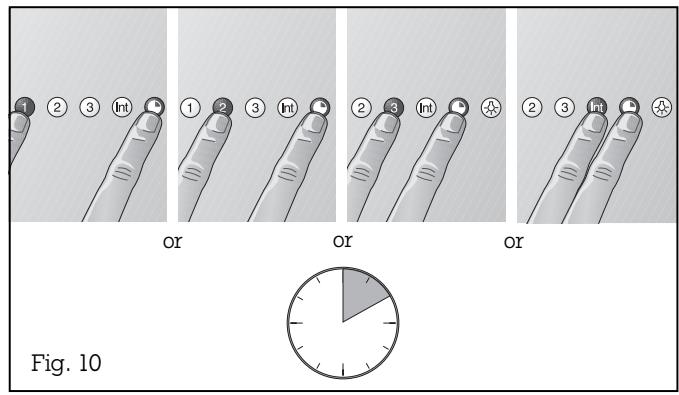
Delayed shut-off is possible at any level. First press the required key 1, 2, 3 or Int and then press the Ⓞ key (see Fig. 10).
The delayed shut-off time for all levels is ten minutes. After these ten minutes, the ventilation switches off, but the lighting stays on.
Interval ventilation:
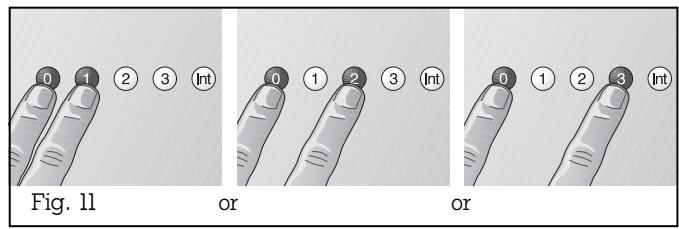
Interval ventilation is a special feature of this appliance which periodically activates the fan for five minutes every hour. You can activate this function by simultaneously pressing the 0 key and, depending on the required extraction capacity, the 1, 2 or 3 key (see Fig. 11).
This mode of operation is indicated by alternating illumination of the Ⓞ key together with the corresponding fan level indicator.
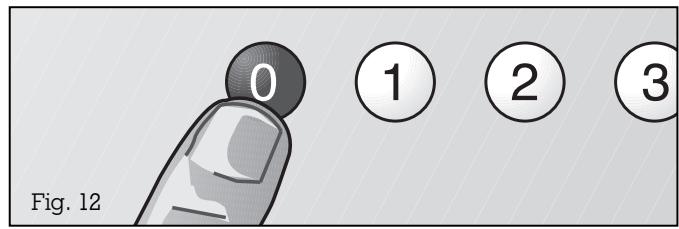
You can switch off interval ventilation by pressing the 0 key (see Fig. 12).
4. Cleaning and care
natural_image
Illustration of a kitchen ventilation system with a hand inserting a component, showing airflow and control buttons (no text or symbols)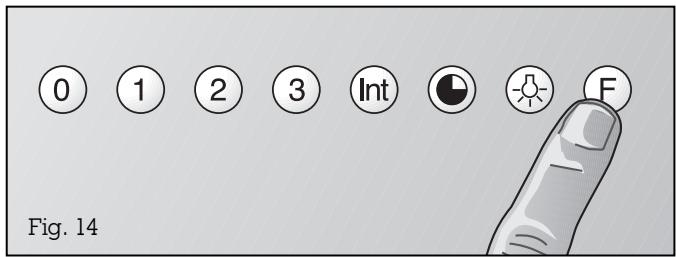
Cleaning the grease filters
The grease filter saturation display F flashes after an operating time of 30 hours to you indicate to you that you should clean the grease filter (see Fig. 3). The grease filters can of course be cleaned at any time, even if the grease filter saturation display has not started to flash.
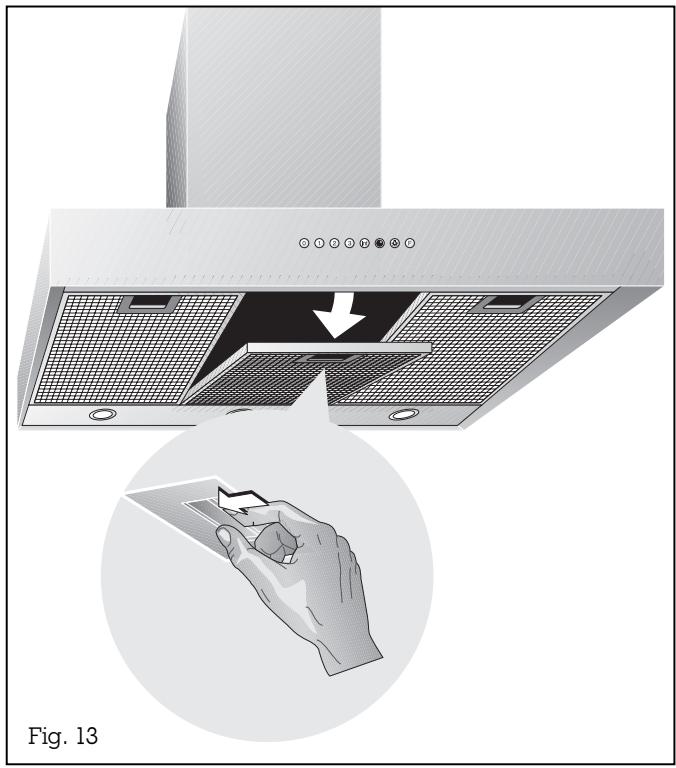
The stainless steel grease filters can be removed easily for cleaning (see Fig. 13):
Disconnect the power supply (switch off the fuse).
Grip the grease filter handle and push the slide towards the rear. Then pull the grease filter downwards out of the holder; repeat the operation for the other grease filters.
You can clean the stainless steel grease filters in a dishwasher at a maximum temperature of 65irc C, where it should be supported vertically to allow food or rinsing residues to drain off.
If possible, the inner parts of the housing should be wiped out in hot rinsing water when replacing the filters.
Caution:
when cleaning the inside of the housing, beware of protruding parts.
After having cleaned them, re-insert the grease filters in the wall extractor in reverse order.
Important:
the handles of both grease filters must be visible after assembly.
Press the F key to set the elapsed hours counter to zero. Flashing of the indicating lamp goes off.
natural_image
Diagram of a mechanical or fluidic device with directional arrows indicating flow or movement, labeled 'Fig. 15' at bottom (no readable text or symbols)Circulating air mode
The activated charcoal filter eliminates kitchen smells in the circulating air mode. In normal use (1 to 2 hours daily), the activated charcoal filter must be replaced approximately once a year.
If no activated charcoal filter is installed, kitchen smells will not be eliminated.
Replacing the activated charcoal filter
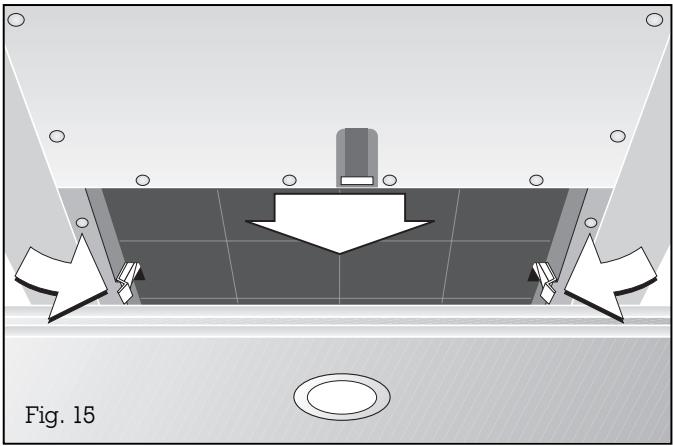
remove the stainless steel grease filters. Push in the clips on the side of the activated charcoal filter and remove the activated charcoal filter downwardly. Push the clips to the side and remove the activated charcoal filter towards the front.
Insert the activated charcoal filter at an angle (Note: be careful not to damage the light connector on the left side). Then push the filter upwards, until the clips on the side lock into place. Re-insert the stainless steel grease filters.
Activated charcoal filters (KF 001-010) are available through your specialist dealer. Only use original filters.
Activated charcoal filters do not contain any dangerous substances. They can be disposed of through the household refuse collection.1
Cleaning the extractor hood
Clean the exterior of your extractor hood with a soft cloth and mild detergent solution. Do not use any strong, caustic or abrasive cleaning agents. Do not use any abrasive sponges or brushes either.
Clean the stainless-steel extractor hood (AW 540/AW 542) with stainless steel cleaner.
Cleaning the glass plates
Apply commercially available window cleaning agent with a soft, moist cloth. To facilitate cleaning, you can detach the glass plates as follows:
Detach the grease filters. In the extractor hood, you will find three openings on the upper side through which you can lift the glass plates singly with a blunt object (e.g. handle of a wooden spoon) to detach them with greater ease.
If they are extremely soiled, the glass plates can be cleaned in a dishwasher at a maximum temperature of 55irc C.
Note: when putting the glass plates back in place, make sure that you do not scratch the chimney. Replace the glass plates with the printed side facing down. Position the glass plates at the chimney side first.
Cleaning the aluminium panel
Clean the control panel with a sponge and mild detergent solution only. Dry with a soft, dry cloth. Do not use any strong or caustic cleaning agents or brushes and abrasive cleaner to clean it. Do not use strongly alkaline cleaning agents (such as oven spray) because these are aggressive to the aluminium surface. Do not use any abrasive sponges either.
natural_image
Diagram of a mechanical component with a circular housing and an arrow indicating rotation or movement (no text or symbols)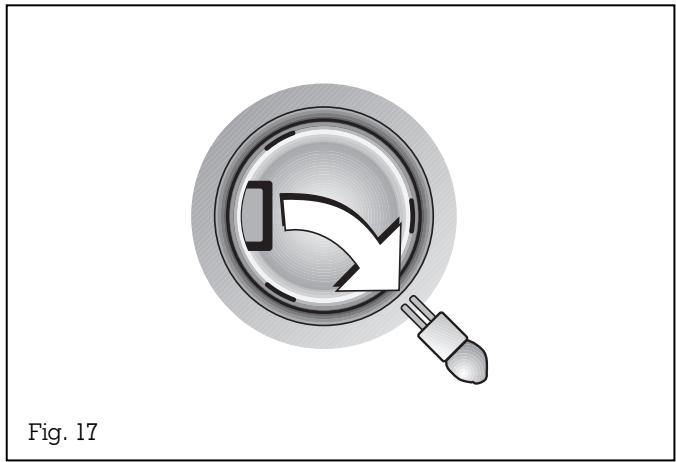
natural_image
Illustration of a magnifying glass with an arrow inside, labeled 'Fig. 17' (no other text or symbols)Disconnect the appliance from the mains before carrying out any repairs.
In the event of malfunctions, first of all check the household fuses.
If the power supply is in proper working order, but the appliance is nevertheless not functioning, then please contact your specialist dealer or Gaggenau after-sales service. Specify the appliance type (see rating plate).
Repairs must only be carried out by authorised specialists, thus ensuring the safety of the appliance. Improper tampering will render all warranty claims null and void.
Lamp replacement
Caution: disconnect the power supply before replacing lamps (switch off the fuse)!
Caution: lamps may still be hot shortly after use! Risk of burns.
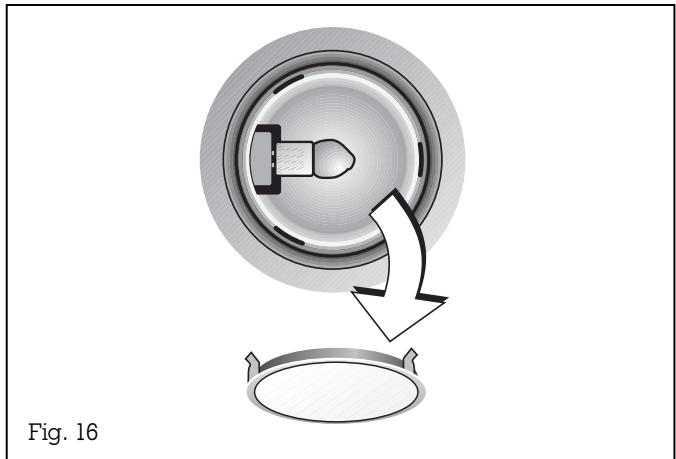
- Detach the ring from the lamp cover. Note: make sure that the glass will not fall out (Fig. 16).
- Pull out the lamp (Fig. 17).
Defective lamps must only be replaced by lamps of the same type! (12 V/20 W/G4 lampholder)
Inserting the lamp
- Insert the lamp in the lampholder.
Note: do not touch the halogen lamps with your hands. Use a cloth and touch the lamp only on its edges. - Engage the lamp cover.
- Connect the appliance to the mains again.
6. Assembly instructions
6.1 Technical data
| AW 540/541-190: | Weight: | 23,5 kg |
| Dimensions: | 898 x 550 mm | |
| AW 540/541-120: | Weight: | 27,5 kg |
| Dimensions: | 1198 x 550 mm | |
| AW 542/543-120: | Weight: | 25,5 kg |
| Dimensions: | 1198 x 550 mm |
Electrical connection
Pay attention to the rating plate data.
The mains connecting cable must at least correspond to the type H 05 VV-F G 0,75.
The appliance must only be connected by an authorised specialist. The specialist is responsible for perfect functioning of the appliance at its installation location. He must explain the operating principle of the appliance to the user with reference to the operating instructions. He must explain to the user how the appliance can be isolated from the mains whenever required.
Connection possibilities
The plug of the connecting cable is inserted into the socket that is located behind the duct cover on the wall. If this is not possible, the disconnection of all the poles of the appliance from the mains must be achieved by way of the domestic fuse, or by using an accessible disconnecting device with a contact gap of at least 3.0 mm.
6.2 Installation
The applicable regulations of the energy supply companies and the regional construction regulations must be observed when installing the hood.
The minimum distance from the cooking surface to the bottom edge of the wall hood is 600 mm for electrical appliances. The minimum distance from the bottom edge of the pot stand to the bottom edge of the wall hood is 700 mm for gas appliances.
The hood can be used in the exhaust or circulating air mode. The exhaust air can be routed into a separate exhaust air shaft or directly into the open through the outside wall.
It is not allowed to pass the exhaust air into a flue or exhaust air chimney that is in operation or into a shaft that is linked to the heating basement. Consult the chimney sweep responsible for your district whenever you wish to pass the exhaust air into a chimney that is not in operation.
During the course of planning, a chimney sweep must be consulted if a room air-dependent hearth is operated in the same room as the one in which a hood is operated in the exhaust air mode. Adequate incoming air must be ensured. The applicable construction and safety regulations must be observed.
Adequate incoming air must be ensured if a wood, coal, gas or oil heater or an open hearth is operated in the same room as the one in which the hood is installed.
Safe operation is possible whenever the partial vacuum in the place where the firing equipment is installed does not exceed 4 Pa (0.04 mbar). This can be achieved whenever the air needed for combustion is able to enter through openings that cannot be sealed, for example in doors, windows, incoming/exhaust air wall boxes or other technical means.
Flexible aluminium pipes, corrosion-protected sheet metal pipes and exhaust air pipes whose material conforms to fire B1 in accordance with DIN 4102 can be used. Exhaust air pipes should have a nominal diameter of 150 mm.
Pay particular attention to ensuring that
- the exhaust air ducts and pipes are kept as short as possible
- the pipes are not laid at an acute angle, but as bends and that they are inserted into the shaft at an inclined upward angle and
- there are no cross-sectional constrictions in the upward direction (this reduces the volume flow).
As standard, the blow-out opening of the wall hood is in the upward direction.
To pass exhaust air through the outer wall, we recommend the use of our telescopic wall box TM 150-045 (∅ 150).
Note:
To prevent the ingress of water, e.g. condensate or rain water from an uncovered exhaust air shaft, our condensate separator RV 060-150 must be installed in the exhaust air line. The condensate separator must still be accessible after installation.
The duct units listed below are available depending on the height of the ceiling:
Installation accessories for exhaust air mode
Stainless steel-design ventilation duct:
LK 010-012 for ceiling heights of 2.25 - 2.64 m
LK 010-022 for ceiling heights of 2.64 - 3.02 m
Aluminium-design ventilation duct:
LK 011-012 for ceiling heights of 2.25-2.64 m
LK 011-022 for ceiling heights of 2.64 - 3.02 m
Installation accessories for circulating air mode
Stainless steel-design ventilation duct:
LK 010-112 for ceiling heights of 2.36 - 2.64 m
LK 010-122 for ceiling heights of 2.64 - 3.02 m
Aluminium-design ventilation duct:
LK 011-112 for ceiling heights of 2.36-2.64 m
LK 011-122 for ceiling heights of 2.64 - 3.02 m
The dimensions above refer to a distance of 1.60 m from the floor to the bottom edge of the hood.
If required, custom made duct units are available at an extra charge.
The socket must be place behind the duct cover on the wall.
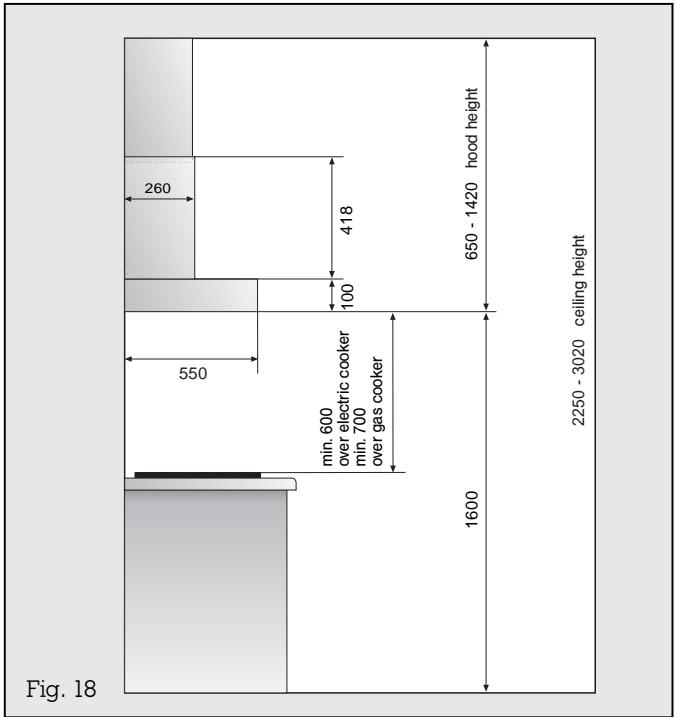
To use above gas cooker / gas hob
Important: do not use all burners on the highest setting simultaneously over a longer period of time (max. 15 minutes). This will pose a risk of burns when touching the hot appliance exterior or parts of the extractor hood may become damaged.
Switch the extractor hood to the highest setting when three or more burners of a gas cooker are used simultaneously.
The following note applies to extractor hood AW 542/543 only; these models do not have an integrated fan:
The extractor hood can only be used in exhaust air mode. The exhaust air is conveyed upwards through an externally attached fan via a ventilation shaft or directly into the open air through the outer wall.
The extraction function is realised by an external fan module. We recommend the fan modules GB 032-107 or GB 052/053-140 from our Gaggenau range; the extractor's electronic circuitry is optimised for these fan modules.
For the electrical connection between the extractor hood and external fan see installation instructions for the external fan.
For safety reasons, if the connecting cable to the external fan has been damaged, it must be replaced by the manufacturer or the after sales service or similarly qualified persons.
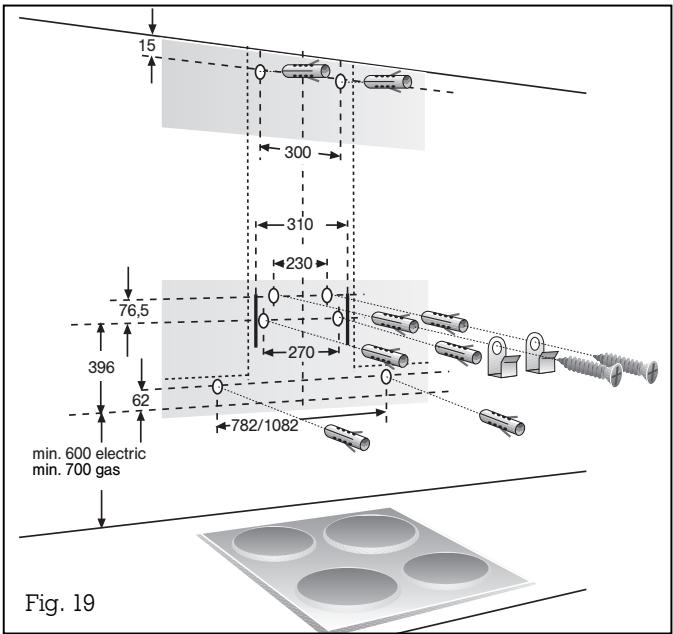
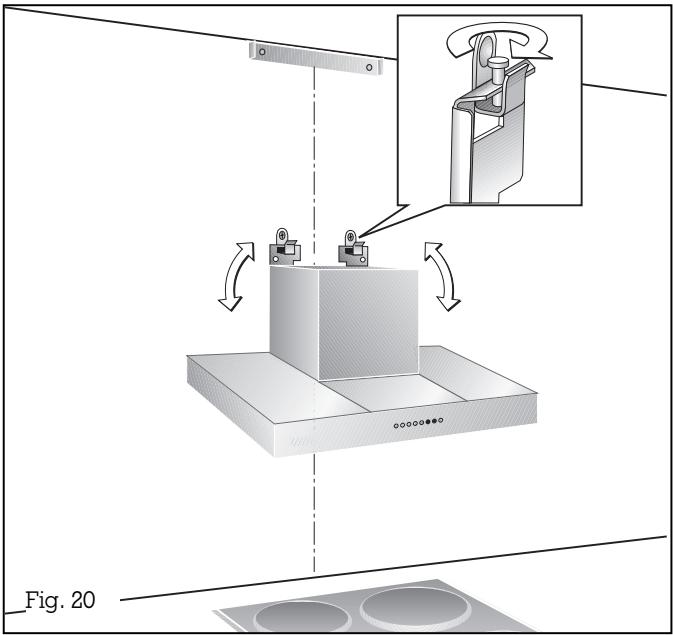
Important: before marking the securing holes, make sure that no electricity or water lines or other lines are laid at the drilling points in the wall.
Proceed as follows:
- From the bottom edge of the hood, mark a center line on the wall.
- With the aid of the drilling template, mark the positions of the screws on the wall (Fig. 19).
- Pay attention to the minimum clearance of 600mm for electric cookers and 700mm for gas cookers. The bottom edge of the template corresponds to the bottom from edge of the hood.
- Using the drilling template, drill the 6 holes for the hood (area I of the drilling template) and the two holes for suspending the chimney (area II of the drilling template). In the top two securing holes for the hood, fix the two hooks d with the countersunk screws c. Make sure that the hooks lie flatly on the wall. In certain circumstances you may have to countersink the drill holes. Fit the included dowels a in the other drill holes.
Note: pay attention to any special accessories that you may have to fit.
- Screw on the retaining bracket for the chimney paneling.
- Detach the grease filters.
- Hang the hood on the two hooks. Adjust the suspended element with the recessed head screw and align the hood using a spirit level (Fig. 20).
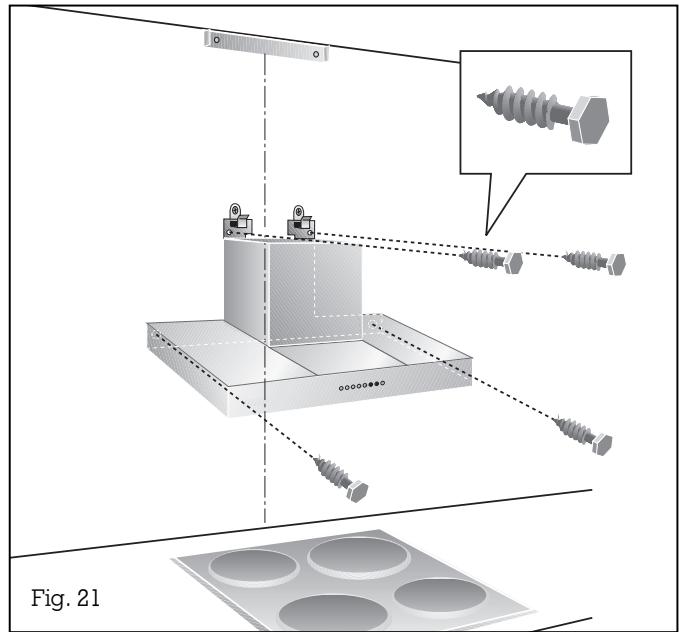
natural_image
Technical illustration of a mechanical assembly with labeled components and a magnified inset showing a hexagonal bolt detail (no text or symbols present)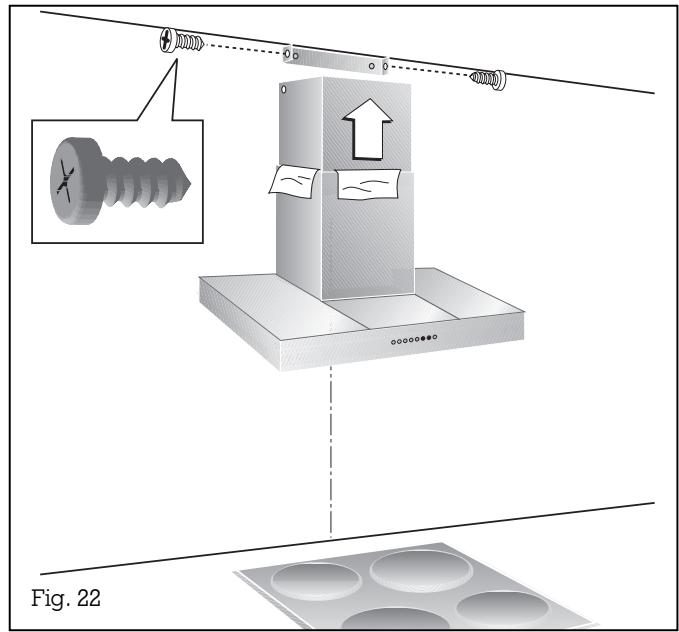
- Secure the hood on the wall with the four screws b (Fig. 21).
For exhaust air mode proceed as follows:
- Establish the pipe connection.
- Establish the electrical connection.
- Stainless steel chimney only (LK 010-012/022): pull the protective film off the chimney's trims.
Note: avoid damaging the sensitive metal surfaces.
- Fit the top chimney duct unit into the base. Make sure that the fastening holes on the side are at the top.
- Put both chimney duct units onto the hood.
- Pull the top chimney duct unit up into its final position and secure it with 2 screws on the ceiling holder (Fig. 22).
Note: avoid scratches when pulling the elements apart by placing the assembly template, for example, over the edge of the bottom chimney paneling to protect it.
- Reinsert the grease filters.
- Place the glass plates on the appliance with the printed side facing down.
Note: when putting the glass trays in place, make sure that you do not scratch the chimney.
natural_image
Technical diagram of a mechanical assembly with labeled components, showing a central component mounted on a base with a cylindrical component and a patterned base (no text or symbols present)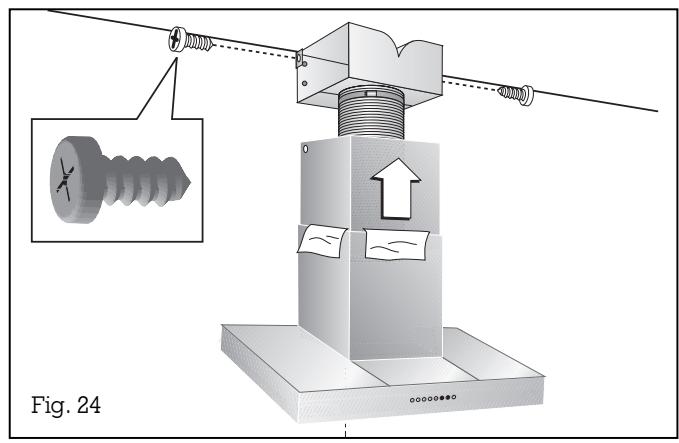
natural_image
Technical illustration of a mechanical assembly with a bolt and spring, showing a close-up inset of the bolt detail (no text or symbols present)For circulating air mode use the installation set included with the ventilation ducts LK 010-112/122 und LK 011-112/122. You also need an activated charcoal filter (KF 001-010).
Proceed as follows:
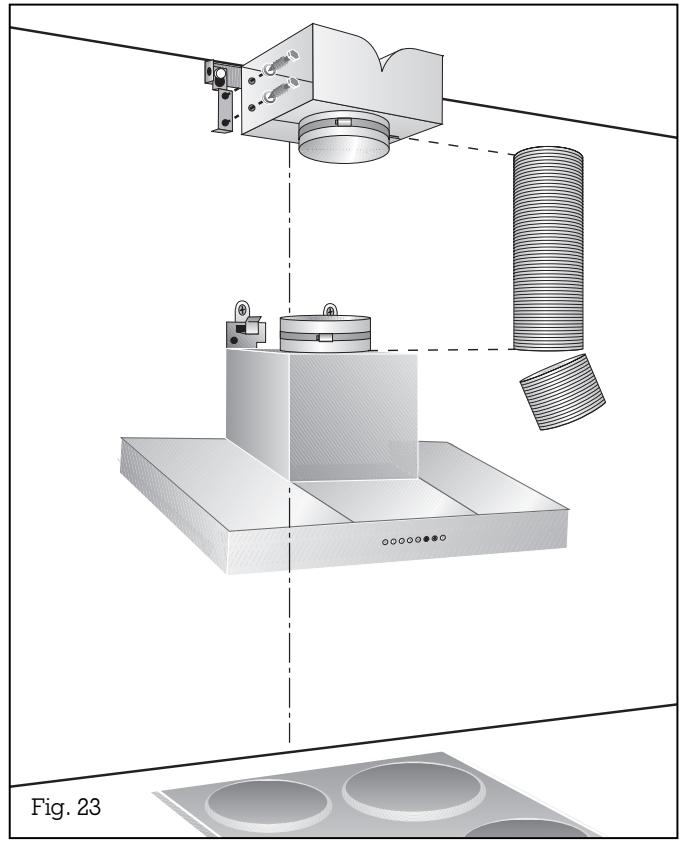
- Slightly loosen the screws of the retaining bracket for the chimney paneling. Hang the angle pieces onto the screws and tighten the screws.
- Screw the circulating air switch module to the angle pieces (4 screws).
- Shorten the flexible air pipe accordingly. Fix the flexible air pipe with hose clamps (Fig. 23).
- Establish the electrical connection.
- Stainless steel chimney only (LK 010-112/122): pull the protective film off the chimney's trims.
Note: avoid damaging the sensitive metal surfaces.
- Fit the top chimney duct unit into the base. Make sure that the fastening holes on the side are at the top.
- Put both chimney duct units onto the hood.
- Pull the top chimney duct unit up into its final position and secure it with 2 screws on the ceiling holder (Fig. 24).
Note: avoid scratches when pulling the elements apart by placing the assembly template, for example, over the edge of the bottom chimney paneling to protect it.
- Insert the activated charcoal filters.
- Insert the grease filters.
GAGGENAU
GAGGENAU HAUSGERÄTE GMBH
CARL-WERY-STR. 34 · D-81739 MÜNCHEN
(089) 45 90-03
FAX (089) 45 90-23 47
www.gaggenau.com
- AW 540-190/120
- AW 541-190/120
- AW 542-120
- AW 543-120
- Preface
- With your new extractor hood, working in the kitchen will be even more fun.
- The appliance offers you a number of advantages:
- For your safety
- Also observe the assembly instructions!
- Operating for the first time
- About use
- Features
- Operation
- Light
- Fan levels
- Special functions:
- Intensive time:
- Delayed shut-off:
- Interval ventilation:
- Cleaning and care
- Cleaning the grease filters
- Caution:
- Important:
- Circulating air mode
- Replacing the activated charcoal filter
- Cleaning the extractor hood
- Cleaning the glass plates
- Cleaning the aluminium panel
- Disconnect the appliance from the mains before carrying out any repairs.
- Lamp replacement
- Inserting the lamp
- Assembly instructions
- Technical data
- Electrical connection
- Connection possibilities
- Installation
- Pay particular attention to ensuring that
- Note:
- To use above gas cooker / gas hob
- The following note applies to extractor hood AW 542/543 only; these models do not have an integrated fan:
- Proceed as follows:
- For exhaust air mode proceed as follows:
- GAGGENAU
Brand : GAGGENAU
Model : AW542120
Category : Range hood