KODO - Audio Equipment Gryphon Audio - Free user manual and instructions
Find the device manual for free KODO Gryphon Audio in PDF.


| Product Type | Four-tower reference loudspeaker system |
| Brand | Gryphon Audio Designs |
| Model | KODO |
| Total Number of Drive Units | 38 custom-designed drivers |
| System Configuration | 2 mid/high towers and 2 bass towers |
| Tower Height | 2.4 meters each |
| Mid/High Tower Configuration | Four 4" midrange drivers, central AMT tweeter, six 5" midbass drivers |
| Bass Tower Configuration | Eight custom 8" drivers per tower with built-in amplifier |
| Bass Amplifier Output | 1,000 Watts continuous, 4,000 Watts peak (4.5 horsepower) |
| Amplifier Type | Dedicated on-board Gryphon bass amplifier, linear power supply, zero negative feedback |
| Frequency Range (Mid/High Tower) | 200 Hz to 25 kHz |
| Sensitivity | 96 dB (1 Watt, 2.83V, 1 meter) |
| Impedance | Never below 4 Ohms |
| Tweeter Type | Mundorf Air Motion Transformer (AMT) with heat-resistant Kapton film and aluminium conductors |
| Tweeter Level Adjustment | +1.0 dB steps using Duelund graphite resistors (hot-swappable) |
| Bass Level Control | Remote-controlled with user-selectable system Q |
| Room-Adaptive Q Controller | Adjusts resonance frequency and system Q for room integration |
| Crossover Technology | Duelund Constant Phase with active crossover bias (28V) |
| Enclosure Construction | Reinforced MDF, bitumen damping, 8mm aluminium support plates, solid aluminium base |
| Connections | XLR balanced and RCA single-ended inputs, loop outputs |
| Power Supply | Mains AC (internal, do not use filters) |
| Safety Features | Error indication, standby mode, 12V trigger link, master/slave data interface |
| Setup Requirement | Must be installed by authorized Gryphon dealer or technician |
| Warranty | 3 years from date of purchase (non-transferable) |
Frequently Asked Questions - KODO Gryphon Audio
User questions about KODO Gryphon Audio
0 question about this device. Answer the ones you know or ask your own.
Ask a new question about this device
Download the instructions for your Audio Equipment in PDF format for free! Find your manual KODO - Gryphon Audio and take your electronic device back in hand. On this page are published all the documents necessary for the use of your device. KODO by Gryphon Audio.
USER MANUAL KODO Gryphon Audio
THE GRYPHON

Owners manual
KODO
This system must only be set up by a dealer/technician authorized by Gryphon Audio Designs
INDEX
A message from the founder 3
The final frontier 4
Gryphon Kodo Reference Standard system 8
A box in a box - set-up 15
The bass tower electronics 17
Master tower controls 18
Bass tower connections ( Slave ) 20
Connecting to Preamplifier and poweramplifier 21
Tweeter fine calibration 22
Notes 23
Warranty 24
This manual do not contain assembly instructions as this is performed exclusively by the Gryphon representatives.

A Message from the Founder By Flemming E. Rasmussen, CEO, Gryphon Audio Designs
With thirtieth anniversary of Gryphon Audio Designs behind us, it is as good an occasion as any to look back and reflect on how we came this far, on what we have achieved and what we have learned.
It is now widely acknowledged that Gryphon has built its reputation on a singularly iconoclastic approach to the design of luxury High End home audio equipment, perhaps best described in the kind and generous words of audio critic Ken Kessler, “a code of perfectionism, the likes of which I’ve only ever seen at the Bugatti atelier in Alsace or at the great watch houses in Switzerland. It is the result of not accepting the notion of compromise, on any level.”
In retrospect, the history of Gryphon Audio Designs has been an exploration of the complex art of simplicity, taking as our conceptual foundation the words of Albert Einstein, widely referred to as Einstein's Razor: “The supreme goal of all theory is to make the irreducible basic elements as simple and as few as possible without having to surrender the adequate representation of a single datum of experience.”
Fortunately, during the Gryphon's lifetime, dedicated music lovers in ever increasing numbers have come to demand more from their home entertainment systems in recognition and appreciation of the crucial musical contribution of natural, un-doctored, realistic sound that conveys the integrity and full emotional impact of the original performance.
More and more, serious listeners recognise the validity of the Gryphon approach: A loudspeaker must not be an instrument or an interpreter with a voice of its own, only a neutral conduit that lets us hear what is there, no more and no less, for better or for worse.
This is the wellspring of inspiration and motivation that led to the ultimate loudspeaker system, the Gryphon KODO, reaffirming our commitment to being the best that we can be with the definitive full-range system to be partnered with equipment and a room truly worthy of such a loudspeaker.
Flemming E. Rasmussen Ry, Denmark, December 2016
The Final Frontier
Having earned a global reputation for technological mastery and unsurpassed excellence in audio amplification and digital playback, it was a natural evolutionary move for Gryphon Audio Designs to broaden its scope and apply the uncompromising Gryphon philosophy to the final link in the chain. But this decision was by no means made on the spur of the moment.
The Gryphon loudspeaker story begins with a chance encounter between Gryphon founder Flemming E. Rasmussen and Danish loudspeaker legend Steen Duelund, a Danish mathematician who dedicated his life to the advancement of loudspeaker theory. Duelund was a man on a mission whose many theories and discoveries continue to inspire professional designers and DIY speaker builders long after his passing.
On a strictly informal basis, they began an in-depth exploration that would take full advantage of Rasmussen's extensive experience in design and manufacturing to transform Duelund's theories into real-world products with scant regard for such minor details as pricing, parts availability, prevailing attitudes and preconceived notions.
Imperfect Drivers
Duelund's revolutionary theories on constant phase in crossover networks can be summed up in a single statement: "All drivers must be in phase at all times at all frequencies." Following this theoretical "Eureka," the hard part then became making that happen with a real loudspeaker in a real room. The first step was to acknowledge that the greatest challenge facing loudspeaker designers was the simple fact that dynamic drive units are by nature flawed and compromised.
Many driver designs defy all sound design principles, because they are the result of penny-pinching exercises under heavy market pressure to deliver “acceptable” performance at the lowest price. There is little motivation to allocate resources to making drivers truly the best that they can be.
In order to succeed in their mission, now assigned the working

Steen Duelund
title Project 30, Rasmussen and Duelund returned to first concepts, literally building by hand individual drivers with baskets that did not introduce compression, handmade multi-laminate cones, exotic home-brew coatings, adjustable wire suspension to replace the conventional spider, heavy-duty magnetic systems, ventilated pole pieces, machined phase plugs and special surrounds to optimize the transition between cone and baffle. All edges were beveled for a deliberate aerodynamic profile. Double contact wiring was employed on the cones to ensure perfect balance. The list of breakthroughs goes on.
Every aspect of driver design, assembly and function was thoroughly investigated without prejudice and with scant respect for received wisdom, which often proved to be ill-founded dogma formulated by individuals promoting their own specific agendas.
The end result was drive units with extremely low Q, high power handling, no dynamic compression and a linear pistonic range that pushed back the limits of driver design.
In order to live up to the uncompromising design goal of perfect phase at all times at all frequencies, the enclosure incorporated a concave curved front to form a direct angled, time-aligned system with identical distance from the listener to the acoustic centre of each driver.
The finished loudspeaker can only be described as an open window, utterly transparent to the original recorded event with equally remarkable dynamic headroom that re-creates the true power and full weight of live music, both in details such as a drum rimshot and in the effortless expansion of an orchestral crescendo in a large-scale symphonic piece.
Gone were the sluggishness and “whitewashed” uniformity typical of loudspeakers with complex crossovers where 60% of the components are dedicated to the thankless task of compensating for the basic imperfections of inferior drivers. In such speakers, the crossover becomes a virtual “black hole,” sucking up energy instead of conveying it to the drivers.
At this stage, a respected German audio reviewer visited Gryphon. In the Gryphon listening room, he auditioned Gryphon amplifiers using the company's usual reference loudspeakers, a well-known American full-range system. Suitably impressed with what he heard, he happened to notice some large enclosures concealed beneath a sheet off to one side. His curiosity aroused, he persuaded Flemming to hook them up for an off the record listening session with the clear understanding that this was not a commercial product.
To make a long story short, the reviewer had a revelatory experience and rumours quickly began to circulate about a mystery speaker that Gryphon were keeping to themselves.
Despite the unique quality of the project, Rasmussen decided not to pursue it as a commercial venture, using the loudspeakers only as a valued tool in the company's electronics development work. The decision was based on the fact that the many hand-tweaked, non-standard components made it a slow, expensive and exceedingly complex system to build. Too many of its geeky, off-the-wall solutions were conceived and executed without regard for the real-world problems of consistent, day-to-day production and long-term reliability. Moreover, this was at a time in the High End industry when electronics manufacturers and speaker makers politely played in their own sandboxes, rarely invading each other's turf. Today, things have changed considerably.
The Cantata Reference Monitor System
By the millennium, Gryphon had become firmly established as a major international player with a range of amplification components and CD players widely regarded as among the very best in the esoteric world of High End audio.
Gryphon innovations included the world's first single-chassis CD player with onboard upsampling and critical system enhancements such as the acclaimed Exorcist, the world's first system demagnetizer, as well as a range of cables and accessories.
Still, demand for a Gryphon loudspeaker continued to grow, as distributors, dealers and enthusiasts wanted to share in the great secret. Electing not to fall into the same trap as so many others who rush to market with a “me, too” loudspeaker system in an attempt to cash in on the goodwill of an established electronics brand name, Rasmussen decided to address an unacknowledged problem that he had frequently observed: Most audiophiles select loudspeakers that are simply too large to work well in their room and wind up fighting a losing battle against room acoustics with inadequate tools.
Rasmussen already knew what they would have to learn from bitter, expensive experience: Not even the best amplifier and room treatments can turn things around once you have installed the wrong speaker in the wrong room. To help enthusiasts with limited living space overcome these obstacles, a more compact loudspeaker became Gryphon's top priority, because it was felt to fill the greatest need.
Driven by his decade-long vision of a loudspeaker that would finally get things right, Rasmussen conceived the Gryphon Cantata to set new standards for sonic performance in a two-way system of modest dimensions. With Steen Duelund's theories as inspiration, acoustician Lars Matthiesen Rasmussen set about the task of translating theory into workable, practical solutions. Rasmussen and the Gryphon design team created the product's conceptual and physical framework, while Rasmus-

The Gryphon Cantata
sen and Gryphon chairman Valdemar Børsting were responsible for final voicing. Exploiting Gryphon's home court advantage in the field of electronics, it was natural to incorporate a high tech active Q control, a concept introduced in the 1950's by Linkwitz and Greiner, but never successfully implemented.
The Cantata received a rave reception from press and owners alike, winning numerous awards, including Product of the Year from UK magazine HiFi+. Gryphon was immediately accepted as a loudspeaker manufacturer and praised for tackling the endeavour with innovative flair and bravery.
Gryphon Poseidon
The development and, in particular, the actual production of Cantata with its innumerable tailor-made components gave Gryphon valuable experience and the courage to revive and complete Project 30. Auditioning confirmed that the system had been well ahead of its time. Equally important, Gryphon's accrued experience and good working relations with driver manufacturers now meant that the project could be fully realised to an even higher standard.
Special drive units would still be required, but Gryphon's unquestioned High End stature and the success of the Cantata attracted the interest of an internationally respected Danish driver manufacturer willing to build drive units to Gryphon's strict specifications. Jensen Capacitors manufactured inductors and capacitors to Gryphon's specifications. A German manufacturer supplied a surround that matched the cone geometry. The list of specialists involved continued to expand.
As was once the norm in the High End, Gryphon is still run by enthusiasts able and willing to take risks and push back boundaries, not because the marketplace demands it or because anyone asked them to, but out of sheer curiosity as to what awaits in the uncharted territories where no one has gone before.
Consequently, Project 30 began to grow in scope and ambition, bearing out Flemming E. Rasmussen's bold declaration, "The reason we make products is to finance our research and development. This is our true passion."
In August 2004, the final fruit of Project 30 was unveiled, Gryphon Poseidon. Lavishly built by even the most extravagant High End standards, the exquisitely finished Gryphon Poseidon offered expressive musical communication and a gripping sensation of involvement in the performance as it unfolds.
Gryphon Poseidon redefined loudspeaker performance in such crucial areas as sonic continuity and integrity, allowing the listener to create a more vivid mental image of the musical
event with a greater sense of wholeness and consummate ease.
Followed by the more accessible Trident, Atlantis and Mojo systems, Poseidon immediately established Gryphon Audio Designs as a force to be reckoned with in the field of High End loudspeakers.
Gryphon Kodo Reference Standard Loudspeaker System
“Exclusive. Danish. Peak performance. That’s how audiophiles view Flemming Rasmussen’s prestigious Gryphon Audio Designs brand.” www.sixmoons.com
Few High End manufacturers on either side of the electronics/loudspeaker divide have even attempted to bridge that gap. Fewer still have managed to do electronics and speakers equally well and be widely acknowledged as masters in both fields.
In less skilled hands, a loudspeaker system consisting of 38 drive units spread across four 2.4 meter tall towers could very easily turn into a Frankenstein's monster science project. But precisely because the Gryphon design team is equally at ease with transducers as with amplification, we – perhaps uniquely - possess the necessary prowess and ambition to pull off the formidable feat that is the Gryphon Kodo four-tower reference loudspeaker system.
Beginning with the now legendary Gryphon Poseidon in 2004 (the first public result of 10 years of top secret, in-house experimentation), Gryphon has continued to explore the numerous benefits of a closer integration of electronics and loudspeakers in our top of the line products.
Now, the Gryphon Kodo stands as the pinnacle of the loudspeaker designer's art and craft
The Four Towers
To return to the words of www.sixmoons.com – “The engineering team behind Gryphon’s speaker endeavours plays ball in the top leagues.”
Put simply, each Kodo section is a tower of strength and style.
Elegant and deceptively simple, the four towers that make up the Gryphon Kodo system are carefully conceived and executed multi-layer constructions for extreme structural integrity and acoustic damping.
The MDF side panels of the modules are reinforced.
The stacked modules incorporate additional 8 mm aluminium panel supports.
The form moulded curved cosmetic exterior panels of laminated High-Density Fibreboard are damped with bitumen.
The solid aluminium base for each tower is fitted with adjustable, polyoxometalate feet.
The Kodo upper-frequency towers are laid out in a symmetrical vertical array of four 4", exclusive Gryphon midrange drivers (two directly above and two directly below the central AMT high frequency driver) and six 5" Gryphon midbass drivers (three at the top and three at the bottom) to complement the bold design of the bass towers.
Each Gryphon Kodo bass tower houses eight custom designed 8" drive units and a built-in Gryphon power amplifier capable of 1,000 Watts continuous output into the drivers. For ultimate headroom, peak power is approximately 4,000 Watts or 4.5 horsepower.
The integrated bass system is conceived and born with a single purpose in life - to drive one specific set of drivers in one specific enclosure across a very narrowly defined frequency band. This is specialist audio at its ultimate extreme. Compared to the Gryphon Kodo, any so-called system, assembled from an assortment of unrelated products will inevitably fall short.
Gryphon Kodo offers highly desirable features such as remote adjustment of bass level from the listening position, low and high cut filters and a user-selectable bass system Q, an extremely important factor as matching system Q to the listening room's own Q is the gateway to superior bass performance.
In Perfect Phase
Like every loudspeaker ever made by Gryphon, the Gryphon Kodo incorporates specially developed Duelund Constant Phase technologies to ensure that all drivers are in phase at all frequencies at all times.
Based on the ground-breaking synchronous filter theories developed by the late Danish mathematician Steen Duelund, Gryphon loudspeakers achieve inter-driver phase, phase-matched behaviour between multiple drivers that no other manufacturer can claim.
When we say that our speakers are in perfect phase, we mean that the drivers maintain the same relative phase across all frequencies. This is one of the keys to achieving the best sound from any loudspeaker system.
In order to live up to the uncompromising design goal of perfect phase all the time at all frequencies, the Gryphon Kodo
enclosure incorporates a concave curved front to form a direct angled, time-aligned system with identical distance from the listener to the acoustic centre of each driver.
The realisation of this lofty goal demanded lateral thinking and numerous labour-intensive, custom-built components specially designed by Gryphon in close collaboration with the manufacturers of the world's finest drivers.
The Mid/High-Frequency Module
The four 4” ScanSpeak Illuminator midrange units positioned directly above and below the tweeter module are exceptional designs with patented, low mass, well damped cones, low-loss linear suspension, rigid, yet open construction to eliminate compression, extremely long linear excursion and a patented underhung neodymium motor system with copper caps for minimal distortion.
The six 5" mid/bass drivers (three at the top and three at the bottom) are the latest revision of Gryphon's proprietary design, incorporating significant advancements in sensitivity and reduced distortion achieved through the employment of copper rings in the motor system, a larger magnet and an all-new surround. Even the signal leads are arranged for symmetrical loading of the cone.
The 11 drivers share the workload from 200 Hz to 25 kHz. The mid/high tower is extremely efficient, 96 dB (1 Watt, 2.83V, 1 meter) with an impedance that never dips below 4 Ohms, making the passive tower a very amplifier-friendly load.
Each of the 11 drivers is individually mounted in its own independent baffle up to 34 mm and attached to a 22 mm sub baffle breaking up the pathway through which vibrations would otherwise be transmitted in a single, shared baffle. The individual driver baffles are separated from the main baffle by a rubber gasket which simultaneously acts as a seal around the drive units to eliminate air leaks. The baffles are connected only via bolts and rubber rings to minimize vibration transmission.
Each tower consists of a central tweeter module and two separate mid/bass modules with five drivers each. Within these modules, three mid/bass units and two midrange units are housed in two separate, isolated chambers to prevent any unwanted interaction and reinforce the structural integrity of the tower.
Separately, the modules are convenient to move and set up. Once stacked and securely bolted together, they form an extremely rigid and highly damped enclosure, enhanced by the distinctive wraparound shell.
The HF tower is sonically integrated by an uncompromising crossover network based on the finest components available, including Duelund air-core inductors, flat-wound Jensen cop-

EMT display
per inductors and Duelund graphite resistors.
The AMT Tweeter
While the high frequency drive unit in most speaker systems is typically designated the “superstar” player, long experience has shown the Gryphon engineering crew that a far more balanced approach paying equally meticulous attention to the reproduction of the entire audible range (and beyond) will always yield a more consistent and well integrated result.
In short, a more natural, realistic and, above all, truly musical result.
In our quest for a high frequency driver that would shine in its specified arena, yet mesh seamlessly with its companion drivers, Gryphon experimented extensively with tweeters representing a broad spectrum of exotic technologies and rare materials.
Based on comprehensive study, measurements and listening sessions, the extreme high-frequency range in the Gryphon Kodo has been entrusted to the extraordinary Mundorf Air Motion Transformer that moves air by driving an extremely low-mass folded sheet in a semi-perpendicular motion via a powerful magnetic field. Following extensive research into materials and diaphragm geometry, the Kodo AMT employs a heat-resistant Kapton film base, aluminium conductor traces and an innovative fold geometry.
Because of the large surface area of its pleated structure, the Air Motion Transformer moves a large air volume with minimal diaphragm motion for lightning fast transients with flat frequency response well beyond the audible range with negligible distortion and a total absence of compression.
For ideal integration of the high sensitivity (100 dB) tweeter with the acoustics of the listening space, the AMT tweeter incorporates external hot-swappable, hand-tuned Duelund graphite resistors for three-stage, user-accessible +1.0 dB tweeter adjustment. Empowering the user to adjust high frequency response for a seamless presentation without deleterious switches or rheostats, Duelund graphite resistors snap into place with convenient rear-panel clips, then connect with their original leads to screw terminals. The Gryphon Kodo high frequency module can deliver ideal high frequencies with mild roll-off (-1.0 dB), neutral response (0 dB) or mild boost (+1.0 dB) to integrate perfectly with the acoustics of the listening room.
Active Q Control
The Gryphon Q Controller is an innovative room-adaptive device that allows user adjustment of the total system resonance frequency and of system Q for ideal coupling to any room.

Kodo display
As a theoretical concept, active Q control was discussed in papers published in the 1950's by Linkwitz and Greiner, but never successfully implemented prior to the breakthrough Gryphon Cantata stand-mount loudspeaker in 2002, offering powerful new opportunities for extensive low-frequency adjustment and room integration.
Subsequent Gryphon floor-standing models – Poseidon (2004), Trident (2005), Pendragon (2013) and Trident II (2013) have all incorporated active Q control as well as built-in Gryphon power amplification for the bass section.
Unlike compromised, universal external amplifiers, purpose-built, on-board Gryphon bass amps are conceived and built exclusively for optimal integration with our custom-built drive units, advanced crossover networks, handmade crossover components, non-resonant enclosures and proprietary, user-adjustable room integration parameters. This extraordinary degree of integration delivers a level of performance unattainable via any standard mix-and-match approach.
At the critical interface between amplification and loudspeaker, amplifiers are typically designed to ensure compatibility with the widest possible number of loudspeakers for obvious commercial reasons. And loudspeakers are designed for similar “universality.”
Inevitably, there are factors which can make specific pairings less than optimal or even untenable: radical differences in tonality, low-power amp vs. low-sensitivity speakers, low current amp vs. low-impedance speakers, etc.
As one of the very few High End manufacturers of complete system solutions from source components to amplification to loudspeakers, Gryphon has a uniquely valuable perspective on all relevant compatibility/synergy issues.
In order to elegantly and effectively resolve the electrical, mechanical and acoustical problems which plague lesser systems, the Gryphon Kodo incorporate a semi-active configuration with specially developed bass amplification. For extended headroom, available peak power is approximately 4,000 Watts or 4.5 horsepower. The dedicated, on-board Gryphon bass power amplifier weighs in at 70 kg per speaker!
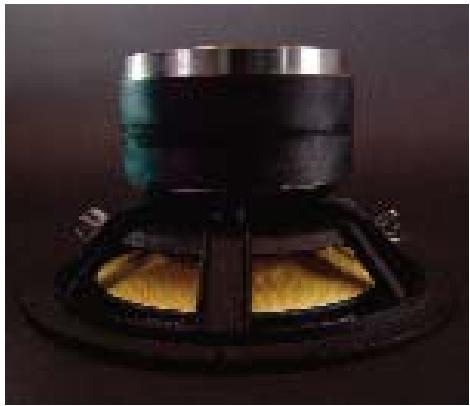
KODO bespoke bass driver
Gryphon bass amps incorporate custom developed parts, the finest Sanken high current bipolar output transistors, linear power supply, large capacitor banks, DC servo-coupling, military spec. double-sided printed circuit boards and Holmgren toroidal transformers with internal magnetic shielding. Ultra-wide bandwidth and zero negative feedback contribute to extreme speed and unconditional stability.
In short, they are true, no-compromise Gryphon power ampli-
Amplifier module for 1 bass tower

fiers born for one purpose only, to be a perfect match for the speaker's bass drivers, electronics and cabinet volume to an extent unrivalled by any conventional passive loudspeaker using external amplification.
Active Crossover Bias
In addition to increasing low-frequency extension for a given cabinet volume and improving bass control by direct-coupling the amp to the drivers, the Gryphon active approach also provides permanent 28 V biasing of crossover capacitors, originally introduced in the Gryphon Cantata. The considerable benefits include improved stability, body, tonal colour and image coherence.
This extraordinary level of coordination and integration ensures an exceptional degree of bass control all the way down to those crucial subsonic notes that are felt more than heard. The signature of a Gryphon active deep bass system is absolute control with none of the sluggishness of more conventional systems.
It should be noted that the Kodo bass towers, as with the Poseidon and Pendragon, are not "subwoofers" in any conventional sense as they cross over at a higher point and, therefore, require more careful placement relative to the HF towers. This must not be compared with old-school systems such as the four-tower infinity's that are often seen positioned with the bass towers some distance away from the HF columns.
Room-Adaptive Q Controller
Essential to the exceptional deep bass performance and outstanding room integration of the Gryphon semi-active bass system is the Gryphon Q controller, ingeniously designed to exploit what others narrowly regard as a problem: an acoustical phenomenon known as room gain, i.e. the fact that in any room, the enclosed space will reinforce response below the room resonance frequency by 12 dB per octave. Since loudspeaker system response rolls off by 12 dB per octave below the loudspeaker's resonance frequency, the Gryphon Q Con-
troller calculates complementary resonance and Q values for the loudspeaker and for the room to achieve resonance-free, extended deep bass response.
Due to the room-specific nature of resonance and Q (the resonance frequency is dependent upon the size of the room and the Q at the resonance frequency will depend on the degree of damping in the room), the necessary compensation can only be performed in situ in a given room.
Once system Q and room Q are "locked in", bass frequencies are coupled ideally to the room and are reproduced in perfect phase with the upper frequency range.
Bass parameters can be optimised for fast, seamless integration of the bass section with the upper/mid in any listening room.
Set-up of the Gryphon Q Controller via remote control is simplicity itself with a separate display that can be placed for clear visibility from the listening position.
Because bass frequencies now have their own dedicated amp, the amount of power needed to achieve a given sound pressure level from the upper/mid section is greatly reduced (typically by more than 50%), allowing you to make your choice of main amplifier exclusively on the basis of sound quality.
Significant effort and resources have been devoted to the development of the Gryphon Q Controller and active, integrated bass amplification with the objective of delivering extended deep bass with articulation, force and authority, completely independent of the acoustic environment.
The singular bass performance of the Gryphon Kodo semi-active system is the direct result of the implementation of active Q control and dedicated on-board amplification, heightening audience awareness of rhythmic subtleties and nuances as it immerses the listener in music's rhythmic power.
A box in a Box
The differences between rooms are often bigger and more profound than the differences between speakers. This is the reason why a speaker with a great subjective review can disappoint greatly when placed in another room. Often it is more a test of how a certain speaker interacts with a certain room, rather than the actual quality of the speaker.
In short, you listen to the combination of speaker and room.
In real life it is easier to buy a new speaker than to buy a new room. Depending on the individual situation – is it a dedicated sound room or is it a living room with other considerations to take and respect – but acoustics can be greatly improved in most rooms and can basically be divided into 2 directions – absorption or diffusion.
a. Absorption is reducing the sound level at certain frequencies.
b. Diffraction is scattering reflections and removing negative effects of reflections from the walls that interfere with the direct sound from the speaker system
At Gryphon we are biased towards diffusion as we find that absorption in its extreme is killing dynamics and live feeling and is often pushing the system to hard because of the loos of sound level. Damping may be required to control an excess of energy in a certain frequency area,. Diffusion can not do that.
It is not possible to give plug and play directions to any speaker system. A large degree is the individual – and often minute – adjustments of position of speaker and listening position that is crucial for optimum performance.
In the following we will describe a starting- point set-up based on our experience and it should only serve as a guideline.
Keep in mind that the set-up that sound right – is right.
As speakers run in, minor adjustments may be required for final set-up.
The bass is a huge challenge in set-up and reason for much aggravation. However, the Kodo active woofer with its adjustments to the room is making that part more easy.
In our reference room ( 60 sq m ) we do not have any damping ( absorption ) behind the speakers but some diffusion on this and more on the rest of the walls. Often some damping on the back wall may be the right solution – the live / dead end philosophy – If ceiling is low, damping at first reflection is suggested. For a ultimate-take-no-prisoners- approach, the traditional table in front of the listener should be avoided as it can generate reflections just as the close ceeling.
The Kodo may at first sight look very much as some of the old 4 column systems such as the Infinity IRS models that was outstanding at its time. They were usually set up with very little respect to the woofer towers that was just placed somewhere
behind the panels and just supposed to provide some oomph to the sound.
The Kodo is a different generation of speakers and shines with its seamless integration between bass and the MT tower, that was the weakness of the older generations of 4 tower systems. So forget about the old school set-ups
Notes on sound reflections.

Behind speaker:
The farther away the system is from back wall, then less diffusion (if any) is required.
Side walls
Diffusion should be used (if any) at sidewalls where first reflection will enter – in this example between 1/3 and 2/3
Behind listener
If distance is large little or perhaps moderate damping can be applied. If it is closer diffusion can be applied, could be combined with damping.
Note that the system is set up in a curve so all drivers are on same curved line and pointing direct at the listener.
Toe-In
If the room is narrow it may be necessary to use the bass towers on the outside of the MT tower to increase distance from In a short room, a set-up where the “focus” of the speakers is slightly behind the speaker may be required.
Reducing toe-in – opening up – may increase soundstage size, opening to much can reduce focus and reduce the dynamic headroom.
Adjusting vertical angle ( lean )
The feet on the cabinets can be adjusted in height; a back lean will often result in a higher placed soundstage. If you are seated low, a forward lean may be required.
The bass towers are not sensitive to this.
Spikes
Due to the weight of the system and consequently, its solid contact to the floor. Spikes are not offering any performance gain, unless the floor is very lively or the carpet is thick and soft.
The woofer towers
In the old school systems, the woofers was often underestimated and viewed as devises that should provide some “umph” to the sound,. They lived their own life , often unhappily married to a inferior muscle amp with PA qualities ( a contradiction of words perhaps )
The Kodo is a speaker system and shines with its rare integration between the drivers. This is achieved by using a number of special developed drivers that due to its size are lightening fast to respond to command.
Large drivers are heavy and takes time to start and most of the time has trouble stopping again, thus creating the dreaded “overhang” – the woofer is playing something that it was not told to by the amplifier.
By using these responsive drivers in a large numbers in combination with a Gryphon amplifier designed specifically to this purpose – rather than a all-round performance - a exceptional degree of bass control is achieved down to the notes that are more felt than heard. The signature of a deep bass system in absolute control is the absence of bass unless the bass is required – it is never a constant “rumble” creating a illusion of a bass that is not telling if it is a cello or a bass – at best, it is just a deep sluggish tone.
The Bass tower electronics
Each tower has a amplifier capable of delivering 1000 watts to the drivers.
It also has some adjustments to support precise integration with panels and the room.
One of the towers is the master and the other is the slave.
The master tower houses all the intelligent circuits that responds to the remote control or other functions, these commands are communicated to the slave with a data-only cable between them. This set-up with only one master in charge scure that both cabinets do the same at the same time.

Master tower control.
Adjustments applies to both towers automatically.
Warning:
Be aware that there is 1000 watt amplifier in each tower that can deliver a huge output in very low frequencies if instructions are not observed. Please be very careful when handling this system
Vol+/Vol-
Bass level up or down.
Q+/Q-
Optimizing bass performance to the specific room.
Always if you change cables – or turn the towers off.
LOW CUT
Use this with turntable use to prevent overloading the system with low level noise from turntable ( rumble) or to prevent disasters with a dropped tone arm
MUTE
In & out puts
XLR in
Connect to balanced output from balanced preamplifier XLR - AES standard- (pin 2 positive, Pin 3 negative, Pin 1 shield)
CONNECT ONLY KODO TOWER TO PREAMPLIFIERS WITH ABSOLUTELY STABLE DC OPERATION. NEVER TURN PREAMPLIFIER ON OR OFF OR MOVE TOWER UNLESS THE KODO MASTER IS TURNED OFF.
XLR out
Can be used to loop to Mid/Hi amplifier if preamplifier do not have 2 outputs.
XLR/RCA
Toggle Switch between balanced or single ended connection
RCA/in
Connect to single ended output from preamplifier
RCA out
Can be used to loop to the Mid/Hi amplifier if your preamplifier do not have 2 sets of outputs.
Ports
Display
Connect display here
Data Interface
Link between Master and Slave
Error
Indication of malfunction
12 v. Link
Auto power-on if connected to a Gryphon link system
Stdby
Flashes when starting up. Blue led on front of bass tower is indicating that tower is ready
AC power
Do not use filters or “sound enhancing” AC devises.
FUSE
Replace only with fuses of same value and type
No serviceable parts inside.
On/Off
Mains switch, both towers must be turned on.
Bass Tower Connections ( SLAVE )

Connecting the Kodo to preamplifier and poweramplifier


TWEETER FINE CALIBRATION
The tweeter level can be fine calibrated by replacing the factory supplied resistors with any pair of the enclosed 2 extra pars.
Notes
Warranty
The Gryphon Kodo is warranted against failures arising through faulty workmanship and materials for a period of 3 year from date of purchase.
The warranty is not transferable.
This warranty is only valid in the country where the product was purchased.
All claims under this warranty must be made to the distributor in the buyer's country by returning the unit securely packed in the original box with all accessories, postage/freight prepaid and insured. The unit will be repaired or replaced at no charge for parts and labor.
This warranty remains valid only if the serial number of the unit has not been defaced or removed and if repairs are performed only by authorized Gryphon dealers or distributors.
The warranty does not cover damage due to misuse, accident or neglect. This warranty is not valid if the operation voltage of the product has been changed.
The distributor or manufacturer, Gryphon Audio Designs, Denmark, retains the exclusive right to make such judgement on the basis of inspection.
The retailer, distributor or manufacturer of the Gryphon shall not be liable for consequential damage arising from the use, misuse or failure of this product, including injuries to persons or property.
To qualify, the enclosed warranty registration card must be filled out and returned to the manufacturer within 10 days of purchase.
Service, warranty claims or questions
Please contact the dealer where you purchased the product

Serial Number
Installed by
Date:
Inspected & Approved By:



- THE GRYPHON
- THIS SYSTEM MUST ONLY BE SET UP BY A DEALER/TECHNICIAN AUTHORIZED BY GRYPHON AUDIO DESIGNS
- INDEX
- THE FINAL FRONTIER
- IMPERFECT DRIVERS
- THE CANTATA REFERENCE MONITOR SYSTEM
- GRYPHON POSEIDON
- GRYPHON KODO REFERENCE STANDARD LOUDSPEAKER SYSTEM
- THE FOUR TOWERS
- IN PERFECT PHASE
- THE MID/HIGH-FREQUENCY MODULE
- THE AMT TWEETER
- ACTIVE Q CONTROL
- ACTIVE CROSSOVER BIAS
- ROOM-ADAPTIVE Q CONTROLLER
- A BOX IN A BOX
- BEHIND SPEAKER
- SIDE WALLS
- BEHIND LISTENER
- TOE-IN
- ADJUSTING VERTICAL ANGLE ( LEAN )
- SPIKES
- THE WOOFER TOWERS
- THE BASS TOWER ELECTRONICS
- MASTER TOWER CONTROL
- WARNING
- LOW CUT
- MUTE
- IN & OUT PUTS
- XLR IN
- PORTS
- CONNECTING THE KODO TO PREAMPLIFIER AND POWERAMPLIFIER
- TWEETER FINE CALIBRATION
- WARRANTY
- SERVICE, WARRANTY CLAIMS OR QUESTIONS
Brand : Gryphon Audio
Model : KODO
Category : Audio Equipment