USER MANUAL CD-RW900 TASCAM
TEAC Professional Division
CD-RW900
CD Rewritable Recorder
Professional
OWNER'S MANUAL

M3

CAUTION
RISK OF ELECTRIC SHOCK
DO NOT OPEN

CAUTION: TO REDUCE THE RISK OF ELECTRIC SHOCK, DO NOT REMOVE COVER (OR BACK). NO USER-SERVICEABLE PARTS INSIDE. REFER SERVICING TO QUALIFIED SERVICE PERSONNEL.

The lightning flash with arrowhead symbol, within equilateral triangle, is intended to alert the user to the presence of uninsulated "dangerous voltage" within the product's enclosure that may be of sufficient magnitude to constitute a risk of electric shock to persons.

The exclamation point within an equilateral triangle is intended to alert the user to the presence of important operating and maintenance (servicing) instructions in the literature accompanying the appliance.
This appliance has a serial number located on the rear panel. Please record the model number and serial number and retain them for your records.
Model number
Serial number
WARNING: TO PREVENT FIRE OR SHOCK HAZARD, DO NOT EXPOSE THIS APPLIANCE TO RAIN OR MOISTURE.
For U.S.A.
TO THE USER
This equipment has been tested and found to comply with the limits for a Class A digital device, pursuant to Part 15 of the FCC Rules. These limits are designed to provide reasonable protection against harmful interference when the equipment is operated in a commercial environment. This equipment generates, uses, and can radiate radio frequency energy and, if not installed and used in accordance with the instruction manual, may cause harmful interference to radio communications.
Operation of this equipment in a residential area is likely to cause harmful interference in which case the user will be required to correct the interference at his own expense.
CAUTION
Changes or modifications to this equipment not expressly approved by TEAC CORPORATION for compliance could void the user's authority to operate this equipment.
For the customers in Europe
WARNING
This is a Class A product. In a domestic environment, this product may cause radio interference in which case the user may be required to take adequate measures.
a) Applicable electromagnetic environment: E4
b) Peak inrush current: 12.5 A
1 Read these instructions.
2 Keep these instructions.
3 Heed all warnings.
4 Follow all instructions.
5 Do not use this apparatus near water.
6 Clean only with dry cloth.
7 Do not block any ventilation openings. Install in accordance with the manufacturer's instructions.
8 Do not install near any heat sources such as radiators, heat registers, stoves, or other apparatus (including amplifiers) that produce heat.
9 Do not defeat the safety purpose of the polarized or grounding-type plug. A polarized plug has two blades with one wider than the other. A grounding type plug has two blades and a third grounding prong. The wide blade or the third prong are provided for your safety. If the provided plug does not fit into your outlet, consult an electrician for replacement of the obsolete outlet.
10 Protect the power cord from being walked on or pinched particularly at plugs, convenience receptacles, and the point where they exit from the apparatus.
11 Only use attachments/accessories specified by the manufacturer.
12 Use only with the cart, stand, tripod, bracket, or table specified by the manufacturer, or sold with the apparatus. When a cart is used, use caution when moving the cart/apparatus combination to avoid injury from tip-over.
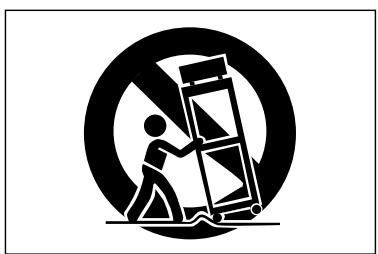
13 Unplug this apparatus during lightning storms or when unused for long periods of time.
14 Refer all servicing to qualified service personnel. Servicing is required when the apparatus has been damaged in any way, such as power-supply cord or plug is damaged, liquid has been spilled or objects have fallen into the apparatus, the apparatus has been exposed to rain or moisture, does not operate normally, or has been dropped.
- Do not expose this apparatus to drips or splashes.
- Do not place any objects filled with liquids, such as vases, on the apparatus.
- Do not install this apparatus in a confined space such as a book case or similar unit.
- The apparatus draws nominal non-operating power from the AC outlet with its POWER switch in the off position.
- The apparatus should be located close enough to the AC outlet so that you can easily grasp the power cord plug at any time.
- An apparatus with Class I construction shall be connected to an AC outlet with a protective grounding connection.
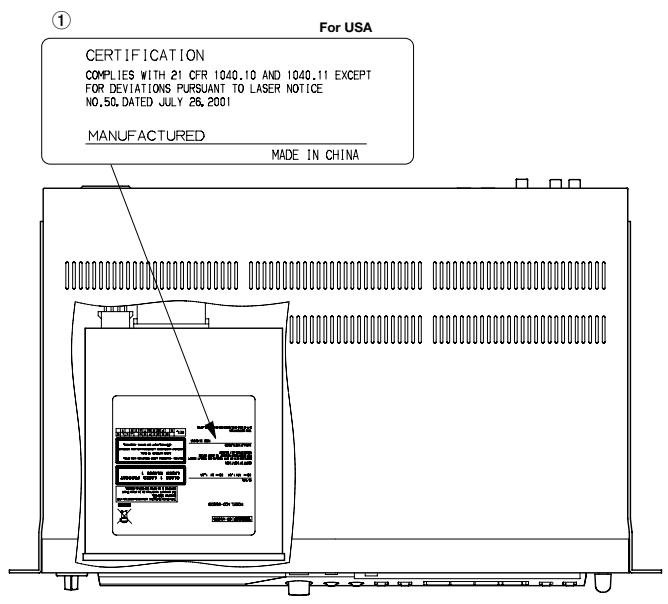
This product has been designed and manufactured according to FDA regulations "title 21, CFR, chapter 1, subchapter J, based on the Radiation Control for Health and Safety Act of 1968", and is classified as a class 1 laser product. There is no hazardous invisible laser radiation during operation because invisible laser radiation emitted inside of this product is completely confined in the protective housings. The label required in this regulation is shown ①.
Optical pickup:
Type: SF-W37SFT
Manufacturer: Sanyo Electric Co, Ltd.
Laser output: Less than 0.7mW on the objective lens (record)
Wavelength: 760 to 800nm
CAUTION
- DO NOT REMOVE THE PROTECTIVE HOUSING USING A SCREWDRIVER.
- USE OF CONTROLS OR ADJUSTMENTS OR PERFORMANCE OF PROCEDURES OTHER THAN THOSE SPECIFIED HEREIN MAY RESULT IN HAZARDOUS RADIATION EXPOSURE.
- IF THIS PRODUCT DEVELOPS TROUBLE, CONTACT YOUR NEAREST QUALIFIED SERVICE PERSONNEL, AND DO NOT USE THE PRODUCT IN ITS DAMAGED STATE.
1 - Introduction
About this manual 6
Supplied accessories 6
Rack-mounting the unit 6
About CD-R abd CD-RW discs. 7
Finalizing. 7
"Recordable" discs. 7
Environmental considerations 8
Handling of compact discs 8
Never use a stabilizer or printable discs. 9
Beware of condensation 9
Use of the remote control unit. 9
Batteries 9
Inserting batteries 9
Connections 9
2 - Features of the CD-RW900
Front panel. 10
Rear panel. 11
RC-RW900 Remote control unit 12
Menu configuration 13
Operation basics 13
4 -Playback operations
Discs for playback. 15
Simple playback operations 15
Track selection 15
Using the skip function 15
Selecting by track number 16
Track search 16
Normal search 16
Direct search 16
Operation variations. 16
Playback modes 17
Continuous playback 17
Single-track playback 17
Program playback 17
Random playback 18
Time display switching. 18
Timer playback 18
Repeat playback 18
A to B repeat playback. 19
Pitch control function. 19
Key control function. 19
Playingback MP3 files 20
About MP3 track data 20
Directory playback setting 20
5 - Recording
Input selection 21
Input monitoring 21
Frequency conversion 21
Basic recording 22
Time display while recording 22
Full disc 22
Advanced recording. 23
Fade-in and fade-out recording 23
Synchronized recording 23
Sync recording 23
Automatic track division 24
Manually divide track 25
Rec mute function 25
6 - After recording
Finalizing 26
Unfinalizing CD-RW discs 26
Erasing 27
Erasing tracks 27
Erasing a whole disc. 27
Refreshing a disc 27
7 - Titling
Title input operation 28
Disc title input 28
Track title input 28
Keyboard type setting 29
Title input by keyboard 29
Other keyboard operations 29
8 - Reference and specifications
Error messages 30
Messages during operations 30
Troubleshooting 30
Specifications 31
Dimensional drawing 31
1 - Introduction
Thank you for your purchase of the TASCAM CD-RW900 CD rewritable recorder.
Before connecting and using the unit, please take time to read this manual thoroughly to ensure you understand how to properly set up and connect the CD-RW900, as well as the operation of its many useful and convenient functions. After you have finished reading this manual, please keep it in a safe place for future reference.
NOTE
This product is designed to help you record and reproduce sound works to which you own the copyright, or where you have obtained permission from the copyright holder or the rightful licensor. Unless you own the copyright, or have obtained the appropriate permission from the copyright holder or the rightful licensor, your unauthorized recording, reproduction or distribution thereof may result in severe criminal penalties under copyright laws and international copyright treaties. If you are uncertain about your rights, contact your legal advisor. Under no circumstances will TEAC Corporation be responsible for the consequences of any illegal copying performed using the CD-RW900.
About this manual
In this manual, we use the following conventions:
- The names of keys and controls are given in the following typeface: ERASE.
-
When the alphanumeric portion of the display shows a message, this is shown in the following typeface: Welcome.
-
If a preset indicator in the display (i.e. one which cannot change, but is either on or off) is shown, this is shown as follows: RANDOM.
- Selectable value (i.e. values of dB) or ON and OFF selection (i.e. SRC>XXX) is shown in the following typface: XXX.
Supplied accessories
In addition to this manual, the CD-RW900 has been packed with the following:
Contact your TASCAM supplier if any of these items are missing.
Rack-mounting the unit
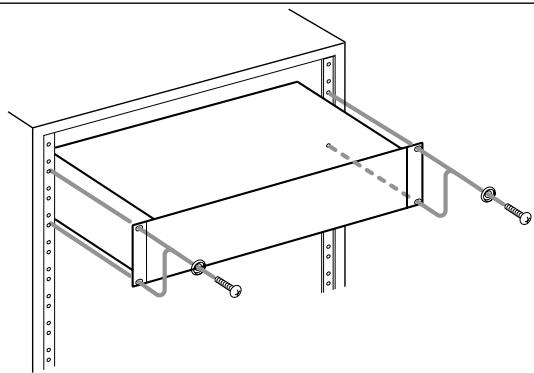
If you are mounting the unit in a rack, leave 1U of space above it and 4 inch (10cm) or more of space at the rear.
Use the rack-mounting kit to mount the unit in a standard 19-inch equipment rack, as shown in this section. Remove the feet of the unit before mounting.
About CD-R and CD-RW discs
CD-R discs can be recorded once only. Once they have been used for recording, they cannot be erased or re-recorded. However, if space is available on the disc, additional material can be recorded. The pack-aging of CD-R discs will include one of the following logos:


By contrast, a CD-RW disc can be used in much the same way as a CD-R disc, but the last track or tracks recorded can be erased before the disc has been "finalized", and the space on the disc can be re- used for other recordings. The packaging of CD-RW discs will include the logo one of the following logos:



However, you should note that an audio CD created using a CD-RW900 disc may not play back satisfactorily on every audio CD player. It will, naturally, be playable on the CD-RW900. This is in no way a limitation of the CD-RW900 itself, but of the difference between the different types of media and the methods used to read them.
There are precautions that you should take when handling CD-R and CD-RW discs.
- Avoid touching the recording (non-label) side of a disc on which you will be recording. Recording on a disc requires a cleaner surface than playing back, and fingerprints, grease, etc. can cause errors in the recording process.
Finalizing
Although audio data may be written on a CD-R or CD-RW disc, a standard CD player will not be able to read the data (i.e. play back the audio) until a final *TOC has been written at the start of the disc.
*TOC=Table of contents:
information of recorded data, which contains titles, starting and ending addresses, and etc..
The process of writing this table of contents is known as "finalizing". Once this has been done, no further data can be written to the disc. See "Finalizing" on page 25 for details.
"Recordable" discs
In this maanual, we use the term "recordable" disc to describe a CD-R or CD-RW disc that has not been finalized, i.e. further recording is possible on the disc.
- CD-R and CD-RW discs are sensitive to the effects of heat and ultraviolet rays. It is important that they are not stored in a location where direct sunlight will fall on them, and which is away from sources of heat such as radiators or heat-generating electrical devices.
- Always store CD-R and CD-RW discs in their cases to avoid dirt and dust accumulating on their surfaces.
- When labeling CD-R and CD-RW discs, always use a soft oil-based felt-tipped pen to write the information. Never use a ball-point or hard-tipped pen, as this may cause damage to the recorded side.
- Always keep the recording sides of the discs away from grime and dust to avoid a reduction in sound quality. To clean a disc, wipe gently with a soft dry cloth from the center towards the outside edge. Do not use thinner, gasoline, benzene or LP cleaning fluid, as these will damage the disc and cause the disc unplayable.
- Do not put labels or protective sheets on the discs and do not use any protective coating spray.
- If you are in any doubt as to the care and handling of a CD-R disc, read the precautions supplied with the disc, or contact the disc manufacturer directly.
In the case of a CD-RW disc which has been finalized, the whole of the disc may be erased, or the disc may be "refreshed", and the disc re-used.
In addition, a CD-RW disc that has been finalized may be "unfinalized", i.e. only the TOC is removed. This allows further tracks to be recorded to the disc, provided that there is space on the disc.
Environmental considerations
The CD-RW900 may be used in most areas, but to maintain top performance, and prolong operating life, observe the following environmental conditions:
- The nominal temperature should be between 5^ and 35^ (41°F and 95°F).
- Relative humidity should be 30 to 90 degrees non-condensing.
-
As the unit may become hot during operation, always leave sufficient space above the unit for ventilation. Do not install this unit in a confined space such as a book case or similar product, and do not put any material goods on the unit.
-
Avoid installing this apparatus on top of any heat-generating electrical device such as a power amplifier.
- Make sure that the unit is mounted in a level position for correct operation.
NOTE
The voltage supplied to the unit should match the voltage as printed on the rear panel. If you are in any doubt regarding this matter, consult an electrician.
Handling of compact discs
The CD-RW900 has been designed for the playback of CD-DA format discs and MP3 files recorded in ISO9660 format: In addition to ordinary 5-inch and 3-inch CDs, it can also play properly recorded CD-R and CD-RW discs.
- Always place the compact discs in the trays with their label facing upward.
- To remove a disc from its case, press down on the center of the disc holder, then lift the disc out, holding it carefully by the edges.
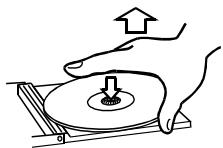
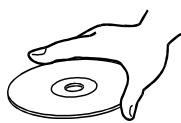
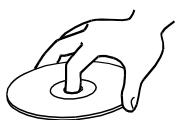
- Avoid getting fingerprints on the signal side (opposite the label side). Grime and dust may cause skipping, so keep discs clean and store them in their cases when not being played. To clean the signal side of a disc, wipe gently with a soft dry cloth from the center towards the outside edge.
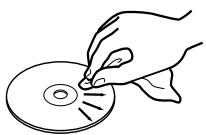
- Do not use any record spray, anti-static solutions, benzene, paint thinner or other chemical agents to clean CDs as they could damage the delicate playing surface. It may cause CDs unplayable.
- Discs should be returned to their cases after use to avoid serious scratches that could cause the laser pickup to "skip".
-
Keep discs away from direct sunlight, and places of high heat and humidity. If left in such places, warping could result.
-
Do not affix any labels or stickers to the label side of the disc. Do not write on the disc with a ballpoint pen.
- Do not insert discs that have adhesive remaining from tape or stickers that have been removed. If they are inserted into the player, they could stick to the internal mechanism, requiring removal by a technician.
- Do not use cracked discs.
- Only use circular compact discs. Avoid using non-circular promotional, etc. discs.
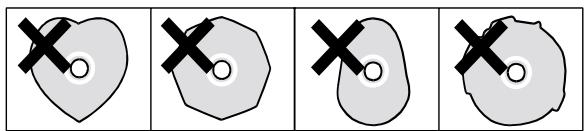
- The CD-RW900 cannot play unfinalized CD-R/RW discs.
- Music discs with copy control, a compact disc copy-protection system, have been released form several record companies aiming to protect the copyright. Since some of these discs do not comply with the CD specifications, they may not be playable on the CD-RW900.
Never use a stabilizer or printable discs
Using commercially available CD stabilizers or printable recordable discs with this player will damage the mechanism and cause it to malfunction.
NOTE
Never use a disc that has had a stabilizer mounted to it. The residual adhesive may cause the disc to stick to the turntable of the CD-RW900. If it sticks to the turntable, you will need a technician to get it out.
Beware of condensation
If the unit (or a compact disc) is moved from a cold to a warm place, or used after a sudden temperature change, there is a danger of condensation; vapor in the air could condense on the internal mechanism, making
correct operation impossible. To prevent this, or if this occurs, leave the player for one or two hours with the power turned on, then turn the power off and on again.
Use of the remote control unit
- Do not expose the light-receptive spot to the direct sunlight or intense lights of an illumination for extended periods. Long exposure to the lights may result a failure of the unit functions.
-
When the remote control will not be used over one month, please remove the batteries to prevent the possibility of battery acid leakage which could damage the unit. Should leakage occur, remove and discard the batteries, and wipe the battery case thoroughly with a cloth. Avoid getting the battery liquid on the skin. After cleaning, replace with new batteries.
-
The remote control functions by using an infrared light signal. When using the unit to control the CD-RW900, other devices that are turned on could be operated by its signal.
- If the range of remote operation becomes smaller, or commands do not always function properly, the batteries have become weak and should be replaced. Always replace both batteries with new batteries of the same type.
- Point the remote control to the remote sensor on the main unit. Do not obstruct the path between the remote control and the remote sensor.
Batteries
If batteries are used improperly, or if leakage or breakage occurs, the unit will not function. Please observe the cautions indicated on the batteries and their packaging to ensure proper usage.
- Confirm + and - polarity and follow the indications when inserting new batteries into the remote control.
- Do not use old and new batteries together.
- Even if the battery is the same size, the voltage may differ. Do not use batteries of different specifications together.
- Do not attempt to recharge batteries that are non-rechargeable.
- Do not open or disassemble batteries, throw them into a fire or put them in water.
Inserting batteries
- Open the lid.
- Confirm + / - polarity, and insert two AAA batteries.
- Close the lid.
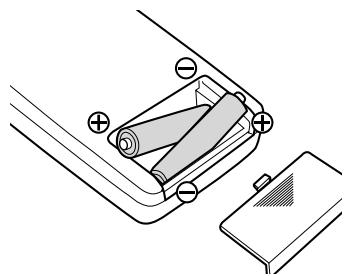
Connections
The following should be noted when you connect the unit to other equipment.
It is possible to connect the unit's DIGITAL COAXIAL IN, DIGITAL OPTICAL IN and ANALOG UNBALANCED INs (L, R) to other equipment at the same time. However, the unit can receive signals from only one digital input at a time.
Currently selected input jack is shown on the display.
Audio signals output from the unit are output from the analog ANALOG OUT jacks, as well as from the DIGITAL COAXIAL OUT jack and DIGITAL OPTICAL OUT connector simultaneously (but not from the digital outputs in stop mode).
Front panel
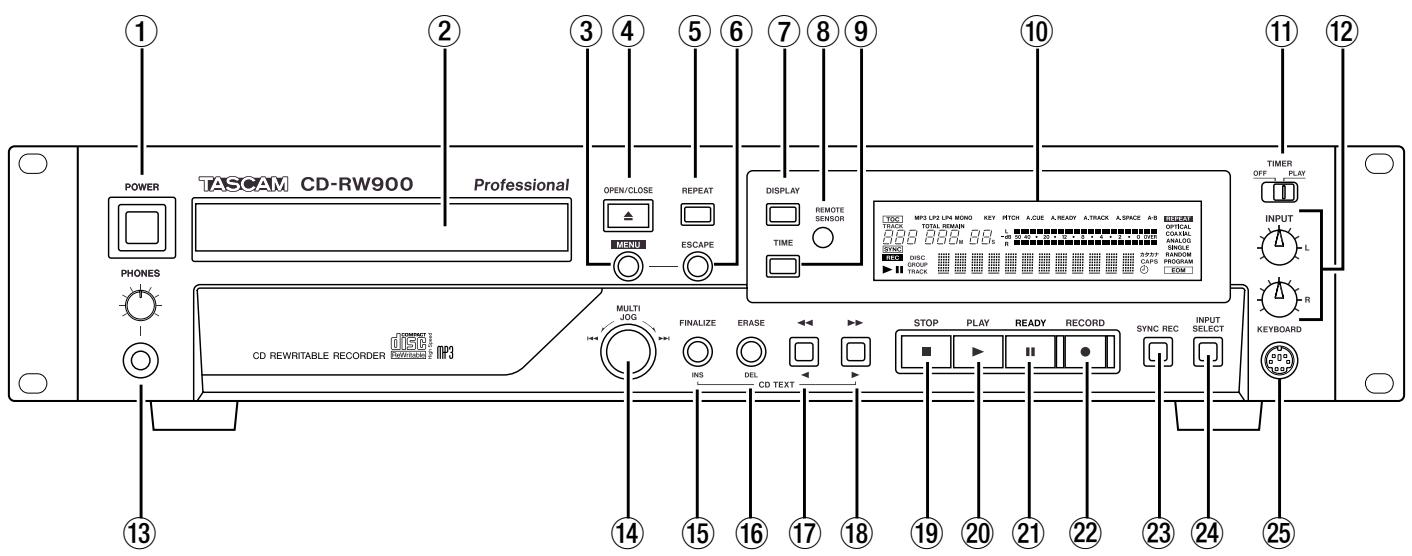
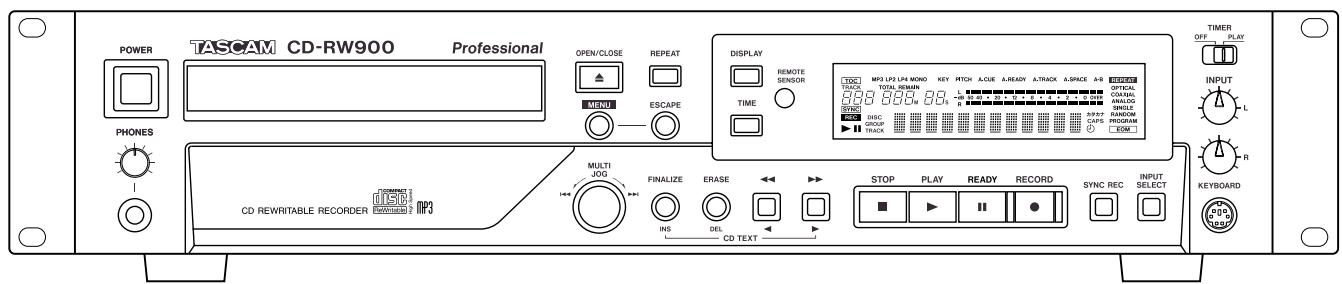
① POWER switch The power switch is used to switch the unit on and off.
② Disc tray Discs should be placed label side upwards in the disc tray. When a disc is loaded into the unit, the display period following the word TOC Reading as the unit determines the contents of the disc.
(3) MENU key Use this key to call up the menu options (see “Operation basics” on page 14).
(4) OPEN/CLOSE key Use this key to open and close the disc tray. The display shows Open when the tray is opening and Close when the tray is closing.
⑤ REPEAT key Use this key to set the repeat playback mode on and off.
⑥ ESCAPE key When in a menu mode, this key cancels the menu item selected.
⑦ DISPLAY key Use this key to see the current disc tittle when a disc is stopping. To display the current track tittle, press this key while playback or ready mode.
(8) REMOTE SENSOR This is not a control, but the sensor for the remote control unit. When using the remote control unit, make sure that there is a clear path from the remote control unit to the sensor.
⑨ TIME key Use this key to cycle through the time modes appear on the display (see “Time display switching” on page 18).
⑩ Display The display is used to show the current status of the unit, as well as the current menu settings.
⑪ TIMER switch (PLAY, OFF) Using this key switches Timer play on and off. See “Timer playback” on
page 18 for details.
⑫ INPUT (L,R) controls Use these concentric controls to adjust the level of the analog audio signals received at the ANALOG IN jacks.
(13) PHONES jack and the level control Use a standard pair of stereo headphones, equipped with a 1/4-inch plug, with this jack.
Adjust the volume from the jack with the level control (turn clockwise for higher volume).
(14) MULTI JOG dial Use this dial to select tracks for playback, to set parameter values.
In addition, pushing the dial acts like an ENTER key, i.e. the currently-displayed value or setting is confirmed.
(15) FINALIZE/INS key Use this key to finalize recordable discs. (see “Finalizing” on page 25 for details).
It also acts like a space key when entering TEXT data (see “Title input operation” on page 28).
ERASE/DEL key Use this key (with CD-RW discs only) to erase tracks, or a whole disc, or to refresh a "bad" disc, or to uninitialize a finalized disc. See "Erasing" on page 26 for details.
It also acts like a delete key when entering TEXT data (see “Title input operation” on page 28).
17 key Use this key to operate review playback (search) while playback or ready mode.
When Directory search is on, and when stop, using this key selects the directory.
It also moves the cursor in the left direction when entering TEXT data.
2 - Features of the CD-RW900
18 / key Use this key to operate cue playback (search) while playback or ready mode.
When Directory search is on, and when stop, using this key selects the directory.
It also moves the cursor in the right direction when entering TEXT data.
19 STOP key Use this key to stop playback or recording.
20 PLAY key Use this key to start or resume playback or recording.
(2) READY key Use this key to stands by playback or recording.
22 RECORD key Use this key to enter record ready mode (see "Recording" on page 21 for details) and also to enter manual track divisions (see "Manual track division" on page 25).
23 SYNC REC key Use this key to turn synchronized
recording on and off before starting to record (see "Synchronized recording" on page 23 for details).
24 INPUT SELECT Use this key to select the different audio inputs and the input combinations (see “Input selection” on page 21 for full details).
25 KEYBOARD jack An IBM PC-compatible keyboard with PS/2 interface can be connected to this terminal to enable certain operations of the CD-RW900 with the keyboard. Title input operations, in particular, can be performed with greater efficiency.
Rear panel
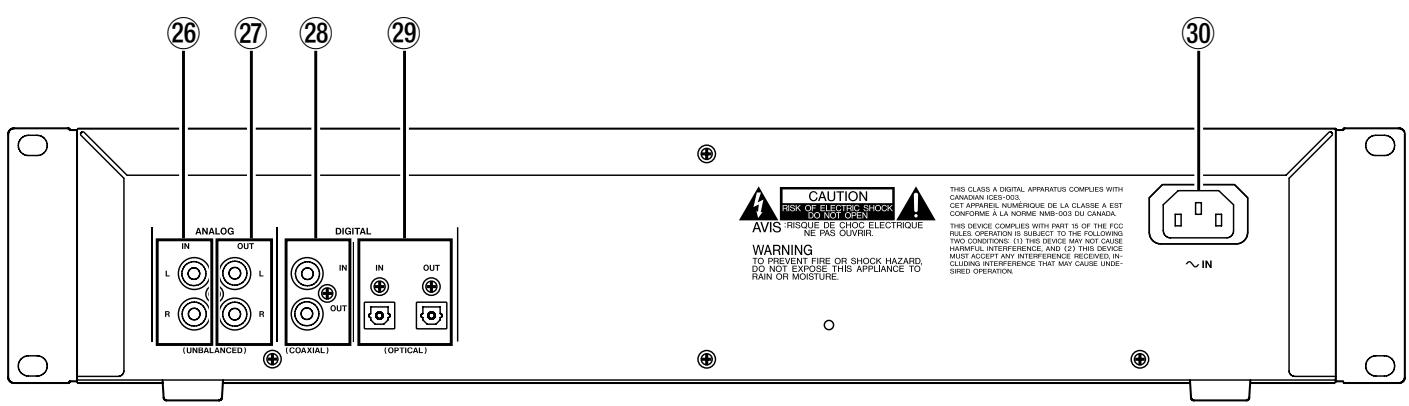
26 ANALOG INPUT (L, R) These RCA jacks accept analog audio signals from suitably-equipped units (-10 dBV, unbalanced).
27 ANALOG OUT (L, R) These RCA jacks output analog audio signals (at -10 dBV levels, unbalanced) to suitably-equipped units).
28 DIGITAL COAXIAL (IN, OUT) These two RCA jacks accept and output digital audio in standard consumer format (SPDIF).
29 DIGITAL OPTICAL (IN, OUT) These two TOSLINK optical connectors accept and output digital audio using optical fiber connectors.
30 AC IN jack Connects the power cable supplied.
RC-RW900 Remote control unit

① TIME key Press this key to cycle through the time display modes.
② DISPLAY key Press this key to see the current disc tittle when a disc is stopping, or the current track tittle while playback or ready mode.
When entering TEXT data, using this key switches the text characters.
(3) REPEAT key Changes between the various repeat modes when playing back (see “Repeat playback” on page 18).
(4) A-B key Sets the A-B repeat points and playback mode (see “A-B repeat mode” on page 19).
(5) DIRECTORY key Use this key to switch MP3 file directory playback on and off.
⑥ PITCH key Switches pitch control on and off.
(7) FADER key Use this key to start fade-in recordings or to start a fade-out when recording (see “Fade-out and fade-in recording” on page 23 for details).
(8) RECORD key Use this key to enter record ready mode.
(9) SEARCH keys (▲/▲▶) Use these keys to move the playback position inside a track.
(10) STOP key Use this key to stop playback or recording.
(1) READY key Use this key to stands by playback or recording.
⑫ SYNC REC key Use this key to turn synchronized recording on and off (see “Synchronized recording” on page 23 for details).
13 OPEN/CLOSE key Opens and closes the disc tray.
⑭ Number keys (0 through 9) Use these keys for direct entry of track numbers when playing back, or making a programmed play list.
15 CLEAR key Clears a mistaken entry made with the number keys.
In the program mode, pressing this key cancels the program entered at the last.
It also acts like the ESCAPE key in the Menu mode.
(16) ENTER key Pressing this key is equivalent to pressing the MULTI JOG dial to confirm an entry.
17 MENU key Switches the menu mode on or off.
⑱ PLAY MODE key Use this key to choose between the different playback modes (single play, continue play, etc.).
ERASE key Erases tracks (CD-RW discs only), or a whole disc, or to refresh a "bad" disc, or to uninitialize a finalized disc (see "Erasing" on page 26 for details).
20 FINALIZE key Finalizes recordable discs. See "Finalizing" on page 25 for details.
(2) RECR MUTE key Use this key when recording, to mute the input signal for about four seconds and then to enter record ready mode (see “Rec mute function” on page 25).
② SKIP (I▲/▶) keys Use these keys to move between tracks when playing back (equivalent to rotating the MULTI JOG dial).
23 PLAY key Use this key to start playback, or enter record mode from record ready mode.
The various settings and editing operations possible with the CD-RW900 are performed through menu options shown on the display. Among the many menu set-
ting options, some may be made directly using the keys on the remote control.
The menus are configured as shown below. Please see the reference page for more details of each menu.
| Menu option | Sub-M Menu option | Function | Reference page |
| PLAY | PLAY MODE | Playback mode settings | P17 ("Playback modes") |
| PITCH | Pitch control mode on/off | P19 ("Pitch control") |
| PITCH CONT | Pitch control setting | P19 ("Pitch control") |
| PITCH STEP | Pitch control variable pitch setting | P19 ("Pitch control") |
| KEY | Key control mode on/off | P19 ("Key control function") |
| KEY LEVEL | Key control level setting | P19 ("Key control function") |
| DIRECTORY | MP3 disc directory mode on/off | P20 ("Playback MP3 files") |
| REC | VOLUME | Input level setting | P21 ("Input selection") |
| FADE IN | Fade-in operation time setting | P23 ("Fade-in and fade-out recording") |
| FADE OUT | Fade-out operation time setting | P23 ("Fade-in and fade-out recording") |
| SRC | Sampling rate converter on/off | P21 ("Frequency conversion") |
| SYNC LEVEL | Operation level of Sync recording | P23("Sync recording") |
| A_TRK | Auto track mode setting | P24 ("Automatic track division") |
| A_TRK LEVEL | Auto track operation level | P24 ("Automatic track division") |
| TEXT | TEXT EDIT | Text setting | P28 ("Title input") |
| SYSTEM | KEYBOARD | Setting for keyboard type | P29 ("Keyboard setting") |
| PLAY TIME | Confirming total playing time | P18 ("Time display switching") |
| REC TIME | Confirming total recording time | P22 ("Time display while recording") |
Operation basics
Press the MENU key on the front panel or remote control to call up the desired menu. The PLAY option in the PLAY sub-menu will be shown on the display at first.
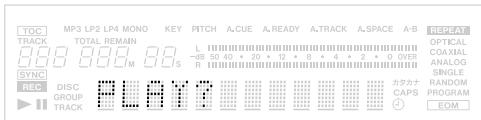
Front panel operation: Rotate the MULTI JOG dial to select the desired menu option, then push the dial to confirm.
Remote control operation: Use the SKIP key to cycle through the different menu options, then press the ENTER key to confirm.
The sub-menu option screen of the selected menu will be displayed.
If the PLAY option is selected, the sub-menu option shows up like this:
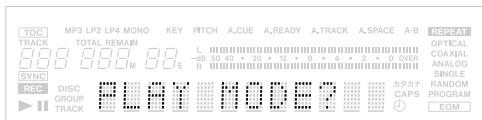
NOTE
Return to the menu option selection screen, press the ESCAPE key on the front panel or the CLEAR key on the remote control.
Front panel operation: Rotate the MULTI JOG dial to select the desired sub-menu, then push the dial to enter the selection.
Remote control operation: Use the SKIP key to select, then press the ENTER key.
The menu item screen of the selected su-menu will
appear. If the sub-menu PLAY MODE is selected, the menu item shows up like this:
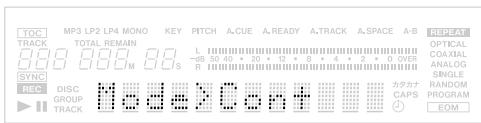
NOTE
Return to the sub-menu option selection screen, press the ESCAPE key on the front panel or the CLEAR key on the remote control.
Front panel operation: Use the MULTI JOG dial to select the desired menu item or value. Pushing the dial enters and exits menu mode.
Remote control operation: Use the SKIP key to select. Pressing the ENTER key confirms and exits menu mode.
NOTE
Some menu options exist for confirmation purposes only, and setting cannot be performed.
As well as pushing the MULTI JOG dial or pressing the ENTER key, you can use the MENU key to exit menu mode.
NOTE
The selected menu mode remains after power is turned off, except the TEXT menu.
The CD-RW900 can be used to play back CDs (including CD-R and CD-RW discs that have been recorded and finalized on other types of recorder), as well as CD-R discs and CD-RW discs that have been recorded on the unit.
Audio files in MP3 format on CD-ROM, CD-R and CD-RW are also playable on the unit.
Discs for playback
The CD discs in the CD-RW900 can play back the types of discs listed below.
- Commercial pre-recorded CDs recorded in CD-DA format.
-
CD-R and CD-RW discs that have been recorded in CD-DA format and finalized properly.
-
MP3 files recorded in ISO9660 level 1 and level 2 format on CD-R and CD-RW discs, and properly finalized. MP3 files recorded in the format which adheres to Joliet, are also playable.
Simple playback operations
1 Press the POWER switch to turn on the unit.
2 Press the OPEN/CLOSE key to open the disc tray. The display shows Open. Insert a disc in the tray with the label side up.
3 Press the OPEN/CLOSE key to close the tray. The display shows Close when a disc is loaded into the unit, then TOC Reading. will appear, with the period flashing.
When the TOC has been read, the display shows the number of tracks and total running time of the disc.
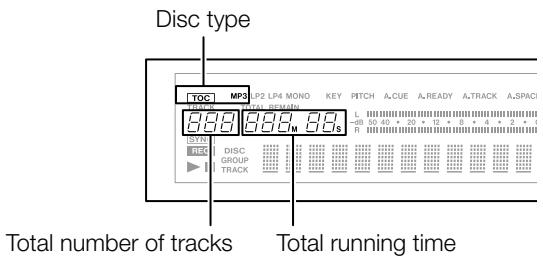
The CD-RW900 also shows one of the following:
TOC A disc finalized
MP3 A disc contains MP3 files
4 Press the PLAY key to start playback.
Adjust the connected monitor system, or the level control for the PHONES on the unit to set the listening level you desire.
WARNING
If you monitoring using headphones, adjust the level control to low on the unit, then connect to the PHONES jack before playing back. This will prevent any possible damage for your hearing.
5 To stop playback, press the STOP key.
Temporarily stop playback and enter playback standby mode, press the READY key. To resume playback, press the PLAY key again.
NOTE
The explanation in this manual will assume the user is starting from the normal Continuous mode.
Track selection
Using the skip function
Skipping track numbers backward or forward.
- Select desired tracks for playback with the MULTI JOG dial on the front panel. Turning clockwise skips the track number backward and counterclockwise skips forward.
Or, press the SKIP key on the remote control. Pressing key skips the track number backward and key skips forward.
2 Press the PLAY key to start playback.
Or, press the READY key to cue the track and enter playback standby mode after moving to the head of the selected track. To start playback, press the PLAY key.
Selecting by track number
Using the number keys on the remote control, the number of the desired track can be entered directory. Even numbers with two or three digits can be entered easily. For example:
Track 9: press '9' and 009 will be displayed.
Track 12: press '1' and '2' and 012 will be displayed.
Track 103: press '1' and '0' and '3' and 103 will be displayed.
After input, press the PLAY key to start playback. Or, the READY key to cue the track at its head position and enter playback standby mode.
You can also enter the track number and start playback by pushing the MULTI JOG dial or using the ENTER key.
NOTE
This function cannot be used in Program or Random mode.
Track search
Normal search
1 Press the / search key continuously on the front panel, or the SEARCH / key on the remote control.
2 To stop the search function, simply release the / or the SEARCH key.
NOTE
The search function does not operate with MP3 discs.
Direct search
By specifying time from the start of a certain track, you can start playback from a specified point of a specified track.
Basic operation
1 During stop, play or playback standby modes, use the number keys on the remote control to input the three-digit track number (such as 002 for track 2), then the desired elapsed time (***min **sec) from the start of that track.
Example: To specify 1 min 30 sec from the start of track 2, input "002 001 30".
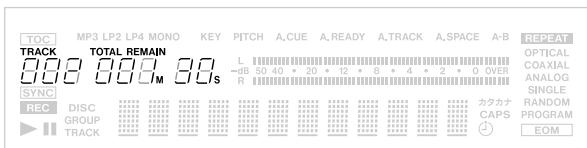
During input, the counter in the display will flash.
Pressing the CLEAR key cancels the input at any stage during input.
NOTE
Regardless of the time display mode (refer to "Time display switching on page 18), the time from the start of the specified track is displayed.
During stop or playback modes, when the final digit is entered, the desired position is automatically located and playback will begin from the desired point. During playback standby mode, at the desired point the unit will enter playback standby mode.
NOTE
-
If a point which does not exist is entered, setting operation will be cancelled.
-
The direct search function cannot be used in program or random mode.
- For MP3 discs, time cannot be specified within a track. However, if you input the three-digit track number, playback will begin from the start of that track.
Operation variations
Even if the final second is not input, playback will begin from the selected point after pressing the ENTER or PLAY key. Or, if you press the READY key, the unit will enter the playback standby mode at the selected point.
Specifying a track number only
After inputting the track number, press the ENTER or PLAY key to begin playback of that track, or the READY key to cue the track and enter playback standby mode.
NOTE
Instead of inputting the three-digit track number, you can input only the desired track number.
Example: To specify track 3, input only "3".
Specifying to the minute
After inputting the three-digit track number and the number of minutes after the start of the track, press the ENTER or PLAY key to begin playback of that track, or the READY key to cue the track and enter playback standby mode.
Example: To specify 1 min 00 sec from the start of track 2, input "002 001"
NOTE
Following the above example, if “0021” is input, the same position will be located.
Playback modes
There are four different playback modes. The selected mode will be indicated on the left of the display.
- Continuous playback mode (default setting): no indication lamp
- Single playback mode: SINGLE lamp is lit
- Program playback mode: PROGRAM red lamp is lit
- Random playback mode: RANDOM red lamp is lit
The playback mode can be selected using the PLAY MODE key on the remote control unit. Pressing the key changes the playback mode on the display in the following order:
Continue Single Program Random
You can also select the playback mode using the PLAY MODE option in the PLAY sub-menu (refer to “Opera-
tion basics" on page 14). Turning the MULTI JOG dial clockwise changes the playback mode shown on the display in the following order:
Mode>Cont Mode>Single Mode>Program Mode>Random
Pressing the MENU key or pushing the MULTI JOG dial returns to normal mode from the menu mode.
While the mode can be changed from any playback mode, the explanation in this manual will assume the user is starting from the Continuous mode.
NOTE
The selected playback mode remains after power is turned off. However, the setting of program playback mode will be deleted when power is turned off.
Continuous playback
Programming is cancelled, and playback continuous in the normal order.
1 During stop, set the Continue or the Mode>Cont mode.
2 Press the PLAY key to begin playback in order of the track number.
Single-track playback
This function enables playback of just a single track.
1 During stop, set the Single or the Mode>Single mode.
2 Use the SKIP key or the number keys (0~9) on the remote control to select the desired track.
The MULTI JOG dial can be used to select the track also.
3 Press the PLAY key to begin playback.
After the selected track finishes, playback stops.
Program playback
This function enables playback of selected tracks in any desired order. Up to 99 tracks can be selected for program playback.
1 During stop, set the Program or the Mode>Program mode.
2 Use the number keys (0~9) on the remote control unit to select each desired track for program playback, then press the ENTER key.
You can also rotate the MULTI JOG dial to select the track number and push to enter.
The track number will be entered into the program.
Repeat the above step 2 until the desired program is completed. As the program is being created, the program number and total program playing time is revised on the display.
NOTE
If the CLEAR key is pressed, the programmed track will be deleted from the last.
3 When program setting is completed, press the PLAY key to begin playback of the tracks in the programmed order.
NOTE
- If the STOP key is pressed without first pressing the PLAY key, all the program data will be erased.
- During stop, if the playback mode is switched to another, all the program data will be erased.
- The programmed play order is not memorized when power is turned off.
- In this mode, if any track is not programmed, the CD-RW900 will not start playback.
- If an attempt is made to enter more than 100 program steps, the message PGM Full! appears on the display.
- If the total program playing time exceeds 999 min 59 sec, --- : --- appears on the display.
Random playback
In this mode, the unit will play back all the tracks on the disc in completely random order, regardless of track number.
1 During stop, set the Program or the Mode>Random mode.
2 Press the PLAY key and random playback will begin.
Time display switching
When the TIME key on the front panel or the remote control is pressed, the time display will switch through several modes on the display.
- Elapsed track time (no display light indication)
- Remaining track time (REMAIN is lit in the display)
- Elapsed disc time (TOTAL is lit in the display)
- Remaining disc time (TOTAL and REMAIN are lit in the display)
When stopped, the total recording time is shown, regardless of the status of the TOTAL and REMAIN indicators.
NOTE
Even when power is turned off, the unit will remain in Random mode.
NOTE
- In program mode, pressing the TIME key displays the elapsed and the remaining time of the whole program.
- When playing an MP3 disc, elapsed track time is always displayed, and the TIME key cannot be used.
- For details on time display during recording, please refer to "Time display while recording" in "Recording" section on page 22.
- Even when power is turned off, the time display mode setting is retained.
Timer playback
By using an external timer, you can set the CD-RW900 to play the loaded disc automatically when the unit is turned on by the timer.
1 First, plug the power cord of the CD-RW900 into the power outlet of the timer.
2 Load a disc into the unit.
3 Switch the TIMER switch on PLAY to enable timer function on for the desired deck.
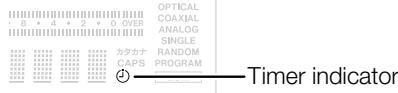
When Timer playback has been turned on, the timer icon lights up in the display.
NOTE
The indicator flashes when a disc is not loaded into the unit.
4 Set the timer to the desired time. Consult the timer's operation manual for details. At the set time, the power to the CD-RW900 will be turned on, and playback will automatically begin.
Repeat playback
1 Press the REPEAT key to turn on the repeat mode.
In this mode, all the tracks on the disc are played continuously. The display shows Repeat ON and the indicator lights up REPEAT.
During playback, if the repeat mode is turned on, playback continues as before, and when the last track finishes, playback resumes from the first track.
If the repeat mode is turned on when the deck is stopped, press the PLAY key to begin operation.
2 Press the REPEAT key again to turn off the repeat mode. Repeat OFF appears then REPEAT indicator turns off.
NOTE
- Combining the repeat mode with the program, Single-track playback and Random playback functions will enable Program repeat, Single-track repeat and Random repeat operations, respectively.
- Settings of the repeat playback mode remain after power is turned off, except the specified A-B section (see “A-B repeat playback” on page 19).
A to B repeat playback
If a specific portion between two points on the disc is specified, that portion can be played back repeatedly.
1 During playback, press the A-B key on the remote control at the beginning of the desired portion on the disc.
REPEAT indicator lights up in the display and the A-indicator will flashes.
2 At the end of the desired portion on the disc, press the A-B key again.
Then, REPEAT and A-B indicator light up in the display, and the desired A-B section will be played back repeatedly.
NOTE
You can also operate this function during playback standby.
3 To cancel the A-B repeat mode and resume normal playback, press the A-B key once again.
REPEAT and A-B indicator will turn off.
NOTE
- A-B repeat mode cannot function For MP3 discs.
- In Random and Program modes, A-B repeat cannot function when the specified A-B section spans more than one track, and does not function for MP3 discs.
- When the STOP key is pressed, the specified A-B section is cancelled.
Pitch control function
When playing back an audio CD, the pitch (or speed) of the playback can be varied. Pitch can be varied +/- 16% .
1 During stop, press the PITCH key on the remote control to turn on the Pitch control function.
Or, use the PITCH option in the PLAY sub-menu to turn on (refer to “Operation basics” on page 14)
The current pitch value appears on the display for seconds and the PITCH indicator will light up.
2 Press the MENU key and select the PITCH CONT option in the PLAY sub-menu to set the desired value and push the MULTI JOG dial to enter.
Pitch>XXX will appear on the dispaly.
Then, rotate the MULTI JOG dial to set the desired value.
NOTE
Use the PITCH STEP option in the PLAY sub-menu to
adjust the pitch value steps from 0.1% to 1.0% in 0.1% increments (default: 0.1% )
3 Press the MENU key or push the MULTI JOG dial to enter and return to normal mode.
During playback, the pitch control playback can be off temporally. Press the PITCH key on the remote control or use the PITCH option in the PLAY submenu to turn the function off.
Pitch>OFF appears on the display and the pitch control playback will be off temporally, until the function is re-set again.
To resume the pitch control playback, press the PITCH key again or use the PITCH option.
NOTE
- When turning the pitch control on and off during playback, sound output is cut for a short instant.
- Pitch control cannot be applied for MP3 discs.
Key control function
The key of the music can be changed during stop, playback or playback standby mode. However, please note that this feature does not operate with MP3 discs.
- Press the MENU key to select the KEY option in the PLAY sub-menu (refer to “Operation basics” on page 14) to enter the function.
The KEY indicator will light up.
2 Call up the KEY LEVEL option in the PLAY submenu to adjust the playback key level.
The playback key can be raised or lowered 1/2 octave in half-tone increments. Selection values: 0 (no change), b 1 to b 6 , # 1 to # 6 .
3 Rotate the MULTI JOG dial to select the desired key level and push to enter.
NOTE
- In this condition, when a CD is played back, the key of the music is changed while the speed of the music remains the same.
- Even when the power is turned off, the key change setting is retained.
- When the Key control function is on, even if the Pitch control function is used to change the playback speed, the key of playback will remain fixed at the preset key {even if the key level is 0 (zero)}, the Key control function can be turned on.
- When using the key control function, playback sound may occasionally sound as vibrating. This is a result of a special process applied to CD playback sound and is normal.
Playing back MP3 files
MP3 files recorded onto a CD are handled the same way as files are handled in an ordinary PC, with some MP3 files held within a directory. In addition, several directories can be combined into one directory. This results in multiple layers of directories and files.
When the Directory mode is on, only those files within a selected directory are available for playback.
When the directory mode is off, the directory config-uration is ignored, and all MP3 files recorded on the disc are available for playback. Please note that Pro-gram playback and Repeat playback only function within directories.
NOTE
Each MP3 file is handled as a track.
Directories which do not contain MP3 files directly under them cannot be selected for playback. For example, in the diagram below, under directory A are directory B and directory C. If there are MP3 files in both directory B and C, directory A cannot be selected for playback, but directory B and C can be selected for playback.
The CD-RW900 can play back MP3 files recorded in formats which conform to ISO9660 level 1, level 2, formats which confirm to ISO9660 level 1, level 2, or Joliet. Discs recorded in multiple sessions may also be played back.
For MP3 CDs to be played by the CD-RW900, the following limitations have been placed on the number of MP3 files and directories.
Maximum number of directories: 255
Maximum number of hierarchical structures: 8
Maximum number of MP3 files: 999
Maximum title size of MP3 files and directories: 255
Directory playback setting
1 Press the DIRECTORY key on the remote control.
Or, use the DIRECTORY option in the PLAY submenu to turn this mode on or off (refer to “Operation basics” on page 14).
Pressing the MENU key or pushing the MULTI JOG dial exits to normal mode.
NOTE
All MP3 files in a disc can be played back when directory playback mode is off. The indicator MP3 lights up and only the total number of track will be shown.
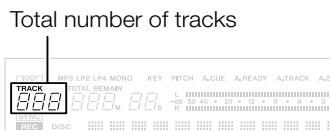
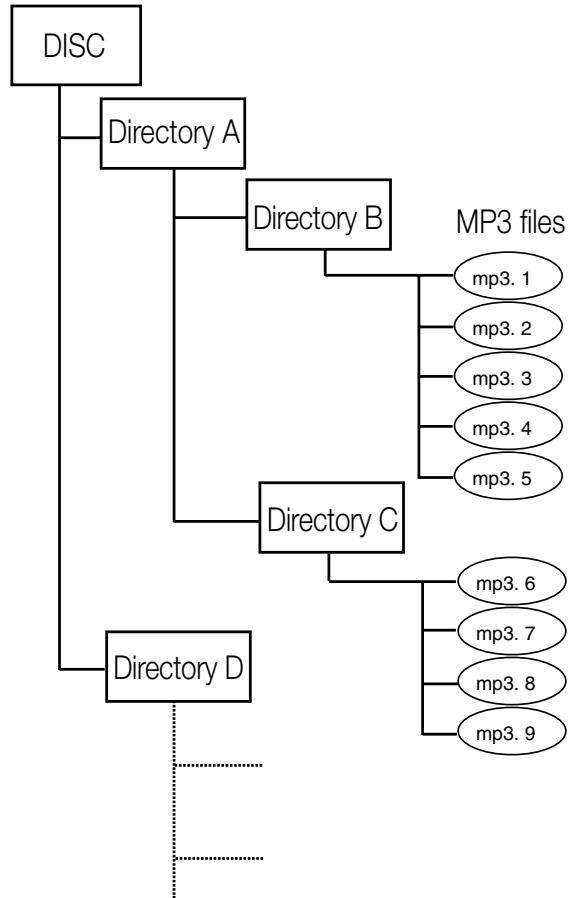
MP3 files are played in the following order
In this manner, playback is performed from the top level directories.
About MP3 track data
During playback, titles are displayed in the following order of priority:
ID3v2 > ID3v1 > file title
During stop mode, the file title is displayed.
2 During stop, use the MULTI JOG dial or SKIP key to select desired directory for playback.
3 Press the PLAY key to start playback in the directory.
Program or Repeat playback can be operated in the selected directory also.
NOTE
- During stop, pressing the ENTER key shows current directory name.
- During playback or standby mode, pushing the MULTI JOG dial shows the MP3 file name currently played back.
- MP3 file formatted at 44,1 kHz sampling rate and 128 kbps or higher is required to play back, otherwise, MP3 file cannot be played back.
Before you start recording using the CD-RW900, make sure that you understand the following key points:
-
Once you have recorded on a CD-R disc, the data cannot be erased from it.
-
You can add tracks to an unfinalized recordable disc. Once finalized, a CD-R disc is "fixed" and behaves in the same way as a pre-recorded disc. Finalized CD-RW discs, however, can be erased, refreshed and re-recorded.
To select the input to be recorded, press the INPUT SELECT key on the main unit.
Repeated presses of the key cycle through the following options:
| ANALOG | Analog |
| OPTICAL | Optical digital in |
| COAXIAL | Coaxial digital in |
In the case of either the coaxial or optical inputs being selected, the appropriate indicator: COAXIAL or OPTICAL, lights on the right of the screen.
If the analog signal is selected, the ANALOG indicator lights on the right of the screen.
Analog recording level The level of the analog signals received at the ANALOG IN jacks are controlled with the INPUT controls.
When recording analog signals, set the digital volume to 0 dB.
Digital recording level The level of the digital signal may be controlled using the digital volume menu, as described below.
- Call up the VOLUME option in the REC sub-menu (refer to “Operation basics” on page 14).
Push the MULTI JOG dial to enter the function on.
2 Rotate the MULTI JOG dial to adjust the input volume between -54dB and +18 dB (relative to the original input level).
There is also a - setting which represents a complete signal cut. The display shows Vol> ---dB for the - setting.
3 Press the MENU key or push the MULTI JOG dial to enter the setting and return to normal mode.
When the unit is in record ready, or record mode, the input signal is output from the OUT jacks (digital and analog), allowing you to hear the input signal.
1 Press the RECORD key on the front panel or the remote control when a recordable disc is not inserted.
The word Monitor appears on the display to show that the output signal is an echo of the input signal(s).
2 Exit the monitor mode by using the STOP key.
Frequency conversion
The sampling frequency for CDs is 44.1 kHz . The CD-RW900 will always record (and play back) CDs at this frequency.
However, if recording through a digital connection (either coaxial or optical) and the source has been recorded at a frequency other than 44.1kHz , or is being played back at a non-standard speed using a varispeed unit (more than 1% away from the standard), the CD-RW900's internal frequency converter: SRC (Sampling rate converter) will automatically convert the incoming frequency to 44.1kHz .
To set the SRC
Press the MENU key and select the SRC? option in the REC sub-menu (refer to “Operation basics” on
page 14).
Rotate the MULTI JOG dial and select ON.
Press the MENU key or push the MULTI JOG dial to enter and return to normal mode.
NOTE
When the SRC function is off, receiving digital signals, the display shows the REC indicator flashing while recording or recording standby mode.
The digital signals other than 44.1 kHz cannot be recorded when SRC is off. The error message Not
Fs44.1k! will appear on the display.
Basic recording
1 Load a recordable disc into the unit. As the disc loaded, the display shows TOC Reading., with the period flashing.
2 Press the INPUT SELECT key to select a recording source (see “Input selection” on page 21).
If a digital source is selected, and the connection or the signal are improper, the error message D-IN UNLOCK! will appear on the display.
3 Press the RECORD key. The unit enters record ready mode, as shown by the REC and READY indicators on the display.
NOTE
As the unit enters record ready mode, the display shows the Now OPC (Optimum Power Control) occasionally, as the unit prepares to record on the disc.
To adjust the level of the source, following the guidelines in "Input selection" on page 21.
NOTE
The red OVER indicators on the meters should never light. Unlike analog equipment, digital audio units produce extremely unpleasant sounds when distorted, and there is no "headroom" after the 0 mark. If recording digitally from a commercially-produced CD, the volume set in the menu should be 0 dB. This will maintain all the dynamic range of the source CD without clipping. Only boost the signal if the source is exceptionally quiet.
An analog signal input at nominal level, with no cut or boost from the volume controls, is equivalent to a reading of -16 dB on the meters.
4 Press the PLAY key to start recording.
Pressing the READY key stands by recording temporarily. To restart recording, press the READY key or PLAY key again.
5 Press the STOP key to stop recording.
When recording stops, the display shows PMA Writing (Program Memory Area) flashing for a few seconds as the unit writes to the disc.
NOTE
During the PMA Writing is shown, any key cannot be used.
- To confirm the total recording time, use the REC TIME opyion in the SYSTEM sub-menu (refer to “Operation basics” on page 14).
CAUTION
Do not vibrate the unit or turn off the power when the unit writes to the disc, otherwise, recording fails.
Time display while recording
When in record or record ready mode, repeated presses of the TIME key cycle through four different time modes:
Full disc
If recording a long program, when there is no space remaining on the disc for recording, as shown by the above time display, just before the end of the disc is reached, the unit starts a fade-out over four seconds (the display shows Fade Out).
When the fade-out has finished, the display shows Disc Full!. Press the STOP key to exit.
If the disc is a CD-RW, the final track can be erased, if required (see “Erasing” on page 26) and the disc then finalized. If the disc is a CD-R, it must be finalized prior to use (see “Finalizing” on page 25).
Advanced recording
Fade-in and fade-out recording
At the beginning and end of recording, fade-in and fade-out effects can be performed.
1 During stop or recording standby mode, set the operation using the following menu options on the REC sub-menu (refer to “Operation basics” on page 14).
FADE IN?
The length of the fade in to the normal level can be set between 1 and 30 seconds in 1-second increments (default setting: 3 seconds).
FADE OUT?
The length of the fade out into complete silence can be set between 1 and 30 seconds in 1-second increments (default setting: 3 seconds).
The display shows Fade Out>XXs or Fade In>XXs.
Synchronized recording
Synchronized recording basically means that recording will begin automatically when a signal is received, and will stop when the signal ends.
Use the SYNC REC key to select the synchronization mode. The synchronization mode determines the automated start and stopping of recording when a signal is received.
During stop or recording stancby mode, repeated presses of this key cycle through the fol-lowing modes:
- Sync ALL: The SYNC indicator lights up.
Sync 1: The unit stops when a selected track is finished and the SYNC indicator flashes
- Sync OFF: Turns Sync recording function off
Sync recording
1 While recording standby mode, press the SYNC REC key repeatedly to select Sync ALL or Sync 1.
2 Set the signal detection threshold level. Use the SYNC LEVEL option in the REC sub-menu (refer to "Operation basics" on page 14).
Rotate the MULTI JOG dial to adjust the level. The level can be set from -72 dB to -24 dB in 6 dB increments. The default setting is -24 dB.
Press the MENU key or push the MULTI JOG dial to enter and return to recording standby mode.
3 Input the source signal.
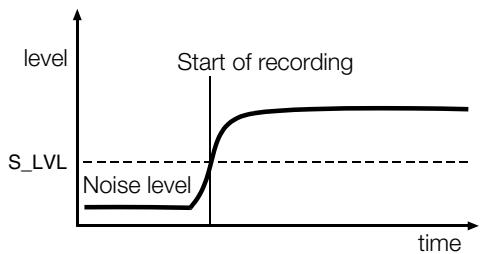
Recording begins automatically when the source signal is detected. The source signal should be higher than the adjusted threshold level.
2 In recording standby mode, press the FADER key on the remote control.
Recording begins and the sound fades in. After the preset fade-in time, the sound is at normal level.
3 During recording, press the FADER key on the remote control when you wish to fade-out the sound.
Fade-out begins with Fade Out flashing on the display then the unit enters recording standby mode.
4 Press the STOP key and the PMA writing will begin.
NOTE
Fade-in or fade-out function can be operated only pressing the FADER key on the remote control unit.
After the synchronization mode is selected, the record ready mode must then be entered (you cannot reverse the order of these steps).
Starting playback of the source automatically starts recording on the CD-RW900 if Sync ALL or Sync 1 has been selected (see “Sync recording” below) and manual record start is disabled. If Sync OFF is selected, the recording must be started manually.
NOTE
After the mode is set, more than one second of signal under the adjusted threshold level is required to start recording automatically, otherwise, the unit does not begin recording even it detects the signals.
5-Recording
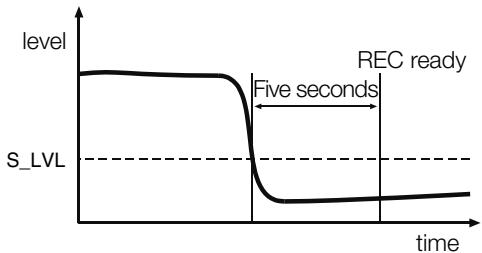
When audio signal is not detected more than five seconds, the CD-RW900 automatically will stop recording and enters record standby mode.
NOTE
In the Sync 1 mode, if the unit detects the signal which is under the adjusted level over five secondsd, the Sync recording mode will be canceled.
3 To cancel the Sync recording mode, press the SYNC REC key and select the Sync OFF. Recording returns to normal and continues till you press the STOP key or the source signal stops.
Pressing the STOP key stops recording. Once stopped, the selected mode will be canceled.
NOTE
-
When the Sync 1 is on, and the READY key is pressed, Sync recording stops and the setting will be canceled.
-
When the Sync ALL is on, and the READY key is pressed, the unit enters recording standby mode with remaining the Sync recording setting.
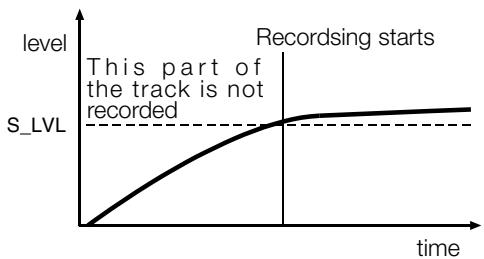
- If you set the value only high-level signals trigger recording, remember that this will not record the start of a piece:
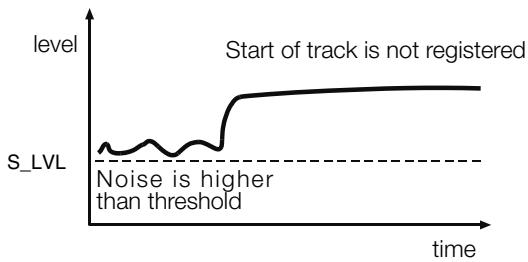
- Also remember that when recording from an analog source, the threshold should be set so that it is higher than the "noise floor". If the "noise floor" is higher than the threshold, a false start will occur:
Automatic track division
The trigger level can also be used to divide tracks if the ATRACK (auto track) function is enabled.
When this function is enabled, the unit automatically inserts a track division in the recorded material.
To enable or disable automatic track division:
- Use A_TRK option in the REC sub-menu to set the mode on. The A.TRACK indicator at the top right of the display lights.
2 Rotate and push the MULTI JOG dial to select and enter the modes following:
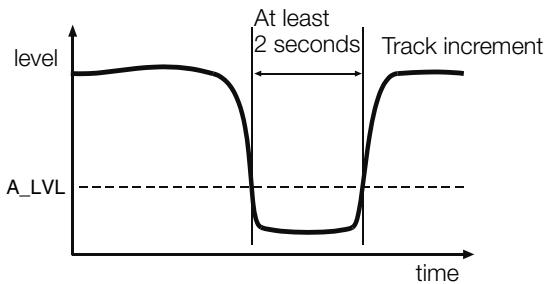
Level
When the sound level has dropped below the threshold for more than two seconds, and sound has re-started, the track will be divided.
Use A_TRK LEVEL option in the REC sub-menu. The trigger level is set to -24dB to -72 dB.
When recording digitally from MD, CD or DAT, this mode detects a track boundary and divides the track.
However, when the DD mode is on, and if the analog source or non-DAT/CD/MD digital connections are detected, the track number will be increased by the setting level that you set in the Level mode.
Manually divide track
While recording is taking place, press the RECORD key. The current track number is incremented by one.
For details of automatic track division while recording, see "Automatic track division" on page 24.
NOTE
- According to the "Red Book" (the specification for audio CDs), a track cannot be less than four seconds in length, and there can be a maximum of 99 tracks on an audio CD. Bear these limitations in mind when adding track divisions.
- This operation can not be applied during recording the track 99.
Rec mute function
The Rec mute function allows instant cut-off of the input signal, and records four seconds of silence on the disc.
While recording is in progress, press the REC MUTE key on the remote contorl.
The display shows the Rec Mute flashing, the meters stop displaying the current level and the monitored sound is cut.
After about four seconds, the unit enters record ready mode.
NOTE
This function is only available from the remote control unit.
6-After recording
This section deals with the actions taken after recording: finalizing for CD-R and CD-RW discs, and erase operations for CD-RW discs.
Once finalized, CD-R discs are truly final—no more can be recorded on them. By contrast, CD-RW discs
can be “unfinalized” using the CD-RW900, i.e. their TOC can be deleted, and if there is space, further material can be recorded on them. Even if the disc is full, tracks can be erased following the unfinalize process, and new material can be recorded.
Finalizing
As has been explained earlier ("Finalizing" on page 7), in order for a disc to become a standard CD, it must have a Table of Contents (TOC) written to it. This process is known as finalizing.
An unfinalized disc can always be distinguished on the CD-RW900 by the TOC indicator under the disc type on the display being un-lit when the disc is inserted.
To finalize a disc:
1 Load the unfinalized disc, and the unit in stop mode, press the FINALIZE key.
The display shows FINALIZE?
If you do not want to proceed with the finalizing process, press the FINALIZE/INS key on the front panel or the FINALIZE key on the remote control.
2 To start the finalizing process, push the MULTI JOG dial or press the ENTER key on the remote control.
The display shows Sure?
If you do not want to proceed with the finalizing process, press the STOP key.
3 When finalization has been chosen, the display shows the TOC flashing and the remaining time. The unit starts counting down from a time shown on the display.
4 When finalization has been finished successfully, Complete appears and the TOC will be lit on the display.
NOTE
During the process of finalizing, any key operation is not accepted.
Unfinalizing CD-RW discs
If a CD-RW disc has been finalized, it is possible to erase the Table of Contents in the following way:
1 With the finalized disc loaded and the unit in stop mode, press the ERASE/DEL key on the front panel or the ERASE key on the remote control.
Rortate the MULTI JOG dial or press the SKIP keys on the remote control to select UNFINALIZE?. Push the MULTI JOG dial or press the ENTER key to confirm.
If you do not want to proceed with the unfinalizing process, press the ERASE/DEL key on the front panel or the SKIP keys on the remote control.
2 The display shows Sure?
If you do not want to proceed with the unfinalizing process, press the STOP key.
3 To start the unfinalizing process, press the MULTI JOG dial or the ENTER key again.
When unfinalization has been chosen, the display shows the Erase flashing and the remaining time. The unit starts counting down from a time shown on the display.
4 When finalization has been finished successfully, Complete appears on the display, yet the TOC will go off.
Erasing
Erasing tracks
This operation erases the specified track and all subsequent tracks from a recorded CD-RW disc.
1 During stop, press the ERASE/DEL key on the front panel or the ERASE key on the remote control. Select the ERASE TRACK? rotating the MULTI JOG dial or pressing the SKIP keys on the remote control.
To cancel the operation at this point, press the ERASE/DEL or the ERASE key again.
2 Push the MULTI JOG dial or press the ENTER key to enter the function.
The display shows Erase XX-XX (the number of the first track and last track to be erased).
Rotate the MULTI JOG dial or press the SKIP key to change the track numbers you desire to erase.
To cancel the operation at this point, press the ERASE/DEL or the ERASE key again.
Erasing a whole disc
When you want to erase a whole disc (all the tracks on a disc), follow the procedure below:
1 During stop, press the ERASE/DEL key on the front panel or the ERASE key on the remote control. Select the ERASE DISC? rotating the MULTI JOG dial or pressing the SKIP keys on the remote control.
To cancel the operation at this point, press the ERASE/DEL or the ERASE key again.
2 Push the MULTI JOG dial or press the ENTER key to enter the function.
The display shows Sure?.
To cancel the operation at this point, press the STOP key.
3 Push the MULTI JOG dial or press the ENTER key to operate the function.
The display shows Sure?
To cancel the operation at this point, press the STOP key.
4 Push the MULTI JOG dial or press the ENTER key again to proceed the operation.
The display shows the Erase flashing and the remaining time. The unit starts counting down from a time shown on the display.
NOTE
Once the operation is proceeded, the STOP key cannot function. Please confirm before the operation.
5 When the tracks have been erased, Complete will appear on the display.
- Push the MULTI JOG dial or press the ENTER key again to proceed the operation.
The display shows the Erase flashing and the remaining time. The unit starts counting down from a time shown on the display.
NOTE
Once the operation is proceeded, the STOP key cannot function. Please confirm before the operation.
4 When the disc has been erased, Complete appears then Blank Disc will appear on the display.
Refreshing a disc
Refreshing the disc makes a disc usable again. This operation destroys all data on the disc.
1 Load the disc, and the unit in stop mode, press the ERASE/DEL key on the front panel or the ERASE key on the remote control. Select the REFRESH? rotating the MULTI JOG dial or pressing the SKIP keys on the remote control.
To cancel the operation at this point, press the ERASE/DEL or the ERASE key again.
- Push the MULTI JOG dial or press the ENTER key on the remote control to enter the function.
The display shows Sure?
To cancel the operation at this point, press the STOP key.
- Push the MULTI JOG dial or press the ENTER key again to proceed the operation.
The display shows the Erase flashing and the remaining time. The unit starts counting down from a time shown on the display.
4 When the disc has been refreshed, Complete will appear on the display, and Blank disc shows up.
Titles can be given to the disc and the tracks on the disc, using the TEXT EDIT option on the TEXT submenu.
Follow the guidelines below to input titles on the screen. Operate them when in the text edit mode. It is more efficient to connect a keyboard for title input ( refer to “Title input by keyboard” on page 29).
Press the DISPLAY key on the unit or the remote control to select from two different types of characters.
Lower case letters/code: no indication
Capital letters/code: CAPS
Rotate the MULTI JOG dial or the SKIP keys on the remote control to get the desired characters on the display.
Push the MULTI JOG dial or press the ENTER key on the remote control to enter.
To move the cursor position
Use the / key and the / key on the front panel, or the SEARCH key on the remote control.
To delete characters
Place the cursor on the character, then press the ERASE/DEL key on the front pane, or the ERASE key on the remote control.
1 During stop, select the TEXT EDIT option in the TEXT sub-menu (refer to "Operation basic" on page 14).
Text> Disc will appear.
2 Press the MULTI JOG dial or the ENTER key on the remote control.
Now, you can input or edit the disc title following the guidelines above.
3 Press the MENU key to enter.
If you want to cancel, press the STOP key.
NOTE
After the title is selected and entered on the disc, and TOC lights up on the dis-play, if the power is turned off, the TOC will not be recorded onto the disc, and the titles will not be added.
- To insert characters
Move the cursor to the location where you wish to insert a character, and press the FINALIZE/INS key on the front panel or the FINALIZE key on the remote control.
To change a character
Place the cursor on the character to be changed, then input the desired character.
NOTE
- As with the TEXT menu, after the name is set, if the disc is tried to eject without writing TOC on the disc, the display will show Sure? Text!. If you want to eject the disc without TOC writing, press OPEN/CLOSE key during the Sure? Text! is shown on the display. The text that have been edited or entered will be erased.
- The disc or track title of the fainalized disc cannot be edited. Unfinalizing (CD-RW only) is needed to operate the title input function.
1 During stop, select the TEXT EDIT option in the TEXT sub-menu (refer to “Operation basic” on page 14).
2 Rotate the MULTI JOG dial or repeatedly press the SKIP keys on the remote control to select the track number you desire to title.
3 Push the MULTI JOG dial or press the ENTER key on the remote control.
Now, you can input or edit the track title following the guidelines above.
4 Press the MENU key to enter.
If you want to cancel, press the STOP key.
A computer keyboard can be connected to the IBM PC compatible PS/2 interface on the front panel to operate
certain functions of the CD-RW900. It is particularly efficient for title input.
Keyboard type setting
The CD-RW900 must be set for the type of keyboard being connected.
Set the type using the sub-menu KEYBOARD option
on the SYSTEM sub-menu. Select US for an English-language keyboard, or JP for a Japanese-language keyboard.
Titles can be input just like typing on a PC.
To enter the Title Edit menu
Press SHIFT + F8 to enter the Disc/Track Title Edit Menu.
To select the type of characters for input
Press CAPS to select or cancel upper case letters
To input characters
Character input is performed directly with the letter and number keys.
To move the cursor
Use the cursor arrow keys
To delete characters
Delete key: deletes the character in the cursor position
Back space key: deletes the character before the cursor position
Use the Insert key.
To change a character
Put the cursor on its position and input the desired character.
Other keyboard operations
The keyboard can be used not only for title input, but also to control the deck transports, perform editing functions and other operations. The list below shows the keys that perform various operations.
| Keyboard key | Operation |
| F1 | same as pressing the 〈←〉key |
| F2 | same as pressing the ▷□〉key |
| F3 | operates the Key control on or off |
| F4 | same as pressing the STOP key |
| F5 | same as pressing the PLAY key |
| F6 | same as pressing the READY key |
| F7 | |
| F8 | same as pressing the RECORD key |
| F9 | |
| F10 | same as pressing the REPEAT key |
| F11 | same as pressing the PLAY MODE key |
| F12 | same as pressing the PITCH key |
| SHIFT + F1 | direct to the “ERASE TRACK?” |
| SHIFT + F2 | direct to the “ERASE DISC?” |
| SHIFT + F3 | direct to the “REFRESH?” |
| SHIFT + F4 | |
| SHIFT + F5 | |
| SHIFT + F6 | |
| SHIFT + F7 | |
| SHIFT + F8 | direct to the “TEXT EDIT?” |
| SHIFT + F9 | |
| SHIFT + F10 | |
| SHIFT + F11 | direct to the “UNFINALIZE?” |
| SHIFT + F12 | direct to the “FINALIZE?” |
| CTRL + F1 | Direct track search TRACK 1 |
| CTRL + F2 | Direct track search TRACK 2 |
| CTRL + F3 | Direct track search TRACK 3 |
| CTRL + F4 | Direct track search TRACK 4 |
| CTRL + F5 | Direct track search TRACK 5 |
| CTRL + F6 | Direct track search TRACK 6 |
| CTRL + F7 | Direct track search TRACK 7 |
| CTRL + F8 | Direct track search TRACK 8 |
| CTRL + F9 | Direct track search TRACK 9 |
| CTRL + F10 | Direct track search TRACK 10 |
| CTRL + F11 | Direct track search TRACK 11 |
| CTRL + F12 | Direct track search TRACK 12 |
| CAPS | select or cancel upper case letters |
| ← / → | to move the cursor |
| Delete | Same as the DEL/CLR key |
| Back space | deletes the character before the cursor |
| Insert | same as the FINALIZE/INS key |
| ESC | cancel edit or title edit and finish Menu mode |
| Enter | same as the ENTER key |
Error messages
| Message | Details / response |
| Can’t Rec! | Cannot record. Either erase the contents of the disc (for a CD-RW), or use a different recordable disc. |
| Disc Error! | The disc has malfunctioned. Please replace with a new disc. |
| Disc Full! | No recording time remaining, or no recordable track is left on the disc. |
| Text Full! | No space to input the letters. |
| Sure? Text! | The text data is not written on the disc yet. Open the tray to cancel the text you enter or operate final-ization to write the data on the disc. |
| Drive Error! | There is a problem in the drive. |
| D-IN UNLOCK! | The digital input is not connected. Turn on the power of the equipment connected to DIGITAL IN. |
| Not Audio! | There is no audio signal from DIGITAL IN. |
| Erase Error! | An error occurred while erasing. |
| Not Fs44.1k! | The sampling frequency of the digital input is not 44.1 kHz. Please turn the SRC on. |
| PGM Empty! | There is no program. |
| PGM Full! | Now new programs can be created. |
| Can’t Edit! | Editing cannot be performed due to operational restrictions. |
| Can’t sel! | Menu selection cannot be performed due to selection prohibitions. |
| Rec Error! | There was an error during recording. Please re-record. |
| No DIR! | There is no directory that contains a file. |
| Decode Err! | The MP3 file cannot be played back. |
| Format Err! | The disc has been formatted that the CD-RW900 cannot read. |
Messages during operations
| Message | Statement |
| Blank Disc | A blank recordable disc has been inserted. |
| Complete | An operation such as finalize or erase has been successfully completed. |
| Now OPC
(OPC=Optium power Control) | Calibration is being performed to operate recording properly. |
| Disc Repair | The disc failed to write PMA is being repaired, and this operation will be a long-running. Please do not turn off the power of the CD-RW900 during this operation. |
| PMA Writing
(PMA=Program memory Area) | The recorded content is being written to the disc. |
| TOC reading | The table of contents data is being read. |
Troubleshooting
| Symptom | Possible cause and remedy |
| There is no power to the unit. | Please check the power cord is properly plugged in. |
| “Disc Error!” is displayed. | The disc may be dirty. Please replace the disc. |
| Playback is not possible. | This may be due to condensation. In this case, remove the disc, turn the power on and wit a few hours, then try again. |
| No sound is output. | Confirm the connections with the audio system.
Check the volume level, and proper amplifier operation. |
| Recording is not possible. | Confirm the connections with the audio system. |
| Adjust the recording level. |
| The disc may be for playback only. Please replace with a recordable disc. |
| Noise or static can be heard. | Please re-position the unit away from strong source of magnetism such as a television. |
| The CD-RW900 does not retain settings. | While settings are retained each time they are made, in some cases they will not be retained when the power is turned off too soon. To prevent this from happening, do not turn off the power right after making a setting. |
Specifications
| Recordable discs | CD-R, CD-R-DA, CD-RW, CD-RW-DA (High speed CD-RW is supported) |
| Quantization bit depth | 16 bit |
| Sampling frequency | 44.1 kHz |
| Frequency response | 20 Hz~20 KHz |
| S/N | 95 dB
90 dB |
| Dynamic range | 95 dB
90 dB |
| Distortion | 0.006 %
0.008 % |
| Channel separation | 90 dB
80 dB |
| Wow and flutter | (0.001 %) |
| Analog inputs | Unbalanced input RCA pin
level -10 dBV
Minimum input level -19 dBV
Input impedance 22 kΩ ±10 % |
| Analog outputs | Unbalanced output RCA pin
level -10 dBV
Maximum output level +6 dBV 2 dB
Output impedance 600 Ω ±10% |
| Phones output | Stereo (6.3)
20 mW
32 Ω |
| Digital input | Coaxial RCA pin jack (IEC-60958 Consumer use)
Optical TOSLINK (IEC-60958 Consumer use) |
| Digital output | Coaxial RCA pin jack (IEC-60958 Consumer use)
Optical TOSLINK (IEC-60958 Consumer use) |
| Keyboard | Mini DIN 6 pin |
| Power | U.S.A./Canada 120VAC, 60Hz
U.K./Erope 230VAC, 50Hz
Australia 240VAC, 50Hz |
| Power consumption | 16 W |
| Dimensions | w x h x d 482.6 x 94 x 307.6 (mm) |
| Weight | 4.9 kg (10.8 lb) |
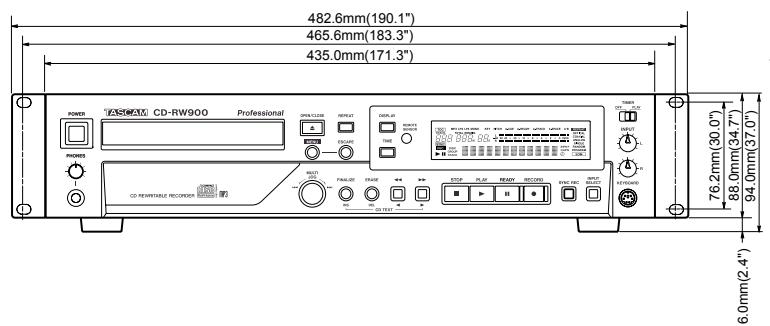
Dimensional drawing
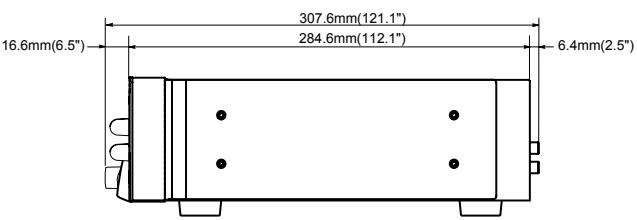
TASCAM
TEAC Professional Division
CD-RW900
TEAC CORPORATION
Phone: +81-422-52-5082
3-7-3, Nakacho, Musashino-shi, Tokyo 180-8550, Japan
www.tascam.com
TEAC AMERICA, INC.
Phone: +1-323-726-0303
7733 Telegraph Road, Montebello, California 90640
www.tascam.com
TEAC CANADA LTD.
Phone: +1905-890-8008 Facsimile: +1905-890-9888
5939 Wallace Street, Mississauga, Ontario L4Z 1Z8, Canada
www.tascam.com
TEAC MEXICO, S.A. De C.V
Phone: +52-555-581-5500
Campesinos No. 184, Colonia Granjes Esmeralda, Delegaacion Iztapalapa CP 09810, Mexico DF
www.tascam.com
TEAC UK LIMITED
Phone: +44-8451-302511
Unit 19 & 20, The Courtyards Hatters Lane Watford, Hertfordshire. WD18 8TE, U.K.
www.tascam.co.uk
TEAC EUROPE GmbH
Phone: +49-611-71580
Phone: +39-02-66010500
Via C. Cantu 11, 20092 Cinisello Balsamo, Milano, Italy
www.teac.it