
E5CN-H - Temperature Controller OMRON - Free user manual and instructions
Find the device manual for free E5CN-H OMRON in PDF.


| Product Type | Digital Temperature Controller |
| Brand | OMRON |
| Model | E5CN-H (also E5AN-H, E5EN-H) |
| Category | Temperature Controller |
| Dimensions (E5CN-H) | 48 x 48 mm (front face), variable depth |
| Weight | Approximately 150 g (standard model) |
| Power Supply | 100 to 240 VAC, 50/60 Hz or 24 VAC/VDC (depending on version) |
| Consumption | 8.5 VA max. (100-240 VAC), 5.5 VA (24 VAC), 3.5 W (24 VDC) |
| Universal Inputs | Thermocouples (K, J, T, E, L, U, N, R, S, B, W, PLII), Pt100/JPt100 probes, current 4-20 mA / 0-20 mA, voltage 1-5 V / 0-5 V / 0-10 V |
| Control Outputs | Relay, voltage for SSR, current, linear voltage depending on model |
| Display | 2 or 3 11-segment displays, changeable PV color |
| Protection Rating | Front face IP66, rear housing IP20, terminals IP00 |
| Ambient Temperature | -10 to 55 °C (without condensation or frost) |
| Ambient Humidity | 25 to 85 % RH |
| Main Functions | PID auto-tuning (AT/ST), heating/cooling control, alarms, heater burnout detection, event inputs, serial communication, simple programming |
| Communications | RS-232C, RS-485, RS-422 (depending on option), CompoWay/F, SYSWAY, Modbus protocols |
| Maintenance and Cleaning | Clean with a soft cloth and isopropyl alcohol. Do not use solvents. |
| Safety | Compliant with UL, CSA, CE. Power terminals with reinforced insulation. Do not open. Use in a suitable enclosure. |
| Spare Parts and Repairability | Removable output units (E53-...), terminal block, gaskets. Repair by OMRON or authorized technician. |
| General Information | 374-page manual available in PDF. 1-year warranty. Indoor use only. |
Frequently Asked Questions - E5CN-H OMRON
User questions about E5CN-H OMRON
0 question about this device. Answer the ones you know or ask your own.
Ask a new question about this device
Download the instructions for your Temperature Controller in PDF format for free! Find your manual E5CN-H - OMRON and take your electronic device back in hand. On this page are published all the documents necessary for the use of your device. E5CN-H by OMRON.
USER MANUAL E5CN-H OMRON
User's Manual Advanced Type
E5CN-H
E5AN-H
E5EN-H
Digital Controllers
User's Manual
Advanced Type
Revised March 2009
Preface
The E5CN-H, E5AN-H, and E5EN-H are Digital Controllers. The main functions and characteristics of these Digital Controllers are as follows:
- Use the universal inputs to input from thermocouples or temperature-resistance thermometers, or to input analog voltage or analog current inputs.
- Either standard or heating/cooling control can be performed.
- Both auto-tuning and self-tuning are supported.
- Event inputs can be used to switch banks, switch between RUN and STOP status, switch between automatic and manual operation, start/reset the simple program function, and perform other operations.
- Heater burnout detection, heater short (HS) alarms, and heater overcurrent (OC) functions are supported. (Applicable to E5CN-H, E5AN-H, and E5EN-H models with heater burnout detection function.)
- Communications are supported. (Applicable to E5CN-H, E5AN-H, and E5EN-H models with communications.)
- User calibration of the sensor input is supported.
- User calibration of transfer output is supported. (Applicable to E5CN-H, E5AN-H, and E5EN-H models with transfer outputs.)
- Use position-proportional control. (Applicable to the E5AN-H and E5EN-H.)
- Use a remote SP input (Applicable to the E5AN-H and E5EN-H.)
- The structure is waterproof (IP66).
- Conforms to UL, CSA, and IEC safety standards and EMC Directive.
- The PV display color can be switched to make process status easy to understand at a glance.
This manual describes the E5CN-H, E5AN-H, and E5EN-H. Read this manual thoroughly and be sure you understand it before attempting to use the Digital Controller and use the Digital Controller correctly according to the information provided. Keep this manual in a safe place for easy reference. Refer to the following manual for further information on communications: E5CN-H/E5AN-H/E5EN-H Digital Controllers Communications Manual Advanced Type (Cat. No. H159).
Visual Aids
The following headings appear in the left column of the manual to help you locate different types of information.
Note Indicates information of particular interest for efficient and convenient operation of the product.
1,2,3... 1. Indicates lists of one sort or another, such as procedures, checklists, etc.
OMRON, 2008
All rights reserved. No part of this publication may be reproduced, stored in a retrieval system, or transmitted, in any form, or by any means, mechanical, electronic, photocopying, recording, or otherwise, without the prior written permission of OMRON.
No patent liability is assumed with respect to the use of the information contained herein. Moreover, because OMRON is constantly striving to improve its high-quality products, the information contained in this manual is subject to change without notice. Every precaution has been taken in the preparation of this manual. Nevertheless, OMRON assumes no responsibility for errors or omissions. Neither is any liability assumed for damages resulting from the use of the information contained in this publication.
| Read and Understand this Manual |
| Please read and understand this manual before using the products. Please consult your OMRON representative if you have any questions or comments. |
| Warranty, Limitations of Liability |
| WARRANTY OMRON's exclusive warranty is that the products are free from defects in materials and workmanship for a period of one year (or other period if specified) from date of sale by OMRON. OMRON MAKES NO WARRANTY OR REPRESENTATION, EXPRESS OR IMPLIED, REGARDING NON-INFRINGEMENT, MERCHANTABILITY, OR FITNESS FOR PARTICULAR PURPOSE OF THE PRODUCTS. ANY BUYER OR USER ACKNOWLEDGES THAT THE BUYER OR USER ALONE HAS DETERMINED THAT THE PRODUCTS WILL SUITABLY MEET THE REQUIREMENTS OF THEIR INTENDED USE. OMRON DISCLAIMS ALL OTHER WARRANTYES, EXPRESS OR IMPLIED. |
| LIMITATIONS OF LIABILITY OMRON SHALL NOT BE RESPONSIBLE FOR SPECIAL, INDIRECT, OR CONSEQUENTIAL DAMAGES, LOSS OF PROFITS OR COMMERCIAL LOSS IN ANY WAY CONNECTED WITH THE PRODUCTS, WHETHER SUCH CLAIM IS BASED ON CONTRACT, WARRANTY, NEGLIGENCE, OR STRICT LIABILITY. In no event shall the responsibility of OMRON for any act exceed the individual price of the product on which liability is asserted. IN NO EVENT SHALL OMRON BE RESPONSIBLE FOR WARRANTY, REPAIR, OR OTHER CLAIMS REGARDING THE PRODUCTS UNLESS OMRON'S ANALYSIS CONFirms THAT THE PRODUCTSWere PROPERLY HANDLED, STORED, INSTALLED, AND MAINTAINED AND NOT SUBJECT TO CONTAMINATION, ABUSE, MISUSE, OR INAPPROPRIATE MODIFICATION OR REPAIR. |
| Application Considerations |
| SUITABILITY FOR USE OMRON shall not be responsible for conformity with any standards, codes, or regulations that apply to the combination of the products in the customer's application or use of the products. At the customer's request, OMRON will provide applicable third party certification documents identifying ratings and limitations of use that apply to the products. This information by itself is not sufficient for a complete determination of the suitability of the products in combination with the end product, machine, system, or other application or use. The following are some examples of applications for which particular attention must be given. This is not intended to be an exhaustive list of all possible uses of the products, nor is it intended to imply that the uses listed may be suitable for the products: • Outdoor use, uses involving potential chemical contamination or electrical interference, or conditions or uses not described in this manual. • Nuclear energy control systems, combustion systems, railroad systems, aviation systems, medical equipment, amusement machines, vehicles, safety equipment, and installations subject to separate industry or government regulations. • Systems, machines, and equipment that could present a risk to life or property. Please know and observe all prohibitions of use applicable to the products. NEVER USE THE PRODUCTS FOR AN APPLICATION INVOLVING SERIOUS RISK TO LIFE OR PROPERTY WITHOUT ENSURING THAT THE SYSTEM AS A WHOLE HAS BEEN DESIGNED TO ADDRESS THE RISKS, AND THAT THE OMRON PRODUCTS ARE PROPERLY RATED AND INSTALLED FOR THE INTENDED USE WITHIN THE OVERALL EQUIPMENT OR SYSTEM. |
| PROGRAMMABLE PRODUCTS OMRON shall not be responsible for the user's programming of a programmable product, or any consequence thereof. |
| Disclaimers |
| CHANGE IN SPECIFICATIONS Product specifications and accessories may be changed at any time based on improvements and other reasons. It is our practice to change model numbers when published ratings or features are changed, or when significant construction changes are made. However, some specifications of the products may be changed without any notice. When in doubt, special model numbers may be assigned to fix or establish key specifications for your application on your request. Please consult with your OMRON representative at any time to confirm actual specifications of purchased products. |
| DIMENSIONS AND WEIGHTS Dimensions and weights are nominal and are not to be used for manufacturing purposes, even when tolerances are shown. |
| PERFORMANCE DATA Performance data given in this manual is provided as a guide for the user in determining suitability and does not constitute a warranty. It may represent the result of OMRON's test conditions, and the users must correlate it to actual application requirements. Actual performance is subject to the OMRON Warranty and Limitations of Liability. |
| ERRORS AND OMISSIONS The information in this manual has been carefully checked and is believed to be accurate; however, no responsibility is assumed for clerical, typographical, or proofreading errors, or omissions. |
Safety Precautions
Definition of Precautionary Information
The following notation is used in this manual to provide precautions required to ensure safe usage of the product.
The safety precautions that are provided are extremely important to safety. Always read and heed the information provided in all safety precautions.
The following notation is used.

CAUTION
Indicates a potentially hazardous situation which, if not avoided, is likely to result in minor or moderate injury or in property damage.
Symbols
| Symbol | Meaning | |
| Caution | ! | General Caution Indicates non-specific general cautions, warnings, and dangers. |
| ! | Electrical Shock Caution Indicates possibility of electric shock under specific conditions. | |
| Prohibition | General Prohibition Indicates non-specific general prohibitions. | |
| Mandatory Caution | General Caution Indicates non-specific general cautions, warnings, and dangers. | |
| CAUTION | |
| Do not touch the terminals while power is being supplied. Doing so may occasionally result in minor injury due to electric shock. | 41 |
| Do not allow pieces of metal, wire clippings, or fine metallic shavings or filings from installation to enter the product. Doing so may occasionally result in electric shock, fire, or malfunction. | 60 |
| Do not use the product where subject to flammable or explosive gas. Otherwise, minor injury from explosion may occasionally occur. | |
| Never disassemble, modify, or repair the product or touch any of the internal parts. Minor electric shock, fire, or malfunction may occasionally occur. | |
| CAUTION - Risk of Fire and Electric Shock a) This product is UL listed as Open Type Process Control Equipment. It must be mounted in an enclosure that does not allow fire to escape externally. b) When using more than one shutoff switch, always turn OFF all the shutoff switches to ensure that no power is being supplied before servicing the product. c) Signal inputs are SELV, limited energy. (See note 1.) d) Caution: To reduce the risk of fire or electric shock, do not interconnect the outputs of different Class 2 circuits. (See note 2.) | 71 |
| If the output relays are used past their life expectancy, contact fusing or burning may occasionally occur. Always consider the application conditions and use the output relays within their rated load and electrical life expectancy. The life expectancy of output relays varies considerably with the output load and switching conditions. | |
Note 1: An SELV circuit is one separated from the power supply with double insulation or reinforced insulation, that does not exceed 30~V r.m.s. and 42.4~V peak or 60~VDC .
Note 2: A class 2 power supply is one tested and certified by UL as having the current and voltage of the secondary output restricted to specific levels.
| CAUTION | |
| Tighten the terminal screws to between 0.74 and 0.90 N·m. Loose screws may occasionally result in fire. |  |
| Set the parameters of the product so that they are suitable for the system being controlled. If they are not suitable, unexpected operation may occasionally result in property damage or accidents. | |
| A malfunction in the Digital Controller may occasionally make control operations impossible or prevent alarm outputs, resulting in property damage. To maintain safety in the event of malfunction of the Digital Controller, take appropriate safety measures, such as installing a monitoring device on a separate line. | |
| When inserting the body of the Digital Controller into the case, confirm that the hooks on the top and bottom are securely engaged with the case. If the body of the Digital Controller is not inserted properly, faulty contact in the terminal section or reduced water resistance may occasionally result in fire or malfunction. | |
| When connecting the Control Output Unit to the socket, press it in until there is no gap between the Control Output Unit and the socket. Otherwise contact faults in the connector pins may occa- sionally result in fire or malfunction. | |
Precautions for Safe Use
Be sure to observe the following precautions to prevent operation failure, malfunction, or adverse affects on the performance and functions of the product. Not doing so may occasionally result in unexpected events.
1) The product is designed for indoor use only. Do not use the product outdoors or in any of the following locations.
- Places directly subject to heat radiated from heating equipment.
- Places subject to splashing liquid or oil atmosphere.
- Places subject to direct sunlight.
- Places subject to dust or corrosive gas (in particular, sulfide gas and ammonia gas).
- Places subject to intense temperature change.
- Places subject to icing and condensation.
- Places subject to vibration and large shocks.
2) Use and store the Digital Controller within the rated ambient temperature and humidity.
Gang-mounting two or more Digital Controllers, or mounting Digital Controllers above each other may cause heat to build up inside the Digital Controllers, which will shorten their service life. In such a case, use forced cooling by fans or other means of air ventilation to cool down the Digital Controllers.
3) To allow heat to escape, do not block the area around the product. Do not block the ventilation holes on the product.
4) Be sure to wire properly with correct polarity of terminals.
5) Use specified size (M3.5, width 7.2 mm or less) crimped terminals for wiring. To connect bare wires, use stranded or solid copper wires with a gage of AWG24 to AWG14 (equal to cross-sectional areas of 0.205 to 2.081mm^2 ). (The stripping length is 5 to 6 mm.) Up to two wires of same size and type, or two crimp terminals can be inserted into a single terminal.
6) Do not wire the terminals which are not used.
7) To avoid inductive noise, keep the wiring for the Digital Controller's terminal block away from power cables carry high voltages or large currents. Also, do not wire power lines together with or parallel to Digital Controller wiring. Using shielded cables and using separate conduits or ducts is recommended.
Attach a surge suppressor or noise filter to peripheral devices that generate noise (in particular, motors, transformers, solenoids, magnetic coils or other equipment that have an inductance component).
When a noise filter is used at the power supply, first check the voltage or current, and attach the noise filter as close as possible to the Digital controller.
Allow as much space as possible between the Digital Controller and devices that generate powerful high frequencies (high-frequency welders, high-frequency sewing machines, etc.) or surge.
8) Use this product within the rated load and power supply.
9) Make sure that the rated voltage is attained within two seconds of turning ON the power using a switch or relay contact. If the voltage is applied gradually, the power may not be reset or output malfunctions may occur.
10) Make sure that the Digital Controller has 30 minutes or more to warm up after turning ON the power before starting actual control operations to ensure the correct temperature display.
11) When using self-tuning, turn ON power for the load (e.g., heater) at the same time as or before supplying power to the Digital Controller. If power is turned ON for the Digital Controller before turning ON power for the load, self-tuning will not be performed properly and optimum control will not be achieved.
12) A switch or circuit breaker should be provided close to this unit. The switch or circuit breaker should be within easy reach of the operator, and must be marked as a disconnecting means for this unit.
13) Always turn OFF the power supply before pulling out the interior of the product, and never touch nor apply shock to the terminals or electronic components. When inserting the interior of the product, do not allow the electronic components to touch the case.
14) Do not use paint thinner or similar chemical to clean with. Use standard grade alcohol.
15) Design system (control panel, etc.) considering the 2 second of delay that the controller's output to be set after power ON.
16) The output may turn OFF when shifting to certain levels. Take this into consideration when performing control.
17) The number of EEPROM write operations is limited. Therefore, use RAM write mode when frequently overwriting data during communications or other operations.
18) Always touch a grounded piece of metal before touching the Digital Controller to discharge static electricity from your body.
19) Do not remove the terminal block. Doing so may result in failure or malfunction.
20) Control outputs that are voltage outputs are not isolated from the internal circuits. When using a grounded thermocouple, do not connect any of the control output terminals to ground. (Doing so may result in an unwanted circuit path, causing error in the measured temperature.)
21) When replacing the body of the Digital Controller, check the condition of the terminals. If corroded terminals are used, contact failure in the terminals may cause the temperature inside the Digital Controller to increase, possibly resulting in fire. If the terminals are corroded, replace the case as well.
22) Use suitable tools when taking the Digital Controller apart for disposal. Sharp parts inside the Digital Controller may cause injury.
23) Check the specifications of the Control Output Unit and assemble it correctly.
24) When mounting the Control Output Unit, read and follow all relevant information in the product catalogs and manuals.
25) When applying Lloyd's standards, install the Digital Controller according to the requirements given in Shipping Standards.
Service Life
Use the Digital Controller within the following temperature and humidity ranges:
Temperature: -10 to 55^ (with no icing or condensation), Humidity: 25% to 85%
If the Controller is installed inside a control board, the ambient temperature must be kept to under 55^ , including the temperature around the Controller.
The service life of electronic devices like Digital Controllers is determined not only by the number of times the relay is switched but also by the service life of internal electronic components. Component service life is affected by the ambient temperature: the higher the temperature, the shorter the service life and, the lower the temperature, the longer the service life. Therefore, the service life can be extended by lowering the temperature of the Digital Controller.
When two or more Digital Controllers are mounted horizontally close to each other or vertically next to one another, the internal temperature will increase due to heat radiated by the Digital Controllers and the service life will decrease. In such a case, use forced cooling by fans or other means of air ventilation to cool down the Digital Controllers. When providing forced cooling, however, be careful not to cool down the terminals sections alone to avoid measurement errors.
- Ambient Noise
To avoid inductive noise, keep the wiring for the Digital Controller's terminal block wiring away from power cables carrying high voltages or large currents. Also, do not wire power lines together with or parallel to Digital Controller wiring. Using shielded cables and using separate conduits or ducts is recommended.
Attach a surge suppressor or noise filter to peripheral devices that generate noise (in particular, motors, transformers, solenoids, magnetic coils or other equipment that have an inductance component). When a noise filter is used at the power supply, first check the voltage or current, and attach the noise filter as close as possible to the Digital Controller.
Allow as much space as possible between the Digital Controller and devices that generate powerful high frequencies (high-frequency welders, high-frequency sewing machines, etc.) or surge.
Ensuring Measurement Accuracy
When extending or connecting the thermocouple lead wire, be sure to use compensating wires that match the thermocouple types.
When extending or connecting the lead wire of the platinum resistance thermometer, be sure to use wires that have low resistance and keep the resistance of the three lead wires the same.
Mount the Digital Controller so that it is horizontally level.
If the measurement accuracy is low, check to see if input shift has been set correctly.
Waterproofing
The degree of protection is as shown below. Sections without any specification on their degree of protection or those with IP 0 are not waterproof.
Front panel: IP66
Rear case: IP20, Terminal section: IP00
Precautions for Operation
1) It takes approximately two seconds for the outputs to turn ON from after the power supply is turned ON. Due consideration must be given to this time when incorporating Digital Controllers into a control panel or similar device.
2) Make sure that the Digital Controller has 30 minutes or more to warm up after turning ON the power before starting actual control operations to ensure the correct temperature display.
3) When executing self-tuning, turn ON power for the load (e.g., heater) at the same time as or before supplying power to the Digital Controller. If power is turned ON for the Digital Controller before turning ON power for the load, self-tuning will not be performed properly and optimum control will not be achieved. When starting operation after the Digital Controller has warmed up, turn OFF the power and then turn it ON again at the same time as turning ON power for the load. (Instead of turning the Digital Controller OFF and ON again, switching from STOP mode to RUN mode can also be used.)
4) Avoid using the Controller in places near a radio, television set, or wireless installing. The Controller may cause radio disturbance for these devices.
Shipping Standards
The E5□N-H Digital Controllers comply with Lloyd's standards. When applying the standards, the following installation and wiring requirements must be met in the application.
■ Application Conditions
1) Installation Location
The E5□N-H Digital Controllers comply with installation categories ENV1 and ENV2 of Lloyd's standards. They must therefore be installed in a location equipped with air conditioning. They cannot be used on the bridge or decks, or in a location subject to strong vibration.
2) Wiring Conditions
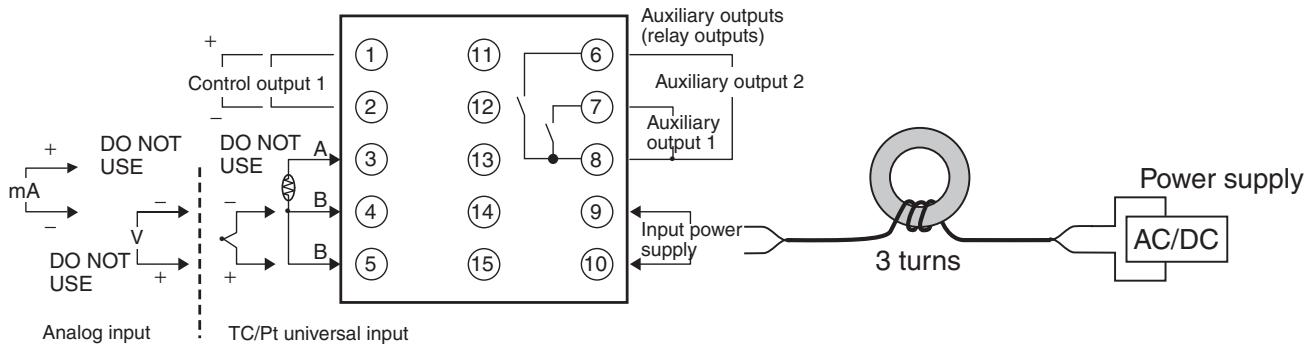
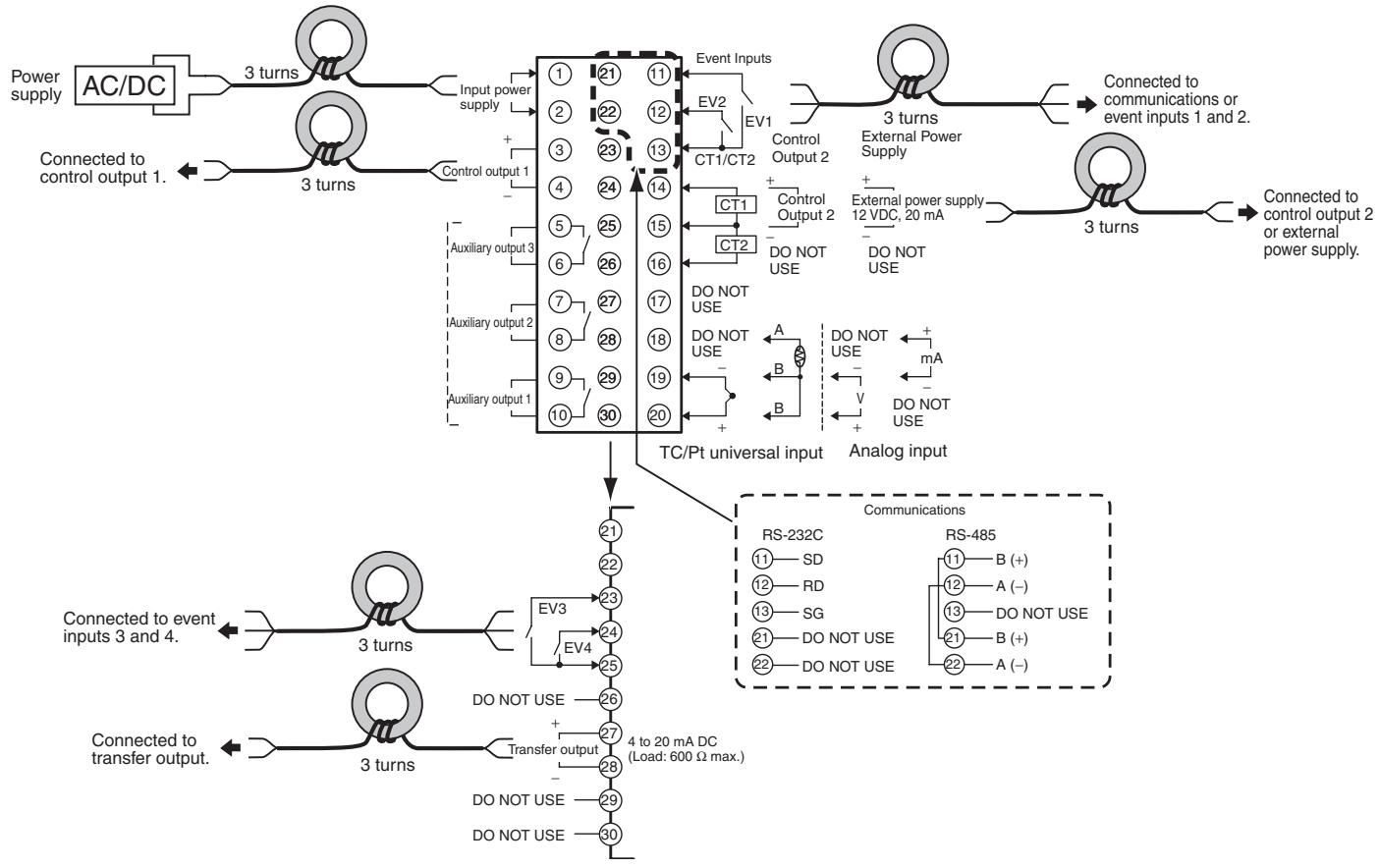
Install the recommended ferrite core and wrap the line around it three turns for the applicable lines (e.g., power supply cable line and signal lines) of the models listed in the following table. (See illustrations.) Install the ferrite cores as close to the terminal block of the E5□N-H as possible. (As a guideline, the ferrite core should be within 10 cm of the terminal block.)
- Lines Requiring Ferrite Cores
| Model | Signal line or power supply line onto which a ferrite core is installed |
| E5CN, E5CN-U, or E5CN-H | Input power supply line |
| E5EN, E5AN, E5EN-H, or E5AN-H | Input power supply line and I/O lines (control outputs 1 and 2, communications, event inputs EV1, EV2, EV3, and EV4, transfer output, and external power supply (not provided on Advanced-type Digital Controllers (E5☐N-H))) |
Recommended Ferrite Core
| Manufacturer | Seiwa Electric Manufacturing Co., Ltd. |
| Model | E04RA310190100 |
Ferrite Core Connection Examples
1. E5CN/E5CN-H
2. E5AN/E5EN/E5AN-H/E5EN-H
Preparations for Use
Be sure to thoroughly read and understand the manual provided with the product, and check the following points.
| Timing | Check point | Details |
| Purchasing the product | Product appearance | After purchase, check that the product and packaging are not dented or otherwise damaged. Damaged internal parts may prevent optimum control. |
| Product model and specifications | Make sure that the purchased product meets the required specifications. | |
| Setting the Unit | Product installation location | Provide sufficient space around the product for heat dissipation. Do not block the vents on the product. |
| Wiring | Terminal wiring | Do not subject the terminal screws to excessive stress (force) when tightening them. Make sure that there are no loose screws after tightening terminal screws to the specified torque of 0.74 to 0.90 N·m. |
| Be sure to confirm the polarity for each terminal before wiring the terminal block and connectors. | ||
| Power supply inputs | Wire the power supply inputs correctly. Incorrect wiring will result in damage to the internal circuits. | |
| Operating environment | Ambient temperature | The ambient operating temperature for the product is -10 to 55°C (with no condensation or icing). To extend the service life of the product, install it in a location with an ambient temperature as low as possible. In locations exposed to high temperatures, if necessary, cool the products using a fan or other cooling method. |
| Vibration and shock | Check whether the standards related to shock and vibration are satisfied at the installation environment. (Install the product in locations where the conductors will not be subject to vibration or shock.) | |
| Foreign particles | Install the product in a location that is not subject to liquid or foreign particles entering the product. |
Conventions Used in This Manual
Meanings of Abbreviations
The following abbreviations are used in parameter names, figures and in text explanations. These abbreviations mean the following:
| Symbol | Term |
| PV | Process value |
| SP | Set point |
| SV | Set value |
| AT | Auto-tuning |
| ST | Self-tuning |
| HB | Heater burnout |
| HS | Heater short (See note 1.) |
| OC | Heater overcurrent |
| LBA | Loop burnout alarm |
| EU | Engineering unit (See note 2.) |
| RSP | Remote SP |
| LSP | Local SP |
Note: (1) A heater short indicates that the heater remains ON even when the control output from the Digital Controller is OFF because the SSR has failed or for any other reason.
(2) "EU" stands for Engineering Unit. EU is used as the minimum unit for engineering units such as ^ C , m, and g. The size of EU varies according to the input type.
For example, when the input temperature setting range is -200 to +1300^ , 1 EU is 1^ , and when the input temperature setting range is -20.0 to +500.0^ , 1 EU is 0.1^ .
For analog inputs, the size of EU varies according to the decimal point position of the scaling setting, and 1 EU becomes the minimum scaling unit.
How to Read Display Symbols
The following tables show the correspondence between the symbols displayed on the displays and alphabet characters. The default is for 11-segment displays.
| A | B | C | D | E | F | G | H | I | J | K | L | M |
| N | ∅ | P | ∅ | R | 5 | E | U | V | W | X | Y | Z |
| N | O | P | Q | R | S | T | U | V | W | X | Y | Z |
The Character Select parameter in the advanced function setting level can be turned OFF to display the following 7-segment characters.
| A | B | C | D | E | F | G | H | I | J | K | L | M |
| n | ð | P | 9 | r | 5 | t | u | u | u | u | y | y | z |
| N | O | P | Q | R | S | T | U | V | W | X | Y | Z |
TABLE OF CONTENTS
SECTION 1
Introduction. 1
1-1 Names of Parts. 2
1-2 I/O Configuration and Main Functions 5
1-3 Setting Level Configuration and Key Operations 11
1-4 Communications Function. 14
SECTION 2
Preparations 17
2-1 Installation 18
2-2 Wiring Terminals 28
2-3 Using the Support Software Port 40
2-4 Using Infrared Communications 42
SECTION 3
Basic Operation. 45
3-1 Initial Setting Examples. 46
3-2 Setting the Input Type 49
3-3 Selecting the Temperature Unit 51
3-4 Selecting PID Control or ON/OFF Control 51
3-5 Setting Output Specifications 52
3-6 Setting the Set Point (SP) 56
3-7 Using ON/OFF Control 57
3-8 Determining PID Constants (AT, ST, Manual Setup) 60
3-9 Alarm Outputs 67
3-10 Using Heater Burnout, Heater Short, and Heater Overcurrent Alarms 71
3-11 Setting the No. 3 Display 82
SECTION 4
Applications Operations. 85
4-1 Shifting Input Values 87
4-2 Alarm Hysteresis 90
4-3 Setting Scaling Upper and Lower Limits for Analog Inputs. 92
4-4 Executing Heating/Cooling Control 93
4-5 Using Event Inputs 96
4-6 Setting the SP Upper and Lower Limit Values 100
4-7 Using the SP Ramp Function to Limit the SP Change Rate 102
4-8 Moving to the Advanced Function Setting Level 104
4-9 Using the Key Protect Level 106
4-10 PV Change Color. 109
4-11 Alarm Delays. 112
4-12 Loop Burnout Alarm 114
4-13 Performing Manual Control. 119
4-14 Using the Transfer Output 124
TABLE OF CONTENTS
4-15 Using Banks and PID Sets. 129
4-16 Using the Simple Program Function 132
4-17 Output Adjustment Functions 141
4-18 Using the Extraction of Square Root Parameter 144
4-19 Setting the Width of MV Variation 146
4-20 Setting the PF Key 148
4-21 Counting Control Output ON/OFF Operations 150
4-22 Displaying PV/SV Status. 152
4-23 Using a Remote SP 155
4-24 Position-proportional Control 157
4-25 Logic Operations 159
SECTION 5
Parameters. 169
5-1 Conventions Used in this Section 170
5-2 Protect Level 171
5-3 Operation Level 175
5-4 Adjustment Level. 190
5-5 Bank Setting Level. 209
5-6 PID Setting Level. 216
5-7 Monitor/Setting Item Level 220
5-8 Manual Control Level 221
5-9 Initial Setting Level 223
5-10 Advanced Function Setting Level 242
5-11 Communications Setting Level 281
SECTION 6
CALIBRATION 283
6-1 Parameter Structure 284
6-2User Calibration. 285
6-3 Thermocouple Calibration (Thermocouple/Resistance Thermometer Input) 285
6-4 Platinum Resistance Thermometer Calibration (Thermocouple/Resistance Thermometer Input). 289
6-5 Calibrating Analog Input (Analog Input) 290
6-6 Calibrating the Transfer Output 292
6-7 Checking Indication Accuracy 294
Appendix 297
Index. 343
Revision History 351
About this Manual:
This manual describes the E5CN/AN/EN-H Digital Controllers and includes the sections described below.
Please read this manual carefully and be sure you understand the information provided before attempting to set up or operate an E5CN/AN/EN-H Digital Controller.
- Overview
Section 1 introduces the features, components, and main specifications of the E5CN/AN/EN-H Digital Controllers.
- Setup
Section 2 describes the work required to prepare the E5CN/AN/EN-H Digital Controllers for operation, including installation and wiring.
- Basic Operations
Section 3 describes the basic operation of the E5CN/AN/EN-H Digital Controllers, including key operations to set parameters and descriptions of display elements based on specific control examples.
Section 5 describes the individual parameters used to set up, control, and monitor operation.
Operations for Applications
Section 4 describes scaling, the SP ramp function, and other special functions that can be used to make the most of the functionality of the E5CN/AN/EN-H Digital Controllers.
Section 5 describes the individual parameters used to setup, control, and monitor operation.
-User Calibration
Section 6 describes how the user can calibrate the E5CN/AN/EN-H Digital Controllers.
- Appendix
The Appendix provides information for easy reference, including lists of parameters and settings.

WARNING
Failure to read and understand the information provided in this manual may result in personal injury or death, damage to the product, or product failure. Please read each section in its entirety and be sure you understand the information provided in the section and related sections before attempting any of the procedures or operations given.
SECTION 1 Introduction
This section introduces the features, components, and main specifications of the E5CN-H, E5AN-H, and E5EN-H Digital Controllers.
1-1 Names of Parts 2
1-1-1 Front Panel 2
1-1-2 Explanation of Indicators 3
1-1-3 Using the Keys 4
1-2 I/O Configuration and Main Functions 5
1-2-1 I/O Configuration 5
1-2-2 Main Functions. 8
1-3 Setting Level Configuration and Key Operations 11
1-3-1 Selecting Parameters. 14
1-3-2 Saving Settings 14
1-4 Communications Function 14
1-1 Names of Parts
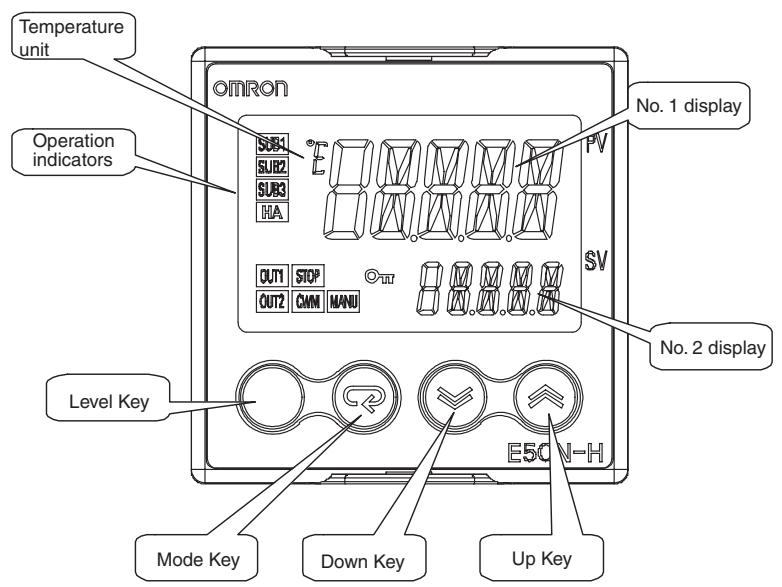
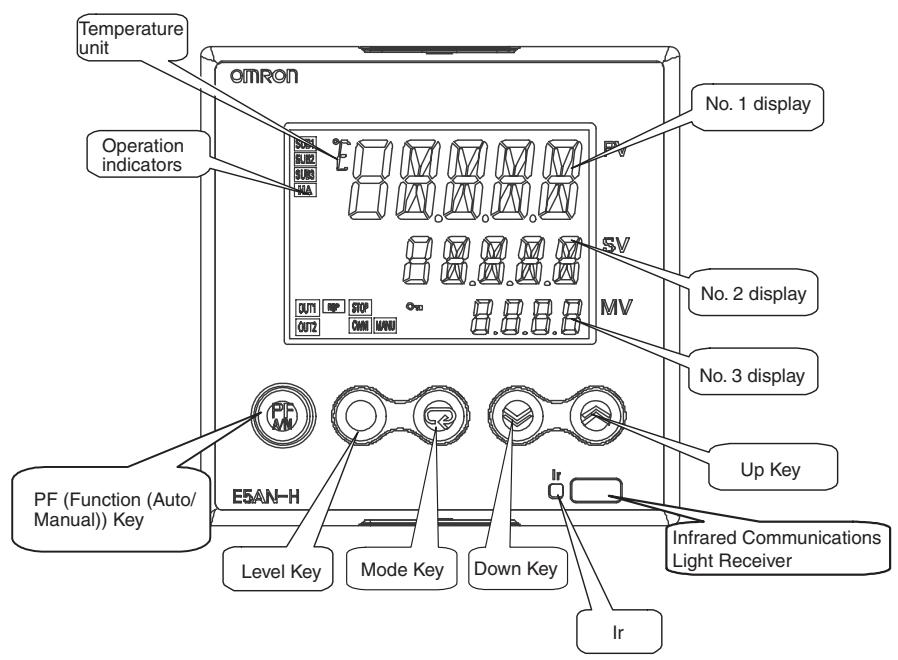
1-1-1 Front Panel
E5CN-H
E5AN-H
E5EN-H
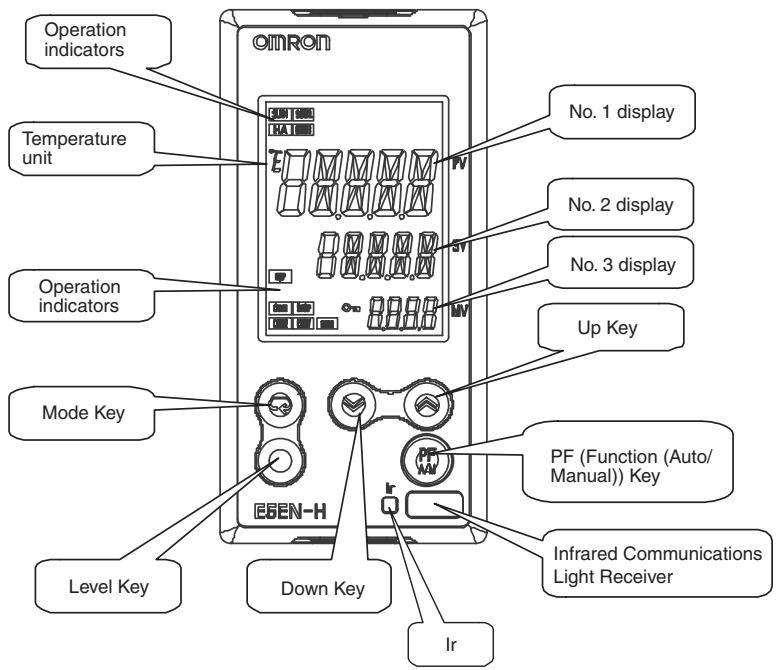
1-1-2 Explanation of Indicators
No. 1 Display
Displays the process value or parameter name.
Lights for approximately one second during startup.
No. 2 Display
Displays the set point, parameter operation read value, or the variable input value.
Lights for approximately one second during startup.
No. 3 Display (E5AN/EN-H Only)
Displays MV (valve opening), soak time remain, or bank number.
Lights for approximately one second during startup.
Operation Indicators
1,2,3...
- SUB1 (Sub 1)
Lights when the function set for the Auxiliary Output 1 Assignment parameter is ON.
SUB2 (Sub 2)
Lights when the function set for the Auxiliary Output 2 Assignment parameter is ON.
SUB3 (Sub 3)
Lights when the function set for the Auxiliary Output 3 Assignment parameter is ON.
- HA (Heater Burnout, Heater Short Alarm, Heater Overcurrent Detection Output Display)
Lights when a heater burnout, heater short alarm, or heater overcurrent occurs.
- OUT1 (Control Output 1)
Lights when the control output function assigned to control output 1 turns ON. For a current output, however, OFF for a 0% output only.
With position-proportional models, OUT1 lights when the "open" output turns ON.
| OUT2 (Control Output 2) Lights when the control output function assigned to control output 2 turns ON. For a current output, however, OFF for a 0% output only. With position-proportional models, OUT2 lights when the "close" output turns ON. 4. STOP Lights when operation is stopped. During operation, this indicator lights when operation is stopped by an event or by key input using the RUN/STOP function. 5. CMW (Communications Writing) Lights when communications writing is enabled and is not lit when it is disabled. 6. MANU (Manual Mode) Lights when the auto/manual mode is set to manual mode. 7. On (Key) Lights when settings change protect is ON (i.e., when the ☑ and ☑ Keys are disabled by protected status. 8. RSP Lights when the SP Mode parameter is set to Remote SP Mode. Temperature Unit | The temperature unit is displayed when parameters are set to display a temperature. The display is determined by the currently set value of the Temperature Unit parameter. ☐ indicates °C and F indicates °F. This indicator flashes during ST operation. It is OFF when an analog input is set. Ir | Indicates whether infrared communications is enabled. Lights when communications is enabled. Not lit when infrared communications is disabled. · Infrared Communications Light Receiver Used when infrared cable is used. |
1-1-3 Using the Keys
| PF (Function (Auto/ Manual)) Key (E5AN/EN-H Only) | This section describes the basic functions of the front panel keys. |
| This is a function key. When it is pressed for at least 1 second, the function set in the PF Setting parameter will operate. | |
| Example: When A-M (auto/manual) is selected in the PF Setting parameter (initial value: A-M), the key operates as an auto/manual switch, switching between Auto Mode and Manual Mode. If the key is pressed for more than 1 second (regardless of key release timing), the mode will switch. | |
| Key | Press this key to move between setting levels. The setting level is selected in the following order: operation level: adjustment level, initial setting level, communications setting level. |
| Key | Press this key to change parameters within a setting level. |
| The parameters can be reversed by holding down the key (moving one per second in reverse order). | |
| Key | Each press of this key increments the value displayed on the No. 2 display or advances the setting. Holding the key down speeds up the incrementation. |
| Key | Each press of this key decrements values displayed on the No. 2 display or reverses the setting. Holding the key down speeds up the incrementation. |
- Keys
Press these keys to change to the protect level. For details on operations involving holding these keys down simultaneously, refer to 1-3 Setting Level Configuration and Key Operations. For details on the protect level, refer to SECTION 5 Parameters.
O + Keys
O + Keys
To restrict set value changes (in order to prevent accidental or incorrect operations), these key operations require simultaneously pressing the key along with or key. This applies only to the parameter for the password to move to protect level. (Refer to page 174.)
1-2 I/O Configuration and Main Functions
1-2-1 I/O Configuration

E5CN-H
Note
Functions can be assigned individually for each output by changing the set values for the Control Output 1 Assignment, the Control Output 2 Assignment, the Auxiliary Output 1 Assignment, and the Auxiliary Output 2 Assignment parameters in the advanced function setting level.
Model Number Structure
Model Number Legends
Controllers
E5CN-□□□M□-□-500 1234567
- Type
H: Advanced
- Control Output 1
R: Relay output
Q: Voltage output (for driving SSR)
C: Current output
V: Linear voltage output
- Auxiliary Outputs
2: Two outputs
- Option 1
M: Option Unit can be mounted.
- Power Supply Voltage
Blank: 100 to 240 VAC
D: 24 VAC/VDC
- Case Color
Blank: Black
W: Silver
- Terminal Cover
-500: With terminal cover
Option Units
E53-□□□1234
- Applicable Controller
CN: E5CN-H or E5CN
- Function 1
Blank: None
Q: Control output 2 (voltage output for driving SSR)
P: Power supply for sensor
C: Current output
- Function 2
Blank: None
H: Heater burnout/Heater short/ Heater overcurrent detection (CT1)
HH: Heater burnout/Heater short/ Heater overcurrent detection (CT2)
B: Two event inputs
03: RS-485 communications
H03: Heater burnout/Heater short/ Heater overcurrent detection (CT1) + RS-485 communications
HB: Heater burnout/Heater short/ Heater overcurrent detection (CT1) + Two event inputs
HH03: Heater burnout/Heater short/ Heater overcurrent detection (CT2) + RS-485 communications
H01: Heater burnout/Heater short/ Heater overcurrent detection (CT1)/ RS-232C communications
F: Transfer output
BF: Two event inputs/Transfer output
- Version
N2: Available only to models released after January 2008
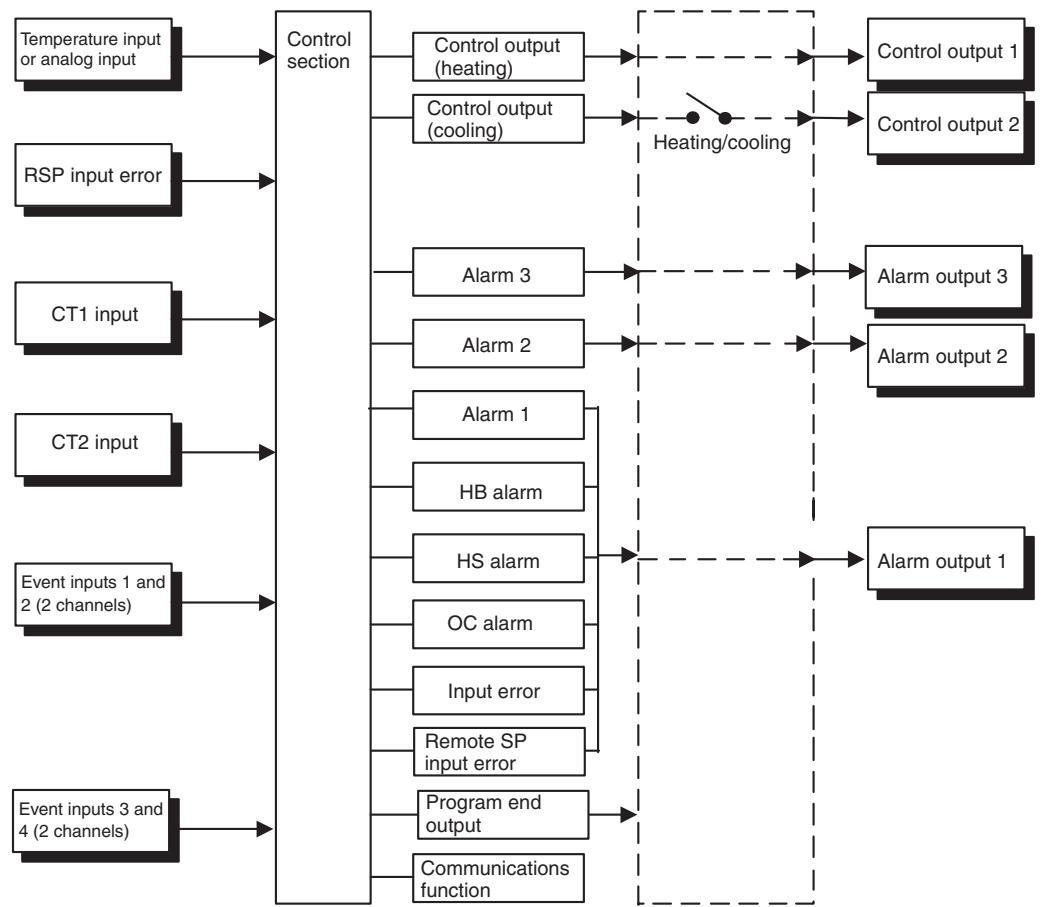
E5AN/EN-H
Note
Functions can be assigned individually to each output by changing the set values for the Control Output 1 Assignment, Control Output 2 Assignment, Auxiliary Output 1 Assignment, Auxiliary Output 2 Assignment, and Auxiliary Output 3 Assignment parameters in the advanced function setting level.
Model Number Structure
Model Number Legends
Controllers

Option Units
- Type
H: Advanced
- Control Mode
Blank: Standard or heating/cooling control
P: Position-proportional control
- Control Output 1
A: Control Output Unit
R: Relay output
S: SSR output
- Control Output 2
A: Control Output Unit
R: Relay output
S: SSR output
- Auxiliary Outputs
2: Two outputs
3: Three outputs
- Option 1
Blank: None
H: Heater burnout/Heater short/ Heater overcurrent detection (CT1)
HH: Heater burnout/Heater short/ Heater overcurrent detection (CT2)
- Option 2
B: Two event inputs
BF: Event input + Transfer output
- Option 3
M: Option Unit can be mounted.
- Power Supply Voltage
Blank: 100 to 240 VAC
D: 24 VAC/VDC
- Case Color
Blank: Black
W: Silver
- Terminal Cover
-500: With Terminal Cover
- Function
EN01: RS-232C
communications
EN02:RS-422
communications
EN03:RS-485
communications
AKB: Event input
Output Units
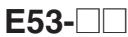
12
- Control Output
R: Relay output
Q: Voltage output (for driving SSR)
Q3: Voltage output (for driving SSR) + 24 VDC (NPN)
Q4: Voltage output (for driving SSR) + 24 VDC (PNP)
C3: Current output + 4 to 20 mA DC
C3D: Current output + 0 to 20 mA DC
V34: Linear voltage output + 0 to 10 VDC
V35: Linear voltage output + 0 to 5 VDC
- Version
Blank: Available for
E5AN-H/E5EN-H and E5AK/E5EK.
N: Available only for
E5AN-H/E5EN-H.
1-2-2 Main Functions
This section introduces the main E5□N-H functions. For details on particular functions and how to use them, refer to SECTION 3 Basic Operation and following sections.
Input Sensor Types
- The following input sensors can be connected.:
Thermocouple: K, J, T, E, L, U, N, R, S, B, W, PLII
Platinum resistance thermometer: Pt100, JPt100
Current input: 4 to 20mA DC, 0 to 20mA DC
Voltage input: 1 to 5 VDC, 0 to 5 V DC, 0 to 10 V DC
| Control Outputs | ·A control output can be a relay output, voltage output (for driving SSR), linear voltage output, SSR output, or current output, depending on the model. ·With the E5CN-H□2□□, auxiliary output 2 is used as control output (cooling) when heating/cooling control is selected. (It is also possible to allocate a different output.) Therefore, use auxiliary output 1 if an auxiliary output is required while using heating/cooling control. |
| Alarms | ·Set the alarm type and alarm value or the alarm value upper and lower limits. ·If necessary, a more comprehensive alarm function can be achieved by setting a standby sequence, alarm hysteresis, auxiliary output close in alarm/open in alarm, alarm latch, alarm ON delay, and alarm OFF delay. ·If the Input Error Output parameter is set to ON, the output assigned to alarm 1 function will turn ON when an input error occurs. ·If the Remote SP Input Error Output parameter is set to ON, the output assigned to the alarm 1 function will turn ON when an input error occurs. |
| Control Adjustment | ·Optimum PID constants can be set easily by performing AT (auto-tuning) or ST (self-tuning). |
| Event Inputs | ·With the E53-CN□B□N2 for the E5CN-H (for two event inputs), the E5AN/EN-H□B□M□-500 for E5AN/EN-H (for two event inputs) or the E5AN/EN-H□B□M□-500 with the E53-AKB for the E5AN/EN-H (for four event inputs), the following functions can be executed using event inputs: switching banks, switching RUN/STOP, switching between automatic and manual operation, starting/resetting the program, inverting direct/reverse operation, switching SP modes, 100% AT execute/cancel, 40% AT execute/cancel, setting change enable/disable, communications writing enable/disable and canceling the alarm latch. |
| Heater Burnout, HS Alarm, and Heater Overcurrent | ·With the E53-CN□H□N2 or E53-CN□HH□N2 for the E5CN-H, or the E5AN/EN-H□B□H□-500 or E5AN/EN-H□HH□-500, the heater burnout detection function, HS alarm function, and heater overcurrent detection function can be used. |
| Communications Functions | ·Communications functions utilizing CompoWay/F (See note 1.), SYSWAY (See note 2.), or Modbus (See note 3.) can be used. RS-485 Interface Use the E53-CN□03N2 for the E5CN-H, or the E53-EN03 for the E5AN/EN-H. RS-232C Interface Use the E53-CN□01N2 for the E5CN-H, or the E53-EN01 for the E5AN/EN-H. RS-422 Interface Use the E53-EN02 for the E5AN/EN-H. |
| Note | (1) CompoWay/F is an integrated general-purpose serial communications protocol developed by OMRON. It uses commands compliant with the well-established FINS, together with a consistent frame format on OMRON Programmable Controllers to facilitate communications between personal computers and components. (2) SYSWAY communications do not support alarm 3. (3) Modbus is a communications control method conforming to the RTU Mode of Modbus Protocol. Modbus is a registered trademark of Schneider Electric. |
| (4) The E5CN-H does not support the RS-422 interface. | |
| Transfer Output | A 4 to 20-mA transfer output can be used with the E53-CN□FN2 for the E5CN-H, or the E5AN/EN-H□□F-500. |
| Remote SP Inputs | Remote SP inputs can be used with the E5AN-H and E5EN-H. |
| Infrared Communications | When Support Software, such as CX-Thermo version 4.00 or later (EST2-2CMV4 or later), is used, the personal computer can be connected to the Digital Controller using infrared communications. |
1-3 Setting Level Configuration and Key Operations
Parameters are divided into groups, each called a level. Each of the set values (setting items) in these levels is called a parameter. The parameters on the E5CN/AN/EN-H are divided into the following 9 levels.
When the power is turned ON, all of the display lights for approximately one second.
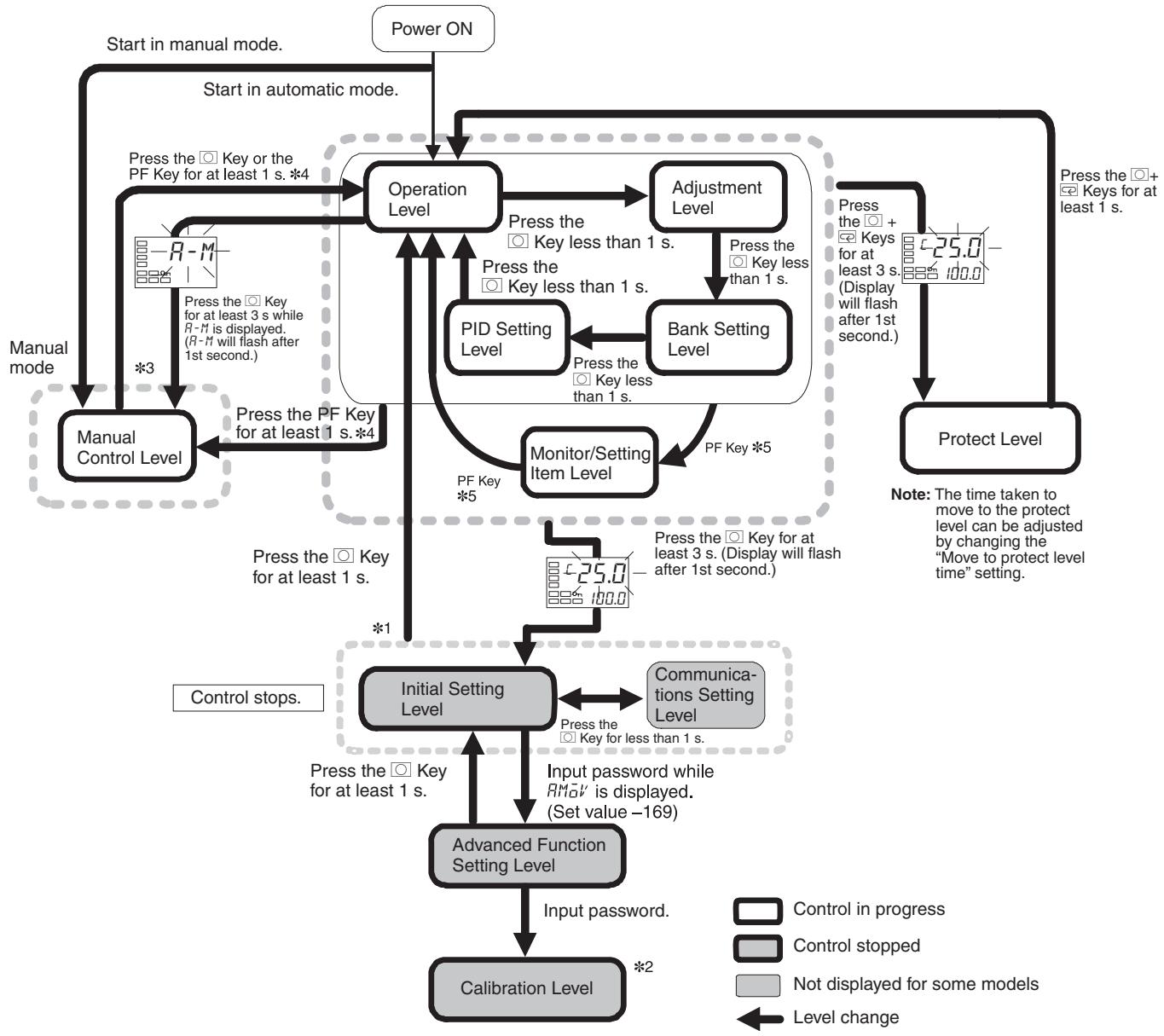
Note
(1) Your can return to the operation level by executing a software reset.
(2) You cannot move to other levels by operating the keys on the front panel from the calibration level. You must turn OFF the power supply.
(3) From the manual control level, key operations can be used to move to the operation level only.
| Level | Control in progress | Control stopped |
| Protect level | Can be set. | --- |
| Operation level | Can be set. | --- |
| Adjustment level | Can be set. | --- |
| Bank setting level | Can be set. | --- |
| Level | Control in progress | Control stopped | |
| PID setting level | Can be set. | --- | |
| Manual control level | Can be set. | --- | |
| Monitor/setting item level | Can be set. | --- | |
| Initial setting level | --- | Can be set. | |
| Advanced function setting level | --- | Can be set. | |
| Calibration level | --- | Can be set. | |
| Communications setting level | --- | Can be set. | |
| Of these levels, the initial setting level, communications setting level, advanced function setting level, and calibration level can be used only when control is stopped. Control outputs are stopped when any of these four levels is selected.(4) When the PF Setting is set to A-M in models with a PF Key (E5AN/EN-H)(5) When the PF Setting is set to PFDP in models with a PF Key (E5AN/EN-H) | |||
| Protect Level | • To switch to the protect level from the operation level, the adjustment level, bank setting level, or PID setting level, simultaneously hold down the 0 and 0 Keys for at least 3 seconds. (See note.) This level is for preventing unwanted or accidental modification of parameters. Protected levels will not be displayed, and so the parameters in that level cannot be modified.Note The key pressing time can be changed in Move to Protect Level parameter (advanced function setting level). | ||
| Operation Level | • The operation level is displayed when the power is turned ON. You can move to the protect level, initial setting level, or adjustment level from this level.• Normally, select this level during operation. While operation is in progress, items such as the PV and manipulated variable (MV) can be monitored, and the set points, alarm values, and alarm upper and lower limits can be monitored and changed. | ||
| Adjustment Level | • To move to the adjustment level, press the 0 Key once (for less than 1 s).• This level is for entering set values and offset values for control. In addition to AT (auto-tuning), communications write enable/disable switching, hysteresis settings, SP settings, and input offset parameters, it includes HB alarm, HS alarm, OC alarm, and PID constants. From the adjustment level, it is possible to move to the bank setting level, initial setting level, or protect level. | ||
| Bank Setting Level | • To move to the bank setting level from the adjustment level, press the 0 Key once (for less than 1 s).• This level is used to input parameters such as set points, alarm values, and PID set numbers. From the bank setting level, it is possible to move to the PID setting level, the initial setting level, or the protect level. | ||
| PID Setting Level | • To move to the PID setting level from the bank setting level, press the 0 Key once (for less than 1 s).• This level is used to input parameters such as the PID values for each PID set, MV upper and lower limits, and automatic selection range upper and lower limits. From the PID setting level, it is possible to move to the operation level, the initial setting level, or the protect level. | ||
Monitor/Setting Item Level
- To switch to the monitor/setting item level, press the PF Key from the operation level, adjustment level, bank setting level, or PID setting level. The contents set for monitor/setting items 1 to 5 can be displayed. You can move from the monitor/setting item level to the operation level or initial setting level. (E5AN/EN-H only.)
Manual Control Level
- When the Key is pressed for at least 3 seconds from the operation level's auto/manual switching display, the manual control level will be displayed. (The MANU indicator will light.)
- When the PF Setting is set to A-M (auto/manual) and the PF Key is pressed for more than one second from the operation level, adjustment level, bank setting level, or PID setting level the manual control level will be displayed. (E5AN/EN-H only.)
- This is the level for changing the MV in manual mode.
- To return to the operation level, press the Key for at least one second. It is also possible to return to the operation level by pressing the PF Key for more than one second when the PF Setting is set to A-M.
Initial Setting Level
- To move to the initial setting level from the operation level, the adjustment level, bank setting level, PID setting level, or monitor/setting item level, press the Key for at least 3 seconds. The PV display flashes after one second. This level is for specifying the input type and selecting the control method, control period, setting direct/reverse operation, setting the alarm types, etc. You can move to the advanced function setting level or communications setting level from this level. To return to the operation level, press the Key for at least one second. To move to the communications setting level, press the Key for less than one second.
(When moving from the initial setting level to the operation level, all the indicators will light.)
Note Pressing the Key for at least 3 seconds in the operation level's auto/manual switching display will move to the manual control level, and not the initial setting level.
Advanced Function Setting Level
- To move to the advanced function setting level, set the Initial Setting/Communications Protect parameter in the protect level to 0 (the default) and then, in the initial setting level, input the password (-169).
- From the advanced function setting level, it is possible to move to the calibration level or to the initial setting level.
- This level is for setting the automatic display return time and standby sequence, and it is the level for moving to the user calibration and other functions.
Communications Setting Level
- To move to the communications setting level from the initial setting level, press the Key once (for less than 1 s). When using the communications function, set the communications conditions in this level. Communicating with a personal computer (host computer) allows set points to be read and written, and manipulated variables (MV) to be monitored.
Calibration Level
- To move to the calibration level, input the password (1201) from the advanced function setting level. The calibration level is for offsetting error in the input circuit.
- You cannot move to other levels from the calibration level by operating the keys on the front panel. To cancel this level, turn the power OFF then back ON again.
1-3-1 Selecting Parameters
- Within each level, the parameter is changed in order (or in reverse order) each time the Key is pressed. (In the calibration level, however, parameters cannot be changed in reverse order.) For details, refer to SECTION 5 Parameters.
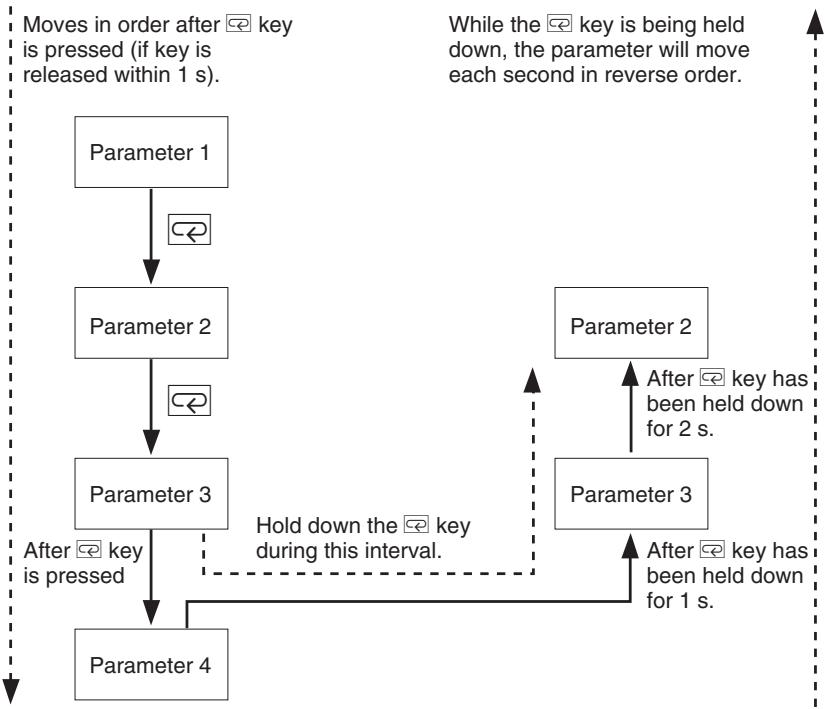
1-3-2 Saving Settings
- If you press the Key at the final parameter, the display returns to the top parameter for the current level.
- To change parameter settings, specify the setting using the or Key, and either leave the setting for at least two seconds or press the Key. This saves the setting.
- When another level is selected after a setting has been changed, the contents of the parameter prior to the change is saved.
- When you turn the power OFF, you must first save the settings (by pressing the Key). The settings are sometimes not changed by merely pressing the or Keys.
1-4 Communications Function
The E5CN/AN/EN-H Digital Controllers are provided with a communications function that enables parameters to be checked and set from a host computer. If the communications function is required, use a model that has that function (E5CN-H□M□-500 with an E53-CN□01N2 or E53-CN□03N2, E5AN-H/EN-H□M□-500 with an E53-EN01, E53-EN02, or E53-EN03). For details on the communications function, see the separate Communications Manual Advanced Type. Use the following procedure to move to the communications setting level.
1,2,3... 1. Press the Key for at least three seconds to move from the operation level to the initial setting level.
- Press the Key for less than one second to move from the initial setting level to the communications setting level.
- Select the parameters as shown below by pressing the Key.
- Press the 心 or 心 Key to change the parameter setting.
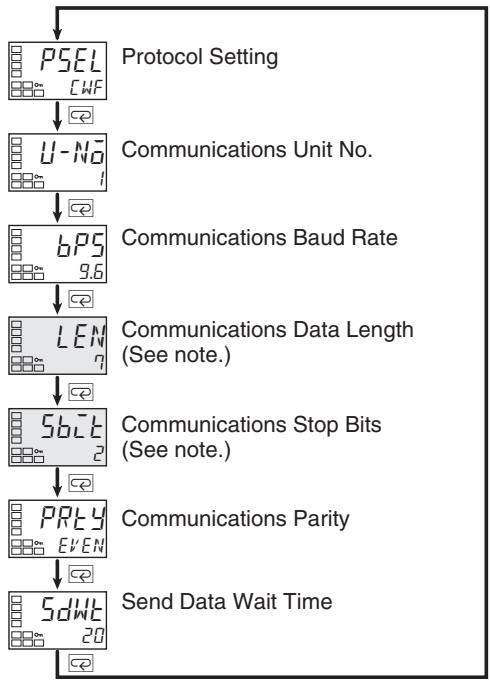
Note
The Protocol Setting parameter is displayed only when CompoWay/F communications are being used.
Setting Communications Data
Match the communications specifications of the E5CN/AN/EN-H and the host computer. If a 1:N connection is being used, ensure that the communications specifications for all devices in the system (except the communications Unit No.) are the same.
| Parameter name | Symbol | Setting (monitor) value | Selection symbols | Default | Unit |
| Protocol Setting | PSEL | CompoWay/F (SYSWAY), Modbus | CWF, Mād | CompoWay/F (SYSWAY) | None |
| Communications Unit No. | U-No | 0 to 99 | 1 | None | |
| Communications Baud Rate | bPS | 1.2, 2.4, 4.8, 9.6, 19.2, 38.4, 57.6 | 1.2, 2.4, 4.8, 9.6, 19.2, 38.4, 57.6 | 9.6 | kbps |
| Communications Data Length | LEN | 7, 8 | 7 | Bits | |
| Communications Stop Bits | SbCT | 1, 2 | 2 | Bits | |
| Communications Parity | PREY | None, Even, Odd | None, Even, odd | Even | None |
| Send Data Wait Time | SdWE | 0 to 99 | 20 | ms |
SECTION 2 Preparations
This section describes the work required to prepare the E5CN-H, E5AN-H, and E5EN-H Digital Controllers for operation, including installation and wiring.
2-1 Installation. 18
2-1-1 Dimensions. 18
2-1-2 Panel Cutout 19
2-1-3 Mounting. 21
2-1-4 Removing the Digital Controller from the Case. 23
2-2 Wiring Terminals. 28
2-2-1 Terminal Arrangement 28
2-2-2 Precautions when Wiring 30
2-2-3 Wiring. 30
2-3 Using the Support Software Port. 40
2-4 Using Infrared Communications. 42
2-1 Installation
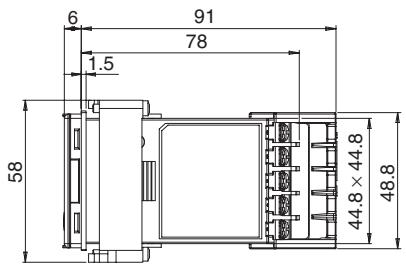
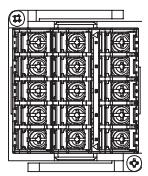
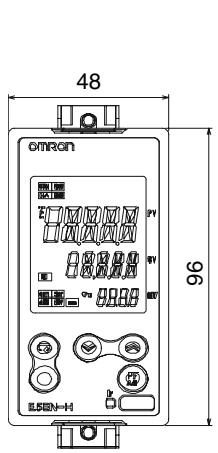
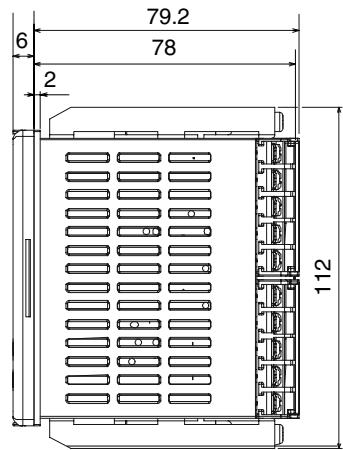
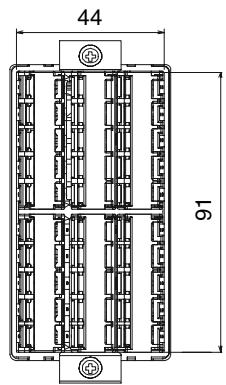
2-1-1 Dimensions
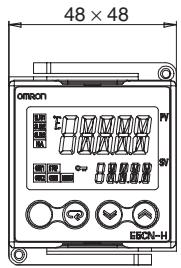
Unit: mm
E5CN-H
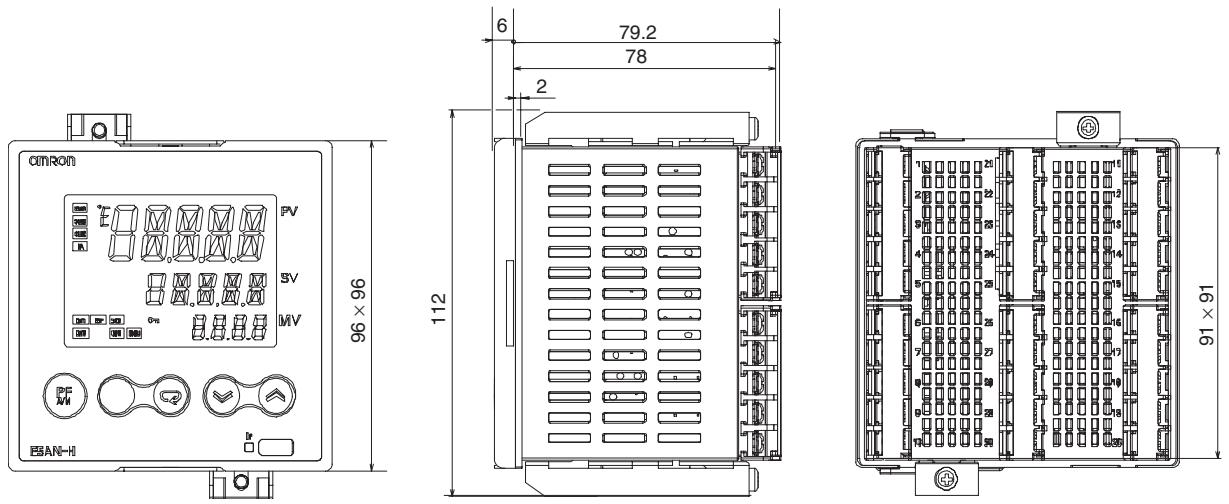
E5AN-H
E5EN-H
2-1-2 Panel Cutout
Unit: mm
E5CN-H
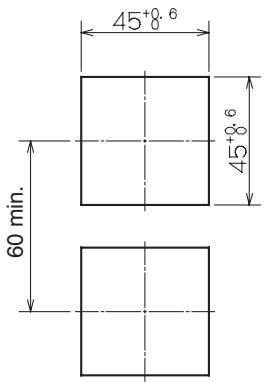
Individual Mounting
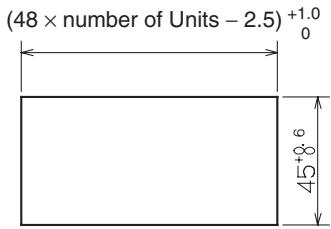
Group Mounting
E5AN-H
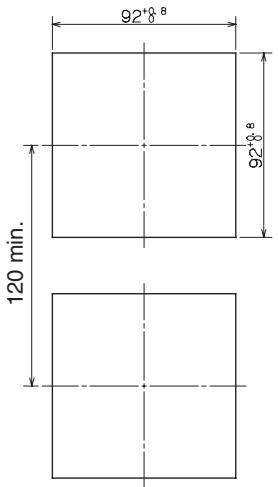
Individual Mounting
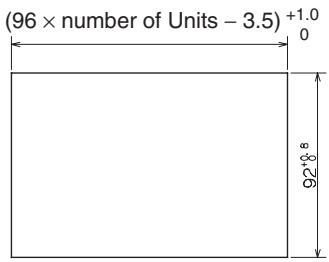
Group Mounting (See note.)
Note Group mounting is not possible when an SSR output is used for control output 1 or 2 and an E53-C3N or E53-C3DN Output Unit is used. Mount at the intervals shown in the following diagram.
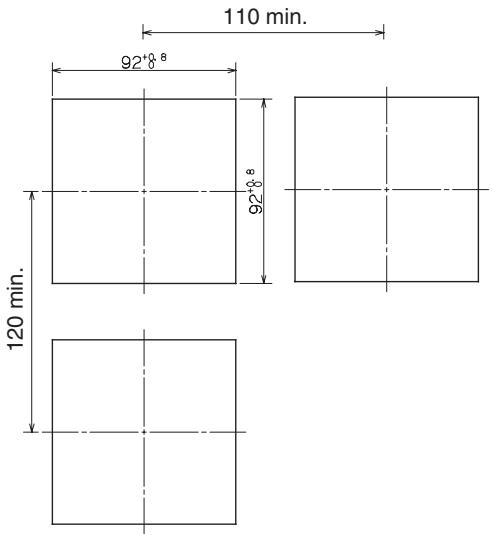
E5EN-H
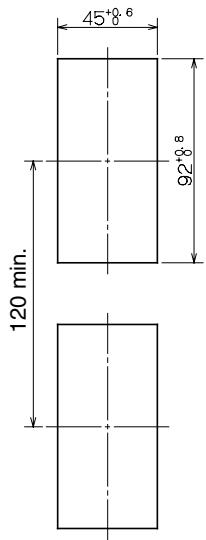
Individual Mounting
Group Mounting (See note.)
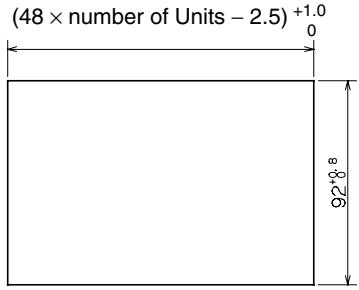
Note Group mounting is not possible when an SSR output is used for control output 1 or 2 and an E53-C3N or E53-C3DN Output Unit is used. Mount at the intervals shown in the following diagram.
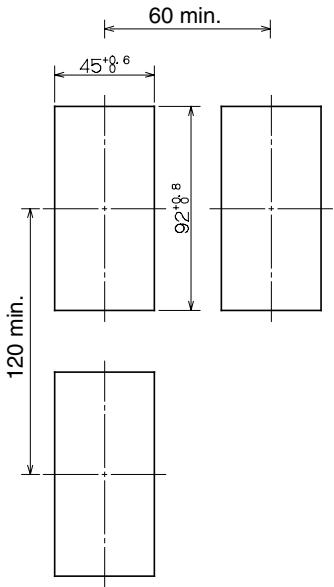
- Waterproofing is not possible when group mounting several Controllers.
- The recommended panel thickness is 1 to 5mm for E5CN-H, and 1 to 8 mm for E5AN/E5EN-H.
- Units must not be group mounted vertically. In addition, group mounting is not possible when an SSR output is used for control output 1 or 2 and an E53-C3N or E53-C3DN Output Unit is used. (Observe the recommended mounting intervals.)
- When group mounting several Controllers, ensure that the surrounding temperature does not exceed the ambient operating temperature listed in the specifications.
2-1-3 Mounting
E5CN-H
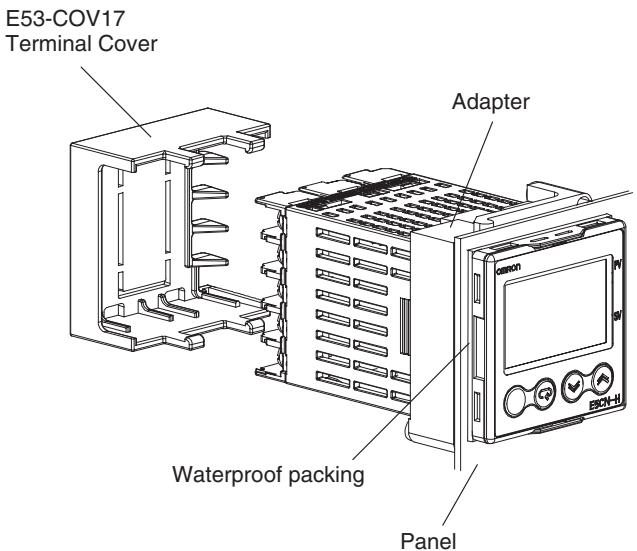
Mounting to the Panel
1,2,3...
- For waterproof mounting, waterproof packing must be installed on the Controller. Waterproofing is not possible when group mounting several Controllers. Waterproof packing is not necessary when there is no need for the waterproofing function.
- Insert the E5CN-H into the mounting hole in the panel.
- Push the adapter from the terminals up to the panel, and temporarily fasten the E5CN-H.
- Tighten the two fastening screws on the adapter. Alternately tighten the two screws little by little to maintain a balance. Tighten the screws to a torque of 0.29 to 0.39N· m .
Mounting the Terminal Cover
Make sure that the "UP" mark is facing up, and then attach the E53-COV17 Terminal Cover to the holes on the top and bottom of the Digital Controller.
E5AN/EN-H
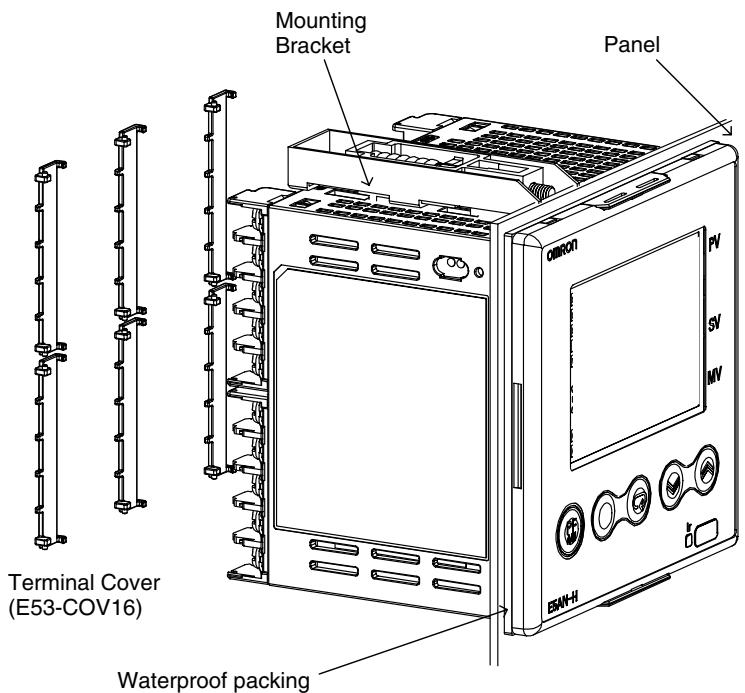
E5AN-H
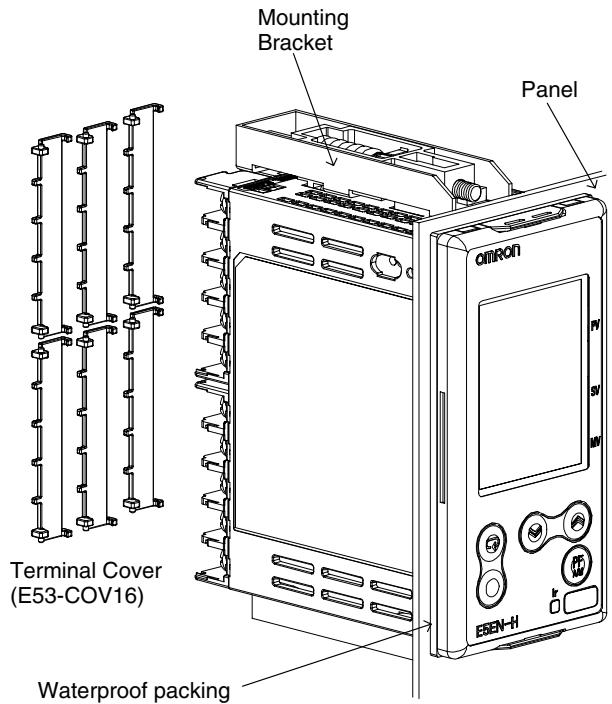
E5EN-H
Mounting to the Panel
1,2,3...
- For waterproof mounting, waterproof packing must be installed on the Controller. Waterproofing is not possible when group mounting several Controllers. Waterproof packing is not necessary when there is no need for the waterproofing function.
- Insert the E5AN/E5EN-H into the square mounting hole in the panel (thickness: 1 to 8mm ). Attach the Mounting Brackets provided with the product to the mounting grooves on the top and bottom surfaces of the rear case.
- Use a ratchet to alternately tighten the screws on the top and bottom Mounting Brackets little by little to maintain balance, until the ratchet turns freely.
Mounting the Terminal Cover
Slightly bend the E53-COV16 Terminal Cover to attach it to the terminal block as shown in the following diagram. The Terminal Cover cannot be attached in the opposite direction.
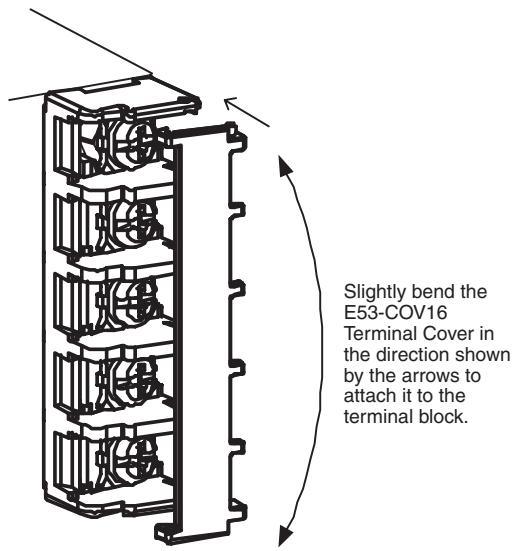
Enlarged Illustration of Terminal Section
2-1-4 Removing the Digital Controller from the Case
The body of the Digital Controller can be removed from the case to set Output Units or to perform maintenance. Check the specifications of the case and Digital Controller before removing the Digital Controller from the case.
E5CN-H
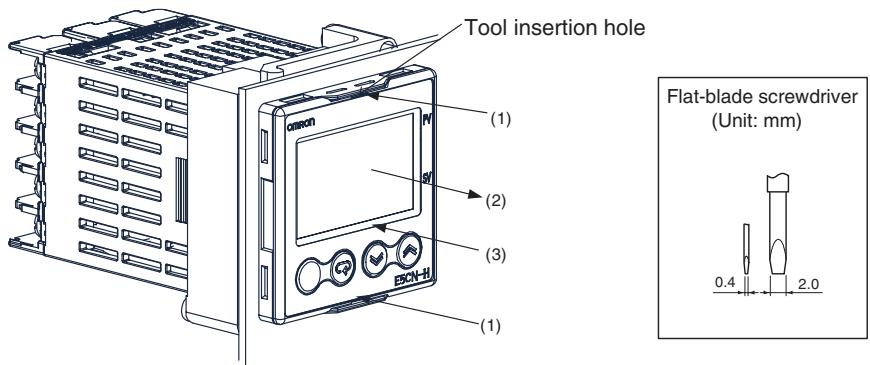
1,2,3...
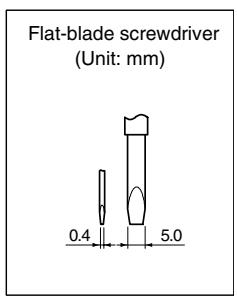
- Insert a flat-blade screwdriver into the two tool insertion holes (one on the top and one on the bottom) to release the hooks.
- Insert the flat-blade screwdriver in the gap between the front panel and rear case, and pull out the front panel slightly. Hold the top and bottom of the front panel and carefully pull it out toward you, without applying unnecessary force.
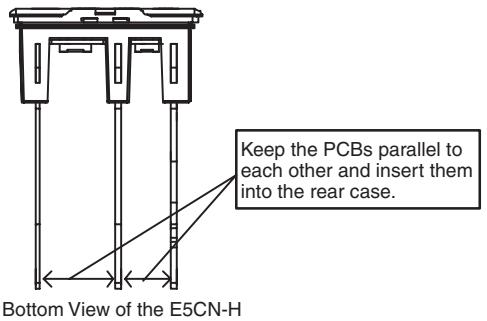
- When inserting the body of the Digital Controller into the case, make sure the PCBs are parallel to each other, make sure that the sealing rubber is in place, and press the E5CN-H all the way to the rear case. While pushing the E5CN-H into place, push down on the hooks on the top and bottom surfaces of the rear case so that the hooks are securely locked in place. Be sure that electronic components do not come into contact with the case.
E5AN/EN-H
1,2,3...
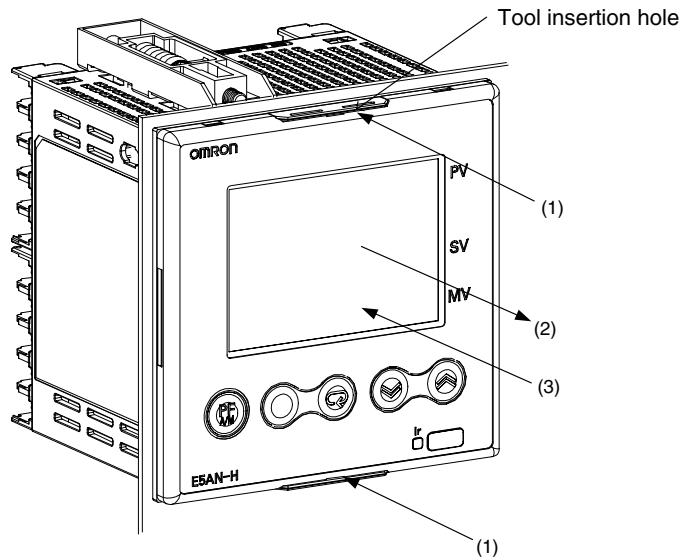
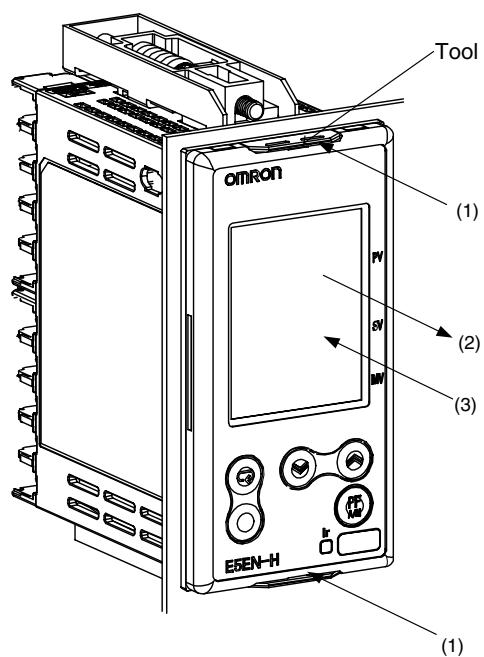
- Insert a flat-blade screwdriver into the two tool insertion holes (one on the top and one on the bottom) to release the hooks.
- Insert a flat-blade screwdriver in the gap between the front panel and rear case (two on the top and two on the bottom), and use it to pry and pull out the front panel slightly. Then, pull out on the front panel gripping both sides. Be sure not to impose excessive force on the panel.
Gap between the Front Panel and Rear Case Four gaps, two on the top and two on the bottom
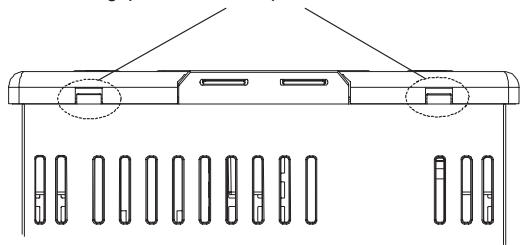
Top View of E5AN-H
Gap between the Front Panel and Rear Case Four gaps, two on the top and two on the bottom
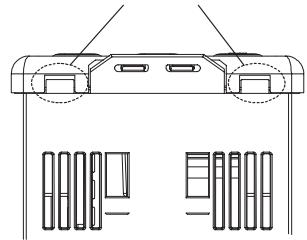
Top View of E5EN-H
- When inserting the body of the Digital Controller into the case, make sure the PCBs are parallel to each other, make sure that the sealing rubber is in place, and press the E5AN/EN-H toward the rear case until it snaps into position. While pressing the E5AN/EN-H into place, press down on the hooks on the top and bottom surfaces of the rear case so that the hooks securely lock in place. Make sure that electronic components do not come into contact with the case.
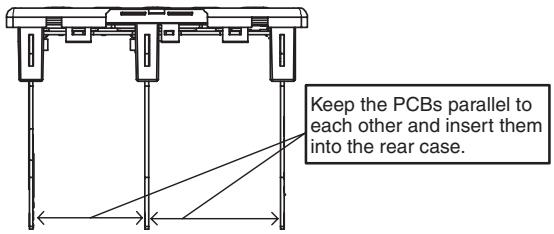
Bottom View of the E5AN-H
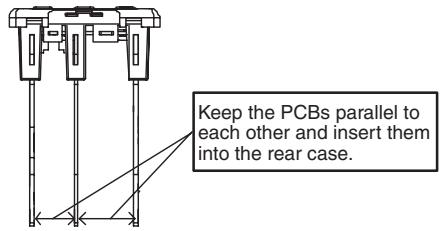
Bottom View of the E5EN-H
Mounting Output Units
Before Performing the Setup
Setting Procedure
- Confirm the type of Output Units that are to be set.
- For details on types of Output Units and the main specifications, refer to Output Units on page 32.
- For position-proportional models and models with SSR outputs, the Output Units are already set. This setting operation is not required.
-
When setting the Output Units, draw out the body of the Controller from the case and insert the Output Units into the sockets for control output 1 and 2.
-
Check the socket positions to be set using the following diagram.
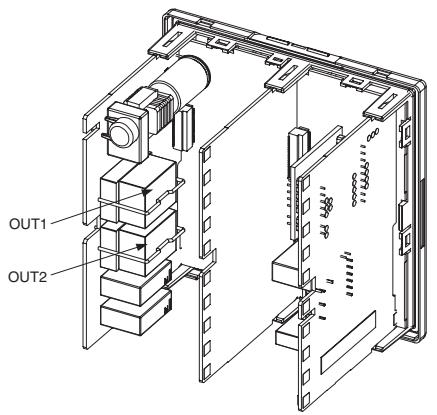
E5AN-H
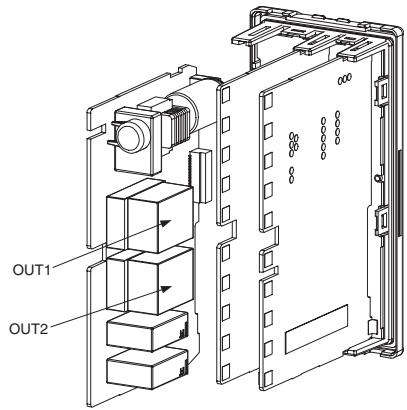
E5EN-H
1,2,3... 1. While lifting the hooks securing the PCB on the front panel, remove the PCB to which the sockets are attached.
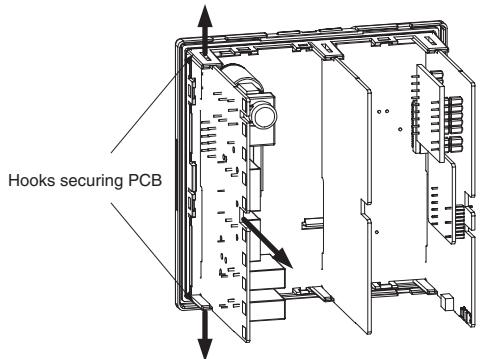
E5AN-H
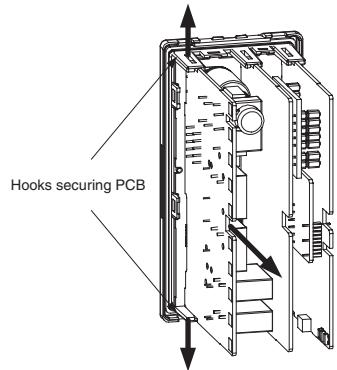
E5EN-H
- Set the Output Unit for control output 1 in the OUT1 socket. Set the Output Unit for control output 2 in the OUT2 socket.
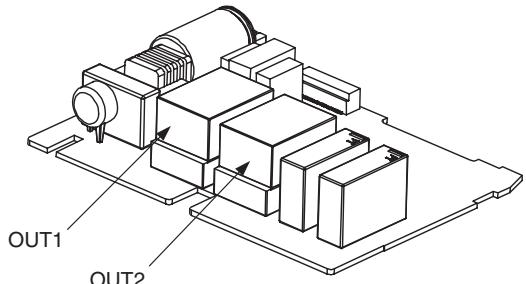
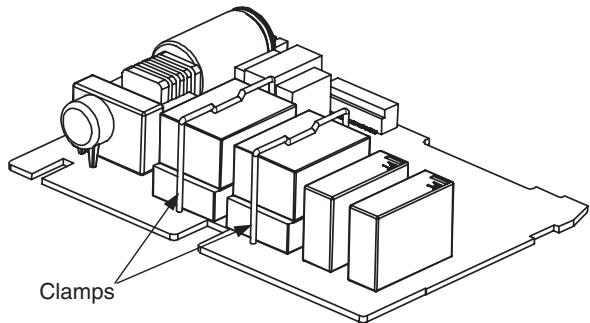
- For the E5AN-H, use the enclosed clamps to secure the Output Units. Do not use clamps for the E5EN-H.
- Set the PCB back in its original location, and make sure that the hooks securing the PCB are firmly in place.
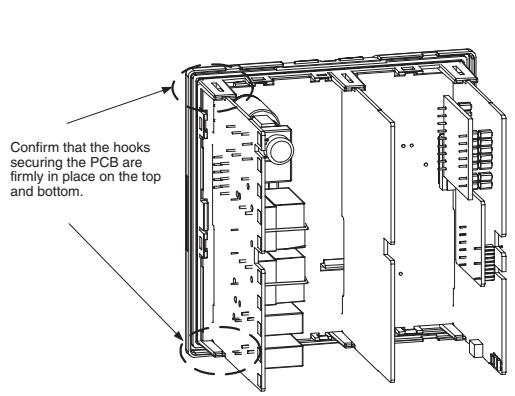
E5AN-H
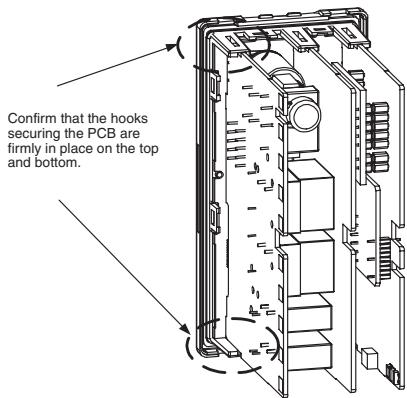
E5EN-H
2-2 Wiring Terminals
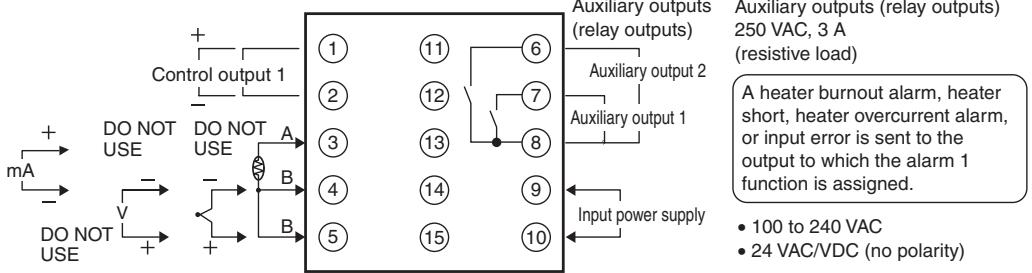
Check the terminal arrangements for E5CN-H terminals 1 to 15 and E5AN/ EN-H terminals 1 to 30 as marked on the product label and on the side of the case.
2-2-1 Terminal Arrangement
E5CN-H
Controllers
Control output 1
Relay output
250 VAC, 3 A
(resistive load)
Voltage output
(for driving SSR)
12 VDC, 21 mA
Linear voltage output
0 to 10 VAC
Load 1 kΩ max.
Current output
0 to 20 mA DC
4 to 20 mA DC
Load 600 max.
Option Units
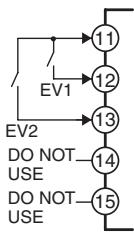
E53-CNBN2
Event Inputs
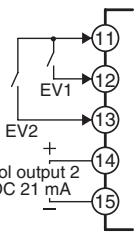
E53-CNQBN2
Event Inputs and
Control Output 2
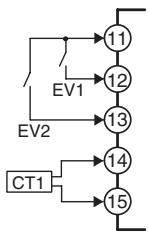
E53-CNHBN2
Event Inputs and CT
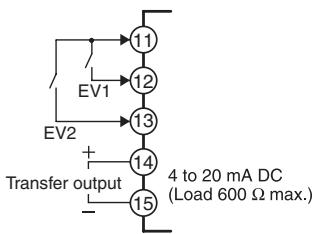
E53-CNBFN2
Event Inputs and
Transfer Output
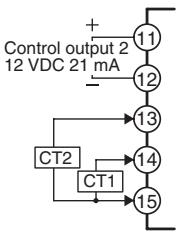
E53-CNQHHN2
Control Output 2 and CT2
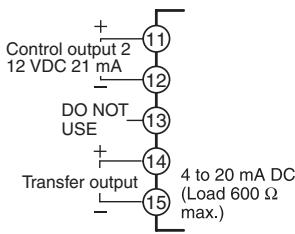
E53-CNQFN2
Control Output 2 and Transfer Output
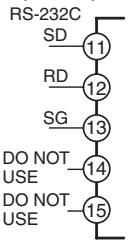
E53-CN01N2
Communications (RS-232)
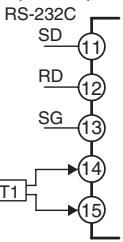
E53-CNH01N2
Communications (RS-232) and CT
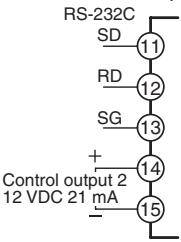
E53-CNQ01N2
Communications (RS-232) and Control Output 2
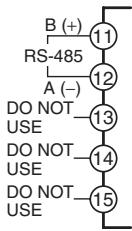
E53-CN03N2
Communications (RS-485)
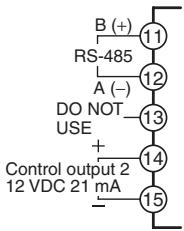
E53-CNQ03N2
Communications (RS-485) and Control Output 2
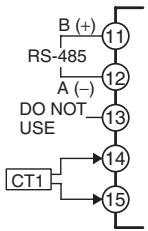
E53-CNH03N2
Communications (RS-485) and CT
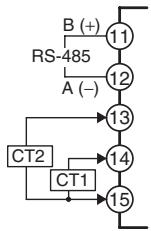
E53-CNHH03N2
Communications (RS-485) and CT2
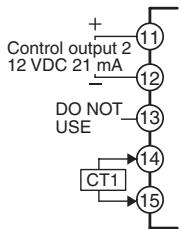
E53-CNQHN2
Control Output 2 and CT
Note Wire all voltage input terminals correctly. The Controller may fail if voltage input terminals are wired incorrectly.
E5AN/EN-H
Controllers
Option Units
100 to 240 VAC 24 VAC/VDC (no polarity)
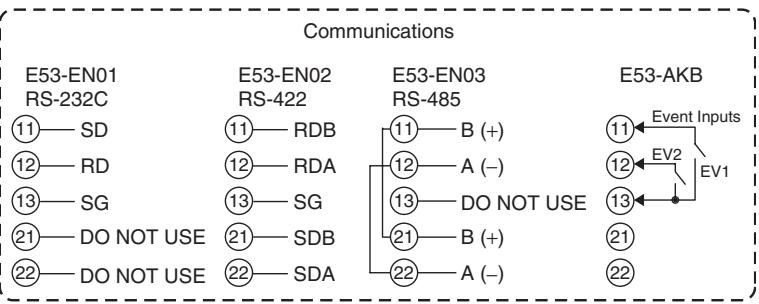
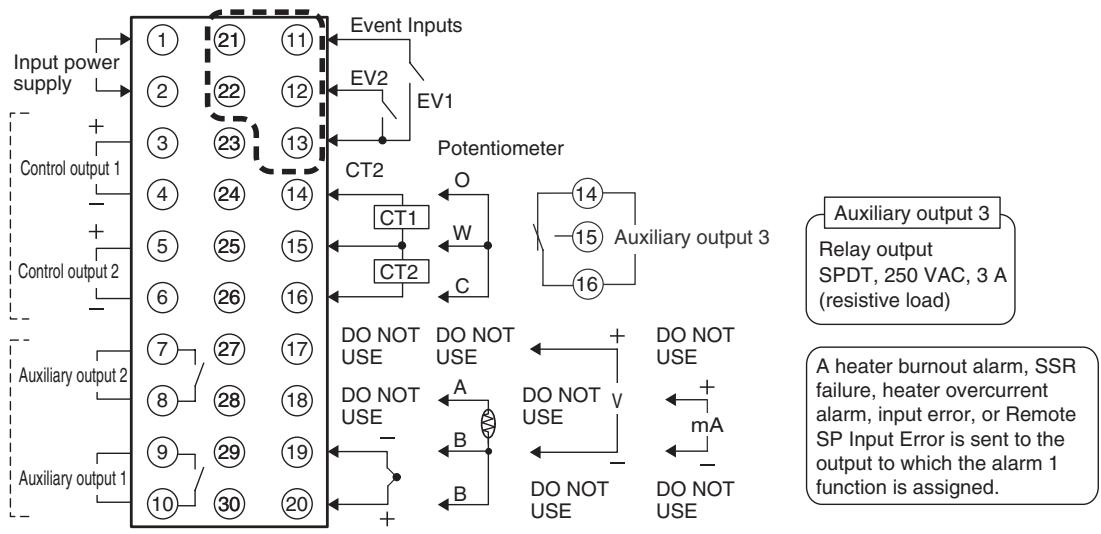
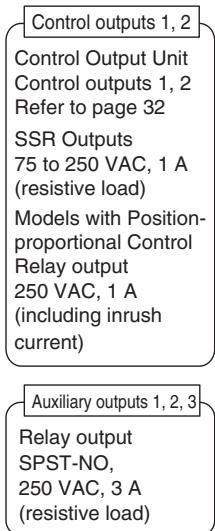
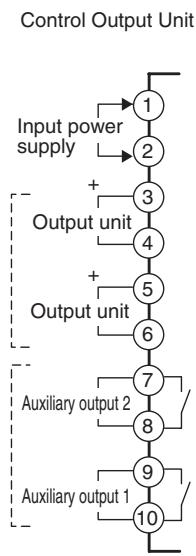
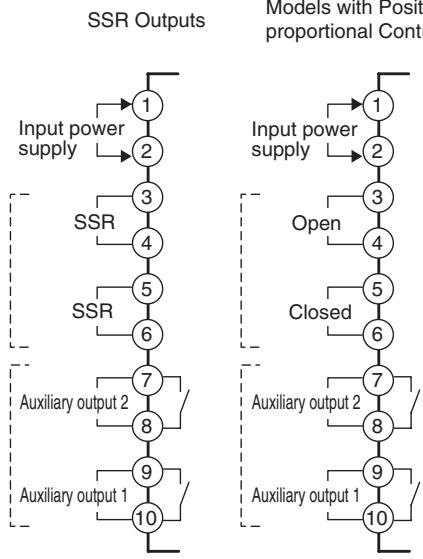
Note Wire all voltage input terminals correctly. The Controller may fail if voltage input terminals are wired incorrectly.
2-2-2 Precautions when Wiring
- Separate input leads and power lines in order to prevent external noise.
- Use AWG24 (cross-sectional area: 0.205 mm^2 ) to AWG14 (cross-sectional area: 2.081 mm^2 ) twisted-pair cable (stripping length: 5 to 6 mm ).
- Use crimp terminals when wiring the terminals.
- Use the suitable wiring material and crimp tools for crimp terminals.
- Tighten the terminal screws to a torque of 0.74 to 0.90 N · m .
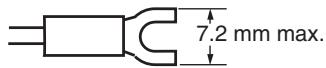
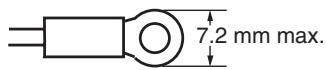
- Use the following types of crimp terminals for M3.5 screws.
Note Do not remove the terminal block. Doing so will result in malfunction or failure.
2-2-3 Wiring
Power supply
In the connection diagrams, the left side of the terminal numbers represents the inside of the Controller and the right side represents the outside.
- With the E5CN-H, connect to terminals 9 and 10; with the E5AN-H and E5EN-H, connect pins 1 and 2. The following table shows the specifications.
| Input power supply | E5CN-H | E5AN/EN-H |
| 100 to 240 VAC, 50/60 Hz | 8.5 VA | 12 VA |
| 24 VAC, 50/60 Hz | 5.5 VA | 8.5 VA |
| 24 VDC (no polarity) | 3.5 W | 5.5 W |
- These models have reinforced insulation between the input power supply, the relay outputs, and other terminals.
- Make the connections as shown below, using terminals 3 to 5 for the E5CN-H and pins 17 to 20 for the E5AN/EN-H, and matching the input types.

E5AN/EN-H
Note When wiring a voltage input, check the connected terminals carefully to make sure there are no mistakes. Incorrect wiring can cause the Unit to fail.
Control Output 1
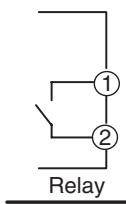
- Outputs are sent from terminals 1 and 2 with the E5CN-H and from pins 3 and 4 with the E5AN/EN-H. The following diagrams show the available outputs and their internal equalizing circuits.
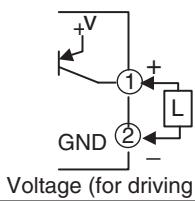
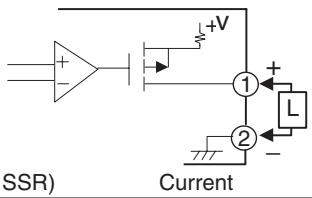
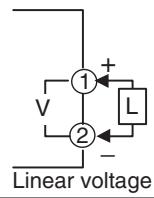
E5CN-H
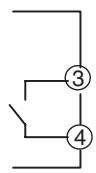
Relay
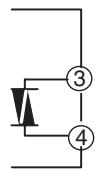
SSR
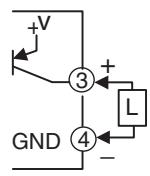
E53-Q4 (PNP) E53-QN (PNP)
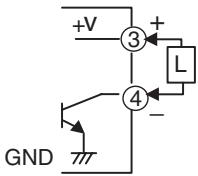
E53-Q3 (NPN)
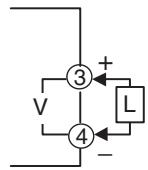
E53-V34N E53-V35N
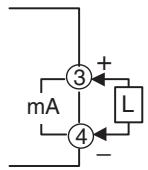
E53-C3N E53-C3DN
E5AN/EN-H
- The following table shows the specifications for each output type.
E5CN-H
| Output type | Specifications |
| Relay | 250 VAC, 3 A (resistive load), electrical durability: 100,000 operations |
| Voltage (for driving SSR) | PNP type, 12 VDC ±15%, 21 mA (with short-circuit protection) |
| Current | DC 4 to 20 mA/DC 0 to 20 mA, resistive load: 600 Ω max. Resolution: Approx. 10,000 |
| Linear voltage | 0 to 10 VDC, resistive load: 1 kΩ max. Resolution: Approx. 10,000 |
E5AN/EN-H
| Output type | Specifications |
| SSR | 75 to 250 VAC, 1 A (See note.) |
| Relay (Position-proportional mod-els) | 250 VAC 1 A (including inrush current) |
Note The SSR output (control output 1 or control output 2) ratings are as follows:
- Rated load voltage: 75 to 250 VAC
- Rated load current: 1 A (resistance load)
Use the load current within the derating curve.
- A zero cross function is not supported.
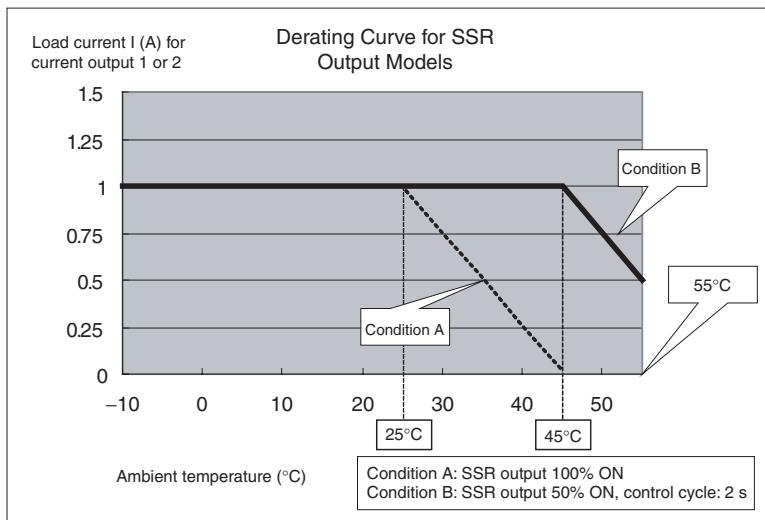
Output Units
| Model | Output Type | Output method | Specifications |
| E53-RN | Relay | ON/OFF | 250 VAC, 5 A (resistive load), Electrical life: 100,000 operations |
| E53-QN E53-Q3 E53-Q4 | Voltage (PNP) Voltage (NPN) Voltage (PNP) | ON/OFF ON/OFF ON/OFF | PNP type, 12 VDC, 40 mA (with short-circuit protection) NPN type, 24 VDC, 20 mA (with short-circuit protection) PNP type, 24 VDC, 20 mA (with short-circuit protection) |
| E53-C3N E53-C3DN | 4 to 20 mA 0 to 20 mA | Linear Linear | DC 4 to 20 mA, resistive load: 600 Ω max. Resolution: Approx. 10,000 DC 0 to 20 mA, resistive load: 600 Ω max. Resolution: Approx. 10,000 |
| E53-V34N E53-V35N | 0 to 10 V 0 to 5 V | Linear Linear | 0 to 10 VDC, resistive load: 1 kΩ min. Resolution: Approx. 10,000 to 5 VDC, resistive load: 1 kΩ min. Resolution: Approx. 10,000 |
- The E5CN-H voltage output (for driving SSR) is not electrically isolated from the internal circuits. When using a grounding thermocouple, do not connect any of the control output terminals to the ground. (If a control output terminal is connected to the ground, errors will occur in the measured temperature as a result of leakage current.) E5AN/EN-H voltage outputs (for driving SSR), however, are functionally isolated from the internal circuits.
-
If high levels of noise or surge are imposed between the output terminals of an SSR output, short-circuit faults may occasionally occur. If the output becomes permanently shorted, there is the danger of fire due to overheating of the heater. Design safety into the system, including measures to prevent excessive temperature rise and spreading of fire.
-
Take countermeasures such as installing a surge absorber. As an additional safety measure, provide error detection in the control loop. (Use the Loop Burnout Alarm (LBA) and HS alarm that are provided for the E5☐N-H.)
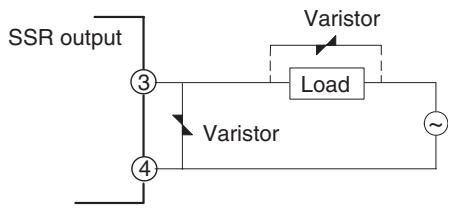
Select a surge absorber that satisfies the following conditions.
| Voltage used | Varistor voltage | Surge resistance |
| 100 to 120 VAC | 240 to 270 V | 1,000 A min. |
| 200 to 240 VAC | 440 to 470 V |
Control Output 2
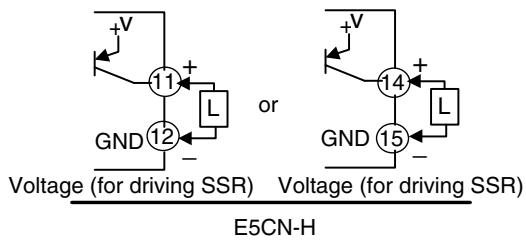
- Outputs are sent from terminals 11, 12, 14, and 15 with the E5CN-H, and from pins 5 and 6 with the E5AN/EN-H. The following diagrams show the available outputs and their internal equalizing circuits.
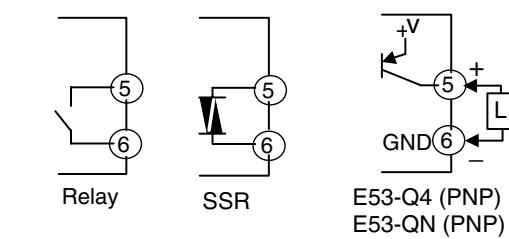
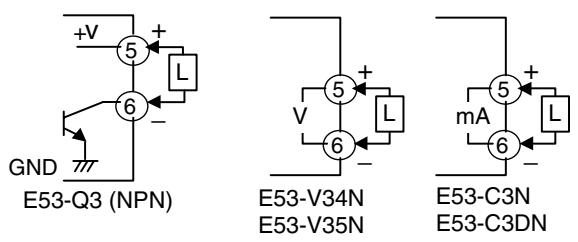
E5AN/EN-H
- The following table shows the specifications for each output type.
E5CN-H
| Output type | Specifications |
| Voltage (for driving SSR) | PNP type, 12 VDC ±15%, 21 mA (with short-circuit protection) |
E5AN/EN-H
| Output type | Specifications |
| SSR | 75 to 250 VAC 1 A (See note.) |
| Relay (Position-proportional mod-els) | 250 VAC 1 A (including inrush current) |
Note The SSR output (control output 1 or control output 2) ratings are as follows:
- Rated load voltage: 75 to 250 VAC
- Rated load current: 1 A (resistance load)
Use the load current within the derating curve.
- A zero cross function is not supported.
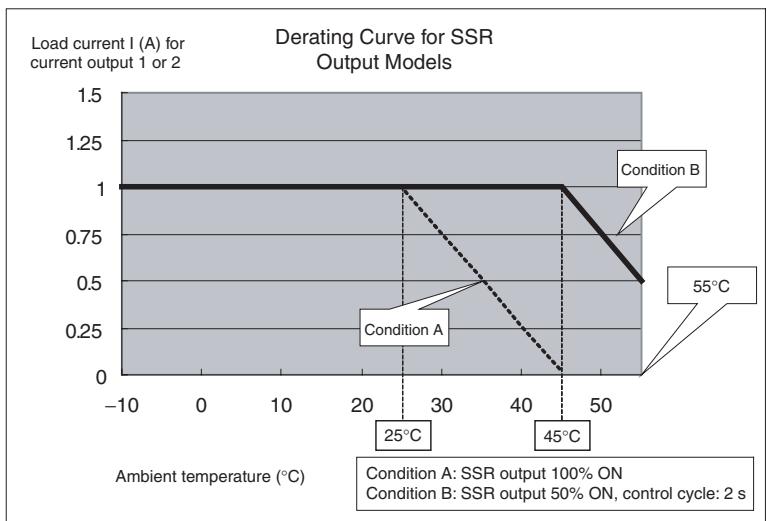
Output Units
| Model | Output Type | Output method | Specifications |
| E53-RN | Relay | ON/OFF | 250 VAC, 5 A (resistive load), Electrical life: 100,000 operations |
| E53-QNE53-Q3E53-Q4 | Voltage (PNP)Voltage (NPN)Voltage (PNP) | ON/OFFON/OFFON/OFF | PNP type, 12 VDC, 40 mA (with short-circuit protection)NPN type, 24 VDC, 20 mA (with short-circuit protection)PNP type, 24 VDC, 20 mA (with short-circuit protection) |
| E53-C3NE53-C3DN | 4 to 20 mA0 to 20 mA | LinearLinear | DC 4 to 20 mA, resistive load: 600 Ω max.Resolution: Approx. 10,000DC 0 to 20 mA, resistive load: 600 Ω max.Resolution: Approx. 10,000 |
| E53-V34NE53-V35N | 0 to 10 V0 to 5 V | LinearLinear | 0 to 10 VDC, resistive load: 1 kΩ min.Resolution: Approx. 10,0000 to 5 VDC, resistive load: 1 kΩ min.Resolution: Approx. 10,000 |
- The E5CN-H voltage output (for driving SSR) is not electrically isolated from the internal circuits. When using a grounding thermocouple, do not connect any of the control output terminals to the ground. (If a control output terminal is connected to the ground, errors will occur in the measured temperature as a result of leakage current.) E5AN/EN-H voltage outputs (for driving SSR), however, are functionally isolated from the internal circuits.
- Control output 2 of the E5CN-H is a voltage output (for driving SSR) only, and outputs across terminals 11(+) and 12(-) , or 14(+) and 15(-) .
- Control output 1 (voltage output for driving SSR) and control output 2 (voltage output for driving SSR) are not isolated.
-
If high levels of noise or surge are imposed between the output terminals of an SSR output, short-circuit faults may occasionally occur. If the output becomes permanently shorted, there is the danger of fire due to overheating of the heater. Design safety into the system, including measures to prevent excessive temperature rise and spreading of fire.
-
Take countermeasures such as installing a surge absorber. As an additional safety measure, provide error detection in the control loop. (Use the Loop Burnout Alarm (LBA) and HS alarm that are provided for the E5☐N-H.)
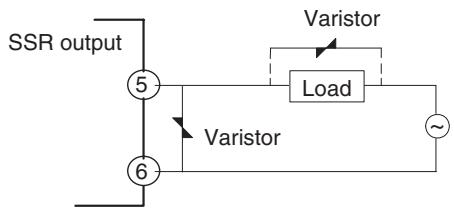
Select a surge absorber that satisfies the following conditions.
| Voltage used | Varistor voltage | Surge resistance |
| 100 to 120 VAC | 240 to 270 V | 1,000 A min. |
| 200 to 240 VAC | 440 to 470 V |
Auxiliary Outputs 2, and 3
- On the E5CN-H□2□-500, auxiliary output 1 (SUB1) is output across terminals 7 and 8, and auxiliary output 2 (SUB2) is output across terminals 6 and 8.
- On the E5AN/EN-H□2□-500, auxiliary output 1 (SUB1) is output across terminals 9 and 10, auxiliary output 2 (SUB2) is output across terminals 7 and 8.
- On the E5AN/EN-H□3□-500, auxiliary output 1 (SUB1) is output across terminals 9 and 10, auxiliary output 2 (SUB2) is output across terminals 7 and 8, and auxiliary output 3 (SUB3) is output across terminals 14, 15 and 16.
- When the Input Error Output parameter is set to ON, the output assigned to the alarm 1 function turns ON when an input error occurs.
- If the Remote SP Input Error Output parameter is set to ON, the output assigned to the alarm 1 function will turn ON when an RSP input error occurs.
- When the HB alarm, HS alarm, or heater overcurrent alarm is used with the E5CN-H (with E53-CN□H/HH□N2), alarms are output to the output assigned to the alarm 1 function.
- When the HB alarm, HS alarm, or heater overcurrent alarm is used with the E5AN-H/EN-H, alarms are output across terminals 9 and 10.
- On the E5CN-H, when heating/cooling control is used, auxiliary output 2 becomes control output (cooling).
- On the E5AN-H and E5EN-H, when heating/cooling control is used, control output 2 becomes the control output (cooling).
- For models that have a heater burnout alarm, an OR of the alarm 1 function and the HB alarm, HS alarm, or heater overcurrent alarm is output. If the alarm 1 function is to be used for HB alarm only, set the alarm 1 type to 0 (i.e., do not use alarm 1 function).
- The following diagrams show the internal equalizing circuits for auxiliary outputs 1, 2, and 3.
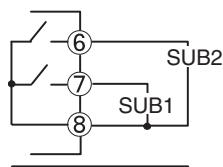
E5CN-H
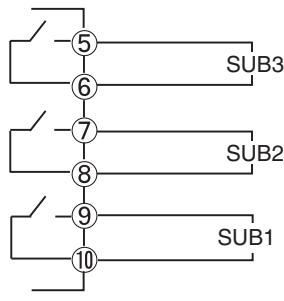
E5AN/EN-H
ALM1, 2, 3 can be output to auxiliary output 1, 2, 3 or changed with the advanced function setting level.
- The relay specifications are as follows:
| E5□N-H (SUB1, SUB2) | SPST-NO, 250 VAC, 3 A |
| E5□N-H (SUB3) | SPDT, 250 VAC, 3 A |
Event Inputs
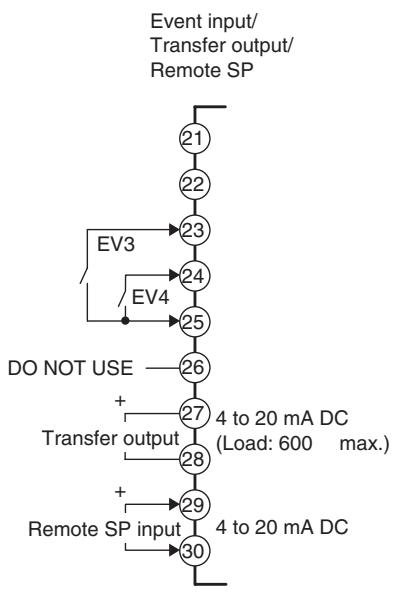
- The E5□N-H□□□B supports event inputs. When event inputs 1/2 are to be used, connect to terminals 11 to 13, and when event inputs 3/4 are to be used, connect to terminals 23 to 25.
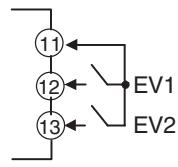
E53-CN□B□N2 (for E5CN-H)
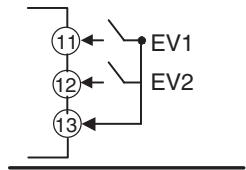
E53-AKB (for E5AN/EN-H)
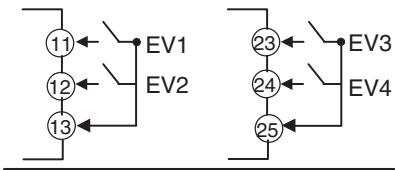
E5AN-H/EN-H□B□M□-500
- Use event inputs under the following conditions:
- The outflow current is approximately 7mA .
Contact inputON: 1 kΩ max., OFF: 100 kΩ min.
No-contact inputON: Residual voltage 1.5 V max.; OFF: Leakage current 0.1 mA max.
Polarities during no-contact input are as follows:
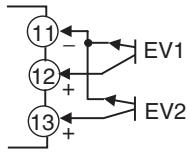
Two Event Inputs: E53-CN□B□N2 (for E5CN-H)
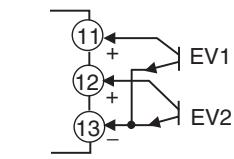
Two Event Inputs: E5AN/EN-H□B□M□-500 (for E5AN/EN-H)
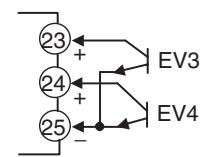
Two Additional Event Inputs: E53-AKB in E5AN/EN-H□B□M□-500 (for E5AN/EN-H)
CT Inputs
- When the HB alarm, HS alarm, or heater overcurrent alarm is to be used with the E5CN-H□M□-500 with an E53-CN□H/HH□N2 Option Unit, connect a current transformer (CT) across terminals 14 and 15 or terminals 13 and 15 (no polarity).
- When the HB alarm, HS alarm, or heater overcurrent alarm is to be used with the E5AN/EN-H□□H□-500 or E5AN/EN-H□□HH□-500, connect a current transformer (CT) across terminals 14 and 15 or terminals 15 and 16 (no polarity).
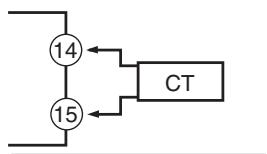
E53-CN□H□N2
(for E5CN-H)
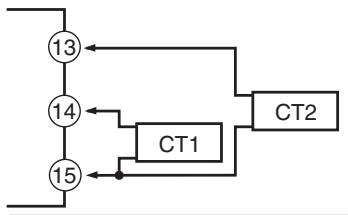
E53-CN□HH□N2
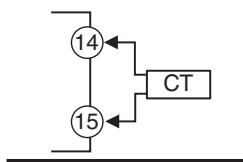
E5AN/EN-H□□H□-500
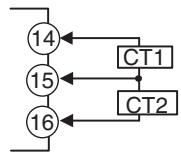
E5AN/EN-H□HH□-500
Transfer Output
- On the E5CN-H□M□-500 with an E53-CN□FN2, the transfer output is output across terminals 14 and 15.
- On the E5AN/EN-H□□F-500, transfer output is output across terminals 27 and 28.
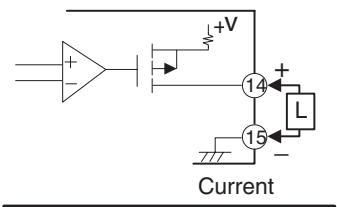
E53-CN□FN2
(for E5CN-H)
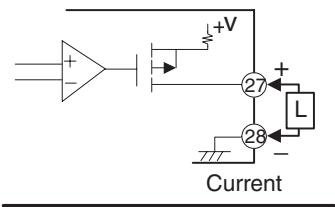
E5AN/EN-H□□F-500
| Output type | Specifications |
| Current | 4 to 20 mA DC, Load: 600 Ω max., Resolution: 10,000 |
Even with models that do not have a transfer output, control outputs 1 or 2 can be used as a simple transfer output if it is a current output or linear output. For details on the operation, refer to 4-14 Using the Transfer Output.
Remote SP Input
- The E5AN-H and E5EN-H support remote SP inputs. To use remote SP, connect to terminals 29 and 30.
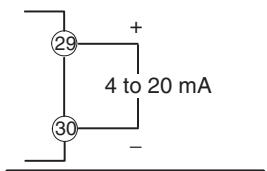
E5AN/EN-H
Remote SP inputs are not electrically isolated from the internal circuits. When using a grounding thermocouple, do not connect any of the remote SP input terminals to the ground. (If a remote SP input terminal is connected to the ground, errors will occur in the measured temperature as a result of leakage current.)
Communications
RS-485
- When communications are to be used with the E53-CN□03N2 for the E5CN-H, or E53-EN03 for the E5AN/EN-H, connect communications cable across terminals 11 and 12 or 21 and 22.
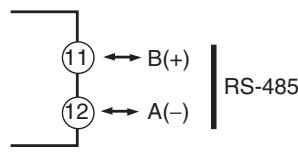
E53-CN□03N2 (for E5CN-H)
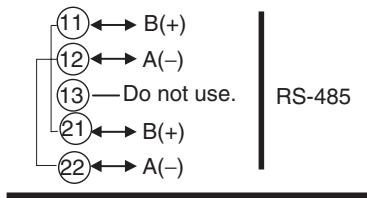
E53-EN03 (for E5AN/EN-H)
Specify both ends of the transmission path including the host computer as end nodes (that is, connect terminators to both ends).
The minimum terminal resistance is 54 Ω.
Communications Unit Connection Diagram
E5CN-H
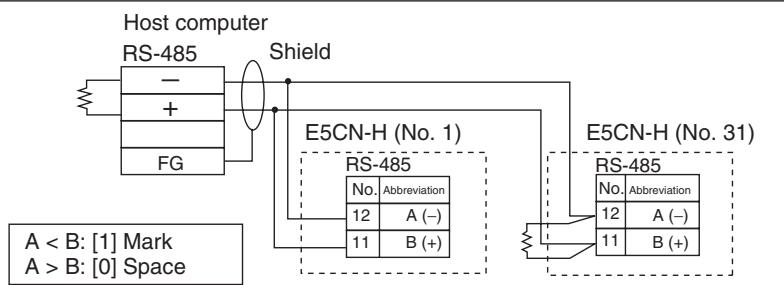
Terminator (120Ω, 1/2 W)
E5AN/EN-H
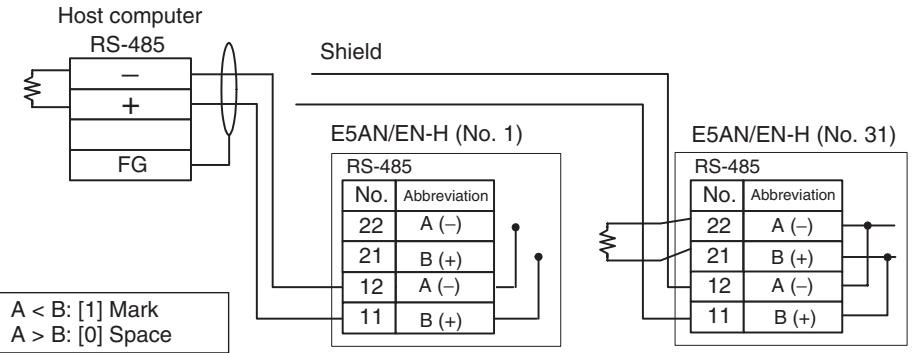
Terminator (120 Ω, 1/2 W)
- The RS-485 connection can be either one-to-one or one-to-N. A maximum of 32 Units (including the host computer) can be connected in one-to-N systems. The maximum total cable length is 500m . Use AWG24 (cross-sectional area: 0.205mm^2 ) to AWG14 (cross-sectional area: 2.081mm^2 ) shielded twisted-pair cable.
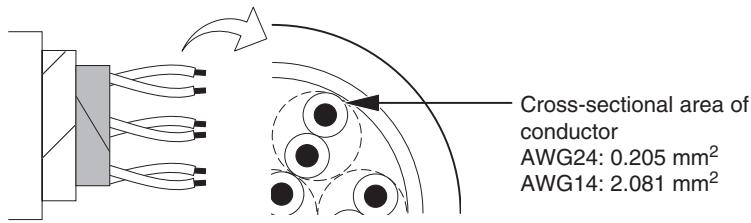
RS-232C
- When communications are to be used with the E53-CN 01N2 for the E5CN-H, or the E53-EN01 for the E5AN/EN-H, connect communications cable across terminals 11 to 13.
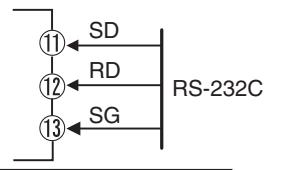
E53-CN□01N2 (for E5CN-H)
E53-EN01 (for E5AN/EN-H)
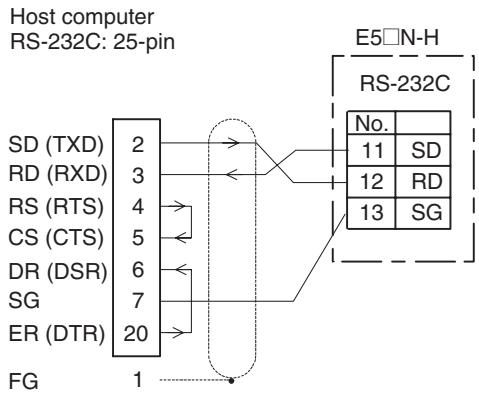
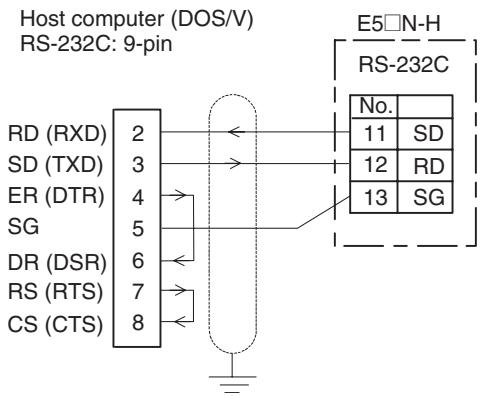
- A 1:1 connection is used. The maximum cable length is 15 ~m . To extend the transmission path, use the OMRON Z3R RS-232C Optical Interface.
- Use AWG24 (cross-sectional area: 0.205 mm^2 ) to AWG14 (cross-sectional area: 2.081 mm^2 ) shielded twisted-pair cable.
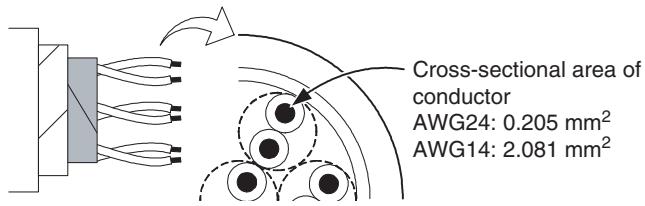
RS-422 (E5AN/EN-H Only)
- When communications are to be used with the E53-EN02 for the E5AN/ EN-H, connect Communications Cable across terminals 11 to 13 and 21 to 22.
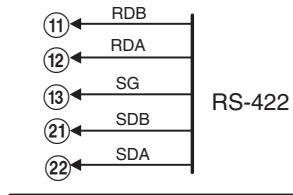
E5AN/EN-H□M□-500 with an E53-EN02
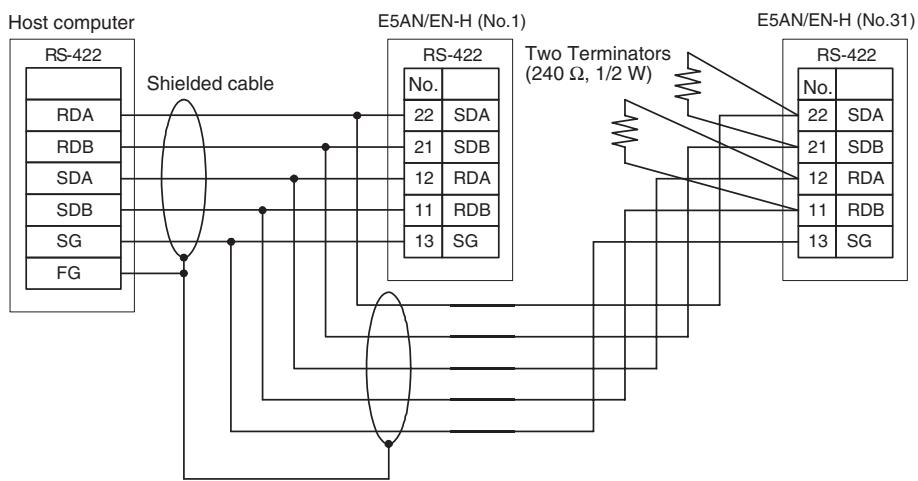
- A 1:1 or 1:N connection is used. When a 1:N connection is used, a maximum of 32 nodes including the host computer can be connected.
- Use AWG24 (cross-sectional area: 0.205 mm^2 ) to AWG14 (cross-sectional area: 2.081 mm^2 ) shielded twisted-pair cable.
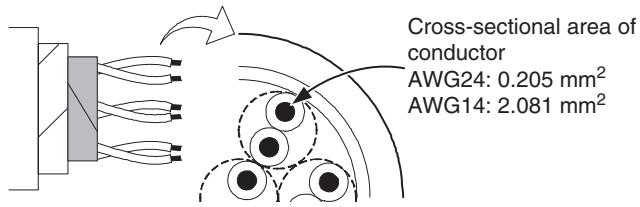
2-3 Using the Support Software Port
Use the communications port for Support Software to connect the personal computer to the Digital Controller when using EST2-2C-MV4 CX-Thermo or a version of CX-Thermo higher than 4.00, or other Support Software. The E58-CIFQ1 USB-Serial Conversion Cable is required to make the connection.
For information concerning the models that can be used with CX-Thermo, contact your OMRON sales representative.
Procedure
Use the following procedure to connect the Digital Controller to the personal computer using the USB-Serial Conversion Cable. The USB-Serial Conversion Cable is used to communicate with the COM port of the personal computer. To perform communications using USB-Serial Conversion Cable, set the communications port (COM port) number to be used for the software to the COM port assigned to the Cable.
1,2,3... 1. Turn ON the power to the Digital Controller.
Note If the Cable is connected when the power to the Digital Controller is OFF, power will be supplied from the personal computer and impose a load on the internal circuits of the Digital Controller.
- Connect the Cable.
Connect the personal computer's USB port with the Support Software port on the Digital Controller using the Cable.
- Digital Controller Connection Method
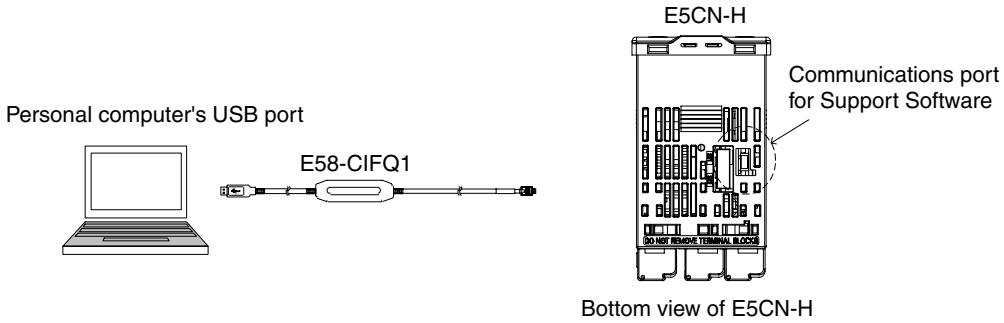
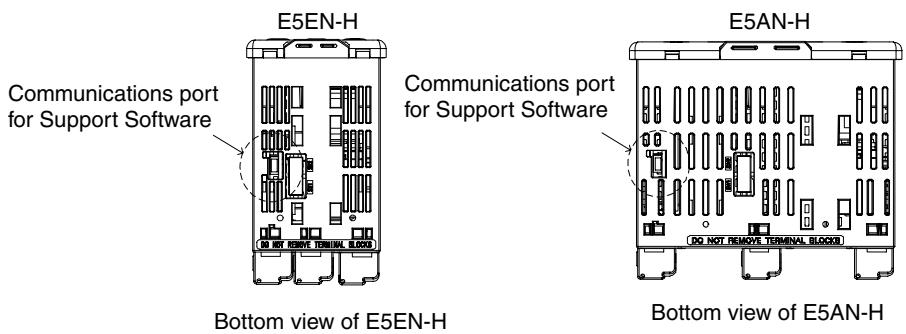
Note Hold the connector when inserting or disconnecting the Cable.
- Install the driver.
Install the driver to enable the Cable to be used with the personal computer.
- Installation
When the Cable is connected with the personal computer, the OS detects the product as a new device. At this time, install the driver using the installation wizard. For details on installation methods, refer to the user's manual for the E58-CIFQ1 USB-Serial Conversion Cable.
- Setting Setup Tool Communications Conditions
Set the communications port (COM port) number to be used for the CX-Thermo Setup Tool to the COM port number assigned to the USB-Serial Conversion Cable.
Refer to the E58-CIFQ1 USB-Serial Conversion Cable Instruction Manual and Setup Manual for details on how to check the COM port assigned to the USB-Serial Conversion Cable.
The communications conditions for Setup Tool COM ports are fixed as shown in the table below. Set the communications conditions for the CX-Thermo Setup Tool according to the following table.
| Parameter | Set value |
| Communications Unit No. | 01 |
| Communications baud rate | 38.4 (kbps) |
| Communications data length | 7 (bits) |
| Communications stop bits | 2 (bits) |
| Communications parity | Even |
2-4 Using Infrared Communications
When a Setup Tool, such as CX-Thermo version 4.00 or later (EST2-2C-MV4 or later), is used, the personal computer and Digital Controller can be connected using infrared communications. Using infrared communications enables the personal computer and Digital Controller to be connected from the front panel while ensuring a dust-tight and drip-tight structure. Use a USB-Infrared Conversion Cable, and connect it to the USB port at the personal computer. Infrared communications are supported only for the E5AN-H and E5EN-H. The infrared communications port and the Setup Tool port cannot be used at the same time.
For information concerning the models that can be used with the CX-Thermo, contact your OMRON sales representatives.
Procedure
Use the following procedure to connect the Digital Controller to the personal computer using the USB-Infrared Conversion Cable. The USB-Infrared Conversion Cable is used to communicate with the COM port on the personal computer. To perform communications using the USB-Infrared Conversion Cable, set the communications port (COM port) number to be used for the Setup Tool (such as CX-Thermo) to the COM port assigned to the Cable.
1,2,3...
- Connecting the USB-Infrared Conversion Cable to the Personal Computer Connect the USB-Infrared Conversion Cable to the USB port on the personal computer.
-
Install the driver Install the driver to enable the USB-Infrared Conversion Cable to be used with the personal computer.
-
Installation
When the Cable is connected with the personal computer, the OS will detect it as a new device. At this time, install the driver using the installation wizard. For details on installation methods, refer to the Instruction Sheet and Setup Manual for the E58-CIFIR USB-Infrared Conversion Cable.
- Enabling Digital Controller Infrared Communications
Mount the Digital Controller to the panel and wire it. Turn ON the power supply for the Digital Controller, go to the adjustment level, and set the Infrared Communications Use parameter to ON. When this parameter is set to ON, the Ir indicator on the front panel of the Digital Controller will light. This enables connecting to a personal computer using infrared communications.
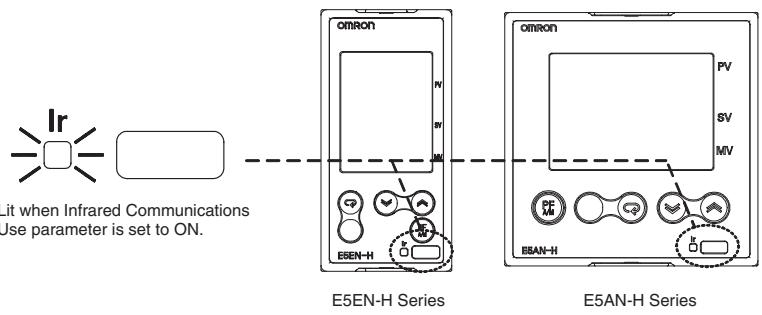
- Connecting the USB-Infrared Conversion Cable to the Digital Controller Mount the enclosed adapter to the Digital Controller. Hold the USB-Infrared Conversion Cable with the label side facing up, and insert the Cable into the adapter to the line specified on the label.
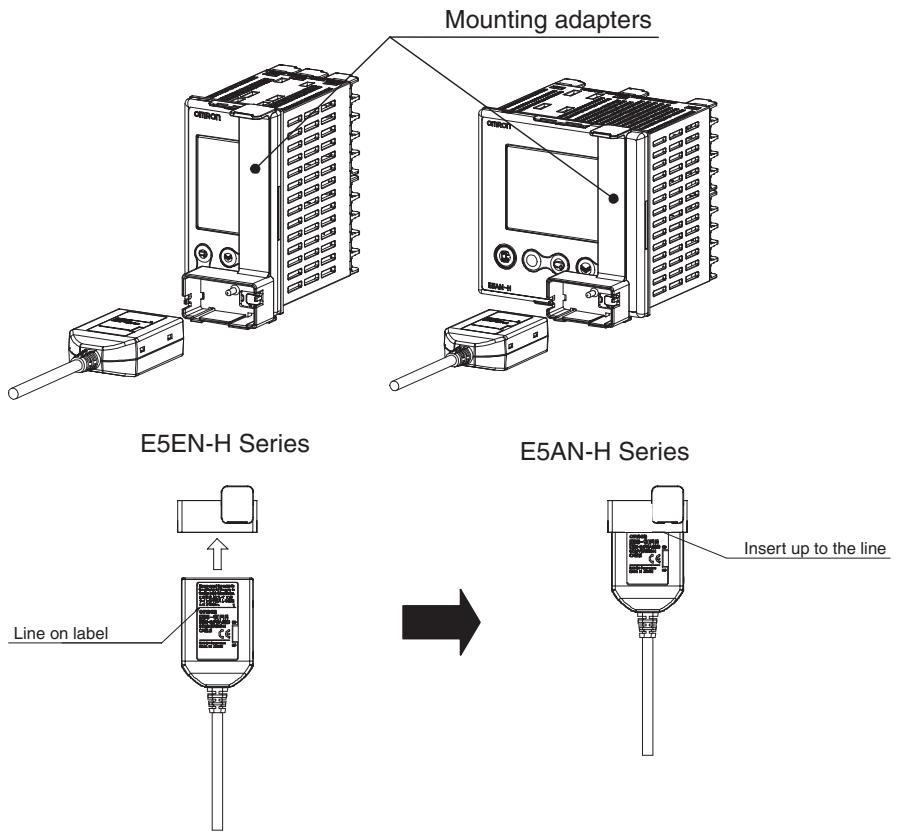
- Setting the Setup Tool Communications Conditions
Set the communications port (COM port) number to be used for the CX-Thermo Setup Tool to the COM port number assigned to the USB-Infrared Conversion Cable.
Refer to the E58-CIFIR USB-Infrared Conversion Cable Instruction Sheet and Setup Manual for details on checking the COM port assigned to the USB-Infrared Conversion Cable. The communications conditions for infrared COM ports are fixed as shown in the table below. Set the communications conditions for the CX-Thermo Setup Tool according to the following table.
| Parameter | Set value |
| Communications Unit No. | 01 |
| Communications baud rate | 38.4 (kbps) |
| Communications data length | 7 (bits) |
| Communications stop bits | 2 (bits) |
| Communications parity | Even |
- Checking the Settings
After completing all data transfers, be sure that the data is correct. Finally, remove the USB-Infrared Conversion Cable and mounting adapter from the Digital Controller and set the Infrared Communications Use parameter to OFF. Operation can now be started.
Turn ON the Infrared Communications Use parameter only when connected to the Setting Tool through infrared communications. Leave it set to OFF during normal operation.
SECTION 3
Basic Operation
This section describes the basic operation of the E5CN-H, E5AN-H, and E5EN-H Digital Controllers, including key operations to set parameters and descriptions of display elements based on specific control examples.
3-1 Initial Setting Examples 46
3-2 Setting the Input Type 49
3-2-1 Input Type. 49
3-3 Selecting the Temperature Unit. 51
3-3-1 Temperature Unit 51
3-4 Selecting PID Control or ON/OFF Control 51
3-5 Setting Output Specifications 52
3-5-1 Control Periods. 52
3-5-2 Direct and Reverse Operation. 52
3-5-3 Assigned Output Functions. 53
3-6 Setting the Set Point (SP) 56
3-6-1 Changing the SP 56
3-7 Using ON/OFF Control. 57
3-7-1 ON/OFF Control. 57
3-7-2 Settings 58
3-8 Determining PID Constants (AT, ST, Manual Setup) 60
3-8-1 AT (Auto-tuning) 60
3-8-2 ST(Self-tuning) 62
3-8-3 RT (Robust Tuning) 64
3-8-4 Manual Setup 66
3-9 Alarm Outputs. 67
3-9-1 Alarm Types 67
3-9-2 Alarm Values 69
3-10 Using Heater Burnout, Heater Short, and Heater Overcurrent Alarms. 71
3-10-1 Heater Burnout, Heater Short, and Heater Overcurrent Alarm Operations. 71
3-10-2 Installing Current Transformers (CT). 72
3-10-3 Calculating Detection Current Values 73
3-10-4 Application Examples. 74
3-10-5 Settings: HB Alarm. 78
3-10-6 Settings: Heater Short Alarm 79
3-10-7 Settings: Heater Overcurrent Alarm 80
3-11 Setting the No. 3 Display 82
3-11-1 PV/SP Display Selection 82
3-1 Initial Setting Examples
Initial hardware setup, including the sensor input type, alarm types, control periods, and other settings is done using parameter displays. The and Keys are used to switch between parameters, and the amount of time that you press the keys determines which parameter you move to.
This section describes 3 typical examples.
Explanation of Examples
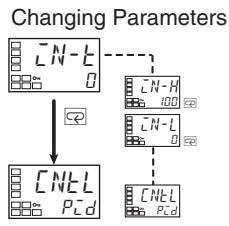
A image means that there are parameters. Continue pressing the key to change parameters until you reach the intended parameter.
Changing Numbers
- Numeric data and selections in each screen can be changed by using the and keys.
Example 1
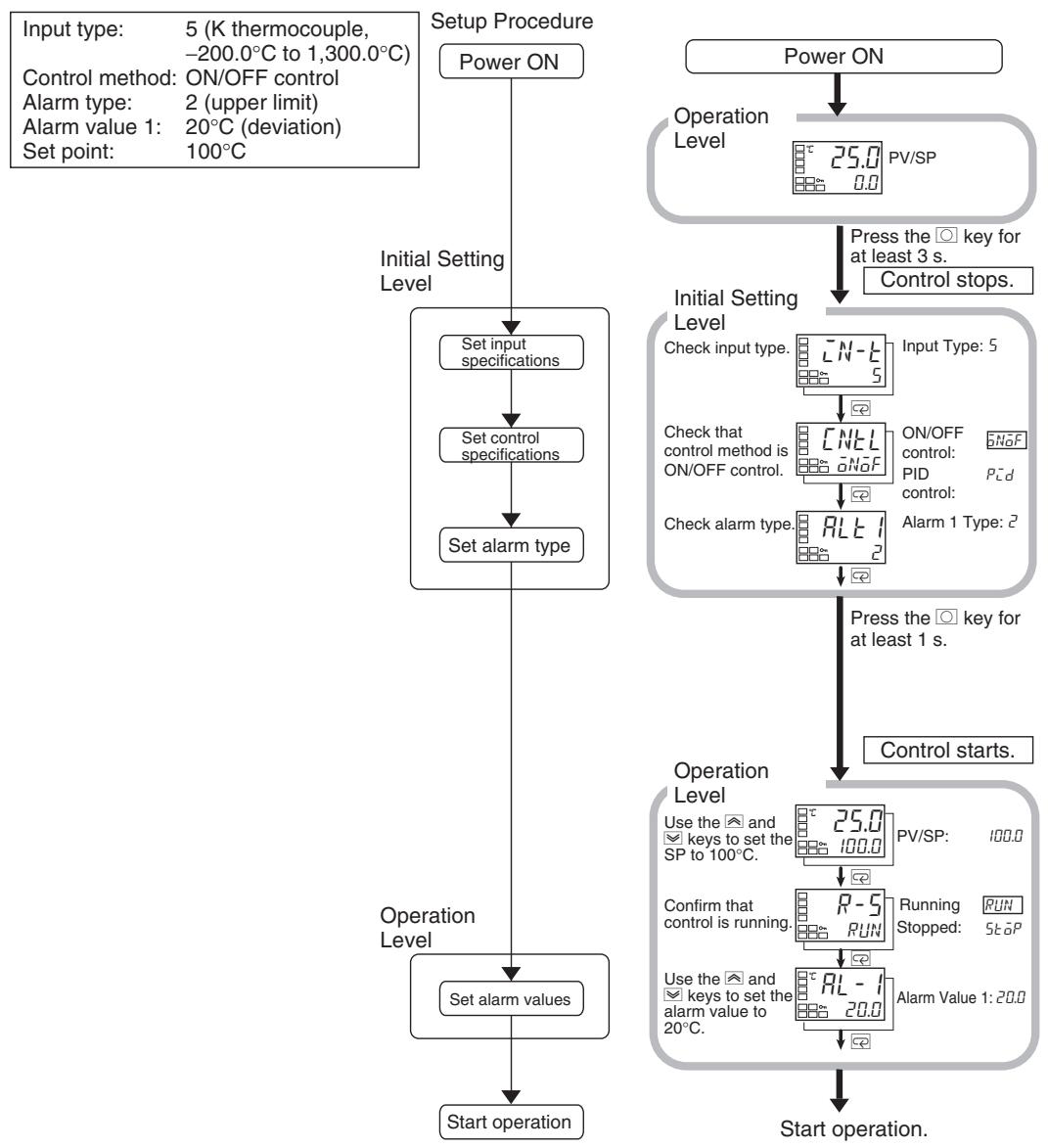
Example 2


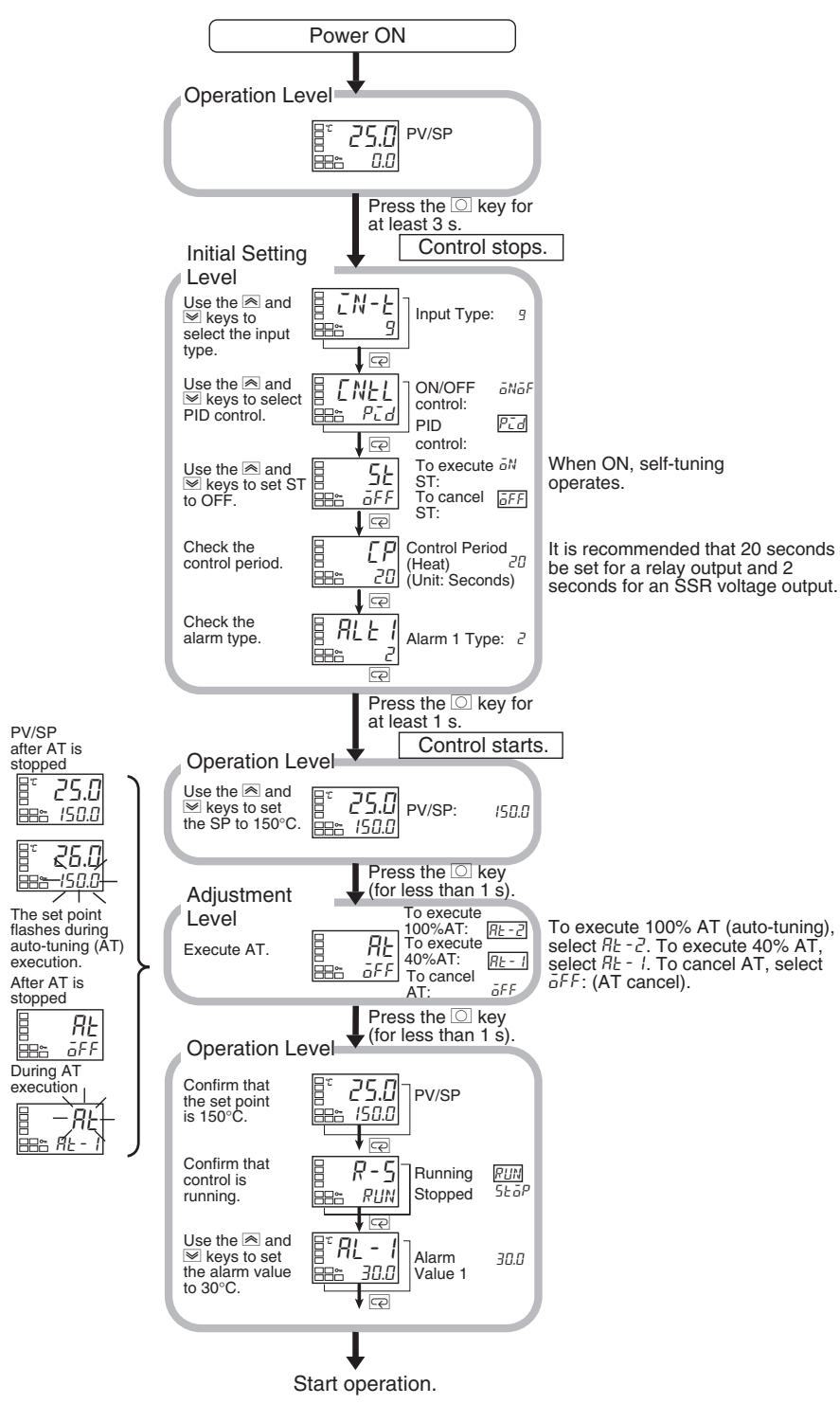
Example 3
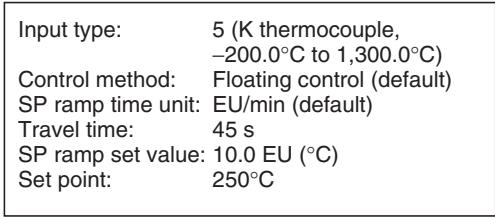

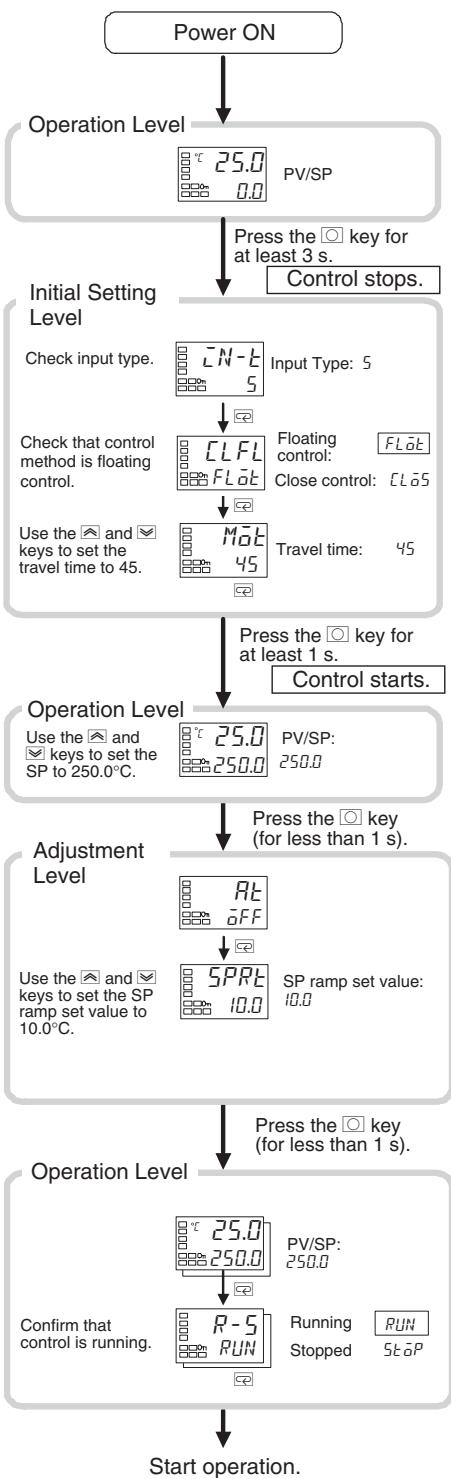
3-2 Setting the Input Type
The Controller supports 3 input types: platinum resistance thermometer, thermocouple, and analog inputs. Set the input type that matches the sensor that is used.
3-2-1 Input Type
The following example shows how to set a K thermocouple for -20.0 to 500.0^ .
Operating Procedure
Operation Level
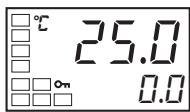
Initial Setting Level
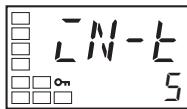
Input Type
- Press the Key for at least three seconds to move from the operation level to the initial setting level.
- Press the Key to enter the set value of the desired sensor. When you use a K thermocouple (-20.0 to 500.0^ ), enter 6 as the set value.
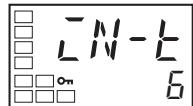
Hint: The key operation is saved two seconds after the change, or by pressing the 0 or 2 Key.
List of Input Types
| Input type | Specifications | Set value | Input temperature setting range |
| Platinum resistance thermometer | Pt100 | 0 | -200.0 to 850.0 (°C)/-300.0 to 1,500.0 (°F) |
| 1 | -199.9 to 500.0 (°C)/-199.9 to 900.0 (°F) | ||
| 2 | 0.0 to 100.0 (°C)/0.0 to 210.0 (°F) | ||
| JPt100 | 3 | -199.9 to 500.0 (°C)/-199.9 to 900.0 (°F) | |
| 4 | 0.0 to 100.0 (°C)/0.0 to 210.0 (°F) | ||
| Thermocouple | K | 5 | -200.0 to 1,300.0 (°C)/-300.0 to 2,300.0 (°F) |
| 6 | -20.0 to 500.0 (°C)/0.0 to 900.0 (°F) | ||
| J | 7 | -100.0 to 850.0 (°C)/-100.0 to 1,500.0 (°F) | |
| 8 | -20.0 to 400.0 (°C)/0.0 to 750.0 (°F) | ||
| T | 9 | -200.0 to 400.0 (°C)/-300.0 to 700.0 (°F) | |
| 10 | -199.9 to 400.0 (°C)/-199.9 to 700.0 (°F) | ||
| E | 11 | -200.0 to 600.0 (°C)/-300.0 to 1,100.0 (°F) | |
| L | 12 | -100.0 to 850.0 (°C)/-100.0 to 1,500.0 (°F) | |
| U | 13 | -200.0 to 400.0 (°C)/-300.0 to 700.0 (°F) | |
| 14 | -199.9 to 400.0 (°C)/-199.9 to 700.0 (°F) | ||
| N | 15 | -200.0 to 1,300.0 (°C)/-200.0 to 2,300.0 (°F) | |
| R | 16 | 0.0 to 1,700.0 (°C)/0.0 to 3,000.0 (°F) | |
| S | 17 | 0.0 to 1,700.0 (°C)/0.0 to 3,000.0 (°F) | |
| B | 18 | 100.0 to 1,800.0 (°C)/300.0 to 3,200.0 (°F) | |
| W | 19 | 0.0 to 2,300.0 (°C)/0.0 to 3,200.0 (°F) | |
| PLII | 20 | 0.0 to 1,300.0 (°C)/0.0 to 2,300.0 (°F) | |
| K | 21 | -50.0 to 200.0 (°C)/-50.0 to 200.0 (°F) | |
| J | 22 | -50.0 to 200.0 (°C)/-50.0 to 200.0 (°F) | |
| T | 23 | -50.0 to 200.0 (°C)/-50.0 to 200.0 (°F) | |
| Platinum resistance thermometer | Pt100 | 24 | -50.0 to 200.0 (°C)/-50.0 to 200.0 (°F) |
| Current input | 4 to 20 mA | 25 | Either of the following ranges, by scaling: -19999 to 32400 -1999.9 to 3240.0 -199.99 to 324.00 -19.999 to 32.400 |
| 0 to 20 mA | 26 | ||
| Voltage input | 1 to 5 V | 27 | |
| 0 to 5 V | 28 | ||
| 0 to 10 V | 29 |
- The default is 5.
- If a platinum resistance thermometer is mistakenly connected while a setting for other than a platinum resistance thermometer is in effect, S.ErrR will be displayed. To clear the S.ErrR display, check the wiring and then turn the power OFF and back ON.
3-3 Selecting the Temperature Unit
3-3-1 Temperature Unit
- Either ^ C or ^ F can be selected as the temperature unit.
- Set the temperature unit in the Temperature Unit parameter of the initial setting level. The default is ^ (°C).
Operating Procedure
Operation Level
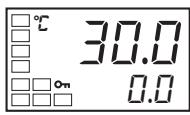
Initial Setting Level
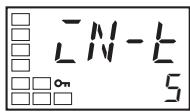
Input Type
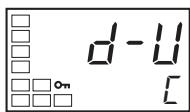
Temperature Unit
The following example shows how to select ^ C as the temperature unit.
-
Press the Key for at least three seconds to move from the operation level to the initial setting level.
-
Select the Temperature Unit parameter by pressing the 或 Key. Press the 或 Key to select either ^ C or ^ F .
E:°C
F:°F
- To return to the operation level, press the Key for at least one second.
3-4 Selecting PID Control or ON/OFF Control
Two control methods are supported: 2-PID control and ON/OFF control. Switching between 2-PID control and ON/OFF control is executed by means of the PID ON/OFF parameter in the initial setting level. When this parameter is set to L^-d , 2-PID control is selected, and when set to N^-FF , ON/OFF control, is selected. The default is _L^-d . ON/OFF control is not displayed for position-proportional models.
2-PID Control
PID control is set by AT (auto-tuning), ST (self-tuning), or manual setting.
For PID control, set the PID constants in the Proportional Band (P), Integral Time (I), and Derivative Time (D) parameters.
ON/OFF Control
In ON/OFF control, the control output is turned ON when the process value is lower than the current set point, and the control output is turned OFF when the process value is higher than the current set point (reverse operation).
3-5 Setting Output Specifications
The following table shows the parameters related to outputs. Each of the parameters is described in detail following the table.
| Parameter | Standard models | Position-proportional models | |
| cp | Control Period (Heating) | ● | |
| c-cp | Control Period (Cooling) | ● | |
| oremv | Direct/Reverse Operation | ● | ● |
| out1 | Control Output 1 Assignment | ● | |
| out2 | Control Output 2 Assignment | ● | |
| sub1 | Auxiliary Output 1 Assignment | ● | ● |
| sub2 | Auxiliary Output 2 Assignment | ● | ● |
| sub3 | Auxiliary Output 3 Assignment | ● | |
() :Supported
3-5-1 Control Periods
Control Period (Heating)
Control Period (Cooling)
- Set the output periods (control periods). Though a shorter period provides better control performance, it is recommended that the control period be set to 20 seconds or longer for a relay output to preserve the service life of the relay. After the settings have been made in the initial setup, readjust the control period, as required, by means such as trial operation.
- Set the control periods in the Control Period (Heating) and Control Period (Cooling) parameters in the initial setting level. The default is 20 seconds.
- The Control Period (Cooling) parameter is used only for heating/cooling control.
- When the control output is used as a current output or linear voltage output, the Control Period settings cannot be used.
- The control period can be set for standard models only.
3-5-2 Direct and Reverse Operation
- Direct operation increases the manipulated variable whenever the process value increases. Reverse operation decreases the manipulated variable whenever the process value increases.
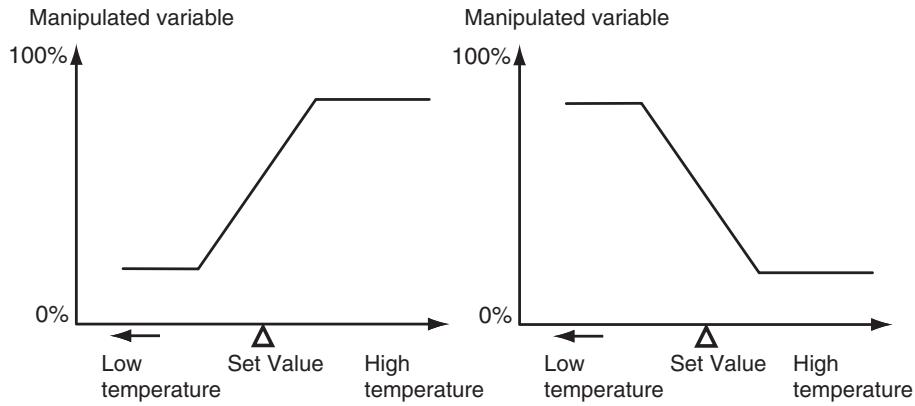
Direct operation
Reverse operation
For example, when the process value (PV) is lower than the set point (SP) in a heating control system, the manipulated variable increases according to the difference between the PV and SP. Accordingly, reverse operation is used in a heating control system. Direct operation is used in a cooling control system, in which the operation is the opposite of a heating control system.
- Direct/reverse operation is set in the Direct/Reverse Operation parameter in the initial setting level. The default is ^R - (reverse operation).
Operating Procedure
In this example, the input type, temperature unit, direct/reverse operation, and control period (heat) parameters are checked.
Input type = 5 (K thermocouple)
Temperature unit = (°C)
Direct/reverse operation = R - R (reverse operation)
Control period (heat) = 20 (seconds)
Operation Level
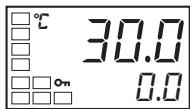
Initial Setting Level
Input Type
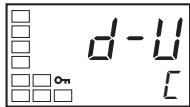
Temperature Unit
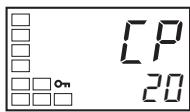
Control Period (Heating)
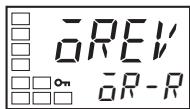
Direct/Reverse Operation
Operation Level
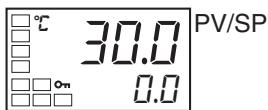
- Press the Key for at least three seconds to move from the operation level to the initial setting level.
- The input type is displayed. When the input type is being set for the first time, 5 (K thermocouple) is set. To select a different sensor, press the 火 or 火 Key.
- Select the Temperature Unit parameter by pressing the Key. The default is L^ . To select F ( ^ F ), press the Key.
- Select the Control Period (Heating) parameter by pressing the 回 Key. The default is 20.
- Select the Direct/Reverse Operation parameter by pressing the Key. The default is R - (reverse operation). To select R - d (direct operation), press the Key.
- To return to the operation level, press the Key for at least one second.
3-5-3 Assigned Output Functions
- Function assignments can be changed by changing the settings for control and auxiliary output assignments.
- The default function assignments for each output are shown below.
| Parameter name | Symbol | Initial status |
| Control Output 1 Assignment | aUb I | Control output (heating) |
| Control Output 2 Assignment | aUb 2 | Not assigned. |
| Auxiliary Output 1 Assignment | 5Ub I | Alarm 1 |
| Auxiliary Output 2 Assignment | 5U62 | Alarm 2 |
| Auxiliary Output 3 Assignment (E5AN/EN-H only) | 5U63 | Alarm 3 |
- Each output is automatically initialized as shown below by changing the control mode.
Example: E5CN-H
| Parameter name | Symbol | Without control output 2 | With control output 2 | ||
| Standard | Heating/cooling | Standard | Heating/cooling | ||
| Control Output 1 Assignment | \( \bar{u} \) | Control output (heating) | Control output (heating) | Control output (heating) | Control output (heating) |
| Control Output 2 Assignment | \( \bar{u} \) | Not assigned. (See note 1.) | Not assigned. (See note 1.) | Not assigned. | Control output (cooling) |
| Auxiliary Output 1 Assignment | \( \bar{S} \) | Alarm 1 (See note 2.) | Alarm 1 (See note 2.) | Alarm 1 (See note 2.) | Alarm 1 (See note 2.) |
| Auxiliary Output 2 Assignment | \( \bar{S} \) | Alarm 2 | Control output (cooling) | Alarm 2 | Alarm 2 |
Note
(1) There is no control output 2 and no parameter assignment is displayed for that output.
(2) The Auxiliary Output 1 Assignment parameter becomes the program end output unless the Program Pattern parameter is set to OFF.
Alarms
It will be specified in this section when an alarm must be assigned, i.e., when an alarm must be set for the Control Output 1 or 2 Assignment parameters, or for the Auxiliary Output 1 or 3 Assignment parameters. For example, if alarm 1 is set for the Control Output 1 Assignment parameter, then alarm 1 has been assigned.
Assigning a work bit to either control output 1 or 2 or to auxiliary output 1 to 3 is also considered to be the same as assigning an alarm. For example, if work bit 1 is set for the Auxiliary Output 1 Assignment parameter, then alarms 1 to 3 have been assigned.
Operating Procedure
This procedure sets the following control and auxiliary output assignments. Control output 1: Control output (heating); Control output 2: Control output (cooling); Auxiliary output 1: Alarm 1; Auxiliary output 2: Alarm 2
Operation Level
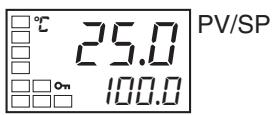
Initial Setting Level
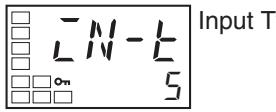
Initial Setting Level
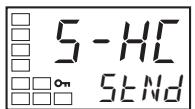
Standard or Heating/Cooling
- Press the Key for at least three seconds to move from the operation level to the initial setting level.
- Select the Standard or Heating/Cooling parameter by pressing the Key.
Initial Setting Level
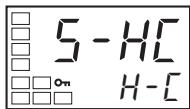
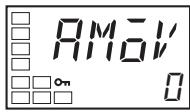
Move to Advanced Function Setting Level
Advanced Function Setting Level
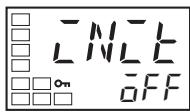
Parameter Initialization
Advanced Function Setting Level
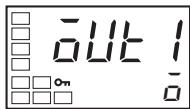
Control Output 1 Assignment
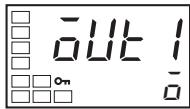
Advanced Function Setting Level
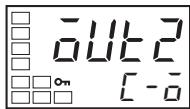
Control Output 2 Assignment
Advanced Function Setting Level
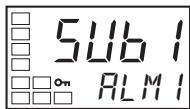
Auxiliary Output 1 Assignment
Advanced Function Setting Level
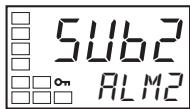
Auxiliary Output 2 Assignment
- Press the Key to set the parameter to H -
Note The following output assignments do not need to be set because they are set automatically by changing the control mode, but they are shown here as a reference for checking the assignments for each output. - Select the Move to Advanced Function Setting Level parameter by pressing the . (For details on moving between levels, refer to 4-8 Moving to the Advanced Function Setting Level.)
- Press the Key to enter the password ("-169"), and move from the initial setting level to the advanced function setting level.
- Select the Control Output 1 Assignment parameter by pressing the 心 Key.
- Press the or Key to set . (The default is .)
- Select the Control Output 2 Assignment parameter by pressing the Key.
- Press the or Key to set L - . (When H - is selected for the Standard or Heating/Cooling parameter, the setting will be L - .)
- Select the Auxiliary Output 1 Assignment parameter by pressing the Key.
- Press the or Key to set RLM I. (The default is RLM I.)
- Select the Auxiliary Output 2 Assignment parameter by pressing the Key.
- Press the 或 Key to set RL M2. (The default is RL M2.)
Initial Setting Level
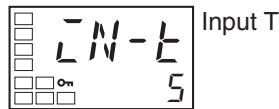
Operation Level
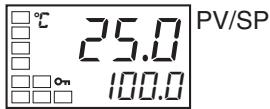
- Press the Key for at least one second to move from the advanced function setting level to the initial setting level.
- Press the Key for at least one second to move from the initial setting level to the operation level.
Auxiliary Output Opening or Closing in Alarm
- When "close in alarm" is set, the status of the auxiliary output is output unchanged. When "open in alarm" is set, the status of the auxiliary output function is reversed before being output.
Each auxiliary output can be set independently. - These settings are made in the Auxiliary Output 1 to 3 Open in Alarm parameters (advanced function setting level).
- The default is N - : Close in Alarm.
- When "open in alarm" is set for the alarm 1 output, the open in alarm status is also applied to heater burnout, HS alarm, heater overcurrent, and input error outputs.
| Auxiliary output functions 1 to 3 | Auxiliary output | Indicators (SUB1 to SUB3) | |
| Close in Alarm | ON | ON | Lit |
| OFF | OFF | Not lit | |
| Open in Alarm | ON | OFF | Lit |
| OFF | ON | Not lit |
- The alarm output will turn OFF (i.e., the relay contacts will open) when power is interrupted and for about two seconds after the power is turned ON regardless of the setting of the Auxiliary Output 1 to 3 Open in Alarm parameter.
3-6 Setting the Set Point (SP)
Operation Level
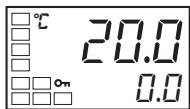
Operation Level
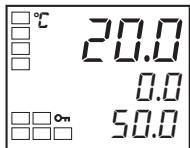
The operation level is displayed when the power is turned ON. The process value (PV) is at the top of the display, and the set point (SP) is at the bottom.
For Controllers that support a No. 3 display (E5AN/E5EN-H), the contents set in the PV/SP Display Screen Selection parameter (advanced function setting level) are displayed below the PV and SP.
The MV is displayed as the default. For details, refer to 3-11 Setting the No. 3 Display.
3-6-1 Changing the SP
- The set point cannot be changed when the Operation/Adjustment Protect parameter is set to 3. For details, refer to 4-9 Using the Key Protect Level.
Operating Procedure
Operation Level
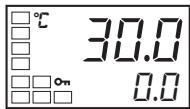
Bank Setting Level
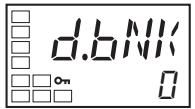
Display Bank Selection
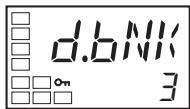
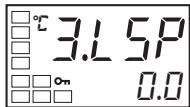
Bank 3 SP 1
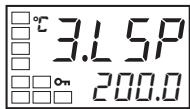
Bank 3 SP 1
- To change the set point, select the bank number in the Display Bank Selection parameter in the bank setting level, and press the or Key in the SP parameter (in the bank setting level) for each bank to set the desired set value. The new set point will be selected two seconds after the new value has been specified.
- If the SP parameter is changed in the operation level, the change will be reflected in the set point for the current bank.
- The bank function can be used to change eight set points. For details, refer to Banks on page 129.
In this example, the set point in bank 3 is changed from 0^ to 200^ .
- Normally, the Process Value/Set Point parameter is displayed. The set point is 0.0^ .
- The current bank number will be displayed. Press the l Key to move the bank setting level.
- Press the or Key to set 3.
- Select the Bank 3 SP parameter by pressing the 一 Key.
- Press the and Keys to set 200.0.
3-7 Using ON/OFF Control
In ON/OFF control, the control output turns OFF when the temperature being controlled reaches the preset set point. When the manipulated variable turns OFF, the temperature begins to fall and the control turns ON again. This operation is repeated over a certain temperature range. At this time, how much the temperature must fall before control turns ON again is determined by the Hysteresis (Heating) parameter. Also, what direction the manipulated variable must be adjusted in response to an increase or decrease in the process value is determined by the Direct/Reverse Operation parameter.
3-7-1 ON/OFF Control
- Switching between 2-PID control and ON/OFF control is performed using the PID ON/OFF parameter in the initial setting level. When this parameter is set to L^-d , 2-PID control is selected, and when it is set to ND^-F , ON/OFF control is selected. The default is _L^-d .
- ON/OFF control can be set for standard models only.
Hysteresis
- With ON/OFF control, hysteresis is used to stabilize operation when switching between ON and OFF. The control output (heating) and control output (cooling) functions are set in the Hysteresis (Heating) and Hysteresis (Cooling) parameters, respectively.
- In standard control (heating or cooling control), the setting of the Hysteresis (Heating) parameter in the adjustment level is used as the hysteresis regardless of whether the control type is heating control or cooling control.
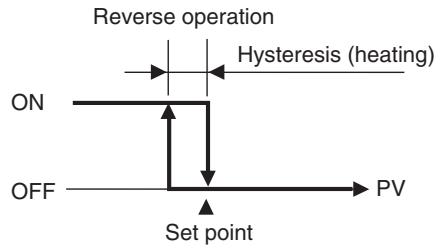
Three-position Control
- In heating/cooling control, a dead band (an area where both control outputs are 0) can be set to either the heating or cooling side. This makes it possible to use 3-position control.
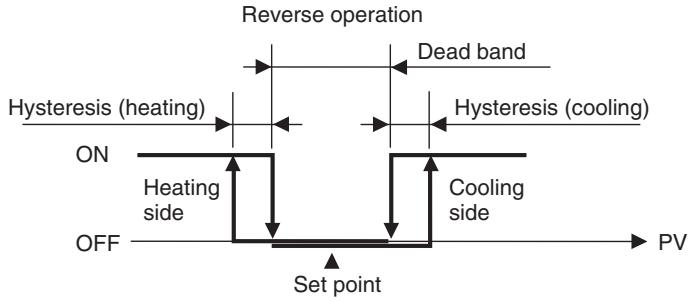
Parameters
| Symbol | Parameter: level | Application |
| S-HE | Standard or Heating/Cooling: Initial setting level | Specifying control method |
| CNEL | PID ON/OFF: Initial setting level | Specifying control method |
| aREV | Direct/Reverse Operation: Initial setting level | Specifying control method |
| C-db | Dead Band: Adjustment level | Heating/cooling control |
| HYS | Hysteresis (Heating): Adjustment level | ON/OFF control |
| CHYS | Hysteresis (Cooling): Adjustment level | ON/OFF control |
3-7-2 Settings
To execute ON/OFF control, set the Set Point, PID ON/OFF, and Hysteresis parameters.
Setting the PID ON/OFF Parameter
Operating Procedure
Operation Level
The following example shows how to change the PID ON/OFF parameter to in the initial setting level.
- Press the Key for at least three seconds to move from the operation level to the initial setting level.
Initial Setting Level
Input Type
PID-ON/OFF
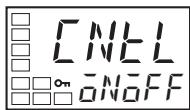
PID-ON/OFF
- The Input Type parameter is displayed in the initial setting level.
- Select the PID ON/OFF parameter by pressing the 一 Key.
- Use the 心 and 心 Keys to set onof.
- To return to the operation level, press the Key for at least one second. Next, set the set point value.
Setting the SP
Operating Procedure
Operation Level
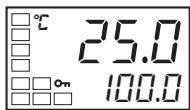
PV/SP
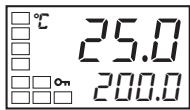
In this example, the set point is set to 200.0. The set value (i.e., the SP) is shown at the bottom of the display.
- Select the Process Value/Set Point parameter in the operation level.
- Use the and Keys to set the SP. (In this example, it is set to 200.0.) The new set value can be saved by pressing the Key, or it will go into effect after two seconds have elapsed. (The new set point will be reflected in the current bank.)
Next, set the hysteresis.
Setting the Hysteresis
Operating Procedure
Operation Level
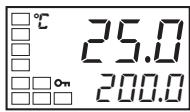
PV/SP
Adjustment Level
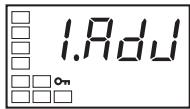
Adjustment Level Display
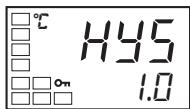
Hysteresis (Heating)
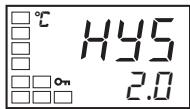
Set the hysteresis to 2.0^
- Press the l Key to move from the operation level to the adjustment level.
- The Adjustment Level Display parameter will be displayed in the adjustment level.
- Select the Hysteresis (Heating) parameter by pressing the l Key.
- Press the and Keys to set the hysteresis (2.0 in this example). Either press the Key or wait for at least two seconds after setting the hysteresis value to confirm the setting.
- To return to the operation level, press the Key.
3-8 Determining PID Constants (AT, ST, Manual Setup)
3-8-1 AT (Auto-tuning)
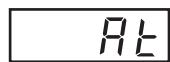
- When AT is executed, the optimum PID constants for the set point at that time are set automatically. A method (called the limit cycle method) for forcibly changing the manipulated variable and finding the characteristics of the control object is employed.
- Either 40% AT or 100% AT can be selected depending on the width of MV variation in the limit cycle. In the AT Execute/Cancel parameter, specify - ^2 (100% AT) or - (40% AT). To cancel AT, specify (AT cancel).
- Only 100% AT can be executed for heating and cooling control or for floating control for position-proportional models.
- AT cannot be executed when control has stopped or during ON/OFF control.
- The results of AT are reflected in the Proportional Band (P), Integral Time (I), and Derivative Time (D) parameters for the PID set at the time AT execution starts. For details on PID sets, refer to PID Sets on page 129.
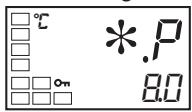
PID Setting Level
PID^* Proportional Band
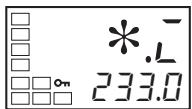
PID* Integral Time

PID* Derivative Time
(:1 to 8)
AT Operations
AT is started when either - (100% AT) or - 1 (40% AT) is specified for the AT Execute/Cancel parameter. During execution, the AT Execute/Cancel parameter on the No. 1 display flashes. When AT ends, the AT Execute/Cancel parameter turns OFF, and the No. 1 display stops flashing.
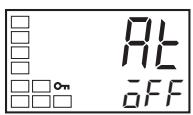
AT Execute/Cancel
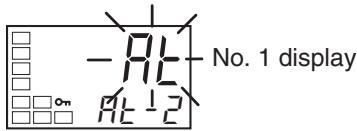
100% AT execution in progress
If you move to the operation level during AT execution, the No. 2 display flashes to indicate that AT is being executed.
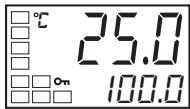
PV/SP
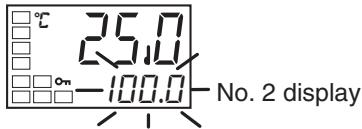
AT execution in progress
Only the Communications Writing, RUN/STOP, AT Execution/Cancel, and Program Start parameters can be changed during AT execution. Other parameters cannot be changed.
AT Calculated Gain
The AT Calculated Gain parameter sets the gain for when PID values are calculated using AT. When emphasizing response, decrease the set value. When emphasizing stability, increase the set value.
AT Hysteresis
The AT Hysteresis parameter sets the hysteresis when switching ON and OFF for the limit cycle operation during auto-tuning.
Limit Cycle MV Amplitude
The Limit Cycle MV Amplitude parameter sets the MV amplitude for limit cycle operation during auto-tuning.
Note Disabled for 100% AT.
40% AT
The width of MV variation in the limit cycle can be changed in the Limit Cycle MV Amplitude parameter, but the AT execution time may be longer than for 100% AT. The limit cycle timing varies according to whether the deviation (DV) at the start of auto-tuning execution is less than 10% FS.
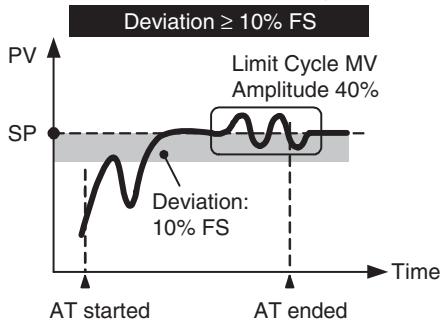

100% AT
Operation will be as shown in the following diagram, regardless of the deviation (DV) at the start of AT execution. To shorten the AT execution time, select 100% AT.
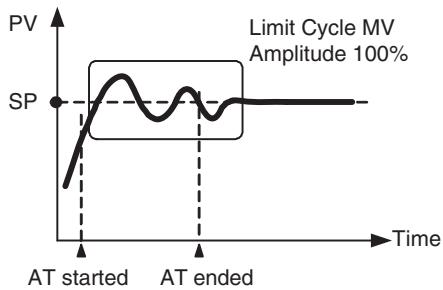
Note The Limit Cycle MV Amplitude parameter is disabled.
Operating Procedure
Adjustment Level
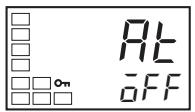
AT Execute/Cancel
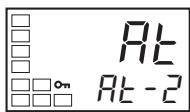
This procedure executes 100% AT.
- Press the O Key to move from the operation level to the adjustment level. Press the Key to select the AT Execute/Cancel parameter.
- Press the to select R -^2 . The No. 1 display for AT Execute/Cancel will flash during AT execution.
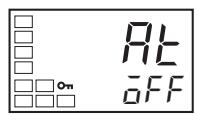
Operation Level
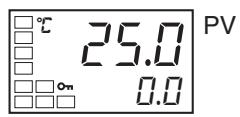
- F will be displayed when AT ends.
- To return to the operation level, press the Key.
3-8-2 ST (Self-tuning)
ST (self-tuning) is a function that finds PID constants by using step response tuning (SRT) when Digital Controller operation begins or when the set point is changed.
Once the PID constants have been calculated, ST is not executed when the next control operation is started as long as the set point remains unchanged.
ST (self-tuning) is enabled when the ST parameter is set to ON in the initial setting level.
When the ST function is in operation, be sure to turn the power supply of the load connected to the control output ON simultaneously with or before starting Controller operation.
When executing self-tuning, turn ON power for the load (e.g., heater) at the same time as or before supplying power to the Digital Controller. If power is turned ON for the Digital Controller before turning ON power for the load, self-tuning will not be performed properly and optimum control will not be achieved. ST can be set for standard models only.
Operating Procedure
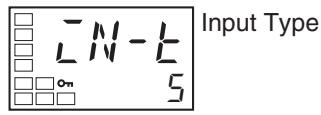
Initial Setting Level
This procedure executes self-tuning (ST).
- Press the Key for at least three seconds to move from the operation level to the initial setting level.
- Select the ST parameter by pressing the Key.
- Press the Key to select N . ON is the default.
- To return to the operation level, press the Key for at least one second. The temperature display flashes during self-tuning (ST) execution.
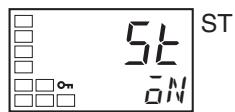
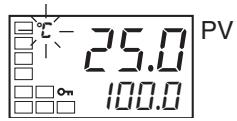
Operation Level
Note PID Constants
When control characteristics are already known, PID constants can be set directly to adjust control. PID constants are set in the Proportional Band (P), Integral Time (I), and Derivative Time (D) parameters, according to the Display PID Selection parameter setting in the PID setting level. Changing the Proportional Band (P), Integral Time (I), or Derivative Time (D) parameter settings in the adjustment level changes the settings in these parameters in the current PID set.
Startup Conditions
Self-tuning by step response tuning (SRT) is started when the following conditions are met after program execution is started and the set point is changed.
| At start of operation | When set point is changed |
| 1. The set point at the start of operation differs from the set point when the previous SRT was executed. (See note 1.)2. The difference between the temperature at the start of operation and the set point is greater both of the following: (Present proportional band × 1.27 + 4°C) and the ST stable range.3. The temperature at the start of operation is lower than the set point during reverse operation, and is larger than the set point during direct operation.4. There is no reset from input errors. | 1. The new set point differs from the set point used when the previous SRT was executed. (See note 1.)2. The set point change width is greater both of the following: (Present proportional band × 1.27 + 4°C) and the ST stable range.3. During reverse operation, the new set point is larger than the set point before the change; and during direct operation, the new set point is smaller than the set point before the change.4. The temperature is stable. (See note 2.) (Equilibrium with the output amount at 0% when the power is turned ON is also all right.) (See note 3.) |
Note
(1) The previous SRT-implemented set point is the set point that was used for calculating the PID constants for the previous SRT.
(2) In this state, the measurement point is within the ST stable range.
(3) In this state, the change width of the PV every 60 seconds is within the ST stable range or less.
In the following instances, PID constants are not changed by self-tuning (ST) for the present set point.
- When the PID constants have been changed manually with ST set to ON.
- When auto-tuning (AT) has been executed.
- When the PID set has been changed during SRT.
- When the PID set for the current bank is set to 0 (PID set automatic selection).
In addition, the following diagrams show the difference between setting a different PID set for each bank and setting the same PID set. For details on bank settings, refer to 4-15 Using Banks and PID Sets.
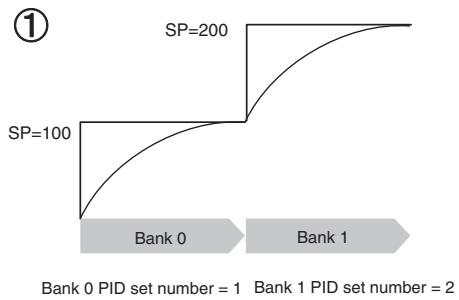
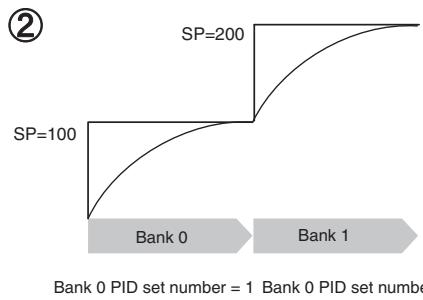
1,2,3...
- When operation starts, ST is executed for each bank and the PID constants are saved for each PID set. Stable control is thus enabled, because ST is not executed when the bank is changed or when the next operation starts.
- ST is executed each time the bank is changed, and PID constants are saved for the same PID set. Therefore ST is executed each time the bank is changed and when the next operation starts.
ST Stable Range
Operating Procedure
The ST stable range determines the condition under which ST (self-tuning) functions.
This procedure sets the ST stable range to 20^ .
Advanced Function Setting Level
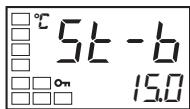
ST Stable Range
- Select the ST Stable Range parameter by pressing the Key in the advanced function setting level.
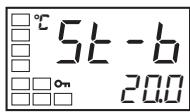
- Use the Key to set the parameter to 20^ .
3-8-3 RT (Robust Tuning)
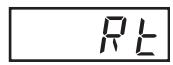
- When AT or ST is executed with RT selected, PID constants are automatically set that make it hard for control performance to degenerate even when the characteristics of the controlled object are changed.
- RT can be set in the advanced function setting level when PID control has been set.
- The RT mode cannot be selected while an analog input is set.
-
Selecting the RT mode in the following cases will help to prevent hunting from occurring.
-
When the set temperature is not constant and is changed in a wide range
- When there are large variations in ambient temperatures due to factors such as seasonal changes or differences between day and night temperatures
- When there are large variations in ambient wind conditions and air flow
- When heater characteristics change depending on the temperature
- When an actuator with disproportional I/O, such as a phase-control-type power regulator, is used
- When a rapidly heating heater is used
- When the control object or sensor has much loss time
- When hunting occurs in normal mode for any reason
- PID constants are initialized to the factory settings by switching to RT mode.
- When the RT mode is selected, the derivative time setting unit becomes the second.
RT Features
- Even when hunting occurs for PID constants when AT or ST is executed in normal mode, it is less likely to occur when AT or ST is executed in RT mode.
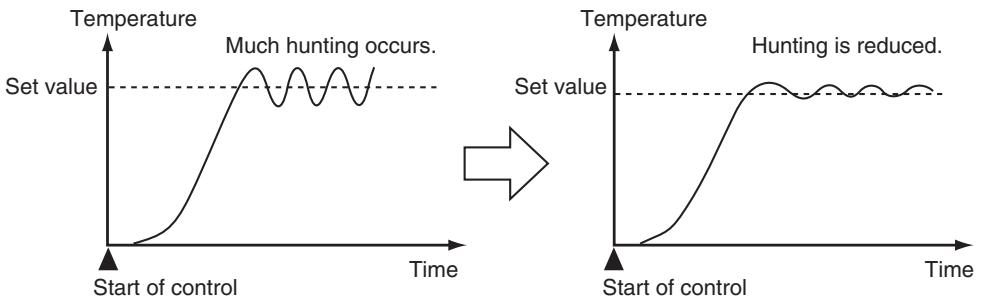
- When the temperature (PV) falls short of the set point for the PID constants when using AT or ST in normal mode, executing AT or ST in RT mode tends to improve performance.
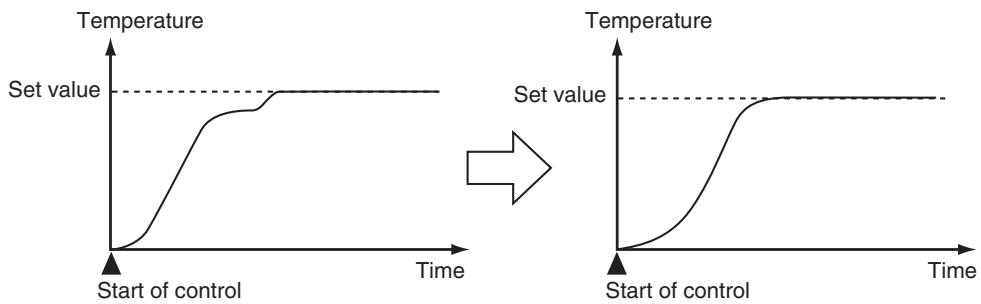
- When the manipulated variable (MV) is saturated, the amount of overshooting may be somewhat higher in comparison to PID control based on AT or ST in normal mode.
Operating Procedure
Operation Level
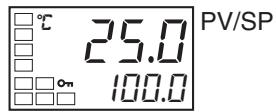
Initial Setting Level
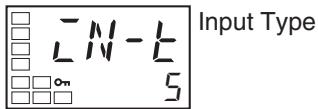
Initial Setting Level
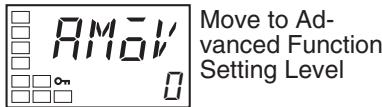
Advanced Function Setting Level
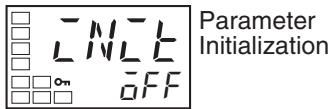
Advanced Function Setting Level
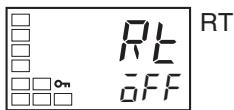
This procedure selects RT mode.
- Press the Key for at least three seconds to move from the operation level to the initial setting level.
- Select the Move to Advanced Function Setting Level parameter by pressing the 回 Key.
- Use the Key to enter "−169" (the password).
It is possible to move to the advanced function setting level by pressing the 回 Key or leaving the setting for at least two seconds.
- Press the Key to select RL.
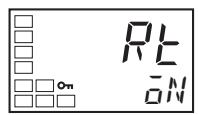
Initial Setting Level
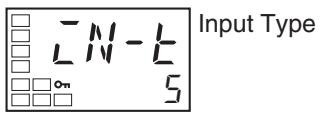
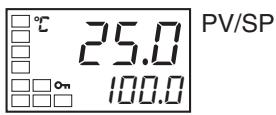
Operation Level
- Press the Key to select N . F F is the default.
- To return to the initial setting level, press the Key for at least one second.
- To return to the operation level, press the Key for at least one second.
3-8-4 Manual Setup
PID constants can be manually and individually set in the Proportional Band (P), Integral Time (I), and Derivative Time (D) parameters, according to the Display PID Selection parameter set in the PID setting level. Changing the Proportional Band (P), Integral Time (I), or Derivative Time (D) parameter settings in the adjustment level changes the settings in the current PID set. For details on PID sets, refer to PID Sets on page 129.
Operating Procedure
In this example, the PID 2 Proportional Band parameter is set to 10.0, the PID 2 Integral Time parameter to 250, and the PID 2 Derivative Time parameter to 45.
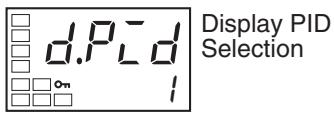
PID Setting Level
- Press the Key to move from the operation level to the PID setting level.
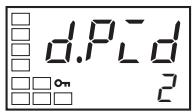
- Use the and Keys to set 2.
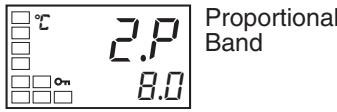
- Press the Key to select the PID 2 Proportional Band parameter.
- Use the 和 and 和 Keys to set 10.0.
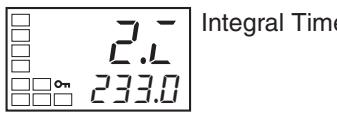
- Press the Key to select the PID 2 Integral Time parameter.
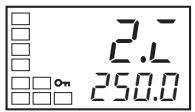
- Use the 心 and 心 Keys to set 250.0.
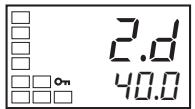
Derivative Time
- Press the Key to select the PID 2 Derivative Time parameter.
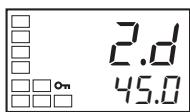
- Use the 和 and 和 Keys to set 45.0.
- To return to the operation level, press the Key.
Note Proportional Action
When PID constants I (integral time) and D (derivative time) are set to 0, control is executed according to proportional action. As the default, the center value of the proportional band becomes the set point.
Related parameter: Manual reset value (adjustment level)
3-9 Alarm Outputs
- Alarm outputs are determined by a combination of Alarm Type, Alarm Value, and Alarm Hysteresis alarm output conditions. For details, refer to 4-2 Alarm Hysteresis.
- This section describes the Alarm Type, Alarm Value, Upper-limit Alarm and Lower-limit Alarm parameters.
3-9-1 Alarm Types
| Set value | Alarm type | Alarm output operation | |
| When alarm value X is positive | When alarm value X is negative | ||
| 0 | Alarm function OFF | Output OFF | |
| 1 | Upper- and lower-limit | ON L H← OFF SP | See note 2. |
| 2 (See note 1.) | Upper-limit | ON X← OFF SP | ON X← OFF SP |
| 3 | Lower-limit | ON X← OFF SP | ON X← OFF SP |
| 4 (See note 1.) | Upper- and lower-limit range | ON L H← OFF SP | See note 3. |
| 5 (See note 1.) | Upper- and lower-limit with standby sequence | ON L H← OFF SP See note 5. | See note 4. |
| 6 | Upper-limit with standby sequence | ON X← OFF SP | ON X← OFF SP |
| 7 | Lower-limit with standby sequence | ON X← OFF SP | ON X← OFF SP |
| 8 | Absolute-value upper-limit | ON X← OFF 0 | ON X← OFF 0 |
| 9 | Absolute-value lower-limit | ON X← OFF 0 | ON X← OFF 0 |
| 10 | Absolute-value upper-limit with standby sequence | ON X← OFF 0 | ON X← OFF 0 |
| 11 | Absolute-value lower-limit with standby sequence | ONOFF0 | ONOFF0 |
| 12 | LBA (alarm 1 type only) | --- | |
| 13 | PV change rate alarm | --- | |
| 14 | Remote SP absolute value upper limit (See note 6.) | ONOFF0 | ONOFF0 |
| 15 | Remote SP absolute value lower limit (See note 6.) | ONOFF0 | ONOFF0 |
Note
(1) With set values 1, 4, and 5, the upper- and lower-limit values can be set independently for each alarm type, and are expressed as “L” and “H.”
(2) Set value: 1 (Upper- and lower-limit alarm)
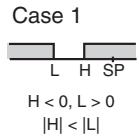
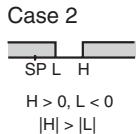
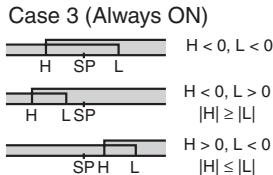
(3) Set value: 4 (Lower limit range)
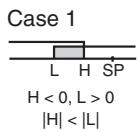
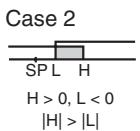
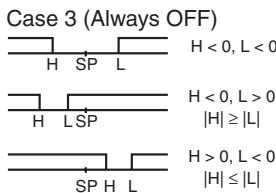
(4) Set value: 5 (Upper- and lower-limit with standby sequence)
- For the lower-limit alarms in cases 1 and 2 above, the alarm is always OFF if upper- and lower-limit hysteresis overlaps.
- In case 3, the alarm is always OFF.
(5) Set value: 5 (Upper- and lower-limit with standby sequence)
- The alarm is always OFF if upper- and lower-limit hysteresis overlaps.
(6) Displayed when remote SP input is used.
- Set the alarm type independently for each alarm in the Alarm 1 to 3 Type parameters in the initial setting level. The default is 2 (Upper-limit alarm).
3-9-2 Alarm Values
Bank* Alarm Value Lower Limit
(:0 to 7)
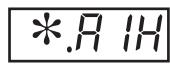
Alarm Value Upper Limit Value
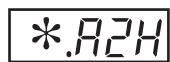
(:0 to 7)
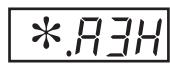
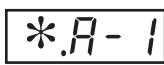
Alarm Value (:0 to 7)
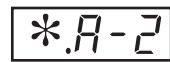
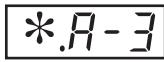
- Alarm values are indicated by "X" in the table on the previous page. When the upper and lower limits are set independently, "H" is displayed for upper limit values, and "L" is displayed for lower limit values.
- To set the alarm upper and lower limits for deviation, set the upper and lower limits in the Alarm 1 to 3 Upper Limit and Alarm 1 to 3 Lower Limit parameters.
- Alarm values can be set for each bank. Select the bank number in the Display Bank Selection parameter in the bank setting level, and set the Alarm Value, Alarm Value Upper Limit (1 to 3), and Alarm Value Lower Limit (1 to 3) parameters for that bank.
- When the Alarm Value, Alarm Value Upper Limit, and Alarm Value Lower Limit parameters in the operation level are changed, the changes will be reflected in those parameters for the current bank.
Operating Procedure
Initial Setting Level
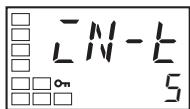
Input Type
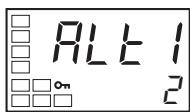
Alarm 1 Type
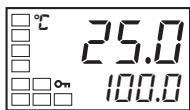
PV/SP
Bank Setting Level
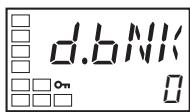
Display Bank Selection
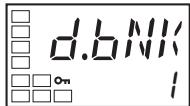
This procedure sets alarm 1 for bank number 1 as an upper-limit alarm. The related parameters and settings are shown below. The alarm is output when the set point exceeds 10^ . (In this example, the temperature unit is ^ C .)
Alarm 1 type = 2 (Upper-limit alarm)
Bank 1 Alarm value 1 = 10
- Press the Key for at least three seconds to move from the operation level to the initial setting level.
- Select the Alarm 1 Type parameter by pressing the Key. Confirm that the set value is 2. The default value is 2 (Upper-limit alarm).
- To return to the operation level, press the Key for at least one second.
- Press the Key to move to the bank setting level.
- Use the and Keys to set 1.
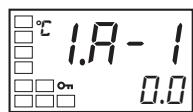
Bank 1 Alarm Value 1
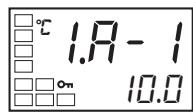
- Press the Key to select the Bank 1 Alarm Value 1 parameter.
- Use the Key to set 10.0.
PV Change Rate Alarm
The change width can be found for PV input values in any set period. Differences with previous values in each set period are calculated, and an alarm is output if the result exceeds the alarm value. The PV rate of change calculation period can be set in units of 60 ms.
If a positive value is set for the alarm value, the PV will operate as a change rate alarm in the rising direction. If a negative value is set, the PV will operate as a change rate alarm in the falling direction.
Precaution
If a shorter PV rate of change calculation period is set, outputs set for the PV change rate alarm function may repeatedly turn ON and OFF for a short period of time. It is therefore recommended that the PV change rate alarm be used with the alarm latch turned ON.
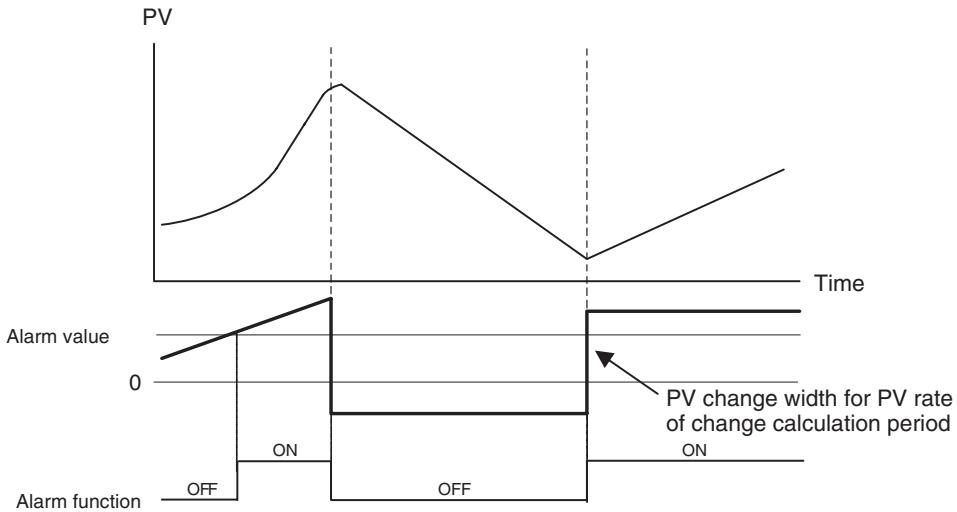
SP Alarms When Remote SP Is Used
| Parameter name | Setting range | Unit | Default |
| PV Rate of Change Calculation Period | 1 to 999 | Sampling cycle | 17 (= 17 × 60 ms = 1,020 ms) |
RSP Absolute Upper Limit and RSP Absolute Lower Limit parameters were added for the E5AN-H and E5EN-H (with remote SP input). These parameters are used for a remote SP regardless of whether the SP mode is set to Remote SP or Local SP Mode.
3-10 Using Heater Burnout, Heater Short, and Heater Overcurrent Alarms
3-10-1 Heater Burnout, Heater Short, and Heater Overcurrent Alarm Operations
- Heater burnout detection and heater overcurrent detection are executed by measuring heater current while the control output (heating) is ON, and heater short detection is executed by measuring heater current while it is OFF. For details, refer to the following table. (Heater burnout detection, heater short detection, and heater overcurrent detection cannot be used with the control output for cooling.)
- These settings can be made for standard models only.
| Control output (heating) status | Power to heater | HB alarm output | HS alarm output | Heater overcurrent alarm output | |
| Control output (heating) | Operation indicator | ||||
| ON | Lit | Yes (Normal) (See note 1.) | OFF | --- | --- |
| No (Heater burnout) | ON | --- | --- | ||
| OFF | Not lit | Yes (HS alarm) | --- | ON | --- |
| No (Normal) (See note 2.) | --- | OFF | --- | ||
| ON | Lit | Normal | --- | --- | OFF |
| Heater overcurrent status (See note 3.) | --- | --- | ON | ||
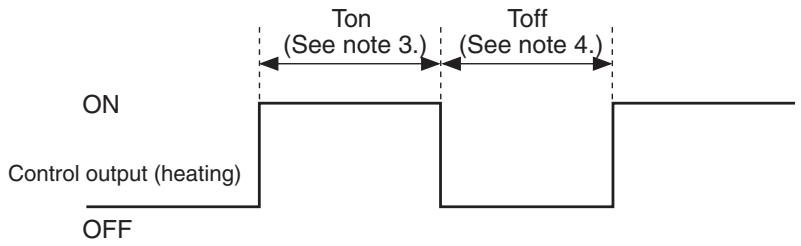
Note
(1) In the above diagram, power is considered to be ON (normal) if the heater current is greater than the heater burnout detection current during the Ton interval. If the heater is burned out, the measured current decreases and falls below the heater burnout detection value. The output is then activated as the heater burnout alarm.
(2) In the above diagram, power is considered to be OFF (normal) if the leakage current is less than the HS alarm current during the Toff interval. If the SSR output is short-circuited, the measured current increases beyond the HS alarm value. The output is then activated as the HS alarm.
(3) In the above diagram, it is regarded as normal when the heater current is less than the heater overcurrent detection current during the Ton period. Current is increased when excessive current flows to the heater, causing the heater overcurrent detection value to be exceeded and an OC (heater overcurrent) alarm to be output.
(4) Heater burnout and heater overcurrent are not detected if the control output (heating) ON time (Ton) is 100 ms or less.
(5) HS alarms are not detected if the control output (heating) OFF time (Toff) is 100 ms or less.
- For Controllers with heater burnout, HS, and heater overcurrent alarms, an OR output is established between the ALM 1 function and the alarms. If the ALM1 function is to be used for the heater burnout, HS, and heater overcurrent alarms only, set 0 as the alarm 1 type (i.e., do not use ALM1).
- Turn the heater power ON simultaneously or before turning ON the E5□N-H power. If the heater power is turned ON after turning ON the E5AN-H power, the HB alarm will be activated.
- Control is continued even when the heater burnout, HS, or heater overcurrent alarm is active.
- The rated current value may sometimes differ slightly from the actual current flowing to the heater.
Use the Heater Current 1 Value Monitor, Heater Current 2 Value Monitor, Leakage Current 1 Monitor, and Leakage Current 2 Monitor parameters to check the actual current being used.
- If there is little difference between the current in normal and abnormal states, detection may become unstable. To stabilize detection, set a current value difference of at least 1.0A for heaters of less than 10.0A , and at least 2.5A for heaters of 10.0A or more. If the heater current is too low, loop the load line several times through a CT, as shown in the diagram below. Looping it through once will double the detection current.
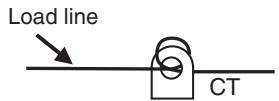
3-10-2 Installing Current Transformers (CT)
- This function can be used with E5□N-H models that have the HB alarm, HS alarm, and OC alarm.
For the E5CN-H, connect the CT in advance to terminals 14 and 15 (CT1), or 13 and 15 (CT2). For the E5AN-H/EN-H, connect the CT in advance to terminals 14 and 15 (CT1) or 15 and 16 (CT2). Then pass the heater power line through the CT's hole.
For specifications, models and dimensions of current transformers that can be used with this Controller, see Appendix Current Transformer (CT) on page 300.
Single-phase Heaters
For single-phase heaters, install the CT in the position shown in the following diagram.
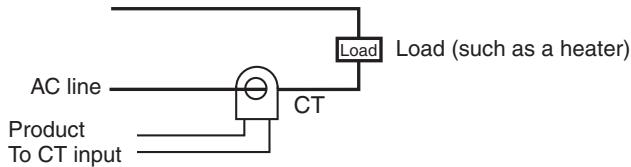
Three-phase Heaters (E5□N-H□HH□3-phase Heater Detection Models)
When a 3-phase power supply is used, regardless of the types of connecting lines, two current transformers (CTs) are required to detect heater burnout, HS, and OC.
- Delta connecting lines: Refer to the following diagram for CT installation positions.
Note Heater voltage fluctuations are not considered here, so be take that into account when setting the detection current.
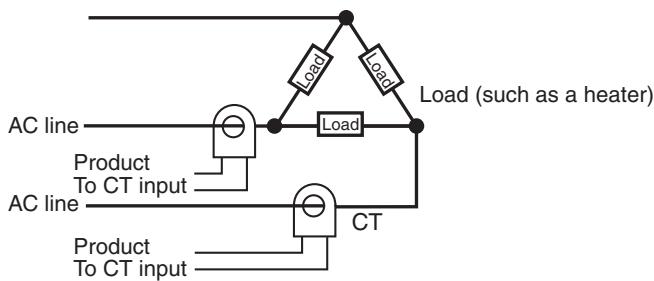
Star connecting lines: Refer to the following diagram for CT installation positions.
Note Heater voltage fluctuations are not considered here, so be take that into account when setting the detection current.
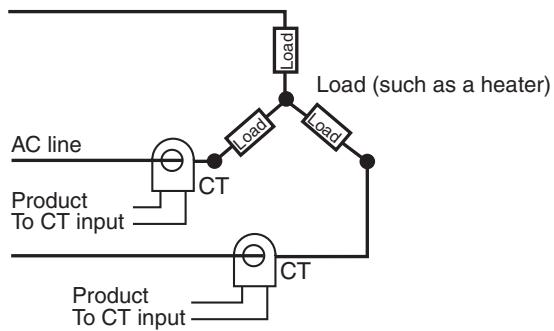
V connecting lines: Refer to the following diagram for CT installation positions.
Note Heater voltage fluctuations are not considered here, so be take that into account when setting the detection current.
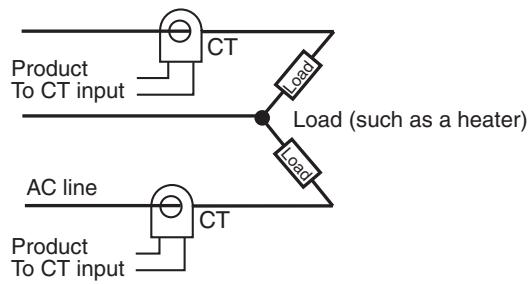
3-10-3 Calculating Detection Current Values
- Calculate the set value using the following equation:
Heater Burnout Detection 1/2 set value = current value + Burnout current value2
HS Alarm 1/2 set value = Leakage current value (output OFF) + HS current value / 2
Heater overcurrent 1/2 set value = current value + Overcurrent value2
-
To set the current for heater burnout when two or more heaters are connected through the CT, use the value from when the heater with the smallest current burns out. If all of the heaters have the same current, use the value from when any one of them burns out.
-
Make sure that the following conditions are satisfied:
Heater with a current of less than 10.0 A:
(Current value at normal operation) - (Current value at heater burnout) ≥ 1 A
When the difference is less than 1 A, detection is unstable.
Heater with a current of 10.0 A or more:
(Current value at normal operation) - (Current value at heater burnout) ≥ 2.5 A
When the difference is less than 2.5A , detection is unstable.
- The setting range is 0.1 to 49.9 A. Heater burnout, HS, and heater overcurrent are not detected when the set value is 0.0 or 50.0. When the set value is 0.0, the heater burnout alarm is always OFF, the HS alarm is always ON, and the heater overcurrent alarm is always ON. When the set value is 50.0, the heater burnout alarm is always ON, the HS alarm is always OFF, and the heater overcurrent alarm is always OFF.
- Set the total current value for normal heater operation to 50 A or less. When a current value of 55.0 A is exceeded, FFFF is displayed in the Heater Current 1 (or 2) Value Monitor and Leakage Current 1 (or 2) Monitor parameters.
3-10-4 Application Examples
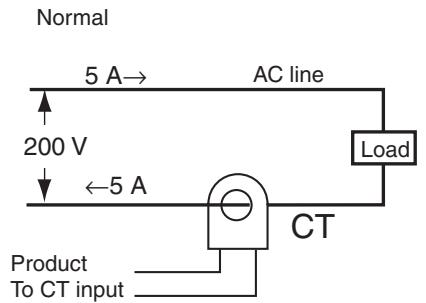
Single-phase Heaters
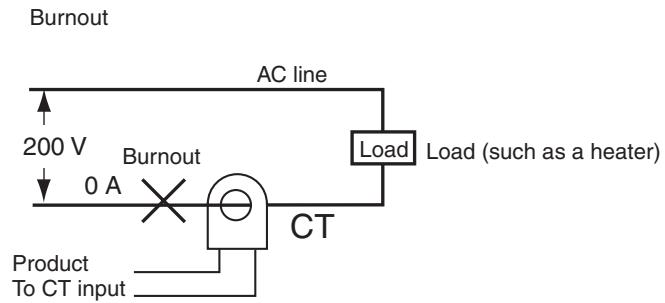
Example: Using a 200-VAC, 1-kW Heater
The heater power supply provides 5 A when the current is normal, and 0 A when there is a burnout, so the heater burnout detection current is calculated as follows:
$$ \begin{array}{l} \text {H e a t e r b u r n o u t d e t e c t i o n c u r r e n t} = \frac {\text {(N o r m a l c u r r e n t)} + \text {(H e a t e r b u r n o u t c u r r e n t)}}{2} \ = \frac {5 + 0}{2} = 2. 5 [ A ] \ \end{array} $$
Example: Using Three 200-VAC, 1-kW Heaters
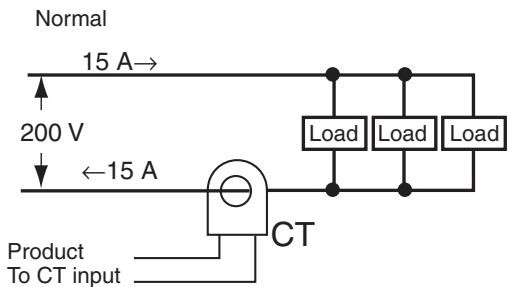
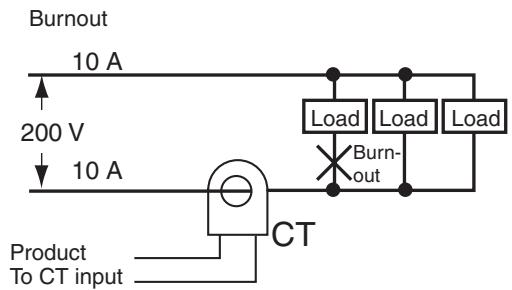
The heater power supply provides 15 A when the current is normal, and 10 A when there is a burnout, so the heater burnout detection current is calculated as follows:
Heater burnout detection current = (Normal current) + (Heater burnout current)2
$$ = \frac {1 5 + 1 0}{2} = 1 2. 5 [ A ] $$
Three-phase Heaters
Delta Connecting Lines
Example: Using Three 200-VAC, 2-kW Heaters
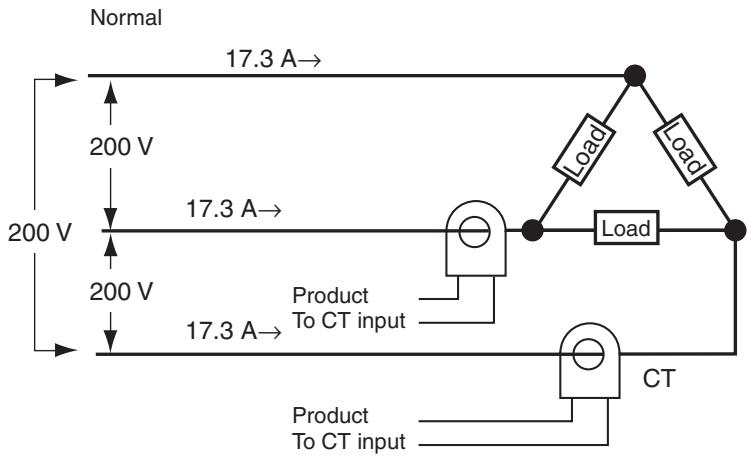
The current when each phase is normal is 17.3 A ( ≈ 3 × 10 A ).
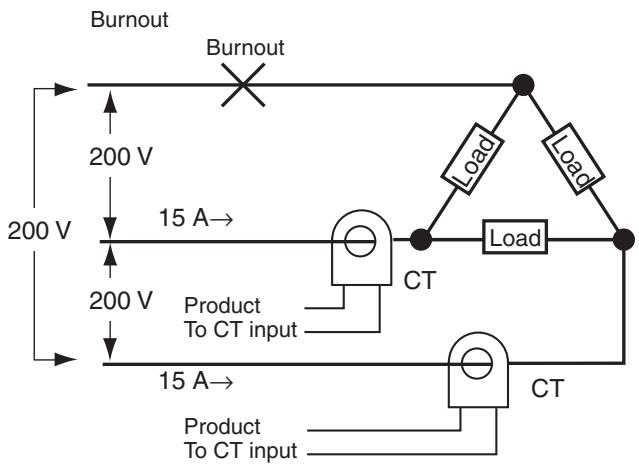
Current when there is a burnout = 10A× 3×
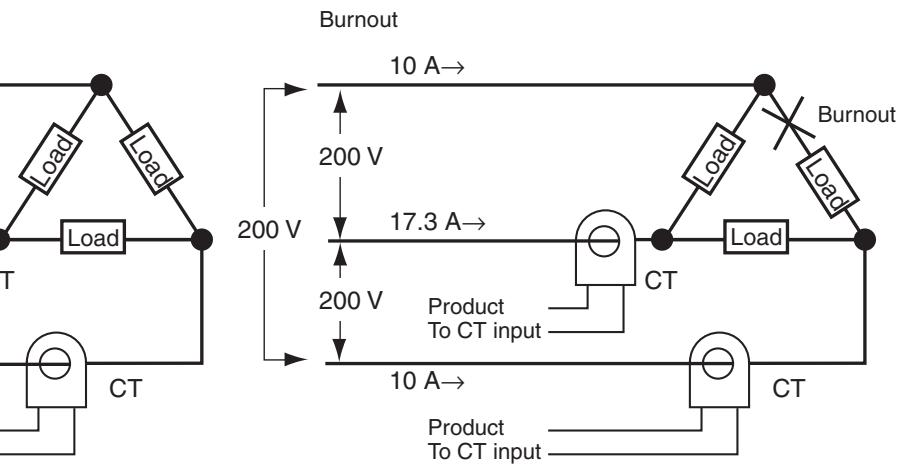
Current when there is a burnout = 10A× 3×
The heater burnout current when there is a burnout at the load line is as follows:
(Heater burnout detection current) = (17.3 + 15) / 2 ≈ 16.1 [A]
The heater burnout current when there is a burnout at the load is as follows:
(Heater burnout detection current) = (17.3 + 10) / 2 ≈ 13.65 [A]
To enable detection in either case, use 16.1 A as the heater burnout detection current.
Star Connecting Lines
Example: Using Three 200-VAC, 2-kW Heaters
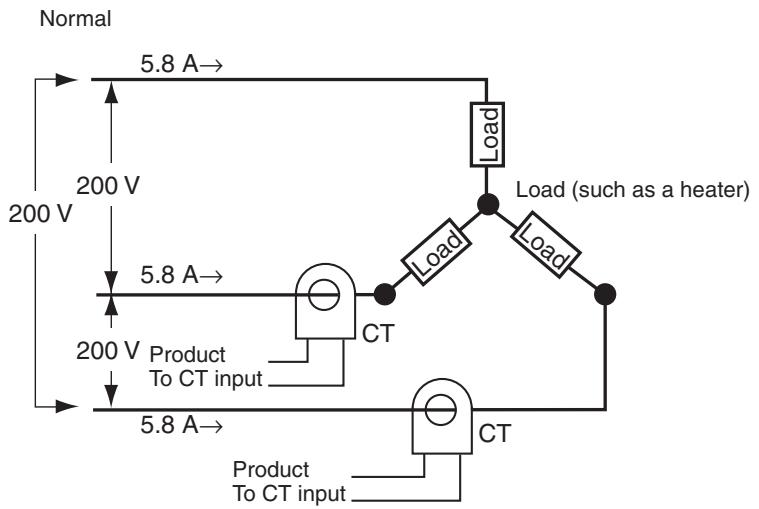
The current when each phase is normal is 5.8A(≈ 10A× (1 / 3))
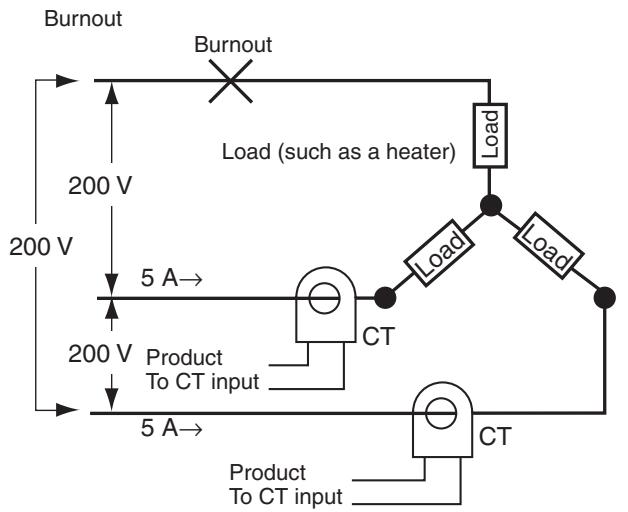
Current when there is a burnout = 10A× (1 / 3)
× ( 3/2) = 5 A
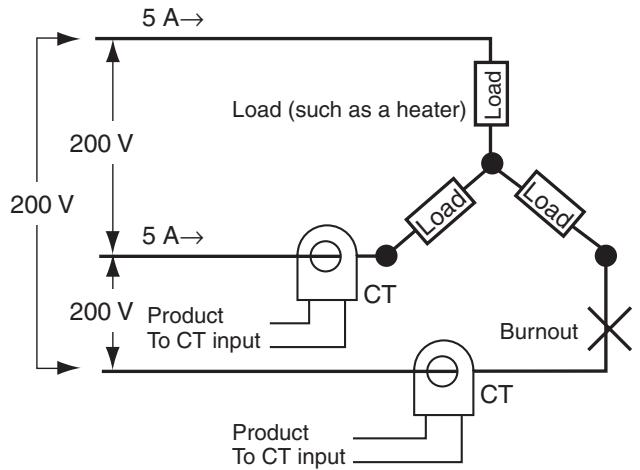
Current when there is a burnout = 10A× (1 / 3)
× (3 / 2) = 5A
The heater burnout detection current for this connecting line is 5.4 A ( = (5.8 + 5) / 2 ).
V Connecting Lines
Example: Using Two 200-VAC, 2-kW Heaters
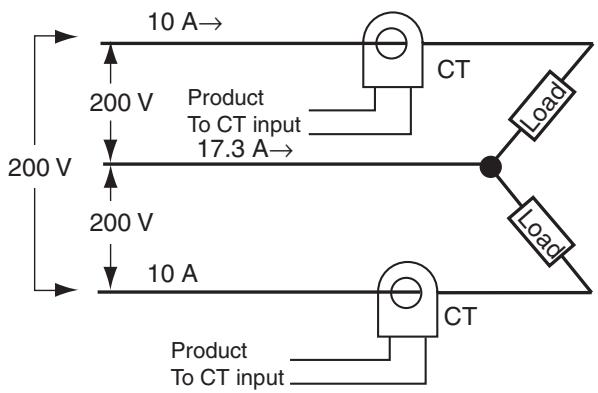
Normal
Burnout
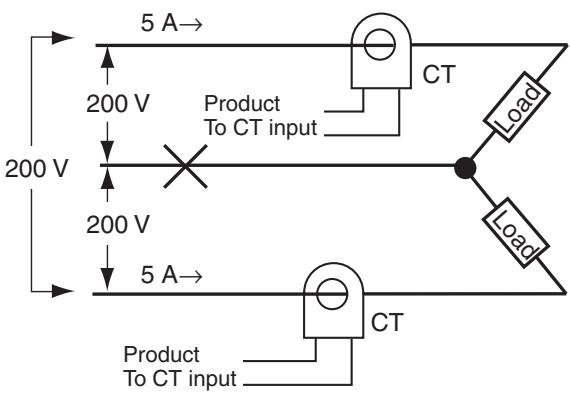
Current when there is a burnout = 10A× (1 / 2) = 5A
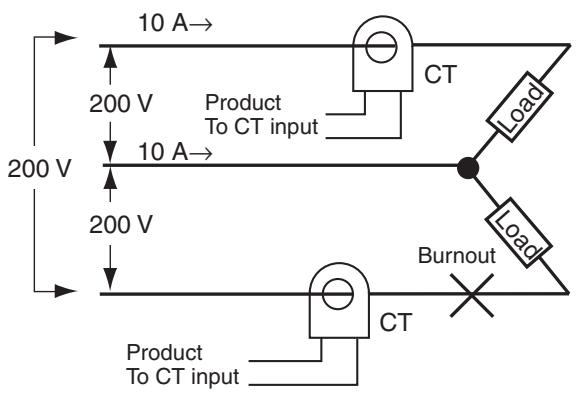
Current when there is a burnout = 0 A
The heater burnout current when there is a burnout at the common is as follows:
Heater burnout detection current = (10 + 5) / 2 ≈ 7.5 [A]
The heater burnout current when there is a burnout at the load is as follows: Heater burnout detection current = (10 + 0) / 2 ≈ 5 [A]
To enable detection in either case, use 7.5 A as the heater burnout detection current.
3-10-5 Settings: HB Alarm
To activate the heater burnout alarm, set the HB ON/OFF parameter to ON in the advanced function setting level and set the Heater Burnout Detection 1 and Heater Burnout Detection 2 parameters in the adjustment level.
Operating Procedure
This procedure sets the Heater Burnout Detection 1 parameter to 2.5.
■ Moving to the Advanced Function Setting Level
The Heater Burnout Detection parameter setting is already ON by default, so set the Heater Burnout Detection 1 parameter.
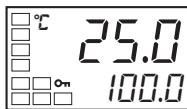
Operation Level
PV/SP
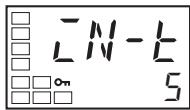
Initial Setting Level
Input Type
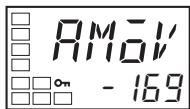
Initial Setting Level
Moves to Advanced Function Setting Level
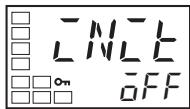
Advanced Function Setting Level
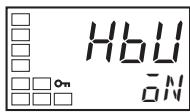
Heater Burnout Detection
- Move to the advanced function setting level.
Press the for at least three seconds to move from the operation level to the initial setting level. - Select Move to Advanced Function Setting Level by pressing the l Key. (For details on moving between levels, refer to 4-8 Moving to the Advanced Function Setting Level.)
- Press the to enter the password (-169), and move from the initial setting level to the advanced function setting level.
The top parameter in the advanced function setting level is displayed.
- Select the Heater Burnout Detection parameter by pressing the . Check that this parameter is set to ON (the default). Next, set the Heater Burnout Detection 1 parameter.
Setting Heater Burnout Detection
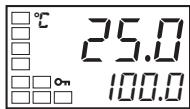
Operation Level
PV/SP
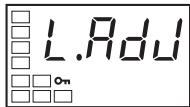
Adjustment Level
Adjustment Level Display
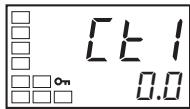
Heater Current 1 Value Monitor
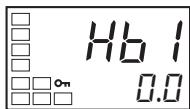
Heater Burnout Detection 1
- Press the Key for at least one second to move from the advanced function setting level to the initial setting level. Press the key again for at least one second to move to the operation level.
- Press the Key for less than one second to move from the operation level to the adjustment level.
- Select the Heater Current 1 Value Monitor parameter by pressing the Key. Check the current value. Next, set the Heater Burnout Detection 1 parameter.
- Select the Heater Burnout Detection 1 parameter by pressing the l Key. Refer to Calculating Detection Current Values on page 73 on when making the settings.
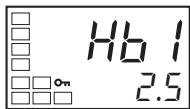
- For this example, set 2.5. To return to the operation level, press the Key for less than one second.
3-10-6 Settings: Heater Short Alarm
To activate the HS alarm, set the HS Alarm Use parameter to ON in the advanced function setting level and set the HS Alarm 1 and HS Alarm 2 parameters in the adjustment level.
Operating Procedure
This procedure sets the HS Alarm 1 parameter to 2.5.
■ Moving to the Advanced Function Setting Level
The HS Alarm Use parameter setting is already ON by default, so set the HS Alarm 1 parameter.
Operation Level
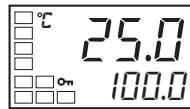
PV/SP
Initial Setting Level
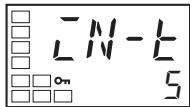
Input Type
Initial Setting Level
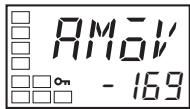
Advanced Function Setting Level

Move to the Advanced Function Setting Level
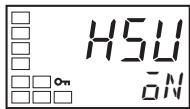
HS Alarm Use
- Move to the advanced function setting level. Press the Key for at least three seconds to move from the operation level to the initial setting level.
- Select Move to Advanced Function Setting Level by pressing the l Key. (For details on moving between levels, refer to 4-8 Moving to the Advanced Function Setting Level.)
- Press the Key to enter the password (-169), and move from the initial setting level to the advanced function setting level.
The top parameter in the advanced function setting level is displayed.
- Select the HS Alarm Use parameter by pressing the Key. Check that this parameter is set to ON (the default). Next, set the HS Alarm 1 parameter.
HS Alarm Settings
Operation Level
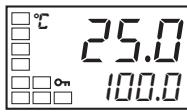
PV/SP
- Press the Key for at least one second to move from the advanced function setting level to the initial setting level. Press the key again for at least one second to move to the operation level.
Adjustment Level
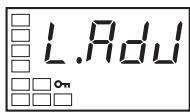
Adjustment Level Display
- Press the Key for less than one second to move from the operation level to the adjustment level.
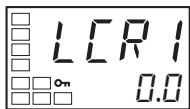
Leakage Current 1 Monitor
- Select the Leakage Current 1 Monitor parameter by pressing the Key. Check the current value. Next, set the HS Alarm 1 parameter.
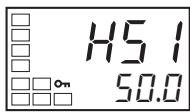
HS Alarm 1
- Select the HS Alarm 1 parameter by pressing the Key. Refer to Calculating Detection Current Values on page 73 when setting the values.
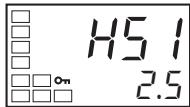
- For this example, set 2.5. To return to the operation level, press the Key for less than one second.
3-10-7 Settings: Heater Overcurrent Alarm
To activate heater overcurrent alarm, set the Heater Overcurrent Use parameter to ON in the advanced function setting level and set the Heater Overcurrent Detection 1 and Heater Overcurrent Detection 2 parameters in the adjustment level.
Operating Procedure
This procedure sets the Heater Overcurrent Detection 1 parameter to 20.0.
■ Moving to the Advanced Function Setting Level
The default setting for the Heater Overcurrent Use parameter is ON, so set the Heater Overcurrent Detection 1 parameter.
Operation Level
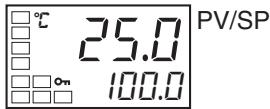
PV/SP
- Move to the advanced function setting level.
Press the Key for at least three seconds to move from the operation level to the initial setting level.
Initial Setting Level
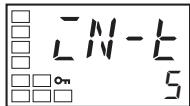
Input Type
- Press the to select the Move to Advanced Function Setting Level parameter. (For details on moving between levels, refer to 4-8.)
Initial Setting Level
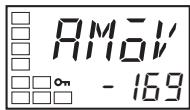
- Press the to enter the password (-169), and move from the initial setting level to the advanced function setting level.
Advanced Function Setting Level
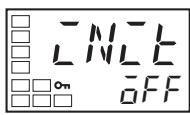
Move to the Advanced Function Setting Level
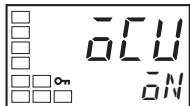
Heater Overcurrent Use
The top parameter in the advanced function setting level is displayed.
- Press the l Key to select the Heater Overcurrent Use parameter. Check that this parameter is set to ON (the default), and then set the Heater Overcurrent Detection 1 parameter.
Setting Heater Overcurrent Detection
Operation Level
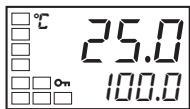
PV/SP
- Press the Key for at least one second to move from the advanced function setting level to the initial setting level. Press the key again for at least one second to move to the operation level.
- Press the Key for less than one second to move from the operation level to the adjustment level.
- Press the Key for less than one second to move from the operation level to the adjustment level.
Adjustment Level
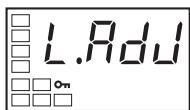
Adjustment Level Display
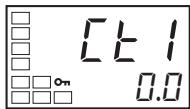
Heater Current 1 Value Monitor
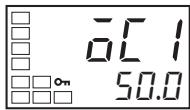
Heater Overcurrent Detection 1
- Press the Key to select the Heater Current 1 Value Monitor parameter. Check the current value, and then set the Heater Overcurrent Detection parameter.
- Press the Key to select the Heater Overcurrent Detection 1 parameter. Refer to Calculating Detection Current Values on page 73 when setting the values.
- For this example, set 20.0. To return to the operation level, press the Key for less than one second.
3-11 Setting the No. 3 Display
This section describes how to set the No. 3 Display (E5AN/EN-H). The bank No., MV, or soak time remain can be displayed on the No. 3 display.
3-11-1 PV/SP Display Selection
The following table shows the set values and display contents for the PV/SP Display selection.
| Set value | Display contents |
| 0 | Only PV/SP is displayed (with no No. 3 display.) |
| 1 | PV/SP/Bank No. and PV/SP/MV are displayed in order. (See note 2.) |
| 2 | PV/SP/MV and PV/SP/Bank No. are displayed in order. (See note 2.) |
| 3 | Only PV/SP/Bank No. is displayed. |
| 4 | Only PV/SP/MV is displayed. (See note 2.) |
| 5 | PV/SP/Bank No. and PV/SP/Soak time remain are displayed in order. |
| 6 | PV/SP/MV and PV/SP/Soak time remain are displayed in order. (See note 2.) |
| 7 | Only PV/SP/Soak time remain is displayed. |
Note
(1) The default setting is 4.
(2) For details on setting the MV for heating and cooling control, refer to MV Display for Heating and Cooling Control below. The MV for position-proportional models becomes the value for opening the valve.
When 1, 2, 5, or 6 is selected, press the Key to display the next value set for the PV/SP display (display 2).
Example: When the PV/SP Display Screen Parameter Is Set to 2
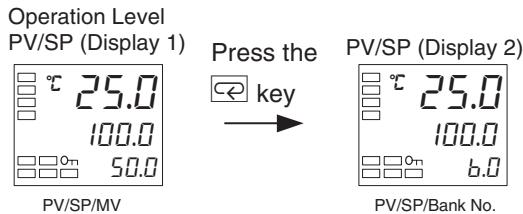
MV Display for Heating and Cooling Control
Select either the manipulated variable (heating) or manipulated variable (cooling) as the MV to be displayed for PV/SP/MV during heating and cooling control. This parameter is displayed only when heating/cooling control is being performed and PV/SP/MV is selected in the PV/SP Display Screen parameter or a Monitor/Setting Item Display parameter. This setting can be made for standard models only.
| Parameter name | Set value | Symbol | Display contents |
| MV Display Selection | O | a | Manipulated variable (heating) |
| C-O | [-a] | Manipulated variable (cooling) |
Operating Procedure
This procedure displays PV/SP/MV and PV/SP/Bank No. on the Process Value/Set Point display. The PV/SP Display Screen Selection parameter is set to 2.
Operation Level
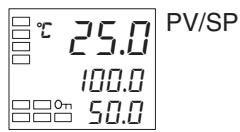
Initial Setting Level
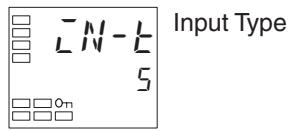
Initial Setting Level
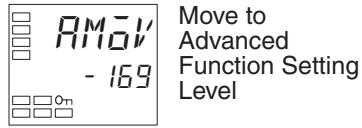
Advanced Function Setting Level
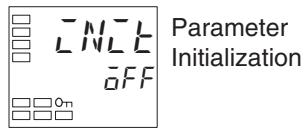
Advanced Function Setting Level
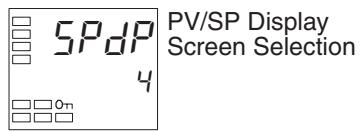
Initial Setting Level
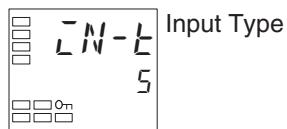
Operation Level
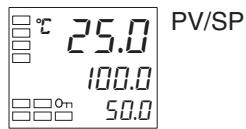
Operation Level
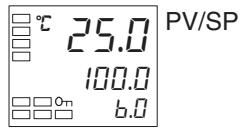
- Press the Key for at least three seconds to move from the operation level to the initial setting level.
- Press the Key to select the Move to Advanced Function Setting Level parameter.
- Use the Key to enter the password ("-169"). It is possible to move to the advanced function setting level by either pressing the Key or waiting two seconds without pressing any key.
- Press the Key to select the PV/SP Display Screen Selection parameter.
- Use the and Keys to set .
- Press the Key for at least one second to move from the advanced function setting level to the initial setting level.
- Press the Key for at least one second to move from the initial setting level to the operation level. The MV will be displayed on the No. 3 display.
- Press the Key to confirm that the Bank No. is displayed on the No. 3
SECTION 4
Applications Operations
This section describes scaling, the SP ramp function, and other special functions that can be used to make the most of the functionality of the E5CN-H, E5AN-H, and E5EN-H Digital Controllers.
4-1 Shifting Input Values. 87
4-1-1 Shifting Inputs 87
4-1-2 How to Calculate Input Shift Values for a 2-point Shift. 88
4-2 Alarm Hysteresis. 90
4-2-1 Standby Sequence. 90
4-2-2 Alarm Latch 91
4-3 Setting Scaling Upper and Lower Limits for Analog Inputs 92
4-3-1 Analog Input. 92
4-4 Executing Heating/Cooling Control 93
4-4-1 Heating/Cooling Control 93
4-4-2 Settings 95
4-5 Using Event Inputs 96
4-5-1 Event Input Settings 96
4-5-2 Operation Commands Other than Bank Selection 98
4-6 Setting the SP Upper and Lower Limit Values 100
4-6-1 Set Point Limiter. 100
4-6-2 Setting. 101
4-7 Using the SP Ramp Function to Limit the SP Change Rate. 102
4-7-1 SP Ramp. 102
4-8 Moving to the Advanced Function Setting Level 104
4-9 Using the Key Protect Level 106
4-9-1 Protection 106
4-9-2 Entering the Password to Move to the Protect Level 107
4-10 PV Change Color 109
4-10-1 PV Color Change Function. 109
4-10-2 Setting. 110
4-11 Alarm Delays 112
4-11-1 Alarm Delays 112
4-12 Loop Burnout Alarm. 114
4-12-1 Loop Burnout Alarm (LBA). 114
4-13 Performing Manual Control 119
4-13-1 Manual Operation. 119
4-14 Using the Transfer Output. 124
4-14-1 Transfer Output Function 124
4-15 Using Banks and PID Sets 129
4-16 Using the Simple Program Function 132
4-16-1 Simple Program Function 132
4-16-2 Operation at the Program End. 136
4-16-3 Combining a Simple Program with an SP Ramp 137
4-16-4 Relationships between Simple Programs and Other Functions 138
4-17 Output Adjustment Functions 141
4-17-1 Output Limits 141
4-17-2 MV at Stop 142
4-17-3 MV at PV Error 143
4-18 Using the Extraction of Square Root Parameter 144
4-19 Setting the Width of MV Variation 146
4-20 Setting the PF Key. 148
4-20-1 PF Setting (Function Key). 148
4-21 Counting Control Output ON/OFF Operations 150
4-21-1 Control Output ON/OFF Count Function 150
4-22 Displaying PV/SV Status. 152
4-22-1 PV and SV Status Display Functions 152
4-23 Using a Remote SP 155
4-24 Position-proportional Control 157
4-25 Logic Operations 159
4-25-1 The Logic Operation Function (CX-Thermo) 159
4-25-2 Using Logic Operations 159
4-1 Shifting Input Values
4-1-1 Shifting Inputs
Either a 1-point shift or a 2-point shift can be used to shift the input. The default setting is for a 1-point shift. To execute a 2-point shift, change the Input Shift Type parameter setting (advanced function setting level) to INS2.
There is no shift function for analog inputs. Use scaling for fine adjustments.
One-point shift
Temperature Input Shift
- With a 1-point shift, the value set for the Temperature Input Shift parameter (adjustment level) is applied to each point in the entire temperature input range. For example, if the input shift value is set to 1.2^ , the process value is treated as 201.2^ after the input shift is applied when the measured process value is 200^ .
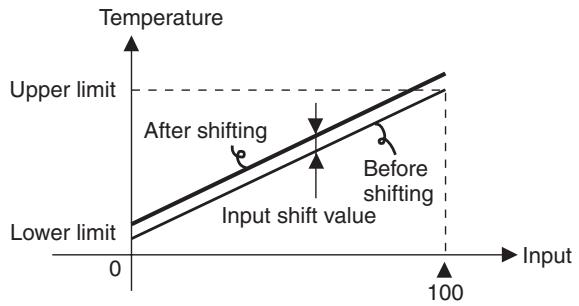
Operating Procedure
In this example, the input from a K sensor is shifted by 1^ using a 1-point input shift.
Operation Level
Operation Level
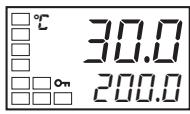
Adjustment Level
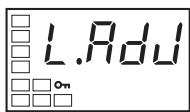
Adjustment Level Display

Temperature Input Shift
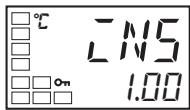
Operation Level
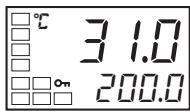
- Press the Key to move from the operation level to the adjustment level.
- Select the Temperature Input Shift parameter by pressing the 一 Key.
- Press the or Key to set 1.00.
- To return to the operation level, press the Key. The process value is 1^ larger than before the shift was applied.
Two-point shift
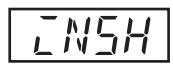
Upper-limit Temperature Input Shift Value
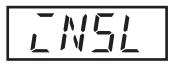
Lower-limit Temperature Input Shift Value
- Separate shift values can be set for the upper limit and lower limit of the sensor input range for an infrared sensor as well as for a thermocouple or platinum resistance thermometer with the Input Shift Type parameter set to INS2. If different shift values are set for the upper limit and lower limit, then the slope of the line will be different before and after applying the input shift. For example, if the upper-limit value is set to 2^ and the lower-limit value is set to 1^ , the input temperature will be shifted by 1.5^ for a 50% input, i.e., by the average of the upper-limit and lower-limit values.
- Set the upper-limit value in the Upper-limit Temperature Input Shift Value parameter and the lower-limit value in the Lower-limit Temperature Input Shift Value parameter.
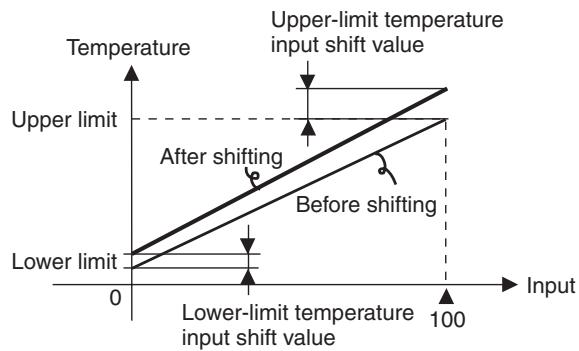
4-1-2 How to Calculate Input Shift Values for a 2-point Shift
Offset the readout value using a 1-point or 2-point shift as described in this section. This offset occurs because a bias current for detecting a Controller sensor error flows to the output impedance of the infrared temperature sensor.
Method for a 1-point Shift
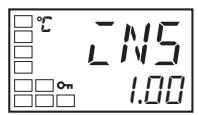
1,2,3...
- In the configuration shown in Figure 1, bring the set point to near the value at which the temperature of the control target is to be controlled. Assume that the control target temperature (C) and the thermometer temperature (B) are the same.
-
Check the control target temperature (B) and the Controller readout (A). Subtract the Controller readout temperature (A) from the control target temperature (B), and set as the input shift value to the result. The shift is illustrated in Figure 2.
-
After setting the input shift values, check the Controller readout (A) and the control target temperature (B). If they are approximately the same, this completes setting the input shift.
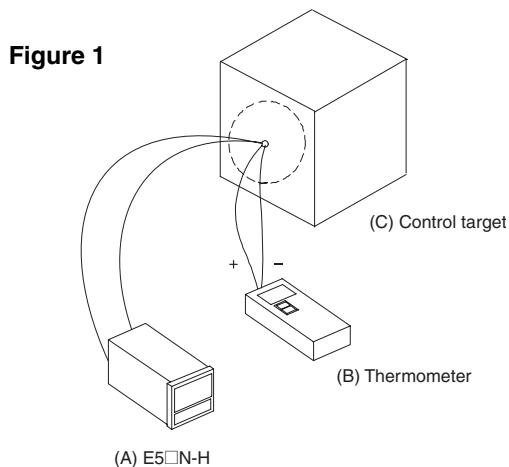

Figure 2 Illustration of 1-Point Shift
Method for a 2-point Shift
Use a 2-point input shift if you want to increase the accuracy of the readout values across the range of the Sensor.
1,2,3...
- Shift the Controller readout at two points, near room temperature and near the value at which the temperature of the control target is to be controlled. For this reason, check the thermometer temperature (B) and Controller readout (A) with the thermometer temperature near room temperature and near the set point.
2.
- Y1 is the Controller readout at room temperature before shifting and X1 is the Controller readout at room temperature after shifting.
- Y2 is the Controller readout at the set temperature before shifting and X2 is the Controller readout at the set temperature after shifting.
- Set the upper-limit temperature input shift and the lower-limit temperature input shift using the following formulas based on the temperatures before shifting (Y1 and Y2), the temperatures after shifting (X1 and X2), the set temperature upper limit (YH), and the set temperature lower limit (YL). The shift is illustrated in Figure 3.
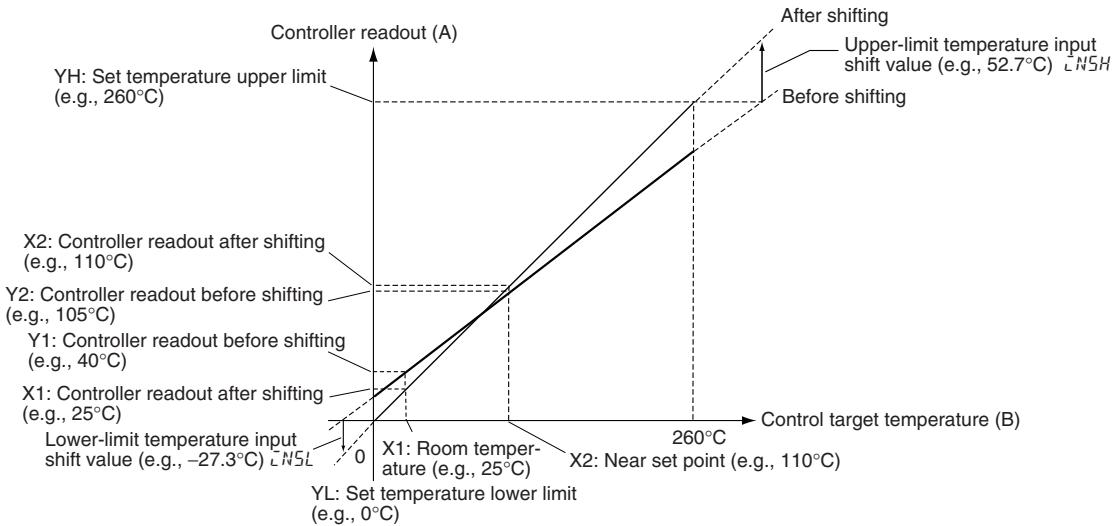
Figure 3 Illustration of 2-Point Shift
a. Lower-limit temperature input shift value
$$ \bar {L} N S L = \frac {Y L - Y 1}{Y 2 - Y 1} \times {(X 2 - Y 2) - (X 1 - Y 1) } + (X 1 - Y 1) $$
b. Upper-limit temperature input shift value
$$ \zeta N 5 H = \frac {Y H - Y 1}{Y 2 - Y 1} \times \left{\left(X 2 - Y 2\right) - \left(X 1 - Y 1\right) \right} + \left(X 1 - Y 1\right) $$
- After setting the calculated values to N5L and N5H , check the Digital Controller readout (A) and thermometer temperature (B).
- Here, offsets are set at two points, near room temperature and near the set point. To improve accuracy within the measurement temperature range, another point in the measurement temperature range other than the set point should be set instead of room temperature.
Example of a 2-point Temperature Input Shift
In this example, a K thermocouple from -200.0 to 1,300.0^ is used. In equations 1 and 2, the set temperature lower limit YL is -200^ and the set temperature upper limit YH is 1,300^ . Check the temperature of the control target.
The temperature input offset values can be calculated as shown below when the Digital Controller readout Y1 is 35^ for a room temperature X1 of 25^ and when the Digital Controller readout Y2 is 105^ for a set point temperature X2 of 110^ .
Lower-limit Temperature Input Shift Value
| Lower-limit Temperature Input Shift Value |
$$ \bar {L} N 5 L = \frac {- 2 0 0 - 3 5}{1 0 5 - 3 5} \times {(1 1 0 - 1 0 5) - (2 5 - 3 5) } + (2 5 - 3 5) = - 6 0. 3 5 (^ {\circ} C) $$
| □℃ | Upper-limit |
| □L | Temperature |
| □N | Input Shift |
| □26 | Value |
Upper-limit Temperature Input Shift Value
$$ \bar {C} N 5 H = \frac {1 3 0 0 - 3 5}{1 0 5 - 3 5} \times {(1 1 0 - 1 0 5) - (2 5 - 3 5) } + (2 5 - 3 5) = 2 6 1. 0 7 (^ {\circ} \mathrm {C}) $$
4-2 Alarm Hysteresis
| Lower-limit Temperature Input Shift Value |
- The hysteresis of alarm outputs when alarms are switched ON/OFF can be set as follows:
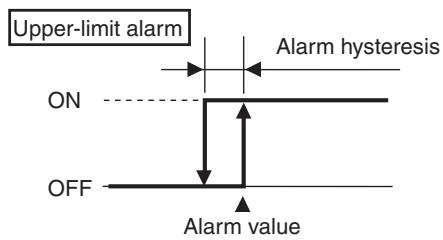
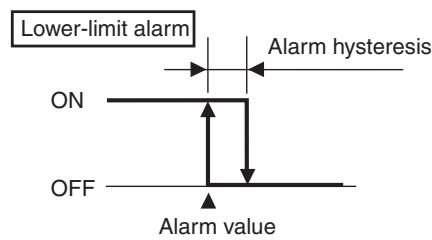
- Alarm hysteresis is set independently for each alarm in the Alarm Hysteresis 1 to Alarm Hysteresis 3 parameters (initial setting level).
- The default is 0.2(^ C / ^ F) when a temperature input is selected, and 0.02 % FS when an analog input is selected.
4-2-1 Standby Sequence
- The standby sequence can be used so that an alarm will not be output until the process value leaves the alarm range once and then enters it again.
Restart
- For example, with a lower limit alarm, the process value will normally be below the set point, i.e., within the alarm range, when the power supply is turned ON, causing an alarm to be output.
If the lower limit alarm with a standby sequence is selected, an alarm will not be output until the process value increases above the alarm set value, i.e., until it leaves the alarm range, and then falls back below the alarm set value.
- The standby sequence is canceled when an alarm is output. It is, however, restarted later by the Standby Sequence Reset parameter (advanced function setting level). For details, refer to the Standby Sequence Reset parameter in SECTION 5 Parameters.
4-2-2 Alarm Latch
- The alarm latch can be used to keep the alarm output ON until the latch is canceled regardless of the temperature once the alarm output has turned ON.
Any of the following methods can be used to clear the alarm latch.
- Turn OFF the power supply. (The alarm latch is also cleared by switching to the initial setting level, communications setting level, advanced function setting level, or calibration level.)
- Use the PF Key.
- Use an event input.
For details on setting the PF Key, refer to 4-20 Setting the PF Key. For details on setting events, refer to 4-5 Using Event Inputs.
Summary of Alarm Operation
The following figure summarizes the operation of alarms when the Alarm Type parameter is set to "lower-limit alarm with standby sequence" and "close in alarm" is set.
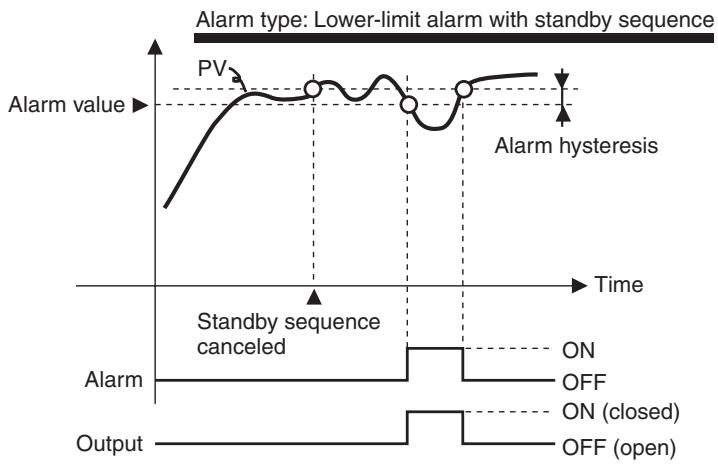
Parameters
| Symbol | Parameter: level | Description |
| RLH* | Alarm 1 to 3 Hysteresis: Initial setting level | Alarm |
| RE5E | Standby Sequence: Advanced function setting level | Alarm |
Note * to
4-3 Setting Scaling Upper and Lower Limits for Analog Inputs
4-3-1 Analog Input
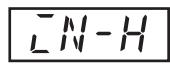
Scaling Upper Limit
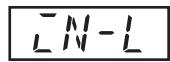
Scaling Lower Limit
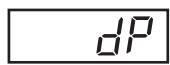
Decimal Point
- When an analog input is selected, scaling can be performed as needed by the control application.
- Scaling is set in the Scaling Upper Limit, Scaling Lower Limit, and Decimal Point parameters (initial setting level). These parameters cannot be used when a temperature input is selected.
- The Scaling Upper Limit parameter sets the physical quantity to be expressed by the upper limit value of input, and the Scaling Lower Limit parameter sets the physical quantity to be expressed by the lower-limit value of input. The Decimal Point parameter specifies the number of digits below the decimal point.
- The following figure shows a scaling example for a 4 to 20-mV analog input. After scaling, the temperature can be directly read. The decimal point is set to 1.
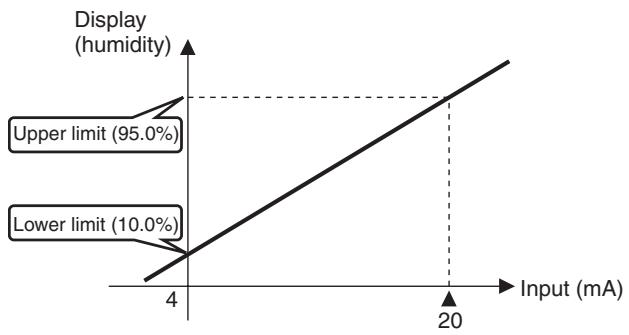
Operating Procedure
Initial Setting Level
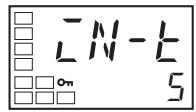
Input Type
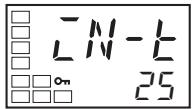
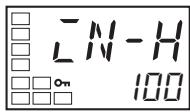
Scaling Upper Limit
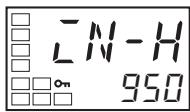
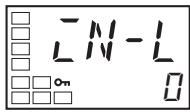
Scaling Lower Limit
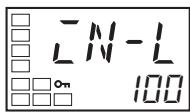
In this example scaling is set to display 4 to 20mA as 10.0% to 95.0% .
- Press the Key for three seconds to move from the operation level to the initial setting level.
- Press the 心 and 心 Keys to set 25.
- Select Scaling Upper Limit parameter by pressing the Key.
- Use the and Keys to set the parameter to 950.
- Select the Scaling Lower Limit parameter by pressing the Key.
- Press the and Keys to set 100.
Decimal Point
- Select the Decimal Point parameter by pressing the Key.
-
Press the and Keys to set 1.
-
To return to the operation level, press the Key for one second.
4-4 Executing Heating/Cooling Control
4-4-1 Heating/Cooling Control
Heating/cooling control operates when H - (heating/cooling) is selected for the Standard or Heating/Cooling parameter for standard models. The following functions are assigned to outputs by default.
| Parameter name | Symbol | Initial status |
| Control Output 1 Assignment | aUbe1 | Control output for heating |
| Control Output 2 Assignment | aUbe2 | Not assigned. |
| Auxiliary Output 1 Assignment | 5Ub1 | Alarm 1 |
| Auxiliary Output 2 Assignment | 5Ub2 | Alarm 2 |
| Auxiliary Output 3 Assignment (E5AN/EN-H only) | 5Ub3 | Alarm 3 |
Each output assignment is automatically initialized as shown below when the control mode is changed.
Example: E5CN-H
| Parameter name | Symbol | Without control output 2 | With control output 2 | ||
| Standard | Heating/cooling | Standard | Heating/cooling | ||
| Control Output 1 Assignment | \( \bar{a} u_{E} \) | Control output (heating) | Control output (heating) | Control output (heating) | Control output (heating) |
| Control Output 2 Assignment | \( \bar{a} u_{E} \) | Not assigned. (See note 1.) | Not assigned. (See note 1.) | Not assigned. | Control output (coo-ing) |
| Auxiliary Output 1 Assignment | \( \bar{S} u_{B} \) | Alarm 1 (See note 2.) | Alarm 1 (See note 2.) | Alarm 1 (See note 2.) | Alarm 1 (See note 2.) |
| Auxiliary Output 2 Assignment | \( \bar{S} u_{B} \) | Alarm 2 | Control output (coo-ing) | Alarm 2 | Alarm 2 |
Note
(1) No parameter assignment is displayed because there is no control output 2.
(2) The output set for the Auxiliary Output 1 Assignment parameter becomes the program END output unless the program pattern is OFF.
- The heating/cooling operation of the control outputs will switch when the Direct/Reverse Operation parameter is set to "direct."
- When DRS (Invert Direct/Reverse Operation) is assigned for an Event Input Assignment (1 to 4), control will start with the contents set for the Direct/Reverse Operation parameter inverted when the event input turns ON, and with the contents left according to the setting when the event input turns OFF. For details on event inputs and control combined with the Direct/Reverse Operation parameter, refer to Control by Inverting Direct/ Reverse Operation on page 99.
Dead Band
- When heating/cooling control is selected, the Dead Band and Cooling Coefficient parameters can be used.
- For heating/cooling control, the dead band is set with the set point as its center. The dead band width is the set value of the Dead Band parameter (adjustment level). Setting a negative value produces an overlapping band.
- If an overlapping band is set, the bumpless function may not operate when switching between manual operation and automatic operation.
- The default is 0.0 EU for a temperature input and 0.00% FS for an analog input.
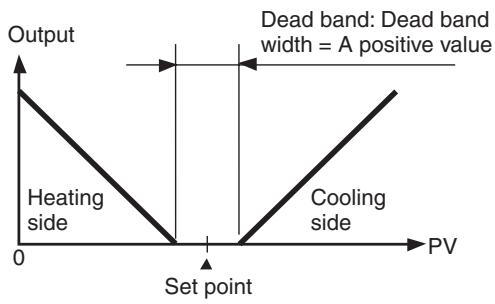
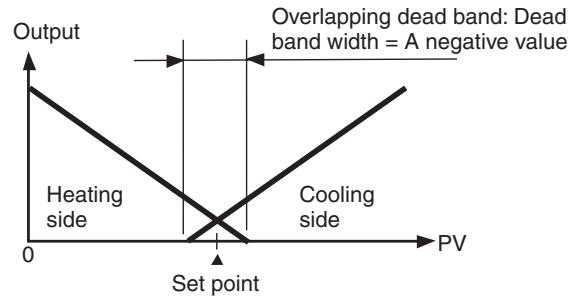
Cooling Coefficient
If the heating characteristics and cooling characteristics of the control object are very different and good control characteristics cannot be achieved with the same PID constants, the cooling coefficient can be used to adjust the proportional band (P) for the control output assigned to the cooling side. Use this to achieve balanced control between the heating side and cooling side. The proportional bands (P) for the control outputs assigned to the heating/cooling sides can be calculated using the following equations.
P for control output assigned to heating side = P
P for control output assigned to cooling side = P for control output assigned to heating side × cooling coefficient
The cooling coefficient is multiplied by the P for the control output assigned to the heating side to obtain control with characteristics that differ from those of the control output assigned to the heating side.
A cooling coefficient can be set for each PID set. To set the cooling coefficient, select the PID set number in the Display PID Selection parameter (PID setting level) and then set the Cooling Coefficient parameter. If the Cooling Coefficient parameter setting is changed in the adjustment level, the change will be reflected in the Cooling Coefficient parameter for the current PID set.
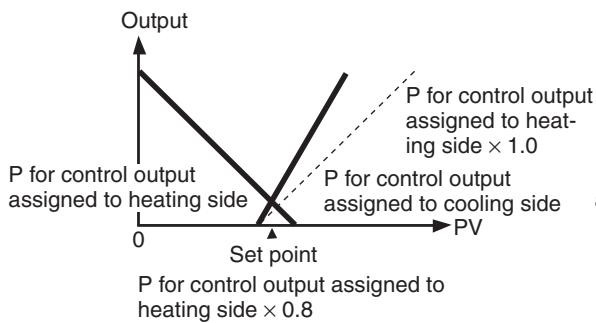
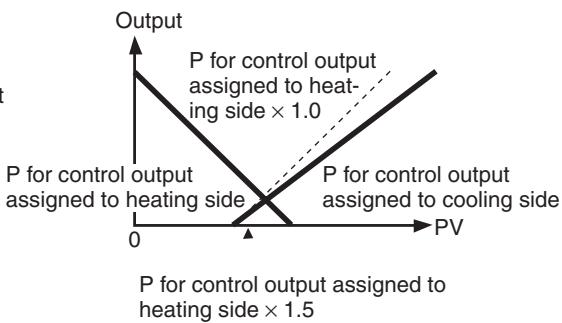
Automatic Cooling Coefficient Adjustment
By executing AT during heating/cooling control, the cooling coefficient can be automatically calculated along with the PID parameters.
| Parameter name | Setting rage | Default |
| Automatic Cooling Coef- ficient Adjustment | OFF: Disabled, ON: Enabled | OFF |
Note
If there is strong non-linear gain for the cooling characteristics, such as when cooling water boils for cooling control, it may not be possible to obtain the optimum cooling coefficient at the Controller, and control may take the form of oscillating waves. If that occurs, increase the proportional band or the cooling coefficient to improve control.
4-4-2 Settings
To set heating/cooling control, set the Standard or Heating/Cooling, Dead Band, and Cooling Coefficient parameters.
Setting Heating/Cooling Control
Operating Procedure
Initial Setting Level
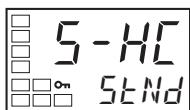
Standard or Heating/ Cooling
Standard or heating/cooling = Heating/cooling
-
Press the Key for at least three seconds to move from the operation level to the initial setting level.
-
Select "heating/cooling control" in the initial setting level.
5eNd: Standard control
H-Heating/cooling control
Setting the Cooling Coefficient
Operating Procedure
PID Setting Level

Display PID selection
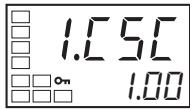
PID1 Cooling Coefficient
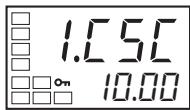
Setting the Dead Band Operating Procedure
Adjustment Level
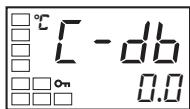
Dead Band

PID 1 Cooling Coefficient = 10
- Press the Key to move from the operation level to the PID setting level. The current PID set number will be displayed. Use the or Key to select 1.
- Select the PID1 Cooling Coefficient parameter by pressing the 一 Key.
- Press the and Keys to set 10.00.
Dead Band = 5
- Select the Dead Band parameter in the adjustment level.
- Use the Key to set the parameter to 5.0.
4-5 Using Event Inputs
4-5-1 Event Input Settings
- Depending on the Controller, there are either two event inputs (event inputs 1 and 2 or 3 and 4) or four event inputs (event inputs 1 to 4). The number of event inputs that can be used varies. (Only the E5AN/EN-H has event inputs 3 and 4.)
- Event inputs can be used for Bank Selection, RUN/STOP, Auto/Manual Switch, Program Start, Direct/Reverse Operation, SP Mode Switch (E5AN/EN-H only), 100% AT Execute/Cancel, 40% AT Execute/Cancel, Setting Change Enable/Disable, Communications Write Enable/Disable, and Alarm Latch Cancel.
- Of these, only the number of event inputs (0 to 3) set in the Bank Numbers Used parameter (initial setting level) are used for the bank selection function.
- Event inputs (1 to 4) that are not used for the bank selection function are assigned using the Event Input Assignment (1 to 4) parameters (initial setting level).
- Event inputs can be used on the following models:
Two Event Inputs;
E5CN-H□M□-500 with the E53-CN□B□N2 for the E5CN-H
E5AN/EN-H□B□M□-500 for the E5AN/EN-H
Four Event Inputs;
E5AN/EN-H□B□M□-500 with the E53-AKB for the E5AN/EN-H
- When using event inputs for bank selection, the event input assignment screen will not be displayed. Whether the set value and event input assignments 1 to 4 will be displayed or hidden is shown in the tables below.
- Do not connect the contacts from the same switch for more than one E5□N Controllers.
Controllers with Event Inputs 1 and 2 (Two Event Inputs)
| Event input assignment 1 | Event input assignment 2 | ||
| Bank Numbers Used | 0 | Displayed (Bank selection not used.) | |
| 1 | Hidden (Bank, 2 points) | Displayed (Event input 2 not used for bank selection.) | |
| 2 | Hidden (Bank, 4 points) | ||
Controllers with Event Inputs 3 and 4 (Two Event Inputs)
| Event input assignment 3 | Event input assignment 4 | ||
| Bank Numbers Used | 0 | Displayed (Bank selection not used.) | |
| 1 | Hidden (Bank, 2 points) | Displayed (Event input 4 not used for bank selection.) | |
| 2 | Hidden (Bank, 4 points) | ||
Controllers with Event Inputs 1 to 4 (Four Event Inputs)
| Event input assignment 1 | Event input assignment 2 | Event input assignment 3 | Event input assignment 4 | ||
| Bank Numbers Used | 0 | Displayed (Bank selection not used.) | |||
| 1 | Hidden (Bank, 2 points) | Displayed (Event inputs 2 to 4 not used for bank selection.) | |||
| 2 | Hidden (Bank, 4 points) | Displayed (Event input 3 and 4 not used for bank selection.) | |||
| 3 | Hidden (Bank, 8 points) | Displayed (Event input 4 not used for bank selec-tion.) | |||
The following table shows the relation between ON/OFF combinations of event inputs and the banks that are selected.
| Bank Numbers Used | Event No. | Bank No. | |||||||
| 0 | 1 | 2 | 3 | 4 | 5 | 6 | 7 | ||
| 1 | Event input 1 (See note 1.) | OFF | ON | --- | --- | --- | --- | --- | --- |
| 2 | Event input 1 (See note 1.) | OFF | ON | OFF | ON | --- | --- | --- | --- |
| Event input 2 (See note 2.) | OFF | OFF | ON | ON | --- | --- | --- | --- | |
| 3 | Event input 1 | OFF | ON | OFF | ON | OFF | ON | OFF | ON |
| Event input 2 | OFF | OFF | ON | ON | OFF | OFF | ON | ON | |
| Event input 3 | OFF | OFF | OFF | OFF | ON | ON | ON | ON | |
Note
(1) For models with event inputs 3 and 4, this becomes event input 3.
(2) For models with event inputs 3 and 4, this becomes event input 4.
To set two banks are externally, make the setting in the Bank Numbers Used parameter.
- Switching is possible between two banks (0 and 1) by setting the Bank Numbers Used parameter to 1. The default setting is 1 and does not need to be changed. Banks 0 and 1 are specified by the status of event input 1 or 3.
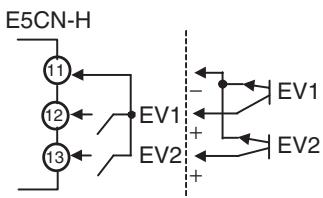
Two Event Inputs: E53-CN□B□N2 (for E5CN-H)
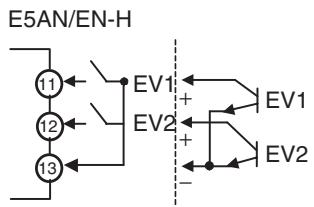
Two Event Inputs: E5AN/EN-H□B□M□-500 (for E5AN/EN-H)
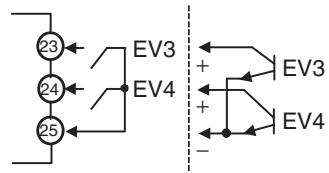
Two Additional Event Inputs: E53-AKB in E5AN/EN-H□B□M□-500 (for E5AN/EN-H)
4-5-2 Operation Commands Other than Bank Selection
The following table shows the functions assigned when an Event Input Assignment (1 to 4) is displayed.
| Setting | Function |
| None | None |
| Stop | RUN/STOP |
| MANU | Auto/Manual |
| PRSE | Program Start (See note 1.) |
| dRS | Invert Direct/Reverse Operation |
| RSP | SP Mode Switch (See note 2.) |
| RE-2 | 100% AT Execute/Cancel |
| RE-1 | 40% AT Execute/Cancel (See note 3.) |
| WEPE | Setting Change Enable/Disable |
| CMWE | Communications Write Enable/Disable (See note 4.) |
| LRE | Alarm Latch Cancel |
Note
(1) PRST (Program Start) can be set even when the Program Pattern parameter is set to OFF, but the function will be disabled.
(2) This function can be selected only with models that support remote SP.
(3) This function can be set for heating/cooling control, but the function will be disabled.
(4) This function can be selected only with models that support communications. Also, when a work bit is selected as event input data, Communications Write Enable/Disable parameter cannot be selected.
When any of the following functions is set for an Event Input Assignment parameter, the same function cannot be set for another Event Input Assignment parameter: STOP (RUN/STOP), MANU (Auto/Manual Switch), PRST (Program Start), DRS (Direct/Reverse Operation), RSP (SP Mode Switch), AT-2 (100% AT Execute/Cancel), AT-1 (40% AT Execute/Cancel), WTPT (Setting Change Enable/Disable), CMWT (Communications Write Enable/Disable), or LAT (Alarm Latch Cancel).
Turn event inputs ON and OFF while the power is being supplied. Event input ON/OFF changes are detected for inputs of 50 ms or longer. (However, inputs of 250 ms or longer is determined using logic operation.)
The functions are described in detail below. Event inputs 1 and 2 are taken as examples. When using event inputs 3 and 4, substitute event input 3 for event input 1 and event input 4 for event input 2.
Executing Run/Stop Control
When the Event Input Assignment 1 or Event Input Assignment 2 parameter is set to STOP (RUN/STOP), control is started when event input 1 or 2 turns OFF. Control is stopped when the input turns ON. Alarm outputs, however, will be according to the process value.
The STOP indicator will light while control is stopped.
| Setting | Input contact | Status |
| Event input 1 or 2 | ON | STOP |
| Event input 1 or 2 | OFF | RUN |
Switching between Auto and Manual Control
When the Event Input Assignment 1 or Event Input Assignment 2 parameter is set to MANU (auto/manual), manual control will start when event input 1 or 2 turns ON. Auto control will start when the input turns OFF.
Controlling the Start of the Simple Program Function
Control by Inverting Direct/Reverse Operation
Switching SP Mode
Switching 100% AT Execute/Cancel
Switching 40% AT Execute/Cancel
The MANU indicator will light during manual control.
| Setting | Input contact | Status |
| Event input 1 or 2 | OFF | Automatic |
| Event input 1 or 2 | ON | Manual |
When the Event Input Assignment 1 or Event Input Assignment 2 parameter is set to PRST (program start), the program will start when event input 1 or 2 turns ON. The program will be reset when the input turns OFF and the RUN/ STOP status will automatically switch to STOP mode. If the program END output is ON, the program END output will turn OFF.
| Setting | Input contact | Status |
| Event input 1 or 2 | OFF | Reset |
| Event input 1 or 2 | ON | Start |
When DRS (Invert Direct/Reverse Operation) is set for the Event Input Assignment 1 or Event Input Assignment 2 parameter and the Direct/Reverse Operation parameter is set for reverse operation, control starts with direct operation (cooling control) when event input 1 or 2 turns ON and control starts with reverse operation (heating control) when the event input turns OFF.
| Setting | Input contact | Direct/Reverse Operation parameter | Status |
| Event input 1 or 2 | OFF | Direct operation (cooling) | Direct operation (cooling) |
| Reverse operation (heating) | Reverse operation (heating) | ||
| Event input 1 or 2 | ON | Direct operation (cooling) | Reverse operation (heating) |
| Reverse operation (heating) | Direct operation (cooling) |
When RSP (SP Mode Switch) is set for either the Event Input Assignment 1 or Event Input Assignment 2 parameter, operation will be started with remote SP when event input 1 or 2 turns ON. Operation will start with local SP when the input turns OFF. The RSP operation indicator will light while in remote SP mode.
| Setting | Input contact | Status |
| Event input 1 or 2 | OFF | Local SP |
| Event input 1 or 2 | ON | Remote SP |
When AT-2 (100% AT Execute/Cancel) is set for either the Event Input Assignment 1 or Event Input Assignment 2 parameter, 100% AT will be executed when event input 1 or 2 turns ON and will be cancelled when the input turns OFF.
| Setting | Input contact | Status |
| Event input 1 or 2 | OFF | 100% AT cancelled |
| Event input 1 or 2 | ON | 100% AT executed |
When AT-1 (40% AT Execute/Cancel) is set for either the Event Input Assignment 1 or Event Input Assignment 2 parameter, 40% AT will be executed when event input 1 or 2 turns ON and will be cancelled when the input turns OFF.
| Setting | Input contact | Status |
| Event input 1 or 2 | OFF | 40% AT cancelled |
| Event input 1 or 2 | ON | 40% AT executed |
Switching Setting Change Enable/ Disable
When WTPT (Setting Change Enable/Disable) is set for either the Event Input Assignment 1 or Event Input Assignment 2 parameter, the setting change will be disabled when event input 1 or 2 turns ON and will be enabled when the input turns OFF.
| Setting | Input contact | Status |
| Event input 1 or 2 | OFF | Enabled |
| Event input 1 or 2 | ON | Disabled |
Switching Communications Write Enable/Disable
Only event inputs 3 and 4 can be set to Communications Write Enable/Disable.
When CMWT (Communications Write Enable/Disable) is set for either the Event Input Assignment 3 or Event Input Assignment 4 parameter, communications writing will be enabled when event input 3 or 4 turns ON and will be disabled when the input turns OFF.
| Setting | Input contact | Status |
| Event input 3 or 4 | OFF | Disabled |
| Event input 3 or 4 | ON | Enabled |
Switching Alarm Latch Cancel
When LAT (Alarm Latch Cancel) is set for either the Event Input Assignment 1 or Event Input Assignment 2 parameter, all alarm latches (alarms 1 to 3, heater burnout, HS alarm, and heater overcurrent latch) will be cancelled when event input 1 or 2 turns ON.
| Setting | Input contact | Status |
| Event input 1 or 2 | OFF | --- |
| Event input 1 or 2 | ON | Cancelled |
Parameters
| Symbol | Parameter: level | Description |
| E′′-1 | Event Input Assignment 1: Initial setting level | Function of event input function |
| E′′-2 | Event Input Assignment 2: Initial setting level | |
| E′′-3 | Event Input Assignment 3: Initial setting level | |
| E′′-4 | Event Input Assignment 4: Initial setting level | |
| E′′-b | Bank Numbers Used: Initial setting level |
4-6 Setting the SP Upper and Lower Limit Values
4-6-1 Set Point Limiter
The setting range of the set point is limited by the set point limiter. The set point limiter is used to prevent the control target from reaching abnormal temperatures. The upper- and lower-limit values of the set point limiter are set using the Set Point Upper Limit and Set Point Lower Limit parameters in the initial setting level. When the set point limiter is reset, the set point is forcibly changed to the upper- or lower-limit value of the set point limiter if the set point is out of the limiter range. Also, when the input type and the temperature unit, scaling upper-limit value, or lower-limit value are changed, the set point limiter is forcibly reset to the input setting range or the scaling upper- or lower-limit value.
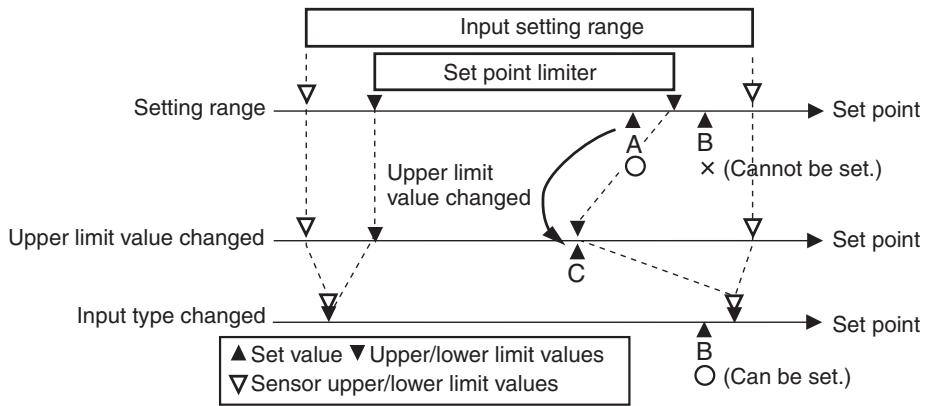
Parameters
| Symbol | Parameter: level | Description |
| SL-H | Set Point Upper Limit: Initial setting level | To limit the SP setting |
| SL-L | Set Point Lower Limit: Initial setting level | To limit the SP setting |
4-6-2 Setting
Set the set point upper and lower limits in the Set Point Upper Limit and Set Point Lower Limit parameters in the initial setting level. In this example, it is assumed that the input type is set to a K thermocouple with a temperature range of -200.0 to 1300.0^ .
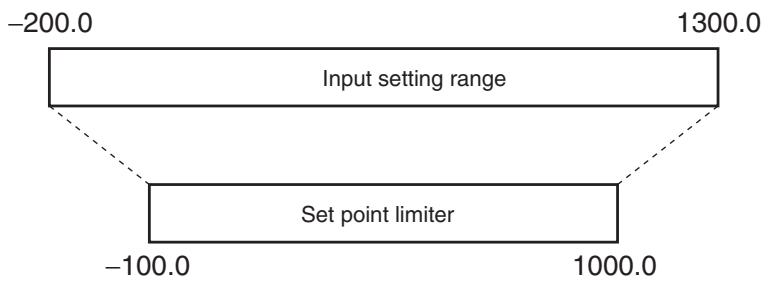
Setting the Set Point Upper-limit Value
Operating Procedure
Input Type
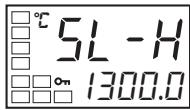
Set Point Upper-limit
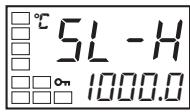
Set Point Upper Limit = 1000
- Press the Key for at least three seconds to move from the operation level to the initial setting level.
- Select the Set Point Upper Limit parameter.
- Use the and Keys to set the parameter to 1000.0.
Setting the Set Point Lower-limit Value
Operating Procedure
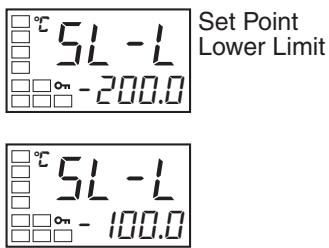
Set Point Lower Limit = -100
-
Select the Set Point Lower Limit parameter in the initial setting level.
-
Use the and Keys to set the parameter to -100.0.
4-7 Using the SP Ramp Function to Limit the SP Change Rate
4-7-1 SP Ramp
The SP ramp function is used to restrict the width of changes in the set point as a rate of change. When the SP ramp function is enabled and the change width exceeds the specified rate of change, an area where the set point is restricted will be created, as shown in the following diagram.
During the SP ramp, control will be performed not for the specified set point but rather for the set point restricted by the rate of change set for the SP ramp function.
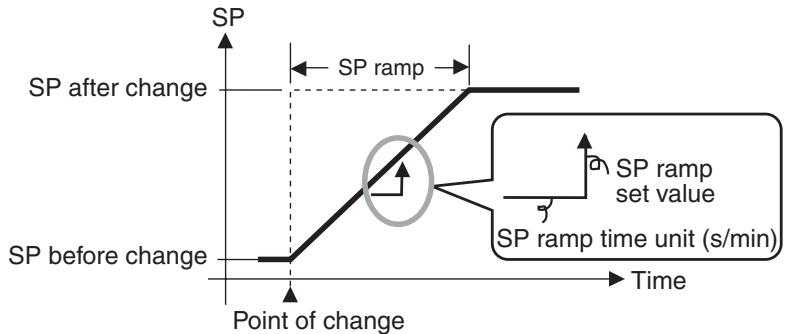
The rate of change during SP ramp is specified using the SP Ramp Set Value and SP Ramp Time Unit parameters. The SP Ramp Set Value parameter is set to OFF by default, i.e., the SP ramp function is disabled.
The SP Ramp Set Value parameter can be set for each bank. Select the bank number in the Display Bank Selection parameter (bank setting level), and then set the SP Ramp Set Value parameter. Also, the ramp set point for the current bank can be monitored in the Set Point During SP Ramp parameter (operation level). Use this parameter when monitoring SP ramp operation.
If the SP Ramp Set Value parameter setting is changed in the adjustment level, the change will be reflected in the SP Ramp Set Value parameter for the current bank.
The SP ramp function is enabled even when switching from local SP to remote SP, and the SP ramp will operate.
Parameters
| Symbol | Parameter: level | Description |
| *slH (: 1 to 8) | PID* MV Upper Limit: PID setting level | To limit the manipulated variable |
| *all (: 1 to 8) | PID* MV Lower Limit: PID setting level | To limit the manipulated variable |
| SL-H | Set Point Upper Limit: Initial setting level | To limit the SP setting |
| SL-L | Set Point Lower Limit: Initial setting level | To limit the SP setting |
| *SPR (: 0 to 7) | Bank* SP Ramp Set Value: Bank setting level | To limit the SP rate of change |
| SPRU | SP Ramp Time Unit: Advanced function setting level | Unit for setting the SP |
| RLSP | Alarm SP Selection: Advanced function setting level | Alarm SP selection |
| *SPR (: 0 to 7) | Bank* SP Ramp Set Value: Bank setting level | Setting the SP ramp |
Operation at Startup
If the SP ramp function is enabled when the Controller is turned ON or when switching from STOP to RUN mode, the process value reaches the set point using the SP ramp function in the same way as when the set point is changed. In this case, operation is carried out with the process value treated as the set point before the change was made. The direction of the SP ramp changes according to the relationship between the process value and the set point.
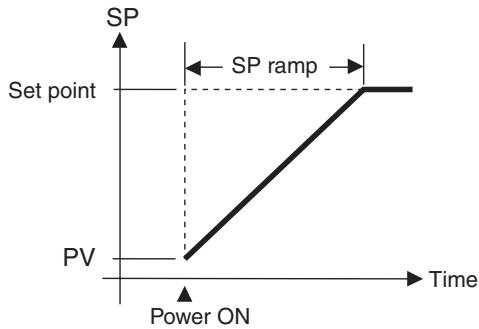
PV < SP
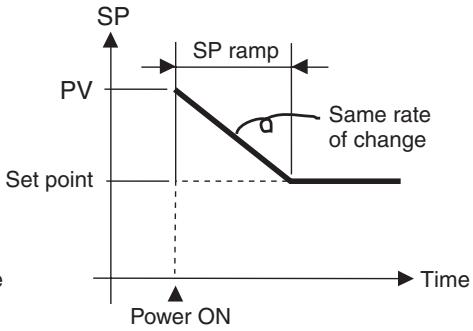
PV > SP
Restrictions during SP Ramp Operation
- Execution of auto-tuning starts after the end of the SP ramp.
- When control is stopped or an error occurs, the SP ramp function is disabled.
Alarms during SP Ramp Operation
The operation of alarms during SP ramp operation depends on whether alarms are set to be based on the ramp set point or the target set point (refer to the following diagrams). The set point to be used is set in the Alarm SP Selection parameter.
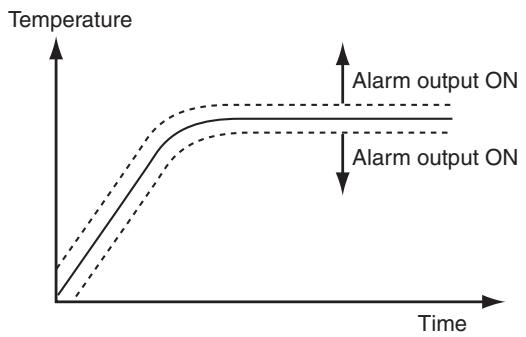
Alarm SP Selection = Ramp SP (Alarm Type: 1 (Upper/Lower Limits))
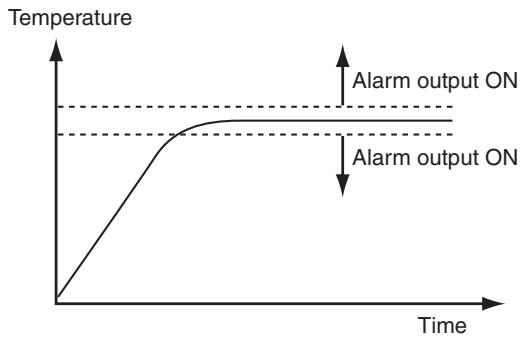
Alarm SP Selection = Target SP (Alarm Type: 1 (Upper/Lower Limits))
4-8 Moving to the Advanced Function Setting Level
Use the following procedure to move to the advanced function setting level.
1,2,3...
- Press the and Keys simultaneously for at least three seconds in operation level.
Note The key pressing time can be changed in the Move to Protect Level Time parameter (advanced function setting level).
- The Controller moves to the protect level, and the Operation/Adjustment Protect parameter is displayed.
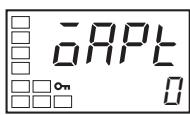
Protect Level
Operation/Adjustment Protect
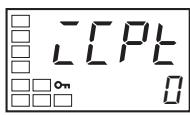
Initial Setting/ Communications Protect
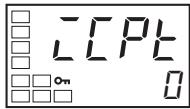
- Press the Key once to move to the Initial Setting/Communications Protect parameter.
- Set the set value to 0. The default setting is 0 (possible to reach).
Operation Level
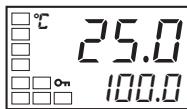
PV/SP
Initial Setting Level
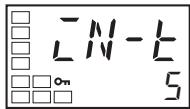
Input Type
Initial Setting Level
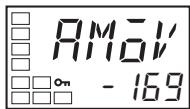
Move to Advanced Function Setting Level
Advanced function setting level
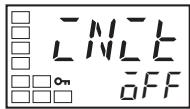
Parameter Initialization
Initial Setting Level
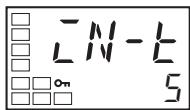
Input Type
Operation Level
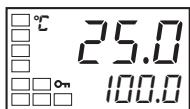
PV/SP
- Press the and Keys simultaneously for at least one second to return to the operation level.
- Move to the advanced function setting level.
Press the Key for at least three seconds to move from the operation level to the initial setting level.
- Select the Move to Advanced Function Setting Level parameter by pressing the 回 Key.
- Press the Key, enter the password (-169), and then either press the Key or leave the setting for at least two seconds to move to the advanced function setting level from the initial setting level.
- To return to the initial setting level, press the Key for at least one second.
- To return to the operation level, press the Key for at least one second.
4-9 Using the Key Protect Level
4-9-1 Protection
- To move to the protect level, press the l and 念 Keys simultaneously for at least three seconds in operation level or adjustment level. (See note.)
Note The key pressing time can be changed in the Move to Protect Level Time parameter (advanced function setting level). - The protect level protects parameters that are not changed during Controller operation until operation is started to prevent them from being modified unintentionally.
There are four types of protection: operation/adjustment protect, initial setting/communications protect, setting change protect, and PF Key protect. - The protect level settings restrict the range of parameters that can be used.
Operation/Adjustment Protect
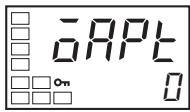
The following table shows the relationship between set values and the range of protection.
| Level | Set value | ||||
| 0 | 1 | 2 | 3 | ||
| Operation level | PV | Can be dis-played | Can be dis-played | Can be dis-played | Can be dis-played |
| PV/SP | Can be dis-played and changed | Can be dis-played and changed | Can be dis-played and changed | Can be dis-played | |
| Others | Can be dis-played and changed | Can be dis-played and changed | Cannot be displayed and moving to other levels is not possible | Cannot be displayed and moving to other levels is not possible | |
| Adjustment level | Can be dis-played and changed | Cannot be displayed and moving to other levels is not possible | Cannot be displayed and moving to other levels is not possible | Cannot be displayed and moving to other levels is not possible | |
- Parameters are not protected when the set value is set to 0.
- The default is 0.
Initial Setting/ Communications Protect
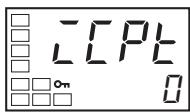
This protect level restricts movement to the initial setting level, communications setting level, and advanced function setting level.
| Set value | Initial setting level | Communications setting level | Advanced function setting level |
| 0 | Possible to reach | Possible to reach | Possible to reach |
| 1 | Possible to reach | Possible to reach | Not possible to reach |
| 2 | Not possible to reach | Not possible to reach | Not possible to reach |
- The default is 0.
Setting Change Protect
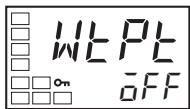
This protect level restricts key operations.
| Set value | Description |
| OFF | Settings can be changed using key operations. |
| ON | Settings cannot be changed using key operations. (The protect level settings, however, can be changed.) |
- The default is OFF.
- The all protect indication (Oπ) will light when setting change protect is set.
PF Key Protect
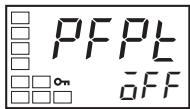
This protect level enables or disables PF Key operations.
| Set value | Description |
| OFF | PF Key enabled. |
| ON | PF Key disabled (Operation as function key prohibited). |
- The default is OFF.
4-9-2 Entering the Password to Move to the Protect Level
- Protect level can be moved to only by display the password display and entering the correct password. (The user can set any password in the Protect Level Password parameter. If no password is set (i.e., if the password is set to 0 in the Protect Level Password parameter), the password input display to move to protect level will not be displayed and the protect level can be moved to directly.
Operating Procedure
Use the following procedure to move to protect level.
Example with a Password of 1234
Operation Level

PV/SP
Protect Level
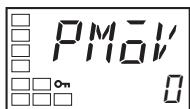
Move to Protect Level
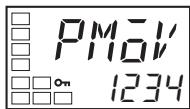
Protect Level
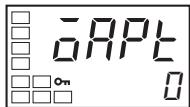
Operation/Adjustment Protect
- Press the and Keys simultaneously for at least the time set in the Move to Protect Level Time parameter to move from the operation level to the protect level.
- Press the Key to set the parameter to 1234 (password input).
- Move to the Operation/Adjustment Protect parameter by pressing the or Key or leaving the setting for at least two seconds.
Example with No Password Set
Operation Level
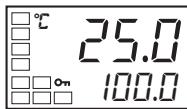
PV/SP
Protect Level
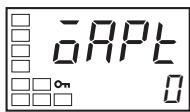
Operation/Adjustment Protect
Press the and Keys simultaneously for at least the time set in the Operation/Adjustment Protect parameter to move from the operation level to the protect level.
When a password is not set, the Operation/Adjustment Protect parameter will be displayed.
Setting the Password
Operating Procedure
Use the following procedure to set the password to move to the protect level.
Example To set the Password to 1234
Operation Level
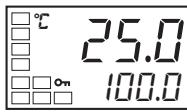
PV/SP
Protect Level
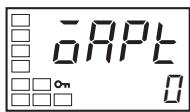
Operation/Adjustment Protect
Protect Level
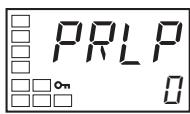
Password to Move to Protect Level
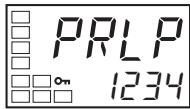
- Press the and Keys simultaneously for at least the time set in the Move to Protect Level Time parameter to move from the operation level to the protect level.
-
Select the Password to Move to Protect Level parameter by pressing the Key.
-
Press the and Keys to set the parameter to 1234. (To prevent setting the password incorrectly, the and Keys or and Keys must be pressed simultaneously to set the password.)
Note Protection cannot be cleared or changed without the password. Be careful not to forget it. If you forget the password, contact your OMRON sales representative.
Communications Operation Command to Move to the Protect Level
Note
- The Write Variable operation command can be used via communications to write the password to the Move to Protect Level parameter. When the correct password is written, the display will change to the Operation/Adjustment Protect parameter and writing the parameters in the protect level will be enabled.
(1) If the Write Variable operation command is used to write the wrong password to the Move to Protect Level parameter after the correct parameter has been written, the Move to Protect Level parameter will be displayed and any Write Variable operation commands to write parameters in the protect level will result in operation errors.
(2) If a password is not set or if it is set to 0, the display will change to the Operation/Adjustment Protect parameter and writing the parameters in the protect level will be enabled immediately.
4-10 PV Change Color
4-10-1 PV Color Change Function
Use the PV color change function to change the color of the PV display (No. 1 display).
There are three display colors, orange, red, and green, and you can select from the following three modes and eight functions.
PV Change Color
- Constant: This mode displays orange, red, or green all the time.
- Linked to Alarm 1: This mode switches the PV display color from red to green when alarm 1 turns ON or from green to red when alarm 1 turns ON.
- Linked to PV stable band: This mode switches the PV display color between red outside the PV stable band and green within PV stable band, or between green outside the PV stable band and red within PV stable band.
Set the PV stable band in the PV Stable Band parameter (advanced function setting level).
The default is R (red).
The following tables show the display functions that can be set using the PV color change function.
| Mode | Setting | Function | PV change color | Application example | ||
| Constant | aRb | Orange | Constant: Orange | To match the display color with other Controller models | ||
| Red | Red | Constant: Red | To match the display color with other Controller models | |||
| GRN | Green | Constant: Green | To match the display color with other Controller models | |||
| Linked to alarm 1 | Alarm value ALM1 lit PV SP | |||||
| ALM1 not lit | ALM1 lit | Application example | ||||
| R-G | Red to Green | Red | Green | To display the PV reached signal | ||
| G-R | Green to Red | Green | Red | To display error signals | ||
| Linked to PV stable band | PV stable band Low Within High PV SP | |||||
| Low | Within PV stable band | High | Application example | |||
| R-G,R | Red to Green to Red | Red | Green | Red | To display stable status | |
| G-G,R | Green to Orange to Red | Green | Orange | Red | To display stable status | |
| G-G,R | Orange to Green to Red | Orange | Green | Red | To display stable status | |
PV Stable Band
PV Stable Band
When the mode to link to the PV stable band is selected, the PV display color will change according to whether the present value (PV) is lower than, within, or higher than the PV stable band shown in the following figure. The PV stable band is set with the SP as the center, as shown below.
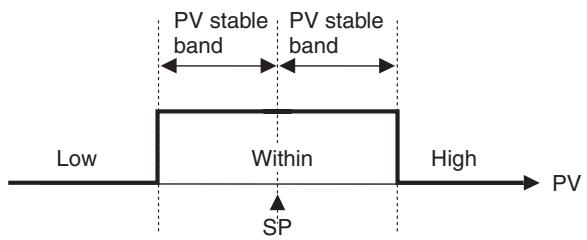
The default is 5.0(^ / ^) for a temperature input and 5.0% FS for an analog input.
4-10-2 Setting
Setting the PV Change Color to Indicate Stable Status
To display the PV in a stable green display when the PV is within ± 15.0^ of the set point to enable checking the control process at a glance, set the PV Change Color and PV Stable Band parameters.
PV change color = R - R (Red to Green to Red)
PV stable band = 15.0^
Operating Procedure
Release the protection before setting the PV Change Color and PV Stable Band parameters to enable moving to advanced function setting level. (Refer to steps 1 to 8 on page 104.)
PV Change Color: - (Red to Green to Red)
PV Stable Band: 15.0 (°C)
Operation Level
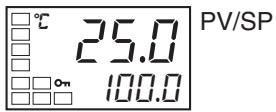
Initial Setting Level
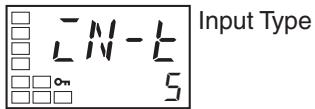
Initial Setting Level
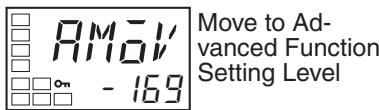
Advanced Function Setting Level
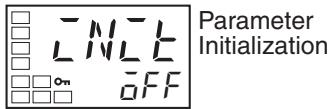
Advanced Function Setting Level
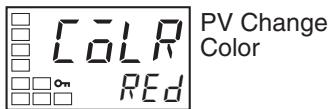
- Press the Key for at least three seconds to move from the operation level to the initial setting level.
- Select the Move to Advanced Function Setting Level parameter by pressing the Key.
- Use the Key to enter "−169" (the password).
Move to the advanced function setting level by pressing the Key or leaving the setting for at least two seconds.
- Select the PV Change Color parameter by pressing the Key.
Advanced Function Setting Level
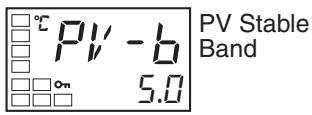
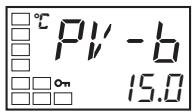
Operation Level
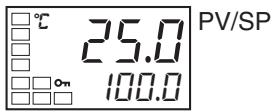
- Press the Key to set the parameter to R - R .
-
Select the PV Stable Band parameter by pressing the
-
Use the Key to set the parameter to 15.0.
- To return to the initial setting level, press the Key for at least one second.
- To return to the operation level, press the Key for at least one second.
4-11 Alarm Delays
4-11-1 Alarm Delays
- Delays can be set for the alarm outputs. ON and OFF delays can be set separately for alarms 1, 2, and 3. The ON and OFF delays for alarm 1 function only for the alarm function. If the alarm 1 function is set to be output as an OR with other alarms (i.e., the heater burnout alarm, HS alarm, heater overcurrent alarm, or input error output alarm), delays cannot be set for the other alarms. The ON and OFF delays for alarms 1, 2, and 3 also apply to the individual SUB1, SUB2, and SUB3 indicators and to communications status. The alarm ON delays will also function when power is turned ON or when moving from the initial setting level to operation level (e.g., to software resets). All outputs will turn OFF and the OFF delays will not function when moving to the initial setting level or when an alarm is output for a A/D converter error.
Operation of Alarm ON and OFF Delays (for an Upper-limit Alarm)
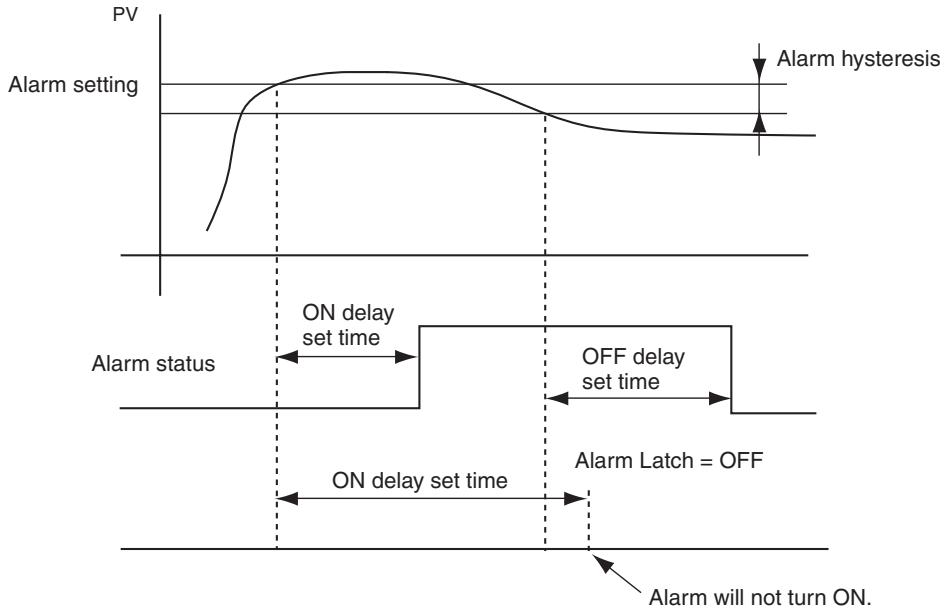
- The alarm will not turn ON if the time that the alarm is ON is equal to or less than the ON delay set time. Also, the alarm will not turn OFF if the time that the alarm is OFF is equal to or less than the OFF delay set time.
- If an alarm turns OFF and then back ON during the ON delay time, the time will be remeasured from the last time the alarm turns ON. Also, if an alarm turns ON and then back OFF during the OFF delay time, the time will be remeasured from the last time the alarm turns OFF.
Parameters Related to Alarm Delays
| Parameter name | Symbol | Set (monitor) values |
| Alarm 1 ON Delay | R10N | 0 to 999 (s) |
| Alarm 2 ON Delay | R20N | 0 to 999 (s) |
| Alarm 3 ON Delay | R30N | 0 to 999 (s) |
| Alarm 1 OFF Delay | R10F | 0 to 999 (s) |
| Alarm 2 OFF Delay | R20F | 0 to 999 (s) |
| Alarm 3 OFF Delay | R30F | 0 to 999 (s) |
Note
(1) The defaults are 0, i.e., the ON and OFF delays are disabled.
(2) The parameters are displayed when alarm functions are assigned and when the alarm type is set to any type but 0 (none), 12: LBA, or 13: PV change rate alarm.
Operating Procedure
Use the following procedure to set ON and OFF delays for the alarm 1.
An ON delay of 5 seconds and an OFF delay of 10 s will be set.
Operation Level
Initial Setting Level
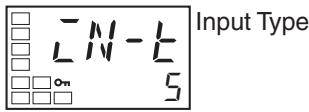
Initial Setting Level
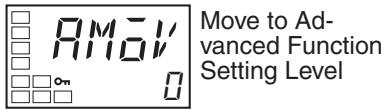
Advanced Function Setting Level
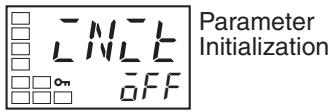
Advanced Function Setting Level
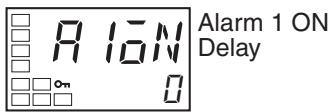
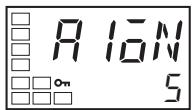
Advanced Function Setting Level
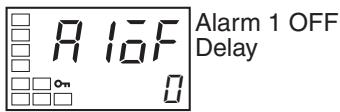

Initial Setting Level
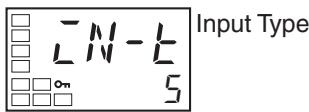
- Press the Key for at least three seconds to move from the operation level to the initial setting level.
- Select the Move to Advanced Function Setting Level parameter by pressing the Key. (For details on moving between levels, refer to 4-8 Moving to the Advanced Function Setting Level.)
- Press the Key to enter the password (-169) and move from the initial setting level to the advanced function setting level.
- Press the Key to select the Alarm 1 ON Delay parameter.
- Press the Key to set the parameter to 5.
- Press the Key to select the Alarm 1 OFF Delay parameter.
- Press the Key to set the parameter to 10.
- Press the Key for at least one second to move from the advanced function setting level to the initial setting level.
Operation Level
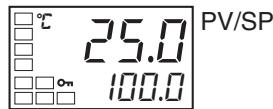
- Press the Key for at least one second to move from the initial setting level to the operation level.
4-12 Loop Burnout Alarm
4-12-1 Loop Burnout Alarm (LBA)
- The loop burnout alarm can be used only with standard models.
- With a loop burnout alarm, there is assumed to be an error in the control loop if the control deviation (SP - PV) is greater than the threshold set in the LBA Level parameter and if the control deviation is not reduced by at least the value set in the LBA Detection Band parameter within the LBA detection time.
- Loop burnout alarms are detected at the following times.
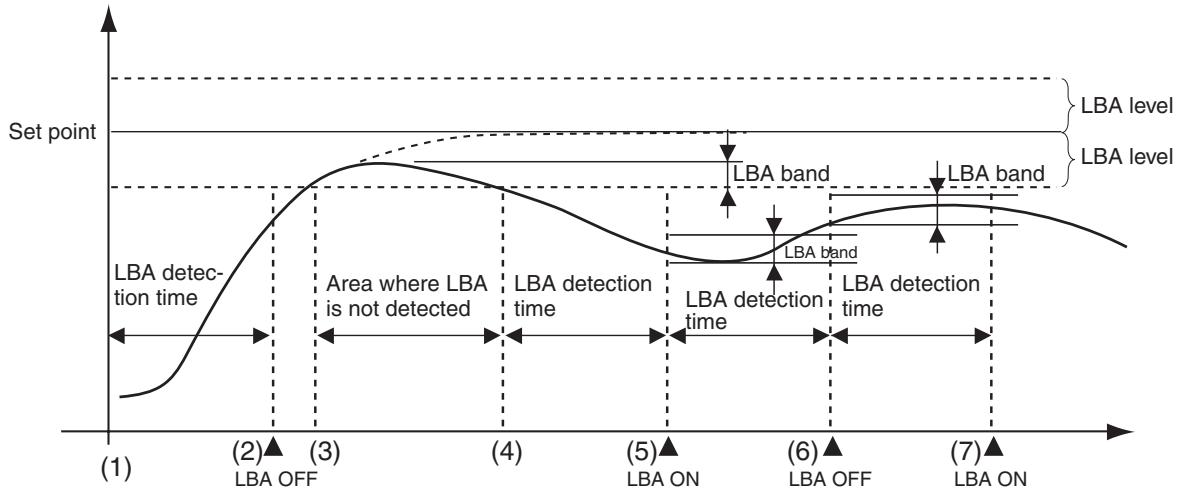
If the control deviation is reduced in the area between 1 and 2 (i.e., the set point is approached) and the amount the control deviation is reduced is at least equal to the LBA band, the loop burnout alarm will remain OFF.
The process value is within the LBA level between 3 and 4, and thus loop burnout alarms will not be detected. (The loop burnout alarm will remain OFF.)
If the process value is outside the LBA level between 4 and 5 and the control deviation is not reduced by at least the LBA band within the LBA detection time, the loop burnout alarm will turn ON.
If the control deviation is reduced in the area between 5 and 6 (i.e., the set point is approached) and the amount the control deviation is reduced is at least equal to the LBA band, the loop burnout alarm will turn OFF.
If the control deviation is reduced in the area between 6 and 7 (i.e., the set point is approached) and the amount the control deviation is reduced is less than the LBA band, the loop burnout alarm will turn ON.
- If the LBA detection time, LBA level, LBA detection band, and PID settings are not appropriate, alarms may be detected inappropriately or alarms may not be output when necessary.
-
Loop burnout alarms may be detected if unexpectedly large disturbances occur continuously and a large deviation does not decrease.
-
If a loop burnout occurs when the set point is near the ambient temperature, the temperature deviation in a steady state may be less than the LBA level, preventing detection of the loop burnout.
- If the set point is so high or low that it cannot be reached even with a saturated manipulated variable, a temperature deviation may remain even in a steady state and a loop burnout may be detected.
- Detection is not possible if a fault occurs that causes an increase in temperature while control is being applied to increase the temperature (e.g., an SSR short-circuit fault).
- Detection is not possible if a fault occurs that causes a decrease in temperature while control is being applied to decrease the temperature (e.g., a heater burnout fault).
Parameters Related to Loop Burnout Alarms
| Parameter name | Symbol | Setting range | Remarks | |
| PID* LBA Detection Time (*: 1 to 8) | *L bR | 0 to 9999 (s) | Setting 0 disables the LBA function. | |
| LBA Detection Time | L bR | |||
| LBA Level | L bRL | Controllers with tempera-ture inputs | 0.1 to 3,240.0 (°C/°F) (See note.) | Default: 8.0 (°C/°F) |
| Controllers with analog inputs | 0.01 to 99.99 (%FS) | Default: 10.00% FS | ||
| LBA Band | L bRb | Controllers with tempera-ture inputs | 0.0 to 3,240.0 (°C/°F) (See note.) | Default: 3.0 (°C/°F) |
| Controllers with analog inputs | 0.00 to 99.99 (%FS) | Default: 0.20% FS | ||
Note Set "None" as the unit for analog inputs.
- A loop burnout alarm can be output by setting the alarm 1 type to 12 (LBA).
- A setting of 12 (LBA) can be set for alarm 2 or alarm 3, but the setting will be disabled.
- Loop burnouts are not detected during SP ramp operation.
- Loop burnouts are not detected during auto-tuning, manual operation, or while stopped.
- If the alarm 1 latch is set to ON, the latch will be effective for the loop burnout alarm.
- Loop burnout alarms are not detected when using a remote SP.
Automatically Setting the LBA Detection Time
- Automatic setting is not possible for ON/OFF control. Set the LBA Detection Time parameter in the advanced function setting level.
- When PID control is being used, the LBA detection time can be set individually for each PID set. First select the PID set number in the Display PID Selection parameter (PID setting level), and then set the time in the LBA Detection Time parameter.
- The LBA detection time is automatically set by auto-tuning, and the execution results are saved in the PID set when auto-tuning is started. (The results are not set automatically, however, for heating/cooling control.)
- If the optimum LBA detection time is not obtained by auto-tuning, set the LBA Detection Time parameter (PID setting level).
Determining the LBA Detection Time
1,2,3...
-
To manually set the LBA detection time, set the LBA Detection Time parameter to twice the LBA reference time given below.
-
Set the output to the maximum value.
- Measure the time required for the width of change in the input to reach the LBA band.
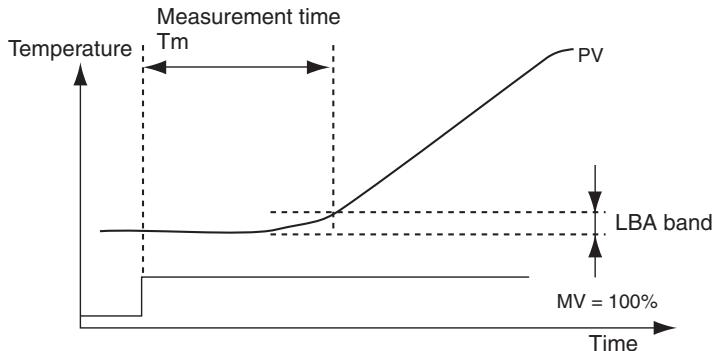
LBA detection time = Tm × 2
- Set the LBA Detection Time parameter to two times the measured time.
LBA Level
- Set the control deviation when the control loop is working properly.
- The default is 8.0(^ / ^) for a temperature input and 10.00% FS for an analog input.
LBA Band
- There is assumed to be an error in the control loop if the control deviation is greater than the threshold set in the LBA Level parameter and if the control deviation does not change by at least the value set in the LBA Band parameter.
- The default is 3.0(^ / ^) for a temperature input and 0.20% FS for an analog input.
Operating Procedure
Perform the following procedure to use the loop burnout alarm.
In this example, the LBA detection time is set to 10, the LBA level is set to 8.0, and the LBA band is set to 3.0.
Operation Level
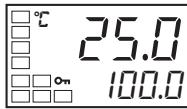
PV/SP
Initial Setting Level
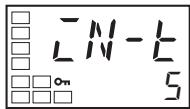
Input Type
Initial Setting Level
Alarm 1 Type
- Press the Key for at least three seconds to move from the operation level to the initial setting level.
- Select the Alarm 1 Type parameter by pressing the Key.
Initial Setting Level
Operation Level
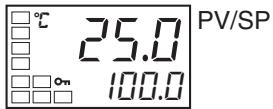
PID Setting Level
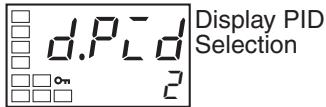
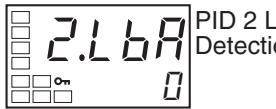
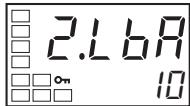
Initial Setting Level
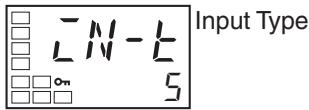
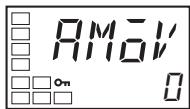
Move to Advanced Function Setting Level
Advanced Function Setting Level
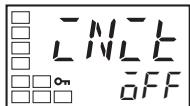
Parameter Initialization
Advanced Function Setting Level
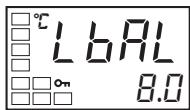
LBA Level
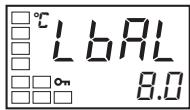
Advanced Function Setting Level
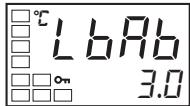
LBA Band
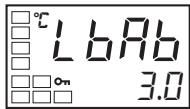
- Press the Key to set the parameter to 12.
To return to the operation level, press the Key for at least one second. - Press the Key to move from the operation level to the PID setting level.
- The current PID set number will be displayed. Press the 心 or 心 Key to select PID set 2.
- Press the Key to select the PID 2 LBA Detection Time parameter.
- Press the Key to set the parameter to 10.
- Press the Key for at least three seconds to move to the initial setting level.
- Select the Move to Advanced Function Setting Level parameter by pressing the Key. (For details on moving between levels, refer to 4-8 Moving to the Advanced Function Setting Level.)
- Press the Key to enter the password (-169), and move from the initial setting level to the advanced function setting level.
- Select the LBA Level parameter by pressing the Key.
- Press the Key to set the parameter to 8.0. (The default is 8.0.)
- Select the LBA Band parameter by pressing the Key.
- Press the or Key to set the parameter to 3.0. (The default is 3.0.)
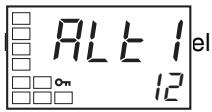
- Press the Key to set the parameter to 12.
To return to the operation level, press the Key for at least one second.
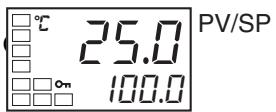
- Press the Key to move from the operation level to the PID setting level.
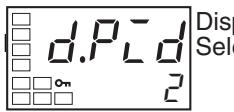
- The current PID set number will be displayed. Press the 或 或 Key to select PID set 2.
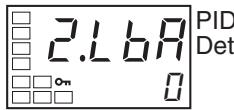
PID 2 LBA
Detection Time
- Press the Key to select the PID 2 LBA Detection Time parameter.
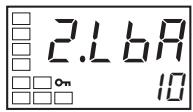
- Press the Key to set the parameter to 10.
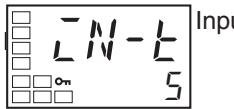
Input Type
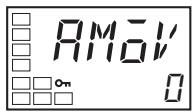
Move to Advanced Function Setting Level
- Press the Key for at least three seconds to move to the initial setting level.
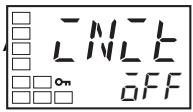
Parameter Initialization
-
Select the Move to Advanced Function Setting Level parameter by pressing the . (For details on moving between levels, refer to 4-8 Moving to the Advanced Function Setting Level.)
-
Press the Key to enter the password (-169), and move from the initial setting level to the advanced function setting level.
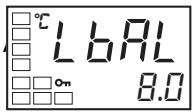
LBA Level
- Select the LBA Level parameter by pressing the Key.
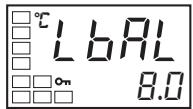
- Press the Key to set the parameter to 8.0. (The default is 8.0.)
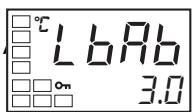
LBA Band
- Select the LBA Band parameter by pressing the Key.
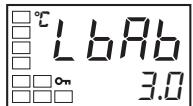
- Press the or Key to set the parameter to 3.0. (The default is 3.0.)
Initial Setting Level
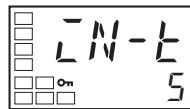
Input Type
Operation Level
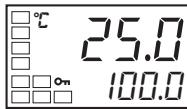
PV/SP
- Press the Key for at least one second to move from the advanced function setting level to the initial setting level.
- Press the Key for at least one second to move from the initial setting level to the operation level.
4-13 Performing Manual Control
4-13-1 Manual Operation
Standard Models
Position-proportional Models
- With standard models, the MV is manipulated directly. With position-proportional models, the MV is manipulated through the amount of valve opening or by parameter settings.
- The manipulated variable can be set in manual mode if the PV/MV parameter is displayed in the manual control level. The final MV used in automatic mode will be used as the initial manual MV when moving from automatic mode to manual mode. In manual mode, the change value will be saved immediately and reflected in the actual MV.
-
Manual operation can be used only for PID control.
-
The automatic display return function will not operate in manual mode.
- Balanceless-bumpless operation will be performed for the MV when switching from manual operation to automatic operation. (See note.)
- If a power interruption occurs during manual operation, manual operation will be restarted when power is restored using the same MV as when power was interrupted.
- Switching between automatic and manual operation is possible for a maximum of one million times.
The overall manual operation is illustrated in the following figure.
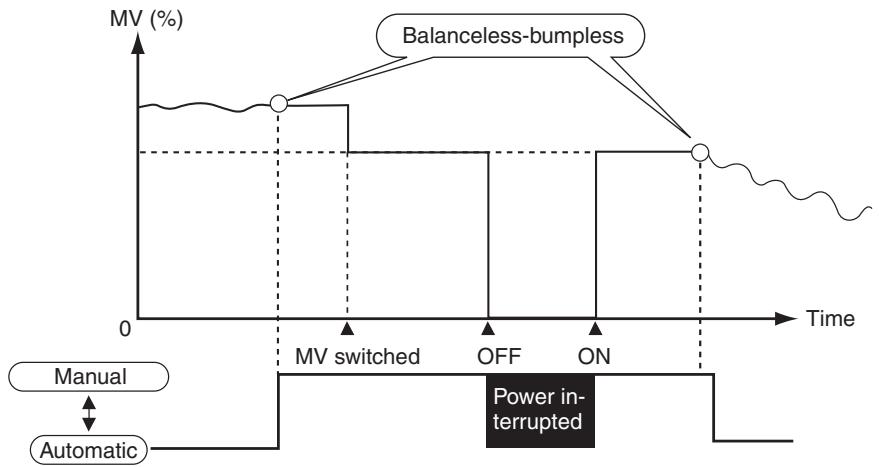
-
When floating control is used or when the Direct Setting of Position Proportional MV parameter is set to OFF:
-
Pressing the Key turns ON the open output, and pressing the Key turns ON the close output.
-
The automatic display return function will not operate in manual mode.
- Balanceless-bumpless operation will be performed for the MV when switching between manual and automatic operation. (See note.)
-
Switching between manual and automatic operation is possible for a maximum of one million times.
-
When close control is used or when the Direct Setting of Position Proportional MV parameter is set to ON:
-
Just as with standard models, the MV is set numerically.
- The automatic display return function will not operate in manual mode.
- Balanceless-bumpless operation will be performed for the MV when switching between manual and automatic operation. (See note.)
Note In balanceless-bumpless operation, the MV before switching is used initially after the switch and then gradually changed to achieve the proper value after switch to prevent radical changes in the MV after switching operation.
- If a power interruption occurs during manual operation, manual operation will be restarted when power is restored using the same MV as when power was interrupted.
- Switching between manual and automatic operation is possible for a maximum of one million times.
- Operation will be as described below if a potentiometer input error occurs.
When the Manual MV Limit Enable Parameter Is Set to OFF:
Manual MV ≥ 100
Open output: ON
Manual MV ≤ 0
Close output: ON
If the manual MV is other than the above, the open and close outputs will both be OFF.
When the Manual MV Limit Enable Parameter Is Set to ON:
Manual MV = MV upper limit
Open output: ON
Manual MV = MV lower limit
Close output: ON
If the manual MV is other than the above, the open and close outputs will both be OFF.
Related Displays and Parameters
| Parameter name | Symbol | Level | Remarks |
| PV/MV (Manual MV) | --- | Manual Control Level | Changes the manual MV. Standard: -5.0 to 105.0 (See note 2.) Heating/cooling: -105.0 to 105.0 (See note 2.) Position-proportional: -5.0 to 105.0 (See notes 2 and 3.) |
| Direct Setting of Position Proportional MV | PMVd | Advanced Function Setting Level | Selects the method for specifying each MV for manual operation, when stopping, or when an error occurs. OFF: All open, hold, all closed ON: -5.0 to 105% |
| Auto/Manual Switch | R-M | Operation Level | Switches between automatic and manual modes. |
| Auto/Manual Select Addition | RMRd | Advanced Function Setting Level | Enables switching between automatic and man-ual modes. |
Note (1) Refer to 4-17 Output Adjustment Functions for information on the priority for the MV.
Manual MV Limit Enable
(2) For Manual MV Limit Enable, this value will be between the MV upper limit and the MV lower limit.
(3) This setting is enabled only when the Direct Setting of Position Proportional MV parameter is set to ON.
When the Manual MV Limit Enable parameter is set to ON (enabled), the MV limits will function and the setting range for the Manual MV parameter will be between the MV upper limit and the MV lower limit. When the parameter is set to OFF (disabled), MV limits will not function.
| Parameter name | Setting range | Default |
| Manual MV Limit Enable | OFF: Disabled, ON: Enabled | ON |
Moving from the Operation Level to the Manual Control Level
- When the Key is pressed for at least 3 seconds in the operation level's auto/manual switching display, the manual mode will be entered and the manual control level will be displayed. It is not possible to move to any displays except for the PV/MV parameter during manual operation. Press the Key for at least one second from the PV/MV parameter display in manual control level to return to automatic mode and display the top parameter in the operation level.
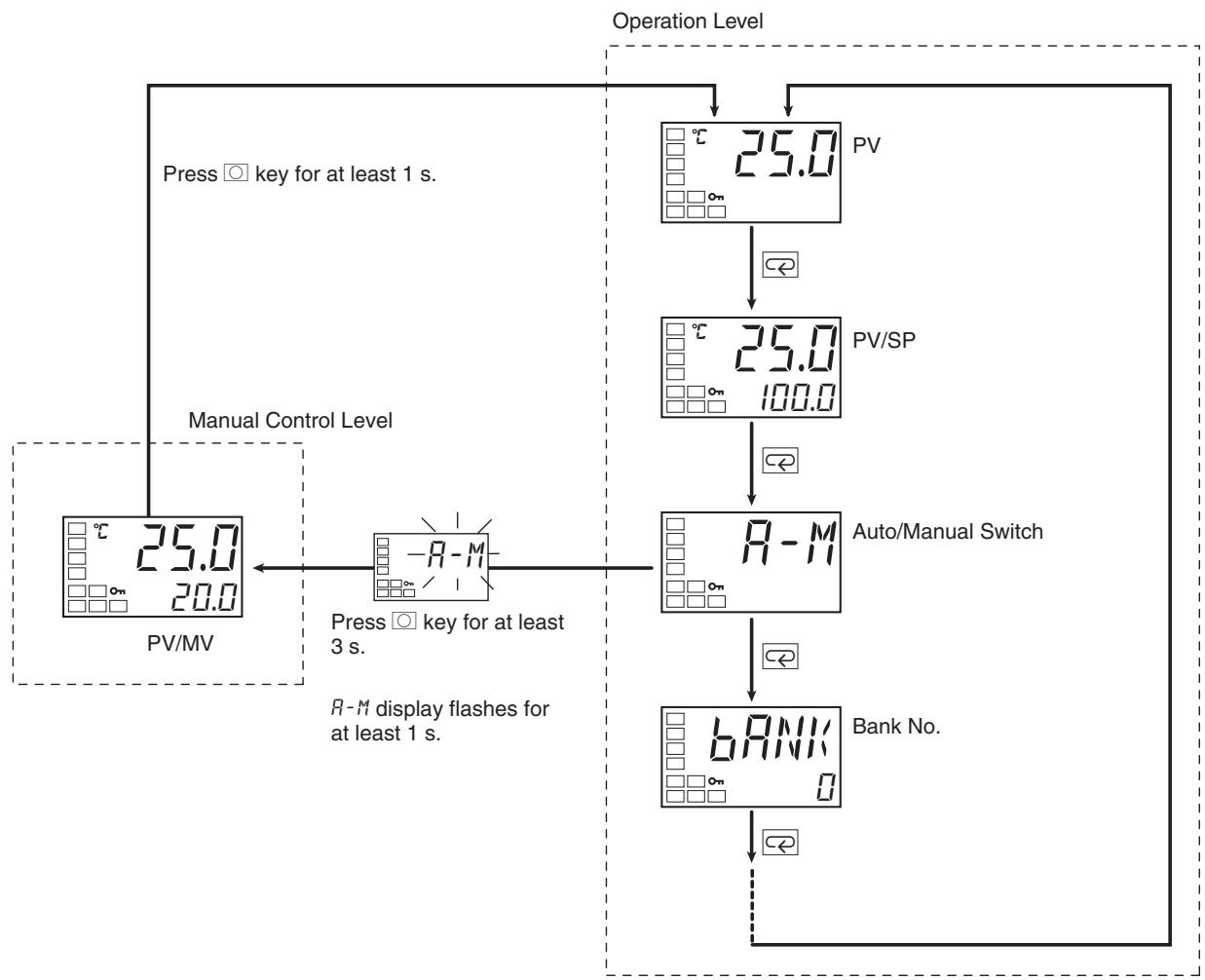
- If an event input is set to MANU (auto/manual), the Auto/Manual Switch parameter will not be displayed. Use the event input to switch between automatic and manual modes.
Using the PF Key to Move to the Manual Control Level
- When the PF Setting parameter is set to A-M (Auto/Manual), pressing the PF Key for at least one second while in the adjustment, operation, bank setting, or PID setting level will change the mode to manual mode and move to the manual control level. During manual operation it is not possible to move to any displays other than PV/MV (Manual MV). Press the PF Key for at least one second from the PV/MV display in the manual control mode to change the mode to automatic mode, move to the operation level, and display the top parameter in the operation level.
- When MANU (Auto/Manual) is selected for an event input, the Auto/Manual Switch parameter is not displayed. In that case, switching between auto and manual mode is executed by using an event input.
Auto/Manual Select Addition
- The Auto/Manual Select Addition parameter must be set to ON in the advanced function setting level before it is possible to move to manual mode. The default is ^N .
Note
(1) Priority of Manual MV and Other Functions
Even when operation is stopped, the manual MV is given priority.
Auto-tuning and self-tuning will stop when manual mode is entered.
(2) Manual MV and SP Ramp
If operating, the SP ramp function will continue even when manual mode is entered.
Operating Procedure
Use the following procedure to set the manipulated variable in manual mode.
Operation Level

PV/SP
Initial Setting Level
Input Type
Initial Setting Level
Move to Advanced Function Setting Level
Advanced Function Setting Level
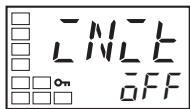
Parameter Initialization
Advanced Function Setting Level
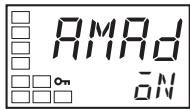
Auto/Manual Select Addition
- Press the Key for at least three seconds to move from the operation level to the initial setting level.
- Select the PID ON/OFF parameter by pressing the . (The default is PID.)
- Select the Move to Advanced Function Setting Level parameter by pressing the Key. (For details on moving between levels, refer to 4-8 Moving to the Advanced Function Setting Level.)
- Press the to enter the password (-169), and move from the initial setting level to the advanced function setting level.
- Select the Auto/Manual Select Addition parameter by pressing the Key.
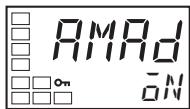
Initial Setting Level
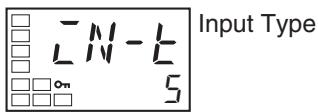
Operation Level
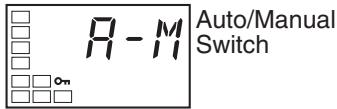
Manual Control Level
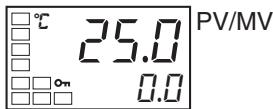
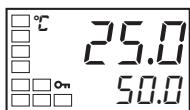
Operation Level
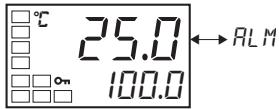
Operating Procedure
Operation Level
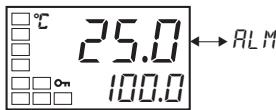
Initial Setting Level
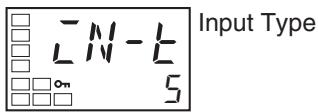
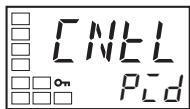
Initial Setting Level
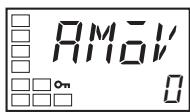
Move to Advanced Function Setting Level
- Use the Key to set the parameter to ON. (The default is ON.)
- Press the Key for at least one second to move from the advanced function setting level to the initial setting level.
- Press the Key for at least one second to move from the initial setting level to the operation level.
- Select the Auto/Manual Switch parameter by pressing the 一 Key.
- Press the Key for at least three seconds to move from the operation level to the manual control level.
- Press the or Key to set the manual MV. (In this example, the MV is set to 500% .)
Note The manual MV setting must be saved (see page 14), but values changed with Key operations are reflected in the control output immediately.
- Press the Key for at least one second to move from the manual control level to the operation level.
In this example, A-M (Auto/Manual) is set for the PF Setting parameter (E5AN/EN-H only).
- Press the Key for at least three seconds to move from the operation level to the initial setting level.
- Select the PID ON/OFF parameter by pressing the Key. (The default is PID.)
- Select the Move to Advanced Function Setting Level parameter by pressing the Key. (For details on moving between levels, refer to 4-8 Moving to the Advanced Function Setting Level.)
Advanced Function Setting Level
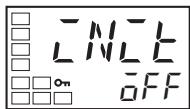
Parameter Initialization
Advanced Function Setting Level
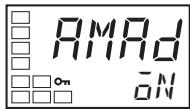
Auto/Manual Select Addition
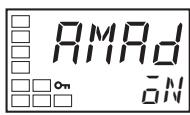
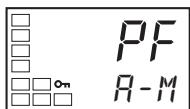
Initial Setting Level
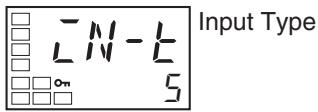
Manual Control Level
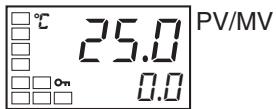
Operation Level
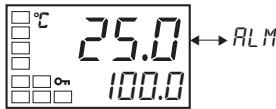
- Press the × Key to enter the password (-169), and move from the initial setting level to the advanced function setting level.
- Select the Auto/Manual Select Addition parameter by pressing the Key.
- Use the to set the parameter to ON. (The default is ON.)
- Press the Key to select the PF Setting parameter and confirm that it is set to "A-M." ("A-M" is the default setting.)
- Press the Key for at least one second to move from the advanced function setting level to the initial setting level.
- Press the Key for at least one second to move from the initial setting level to the operation level.
- Press the PF Key for at least one second to move from the operation level to the manual control level.
- Press the or Key to set the manual MV. (In this example, the MV is set to 50.0% .)
Note The manual MV setting must be saved (see page 14), but values changed with key operations are reflected in the control output immediately. - Press the PF Key to move from the manual control level to the operation level.
4-14 Using the Transfer Output
4-14-1 Transfer Output Function
- The transfer output function can be used by Controllers that support a transfer output (E5AN/EN-H□F). For Controllers that do not have a transfer output, a control output can be used as a simple transfer output if the control output is a current output or a linear voltage output.
-
To use a transfer output, change the setting for the Transfer Type parameter to anything other than OFF. (This will enable the Transfer Output Upper Limit and Transfer Output Lower Limit parameters.)
-
The operation differs for models with a transfer output and models without a transfer output for which control output 1 or control output 2 is used as a simple transfer output, as shown in the following table.
Transfer Output Destination
| Transfer output | Control output 1 | Control output 2 | Transfer output destination |
| Yes | --- | --- | Transfer output |
| No | Current output or linear voltage output | None, relay output, voltage output (for driving SSR), or SSR output | Control output 1 |
| No | Current output or linear voltage output | Current output or linear voltage output | Control output 1 |
| No | Relay output, voltage output (for driving SSR), or SSR output | Current output or linear voltage output | Control output 2 |
| No | Relay output, voltage output (for driving SSR), or SSR output | None, relay output, voltage output (for driving SSR), or SSR output | None |
■ Precision and User Calibration
| Precision | User calibration | |
| Transfer output | ±0.3% FS | Supported. (See note.) |
| Simple transfer out-put | Not specified. | Not supported. |
Note For details on the calibration method, refer to SECTION 6 CALI- BRATION.
Transfer Output Type
| Transfer output type | Symbol | Setting range |
| OFF (See note 1.) | aFF | --- |
| Set point | 5P | SP lower limit to SP upper limit |
| Set point during SP ramp | 5P-M | SP lower limit to SP upper limit |
| PV | PV | Input setting range lower limit to input setting range upper limit or Scaling lower limit to scaling upper limit |
| MV monitor (heating) (See note 4.) | MV | -5.0 to 105.0 (heating/cooling control: 0.0 to 105.0) (See note 2.) |
| MV monitor (cooling) (See note 5.) | C-MV | 0.0 to 105.0 (See note 2.) |
| Valve opening (See note 6.) | V-M | -10.0 to 110.0 |
Note
(1) The default is OFF. For a Controller that does not support a transfer output, the item specified for the Control Output 1 Assignment or Control Output 2 Assignment parameter will be output.
(2) The output value will be different between when the Transfer Output Type parameter is set to a heating control output or cooling control output, and when the Control Output 1 Assignment or Control Output 2 Assignment parameter is set to a heating control output or cooling control output.
Example: When a Current Output Is Set to 4 to 20mA and MV Monitor (Heating) Is Selected
When used as a transfer output, 4.0mA will be output for 0% and 20.0mA will be output for 100% .
When used as a control output, 3.7mA will be output for 0% and 20.3mA will be output for 100% so that the actuator is controlled at 0% or 100% .
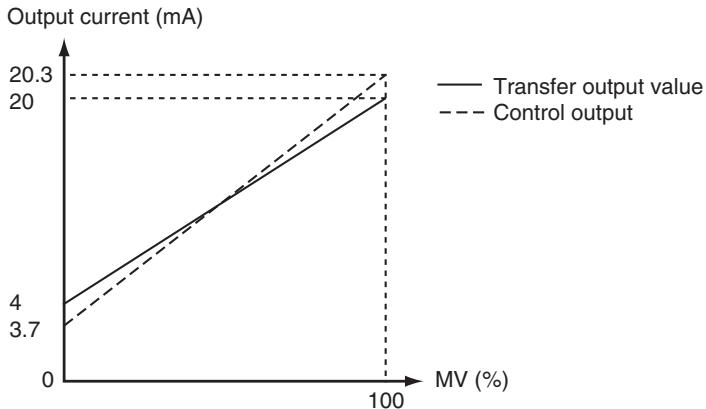
(The above graph is for when the linear current output is set to 4 to 20mA .)
(3) When the set point is selected, remote SP will be output while the Remote SP Mode is set in the SP Mode parameter.
(4) This setting will be ignored for position-proportional models.
(5) This setting will be ignored for standard control or for position-proportional models.
(6) Displayed for position-proportional models only when there is a potentiometer input.
Transfer Scaling
- Reverse scaling is possible by setting the Transfer Output Lower Limit parameter larger than the Transfer Output Upper Limit parameter. If the Transfer Output Lower Limit and Transfer Output Upper Limit parameters are set to the same value when 4 to 20mA is set, the transfer output will be output continuously at 0% (4 mA).
- If the SP, SP during SP ramp, or PV is selected, the Transfer Output Lower Limit and Transfer Output Upper Limit parameters will be forcibly initialized to the respective upper and lower setting limits for changes in the upper and lower limits of the SP limiter and the temperature unit.
If the MV for heating or MV for cooling is selected, the Transfer Output Lower Limit and Transfer Output Upper Limit parameters will be initialized to 100.0 and 0.0, respectively, when a switch is made between standard control and heating/cooling control using the Standard or Heating/Cooling parameter.
- The output current when the linear current type is set to 4 to 20mA , the transfer output upper limit is set to 90.0, and the transfer output lower limit is set to 10.0 is shown in the following graph.
- For scaling from 0.0% to 100.0% , the output for -5.0 to 0.0 will be the same value as for 0.0% , and the output for 100.0 to 105.0 will be the same value as for 100.0% .
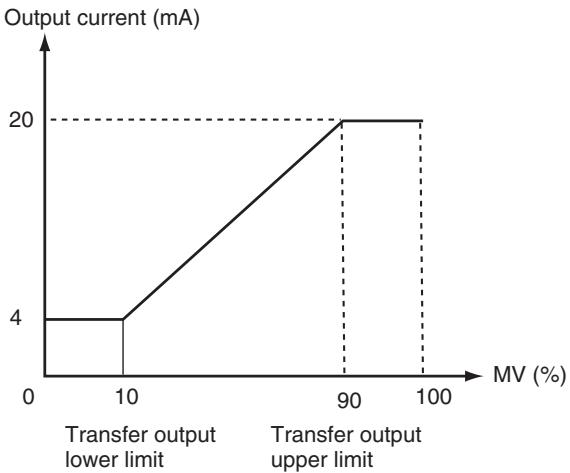
(The above graph is for when the linear current output is set to 4 to 20mA .)
Operating Procedure
The following procedure sets the transfer output for an SP range of -50 to 200.
Operation Level
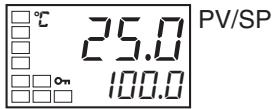
Initial Setting Level
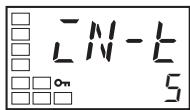
Input Type
Initial Setting Level
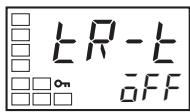
Transfer Output Type
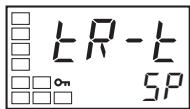
Initial Setting Level
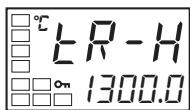
Transfer Output Upper Limit
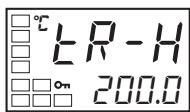
Initial Setting Level
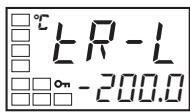
Transfer Output Lower Limit
- Press the Key for at least three seconds to move from the operation level to the initial setting level.
- Select the Transfer Output Type parameter by pressing the 一 Key.
- Press the Key to select 5^P (set point).
- Select the Transfer Output Upper Limit parameter by pressing the 一 Key.
- Use the 一 Key to set the parameter to 200.0. The default is 1300.0.
- Select the Transfer Output Lower Limit parameter by pressing the 一 Key.
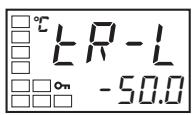
Operation Level
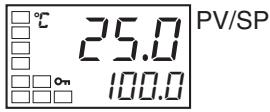
-
Use the Key to set the parameter to -50.0. The default is -200.0.
-
To return to the operation level, press the Key for at least one second.
4-15 Using Banks and PID Sets
Banks
Up to eight banks, each of which contains the following parameters, can be created. The current bank number can be changed by using key operations, event inputs, communications (operation commands), or simple programs.
| Parameter | 0 | 1 | ··· | 7 |
| Set Point | 200.0 | 500.0 | ||
| PID Set No. | 0 | 0 | ||
| SP Ramp Set Value | OFF | OFF | ||
| Alarm Value 1 to 3 | 240.0 | 300.0 | ||
| Alarm Value Upper Limit 1 to 3 | 40.0 | 30.0 | ||
| Alarm Value Lower Limit 1 to 3 | 40.0 | 30.0 | ||
| Soak Time | 5 | 10 | ||
| Wait Band | 3.0 | 5.0 |
In the bank setting level, select the bank numbers to be edited with the Display Bank Selection parameter, and make the settings for each bank.
| Parameter | Setting range | Unit | Default |
| Bank No. | 0 to 7 | --- | 0 |
| Display Bank Selection | 0 to 7 | --- | See note. |
Note The current bank will be displayed. If you change the bank using the U and D Keys, monitor function will be canceled.
If the following parameters are changed, the changes will be saved in the current bank:
Set Point, Alarm Values 1 to 3, Alarm Value Upper Limits 1 to 3, Alarm Value Lower Limits 1 to 3, (operation level)
SP Ramp Set Value, Soak Time, Wait Band (adjustment level).
PID Set Number
PID Set No.
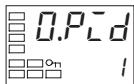
- Select a number from 1 to 8 to specify the PID set for each bank.
- The default setting is 1. For details, refer to PID Sets.
- The bank number can be confirmed by checking the number at the beginning of the parameter.
Simple Program and Bank Functions
For each bank, the Soak Time and Wait Band parameters can be set, and a simple program can be created. For details on creating a simple program, refer to 4-16 Using the Simple Program Function.
PID Sets
- The PID set to be executed is selected by using the PID Set No. parameter in the bank setting level. If 0 (Automatic selection) is set, then the PID set will be selected automatically according to preset conditions.
- Up to eight of the following parameters can be registered for each PID set.
| Parameter | Setting range | Default | Unit |
| Proportional Band | Temperature: 0.1 to 3,240.0 | 8.0 | °C or °F |
| Analog: 0.1 to 999.9 | 10.0 | %FS | |
| Integral Time | Standard, heating/cooling, position proportional (closed): 0.0 to 3,240.0 Position proportional (float-ing): 0.1 to 3,240.0 | 233.0 | s |
| Derivative Time | 0.0 to 3240.0 | 40.0 | s |
| MV Upper Limit | Standard: MV lower limit + 0.1 to 105.0 Heating/cooling: 0.0 to 105.0 | 105.0 | % |
| Position proportional (closed): MV lower limit + 0.1 to 105.0 | |||
| MV Lower Limit | Standard: -5.0 to MV upper limit -0.1 | -5.0 | % |
| Heating/cooling: -105.0 to 0.0 | -105.0 | ||
| Position proportional (closed): -5.0 to MV upper limit -0.1 | -5.0 | ||
| Automatic Selection Range Upper Limit | Temperature: -19,999 to 32,400 | 1320.0 | EU |
| Analog: -5.0 to 105.0 | 105.0 | %(See note.) | |
| Cooling Coefficient | 0.01 to 99.99 | 1.00 | None |
| LBA Detection Time | 0 to 9,999 (0: LBA function disabled) | 0 | s |
Note When the PID Automatic Selection Data parameter is set to DV, the unit will be %FS.
The settings for the PID sets are made in the PID setting level. In the PID setting level, select the PID set numbers to be edited with the Display PID Selection parameter, and make the settings for each PID set.
| Parameter | Setting range | Unit | Default |
| Display PID Selection | 1 to 8 | --- | See note. |
Note The current PID set is displayed. If you use the 和 and 和 Keys to change the PID set, the monitor function will be canceled
When the following parameters are changed, the changes will be reflected in the current PID set:
Proportional Band, Integral Time, Derivative Time, MV Upper Limit, MV Lower Limit, Cooling Coefficient (adjustment level)
LBA Detection Time (advanced function setting level)
- If the PID Set No. parameter for a bank is set to 0, the PID set will be selected automatically according to preset conditions.
In the setting example on the left (with the PID Set Automatic Selection Data parameter set to PV), the following PID parameters are used:
PV ≤ 200°C: PID Set No. 1
200^ < PV ≤ 400^ : PID Set No. 2
Set the PID Set Automatic Selection Range Upper Limit so that the set value becomes larger as the PID set number increases. For PID Set No. 8, however, the automatic selection range upper limit always equals the upper limit of the specified range.
The PID Set Automatic Selection Hysteresis parameter can be used to set the hysteresis to prevent chattering when changing the PID set.
The PID Set Automatic Selection Data parameter can be used to select PV, DV (Derivative), or SP.
Automatic PID Set Selection
| PID set | Automatic selection range |
| 1 | 200.0 |
| 2 | 400.0 |
| 3 | 500.0 |
| 4 | 600.0 |
| 5 | 700.0 |
| 6 | 800.0 |
| 7 | 1000.0 |
| 8 | 1300.0 |
| Parameter | Setting range | Unit | Default |
| Bank * PID Set No. *: 0 to 7 | 0: Automatic selection 1 to 7: PID Set No. 1 to 7 | --- | 1 |
| PID *Automatic Selection Range Upper Limit *: 1 to 8 | Temperature: -19,999 to 32,400 | 1320.0 | EU |
| Analog: -5.0 to 105.0 | 105.0 | % (See note.) | |
| PID Set Automatic Setting Data | PV: Process value DV: Derivative value SP: Set point | PV | None |
| PID Set Automatic Hysteresis | 0.10 to 99.99 | 0.50 | %FS |
Note When the PID Set Automatic Hysteresis parameter is set to DV, the default setting becomes %FS.
4-16 Using the Simple Program Function
4-16-1 Simple Program Function
- A simple program consists of multiple banks.
The program can be created from the required number of banks by specifying the end bank in the Valid Program Bank parameter.
A simple program can be started from any of the banks from bank 0 to the end bank. When operation is finished in one bank, the program switches to the next bank and operation starts in that bank. Operation after the end bank has been completed can be set in the Program Pattern parameter.
- The program starts when the Program Start parameter is changed from RSET to STRT.
- The program stops when the Program Start parameter is changed from STRT to RSET. The program can be reset in any bank.
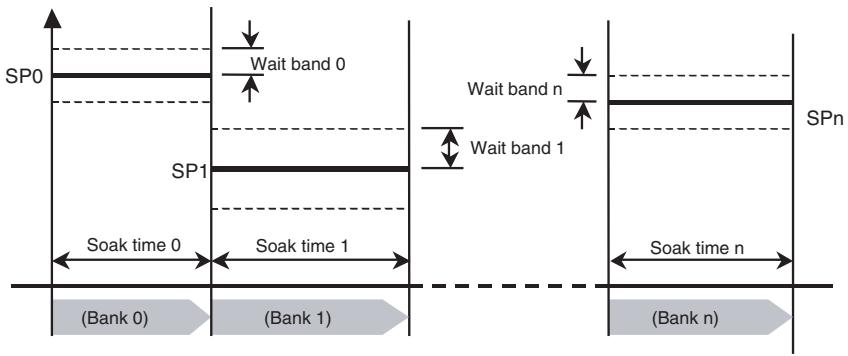
Parameters Related to the Simple Program Function
| Parameter name | Symbol | Set (monitor) values | Unit | Display level |
| Program Pattern | PERN | OFF, STOP, CONT, LOOP | --- | Initial setting level |
| Program Start | PRSET | RSET, STRT | --- | Operation level |
| Bank * Soak Time (See note 2.) | * SOK | 0 to 9999 | min or h | Bank setting level |
| Soak Time Unit | t - U | m (minutes)/h (hours) | --- | Advanced function set- ting level |
| Bank * Wait Band (See note 2.) | * Web | Temperature: OFF, 0.1 to 3,240.0 Analog: OFF, 0.01 to 99.99 | °C or °F (See note 1.) | Bank setting level |
| Soak Time Remain Monitor | Sker | 0 to 9999 | min or h | Operation level |
| Valid Program Bank (See note 3.) | PBNK | 0 to 7 | --- | Initial setting level |
Note
(1) The setting unit is % FS for analog inputs.
(2) When the Soak Time or Wait Band parameter is changed in the adjustment level, the changes will be reflected in the current bank.
(3) Displayed when the Program Pattern parameter is set to any value other than OFF. The bank cannot be switched to any other bank.
Program Pattern
Any of three program patterns can be selected. The simple program will not be run if the Program Pattern parameter is set to OFF.
| Program Pattern | Operation |
| OFF | Program will not be executed. |
| STOP | • Program operation will start when the Program Start parameter is changed from RSET to STRT. The bank number will be automatically incremented by one when the Soak Time parameter setting for the bank has elapsed. • After the bank specified in the Valid Program Bank parameter has been executed, program operation will be ended. The RUN/STOP status will become STOP, and the program end output will be turned ON. |
| CONT | • Program operation will start when the Program Start parameter is changed from RSET to STRT. The bank number will be automatically incremented by one when the Soak Time parameter setting for the bank has elapsed. • After the bank specified in the Valid Program Bank parameter has been executed, program operation will be ended. The RUN/STOP status will continue as RUN (control will continue at the SP at the end bank), and the program end output will be turned ON. |
| LOOP | • Program operation will start when the Program Start parameter is changed from RSET to STRT. The bank number will be automatically incremented by one when the Soak Time parameter setting for the bank has elapsed. • After the bank specified in the Valid Program Bank parameter has been executed, the bank number will return to 0 and the program execution will continue. |
- Banks where the Soak Time parameter is set to 0 will not be executed.
- The bank number can be changed even during program operation by using either an event input or key operations.
- The bank number is initialized to 0 when the program pattern is changed.
■ Pattern 1 (STOP)
Control will stop and the STOP mode will be entered when the program has ended.

■ Pattern 2 (CONT)
Control will continue in RUN mode when the program has ended.
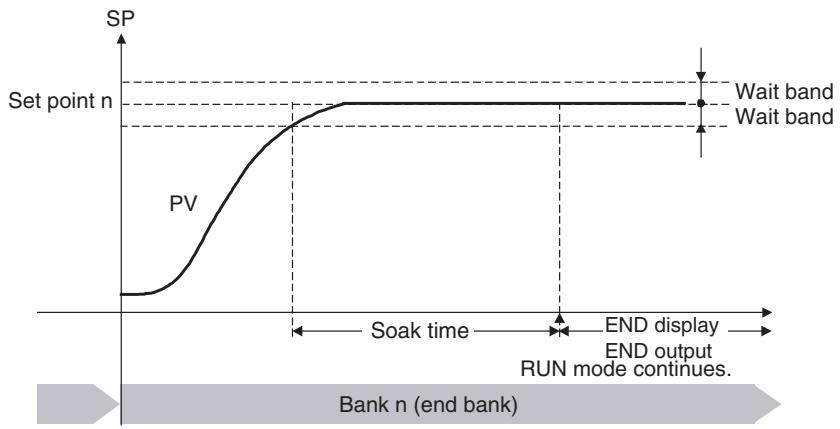
■ Pattern 3 (LOOP)
At the end of the program, operation switches to the start bank and continues in RUN mode.
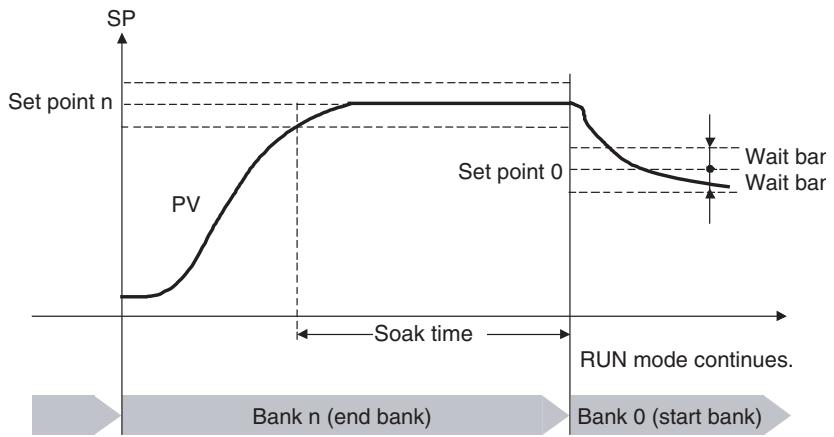
Starting Method
Any of the following three methods can be used to start the simple program.
- Setting the Program Start parameter to STRT.
- Turning ON an event input. (The program start must be assigned to an event input. See note.)
- Starting with an Operation Command using communications. (When the program start is not assigned to an event input.)
Note
When an event input is used to start and reset the simple program, writing is performed to EEPROM. Be sure to consider the write life (1 million writes) of the EEPROM in the system design. When the program start is assigned to an event input, the Program Start parameter will function as a monitor display, and the RSET/STRT displays can be used to check when the event input has started or reset the simple program. When this is done, the Program Start parameter functions as a monitor display only and cannot be changed using key operations. If the Program Pattern parameter is set to OFF, the event input assignment setting will be initialized to "None."
The following table shows the operations when the program is started.
- Changing from RSET to STRT
| Program Pattern | Executed bank No. | RUN/STOP status | Program end output |
| STOP | Executed from cur-rent bank | RUN command executed. | OFF |
| CONT | |||
| LOOP |
The following table shows the operations when the program is reset.
- Changing from STRT to RSET
| Program Pattern | Executed bank No. | RUN/STOP status | Program end output |
| STOP | Initialized to bank 0 | STOP command executed. | OFF |
| CONT | |||
| LOOP |
Note
(1) The bank number can be changed even during program operation by using either an event input or key operations.
(2) The bank number is initialized to 0 when the program pattern is changed.
(3) Even if an event input assigned to "Program Start" is switched from STRT to RSET while the power is OFF, the RUN/STOP status will not be changed when the power is turned ON and the bank number will not be initialized to 0.
Soak Time and Wait Band
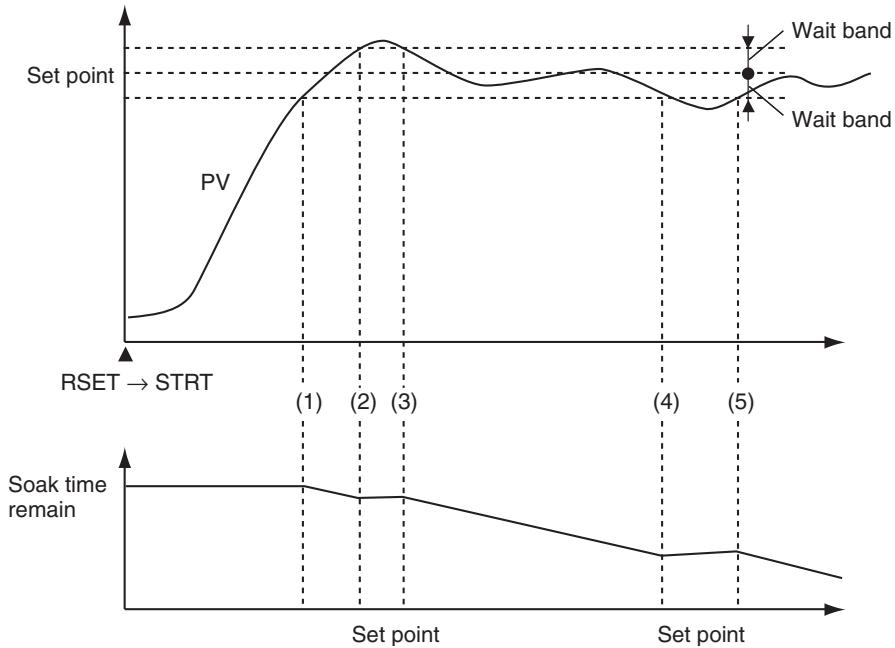
The wait band is the band within which the process value is stable in respect to the set point. The soak time is measured within the wait band. The timer that measures the soak time operates only when the process value is within the wait band around the set point (i.e., SP ± wait band). In the following diagram, the timer will be stopped between the start and (1), (2) and (3), and (4) and (5) and will measure the time only between (1) and (2), (3) and (4), and (5) and the end.
Note
If the wait band is set to OFF, the wait band will be treated as infinity and the timer will measure time continuously after changing from RSET to STRT.
Operation When Power Is Turned ON
The following will occur if a power interruption occurs during execution of a simple program:
- The program start (RSET/STRT) and RUN/STOP status from before the power interruption will be held.
- The timer value for the Soak Time parameter will be reset.
Therefore, when a power interruption occurs, the timer value for the Soak Time parameter will not be correct. In addition, if starting the program is assigned to an event input, the event input status when a power interruption occurs will be the program start status from just before the power interruption.
4-16-2 Operation at the Program End
The following table shows operation when program operation ends, according to the Program Pattern parameter setting.
| Program Pattern | Executed bank No. | RUN/STOP status | Program end output |
| STOP | End bank number held | STOP command executed. | ON |
| CONT | RUN continues. | ||
| LOOP | --- | --- | --- |
Note
(1) The bank number can be changed even during program operation by using either an event inputs or key operation.
(2) The bank number is initialized to 0 when the program pattern is changed.
Display at the Program End
When the program ends, the process value will be displayed on the No. 1 display (see note) and the set point and "end" will be alternately displayed on the No. 2 display at 0.5 s intervals.
Note
One of the following displays: PV/SP, PV only, or PV/MV.
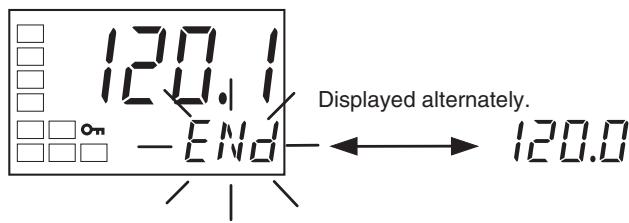
Program End Output
When the Program Pattern parameter is changed from OFF to STOP, CONT, or LOOP, the Auxiliary Output 1 Assignment parameter will automatically be set to the end output. Conversely, when the Program Pattern parameter is changed from STOP, CONT, or LOOP to OFF, the Alarm 1 Output Assignment parameter will automatically be initialized to ALM1. The output assignment parameters can also be used to assign the program end output to any output. A program end output is also provided in communications status.
Clearing the Program End Status
The program END output and display will be cleared when the Program Start parameter is changed from STRT to RSET. The setting is changed from STRT to RSET while the Program Start parameter is displayed.
The program END status can also be cleared using an event. If the program start function is assigned to an event, however, the program end status cannot be cleared from the Program Start parameter display, which will function only as a monitor display.
4-16-3 Combining a Simple Program with an SP Ramp
Control can be combined with the SP ramp by setting the SP Ramp Set Value and Soak Time parameters for each bank.
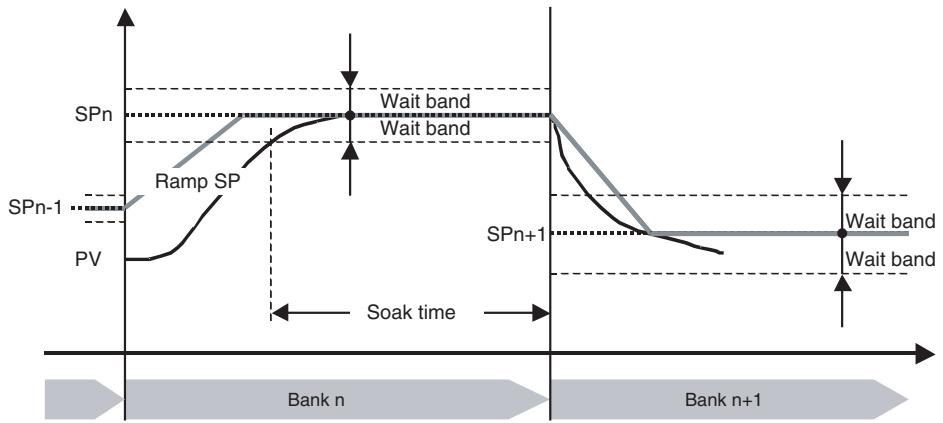
If the program moves to the next bank at the end of the soak time before the ramp SP reaches the SP, the SP ramp operation will extend across the banks as shown below as long as the SP Ramp Set Value parameter is not set to 0.
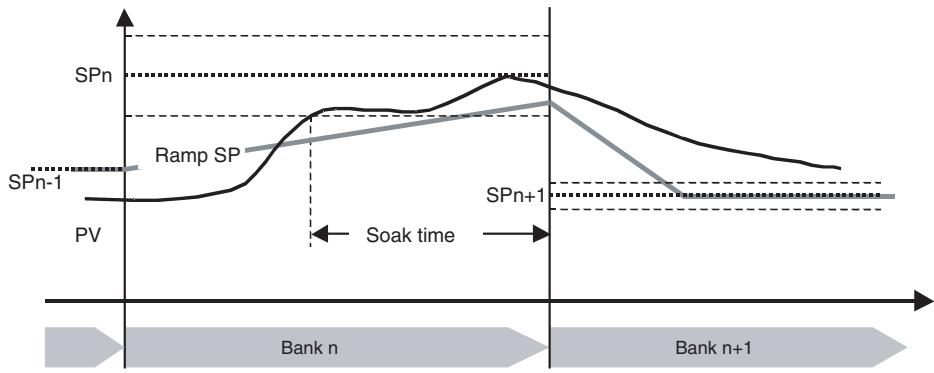
If the SP Ramp Set Value parameter is set to 0 for the next bank, SP ramp operation will be stopped as shown below.
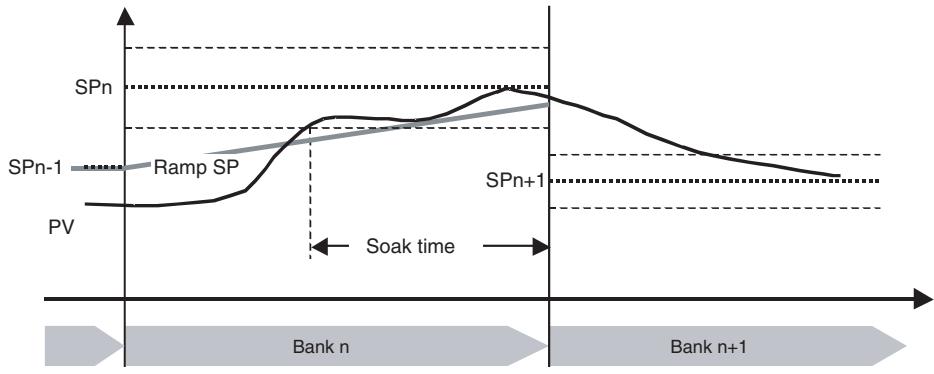
SP Start
Program operation can be started by using an SP start from the bank 0 LSP. To use an SP start, set the SP Ramp Set Value and Soak Time parameters for bank 0 to 0.
Example Bank 0 SP: 30 Bank 1 SP: 100
Bank 0 SP ramp set value: OFF Bank 1 SP ramp set value: 1
Bank 0 soak time: 0 Bank 1 soak time: 5
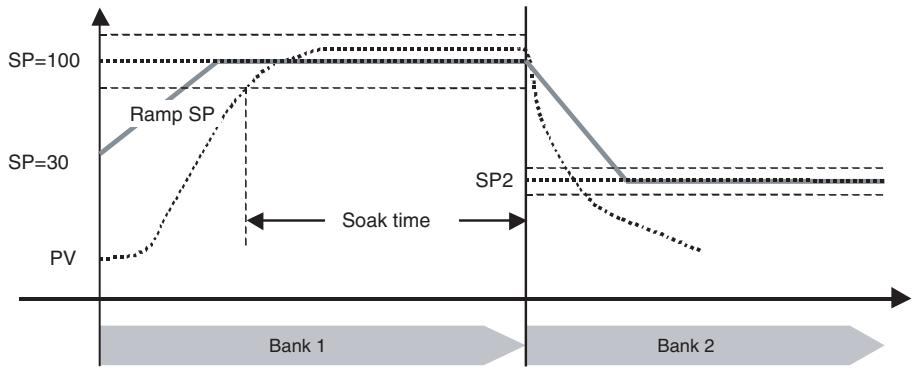
4-16-4 Relationships between Simple Programs and Other Functions
- Changing the Soak Time
If the soak time is changed while the program is being executed, timing will be continued from the time value at that point. The timer value will be reset, however, if a power interruption occurs.
- Changing the SP
If the soak time is changed while the program is being executed, timing will be continued from the timer value at that point.
- Input Errors
Timing will be continued even if an input error occurs during operation in program mode.
Note Timing will be performed according to the PV at the time of the input error (i.e., the sensor input setting range upper limit).
- Changing to Manual Mode
Timing will be continued when changing to manual mode while the simple program is being executed.
AT
AT will be executed even if it is started while the simple program is being executed. While AT is being executed, operation will not move to the next bank and the soak remain time will remain at 0. Operation will move to the next bank after AT has been completed. After operation has been completed for the end bank, one of the following operations will be executed depending on the program pattern.
| Program Pattern | Operation |
| STOP | The STOP operation command will be executed, so AT will be stopped. |
| CONT | The STOP operation command will not be executed, so AT will continue. |
| LOOP | AT will be continued by changing to the start bank. |
- SP Mode
STRT and RSET can be executed for the simple program without regard to the SP mode. SP mode changes are enabled while the simple program is being executed. Timing will continue in the SP mode after the change.
| SP mode | Description |
| LSP | Timing is performed according to the SP of the bank being executed. |
| RSP | Timing is performed according to the remote SP. |
RSP Input Errors
Timing will be continued even if an RSP input error occurs while the simple program is being executed.
Note Timing will be performed according to the PV and remote SP at the time of the RSP error.
- Switching RUN and STOP
Timing will continue if RUN and STOP are switched while the simple program is being executed.
- Changing Banks
If the bank is changed while the simple program is being executed, the time up to that point will be cleared and timing will start for the new bank's set value.
Operating Procedure
Perform the following procedure to use the simple program function.
Program pattern: STOP
Valid program bank: 1
Bank 0 set point: 150^ , Soak time: 5 min, Wait band: 3^
Bank 0 set point: 200^ , Soak time: 10 min, Wait band: 5^

Operation Level
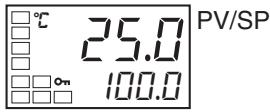
Initial Setting Level
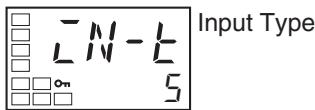
-
Press the Key for at least three seconds to move from the operation level to the initial setting level.
-
Select the Program Pattern parameter by pressing the Key.
Initial Setting Level
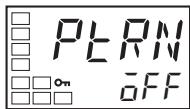
Program Pattern
Operation Level

PV/SP
Bank setting level
Display Bank Selection
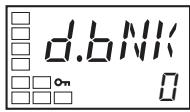
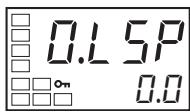
Bank 0 SP
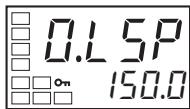
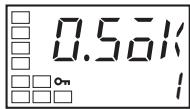
Bank 0
Soak Time
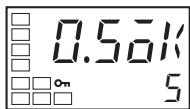
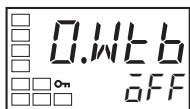
Bank 0 Wait band
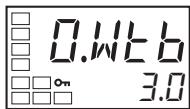
- Use the Key to set the parameter to STOP.
- Press the Key to select the Valid Program Bank parameter.
- Use the and Keys to set 2.
- Press the Key for at least one second to move from the initial setting level to the operation level.
- Press the Key to move from the operation level to the bank setting level.
- The Display Bank Selection parameter will be displayed. The current bank number will be displayed, so use the and Keys to select 0.
- Press the Key to select the Bank 0 SP parameter.
- Use the 和 and 和 Keys to set the parameter to 150.0.
- Press the Key to select the Bank 0 Soak Time parameter.
- Use the and Keys to set the parameter to 5.
- Press the Key to select the Bank 0 Wait band parameter.
- Use the and Keys to set the parameter to 3.0.
- Press the Key to select the Display Bank Selection parameter.
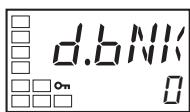
Display Bank Selection
- Use the and Keys to set the parameter to 1.
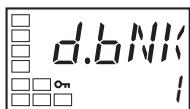
- Press the Key to select the Bank 1 SP parameter.
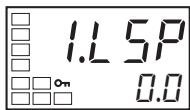
Bank 1 SP
- Use the and Keys to set the parameter to 200.0.
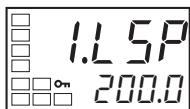
- Press the Key to select the Bank 1 Soak Time parameter.
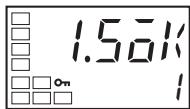
Bank 1
Soak Time
- Use the and Keys to set the parameter to 10.
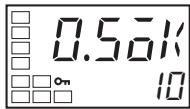
- Press the Key to select the Bank 1 Wait band parameter.
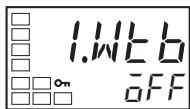
Bank 1 Wait band
- Use the and Keys to set the parameter to 5.0.
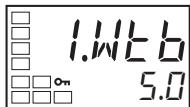
- Press the Key to move from the bank setting level to the operation level.
Operation Level
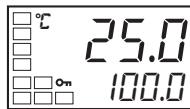
PV/SP
4-17 Output Adjustment Functions
4-17-1 Output Limits
- Output limits can be set to control the output using the upper and lower limits to the calculated MV.
- The following MV takes priority over the MV limits.
Manual MV (See note.)
MV at stop
MV at PV error
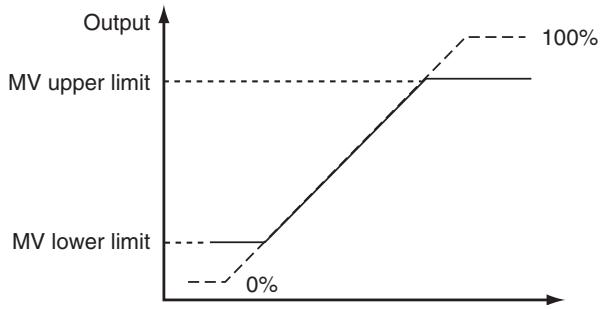
Note When the manual MV limit is enabled, the manual MV will be restricted by the MV limit.
- For heating/cooling control, upper and lower limits are set of overall heating/cooling control. (They cannot be set separately for heating/cooling.)
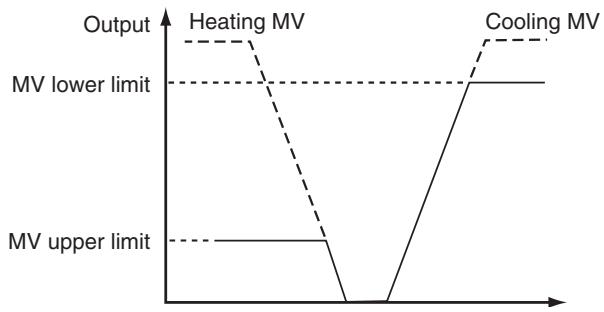
4-17-2 MV at Stop
The MV when control is stopped can be set.
When setting the MV when control is stopped, set the MV at Stop and Error Addition parameter (advanced function setting level) to ON.
Standard Models
For heating/cooling control, the MV at stop will apply to the cooling side if the MV is negative and to the heating side if the MV is positive. The default is 0.0, so an MV will not be output for either standard or heating/cooling control.
Position-proportional Models
Open, close, or hold status can be selected for floating control or when the Direct Setting of Position Proportional MV parameter is set to OFF. With open status, only the open output will turn ON. With close status, only the close output will turn ON. With hold status, the open and close outputs will both turn OFF. The default setting is for hold status, with no outputs.
If the Direct Setting of Position Proportional MV parameter is set to ON during close control, the valve opening can be specified. The default setting is 0.0 (i.e., the open and close outputs are adjusted so that valve opening will be 0).
| Parameter name | Setting range | Unit | Default |
| MV at STOP | -5.0 to 105.0 for standard control | % or none | 0.0 or HOLD |
| -105.0 to 105.0 (heating/cooling control) | |||
| Position-proportional Control Close control and Direct Setting of Position Proportional MV parameter ON: -5.0 to 105.0 | |||
| Floating control or Direct Setting of Position Proportional MV parameter OFF: CLOS (Control output 2 ON) | |||
| HOLD (Control outputs 1 and 2 both OFF) | |||
| OPEN (Control output 1 ON) |
Note The order of priority is as follows: Manual MV > MV at stop > MV at PV error.
- The following table shows the operation when a potentiometer error occurs when the Direct Setting of Position Proportional MV parameter is set to ON.
MV at stop ≥ 100
Open output ON
MV at stop ≤ 0
Close output ON
When the MV at stop is other than the above, the open and close outputs will both be OFF.
4-17-3 MV at PV Error
- A fixed MV is output for an input error, RSP input error, or potentiometer error (close control only). To set the MV at PV error, set the MV at Stop and Error Addition parameter (advanced function setting level) to ON. The MV at stop takes priority when stopped and the manual MV takes priority in manual mode.
Standard Models
With heating/cooling control, the MV on the cooling side is taken to be a negative value, so the output is made to the heating side for a positive value and to the cooling side for a negative value. The default setting is 0.0 (i.e., there are not outputs for either standard control or heating/cooling control).
Position-proportional Models
Open, close, or hold status can be selected for floating control or when the Direct Setting of Position Proportional MV parameter is set to OFF. With open status, only the open output will turn ON. With close status, only the close output will turn ON. With hold status, the open and close outputs will both turn OFF. The default setting is for hold status, with no outputs.
If the Direct Setting of Position Proportional MV parameter is set to ON during close control, valve opening can be specified. The default setting is 0.0, so open and close outputs are adjusted so that valve opening will be 0.
| Parameter name | Setting range | Unit | Default |
| MV at PV ERROR | -5.0 to 105.0 for standard control | % or none | 0.0 or HOLD |
| -105.0 to 105.0 (heating/cooling control) | |||
| Position-proportional Control Close control and Direct Setting of Position Proportional MV parameter ON: -5.0 to 105.0 | |||
| Floating control or Direct Setting of Position Proportional MV parameter OFF: CLOS (Control output 2 ON) | |||
| HOLD (Control outputs 1 and 2 both OFF) | |||
| OPEN (Control output 1 ON) |
Note The order of priority is as follows: Manual MV > MV at stop > MV at PV error.
- The following table shows the operation when a potentiometer error occurs when the Direct Setting of Position Proportional MV parameter is set to ON.
MV at stop ≥ 100
Open output ON
MV at stop ≤ 0
Close output ON
When the MV at stop is other than the above, the open and close outputs will both be OFF.
- The order of priority of the MVs is illustrated in the following diagram.
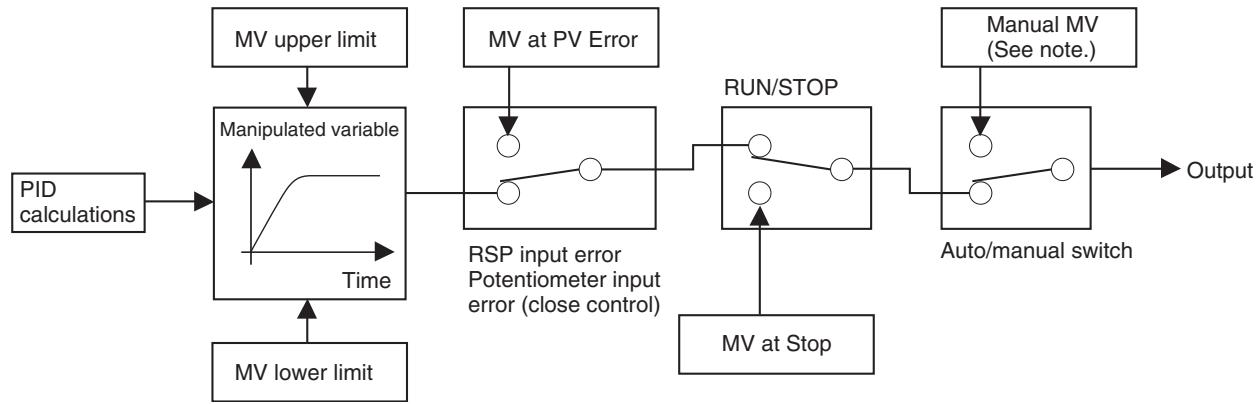
Note When the Manual MV Limit Enable parameter is set to ON, the setting range will be the MV lower limit to the MV upper limit.
4-18 Using the Extraction of Square Root Parameter
Extraction of Square Roots
Extraction of Square Root Enable
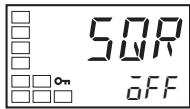
- For analog inputs, the Extraction of Square Root parameter is provided for inputs so that differential pressure-type flow meter signals can be directly input.
- The default setting for the Extraction of Square Root parameter is OFF. The Extraction of Square Root Enable parameter must be set to ON in order to use this function.
Extraction of Square Root Low-cut Point
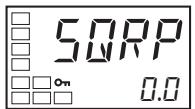
- If the PV input (i.e., the input before extracting the square root) is higher than 0.0% and lower than the low cut point set in the Extraction of Square Root Low-Cut Point parameter, the results of extracting the square root will be 0.0% . If the PV input is lower than 0.0% or higher than 100.0% , extraction of the square root will not be executed, so the result will be equal to the PV input. The low-cut point is set as normalized data for each input, with 0.0 as the lower limit and 100.0 as the upper limit for the input setting range.
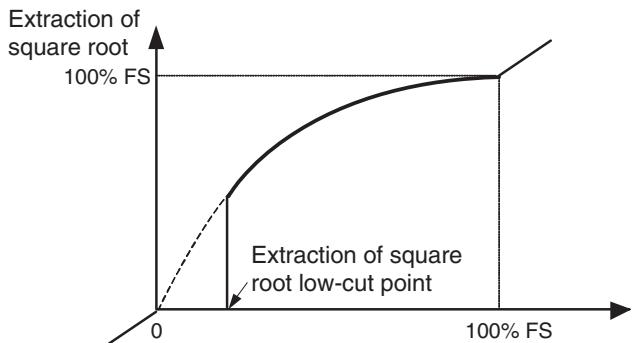
Argument 1 (Input Data)
| Parameter name | Setting rage | Unit | Default |
| Extraction of Square Root Enable | OFF: Disabled, ON: Enabled | --- | OFF |
| Extraction of Square Root Low-cut Point | 0.0 to 100.0 | % | 0.0 |
Operating Procedure
Input type = 25 (4 to 20mA
This procedure sets the Extraction of Square Root Low-cut Point parameter to 10.0% .
Operation Level
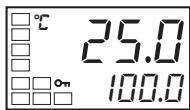
PV/SP
Initial Setting Level
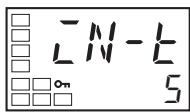
Input Type
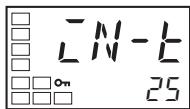
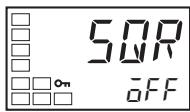
Extraction of Square Root Enable
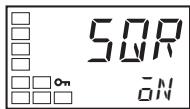
Extraction of Square Root Enable
- Press the Key for at least three seconds to move from the operation level to the initial setting level.
- Use the and Keys to set the parameter to 25 (4 to 20mA ).
- Press the Key to select the Extraction of Square Root Enable parameter.
- Use the Key to select ON.
Operation Level
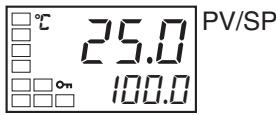
Adjustment Level
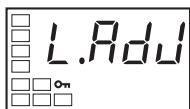
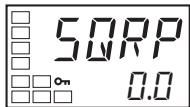
Extraction of Square Root Low-cut Point
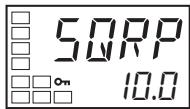
Extraction of Square Root Low-cut Point
Operation Level
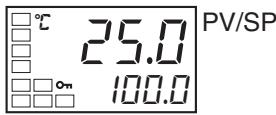
- Press the Key for at least one second to move from the initial setting level to the operation level.
- Press the Key to move from the operation level to the adjustment level.
- Select the Extraction of Square Root Low-cut Point parameter by pressing the 回 Key.
- Use the Key to set the parameter to -10.0.
- Press the l Key to return to the operation level.
4-19 Setting the Width of MV Variation
MV Change Rate Limit
MV Change Rate Limit (Heating)
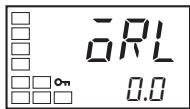
- The MV change rate limit sets the maximum allowable width of change in the MV per second. If the change in the MV exceeds this setting, the MV will be changed by the MV change rate limit until the calculated value is reached. This function is disabled when the setting is 0.0.
- The MV change rate limit does not function in the following situations:
In manual mode
- During ST execution (Cannot be set when ST is ON.)
- During AT execution
- During ON/OFF control
- While stopped (during MV at Stop output)
- During MV at PV Error output
| Parameter name | Setting rage | Unit | Default |
| MV Change Rate Limit | 0.0 to 100.0 | %/s | 0.0 |
Operating Procedure
This procedure sets the MV change rate limit to 5.0% . The related parameters are as follows:
$$ P I D \cdot O N / O F F = P I D $$
$$ S T = O F F $$
Operation Level
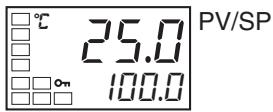
Initial Setting Level
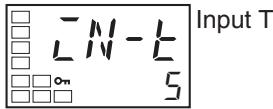
Input Type
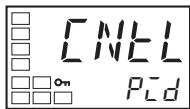
PID-ON/OFF
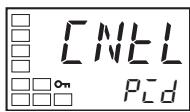
PID-ON/OFF
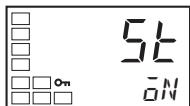
ST
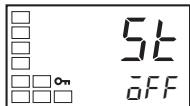
ST
Operation Level
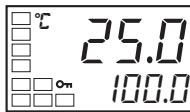
PV/SP
Adjustment Level
MV
Change
Rate Limit
MV
Change
Rate Limit
Operation Level
PV/SF
- Press the Key for at least three seconds to move from the operation level to the initial setting level.
- Select the PID ON/OFF parameter by pressing the 一 Key.
- Use the Key to select 2-PID control. (The default is PID.)
- Press the Key to select the ST parameter.
- Press the Key to select OFF.
- Press the Key for at least one second to move from the initial setting level to the operation level.
- Press the l Key to move from the operation level to the adjustment level.
- Press the Key to select the MV Change Rate Limit parameter.
- Use the Key to set the parameter to 5.0.
- Press the Key to return to the operation level.
4-20 Setting the PF Key
4-20-1 PF Setting (Function Key)
PF Setting
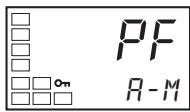
- Pressing the PF Key for at least one second executes the operation set in the PF Setting parameter (E5AN/EN-H only).
| Set value | Symbol | Setting | Function |
| OFF | \(\overline{a}FF\) | Disabled | Does not operate as a function key. |
| RUN | \(RUN\) | RUN | Specifies RUN status. |
| STOP | \(5\text{E}\overline{\text{a}}P\) | STOP | Specifies STOP status. |
| R-S | \(\overline{R}-\overline{S}\) | RUN/STOP reverse operation | Specifies reversing the RUN/STOP operation status. |
| AT-2 | \(\overline{R}\text{E}-\overline{2}\) | 100% AT Execute/Cancel | Specifies reversing the 100% AT Execute/Cancel status. (See note 1.) |
| AT-1 | \(\overline{R}\text{E}-\overline{1}\) | 40% AT Execute/Cancel | Specifies reversing the 40% AT Execute/Cancel status. (See notes 1 and 2.) |
| LAT | \(L\overline{R}\text{E}\) | Alarm Latch Cancel | Specifies canceling all alarm latches. (See note 3.) |
| A-M | \(\overline{R}-\overline{M}\) | Auto/Manual | Specifies reversing the Auto/Manual status. (See note 4.) |
| PFDP | \(PFdP\) | Monitor/Setting Item | Specifies the monitor/setting item display. Select the monitor setting item according to the Monitor/Setting Item 1 to 5 parameters (advanced function setting level). |
| BANK | \(b\overline{R}N\overline{K}\) | Bank Selection | Specifies switching to the bank number + 1. |
Note
(1) When AT cancel is specified, it means that AT is cancelled regardless of whether the AT currently being executed is 100% AT or 40% AT.
(2) The setting of AT-1 will be ignored for heating/cooling control or for position-proportional floating control.
(3) Alarms 1 to 3, heater burnout, HS alarms, and heater overcurrent latches are cancelled.
(4) For details on auto/manual operations using the PF Key, refer to 4-13 Performing Manual Control.
(5) Pressing the PF Key for at least one second executes operation according to the set value. When the Monitor/Setting Item parameter is selected, however, the display is changed in order from Monitor/Setting Item 1 to 5 each time the key is pressed.
(6) This function is enabled when PF Key Protect is OFF.
Monitor/Setting Item
Monitor/Setting Item 1
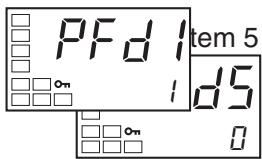
Setting the PF Setting parameter to the Monitor/Setting Item makes it possible to display monitor/setting items using the function key. The following table shows the details of the settings. For setting (monitor) ranges, refer to the applicable parameter.
| Set value | Setting | Remarks | |
| Monitor/Setting | Symbol | ||
| 0 | Disabled | --- | |
| 1 | PV/SP/Bank No. (See note 1.) | Can be set. (SP) | --- |
| 2 | PV/SP/MV (See notes 1 and 2.) | Can be set. (SP) | --- |
| 3 | PV/SP /Soak time remain (See note 1.) | Can be set. (SP) | --- |
| 4 | Proportional band (P) (See note 3.) | Can be set. | P |
| 5 | Integral time (I) (See note 3.) | Can be set. | L |
| 6 | Derivative time (D) (See note 3.) | Can be set. | d |
| 7 | Alarm value 1 (See note 4.) | Can be set. | RL - I |
| 8 | Alarm value upper limit 1 (See note 4.) | Can be set. | RL IH |
| 9 | Alarm value lower limit 1 (See note 4.) | Can be set. | RL IL |
| 10 | Alarm value 2 (See note 4.) | Can be set. | RL - 2 |
| 11 | Alarm value upper limit 2 (See note 4.) | Can be set. | RL 2H |
| 12 | Alarm value lower limit 2 (See note 4.) | Can be set. | RL 2L |
| 13 | Alarm value 3 (See note 4.) | Can be set. | RL - 3 |
| 14 | Alarm value upper limit 3 (See note 4.) | Can be set. | RL 3H |
| 15 | Alarm value lower limit 3 (See note 4.) | Can be set. | RL 3L |
| 16 | Bank No. | Can be set. | BANK |
Note (1) The SP for the current bank will be displayed.
(2) For details on MV settings for heating and cooling control, refer to MV Display for Heating and Cooling Control on page 82.
(3) The set value for the current PID set will be displayed.
(4) The set value for the current bank will be displayed.
Setting Monitor/Setting Items
Pressing the PF Key in the operation, adjustment, bank setting, or PID setting level displays the applicable monitor/setting items. Press the PF Key to display in order Monitor/Setting Items 1 to 5. After Monitor/Setting Item 5 has been displayed, the display will switch to the top parameter in the operation level.
Note (1) Items set as disabled in the Monitor/Setting Items 1 to 5 parameters will not be displayed, and the display will skip to the next enabled setting.
(2) While a monitor/setting item is being displayed, the display will be switched to the top parameter in the operation level if the Key or the Key is pressed.
Operating Procedure
This procedure sets the PF Setting parameter to PFDP, and the Monitor/Setting Item 1 parameter to 7 (Alarm Value 1).
Operation Level
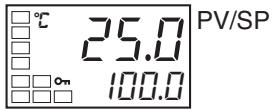
Initial Setting Level
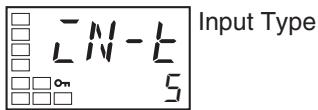
- Press the Key for at least three seconds to move from the operation level to the initial setting level.
Initial Setting Level
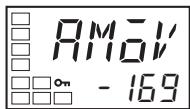
Move to Advanced Function Setting Level
Advanced Function Setting Level
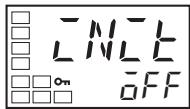
Parameter Initialization
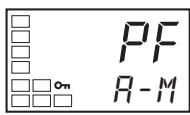
PF Setting
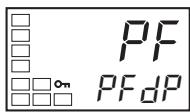
PF Setting
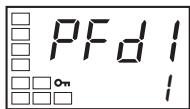
Monitor/Setting Item 1
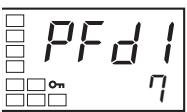
Monitor/Setting Item 1
Initial Setting Level
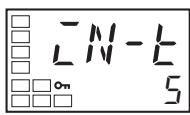
Input Type
Operation Level
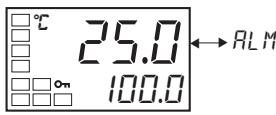
Monitor/Setting Item Level
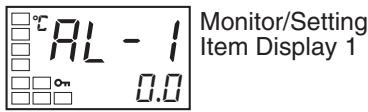
- Select the Move to Advanced Function Setting Level parameter by pressing the 回 Key.
- Press the Key to enter the password (-169). It is possible to move to the advanced function setting level by either pressing the Key or waiting two seconds without pressing any key.
- Press the Key to select the PF Setting parameter.
- Press the Key to select PFDP (Monitor/Setting Item).
- Press the Key to select the Monitor/Setting Item 1 parameter.
- Press the Key to select 7 (Alarm Value 1).
- Press the Key for at least one second to move from the advanced function setting level to the initial setting level.
- Press the Key for at least one second to move from the initial setting level to the operation level.
- Press the PF Key to display Alarm Value 1 for the current bank.
4-21 Counting Control Output ON/OFF Operations
4-21-1 Control Output ON/OFF Count Function
If Control Output 1 and 2 are ON/OFF outputs (relay outputs, voltage outputs for driving SSR, or SSR outputs), the number of times that a control output turns ON and OFF can be counted. Based on the control output ON/OFF count alarm set value, an alarm can be output and an error can be displayed if the set count value is exceeded.
The default setting of the Control Output ON/OFF Alarm Set Value parameter is 0. ON/OFF operations are not counted when this parameter is set to 0. To enable counting ON/OFF operations, change the setting to a value other than 0.
Control Output ON/OFF Counter Monitor Function
This function is not displayed when the Control Output 1 ON/OFF Alarm Set Value and the Control Output 2 ON/OFF Alarm Set Value parameter are set to 0, or when the control outputs are set for linear outputs.
| Parameter name | Setting range | Unit | Default |
| Control Output 1 ON/OFF Count Monitor | 0 to 9999 | 100 times | 0 |
| Control Output 2 ON/OFF Count Monitor | 0 to 9999 | 100 times | 0 |
Display When ON/OFF Count Alarm Occurs
When an ON/OFF count alarm occurs, the PV display in the No. 1 display shown below alternates with the RRLM display on the No. 2 display.
PV
- PV/SP (Including the items displayed by setting the "PV/SP" Display Screen Selection parameter.)
- PV/Manual MV (Valve Opening), PV/SP/Manual MV (Valve Opening)
- PV/SP displayed for the monitor/setting items
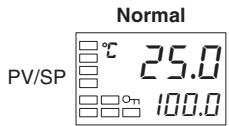
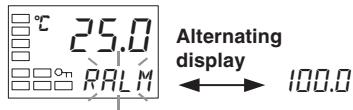
ON/OFF Count Alarm
Control Output ON/OFF Count Alarm Function
If the ON/OFF counter exceeds the control output ON/OFF count alarm set value, an ON/OFF count alarm will occur. The alarm status can be assigned to a control output or an auxiliary output, or it can be displayed at the Controller. The ON/OFF count alarm set value function is disabled by setting the ON/OFF count alarm set value to 0.
| Parameter name | Setting range | Unit | Default |
| Control Output 1 ON/OFF Alarm Set Value | 0 to 9999 | 100 times | 0 |
| Control Output 2 ON/OFF Alarm Set Value | 0 to 9999 | 100 times | 0 |
ON/OFF Counter Reset Function
The ON/OFF counter can be reset for a specific control output.
| Parameter name | Setting range | Unit | Default |
| ON/OFF Counter Reset | 0: Disable the counter reset function. 1: Reset the control output 1 ON/OFF counter. 2: Reset the control output 2 ON/OFF counter. | --- | 0 |
Note After the counter has been reset, the control output ON/OFF count monitor value will be automatically returned to 0.
If an error occurs in the control output ON/OFF counter data, the ON/OFF count monitor value will be set to 9999 and an ON/OFF count alarm will occur. The alarm can be cleared by resetting the ON/OFF counter.
Operating Procedure
Initial Setting Level
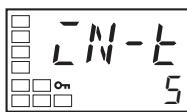
Input Type
Initial Setting Level
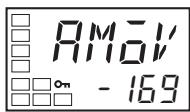
Move to Advanced Function Setting Level
Advanced Function Setting Level
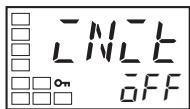
Parameter Initialization
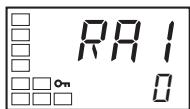
Control Output 1 ON/OFF Count Alarm Set Value
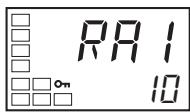
Control Output 1 ON/OFF Count Alarm Set Value
Initial Setting Level
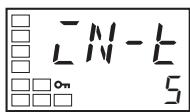
Input Type
Operation Level
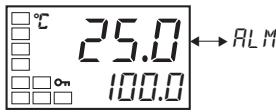
This procedure sets the Control Output 1 ON/OFF Alarm Set Value parameter to 10 (1,000 times).
- Press the Key for at least three seconds to move from the operation level to the initial setting level.
- Select the Move to Advanced Function Setting Level parameter by pressing the Key.
- Use the Key to enter the password ("-169"). It is possible to move to the advanced function setting level by either pressing the Key or waiting two seconds without pressing any key.
- Press the Key to select the Control Output 1 ON/OFF Count Alarm Set Value parameter.
- Use the Key to set the parameter to 10.
- Press the Key for at least one second to move to the initial setting level.
- Press the l Key for at least one second to move to the operation level.
4-22 Displaying PV/SV Status
4-22-1 PV and SV Status Display Functions
PV Status Display Function
The PV function in the PV/SP, PV, or PV/Manual MV (Valve Opening) Display and the control and alarm status specified for the PV and PV status display are alternately displayed in 0.5-s
| Set value | Symbol | Function |
| OFF | OFF | No PV status display |
| Manual | MANU | MANU is alternately displayed during manual control. |
| Stop | STOP | STOP is alternately displayed while operation is stopped. |
| Alarm 1 | ALM1 | ALM1 is alternately displayed during Alarm 1 status. |
| Alarm 2 | ALM2 | ALM2 is alternately displayed during Alarm 2 status. |
| Alarm 3 | RLM3 | ALM3 is alternately displayed during Alarm 3 status. |
| Alarm 1 to 3 OR status | RLM | ALM is alternately displayed when Alarm 1, 2, or 3 is set to ON. |
| Heater Alarm (See note.) | HR | HA is alternately displayed when a heater burnout alarm, HS alarm, or heater over-current alarm is ON. |
- The default is OFF.
Note "HA" can be selected for models that do not support heater burnout detection, but the function will be disabled.
Example: When STOP Is Selected for the PV Status Display Function
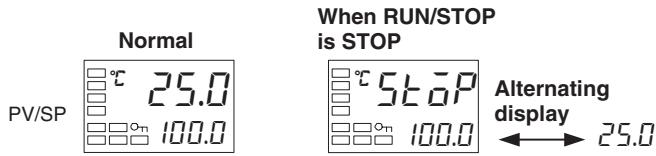
SV Status Display Function
The SP, Blank, or Manual MV in the PV/SP, PV, or PV/Manual MV Display (Valve Opening) and the control and alarm status specified for the SV status display function are alternately displayed in 0.5-s cycles.
| Set value | Symbol | Function |
| OFF | OFF | No SV status display |
| Manual | MANU | MANU is alternately displayed during manual control. |
| Stop | STOP | STOP is alternately displayed while operation is stopped. |
| Alarm 1 | ALM1 | ALM1 is alternately displayed during Alarm 1 status. |
| Alarm 2 | ALM2 | ALM2 is alternately displayed during Alarm 2 status. |
| Alarm 3 | ALM3 | ALM3 is alternately displayed during Alarm 3 status. |
| Alarm 1 to 3 OR status | ALM | ALM is alternately displayed when Alarm 1, 2, or 3 is set to ON. |
| Heater Alarm (See note.) | HR | HA is alternately displayed when a heater burnout alarm, HS alarm, or heater over-current alarm is ON. |
- The default is OFF.
Note "HA" can be selected for models that do not support heater burnout detection, but the function will be disabled.
Example: When ALM1 Is Selected for the SV Status Display Function

Note The order of priority for flashing and alternating displays on the No. 2 display are as follows:
Operating Procedure
Initial Setting Level
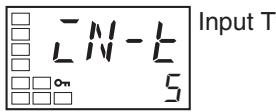
Initial Setting Level
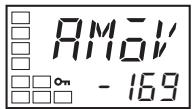
Move to Advanced Function Setting Level
Advanced Function Setting Level
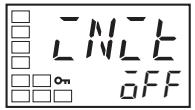
Parameter Initialization
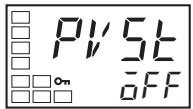
PV Status Display Function
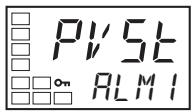
PV Status Display Function
Initial Setting Level
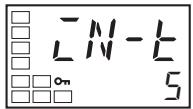
Input Type
Operation Level
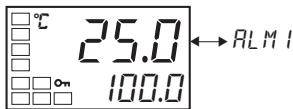
(1) Alternating display in SV status display
(2) Alternating display during program end output
(3) Flashing display during auto-tuning
(4) Alternating display when a control output ON/OFF count alarm occurs
(5) Flashing display when out of the setting range
This procedure sets the PV Status Display Function parameter to ALM1.
- Press the Key for at least three seconds to move from the operation level to the initial setting level.
- Select the Move to Advanced Function Setting Level parameter by pressing the 回 Key.
- Use the Key to enter the password (-169). It is possible to move to the advanced function setting level by either pressing the Key or waiting two seconds without pressing any key.
- Press the Key to select the PV Status Display Function parameter.
- Press the Key to select ALM1.
- Press the Key for at least one second to move to the initial setting level.
- Press the Key for at least one second to move to the operation level. If the Alarm 1 status is ON, PV and ALM1 will be alternately displayed.
4-23 Using a Remote SP
The remote SP function scales a remote SP input (4 to 20mA ) to the remote SP upper and lower limits, and takes it as the set point. (This function is supported by the E5AN-H and E5EN-H only.)
Set the Remote SP Enable parameter (advanced function setting level) to ON, and use an event input or an operation command to select the remote SP.
| Parameter | Setting range | Unit | Default |
| Remote SP Enable | OFF: Disable, ON: Enable | None | OFF |
| Remote SP Upper Limit | SP lower limit to SP upper limit | EU | 1300.0 |
| Remote SP Lower Limit | SP lower limit to SP upper limit | EU | -200.0 |
| SP Tracking | OFF: Disable, ON: Enable | None | OFF |
| Remote SP Input Error Output | OFF: Disable, ON: Enable | None | OFF |
| SP Mode | LSP: Local SP, RSP: Remote SP | None | LSP |
| Remote SP Monitor | Remote SP lower limit to remote SP upper limit | EU | --- |
Precautions
- When the ST (self-tuning) parameter is turned ON, the SP Mode parameter is forcibly set to LSP.
- The remote SP input is not accepted during autotuning. Autotuning is executed for the remote SP at the beginning of autotuning.
- Changes in the remote SP value are not used as conditions for resetting the standby sequence.
Remote SP Scaling
- The remote SP input (4 to 20mA ) can be scaled to match the PV input range, based on the Remote SP Upper Limit and Remote SP Lower Limit parameter settings.
- The remote SP input can be input in a range of -10% to 110% of 4 to 20 mA. Input values outside of this range treated as out-of-range input values (RSP input error) and clamped to the upper or lower limit. In SP mode, the RSP single indicator will flash, and in local SP mode the No. 2 indicator for the Remote SP Monitor will flash.
- An alarm can be output if an RSP input error occurs by setting the Remote SP Input Error Output parameter to ON.
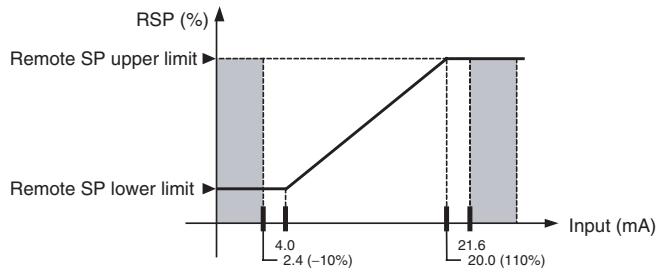
- When the SP Upper Limit or SP Lower Limit parameter setting is changed, the remote SP upper or lower limit will be forcibly changed to the SP upper or lower limit. For example, if the upper limit for the SP limiter is changed from A to B, the remote SP upper and lower limits will be changed as shown in the following diagram.
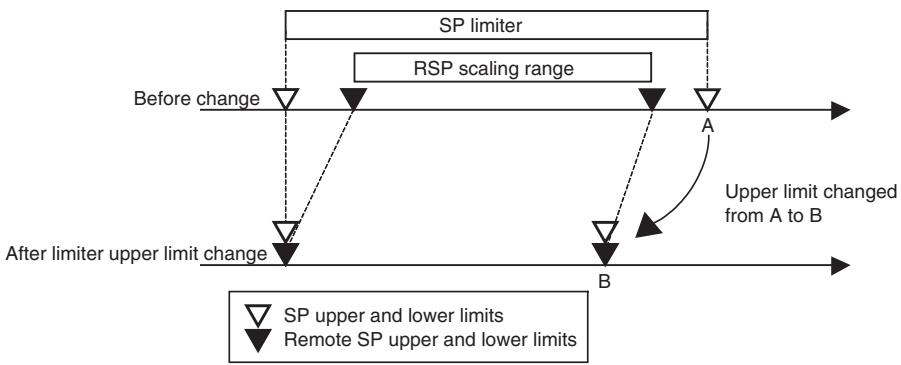
SP Mode
The SP mode is used to switch between local SP and remote SP. When a remote SP is selected in SP mode, the RSP single indicator will light.
Remote SP Monitor
In remote SP mode, the remote SP can be checked on the No. 2 display in the PV/SP Display Screen. In local SP mode, it can be checked with the Remote SP Monitor parameter.
SP Tracking
- If the SP tracking function is enabled, the local SP inherits the remote SP value after switching from remote SP to local SP. To enable the SP tracking function, set the SP Tracking parameter to ON.
- SP tracking operates as follows:
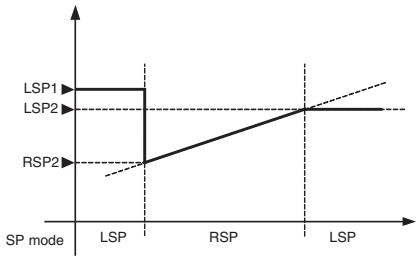
1,2,3... 1. Switching to remote SP when the SP is LSP1 will result in switching to RSP2.
2. The operation will proceed according to remote SP inputs.
3. If the SP tracking function is enabled, the SP will become LSP2 after switching to local SP. If the SP tracking function is disabled, the SP will remain as LSP1.
- If the SP tracking function is enabled when switching from local SP to remote SP, the SP ramp will operate.
4-24 Position-proportional Control
The control method used to adjust the opening and closing of a valve with a control motor is called "position-proportional control" or "ON/OFF servo control." Either closed control or floating control can be selected for position-proportional control. Only models that support position-proportional control (E5AN/EN-HPRR□) can be used for position-proportional control. In addition, the following functions are disabled when using position-proportional control.
- ST
LBA - Heater burnout, heater short, and heater overcurrent alarms
ON/OFF control - P and PD control (for floating control only)
- 40% AT (for floating control only)
Closed Control
Closed control provides control using feedback on the valve opening by connecting a potentiometer.
Floating Control
Floating control provides control without using feedback on the valve opening, so control is still possible even if a potentiometer is not connected. With floating control, the expected valve opening is calculated from the travel time, and that value is treated as the valve opening for executing control outputs.
If there is no FB input, then even if the Closed/Floating parameter is set to Closed the parameter will be disabled and floating control will be executed.
| Parameter | Setting range | Unit | Default |
| Travel Time | 1 to 999 | s | 30 |
Motor Calibration and Travel Time
Calibrate the motor when a potentiometer is connected, such as in closed control or in floating control for monitoring valve opening. The fully closed and fully open valve positions will be calibrated and the travel time, i.e., the time from the fully open to the fully closed position, will be automatically measured and set. Set the Motor Calibration parameter to ON to execute the motor calibration. The setting will be automatically changed OFF when the calibration has been completed.
For floating control (i.e., without a potentiometer connection), it is necessary to manually set the travel time. Set the Travel Time parameter to the time from the fully open to the fully closed valve position.
| Parameter | Setting range | Unit | Default |
| Motor Calibration | OFF, ON | --- | OFF |
Position-proportional Dead Band and Open/Close Hysteresis
The interval during which the valve output is held (for the ON and OFF switching points for the open output and closed output) is set by the Position Proportional Dead Band parameter, and the hysteresis is set by the Open/Close Hysteresis parameter.
| Parameter | Setting range | Unit | Default |
| Position Proportional Dead Band | Position proportional (closed): 0.1 to 10.0 | % | 4.0 |
| Position proportional (floating): 0.1 to 10.0 | 2.0 | ||
| Open/Close Hysteresis | 0.1 to 20.0 | % | 0.8 |
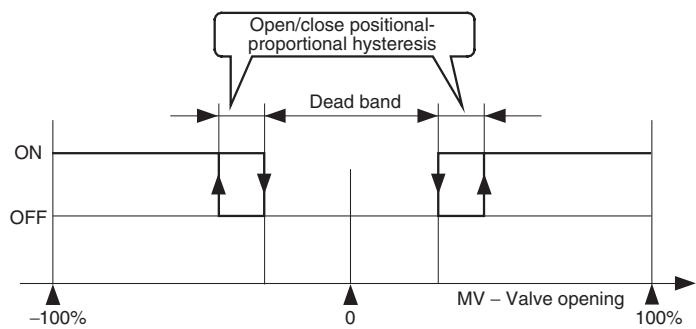
PV Dead Band
When the process value (PV) is within the PV dead band, control is executed as if the process value is equal to the set point for the current bank to prevent unnecessary outputs when the process value is in the vicinity of the set point.
| Parameter | Setting range | Unit | Default |
| PV Dead Band | 0 to 32400 | EU | 0.0 |
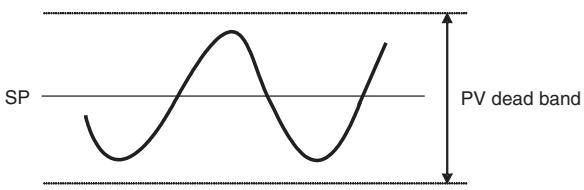
Valve Opening Monitor
Valve opening can be monitored by connecting a potentiometer. The motor must be calibrated after the potentiometer is connected.
| Parameter | Setting range | Unit | Default |
| Valve Opening Monitor | -10.0 to 110.0 | % | --- |
Note If no potentiometer is connected or if a potentiometer input error occurs, "----" will be displayed.
With the E5AN/EN-H, valve opening can also be monitored on the PV/SP/MV (Valve Opening) Screen.
Manual Operation
With models that support position-proportional control, manual operation is possible by moving to the manual control level and pressing the Up and Down Keys. The output on the open side is ON while the Up Key is pressed, and the output on the closed side is ON while the Down Key is pressed. If the Direct Setting of Position Proportional MV parameter is set to ON and closed control is used, however, the Manual MV parameter can be set with the same display and operations as for standard models.
MV at Stop and Error
With floating control or when the Direct Setting of Position Proportional MV parameter is set to OFF, select to output open, closed, or hold status when stopped or when an error occurs. If the Direct Setting of Position Proportional MV parameter is set to ON for closed control, set the MV.
4-25 Logic Operations
4-25-1 The Logic Operation Function (CX-Thermo)
- The logic operation function logically calculates as 1 or 0 the Controller status (alarms, SP ramp, RUN/STOP, auto/manual, etc.) and the external event input status, and outputs the results to work bits. The work bit status can be output to auxiliary or control outputs, and operating status can be switched according to the work bit status.
- Work bit logic operation can be set from 1 to 8. Set them to No operation (Always OFF) (the default) when the work bits are not to be used. When logic operations are being used, a dot will be displayed on the No. 2 display of the adjustment level display
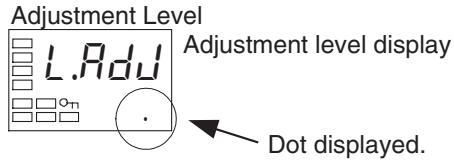
4-25-2 Using Logic Operations
Logic operations are set using the CX-Thermo.
Starting Logic Operations
There are two ways to start logic operations.
- Select Logic Operation Editor from the CX-Thermo tree, and click the Start Button.
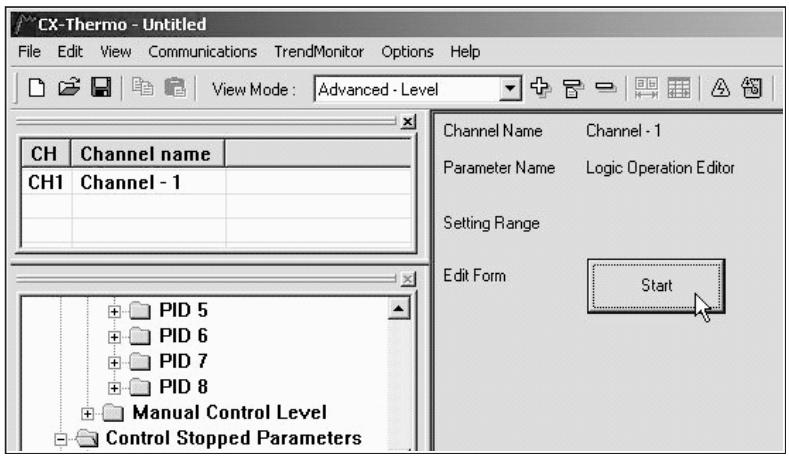
- Select Logic Operation Editor from the CX-Thermo Options Menu.
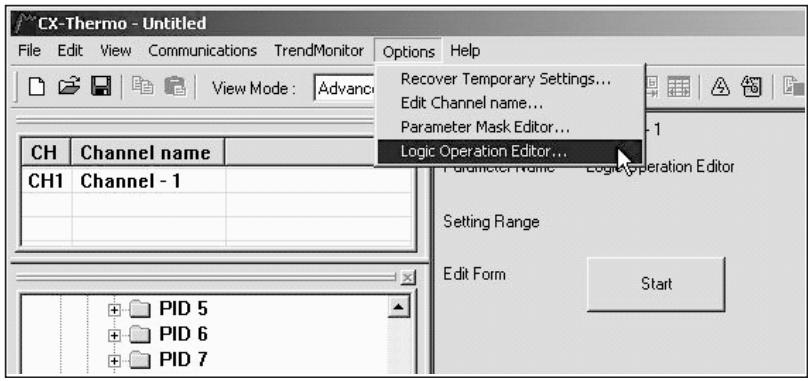
Making the Settings
The following display will appear on the Logic Operation Editor Setting Window. Set each of the parameters.
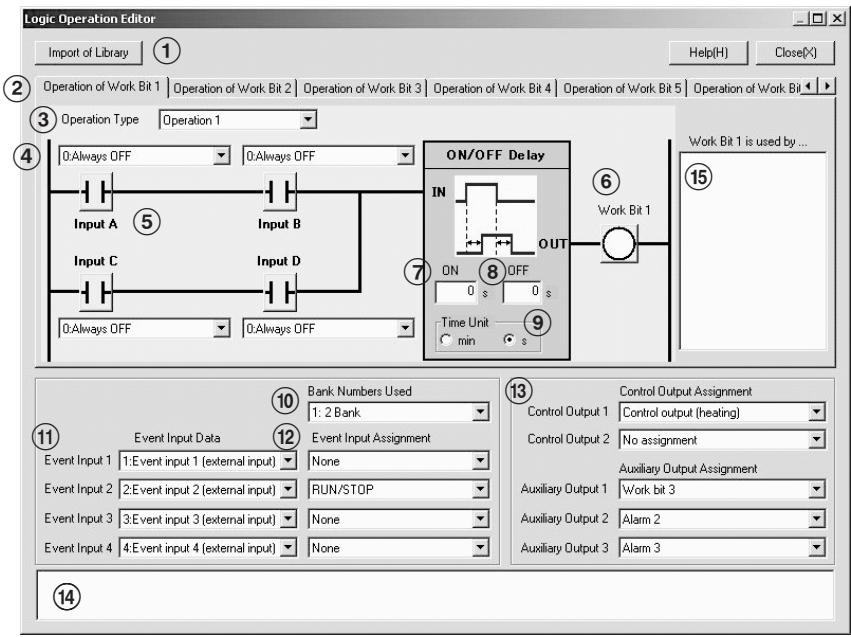
1,2,3... 1. Displaying the Library Import Dialog Box
Logic operation samples for specific cases are set in the library in advance. Examples of settings for specific cases are loaded by selecting them from the library list and clicking the OK Button.
Example: Selecting Library 1
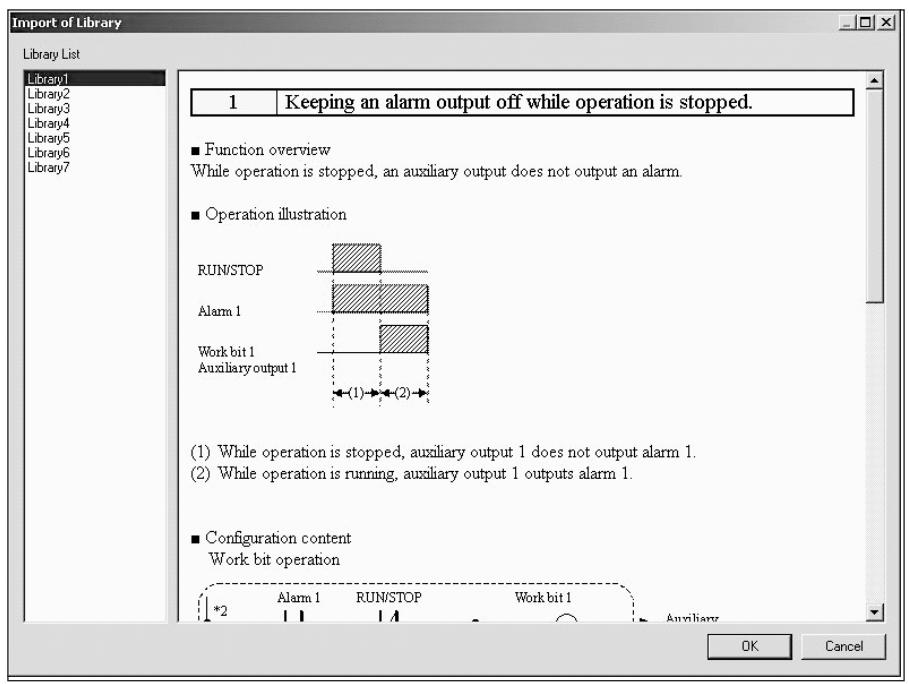
2. Switching Work Bit Operations
Select the work bit logic operations from the Operation of Work Bit 1 to Operation of Work Bit 8 Tab Pages.
3. Selecting the Operation Type
From one to four operations are supported. If work bits are not to be used, set them to No operation (Always OFF) (the default).
- No Operation (Always OFF)
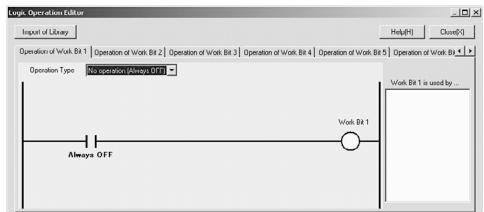
Operation 1
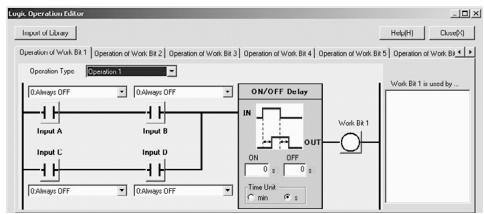
Operation 2
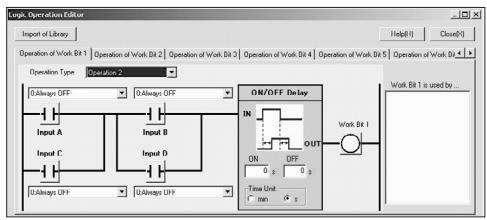
(A and B) or (C and D)
When conditions A and B or conditions C and D are satisfied
(A or C) and (B or D)
When condition A or C and condition B or D are satisfied
Operation 3
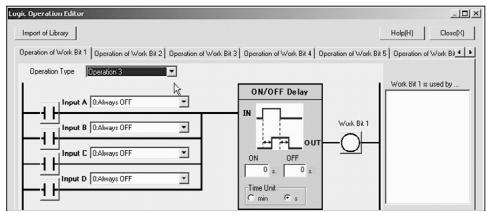
Operation 4
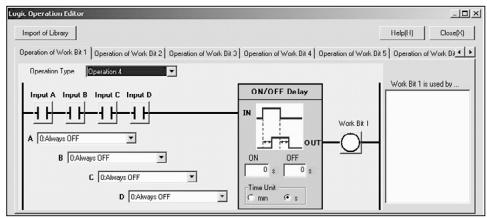
A or B or C or D
When condition A, B, C or D is satisfied
A and B and C and D When conditions A, B, C and D are all satisfied
4. Selecting Input Assignments
Select the input assignment for the work bit logic operation from the following settings.
| Parameter name | Setting range |
| Work Bit 1 Input Assignment A | 0: Always OFF1: Always ON2: ON for one cycle when power is turned ON3: Event Input 1 (external input) (See note 1.)4: Event Input 2 (external input) (See note 1.)5: Event Input 3 (external input) (See note 1.)6: Event Input 4 (external input) (See note 1.)7: Alarm 18: Alarm 29: Alarm 310: Control output ON/OFF count alarm (See note 2.)11: Control output (heating)12: Control output (cooling)13: Input error14: RSP input error15: HB (heater burnout) alarm16: HS alarm17: OC (heater overcurrent) alarm18: Auto/Manual19: RUN/STOP20: RSP/LSP21: Program start22: AT Execute/Cancel23: SP ramp operating24: Bank No. (bit 0)25: Bank No. (bit 1)26: Bank No. (bit 2)27: Program end output28: Work bit 129: Work bit 230: Work bit 331: Work bit 432: Work bit 533: Work bit 634: Work bit 735: Work bit 8 |
| Work Bit 1 Input Assignment B | Same as for work bit 1 input assignment A |
| Work Bit 1 Input Assignment C | Same as for work bit 1 input assignment A |
| Work Bit 1 Input Assignment D | Same as for work bit 1 input assignment A |
| to | to |
| Work Bit 8 Input Assignment D | Same as for work bit 1 input assignment A |
Note (1) The event inputs that can be used depend on the Controller model.
(2) Turns ON when either the control output 1 or 2 ON/OFF count alarm is ON.
5. Switching between Normally Open and Normally Closed for Inputs A to D Click the condition to switch between normally open and normally closed inputs A to D.
| Normally open | Normally closed |
| - - | - - |
- Switching between Normally Open and Normally Closed for Work Bits Click the condition to switch between normally open and normally closed work bits.
| Normally open | Normally closed |
| -○- | -∅- |
- Setting ON Delay Times
When an input with an ON delay turns ON, the output will turn ON after the set delay time has elapsed. The setting range is 0 to 9,999. The default is 0 (disabled).
- Setting OFF Delay Times
When an input with an OFF delay turns OFF, the output will turn OFF after the set delay time has elapsed. The setting range is 0 to 9,999. The default is 0 (disabled).
- Switching ON/OFF Delay Time Unit
Select either seconds or minutes for the ON/OFF delay time unit. The default is seconds.
- Selecting the Number of Banks to Use
Select a number from 0 to 3 for the Bank Numbers Used parameter.
(For models with two event inputs, select a number between 0 and 2.)
Note If a work bit is assigned for either the Event Input Data 1 or Event Input Data 2 parameter for a model that does not support event inputs 1 and 2 and if a number greater than 0 is set for the Bank Numbers Used parameter, then event inputs 1 and 2 will be used for bank selection.
For example, if the Bank Numbers Used parameter is set to 2 for a model with event inputs 3 and 4, and the following settings are made, then event input 1 (work bit 1) and event input 2 (work bit 2) will be used for bank selection.
Event Input Data 1: Work bit 1
Event Input Data 2: Work bit 2
Event Input Data 3: Event input 3 (external input)
Event Input Data 4: Event input 4 (external input)
To use event input 3 (external input) and event input 4 (external input) for bank selection, make the following settings:
Event Input Data 1: Event input 3 (external input)
Event Input Data 2: Event input 4 (external input)
Event Input Data 3: Work bit 1
Event Input Data 4: Work bit 2
11. Changing Event Input Data
Select the event input conditions from the following setting ranges.
| Parameter name | Setting range |
| Event Input Data 1 | 0: Not assigned.1: Event input 1 (external input)2: Event input 2 (external input)3: Event input 3 (external input)4: Event input 4 (external input)5: Work bit 16: Work bit 27: Work bit 38: Work bit 49: Work bit 510: Work bit 611: Work bit 712: Work bit 8 |
| Event Input Data 2 | Same as for event input data 1 |
| Event Input Data 3 | Same as for event input data 1 |
| Event Input Data 4 | Same as for event input data 1 |
Note The event input data can be changed from the default setting even if there is no event input terminal (external input). By changing the default setting, the event input assignment parameters will be displayed at the Controller display and can be set from the Controller.
- Changing the Event Input Assignment Function
Select the setting for the event input assignment.
When a work bit is selected as event input data, Communications Write Enable/Disable cannot be assigned to an event input.
- Changing Control Output and Auxiliary Output Settings
Control output and auxiliary output assignments can be changed. The items that can be changed depend on the Controller model. For details, refer to 3-5-3 Assigned Output Functions.
Assigning a work bit to either a control output or to an auxiliary output is also considered to be the same as assigning an alarm. For example, if work bit 1 is set for the Auxiliary Output 1 Assignment parameter, then alarms 1 to 3 have been assigned.
- Displaying Parameter Guides
A description of the parameters can be displayed.
- Displaying the Work Bit Use Destinations
Display a list of destinations where the work bits are used.
Operating Procedure
This procedure uses event input 2 to change to RUN or STOP.
Event input 2 ON: RUN
Event input 2 OFF: STOP
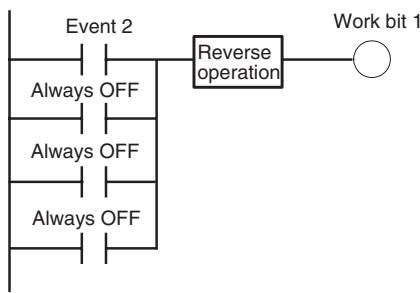
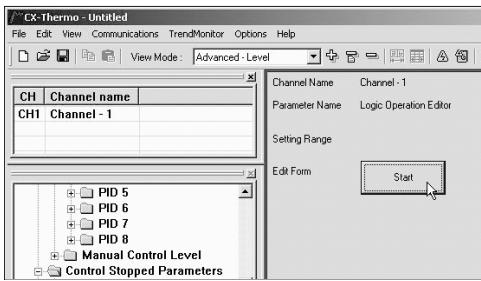
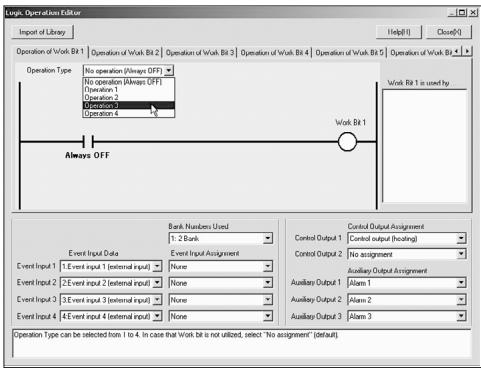
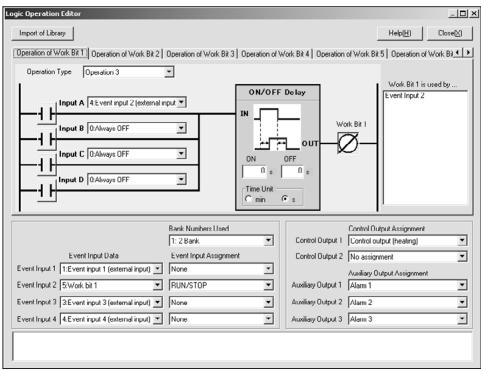
- Select Logic Operation Editor from the CX-Thermotree, and click the Start Button.
- The Logic Operation Editor will be displayed. Confirm that the screen for work bit 1 is displayed, and select Operation 3 from the Operation Type Field.
- Set the operation by selecting one of the following:
Work bit 1 input assignment A = 4 : Event input 2 (external input)
Work bit 1 input assignment B = 0 : Always OFF
Work bit 1 input assignment C = 0 : Always OFF
Work bit 1 input assignment D = 0 : Always OFF - Invert work bit 1. Click (Normally open) to change it to (Normally closed).
- Assign RUN/STOP to event input 2. Set “5: Work bit 1” for the event input data for event input 2, and set “RUN/STOP” for the assignment function.
- Closing the Logic Operation Editor Dialog Box Click the Close Button.
This completes the procedure for setting parameters using the CX-Thermo. Transfer the settings to the Controller to set the Controller. Refer to CX-Thermo help for the procedure to transfer the settings.
Operating Procedure
This procedure outputs alarm 1 status to auxiliary output 1 during operation (RUN). A library object is used to make the setting.
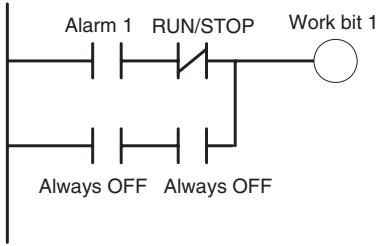
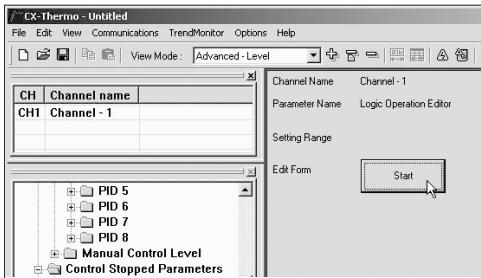
- Select Logic Operation Editor from the CX-Thermotree, and click the Start Button.
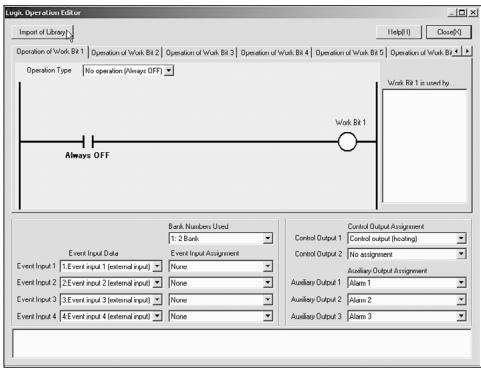
- Click the Import of Library Button.
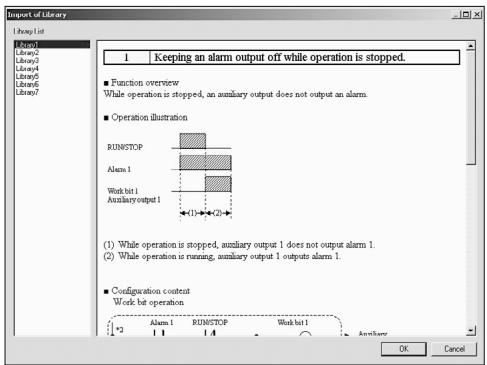
- Select Library 1 from the library list, and then click the OK Button.
Confirm the following settings, and then click the OK Button.
Work bit 1 operation type: Operation 1
Work bit 1 input assignment A = 7 : Alarm 1
Work bit 1 input assignment B = 19: Invert for RUN/ STOP
Work bit 1 input assignment C = 0 : Always OFF
Work bit 1 input assignment D = 0 : Always OFF
Auxiliary output 1 = Work bit 1
- Closing the Logic Operation Editor Dialog Box Click the Close Button.
This completes the procedure for setting parameters using the CX-Thermo. Transfer the settings to the Controller to set the Controller. Refer to CX-Thermo help for the procedure to transfer the settings.
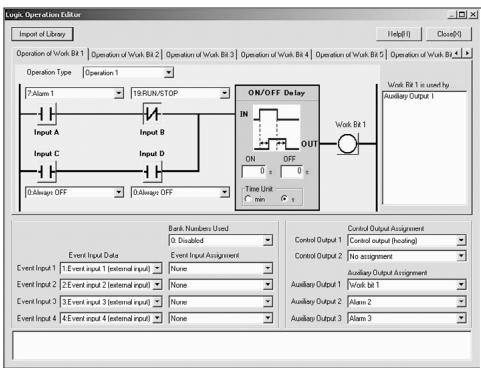
SECTION 5 Parameters
This section describes the individual parameters used to setup, control, and monitor operation.
5-1 Conventions Used in this Section 170
5-1-1 Meanings of Icons Used in this Section 170
5-1-2 About Related Parameter Displays. 170
5-1-3 The Order of Parameters in This Section 170
5-1-4 Alarms. 170
5-2 Protect Level 171
5-3 Operation Level. 175
5-4 Adjustment Level 190
5-5 Bank Setting Level 209
5-6 PID Setting Level 216
5-7 Monitor/Setting Item Level 220
5-8 Manual Control Level 221
5-9 Initial Setting Level 223
5-10 Advanced Function Setting Level 242
5-11 Communications Setting Level 281
5-1 Conventions Used in this Section
5-1-1 Meanings of Icons Used in this Section
Function
Describes the functions of the parameter.
Setting
Describes the setting range and default of the parameter.
Monitor
Used to indicate parameters used only for monitoring.

Operation
Describes the parameter settings, such as those for Operation Commands, and procedures.

Used to indicate information on descriptions in which the parameter is used or the names of related parameters.
5-1-2 About Related Parameter Displays
Parameters are displayed only when the conditions for use given on the right of the parameter heading are satisfied. Protected parameters are not displayed regardless of the conditions for use, but the settings of these parameters are still valid.

5-1-3 The Order of Parameters in This Section
Parameters are described level by level.
The first page of each level describes the parameters in the level and the procedure to switch between parameters.
5-1-4 Alarms
It will be specified in this section when alarms are set for the Control Output 1 or 2 Assignment parameters, or for the Auxiliary Output 1 or 3 Assignment parameters. For example, when alarm 1 is set for the Control Output 1 Assignment parameter, it will be specified that alarm 1 is assigned.
Assigning a work bit to either control output 1 or 2 or to auxiliary output 1 to 3 is also considered to be the same as assigning an alarm. For example, if work bit 1 is set for the Auxiliary Output 1 Assignment parameter, then alarms 1 to 3 have been assigned.
5-2 Protect Level
Four levels of protection are provided on the E5CN-H, operation/adjustment protect, initial setting/ communications protect, setting change protect, and PF key protect (PF Key protect is supported for the E5AN-H and E5EN-H only). These protect levels prevent unwanted operation of the keys on the front panel in varying degrees.
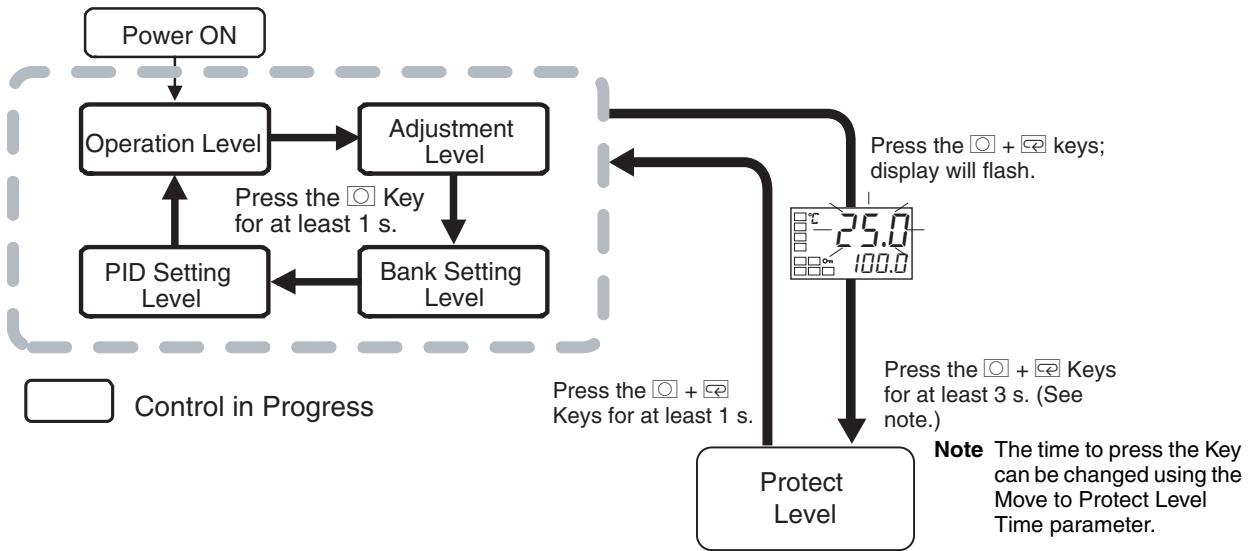
To move from the operation level to the protect level, press and Keys for three seconds (see note) or more.
Note The time taken to move to the protect level can be adjusted by changing the Move to Protect Level Time parameter setting.
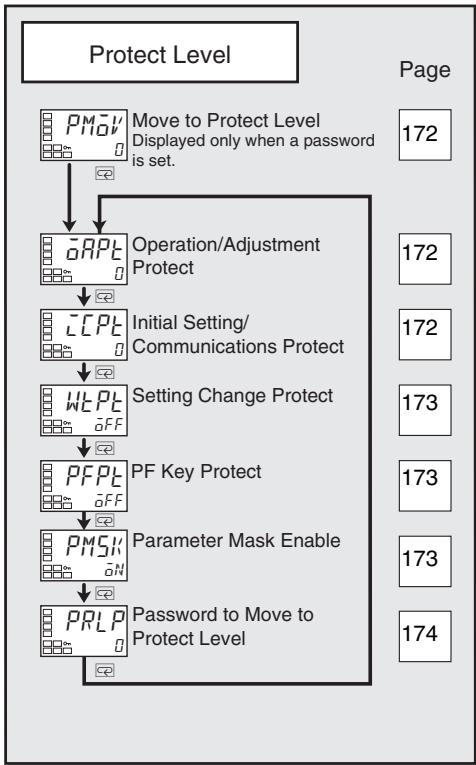
Parameters that are protected will not be displayed and their settings cannot be changed.
| PMov | Move to Protect Level | The Password to Move to Protect Level password must not be set to 0. |
| Function | The password to move to the protect level is entered for this parameter. · The password to move to the protect level (i.e., the password set for the Password to Move to Protect Level parameter) is entered for this parame- ter. · The Operation/Adjustment Protect parameter will be displayed if the cor- rect password is entered. | |
| See | ■ Related Parameters Password to move to protect level (protect level): Page 174 | |
| aRPl | Operation/Adjustment Protect | |
| cPLt | Initial Setting/Communications Protect | |
These parameters specify the range of parameters to be protected. Shaded settings are the defaults.
Operation/Adjustment Protect
The following table shows the relationship between set values and the range of protection.
| Level | Set value | ||||
| 0 | 1 | 2 | 3 | ||
| Operation Level | PV | Can be displayed | Can be displayed | Can be displayed | Can be displayed |
| PV/SP | Can be displayed and changed | Can be displayed and changed | Can be displayed and changed | Can be displayed | |
| Others | Can be displayed and changed | Can be displayed and changed | Cannot be dis-played and moving to other levels is not possible | Cannot be dis-played and moving to other levels is not possible | |
| Adjustment Level | Can be displayed and changed | Cannot be dis-played and moving to other levels is not possible | Cannot be dis-played and moving to other levels is not possible | Cannot be dis-played and moving to other levels is not possible | |
- Parameters are not protected when the set value is set to 0.
Initial Setting/Communications Protect
This protect level restricts movement to the initial setting level, communications setting level, and advanced function setting level.
| Set value | Initial setting level | Communications setting level | Advanced function setting level |
| 0 | Possible to reach | Possible to reach | Possible to reach |
| 1 | Possible to reach | Possible to reach | Not possible to reach |
| 2 | Not possible to reach | Not possible to reach | Not possible to reach |
| WEPE | Setting Change Protect | The Event Input Assignment 1 to 4 parameters must not be set to “setting change enable/disable.” |
| Function | This parameter specifies the range of data to be protected. The shaded cell indicates the default. | |
| ■ Change Setting ProtectChanges to settings using key operations are restricted.When enabling and disabling of setting changes by event inputs assignment 1 to 4 is selected, this parameter is not displayed. | ||
| Set value | Description | |
| OFF | Settings can be changed using key operations. | |
| ON | Settings cannot be changed using key operations. (The protect level settings, however, can be changed.) | |
| PFPE | PF Key Protect | The Controller must have a PF Key (E5AN/EN-H). |
| Function | ■ PF Key ProtectThis parameter enables and disables PF Key operation (E5AN/EN-H only). | |
| Set value | Description | |
| OFF | PF Key enabled | |
| ON | PF Key disabled (Operation as a function key is prohibited.) | |
| PMSK | Parameter Mask Enable | This parameter is displayed only when a parameter mask has been set from the Setup Tool. |
| Function | ■ This parameter turns the parameter mask function ON and OFF. | |
| Setting | Setting range | Default |
| aN: Enabled, aFF: Disabled | aN | |
PRLF
Password to Move to Protect Level
This parameter is used to set the password to move to the protect level.
- To prevent setting the password incorrectly, the and Keys or and Keys must be pressed simultaneously to set the password.
| Setting range | Default |
| -1999 to 9999 | 0 |
- Set this parameter to 0 when no password is to be set.

Related Parameters
Move to protect level (protect level): Page 172
Note Protection cannot be cleared or changed without the password. Be careful not to forget it. If you forget the password, contact your OMRON sales representative.
5-3 Operation Level
Display this level to perform control operations. You can set alarm values, monitor the manipulated variable, and perform other operations in this level.
In the advanced function setting level, you can set a parameter to hide or show the set points.
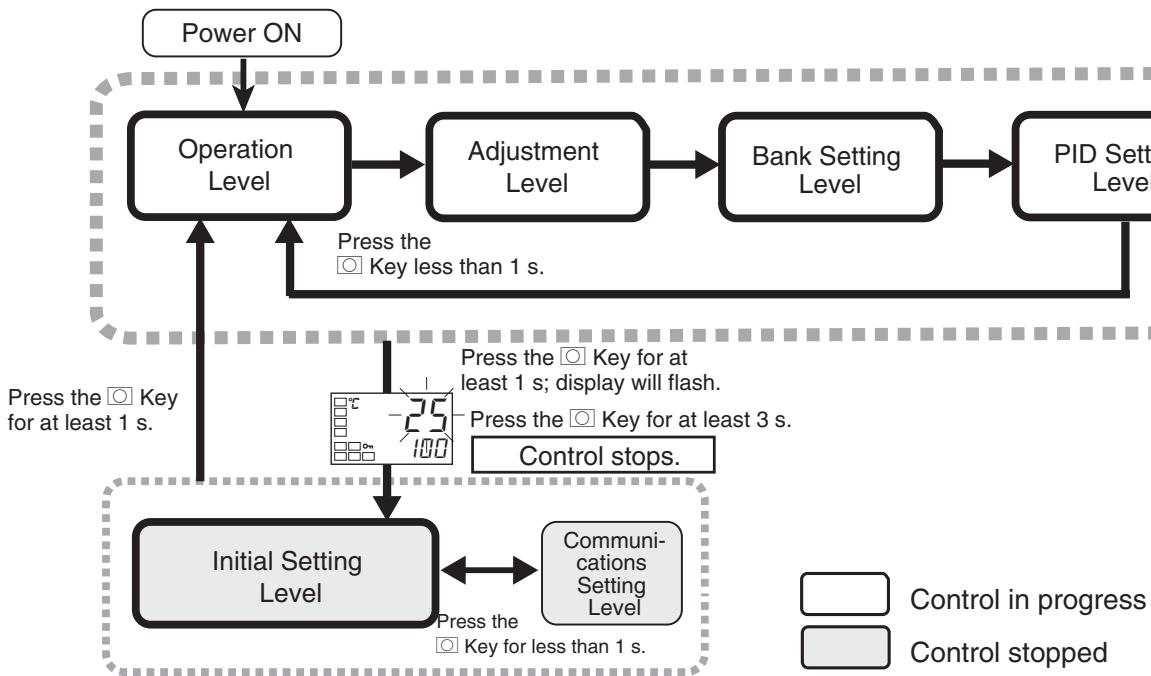
This level is displayed immediately after the power is turned ON. To move to other levels, press the Key or the and Keys.
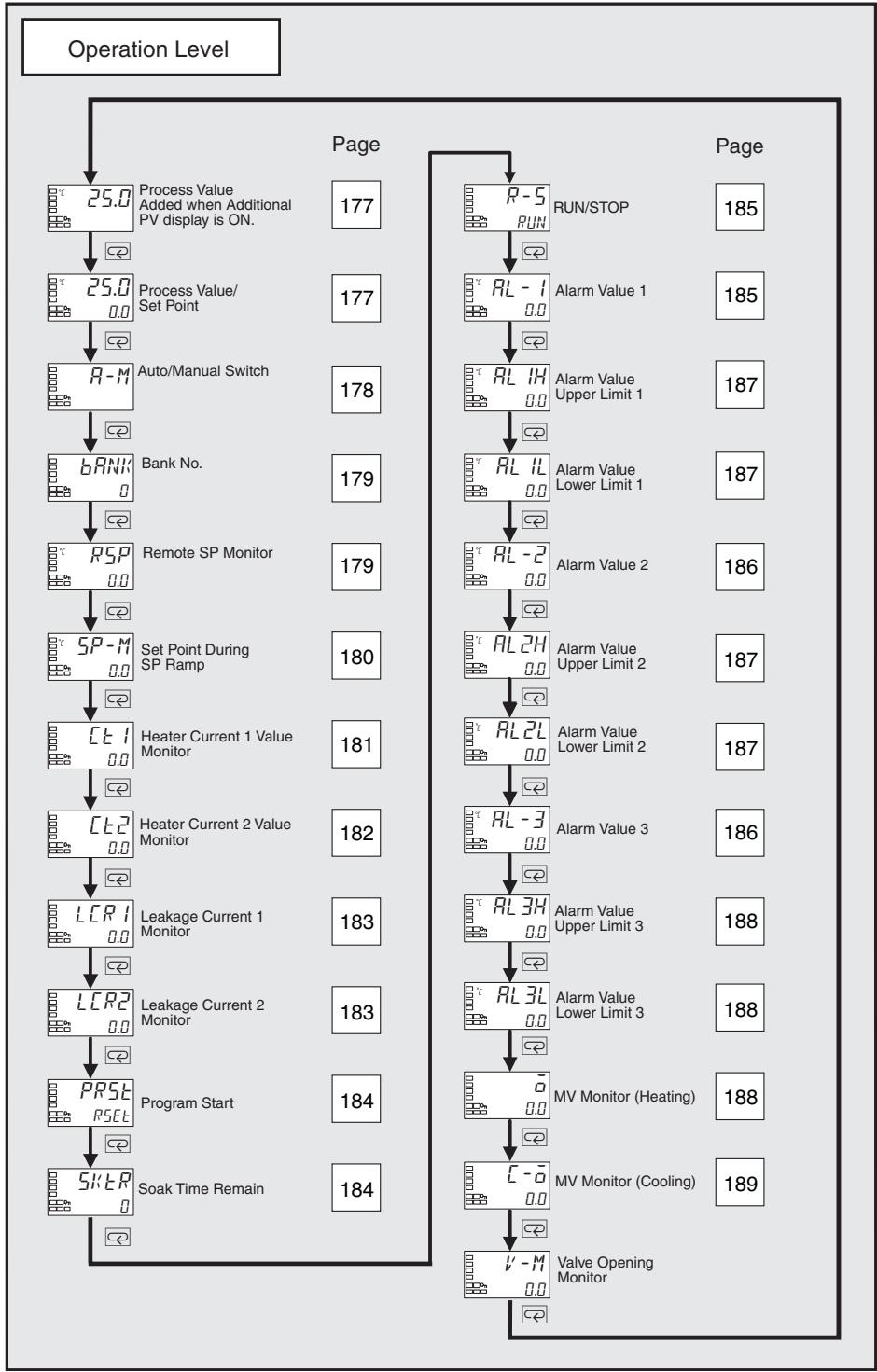
Note For details on the displays of Controllers with a No. 3 display (E5AN/EN-H), refer to Process Value/Set Point on page 177.
Process Value
The Additional PV Display parameter must be set to ON.
The process value is displayed on the No. 1 display, and nothing is displayed on the No. 2 and No. 3 (E5AN/EN-H only) displays.

| Monitor range | Unit | |
| Process value | Temperature: According to indication range for each sensor. Analog: Scaling lower limit -5% FS to Scaling upper limit +5% FS (Refer to page 335.) | EU |
During temperature input, the decimal point position depends on the currently selected sensor, and during analog input it depends on the Decimal Point parameter setting.

Related Parameters
Input type: Page 224, Set point upper limit, Set point lower limit: Page 227 (initial setting level)
Process Value/Set Point (Display 1) Process Value/Set Point (Display 2)
(The Process Value/Set Point (Display 2) parameter is supported for the E5AN-H and E5EN-H only.)
The process value is displayed on the No. 1 display, and the set point is displayed on the No. 2 display.
| Monitor range | Unit | |
| Process value | Temperature: According to indication range for each sensor. Analog: Scaling lower limit -5% FS to Scaling upper limit +5% FS (Refer to page 335.) | EU |
| Setting range | Unit | |
| Set point | SP lower limit to SP upper limit | EU |
During temperature input, the decimal point position depends on the currently selected sensor, and during analog input it depends on the Decimal Point parameter setting.
No. 3 Display (E5AN/EN-H)
The following table shows the contents of the No. 3 display, according to the setting of the PV/SP Display Screen Selection parameter.
| Set value | Display contents |
| 0 | Only the PV and SP are displayed. (The No. 3 display is not shown.) |
| 1 | PV/SP/Bank No. and PV/SP/MV are displayed in order. |
| 2 | PV/SP/MV and PV/SP/Bank No. are displayed in order. |
| 3 | Only PV/SP/Bank No. are displayed. |
| 4 | PV/SP/MV are displayed |
| 5 | PV/SP/Bank No. and PV/SP/Soak time remain are displayed in order. |
| 6 | PV/SP/MV and PV/SP/Soak time remain are displayed in order. |
| 7 | Only PV/SP/Soak time remain are displayed. |
When 1, 2, 5, or 6 is selected, press the Key to display PV/SP (Display 2). Example: When the PV/SP Display Screen Selection Parameter Is Set to 2
Operation Level
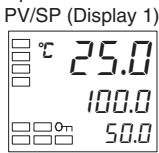
PV/SP/MV
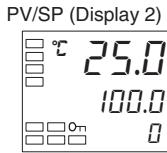
PV/SP/Bank No.
See
Related Parameters
Input type: Page 224, Set point upper limit, Set point lower limit: Page 227 (initial setting level)
PV/SP display screen selection (advanced function setting level): Page 275
H-M
Auto/Manual Switch
The Event Input Assignment 1 to 4 parameters must not be set to Auto/ Manual and the Auto/Manual Select Addition parameter must be set to ON.
The control must be set to 2-PID control.

Operation
- This parameter switches the Controller between automatic and manual modes.
- If the Key is pressed for at least 3 seconds when the Auto/Manual Switch parameter is displayed, the manual mode will be entered and the manual control level will be displayed.
- This parameter will not be displayed if an event input is set to "MANU" (auto/manual).
See
Related Parameters
PID ON/OFF (initial setting level): Page 228
Auto/manual select addition (advanced function setting level): Page 256
| Bank No. | The Bank Numbers Used parameter must be set to 0. | |
| Function | ·This parameter is used to select the bank. The SP, PID set number, SP ramp set value, alarm value, soak time, and wait band are set in bank setting level for each bank to be used, and then operation is switched between the banks using bank specifications (with event inputs, key operations, or communications).·With this parameter, the bank is specified by using key operations.·Use the ☑ and ☑ Keys to specify the bank number.·The default is for the current bank number to be displayed. | |
| Operation | ■ Related Parameters Bank numbers used (advanced function setting level): Page 237 | |
| RSP | Remote SP Monitor | The ST parameter must be set to OFF. The Remote SP Enable parameter must be set to ON. The SP Mode parameter must be set to LSP. |
| Function | ·This parameter monitors the remote SP while in Local SP Mode. ·While in Remote SP Mode, the remote SP can be monitored on the No. 2 display of the PV/SP Screen. | |
| Monitor | Monitor range Unit Remote SP lower limit to remote SP upper limit EU There are restrictions on the SP limits. | |
| See | ■ Related Parameters Process value/Set point (operation level): Page 177 SP mode (adjustment level): Page 193 Remote SP upper limit, Remote SP lower limit (advanced function setting level): Page 267 Remote SP enable (advanced function setting level): Page 266 | |
5P-M
Set Point During SP Ramp
The Bank * SP Ramp Set Value parameter must not be set to OFF, or the Remote SP Enable parameter must be set to ON.
The ST parameter must be set to OFF.
Function
This parameter monitors the set point during SP ramp operation.
A ramp is used to restrict the change width of the set point as a rate of change.
This parameter is displayed when a set value is input for the Bank * SP Ramp Set Value parameter (bank setting level).
When not in ramp operation, the set point will be the same as the one displayed for the Process Value/Set Point parameter.
Monitor
| Monitor range | Unit |
| SP: SP lower limit to SP upper limit | EU |

Related Parameters
Process value/Set point (operation level): Page 177
Bank * SP ramp set value (bank setting level): Page 211
Set point upper limit, Set point lower limit (initial setting level): Page 227
| Heater Current 1 Value Monitor | Heater burnout, HS alarm, and heater overcurrent detection must be supported. Alarm 1 must be assigned. The Heater Burnout Detection or Heater Overcurrent Use parameter must be set to ON. | |
| Function | This parameter measures the heater current from the CT input used for detecting heater burnout. This parameter measures and displays the heater current value. • Heater burnouts and heater overcurrent are not detected if the control output (heating) ON time is 100 ms or less. | |
| Monitor | Monitor range | Unit |
| 0.0 to 55.0 | A | |
| ● FFFF is displayed when 55.0 A is exceeded. ● If a heater burnout detection 1 or heater overcurrent detection 1 alarm is output, the HA indicator will light and the No. 1 display for the heater cur- rent 1 value monitor will flash. | ||
| See | ■ Related Parameters Heater burnout detection 1, Heater burnout detection 2 (adjustment level): Page 194, 196 HB ON/OFF (advanced function setting level): Page 246 Heater overcurrent detection 1, Heater overcurrent detection 2 (adjustment level): Page 195 Heater overcurrent use (advanced function setting level): Page 272 Error displays [E:]: Page 306 | |
| Heater Current 2 Value Monitor | Heater burnout, HS alarm, and heater overcurrent detection must be supported (two CTs). Alarm 1 must be assigned. The Heater Burnout Detection or Heater Overcurrent Use parameter must be set to ON. | |
| Function | This parameter measures the heater current from the CT input used for detecting heater burnout. This parameter measures and displays the heater current value. • Heater burnouts and heater overcurrent are not detected if the control output (heating) ON time is 100 ms or less. | |
| Monitor | Monitor range | Unit |
| 0.0 to 55.0 | A | |
| ● FFFF is displayed when 55.0 A is exceeded. ● If a heater burnout detection 2 or heater overcurrent detection 2 alarm is output, the HA indicator will light and the No. 1 display for the heater cur- rent 2 value monitor will flash. | ||
| See | ■ Related Parameters Heater burnout detection 1, Heater burnout detection 2 (adjustment level): Page 194, 196 HB ON/OFF (advanced function setting level): Page 246 Heater overcurrent detection 1, Heater overcurrent detection 2 (adjustment level): Page 195, 196 Heater overcurrent use (advanced function setting level): Page 272 Error displays [E2]: Page 306 | |
| LCRI | Leakage Current 1 Monitor | Heater burnout, HS alarms, and heater overcurrent detection must be supported. The HS Alarm Use parameter must be set to ON. |
| Function | This parameter measures the heater current from the CT input used for detecting SSR short-circuits. The heater current is measured and the leakage current 1 monitor is displayed. • HS alarms are not detected if the control output (heating) OFF time is 100 ms or less. | |
| Monitor | Monitor range | Unit |
| 0.0 to 55.0 | A | |
| • FFFF is displayed when 55.0 A is exceeded. • If an HS alarm 1 alarm is output, the HA indicator will light and the No. 1 display for the leakage current 1 monitor will flash. | ||
| See | ■ Related Parameters HS alarm 1, HS alarm 2 (adjustment level): Page 197 Failure detection (advanced function setting level): Page 257 Error displays LCR1: Page 306 | |
| LCRI2 | Leakage Current 2 Monitor | Heater burnout, HS alarms, and heater overcurrent detection must be supported (two CTs). Alarm 1 must be assigned. The HS Alarm Use parameter must be set to ON. |
| Function | This parameter measures the heater current from the CT input used for detecting SSR short-circuits. This parameter measures and displays the heater current value. • HS alarms are not detected if the control output (heating) OFF time is 100 ms or less. | |
| Monitor | Monitor range | Unit |
| 0.0 to 55.0 | A | |
| • FFFF is displayed when 55.0 A is exceeded. • If an HS alarm 2 alarm is output, the HA indicator will light and the No. 1 display for the leakage current 2 monitor will flash. | ||
| See | ■ Related Parameters HS alarm 1, HS alarm 2 (adjustment level): Page 197 HS alarm use (advanced function setting level): Page 257 Error displays LCR2: Page 306 | |
| PRSE | Program Start | The Program Pattern parameter must not be set to OFF. | |
| Function | This parameter starts and stops the simple program function. · The RUN/STOP status will automatically switch to RUN when this param- eter is set to STRT. · The simple program will stop when this parameter is set to RSET. · This parameter will function as a monitor display for the start/stop status of the simple program if an event input is selected to start the simple pro- gram. | ||
| Operation | Setting range | Default | |
| RSET | Stops the simpler program. | RSET | |
| STRRT | Starts the simpler program. | ||
| See | ■ Related Parameters Soak time remain: Page 184, RUN/STOP: Page 185 (operation level) Bank * soak time, Wait band (bank setting level): Page 215 Program pattern (initial setting level): Page 229 Soak time unit (advanced function setting level): Page 266 | ||
| SKIP | Soak Time Remain | The Program Pattern parameter must not be set to OFF. | |
| Function | · This parameter measures and displays the remaining time of the soak time for the simple program function. | ||
| Monitor | Monitor range | Unit | |
| 0 to 9999 | min or h | ||
| See | ■ Related Parameters Program start (operation level): Page 184 Bank * soak time, Wait band (bank setting level): Page 215 Program pattern (initial setting level): Page 229 Soak time unit (advanced function setting level): Page 266 | ||
| R-5 | RUN/STOP | The Event Input Assignment 1 to 4 parameters must not be set to “RUN/ STOP” | |
| Operation | This parameter starts and stops the control operation. When RUN (RUN) is selected, control is started. When LLaP (STOP) is selected, control is stopped. The STOP indicator will light when control. The default is RUN. | ||
| See | This parameter will not be displayed if an event input is set to “RUN/STOP.” | ||
| RL - I | Alarm Value 1 | Alarm 1 must be assigned. The alarm 1 type must not be 0, 1, 4, 5, or 12. | |
| Function | This parameter is set to one of the input values “X” in the alarm type list. · This parameter sets the alarm value for alarm 1. · During temperature input, the decimal point position depends on the cur- rently selected sensor, and during analog input it depends on the Decimal Point parameter setting. · The set value is saved in the Alarm 1 parameter in the current bank. | ||
| Setting | Setting range | Unit | Default |
| -1999 to 9999 | EU | 0 | |
| See | ■ Related Parameters Input type: Page 224, Scaling upper limit, Scaling lower limit, Decimal point (initial setting level): Page 226 (initial setting level) Alarm 1 type (initial setting level): Page 231 Standby sequence reset: Page 244, Auxiliary output * open in alarm: Page 245, Alarm 1 hysteresis: Page 233, Alarm 1 latch: Page 250 (advanced func- tion setting level) Bank * alarm value 1 (bank setting level): Page 211 | ||
| RL-2 | Alarm Value 2 | Alarm 2 must be assigned. The alarm 2 type must not be 0, 1, 4, 5, or 12. | |
| Function | This parameter is set to one of the input values “X” in the alarm type list. · This parameter sets the alarm value for alarm 2. · During temperature input, the decimal point position depends on the cur- rently selected sensor, and during analog input it depends on the Decimal Point parameter setting. · The set value is saved in the Alarm 2 parameter in the current bank. | ||
| Setting | Setting range | Unit | Default |
| -1999 to 9999 | EU | 0 | |
| See | ■ Related Parameters Input type: Page 224, Scaling upper limit, Scaling lower limit, Decimal point (initial setting level): Page 226 (initial setting level) Alarm 2 type (initial setting level): Page 233 Standby sequence reset: Page 244, Auxiliary output * open in alarm: Page 245, Alarm 2 hysteresis: Page 233, Alarm 2 latch: Page 250 (advanced func- tion setting level) Bank * alarm value 2 (bank setting level): Page 212 | ||
| RL-3 | Alarm Value 3 | Alarm 3 must be assigned. The alarm 3 type must not be 0, 1, 4, 5, or 12. | |
| Function | This parameter is set to one of the input values “X” in the alarm type list. · This parameter sets the alarm value for alarm 3. · During temperature input, the decimal point position depends on the cur- rently selected sensor, and during analog input it depends on the Decimal Point parameter setting. · The set value is saved in the Alarm 3 parameter in the current bank. | ||
| Setting | Setting range | Unit | Default |
| -1999 to 9999 | EU | 0 | |
| See | ■ Related Parameters Input type: Page 224, Scaling upper limit, Scaling lower limit, Decimal point (initial setting level): Page 226 (initial setting level) Alarm 3 type (initial setting level): Page 234 Standby sequence reset: Page 244, Auxiliary output * open in alarm: Page 245, Alarm 3 hysteresis: Page 233, Alarm 3 latch: Page 250 (advanced func- tion setting level) Bank * alarm value 3 (bank setting level): Page 213 | ||
| Setting range | Unit | Default |
| -1999 to 9999 | EU | 0 |

Related Parameters
Input type: Page 224, Scaling upper limit, Scaling lower limit, Decimal point: Page 226, Alarm 2 type: Page 233 (initial setting level), Standby sequence reset: Page 244, Auxiliary output * open in alarm: Page 245, Alarm 2 hysteresis: Page 233, Alarm 2 latch: Page 250 (advanced function setting level)
Bank * alarm value upper limit 2, Bank * alarm value lower limit 2 (bank setting level): Page 213
AL3H AL3L
Alarm Value Upper Limit 3 Alarm Value Lower Limit 3
Alarm 3 must be assigned.
The alarm 3 type must not be 1, 4, or 5.
These parameters independently set the alarm value upper and lower limits when the mode for setting the upper and lower limits is selected for the Alarm 3 Type parameter (initial setting level).
- This parameter sets the upper and lower limit values of alarm 3.
- During temperature input, the decimal point position depends on the currently selected sensor, and during analog input it depends on the Decimal Point parameter setting.
- The set value is saved in the Alarm Value Upper Limit 3 and Alarm Value Lower Limit 3 parameters in the current bank.
| Setting range | Unit | Default |
| -1999 to 9999 | EU | 0 |

Related Parameters
Input type: Page 224, Scaling upper limit, Scaling lower limit, Decimal point: Page 226, Alarm 3 type: Page 234 (initial setting level), Standby sequence reset: Page 244, Auxiliary output * open in alarm: Page 245, Alarm 3 hysteresis: Page 233, Alarm 3 latch: Page 250 (advanced function setting level)
Bank * alarm value upper limit 3, Bank * alarm value lower limit 3 (bank setting level): Page 214
a
MV Monitor (Heating)
The MV Display parameter must be set to ON.
This parameter is used to check the manipulated variable for the heating control output during operation.
- This parameter cannot be set.
- During standard control, the manipulated variable is monitored. During heating/cooling control, the manipulated variables on the control output (heating) is monitored.
- The default is OFF and the manipulated variable is not displayed.
| Control | Monitor range | Unit |
| Standard | -5.0 to 105.0 | % |
| Heating/cooling | 0.0 to 105.0 | % |
| Control | Monitor range | Unit |
| Heating/cooling | 0.0 to 105.0 | % |
5-4 Adjustment Level
This level is for executing AT (auto-tuning) and other operations, and for set control parameters.
This Digital Controllers the basic Controller parameters for PID control (proportional band, integral time, derivative time) and heating/cooling control.
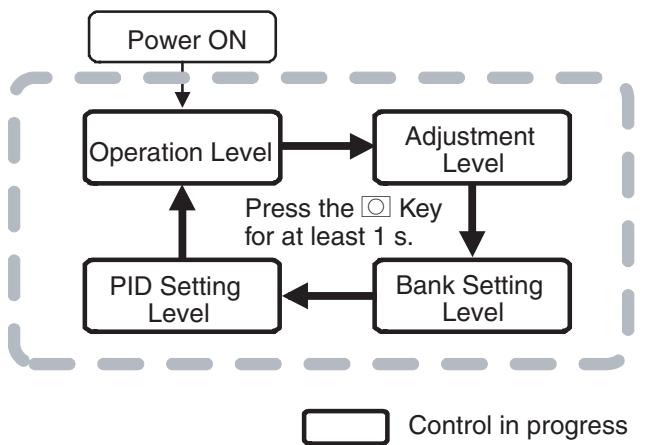
To move to the adjustment level from the operation level, press the Key once.
- The following parameters are displayed for Controllers with CT Inputs: Heater current monitors, Leakage current monitors, heater burnout detections, HS alarms, and heater overcurrent detections.
- Adjustment level parameters can be changed after setting the Operation/ Adjustment Protect parameter to 0. Displays and changing levels are not possible if the Operation/Adjustment Protect parameter is set to 1 to 3. Protection is set in the protect level.
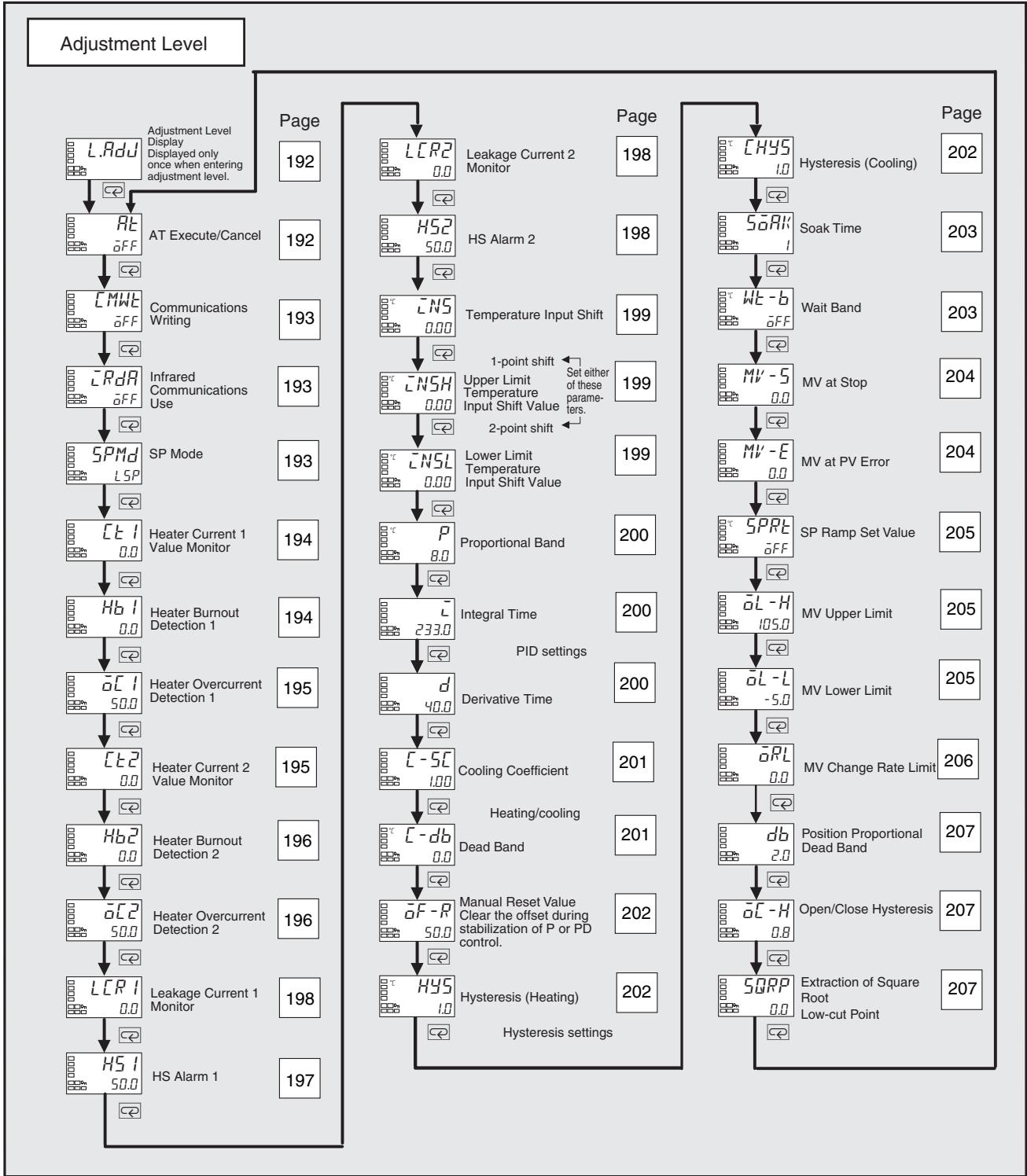
| L.RduJ | Adjustment Level Display | |
| Function | This parameter is displayed after moving to the adjustment level. When a logic operation is set, a period "." will be displayed on the No. 2. display. · This parameter indicates that the adjustment level has been entered. (The Adjustment Level parameter will not be displayed again even if the Key is pressed in the adjustment level to scroll through the parame- ters.) | |
| RE | AT Execute/Cancel | The ramp must be in operation, and 2-PID control must be used. Event Input Assignments 1 to 4 parameters must be other than 100% or 40% AT Execute/Cancel. |
| Function | This parameter executes auto-tuning (AT). · The MV is forcibly increased and decreased around the set point to find the characteristics of the control object. From the results, the PID constants are automatically set in the Proportional Band (P), Integral Time (I), and Derivative Time (D) parameters. · Both 100% AT and 40% AT are supported for AT. · Only 100% AT can be executed for heating/cooling control and position-proportional floating control. · This parameter will not be displayed when either 100% or 40% AT ex- cute/cancel is set to be executed using an event input. | |
| Operation | Setting rage | Default |
| OFF: AT Cancel AT-2: 100%AT Execute AT-1: 40%AT Execute | OFF | |
| · This parameter is normally OFF. Press the Key and select Rt - 2 or Rt - I to execute AT. AT cannot be executed when control is stopped or during ON/OFF control. · When AT execution ends, the parameter setting automatically returns to OFF. | ||
| See | ■ Related Parameters PID * proportional band, PID * Integral time, PID * Derivative time (PID setting level): Page 217 PID ON/OFF (initial setting level): Page 228 | |
| EME | Communications Writing | Communications must be supported. The Event Input Assignments 1 to 4 parameters must not be set to enable communications writing. | |
| Function | ·This parameter enables/disables writing of parameters to the Digital Controllers from the host (personal computer) using communications. ·This parameter is not displayed if communications write enable/disable is set for execution using an event input assignment 1 to 4. | ||
| Setting | ON: Writing enabled OFF: Writing disabled ·Default: OFF | ||
| See | ■ Related Parameters MB command logic switching (advanced function setting level): Page 252 Communications unit No., Communications baud rate, Communications data length, Communications parity, Communications stop bits (communications setting level): Page 281 | ||
| ERdR | Infrared Communications Use | Infrared communications must be supported. | |
| Function | This parameter enables or disables infrared communications between the host (personal computer) and the Digital Controller. ·Set this parameter to ON only when connecting to a Setup Tool, and leave it set to OFF during normal operation. | ||
| Setting | ON: Infrared communications enabled. OFF: Infrared communications disabled. ·Default: OFF | ||
| SPMd | SP Mode | The ST parameter must be set to OFF. The Remote SP Enable parameter must be set to ON. The Event Input Assignment 1 to 4 parameters must not be set to switch to SP mode. | |
| Function | ·This parameter is used to select the SP mode. ·In Local SP Mode, the local SP set in bank is used as the target value in the control operation. In Remote SP Mode, the remote SP set via an external signal (e.g., 4 to 20 mA) is used as the target value in the control operation. | ||
| Setting | Setting range | Default | |
| RSP: Remote SP, LSP: Local SP | LSP | ||
| See | ■ Related Parameters Remote SP enable (advanced function setting level): Page 266 | ||
| [Et] | Heater Current 1 Value Monitor | Heater burnout, HS alarms, and heater overcurrent detection must be supported. Alarm 1 must be assigned. The HB ON/OFF parameter or Heater Overcurrent Use parameter must be set to ON. | |
| Function | This parameter measures the heater current from the CT input used for detecting heater burnout. This parameter measures and displays the heater current value. • Heater burnouts or heater overcurrent are not detected if the control output (heating) ON time is 100 ms or less. | ||
| Monitor | Monitor range | Unit | |
| 0.0 to 55.0 | A | ||
| ● FFFF is displayed when 55.0 A is exceeded. ● If a heater burnout detection 1 or heater overcurrent detection 1 alarm is output, the HA indicator will light and the No. 1 display for the heater cur- rent 1 value monitor will flash. | |||
| See | ■ Related Parameters Heater burnout detection 1, Heater burnout detection 2 (adjustment level): Page 194, 196 HB ON/OFF (advanced function setting level): Page 246 Heater overcurrent detection 1, Heater overcurrent detection 2 (adjustment level): Page 195, 196 Heater overcurrent use (advanced function setting level): Page 272 Error displays [Et]: Page 306 | ||
| Hb I | Heater Burnout Detection 1 | Heater burnout, HS alarms, and heater overcurrent detection must be supported. Alarm 1 must be assigned. The Heater Burnout Detection parameter must be set to ON. | |
| Function | This parameter sets the current for the heater burnout alarm to be output. • The heater burnout alarm is output when the heater current value falls below the setting of this parameter. • When the set value is 0.0, the heater burnout alarm output is turned OFF. When the set value is 50.0, the heater burnout alarm output is turned ON. | ||
| Setting | Setting range | Unit | Default |
| 0.0 to 50.0 | A | 0.0 | |

Related Parameters
Heater current 1 value monitor (adjustment level): Page 181
HB ON/OFF, Heater burnout latch, Heater burnout hysteresis (advanced function setting level): Page 246, 247
| aC I | Heater Overcurrent Detection 1 | Heater burnout, HS alarms, and heater overcurrent detection must be supported. Alarm 1 must be assigned. The Heater Overcurrent Use ON/OFF parameter must be set to ON. | |
| Function | This parameter sets the current value for heater overcurrent alarm outputs. • A heater overcurrent alarm is output when the heater current exceeds the value set for this parameter. • When the set value is 50.0, the heater overcurrent alarm is turned OFF. When the set value is 0.0, the heater overcurrent alarm is turned ON. | ||
| Setting | Setting range | Unit | Default |
| 0.0 to 50.0 | A | 50.0 | |
| See | ■ Related Parameters Heater current 1 value monitor (adjustment level): Page 181 Heater overcurrent use, Heater overcurrent latch, Heater overcurrent hysteresis (advanced function setting level): Page 272, 273 | ||
| Heater Current 2 Value Monitor | Heater burnout, HS alarms, and heater overcurrent detection must be supported (two CTs). Alarm 1 must be assigned. The HB ON/OFF or Heater Overcurrent Use parameter must be set to ON. |
Function
This parameter measures the heater current from the CT input used for detecting heater burnout.
This parameter measures and displays the heater current value.
- Heater burnouts and heater overcurrent are not detected if the control output (heating) ON time is 100ms or less.
Monitor
| Monitor range | Unit |
| 0.0 to 55.0 | A |
- F F F is displayed when 55.0 A is exceeded.
- If a heater burnout detection 2 or heater overcurrent detection 2 alarm is output, the HA indicator will light and the No. 1 display for the heater current 2 value monitor will flash.

Related Parameters
Heater burnout detection 1, Heater burnout detection 2 (adjustment level): Page 194, 196
HB ON/OFF (advanced function setting level): Page 246
Heater overcurrent detection 1, Heater overcurrent detection 2 (adjustment level): Page 195, 196
Heater overcurrent use (advanced function setting level): Page 272
Error displays [E2]: Page 306
Hb2
Heater Burnout Detection 2
Heater burnout, HS alarms, and heater overcurrent detection must be supported (two CTs).
Alarm 1 must be assigned.
The HB ON/OFF parameter must be set to ON.
Function
This parameter sets the current for the heater burnout alarm to be output.
- The heater burnout alarm is output when the heater current value falls below the setting of this parameter.
- When the set value is 0.0, the heater burnout alarm output is turned OFF.
When the set value is 50.0, the heater burnout alarm output is turned ON.
Setting
| Setting range | Unit | Default |
| 0.0 to 50.0 | A | 0.0 |

Related Parameters
Heater current 2 value monitor (adjustment level): Page 182
HB ON/OFF, Heater burnout latch, Heater burnout hysteresis (advanced function setting level): Page 246
aC2
Heater Overcurrent Detection 2
Heater burnout, HS alarms, and heater overcurrent detection must be supported (two CTs).
Alarm 1 must be assigned.
The Heater Overcurrent Use parameter must be set to ON.
Function
This parameter sets the current value for heater overcurrent alarm outputs.
- A heater overcurrent alarm is output when the heater current exceeds the value set for this parameter.
- When the set value is 50.0, the heater overcurrent alarm is turned OFF.
When the set value is 0.0, the heater overcurrent alarm is turned turn ON.
Setting
| Setting range | Unit | Default |
| 0.0 to 50.0 | A | 50.0 |

Related Parameters
Heater current 2 value monitor (adjustment level): Page 182
Heater overcurrent use, Heater overcurrent latch, Heater overcurrent hysteresis (advanced function setting level): Page 272, 273
| LCRI | Leakage Current 1 Monitor | Heater burnout, HS alarms, and heater overcurrent detection must be supported. Alarm 1 must be assigned. The HS Alarm parameter must be set to ON. | |
| Function | This parameter measures the heater current from the CT input used for detecting SSR short-circuits. This parameter measures and displays the heater current when the heater is OFF. ·HS alarms are not detected if the control output (heating) OFF time is 100 ms or less. | ||
| Monitor | Monitor range | Unit | |
| 0.0 to 55.0 | A | ||
| See | ·FFFF is displayed when 55.0 A is exceeded. ·If an HS alarm 1 alarm is output, the HA indicator will light and the No. 1 display for the leakage current 1 monitor will flash. | ||
| ■Related Parameters HS alarm 1, HS alarm 2 (adjustment level): Page 197 HS alarm use (advanced function setting level): Page 257 Error displays LCR I: Page 306 | |||
| HS I | HS Alarm 1 | Heater burnout, HS alarms, and heater overcurrent detection must be supported. Alarm 1 must be assigned. The HS Alarm parameter must be set to ON. | |
| Function | This parameter sets the current for the HS alarm to be output. ·An HS alarm is output when the leakage current value exceeds the setting of this parameter. ·When the set value is 50.0, the HS alarm output is turned OFF. When the set value is 0.0, the HS alarm output is turned ON. | ||
| Setting | Setting range | Unit | Default |
| 0.0 to 50.0 | A | 50.0 | |

Related Parameters
Leakage current 1 monitor (adjustment level): Page 197
HS alarm, HS alarm latch, HS alarm hysteresis (advanced function setting level): Page 257
| LCR2 | Leakage Current 2 Monitor | Heater burnout, HS alarms, and heater overcurrent detection must be supported (two CTs). Alarm 1 must be assigned. The HS Alarm parameter must be set to ON. | |
| Function | This parameter measures the heater current from the CT input used for detecting SSR short-circuits. This parameter measures and displays the heater current value. • HS alarms are not detected if the control output (heating) OFF time is 100 ms or less. | ||
| Monitor | Monitor range | Unit | |
| 0.0 to 55.0 | A | ||
| See | ■ FFFF is displayed when 55.0 A is exceeded. • If an HS alarm 2 alarm is output, the HA indicator will light and the No. 1 display for the leakage current 2 monitor will flash. | ||
| HS alarm 1, HS alarm 2 (adjustment level): Page 197 HS alarm use (advanced function setting level): Page 257 Error displays LCR2: Page 306 | |||
| HS2 | HS Alarm 2 | Heater burnout, HS alarms, and heater overcurrent detection must be supported (two CTs). Alarm 1 must be assigned. The HS Alarm parameter must be set to ON. | |
| Function | This parameter sets the current for the HS alarm to be output. • An HS alarm is output when the leakage current value exceeds the setting of this parameter. • When the set value is 50.0, the HS alarm output is turned OFF. When the set value is 0.0, the HS alarm output will turn ON. | ||
| Setting | Setting range | Unit | Default |
| 0.0 to 50.0 | A | 50.0 | |

Related Parameters
Leakage current 2 monitor (adjustment level): Page 198
HS alarm use, HS alarm latch, HS alarm hysteresis (advanced function setting level): Page 257
| Setting range | Unit | Default |
| -199.99 to 324.00 | °C or °F | 0.00 |
| P | Proportional Band | The control must be set to 2-PID control. |
| L | Integral Time | |
| d | Derivative Time |
These parameters set PID control constants. PID constants are automatically set when AT or ST is executed.
P action: Refers to control in which the MV is proportional to the deviation (control error).
I action: Refers to a control action that is proportional to the time integral of the deviation. With proportional control, there is normally an offset (control error). Proportional action is thus used in combination with integral action. As time passes, this control error disappears, and the control temperature (process value) comes to agree with the set point.
D action: Refers to a control action that is proportional to the time derivative of the control error. The proportional control and integral control correct for errors in the control result, and thus the control system is late in responding to sudden changes in temperature. The derivative action increases the MV in proportion to the slope of the change in the temperature as a corrective action.
- The set values are saved in the Proportional Band, Integral Time, and Derivative Time parameters for the selected PID set.
| Parameter name | Models | Unit | Default |
| Proportional Band | Controllers with Temperature Inputs: 0.1 to 3,240.0 | °C or °F | 8.0 |
| Analog input: 0.1 to 999.9 | %FS | 10.0 | |
| Integral Time | Standard, heating/cooling, or position-proportional (close) control: 0.0 to 3,240.0 | Second | 233.0 |
| Position-proportional (floating) control: 0.1 to 3,240.0 | |||
| Derivative Time | 0.0 to 3240.0 | Second | 40.0 |

Related Parameters
AT execute/cancel (adjustment level): Page 192
PID * proportional band, PID * Integral time, PID * Derivative time (PID setting level): Page 217
| Model | Setting range | Unit | Default | |
| Temperature input | -19999.9 to 3240.00 | °C or °F | 0.0 | |
| Analog input | -19.99 to 99.99 | %FS | 0.00 | |
| Parameter name | Model | Setting range | Unit | Default | |
| Hysteresis (Heating) | Temperature input | 0.1 to 3240.00 | °C or °F | 1.0 | |
| Analog Input | 0.01 to 99.99 | %FS | 0.10 | ||
| Hysteresis (Cooling) | Temperature input | 0.1 to 3240.00 | °C or °F | 1.0 | |
| Analog Input | 0.01 o 99.99 | %FS | 0.10 | ||
| SoAK | Soak Time | The Program Pattern parameter must not be set to OFF. | |||
| Function | ·This parameter sets the time for the control operation when using the sim- ple program function. ·The set value is saved in the Soak Time parameter for the current bank. | ||||
| Setting | Setting range | Unit | Default | ||
| 1 to 9999 | min or h | 1 | |||
| See | ■ Related Parameters Program start, Soak time remain (operation level): Page 184 Bank * wait band, Bank * soak time (Bank setting level): Page 215 Program pattern (initial setting level): Page 229 Soak time unit (advanced function setting level): Page 266 | ||||
| Wt-b | Wait Band | The Program Pattern parameter must not be set to OFF. | |||
| Function | ·This parameter sets the stable band within which the soak time is mea- sured for the simple program function. ·The set value is saved in the Soak Time parameter for the current bank. | ||||
| Setting | Model | Setting range | Unit | Default | |
| Temperature input | OFF or 0.1 to 3240.0 | °C or °F | °F | ||
| Analog Input | OFF or 0.01 to 99.99 | %FS | |||
| See | ■ Related Parameters Program start, Soak time remain (operation level): Page 184 Bank * wait band, Bank * soak time (Bank setting level): Page 215 Program pattern (initial setting level): Page 229 Soak time unit (advanced function setting level): Page 266 | ||||
| MV-5 | MV at Stop | The control must be set to 2-PID control. The MV at Stop and Error Addition parameter must be ON. | |
| Function | ·This parameter sets the MV to use when the RUN/STOP status changes from RUN to STOP. | ||
| Setting range | Unit | Default | |
| Standard control: -5.0 to 105.0 Heating/cooling control: -105.0 to 105.0 Position-proportional control (close, with the Direct Setting of Position Proportional MV parameter ON): -5.0 to 105.0 | % | 0.0 | |
| Position-proportional control (floating or with the Direct Setting of Positional Proportional MV parameter OFF): CLOS, HOLD, OPEN | None | HOLD | |
| See | ■ Related Parameters RUN/STOP (operation level): Page 185 MV at stop and error addition (advanced function setting level): Page 256 | ||
| MV-E | MV at PV Error | The control must be set to 2-PID control. The MV at Stop and Error Addition parameter must be ON. | |
| Function | ·This parameter sets the MV to use when an input error occurs. | ||
| Setting range | Unit | Default | |
| Standard control: -5.0 to 105.0 Heating/cooling control: -105.0 to 105.0 Position-proportional control (close, with the Direct Setting of Position Proportional MV parameter ON): -5.0 to 105.0 | % | 0.0 | |
| Position-proportional control (floating or with the Direct Setting of Positional Proportional MV parameter OFF): CLOS, HOLD, OPEN | None | HOLD | |
| See | ■ Related Parameters MV at stop and error addition (advanced function setting level): Page 256 | ||
| SPRL | SP Ramp Set Value | The ST parameter must be set to OFF. | ||
| Function | ·This parameter sets the rate of change during SP ramp operation. Set the maximum permissible change width per unit of time as the SP ramp set value. The SP ramp function is disabled if this parameter is set to OFF. ·During temperature input, the decimal point position of the SP ramp set value is dependent on the currently selected sensor, and during analog input it is dependent on scaling. ·The set value is saved in the SP Ramp Set Value parameter for the current bank. | |||
| Setting range | Unit | Default | ||
| OFF or 1 to 32400 | EU/s or EU/minute | aFF | ||
| See | ■ Related Parameters Input type: Page 224, Scaling upper limit, Scaling lower limit, Decimal point (initial setting level): Page 226, ST: Page 228 (initial setting level) SP ramp time unit (advanced function setting level): Page 244 Bank * SP ramp set value (bank setting level): Page 211 | |||
| aL-H | MV Upper Limit | The control must be set to 2-PID control. | ||
| aL-L | MV Lower Limit | The ST parameter must be set to OFF. Position-proportional (close) control must be supported. | ||
| Function | ·The MV Upper Limit and MV Lower Limit parameters set the upper and lower limits of the manipulated variable. When the calculated manipulated variable exceeds the upper or lower limit value, the upper or lower limit value will be the output level. ·The set value is saved in the MV Upper Limit and MV Lower Limit parameters for the current PID set. ·MV Upper Limit The setting ranges during standard control, heating/cooling control, and position-proportional (close) control are different. | |||
| Setting | Control method | Setting range | Unit | Default |
| Standard | MV lower limit + 0.1 to 105.0 | % | 105.0 | |
| Heating/cooling | 0.0 to 105.0 | |||
| Position proportional (close) | MV lower limit + 0.1 to 105.0 | |||
- MV Lower Limit
The setting ranges during standard control, heating/cooling control, and position-proportional (close) control are different. The manipulated variable for the cooling control output side during heating/cooling control is expressed as a negative value.
| Control method | Setting range | Unit | Default |
| Standard | -5.0 to MV upper limit -0.1 | % | -5.0 |
| Heating/cooling | -105.0 to 0.0 | -105.0 | |
| Position proportional (close) | 5.0 to MV upper limit -0.1 | -5.0 |

Related Parameters
PID ON/OFF: Page 228, ST: Page 228 (initial setting level)
PID * MV upper limit, PID * MV lower limit (PID setting level): Page 217
aRL
MV Change Rate Limit
2-PID control must be used.
ST must be OFF.
- The MV Change Rate Limit parameter sets the maximum allowable variation in the MV per second. If the change in the MV exceeds this setting, the MV will be changed by the MV change rate limit until the calculated value is reached. If the limit is set to 0.0, this function will be disabled.
- The MV Change Rate Limit parameter will not operate in the following situations.
In manual mode
- During ST execution (Cannot be set when ST is ON.)
- During AT execution
- During ON/OFF control
- While stopped (MV output during STOP)
- During MV output when error occurs
| Setting range | Unit | Default |
| 0.0 to 100.0 | %/s | 0.0 |

Related Parameters
Proportional band (adjustment level): Page 200
| db | Position Proportional Dead Band | Position-proportional control must be supported. | |
| Function | ·This parameter sets the output hold interval (the ON/OFF switching interval between the open and close outputs) for position-proportional control. | ||
| Setting range | Unit | Default | |
| Position proportional (close): 0.1 to 10.0 | % | 4.0 | |
| Position proportional (floating): 0.1 to 10.0 | % | 2.0 | |
| See | ■ Related Parameters Open/close hysteresis (adjustment level): Page 207 | ||
| aC-H | Open/Close Hysteresis | Position-proportional control must be supported. | |
| Setting | ·This parameter provides hysteresis in position-proportional control when the open and close outputs are switched ON or OFF. | ||
| Setting range | Unit | Default | |
| 0.1 to 20.0 | % | 0.8 | |
| See | ■ Related Parameters Position proportional dead band (adjustment level): Page 207 | ||
| SQRP | Extraction of Square Root Low-cut Point | The input type must be an analog input, and the Extraction of Square Root Enable parameter must be set to ON. | |
| Function | ·This parameter sets the extraction of square root low-cut point used for the inputs. The data after extracting the square root is shown below. | ||
- The low-cut point is used for extracting the square root for flowrate sensors.
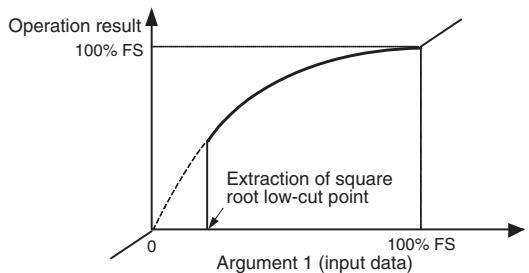
| Setting range | Unit | Default |
| 0.0 to 100.0 | % | 0.0 |

Related Parameters
Extraction of square root enable (initial setting level): Page 207
5-5 Bank Setting Level
The bank setting level is used to make settings such as the SP, PID set, alarm value, soak time, and wait band for each bank. Move to a particular bank from the Display Bank Selection parameter, which is displayed first in the bank selection level.
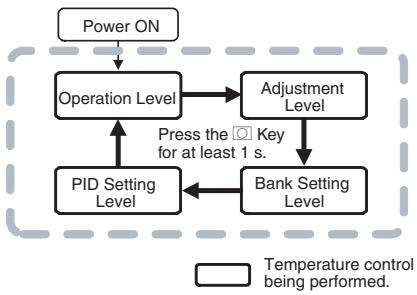
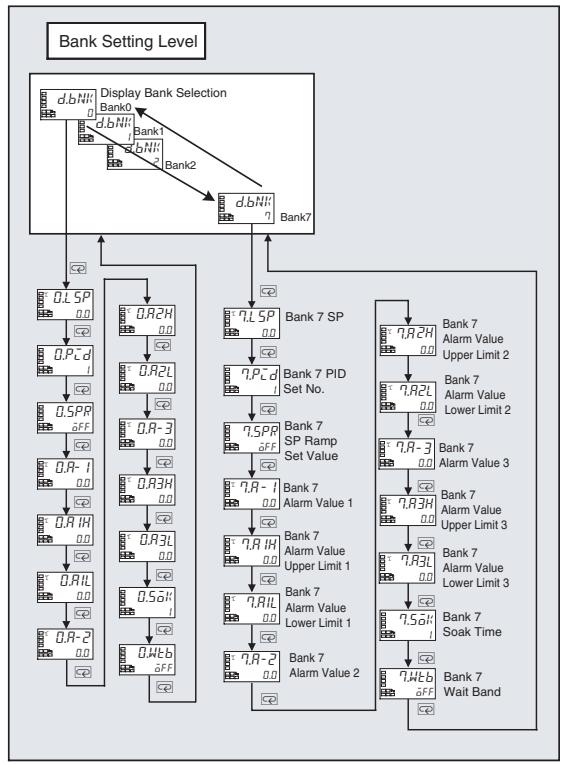
| Setting range | Default |
| 0 to 8 | 1 |

Related Parameters
PID () proportional band, PID () integral time, PID (*) derivative time (PID setting level): Page 217
PID (*) automatic selection range upper limit (PID setting level): Page 218
PID set automatic selection data (advanced function setting level): Page 269
| *5PR Bank 0 to 7 SP Ramp Set Value The ST parameter must be set to OFF. | |||
| Function | These parameters are used to set the SP ramp set value for each bank. ·The SP ramp set value can be set for banks 0 to 7. ·This parameter specifies the rate of change during SP ramp operation. Set the maximum allowable change width per unit of time as the SP ramp set value. When this parameter set to OFF, the SP ramp function will be disabled. ·During temperature input, the decimal point position for the SP ramp set value depends on the current sensor, and during analog input it depends on scaling. | ||
| Setting | Setting range | Unit | Default |
| OFF, 1 to 32400 | EU/s, EU/min, EU/h | OFF | |
| See | ■ Related Parameters Input type: Page 224 Scaling upper limit, Scaling lower limit, Decimal point: Page 226 ST (initial setting level): Page 228 SP ramp time unit (advanced function setting level): Page 244 | ||
| *R- I | Bank * Alarm Value 1 (*: 0 to 7) | Alarm 1 must be assigned.The alarm 1 type must not be 0, 1, 4, 5, or 12. | |
| Function | These parameters set one of the input values "X" in the alarm type list for each bank. ·These parameters set the value for alarm value 1 in banks 0 to 7. ·During temperature input, the decimal point position is set automatically according to the current sensor, and during analog input it depends on the Decimal Point parameter setting. | ||
| Setting | Setting range | Unit | Default |
| -19999 to 32400 | EU | 0.0 | |

Related Parameters
Input type: Page 224 Scaling upper limit, Scaling lower limit, Decimal point: Page 226
Alarm 1 type (initial setting level): Page 231
Standby sequence reset: Page 244
Auxiliary output * open in alarm: Page 245
Alarm 1 hysteresis: Page 233
Alarm 1 latch (advanced function level): Page 250
| Setting range | Unit | Default |
| -19999 to 32400 | EU | 0.0 |
| *R-2 | Bank * Alarm Value 2 (*: 0 to 7) | Alarm 2 must be assigned. The alarm 2 type must not be 0, 1, 4, or 5, or 12. |
| Function | These parameters set one of the input values "X" in the alarm type list for each bank. · These parameters set the value for alarm value 2 in banks 0 to 7. · During temperature input, the decimal point position is set automatically according to the current sensor, and during analog input it depends on the Decimal Point parameter setting. | |
| Setting range | Unit | Default |
| -19999 to 32400 | EU | 0.0 |
| *5ok Bank Soak Time The Program Pattern parameter must not be set to OFF. | ||
| Function Setting | These parameters set the soak time for each bank. · These parameters set the time for the control operation in each bank when using the simple program function · When the bank function is enabled, this parameter is enabled when the current bank program pattern is not set to OFF. | |
| Setting range | Unit Default | |
| 0 to 9999 | min or h 1 | |
| See | ■ Related Parameters Program start, Soak time remain (operation level): Page 184 Bank (*) wait band (bank setting level): Page 215 Program pattern (initial setting level): Page 229 Soak time unit (advanced function setting level): Page 266 | |
| *.Netb Bank Wait Band The Program Pattern parameter must not be set to OFF. | ||
| Function Setting | These parameters set the wait band for each bank. · These parameters set the stable band, in each bank, within which the soak time is measured for the simple program function. · When the bank function is enabled, this parameter is enabled when the current bank program pattern is not set to OFF. | |
| Setting range | Unit Default | |
| Temperature: OFF, 0.1 to 3,240.0 | °C or °F | |
| Analog: OFF, 0.01 to 99.99 | %FS | |
| See | ■ Related Parameters Program start, Soak time remain (operation level): Page 184 Bank (*) soak time (bank setting level): Page 215 Program pattern (initial setting level): Page 229 Soak time unit (advanced function setting level): Page 266 | |
5-6 PID Setting Level
The PID setting level is used to make settings such as PID values for each PID set and MV limit values. Move to a particular PID set from the Display PID Set Selection parameter, which is displayed first in the PID setting level.
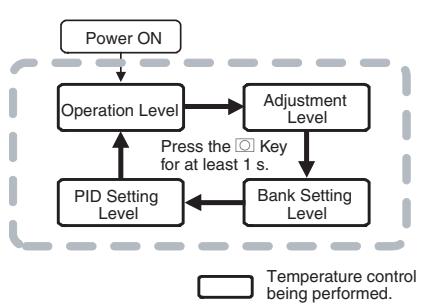
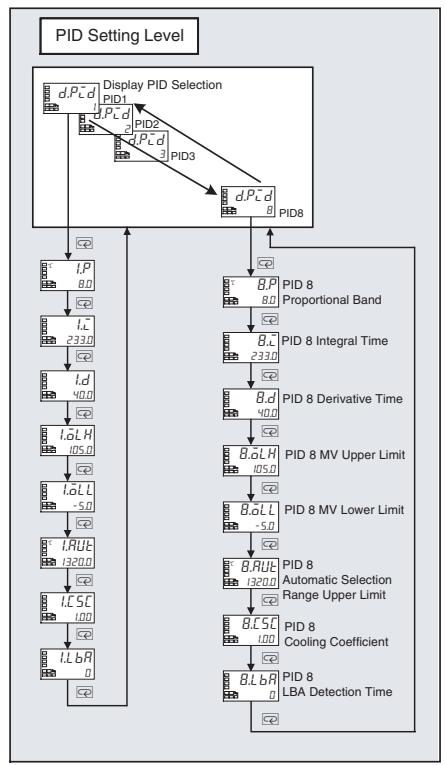
d.Pc
Display PID Selection
This parameter is used to select the PID set for making the display settings.
- This parameter selects the PID set for which the display settings are to be made.
- Up to eight sets (1 to 8) can be used. The following items registered in each set: PID value, MV upper and lower limits, automatic selection range, upper limit, cooling coefficient, and LBA detection time.
| Setting range | Default |
| 1 to 8 | See note. |
Note The current PID set will be displayed. If you use the U and D Keys to change the PID set, the monitor function will be canceled.

Related Parameters
Bank No. (operation level): Page 179
| *.P | PID * Proportional Band | |
| *.L | PID * Integral Time | 2-PID control must be used. |
| *.d | PID * Derivative Time (*: 1 to 8) |
These parameters set the PID constants for each PID set. When AT and ST are executed, the parameters are set automatically.
P action: For the P action, the MV is proportional to the derivative.
I action: For the I action, an output is produced that is proportional to the time integral of the derivative. An offset normally occurs with the proportional action, so the proportional action is used in combination with the integral action. As time passes, this offset disappears and the control temperature comes to match the set point.
D action: For the D action, an output is produced that is proportional to the time derivative of the input. Because the proportional action and integral action correct for errors in the control result, the control system will be slow to respond to sudden changes in temperature. The derivative action performs a corrective action by increasing the MV in proportion to the slope of the temperature change.
| Parameter | Setting range | Unit | Default |
| Proportional Band | Temperature: 0.1 to 3,240.0 | °C or °F | 8.0 |
| Analog: 0.1 to 999.9 | %FS | 10.0 | |
| Integral Time | Standard/heating and cooling, position proportional (closed): 0.0 to 3,240.0 | s | 233.0 |
| Position proportional (floating): 0.1 to 3,240.0 | |||
| Derivative Time | 0.0 to 3240.0 | s | 40.0 |
Note If the settings for RT (robust tuning) are changed, the P (proportional band), I (integral time), and D (derivative time) will be initialized.

Related Parameters
AT execute/cancel (adjustment level): Page 192
| *.\aLH | PID * MV Upper Limit | 2-PID control must be used. |
| *.\aLL | PID * MV Lower Limit (*: 1 to 8) | The ST parameter must be set to OFF. Closed control must be used (for position proportional models). |
These parameters set the MV upper and lower limits for each PID set.
- The MV Upper Limit and MV Lower Limit parameters set the upper and lower limits of the manipulated variable. When the calculated manipulated variable exceeds the upper or lower limit value, the upper or lower limit value will be the output level.
- MV limits do not operate when floating control is used with models that support position-proportional control, so these parameters are disabled.
Setting
- MV Upper Limit
The setting range depends on whether standard, position-proportional (closed) control, or heating/cooling control is used. In addition, the cooling MV during heating/cooling control is expressed as a negative value.
| Control method | Setting range | Unit | Default |
| Standard | MV lower limit + 0.1 to 105.0 | % | 105.0 |
| Heating/cooling | 0.0 to 105.0 | ||
| Position-proportional (closed) | MV lower limit + 0.1 to 105.0 |
- MV Lower Limit
The setting range depends on whether standard, position-proportional (closed) control, or heating/cooling control is used. In addition, the cooling MV during heating/cooling control is expressed as a negative value.
| Control method | Setting range | Unit | Default |
| Standard | -5.0 to MV lower limit - 0.1 | % | -5.0 |
| Heating/cooling | -105.0 to 0.0 | -105.0 | |
| Position-proportional (closed) | -5.0 to MV upper limit - 0.1 | -5.0 |
See
Related Parameters
PID ON/OFF: Page 228
ST (initial setting level): Page 228
*.RUL
PID * Automatic Selection Range Upper Limit (*: 1 to 8)
2-PID control must be used.
Function
These parameters set the upper limit for each PID set when PID sets are selected automatically.
- These parameters are used to set the automatic selection range upper limits for PID sets 1 to 8.
- The sensor setting range for PID set 8 is 32,400 EU for temperature inputs and 105.0% for analog inputs. This parameter does not need to be set.
- These values apply to the PV (process value), DV (deviation), or SP (set point) set in the PID Set Automatic Selection Data parameter. The default setting is PV.

Setting
| Setting range | Unit | Default |
| Temperature: -19,999 to 32,400 | EU | 1320.0 |
| Analog: -5.0 to 105.0 | % | 105.0 |
See
Related Parameters
PID set automatic selection data (advanced function setting level): Page 269
| *.[5C] | PID * Cooling Coefficient (*: 1 to 8) | Heating and cooling control and 2-PID control must be used. | |
| Function | If the heating and cooling characteristics of the control object are very different and good control characteristics cannot be achieved with the same PID constants, the cooling coefficient can be used to adjust the proportional band (P) for the control output assigned to the cooling side. One parameter is set for each PID set. • In heating/cooling control, the proportional band P for the cooling control output is calculated using the following formula to set the cooling coefficient: Cooling control output side P = Cooling coefficient × P (proportional band) • The cooling coefficient will be set automatically if autotuning is executed when the Automatic Cooling Coefficient Adjustment parameter is set to ON. The execution results will be saved in the PID set where autotuning was started. If non-linearity is strong in the cooling characteristics, however, this function may not find the optimum cooling coefficient. | ||
| Setting | Setting range | Unit | Default |
| 0.01 to 99.99 | None | 1.00 | |
5-7 Monitor/Setting Item Level
Monitor/setting items can be displayed by means of the function key when the PF Setting parameter (advanced function setting level) is set to PFDP: Monitor/Setting Item (for the E5AN/EN-H only).
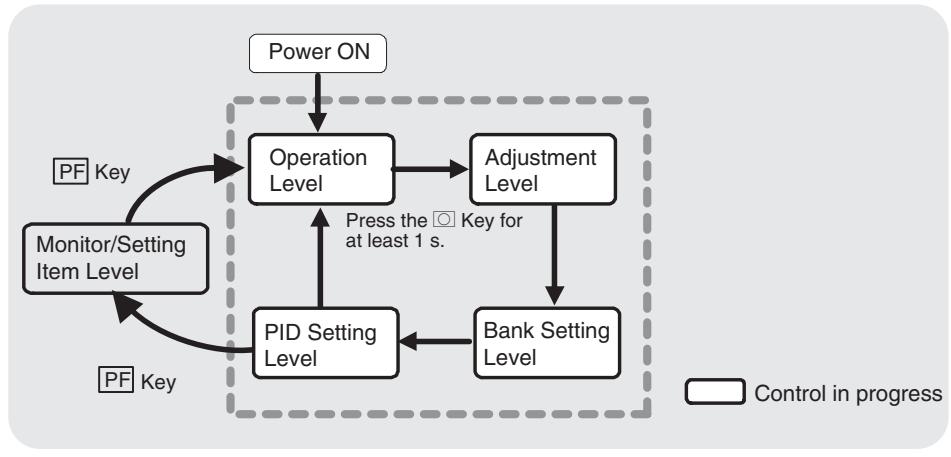
Monitor/Setting Item Display 1 to 5
The PF Setting parameter must be set to PFDP, and the Monitor/Setting Item 1 to 5 parameters must not be set to OFF.
Function
- When the PF Key is set to display monitor/setting items, pressing the PF Key will display in order the contents of the Monitor/Setting Item 1 to 5 parameters. The contents of these parameters are shown in the following table. For the setting (monitor) ranges, refer to the applicable parameters.
| Set value | Setting | Remarks | |
| Monitor/Setting | Symbol | ||
| 0 | Disabled | --- | |
| 1 | PV/SP/Bank No. | Can be set. (SP) | --- |
| 2 | PV/SP/MV | Can be set. (SP) | --- |
| 3 | PV/SP /Soak time remain | Can be set. (SP) | --- |
| 4 | Proportional band (P) | Can be set. | P |
| 5 | Integral time (I) | Can be set. | L |
| 6 | Derivative time (D) | Can be set. | d |
| 7 | Alarm value 1 | Can be set. | RL - I |
| 8 | Alarm value upper limit 1 | Can be set. | RL IH |
| 9 | Alarm value lower limit 1 | Can be set. | RL IL |
| 10 | Alarm value 2 | Can be set. | RL - 2 |
| 11 | Alarm value upper limit 2 | Can be set. | RL 2H |
| 12 | Alarm value lower limit 2 | Can be set. | RL 2L |
| 13 | Alarm value 3 | Can be set. | RL - 3 |
| 14 | Alarm value upper limit 3 | Can be set. | RL 3H |
| 15 | Alarm value lower limit 3 | Can be set. | RL 3L |
| 16 | Bank No. | Can be set. | BANK |
See
Related Parameters
PF setting (advanced function setting level): Page 273
Monitor/setting items 1 to 5 (advanced function setting level): Page 274
5-8 Manual Control Level
The manipulated variable can be set in manual mode while the PV/MV parameter is displayed.
The final MV used in automatic mode will be used as the initial manual MV when moving from automatic mode to manual mode. In manual mode, the change value will be saved immediately and reflected in the actual MV.
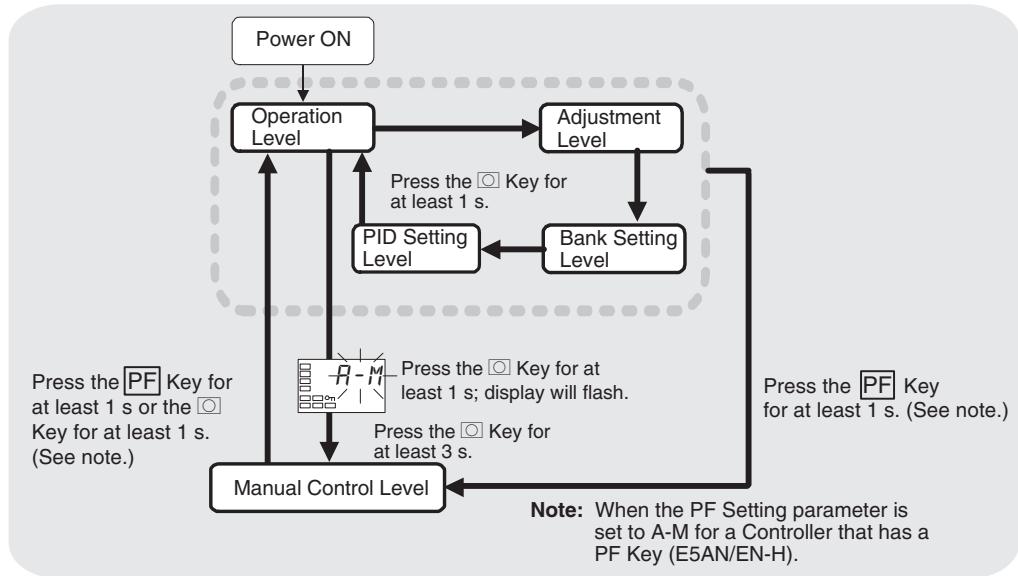
To move from the operation level to the manual control level, press the Key for at least three seconds with the Auto/Manual Switch parameter displayed. In addition, this operation can be performed using the PF Key by setting the PF Key parameter (advanced function setting level) to A-M (Auto/Manual). For details on the setting method, refer to 4-13 Performing Manual Control.
This setting cannot be made during ON/OFF operation.
- The MANU indicator will light during manual control.
- It is not possible to move to any displays except for the PV/MV parameter during manual operation.
- To return to the operation level, press the Key or the PF Key in the manual control level for at least one second.
PV/MV (Manual MV)

Function
The manual control level display appears as shown below.
With No. 3 Display
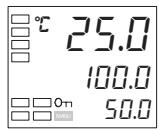
PV/SP/Manual MV
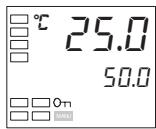
PV/Manual MV
Without No. 3 Display
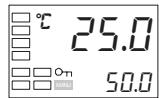
PV/Manual MV
Note: When the PV/SP Display Screen Selection parameter is 0.
| Monitor range | Unit | |
| Process value | Temperature: According to indication range for each sensor. Analog: Scaling lower limit -5% FS to Scaling upper limit +5% FS (Refer to page 335.) | EU |
| Set point | SP lower limit to SP upper limit | EU |
| Setting range | Unit | ||
| MV (manual MV) | Standard control | -5.0 to 105.0 (See note.) | % |
| Heating/cooling control | -105.0 to 105.0 (See note.) | ||
| Position-proportional control | -5.0 to 105.0 (See note.) | ||
Note When the Manual MV Limit Enable parameter is set to ON, the setting range will be the MV lower limit to the MV upper limit.
See
Related Parameters
Standard or heating/cooling (initial setting level): Page 228
5-9 Initial Setting Level
This level is used to set up the basic Digital Controller specifications. In this level, you can set the Input Type parameter to set the sensor input to be connected, limit the setting range of set points, set the alarm modes, and perform other operations.
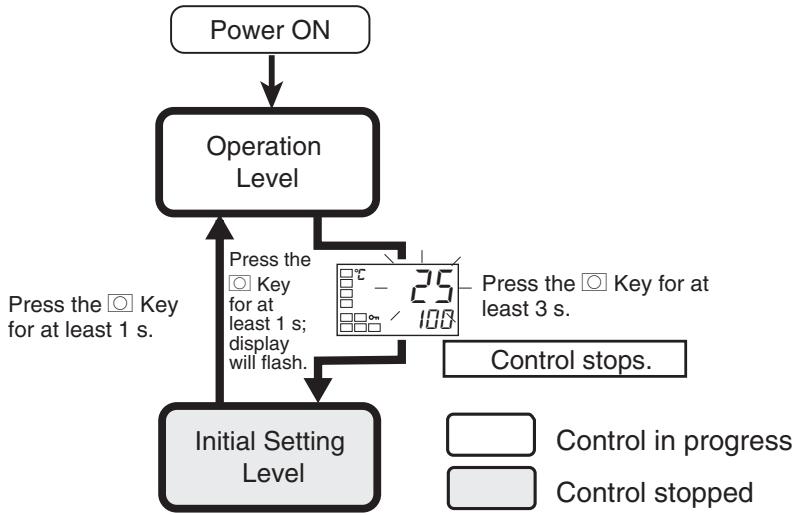
To move from the operation level to the initial setting level, press the Key for at least three seconds with any parameter displayed except for the Auto/ Manual Switch parameter.
- The initial setting level is not displayed when the Initial/Communications Protect parameter is set to 2. It can be used when the Initial/Communications Protect parameter is set to 0 or 1.
- If the Input Type parameter is set for an analog input, the following parameters will be set: Scaling upper limit, Scaling lower limit, and Decimal point.
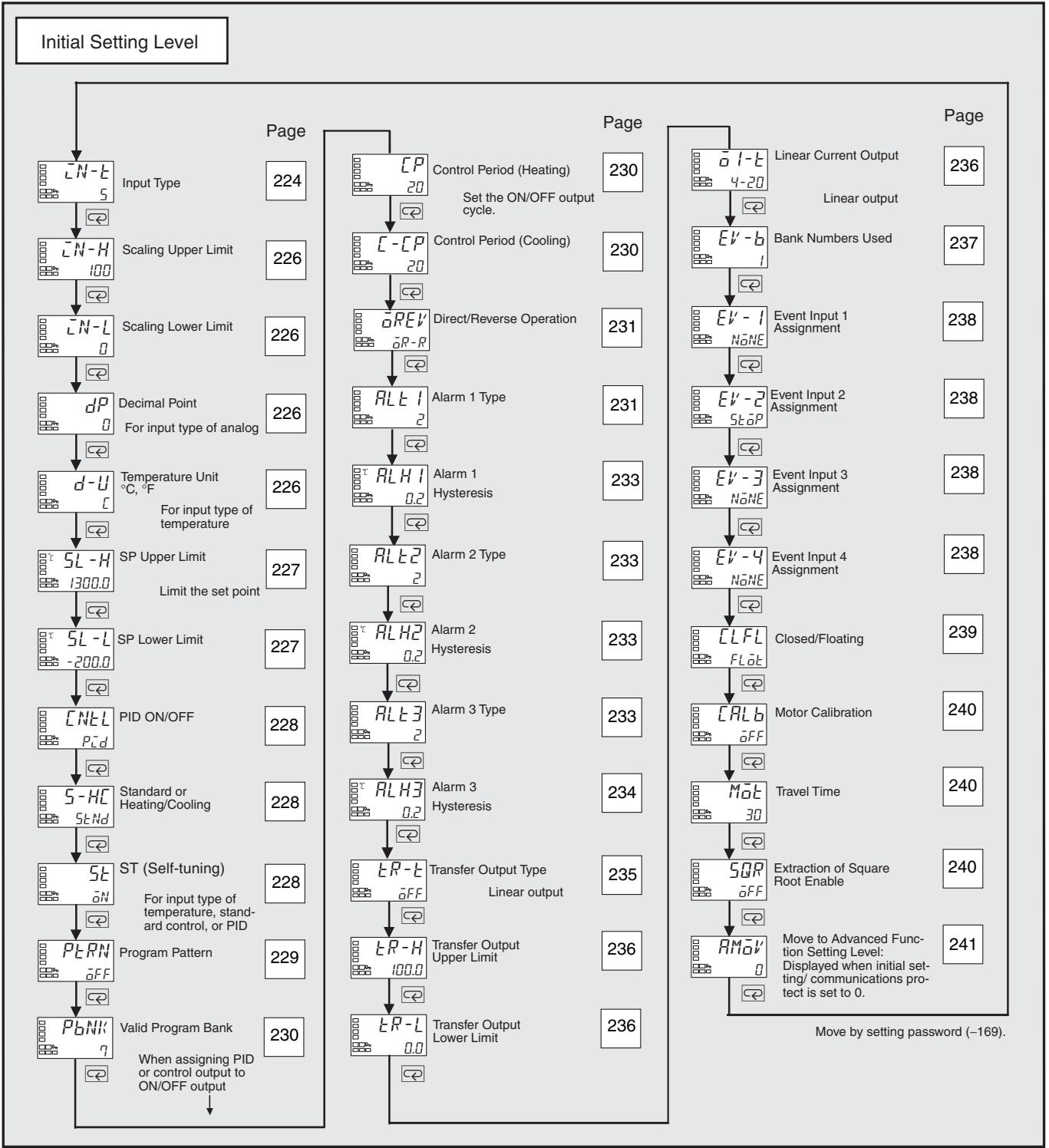
[{\left\lbrack \overrightarrow{N} - \overrightarrow{L}\right\rbrack }^{2} = \frac{1}{4}{\left( \overrightarrow{a} + \overrightarrow{b}\right) }^{2} - \frac{1}{4}{\left( \overrightarrow{a} + \overrightarrow{c}\right) }^{2}]
Input Type
Function
- This parameter sets the type of sensor.
- When this parameter is changed, the set point limiter is changed to the defaults. If the limiter must be specified, set the SP Upper Limit and SP Lower Limit parameters (initial setting level) again.
Setting
- Set one of the set values from the following table. The default is 5.
- If a platinum resistance thermometer is mistakenly connected while a setting for other than a platinum resistance thermometer is in effect, S.Err will be displayed. To clear the S.Err display, check the wiring and then cycle the power.
| Input type | Specifications | Set value | Input temperature range |
| Platinum resistance thermometer | Pt100 | 0 | -200.0 to 850.0 (°C)/-300.0 to 1,500.0 (°F) |
| 1 | -199.9 to 500.0 (°C)/-199.9 to 900.0 (°F) | ||
| 2 | 0.0 to 100.0 (°C)/0.0 to 210.0 (°F) | ||
| JPt100 | 3 | -199.9 to 500.0 (°C)/-199.9 to 900.0 (°F) | |
| 4 | 0.0 to 100.0 (°C)/0.0 to 210.0 (°F) | ||
| Thermocouple | K | 5 | -200.0 to 1,300.0 (°C)/-300.0 to 2,300.0 (°F) |
| 6 | -20.0 to 500.0 (°C)/0.0 to 900.0 (°F) | ||
| J | 7 | -100.0 to 850.0 (°C)/-100.0 to 1,500.0 (°F) | |
| 8 | -20.0 to 400.0 (°C)/0.0 to 750.0 (°F) | ||
| T | 9 | -200.0 to 400.0 (°C)/-300.0 to 700.0 (°F) | |
| 10 | -199.9 to 400.0 (°C)/-199.9 to 700.0 (°F) | ||
| E | 11 | -200.0 to 600.0 (°C)/-300.0 to 1,100.0 (°F) | |
| L | 12 | -100.0 to 850.0 (°C)/-100.0 to 1,500.0 (°F) | |
| U | 13 | -200.0 to 400.0 (°C)/-300.0 to 700.0 (°F) | |
| 14 | -199.9 to 400.0 (°C)/-199.9 to 700.0 (°F) | ||
| N | 15 | -200.0 to 1,300.0 (°C)/-300.0 to 2,300.0 (°F) | |
| R | 16 | 0.0 to 1,700.0 (°C)/0.0 to 3,000.0 (°F) | |
| S | 17 | 0.0 to 1,700.0 (°C)/0.0 to 3,000.0 (°F) | |
| B | 18 | 100.0 to 1,800.0 (°C)/300.0 to 3,200.0 (°F) | |
| W | 19 | 0.0 to 2,300.0 (°C)/0.0 to 3,200.0 (°F) | |
| PLII | 20 | 0.0 to 1,300.0 (°C)/0.0 to 2,300.0 (°F) | |
| K | 21 | -50.0 to 200.0 (°C)/-50.0 to 200.0 (°F) | |
| J | 22 | -50.0 to 200.0 (°C)/-50.0 to 200.0 (°F) | |
| T | 23 | -50.0 to 200.0 (°C)/-50.0 to 200.0 (°F) | |
| Platinum resistance thermometer | Pt100 | 24 | -50.0 to 200.0 (°C)/-50.0 to 200.0 (°F) |
| Current input | 4 to 20 mA | 25 | One of the following ranges depending on the scaling. |
| 0 to 20 mA | 26 | -19999 to 32400 | |
| Voltage input | 1 to 5 V | 27 | -1999.9 to 3240.0 |
| 0 to 5 V | 28 | -199.99 to 324.00 | |
| 0 to 10 V | 29 | -19.999 to 32.400 |

Related Parameters
Temperature unit, Set point upper limit, Set point lower limit (initial setting level): Page 226
| Parameter name | Setting range | Unit | Default | ||
| Scaling Upper Limit | Scaling lower limit + 1 to 32400 | None | 100 | ||
| Scaling Lower Limit | -19999 to scaling upper limit - 1 | None | 0 | ||
| Set value | Settings | Example | |||
| 0 | 0 digits past decimal point | 12345 | |||
| 1 | 1 digits past decimal point | 1234.5 | |||
| 2 | 2 digits past decimal point | 123.45 | |||
| 3 | 3 digits past decimal point | 12.345 | |||
5L - H
[{5L} - L]
SP Upper Limit
SP Lower Limit
Function
- These parameters set the upper and lower limits of the set points. A set point can be set within the range defined by the upper and lower limit set values in the SP Upper Limit and SP Lower Limit parameters. If these parameters are reset, any set point that is outside of the new range will be forcibly changed to either the upper limit or the lower limit.
- When the temperature input type and temperature unit have been changed, the set point upper limit and set point lower limit are forcibly changed to the upper and lower limits of the sensor.
- During temperature input, the decimal point position depends on the currently selected sensor, and during analog input it depends on the Decimal Point parameter setting.
Controllers with Thermocouple/Resistance Thermometer Universal Inputs
| Parameter name | Setting range | Unit | Default | |
| Set Point Upper Limit | Temperature | SP lower limit + 1 to Input setting range upper limit | EU | 1300.0 |
| Analog | SP lower limit + 1 to scaling upper limit | EU | ||
| Set Point Lower Limit | Temperature | Input setting range lower limit to SP upper limit - 1 | EU | -200.0 |
| Analog | Scaling lower limit to SP upper limit - 1 | EU |
Setting
Related Parameters
Input type: Page 224, Temperature unit: Page 226 (initial setting level)

| CNL | PID ON/OFF | |
| Function | This parameter selects 2-PID control or ON/OFF control. The auto-tuning and self-tuning functions can be used in 2-PID control. | |
| Setting range | Default | |
| Pc:2-PID, cNcF: ON/OFF | Pc:0 | |
| ■ Related Parameters AT execute/cancel: Page 192, Manual reset, Hysteresis (heating), and Hysteresis (cooling): Page 202 (adjustment level) ST stable range (advanced function setting level): Page 247 | ||
| 5-HC | Standard or Heating/Cooling | |
| Function | This parameter selects standard control or heating/cooling control. When heating/cooling control is selected for the E5CN-H (for a model which does not support control output 2), the auxiliary output 2 terminal (SUB2) is assigned as the control output (cooling). | |
| Setting | Setting range | Default |
| St:Nd: Standard, H-c: Heating/cooling | St:Nd | |
| ■ Related Parameters MV monitor (heating): Page 188, MV monitor (cooling): Page 189 (operation level) Cooling coefficient, Dead band: Page 201, Hysteresis (heating), Hysteresis (cooling): Page 202 (adjustment level) Control period (heat), Control period (cool) (initial setting level): Page 230 Control output 1 assignment: Page 261, Control output 2 assignment, Auxiliary output 1 assignment: Page 263, Auxiliary output 2 assignment: Page 264, Auxiliary output 3 assignment: Page 265 (advanced function setting level) | ||
| 5t | ST (self-tuning) | The control must be set to a temperature input, standard control, and 2-PID control. |
| Function | The ST (self-tuning) function executes tuning from the start of program execution to calculate PID constants matched to the control target. When the ST function is in operation, be sure to turn ON the power supply of the load connected to the control output simultaneously with or before starting Controller operation. | |
- Auto-tuning can be started during self-tuning.
Setting
| Parameter name | Setting range | Unit | Default |
| ST | aFF: ST function OFF, aN: ST function ON | None | aN |

Related Parameters
Input type: Page 224, PID ON/OFF: Page 228 (initial setting level), ST stable range (advanced function setting level): Page 247
PLRN
Program Pattern
Function
This parameter sets the type of control when using the simple program function.
- If the Program Pattern parameter is set to OFF, the simple program will not operate.
- If the Program Pattern parameter is set to STOP, the RUN/STOP status will change to STOP after execution has been completed up to the bank number specified in the Valid Program Bank parameter.
- If the Program Pattern parameter is set to CONT, control will continue in RUN status after execution has been completed up to the bank number specified in the Valid Program Bank parameter.
- If the Program Pattern parameter is set to LOOP, the program will return to bank number 0 and repeat the program operation.
Setting
| Setting range | Default | |
| aFF | Simple program function turned OFF | aFF |
| SbP | Go to STOP mode at end of program. | |
| CnT | Continue in RUN mode at end of program. | |
| LbP | Return to bank number 0 and repeat the program operation. |

Related Parameters
Program start, Soak time remain: Page 184, RUN/STOP: Page 185 (operation level)
Bank * soak time, Bank * wait band (bank setting level): Page 215
Soak time unit (advanced function setting level): Page 266
| PbNK | Valid Program Bank | The Program Pattern parameter must not be set to OFF. | ||
| Function | This parameter sets the final bank number for executing program operation. | |||
| Setting range | Default | |||
| 0 to 7 | 7 | |||
| See | ■ Related Parameters Program pattern (initial setting level): Page 229 | |||
| CP | Control Period (Heating) | The cooling control output and heating control outputs must be assigned to relay outputs, voltage outputs (for driving SSR), or SSR outputs. | ||
| C-CP | Control Period (Cooling) | The control must be set to 2-PID control. | ||
| For the Control Period (Cooling) parameter, the control must be set to heating/cooling control. | ||||
| Function | These parameters set the output periods. Set the control periods taking the control characteristics and the electrical durability of the relay into consideration. For standard control, use the Control Period (Heating) parameter. The Control Period (Cooling) parameter cannot be used. When the heating control output is a current output, the Control Period (Heating) parameter cannot be used. For heating/cooling control, the control period can be set independently for heating and cooling. The Control Period (Heating) parameter is used for the heating control output, and the Control Period (Cooling) parameter is used for the cooling control output | |||
| Setting | Parameter name | Setting range | Unit | Default |
| Control Period (Heating) | 0.5 or 1 to 99 | Second | 20 | |
| Control Period (Cooling) | 0.5 or 1 to 99 | Second | 20 | |
aREV
Direct/Reverse Operation
- "Direct operation" refers to control where the manipulated variable is increased when the process value increases. Alternatively, "reverse operation" refers to control where the manipulated variable is increased when the process value decreases.
| Setting range | Default |
| aR-R: Reverse operation, aR-d: Direct operation | aR-R |
ALTE
Alarm 1 Type
Alarm 1 must be assigned.
- Select one of the following six alarm 1 types: Deviation, deviation range, absolute value, LBA, PV change rate alarm, or RSP alarm.
| Set values | Alarm type | Alarm output operation | |
| When alarm value X is positive | When alarm value X is negative | ||
| 0 | Alarm function OFF | Output OFF | |
| 1 (See note 1.) | Upper- and lower-limit | ON L H← OFF SP | (See note 2.) |
| 2 | Upper-limit | ON X← OFF SP | ON X← OFF SP |
| 3 | Lower-limit | ON X← OFF SP | ON X← OFF SP |
| 4 (See note 1.) | Upper- and lower-limit range | ON L H← OFF SP | (See note 3.) |
| 5 (See note 1.) | Upper- and lower-limit with standby sequence | ON L H← OFF SP (See note 5.) | (See note 4.) |
| 6 | Upper-limit with standby sequence | ON X← OFF SP | ON X← OFF SP |
| 7 | Lower-limit with standby sequence | ON X← OFF SP | ON X← OFF SP |
| 8 | Absolute-value upper-limit | ON X← OFF 0 | ON X← OFF 0 |
| 9 | Absolute-value lower-limit | ONOFF0 | ONOFF0 |
| 10 | Absolute-value upper-limit with standby sequence | ONOFF0 | ONOFF0 |
| 11 | Absolute-value lower-limit with standby sequence | ONOFF0 | ONOFF0 |
| 12 | LBA (alarm 1 type only) | --- | |
| 13 | PV change rate alarm | --- | |
| 14 | Remote SP absolute value upper limit (See note 6.) | ONOFF0 | ONOFF0 |
| 15 | Remote SP absolute value lower limit (See note 6.) | ONOFF0 | ONOFF0 |
Note
(1) With set values 1, 4 and 5, the upper- and lower- limit values can be set independently for each alarm type, and are expressed as "L" and "H."
(2) Set value: 1 (Upper- and lower-limit alarm)
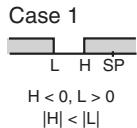
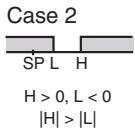
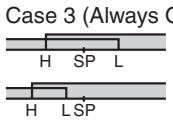


(3) Set value: 4 (Lower limit range)
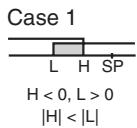
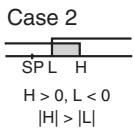

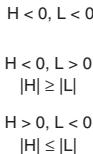
(4) Set value: 5 (Upper- and lower-limit with standby sequence)
- For the lower-limit alarms in cases 1 and 2 above, the alarm is normally OFF if upper- and lower-limit hysteresis overlaps.
- In case 3, the alarm is always OFF.
(5) Set value: 5 (The alarm is always OFF if upper- and lower-limit alarm hysteresis with standby sequence overlaps.)
(6) Displayed when remote SP input is supported.
- Set the alarm type independently for each alarm in the Alarm 1 to 3 Type parameters in the initial setting level. The default is 2 (Upper-limit alarm).
See
Related Parameters
Bank * alarm value upper limit 1, Bank * alarm value lower limit 1 (bank setting level): Page 212
Standby sequence reset: Page 244, Auxiliary output 1 open in alarm: Page 245, Alarm 1 hysteresis: Page 233, Alarm 1 latch: Page 250 (advanced function setting level)
| RLH1 | Alarm 1 Hysteresis | Alarm 1 must be assigned. The alarm 1 type must not be 0, 12, or 13. |
| RLH2 | Alarm 2 Hysteresis | Alarm 2 must be assigned. The alarm 2 type must not be 0, 12, or 13. |
| RLH3 | Alarm 3 Hysteresis | Alarm 3 must be assigned. The alarm 3 type must not be 0, 12, or 13. |
These parameters set the hysteresis for alarms 1, 2, and 3.

| Models | Unit | Default |
| Temperature input: 0.1 to 3,240.0 | °C or °F | 0.2 |
| Analog input: 0.01 to 99.9 | %FS | 0.02 |

Related Parameters
Bank * alarm value 1 to 3: Page 211, 212, 213, Bank * alarm value upper limit 1 to 3, Bank * alarm value lower limit 1 to 3: (bank setting level): Page 212, 213, 214
Alarm 1 to 3 type (initial setting level): Page 231, 233, 234
Standby sequence reset: Page 244, Alarm 1 to 3 open in alarm: Page 250, Alarm 1 to 3 latch: Page 250 (advanced function setting level)
| RL12 | Alarm 2 Type | Alarm 2 must be assigned. |
| Function Setting | ·Select one of the following five alarm 2 types: Deviation, deviation range, absolute value, PV change rate alarm, or RSP alarm. Refer to the alarm 1 type list. The 12: LBA (Loop Burnout Alarm) setting in that list cannot be used. | |
| See | ■ Related Parameters Bank * alarm value 2: Page 212 Bank * alarm value upper limit 2, Bank * alarm value lower limit 2 (bank setting | |
- Select one of the following five alarm 2 types: Deviation, deviation range, absolute value, PV change rate alarm, or RSP alarm.
Refer to the alarm 1 type list. The 12: LBA (Loop Burnout Alarm) setting in that list cannot be used.
Related Parameters
Bank * alarm value 2: Page 212
Bank * alarm value upper limit 2, Bank * alarm value lower limit 2 (bank setting level): Page 213
Standby sequence reset: Page 244, Auxiliary output 2 open in alarm: Page 245, Alarm 2 hysteresis: Page 233
Alarm 2 latch (advanced function setting level): Page 250
| RL 13 | Alarm 3 Type | Alarm 3 must be assigned. |
| · Select one of the following five alarm 3 types: Deviation, deviation range, absolute value, PV change rate alarm, or RSP alarm. | ||
| Refer to the alarm 1 type list. The 12: LBA (Loop Burnout Alarm) setting in that list cannot be used. | ||
| Setting | ||
| ■ Related Parameters Bank * alarm value 3: Page 213, Bank * alarm value upper limit 3, Bank * alarm value lower limit 3: Page 214 (operation level) Standby sequence reset: Page 244, Auxiliary output * open in alarm: Page 245, Alarm 3 hysteresis: Page 233, Alarm 3 latch: Page 250 (advanced function setting level) |
L R - L
Transfer Output Type
There must be a transfer output, current output, or linear voltage output.
- This parameter sets the transfer output type.
- The following table shows the differences between models with a transfer output and models without a transfer output that use control output 1 or control output 2 as a simple transfer output.
Transfer Output Destination
| Transfer output | Control output 1 | Control output 2 | Transfer output destination |
| Yes | --- | --- | Transfer output |
| No | Current output or linear voltage output | No Relay output, voltage output (for driving SSR), or SSR output | Control output 1 |
| No | Current output or linear voltage output | Current output or linear voltage output | Control output 1 |
| No | Relay output, voltage output (for driving SSR), or SSR output | Current output or linear voltage output | Control output 2 |
| No | Relay output, voltage output (for driving SSR), or SSR output | No Relay output, voltage output (for driving SSR), or SSR output | No |
■ Precision and User Calibration
| Precision | User calibration | |
| Transfer output | ±0.3% FS | Supported. (See note.) |
| Simple transfer output | Not specified. | Not supported. |
Note For details on the calibration method, refer to SECTION 6 CALIBRATION.
| Transfer output type | Default | |
| OFF | aFF | aFF |
| Set point | 5P | |
| Set point during SP ramp | 5P-M | |
| PV | P'V | |
| MV monitor (heating) | M'V | |
| MV monitor (cooling) | C-MV | |
| Valve opening | V'-M' | |

Related Parameter
Transfer output upper limit, Transfer output lower limit (initial setting level): Page 236
LR-H
L R-L
Transfer Output Upper Limit
Transfer Output Lower Limit
A transfer output or linear voltage output must be supported.
The Transfer Output Type parameter must not be set to OFF.
Function
Setting
- This parameter sets the upper and lower limit values of transfer outputs.
| Transfer output type | Setting range | Default | Unit | ||
| Transfer output lower limit | Transfer output upper limit | ||||
| Set point (See note 1.) | SP lower limit to SP upper limit | SP lower limit | SP upper limit | EU | |
| Set point during SP ramp | SP lower limit to SP upper limit | ||||
| PV | Temperature | Input setting range lower limit to input setting range upper limit | Input setting range lower limit | Input setting range upper limit | |
| Analog | Analog scaling lower limit to analog scaling upper limit | Scaling lower limit | Scaling upper limit | ||
| MV monitor (heating) (See note 2.) | Standard | -5.0 to 105.0 | 0.0 | 100.0 | % |
| Heating/ cooling | 0.0 to 105.0 | ||||
| MV monitor (cooling) (See note 3.) | 0.0 to 105.0 | ||||
| Valve opening (See note 4.) | Position-proportional | -10.0 to 110.0 | |||
Note
(1) If the set point is selected, the remote SP will be output as long as the Remote SP Mode is selected in the SP Mode parameter.
(2) This setting will be ignored for position-proportional model.
(3) This setting will be ignored for standard control or position-proportional control.
(4) This parameter will be displayed only when the is a potentiometer input for a position-proportional model.
See
Related Parameter
Transfer output type (initial setting level): Page 235
a1-t
Linear Current Output
The E5CN-H must be used, and the control output must be a current output.
This parameter selects the output type for linear current outputs.
- When control output 1 or control output 2 is a current output, select either 4 to 20mA or 0 to 20mA as the output type.
Setting
| Linear current output | Default |
| 4-20: 4 to 20 mA | 4-20 |
| 0-20: 0 to 20 mA |
Note Even when control output 1 or control output 2 is used as a control output or a simple transfer output, 0 to 20mA can be used.

Related Parameter
Transfer output type (initial setting level): Page 235
E-V-b
Bank Numbers Used
Event inputs must be supported.
Function
The Bank Numbers Used parameter is used when switching bank numbers according to ON/OFF combinations of event inputs that have been preset for bank numbers 0 to 7. The number of banks used can be changed to 2, 4, or 8, according to the set value.
The Event Input Assignment Screen will not be displayed when event inputs are assigned for the Bank Numbers Used parameter. The following tables show the set values and the display/hide status of Event Input Assignments 1 and 2.
Controllers with Event Inputs 1 and 2 (Two Event Inputs)
| Event Input Assignment 1 | Event Input Assignment 2 | ||
| Bank Num- bers Used | 0 | Displayed (Banks not switched.) | |
| 1 | Hidden (2 banks) | Displayed (Event input 2 not used to switch banks.) | |
| 2 | Hidden (4 banks) | ||
Controllers with Event Inputs 3 and 4 (Two Event Inputs)
| Event Input Assignment 3 | Event Input Assignment 4 | ||
| Bank Num- bers Used | 0 | Displayed (Banks not switched.) | |
| 1 | Hidden (2 banks) | Displayed (Event input 4 not used to switch banks.) | |
| 2 | Hidden (4 banks) | ||
Controllers with Event Inputs 1 to 4 (Four Event Inputs)
| Event Input Assignment 1 | Event Input Assignment 2 | Event Input Assignment 3 | Event Input Assignment 4 | ||
| Bank Numbers Used | 0 | Displayed (Banks not switched.) | |||
| 1 | Hidden (2 banks) | Displayed (Event inputs 2 to 4 not used to switch banks.) | |||
| 2 | Hidden (4 banks) | Displayed (Event inputs 3 to 4 not used to switch banks.) | |||
| 3 | Hidden (8 banks) | Displayed (Event input 4 not used to switch banks.) | |||
For details on event input assignments, refer to Event Input Assignments 1 to 4 on page 238.
The following table shows the relationship between event input ON/OFF combinations and the banks that are selected.
| Bank Numbers Used | Event No. | Bank No. | |||||||
| 0 | 1 | 2 | 3 | 4 | 5 | 6 | 7 | ||
| 1 | Event input 1 (See note 1.) | OFF | ON | --- | --- | --- | --- | --- | --- |
| 2 | Event input 1 (See note 1.) | OFF | ON | OFF | ON | --- | --- | --- | --- |
| Event input 2 (See note 2.) | OFF | OFF | ON | ON | --- | --- | --- | --- | |
| 3 | Event input 1 (See note 1.) | OFF | ON | OFF | ON | OFF | ON | OFF | ON |
| Event input 2 (See note 2.) | OFF | OFF | ON | ON | OFF | OFF | ON | ON | |
| Event input 3 (See note 3.) | OFF | OFF | OFF | OFF | ON | ON | ON | ON | |
Note
(1) For Controllers with event inputs 3 and 4, this becomes event input 3.
(2) For Controllers with event inputs 3 and 4, this becomes event input 4.
(3) Turn event inputs ON and OFF while power is being supplied. Changes in ON/OFF status are detected for inputs of 50 ms or longer. (For logic operations, however they are detected at 250 ms or longer.)
| Setting range | Default |
| 0 to 2 (for 2 event inputs) | 1 |
| 0 to 3 (for 4 event inputs) |
See
Related Parameter
Event Input Assignment 1 to 4: Page 238
EV-
Event Input Assignment * (*: 1 to 4)
An event input must be assigned.
The event inputs must not be used to switch banks.
Function
- The following functions can be assigned to event inputs 1 to 4.
RUN/STOP
Auto/Manual Switch
Program Start
Invert Direct/Reverse Operation
SP Mode Switch
100% AT Execute/Cancel
40% AT Execute/Cancel
Setting Change Enable/Disable
Communications Write Enable/Disable
Alarm Latch Cancel
- Default: Event Input Assignment 1: No NE
Event Input Assignment 2: 5 P
(For Controllers supporting event inputs 3 and 4, the default is none.)
Event Input Assignment 3: No NE
Event Input Assignment 4: No NE
Setting
| Setting | Function |
| None | None |
| Stop | RUN/STOP |
| MANU | Auto/Manual |
| PRST | Program start (See note 1.) |
| dRS | Invert Direct/Reverse Operation |
| RSP | SP Mode Switch (See note 2.) |
| RE - 2 | 100% AT Execute/Cancel |
| RE - 1 | 40% AT Execute/Cancel (See note 3.) |
| WEPE | Setting Change Enable/Disable (See note 4.) |
| CMWTE | Communications Write Enable/Disable |
| LRE | Alarm Latch Cancel |
Note
(1) PRST (Program Start) can be set even when the Program Pattern parameter is set to OFF, but the function will be disabled.
(2) This can be selected only for models that support the remote SP function.
(3) This setting will be ignored for heating/cooling control or for position-proportional (floating) control.
(4) This can be selected only for models that support communications. Also, when a work bit is selected as event input data, communications writing enable/disable cannot be selected.
See
Related Parameter
Bank Numbers Used (initial setting level): Page 237
CLFL
Closed/Floating
Position-proportional control must be supported and there must be a potentiometer input.
Function
- This parameter is used to select the control method for position-proportional control.
Setting
| Setting range | Default |
| FLaE: Floating | flot |
| CLa5: Closed |
| Motor Calibration | Position-proportional control must be supported and there must be a potentiometer input. | |
| Function | ·This parameter is used to calibrate a motor. It must be executed when monitoring valve opening. (The display cannot be changed during motor calibration.)·The travel time is reset when motor calibration is executed.·The setting becomes off after switching to this parameter.·Motor calibration is executed when ∅N is selected.·The setting returns to ∅FF after the motor calibration has been completed. | |
| See | ■ Related ParameterTravel Time (initial setting level): Page 240 | |
| Mōt | Travel Time | Position-proportional control must be supported. |
| Function | ·This parameter sets the time from when the valve is completely open until it is completely closed.·The travel time is set automatically when motor calibration is executed. | |
| Setting | Setting range | Unit Default |
| 1 to 999 | s 30 | |
| See | ■ Related ParameterMotor Calibration (initial setting level): Page 240 | |
| SQR | Extraction of Square Root Enable | An analog input must be supported. |
| Function | This parameter enables and disables square root extraction. | |
| Setting | Setting range | Default |
| ∂N: Enabled, ∅FF: Disabled | None | |
| See | ■ Related ParameterExtraction of square root low-cut point (adjustment level): Page 207 | |
| RMaI' | Move to Advanced Function Setting Level The Initial Setting/Communications Protect parameter must be set to 0. | |
| Function | · Set the Move to Advanced Function Setting Level parameter set value to “-169.” · Move to the advanced function setting level either by pressing Key or Key or by waiting or two seconds to elapse. | |
| See | ■ Related Parameter Initial setting/communication protect (adjustment level): Page 172 | |
5-10 Advanced Function Setting Level
The advanced function setting level is used for optimizing Controller performance. To move to this level, input the password ("-169") from the initial setting level.
To be able to enter the password, the Initial Setting/Communications Protect parameter in the protect level must be set to 0. (The default is 0.)
- The parameters in this level can be used when the Initial Setting/Communications Protect parameter is set to 0.
- To switch between setting levels, press the .
- To change set values, press the and Keys.
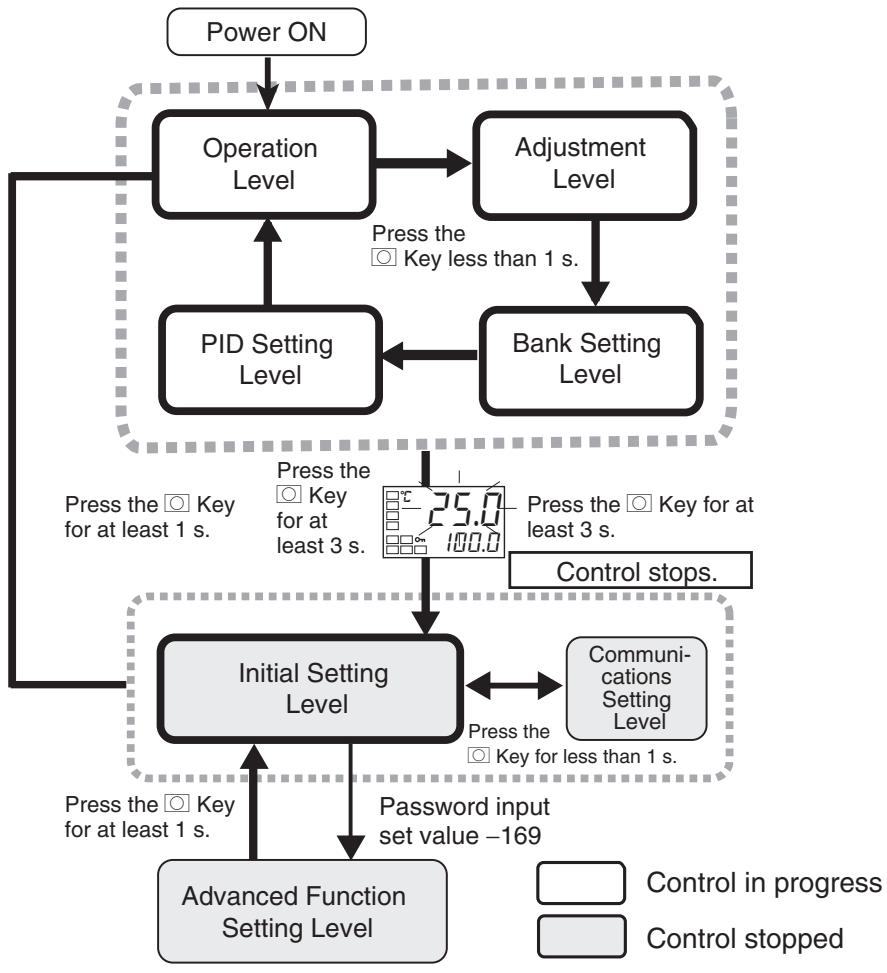
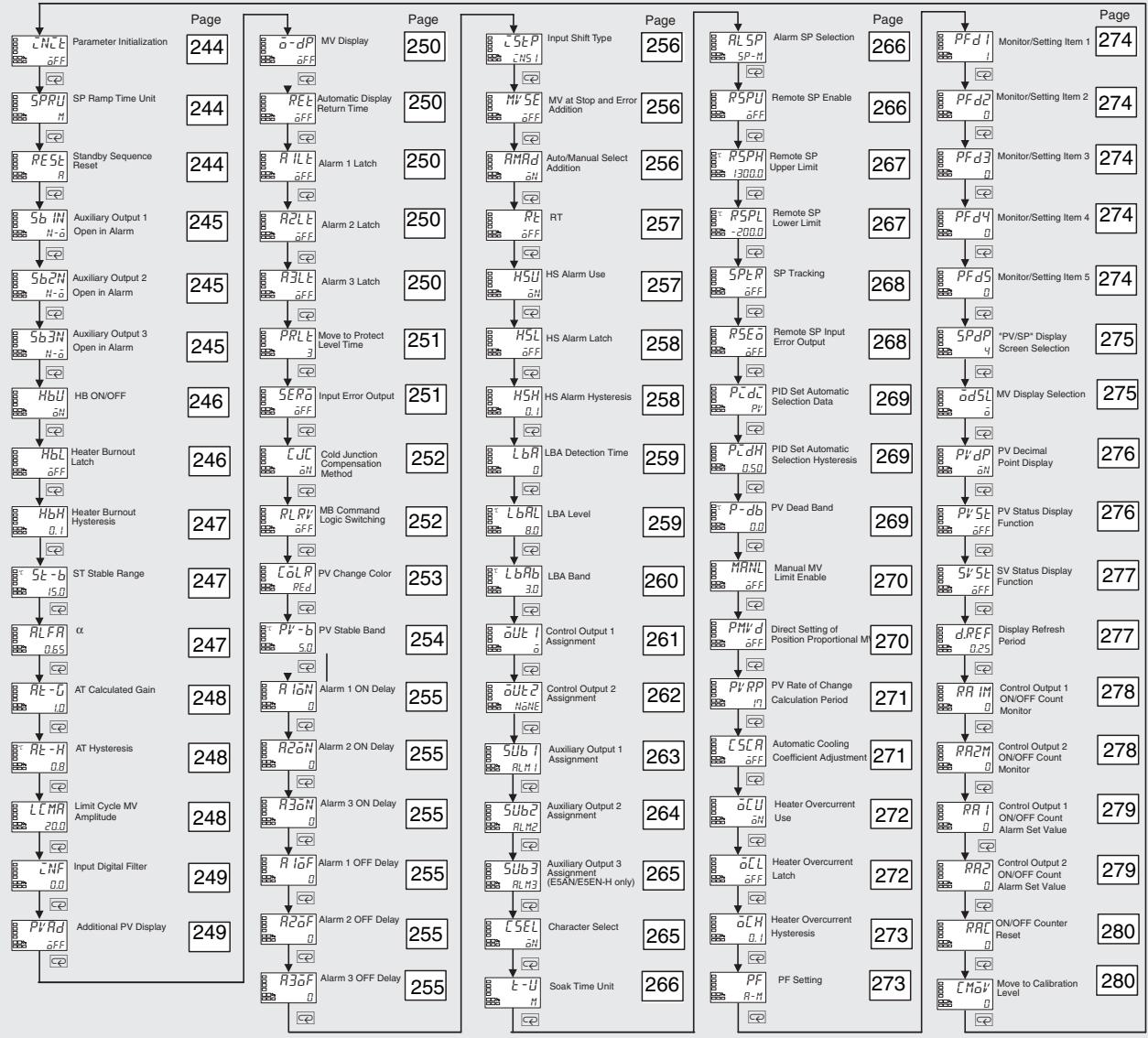
Advanced Function Setting Level
| CLNT | Parameter Initialization | |
| Function | ·This parameter returns all parameter settings to their defaults. ·After the initialization, the set value automatically turns OFF. | |
| Setting | Setting range | Default |
| δFF: Initialization is not executed. | δFF | |
| FRCL: Initialized to the factory settings described in the manual. | ||
| SPRU | SP Ramp Time Unit | The ST parameter must be set to OFF. |
| Function | ·This parameter sets the time unit for the rate of change during SP ramp operation. | |
| Setting | Setting range | Default |
| 5: EU/s, M: EU/min, H: EU/h | M | |
| See | ■ Related Parameters Ramp SP monitor (operation level): Page 180 Bank * SP ramp set value (bank setting level): Page 211 | |
| RESET | Standby Sequence Reset | Alarm 1 to 3 type must be 5, 6, 7, 10, or 11. |
| Function | ·This parameter selects the conditions for enabling reset after the standby sequence of the alarm has been canceled. ·Output is turned OFF when switching to the initial setting level, communications setting level, advanced function setting level, or calibration level. ·Condition A Control started (including power ON), and set point, alarm value (alarm value upper/ lower limit), or input shift value (upper/ lower-limit temperature input shift value) changed. ·Condition B Power ON ·The following example shows the reset action when the alarm type is lower-limit alarm with standby sequence. | |
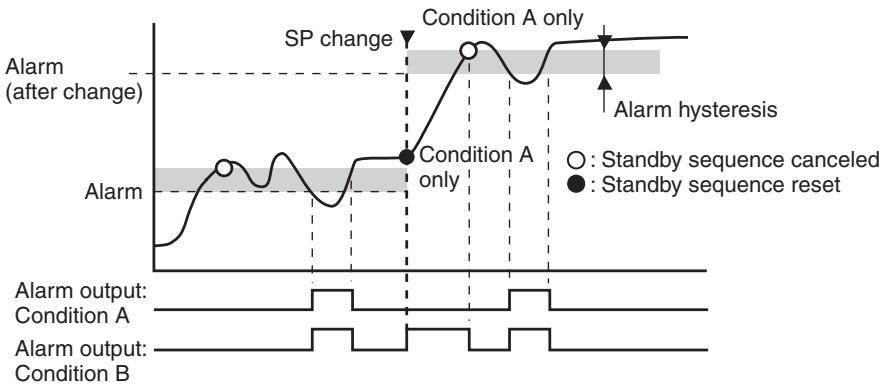
| Setting range | Default |
| R: Condition A, b: Condition B | R |

Related Parameters
Alarm 1 to 3 type (initial setting level): Page 231 to 233
Alarm 1 to 3 latch (advanced function setting level): Page 250
5b*N
Auxiliary Output * Open in Alarm (*: 1 to 3)
Auxiliary output 1, 2, or 3 must be assigned.
- This parameter sets the output status of auxiliary outputs 1 to 3.
- When Close in Alarm is set, the status of the auxiliary output function is output unchanged. When Open in Alarm is set, the status of the auxiliary output function is reversed before being output. The following table shows the relationship between the auxiliary output function, auxiliary output, and operation displays (SUB1 to SUB3).
| Auxiliary output function | Auxiliary output | Operation display (SUB1 to SUB3) | |
| Close in Alarm | ON | ON | Lit |
| OFF | OFF | Not lit | |
| Open in Alarm | ON | OFF | Lit |
| OFF | ON | Not lit |

| Setting range | Default |
| N-α: Close in alarm, N-ε: Open in alarm | N-α |
Related Parameters
Auxiliary output 1 to 3 assignment (advanced function setting level): Page 263 to 265
| HbU | HB ON/OFF | Heater burnout, HS alarms, and heater overcurrent detection must be supported. Alarm 1 must be assigned. | |
| Function | • Set to use the heater burnout alarm. | ||
| Setting | Setting range | Default | |
| aN: Enabled, aFF: Disabled | aN | ||
| HbL | Heater Burnout Latch | Heater burnout, HS alarms, and heater overcurrent detection must be supported. Alarm 1 must be assigned. The Heater Burnout Detection parameter must be set to ON. | |
| Function | • When this parameter is set to ON, the heater burnout alarm is held until either of the following conditions is satisfied. a Heater burnout detection is set to 0.0 A. b The power is cycled. c The latch is cancelled by the PF Key. (PF Setting = LAT: Alarm Latch Cancel) d The latch is cancelled by an event input. (Event Input Assignment 1 to 4 = LAT: Alarm Latch Cancel) • Output is turned OFF when switching to the initial setting level, communications setting level, advanced function setting level, or calibration level. | ||
| Setting | Setting range | Default | |
| aN: Enabled, aFF: Disabled | aFF | ||
| See | ■ Related Parameters Event input assignment 1 to 4 (initial setting level): Page 238 HB ON/OFF: Page 246, PF setting: Page 273 (advanced function setting level) | ||
| HbH | Heater Burnout Hysteresis | The Heater Burnout parameter must be set to ON. The Heater Burnout Latch parameter must be set to OFF. Heater burnout, HS alarms, and heater overcurrent detection must be supported. Alarm 1 must be assigned. | ||
| Function | Setting range | Unit | Default | |
| 0.1 to 50.0 | A | 0.1 | ||
| Setting | ■ Related Parameters HB ON/OFF (advanced function setting level): Page 246 | |||
| See | ST Stable Range | ST must be ON and temperature input, standard control, 2-PID control must be set. | ||
| 5t-b | ||||
| Function | The setting of this parameter determines when ST operates. This parameter cannot be used when ST is set to OFF. | |||
| Setting | Setting range | Unit | Default | |
| 0.1 to 3240.0 | °C or °F | 15.0 | ||
| See | ■ Related Parameters Input type: Page 224, PID ON/OFF: Page 228, ST: Page 228 (initial setting level) | |||
| RLFR | α | ST must be OFF and 2-PID control must be set. | ||
| Function | · Normally, use the default for this parameter. · This parameter sets the 2-PID control α constant. | |||
| Setting | Setting range | Unit | Default | |
| 0.00 to 1.00 | None | 0.65 | ||
| Parameter name | Setting range | Unit | Default | |
| AT Calculated Gain | 0.1 to 10.0 | --- | 1.0 | |
| AT Hysteresis | Temperature input: 0.1 to 3,240.0 | °C or °F | 0.8 (See note 1.) | |
| Analog input: 0.01 to 9.99 | %FS | 0.20 | ||
| Limit Cycle MV Amplitude (See note 2.) | 5.0 to 50.0 | % | 20.0 | |
| Note | (1) When the temperature unit is °F, the default is 1.4. (2) With standard models, this is displayed during standard control. With po- sition-proportional models, this is displayed during close control (when there is a potentiometer input). | |||
| See | ■ Related Parameters AT execute/cancel (adjustment level): Page 192 | |||
INF
Input Digital Filter
- This parameter sets the time constant for the input digital filter. The following diagram shows the effect on data after passing through the digital filter:
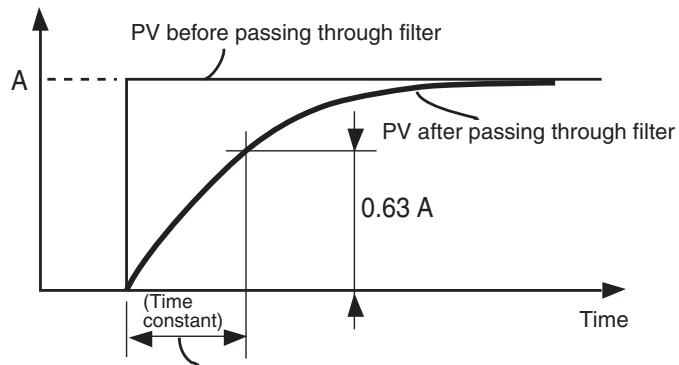
Setting
Input digital filter
| Setting range | Unit | Default |
| 0.0 to 999.9 | Second | 0.0 |
PvRd
Additional PV Display
Function
This parameter adds a display at the beginning of the operation level for the process value (PV). If there is no need to display the set point, use this to display only the present temperature.
Set to ON to display, and OFF to not display.
Setting
| Setting range | Default |
| aN: Displayed, aFF: Not displayed | aFF |
| a-dP | MV Display | ||
| Function | This parameter is used to display the manipulated variable (MV).The manipulated variable is displayed when the MV Monitor (Heating) and MV Monitor (Cooling) parameters are set to ON, and not displayed when these parameters are set to OFF. | ||
| Setting range | Default | ||
| aN: Displayed, aFF: Not displayed | aFF | ||
| See | ■ Related ParametersMV monitor (heating): Page 188, MV monitor (cooling): Page 189 (operation level) | ||
| REt | Automatic Display Return Time | ||
| Function | In the operation level, adjustment level, bank setting level, PID setting level, or monitor/setting item level, the display automatically returns to the PV/SP if there are no key operations for the time set for this parameter.The automatic display return time is disabled when the parameter is set to OFF. (In that case, the display will not be automatically switched.) | ||
| Setting range | Unit | Default | |
| OFF, 1 to 99 | Second | aFF | |
| Function | Alarm 1 Latch | Alarm 1 must be assigned, and the alarm 1 type must not be 0. | |
| Alarm 2 Latch | Alarm 2 must be assigned, and the alarm 2 type must not be 0 or 12. | ||
| Alarm 3 Latch | Alarm 3 must be assigned, and the alarm 3 type must not be 0 or 12. | ||
| Function | When this parameter is set to ON, the alarm function is held until one of the following conditions is satisfied.a The power is cycled.b The latch is cancelled by the PF Key.(PF Setting = LAT: Alarm Latch Cancel)c The latch is cancelled by an event input.(Event Input Assignment 1 to 4 = LAT: Alarm Latch Cancel) | ||
| Advanced Function Setting Level | Section 5-10 | ||
| Setting | The output is turned OFF when switching to the initial setting level, communications setting level, advanced function setting level, or calibration level. If an auxiliary output is set to close in alarm, the output is kept closed. If it is set to open in alarm, it is kept open. | ||
| Setting range | Default | ||
| aN: Enabled, aFF: Disabled | aFF | ||
| See | ■ Related Parameters Bank * alarm value 1 to 3 (bank setting level): Page 211, 212, 213 Bank * alarm value upper limit 1 to 3 (bank setting level): Page 212, 213, 214 Bank * alarm value lower limit 1 to 3 (bank setting level): Page 212, 213, 214 Alarm 1 to 3 type (initial setting level): Page 231 to 234 Standby sequence reset: Page 244, Auxiliary output * open in alarm: Page 245, HB ON/OFF: Page 246, Alarm 1 to 3 hysteresis: Page 233 (advanced function setting level) Event input assignment 1 to 4 (initial setting level): Page 238 HB ON/OFF: Page 246, PF setting: Page 273 (advanced function setting level) | ||
| PRLE | Move to Protect Level Time | ||
| Function | This parameter sets the key pressing time required to move to the protect level from the operation level, the adjustment level, bank setting level, PID setting level, or monitor/setting item level. | ||
| Setting range | Unit | Default | |
| 1 to 30 | Second | 3 | |
| See | ■ Related Parameters Operation/adjustment protect, Initial setting/communications protect, Setting change protect (protect level): Page 172 | ||
| SERO | Input Error Output | Alarm 1 must be assigned, but not to a work bit output. | |
| Function | · When this parameter is set to ON, the output assigned for alarm 1 turns ON for input errors. Note For details on input errors, refer to Error Displays on page 304. · The alarm 1 output is an OR output between alarm 1, HB alarm/HS alarm, heater overcurrent alarm, and input error. · Output is turned OFF when switching to the initial setting level, communications setting level, advanced function setting level, or calibration level. | ||
| Setting | |||
| Setting range | Default | ||
| aN: Enabled, aFF: Disabled | aFF | ||
| Cold Junction Compensation Method | Input type must be thermocouple. | ||
| Function | This parameter specifies whether cold junction compensation is to be performed internally by the Controller or to be performed externally when the input type setting is 5 to 23. The cold junction compensation external setting is enabled when the temperature difference is measured using two thermocouples. | ||
| Setting | Setting range | Default | |
| aN: Internally, aFF: Externally | aN | ||
| See | ■ Related Parameters Input type (initial setting level): Page 224 | ||
| RLRv | MB Command Logic Switching | Communications must be supported. CompoWay/F must be selected as the protocol. | |
| Function | · This parameter switches the logic of the MB command (communications writing switch) for the SYSWAY communications protocol · The MB command (communications writing switch) is the equivalent of the MB command (remote/local switch) of the E5□J. · The setting indicated by the shaded cell indicates the default (same logic as E5□J). | ||
| Setting | Set value | Text data of MB command | |
| 0000 | 0001 | ||
| OFF | Communications writing enabled (remote mode selection) | Communications writing disabled (local mode selection) | |
| ON | Communications writing disabled (local mode selection) | Communications writing enabled (remote mode selection) | |
| (Terms in parentheses () are the terms used on the E5□J.) | |||
| See | ■ Related Parameters Communications writing (adjustment level): Page 193 Protocol setting (communications setting level): Page 281 | ||
C oL R
PV Change Color
Use the PV color change function to change the color of the PV display (No. 1 display).
There are three display colors, orange, red, and green, and you can select from the following three modes and eight types.
- Constant: This mode displays orange, red, or green all the time.
- Linked to Alarm 1: This mode switches the PV display color from red to green when alarm 1 turns ON or from green to red when alarm 1 turns ON.
- Linked to PV stable band: This mode switches the PV display color between red outside the PV stable band and green within PV stable band, or between green outside the PV stable band and red within PV stable band. Set the PV stable band in the PV Stable Band parameter in the advanced function setting level.
The default is R (red).
The following table shows the display functions that can be set using the PV color change function.
| Mode | Setting | Function | PV change color | Application example | ||
| Constant | \(\overline{a}R\overline{u}\) | Orange | Constant: Orange | To match the display color with other Controller models | ||
| \(\overline{R}E\overline{d}\) | Red | Constant: Red | To match the display color with other Controller models | |||
| \(\overline{G}R\overline{N}\) | Green | Constant: Green | To match the display color with other Controller models | |||
| Linked to alarm 1 | ON OFF SP | Alarm value ALM1 ON PTV | ||||
| ALM1 ON ALM1 OFF Application example | ||||||
| \(\overline{R}-\overline{G}\) | Red to Green | Red | Green | To display the PV reached signal | ||
| \(\overline{G}-\overline{R}\) | Green to Red | Green | Red | To display error signals | ||
| Mode | Setting | Function | PV change color | Application example | ||
| Linked to PV stable band | Within PV stable band Low ▲ SP | |||||
| Low | PV stable band | High | Application example | |||
| R-UR | Red to Green to Red | Red | Green | Red | To display stable status | |
| U-UR | Green to Orange to Red | Green | Orange | Red | To display stable status | |
| U-UR | Orange to Green to Red | Orange | Green | Red | To display stable status | |
See
Related Parameters
PV stable band (advanced function setting level): Page 254
Pb
PV Stable Band
This parameter sets the PV stable band width within which the PV display color is changed.
- When the mode to link to the PV stable band is selected with the PV Change Color parameter, the PV display color will change according to whether the present value (PV) is lower than, within, or higher than the PV stable band, as shown in the following figure.
- There is a hysteresis of 0.2( ^ Cor^ F) .
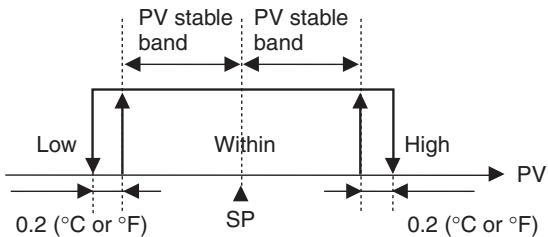
When analog inputs are used: 0.02 (%FS)
| Models | Setting range | Unit | Default |
| Controllers with Thermocouple/Resistance Thermometer Universal Inputs | 0.1 to 999.9 | °C or °F(See note.) | 5.0 |
| Controllers with Analog Inputs | 0.01 to 99.99 | %FS | 5.00 |

Note Set "None" as the unit for Controllers with Analog Inputs.
Related Parameters
PV change color (advanced function setting level): Page 253
| R10N | Alarm 1 ON Delay | Alarm 1 must be assigned, and the alarm 1 type must not be 0, 12, or 13. |
| R20N | Alarm 2 ON Delay | Alarm 2 must be assigned, and the alarm 2 type must not be 0, 12, or 13. |
| R30N | Alarm 3 ON Delay | Alarm 3 must be assigned, and the alarm 3 type must not be 0, 12, or 13. |
Alarm 1, 2, or 3 outputs are prevented from turning ON until after the delay times set in these parameters have elapsed.
- Set the time for which the ON delay is to be enabled.
- To disable the ON delay, set 0.
| Setting range | Unit | Default |
| 0 to 999 | Second | 0 |

Related Parameters
Alarm 1 to 3 type (initial setting level): Pages 231 to 234
| R10F | Alarm 1 OFF Delay | Alarm 1 must be assigned, and the alarm 1 type must not be 0, 12, or 13. |
| R20F | Alarm 2 OFF Delay | Alarm 2 must be assigned, and the alarm 2 type must not be 0, 12, or 13. |
| R30F | Alarm 3 OFF Delay | Alarm 3 must be assigned, and the alarm 3 type must not be 0, 12, or 13. |
Alarm 1, 2, or 3 outputs are prevented from turning OFF until after the delay times set in these parameters have elapsed.
- Set the time for which the OFF delay is to be enabled.
- To disable the OFF delay, set 0.
| Setting range | Unit | Default |
| 0 to 999 | Second | 0 |

Related Parameters
Alarm 1 to 3 type (initial setting level): Pages 231 to 234
| STEP | Input Shift Type | The input type must be for a temperature input. |
| Function | This parameter sets the shift method for a temperature input. ·When the input type is for a temperature input, set either a 1-point shift or a 2-point shift. | |
| Setting | Setting range | Default |
| <NS1:1-point shift, <NS2:2-point shift | <NS1 | |
| See | ■ Related Parameters Temperature input shift, Upper-limit temperature input shift value, Lower-limit temperature input shift value (adjustment level): Page 199 Input type (initial setting level): Page 224 | |
| MV-SE | MV at Stop and Error Addition | The control must be set to 2-PID control. |
| Function | This parameter sets whether or not the MV at Stop and MV at PV Error parameters are to be displayed. ·Set whether or not the MV at Stop and MV at PV Error parameters are to be displayed. | |
| Setting | Setting range | Default |
| aN: Displayed, aFF: Not displayed | aFF | |
| See | ■ Related Parameters MV at stop, MV at PV error (adjustment level): Page 204 | |
| RMRd | Auto/Manual Select Addition | The control must be set to 2-PID control. |
| Function | ·Set whether the Auto/Manual Switch parameter is to be displayed. | |
| Setting | Setting range | Default |
| aN: Displayed, aFF: Not displayed | aN | |
| See | Related Parameters Auto/manual switch (operation level): Page 178 | |
| RT | RT | The control must be set to 2-PID control. The input type must be set to temperature input. |
| Function | This parameter executes robust tuning (RT). ·When AT or ST is executed with RT selected, PID constants are automatically set which make it hard for control performance to degenerate even when control object characteristics are changed. ·Even when hunting occurs for PID constants when AT or ST is executed in normal mode, it is less likely to occur when AT or ST is executed in RT mode. | |
| Setting | Setting range | Default |
| aN: RT function OFF, aFF: RT function ON | aFF | |
| See | ■ Related Parameters AT execute/cancel (PID setting level): Page 192 PID * proportional band (PID setting level): Page 217 PID * integral time (PID setting level): Page 217 PID * derivative time (PID setting level): Page 217 PID ON/OFF (initial setting level): Page 228 ST (initial setting level): Page 228 | |
| HSU | HS Alarm Use | Heater burnout, HS alarms, and heater overcurrent detection must be supported. Alarm 1 must be assigned. |
| Function | ·Set this parameter to use HS alarms. | |
| Setting | Setting range | Default |
| aN: Enabled, aFF: Disabled | aN | |
| H5L | HS Alarm Latch | Heater burnout, HS alarms, and heater overcurrent detection must be supported. Alarm 1 must be assigned. The HS Alarm parameter must be set to ON. | |
| Function | ·When this parameter is set to ON, the HS alarm is held until any of the following conditions is satisfied. a The HS alarm current is set to 50.0 A. b The power is cycled. c The latch is cancelled by the PF Key. (PF Setting = LAT: Alarm Latch Cancel) d The latch is cancelled by an event input. (Event Input Assignment 1 to 4 = LAT: Alarm Latch Cancel)·Output is turned OFF when switching to the initial setting level, communications setting level, advanced function setting level, or calibration level. | ||
| Setting | Setting range | Default | |
| aN: Enabled, aFF: Disabled | OFF | ||
| See | ■ Related Parameters HS alarm use (advanced function setting level): Page 257 Event input assignment 1 to 4 (initial setting level): Page 238 HB ON/OFF: Page 246, PF setting: Page 273 (advanced function setting level) | ||
| H5H | HS Alarm Hysteresis | Heater burnout and HS alarms must be supported. Alarm 1 must be assigned. The HS Alarm parameter must be set to ON. The HS Alarm Latch parameter must be set to OFF. | |
| Function | ·This parameter sets the hysteresis for HS alarms. | ||
| Setting | Setting range | Unit | Default |
| 0.1 to 50.0 | A | 0.1 | |
| Models | Setting range | Unit | Default | |
| Temperature input | 0.1 to 3240.0 | °C or °F | 8.0 | |
| Analog Input | 0.01 to 99.99 | %FS | 10.00 | |
| Setting | Note | Set “None” as the unit for Controllers with Analog Inputs. | ||
| Models | Setting range | Unit | Default |
| Temperature input | 0.0 to 3240.0 | °C or °F | 3.0 |
| Analog input | 0.00 to 99.99 | %FS | 0.20 |
LBA detection time, LBA level (advanced function setting level): Page 259
out
Control Output 1 Assignment
There must a transfer output, or if there is no transfer output, control output 1 must not be a linear output or if it is a linear output, the transfer output type must be set to OFF.
Function
Setting
- This parameter sets the function to be assigned to control output 1.
| Setting range | Default |
| nNone: No function is assigned to control output 1. | a |
| a: Heating control output is output. | |
| C - a: Cooling control output is output. (See note 1.) | |
| RLM1: Alarm 1 is output. (See note 2.) | |
| RLM2: Alarm 2 is output. (See note 2.) | |
| RLM3: Alarm 3 is output. (See note 2.) | |
| PEND: Program end is output. (See notes 2 and 3.) | |
| RALM: Control output ON/OFF count alarm (See note 2.) | |
| WR1: Work bit 1 (See notes 2 and 4.) | |
| WR2: Work bit 2 (See notes 2 and 4.) | |
| WR3: Work bit 3 (See notes 2 and 4.) | |
| WR4: Work bit 4 (See notes 2 and 4.) | |
| WR5: Work bit 5 (See notes 2 and 4.) | |
| WR6: Work bit 6 (See notes 2 and 4.) | |
| WR7: Work bit 7 (See notes 2 and 4.) | |
| WR8: Work bit 8 (See notes 2 and 4.) |
Note
(1) If - is assigned for standard control, a value equivalent to 0% is output.
(2) Can be selected for a relay output, voltage output (for driving SSR), or SSR output only.
(3) Can be selected when the Program Pattern parameter is set to OFF, but the function will be disabled.
(4) WR1 to WR8 are not displayed when the logic operation function is not used.
See
Related Parameters
Standard or heating/cooling: Page 228, Program pattern: Page 229, Transfer output type: Page 235 (initial setting level)
out2
Control Output 2 Assignment
There must a transfer output, or if there is no transfer output, control output 1 must be a linear output or control output 2 must not be a linear output. If control output 1 is not a linear output and control output 2 is a linear output, the transfer output type must be set to OFF.
Function
Setting
- This parameter sets the function to be assigned to control output 2.
| Setting range | Default |
| N0NE: No function is assigned to control output 2. | N0NE (See note 5.) |
| a: Heating control output is output. | |
| C - a: Cooling control output is output. (See note 1.) | |
| RLM1: Alarm 1 is output. (See note 2.) | |
| RLM2: Alarm 2 is output. (See note 2.) | |
| RLM3: Alarm 3 is output. (See note 2.) | |
| PEND: Program end is output. (See notes 2 and 3.) | |
| RRLM: Control output ON/OFF count alarm (See note 2.) | |
| WR1: Work bit 1 (See notes 2 and 4.) | |
| WR2: Work bit 2 (See notes 2 and 4.) | |
| WR3: Work bit 3 (See notes 2 and 4.) | |
| WR4: Work bit 4 (See notes 2 and 4.) | |
| WR5: Work bit 5 (See notes 2 and 4.) | |
| WR6: Work bit 6 (See notes 2 and 4.) | |
| WR7: Work bit 7 (See notes 2 and 4.) | |
| WR8: Work bit 8 (See notes 2 and 4.) |
Note
(1) If - is assigned for standard control, a value equivalent to 0% will be output.
(2) Can be selected for a relay output, voltage output (for driving SSR), or SSR output only.
(3) The setting will be ignored when the Program Pattern parameter is set to OFF.
(4) WR1 to WR8 are not displayed when the logic operation function is not used.
(5) If the Standard or Heating/Cooling parameter is set to heating/cooling control, control automatically switches to - .

Related Parameters
Standard or heating/cooling: Page 228, Program pattern: Page 229, (initial setting level)
SUB1
Auxiliary Output 1 Assignment
Auxiliary output 1 must be assigned.
Function

Setting
- This parameter sets the function to be assigned to auxiliary output 1.
| Setting range | Default |
| N0NE: No function is assigned to auxiliary output 1. | RLM1(See note 3.) |
| a: Heating control output is output. | |
| C - a: Cooling control output is output. (See note 1.) | |
| RLM1: Alarm 1 is output. | |
| RLM2: Alarm 2 is output. | |
| RLM3: Alarm 3 is output. | |
| PEND: Program end is output. (See note 2.) | |
| RRLM: Control output ON/OFF count alarm | |
| WR1: Work bit 1 (See note 4.) | |
| WR2: Work bit 2 (See note 4.) | |
| WR3: Work bit 3 (See note 4.) | |
| WR4: Work bit 4 (See note 4.) | |
| WR5: Work bit 5 (See note 4.) | |
| WR6: Work bit 6 (See note 4.) | |
| WR7: Work bit 7 (See note 4.) | |
| WR8: Work bit 8 (See note 4.) |
Note
(1) If - is assigned for standard control, a value equivalent to 0% will be output.
(2) Can be selected when the Program Pattern parameter is set to OFF, but the function will be disabled.
(3) If a setting is changed when the Program Pattern parameter is not set to OFF, control automatically switches to P, E, N, d .
(4) WR1 to WR8 are not displayed when the logic operation function is not used.
Related Parameters
Program pattern (initial setting level): Page 229

5662
Auxiliary Output 2 Assignment
Auxiliary output 2 must be assigned.
- This parameter sets the function to be assigned to auxiliary output 2.
| Setting range | Default |
| N0NE: No function is assigned to auxiliary output 2. | RLM2 (See note 3.) |
| a: Heating control output is output. | |
| C - a: Cooling control output is output. (See note 1.) | |
| RLM1: Alarm 1 is output. | |
| RLM2: Alarm 2 is output. | |
| RLM3: Alarm 3 is output. | |
| PEND: Program end is output. (See note 2.) | |
| RRLM: Control output ON/OFF count alarm | |
| WR1: Work bit 1 (See note 4.) | |
| WR2: Work bit 2 (See note 4.) | |
| WR3: Work bit 3 (See note 4.) | |
| WR4: Work bit 4 (See note 4.) | |
| WR5: Work bit 5 (See note 4.) | |
| WR6: Work bit 6 (See note 4.) | |
| WR7: Work bit 7 (See note 4.) | |
| WR8: Work bit 8 (See note 4.) |
Note
(1) If - is assigned for standard control, a value equivalent to 0% will be output.
(2) Can be selected when the Program Pattern parameter is set to OFF, but the function will be disabled.
(3) If the Standard or Heating/Cooling parameter is set to heating/cooling control when there is no control output 2 (E5CN-H), control automatically switches to - .
(4) WR1 to WR8 are not displayed when the logic operation function is not used.

Related Parameters
Standard or heating/cooling: Page 228, Program pattern: Page 229, (initial setting level)
5ub3
Auxiliary Output 3 Assignment
Auxiliary output 3 must be assigned (E5AN-H and E5EN-H only).
Function
Setting
- This parameter sets the function to be assigned to Auxiliary output 3.
| Setting range | Default |
| N0NE: No function is assigned to auxiliary output 3. | RLM3 |
| a: Heating control output is output. | |
| C - a: Cooling control output is output. (See note 1.) | |
| RLM1: Alarm 1 is output. | |
| RLM2: Alarm 2 is output. | |
| RLM3: Alarm 3 is output. | |
| PEND: Program end is output. (See note 2.) | |
| RRLM: Control output ON/Off count alarm | |
| WR1: Work bit 1 (See note 3.) | |
| WR2: Work bit 2 (See note 3.) | |
| WR3: Work bit 3 (See note 3.) | |
| WR4: Work bit 4 (See note 3.) | |
| WR5: Work bit 5 (See note 3.) | |
| WR6: Work bit 6 (See note 3.) | |
| WR7: Work bit 7 (See note 3.) | |
| WR8: Work bit 8 (See note 3.) |
Note
(1) If - is assigned for standard control, a value equivalent to 0% will be output.
(2) Can be selected when the Program Pattern parameter is set to OFF, but the function will be disabled.
(3) WR1 to WR8 are not displayed when the logic operation function is not used.

Related Parameters
Standard or heating/cooling: Page 228, Program pattern: Page 229, (initial setting level)
C5EL
Character Select
Function
- This parameter switches the characters to be displayed. The following two types of characters can be displayed. 11-segment display 7-segment display
Setting
| Setting range | Default |
| aN: 11-segment display, aFF: 7-segment display | aN |
When set to N , an 11-segment display is used.
| E-LU | Soak Time Unit | The Program Pattern parameter must not be set to OFF. |
| Function | • Set the soak time unit for the simple program function. | |
| Setting range | Default | |
| M: Minutes, H: Hours | M | |
| Setting | ||
| See | ■ Related Parameters Program start, Soak time remain (operation level): Page 184 Bank * soak time, Bank * wait band (bank setting level): Page 215 Program pattern (initial setting level): Page 229 | |
| RL SP | Alarm SP Selection | Alarm 1, 2, and 3 functions must be assigned. The SP Ramp Set Value parameter must not be set to OFF. The ST parameter must be set to OFF. The alarm type must be set to 1, 2, 3, 4, 5, 6, or 7. |
| Function | This parameter sets whether the set point that triggers a deviation alarm during SP ramp operation is to be the ramp SP or target SP. • Set whether the set point that triggers a deviation alarm is the ramp SP or target SP. | |
| Setting range | Default | |
| SP-M: Ramp SP, SP: SP | SP-M | |
| Function | ||
| See | ■ Related Parameters Bank * SP ramp set value (bank setting level): Page 211 ST (initial setting level): Page 228 | |
| RSPU | Remote SP Enable | The ST parameter must be set to OFF. |
| Function | • When this parameter is set to ON, you can switch between a remote SP and local SP (by specifying one or the other in the SP Mode parameter). The Set Point During SP Ramp parameter is always enabled. | |
- When this parameter is set to OFF, only the local SP can be used. In addition, the Set Point During SP Ramp parameter is enabled only when the SP ramp function is set to ON.
| Setting range | Default |
| ON: Enabled, OFF: Disabled | OFF |

Related Parameters
Set point during SP ramp (operation level): Page 180
SP mode (adjustment level): Page 193
R5PH R5PL
Remote SP Upper Limit Remote SP Lower Limit
The ST parameter must be set to OFF. The Remote SP Enable parameter must be set to ON.
- This parameter sets the upper and lower limits for a remote SP. An upper limit of 20mA and a lower limit of 4mA are supported. Set the upper limit in the Remote SP Upper Limit parameter, and set the lower limit in the Remote SP Lower limit parameter.
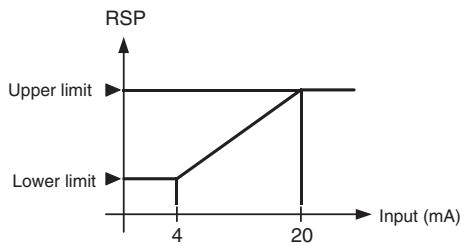
- When the SP Upper Limit or SP Lower Limit parameter setting is changed, the remote SP upper or lower limit is forcibly changed to that setting.
| Setting | Setting range | Unit | Default |
| Remote SP Upper Limit | SP lower limit to SP upper limit | EU | 1300.0 |
| Remote SP Lower Limit | SP lower limit to SP upper limit | EU | -200.0 |

Related Parameters
Decimal point (initial setting level): Page 226
SP upper limit, SP lower limit (initial setting level): Page 227
Remote SP enable (advanced function setting level): Page 266
| SPER | SP Tracking | The ST parameter must be set to OFF. The Remote SP Enable parameter must be set to OFF. | |
| Function | ·This parameter specifies the operation for when the mode is changed from Remote SP Mode to Local SP Mode. ·When this parameter is set to ON, Local SP Mode inherits the remote SP. ·When this parameter is set to OFF, the local SP is not affected by the remote SP. | ||
| Setting | Setting range | Default | |
| ON: Enabled, OFF: Disabled | OFF | ||
| See | ■ Related Parameters Set point during SP ramp (operation level): Page 180 SP mode (adjustment level): Page 193 | ||
| RSEa | Remote SP Input Error Output | The ST parameter must be set to OFF. The Remote SP Enable parameter must be set to ON. Alarm 1 must be assigned, but not to a work bit output. | |
| Function | ·When this parameter is set to ON, the output to which alarm 1 is assigned turns ON when a remote SP input error occurs. Note For details on input errors, refer to 4-23 Using a Remote SP Function. ·The output is an OR output between alarm 1, the heater burnout/HS/ heater overcurrent alarm, the input error, and the RSP input error status. ·The output turns OFF when switching to the initial setting level, advanced function setting level, communications setting level, or calibration level. | ||
| Setting | Setting range | Default | |
| ON: Enabled, OFF: Disabled | OFF | ||
| See | ■ Related Parameters Remote SP upper limit, Remote SP lower limit (advanced function setting level): Page 267 SP mode (adjustment level): Page 193 | ||
| P-Set | PID Set Automatic Selection Data PID Set Automatic Selection Hysteresis | The control must be set to 2-PID control. | ||
| Function | ·This parameter provides the data for automatic selection of the PID set. ·The PID set number to be used is automatically selected according to the data set in the PID Set Automatic Selection Data parameter. The selec- tion range is specified in the PID Set Automatic Selection Range Upper Limit parameter. ·The PID Set Automatic Selection Hysteresis parameter is used to set the hysteresis to prevent chattering when the PID set is changed. | |||
| Parameter | Setting range | Unit | Default | |
| PID Set Automatic Selec- tion Data | P': Process value d': Deviation SP': Set point | --- | PV | |
| PID Set Automatic Selec- tion Hysteresis | 0.10 to 99.99 | %FS | 0.50 | |
| See | ■ Related Parameters PID set automatic selection range upper limit (PID setting level): Page 269 Bank * PID set No. (bank setting level): Page 210 | |||
| P-db | PV Dead Band | Position-proportional control must be supported. | ||
| Function | ·For position-proportional models, control is executed with the process value equal to the set point when the process value is within the PV dead band. ·This function prevents unnecessary outputs when the process value approaches the set point. | |||
| Setting range | Unit | Default | ||
| 0 to 32400 | EU | 0.0 | ||
| See | ■ Related Parameters Closed/floating (initial setting level): Page 239 Motor calibration (initial setting level): Page 240 Travel time (initial setting level): Page 240 Position proportional dead band (adjustment level): Page 207 Open/close hysteresis (adjustment level): Page 207 | |||
| MRNL | Manual MV Limit Enable | The control must be set to 2-PID control. Close control (position-proportional models) must be used. | |
| Function | This parameter sets whether the MV Upper Limit and MV Lower Limit param- eters are to be enabled for manual MV in manual mode. | ||
| Setting range | Default | ||
| aN: Enabled, aFF: Disabled | OFF | ||
| See | ■ Related Parameters PID * MV upper limit, PID * MV lower limit (PID setting level): Page 217 | ||
| PM'd | Direct Setting of Position Proportional MV | Close control (position-proportional models) must be used. | |
| Function | · When this parameter is set to ON, valve opening can be specified in the MV at Stop, MV at PV Error, and Manual MV Limit Enable parameters. | ||
| Setting range | Default | ||
| aN: Enabled, aFF: Disabled | OFF | ||
| See | ■ Related Parameters MV at stop (adjustment level): Page 204 MV at PV error (adjustment level): Page 204 Manual MV (manual control level): Page 221 | ||
| PV RP | PV Rate of Change Calculation Period | Alarms 1, 2, and 3 must be assigned. The alarm type must be set to 13. | |
| Function | · The change width can be found for PV input values in any set period. Dif- ferences with previous values in each set period are calculated, and an alarm is output if the results exceed the alarm value. · The PV rate of change calculation period can be set in units of 60 ms (sampling period). | ||
| Setting | Setting range | Unit | Default |
| 1 to 999 | Sampling period | 17 (= 17 × 60 ms = 1020 ms) | |
| See | ■ Related Parameters Process value, Process value/set point (operation level): Page 177 Alarm 1 to 3 type, (Initial setting level): Pages 231, 233, 234. | ||
| C5CR | Automatic Cooling Coefficient Adjustment | The control must be set to heating/ cooling control and 2-PID control. | |
| Function | · By setting the Automatic Cooling Coefficient Adjustment parameter to ON, autotuning can be executed during heating/cooling control to auto- matically calculate the cooling coefficient at the same time as the PID parameters. If there is strong non-linear gain for the cooling characteris- tics, such as when cooling water boils for cooling control, it may not be possible to obtain the optimum cooling coefficient with this function, and control may take the form of oscillating waves. If that occurs, increase the proportional band or the cooling coefficient to improve control. | ||
| Setting | Setting range | Default | |
| aN: Enabled, aFF: Disabled | OFF | ||
| See | ■ Related Parameters PID * cooling coefficient (PID setting level): Page 219 | ||
| aCU | Heater Overcurrent Use | Heater burnout, HS alarms, and heater overcurrent detection must be supported. Alarm 1 must be assigned. |
| Function | • Set this parameter to use the heater overcurrent alarm. | |
| Setting | Setting range | Default |
| aN: Enabled, aFF: Disabled | ON | |
| aCL | Heater Overcurrent Latch | Heater burnout, HS alarms, and heater overcurrent detection must be supported (two CTs). Alarm 1 must be assigned. |
| Function | • When this parameter is set to ON, the HS alarm is held until any of the following conditions is satisfied. a Heater overcurrent detection is set to 50.0 A. b The power is cycled. c The latch is cancelled by the PF Key. (PF Setting = LAT: Alarm Latch Cancel) d The latch is cancelled by an event input. (Event Input Assignment 1 to 4 = LAT: Alarm Latch Cancel) | |
| Setting | • Output is turned OFF when switching to the initial setting level, communications setting level, advanced function setting level, or calibration level. | |
| Setting range | Default | |
| aN: Enabled, aFF: Disabled | OFF | |
| See | ■ Related Parameters | |
| Heater overcurrent detection 1, Heater overcurrent detection 2 (adjustment level): Pages 195, 196 | ||
| Heater overcurrent use (advanced function setting level): Page 272 | ||
| Heater overcurrent hysteresis (advanced function setting level): Page 273 | ||
| Event input assignment 1 to 4 (initial setting level): Page 238 | ||
| HB ON/OFF: Page 246, PF setting: Page 273 (advanced function setting level) | ||
| a[H] | Heater Overcurrent Hysteresis | Heater burnout, HS alarms, and heater overcurrent detection must be supported, and alarm 1 must be assigned. The Heater Overcurrent Use parameter must be set to ON, and the Heater Overcurrent Latch parameter must be set to OFF. | |
| Setting range | Unit | Default | |
| 0.1 to 50.0 | A | 0.1 | |
| Function | This parameter sets the hysteresis for heater overcurrent detection. | ||
| Setting | Setting range | Unit | Default |
| 0.1 to 50.0 | A | 0.1 | |
| See | ■ Related Parameters Heater overcurrent use (advanced function setting level): Page 272 | ||
| PF | PF Setting | The PF Key must be supported (E5AN/EN-H). | |
| Function | This parameter sets the function of the PF Key. | ||
| Setting | The default setting is A-M (Auto/Manual). | ||
| Set value | Setting | Function | |
| OFF: aFF | Disabled | Does not operate as a function key. | |
| RUN: RUN | RUN | Specifies RUN status. | |
| STOP: 5εaP | STOP | Specifies STOP status. | |
| R-S: R-5 | Reversing RUN/STOP operation | Specifies reversing RUN/STOP operation status. | |
| AT-2: R-2 | 100%AT Execute/Cancel | Specifies reversing 100% AT Execute/Cancel status. (See note 1.) | |
| AT-1: R-1 | 40%AT Execute/Cancel | Specifies reversing 40% AT Execute/Cancel status. (See notes 1 and 2.) | |
| LAT: LaRc | Alarm Latch Cancel | Specifies canceling alarm latches. (See note 3.) | |
| A-M: R-M | Auto/Manual | Specifies reversing Auto/Manual status (See note 4.) | |
| PFDP: PFdP | Monitor/Setting Item | Specifies the monitor/setting item display. Select the monitor/setting item using the Monitor/Setting Item 1 to 5 parameters (advanced function setting level). | |
| BANK: bRnN | Bank No. | Specifies switching to the bank number + 1. | |
| Note | (1) When AT cancel is specified, it means that AT is cancelled regardless of whether the AT currently being executed is 100% AT or 40% AT. | ||
(2) The setting of this function will be ignored for heating/cooling control or position-proportional (floating) control.
(3) Alarms 1 to 3, heater burnout, HS alarms, and heater overcurrent latches are cancelled.
(4) For details on auto/manual operations using the PF Key, refer to 4-13 Performing Manual Control.

Related Parameters
Monitor/setting item 1 to 5 (advanced function setting level): Page 274
PFd*
Monitor/Setting Item * (*: 1 to 5)
The PF Setting parameter must be set to PFDP.
- Set the PF Key parameter to Monitor/Setting Item to enable using the function key to display monitor/setting items. The items that will be displayed are set using the Monitor/Setting Item 1 to 5 parameters. The settings are listed in the following table.
| Set value | Setting | Remarks | |
| Monitor/Setting | Symbol | ||
| 0 | Disabled | --- | |
| 1 | PV/SP/Bank No. | Can be set. (SP) | --- |
| 2 | PV/SP/MV (See note.) | Can be set. (SP) | --- |
| 3 | PV/SP/Soak time remain | Can be set. (SP) | --- |
| 4 | Proportional band (P) | Can be set. | P |
| 5 | Integral time (I) | Can be set. | L |
| 6 | Derivative time (D) | Can be set. | d |
| 7 | Alarm value 1 | Can be set. | RL - I |
| 8 | Alarm value upper limit 1 | Can be set. | RL IH |
| 9 | Alarm value lower limit 1 | Can be set. | RL IL |
| 10 | Alarm value 2 | Can be set. | RL - 2 |
| 11 | Alarm value upper limit 2 | Can be set. | RL 2H |
| 12 | Alarm value lower limit 2 | Can be set. | RL 2L |
| 13 | Alarm value 3 | Can be set. | RL - 3 |
| 14 | Alarm value upper limit 3 | Can be set. | RL 3H |
| 15 | Alarm value lower limit 3 | Can be set. | RL 3L |
| 16 | Bank No. | Can be set. | BANK |
Note The MV for heating and cooling control is set in the MV Display Selection parameter.

Related Parameters
PF setting: Page 273, MV display selection: Page 275 (advanced function setting level)
| SPdP | PV/SP Display Screen Selection | The No. 3 display must be supported (E5AN/EN-H). |
| Function | ·This parameter sets the PV/SP Screen No. 3 display and order of display. ·The default is 4. | |
| Set value | Display contents | |
| 0 | Only PV/SP is displayed (with no No. 3 display). | |
| 1 | PV/SP/Bank No. and PV/SP/MV are displayed in order. (See note.) | |
| 2 | PV/SP/MV and PV/SP/Bank No. are displayed in order. (See note.) | |
| 3 | Only PV/SP/Bank No. is displayed. | |
| 4 | PV/SP/MV is displayed (See note.) | |
| 5 | PV/SP/Bank No. and PV/SP/Soak time remain are displayed in order. | |
| 6 | PV/SP/MV and PV/SP/Soak time remain are displayed in order. (See note.) | |
| 7 | Only PV/SP/Soak time remain is displayed. | |
| See | Note | The MV for heating and cooling control is set in the MV Display Selection parameter. |
| ■ Related Parameters Process value/set point (operation level): Page 177 MV display selection (advanced function setting level): Page 275 | ||
| ad5L | MV Display Selection | The No. 3 display must be supported (E5AN/EN-H). Heating and cooling control must be used. The PV/SP Display Screen Selection parameter must be set to 1, 2, 4, or 6, or the Monitor/Setting Item 1 to 5 parameter must be set to 2. |
| Function | ·This parameter selects the MV display for PV/SP/MV during heating and cooling control. Either heating MV or cooling MV can be selected. | |
| Setting range | Default | |
| a: MV (heating) c - a: MV (cooling) | a | |
| PV dP | PV Decimal Point Display | The input type must be set to temperature input. |
| Function | The display below the decimal point in the PV can be hidden for temperature inputs. · The PV decimals below the decimal point can be hidden by setting the PV Decimal Point Display parameter to OFF. When this parameter is set to ON, the display below the decimal point will appear according to the input type setting. | |
| Setting | Setting range | Default |
| ON: ON, OFF: OFF | ON | |
| See | ■ Related Parameters Input type (initial setting level): Page 224 | |
| PV 5e | PV Status Display Function | |
| Monitor | · The PV in the No. 1 display for the PV/SP, PV, or PV/Manual MV (Valve Opening) Screen is alternately displayed in 0.5-s cycles with the control and alarm status specified for the PV status display function. | |
| Monitor range | Default | |
| OFF: No PV status display | OFF | |
| MANU: MANU is alternately displayed during manual control. | ||
| STOP: STOP is alternately displayed while operation is stopped. | ||
| ALM1: ALM1 is alternately displayed during Alarm 1 status. | ||
| ALM2: ALM2 is alternately displayed during Alarm 2 status. | ||
| ALM3: ALM3 is alternately displayed during Alarm 3 status. | ||
| ALM4: ALM4 is alternately displayed when Alarm 1, 2, or 3 is set to ON. | ||
| HA: HA is alternately displayed when a heater burnout alarm, HS alarm, or heater overcurrent alarm is ON. | ||
| See | ■ Related Parameters Process value/set point, PV (operation level): Page 177 PV/MV (manual MV) (manual control level): Page 221 | |
515t
SV Status Display Function
- The SP, Blank, or Manual MV in the No. 2 display for the PV/SP, PV, or PV/Manual MV (Valve Opening) Screen is alternately displayed in 0.5-s cycles with the control and alarm status specified for the SV status display function.
| Monitor range | Default |
| ☐FF: No SV status display | ☐FF |
| MANU: MANU is alternately displayed during manual control. | |
| ☐E ☐P: STOP is alternately displayed while operation is stopped. | |
| RLM1: ALM1 is alternately displayed during Alarm 1 status. | |
| RLM2: ALM2 is alternately displayed during Alarm 2 status. | |
| RLM3: ALM3 is alternately displayed during Alarm 3 status. | |
| RLM: ALM is alternately displayed when Alarm 1, 2, or 3 is set to ON. | |
| HR: HA is alternately displayed when a heater burnout alarm, HS alarm, or heater overcurrent alarm is ON. |

Related Parameters
Process value/set point, PV (operation level): Page 177
PV/MV (manual MV) (manual control level): Page 221
d.REF
Display Refresh Period
- This parameter delays the display refresh period for monitor values. Only display refreshing is delayed, and the refresh period for process values used in control is not changed.
- This function is disabled by setting the parameter to OFF.
| Setting range | Unit | Default |
| OFF, 0.25, 0.5, 1.0 | Second | 0.25 |
| RR IM | Control Output 1 ON/OFF Count Monitor | Control output 1 must be supported. A relay output, voltage output (for driving SSR), or SSR output must be used. The Control Output 1 ON/OFF Count Alarm Set Value parameter must not be set to 0. |
| Function | ·This parameter monitors the number of times that control output 1 is turned ON and OFF. ·This function is not displayed when the set value is 0, or when the control output is a linear output. | |
| Monitor | Monitor range | Unit |
| 0 to 9999 | 100 times | |
| RR2M | Control Output 2 ON/OFF Count Monitor | Control output 2 must be supported. Relay, voltage outputs (for driving SSR), or SSR output must be used. The Control Output 2 ON/OFF Count Alarm Set Value parameter must not be set to 0. |
| Function | ·This parameter monitors the number of times that control output 2 is turned ON and OFF. ·This function is not displayed when the set value is 0, or when the control output is a linear output. | |
| Monitor | Monitor range | Unit |
| 0 to 9999 | 100 times | |
| RR1 | Control Output 1 ON/OFF Count Alarm Set Value | Control output 1 must be supported. Relay, voltage outputs (for driving SSR), or SSR output must be used. | |
| Function | ·An ON/OFF count alarm occurs when the ON/OFF counter exceeds the value set for this parameter. ·It is possible to assign ON/OFF count alarms to auxiliary outputs and to have them displayed on the screen. ·This function is disabled when the set value is 0. | ||
| Monitor | Setting range | Unit | Default |
| 0 to 9999 | 100 times | 0 | |
| See | ■ Related Parameters Control output 1 ON/OFF count monitor (advanced function setting level): Page 278 | ||
| RR2 | Control Output 2 ON/OFF Count Alarm Set Value | Control output 2 must be supported. Relay, voltage outputs (for driving SSR), or SSR output must be used. | |
| Function | ·An ON/OFF count alarm occurs when the ON/OFF counter exceeds the value set for this parameter. ·It is possible to assign ON/OFF count alarms to auxiliary outputs and to have them displayed on the screen. ·This function is disabled when the set value is 0. | ||
| Monitor | Setting range | unit | Default |
| 0 to 9999 | 100 times | 0 | |
| See | ■ Related Parameters Control output 2 ON/OFF count monitor (advanced function setting level): Page 278 | ||
| RAC | ON/OFF Counter Reset | Control outputs 1 and 2 must be supported. Relay, or voltage outputs (for driving SSR), or SSR output must be used. |
| Function | · This parameter resets the ON/OFF counter for specified control outputs. | |
| Setting range | Default | |
| 0: Disable the counter reset function. 1: Reset the control output 1 ON/OFF counter. 2: Reset the control output 2 ON/OFF counter. | 0 | |
| See | Note | After the counter has been reset, the set value will be automatically returned to 0. |
| ■ Related Parameters Control output 1 ON/OFF count monitor, Control output 2 ON/OFF count monitor (advanced function setting level): Page 278 | ||
| [MaV] | Move to Calibration Level | Initial setting/communications protect must be 0. |
| Function | This parameter sets the password to move to the calibration level. · Set the password to move to the calibration level. The password is 1201. · Move to the calibration level either by pressing the Key or Key or by waiting for two seconds to elapse. | |
| See | ■ Related Parameter Initial setting/communications protect (protect level): Page 172 | |
5-11 Communications Setting Level
| PSEL | Protocol Setting | Communications must be supported. |
| U-No | Communications Unit No. | |
| bPS | Communications Baud Rate | |
| LEN | Communications Data Length | CompoWay/F must be selected as the protocol. |
| SbLT | Communications Stop Bits | CompoWay/F must be selected as the protocol. |
| PREY | Communications Parity | |
| SdWt | Send Data Wait Time |
Each parameter is enabled when the power is reset.
- Match the communications specifications of the E5□N-H and the host computer. If multiple devices are connected, ensure that the communications specifications for all devices in the system (except the Communications unit number) are the same.
| Item | Symbol | Set values | Settings | Default |
| Protocol setting | PSEL | CWF, Mod | CompoWay/F (SYSWAY), Modbus | CWF |
| Communications Unit No. | U-No | 0 to 99 | 0 to 99 | 1 |
| Communications baud rate | bPS | 1.2, 2.4, 4.8, 9.6, 19.2, 38.4, or 57.6 (kbps) | 1.2, 2.4, 4.8, 9.6, 19.2, 38.4, or 57.6 (kbps) | 9.6 |
| Communications data length | LEN | 7 or 8 bits | 7 or 8 bits | 7 |
| Stop bits | SbLT | 1 or 2 bits | 1 or 2 bits | 2 |
| Communications parity | PREY | None, EVEN, add | None, Even, Odd | EVEN |
| Send data wait time | SdWt | 0 to 99 | 0 to 99 (ms) | 20 |

Related Parameter
Communications writing (adjustment level): Page 193
SECTION 6
CALIBRATION
This section describes how the user can calibrate the E5CN-H Digital Controllers.
6-1 Parameter Structure 284
6-2User Calibration 285
6-2-1 Calibrating Inputs 285
6-2-2 Registering Calibration Data 285
6-3 Thermocouple Calibration (Thermocouple/Resistance Thermometer Input). 285
6-3-1 Preparations 286
6-4 Platinum Resistance Thermometer Calibration (Thermocouple/Resistance Thermometer Input) 289
6-5 Calibrating Analog Input (Analog Input) 290
6-5-1 Calibrating a Current Input. 290
6-5-2 Calibrating a Voltage Input. 291
6-6 Calibrating the Transfer Output 292
6-7 Checking Indication Accuracy 294
6-7-1 Thermocouple. 294
6-7-2 Platinum Resistance Thermometer 294
6-7-3 Analog Input. 295
6-1 Parameter Structure
- To execute user calibration, enter the password "1201" at the Move to Calibration Level parameter in the advanced function setting level. The mode will be changed to the calibration mode, and dU will be displayed.
- The Move to Calibration Level parameter may not be displayed. If this happens, set the Initial/Communications Protect parameter in the protect level to 0 before moving to the advanced function setting level. (The default setting is 0.)
- The calibration mode is ended by turning the power OFF.
- The parameter calibrations in the calibration mode are structured as shown below.
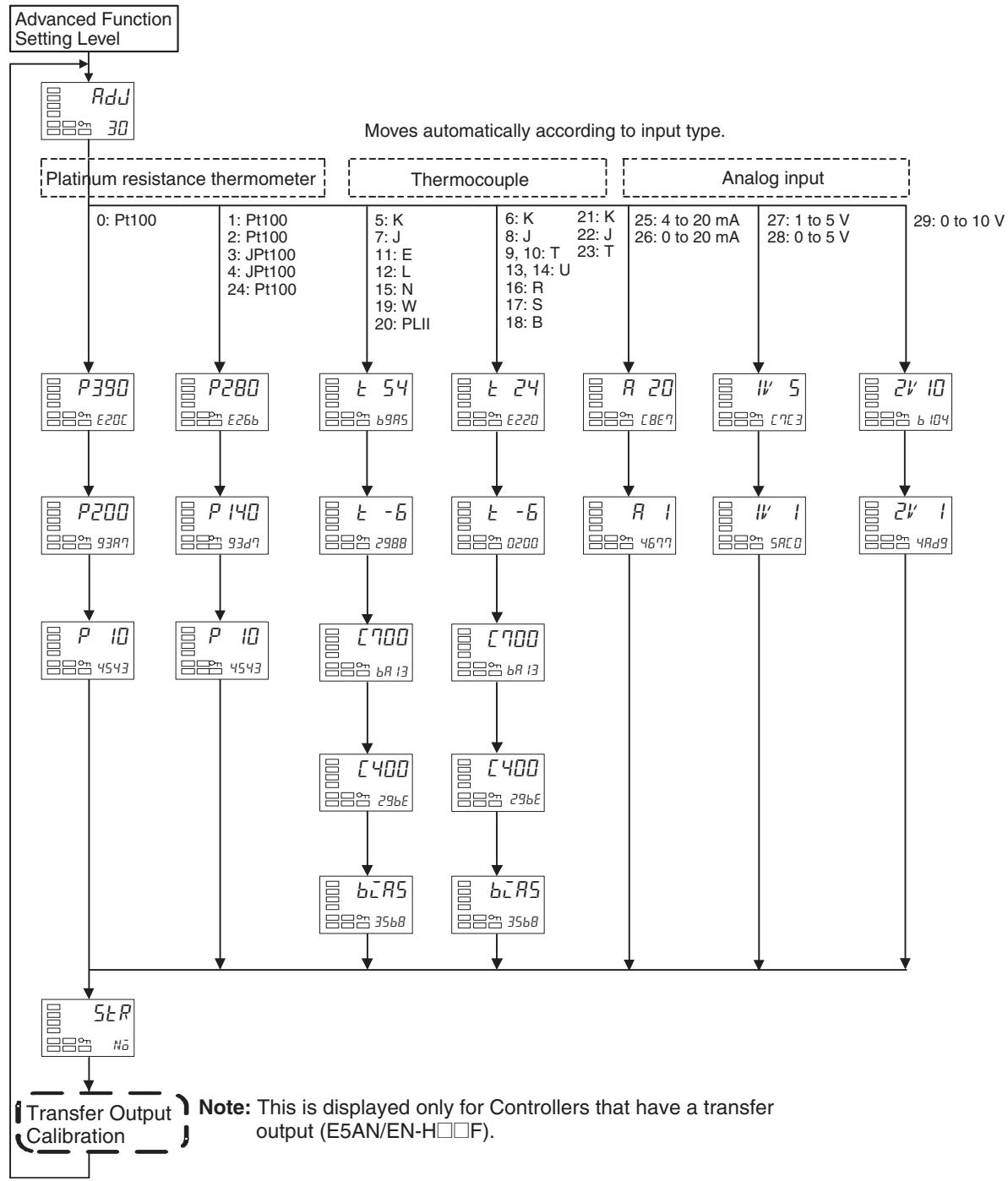
Controllers with Thermocouple/Resistance Thermometer Universal Inputs
When calibration has been performed after purchase, the user calibration information shown in the following illustration will be displayed when moving to the calibration level.
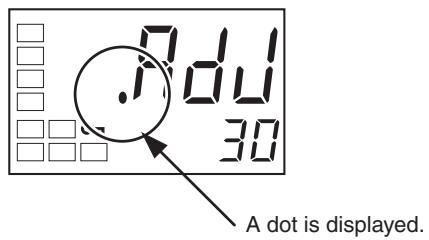
6-2 User Calibration
The E5□N-H is correctly calibrated before it is shipped from the factory, and normally need not be calibrated by the user.
If, however, it must be calibrated by the user, use the parameters for calibrating temperature input and analog input. OMRON, however, cannot ensure the results of calibration by the user. Also, calibration data is overwritten with the latest calibration results. The default calibration settings cannot be restored after user calibration. Perform user calibration with care.
6-2-1 Calibrating Inputs
The input type selected in the parameter is used for calibration. The input types are as follows:
Controllers with Thermocouple, Resistance Thermometer, Analog Universal Inputs
Thermocouple: 19 types
- Analog input: 5 types
- Platinum resistance thermometer: 6 types
6-2-2 Registering Calibration Data
The new calibration data for each item is temporarily registered. It can be officially registered as calibration data only when all items have been calibrated to new values. Therefore, be sure to temporarily register all items when you perform the calibration. When the data is registered, it is also recorded that user calibration has been performed.
Prepare separate measuring devices and equipment for calibration. For details on how to handle measuring devices and equipment, refer to the respective instruction manuals.
6-3 Thermocouple Calibration (Thermocouple/Resistance Thermometer Input)
- Calibrate according to the type of thermocouple: thermocouple 1 group (input types 5, 7, 11, 12, 15, 19, 20) and thermocouple 2 group (input types 6, 8, 9, 10, 13, 14, 16, 17, 18, 21, 22, 23).
- When calibrating, do not cover the bottom of the Controller. Also, do not touch input terminals/pins (terminals 4 and 5 on the E5CN-H, and pins 19 and 20 on the E5AN/EN-H) or compensating conductors.
6-3-1 Preparations
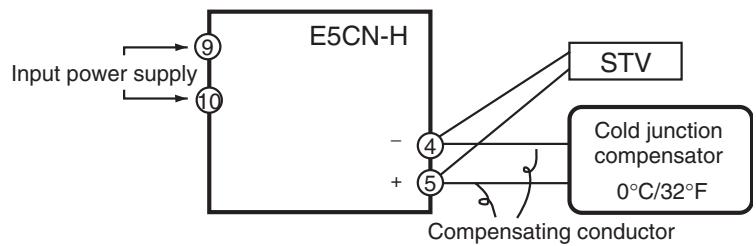
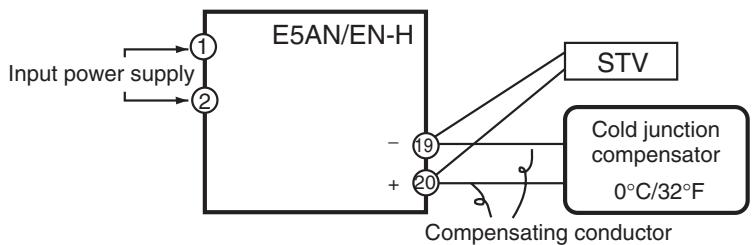
- Set the cold junction compensator designed for compensation of internal thermocouples to 0^ . Make sure that internal thermocouples are disabled (i.e., that tips are open).
- In the above figure, STV indicates a standard DC current/voltage source.
- Use the compensating conductor designed for the selected thermocouple. When thermocouples R, S, E, B, W, or PLII is used, the cold junction compensator and the compensating conductor can be substituted with the cold junction compensator and the compensating conductor for thermocouple K.
- Connecting the Cold Junction Compensator
Correct process values cannot be obtained if you touch the contact ends of the compensating conductor during calibration of a thermocouple. Accordingly, short-circuit (enable) or open (disable) the tip of the thermocouple inside the cold junction compensator as shown in the figure below to create a contact or non-contact state for the cold junction compensator.
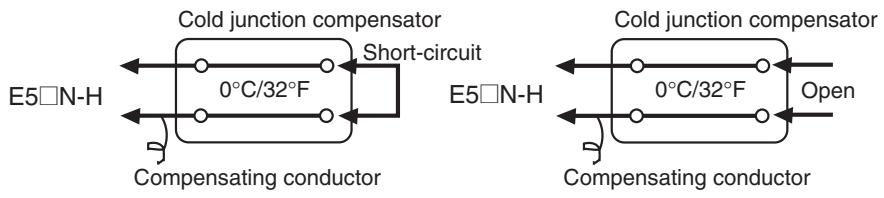
In this example, calibration is shown for a Controller with a thermocouple set as the input type.
1,2,3... 1. Connect the power supply.
- Connect a standard DC current/voltage source (STV), precision digital multimeter (DMM), and contact junction compensator (e.g., a zero controller as in the figure) to the thermocouple input terminals, as shown in the figure below.

Compensating conductor of currently selected thermocouple
Use K thermocouple compensating conductor
for E, R, S, B, W, and PLII thermocouples.
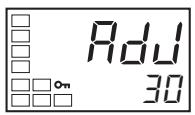
Input types 5, 7, 11, 12, 15, 19, 20:
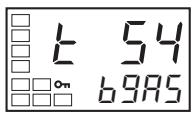
Input types 6, 8, 9, 10, 13, 14, 16, 17, 18, 21, 22, 23:
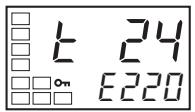
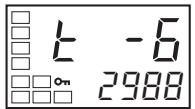
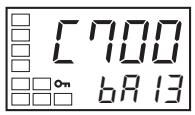
- Turn the power ON.
- Move to the calibration level.
This starts the 30-minute aging timer. This timer provides an approximate timer for aging. After 30 minutes have elapsed, the No. 2 display changes to 0. You can advance to the next step in this procedure even if 0 is not displayed.
- When the Key is pressed, the status changes as shown to the left.
The No. 2 display at this time shows the currently entered count value in hexadecimal. Set the STV as follows:
- Input types 5, 7, 11, 12, 15, 19, 20: Set to 54mV .
- Input types 6, 8, 9, 10, 13, 14, 16, 17, 18, 21, 22, 23:
Set to 24mV
Allow the count value on the No. 2 display to fully stabilize, then press the Key to temporarily register the calibration settings.
If this count value is outside of the specified range, the No. 2 display will flash and the count value will not be temporarily registered.
- When the Key is pressed, the status changes as shown to the left. Set the STV to -6mV
Allow the count value on the No. 2 display to fully stabilize, then press the Key to temporarily register the calibration settings.
If this count value is outside of the specified range, the No. 2 display will flash and the count value will not be temporarily registered.
- Press the l Key. The display changes as shown on the left. Set the STV to 700mV .
Allow the count value on the No. 2 display to fully stabilize, then press the Key to temporarily register the calibration settings.
If this count value is outside of the specified range, the No. 2 display will flash and the count value will not be temporarily registered.
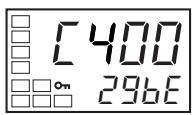
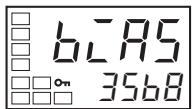
- Press the Key. The display changes as shown on the left.
Set the STV to 400mV
Allow the count value on the No. 2 display to fully stabilize, then press the
Key to temporarily register the calibration settings.
If this count value is outside of the specified range, the No. 2 display will flash and the count value will not be temporarily registered.
-
When the Key is pressed, the status changes as shown to the left.
-
Change the wiring as follows:
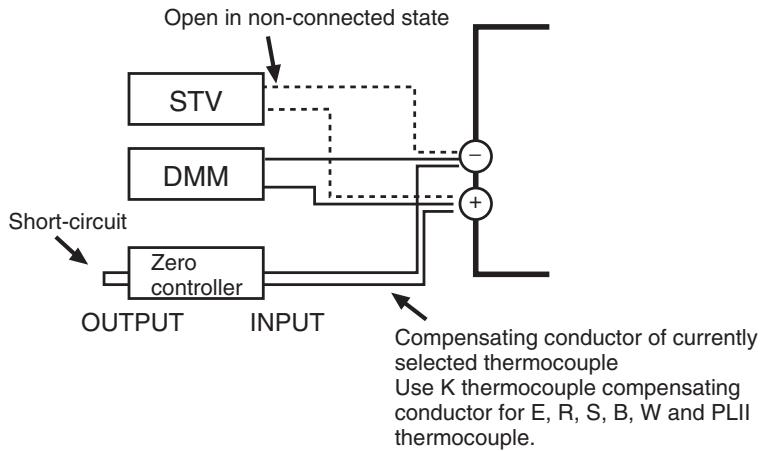
Disconnect the STV to enable the thermocouple of the cold junction compensator. When doing this, be sure to disconnect the wiring on the STV side.
- Allow the count value on the No. 2 display to fully stabilize, then press the _X^X Key to temporarily register the calibration settings.
- When the Key is pressed, the status changes as shown to the left. The data to be temporarily registered is not displayed if it is not complete. Press the Key. The No. 2 display changes to 4ES . Release the key and wait two seconds or press the Key. This stores the temporarily registered calibration data to EEPROM. To cancel the saving of temporarily registered calibration data to EEPROM, press the Key (while N is displayed in the No. 2 display) without pressing the Key.
- The calibration mode is ended by turning the power OFF. For Controllers that have a transfer output (E5AN/EN-H□□F), transfer output calibration continues to be performed. For details on the settings, refer to 6-6 Calibrating the Transfer Output on page 292.
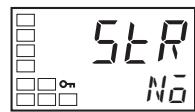
6-4 Platinum Resistance Thermometer Calibration (Thermocouple/Resistance Thermometer Input)
In this example, calibration is shown for Controller with a resistance thermometer set as the input type.
Use connecting wires of the same thickness.
1,2,3... 1. Connect the power supply.
- Connect a precision resistance box (called a "6-dial" in this manual) to the platinum resistance thermometer input terminals, as shown in the following diagram.
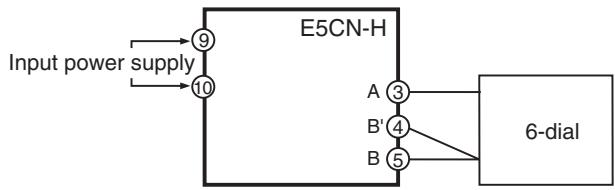
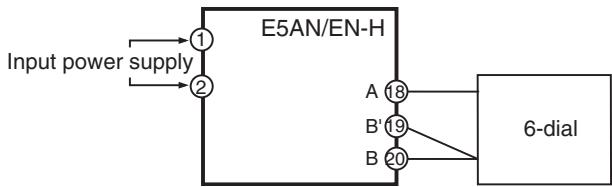
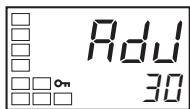
Input type 0:
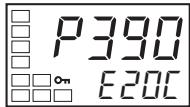
Input types 1, 2, 3, 4, 24:
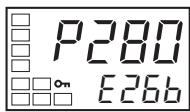
Input type 0:
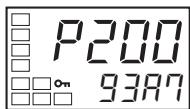
Input types 1, 2, 3, 4, 24:
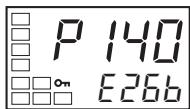
3. Turn the power ON.
4. Move to the calibration level.
This starts the 30-minute aging timer. This timer provides an approximate timer for aging. After 30 minutes have elapsed, the No. 2 display changes to 0. You can advance to the next step in this procedure even if 0 is not displayed.
5. Execute calibration for the main input.
Press the Key to display the count value for each input type.
The No. 2 display at this time shows the currently entered count value in hexadecimal. Set the 6-dial as follows:
- Input type 0: 390Ω
- Input type 1, 2, 3, 4 or 24: 280 Ω
Allow the count value on the No. 2 display to fully stabilize, then press the Key to temporarily register the calibration settings.
If this count value is outside of the specified range, the No. 2 display will flash and the count value will not be temporarily registered.
Press the Key to display the count value for each input type.
The No. 2 display at this time shows the currently entered count value in hexadecimal. Set the 6-dial as follows:
- Input type 0: 200 Ω
- Input type 1, 2, 3, 4 or 24: 140
Allow the count value on the No. 2 display to fully stabilize, then press the Key to temporarily register the calibration settings.
If this count value is outside of the specified range, the No. 2 display will flash and the count value will not be temporarily registered.
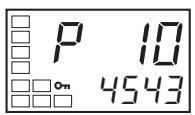

- When the Key is pressed, the status changes as shown to the left. Set the 6-dial to 10
Allow the count value on the No. 2 display to fully stabilize, then press the Key to temporarily register the calibration settings.
If this count value is outside of the specified range, the No. 2 display will flash and the count value will not be temporarily registered.
- When the Key is pressed, the status changes as shown to the left. The data to be temporarily registered is not displayed if it is not complete. Press the Key. The No. 2 display changes to 9E5 . Release the key and wait two seconds or press the Key. This stores the temporarily registered calibration data to EEPROM.
To cancel the saving of temporarily registered calibration data to EEPROM, press the 回 Key (while N_ is displayed in the No. 2 display) without pressing the 回 Key.
- The calibration mode is quit by turning the power OFF.
For Controllers that have a transfer output (E5AN/EN-H□□F), transfer output calibration continues to be performed. For details on the settings, refer to 6-6 Calibrating the Transfer Output on page 292.
6-5 Calibrating Analog Input (Analog Input)
6-5-1 Calibrating a Current Input
In this example, calibration is shown for a Controller with a current input set as the input type.
1,2,3... 1. Connect the power supply.
2. Connect an STV and DMM to the current input terminals, as shown in the following diagram.
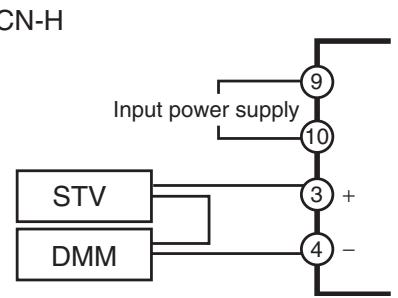
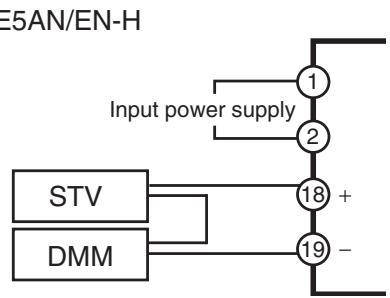
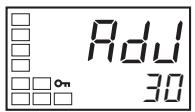
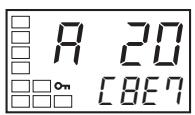
- Turn the power ON.
- Move to the calibration level.
This starts the 30-minute aging timer. This timer provides an approximate timer for aging. After 30 minutes have elapsed, the No. 2 display changes to 0. You can advance to the next step in this procedure even if 0 is not displayed.
- When the Key is pressed, the status changes as shown to the left.
The No. 2 display at this time shows the currently entered count value in hexadecimal. Set the STV to 20mA .
Allow the count value on the No. 2 display to fully stabilize, then press the Key to temporarily register the calibration settings.
If this count value is outside of the specified range, the No. 2 display will flash and the count value will not be temporarily registered.
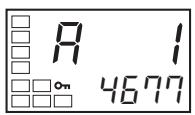
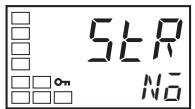
- When the l Key is pressed, the status changes as shown to the left. Set the STV to 1 mA.
Allow the count value on the No. 2 display to fully stabilize, then press the Key to temporarily register the calibration settings.
If this count value is outside of the specified range, the No. 2 display will flash and the count value will not be temporarily registered.
- When the Key is pressed, the status changes as shown to the left. The data to be temporarily registered is not displayed if it is not complete.
Press the . The No. 2 display changes to 9E5 . Release the key and wait two seconds or press the . This stores the temporarily registered calibration data to EEPROM.
To cancel the saving of temporarily registered calibration data to EEPROM, press the 回 Key (while N is displayed in the No. 2 display) without pressing the 回 Key.
- The calibration mode is ended by turning the power OFF.
For Controllers that have a transfer output (E5AN/EN-H□□F), transfer output calibration continues to be performed. For details on the settings, refer to 6-6 Calibrating the Transfer Output on page 292.
6-5-2 Calibrating a Voltage Input
In this example, calibration is shown for a Controller with a voltage input set as the input type.
1,2,3... 1. Connect the power supply.
- Connect an STV and DMM to the voltage input terminals, as shown in the following diagram.
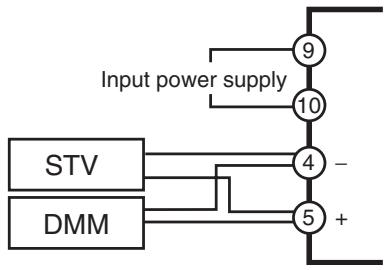
E5CN-H
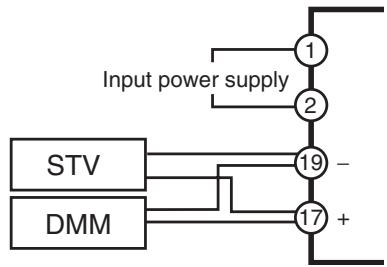
E5AN/EN-H
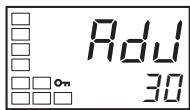
Input type 27 or 28:
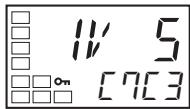
Input type 29:
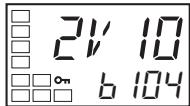
- Turn the power ON.
- Move to the calibration level.
This starts the 30-minute aging timer. This timer provides an approximate timer for aging. After 30 minutes have elapsed, the No. 2 display changes to 0. You can advance to the next step in this procedure even if 0 is not displayed.
- When the Key is pressed, the status changes as shown to the left.
The No. 2 display at this time shows the currently entered count value in hexadecimal. Set the STV as follows:
- Input type 27 or 28:5 V
- Input type 29: 10 ~V
Allow the count value on the No. 2 display to fully stabilize, then press the Key to temporarily register the calibration settings.
If this count value is outside of the specified range, the No. 2 display will flash and the count value will not be temporarily registered.
Input type 27 or 28:
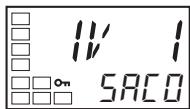
Input type 29:
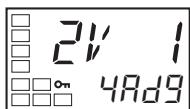
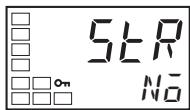
- When the Key is pressed, the status changes as shown to the left. Set the STV to 1 V.
Allow the count value on the No. 2 display to fully stabilize, then press the Key to temporarily register the calibration settings.
If this count value is outside of the specified range, the No. 2 display will flash and the count value will not be temporarily registered.
- When the Key is pressed, the status changes as shown to the left. The data to be temporarily registered is not displayed if it is not complete. Press the Key. The No. 2 display changes to yE5 . Release the key and wait two seconds or press the Key. This stores the temporarily registered calibration data to EEPROM.
To cancel the saving of temporarily registered calibration data to EEPROM, press the 回 Key (while N is displayed in the No. 2 display) without pressing the 回 Key.
- The calibration mode is ended by turning the power OFF.
For Controllers that have a transfer output (E5AN/EN-H□□F), transfer output calibration continues to be performed. For details on the settings, refer to 6-6 Calibrating the Transfer Output on page 292.
6-6 Calibrating the Transfer Output
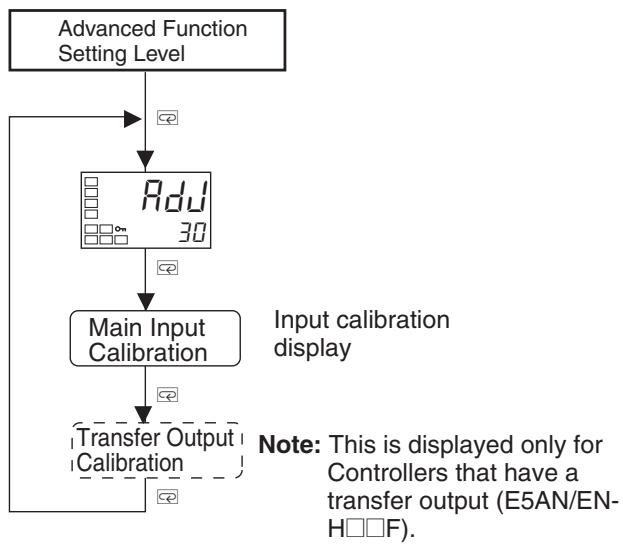
For Controllers that have a transfer output (E5□N-H□□F), the Transfer Output Calibration Screen will be displayed after input calibration has been completed.
Use the following procedure for calibration.
- Connect the DMM to the transfer output terminal.
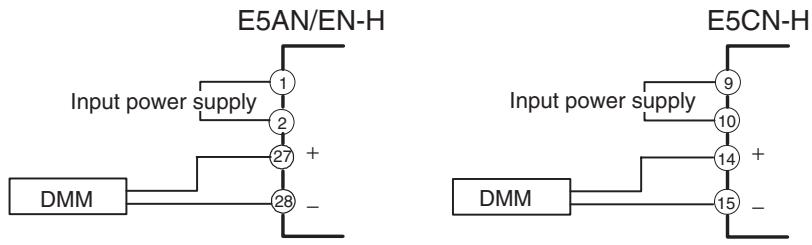
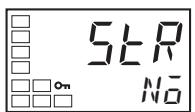
- Press the Key to switch to the Transfer Output Screen.
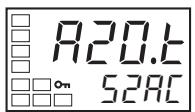
- The 20 ~mA Calibration Screen will be displayed. Use the and Keys to adjust the DMM monitor value to 20 ~mA , and then press the Key. The contents of the calibration will be temporarily registered.
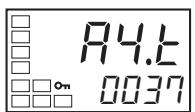
- The 4 mA Calibration Screen will be displayed. Use the and Keys to adjust the DMM monitor value to 4 mA, and then press the Key. The contents of the calibration will be temporarily registered.
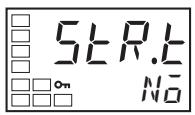
- Press the Key. The No. 2 display changes to E . Release the key and wait two seconds or press the Key. This stores the temporarily registered calibration data to EEPROM.
To cancel the saving of temporarily registered calibration data to EEPROM, press the 回 Key (while N_ is displayed in the No. 2 display) without pressing the 回 Key.
- The calibration mode is quit by turning the power OFF.
6-7 Checking Indication Accuracy
- After calibrating the input, be sure to check the indication accuracy to make sure that the calibration has been executed correctly.
- Operate the E5□N-H in the process value/set point monitor mode.
- Check the indication accuracy at the following three values: upper limit, lower limit, and mid-point.
6-7-1 Thermocouple
- Preparations
The diagram below shows the required device connections. Make sure that the E5CN/AN/EN-H and cold junction compensator are connected by a compensating conductor for the thermocouple that is to be used during actual operation.
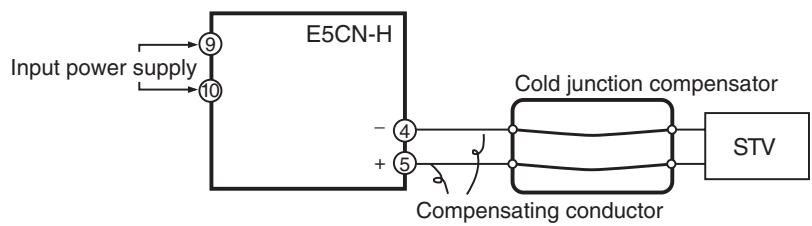
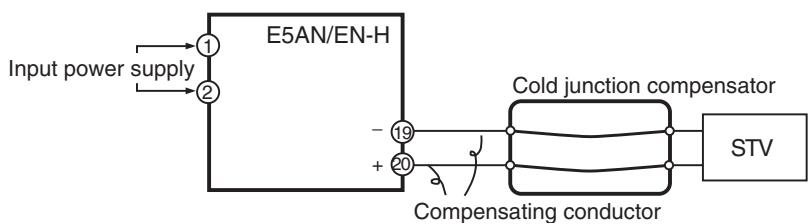
Operation
Make sure that the cold junction compensator is at 0^ , and set the STV output to the voltage equivalent of the starting power of the check value. The cold junction compensator and compensation conductor are not required when an external cold junction compensation method is used.
6-7-2 Platinum Resistance Thermometer
- Preparations
The diagram below shows the required device connections.
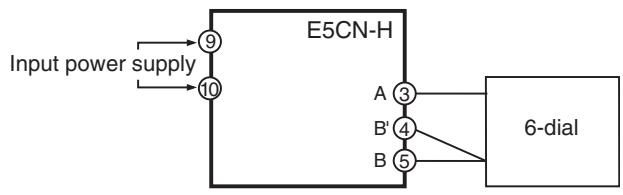
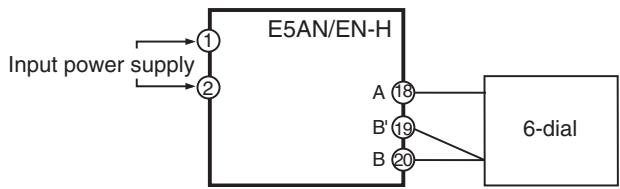
Operation
Set the 6-dial to the resistance equivalent to the check value.
6-7-3 Analog Input
- Preparations
The diagram below shows the required device connections.
(The connection terminals depend on the model and input type.)
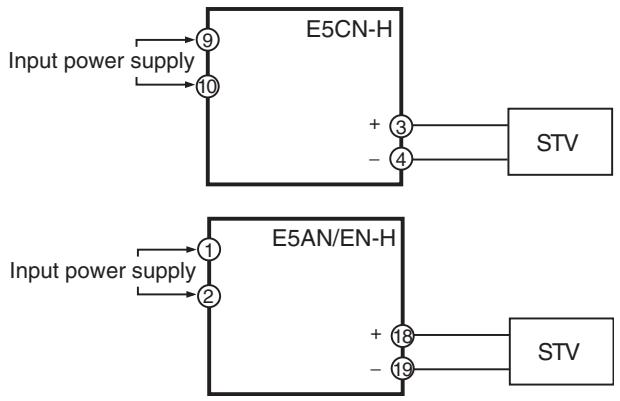
Current Input for a Controller with an Analog Input
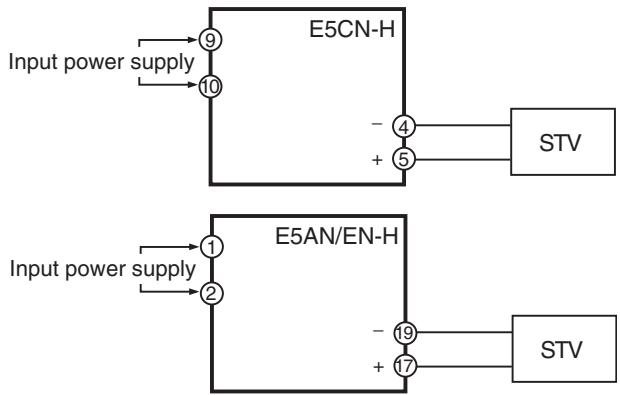
Voltage Input for a Controller with an Analog Input
Operation
Set the STV output to the voltage or current equivalent to the check value.
Appendix
Specifications
Ratings
| Supply voltage | 100 to 240 VAC, 50/60 Hz | 24 VAC, 50/60 Hz/24 VDC | ||
| Operating voltage range | 85% to 110% of rated supply voltage | |||
| Power consumption | E5CN-H | 8.5 VA | 5.5 VA/3.5 W | |
| E5AN-H | 12 VA | 8.5 VA/5.5 W | ||
| E5EN-H | 12 VA | 8.5 VA/5.5 W | ||
| Sensor input (See note 1.) | Temperature inputThermocouple: K, J, T, E, L, U, N, R, S, B, W, PLIIPlatinum resistance thermometer: Pt100, JPt100 | |||
| Controllers with Analog (See note 2.)Current input: 4 to 20 mA, 0 to 20 mA (Input impedance: 150 Ω max.)Voltage input: 1 to 5 V, 0 to 5 V, 0 to 10 V (Input impedance: 1 MΩ max.) | ||||
| Control output (See note 3.) | Relay output | E5CN-H | Relay output:SPST-NO, 250 VAC, 3 A (resistive load), electrical duality: 100,000 operationsMin. applicable load: 5 V, 10 mA | |
| E5AN-H | Relay output: Open and closeSPST-NO, 250 VAC, 1 A (including inrush current), elec-trical durability: 100,000 operationsMin. applicable load: 5 V, 10 mA | |||
| Voltage output | E5CN-H | Output voltage 12 VDC ±15% (PNP), max. load current 21 mA, with short-circuit protection circuit | ||
| Current output | E5CN-H | 4 to 20 mA DC, 0 to 20 mA DC, Load: 600 Ω max., Resolution: approx. 10,000 | ||
| Linear voltage output | E5CN-H | 0 to 10 VDC,Load: 1 kΩ min., Resolution: approx. 10,000 | ||
| SSR output | E5AN-H | 75 to 250 VAC, 1A (resistive load) | ||
| E5EN-H | ||||
| Auxiliary output | E5CN-H | SPST-NO, 250 VAC, 3 A (resistive load), electrical durability: 100,000 operationsMin. applicable load: 5 V, 10 mA | ||
| E5AN-H | SPST-NO, 250 VAC, 3 A (resistive load), electrical durability: 100,000 operationsMin. applicable load: 5 V, 10 mA | |||
| E5EN-H | ||||
| Control method | 2-PID or ON/OFF control | |||
| Setting method | Digital setting using front panel keys | |||
| Indication method | 11-segment/7-segment digital display and single-lighting indicator | |||
| Other functions | Depend on the model | |||
| Ambient temperature | -10 to 55°C (with no condensation or icing); with 3-year guarantee: -10 to 50°C | |||
| Ambient humidity | 25% to 85% | |||
| Storage temperature | -25 to 65°C (with no condensation or icing) | |||
| Altitude | 2,000 m or less | |||
| Recommended fuse | T2A, 250 VAC, time lag, low shut-off capacity | |||
| Installation environment | Installation Category II, Pollution Class 2 (IEC 61010-1 compliant) | |||
Note (1) For the setting ranges for each sensor input, see page 335.
(2) When connecting the ES2-THB, connect it 1:1.
(3) The E5AN-H and E5EN-H Output Units are sold separately. Refer to the following table.
E5AN-H/EN-H Output Unit Ratings
| Model | Output type | Output form | Specifications |
| E53-RN | Relay | ON/OFF | 250 VAC, 5 A (resistive load), electrical durability: 100,000 operations |
| E53-QN | Voltage (PNP) | ON/OFF | PNP type, 12 VDC, 40 mA (with short-circuit protection) |
| E53-Q3 | Voltage (NPN) | ON/OFF | NPN type, 24 VDC, 20 mA (with short-circuit protection) |
| E53-Q4 | Voltage (PNP) | ON/OFF | PNP type, 24 VDC, 40 mA (with short-circuit protection) |
| E53-C3N | 4 to 20 mA | Linear | 4 to 20 mA DC, Load: 600 Ω max., Resolution: approx. 10,000 |
| E53-C3DN | 0 to 20 mA | Linear | 0 to 20 mA DC, Load: 600 Ω max., Resolution: approx. 10,000 |
| E53-V34N | 0 to 5 V | Linear | 0 to 10 VDC, Load: 1 kΩ max., Resolution: approx. 10,000 |
| E53-V35N | 0 to 10 V | Linear | 0 to 5 VDC, Load: 1 kΩ max., Resolution: approx. 10,000 |
HB, HS, and Heater Overcurrent Alarms (for E5CN/AN/EN-H Controllers with Heater Burnout, HS, and Heater Overcurrent Alarms)
| Max. heater current | 50 A AC |
| Input current readout accuracy | ±5% FS ±1 digit max. |
| Heater burnout alarm setting range | 0.1 to 49.9 A (0.1 A units)0.0 A: Heater burnout alarm output turns OFF.50.0 A: Heater burnout alarm output turns ON.Min. detection ON time: 100 ms (See note 1.) |
| HS alarm setting range | 0.1 to 49.9 A (0.1 A units)0.0 A: HS alarm output turns ON.50.0 A: HS alarm output turns OFF.Min. detection OFF time: 100 ms (See note 2.) |
| Heater overcurrent alarm setting range | 0.1 to 49.9 A (0.1 A units)0.0 A: Heater overcurrent alarm output turns ON.50.0 A: Heater overcurrent alarm output turns OFF.Min. detection OFF time: 100 ms |
Note (1) When the control output 1 ON time is less than 100ms , heater burnout detection, heater overcurrent detection, and heater current measurement are not performed.
(2) When the control output 1 OFF time is less than 100ms , HS alarm, and leakage current measurement are not performed.
Characteristics
| Indication accuracy (ambient temperature of 23°C) | Thermocouple (See note 1.): (±0.1% of indication value or ±1°C, whichever is greater) ±1 digit max. Platinum resistance thermometer: (±0.1% of indication value or ±0.5°C, whichever is greater) ±1 digit max. Analog input: ±0.1% FS ±1 digit max. CT input: ±5% FS ±1 digit max. | |
| Temperature variation influence (See note 2.) | Thermocouple (R, S, B, W, PLII) (±1% of PV or ±10°C, whichever is greater) ±1 digit max. Other thermocouples: (±1% of PV or ±4°C, whichever is greater) ±1 digit max. *K thermocouple at -100°C max: ±10°C max. | |
| Voltage variation influence (See note 2.) | Platinum resistance thermometer: (±1% of PV or ±2°C, whichever is greater) ±1 digit max. Analog input: ±1% FS ±1 digit max. | |
| Hysteresis | Temperature Input | 0.1 to 3240.0°C or °F (in units of 0.1°C or °F) |
| Analog Input | 0.01% to 99.99% FS (in units of 0.01% FS) | |
Note
| Proportional band (P) | Temperature Input | 0.1 to 3240.0°C or °F(in units of 0.1°C or °F) | ||
| Analog Input | 0.1% to 999.9% FS (in units of 0.1% FS) | |||
| Integral time (I) | Standard, heating/cooling, position proportional (closed): 0.0 to 3240.0Position proportional (floating): 0.1 to 3240.0 (in units of 0.1 s) | |||
| Derivative time (D) | 0.0 to 3240.0 (in units of 0.1 s) | |||
| Control Period | 0.5, 1 to 99 s (in units of 1 s) | |||
| Manual reset value | 0.0% to 100.0% (in units of 0.1%) | |||
| Alarm setting range | -19,999 to 32,400 (decimal point position depends on input type) | |||
| Sampling period | 60 ms | |||
| Insulation resistance | 20 MΩ min. (at 500 VDC) | |||
| Dielectric strength | 2,300 VAC, 50/60 Hz for 1 min between terminals of different charge | |||
| Malfunction vibration | 10 to 55 Hz, 20 m/s2for 10 min each in X, Y and Z directions | |||
| Vibration resistance | 10 to 55 Hz, 20 m/s2for 2 hr each in X, Y, and Z directions | |||
| Malfunction shock | 100 m/s2, 3 times each in X, Y, and Z directions | |||
| Shock resistance | 300 m/s2, 3 times each in X, Y, and Z directions | |||
| Weight | E5CN-H | Approx. 150 g | Adapter: approx. 10 g | Terminal cover: approx. 10 g |
| E5AN-H | Approx. 310 g | Adapter: approx. 100 g | Terminal cover: approx. 1.6 g per cover | |
| E5EN-H | Approx. 260 g | |||
| Degree of protec-tion | E5CN-H | Front panel: IP66 | ||
| E5AN-H | Rear case: IP20 | |||
| E5EN-H | Terminals: IP00 | |||
| Memory protection | EEPROM (non-volatile memory) (number of writes: 1,000,000) | |||
(1) The indication accuracy of K thermocouples in the -200 to 1,300^ range, T and N thermocouples at a temperature of -100^ or less, and U and L thermocouples at any temperature is ± 2^ ± 1 digit maximum. The indication accuracy of B thermocouples at a temperature of 400^ to 800 ± 3^ or less is not specified. The indication accuracy of R and S thermocouples at a temperature of 200^ or less is ± 3^ ± 1 digit maximum. The indication accuracy of W thermocouples is (the larger of ± 0.3% or ± 3^ ) ± 1 digit maximum and the indication accuracy of PLL thermocouples is (the larger of ± 0.3% or ± 2^ ) ± 1 digit maximum.
(2) Ambient temperature: -10^ C to 23^ C to 55^ C
Voltage range: -15 to +10% of rated voltage
Rating and Characteristics of Options
| Event inputs | Contact Input ON: 1 kΩ max., OFF: 100 kΩ min. |
| Non-contact Input ON: Residual voltage 1.5 V max.; OFF: Leakage current 0.1 mA max. | |
| Communications | Transmission path: RS-485/232C/RS-422 Communications method: RS-485 (2-wire, half duplex), RS-232C or RS-422 (4-wire, half duplex) Synchronization: Start-stop Baud rate: 1.2, 2.4, 4.8, 9.6, 19.2, 38.4, or 57.6 kbps |
| Transfer output | 4 to 20 mA DC, Load: 600 Ω max., Resolution: Approx. 10,000, Accuracy: ±0.3% |
Current Transformer (CT)
Specifications
| Item | Specifications | |
| Model number | E54-CT1 | E54-CT3 |
| Max. continuous current | 50 A | 120 A (See note.) |
| Dielectric strength | 1,000 VAC (for 1 min) | |
| Vibration resistance | 50 Hz, 98 m/s² | |
| Weight | Approx. 11.5 g | Approx. 50 g |
| Accessories | None | Armature (2), Plug (2) |
Note The maximum continuous current of the E5□N-H is 50 A.
External Dimensions
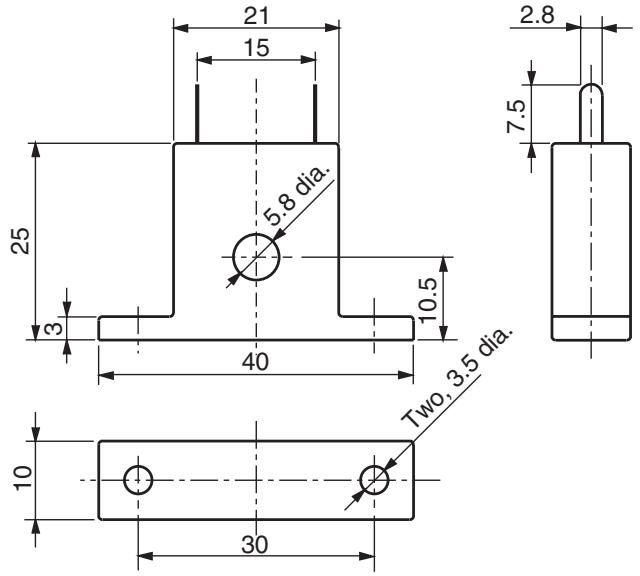
E54-CT1
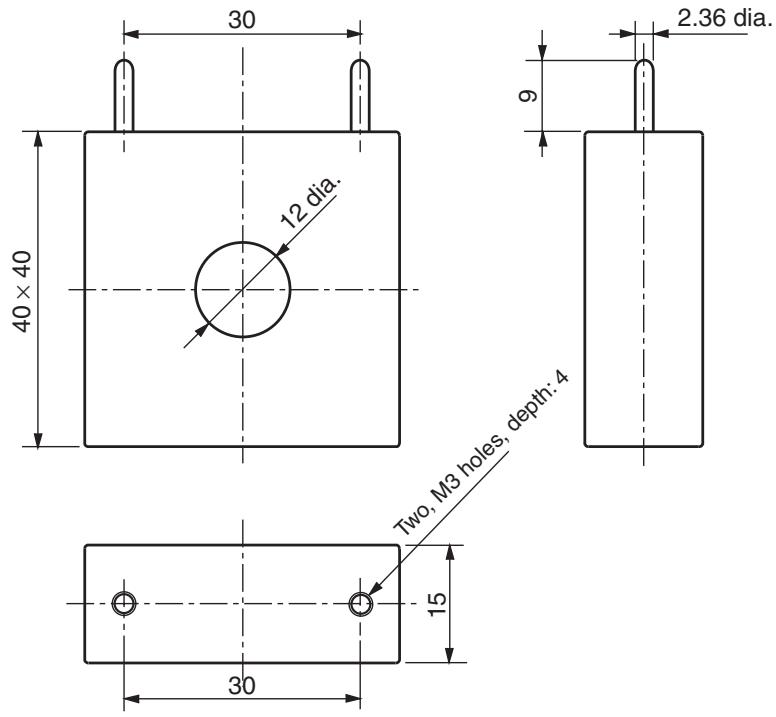
E54-CT3
E58-CIFQ1 USB-Serial Conversion Cable
Specifications
| Item | Specifications |
| Applicable OS | Windows 2000/XP/Vista |
| Applicable software | CX-Thermo version 4.00 or higher |
| Applicable models | OMRON E5AN/EN/CN-H Digital Controllers |
| USB interface rating | Conforms to USB Specification 1.1 |
| DTE speed | 38,400 bps |
| Connector specifications | Computer end: USB (type A plug)Digital Controller end: Serial |
| Power supply | Bus power (5 VDC supplied from USB host controller) |
| Current consumption | 70 mA |
| Ambient operating temperature | 0 to 55°C (with no condensation or icing) |
| Ambient operating humidity | 10% to 80% |
| Storage temperature | -20 to 60°C (with no condensation or icing) |
| Storage humidity | 10% to 80% |
| Altitude | 2,000 m max. |
| Weight | Approx. 100 g |
Compatible Operating Environment
A personal computer that includes the following specifications is required.
- USB port
- CD-ROM drive
- Windows 2000/XP/Vista
Appearance and Nomenclature
Appearance (Unit: mm)

LED Indicator Display
| Indicator | Color | Status | Meaning |
| SD | Yellow | Lit | Sending data from USB-Serial Conversion Cable |
| Not lit | Not sending data from USB-Serial Conversion Cable | ||
| RD | Yellow | Lit | Receiving data from the USB-Serial Conversion Cable |
| Not lit | Not receiving data from the USB-Serial Conversion Cable |
E58-CIFIR USB-Infrared Conversion Cable
Specifications
| Item | Specifications |
| Applicable OS | Windows 2000/XP/Vista |
| Applicable software | CX-Thermo version 4.0 or higher |
| Applicable models | OMRON E5AN/EN-H Digital Controllers |
| USB interface rating | Conforms to USB Specification 1.1 |
| DTE speed | 38,400 bps |
| Connector specifications | Computer end: USB (type A plug) |
| Power supply | Bus power (5 VDC supplied from USB host controller) |
| Current consumption | 80 mA max. |
| Ambient operating temperature | 0 to 55°C (with no condensation or icing) |
| Ambient operating humidity | 10% to 80% |
| Storage temperature | -20 to 60°C (with no condensation or icing) |
| Storage humidity | 10% to 80% |
| Altitude | 2,000 m max. |
| Weight | Approx. 130 g (including mounting adapter) |
| Accessories | Instruction Sheet, Setup Manual, driver CD-ROM, mounting adapter |
Compatible Operating Environment
A personal computer that includes the following specifications is required.
- USB port
- CD-ROM drive
- Windows 2000/XP/Vista
Appearance and Nomenclature
Appearance (Unit: mm)
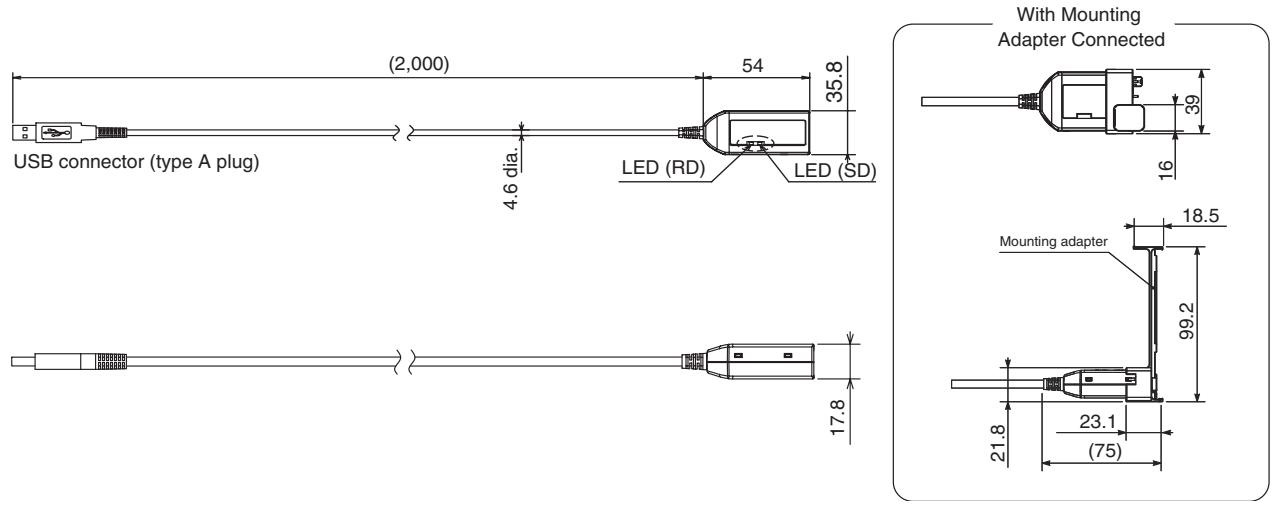
LED Indicators
| Indicator | Color | Status | Meaning |
| SD | Yellow | Lit | Sending data from personal computer to Digital Controller. |
| Not lit | Not sending data from personal computer to Digital Controller. | ||
| RD | Yellow | Lit | Personal computer receiving data from Digital Controller. |
| Not lit | Personal computer not receiving data from Digital Controller. |
Error Displays
When an error occurs, the error contents are shown on the No. 1 or the No. 2 display.
This section describes how to check error codes on the display, and the actions to be taken to remedy the problems.
5.ERR
Input Error
Meaning
The input value has exceeded the control range. (See note.)
Note Control Range
Resistance thermometer, thermocouple input: Temperature setting lower limit -20^ to temperature setting upper limit +20^
(Temperature setting lower limit -40^ to temperature setting upper limit +40^ )
Analog input
-5% to +105% of scaling range
Action
Check the wiring of inputs for miswiring, disconnections, and short-circuits and check the input type.
If no abnormality is found in the wiring and input type, turn the power OFF then back ON again.
If the display remains the same, the Controller must be replaced. If the display is restored, then the probable cause is electrical noise affecting the control system. Check for electrical noise.
Note With resistance thermometer input, a break in the A, B, or B' line is regarded as a disconnection.
Operation at Error
After an error occurs, the error is displayed and the alarm outputs function as if the upper limit has been exceeded.
When the Input Error Output parameter in the advanced function setting level is set to ON, the output assigned to the alarm 1 function turns ON whenever an input error occurs.
An error message is displayed when the PV, PV/SP, or PV/MV is displayed.
Note The control output turns OFF. When the manual MV, MV at stop, or MV at PV error is set, however the control output corresponds to the set value.
CCCCC
Display Range Exceeded
Meaning
Though this is not an error, it is displayed if the process value exceeds the display range when the control range is larger than the display range.
The display ranges are shown below (with decimal points omitted).
- When less than -19,999 C C C C
- When more than 32,400
Action
Control continues, allowing normal operation. The message is displayed when the PV, PV/SP, or PV/MV is displayed.
Resistance thermometer input (Except for models with a setting range of -199.9 to 500.0^
Thermocouple input (Except for models with a setting range of -199.9 to 400.0^ )
| 5.ERR display | Numeric display | 5.ERR display |
| Input indication range |
Resistance thermometer input (Except for models with a setting range of -1999 to 500.0^
Thermocouple input (Except for models with a setting range of -199.9 to 400.0^ )
| 5.ERR display | cccc display | Numeric display | 5.ERR display |
| Input indication range |
Analog Input
- When display range < control range
| Control range | ||||
| S. ERR display | c c c c display | Numeric display | c c c c display | S. ERR display |
| Input indication range | ||||
| -19999← Display range→ 32400(See note.) | ||||
Analog Input
- When display range > control range
| Control range | ||
| 5.ERP display | Numeric display | 5.ERP display |
| -19999 Display range 32400 (See note.) | ||
Note: The display range is shown in numbers with decimal points omitted.
E333
AD Converter Error
Meaning
There is an error in internal circuits.
Action
First, turn the power OFF then back ON again. If the display remains the same, the Controller must be repaired. If the display is restored, then the probable cause is electrical noise affecting the control system. Check for electrical noise.
Operation
Control output and alarm output turn OFF.
E111
Memory Error
Meaning
Internal memory operation is in error.
Action
First, turn the power OFF then back ON again. If the display remains the same, the Controller must be repaired. If the display is restored, then the probable cause is electrical noise affecting the control system. Check for electrical noise.
Operation at Error
Control output and alarm output turn OFF. (Current output is approx. 0mA ).
F F F F
Current Value Exceeds
Meaning
This error is displayed when the heater current value exceeds 55.0 A.
Action
Control continues, allowing normal operation. An error message is displayed when the following items are displayed.
Heater current 1 value monitor
Heater current 2 value monitor
Leakage current 1 monitor
Leakage current 2 monitor
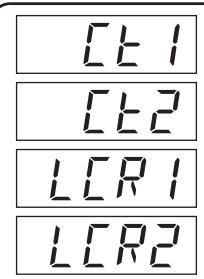
Heater Burnout
HS Alarm
Heater Overcurrent
Meaning
When heater burnout, HS alarm, or heater overcurrent occurs, the No. 1 display in the applicable setting level flashes.
Action
When a heater burnout, HS error, or heater overcurrent is detected, the HA indicator lights and the No. 1 display flashes for the applicable Heater Current 1 Value Monitor, Heater Current 2 Value Monitor, Leakage Current 1 Monitor, or Leakage current 1 Monitor parameters in the operation level and adjustment level. Control continues, allowing normal operation.
Potentiometer Input Error
Meaning
When an input count value error occurs or the converted valve opening is not between -10% and 110% , the valve opening monitor value will be displayed as “- - - - ”
Action
Check the wiring of the potentiometer.
Operation
The control outputs will turn OFF or will output the MV value set for errors. Operation will be normal if floating control is being used. The valve opening monitor value will be displayed as "---".
Troubleshooting
Checking Problems
If the Digital Controller is not operating normally, check the following points before requesting repairs. If the problem persists, contact your OMRON representative for details on returning the product.
| Timing | Status | Meaning | Countermeasures | Page |
| Turning ON the power for the first time | Temperature unit (°C/°F) is flashing. | ST (self-tuning) is in progress (default setting: ON). | This is not a product fault. The temperature unit (°C/°F) flashes while ST (self-tuning) is being performed | 62 |
| Temperature error is large. Input error (S.Err display) | Input type mismatch | Check the sensor type and reset the input type correctly. | 49 | |
| Thermometer is not installed properly. | Check the thermometer installation location and polarity and install correctly. | 28 | ||
| Communications are not possible. | Non-recommended adapter is being used. | Make sure that the connected device is not faulty. | Section 1 of Communications Manual | |
| During operation | Overshooting Undershooting Hunting | ON/OFF control is enabled | Select PID control and execute either ST (self-tuning) or AT (auto-tuning). When using self-tuning, turn ON the power supply to the Digital Controller and load (heater, etc.) at the same time, or turn ON the load power supply first. Accurate self-tuning and optimum control will not be possible if the power supply to the load is turned ON after turning ON the power supply to the Digital Controller. | 60 |
| Control cycle is longer compared with the speed of rise and fall in temperature | Shorten the control cycle. A shorter control cycle improves control performance, but a cycle of 20 ms minimum is recommended in consideration of the service life of the relays. | 52 | ||
| Unsuitable PID constant | Set appropriate PID constants using either of the following methods. • Execute AT (autotuning). • Set PID constants individually using manual settings. | 60 | ||
| HS alarm operation fault | Use breeder resistance if the problem is due to leakage current. Also investigate the errors detected by the HS alarm function. | 71 | ||
| Temperature is not rising | Specified operation is unsuitable for required control (default: Reverse operation) | Select either forward or reverse operation depending on the required control. Reverse operation is used for heating operations. | 52 | |
| Heater is burnt out or deteriorated. | Check whether heater burnout or deterioration have occurred. Also investigate the errors detected by the heater burnout alarm. | 71 | ||
| Insufficient heater capacity | Check whether the heater's heating capacity is sufficient. | --- | ||
| Cooling system in operation. | Check whether a cooling system is operat-ing. | --- | ||
| Peripheral devices have heat preven-tion device operat-ing. | Set the heating prevention temperature setting to a value higher than the set tempera-ture of the Digital Controller. | --- | ||
| During operation (continued) | Output will not turn ON | Set to STOP (default: RUN) | Set the RUN/STOP mode to RUN. If STOP is lit on the display, control is stopped. | 185 |
| Specified operation is unsuitable for required control (default: Reverse operation) | Select either forward or reverse operation depending on the required control. Reverse operation is used for heating operations. | 52 | ||
| A high hysteresis is set for ON/OFF operation (default: 1.0°C) | Set a suitable value for the hysteresis. | 57 | ||
| Digital Controller will not operate | Set to STOP (default: RUN) | Set the RUN/STOP mode to RUN. If STOP is lit on the display, control is stopped. | 185 | |
| Temperature error is large Input error (S.err dis-play) | Thermometer has burnt out or short-circuited. | Check whether the thermometer has burnt out or short-circuited | --- | |
| Thermometer lead wires and power lines are in the same conduit, causing noise from the power lines (generally, display values will be unstable). | Wire the lead wires and power lines in separate conduits, or wiring using a more direct path. | --- | ||
| Connection between the Digital Controller and thermocouple is using copper wires. | Connect the thermocouple's lead wires directly, or connect a compensating conductor suitable for the thermocouple. | --- | ||
| Installation location of thermometer is unsuitable. | Check whether the location of the thermometer is suitable. | --- | ||
| Input shift is not set correctly (default: 0°C) | Set a suitable input shift. If input shift is not required, set the input shift value to 0.0. | 87 | ||
| Keys will not operate | Setting change protect is ON. | Turn OFF setting change protect. | 106 | |
| Cannot shift levels | Operations limited due to protection. | Set the operation/adjustment protect, initial setting/communications protect, and setting change protect values as required. | 106 | |
| After long service life | Control is unstable | Terminal screws may be loose. | Retighten terminal screws to a torque of 0.74 to 0.90 N·m. | 30 |
| The internal components have reached the end of their service life. | The Digital Controller's internal electrolytic capacitor depends on the ambient temperature, and load rate. The structural life depends on the ambient environment (shock, vibration). The life expectancy of the output relays varies greatly with the switching capacity and other switching conditions. Always use the output relays within their rated load and electrical life expectancy. If an output relay is used beyond its life expectancy, its contacts may become welded or burned. Replace the Digital Controller and all other Digital Controllers purchased in the same time period. | --- |
Symptom: Cannot Communicate or a Communications Error Occurs
| Meaning | Countermeasures |
| The communications wiring is not correct. | Correct the wiring. |
| The communications line has become dis-connected. | Connect the communications line securely and tighten the screws. |
| The communications cable is broken. | Replace the cable. |
| The communications cable is too long. | The total cable length is 500 m maximum for RS-485 and 15 m maximum for RS-232C communications. To extend the communications distance for RS-232C communications, use OMROM's Z3R Optical Interface. |
| The wrong communications cable has been used. | Use a shielded, twisted-pair AWG24 to AWG14 (cross-sectional area of 0.205 to 2.081 mm²) cable for the communications cable. |
| More than the specified number of communications devices are connected to the same communications path for RS-485/RS-422 communications. | When 1:N RS-485/RS-422 communications are used, a maximum of 32 nodes (including the host node) can be connected. |
| An end node has not been set at each end of the communications line for RS-485/RS-422 communications. | Set or connect terminating resistance at each end of the line.RS-485 connections: If the E5CN-H, E5AN-H, or E5EN-H is the end node, use 120-Ω (1/2-W) terminating resistance. The combined terminating resistance with the host device must be at least 54 Ω.RS-422 connections: If the E5AN-H or E5EN-H is the end node, use 240-Ω (1/2-W) terminating resistance. The combined terminating resistance with the host device must be at least 100 Ω. |
| The specified power supply voltage is not being supplied to the Controller. | Supply the specified power supply voltage. |
| The specified power supply voltage is not being supplied to an Interface Converter (such as the K3SC). | Supply the specified power supply voltage. |
| The same baud rate and communications method are not being used by all of the Controllers, host devices, and other devices on the same communications line. | Set the same values for the baud rate, protocol, data length, stop bits, and parity on all nodes. |
| The unit number specified in the command frame is different from the unit number set by the Controller. | Use the same unit number. |
| The same unit number as the Controller is being used for another node on the same communications line for RS-485 communications. | Set each unit number for only one node. |
| There is a mistake in programming the host device. | Use a line monitor to check the commands. Check operation using a sample program. |
| The host device is detecting the absence of a response as an error before it receives the response from the Controller. | Shorten the send data wait time in the Controller or increase the response wait time in the host device. |
| The host device is detecting the absence of a response as an error after broadcasting a command (except for SYSWAY). | The Controller does not return responses for broadcast commands. |
| The host device sent another command before receiving a response from the Controller. | The response must always be read after sending a command (except for broadcast commands). |
| The host device sent the next command too soon after receiving a response from the Controller. | After receiving a response, wait at least 2 ms before sending the next command. |
| The communications line became unstable when Controller power was turned ON or interrupted, and the host device read the unstable status as data. | Initialize the reception buffer in the host device before sending the first command and after turning OFF the power to the Controller. |
| The communications data was corrupted from noise from the environment. | Try using a slower baud rate.Separate the communications cable from the source of noise.Use a shielded, twisted-pair cable for the communications cable.Use as short a communications cable as possible, and do not lay or loop extra cable.To prevent inductive noise, do not run the communications cable parallel to a power line.If noise countermeasures are difficult to implement, use an Optical Inter-face. |
Note For details on errors, refer to E5CN-H/E5AN-H/E5EN-H Digital Controllers Communications Manual Advanced Type (Cat. No. H159).
Parameter Operation Lists
Operation Level
| Parameters | Characters | Setting (monitor) value | Display | Default | Unit | Set value |
| Process Value | Temperature: According to indication range for each sensor. Analog: Scaling lower limit -5% FS to Scaling upper limit +5% FS | EU | ||||
| Set Point (See note 1.) | SP lower limit to SP upper limit | 0 | EU | |||
| Auto/Manual Switch | R-M | |||||
| Bank No. | bRNK | 0 to 7 (See note 2.) | 0 | None | ||
| Remote SP Monitor | R5P | Remote SP upper limit to Remote SP lower limit | EU | |||
| Set Point During SP Ramp | SP-M | SP lower limit to SP upper limit | EU | |||
| Heater Current 1 Value Monitor | CE-I | 0.0 to 55.0 | A | |||
| Heater Current 2 Value Monitor | CE-2 | 0.0 to 55.0 | A | |||
| Leakage Current 1 Monitor | LCR1 | 0.0 to 55.0 | A | |||
| Leakage Current 2 Monitor | LCR2 | 0.0 to 55.0 | A | |||
| Program Start | PRSE | RSET, STRT | RSET, SERE | RSET | None | |
| Soak Time Remain | S1:ER | 0 to 9999 | min or h | |||
| RUN/STOP | R-5 | RUN/STOP | RUN, S3-0P | Run | None | |
| Alarm Value 1 (See note 1.) | RL-I | -19999 to 32400 | 0.0 | EU | ||
| Alarm Value Upper Limit 1 (See note 1.) | RL IH | -19999 to 32400 | 0.0 | EU | ||
| Alarm Value Lower Limit 1 (See note 1.) | RL IL | -19999 to 32400 | 0.0 | EU | ||
| Alarm Value 2 (See note 1.) | RL-2 | -19999 to 32400 | 0.0 | EU | ||
| Alarm Value Upper Limit 2 (See note 1.) | RL-2H | -19999 to 32400 | 0.0 | EU | ||
| Alarm Value Lower Limit 2 (See note 1.) | RL-2L | -19999 to 32400 | 0.0 | EU | ||
| Alarm Value 3 (See note 1.) | RL-3 | -19999 to 32400 | 0.0 | EU | ||
| Alarm Value Upper Limit 3 (See note 1.) | RL-3H | -19999 to 32400 | 0.0 | EU | ||
| Alarm Value Lower Limit 3 (See note 1.) | RL-3L | -19999 to 32400 | 0.0 | EU | ||
| MV Monitor (Heating) | a | -5.0 to 105.5 (standard) 0.0 to 105.0 (heating/cooling) | % | |||
| MV Monitor (Cooling) | c-a | 0.0 to 105.0 | % | |||
| Valve Opening Monitor | V-M | -10.0 to 110.0 | % |
Note (1) The parameters in the current bank will be accessed.
(2) Unless the Program Pattern parameter is set to OFF, the bank number will be from 0 to the value set for the Valid Program Bank parameter.
Adjustment Level
| Parameters | Characters | Setting (monitor) value | Display | Default | Unit | Set value |
| Adjustment Level Display | L.Rdu | |||||
| AT Execute/Cancel | Rt | OFF: AT CancelAT-2: 100%AT ExecuteAT-1: 40%AT Execute (See note 3.) | aFF, Rt - 2, Rt - 1 | OFF | None | |
| Communications Writing | CMwI | OFF, ON | aFF, aN | OFF | None | |
| Infrared Communications Use | CRdR | OFF, ON | aFF, aN | OFF | None | |
| SP Mode | SPMd | LSP, RSP | LSP, RSP | LSP | None | |
| Heater Current 1 Value Monitor | Ct I | 0.0 to 55.0 | A | |||
| Heater Burnout Detection 1 | Hb I | 0.0 to 50.0 | 0.0 | A | ||
| Heater Overcurrent Detection 1 | aC I | 0.0 to 50.0 | 50.0 | A | ||
| Heater Current 2 Value Monitor | Ct2 | 0.0 to 55.0 | A | |||
| Heater Burnout Detection 2 | Hb2 | 0.0 to 50.0 | 0.0 | A | ||
| Heater Overcurrent Detection 2 | aC2 | 0.0 to 50.0 | 50.0 | A | ||
| Leakage Current 1 Monitor | LCR I | 0.0 to 55.0 | A | |||
| HS Alarm 1 | HS I | 0.0 to 50.0 | 50.0 | A | ||
| Leakage Current 2 Monitor | LCR2 | 0.0 to 55.0 | A | |||
| HS Alarm 2 | HS2 | 0.0 to 50.0 | 50.0 | A | ||
| Heater Burnout Detection 1 | Hb I | 0.0 to 50.0 | 0.0 | A | ||
| Heater Burnout Detection 2 | Hb2 | 0.0 to 50.0 | 0.0 | A | ||
| SP 0 | SP-0 | SP lower limit to SP upper limit | 0 | EU | ||
| SP 1 | SP-1 | SP lower limit to SP upper limit | 0 | EU | ||
| SP 2 | SP-2 | SP lower limit to SP upper limit | 0 | EU | ||
| SP 3 | SP-3 | SP lower limit to SP upper limit | 0 | EU | ||
| Temperature Input Shift | cNS | -199.99 to 32400 | 0.00 | °C or °F | ||
| Upper Limit Temperature Input Shift Value | cNSH | -199.99 to 32400 | 0.00 | °C or °F | ||
| Lower Limit Temperature Input Shift Value | cNSL | -199.99 to 32400 | 0.00 | °C or °F | ||
| Proportional Band (See note 1.) | P | Universal input: 0.1 to 3240.0 | 8.0 | °C or °F (See note 1.) | ||
| Analog input: 0.1 to 999.9 | 10.0 | %FS | ||||
| Integral Time (See note 1.) | L | Standard, heating/cooling, position proportional (closed): 0.0 to 3240.0 Position proportional (floating): 0.1 to 3240.0 | 233.0 | Second | ||
| Derivative Time (See note 1.) | d | 0.0 to 3240.0 | 40.0 | Second | ||
| 0.0 to 3240.0 | 40.0 | Second | ||||
| Cooling Coefficient (See note 1.) | C-5C | 0.01 to 99.99 | 1.00 | None | ||
| Dead Band | C-db | Temperature input: -1999.9 to 3240.0 | 0.0 | °C or °F | ||
| Analog input: -19.99 to 99.99 | 0.00 | %FS | ||||
| Manual Reset Value | σF-R | 0.0 to 100.0 | 50.0 | % | ||
| Hysteresis (Heating) | HYS | Temperature input: 0.1 to 3240.0 | 1.0 | °C or °F | ||
| Analog input: 0.01 to 99.99 | 0.10 | %FS | ||||
| Hysteresis (Cooling) | CHYS | Temperature input: 0.1 to 3240.0 | 1.0 | °C or °F | ||
| Analog input: 0.01 to 99.99 | 0.10 | %FS | ||||
| Soak Time (See note 2.) | SoRH | 1 to 9,999 | 1 | min or h | ||
| Wait Band (See note 2.) | HE-b | Temperature input: OFF, 0.1 to 3240.0 | δFF, 0.1 to 3240.0 | OFF | °C or °F | |
| Analog input: OFF, 0.01 to 99.99 | δFF, 0.01 to 99.99 | OFF | %FS | |||
| MV at Stop | MV-5 | Standard: -5.0 to 105.0 Heating/cooling: -105.0 to 105.0 | 0.0 | % | ||
| Position proportional (Floating or Direct Setting of Position Proportional MV parameter set to OFF): CLOS, HOLD, OPEN | CLAS, HöLD, aOPEN | HOLD | None | |||
| Position proportional (Close and Direct Setting of Position Proportional MV parameter set to ON): -5.0 to 105.0 | 0.0 | % | ||||
| MV at PV Error | MV-E | Standard: -5.0 to 105.0 Heating/cooling: -105.0 to 105.0 | 0.0 | % | ||
| Position proportional (Floating or Direct Setting of Position Proportional MV parameter set to OFF): CLOS, HOLD, OPEN | CLAS, HöLD, aOPEN | HOLD | None | |||
| Position proportional (Close and Direct Setting of Position Proportionally MV parameter set to ON): -5.0 to 105.0 | 0.0 | % | ||||
| SP Ramp Set Value (See note 2.) | SPRE | OFF or 1 to 9,999 | δFF, I to 9999 | OFF | EU/s, EU/min, EU/h | |
| MV Upper Limit (See note 1.) | aL -H | Standard: MV lower limit (0.1 to 105.0 Heating/cooling: 0.0 to 105.0 | 105.0 | % | ||
| Position proportional (closed): MV upper limit (0.1 to 105.0) | ||||||
| MV Lower Limit (See note 1.) | aL -L | Standard: -5.0 to MV upper limit -0.1 | -5.0 | % | ||
| Heating/cooling: -105.0 to 0.0 | -105.0 | |||||
| Position proportional (closed): -5.0 to MV upper limit -0.1 | -5.0 | |||||
| MV Change Rate Limit | aRL | 0.0 to 100.0 (0.0: MV Change Rate Limit Disabled) | 0.0 | %/s | ||
| Position Proportional Dead Band | db | Position proportional (closed): 0.1 to 10.0 | 4.0 | % | ||
| Position proportional (floating): 0.1 to 10.0 | 2.0 | |||||
| Open/Close Hysteresis | aC -H | 0.1 to 20.0 | 0.8 | % | ||
| Extraction of Square Root Low-cut Point | SURP | 0.0 to 100.0 | 0.0 | % |
Note (1) The parameters in the current PID set will be accessed.
(2) The parameters in the current bank will be accessed.
(3) Not displayed for heating/cooling control or floating control (for models with position-proportional control).
Bank Setting Level
| Parameters | Characters | Setting (monitor) value | Display | Default | Unit | Set value |
| Display Bank Selection | d.bNk | 0 to 7 | (See note 1.) | None | ||
| Bank 0 SP | ΩLSP | SP lower limit to SP upper limit | 0.0 | EU | ||
| Bank 0 PID Set No. | ΩPcd | 0 to 8 (0: Auto selection) | 1 | None | ||
| Bank 0 SP Ramp Set Value | ΩSPR | OFF, 1 to 32400 | aFF, I to 32400 | OFF | EU/s, EU/min, EU/h | |
| Bank 0 Alarm Value 1 | ΩRL I | -19999 to 32400 | 0.0 | EU | ||
| Bank 0 Alarm Value Upper Limit 1 | ΩR IH | -19999 to 32400 | 0.0 | EU | ||
| Bank 0 Alarm Value Lower Limit 1 | ΩR IL | -19999 to 32400 | 0.0 | EU | ||
| Bank 0 Alarm Value 2 | ΩR-c | -19999 to 32400 | 0.0 | EU | ||
| Bank 0 Alarm Value Upper Limit 2 | ΩR2H | -19999 to 32400 | 0.0 | EU | ||
| Bank 0 Alarm Value Lower Limit 2 | ΩR2L | -19999 to 32400 | 0.0 | EU | ||
| Bank 0 Alarm Value 3 | ΩR-3 | -19999 to 32400 | 0.0 | EU | ||
| Bank 0 Alarm Value Upper Limit 3 | ΩR3H | -19999 to 32400 | 0.0 | EU | ||
| Bank 0 Alarm Value Lower Limit 3 | ΩR3L | -19999 to 32400 | 0.0 | EU | ||
| Bank 0 Soak Time | ΩSak | 0 to 9999 | 1 | min or h | ||
| Bank 0 Wait Band | ΩWb | Temperature input: OFF, 0.1 to 3240.0 | aFF, 0.1 to 3240.0 | OFF | °C or °F | |
| Analog input: OFF, 0.01 to 99.99 | aFF, 0.01 to 99.99 | %FS | ||||
| Bank 1 SP | I.LSP | SP lower limit to SP upper limit | 0.0 | EU | ||
| to | ||||||
| Bank 1 Wait Band | I.Wb | Temperature input: OFF, 0.1 to 3240.0 | aFF, 0.1 to 3240.0 | OFF | °C or °F | |
| Analog input: OFF, 0.01 to 99.99 | aFF, 0.01 to 99.99 | %FS | ||||
| Bank 2 SP | ZLSP | SP lower limit to SP upper limit | 0.0 | EU | ||
| to | ||||||
| Bank 2 Wait Band | ZWeb | Temperature input: OFF, 0.1 to 3240.0 | aFF, 0.1 to 3240.0 | OFF | °C or °F | |
| Analog input: OFF, 0.01 to 99.99 | aFF, 0.01 to 99.99 | %FS | ||||
| Bank 3 SP | ZLSP | SP lower limit to SP upper limit | 0.0 | EU | ||
| to | ||||||
| Bank 3 Wait Band | ZWeb | Temperature input: OFF, 0.1 to 3240.0 | aFF, 0.1 to 3240.0 | OFF | °C or °F | |
| Analog input: OFF, 0.01 to 99.99 | aFF, 0.01 to 99.99 | %FS | ||||
| Bank 4 SP | \( ^{4.5} \text{SP} \) | SP lower limit to SP upper limit | 0.0 | EU | ||
| to | ||||||
| Bank 4 Wait Band | \( ^{4.5} \text{Web} \) | Temperature input: OFF, 0.1 to 3240.0 | \( ^{\overline{aFF},\overline{0}.1} \) to 3240.0 | OFF | °C or °F | |
| Analog input: OFF, 0.01 to 99.99 | \( ^{\overline{aFF},\overline{0}.1} \) to 99.99 | %FS | ||||
| Bank 5 SP | \( ^{5.5} \text{SP} \) | SP lower limit to SP upper limit | 0.0 | EU | ||
| to | ||||||
| Bank 5 Wait Band | \( ^{5.5} \text{Web} \) | Temperature input: OFF, 0.1 to 3240.0 | \( ^{\overline{aFF},\overline{0}.1} \) to 3240.0 | OFF | °C or °F | |
| Analog input: OFF, 0.01 to 99.99 | \( ^{\overline{aFF},\overrightarrow{0}.1} \) to 99.99 | %FS | ||||
| Bank 6 SP | \( ^{6.5} \text{SP} \) | SP lower limit to SP upper limit | 0.0 | EU | ||
| to | ||||||
| Bank 6 Wait Band | \( ^{6.5} \text{Web} \) | Temperature input: OFF, 0.1 to 3240.0 | \( ^{\overline{aFF},\overline{0}.1} \) to 3240.0 | OFF | °C or °F | |
| Analog input: OFF, 0.01 to 99.99 | \( ^{\overline{aFF},\overleftarrow{0}.1} \) to 99.99 | %FS | ||||
| Bank 7 SP | \( ^{7.5} \text{SP} \) | SP lower limit to SP upper limit | 0.0 | EU | ||
| to | ||||||
| Bank 7 Wait Band | \( ^{7.5} \text{Web} \) | Temperature input: OFF, 0.1 to 3240.0 | \( ^{\overline{aFF},\overline{0}.1} \) to 3240.0 | OFF | °C or °F | |
| Analog input: OFF, 0.01 to 99.99 | \( ^{\overline{aFF},\overleftrightarrow{0}.1} \) to 99.99 | %FS |
Note The current bank is displayed. If the bank is changed with the Up or Down Key, monitor functions will be lost.
PID Setting Level
| Parameters | Characters | Setting (monitor) value | Display | Default | Unit | Set value |
| Display PID Selection | d.Pd | 1 to 8 | (See note 1.) | |||
| PID 1 Proportional Band | UP | Temperature input: 0.1 to 3240.0 | 8.0 | °C or °F | ||
| Analog input: 0.1 to 999.9 | 10.0 | %FS | ||||
| PID 1 Integral Time | IL | Standard/heating/cooling, position proportional (closed): 0.0 to 3240.0 | 233.0 | s | ||
| Position proportional (floating): 0.1 to 3240.0 | ||||||
| PID 1 Derivative Time | Id | 0.0 to 3240.0 | 40.0 | s | ||
| PID 1 MV Upper Limit | I.LH | Standard: MV lower limit (0.1 to 105.0) Heating/cooling: 0.0 to 105.0 | 105.0 | % | ||
| Position proportional (closed): MV lower limit (0.1 to 105.0) | ||||||
| PID 1 MV Lower Limit | I.LL | Standard: -5.0 to MV upper limit -0.1 | -5.0 | % | ||
| Heating/cooling: -105.0 to 0.0 | -105.0 | |||||
| Position proportional (closed): -5.0 to MV upper limit -0.1 | -5.0 | |||||
| PID 1 Automatic Selection Range Upper Limit | I.RUc | Temperature input: -19999 to 32400 | 1320.0 | EU | ||
| Analog input: -5.0 to 105.0 | 105.0 | %(See note 2.) | ||||
| PID 1 Cooling Coefficient | ICSC | 0.01 to 99.99 | 1.0 | None | ||
| PID 1 LBA Detection Time | ILbR | 0 to 9999 (0: LBA function disabled) | 0 | s | ||
| PID 2 Proportional Band | 2P | Temperature input: 0.1 to 3240.0 | 8.0 | °C or °F | ||
| Analog input: 0.1 to 999.9 | 10.0 | %FS | ||||
| to | ||||||
| PID 2 LBA Detection Time | 2LbR | 0 to 9999 (0: LBA function disabled) | 0 | s | ||
| PID 3 Proportional Band | 3P | Temperature input: 0.1 to 3240.0 | 8.0 | °C or °F | ||
| Analog input: 0.1 to 999.9 | 10.0 | %FS | ||||
| to | ||||||
| PID 3 LBA Detection Time | 3LbR | 0 to 9999 (0: LBA function disabled) | 0 | s | ||
| PID 4 Proportional Band | 4P | Temperature input: 0.1 to 3240.0 | 8.0 | °C or °F | ||
| Analog input: 0.1 to 999.9 | 10.0 | %FS | ||||
| to | ||||||
| PID 4 LBA Detection Time | 4LbR | 0 to 9999 (0: LBA function disabled) | 0 | s | ||
| PID 5 Proportional Band | 5P | Temperature input: 0.1 to 3240.0 | 8.0 | °C or °F | ||
| Analog input: 0.1 to 999.9 | 10.0 | %FS | ||||
| to | ||||||
| PID 5 LBA Detec-tion Time | \(5.L\ b R\) | 0 to 9999 (0: LBA function disabled) | 0 | s | ||
| PID 6 Proportional Band | \(6.P\) | Temperature input: 0.1 to 3240.0 | 8.0 | °C or °F | ||
| Analog input: 0.1 to 999.9 | 10.0 | %FS | ||||
| to | ||||||
| PID 6 LBA Detec-tion Time | \(6.L\ b R\) | 0 to 9999 (0: LBA function disabled) | 0 | s | ||
| PID 7 Proportional Band | \(7.P\) | Temperature input: 0.1 to 3240.0 | 8.0 | °C or °F | ||
| Analog input: 0.1 to 999.9 | 10.0 | %FS | ||||
| to | ||||||
| PID 7 LBA Detec-tion Time | \(7.L\ b R\) | 0 to 9999 (0: LBA function disabled) | 0 | s | ||
| PID 8 Proportional Band | \(8.P\) | Temperature input: 0.1 to 3240.0 | 8.0 | °C or °F | ||
| Analog input: 0.1 to 999.9 | 10.0 | %FS | ||||
| to | ||||||
| PID 8 LBA Detec-tion Time | \(8.L\ b R\) | 0 to 9999 (0: LBA function disabled) | 0 | s |
Note (1) The current PID is displayed. If the PID set is changed with the Up or Down Key, monitor functions will be lost.
(2) The unit will be %FS if the PID Set Automatic Selection Data parameter is set to DV.
Initial Setting Level
| Parameters | Characters | Setting (monitor) value | Display | Default | Unit | Set value | |
| Input Type | LN-E | Temper- ature input | 0: Pt1001: Pt1002: Pt1003: JPt1004: JPt100 | 5 | None | ||
| 5: K6: K7: J8: J9: T10: T11: E12: L13: U14: U15: N16: R17: S18: B19: W20: PLII21: K22: J23: T24: Pt100 | |||||||
| Analog input | 25: 4 to 20 mA26: 0 to 20 mA27: 1 to 5 V28: 0 to 5 V29: 0 to 10 V | 0 | None | ||||
| Parameters | Characters | Setting (monitor) value | Display | Default | Unit | Set value |
| Scaling Upper Limit | \( \overline{CN-H} \) | Scaling lower limit + 1 to 32400 | 100 | None | ||
| Scaling Lower Limit | \( \overline{CN-L} \) | -19,999 to scaling upper limit -1 | 0 | None | ||
| Decimal Point | \( dP \) | 0 to 3 | 0 | None | ||
| Temperature Unit | \( d-U \) | °C, °F | \( \overline{C},\overline{F} \) | °C | None | |
| SP Upper Limit | \( SL-H \) | Temperature input: SP lower limit + 1 to input range upper limit | 1300.0 | EU | ||
| Analog input: SP lower limit + 1 to Scaling upper limit | ||||||
| SP Lower Limit | \( SL-L \) | Temperature input: Input range lower limit to SP upper limit -1 | -200.0 | EU | ||
| Analog: Scaling lower limit to SP upper limit -1 | ||||||
| PID ON/OFF | \( \overline{CNEL} \) | ON/OFF 2-PID | \( \overline{aN}\overline{o}\overline{F},\overline{P}\overline{L}\overline{d} \) | PID | None | |
| Standard or Heating/ Cooling | \( S-H-C \) | Standard or heating/cooling | \( \overline{S}\overline{E}\overline{N},\overline{H}-\overline{C} \) | Standard | None | |
| ST | \( \overline{SE} \) | OFF, ON | \( \overline{aF},\overline{aN} \) | ON | None | |
| Program Pattern | \( P_{ERN} \) | OFF, STOP, CONT, LOOP | \( \overline{aF},\overline{S}\overline{e}\overline{a}P,\overline{C}\overline{o}\overline{N}\overline{e} \) | OFF | None | |
| Valid Program Bank | \( P_{BNK} \) | 0 to 7 | 7 | None | ||
| Control Period (Heating) | \( \overline{CP} \) | 0.5 or 1 to 99 | \( \overline{0.5},\overline{I} \) to 99 | 20 | Second | |
| Control Period (Cool-ing) | \( \overline{C}-\overline{CP} \) | 0.5 or 1 to 99 | \( \overline{0.5},\overline{I} \) to 99 | 20 | Second | |
| Direct/Reverse Operation | \( \overline{aREV} \) | Reverse operation, direct operation | \( \overline{aR-R},\overline{aR-d} \) | Reverse operation | None | |
| Alarm 1Type | RL E I | 0: Alarm function OFF1: Upper and lower-limit alarm2: Upper-limit alarm3: Lower-limit alarm4: Upper and lower-limit range alarm5: Upper and lower-limit alarm with standby sequence6: Upper-limit alarm with standby sequence7: Lower-limit alarm with standby sequence8: Absolute-value upper-limit alarm9: Absolute-value lower-limit alarm10: Absolute-value upper-limit alarm with standby sequence11: Absolute-value lower-limit alarm with standby sequence12: LBA (Loop Burnout Alarm)13: PV change rate alarm14: Remote SP absolute value upper limit alarm (See note 1.)15: Remote SP absolute value lower limit alarm (See note 1.) | 2 | None | ||
| Alarm 1 Hysteresis | RL H I | Temperature input: 0.1 to 3240.0 | 0.2 | °C or °F | ||
| Analog input: 0.01 to 99.99 | 0.02 | %FS | ||||
| Alarm 2 Type | RL E2 | Same settings as the alarm 1 type.Note The 12: LBA (Loop Burnout Alarm) setting cannot be used. | 2 | None | ||
| Alarm 2 Hysteresis | RL H2 | Temperature input: 0.1 to 3240.0 | 0.2 | °C or °F | ||
| Analog input: 0.01 to 99.99 | 0.02 | %FS | ||||
| Alarm 3 Type | RL E3 | Same settings as the alarm 2 type | 2 | None | ||
| Alarm 3 Hysteresis | RL H3 | Temperature input: 0.1 to 3240.0 | 0.2 | °C or °F | ||
| Analog input: 0.01 to 99.99 | 0.02 | %FS | ||||
| Transfer Output Type | ER-R-E | OFF: OFFSP: Set point (See note 2.)SP-M: Ramp set pointPV: Process valueMV: Manipulated variable (heating) (See note 3.)C-MV: Manipulated variable (cooling) (See note 4.)V-M: Valve Opening (See note 5.) | OFFFFSPMP-MP'MM'[-MV]v-M | OFF | None | |
| Transfer Output Upper Limit | ER-R-H | See note 6. | See note 6. | See note 6. |
| Parameters | Characters | Setting (monitor) value | Display | Default | Unit | Set value | |
| Transfer Output Lower Limit | \(E^{R}-L\) | See note 6. | See note 6. | See note 6. | |||
| Linear Current Out-put | \(\bar{a}\bar{1}-\bar{t}\) | 4-20: 4 to 20 mA0-20: 0 to 20 mA | \(4-20,0-20\) | 4-20 | None | ||
| Bank Numbers Used | \(E^{V}-b\) | 0 to 20 to 3 (Only when four event inputs are supported) | 1 | None | |||
| Event Input Assign-ment 1 | \(E^{V}-1\) | None: NoneSTOP: RUN/STOPMANU: Auto/ManualPRST: Program Start (Seep note 3.)DRS: Invert Direct/Reverse OperationAT-2: 100% AT Execute/CancelAT-1: 40% AT Execute/CancelWTPT: Setting Change Enable/DisableCMWT: CommunicationsWrite Enable/DisableLAT: Alarm Latch Cancel | \(\begin{array}{c} \text{None}\\ \text{STGP}\\ \text{MRNU}\\ \text{PRST}\\ \text{dRS}\\ \text{RT}-2\\ \text{RT}-1\\ \text{WEPL}\\ \text{CMHT}\\ \text{LRT}\end{array}\) | NONE | NONE | None | |
| Event Input Assign-ment 2 | \(E^{V}-2\) | None: NoneSTOP: RUN/STOPMANU: Auto/ManualPRST: Program Start (Seep note 3.)DRS: Invert Direct/Reverse OperationAT-2: 100% AT Execute/CancelAT-1: 40% AT Execute/CancelWTPT: Setting Change Enable/DisableCMWT: CommunicationsWrite Enable/DisableLAT: Alarm Latch Cancel | \(\begin{array}{c} \text{None}\\ \mathrm{STGP}\\ \mathrm{MRNU}\\ \mathrm{PRST}\\ \mathrm{dRS}\\ \mathrm{RT}-2\\ \mathrm{RT}-1\\ \mathrm{WEPL}\\ \mathrm{CMHT}\\ \mathrm{LRT}\end{array}\) | STOP | NONE | ||
| Event Input Assign-ment 3 | \(E^{V}-3\) | Same as for Event Input Assignment 1. | \(\begin{array}{c} \text{NONE}\\ \end{array}\) | NONE | NONE | ||
| Event Input Assign-ment 4 | \(E^{V}-4\) | Same as for Event Input Assignment 1. | \(\begin{array}{c} \text{NONE}\\ \end{array}\) | NONE | NONE | ||
| Closed/Floating | CLFL | FLOT: FloatingCLOS: Closed | \(FL\bar{a}t,\)\(CL\bar{a}s\) | FLOT | None | ||
| Motor Calibration | \(CRLb\) | OFF, ON | \(\bar{a}FF,\bar{a}N\) | OFF | None | ||
| Travel Time | \(M\bar{a}t\) | 1 to 999 | 30 | s | |||
| Extraction of Square Root Enable | \(SGR\) | OFF, ON | \(\bar{a}FF,\bar{a}N\) | OFF | None | ||
| Move to Advanced function Setting Level | \(RM\bar{a}v\) | -1999 to 9,999 | 0 | None |
Note (1) Displayed when there is a remote SP input.
(2) If the PV is selected, the remote SP will be output as long as the SP Mode is set to the Remote SP Mode.
(3) This setting is ignored for position-proportional control models.
(4) This setting is ignored for models with standard or position-proportional control.
(5) Displayed only when there is a potentiometer input for a model with position-proportional control.
(6) Refer to the following table.
| Transfer output type | Setting (monitor) range | Default (transfer output upper/ lower limits) (See note 6.1.) | Unit |
| Set Point | SP lower limit to SP upper limit | SP upper limit/ lower limit | EU |
| Set Point During SP Ramp | SP lower limit to SP upper limit | SP upper limit/ lower limit | EU |
| PV | Temperature input: Input setting range lower limit to input setting range upper limit | Input setting range upper/ lower limit | EU |
| Analog input: Scaling lower limit to scaling upper limit | Scaling upper/ lower limit | EU | |
| MV Monitor (Heating) | Standard: -5.0 to 105.0 Heating/cooling: 0.0 to 105.0 | 100.0/0.0 | % |
| MV Monitor (Cooling) | 0.0 to 105.0 | 100.0/0.0 | % |
| Valve Opening | -10.0 to 110.0 | 100.0/0.0 | % |
(6.1) Initialized when the transfer output type is changed.
initialized if the input type, temperature unit, scaling upper/ lower limit, or SP upper/ lower limit is changed when the transfer output type is SP, ramp SP, or PV.
(7) The setting of PRST (program start) will be ignored if the Program Pattern parameter is set to OFF.
(8) Can be selected only for models with the remote SP function.
(9) This setting will be ignored for heating/cooling control or for floating control (for models with position-proportional control).
(10) Displayed only for models with communications.
(11) The parameter will be "NONE" for models with event inputs 3 and 4.
Manual Control Level
| Parameters | Characters | Setting (monitor) value | Display | Default | Unit | Set value |
| Manual MV | -5.0 to 105.0 (standard) (See note 1.)-105.0 to 105.0 (heating/cooling) (See note 1.)-0.5 to 105.0 (position proportional) (See notes 1 and 2.) | 0.0 | % |
Note (1) When the Manual MV Limit Enable parameter is set to ON, the setting range will be the MV lower limit to the MV upper limit.
(2) The valve opening will be monitored for floating control or close control when the Direct Setting of Position Proportional MV parameter is set to OFF.
Monitor/Setting Item Level
The contents displayed vary depending on the Monitor/Setting 1 to 5 (advanced function setting level) setting.
Advanced Function Setting Level
| Parameters | Characters | Setting (monitor) value | Display | Default | Unit | Set value |
| Parameter Initialization | CNLE | OFF, FACT | OFF, FRCLE | OFF | None | |
| SP Ramp Time Unit (See note 1.) | SPRU | S: EU/secondM: EU/minuteH: EU/hour | SMMH | M | None | |
| Standby Sequence Reset | RESET | Condition A, condition B | R, b | Condition A | None | |
| HB ON/OFF | HbU | OFF, ON | OFF, ON | ON | None | |
| Auxiliary Output 1Open in Alarm | 5b IN | N-O: Close in alarmN-C: Open in alarm | N-ā, N-ć | N-O | None | |
| Auxiliary Output 2Open in Alarm | 5b2N | N-O: Close in alarmN-C: Open in alarm | N-ā, N-ć | N-O | None | |
| Auxiliary Output 3Open in Alarm | 5b3N | N-O: Close in alarmN-C: Open in alarm | N-ā, N-ć | N-O | None | |
| Heater BurnoutLatch | HbL | OFF, ON | āFF, āN | OFF | None | |
| Heater Burnout Hysteresis | HbH | 0.1 to 50.0 | 0.1 | A | ||
| ST Stable Range | 5t-b | 0.1 to 3240.0 | 15.0 | °C or °F | ||
| α | RL FR | 0.00 to 1.00 | 0.65 | None | ||
| AT Calculated Gain | RE-G | 0.1 to 10.0 | 0.8 | None | ||
| AT Hysteresis | RE-H | Universal input: 0.1 to 3240.0 | 0.8 | °C or °F | ||
| Analog input: 0.01 to 9.99 | 0.20 | %FS | ||||
| Limit Cycle MV Amplitude | LC MR | 5.0 to 50.0 | 20.0 | % | ||
| Input Digital Filter | CNF | 0.0 to 999.9 | 0.0 | Second | ||
| Additional PV Dis-play | PV Rd | OFF, ON | āFF, āN | OFF | None | |
| MV Display | a-dP | OFF, ON | āFF, āN | OFF | None | |
| Automatic Display Return Time | REt | OFF or 1 to 99 | āFF, I to 99 | OFF | Second | |
| Alarm 1 Latch | RILt | OFF, ON | āFF, āN | OFF | None | |
| Alarm 2 Latch | R2Lt | OFF, ON | āFF, āN | OFF | None | |
| Alarm 3 Latch | R3Lt | OFF, ON | āFF, āN | OFF | None | |
| Move to Protect Level Time | PRLt | 1 to 30 | 3 | Second | ||
| Input Error Output | SERa | OFF, ON | āFF, āN | OFF | None | |
| Cold junction Com-pensation Method | LCJ | OFF, ON | āFF, āN | ON | None | |
| MB Command Logic Switching | RLRV | OFF, ON | āFF, āN | OFF | None | |
| PV Change Color | CGLR | Orange, Red, GreenRed to Green: When ALM1 is ON,Green to Red: When ALM1 is ON,Red to Green to RedWithin PV stable band:GreenOutside stable band:RedGreen to Orange to RedWithin PV stable band:GreenOutside stable band:Green,RedOrange to Green to RedWithin PV stable band:GreenOutside stable band:Green,Red | aRt, RED,GRNRT-Ga-Ra-Ra-Ra-Ra-Ra-Ra-Ra-Ra-Ra-Ra-Ra-Ra-Ra-Ra-Ra-Ra-Ra-Ra-Ra-Ra-Ra-Ra-Ra-Ra-Ra-Ra-Ra-Ra-Ra-Ra-Ra-Ra-Ra-Ra-Ra-Ra-Ra-Ra-Ra-Ra-Ra-Ra-Ra-Ra-Ra-Ra-Ra-Ra-Ra-Ra-GRnGRnGR-GRa-Ra-Ra-Ra-Ra-Ra-Ra-Ra-Ra-Ra-Ra-Ra-Ra-Ra-Ra-Ra-Ra-Ra-Ra-Ra-Ra-Ra-Ra-Ra-Ra-Ra-Ra-Ra-Ra-Ra-Ra-Ra-Ra-Ra-Ra-Ra-Ra-Ra-Ra-Ra-Ra-Ra-Ra-Ra-Ra-Ra-Ra-Ra-Ra-Ra | RED | None | |
| PV Stable Band | PV-b | Temperature input: 0.1 to 3240.0 | 5.0 | °C or °F(See note 1.) | ||
| Analog input: 0.01 to 99.99 | 5.00 | %FS | ||||
| Alarm 1 ON Delay | R IaN | 0 to 999 (0: ON delay dis-abled) | 0 | Second | ||
| Alarm 2 ON Delay | R2aN | 0 to 999 (0: ON delay dis-abled) | 0 | Second | ||
| Alarm 3 ON Delay | R3aN | 0 to 999 (0: ON delay dis-abled) | 0 | Second | ||
| Alarm 1 OFF Delay | R IaF | 0 to 999 (0: OFF delay dis-abled) | 0 | Second | ||
| Alarm 2 OFF Delay | R2aF | 0 to 999 (0: OFF delay dis-abled) | 0 | Second | ||
| Alarm 3 OFF Delay | R3aF | 0 to 999 (0: OFF delay dis-abled) | 0 | Second | ||
| Input Shift Type | L5EP | INS1: Temperature input 1-point shiftINS2: Temperature input 2-point shift | CNS1, CNS2 | INS1 | None | |
| MV at Stop and Error Addition | MV5E | OFF, ON | aFF, aN | OFF | None | |
| Auto/Manual Select Addition | MRd | OFF, ON | aFF, aN | OFF | None | |
| RT | Rt | OFF, ON | aFF, aN | OFF | None | |
| HS Alarm Use | HSU | OFF, ON | aFF, aN | ON | None | |
| HS Alarm Latch | HSL | OFF, ON | aFF, aN | OFF | None | |
| HS Alarm Hysteresis | HSH | 0.1 to 50.0 | 0.1 | A | ||
| LBA Detection Time (See note 2.) | LbR | 0 to 9999 (0: LBA function dis-abled) | 0 | Second | ||
| LBA Level | LbRL | Temperature input: 0.1 to 3240.0 | 8.0 | °C or °F | ||
| Analog input: 0.01 to 99.99 | 10.00 | %FS | ||||
| LBA Band | LbRb | Temperature input: 0.0 to 3240.0 | 3.0 | °C or °F | ||
| Analog input: 0.00 to 99.99 | 0.20 | %FS | ||||
| Control Output 1 Assignment | ∆Ue-1 | When control output 1 is a ON/OFF output (See note 3.): NONE: No assignmentO: Control output (heat-ing)C-O: Control output (cool-ing)ALM1: Alarm 1ALM2: Alarm 2ALM3: Alarm 3P-END: Program end output (See note 5.)RALM: Control output ON/OFF count alarmWR1: Work bit 1 (See note 6.)WR2: Work bit 2 (See note 6.)WR3: Work bit 3 (See note 6.)WR4: Work bit 4 (See note 6.)WR5: Work bit 5 (See note 6.)WR6: Work bit 6 (See note 6.)WR7: Work bit 7 (See note 6.)WR8: Work bit 8 (See note 6.)When control output 1 is a linear output (See note 3.): NONE: No assignmentO: Control output (heating)C-O: Control output (cooling) | NoneN-NEaC- -aRLM1RLM2RLM3RLM4RLM5RWB- -aN-NEaC- -a | 0 | None | |
| Control Output 2 Assignment | ∆Ue-2 | When control output 2 is a ON/OFF output (See note 4.): NONE: No assignmentO: Control output (heat-ing)C-O: Control output (cool-ing)ALM1: Alarm 1ALM2: Alarm 2ALM3: Alarm 3P-END: Program end output (See note 5.)RALM: Control output ON/OFF count alarmWR1: Work bit 1 (See note 6.)WR2: Work bit 2 (See note 6.)WR3: Work bit 3(See note 6.)WR4: Work bit 4 (See note 6.)WR5: Work bit 5 (See note 6.)WR6: Work bit 6 (See note 6.)WR7: Work bit 7 (See note 6.)WR8: Work bit 8 (See note 6.)When control output 2 is a linear output (See note 4.)NONE: No assignmentO: Control output (heat-ing)C-O: Control output (cool-ing) | NoneN-NEaC- -aRLM1RLM2RLM3RLM4RLM5RWB- -aN-NEaC- -a | NONE | None |
| Parameters | Characters | Setting (monitor) value | Display | Default | Unit | Set value | |
| Auxiliary Output 1 Assignment | 5Ub I | NONE: No assignment | NoNE | ALM1 | None | ||
| O: Control output (heat-ing) | |||||||
| C-O: Control output (cool-ing) | |||||||
| ALM1: Alarm 1 | RLM1 | RLM2 | RLM3 | P.END | |||
| ALM2: Alarm 2 | RLM2 | RLM3 | P.END | ||||
| ALM3: Alarm 3 | RLM3 | P.END | |||||
| P.END: Program end output (See note 5.) | RRLM | RRLM | |||||
| RALM: Control output ON/OFF count alarm | RP1 | RP2 | |||||
| WR1: Work bit 1 (See note 6.) | RP1 | RP2 | |||||
| WR2: Work bit 2 (See note 6.) | RP2 | RP3 | |||||
| WR3: Work bit 3 (See note 6.) | RP3 | RP4 | |||||
| WR4: Work bit 4 (See note 6.) | RP4 | RP5 | |||||
| WR5: Work bit 5 (See note 6.) | RP5 | RP6 | |||||
| WR6: Work bit 6 (See note 6.) | RP6 | RP7 | |||||
| WR7: Work bit 7 (See note 6.) | RP7 | RP8 | |||||
| WR8: Work bit 8 (See note 6.) | RP8 | RP9 | |||||
| Auxiliary Output 2 Assignment | 5Ub2 | NONE: No assignment | NoNE | ALM2 | None | ||
| O: Control output (heating) | c-a | ||||||
| C-O: Control output (cooling) | c-a | ||||||
| ALM1: Alarm 1 | RLM1 | RLM2 | RLM3 | P.END | |||
| ALM2: Alarm 2 | RLM2 | RLM3 | P.END | ||||
| ALM3: Alarm 3 | RLM3 | P.END | |||||
| P.END: Program end output (See note 5.) | RRLM | RRLM | |||||
| RALM: Control output ON/OFF count alarm | RP1 | RP2 | |||||
| WR1: Work bit 1 (See note 6.) | RP1 | RP2 | |||||
| WR2: Work bit 2 (See note 6.) | RP2 | RP3 | |||||
| WR3: Work bit 3 (See note 6.) | RP3 | HP4 | |||||
| WR4: Work bit 4 (See note 6.) | RP4 | RP5 | |||||
| WR5: Work bit 5 (See note 6.) | RP5 | RP6 | |||||
| WR6: Work bit 6 (See note 6.) | RP6 | RP7 | |||||
| WR7: Work bit 7 (See note 6.) | |||||||
| WR8: Work bit 8 (See note 6.) | |||||||
| Auxiliary Output 3 Assignment | 5Ub3 | NONE: No assignment | NoNE | ALM3 | None | ||
| O: Control output (heating) | c-a | ||||||
| C-O: Control output (cooling) | c-a | ||||||
| ALM1: Alarm 1 | RLM1 | RLM2 | RLM3 | P.END | |||
| ALM2: Alarm 2 | RLM2 | RLM3 | |||||
| ALM3: Alarm 3 | RLM3 | P.END | |||||
| P.END: Program end output (See note 5.) | RRLM | RRLM | |||||
| RALM: Control output ON/OFF count alarm | RP1 | RP2 | |||||
| WR1: Work bit 1 (See note 6.) | RP1 | RP2 |
| Parameters | Characters | Setting (monitor) value | Display | Default | Unit | Set value |
| Remote SP Enable | R5PU | OFF, ON | δFF, δN | OFF | None | |
| Remote SP Upper Limit | R5PH | SP lower limit to SP upper limit | 1300.0 | EU | ||
| Remote SP Lower Limit | R5PL | SP lower limit to SP upper limit | -200.0 | EU | ||
| SP Tracking | SPER | OFF, ON | δFF, δN | OFF | None | |
| Remote SP Input Error Output | R5Ea | OFF, ON | δFF, δN | OFF | None | |
| PID Set Automatic Selection Data | Pc dL | PV: Process ValueDV: DeviationSP: Set point | PVdV5P | PV | None | |
| PID Set Automatic Selection Hysteresis | PcdH | 0.10 to 99.99 | 0.50 | %FS | ||
| PV Dead Band | P-db | 0 to 32400 | 0.0 | EU | ||
| Manual MV Limit Enable | MRNL | OFF, ON | δFF, δN | OFF | None | |
| Direct Setting of Position Proportional MV | PMv d | OFF, ON | δFF, δN | OFF | None | |
| PV Rate of Change Calculation Period | PVRP | 1 to 999 | 17 | Sampling period | ||
| Automatic Cooling Coefficient Adjust-ment | LCER | OFF, ON | δFF, δN | OFF | None | |
| Heater Overcurrent Use | aCU | OFF, ON | δFF, δN | ON | None | |
| Heater Overcurrent Latch | aCL | OFF, ON | δFF, δN | OFF | None | |
| Heater Overcurrent Hysteresis | aCH | 0.1 to 50.0 | 0.1 | A | ||
| PF Setting | PF | OFF: Not assignedRUN: RUNSTOP: STOPR-S: RUN/STOPAT-2: 100% AT ExecuteAT-1: 40% AT ExecuteLAT: Alarm Latch CancelA-M: Auto/manualPFDP: Monitor/setting itemBANK: Bank selection | δFFRUN5εδP-R-5Rt-2RLt-1LRLaM-PFdpBRNN | A-M | None | |
| Monitor/Setting Item 1 | PFd I | 0: Disabled1: PV/SP/Bank No.2: PV/SP/MV3: PV/SP/Soak time remain4: Proportional band (P)5: Integral time (I)6: Derivative time (D)7: Alarm value 18: Alarm value upper limit 19: Alarm value lower limit 110: Alarm value 211: Alarm value upper limit 212: Alarm value lower limit 213: Alarm value 314: Alarm value upper limit 315: Alarm value lower limit 316: Bank No. | 1 | None | ||
| Monitor/Setting Item 2 | PFd2 | Same as for Monitor/Setting Item 1. | 0 | None | ||
| Monitor/Setting Item 3 | PFd3 | Same as for Monitor/Setting Item 1. | 0 | None | ||
| Monitor/Setting Item 4 | PFd4 | Same as for Monitor/Setting Item 1. | 0 | None | ||
| Monitor/Setting Item 5 | PFd5 | Same as for Monitor/Setting Item 1. | 0 | None | ||
| PV/SP Display Screen Selection | SPdP | 0: PV/SP1: PV/SP/Bank No., PV/SP/MV2: PV/SP/MV, PV/SP/Bank No.3: PV/SP/Bank No.4: PV/SP/MV5: PV/SP/Bank No., PV/SP/Soak Time Remain6: PV/SP/MV, PV/SP/Soak Time Remain7: PV/SP/Soak Time Remain | 4 | None | ||
| MV Display Selection | adSL | O: MV (Heating)C-O: MV (Cooling) | aL-a | 0 | None | |
| PV Decimal Point Display | PVdP | OFF, ON | aFF, aN | ON | None | |
| PV Status Display Function | PVSt | OFF: OFFMANU: ManualSTOP: StopALM1: Alarm 1ALM2: Alarm 2ALM3: Alarm 3ALM: Alarm 1 to 3 OR statusHA: Heater alarm | aFFMRNU5aPRLM1RLM2RLM3RLM4HR | OFF | None | |
| SV Status Display Function | SVSt | OFF: OFFMANU: ManualSTOP: StopALM1: Alarm 1ALM2: Alarm 2ALM3: Alarm 3ALM: Alarm 1 to 3 OR statusHA: Heater alarm | aFFMRNU5aPRLM1RLM2RLM3RLM4HR | OFF | None | |
| Display Refresh Period | dREF | OFF, 0.25, 0.5, 1.0 | aFF0.250.5t0 | 0.25 | Second | |
| Control Output 1 ON/OFF Count Monitor | RRIM | 0 to 9999 | 100 times | |||
| Control Output 2 ON/OFF Count Monitor | RR2M | 0 to 9999 | 100 times | |||
| Control Output 1 ON/OFF Count Alarm Set Value | RRI | 0 to 9999 | 0 | 100 times | ||
| Control Output 2 ON/OFF Count Alarm Set Value | RR2 | 0 to 9999 | 0 | 100 times | ||
| ON/OFF Counter Reset | RRC | 0 to 2 | 0 | None | ||
| Move to Calibration Level | CMaV | -1999 to 9,999 | 0 | None |
Note (1) The parameters in the current PID set will be accessed.
(2) Displayed for ON/OFF control.
(3) The setting range depends on whether control output 1 is a linear output (relay output, current output, or linear voltage output) or an ON/OFF output (voltage output (for driving SSR) or SSR output.
(4) The setting range depends on whether control output 2 is a linear output (relay output, current output, or linear voltage output) or an ON/OFF output (voltage output (for driving SSR) or SSR output.
(5) This setting is ignored if the Program Pattern parameter is OFF.
(6) WR1 to WR8 are not displayed if logic operations are not used.
Protect Level
| Parameters | Characters | Setting (monitor) value | Display | Default | Unit | Set value |
| Move to Protect level | PMov | -1999 to 9,999 | 0 | None | ||
| Operation/Adjustment Protect | ΔRPE | 0 to 3 | 0 | None | ||
| Initial Setting/Communications Protect | ΣPE | 0 to 2 | 0 | None | ||
| Setting Change Protection | WEPE | OFF, ON | ΔFF, ΔN | OFF | None | |
| PF Key Protect | PFPE | OFF, ON | ΔFF, ΔN | OFF | None | |
| Parameter Mask Enable | PMSK | OFF, ON | ΔFF, ΔN | ON | None | |
| Password to Move to Protect Level | PRLP | -1999 to 9,999 | 0 | None |
Communications Setting Level
| Parameters | Characters | Setting (monitor) value | Display | Default | Unit | Set value |
| Protocol Setting | P5EL | CompoWay/F (SYSWAY), Modbus (See note 1.) | CWF, Mod | Compo- Way/F (SYSWAY) | None | |
| Communications Unit No. | U-No | 0 to 99 | 1 | None | ||
| Communications Baud Rate | bPS | 1.2, 2.4, 4.8, 9.6, 19.2, 38.4, or 57.6 | 1.2, 2.4, 4.8, 9.6, 19.2, 38.4, 57.6 | 9.6 | kbps | |
| Communications Data Length | LEN | 7, 8 | 7 | Bit | ||
| Communications Stop Bits | SbCT | 1, 2 | 2 | Bit | ||
| Communications Parity | PREY | None, Even, Odd | None, EvEN, odd | Even | None | |
| Send Data Wait Time | SdWt | 0 to 99 | 20 | ms |
Note (1) When setting CWF, either CompoWay/F or SYSWAY can be used as the communications protocol. (CompoWay/F and SYSWAY are automatically identified by the command frames.)
Initialization According to Parameter Changes
The parameters that are initialized when parameters are changed are shown under Related initialized parameters.
| Changed parameter Related initialized parameters | Input type | Tempera ture unit | Scaling Lower Limit Scaling Upper Limit | SP Lower Limit SP Upper Limit | PID/ON OFF | Stan- dard or Heating/ Cooling | Pro- gram Pattern | Valid Program Bank | ST | Remote SP Enable |
| Related parameter initialization execution condition | --- | Temper- ature input | Analog input | --- | Standar d models | Stan- dard models | --- | (See note 21.) | --- | --- |
| SP Upper Limit, SP Lower Limit | ● (See note 1.) | ● (See note 1.) | ● (See note 1.) | --- | --- | --- | --- | --- | --- | --- |
| Set Point | ● (See note 3.) | ● (See note 3.) | ● (See note 3.) | ● (See note 3.) | --- | --- | --- | --- | --- | --- |
| Bank No. | --- | --- | --- | --- | --- | --- | ● | ● | --- | --- |
| RUN/STOP | --- | --- | --- | --- | --- | --- | ● (See note 22.) | --- | --- | --- |
| RT | ● (See note 4.) | --- | --- | --- | --- | --- | --- | --- | --- | --- |
| Proportional Band (See note 16.) | ● (See notes 4 and 15.) | --- | --- | --- | --- | --- | --- | --- | --- | --- |
| Integral Time (See note 16.) | ● (See notes 4 and 15.) | --- | --- | --- | --- | --- | --- | --- | --- | --- |
| Derivative Time (See note 16.) | ● (See notes 4 and 15.) | --- | --- | --- | --- | --- | --- | --- | --- | --- |
| MV Upper Limit, MV Lower Limit | --- | --- | --- | --- | --- | ● (See note 6.) | --- | --- | --- | --- |
| MV at Stop | --- | --- | --- | --- | --- | ● | --- | --- | --- | --- |
| MV at PV Error | --- | --- | --- | --- | --- | ● | --- | --- | --- | --- |
| Manual MV | --- | --- | --- | --- | --- | --- | --- | --- | --- | --- |
| Transfer Output Upper Limit, Transfer Output Lower Limit (See note 5.) | ● (See notes 1 and 5.) | ● (See notes 1 and 5.) | ● (See notes 1 and 5.) | ● (See notes 1 and 5.) | --- | ● (See notes 2 and 5.) | --- | --- | --- | --- |
| SP Mode | ● (See note 19.) | --- | --- | --- | ● (See note 19.) | ● (See note 19.) | --- | --- | ● (See note 12.) | ● (See note 13.) |
| Remote SP Enable | ● (See note 19.) | --- | --- | --- | ● (See note 19.) | ● (See note 19.) | --- | --- | ● (See note 12.) | --- |
| Remote SP Upper Limit, Remote SP Lower Limit | ● (See note 2.) | ● (See note 2.) | ● (See note 2.) | ● (See note 2.) | --- | --- | --- | --- | --- | --- |
| Control Output 1 Assignment | --- | --- | --- | --- | --- | ● | ● | --- | --- | --- |
| Control Output 2 Assignment | --- | --- | --- | --- | --- | ● (See note 7.) | ● (See note 7.) | --- | --- | --- |
| Auxiliary Output 1 Assignment | --- | --- | --- | --- | --- | ● (See note 8.) | ● (See note 8.) | --- | --- | --- |
| Auxiliary Output 2 Assignment | --- | --- | --- | --- | --- | ● (See note 7.) | ● (See note 7.) | --- | --- | --- |
| Auxiliary Output 3 Assignment | --- | --- | --- | --- | --- | ● (See note 7.) | ● (See note 7.) | --- | --- | --- |
| Event Input Assignment 1 | --- | --- | --- | --- | --- | --- | ● (See note 9.) | --- | --- | --- |
| Event Input Assignment 2 | --- | --- | --- | --- | --- | --- | ● (See note 9.) | --- | --- | --- |
| Event Input Assignment 3 | --- | --- | --- | --- | --- | --- | ● (See note 9.) | --- | --- | --- |
| Event Input Assignment 4 | --- | --- | --- | --- | --- | --- | ● (See note 9.) | --- | --- | --- |
| Move to Protect Level | --- | --- | --- | --- | --- | --- | --- | --- | --- | --- |
| MV Display Selection | --- | --- | --- | --- | --- | ● | --- | --- | --- | --- |
| Position Proportional Dead Band | --- | --- | --- | --- | --- | --- | --- | --- | --- | --- |
| Temperature Input Shift | ● (See note 15.) | --- | --- | --- | --- | --- | --- | --- | --- | --- |
| Upper Limit Temperature Input Shift Value, Lower Limit Temperature Input Shift Value | ● (See note 15.) | --- | --- | --- | --- | --- | --- | --- | --- | --- |
| Dead Band | ● (See note 15.) | --- | --- | --- | --- | --- | --- | --- | --- | --- |
| Hysteresis (Heating) | ● (See note 15.) | --- | --- | --- | --- | --- | --- | --- | --- | --- |
| Hysteresis (Cooling) | ● (See note 15.) | --- | --- | --- | --- | --- | --- | --- | --- | --- |
| Wait Band | ● (See note 15.) | --- | --- | --- | --- | --- | --- | --- | --- | --- |
| Alarm 1 to 3 Hysteresis | ● (See note 15.) | --- | --- | --- | --- | --- | --- | --- | --- | --- |
| ST Stable Range | ● (See note 15.) | --- | --- | --- | --- | --- | --- | --- | --- | --- |
| AT Hysteresis | ● (See notes 15 and 20.) | ● (See note 20.) | --- | --- | --- | --- | --- | --- | --- | --- |
| PV Stable Band | ● (See note 15.) | --- | --- | --- | --- | --- | --- | --- | --- | --- |
| LBA Level | ● (See note 15.) | --- | --- | --- | --- | --- | --- | --- | --- | --- |
| LBA Band | ● (See note 15.) | --- | --- | --- | --- | --- | --- | --- | --- | --- |
| Bank 1 to 7 SP | ● (See note 3.) | ● (See note 3.) | ● (See note 3.) | ● (See note 3.) | --- | --- | --- | --- | --- | --- |
| Bank 0 to 7 Wait Band | ● (See note 15.) | --- | --- | --- | --- | --- | --- | --- | --- | --- |
| PID 1 to 8 Proportional Band (See note 16.) | ● (See notes 4 and 15.) | --- | --- | --- | --- | --- | --- | --- | --- | --- |
| PID 1 to 8 Integral Time (See note 16.) | ● (See notes 4 and 15.) | --- | --- | --- | --- | --- | --- | --- | --- | --- |
| PID 1 to 8 Derivative Time (See note 16.) | ● (See notes 4 and 15.) | --- | --- | --- | --- | --- | --- | --- | --- | --- |
| PID 1 to 8 MV Upper Limit, PID 1 to 8 MV Lower Limit | --- | --- | --- | --- | --- | ● (See note 6.) | --- | --- | --- | --- |
| PID 1 to 8 Automatic Selection Range Upper Limit | ● (See note 14.) | ● (See note 14.) | --- | --- | --- | --- | --- | --- | --- | --- |
| Changed parameter Related initialized parameters | Transfer Output Type | Floating/Closed | Bank Numbers Used | PID Set Automatic Selection Data | Direct Setting of Position Proportional MV | Password to Move to Protect Level |
| Related parameter initialization execution condition | --- | Models with position-proportional control and FB input | --- | Models with position-proportional control and FB input, close control | --- | |
| SP Upper Limit, SP Lower Limit | --- | --- | --- | --- | --- | --- |
| Set Point | --- | --- | --- | --- | --- | --- |
| Bank No. | --- | --- | --- | --- | --- | --- |
| RUN/STOP | --- | --- | --- | --- | --- | --- |
| RT | --- | --- | --- | --- | --- | --- |
| Proportional Band (See note 16.) | --- | --- | --- | --- | --- | --- |
| Integral Time (See note 16.) | --- | ● (See note 17.) | --- | --- | --- | --- |
| Derivative Time (See note 16.) | --- | --- | --- | --- | --- | --- |
| MV Upper Limit, MV Lower Limit | --- | --- | --- | --- | --- | --- |
| MV at Stop | --- | ● | --- | --- | ● | --- |
| MV at PV Error | --- | ● | --- | --- | ● | --- |
| Manual MV | --- | ● | --- | --- | ● | --- |
| Transfer Output Upper Limit, Transfer Output Lower Limit (See note 5.) | ● (See notes 3 and 5.) | --- | --- | --- | --- | --- |
| SP Mode | --- | --- | --- | --- | --- | --- |
| Remote SP Enable | --- | --- | --- | --- | --- | --- |
| Remote SP Upper Limit, Remote SP Lower Limit | --- | --- | --- | --- | --- | --- |
| Control Output 1 Assignment | --- | --- | --- | --- | --- | --- |
| Control Output 2 Assignment | --- | --- | --- | --- | --- | --- |
| Auxiliary Output 1 Assignment | --- | --- | --- | --- | --- | --- |
| Auxiliary Output 2 Assignment | --- | --- | --- | --- | --- | --- |
| Auxiliary Output 3 Assignment | --- | --- | --- | --- | --- | --- |
| Event Input Assignment 1 | --- | --- | ● (See note 18.) | --- | --- | --- |
| Event Input Assignment 2 | --- | --- | ● (See note 18.) | --- | --- | --- |
| Event Input Assignment 3 | --- | --- | ● (See note 18.) | --- | --- | --- |
| Event Input Assignment 4 | --- | --- | ● (See note 18.) | --- | --- | --- |
| Move to Protect Level | --- | --- | --- | --- | --- | ● (See note 10.) |
| MV Display Selection | --- | --- | --- | --- | --- | --- |
| Position Proportional Dead Band | --- | ● (See note 11.) | --- | --- | --- | --- |
| Temperature Input Shift | --- | --- | --- | --- | --- | --- |
| Upper Limit Temperature Input Shift Value, Lower Limit Temperature Input Shift Value | --- | --- | --- | --- | --- | --- |
| Dead Band | --- | --- | --- | --- | --- | --- |
| Hysteresis (Heating) | --- | --- | --- | --- | --- | --- |
| Hysteresis (Cooling) | --- | --- | --- | --- | --- | --- |
| Wait Band | --- | --- | --- | --- | --- | --- |
| Alarm 1 to 3 Hysteresis | --- | --- | --- | --- | --- | --- |
| ST Stable Range | --- | --- | --- | --- | --- | --- |
| AT Hysteresis | --- | --- | --- | --- | --- | --- |
| PV Stable Band | --- | --- | --- | --- | --- | --- |
| LBA Level | --- | --- | --- | --- | --- | --- |
| LBA Band | --- | --- | --- | --- | --- | --- |
| Bank 1 to 7 SP | --- | --- | --- | --- | --- | --- |
| Bank 0 to 7 Wait Band | --- | --- | --- | --- | --- | --- |
| PID 1 to 8 Proportional Band (See note 16.) | --- | --- | --- | --- | --- | --- |
| PID 1 to 8 Integral Time (See note 16.) | --- | ● (See note 17.) | --- | --- | --- | --- |
| PID 1 to 8 Derivative Time (See note 16.) | --- | --- | --- | --- | --- | --- |
| PID 1 to 8 MV Upper Limit, PID 1 to 8 MV Lower Limit | --- | --- | --- | --- | --- | --- |
| PID 1 to 8 Automatic Selection Range Upper Limit | --- | --- | --- | ● (See note 14.) | --- | --- |
Note
(1) Initialized to input setting range upper and lower limits, or scaling upper and lower limits.
(2) Initialized to SP upper and lower limits.
(3) Clamped by SP upper and lower limits.
(4) Initialized only when the input type is changed to analog input when RT turns ON. The defaults are as follows: RT: OFF
(5) Initialization is performed as shown below according to the transfer output type setting. The initialization differs depending on the changed parameter and the output type setting.
SP: SP upper and lower limits
Ramp SP: SP upper and lower limits
PV: Input setting range upper and lower limits or scaling upper and lower limits
MV (Heating): 100.0/0.0
MV (Cooling): 100.0/0.0
Valve Opening: 100.0/0.0
(5.1) Initialized only when the transfer output type is set to SP, Ramp SP, or PV.
(5.2) Initialized only when the transfer output type is set to MV (Heating) or MV (Cooling).
(5.3) Initialized to the above default values regardless of the settings for changing the transfer output type.
(6) Initialized as follows according to the Standard or Heating/Cooling parameter setting.
MV Upper Limit: 105.0
MV Lower Limit: Standard -5.0, heating/cooling -105.0
(7) For standard models, initialized to control output (cooling) for heating/cooling control, according to the following. (The defaults for standard control and for models with position-proportional control are the defaults in the parameter list.)
With control output 2: The Control Output 2 Assignment parameter is initialized to control output (cooling).
Without control output 2 and E5CN-H: The Auxiliary Output 2 Assignment parameter is initialized to control output (cooling).
(8) When the program pattern is OFF, the Auxiliary Output 1 Assignment parameter is initialized to alarm output 1. When the program pattern is not OFF, the Auxiliary Output 1 Assignment parameter is initialized to program end output.
(9) When the program pattern is changed to OFF, if the Program Start parameter is assigned it is initialized to "not assigned."
(10) If the password is changed, it will be initialized to the new password.
(11) Initialized to 4.0 for close control and to 2.0 for floating control.
(12) If the ST is changed to ON, the SP Mode will be initialized to LSP and the remote SP function will be disabled.
(13) If the remote SP function is disabled, the SP Mode will be initialized to LSP.
(14) The default values are as follows:
Temperature Input
Depends on the setting of the PID Set Automatic Selection Data parameter and the upper and lower limits for the input setting range (which depends on the temperature unit).
- PID Set Automatic Selection Data = PV: Upper limit + 20°C (40°F)
- PID Set Automatic Selection Data = DV: Upper limit - Lower Limit + 20°C (40°F)
- PID Set Automatic Selection Data = SP: Upper limit
Analog Input
The default is 105.0 (regardless of the setting of the PID Set Automatic Selection Data parameter.
(15) Initialized when the input type is changed from a temperature input to an analog input or from an analog input to a temperature input.
(16) The proportional band, integral time, and derivative time are initialized when the input type is changed from a temperature input to an analog input or from an analog input to a temperature input.
(17) Initialized to 233 if the integral time is 0 and the Close/Floating parameter is set for floating control.
(18) Event input assignments used for bank selection are initialized to NONE. They are also initialized to NONE when only event inputs 3 and 4 are supported (i.e., when only two event inputs are supported).
(19) If the ST is enabled, the SP Mode is initialized to LSP and the remote SP function is disabled.
(20) Initialized to 0.8 when the temperature unit is ^ C , and to 1.4 when the temperature unit is ^ F .
(21) When the program valid bank is exceeded and the Program Pattern parameter is not OFF.
(22) Initialized to Stop if the Program Pattern parameter is not OFF.
Sensor Input Setting Range, Indication Range, Control Range
| Input type | Specifications | Set value | Input setting range | Input indication range |
| Resistance thermometer | Pt100 | 0 | -200.0 to 850.0 (°C)/-300.0 to 1,500.0 (°F) | -220.0 to 870.0 (°C)/-340.0 to 1,540.0 (°F) |
| 1 | -199.9 to 500.0 (°C)/-199.9 to 900.0 (°F) | -199.9 to 520.0 (°C)/-199.9 to 940.0 (°F) | ||
| 2 | 0.0 to 100.0 (°C)/0.0 to 210.0 (°F) | -20.0 to 120.0 (°C)/-40.0 to 250.0 (°F) | ||
| JPt100 | 3 | -199.9 to 500.0 (°C)/-199.9 to 900.0 (°F) | -199.9 to 520.0 (°C)/-199.9 to 940.0 (°F) | |
| 4 | 0.0 to 100.0 (°C)/0.0 to 210.0 (°F) | -20.0 to 120.0 (°C)/-40.0 to 250.0 (°F) | ||
| Thermocouple | K | 5 | -200.0 to 1,300.0 (°C)/-300.0 to 2,300.0 (°F) | -220.0 to 1,320.0 (°C)/-340.0 to 2,340.0 (°F) |
| 6 | -20.0 to 500.0 (°C)/0.0 to 900.0 (°F) | -40.0 to 520.0 (°C)/-40.0 to 940.0 (°F) | ||
| J | 7 | -100.0 to 850.0 (°C)/-100.0 to 1,500.0 (°F) | -120.0 to 870.0 (°C)/-140.0 to 1,540.0 (°F) | |
| 8 | -20.0 to 400.0 (°C)/0.0 to 750.0 (°F) | -40.0 to 420.0 (°C)/-40.0 to 790.0 (°F) | ||
| T | 9 | -200.0 to 400.0 (°C)/-300.0 to 700.0 (°F) | -220.0 to 420.0 (°C)/-340.0 to 740.0 (°F) | |
| 10 | -199.9 to 400.0 (°C)/-199.9 to 700.0 (°F) | -199.9 to 420.0 (°C)/-199.9 to 740.0 (°F) | ||
| E | 11 | -200.0 to 600.0 (°C)/-300.0 to 1,100.0 (°F) | -20.0 to 620.0 (°C)/-40.0 to 1,140.0 (°F) | |
| L | 12 | -100.0 to 850.0 (°C)/-100.0 to 1,500.0 (°F) | -120.0 to 870.0 (°C)/-140.0 to 1,540.0 (°F) | |
| U | 13 | -200.0 to 850.0 (°C)/-300.0 to 700.0 (°F) | -220.0 to 420.0 (°C)/-340.0 to 740.0 (°F) | |
| 14 | -199.9 to 400.0 (°C)/-199.9 to 700.0 (°F) | -199.9 to 420.0 (°C)/-199.9 to 740.0 (°F) | ||
| N | 15 | -200.0 to 1,300.0 (°C)/-300.0 to 2,300.0 (°F) | -220.0 to 1,320.0 (°C)/-340.0 to 2,340.0 (°F) | |
| R | 16 | 0.0 to 1,700.0 (°C)/0.0 to 3,000.0 (°F) | -20.0 to 1,720.0 (°C)/-40.0 to 3,040.0 (°F) | |
| S | 17 | 0.0 to 1,700.0 (°C)/0.0 to 3,000.0 (°F) | -20.0 to 1,720.0 (°C)/-40.0 to 3,040.0 (°F) | |
| B | 18 | 100.0 to 1,800.0 (°C)/300.0 to 3,200.0 (°F) | 0.0 to 1,820.0 (°C)/0.0 to 3,240.0 (°F) | |
| W | 19 | 0.0 to 2,300.0 (°C)/0.0 to 3,200.0 (°F) | -20.0 to 2,320.0 (°C)/-40.0 to 270.0 (°F) | |
| PLII | 20 | 0.0 to 1,300.0 (°C)/0.0 to 2,300.0 (°F) | -20.0 to 1,320.0 (°C)/-40.0 to 2,340.0 (°F) | |
| K | 21 | -50.0 to 200.0 (°C)/-50.0 to 200.0 (°F) | -90.0 to 220.0 (°C)/-90.0 to 240.0 (°F) | |
| J | 22 | -50.0 to 200.0 (°C)/-50.0 to 200.0 (°F) | -90.0 to 220.0 (°C)/-90.0 to 240.0 (°F) | |
| T | 23 | -50.0 to 200.0 (°C)/-50.0 to 200.0 (°F) | -90.0 to 220.0 (°C)/-90.0 to 240.0 (°F) | |
| Resistance thermometer | Pt100 | 24 | -50.0 to 200.0 (°C)/-50.0 to 200.0 (°F) | -90.0 to 220.0 (°C)/-90.0 to 240.0 (°F) |
| Current input | 4 to 20 mA | 25 | Any of the following ranges, by scaling: -19,999 to 32,400 -1,999.9 to 3,240.0 -199.99 to 324.00 -19.999 to 32.400 | -5% to 105% of setting range. The display shows -19,999 to 32,400 (numeric range with decimal point omitted). |
| 0 to 20 mA | 26 | |||
| Voltage input | 1 to 5 V | 27 | ||
| 0 to 5 V | 28 | |||
| 0 to 10 V | 29 |
The default is 5.
- The applicable standards for each of the above input ranges are as follows:
K, J, T, E, N, R, S, B: JIS C1602-1995, IEC 584-1
L: Fe-CuNi, DIN 43710-1985
U: Cu-CuNi, DIN 43710-1985
W: W5Re/W26Re, ASTM E988-1990
JPt100: JIS C 1604-1989, JIS C 1606-1989
Pt100: JIS C 1604-1997, IEC 751
PLII: According to Platinel II Electromotive Force Table by Engelhard Corp.
Control Range
- Resistance thermometer and thermocouple input Temperature lower limit -20^ to temperature upper limit +20^ , or temperature lower limit -40^ to temperature upper limit +40^
- Analog input
- 5% to +105% of scaling range
Setting Levels Diagram
This diagram shows all of the setting levels. To move to the advanced function setting level and calibration level, you must enter passwords. Some parameters are not displayed depending on the protect level setting and the conditions of use.
Control stops when you move from the operation level to the initial setting level.
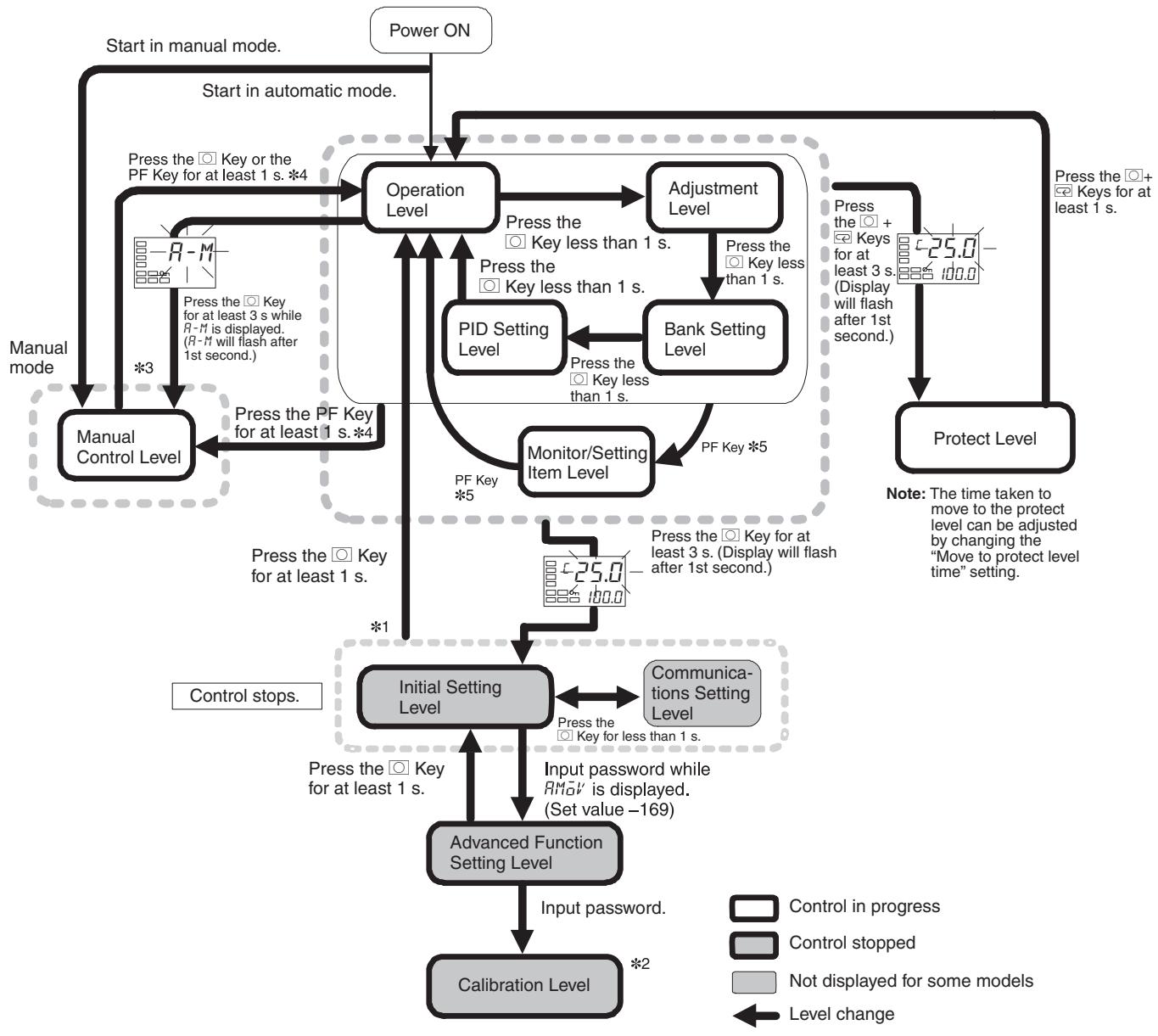
Note (1) You can return to the operation level by executing a software reset.
(2) It is not possible to move to other levels from the calibration level by operating the keys on the front panel. It can be done only by first turning OFF the power.
(3) From the manual control level, key operations can be used to move to the operation level only.
(4) When the PF Setting parameter is set to A-M for a Controller with a PF Key (E5AN/EN-H).
(5) When the PF Setting parameter is set to PFDP for a Controller with a PF Key (E5AN/EN-H)
Parameter Flow
This section describes the parameters set in each level. Pressing the 心 Key at the last parameter in each level returns to the top parameter in that level.
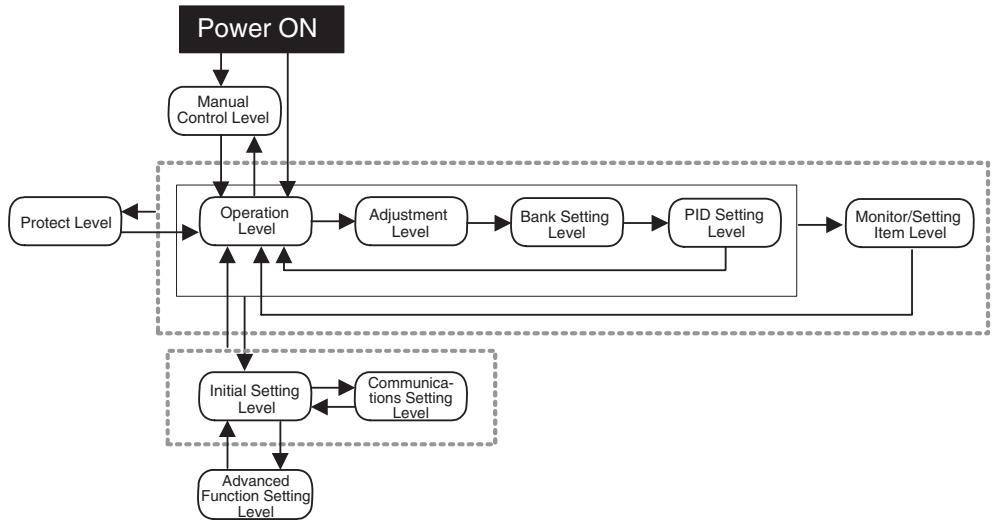
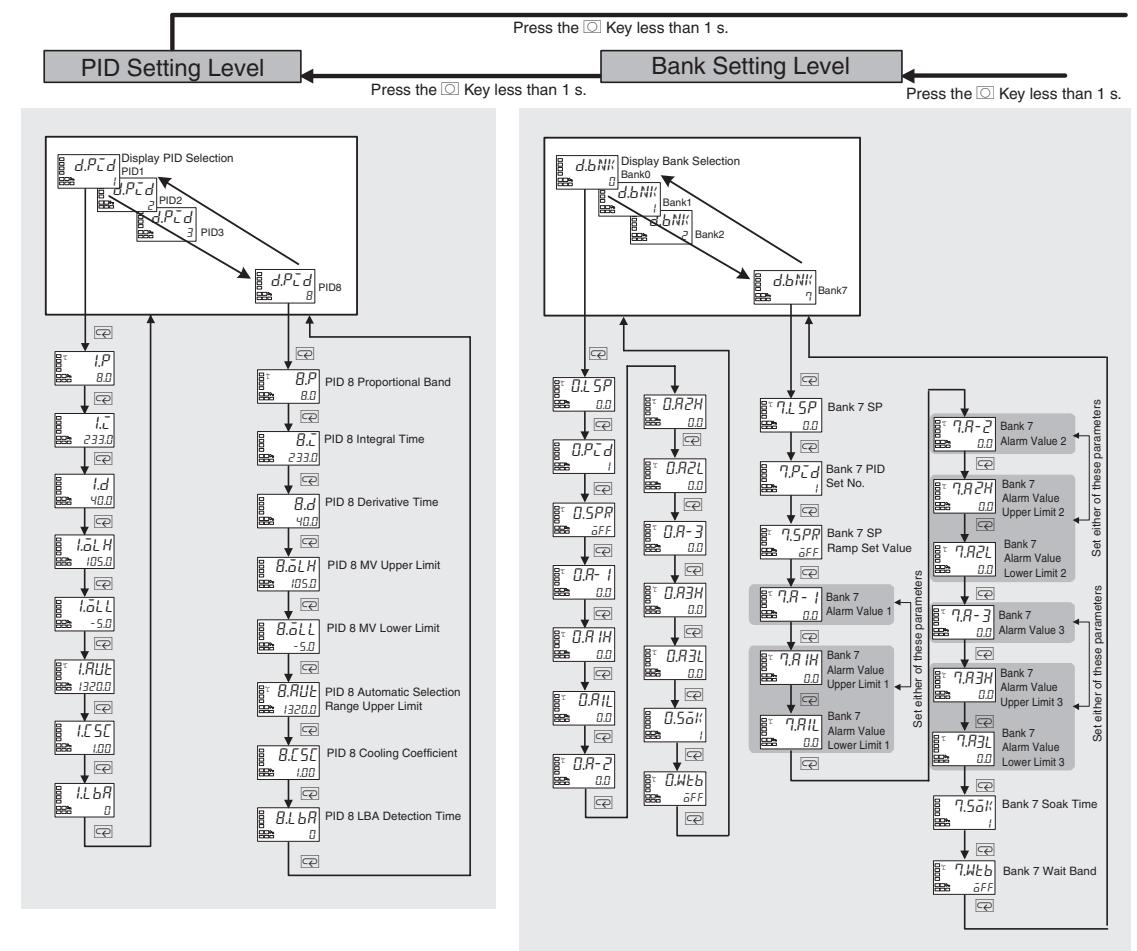
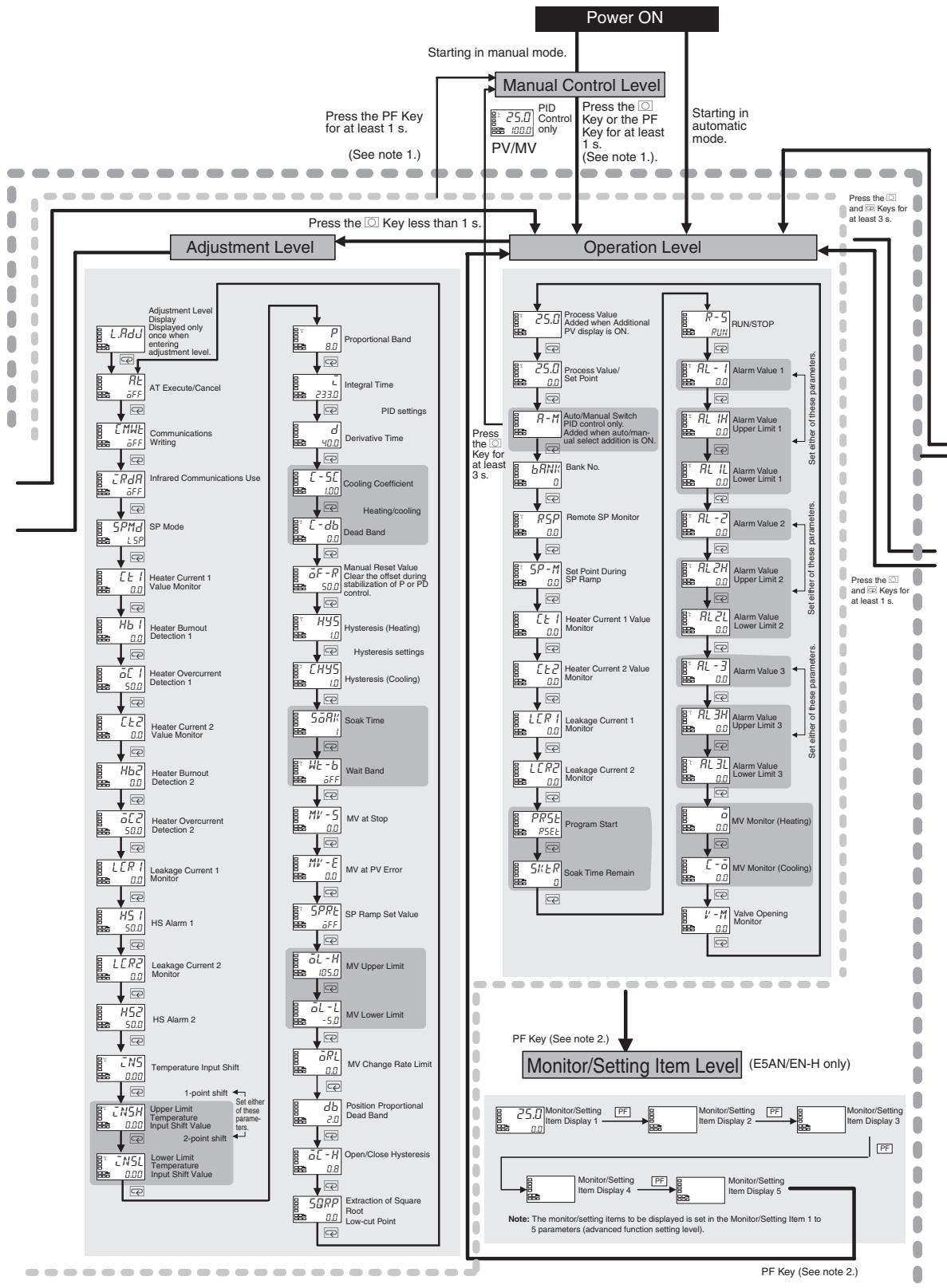
Note:
- When the PF Setting parameter is set to A-M for a Controller with a PF Key (E5AN/EN-H).
- When the PF Setting parameter is set to PFDP for a Controller with a PF Key (E5AN/EN-H).
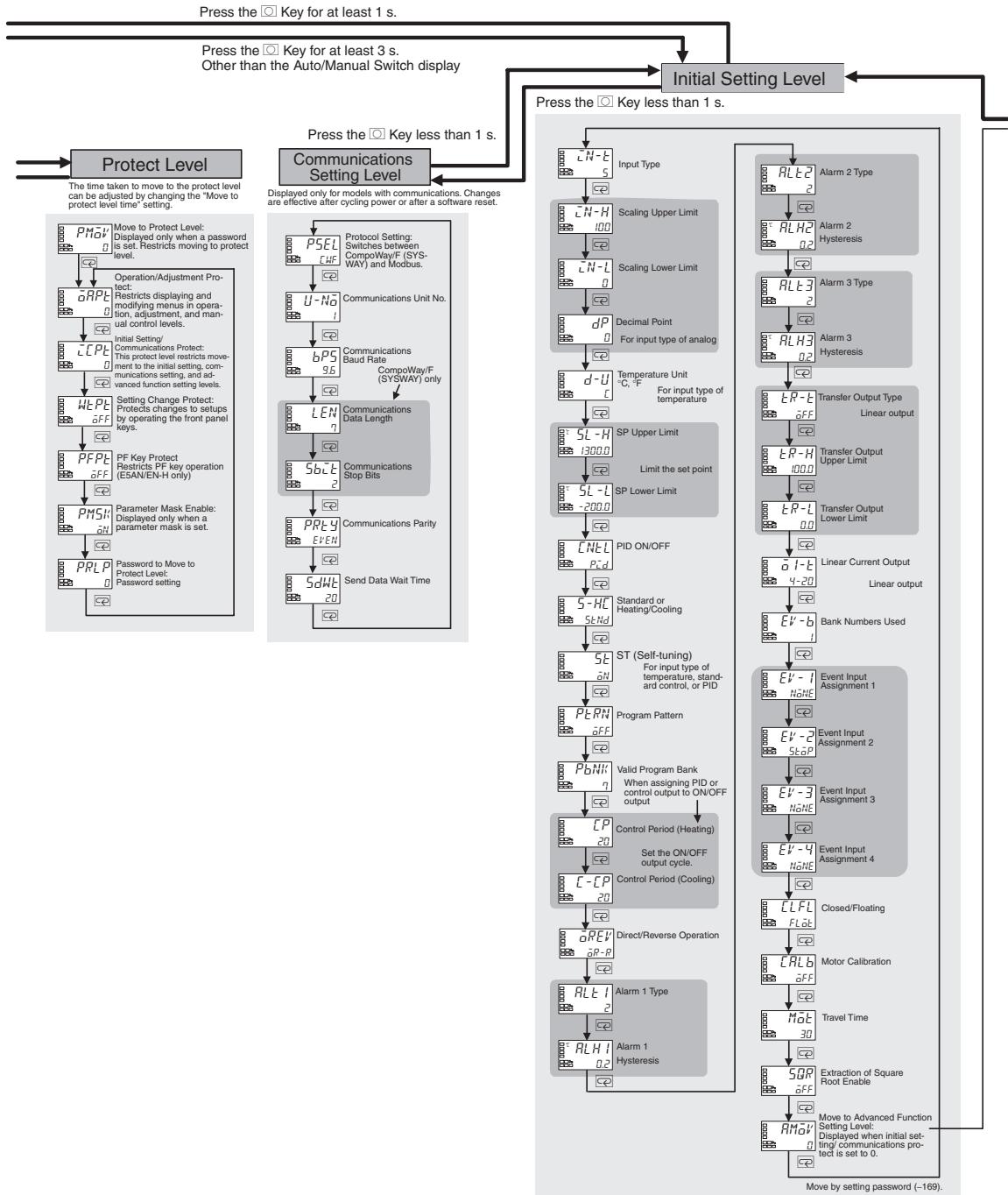
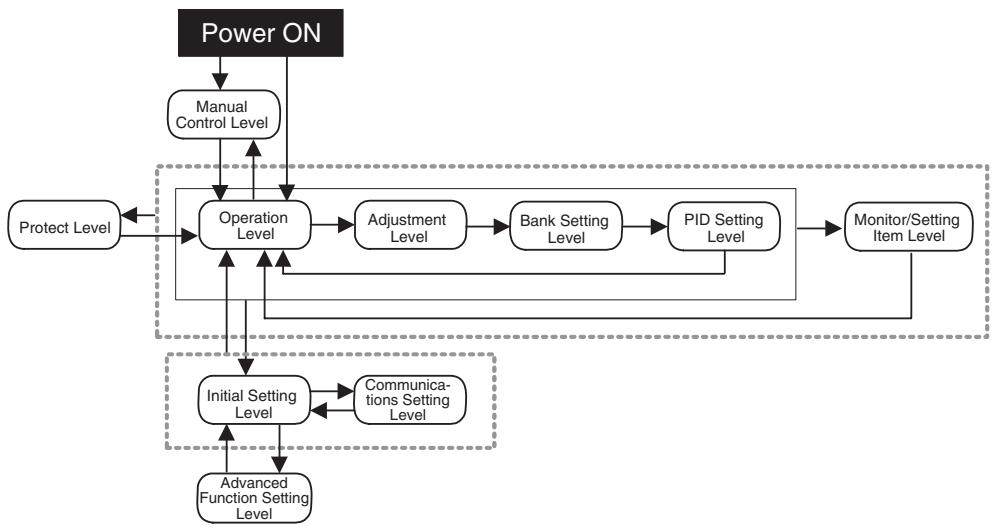
Press the Key for at least 1 s.
Advanced Function Setting Level
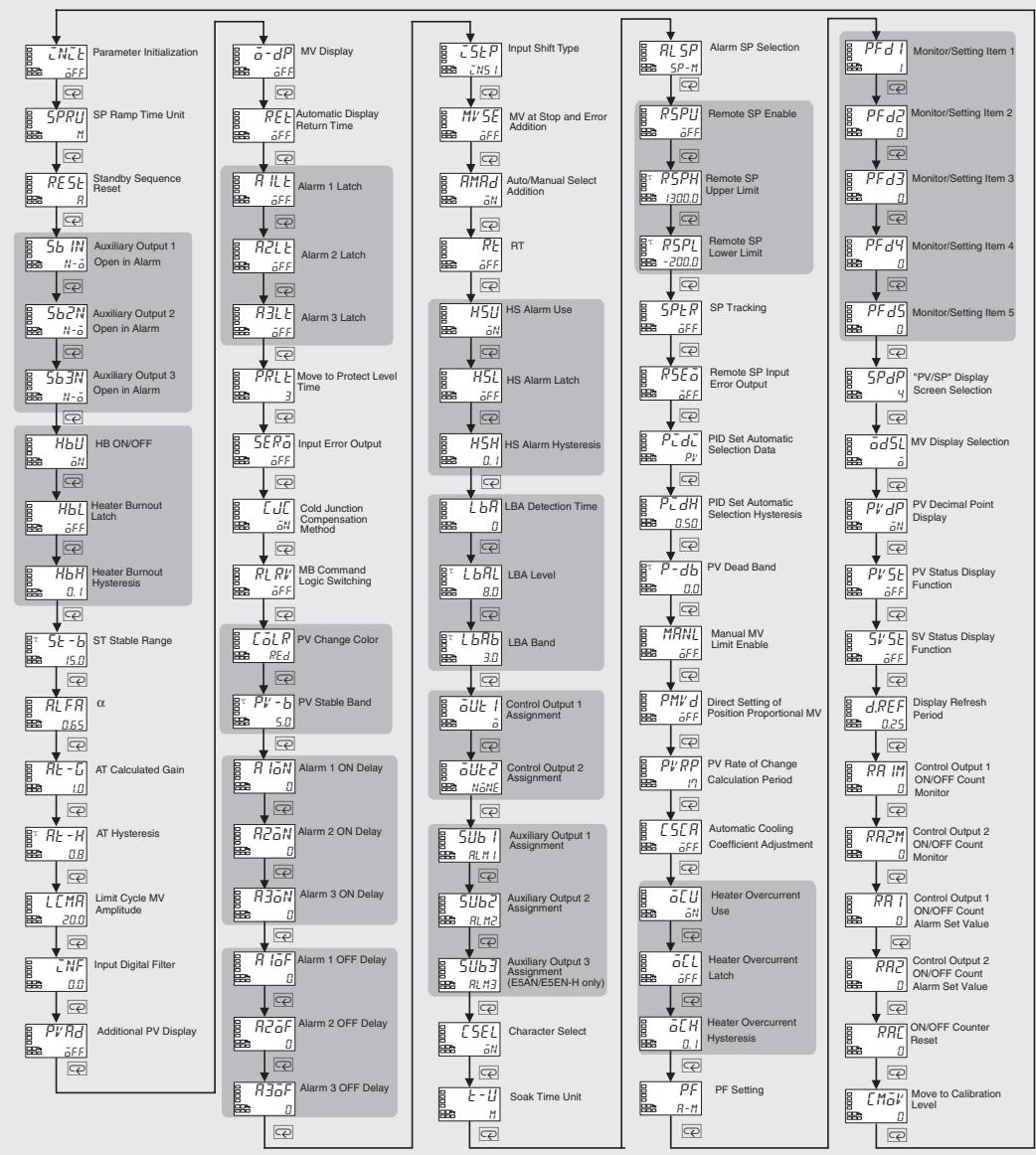
Index
Numerics
2-PID control, 51, 228
A
adjustment level, 12, 190
parameter operation list, 312
advanced function setting level, 13, 242
moving to, 104
parameter operation list, 322
alarm delays, 112
alarms, 9
alarm delays, 112
alarmhysteresis,90
alarm latch, 91
alarm outputs, 67
alarm types, 67
alarm values, 69
operation, 91
analog input, 92, 295
calibration, 290
AT (auto-tuning), 60
autocontrol,98
auto/manual select addition, 122, 256
auto/manual switch, 178
auxiliary output 1 assignment, 263
auxiliary output 2 assignment, 264
auxiliary output 3 assignment, 265
auxiliary outputs 2 and 3, 35
wiring, 36
B
bank setting level, 209
basic model
E5AN-H, 7
E5CN-H, 5
E5EN-H, 7
C
calibration
analog input, 290
current input, 290
indication accuracy, 294
input types, 285
platinum resistance thermometer, 289
registering calibration data, 285
thermocouple, 285
user calibration, 285
voltage input, 291
characteristics, 298
cold junction compensator
connecting, 286
communications
operation commands, 108
wiring
RS-485,38
communications function, 9
communications setting level, 13, 281
parameter operation list, 329
control outputs, 9
control outputs 1 and 2
wiring, 31, 33
control periods, 52, 230
Controllers with Analog Input, 290
Controllers with Analog Inputs, 284, 291
cooling coefficient
setting, 95
current input
calibration, 290
current transformer
calculating detection current, 73
Current Transformers (CT), 72, 300
CT inputs
wiring, 37
external dimensions, 300
E54-CT1,300
E54-CT3, 301
specifications, 300
Current Value Exceeds (error display), 305
D
dead band, 94
setting, 95
detection current, 73
dimensions, 18
E5AN-H, 18
E5CN-H, 18
E5EN-H, 18
direct operation, 52, 231
Display Range Exceeded (error display), 304
down key, 4
E
error displays, 304
Current Value Exceeds, 305
Display Range Exceeded, 304
HeaterBurnout,306
Heater Overcurrent, 306
HS Alarm, 306
Input Error, 304
Memory Error, 305
event inputs, 9, 36, 96
wiring, 36
external dimensions
Current Transformer (CT), 300
F
front panel
E5AN-H, 2
E5CN-H, 2
E5EN-H, 3
H
HBalarm(heaterburnoutalarm),71 settings,78
HeaterBurnout(errordisplay),306
heaterburnoutalarm,9,298
heaterburnouthysteresis,247
heaterburnoutlatch,246
heater overcurrent
hysteresis, 273
latch, 272
heating/cooling control, 93, 201, 228
cooling coefficient, 94, 201
dead band, 94, 201
setting, 95
HS alarm, 9, 71, 298
settings, 80
HS Alarm (error display), 306
hysteresis, 58, 59
1
I/O configuration, 5
basic model
E5AN-H, 7
E5CN-H, 5
E5EN-H, 7
main functions, 8
indication accuracy, 294
indicators
explanation, 3
operation, 3
initial setting level, 13, 223
parameter operation list, 318
initial setting/communications protect, 106
initial settings, 46
examples, 46, 47, 48
initialization, 244
Input Error (error display), 304
input sensor types, 8, 224
input shift, 87
one-point shift, 87
two-point shift, 88
input types, 49
list, 49
setting, 49
inputs
wiring, 30
installation, 18, 21
E5AN/E5EN-H
mounting the terminal cover, 22, 23
mounting to the panel, 23
E5CN-H
mounting the terminal cover, 22
mounting to the panel, 21
panelcutout
E5AN-H, 19
E5CN-H, 19
E5EN-H, 20
removing from case
E5AN-H, 25
E5CN-H, 23
E5EN-H, 25
K
keys
down key, 4
key operations, 11
level key, 4
modekey,4
operations, 4
up key, 4
L
LBA (loop burnout alarm), 114
band, 115
detection time, 116
level, 115, 116
levelkey,4
logic operations, 159
loopburnoutalarm(LBA),114
M
main functions, 8
manual control, 98, 119
manual control level, 13
moving to, 121
parameter operation list, 322
manual setup, 66
Memory Error (error display), 305
modekey,4
monitor/setting item level, 220
mounting, 21
terminal cover
E5AN/E5EN-H, 23
E5CN-H, 22
to panel
E5AN/E5EN-H, 23
E5CN-H, 21
MV at PV error, 143, 256
MV at stop, 142, 256
N
No.1 display, 3
No. 2 display, 3
0
ON/OFF control, 51, 228
setting, 58
one-point shift, 88
operation level, 12, 175
parameter operation list, 311
operation/adjustmentprotect,106
output functions
assignments, 53
output limits, 141
output periods, 230
output specifications
setting, 52
P
panelcutout
E5AN-H, 19
E5CN-H, 19
E5EN-H, 20
parameter flow, 336
parameter operation list, 311
adjustment level, 312
manual control level, 322
operation level, 311
parameter operation lists
advanced function setting level, 322
communications setting level, 329
initial setting level, 318
protect level, 329
parameter structure, 284
parameters
additional PV display, 249
adjustment level display, 192
alarm 1 hysteresis, 233
alarm 1 latch, 250
alarm 1 OFF delay, 255
alarm 1 ON delay, 255
alarm 1 type, 231
alarm 2 hysteresis, 233
alarm 2 latch, 250
alarm 2 OFF delay, 255
alarm 2 ON delay, 255
alarm 2 type, 233
alarm 3 hysteresis, 233
alarm 3 latch, 250
alarm 3 OFF delay, 255
alarm 3 ON delay, 255
alarm 3 type, 234
alarm SP selection, 266
alarmvalue1,185
alarmvalue2,186
alarmvalue3,186
alarm value lower limit 1, 187
alarm value lower limit 2, 187
alarm value lower limit 3, 188
alarm value upper limit 1, 187
alarm value upper limit 2, 187
alarm value upper limit 3, 188
alpha, 247
AT calculated gain, 248
AT execute/cancel, 192
AThysteresis,248
auto/manual select addition, 256
auto/manual switch, 178
automatic cooling coefficient adjustment, 271
automatic display return time, 250
auxiliary output * open in alarm, 245
auxiliary output 1 assignment, 263
auxiliary output 2 assignment, 264
auxiliary output 3 assignment, 265
bank (0 to 7) PID set No., 210
bank (0 to 7) SP, 210
bank *alarm value 1,211
bank * alarm value 2, 212
bank * alarm value 3, 213
bank * alarm value lower limit 1, 212
bank * alarm value lower limit 2, 213
bank * alarm value lower limit 3, 214
bank * alarm value upper limit 1, 212
bank * alarm value upper limit 2, 213
bank * alarm value upper limit 3, 214
bank 0 to 7 SP ramp set value, 211
bank No., 179
bank numbers used, 237
bank soak time, 215
bank wait band, 215
character select, 265
closed/floating, 239
cold junction compensation method, 252
communications baud rate, 281
communications data length, 281
communications parity, 281
communications stop bits, 281
communications Unit No., 281
communications writing, 193
control output 1 assignment, 261
control output 1 ON/OFF count alarm set value, 279
control output 1 ON/OFF count monitor, 278
control output 2 assignment, 262
control output 2 ON/OFF count alarm set value, 279
control output 2 ON/OFF count monitor, 278
control period (cooling), 230
control period (heating), 230
cooling coefficient, 201
dead band, 201
decimal point, 226
derivative time, 200
direct setting of position proportional MV, 270
direct/reverse operation, 231
display bank selection, 210
display PID selection, 216
display refresh period, 277
event input assignment *, 238
extraction of square root enable, 240
extraction of square root low-cut point, 207
HB ON/OFF, 246
heaterburndetction1,194
heaterburndetction2,196
heaterburnouthysteresis,247
heaterburnoutlatch,246
heater current 1 value monitor, 181, 194
heater current 2 value monitor, 182, 195
heater overcurrent detection 1, 195
heater overcurrent detection 2, 196
heater overcurrent hysteresis, 273
heater overcurrent latch, 272
heater overcurrent use, 272
HS alarm 1, 197
HS alarm 2, 198
HS alarm hysteresis, 258
HS alarm latch, 258
HSalarmuse,257
hysteresis (cooling), 202
hysteresis (heating), 202
infrared communications use, 193
initial setting/communications protect, 172
input digital filter, 249
input error output, 251
input shift type, 256
input type, 224
integral time, 200
LBA band, 260
LBA detection time, 259
LBA level, 259
leakage current 1 monitor, 183, 197
leakage current 2 monitor, 183, 198
limit cycle MV amplitude, 248
linear current output, 236
lower-limit temperature input shift value, 199
manual MV limit enable, 270
manual reset value, 202
MB command logic switching, 252
monitor/setting item, 274
monitor/setting item display 1 to 5, 220
motor calibration, 240
move to advanced function setting level, 241
move to calibration level, 280
move to protect level, 172
move to protect level time, 251
MV at PV error, 204
MV at stop, 204
MV at stop and error addition, 256
MV change rate limit, 206
MV display, 250
MV display selection, 275
MV lower limit, 205
MV monitor (cooling), 189
MV monitor (heating), 188
MV upper limit, 205
ON/OFF counter reset, 280
open/closehysteresis,207
operation/adjustmentprotect,172
parameter initialization, 244
parametermaskenable,173
password to move to protect level, 174
PFkeyprotect,173
PF setting, 273
PID * cooling coefficient, 219
PID * integral time, 217
PID * LBA detection time, 219
PID * MV lower limit, 217
PID * proportional band, 217
PID automatic selection range upper limit, 218
PID derivative time, 217
PID MV upper limit, 217
PID ON/OFF, 228
PID set automatic selection data, 269
PID set automatic selection hysteresis, 269
position proportional dead band, 207
processvalue,177
process value/set point, 177
program pattern, 229
program start, 184
proportional band, 200
protocol setting, 281
PV change color, 253
PVdeadband,269
PV decimal point display, 276
PV rate of change calculation period, 271
PV stable band, 254
PV status display function, 276
PV/MV (manual MV), 221
PV/SP display screen selection, 275
remote SP enable, 266
remote SP input, 268
remote SP lower limit, 267
remote SP monitor, 179
remote SP upper limit, 267
RT, 257
RUN/STOP, 185
scaling lower limit, 226
scaling upper limit, 226
selecting, 14
send data wait time, 281
set point during SP ramp, 180
setting change protect, 173
soak time, 203
soak time remain, 184
soak time unit, 266
SP lower limit, 227
SPmode,193
SP ramp set value, 205
SP ramp time unit, 244
SP tracking, 268
SP upper limit, 227
ST (self-tuning), 228
ST stable range, 247
standard or heating/cooling, 228
standby sequence reset, 244
SVstatusdisplayfunction,277
temperature input shift, 199
temperature unit, 226
transfer output lower limit, 236
transfer output type, 235
transfer output upper limit, 236
travel time, 240
upper-limit temperature input shift value, 199
valid program bank, 230
wait band, 203
part names, 2
password, 107, 108
PID constants, 60, 63
settingmanually,66
PID control
setting, 58
PID setting level, 216
platinum resistance thermometer, 294
calibration, 289
power supply
wiring, 30
precautions
wiring, 30
process value (PV), 177
program end, 136
output, 136
program patterns, 133
proportional action, 67
protect level, 12, 106, 171
moving to, 108, 172, 251
communications operation command, 108
password, 107, 174
parameter operation list, 329
protection, 106
initial setting/communications, 106, 172
operation/adjustment, 106, 172
setting change, 106, 107
PV display
color change, 109
stable band, 110
PV/MV, 221
R
ratings, 297
removing from case
E5AN/E5EN-H, 25
E5CN-H, 23
reverse operation, 52, 231
RT (robust tuning), 64, 257
run/stop control, 98
s
scaling
upper and lower limits for analog inputs, 92
self-tuning (ST), 62, 228
sensor input
control range, 335
indication range, 335
setting range, 335
sensor types, 224
set point (SP), 56
limiter, 100
limiting change rate, 102
lower limit, 102
ramp, 102
setting, 56, 59
setting upper and lower limits, 100
upper limit, 101
setting change protect, 106
setting level configuration, 11
setting levels
diagram, 336
settings
cooling coefficient, 95
dead band, 95
event input, 96
HB alarm (heater burnout alarm), 78
moving to advanced function setting level, 78
heating/cooling control, 95
HS alarm, 80
moving to advanced function setting level, 79, 80
hysteresis, 59
LBA detection time, 115
password, 108
PID ON/OFF, 58
saving, 14
SP lower limit, 102
SP upper limit, 101
shifting input values, 87
simple program function, 132
controlling start, 99
starting, 134
soak time, 135
SP ramp, 102
alarm operations, 104
operation at startup, 103
restrictions, 103
specifications, 297
Current Transformer (CT), 300
output, 52
USB-Serial Conversion Cable, 302
ST (self-tuning), 62
ST stable range, 64
startup conditions, 63
standard control, 228
standby sequence, 90
startup
conditions, 63
operation, 103
support software port, 40
T
temperature input, 8
shift values, 90
temperature unit, 4, 51
terminals
arrangement
E5AN/E5EN-H, 29
E5CN-H, 28
wiring, 28
thermocouple, 294
calibration, 285
Thermocouple/Resistance Thermometer
input type, 289
three-position control, 58
transfer output, 124
type, 125
troubleshooting, 307
two-point shift, 88, 89, 90
U
universal inputs, 284
up key, 4
USB-Serial Conversion Cable
specifications, 302
user calibration, 285
V
voltage input
calibration, 291
W
wait band, 135
wiring, 30
auxiliary outputs 2, and 3, 35
communications
RS-485,38
control output 1, 31
control output 2, 33
CT inputs, 37
event inputs, 36
inputs, 30
power supply, 30
precautions, 30
terminal arrangement, 28
terminals, 28
Revision History
A manual revision code appears as a suffix to the catalog number on the front cover of the manual.
Cat. No. H157-E1-02
Revision code
The following table outlines the changes made to the manual during each revision. Page numbers refer to the previous version.
| Revision code | Date | Revised content |
| 01 | January 2008 | Original production |
| 01A | March 2008 | Page 6: Added case color information to the model number legend. Page 8: Added model number legend for Output Units. |
| 02 | March 2009 | Pages xii and xiv: Added information on shipping standards. Pages 26, 32, 34, 72, 138, 213, 279, 295, 306, 313, and 314: Made minor corrections. Page 29: Replaced graphic. Pages 73 to 77: Made minor corrections to graphics. Page 89: Replaced graphic and changed step 2. |
OMRON Corporation
Industrial Automation Company
Control Devices Division H.Q.
Analog Controller Division
Shiokoji Horikawa, Shimogyo-ku,
Kyoto, 600-8530 Japan
Tel: (81) 75-344-7080/Fax: (81) 75-344-7149
2-2-1 Nishikusatsu, Kusatsu-shi,
Shiga, 525-0035 Japan
Tel: (81) 77-565-5216/Fax: (81) 77-565-5568
Regional Headquarters
OMRON EUROPE B.V.
OMRON ELECTRONICS LLC
One Commerce Drive Schaumburg,
IL 60173-5302 U.S.A.
Tel: (1) 847-843-7900/Fax: (1) 847-843-7787
OMRON ASIA PACIFIC PTE. LTD.
No. 438A Alexandra Road # 05-05/08 (Lobby 2),
Alexandra Technopark, Singapore 119967
Tel: (65) 6835-3011/Fax: (65) 6835-2711
OMRON (CHINA) CO., LTD.
Room 2211, Bank of China Tower,
200 Yin Cheng Zhong Road.
PuDong New Area, Shanghai, 200120, China
Tel: (86) 21-5037-2222/Fax: (86) 21-5037-2200
Authorized Distributor:
© OMRON Corporation 2008 All Rights Reserved.
In the interest of product improvement,
specifications are subject to change without notice.
- User's Manual Advanced Type
- Preface
- Visual Aids
- OMRON, 2008
- Safety Precautions
- Definition of Precautionary Information
- Symbols
- Precautions for Safe Use
- Service Life
- - Ambient Noise
- Ensuring Measurement Accuracy
- Waterproofing
- Precautions for Operation
- Shipping Standards
- ■ Application Conditions
- 1) Installation Location
- 2) Wiring Conditions
- Ferrite Core Connection Examples
- E5CN/E5CN-H
- E5AN/E5EN/E5AN-H/E5EN-H
- Preparations for Use
- Conventions Used in This Manual
- Meanings of Abbreviations
- How to Read Display Symbols
- TABLE OF CONTENTS
- SECTION 1
- Introduction. 1
- SECTION 2
- Preparations 17
- SECTION 3
- Basic Operation. 45
- SECTION 4
- Applications Operations. 85
- SECTION 5
- Parameters. 169
- SECTION 6
- CALIBRATION 283
- Appendix 297
- Index. 343
- Revision History 351
- About this Manual:
- - Overview
- - Setup
- - Basic Operations
- Operations for Applications
- -User Calibration
- - Appendix
- WARNING
- SECTION 1 Introduction
- 1-1 Names of Parts
- 1-1-1 Front Panel
- E5EN-H
- 1-1-2 Explanation of Indicators
- Operation Indicators
- 1-1-3 Using the Keys
- 1-2 I/O Configuration and Main Functions
- 1-2-1 I/O Configuration
- Model Number Structure
- Controllers
- E5CN-□□□M□-□-500 1234567
- Option Units
- E53-□□□1234
- E5AN/EN-H
- Note
- Model Number Legends
- Output Units
- 1-2-2 Main Functions
- Input Sensor Types
- 1-3 Setting Level Configuration and Key Operations
- Monitor/Setting Item Level
- Manual Control Level
- Initial Setting Level
- Advanced Function Setting Level
- Communications Setting Level
- Calibration Level
- 1-3-1 Selecting Parameters
- 1-3-2 Saving Settings
- 1-4 Communications Function
- Setting Communications Data
- SECTION 2 Preparations
- 2-1 Installation
- 2-1-1 Dimensions
- 2-1-2 Panel Cutout
- E5CN-H
- E5AN-H
- 2-1-3 Mounting
- Mounting to the Panel
- 1,2,3...
- Mounting the Terminal Cover
- 2-1-4 Removing the Digital Controller from the Case
- Mounting Output Units
- 2-2 Wiring Terminals
- 2-2-1 Terminal Arrangement
- 2-2-2 Precautions when Wiring
- 2-2-3 Wiring
- Power supply
- Control Output 1
- Control Output 2
- Auxiliary Outputs 2, and 3
- Event Inputs
- CT Inputs
- Transfer Output
- Remote SP Input
- Communications
- RS-485
- Communications Unit Connection Diagram
- RS-232C
- RS-422 (E5AN/EN-H Only)
- 2-3 Using the Support Software Port
- Procedure
- 2-4 Using Infrared Communications
- Basic Operation
- 3-1 Initial Setting Examples
- Explanation of Examples
- Example 1
- Example 2
- Example 3
- 3-2 Setting the Input Type
- 3-2-1 Input Type
- Operating Procedure
- 3-3 Selecting the Temperature Unit
- 3-3-1 Temperature Unit
- 3-4 Selecting PID Control or ON/OFF Control
- 2-PID Control
- ON/OFF Control
- 3-5 Setting Output Specifications
- 3-5-1 Control Periods
- 3-5-2 Direct and Reverse Operation
- 3-5-3 Assigned Output Functions
- Alarms
- Operation Level
- Standard or Heating/Cooling
- Auxiliary Output Opening or Closing in Alarm
- 3-6 Setting the Set Point (SP)
- 3-6-1 Changing the SP
- 3-7 Using ON/OFF Control
- 3-7-1 ON/OFF Control
- Hysteresis
- Three-position Control
- 3-7-2 Settings
- Setting the PID ON/OFF Parameter
- Setting the SP
- Setting the Hysteresis
- 3-8 Determining PID Constants (AT, ST, Manual Setup)
- 3-8-1 AT (Auto-tuning)
- AT Operations
- AT Calculated Gain
- AT Hysteresis
- Limit Cycle MV Amplitude
- 40% AT
- 100% AT
- 3-8-2 ST (Self-tuning)
- Note PID Constants
- Startup Conditions
- ST Stable Range
- 3-8-3 RT (Robust Tuning)
- RT Features
- 3-8-4 Manual Setup
- Note Proportional Action
- 3-9 Alarm Outputs
- 3-9-1 Alarm Types
- 3-9-2 Alarm Values
- PV Change Rate Alarm
- Precaution
- SP Alarms When Remote SP Is Used
- 3-10 Using Heater Burnout, Heater Short, and Heater Overcurrent Alarms
- 3-10-1 Heater Burnout, Heater Short, and Heater Overcurrent Alarm Operations
- 3-10-2 Installing Current Transformers (CT)
- Single-phase Heaters
- Three-phase Heaters (E5□N-H□HH□3-phase Heater Detection Models)
- - Delta connecting lines: Refer to the following diagram for CT installation positions.
- 3-10-3 Calculating Detection Current Values
- 3-10-4 Application Examples
- Three-phase Heaters
- Delta Connecting Lines
- Star Connecting Lines
- V Connecting Lines
- 3-10-5 Settings: HB Alarm
- ■ Moving to the Advanced Function Setting Level
- Setting Heater Burnout Detection
- 3-10-6 Settings: Heater Short Alarm
- HS Alarm Settings
- 3-10-7 Settings: Heater Overcurrent Alarm
- Setting Heater Overcurrent Detection
- 3-11 Setting the No. 3 Display
- 3-11-1 PV/SP Display Selection
- MV Display for Heating and Cooling Control
- Applications Operations
- 4-1 Shifting Input Values
- 4-1-1 Shifting Inputs
- One-point shift
- Two-point shift
- 4-1-2 How to Calculate Input Shift Values for a 2-point Shift
- Method for a 1-point Shift
- Method for a 2-point Shift
- Example of a 2-point Temperature Input Shift
- 4-2 Alarm Hysteresis
- 4-2-1 Standby Sequence
- Restart
- 4-2-2 Alarm Latch
- Summary of Alarm Operation
- Parameters
- 4-3 Setting Scaling Upper and Lower Limits for Analog Inputs
- 4-3-1 Analog Input
- 4-4 Executing Heating/Cooling Control
- 4-4-1 Heating/Cooling Control
- Dead Band
- Cooling Coefficient
- Automatic Cooling Coefficient Adjustment
- 4-4-2 Settings
- Setting Heating/Cooling Control
- Setting the Cooling Coefficient
- Setting the Dead Band Operating Procedure
- 4-5 Using Event Inputs
- 4-5-1 Event Input Settings
- 4-5-2 Operation Commands Other than Bank Selection
- Executing Run/Stop Control
- Switching between Auto and Manual Control
- Controlling the Start of the Simple Program Function
- Control by Inverting Direct/Reverse Operation
- Switching SP Mode
- Switching 100% AT Execute/Cancel
- Switching 40\% AT Execute/Cancel
- Switching Setting Change Enable/ Disable
- Switching Communications Write Enable/Disable
- Switching Alarm Latch Cancel
- 4-6 Setting the SP Upper and Lower Limit Values
- 4-6-1 Set Point Limiter
- 4-6-2 Setting
- Setting the Set Point Upper-limit Value
- Setting the Set Point Lower-limit Value
- 4-7 Using the SP Ramp Function to Limit the SP Change Rate
- 4-7-1 SP Ramp
- Operation at Startup
- Restrictions during SP Ramp Operation
- Alarms during SP Ramp Operation
- 4-8 Moving to the Advanced Function Setting Level
- 4-9 Using the Key Protect Level
- 4-9-1 Protection
- Operation/Adjustment Protect
- Initial Setting/ Communications Protect
- Setting Change Protect
- PF Key Protect
- 4-9-2 Entering the Password to Move to the Protect Level
- Example with a Password of 1234
- Example with No Password Set
- Setting the Password
- Example To set the Password to 1234
- Communications Operation Command to Move to the Protect Level
- 4-10 PV Change Color
- 4-10-1 PV Color Change Function
- PV Stable Band
- 4-10-2 Setting
- Setting the PV Change Color to Indicate Stable Status
- 4-11 Alarm Delays
- 4-11-1 Alarm Delays
- Operation of Alarm ON and OFF Delays (for an Upper-limit Alarm)
- Parameters Related to Alarm Delays
- 4-12 Loop Burnout Alarm
- 4-12-1 Loop Burnout Alarm (LBA)
- Parameters Related to Loop Burnout Alarms
- Automatically Setting the LBA Detection Time
- Determining the LBA Detection Time
- LBA Level
- LBA Band
- 4-13 Performing Manual Control
- 4-13-1 Manual Operation
- Standard Models
- Position-proportional Models
- Manual MV Limit Enable
- Moving from the Operation Level to the Manual Control Level
- Using the PF Key to Move to the Manual Control Level
- Auto/Manual Select Addition
- 4-14 Using the Transfer Output
- 4-14-1 Transfer Output Function
- Transfer Output Destination
- ■ Precision and User Calibration
- Transfer Output Type
- Transfer Scaling
- 4-15 Using Banks and PID Sets
- Banks
- PID Set Number
- Simple Program and Bank Functions
- PID Sets
- Automatic PID Set Selection
- 4-16 Using the Simple Program Function
- 4-16-1 Simple Program Function
- Program Pattern
- ■ Pattern 1 (STOP)
- ■ Pattern 2 (CONT)
- ■ Pattern 3 (LOOP)
- Starting Method
- Soak Time and Wait Band
- Operation When Power Is Turned ON
- 4-16-2 Operation at the Program End
- Display at the Program End
- Program End Output
- Clearing the Program End Status
- 4-16-3 Combining a Simple Program with an SP Ramp
- SP Start
- 4-16-4 Relationships between Simple Programs and Other Functions
- 4-17 Output Adjustment Functions
- 4-17-1 Output Limits
- 4-17-2 MV at Stop
- 4-17-3 MV at PV Error
- 4-18 Using the Extraction of Square Root Parameter
- Extraction of Square Roots
- 4-19 Setting the Width of MV Variation
- MV Change Rate Limit
- Adjustment Level
- 4-20 Setting the PF Key
- 4-20-1 PF Setting (Function Key)
- Monitor/Setting Item
- Setting Monitor/Setting Items
- 4-21 Counting Control Output ON/OFF Operations
- 4-21-1 Control Output ON/OFF Count Function
- Control Output ON/OFF Counter Monitor Function
- Display When ON/OFF Count Alarm Occurs
- Control Output ON/OFF Count Alarm Function
- ON/OFF Counter Reset Function
- 4-22 Displaying PV/SV Status
- 4-22-1 PV and SV Status Display Functions
- PV Status Display Function
- SV Status Display Function
- 4-23 Using a Remote SP
- Precautions
- Remote SP Scaling
- SP Mode
- Remote SP Monitor
- SP Tracking
- 4-24 Position-proportional Control
- Closed Control
- Floating Control
- Motor Calibration and Travel Time
- Position-proportional Dead Band and Open/Close Hysteresis
- PV Dead Band
- Valve Opening Monitor
- Manual Operation
- MV at Stop and Error
- 4-25 Logic Operations
- 4-25-1 The Logic Operation Function (CX-Thermo)
- 4-25-2 Using Logic Operations
- Starting Logic Operations
- Making the Settings
- 1,2,3... 1. Displaying the Library Import Dialog Box
- Switching Work Bit Operations
- Selecting the Operation Type
- Selecting Input Assignments
- Changing Event Input Data
- SECTION 5 Parameters
- 5-1 Conventions Used in this Section
- 5-1-1 Meanings of Icons Used in this Section
- 5-1-2 About Related Parameter Displays
- 5-1-3 The Order of Parameters in This Section
- 5-1-4 Alarms
- 5-2 Protect Level
- Initial Setting/Communications Protect
- PRLF
- Password to Move to Protect Level
- Related Parameters
- 5-3 Operation Level
- Process Value
- Process Value/Set Point (Display 1) Process Value/Set Point (Display 2)
- No. 3 Display (E5AN/EN-H)
- Auto/Manual Switch
- Set Point During SP Ramp
- Alarm Value Upper Limit 3 Alarm Value Lower Limit 3
- MV Monitor (Heating)
- 5-4 Adjustment Level
- Hb2
- Heater Burnout Detection 2
- aC2
- Heater Overcurrent Detection 2
- aRL
- 5-5 Bank Setting Level
- 5-6 PID Setting Level
- Display PID Selection
- PID * Automatic Selection Range Upper Limit (*: 1 to 8)
- 5-7 Monitor/Setting Item Level
- Monitor/Setting Item Display 1 to 5
- 5-8 Manual Control Level
- PV/MV (Manual MV)
- 5-9 Initial Setting Level
- Input Type
- SP Upper Limit
- SP Lower Limit
- PLRN
- aREV
- Direct/Reverse Operation
- ALTE
- Alarm 1 Type
- Related Parameter
- Transfer Output Upper Limit
- Transfer Output Lower Limit
- Linear Current Output
- Bank Numbers Used
- Controllers with Event Inputs 1 and 2 (Two Event Inputs)
- Controllers with Event Inputs 3 and 4 (Two Event Inputs)
- Controllers with Event Inputs 1 to 4 (Four Event Inputs)
- See
- EV-
- Event Input Assignment * (*: 1 to 4)
- Closed/Floating
- 5-10 Advanced Function Setting Level
- Auxiliary Output * Open in Alarm (*: 1 to 3)
- INF
- Input Digital Filter
- PvRd
- Additional PV Display
- C oL R
- PV Change Color
- out
- Control Output 1 Assignment
- Control Output 2 Assignment
- Auxiliary Output 1 Assignment
- 5662
- Auxiliary Output 2 Assignment
- 5ub3
- Auxiliary Output 3 Assignment
- C5EL
- Character Select
- Remote SP Upper Limit Remote SP Lower Limit
- Monitor/Setting Item * (*: 1 to 5)
- 515t
- d.REF
- Display Refresh Period
- 5-11 Communications Setting Level
- CALIBRATION
- 6-1 Parameter Structure
- 6-2 User Calibration
- 6-2-1 Calibrating Inputs
- 6-2-2 Registering Calibration Data
- 6-3 Thermocouple Calibration (Thermocouple/Resistance Thermometer Input)
- 6-3-1 Preparations
- - Connecting the Cold Junction Compensator
- 6-4 Platinum Resistance Thermometer Calibration (Thermocouple/Resistance Thermometer Input)
- 1,2,3... 1. Connect the power supply.
- Turn the power ON.
- Move to the calibration level.
- Execute calibration for the main input.
- 6-5 Calibrating Analog Input (Analog Input)
- 6-5-1 Calibrating a Current Input
- 6-5-2 Calibrating a Voltage Input
- 6-6 Calibrating the Transfer Output
- 6-7 Checking Indication Accuracy
- 6-7-1 Thermocouple
- 6-7-2 Platinum Resistance Thermometer
- 6-7-3 Analog Input
- Appendix
- Specifications
- Current Transformer (CT)
- External Dimensions
- E58-CIFQ1 USB-Serial Conversion Cable
- Compatible Operating Environment
- Appearance and Nomenclature
- Appearance (Unit: mm)
- E58-CIFIR USB-Infrared Conversion Cable
- LED Indicators
- Error Displays
- Input Error
- Meaning
- Action
- Operation at Error
- Display Range Exceeded
- AD Converter Error
- Operation
- Memory Error
- Current Value Exceeds
- Heater Burnout
- HS Alarm
- Heater Overcurrent
- Potentiometer Input Error
- Troubleshooting
- Checking Problems
- Parameter Operation Lists
- Initialization According to Parameter Changes
- Control Range
- Setting Levels Diagram
- Parameter Flow
- Index
- Numerics
- A
- B
- C
- D
- E
- F
- H
- 1
- K
- L
- M
- N
- 0
- P
- R
- s
- T
- U
- V
- W
- Revision History
- OMRON Corporation
Brand : OMRON
Model : E5CN-H
Category : Temperature Controller