
CVD 121 V - Wine Cooler LA SOMMELIERE - Free user manual and instructions
Find the device manual for free CVD 121 V LA SOMMELIERE in PDF.



| Type de produit | Wine cellar (Sommelier) |
| Marque | LA SOMMELIERE |
| Modèle | CVD 121 V |
| Capacité estimée | 121 bottles |
| Plage de température | 4°C to 18°C (adjustable) |
| Températures par défaut | Red wine: 12-16°C, White wine: 6-10°C |
| Affichage | Digital (average temperature) |
| Unité de température | Celsius or Fahrenheit (switchable) |
| Dégivrage | Automatic |
| Éclairage intérieur | Interior lamp (max 15W) |
| Porte | Tempered glass with magnetic seal |
| Clayettes | Chrome, adjustable and removable |
| Réfrigérant | R600a (isobutane) |
| Classe climatique | N (standard ambient temperature) |
| Type de pose | Not built-in, freestanding |
| Branchement électrique | Plug with earth connection |
| Nettoyage | Lukewarm water and vinegar, mild detergent |
| Montage poignée | To be done before first use (screws provided) |
| Particularités | Defrost water outlet to be checked regularly |
Frequently Asked Questions - CVD 121 V LA SOMMELIERE
User questions about CVD 121 V LA SOMMELIERE
0 question about this device. Answer the ones you know or ask your own.
Ask a new question about this device
Download the instructions for your Wine Cooler in PDF format for free! Find your manual CVD 121 V - LA SOMMELIERE and take your electronic device back in hand. On this page are published all the documents necessary for the use of your device. CVD 121 V by LA SOMMELIERE.
USER MANUAL CVD 121 V LA SOMMELIERE
. Before Putting Into Use 2
.Important 3
. Placing and Installation 4
. Description of the Appliance 5
. Temperature Control 5
. Maintenance and Cleaning 7
. Trouble Shooting Guide 8
CAUTION:
Read and follow all safety rules and operating instructions before first use of this product.
Thank you for buying this appliance.
We hope it will successfully serve your requirements for many years.
SAVE THESE INSTRUCTIONS
Before Putting Into Use 2
To Assemble Door Handle
Tips for Energy Savings
Important 3
Warning
Disposing of Worn Out Appliances
Placing and Installation 4
Choosing the Right Place
Placing the Self-standing Appliance
Wiring Instructions
Connection to Power Supply
Description of the Appliance 5
Temperature Control and Display 5
Preset Wine Zones
Manual Temperature Setting
Maintenance and Cleaning 7
Automatic Defrosting of the appliance
Cleaning of the Appliance
Switch Off the Appliance When Not In Use
Correct Step to Change Bulb
Trouble-Shooting Guide 8
Before Putting Into Use
To Assemble Door Handle
To save shipping space and avoid damage of the unit during transportation, the door handle of this unit is shipped unassembled. Before putting the unit into use you are kindly asked to assemble the door handle as follows:
- Locate the door handle and 2 screws attached inside the cabinet, and prepare an appropriate screwdriver.
With the 2 screws attached, fasten the door handle onto the frame of the door panel as illustrated. Be sure that the screws must point to the holes on the frame of the door panel when doing so.
- Before connecting the appliance to electrical power supply, leave it to stand for about 4 hours, which will reduce the possibility of malfunctions in the cooling system due to transport handling.
- Clean the appliance thoroughly, especially in the interior (See Cleaning and Maintenance).
- In case the interior accessories are not correctly placed, rearrange them as described in chapter "Description of the Appliance".
Instructions for Use
These instructions for use are intended for the user. They describe the appliance and correct operating procedures for safe use.
SAVE THESE INSTRUCTIONS:
Tips for Energy Saving
- Try not to open the door too often, especially when the weather is hot and humid. Once you open the door, close it as soon as possible. This is especially important if you have an upright model.
- Every now and then check if the appliance is sufficiently ventilated (adequate air circulation behind the appliance).
- Set the thermostat from higher to lower settings as soon as possible (depends on how loaded the appliance is, ambient temperatures etc.).
- If the gasket is damaged or the door seal is poor, energy consumption is substantially higher. To restore efficiency, replace the gasket.
- Always consider instructions stated in sections Positioning and Energy Saving Tips, otherwise the energy consumption is substantially higher.
Important
- If you have bought this appliance to replace an old one equipped with a door lock that cannot be opened from the inside (lock, bolt), make sure that the lock is removed, disabled or destroyed before discarding. This will make it impossible for children to accidentally lock themselves inside the appliance and suffocate
- To avoid risk of child entrapment, leave the shelves in place so children can not easily climb inside even when the appliance is in routine use or not in use at home.
- The appliance must be properly connected to an electrical power supply. (See: Connection to Power Supply).
- Do not use an extension cord.
- Always disconnect the appliance from the power supply before cleaning the appliance, or attempting repairs.
WARNING:
- This unit is supplied with flammable refrigerant ISO BUTANE (R600a). It must be transported and installed with the utmost care since any excessive knocking or shaking could damage the refrigerating circuit.
- Keep ventilation openings in the appliance enclosure or in the built-in structure clear of obstruction.
- Do not use mechanical devices or other means to accelerate defrosting process, other than those recommended by the manufacturer.
-
Do not damage the refrigerant circuit.
-
Do not use electrical appliance inside the food storage compartments of the appliance, unless they of the type recommended by the manufacturer.
- If the supply cord is damaged, it must be replaced by the manufacturer or its service agent or a similarly qualified person in order to avoid a hazard.
Disposing of Worn Out Appliances
DANGER OR WARNING: Risk of child entrapment. Before you throw away your old appliance:
-Take off the doors
- Leave the shelves in place so children may not easily climb inside.
- The cooling system of the appliance is filled with refrigerant and insulating substances which should be separately treated and processed. Call your nearest authorised service agent. If you are unable to locate one, contact your local authorities or your distributor. Be careful not to damage the tubes on the rear wall of the appliance (danger of pollution).
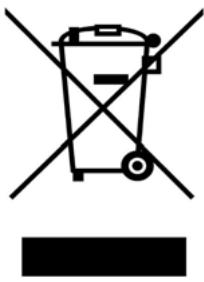
- DISPOSAL: Do not dispose this product as unsorted municipal waste. Collection of such waste separately for special treatment is necessary.
Placing and Installation
CHOOSING THE RIGHT PLACE
WARNING
This appliance is intended to be used in the ambient temperature of climate class "N".
Place the appliance in a dry and regularly ventilated room. Never place the appliance near heat emitting devices (e.g. cooking appliances, radiators, water heaters or similar devices) and do not expose to direct sunlight.
The appliance should be positioned at least 2in. away from electric or gas cooking appliances and at least 30cm away from oil or coal fired stoves. If this is not possible, use an appropriate insulation barrier.
Behind the appliance there should be a free space of at least 8cm . Kitchen units (cupboards) should be at least 5cm away from the appliance in order to assure adequate ventilation. There should be 10cm between both size of the chiller and other article.
Placing the Self-standing Appliance
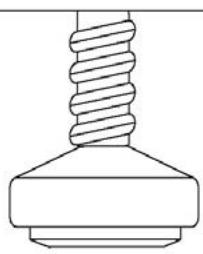
Place the appliance firmly on a solid base. Some appliances have adjustable feet on the front side; use them to level the appliance.
Instructions to avoid to the risk of fire, electric shock, or injury to persons.
WIRING INSTRUCTIONS
For your personal safety, this appliance must be earthed. In the event of a malfunction or breakdown, earthing will reduce the risk of electric shock by providing a path of least resistance for electric current. This appliance is equipped with a power cord having an earthing conductor. The plug must be plugged into an appropriate wall outlet that is installed and wired in accordance with all existing local codes and ordinances. Consult a qualified electrician or serviceman if the wiring instruction are not clearly understood, or if doubt exists as to whether the appliance is properly earthed.
CONNECTION TO POWER SUPPLY
Connect the appliance power cord and plug to a properly earthed wall outlet. The required nominal voltage and frequency are indicated on the rating plate (inside the unit or on the exterior rear wall of the unit).
Description of the appliance
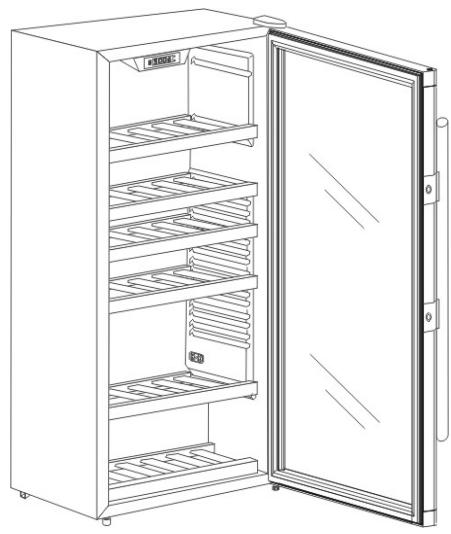
Adjustable Wire Shelves
Shelves can be optionally placed on the guides inside the appliance where appropriate.
Defrost Water Outlet
The interior of the appliance is cooled with a cooling plate mounted in the rear wall. Under the plate there is a channel and an outlet for defrost water. Regularly check the defrost water outlet and the drain channel for blockage. They should always be kept free and clean of particles.
WE RESERVE THE RIGHT TO ALTER THE SPECIFICATIONS WITH NO EFFECT ON THE OPERATION OF THE APPLIANCE.
Temperature Control and Display
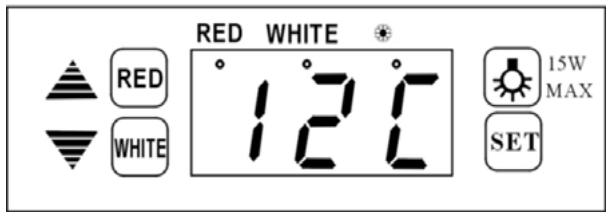
- The temperature range of the wine cooler is intended for 4^ C to 18^ C (+ / - 3^ C) .
. Average temperature for red wine is 12^ C to 16^ C .
. Average temperature for white wine is 6^ C to 10^ C .
. The display usually shows the average temperature of the appliance at that moment.
PRESET WINE ZONES:
Press the [Red] or [White] pads to choose preset storage conditions for Red or White Wine. (The indicator 'RED' or 'WHITE' will light accordingly.) The programmed Temperature for red or white wine will be displayed for a few seconds.
MANUAL TEMPERATURE SETTING:
The temperature of the wine cooler can be set anywhere between 4^ to 18^ by the temperature up and temperature down pads as follows:
(1) Press the [SET] pad until you hear a "beep" sound (approximately 2 seconds).
(2) Press the pads to increase or decrease the desired temperature in increments of one degree.
(3) Press the [SET] pad to confirm your choice - if no pad is pressed within 10 seconds your choice will be automatically confirmed.
NOTES:
. The temperature display can be changed between Celsius and Fahrenheit by pressing and holding the pad for approximately 2 seconds.
. The indicator indicates status of the refrigeration cycle as follows:
(1) It remains ON during the refrigeration cycle; (2) It remains OFF during the idle cycle.
. To switch the interior light on/off, simply press the pad.
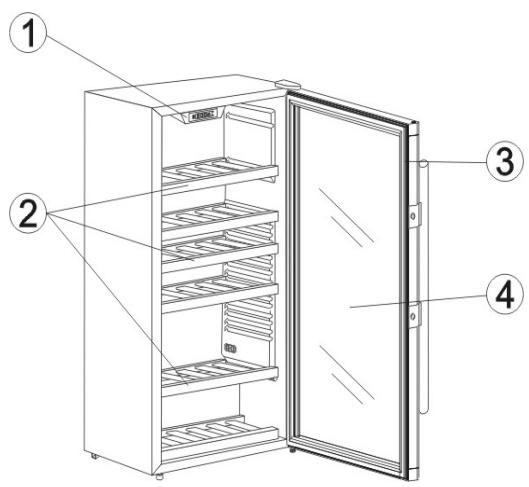
ILLUSTRATION OF THE APPLIANCE
- THERMOSTAT:
For controlling the temperature inside the wine cooler.
- CHROME PLATED SHELVES:
Removable for easy cleaning.
- MAGNETIC GASKET: Tight fitting door seal keeps all the cooling power locked inside. No hooks or latches.
- TEMPERED GLASS DOOR:
Allows easy interior visibility.
Maintenance and Cleaning
Automatic Defrosting of the Appliance
There is no need to defrost the cooler, because ice depositing on the inner back wall is defrosted automatically.
Ice build-up on the inner back wall during the compressor operation will defrost automatically (when the compressor has cycled off). Defrost water will drain out passing through the drain outlet in the inner back wall into a drain pan situated above the compressor, from where it evaporates.
Cleaning the Appliance
Disconnect the power supply before cleaning the appliance.
Do not use coarse or aggressive cleaning agents as you may damage the surface.
Clean the exterior with water and detergent. Remove the detachable accessories in the interior of the appliance and clean with water and liquid detergent. Plastic parts cannot be washed in dishwashers.
- Wash the interior of the appliance with lukewarm water, adding one or two spoonfuls of vinegar. After cleaning, connect the appliance to power supply and reload it.
Switch Off the Appliance When Not In Use
If you do not intend to use the appliance for long periods of time, disconnect the power supply, take out the contents and defrost and clean the appliance. Leave the door slightly open.
Correct Step to Change Bulb:
1.Pull out the power plug from wall socked. Use a screw driver to loose the screw that holds the bulb protective cover and then remove the cover.
2.Screw out the old bulb counter-clockwise.
3.Screw on a new bulb ( max. power 15W) clockwise.
4. Replace the bulb protective cover.
Very important:
Be sure to disconnect power supply before you change bulb.
- Sometimes you may come across minor problems that in most cases do not require a service call and can be easily eliminated. The problem may have resulted from improper handling and / or installation of the appliance. Please refer to the below trouble-shooting guide to assist you in identifying the possible cause and solution to your problem. Should the problem still persist after completing these checkpoints, contact the closest authorized service agent in your area for assistance.
The Appliance Fails to Operate After Connecting to Electrical Power Supply
- Check the power cord is properly connected.
- Check the power supply in the electrical outlet. (blown fuse / circuit breaker).
Continuous Operation of the Cooling System
- The door is frequently opened or left open for too long.
- The door is not properly closed (the door may sag, the gasket may be polluted or damaged).
Perhaps you may have overloaded the appliance. - The reason may be inadequate ventilation of the compressor (assure adequate air circulation).
Ice Formation on the Inner Rear Wall
As long as the defrost water runs to the channel and through the outlet to the drain pan on the compressor, automatic defrosting of the appliance is assured.
In case the ice formation on the inner back wall is increased (3-5mm.), ice should be manually defrosted.
Disconnect the power supply, leave the door open and defrost the ice. Never use electric devices for defrosting and do not scrape the ice or frost layer with sharp objects.
After defrosting is complete, close the door, connect the power supply and set the temperature as desired. The cause of increased ice formation may be one of the following:
- the door does not seal well (clean the gasket if it is contaminated, or replace it if it is damaged);
- the door is frequently opened or left open too long;
- the content stored in the appliance was warm;
- the contents are touching the inner back wall.
Water is Leaking From the Appliance
If the discharge water outlet is clogged, or the defrost water drips over the channel, water will leak from the appliance.
Clean the clogged outlet.
. Manually defrost the increased ice layer ( see Ice Formation on the Inner Rear Wall ).
Noise
Cooling in this appliance is made possible by cooling the system using a compressor, which will produce certain noise levels. How noisy the appliance is depends on where it is placed, how it is used and how old the appliance is.
During the operation of the compressor the noise of the liquid is heard and when the compressor is not operating, the refrigerant flow is heard. This is a normal condition and it has no influence whatsoever on the lifetime of the appliance.
After starting the appliance, the operation of the compressor and the refrigerant flow may be louder, which does not mean that something is wrong with the appliance and it has no influence on the lifetime of the appliance. Gradually the noise will reduce.
Sometimes unusual and louder noise may be heard. This noise is often a consequence of inadequate installation.
- The appliance must be level and installed on a firm solid base/floor.
- The appliance should not touch the wall or kitchen units standing next to it.
Check the accessories on the interior of the appliance, they should be placed correctly in their positions; also check bottles, tins, and other vessels are not touching each other causing rattling and/or vibrations.
Weinkühler
Weinkühler
- CAUTION:
- SAVE THESE INSTRUCTIONS
- Before Putting Into Use 2
- Important 3
- Placing and Installation 4
- Description of the Appliance 5
- Temperature Control and Display 5
- Maintenance and Cleaning 7
- Trouble-Shooting Guide 8
- Before Putting Into Use
- To Assemble Door Handle
- Instructions for Use
- Tips for Energy Saving
- Important
- WARNING:
- Disposing of Worn Out Appliances
- Placing and Installation
- CHOOSING THE RIGHT PLACE
- WARNING
- Placing the Self-standing Appliance
- WIRING INSTRUCTIONS
- CONNECTION TO POWER SUPPLY
- Description of the appliance
- Adjustable Wire Shelves
- Defrost Water Outlet
- WE RESERVE THE RIGHT TO ALTER THE SPECIFICATIONS WITH NO EFFECT ON THE OPERATION OF THE APPLIANCE.
- Temperature Control and Display
- PRESET WINE ZONES:
- MANUAL TEMPERATURE SETTING:
- NOTES:
- ILLUSTRATION OF THE APPLIANCE
- Maintenance and Cleaning
- Automatic Defrosting of the Appliance
- Cleaning the Appliance
- Switch Off the Appliance When Not In Use
- Correct Step to Change Bulb:
- Very important:
- The Appliance Fails to Operate After Connecting to Electrical Power Supply
- Continuous Operation of the Cooling System
- Ice Formation on the Inner Rear Wall
- Water is Leaking From the Appliance
- Noise
- Weinkühler
Brand : LA SOMMELIERE
Model : CVD 121 V
Category : Wine Cooler