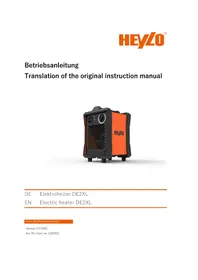
DE 2 XL - Frying Pan Heylo - Free user manual and instructions
Find the device manual for free DE 2 XL Heylo in PDF.


| Product Type | Frying Pan |
| Brand | Heylo |
| Model | DE 2 XL |
| Material | Aluminum body with durable non-stick coating |
| Handle Material | Heat-resistant plastic with ergonomic grip |
| Non-stick Coating | PFOA-free, scratch-resistant |
| Exterior Finish | Black metallic |
| Diameter | 28 cm (11 inches) |
| Depth | 7 cm |
| Bottom Thickness | 4.5 mm for even heat distribution |
| Weight | 1.2 kg |
| Compatible Heat Sources | Gas, electric, ceramic, and induction |
| Oven Safe Temperature | Up to 180°C (with handle) |
| Dishwasher Safe | No, hand wash recommended |
| Suitable Utensils | Wooden, silicone, or plastic utensils only |
| Main Functions | Frying, sautéing, searing, and simmering |
| Maintenance | Wash with warm soapy water and a soft sponge |
| Safety Features | Stable base and cool-touch handle |
| Spare Parts Availability | Replacement handles and lids available from manufacturer |
| Warranty | 2-year manufacturer warranty |
Frequently Asked Questions - DE 2 XL Heylo
User questions about DE 2 XL Heylo
0 question about this device. Answer the ones you know or ask your own.
Ask a new question about this device
Download the instructions for your Frying Pan in PDF format for free! Find your manual DE 2 XL - Heylo and take your electronic device back in hand. On this page are published all the documents necessary for the use of your device. DE 2 XL by Heylo.
USER MANUAL DE 2 XL Heylo
Translation of the original instruction manual

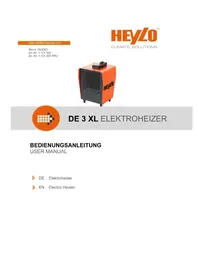
DE Elektroheizer DE2XL
EN Electric heater DE2XL
www.danthermgroup.com
Version 07/2023
13 About this operating manual 21
13.1 The purpose of this manual. ---- 21
13.2 Keep the manual safe and at hand at all times 21
13.3 Symbols and definitions used ---- 21
13.4 Warranty 22
13.5 Contacting DANTHERM GmbH---- 22
14 Safety 23
14.1 Information on electrical equipment ---- 24
14.2 Notes on fire protection 24
14.3 Operating conditions 25
14.4 Residual hazards 26
15 Product description---- 26
15.1 Identification 26
15.2 General description 26
15.2.1 Intended use 27
15.2.2 Improper use 27
15.2.3 Foreseeable improper use ---- 27
15.3 Device components 28
15.3.1 Fan 28
15.3.2 Safety devices 28
15.4 Operating and display elements ---- 28
16 Transportation and connection 28
17 Commissioning 29
18 Operation 30
18.1 The sequences for switching on and off -- 30
18.2 Operating modes 31
19 Faults 31
19.1 Malfunctions during operation ---- 32
20 Cleaning and maintenance 33
20.1 Cleaning the device 33
20.2 Customer service by the manufacturer --- 34
21 Repairs 34
22 Decommissioning, storage and disposal ---- 34
22.1 Decommissioning 34
22.2 Storing the device 35
22.3 Disposal 35
23 Technical details ---- 35
24 Supplementary documents ---- 35
24.1 Declaration of conformity 35
13 About this operating manual
This operating manual (hereinafter referred to as the "manual") will enable you to operate the DE2XL-series electric heater (hereinafter referred to as the "device") safely. It describes the device manufactured by DANTHERM GmbH (hereinafter referred to as HEYLO).
- Please read the manual carefully.
– Follow all safety instructions.
13.1 The purpose of this manual.
The manual should be used by the company operating the device and all the staff who use it as a guide and reference book pertaining to the operation and technical aspects of the device.
The technical data concerning settings, maintenance and the electrical features have been prepared for specialists who are specially authorised for these areas of responsibility. Unauthorised persons may not carry out the work specified here.
13.2 Keep the manual safe and at hand at all times
The manual must always be kept where the machine is located. The manual must be available to all operators of the device throughout the service life of the device.
13.3 Symbols and definitions used
This section explains the symbols used in this manual.
Instructions
The safety instructions in this manual contain the following elements:
DANGER
Warning indicating an immediate danger for people
This safety instruction warns of an immediate dangerous situation which can lead to serious injury or death.
WARNING
Warning of a potential risk to human life.
This safety instruction warns of a potentially hazardous situation which, if not avoided, could result in death or serious injury.
CAUTION
Warning of a potential risk to human life.
This safety instruction warns of a potentially hazardous situation which, if not avoided, could result in minor to moderate injury.
Attention
Warning of possible damage to property.
This safety instruction warns of damage to machinery.
A safety instruction contains the following information:
- Heading
- Type and source of hazard
- Effects
- Remedy (= measures to take to avoid the risk)
Example

DANGER
Electric shock due to high voltage (type and source of danger)
Death from electric shock! (effects)
a) Wait four minutes before starting work on the motor connections! (measures)
Important or helpful instructions, information and tips have the following structure:

NOTICE
Instruction
User tips and useful information that help you to make optimal use of the device's functions are listed below this symbol.
Mandatory symbols
The manual uses the following mandatory symbols.
| Symbol Meaning | |
 | General instructionThis symbol indicates instructions and may signal prohibitions. |
 | Covering prohibitedTo prevent overheating, never cover the heater. |
Tab. 4: Mandatory symbols
Markings in the text
- Listings are indicated by an indent mark (-).
- Text marked in this way highlights references and hyperlinks referring to related topics, internet addresses, and other information.
-
Text highlighted in bold indicates highlighting or subheadings.
-
Menu items, tabs, buttons and Softkey buttons are set in angled brackets <...>, e.g.
. - Sequences are enclosed in angle brackets <...>, e.g.
. - Buttons or indicator lights on a keyboard or control panel are enclosed in square brackets, e.g. [Start].
- Text highlighted in this way PLC indicates a cross-reference to the glossary with an explanation of terms.
Action instructions
As a rule, action instructions have the following structure:
√ Conditions that are necessary in order for the action to be carried out may also be referred to here.
a) These are followed by operating steps
b) Another operating step
⇒ Partial result after one operating step
c) Another operating step
→ Overall result of an action instruction
13.4 Warranty
In general, the "General Terms and Conditions of Sale and Delivery" of DANTHERM GmbH shall apply. Operating the device in accordance with its intended use is the prerequisite for a successful claim for statutory liability for material defects within the first two years of the date of purchase.
13.5 Contacting Dantherm GmbH
If you have any questions about the device, please get in touch with your sales partner.
We will also gladly provide information ourselves. If you have any queries regarding the machine, refer to the WITTE website or please contact WITTE with the following details (by phone, fax, letter or online):
- Your name and address,
- Contact person at your company,
- The data on the rating plate: Type, serial no. and year of construction.
Address: Dantherm GmbH Oststrasse 148 22844 Norderstedt
Telephone: +49 (0) 40/52 68 790
Email: Info.de@danthermgroup.com
Internet: http://www.danthermgroup.com
Tab. 5: Registered office
14 Safety
The heater is manufactured using engineering best practice and in accordance with recognised safety engineering rules. Nonetheless, danger to the life and limb of the operator or third parties may arise if it is not used properly. Similarly, the device or other property and material may become damaged.
The device must only be used:
– for the purpose for which it was intended
- and when it is in perfect technical condition.
The device must not be restarted until any fault that may impair safety has been rectified.
Any persons installing, operating, maintaining or cleaning the device must be aware of the hazards that may arise from mobile, electrically operated heating equipment in environments with a high humidity, and they must have read and understood this operating manual.
Avoiding dangerous situations
The following instructions apply to anyone working on or with the device:
- The operating manual must be kept at hand, in complete and legible form, at the place where the device is used.
- The device must be fully functional and in faultless condition. The condition of the device must be checked regularly before use.
- The device must be handled with care. Do not drop or throw the device or place it on an unstable surface from where it can fall down. Rough handling can damage the device and lead to dangerous situations or make the warranty invalid.
- The device must be kept away from children. Children must be denied access to the unattended device.
- Certain components of the device can become very hot and pose a burn hazard. Particular attention must be given to places where children and vulnerable people are present.
Information on transport and installation
The following principles apply during operation:
- Switch off the device, pull out the plug and allow the device to cool down before lifting or moving it.
- Do not position the device right below a wall socket.
Instructions for operation
The following principles apply during operation:
- Do not modify, dismantle or take any safety devices out of operation. All safety equipment must be checked at regular intervals.
- All the covering panels, covers and hoods must be installed as intended.
- Structural changes to the device are not allowed.
- The device must not be operated if the power cable is damaged.
- Never pull on the cable, but grasp the plug and pull it out.
Never touch the plug with wet or damp hands.
- Children aged 8 or over and persons with reduced physical, sensory or mental capabilities, lack of experience or knowledge may only use this device if they are supervised or have been instructed on how to use the device safely and understand the dangers. Children must not play with the device.
- Children between three years and eight years may only switch the device on and off if it has been set-up or installed in the normal, intended operating position, if they have been instructed on how to safely use the device and understand the dangers associated with the device. Children between the ages of three and eight years must not connect up, operate, clean or maintain the device.
- Children up to three years must be kept away from the heater if they are not continuously monitored.
Maintenance and troubleshooting instructions
The following principles apply for troubleshooting.
- Only suitably trained and qualified staff may perform such work on the device.
- Cleaning and maintenance may not be carried out by children without supervision.
- The mains plug must always be disconnected before opening the housing for cleaning and maintenance purposes.
- The device should always be allowed to cool down before work is started.
14.1 Information on electrical equipment
During all work on electrical equipment, the following principles shall apply:
- The device is operated electrically. There is a risk of fatal injury from faulty installation of the electrical system or from a breakdown of the insulation during operation.
- Only electricians are allowed to access and work on electrical equipment.
- Pull the mains plug out of the socket to disconnect the device from the mains supply.
- Only insert the mains plug into sockets that are protected by an RC (residual current) circuit-breaker.
- Never interrupt the earthing.
14.2 Notes on fire protection
The device is equipped with a safety thermostat. This switches the device off in the event that it overheats (the operating temperature is exceeded). Eliminate the causes of overheating, let the device cool down, unplug the device from the mains and operate the safety temperature limiter on the bottom of the device, observe the following precautions:
- WARNING! To prevent overheating, never cover the device.
- Keep the air inlet and protective grille free of obstructions and dirt. A reduced air flow can lead to overheating of the components or the
device. Do not use near curtains or other objects that can block the air inlet opening.
- Do not use near open fires or heat sources.
- Do not use or store in areas where combustible gaseous, air or dust-air mixtures could be produced, or in aggressive atmospheres.
- Do not use in areas where the device can suck in flammable small parts such as wood shavings or straw.
- The device should not be exposed to significant dust emissions. Dust deposits on the heating element can cause a short-circuit when moisture is also present.
14.3 Operating conditions
Under inadmissible operating conditions, the operational safety and the performance of the device may not be sufficiently ensured. Inadmissible operating conditions must therefore be avoided at all times.
When installing the device, the respective local building, fire prevention and trade association regulations must always be adhered to. Different ambient conditions can pose different dangers.
Installation location
The device must not be connected to air ducts or hoses.
The following safety clearances to flammable fume parts must be strictly observed:
- Lateral: 0.60 m
- Outlet side: 2.00 m
- Inlet side: 0.20 m
- Upwards: 2.00 m
The following principles apply to the place of installation and to installing the device:
- The device is designed for the heating/ventilation of closed rooms.
- The device must not be used in rooms and environments with explosive atmospheres, combustible liquids or gases.
- Do not use the device outdoors in damp weather, in bathrooms or in other damp environments.
- The device must never be operated in the immediate vicinity of bathtubs, showers, wash basins or swimming pools.
- The floors and ceilings at the place of installation must be fire retardant.
- A sufficient safety clearance to flammable objects such as furniture, curtains and the like must be maintained.
- The intake and outlet nozzles of the device must not be narrowed or covered. The safety clearances must be observed.
The device must not be covered with textiles and the like (e.g. curtains).
- The device must be installed in an upright and stable way.
- The mains voltage must correspond to the details on the rating plate.
- Extension cables must be selected according to the performance data on the rating plate, in order to prevent overload.
Keep extension cables as short as possible and only ever use them when they are fully extended.
- The socket used must be earthed or protected with an RC circuit-breaker when installed indoors.
- Only ever operate one device from one socket to prevent overloading.
- Do not switch the device on automatically with a timer or similar device.
- Monitor the device during operation and keep children and pets at a safe distance.
The following principles apply to handling the device:
- Always handle the device with care. Never drop the device, do not throw it or transport it unsecured.
- Only original spare parts or parts approved by the manufacturer may be used.
- People under the influence of alcohol, drugs or medication must not operate or maintain the device.
Areas of application / technical design
The main purpose of the device is for heating closed rooms in a variety of different workplaces. The device is used for heating rooms or materials.
14.4 Residual hazards
The following residual hazards cannot be eliminated completely.
- The danger that persons who are not authorised and qualified may operate the device.
- Danger of flammable substances reaching the heating element.
15 Product description
The device is a lightweight, easily transportable air heater. The device is suitable for spot heating (e.g. of machines or workplaces) and for heating enclosed spaces (e.g. warehouses, workshops, construction sites, greenhouses).
The desired air temperature can be adjusted within a range of 5° C to 30° C using a rotary knob.
15.1 Identification
The device can be clearly identified using the rating place on the housing.
Rating plate

CLIMATE SOLUTIONS
Elektro Heizer
Electric Heater
DE 2 XL
220-240V\~50Hz
2000 W IP20
Art.-Nr. 1101922


Dantherm GmbH
Oststrasse 148
D-22844 Norderstedt
www.danthermgroup.com
The type plate bears the following information on the device:
- Model
- Rating number
- Electrical connection information
- Serial number
15.2 General description
The device is a compact, versatile, easily transportable and mobile solution for generating hot air in enclosed spaces.
The device must only be operated:
- for the purpose for which it was intended,
- and by observing all instructions Safety [▶ 23] given in the chapter.
Assembly, scope of delivery and accessories

Fig. 3: Electric heater
| 1 | Carry handle 2 | Housing | |
| 3 | Air outlet 4 | Air inlet | |
| 5 | Heating temperature rotary knob | 6 | Rotary selector for operating mode (Heat 1000 W, Heat 2000 W) |
The scope of supply includes:
- Air heater
- Operating manual
Available accessories: see Accessories list.
Mode of operation
The device is equipped with a heating element, a fan and a thermostat.
Air is sucked in by the fan on the inlet side, routed through the heating element where it is heated and then emitted on the outlet side.
The device can generate a room temperature of up to 30° C.
The thermostat identifies the temperature of the air taken in at the air inlet and then regulates the temperature of the heating element. The heating element and the fan are switched off when the set
room temperature (maximum 30° C) is reached at the air inlet.
The heating element and the fan are switched back on automatically when the room temperature falls below the set heating temperature.
See also
Intended use [▶ 27]
15.2.1 Intended use
The device serves to generate warm air. The warm air can be used for spot heating or for heating enclosed spaces.
Intended use also includes observance of the operating conditions (see Operating conditions [▶ 25]).
Any other use or any application transcending the specified use is considered improper use. Improper use will result in all warranty claims becoming void.
See also
Technical details [▶ 35]
15.2.2 Improper use
Any uses other than the heating of air are prohibited. Improper use may lead to danger.
- Improper use is, for example, if safety-related components are interfered with without authorization.
- In addition, improper use is if the specified operating conditions are not met or the device is insufficiently maintained.
15.2.3 Foreseeable improper use
The following types of misuse can be envisaged:
- Operation while ignoring prescribed safety clearances
- Operation while ignoring applicable operating conditions
15.3 Device components
15.3.1 Fan
The fan in the device is installed vertically. The fan draws in the ambient air and blows it through the PTC heating element. This causes the air to be heated up and is then emitted in heated form to the room.
15.3.2 Safety devices
Persons can be injured on the device if the safety devices are not properly installed and set. Do not modify, dismantle or take any of the safety devices out of operation. All the safety devices must be freely accessible at all times.
Familiarize yourself with all the safety devices; this way personal injury and/or damage to property can be prevented or minimized.

Fig. 4: Safety devices
| 1 | Carry handle 2 | Thermal insulated housing | |
| 3 | Air outlet safety guard | 4 | Air inlet safety guard |
The device has the following additional safety devices:
- Temperature limiter
15.4 Operating and display elements
The device is operated solely by means of the rotary selector and the rotary knob.
The functions of the control elements are:
- Rotary selector for operating mode: To select the functions Heat 1000 Watts, Heat 2000 Watts.
- Rotary knob: To set the heating temperature from min. (+5 ° C) to max. (30 ° C).
See also
Safety devices [▶ 28]
16 Transportation and connection
The device has been assembled, set up and tested at the factory.
DANGER
Danger to life due to electric shock
Touching electrically live parts can be fatal.
a) Always turn the device off at the device switch before any change of location and pull out the mains plug.
b) Never pull the device by the mains plug and always carry it using the carry handle.
Transportation
a) To connect up the device, insert the mains plug into a suitable socket.
b) Ensure that you adhere to the Operating conditions [▶ 25].
See also
Technical details [▶ 35]
17 Commissioning

WARNING
Danger to life due to electric shock
Operating the heater in a humid environment, with a damaged mains lead or beneath a wall socket may result in an electric shock. An electric clock may lead to death or serious injury.
a) Do not use the heater in the immediate vicinity of a bath, a shower or a swimming pool.
b) If the mains lead is damaged, it must be replaced by the manufacturer, the manufacturer's customer service or similarly qualified persons.
c) The heater may not be operated beneath a wall socket.

WARNING
Danger from operation by unauthorised and unqualified persons
Heater operation by either children or persons with limited physical, sensory or mental capabilities may lead to serious injuries.
a) Children aged eight and over and people with limited physical, sensory or mental capabilities may only operate the heater if they are supervised or have been instructed in how to use it safely and if they understand the dangers.

WARNING
b) Children between the ages of three and eight may only operate the heater under supervision.
c) Children up to three years must be kept away from the heater if they are not continuously monitored.
d) Children must not play with the device.

CAUTION
Risk of burns due to hot surfaces
The device covers on the outlet side can reach high temperatures during operation and cause burns. Particular caution is required when either children or people with limited physical, sensory or mental capabilities are present.
a) Wear protective gloves.
b) Supervise children or persons with limited physical, sensory or mental capabilities who are in the vicinity of the heater.
√ The device is now installed and connected.
√ The device does not exhibit any externally recognizable defects; all the protective panels have been mounted.
√ The Operating conditions [▶ 25] for the place of installation have been met.
a) Make sure that the device is not standing on a wet base and ensure that it stands upright and safe.
b) Make sure that the power cable is undamaged.
c) Insert the power plug into the socket.
d) Select the desired operating mode on the rotary selector.
e) Set the desired heating temperature with the rotary knob.
→ You have now commissioned the device.
See also
Safety [▶ 23]
18 Operation

WARNING
Danger to life due to electric shock
Operating the heater in a humid environment, with a damaged mains lead or beneath a wall socket may result in an electric shock. An electric clock may lead to death or serious injury.
a) Do not use the heater in the immediate vicinity of a bath, a shower or a swimming pool.
b) If the mains lead is damaged, it must be replaced by the manufacturer, the manufacturer's customer service or similarly qualified persons.
c) The heater may not be operated beneath a wall socket.

WARNING
Danger from operation by unauthorised and unqualified persons
Heater operation by either children or persons with limited physical, sensory or mental capabilities may lead to serious injuries.
a) Children aged eight and over and people with limited physical, sensory or mental capabilities may only operate the heater if they are supervised or have been instructed in how to use it safely and if they understand the dangers.
b) Children between the ages of three and eight may only operate the heater under supervision.
c) Children up to three years must be kept away from the heater if they are not continuously monitored.
d) Children must not play with the device.

CAUTION
Risk of burns due to hot surfaces
The device covers on the outlet side can reach high temperatures during operation and cause burns. Particular caution is required when either children or people with limited physical, sensory or mental capabilities are present.
a) Wear protective gloves.
b) Supervise children or persons with limited physical, sensory or mental capabilities who are in the vicinity of the heater.
18.1 The sequences for switching on and off
Switching the device on
√ Commissioning is now completed.

NOTICE
Process sequence
After switching on the device with the Operating moderotary switch, the device independently regulates the running times of the device components (fan, heating). Information about this can be found in the Section Operating modes [▶ 31].
a) Select the desired operating mode on the rotary selector.
⇒ The heating element and the fan start up.
b) Set the desired heating temperature with the rotary knob.
⇒ The air is heated at the outlet side.
⇒ You have now switched on the device.
Switching the device off
a) Set the Heating temperature rotary knob to the Min position.
b) Move the Operating mode rotary selector to the Ventilate position.
⇒ Allow the device to run for approx. two minutes until it has cooled down.
c) Move the Operating mode rotary selector to the 0 position.
During prolonged downtime: Pull out the mains plug.
→ You have now switched off the device.
See also
Malfunctions during operation [▶ 32]
18.2 Operating modes
The operating mode can be used to select the heating output. The device emits the intake air in heated form (Heat 1000 W or Heat 2000 W).
The operating mode can only be selected with the Operating mode rotary selector.
Operating mode Heat (1000 W)
- Move the Operating mode rotary selector to position 2 (Heat 1000 W).
- The fan and the heater are switched on and are conveying and heating up the intake air.
- The desired temperature is set with the Heating temperature rotary knob.

NOTICE
Single-sided warming of the heating element
In the 1000 W mode, one half of the heating element remains cooler than the other half. This is a normal operating condition.
Operating mode Heat (2,000 W)
- Move the Operating mode rotary selector to position 3 (Heat 2,000 W).
- The fan and the heater are switched on and are conveying and heating up the intake air.
- The desired temperature is set with the Heating temperature rotary knob.
19 Faults
Observe the following principles if you looking for the causes of faults and want to eliminate them:
These tasks may only be carried out by trained and authorised specialists.
Interventions may only be carried out by the manufacturer or by persons authorised by the manufacturer during the statutory warranty period.
a) Let the device cool down.
b) Wear suitable protective clothing.
c) Before recommissioning, install all the safety devices as attached at the factory.
d) Check that the safety devices are functioning properly.
e) After completing the task, remove all the tools and objects from the working area around the device.
Safety instructions regarding faults

DANGER
Electric shock arising from high voltage when working on the electrical components
Electric shock can cause serious injury or death.
a) Any work on the electrical system must be performed by qualified electricians only.
b) Disconnect the device from the power supply before performing any work on the electrical system.
c) After completion of the work, install all protective equipment as provided at the factory.
19.1 Malfunctions during operation

NOTICE
If the device is supplied with electricity via the power cable, work on the electrical system may only be carried out by qualified electricians.
Only have repair work carried out by the HEYLO Service division or by service partners of HEYLO.
| Rectifying | Possible cause | Remedy |
| Device does not start | No electricity because:– Rotary selector for Operating mode switched off– Residual current device of the indoor in- | Check the power cable and the mains connection. |
| Check supply with voltage tester. |
| Rectifying | Possible cause | Remedy |
| stallation tripped- Mains plug disconnected- Supply line defective | ||
| Residual current device of the indoor installation has tripped. | Clean the heating element (if necessary with compressed air), otherwise send the device for repair. | |
| If the device has come into contact with moisture, allow it to dry out completely prior to operation. | ||
| Safety temperature limiter triggered: Intake or blow-out temperature too high, air cannot circulate freely, | device has over-heated. Disconnect the plug and wait for 10 minutes to cool down. Insert the tool into the reset hole on the bottom and press the reset button. Turn on again. | |
| Heating element defective. | Send the device in for repair. | |
| The device does not heat up | Rotary selector for Operating mode not set to Heat | Move the Operating mode rotary selector to Heat (1000 W or 2000 W) |
| Thermostat has tripped | Turn the Heating temperature rotary knob and listen outfor the open/close sound. If a clicking sound is not heard and the thermostat is not faulty, then the thermostat switches on automatically as soon as the device has cooled down. | |
| Device heats up, fan does not run | Fan defective. Send the device in for repair. | |
| Unusual sound | The device is not in an upright position. | Set the device down on a level surface. |
| The fan wheel is blocked or dirty. | Free the fan wheel of any blockages and dirt. | |
Tab. 6: Fault list
20 Cleaning and maintenance
The following principles apply when cleaning and maintaining the device:
a) Switch off the device before starting work and then pull out the mains plug.
b) Let the device cool down.
The replacement of electrical components may be carried out by a qualified electrician.
DANGER
Danger to life due to electric shock
Contact with live components can be fatal.
Contact with a damaged mains lead can lead to death or serious injury.
a) Switch off the device and pull out the mains plug.
b) A damaged mains lead must be replaced by the manufacturer, the manufacturer's customer service or similarly qualified persons.
CAUTION
Risk of burning due to hot surfaces
The device covers on the outlet side can reach high temperatures during operation.
a) Wear protective gloves.
20.1 Cleaning the device
NOTICE
Suitable cleaning agents
You can obtain suitable cleaning agents for cleaning your device from your dealer or directly from HEYLO.
The cleaning intervals for the device will depend on the conditions of use. Therefore check and clean the device regularly.
Cleaning the outside of the device
Cleaning can be performed with compressed air, a vacuum cleaner (e.g. for cleaning dusty electrical components) or by wiping with a damp cloth.
CAUTION! Never use a high-pressure cleaner.
CAUTION! Electrical components must never come into contact with water or chemical cleaners.
Proceed as follows to clean and check the condition of the device:
a) Move the Operating mode rotary selector to the 0 position and pull out the mains plug.
b) Wait until the temperature at the outlet nozzle has dropped to ≤ 30° C.
Cleaning the inside of the device
a) Open the safety cover.
b) Clean the safety cover and the housing with a damp, lint-free cloth and a mild detergent.
c) Clean the electrical components with compressed air.
d) Wait until all the components that have been wiped are dry.
e) Close the safety cover as intended at the factory.
→ The device has now been cleaned.
20.2 Customer service by the manufacturer
If the device states are unclear and you have any questions about repair, the HEYLO service will be happy to help.
See also
Contacting Dantherm GmbH [▶ 22]
21 Repairs
The following section describes who may repair the device and how it can be repaired.

NOTICE
Repairs may only be carried out by staff authorised by the manufacturer during the warranty period of the device.
Repairs performed by the company operating the device
After the statutory warranty has expired, repairs may be carried out by the company operating the device, provided appropriate expertise is shown. HEYLO will not assume any liability for these repairs.
Contact the HEYLO service department or your dealer if you have any questions about repairs.
See also
Contacting Dantherm GmbH [▶ 22]
22 Decommissioning, storage and disposal
The following principles apply for the decommissioning, storage and disposal of the device:

DANGER
Danger to life due to electric shock
Touching electrically live parts can be fatal.
a) Switch off the device and pull out the mains plug.
22.1 Decommissioning
Temporary decommissioning
a) Move the Operating mode rotary selector to the 0 position.
b) Clean the device (see Cleaning and maintenance [▶ 33]).
⇒ The device has now been temporarily decommissioned.
Final decommissioning
√ Carry out all the steps needed for temporary decommissioning.
a) Disconnect all the incoming and outgoing lines (power supply lines).
⇒ You have now taken the device permanently out of service.
See also
Contacting Dantherm GmbH [▶ 22]
22.2 Storing the device
Store the device dry and free of frost.
See also
Technical details [▶ 35]
Operating conditions [▶ 25]
22.3 Disposal
The device is largely made of recyclable materials. It does not represent any danger to the operator and the environment when handled properly. However, operation of the device may lead to the generation of waste and waste water containing harmful and/or environmentally hazardous substances (air filters). These materials must be disposed of properly in accordance with the regulations.
The individual components of the device (e.g. metal components, etc.) must be taken to a qualified disposal and recycling company. Appoint a qualified, specialist company to dispose of and recycle the device.
See also
Contacting Dantherm GmbH [▶ 22]
23 Technical details
| Type: DE2XL | |
| Temperature range [°C] +5 - +30 | |
| Nominal heating output [kW] 2.0 | |
| Type: DE2XL | |
| Air throughput [m3/h] 90 | |
| Sound level at a distance of 3 m [dB(A)] | 47 |
| Power connection [V/Hz] 220-240 / 50 | |
| IP enclosure class 20 | |
| Current consumption [A] 8.7 | |
| Fuse protection [A] 10 | |
| Set values for ventilate/heat 50%/heat 100% [W] | 25/1000/2000 |
| Temperature limit for manually-resetting thermostat [°C] | 80 |
| Length [mm] 185 | |
| Width [mm] 180 | |
| Height [mm] 280 | |
| Weight [kg] | 2.8 |

NOTICE
The technical details may be changed without prior notice during the course of development. Some of the values are approximate.
24 Supplementary documents
24.1 Declaration of conformity
EC Declaration of Conformity IIA In accordance with the EC Machinery Directive 2006/42/EC

For device series: Electric heaters
Type: DE2XL
DANTHERM GmbH, of Im Finigen 9, 28832 Achim, declares that the machines specified comply with
the essential health and safety requirements of the "Machinery Directive" and the following provisions and standards, provided they are installed, maintained and used in accordance with the operating manual and in accordance with the recognized rules of technology.
Applicable EC Directives:
Machinery Directive 2006/42/EC
Low-voltage Directive 2014/35/EU
EMC Directive 2014/30/EU
Changes to the machinery made without our consent will render this declaration void.
Applied standards:
Norderstedt, Germany, 21/07/2023

Manfred Föhlisch
- Chief Executive -

- TRANSLATION OF THE ORIGINAL INSTRUCTION MANUAL
- 13 ABOUT THIS OPERATING MANUAL 21
- 14 SAFETY 23
- 15 PRODUCT DESCRIPTION---- 26
- 16 TRANSPORTATION AND CONNECTION 28
- 17 COMMISSIONING 29
- 18 OPERATION 30
- 19 FAULTS 31
- 20 CLEANING AND MAINTENANCE 33
- 21 REPAIRS 34
- 22 DECOMMISSIONING, STORAGE AND DISPOSAL ---- 34
- 23 TECHNICAL DETAILS ---- 35
- 24 SUPPLEMENTARY DOCUMENTS ---- 35
- 13 ABOUT THIS OPERATING MANUAL
- 13.1 THE PURPOSE OF THIS MANUAL
- 13.2 KEEP THE MANUAL SAFE AND AT HAND AT ALL TIMES
- 13.3 SYMBOLS AND DEFINITIONS USED
- INSTRUCTIONS
- DANGER
- WARNING INDICATING AN IMMEDIATE DANGER FOR PEOPLE
- WARNING
- WARNING OF A POTENTIAL RISK TO HUMAN LIFE
- CAUTION
- ATTENTION
- WARNING OF POSSIBLE DAMAGE TO PROPERTY
- EXAMPLE
- ELECTRIC SHOCK DUE TO HIGH VOLTAGE (TYPE AND SOURCE OF DANGER)
- NOTICE
- INSTRUCTION
- MANDATORY SYMBOLS
- MARKINGS IN THE TEXT
- ACTION INSTRUCTIONS
- 13.4 WARRANTY
- 13.5 CONTACTING DANTHERM GMBH
- 14 SAFETY
- AVOIDING DANGEROUS SITUATIONS
- INFORMATION ON TRANSPORT AND INSTALLATION
- INSTRUCTIONS FOR OPERATION
- MAINTENANCE AND TROUBLESHOOTING INSTRUCTIONS
- 14.1 INFORMATION ON ELECTRICAL EQUIPMENT
- 14.2 NOTES ON FIRE PROTECTION
- 14.3 OPERATING CONDITIONS
- UNDER INADMISSIBLE OPERATING CONDITIONS, THE OPERATIONAL SAFETY AND THE PERFORMANCE OF THE DEVICE MAY NOT BE SUFFICIENTLY ENSURED. INADMISSIBLE OPERATING CONDITIONS MUST THEREFORE BE AVOIDED AT ALL TIMES
- INSTALLATION LOCATION
- AREAS OF APPLICATION / TECHNICAL DESIGN
- 14.4 RESIDUAL HAZARDS
- 15 PRODUCT DESCRIPTION
- 15.1 IDENTIFICATION
- RATING PLATE
- 15.2 GENERAL DESCRIPTION
- MODE OF OPERATION
- SEE ALSO
- 15.2.1 INTENDED USE
- 15.2.2 IMPROPER USE
- 15.2.3 FORESEEABLE IMPROPER USE
- 15.3 DEVICE COMPONENTS
- 15.3.1 FAN
- 15.3.2 SAFETY DEVICES
- 15.4 OPERATING AND DISPLAY ELEMENTS
- 16 TRANSPORTATION AND CONNECTION
- DANGER TO LIFE DUE TO ELECTRIC SHOCK
- TRANSPORTATION
- 17 COMMISSIONING
- DANGER FROM OPERATION BY UNAUTHORISED AND UNQUALIFIED PERSONS
- RISK OF BURNS DUE TO HOT SURFACES
- 18 OPERATION
- 18.1 THE SEQUENCES FOR SWITCHING ON AND OFF
- PROCESS SEQUENCE
- SWITCHING THE DEVICE OFF
- 18.2 OPERATING MODES
- OPERATING MODE HEAT (1000 W)
- SINGLE-SIDED WARMING OF THE HEATING ELEMENT
- OPERATING MODE HEAT (2,000 W)
- 19 FAULTS
- ELECTRIC SHOCK ARISING FROM HIGH VOLTAGE WHEN WORKING ON THE ELECTRICAL COMPONENTS
- 19.1 MALFUNCTIONS DURING OPERATION
- 20 CLEANING AND MAINTENANCE
- RISK OF BURNING DUE TO HOT SURFACES
- 20.1 CLEANING THE DEVICE
- SUITABLE CLEANING AGENTS
- CLEANING THE INSIDE OF THE DEVICE
- 20.2 CUSTOMER SERVICE BY THE MANUFACTURER
- 21 REPAIRS
- REPAIRS PERFORMED BY THE COMPANY OPERATING THE DEVICE
- 22 DECOMMISSIONING, STORAGE AND DISPOSAL
- 22.1 DECOMMISSIONING
- TEMPORARY DECOMMISSIONING
- FINAL DECOMMISSIONING
- 22.2 STORING THE DEVICE
- 22.3 DISPOSAL
- 23 TECHNICAL DETAILS
- 24 SUPPLEMENTARY DOCUMENTS
- 24.1 DECLARATION OF CONFORMITY
- FOR DEVICE SERIES: ELECTRIC HEATERS
- APPLICABLE EC DIRECTIVES
- APPLIED STANDARDS
Brand : Heylo
Model : DE 2 XL
Category : Frying Pan