
NANO FIGHTER GYRO - Gyroscope GRAUPNER - Free user manual and instructions
Find the device manual for free NANO FIGHTER GYRO GRAUPNER in PDF.


| Product type | Indoor radio-controlled helicopter |
| Brand | GRAUPNER |
| Model | NANO FIGHTER GYRO |
| Category | Gyroscope (stabilized helicopter) |
| Transmitter power supply | 6 AA 1.5V batteries |
| Helicopter power supply | LiPo battery 3.7V 180 mAh |
| Charger | Integrated in the transmitter (IR) or USB cable |
| Charging time | Approximately 60 minutes |
| Flight time | 5 to 6 minutes |
| Range | Approximately 15 meters |
| Available frequencies | A, B, C (infrared) |
| Required flying space | Approximately 4 x 4 x 2.5 m |
| Main functions | Hovering, ascent/descent, turns, forward/backward |
| Gyroscope integrated | Yes, for stabilization |
| Recommended age | 14 years and older (adult supervision for under 14) |
| Maintenance | Clean after use with appropriate products |
| Safety | Do not fly outdoors; keep out of reach of children under 3 years; do not disassemble the battery |
| Warranty | 24 months from date of purchase in Germany |
| Recycling | Used batteries and rechargeable batteries to be deposited at a collection point |
Frequently Asked Questions - NANO FIGHTER GYRO GRAUPNER
User questions about NANO FIGHTER GYRO GRAUPNER
0 question about this device. Answer the ones you know or ask your own.
Ask a new question about this device
Download the instructions for your Gyroscope in PDF format for free! Find your manual NANO FIGHTER GYRO - GRAUPNER and take your electronic device back in hand. On this page are published all the documents necessary for the use of your device. NANO FIGHTER GYRO by GRAUPNER.
USER MANUAL NANO FIGHTER GYRO GRAUPNER
Operating instructions
Nano Fighter Gyro Miniature Fun Helicopter
Foreword
The GRAUPNER RC-Helicopter Nano Fighter Gyro is a remote-controlled indoor model helicopter. The model is supplied factory-assembled, including motors, speed controllers and LiPo battery; the flight battery is already installed in the fuselage. All you have to do is fit dry cells in the (IR) transmitter and charge the flight battery, and the flying fun can commence.
The Nano Fighter Gyro is a small electric-powered remote-controlled model helicopter intended for youngsters of fourteen years and over. If young persons under fourteen years wish to fly the model, an adult must supervise the activity.
IMPORTANT SAFETY NOTES
You have acquired a model helicopter with an infra-red remote control system. However, we as manufacturers have no control over the way you build and operate your RC model aircraft, nor how you install, operate and maintain the associated components, and for this reason we are obliged to deny all liability for loss, damage or costs which are incurred due to the incorrect use of our products or due to incompetent behaviour on the part of the user, or which are connected with such operation in any way. Unless otherwise prescribed by binding law, the obligation of the GRAUPNER company to pay compensation, regardless of the legal argument employed, is excluded. This includes personal injury, death, damage to buildings, damages due to loss of business or turnover, interruption of business or other direct or indirect consequent damage whose root cause was the operation of the model.
The total liability in all cases and under all circumstances is limited to the amount of money which you actually paid for the model.
This model is operated at the sole and express responsibility of the operator. The only way to avoid injury to persons and damage to property is to handle and operate the model with the greatest care and consideration at all times.
According to the new regulation of §103 Paragraph 3 of the LuftVZO (German Aviation Approvals Office), all model aircraft - whether slow-flyer, park-flyer, glider, or model aircraft propelled by any form of power plant - must be insured before the model is operated. If you are not sure about this, please ask at your local model shop where the staff will be glad to advise you.
These safety notes must be kept in a safe place. If you ever dispose of the model, be sure to pass them on to the new owner.
- Please read through and observe all the warnings and safety notes in these instructions and on the packaging.
- The operator is responsible for any personal injury and property damage caused by the model helicopter.
- The helicopter must be handled exactly as described in these instructions. Keep your fingers, head and body well away from the rotating components, as they are capable of inflicting injury.
It is the owner's responsibility to operate the helicopter safely. The manufacturer and distributor accept no liability if incompetent or inappropriate use of the model results in loss or
damage.
- This product is suitable for young persons of fourteen years and over. Younger children may only play with it under the constant supervision of an adult.
- You alone are responsible for the safe operation of this model!
Warning notes
- The set contains small parts which could cause injury if swallowed; for this reason it must be kept out of the reach of children under three years of age.
- Do not operate the helicopter if there is already another remote-controlled model in use on the same channel (the channel A - B is set on the transmitter).
- Do not attempt to fly the model outdoors. The helicopter should only be flown in an open indoor space devoid of obstacles.
- Always ensure that the batteries are new or fully charged.
- Do not dismantle or modify any of the parts supplied in the set; this applies in particular to the transmitter and the flight battery.
- Do not allow moisture or damp to penetrate the components, as water may damage the electronics.
- Take care to avoid the rotors coming into contact with fingers, hair or loose clothing.
- Remember to switch the model off when you are not using it.
- Do not remove the flight battery, subject it to heat or incinerate it.
- Use only the transmitter and integral battery charger supplied in the set.
- Alternatively charge the helicopter from a PC using the USB charge lead supplied.
- We recommend adult supervision when young people fly the model. Children must be advised of the potential hazards involved in handling the model.
Safety notes regarding power sources
- Never attempt to charge any battery which is not specifically stated to be rechargeable.
- Unless the instructions expressly state otherwise, always remove rechargeable batteries from the device before charging them.
- Rechargeable batteries must only be charged under the supervision of an adult.
If you are using dry cells, never use different cell types, nor a mixture of new and used cells. - Use only batteries of the recommended type, or their exact equivalent.
Always take care to insert battery cells with correct polarity. - When dry cells are exhausted, remove them from the device immediately.
Take care not to short-circuit battery terminals. - Never use defective or damaged rechargeable or dry batteries, or packs consisting of different cell types.
Safety notes
- The helicopter is controlled by an infra-red guidance system (i.e. light). This means that you can expect interference and problems with the control system if you try to fly the model in direct sunshine or under powerful fluorescent lamps.
- As the model is so light, it is inevitably sensitive to wind. For this reason the helicopter should only be flown indoors, where there is no air movement of any kind. Even the airflow from an air-conditioning unit can have an adverse effect on the machine's flying characteristics.
- The helicopter's integral Lithium-Polymer battery contains potentially harmful chemicals; it must not be removed from the model, nor opened.
-
The LiPo battery should only be charged under the supervision of an adult. Keep children well clear during this procedure.
-
If the rotors are damaged or broken, do not attempt to fly the model again, as it will be uncontrollable and could injure you.
- Never try to open the model or modify its construction.
- Flying the helicopter requires an open indoor space around 4 × 4 × 2.5m in size, devoid of obstacles. Do not fly the model close to people, animals, furniture or other obstacles.
- The operator of the model must be in full possession of his or her bodily and mental faculties. As with car driving, operating a model aircraft under the influence of alcohol or drugs is not permissible under any circumstances.
Nano Fighter Gyro remote control system
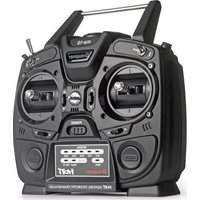
- The infra-red remote control system is included in the set.
- 6 × 1.5 V AA-sized dry cells are included in the kit (replacement Order No. 3426)
- Helicopter battery: 3.7V / 180mAh LiPo
- The helicopter battery is recharged via the transmitter
- or via the USB lead
Transmitter batteries
- Switch the transmitter on. If the red LED flashes, new cells are required.
- Insert the cells in the transmitter compartment with correct polarity.
- Ensure that the battery cells are fitted with correct polarity.
- Never mix new and old cells.
- Never fit different makes of battery cell.
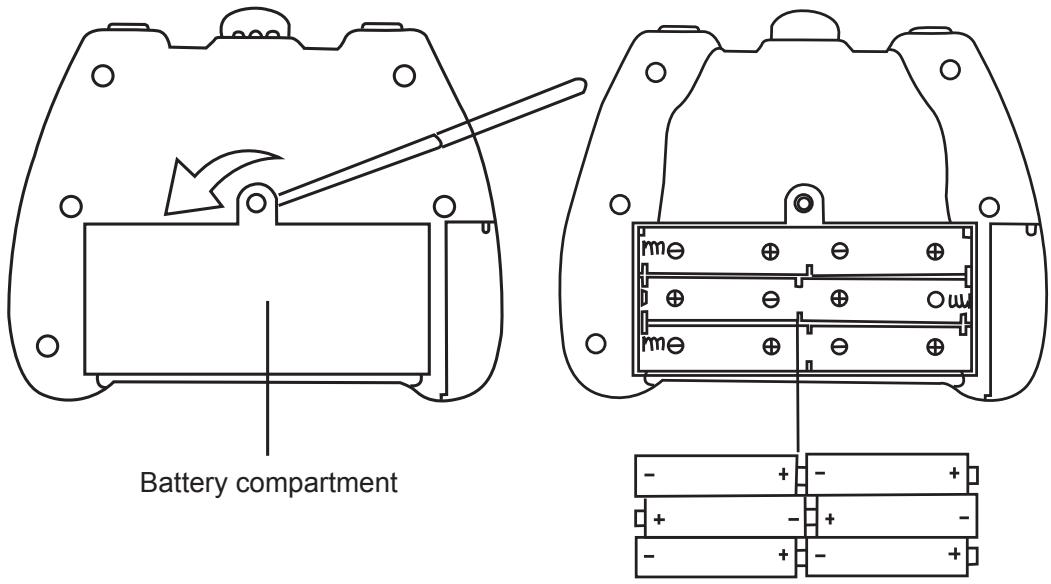
6x1.5V“AA”
Charging the battery
- First switch the helicopter off.
- Locate the charge lead in the side panel of the transmitter, and insert the charge connector into the helicopter socket. Switch the transmitter on, and the LED will light up green.
- The LED expires when the battery is fully charged. Disconnect the charge lead at this point.
-
This method of charging takes about 60 minutes.
-
Never allow the helicopter battery to touch or come close to any hot object (open flame, heating radiator), otherwise there is a risk of explosion.
- Store the helicopter battery in dry indoor conditions.
- Never strike the battery with a hard object, as this could damage the cell.
- Do not dismantle the LiPo battery.
- The battery should never be left on charge unsupervised.
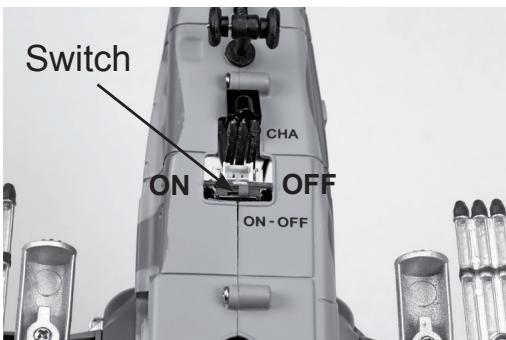
During the charge process the switch on the helicopter must be left at the OFF position.
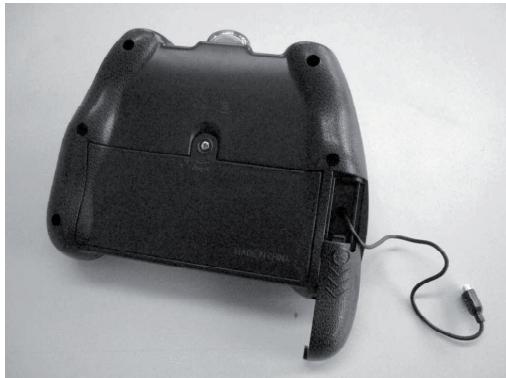
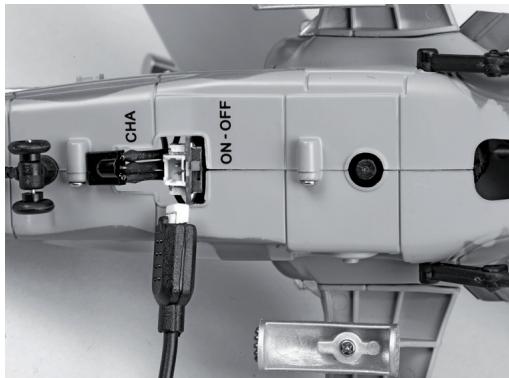
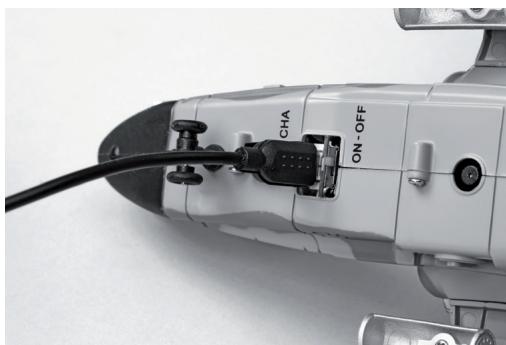
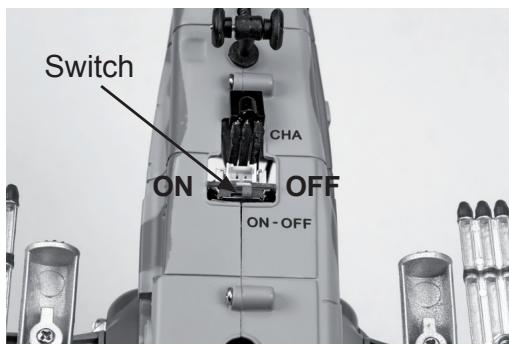
- The battery can also be recharged from a PC using the USB charge lead supplied in the set: connect the charge lead to the USB socket of a PC, and the red LED in the plug will glow red. Insert the other end of the lead in the helicopter charge socket, and the LED will go out. After about 30 minutes, when the battery is fully charged, the LED in the plug will light up, and the charge lead must be disconnected. During the charge process the switch on the helicopter must be left at the OFF position.
Remote control functions
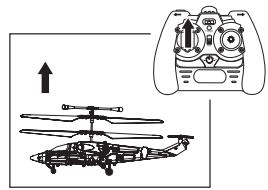
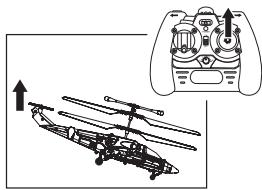
Climb
If you slowly move the left-hand stick (throttle stick) forward (away from you), the main rotor blades will start to rotate and accelerate steadily; the helicopter takes off and climbs.
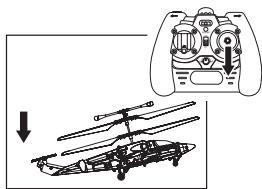
Descent
If you move the left-hand stick (throttle stick) back (towards you), the main rotor blades slow down; the helicopter starts to descend.
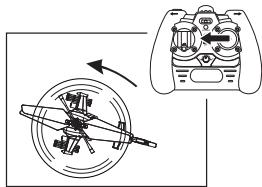
Nose left
If you move the right-hand stick (rudder stick) to the left, the helicopter's nose moves to the left.
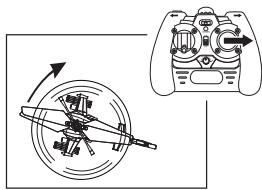
Nose right
If you move the right-hand stick (rudder stick) to the right, the helicopter's nose moves to the right.
Forward
If you move the right-hand stick forward away from you), the helicopter flies forward.
Back
If you move the right-hand stick back (towards you), the helicopter flies backwards.

Special notes
- If you find that the model's nose constantly turns in one direction, turn the trim knob in the opposite direction until the rotation ceases.

- When the transmitter cells are almost exhausted, the LED starts flashing red. This is the time to change the batteries.
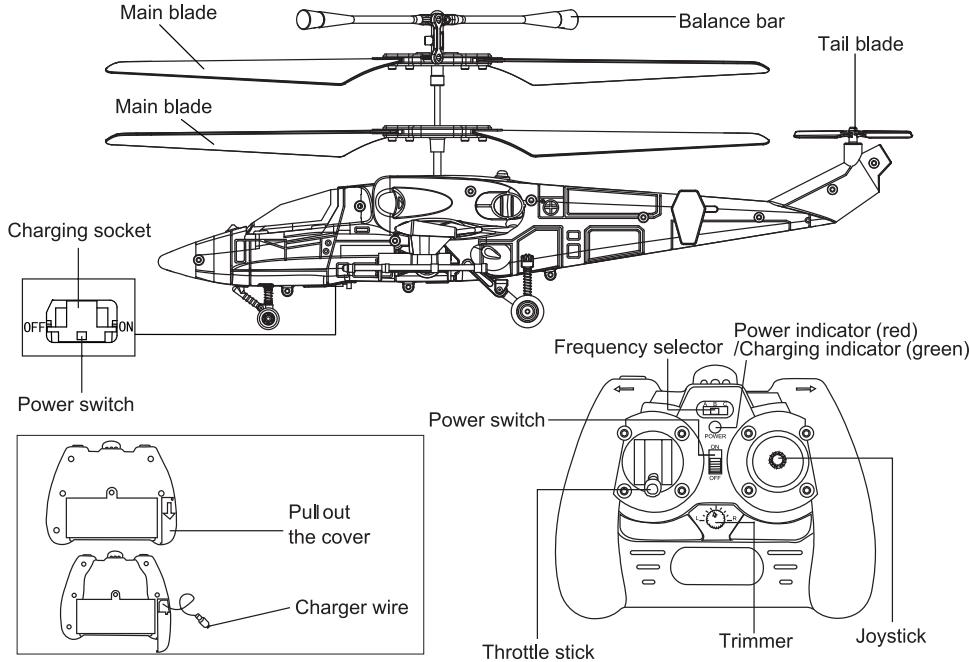
- The helicopter can be operated on three different channels (A, B or C). Select the channel, switch the transmitter on, then switch the helicopter on; if the LED on the circuit board in the fuselage lights up, you can start flying
Flying the model
- Set the channel select switch on the transmitter to channel A, B or C as required.
- Switch the transmitter on: the LED lights up green.
- Switch the helicopter on (ON): after approx. 5 seconds the helicopter is ready to fly.
- Keep the blue dome of the transmitter pointing at the helicopter at all times.
- Place the model on a flat floor, and check once more that there are no people, animals or other obstacles close by.
- Slowly move the throttle stick forward: the helicopter lifts off and climbs.
- If necessary, turn the trim knob to trim the helicopter, then use the sticks to control the model.
Controlling climb, descent and hovering
The first step in getting maximum fun out of the Nano Fighter Gyro Helicopter is to establish a stable, smooth hover. After a little practice the multi-channel control system can be used to fly the model in a similar manner to a "proper" model helicopter:
When the machine reaches the desired altitude, hold the left-hand stick (climb / descent) as still as possible in the position where the helicopter neither climbs nor descends. If the model starts turning in either direction, use the right-hand stick to counteract the movement; in this way you will soon achieve a steady hover. Once you have learned the skill of keeping the Nano Fighter Gyro hovering at a particular height, without rotating, you can deliberately alter the orientation of the fuselage (and therefore the possible direction of flight) using the direction control (right stick). The forward / back control (right stick again) is used to accelerate or brake the model in this direction; the helicopter is even capable of flying slowly backwards. By combining all the stick functions the model can be controlled in a similar manner to a 'real' helicopter.
Landing, terminating flight operations
The Nano Fighter Gyro can be landed simply by gradually moving the left-hand stick back towards you. After the landing the main switch on the model must first be moved to the "OFF" position, and only then the transmitter can be switched off.
Note: towards the end of a flight the model will become increasingly unstable due to the declining battery voltage. When this happens you must land the model and recharge the battery.
Fault-finding
- After the initial charge you may find that the flight battery does not give its full capacity, resulting in reduced flight times. The LiPo pack only reaches its full performance after a few charge / discharge cycles.
After a flying session
- At the end of a flying session the model should be replaced in its original packaging to avoid the danger of accidentally bending or distorting the rotors.
- If you know you will not be flying the helicopter for a long period, ensure that the model is switched off, and remove the dry cells from the transmitter.
We wish you loads of fun and pleasure flying your Nano Fighter Gyro!
Care and maintenance
- Clean the model carefully after every flying session.
- The model and the remote control system components should only be cleaned using suitable materials.
Please ask your local model shop for advice on this.
Assembly (and repair instructions)
If you have to use solvent-based adhesives, use them only in a well-ventilated room. Take waste adhesives and paints to your nearest toxic waste collection point. An unobstructed work area of generous size is very helpful for all types of modelling activity.
Do not fly the model outdoors if there is any wind.
Pre-flight checking
If there are several helicopters at the flying site, check beforehand that your model is the only one on "your" channel before you switch the transmitter on. Two transmitters on the same channel causes interference, and may result in other models crashing.
Before flying the model check that all parts are in place and firmly secured.
The helicopter must always be held in such a way that the rotors are free to spin, otherwise they may cause injury when they start turning.
Always switch the transmitter on first, and only then the receiver.
Always switch the receiver off first, and only then the transmitter.
If you do not adhere to this sequence, i.e. if the receiver is switched on at any time when the associated transmitter is "OFF", then the receiver may respond to other transmitters, interference signals etc., and the motors could burst into life.
Before every flight check that the model's controls operate correctly, and at range (approx. 15 m). This simply means walking that distance from the model and checking that all the controls work properly.
Warning: never fly the model in a hall with fan-assisted air-conditioning; this has the same effect as quite a strong wind, and could easily push the model out of transmitter range and allow it to go out of control.
Flight time: with a fully charged battery and flat calm (indoor) conditions the helicopter will fly for between five and six minutes.
As soon as you notice that the model is unwilling to take off and climb, it is time to recharge the flight battery.
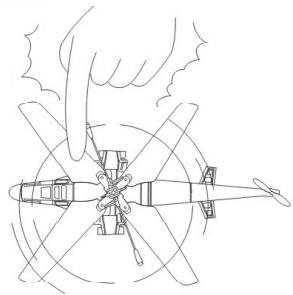
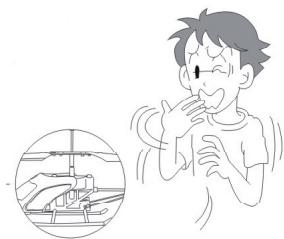
The motors become quite hot during a flight, and remain so afterwards. Don't touch the motors until they have had a chance to cool down to room temperature.
Motor too hot!
Disposal
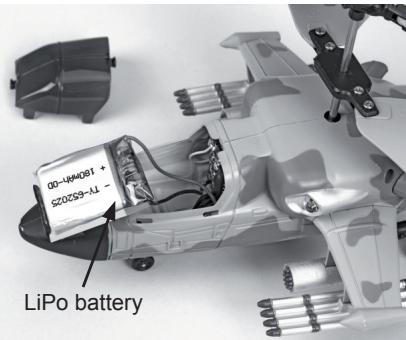
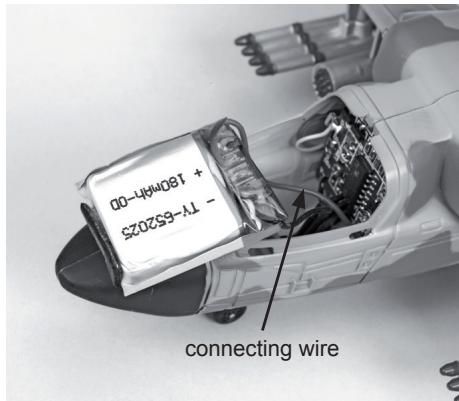
Fly until the helicopter battery is completely flat, or allow the rotors to spin until they come to a halt. Remove the cockpit window and take the LiPo battery out. Cut through each wire of the battery separately (to avoid short-circuits), insulate the cutted ends separately, and remove the battery. Dispose of the exhausted battery in the appropriate manner.
Environmental Protection Notes
Important information regarding the disposal of dry and rechargeable batteries:
In Germany the Battery Regulation places a legal requirement on all consumers to return all used and exhausted dry and rechargeable batteries. It is prohibited to discard these items through the domestic refuse system. Old dry and rechargeable batteries can be handed in at no charge at your local community collection point, at our dealers, and at any other retail outlet where dry and rechargeable batteries of the same type are sold.
An alternative method of disposal for any exhausted battery which we originally supplied is to send it to us, with pre-paid postage, at the following address.
You can make an important contribution to the protection of our shared environment in this way.
Dry and rechargeable batteries which contain harmful materials are marked with the following symbols, in order to draw attention to the fact that they must not be discarded through the household refuse system.
Under each symbol is stated the chemical symbol for the toxic metal concerned.
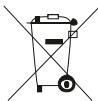
Cd

Hg

Pb

Li-Po
Battery contains:
1) Cd: cad
2) Hg: mercury
3) Pb: lead
4) Li-Po: Lithium-Polymer
Environmental Protection Notes
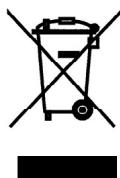
When this product comes to the end of its useful life, you must not dispose of it in the ordinary domestic waste. The correct method of disposal is to take it to your local collection point for recycling electrical and electronic equipment. The symbol shown here, which may be found on the product itself, in the operating instructions or on the packaging, indicates that this is the case.
Individual markings indicate which materials can be recycled and re-used. You can make an important contribution to the protection of our common environment by re-using the product, recycling the basic materials or recycling redundant equipment in other ways.
Manufacturer's declaration declaration by GRAUPNER GmbH & Co. KG, Henriettenstr. 94 - 96, D-73230 Kirchheim/Teck, Germany
Content of the manufacturer's declaration:
If material defects or manufacturing faults should arise in a product distributed by us in the Federal Republic of Germany and purchased by a consumer (§ 13 BGB), we, GRAUPNER GmbH & Co. KG, Kirchheim/Teck, acknowledge the obligation to correct those defects within the limitations described below.
The consumer is not entitled to exploit this manufacturer's declaration if the failure in the usability of the product is due to natural wear, use under competition conditions, incompetent or improper use (including incorrect installation) or external influences.
This manufacturer's declaration does not affect the consumer's legal or contractual rights regarding defects arising from the purchase contract between the consumer and the vendor (dealer).
Extent of the guarantee
If a claim is made under guarantee, we undertake at our discretion to repair or replace the defective goods. We will not consider supplementary claims, especially for reimbursement of costs relating to the defect (e.g. installation / removal costs) and compensation for consequent damages unless they are allowed by statute. This does not affect claims based on legal regulations, especially according to product liability law.
Guarantee requirements
The purchaser is required to make the guarantee claim in writing, and must enclose original proof of purchase (e.g. invoice, receipt, delivery note) and this guarantee card. He must send the defective goods to us at his own cost, using the following address:
Service Department, GRAUPNER GmbH & Co. KG, Henriettenstr. 94 - 96, D-73230 Kirchheim/Teck, Germany
The purchaser should state the material defect or manufacturing fault, or the symptoms of the fault, in as accurate a manner as possible, so that we can check if our guarantee obligation is applicable.
The goods are transported from the consumer to us and from us to the consumer at the risk of the consumer.
Duration of validity
This declaration only applies to claims made to us during the claim period as stated in this declaration. The claim period is 24 months from the date of purchase of the product by the consumer from a dealer in the Federal Republic of Germany (date of purchase). If a defect arises after the end of the claim period, or if the evidence or documents required according to this declaration in order to make the claim valid are not presented until after this period, then the consumer forfeits any rights or claims from this declaration.
Limitation by lapse of time
If we do not acknowledge the validity of a claim based on this declaration within the claim period,
all claims based on this declaration are barred by the statute of limitations after six months from the time of implementation; however, this cannot occur before the end of the claim period.
Applicable law
This declaration, and the claims, rights and obligations arising from it, are based exclusively on the pertinent German Law, without the norms of international private law, and excluding UN retail law.
WARNING!
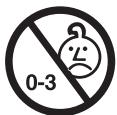
As this toy contains small parts that could be swallowed, it is unsuitable for children under the age of 3 years.
Not suitable for children under the age of 3 years - risk of choking.
The product complies with CE regulations.

Please keep all information about the product for future reference.
Mode d'emploi
Nano Fighter Gyro Mini Helicopter Fun
Introduction
E3NdN49D·E3NdN49D·E3NdN49D·E3NdN49D

Graupner
Specifications and availability subject to change. Supplied through specialist model shops only. We will gladly inform you of your nearest supplier. We accept no liability for printing errors.


- OPERATING INSTRUCTIONS
- NANO FIGHTER GYRO MINIATURE FUN HELICOPTER
- FOREWORD
- IMPORTANT SAFETY NOTES
- WARNING NOTES
- SAFETY NOTES REGARDING POWER SOURCES
- SAFETY NOTES
- NANO FIGHTER GYRO REMOTE CONTROL SYSTEM
- TRANSMITTER BATTERIES
- CHARGING THE BATTERY
- REMOTE CONTROL FUNCTIONS
- CLIMB
- DESCENT
- NOSE LEFT
- NOSE RIGHT
- FORWARD
- BACK
- SPECIAL NOTES
- FLYING THE MODEL
- CONTROLLING CLIMB, DESCENT AND HOVERING
- LANDING, TERMINATING FLIGHT OPERATIONS
- FAULT-FINDING
- AFTER A FLYING SESSION
- CARE AND MAINTENANCE
- ASSEMBLY (AND REPAIR INSTRUCTIONS)
- PRE-FLIGHT CHECKING
- DISPOSAL
- ENVIRONMENTAL PROTECTION NOTES
- MANUFACTURER'S DECLARATION DECLARATION BY GRAUPNER GMBH & CO. KG, HENRIETTENSTR. 94 - 96, D-73230 KIRCHHEIM/TECK, GERMANY
- APPLICABLE LAW
- WARNING
- MODE D'EMPLOI
- NANO FIGHTER GYRO MINI HELICOPTER FUN
- GRAUPNER
Brand : GRAUPNER
Model : NANO FIGHTER GYRO
Category : Gyroscope