50 SUPERMOTO - Motorcycle KTM - Free user manual and instructions
Find the device manual for free 50 SUPERMOTO KTM in PDF.


| Product type | Mini off-road motorcycle |
| Brand | KTM |
| Model | 50 SUPERMOTO |
| Category | Motorcycle |
| Engine | Single-cylinder 2-stroke, 49 cc, liquid cooling |
| Fuel | Premium RON 95 mixed with 2-stroke oil (1:60) |
| Wheelbase | 1030 mm |
| Seat height (unloaded) | 650 mm (low position) / 675 mm (high position) |
| Ground clearance | 255 mm |
| Recommended rider age | 6 to 10 years |
| Max rider height and weight | Max height 130 cm, max weight 35 kg |
| Front suspension | Marzocchi telescopic fork Ø 32 mm, travel 185 mm |
| Rear suspension | WP central shock absorber, travel 185 mm |
| Front brake | Disc Ø 160 mm |
| Rear brake | Disc Ø 140 mm |
| Tires | Front 90/90-10, rear 90/90-10, pressure 1.0 bar |
| Transmission | Chain secondary drive, ratio 10:44 |
| Clutch | Centrifugal, engagement speed 8500-9000 rpm |
| Periodic maintenance | Transmission oil change every 5h, air filter cleaning every 5h, etc. |
| Usage | Off-road only, not allowed on public roads |
| Mandatory safety equipment | Helmet, eye protection, chest protector, arm/leg guards, gloves, boots |
| Included manual | User manual and spare parts manual |
Frequently Asked Questions - 50 SUPERMOTO KTM
User questions about 50 SUPERMOTO KTM
0 question about this device. Answer the ones you know or ask your own.
Ask a new question about this device
Download the instructions for your Motorcycle in PDF format for free! Find your manual 50 SUPERMOTO - KTM and take your electronic device back in hand. On this page are published all the documents necessary for the use of your device. 50 SUPERMOTO by KTM.
USER MANUAL 50 SUPERMOTO KTM
Please read this manual thoroughly before letting your youngster ride the motorcycle for the first time. This manual contains important information and recommendations that will help you and your youngster to operate and handle the motorcycle properly. In the interest of everybody involved, we urge you to pay particular attention to instructions and information marked as follows:
WARNING
- IGNORING THESE INSTRUCTIONS CAN BE DANGEROUS TO LIFE AND LIMB!
!CAUTION
- IGNORING THESE INSTRUCTIONS MAY DAMAGE PARTS OF THE MOTORCYCLE OR IMPAIR THE MOTORCYCLE'S TRAFFIC SAFETY!
Please insert the serial numbers of the motorcycle below
Chassis number
Engine number
Stamp of dealer
All information contained is without obligation. KTM-Sportmotorcycle AG particularly reserves the right to modify any equipment, technical specifications, prices, colors, shapes, materials, services, service work, constructions, equipment and the like so as to adapt them to local conditions or to cancel any of the above items, all without previous announcement and without giving reasons. KTM may stop manufacturing certain models without previous notice. KTM shall not be held liable for any deviations of availability and/or ability to deliver, illustrations, descriptions, printing and/or other errors. The illustrated models partly contain extra equipment, which is not applied to standard models.
© 2004 by KTM-SPORTMOTORCYCLE AG, Mattighofen AUSTRIA; All rights reserved; Reprint, also in extracts, with written allowance of KTM-SPORTMOTORCYCLE AG, Mattighofen only.
Now you own a modern motorcycle that you and your youngster will certainly enjoy, provided that you service and maintain it properly. This manual contains important information on the operation and maintenance of your new KTM motorcycle. It went to press describing your model's latest state of development. Nevertheless, the descriptions may deviate slightly from the current design as our motorcycles are permanently improved. The Owner's Manual is an integral part of the motorcycle and must be handed over to the new owner when the motorcycle is sold.
We expressly point out that work marked with an asterisk (*) in the chapter "Maintenance work on the chassis and engine" must be performed by a KTM workshop. If maintenance work should become necessary during a competition, it must be performed by a trained mechanic.
Please strictly observe the prescribed running-in periods and inspection and maintenance intervals. Compliance with these instructions will significantly prolong the life of your motorcycle.
Be sure to have the maintenance work carried out by a KTM workshop to avoid losing your right to claim under the warranty.
For the safety of your child, only use spare parts and accessories approved by KTM. KTM shall not assume any liability for other products or consequential damage resulting from the use of such products.
When special needs arise, please contact a KTM dealer, who will seek the assistance of the KTM importer if necessary.
PARENTS SHOULD KEEP IN MIND that the safety of their youngsters always depends on the efforts made by the parents to ensure that the motorcycle is kept in good working order and only used on safe terrains. Nevertheless, driving the motorcycle, like driving any other vehicle, involves a potential risk. Therefore, please make sure that all fundamental precautions are taken. Please also read the „INFORMATION ON SAFE DRIVING FOR PARENTS“ on page 4.
Riding an off-highway motorcycle is a wonderful form of outdoor recreation and we certainly hope that you and your youngsters will enjoy it to the full. However, this enjoyable outdoor activity can cause environmental problems or lead to conflicts with other people. Responsible use of the motorcycle will prevent such problems and conflicts. You can contribute to securing the future of motorcycling by making sure that you and your youngsters only use the motorcycle within the limits established by the applicable laws, making environmental protection one of your top priorities and never violating other people's rights.
In this spirit, we hope that you and your youngsters will always safely enjoy your motorcycle!
KTM-SPORTMOTORCYCLE AG 5230 MATTIGHOFEN, AUSTRI
Attachments: 1 spare parts manual chassis & engine
KTM mini-sports motorcycles are designed and constructed to resist the usual wear and tear of normal use in competitions.
The motorcycles comply with the regulations and categories currently in effect with the leading international motorcycle associations.
Observance of the service, maintenance and tuning instructions for the engine and chassis specified in the Owner's Manual is a prerequisite for faultless operation and the avoidance of premature wear. An improperly tuned chassis can lead to damage and breakage of the chassis components (see chapter on checking the basic chassis setting).
The service work specified in the "Lubrication and Maintenance Schedule" must be performed by a KTM workshop and recorded in the service manual otherwise claims under the warranty shall become void.
The fuels and lubricants specified in the Owner's Manual or automotive fluids with equivalent specifications must be used in accordance with the maintenance schedule.
No claims can be filed under the warranty for damage or consequential damage caused by manipulations or conversions to the motorcycle.
The use of the motorcycle under extreme conditions, e.g. on extremely muddy and wet terrain, can lead to higher than average wear on components such as the drive train or the brakes. In this case it may become necessary to service or replace wear parts before the service limit specified in the maintenance schedule has been reached.
KTM mini motorcycles are off-road motorcycles designed for one person only. They are not allowed on public roads.
The vehicle dimensions and components are designed for children from 4 to 10 years of age with a maximum weight of. 35kg (78 lbs) and a maximum height of 130~cm (51 in).
- Have your youngster wear proper protective gear whenever he or she rides the motorcycle: helmet, eye protection, chest, back, arm and leg protectors, gloves and boots. To set a good example, be sure to wear protective gear yourself whenever riding a motorcycle!
Before your youngster takes his or her first ride, explain how each of the controls works and check if your youngster has understood what you explained. We recommend to review the entire owner's manual with your youngster item by item, paying particular attention to the specially marked warnings and pointing out the danger of injury. - Instruct your youngster about riding and falling techniques, explain how the motorcycle will respond to shifting of the rider's weight, etc.
Before starting the motorcycle for the first time check whether the basic fork and shock absorber settings are suitable for your child's weight (see chapter on checking the basic chassis setting)
Before using the motorcycle you should always check all components for proper operation (see maintenance schedule). Have your youngster perform these technical checks himself / herself as well. - Whenever you go for a ride with your youngster, keep in mind that the speed should be adjusted to your youngster and not the other way around.
- Your youngster must understand that all instructions he or she receives from you or any other supervising adult must be followed.
- Your child must be physically ready to ride a motorcycle. This means that he or she must at least be able to ride a bicycle. Being good at sports that require fast reactions is an additional advantage. Your youngster should be strong enough to pick up the motorcycle after a fall.
- Never demand too much of your youngster. Give him or her time to get used to the motorcycle and to improve his / her riding skills. Do not even consider letting your youngster participate in a race before his / her physical condition, riding skills and motivation have sufficiently developed.
- Explain to your youngster that he / she should always adjust his / her riding speed to the local conditions as well as to his / her own riding skills and that excessive speed can cause falls and severe injuries. Always keep in mind that youngsters tend to underestimate dangers or fail to recognize them altogether. The riding speed must be reduced, in particular, on unknown terrain.
- Never let your youngster ride the motorcycle without supervision. An adult should always be present.
- The motorcycle is designed for one rider only. Your youngster is not allowed to transport a passenger.
- When you go for a ride, somebody at home should always know where you are going and when you will be back. This makes it easier to send you help, should problems occur.
Page
IMPORTANT INFORMATION FOR PARENTS ABOUT SAFE
DRIVING 4
SERIAL NUMBER LOCATIONS 6
Chassis number 6
Engine number 6
Rebound damping function of the shock absorber 9
General Tips andWarnings for starting the motorcycle .10
Instructions for the first ride 10
Running in 10
Driving instructions 11
What you should check before each start 11
Starting when the engine is cold 12
Starting when the engine is warm 12
What to do when the engine is "flooded" 12
Starting off 12
Driving 12
Refueling, fuel 13
Braking 13
Stopping 13
PERIODIC MAINTENANCE SCHEDULE 14
MAINTENANCE WORK ON CHASSIS AND ENGINE . . .16
Removing the seat 16
Checking and adjusting the steering head bearing
(50 SX Junior) 16
Checking and adjusting the steering head bearing
(50 SX, 50 Supermoto) 17
How to change the handlebar position 17
Basic suspension setup for the weight of the driver ..18
To determine the sag of the shock absorber 18
To determine the sag of the telescopic fork 18
Telescopic fork maintenance 19
Changing the telescopic fork oil 19
Cleaning the dust scrabbers of the telescopic fork 20
Page
Changing spring preloading of the shock absorber 20
Check chain tension 20
Correct chain tension 20
Chain maintenance 20
General information about KTM disc brakes 21
Setting the basic position and play of the hand brake lever .21
Checking the brake fluid level/ refilling 22
Checking front brake pads 22
Replacing the front brake pads 22
Changing the basic position of the foot brake lever (50 SX Junior) 23
Adjusting the control cable on the rear wheel (50 SX Junior) .23
Checking the rear brake linings for wear (50 SX Junior).23
Drum brake maintenance (50 SX Junior) 23
Changing the basic position of the brake lever (50 SX, 50 Supermoto) .23
Checking the rear brake fluid level (50 SX, 50 Supermoto).23
Refilling the rear brake fluid reservoir (50 SX, 50 Supermoto) .24
Checking rear brake pads (50 SX, 50 Supermoto) . .24
Replacing the rear brake pads (50 SX, 50 Supermoto).24
Removing and mounting the front wheel 25
Removing and mounting the rear wheel 25
Tires, air pressure 26
Checking spoke tension 26
Cooling system 26
Checking coolant level 27
Cleaning the air filter 27
Exhaust system 27
Changing the seat height 28
Adjusting the throttle cable 28
Adjusting the idle speed (Dell'Orto PHVA 14 DS) 28
Adjusting the idle speed (Dell'Orto PHBG 19 BS) ..28
Checking the gear oil level 29
Changing gear oil 29
Adjusting the centrifugal clutch 30
TROUBLESHOOTING 32
CLEANING 34
STORAGE 34
TECHNICAL DATA - ENGINE 35
TECHNICAL SPECIFICATIONS - CHASSIS .36
HEAD WORD INDEX 37
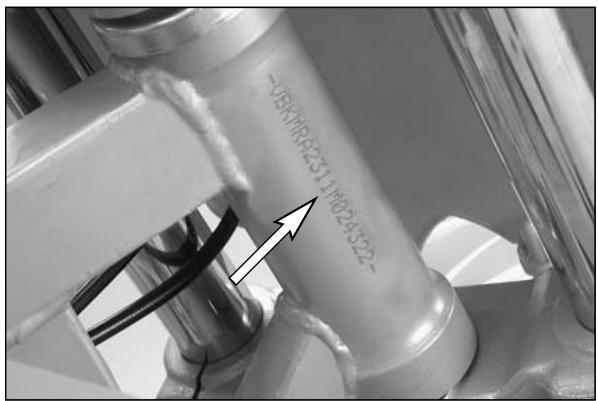
Chassis number
The chassis number is located on the type plate on the steering head. Enter this number in the field on page no 1.

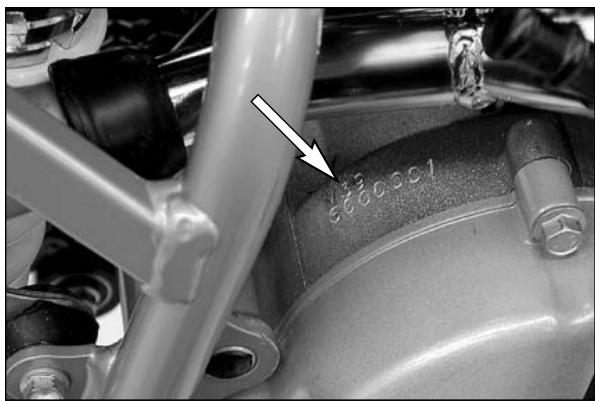
Engine number
The engine number is stamped into the right half of the engine case next to the kickstarter. Enter this number in the relevant field on page 1.
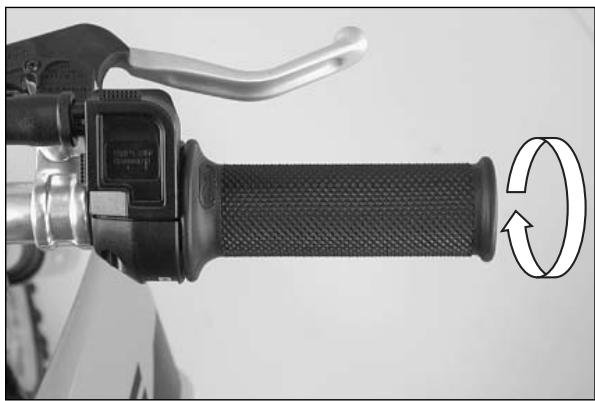
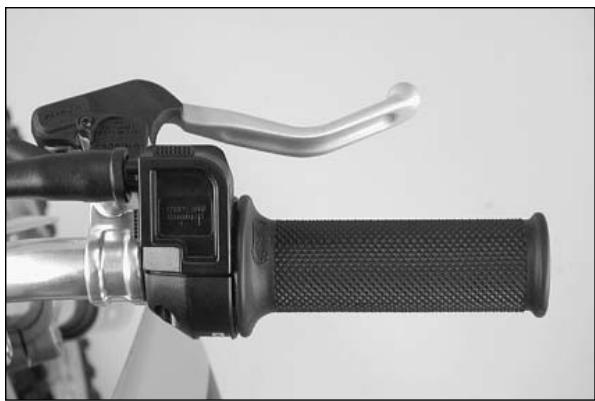
Throttle grip
The throttle grip is located on the right side of the handlebars. It is used to reduce the engine speed and, thus, the driving speed.
Hand brake lever
The hand brake lever is located on the right side of the handlebars and actuates the front wheel brake. The basic position can be adjusted to fit your child's hand.
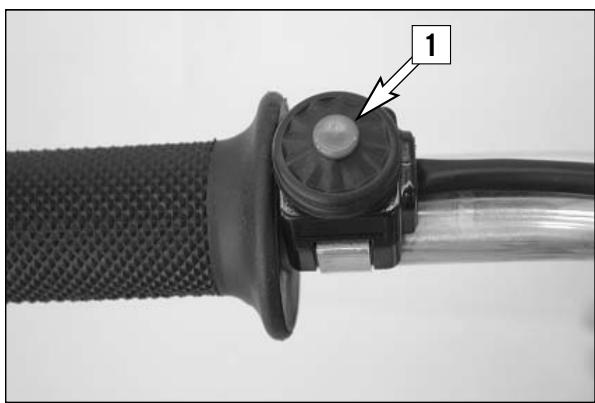
Short circuit button
The short circuit button [1] turns off the engine. When pressing this button, the ignition circuit is short-circuited.
Fillercap
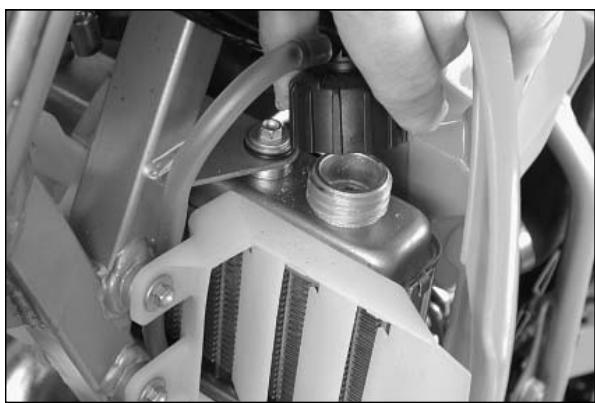
To open it: turn filler cap counter-clockwise.
To close it: put filler cap back on and tighten it by turning it clockwise.
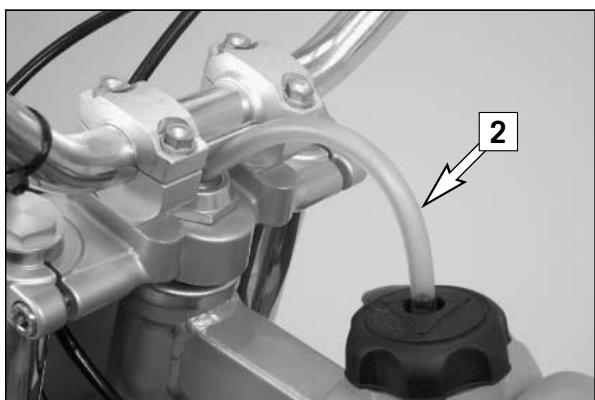
Install tank breather hose [2] without kinks.
Fuel tap
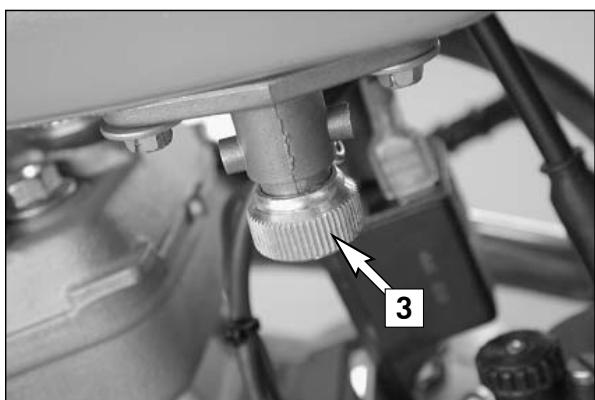
The fuel tap [3] is located at the front of the motorcycle on the left side of the tank.
Opening the fuel tap: Turn the knob all the way to the left.
Closing the fuel tap: Turn the knob all the way to the right.
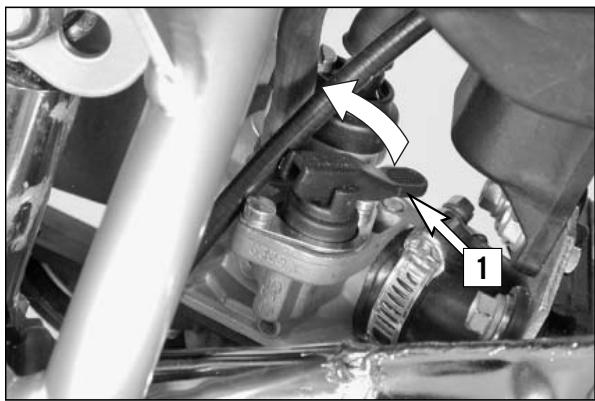
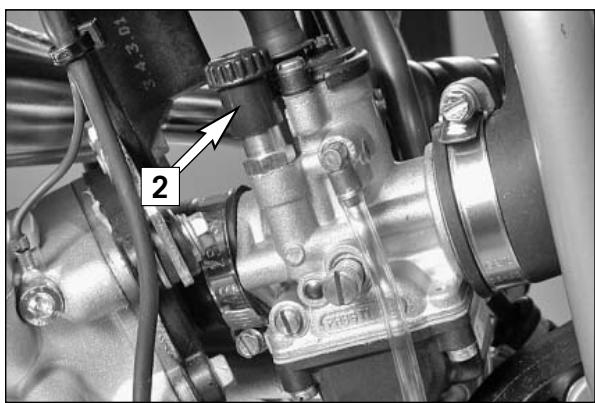
Choke lever [1] is mounted to the right side of the carburetor. If you move the choke lever up to the stop, a hole is opened in the carburetor through which the engine can draw in additional fuel. This results in a "rich" fuel-air mixture required for a cold start.
Moving the choke lever back closes the hole in the carburetor again.
Choke (Dell'Orto carburetor PHBG 19 BS)
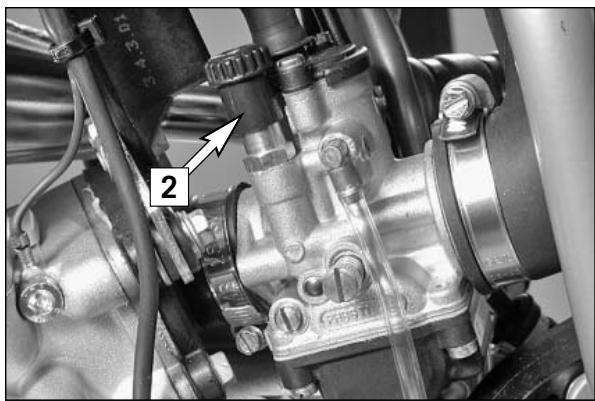
Choke control knob [2] is mounted to the left side of the carburetor. If you pull the choke control knob up to the stop and turn it 90^ , a hole is opened in the carburetor through which the engine can draw additional fuel. This results in a "rich" fuel-air mixture required for a cold start.
Turning back the choke control knob returns the knob to the starting position and closes the hole in the carburetor again.
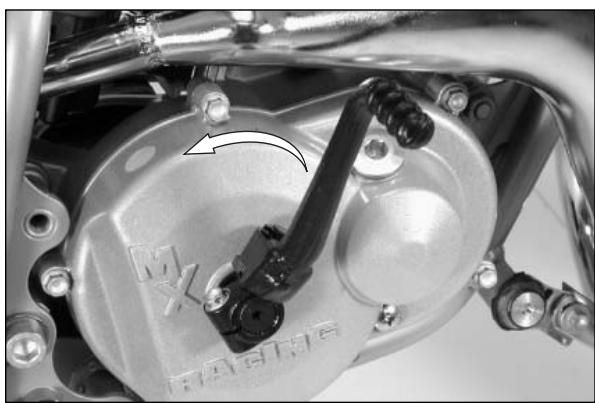
Kickstarter
The kickstarter is mounted on the right side of the engine. Its upper part can be swivelled.
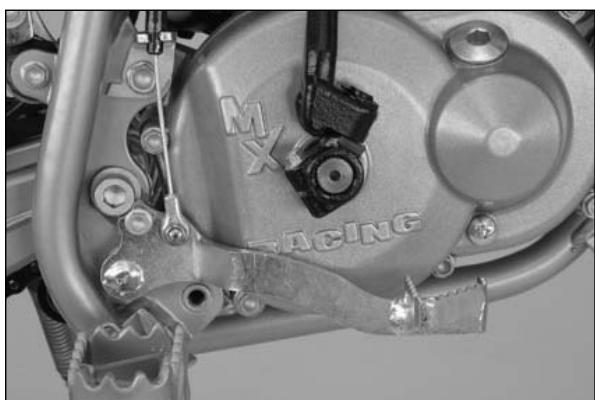
Foot brake lever
The foot brake lever is located in front of the right footrest. The basic position can be adjusted to the seating position (see maintenance work).
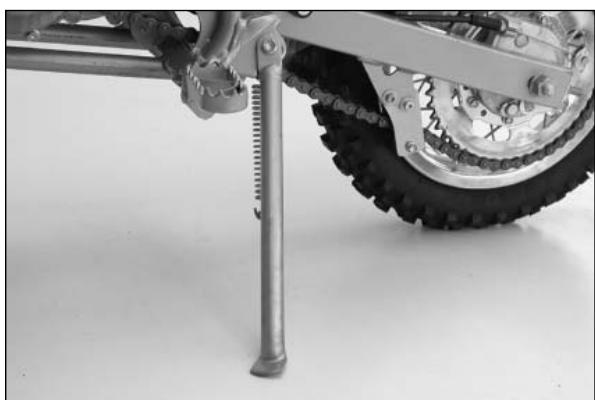
Side stand
Use your foot to swing the side stand forwards to the stop. Make sure it rests securely on solid ground.
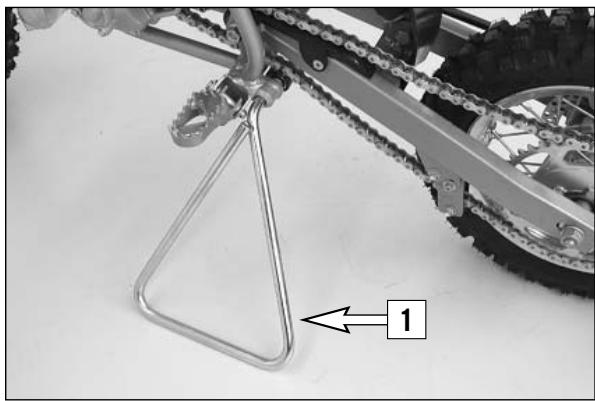
Plugin - Stand (50 SX, 50 Supermoto)
A socket is provided on the left side of the frame for the plug-in stand [1] included in the scope of supply.
Rebound damping function of the shock absorber
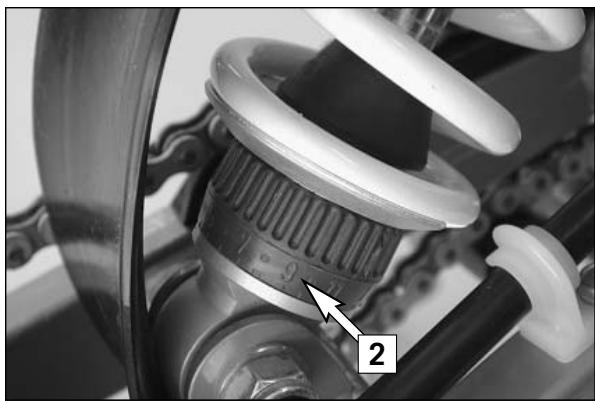
The damping effect of the rebound damping mechanism can be adjusted by means of the setting wheel [2]. Turn the setting wheel clockwise (in) to increase and counterclockwise (out) to reduce the damping effect.
STANDARD SETTING: 5 Clicks OPEN
WARNING
- NEVER TURN THE SETTING WHEEL MORE THAN TWO Clicks BETWEEN TWO TEST RIDES.
- DO NOT TRY TO DISASSEMBLE THE SHOCK ABSORBER OR TO PERFORM MAINTENANCE WORK YOURSELF. DANGER OF INJURY!

Instructions for the first ride
- Make sure the work for the "pre-delivery inspection" was performed by your authorized KTM workshop. The DELIVERY CERTIFICATE and SERVICE MANUAL will be handed over when you pick up your vehicle.
Before your youngster takes his or her first ride, explain how each of the controls works and check if your youngster has understood what you explained. We recommend to review the entire owner's manual with your youngster item by item, paying particular attention to the specially marked warnings and pointing out the danger of injury. - Adjust the basic position of the hand brake lever to fit the size of your child's hand. You child should of course wear gloves. Adjust the foot brake lever to your child's seating position.
- To prevent injury, teach your youngster the basic riding skills on soft ground, e.g. on a meadow or in the garden. Be sure that there is room enough to maneuver, and that no other riders are close.
- To ensure that your youngster gets the feel of the brakes, have your youngster operate the brakes while you push the motorcycle. Do not start the engine before your youngster has learned to apply both brakes with appropriate pressure.
- Now your youngster must get the feel of the throttle. Start the engine, hold the motorcycle and have your youngster slowly open the throttle. Then, your youngster can take his/her first ride. Initially, your youngster should ride back and forth between two persons who help the young rider to stop the motorcycle. However, you should also teach your youngster how to stop the motorcycle himself/herself.
- To improve his/her riding skills, your youngster should practise to ride the motorcycle standing on the footpegs or riding at the slowest possible speed. Additionally, you can arrange a series of obstacles and have your youngster drive around them, etc.
- Tell your youngster to look 3-10 m ahead, depending on the speed, to recognize and avoid obstacles. When riding through curves, the rider should also look far ahead into the curve.
- Pay attention to running-in procedure.
Running in
- Even very precisely machined sections of engine components have rougher surfaces than components which have been sliding across one another for quite some time. Therefore, every engine needs to be broken in. Do not load the engine to the power limit during the first half hour for this reason.
- Apply low but changing loads for running-in.
- NO FULL-LOAD OPERATION DURING THE FIRST HALF HOUR!
WARNING
- HAVE YOUR YOUNGSTER WEAR PROPER PROTECTIVE GEAR WHENEVER HE OR SHE RIDES THE MOTORCYCLE: HELMET, EYE PROTECTION, CHEST, BACK, ARM AND LEG PROTECTORS, GLOVES AND BOOTS. TO SET A GOOD EXAMPLE, BE SURE TO WEAR PROTECTIVE GEAR YOURSELF WHENEVER RIDING A MOTORCYCLE!
- THE MOTORCYCLE HAS A CENTRIFUGAL CLUTCH. THE MOTORCYCLE BEGINS TO MOVE AS SOON AS THE THROTTLE IS OPENED.
- ALWAYS APPLY THE FRONT BRAKE WHEN STARTING THE ENGINE AND RELEASE THE BRAKE SLOWLY WHEN THE ENGINE IS RUNNING. AN ACTIVATED CHoke INCREASES THE IDLE SPEED OF THE ENGINE, THE CENTRIFUGAL CLUTCH THUS BEGINNING TO ENGAGE. THEREFORE, THE MOTORCYCLE CAN BEGIN TO MOVE WHEN THE BRAKE LEVERS ARE RELEASED.
- WHEN THE ENGINE SPEED DROPS TO THE LEVEL AT WHICH THE CENTRIFUGAL CLUTCH DISENGAGES, BRAKING WITH THE ENGINE IS NO LONGER POSSIBLE AND THE MOTORCYCLE CAN ONLY BE SLOWED DOWN USING THE BRAKES.
- YOUR CHILD SHOULD NEVER DRIVE FASTER THAN ITS SKILLS AND THE TERRAIN PERMIT.
- NEVER LET YOUR CHILD DRIVE ITS MOTORCYCLE UNCHAPERONED.
- REPLACE THE HELMET VISOR OR GOGGLE GLASSES EARLY ENOUGH. WHEN LIGHT SHINES DIRECTLY ON A SCRATCHED VISOR OR GOGGLES, YOU WILL BE PRACTICALLY BLIND.
- ONLY USE ACCESSORY PARTS RECOMMENDED BY KTM.
-
NEVER LEAVE YOUR MOTORCYCLE WITHOUT SUPERVISION AS LONG AS THE ENGINE IS RUNNING.
-
KTM MINI MODELS ARE DESIGNED FOR ONE PERSON ONLY. PASSENGERS ARE NOT ALLOWED.
- THESE MODELS DO NOT COMPLY WITH THE REGULATIONS AND SAFETY STANDARDS ESTABLISHED BY THE LAW. THEREFORE, THEY ARE NOT PERMITTED ON PUBLIC ROADS.
- ALWAYS KEEP IN MIND THAT OTHER PEOPLE FEEL MOLESTED BY EXCESSIVE NOISE.

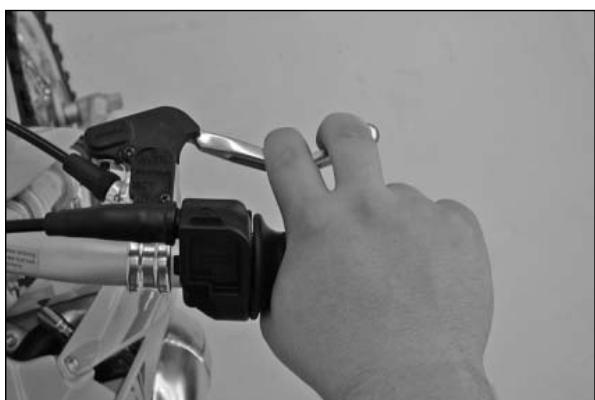
What you should check before each start
When you start off, the motorcycle must be in a perfect technical condition. For safety reasons, you should make it a habit to perform an overall check of your motorcycle before each start.
The following checks should be performed:
1 CHECK TRANSMISSION OIL LEVEL
A lack of gear oil leads to premature wear and finally results in destruction of the gear wheels.
2 FUEL
Check that there is sufficient fuel in the tank; when closing the filler cap, check that the tank venting hose is free of kinks.
3 COOLING FLUID
Check the level of cooling fluid when the engine is cold.
4 CHAIN
A loose chain was fall off the chain wheels; an extremely worn chain may tear, and insufficient lubrication may result in unnecessary wear of the chain and chain wheels.
5 TIRES
Check for damaged tires. Tires showing cuts or dents must be replaced. Also check the air pressure. Insufficient tread and incorrect air pressure deteriorate the driving performance.
6 BRAKES
Check for proper functioning, check brake fluid level in the tank. The tank is designed such that it does not need to be refilled, even if the brake shoes are worn. If the brake fluid falls below the minimum level, the brake system is either leaking or the brake shoes are completely worn out. Have the brake system checked at a KTM workshop to avoid brake failure. Also have the condition of the brake hose and the brake lining thickness checked.
Check the play of the hand brake lever and foot brake lever.
7 THROTTLE CABLE
Check the throttle cable for proper adjustment and smooth operation.

Starting when the engine is cold
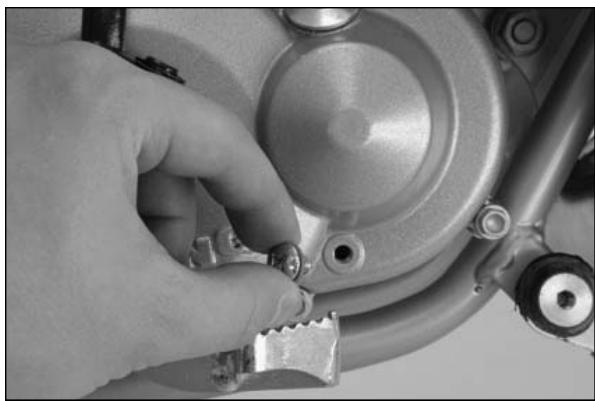
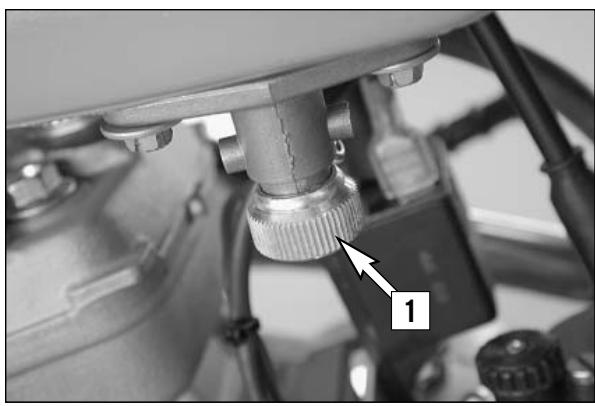
1 Open fuel tap [1].
2 Operate the choke [2].
3 Kick the side up all the way or remove the plug-in stand.
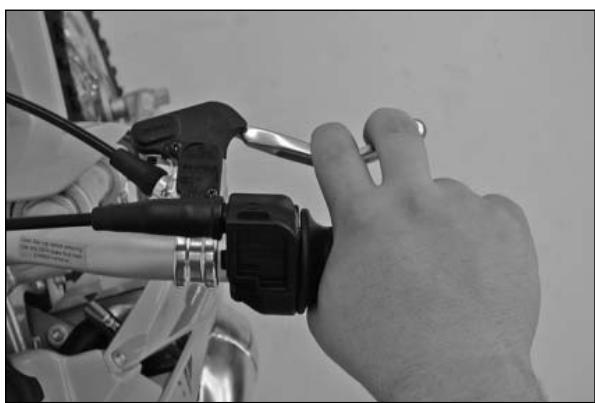
4 Apply the front brake.
5 Operate the kickstarter, depressing it all the way, without opening the throttle.
WARNING
- WHEN STARTING THE ENGINE, PUT ON MOTORCYCLE BOOTS IN ORDER TO AVOID INJURIES. YOU MAY SLIP OFF THE KICKSTARTER, OR THE ENGINE MAY KICK BACK IF YOU DO NOT KICK HARD ENOUGH.
- DO NOT START THE ENGINE AND ALLOW IT TO IDLE IN A CLOSED AREA. EXHAUST FUMES ARE POISONOUS AND CAN CAUSE LOSS OF CONSCIOUSNESS AND DEATH. ALWAYS PROVIDE ADEQUATE VENTILATION WHILE THE ENGINE IS RUNNING.
CAUTION
DON'T RIDE YOUR MOTORCYCLE WITH FULL LOAD AND HIGH REVS WHEN ENGINE IS COLD. BECAUSE THE PISTON IS WARMING UP FASTER THAN THE WATER COOLED CYLINDER, IT CAN CAUSE ENGINE DAMAGE.
NOTE:
The highly inflammable components in modern fuels volatilize if left standing for longer periods of time. If the motorcycle has not been used for over 1 week, the fuel should be drained from the float chamber. The engine will start up immediately if the float chamber is filled with fresh, ignitable fuel
Starting when the engine is warm
1 Open fuel tap [1].
2 Kick the side up all the way or remove the plug-in stand.
3 Apply the front brake.
4 Operate the kickstarter, depressing it all the way, without opening the throttle.
What to do when the engine is "flooded"
1 Close fuel tap [1].
2 Applying the front brake.
3 Start engine with full throttle. If necessary, unscrew spark plug and dry it.
4 Once the engine is running, open fuel tap again.
Starting off
Slowly release the brake lever while simultaneously opening the throttle.
WARNING
ALWAYS MAKE SURE THE SIDE STAND IS KICKED ALL THE WAY UP OR THE PLUG-IN STAND REMOVED BEFORE YOU LET YOUR CHILD DRIVE OFF. THE MOTORCYCLE COULD RUN OUT OF CONTROL IF THE STAND TOUCHES THE GROUND.

Driving
The engine speed, and thus the driving speed, are regulated by the throttle grip.
The choke must always be deactivated as soon as the engine has warmed up.
WARNING
- AFTER FALLING WITH THE MOTORCYCLE, CHECK ALL ITS FUNCTIONS THOROUGHLY BEFORE USING IT AGAIN.
- A BENT HANDLEBAR MUST ALWAYS BE REPLACED. NEVER TRY TO STRAIGHTEN THE HANDLEBAR BECAUSE THIS WILL CAUSE IT TO LOSE ITS STABILITY.
CAUTION
- DRIVING A COLD ENGINE AT HIGH SPEED WILL REDUCE THE LIFE OF THE ENGINE. WE RECOMMEND TO WARM THE ENGINE UP AT A MEDIUM ENGINE SPEED FOR SEVERAL MINUTES BEFORE SWITCHING TO FULL LOAD.
- NEVER TILT THE MOTORCYCLE OVER THE SIDE STAND TO WARM UP THE ENGINE. THE SIDE STAND COULD FOLD AWAY AND THE MOTORCYCLE RUN OUT OF CONTROL.
- IN THE EVENT THAT, WHILE YOUR CHILD IS RIDING ON THE MOTORCYCLE, YOU NOTICE ANY UNUSUAL OPERATION-RELATED NOISE, YOUR CHILD SHOULD STOP IMMEDIATELY, TURN THE ENGINE OFF, AND CONTACT AN AUTHORIZED KTM DEALER.
Braking
Close the throttle and squeeze both brake levers simultaneously. On sandy, wet or slippery terrain the rear wheel brake should be preferred. The brakes should always be operated carefully as locking wheels can cause skidding or falls.
WARNING
Reduce the speed. Immediately before the motorcycle comes to a stop, put the left foot down. To turn off the engine, press the short circuit button until the engine stops. Close the fuel tap.
WARNING
MOTORCYCLES PRODUCE GREAT HEAT DURING OPERATION. THEREFORE, KEEP IN MIND THAT THE ENGINE, THE EXHAUST SYSTEM AND THE BRAKES CAN HEAT UP CONSIDERABLY. MAKE SURE THAT THESE PARTS ARE NOT TOUCHED AND ALWAYS TAKE CARE, WHEN PARKING THE MOTORCYCLE, THAT OTHER PERSONS WILL NOT BURN THEMSELVES.
CAUTION
- CLOSE THE FUEL TAP WHEN LEAVING THE MOTORCYCLE. OTHERWISE THE CARBURETOR MAY GET FLOODED AND FUEL WILL ENTER THE ENGINE.
- THE SIDE STAND OR PLUG-IN STAND IS DESIGNED TO HOLD THE WEIGHT OF THE MOTORCYCLE ONLY. BY SITTING ON THE MOTORCYCLE, YOUR CHILD WILL PUT ADDITIONAL WEIGHT ON THE SIDE STAND, POSSIBLY CAUSING THE SIDE STAND OR FRAME TO BE DAMAGED OR THE MOTORCYCLE TO FALL DOWN.
Refueling, fuel
Oil (high-grade two-stroke engine oil) must be mixed with the fuel (ROZ 95) at a mixing ratio of 1:60.
Fuel and engine oil should only be mixed immediately before use. KTM recommends Motorex 2T Cross Power.
WARNING
GASOLINE IS HIGHLY FLAMMABLE AND POISONOUS. EXTREME CAUTION SHOULD BE USED WHEN HANDLING GASOLINE. NEVER REFUEL THE MOTORCYCLE NEAR OPEN FLAMES OR BURNING CIGARETTEs. ALWAYS SWITCH OFF THE ENGINE BEFORE REFUELING. BE CAREFUL NOT TO SPILL GASOLINE ON THE ENGINE OR EXHAUST PIPE WHILE THE ENGINE IS HOT. WIPE UP SPILLS PROMPTLY. IF GASOLINE IS SWALLOWED OR SPLASHED IN THE EYES, SEEK A DOCTOR'S ADVICE IMMEDIATELY.
CAUTION
- ONLY USE PREMIUM-GRADE GASOLINE ROZ 95 MIXED WITH HIGH-GRADE TWO-STROKE ENGINE OIL. OTHER TYPES OF GASOLINE CAN CAUSE ENGINE FAILURE.
- ONLY USE KNOWN BRANDS OF HIGH-GRADE 2-STROKE ENGINE OIL (MOTOREX 2T CROSS POWER).
- NOT ENOUGH OIL OR LOW-GRADE OIL CAN CAUSE EROSION OF THE PISTON. WHEN USING TOO MANY OIL, THE ENGINE MAY START SMOKING AND FOUL THE SPARK PLUG.
- FUEL EXPANDS WHEN ITS TEMPERATURE RISES. THEREFORE DO NOT FILL THE TANK TO THE TOP. (SEE FIG.)

| 50 SX JUNIOR 50 SX 50 SUPERMOTO A CLEAN MOTORCYCLE CAN BE CHECKED MORE QUICKLY WHICH SAVES MONEY! | Service every 5 hours | Service every 20 hours | after every race | |
| ENGINE | Check engine for leaks | ● | ● | |
| Change transmission oil | ● | ● | ||
| Check spark plug, change it if necessary, set electrode gap | ● | |||
| CARBURETOR | Check carburetor for a tight fit at intake flange | ● | ||
| Check intake flange for cracks | ● | |||
| Check idle setting when engine is warm | ● | |||
| ADD-ON-PARTS | Check cooling system for leaks, check quantity of antifreeze | ● | ||
| Check exhaust system for leaks and suspension | ● | |||
| Check actuating cables for damage, smooth operation, and kinkless arrangement, adjust and lubricate | ● | ● | ● | |
| Clean air filter and air filter box | ● | ● | ● | |
| BRAKES | Check brake fluid level, lining thickness, brake discs | ● | ● | |
| Check the brake line and the brake control cable for damage | ● | ● | ||
| Check/function adjust smooth operation, free travel of handbrake/footbrake levers | ● | ● | ● | |
| Check screws of brake system for a tight fit | ● | ● | ● | |
| CHASSIS | Check suspension strut and fork for leaks and a proper function | ● | ● | |
| Check swinging-fork pivot | ● | ● | ||
| Check/adjust steering-head bearing | ● | ● | ||
| Check all chassis screws for a tight fit (fork plates, axle nuts, swinging-fork pivot, suspension strut) | ● | ● | ||
| WHEELS | Check spoke tension and rim joint | ● | ● | ● |
| Check tire condition and inflation pressure | ● | ● | ||
| Check chain, chain joint, chain wheels, chain wheel guides for wear, a tight fit, and tension | ● | ● | ● | |
| Lubricate chain | ● | ● | ● | |
| Check wheel bearings for play | ● | ● | ● | |
| 50 SX JUNIOR 50 SX 50 SUPERMOTO IMPORTANT RECOMMENDED MAINTENANCE PROCEDURES TO BE PERFORMED BASED ON A SEPARATE SUPPLEMENTARY ORDER | once a year |
| Drain and clean the carburetor's float chamber | C/H |
| Perform complete fork maintenance | C/H |
| Clean and lubricate the swinging-arm bearing | C/H |
| Clean and lubricate the steering-head bearing and sealing elements | C/H |
| Change brake fluid | C/H |
C = FOR COMPETITIVE OFFROAD RACING (COMPETITION)
H = FOR OFFROAD HOBBY USE
THE KILOMETER READING FOR INSPECTION INTERVALS SHOULD NOT EXCEED 5 HOURS.
MAINTENANCE WORK PERFORMED BY YOUR AUTHORIZED KTM WORKSHOP IS NOT A SUBSTITUTE FOR CARE AND MAINTENANCE BY THE DRIVER!
NOTE: A service hour counter (item no.: SXS05450600) is available from your KTM dealer for strict observance of the service intervals.
| 50 SX JUNIOR 50 SX 50 SUPERMOTO VITAL CHECKS AND CARE PROCEDURES TO BE CONDUCTED BY THE OWNER OR THE MECHANIC | before each start | after every cleaning | for cross country use | once a year |
| Check transmission oil level | ● | |||
| Check cooling liquid level | ● | |||
| Check brake fluid level | ● | |||
| Check brake pads for wear | ● | |||
| Check brake performance | ● | ● | ||
| Lubricate and adjust actuating cables and nipples | ● | |||
| Remove and clean dust sleeves of telescopic fork at regular intervals | ● | |||
| Clean and lubricate chain, check tension and readjust it if necessary | ● | ● | ||
| Clean air filter and filter box | ● | |||
| Check tire inflation pressure and wear | ● | |||
| Check fuel line for leaks | ● | |||
| Drain and clean float chamber | ● | |||
| Verify smooth operation of all controls | ● | |||
| Treat exposed metal components (except for the brake and exhaust systems) with wax-based anti-corrosion agents | ● | |||
| Check all screws, nuts, and hose clamps for their tight fit at regular intervals | ● |
| 50 SX JUNIOR 50 SX 50 SUPERMOTO RECOMMENDED INSPECTION OF THE MINI LC ENGINE BY YOUR KTM WORKSHOP (ADDITIONAL ORDER FOR THE KTM WORKSHOP) | every 20 hours | every 40 hours |
| Check the reed-type intake valve for wear | ● | ● |
| Check the clutch shoes for wear | ● | ● |
| Check the clutch engagement speed | ● | ● |
| Check the clutch drum for wear | ● | ● |
| Check the water pump shaft and bearings for wear | ● | ● |
| Check the water pump wheel for wear | ● | ● |
| Check the cylinder and piston for wear | ● | ● |
| Check the eccentricity of the crankshaft journal | ● | ● |
| Check the radial clearance of the conrod bearings | ● | |
| Check the radial clearance of the piston pin main bearing | ● | |
| Check the crankshaft main bearing for wear | ● | |
| Replace the crankshaft bearings and conrod bearings | ● | |
| Check the entire transmission including bearings for wear | ● |
NOTE: IF THE INSPECTION ESTABLISHES THAT PERMISSIBLE TOLERANCES ARE EXCEEDS, THE RESPECTIVE COMPONENTS MUST BE REPLACED.
WARNING
MAINTENANCE WORK AND ADJUSTMENTS MARKED WITH AN ASTERISK (*) MUST BE PERFORMED BY AN EXPERT. TO PROTECT YOUR YOUNGSTER, ALWAYS HAVE SUCH WORK PERFORMED BY A SPECIALIZED KTM DEALER WHERE YOUR MOTORCYCLE WILL BE OPTIMALLY SERVICED BY APPROPRIATELY QUALIFIED, SKILLED STAFF.
CAUTION
- WHEN CLEANING THE MOTORCYCLE, DO NOT USE A HIGH PRESSURE CLEANING UNIT IF POSSIBLE, OTHERWISE WATER WILL PENETRATE THE BEARINGS, CARBURETOR, ELECTRIC CONNECTORS, DRUM BRAKES, ETC.
BEFORE CLEANING WITH WATER, PLUG THE EXHAUST PIPE TO PREVENT WATER INGRESS - WHEN TRANSPORTING YOUR MOTORCYCLE, SECURE IT WITH ELASTIC STRAPS OR OTHER MECHANICAL DEVICES IN AN UPRIGHT POSITION. BE SURE THAT THE FUEL TAP IS CLOSED. IF THE MOTORCYCLE TOPPLES OVER, FUEL CAN FLOW OUT OF THE CARBURETOR OR FUEL TANK.
- DO NOT USE TOOTHED WASHERS OR SPRING RINGS WITH THE ENGINE FASTENING SCREWS, AS THESE WORK INTO THE FRAME PARTS AND KEEP WORKING LOOSE. INSTEAD, USE SELF-LOCKING NUTS.
- LET YOUR MOTORCYCLE COOL DOWN BEFORE BEGINNING ANY MAINTENANCE WORK IN ORDER TO AVOID GETTING BURNED.
- DISPOSE OF OILS, FATTY MATTERS, FILTERS, FUELS, WASHING DETERGENTS, ETC. PROPERLY.
- UNDER NO CIRCUMSTANCES MAY USED OIL BE DISPOSED OF IN THE SEWAGE SYSTEM OR IN THE OPEN COUNTRYSIDE. 1 LITER OF USED OIL CONTAMINATES 1,000,000 LITERS OF WATER.
Removing the seat
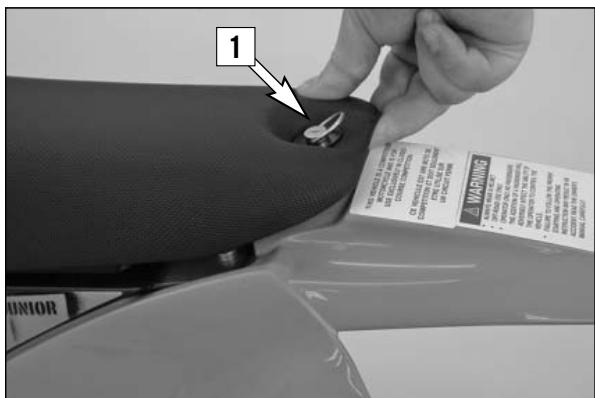
The quick-release mechanism [1] allows removal of the seat without tools. Turn the quick-release device approximately 180^ counterclockwise, lift the rear portion of the seat and pull the seat off backwards. When mounting the seat ensure that the hook engages at the tank.
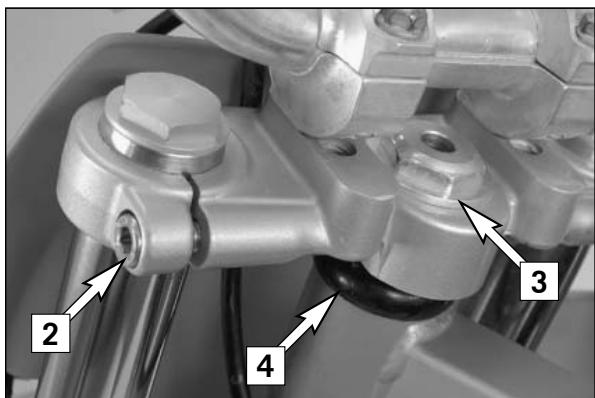
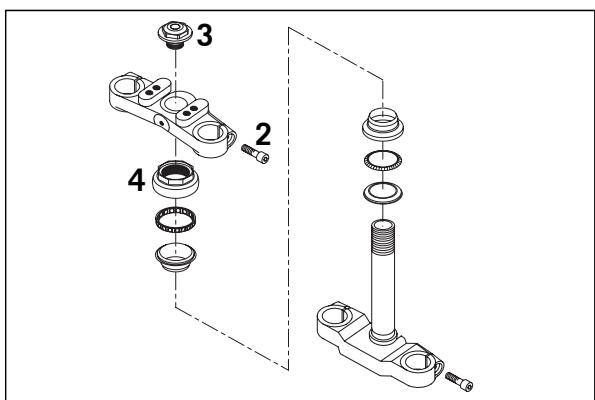
Checking and adjusting the steering head bearing (50 SX Junior) *
The steering head bearing should be checked regularly for play. For this purpose, jack up the motorcycle by the frame so that the front wheel is in the air. Now try to move the fork forward and backward. There should be no clearance. For readjustment, release the two clamp screws [2] of the top triple clamp and the counternut [3]. Turn the adjusting nut [4] until almost no play is left. Do not tighten the adjusting nut! Tightening the adjusting nut can damage the bearings! Keep in mind that tightening the counternut [3] reduces the play of the bearing. Slightly tap the top triple clamp with a rubber hammer to prevent jamming. Then tighten the 2 clamp screws with 20Nm .
WARNING
IF THE STEERING HEAD BEARING IS NOT ADJUSTED TO BE FREE OF CLEARANCE, THE MOTORCYCLE WILL EXHIBIT UNSTEADY DRIVING CHARACTERISTICS AND CAN GET OUT OF CONTROL.
CAUTION
- THE HANDLEBAR MUST MOVE EASILY. OTHERWISE THE BEARINGS WILL BE DAMAGED.
- IF YOU DRIVE WITH PLAY IN THE STEERING HEAD BEARING FOR LONGER PERIODS, THE BEARINGS AND SUBSEQUENTLY THE BEARING SEATS IN THE FRAME WILL BE DESTROYED.
At least once a year, the steering head bearings should be smeared with waterproof grease (Motorex Long Term 2000).
Checking and adjusting the steering head bearing (50 SX, 50 Supermoto) *
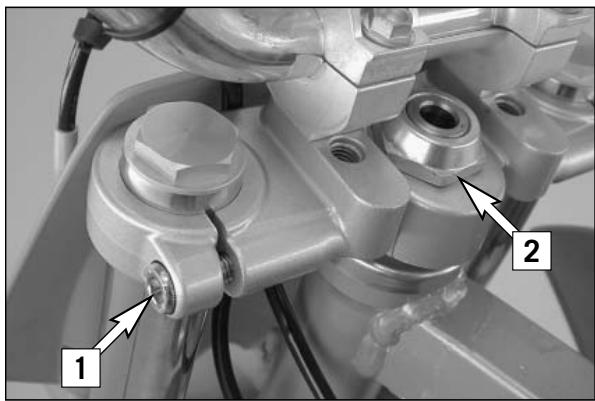
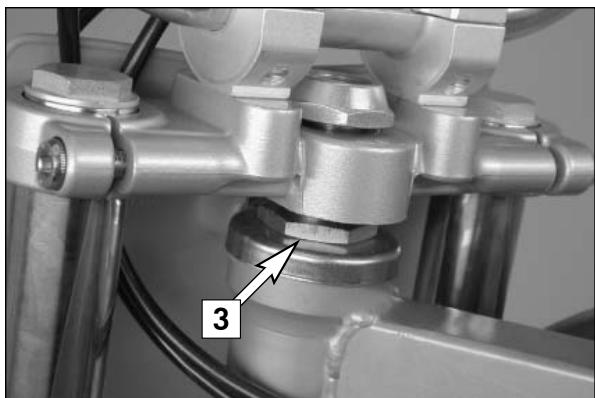
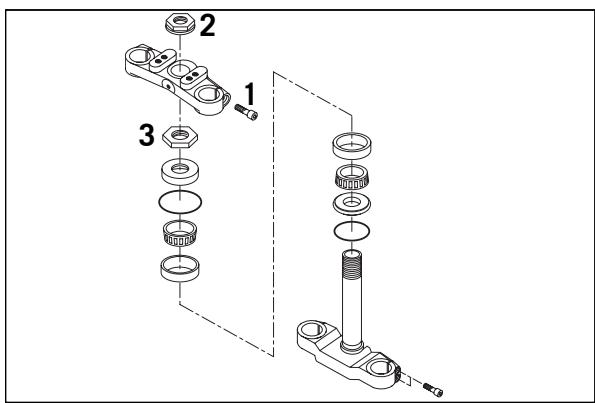
The steering head bearing should be checked regularly for play. To check, support the motorcycle frame and lift the front wheel off the ground. Now try to move the fork back and forth – you should not feel any play. To adjust, loosen both clamping screws [1] on the upper triple clamp and loosen the steering head screw [2] by a few turns. Lift the triple clamp slightly and turn the adjusting nut [3] until hardly any play is left. Never tighten the adjusting nut since you might damage the bearing. Tighten the steering head screw to a torque of 10Nm and the 2 clamping screws to 20Nm .
WARNING
IF THE STEERING HEAD BEARING IS NOT ADJUSTED TO BE FREE OF CLEARANCE, THE MOTORCYCLE WILL EXHIBIT UNSTEADY DRIVING CHARACTERISTICS AND CAN GET OUT OF CONTROL.
CAUTION
- THE HANDLEBAR MUST MOVE EASILY. OTHERWISE THE BEARINGS WILL BE DAMAGED.
- IF YOU DRIVE WITH PLAY IN THE STEERING HEAD BEARING FOR LONGER PERIODS, THE BEARINGS AND SUBSEQUENTLY THE BEARING SEATS IN THE FRAME WILL BE DESTROYED.
At least once a year, the steering head bearings should be smeared with waterproof grease (Motorex Long Term 2000).
How to change the handlebar position
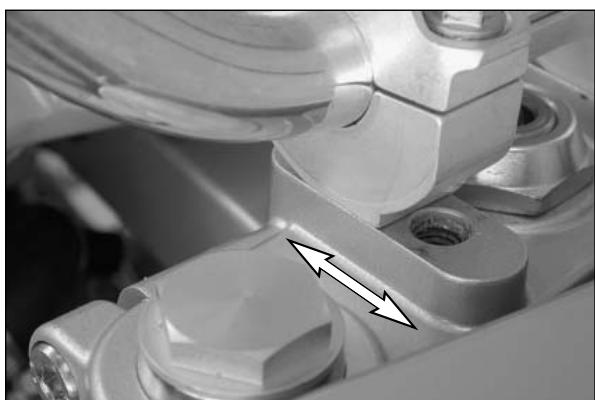
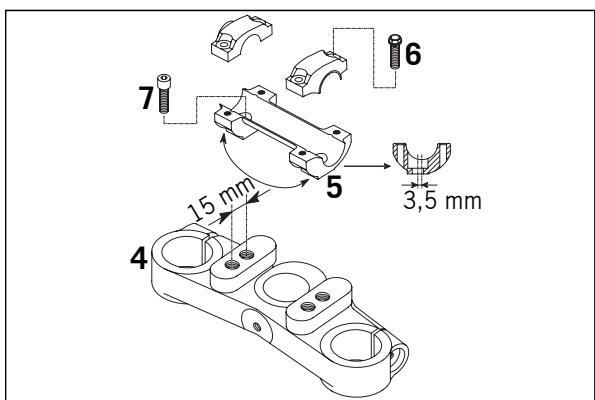
The handlebar position can be readjusted by 22mm (0.9 in). The upper triple clamp [4] includes 2 bores arranged at a distance of 15mm (0.6 in) from one another. The bores at the handlebar support [5] are offset from the center by 3.5mm (0.13 in). Accordingly, you can mount the handlebar in 4 different positions.
For this purpose, remove screws [6] of the handlebar clamps and screws [7] of the handlebar support. Position handlebar support, and tighten screws [7] to 40Nm . Mount handlebar and handlebar clamps, and tighten screws [6] to 20Nm . The gap between the handlebar support and handlebar clamps should be the same size in the front and in the rear.
CAUTION
THE SCREWS [7] MUST BE SECURED WITH LOCTITE 243.
Basic suspension setup for the weight of the driver
To achieve maximum handling performance and to prevent the telescopic fork and shock absorber from being damaged, the basic setup of the suspension components must be suitable for your child's weight. At delivery, KTM's mini motorcycles are set to accommodate a driver weighing 25 - 30 kg (wearing full protective clothing). If your child's weight exceeds or falls short of this range, you will need to adjust the spring preload for the telescopic fork and shock absorber accordingly.
To adjust, check the sag of the shock absorber and telescopic fork. The motorcycle should be filled up and your child should be wearing full protective clothing.
To determine the sag of the shock absorber
- Jack up the motorcycle until the rear wheel no longer touches the ground.
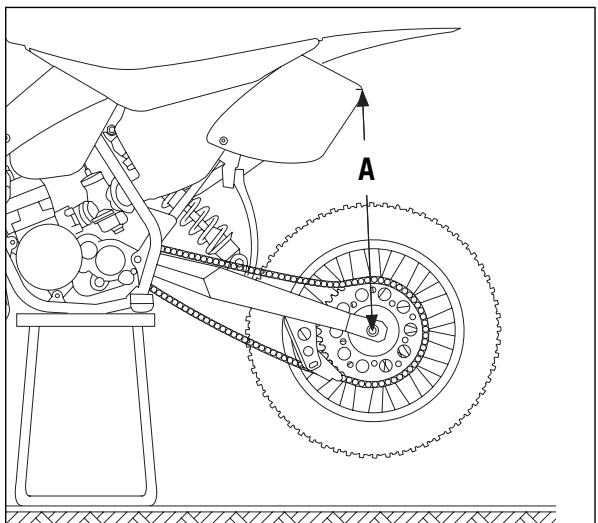
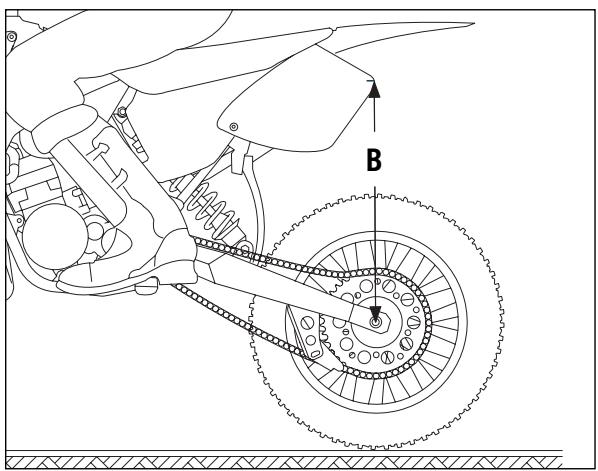
- Measure the vertical distance between the rear wheel axle and a fixed point (e.g. a mark on the side cover) and write it down as dimension A.
- Place the motorcycle on the ground again.
- Have your child sit on the motorcycle in a normal seating position (feet on the footrests) wearing full protective clothing and bounce up and down a few times to allow the rear wheel suspension to become level.
- Holding your child and the bike, have another person measure the distance between the same two points with the load on the motorcycle to establish dimension B.
- The sag is the difference between dimensions A and B.
EXAMPLE:
Motorcycle jacked up (dimension A) 400 mm
Motorcycle on ground with driver seated (dimension B) 355 mm
Sag 45 mm
50 SX Junior shock absorber sag 45 mm (± 5 mm)
50 SX, 50 Supermoto shock absorber sag . . . . . . . . . . . . . . . . . . . . . . . . . . . . . . . . . . . . . . . . . . . . . . . . . . . . . . . . . . . . . . . . . . . . . . . . . . . . . . . . .
If the sag is lower, the spring preload of the shock absorber must be reduced, if the sag is higher, the spring preload must be increased (see Changing spring preloading of the shock absorber). A harder spring is also available for the 50 SX, 50 Supermoto (see spare parts catalog).
To determine the sag of the telescopic fork
- Jack up the motorcycle until the rear wheel no longer touches the ground.
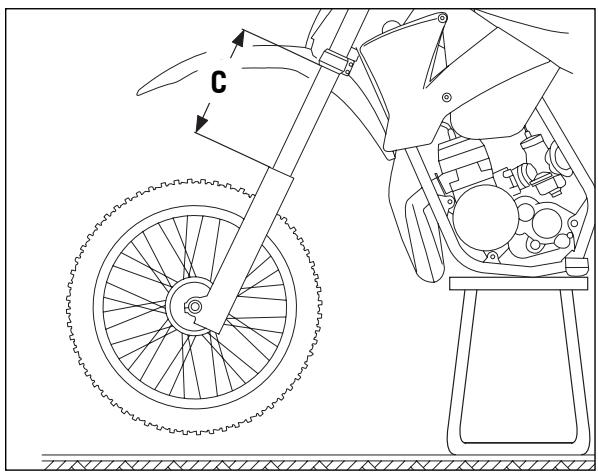
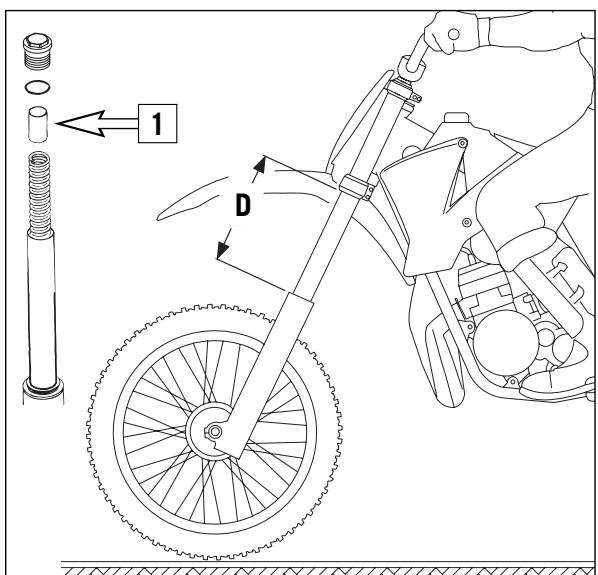
- Measure the distance between the upper edge of the slider tube and the triple clamp and write it down as dimension C.
- Have your child sit on the motorcycle in a normal seating position (feet on the footrests) wearing full protective clothing, and bounce up and down a few times to allow the telescopic fork to become level.
- Holding your child and the bike, have another person measure the distance between the same two points with the load on the motorcycle to establish dimension D.
- The sag is the difference between dimensions C and D.
EXAMPLE:
Motorcycle jacked up (dimension C) 200 mm
Motorcycle on ground with driver seated (dimension D) 160 mm
Sag 40 mm
50 SX Junior telescopic fork sag 30 mm (± 5 mm)
50 SX, 50 Supermoto telescopic fork sag 45 mm (± 5 mm)
If the sag is lower, the spring preload of the telescopic fork must be reduced, if the sag is higher, the spring preload must be increased.
The preload on the fork spring is determined by the length of preload spacer [1]. If an adjustment is necessary, demount the fork legs, remove the plugs and shorten the pretensioning sleeves or replace with longer ones (see maintenance of telescopic fork). Harder fork springs are also available for both models (see spare parts catalog).
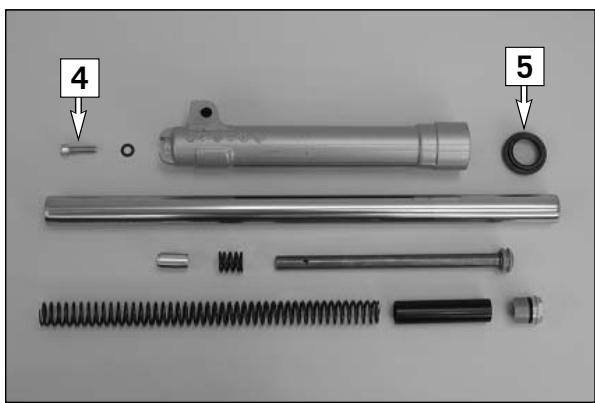
Telescopic fork maintenance *
The telescopic fork must be serviced at least once a year.
To service the fork, proceed as follows:
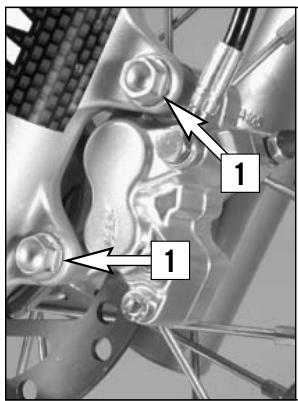
Prop up the motorcycle under the frame to take the load off the front wheel. Disassemble the front wheel, remove screw [1] from the brake caliper and unscrew holding clamp. Measure the projection of the fork legs at the upper fork stabilizer and make a note of the measurement.
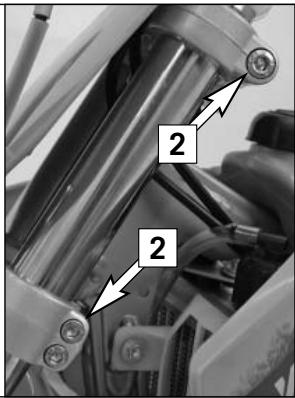
Loosen the clamping screws [2] on the fork stabilizers and pull the fork legs down out of the fork stabilizers.
CAUTION
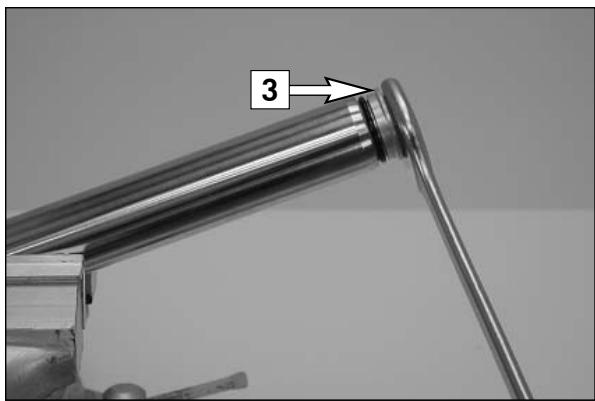
Clamp the fork leg into a vise (use protective jaws) and remove the plugs [3]. Take the preload spacer and the spring out of the fork tube.
Remove screws [4] at the underside of the slider tubes and pull the fork tubes out of the slider tubes.
Remove the dust scrabbers [5].
Thoroughly clean all parts and check for wear.
Generously lubricate seals and springs and reassemble the telescopic fork. Tighten the screws on the bottom of the sliding tubes to 30 Nm.
Fill in fork oil and assemble the fork (see below). Degrease the screws on the brake caliper and apply Loctite 243. Mount the brake caliper and tighten to 20 Nm. Mount brake line and holding clamp.
Insert fork legs in the fork stabilizers (projection as previously noted) and tighten clamping screws to 20 Nm (top) and 15 Nm (bottom).
Mount front wheel (see chapter: mounting the front wheel).
WARNING
THE SCREWS [1] MUST BE SECURED WITH LOCTITE 243.
Changing the telescopic fork oil *
Remove front wheel and fork legs (see above).
Remove plugs, preload spacers and springs.
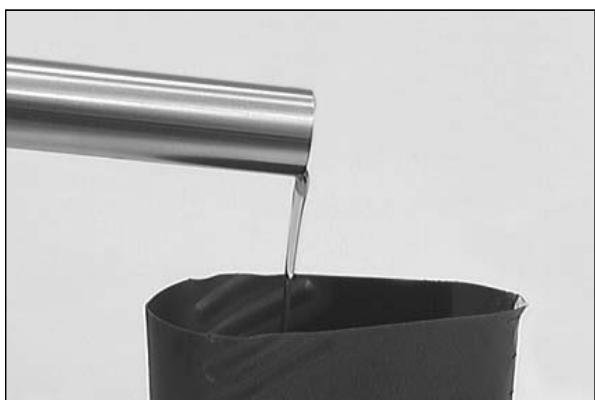
Drain the fork oil into an appropriate container.
Clean the dust scrabbers.
WARNING
- It is very important to keep the brake disk free from oil and fatty matters. Otherwise, the braking effect would be strongly reduced.
- After working on the brake system, always operate the hand brake lever to apply the brake shoes to the brake disk and have a point of pressure.
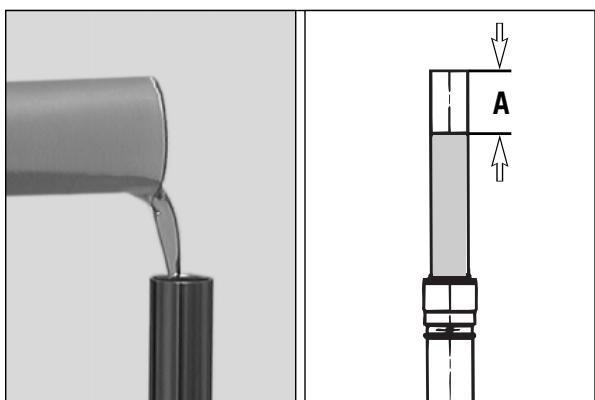
Pour 170 cm3 SAE 7.5 fork oil into each fork tube.
Slide the fork tube all the way into the slider tube.
Adjust the air-chamber length [A] to 110 mm (4.5 in) by extracting or adding fork oil.
Insert springs and pretensioning sleeves into the fork tube.
Check O-rings, grease and mount plugs.
Mount the fork legs, front wheel and brake caliper (see above).
Cleaning the dust scrabbers of the telescopic fork
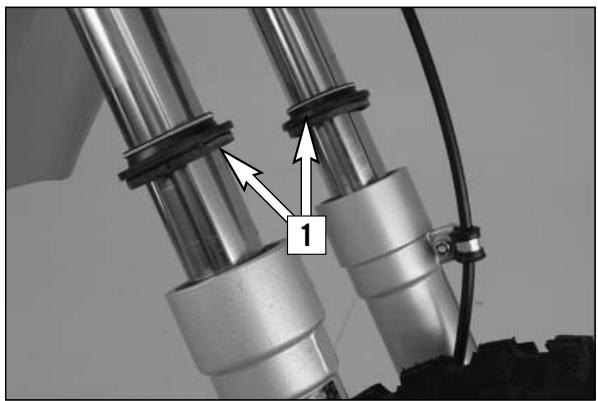
The dust-protection bellows [1] are to remove dust and coarse dirt particles from the fork tube. However, after some time, dirt may also get in behind the dust-protection bellows. If this dirt is not removed, the oil sealing rings located behind it may start to leak.
For this purpose, use a screwdriver to lift the dust scrubbers out of the slider tubes, clean them thoroughly with compressed air, spray the fork tubes and dust scrubbers with Universal oil spray (Motorex Joker 440) or engine oil. Then, push the dust-protection bellows into the outer tubes by hand.
WARNING
NO OIL MAY REACH THE FRONT TIRE OR THE BRAKE DISKS SINCE THIS WOULD CONSIDERABLY REDUCE THE TIRE'S ROAD GRIP AND THE BRAKING EFFECT OF THE FRONT BRAKE.
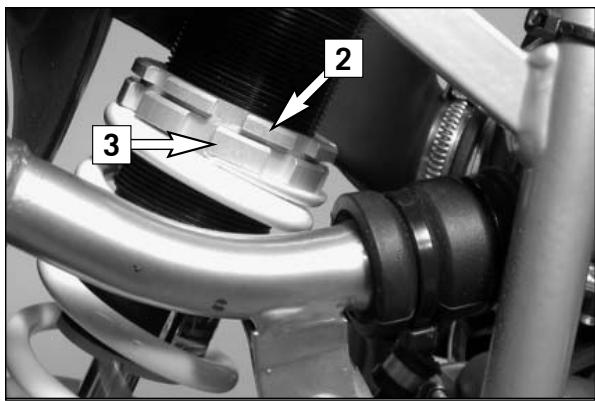
Changing spring preloading of the shock absorber
This is easily done.
NOTE: Before changing the spring preload note down the basic setting, e.g. how many threads are visible above the adjusting ring.
Remove the right side cover.
Loosen the locking ring [2] with the hook spanner. Change the spring preload with the adjusting ring [3] and re-tighten the locking ring [2].
BASIC SETTING - SPRING PRELOAD:
50 SX Junior: 10 mm (0.39 in)
50 SX, 50 Supermoto: ......... 7 mm (0.3 in)
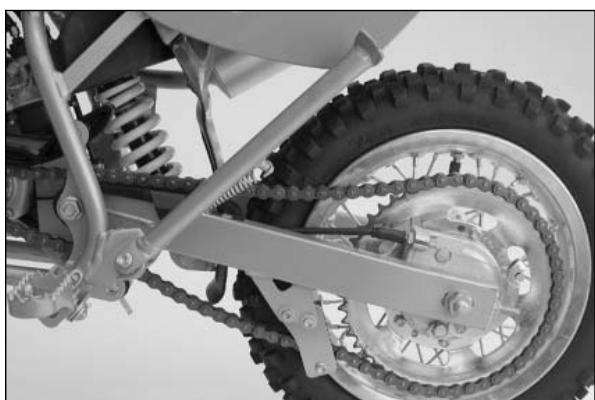
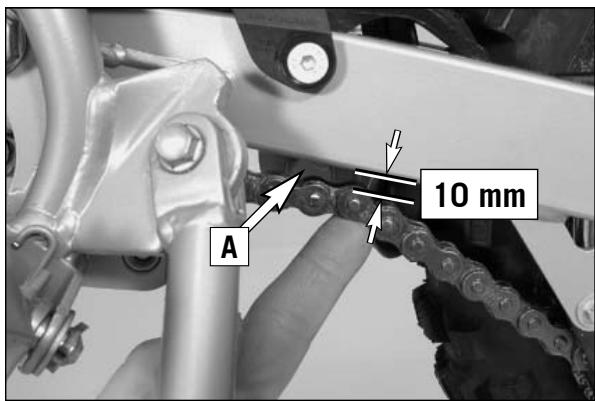
Check chain tension
Put the motorcycle on the sidestand.
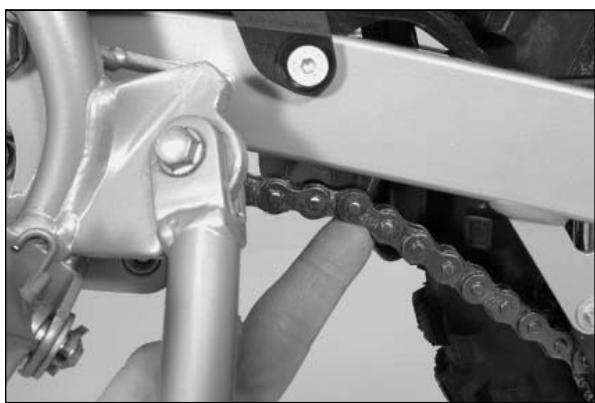
Chain tension has to be checked close to the lower rear shock mounting [A]. When pushing the chain upwards, the distance to the swingarm has to be 10mm (0.4 in).
If necessary, correct chain tension.
WARNING
- IF CHAIN TENSION IS TOO GREAT, PARTS WITHIN THE SECONDARY TRANSMISSION (CHAIN, CHAIN WHEELS, GEAR BOX AND REAR WHEEL BEARINGS) WILL BE SUBJECTED TO UNNECESSARY STRESS, RESULTING IN PREMATURE WEAR AND EVEN CHAIN BREAKAGE.
- TOO MANY SLACK IN THE CHAIN, ON THE OTHER HAND, CAN RESULT IN THE CHAIN JUMPING OFF THE CHAIN WHEELS. IF THIS HAPPENS, THE CHAIN COULD ALSO BLOCK THE REAR WHEEL OR DAMAGE THE ENGINE. IN EITHER CASE THE OPERATOR IS LIKELY TO LOSE CONTROL OF THE MOTORCYCLE.
- BE CAREFUL NOT TO GET YOUR FINGER CAUGHT BETWEEN THE CHAIN AND THE REAR SPROCKET OR OTHER COMPONENTS.
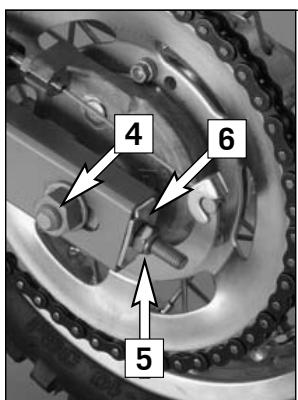
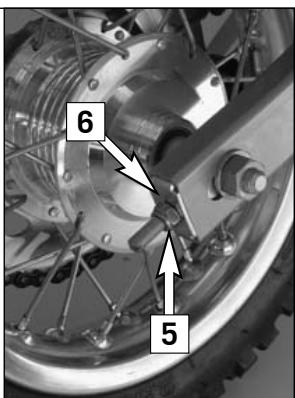
Correct chain tension
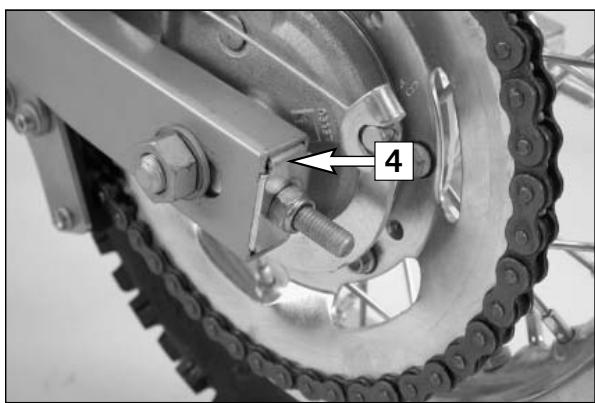
Release the hexagon nut of the wheel spindle [4] and turn the left and the right hexagon nut [5] equally far.
Before tightening the hexagon nut of the wheel spindle to 40Nm , ensure that the supporting plates [6] are resting against the swing arm. Additionally, check that the rear wheel is aligned with the front wheel.
Chain maintenance
For long chain life, good maintenance is very important. Chains without O-rings should be cleaned in fireproof solvent regularly and afterwards treated with hot grease or chain spray (Motorex Chainlube Racing).
WARNING
KEEP THE REAR WHEEL FREE OF GREASE! GREASE ON THE REAR WHEEL WILL SIGNIFICANTLY REDUCE THE GRIP OF THE REAR TIRE AND THE MOTORCYCLE COULD EASILY GET OUT OF CONTROL.
CAUTION
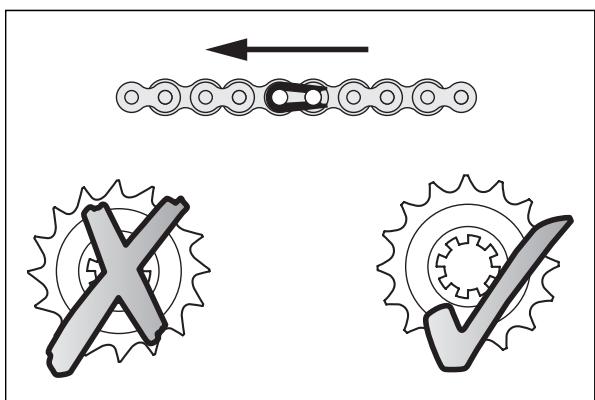
WHEN MOUNTING THE CHAIN MASTERLINK CLIP, THE CLOSED SIDE OF THE MASTERLINK CLIP MUST POINT IN RUNNING DIRECTION.
Also check sprockets and chain guides for wear, and replace if necessary.
General information about KTM disc brakes
BRAKE FLUID RESERVOIRS:
The brake fluid reservoirs for the front brake is designed such that it does not need to be refilled, even if the brake shoes are worn. If the brake fluid level drops below the minimum level either the brake system has a leak or the brake pads are completely worn.
In this case, consult an authorized KTM dealer immediately.
BRAKE FLUID:
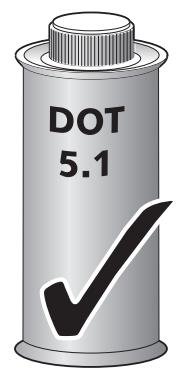
KTM fills the brake system with "Motorex Brake Fluid DOT 5.1", one of the best brake fluids currently available. We recommend that you continue to use it. DOT 5.1 brake fluid is based on glycol ether and of an amber color. If you do not have any DOT 5.1 for refilling, you may use DOT 4 brake fluid. DOT 4 shown on the lid means minimum standard. However, you should replace it as soon as possible by DOT 5.1.
WARNING
HAVETHE BRAKEFLUID CHANGED AT LEAST ONCE ANNUALLY. IF YOU WASH YOUR MOTORCYCLE OFTEN, THE BRAKE FLUID SHOULD BE CHANGED EVEN MORE FREQUently.BRAKE FLUID TENDSTO ABSORB WATER.THEREFORE,VAPOR POCKETS MAY FORM IN "OLD" BRAKE FLUIDS EVEN AT LOW TEMPERATURES, CAUSING THE BRAKE SYSTEM TO FAIL.
BRAKE DISC:
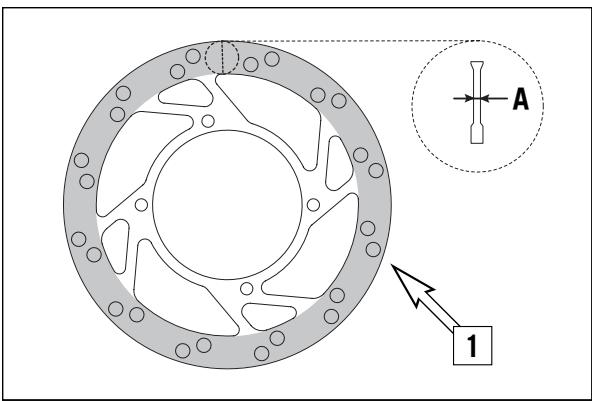
Due to wear, the thickness of the brake disc in the area of the contact face [1] of the brake pads decreases. The brake disk must be at least 2.50 mm thick at the thinnest point [A]. Check the thickness of the brake disk at several points.
WARNING
- A BRAKE DISK WORN DOWN TO LESS THAN 2.50 MM IS A SAFETY RISK. HAVE THE BRAKE DISK REPLACED AS SOON AS IT REACHES THE SERVICE LIMIT.
- HAVE ANY REPAIRS ON THE BRAKE SYSTEM BE PERFORMED BY A KTM DEALER.
BRAKE CALIPERS:
Secure the screws on the brake caliper with Loctite 243 and tighten to a torque of 20Nm .
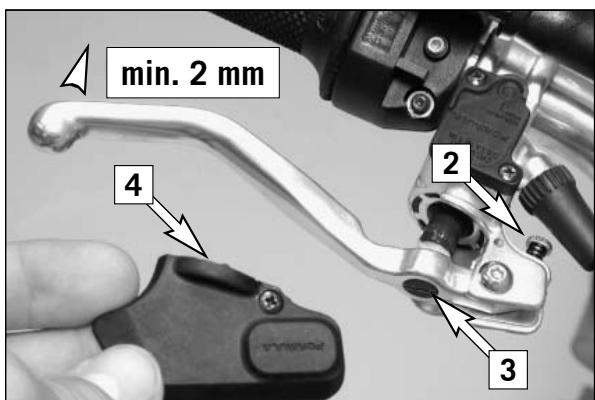
Setting the basic position and play of the hand brake lever *
You can adjust the basic position of the hand brake lever to fit your child's hand by turning stop screw [2]. Afterwards, be sure to adjust the play of the hand brake lever to 2 mm (0.08 in) with the adjusting screw [3]. To adjust, remove covering cap [4]. Replace the covering cap after making the adjustment.
CAUTION
AT THE HAND BRAKE LEVER, FREE TRAVEL MUST AT LEAST BE 2 MM (0.08 IN). ONLY THEN MAY THE PISTON IN THE HAND BRAKE CYLINDER BE MOVED (TO BE RECOGNIZED BY THE GREATER RESISTANCE OF THE HAND BRAKE LEVER). IF THIS FREE TRAVEL IS NOT PROVIDED, PRESSURE WILL BUILD UP IN THE BRAKING SYSTEM, AND THE FRONT-WHEEL BRAKE MAY FAIL DUE TO OVERHEATING.
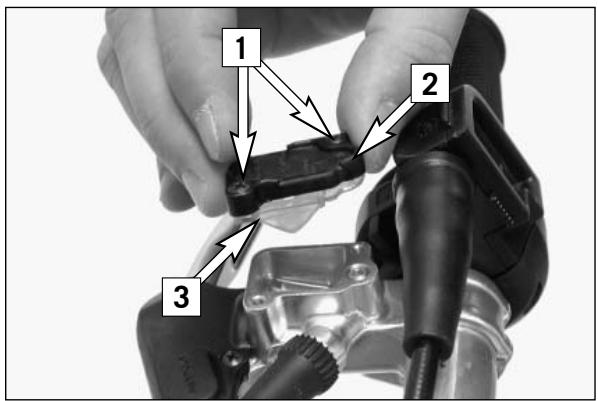
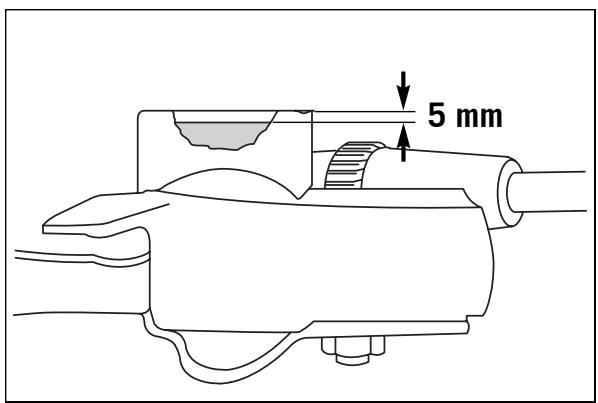
Checking the brake fluid level/refilling \*
The brake fluid reservoir is combined with the hand brake cylinder on the handlebar. To check the brake fluid level, press the brake pistons back into the basic position. Move the hand brake cylinder in a horizontal position, remove the screws [1] and the cover [2] with the diaphragm [3]. The brake fluid level should be 5mm below the upper edge of the reservoir (see drawing), otherwise add DOT 5.1 brake fluid (e.g. Motorex Brake Fluid DOT 5.1) up to 5mm below the upper edge of the reservoir.
Mount the diaphragm, the cover and the screws and actuate the hand brake lever until you feel the point of pressure again. Wipe off any overflowing or spilled brake fluid with water.
WARNING
- ACTUATE THE HAND BRAKE LEVER UNTIL YOU FEEL THE POINT OF PRESSURE AGAIN.
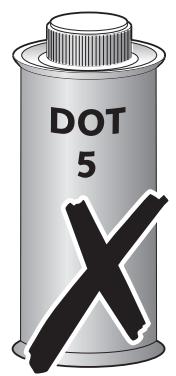
- NEVER USE DOT 5 BRAKE FLUID! IT IS BASED ON SILICONE OIL AND OF A PURPLE COLOR. SEALS AND BRAKE HOSES MUST BE ESPECIALLY ADAPTED TO IT.
- STORE BRAKE FLUID OUT OF REACH OF CHILDREN.
- BRAKE FLUID CAN CAUSE SKIN IRRITATION. AVOID CONTACT WITH SKIN AND EYES. IF YOU GET BRAKE FLUID IN YOUR EYES, RINSE WITH PLENTY OF WATER AND CONSULT A DOCTOR.
CAUTION
- DON'T LET BRAKE FLUID GET IN CONTACT WITH PAINT, IT IS AN EFFECTIVE PAINT REMOVER.
- USE ONLY CLEAN BRAKE FLUID TAKEN FROM A TIGHTLY SEALED CONTAINER.
Checking front brake pads
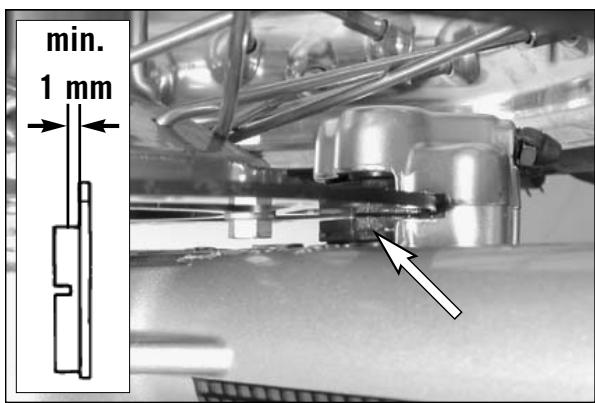
Inspect the brake pads from in front of the vehicle. The linings must be at least 1 mm (0.04 in) thick.
WARNING
AT THEIR MOST WORN POINT BRAKE PAD LININGS SHOULD NOT BE THINNER THAN 1 MM (0.04 IN), OTHERWISE THEY COULD LEAD TO BRAKE FAILURE. FOR YOUR OWN SAFETY DON'T PUT OFF HAVING YOUR BRAKE PADS CHANGED.
CAUTION
IF THE BRAKE PADS ARE REPLACED太LATE SO THAT THE LINING IS PARTLY OR ENTIRELY WORN, THE STEEL COMPONENTS OF THE BRAKE PAD WILL RUB AGAINST THE BRAKE DISC, THEREBY IMPARING THE BRAKING EFFECT AND DESTROYING THE BRAKE DISC.
Replacing the front brake pads *
Remove the front wheel (see front wheel chapter).
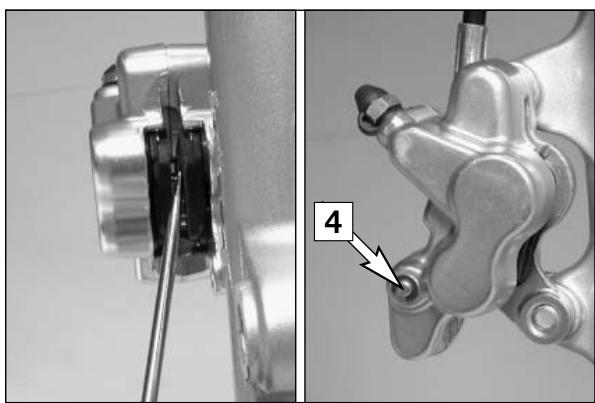
Press brake shoes apart with a suitable screwdriver to put the brake pistons in their basic position.
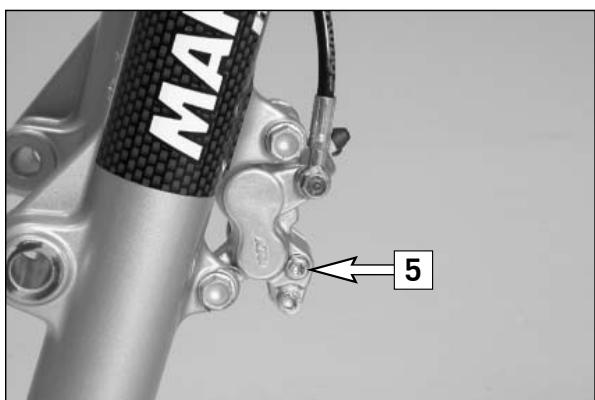
Remove the lock washer [4] from the screw as well as fixing screw [5] and take the brake shoes out of the brake caliper. Clean brake caliper thoroughly with compressed air.
Mount the left brake shoe and fix with screw. Mount the right brake shoe and tighten the screw to 4 Nm. Mount the lock washer. Align brake shoes, mount front wheel (see chapter: Mounting the front wheel).
WARNING
- IT IS VERY IMPORTANT TO KEEP THE BRAKE DISK FREE FROM OIL AND FATTY MATTERS. OTHERWISE, THE BRAKING EFFECT WOULD BE STRONGLY REDUCED.
- AFTER ASSEMBLY, CHECK IF CIRCLIPS HAVE BEEN FITTED CORRECTLY.
- DO NOT UNSCREW ANY OTHER SCREWS ON THE BRAKE CALIPER OR YOU WILL HAVE TO BLEED THE BRAKE SYSTEM.
- AFTER WORKING ON THE BRAKE SYSTEM ALWAYS OPERATE THE HAND BRAKE LEVER TO APPLY THE BRAKE PADS TO THE BRAKE DISK AND CREATE A POINT OF PRESSURE.

Changing the basic position of the foot brake lever (50 SX Junior)
The basic position of the foot brake lever can be changed by unscrewing screw [1] and then turning the retainer [2].
Afterwards, check the setting of the rear wheel brake.
Adjusting the control cable on the rear wheel (50 SX Junior)
You should be able to press the foot brake lever 5 to 10mm (0.2-0.4 in) before the rear wheel begins to brake.
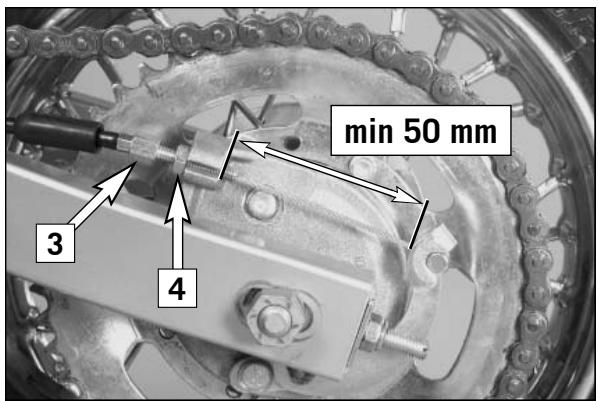
The brake control cable is adjusted with adjusting screw [3] on the brake anchor cover. First loosen lock nut [4] and then tighten again.
CAUTION
AFTER MAKING ADJUSTMENTS, ALWAYS MAKE SURE THE WHEEL TURNS FREELY.
Checking the rear brake linings for wear (50 SX Junior)
The brake linings must be replaced when the distance between the hub brake lever and the cable support, measured with the brake lever squeezed, is less than 50~mm (2 in) (see illustration).
CAUTION
IF THE BRAKE LININGS ARE REPLACED太LATE, I.E. WHEN THE LINING IS PARTLY OR FULLY WORN AWAY, THE METAL SHOES WILL RUB AGAINST THE BRAKE DRUM, THUS REDUCING THE BRAKING EFFECT AND DESTROYING THE BRAKE DRUM.
Drum brake maintenance (50 SX Junior)
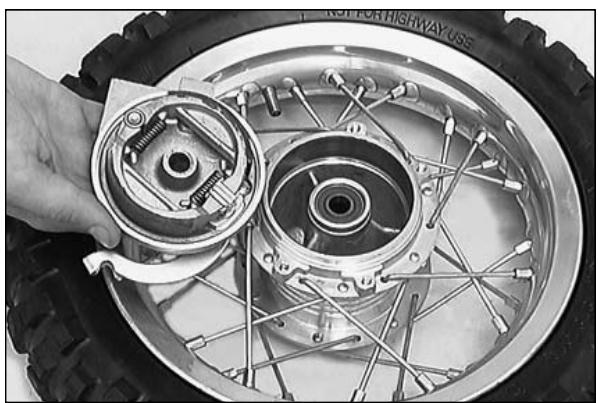
Drum brake maintenance is limited to occasional blowing out of the brake drum and brake shoes. Brake drum and brake linings can be slightly roughened with an abrasive tape.
Changing the basic position of the foot brake lever (50 SX, 50 Supermoto)
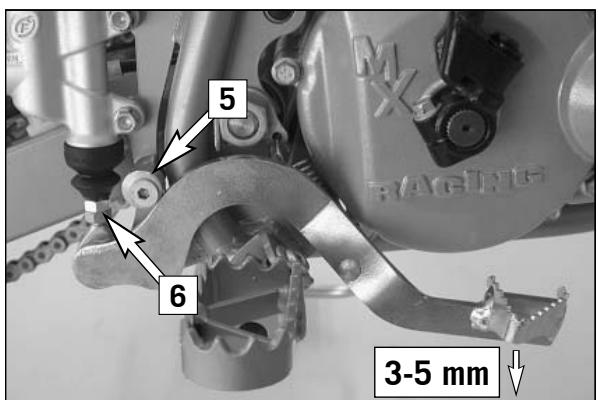
The basic setting of the foot brake pedal can be changed by turning the end stop roller [5]. Using the push rod [6], the free play on the foot brake pedal must be set.
Measured on the outside, the foot brake pedal must have 3 - 5mm of free play, before the push rod can move the piston in the brake cylinder (to be recog-nised from the resistance on the foot brake pedal)
Checking the rear brake fluid level (50 SX, 50 Supermoto)
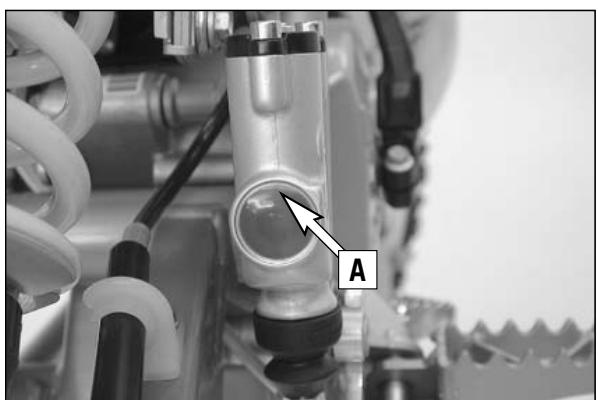
The reservoir for the rear disk brake is on the right side of the motorcycle on the rear brake cylinder.
No air bubble should be visible in inspection glass [A] when the vehicle is parked in a vertical position.
WARNING
Remove the screws [1] and take off the cover [2] and diaphragm [3]. The brake pistons must be pushed back to their basic position. Fill DOT 5.1 brake fluid (e.g. Motorex Brake Fluid DOT 5.1) up to 8mm under the upper edge of the reservoir.
Remount the diaphragm, cover and screws and actuate the foot brake lever until you feel the point of pressure again. Wipe any overflowing or spilled brake fluid off with water.
WARNING
- ACTUATE THE FOOT BRAKE LEVER UNTIL YOU FEEL THE POINT OF PRESSURE AGAIN.
- NEVER USE DOT5 BRAKE FLUID! IT IS BASED ON SILICONE OIL AND OF A PURPLE COLOR. SEALS AND BRAKE HOSES MUST BE ESPECIALLY ADAPTED TO IT.
- STORE BRAKE FLUID OUT OF REACH OF CHILDREN.
- BRAKE FLUID CAN CAUSE SKIN IRRITATION. AVOID CONTACT WITH SKIN AND EYES. IF YOU GET BRAKE FLUID IN YOUR EYES, RINSE WITH PLENTY OF WATER AND CONSULT A DOCTOR.
CAUTION
- DON'T LET BRAKE FLUID GET IN CONTACT WITH PAINT, IT IS AN EFFECTIVE PAINT REMOVER.
- USE ONLY CLEAN BRAKE FLUID TAKEN FROM A TIGHTLY SEALED CONTAINER.
Refilling the rear brake fluid reservoir * (50 SX, 50 Supermoto)
Remove the screws 1 and take off the cover 2 and diaphragm 3. The brake pistons must be pushed back to their basic position. Fill DOT 5.1 brake fluid (e.g. Motorex Brake Fluid DOT 5.1) up to 8mm under the upper edge of the reservoir.
Remount the diaphragm, cover and screws and actuate the foot brake lever until you feel the point of pressure again. Wipe any overflowing or spilled brake fluid off with water.
WARNING
- ACTUATE THE FOOT BRAKE LEVER UNTIL YOU FEEL THE POINT OF PRESSURE AGAIN.
- NEVER USE DOT5 BRAKE FLUID! IT IS BASED ON SILICONE OIL AND OF A PURPLE COLOR. SEALS AND BRAKE HOSES MUST BE ESPECIALLY ADAPTED TO IT.
- STORE BRAKE FLUID OUT OF REACH OF CHILDREN.
- BRAKE FLUID CAN CAUSE SKIN IRRITATION. AVOID CONTACT WITH SKIN AND EYES. IF YOU GET BRAKE FLUID IN YOUR EYES, RINSE WITH PLENTY OF WATER AND CONSULT A DOCTOR.
CAUTION
- DON'T LET BRAKE FLUID GET IN CONTACT WITH PAINT, IT IS AN EFFECTIVE PAINT REMOVER.
- USE ONLY CLEAN BRAKE FLUID TAKEN FROM A TIGHTLY SEALED CONTAINER.
Replacing the rear brake pads * (50 SX, 50 Supermoto)
Dismount the rear wheel (see "Dismounting the rear wheel").
Press the brake shoes apart with a suitable screwdriver to allow the brake pistons to return to their basic position.
Remove the locking screw [4], unscrew the screw [5] and pull the brake shoes out of the brake caliper.
Slide new brake shoes into the brake caliper a fasten with the screw [5].
Tighten the screw to 10 Nm and mount the locking screw [4].
Mount the rear wheel and actuate the foot brake lever until you can feel the pressure point.
WARNING
- IT IS VERY IMPORTANT TO KEEP THE BRAKE DISK FREE FROM OIL AND FATTY MATTERS. OTHERWISE, THE BRAKING EFFECT WOULD BE STRONGLY REDUCED.
- AFTER ASSEMBLY, CHECK IF CIRCLIPS HAVE BEEN FITTED CORRECTLY.
- AFTER WORKING ON THE BRAKING SYSTEM, ONE MUST ALWAYS ACTUATE THE HAND BRAKE LEVER OR FOOT BRAKE LEVER, RESPECTIVELY SO AS TO ENSURE THAT THE BRAKE PADS WILL LIE AGAINST THE BRAKE DISK AND THE PRESSURE POINT IS ESTABLISHED.
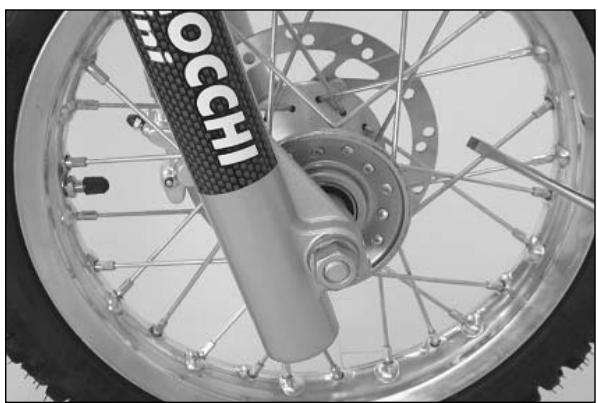
Removing and mounting the front wheel
Jack the motorcycle up by the frame so that the front wheel is suspended above the ground.
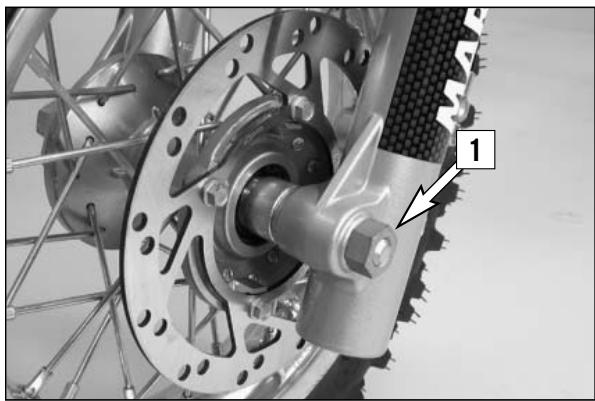
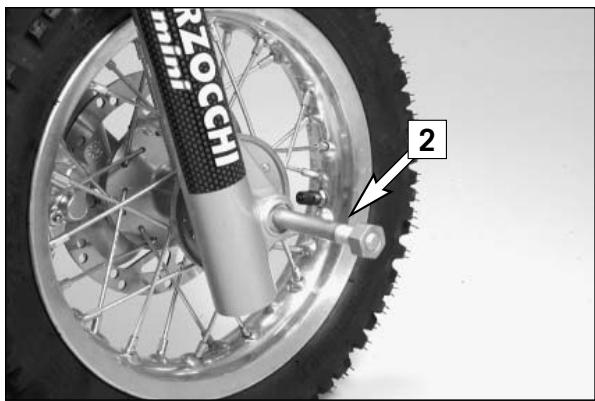
Undo the hexagon nut [1] and remove it together with the washer.
Hold the front wheel and pull out the wheel spindle [2].
Carefully take the front wheel out of the fork.
CAUTION
Lift the front wheel into the fork and correctly position it.
Mount the wheel spindle [2].
Mount the washer and the hexagon nut [1] and tighten 40 Nm.
Put the motorcycle back on the ground and operate the front wheel brake until the working point is reached.
WARNING
- IF YOU DON'T HAPPEN TO HAVE A TORQUE WRENCH AT HAND, MAKE SURE YOU HAVE THE TIGHTENING TORQUE CORRECTED BY A KTM DEALER AS SOON AS POSSIBLE. A LOOSE AXLE MAY LEAD TO AN UNSTABLE DRIVING BEHAVIOR OF YOUR MOTORCYCLE.
- AFTER MOUNTING THE FRONT WHEEL, KEEP OPERATING THE HAND BRAKE UNTIL THE PRESSURE POINT RETURNS.
- IT IS VERY IMPORTANT TO KEEP THE BRAKE DISK FREE FROM OIL AND FATTY MATTERS, EITHERWISE THE BRAKING EFFECTS WOULD BE STRONGLY REDUCED.
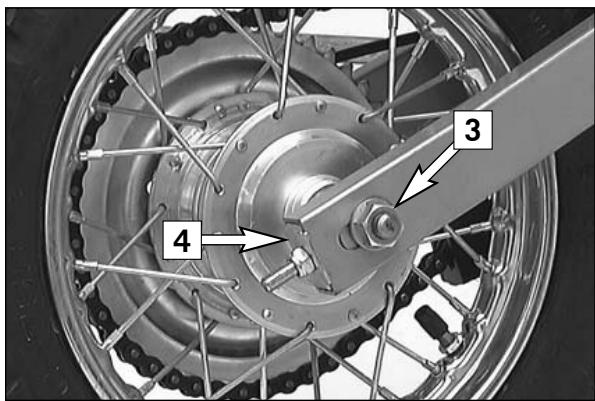
Removing and mounting the rear wheel
Prop up the motorcycle under the frame.
Remove hexagon nut [3] on the wheel spindle and disk.
Hold the rear wheel and remove the wheel spindle.
Move the rear wheel forwards, remove chain, lift the rear wheel out of the swinging fork and remove the brake anchor.
CAUTION
To mount the wheel reverse the procedure described above.
Always hook the brake backing plate into the swing arm support.
Before tightening the hexagon nut of the wheel spindle, ensure that the supporting plates [4] are resting against the swing arm. Additionally, check that the rear wheel is aligned with the front wheel.
Tighten the hexagon nut to 40Nm
WARNING
- IF YOU DON'T HAPPEN TO HAVE A TORQUE WRENCH AT HAND, MAKE SURE YOU HAVE THE TIGHTENING TORQUE CORRECTED BY A KTM DEALER AS SOON AS POSSIBLE. A LOOSE AXLE MAY LEAD TO AN UNSTABLE DRIVING BEHAVIOR OF YOUR MOTORCYCLE.
- AFTER MOUNTING THE REAR WHEEL, KEEP OPERATING THE REAR BRAKE UNTIL THE PRESSURE POINT RETURNS.(SNIOR LC)
- IT IS VERY IMPORTANT TO KEEP THE BRAKE DISK FREE FROM OIL AND FATTY MATTERS, OTHERWISE THE BRAKING EFFECTS WOULD BE STRONGLY REDUCED.(50 SX, 50 SUPERMOTO)
Tires, air pressure
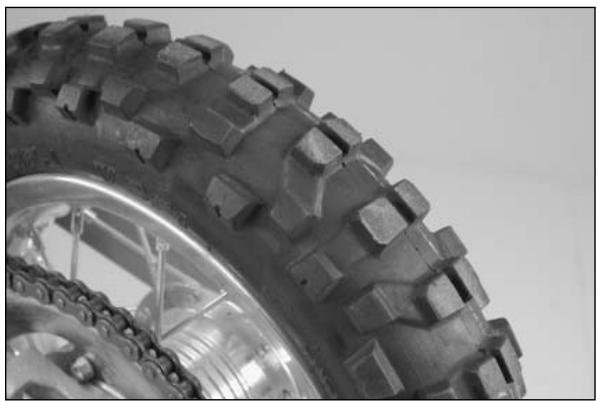
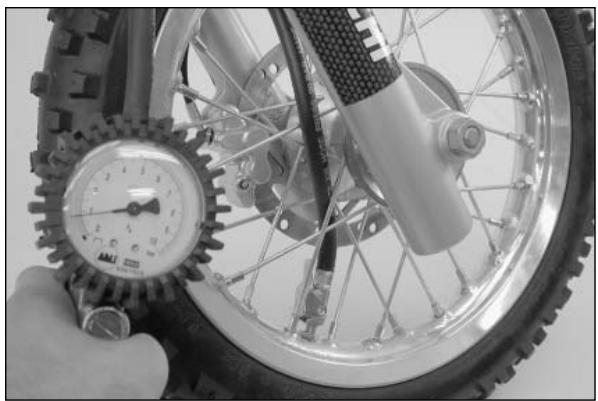
Tire type, tire condition, and air pressure level affect the way your motorcycle rides, and they must therefore be checked whenever you are getting ready to go anywhere on your motorcycle.
- Tire size can be found in the technical specifications.
- Tire condition has to be checked every time you want to ride your motorcycle. Before leaving, check tires for punctures and nails or other sharp objects that might have become embedded in them.
- Regularly check the "cold" tire pressure. Correct tire pressure (1.0 bar / 14 psi) guarantees optimum grip and maximum tire life.
WARNING
- DAMAGED TIRES MUST BE REPLACED IMMEDIATELY TO PROTECT YOUR YOUNGSTER.
- WORN TIRES CAN HAVE A NEGATIVE EFFECT ON HOW THE MOTORCYCLE PERFORMS, ESPECIALLY ON WET SURFACES
- TIRE PRESSURE BELOW THE NORMAL LEVEL WILL LEAD TO PREMATURE TIRE WEAR.
Checking spoke tension
The correct spoke tension is very important for the stability of the wheels and thus for riding safety. A loose spoke causes the wheel to become unbalanced and before long other spokes will have come loose. Check spoke tension, especially on a new motorcycle, at regular intervals. If necessary, have the spokes retightened and the wheel centered by a KTM dealer.
WARNING
- SPOKES CAN TEAR IF YOU CONTINUE TO RIDE WITH THEM LOOSE. THIS MAY LEAD TO AN UNSTABLE HANDLING OF YOUR MOTORCYCLE.
- EXCESSIVELY TENSIONED SPOKES MAY RuptURE DUE TO LOCAL OVERLOADING. THE SPOKES MUST BE TENSIONED TO 3 NM.
Cooling system
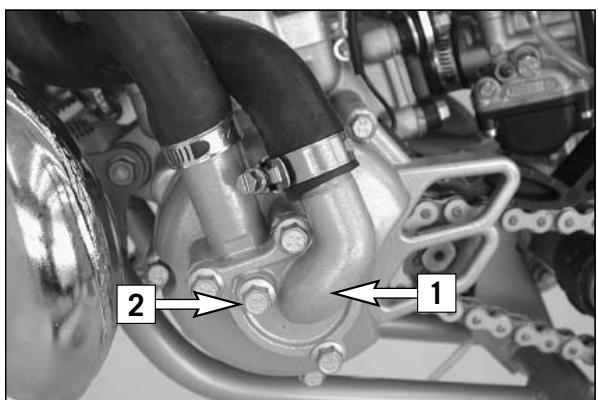
The water pump [1] in the engine keeps the cooling liquid in circulation. The cooling liquid is cooled by the air stream. Therefore, the cooling effect is reduced when the traveling speed is reduced. Dirty radiators additionally reduce the cooling effect.
The cooling liquid can be drained by removing screw [2] on the water-pump cover.
WARNING
DO NOT REMOVE ANY COOLER HOSES OR THE DRAIN SCREW WHEN THE ENGINE IS HOT.
A mixture of 50% antifreeze and 50% distilled water is used as the cooling liquid. How-ever, the antifreeze protection must be at least -25^ (-13^) . This mixture offers antifreeze protection but also good corrosion protection and should therefore not be replaced by pure water.
CAUTION
FOR THE COOLING SYSTEM, USE ONLY WITH HIGH-GRADE ANTIFREEZE (MOTOREX ANTI-FREEZE). USING LOWER-GRADE ANTIFREEZE AGENTS CAN CAUSE CORROSION AND COOLANT FOAMING.
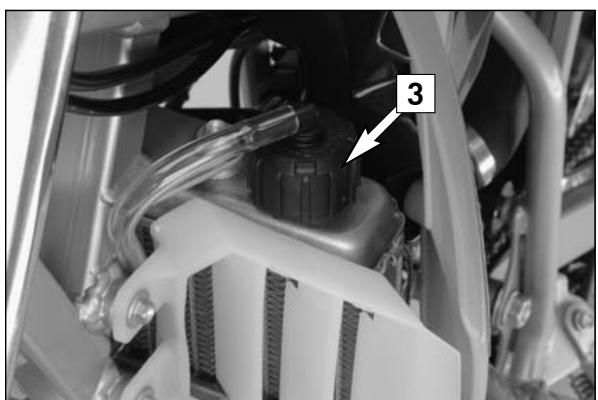
Pressure induced by heating of the coolant in the system is controlled by a valve in the radiator cap [3]; a water temperature rising up to 120^ (248^) is admissible without fear of problems.
Checking coolant level
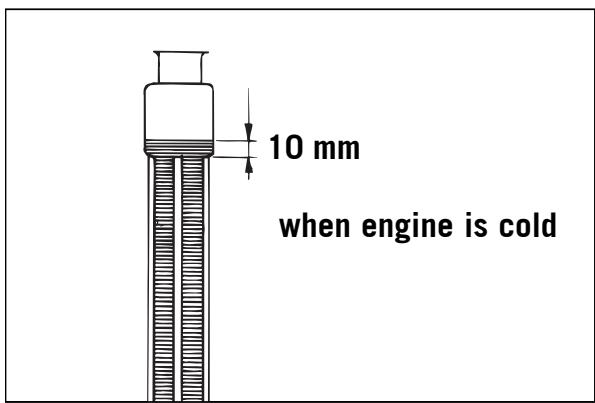
The coolant should be 10 ~mm (0.4 in) above the radiator fins when the engine is cold (see illustr.). In the event of the coolant being drained, always fill and bleed the system.
WARNING
IF POSSIBLE, ALWAYS CHECK LEVEL OF COOLING LIQUID WHEN ENGINE IS COLD. IF YOU HAVE TO OPEN THE RADIATOR CAP WHEN THE ENGINE IS HOT, USE A RAG TO COVER THE CAP AND OPEN SLOWLY TO RELEASE PRESSURE.
Cleaning the air filter *
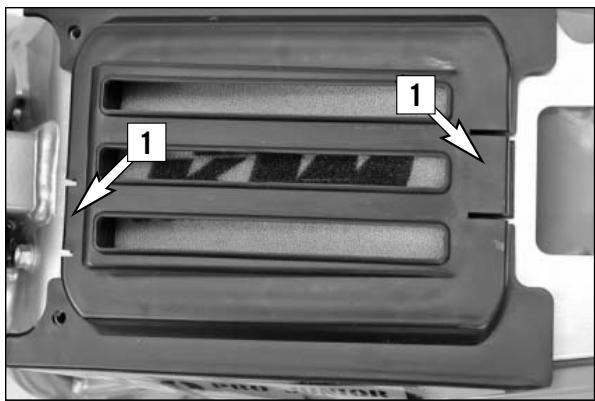
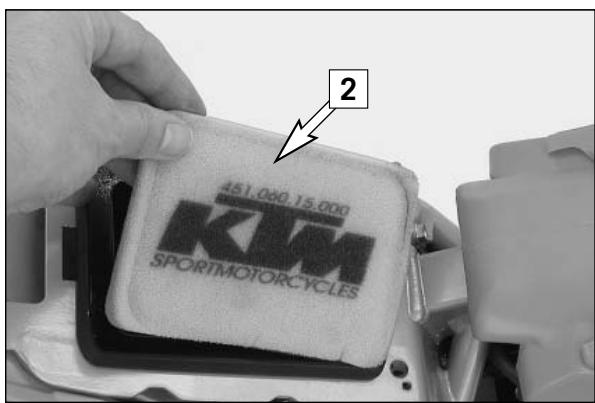
The air filter must be cleaned at intervals depending on the amount of dust accumulated. To clean the air filter, first remove the seat. Then press both retaining clips [1], remove the filter holder and the air filter [2]. The air filter consists of a foam rubber insert soaked with filter oil.
CAUTION
- DO NOT CLEAN THE FOAM FILTER WITH FUEL OR PETROLEUM SINCE THESE WILL DAMAGE THE FOAM. KTM RECOMMENDS THE PRODUCTS (MOTOREX LIQUID BIO POWER) FOR AIR FILTER MAINTENANCE.
- NEVER OPERATE YOUR MOTORCYCLE WITHOUT AN AIR FILTER. OTHERWISE, DUST AND DIRT MAY GET INTO THE ENGINE AND LEAD TO INCREASED WEAR.
- THE HOLDER MUST RETAIN THE AIR FILTER THROUGHOUT ITS ENTIRE CIRCUMFERENCE. IF THE FILTER HAS BEEN MOUNTED INCORRECTLY, THE ENGINE WILL TAKE IN UNFILTERED AIR, THEREBY CAUSING INCREASED ENGINE WEAR.
Thoroughly wash the foam filter in special cleaning fluid (Motorex Bio Dirt Remover) and allow it to dry well. Only press out the filter, do not wring it out under any circumstances. Oil the dry foam filter with a high-grade filter oil (Motorex Liquid Bio Power). Also clean the air filter box. Check carburetor collar for damage and that it is filled correctly.
Insert the air filter in the opening and fasten it with the filter holder. Then mount the seat.
Exhaust system *
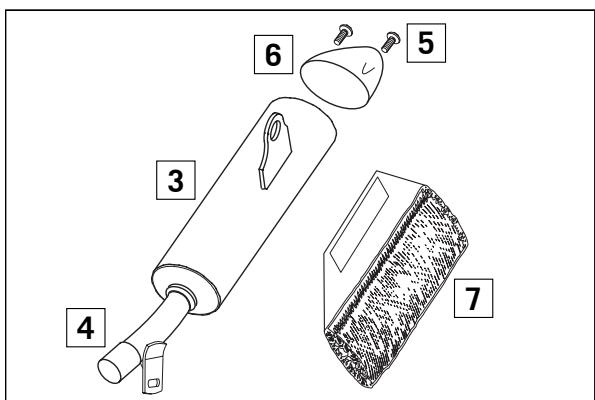
The silencer is filled with glass-fiber yarn for damping. When in use, the glass-fiber yarn becomes loose or coked with oil carbon. This can lead to a power loss and a reduction of the silencer damping. The glass-fiber yarn packing can be replaced in a few easy steps.
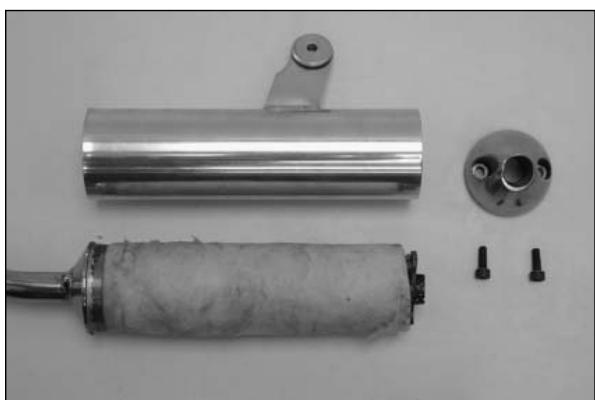
To replace, remove the silencer from the vehicle and mark the position of the outer tube [3] to the inner tube [4]. Remove screws [5] and the end cap [6]. Pull of the outer tube and remove the old glass-fiber yarn packing [7] from the inner tube. Thoroughly clean all parts.
To assemble, mount a new glass-fiber yarn packing onto the inner tube (see illustration) and slide into the outer tube. Mount end cap and fix with screws [5]. Before tightening the screws, turn the outer tube until they match the positions you marked. Mount the silencer and check the exhaust system for tightness.
Note: Glass fiber yarn packages are offered by your licensed KTM dealer.
WARNING
THE EXHAUST SYSTEM BECOMES VERY HOT WHILE THE MOTORCYCLE IS RUNNING. TO AVOID BURNS DO NOT START WORK ON THE EXHAUST SYSTEM UNTIL IT HAS PROPERLY COOLED DOWN.
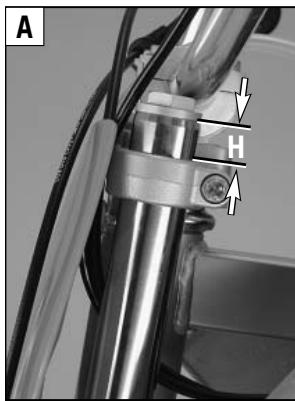
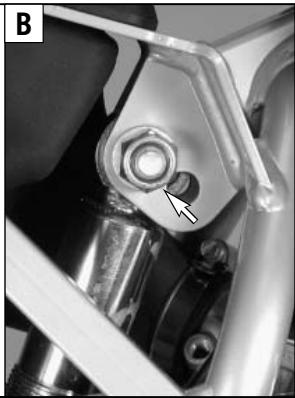
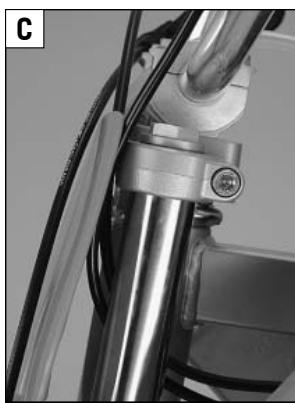
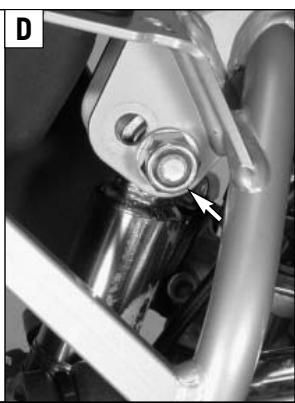
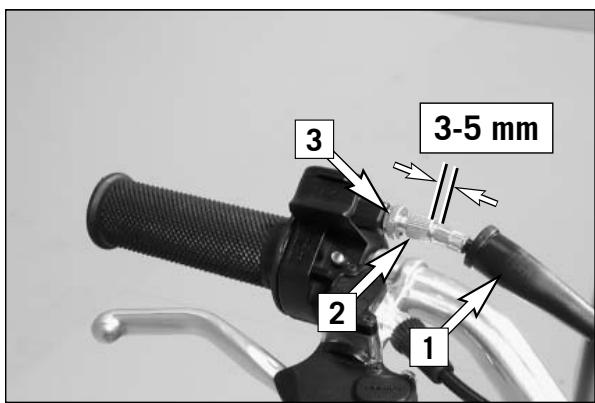
Changing the seat height
The saddle can easily be raised by 25 mm (1 in). This lets you adjust the height as your child grows.
Figures A and B show the fork and shock absorber positions for a low seat position. The fork tubes extend approx. 17mm (0.7 in) (H) above the upper fork stabilizer. The shock absorber is attached to the upper hole in the frame. Tighten the clamp screws on the fork stabilizers to 20Nm (top) and 15Nm (bottom), the screw on the shock absorber to 45Nm .
Figures A and B: low seat position
Figures C and D: high seat position
Figures C and D show the fork and shock absorber positions for a high seat position. Fork tubes are plane with top of upper fork stabilizer. (Screw cap (Aluminium) protrudes from the top of the upper fork stabilizer) The shock absorber is attached to the lower hole in the frame. Tighten the clamp screws on the fork stabilizers to 20Nm (top) and 15Nm (bottom), the screw on the shock absorber to 45Nm .
WARNING
THE FORK TUBES MAY NOT BE LOWERED ANY FURTHER THAN AS DESCRIBED ABOVE, OTHERWISE THE CLAMPING ON THE UPPER FORK STABILIZER WILL NO LONGER BE ADEQUATE.
Adjusting the throttle cable *
There must always be a 3 to 5mm (0.1 to 0.2 in) play in the throttle cable. To check this, move back the protective cover [1] on the throttle grip. You must be able to lift the outer covering of the cable 3 - 5mm from the adjusting screw [2], until resistance is felt.
To adjust, loosen the counter nut [3] and turn the adjusting screw accordingly. Finally tighten counter nut and slide the protective cover back on.
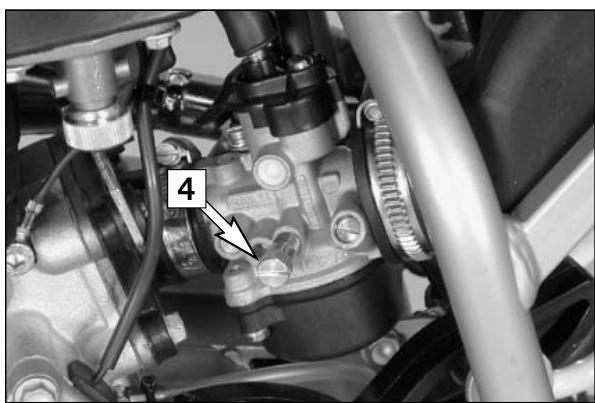
Adjusting the idle speed (Dell'Orto PHVA 14 DS) *
The idle speed can be adjusted with screw [4].
The idle speed is increased by turning clockwise.
The idle speed is reduced by turning counter-clockwise.
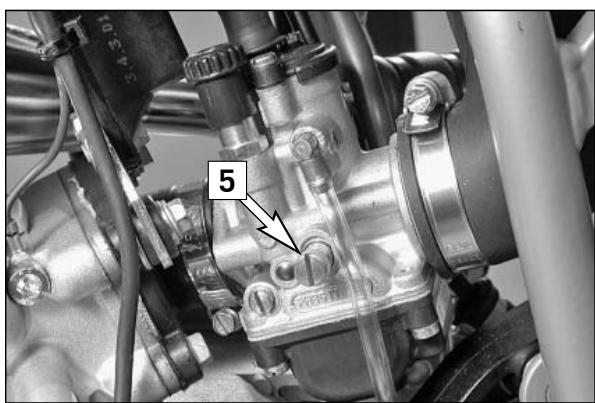
Adjusting the idle speed (Dell'Orto PHBG 19 BS) *
The idle speed can be adjusted with screw [5].
The idle speed is increased by turning clockwise.
The idle speed is reduced by turning counter-clockwise.
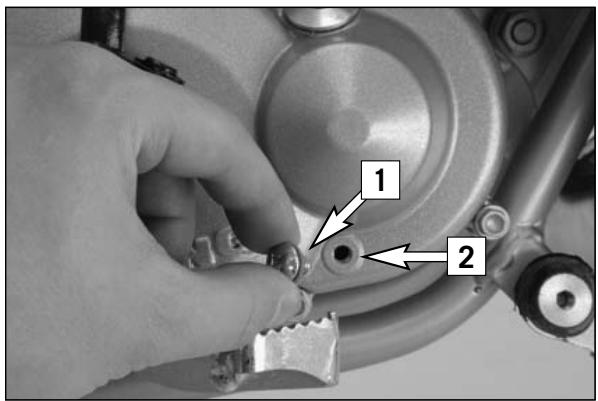
Checking the gear oil level
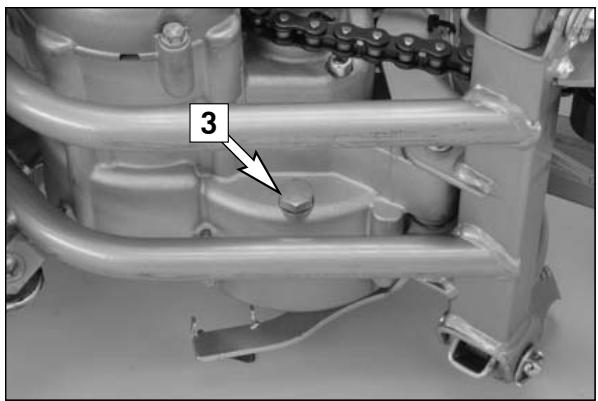
To check the gear oil level, first remove the plug [1]. With the motorcycle parked in an upright position, a small quantity of oil should flow out of the indicator opening [2]. If oil must be added, tilt the motorcycle and pour automatic gear oil (Motorex ATF Super) into the bore.
CAUTION
LESS OIL OR A POOR OIL QUALITY LEAD TO PREMATURE TRANSMISSION WEAR. THEREFORE, ONLY USE BRANDED PRODUCTS (MOTOREX ATF SUPER).
Changing gear oil *
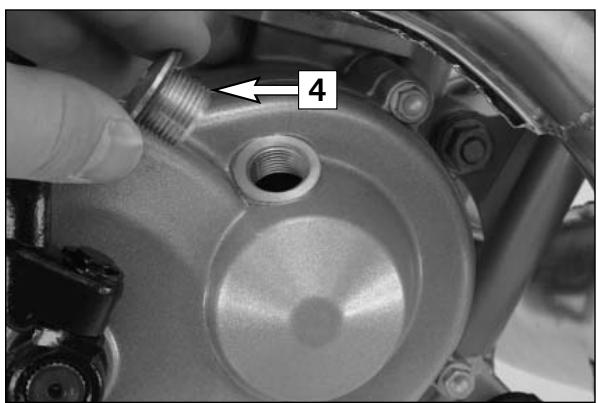
The engine must be warmed up before changing the gear oil. Park the motorcycle on a horizontal surface, remove the oil drain plug [3] and drain the used oil into an appropriate container. Clean the sealing surface, mount the oil drain plug together with the gasket and tighten to 15 Nm.
Remove stopper [4] and fill in 0.15 liters of automatic gear oil (Motorex ATF Super). Mount the stopper and check the engine for tightness.
CAUTION
LESS OIL OR A POOR OIL QUALITY LEAD TO PREMATURE TRANSMISSION WEAR. THEREFORE, ONLY USE BRANDED PRODUCTS (MOTOREX ATF SUPER).
Adjusting the centrifugal clutch *
A correctly adjusted centrifugal clutch will provide maximum engine performance and ease of driving and prevent the engine from overheating. Clutch wear can affect the clutch engagement speed.
The clutch will slip for a longer period of time at higher clutch engagement speeds, generating more frictional heat and causing the engine to overheat. If the clutch engagement speed is too low, the engine will not reach the performance range. In both cases, the engine will not seem to have enough power. Check the clutch engagement speed every 20 hours and correct if necessary or have it corrected by an authorized KTM workshop.
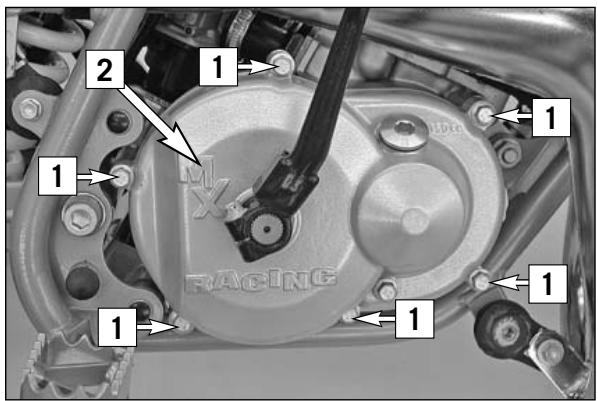
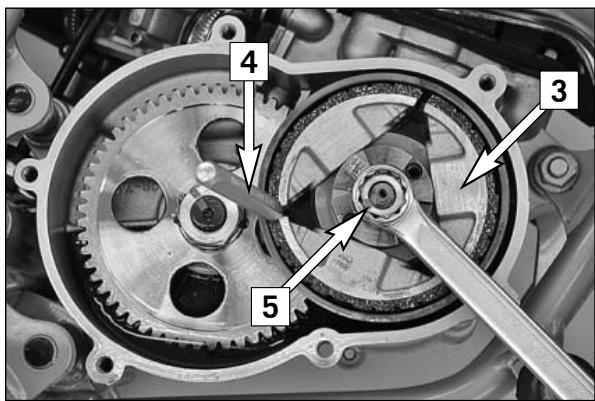
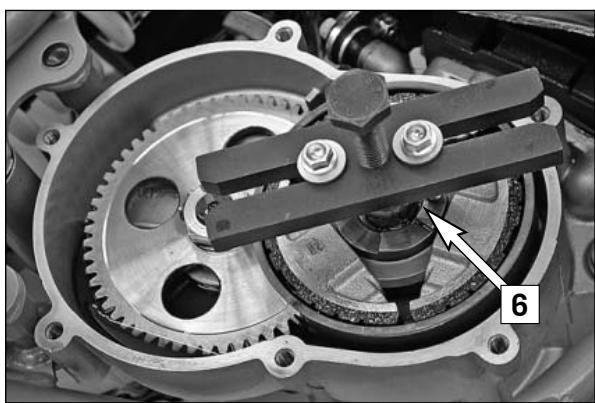
To tune your clutch, lay the bike on the left side. To prevent oil from leaking from the transmission vent hose, run the hose upwards and fasten. Remove the screws [1] and the clutch cover [2] and discard the gasket. Block the centrifugal clutch [3] with a suitable driver [4].
NOTE: insert the driver through both holes in the primary drive's drum and gear wheel.
Loosen the nut [5] on the clutch and pull out the driver. Remove the nut and shim from the crankshaft.
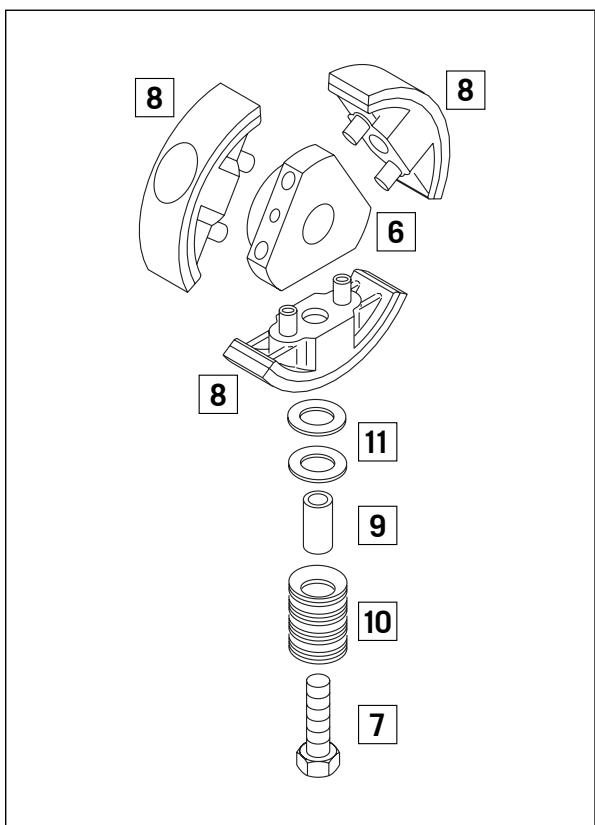
Screw the extractor (special tool item no. 590.29.021.044) onto the clutch hub [6] with the M5x50 screws, hold the extractor and remove the centrifugal clutch from the crankshaft by screwing in the extractor screw.
Completely remove the centrifugal clutch, bearings and spacing washers from the crankshaft.
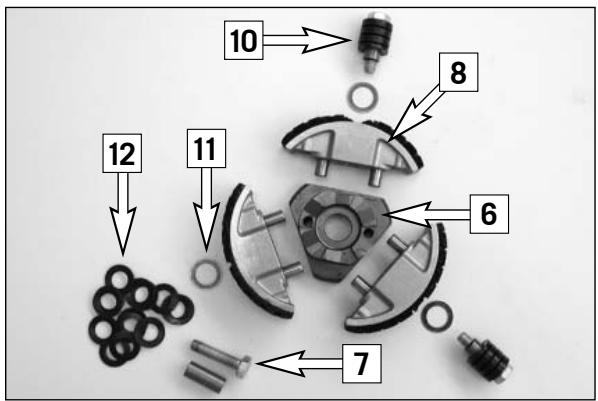
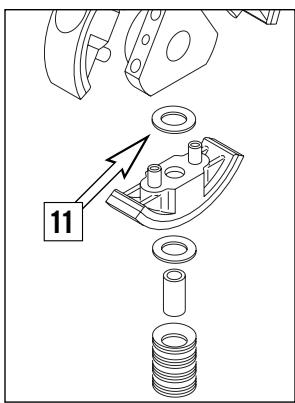
Loosen the HH screws [7] and remove the clutch shoes [8] from the clutch hub [6]. Remove the HH screws and bushings [9], the spring sets [10] and the disks [11] from the clutch shoes.
ADJUSTING THE CLUTCH ENGAGEMENT SPEED:
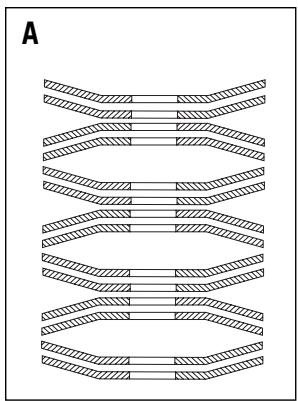
The spring sets contain 14 spring washers [12] that need to be positioned on top of each other in the order shown in the illustration [A].
Washers are located between the spring sets and the clutch shoes to pretension the spring sets. You can influence the clutch engagement speed by pretensioning the spring set. 0.5mm more pretension will increase the clutch engagement speed by approx. 500 rpm.
The clutch engagement speed is the speed at which the clutch begins to engage and the motorcycle starts to drive off. The clutch engagement speed is 8500-9000 rpm for the 50 LC engine.
NOTE: a tachometer (special tool item no. 451.29.075.000) to test the clutch engagement speed is available from your KTM dealer.
Make sure the spring sets are not soiled during service or repair work to the clutch since this can cause them to malfunction.
CORRECTING CLUTCH WEAR:
Check the clutch shoes for wear. If the surface is only slightly worn you can remount them again.
NOTE: The centrifugal clutch has an outer diameter of approx. 82.5 mm when new.
To correct slight wear to the surface, you can insert one of the pretensioning disks [11] from each clutch spring between the clutch hub and the clutch shoes – see illustration.
If only one disk is installed, you can go ahead and use it.
The inner diameter of the centrifugal clutch drum may not exceed 84.4 mm (new condition 84.0 mm).
Assemble in the reverse order.
Apply Loctite 243 to the HH screws [7] and tighten to 12Nm
Apply Loctite 243 to the M10x1.25 nut [5] on the crankshaft and tighten to 35Nm
Mount a new gasket and position the clutch cover [2].
Screw on the clutch cover with 6 M6x25 screws [1] and tighten to 10 Nm.
Move the transmission vent hose back in the original position.
If you let the specified maintenance work on your motorcycle be carried out, disturbances can hardly be expected. Should an error occur nevertheless, we advise you to use the trouble shooting chart in order to find the cause of error.
We would like to point out that many operations cannot be performed by oneself. In case of uncertainty, please contact a KTM-dealer.
| TROUBLE | CAUSE | REMEDE |
| Engine fails to start | Operating error | Open fuel tap, replenish fuel, do not use choke |
| The motorcycle was not driven for a longer period of time, leaving old fuel in the float chamber | The highly inflammable components in modern fuels volatilize if left standing for longer periods of time. If the motorcycle has not been used for over 1 week, the fuel should be drained from the float chamber. The engine will start up immediately if the float chamber is filled with fresh, ignitable fuel | |
| Fuel supply interrupted | Close fuel tap, loosen fuel hose at carburettor, lead into a basin and open fuel tap, - if fuel leaks out, clean carburettor - if no fuel leaks out, check tank ventilation, i.e. clean fuel tap | |
| Electrode distance too large | Reduce electrode distance (0.60 mm) | |
| Plug fouled by oil, wet or bridged | Clean spark plug or renew | |
| Ignition wire or spark plug connector damaged | Dismount spark plug, connect ignition cable, hold to ground (blank place on engine) and actuate kickstarter, a strong spark must be produced at the spark plug - If no spark is produced, loosen spark plug cap from ignition cable, hold about 5 mm from ground and actuate kick starter - If a spark now occurs, replace spark plug cap - If no spark is produced, control ignition system | |
| Kill button wire or short-circuit switch faulty | Disconnect black coloured cable from short circuit button at ignition coil and check ignition spark. If the spark is O.K. repair defective part of cable or ignition switch | |
| Loose ignition cable connectors | Inspect cable connectors | |
| Spark too weak | Examine ignition system | |
| Water in the carburetor and jets blocked | Dismantle and clean carbureto | |
| Engine without idle running | Idle adjusting screw out of adjustment | Readjust idle running or replace idle adjusting screw |
| Ignition system damaged | Examine ignition system | |
| Wear | Overhaul engine | |
| Less power of engine | Air filter obstructed | Clean or renew airfilter |
| Fuel supply partly interrupted or blocked | Blow through fuel pipe and clean carburetor | |
| Loss of compression due to loose spark plug | Tighten spark plug | |
| Exhaust system damaged | Check exhaust system for damage | |
| Engine has not enough preignition | Check and adjust ignition | |
| Reed paddles tensionless or damaged, surface of reed valve housing damaged | Replace reed paddles or reed valve housing | |
| Wear | Overhaul engine | |
| TROUBLE | CAUSE | REMEDY |
| Engine stalling or running with four stroke cycle | Carburetor overflows if level adjust too high, float needle seating is dirty or enlarged | Clean carburetor, if necessary replace float needle and adjust level |
| Loose carburetor jets | Tighten jets | |
| High rpm misfiring | Incorrect heat range spark plug or low quality spark plug | Refer to technical data section |
| Loose, corroded or non conductive ignition socket connector | Check and seal with silicon | |
| Engine spluters into the car-buretor | Lack of fuel | Clean fuel pipes, examine tank aeration and clean |
| Spark plug with incorrect heat value (Ignition by incandescence) | Fit correct spark plug | |
| Engine takes air out of control | Check intake flange and carburettor if firmly setted | |
| Engine overheating | Insufficient liquid in cooling system | Top up coolant and bleed cooling system check cooling system for leaks |
| Radiator fins clogged | Clean radiator fins with water jet | |
| Frothing in cooling system | Renew coolant using branded anti-freeze/anti-corrosive (Motorex Anti-Freeze) | |
| The motorcycle is being driven too slowly, the clutch keeps slipping, causing heat to develop | Drive the motorcycle faster or reduce the preload on the clutch springs | |
| Pinched or kinked water hoses | Replace with correct routed hoses | |
| Incorrect ignition timing because of loose stator screws | Readjust to correct ignition timing specifications, secure screws with Loctite 243 | |
| Incorrect compression ratio | Measure and adjust compression ratio | |
| Emission of white smoke (steam) | Cylinder head or O-ring of cylinder head gasket leaks | Check cylinder head, replace O-ring |
| Excessive oil escapes from transmission breather tube | Excessive oil quantity in transmission | Correct transmission oil level |
Clean your motorcycle regularly in order to keep its painted finish looking shiny and new.
The best manner would be to use warm water that has been mixed with a commercially available washing detergent and a sponge. The hard dirt can be removed before with the help of a soft water jet.
CAUTION
NEVER CLEAN YOUR MOTORCYCLE WITH A HIGH-PRESSURED CLEANER OR A HIGH-PRESSURED WATER JET, OTHERWISE THE WATER MIGHT RUN INTO THE ELECTRICAL COMPONENTS, CONNECTORS, SHEATHED CABLES, BEARINGS, CARBURETOR ETC. AND CAUSE MAILFUNCTIONS, I.E., LEAD TO THE PREMATURE DESTRUCTION OF THESE PARTS.
- You should use commercially available detergents to clean the motorcycle. Heavily soiled parts should also be cleaned with the help of a paint brush.
- Before cleaning with water, plug the exhaust pipe to prevent water ingress.
- After the motorcycle has been rinsed with a soft water jet, it should be dried by air pressure and a cloth. Then take a short drive until the engine has reached its operating temperature, and also operate the brakes. The heat also causes the water at the inaccessible parts of the engine and the brakes to evaporate.
- Slide back the protective covers on the handlebar-mounted instruments so that any water that may have seeped into this part of the motorcycle is allowed to evaporate.
- After the motorcycle has cooled down, oil and grease all the gliding bearing parts. Also treat the chain with a chain spray.
- To prevent failures in the electric system, you should treat the short circuit button with a contact spray.
STORAGE
If you want to put your motorcycle away for longer periods of time, please observe the following instructions:
- Clean motorcycle thoroughly (see chapter: CLEANING)
- Change engine oil (old engine oil contains aggressive contaminations).
- Check antifreeze and amount of cooling liquid.
- the engine warm up again, close fuel tap and wait until the engine dies off by itself. In this way, the carburetor jets are prevented from becoming resin-clogged by the old fuel.
- Remove spark plug and fill in approx. 5 ccm of engine oil into the cylinder through the opening. Actuate kickstarter 10 times in order to distribute the oil onto the cylinder walls and mount the spark plug.
- Let fuel flow out of tank into an appropriate basin.
- Correct tire pressure.
- Lubricate bearing points of the control levers, footrests, etc. as well as the chain.
- The storage place should be dry and not be subjected to overly great temperature fluctuations.
- Cover the motorcycle with an air permeable tarpaulin or blanket. Do not use airtight materials, as possible humidity might not be able to escape and thereby cause corrosion.
CAUTION
IT WOULD BE VERY BAD TO LET THE ENGINE RUN FOR A SHORT TIME DURING THE STORAGE PERIOD. THE ENGINE WOULD NOT GET WARMED UP ENOUGH AND THE THUS DEVELOPED STEAM WOULD CONDENSE DURING THE COMBUSTION PROCESS AND CAUSE THE EXHAUST TO RUST.
USE AFTER PERIOD OF STORAGE
- Fill up tank with fresh fuel.
- Check motorcycle as before each start (see driving instructions).
- Take a short, careful test ride first.
NOTE: Before you put your motorcycle away for the winter, you should check all parts for their function and wear. Should any service jobs, repairs, or any refitting be necessary, you should have them carried out during the off-season (lower workload at mechanics' shops). This way, you can avoid the long waiting times at your shop at the beginning of the next biking season.
| TYP | 50 SX JUNIOR | 50 SX, 50 SUPERMOTO |
| Design | single cylinder 2-stroke engine, with reed valve inlet | |
| Displacement | 49.0 ccm | |
| Bore/Stroke | 39.5 / 40 mm | |
| Fuel | SUPER fuel, research octane no 95, mixed with 2-stroke oil | |
| Oil/gasoline ratio | 1 : 60 when using high grade 2-stroke oil (Motorex 2T Cross Power) When in doubt, please contact your importer | |
| Lubrication | mixture lubrication | |
| Crankshaft bearing | 2 grooved ball bearing | |
| Connecting rod bearing | needle bearing | |
| Piston pin bearing | needle bearing | |
| Piston rings | 1 rectangular ring | |
| Primary drive | straight cut spur gears, 16 : 57 Z | |
| Transmission oil | 0.15-0,2 liter automatic gear oil Dexron II (Motorex Topspeed 4T 15W50) | |
| Spark plug | NGK BR 8 ECM | |
| Electrode gap | 0.6 mm | |
| Carburetor | Dell'Orto PHVA 14 DS | Dell'Orto PHBG 19 BS |
| Air filter | wet foam type air filter insert | |
| Cooling liquid | 0.5 litres, 50% antifreeze, 50% distilled water, at least -25 °C (-13 °F) | |
BASIC CARBURETOR SETTING
| Model | 50 SX Junior | 50 SX, 50 Supermoto |
| Type | Dell'Orto PHVA 14 DS | Dell'Orto PHBG 19 BS |
| Main jet | 80 | 85 |
| Needle jet | 211 FA | 260 AU |
| Idling jet | 45 | 48 |
| Jet needle | A10 | W9 |
| Needle position from top | 3. | 3. |
| Air/Mixture reg. screw open | 3.5 | 3.0 |
| Slide | 40 | 60 |
| Starting jet | 60 | 60 |
TIGHTENING TORQUES - ENGINE
| Primary gear nut | M14x1,25 | 40 Nm |
| Hexagon nut ignition rotor | M10x1,25 | 20 Nm |
| Nut of clutch hub | M10x1,25 | Loctite 243 + 35 Nm |
| Cylinder head screws | M7 | 15 Nm |
| Cylinder base nuts | M8 | 18 Nm |
| Allan head screw-Stator | M5x25 | Loctite 243 + 8 Nm |
| Oil plug | M16 | 5 Nm |
| Oil drain plug | M10 | 15 Nm |
| Other engine screws | M5 | 7 Nm |
| M6 | 10 Nm | |
| M8 | 30 Nm |
| 50 SX JUNIOR | 50 SX | 50 SUPERMOTO | |
| Frame | single downtube, split-cradle | ||
| Fork | Marzocchi Ø = 32 mm | ||
| Wheel travel front/rear | 140/205 mm (5.5/8 in) | 185/185 mm (7.3/7.3 in) | |
| Rear suspension | Central shock absorber WP | ||
| Front brake | Disk brake Ø 160 mm (6.4 in) | ||
| Rear brake | Drum brake Ø 90 mm (3.5 in) | Disk brake Ø 140 mm (5.5 in) | |
| Tires front | 2.50x10" Pirelli MT32A | 2.50x12" Pirelli MT32A | 90/90-10 Pirelli SL26 |
| Tires rear | 2.75x10" Pirelli MT320 | 2.75x10" Pirelli MT320 | 90/90-10 Pirelli SL26 |
| Tire pressure | front/rear: 1.0 bar | ||
| Fuel tank capacity | 1.8 Liters | ||
| Final drive ratio | 11 : 48 | 10 : 44 | |
| Chain | 1/2x3/16“ 96 rolls | 1/2x3/16“ 102 rolls | |
| Steering angle | 66° | ||
| Wheel base | 910 mm (35.8 in) | 1030 mm (40 in) | |
| Seat height, unloaded | 585 mm/610 mm (23/24 in) | 650/675 mm (25.6/26.6 in) | |
| Ground clearance | 220 mm (8.6 in) | 255 mm (10 in) | |
| Rider's body height | max. 130 cm (51 in) | ||
| Rider's body weight | max. 35 kg (78 lbs) | ||
| Recommended age of rider | 4-7 years | 6-10 years | |
| Engine | 50 LC | ||
TIGHTENING TORQUES
| Hexagon nuts front/rear axle | M12x1 | 40 Nm |
| Hexagon nut swing arm bolt | M12 | 40 Nm |
| Clamping screw upper fork bridge | M8 | 20 Nm |
| Clamping screw lower fork bridge | M6 | 10 Nm |
| Screws handlebar clamp | M8 | 20 Nm |
| Shock absorber top/bottom | M10 | 45 Nm |
| Allan screw – Handlebar support | M10 | Loctite 243 + 40 Nm |
| Front brake caliper | M8 | Loctite 243 + 20 Nm |
| Front brake disk | M6 | Loctite 243 + 10 Nm |
| Swing arm bolt | M12x1 | 40 Nm |
| Spoke nipple | M4 | 3 Nm |
| Other chassis screws | M5 | 6 Nm |
| M6 | 10 Nm | |
| M8 | 25 Nm | |
| M10 | 45 Nm |
STANDARD-ADJUSTMENT-FORK
| Spring | 2,0 N/mm |
| Preload | 10 mm (0.4 in) |
| Fork oil | SAE 7,5 |
| Air chamber length | 110 mm (4.3 in) |
STANDARD ADJUSTMENT - SHOCK ABSORBER
| 50 SX Junior WP 03189B01 | 50 SX, 50 Supermoto WP 03189B02 | |
| Rebound adjuster | 5 | 5 |
| Spring | 85 N/mm | 45 N/mm |
| Spring preload | 10 mm (0.39 in) | 7 mm (0.28 in) |
Page
Adjusting the centrifugal clutch 30
Adjusting the control cable on the rear wheel (50 SX Junior) .23
Adjusting the idle speed (Dell'Orto PHBG 19 BS) ..28
Adjusting the idle speed (Dell'Orto PHVA 14 DS) 28
Adjusting the throttle cable 28
Basic suspension setup for the weight of the driver ..18
Braking 13
Chain maintenance 20
Changing gear oil 29
Changing spring preloading of the shock absorber 20
Changing the basic position of the foot brake lever
(50 SX Junior) 23
Changing the basic position of the foot brake lever (50 SX,
50 Supermoto) 23
Changing the seat height 28
Changing the telescopic fork oil 19
Chassis number 6
Check chain tension 20
Checking and adjusting the steering head bearing
(50 SX Junior) 16
Checking and adjusting the steering head bearing (50 SX,
50 Supermoto) 17
Checking coolant level 27
Checking front brake pads 22
Checking rear brake pads (50 SX, 50 Supermoto) . .24
Checking spoke tension 26
Checking the brake fluid level/ refilling 22
Checking the gear oil level 29
Checking the rear brake fluid level (50 SX, 50 Supermoto) .23
Checking the rear brake linings for wear (50 SX Junior) .23
Choke (Dell'Orto carburetor PHBG 19 BS) .8
Choke (Dell'Orto carburetor PHVA 14 DS) .8
Cleaning. 34
Cleaning the air filter 27
Cleaning the dust scrabbers of the telescopic fork 20
Cooling system 26
Correct chain tension 20
Driving 12
Driving instructions 11
Drum brake maintenance (50 SX Junior) 23
Engine number 6
Exhaust system 27
Page
Fillercap .7
Foot brake lever 8
Fuel tap 7
General information about KTM disc brakes 21
General Tips andWarnings for starting the motorcycle .10
Hand brake lever 7
How to change the handlebar position 17
Important Information for parents about safe driving . . .4
Instructions for the first ride 10
Kickstarter 8
Maintenance work on chassis and engine .16
Operation instruments 7
Periodic maintenance schedule 14
Plugin - Stand (50 SX, 50 Supermoto)
Rebound damping function of the shock absorber 9
Refilling the rear brake fluid reservoir (50 SX, 50 Supermoto).24
Refueling, fuel 13
Removing and mounting the front wheel 25
Removing and mounting the rear wheel 25
Removing the seat 16
Replacing the front brake pads 22
Replacing the rear brake pads (50 SX, 50 Supermoto).24
Running in 10
Serial number locations 6
Setting the basic position and play of the hand brake lever .21
Short circuit button 6
Side stand 8
Starting off 12
Starting when the engine is cold 12
Starting when the engine is warm 12
Stopping 13
Storage 34
Technical data - engine 35
Technical specifications - chassis 36
Telescopic fork maintenance 19
Throttle grip 6
Tires, air pressure 26
To determine the sag of the shock absorber 18
To determine the sag of the telescopic fork 18
Trouble shooting 32
What to do when the engine is "flooded" 12
What you should check before each start 11