
AQXGF 169 - Washing machine HOTPOINT-ARISTON - Free user manual and instructions
Find the device manual for free AQXGF 169 HOTPOINT-ARISTON in PDF.



| Brand | HOTPOINT-ARISTON |
| Model | AQXGF 169 |
| Product type | Front-loading washing machine |
| Maximum capacity | 9 kg |
| Dimensions (WxHxD) | 59,5 x 85 x 64,5 cm |
| Electrical supply | 230 V ~ 50 Hz, 10 A |
| Water pressure | 0,05 - 1 MPa (0,5 - 10 bar) |
| Drum volume | 62 litres |
| Maximum spin speed | 1600 rpm |
| Number of programmes | 16 (including Cotton, Synthetics, Wool, Silk, Duvets, etc.) |
| Washing options | Delayed start (1-24h), Super wash, Easy iron, Extra rinse, Mini load |
| Child lock | Yes (Button lock) |
| Door lock | Automatic during cycle, manual unlocking possible |
| Pump cleaning | Self-cleaning, pre-chamber accessible |
| Detergent drawer maintenance | Removable for cleaning |
| Inlet hose check | Annual recommended |
| Spare parts | Available via authorized after-sales service |
| Weight (approximate) | Approximately 75 kg |
| Energy class | Not specified |
| Display | Screen for duration and options |
Frequently Asked Questions - AQXGF 169 HOTPOINT-ARISTON
User questions about AQXGF 169 HOTPOINT-ARISTON
0 question about this device. Answer the ones you know or ask your own.
Ask a new question about this device
Download the instructions for your Washing machine in PDF format for free! Find your manual AQXGF 169 - HOTPOINT-ARISTON and take your electronic device back in hand. On this page are published all the documents necessary for the use of your device. AQXGF 169 by HOTPOINT-ARISTON.
USER MANUAL AQXGF 169 HOTPOINT-ARISTON
Unpacking and levelling
Connecting the cold water and electricity supplies
Technical data
Description of the machine, 4-5
Control panel
Running a wash cycle, 6
Programmes and options, 7
Table of Programmes
Wash options
Detergents and laundry, 8
Detergent
Preparing the laundry
Washing advice
Load-balancing system
Precautions and tips, 9
General safety
Disposal
Opening the door manually
Care and maintenance, 10
Turning off the water and electricity supplies
Cleaning the machine
Cleaning the detergent dispenser
Drum maintenance
Cleaning the pump
Checking the water inlet hose
Troubleshooting, 11
Assistance, 12
GB
! Keep this instruction manual in a safe place for future reference. If the appliance is sold, given away or moved, please ensure the manual remains with the machine so that the new owner may benefit from the advice contained within it.
! Please read this instruction manual carefully it contains important information regarding the safe installation, use and maintenance of the appliance.
! You will find the guarantee and other details relating to the installation process in the bag containing this booklet.
Unpacking and levelling
Unpacking
- Once the washing machine has been removed from the packaging, check that it has not been damaged during transportation. If it has been damaged, contact the retailer and do not proceed any further with the installation process.
-
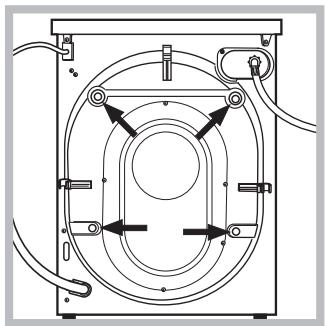
Remove the 4 transit bolts used during transportation and the corresponding spacers on the back of the machine (see figure).
-
Having removed the 4 bolts use the 4 plastic blanking plates to cover the 4 holes.
- Keep all the pieces; if the washing machine is transported in future, the transit bolts and spacers will have to be replaced in order to avoid damaging the inside of the machine.
! Packaging materials should not be used as toys by children.
Levelling
- Position the washing machine on a level and sturdy floor, without resting it against walls or cabinets.
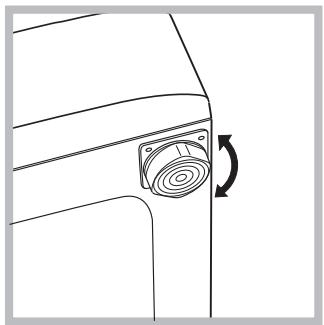
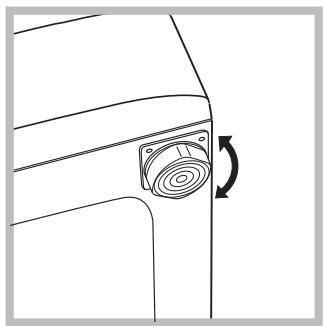
- If the floor is uneven, the feet of the appliance may be adjusted until it reaches a perfectly horizontal position (the angle of inclination must not exceed 2 degrees).
! If the appliance is levelled correctly it will be more stable and much less likely to cause vibrations and noise during the spin cycle.
! If positioned on a fitted carpet or a rug, adjust the feet in such a way as to allow room for air to circulate and provide ventilation beneath the washing machine.
Connecting the cold water and electricity supplies
Connecting the water inlet hose
Before connecting the inlet hose to the cold water supply, allow the water to flow from the tap until it runs clear.
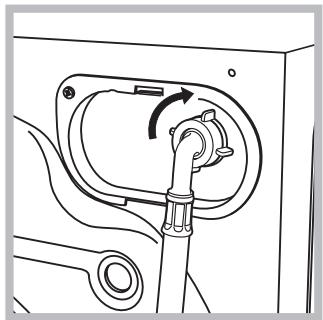
- Connect the end of the water inlet hose to the washing machine, screwing it onto the appliance's cold water inlet, situated on the top right-hand side on the rear of the appliance (see figure).
-
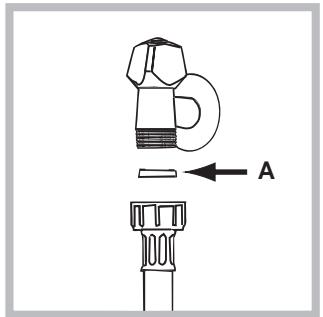
Place the seal A (provided in the bag) on the end of the inlet hose and screw it to a cold water tap with a 3/4 gas threaded connection (see figure).
-
Make sure there are no kinks or bends in the inlet hose.
The water pressure at the tap must fall within the values indicated in the Technical data table (see next page).
If the water inlet hose is not long enough, contact a specialist store or an authorised technician.
! Always use the new water inlet hoses supplied with the machine.
Drainage Connection
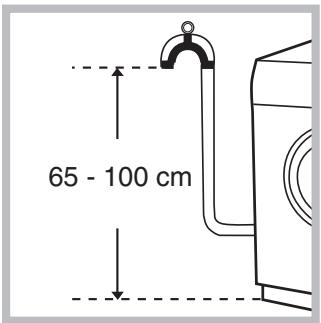
Connect the outlet hose to a draining duct or a stand pipe at a height between 65 and 100~cm from the floor. Do not bend it under any circumstances.
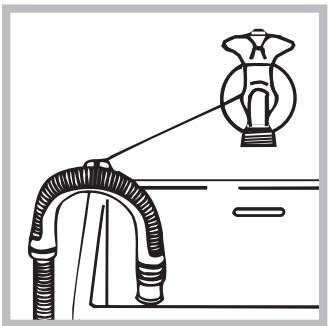
Alternatively, place the end of the hose over the edge of a washbasin or tub, fastening the hose supplied to the tap (see figure).
The free end of the hose should not remain immersed in water.
! We advise against the use of hose extensions; if absolutely necessary, the length of the extension must not exceed 150 cm and its diameter must be the same as the original hose.
Electrical connection
Before inserting the plug into the electrical socket, make sure that:
- the socket is earthed and complies with current regulations;
- the socket can withstand the maximum load of the appliance, which is indicated in the Technical data table (see opposite);
- the power supply voltage falls within the values indicated in the Technical data table (see opposite);
- the socket is compatible with the plug of the appliance. If this is not the case, either the socket or the plug must be replaced.
! The machine must not be installed outdoors, even in covered areas. It is extremely dangerous to leave the appliance exposed to rain, storms and other weather conditions.
! Once the machine has been installed, the electricity socket should be easily accessible.
! Do not use extension cables or multiple sockets.
The cable should not be bent or compressed.
The cable should be replaced only by authorised technicians.
Warning! The company shall not be held responsible for any incidents that occur if these regulations are not observed.
| Technical data | |
| Model | AQXGF 169 |
| Dimensions | width 59.5 cm height 85 cm depth 64.5 cm |
| Capacity | from 1 to 9 kg |
| Electrical connections | please refer to the technical data plate fixed to the machine |
| Water connections | maximum pressure 1 MPa (10 bar) minimum pressure 0.05 MPa (0.5 bar) drum capacity 62 litres |
| Spin speed | up to 1600 rotations per minute |
| Energy rated programmes according to regulation EN 60456 | WHITE COTTON programme; temperature 60°C; using a load of 9 kg. |
| CE | This appliance conforms to the following EC Directives: - 89/336/EEC dated 03/05/89 (Electromagnetic Compatibility) and subsequent modifications - 2002/96/CE - 2006/95/CE (Low Voltage) |
Description of the machine
GB
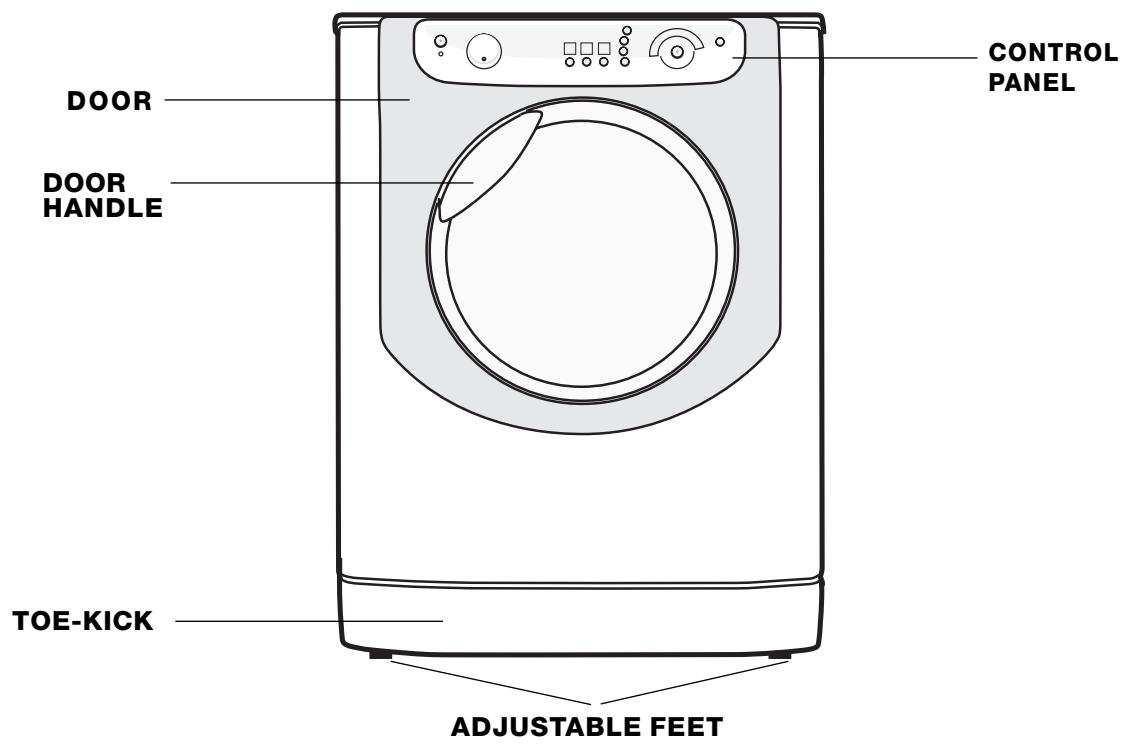
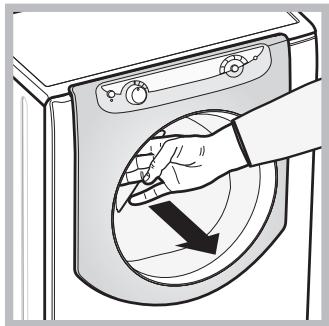
DOOR
Always use the handle to open the door (see figure).
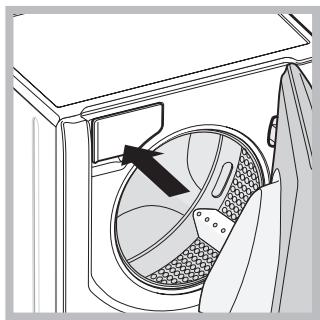
DETERGENT DISPENSER:
This is inside the machine and may be accessed by opening the door.
For information relating to detergents, please refer to the chapter entitled "Detergents and laundry".
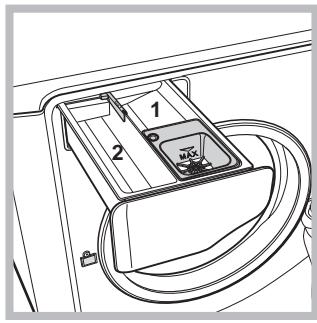
- pre-wash
compartment: use powder detergent.
- main wash
compartment: use
powder or liquid
detergent. If you intend to use liquid detergent, we recommend that it is poured into the
compartment immediately before the wash cycle is started.
compartment for additives: for fabric softener or other liquid washing additives. Do not exceed the maximum level indicated by the grille, and dilute concentrated fabric softeners.
Control panel
GB
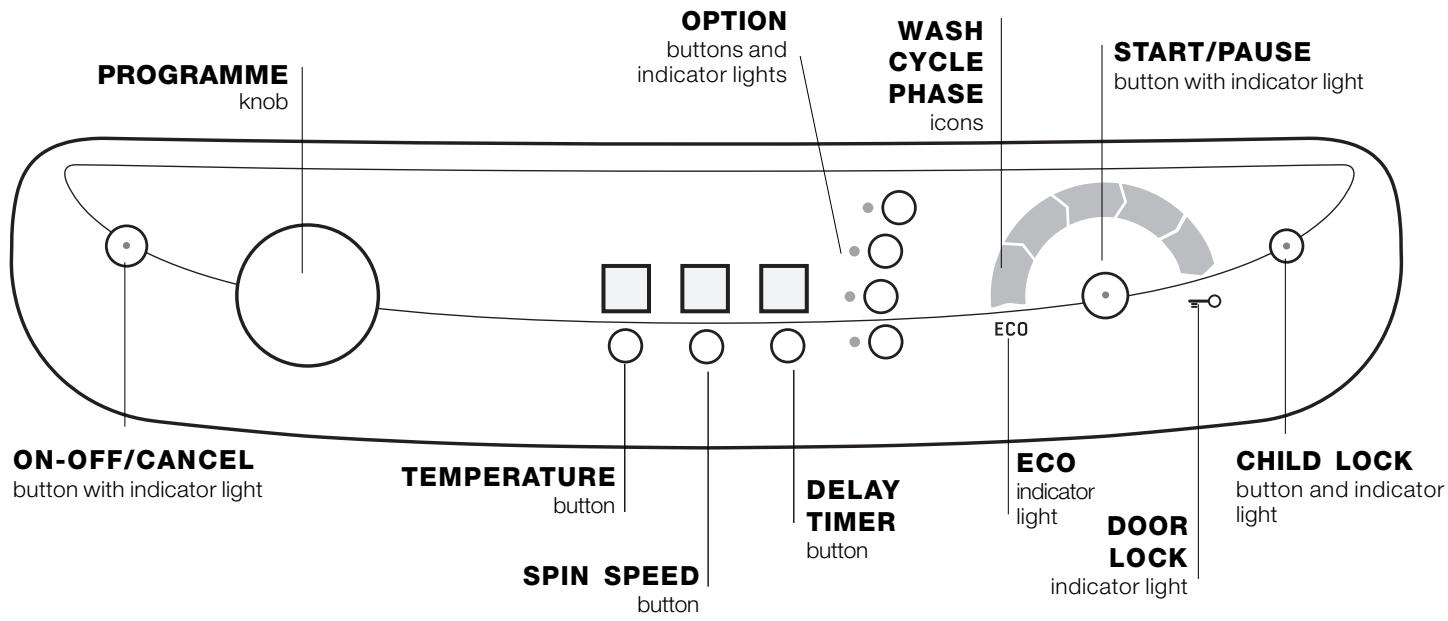
ON-OFF/CANCEL button with indicator light: press the button briefly to switch the machine on or off. The green indicator light shows that the machine is switched on. To switch the washing machine off during a wash cycle, press and hold the button for approximately 2 seconds; pressing the button quickly or accidentally will not switch the machine off. If the machine is switched off during a wash cycle, the programme will be cancelled.
PROGRAMME knob: this can be rotated in both directions. To set a more suitable programme, please refer to the "Table of Programmes". The knob is locked into position during the wash cycle.
TEMPERATURE (i) button: press this button to adjust the temperature; the value will be identified by the display above (see “Running a wash cycle”).
SPIN SPEED button: press this button to adjust the spin value or to exclude this part of the programme; the value will be identified by the display above (see “Running a wash cycle”).
DELAY TIMER button: press to set a delayed start time for the selected programme; the delay time will be identified by the display above (see "Running a wash cycle").
OPTION buttons and indicator lights: may be used to select any of the available options. The indicator light corresponding to the selected option will remain lit (see "Running a wash cycle").
WASH CYCLE PHASE icons: these light up to provide an indication of the progress of the wash cycle (Wash - Rinse - Spin - Final draining phase).
The text END lights up when the cycle has finished.
START/PAUSE button with indicator light: when the green indicator light flashes slowly, press the button to start the wash cycle. When the cycle has started, the indicator light is illuminated in a fixed manner. To pause the wash cycle, press the button again; the indicator light will turn orange and begin to flash again. If the "Door Locked" indicator light is off, the porthole door may be opened.
To restart the wash cycle from the point at which it was interrupted, press the button again.
DOOR LOCK indicator light: this indicates that the porthole door is locked. To open the door, pause the wash cycle (see following page).
CHILD LOCK button and indicator light: this is used to enable or disable the "Child lock" function, by pressing the button for approximately 2 seconds. When the indicator light is illuminated, the control panel is locked. This avoids accidental changes being made to the wash cycles, especially where children are at home.
ECO indicator light: the Eco icon lights up when the electricity saving reaches at least 10% (this can be achieved by adjusting the wash cycle settings).
GB
NOTE: the first time you use the washing machine, add detergent and run an empty 90^ C cotton wash cycle without the pre-wash phase.
- SWITCH ON THE MACHINE. Press the button. All the indicator lights will illuminate for 1 second, after which the light corresponding to the button will remain lit constantly, while the START/PAUSE indicator light will flash slowly.
- LOAD THE LAUNDRY. Open the porthole door. Load the laundry, making sure that the maximum load quantity indicated in the table of programmes (below) is not exceeded.
- MEASURE OUT THE DETERGENT. Pull out the drawer and pour the detergent into the relevant compartments as described in "Description of the machine".
4. CLOSE THE PORTHOLE DOOR.
- CHOOSE THE PROGRAMME. Turn the PROGRAMME knob left or right to select the required programme, to which a set temperature and spin speed are linked (these values may all be modified).
- PERSONALISE THE WASH CYCLE. Use the relevant buttons on the control panel:
(i) Modify the temperature and/or the spin speed. The machine automatically selects the temperature and the maximum spin speed for the programme set and these values may not be increased. By pressing the button, the temperature can be progressively reduced or even set to cold wash (no). By pressing the button, the spin speed can be progressively reduced or even eliminated altogether (no). If the buttons are pressed again the maximum values are restored.
! Exception: if the WITHE COTTON programme is selected, the temperature can be increased up to a value of 90^ .
Setting a delayed start.
To set a delayed start for the selected programme, press the button repeatedly until the desired delay time is displayed (this may be between 1 hour and 24 hours).
To disable the function press the button until the text no is displayed.
N.B.: Once the button START/PAUSE has been pressed, the delay time may only be decreased.
A Modify the cycle characteristics.
Press the OPTION buttons to personalise the wash cycle according to your own requirements.
- Press the button to activate the option; the corresponding indicator light will illuminate.
- Press the button again to deactivate the option; the indicator light will switch off.
If the selected option is not compatible with the set programme, the indicator light will flash and the option will not be activated.
! If the selected option is not compatible with another previously selected option, the indicator light corresponding to the first option will flash and only the second option will be activated (the corresponding indicator light will remain lit in a fixed manner).
- START THE PROGRAMME. Press the START/ PAUSE button. The corresponding indicator light remains lit in a fixed manner and the porthole door locks (the DOOR LOCK indicator light illuminates). The icons corresponding to the different wash phases will light up during the cycle, indicating the progress. To change a programme while a cycle is in progress, pause the washing machine by pressing the START/PAUSE button; then select the desired cycle and press the START/PAUSE button again.
To open the door while a cycle is in progress press the START/PAUSE button; if the DOOR LOCK indicator light switches off it is possible to open the door. Press the START/PAUSE button again to restart the programme from the point at which it was interrupted.
- PROGRAMME END. The text END lights up to indicate that the programme has ended. The porthole door may be opened immediately. If the START/PAUSE button flashes, press the button to end the cycle. Open the door, unload the laundry and switch off the machine.
If you wish to cancel a cycle that has already begun, press and hold the button. The cycle will be stopped and the machine will switch off.
BAG FOR QUILTS, CURTAINS AND DELICATE GARMENTS
Hotpoint/Ariston has made it easier for you to wash even the most valuable and delicate garments in complete confidence thanks to the special bag which protects the laundry (this is supplied with the machine).
We recommend that the bag is used every time you wash quilts and padded items with an outer layer made using synthetic material.
Table of Programmes
| Icon | Programme description | Max. temperature (°C) | Max. spin speed (r.p.m.) | Detergent | Maximum load (kg) | Cycle duration | ||
| Washing | Fabric softener | Normal | Using Mini load | |||||
| Everyday programmes | ||||||||
| WHITE COTTON | 60° (Max 90°) | 1600 | ● | ● | 9 | 4 | ||
| WHITE COTTON: Heavily soiled whites and delicate colours. | 40° | 1600 | ● | ● | 9 | 4 | ||
| COLOURED COTTON | 40° | 1600 | ● | ● | 9 | 4 | ||
| DELICATE SYNTHETICS | 40° | 800 | ● | ● | 4 | 2 | ||
| 30 | MIX 30' : Refreshes lightly soiled garments quickly (not recommended for wool, silk or clothes that should be washed by hand). | 30° | 800 | ● | ● | 3.5 | 1.5 | |
| Vigorous programmes | ||||||||
| PRE-WASH: Removes stubborn stains. (Add detergent to the relevant compartment). | 90° | 1600 | ● | ● | 9 | 4 | ||
| DURABLE SYNTHETICS | 60° | 800 | ● | ● | 4 | 2 | ||
| Special programmes | ||||||||
| SHIRTS | 40° | 600 | ● | ● | 2 | 1 | ||
| SILK: Washes silk and garments and lingerie. | 30° | 0 | ● | ● | 2 | 1 | ||
| WOOL: Washes wool, cashmere, etc. | 40° | 600 | ● | ● | 2 | 1 | ||
| DUVETS: Washes garments filled with goose down. | 30° | 1200 | ● | ● | 3 | 1, 5 | ||
| WEEKLY WASH: Washes bathroom laundry and bedlinen. | 60° | 1600 | ● | ● | 9 | 4 | ||
| Partial programmes | ||||||||
| Durable rinse | - | 1600 | - | ● | 9 | 4 | ||
| Delicate rinse | - | 800 | - | ● | 4 | 2 | ||
| Durable spin | - | 1600 | - | - | 9 | 4 | ||
| Delicate spin | - | 800 | - | - | 4 | 2 | ||
| Drain | - | 0 | - | - | 9 | 4 | ||
The information contained in the table is purely indicative.
Wash options

Super Wash
This option guarantees a high-performance wash, thanks to the use of a greater quantity of water during the initial phase of the cycle and a longer overall duration of the programme.
It is not compatible with the "MIX 30", "Silk", "Wool", "Duvets" and Partial programmes.

Easy Iron
If this option is selected, the wash and spin phases will be adjusted accordingly so that fabric creasing is reduced. At the end of the cycle the drum of the washing machine will spin slowly; the "Easy Iron" and START/PAUSE indicator lights will flash. To end the cycle, press the START/PAUSE button or the "Easy Iron" button.
When using the Silk programme, the machine will end the cycle while the laundry is soaking and the "Easy Iron" indicator light will flash. To drain the water so that the laundry can be removed, press the START/PAUSE button or the "Easy Iron" button.
! This option is not compatible with the "Wool", "Durable Spin", "Delicate Spin" and "Draining" programmes.

Extra Rinse
This programme increases the efficiency of the rinse phase and ensures that a greater amount of detergent is removed. It is particularly recommended for skin types that are sensitive to detergents. We recommend this programme is used when the washing machine is full or when a large amount of detergent has been used.
! This option is not compatible with the “MIX 30”, “Durable Spin”, “Delicate Spin” and “Draining” programmes.

Mini load
This function should be used when the amount of laundry is half, or less than half, of the maximum recommended load (see Table of Programmes).
! This option is not compatible with the "Durable Spin", "Delicate Spin" and "Draining" programmes.
Detergent
The type and quantity of detergent used depends on the type of fabric (cotton, wool, silk...), its colour, the temperature of the wash, the level of soiling and the hardness of the water in the area.
Measuring out the detergent carefully will avoid accidental spills and help to protect the environment: although they may be biodegradable, detergents contain elements that alter the balance of nature.
We recommend:
- the use of powder detergents for white cotton garments and for pre-wash phases;
- the use of liquid detergents for delicate cotton garments and for all programmes which run at a low temperature;
- the use of liquid detergents for wool and silk.
! Do not use detergents when washing garments by hand, because they create too much foam.
The detergent must be measured out into the relevant compartment, or into the detergent dosing ball which will be placed directly into the drum of the machine. In this case the Cotton cycle with pre-wash phase may not be selected.
Preparing the laundry
! Unfold all items of laundry before placing them in the machine.
- Divide the laundry according to type of material (the symbol on the garment label) and colour, making sure that whites are separated from coloured garments.
- Empty all pockets and check for loose buttons.
- Do not exceed the values indicated in the "Table of Programmes", which refer to the weight of the laundry items when they are dry.
How much does your laundry weigh?
| 1 sheet | 400 - 500 g |
| 1 pillowcase | 150 - 200 g |
| 1 tablecloth | 400 - 500 g |
| 1 bathrobe | 900 - 1200 g |
| 1 towel | 150 - 250 g |
| 1 pair of jeans | 400 - 500 g |
| 1 shirt | 150 - 200 g |
Washing advice
Shirts: use a suitable programme to wash shirts made from different fabrics and in different colours. This will guarantee that these garments are looked after properly.
Silk: use the relevant programme designed for all silk garments. We recommend the use of a special detergent for delicate garments.
Curtains: these should be folded and placed inside the bag provided. Use the "Silk" programme.
Wool: Hotpoint/Ariston is the only washing machine to have obtained the prestigious Woolmark Platinum Care mark of recognition (M.0508) from The Woolmark Company, which certifies the machine washing of all woollen garments, even those whose label states "hand wash only". The "Wool" programme therefore offers you complete peace of mind when washing all woollen garments, with great performance guaranteed every time.
Duvets: to wash double or single duvets (the weight of which should not exceed 3kg ), cushions or clothes padded with goose down such as puffa jackets, use the special "Duvets" programme. We recommend that duvets are placed in the drum with their edges folded inwards (see figure) and that no more than 3/4 of the total volume of the drum is used.
To achieve the best results, we recommend that a liquid detergent is used in conjunction with the detergent dispenser drawer.
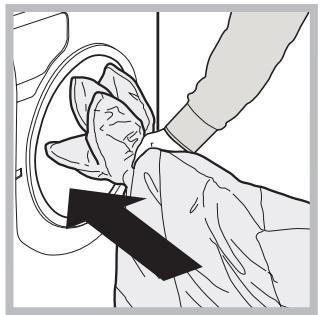
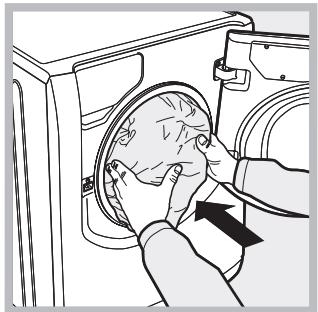
Quilts: to wash quilts with a synthetic outer layer, use the bag provided and set the programme to "Duvets".
Bathroom laundry and bedlinen: this washing machine can be used to wash any domestic laundry in a single cycle called “Bed & Bath” that optimises the use of fabric softener while saving both time and electricity. We recommend that you use a powder detergent.
Stubborn stains: stubborn stains should be treated with solid soap before the garment is washed (use the Cotton programme with pre-wash phase).
Load-balancing system
Before every spin cycle, to avoid excessive vibrations and to distribute the load in a uniform manner, the drum rotates continuously at a speed which is slightly faster than the normal washing speed. If, after several attempts, the load is still not evenly distributed, the machine spins at a lower speed than the set frequency. If the load is excessively unbalanced, the washing machine continues at distribution speed only instead of the full spin speed. In order to achieve better load distribution and balance, we recommend that large and small garments are mixed when placing the laundry in the machine.
! This machine was designed and manufactured in compliance with current international safety standards. The following advice is provided for safety reasons and should be read carefully.
General safety
- This appliance was designed for domestic use inside the home and is not intended for commercial or industrial use.
- The washing machine must be used by adults only, in accordance with the instructions provided in this booklet.
- Do not touch the machine when barefoot or with wet or damp hands or feet.
- When unplugging the appliance, always pull the plug from the mains socket; do not pull on the cable.
- Do not touch the drained water as it may reach extremely high temperatures.
- Never force the porthole door: doing so may damage the safety lock mechanism designed to prevent the door being opened accidentally.
- If the appliance breaks down, under no circumstances must you attempt to carry out the repairs yourself.
- Keep children well away from the machine while it is in operation.
- If the machine must be moved, work in a group of two or three people and handle it very carefully. Never attempt to move the appliance without the help of another person, because it is extremely heavy.
- Make sure that the drum is empty before loading laundry into the appliance.
Disposal
- When disposing of the packaging material: observe local legislation so that the packaging may be reused.
- The European Directive 2002/96/EC relating to Waste Electrical and Electronic Equipment states that household appliances should not be disposed of using the normal solid urban waste cycle. Exhausted appliances should be collected separately in order to optimise the cost of re-using and recycling the materials inside the machine, while preventing potential damage to the atmosphere and to public health. The crossed-out dustbin is marked on all products to remind the owner of their obligations regarding separated waste collection.
For more information relating to the correct disposal of household appliances, owners should contact their local authorities or appliance dealer.
Opening the door manually
If it is not possible to open the porthole door due to a powercut and you wish to hang out the laundry, proceed as follows:
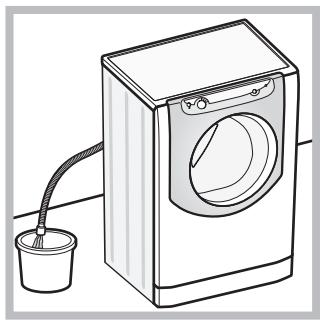
- Remove the plug from the electricity socket;
- Make sure that the water level inside the machine is lower than the door opening; if this is not the case remove excess water using the water outlet hose, collecting it in a bucket as shown in the figure;
- Remove the covering panel on the front of the washing machine using a screwdriver (see figure);
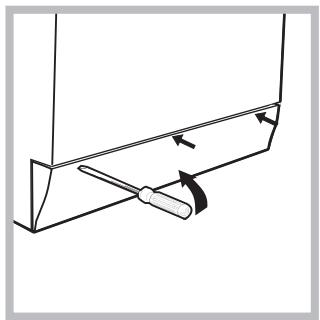
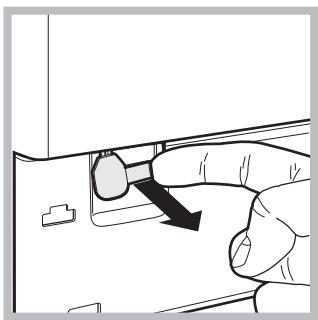
- Using the tab shown in the figure, pull outwards until the plastic brace comes away; pull it downwards until you hear a "click", which indicates that the door is unlocked;
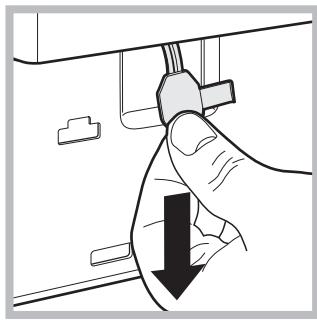
-
Open the door; if this is still not possible, repeat the process;
-
Replace the kick strip, making sure that the hooks are positioned in the right slots before pushing the panel towards the machine.
Turning off the water and electricity supplies
- Turn off the water tap after every wash. This limits wear and tear on the machine's water supply and prevents leaks.
- Disconnect the appliance from the electricity supply before cleaning it and before performing any maintenance work on it.
Cleaning the machine
The exterior of the appliance and all rubber parts may be cleaned using a cloth soaked in warm soapy water. Do not use solvents or abrasive products.
Cleaning the detergent dispenser drawer
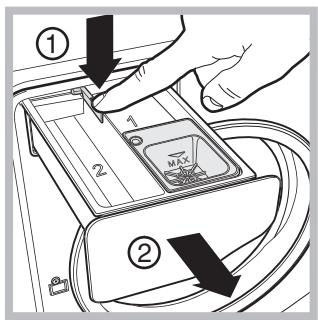
To remove the drawer, press the lever (1) and pull it outwards (2) (see figure).
Wash the drawer under running water; this should be done regularly.
Drum maintenance
- Always leave the porthole door ajar to prevent unpleasant odours from forming.
Cleaning the pump
The washing machine is fitted with a self-cleaning pump which does not require regular maintenance. However, it may be that small objects (coins, buttons, etc.) fall into the pre-chamber that protects the pump (the pump is located in the lower part of this pre-chamber).
! Make sure that the wash cycle has finished and remove the plug from the socket.
To access the pre-chamber:
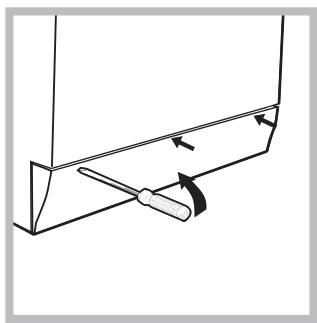
- Remove the kick strip on the front of the machine using a screwdriver (see figure);
-
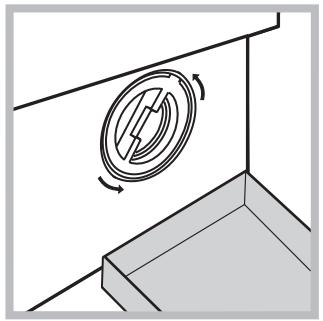
Position a container collecting the drained water (approximately 1.5 l) correctly (see figure);
-
Unscrew the cover, turning it in an anticlockwise direction (see figure);
-
Clean the inside thoroughly;
- Screw the cover back on;
- Replace the kick strip, making sure that the hooks are positioned in the right slots before pushing the panel towards the machine.
Checking the water inlet hose
Check the water inlet hose at least once a year. If there are any cracks, replace it immediately: the high water pressure used by the wash cycles could cause a cracked hose to split open.
From time to time your machine may not operate as it should. Before calling for Assistance (see "Assistance"), make sure that the problem cannot be resolved easily using the following list.
Malfunction:
The washing machine will not switch on.
The wash cycle does not begin.
The washing machines fails to fill with water.
The machine continuously fills and drains water.
The machine does not drain or spin.
The washing machine vibrates too much during the spin cycle.
The washing machine leaks.
The icons corresponding to the "Phase in progress" flash rapidly at the same time as the ON/OFF indicator light.
There is too much foam.
The washing machine door remains locked.
Possible causes / Solutions:
- The plug has not been inserted into the electrical socket, or it has not been inserted far enough to make contact.
-
There is no power in the house.
-
The porthole door has not been shut properly.
- The START/PAUSE button has not been pressed.
-
The water tap has not been turned on.
-
The water inlet hose is not connected to the tap.
- The hose is kinked.
- The water tap has not been turned on.
- There is no water in the house.
- The water pressure is insufficient.
-
The START/PAUSE button has not been pressed.
-
The end of the outlet hose has not been fitted at a height between 65 and 100cm from the floor (see "Installation").
- The free end of the hose is underwater (see "Installation").
- If the dwelling is on one of the upper floors of a building, there may be problems relating to water drainage, causing the washing machine to load and drain water continuously. Special anti-draining valves are available in shops and help to avoid this inconvenience.
-
The water drainage systemis not fitted with a breather pipe.
-
The programme does not include a draining phase: some programmes require manual draining (see "Programmes and options").
- The "Easy Iron" option is enabled: to complete the programme, press the START/PAUSE button (see "Programmes and options").
- The outlet hose is bent (see "Installation").
-
The drainage duct is clogged.
-
The drum was not unlocked properly when the appliance was installed (see "Installation").
- The washing machine is not level (see "Installation").
- The washing machine is trapped between cabinets and a wall (see "Installation").
-
The load is not balanced properly (see "Description of the machine").
-
The water inlet hose is not screwed on to the tap correctly (see "Installation").
-
The detergent dispenser drawer is blocked (for instructions on how to clean it, see "Care and maintenance").
-
The outlet hose has not been secured properly (see "Installation").
-
Switch off the machine and unplug the appliance; wait for approximately 1 minute then switch it on again. If the problem persists, contact Assistance.
- The detergent is not designed for machine washing (the packaging should state that the product is "for washing by machine", "for washing by hand or machine" or similar).
- Too much detergent was used.
- Follow the manual unlocking procedure (see "Precautions and tips").
! If the problem persists after the above checks have been carried out, shut off the water tap, switch off the machine and contact Assistance.
Before contacting Assistance:
- Check whether you can resolve the problem on your own (see "Troubleshooting");
- Restart the programme to check whether the problem has been overcome;
- If this is not the case, contact the Authorised Technical Assistance Centre.
If the machine has been installed or used incorrectly, you may be charged for the maintenance callout service.
! Never use the services of an unauthorised technician.
Have the following information ready:
- The type of problem experienced;
- The appliance model (Mod.);
- The serial number (S/N).
This information can be found on the appliance data plate.

Français
Sommaire
Installation, 14-15
Causes / Solutions possibles:
GAVETA DOS DETERGENTES
Euuypamion nIauvtpiou
- TOnToEtnoTe To PAnuTnpio oE eva dAnEdo EInTEDo kai avEeKtiko, Xwpi vTo aKoumuNoTe OToixouc n EπiIλa.
- AvTtataoIte Tc avwmaiec EeBovotacn Biowovta Ta TIOapakia eoc otou n Pauvtnpio aPdiaotei (Ev TPetie va kivei TepiooTepo aTIO 2 oipec).
- Description of the machine, 4-5
- Running a wash cycle, 6
- Programmes and options, 7
- Detergents and laundry, 8
- Precautions and tips, 9
- Care and maintenance, 10
- Troubleshooting, 11
- Unpacking and levelling
- Unpacking
- Levelling
- Connecting the cold water and electricity supplies
- Connecting the water inlet hose
- Drainage Connection
- Electrical connection
- Description of the machine
- Control panel
- GB
- CLOSE THE PORTHOLE DOOR.
- Setting a delayed start.
- A Modify the cycle characteristics.
- BAG FOR QUILTS, CURTAINS AND DELICATE GARMENTS
- Wash options
- Super Wash
- Easy Iron
- Extra Rinse
- Mini load
- Detergent
- Preparing the laundry
- Washing advice
- Load-balancing system
- General safety
- Disposal
- Opening the door manually
- Turning off the water and electricity supplies
- Cleaning the machine
- Cleaning the detergent dispenser drawer
- Drum maintenance
- Cleaning the pump
- Checking the water inlet hose
- Malfunction:
- Possible causes / Solutions:
- Before contacting Assistance:
- Have the following information ready:
- Sommaire
- Causes / Solutions possibles:
- Euuypamion nIauvtpiou
Brand : HOTPOINT-ARISTON
Model : AQXGF 169
Category : Washing machine