
RX480 NEO2 - Graphic card MSI - Free user manual and instructions
Find the device manual for free RX480 NEO2 MSI in PDF.


| Product type | Graphics card |
| Brand | MSI |
| Model | RX480 NEO2 |
| Dimensions (approx.) | 270 x 130 x 40 mm |
| Weight (approx.) | 900 g |
| Recommended power supply | 450 W minimum |
| Power connectors | 1 x 8-pin PCIe |
| Interface | PCI Express 3.0 x16 |
| Video memory | 8 GB GDDR5 |
| Video outputs | DisplayPort 1.4, HDMI 2.0b, DVI-D |
| Main functions | Graphics rendering, gaming, GPU computing, multi-monitor support |
| Cooling | Dual fan with copper heat pipes |
| Maximum resolution | 7680 x 4320 (8K) via DisplayPort |
| DirectX | 12.0 |
| OpenGL | 4.5 |
| Maintenance and cleaning | Regular dusting with compressed air, avoid moisture |
| Safety | Do not open the case, disconnect before handling |
| Spare parts and repairability | Replaceable fans, re-applicable thermal paste |
| General information | Compliant with WEEE directive, recycling at end of life |
Frequently Asked Questions - RX480 NEO2 MSI
User questions about RX480 NEO2 MSI
0 question about this device. Answer the ones you know or ask your own.
Ask a new question about this device
Download the instructions for your Graphic card in PDF format for free! Find your manual RX480 NEO2 - MSI and take your electronic device back in hand. On this page are published all the documents necessary for the use of your device. RX480 NEO2 by MSI.
USER MANUAL RX480 NEO2 MSI
FCC-B Radio Frequency Interference Statement
This equipment has been tested and found to comply with the limits for a class B digital device, pursuant to part 15 of the FCC rules. These limits are designed to provide reasonable protection against harmful interference when the equipment is operated in a commercial environment. This equipment generates, uses and can radiate radio frequency energy and, if not installed and used in accordance with the instruction manual, may cause harmful interference to radio communications. Operation of this equipment in a residential area is likely to cause harmful interference, in which case the user will be required to correct the interference at his own expense.
Notice 1
The changes or modifications not expressly approved by the party responsible for compliance could void the user's authority to operate the equipment.
Notice 2
Shielded interface cables and A.C. power cord, if any, must be used in order to comply with the emission limits.
SEE THE INSTALLATION NOTICE BEFORE CONNECTING TO THE NETWORK.

This device complies with Part 15 of the FCC Rules. Operation is subject to the following two conditions:
(1) this device may not cause harmful interference, and (2) this device must accept any interference received, including interference that may cause undesired operation.
Copyright Notice
The material in this document is the intellectual property of MICRO-STAR INTERNATIONAL. We take every care in the preparation of this document, but no guarantee is given as to the correctness of its contents. Our products are under continual improvement and we reserve the right to make changes without notice.
Trademarks
All trademarks are the properties of their respective owners.
AMD, Athlon™, Athlon™ XP, Thoroughbred™, and Duron™ are registered trademarks of AMD Corporation.
Intel® and Pentium® are registered trademarks of Intel Corporation.
PS/2 and OS/2 are registered trademarks of International Business Machines Corporation.
Windows 95/98/2000/2003/NT/XP are registered trademarks of Microsoft Corporation. Netware is a registered trademark of Novell, Inc.
Award is a registered trademark of Phoenix Technologies Ltd.
AMI is a registered trademark of American Megatrends Inc.
Revision History
Revision
V1.0
Revision History
First Release of 7151 v1.x PCB
with ATI RX480/SB400 chipsets
Date
August 2005
Technical Support
If a problem arises with your system and no solution can be obtained from the user's manual, please contact your place of purchase or local distributor. Alternatively, please try the following help resources for further guidance.
Visit the MSI website for FAQ, technical guide, BIOS updates, driver updates, and other information: http://www.msi.com.tw/program/service/faq/faq/escfaq_list.php. Contact our technical staff at: support@msi.com.tw
- Always read the safety instructions carefully.
- Keep this User's Manual for future reference.
- Keep this equipment away from humidity.
- Lay this equipment on a reliable flat surface before setting it up.
- The openings on the enclosure are for air convection hence protects the equipment from overheating. DO NOT COVER THE OPENINGS.
- Make sure the voltage of the power source and adjust properly 110/220V before connecting the equipment to the power inlet.
- Place the power cord such a way that people can not step on it. Do not place anything over the power cord.
- Always Unplug the Power Cord before inserting any add-on card or module.
- All cautions and warnings on the equipment should be noted.
- Never pour any liquid into the opening that could damage or cause electrical shock.
- If any of the following situations arises, get the equipment checked by a service personnel:
† The power cord or plug is damaged. † Liquid has penetrated into the equipment. † The equipment has been exposed to moisture. † The equipment has not work well or you can not get it work according to User's Manual. † The equipment has dropped and damaged. † The equipment has obvious sign of breakage.
- DO NOT LEAVE THIS EQUIPMENT IN AN ENVIRONMENT UNCONDITIONED, STORAGE TEMPERATURE ABOVE 60°C (140°F), IT MAY DAMAGE THE EQUIPMENT.

CAUTION: Danger of explosion if battery is incorrectly replaced. Replace only with the same or equivalent type recommended by the manufacturer.

Please recycle waste batteries.
For better environmental protection, waste batteries should be collected separately for recycling or special disposal.

To protect the global environment and as an environmentalist, MSI must remind you that...
Under the European Union ("EU") Directive on Waste Electrical and Electronic Equipment, Directive 2002/96/EC, which takes effect on August 13, 2005, products of "electrical and electronic equipment" cannot be discarded as municipal waste anymore and manufacturers of covered electronic equipment will be obligated to take back such products at the end of their useful life. MSI will comply with the product take back requirements at the end of life of MSI-branded products that are sold into the EU. You can return these products to local collection points.
Chapter 1. Getting Started 1-1
Mainboard Specifications 1-2
Mainboard Layout 1-5
Packing Checklist 1-6
Chapter 2. Hardware Setup 2-1
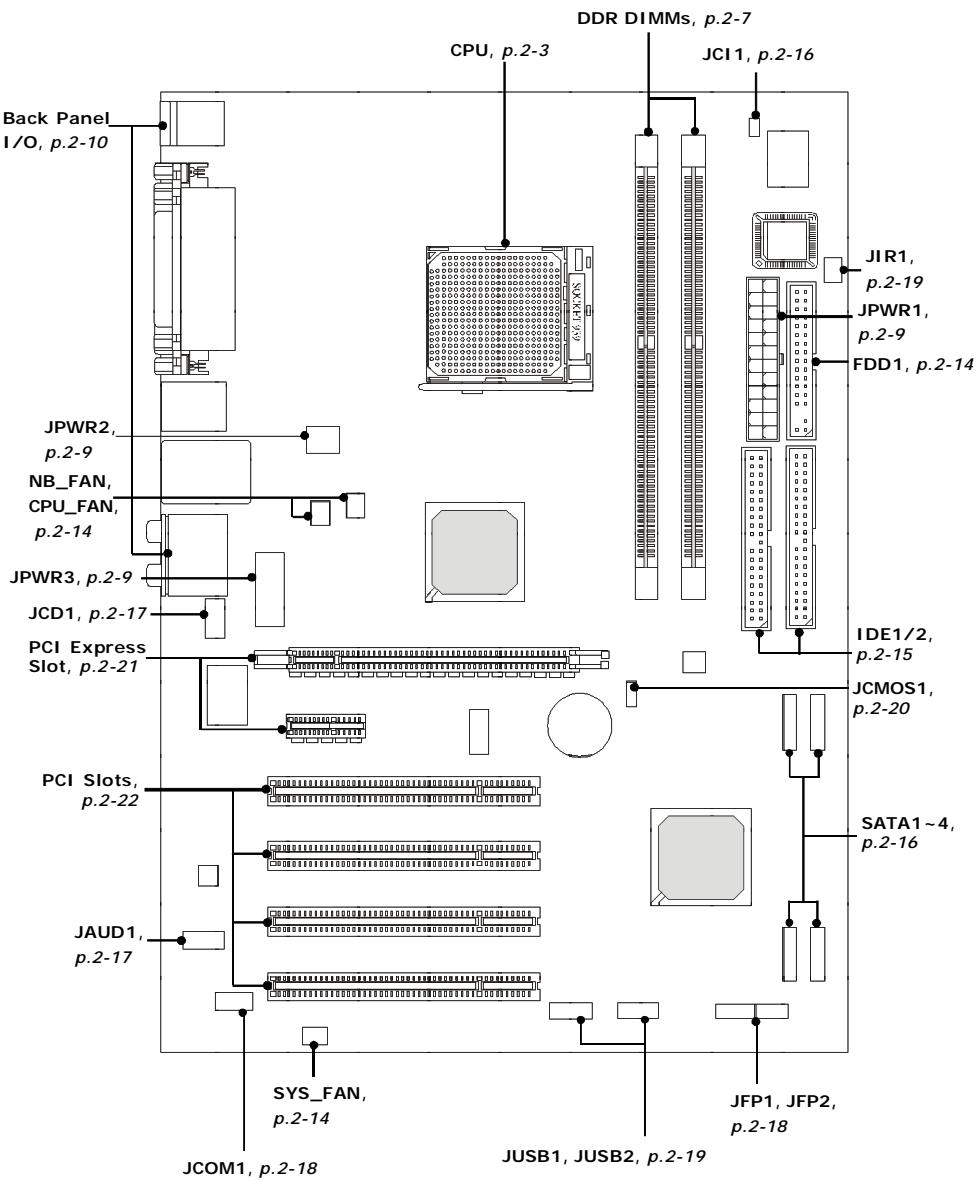
Quick Components Guide 2-2
Central Processing Unit: CPU 2-3
CPU Installation Procedures for Socket 939 2-4
Installing AMD Athlon64 CPU cooler Set 2-5
Memory 2-7
DIMM Module Combination 2-7
Installing DDR Modules 2-8
Power Supply 2-9
ATX 24-Pin Power Connector: JPWR1 2-9
ATX 12V Power Connector: JPWR2 2-9
ATX 4-Pin VGA Power Connector: JPWR3. 2-9
Back Panel 2-10
Mouse/Keyboard Connector 2-10
USB Connectors 2-10
Serial Port Connector: COM Port 2-11
LAN (RJ-45) Jack 2-11
Parallel Port Connector: LPT1 2-12
Audio Port Connectors 2-13
Connectors 2-14
Floppy Disk Drive Connector: FDD1 2-14
Fan Power Connectors: CPU_FAN / NB_FAN/SYS_FAN 2-14
ATA133 Hard Disk Connectors: IDE1 & IDE2 2-15
Serial ATA Connectors: SATA1~SATA4 2-16
Chassis Intrusion Switch Connector: JCI1 2-16
CD-In Connector: JCD1 2-17
Front Panel Audio Connector: JAUD1 2-17
Serial Port Header: COM1 (Optional) 2-18
Front Panel Connectors: JFP1/JFP2 2-18
IrDA Infrared Module Header: JIR1 (Optional) 2-19
Front USB Connectors: JUSB1 / JUSB2 2-19
Jumper 2-20
Clear CMOS Jumper: JCMOS1 2-20
Slots 2-21
PCI Express Slots 2-21 PCI (Peripheral Component Interconnect) Slots 2-22 PCI Interrupt Request Routing 2-22
Chapter 3. BIOS Setup 3-1
Control Keys 3-2 Getting Help 3-3
Entering Setup 3-2 The Main Menu 3-4 Standard CMOS Features 3-6 Advanced BIOS Features 3-9 Advanced Chipset Features 3-11 Integrated Peripherals 3-12 Power Management Setup 3-15 PNP/PCI Configurations 3-18 H/W Monitor 3-20 Cell Menu 3-22 BIOS Setting Password 3-25 Load Fail-Safe/Optimized Defaults 3-26
Appendix A: Using 2-, 4- & 6-Channel Audio Function A-1
Installing the Audio Driver A-2 Installation for Windows 98SE/ME/2000/XP A-2 Software Configuration A-4 Sound Effect A-4 Equalizer A-6 Speaker Configuration A-7 Speaker Test A-8 S/PDIF-Out A-9 HRTF Demo A-10 Microphone Effect A-11 General A-12 Using 2-, 4- & 6- Channel Audio Function A-13
Appendix B: ATI SATA RAID Setup Guide B-1
SATA RAID Features B-2
Disk Striping (RAID 0) B-2 Disk Mirroring (RAID 1) B-3
Creating RAID Sets B-4
BIOS RAID Utility Screen Description B-5 Description of RAID Setup Operations B-5
Installing RAID Drivers (for Windows 2000/XP only) B-8
Installing RAID Drivers during OS Install B-8 Updating Previously Installed RAID Drivers B-8
Installing SATA RAID Utility B-11
SATA RAID GUI B-13
Configuring RAID 0 Set(s) with Windows Disk Manager B-24
Getting Started
Thank you for choosing the RX480 Neo2 (MS-7151 v1.X) ATX mainboard. The RX480 Neo2 mainboard is based on ATI® RX480 & ATI® SB400 chipsets for optimal system efficiency. Designed to fit the advanced AMD® K8 Athlon 64 FX processor, the RX480 Neo2 delivers a high performance and professional desktop platform solution.
Mainboard Specifications
CPU
Supports 64-bit AMD® Athlon 64 and Athlon 64 FX processor (Socket 939) Supports up to 4200+ Athlon 64 FX or higher CPU (For the latest information about CPU, please visit http://www.msi.com.tw/program/products/mainboard/mbd/pro_mbd_cpu_support.php)
Chipset
† ATI® RX480 Chipset
- HyperTransport™ connection to AMD K8 Athlon64 processor
- 8 or 16 bit control/address/data transfer both directions
- 1000/800/600/400/200 MHz “Double Data Rate” operation both direction
- Compliant with PCI Express 1.0a specifications (one x16 graphics interface, which can be divided into two smaller links for use by other devices)
† ATI® SB400 Chipset
- Supports dual channel native SATA controller up to 150MB/s with RAID 0 or 1
- Integrated Hardware Sound Blaster/Direct Sound AC97 audio
- Ultra DMA 66/100/133 master mode PCI EIDE controller
- ACPI & PC2001 compliant enhanced power management
- Supports USB2.0 up to 8 ports
Main Memory
Supports dual channel, four memory banks DDR 333/400, using two 184-pin DDR DIMMs. Supports a maximum memory size up to 2GB without ECC. Supports 2.5v DDR SDRAM DIMM. (For the updated supporting memory modules, please visit http://www.msi.com.tw/program/products/mainboard/mbd/pro_mbd_trp_list.php.)
Slots
† One PCI Express x16 slot (supports PCI Express Bus specification v1.0a compliant) † One PCI Express x1 slot † Four 32-bit Master 3.3V/5V PCI Bus slots
Onboard IDE
† An IDE controller on the ATI® SB400 chipset provides IDE HDD/CD-ROM with PIO, Bus Master and Ultra DMA 133/100/66 operation modes, 4X ultra DMA 100/66/33 † Can connect up to 4 IDE devices
Onboard Serial ATA
Supports 4 SATA ports with up to 150MB/s transfer rate

MSI Reminds You...
- Please note that users cannot install OS, either WinME or Win98, in their SATA hard drives. Under these two OSs, SATA can only be used as an ordinary storage device.
- To create a bootable RAID volume for a Windows 2000 environment, Microsoft's Windows 2000 Service Pack 4 (SP4) is required. As the end user cannot boot without SP4, a combination installation CD must be created before attempting to install the operating system onto the bootable RAID volume.
To create the combination installation CD, please refer to the following website:
http://www.microsoft.com/windows2000/downloads/
servicepacks/sp4/HFdeploy.htm
USB Interface
† 8 USB ports
- 4 ports in the rear I/O, 4 ports via the external bracket
LAN (optional)
Realtek® 8100C/8110SB LAN chip (Optional)
- Integrated Fast Ethernet MAC and PHY in one chip
- Supports 10Mb/s and 100Mb/s and 1000Mb/s (1000Mb/s for 8110SB only)
- Compliance with PCI v2.2
- Supports ACPI Power Management
Audio
† 8 channels software audio codec RealTek ALC850
- Compliance with AC97 v2.3 Spec.
- Meets PC2001 audio performance requirement.
On-Board Peripherals
† On-Board Peripherals include:
- 1 floppy port supports 1 FDD with 360K, 720K, 1.2M, 1.44M and 2.88Mbytes
- 2 serial ports (COM1 on the rear, COM2 with pinheader)
- 1 parallel port supporting SPP/EPP/ECP mode
- 8 USB2.0 ports (Rear 4/Front 4)
- 1 Audio (Line-Outx3, Line-In, MIC In, SPDIF Out (Coaxial/Fibre) port
- 1 RJ-45 LAN Jack
- 2 IDE ports support 4 IDE devices
- 4 serial ATA ports
BIOS
† The mainboard BIOS provides “Plug & Play” BIOS which detects the peripheral devices and expansion cards of the board automatically. † The mainboard provides a Desktop Management Interface (DMI) function which
records your mainboard specifications.
Supports boot from LAN, USB Device 1.1 & 2.0, and SATA HDD.
Dimension
† ATX Form Factor: 30.5cm × 21.5cm
Mounting
† 6 mounting holes
Mainboard Layout RX480 Neo2 (MS-7151 v1.X) ATX Mainboard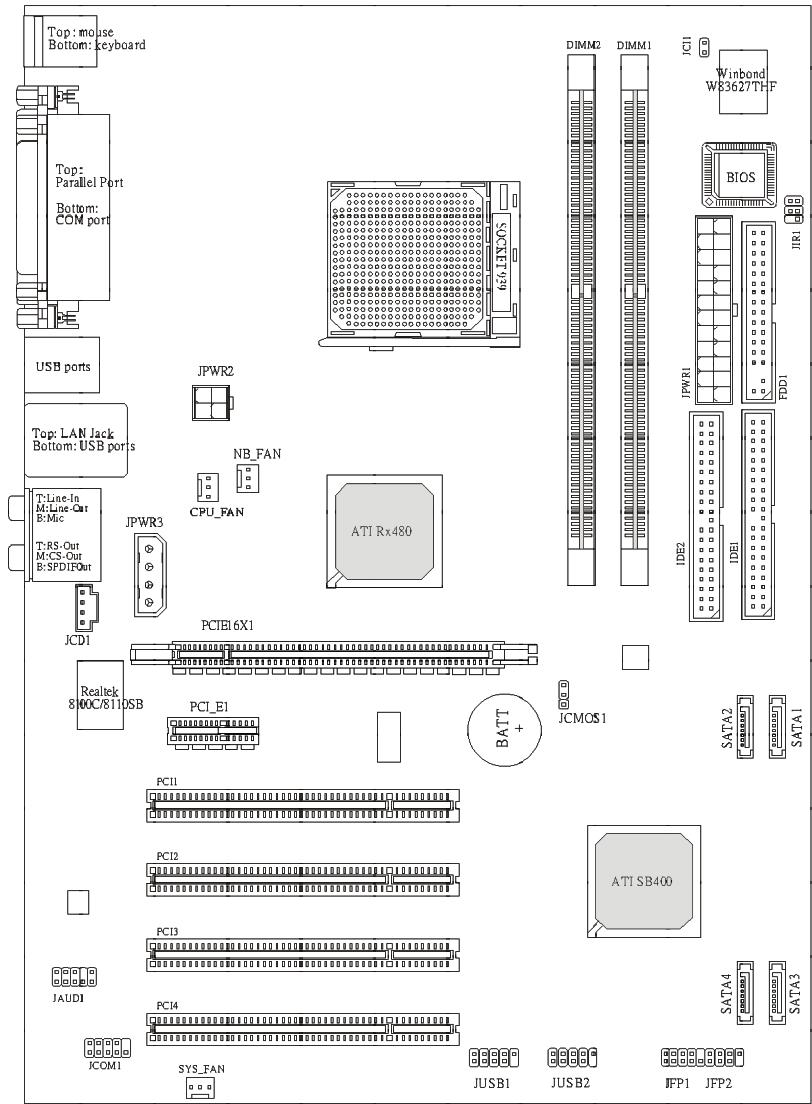
Packing Checklist
MSI motherboard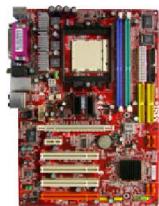
MSI Driver/Utility CD
SATA Cable (Optional)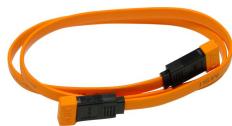
Power Cable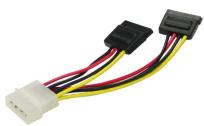
Standard Cable for Floppy Disk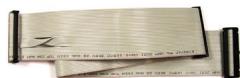
Standard Cable for IDE Devices
USB Bracket (Optional)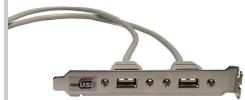
Back IO Shield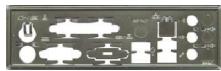
User's Guide
- The pictures are for reference only. Your packing contents may vary depending on the model you purchased.
Hardware Setup
This chapter tells you how to install the CPU, memory modules, and expansion cards, as well as how to setup the jumpers on the mainboard. Also, it provides the instructions on connecting the peripheral devices, such as the mouse, keyboard, etc.
While doing the installation, be careful in holding the components and follow the installation procedures.
Quick Components Guide
Central Processing Unit: CPU
The mainboard supports AMD® Athlon64 processor. The mainboard uses a CPU socket called Socket-939 for easy CPU installation. When you are installing the CPU, make sure the CPU has a heat sink and a cooling fan attached on the top to prevent overheating. If you do not have the heat sink and cooling fan, contact your dealer to purchase and install them before turning on the computer.
For the latest information about CPU, please visit http://www.msi.com.tw/program/products/mainboard/mbd/pro_mbd_cpu_support.php.

MSI Reminds You...
Overheating
Overheating will seriously damage the CPU and system, always make sure the cooling fan can work properly to protect the CPU from overheating.
Replacing the CPU
While replacing the CPU, always turn off the ATX power supply or unplug the power supply's power cord from grounded outlet first to ensure the safety of CPU.
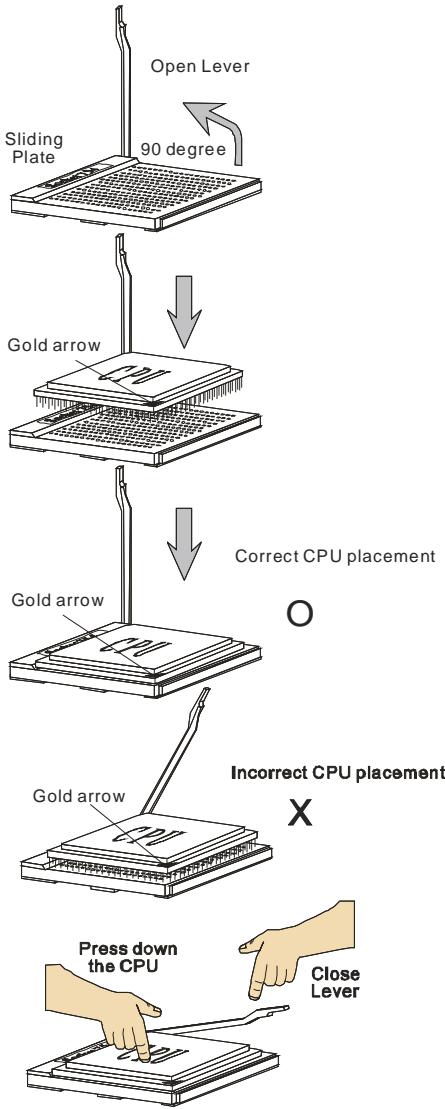
CPU Installation Procedures for Socket 939
- Please turn off the power and unplug the power cord before installing the CPU.
- Pull the lever sideways away from the socket. Make sure to raise the lever up to a 90-degree angle.
- Look for the gold arrow of the CPU. The gold arrow should point as shown in the picture. The CPU can only fit in the correct orientation.
- If the CPU is correctly installed, the pins should be completely embedded into the socket and can not be seen. Please note that any violation of the correct installation procedures may cause permanent damages to your mainboard.
- Press the CPU down firmly into the socket and close the lever. As the CPU is likely to move while the lever is being closed, always close the lever with your fingers pressing tightly on top of the CPU to make sure the CPU is properly and completely embedded into the socket.
Installing AMD Athlon64 CPU cooler Set
When you are installing the CPU, make sure the CPU has a heat sink and a cooling fan attached on the top to prevent overheating. If you do not have the heat sink and cooling fan, contact your dealer to purchase and install them before turning on the computer.

MSI Reminds You...
Mainboard photos shown in this section are for demonstration of the cooler installation for Socket 939 CPUs only. The appearance of your mainboard may vary depending on the model you purchase.
- Detach the shield off the backplate's paster.
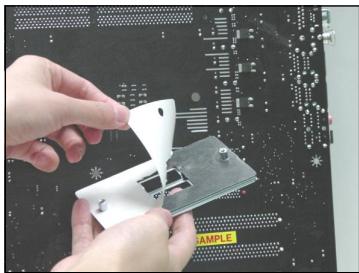
- Turn over the mainboard, and install the backplate to the proper position.
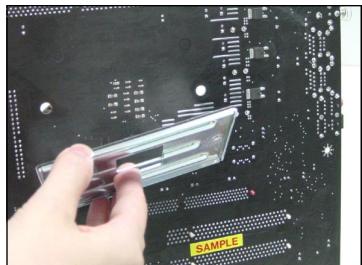
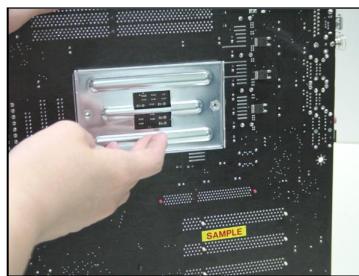
- Turn over the mainboard again, and place the mainboard on the flat surface. Locate the two screw holes of the mainboard.
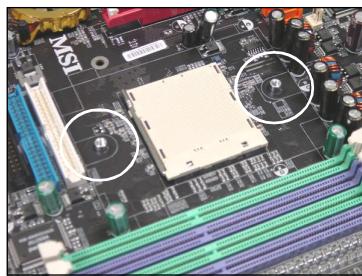
- Align the retention mechanism and the backplate.
Fix the retention mechanism and the backplate with two screws.
retention mechanism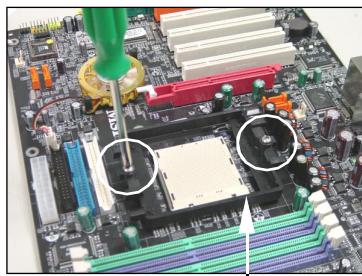
- Position the cooling set onto the retention mechanism.
Hook one end of the clip to hook first, and then press down the other end of the clip to fasten the cooling set on the top of the retention mechanism.
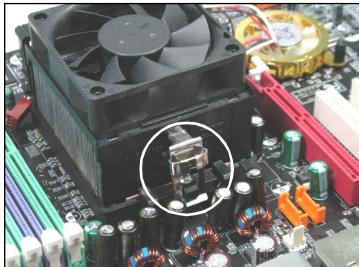
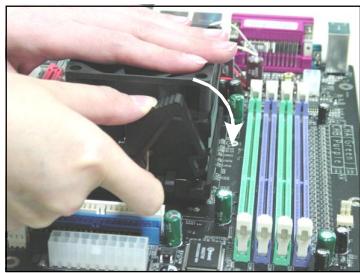
- Locate the Fix Lever, Safety Hook and the Fixed Bolt.
Lift up the intensive fixed lever.
Fixed Lever Fixed Bolt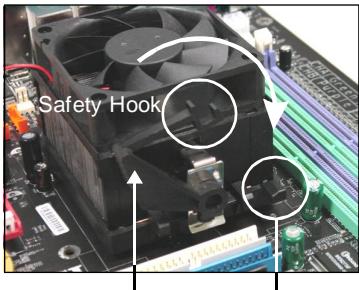
- Fasten down the lever.
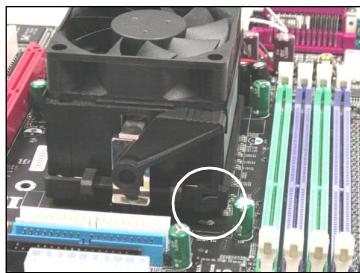
- Make sure the safety hook completely clasps the fixed bolt of the retention mechanism.
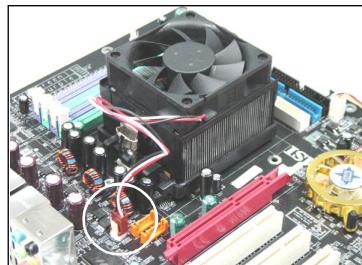
- Attach the CPU Fan cable to the CPU fan connector on the mainboard.

MSI Reminds You...
While disconnecting the Safety Hook from the fixed bolt, it is necessary to keep an eye on your fingers, because once the Safety Hook is disconnected from the fixed bolt, the fixed lever will spring back instantly.
Memory
The mainboard provides 2 slots for 184-pin DDR DIMM (Double In-Line Memory Module) modules and supports the memory size up to 2GB. You can install DDR 333/400 modules on the DDR DIMM slots (DIMM 1~2).
DIMM1~DIMM2 (from right to left)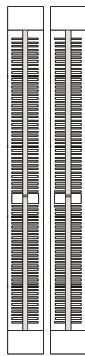
DIMM Module Combination
Install at least one DIMM module on the slots. Each DIMM slot supports up to a maximum size of 1GB. Users can install either single- or double-sided modules to meet their own needs. Users may install memory modules of different type and density on different-channel DDR DIMMs. However, memory modules of the same type and density are required while using dual-channel DDR, or instability may happen.
| Slots | Mode | |
| DIMM1 (CH A) | DIMM2 (CH B) | |
| 128MB~1GB | Single Channel | |
| 128MB~1GB | 128MB~1GB | Dual Channel |

MSI Reminds You...
- The system operates ONLY when the DDR modules are installed in accordance with the above-mentioned memory population rules.
- In dual-channel mode, make sure that you install memory modules of the same type and density on DDR DIMMs.
- To enable successful system boot-up, always insert the memory modules into the Channel A slots (DIMM1) first.
- This mainboard does not support memory modules with more than 18 ICs (integrated circuits).
Installing DDR Modules
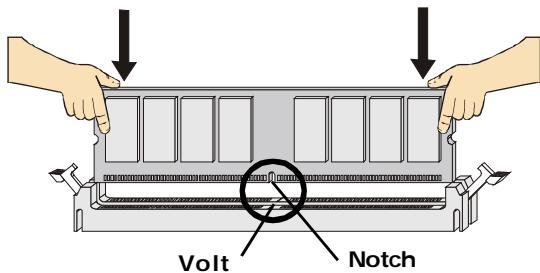
- The DDR DIMM has only one notch in the center of the module. The module will only fit in the correct orientation.
- Insert the DIMM memory module vertically into the DIMM slot. Then push it in until the gold contacts on the memory module are fully inserted into the socket.
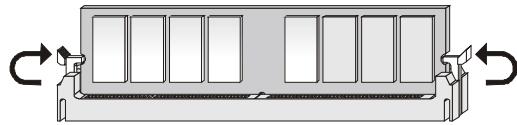
- The plastic clips on each side of the DIMM slot will automatically close.
Power Supply
The mainboard supports ATX power supplies for the power system. Before inserting the power supply connector, always ensure that all components are properly installed to prevent any damage.
ATX 24-Pin Power Connector: JPWR1
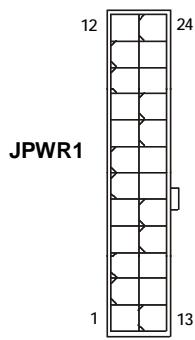
This connector allows you to connect an ATX 24-pin power supply. To connect the ATX 24-pin power supply, ensure the plug is inserted in the correct orientation and the pins are aligned. Then push the power supply firmly into the connector.
Pin Definition
| PIN | SIGNAL | PIN | SIGNAL |
| 1 | +3.3V | 13 | +3.3V |
| 2 | +3.3V | 14 | -12V |
| 3 | GND | 15 | GND |
| 4 | +5V | 16 | PS-ON# |
| 5 | GND | 17 | GND |
| 6 | +5V | 18 | GND |
| 7 | GND | 19 | GND |
| 8 | PWROK | 20 | Res |
| 9 | 5VSB | 21 | +5V |
| 10 | +12V | 22 | +5V |
| 11 | +12V | 23 | +5V |
| 12 | NC | 24 | GND |
ATX 12V Power Connector: JPWR2
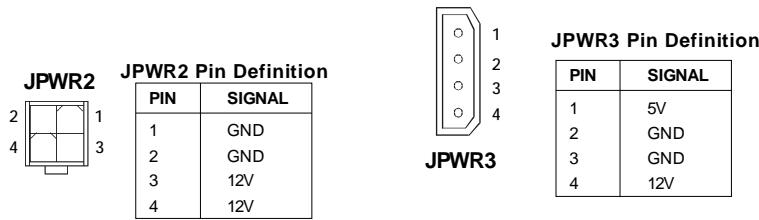
This 12V power connector is used to provide power to the CPU.
ATX 4-Pin VGA Power Connector: JPWR3
This connector is designed to connect a 12V power supply for add-on PCI Express graphics cards.

MSI Reminds You...
- These two connectors connect to the ATX power supply and have to work together to ensure stable operation of the mainboard.
- Power supply of 350 watts (and above) is highly recommended for system stability.
- ATX 12V power connection should be greater than 18A.
Back Panel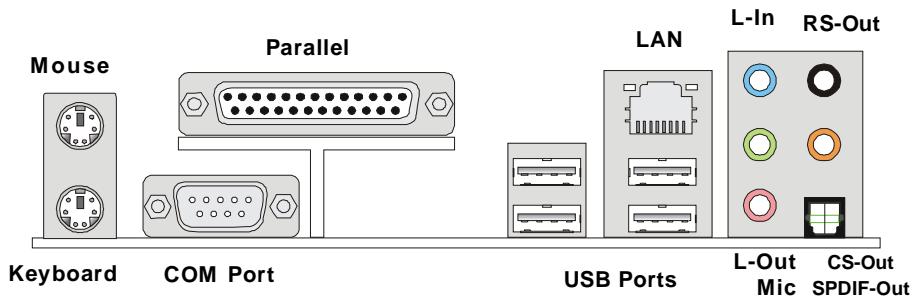
Mouse/Keyboard Connector
The mainboard provides a standard PS/2® mouse/keyboard mini DIN connector for attaching a PS/2® mouse/keyboard. You can plug a PS/2® mouse/keyboard directly into this connector. The connector location and pin assignments are as follows:
PS/2 Mouse / Keyboard (6-pin Female)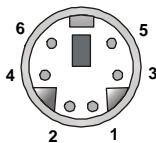
Pin Definition
| PIN | SIGNAL | DESCRIPTION |
| 1 | Mouse/Keyboard Data | Mouse/Keyboard data |
| 2 | NC | No connection |
| 3 | GND | Ground |
| 4 | VCC | +5V |
| 5 | Mouse/KeyboardClock | Mouse/Keyboardclock |
| 6 | NC | No connection |
USB Connectors
The mainboard provides an OHCI (Open Host Controller Interface) Universal Serial Bus root for attaching USB devices such as keyboard, mouse or other USB-compatible devices. You can plug the USB device directly into the connector.
USB Ports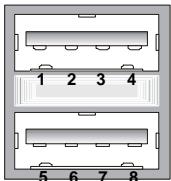
USB Port Description
| PIN | SIGNAL | DESCRIPTION |
| 1 | VCC | +5V |
| 2 | -Data 0 | Negative Data Channel 0 |
| 3 | +Data0 | Positive Data Channel 0 |
| 4 | GND | Ground |
| 5 | VCC | +5V |
| 6 | -Data 1 | Negative Data Channel 1 |
| 7 | +Data 1 | Positive Data Channel 1 |
| 8 | GND | Ground |
Serial Port Connector: COM Port
The mainboard offers one 9-pin male DIN connector COM Port. It's a 16550A high speed communication port that send/receive/ 16 bytes FIFOs. You can attach a serial mouse or other serial device directly to it.
9-Pin Male DIN Connector COM Port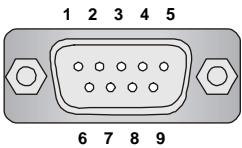
Pin Definition
| PIN | SIGNAL | DESCRIPTION |
| 1 | DCD | Data Carry Detect |
| 2 | SIN | Serial In or Receive Data |
| 3 | SOUT | Serial Out or Transmit Data |
| 4 | DTR | Data Terminal Ready) |
| 5 | GND | Ground |
| 6 | DSR | DataSetReady |
| 7 | RTS | Request To Send |
| 8 | CTS | Clear To Send |
| 9 | RI | Ring Indicate |
LAN (RJ-45) Jack
The mainboard provides 1 standard RJ-45 jack for connection to a single Local Area Network (LAN). This LAN enables data to be transferred at 1000Mbps (Realtek 8100S), 100Mbps, or 10Mbps. You can connect a network cable to it.
RJ-45 LAN Jack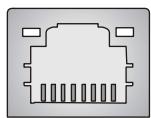
Giga-bit LAN Pin Definition
| PIN | SIGNAL | DESCRIPTION |
| 1 | D0P | Differential Pair 0+ |
| 2 | D0N | Differential Pair 0- |
| 3 | D1P | Differential Pair 1+ |
| 4 | D2P | Differential Pair 2+ |
| 5 | D2N | Differential Pair 2- |
| 6 | D1N | Differential Pair 1- |
| 7 | D3P | Differential Pair 3+ |
| 8 | D3N | Differential Pair 3- |
Parallel Port Connector: LPT1
The mainboard provides a 25-pin female centronic connector as LPT. A parallel port is a standard printer port that supports Enhanced Parallel Port (EPP) and Extended Capabilities Parallel Port (ECP) mode.
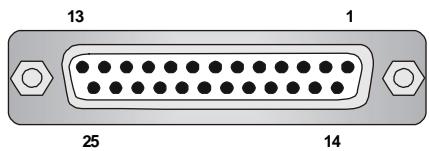
Pin Definition
| PIN | SIGNAL | DESCRIPTION |
| 1 | STROBE | Strobe |
| 2 | DATA0 | Data0 |
| 3 | DATA1 | Data1 |
| 4 | DATA2 | Data2 |
| 5 | DATA3 | Data3 |
| 6 | DATA4 | Data4 |
| 7 | DATA5 | Data5 |
| 8 | DATA6 | Data6 |
| 9 | DATA7 | Data7 |
| 10 | ACK# | Acknowledge |
| 11 | BUSY | Busy |
| 12 | PE | PaperEnd |
| 13 | SELECT | Select |
| 14 | AUTO FEED# | AutomaticFeed |
| 15 | ERR# | Error |
| 16 | INIT# | Initialize Printer |
| 17 | SLIN# | Select In |
| 18 | GND | Ground |
| 19 | GND | Ground |
| 20 | GND | Ground |
| 21 | GND | Ground |
| 22 | GND | Ground |
| 23 | GND | Ground |
| 24 | GND | Ground |
| 25 | GND | Ground |
Audio Port Connectors
The left 3 audio jacks are for 2-channel mode for stereo speaker output: Line Out is a connector for Speakers or Headphones. Line In is used for external CD player, Tape player, or other audio devices. Mic is a connector for microphones.
However, there is an advanced audio application provided by Realtek ALC850 to offer support for 7.1-channel audio operation and can turn rear audio connectors from 2-channel to 4-/5.1-/7.1- channel audio.
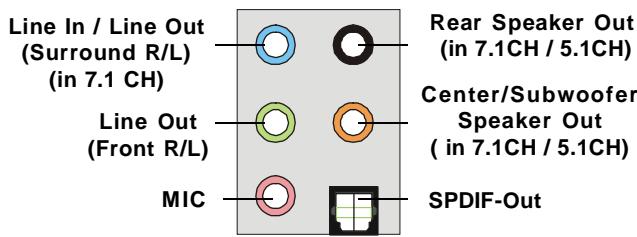

MSI Reminds You...
For the advanced functions of the audio codec, please refer to Appendix A for details.
Connectors
Floppy Disk Drive Connector: FDD1
The mainboard provides a standard floppy disk drive connector that supports 360K, 720K, 1.2M, 1.44M and 2.88M floppy disk types.
FDD1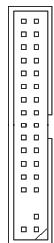
Fan Power Connectors: CPU_FAN/NB_FAN/SYS_FAN
The fan power connectors support system cooling fan with +12V. When connecting the wire to the connectors, always take note that the red wire is the positive and should be connected to the +12V, the black wire is Ground and should be connected to GND. If the mainboard has a System Hardware Monitor chipset onboard, you must use a specially designed fan with speed sensor to take advantage of the CPU fan control.
CPU_FAN/NB_FAN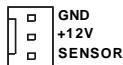
SYS_FAN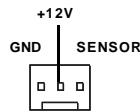

MSI Reminds You...
Please refer to the recommended CPU fans at AMD® official website or consult the vendors for proper CPU cooling fan.
ATA133 Hard Disk Connectors: IDE1 & IDE2
The mainboard has a 32-bit Enhanced PCI IDE and Ultra DMA 66/100/133 controller that provides PIO mode 0~4, Bus Master, and Ultra DMA 66/100/133 function. You can connect up to four hard disk drives, CD-ROM and other IDE devices.
The Ultra ATA133 interface boosts data transfer rates between the computer and the hard drive up to 133 megabytes (MB) per second. The new interface is one-third faster than earlier record-breaking Ultra ATA/100 technology and is backwards compatible with the existing Ultra ATA interface.
IDE2 IDE1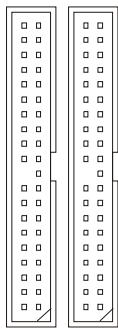
IDE1 (Primary IDE Connector)
The first hard drive should always be connected to IDE1. IDE1 can connect a Master and a Slave drive. You must configure second hard drive to Slave mode by setting the jumper accordingly.
IDE2 (Secondary IDE Connector)
IDE2 can also connect a Master and a Slave drive.

MSI Reminds You...
If you install two hard disks on a cable, you must configure the second drive to Slave mode by setting its jumper. Refer to the hard disk documentation supplied by hard disk vendors for jumper setting instructions.
Serial ATA Connectors: SATA1~SATA4
The ATI SB400 SouthBridge supports four serial ATA connectors SATA1~SATA4. SATA1~SATA4 are high-speed Serial ATA interface ports. Each supports 1st generation serial ATA data rates of 150MB/s and is fully compliant with Serial ATA 1.0 specifications. Each Serial ATA connector can connect to 1 hard disk device.
SATA4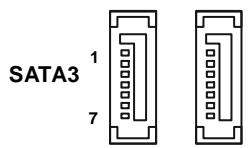
SATA1~ SATA4 Pin Definition
| PIN | SIGNAL | PIN | SIGNAL |
| 1 | GND | 2 | TXP |
| 3 | TXN | 4 | GND |
| 5 | RXN | 6 | RXP |
| 7 | GND |
SATA2 SATA1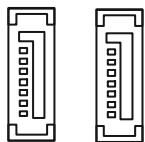
Connect to SATA1/2/3/4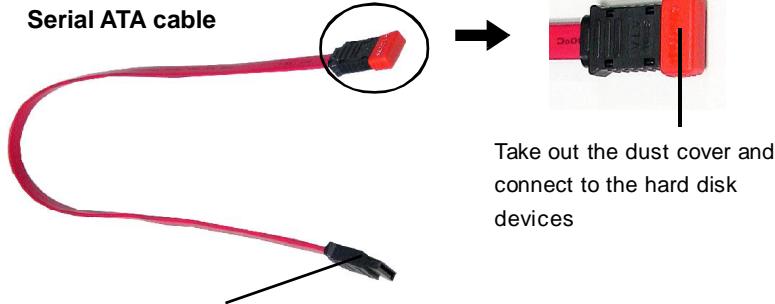

MSI Reminds You...
Please do not fold the Serial ATA cable into a 90-degree angle. Otherwise, data loss may occur during transmission.
Chassis Intrusion Switch Connector: JCI1
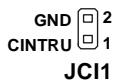
This connector is connected to a 2-pin chassis switch. If the chassis is opened, the switch will be short. The system will record this status and show a warning message on the screen. To clear the warning, you must enter the BIOS utility and clear the record.
CD-In Connector: JCD1
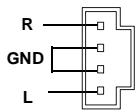
This connector is provided for CD-ROM audio.
JCD1
Front Panel Audio Connector: JAUD1
The JAUD1 front panel audio connector allows you to connect to the front panel audio and is compliant with Intel® Front Panel I/O Connectivity Design Guide.
JAUD1
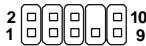
Pin Definition
| PIN | SIGNAL | DESCRIPTION |
| 1 | AUD_MIC | Front panel microphone input signal |
| 2 | AUD_GND | Ground used by analog audio circuits |
| 3 | AUD_MIC_BIAS | Microphone power |
| 4 | AUD_VCC | Filtered +5V used by analog audio circuits |
| 5 | AUD_FPOUT_R | Right channel audio signal to front panel |
| 6 | AUD_RET_R | Right channel audio signal return from front panel |
| 7 | HP_ON | Reserved for future use to control headphone amplifier |
| 8 | KEY | No pin |
| 9 | AUD_FPOUT_L | Left channel audio signal to front panel |
| 10 | AUD_RET_L | Left channel audio signal return from front panel |

MSI Reminds You...
If you don't want to connect to the front audio header, pins 5 & 6, 9 & 10 have to be jumpered in order to have signal output directed to the rear audio ports. Otherwise, the Line-Out connector on the back panel will not function.
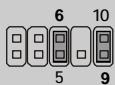
Serial Port Header: JCOM1 (Optional)
The mainboard offers one 9-pin header as serial port. The port is a 16550A high speed communication port that sends/receives 16 bytes FIFOs. You can attach a serial mouse or other serial device directly to it.
JCOM1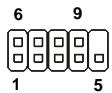
Pin Definition
| PIN | SIGNAL | DESCRIPTION |
| 1 | DCD | Data Carry Detect |
| 2 | SIN | Serial In or Receive Data |
| 3 | SOUT | Serial Out or Transmit Data |
| 4 | DTR | Data Terminal Ready) |
| 5 | GND | Ground |
| 6 | DSR | Data SetReady |
| 7 | RTS | Request To Send |
| 8 | CTS | Clear To Send |
| 9 | RI | Ring Indicate |
Front Panel Connectors: JFP1 / JFP2
The mainboard provides two front panel connectors for electrical connection to the front panel switches and LEDs. JFP1 is compliant with Intel® Front Panel I/O Connectivity Design Guide.
JFP1 Pin Definition
| PIN | SIGNAL | DESCRIPTION |
| 1 | HD_LED_P | Hard disk LED pull-up |
| 2 | FP PWR/SLP | MSG LED pull-up |
| 3 | HD_LED_N | Hard disk active LED |
| 4 | FP PWR/SLP | MSG LED pull-up |
| 5 | RST_SW_N | Reset Switch low reference pull-down to GND |
| 6 | PWR_SW_P | Power Switch high reference pull-up |
| 7 | RST_SW_P | Reset Switch high reference pull-up |
| 8 | PWR_SW_N | Power Switch low reference pull-down to GND |
| 9 | RSVD_DNU | Reserved. Do not use. |
JFP2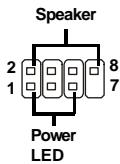
JFP2 Pin Definition
| PIN | SIGNAL | PIN | SIGNAL |
| 1 | GND | 2 | SPK- |
| 3 | SLED | 4 | BUZ+ |
| 5 | PLED | 6 | BUZ- |
| 7 | NC | 8 | SPK+ |
IrDA Infrared Module Header: JIR1 (Optional)
The connector allows you to connect to IrDA Infrared module. You must configure the setting through the BIOS setup to use the IR function. JIR1 is compliant with Intel® Front Panel I/O Connectivity Design Guide.
65


21
JIR1
Pin Definition
| Pin | Signal |
| 1 | NC |
| 2 | NC |
| 3 | VCC5 |
| 4 | GND |
| 5 | IRTX |
| 6 | IRRX |
Front USB Connectors: JUSB1 / JUSB2
The mainboard provides two standard USB 2.0 pin headers JUSB1 & JUSB2. USB 2.0 technology increases data transfer rate up to a maximum throughput of 480Mbps, which is 40 times faster than USB 1.1, and is ideal for connecting high-speed USB interface peripherals such as USB HDD, digital cameras, MP3 players, printers, modems and the like.
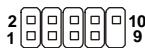
JUSB1,JUSB2
(USB 2.0)
JUSB1 & JUSB2 Pin Definition
| PIN | SIGNAL | PIN | SIGNAL |
| 1 | VCC | 2 | VCC |
| 3 | USB0- | 4 | USB1- |
| 5 | USB0+ | 6 | USB1+ |
| 7 | GND | 8 | GND |
| 9 | Key(no pin) | 10 | USBOC |
Connected to JUSB1 or JUSB2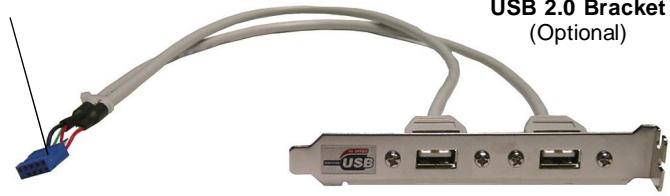

MSI Reminds You...
Note that the pins of VCC and GND must be connected correctly to avoid possible damage.
Jumpers
The motherboard provides the following jumpers for you to set the computer's function. This section will explain how to change your motherboard's function through the use of jumpers.
Clear CMOS Jumper: JCMOS1
There is a CMOS RAM onboard that has a power supply from external battery to keep the data of system configuration. With the CMOS RAM, the system can automatically boot OS every time it is turned on. If you want to clear the system configuration, set the JCMOS1 (Clear CMOS Jumper) to clear data.
JCMOS1
Keep Data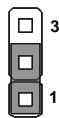
Clear Data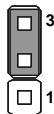

MSI Reminds You...
To clear CMOS you should:
- switch off the system and short 2-3 pin of the JCMOS1;
- switch on the system again and the message "CMOS checksum error" should appear;
- switch off the system and return to 1-2 pin (Keep Data) position;
- switch on again for operation.
Please avoid clearing CMOS while the system is on; it will damage the mainboard.
Slots
The mainboard provides a PCI Express x16 slot, a PCI Express x1 slot and four 32-bit PCI bus slots.
PCI Express Slots
The PCI Express slots support high-bandwidth, low pin count, and serial interconnect technology. You can insert the expansion cards to meet your needs. When adding or removing expansion cards, make sure that you unplug the power supply first.
PCI Express architecture provides a high performance I/O infrastructure for Desktop Platforms with transfer rates starting at 2.5 Giga transfers per second over a PCI Express x1 lane for Gigabit Ethernet, TV Tuners, 1394 controllers, and general purpose I/O. Also, desktop platforms with PCI Express Architecture will be designed to deliver highest performance in video, graphics, multimedia and other sophisticated applications. Moreover, PCI Express architecture provides a high performance graphics infrastructure for Desktop Platforms doubling the capability of existing AGP 8x designs with transfer rates of 4.0 GB/s over a PCI Express x16 lane for graphics controllers, while PCI Express x1 supports transfer rate of 250 MB/s.

PCI Express x16 slot
PCI Express x1 slot
PCI (Peripheral Component Interconnect) Slots
The PCI slots allow you to insert the expansion cards to meet your needs. When adding or removing expansion cards, make sure that you unplug the power supply first. Meanwhile, read the documentation for the expansion card to make any necessary hardware or software settings for the expansion card, such as jumpers, switches or BIOS configuration.

PCI Slots
PCI Interrupt Request Routing
The IRQ, acronym of interrupt request line and pronounced I-R-Q, are hardware lines over which devices can send interrupt signals to the microprocessor. The PCI IRQ pins are typically connected to the PCI bus INT A# ~ INT D# pins as follows:
| Order 1 | Order 2 | Order 3 | Order 4 | |
| PCI Slot 1 | INTA# | INT B# | INTC# | INTD# |
| PCI Slot 2 | INT B# | INT C# | INTD# | INTA# |
| PCI Slot 3 | INTC# | INTD# | INTA# | INTB# |
| PCI Slot 4 | INTD# | INTA# | INTB# | INTC# |
BIOS Setup
This chapter provides information on the BIOS Setup program and allows you to configure the system for optimum use. You may need to run the Setup program when:
2 An error message appears on the screen during the system boot up, and requests you to run SETUP. 2 You want to change the default settings for customized features.

MSI Reminds You...
- The items under each BIOS category described in this chapter are under continuous update for better system performance. Therefore, the description may be slightly different from the latest BIOS and should be held for reference only.
- While booting up, the BIOS version is shown in the 1st line appearing after the memory count. It is usually in the format: example: A7151AMS V1.0BH 06/20/05
where:
1st digit refers to BIOS maker as A = AMI(R) ; W = AWARD(R) 2nd - 5th digit refers to the model number.
6th digit refers to the chipset vendor, MS=all standard customers.
V1.0BH refers to the BIOS version.
06/20/05 refers to the date this BIOS is released.
Entering Setup
Power on the computer and the system will start POST (Power On Self Test) process. When the message below appears on the screen, press key to enter Setup.
DEL: Setup Menu
TAB:Logo
F11: Boot Menu
F10: Flash Recovery
If the message disappears before you respond and you still wish to enter Setup, restart the system by turning it OFF and On or pressing the RESET button. You may also restart the system by simultaneously pressing , , and keys.
Selecting the First Boot Device
You are allowed to select the 1st boot device without entering the BIOS setup utility by pressing <F11>. When the same message as listed above appears on the screen, press <F11> to trigger the boot menu.
The POST messages might pass by too quickly for you to respond in time. If so, restart the system and press <F11> after around 2 or 3 seconds to activate the boot menu similar to the following.
| Select First Boot Device | |
| Floppy:1st FloppyIDE-0:IBM-DTLA-307038CDROM:ATAPI CD-ROM DRIVE 40X M | |
| [Up/Dn] Select | [RETURN] Boot [ESC] cancel |
The boot menu will list all the bootable devices. Select the one you want to boot from by using arrow keys and then pressing <Enter>. The system will boot from the selected device. The selection will not make changes to the settings in the BIOS setup utility, so next time when you power on the system, it will still use the original first boot device to boot up.
Control Keys
| <↑> | Move to the previous item |
| <↓> | Move to the next item |
| <←> | Move to the item in the left hand |
| <→> | Move to the item in the right hand |
| <Enter> | Select the item |
| <Esc> | Jumps to the Exit menu or returns to the main menu from a submenu |
| <++> | Increase the numeric value or make changes |
| <-> | Decrease the numeric value or make changes |
| <F6> | Load Optimized Defaults |
| <F7> | Load Fail-Safe Defaults |
| <F10> | Save all the CMOS changes and exit |
Getting Help
After entering the Setup utility, the first screen you see is the Main Menu.
Main Menu
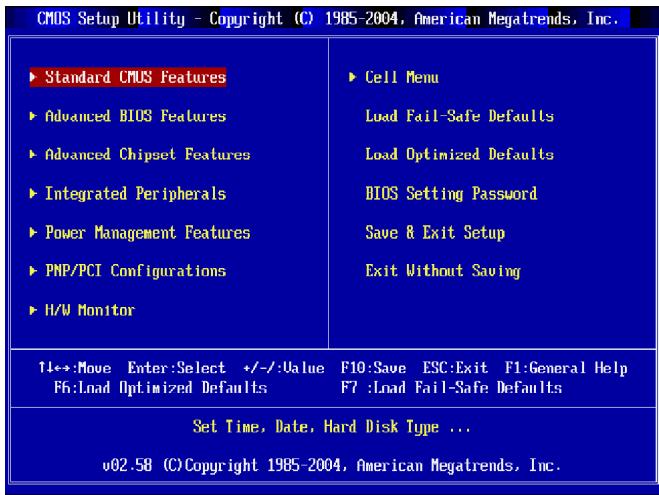
The main menu displays the setup categories the BIOS supplies. You can use the arrow keys (↑↓) to select the item. The on-line description for the selected setup category is displayed at the bottom of the screen.
Default Settings
The preset Optimal Defaults of the BIOS setup program provide optimal performance settings for all devices and the system.

MSI Reminds You...
The items under each BIOS category described in this chapter are under continuous update for better system performance. Therefore, the description may be slightly different from the latest BIOS and should be held for reference only.
The Main Menu
Once you enter AMIBIOS NEW SETUP UTILITY, the Main Menu will appear on the screen. Use arrow keys to move among the items and press <Enter> to enter the sub-menu.
Standard CMOS Features
Use this menu for basic system configurations, such as time, date, etc.
Advanced BIOS Features
Use this menu to set up the items of AMI® special enhanced features.
Advanced Chipset Features
Use this menu to change the values in the chipset registers and optimize your system's performance.
Integrated Peripherals
Use this menu to specify your settings for integrated peripherals.
Power Management Features
Use this menu to specify your settings for power management.
PNP/PCI Configurations
This entry appears if your system supports PnP/PCI.
H/W Monitor
This entry shows the status of your CPU, fan, and warning for overall system status.
Cell Menu
Use this menu to specify your settings for frequency/voltage control.
Load Fail-Safe Defaults
Use this menu to load the default values set by the BIOS vendor for stable system performance.
Load Optimized Defaults
Use this menu to load the default values set by the mainboard manufacturer specifically for optimal performance of the mainboard.
BIOS Setting Password
Use this menu to set the password for BIOS.
Save & Exit Setup
Save changes to CMOS and exit setup.
Exit Without Saving
Abandon all changes and exit setup.
Standard CMOS Features
The items in Standard CMOS Features Menu include some basic setup items. Use the arrow keys to highlight the item and then use the + or - keys to select the value you want in each item.
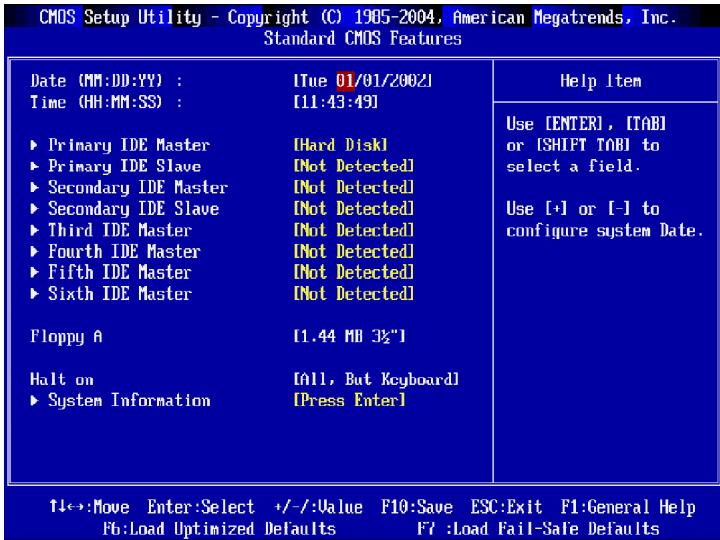
Date (MM:DD:YY)
This allows you to set the system to the date that you want (usually the current date). The format is .
day Day of the week, from Sun to Sat, determined by BIOS. Read only.
month: The month from Jan. through Dec.
date: The date from 1 to 31 can be keyed by numeric function keys.
year: The year can be adjusted by users.
Time (HH:MM:SS)
This allows you to set the system time that you want (usually the current time).
The time format is .
Primary/Secondary/Third IDE Master/Slave
Fourth/Fifth/Sixth IDE Master
Press < + > or < -> to select the hard disk drive type. The specification of hard disk drive will show up on the right hand according to your selection. Press for the sub-menu of each item:
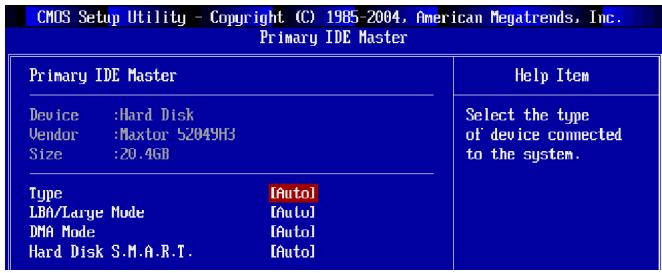
Device
This item shows the information about the specified item. Read-only.
Type
This item defines the HDD parameters.
LBA/Large Mode
This item allows you to enable or disable the LBA (Logical Block Address, the logical block size in hard disk) mode. Setting options: [Auto], [Disabled].
DMA Mode
This item allows you to enable or disable the DMA (Direct Memory Access) mode. Setting options: [Auto], [SWDMA0], [SWDMA1], [SWDMA2], [MWDMA0], [MWDMA1], [MWDMA2], [UDMA0], [UDMA1], [UDMA2], [UDMA3], [UDMA4], [UDMA5].
Hard Disk S.M.A.R.T.
This allows you to activate the S.M.A.R.T. (Self-Monitoring Analysis & Reporting Technology) capability for the hard disks. S.M.A.R.T is a utility that monitors your disk status to predict hard disk failure. This gives you an opportunity to move data from a hard disk that is going to fail to a safe place before the hard disk becomes offline. Settings: [Auto], [Enabled], [Disabled].
Floppy A
This item allows you to set the type of the floppy drives installed. Available options: [Disabled], [360 KB, 5 1/4], [1.2 MB, 5 1/4], [720 KB, 3 1/2], [1.44 MB, 3 1/2], [2.88 MB, 3 1/2].
Halt On
The setting determines whether the system will stop if an error is detected at boot. Available options are:
[No Errors] The system doesn't stop for any detected error.
[All, But Keyboard] The system doesn't stop for a keyboard error.
System Information
Press to for the sub-menu of each item:
| CM03 Setup Utility - Copyright (C) 1985-2004, American Megatrends, Inc. | |
| System Information | |
| Total Memory 256MBBIOS Version U1.0B9** CPU Information **AMD Athlon(tm) G4 Processor 3700+CPU ID/uCode ID OF71h/00h | Help Item |
Total System Memory/BIOS Version
This item shows the memory status and BIOS version of your system (read only).
**CPU Information**
AMD Athlon(tm) 64 Processor/CPU ID/uCode ID
The two items show the CPU related information of your system (read only).
Advanced BIOS Features
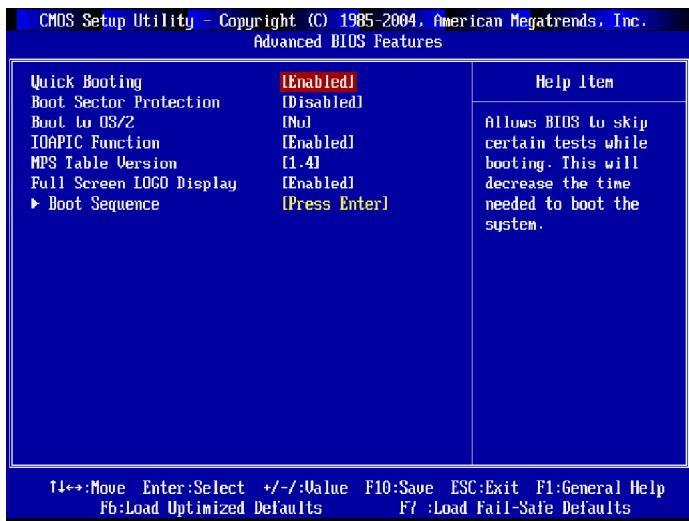
Quick Booting
Setting the item to [Enabled] allows the system to boot within 5 seconds since it will skip some check items. Available options: [Enabled], [Disabled].
Boot Sector Protection
This function protects the BIOS from accidental corruption by unauthorized users or computer viruses. When enabled, the BIOS' data cannot be changed when attempting to update the BIOS with a Flash utility. To successfully update the BIOS, you'll need to disable this Boot Sector Protection function.
You should enable this function at all times. The only time when you need to disable it is when you want to update the BIOS. After updating the BIOS, you should immediately re-enable it to protect it against viruses. Setting options: [Enabled], [Disabled].
Boot to OS/2
This allows you to run the OS/2® operating system with DRAM greater than 64MB. Setting options: [Yes], [No].
IOAPIC Function
This field is used to enable or disable the APIC (Advanced Programmable Interrupt Controller). Due to compliance with PC2001 design guide, the system is able to run in APIC mode. Enabling APIC mode will expand available IRQ resources for the system. Settings: [Enabled], [Disabled].
MPS Table Version
This field allows you to select which MPS (Multi-Processor Specification) version to be used for the operating system. You need to select the MPS version
supported by your operating system. To find out which version to use, consult the vendor of your operating system. Settings: [1.4], [1.1].
Full Screen LOGO Display
This item enables you to show the company logo on the bootup screen. Settings are: [Enabled] Shows a still image (logo) on the full screen at boot.
[Disabled] Shows the POST messages at boot.
Boot Sequence
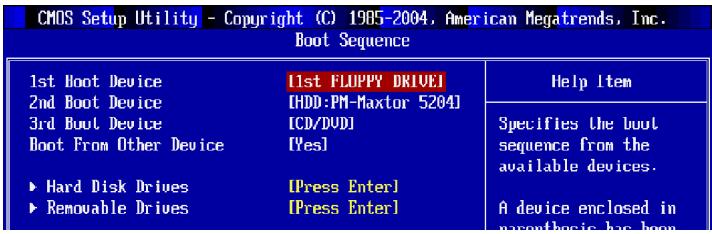
Press and the following sub-menu appears:
1st/2nd/3rd Boot Device
These items allow you to set the sequence of boot devices where BIOS attempts to load the operating system.
Boot From Other Devices
Setting the option to [Yes] allows the system to try to boot from other devices if the system fails to boot from the 1st/2nd/3rd boot device. Settings are: [Yes], [No].

MSI Reminds You...
Available settings for "1st/2nd/3rd Boot Device" vary depending on the bootable devices you have installed. For example, if you did not install a floppy drive, the setting "Floppy" will not show up.
Hard Disk Drives/Removable Drives
These items allow you to specific the boot devices where BIOS attempts to load the operating system.
Advanced Chipset Features

MSI Reminds You...
Change these settings only if you are familiar with the chipset.
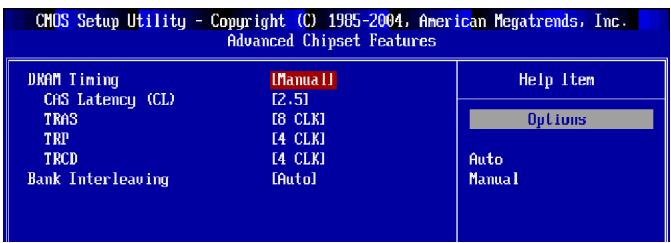
DRAM Timing
The value in this field depends on performance parameters of the installed memory chips (DRAM). Do not change the value from the factory setting unless you install new memory that has a different performance rating than the original DRAMs.
CAS Latency (CL)
This controls the CAS latency, which determines the timing delay (in clock cycles) before SDRAM starts a read command after receiving it. Settings: [2.0], [2.5], [3.0]. [2.0] increases the system performance the most while [3.0] provides the most stable performance.
TRAS
This setting determines the time RAS takes to read from and write to a memory cell. Setting options: [5CLK] to [15CLK].
TRP
This setting controls the number of cycles for Row Address Strobe (RAS) to be allowed to precharge. If insufficient time is allowed for the RAS to accumulate its charge before DRAM refresh, refresh may be incomplete and DRAM may fail to retain data. This item applies only when synchronous DRAM is installed in the system. Setting options: [2CLK] to [6CLK].
TRCD
When DRAM is refreshed, both rows and columns are addressed separately. This setup item allows you to determine the timing of the transition from RAS (row address strobe) to CAS (column address strobe). The less the clock cycles, the faster the DRAM performance. Setting options: [2CLK] to [6CLK].
Bank Interleaving
This field selects 2-bank or 4-bank interleave for the installed SDRAM. Disable the function if 16MB SDRAM is installed. Settings: [Auto], [Disabled].
Integrated Peripherals
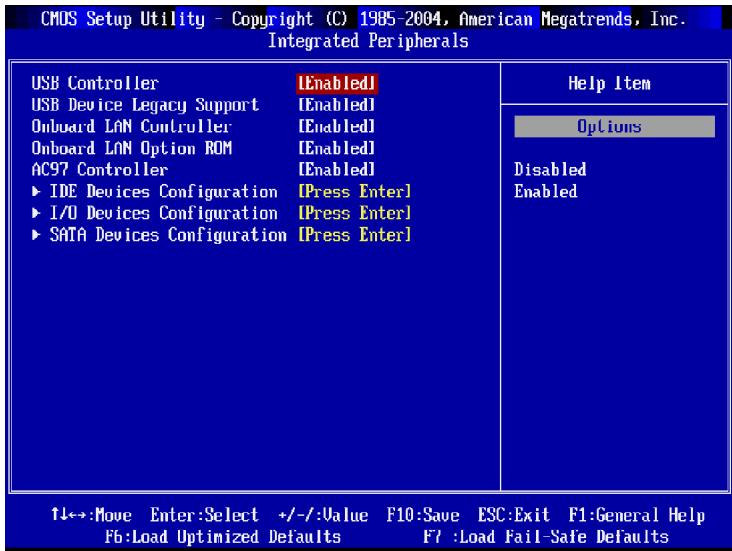
USB Controller
This setting is used to enable/disable the onboard USB host controller. Setting options: [Disabled], [Enabled].
USB Device Legacy Support
Set to [Enabled] if you need to use any USB 1.1/2.0 device in the operating system that does not support or have any USB 1.1/2.0 driver installed, such as DOS. Set to [Disabled] only if you want to use any USB device other than the USB mouse. Setting options: [Disabled], [Enabled].
Onboard LAN Controller
The item enables or disables the onboard LAN controller. Setting options: [Enabled], [Disabled].
Onboard LAN Option ROM
The item enables or disables the initialization of the onboard LAN Boot ROMs during bootup. Selecting [Disabled] will speed up the boot process. Setting options: [Enabled], [Disabled].
AC97 Controller
This item is used to enable or disable the onboard AC97 (Audio Codec) controller. Selecting [Enabled] allows the mainboard to enable the onboard AC97 controller. Disable the function if you want to use other controller cards to connect an audio device. Settings: [Disabled] and [Enabled].
IDE Devices Configuration
Press to enter the sub-menu and the following screen appears:

On-Chip IDE Controller
The integrated peripheral controller contains a IDE interface with support for two IDE channels. Select [Enabled] to activate the IDE interface. Settings options: [Disabled], [Primary], [Secondary], [Both].
PCI IDE BusMaster
Set this option to [Enabled] to specify that the IDE controller on the PCI local bus has bus mastering capability. Settings options: [Disabled], [Enabled].
I/O Devices Configuration
Press to enter the sub-menu and the following screen appears:
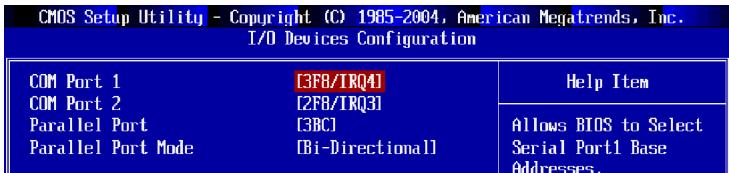
COM Port 1/2
These items specify the base I/O port addresses of the onboard Serial Port 1/2. Selecting [Auto] allows BIOS to automatically determine the correct base I/O port address. Settings: [3F8/IRQ4], [2F8/IRQ3], [3E8/IRQ4], [2E8/IRQ3] and [Disabled].
Parallel Port
This field specifies the base I/O port address of the onboard parallel port. Selecting [Auto] allows BIOS to automatically determine the correct base I/O port address. Settings: [378], [278], [3BC] and [Disabled].
Parallel Port Mode
This item selects the operation mode for the onboard parallel port: [ECP], [Normal] or [Bi-Directional].
SATA Devices Configuration
Press to enter the sub-menu and the following screen appears:

OnChip SATA Channel
Setting options: [Disabled], [Single], [Both].
OnChip SATA Type
Select [Enable SATA As IDE] if you want to have SATA as IDE function, and this device is able to install OS. Select [Enable SATA As RAID] if you want to have RAID function, you may install OS on this SATA device. Select [Enable SATA As Storage] if you want this SATA device for storage only. Setting options: [Enable SATA As IDE], [Enable SATA As RAID], [Enable SATA As Storage].
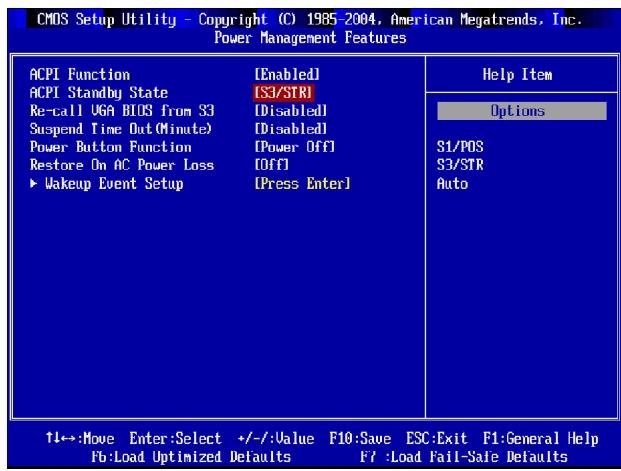
Power Management Features

MSI Reminds You...
S3-related functions described in this section are available only when your BIOS supports S3 sleep mode.
ACPI Function
This item activates the ACPI (Advanced Configuration and Power Management Interface) function. If your operating system is ACPI-aware, such as Windows 98SE/2000/ME/XP, select [Enabled]. Settings: [Enabled] and [Disabled].
ACPI Standby State
This item specifies the power saving modes for the ACPI function. If your operating system supports ACPI, such as Windows 98SE, Windows ME, Windows 2000, and Windows XP, you can choose to enter the Standby mode in S1 (POS) or S3 (STR) fashion through the setting of this field. Options are:
[S1/POS] The S1 sleep mode is a low power state. In this state, no system context is lost (CPU or chipset) and hardware maintains all system context.
[S3/STR] The S3 sleep mode is a lower power state where the information of system configuration and open applications/files is saved to main memory that remains powered while most other hardware components turn off to save energy. The information stored in memory will be used to restore the system when a "wake up" event occurs.
[Auto] BIOS determines the best setting automatically.
Re-Call VGA BIOS from S3
When ACPI Standby State is set to [S3/STR], users can select the options in this field. Selecting [Yes] allows BIOS to call VGABIOS to initialize the VGA
card when the system wakes up (resumes) from S3 sleep state. The system resume time is shortened when you disable the function, but the system will need an AGP driver to initialize the VGA card. Therefore, if the AGP driver of the card does not support the initialization feature, the display may work abnormally or not function after resuming from S3. Options: [Auto], [Yes], [No].
Suspend Time Out (Minute)
If system activity is not detected for the length of time specified in this field, all devices except CPU will be shut off. Settings: [Disabled], [1 minute], [2 minutes], [3 minutes], [4 minutes], [5 minutes], [10 minutes], [15 minutes], [32 minutes], [64 minutes].
Power Button Function
This feature allows users to configure the Power Button function. Settings are:
[Power Off]
The power button functions as a normal power-on/off button.
[Suspend]
When you press the power button, the computer enters the suspend/sleep mode, but if the button is pressed for more than four seconds, the computer is turned off.
Restore on AC Power Loss
This setting specifies whether your system will reboot after a power failure or interrupt occurs. Available settings are:
[Off]
Leaves the computer in the power off state.
[On]
Leaves the computer in the power on state.
[Last State]
Restores the system to the previous status before power failure or interrupt occurred.
Wakeup Event Setup
Press and the following sub-menu appears.
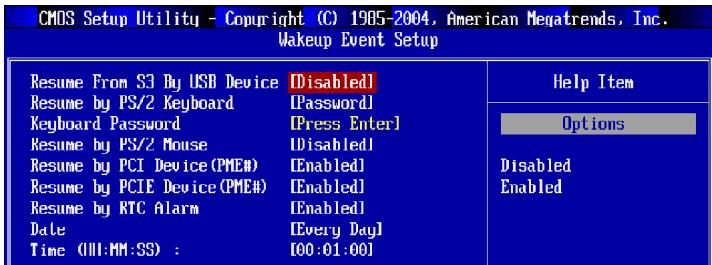
Resume From S3 By USB Device
This item allows the activity of the USB device to wake up the system from S3 (Suspend to RAM) sleep state. Setting options: [Disabled], [Enabled].
Resume by PS/2 Keyboard
This controls how and whether the PS/2 keyboard is able to power on the system. If you choose [Password], you must type the password to power on the system. Settings: [Disabled], [Password] and [Any Key].
Keyboard Password
If Resume by PS/2 Keyboard is set to [Password], then you can set a password in the field for the PS/2 keyboard to power on the system.
Resume by PS/2 Mouse
The setting determines whether the system will be awakened from power saving modes when the PS/2 mouse input signal is detected. Setting options: [Disabled], [Enabled].
Resume by PCI Device (PME#)
When set to [Enabled], this setting allows your system to be awakened from the power saving modes through any event on PME (Power Management Event). Setting options: [Disabled], [Enabled].
Resume by PCIE Device (PME#)
When set to [Enabled], this setting allows your system to be awakened from the power saving modes through any event on PME (Power Management Event). Setting options: [Disabled], [Enabled].
Resume by RTC Alarm
This is used to enable or disable the feature of booting up the system on a scheduled time/date from the S3, S4, and S5 power off state. Setting options: [Disabled], [Enabled].
Date/Time (HH:MM:SS)
If Resume By RTC Alarm is set to [Enabled], the system will automatically resume (boot up) on a specific date/hour/minute/second specified in these fields (using the <+> and <-> to select the date & time settings). Available settings for each item are:
Date 01~31, Every Day
Time (HH:MM:SS) 00~23:00~59:00~59

MSI Reminds You...
If you have changed this setting, you must let the system boot up until it enters the operating system, before this function will work.
PNP/PCI Configurations
This section describes configuring the PCI bus system and PnP (Plug & Play) feature. PCI, or Peripheral Component Interconnect, is a system which allows I/O devices to operate at speeds nearing the speed the CPU itself uses when communicating with its special components. This section covers some very technical items and it is strongly recommended that only experienced users should make any changes to the default settings.
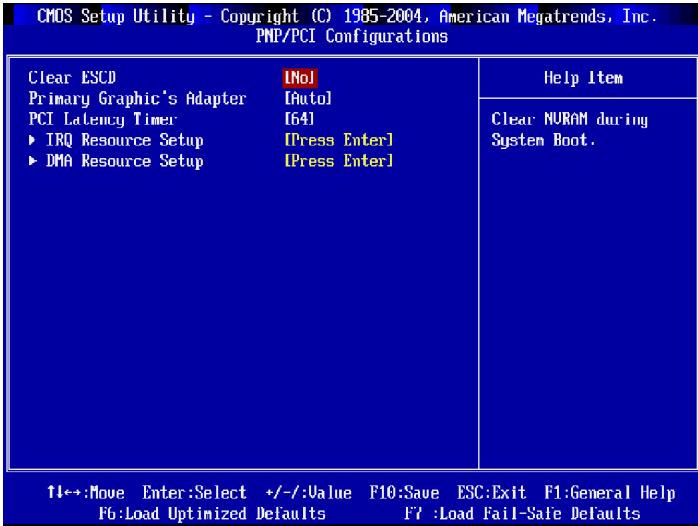
Clear ESCD
The ESCD (Extended System Configuration Data) NVRAM (Non-volatile Random Access Memory) is where the BIOS stores resource information for both PNP and non-PNP devices in a bit string format. When the item is set to [Yes], the system will reset ESCD NVRAM right after the system is booted up and then set the setting of the item back to [No] automatically.
Primary Graphic's Adapter
This setting specifies which VGA card is your primary graphics adapter. Setting options are:
[Auto] The system initializes the graphic's adapter automatically.
[PCI Mode] The system initializes the PCI Express graphic first. If a PCI Express graphic card is not available, it will initialize the internal graphic's adapter.
PCI Latency Timer
This item controls how long each PCI device can hold the bus before another takes over. When set to higher values, every PCI device can conduct transactions for a longer time and thus improve the effective PCI bandwidth. For better PCI performance, you should set the item to higher values. Setting options:
[32], [64], [96], [128].
IRQ Resource Setup
Press <Enter> and the following sub-menu appears.
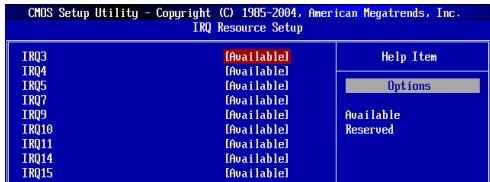
IRQ 3/4/5/7/9/10/11/14/15
These items specify the bus where the specified IRQ line is used.
The settings determine if AMIBIOS should remove an IRQ from the pool of available IRQs passed to devices that are configurable by the system BIOS. The available IRQ pool is determined by reading the ESCD NVRAM. If more IRQs must be removed from the IRQ pool, the end user can use these settings to reserve the IRQ by assigning a [Reserved] setting to it. Onboard I/O is configured by AMIBIOS. All IRQs used by onboard I/O are configured as [Available]. If all IRQs are set to [Reserved], and IRQ 14/15 are allocated to the onboard PCI IDE, IRQ 9 will still be available for PCI and PnP devices. Available settings: [Reserved] and [Available].
DMA Resource Setup
Press <Enter> and the following sub-menu appears.
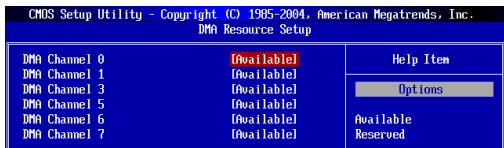
DMA Channel 0/1/3/5/6/7
These items specify the bus that the system DMA (Direct Memory Access) channel is used. The settings determine if AMIBIOS should remove a DMA from the available DMAs passed to devices that are configurable by the system BIOS. The available DMA pool is determined by reading the ESCD NVRAM. If more DMAs must be removed from the pool, the end user can reserve the DMA by assigning a [Reserved] setting to it.
H/W Monitor
This section shows the status of your CPU, fan, overall system status, etc. Monitor function is available only if there is hardware monitoring mechanism.
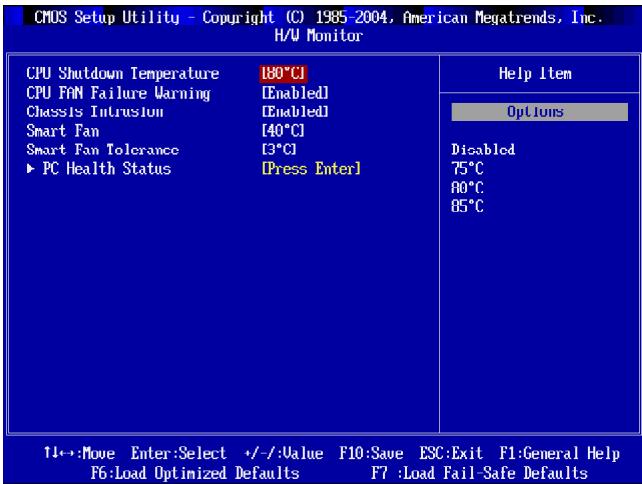
CPU Shutdown Temperature
If the CPU temperature reaches the limit preset in the next setting, the system will shutdown automatically. This helps you to prevent the CPU overheating problem. This item is available only when your OS supports this function, such as Windows ME/XP. Setting options: [Disabled], [75°C], [80°C], [85°C].
CPU Fan Failure Warning
When enabled, the system will automatically monitor the CPU fan during boot-up. If it detects that the CPU fan is not rotating, the system will show an error message on the screen and halt the boot-up process. The function is built with CPU fan power connector (CPU_FAN) only and enables you to protect the CPU from possible overheating problem. If you don't connect the CPU fan to the CPU fan power connector, we recommend disabling this feature. Setting options: [Enabled], [Disabled].
Chassis Intrusion
The field enables or disables the feature of recording the chassis intrusion status and issuing a warning message if the chassis is once opened. This item is available only when your mainboard has JCI1 jumper. To clear the warning message, set the field to [Reset]. The setting of the field will automatically return to [Enabled] later. Settings: [Enabled], [Reset], [Disabled].
Smart Fan
When the current temperature of the CPU fan reaches the value you specify here, the CPU fan will speed up for cooling down to avoid the CPU damage; on
the contrary, if the CPU fan current temperature is lower than the specified value, the CPU fan will slow down its speed to keep the temperature stable.
Smart FAN Tolerance
This item allows you to set the tolerance value of the smart fan.
PC Health Status
Press and the following sub-menu appears:
| CMOS Setup Utility - Copyright (C) 1985-2004, American Megatrends, Inc. | ||
| PC Health Status | ||
| CPU Temperature | : 42°C/107°F | Help Item |
| System Temperature | : 35°C/95°F | |
| SYSTEM FAN Speed | : 4115 RPM | |
| CPU FAN Speed | : 3100 RPM | |
| Ucore | : 1.358 U | |
| +3.3U | : 3.338 U | |
| +5.0U | : 5.000 U | |
| +12.0U | : 11.706 U | |
| +SUSD | : 5.026 U | |
CPU/System Temperature, SYSTEM FAN/CPU FAN Speed, Vcore, +3.3V, +5.0V, +12.0V, +5VSB
These items display the current status of all of the monitored hardware devices/components such as CPU voltages, temperatures and all fans' speeds.
Cell Menu
The items in Cell Menu include some important settings of CPU, AGP, DRAM and overclocking functions.
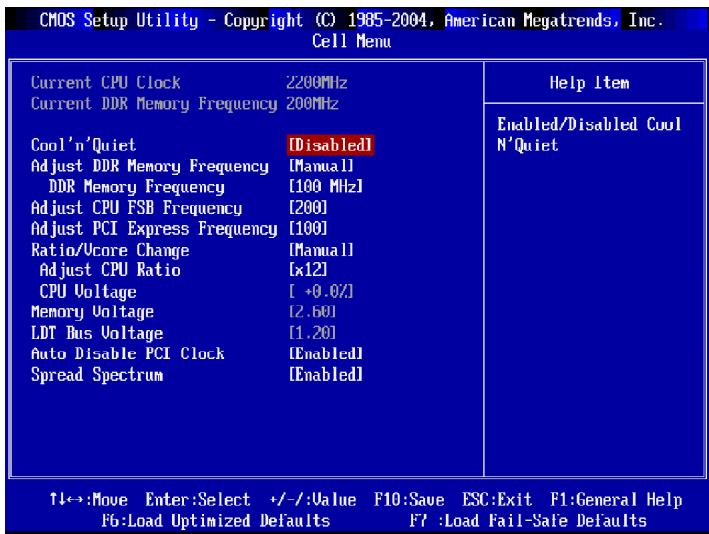

MSI Reminds You...
Change these settings only if you are familiar with the chipset.
Current CPU Clock, Current DDR Memory Frequency
These two items show the current clocks of CPU & DDR memory frequency. Read-only.
Cool'n'Quiet
This feature is especially designed for AMD Athlon processor, which provides a CPU temperature detecting function to prevent your CPU's from overheading due to the heavy working loading. Setting options: [Disabled], [Enabled].

MSI Reminds You...
For the purpose of ensuring the stability of Cool'n'Quiet function, it is always recommended to have the memories plugged in DIMM1.
Adjust DDR Memory Frequency
User can place an artificial memory clock limit on the system. Please note that memory is prevented from running faster than this frequency. Setting options: [Manual], [Auto].
DDR Memory Frequency
This read-only item shows the DDR Memory Frequency you like to use, which
will automatically change in accordance with the setting of Adjust DDR Memory Frequency. Please note you must reboot the system to let the change take effect. Setting options: [100 MHz], [133MHz], [166MHz], [200MHz].
Adjust CPU FSB Frequency
This item allows you to select the CPU Front Side Bus clock frequency (in MHz) and overclock the processor by adjusting the FSB clock to a higher frequency. Setting options: [200]~[320]
Adjust PCI Express Frequency
User can place an artificial PCI Express clock limit on the system. Setting options: [100]~[200].
Ratio/Vcore Change
This field allows you to select the CPU Ratio. Setting to [Auto] enables CPU Ratio automatically to be determined by SPD. Setting options: [Auto], [Manual].
Adjust CPU Ratio
This item allows you to adjust the CPU ratio. Setting to [Startup] enables the CPU running at the fastest speed which is detected by system. Setting options are: [Startup], [x4]~[x25].
CPU Voltage
The settings are used to adjust the CPU clock multiplier (ratio) and CPU core voltage (Vcore). These settings offer users a tool to overclock the system.
Memory Voltage
Adjusting the DDR voltage can increase the DDR speed. Any changes made to this setting may cause a stability issue, so changing the DDR voltage for long-term purpose is NOT recommended.
LDT Bus Voltage
This item specifies the maximum operating frequency of the link's transmitter clock. Setting options: [1.20], [1.25], [1.30], [1.35], [1.40], [1.45], [1.50].
Auto Disable PCI Clock
This item is used to auto detect the PCI slots. When set to [Enabled], the system will remove (turn off) clocks from empty PCI slots to minimize the electromagnetic interference (EMI). Settings: [Enabled], [Disabled].
Spread Spectrum
When the motherboard's clock generator pulses, the extreme values (spikes) of the pulses creates EMI (Electromagnetic Interference). The Spread Spectrum function reduces the EMI generated by modulating the pulses so that the spikes of the pulses are reduced to flatter curves. If you do not have any EMI problem, leave the setting at [Disabled] for optimal system stability and performance. But if you are plagued by EMI, activate the Spread Spectrum for EMI reduction. Remember to disable Spread Spectrum if you are overclocking because even a
Slight jitter can introduce a temporary boost in clock speed which may just cause your overclocked processor to lock up. Options: [Disabled], [Enabled].

MSI Reminds You...
The settings shown in different colors in CPU Voltage, DDR Voltage, and NB Voltage help to verify if your setting is proper for your system.
Gray: Default setting.
White: Safe setting.
Yellow: High performance setting.
Red: Not recommended setting and the system may be unstable.
Changing CPU Voltage, DDR Voltage, and NB Voltage may result in the instability of the system; therefore, it is NOT recommended to change the default setting for long-term usage.
BIOS Setting Password
When you select this function, a message as below will appear on the screen:
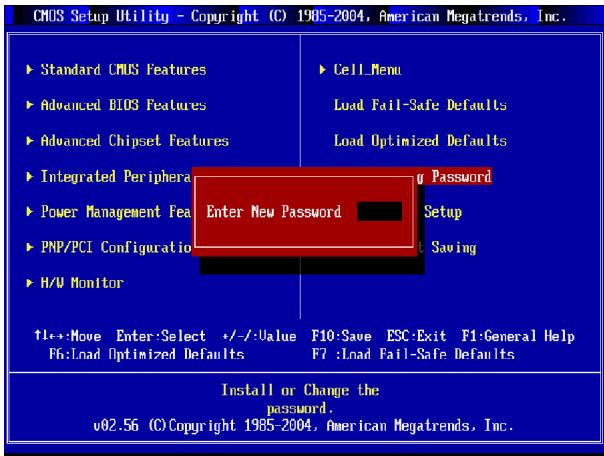
Type the password, up to six characters in length, and press . The password typed now will replace any previously set password from CMOS memory. You will be prompted to confirm the password. Retype the password and press . You may also press to abort the selection and not enter a password.
To clear a set password, just press when you are prompted to enter the password. A message will show up confirming the password will be disabled. Once the password is disabled, the system will boot and you can enter Setup without entering any password.
When a password has been set, you will be prompted to enter it every time you try to enter Setup. This prevents an unauthorized person from changing any part of your system configuration.
Load Fail-Safe/Optimized Defaults
The two options on the main menu allow users to restore all of the BIOS settings to the default Fail-Safe or Optimized values. The Optimized Defaults are the default values set by the mainboard manufacturer specifically for optimal performance of the mainboard. The Fail-Safe Defaults are the default values set by the BIOS vendor for stable system performance.
When you select Load Fail-Safe Defaults, a message as below appears:
Load Fail-Safe Defaults?
[OK]
[Cancel]
Pressing Y loads the BIOS default values for the most stable, minimal system performance.
When you select Load Optimized Defaults, a message as below appears:
Load Optimized Defaults?
[OK]
[Cancel]
Pressing Y loads the default factory settings for optimal system performance.
Appendix A: Using 2-, 4-, 6- or 8- Channel Audio Function
The mainboard is equipped with Realtek ALC850 chip, which provides support for 8-channel audio output, including 2 Front, 2 Rear, 1 Center and 1 Subwoofer channel. ALC850 allows the board to attach 2, 4, 6 or 8 speakers for better surround sound effect. The section will tell you how to install and use 2-, 4-, 6- or 8-channel audio function on the board.
Installing the Audio Driver
You need to install the driver for Realtek ALC850 codec to function properly before you can get access to 2-, 4-, 6- or 8- channel audio operations. Follow the procedures described below to install the drivers for different operating systems.
Installation for Windows 98SE/ME/2000/XP
For Windows® 2000, you must install Windows® 2000 Service Pack 2 or later before installing the driver.
The following illustrations are based on the Windows XP environment and may look slightly different if you install the drivers on different operating systems.
- Insert the companion CD into the CD-ROM drive. The setup screen will appear automatically.
- Click Realtek AC97 Audio Drivers.


MSI Reminds You... The AC97 Audio Configuration software utility is under continuous update to enhance audio applications. Hence, the program screens shown here in this appendix may be slightly different from the latest software utility and shall be held for reference only.
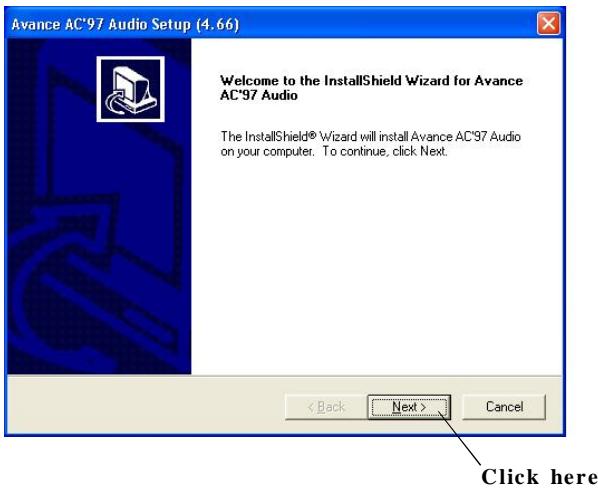
- Click Next to install the AC'97 Audio software.
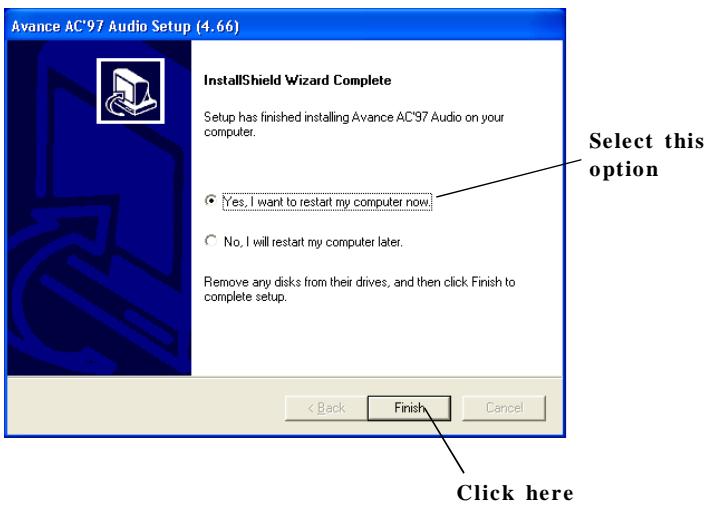
- Click Finish to restart the system.
Software Configuration
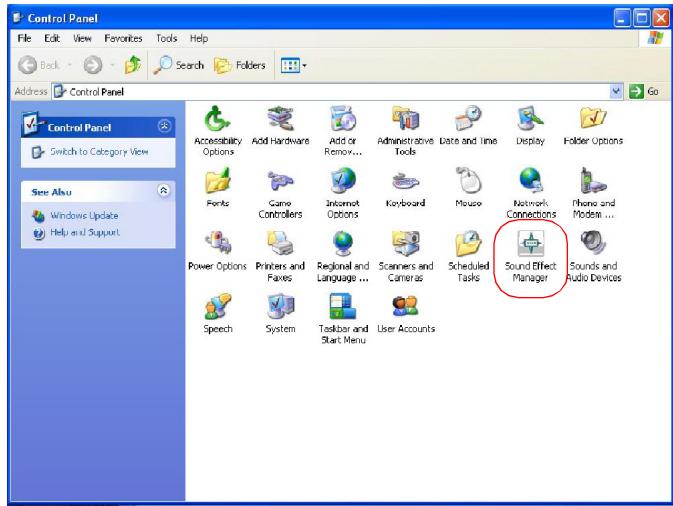
After installing the audio driver, you are able to use the 2-, 4-, 6- or 8- channel audio feature now. Click the audio icon from the system tray at the lower-right corner of the screen to activate the AC97 Audio Configuration. It is also available to enable the audio driver by clicking the Sound Effect Manager from the Control Panel.
Sound Effect
Here you can select a sound effect you like from the Environment list.
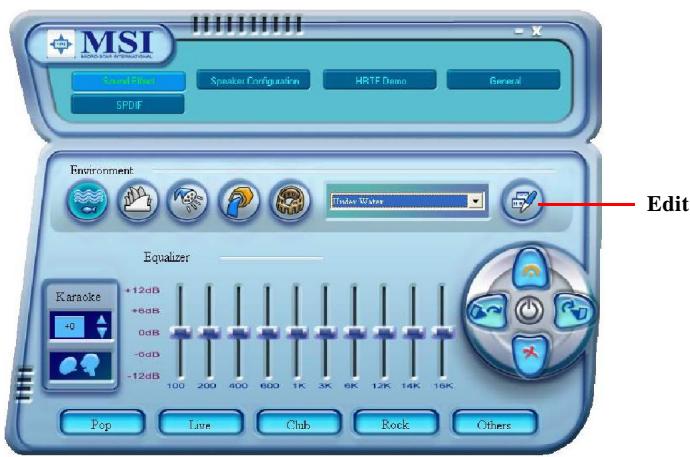
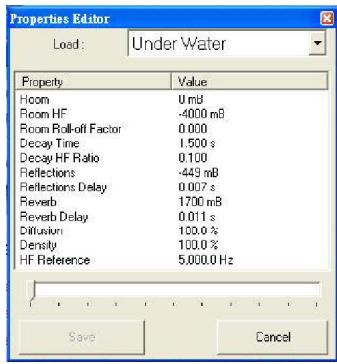
You may also edit the properties for an environment as you wish by clicking the "Edit" button, then just scroll the bar in the bottom for each property to adjust.
You may choose the provided sound effects, and the equalizer will adjust automatically. If you like, you may also load an equalizer setting or make a new equalizer setting to save as a new one by using the "Load EQ Setting" and "Save Preset" button, click "Reset EQ Setting" button to use the default value, or click "Delete EQ Setting" button to remove a preset EQ setting.
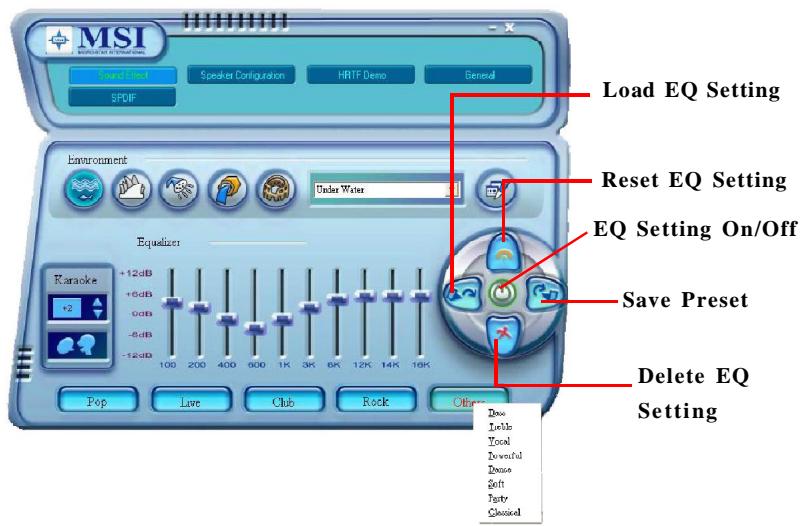
There are also other pre-set equalizer models for you to choose by clicking "Others" under the Equalizer part.
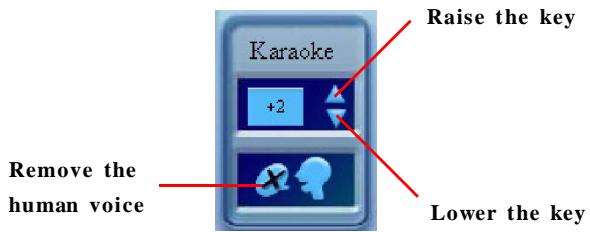
Here it provides the Karaoke function which will automatically remove human voice (lyrics) and leave melody for you to sing the song. You may use the "up arrow" and "down arrow" button to raise/lower the key, and press the lower button to remove the human voice.
Speaker Configuration
In this tab, you can easily configure your multi-channel audio function and speakers.
- First you have to select the audio configuration below which is identical to the audio jack on your mainboard. In this model it uses Realtek ALC850 codec which supports 8-channel S/PDIF, therefore you should choose 8CH-S/PDIF (Optical & Coaxial).
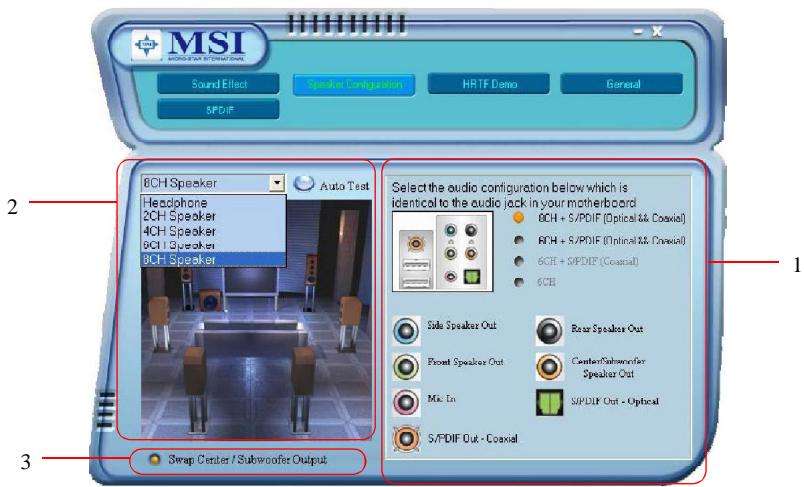
- Select a desired multi-channel operation here.
a. Headphone for the common headphone b. 2CH Speaker for Stereo-Speaker Output c. 4CH Speaker for 4-Speaker Output d. 6CH Speaker for 5.1-Speaker Output e. 8CH Speaker for 8-Speaker Output
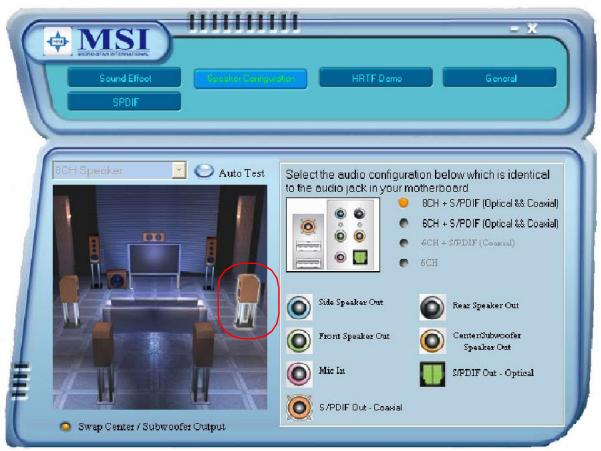
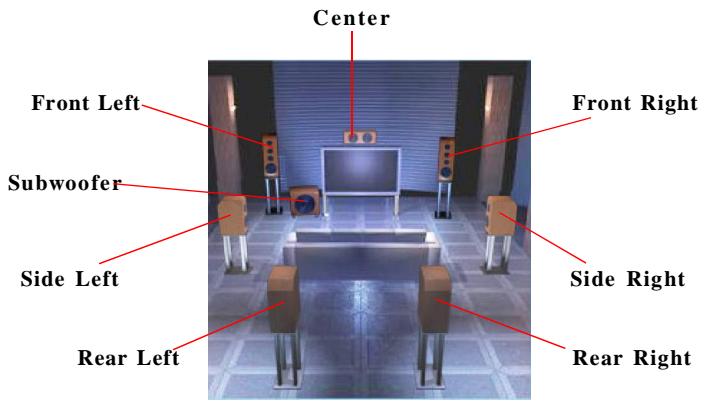
Select the speaker by clicking it to test its functionality. The one you select will light up and make testing sound. If any speaker fails to make sound, then check whether the cable is inserted firmly to the connector or replace the bad speakers with good ones. Or you may click the "Auto Test" button to test the sounds of each speaker automatically.
- While you are testing the speakers in 8-Channel / 6-Channel Mode, if the sound coming from the center speaker and subwoofer is swapped, you should select Swap Center/Subwoofer Output to readjust these two channels.
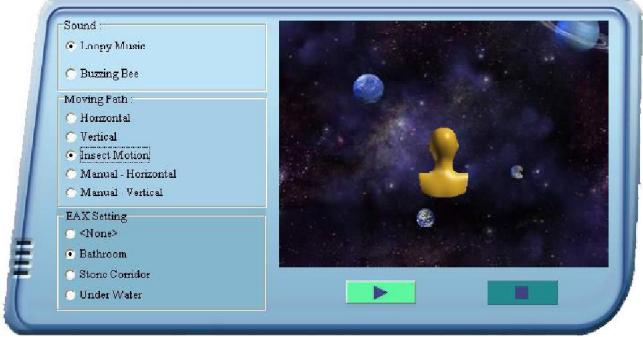
HRTF Demo
In this tab you may adjust your HRTF (Head Related Transfer Functions) 3D positional audio before playing 3D audio applications like gaming. You may also select different environment to choose the most suitable environment you like.
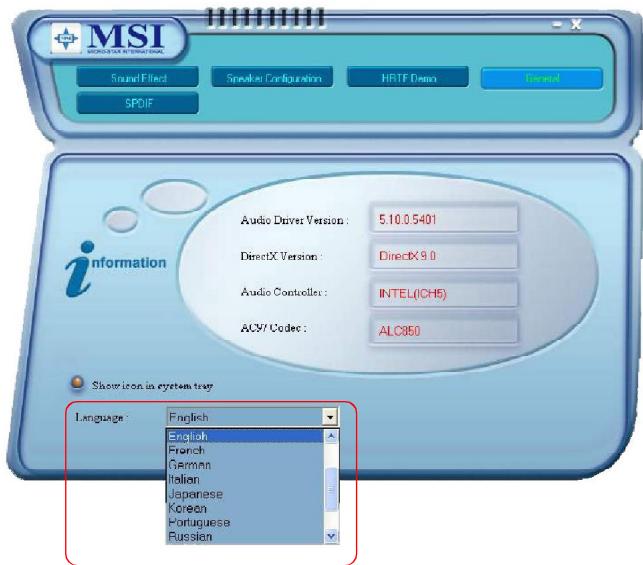
General
In this tab it provides some information about this AC97 Audio Configuration utility, including Audio Driver Version, DirectX Version, Audio Controller & AC97 Codec. You may also select the language of this utility by choosing from the Language list.
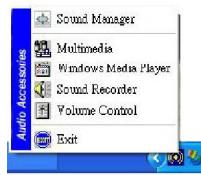
Also there is a selection Show icon in system tray. Switch it on and an icon will show in the system tray. Right-click on the icon and the Audio Accessories dialogue box will appear which provides several multimedia features for you to take advantage of.
SPDIF
In this tab it provides options about SPDIF-Out for you to configure.
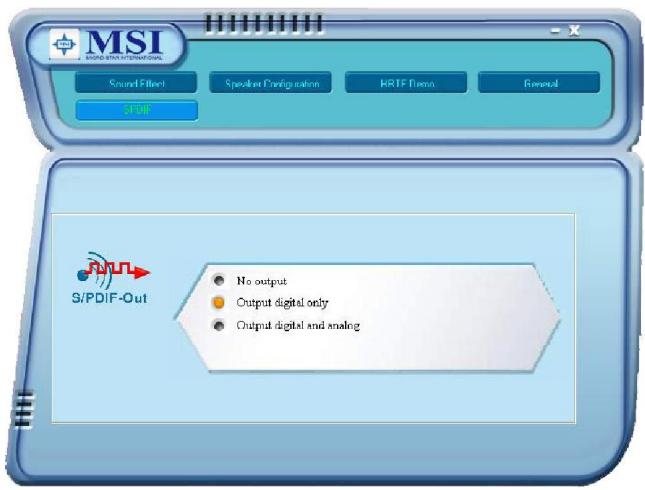
† No Output: With this option, there is no S/PDIF output signal while playing analog and digital audio. † Output digital only: With this option, only digital audio will be allowed to play via SPDIF out while playing analog and digital audio. † Output digital and analog: With this option, both digital and analog audio will be allowed to play via SPDIF out while playing analog and digital audio.
Using 2-, 4-, 6- & 8- Channel Audio Function
Connecting the Speakers
When you have set the Multi-Channel Audio Function mode properly in the software utility, connect your speakers to the correct phone jacks in accordance with the setting in software utility.
In 2-Channel Mode for Stereo-Speaker Output
Refer to the following diagram and caption for the function of each phone jack on the back panel when 2-Channel Mode is selected.
Back Panel
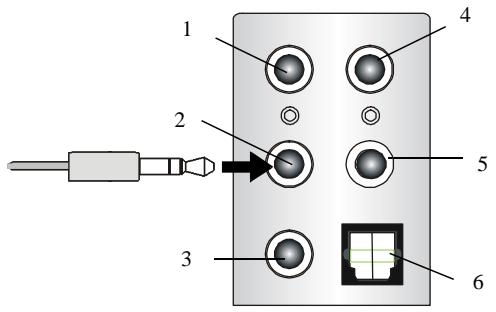
Line In, Line Out (Front channels), 3 MIC, 4 Line Out (Rear channels, but no functioning in this mode), Line Out (Center and Subwoofer channel, but no functioning in this mode), 6 SPDIF Out Optical jack
In 4-Channel Mode for 4-Speaker Output
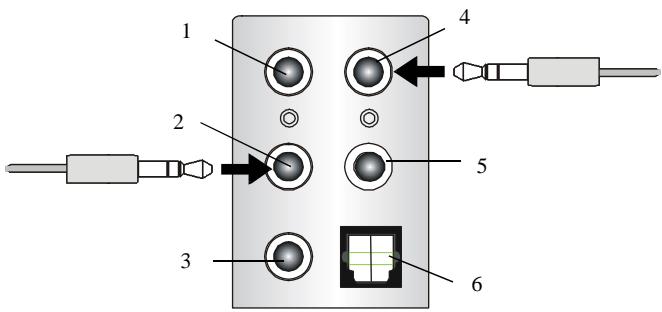
4-Channel Analog Audio Output
Description:
Connect two speakers to back panel's Line Out connector and two speakers to the real-channel Line Out connector.
Line In, Line Out (Front channels), 3 MIC, 4 Line Out (Rear channels), Line Out (Center and Subwoofer channel, but no functioning in this mode), Optical SPDIF jack
In 6-Channel Mode for 6-Speaker Output
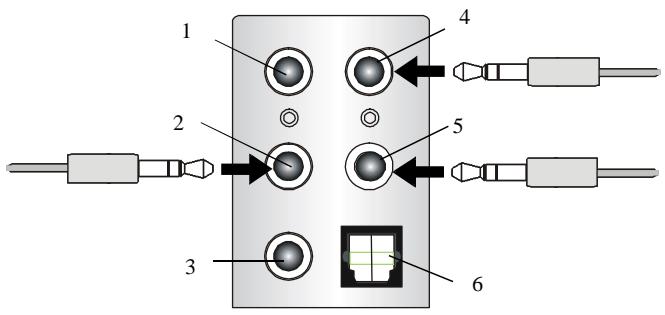
6-Channel Analog Audio Output
Description:
Connect two speakers to the back panel's Line Out connector, two speakers to the rear-channel, and two speakers to the center/subwoofer-channel Line Out connectors.
Line In, Line Out (Front channels), 3 MIC, 4 Line Out (Rear channels), Line Out (Center and Subwoofer channel), 6 Optical SPDIF jack
8-Channel Mode for 8-Speaker Output
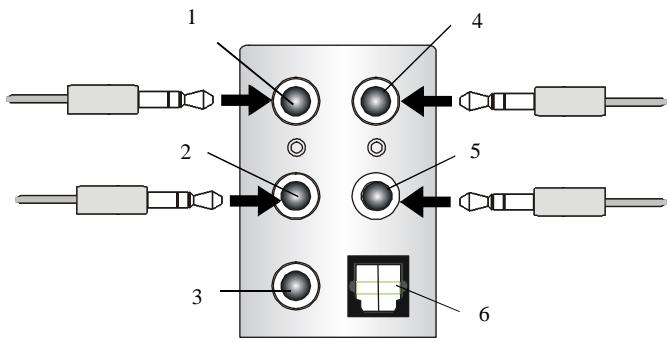
8-Channel Analog Audio Output
Line Out (Side channels), Line Out (Front channels), 3 MIC, 4 Line Out (Rear channels), Line Out (Center and Subwoofer channel), Optical SPDIF jack
Description:
Connect two speakers to the back panel's Line Out connector, two speakers to the rear-channel, two speakers to the center/subwoofer-channel Line Out connectors, and two speakers to the side-channel Line Out connectors.
Appendix B: ATI SATA RAID Setup Guide
Two major challenges facing the storage industry today are (1): keep pace with increasing performance demands of computer systems by improving disk I/O throughput, and (2): provide data accessibility in the event of hard disk failure.
To meet these two challenges, ATI south bridge SB400 supports four SATA ports and incorporates Silicon Image's Sil 3112 Serial ATA host controller, together with Silicon Image's Serial ATA RAID Management Software (SATARaid™).
SATARaid software provides support for RAID Striping and RAID Mirroring. RAID Striping greatly improves hard disk I/O performance by concurrently striping data across multiple drives. RAID Mirroring makes sure data is not lost if a drive fails as data is simultaneously written to two drives. Drives configured for RAID Striping are said to form a RAID 0 set, while drives configured for RAID Mirroring are said to form a RAID 1 set.
The SATARaid software includes a Graphical User Interface (GUI) that provides continuous monitoring of the RAID set(s) supported.
SATA RAID Features
RAID 0 and RAID 1 On-line Mirror Rebuilding, RAID GUI Monitoring Utility:
- Displays/Logs/Alerts Users to Vital RAID Set Information
- Manages RAID Set Functions (configures, rebuilds, etc.)
RAID Set accommodates multiple size HDDs. HDDs function normally when not in RAID Sets. Adjustable stripe size for RAID 0. Automatically selects highest available transfer speed for all ATA and ATAPI devices. Supports:
-UDMA up to 150MB/Sec. - All UDMA and PIO Modes - Up to 4 SATA devices - ACPI and ATA/ATAPI6
RAID (Redundant Array of Independent Disks) technology manages multiple disk drives to enhance I/O performance and to provide redundancy in order to withstand the failure of any individual member, without loss of data.
SATARaid™ provides two RAID Set types: Striped Set (RAID 0) and Mirrored Set (RAID 1).
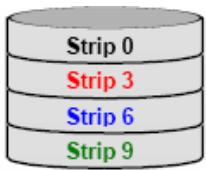
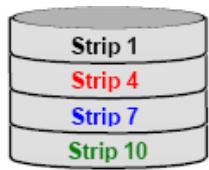
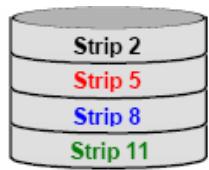
Disk Striping (RAID 0)
Striping is a performance-oriented, non-redundant data mapping technique. It does not provide fault tolerance. With modern SATA and ATA bus mastering technology, multiple I/O operations can be performed in parallel, enhancing performance. Striping arrays use multiple disks to form a larger virtual disk.
Disk Mirroring (RAID 1)
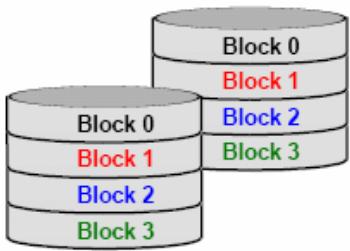
Disk mirroring creates an identical twin for a selected disk by having the data simultaneously written to two disks. This redundancy provides protection from a single disk failure. If a read failure occurs on one drive, the system reads the data from the other drive.
Creating RAID Sets
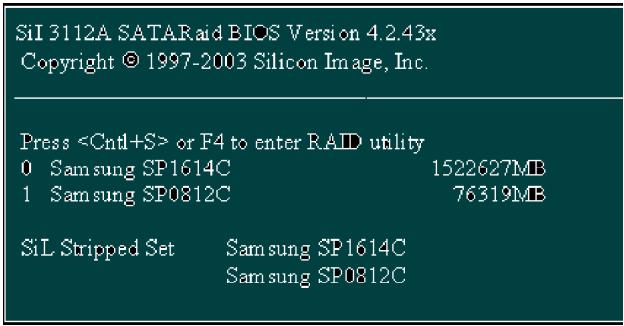
Creating and deleting RAID sets and performing other RAID setting up operations are done in the BIOS. During bootup, a screen similar to the one below will appear for about 5 seconds. Press CTRL+S or the F4 key to enter the BIOS RAID Utility.
The BIOS RAID Utility menu screen will appear. A brief description of each item on the screen is given on the next page.
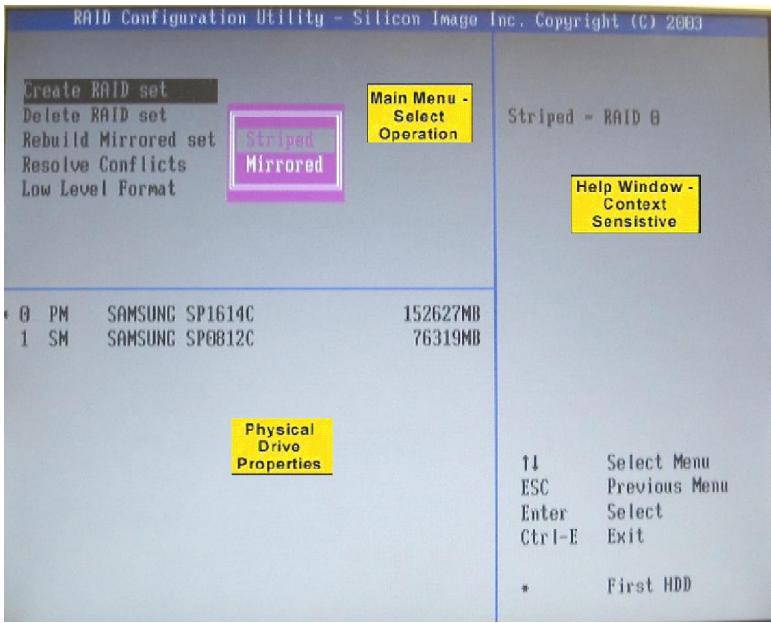
BIOS RAID Utility Screen Description
Main Menu
The Main Menu in the upper left corner is used to choose the operation to be performed.
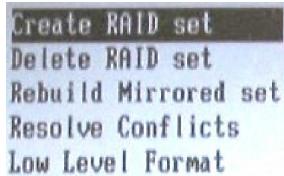
The selections are:
- Create RAID Set is used to create a new RAID Set (RAID 0 or RAID 1).
- Delete RAID Set is used to delete a RAID Set.
- Rebuild Mirrored Set is used to initiate the rebuild of a RAID 1 set after, for example, a drive in the Set has been replaced.
- Resolve Conflicts is used to automatically find the member drives of a RAID set which has been disrupted (physical drives swapped around, for example) and restore the Set to proper operation.
- Low Level Format allows a single drive to have its data completely wiped out. Drives assigned to Sets cannot be low level formatted.
These operations are described in the pages that follow.
Help Window
This window displays context-sensitive help and status messages.
Physical Drive Properties
This window displays the model number and capacities of the drives physically attached to the SATA host adapter.
Description of RAID Setup Operations
Creating RAID Sets
As previously discussed, the SATA host controller supports RAID 0 and RAID 1 configurations. The selection of the RAID configuration should be based upon factors including performance, data security, and the number of drives available. It is best to carefully consider the long-term role of the system and plan the data storage
strategy. RAID sets can be created either automatically, or to allow the greatest flexibility, manually.
- Select "Create RAID Set."
- Choose a RAID 0 Striped, or a RAID 1 Mirrored set.
- Select if you want the utility to Automatically Configure or if you want to manually configure the RAID Set.
- If you chose manual configuration, for Striped Sets, you can change the chunk size. For Mirrored Sets, you assign which drive is the Source and which is the Target.
- The message "Are You Sure?" will display before completing the configuration. Answer "N" to abort the creation of the new RAID set, or "Y" to proceed with the RAID set creation.
Deleting RAID Sets
- To remove one or more RAID sets, select "Delete RAID Set."
- Select the desired set and press Enter.
- Press "Y" when asked "Are You Sure?"
- The drives will be returned to the selection of logical drives from which a new RAID set can be created.
Rebuild RAID 1 Set
This menu selection is used to initiate the copying of data from an existing drive to a replacement drive that has been installed in a RAID 1 set after the failure of one of the members.
- Select "Rebuild RAID1 set."
- Select the desired set and press Enter.
- Press "Y" when asked "Are You Sure?"
- The set will be rebuilt. The status of the rebuild is displayed in the MAIN MENU window.
Resolving Conflicts
When a RAID set is created, the metadata written to the disk includes drive connection information including the channel on the host controller to which it is connected. If after a drive failure the replacement drive was previously part of a RAID set or used in another system, it may have conflicting metadata, specifically in reference to the drive connection information. If so, this will prohibit the RAID set from being either created or rebuilt. In order for the RAID set to function properly, this old metadata must be first overwritten with the new metadata. To correct this, select "Resolve Conflict", and the correct metadata, including the correct drive connection information, will automatically be written to the replacement drive.
- Select "Resolve Conflicts"
- Select the "Invalid RAID drive" entry in the Logical Drive Status window and press Enter.
- Follow the prompts to resolve the conflict.
Note that some conflict resolutions may result in the drive letter assignment changing; for example the RAID set may have been drive D: but after the conflict resolution, it may become drive E.: To maintain the same drive lettering, you may need to swap the SATA cable connected to the drive, or in the case of a SATA-based removable drive unit, you may need to change the order of the drives within the chassis.
Low Level Formatting
The Low Level Format item selection allows you to completely erase the data on a hard drive. However this is a very drastic process and not typically needed. Formatting the drive under Windows is usually sufficient to delete the data.
Installing RAID Drivers (for Windows 2000/XP only)
Installing RAID Drivers during OS Install
Follow the instructions in this section if you are performing a new installation of the OS (Windows 2000/XP), and wish to boot from a RAID drive connected to the SATA controller.
- Install the new SATA drives
a. Power off the system. b. Connect the hard drives to the RAID controller ports. c. Insert your Windows 2000/XP CD into the CD-ROM/DVD drive, or the 2000/XP boot diskette #1 in the floppy drive if your system cannot boot from the CD. d. Power up the system.
- Install the driver during OS boot
a. Press F6 for third-party SCSI or driver installation at the beginning of the text mode installation. b. Press 's' when setup asks if you want to specify an additional device, and insert the diskette or CD labelled 'ATI SATA/Raid Driver Installation Disk'. (You'll have to remove the OS installation CD first.) c. Press 'Enter' and select 'ATI Serial ATA Controller'. d. Press 'Enter' to continue with text mode setup.
- Partition and format the Master RAID drive.
a. Follow the setup instructions to select your choice of partition and file system.
- Install OS on the Master RAID drive.
a. After setup has examined your drives, it will copy files to Windows installation folders and restart the system. b. The setup program will continue and finish the installation after restart. c. Wait until Windows 2000/XP finishes installing devices, regional settings, networking settings, components, and final set of tasks, reboot the system if it is required.
- Verify driver installation under Windows 2000 and XP.
a. Right click on 'My Computer' icon, select 'Properties', left click on 'Hardware' tab, and then on 'Device Manager' button. b. Double click on 'SCSI and RAID Controllers'. If there is no yellow '!' or '?' in front of 'ATI Serial ATA Controller', the driver is installed correctly.
Updating Previously Installed RAID Drivers.
- Insert your Windows 2000/XP ATI driver CD into the CD-ROM/DVD drive. The ATI driver installation Wizard will start.
- Follow the setup instructions to complete the driver installation.
The following screen shots are taken from the ATI driver installation wizard.
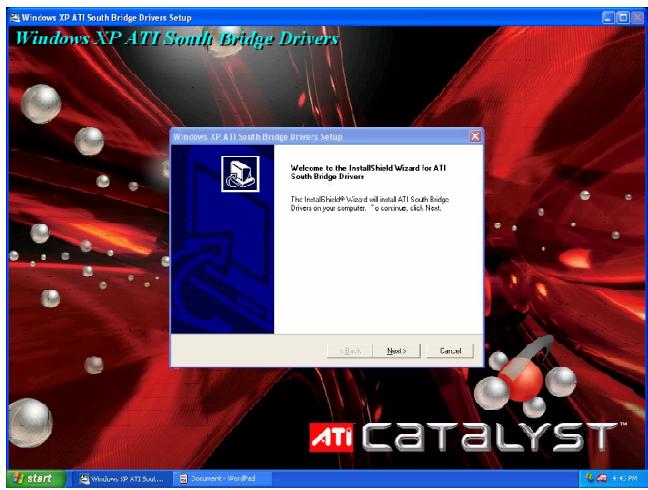
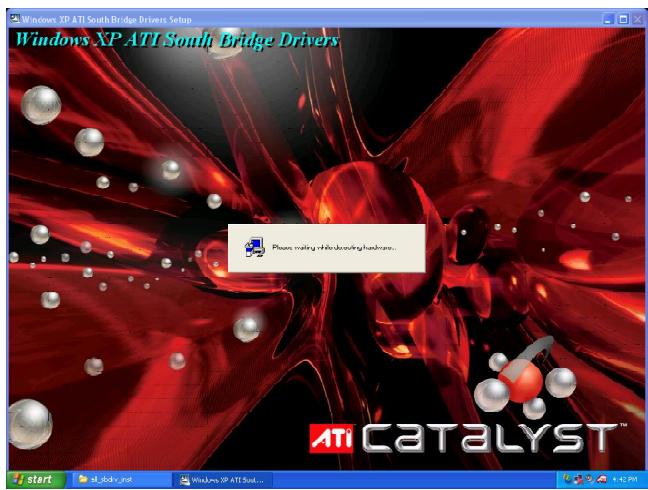
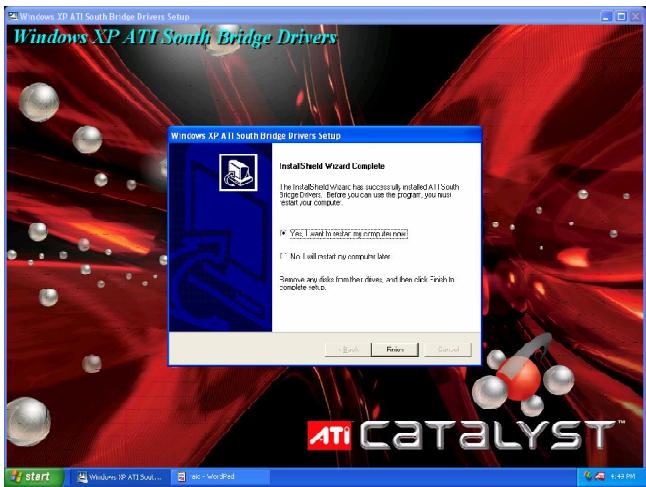
Installing SATARaid Utility.
Insert your Windows 2000/XP ATI driver CD into the CD-ROM/DVD drive.
Run the setup.exe program on the CD and follow the setup instructions to complete the installation.
The following screen shots are taken from the installation of SATARaid.
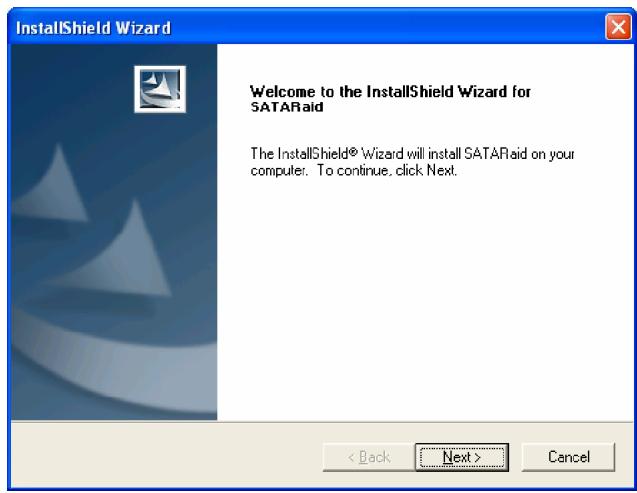
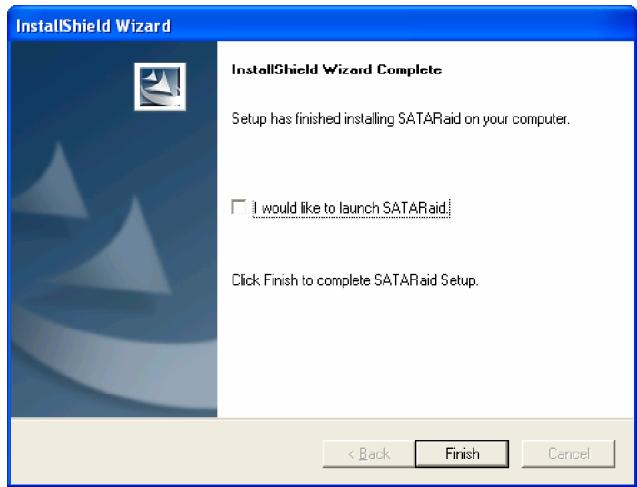
SATARaid GUI can be launched from the Task Bar
SATARaid GUI
The SATARaid GUI offers the user the ability to easily monitor the RAID Set. To launch the GUI, simply double-click on the icon located in the bottom right hand corner of the Desktop. If the icon does not appear in the bottom right hand corner of the desktop, find where the SATARaid application was saved and launch from there. Upon launching the GUI, the main window, which identifies the computer running SATARaid, should look like the following:
Note: You must have created RAID set(s) in the BIOS as described earlier before you can see the set(s) in the GUI.
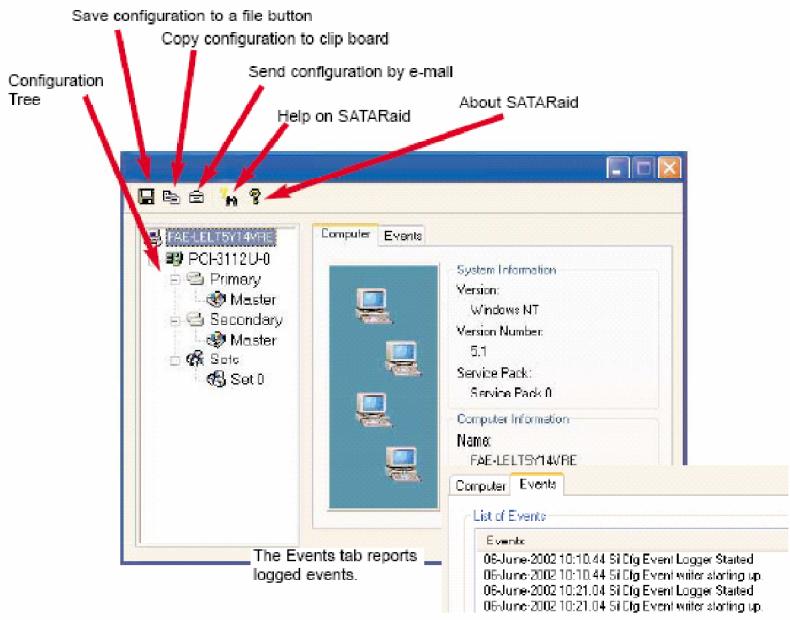
Use Help to find out about the features offered by SATARaid.
The main function of SATARaid is to monitor and report activities of RAID devices. The settings for monitoring and reporting are performed under the item SATARaid Configuration. The following screen shots show some of the settings performed through SATARaid GUI.
A RAID 1 Set Monitoring Example
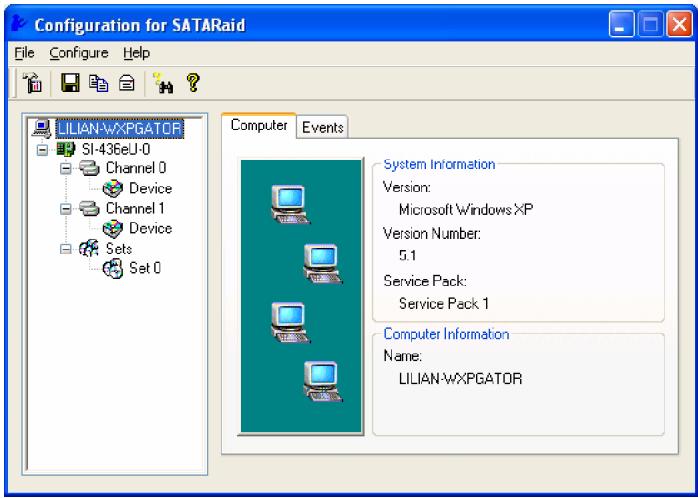
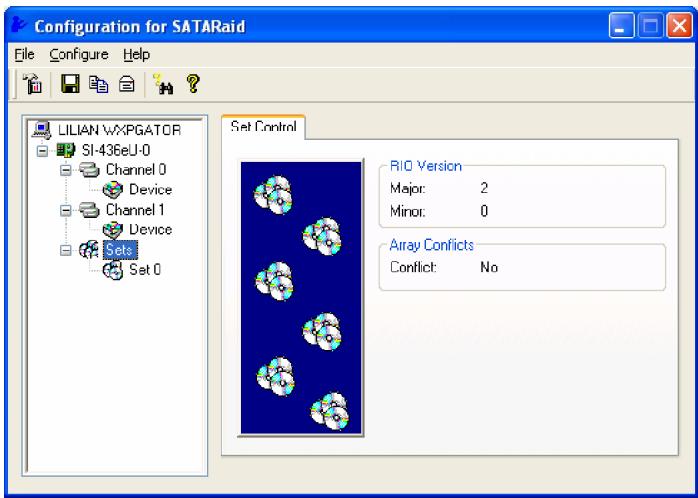
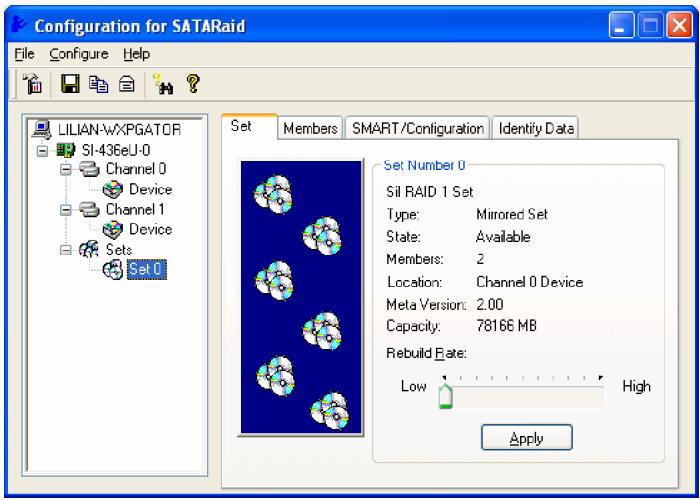
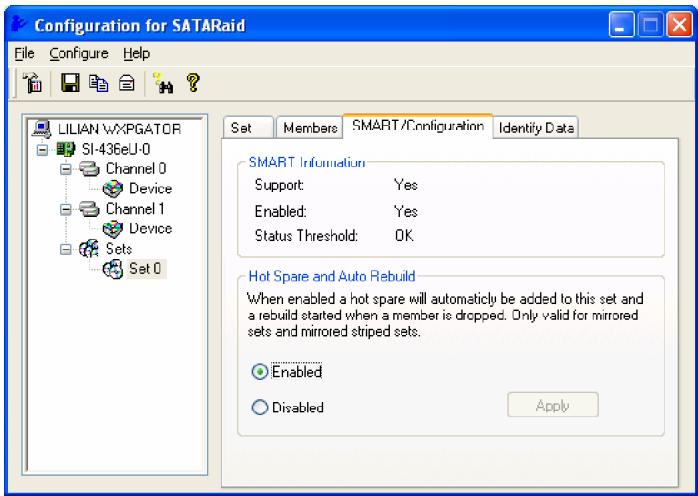
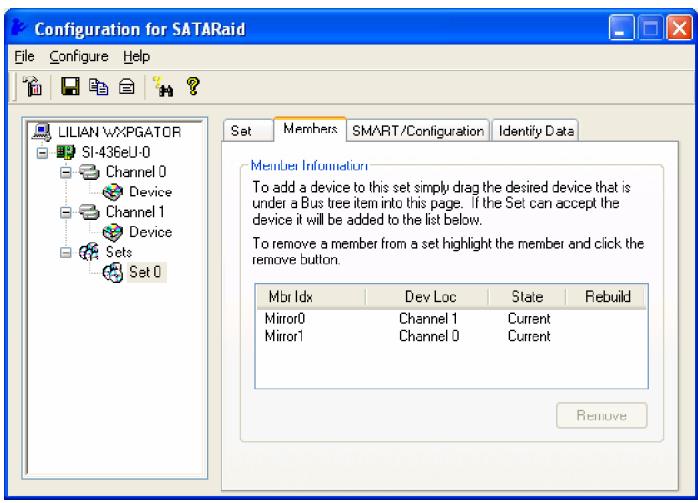
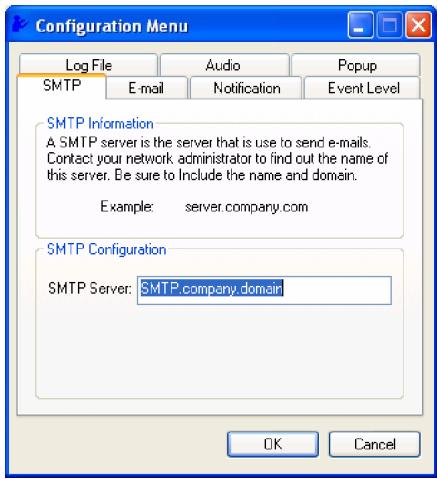
A RAID 0 Set Monitoring Example
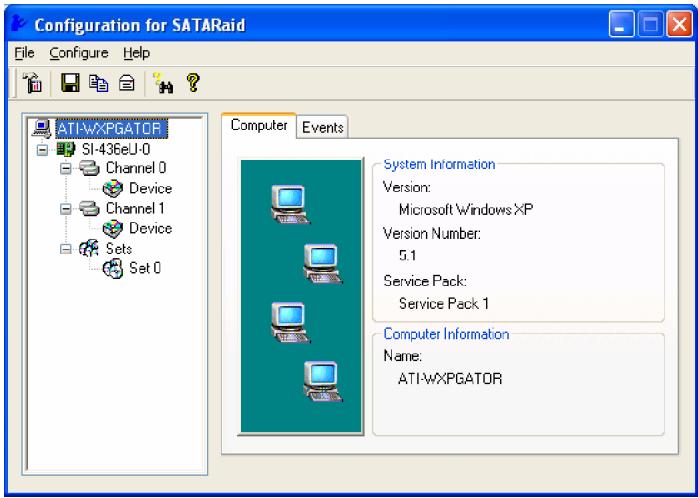
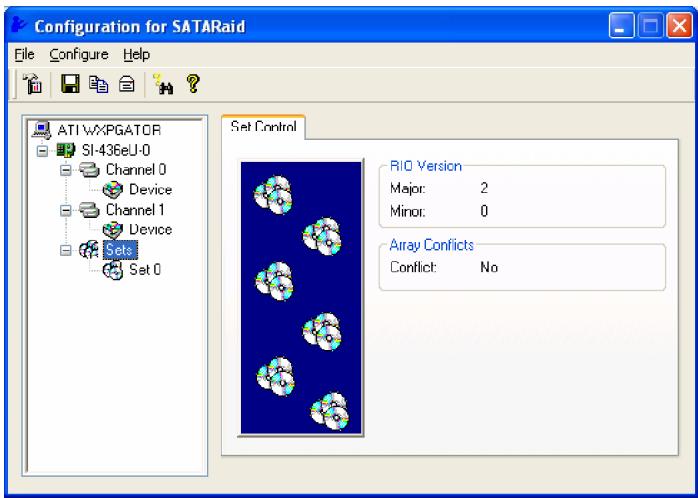
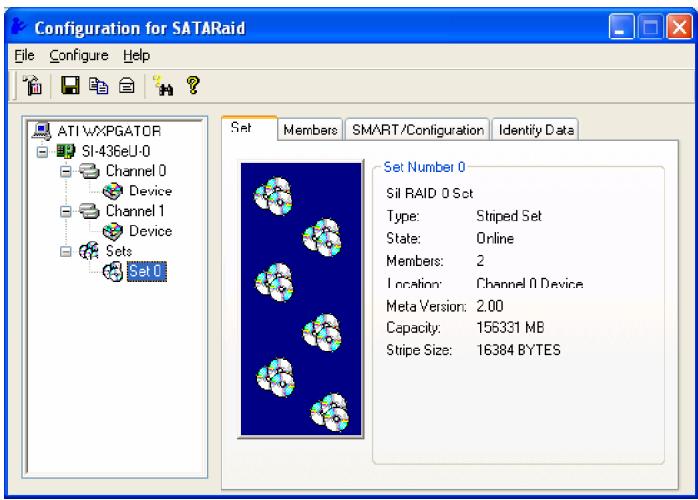
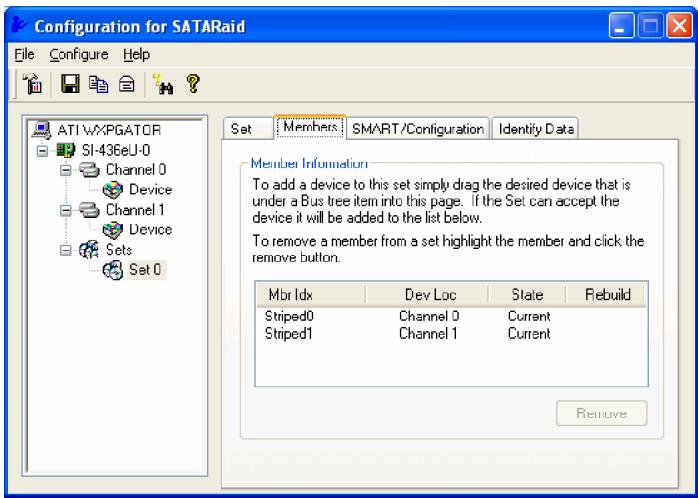
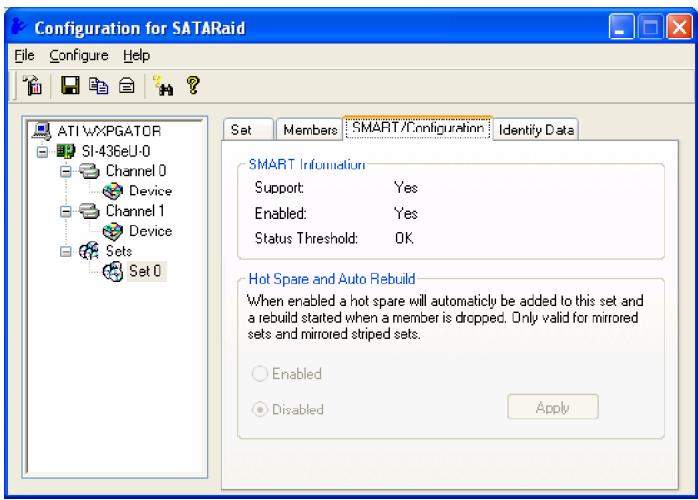
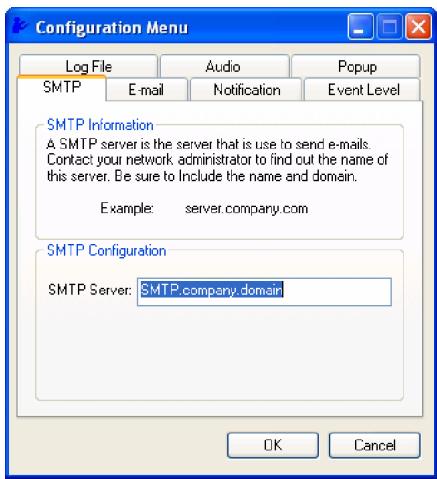
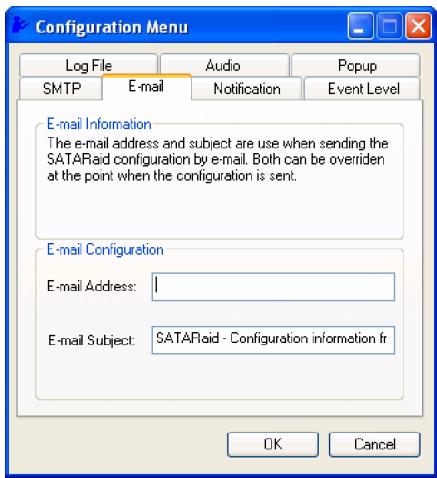
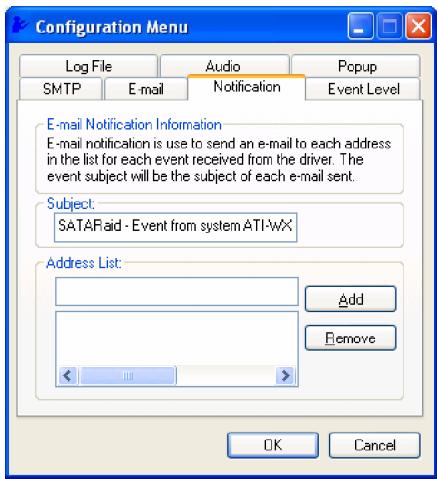
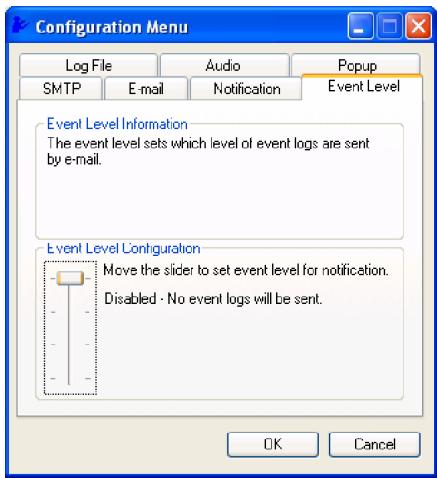
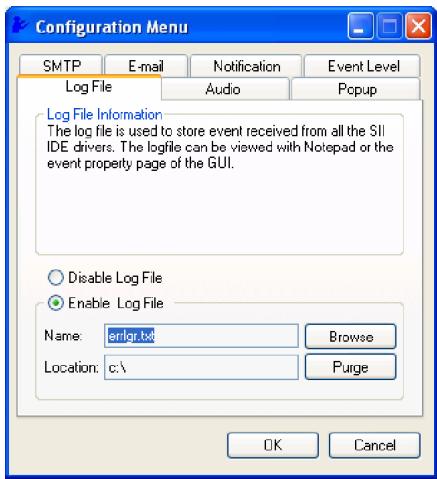
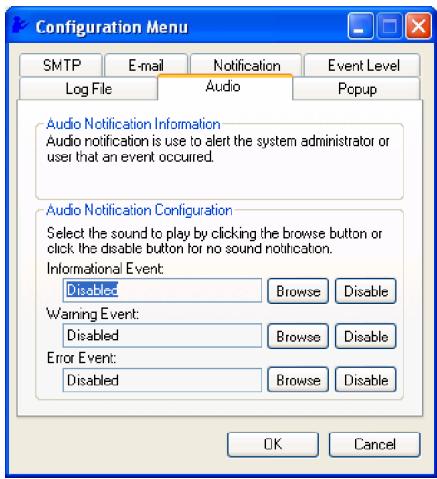
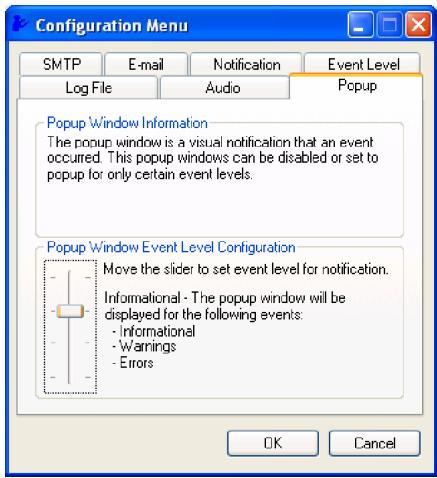
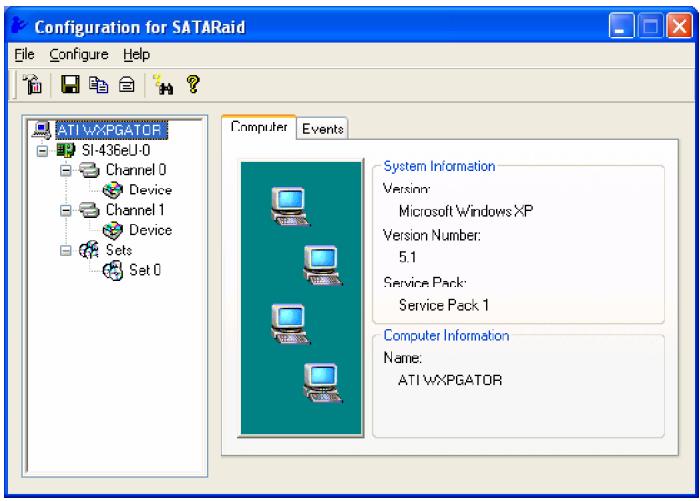
Configuring RAID 0 Set(s) with Windows Disk Manager
Note: This section is only applicable to non-initiated drives. It is not applicable if the drives have been set up as RAID 0 with the BIOS utility.
The Windows XP built-in Disk Manager can be used to set up installed SATA drives in Disk Striping (RAID 0) configuration.
The difference between using the Disk Manager and using the BIOS utility is that the former can select the size of the Striped Disk, while the latter assigns the entire volume of the SATA drives to RAID 0.
Right clicking on the My Computer icon will access Computer Management. The following screen will appear when Computer Management is started. Select Disk Management under the Storage tree.
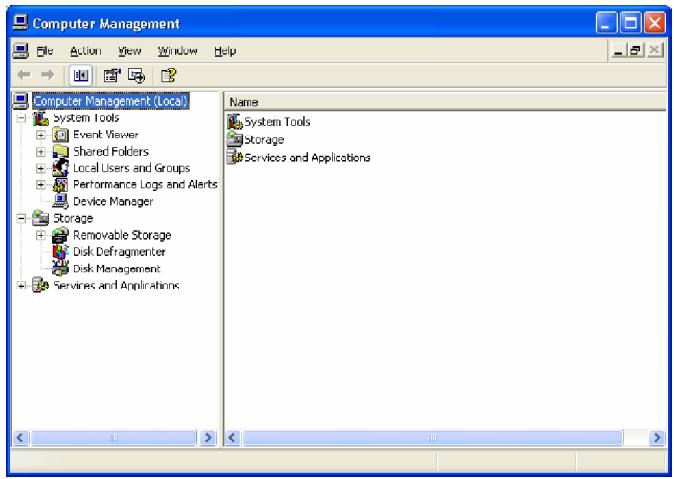
If SATA drives had not been initialized, initialize the disk as Dynamic.
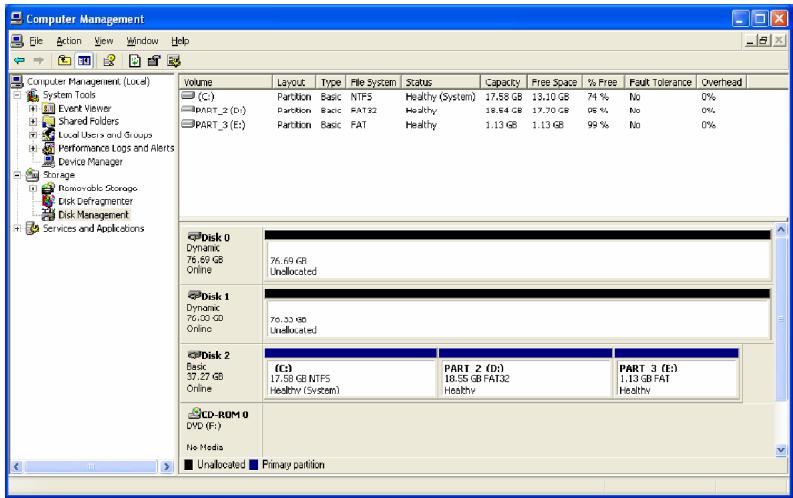
Right click on Disk 0 and select 'New Volume'. At 'New Volume Wizard' select Striped for type of volume.
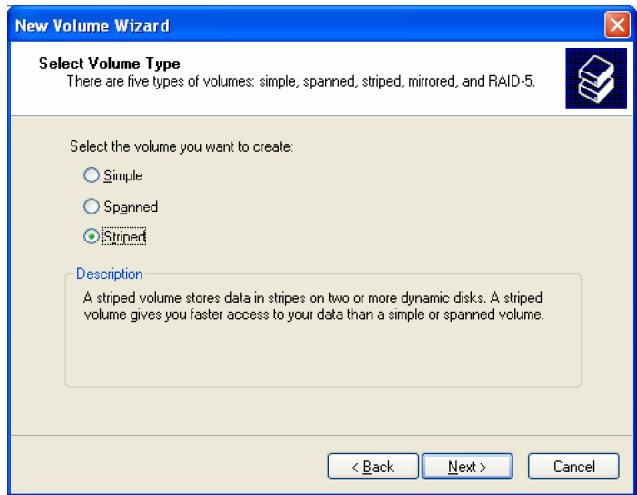
Total size of disk set for striping is set next.

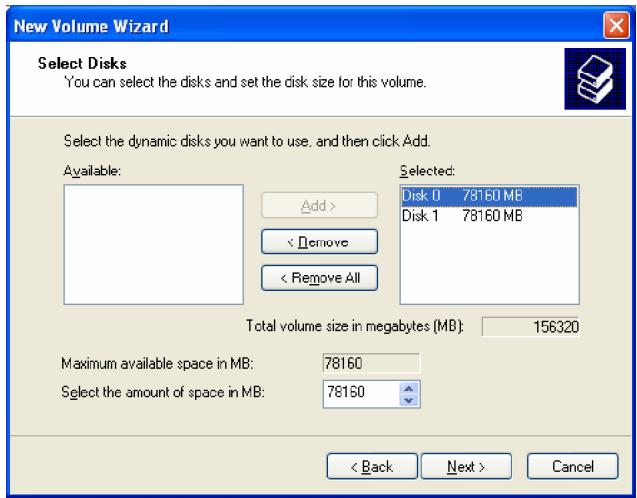
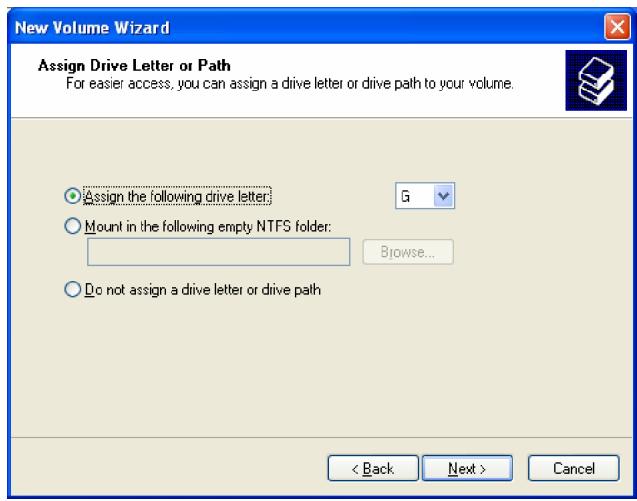
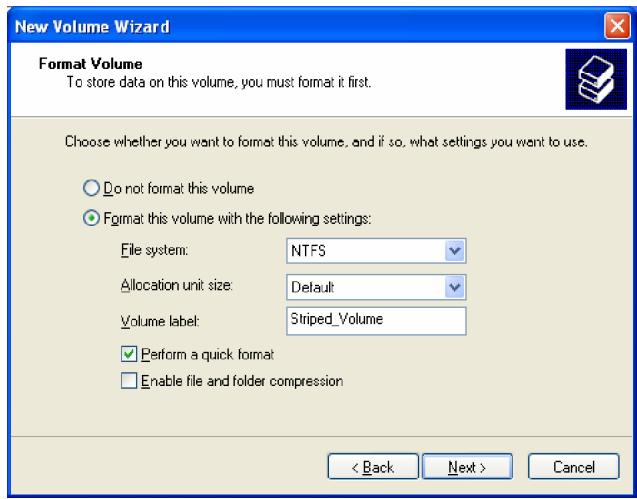
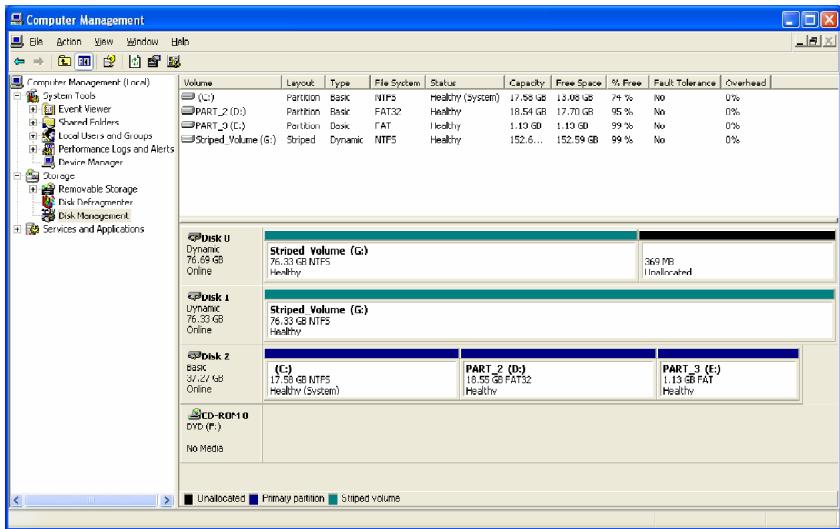
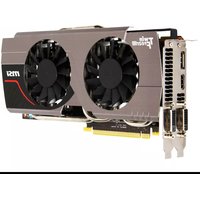


- FCC-B RADIO FREQUENCY INTERFERENCE STATEMENT
- NOTICE
- COPYRIGHT NOTICE
- TRADEMARKS
- REVISION HISTORY
- REVISION
- DATE
- TECHNICAL SUPPORT
- PLEASE RECYCLE WASTE BATTERIES
- CHAPTER 1. GETTING STARTED
- CHAPTER 2. HARDWARE SETUP
- CHAPTER 3. BIOS SETUP
- APPENDIX A: USING 2-, 4- & 6-CHANNEL AUDIO FUNCTION A
- APPENDIX B: ATI SATA RAID SETUP GUIDE B
- GETTING STARTED
- MAINBOARD SPECIFICATIONS
- CPU
- CHIPSET
- MAIN MEMORY
- SLOTS
- ONBOARD IDE
- ONBOARD SERIAL ATA
- MSI REMINDS YOU
- USB INTERFACE
- LAN (OPTIONAL)
- AUDIO
- ON-BOARD PERIPHERALS
- BIOS
- DIMENSION
- MOUNTING
- PACKING CHECKLIST
- HARDWARE SETUP
- QUICK COMPONENTS GUIDE
- CENTRAL PROCESSING UNIT: CPU
- OVERHEATING
- REPLACING THE CPU
- CPU INSTALLATION PROCEDURES FOR SOCKET
- INSTALLING AMD ATHLON64 CPU COOLER SET
- MEMORY
- DIMM MODULE COMBINATION
- INSTALLING DDR MODULES
- POWER SUPPLY
- ATX 24-PIN POWER CONNECTOR: JPWR
- ATX 12V POWER CONNECTOR: JPWR
- ATX 4-PIN VGA POWER CONNECTOR: JPWR
- MOUSE/KEYBOARD CONNECTOR
- USB CONNECTORS
- SERIAL PORT CONNECTOR: COM PORT
- LAN (RJ-45) JACK
- PARALLEL PORT CONNECTOR: LPT
- AUDIO PORT CONNECTORS
- CONNECTORS
- FLOPPY DISK DRIVE CONNECTOR: FDD
- FAN POWER CONNECTORS: CPU_FAN/NB_FAN/SYS_FAN
- ATA133 HARD DISK CONNECTORS: IDE1 & IDE
- IDE1 (PRIMARY IDE CONNECTOR)
- IDE2 (SECONDARY IDE CONNECTOR)
- SERIAL ATA CONNECTORS: SATA1~SATA
- CHASSIS INTRUSION SWITCH CONNECTOR: JCI
- CD-IN CONNECTOR: JCD
- FRONT PANEL AUDIO CONNECTOR: JAUD
- JAUD
- SERIAL PORT HEADER: JCOM1 (OPTIONAL)
- FRONT PANEL CONNECTORS: JFP1 / JFP
- IRDA INFRARED MODULE HEADER: JIR1 (OPTIONAL)
- FRONT USB CONNECTORS: JUSB1 / JUSB
- JUMPERS
- CLEAR CMOS JUMPER: JCMOS
- PCI EXPRESS SLOTS
- PCI (PERIPHERAL COMPONENT INTERCONNECT) SLOTS
- PCI INTERRUPT REQUEST ROUTING
- BIOS SETUP
- ENTERING SETUP
- SELECTING THE FIRST BOOT DEVICE
- CONTROL KEYS
- GETTING HELP
- MAIN MENU
- DEFAULT SETTINGS
- THE MAIN MENU
- STANDARD CMOS FEATURES
- ADVANCED BIOS FEATURES
- ADVANCED CHIPSET FEATURES
- INTEGRATED PERIPHERALS
- POWER MANAGEMENT FEATURES
- PNP/PCI CONFIGURATIONS
- H/W MONITOR
- CELL MENU
- LOAD FAIL-SAFE DEFAULTS
- LOAD OPTIMIZED DEFAULTS
- BIOS SETTING PASSWORD
- SAVE & EXIT SETUP
- EXIT WITHOUT SAVING
- DATE (MM:DD:YY)
- TIME (HH:MM:SS)
- PRIMARY/SECONDARY/THIRD IDE MASTER/SLAVE
- FOURTH/FIFTH/SIXTH IDE MASTER
- DEVICE
- TYPE
- LBA/LARGE MODE
- DMA MODE
- HARD DISK S.M.A.R.T
- FLOPPY A
- HALT ON
- SYSTEM INFORMATION
- TOTAL SYSTEM MEMORY/BIOS VERSION
- CPU INFORMATION
- AMD ATHLON(TM) 64 PROCESSOR/CPU ID/UCODE ID
- QUICK BOOTING
- BOOT SECTOR PROTECTION
- BOOT TO OS
- IOAPIC FUNCTION
- MPS TABLE VERSION
- FULL SCREEN LOGO DISPLAY
- BOOT SEQUENCE
- ST/2ND/3RD BOOT DEVICE
- BOOT FROM OTHER DEVICES
- HARD DISK DRIVES/REMOVABLE DRIVES
- DRAM TIMING
- CAS LATENCY (CL)
- TRAS
- TRP
- TRCD
- BANK INTERLEAVING
- USB CONTROLLER
- USB DEVICE LEGACY SUPPORT
- ONBOARD LAN CONTROLLER
- ONBOARD LAN OPTION ROM
- AC97 CONTROLLER
- IDE DEVICES CONFIGURATION
- ON-CHIP IDE CONTROLLER
- PCI IDE BUSMASTER
- I/O DEVICES CONFIGURATION
- COM PORT
- PARALLEL PORT
- PARALLEL PORT MODE
- SATA DEVICES CONFIGURATION
- ONCHIP SATA CHANNEL
- ONCHIP SATA TYPE
- ACPI FUNCTION
- ACPI STANDBY STATE
- RE-CALL VGA BIOS FROM S
- SUSPEND TIME OUT (MINUTE)
- POWER BUTTON FUNCTION
- RESTORE ON AC POWER LOSS
- WAKEUP EVENT SETUP
- RESUME FROM S3 BY USB DEVICE
- RESUME BY PS/2 KEYBOARD
- KEYBOARD PASSWORD
- RESUME BY PS/2 MOUSE
- RESUME BY PCI DEVICE (PME#)
- RESUME BY PCIE DEVICE (PME#)
- RESUME BY RTC ALARM
- DATE/TIME (HH:MM:SS)
- CLEAR ESCD
- PRIMARY GRAPHIC'S ADAPTER
- PCI LATENCY TIMER
- IRQ RESOURCE SETUP
- IRQ
- DMA RESOURCE SETUP
- DMA CHANNEL
- CPU SHUTDOWN TEMPERATURE
- CPU FAN FAILURE WARNING
- CHASSIS INTRUSION
- SMART FAN
- SMART FAN TOLERANCE
- PC HEALTH STATUS
- CURRENT CPU CLOCK, CURRENT DDR MEMORY FREQUENCY
- COOL'N'QUIET
- ADJUST DDR MEMORY FREQUENCY
- DDR MEMORY FREQUENCY
- ADJUST CPU FSB FREQUENCY
- ADJUST PCI EXPRESS FREQUENCY
- RATIO/VCORE CHANGE
- ADJUST CPU RATIO
- CPU VOLTAGE
- MEMORY VOLTAGE
- LDT BUS VOLTAGE
- AUTO DISABLE PCI CLOCK
- SPREAD SPECTRUM
- LOAD FAIL-SAFE/OPTIMIZED DEFAULTS
- APPENDIX A: USING 2-, 4-, 6- OR 8- CHANNEL AUDIO FUNCTION
- INSTALLING THE AUDIO DRIVER
- INSTALLATION FOR WINDOWS 98SE/ME/2000/XP
- SOFTWARE CONFIGURATION
- SOUND EFFECT
- SPEAKER CONFIGURATION
- HRTF DEMO
- GENERAL
- SPDIF
- USING 2-, 4-, 6- & 8- CHANNEL AUDIO FUNCTION
- CONNECTING THE SPEAKERS
- IN 2-CHANNEL MODE FOR STEREO-SPEAKER OUTPUT
- BACK PANEL
- IN 4-CHANNEL MODE FOR 4-SPEAKER OUTPUT
- CHANNEL ANALOG AUDIO OUTPUT
- IN 6-CHANNEL MODE FOR 6-SPEAKER OUTPUT
- CHANNEL MODE FOR 8-SPEAKER OUTPUT
- APPENDIX B: ATI SATA RAID SETUP GUIDE
- SATA RAID FEATURES
- DISK STRIPING (RAID 0)
- DISK MIRRORING (RAID 1)
- CREATING RAID SETS
- BIOS RAID UTILITY SCREEN DESCRIPTION
- HELP WINDOW
- PHYSICAL DRIVE PROPERTIES
- DESCRIPTION OF RAID SETUP OPERATIONS
- DELETING RAID SETS
- REBUILD RAID 1 SET
- RESOLVING CONFLICTS
- LOW LEVEL FORMATTING
- INSTALLING RAID DRIVERS (FOR WINDOWS 2000/XP ONLY)
- INSTALLING RAID DRIVERS DURING OS INSTALL
- UPDATING PREVIOUSLY INSTALLED RAID DRIVERS
- INSTALLING SATARAID UTILITY
- SATARAID GUI
- A RAID 1 SET MONITORING EXAMPLE
- A RAID 0 SET MONITORING EXAMPLE
- CONFIGURING RAID 0 SET(S) WITH WINDOWS DISK MANAGER
Brand : MSI
Model : RX480 NEO2
Category : Graphic card