
WS9711 - Weather station LA CROSSE TECHNOLOGY - Free user manual and instructions
Find the device manual for free WS9711 LA CROSSE TECHNOLOGY in PDF.


| Product type | Weather station |
| Brand | LA CROSSE TECHNOLOGY |
| Model | WS9711 |
| Station power supply | 2 AA batteries (LR6, 1.5 V) |
| Outdoor sensor power supply | 2 AA batteries (LR6, 1.5 V) |
| Station dimensions (L x W x H) | 124.3 x 28.4 x 92.5 mm |
| Outdoor sensor dimensions (L x W x H) | 38.2 x 21.2 x 128.3 mm |
| Battery life (station and sensor) | Approximately 24 months (alkaline batteries recommended) |
| Transmission frequency | 868 MHz |
| Transmission range | Up to 100 m in open field |
| Maximum number of outdoor sensors | 3 |
| Time display | Radio-controlled DCF-77, manual, 12/24 h |
| Calendar | Day, date, month, year (2005-2029) |
| Alarm | With adjustable snooze function (max 30 min) |
| Weather forecast | 15 icons with \"Weather Girl\", adjustable sensitivity |
| Indoor temperature | Range: -9.9 °C to +59.9 °C, resolution 0.1 °C |
| Outdoor temperature | Range: -39.9 °C to +59.9 °C, resolution 0.1 °C |
| Indoor humidity | Range: 1% to 99%, resolution 1% |
| Moon phase display | 12 phases |
| Sunrise/sunset | For 39 preselected cities |
| Backlight | LED, activation by button, duration 9 seconds |
| LCD contrast | 8 adjustable levels |
| Mounting | On table (stand) or wall (hook) |
| Care and cleaning | Soft damp cloth; do not immerse; no solvents |
| Safety | Do not open or repair yourself; keep out of reach of children; remove used batteries |
Frequently Asked Questions - WS9711 LA CROSSE TECHNOLOGY
User questions about WS9711 LA CROSSE TECHNOLOGY
0 question about this device. Answer the ones you know or ask your own.
Ask a new question about this device
Download the instructions for your Weather station in PDF format for free! Find your manual WS9711 - LA CROSSE TECHNOLOGY and take your electronic device back in hand. On this page are published all the documents necessary for the use of your device. WS9711 by LA CROSSE TECHNOLOGY.
USER MANUAL WS9711 LA CROSSE TECHNOLOGY
Congratulations on purchasing this fancy Weather Station with wireless 868MHz transmission of outdoor temperature and display of indoor temperature and humidity. It is further acting as a DCF-77 radio controlled clock with calendar display and alarm clock function. In addition, sunrise/ sunset/ sun duration time as well as the moon phase are shown. With the totally 15 different weather forecast icons featured by "Weather girl", users can easily observe the forecast weather condition and will no longer worry the sudden weather change. This innovative product is ideal for use in the home or office.
« Instant Transmission+ » is the up and coming state-of-the-art new wireless transmission technology, exclusively designed and developed by LA CROSSE TECHNOLOGY.
"IT +" offers you an immediate update of all your outdoor data measured from the transmitters: follow your climatic variations in real-time!

FEATURES:
The Weather Station
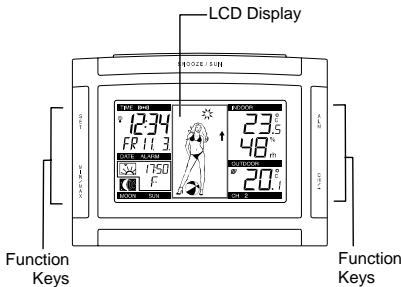
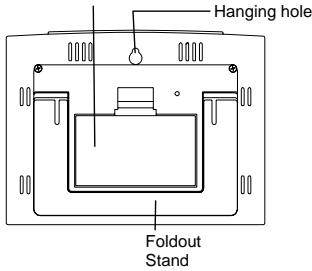
Battery
compartment cover
• DCF-77 Radio controlled time with manual setting options
• DCF Time reception ON/OFF
• 12/24 hour display
• Hour, minute and second time display
• Calendar (weekday, date, month and year)
• Time zone option ±12 hours
• Alarm with snooze function
- Snooze setting
- Weather forecasting with 15 easy-to-read weather forecast signs featured by "Weather girl"
• Weather forecasting icon sensitivity setting
• Temperature display in degrees Celsius (°C) or Fahrenheit (°F) selectable
• Indoor and outdoor temperature display with MIN/MAX recording
• Indoor humidity reading displayed as RH% with MIN/MAX recordings
• All MIN/MAX temperature recordings show date and time received
• All MIN/MAX recordings can be reset
• Display of sunrise time, sunset time and sun duration in 39 cities
• 12 Moon phases display throughout the year
• Can take up to three outdoor transmitters
• LCD contrast setting
• Low battery indicator
• LED backlight
• Table standing/ Wall mounting
The Outdoor Temperature Transmitter
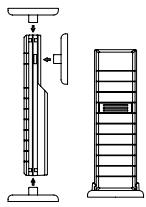
• Remote transmission of outdoor temperature to Weather Station by 868 MHz
• Shower proof casing
• Wall mounting case (Mounting at a sheltered place. Avoid direct rain and sunshine)
SETTING UP:
When one transmitter is used
- First, insert the batteries into the Temperature transmitter. (see "Install and replace batteries in the Temperature transmitter").
-
Immediately after and within 25 seconds, insert the batteries into Weather station (see "Install and replace batteries in the Weather station"). Once the batteries are in place, all segments of the LCD will light up briefly. Following the time as 0:00 and the "Weather girl" icon will be displayed. If these are not displayed after 60 seconds, remove the batteries and wait for at least 10 seconds before reinserting them.
-
After inserting the batteries, the Weather station will start receiving data from the transmitter. The outdoor temperature and the signal reception icon should then be displayed on the Weather station. If this does not happen after 3 minutes, the batteries will need to be removed from both units and reset from step 1.
- In order to ensure sufficient 868 MHz transmission however, this should under good conditions be a distance no more than 100 meters between the final position of the Weather Station and the transmitter (see notes on "Positioning" and "868 MHz Reception").
- Once the remote temperature has been received and displayed on the Weather station, the DCF time (radio controlled time) code reception is automatically started. This takes typically between 3-5 minutes in good conditions. If after 10 minutes, the DCF time has not been received, press the SET key to manually enter a time initially.
When more than one transmitter is used
- User shall remove all the batteries from the weather station and transmitters and wait for 60 seconds if setting has been done with one transmitter before.
- Insert the batteries to the first transmitter.
-
Within 25 seconds of powering up the first transmitter, insert the batteries to the Weather Station. Once the batteries are in place, all segments of the LCD will light up briefly. Following time as 0:00 and the weather girl icon will be displayed. If they are not shown in LCD after 60 seconds, remove the batteries and wait for at least 60 seconds before reinserting them.
-
The outdoor temperature from the first transmitter (channel 1) should then be displayed on the Weather station. Also, the signal reception icon will be displayed. If this does not happen after 2 minutes, the batteries will need to be removed from both units and reset from step 1.
- Insert the batteries to the second transmitter as soon as the outdoor temperature readings from the first transmitter are displayed on the Weather station.
Note: User shall insert the batteries into the second transmitter within 10 seconds of reception of the first transmitter.
-
The outdoor data from the second transmitter and the "channel 2" icon should then be displayed on the Weather station. If this does not happen after 2 minute, the batteries will need to be removed from all the units and reset from step 1.
-
Insert the batteries to the third transmitter as soon as the "channel 2" icon and outdoor data are displayed on the Weather station. Then within 2 minutes, the channel 3 outdoor data from the third transmitter will be displayed and the channel icon will shift back to "1" once the third transmitter is successfully received. If this is not happen, user shall restart the setting up from step 1.
Note:
- User shall insert the batteries into the third transmitter within 10 seconds of reception of the second transmitter.
• And user may require to check the displayed readings on the weather station against
those shown on the transmitters in order to recognise the Channel No. of each transmitter.
- In order to ensure sufficient 868 MHz transmission however, this should under good conditions be a distance no more than 100 meters between the final position of the Weather Station and the transmitter (see notes on "Positioning" and "868 MHz Reception").
IMPORTANT:
Transmission problems will arise if the setting for additional sensors is not followed as described above. Should transmission problems occur, it is necessary to remove the batteries from all units and start again the set-up from step 1.
- Once the remote temperature has been received and displayed on the Weather station, the DCF time (radio controlled time) code reception is automatically started. This takes typically between 3-5 minutes in good conditions.
If after 10 minutes, the DCF time has not been received, press the SET key to manually enter a time initially.
Note:
Daily DCF reception is done at 02:00 and 03:00 every day. If the reception at 03:00 is not successful, then at 04:00 and 05:00 and 06:00 there are other tries, until one is successful. If
the reception at 06:00 is still not successful, then the next try takes place at 02:00 next day. If reception is successful, the received time will override the manually set time. The date is also updated with the received time. (Please refer also to notes on "DCF-77 Radio Controlled time" and "Manual Time Setting")
INSTALL AND REPLACE BATTERIES IN THE WEATHER STATION
The Weather Station uses 2 x AA, IEC LR6, 1.5V batteries. To install and replace the batteries, please follow the steps below:
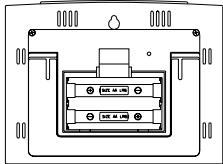
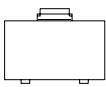
- Remove the cover at the back of the Weather Station.
- Insert batteries observing the correct polarity (see marking).
- Replace compartment cover.
INSTALL AND REPLACE BATTERIES IN THE TEMPERATURE TRANSMITTER
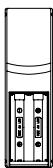

The Temperature Transmitter uses 2 x AA, IEC LR6, 1.5V battery. To install and replace the batteries, please follow the steps below:
- Remove the battery compartment cover at the back of the transmitter.
- Insert the batteries, observing the correct polarity (see marking).
- Replace the battery compartment cover on the unit.
Note:
In the event of changing batteries in any of the units, all units need to be reset by following the setting up procedures. This is because a random security code is assigned by the transmitter at start-up and this code must be received and stored by the Weather station in the first 3 minutes of power being supplied to it.
BATTERY CHANGE:
It is recommended to replace the batteries in all units regularly to ensure optimum accuracy of these units (Battery life See Specifications below).
Please participate in the preservation of the environment. Return used batteries to an authorised depot.
FUNCTION KEYS:
Weather Station:
The Weather Station has five easy to use function keys.
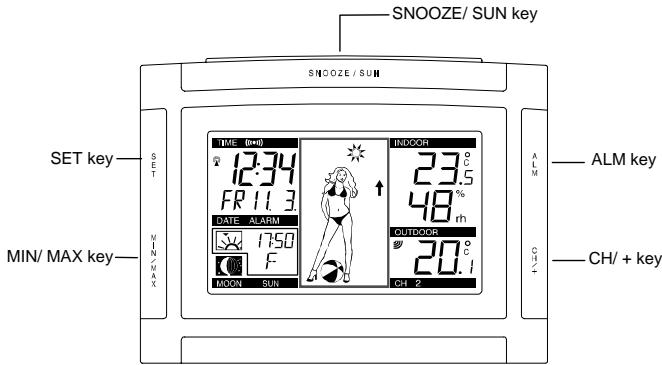
SET key (Setting):
- To enter the set mode for the following functions: LCD contrast, Time zone, Time Reception ON/OFF, 12/24 hour display, Manual time, Year, Date, Sunrise/sunset city location, Snooze time duration, °C/°F, and Weather forecast sensitivity settings.
- To toggle between the display of "Weekday + date + month", "Second", "Alarm time", and "Date + month + year"
- To press and hold for 3 seconds to reset at the same time the maximum/ minimum temperature and humidity records of indoor and the currently selected outdoor channel (will reset all records to current level)
• To stop the alarm
• To switch on the backlight
MIN/ MAX
- To toggle between the maximum/ minimum outdoor temperature and maximum/ minimum indoor temperature and humidity data
Note: The Time/date shown is corresponding to MIN/MAX temperature data.
• To stop the alarm
• To switch on the backlight
ALM key (alarm)
- Press for about 3 seconds to enter the Alarm setting mode
• To activate/ deactivate the alarm
• To stop the alarm
• To switch on the backlight
CH/ + key
• To toggle between the Outdoor transmitters 1, 2 and 3 (if more than 1 transmitter is used)
- To adjust LCD contrast, time zone, Time Reception ON/OFF, 12/24 hour display, hour, minute, year, month, day, snooze time duration, °C/°F and weather forecasting icon sensitivity in setting modes
• To adjust the alarm time in alarm setting mode
• To stop the alarm
• To switch on the backlight
SNOOZE/ SUN key
• To activate the snooze function for the alarm
• To toggle between the sunrise time, sunset time, sun duration in the Sun display
• To exit manual setting mode and alarm setting mode
• To switch on the backlight
LCD SCREEN AND SETTINGS:
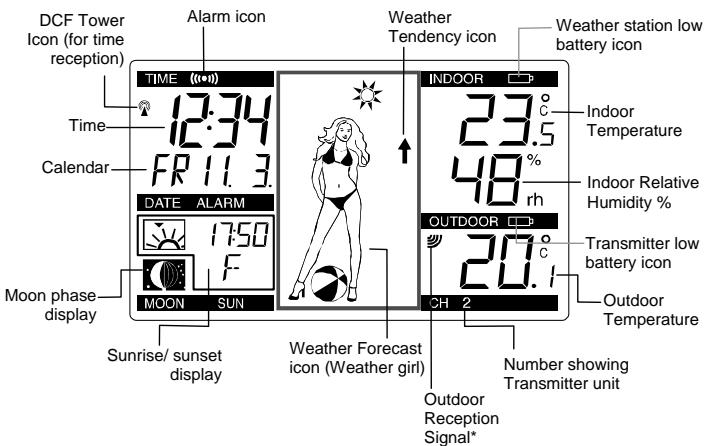
*When the signal from the transmitter is successfully received by the Temperature Station, this icon will be switched on. (If not successful, the icon will not be shown on the LCD). User can therefore easily see whether the last reception was successful ("ON" icon) or not ("OFF" icon). On the other hand, the short blinking of the icon shows that a reception is being done at that time.
For better distinctness the LCD screen is split into 5.
Section 1 - TIME AND CALENDAR
• In normal mode display of radio controlled time.
- A reception tower symbol will be shown indicating that the DCF-77 time signal is scanned for (flashing) or received (steady).
Note: The symbol will not be shown when radio time reception is not successful or when time reception function is turned off.
- Display of "Weekday + date + month", "Second", "Alarm time" or "Date + month + year"
- In normal display, the alarm icon will be shown when the alarm is turned on. Or when the snooze function is activated, the alarm icon will be flashing.
Section 2 - Moon phase and Sunrise / Sunset
• Display the sunrise, sunset, and sun duration time
• Display the 12 different moon phase
Section 3 - WEATHER ICON (FEATURED BY WEATHER GIRL)
- Display of the weather to be expected in form of 15 fancy weather symbols (featured by Weather girl) which change their appearance depending on the air pressure development and the current outdoor temperature.
- Format of the weather girl icons refers to the "WEATHER FORECAST AND TENDENCY"
Section 4 - INDOOR TEMPERATURE AND HUMIDITY
• Display of the current indoor temperature and humidity.
- By pressing the MIN/ MAX key, display of the stored MIN/MAX indoor temperature and humidity, with simultaneous display of MIN/ MAX symbol in Section 5.
Section 5 - OUTDOOR TEMPERATURE
• Display of the current outdoor temperature.
- By pressing the MIN/ MAX key, display of the stored MIN/MAX outdoor temperature with simultaneous display of a MIN or MAX symbol.
- By pressing the CH/ + key, display of outdoor sensors (up to three outdoor transmitters). The number 1, 2 or 3 will be shown.
- A signal reception symbol will be shown indicating that receiver is receiving outdoor temperature.
DCF-77 RADIO CONTROLLED TIME:
The time base for the radio controlled time is a Cesium Atomic Clock operated by the
Physikalisch Technische Bundesanstalt Braunschweig which has a time deviation of less than one second in one million years. The time is coded and transmitted from Mainflingen near Frankfurt via frequency signal DCF-77 (77.5 kHz) and has a transmitting range of approximately 1,500 km. Your radio-controlled Weather Station receives this signal and converts it to show the precise time in summer or wintertime. The quality of the reception depends greatly on the geographic location. In normal cases, there should be no reception problems within a 1,500 km radius around Frankfurt.
Once the outdoor temperature is displayed on the Weather Station after initial set-up, the DCF tower icon in the clock display will start flashing in the upper left corner. This indicates that the clock has detected that there is a radio signal present and is trying to receive it. When the time code is received, the DCF tower becomes permanently lit and the time will be displayed.
If the tower icon flashes, but does not set the time or the DCF tower does not appear at all, then please take note of the following :
- Recommended distance to any interfering sources like computer monitors or TV sets is a minimum of 1.5 - 2 meters.
- Within ferro-concrete rooms (basements, superstructures), the received signal is naturally weakened. In extreme cases, please place the unit close to a window and/or point its front or back towards the Frankfurt transmitter.
MANUAL SETTINGS:
The following manual settings can be done in the setting mode:
• LCD contrast setting
• Time zone setting
• Time reception ON/OFF setting
• 12/24-Hour setting
• Manual time setting
• Calendar setting
• Sunrise/ Sunset city location
- Snooze setting
• °C/°F setting
• Weather forecasting icon sensitivity setting
Press and hold the SET key for about 3 second to advance to the setting mode:
LCD CONTRAST SETTING
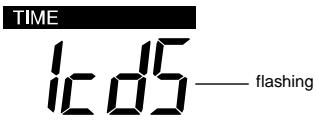
The LCD contrast can be set to 8 different levels to suit the users needs (default LCD contrast setting is LCD 5). To set the desired contrast level:
- The above display will be seen. Press the CH/ + key to select the level of contrast desired.
- Press the SET key to confirm and enter the "Time Zone setting" or exit the setting mode by pressing the SNOOZE/ SUN key
TIME ZONE SETTING:
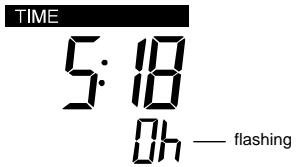
The time zone default of the Weather Station is 0. To change to another time zone:
- Press the SET key after completing the LCD contrast setting in order to enter the time zone setting (flashing).
- Using the CH/ + key, set the time zone. The range runs from 0 to +12 and then runs from -12 back to 0 in consecutive 1 hour intervals.
- Press the SET key to confirm and enter the "Time Reception ON/OFF setting" or exit the setting mode by pressing the SNOOZE/ SUN key
TIME RECEPTION ON/OFF SETTING
TIME
Flashing (time — reception icon)
rcc
07 — Digit flashing
In area where reception of the DCF-77 time is not possible, the DCF-77 time reception function can be turned OFF. The clock will then work as a normal Quartz clock (Default setting is ON).
- The digit "ON" and the time reception icon will start flashing on the LCD.
- Use the CH/ + key to turn OFF the time reception function.
- Confirm with the SET key and enter the "12/24-Hour Display setting" or exit the setting mode by pressing the SNOOZE/ SUN key.
Note:
If the Time Reception function is turned OFF manually, the clock will not attempt any
reception of the DCF time as long as the Time Reception OFF function is activated. The Time Reception icon will not be displayed on the LCD.
12/24 HOUR TIME DISPLAY SETTING
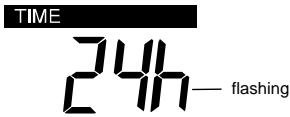
- After setting time reception ON/OFF, press the SET key, "12h" or "24h" flashes in the LCD. (default 24 h)
- Press the CH/ + key to select the "12h" or "24h" display mode.
- Press the SET again to confirm and to enter the "Manual Time setting" or exit the setting mode by pressing the SNOOZE/ SUN key.
Note: When 24h mode display is selected, the calendar format will be date and month display. When 12h mode display is selected, the calendar format will be month and date display.
MANUAL TIME SETTING
In case the Weather Station is not able to detect the DCF-signal (disturbances, transmitting distance, etc.), the time can be manually set. The clock will then work as a normal Quartz clock.
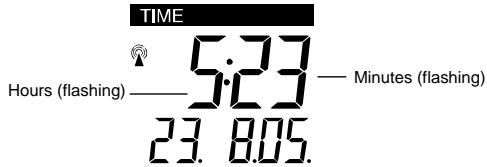
To set the clock :
- The hour and minute digits start flashing in the time display section.
- Use the CH/ + key to adjust the hours and then press SET key to go to the minute setting.
- The minute will be flashing. Press the CH/ + key to just the minutes.
- Confirm with the SET key and enter the "Calendar Setting" or exit the setting mode by pressing the SNOOZE/ SUN key
Note:
The unit will still try to receive the signal at each full hour despite it being manually set. When it does receive the signal, it will change the manually set time into the received time.
During reception attempts the DCF tower icon will flash. If reception has been unsuccessful, then the DCF tower icon will not appear but reception will still be attempted the following hour.
CALENDAR SETTING
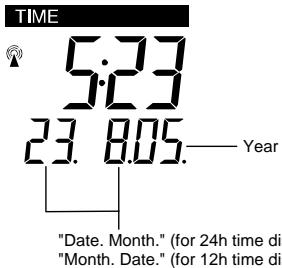
The date default of the Weather Station is 1. 1. of the year 2005 after initial set-up. Once the radio-controlled time signals are received, the date is automatically updated. However, if the signals are not received, the date can also be set manually. To do this:
- Using the CH/ + key, set the year required. The range runs from 2005 to 2029 (default is 2005).
- Press the SET key to enter the month setting mode.
- The month digit will be flashing. Press the CH/ + key to set the month and then press the SET key to go to the date setting.
- The date digit will be flashing. Press the CH/ + key to set the date.
- Confirm with the SET key and enter the “Sunrise, sunset and sun duration” or exit the setting mode by pressing the SNOOZE / SUN key.
SUNRISE, SUNSET AND SUN DURATION
The Sun Clock will automatically calculate the sunrise, sunset and sun duration time based on the city location and the set date. (see “Sun setting”)
- The short form of city name will start flashing (default "F"). Using the CH/ + key, select the city location:
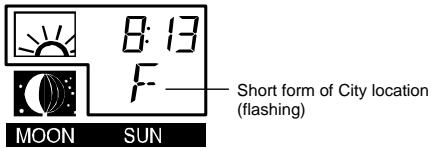
39 cities can be chosen from and every city is displayed in short-form (e.g.: AMS --> Amsterdam).
The cities are displayed as follows:
| F- Frankfurt | LYO - Lyon | PAR - Paris | BAI - Bari |
| FL - Flensburg | M - München | ROM - Roma | BAR - Barcelona |
| H - Hannover | MAD - Madrid | S - Stuttgart | BOL - Bologna |
| HB - Bremen | MAR - Marseille | SB - Saarbrücken | BOR - Bordeaux |
| HEL - Helsinki | MD - Magdeburg | SEV - Sevilla | BRU - Brüssel |
| HH - Hamburg | MIL - Milano | STO - Stockholm | CPH - Copenhagen |
| HRO - Rostock | MZ - Mainz | VIE - Vienna (Wien) | D - Düsseldorf |
| INS - Insbruck | N - Nürnberg | ZRH - Zürich | DD - Dresden |
| LDN - London | NAN - Nantes | AMS - Amsterdam | EF- Erfurt |
| LUX - Luxemburg | OSL - Oslo | B - Berlin |
- Confirm with the SET key and enter the "Snooze setting" or exit the setting mode by pressing the SNOOZE / SUN key.
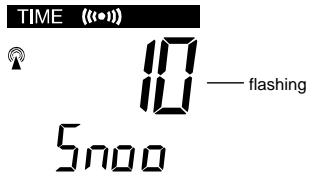
The snooze time can be set OFF or to a maximum time of 30 minutes (default is 10 minutes):
- The snooze time (in minute) digit will be flashing. Use the CH/ + key to set the snooze time (in minute). Each pressing of the key will increase the snooze time by 5 minutes. The snooze can also be set OFF when the "OFF" digit is being displayed.
- Confirm with the SET key and enter the “°C / °F temperature unit setting” or exit the manual setting mode by pressing the SNOOZE/ SUN key.
Note:
If the snooze time has been set "OFF", the snooze function will not be activated.
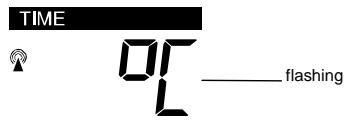
The default temperature reading is set to °C (degree Celsius). To select °F (degree Fahrenheit):
- The “°C” will be flashing, use the CH/ + key to toggle between “°C” and “°F”.
- Once the desired temperature unit has been chosen, confirm with the SET key and enter the "Weather Forecast Icon Sensitivity setting" or exit the setting mode by pressing the SNOOZE/ SUN key.
WEATHER FORECASTING ICON SENSITIVITY SETTING
For locations with rapid changes of weather conditions, the threshold can be set to a different level for faster display of changing weather conditions.
Using the CH/ + key to set the weather sensitivity level. There are 3 levels of setting: 1, 2 and 3; level 1 is the most sensitive setting, level 3 is the least sensitive setting (default setting is "2").
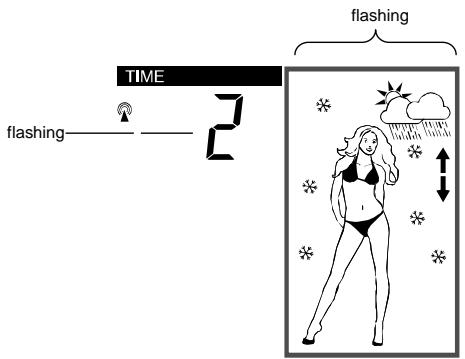
Confirm with the SET key and exit the Manual settings.
TIME (((●))
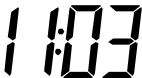
flashing-

ALARM
To set alarm:
- Press and hold ALM for about 3 seconds until the alarm time display flashes.
- The hour digit and the alarm icon will be flashing. Press the CH/ + key to adjust the hour.
- Press ALM button once and minute digit will be flashing. User shall then press CH/ + button to set the minute.
- Press ALM button once to confirm the setting.
- To activate/ deactivate the alarm function, press the ALM button once. The display of the alarm icon represents that the alarm is "ON".
SNOOZE SETTING AND STOPPING THE ALARM:
-
When the alarm is sounding, press the SNOOZE/ SUN key to activate the snooze function. The alarm will stop and re-activate after the time interval of the snooze time pre-set by user.
-
To stop the alarm completely, press any keys other than the SNOOZE/ SUN key.
WEATHER FORECAST AND TENDENCY:
The weather forecast icons (Weather girl):
One of the 15 different weather icons (featured by Weather girl with different clothing) is displayed in the centre of LCD, which indicates the different forecast weather condition due to air pressure level (Sunny, Sunny + Cloudy or Cloudy + Rainy) and the current outdoor temperature (Temperature value detected by Channel 1):
| ≥26°C | 19-25.9°C | 10-18.9°C | 0-9.9°C | <0°C | |
| Sunny | ↑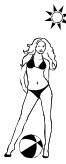 | ↑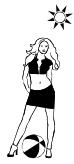 | ↑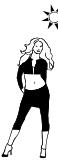 | ↑ | ↑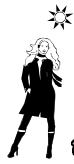 |
| ≥26°C | 19 – 25.9°C | 10 – 18.9°C | 0 – 9.9°C | <0°C | |
| Sunny + Cloudy | 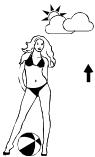 | 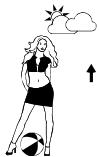 | 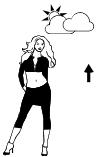 | 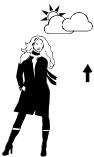 | 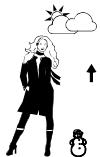 |
| ≥26°C | 19 – 25.9°C | 10 – 18.9°C | 0 – 9.9°C | <0°C | |
| Cloudy + Rainy | 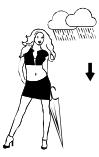 | 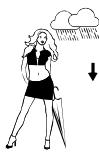 | 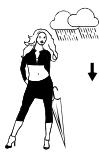 | 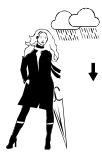 | 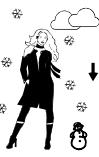 |
For every sudden or significant change in the air pressure, the weather icons will update accordingly to represent the change in weather. If the icons do not change, then it means either the air pressure has not changed or the change has been too slow for the Weather Projection Station to register. However, if the icon displayed is a sun or raining cloud, there will be no change of icon if the weather gets any better (with sunny icon) or worse (with rainy icon) since the icons are already at their extremes.
The icons displayed forecasts the weather in terms of getting better or worse and not necessarily sunny or rainy as each icon indicates. For example, if the current weather is cloudy and the rainy icon is displayed, it does not mean that the product is faulty because it is not raining. It simply means that the air pressure has dropped and the weather is expected to get worse but not necessarily rainy.
Note:
After setting up, readings for weather forecasts should be disregarded for the next 12-24 hours. This will allow sufficient time for the Weather Station to collect air pressure data at a constant altitude and therefore result in a more accurate forecast.
Common to weather forecasting, absolute accuracy cannot be guaranteed. The weather forecasting feature is estimated to have an accuracy level of about 75% due to the varying areas the Weather Station has been designed for use in. In areas that experience sudden changes in weather (for example from sunny to rain), the Weather Station will be more accurate compared to use in areas where the weather is stagnant most of the time (for example mostly sunny).
If the Weather Station is moved to another location significantly higher or lower than its initial standing point (for example from the ground floor to the upper floors of a house), remove the batteries and re-insert them after about 30 seconds. By doing this, the Weather Station will not mistake the new location as being a possible change in air-pressure when really it is due to the slight change of altitude. Again, disregard weather forecasts for the next 12 to 24 hours as this will allow time for operation at a constant altitude.
THE WEATHER TENDENCY INDICATOR
Working together with the weather icons are the weather tendency indicators (the upward and downward arrow located near the Weather girl). When the indicator points upwards, it means that the air-pressure is increasing and the weather is expected to improve, but when indicator points downwards, the air-pressure is dropping and the weather is expected to become worse.
Therefore, user may see how the weather has changed and is expected to change. For example, if the indicator is pointing downwards together with cloudy icons, it means that the last noticeable change in the weather was when it was sunny (the sunny icon only). Therefore, the next change in the weather will be the cloudy icons since the indicator is pointing downwards.
Note:
Once the weather tendency indicator has registered a change in air pressure, it will remain permanently visualized on the LCD.
DISPLAY OF INDOOR TEMPERATURE AND HUMIDITY READING:
The indoor temperature and humidity are measured automatically and displayed on the fourth section of the LCD.
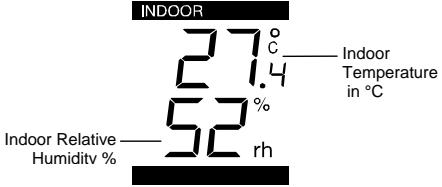
other
| Category | Value (%) | |---|---| | Indoor Temperature in °C | 27.4 | | Indoor Relative Humidity % | 52 | | Outdoor Temperature in °C | 27.4 |
DISPLAY OF OUTDOOR TEMPERATURE:
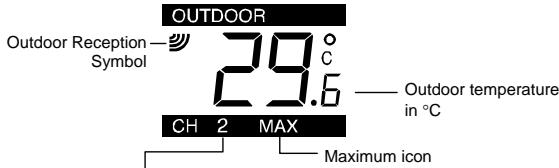
Transmitter identification
No. (only shown when
more than one transmitter
is used)
The last LCD section shows the outdoor temperature, a reception symbol and a channel number under the temperature will also show if more than one transmitter has been used.
DISPLAY OF INDOOR MAXIMUM AND MINIMUM RECORDS:
-
In normal display mode, press the MIN/ MAX button three times. The maximum indoor temperature and humidity will be shown. Also the date and time of recording this temperature will be displayed.
-
Press the MIN/ MAX button once more to display the minimum indoor temperature and humidity. Also the date and time of recording this temperature will be displayed.
RESETTING THE INDOOR MAXIMUM/ MINIMUM RECORDS
- In normal display mode, press the MIN/ MAX button to advance to the MIN/ MAX display.
- Press and hold the SET key for about 3 seconds, this will reset all indoor minimum and maximum data recorded to the current time, date, temperature and humidity. The max/ min temperature of the currently selected outdoor channel will also be rest at the same time
DISPLAY OF OUTDOOR MAXIMUM AND MINIMUM RECORDS:
- In normal display mode, press the CH/ + button to select the desired channel. The channel ID will be displayed above the outdoor temperature reading.
- Press the MIN/MAX button, the max temperature of the selected channel will be displayed. Also the date and time of recording this temperature will be displayed.
- Press the MIN/MAX button once more, the min temperature of the selected channel will be shown. Press the ALM button to go back to the normal display mode.
RESETTING THE OUTDOOR MAXIMUM/ MINIMUM RECORDS
Note: It is required to reset The outdoor max min temperature records of different channels separately.
- In normal display mode, press the CH/ + button to select a channel. The channel ID will be displayed above the outdoor temperature reading.
Note: The transmitter number will only be displayed if more than one transmitter is applied.
-
Press the MIN/ MAX button once. The max icon will be displayed.
-
Press and hold the SET button for about 3 seconds, this will reset all outdoor minimum and maximum temperature recorded to the current time, date and temperature.
Note: The max/ min temperature records of the indoor channel will also be reset at the same time.
SUNSET/ SUNRISE/ SUN DURATION TIME:
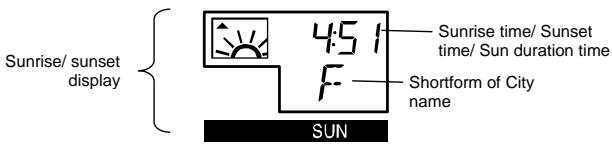
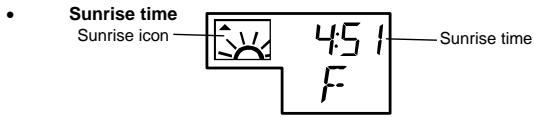
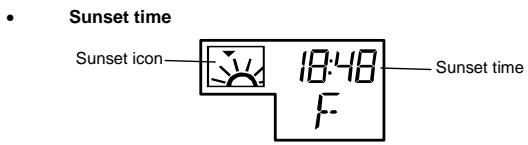
Press the SNOOZE/ SUN key to toggle between the sunrise, sunset, and sun duration time:
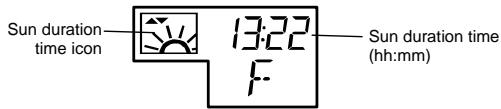
• Sun duration time (total number of hours of sunlight on the day)
THE MOON PHASE
The Moon icon of the Weather Station will also display 12 different Moon phases according to the set calendar.
Note: In the southern hemisphere, the phases of the moon are same but the shape of the moon is mirror inverted.

Full Moon

Large Waning
Gibbous

Small Waning
Gibbous

Last Quarter

Large Waning Crescent

Small Waning Crescent

New Moon

Small Waxing
Crescent

Large Waxing Crescent

First Quarter

Small Waxing
Gibbous

Large Waxing
Gibbous
LED BACK-LIGHT
The LED back-light will be automatically switched ON when any key is pressed. The LED back-light will be switched on for approximately 9 seconds before automatically switching OFF.
TEMPERATURE TRANSMITTER:
The range of the Temperature transmitter may be affected by the temperature. At cold temperatures the transmitting distance may be decreased. Please bear this in mind when placing the transmitter.
868 MHz RECEPTION
The Weather Station should receive the temperature data within 5 minutes after set-up. If the temperature data is not received 5 minutes after setting up (not successfully 3 times continuously, the outdoor display shows “- - -”), please check the following points:
- The distance of the Weather Station or transmitter should be at least 1.5 to 2 meters away from any interfering sources such as computer monitors or TV sets.
- Avoid positioning the Weather Station onto or in the immediate proximity of metal window frames.
- Using other electrical products such as headphones or speakers operating on the same signal frequency (868MHz) may prevent correct signal transmission and reception.
- Neighbors using electrical devices operating on the 868MHz signal frequency can also cause interference.
Note:
When the 868MHz signal is received correctly, do not re-open the battery cover of either the transmitter or Weather Station, as the batteries may spring free from the contacts and force a false reset. Should this happen accidentally then reset all units (see Setting up above) otherwise transmission problems may occur.
The transmission range is about 100 m from the transmitter to the Weather Station (in open space). However, this depends on the surrounding environment and interference levels. If no reception is possible despite the observation of these factors, all system units have to be reset (see Setting up).
POSITIONING
WEATHER STATION:
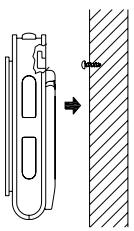
The Weather Station comes complete with a foldout stand that gives the option of table standing or wall mounting.
To wall mount:
- Fix a screw into the desired wall, leaving the head extended out the by about 5mm.
- Using the Weather Station's hanging hole, carefully hang it onto the screw.
Note: Always ensures that the unit locks onto the screw head before releasing.
POSITIONING THE TEMPERATURE TRANSMITTER:
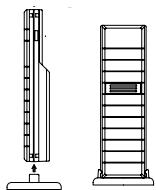
The Transmitter is supplied with a holder that may be attached to a wall with the two screws supplied. The Transmitter can also be position on a flat surface by securing the stand to the bottom to the Transmitter.
To wall mount:
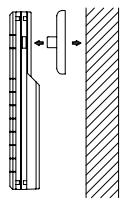
- Secure the bracket onto a desired wall using the screws and plastic anchors.
- Clip the remote temperature sensor onto the bracket.
Note:
Before permanently fixing the transmitter wall base, place all units in the desired locations to check that the outdoor temperature reading is receivable. In event that the signal is not received, relocate the transmitters or move them slightly as this may help the signal reception.
CARE AND MAINTENANCE :
- Extreme temperatures, vibration and shock should be avoided as these may cause damage to the unit and give inaccurate forecasts and readings.
- When cleaning the display and casings, use a soft damp cloth only. Do not use solvents or scouring agents as they may mark the LCD and casings.
• Do not submerge the unit in water. - Immediately remove all low powered batteries to avoid leakage and damage. Replace only with new batteries of the recommended type.
- Do not make any repair attempts to the unit. Return them to their original point of purchase for repair by a qualified engineer. Opening and tampering with the unit may invalidate their guarantee.
- Do not expose the units to extreme and sudden temperature changes, this may lead to rapid changes in forecasts and readings and thereby reduce their accuracy.
SPECIFICATIONS:
Temperature measuring range:
Indoor : -9.9^ to +59.9^ with 0.1^ resolution
(14.1°F to +139.8°F with 0.2°F resolution, "OF.L" displayed if outside this range)
Outdoor : -39.9^ to +59.9^ with 0.1^ resolution
(-39.8°F to +139.8°F with 0.2°F resolution, "OF.L" displayed if outside this range)
Relative humidity measuring range:
Indoor : 1% to 99% with 1% resolution (displays “- -” when lower than 1 %; displays "99" % if higher than 99 %)
Indoor temperature checking interval : every 15 seconds
Indoor humidity checking interval : every 20 seconds
Outdoor temperature reception : every 4 seconds
Power supply:
Weather Station : 2 x AA, IEC, LR6, 1.5V
Temperature transmitter : 2 x AA, IEC, LR6, 1.5V
Battery life cycle (Alkaline batteries recommended)
Weather station : Approximately 24 months
Temperature transmitter : Approximately 24 months
Dimensions (L x W x H)
Weather Station : 124.3 x 28.4 x 92.5 mm
Temperature transmitter : 38.2 x 21.2 x 128.3 mm
LIABILITY DISCLAIMER :
- The electrical and electronic wastes contain hazardous substances. Disposal of electronic waste in wild country and/or in unauthorized grounds strongly damages the environment.
- Please contact your local or/and regional authorities to retrieve the addresses of legal dumping grounds with selective collection.
- All electronic instruments must from now on be recycled. User shall take an active part in the reuse, recycling and recovery of the electrical and electronic waste.
- The unrestricted disposal of electronic waste may do harm on public health and the quality of environment.
- As stated on the gift box and labeled on the product, reading the "User manual" is highly recommended for the benefit of the user. This product must however not be thrown in general rubbish collection points.
- The manufacturer and supplier cannot accept any responsibility for any incorrect readings and any consequences that occur should an inaccurate reading take place.
• This product is designed for use in the home only as indication of the temperature.
• This product is not to be used for medical purposes or for public information.
• The specifications of this product may change without prior notice.
• This product is not a toy. Keep out of the reach of children. - No part of this manual may be reproduced without written authorization of the manufacturer.
- The Outdoor Temperature Transmitter
- SETTING UP:
- When one transmitter is used
- When more than one transmitter is used
- Note:
- IMPORTANT:
- INSTALL AND REPLACE BATTERIES IN THE WEATHER STATION
- INSTALL AND REPLACE BATTERIES IN THE TEMPERATURE TRANSMITTER
- BATTERY CHANGE:
- FUNCTION KEYS:
- Weather Station:
- SET key (Setting):
- MIN/ MAX
- ALM key (alarm)
- CH/ + key
- SNOOZE/ SUN key
- Section 1 - TIME AND CALENDAR
- Section 2 - Moon phase and Sunrise / Sunset
- Section 3 - WEATHER ICON (FEATURED BY WEATHER GIRL)
- Section 4 - INDOOR TEMPERATURE AND HUMIDITY
- Section 5 - OUTDOOR TEMPERATURE
- DCF-77 RADIO CONTROLLED TIME:
- MANUAL SETTINGS:
- LCD CONTRAST SETTING
- TIME ZONE SETTING:
- TIME RECEPTION ON/OFF SETTING
- 12/24 HOUR TIME DISPLAY SETTING
- MANUAL TIME SETTING
- CALENDAR SETTING
- SUNRISE, SUNSET AND SUN DURATION
- WEATHER FORECASTING ICON SENSITIVITY SETTING
- To set alarm:
- SNOOZE SETTING AND STOPPING THE ALARM:
- WEATHER FORECAST AND TENDENCY:
- The weather forecast icons (Weather girl):
- THE WEATHER TENDENCY INDICATOR
- DISPLAY OF INDOOR TEMPERATURE AND HUMIDITY READING:
- DISPLAY OF OUTDOOR TEMPERATURE:
- DISPLAY OF INDOOR MAXIMUM AND MINIMUM RECORDS:
- RESETTING THE INDOOR MAXIMUM/ MINIMUM RECORDS
- DISPLAY OF OUTDOOR MAXIMUM AND MINIMUM RECORDS:
- RESETTING THE OUTDOOR MAXIMUM/ MINIMUM RECORDS
- THE MOON PHASE
- LED BACK-LIGHT
- TEMPERATURE TRANSMITTER:
- MHz RECEPTION
- POSITIONING
- POSITIONING THE TEMPERATURE TRANSMITTER:
- CARE AND MAINTENANCE :
- SPECIFICATIONS:
- LIABILITY DISCLAIMER :
Brand : LA CROSSE TECHNOLOGY
Model : WS9711
Category : Weather station