
ACIDGLC2 - Commercial Dishwasher SMEG - Free user manual and instructions
Find the device manual for free ACIDGLC2 SMEG in PDF.
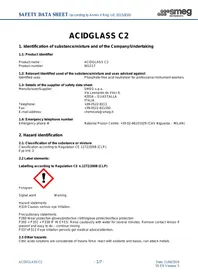


| Product type | Phosphate-free acid neutralizer for professional dishwashers |
| Product identification | ACIDGLASS C2 (ref. 901117) |
| Intended use | Instrument dishwasher in professional setting |
| Main composition | Citric acid monohydrate (45-60%) |
| Hazard classification | Eye irritation category 2 (H319) |
| Warning statement | Warning |
| Precautionary measures | Wear protective gloves, protective clothing, and eye/face protection. If in eyes, rinse with water for several minutes. |
| First aid (inhalation) | Move person to fresh air. Consult a physician. |
| First aid (skin contact) | Wash with plenty of water. Consult a physician. |
| First aid (eye contact) | Rinse thoroughly with water for several minutes. Remove contact lenses if possible. Consult a physician immediately. |
| First aid (ingestion) | Rinse mouth with water. Do not induce vomiting. Consult a physician. |
| Physical appearance | Colorless to light yellow liquid |
| Odor | Characteristic, recognizable |
| pH | 2.5 – 3.5 |
| Relative density | 1.19 – 1.21 g/cm³ |
| Solubility | Soluble in water in all proportions |
| Decomposition point | 175 °C (for citric acid) |
| Storage conditions | In original container, tightly closed, in a dry and ventilated place, away from direct sunlight, away from strong oxidants and bases |
| Reactivity | Reacts with strong oxidants, bases, and may attack metals |
| Waste disposal | Hazardous special waste. Entrust to an approved company in accordance with applicable regulations. |
| Transport | Not classified as dangerous according to ADR/RID/IMDG/IATA regulations |
Frequently Asked Questions - ACIDGLC2 SMEG
User questions about ACIDGLC2 SMEG
0 question about this device. Answer the ones you know or ask your own.
Ask a new question about this device
Download the instructions for your Commercial Dishwasher in PDF format for free! Find your manual ACIDGLC2 - SMEG and take your electronic device back in hand. On this page are published all the documents necessary for the use of your device. ACIDGLC2 by SMEG.
USER MANUAL ACIDGLC2 SMEG
1. Identification of substance/mixture and of the Company/Undertaking
1.1: Product identifier
Product name :
ACIDGLASS C2
Product number:
901117
1.2: Relevant identified uses of the substance/mixture and uses advised against
Identified uses:
Phosphate-free acid neutralizer for professional instrument washers
1.3: Details of the supplier of safety data sheet
Manufacturer/Supplier:
SMEG s.p.a.
Via Leonardo da Vinci 4,
42016 - GUASTALLA
ITALIA
Telephone:
+39-0522-8211
Fax:
+39-0522-821592
E-mail address:
chemicals@smeg.it
1.4: Emergency telephone number
Emergency phone #:
National Poison Centre: +39 02-66101029 (CAV Niguarda - MILAN)
2. Hazard identification
2.1: Classification of the substance or mixture
Classification according to Regulation CE 1272/2008 (CLP):
Eye Irrit. 2
2.2 Label elements:
Labelling according to Regulation CE n.1272/2008 (CLP)

Pictogram
Signal word
Warning
Hazard statements
H319 Causes serious eye irritation.
Precautionary statements
P280 Wear protective gloves/protective clothing/eye protection/face protection
P305 + P351 + P338 IF IN EYES: Rinse cautiously with water for several minutes. Remove contact lenses if present and easy to do - continue rinsing
P337+P313 If eye irritation persists get medical advice/attention.
2.3 Other hazards
Citric acid solutions are considered to react with oxidants and bases, and can attack metals.
3. Composition / Information on ingredients
Content :
CE Nr
CAS Nr
Name
Quantity
labelling
201-069-1
5949-29-1
Citric acid monohydrate
45-60%
Eye Irrit. 2; H319
Where
H319 Causes serious eye irritation.
4. First aid measures
4.1. Description of first aid measures
General information
Consult a physician. Show this safety data sheet to the doctor in attendance.
If inhaled
Move person into fresh air. If not breathing, give artificial respiration. Consult a physician.
In case of skin contact
Wash off with plenty of water. Consult a physician.
In case of eye contact
Rinse thoroughly with plenty of water for several minutes. Remove contact lenses only if easily implemented. Consult a physician immediately.
If swallowed
Never give anything by mouth to an unconscious person. Rinse mouth with water. Consult a physician.
4.2. Most important symptoms and effects, both acute and delayed If inhaled
Cough, shortness of breath, sore throat.
In case of contact with skin redness
In case of contact with eyes
Redness, pain
Swallowing
Abdominal pain, sore throat.
4.3. Indication of any immediate medical attention and special treatment needed
Immediate medical attention in case of strong inhalation (the product has negligible evaporation at 20°C), eye contact, and ingestion.
5. Firefighting measures
5.1. Extinguishing media
Suitable extinguishing media
Use water spray, alcohol-resistant foam, dry chemical (powder) or carbon dioxide.
5.2. Special hazards arising from the substance or mixture
Avoid breathing products of combustion. It may produce toxic fumes of carbon monoxide in the event of combustion. The citric acid decomposes at about 175°C.
5.3. Advice for firefighters
Wear, in case of fire, protective respiratory with independent air supply. Use safety measures as described in sections 7 and 8.
5.4. Additional information
No data available
6. Accidental release measures
6.1. Personal precautions, protective equipment and emergency procedures
Use personal protective equipment (gloves, goggles and protective clothing). Ventilate the premises. See section 8 for personal protective equipment.
6.2 Environmental precautions
Keep the mixture away from drains. Do not dispose of the substance into drains, surface water, or groundwater.
6.3 Methods and materials for containment and cleaning up
Collect with absorbent materials (sand, diatomaceous earth). Sweep up and shovel. Keep in suitable, closed containers for waste disposal.
6.4 Reference to other sections
For disposal see section 13.
7. Handling and storage
7.1. Precautions for safe handling
When handling, use protective glasses to avoid contact with eyes, and use gloves. Protective nitrile.
Handle the mixture away from drains.
Do not eat, drink, and/or smoke in work areas.
Wash hands after use.
Remove contaminated clothing and protective equipment before entering areas where food is consumed.
7.2. Conditions for safe storage, including any incompatibilities
Store in original container. Store tightly closed in a dry and ventilated place. Do not store in direct sunlight / UV.
Keep away from strong oxidants, strong bases, metal nitrates, and metals.
Keep away from heat sources.
Keep product away from food and feed.
7.3. Specific end uses
Detergent for professional automated washing
8. Exposure controls/personal protection
8.1. Control parameters
Components with exposure limits
For citric acid, a threshold limit value for occupational exposure has not been established as of the date of preparation of this document.
8.2. Exposure controls
Appropriate engineering controls
Handle in accordance with good safety practice. Wash hands after use. Ensure good ventilation of the workplace by means of an effective local intake system.
Protective and hygiene measures
Eye/face protection
Safety glasses with side-shields. Use equipment for eye protection tested and approved under appropriate government standards such as NIOSH (US) or EN 166(EU).
Skin protection
Handle with gloves. Gloves must be inspected prior to use. Use proper glove removal technique (without touching glove's outer surface) to avoid skin contact with this product. Dispose of contaminated gloves after use in accordance with applicable laws and good laboratory practices. Wash and dry hands.
The selected protective gloves have to satisfy the specifications of EU Directive 89/686/EEC and the standard EN 374 derived from it.
Protection for immersion and splash
Full contact and splash contact: nitrile rubber gloves of a minimum thickness of 0.11 mm. Breakthrough time: equal to 480 minutes.
If used in solution, or mixed with other substances, and under conditions other than those mentioned in EN 374.
Contact the supplier of CE approved gloves. This recommendation applies by way of advice and must be assessed by an industrial hygienist and a security officer aware of the specific situation. Do not mistake as an endorsement of a specific exposure scenario.
Body Protection
Chemicals protection clothing. Remove/Take off all contaminated clothing.
Respiratory protection
If the risk assessment shows the need for air-purifying respirators, use a full face mask with combined filter type ABEK (EN 14387) as a backup to engineering. If the respirator is the sole means of protection, use a full-face supplied air respirator. Use respirators and components tested and approved by standards bodies such as NIOSH (US) and the CEN (EU).
9. Physical and chemical properties
9.1. Information on basic physical and chemical properties
a. Appearance:
Physical state: liquid
b. Smell:
Color: colorless / light yellow
c. Odour threshold:
Recognizable, characteristic
d. pH:
No data available
e. Freezing point:
2.5 to 3.5
f. Initial boiling point and boiling range:
No data available
g. Flash point:
No data available
h. Evaporation rate:
No data available
i. Flammability (solid, gas)
No data available
j. Upper / lower flammability or explosive limits:
Not applicable as liquid
k. Vapour pressure:
No data available
I. Vapor density:
No data available
m. Relative density:
No data available
n. Solubility:
1.19 to 1.21 g/cm³
o. Partition coefficient (n-octanol / water):
Soluble in water in all proportions
p. Ignition temperature:
No data available
q. Decomposition temperature:
No data available
r. Viscosity:
175 °C (for citric acid)
s. Explosive properties:
No data available
t. Oxidizing properties:
No data available
9.2. Other information
No data available
Data not available
10. Stability and reactivity
10.1 Reactivity
The mixture reacts with strong oxidants, strong bases and can attack metals.
10.2 Chemical stability
Stable under normal conditions (see recommended handling and storage conditions as in section 7).
10.3 Possibility of hazardous reactions
Under normal use and storage conditions, hazardous reactions are not predictable (respecting the conditions as in section 7).
10.4 Conditions to avoid
Open flames, high temperatures.
10.5 Incompatible materials
Metals
10.6 Hazardous decomposition products
Under normal conditions of handling, use and storage (item 7), it is not reasonably expected to form products of decomposition.
11. Toxicological information
11.1 Information on toxicological effects
Since the data related to the mixture are not available, information related to the single components are herein reported.
Acute toxicity
Oral LD 50 - Rat - 5.400 mg/kg
Dermal LD 50 - Rat > 2.000 mg/kg
Skin corrosion/irritation
Skin - rabbit on
Result: Mild skin irritation
Serious eye damage/eye irritation
Eyes - rabbit on
Result: Eye irritation
Respiratory or skin sensitisation
Prolonged or repeated exposure may cause allergic reactions in certain sensitive individuals.
Germ cell mutagenicity
No data available
Carcinogenicity
IARC: No component of this product present at levels greater than or equal to 0.1% is identified as probable, possible or confirmed human carcinogen by IARC.
Reproductive toxicity
No data available
Specific target organ toxicity (STOT) - single exposure
No data available
Specific target organ toxicity (STOT) - repeated exposure
No data available
Aspiration hazard
No data available
Immediate, delayed and chronic effects from short- and long-term exposure
In the long term, repeated exposure to citric acid may have effects on the teeth, resulting in erosion.
Symptoms of exposure
Not available. To the best of our knowledge, the chemical, physical and toxicological properties are not the object of an in-depth investigation.
12. Ecological information
12.1 Toxicity
Toxicity to fish LC50 - Leuciscus idus melatonin - 440 mg/l (48h)
Toxicity to daphnia and other aquatic invertebrates
Static test - Daphnia magna (Water flea) - 1,535 mg/l - 24h
12.2 Persistence and degradability
No data available
12.3 Bioaccumulative potential
No data available
12.4 Mobility in soil
No data available
12.5 Results of PBT and vPvB assessment
This mixture contains components considered persistent, bioaccumulative and toxic (PBT) or very persistent and very bioaccumulative (vPvB) at ≥ 0.1%.
12.6 Other adverse effects
No data available
13. Disposal considerations
13.1 Waste treatment methods
Information concerning disposal
Reuse, if possible. The product residues must be considered as special hazardous waste. The dangerousness of waste, which contains in part this product, must be evaluated according to the regulations in force. A licensed disposal company has to be commissioned for the waste disposal in agreement with the national, and in case local, regulations in force.
Contaminated packaging
Contaminated packaging has to be recovered or disposed of at an approved site according to the national regulations for waste management
14. Transport information
The mixture is not classified as dangerous under current regulations in force relating to the transport of dangerous goods by road (ADR), Rail (RID), sea (IMDG Code), inland waters (ADN), and air (IATA).
14.1 UN number:
ADR-RID-ADN-IMDG-IATA:
Not applicable
14.2 UN proper shipping name
ADR-RID-ADN-IMDG-IATA:
Not applicable
14.3 Transport hazard classes
ADR-RID-ADN-IMDG-IATA:
Not applicable
14.4 Packaging group
ADR-RID-ADN-IMDG-IATA:
Not applicable
14.5 Environmental hazards
Dangerous for the environment
Not applicable
Marine pollutant
Not applicable
14.6 Special precautions for user
Not applicable
14.7 Transport in bulk according to Annex II of MARPOL 73/78 and Code IBC
Not applicable
15. Regulatory information
This safety datasheet complies with the requirements of Regulation (CE) No. 1907/2006
15.1. Safety, health and environmental regulations/legislation specific for the substance or mixture: None
15.2. Chemical Safety Assessment
No data available
16. Other information
Further information
The receiver of our product is solely responsible for compliance with applicable laws and regulations. The information is based on present level of our knowledge. However, the information is not a guarantee of product properties nor represents the completion of any legal relationship.
- IDENTIFICATION OF SUBSTANCE/MIXTURE AND OF THE COMPANY/UNDERTAKING
- PRODUCT IDENTIFIER
- RELEVANT IDENTIFIED USES OF THE SUBSTANCE/MIXTURE AND USES ADVISED AGAINST
- DETAILS OF THE SUPPLIER OF SAFETY DATA SHEET
- EMERGENCY TELEPHONE NUMBER
- HAZARD IDENTIFICATION
- CLASSIFICATION OF THE SUBSTANCE OR MIXTURE
- LABEL ELEMENTS
- LABELLING ACCORDING TO REGULATION CE N.1272/2008 (CLP)
- OTHER HAZARDS
- COMPOSITION / INFORMATION ON INGREDIENTS
- FIRST AID MEASURES
- DESCRIPTION OF FIRST AID MEASURES
- GENERAL INFORMATION
- IF INHALED
- IN CASE OF SKIN CONTACT
- IN CASE OF EYE CONTACT
- IF SWALLOWED
- MOST IMPORTANT SYMPTOMS AND EFFECTS, BOTH ACUTE AND DELAYED IF INHALED
- IN CASE OF CONTACT WITH EYES
- SWALLOWING
- INDICATION OF ANY IMMEDIATE MEDICAL ATTENTION AND SPECIAL TREATMENT NEEDED
- FIREFIGHTING MEASURES
- EXTINGUISHING MEDIA
- SUITABLE EXTINGUISHING MEDIA
- SPECIAL HAZARDS ARISING FROM THE SUBSTANCE OR MIXTURE
- ADVICE FOR FIREFIGHTERS
- ADDITIONAL INFORMATION
- ACCIDENTAL RELEASE MEASURES
- PERSONAL PRECAUTIONS, PROTECTIVE EQUIPMENT AND EMERGENCY PROCEDURES
- ENVIRONMENTAL PRECAUTIONS
- METHODS AND MATERIALS FOR CONTAINMENT AND CLEANING UP
- REFERENCE TO OTHER SECTIONS
- HANDLING AND STORAGE
- PRECAUTIONS FOR SAFE HANDLING
- CONDITIONS FOR SAFE STORAGE, INCLUDING ANY INCOMPATIBILITIES
- SPECIFIC END USES
- EXPOSURE CONTROLS/PERSONAL PROTECTION
- CONTROL PARAMETERS
- COMPONENTS WITH EXPOSURE LIMITS
- EXPOSURE CONTROLS
- APPROPRIATE ENGINEERING CONTROLS
- PROTECTIVE AND HYGIENE MEASURES
- EYE/FACE PROTECTION
- SKIN PROTECTION
- PROTECTION FOR IMMERSION AND SPLASH
- BODY PROTECTION
- RESPIRATORY PROTECTION
- PHYSICAL AND CHEMICAL PROPERTIES
- INFORMATION ON BASIC PHYSICAL AND CHEMICAL PROPERTIES
- OTHER INFORMATION
- STABILITY AND REACTIVITY
- REACTIVITY
- CHEMICAL STABILITY
- POSSIBILITY OF HAZARDOUS REACTIONS
- CONDITIONS TO AVOID
- INCOMPATIBLE MATERIALS
- HAZARDOUS DECOMPOSITION PRODUCTS
- TOXICOLOGICAL INFORMATION
- INFORMATION ON TOXICOLOGICAL EFFECTS
- ACUTE TOXICITY
- SKIN CORROSION/IRRITATION
- SERIOUS EYE DAMAGE/EYE IRRITATION
- RESPIRATORY OR SKIN SENSITISATION
- GERM CELL MUTAGENICITY
- CARCINOGENICITY
- REPRODUCTIVE TOXICITY
- SPECIFIC TARGET ORGAN TOXICITY (STOT) - SINGLE EXPOSURE
- SPECIFIC TARGET ORGAN TOXICITY (STOT) - REPEATED EXPOSURE
- ASPIRATION HAZARD
- IMMEDIATE, DELAYED AND CHRONIC EFFECTS FROM SHORT- AND LONG-TERM EXPOSURE
- SYMPTOMS OF EXPOSURE
- ECOLOGICAL INFORMATION
- TOXICITY
- PERSISTENCE AND DEGRADABILITY
- BIOACCUMULATIVE POTENTIAL
- MOBILITY IN SOIL
- RESULTS OF PBT AND VPVB ASSESSMENT
- OTHER ADVERSE EFFECTS
- DISPOSAL CONSIDERATIONS
- WASTE TREATMENT METHODS
- INFORMATION CONCERNING DISPOSAL
- CONTAMINATED PACKAGING
- TRANSPORT INFORMATION
- UN NUMBER
- UN PROPER SHIPPING NAME
- TRANSPORT HAZARD CLASSES
- PACKAGING GROUP
- ENVIRONMENTAL HAZARDS
- SPECIAL PRECAUTIONS FOR USER
- TRANSPORT IN BULK ACCORDING TO ANNEX II OF MARPOL 73/78 AND CODE IBC
- REGULATORY INFORMATION
- SAFETY, HEALTH AND ENVIRONMENTAL REGULATIONS/LEGISLATION SPECIFIC FOR THE SUBSTANCE OR MIXTURE: NONE
- CHEMICAL SAFETY ASSESSMENT
- FURTHER INFORMATION
Brand : SMEG
Model : ACIDGLC2
Category : Commercial Dishwasher