
GR DIGITAL III - Digital Camera RICOH - Free user manual and instructions
Find the device manual for free GR DIGITAL III RICOH in PDF.


| Product type | Compact digital camera |
| Dimensions | 108,6 x 59,8 x 31,5 mm |
| Weight | Approx. 210 g (with battery and memory card) |
| Power supply | Rechargeable lithium-ion battery DB-65 (3.6 V) |
| Sensor | CCD sensor 1/1.7 inch, 10.4 effective megapixels |
| Lens | Fixed wide-angle 28 mm (35 mm equivalent), f/1.9 |
| Display | 3-inch LCD screen, approx. 920,000 dots |
| Shooting modes | Program, Aperture Priority, Shutter Priority, Manual, Scene |
| Image format | JPEG (EXIF 2.21), RAW (DNG) |
| Video | 640 x 480 at 30 fps |
| Storage | SD/SDHC card, internal memory 154 MB |
| Connectivity | USB 2.0, AV output |
| Battery life | Approx. 350 photos (CIPA standard) |
| Maintenance and cleaning | Clean the lens with a soft cloth, avoid moisture |
| Safety | Do not expose to extreme temperatures, use only recommended accessories |
| Spare parts and repairability | DB-65 battery, BJ-6 charger, USB/AV cables, wrist strap; repairs by RICOH authorized center |
| General information | Manufacturer's warranty, user manual included |
Frequently Asked Questions - GR DIGITAL III RICOH
User questions about GR DIGITAL III RICOH
0 question about this device. Answer the ones you know or ask your own.
Ask a new question about this device
Download the instructions for your Digital Camera in PDF format for free! Find your manual GR DIGITAL III - RICOH and take your electronic device back in hand. On this page are published all the documents necessary for the use of your device. GR DIGITAL III by RICOH.
USER MANUAL GR DIGITAL III RICOH
The product serial number may be found on the bottom of the camera.
Before You Begin
Before using your camera, take a few moments to familiarize yourself with camera controls and displays (pages 1-8). Refer to this section as you read through the rest of the manual.
Basic Photography and Playback
Read this section before using the camera for the first time. It covers the steps involved in readying the camera for use, taking photographs, and playing them back (pages 9-38).
Reference
Read this section for information on topics not covered in "Basic Photography and Playback." It covers advanced shooting and playback options and describes how to print photographs, customize camera settings, and copy pictures to a computer (pages 39-173).
The rechargeable battery needs to be charged before use. The battery is not charged at the time of purchase.
Package Contents
Before using your Ricoh digital camera, confirm that the package contains the items listed below.
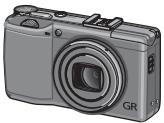
GR DIGITAL III
The serial number may be found on the bottom of the camera.

Hot shoe cover
The cover comes mounted on the camera hot shoe.
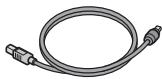
USB cable with mini-B connector
Connect the camera to a computer or printer.
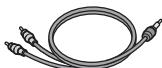
A/V cable
Connect the camera to a TV.

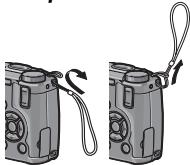
Tip: Attaching the Hand Strap
Pass the small loop through the strap eyelet on the camera body and pass the large loop through the small loop as shown.

DB-65 rechargeable battery
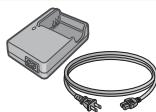
BJ-6 battery charger
- CD: Contains software and a Software User Guide.
- Camera User Guide (this manual)
Safety Precautions
Hand strap
Notices
- Safety precautions: Read all safety precautions thoroughly to ensure safe use.
- Test shots: Take test shots to ensure that the camera is working properly before taking photos on important occasions.
Copyright: Reproduction or alteration of copyrighted documents, magazines, and other materials, other than for personal, home, or other similarly limited purposes, without the consent of the copyright holder, is prohibited. - Exemption from liability: Ricoh Co., Ltd. assumes no liability for failure to record or display images as a result of product malfunction.
- Warranty: This product is manufactured to local specifications and the warranty is valid within the country of purchase. The manufacturer assumes no responsibility for servicing the product in other countries or bearing any expense thereby incurred.
- Radio interference: Operating this product in the vicinity of other electronic equipment may adversely affect both the camera and the other device. Interference is particularly likely if the camera is used in close proximity to a radio or television. This can be resolved by moving the camera as far as possible from the other device, reorienting the radio or television antenna, or plugging the radio or television into a different outlet.
© 2009 RICOH CO., LTD. All rights reserved. This publication may not be reproduced in whole or in part without Ricoh's express written permission. Ricoh reserves the right to change the contents of this document at any time without prior notice.
Every effort has been made to ensure the accuracy of the information in this document. Should you nevertheless notice any errors or omissions, we would be grateful if you would notify us at the address listed on the back cover of this booklet.
Microsoft, Windows, Windows Vista, and Internet Explorer are registered trademarks of Microsoft Corporation in the United States of America and other countries. Macintosh and Mac OS are registered trademarks of Apple Inc. in the United States of America and other countries. Adobe, the Adobe logo, and Adobe Reader are trademarks of Adobe Systems Incorporated. All other trade names mentioned in this document are the property of their respective owners.
The following manuals are provided with the GR DIGITAL III:
Camera User Guide (this booklet)
This guide describes how to use your camera and install the supplied software. The English version of the manual is also available in pdf format on the supplied CD.

Software User Guide (pdf file)
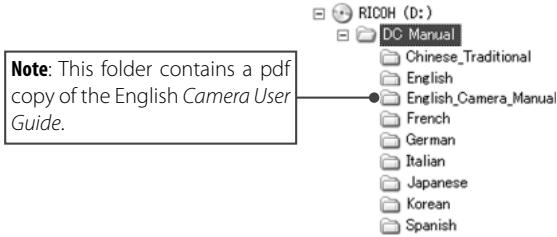
The Software User Guide describes how to copy pictures from your camera to a computer for display and editing. It is available in several languages, each in its own folder in the "DC Manual" folder on the supplied CD. For ease of reference, copy the pdf file from the CD to your computer hard disk.
"Irodio Photo & Video Studio" image viewing and editing software is also included with the camera. For information on using this software, see the Help menu in Irodio Photo & Video Studio or telephone one of the following customer support centers:
North America (U.S.A.): +1-800-458-4029 (toll free)
U.K., Germany, France, and Spain: +800-1532-4865 (toll free)
Other European countries: +44-1489-564-764
China: +86-21-5385-3786
Other Asian countries: +63-2-438-0090
Business hours: 9:00 AM to 5:00 PM
Table of Contents
Package Contents..
Notices..
Product Manuals.. iv
Before You Begin 1
Read this section before using your camera for the first time.
Introduction 2
Parts of the Camera 2
Basic Photography and Playback 9
Read this section before using your camera for the first time.
First Steps. 10
Charging the Battery. 10
Inserting the Battery 12
Inserting Memory Cards. 13
Turning the Camera on and Off 14
Basic Setup. 16
Taking Photographs. 17
Holding the Camera. 17
Taking a Photograph 18
Digital Zoom 22
Close-ups (Macro Mode) 23
Flash Photography 24
The Self-Timer 26
The Tilt Indicator 27
Viewing and Deleting Photographs. 29
Viewing Photographs 29
33
The (DISP).Button 36
Reference 39
Read this section for more information on camera functions.
More on Photography 40
Mode P: Program Shift 40
Mode A: Aperture Priority 42
Mode S:Shutter Priority 43
Mode M: Manual Exposure 44
SCENE Mode: Matching Settings to the Scene 46
"MY" Modes: Using Custom Settings 53
The Shooting Menu. 54
Movies 87
Recording Movies 87
Viewing Movies. 90
More onPlayback. 91
ThePlaybackMenu 91
Viewing Pictures on TV 104
Printing Photographs 106
Connecting the Camera 106
Printing. 108
The Setup Menu. 112
Key Custom Settings/Setup Menu Options 114
Copying Pictures to a Computer. 136
Windows. 136
Macintosh 148
Technical Notes. 150
Troubleshooting 150
Specifications. 158
Optional Accessories 162
Using the Camera Abroad 169
Precautions for Use 169
Camera Care and Storage 171
Warranty and Servicing. 172
NOTICES. 173
Index 174
Before You Begin
Read this section before using your camera for the first time.
Introduction. 2
Introduction
This manual describes how to take pictures and play them back. To ensure that you get the most from your camera, read this manual thoroughly before use and keep it handy when using the product.
Parts of the Camera
For more information, refer to the page number to the right of each item.
Front
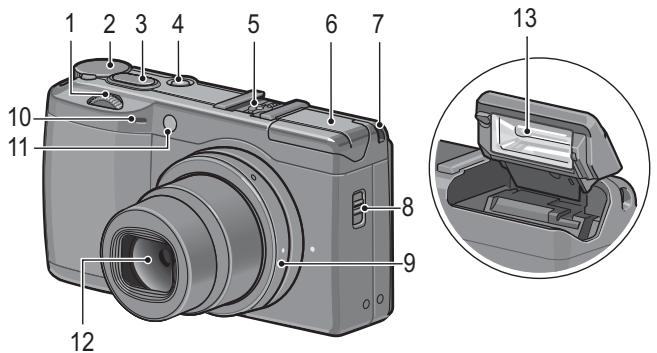
1 Up-down dial. 5
2 Mode dial. 4
3Shutter-release button.17,18,19
4 POWER button. 14, 15, 17
5 Hot shoe.. .ii, 164
6 Flash cover. 24
7 Strap eyelet..
8 Flash OPEN switch. 24
9 Ring cap. 163
10 Microphone. 87
11 AF auxiliary light. 26, 125
12 Lens. 17
13 Flash. 24
Back
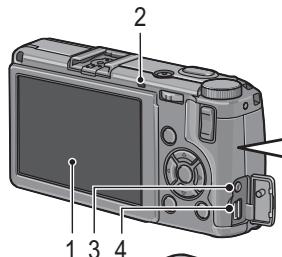
1 Picture display. 6-8
2 Autofocus/flash lamp.....14, 18, 25
3 Connector for A/V cable. 104
4 Connector for USB cable.....107
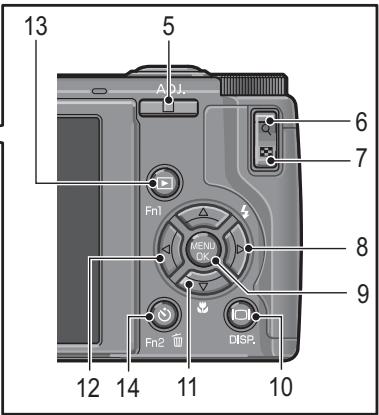
5 ADJ. lever....5, 78, 119-120
6 Q (enlarged view) button 22,31,32,122
7 (thumbnail display) button 22,31,32,122
8 /4 (flash) button 5,24
9 MENU/OK button 47,54,91,112
10 |□| (DISP.) button. 36
11 / / (macro) button.5,23
12 一 / Fn1 (function 1) button...5, 121
13 (playback) button.... 15, 29, 91
14 (self-timer)/Fn2 (function 2)/
(delete) button...26, 33-35, 121
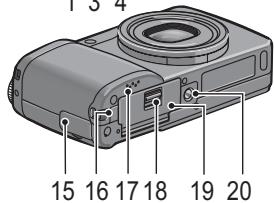
15 Connector cover. 104, 107
16 DC power cable cover 165
17 Speaker 27,90,125-126
18 Release lever. 12, 13, 165
19 Battery/card cover. 12, 13, 165
20 Tripod screw hole 48,61
The Mode Dial
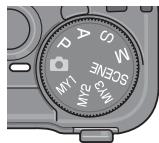
Before shooting, press the mode dial lock release (①) and rotate the mode dial to choose a shooting mode (②).
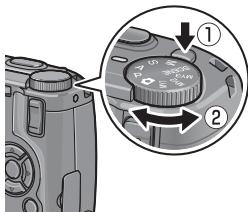
P (program shift): You choose from combinations of shutter speed and aperture that produce the same exposure (page 40).
A (aperture priority): You choose an aperture and let the camera adjust the shutter speed for optimal exposure (page 42).
S(shutter priority):You choose a shutter speed and let the camera adjust aperture for optimal exposure (page 43).
auto): The camera sets shutter speed and aperture for optimal exposure (page 17).
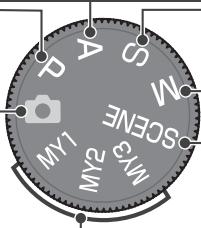
M (manual exposure): You choose shutter speed and aperture (page 44).
MY1, MY2, MY3 ("my settings"): Recall settings saved using Reg. My Settings (pages 53, 114-116).
SCENE (scene): Optimize settings for the current subject or scene or shoot movies (pages 46-52).
The Up-down Dial and ADJ. Lever
When viewing pictures or navigating the menus, you can use the up-down dial in place of the and buttons and the ADJ. lever in place of the and buttons. The ADJ. lever and up-down dial can also be used to select shutter speed and aperture in P, A, S, and M modes.
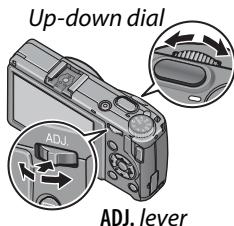
You can assign frequently-used shooting menu items to the ADJ. lever for easy access. To display a shooting menu item, center the ADJ. lever and press it in; you can then use the lever and up-down dial to select an option as described on page 116.

Note
The M Mode Dial Options andPlayback Mode Dial Options items in the setup menu can be used to reverse the roles of the up-down dial and ADJ. lever (page 123).
The Picture Display
The following indicators may be displayed during shooting and playback.
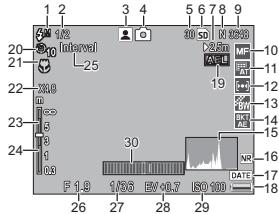
Shooting (still photography)
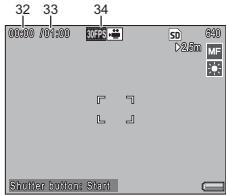
Shooting (movie mode)
1 Flash mode. 24
2 Flash compensation/ manual flash level 72,73
3 Scene mode....46 Continuous...68-69
4 Shooting mode/ plus normal shooting 4, 49, 50
5 Number of exposures remaining* 161
6 Destination. 13
7 Snap focus distance.59,64
8 Picture quality.....57
9 Picture size. 57
10 Focus mode/full press snap.....59,64
11 White balance/ white balance compensation...79,82
12 Metering. 65
13 Image setting. 66
14 Bracketing. 70
15 Histogram 37, 38
16 Noise reduction.... 74
17 Date imprint. 76
18 Battery level. 8
19 Autoexposure lock 121
20 Self-timer. 26
21 Macro mode 23
22 Zoom. 22
23 Depth of field 59
24 Focus bar. 59
25 Interval timer shooting. 75
26 Aperture.....40, 42, 44
27 Shutter speed 40,43,44
28 Exposure compensation 77
29 ISO. 84
30 Tilt indicator. 27
31 Blur warning.....27
32 Movie length.....161
33 Time available*....161
34 Frame rate.....87, 89
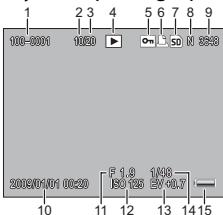
Playback (photographs)
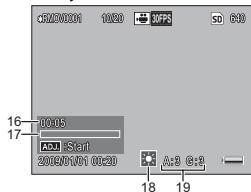
Playback (movies)
1 File number
2 Current frame
3 Total frames
4Playback mode indicator
5 Protected image....92
6 DPOF print indicator. 95
7 Source 13
8 Picture quality.....57
9 Picture size. 57
0 Date of recording 16
11 Aperture.....40, 42, 44
12 ISO. 84
13 Exposure compensation 77
15 Battery level. 8
16 Length/ elapsed time
17 Progress indicator
18 White balance....79
19 White balance compensation 82

Notes
- The picture display may also display warnings and messages.
Additional information can be viewed by pressing the DISP. button (page 36).
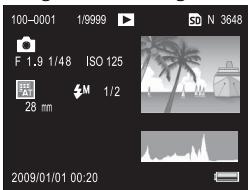
The Battery Level Indicator
Battery level is shown by the icon at the bottom right corner of the picture display.

Cautions
-
The full battery indicator may not appear or may appear only briefly with NiMH batteries. Check the battery type before use.
-
may be displayed when the camera is powered by an AC adapter. This is normal and does not indicate a malfunction.
| Icon | Description |
| (green) | Battery fully charged. |
| (green) | Battery partially dis-charged. |
| (orange) | Low battery. Charge or replace as soon as pos-sible. |
Basic Photography and Playback
Read this section before using your camera for the first time.
First Steps. 10
Taking Photographs. 17
Viewing and Deleting Photographs.29
Prepare the camera for use.
Charging the Battery
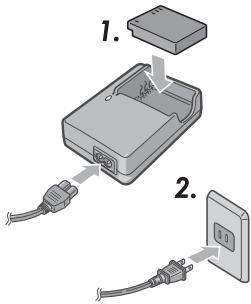
The rechargeable battery supplied with the camera is not charged at shipment. Charge the battery in the supplied BJ-6 battery charger before use.
1 Place the battery in the charger.
Place the battery label up with the "+" and "-" labels oriented to match the labels on the charger.

Caution
Be sure the battery is in the correct orientation.
2 Plug the charger in.
The charger lamp will light while the battery charges. An exhausted battery will recharge in about two hours at 25^

Note
If the charger lamp blinks, a battery or charger fault may have occurred. Unplug the charger and remove the battery.
3 Remove the battery.
Charging is complete when the charger lamp turns off. Unplug the charger and remove the battery.
Compatible Batteries
The camera can be used with a DB-65 rechargeable Li-ion battery (supplied; DB-60 rechargeable batteries can also be used) or with a pair of AAA alkaline or rechargeable nickel-metal hydride (NiMH) batteries.

Tip: Battery Capacity
Under normal conditions, about 370 shots can be taken with a fully-charged DB-65 battery. About 25 shots can be taken with a pair of fresh AAA alkaline batteries manufactured by Panasonic. These figures are based on tests conducted according to CIPA standards under the following conditions: temperature 23^ (73^) ; picture display on; 10 shots taken with 30 seconds between shots and the flash fired with every other shot; and the cycle repeated after the camera has been turned off and then on again.

Cautions
- Rechargeable Li-ion batteries: Use only genuine DB-65 or DB-60 batteries. Do not use batteries not specifically designated by Ricoh for use in this camera.
- Alkaline batteries: Battery life varies with make and storage conditions. Capacity drops at low temperatures.
- NiMH batteries: NiMH batteries are not charged at purchase and gradually lose their charge over time. Charge before use. Note that performance may be impaired immediately after purchase or following an extended period of disuse, and that the batteries may need to be used and recharged two or three times before they will hold a charge.
- Manganese and Ni-Cd batteries can not be used.
- Batteries may be hot immediately after use. Before removing batteries, turn the camera off and wait for them to cool down.
- Remove the battery if the camera will not be used for extended periods.
Inserting the Battery
Be sure the camera is off before inserting or removing batteries.
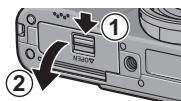
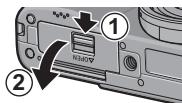
1 Open the battery/card cover. Unlatch (①) and open (②) the cover.
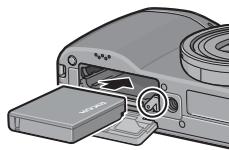
2 Insert the battery. Using the battery to keep the battery latch pressed to one side, slide the battery in. The latch will click into place when the battery is fully inserted.
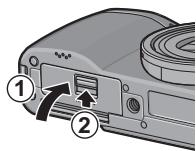
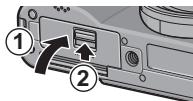
3 Close the battery/card cover. Close (①) and latch (②) the cover.

Caution
Be sure the cover is latched.
Removing the Battery
Unlatch and open the battery/card cover, then press and release the latch and remove the battery by hand, being careful not to drop it.

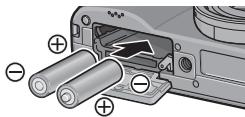
Tip: Inserting and Removing AAA Batteries
Insert in the orientation shown, press the cover closed, and slide the release lever to the closed position. To remove, simply unlatch and open the cover.

Caution
If the camera will not be used for an extended period, remove the batteries and store them in a cool dry place.
Inserting Memory Cards
Pictures can be stored in the camera's 88MB internal memory, or optional SD and SDHC memory cards can be used to store additional pictures. Internal memory is used for recording and playback if no card is inserted; if a card is inserted, the card will be used instead.
Before inserting or removing a memory card, be sure the camera is off. To insert a memory card:
1 Open the battery/card cover. Unlatch (①) and open (②) the cover.
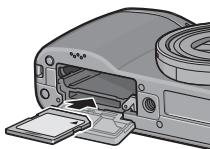
2 Insert the card. Holding the memory card in the orientation shown, slide it in until it clicks into place.
3 Close the battery/card cover. Close (①) and latch (②) the cover.
Removing Memory Cards
Unlatch and open the battery/card cover and press the memory card in to eject it. The card can then be removed by hand.
- Pictures will not be recorded to internal memory when a memory card is inserted, even if the memory card is full.
- Keep the memory card contacts clean.

Tip: Write Protection
Memory cards can be protected by sliding the write-protection switch to "LOCK", keeping data from being written to or deleted from the card and preventing the card from being formatted.
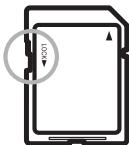
Pictures can not be taken when the memory card is locked; lock the card only to prevent accidental loss of data and be sure to unlock the card before shooting.

Notes
- Format memory cards before first use or after they have been used in a computer or other device (page 124). Be sure to back up any important data before formatting.
- See page 161 for information on memory card capacity.
- Pictures can be copied to memory cards from internal memory (page 97).
Turning the Camera on and Off
Shooting Mode
Press the POWER button to turn the camera on. The POWER button will light and the camera will play the start-up sound. The autofocus/ flash lamp blinks for several seconds while the camera starts up.
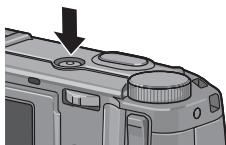
To turn the camera off, press the POWER button again. The number of pictures taken so far that day will be displayed before the camera turns off (zero is displayed if the camera clock is not set; if you
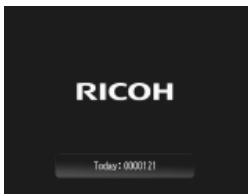
turn the camera off after changing the clock, the camera will display the number of pictures taken since the clock was changed).

Cautions
- The camera may take slightly longer to start up if the flash is on.
- Changes to continuous (page 68), interval (page 75), and self-timer (page 26) settings are lost when the camera is turned off. Turning the camera off restores settings for "MY" modes to the values saved with Reg. My Settings. Other settings are unaffected.
Playback Mode
Press the button for about a second to turn the camera on in playback mode. Press the button again to exit to shooting mode.
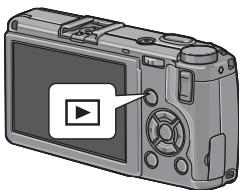
To turn the camera off, press the POWER button.

Tip: Auto Power Off
The camera will turn off automatically to save power if no operations are performed for the time selected in the Auto Power Off menu (see page 125).
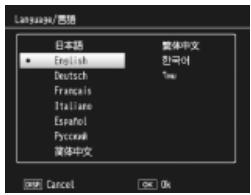
A language-selection dialog is displayed the first time the camera is turned on. Follow the steps below to choose a language and set the time and date. To exit before setup is complete, press DISP; the language, time, and date can be changed at any time in the setup menu (page 135).
1 Select a language.
Press , , or to highlight a language and press MENU/OK to select.
2 Set the clock.
Press or to highlight the year, month, day, hour, minute, or date format and press or to change. After checking that the date is correct, press MENU/OK. A confirmation dialog will be displayed; press MENU/OK again to set the clock.
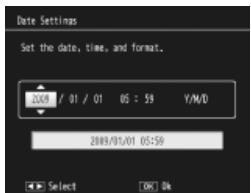
Default date and time

Notes
- If you leave the battery in the camera for at least two hours, the battery can be removed for about a week without resetting the clock or language selection.
- The time and date of recording can be printed on photographs (page 76).
Taking Photographs
After setting up the camera as described in "First Steps" (pages 10-16), you are ready to take your first photos. Press the POWER button to turn the camera on and rotate the mode dial to l
Holding the Camera
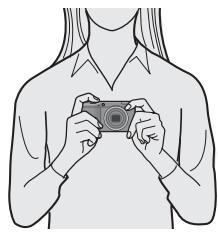
Hold the camera as shown below.
1 Hold the camera in both hands.
Hold the camera in both hands with your elbows lightly pressed against your body.

Caution
Be sure your fingers or hair or the camera strap do not obstruct the lens or flash.
2 Get ready to shoot.
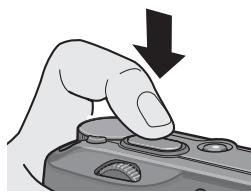
Put your finger on the shutter-release button.
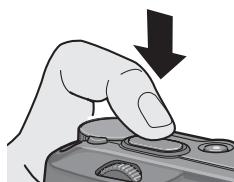
1 Focus.
Frame your subject in the center of the picture display and press the shutter-release button halfway to set focus and exposure.
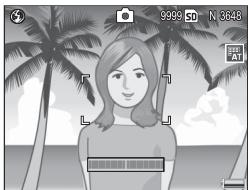
If the camera is unable to focus, the center focus frame blinks red and the autofocus/flash lamp blinks green.
If the camera is able to focus, the focus frames (up to nine) that contain objects that are in focus are shown in green.
Autofocus/flash lamp
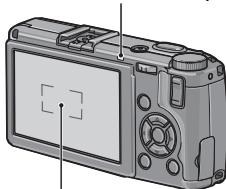
Focus frame
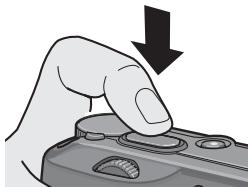
2 Take the picture.
Gently press the shutter-release button the rest of the way down to take the picture. The photograph you have just taken will be displayed in the picture display as it is recorded to the memory card or internal memory.

Tip: The Shutter-Release Button
The camera has a two-stage shutter-release button. To focus, lightly press the shutter-release button until you feel resistance. This is called "pressing the shutter-release button halfway." Press the shutter-release button the rest of the way down to shoot.

Tip: Focus
The autofocus/flash lamp and the focus frame show whether the subject is in focus.
| Focus status | Focus frame | Autofocus/flash lamp |
| Camera has not yet focused. | White | Off |
| Subject in focus. | Green | On (green) |
| Camera unable to focus. | Blinks (red) | Blinks (green) |
The camera may be unable to focus on the following:
- Objects that lack contrast, such as the sky, a wall that is only one color, or the hood of a car
- Flat objects containing only horizontal lines
- Fast-moving objects
- Objects that are poorly lit
- Objects with bright reflections or backlighting
- Flickering objects, such as fluorescent lights
- Point light sources, such as light bulbs, spotlights, or LEDs Note that one or more focus frames may be displayed in green if the camera is unable to focus with the above subjects; check focus in the picture display before shooting. If the camera is unable to focus, lock focus on another object at the same distance from the camera as your subject, then recompose the photograph and take the picture (page 21).

Tip: Avoiding Blurred Pictures
To prevent blurring caused by the camera moving when the shutter is released ("camera shake"), press the shutter-release button smoothly and gently. Blurring is particularly likely to occur if:
- The flash is off and lighting is poor, or
The camera is zoomed in (page 22)
In situations in which photographs are especially prone to blurring caused by camera shake, a icon will be displayed in the picture display. Hold the camera steady and try focusing again, or attempt one of the following remedies:
- Turning the flash on (♂) or using auto flash (♀; see page 24)
- Choosing a higher ISO (page 84)
Using the self-timer (page 26)

Notes
- If the flash will fire when the picture is taken, a pre-flash will be emitted to assist focus and exposure.
- You can choose how long pictures are displayed in the picture display after shooting. If desired, photographs can be displayed until the shutter-release button is pressed halfway (page 126).
- In mode, a built-in neutral density (ND) filter is used for between f/8.0 and f/11. The smallest aperture available in mode is f/11.
Focus Lock
Use focus lock to compose photographs in which the subject is not in the center of the frame. Focus lock can also be used if the camera is unable to focus (page 18).
1 Focus.
Position your subject in the center of the picture display and press the shutter-release button halfway to focus.

2 Recompose the photograph.
Keeping the shutter-release button pressed halfway to lock focus, recompose the photograph.
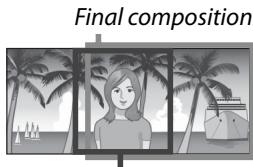
Main subject

3 Take the picture.
Gently press the shutter-release button the rest of the way down to take the picture.
Caution
If the distance between the camera and subject changes while focus lock is in effect, focus again at the new distance.
Digital Zoom
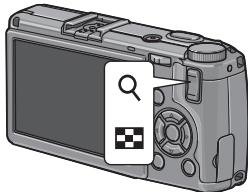
When Digital Zoom is selected for Zoom Button (page 122), the Q button can be used to zoom in to a maximum of 4.0 × Use the button to zoom out.
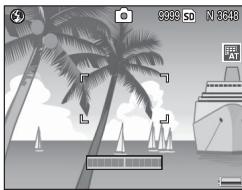
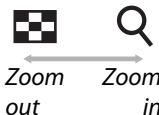

1 Assign digital zoom to the Q and 串 buttons. Select Digital Zoom for the Zoom Button option in the setup menu (page 122).
2 Frame the picture using the and 巴 buttons.
The zoom ratio is shown in the picture display.
3 Focus.
Press the shutter-release button halfway to focus.
4 Take the picture.
Gently press the shutter-release button the rest of the way down to take the picture.

Notes
- If an option with a size of 3,648 × 2,736 is selected for Picture Quality/Size, Auto Resize can be selected for Digital Zoom Image (page 133).
- Digital zoom is not available when a RAW-quality option is selected for Picture Quality/Size (page 57) or the camera is in dynamic range double shot mode (page 48).
Close-ups (Macro Mode)
Use macro mode for close-ups of small objects as close as 1.0cm (0.4 in.) to the lens (at this distance, the area photographed will be about 26× 19mm / 1.0× 0.7 in.).
Press the button.
A icon will be briefly displayed in the center of the picture display. will then appear at the top of the display.
2 Focus.
Frame the subject in the picture display and press the shutter-release button halfway to focus.
3 Take the picture.
Gently press the shutter-release button the rest of the way down to take the picture.
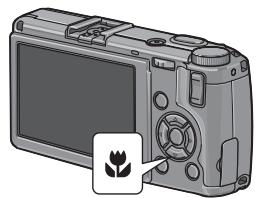
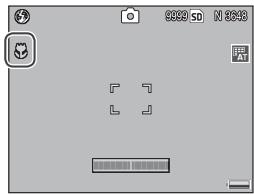
To exit macro mode, press the button again.

Note
If an option other than MF or Spot AF is selected for Focus when the camera is in macro mode, the camera will focus using spot autofocus (page 59).
Flash Photography
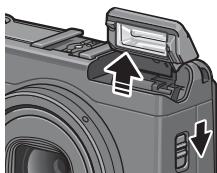
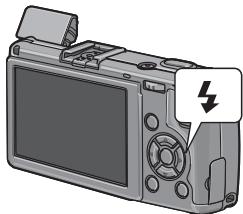
The flash only fires when raised. Slide the OPEN switch to raise the flash and press the button to choose from the following flash modes:
| Mode | Description |
| Flash Off | The flash is off and will not fire. |
| Auto | The flash fires automatically when required. |
| Red-Eye Flash | Reduces "red-eye" in portraits taken with the flash. |
| Flash On | The flash fires with every shot. |
| Flash Synchro. | Combines the flash with slow shutter speeds. Use when taking portraits that include details of the background indoors or at night. Use of a tripod is recommended to prevent blur. |
| Manual Flash | The flash fires with every shot; flash output is fixed at the level selected for Manual Flash Amount (page 73). |

Note
The flash has a range of approximately 20cm to 3.0m (8 in.-10 ft.), measured from the front of the lens (auto ISO; see page 84).
Using the Built-in Flash
1 Raise the flash.
Slide the flash OPEN switch as shown.
2 Select a flash mode.
Press the 4 button to select a flash mode. The flash mode icon is briefly displayed in the center of the picture display and then appears in the top left corner of the display.

Note
The selected flash mode remains in effect until a new mode is chosen.
The autofocus/flash lamp blinks while the flash charges (if the camera is powered by AAA batteries, the picture display will turn off until charging is complete). Photos can be taken when the lamp stops blinking.
3 Focus and shoot.
If the flash is required, it will emit a pre-flash before each shot to help with focus and exposure.

Notes
- To close the flash when it is not in use, gently press the center of the flash cover down until it latches.
- The flash turns off automatically in dynamic range double shot, movie, continuous, and bracketing modes.
- The built-in flash turns off automatically when an optional flash is used (pages 167, 168).

Cautions
- Do not use the built-in flash with conversion lenses or lens hoods.
- Do not use the flash unit in close proximity to your subject's eyes. Particular care should be observed when photographing infants. Do not direct the flash at the operator of a motor vehicle.
The Self-Timer
The camera offers a ten-second timer for self-portraits and a two-second timer to prevent blur caused by camera movement when the shutter-release button is pressed.

Note
By default, the self-timer is assigned to the (Fn2) button, but it can also be assigned to the Fn1 button (the instructions that follow assume it is assigned to the button). The self-timer can only be used when assigned to a button (page 119).
1 Choose a self-timer mode.
Press the button once to select the ten-second timer and again to select the two-second timer. The current selection is displayed in the picture display. Pressing the
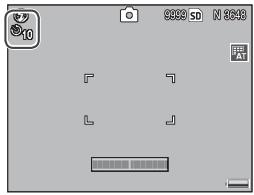
button a third time turns the timer off.

Note
The selected self-timer mode remains in effect until a new mode is chosen.
2 Start the timer.
Press the shutter-release button to lock focus and start the timer. If the ten-second timer is selected, the AF auxiliary light will light.
The Tilt Indicator
Use the tilt indicator to level the camera when photographing buildings or landscapes. It is particularly useful for compositions in which the horizon is visible.
1 Display level setting options.
Press and hold the button until level setting options are displayed.
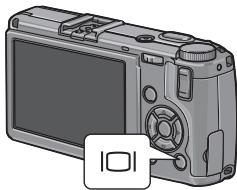
2 Highlight an option.
Press or to highlight an option:
| Option | Description |
| Off | Tilt indicator not displayed. |
| Display | Tilt is shown in the picture display. The indicator turns or-ange when the camera is tilted; the amount and direction of rotation needed to bring it level is shown by the position of the indicator in the display (the indicator turns red if the angle is too great to be shown). The indicator turns green when the camera is level, either in the normal shooting orientation or rotated 90° to shoot pictures in “tall” orien-tation. Tilt is not shown if the display is off, indicators are hidden, or the framing grid is displayed (page 36). |
| Disp + Snd | As above, except that a beep sounds periodically when the camera is level. |
| Sound | A beep sounds periodically when the camera is level. The tilt indicator is not displayed in the picture display. |
3 Select the highlighted option.
Press MENU/OK to select the highlighted option.
Understanding the Tilt Indicator
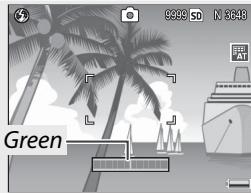
Camera level
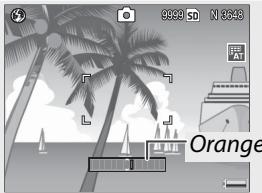
Tilt camera left to level
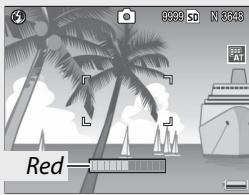
Unable to measure tilt; camera rotated too far forward or back
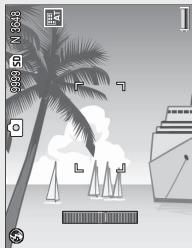
Camera tilted 90^ left

Note
Tilt indicator settings can also be adjusted in the setup menu (pages 113, 127).

Cautions
- The tilt indicator is not displayed when the camera is upside down, movies are being recorded, or the interval timer is on.
- Muting the camera speaker (pages 125-126) also mutes the beep that sounds to indicate that the camera is level.
- The tilt indicator is intended as a guide only and should not be used as a spirit level or in other applications in which a high degree of precision is required. Accuracy drops when the camera is in motion or you are shooting on a vehicle or other moving platform.
Viewing and Deleting Photographs
Pictures can be viewed in the picture display.
Viewing Photographs
Press the button to display the last photograph viewed.

Tip: If the Camera Is Off
If the camera is off, press the button for about a second to turn the camera on and start playback.
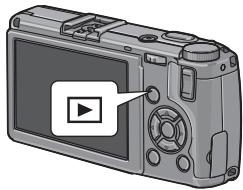
Press to view photographs in the order recorded, to view in reverse order. Press to skip ahead ten frames, to go back ten frames.
Back one photo
Back ten photos
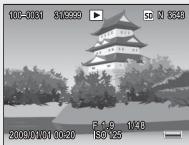
Ahead ten photos
Ahead one photo

Caution: RAW Images
The camera records JPEG copies of RAW images for display in the picture display. When a RAW image is selected for playback, the camera shows the JPEG copy and a RAW-mode indicator is displayed. If the JPEG copy has been deleted using a computer or other device, the camera will display a small preview of the RAW image, but you will not be able to view the image at larger magnifications. See pages 57, 58 for information on recording RAW images.

Tip: Viewing Pictures in Shooting Mode
Photographs are displayed in the picture display immediately after shooting. You can choose how long pictures are displayed using the LCD Confirmation Time option in the setup menu (page 126).

Tip: Viewing the Pictures in Internal Memory
If a memory card is inserted, the pictures on the memory card will be displayed; the pictures in internal memory can not be viewed even if the memory card is empty. The pictures in internal memory will only be displayed if no card is inserted in the camera.

Tip: Auto Rotate
If On is selected for Auto Rotate in the setup menu, pictures will automatically be displayed in the correct orientation in the picture display (page 127).
Viewing Multiple Photographs
Use the and buttons to choose the number of photos displayed from one, 20, and 81. Multi-frame views can be used to select images for display or deletion.
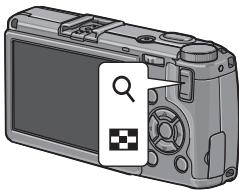
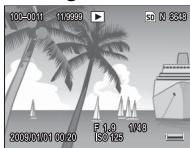
Single frame
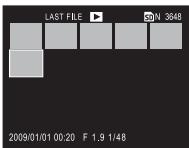
20 frames
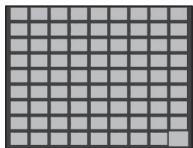
81 frames
In multi-frame views, press , , , and to highlight photographs. In 20-frame view, press Q or press the ADJ lever in to view the highlighted frame full frame. In 81-frame view, press Q to return to 20-frame view or press the ADJ lever in to display the highlighted photo full frame.
PlaybackZoom
Press the Q button or rotate the up-down dial to zoom in on the photo currently displayed full frame. To zoom in to the magnification selected with One Press Zoom Ratio (page 126), press the ADJ lever in.
The following operations can be performed:
| Use | To |
| Q | Zoom in. |
| Up-down dial | Rotate right to zoom in, left to zoom out. |
| MENU/OK | Zoom in to magnification selected for One Press Zoom Ratio. If picture is displayed at maximum magnification, pressing MENU/OK cancels zoom. |
| ▲▼◇ | View other areas of the image. |
| ADJ. lever | Press left or right to view other images at same zoom ratio. |
| ■ | Cancel zoom. |

Notes
Maximum magnification varies with image size:
| Image size (pixels) | Maximum magnification |
| 2,048 × 1,536 or larger | 16 × |
| 1,280 × 960 | 6.7 × |
| 640 × 480 | 3.4 × |
-
Playback zoom is not available with movies or with photographs taken at settings of S-Cont or M-Cont.
-
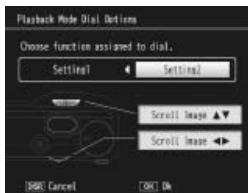
If Setting2 is selected forPlayback Mode Dial Options in the setup menu (page 123), the ADJ. lever and up-down dial can be used to view other areas of the image.
Deleting Photographs
Follow the steps below to delete unwanted photos.
Deleting Individual Photographs
1 Display a photograph you want to delete.
Display a photograph you want to delete in single-frame playback (page 29).
2 Press the button.
The options shown at right will be displayed (if the current image is not one you wish to delete, press or to display the desired photo).
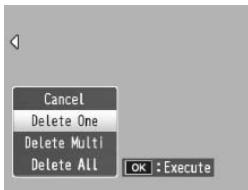
3 Highlight Delete One.
Press or to highlight Delete One.
4 Press MENU/OK.
A message is displayed during deletion. The options shown above will then be displayed; repeat Steps 2 and 3 to delete additional photographs, or highlight Cancel and press MENU/OK to exit.
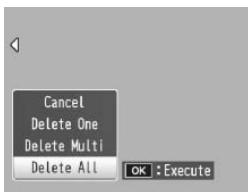
Deleting All Files
To delete all files, press the button to display delete options as described above and select Delete All. A confirmation dialog will be displayed; press or to highlight Yes and press MENU/OK.
Deleting Multiple Files
Follow the steps below to delete multiple selected files.
1 Press the button.
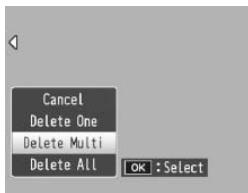
In multi-frame playback, proceed to Step 2. In single-frame playback, the options shown at right will be displayed. Highlight Delete Multi and press MENU/OK.
2 Select Sel. Indiv. or Sel. Range.
To select images one at a time, highlight Sel. Indiv., press MENU/OK, and proceed to Step 3. To select one or more ranges consisting of two images and all photographs be
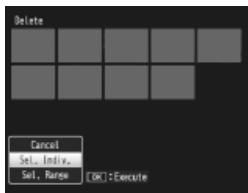
tween them, highlight Sel. Range, press MENU/OK, and proceed to Step 3.1. To exit at any time without deleting files, press DISP.
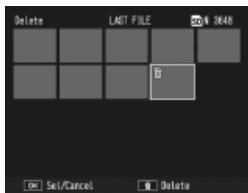
3 Select photographs.
Press▲,▼,▲,or▶tohighlight photos and press MENU/OK to select. Selected pictures are marked with icons. To deselect a photo, highlight it and press MENU/OK again.

Tip: Selecting Ranges
To select one or more ranges consisting of two images and all photographs between them, press the ADJ. lever in and follow the steps below:
3.1 Press , , , or to highlight the first image and press MENU/OK to select. The selected image is marked with a icon. If you selected the wrong image, press DISP. and try again.
3.2 Press , , , or to highlight the last image and press MENU/OK to select. The selected image and other images in the selected range will be marked with icons.
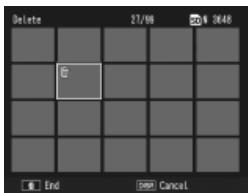
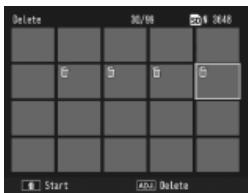
Repeat Steps 3.1-3.2 to select additional ranges, or press the ADJ lever in to return to Step 3 and select or deselect individual photographs.
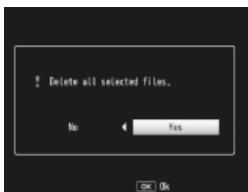
4 Press
A confirmation dialog will be displayed.
5 Select Yes.
Press or to highlight Yes and press MENU/OK.
The (DISP.) Button
Use the button to choose the information displayed in the picture display during shooting and playback.
Shooting Mode
Press the (DISP.) button to cycle through the following displays:
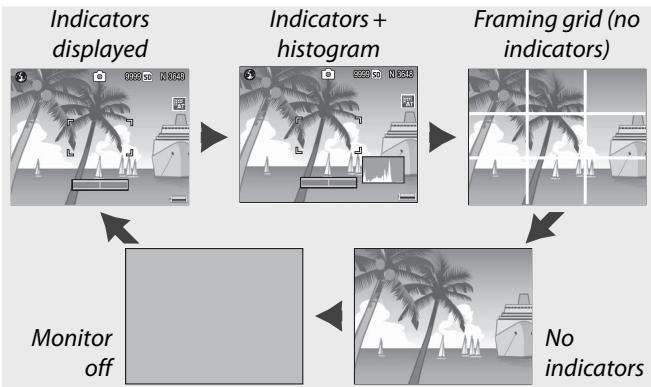

Tip: The Framing Grid
See page 128 for information on choosing a framing grid. The grid lines do not appear in the final photograph.

Notes
- If Display or Display+Sound is selected for Level Setting, a tilt indicator appears when indicators are displayed.
- When the picture display is off, pressing any of following turns the picture display on: the ADJ lever, the MENU/OK, ☐ (DISP.), and ☑ buttons, the Q and ☑ buttons (except when Off is selected for Zoom Button; page 122), and the ▲ and ▼ buttons (manual focus mode only).
Playback Mode
Press the (DISP.) button to cycle through the following displays:
Indicators displayed
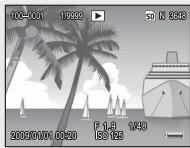
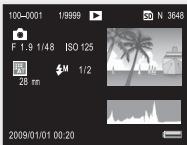
Details+ histogram
No indicators
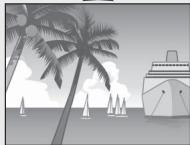
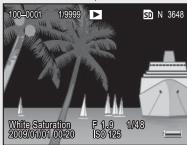
Highlights

Tip: Highlights
The flashing portions of the highlights display mark "washed out" areas in which details may have been lost to overexposure. Check highlights after shooting in direct sunlight or in other conditions in which parts of the image may be overexposed. If it seems important details may have been lost, choose a lower exposure compensation value and shoot again (page 77). Note that the display is intended only as a guide and may not be entirely accurate.

Tip: The Histogram
The histogram is a graph showing the distribution of pixels of different brightness in the image. Brightness is plotted on the horizontal axis, with shadows at the left and highlights at the right. The vertical axis gives the number of pixels. The histogram can be used to assess exposure and check for loss of detail in highlights and shadows without the brightness of your surroundings affecting your judgement. A histogram in which pixels are clustered on the right indicates that the image may be overexposed, while a histogram in which pixels are clustered on the left indicates that the image may be underexposed.
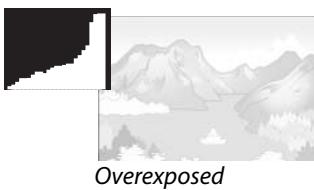
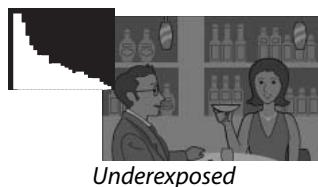
If the image appears to be incorrectly exposed, you may be able to use exposure compensation to correct exposure in subsequent photographs of the same subject (page 77; note that exposure compensation may be insufficient to produce the correct exposure in some cases). The histogram can also be used as a guide when adjusting contrast in photographs after shooting (pages 101, 102).
The histogram is intended as a guide only and may not be completely accurate, particularly in cases in which the flash is used or ambient lighting is poor.
Reference
Read this section for more information on camera functions.
More on Photography 40
Movies. 87
More on Playback. 91
■ Printing Photographs. 106
The Setup Menu 112
Copying Pictures to a Computer. 136
Technical Notes 150
More on Photography
This section provides information on P, A, S, M, SCENE, and "MY" modes and on using shooting menu options.
Mode P: Program Shift
When the mode dial is rotated to P (program shift), you can use the up-down dial to choose from several combinations of shutter speed and aperture, all of which produced the same exposure.
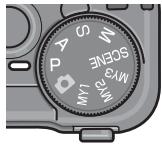
1 Choose mode P.
Rotate the mode dial to P. The shooting mode is shown by an icon in the display.
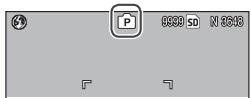
2 Measure exposure.
Press the shutter-release button halfway to measure exposure. The current shutter speed and aperture appear in the display.
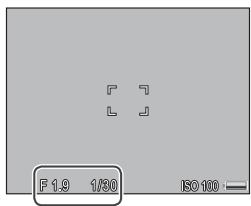
3 Choose shutter speed and aperture.
Remove your finger from the shutter-release button and rotate the up-down dial to select a combination of shutter speed and aperture.
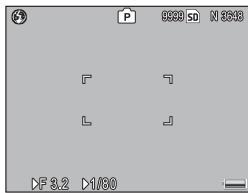
Shutter speed and aperture can be adjusted for ten seconds after you remove your finger from the shutter-release button.
4 Take the photograph.
Gently press the shutter-release button all the way down to take the photograph.

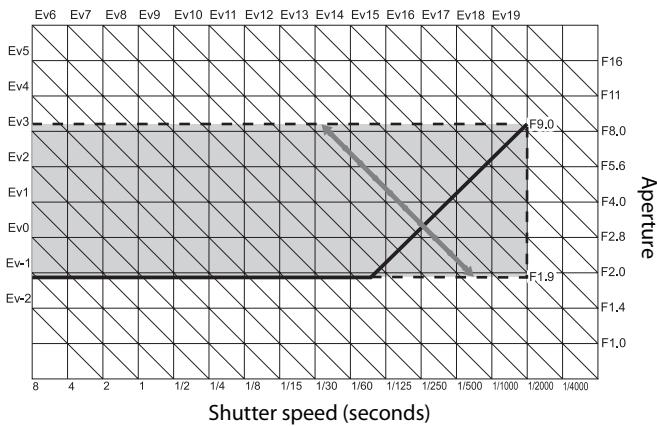
Note: The Exposure Program
The exposure program (ISO 100, flash off) is shown below. The shaded area gives the combinations of shutter speed and aperture available at each exposure value (EV).
Mode A: Aperture Priority
In mode A (aperture priority), you choose the aperture and the camera selects the shutter speed. Choose large apertures (low f-numbers) to emphasize the main
subject by blurring background and foreground details. Choose small apertures (high f-numbers) to bring both the background and main subject into focus.
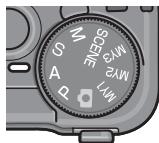
1 Choose mode A.
Rotate the mode dial to A. The current aperture is displayed in orange.
2 Choose an aperture.
Rotate the up-down dial to choose an aperture. Your se
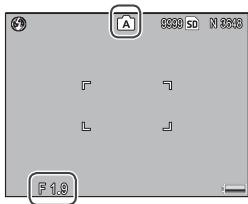
lection only takes effect when the photo is taken; the effect can not be previewed in the picture display.
3 Press the shutter-release button halfway.
Press the shutter-release button halfway to set focus and exposure. The shutter speed selected by the camera will be displayed in the picture display.
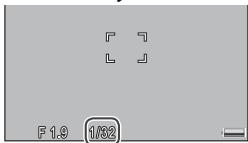
4 Take the photograph.
Gently press the shutter-release button the rest of the way down to shoot.

Note
If auto aperture shift is on (page 85), the camera will adjust aperture for optimal exposure.
Mode S:Shutter Priority
In mode S (shutter priority), you choose the shutter speed and the camera selects the aperture. Choose fast shutter speeds to "freeze" motion, slow shutter
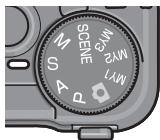
speeds to suggest motion by blurring moving objects.
1 Choose mode S.
Rotate the mode dial to S. The current shutter speed is displayed in orange.
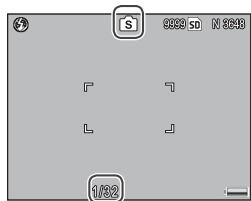
2 Choose shutter speed.
Rotate the up-down dial to choose a shutter speed.
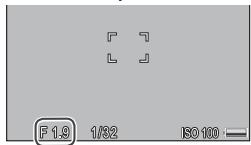
Press the shutter-release button halfway.
Press the shutter-release button halfway to set focus and exposure. The aperture selected by the camera will be displayed in the picture display.
4 Take the photograph.
Gently press the shutter-release button the rest of the way down to shoot.

Note
Maximum aperture (i.e., the lowest possible f-number) may not be selected at slow shutter speeds, even when the subject is poorly lit.
Mode M: Manual Exposure
In mode M (manual exposure), you use the up-down dial to choose aperture and the ADJ lever to select a shutter speed.
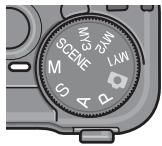
1 Choose mode M.
Rotate the mode dial to M. The shooting mode, exposure indicator, and current aperture and shutter speed appear in the display.
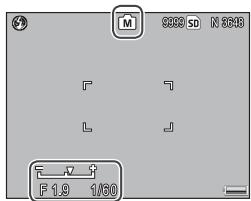
2 Choose an aperture and shutter speed.
Rotate the up-down dial to choose an aperture and press the ADJ lever left or right to select a shutter speed (if de
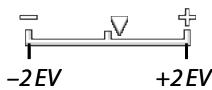
sired, the roles of the two controls can be reversed; see page 123). The effects can be previewed in the picture display and are reflected in the exposure indicator (if the image would be under- or over-exposed by more than 2EV , the effects can not be previewed and the indicator will turn orange).
3 Focus.
Press the shutter-release button halfway to focus.
4 Take the photograph.
Gently press the shutter-release button the rest of the way down to shoot.

Notes
- If Auto or Auto-Hi is selected for ISO Setting (page 84), ISO will be fixed at 100 while the camera is in manual exposure mode.
- Choose slower shutter speeds for longer exposure times. To reduce blur caused by camera shake, hold the camera steadily in both hands or use a tripod. The picture display turns off while the shutter is open. At speeds of 10 s or slower, the camera automatically processes photographs to remove noise, increasing the time needed to record images to about twice the shutter speed.
- Autoexposure (AE) lock is not available in manual exposure mode. If AE Lock is selected for Set Fn1 Button or Set Fn2 Button in the setup menu, pressing the affected button in manual exposure mode will set shutter speed or aperture to a value close to that needed for optimal exposure. Similarly, if Exposure Comp. is selected for Zoom Button in the setup menu, pressing the and buttons will not display exposure compensation options in manual exposure mode, but will instead set shutter speed or aperture to a value close to that needed for optimal exposure. This is useful when you want to use optimal exposure as a starting point for modifying exposure. The One Press M Mode option in the setup menu determines whether shutter speed or aperture is altered to achieve optimal exposure.
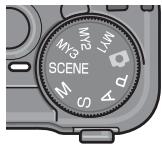
SCENE Mode: Matching Settings to the Scene
Select SCENE mode to shoot movies or to choose from one of the following subject types. Camera settings are automatically optimized for the selected subject type.
| Option | Description |
| DR Dynamic Range | Choose for natural contrast when photographing subjects that are partly in the shade on a sunny day and other high-contrast scenes (page 48). A tripod is required; results are not guaranteed with subjects that are in motion. |
| Skew Correct Mode | Reduce the effects of perspective when photograph-ing rectangular objects, such as message boards or business cards (page 51). |
| Text Mode | Make black-and-white photographs of text or drawings on notepaper or a white board (page 52). |
| Movie | Shoot movies with sound (page 87). |
To select a scene mode option:
1 Rotate the mode dial to SCENE.
The option currently selected for SCENE mode appears in the display.
2 Press MENU/OK.
A menu of scene mode options will be displayed.
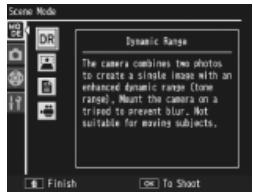
3 Select an option.
Press or to highlight an option and press MENU/OK to return to shooting mode with the selected option shown at the top of the display.
4 Shoot.
- Dynamic range double shot: See page 48.
- Skew correct mode: See page 51.
- Text mode: See page 52.
- Movie mode: See page 87.

Tip: Using the Menu
To access the shooting and setup menus in SCENE mode, press the MENU/OK button to display the scene mode menu and press to highlight the mode tab. Press or to highlight the shooting menu tab (page 54), key custom settings tab (page 112), or setup menu tab (page 112), and press to place the cursor in the selected menu. See pages 55-56 for information on the shooting menu options available in each mode.
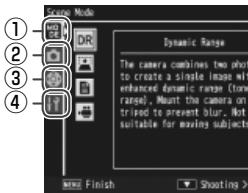
① Modetab
② Shooting menu tab
③ Key custom settings tab
④ Setup menu tab
SCENE Mode: Dynamic Range Double Shot
Each time the shutter-release button is pressed, the camera takes two shots at different exposures, then combines the areas that are
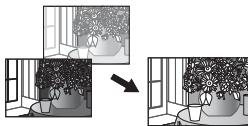
correctly exposed to create a single composite image with natural contrast, reducing loss of detail in highlights and shadows. Use to photograph scenes that contain both sunlight and shade or other high-contrast subjects.

Cautions
- The flash turns off, digital zoom can not be used, and RAW options can not be selected for Picture Quality/Size (page 57).
- The desired effect may not be achieved if the scene is too bright or too dark.
- Moving subjects may be blurred.
- Flicker from fluorescent lights may affect colors and brightness.

Tip: Dynamic Range
"Dynamic range" refers to the range of tones that can be expressed by the camera, which is narrower than that visible to the naked eye. In high-contrast scenes, this may result in loss of detail in highlights and shadows. Dynamic range double shot creates a smooth transition from highlights to shadows for natural contrast.
1 Mount the camera on a tripod.

Note
Dynamic range double shot requires more time to create an exposure than other modes, and an icon is displayed to show that photos may be blurred. Use a tripod. Note that the camera may move when the shutter-release button is pressed, even if mounted on a tripod. This can be prevented by using the self-timer (page 26) or an optional CA-1 cable switch wired remote shutter release.
2 Focus.
Press the shutter-release button halfway to set focus, exposure, and white balance.
3 Shoot.
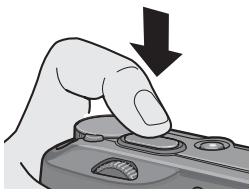
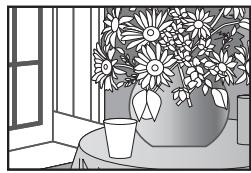
Gently press the shutter-release button the rest of the way down. The camera will take two pictures and combine them to create a single image with an enhanced dynamic range.
Shooting Menu Options
The following shooting menu options are available only in dynamic range double shot mode:
- Dynamic Range Expansion: Choose amount by which dynamic range is enhanced.
- Plus Normal Shooting: Choose On to record two copies of each photo, one with normal exposure and another with enhanced dynamic range.
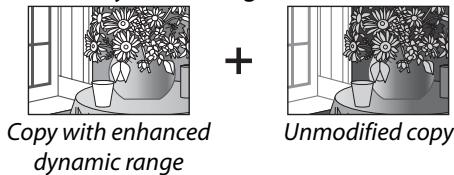
Follow the steps below to adjust these options in dynamic range double shot mode.
1 Display the shooting menu. Press MENU/OK to display the scene-mode menu. Press to highlight the mode tab, press to highlight the shooting menu tab, and press to place the cursor in the shooting menu.
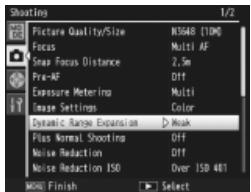
2 Select a menu item. Press or to highlight Dynamic Range Expansion or Plus Normal Shooting and press to display options for the highlighted item.
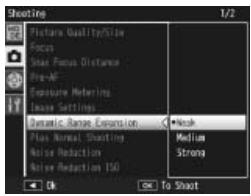
3 Select an option. Press or to highlight an option and press MENU/OK to select.

Tip: Plus Normal Shooting
When photographs taken with On selected for Plus Normal Shooting are displayed in the picture display after shooting, both the enhanced and unmodified copies appear with histograms showing tone distribution. If Hold is selected for LCD Confirmation
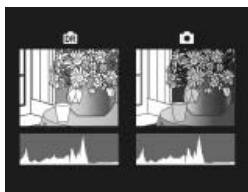
Time in the setup menu (page 126), the images will be displayed until the shutter-release button is pressed halfway.
SCENE Mode: Skew Correct
To take pictures in skew correct mode, frame the subject so that it occupies as much of the frame as possible and press the shutter-release button to take the photograph. If the camera is able to detect an object that can be used to correct perspective, a message will be displayed with the object shown by an orange frame. The camera can detect up to five objects; to select a different object, press , or press to record the photograph without correcting perspective. If the camera is unable to detect a suitable subject, an error message will be displayed and the photograph will be recorded without modification.

Caution: Skew Correct Mode
The camera records two images each time the shutter is released: the unmodified photograph and a copy that has been processed to correct perspective. No photograph will be taken if memory is insufficient to record two images. The camera may be unable to correct perspective if:
- The subject is out of focus.
- The four edges of the subject are not clearly visible.
- There is little contrast between the subject and the background.
- The background contains many fine details.

Tip: Skew Correction
The Skew Correction option in the playback menu can be used to correct perspective in existing photographs (page 98).
SCENE Mode: Text
To take pictures in text mode:
1 Adjust contrast.
Press the ADJ lever in to display the menu shown at right. Press or to highlight an option and press the ADJ lever or MENU/OK to select the highlighted option and clear the menu from the display.
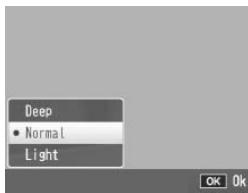

Tip: Adjusting Contrast
Contrast can also be adjusted using the Density option in the shooting menu (page 56).
2 Take the photograph.
Press the shutter-release button halfway to focus, then gently press it the rest of the way down to take the photograph.
To take photos using settings saved with the Reg. My Settings > MY1 option in the setup menu key custom settings tab (page 114), rotate the mode dial to MY1. Select
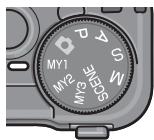
MY2 to take photos using the settings saved with MY2, MY3 to take photos using the settings saved with MY3.
1 Rotate the mode dial to MY1, MY2, or MY3.
The shooting mode saved using Reg. My Settings will be displayed in the picture display.
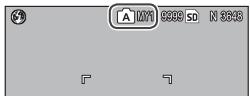

Note
Menu settings can be freely adjusted in "MY" modes. The settings saved with Reg. My Settings are restored when another mode is selected or the camera is turned off.

Tip: Choosing a Shooting Mode
To choose a shooting mode in "MY" mode without changing other settings, use the Switch Shooting Mode option in the shooting menu (page 86). Switch Shooting Mode is not available in "MY" modes for which a scene mode is selected.
2 Take the photograph.
See the section on the selected shooting mode for more information.
Use the , , , and MENU/OK buttons to navigate the menus.
1 Display the shooting menu. In modes other than SCENE, pressing the MENU/OK button in shooting mode displays the shooting menu.

Tip:SCENE Mode
In SCENE mode, pressing MENU/OK displays the mode menu; press to highlight the mode tab, to display the shooting menu, and to place the cursor in the menu.
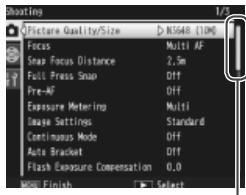
Scroll bar shows position in menu
2 Select a menu item.
Press or to highlight a menu item and press to display options for the highlighted item.
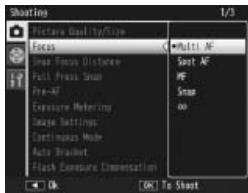
3 Select an option.
Press or to highlight an option. Press MENU/OK to select and exit to shooting mode, or press to select and return to the shooting menu.
The items available in the shooting menu vary with the shooting mode.

P, A, S, M, MY1, MY2 and MY3 Modes
| Option | Default | Page |
| Picture Quality/Size | N3648 (10M) | 57 |
| Focus | Multi AF | 59 |
| Snap Focus Distance | 2.5 m | 64 |
| Full Press Snap | On | 64 |
| Pre-AF | Off | 65 |
| Exposure Metering | Multi | 65 |
| Image Settings | Standard | 66 |
| Continuous Mode | Off | 68 |
| Auto Bracket | Off | 70 |
| Flash Exposure Compensation | 0.0 | 72 |
| Manual Flash Amount | 1/2 | 73 |
| Flash Synchro Settings | 1st Curtain | 73 |
| Noise Reduction | Off | 74 |
| Option | Default | Page |
| Noise Reduction ISO | Over ISO 401 | 74 |
| Interval Shooting | — | 75 |
| Date Imprint | Off | 76 |
| Exposure Compensation1 | 0.0 | 77 |
| White Balance | Multi-P AUTO | 79 |
| White Balance Compensation | A: 0; G: 0 | 82 |
| ISO Setting | Auto | 84 |
| Restore Defaults2 | — | 85 |
| Auto Aperture Shift3 | Off | 85 |
| Switch Shooting Mode4 | — | 86 |
1 Not available in mode M.
2 mode only.
3 Mode A only.
4 Mode MY1, MY2 or MY3 only.
SCENE Mode: Movie
| Option | Default | Page |
| Movie Size | 640 | 89 |
| Frame Rate | 30 Frame/Sec | 89 |
| Focus | Multi AF | 59 |
| Snap Focus Distance | 2.5 m | 64 |
| Option | Default | Page |
| Pre-AF | Off | 65 |
| White Balance | Auto | 79 |
| White Balance Compensation | A: 0, G: 0 | 82 |
SCENE Mode: Dynamic Range Double Shot
| Option | Default | Page | Option | Default | Page |
| Picture Quality/Size | N3648 (10M) | 57 | Noise Reduction | Off | 74 |
| Focus | Multi AF | 59 | Noise Reduction ISO | Over ISO 401 | 74 |
| Snap Focus Distance | 2.5 m | 64 | Date Imprint | Off | 76 |
| Pre-AF | Off | 65 | Exposure Compensation | 0.0 | 77 |
| Exposure Metering | Multi | 65 | White Balance | Multi-P AUTO | 79 |
| Image Settings | Standard | 66 | White Balance Compensation | A: 0; G: 0 | 82 |
| Dynamic Range Expansion | Weak | 49 | ISO Setting | Auto | 84 |
| Plus Normal Shooting | Off | 49 |
SCENE Mode: Skew Correct
| Option | Default | Page | Option | Default | Page |
| Picture Quality/Size | N1280 (1M) | 57 | Flash Exposure Compensation | 0.0 | 72 |
| Focus | Multi AF | 59 | |||
| Snap Focus Distance | 2.5 m | 64 | Flash Synchro Settings | 1st Curtain | 73 |
| Full Press Snap | On | 64 | Date Imprint | Off | 76 |
| Pre-AF | Off | 65 | Exposure Compensation | 0.0 | 77 |
| Exposure Metering | Multi | 65 | White Balance | Multi-P AUTO | 79 |
| Image Settings | Standard | 66 | ISO Setting | Auto | 84 |
SCENE Mode: Text
| Option | Default | Page | Option | Default | Page |
| Density | Normal | 46, 52 | Pre-AF | Off | 65 |
| Date Imprint | Off | 76 | |||
| Size | N3648 (10M) | 57 |
Picture Quality and Size
Picture quality (RAW, fine, and normal) and size (dimensions in pixels) determine the number of photographs that can be stored in internal memory or on a memory card (page 13). The following options are available:
| Option | Quality | Size | Description |
| RAW(10M)1 | RAW | 3,648×2,736 | Produces images adapted for further processing or editing on a computer. |
| RAW3:2(9M)1,2 | 3,648×2,432 | ||
| RAW1:1(7M)1,2 | 2,736×2,736 | ||
| F3648(10M) | Fine | 3,648×2,7363 | Produces images that can be printed at larger sizes or cropped on a computer. |
| N3648(10M) | Normal | ||
| F3:2(9M)2 | Fine | 3,648×2,432 | |
| N3:2(9M)2 | Normal | ||
| F1:1(7M)2 | Fine | 2,736×2,736 | |
| N1:1(7M)2 | Normal | ||
| N3264(8M) | 3,264×2,448 | ||
| N2592(5M) | 2,592×1,944 | Produces images suitable for printing. | |
| N2048(3M) | 2,048×1,5363 | ||
| N1280(1M)4 | 1,280×960 | Allows more photos to be stored. | |
| N640(VGA)4 | 640×480 | Produces small images suited to e-mail or the web and allows more photos to be stored. |
1 Not available in dynamic range double shot mode.
2 Edges of display blacked out to show crop in picture display.
3 One of two options available in text mode.
4 One of two options available in skew correct mode.
The camera supports the following picture qualities:
- Normal: JPEG compression is used to reduce file size.
- Fine: Compression is reduced for improved quality. File size increases, reducing number of photos that can be recorded.
- RAW: Raw image data are saved in DNG format; JPEG copies are also created. The camera displays only the JPEG copy; DNG files can be viewed and edited on a computer using the supplied Irodio Photo & Video Studio Software (Windows only) or commercially-available applications that support the DNG format.
Unlike normal- and fine-quality images, RAW images are not compressed. This increases file size but avoids the loss of quality associated with JPEG compression. Note the following when shooting RAW images:
- Some settings can not be used, as detailed in the section for the affected setting. Image Settings and Date Imprint options apply only to JPEG copies and have no effect on the DNG images.
- The size and quality of the JPEG copies recorded with DNG images can be selected using the RAW/JPEG Setting option in the setup menu (page 131).
- The number of RAW photographs that can be taken in a single burst in continuous mode varies with the option selected for Noise Reduction (page 74). Up to five photographs can be taken when noise reduction is disabled; when noise reduction is enabled, this number drops to four.
Focus
Choose how the camera focuses. By default, the camera uses autofocus; other options are listed below.
| Option | Description |
| Multi AF | The camera selects the focus area with the closest subject, preventing out-of-focus shots by keeping the camera from focusing on the background. |
| Spot AF | Focus on the subject in the center of the frame. |
| MF (manual focus) | Focus manually (page 60). |
| Snap | Focus is fixed at distance selected with Snap Focus Distance (page 64) for quick shutter response. |
| ∞ (infinity) | Fix the focus distance at infinity when photograph-ing distant scenes. |
In the case of MF, Snap, and , the current selection is shown by an icon in the picture display.
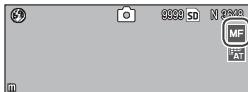

Tip: Depth of Field
Depth of field is the distance in front of and behind the focus point that appears to be in focus. Small apertures (high f-numbers) increase depth of field, bringing more of the scene into focus; large apertures (low f-numbers) decrease depth of field, emphasizing the main subject by blurring the foreground and background. At
settings of MF, Snap, and , the focus bar shows depth of field in shooting modes M, A, and P (in mode P, depth of field is only shown when the shutter-release button is pressed halfway and aperture values are displayed).
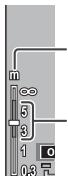
Focus bar (distances are approximate)
Depth of field (green)

Note
The Fn buttons can be used to switch back and forth between autofocus and manual or snap focus (page 121).
Focus: MF (Manual Focus)
Manual focus can be used to lock focus over a series of photographs or to focus when the camera is unable to focus using autofocus.

Note
Manual focus is not available in text mode (page 46).
1 Select MF (manual focus).
Select MF in the Focus menu. The focus mode and focus bar (page 59) are displayed in the picture display.
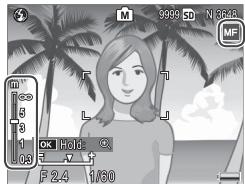
2 Choose the focus distance.
Press to increase the focus distance, to decrease.
To zoom in on the subject in the center of the picture display and check focus, press and hold the MENU/OK button. Press and hold the button again to return to the normal shooting display.
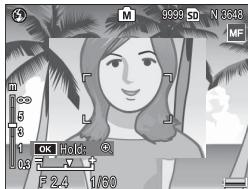
3 Take the picture.
See the section on the selected shooting mode for more information.
Choosing the Focus and Metering Target
Target selection can be used to set focus and exposure for off-center subjects without moving the camera, making it easier to use a tripod.
1 Activate target selection.
Press the ADJ lever in and then press the lever left or right to highlight = 5 . Press or to highlight one of the following options and press MENU/OK to select.
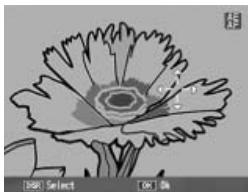
| Option | Description |
| AE/AF | Spot metering and spot autofocus; choose the focus and exposure target. |
| AF | Spot autofocus; choose the focus target. Exposure is metered using the option selected for Exposure metering (page 65). |
| AE | Spot metering; choose the metering target. Focus is set using the option selected for Focus (page 59). |
| Off | Target selection off. |
2 Position the target.
Using the , , and buttons, position the cross hairs over your subject and press MENU/OK (to return to the target selection menu, press DISP.).
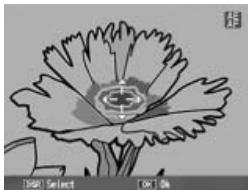
3 Take the picture.
Press the shutter-release button halfway to set focus and/or exposure for the selected subject and then gently press the shutter-release button the rest of the way down to take the picture.

Notes
- Target selection is not available in manual focus mode (page 60).
- The selected target remains in effect until a new target is selected. Note that target will be reset if you choose a new option in the target-selection menu or select manual focus.
- When the mode dial is rotated to SCENE, the focus target for macro mode can be selected by pressing the ADJ. lever in, selecting, and then using the , , , and buttons to position the cross-hairs as described on page 63.
- The Fn buttons can be used for focus target selection in macro mode (see below). Note that if the Fn buttons have been used to select the focus target, the ADJ lever can not be used for target selection until the target is reset.

Macro Target Selection
If Macro Target is assigned to the Fn1 or Fn2 button (pages 121-122), you can select macro mode by pressing the chosen button in shooting mode. The cross-hairs shown at right will be displayed; use the , , , and buttons to position the cross-hairs over your
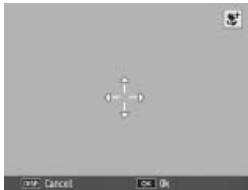
subject and press MENU/OK (to exit without moving the target, press DISP.). Press the shutter-release button halfway to focus on the selected target and then gently press the shutter-release button the rest of the way down to take the picture.
Note that if the ADJ lever has been used to select the focus target, the Fn buttons can not be used for target selection until the target is reset. Target selection can be reset by pressing the button.
Snap Focus Distance
Select the distance at which the camera focuses when Snap is selected for Focus (page 59) or Full Press Snap is on (see below). Choose from 1m (3.3 ft.), 2.5m (8.2 ft.), 5m (16.4 ft.), and (infinity).

Note
When Snap is selected for Focus or Full Press Snap is on, the snap focus distance can also be selected by pressing and rotating the up-down dial.
Full Press Snap
Take photographs without pausing to focus the camera when Multi AF or Spot AF is selected for Focus (page 59).
| Option | Description |
| Off | The camera focuses normally. |
| On | If the shutter-release is pressed all the way down in one motion, the camera will take a picture at the focus distance selected for Snap Focus Distance. Choose when quick shutter response is required. |
| On (Auto-Hi ISO) | As for On, except that ISO sensitivity is automatically set to Auto-Hi (page 84). |

Tip: Autofocus
The camera will focus normally if you pause with the shutter-release button pressed halfway.

Cautions
- Full press snap is not available in macro mode or when MF, Snap, or is selected for Focus.
- Care is required to avoid blur caused by camera movement.
Pre-AF
If On is selected when Multi AF or Spot AF is selected for Focus (page 59), the camera will continue to focus even when the shutter-release button is not pressed halfway (the focus range, however, is narrower than for normal focus). This may decrease the time needed to focus when a picture is taken, potentially improving shutter response.

Cautions
- Pre-AF is not available when MF, Snap, or is selected for Focus.
- Using pre-AF increases the drain on the battery.
Exposure Metering
Choose how the camera measures exposure.
| Option | Description |
| Multi | The camera meters exposure in 256 areas of the frame. |
| Center | The camera meters the entire frame but assigns the great-est weight to the center. Use when the subject in the cen-ter of the frame is brighter or darker than the background. |
| Spot | The camera meters only the subject in the center of the frame, ensuring that it is correctly exposed even when it is markedly brighter or darker than the background. |
Settings of Center and Spot are shown by an icon in the picture display.
Image Settings
Control contrast, sharpness, and vividness (color depth) or take monochrome photographs.
| Option | Description |
| Vivid | Take strong, vivid photos with heightened contrast and sharpness and maximum vividness. |
| Standard | Normal contrast, sharpness, and vividness. |
| Black & White | Take photos in black and white. Contrast and sharpness can be adjusted manually. |
| B&W (TE) (toning effect) | Create monochrome photos with a sepia, red, green, blue, or purple tint. Vividness, contrast, and sharpness can be adjusted manually. |
| Setting 1 Setting 2 | Make individual adjustments to vividness, contrast, sharpness, colors and hue to create custom settings that can be recalled as desired. |

Note
Contrast has no effect in dynamic range double shot mode.
At settings other than Standard, the current selection is shown by an icon in the picture display.
To make individual adjustments to the settings for Black & White, B&W (TE), Setting 1, or Setting 2, highlight the desired option and press .
1 Adjust custom color reproduction settings.
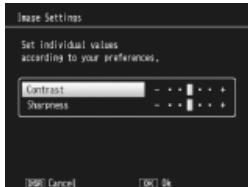
- Black & White: Press and to highlight an option and press and to change.
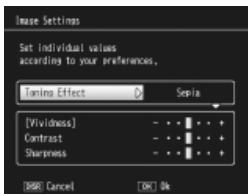
B&W (TE): Adjust vividness, contrast, and sharpness as described above. To choose a tint, highlight Toning Effect and press . Press and to highlight an option and press to select.
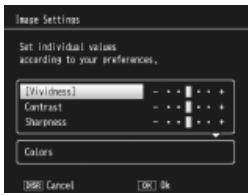
- Setting1/Setting2: Adjust vividness, contrast, and sharpness as described above. To adjust individual colors, highlight Colors and press . Press and to highlight an option and press and to change. Press MENU/OK to exit when settings are complete.
2 Press MENU/OK.
Press MENU/OK to return to the Image Settings menu when settings are complete.
3 Exit to shooting mode.
Press MENU/OK to exit to shooting mode, or press and then press MENU/OK.
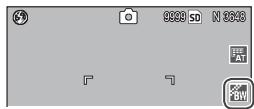
The option currently selected for Image Settings will be displayed in the picture display.
Continuous Mode
Shoot photographs one at a time or in continuous sequence. The following options are available:
- Off: One photo is taken each time the shutter-release button is pressed.
- Continuous: The camera records photographs one after the other while the shutter-release button is pressed.
S-Cont (stream continuous): While the shutter-release button is pressed, the camera shoots up to 16 frames at about 7.5 frames per second and joins them to form a single image 3,648 × 2,736 pixels in size. About 2 s are required to shoot the entire sequence.
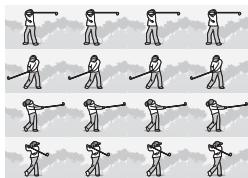
- M-Cont (memory-reversal continuous): The camera shoots while the shutter-release button is pressed, but only the last 16 frames (about the last two seconds of shooting) are recorded, creating a single image 3,648 × 2,736 pixels in size.
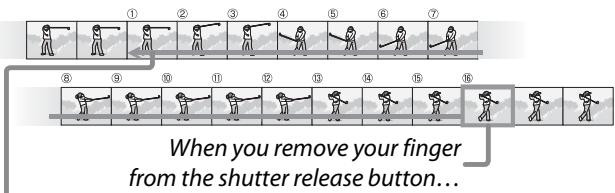
...the camera records the frames taken in the last two seconds (frames ① to ⑥).
At settings other than Off, the current selection is shown by an icon in the picture display.

Caution
Digital zoom is available at settings of S-Cont and M-Cont even if Auto Resize is selected for Digital Zoom Image.

Notes
- At settings other than Off, the flash turns off automatically, focus and exposure are fixed with the first shot in each series, and Auto white balance is used in place of Multi-P AUTO (page 79).
- ISO settings of ISO 100 or ISO 64 will be set to Auto while S-Cont or M-Cont are in effect.

Tip: Viewing S-Cont and M-Cont Images with Playback Zoom
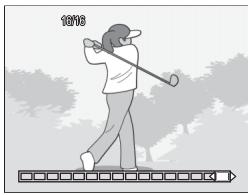
Zoom can be used to view the individual frames of S-Cont and M-Cont images during playback. Pressing the Q button while an image taken with either of these options is displayed in single-frame playback displays the first frame in the sequence; use the and
- buttons to display other frames. Your current position in the sequence is shown by strip at the bottom of the display (the DISP. button can be used to hide the strip; see page 36). Press MENU/OK to exit.
Auto Bracket
Vary exposure, white balance, or color to record two or three images "bracketing" current settings.
| Option | Description | |
| BKTAEON ±0.3 | Each time the shutter-release but-ton is pressed, the camera takes three photos: one underexposed by 0.3 EV, a second at current exposure settings, and a third over-exposed by 0.3 EV. Choose when you find it difficult to judge the correct exposure. | Recordings -0.3 Display after shooting |
| BKTAEON ±0.5 | As above, except that the camera varies exposure by 0.5 EV with each shot instead of 0.3 EV. | |
| BKTWBW-BKT | The camera records three copies of each photo: one with a "warm," reddish cast, a second at the white balance currently selected in the shooting menu (page 79), and a third with a "cool," blueish cast. Choose when you find it difficult to select the correct white balance. | Recordings EE3 Display after shooting |
| BKTCLBKT | Record photos in both black-and-white and color or in black-and-white, color, and tinted monochrome (page 71). | |
The current selection is shown by an icon in the picture display.

Notes
- Bracketing is not available when an option other than Off is selected for Continuous. White balance bracketing is not available when shooting monochrome photographs.
- White balance bracketing and color bracketing are not available when a RAW-quality option is selected for Picture Quality/Size (page 57).
- The flash turns off automatically when bracketing is in effect.
- Auto white balance is used in place of Multi-P AUTO when exposure bracketing is in effect.
CL-BKT:Color Bracketing
The number and type of photographs recorded when CL-BKT is selected for Auto Bracket depends on the option chosen for CL-BKT Black & White (TE) in the setup menu (page 131):
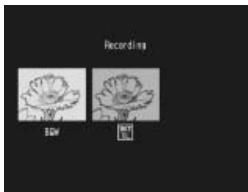
- Off: The camera records two copies of each photograph, one in black and white and a second in color.
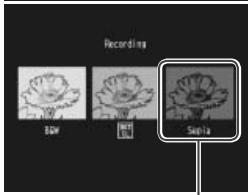
- On: The camera records three copies of each photograph, one in black and white, a second in color, and a third using the tint selected for B&W (TE) in the Image Settings menu (pages 66-67).
B&W (TE) copy

Tip: Contrast, Sharpness, and Color Depth
The contrast, sharpness, and vividness of the images in the bracketing sequence are determined by the options selected in the Image Settings menu (pages 66-67). The black-and-white copy is recorded at the settings most recently selected for Black & White, the tinted monochrome copy at the settings most recently selected for B&W (TE), and the color copy at the setting currently selected for Image Settings (if Black & White or B&W (TE) is selected, the color copy will be recorded at a setting of Standard).
Flash Exposure Compensation
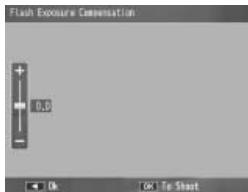
Adjust flash level by -2.0 to +2.0 in steps of 1/3 EV. Selecting Flash Exposure Compensation in the shooting menu displays the slider shown at right; press or to choose a flash exposure compensation value and press MENU/OK.
Flash exposure compensation is displayed in the picture display except when the flash is off.
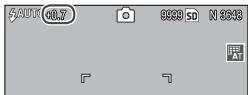

Note
See page 24 for information on using the flash.

Caution
Flash exposure compensation may have no effect outside the range of the flash (page 24).
Manual Flash Amount
Choose amount of light produced by the flash in manual flash mode (page 24). Flash output is expressed as a fraction of full power (all values are approximate):
FULL 1 / 1,4 1 / 2 1 / 2,8 1 / 4 1 / 5,6 1 / 8 1 / 11 1 / 16 1 / 22 1 / 32 1 / 64
Flash level is displayed in the picture display in manual flash mode.
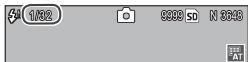

Note
Flash exposure compensation is not available in manual flash mode.

Cautions
- In manual mode, flash level is not automatically adjusted according to lighting conditions.
- Do not direct the flash at a person operating a motor vehicle or use the flash close to the subject's eyes. Particular care should be observed when photographing infants.
Flash Synchro Settings
Choose how the flash synchronizes with the shutter.
- 1st Curtain: The flash fires at the beginning of the exposure. Recommended in most situations.
- 2nd Curtain: The flash fires at the end of the exposure. This option produces trails of light behind moving light sources.
Noise Reduction
Choose Weak or Strong to reduce "noise" (random variations in brightness and color) in photographs taken at high ISO sensitivities. The minimum ISO sensitivity at which noise reduction applies can be selected using Noise Reduction ISO (see below).
NR is displayed when noise reduction is on.
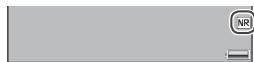

Notes
- When a RAW-quality option is selected for Picture Quality/Size, noise reduction applies only to the JPEG copy, not to the DNG file.
- The time needed to record photographs varies with the option selected for Noise Reduction.
Noise Reduction ISO
Select the minimum ISO sensitivity at which noise reduction applies when Weak or Strong is selected for Noise Reduction. Choose from All (noise reduction applies at all ISO sensitivities), Over ISO 201, Over ISO 401, Over ISO 801, and ISO 1600.
Interval Shooting
To take photos automatically at intervals of from five seconds to one hour, select Interval Shooting in the shooting menu and follow the steps below:
1 Choose an interval.
Press and to highlight hours, minutes, or seconds and press and to change. Press MENU/OK to return to shooting mode.
Interval will be displayed in the picture display.

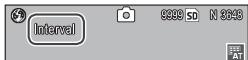
2 Start shooting.
Press the shutter-release button. Photographs will be taken automatically at the selected interval.
3 End shooting.
Press MENU/OK to end shooting when all the desired photographs have been taken.
Cautions
- The interval timer is not available in SCENE mode.
- The interval resets to zero when the camera is turned off.
- If the time needed to record photographs is longer than the selected interval, the next photograph will not be taken until recording is complete.

Notes
- Use a fully-charged battery or optional AC adapter and be sure that sufficient space remains in internal memory or on the memory card. Interval timer photography ends automatically when the number of exposures remaining reaches zero.
- Photographs can be taken at any time by pressing the shutter-release button.
- If Continuous or M-Cont is selected for Continuous Mode, continuous shooting turns off automatically.
Date Imprint
Imprint the date (YY/MM/DD) or date and time (YY/MM/DD hh:mm) on photographs as they are taken.
An indicator is displayed in the bottom right corner of the picture display when date imprint is on.

Notes
- Date imprint is not available when the clock is not set. Set the clock (page 16) before using date imprint.
- The date can not be imprinted on movies.
- When a RAW-quality option is selected for Picture Quality/Size, the date is imprinted only on the JPEG copy, not the DNG file.
- The date is permanently imprinted on the image and can not be removed.
Exposure Compensation
The camera automatically adjusts exposure for the subject in the center of the frame, producing optimal exposure even when the subject is backlit. Exposure compensation may however be required in situations such as the following:
- Very bright backlighting: Subjects that are very strongly backlit may be underexposed. Try increasing exposure compensation.
- The frame is dominated by very bright objects: The subject may be underexposed. Try increasing exposure compensation.
- The frame is mostly dark (for example, a spotlit subject on a darkened stage): The subject may be overexposed. Try reducing exposure compensation.
Exposure compensation can be adjusted from the shooting menu or using the ADJ lever.
The Shooting Menu
Selecting Exposure Compensation in the shooting menu displays the slider shown at right; press or to choose an exposure compensation value and press MENU/OK.
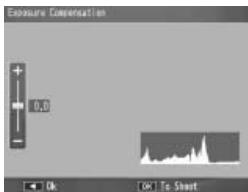
The ADJ. Lever
If exposure compensation is assigned to the ADJ. lever (page 119), exposure compensation can be adjusted as described below.
1 Display the exposure compensation slider.
With the camera in shooting mode, press the ADJ lever in and press or or press the ADJ lever left or right until the exposure compensation slider is displayed.
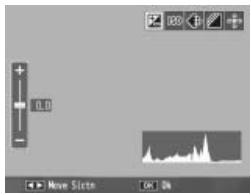
Adjust exposure compensation.
Press or to choose an exposure compensation value. Press the shutter-release button to take a picture or press the ADJ lever or MENU/OK to return to shooting mode.
At settings other than 0.0, exposure compensation is displayed in the picture display.
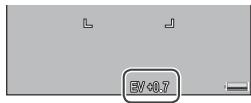

Caution
Exposure compensation is not available in mode M.
White Balance
At the default setting of Multi-P AUTO, the camera automatically adjusts white balance so that a white subject will appear white regardless of the color of the light source. It may however be necessary to match white balance to the light source under mixed lighting or when photographing a subject that is a solid color.
| Option | Description |
| Auto | The camera adjusts white balance automatically. |
| Multi-P AUTO | The camera adjusts white balance to account for differences in lighting in separate areas of the frame (in continuous mode, this option is equivalent to Auto). |
| Outdoors | Use when shooting in daylight under clear skies. |
| Cloudy | Use when shooting in daylight under cloudy skies. |
| Incandescent Lamp | Use with incandescent lighting. |
| Fluorescent Lamp | Use with fluorescent lighting. |
| Manual Settings | Measure white balance manually (page 80). |
| Detail | Make fine adjustments to white balance (page 81). |
At settings other than Auto, the current selection is shown by an icon in the picture display.
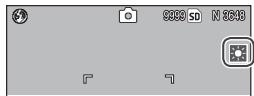
Cautions
- Auto white balance may not produce the desired results with scenes lacking white objects. This can be corrected by adding a white object to the scene before shooting.
- Options other than Auto may not produce the desired results when the flash is used. Select Auto when using the flash.
White balance can be selected in the shooting menu (page 79) or assigned to the ADJ lever (page 119) and adjusted as described below:
1 Display white balance options.
With the camera in shooting mode, press the ADJ lever in and press or or press the ADJ lever left or right until white balance options are displayed.
2 Select a white balance option.
Press or to select an option. Press the shutter-release button to take a picture or press the ADJ lever or MENU/OK to return to shooting mode.
Manual: Measuring White Balance
To measure a value for white balance:
1 Select Manual Settings. Highlight WM Manual Settings in the white balance menu.
2 Measure white balance. Frame a blank piece of paper or other white object so that it fills the frame and press the
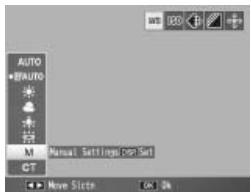
DISP. button. Repeat Steps 1-2 until the desired effect is achieved.
3 Press MENU/OK. Press MENU/OK to return to shooting mode.

Note
Selecting an option other than Manual Settings resets manual white balance.
Detail: Making Fine Adjustments to White Balance
To make fine adjustments to white balance:
1 Select Detail.
Highlight Detail in the white balance menu and press the DISP. button.
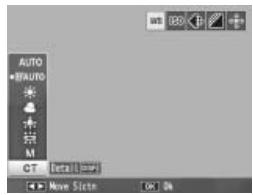
2 Choose a setting.
Press or to choose a white balance. Press MENU/OK when settings are complete.
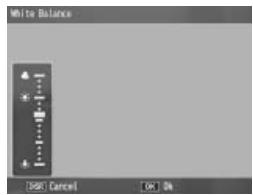
3 Return to shooting mode.
Press MENU/OK to return to shooting mode.

Note
Selecting an option other than Detail resets detail white balance.
White Balance Compensation
Compensate for color casts by modifying white balance on the green-magenta or blue-amber axis. The modifications apply to the option currently selected for white balance and to all options selected while the modifications are in effect.
Selecting White Balance Compensation in the shooting menu (page 54) displays the controls shown at right. Choose white balance compensation using the , , , or buttons, or press the DISP button to reset white balance compensation to a neutral value. Press MENU/OK to save changes and exit, or press the DISP button twice to cancel.
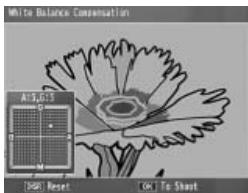
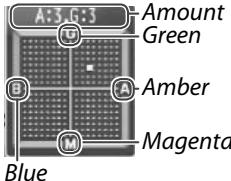
White balance compensation is shown in the picture display.
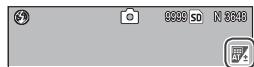

Notes
- White balance compensation can be assigned to the ADJ lever (page 119). To reset, highlight Reset and press MENU/OK.
- White balance compensation can also be assigned to the Fn buttons (pages 121-122).
- When the mode dial is rotated to SCENE, white balance compensation is only available in movie and dynamic range double shot modes.
- The White Balance Compensation option in the playback menu (page 103) does not use the same values as the shooting menu option.
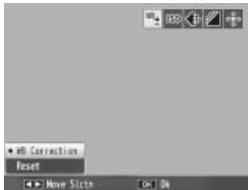
ISO Setting
Adjust the camera's sensitivity to light. Higher values can be used for faster shutter speeds when the subject is poorly lit, preventing blur.
- Auto: The camera automatically adjusts sensitivity according to brightness, the distance to the subject, and the options selected for macro mode and picture quality and size.
- Auto-Hi (high sensitivity auto): As above, except that the camera selects higher sensitivities when the subject is poorly lit. The maximum sensitivity can be selected in the setup menu (page 125).
- ISO 64-ISO 1600: Sensitivity is set to the selected value.
The current sensitivity is shown in the picture display (if Auto or Auto-Hi is selected, the sensitiv
ity selected by the camera is shown when the shutter-release button is pressed halfway).
Sensitivity can be selected in the shooting menu (page 54) or assigned to the ADJ. lever (page 119) and adjusted as described below:
1 Display ISO sensitivity options.
With the camera in shooting mode, press the ADJ lever in and press or or press the ADJ lever left or right until ISO sensitivity options are displayed.
2 Select an ISO sensitivity option.
Press or to select an option. Press the shutter-release button to take a picture or press the ADJ lever or MENU/OK to return to shooting mode.

Notes
- "Noise" (random variations in brightness and color) may appear in photographs taken at high sensitivities.
- The sensitivity displayed in the picture display in Auto and Auto-Hi modes may differ from the actual value. If the flash is used, a sensitivity of Auto is equivalent to ISO 125, regardless of the value displayed in the picture display. The range of sensitivities available in Auto mode when the flash is off is shown below:
| Picture size | ISO sensitivity | ||
| Default | Min. | Max. | |
| 640 | 100 | 64 | 283 |
| 1280 | 238 | ||
| 2048 | 176 | ||
| Picture size | ISO sensitivity | ||
| Default | Min. | Max. | |
| 2592 | 100 | 64 | 154 |
| 3264 | |||
| 3648 | |||
Restore Defaults
To restore default shooting menu settings (pages 55-56), rotate the mode dial to and select Restore Defaults in the shooting menu. A confirmation dialog will be displayed; highlight Yes and press MENU/OK to restore default values and exit to shooting mode.
Auto Aperture Shift
When On is selected, the camera will automatically adjust aperture to prevent overexposure in mode A.

Note
Auto aperture shift is available only in mode A.
Switch Shooting Mode
When the mode dial is rotated to a "MY" mode (page 53), you can use this option to switch between P, A, S, and M modes without rotating the mode dial to a new setting. This option is only available
in "MY" modes and is not displayed if the shooting mode currently selected for Reg. My Settings is a scene mode.
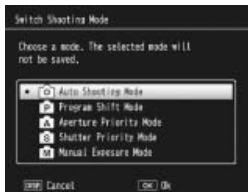
This section describes how to record and view movies.

Recording Movies
Shoot movies with sound. Movies are stored as AVI files.
1 Rotate the mode dial to SCENE.
The option currently selected for SCENE mode appears in the display.
2 Press MENU/OK.
A menu of scene mode options will be displayed.
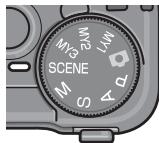
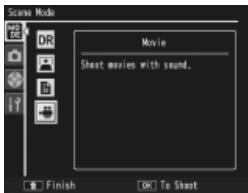
3 Select
Press ▲ or ▼ to highlight (movie) and press MENU/OK to exit to movie mode.
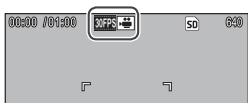
4 Shoot.
Press the shutter-release button to begin recording; press again to end. Recording ends automatically when memory is full.

Cautions
- Sounds made by the camera may be recorded with the movie.
- Movies may be up to 90 minutes in length or 4GB in size. Depending on the type of memory card used, shooting may end before this length is reached. The maximum total length of all movie files that can be stored in internal memory or on a memory card varies with the options selected for Movie Size and Frame Rate (page 89).

Notes
The flash can not be used.
- The camera focuses when the shutter-release button is pressed to begin recording.
- The amount of time remaining is calculated based on the amount of memory available and may not diminish at an even rate.
- Shooting menu options differ from those available in other modes (page 55).
- Charge the battery before shooting or use an optional AC adapter. For long recordings, choose memory cards with high write speeds and check the amount of memory available before shooting.
Choosing the Frame Size and Frame Rate
Movies consist of a series of images (frames) that are played at high speed to create the illusion of motion. To choose a frame size (the size of each frame in pixels) or frame rate (the rate at which the frames are recorded), select mode and follow the steps below:
1 Display the shooting menu.
Press MENU/OK to display the scene menu. Press to highlight the mode tab, press to highlight the shooting menu tab, and press to place the cursor in the shooting menu.
2 Select Movie Size or Frame Rate.
Highlight Movie Size or Frame Rate and press to display options for the selected item.
3 Highlight an option.
- Movie Size: Choose 640 (640×480 pixels) or 320 (320×240 pixels).
- FrameRate: Choose 30 Frames/ Sec (30 fps) or 15 Frames/Sec (15 fps).
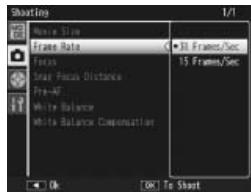
4 Exit to shooting mode.
Press MENU/OK. The selected option will be displayed in the picture display.
Follow the steps below to view movies.
Press
Press the button to display pictures in the picture display.
2 Display the movie.
Use the , , , and buttons (page 29) to scroll through pictures until the first frame of the movie is displayed. Movies are indicated by a icon.
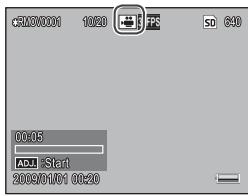
3 Start playback.
Press the ADJ lever in to start playback. Progress is shown in the playback display. The following operations can be performed:
| To | Press | Description |
| Advance/rewind | Q/■ | Hold Q to fast forward, ■ to rewind. If movie is paused, movie will advance or rewind one frame; keep button pressed for slow advance or rewind. |
| Pause/resume | ADJ. | Press the ADJ. lever in to pause; press again to resume. |
| Adjust volume | ▲/▼ | Press ▲ to increase volume, ▼ to decrease. |
More onPlayback
This section details the options in the playback menu and describes how to view pictures on a TV.
ThePlaybackMenu
To use the playback menu, press the button to start playback and follow the steps below.
1 Display the playback menu.
Press the MENU/OK button to display the playback menu.
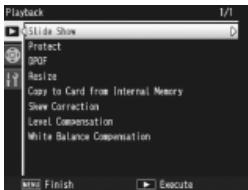
2 Select a menu item.
Press or to scroll through the menu and press to display options for the highlighted item.
The playback menu contains the following options:
| Option | Page | Option | Page |
| Slide Show | 92 | Copy to Card from Internal Memory | 97 |
| Protect | 92 | Skew Correction | 98 |
| DPOF | 95 | Level Compensation | 100 |
| Resize | 97 | White Balance Compensation | 103 |

Note
The setup menu can be accessed from the playback menu (page 112).
Slide Show
Selecting this option starts an automated slide show. Pictures are displayed at three second intervals in the order recorded. When a movie is displayed, movie playback begins automatically; the slide show resumes when playback is complete.
The slide show repeats until stopped; press any button to end the slide show.
Protect
Protect pictures from accidental deletion. Protected files are indicated by the icon shown at right.
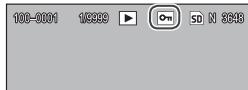

Caution
Formatting erases all files, including protected files.
Protecting Individual Pictures
To protect or remove protection from individual files, play the picture back and select Protect in the playback menu to display the options shown at right (if the desired image is not displayed, press or
to view other pictures). Highlight 1 File and press MENU/OK.
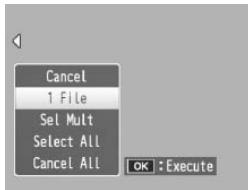
Changing the Protect Status of Multiple Files
Follow the steps below to change the protect status of multiple selected files.
1 Select Protect in the playback menu.
In multi-frame playback, proceed to Step 2. In single-frame playback, the options shown at right will be displayed. Highlight Sel Mult and press MENU/OK.
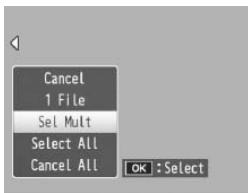
2 Select Sel. Indiv. or Sel. Range.
Select Protect in the playback menu to display the options shown at right. To select images one at a time, highlight Sel. Indiv., press MENU/OK, and proceed to Step 3. To se
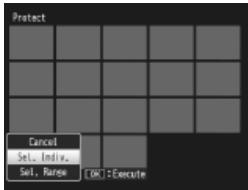
lect one or more ranges consisting of two images and all photographs between them, highlight Sel. Range, press MENU/OK, and proceed to Step 3.1.
3 Select photographs.
Press , , or to highlight photos and press MENU/OK to select. Protected pictures are marked with icons. To remove protection from a photo, highlight it and press MENU/OK again.
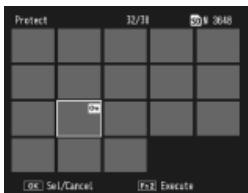
To select one or more ranges consisting of two images and all photographs between them, press the ADJ lever in and follow the steps below:
3.1 Press , , , or to highlight the first image and press MENU/OK to select. The selected image is marked with an icon. If you selected the wrong image, press DISP. and try again.
3.2 Press , , , or to highlight the last image and press MENU/OK to select. The selected image and other images in the selected range will be marked with icons.
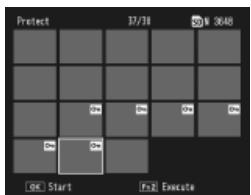
Repeat Steps 3.1-3.2 to select additional ranges, or press the ADJ lever in to select or deselect individual photographs as described in Step 3.
4 Press the Fn2 button.
A message will be displayed while the camera protects the selected files. The camera will then return to normal playback.
Protecting or Removing Protection from All Files
To protect all files, select Protect, highlight Select All and press MENU/OK. To remove protection from all files, highlight Cancel All and press MENU/OK.
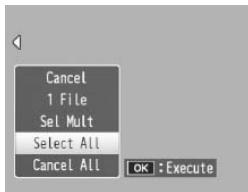
DPOF: Selecting Pictures for Printing
To request professional prints of the photographs on a memory card, first use this option to create a digital "print order" listing the photos you wish to print and the number of prints, and then take the memory card to a digital print service center that supports the DPOF standard.

Note
If a photograph created using a RAW picture-quality option is selected for printing, only the JPEG copy will be printed.

Tip: DPOF
DPOF (Digital Print Order Format) is a standard used to specify the photos to be printed and the number of prints. Photos selected for printing are marked with a DPOF print indicator (page 7).
Selecting Individual Photos for Printing
To add a photo to or remove it from the print order, play the picture back and select DPOF in the playback menu to display the options shown at right (if the desired image is not displayed, press
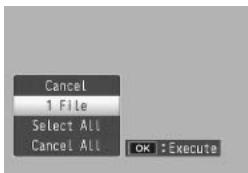
or to view other pictures). Highlight 1 File and press MENU/OK.
Selecting All Photos for Printing
To select all photos for printing, select DPOF, highlight Select All and press MENU/OK. To remove all photos from the print order, highlight Cancel All and press MENU/OK.
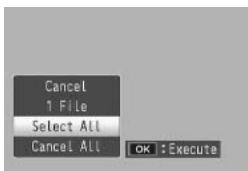
Multi-Frame Playback
To select multiple photographs for printing:
1 Select DPOF.
Press MENU/OK in multi-frame playback to display the playback menu. Highlight DPOF and press
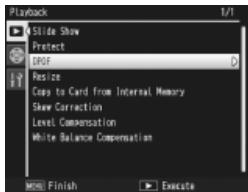
2 Select photos and choose the number of prints.
Press or to highlight additional photos and or to choose the number of prints. To remove a photograph from the print order, press until the number of prints is zero.
3 Press MENU/OK.
A message will be displayed while the camera creates the print order. The camera will then return to multi-frame playback.

Note
For information on removing all photos from the print order, see page 95.
Resize: Creating Small Copies of Photographs
To create a small copy of the current photograph, select Resize in the playback menu (page 91) and choose a size. Fine- and normal-quality photos larger than 1,280 × 960 pixels can be copied at sizes of N1280 or N640, while N1280 pictures can be copied at a size of N640. Movies and RAW-quality photos can not be resized.

Notes
- All copies have an aspect ratio of 4:3. Copies created from photos with an aspect ratio of 3:2 or 1:1 have a black border.
- See page 57 for information on choosing the size of photographs during shooting.
Copy to Card from Internal Memory
To copy all files from internal memory to a memory card, insert the memory card in the camera and select Copy to Card from Internal Memory in the playback menu (page 91). A message will be displayed while copying is in progress; the camera will return to playback when copying is complete.

Notes
- If the space available on the memory card is insufficient to hold all the files in internal memory, a message will be displayed. To copy only those files that will fit in the space available, highlight Yes and press MENU/OK; to exit without copying any files, select No.
- Files can not be copied to internal memory from a memory card.
Skew Correction
Create copies that have been processed to reduce the effects of perspective on rectangular objects, such as message boards or business cards.
1 Display the photo.
Display the photo to be copied in playback mode.
2 Select Skew Correction.
Press MENU/OK to display the playback menu, highlight Skew Correction, and press. If the camera is able to detect an object that can be used to correct perspective,
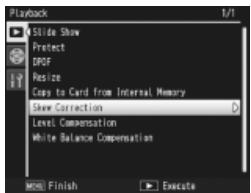
a message will be displayed with the object shown by an orange frame. The camera can detect up to five objects; to select a different object, press , or press to exit without correcting perspective. If the camera is unable to detect a suitable subject, an error message will be displayed.
3 Press MENU/OK.
A message will be displayed while the camera copies the photo. Copying takes from about 2 to 46 seconds, depending on image size (page 99).
Caution
Skew correction is available only with still images taken with this camera. It is not available with movies or with photos taken with S-Cont or M-Cont selected for Continuous. When used with photos taken with a RAW option selected for picture quality (page 57), skew correction applies only to the JPEG copy.

Notes
- The copy is the same size as the original. The time needed to create a copy increases with image size:
| Size | Time (approx.) | Size | Time (approx.) |
| 3,648 × 2,736 | 21 sec. | 2,048 × 1,536 | 8 sec. |
| 3,264 × 2,448 | 17 sec. | 1,280 × 960 | 5 sec. |
| 2,592 × 1,944 | 12 sec. | 640 × 480 | 2 sec. |
To reduce the time required, create a small copy of the original using Resize (page 97) and perform skew correction on the copy.
- Skew correction can also be performed during shooting (pages 46, 51).
Level Correction
Create copies that have been processed to adjust brightness and contrast. Correct brightness and contrast automatically (see below) or make manual adjustments using a histogram (pages 101-102).
Auto: Automatic Level Correction
1 Display the photo.
Display the photo to be copied in playback mode.
2 Select Level Compensation.
Press MENU/OK to display the playback menu, highlight Level Compensation, and press
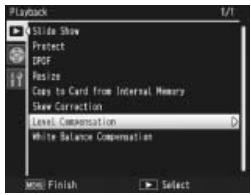
3 Select Auto.
Highlight Auto and press If the camera is able to create a copy, a preview will be displayed with the original image displayed at upper left, the corrected copy at right. If
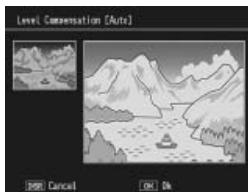
the camera can not create a copy, an error message will be displayed and the camera will exit to the playback menu.
4 Press MENU/OK.
Press MENU/OK to copy the image (to exit without creating a copy, press DISP.). A message will be displayed while the camera copies the photo.
Manual: Manual Level Correction
Display the photo to be copied and select Level Compensation > Manual in the playback menu to display a preview as described on the preceding page, then follow the steps below.
1 Select the black point, white point, or mid-point.
The manual preview contains a histogram showing how pixels of different brightnesses are distributed in the image, with dark pixels (shadows) on the left and bright pixels (highlights) on the right. Press the ADJ lever in to cycle through the black point, mid
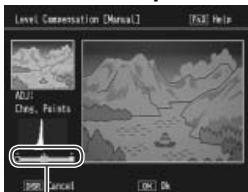
From left to right: black point, midpoint, white point
point, and white point and press or to position the selected point for enhanced brightness and contrast as described on the following page. For help, press the Fn2 button; press the button again to return to the preview display.
2 Press MENU/OK.
Press MENU/OK to copy the image (to exit without creating a copy, press DISP.). A message will be displayed while the camera copies the photo.

Tips: Choosing the Black Point, White Point, and Mid-Point
- Adjusting brightness: To make the image brighter, move the mid-point to the right. Moving the mid-point to the left makes the image darker.
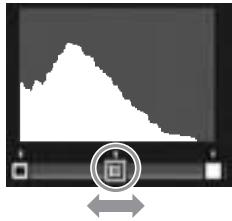
- Correcting exposure: If the image is overexposed, move the black point to the right until it lines up with the darkest pixel in the histogram (see right). If the image is underexposed, move the white point to the left until it lines up with the brightest pixel. You can then move the mid-point left or right to adjust brightness.
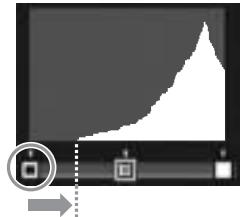
Correcting overexposure
- Increasing contrast: To increase contrast, align the black point and white point with the darkest and brightest pixels as shown at right. You can then move the mid-point left or right to adjust brightness.
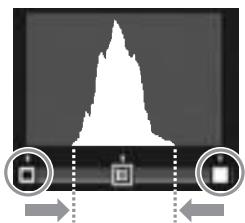

Cautions
- Level correction is available only with still images taken with this camera. It is not available with movies or pictures taken using S-Cont or M-Cont. The desired results may not be achieved with monochrome images or photographs taken in text mode.
- Although level correction can be applied multiple times, the compression applied every time a copy is saved will result in a drop in image quality.
White Balance Compensation
Create copies with modified white balance.
1 Display the photo.
Display the photo to be copied in playback mode.
2 Select White Balance Compensation.
Press MENU/OK to display the playback menu, highlight White Balance Compensation, and press
3 Adjust white balance.
Use the , , , or buttons to adjust white balance, or press DISP. to reset white balance compensation to a neutral value (to view or hide help, press the Fn2 button).
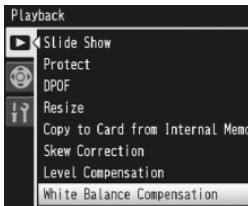
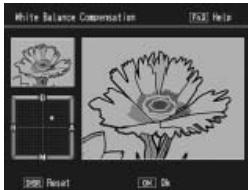
4 Press MENU/OK.
Press MENU/OK to copy the image (to exit without creating a copy, press DISP. twice). A message will be displayed while the camera copies the photo.
Cautions
- White balance compensation is available only with still images taken with this camera. It is not available with movies or pictures taken using S-Cont or M-Cont. The desired results may not be achieved with monochrome images.
- Although white balance compensation can be applied multiple times, the compression applied every time a copy is saved will result in a drop in image quality.
Viewing Pictures on TV
To view pictures on a TV, connect the camera using the supplied A/V cable.
1 Turn the camera off.
Be sure the camera is off before connecting or disconnecting the A/V cable.
2 Connect the A/V cable to the TV.
Insert the white plug into the audio input connector, the yellow plug into the video input connector. Be sure the plugs are securely connected. Do not use force.
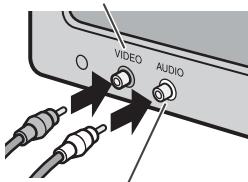
Video input (yellow)
Audio input (white)
3 Connect the camera.
Open the terminal cover and plug the cable into the A/V cable connector. Do not use force.
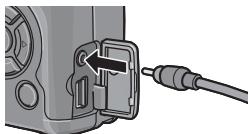
4 Tune the television to the video channel.
Select video input. See the television manual for details.
5 Turn the camera on.
Press the button for about a second to turn the camera on in playback mode. The camera picture display and speaker will turn off and photos and movies will be played back on the TV.
Do not use force or tug the A/V cable when handling the camera with the A/V cable connected.

Notes
- The camera can be connected to the video input connector on a video recorder and pictures recorded to video or DVD.
- The camera supports the following video standards: NTSC (used in North America, the Caribbean, parts of Latin America, and some East Asian countries) and PAL (used in the United Kingdom and much of Europe, Australia, New Zealand, and parts of Asia and Africa). SECAM is not supported. Where possible, the camera is set to the standard used in your country or region before shipment; before connecting the camera to a device that uses a different video standard, choose the appropriate video mode (page 135).
Printing Photographs
The camera can be connected to a printer via the supplied USB cable and photographs printed directly from the camera without using a computer.

Caution
Movies can not be printed. If a photograph created using a RAW picture-quality option is selected for printing, only the JPEG copy will be printed.

Note
The camera conforms to PictBridge, a standard widely used for direct printing, and direct printing is consequently only available with PictBridge-compliant printers. See the documentation provided with your printer for information on whether it supports PictBridge.
Connecting the Camera
Connect the camera to the printer using the supplied USB cable.
1 Turn the camera off.
Be sure the camera is off before connecting or disconnecting the USB cable.
2 Connect the USB cable to the printer.
Connect the USB cable to the printer and turn the printer on.
3 Connect the camera.
Open the terminal cover and plug the cable into the USB cable connector.
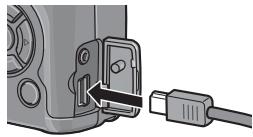
Press the ADJ. lever in. The camera will turn on and the message shown at right will be displayed; press the ADJ. lever in again immediately.
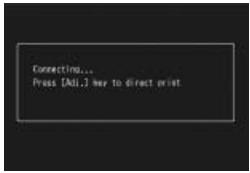

Note
If you do not press the ADJ. lever in while the above message is displayed, it may in some cases be replaced after two seconds by a message stating that the camera is connecting to a computer. Turn the camera off and press the ADJ. lever in again.
The message will be replaced by the PictBridge playback display shown at right (if the PictBridge playback display does not appear, the camera is still establishing a connection to the printer).

Caution
Do not use force when connecting the USB cable or when handling the camera with the cable connected.
Printing
Photographs can be printed one at a time or multiple photos can be selected for printing. If a memory card is inserted, the pictures will be printed from the memory card; otherwise pictures will be printed from internal memory.

Caution
Do not disconnect the USB cable while printing is in progress.

Note
If an error is displayed during printing, check the printer and take the appropriate action.
Printing Photos One at a Time
To print a selected photograph:
1 Select a photo.
Press or until the desired photo is shown in the Pict-Bridge playback display and press the ADJ lever in. The menu shown at right will be displayed; highlight 1 File and press MENU/OK.
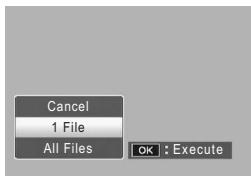

Tip: Printing One Copy of All Photos
To print one copy of all photos, press the ADJ. lever to display the options shown above and select All Files.
2 Adjust printer settings.
The menu shown at right will be displayed; highlight an item and press to view the options available, or choose Printer Select to use the default setting for the current
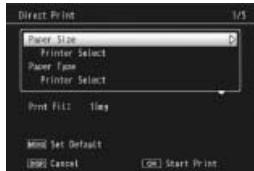
printer (the options available vary with the type of printer; items not supported by the connected printer can not be selected). Press or to highlight an option and press MENU/OK to select and return to the direct print menu.
| Item | Description |
| Paper Size | Choose the paper size. |
| Paper Type | Choose the paper type. |
| Layout | Choose the number of pictures per page. |
| Date Print | Include the time and date of recording. See page 16 for information on selecting the order in which the time and date are displayed. If the picture was taken using Date Imprint (page 76), only the im-printed date will be printed. |
| File Name Print | Include the file name. |
| Optimize Image | Choose whether the printer optimizes photo data. |
| Print Size | Choose the print size. |
| Print Quality | Choose the print quality. |
| Report Print* | Print a report. |
| Printing Quantity | Choose the number of copies. |
| Toner Saving* | Use less toner during printing. |
| 1-Side/2-Sides* | Print on one or both sides of the paper. |
- Ricoh printers only. Visit http://www.ricoh.com/ for details.
To select the highlighted option as the default for the current printer when the camera is connected, press the ADJ lever in. The menu shown at right will be displayed; highlight Set and press MENU/
OK. Select Cancel to exit without changing the default setting.
3 Start printing.
To start printing, press MENU/OK when the direct print menu shown in Step 2 is displayed. A message is displayed during printing; to exit before printing is complete, press the DISP. button. The PictBridge playback display will appear when printing is complete.
Printing Multiple Photographs
To print multiple photographs:
Press the button.
Photographs will be displayed in multi-frame playback.
2 Select a picture.
Highlight a picture and press MENU/OK.
3 Choose the number of prints.
Press or to choose the number of prints. Selected pictures are marked with a icon; to deselect a photograph, press until the number of prints is zero.
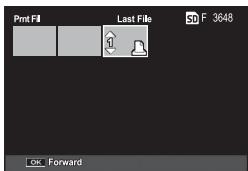
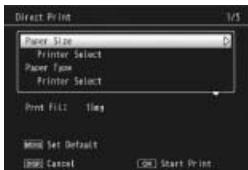
4 Select additional photos.
Press or to highlight additional photographs and press or to choose the number of prints.
5 Adjust printer settings.
Press MENU/OK to display the direct print menu. Adjust settings as described on pages 109-110.
6 Start printing.
To start printing, press MENU/OK when the direct print menu is displayed. A message is displayed during printing; to exit before printing is complete, press the DISP. button. The PictBridge playback display will appear when printing is complete.
The Setup Menu
The setup menu can be accessed from the shooting and playback menus (pages 54 and 91).
1 Display the menus.
Press MENU/OK to display the menu for the current mode (page 133; in scene mode, a MODE tab will be displayed).
2 Select a setup menu tab.
Press to highlight the tab for the current menu and press or to highlight the key custom settings tab (page 113) or the setup menu tab (page 113). Press to place the cursor in the selected tab.
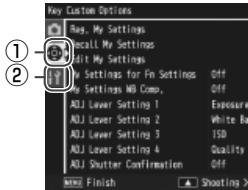
① Key custom settings tab
② Setup menu tab
3 Select a menu item.
Press or to highlight a menu item and press to display options for the highlighted item.
4 Select an option.
Press or to highlight an option and press MENU/OK to select and exit (the procedure may differ for some items; see the page for the item in question).
The key custom settings tab contains the following options:
| Option | Default | Page |
| Reg. My Settings | — | 114 |
| Recall My Settings | — | 116 |
| Edit My Settings | — | 117 |
| My Settings for Fn Settings | Off | 118 |
| My Settings WB Comp. | Off | 118 |
| ADJ Lever Setting 1 | White Balance | 119 |
| ADJ Lever Setting 2 | ISO | 119 |
| ADJ Lever Setting 3 | Quality | 119 |
| ADJ Lever Setting 4 | Image Settings | 119 |
| Option | Default | Page |
| ADJ Shutter Confirmation | Off | 121 |
| Set Fn1 Button | AF/MF | 121 |
| Set Fn2 Button | Self-timer | 121 |
| Zoom Button | Exposure Comp. | 122 |
| Power Button Lamp | On | 122 |
| Playback Mode Dial Options | Setting1 | 123 |
| M Mode Dial Options | Setting1 | 123 |
| One Press M Mode | Aprtr Priority | 123 |
The setup menu tab contains the following options:
| Option | Default | Page |
| Format [Card] | — | 124 |
| Format [Internal Memory] | — | 124 |
| LCD Brightness | — | 124 |
| ISO Auto-High Settings | AUTO 400 | 125 |
| AF Auxiliary Light | On | 125 |
| Auto Power Off | 5 Min. | 125 |
| Operation Sounds | All | 125 |
| Volume Settings | ■ □ (medium) | 126 |
| LCD Confirmation Time | 0.5 seconds | 126 |
| One Press Zoom Ratio | 9.8× | 126 |
| Auto Rotate | On | 127 |
| Level Setting | Display | 27, 127 |
| Grid Guide Display Options | 128 |
| Option | Default | Page |
| Fn Button Display | On | 129 |
| Show My Setting Name | Off | 129 |
| Shooting Info. Display Frame | Off | 129 |
| Information Display Mode | Off | 130 |
| CL-BKT Black & White (TE) | On | 131 |
| RAW/JPEG Setting | Fine | 131 |
| Color Space Set | sRGB | 132 |
| Digital Zoom Image | Normal | 133 |
| Store Menu Cursor Position | Off | 133 |
| Card Sequence No. | On | 134 |
| Date Settings | — | 135 |
| Language/ 言語 | (Varies*) | 135 |
| Video Out Mode | (Varies*) | 135 |
| * Varies with country or region of purchase. | ||
Key Custom Settings/Setup Menu Options
The options available in the key custom settings and setup menu tabs are described on the pages that follow.
Reg. My Settings
Settings saved using Reg. My Settings can be recalled by rotating the mode dial to MY1, MY2, or MY3, allowing you to easily create and recall up to six sets of settings for frequently-encountered shooting conditions.
1 Adjust settings.
Set the camera to the desired settings. The following settings can be stored:
- Camera settings: Shooting mode (O, P, A, S, M, or SCENE), aperture (modes A and M), shutter speed (modes S and M), focus position for manual focus, and scene, macro, flash, self-timer and display modes.
- Shooting menu options: All options except Interval Shooting, Auto Aperture Shift, and Switch Shooting Mode. White balance compensation will be stored if My Settings WB Comp. is on (page 118).
- Setup menu options: ISO Auto-High Settings, function button settings (if My Settings for Fn Settings is on; see page 118), Level Setting, Grid Guide Display Options, Shooting Info. Display Frame, CL-BKT Black & White (TE), and Digital Zoom Image.
2 Select Reg My Settings.
Highlight Reg. My Settings in the setup menu key custom settings tab and press
3 Save settings.
To assign the settings to MY1, MY2, or MY3 on the mode dial, highlight MY1, MY2, or MY3 and press MENU/OK (to exit without saving settings, press the DISP. button).
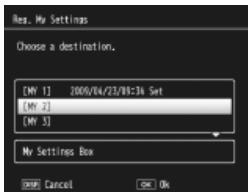
To save the settings to a "box" to be recalled and assigned to the mode dial at a later date (page 116), select My Settings Box and press. Highlight the desired box and press MENU/OK.
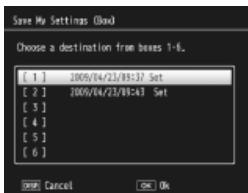
Unnamed boxes will be named using the current date. If the box has already been assigned a name, the dialog shown at right will be displayed. Select Yes to use the current name, No to use a name based on the current date.
Recall My Settings
Copy settings from a "box" to MY1, MY2, or MY3.
1 Select a destination.
Highlight the destination for the stored settings (MY1, MY2, or MY3) and press .
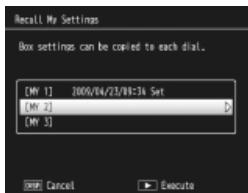
2 Select the source.
Highlight the settings "box" that will be assigned to the selected position on the modal dial and press MENU/OK.
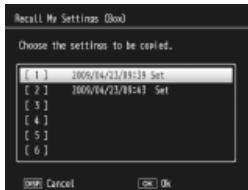
To exit without assigning settings to the mode dial, press the DISP. button.

Caution
If Edit My Settings is used to edit boxes that are currently assigned to the mode dial, the changes will be reflected when the mode dial is rotated to the position assigned to the box. Changes to settings assigned directly to MY1, MY2, or MY3 are not however reflected in the boxes currently assigned to the mode dial, and if the boxes are subsequently changed, these changes will not be reflected in the settings assigned to MY1, MY2, or MY3.
Edit My Settings
Edit and rename settings saved with Reg. My Settings.
1 Select settings.
To edit the settings assigned to MY1, MY2, or MY3 on the mode dial, highlight MY1, MY2, or MY3 and press
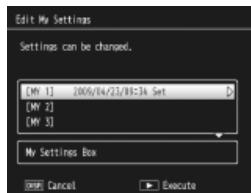
To edit "box" settings, select My Settings Box and press. Highlight the desired box and press.
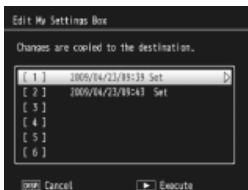
2 Edit settings.
Press or to highlight items and press to edit (see the section for each item in this manual for more information). After editing each item, press to return to the settings list, where you can edit additional settings.
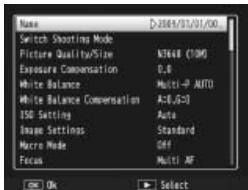
3 Save changes and exit.
Press MENU/OK to save changes and exit (to exit without saving changes, press DISP.).
Select Name in Step 2 to rename the current combination of settings. The current name is highlighted in the name area; to edit the current name, press or to position the cursor in the name area and press to place the cursor in the keyboard area (to delete the current name, press while the name is highlighted). Highlight characters using ,
, , or and press MENU/OK to enter the highlighted character at the current cursor position (to delete the character at the current cursor position, select [Delete]). Press Fn2 to switch between upper and lower case. Names can be up to 32 characters long. Press the ADJ lever in to use the new name, or press DISP to exit without renaming the settings.
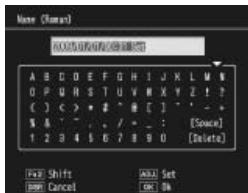
Name area
Keyboard area
My Settings for Fn Settings
Select On to include the options assigned to the Fn buttons (page 121) in the settings saved with Reg. My Settings.
My Settings WB Comp.
Select On to include white balance compensation (page 82) in the settings saved with Reg. My Settings.
ADJ Lever Setting
Assign up to four frequently-used options to the ADJ. lever for quick access in O , P, A, S, and M modes. At shipment, the ADJ. lever can be used for white balance (page 79), sensitivity (page 84), picture quality (page 57), and image setting (page 66), but it can also be used for white balance compensation (page 82), focus (page 59), metering (page 65), continuous (page 68), bracketing (page 70), flash compensation (page 72), manual flash amount (page 73), and exposure compensation (page 77). The ADJ. lever can also be used to select white balance in O , and DR modes, contrast in mode, and exposure compensation in and DR modes.
Using the ADJ. Lever
To select an option currently assigned to the ADJ. lever:
1 Display options.
With the camera in shooting mode, press the ADJ lever in and press the lever left or right or press or to view the options assigned to the lever.
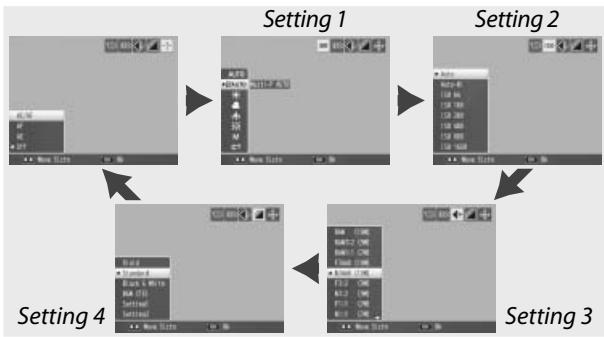
2 Select an option.
Press or to highlight an option and press the ADJ. lever in or press MENU/OK to select.

Tip
Keep the ADJ. lever pressed to page rapidly through the available options.
ADJ Shutter Confirmation
Select On to use the shutter-release button to select the highlighted option when using the ADJ lever.
Set Fn Button
Choose the functions assigned to the Fn (function) buttons: (Set Fn1 Button) and (Set Fn2 Button).
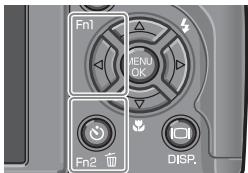
| Option | Description |
| AF/MF | Switch between multi or spot AF and manual focus (page 59).1,2 |
| AF/Snap | Switch between multi or spot AF and snap focus (page 59).2 |
| AE Lock | Lock exposure.3,4 |
| JPEG>RAW | If a fine- or normal-quality option is selected for Picture Quality/Size, pressing the Fn button selects a RAW option with the same aspect ratio (page 57).2,4,5,6 |
| Color>B&W | Select Black & White for Image Settings (page 66).2,4 |
| Color>TE | Select B&W (TE) for Image Settings (page 66).2,4 |
| Exposure Comp. | Display the exposure compensation slider (page 77).2,4 |
| White Balance | Display white balance options (page 79).2 |
| WB Correction | Display white balance compensation controls (page 82).2,5 |
| ISO | Display ISO sensitivity options (page 84).2,4 |
| Quality | Display options for picture quality and/or size (page 57) or movie size (page 89). |
1 If focus is locked in autofocus mode (page 59), selecting manual focus sets the focus distance to the distance at which focus is locked.
2 Not available when B is selected in SCENE mode.
3 Exposure can not be locked in mode M. Pressing the Fn button in mode M sets shutter speed and aperture to values close to those needed for optimal exposure.
4 Not available when is selected in SCENE mode.
5 Not available when z is selected in SCENE mode.
6 Not available when DR is selected in SCENE mode.
| Option | Description |
| Focus | Display focus options (page 59).2 |
| Image Settings | Display image setting options (page 66).2,4 |
| Expo. Metering | Display exposure metering options (page 65).2,4 |
| Cont. Mode | Display continuous shooting options (page 68).2,4,5,6 |
| Auto Bracket | Display bracketing options (page 70).2,4,5,6 |
| Macro Target | Position the focus target in macro mode (page 63). |
| Flash Comp. | Display the flash compensation slider (page 72).2,4,6 |
| Flash Amount | Adjust manual flash output (page 73).2,4,5,6 |
| Self-timer | Set the self-timer (page 26).4 |
By default, AF/MF is assigned to the button and Self-timer to the button.
Zoom Button
Choose the role played by the Q and buttons. Choose from none (off), digital zoom (page 22), exposure compensation (page 77), and white balance (page 79).

Caution
Digital zoom is not available when a RAW-quality option is selected for Picture Quality/Size (page 57).
Power Button Lamp
If On is selected, the power button LED will light when the camera is turned on.
Playback Mode Dial Options/M Mode Dial Options
Choose the roles played by the ADJ. lever and up-down dial during playback zoom and in mode M.
| Playback Mode Dial Options | M Mode Dial Options | |||
| Setting1 | Setting2 | Setting1 | Setting2 | |
| ADJ. lever | Next/previous frame | Scroll left/right | Shutter speed | Aperture |
| Up-down dial | Zoom in/out | Scroll up/down | Aperture | Shutter speed |
One Press M Mode
When exposure compensation is assigned to the Q and buttons (page 122) or AE lock is assigned to an Fn button (page 121), pressing the affected button in manual exposure mode sets shutter speed and/or aperture to values close to those needed for optimal exposure. This option determines whether shutter speed or aperture is adjusted to achieve optimal exposure.
- Aprtr Priority: Aperture remains at the selected value; shutter speed is adjusted for optimal exposure.
- Shttr Priority: Shutter speed remains at the selected value; aperture is adjusted for optimal exposure.
- Program: Both aperture and shutter speed are adjusted for optimal exposure.

Note
In manual exposure mode, exposure compensation can not be performed with the zoom buttons, nor can AE lock be performed with the Fn buttons.
Format [Card]/Format [Internal Memory]
Select Format [Card] to format the memory card before first use, after using it in another device, or if a card error is displayed when the card is inserted in the camera. Select Format [Internal Memory] if a message is displayed prompting you to format internal memory.
![RICOH GR DIGITAL III - Format [Card]/Format [Internal Memory] - 1](/content/2025/01/136456/images/9cb6145f60b2886af78e1838e7183b182bf236488bb397426326ebeb2a87ab42.jpg)
Cautions
- Formatting permanently deletes all data on the card or in internal memory. Before formatting, copy any data you wish to keep to a computer (page 136).
- Selecting Format [Card] when no memory card is inserted displays an error message. Turn the camera off and insert a memory card.

Tip: Write Protection
To prevent memory cards from being formatted, slide the write-protect switch to the "LOCK" position (page 14). Restore the switch to its original position to resume normal operation.
LCD Brightness
Selecting this option displays the control shown at right. Press or to adjust picture display brightness and press MENU/OK to return to the setup menu. Press MENU/OK again to exit to shooting or playback mode.
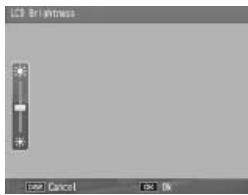

Note
The brightness display shows the view through the lens (shooting mode) or the most recently viewed picture (playback mode; if no picture is available for playback, no image will be shown in the brightness display).
ISO Auto-High Settings
Choose the maximum sensitivity selected by the camera when Auto-Hi is selected for ISO Setting in the shooting menu (page 84). Choose from settings of ISO 200 (AUTO 200), 400 (AUTO 400), 800 (AUTO 800) or 1600 (AUTO 1600).

Note
"Noise" (random variations in brightness and color) may appear in photographs taken at high sensitivities.
AF Auxiliary Light
If On is selected, the AF auxiliary light will light to assist the focus operation when the subject is poorly lit.
Auto Power Off
Choose the delay before the camera turns off automatically to save power when no operations are performed. Select from Off (the camera does not turn off automatically), 1 minute, 5 minutes, and 30 minutes.
Operation Sounds
Choose when the camera plays a sound.
| Option | Description |
| All | Sounds are played at startup, when the shutter is released, when the camera focuses, and when an error occurs. If Sound or Disp + Snd is selected for Level Setting (page 27), the camera will also beep at regular intervals when the camera is level. |
| Level Sound | If Sound or Disp + Snd is selected for Level Setting, the camera will beep at regular intervals when the camera is level. |
| Shutter Sounds | Sounds are played when the shutter is released or an error occurs. If Sound or Disp + Snd is selected for Level Setting, the camera will beep at regular intervals when the camera is level. |
Volume Settings
Select the volume for the sounds described above under "Operation Sounds." Choose from (off), (low), (medium), and (high).
LCD Confirmation Time
Choose how long photographs are displayed in the picture display after shooting. Select from 0.5, 1, 2, and 3 seconds, Hold (photograph is displayed until shutter-release button is pressed halfway and can be viewed with playback zoom or deleted; see pages 32 and 33), and Off (photographs are not displayed in the picture display after shooting).
One Press Zoom Ratio
Select the magnification at which pictures are displayed when zoomed in using the MENU/OK button or ADJ. le- ver (page 32). Choose from 5.7× 9.8× ,and 16×

Note
Maximum magnification varies with image size:
| Image size (pixels) | Maximum magnification |
| 2,048 × 1,536 or larger | 16 × |
| 1,280 × 960 | 6.7 × |
| 640 × 480 | 3.4 × |
If the magnification would be greater than the maximum magnification, pictures will be displayed at the maximum magnification.
Auto Rotate
Select On to automatically display pictures in the correct orientation during playback.

Caution
Movies, pictures shot with Continuous Mode set to S-Cont or M-Cont, and pictures taken with the camera upside down or tilted sharply forward or back are not rotated for display in the picture display. Pictures are not rotated during slide shows, in multi-frame playback, or when displayed on a TV, nor are they rotated when the camera is upside down or if the camera is rotated during playback zoom or while skew correction is in progress.

Note
During bracketing or when recording pictures with Continuous selected for Continuous Mode, the camera only records the orientation for the first photograph in each series. The remaining photographs will not be displayed in the correct orientation if the camera was rotated during shooting.
Level Setting
Choose tilt indicator settings (page 27).
Grid Guide Display Options
Choose the type of framing grid available in shooting mode (page 36).
| Item | Description | ||
| A three-by-three grid for “rule of thirds” com-position. | |||
| A four-by-four grid with diagonal lines running from corner to corner makes it easy to find the center of the subject. Use for architectural photography or photographing products for display. | |||
| A two-by-two grid with the center of the frame left clear to make it easier to view the subject. Use if your subject is in motion. | |||
Fn Button Display
Select On to display the options currently assigned to the Fn buttons when the camera is turned on, when shooting mode is selected, or when a new mode is selected with the mode dial.
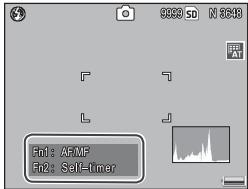
Show My Setting Name
Select On to display the name of the settings assigned to the current position on the mode dial when the dial is rotated to MY1, MY2, or MY3.
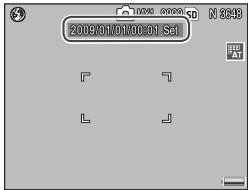
Shooting Info. Display Frame
Select On to display shooting icons in a frame surrounding the view through the lens (page 6), making it easier to frame photographs in the picture display. The frame is not displayed in movie mode.
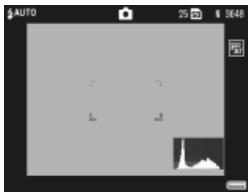
Information Display Mode
Select On to display shooting information in the picture display when the picture display is off (page 36), allowing you to adjust camera settings while using an optional external viewfinder (page 162) to frame photographs. The view through the lens is not displayed.
Shooting information can be displayed by:
- pressing the or 串 button,
- rotating the mode dial to a new position,
using the up-down dial, - pressing the ADJ. lever left or right,
- pressing the Fn1 or Fn2 button, or
- pressing the flash OPEN switch (OPEN) to raise the flash. The display turns off if the shutter-release button is pressed halfway or no operations are performed for a few seconds.

Notes
- Regardless of the setting chosen, the picture display turns on when any of the following buttons are pressed: the ADJ. lever, the MENU/OK, [DISP.), and [buttons, the Q and [buttons (except when Off is selected for Zoom Button; page 122), and the ▲ and [buttons (manual focus mode only).
- The tilt indicator is not displayed when the picture display is off.
CL-BKT Black & White (TE)
Choose the number and type of copies created with color bracketing (page 71). Select On to record three copies of each shot (one in black and white, a second in color, and a third using a monochrome tint), Off to record two copies (one in black and white and the second in color).

Note
Regardless of the setting chosen, three copies of each photograph will be recorded if B&W (TE) is selected for Image Settings.
RAW/JPEG Setting
Choose the quality and size of JPEG copies recorded when a RAW-quality option is selected for Picture Quality/Size (page 57). Select Fine or Normal to record a fine- or normal-quality copy of the same dimensions as the RAW image, N640 (VGA) to record a normal-quality copy 640 × 480 pixels in size.

Note
If a RAW-quality option with an aspect ratio of 3:2 or 1:1 is selected for Picture Quality/Size when N640 is selected, black bands will be added above and below or to either side of the JPEG copies to give them an aspect ratio of 4:3.
Color Space Setting
Choose the color space used to record photographs. sRGB is widely used to reproduce digital images but offers a smaller gamut of colors than AdobeRGB.

Caution
The Adobe RGB color space was developed by Adobe Systems, Inc., and is compatible with the default color space used in Adobe Photoshop and other image editing software. Note, however, that colors will only be reproduced correctly in software that supports the Adobe RGB color space. Note too that specialized equipment is required to print the full range of colors in the Adobe RGB gamut; when printed using consumer household printers or digital photo print services, colors will generally be less vivid than in photographs that use the sRGB color space.
Digital Zoom Image
If Normal (the default option) is selected for Digital Zoom Image and an option with a size of 3,648 × 2,736 is selected for Picture Quality/Size, digital zoom will enlarge image data from the center of the frame to create a picture 3,648 × 2,736 pixels in size, creating a slightly grainy image. To record pictures taken with digital zoom at actual size, select Auto Resize. The size at which the image will be recorded varies with the zoom ratio:
| Zoom ratio | Size (pixels) | Zoom ratio | Size (pixels) |
| 1.0× | 3,648×2,736 (10M) | 1.8× | 2,048×1,536 (3M) |
| 1.1× | 3,264×2,448 (8M) | 2.9× | 1,280×960 (1M) |
| 1.4× | 2,592×1,944 (5M) | 5.7× | 640×480 (VGA) |
The current picture size is displayed in the picture display when the camera is zoomed in.
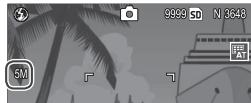

Caution
The option selected for Digital Zoom image only takes effect when Digital Zoom is selected for Zoom Button (page 122). Auto Resize has no effect when S-Cont or M-Cont is selected for Continuous, when a RAW-quality option is selected for Picture Quality/Size, or when is selected in SCENE mode.
Store Menu Cursor Position
If On is selected, the most-recently accessed item will be highlighted when menus are displayed.
Card Sequence No.
Choose how the camera names image files when saving photographs to a memory card.
- On: Files names consist of "R" followed by a seven-digit number (e.g., "R0010001.jpg"), assigned in ascending order from 0010001 to 9999999. When a new memory card is inserted, file numbering continues from the last number used.
- Off: Files names consist of "RIMG" followed by a four-digit number (e.g., "RIMG0001.jpg"), assigned in ascending order from 0001 to 9999. When a new memory card is inserted, file numbering is reset to 0001.

Notes
- This option applies only to memory cards. The names of photos in internal memory consist of "RIMG" and a four-digit number.
- Photos copied to a computer using DL-10 (page 136) are given new names consisting of "RIMG" and a four-digit number.
- Photos taken with AdobeRGB selected for Color Space Setting (page 132) are indicated by file names beginning with an underscore (e.g., "R010001.jpg" or "RIMG001.jpg").

Caution
When On is selected, no further photographs can be stored if the memory card contains a folder numbered 999 and a file name ending in 9999; when Off is selected, no further photographs can be stored if the memory card contains a file numbered 9999. To take additional photos, format the card after copying its contents to a computer.
Date Settings
Set the camera clock (page 16).

Note
If you leave the battery in the camera for at least two hours, the battery can be removed for about a week without resetting the clock.
Language/言語
Choose the language in which camera messages and menus are displayed.
| Option | Description |
| 日本語 | Japanese |
| English | English |
| Deutsch | German |
| François | French |
| Italiano | Italian |
| Espanol | Spanish |
| Option | Description |
| РRussКий | Russian |
| 简体中文 | Simplified Chinese |
| 繁体中文 | Traditional Chinese |
| 한국어 | Korean |
| 韩語 | Thai |
Video Out Mode
When connecting the camera to a TV or VCR (page 104), choose a video out mode that matches the standard used in the device. The camera supports NTSC and PAL; SECAM is not supported.
Copying Pictures to a Computer
This section describes how to copy pictures from the camera to your computer. Instructions for Windows may be found below; those for the Macintosh begin on page 148.

Note
The dialogs shown in this section may differ slightly from those displayed by your computer.
Windows
You can copy pictures to your computer by either of the following methods:
- Install the supplied DL-10 software (page 138) and use it to copy pictures as described on page 144.
- Copy pictures in Windows Explorer (page 145).

Caution
Pictures can not be copied from the camera to computers running Windows 98 or Windows 98SE. Use a card reader to copy pictures from a memory card (page 146).

Note
Detailed instructions may be found in the Software User Guide on the supplied CD (page ii).
System Requirements
Before using the supplied CD, check that your computer meets the following requirements. See the documentation provided with your computer for details.
| OS | Windows 2000 Professional SP 4, Windows XP Home Edition/Professional SP 3, Windows Vista SP 1 |
| CPU | Windows 2000/Windows XP: Pentium III 500 MHz or faster Windows Vista: Pentium III 1 GHz or faster |
| RAM | Windows 2000/Windows XP: 256 MB or more Windows Vista: 512 MB or more |
| Free disk space | A minimum of 160 MB required for installation |
| Video | 1024×768 pixels or more with 16-bit color or better |
| Miscellaneous | • Compatible CD-ROM drive • Compatible USB port |
Cautions
- 64-bit operating systems, Windows 98, Windows 98SE, and Windows Me are not supported. Operating systems that have been upgraded from an earlier version are not supported, as USB may fail to function as expected. The supplied software may not function as expected with systems that have been patched or updated with Service Pack releases.
- Connect the camera directly to a built-in USB port. USB ports added via PCI-bus or other extension boards or cards are not supported. The camera may not function as expected when connected via a USB hub or keyboard.
- More RAM may be required when handling movies and other large files.
The Supplied CD
Inserting the supplied CD in a CD-ROM drive displays the dialog shown at right.
- Installing the software: Install the following software.
DL-10: Copy pictures to the computer in a single operation.
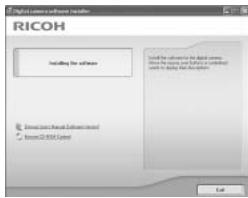
Irodio Photo & Video Studio: View, manage, edit pictures on the computer. For more information, see the Help menu in Irodio Photo & Video Studio or visit the following website: http://www.pixela.co.jp/oem/iredio/e/irediodigitalphoto Videostudio/
USB driver: Connect earlier Ricoh cameras to computers running Windows 98, Windows 98 SE, Windows Me, or Windows 2000. Not required for this camera.
WIA driver: Connect earlier Ricoh cameras to computers running Windows XP or Windows Vista. Not required for this camera.
- Browse User's Manual (Software Version): View the Software User Guide in pdf format (page iv). Acrobat Reader or Adobe Reader is required; if necessary, install Adobe Reader as described on pages 141-142.
- Browse CD-ROM Content: View the contents of the CD, which include Adobe Reader (page 141). To install Irodio Photo & Video Studio without installing other software, open the "Irodio Photo & Video Studio" folder and double-click Irodio Photo & Video Studio.exe.
Installing the Software
Follow the steps on the next page to install the supplied software. Illustrations are from Windows XP.

Cautions
- If the camera is connected to the computer, disconnect the camera before beginning installation.
- Users of existing "Caplio" software should note that the "DC" software supplied with the camera replaces the following items in the Caplio software package:
| Caplio software | DC software |
| RICOH Gate La | DL-10 |
| Caplio Viewer | DU-10* |
| Caplio Server | SR-10* |
| Caplio Setting | ST-10* |
*Not used by this camera.
If the above Caplio software is currently installed, you will be prompted to uninstall it before installing the supplied DC software. Follow the on-screen instructions. Installing the DC software replaces Caplio Viewer, Caplio Server, and Caplio Setting with the software listed above, which can be used in the same way as the Caplio versions (note that this software will not be installed if you uninstall the Caplio software as described on page 143 before installing the DC software). Note that uninstalling the software for earlier Ricoh cameras may reset user preferences for DL-10 or RICOH Gate La.
- Administrator privileges are required for installation.
- DL-10 is for use in a stand-alone environment alone and can not be run over a network.
Insert the supplied CD.
Turn the computer on and insert the supplied CD in a CD-ROM drive.
- Windows Vista: An Autorun dialog will be displayed. Click Run Autorun.exe to display the installer dialog.
- Other versions of Windows: The installer dialog will be displayed automatically.
2 Click Installing the software.
- Windows Vista: A "User Account Control" dialog will be displayed. Click Allow to display a language-selection dialog.
- Other versions of Windows: A language-selection dialog will be displayed.
3 Select a language and click OK.
The dialog shown at right will be displayed. Click Next.
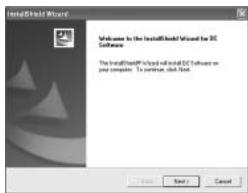
4 Select a destination.
The supplied software will be installed to the folder shown under Destination Folder. Click Next.
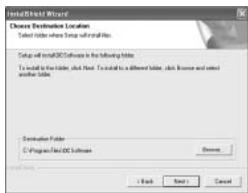
5 Install the software.
The Irodio Photo & Video Studio installer will start (depending on your computer, the splash screen at right may be displayed for some time
before installation begins). Follow the on-screen instructions to install the supplied software.
6 Click Finish.
The dialog shown at right will be displayed when installation is complete. Click Finish.
7 Restart the computer.
A message will be displayed prompting you to restart your
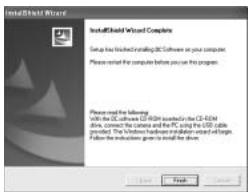
computer. Select Yes, I want to restart my computer now and click Finish to restart the computer.
8 Unblock DL-10.
A Windows security dialog will be displayed when the computer restarts. Click Unblock for DL-10.

See page 143 for information on uninstalling the software.
Adobe Reader
Adobe Reader is required to view the Software User Guide. If Adobe Reader is not already installed, it can be installed from the supplied CD as described below.
Cautions
- Disconnect the camera before beginning installation.
- Administrator privileges are required.
Insert the supplied CD.
Turn the computer on and insert the supplied CD in a CD-ROM drive.
- Windows Vista: An Autorun dialog will be displayed. Click Run Autorun.exe to display the installer dialog.
- Other versions of Windows: The installer dialog will be displayed automatically.
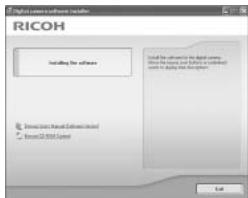
2 Click Browse CD-ROM Content.
The contents of the CD will be displayed.
3 Install Adobe Reader.
Double-click the "Acrobat" folder and then double-click the folder for the language of your choice. Double-click the file beginning with "AdbeRdr910" and follow the on-screen instructions. If a "User Account Control" dialog is displayed, click Continue.

Notes
- See the Adobe Reader Help menu for information on Adobe Reader.
- Installation of Adobe Reader 9.1 requires MSI (Microsoft Windows Installer) version 3.1 or later and either Microsoft Internet Explorer 6.0 or later or Firefox 2.0 or later. Microsoft Internet Explorer and Microsoft Windows Installer are available via Microsoft Update.
Uninstalling the Software
Follow the steps below to uninstall DC software or Irodio Photo & Video Studio.

Cautions
- Administrator privileges are required.
- Exit any applications that may be running before proceeding.
1 Open the "Add/Remove Programs" Control Panel. Open the Windows "Start" menu and select Control Panel (Windows XP or Windows Vista) or Settings > Control Panel (Windows 2000). Double-click Add/ Remove Programs.
2 Uninstall the software.
Select the software you wish to uninstall (DC Software or Irodio Photo & Video Studio) and click Change/Remove. A confirmation dialog will be displayed; click OK. If a message appears warning that a shared file has been detected, select Don't display this message again and click Yes.
Close any open windows when the uninstall process is complete. After uninstalling Irodio Photo & Video Studio, restart the computer.
Copying Pictures Using DL-10
After installing DC software, follow the steps below to copy pictures to your computer.
1 Turn the camera off.
2 Connect the supplied USB cable.
Connect the cable to the computer USB port.
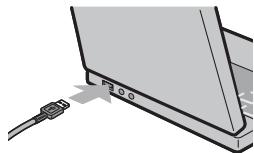
Caution
Do not use force when connecting the cable or when handling the camera with the cable connected.
Connect the cable to the camera as shown. The camera will turn on, DL-10 will start, and
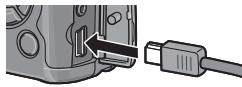
transfer will begin automatically. Pictures are copied to folders in the "Digital Camera" folder in "My Documents" (if you were previously using Caplio software, pictures will instead be copied to folders in the "Caplio" folder). Pictures are sorted into separate folders by date of recording; make sure the camera clock is set to the correct date and time before shooting.
3 Disconnect the cable when transfer is complete. See page 147 for more information.
Note
If transfer does not begin automatically, click Save in the DL-10 window. Alternatively, check that Saves automatically when connected to USB is selected in the DL-10 "Option Settings" dialog, then restart the computer and repeat the above steps.
Copying Pictures Using Windows Explorer
If DL-10 is not installed, you can copy pictures to the computer as described below. The illustrations in this section are from Windows XP.
1 Turn the camera off.
2 Connect the supplied USB cable.
Connect the cable to the computer USB port and then to the camera. The camera will turn on automatically.
3 Copy files from the camera to the computer.
The camera will be listed as a removable drive in "My Computer" with pictures stored in folders as shown at right. If a memory card is inserted in the camera, the drive will be named as shown at right and
the contents of the memory card will be displayed. If no memory card is inserted, the drive will be named "RICOHDCI" and the contents of internal memory will be displayed. Copy pictures to the desired location on your computer.
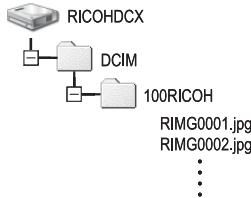
Cautions
- Do not turn the camera off or disconnect the USB cable until copying is complete.
- Files in the destination folder with the same name as the pictures being copied will be overwritten. If necessary, rename files before copying begins.

SD Card Readers and PC Card Adapters
If the memory card is inserted in an SD card reader connected to the computer, or the memory card is inserted in a PC card adapter which is then inserted in a computer PC card slot, data can be read directly from the memory card (be sure that the reader or adapter is compatible with both the computer and the memory card). Pictures are stored on memory cards as shown below.
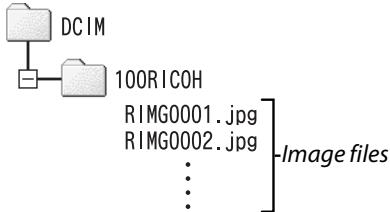

Caution
Do not use a computer to view or edit pictures on a memory card. Pictures that have been viewed or modified on a computer can no longer be displayed on the camera. Copy pictures to the computer for viewing and editing.
Disconnecting the Camera
Before disconnecting the camera from the computer, click the "Safe-
ly Remove Hardware" or "Unplug or Eject Hardware" icon in the taskbar (the illustration above shows the icon for Windows XP) and select Safely Remove USB Mass Storage Device or Stop USB Mass Storage Device from the menu that appears. You can then disconnect the USB cable.

Notes
- A warning may be displayed if the USB cable is disconnected without first removing the camera from the system as described above. Be sure to remove the camera from the system before disconnecting the cable.
- Confirm that transfer is complete before removing the camera from the system and disconnecting the cable.

16:49
The camera can be used with Mac OS 9.0-9.2.2 and Mac OS X versions 10.1.2-10.5.6.

Caution
The software on the supplied CD can not be installed on Macintosh computers. Macintosh computers can however be used to view the Software User Guide (note that Acrobat Reader is required to view the Software User Guide under Mac OS 9).
Copying Pictures to a Macintosh
To copy pictures to a Macintosh computer:
1 Turn the camera off.
2 Connect the supplied USB cable.
Connect the cable to the computer USB port.
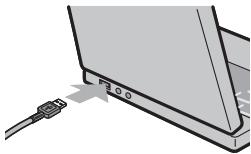

Caution
Do not use force when connecting the cable or when handling the camera with the cable connected.
Connect the cable to the camera as shown. The camera will turn on automatically.

3 Copy files from the camera to the computer.
The camera will appear as a volume on the desktop with pictures stored in folders as shown at right. If a memory card is inserted in the camera, the drive will be named as shown at right and the
contents of the memory card will be displayed. If no memory card is inserted, the drive will be named "RICOHDCI" and the contents of internal memory will be displayed. Copy pictures to the desired location on your computer.
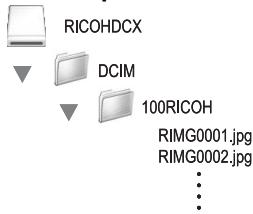
Disconnecting the Camera
Before disconnecting the camera from the computer, drag the camera volume into the Trash or select the camera volume and choose Eject from the Special menu (Mac OS 9) or File menu (Mac OS X). You can then disconnect the USB cable.

Notes
- A warning may be displayed if the USB cable is disconnected without first removing the camera from the system as described above. Be sure to remove the camera from the system before disconnecting the cable.
- Confirm that transfer is complete before removing the camera from the system and disconnecting the cable.
- Connecting the camera to a Macintosh computer may result in the creation of "FINDER.DAT" or ".DS_Store" files that will be listed by the camera as unmatched files. These files can be deleted without risk.
Troubleshooting
Error Messages
If an error message is displayed, take the steps listed below.
| Message | Solution | Page |
| Insert card | No memory card inserted. Insert card. | 13 |
| Set date. | Camera clock not set. Set camera clock. | 135 |
| File Number Over Limit | Camera is out of file numbers. Insert another card. | 13, 134 |
| Unmatched File | Camera can not display file. Use computer to check file contents and delete file. | — |
| Insufficient memory. Continue? | Space on memory card is insufficient to copy all files. Insert another card. | 13 |
| Protected | File is protected and can not be deleted. | 92 |
| Card Is Write-Protected. | Card is write protected (locked). Unlock card. | 14 |
| Print settings cannot be set for this file. | File is a movie or other file that can not be selected for printing. | — |
| Insufficient Memory/ Capacity short | Insufficient memory to store additional files. Delete existing files or increase amount of memory available. | 33, 124 |
| Maximum number of images selected for printing. Set number of prints for other images to zero. | 96 | |
| Format internal memory. | Internal memory is not correctly formatted. Format internal memory. | 124 |
| Format card. | Card is not correctly formatted. Format card in camera. | 124 |
| Card Error | Format card. If message persists, card is faulty; discontinue use. | 124 |
| Writing Data | Camera is saving data. Wait until save is complete. | — |
| No File | No files available for playback. | — |
| Cannot Record | Memory is full. Use another card or remove card and use internal memory. | 13, 14 |
Power Supply
| Problem | Cause | Solution | Page |
| The camera does not turn on. | Battery is exhausted or not in-serted. | Check that battery is correctly in-serted. Charge battery (recharge-able battery only), insert fresh battery, or use AC adapter. | 10, 12, 165 |
| Battery is incompatible. | Use supplied battery or compat-ible AAA batteries. | 11 | |
| AC adapter is not connected. | Check connection. | 165 | |
| Battery is not in correct orienta-tion. | Insert battery in correct orienta-tion. | 12 | |
| The camera turns off during use. | Camera has turned off automat-cally to save power. | Turn camera on. | 14 |
| Battery is exhausted. | Charge battery (rechargeable ba-tery only), insert fresh battery, or use AC adapter. | 10, 12, 165 | |
| Battery is incompatible. | Use supplied battery or compat-ible AAA batteries. | 11 | |
| The camera does not turn off. | Camera malfunction. | Remove and reinsert battery or disconnect and reconnect AC adapter. | 12, 165 |
| Low battery indicator displayed or camera turns off when battery has charge remaining. | Battery is incompatible. | Use supplied battery or compat-ible AAA batteries. | 11 |
| Battery can not be charged. | Battery has reached end of charging life. | Replace with a new battery. | 12 |
| Battery is quickly exhausted. | Ambient temperature is very high or very low. | — | — |
| Poor lighting requires extensive use of flash. | — | — |
Shooting
| Problem | Cause | Solution | Page |
| No picture taken when shutter-release button is pressed. | Battery is exhausted. | Charge battery (rechargeable battery only), insert fresh battery, or use AC adapter. | 10, 12, 165 |
| Camera is off or not in shooting mode. | Press POWER button to turn camera on or press ➤ to select shooting mode. | 14, 29 | |
| Camera is in playback mode. | Press ➤ to select shooting mode. | 15, 29 | |
| Shutter-release button was not fully pressed. | Press shutter-release button all the way down. | 18 | |
| Memory card is not formatted. | Format card. | 124 | |
| Memory card is full. | Insert new card or delete files. | 13, 33 | |
| Memory card has reached end of working life. | Insert new card. | 13 | |
| Flash is charging. | Wait until flash lamp stops blink-ing. | 25 | |
| Memory card is locked. | Unlock card. | 14 | |
| Memory card contacts are dirty. | Clean with soft, dry cloth. | — | |
| Can not view photos after shooting. | Display time is too short. | Choose longer display time. | 126 |
| Picture display is blank. | Camera is off or picture display is dark. | Turn camera on or adjust picture display brightness. | 14, 124 |
| Picture display is off. | Press DISP. to turn picture display on. | 36 | |
| A/V cable is connected. | Disconnect cable. | 104 | |
| Camera unable to focus in autofocus mode. | Lens is dirty. | Clean with soft, dry cloth. | 171 |
| Subject is not at center of frame. | Use focus lock. | 21 | |
| Subject not suitable for autofo-cus. | Use focus lock or manual focus. | 21, 60 | |
| Subject is too close. | Use macro mode or move away from subject. | 23 | |
| Pictures are blurred. | Camera moved during shooting. | Use tripod or press elbows against torso. | 17 |
| Lighting is poor and shutter speeds are slow. | Use the flash or choose higher ISO setting. | 24, 84 | |
| Flash does not fire or will not charge. | Flash is not raised. | Slide ↓ OPEN switch down to raise flash. | 24 |
| Flash cover is not fully open. | Do not obstruct flash cover. | — | |
| Bracketing enabled or camera in continuous, dynamic range double shot, or movie mode. | Change camera settings. | 48, 68, 70, 88 | |
| Flash is off. | Raise flash and choose another flash mode. | 24 | |
| Battery is exhausted. | Charge battery (rechargeable battery only), insert fresh battery, or use AC adapter. | 10, 12, 165 | |
| Flash does not illuminate subject. | Subject is more than 3.0 m/9.8 ft. from camera. | Move closer to subject. | 24 |
| Subject is dark. | Increase flash output. | 72 | |
| Flash output is too low. | Increase flash output. | 72 | |
| Flash cover is not fully open. | Do not obstruct flash cover. | — | |
| Photos are too bright. | Flash output is too high. | Reduce flash output, move away from subject, or use different light source. | 72 |
| Photo is overexposed. | Use exposure compensation or choose faster shutter speed. | 44, 77 | |
| Picture display is too bright. | Adjust picture display brightness. | 124 | |
| Photos are too dark. | Flash is off and subject is poorly lit. | Raise flash and choose another flash mode. | 24 |
| Photo is underexposed. | Use exposure compensation or choose slower shutter speed. | 44, 77 | |
| Picture display is too dark. | Adjust picture display brightness. | 124 | |
| Colors are unnatural. | Camera unable to adjust white balance for shooting conditions using auto white balance. | Include white object in photo or choose another white balance option. | 79 |
| Photo information not displayed. | Indicators are hidden. | Press DISP. to display indicators. | 36 |
| Picture display brightness changes during focusing. | Ambient lighting is poor or differs from that used for autofocus. | This is normal and does not indicate a malfunction. | — |
| Vertical streaks ("smear") appear in photos. | Subject is bright. | This is normal and does not indicate a malfunction. | — |
| Tilt indicator is not displayed. | Off or Sound selected for Level Setting. | Choose Display or Disp + Snd. | 27 |
| Indicators are hidden. | Press DISP. to display indicators. | 36 | |
| The camera is upside down. | Hold the camera in the correct orientation. | 17 | |
| Photo is not level, although tilt indicator showed that camera was level. | Camera was moving when photo was taken. | Do not take pictures from moving objects. | — |
| Subject is not level. | Straighten subject. | — |
Playback/Deletion
| Problem | Cause | Solution | Page |
| Can not play pictures back. | Camera not in playback mode. | Press▶. | 15, 29 |
| A/V cable incorrectly connected. | Reconnect A/V cable. | 104 | |
| Video mode does not match TV. | Choose another video mode. | 135 | |
| Can not view pictures on memory card. | Memory card empty or not inserted. | Insert card that has been formatted in camera and contains pictures recorded with camera. | 13, 124 |
| Card was not formatted in camera. | |||
| Pictures were created with other device. | |||
| Memory card contacts are dirty. | Clean with soft, dry cloth. | — | |
| Card malfunction. | Insert another card. If you can view pictures on second card, first card has probably malfunctioned; discontinue use. | — | |
| Picture display has turned off. | Battery is exhausted. | Charge battery (rechargeable battery only), insert fresh battery, or use AC adapter. | 10, 12, 165 |
| Camera has turned off automatically to save power. | Turn camera on. | 14 | |
| Can not delete file. | File is protected. | Remove protection. | 92 |
| Memory card is locked. | Unlock memory card. | 14 | |
| Can not format card. | Card is locked. |
Miscellaneous
| Problem | Cause | Solution | Page |
| Can not insert memory card. | Card is not in correct orientation. | Insert in correct orientation. | 13 |
| Camera controls have no effect. | Battery is exhausted. | Charge battery (rechargeable battery only), insert fresh battery, or use AC adapter. | 10, 12, 165 |
| Camera malfunction. | Turn camera off and then on again. | 14 | |
| Remove and reinsert battery or disconnect and reconnect AC adapter. | 12, 165 | ||
| Date is incorrect. | Clock is not set correctly. | Set clock to correct date and time. | 135 |
| Date has been reset. | Battery has not been inserted for about a week. | Set clock to correct date and time. | 135 |
| Camera does not turn off automatically. | Off selected for Auto Power Off. | Choose another setting. | 125 |
| Camera does not beep. | Beep is muted. | Choose another option for Volume Settings. | 28, 126 |
| Pictures are not displayed on TV. | Video mode does not match TV. | Choose another video mode. | 135 |
| A/V cable not connected. | Connect A/V cable. | 104 | |
| TV is not tuned toVIDEO IN channel. | Tune TV toVIDEO IN channel. | — |
Computer-Related Problems
For more information, refer to the Software User Guide, available in pdf format on the supplied CD.
Security Alerts (Windows Vista/Windows XP)
Consult the following if Windows XP Service Pack 3 or Windows Vista Service Pack 1 displays a security alert when the camera is connected or DL-10 starts. The illustrations in this section are from Windows XP.
If a security alert is displayed, confirm that the program is from a reputable source and click Unblock.
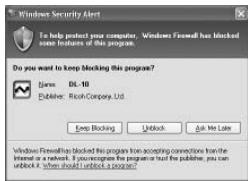

Caution
Blocking denies the affected program access to the Internet. To ensure that your computer is not infected by viruses and other malware, click Keep Blocking if you can not identify the program name or publisher.
If you clicked Keep Blocking to block a Ricoh application, you can remove the block in Windows Firewall.
1 Open the "Windows Firewall" Control Panel.
Open the "Start" menu and select Control Panel, then double-click Windows Firewall (if Windows Firewall is not listed, click Switch to Classic View at the top left corner of the Control Panel window).

Windows Firewall
2 Allow the Ricoh application Internet access.
In the "Windows Firewall" dialog, click the Exceptions tab and check whether DL-10 is listed under "Programs and Services." If it is, place a check in the check box next to DL-10 and click OK. If it is not listed, click Add Program... to add DL-10 to the list of exceptions.
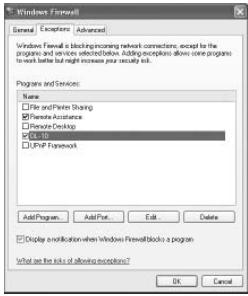
If you clicked Ask Me Later to block DL-10, a security alert will be displayed the next time the program starts. Click Unblock to remove the block.
Specifications
| Effective pixels | Approximately 10 million | |
| Image sensor | 1/1.7" CCD (approximately 10.4 million total pixels) | |
| Lens | Focal length | 6.0 mm (35-mm format equivalent: 28 mm) |
| Aperture (f-number) | f/1.9 - f/9 (ND filter used for apertures of f/8.0 - f/11 in auto shooting mode) | |
| Focus range (from lens) | Approx. 30 cm - ∞; approx. 1.0 cm - ∞ in macro mode | |
| Construction | 8 elements in 6 groups (2 aspherical lens elements with 2 surfaces) | |
| Zoom | 4.0 × digital zoom; approx. 5.7 × auto resize zoom (VGA) | |
| Focus mode | CCD-based multi and spot AF; MF; Snap; ∞; focus lock and AF-assist | |
| Shutter speed | Photographs | 180, 120, 60, 30, 15, 13, 10, 8, 6, 5, 4, 3.2, 2.5, 2, 1.6, 1.3, and 1 - 1/2000 s (upper and lower limits vary according to shooting and flash mode) |
| Movies | 1/30 - 1/2000 s | |
| Exposure control | Metering | TTL-CCD metering in multi (256-segment), center-weighted, and spot modes with autoexposure lock |
| Mode | Program AE, aperture priority AE, shutter priority AE, manual exposure | |
| Exposure compensation | Manual (+2.0 to -2.0 EV in increments of 1/3 EV); auto bracketing (-0.5 EV, ±0 EV, +0.5 EV and -0.3 EV, ±0 EV, +0.3 EV) | |
| ISO sensitivity (Standard Output Sensitivity) | Auto, Auto-Hi, ISO 64, ISO 100, ISO 200, ISO 400, ISO 800, ISO 1600 | |
| White balance | Auto, Multi-P AUTO, Outdoors, Cloudy, Incandescent Lamp, Fluorescent Lamp, Manual Settings, Detail; white balance bracketing | |
| Flash | Mode | Auto (flash fires when lighting is poor or subject is backlit), red-eye, on, slow sync, manual, off |
| Range (built-in flash) | Approx. 20 cm - 3.0 m (ISO auto) | |
| Flash compensation | ±2.0 EV in increments of 1/3 EV | |
| Picture display | 3.0" transparent LCD; approx. 920,000 pixels | |
| Shooting mode | Auto, program shift, aperture priority, shutter priority, manual, scene (text, movie, skew correct, dynamic range double shot), "My Settings" | |
| Picture quality1 | Fine, Normal, RAW (DNG)2 | |
| Image size (pixels) | Photographs | 3648 × 2736, 3648 × 2432, 2736 × 2736, 3264 × 2448, 2592 × 1944, 2048 × 1536, 1280 × 960, 640 × 480 |
| Movies | 640 × 480, 320 × 240 | |
| Text mode | 3648 × 2736, 2048 × 1536 | |
| Storage | SD/SDHC and MultiMedia memory cards; internal memory (approx. 88 MB) | |
| File size (approx.) | 3648 × 2736 | 2,164 KB/frame (N), 3,738 KB/frame (F), 18.2 MB/frame (RAW) |
| 3648 × 2432 | 1,925 KB/frame (N), 3,325 KB/frame (F), 16.2 MB/frame (RAW) | |
| 2736 × 2736 | 1,628 KB/frame (N), 2,809 KB/frame (F), 13.7 MB/frame (RAW) | |
| 3264 × 2448 | 1,756 KB/frame (N) | |
| 2592 × 1944 | 1,151 KB/frame (N) | |
| 2048 × 1536 | 763 KB/frame (N) | |
| 1280 × 960 | 447 KB/frame (N) | |
| 640 × 480 | 106 KB/frame (N) | |
| File format | Photographs | JPEG (Exif Ver. 2.21)3, RAW (DNG) |
| Movies | AVI (OpenDML Motion JPEG compliant) | |
| Compression | JPEG baseline compliant (photographs and movies) | |
| Other shooting options | Continuous shooting (continuous, S-Cont, M-Cont); self-timer (shutter release delay of approx. 10 s or 2 s); interval timer (intervals of 5 s to 1 hour in increments of 5 s)4; color bracketing; B&W (TE); color space selection; noise reduction; histogram display; framing grid; depth-of-field indicator; tilt indicator; hot shoe | |
| Other playback options | Auto image rotation; multi-frame playback; playback zoom (up to 16 x); resize | |
| Interface | USB 2.0 (High-Speed) Mini-B connector; Mass Storage5; audio output 1.0 Vp-p (75 Ω) | |
| Video signal format | NTSC, PAL | |
| Power source | One DB-65 rechargeable battery (3.7V) | |
| Two AAA alkaline or NiMH batteries | ||
| Optional AC-4c AC adapter (3.8V) | ||
| Battery life (based on CIPA standard)6 | • DB-65: approx. 370 shots • AAA alkaline batteries: approx. 25 shots7 | |
| Dimensions (W × H × D) | 108.6 mm × 59.8 mm × 25.5 mm (excluding projections) | |
| Weight (approx.) | • Camera (excluding battery, memory card, and strap): 188 g • Battery and strap: 30 g | |
| Tripod screw hole | 1/4-20UNC | |
| Date storage time | Approx. 1 week | |
| Operating temperature | 0 °C to 40 °C | |
| Operating humidity | 85% or less | |
| Storage temperature | -20 °C to 60 °C | |
1 The options available vary with image size.
2 A JPEG file is also recorded (the JPEG file may be a fine- or normal-quality file with the dimensions as the RAW file or a normal-quality file 640 × 480 pixels in size). RAW files use the standard DNG format promoted by Adobe Systems, Inc.
3 Compatible with the Design rule for Camera File system (DCF, a JEITA standard) and DPOF. Full compatibility with other devices is not guaranteed.
4 Flash off.
5 Mass Storage is supported under Windows 2000, Windows XP, Windows Vista, Mac OS 9.0-9.2.2, and Mac OS X 10.1.2-10.5.6.
6 Measured according to CIPA standard. For reference only; actual number of shots varies greatly according to how camera is used.
7 Measured with Panasonic alkaline batteries.
Internal Memory/Memory Card Capacity
The following table lists the approximate number of frames or length of movies that can be stored in internal memory or on a memory card at different settings.
| Internal memory | 1 GB | 2 GB | 4 GB | 8 GB | 16 GB | 32 GB | |||
| Processes | RAW | 3,648 × 2,736 | 4 | 51 | 104 | 204 | 417 | 836 | 1677 |
| F | 22 | 240 | 487 | 957 | 1957 | 3922 | 7867 | ||
| N | 38 | 414 | 842 | 1653 | 3379 | 6769 | 13579 | ||
| RAW | 3,648 × 2,432 | 5 | 57 | 116 | 229 | 469 | 939 | 1884 | |
| F | 25 | 269 | 548 | 1077 | 2202 | 4412 | 8851 | ||
| N | 43 | 465 | 945 | 1856 | 3795 | 7602 | 15251 | ||
| RAW | 2,736 × 2,736 | 6 | 68 | 138 | 271 | 554 | 1110 | 2227 | |
| F | 29 | 319 | 647 | 1270 | 2596 | 5202 | 10435 | ||
| N | 50 | 544 | 1097 | 2155 | 4405 | 8824 | 17702 | ||
| 3,264 × 2,448 | 47 | 512 | 1041 | 2045 | 4181 | 8376 | 16802 | ||
| 2,592 × 1,944 | 72 | 775 | 1576 | 3094 | 6325 | 12671 | 25418 | ||
| 2,048 × 1,536 | 109 | 1184 | 2363 | 4640 | 9486 | 19005 | 38125 | ||
| 1,280 × 960 | 175 | 1888 | 3840 | 7541 | 15415 | 30882 | 61951 | ||
| 640 × 480 | 705 | 7553 | 15359 | 30159 | 61643 | 123489 | 247716 | ||
| Text mode | 3,648 × 2,736 | 38 | 414 | 842 | 1653 | 3379 | 6769 | 13879 | |
| 2,048 × 1,536 | 109 | 1184 | 2363 | 4640 | 9486 | 19005 | 38125 | ||
| Process N | 640 × 480, 30 fps | 51 s | 9 min. 15 s | 18 min. 49 s | 38 min. 41 s | 75 min. 31 s | 151 min. 18 s | 303 min. 31 s | |
| 640 × 480, 15 fps | 1 min. 42 s | 18 min. 20 s | 37 min. 17 s | 76 min. 41 s | 149 min. 40 s | 299 min. 50 s | 601 min. 28 s | ||
| 320 × 240, 30 fps | 2 min. 12 s | 23 min. 42 s | 48 min. 13 s | 99 min. 8 s | 193 min. 30 s | 387 min. 39 s | 777 min. 37 s | ||
| 320 × 240, 15 fps | 4 min. 19 s | 46 min. 19 s | 94 min. 11 s | 193 min. 41 s | 378 min. 2 s | 757 min. 18 s | 1519 min. 7 s | ||

Notes
- The figures for movies are the total length that can be recorded. Each movie can be up to 90 minutes long (4GB in size).
- The maximum number of shots that can be taken in a single burst is 999. If memory remains for more than 999 exposures, "999" is shown in the display.
- Depending on the subject, the number of pictures that can be taken may differ from the number of exposures remaining.
- Capacity varies with shooting conditions and the make of memory card.
- Use a high-speed memory card when shooting for extended periods.
Optional Accessories
The GR DIGITAL III can be used with the following optional accessories:
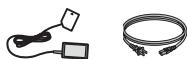
AC-4c AC adapter
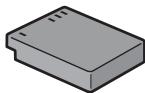
DB-65 rechargeable battery
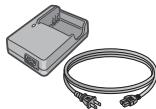
BJ-6 battery charger
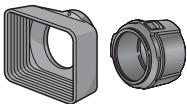
GH-2 hood and adapter
Includes a hood to prevent sunlight from entering the lens and an adapter for general-purpose filters with a diameter of 43mm . Improves results with backlit subjects.
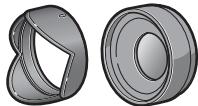
GW-2 wide conversion lens
A conversion lens with a focal length multiplier of 0.75× for wide-angle shots, giving a combined focal length of 21mm (35-mm format equivalent). Requires GH-2. Case included.
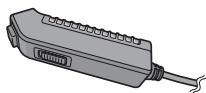
CA-1 cable switch
A wired remote shutter release that attaches to the camera USB connector.
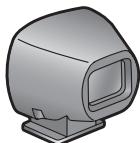
GV-1 external viewfinder
An optical viewfinder that attaches to the camera hot shoe. Frames offer coverage for 21mm and 28mm lenses (35-mm format equivalent). Case included.
A compact optical viewfinder that attaches to the camera hot shoe. Frames offer coverage for 28mm lenses (35-mm format equivalent) with marks for 1:1 aspect ratio. Case included.
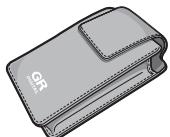
GC-3 soft case
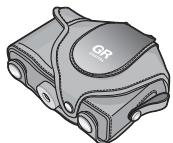
GC-4 soft case (can be used with GV-2)
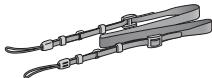
GS-1 or ST-2 neck strap

Notes
- Before using optional accessories, read the manual provided with the product.
- The built-in flash can not be used with conversion lenses or lens hoods.
- GH-1, GW-1, and GT-1 accessories for GR DIGITAL and GR DIGITAL II cameras can not be used.
- For the latest information on optional accessories, visit the Ricoh website (http://www.ricohpmmc.com/).

Tip: Attaching the Neck Strap
Remove the end of the neck strap from the buckle and attach the strap as shown at right.
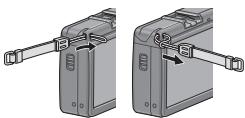

Tip: The Ring Cap
Remove the ring cap before attaching a conversion lens or the lens hood and adapter.
- To remove the ring cap: Turn the camera off and rotate the cap counterclockwise until it can be removed.
To reattach the ring cap: Turn the camera off and place the cap on the camera, keeping the marks on the camera body (①) and ring cap (②) aligned. Rotate the cap clockwise until it clicks into place.
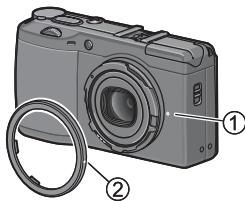
Camera System and Accessories
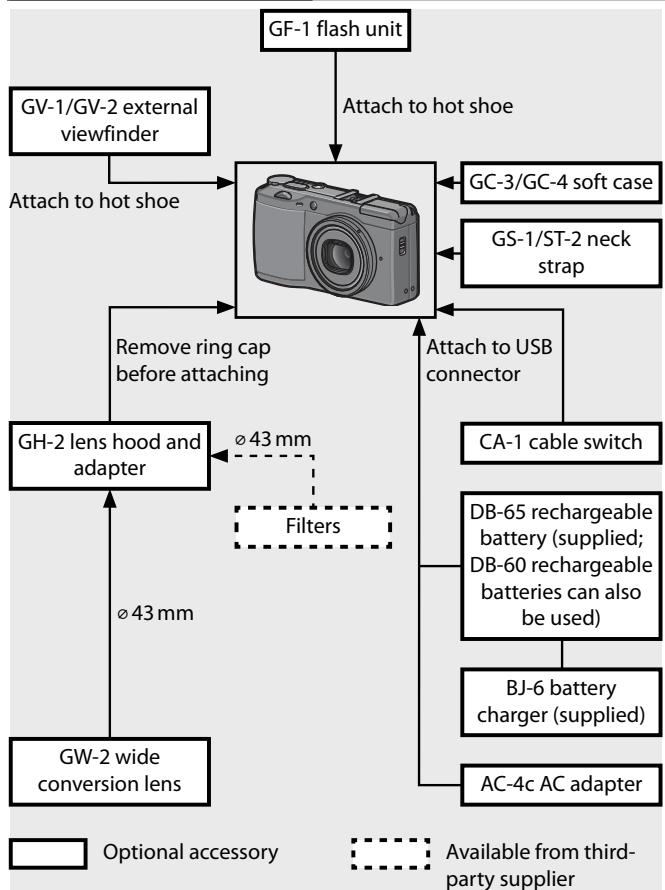
Using an Optional AC Adapter
An optional AC adapter is recommended for extended use or when the camera is connected to a computer. Be sure the camera is off before connecting the AC adapter.
1 Open the battery/card cover.
Unlatch (①) and open (②) the cover and remove any batteries.
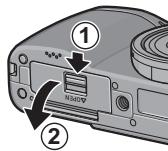
Insert the AC adapter coupler.
The battery latch will click into place when the coupler is fully inserted.
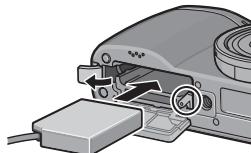
3 Place the cable in the cable channel.
Open the power (DC input) cable cover and place the power cable in the cable channel.
4 Close the battery/card cover.
Close (1) and latch (2) the cover.
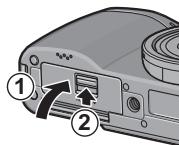

Caution
Be sure the cover is latched.
5 Plug the adapter in.
Attach the AC cable to the adapter and plug it in to a power outlet.

Caution
Be sure that both plugs are fully inserted.

Cautions
- Disconnect the AC adapter and unplug it from the power outlet when not in use.
- Data may become corrupted if the AC adapter is disconnected or power is interrupted while the camera is on.
- The battery indicator (i) may be displayed while the AC adapter is in use. This is normal, and you can continue using the camera.
- Do not pick up the camera by the cable when the AC adapter is attached.
Disconnecting the AC Adapter
Be sure the camera is off before disconnecting the AC adapter.
1 Unplug the adapter.
2 Open the battery/card cover. Slide the release lever to "OPEN" and open the cover.
3 Remove the AC adapter coupler.
4 Close the battery/card cover. Close and latch the cover.
The GF-1 Flash Unit
An optional GF-1 flash unit can be connected to the camera hot shoe.
1 Close the flash cover (page 25).
2 Attach the flash.
Turn the camera and the GF-1 off and attach the GF-1 to the camera hot shoe.
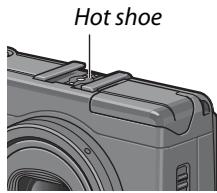
3 Turn the flash and camera on.

Note
If the optional flash unit icon is not displayed, turn the GF-1 and camera off and then remove and reattach flash.

Cautions
- Blur may occur at slow shutter speeds.
- Do not use the built-in flash when the GF-1 is attached. Failure to observe this precaution could cause injury or damage the product.
Other Flash Units
Use only flash units with one signal terminal, which must be an X-contact with a positive voltage of no more than 20V . Use a flash that covers the angle of view of the lens.
1 Close the flash cover (page 25).
2 Attach the flash.
Turn the camera and the optional flash unit off and attach the flash to the camera hot shoe.
3 Set aperture manually.
Turn the camera on, select mode A or M, and choose an aperture (pages 14, 43, 44).
4 Choose a manual ISO sensitivity setting.
Select an option other than Auto for ISO sensitivity (page 84).
5 Turn the flash on.
Turn the flash on and set it to auto mode. Set aperture and ISO sensitivity to the values selected with the camera. Take a test shot and adjust flash aperture and ISO settings as necessary.
Turn the optional flash unit off before removing it from the camera.
Cautions
-
If the external flash is on, it will fire with every shot regardless to the flash mode selected with the camera. Turn the flash unit off to shoot without the flash.
-
Optional flash units are in principle for use at ranges that exceed the range of the built-in flash. Using an optional flash unit at shorter ranges may result in overexposure.
Using the AC-4c AC Adapter and BJ-6 Battery Charger
These products are for use with currents of 100-240V and 50 or 60Hz . Before travelling, purchase a travel adapter for connection to the type of outlets used at your destination. Do not use these products with electrical transformers, as this could damage the camera.
Warranty
This product was manufactured for use in the country of purchase, and the warranty is not valid in other countries. Should the product fail or malfunction while out of the country, the manufacturer assumes no responsibility for servicing the product locally or bearing any expenditure incurred thereby.
Television Playback
The supplied A/V cable can be used to connect the camera to televisions and monitors equipped with a video input terminal. The camera supports the NTSC and PAL video formats; before connecting the camera to a video device, select the appropriate video output mode.
Precautions for Use
- This product was manufactured for use in the country of purchase; the warranty is not valid in other countries. Should the product fail or malfunction while out of the country, the manufacturer assumes no responsibility for servicing the product locally or bearing any expenditure incurred thereby.
-
Do not drop the camera or subject it to physical shocks. When carrying the camera, be careful that it does not strike other objects. Particular care is required to protect the lens and picture display.
-
The flash may overheat if fired many times in succession. Do not use the flash more than necessary. Do not use the flash in close contact with your body or other objects. Failure to observe these precautions could result in burns or fire.
- Using the flash unit in close proximity to your subject's eyes could cause temporary visual impairment. Particular care should be observed when photographing infants. Do not direct the flash at the operator of a motor vehicle.
- Batteries may become hot with extended use. Wait for batteries to cool before removing them from the camera.
- The picture display may be difficult to read in direct sunlight.
- You may notice that picture display varies in brightness or contains pixels that do not light or that are always lit. This is common to all LCD monitors and does not indicate a malfunction.
- Do not apply force to the picture display.
- Abrupt changes in temperature may cause condensation, resulting in visible condensation inside the lens or camera malfunction. This can be avoided by placing the camera in a plastic bag to slow the temperature change, and removing it only after the air in the bag has reached the same temperature its surroundings.
- To prevent damage to the product, do not insert objects into the holes in the microphone and speaker coverings.
- Keep the camera dry and avoid handling it with wet hands. Failure to observe these precautions could result in product malfunction or electric shock.
- Take a test shot to ensure that the camera is functioning properly before using it on important occasions such as travel or weddings. We recommend that you keep this manual and spare batteries at hand.

Tip: Avoiding Condensation
Condensation is particularly likely to occur if you move to an area with a sharply different temperature, if humidity is high, in a cold room after the heater has come on, or where the camera is exposed to cold air from an air conditioner or other device.
Caring for the Camera
- Photographs can be affected by fingerprints and other foreign matter on the lens. Avoid touching the lens with your fingers. Remove dust or lint with a blower from a camera supply store, or gently clean the lens with a soft, dry cloth. Clean the picture display by wiping it with a soft cloth dampened with a small amount of any monitor cleaner that does not contain organic solvents.
- Clean the camera thoroughly after using it at the beach or handling cosmetics. Do not expose the camera to volatile substances such as thinner, benzene, or pesticides. Failure to observe this precaution could result in damage to the camera or its finish.
- In the unlikely event of malfunction, visit a Ricoh Repair Center.
- The camera contains high-voltage circuits. Do not disassemble.
- The picture display is easily scratched; avoid touching it with hard objects.
Storage
- Do not store the camera where it will be exposed to: extreme heat or humidity; large changes in temperature or humidity; dust, dirt, or sand; severe vibration; prolonged contact with chemicals, including mothballs and other insect repellent, or with vinyl or rubber products; strong magnetic fields (for example, in the vicinity of a monitor, transformer, or magnet).
- Remove the batteries if the product will be left unused for a long period of time.
Before Cleaning
Turn the camera off and remove the battery or disconnect the AC adapter.
Warranty and Servicing
- This product is backed by a limited warranty. During the warranty period mentioned in the Warranty supplied with your camera, any defective parts will be repaired free of charge. In the event of a camera malfunction, contact the dealer from which you purchased the camera or your nearest Ricoh Repair Center. Please note that you will not be reimbursed for the cost of bringing the camera to the Ricoh Repair Center.
- This warranty does not cover any damage resulting from:
1 failure to follow the instructions in the instruction manual;
2 repair, modification or overhaul not conducted by an authorized service center listed in the instruction manual;
3 fire, natural disaster, act of God, lightning, abnormal voltage, etc.;
4 improper storage (noted in the "Camera User Guide"), leaking of battery and other fluids, mold, or otherwise insufficient care of the camera.
5 submergence in water (flooding), exposure to alcohol or other beverages, infiltration of sand or mud, physical shock, dropping of the camera, or pressure on the camera, and other unnatural causes.
- After the warranty period has passed, you will be liable for all repair fees, including those incurred at an authorized service center.
- You will be liable for all repair fees, even within the warranty period, if the warranty card is not attached or if the distributor's name or the purchase date have been changed or are not indicated on the card.
- Expenses for overhaul and thorough inspection by special request of the customer will be charged to the customer, whether or not they are incurred during the warranty period.
- This warranty only applies to the camera and not to the accessories, such as the case and strap, nor does it apply to the battery and other consumables provided.
- Any consequential damages arising from failure of the camera, such as expenses incurred in taking pictures or loss of expected profit, will not be reimbursed whether they occur during the warranty period or not.
-
The warranty is only valid in the country in which the camera was purchased.
-
The above provisions refer to repairs offered free of charge, and do not limit your legal rights.
-
The intention of the above provisions is also described in the warranty card provided with this camera.
-
Parts essential to the servicing of the camera (that is, components required to maintain the functions and quality of the camera) will be available for a period of five years after the camera is discontinued.
- Please note that if the camera is seriously damaged by flooding, submergence, infiltration of sand or mud, violent shocks or dropping, it may not be repairable, and restoration to its original condition may be impossible.

Notes
- Before sending the camera in for repair, check the battery and read the instruction manual again to ensure proper operation.
- Some repairs require a significant amount of time to complete.
- When sending the camera to a service center, please include a note which describes the defective part and the problem as precisely as possible.
- Remove all accessories not related to the problem before sending the camera to the service center.
- This warranty does not apply to data stored on memory cards or in internal memory.
USA FCC Part 15 Class B
The equipment has been tested and found to comply with the limits for a Class B digital device, pursuant to part 15 of the FCC Rules. These limits are designed to provide reasonable protection against harmful interference in a residential installation. This equipment generates, uses, and can radiate radio frequency energy and if not installed and used in accordance with the instructions, may cause harmful interference to radio communications. However, there is no guarantee that interference will not occur in a particular installation. If this equipment does cause harmful interference to radio or television reception, which can be determined by turning the equipment off and on, then user is encouraged to try to correct the interference by one or more of the following measures:
- Reorient or relocate the receiving antenna.
- Increase the separation between the equipment and receiver.
- Connect the equipment to an outlet on a circuit different from that to which the receiver is connected.
- Consult the dealer or an experienced radio/TV technician for help. (FCC 15.105B)
Changes or modifications not expressly approved by the party responsible for compliance could void the user's authority to operate the equipment. (FCC 15.21)
Properly shielded and grounded cables and connectors must be used for connection to a host computer in order to comply with FCC emission limits. (FCC 15.27)
An AC adapter with a ferrite core must be used for RF interference suppression.
COMPLIANCE INFORMATION STATEMENT
Product Name: DIGITAL CAMERA
Model Number: GR DIGITAL III
This device complies with Part 15 of the FCC Rules.
Operation is subject to the following two conditions:
(1) This device may cause harmful interference, and
(2) This device must accept any interference received, including interference that may cause undesired operation.
RICOH AMERICAS CORPORATION
5 Dedrick Place, West Caldwell NJ, 07006 Tel.: 1-800-225-1899
Note to Users in Canada
Note: This Class B digital apparatus complies with Canadian ICES-003
IMPORTANT SAFETY INSTRUCTIONS—SAVE THESE INSTRUCTIONS
DANGER—TO REDUCE THE RISK OF FIRE OR ELECTRIC SHOCK, CAREFULLY FOLLOW THESE INSTRUCTIONS.
Symbols
(auto) mode. 4, 17-21
(Delete) button.. 3, 33-35
□DISP).button 3,36,37
(flash) button. 3,5,24
(3, 23)
(Playback) button...... 3, 15, 29, 91
( self-timer ) button . 3 , 26
Q (enlarged view) button....3,22,31, 32,122
(-Thmbnail display) button..3,22,31, 32,122
A
A (aperture priority) mode. 4, 42
A/V cable .ii, 104
A/V cable connector. 3, 104
AAA. 11-12, 159, 170, 171
ACadapter 162,165-166,169
ADJ Lever Setting. 119-120
ADJ Shutter Confirmation 120
ADJ. lever.. 3,5,78,119-120
Adobe Reader. 141-142, 148
AF Auxiliary Light. 125
AF auxiliary light. 5, 26, 125
Alert. 156-157
Alkaline 11-12, 159, 170, 171
Aperture.....40, 42, 43, 44, 85, 123, 158
Auto Aperture Shift. 85
Auto Bracket. 70-71
Auto Power Off. 125
Auto Rotate. 127
Autofocus. 18, 19, 59, 64, 65
Autofocus/flash lamp. 3, 14, 18, 25
AVI. 87
B
Backlighting 77
Battery ...ii,8,10-12,159,164,165,170,171
Battery charger. .ii, 10, 165, 169
Battery level. 8
Battery/card cover. 3, 12, 13, 165
Black-and-white 66-67, 70-71
Blur. 20
Bracketing. 70-71
Brightness 100-102, 124
C
Cable switch 162
Caplio 139
Card Sequence No. 134
Case,soft. 163
CD. ii, 138, 140, 142
CL-BKT Black & White (TE) 131
Clock. 16
Close-up. 23
Color. 66-67, 70-71, 79, 82, 132
Color Space Setting. 132
Computer 136-149
Connector cover...3, 104, 107, 144, 148
Continuous Mode 68-69
Contrast. 48-49, 66-67, 100-102
Conversion lens, wide. 162, 163
Copy to Card from Internal Memory. 97
Copying photographs.....97, 136-149
D
Date 16,76
Date Imprint 76
Date Settings 16, 135
DB-60 8,10-12,164,170,171
DB-65...ii,8,10-12,159,164,170,171
DC power cable cover. 3, 165
Defaults. 55-56,85
Deleting photographs.. 33-35
Density. 52
Depth of field. 42, 59
Digital zoom. 22
Digital Zoom Image 133
DISP. button 3, 36, 37
DL-10
137, 138, 139-141, 143, 145, 156-157
DL-10, installing 139-141
DL-10, system requirements for.... 137
DL-10, unblocking. 156-157
DL-10,uninstalling. 143
DNG 58
DPOF. 95-96
Dynamic range. 48
Dynamic range double shot mode 48-50
Dynamic Range Expansion.....49-50
E
Edit My Settings. 117-118
Error message.....150-155, 156-157
Exposure.....18,61-62,70-71,77-78 102,123
Exposure Compensation. 77-78
Exposure lock. 121
Exposure Metering 65
Exposure program 41
F
Fine picture quality.. 57, 58
Flash compensation 72
Flash cover 2, 24
Flash Exposure Compensation. 72
Flash level. 72
Flash mode 24
Flash OPEN switch 2, 24
Flash Synchro Settings. 73
Flash, built-in. 2, 24-25, 72, 73, 158, 170
Flash, manual. 73
Flash, optional 167-168
Fn Button Display. 129
Fn1 button. 3, 119-120
Fn2 button. 3,119-120
Focus. 18, 19, 59-65
Focus. 58-63
Focus lock. 21
Focus target. 61-63
Format [Card] 124
Format [Internal Memory] 124
Formatting 124
Frame Rate 89
Frame size 89
Framing grid. 36, 128
Full Press Snap. 64
G
GF-1 167
Grid 36,128
Grid Guide Display Options. 128
H
Hand strap..
Highlights. 37
Histogram. 37, 38, 101-102
Hot shoe .ii, 162, 167, 168
Hot shoe cover .ii
1
Image Settings 66-67
Information Display Mode 130
Interval Shooting. 75-76
Interval timer photography.75-76
Irodio Photo & Video Studio...iv, 138
ISO. 74,84-85,125
ISO Auto-High Settings 125
ISO Setting. 84-85
#
JPEG. 58, 131, 159
K
Key custom options. 113-123
L
Language/言語 16,135
LCD Brightness 124
LCD Confirmation Time 126
Lens. 2, 17, 158, 171
Lens filter. 162
Lens hood and adapter. 162, 163
Level Compensation 100-102
Level Setting 127
M
M (manual) mode. 4, 44-45
M Mode Dial Options. 123
Mac OS. 148-149
Macintosh. 148-149
Macro mode 23
Manual focus. 59, 60
Memory card.....13-14, 97, 124, 134, 146, 161
Memory card reader. 146
Memory, internal..13, 14, 97, 124, 161
MENU/OK button. 3,54
Metering. 61-62, 65
Microphone. 2
My Settings for Fn Settings. 118
My Settings WB Comp. 118
N
Neck strap 163
Nickel-metal hydride.8, 11-12, 159, 170, 171
NiMH. 8,11-12,159,170,171
Noise 74,85
Noise Reduction 74
Noise Reduction ISO. 74
Normal picture quality 57, 58
NTSC. 105, 135
0
One Press M Mode 123
One Press Zoom Ratio 126
Operation Sounds. 125
P
P (program shift) mode. 4, 40-41
PAL. 105, 135
PC card adapter. 146
PictBridge. 106
Picture display ...3,6-8,36-37,124,130,158,170,171
Picture quality. 57, 58
Picture Quality/Size. 57-58
Picture size 57
Playback menu. 91-103
Playback Mode Mode Dial Options 123
Playback zoom 32
Playback,movies 90
Playback, photographs. 29-32, 91-105
Playback, TV. 104-105
Plus Normal Shooting 49-50
POWER button. 2, 14, 15, 17, 122
Power Button Lamp 122
Pre-AF. 65
Printing. 76, 95-96, 106-111
Protect. 92-94
R
RAW. 30, 57, 58, 131
RAW/JPEG Setting 131
Recall My Settings. 116
Rechargeable battery.....ii, 10-12, 159
Reg. My Settings 114-115
Remote shutter release 162
Resize 97
Safety Precautions..
SCENE mode. 4, 46-52
SD. 13, 161
SDHC. 13, 161
SECAM. 105, 135
Security alert. 156-157
Self-timer. 26
Set Fn1 Button. 121-122
Set Fn2 Button. 121-122
Setup menu. 124-135
Sharpness. 66-67
Shooting Info Display Frame.....129
Shooting menu 54-86
Show My Setting Name 129
Shutter speed.....40, 42, 43, 44, 45, 123, 158
Shutter-release button....2,17,18,19
Size 57
Skew. 51, 98-99
Skew correct mode. 51
Skew Correction 98-99
Slide Show. 92
Snap Focus Distance 64
Software. 139-141, 143
Software User Guide..ii, iv
Speaker 3,27,125-126
Specifications. 158-160
Store Menu Cursor Position. 133
Strap.. ii, 163
Strap eyelet.. ii, 2
Support. iv
Switch Shooting Mode 86
1
Text mode 52
Tilt indicator 27-28
Time and date. 16, 76
Timer 26
Tripod screw hole. 3, 48, 61
TV. 104-105, 135, 169
U
Up-down dial. 2, 5, 32, 123
USB cable.. .ii, 107, 144, 148
USB cable connector...3, 107, 144, 148
V
Video Out Mode. 135
Viewfinder, external. 130, 162
Viewing photographs...29-32, 104-105
Volume 90,126
Volume Settings 126
W
Warranty. 169, 172
White balance. 77-83, 103
White Balance. 79-81
White Balance Compensation
playback) 103
White Balance Compensation
(shooting) 82-83
Windows. 136-147, 156-157
Z
Zoom. 22,32
Zoom Button 122
Telephone Support Numbers in Europe
| UK | (from within the UK) | 02073 656 580 |
| (from outside of the UK) | +44 2073 656 580 | |
| Deutschland | (innerhalb Deutschlands) | 06331 268 438 |
| (außerhalb Deutschlands) | +49 6331 268 438 | |
| France | (à partir de la France) | 0800 88 18 70 |
| (en dehors de la France) | +33 1 60 60 19 94 | |
| Italia | (dall'Italia) | 02 696 33 451 |
| (dall'estero) | +39 02 696 33 451 | |
| Espana | (desde España) | 91 406 9148 |
| (desde fauna de España) | +34 91 406 9148 |
http://www.service.ricohpmmc.com/
From environmental friendliness to environmental conservation and
to environmental management
Ricoh is aggressively promoting environment-friendly activities and also environment conservation activities to solve the great subject of management as one of the citizens on our precious earth.
To reduce the environmental loads of digital cameras,
Ricoh is also trying to solve the great subjects of "Saving energy by reducing power consumption" and "Reducing environment-affected chemical substances contained in products".
If You Encounter a Problem with This Product
See "Troubleshooting" (page 150) in this manual. If the problem persists, contact a Ricoh office.
| Ricoh offices | |
| RICOH COMPANY, LTD. | 3-2-3, Shin-Yokohama Kouhoku-ku, Yokohama City, Kanagawa 222-8530, Japan http://www.ricoh.com/r_dc |
| RICOH AMERICAS CORPORATION | 5 Dedrick Place, West Caldwell, New Jersey 07006, U.S.A. 1-800-22RICOH http://www.ricoh-usa.com/ |
| RICOH INTERNATIONAL B.V. (EPMMC) | Oberrather Str. 6, 40472 Düsseldorf, GERMANY (innerhalb Deutschlands) 06331 268 438 (außerhalb Deutschlands) +49 6331 268 438 http://www.ricohpmmc.com/ |
| RICOH UK LTD. (PMMC UK) | (from within the UK) 02073 656 580 (from outside of the UK) +44 2073 656 580 |
| RICOH FRANCE S.A.S. (PMMC FRANCE) | (à partir de la France) 0800 88 18 70 (en dehors de la France) +33 1 60 60 19 94 |
| RICOH ESPANA, S.A. (PMMC SPAIN) | (dese España) 91 406 9148 (deseURTa de España) +34 91 406 9148 |
| RICOH ITALIA S.p.A. (PMMC ITALY) | (dall'Italia) 02 696 33 451 (dall'estero) +39 02 696 33 451 |
| RICOH ASIA PACIFIC OPERATIONS LIMITED | 21/F, One Kowloon, 1 Wang Yuen Street, Kowloon Bay, Hong Kong |
| Support for Irodio Photo & Video Studio | |
| North America (U.S.A.) | +1-800-458-4029 (toll free) |
| Europe | UK, Germany, France and Spain: +800-1532-4865 (toll free) Other countries: +44-1489-564-764 |
| Asia | +63-2-438-0090 |
| China | +86-21-5385-3786 |
| Business hours: 9:00 AM to 5:00 PM | |
Ricoh Company, Ltd.
Ricoh Building, 8-13-1, Ginza, Chuo-ku, Tokyo
104-8222, Japan
2009 August
- Before You Begin
- Basic Photography and Playback
- Reference
- Package Contents
- Tip: Attaching the Hand Strap
- Notices
- Camera User Guide (this booklet)
- Software User Guide (pdf file)
- Table of Contents
- Before You Begin 1
- Introduction 2
- Basic Photography and Playback 9
- First Steps. 10
- Taking Photographs. 17
- Viewing and Deleting Photographs. 29
- Reference 39
- More on Photography 40
- Movies 87
- More onPlayback. 91
- Printing Photographs 106
- The Setup Menu. 112
- Copying Pictures to a Computer. 136
- Technical Notes. 150
- Index 174
- Introduction
- Parts of the Camera
- Front
- Back
- The Mode Dial
- The Up-down Dial and ADJ. Lever
- Note
- The Picture Display
- Notes
- The Battery Level Indicator
- Cautions
- Charging the Battery
- Place the battery in the charger.
- Caution
- Plug the charger in.
- Remove the battery.
- Compatible Batteries
- Tip: Battery Capacity
- Inserting the Battery
- Removing the Battery
- Tip: Inserting and Removing AAA Batteries
- Inserting Memory Cards
- Removing Memory Cards
- Tip: Write Protection
- Turning the Camera on and Off
- Shooting Mode
- Playback Mode
- Tip: Auto Power Off
- Select a language.
- Set the clock.
- Taking Photographs
- Holding the Camera
- Hold the camera in both hands.
- Get ready to shoot.
- Focus.
- Take the picture.
- Tip: The Shutter-Release Button
- Tip: Focus
- Tip: Avoiding Blurred Pictures
- Focus Lock
- Recompose the photograph.
- Take the picture.
- Digital Zoom
- Close-ups (Macro Mode)
- Press the button.
- Focus.
- Flash Photography
- Using the Built-in Flash
- Raise the flash.
- Select a flash mode.
- Focus and shoot.
- The Self-Timer
- Choose a self-timer mode.
- Start the timer.
- The Tilt Indicator
- Display level setting options.
- Highlight an option.
- Select the highlighted option.
- Understanding the Tilt Indicator
- Viewing and Deleting Photographs
- Viewing Photographs
- Tip: If the Camera Is Off
- Caution: RAW Images
- Tip: Viewing Pictures in Shooting Mode
- Tip: Viewing the Pictures in Internal Memory
- Tip: Auto Rotate
- Viewing Multiple Photographs
- PlaybackZoom
- Deleting Photographs
- Deleting Individual Photographs
- Deleting All Files
- Deleting Multiple Files
- Press the button.
- Select Sel. Indiv. or Sel. Range.
- Select photographs.
- Tip: Selecting Ranges
- The (DISP.) Button
- Tip: The Framing Grid
- Tip: Highlights
- Tip: The Histogram
- More on Photography
- Mode P: Program Shift
- Choose mode P.
- Measure exposure.
- Choose shutter speed and aperture.
- Take the photograph.
- Note: The Exposure Program
- Mode A: Aperture Priority
- Choose mode A.
- Choose an aperture.
- Press the shutter-release button halfway.
- Mode S:Shutter Priority
- Choose mode S.
- Choose shutter speed.
- Press the shutter-release button halfway.
- Mode M: Manual Exposure
- Choose mode M.
- Choose an aperture and shutter speed.
- Focus.
- SCENE Mode: Matching Settings to the Scene
- Rotate the mode dial to SCENE.
- Press MENU/OK.
- Select an option.
- Shoot.
- Tip: Using the Menu
- SCENE Mode: Dynamic Range Double Shot
- Tip: Dynamic Range
- Mount the camera on a tripod.
- Shoot.
- Shooting Menu Options
- Tip: Plus Normal Shooting
- SCENE Mode: Skew Correct
- Caution: Skew Correct Mode
- Tip: Skew Correction
- SCENE Mode: Text
- Adjust contrast.
- Tip: Adjusting Contrast
- Take the photograph.
- Rotate the mode dial to MY1, MY2, or MY3.
- Tip: Choosing a Shooting Mode
- Tip:SCENE Mode
- Select a menu item.
- Picture Quality and Size
- Focus
- Tip: Depth of Field
- Focus: MF (Manual Focus)
- Select MF (manual focus).
- Choose the focus distance.
- Choosing the Focus and Metering Target
- Activate target selection.
- Position the target.
- Macro Target Selection
- Snap Focus Distance
- Full Press Snap
- Tip: Autofocus
- Pre-AF
- Exposure Metering
- Image Settings
- Adjust custom color reproduction settings.
- Exit to shooting mode.
- Continuous Mode
- Tip: Viewing S-Cont and M-Cont Images with Playback Zoom
- Auto Bracket
- CL-BKT:Color Bracketing
- Tip: Contrast, Sharpness, and Color Depth
- Flash Exposure Compensation
- Manual Flash Amount
- Flash Synchro Settings
- Noise Reduction
- Noise Reduction ISO
- Interval Shooting
- Choose an interval.
- Start shooting.
- End shooting.
- Date Imprint
- Exposure Compensation
- The Shooting Menu
- The ADJ. Lever
- Display the exposure compensation slider.
- Adjust exposure compensation.
- White Balance
- Manual: Measuring White Balance
- Detail: Making Fine Adjustments to White Balance
- Select Detail.
- Choose a setting.
- Return to shooting mode.
- White Balance Compensation
- ISO Setting
- Restore Defaults
- Auto Aperture Shift
- Switch Shooting Mode
- Recording Movies
- Select
- Choosing the Frame Size and Frame Rate
- Display the shooting menu.
- Select Movie Size or Frame Rate.
- Highlight an option.
- Exit to shooting mode.
- More onPlayback
- ThePlaybackMenu
- Display the playback menu.
- Slide Show
- Protect
- Protecting Individual Pictures
- Changing the Protect Status of Multiple Files
- Select Protect in the playback menu.
- Press the Fn2 button.
- Protecting or Removing Protection from All Files
- DPOF: Selecting Pictures for Printing
- Tip: DPOF
- Selecting Individual Photos for Printing
- Selecting All Photos for Printing
- Multi-Frame Playback
- Select DPOF.
- Select photos and choose the number of prints.
- Press MENU/OK.
- Resize: Creating Small Copies of Photographs
- Copy to Card from Internal Memory
- Skew Correction
- Display the photo.
- Select Skew Correction.
- Level Correction
- Auto: Automatic Level Correction
- Manual: Manual Level Correction
- Select the black point, white point, or mid-point.
- Tips: Choosing the Black Point, White Point, and Mid-Point
- Viewing Pictures on TV
- Turn the camera off.
- Connect the A/V cable to the TV.
- Connect the camera.
- Tune the television to the video channel.
- Turn the camera on.
- Printing Photographs
- Connecting the Camera
- Printing
- Printing Photos One at a Time
- Select a photo.
- Tip: Printing One Copy of All Photos
- Adjust printer settings.
- Start printing.
- Printing Multiple Photographs
- The Setup Menu
- Display the menus.
- Select a setup menu tab.
- Select a menu item.
- Select an option.
- Key Custom Settings/Setup Menu Options
- Reg. My Settings
- Adjust settings.
- Select Reg My Settings.
- Save settings.
- Recall My Settings
- Select a destination.
- Select the source.
- Edit My Settings
- Select settings.
- Edit settings.
- Save changes and exit.
- My Settings for Fn Settings
- My Settings WB Comp.
- ADJ Lever Setting
- Using the ADJ. Lever
- Display options.
- Select an option.
- Tip
- ADJ Shutter Confirmation
- Set Fn Button
- Zoom Button
- Power Button Lamp
- Playback Mode Dial Options/M Mode Dial Options
- One Press M Mode
- Format [Card]/Format [Internal Memory]
- LCD Brightness
- ISO Auto-High Settings
- AF Auxiliary Light
- Auto Power Off
- Operation Sounds
- Volume Settings
- LCD Confirmation Time
- One Press Zoom Ratio
- Auto Rotate
- Level Setting
- Grid Guide Display Options
- Fn Button Display
- Show My Setting Name
- Shooting Info. Display Frame
- Information Display Mode
- CL-BKT Black & White (TE)
- RAW/JPEG Setting
- Color Space Setting
- Digital Zoom Image
- Store Menu Cursor Position
- Card Sequence No.
- Date Settings
- Language/言語
- Video Out Mode
- Copying Pictures to a Computer
- Windows
- System Requirements
- The Supplied CD
- Installing the Software
- Insert the supplied CD.
- Click Installing the software.
- Select a language and click OK.
- Select a destination.
- Install the software.
- Click Finish.
- Restart the computer.
- Unblock DL-10.
- Adobe Reader
- Click Browse CD-ROM Content.
- Install Adobe Reader.
- Uninstalling the Software
- Uninstall the software.
- Copying Pictures Using DL-10
- Copying Pictures Using Windows Explorer
- SD Card Readers and PC Card Adapters
- Disconnecting the Camera
- Copying Pictures to a Macintosh
- Copy files from the camera to the computer.
- Troubleshooting
- Error Messages
- Shooting
- Computer-Related Problems
- Security Alerts (Windows Vista/Windows XP)
- Open the "Windows Firewall" Control Panel.
- Allow the Ricoh application Internet access.
- Specifications
- Internal Memory/Memory Card Capacity
- Optional Accessories
- Tip: Attaching the Neck Strap
- Tip: The Ring Cap
- Camera System and Accessories
- Using an Optional AC Adapter
- Open the battery/card cover.
- Insert the AC adapter coupler.
- Place the cable in the cable channel.
- Close the battery/card cover.
- Plug the adapter in.
- Disconnecting the AC Adapter
- The GF-1 Flash Unit
- Other Flash Units
- Using the AC-4c AC Adapter and BJ-6 Battery Charger
- Warranty
- Television Playback
- Precautions for Use
- Tip: Avoiding Condensation
- Caring for the Camera
- Storage
- Before Cleaning
- Warranty and Servicing
- USA FCC Part 15 Class B
- COMPLIANCE INFORMATION STATEMENT
- Note to Users in Canada
- Symbols
- A
- B
- C
- D
- E
- F
- G
- H
- 1
- #
- K
- L
- M
- N
- 0
- P
- R
- U
- V
- W
- Z
- Telephone Support Numbers in Europe
- From environmental friendliness to environmental conservation and
- to environmental management
- If You Encounter a Problem with This Product
Brand : RICOH
Model : GR DIGITAL III
Category : Digital Camera