
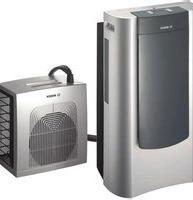
Climate 5000 MS - Air conditioner BOSCH - Free user manual and instructions
Find the device manual for free Climate 5000 MS BOSCH in PDF.
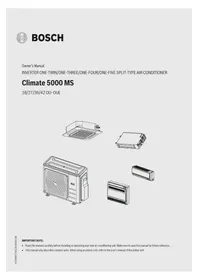


| Product Type | Split Air Conditioner |
| Model | Climate 5000 MS |
| Brand | Bosch |
| Cooling Capacity | 12,000 BTU (3.5 kW) |
| Heating Capacity | 12,000 BTU (3.5 kW) |
| Energy Efficiency | SEER 18.0 |
| Power Supply | 220-240 V, 50 Hz |
| Indoor Unit Dimensions | 800 x 200 x 220 mm |
| Outdoor Unit Dimensions | 700 x 550 x 250 mm |
| Indoor Unit Weight | 8.5 kg |
| Outdoor Unit Weight | 25 kg |
| Refrigerant | R32 |
| Airflow (High) | 400 m³/h |
| Noise Level Indoor | 25-45 dB(A) |
| Noise Level Outdoor | 55 dB(A) |
| Functions | Cooling, Heating, Dehumidification, Fan, Auto Mode, Sleep, Timer |
| Fan Speeds | 4 (Auto, Low, Medium, High) |
| Remote Control | Yes, included |
| Air Filter | Washable, Anti-bacterial |
| Maintenance | Clean filter every 2 weeks; outdoor unit coil annually |
| Safety Features | Overheating protection, auto restart, child lock |
| Spare Parts | Remote control, filters, fan motors available |
| Certifications | CE, RoHS |
Frequently Asked Questions - Climate 5000 MS BOSCH
User questions about Climate 5000 MS BOSCH
0 question about this device. Answer the ones you know or ask your own.
Ask a new question about this device
Download the instructions for your Air conditioner in PDF format for free! Find your manual Climate 5000 MS - BOSCH and take your electronic device back in hand. On this page are published all the documents necessary for the use of your device. Climate 5000 MS by BOSCH.
USER MANUAL Climate 5000 MS BOSCH
INVERTER ONE-TWIN/ONE-THREE/ONE-FOUR/ONE-FIVE SPLIT-TYPE AIR CONDITIONER
Climate 5000 MS
18/27/36/42 OU- OUE

IMPORTANT NOTE:
- Read this manual carefully before installing or operating your new air conditioning unit. Make sure to save this manual for future reference.
- This manual only describes outdoor units. When using an indoor unit, refer to the user's manual of the indoor unit.
Table of Contents
1 Safety Precautions 2 2 Unit Parts and Major Functions....3 2.1 Unit Parts 3 3 Manual Operations and Maintenance 7 4 Troubleshooting 8 4.1 Common Problems....8 4.2 Troubleshooting Tips....8 5 European Disposal Guidelines 9
1 Safety Precautions
Thank you for purchasing this air conditioner. This manual will provide you with information on how to operate, maintain and troubleshoot your air conditioner. Following the instructions will ensure the proper function and extended lifespan of your unit.
Please pay attention to the following signs:

WARNING
Failure to observe a warning may result in serious injury. The appliance must be installed in accordance with national regulations.

CAUTION
Failure to observe a caution may result in injury or equipment damage.

WARNING
- Only Qualified Personnel to install this air conditioner. Inappropriate installation may cause water leakage, electric shock or fire.
- The warranty will be voided if the unit is not installed by Qualified Personnel.
- If an abnormal situation arises (like smell of burning), isolate the power supply and call qualified personnel for instructions to avoid electric shock, fire or injury.
- DO NOT let the indoor unit or the remote control get wet. This may cause electric shock or fire.
- DO NOT insert fingers, rods or other objects into the air inlet or outlet. This may cause injury, since the fan may be rotating at high speeds.
- DO NOT use a flammable spray such as hair spray, lacquer or paint near the unit. This may cause fire or combustion.
- Do not use means to accelerate the defrosting process or for cleaning, other than those recommended by the manufacturer.
- The appliance shall be stored so as to prevent mechanical damage from occurring.
- Be aware that the refrigerants may not contain an odour.
- Compliance with F-gas regulations shall be observed.
- Keep ventilation openings clear of obstruction. • DO NOT pierce or burn.
- The appliance shall be stored in a well-ventilated area where the room size corresponds to the room area as specified for operation.
- Any person who is involved with working on or breaking into a refrigerant circuit should hold a current valid certificate from an industry-accredited assessment authority, which authorises their competence to handle refrigerants safely in accordance with an industry-recognised assessment specification.
- Servicing shall only be performed by Qualified Personnel. Maintenance and repair requiring the assistance of other Qualified personnel shall be carried out under the supervision of the person competent in the use of flammable refrigerants.

CAUTION
Risk of fire (for R32 refrigerant only).

WARNING
Servicing shall only be performed as recommended by the equipment manufacturer. Maintenance and repair requiring the assistance of other qualified personnel shall be carried out under the supervision of the person competent in the use of flammable refrigerants. For more details, please refer to the Information on servicing in the INSTALLATION MANUAL. (This is only required for units adopting R32 Refrigerant.)

CAUTION
- DO NOT touch the air outlet while the swing flap is in motion. Fingers might get caught or the unit may break down.
- DO NOT inspect the unit by yourself. Ask qualified personnel to perform the inspection.
- To prevent product deterioration, do not use the air conditioner for preservation purposes (storage of food, plants, animals, works of art, etc.).
- DO NOT touch the evaporator coils inside the indoor unit. The evaporator coils are sharp and may cause injury.
- DO NOT operate the air conditioner with wet hands. It may cause electric shock.
- DO NOT place items that might be affected by moisture damage under the indoor unit. Condensation can occur at a relative humidity of 80%.
- DO NOT expose heat-producing appliances to cold air or place them under the indoor unit. This may cause incomplete combustion or deformation of the unit due to the heat.
- After long periods of usage, check the indoor unit to see if anything is damaged. If the indoor unit is damaged, it may fall and cause injury.
- If the air conditioner is used together with other heating devices, thoroughly ventilate the room to avoid oxygen deficiency. • DO NOT climb onto or place objects on top of the outdoor unit.
- DO NOT operate the air conditioner when using fumigant insecticides. The chemicals may become layered with the unit and endanger those who are hypersensitive to chemicals. • DO NOT let children play with the air conditioner.
- DO NOT operate the air conditioner in a wet room (e.g. bathroom or laundry room). This can cause electrical shock and cause the product to deteriorate.
2 Unit Parts and Major Functions
2.1 Unit Parts
Wall-mounted type
Fig. 1.
Indoor unit
- Panel frame
- Rear air intake grille
- Front panel
- Air purifying filter & Air filter (rear)
- Horizontal louvre
- LCD display window
- Vertical louvre
- Manual control button (rear)
- Remote controller holder
Outdoor unit
- Drain hose, refrigerant connecting pipe
- Connective cable
- Stop valve
- Fan hood
Duct / Ceiling type
Fig. 2.
Indoor unit
- Air outlet
- Air inlet
- Air filter
- Electric control cabinet
- Wire controller
Outdoor unit
- Drain hose, refrigerant connecting pipe
- Connective cable
- Stop valve
- Fan hood
Floor and standing type (console)
Fig. 3.
Indoor unit
- Air flow louvre (at air outlet)
- Air inlet (containing air filter)
- Remote controller
- Installation part
- Display panel
Outdoor unit
- Drain hose, refrigerant connecting pipe
- Connective cable
- Stop valve
- Fan hood
Compact four-way cassette type
Fig. 4.
Indoor unit
- Drain pump (drain water from indoor unit)
- Drain hose
- Air outlet
- Air inlet
- Air intake grille
- Display panel
- Remote controller
Outdoor unit
- Refrigerant connecting pipe
- Connective cable
- Stop valve
- Fan hood
NOTE:
For multi-split type air conditioners, one outdoor unit can be matched to different types of indoor units. All of the pictures in this manual are for demonstration purposes only. Your air conditioner may be slightly different, even if similar in shape. The following pages introduce several kinds of indoor units that can be matched with the outdoor units.
Operating Conditions
Use the system under the following temperatures for safe and effective operation. If the air conditioner is used under different conditions, it may malfunction or become less efficient.
| COOL mode HEAT mode DRY mode | ||
| Room Temperature | 17°C - 32°C 0°C | -30°C 10°C - 32°C |
| Outdoor Temperature | 0°C - 50°C -15°C | -30°C 0°C - 50°C |
| -15-50°C(For models with low-temp. cooling systems) | ||
| 0°C - 60°C(For special tropical models) | 0°C - 60°C(For special tropical models) | |
Table 1.
Features
Protection of the air conditioner
Compressor protection
- The compressor cannot restart for 3 minutes after it stops.
Anti-cold air (Cooling and heating models only)
- The unit is designed not to blow cold air in HEAT mode, when the indoor heat exchanger is in one of the following three situations and the set temperature has not been reached: a. When heating has just started. b. During defrosting. c. During low temperature heating.
- The indoor or outdoor fans stop running when defrosting (cooling and heating models only).
Defrosting (cooling and heating models only)
- Frost may form on the outdoor unit during a heating cycle when the outdoor temperature is low and humidity is high, which can reduce the heating efficiency of the air conditioner.
- Under these conditions, the air conditioner will automatically stop heating and begin defrosting.
- The defrosting time may vary from 4 to 10 minutes, depending on the outdoor temperature and the amount of frost buildup on the outdoor unit.
Auto-Restart (some models)
In the event of a power failure, the system will stop immediately. When power is restored, the operation light on the indoor unit will flash. To restart the unit, press the ON/OFF button on the remote control. If the system has an auto-restart function, the unit will restart with the same settings.
White mist emerging from the indoor unit
- In COOL mode, white mist may be generated due to a large temperature difference between the air inlet and outlet in areas with high relative humidity.
- In HEAT mode, white mist may be generated due to moisture created during the defrosting process when the air conditioner restarts after defrosting.
Noise coming from the air conditioner
- You may hear a low hissing sound when the compressor is running or has just stopped. This sound is caused by the refrigerant flowing or coming to a stop.
- You may also hear a low "squeaking" sound when the compressor is running or has just stopped. This is caused by temporary thermal expansion and contraction of the plastic parts in the unit as the temperature changes.
- A noise may be heard due to the louvre returning to its original position when the power is first turned on.
Dust blowing out from the indoor unit
This occurs when the air conditioner has not been used for a long time or during its first use.
Smell emitted by the indoor unit
This is caused by the indoor unit giving off smells from building materials, furniture, or smoke.
The air conditioner turns to FAN ONLY mode from COOL or HEAT mode (for cooling and heating models only).
When the indoor temperature reaches the set temperature, the compressor will stop automatically, and the air conditioner turns to FAN ONLY mode. The compressor will start again when the indoor temperature rises in COOL mode or falls in HEAT mode to the set point.
Droplets of water may form on the surface of the indoor unit when cooling occurs in relatively high humidity (defined as higher than 80%). Adjust the horizontal louvre to the maximum air outlet position and select HIGH fan speed.
Heating mode (for cooling and heating models only)
The air conditioner draws in heat from the outdoor unit and releases it via the indoor unit during heating. When the outdoor temperature falls, heat drawn in by the air conditioner decreases accordingly. At the same time, the heat load of the air conditioner increases due to a larger difference between indoor and outdoor temperature. If a comfortable temperature cannot be achieved with the air conditioner alone, it is recommended that you use a supplementary heating device.
Lightning or a wireless car telephone operating nearby may cause the unit to malfunction. Disconnect the unit from its power source and then re-connect the unit with the power source again. Push the ON/OFF button on the remote controller to restart operation.
Energy Saving Tips
• DO NOT set the unit to excessive temperature levels. - While cooling, close the curtains to avoid direct sunlight. - Doors and windows should be kept closed to keep cool or warm air in the room.
- DO NOT place objects near the air inlet and outlet of the unit. This will reduce the efficiency of the unit.
- Set a timer and use the built-in SLEEP/ECONOMY mode if applicable.
- If you don't plan to use the unit for a long time, remove the batteries from the remote control.
- Clean the air filter every two weeks. A dirty filter can reduce cooling or heating efficiency.
- Adjust louvres properly and avoid direct airflow.

Fig. 5.
Fig. 6.
3 Manual Operations and Maintenance
Operation Mode Selection
When two or more indoor units are operating simultaneously, make sure the modes do not conflict with each other. The heat mode claims precedence over all other modes. If the unit initially started to operate in HEAT mode, the other units can operate in HEAT mode only. For example: If the unit initially started operating in COOL (or FAN) mode, the other units can operate in any mode except HEAT mode. If one of the units selects HEAT mode, the other operating units will:
- stop operation and display "--" (for units with display window only)
or
- the auto and operation indication light will flash rapidly
• the defrost indication light will turn on
- the timer indication light will remain on (for units without a display window).
Alternatively, the defrost and alarm indication light (if applicable) will light up, or the operation indication light will flash rapidly, and the timer indication light will turn off (for the floor and standing type).
Maintenance
If you plan to leave the unit idle for a long time, perform the following tasks:
- Clean the indoor unit and air filter.
- Select FAN ONLY mode and let the indoor fan run for a time to dry the inside of the unit.
- Disconnect the power supply and remove the battery from the remote control.
- Check components of the outdoor unit periodically. Contact a local dealer or a customer service centre if the unit requires servicing.
NOTE:
Before you clean the air conditioner, be sure to switch off the unit and isolate the power supply.
Optimal Operation
To achieve optimal performance, please note the following:
- Adjust the direction of the air flow so that it is not blowing directly on people.
- Adjust the temperature to achieve the highest possible level of comfort. Do not adjust the unit to excessive temperature levels.
- Close doors and windows in COOL or HEAT mode.
- Use the TIMER ON button on the remote controller to select a time at which you want to start your air conditioner.
- Do not place any object near the air inlet or air outlet, as the efficiency of the air conditioner may be reduced and the air conditioner may stop running.
- Clean the air filter periodically, otherwise cooling or heating performance may be reduced.
- Do not operate the unit with horizontal louvre in closed position.
Suggestion: For units that feature an electric heater, it is strongly recommended that you keep the machine plugged in so as to ensure smooth operation, when the outside ambient temperature is below 0°C.
When the air conditioner is to be used again:
- Use a dry cloth to wipe off the dust accumulated on the rear air intake grille in order to avoid the dust being dispersed from the indoor unit.
- Check that the wiring is not broken or disconnected.
- Check that the air filter is installed.
- Check if the air outlet or inlet is blocked after the air conditioner has not been used for a long time.
4 Troubleshooting

CAUTION
If one of the following conditions occurs, isolate the power supply immediately and contact qualified personnel for further assistance.
- The operation light continues to flash rapidly after the unit has been restarted.
- The remote control buttons do not work.
- The unit continually trips fuses or circuit breakers.
- A foreign object or water enters the air conditioner.
- Other abnormal situations.
4.1 Common Problems
The following symptoms are not a malfunction and in most situations will not require repairs.
| Problem Possible Causes | |
| Unit does not turn on when pressing ON/ OFF button | The unit has a 3-minute protection feature that prevents the unit from overloading. The unit cannot be restarted within three minutes of being turned off. |
| Cooling and heating models: If the operation light and PRE-DEF (Pre-heating/ Defrost) indicators are lit up, the outdoor temperature is too cold and the unit's anti-cold wind is activated in order to defrost the unit. | |
| In cooling-only models: If the “Fan Only” indicator is lit up, the outdoor temperature is too cold and the unit's anti-freeze protection is activated in order to defrost the unit. | |
| The unit changes from COOL mode to FAN mode | The unit changes its setting to prevent frost from forming on the unit. Once the temperature increases, the unit will start operating again. |
| The set temperature has been reached, at which point the unit turns off the compressor. The unit will resume operation when the temperature fluctuates again. | |
| The indoor unit emits white mist | In humid regions, a large temperature difference between the room air and the conditioned air can cause white mist. |
| Both the indoor and outdoor units emit white mist | When the unit restarts in HEAT mode after defrosting, white mist may be emitted due to moisture generated from the defrosting process. |
| The indoor unit makes noises | A squeaking sound is heard when the system is OFF or in COOL mode. The noise is also heard when the drain pump (optional) is in operation. |
| A squeaking sound may occur after running the unit in HEAT mode due to expansion and contraction of the unit's plastic parts. | |
| Problem Possible Causes | |
| Both the indoor unit and outdoor unit make noises | A low hissing sound may occur during operation. This is normal and is caused by refrigerant gas flowing through both the indoor and outdoor units. |
| A low hissing sound may be heard when the system starts, has just stopped running or is defrosting. This noise is normal and is caused by the refrigerant gas stopping or changing direction. | |
| The outdoor unit makes noises | The unit will make different sounds based on its current operating mode. |
| Dust is emitted from either the indoor or the outdoor unit | The unit may accumulate dust during extended periods of non-use, which will be emitted when the unit is turned on. This can be mitigated by covering the unit during long periods of inactivity. |
| The unit emits a bad odour | The unit may absorb odors from the environment (such as furniture, cooking, cigarettes, etc.) which will be emitted during operation. |
| The unit's filters have become moldy and should be cleaned. | |
| The fan of the outdoor unit does not operate | During operation, the fan speed is controlled to optimise product operation. |
Table 2.
4.2 Troubleshooting Tips
When troubles occur, please check the following points before contacting a repair company.
| Problem Possible Causes Solution | ||
| The unit is not working | Power failure Wait for the power to be restored | |
| The power switch is off Turn on the power | ||
| The fuse is blown Replace the fuse | ||
| Remote control batteries are dead | Replace the remote control batteries | |
| The unit's 3-minute protection has been activated | Wait three minutes after restarting the unit | |
| Poor cooling performance | Temperature setting may be higher than the ambient room temperature | Lower the temperature setting |
| The heat exchanger on the indoor or outdoor unit is dirty | Clean the affected heat exchanger | |
| The air filter is dirty Remove the filter and clean it according to instructions | ||
| The air inlet or outlet of either unit is blocked | Turn the unit off, remove the obstruction and turn it back on | |
| Doors and windows are open | Make sure that all doors and windows are closed while operating the unit | |
| Excessive heat is generated by sunlight | Close windows and curtains during periods of high heat or bright sunshine | |
| Low refrigerant charge due to leak or long-term use | Check for leaks, re-seal if necessary and top off refrigerant | |
| The unit starts and stops frequently | There's too much or too little refrigerant in the system | Check for leaks and recharge the system with refrigerant |
| There is air, incompressible gas or foreign material in the refrigeration system. | Evacuate and recharge the system with refrigerant | |
| System circuit is blocked | Determine which circuit is blocked and replace the malfunctioning piece of equipment | |
| The compressor is broken | Replace the compressor | |
| The voltage is too high or too low | Install a manostat to regulate the voltage | |
| Poor heating performance | The outdoor temperature is lower than 7 °C | Check for leaks and recharge the system with refrigerant |
| Cold air is entering through doors and windows | Make sure that all doors and windows are closed during use | |
| Low refrigerant due to leak or long-term use | Check for leaks, re-seal if necessary and top off refrigerant | |
Table 3.
5 European Disposal Guidelines
Users in European Countries may be required to properly dispose of this unit. This appliance contains refrigerant and other potentially hazardous materials. When disposing of this appliance, the law requires special collection and treatment. DO NOT dispose of this product as household waste or unsorted municipal waste.
When disposing of this appliance, you have the following options:
- Dispose of the appliance at a designated municipal electronic waste collection facility.
NOTE:
Disposing of this appliance in the forest or other natural surroundings endangers your health and is bad for the environment. Hazardous substances may leak into the ground water and enter the food chain.


Bosch Thermotechnology Ltd
Cotswold Way
Warndon
Worcester
WR4 9SW
mailto: Commercial.enquiry@uk.bosch.com
Contact Number 03301233004
Web address www.bosch-industrial.co.uk
- CLIMATE 5000 MS
- IMPORTANT NOTE
- TABLE OF CONTENTS
- SAFETY PRECAUTIONS
- PLEASE PAY ATTENTION TO THE FOLLOWING SIGNS
- WARNING
- CAUTION
- UNIT PARTS AND MAJOR FUNCTIONS
- UNIT PARTS
- INDOOR UNIT
- OUTDOOR UNIT
- NOTE
- OPERATING CONDITIONS
- FEATURES
- PROTECTION OF THE AIR CONDITIONER
- COMPRESSOR PROTECTION
- ANTI-COLD AIR (COOLING AND HEATING MODELS ONLY)
- DEFROSTING (COOLING AND HEATING MODELS ONLY)
- AUTO-RESTART (SOME MODELS)
- WHITE MIST EMERGING FROM THE INDOOR UNIT
- NOISE COMING FROM THE AIR CONDITIONER
- DUST BLOWING OUT FROM THE INDOOR UNIT
- SMELL EMITTED BY THE INDOOR UNIT
- THE AIR CONDITIONER TURNS TO FAN ONLY MODE FROM COOL OR HEAT MODE (FOR COOLING AND HEATING MODELS ONLY)
- HEATING MODE (FOR COOLING AND HEATING MODELS ONLY)
- ENERGY SAVING TIPS
- MANUAL OPERATIONS AND MAINTENANCE
- OPERATION MODE SELECTION
- MAINTENANCE
- OPTIMAL OPERATION
- WHEN THE AIR CONDITIONER IS TO BE USED AGAIN
- TROUBLESHOOTING
- COMMON PROBLEMS
- TROUBLESHOOTING TIPS
- EUROPEAN DISPOSAL GUIDELINES
Brand : BOSCH
Model : Climate 5000 MS
Category : Air conditioner