RCP12PN 15J, RCP12PN 15J, RCP12PN BOCUSE - Food processor ROSIERES - Free user manual and instructions
Find the device manual for free RCP12PN 15J, RCP12PN 15J, RCP12PN BOCUSE ROSIERES in PDF.


| Product type | Gas and electric range |
| Brand | ROSIERES |
| Model | RCP12PN 15J, RCP12PN BOCUSE |
| Overall dimensions (W x D x H) | 116.5 x 61.5 x 98 cm (with backsplash) |
| Left cooking hob | 1 ultra-rapid burner 4.5 kW with electronic ignition and safety |
| Right cooking hob | 4 burners: ultra-rapid 3.5 kW, rapid 2.5 kW, two semi-rapid 1.45 kW, integrated electronic ignition |
| Left oven | Electric multifunction (7 functions) with pyrolysis, volume 48 L, energy class B |
| Right oven | Electric natural convection (4 functions) with catalysis, volume 50 L, energy class C |
| Power supply | 230 V ~, single-phase/two-phase/three-phase connection possible, max power left oven 2.80 kW, right oven 3.35 kW |
| Gas supply | Natural gas (G20/G25) or butane/propane (G30/G31), injectors supplied for change |
| Main functions | Oven cooking (natural convection, forced air, bottom heat, grill, turbo grill, rotisserie), pyrolysis, catalysis, hob burner with accessories (heat diffuser plate, steak grill, wok support) |
| Included accessories | Grills, baking trays, drip pans, rotisserie, maneuvering tool, burner riser, wok grid |
| Cleaning and maintenance | Pyrolysis for left oven, catalysis for right oven, manual cleaning of burners and plates, do not use steam cleaner |
| Safety | Thermocouple on all burners, door lock during pyrolysis, automatic oven shut-off, circuit breaker |
| Reparability | Interchangeable injectors, accessible oven bulb (230 V - 25 W - E14 - 300°C), parts available via approved after-sales service |
| General information | Adjustable feet, professional installation recommended, class 2 subclass 1, compatible with adjacent cabinets |
Frequently Asked Questions - RCP12PN 15J, RCP12PN 15J, RCP12PN BOCUSE ROSIERES
User questions about RCP12PN 15J, RCP12PN 15J, RCP12PN BOCUSE ROSIERES
0 question about this device. Answer the ones you know or ask your own.
Ask a new question about this device
Download the instructions for your Food processor in PDF format for free! Find your manual RCP12PN 15J, RCP12PN 15J, RCP12PN BOCUSE - ROSIERES and take your electronic device back in hand. On this page are published all the documents necessary for the use of your device. RCP12PN 15J, RCP12PN 15J, RCP12PN BOCUSE by ROSIERES.
USER MANUAL RCP12PN 15J, RCP12PN 15J, RCP12PN BOCUSE ROSIERES
Operating instructions
PRODIGE
Section 1
An introduction to your Rosières cooker
- key features at a glance
Section 2
Some words of caution
Section 3
How to use your Rosières cooker
gas burners
- hob plate and griddle
the left oven
- rotisserie
the right oven
oven accessories
- cooking hints
Section 4
Cleaning
- cast-iron hot plate
- stainless steel parts
- enamelled cast-iron
gas burners - stainless steel parts
oven doors
the oven light - pyrolytic left oven
catalytic right oven
Section 5
Technical data and maintenance
Section 6
Installation
We recommend that your cooker is installed by professional fitters
- connection to gas supply
- This must be carried out by a qualified gas fitter
- setting hob jets
- adjusting gas flame
- with option splash-back : installation conditions
Section 7
Electrical connection
This must be carried out by a qualified electrician
The cooker must be earthed
Section 8
Guarantee
- terms
- replacement parts and servicing
...to the Rosières world of 'cuisine complet'
The purpose of this user-guide is to introduce you to the many features and benefits of your Rosières cooker – and to welcome you to our world of ‘cuisine complet’.
As someone who loves to cook, you now have before you, at your fingertips, a cooker with the level of specification and performance which satisfies the requirements of the most demanding professionals.
Rosières have been manufacturing appliances which have won their place at the heart of French cuisine since 1869 and the Rosières Prodige may be described as the only complete cooker. It combines craftsmanship and innovation, putting the technology of today at the service of the finest traditions of the chef's art.
So much more is put into the Rosières Prodigie – so you can get so much more out of it.
Let your creative cooking have free rein and enjoy experiencing the world of cuisine complet with your Rosières Prodigie.
Bon appetit!
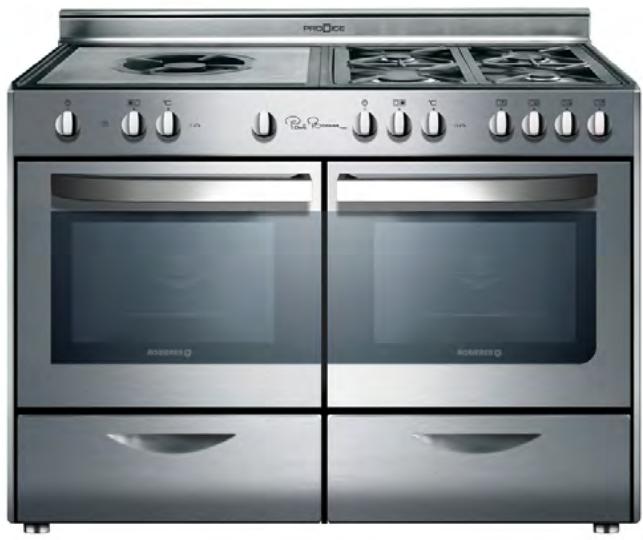
TOP LEFT
Ultra-rapid 4.5 kW safety burner with electronic ignition
The hot plate can be replaced with the meat griddle
LEFT OVEN
Electric
Multi-function, 7 cooking functions Pyrolytic cleaning
Equipped for controlling the cooking and pyrolytic functions with end of cooking timer
Thermostat control indicator light and pyrolytic cycle indicator
TOP RIGHT
4 safety gas burners with electronic ignition
front left, ultra-rapid 3.5 kW
back left, semi-rapid 1.45 kW
front right, semi-rapid 1.45 kW
back right, rapid Mijorose simmer safe burner 2.5 kW
RIGHT OVEN
Electric
Conventional cooking with 4 cooking functions
Oven, either catalytic or super-enamel
Equipped with end of cooking timer Thermostat control indicator light
Section 1
An introduction to your Rosières Prodigie cooker
Eager though you will be to start using your new Rosières Prodigie cooker, we advise that you take time to get acquainted: after all, this is going to be a long and creative relationship.
Using the key features illustration as your guide, familiarise yourself with each part and function of the cooker which you will come to find offers you easy access, flexibility, safety, economy, efficiency, with precise control of timing and temperature.
As you will see from this initial inspection, the Rosières Prodige gives you:
- Two full-sized electric ovens: Pyrolytic multi-function oven with diagonal rotisserie left oven - catalytic conventional oven (right oven)
- End of cooking timer for multifunction oven
End of cooking timer for conventional oven - Flame failure device
- 4 gas burners with cast iron pan supports including Miorose simmersafe burner
- 4,5 kW Super gas burner with cast-iron pan and Wok support
- Cast-iron hotplate with griddle option
- Height adjustment feature to a maximum 90 cm
- Optional matching stainless steel splash-back
- Two convenient storage drawers for kitchen utensils and cooker accessories
As you begin using your Rosières Proidge cooker you will find that its unrivalled array of features, together in this one appliance, puts you in total control – with all the advantages that brings.
Whether it involves baking or blanching, simmering or grilling, no recipe will prove impossible. You will have your own favourites to try, of course.
We want you to get maximum pleasure and benefit from your Rosières cooker cooker. But before we guide you through its many features, permit us to offer.
a few important words of caution for your well-being and that of your cooker.
We recommend that your cooker is:
professionally installed
- it must be connected to the fuel supply by a qualified electrician and gas fitter
earthed
- For safety reasons under no circumstances should any modifications be carried out to this appliance.
- All the accessible parts are hot when the cooker is in operation. Keep young children away from the cooker when in use.
- Both the ovens are fitted with a multi-layered glass door to prevent the possible risk of burns during operation (cooking modes). Nevertheless, we recommend you keep young children well away from the ovens especially during the left oven's pyrolytic cleaning phase.
- Prior to pyrolytic cleaning, wipe off any large food spillages. Indeed, excessive amounts of grease may catch fire under the intense pyrolytic heat.
- Never use a steam or high-pressure spray to clean the ovens.
- If your oven shows even the smallest defect, do not connect it. Disconnect it from the power supply and immediately contact an approved ROSIERES service agent.
- Do not store flammable products in the cooker as they can catch fire if the cooker is inadvertently switched on.
- Do not lean on the oven doors or allow children to do so.
- Use oven gloves, when placing or removing a dish from the oven.
- After each use we recommend that some cleaning of the cooker, is undertaken. This prevents the accumulation of dirt and grease which gets re-cooked and burns, generating unpleasant smells and smoke.
- Do not line the oven walls with aluminium foil or single-use oven protectors available from some stores. Aluminium foil or any other protection, in direct contact with the hot enamel, risks melting the enamel or causing deterioration to the inside.
- When cooking with fats or oils, always take care to watch the cooking process as heated fats and oils can catch fire rapidly.
- This appliance is not intended for use by persons (including children) with reduced physical, sensory or mental capabilities, or lack of experience and knowledge, unless they have been given supervision or instruction concerning use of the appliance by a person responsible for their safety.
- Children should be supervised to ensure that they do not play with the appliance.
Cast-iron hot plate: essential pre-treatment before first use
Caution: before using the hot plate for the first time, the following steps must be taken:
- wash the plate with soapy water
- sprinkle salt over the plate and then buff in the salt with black and white printed newspaper (not coloured)
- heat the salted plate, allow to cool, wipe off the salt
- using kitchen roll, wipe a thin layer of vegetable cooking oil over the top of the hot plate
- turn on the burner to heat the hot plate for a few minutes
- this will produce some smoke, so switch on the extractor hood
- once the oil has disappeared, turn off the burner and let the hot plate cool
- give the plate a light wipe with vegetable oil
- leave to cool, the hot plate centre will turn light grey and the edges will remain dark grey
- the hot plate is ready for use
Caution: Please read this guide thoroughly before first using your cooker.
Section 3
How to use your Rosières Prodigie cooker
We now come to the detailed practical guide to your cooker. We describe each feature, its function, and how it can benefit you in your cooking.
RECOMMENDATIONS...
- Do not use pans with a concave or convex bases. You can use a "Wok" as long as you install the Wok support griddle supplied with the cooker.
- Avoid boiling food too quickly. A "high boil" doesn't cook food any quicker, and as the food is violently agitated this can cause it to loose its taste.
- Flames should not lick out from the pan base, this just means you are wasting gas. Only the base of the pan should be heated. Do not allow flames to project beyond this point. This means gas is being wasted.
- Do not place an empty pan on a lit gas burner.
Caution: when the burners are not in use, the main supply control should be closed.
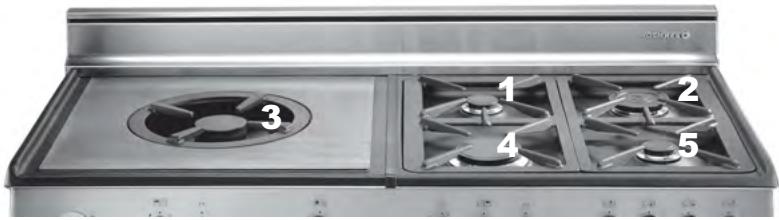
1-5 • SEMI-RAPID BURNER: use the smallest burner for small pans.
2 • RAPID BURNER: use this burner for stewing and sauces. With medium rate, the flame is only in contact with the burner cap. Ideal for stewing, the heat is distributed evenly under the pan. Food does not stick and there is no crown effect in the bottom of the pan.
3 • MULTI PURPOSE HOT PLATE/SUPER BURNER: this burner provides various uses. A handling tool supplied with the cooker lets you remove the hot plate for adapting various components.
4 • ULTRA-RAPID BURNER: use this burner for bringing to the boil, sealing meat, and generally for all foods that need to be cooked quickly.
For optimum burner utilisation, we recommend you use pans with diameters not less than those detailed below:
USE
Each burner has electronic ignition and a thermocouple safety device that automatically stops the gas if the flame goes out accidentally.
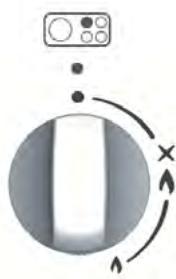
- Open the gas tap.
- A symbol near each knob lets you see which burner is in use.
- Press in and turn the gas tap to the × mark. Holding the knob in creates the ignition spark. Continue pressing the knob in for two seconds to set the safety device.
- Adjust the flame according to your cooking needs.

High

Low
- To stop the burner, set the knob to position"●".
Note:
If there is no electricity, the burner can be lit with a match.
If the flame goes out accidentally, reignite the burner.
MULTI PURPOSE BURNER
Caution: the cast iron hot plate and the griddle cook at high temperatures. Please take extreme care and always keep children away. It is advisable to allow the cast iron parts to cool before moving them. Always use the lifting tool ensuring that the top of the tool is over the hot plate centre.
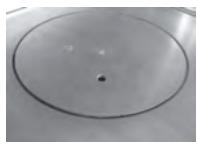
HOT PLATE: ideal for simultaneous cooking, for sauces, lengthy stewing, or keeping foods warm. According to the dish, you can adjust the setting either by the control knob or by moving the pan over the cast iron plate. The temperature at the plate centre reaches 400°C , towards the outer edge the temperature decreases to 100°C for traditional slow simmering.
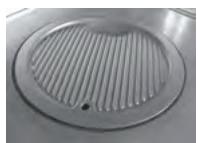
GRIDDLE: for a brisk heat, etc.
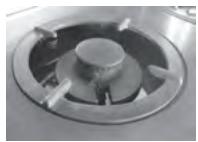
OPEN HOB: accommodates large quantities of food and large pans. Remember to position the spacer and its core for optimal operation.
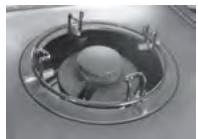
WOK SUPPORT: for WOK, use or when using a convex bottomed pan. It can be fitted to various burners.
COOKING METHODS :

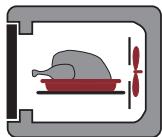

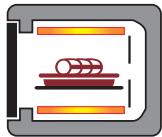

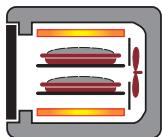

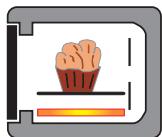

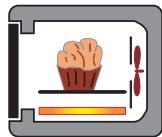

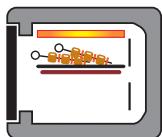

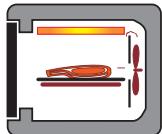

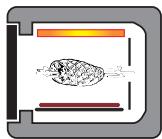

All cooking should be carried out with the door closed.
Defrost: The cooking fan runs circulating air inside the oven. Ideal for defrosting before cooking.
Conventional cooking: Top and bottom heating elements are used together. Preheat the oven for about ten minutes. This method is ideal for all traditional roasting and baking. For sealing red meats, roast beef, leg of lamb, game, bread, foil-wrapped food (papillotes), flaky pastry. Mid shelf position recommended.
Fan cooking: Both top and bottom heating elements are used and the fan circulates the air inside the oven. Recommended for poultry, pastries, fish and vegetables. Heat penetrates the food better and both the cooking and preheating times are reduced. Different foods can be cooked at the same time in one or more positions. This function provides even heat distribution and does not mix the smells. Allow about ten minutes extra when cooking foods at the same time.
Lower element: Using the lower element. Ideal for cooking all pastry based dishes. This allows you to cook dry tart pastry without over cooking the fruit filling. Use this for flans, quiches, tarts, pâté and any cooking that needs more heat and radiation from below.
Fan & Lower element: The bottom heating element is used in conjunction with the fan which circulates the air inside the oven. This method is ideal for moist fruit flans, tarts and pâté. It prevents food from drying out and encourages rising cakes, bread dough and other foods. Bottom cooking. Put the shelf at a lower shelf level recommended.
Grill: Using the top level element. Success is guaranteed for mixed grills, kebabs and au gratin dishes.
Five minutes preheating is required to get the element hot. Use the grill when the door is closed. The right oven has two grill positions: grill = 2140 W, grill with extra = 3000 W.
Fan assisted grilling: The top heating element is used in conjunction with the fan circulating the air inside the oven. Ideal for cooking thicker food stuffs, whole pieces of meat such as roast pork, poultry, etc. Preheating is necessary for red meats but not for white meats. Place the food to be grilled directly on the shelf centrally, at the middle level. Slide the drip tray under the shelf to collect the juices. Make sure that the food is not too close to the grill. Turn the food over halfway through cooking.
Rotisserie: The top heating element is used in conjunction with the rotisserie providing the real flavour of a traditional roast.
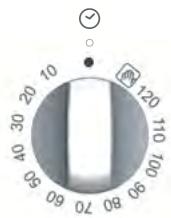
End of cooking timer
Pyrolytic cleaning indicator

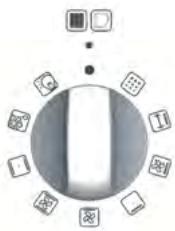
Function
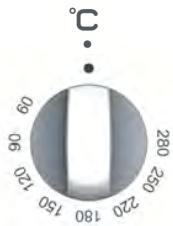
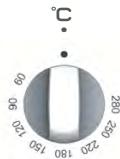
Thermostat
Thermostat control indicator
END OF COOKING TIMER
It takes in charge the functioning of the oven in cooking mode, or in pyrolytic mode, for between 1 and 120 minutes, with immediate start and automatic stop.
When the time is up, the timer automatically cuts off the power supply to the oven.
However, in cooking mode, the oven could be used without programming. In this case, turn the control knob to the «Hand position »
- Turn the function selector to the cooking position you want.
- Set the thermostat knob to the required temperature based on the information below.

Defrost
Thermostat knob to stop position

Conventional cooking
from 60°C to 280°C

Fan cooking
from 60°C to 230°C

Fan + Lower element
from 60°C to 230°C

Grill
from 220°C to 275°C

Turbo grill
from 180°C to 230°C

Rotisserie
from 220°C to 275°C
- In order to operate the oven either set to manual ( symbol in window) or a cooking duration.
This consists of one skewer, two forks and a spit holder.
Take all the accessories out of the oven.
. Place the deep tray at the bottom.
. Put the food onto the skewer, and centre between the two forks.
. Put the skewer onto the holder.
. Slide the holder and skewer into the second shelf position from the bottom.
. The end of the turnspit should be opposite to the opening of the drive device.
. Engage the turnspit in the drive device.
Fitting the turnspit diagonally:
1.
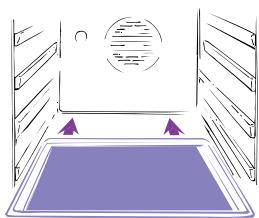
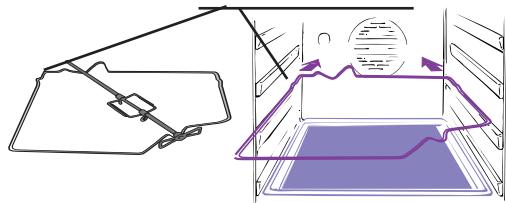
2. Locators to the back
3.
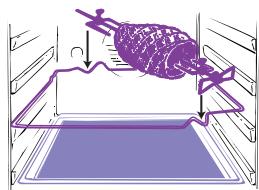
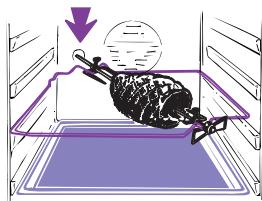
4. Drive device
No preheating is required for Rotisserie cooking. Rotisserie cooking is carried out with the door closed.
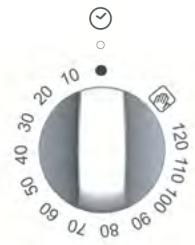
End of ooking timer with hand position
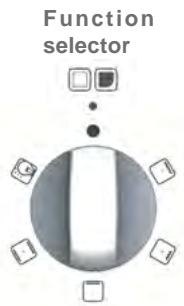
- Turn the function selector knob to the cooking position you require.
- Set the thermostat knob to the required temperature based on the information below.

Conventional cooking
from 60°C to 280°C

Lower element
from 60°C to 230°C


Grill
from 220°C to 275°C
- Set the timer knob to the hand position or to a duration.
Note: to indicate a duration on the timer, turn the knob clockwise up to 120 minutes then return it to the required duration.

Hand position
Duration: 1-120 minutes
Whatever programming method is selected, the oven starts immediately.
In hand position, the oven must be stopped manually by returning the function selector and thermostat knobs to the stop position.
When programming a duration, the oven stops automatically once the time has elapsed.
INDICATORS


The regulation indicator shows the use and operation of the thermostat. It comes on and goes off regularly throughout the cooking duration time.

The pyrolytic cleaning indicator comes on as soon as the control knob is on the P position and goes off when the oven temperature rises to 300°C .
COOKING HINTS
Temperatures and cooking times are given as guidance for oven use. Personal experience should then let you adapt these settings to your own taste.
Remember that cooking at higher temperatures causes more spattering, and the oven becomes dirty causing smoke. It is better to slightly reduce the cooking temperature, even if it means increasing the cooking time.

Oven walls are equipped with different shelf positions numbered from the bottom.
| FISH Recipe | Cooking | Quantity Method | Cooking °C | Cooking time | Shelf position from bottom of the oven |
| Trout or Bream | Conventional cooking | 1 kg whole | 220°C | 30 min | 1 |
| Monk fish or Salmon | Conventional cooking | 1 kg poached | 220°C | 30 min | 1 |
| Salmon steak | Fan cooking | 6 pieces | 140-160°C | 10-15 min | 1 |
| Fillet of sole | Fan cooking | 6 pieces | 160°C | 15-20 min | 1 |
| Grilled fish | Grill | 6 fillets | 275°C | 2 X 5 min | 4 |
MEAT
It is better not to salt meat until after cooking as salt encourages the meat to spatter fat. This will dirty the oven and generate a lot of smoke.
Joints of white meat, pork, veal, lamb and fish can be put into a cold oven. The cooking time is longer than for a preheated oven, but it cooks through to the middle of the food as the heat has more time to penetrate.
Correct preheating is the basis of successful red meat cookery.
FOR GRILLING
Preparing for a mixed grill:
Remove the meat from the refrigerator a few hours before grilling. Lay it on several layers of kitchen roll: this improves sealing, making it tastier and ensures that it cooks right through to the centre.
Add pepper and spices to the meat before grilling, but add any salt after cooking. This way it will seal and stay moist. Baste all the food to be cooked with a little oil. This is best done with a wide flatasting brush. Then sprinkle with more pepper and herbs.
Put the grill dish into the oven.
During cooking:
Never pierce the food during cooking, or when you turn it over: juice runs out and the meat becomes dry.
MEAT
| Recipe | Cooking Method | Quantity | Cooking °C | Cooking time | Hints |
| Beef with carrots | Conventional cooking | for 6 | 200-220°C | about 4 hr | |
| Duck | Conv. cooking | 1.5 kg | 200-220°C | 1½ hr | |
| Turkey | Conv. cooking | 5-6 kg | 160-180°C | 2½-3 hr | |
| Goose | Conv. cooking | 3-4 kg | 160-180°C | 2-2½ hr | |
| Leg of lamb | Conv. cooking | 200-220°C | 15 min/pound | ||
| Roast chicken | Conv. cooking | 1-1.5 kg | 220°C | about 1 hr | |
| Roast beef | Conv. cooking | 240°C | 15 min/pound | ||
| Roast rabbit | Fan cooking | 800 g – 1 kg | 200-220°C | 50-60 min | |
| Roast white meat | Fan cooking | 200-220°C | 40-50 min/kg | ||
| Boeuf bourguignon | Lower element* | for 6 | 200°C | 1½ hr | Cast-iron casserole with lid |
| Chicken casserole | Lower element* | 1.5 kg | 210°C | 1½ hr | Cast-iron casserole with lid |
| Veal/poultry | Rotisserie | 1.2 kg | 275°C | 60-70 min/kg | No preheat required |
| Veal/poultry | Rotisserie | 1 kg | 275°C | 45-50 min | No preheat required |
| Beef | Rotisserie | 1 kg | 275°C | 15-20 min | No preheat required |
| Lamb/Mutton | Rotisserie | 1 kg | 275°C | 20-25 min | No preheat required |
| Pork | Rotisserie | 1 kg | 275°C | 45-50 min | No preheat required |
| Kebabs | Grill | 6 pieces | 275°C | 2 x 8 min | Turn over half way through cooking |
| Pork chop | Grill | 6 pieces | 275°C | 2 x 8 min | Turn over half way through cooking |
- for the fan and lower element cooking method, we recommend preheating with fan cooking. All cooking was done at shelf position "1".
VEGETABLES - OTHERS
| Recipe | Cooking Method | Quantity | Cooking °C | Cooking time | Hints |
| Braised cabbage | Conv. cooking | for 6 | 200-220°C | 1 hour | |
| Pâté en croûte | Conv. cooking | 200-220°C | 1 hour/kg | ||
| Chicory with gruyere | Fan cooking | for 6 | 180-200°C | 25-30 min | |
| Jacket potatoes | Fan cooking | for 6 | 200-220°C | about 1 hour | |
| Soufflé, savoury /sweet | Fan cooking | for 6 | 180-200°C | 50-60 min | mould Ø 22 |
| Stuffed tomatoes | Fan cooking | 6-8 pieces | 200-220°C | 40-45 min | |
| Pilau rice | Lower element | 300 g | 200°C | 25 min | |
| Leek flan | Fan + Lower element | for 6 | 220°C | 35-40 min | |
| Quiche Lorraine | Fan + Lower element | for 6 | 220°C | 45-50 min | Flat pan |
| Toast with cheese* | Turbo grill | 6 pieces | 210°C | 3 min to toast one side + 4 min/cheese | |
| Dauphiné (cheese-topped dish)* | Turbo grill | 6 portions | 200°C | 45 min | Oval dish |
| Sausages* | Turbo grill | 4 pieces | 210°C | 2 X 10 min Turn over Half way through cooking | Flat pan |
All the cooking was done at shelf position "1" except cooking marked "*, which requires cooking at a middle shelf position.
BAKING
Avoid using shiny tins as they reflect heat and can spoil your cakes. If your cakes brown too quickly, cover them with grease-proof paper or aluminium foil. Caution: the correct way to use foil is with the shiny side in towards the cake. If not the heat is reflected by the shiny surface and does not penetrate the food.
Avoid opening the door during the first 20 to 25 minutes of cooking: souffles, brioche, sponge cakes will tend to fall.
You can check if cakes are done by pricking the centre with a knife blade or skewer. If the blade comes out nice and dry, your cake is ready and you can stop cooking. If the blade comes out moist or with bits of cake attached, continue baking but slightly lower the thermostat so that it is finished off without burning.
| Recipe | Cooking | Quantity Method | Cooking °C | Cooking time | Shelf level | Hints |
| Cake | Conv. cooking | 1.5 kg | 180-200°C | 50-60 min | 1 | |
| Fruit tart in batter | Conv. Cooking | for 6 | 200-220°C | 40-50 min | 1 | Ø 27 |
| Pound cake | Conv. cooking | 1.5 kg | 200-220°C | 45-50 min | 1 | |
| Filled pie | Conv. cooking | for 6 | 200-220°C | 40-45 min | 1 | Ø 27 |
| Brioche | Fan cooking | 800 g | 200°C | 40-45 min | 1 | |
| Sponge cake | Fan cooking | 180-200°C | 35-40 min | 1 | Ø 27 | |
| Genoese cake | Fan cooking | 180-200°C | 30-35 min | Ø 27 | ||
| Choux pastry | Fan cooking | 40 pieces | 190°C | 35 min | 1 and 3 | 2 trays |
| Pastry base | Fan cooking | for 6 | 180-200°C | 20-30 min | 1 | Ø 27 |
| Puff pastry e.g. bouchée | Fan cooking | 6 pieces | 200°C | 15-20 min | 1 | |
| Meringues | Fan + Lower element* | 1 tray | 80-85°C | 4½ hours | 1 | |
| Fruit tart | Fan + Lower element* | for 6 | 220°C | 35-40 min | 1 |
- with fan and lower element cooking method, we recommend at first a preheating with fan cooking to save time.
THE MULTI PURPOSE HOT PLATE/SUPER BURNER AND ACCESSORIES
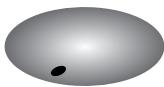
Hot plate
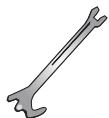
Hook
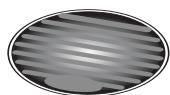
Griddle
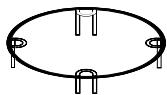
Wok support
. 1 Hot plate for cooking food using large pans, for stews, sauces, etc.
.1 Hook for removing the hot plate.
.1 Griddle for brisk grilling.
. 1 Burner spacer with cast iron pan support for use when the burner is uncovered.
.1 Wok support grill.
.1 Cast-iron pan support for open burner cooking.
OVENS
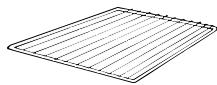
Flat shelf
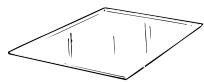
Pastry tray
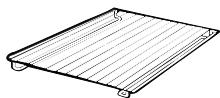
Tray holder shelf
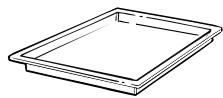
Drip-tray
.2 Flat shelves for supporting various dishes and moulds.
. 3 Pastry trays with 1 stainless steel tray that slides directly into the pyrolytic oven shelf positions. Hint very important : do not slide the stainless steel tray into the catalytic oven shelf positions because it could be damaged the enamel or then, remove the catalytic walls before sliding the stainless steel tray. They are for cooking small pastries, like choux, biscuits, meringues, etc.
. 2 Tray holder shelves for supporting dishes or moulds. They can be combined with drip-trays on slides.
. 2 Drip-trays to collect meat and grilling juices during roasting or grilling. They can be put on the shelves, or slid under them. Unless used with the grill, the drip-tray must not be stored in the oven while in use.
. 1 Flat shelf can be combined with the drip-tray for all types of grilling. A handle is supplied for removing grill pan from the oven without the risk of burning yourself. Never leave the handle inside the oven.
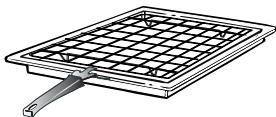
All unused accessories must be removed from the oven when it is in use.
Cleaning your Rosières Prodigie cooker
This section explains how to keep each part of your cooker clean and in peak operating condition.
Before carrying out any cleaning, you must:
. disconnect the appliance from the electrical supply.
. wait for all the hot parts to cool.
Never use abrasive cleaners, wire wool or sharp objects to clean the top.
TOP LEFT
- Polished cast-iron plate: protective finish is applied to the cast-iron plate when it leaves the factory. The finish can easily be removed using a strong liquid detergent (ammonia based).
To clean it, rub the plate with fine emery paper to clear any rust spots. Wipe with a slightly oily cloth to prevent rust forming. When in use, daily cleaning is required to keep the top of the cast-iron plate looking good. General stores stock various products for cleaning the polished top. For additional protection, we recommend you clean the cast-iron top regularly with a slightly oily cloth.
- Enamelled cast-iron frame: when the cooker is cold, just clean using a non-abrasive liquid detergent, rinse and wipe off with a clean dry cloth. Cleaning hot enamel risks tarnishing it.
TOP RIGHT
- Burner caps and pan supports in enamelled cast-iron: clean as described above for the enamelled cast-iron frame.
- Gas burners: for normal cleaning, it is recommended to clean off all grease or burnt-on deposits using ammonia or commercial, non-abrasive cleaners.
Do not put the burner caps straight into cold water after use in order to prevent heat shock from rupturing the enamel. To conserve the original appearance of the burner bodies, use a non-abrasive detergent, rinse and dry carefully. If the holes are clogged, brush them with soapy water, rinse and dry.
When refitting these parts, make sure that each of them is wiped dry. Check that each part is correctly positioned before using the cooker hob again.
- Caution: do not let water get inside the gas burners.
STAINLESS STEEL PARTS - clean with soft cloth and a special stainless steel cleaner available from most department stores.
ENAMEL CAST-IRON PARTS - when the cooker is cold, clean using a non-abrasive liquid detergent, rinse and wipe off with a clean dry cloth.
OVENS
. Whatever the cleaning method, do not let fatty residues accumulate inside the oven. Clean it regularly.
. Never line the oven sides with aluminium foil or single-use commercial protection; this concentrates the heat causing the enamel to deteriorate.
- Oven doors: the door can be cleaned in situ or can be removed.
. Remove as follows:
. fully open the door; the hinge appears as in photo 1;
. lift the hinge pins (photo 2) and pull the door upwards partially closing it until released.
For installation, make sure you reposition the hinges carefully; a notch located below them (photo 3) lets you fit the hinges correctly.
After the door is put back on its supports, fit the hinge pins in their initial position as in photo 4.
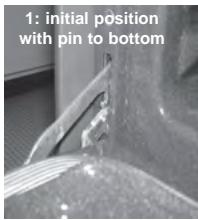
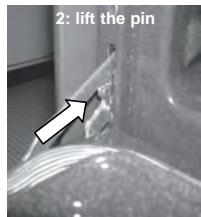
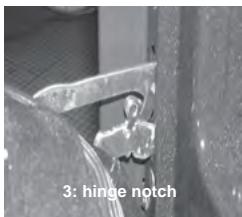
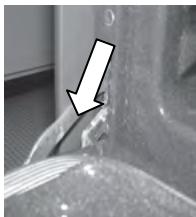
<-------- Removal ----> <-------- Installation ---->
- Oven door glass: after each use of the oven, wipe using absorbent kitchen roll. If there is a lot of spattering, clean the glass with a sponge and detergent. Rinse and dry.
- Oven lighting:
Disconnect all power supplies from the oven before cleaning or replacing the bulb. The bulb and its cover are made of material resistant to high temperatures.
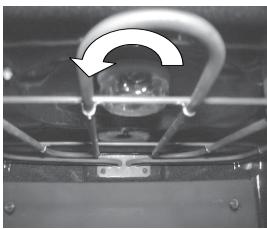
Bulb characteristics:
230 V AC - 25 W - Base E 14 - Temperature 300°C
To change a defective bulb, just:
. unscrew and remove the glass cover,
. unscrew the bulb;
. replace it with the same type: see characteristics above;
. after replacing the defective bulb, screw back the protective glass cover.
LEFT PYROLYTIC OVEN
Pyrolytic cleaning uses high temperatures to destroy soiling. The resulting smoke is cleaned by passing through a catalyst. Because of the high temperatures involved, the oven door has a safety lock that prevents it being opened during pyrolytic cleaning.
When the pyrolytic cycle is running, you may notice a slight odours; its intensity will depend on the amount of ventilation in the room.
IMPORTANT:
. It is important to clean off accumulated grease. Indeed, any grease deposits may catch fire under the intense heat involved in pyrolytic cleaning.
. You are strongly advised not to use detergents or any other proprietary product for cleaning ovens.
. Do not use the left-hand gas plate during pyrolytic cleaning.
- Before commencing pyrolytic cleaning:
. Remove all the accessories from the oven; they are likely to be damaged by the heat generated during the pyrolytic cleaning process.
. Remove large spills of food or waste that would take too long to be carbonized.
. Close the door.
Starting pyrolytic cleaning:
Turn the function selector to the P position.
Leave the thermostat knob on the 'stop' position.
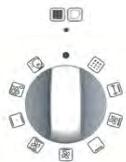
Indicator pyrolytic cleaning
- According to the degree of staining :
Minor soiling: 90 min., medium soiling: 105 min., very soiled: 120 min.
- Display a cleaning duration on the "End of cooking timer".
OVEN WITH CATALYTIC WALLS –
Catalytic cleaning takes place while the oven is in use. The oven walls are coated with a special enamel, micropores encourage the combustion of grease. Each drop is eliminated by the combined action of the catalytic enamel and heat.
Regular cleaning:
the accumulation of fine residual dust resulting from the combustion of grease may eventually reduce the enamel's efficiency.
To keep this enamel in peak condition, you should rinse the walls with very hot water after every 10-15 roasts. This quick job is made all the easier as the side walls can be fully removed to be washed in the sink. They are fixed by a central screw (unscrewed by hand) on the top of the wall, and held by two tabs at the bottom; release them by lifting.
After rinsing and installing the sides in the cooker, dry the enamel by operating the oven at maximum position for 1/4 hour.
If spills are large,
the enamel should be cleaned to let it recover its efficiency. Follow these steps: . Wipe any big spills or deposits with a sponge soaked in very hot water, using ammonia liquid detergent.
. Use a nylon brush on any marks that cannot be wiped away.
. Then heat the oven for an hour set at the maximum thermostat position.
. It may be necessary to repeat these operations several times, if the spillages are heavy.
Note: if after normal use, you notice slightly darker marks on the oven walls don't worry, this effect is quite normal, they are just grease marks in the process of being eliminated.
ENAMELOVEN -
The oven has an enamelled surface when the catalytic side walls are removed. Clean inside the oven with a sponge soaked in washing up liquid and very hot water to remove hard grease marks. For heavy spattering use commercially available oven cleaners.
This section details the dimensions of the appliance, the hob power rating, and the dimensions, power rating and power consumption of the two ovens.
| MANUFACTURER | ROSIERES | ||
| Cooker dimensions (cm) | Width 116,5 x Depth 61,5 x 98 height with back plate | ||
| HOBS | TOP LEFT | TOP RIGHT | |
| FRONT RIGHT BURNER | - | semi-rapid 1,45 kW | |
| FRONT LEFT BURNER | - | ultra-rapid 3,5 kW | |
| BACK RIGHT BURNER | - | rapid simmer 2,5 kW | |
| BACK LEFT BURNER | - | semi-rapid 1,45 kW | |
| HOT PLATE / SUPER BURNER | super burner 4,5 kW | - | |
| OVENS | LEFT OVEN | RIGHT OVEN | |
| Norm EN 50304 | Energy efficiency class A (more efficient) to G (less efficient) | B | C |
| Heating function | Conventional | Conventional | |
| Energy consumption with conventional | 0,98 kWh | 1,15 kWh | |
| Energy consumption with forced air convection | 1,19 kWh | NA | |
| Usable volume | 48 litres | 50 litres | |
| Type of appliance (size of the oven) | Medium volume | Medium volume | |
| Time to cook based on standard load | 48 min | 50 min | |
| The area of the largest baking sheet | 1250 cm² | 1250 cm² | |
| Electrical connection | see table page 33 | ||
| Maxi oven power | 2,80 kW | 3,35 kW | |
| Energy consumption of the pyrolytic cycle (80 minutes) | 3,00 kWh | - | |
All data is given for information only. In order to improve the quality of its products, ROSIERES may modify its appliances with technological developments which adhere to the conditions set out in the Consumer Code.
The installation of household appliances is a delicate operation that, «if not done correctly», can have serious consequences for consumer safety.
Therefore, this work must be entrusted to a professional who can carry it out in compliance with the technical standards in force.
Rosières will not accept any responsibility in case of technical failure of the product whether or not it causes damage to goods and/or persons if the installation has not been carried out by a qualified engineer/gas fitter.
- Before installation, the technician should:
. Check the compatibility between the cooker and the gas installation.
The cooker is factory set for use with the gas type as stated on the packaging and repeated on the label affixed to the cooker.
. If necessary change the gas
To adapt the cooker fit suitable jets that provide the nominal flow rate and by adjusting the air rings according to the information given on pages 26 to 28.
- For installation, the technician should:
. The cooker is Class 2 - Sub-class 1; furniture adjacent to the unit must not be higher than the top of the cooker.
. The cooker has five adjustable feet for perfect levelling on the floor.
. Do not remove the cooker spacers at the back. Do not block the air outlet between the back plate and the wall. These alterations can cause abnormal heating of the cooker.
. Comply with the installation conditions stated on page 31 when fitting the splash-back, optional accessory.
. Make the gas connection to the installation according to the gas supply, page 29 to 30 , by connecting the gas supply pipe without forgetting to fit the seal.
Caution - some countries require the use of a tapered fitting. You should therefore replace the fitting mounted on the cooker with the tapered fitting.
. Connect the cooker electrically in compliance with the information given on page 32/33.
. If the gas type has been changed, adjust the minimum flow of each gas burner as described on page 30.
ANY MODIFICATION MADE TO THE GAS SETTING SHOULD BE NOTED ON THE LABEL AFFIXED TO THE COOKER.
GAS INSTALLATION
| Gas | G20 | G 25 | G 30 | G 31 | Gas connector | |||||||
| Category | 20 mbar | 20 mbar | 25 mbar | 29 mbar | 50 mbar | 30 mbar | 37 mbar | 50 mbar | tapered ISO 7-1 | cylindrical 228-1 | ||
| Netherlands | NL | II2L 3B/P | ☐ | X | X | X | ||||||
| UK | GB | II2H3 + | ☐ | X | X | X | ||||||
| Portugal | PT | II2H3 + | ☐ | X | X | X | X | |||||
| Spain | ES | II2H3 + | ☐ | X | X | X | X | |||||
| Switzerland | CH | II2H3 + | ☐ | X | X | X | ||||||
| France | FR | II2E + 3 + | ☐ | ☐ | X | X | X | |||||
| Belgium | BE | II2E + 3 + | ☐ | ☐ | X | X | X | |||||
| Germany | DE | II2E3B/P | ☐ | X | X | X | X | |||||
= Original setting: G20-20 mbar G25-25 mbar
X = Gas setting possible according to installation country (refer to chapter below).
CHANGING THE GAS: the calorific capacity and pressure of the gas vary according to the type of gas.
When changing the gas, you should successively:
- change the jets, see table page 28 for jet selection,
- replace the gas fitting, if necessary,
- correct the flame appearance by adjusting the air ring, see table page 28,
- and set the minimum flow of the gas burner tap.
CHANGING JETS
Each jet is identified with a mark.
Burner jets
To access the jets of the top burners, remove the top grills, caps and heads of all the burners.
Use the key supplied with the cooker to unscrew the jets.
According to the information given in table page 28, install jets suitable for the burner type and gas type supplied.
Screw them right down.
For reinstallation, fit the heads, burner caps and grills.
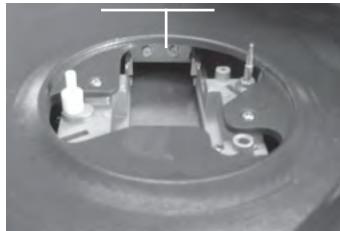
TOP JET
Example above: ultra-rapid burner (x 2 jets)
Hot plate burner jet
The cast-iron top has to be removed after taking off the hot plate using the hook (see page 19).
The cast-iron plate is held:
. At the back by two screws located under the back plate (unscrew them), and at the front by two pins located under the control panel. Open the oven door and unscrew them.
To access the jet, loosen the air ring and push it backwards. Loosen the jet with a 7mm spanner holding the jet holder with a 16mm spanner. Fit the jet suited to the burner type and the gas supply. Do not forget to replace the air ring in its initial position.
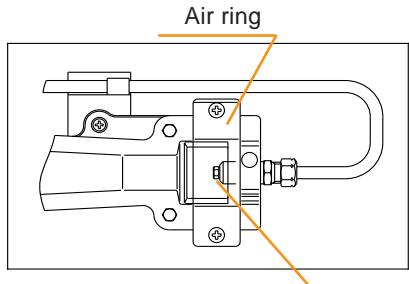
Jet located under the air ring.
ADJUSTING THE AIR RING
Adjusting the air ring of the top burners and the hob burner.
This lets you obtain correct combustion and maximum burner efficiency. The table on page 28 gives the dimension "X" in mm; it may be necessary to adjust this setting in a range +/- 1 mm to improve the flame's appearance and quality.
1 - Top burners:
To access the burner air rings, remove the burner grills and caps.
The air ring is located in the extension of the burner body, and fixed with a screw.
Unscrew the air ring. Adjust the air ring according to the dimensions given in the table. Lock the fixing screw. Install the various parts again.
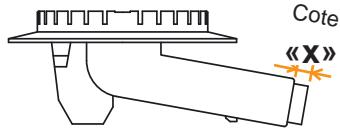
Semi-rapid or rapid burner
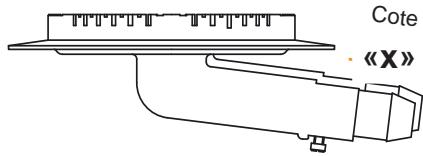
Ultra-rapid burner
2 - Hot plate burner:
The air ring is located in the extension of the burner body. Adjust the air ring according to the dimension given in the table below. Lock the fixing screw.
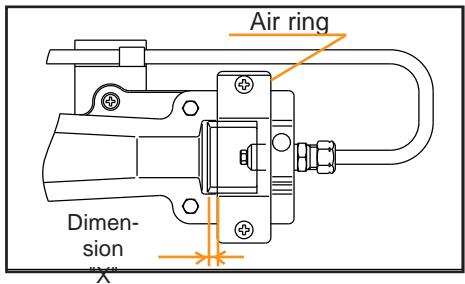
To reinstall, replace the cast-iron top, fix it with the two pins at the front under the control panel, and replace the two screws holding it under the rear back plate.
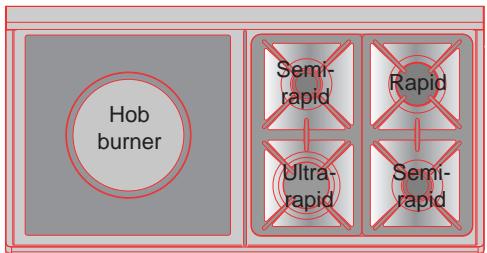
| Hob | semi-rapid | rapid | semi-rapid | ultra-rapid*** | |||||||||||||
| back left | back right | front right | front left | ||||||||||||||
| Gaz | mbar | Jet | BA | kW | Jet | BA | kW | Jet | BA | kW | Inj. | BA | kW | Inj. | BA | kW | |
| 1 | G 20 | 20 | 160 | 3 | 4,5 | 96 | 6 | 1,45 | 122 | 10 | 2,5 | 96 | 6 | 1,45 | 102 | 14 | 3,5 |
| G 25 | 20 | 175 | 3 | 4,6 | 97 | 6 | 1,4 | 126 | 10 | 2,4 | 97 | 6 | 1,4 | 110 | 14 | 3,3 | |
| 1 | 25 | 160 | 3 | 4,1 | 96 | 6 | 1,3 | 122 | 10 | 2,3 | 96 | 6 | 1,3 | 102 | 14 | 3,2 | |
| G 30 | 29 | 105 | max. | 4,5 | 61 | 0 | 1,45 | 80 | 0 | 2,5 | 61 | 0 | 1,45 | 68 | 0 | 3,5 | |
| 50 | 92 | 2,5 | 4,5 | 54 | 7 | 1,45 | 70 | 10 | 2,5 | 54 | 7 | 1,45 | 58 | 15 | 3,2 | ||
| G 31 | 30 | 105 | 1,5 | 4 | 61 | 7 | 1,25 | 80 | 9 | 2,2 | 61 | 7 | 1,25 | 68 | 14 | 3,1 | |
| 37 | 105 | 1,5 | 4,5 | 61 | 7 | 1,45 | 80 | 9 | 2,5 | 61 | 7 | 1,45 | 68 | 14 | 3,5 | ||
| 50 | 92 | 1 | 4 | 54 | 7 | 1,25 | 70 | 10 | 2,2 | 54 | 7 | 1,25 | 58 | 15 | 2,8 | ||
| BA = Air ring - kW = burner power*** The ultra-rapid burner needs two jets | |||||||||||||||||
| 1 | Original setting: G 20-20 mbar - G 25-25 mbar | ||||||||||||||||
GAS CONNECTION
This must be done in compliance with the regulations in force in the installation country. In all cases, on the gas feed pipe provide a stop cock, a regulator or regulator release device for propane gas. Only use valves, regulators, ends and flexible tubes, regulators with the official mark of the installation country.
GAS CONNECTION ACCORDING TO INSTALLATION:
Natural Rigid, Flexible hose with mechanical fittings (1)
Butane Rigid, Flexible hose with mechanical fittings (1), Soft rubber tube (2)
Propane Rigid, Flexible hose with mechanical fittings (1), Soft rubber tube (2)
1 - Provided the flexible hose can be inspected for its entire length.
2 - Provided the soft rubber tube can be inspected for its entire length, its length does not exceed 1.5 metres and it is fitted with suitable clamps at the ends.
1, 2 – Soft tubes and flexible hoses with mechanical fittings must be arranged to be away from any flames, and not deteriorated by the combustion gases, hot cooker parts or by any spills of hot food.
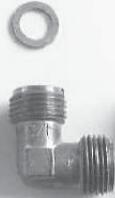
Cylindrical fittings
series 228-1

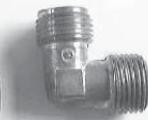
tapered ISO 7-1
Caution: according to the regulations in force in certain countries (see gas table page 26, it is compulsory to replace the cylindrical fitting production mounted on the cooker with a tapered fitting* supplied with the unit.
- without forgetting to fit the seal.
THREE CONNECTION OPTIONS:
- RIGID PIPE CONNECTION
Connect directly to the manifold fittings.
- CONNECTION BY FLEXIBLE HOSE WITH MECHANICAL FITTINGS
Screw the hose nuts directly onto the manifold fitting on the one hand and onto the stop cock of the piping on the other hand.
- CONNECTION BY SOFT RUBBER TUBE
Screw the compliant end piece*
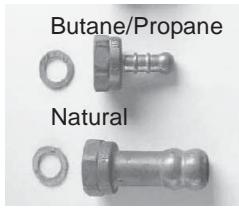
Fit the soft tube to the end piece on the one hand and to the regulator or to the valve outlet on the other hand.
We do not recommend this type of connection. To be reserved solely for old installations not enabling any other option.
- In all cases, make sure the seal is fitted. Following the connection operations, test the leak tightness using soapy water, testing by flame is strictly prohibited.
MINIMUM FLOW ADJUSTMENT
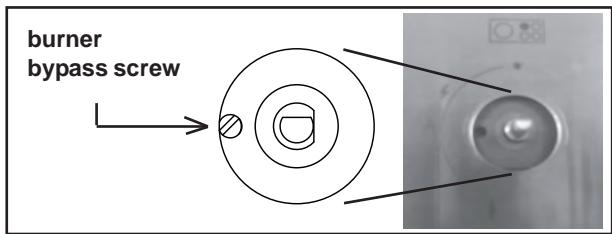
If the gas type has been altered, the stability of the flame in the minimum flow must be checked and set by adjusting the bypass screw.
To access the top burner bypass screw, remove the control panel knobs.
a) natural gas
. unscrew the bypass screw one turn
. replace the knob, light the burner and set to low.
. remove the knob, screw the bypass screw until a reduced flame is obtained, staying stable when going from high to low position. Replace the knob.
b) butane-propane: the setting is done by screwing right in (without forcing) the bypass screw whose calibrated hole provides the minimum flow.
To access the hob burner's bypass screw, remove its knob.
a) natural gas: screw the bypass screw right in then unscrew it by two turns, replace the knob and light the burner, set it to low (to the stop), remove the knob, and screw the bypass screw to obtain a low flame that stays stable when going from high to low position. Replace the knob.
b) butane-propane: the setting is done by screwing to the stop the bypass screw whose calibrated hole provides the minimum flow.
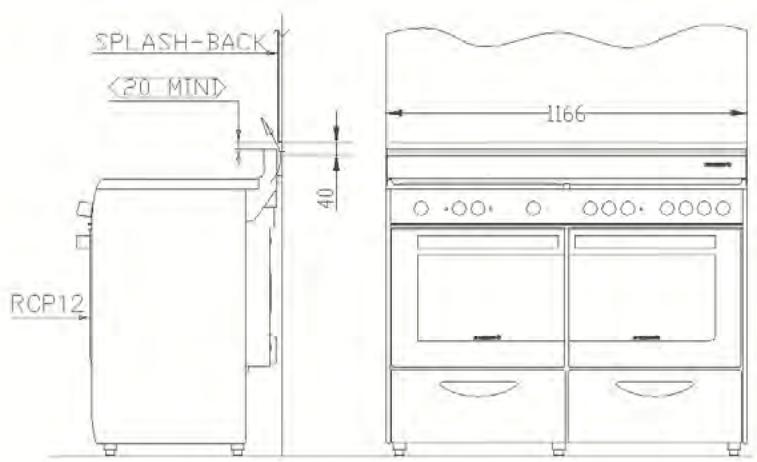
INSTALLATION CONDITIONS WITH SPLASH-BACK OPTION
For the cooker to operate properly, make sure not to block the ventilation flow outlet, especially when the optional Splash-back is installed, when a minimum distance of 20mm must be allowed (see diagram).
Not complying with this condition can damage internal components by overheating, which may have serious consequences for consumer safety.
Section 7 Electrical connection
The installation receiving the appliance must comply with the standards in force in the installation country. The ROSIERES company does not accept any responsibility if this provision is not complied with.
Caution:
- Before connecting, the technician must check the power supply voltage shown on the meter, the circuit breaker setting, the fuse rating and the earth continuity of the installation.
- Connection to the network must be by earthed socket outlet, or by means of a multi-pole circuit-breaker having a distance between contacts of at least 3mm . If the appliance has a socket outlet, it must be installed so that the socket outlet is accessible.
- The green/yellow protection wire must be linked to the earth terminals, of the appliance on one side, and the installation on the other side.
- We decline any responsibility for any incident or its possible consequences that may arise when an appliance is used that is not connected to the earth, or connected to an earth whose continuity is defective.
- All work in relation to the power supply cable must be carried out by the after sales service or someone with similar qualifications.
The cooker comes without power supply cable. It is equipped with a terminal board for selecting the type of electrical connection appropriate to the installation.
Single phase 220-240 V AC
Two phase 220-240 V2 AC
Three phase 220-240 V3 AC
Three phase 380-415 V3N AC
CONNECTING TO THE COOKER TERMINALS:
The terminal strip is located at the back of the cooker.
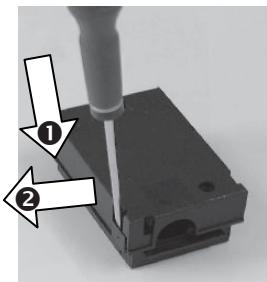
To open the terminal strip cover:
. find the two tabs located on the sides,
. put the blade of a screwdriver in front of each tab, push in "1" and press "2", . remove the cover.
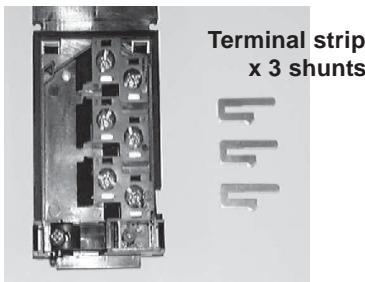
To make the connection:
. strip the end of each conductor and attach them to the terminals, respecting the marks and the placing of the shunts as shown in the connection table,
. unscrew the cable clamp,
pass the lead through the cable clamp.
Example of single phase connection.
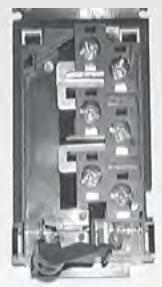
1 - Shunt installation
2 - Wire installation
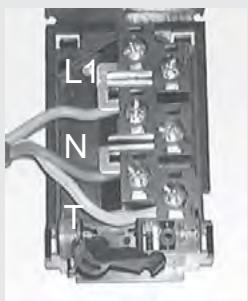
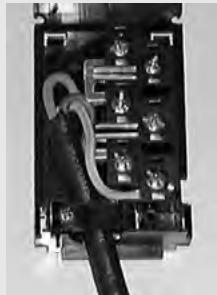
3 - The cable goes through the cable clamp.
Caution: incorrect tightening can cause dangerous heating risks for the power supply cable.
When the connection operation to the appliance terminals is finished, tighten the cable clamp and close the cover.
| SINGLE PHASE 220-240 V~ | TWO PHASE 220-240 V2~ | THREE PHASE 220-240 V3~ | THREE PHASE 380-415 V3N~ | |
| Fuse | 32 A | 32 A | 25 A | 16 A |
| CABLE | ||||
| Cross-section | 3 G 4 mm² | 3 G 4 mm² | 4 G 2,5 mm² | 5 G 1,5 mm² |
| Type | H05VV-F or H05RR-F | H05VV-F or H05RR-F | H05VV-F or H05RR-F | H05VV-F or H05RR-F |
| Connection to terminal board | L1: Phase Shunt 1-2 & Shunt 2-3 N: Neutral Shunter 4-5 T: Earth | L1: Phase Shunt 1-2 & Shunt 2-3 L2: Phase Shunt 4-5 T: Earth | L1: Phase Shunt 1-2 L2: Phase Shunt 3-4 L3: Phase 5 T: Earth | L1: Phase 1 L2: Phase 2 L3: Phase 3 N: Neutral Shunt 4-5 T: Earth |
Section 8 Your guarantee
Your cooker is guaranteed for 12 months
Your cooker must be installed in accordance with the instructions in this guide.
We recommend that the work is carried out by professionally qualified fitters.
Connection of the cooker to gas and electricity supplies must be undertaken by qualified gas fitters and electricians.
Only Rosières replacement parts should be used
Replacement parts and servicing
To order spare parts, or to request service, contact your Rosières retailer
When ordering spares, quote:
-
appliance model number and serial number which are to be found on the appliance rating plate
-
a description of the part required
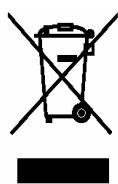
This appliance is marked according to the European directive 2002/96/EC on Waste Electrical and Electronic Equipment (WEEE).
By ensuring this product is disposed of correctly, you will help prevent potential negative consequences for the environment and human health, which could otherwise be caused by inappropriate waste handling of this product.
The symbol on the product indicates that this product may not be treated as
household waste. Instead it shall be handed over to the applicable collection point for the recycling of electrical and electronic equipment
Disposal must be carried out in accordance with local environmental regulations for waste disposal.
For more detailed information about treatment, recovery and recycling of this product, please contact your local city office, your household waste disposal service or the shop where you purchased the product.


- PRODIGE
- SECTION 1
- SECTION 2
- SECTION 3
- SECTION 4
- SECTION 5
- SECTION 6
- SECTION 7
- SECTION 8
- TOP LEFT
- LEFT OVEN
- TOP RIGHT
- RIGHT OVEN
- AN INTRODUCTION TO YOUR ROSIÈRES PRODIGIE COOKER
- CAST-IRON HOT PLATE: ESSENTIAL PRE-TREATMENT BEFORE FIRST USE
- CAUTION: BEFORE USING THE HOT PLATE FOR THE FIRST TIME, THE FOLLOWING STEPS MUST BE TAKEN
- RECOMMENDATIONS
- USE
- NOTE
- MULTI PURPOSE BURNER
- COOKING METHODS
- ALL COOKING SHOULD BE CARRIED OUT WITH THE DOOR CLOSED
- END OF COOKING TIMER
- FUNCTION
- THERMOSTAT
- 1
- 3
- INDICATORS
- COOKING HINTS
- MEAT
- FOR GRILLING
- VEGETABLES - OTHERS
- BAKING
- THE MULTI PURPOSE HOT PLATE/SUPER BURNER AND ACCESSORIES
- OVENS
- CLEANING YOUR ROSIÈRES PRODIGIE COOKER
- OVEN LIGHTING
- BULB CHARACTERISTICS
- LEFT PYROLYTIC OVEN
- IMPORTANT
- BEFORE COMMENCING PYROLYTIC CLEANING
- STARTING PYROLYTIC CLEANING
- ACCORDING TO THE DEGREE OF STAINING
- OVEN WITH CATALYTIC WALLS
- REGULAR CLEANING
- IF SPILLS ARE LARGE
- ENAMELOVEN
- BEFORE INSTALLATION, THE TECHNICIAN SHOULD
- FOR INSTALLATION, THE TECHNICIAN SHOULD
- GAS INSTALLATION
- CHANGING JETS
- BURNER JETS
- HOT PLATE BURNER JET
- ADJUSTING THE AIR RING
- ADJUSTING THE AIR RING OF THE TOP BURNERS AND THE HOB BURNER
- TOP BURNERS
- HOT PLATE BURNER
- GAS CONNECTION
- GAS CONNECTION ACCORDING TO INSTALLATION
- THREE CONNECTION OPTIONS
- RIGID PIPE CONNECTION
- CONNECTION BY FLEXIBLE HOSE WITH MECHANICAL FITTINGS
- CONNECTION BY SOFT RUBBER TUBE
- MINIMUM FLOW ADJUSTMENT
- NATURAL GAS
- TO ACCESS THE HOB BURNER'S BYPASS SCREW, REMOVE ITS KNOB
- INSTALLATION CONDITIONS WITH SPLASH-BACK OPTION
- SECTION 7 ELECTRICAL CONNECTION
- CAUTION
- CONNECTING TO THE COOKER TERMINALS
- TO OPEN THE TERMINAL STRIP COVER
- TO MAKE THE CONNECTION
- SECTION 8 YOUR GUARANTEE
- YOUR COOKER IS GUARANTEED FOR 12 MONTHS
- REPLACEMENT PARTS AND SERVICING
Brand : ROSIERES
Model : RCP12PN 15J, RCP12PN 15J, RCP12PN BOCUSE
Category : Food processor