DS-30A - Active speaker ROLAND - Free user manual and instructions
Find the device manual for free DS-30A ROLAND in PDF.


| Product Type | Active Powered Speaker |
| Brand | Roland |
| Model | DS-30A |
| Dimensions (W x H x D) | 250 x 200 x 300 mm |
| Weight | 5.0 kg |
| Power Supply | 100-240 V AC, 50/60 Hz |
| Output Power | 30 W RMS |
| Frequency Response | 70 Hz - 20 kHz |
| Inputs | XLR, TRS 6.35 mm, AUX 3.5 mm |
| Outputs | XLR (Thru), Headphone 3.5 mm |
| Main Functions | Volume, Bass/Treble EQ, Limiter |
| Maintenance and Cleaning | Wipe with a soft, dry cloth. Do not use solvents. |
| Safety | Class II, automatic grounding. Do not open. |
| Spare Parts and Repairability | Contact an authorized Roland center for any repairs. |
| Warranty | 2 years parts and labor |
Frequently Asked Questions - DS-30A ROLAND
User questions about DS-30A ROLAND
0 question about this device. Answer the ones you know or ask your own.
Ask a new question about this device
Download the instructions for your Active speaker in PDF format for free! Find your manual DS-30A - ROLAND and take your electronic device back in hand. On this page are published all the documents necessary for the use of your device. DS-30A by ROLAND.
USER MANUAL DS-30A ROLAND
Thank you for purchasing the Roland Bi-Amp Monitor DS-30A.
Before using this unit, carefully read the sections entitled: “IMPORTANT SAFETY INSTRUCTIONS” (p. 3), “USING THE UNIT SAFELY” (p. 4), and “IMPORTANT NOTES” (p. 5). These sections provide important information concerning the proper operation of the unit. Additionally, in order to feel assured that you have gained a good grasp of every feature provided by your new unit, Owner’s manual should be read in its entirety. The manual should be saved and kept on hand as a convenient reference.
Main Features
● In Pursuit of High Sound Quality
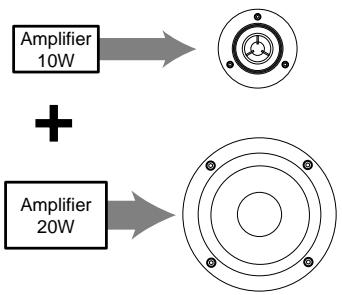
The DS-30A powered monitor uses a two-way, bi-amplifier design to achieve high sound quality.
The monitor features a 120-mm LF Driver and a 25-mm soft-dome HF Driver as speakers. The amplification includes 20-watt and 10-watt amplifiers designed to achieve high sound quality.
flowchart
graph TD
    A["Amplifier 10W"] --> C((Circular Component))
    B["Amplifier 20W"] --> D((Circular Component)
● Analog Input
In addition to an XLR connector, which provides for
balanced input, a 1/4" TRS phone jack accommodating either balanced or unbalanced input is also provided. This assures broad-ranging connectivity.
- Digital Input
The DS-30A is provided with digital input connectors (coaxial and optical) that support 96 kHz sample rate and 24-bit digital audio.
Digitally input signals are reproduced faithfully through 24-bit D/A conversion, thus preventing noise or a drop in sound quality.
You can use the monitors with a wide variety of equipment and applications through selective use of the analog and digital settings.
● Magnetically Shielded Low- and High-Frequency Drivers
This allows you to use the speakers next to CRT displays.

For EU Countries
This product complies with the requirements of European Directives EMC 89/336/EEC and LVD 73/23/EEC.
-For the USA
FEDERAL COMMUNICATIONS COMMISSION RADIO FREQUENCY INTERFERENCE STATEMENT
This equipment has been tested and found to comply with the limits for a Class B digital device, pursuant to Part 15 of the FCC Rules. These limits are designed to provide reasonable protection against harmful interference in a residential installation. This equipment generates, uses, and can radiate radio frequency energy and, if not installed and used in accordance with the instructions, may cause harmful interference to radio communications. However, there is no guarantee that interference will not occur in a particular installation. If this equipment does cause harmful interference to radio or television reception, which can be determined by turning the equipment off and on, the user is encouraged to try to correct the interference by one or more of the following measures:
– Reorient or relocate the receiving antenna.
– Increase the separation between the equipment and receiver.
- Connect the equipment into an outlet on a circuit different from that to which the receiver is connected.
- Consult the dealer or an experienced radio/TV technician for help.
This device complies with Part 15 of the FCC Rules. Operation is subject to the following two conditions:
(1) This device may not cause harmful interference, and
(2) This device must accept any interference received, including interference that may cause undesired operation.
Unauthorized changes or modification to this system can void the users authority to operate this equipment.
This equipment requires shielded interface cables in order to meet FCC class B Limit.
For Canada
NOTICE
This Class B digital apparatus meets all requirements of the Canadian Interference-Causing Equipment Regulations.
AVIS
NO USER-SERVICEABLE PARTS INSIDE.
REFER SERVICING TO QUALIFIED SERVICE PERSONNEL.

The lightning flash with arrowhead symbol, within an equilateral triangle, is intended to alert the user to the presence of uninsulated “dangerous voltage” within the product's enclosure that may be of sufficient magnitude to constitute a risk of electric shock to persons.

The exclamation point within an equilateral triangle is intended to alert the user to the presence of important operating and maintenance (servicing) instructions in the literature accompanying the product.
INSTRUCTIONS PERTAINING TO A RISK OF FIRE, ELECTRIC SHOCK, OR INJURY TO PERSONS.
IMPORTANT SAFETY INSTRUCTIONS SAVE THESE INSTRUCTIONS
WARNING - When using electric products, basic precautions should always be followed, including the following:
- Read these instructions.
- Keep these instructions.
- Heed all warnings.
- Follow all instructions.
- Do not use this apparatus near water.
- Clean only with a dry cloth.
- Do not block any of the ventilation openings. Install in accordance with the manufacturers instructions.
- Do not install near any heat sources such as radiators, heat registers, stoves, or other apparatus (including amplifiers) that produce heat.
-
Do not defeat the safety purpose of the polarized or grounding-type plug. A polarized plug has two blades with one wider than the other. A grounding type plug has two blades and a third grounding prong. The wide blade or the third prong are provided for your safety. When the provided plug does not fit into your outlet, consult an electrician for replacement of the obsolete outlet.
-
Protect the power cord from being walked on or pinched particularly at plugs, convenience receptacles, and the point where they exit from the apparatus.
-
Only use attachments/accessories specified by the manufacturer.
-
Never use with a cart, stand, tripod, bracket, or table except as specified by the manufacturer, or sold with the apparatus. When a cart is used, use caution when moving the cart/apparatus combination to avoid injury from tip-over.
-
Unplug this apparatus during lightning storms or when unused for long periods of time.
-
Refer all servicing to qualified service personnel. Servicing is required when the apparatus has been damaged in any way, such as power-supply cord or plug is damaged, liquid has been spilled or objects have fallen into the apparatus, the apparatus has been exposed to rain or moisture, does not operate normally, or has been dropped.

For the U.K.
WARNING: THIS APPARATUS MUST BE EARTHED
IMPORTANT: THE WIRES IN THIS MAINS LEAD ARE COLOURED IN ACCORDANCE WITH THE FOLLOWING CODE. GREEN-AND-YELLOW: EARTH, BLUE: NEUTRAL, BROWN: LIVE
As the colours of the wires in the mains lead of this apparatus may not correspond with the coloured markings identifying the terminals in your plug, proceed as follows:
The wire which is coloured GREEN-AND-YELLOW must be connected to the terminal in the plug which is marked by the letter E or by the safety earth symbol ⏻ or coloured GREEN or GREEN-AND-YELLOW.
The wire which is coloured BLUE must be connected to the terminal which is marked with the letter N or coloured BLACK.
The wire which is coloured BROWN must be connected to the terminal which is marked with the letter L or coloured RED.
USING THE UNIT SAFELY
INSTRUCTIONS FOR THE PREVENTION OF FIRE, ELECTRIC SHOCK, OR INJURY TO PERSONS
About ⚠️ WARNING and ⚠️ CAUTION Notices
| ⚠ WARNING | Used for instructions intended to alert the user to the risk of death or severe injury should the unit be used improperly. |
| ⚠ CAUTION | Used for instructions intended to alert the user to the risk of injury or material damage should the unit be used improperly.* Material damage refers to damage or other adverse effects caused with respect to the home and all its furnishings, as well to domestic animals or pets. |
About the Symbols
| The △ symbol alerts the user to important instructions or warnings. The specific meaning of the symbol is determined by the design contained within the triangle. In the case of the symbol at left, it is used for general cautions, warnings, or alerts to danger. | |
| The ⊙ symbol alerts the user to items that must never be carried out (are forbidden). The specific thing that must not be done is indicated by the design contained within the circle. In the case of the symbol at left, it means that the unit must never be disassembled. | |
| The ● symbol alerts the user to things that must be carried out. The specific thing that must be done is indicated by the design contained within the circle. In the case of the symbol at left, it means that the power-cord plug must be unplugged from the outlet. |
ALWAYS OBSERVE THE FOLLOWING
WARNING
- Before using this unit, make sure to read the instructions below, and the Owner's Manual.
- Do not open or perform any internal modifications on the unit.
- Do not attempt to repair the unit, or replace parts within it (except when this manual provides specific instructions directing you to do so). Refer all servicing to your retailer, the nearest Roland Service Center, or an authorized Roland distributor, as listed on the “Information” page.
-
Never use or store the unit in places that are:
-
Subject to temperature extremes (e.g., direct sunlight in an enclosed vehicle, near a heating duct, on top of heat-generating equipment); or are
- Damp (e.g., baths, washrooms, on wet floors); or are
- Humid; or are
- Exposed to rain; or are
- Dusty; or are
-
Subject to high levels of vibration.
-
Make sure you always have the unit placed so it is level and sure to remain stable. Never place it on stands that could wobble, or on inclined surfaces.
- The unit should be connected to a power supply only of the type described in the operating instructions, or as marked on the unit.
- Use only the attached power-supply cord.
- Do not excessively twist or bend the power cord, nor place heavy objects on it. Doing so can damage the cord, producing severed elements and short circuits. Damaged cords are fire and shock hazards!


WARNING
- This unit, either alone or in combination with an amplifier and headphones or speakers, may be capable of producing sound levels that could cause permanent hearing loss. Do not operate for a long period of time at a high volume level, or at a level that is uncomfortable. If you experience any hearing loss or ringing in the ears, you should immediately stop using the unit, and consult an audiologist.
-
Do not allow any objects (e.g., flammable material, coins, pins); or liquids of any kind (water, soft drinks, etc.) to penetrate the unit.
-
In households with small children, an adult should provide supervision until the child is capable of following all the rules essential for the safe operation of the unit.
- Protect the unit from strong impact. (Do not drop it!)
- Do not force the unit's power-supply cord to share an outlet with an unreasonable number of other devices. Be especially careful when using extension cords—the total power used by all devices you have connected to the extension cord's outlet must never exceed the power rating (watts/amperes) for the extension cord. Excessive loads can cause the insulation on the cord to heat up and eventually melt through.
- Before using the unit in a foreign country, consult with your retailer, the nearest Roland Service Center, or an authorized Roland distributor, as listed on the "Information" page.
- Do not put anything that contains water (e.g., flower vases) on this unit. Also, avoid the use of insecticides, perfumes, alcohol, nail polish, spray cans, etc., near the unit. Swiftly wipe away any liquid that spills on the unit using a dry, soft cloth.


CAUTION
- The unit should be located so that its location or position does not interfere with its proper ventilation.
- Always grasp only the plug on the power-supply cord when plugging into, or unplugging from, an outlet or this unit.
- Try to prevent cords and cables from becoming entangled. Also, all cords and cables should be placed so they are out of the reach of children.
- Never climb on top of, nor place heavy objects on the unit.
- Never handle the power cord or its plugs with wet hands when plugging into, or unplugging from, an outlet or this unit.
- Before moving the unit, disconnect the power plug from the outlet, and pull out all cords from external devices.
- Before cleaning the unit, turn off the power and unplug the power cord from the outlet (p. 5).
- Whenever you suspect the possibility of lightning in your area, pull the plug on the power cord out of the outlet.
- Should you remove the optical connector caps, make sure to put them in a safe place out of children's reach, so there is no chance of them being swallowed accidentally.
- The top of the unit may become hot, so take care to avoid burns.


IMPORTANT NOTES
In addition to the items listed under “IMPORTANT SAFETY INSTRUCTIONS” and “USING THE UNIT SAFELY” on page 3 and 4, please read and observe the following:
Power Supply
- Do not use this unit on the same power circuit with any device that will generate line noise (such as an electric motor or variable lighting system).
- Before connecting this unit to other devices, turn off the power to all units. This will help prevent malfunctions and/or damage to speakers or other devices.
Placement
- Using the unit near power amplifiers (or other equipment containing large power transformers) may induce hum. To alleviate the problem, change the orientation of this unit; or move it farther away from the source of interference.
- This device may interfere with radio and television reception. Do not use this device in the vicinity of such receivers.
- Noise may be produced if wireless communications devices, such as cell phones, are operated in the vicinity of this unit. Such noise could occur when receiving or initiating a call, or while conversing. Should you experience such problems, you should relocate such wireless devices so they are at a greater distance from this unit, or switch them off.
- Do not expose the unit to direct sunlight, place it near devices that radiate heat, leave it inside an enclosed vehicle, or otherwise subject it to temperature extremes. Also, do not allow lighting devices that normally are used while their light source is very close to the unit (such as a piano light), or powerful spotlights to shine upon the same area of the unit for extended periods of time. Excessive heat can deform or discolor the unit.
- To avoid possible breakdown, do not use the unit in a wet area, such as an area exposed to rain or other moisture.
- Do not allow rubber, vinyl, or similar materials to remain on the unit for long periods of time. Such objects can discolor or otherwise harmfully affect the finish.
- Do not put anything that contains water (e.g., flower vases) on the unit. Also, avoid the use of insecticides, perfumes, alcohol, nail polish, spray cans, etc., near the unit. Swiftly wipe away any liquid that spills on the unit using a dry, soft cloth.
-
Do not paste stickers, decals, or the like to this instrument. Peeling such matter off the instrument may damage the exterior finish.
-
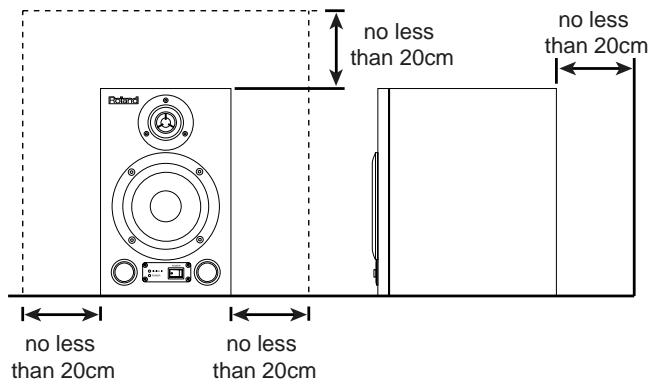
During operation, this unit must be placed at a distance of no less than 20 cm from any walls.
- Do not allow objects to remain on top of the unit while it is in operation.
- If you cover the top of the unit, the function is defeated, and temperature can rise to overly high level, which could cause burns if they are accidentally touched.
* Please also refer to Important Notes on Placement (p. 9).
Maintenance
- For everyday cleaning wipe the unit with a soft, dry cloth or one that has been slightly dampened with water. To remove stubborn dirt, use a cloth impregnated with a mild, non-abrasive detergent. Afterwards, be sure to wipe the unit thoroughly with a soft, dry cloth.
- Never use benzine, thinners, alcohol or solvents of any kind, to avoid the possibility of discoloration and/or deformation.
Additional Precautions
- Use a reasonable amount of care when using the unit's buttons, sliders, or other controls; and when using its jacks and connectors. Rough handling can lead to malfunctions.
- When connecting / disconnecting all cables, grasp the connector itself—never pull on the cable. This way you will avoid causing shorts, or damage to the cable's internal elements.
- A small amount of heat will radiate from the unit during normal operation.
- To avoid disturbing your neighbors, try to keep the unit's volume at reasonable levels (especially when it is late at night).
- When you need to transport the unit, package it in the box (including padding) that it came in, if possible. Otherwise, you will need to use equivalent packaging materials.
- Use a cable from Roland to make the connection. If using some other make of connection cable, please note the following precautions.
- Some connection cables contain resistors. Do not use cables that incorporate resistors for connecting to this unit. The use of such cables can cause the sound level to be extremely low, or impossible to hear. For information on cable specifications, contact the manufacturer of the cable.
Table of Contents
Main Features....1
USING THE UNIT SAFELY....4
IMPORTANT NOTES .... 5
Table of Contents......5
Panel Descriptions....6
Front 6
Rear....6
Connection Examples 8
Using Two DS-30A Monitors for Stereo Sound 8
Important Notes on Placement....9
Precautions When Connecting and Turning on the Power 9
Reference....10
Troubleshooting....10
Specifications....10
Dimensions....11
Frequency Response....11
Panel Descriptions
Front
Power Indicator
Lights when power is on.
Digital In Indicator
This lights up when output is received from a connected digital device or during standby. Connect the digital-signal output device, set the "Input Select switch" to DIGITAL INPUT, and set the "Digital Input select switch" according to the connector to which the device is attached (Coaxial or Optical).
* When the connected digital-signal output device is not powered up, the Digital In indicator does not light up.
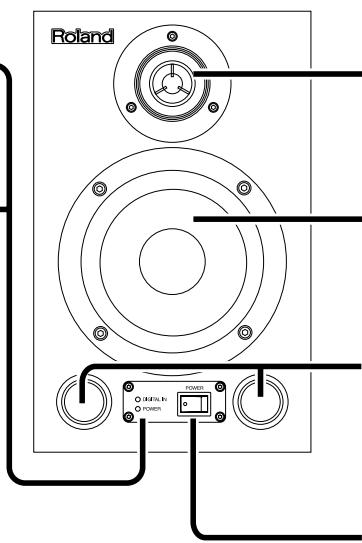
HF Driver
* Do not touch the diaphragm.
LF Driver
* Do not touch the speaker cone.
Bass-reflex Ducts
These are conduits for rich, bass-range reproduction.
Power Switch
This switch turns the power on/off.

Before turning the power on or off, you must lower the volume of this unit and your connected device etc. This unit is equipped with a protection circuit. A brief interval (a few seconds) after power up is required before the unit will operate normally.
Rear
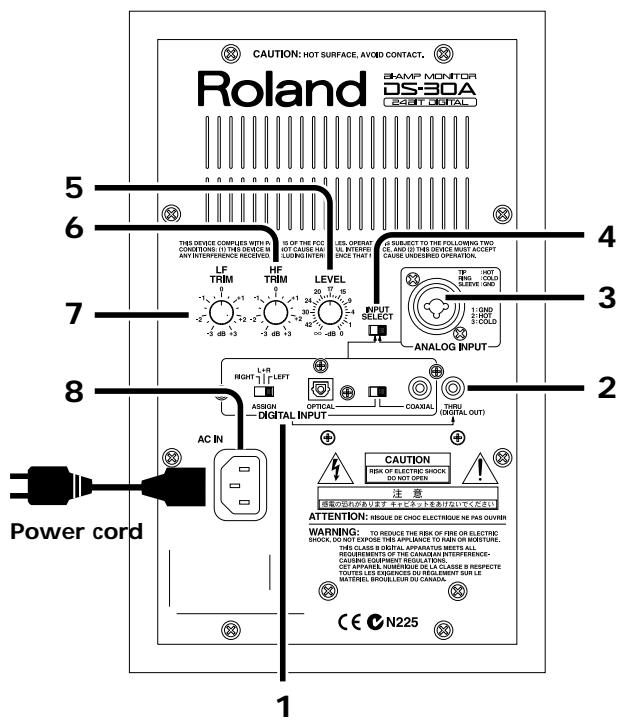
1 Digital Input
Coaxial Input Connector (Digital Input)
This is the digital input connector for coaxial cable.

It cannot be used for input of analog audio signals (no sound is produced).
Optical Input Connector (Digital Input)
This is the digital input connector for optic-fiber cable. Use commercially available optical cable for audio equipment to make the connection.

Optical-connector Protective Cap

- After removing the protective cap, put in a safe place so that it doesn't get lost.
- When not using the optical connector, attach the cap to keep the connector safe.
- When using the optical connector, be sure that the cap you removed is placed out of the reach of children. If a child has accidentally swallowed a cap, see a doctor immediately.
Digital Input Select Switch
This switch selects Optical or Coaxial. Select the connector used for the input signal.
Assign Switch
This switch selects the stereo position of the digital signal.
It selects Right, L+R, or Left when using two DS-30A
monitors for stereo sound (with digital signals).
Choose the setting appropriate for your setup.

With the DS-30A, there is no difference between L and R.
When using the digital input connectors of two DS-30A monitors for stereo sound, the digital signal can be input to either L or R.
2 Thru (Digital Out) Connector
When connecting multiple DS-30A monitors with digital signals, this connector is used for output to the second DS-30A.

Refer to Connection Examples (p. 8).
3 Analog Input
XLR/TRS Phone Input Connector (Analog Input)
This is for connecting XLR or TRS phone plugs.
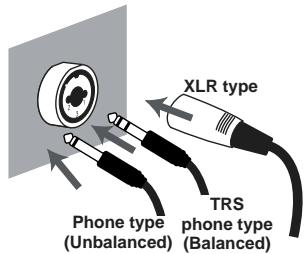
Both balanced and unbalanced connections are possible.
This instrument is equipped with balanced (XLR/TRS) type input jacks. Wiring diagrams for these jacks are shown below. Make connections after first checking the wiring diagrams of other equipment you intend to connect.
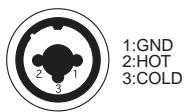
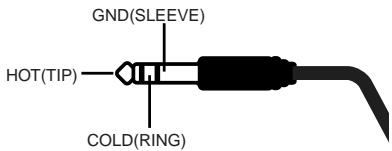
4 Input Select Switch
Used to select Digital Input or Analog Input.
Select the connector used for the input signal.
5 Level Control
This adjusts the input level. Turning the control clockwise increases the sound from the speakers.
6 HF Trim Control
This adjusts the sound quality of the treble range
$$ (1 0 \mathrm{kHz}, + / - 3 \mathrm{dB}). $$
7 LF Trim Control
This adjusts the sound quality of the bass range
$$ (8 0 \mathrm{Hz}, + / - 3 \mathrm{dB}). $$

The LF Trim and HF Trim controls on the DS-30A are designed to correct the sound quality of the sonic field. Use these to make fine adjustments to match the usage conditions.
8 AC Inlet
Connect the included Power cord here. Plug it firmly in, so that the cable does not accidentally become disconnected.
Connection Examples
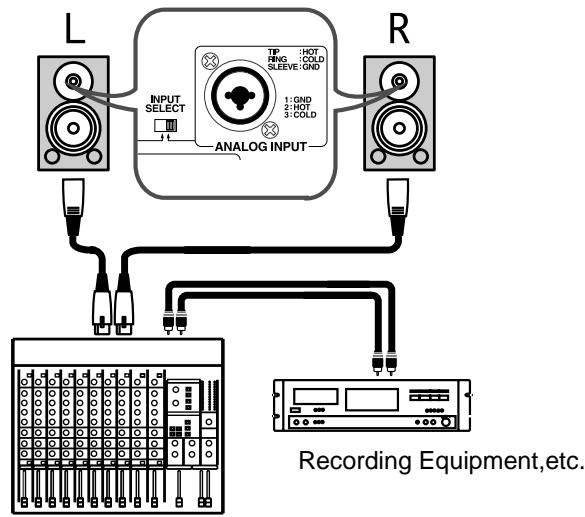
Using Two DS-30A Monitors for Stereo Sound
Example for
Using Analog Input Connectors
flowchart
graph TD
    L["Speaker L"] -->|INPUT SELECT| AnalogInput["Analog INPUT"]
    R["Speaker R"] -->|ANALOG INPUT| AnalogInput
    AnalogInput -->|Recording Equipment, etc.| Record["Equipment"]
Mixer,etc.
Example for
Using Digital Input Connectors
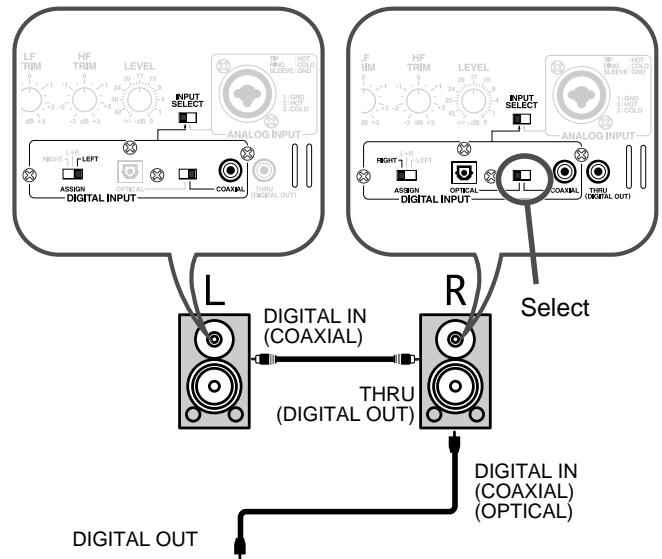
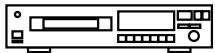
CD Player, MD Player, etc.
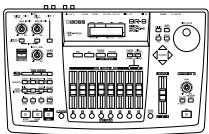
BR-8/532/1180, etc
Tips about high sound quality playback
- Please pay careful attention to the placement location. In order to take full advantage of the low-frequency playback capabilities of this device, we recommend that you place it on a hard and strong base.
- When using digital in connections, turn down the LEVEL knob of this device and raise the output level of the connected device. This will take advantage of the full number of bits in the digital signal, improving the audio quality.
Important Notes on Placement
- During setup and transport, be careful not to damage the vibrating portions (the speaker cone and diaphragm).
- Be sure to place the monitor so that the slits on the top to radiate the heat is not obstructed. Also, make sure the monitor does not touch any curtains or other fabrics.
- This unit performs cooling when the monitor is placed as shown below. Do not place the monitor on its side or upside down.
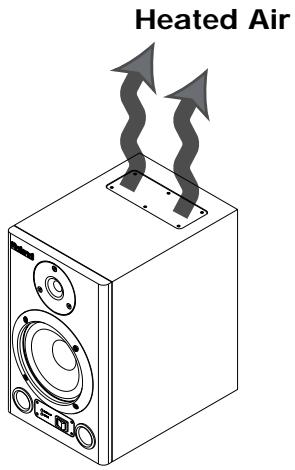
- When this unit is in operation, the top side will become hot. Take care not to touch it.
- Do not put anything on the unit.
- During operation, this unit must be placed at a distance of no less than 20 cm from any walls.
* Please also refer to "Placement" in IMPORTANT NOTES (p. 5).
Precautions When Connecting and Turning on the Power
- To prevent malfunction and/or damage to speakers or other devices, always turn down the volume, and turn off the power on all devices before making any connections.
-
Once the connections have been completed, turn on power to your various devices in the order specified. By turning on devices in the wrong order, you risk causing malfunction and/or damage to speakers and other devices. (When turning the power off, reverse this procedure.)
-
Turn on the power on the devices connected to the DS-30A.
-
Turn on the power on the DS-30A.
- This unit is equipped with a protection circuit. A brief interval (a few seconds) after power up is required before the unit will operate normally.
Troubleshooting
If there is no sound or if the unit does not operate as you expect, please check the following points first. If this does not resolve the problem, contact the nearest Roland service center or authorized Roland distributor.
There's No Sound
- Make sure the Input Level control has not been turned fully counterclockwise.
- Make sure the Input Select switch has been set to the connector where the input signal is connected (Digital Input or Analog Input).
- Make sure the Digital Input select switch has been set to the connector where the input signal is connected (Optical or Coaxial).
- Input a digital signal to the Digital Input connector. No sound is produced when an analog signal is input.
The volume level of the instrument connected to ANALOG INPUT is too low
- Could you be using a connection cable that contains a resistor? Use a connection cable that does not contain a resistor.
During Digital Signal Input, the Stereo Image Is Reversed or Sounds Unnatural, or Output Doesn't Sound Like Stereo
- Check the setting of the Assign switch (Right, L+R, or Left). The DS-30A uses an identical construction for the left and right monitors, and makes no distinction between left and right. During digital signal input, set the Assign switch L or R as appropriate for your setup.
Specifications
• System
2-Way Bi-Amplified Monitor
• Enclosure
Bass-reflex type
- Cabinet
1/2" PB (Baffle: 5/8" MDF)
- LF Driver
120 mm (5") Foamed polypropylene cone type, magnetically shielded
- HF Driver
25 mm (1") Soft dome type, magnetically shielded
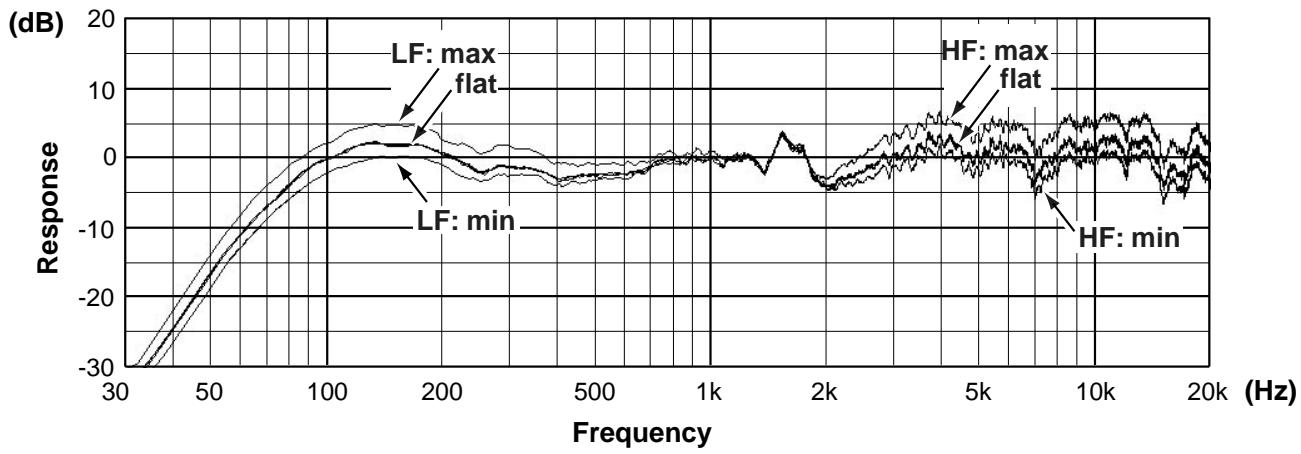
• Frequency Response
78 Hz to 20 kHz (+/-3 dB)
• Crossover Frequency 2.3 kHz (active third order)
• LF Amplifier Power 20 W
• HF Amplifier Power 10 W
Analog in
• Input Sensitivity 0 dBu (0.775 Vrms)
- Input Impedance
20 k ohms (Balanced/Unbalanced)
Digital in
- Format Conformity with S/P DIF
• Sample Rate 32 kHz to 96 kHz (de-emphasis: OFF)
• D/A Converter 24 bits
- Controls LEVEL Knob LF TRIM Knob (80 Hz, +/-3 dB) HF TRIM Knob (10 kHz, +/-3 dB) INPUT SELECT SW (Analog In/Digital In) ASSIGN SW (Right/L+R/Left) DIGITAL INPUT SELECT SW (Optical/Coaxial) POWER SW
• Indicators POWER DIGITAL IN
- Connectors ANALOG INPUT (XLR / 1/4 inch TRS phone type) DIGITAL INPUT (Optical) DIGITAL INPUT (Coaxial) DIGITAL THRU OUT (Coaxial)
• Power Supply
AC 117 V, AC 230 V, AC 240 V
• Power Consumption 40 W
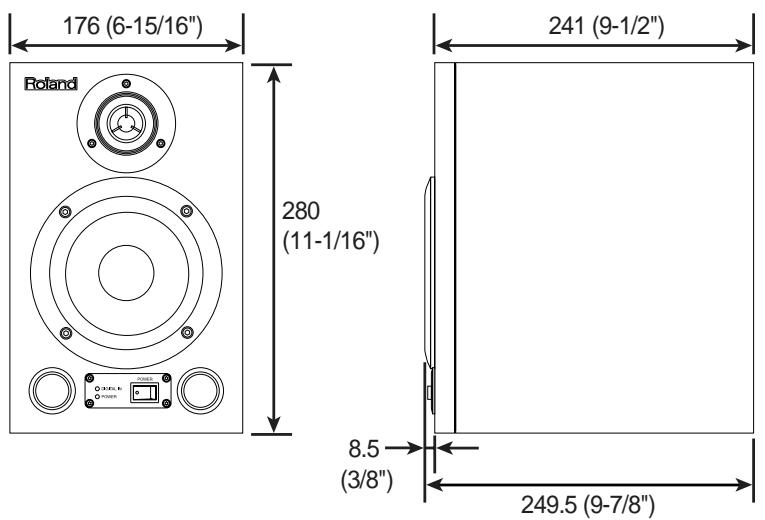
- Dimensions
176 (W) x 249.5 (D) x 280 (H) mm
6-15/16 (W) x 9-7/8 (D) x 11-1/16 (H) inches
* In the interest of product improvement, the specifications and/or appearance of this unit are subject to change without prior notice.
• Weight
6.1 kg/13 lbs 8 oz
• Accessories
Owner's Manual
Power Cord
Dimensions
* Not include the power cord.
Frequency Response