TK 245 - Refrigerator Exquisit - Free user manual and instructions
Find the device manual for free TK 245 Exquisit in PDF.


| Brand | Exquisit |
| Model | TK 245 |
| Product type | Refrigerator |
| Capacity | Approximately 90 liters |
| Dimensions (H x W x D) | 85 x 50 x 55 cm |
| Weight | Approximately 25 kg |
| Power supply | 220-240 V, 50 Hz |
| Energy class | A+ |
| Annual consumption | Approximately 150 kWh |
| Main functions | Adjustable thermostat, interior light, reversible door, freezer compartment |
| Maintenance and cleaning | Interior cleaning with a soft cloth and soapy water; manual defrosting recommended |
| Safety | Operating temperature: 0°C to 7°C for the refrigerator, -18°C for the freezer |
| Spare parts and repairability | Available via Exquisit after-sales service: thermostat, shelves, door gasket |
| General information | User manual available in several languages, including French |
Frequently Asked Questions - TK 245 Exquisit
User questions about TK 245 Exquisit
0 question about this device. Answer the ones you know or ask your own.
Ask a new question about this device
Download the instructions for your Refrigerator in PDF format for free! Find your manual TK 245 - Exquisit and take your electronic device back in hand. On this page are published all the documents necessary for the use of your device. TK 245 by Exquisit.
USER MANUAL TK 245 Exquisit
Safety instructions ....
Transport ....
Environmental protection information ....
General information ....
Description of the appliance, basic parts ....
Preparing the appliance for operation ....
Positioning ....
Changing the opening direction of the doors ....
Review of Mechanical Control
Temperature regulation ....
Freezing of food stuffs in the freezer compartment ....
Making ice-cubes ....
Defrosting the freezer compartment ....
Cleaning and care ....
Practical tips and observations ....
Operation problems and their solutions (troubleshooting) ......
Warranty service ....
INHOUDSOPGAVE NL


natural_image
Diagram of a microelectronic component with a labeled section (2) and base, showing a pin and terminal block (no text or symbols beyond labels)

natural_image
Line drawing of a computer with arrows indicating file transfer or movement (no text or symbols)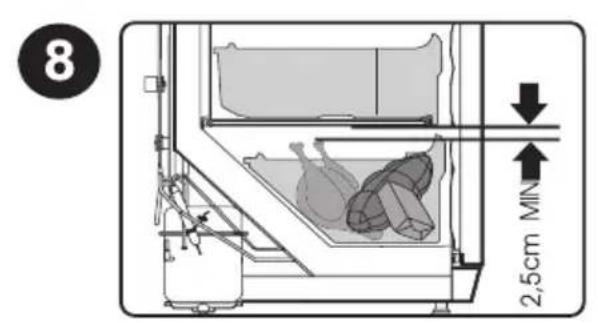


SAFETY INSTRUCTIONS
! CAREFULLY READ THE INSTRUCTION MANUAL. If instructions are not followed, there is a risk of injury, damage to the appliance, and loss of the right to free warranty service. We recommend to keep the Instruction manual the whole time you have the appliance. When you sell the appliance, pass the Instruction manual to the new owner of the appliance.
WARNING! Do not cover the ventilation holes at the top and on the sides of the appliance.
WARNING! Do not use any mechanical means or electrical devices to hasten the thawing process when cleaning the freezer compartment.
WARNING! If the supply cord is damaged it must be replaced by the manufacturer, manufacturer service agent or a similarly qualified person, in order to avoid a hazard.
WARNING! Disposal of the appliance should be according to national rules.
WARNING! Do not damage the appliance refrigeration system. It contains the refrigerant gas R600a. If the refrigeration system is damaged:
√ Do not use any open flame.
√ Avoid sparks — do not turn on any electrical appliances or lighting fixtures.
√ Immediately ventilate the room.
WARNING! Do not allow children to play with the appliance or to plug it in or unplug from the electricity supply socket. Do not allow children to play with the packaging material from the appliance.
WARNING! The appliance should not be used by children or mentally challenged individuals, unless they have previously been shown how to operate the appliance by someone responsible for their safety.
- The appliance should be transported only in the vertical position! Read more about this in the section TRANSPORT.
- If the appliance is brought in from the cold (temperature is not higher than +12^ ), you should wait for two hours before connecting it to the mains.
- The appliance should not be connected to the mains until all packing and transport materials aren't removed.
- Once the appliance is unpacked, make sure that it is complete, that the body and the electrical cord aren't damaged.
- It is forbidden to use a technically damaged appliance.
- WARNING! The earthed electrical socket by which the appliance is connected to the mains should be in an accessible place.
- WARNING! IF THE APPLIANCE IS PRODUCED WITH THE SPECIAL SUPPLY CORD IT CAN BE EXCHANGED ONLY BY THE SAME SPECIAL SUPPLY CORD PROVIDED BY THE MANUFACTURER.
- WARNING! The appliance must be plugged in to an earthed electricity supply socket.
- WARNING! The frequency and power of the electricity supply in your house must conform to the general data parameters of the appliance as it is shown in the table.
- WARNING! When positioning the appliance, be careful that the electrical cord isn't squeezed in order to avoid its damage. This can cause a short circuit and a fire.
- WARNING! Make sure that the plug of the electrical cord is not squeezed by the back wall of the appliance or otherwise damaged. A damaged plug can be the cause of a fire!
- When unplugging the appliance, do not touch the plug pins of the electrical cord.
- IF THE APPLIANCE IS UNPLUGGED (FOR CLEANING, MOVING TO ANOTHER PLACE, ETC.), IT MAY BE REPEATEDLY SWITCHED ON AFTER 15 MIN.
- Do not store heavy objects such as cooling devices, furniture or other domestic devices next the appliance in such a way that they could squeeze and damage the electrical cord.
- The appliance should be used only for freezing and storing foodstuffs.
-
Before cleaning, switch off the appliance and unplug the electricity supply cord plug from the electrical socket. Read more about this in the section CLEANING AND CARE.
-
The appliance can't be disposed of by burning. Read more about this in the section ENVIRONMENTAL PROTECTION INFORMATION.
- Do not freeze liquid food products in glass containers or bottles in the freezer compartment.
- Protect the appliance inner surfaces and plastic parts from fats, acids and sauces.
- Do not place any switched on electrical devices (such as microwave ovens, hair dryers, irons, electric kettles or other electrical devices) on top of the appliance because this may cause ignition of plastic parts.
- Do not place any dishes with liquids on top of the appliance and do not keep flowers in vases or other liquid-filled vessels on the appliance.
- Do not climb on or sit on the appliance, do not lean on or hang on the appliance doors, and do not allow children to do this.
- ! IF THE APPLIANCE IS OUT OF ORDER AND IT IS NOT POSSIBLE TO REPAIR IT BY MEANS OF GIVEN RECOMMENDATIONS, UNPLUG IT, OPEN THE DOORS AND CALL THE SERVICE EXPERT. ONLY A SERVICE REPRESENTATIVE CAN REMEDY ALL TECHNICAL OR CONSTRUCTION FAULTS.
TRANSPORT
! THE MANUFACTURER WILL NOT BE RESPONSIBLE FOR ANY DAMAGE TO THE APPLIANCE THAT RESULTS FROM NON-COMPLIANCE WITH THE INSTRUCTIONS FOR TRANSPORTATION.
- The appliance should be transported only in the vertical position.
- When being transported, the appliance should be protected from atmospheric conditions (rain, snow, dampness).
- The appliance should be firmly secured in place while being transported, to avoid slippage or any shocks in the transport vehicle.
- If the appliance was transported not vertically, it may be connected to the mains after 4 hours at least. If this is not done, the appliance compressor may fail.
ENVIRONMENTAL PROTECTION INFORMATION

This symbol indicates that once the appliance is no longer needed, it cannot be disposed together with other miscellaneous municipal waste. It should be collected and eliminated separately, i.e. in containers specially marked with this symbol in large-dimension rubbish collection areas.
Full information on where to submit the old appliance safety can be obtained from local government authorities, the shop where you bought the appliance, or the manufacturer's representatives.
If you decided to scrap the appliance, make it impossible to use in order to prevent possible misadventure. Pull out the electric plug from the electricity supply socket and then cut off the cord. Tear off the gasket. Break the door lock if any.
WARNING! Do not dismantle the appliance yourself. Pass it on to recycling companies.
GENERAL INFORMATION
The appliance is a upright freezer. The freezer compartment is intended for freezing and long-term storage of foodstuffs.
! THE APPLIANCE IS ECOLOGICALLY CLEAN, CONTAINING NO MATERIALS HARMFUL TO THE OZONE LAYER: the refrigerant used is R600a, the foaming agent used for the appliance insulation is cyclopentane C_5H_10 .
! THE MANUFACTURER GUARANTEES RELIABLE OPERATION OF THE REFRIGERATOR WHEN THE AMBIENT TEMPERATURE IS +16 TO +32 DEGREES CELSIUS AND THE RELATIVE AIR HUMIDITY NOT GREATER THAN 70 PER CENT.
The appliance climate class is N.
| Model | F 245 / TK245 / F2455S.18 | |
| Energy efficiency class according to the directive 94/2 EC | A | B |
| Energy consumption: kWh/24 h | 0,73 | 0,98 |
| kWh/per year | 266 | 358 |
| Total gross volume, L | 243 | |
| Net volume, L | 205 | |
| Freezer temperature rising time from storage temperature to -9 °C after power-cut, h | 19 | |
| Freezing capacity, kg/24h | 24 | |
| Temperature in the freezer compartment, °C | -18 and lower | |
| Dimensions (HxWxD), cm | 145x60x61,5 | 145x60x60 |
| Weight, kg | 60 | |
| Voltage used | 220-230 V/ 50HZ | |
| Rated input, W | 165 | |
| Current, A | 1,4 | |
NOTE. The manufacturer reserves the right to make future changes to technical parameters and specifications.
DESCRIPTION OF THE APPLIANCE, BASIC PARTS
IMPORTANT!
THE APPLIANCE ACCESSORIES LISTED BELOW MAY DIFFER FROM THE ACCESSORIES OF THE APPLIANCE YOU HAVE BOUGHT IN QUANTITY AND IN DESIGN. THIS DESCRIPTION IS ADAPTED FOR ENTIRE GROUP OF FREEZERS.
Fig. 1, see page 2
| 1-5 | Control Panel |
| 6 | fast-freeze section (s) |
| 7 | Frozen products section(s) |
| 8 | Cold accumulator |
| 9 | Ice tray |
| 10 | Condenser |
| 11 | Compressor |
PREPARING THE APPLIANCE FOR OPERATION
! It is recommended to prepare the appliance for operation with a helper.
- Remove package. Lift the appliance away from foamed polystyrene base. If your freezer is fit with screwed handles. Do not rise or push it taking by handles. Handles may break.
- Tear off adhesive tapes.
- When positioning the appliance in chosen location, it will move more easily into position if you lift the front a little and incline it backward, allowing it to roll on its casters.
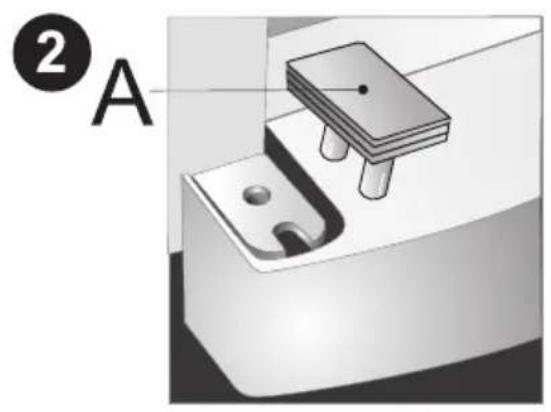
- Remove the support from the bottom cover (fig. 2, see page 2). Tear away the red-coloured adhesive tapes from the door trays – they are intended only for the transport of the appliance.
- Suitably dispose the packaging material.
- Take two supports from the bag (fig. 3, see page 2) and insert them into the guides at the top back part of the appliance.
- ATTENTION! In order to fix the upper small door when closing, the upper corners of the door till a click (fig. 4, see page 3).
POSITIONING
- Place the appliance in a dry, well ventilated room.
-
The appliance should not be operated in an unheated room or porch. Place the appliance away from heat sources such as kitchen stove/oven, radiators, or direct sunlight.
-
ATTENTION! The appliance must not touch any pipes for heating, gas or water supply, or any other electrical devices.
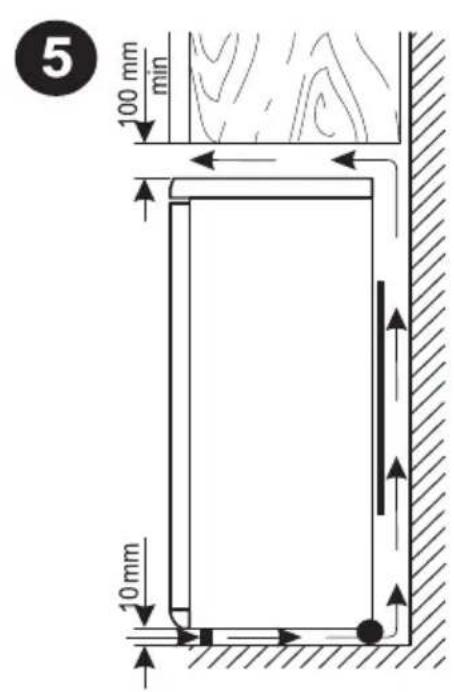
- Do not cover the ventilation holes at the top of the appliances—it must be a good air circulation around the appliance. There should be a gap of at least 10 cm between the top of the appliance body and any furniture that may be above it (fig. 5, see page 3). If this requirement is not followed, the appliance consumes more electrical energy and its compressor may overheat.
- If the appliance is placed in a corner, a gap of at least 1 cm must be left between the appliance body and the wall so that the freezer compartment door can be opened enough to pull out the frozen product drawer (fig. 6, see page 3).
- The appliance must stand on a level surface and must not touch the wall. If necessary, regulate the height of the appliance by adjusting the levelling feet: by turning them clockwise – the front of the appliance rises, by turning them counter clockwise – it comes down. If the appliance is tilted slightly backward – the doors will close by themselves.
CHANGING THE OPENING DIRECTION OF THE DOORS
It is recommended that changing the opening direction of the doors should be done with a helper. You will need two spanners No. 8 and No. 10 and a Philips head screwdriver.
! When changing the opening direction of the doors, YOU CAN NOT lay the refrigerator horizontally.
Do the actions below in the order they are listed (fig. 7, see page 3):
WARNING! Turn off the appliance and pull the plug out of the electricity supply socket.
- Remove the bottom cover 10.
- Unscrew two screws 7 and remove the bottom bracket 8 together with the washers 6 on the axle and the spacer 5.
- Remove the door 4. Unscrew the axle 2 together with the nut 1 and the washers 3 from the upper bracket and screw all this set on the left side of the door.
- Displace the plug 14 on the right side, hang the door on the axle 2.
- Prior to unscrewing the bracket 11 and counterchanging it with the bottom bracket 8 (together with the set of washers and spacers), insert the bracket axle into the door.
- The brackets 9 which are under the brackets 11 and 8 remain in their places;
- Put on the bottom cover 10.
REVIEW OF MECHANICAL CONTROL
CONTROL PANEL — DESCRIPTION OF SYMBOLS AND OPERATIONS
Fig. 1, see page 2
1 - THERMOSTAT POSITION INDICATOR, marked with the symbol The thermostat position is seen on the thermostat position indicator.

2 - THERMOSTAT KNOB. The temperature in the appliance is controlled using the thermostat knob. The thermostat is off when there is a zero (0) in the thermostat indicator space. Turning the thermostat knob clockwise lowers the temperature in the compartment.
3 - FAST-FREEZE INDICATOR, marked with the symbol S
When the fast-freeze mode is turned on, the yellow indicator light is illuminated. Instructions on how to use the fast-freeze function are in the section entitled "Freezing of food stuffs in the freezer compartment".
ATTENTION! The fast-freeze function does not turn off automatically — it needs to be switched off!
ATTENTION! When the fast-freeze mode is on, the appliance's compressor works non-stop.
4 - THE TEMPERATURE RISE INDICATOR is marked with the symbol

When the temperature in the freezer compartment rises above -14 ^ , the red indicator light is illuminated. It indicates that:
- The freezer was switched off for a longer time, i.e. the freezer is switched on for the first time, after defrosting or after losing of voltage.
- The door of the freezer is opened or is being opened too frequently.
- It is loaded a large amount of unfrozen foodstuffs.
- The freezing system is failed, i.e. the indicator does not go out longer 6 hours and it is heard running compressor or the compressor does not switch on. In this case you should apply to your service agent (at first make sure that three above items were taken into account).
5 - ELECTRICITY SUPPLY INDICATOR, marked with the symbol ①
When the appliance is connected to the electricity supply, the green indicator light is illuminated.
Simultaneously also the the temperature rise indicator lights up. It indicates that the freezer was switched off for a longer time, i.e. the freezer is switched on for the first time, after defrosting or after losing of voltage. When the temperature in the compartment again falls below -9 °C, the indicator light will go out.
TEMPERATURE REGULATION
! Temperature set in the freezer by the manufacturer is -18^
The temperature in the appliance is controlled using the thermostat knob 2 (fig. 1, see page 2) by turning it to one side or the other. The temperature indication in digits is shown beside the thermostat knob. When the appliance door is closed, the thermostat position is seen on the thermostat position indicator 1 (fig. 1).
The temperature is regulated on the scale of five digits.
0 = Compressor is switched off. WARNING! Electric current is not switched off.
1 = highest temperature (lowest cooling)
5 = lowest temperature (highest cooling)
! Please set the desired temperature in the appliance according to your own requirements.
! THE TEMPERATURE IN THE REFRIGERATOR COMPARTMENT MAY VARY DEPENDING ON AMBIENT TEMPERATURE, THE AMOUNT OF FOODSTUFFS, THE TEMPERATURE OF THE FOODSTUFFS, AND HOW OFTEN THE APPLIANCE DOOR IS OPENED AND CLOSED.
Therefore we recommend:
- locate the appliance away from heat sources,
- food placed in the appliance should not be warmer than the room temperature,
- appliance door must not to be left open,
- the appliance door should not be open longer than it is necessary to take out or put in foodstuffs.
! IF THE ROOM IS COOL, THE APPLIANCE COOLS LESS. THE TEMPERATURE IN THE APPLIANCE MAY THEREFORE RISE. Use the thermostat wheel to set a lower temperature.
FREEZING OF FOOD STUFFS IN THE FREEZER COMPARTMENT
In the freezer compartment, the fast-freeze section is marked with the symbol

The storage section is marked with the symbol ***
In order to freeze fresh food products turn on the fast-freeze function: turn the thermostat knob to the setting S. When the fast-freeze mode is turned on, the yellow indicator light is illuminated. After 24 hours, place the fresh food products to be frozen in one or two rows in the fast-freeze section. When the food products are frozen after 24 hours should be removed from the fast-freeze section and placed in the storage section drawer(s). When the food products are frozen, return the thermostat knob to its initial setting. The fast-freeze mode yellow indicator light will cease to be illuminated.
ATTENTION! The fast-freeze function does not turn off automatically — it needs to be switched off!
ATTENTION! The appliance cannot operate in fast-freeze mode for more than 72 hours. Failing to heed this requirement will damage the appliance's compressor.
- DO NOT EXCEED THE INDICATED MAXIMUM AMOUNT OF FOOD FOR FREEZING- IT IS 24 KG PER 24 HOURS.
- Leave a gap of not less than 2,5 cm between the foodstuffs being frozen and the upper partition (fig.
- Do not place unwrapped foodstuffs in the freezer sections.
- Do not freeze carbonated beverages.
- Fresh food for freezing should not touch already frozen foodstuffs.
- Do not freeze foodstuffs that are warmer than the room temperature.
- Do not freeze liquid foodstuffs in glass vessels or bottles.
- Strictly observe the frozen food product validity dates indicated by the manufacturer on the product packaging.
- WE RECOMMEND THAT FROZEN FISH AND SAUSAGE SHOULD BE STORED IN THE FREEZER COMPARTMENT NOT LONGER THAN 6 MONTHS; CHEESE, POULTRY, PORK, LAMB – NOT MORE THAN 8 MONTHS; BEEF, FRUIT AND VEGETABLES – NOT LONGER THAN 12 MONTHS.
8, see page 3).
MAKING ICE-CUBES
Ice-cubes are prepared in a tray for making ice-cubes. Fill each space in the ice cube tray 34 full of drinking water. Place the ice-cube tray in the fast-freeze section. When you want to remove the ice-cubes from the ice-cube tray, leave it for 5 min at room temperature and then shake the cubes into the special dish for them.
DEFROSTING THE FREEZER COMPARTMENT
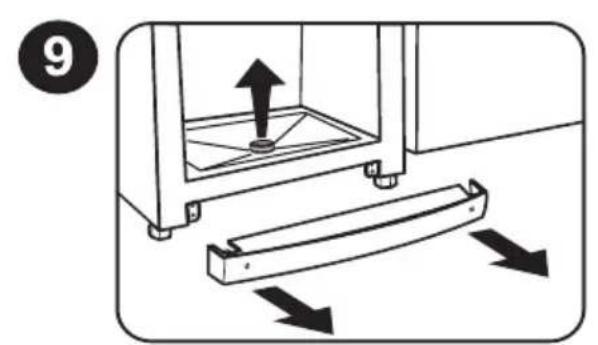
The freezer compartment should be thawed not less than twice a year or when a layer of ice thicker than 5 mm forms in it. Do the actions below in the order they are listed (fig.9, see page 3):
WARNING! Turn the appliance off and pull the plug out of the electrical socket.
- To remove foodstuffs, to place them into containers, to cover them with a heavy cloth and to leave them in a cold place.
- To pull out the plug on the bottom of the freezer. The plug will be pulled out easier after 10 - 20 minutes.
- To leave the door of the compartment open.
- When the ice melts, clean and wipe dry the surfaces and fixtures of the freezer compartment.
- Close the freezer compartment door.
- Plug in and turn on the appliance.
CLEANING AND CARE
! REGULARLY CLEAN THE APPLIANCE.
! Remember that before defrosting the freezer compartment and cleaning the back part of the appliance body you must disconnect the appliance from the electrical energy supply socket by pulling the plug out of the electricity outlet.
- Protect the appliance inner surfaces and plastic parts from fats, acids and sauces. In case of accidental spills – immediately clean with warm soapy water or dishwashing detergent. Wipe dry.
- Clean the appliance inner surfaces with warm soapy water. Dishwashing detergent may also be used.
- Wipe dry inner and outer surfaces.
- Regularly clean the hermetic gaskets of the doors. Wipe dry.
- At least once a year clean dust away from the back part of the appliance body and the compressor. A soft brush, electrostatic cloth or vacuum cleaner may be used for cleaning.
- DO NOT use detergents containing abrasive particles, acid, alcohol or benzene for cleaning the appliance inner and outer surfaces.
- DO NOT use for cleaning cloths or sponges that have coarse surfaces intended for scrubbing.
PRACTICAL TIPS AND OBSERVATIONS
- Frozen foodstuffs should be thawed in the refrigerator compartment. Food that thaws slowly retains better flavour properties and spread cold will help to maintain the set temperature in the refrigeration compartment. Do not consume ice made in the freezer chamber straight away.
- Products will freeze more quickly if they are divided up and packed in small portions.
- IF THE APPLIANCE IS TO BE LEFT SWITCHED OFF FOR AN EXTENDED PERIOD, LEAVE ITS DOORS OPEN.
Remarks on the appliance operating noise
As the appliance operates and goes through the freezing cycle, various noises will be emitted. This is normal and is not a sign of any malfunction.
- As the refrigerant circulates around the refrigeration system, it causes sounds like murmuring, bubbling, or rustling.
- Louder sounds like popping or clicking may be heard for a short time as the refrigerator's compressor switches on.
OPERATION PROBLEMS AND THEIR SOLUTIONS (TROUBLESHOOTING)
What if ...
- The appliance is plugged in to the mains but it does not work and the electricity supply voltage indicator is not illuminated. Check that your house electricity supply installations are in order. Check that the plug is correctly inserted into the electricity supply socket.
- The noise has become louder. Check that the appliance is standing stable, on a level place. To make it level, regulate the front feet. Check if the appliance is not touching any furniture, and that no part of the refrigeration system at the back part of the appliance body is touching the wall. Pull the appliance away from any furniture or walls. Check that the cause of increased noise isn't due to bottles, cans or dishes in the appliance that might be touching each other.
- When the appliance door is opened, the rubber sealing gasket pulls out. The gasket is smeared with sticky foodstuffs (fat, syrup). Clean the sealing gasket and the groove for it with warm water containing soap or dishwashing detergent and wipe dry. Put the rubber sealing gasket back into the place.
- The temperature rise indicator light is illuminated red. This means the appliance is being connected to the electricity supply for the first time or it was disconnected for a significant period (for thawing or during an interruption to the electricity supply), the freezer compartment door is not closed or is being frequently opened and closed, or a large amount of fresh food has been put in, and therefore the temperature in the compartment has risen above -9 °C. When the temperature in the compartment again falls below -9 °C, the indicator light will go out.
ATTENTION! If the temperature indicator light does not go out (for reasons other than those listed above) for longer than six hours, the compressor is either working constantly or is not functioning. You need to consult service people.
- High temperature in appliance, the compressor operation pauses are short. Ascertain whether the appliance door is shutting tightly, whether the door wasn't kept open longer than necessary when taking out or putting in foodstuffs, or whether a large amount of warm food was placed in the appliance.
- The top of the appliance has condensation on it. The ambient relative air humidity is above 70%. Ventilate the room where the appliance stands, and if possible remove the cause of the humidity.
WARRANTY SERVICE
! IF YOUR APPLIANCE IS NOT WORKING PROPERLY, ASCERTAIN WHETHER YOU CAN REMEDY THE CAUSE OF THE FAULTY FUNCTIONING OF THE APPLIANCE YOURSELF. If you cannot solve the problem yourself, contact the nearest refrigerator service representative by telephone or in writing. When making contact, necessarily indicate the refrigerator model 1 and number 2. You will find this data on the product label, which is glued to the left wall of the refrigerator compartment, near the fruit and vegetable trays.

VEILIGHEIDSINSTRUCTIES
BESCHRIJVING VAN DE KOELKAST, BASISONDERDELEN WAARSCHUWING!
DE HIERONDER AANGEGEVEN LIJST MET ONDERDELEN KAN ZOWEL IN HOEVEELHEID ALS IN ONTWERP VERSCHILLEN MET DE ONDERDELEN VAN DE KOELKAST DIE U HEEFT AANGESCHAFT. DEZE BESCHRIJVING IS GELDIG VOOR DE GEHELE REEKS DIEPVRIESKAST.
- 73/23 CEE 19/02/73 (Basse Tension) et modifications successives;
- INHOUDSOPGAVE NL
- SAFETY INSTRUCTIONS
- TRANSPORT
- ENVIRONMENTAL PROTECTION INFORMATION
- GENERAL INFORMATION
- DESCRIPTION OF THE APPLIANCE, BASIC PARTS
- IMPORTANT!
- PREPARING THE APPLIANCE FOR OPERATION
- POSITIONING
- CHANGING THE OPENING DIRECTION OF THE DOORS
- REVIEW OF MECHANICAL CONTROL
- - ELECTRICITY SUPPLY INDICATOR, marked with the symbol ①
- TEMPERATURE REGULATION
- FREEZING OF FOOD STUFFS IN THE FREEZER COMPARTMENT
- 8, see page 3).
- MAKING ICE-CUBES
- DEFROSTING THE FREEZER COMPARTMENT
- WARNING! Turn the appliance off and pull the plug out of the electrical socket.
- CLEANING AND CARE
- ! REGULARLY CLEAN THE APPLIANCE.
- PRACTICAL TIPS AND OBSERVATIONS
- Remarks on the appliance operating noise
- OPERATION PROBLEMS AND THEIR SOLUTIONS (TROUBLESHOOTING)
- What if ...
- ATTENTION! If the temperature indicator light does not go out (for reasons other than those listed above) for longer than six hours, the compressor is either working constantly or is not functioning. You need to consult service people.
- WARRANTY SERVICE
- VEILIGHEIDSINSTRUCTIES
- BESCHRIJVING VAN DE KOELKAST, BASISONDERDELEN WAARSCHUWING!
Brand : Exquisit
Model : TK 245
Category : Refrigerator