
CTK-710 - Numeric keypad CASIO - Free user manual and instructions
Find the device manual for free CTK-710 CASIO in PDF.


| Product type | Digital keyboard |
| Brand | CASIO |
| Model | CTK-710 |
| Number of keys | 61 standard-size keys (5 octaves) |
| Maximum polyphony | 32 notes (16 for some tones) |
| Number of tones | 242 (113 panel + 128 GM + 1 drum kit) |
| Number of rhythms | 100 |
| Number of built-in songs | 100 (50 Song Bank + 50 Piano Bank) |
| Accompaniment functions | Automatic accompaniment (CASIO CHORD, FINGERED), Fill-in, Synchro start |
| Learning system | 3-step lesson with evaluation, voice fingering guide |
| Display | LCD screen with keyboard guide, staff, fingering, tempo, and chord name |
| Speakers | 2 × 2.0 W |
| Connectivity | USB port (Type B), headphone/stereo output (jack), microphone input (jack), sustain pedal (jack), DC 9V |
| Power supply | 6 AA batteries (LR6) or AD-5 AC adaptor (9V) |
| Battery life | Approximately 4 hours with alkaline batteries (2 hours with manganese batteries) |
| Dimensions (W × D × H) | 95.6 × 35.6 × 13.3 cm |
| Weight | Approximately 4.0 kg (without batteries) |
| Care and cleaning | Clean with a soft, slightly damp cloth (water + mild detergent). Unplug the adaptor before cleaning. Do not use thinners or chemical agents. |
| Safety | Do not open or modify the device. Use only the specified adaptor (AD-5). Keep away from heat sources, moisture, and dust. Do not subject to strong drops or shocks. Do not place heavy objects on top. Batteries must not be recharged, mixed, or short-circuited. |
| Spare parts and repairability | The device contains no user-serviceable parts. Contact an authorized dealer or CASIO service center for repairs. Options available: sustain pedal (SP-3/SP-20), AD-5 AC adaptor. |
| General information | MIDI functions (keyboard channel, navigation, General MIDI), transposition (±12 semitones), fine tuning (±50 cents), adjustable accompaniment/song volume, auto power off (on batteries, approx. 6 min). Supplied with music stand. |
Frequently Asked Questions - CTK-710 CASIO
User questions about CTK-710 CASIO
0 question about this device. Answer the ones you know or ask your own.
Ask a new question about this device
Download the instructions for your Numeric keypad in PDF format for free! Find your manual CTK-710 - CASIO and take your electronic device back in hand. On this page are published all the documents necessary for the use of your device. CTK-710 by CASIO.
USER MANUAL CTK-710 CASIO
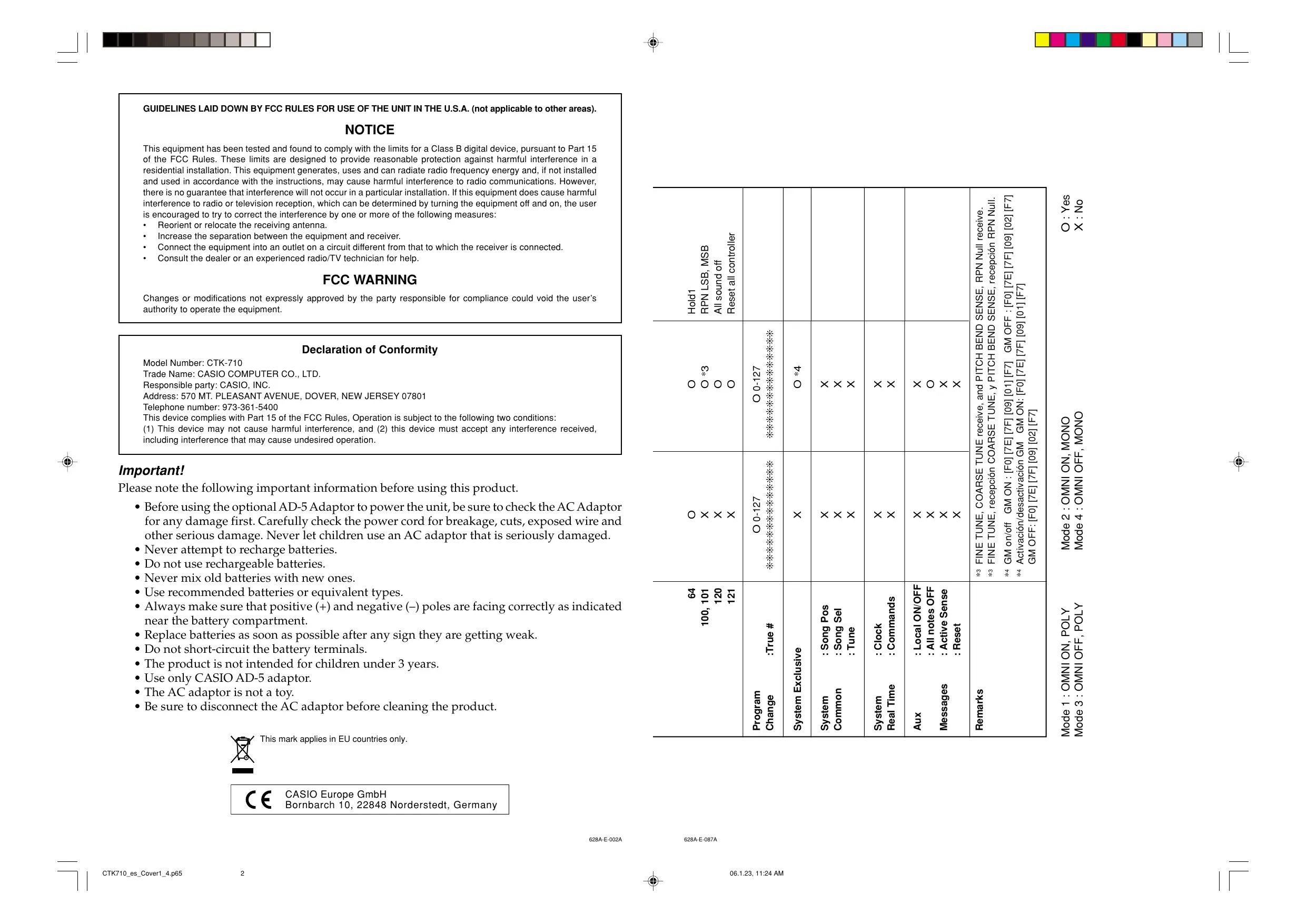
This equipment has been tested and found to comply with the limits for a Class B digital device, pursuant to Part 15 of the FCC Rules. These limits are designed to provide reasonable protection against harmful interference in a residential installation. This equipment generates, uses and can radiate radio frequency energy and, if not installed and used in accordance with the instructions, may cause harmful interference to radio communications. However, there is no guarantee that interference will not occur in a particular installation. If this equipment does cause harmful interference to radio or television reception, which can be determined by turning the equipment off and on, the user is encouraged to try to correct the interference by one or more of the following measures:
Reorient or relocate the receiving antenna.
- Increase the separation between the equipment and receiver.
- Connect the equipment into an outlet on a circuit different from that to which the receiver is connected.
- Consult the dealer or an experienced radio/TV technician for help.
FCC WARNING
Changes or modifications not expressly approved by the party responsible for compliance could void the user's authority to operate the equipment.
Declaration of Conformity
Model Number:CTK-710
Trade Name: CASIO COMPUTER CO., LTD.
Responsible party: CASIO, INC.
Address: 570 MT. PLEASANT AVENUE, DOVER, NEW JERSEY 07801
Telephone number: 973-361-5400
This device complies with Part 15 of the FCC Rules, Operation is subject to the following two conditions:
(1) This device may not cause harmful interference, and (2) this device must accept any interference received, including interference that may cause undesired operation.
Important!
Please note the following important information before using this product.
- Before using the optional AD-5 Adaptor to power the unit, be sure to check the AC Adaptor for any damage first. Carefully check the power cord for breakage, cuts, exposed wire and other serious damage. Never let children use an AC adaptor that is seriously damaged.
- Never attempt to recharge batteries.
- Do not use rechargeable batteries.
- Never mix old batteries with new ones.
- Use recommended batteries or equivalent types.
- Always make sure that positive (+) and negative (-) poles are facing correctly as indicated near the battery compartment.
- Replace batteries as soon as possible after any sign they are getting weak.
- Do not short-circuit the battery terminals.
- The product is not intended for children under 3 years.
- Use only CASIO AD-5 adaptor.
- The AC adaptor is not a toy.
- Be sure to disconnect the AC adaptor before cleaning the product.
This mark applies in EU countries only.

CASIO Europe GmbH
Bornbarch 10, 22848 Norderstedt, Germany
Congratulations on your selection of the CASIO electronic musical instrument.
- Before using the instrument, be sure to carefully read through the instructions contained in this manual.
- Be sure to keep all user documentation handy for future reference.
Symbols
Various symbols are used in this user's guide and on the product itself to ensure that the product is used safely and correctly, and to prevent injury to the user and other persons as well as damage to property. Those symbols along with their meanings are shown below.

DANGER
This symbol indicates information that, if ignored or applied incorrectly, creates the danger of death or serious personal injury.

WARNING
This indication stipulates matters that have the risk of causing death or serious injury if the product is operated incorrectly while ignoring this indication.

CAUTION
This indication stipulates matters that have the risk of causing injury as well as matters for which there is the likelihood of occurrence of physical damage only if the product is operated incorrectly while ignoring this indication.
Symbol Examples

This triangle symbol () means that the user should be careful. (The example at left indicates electrical shock caution.)

This circle with a line through it (O) means that the indicated action must not be performed. Indications within or nearby this symbol are specifically prohibited. (The example at left indicates that disassembly is prohibited.)

The black dot () means that the indicated action must be performed. Indications within this symbol are actions that are specifically instructed to be performed. (The example at left indicates that the power plug must be unplugged from the electrical socket.)
DANGER
Alkaline Batteries
Perform the following steps immediately if fluid leaking from alkaline batteries ever gets into your eyes.
- Do not rub your eyes! Rinse them with water.
- Contact your physician immediately.
Leaving alkaline battery fluid in your eyes can lead to loss of sight.

WARNING
Smoke, Strange Odor, Overheating
Continued use of the product while it is emitting smoke, a strange odor, or heat creates the risk of fire and electric shock. Take the following steps immediately.
- Turn off power.
- If you are using the AC adaptor for power, unplug it from the wall outlet.
- Contact your original retailer or an authorized CASIO Service Provider.
AC Adaptor
- Misuse of the AC adaptor creates the risk of fire and electric shock. Always make sure you observe the following precautions.
- Be sure to use only the AC adaptor that is specified for this product.
- Use only a power source whose voltage is within the rating marked on the AC adaptor.
-
Do not overload electrical outlets and extension cords.
-
Misuse of the AC adaptor's electric cord can damage or break it, creating the risk of fire and electric shock. Always make sure you observe the following precautions.
-
Never place heavy objects on the cord or subject it to heat.
- Never try to modify the cord or subject it to excessive bending.
- Never twist or stretch the cord.
- Should the electric cord or plug become damaged, contact your original retailer or authorized CASIO Service Provider.


- Never touch the AC adaptor while your hands are wet.
Doing so creates the risk of electric shock. - Use the AC adaptor where it will not be splashed with water. Water creates the risk of fire and electric shock.
- Do not place a vase or any other container filled with liquid on top of the AC adaptor. Water creates the risk of fire and electric shock.
Batteries
Misuse of batteries can cause them to leak, resulting in damage to nearby objects, or to explode, creating the risk of fire and personal injury. Always make sure you observe the following precautions.
- Never try to take batteries apart or allow them to become shorted.
- Never expose batteries to heat or dispose of them by incineration.
- Never mix old batteries with new ones.
- Never mix batteries of different types.
- Do not charge the batteries.
- Make sure the positive (+) and negative (-) ends of the batteries are facing correctly.
Do not incinerate the product.
Never throw the product into fire.
Doing so can cause it to explode, creating the risk of fire and personal injury.
Water and Foreign Matter
Water, other liquids, and foreign matter (such as pieces of metal) getting into the product create the risk of fire and electric shock. Take the following steps immediately.
- Turn off power.
- If you are using the AC adaptor for power, unplug it from the wall outlet.
- Contact your original retailer or an authorized CASIO Service Provider.
Disassembly and Modification
Never try to take this product apart or modify it in any way. Doing so creates the risk of electric shock, burn injury, or other personal injury. Leave all internal inspection, adjustment, and maintenance up to your original retailer or authorized CASIO Service Provider.


Dropping and Impact
Continued use of this product after it has been damaged by dropping or subjecting it to strong impact creates the risk of fire and electric shock. Take the following steps immediately.
- Turn off power.
- If you are using the AC adaptor for power, unplug it from the wall outlet.
- Contact your original retailer or an authorized CASIO Service Provider.
Plastic Bags
Never place the plastic bag the product comes in over your head or in your mouth. Doing so creates the risk of suffocation.
Particular care concerning this precaution is required where small children are present.
Keep off of the product and stand.*
Climbing onto the product or stand can cause it to tip over or become damaged. Particular care concerning this precaution is required where small children are present.
Location
Avoid locating the product on an unstable stand, on an uneven surface, or any other unstable location. An unstable location can cause the product to fall over, creating the risk of personal injury.


CAUTION
AC Adaptor
-
Misuse of the AC adaptor creates the risk of fire and electric shock. Always make sure you observe the following precautions.
-
Do not locate the electric cord near a stove or other sources of heat.
-
Never pull on the cord when unplugging from the electrical outlet. Always grasp the AC adaptor when unplugging.
-
Misuse of the AC adaptor creates the risk of fire and electric shock. Always make sure you observe the following precautions.
-
Insert the AC adaptor into the wall outlet as far as it will go.
- Unplug the AC adaptor from the wall outlet during lightening storms or before leaving on a trip or other long-term absence.
- At least once a year, unplug the AC adaptor from the wall outlet and wipe away any dust that is built up in the area around the prongs of the plug.
Relocating the Product
Before relocating the product, always unplug the AC adaptor from the wall outlet and disconnect all other cables and connecting cords. Leaving cords connected creates the risk of damage to the cords, fire, and electric shock.
Cleaning
Before cleaning the product, always unplug the AC adaptor from the wall outlet first. Leaving the AC adaptor plugged in creates the risk of damage to the AC adaptor, fire, and electric shock.


Batteries
Misuse of batteries can cause them to leak resulting in damage to nearby objects, or to explode, creating the risk of fire and personal injury. Always make sure you observe the following precautions.
- Use only batteries that are specified for use with this product.
- Remove batteries from the product if you do not plan to use it for a long time.
Connectors
Connect only the specified devices and equipment to the product's connectors. Connection of a non-specified device or equipment creates the risk of fire and electric shock.
Location
Avoid the following locations for this product. Such locations create the risk of fire and electric shock.
- Areas subject to high humidity or large amounts of dust.
- In food preparation areas or other areas subject to oil smoke.
- Near air conditioning equipment, on a heated carpet, in areas exposed to direct sunlight, inside of a vehicle parked in the sun, or any other area that subjects the product to high temperatures.
Display Screen
- Never push on the display screen's LCD panel or subject it to strong impact. Doing so can cause the LCD panel's glass to crack, creating the risk of personal injury.
- Should the LCD panel ever crack or break, never touch the liquid inside of the panel. LCD panel liquid can cause skin irritation.
- Should LCD panel liquid ever get inside your mouth, immediately wash out your mouth with water and contact your physician.
- Should LCD panel liquid ever get into your eyes or onto your skin, rinse with clear water for at least 15 minutes, and then contact a physician.
Sound Volume
Do not listen to music at very loud volumes for long periods. Particular care concerning this precaution is required when using headphones. High volume settings can damage your hearing.
Heavy Objects
Never place heavy object on top of the product.
Doing so can make the product top heavy, causing the product to tip over or the object to fall from it, creating the risk of personal injury.


Correct Stand* Assembly
An incorrectly assembled stand can tip over, causing the product to fall and creating the risk of personal injury.
Make sure you assemble the stand correctly, following the assembly instructions that come with it. Make sure you mount the product on the stand correctly.

- Stand is available as an option.
IMPORTANT!
When using batteries, be sure to replace them or shift to one of the alternate power sources whenever you notice any of the following symptoms.
- Dim power supply indicator
- Instrument does not turn on.
- Dim, difficult to read display
- Abnormally low speaker/headphone volume
Distortion of sound output - Occasional interruption of sound when playing at high volumes
- Sudden power failure when playing at high volumes
- Dimming of the display when playing at high volume
- Continued sound output even after you release a key
- A totally different tone may sound
- Abnormal rhythm pattern and demo tune play
- Abnormally low microphone volume
Distortion of microphone input - Dim power supply indicator when a microphone is used
- Sudden power failure when using the microphone
Company and product names used in this manual may be registered trademarks of others.
Congratulations upon your selection of this CASIO musical instrument. This keyboard provides you with the following features and functions.
242 tones
Choose from among orchestral sounds, synthesized sounds, and more.
100 rhythms
100 versatile rhythms help to add plenty of life to all your keyboard performances.
Auto Accompaniment
Simply play a chord and the corresponding rhythm, bass and chord parts play automatically.
PIANO BANK button
The touch of a button takes you directly to piano tones and piano lessons.
3-Step Lesson System
The 3-Step Lesson System lets you practice at your own pace. The keyboard automatically grades your performances, so you can trace your progress as you improve.
- 3-Step Lesson System: Now you can learn the parts that make up the keyboard's built-in tunes. Guidance that appears on the monitor screen helps lead you down the path to music proficiency.
- Evaluation System: The keyboard can be configured to rate your performances during Step 3 lesson by assigning points.
100 built-in tunes, including piano pieces
Built-in tunes are divided into two groups: a Song Bank of 50 tunes with Auto Accompaniment, and a Piano Bank of 50 piano tunes.
Musical Information System
A big LCD screen graphically shows you fingerings, keyboard keys to be pressed, and notes, making keyboard play more informative and enjoyable than ever before.
Avoid heat, humidity or direct sunlight.
Do not overexpose the instrument to direct sunlight, or place it near an air conditioner, or in any extremely hot place.
Do not use near a TV or radio.
This instrument can cause video or audio interference with TV and radio reception. If this happens, move the instrument away from the TV or radio.
Do not use lacquer, thinner or similar chemicals for cleaning.
Clean the keyboard with a soft cloth dampened in a weak solution of water and a neutral detergent. Soak the cloth in the solution and squeeze until it is almost dry.
Avoid use in areas subjected to temperature extremes.
Extreme heat can cause figures on the LCD screen to become dim and difficult to read. This condition should correct itself when the keyboard is brought back to normal temperature.
NOTE
- You may notice lines in the finish of the case of this keyboard. These lines are a result of the molding process used to shape the plastic of the case. They are not cracks or breaks in the plastic, and are no cause for concern.
Contents
Safety Precautions. E-1
Introduction E-5
Care of your keyboard . . . . . E-5
General Guide. E-8
Attachment of the Score Stand E-9
Quick Reference. E-10
To play the keyboard E-10
Power Supply E-12
Using batteries. E-12
Using the AC Adaptor. E-13
Auto Power Off. E-13
Settings E-13
Connections E-14
Phones/Output Terminal E-14
Connecting to a Computer or
Other Equipment E-14
Sustain jack Terminal E-14
Microphone Jack E-14
Accessories and Options E-14
Basic Operations. E-15
Playing the Keyboard E-15
Selecting a Tone. E-15
Using the Microphone Jack. E-16
Auto Accompaniment ...... E-17
Selecting a Rhythm E-17
Playing a Rhythm E-17
Adjusting the Tempo. E-18
Using Auto Accompaniment E-18
Using a Fill-in Pattern. E-20
Synchro Starting Accompaniment with
Rhythm Play E-20
Playing a Built-in Tune...... E-21
To play back a Song Bank tune .E-21
To play back a Piano Bank tune. E-22
Adjusting the Tempo. E-22
To change the melody tone. E-23
To play all tunes in succession. E-23
Using the PIANO BANK Button E-23
3-Step Lesson......E-24
Evaluation Mode E-25
Using the Lesson Functions and
Evaluation Mode E-25
Step 1 - Master the timing. E-25
Step 2 - Master the notes. E-26
Step 3 - Play at normal speed. E-26
Voice Fingering Guide. E-27
Keyboard Settings E-28
Adjusting Accompaniment and
Song Bank Volume E-28
Transposing the Keyboard E-28
Tuning the Keyboard. E-29
Connection to a Computer ....E-30
Connecting to a Computer E-30
General MIDI Tone E-31
Changing the Settings. E-31
Troubleshooting E-33
Specifications E-34
Appendix A-1
Tone List A-1
Percussion Instrument List. A-5
Fingered Chord Chart A-6
Rhythm List A-8
Song List A-9
MIDI messages that can be sent and received using the USB port
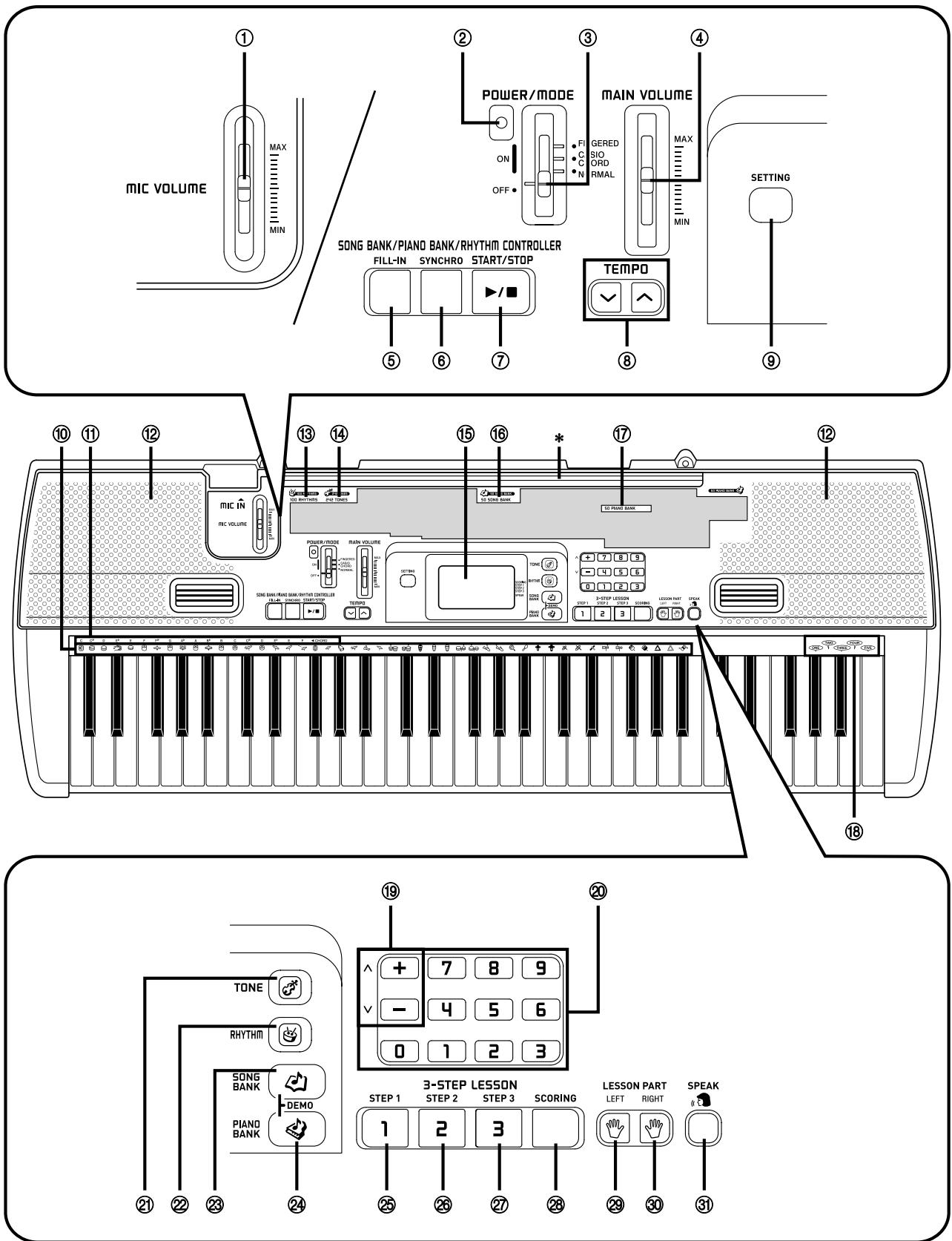
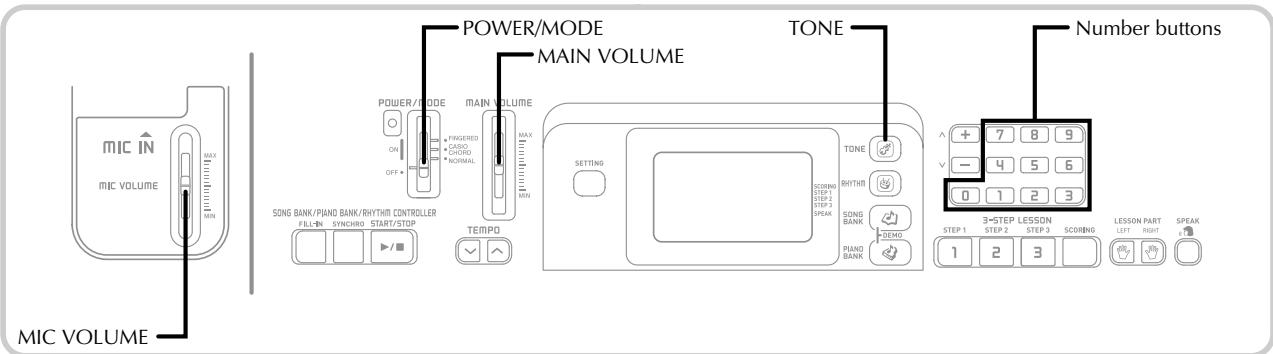
① MIC VOLUME slider
② Power indicator
③ POWER/MODE switch
④ MAIN VOLUME slider
SONG BANK/PIANO BANK/RHYTHM CONTROLLER
⑤ FILL-IN button
⑥ SYNCHRO button
⑦ START/STOP button
⑧ TEMPO buttons
⑨ SETTING button
10 Percussion instrument list
⑪ CHORD root names
⑫ Speaker
③ Rhythm list
14 Tone list
15 Display
Song Bank list
⑦ Piano Bank list
18 COUNT VOICE 1 to 5
19 [+]/[-] buttons
- Negative values can be changed only by using [+] and [-] to increase and decrease the displayed value.
Number buttons
- For input of numbers to change displayed settings.
2 TONE button
② RHYTHM button
23 SONG BANK button
24 PIANO BANK button
3-STEP LESSON
STEP1 button
STEP2 button
STEP3 button
28 SCORING button
29 LEFT button
RIGHT button
③ SPEAK button
Rear Panel
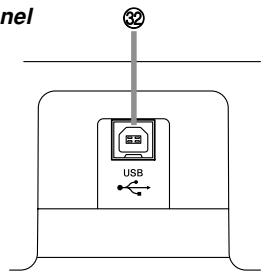
② USB port
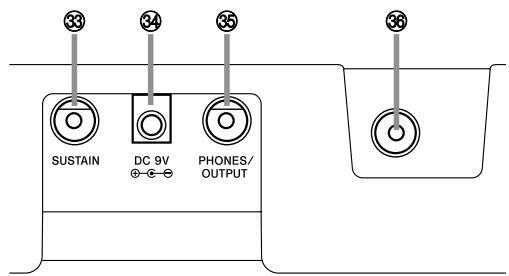
SUSTAIN jack terminal
④ DC 9V terminal
⑤ PHONES/OUTPUT terminal
MIC IN jack
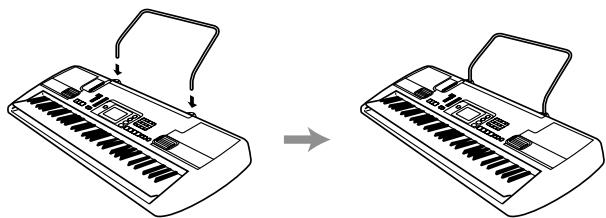
*Attachment of the Score Stand
Insert both ends of the music stand provided with the keyboard into the two holes on the top surface.
NOTE
- Display examples shown in this User's Guide are intended for illustrative purposes only. The actual text and values that appear on the display may differ from the examples shown in this User's Guide.
- Viewing a liquid crystal display screen from an angle can change the appearance of display contrast. The display contrast of this keyboard is set to allow easy viewing for a person seated on a chair in front of the keyboard. Note that display contrast is fixed, and cannot be adjusted.
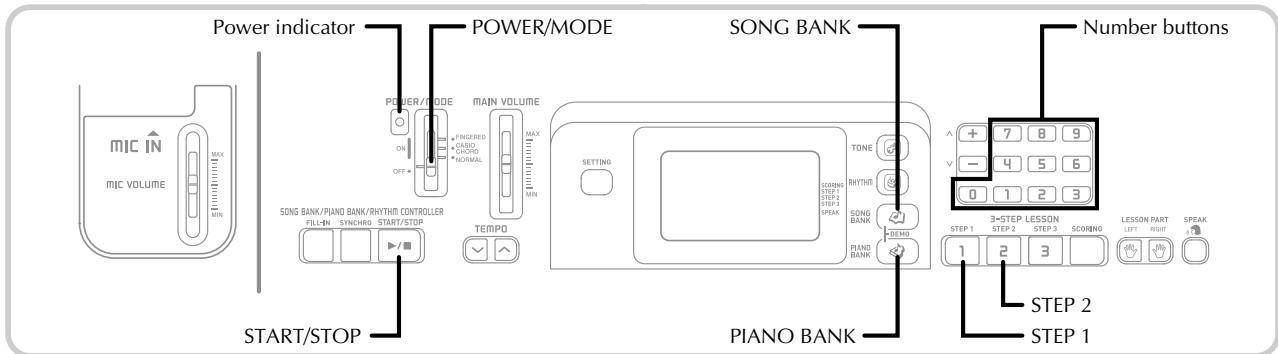
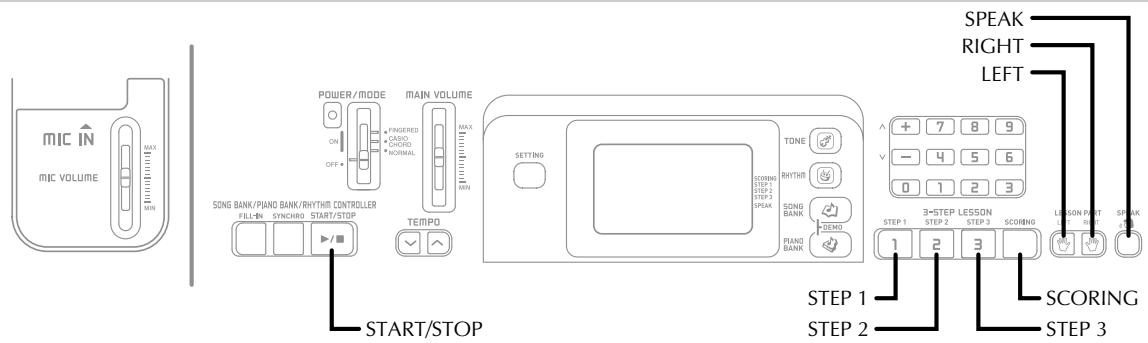
This section provides a quick overview of keyboard operation using steps one and two of the 3-step lesson feature.
With the 3-step lesson feature, the on-screen keyboard guide keys light to show the next note of the tune.
To play the keyboard
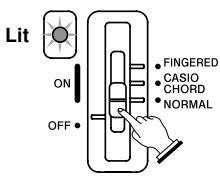
1 Set the POWER/MODE switch to NORMAL.
- This causes the power indicator to light.
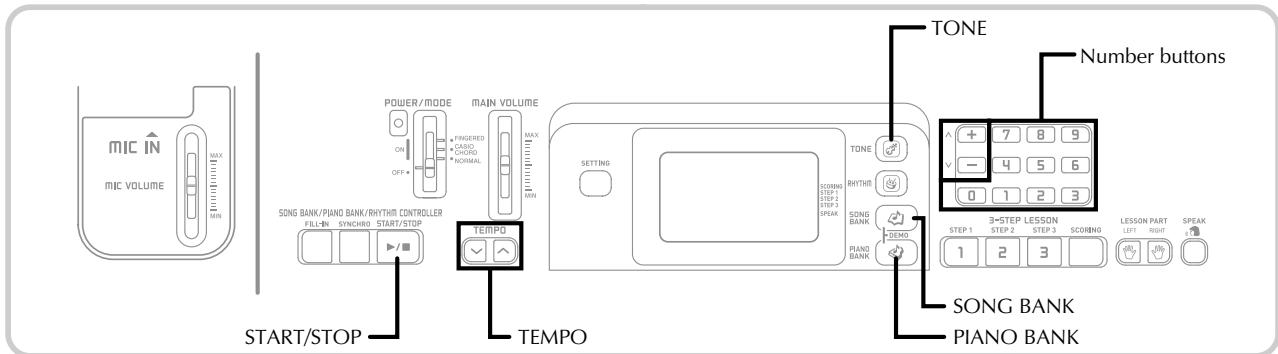
Press the SONG BANK button.
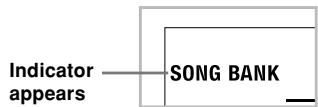
3 Find the tune you want to play in the SONG BANK List, and then use the number buttons to input its two-digit number.
- See page A-9 for the SONG BANK List.
Example: To select "40 ALOHA OE", input 4 and then 0.

4 Press the STEP 1 button or STEP 2 button.
- The keyboard sounds a count beat and waits for you to play something on the keyboard. The keys that you need to press first flash on the display.
Play the melody along with the selected tune's accompaniment.
- Play in accordance with the keyboard keys, fingerings and notes that appear on the display.
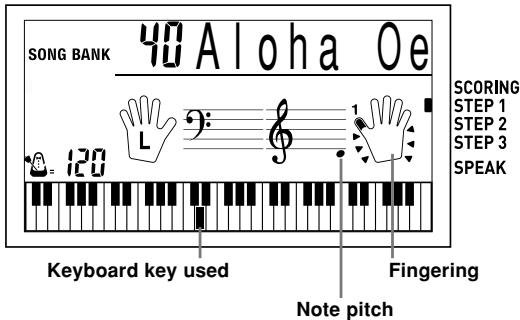
If you selected lesson Step 1
- Play the notes on the keyboard.
- Accompaniment (left-hand part) plays in time with the notes.
- With Step 1, the correct melody note is played no matter which keyboard key you press.
If you selected lesson Step 2
- Play the correct notes on the keyboard.
- While an on-screen keyboard guide key is lit, press the corresponding key on the actual keyboard. In the case of a Piano Bank tune, the keyboard guide indication turns off when you press a keyboard key, and the on-screen keyboard guide key lights for the next note to be played.
- Accompaniment (left-hand part) plays in time with the notes, as long as you press the correct keyboard keys.
To stop play at any time, press the START/STOP button.
To play an Etude or Concert Piece tune
When you get to step 2 of the above procedure, press the PIANO BANK button in place of the SONG BANK button.
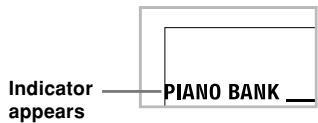
2 Find the tune you want to play in the PIANO BANK List, and then use the number buttons to input its two-digit number.
See page A-9 for the PIANO BANK List.
3 Next, continue from step 4 of the above procedure.
This keyboard can be powered by current from a standard household wall outlet (using the specified AC adaptor) or by batteries. Always make sure you turn the keyboard off whenever you are not using it.
Using batteries
Always make sure you turn off the keyboard before loading or replacing batteries.
To load batteries
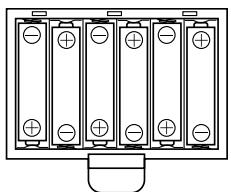
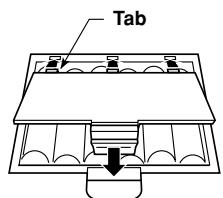
1 Remove the battery compartment cover.
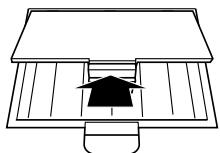
2 Load 6 AA-size batteries into the battery compartment.
- Make sure that the positive (+) and negative (-) ends are facing correctly.
3 Insert the tabs on the battery compartment cover into the holes provided and close the cover.
NOTE
- The keyboard may not function correctly if you load or replace batteries with power turned on. If this happens, turning the keyboard off and then back on again should return functions back to normal.
Important Battery Information
The following shows the approximate battery life.
Alkaline batteries 4 hours
Manganese batteries 2 hours
The above value is standard battery life at normal temperature, with the keyboard volume at medium setting. Temperature extremes or playing at very loud volume settings can shorten battery life.
WARNING
Misuse of batteries can cause them to leak, resulting in damage to nearby objects, or to explode, creating the risk of fire and personal injury. Always make sure you observe the following precautions.
- Never try to take batteries apart or allow them to become shorted.
- Never expose batteries to heat or dispose of them by incineration.
- Never mix old batteries with new ones.
- Never mix batteries of different types.
- Do not charge the batteries.
- Make sure the positive (+) and negative (-) ends of the batteries are facing correctly.
CAUTION
Misuse of batteries can cause them to leak resulting in damage to nearby objects, or to explode, creating the risk of fire and personal injury. Always make sure you observe the following precautions.
- Use only batteries that are specified for use with this product.
- Remove batteries from the product if you do not plan to use it for a long time.
Using the AC Adaptor
Make sure that you use only the AC adaptor specified for this keyboard.
Specified AC Adaptor: AD-5
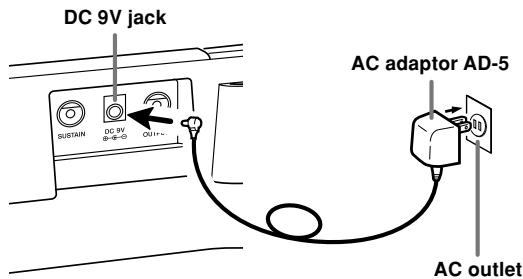
[Rear Panel]
Note the following important precautions to avoid damage to the power cord.
During Use
- Never pull on the cord with excessive force.
- Never repeatedly pull on the cord.
- Never twist the cord at the base of the plug or connector.
- The power cord should not be stretched tight while it is in use.
During Movement
- Before moving the keyboard, be sure to unplug the AC adaptor from the power outlet.
During Storage
- Loop and bundle the power cord, but never wind it around the AC adaptor.
IMPORTANT!
- Make sure that the keyboard is turned off before connecting or disconnecting the AC adaptor.
- Using the AC adaptor for a long time can cause it to become warm to touch. This is normal and does not indicate malfunction.
Auto Power Off
When you are using battery power, keyboard power turns off automatically whenever you leave it on without performing any operation for about 6 minutes. When this happens, use the POWER/MODE switch to turn power back on.
NOTE
- Auto Power Off is disabled (it does not function) when you are using the AC adaptor to power the keyboard.
To disable Auto Power Off
Hold down the TONE button while turning on the keyboard to disable Auto Power Off.
NOTE
- When Auto Power Off is disabled, the keyboard does not turn off automatically no matter how long it is left with no operation being performed.
- Auto Power Off is automatically enabled whenever you turn on keyboard power.
Settings
All keyboard settings are returned to their initial defaults whenever keyboard power is turned back on after being turned off by operation of the POWER/MODE switch or Auto Power Off.
Phones/Output Terminal
Before connecting phones or other external equipment, be sure to first turn down the volume settings of the keyboard and the connected equipment. You can then adjust volume to the desired level after connections are complete.

[Rear Panel]
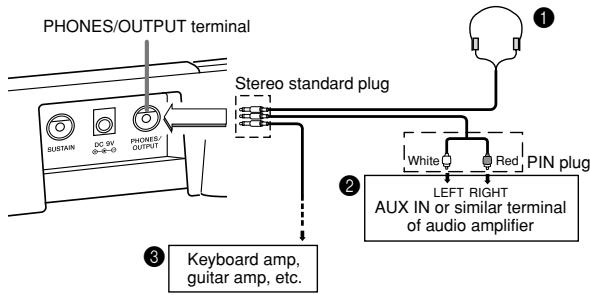
Connecting Phones (Figure 1)
Connecting phones cuts off output from the keyboard's built-in speakers, so you can play even late at night without disturbing anyone.
Audio Equipment (Figure 2)
Connect the keyboard to a audio equipment using a commercially available connecting cord with a standard plug on one end and two PIN plugs on the other end. Note that the standard plug you connect to the keyboard must be a stereo plug, otherwise you will be able to output only one of stereo channels. In this configuration, you normally set the input selector of the audio equipment to the terminal (usually marked AUX IN or something similar) where the cord from the keyboard is connected. See the user documentation that comes with your audio equipment for full details.
Musical Instrument Amplifier (Figure 3)
Use a commercially available connecting cord* to connect the keyboard to a musical instrument amplifier.
- Be sure to use a connecting cord that has a stereo standard plug on the end you connect to the keyboard, and a connector that provides dual channel (left and right) input to the amplifier to which you are connecting. The wrong type of connector at either end can cause one of the stereo channels to be lost.
When connected to a musical instrument amplifier, set the volume of the keyboard to a relatively low level and make output volume adjustments using the amplifier's controls.
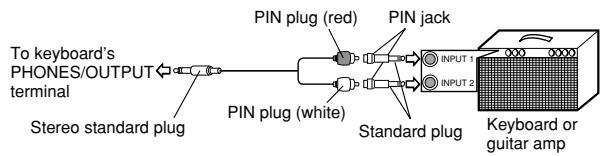
[Connection Example]
Connecting to a Computer or Other Equipment
You can also connect the keyboard to a computer or sequencer. See "Connecting to a Computer" on page E-30 for details.
Sustain jack Terminal
You can connect an optional sustain pedal (SP-3 or SP-20) to the SUSTAIN jack terminal to enable the capabilities described below.
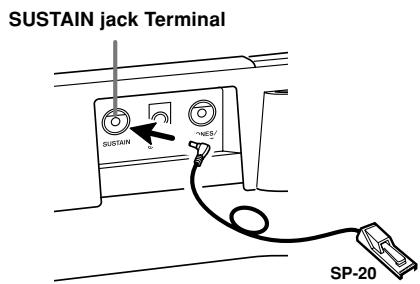
Sustain Pedal
- With piano tones, depressing the pedal causes notes to linger, much like a piano's damper pedal.
- With organ tones, depressing the pedal causes notes to continue to sound until the pedal is released.
Microphone Jack
You can connect a commercially available microphone to the microphone jack and sing along with notes played on the keyboard. For details, see "Using the Microphone Jack" on page E-16.
Accessories and Options
Use only the accessories and options specified for this keyboard. Use of non-authorized items creates the danger of fire, electrical shock, and personal injury.
This section provides information on performing basic keyboard operations.
Playing the Keyboard
To play the keyboard
1 Set the POWER/MODE switch to NORMAL.
Use the MAIN VOLUME slider to lower the keyboard volume.
- It's always a good idea to set the keyboard volume at a relatively low level before playing.
3 Play something on the keyboard.
Selecting a Tone
This keyboard comes with 242 built-in tones. Use the following procedure to select the tone you want to use.
To select a tone
1 Find the tone you want to use in the TONE List and note its tone number.
- Not all of the available tones are shown on the tone list printed on the keyboard console. For a complete list, see the "Tone List" on page A-1.
Press the TONE button.
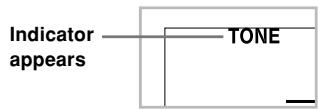
3 Use the number buttons to input the three digit tone number for the tone you want to select.
Example: To select "041 ACOUSTIC BASS", input 0, 4 and then 1.
TONE 041 Acous.Bs
NOTE
- Always input all three digits for the tone number, including leading zeros (if any). If you input one or two digits and stop, the display will automatically clear your input after a few seconds.
- You can also increment the displayed tone number by pressing ([+] and decrement it by pressing ([-]).
Combination tones
The following describes the two types of combination tones that are available.
Layered Tones (Tone Numbers: 098 through 107)
Example: 098 STRINGS PIANO
This tone layers a strings tone with a piano tone so they both sound when a keyboard key is pressed.
Split Tones (Tone Numbers: 108 through 112)
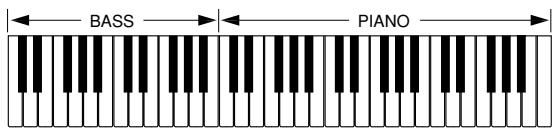
Example: 108 BASS/PIANO
This tone splits the keyboard so one range is assigned a bass tone and another range is assigned a piano tone.
Percussion sounds
Example: 241 DRUM SET
This tone assigns various percussion sounds to the keyboard. See the "Percussion Instrument List" on page A-5 for full details.
Polyphony
The term polyphony refers to the maximum number of notes you can play at the same time. The keyboard has 32-note polyphony, which includes the notes you play as well as the rhythms and auto-accompanyiment patterns that are played by the keyboard. This means that when a rhythm or auto-accompanyiment pattern is being played by the keyboard, the number of notes (polyphony) available for keyboard play is reduced. Also note that some of the tones offer only 16-note polyphony.
NOTE
- When rhythm or auto accompaniment is playing, the number of sounds simultaneously played is reduced.
Using the Microphone Jack
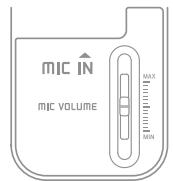
Connecting a commercially available microphone to the MIC IN jack makes it possible to sing along with the keyboard's built-in tunes. When connecting a microphone, be sure to first adjust the MIC VOLUME to a relatively low setting, and then adjust to the level you want after connecting.

Set the MIC VOLUME slider setting so it is on the "MIN" side.

Turn on the microphone's ON/OFF switch.

Use the MIC VOLUME slider to adjust microphone volume to the level you want.
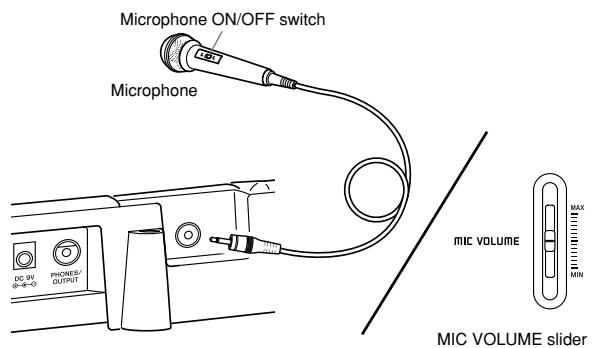
[Rear Panel]
IMPORTANT!
- Be sure to use the microphone's ON/OFF switch to turn off the microphone and to disconnect the microphone from the keyboard whenever you are not using it.
Recommended Microphone Type
- Dynamic microphone (standard plug)
IMPORTANT!
- Be sure to disconnect the microphone from the keyboard whenever you are not using it.
Howling (Feedback Noise)
Any of the following conditions can cause howling (feedback noise).
- Covering the head of the microphone with your hand
- Positioning the microphone too near to a speaker
Should howling occur, try grasping the microphone further away from the head, and move away from any nearby speaker.
Static Noise
Fluorescent lighting can cause static noise in the microphone signal. When this happens, move away from the lighting you suspect may be causing the static.
This keyboard automatically plays bass and chord parts in accordance with the chords you finger. The bass and chord parts are played using sounds and tones that are automatically selected to select the rhythm you are using. All of this means that you get full, realistic accompaniments for the melody notes you play with your right hand, creating the mood of an one-person ensemble.
Selecting a Rhythm
This keyboard provides you with 100 exciting rhythms that you can select using the following procedure.
To select a rhythm

Find the rhythm you want to use in the RHYTHM List and note its rhythm number.
- Not all of the available rhythms are shown on the rhythm list printed on the keyboard console. For a complete list, see the "Rhythm List" on page A-8.

Press the RHYTHM button.

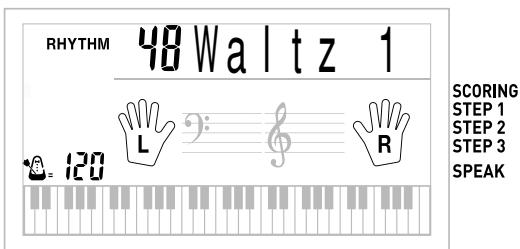
Use the number buttons to input the two digit rhythm number for the rhythm you want to select. Example: To select "48 WALTZ 1", input 4 and then 8.
NOTE
- "00 8 Beat 1" is the initial default rhythm setting whenever you turn on keyboard power.
- You can also increment the displayed rhythm number by pressing [+] and decrement it by pressing [-] .
- Accompaniment sounds (chords, bass, etc.) do not sound while a metronome rhythm (No. 95 to 99: 0, 2, 3, 4, 6) is being used, even if the POWER/MODE switch setting is "CASIO CHORD" or "FINGERED". Because of this, you should set the POWER/MODE switch to "NORMAL" when using a metronome rhythm.
Playing a Rhythm
Use the following procedure to start and stop rhythm play.
To play a rhythm

Set the POWER/MODE switch to NORMAL.

Press the START/STOP button to start play of the currently selected rhythm.

To stop rhythm play, press the START/STOP button again.
NOTE
- All of the keyboard keys are melody keys while the POWER/MODE switch is set to NORMAL.
Adjusting the Tempo
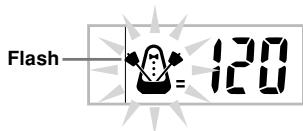
You can adjust the tempo of rhythm play within a range of 40 to 255 beats per minute. The tempo setting is applied to Auto Accompaniment chord play, and song bank operations.
To adjust the tempo
1 Use the TEMPO buttons ( / ) to adjust the tempo.
: Increases the tempo value.
: Decreases the tempo value.
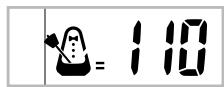
Example: Hold down the button until the tempo value 110 is on the display.
NOTE
- Pressing both TEMPO buttons (^ and ) at the same time resets the tempo to the default value of the currently selected rhythm.
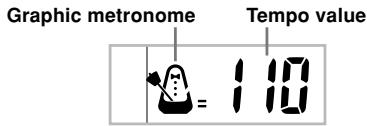
About the Graphic Metronome
The graphic metronome appears on the display along with the tempo value and beat of a rhythm or built-in tune. The graphic metronome helps you keep in time as you play along with a rhythm or built-in tune.
Using Auto Accompaniment
The following procedure describes how to use the keyboard's Auto Accompaniment feature. Before starting, you should first select the rhythm you want to use and set the tempo of the rhythm to the value you want.
To use Auto Accompaniment
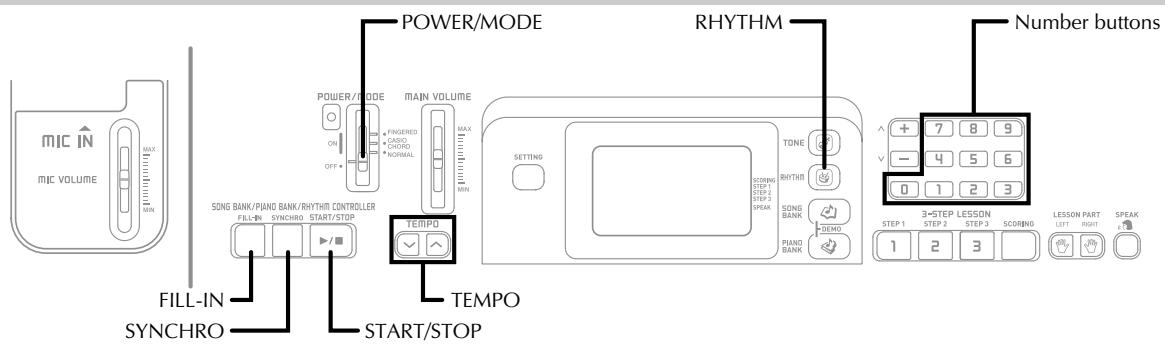
1 Set the POWER/MODE switch to CASIO CHORD or FINGERED.
Press the START/STOP button to start play of the currently selected rhythm.
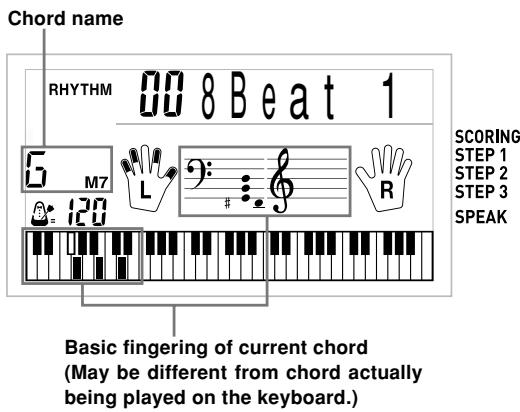
3 Play a chord.
- The actual procedure you should use to play a chord depends on the current POWER/MODE switch position. Refer to the following pages for details on chord play.
CASIO CHORD.......This page
FINGERED...... Page E-19
4 To stop Auto Accompaniment play, press the START/STOP button again.
NOTE
- If you press the SYNCHRO button in place of the START/STOP button in step 2, the rhythm pattern starts to play automatically when you perform the operation in step 3. For details about these buttons, see page E-20.
- You can adjust the accompaniment part volume level independently of the main volume. For details, see "Adjusting Accompaniment and Song Bank Volume" on page E-28.
CASIO CHORD
This method of chord play makes it possible for anyone to easily play chords, regardless of previous musical knowledge and experience. The following describes the CASIO CHORD "Accompaniment keyboard" and "Melody keyboard", and tells you how to play CASIO CHORDs.
CASIO CHORD Accompaniment Keyboard and Melody Keyboard
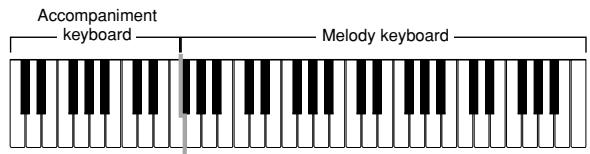
NOTE
- The accompaniment keyboard can be used for playing chords only.
No sound will be produced if you try playing single melody notes on the accompaniment keyboard.
Chord Types
CASIO CHORD accompaniment lets you play four types of chords with minimal fingering.
| Chord types | Example |
| Major chords Major chord names are marked above the keys of the accompaniment keyboard. Note that the chord produced when you press an accompaniment keyboard does not change octave, regardless of which key you use to play it. | C Major (C) C C C C C C C C C C C C C C C C C C C C C C C C C C C C C C C C C C C C C C C C C C C C C C C C C C C |
| Minor chords (m) To play a minor chord, keep the major chord key depressed and press any other accompaniment keyboard key located to the right of the major chord key. | C minor (Cm) C C C C C C C C C C C C C C C C C C C C C C C C C C C C C C C C C C C C C C C C C C C C C C C C C c c c c c c c c c c c c c c c c c c c c c c c c c c c c c c c c c c c c c c c c c c c c c c c c c c C C C C C C C C C C C C C C C C C C C C C C C C C C C C C C C C C C C C C C C C C C C C C C C C C c |
| Seventh chords (7) To play a seventh chord, keep the major chord key depressed and press any other two accompaniment keyboard keys located to the right of the major chord key. | C seventh (C7) C C C C C C C C C C C C C C C C C C C C C C C C C C C C C C C C C C C C C C C C C C C C C C C C C D D D D D D D D D D D D D D D D D D D D D D D D D D D D D D D D D D D D D D D D D D D D D D D D D D C C C C C C C C C C C C C C C C C C C C C C C C C C C C C C C C C C C C C C C C C C C C C C C C C D |
| Minor seventh chords (m7) To play a minor seventh chord, keep the major chord key depressed and press any other three accompaniment keyboard keys located to the right of the major chord key. | C minor seventh (Cm7) C C C C C C C C C C C C C C C C C C C C C C C C C C C C C C C C C C C C C C C C C C C C C C C C C |
NOTE
- It makes no difference whether you press black or white keys to the right of a major chord key when playing minor and seventh chords.
FINGERED
FINGERED provides you with a total of 15 different chord types. The following describes the FINGERED "Accompaniment keyboard" and "Melody keyboard", and tells you how to play a C-root chord using FINGERED.
FINGERED Accompaniment Keyboard and Melody Keyboard
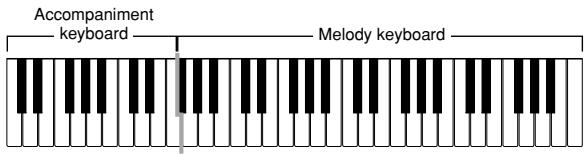
NOTE
- The accompaniment keyboard can be used for playing chords only. No sound will be produced if you try playing single melody notes on the accompaniment keyboard.
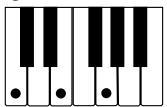
C
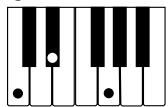
Cm
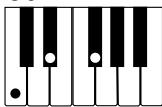
Cdim
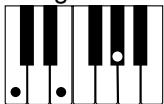
Caug*1
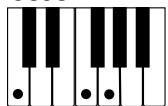
Csus4
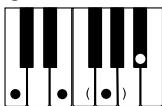
C7*2
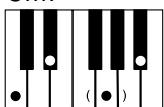
Cm7^*2
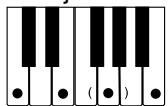
Cmaj7*2
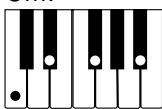
Cm75
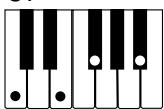
C7b5*1
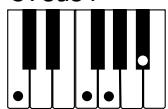
C7sus4
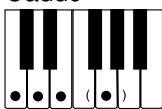
Cadd9*2
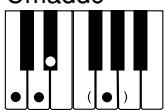
Cmadd9*2
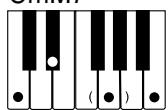
CmM7*2
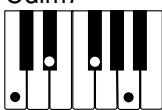
Cdim7*1
See the "Fingered Chord Chart" on page A-6 for details on playing chords with other roots.
1: Inverted fingerings cannot be used. The lowest note is the root.
2: The same chord can be played without pressing the 5th G.
NOTE
Except for the chords specified in note*1 above, inverted fingerings (i.e. playing E-G-C or G-C-E instead of C-E-G) will produce the same chords as the standard fingering.
Except for the exception specified in note ^+2 above, all of the keys that make up a chord must be pressed. Failure to press even a single key will not play the desired FINGERED chord.
Using a Fill-in Pattern
Fill-in patterns let you momentarily change the rhythm pattern to add some interesting variation to your performances.
The following procedure describes how to use the Fill-in feature.
To insert a fill-in
1 Press the START/STOP button to start rhythm play.
Press the FILL-IN button to insert a fill-in pattern for the rhythm you are using.
Synchro Starting Accompaniment with Rhythm Play
You can set up the keyboard to start rhythm play at the same time you play the accompaniment on the keyboard.
The following procedure describes how to use synchro start. Before starting, you should first select the rhythm you want to use, set the tempo, and use the POWER/MODE switch to select the chord play method you want to use (CASIO CHORD, FINGERED).
To use synchro start
Press the SYNCHRO button to put the keyboard into synchro start standby.
2 Play a chord on the accompaniment keyboard and the rhythm pattern starts to play automatically.
NOTE
- If the POWER/MODE switch is set to NORMAL, only the rhythm plays (without a chord) when you play on the accompaniment keyboard.
- To cancel synchro start standby, press the SYNCHRO button one more time.
Your keyboard comes with a total of built-in 100 tunes. You can play back built-in tunes for your own listening pleasure, or you can use them for practice and even sing-along. Built-in tunes are divided between the two groups described below.
Song Bank: 50 tunes
The tunes in this group are Auto Accompaniment tunes.
- Piano Bank Group: 50 tunes
The tunes in this group are piano tunes.
To play back a Song Bank tune
PREPARATION
- Adjust the main volume (page E-15).

Find the tune you want to play in the SONG BANK List, and note its number.
- See page A-9 for the SONG BANK List.

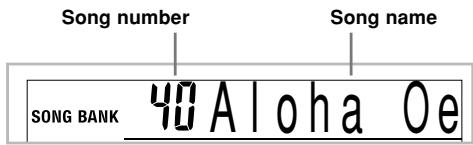
Press the SONG BANK button to enter the Song Bank Mode.

Use the number buttons to input the tune's two-digit number.
Example: To select "40 ALOHA OE", input 4 and then 0.
NOTE
- Tune Number 00 is the initial default Song Bank tune setting whenever you turn on keyboard power.
- You can also increment the displayed tune number by pressing [+] and decrement is by pressing [-] .

Press the START/STOP button to start play of the tune.

Press the START/STOP button to stop playback of the Song Bank tune.
- The tune you select continues to play until you stop it.
To play back a Piano Bank tune
1 Find the tune you want to play in the PIANO BANK List, and note its number.
See page A-9 for the PIANO BANK List.
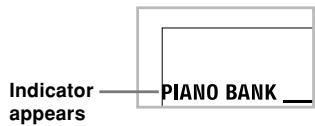
Press the PIANO BANK button to specify the Piano Bank group.
NOTE
- Pressing the PIANO BANK button changes the tone to STEREO GRAND PIANO (Tone Number 000).

Use the number buttons to input the two-digit tune number you looked up in step 1.
Example: To select tune number 03 (Ode To Joy), input 0 and then 3.

NOTE
- Tune Number 00 is the initial default Piano Bank tune setting whenever you turn on keyboard power.
- You can also change the displayed tune number using the [+] and [-] buttons.

Press the START/STOP button to start playback.

To stop playback, press the START/STOP button.
- The tune you select continues to play until you stop it.
Adjusting the Tempo
Each tune has a preset default tempo (beats per minute) that is set automatically whenever you select a tune. While the tune is playing, you can change the tempo setting to a value in the range of 40 to 255.
To set the tempo

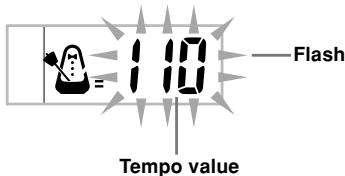
Use the TEMPO buttons to set the tempo.
: Increases the tempo value.
: Decreases the tempo value.
NOTE
- While the tempo value is flashing, you can also use the number buttons or [+] and [-] to input a three-digit value. Note that you must input leading zeros, so 90 is input as 090.
- Pressing both the and TEMPO buttons at the same time automatically returns the currently selected rhythm to its default tempo.
- Piano Bank tunes have tempo changes part way through in order to produce specific musical effects. Note that the tempo setting automatically returns to the default whenever a tempo change occurs within one of these tunes.
To change the melody tone
Press the TONE button.
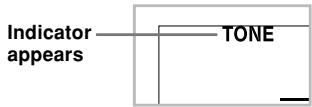
2 Find the tone you want in the TONE List, and then use the number buttons to input its three-digit number.
Example: To select "049 VIOLIN", input 0, then 4, then 9.
- You can select any one of the keyboard's built-in tones.

NOTE
- You can also use the [+] and [-] buttons to change the melody tones.
- For two-hand tunes (Piano Bank tunes), the same tone is applied for both the left and right hand parts.
- Specifying the tune number for the same tune that is currently selected returns the melody tone to the default setting for that tune.
To play all tunes in succession
Press the SONG BANK button and PIANO BANK button at the same time.
- Playback starts from Song Bank tune number 00, followed in sequence by Piano Bank tunes.
To stop tune play, press the START/STOP button.
NOTE
- While a tune is playing, you can use the number buttons or [+] and [-] to change to another tune.
- You can play along with the tunes on the keyboard.
Using the PIANO BANK Button
Pressing the PIANO BANK button provides instant access to piano tones and piano tune selection.
Initial Piano Bank Setting
Tone: 000 STEREO GRAND PIANO
To use the piano bank
Press the PIANO BANK button.
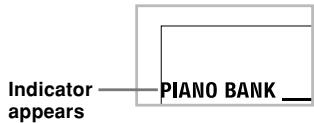
Now try playing something on the keyboard.
- The notes you play sound with a piano tone.
3 If you want to playback the built-in tune, press the START/STOP button.
- This causes the currently selected tune to play in an endless loop.
- To stop playback, press the START/STOP button again.
3-Step Lesson
With the 3-Step Lesson System, you can practice built-in tunes and even plot your progress according to the evaluation points the keyboard awards you.
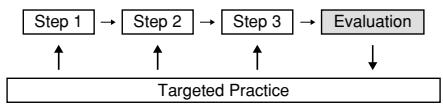
Lesson Progress
3-Step Lesson
The 3-step lesson feature takes you through the three distinct steps described below to help you learn to play tunes on the keyboard.
Step 1 - Master the timing.
Step 2 - Master the notes.
Step 3 - Play at normal speed.
Tune Types and Their Parts
Song Bank Tunes
When using these tunes for a 3-step lesson, you can practice playing along with the melody (right hand) part only.
Piano Bank Tunes
When using these tunes for a 3-step lesson, you can practice playing along with both the left hand and right hand parts.
Display Contents During 3-step Lesson Play
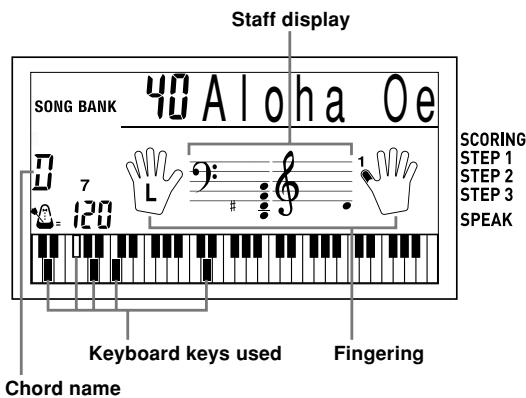
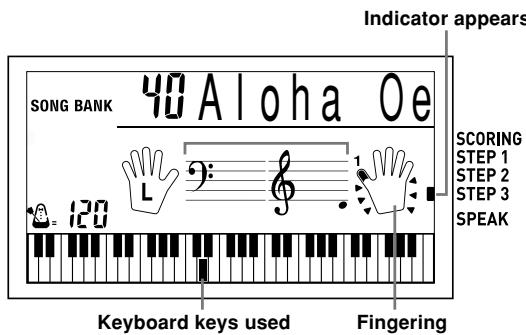
Whenever you select an Auto Accompaniment tune for 3-step lesson play, the on-screen keyboard guide and staff notation shows the note you should play and its length. The on-screen keyboard guide also shows the notes you play on the keyboard. The following describes the information that appears on the display.
Note Pitch
The key you should press lights on the on-screen keyboard guide, while the actual pitch of the note appears in the display's staff notation area. The fingers you should use to play the notes are also shown on the display.
Note Length
The key stays lit on the on-screen keyboard guide for as long as the note should be sustained. The staff notation and fingerings also remain on the display for the length of the note.
Next Note
An on-screen keyboard guide key flashes to indicate the next note to be played, while a number appears on the display near the finger you should use to play the next note.
Series of Same Pitch Notes
The on-screen keyboard guide key turns off momentarily between the notes, and lights again for each successive note. The staff notation and fingerings also turn off and back on again.
Example: When play requires pressing keys with fingers 3, 2, and then 1
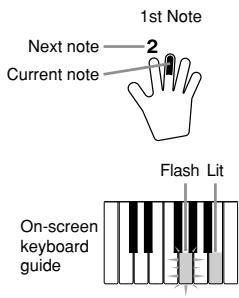
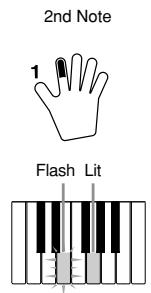
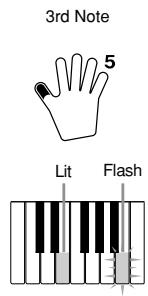
NOTE
- Note length is not indicated when you are using Piano Bank tunes with 3-step lesson Steps 1 and 2. As soon as you press a key that is lit on the on-screen keyboard guide, it goes out and the next key you need to press starts to flash.
- Note length is indicated by the on-screen keyboard guide when you use Piano Bank tunes with Step 3. In this case, the next key to be pressed does not flash when you press a lit key and the next finger number does not appear on the display. Only the current finger number is shown.
3-step Lesson Tempo Setting
Use the procedure under "Adjusting the Tempo" on page E-22 to adjust the tempo for 3-step lesson play.
Evaluation Mode
The keyboard's Evaluation Mode awards points to your performances during Step 3 of the 3-Step Lesson. A perfect score is 100. Also, the Evaluation Mode provides comments about your play on the monitor screen.
Evaluation Mode Display
Level Indicator (9 Levels): This indicator shows the evaluation of your current performance at a glance. The more segments that appear, the higher your points.
Example: 50 points
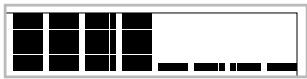
Evaluation Results
After you finish playing, the keyboard calculates an evaluation of your total performance, from beginning to end, and displays your total score on the monitor screen. The greater the score, the higher your evaluation is.
Evaluation Rank Display Messages
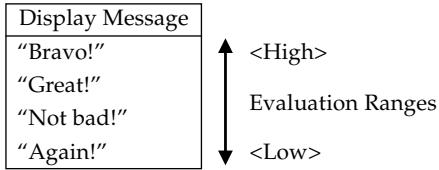
"**": indicates that the Evaluation Mode was exited before an evaluation result could be obtained.
NOTE
- If you press the START/STOP button and interrupt the Evaluation Mode part way through, the monitor screen shows the evaluation points you have accumulated up to that point. In this case, the keyboard does not display a message.
Using the Lesson Functions and Evaluation Mode
Perform the following steps to master your favorite tunes.
Step 1 – Master the timing.
1 Select the tune you want to use.
Press the STEP 1 button to start Step 1 play.
- The hand you should use is indicated by arrows around it.
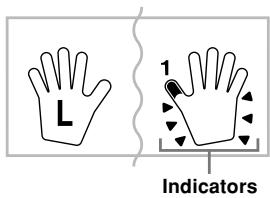
- Left hand practice can also be performed with Piano Bank tunes. Simply select one of the Piano Bank tunes in step 1, and then press the LEFT button following step 2.
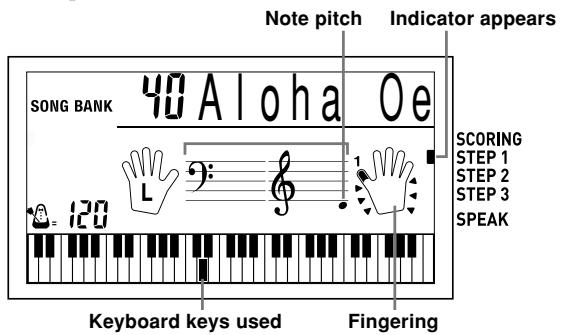
- After a count sounds, they keyboard stands by and waits for you to play the first note of the tune.
- Voice fingering guide will use a simulated human voice to call out fingering numbers. See "Voice Fingering Guide" on page E-27 for details.
3 Press any keyboard keys to play the notes.
- The key for the next note to be played flashes on the on-screen keyboard guide and the keyboard waits for you to play it. When you press any key to play the note, the on-screen key remains lit as the note plays.
- Accompaniment (left-hand part) waits until you press any key to play a note.
- If you accidentally press more than one key in succession, accompaniment is played for the corresponding number of notes.
- Pressing more than one key at the same time counts as a single note. Pressing a key while another key is held down is counted as two notes.
4 To stop play at any time, press the START/STOP button.
Step 2 - Master the notes.
1 Select the tune you want to use.
Press the STEP 2 button to start Step 2 play.
- Indicators appear around the hand on the display whose part is selected for practice.
- Left hand practice can also be performed with Piano Bank tunes. Simply select one of the Piano Bank tunes in step 1, and then press the LEFT button following step 2.
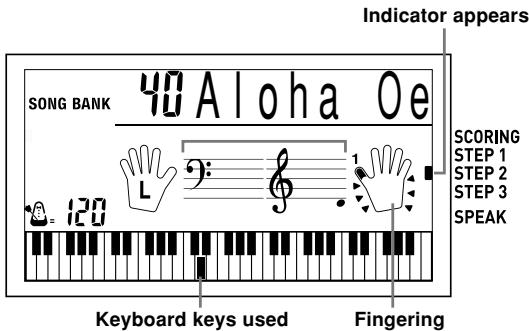
- After a count sounds, the keyboard stands by and waits for you to play the first note of the tune.
- Voice fingering guide will use a simulated human voice to call out fingering numbers. See "Voice Fingering Guide" on page E-27 for details.
3 Play the notes as indicated by the on-screen keyboard guide.
- The key for the next note to be played flashes on the on-screen keyboard guide and the keyboard waits for you to play it. When you press any key to play the note, the on-screen key remains lit as the note plays.
- If multiple keys light on the on-screen keyboard guide when you are using a two-hand tune, it means that you must press all of the keys that are lit.
4 To stop play at any time, press the START/STOP button.
Step 3 – Play at normal speed.
1 Select the tune you want to play.
Press the STEP 3 button to start Step 3 play.
- Indicators appear around the hand on the display whose part is selected for practice.
- Left hand practice can also be performed with Piano Bank tunes. Simply select one of the Piano Bank tunes in step 1, and then press the LEFT button following step 2.
- Accompaniment (left hand part) starts to play at normal speed.
3 Play the notes as indicated by the on-screen keyboard guide.
4 To stop play at any time, press the START/STOP button.
Evaluation: Find out how the keyboard evaluates your Step 3 play.
Use the SCORING button to check the evaluation of your play in Step 3.
Press the SCORING button.
- This causes the SCORING indicator to appear on the display.
- A count beat sounds and then evaluation mode starts.
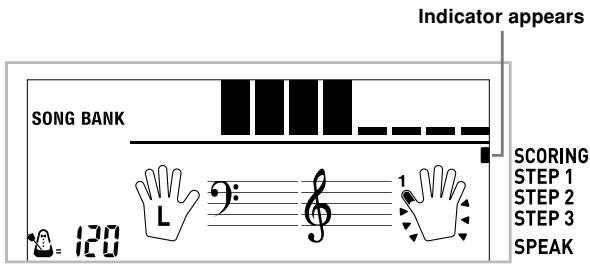
2 Play in accordance with the guidance on the monitor screen and as told by the voice.
- To stop evaluation, press the START/STOP button. This displays only the points accumulated up to that point.
After you finished playing, your evaluation result appears on the display.
- For information about evaluation ranks and sound effects, see "Evaluation Results" on page E-25.
- Pressing the SONG BANK button returns to the tune selection screen.
095 Bravo!
Voice Fingering Guide
Voice fingering guide uses a simulated human voice to call out fingering numbers during Step 1 and Step 2 one-hand part practice. If you need to press a key with your thumb, for example, voice fingering guide says, "One!" In the case of a chord to be played with your thumb, middle and little finger, voice fingering guide says, "One, three, five!"
Voice Fingering Guide calls out fingerings only when you do not press the proper key when you should.
Voice Fingering Guide
One : Thumb
Two : Forefinger
Three:Middle finger
Four : Ring finger
Five : Little finger
To turn voice fingering guide on or off
Press the SPEAK button to toggle voice fingering guide on (voice fingering guide indicator displayed) and off (indicator not displayed).
NOTE
- Note that Voice Fingering is disabled in the Evaluation Mode.
- Exiting the Evaluation Mode automatically restores the Voice Fingering setting that was in effect when you entered the Evaluation Mode.
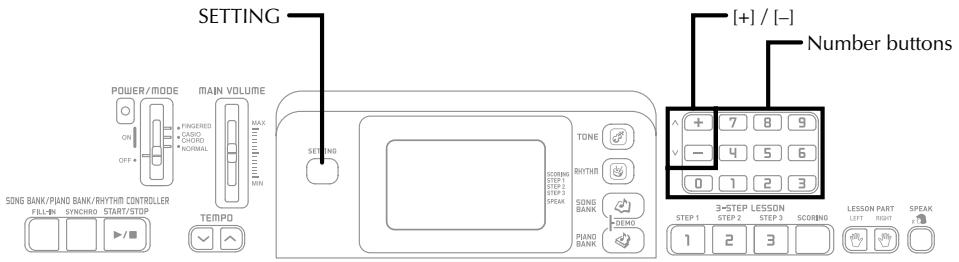
About SETTING button
Each press of the SETTING button cycles through the setting screens. If you accidentally pass the screen you want to use, keep pressing the SETTING button until the screen appears again.
Adjusting Accompaniment and Song Bank Volume
You can adjust the volume of the accompaniment and Song Bank tunes independently of the notes you play on the keyboard. You can specify a volume level in the range of 00 (minimum) to 99 (maximum).
To adjust the accompaniment volume
Press the SETTING button until the accompaniment volume adjustment screen appears.
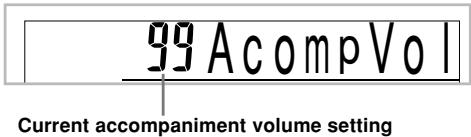
Use the number buttons or the [+]/[-] buttons to change the current volume setting value. Example: 80

NOTE
- The current accompaniment volume value that appears in Step 1 automatically clears from the display if you do not input anything within about five seconds.
- Pressing [+] and [-] buttons at the same time automatically sets an accompaniment volume of 99.
To adjust built-in tune volume
Enter the Song Bank mode or Piano Bank mode, and then perform the procedure under "To adjust the accompaniment volume".
- In this case, a song volume screen will appear in place of the accompaniment volume screen.
Transposing the Keyboard
Transpose lets you raise and lower the overall key of the keyboard in semitone units. If you want to play an accompaniment for a vocalist who sings in a key that's different from the keyboard, for example, simply use transpose to change the key of the keyboard.
To transpose the keyboard
Press the SETTING button until the transpose screen appears on the display.
Use [+ and [-] to change the transpose setting of the keyboard. Example: To transpose the keyboard five semitones upwards.

NOTE
- The keyboard can be transposed within a range of -12 to +12 .
- The default transpose setting is "00" when keyboard power is turned on.
- If you leave the transpose screen on the display for about five seconds without doing anything, the screen is automatically cleared.
- The transpose setting also affects Auto Accompaniment.
- Playing back a Song Bank tune automatically returns the transpose setting to its standard default of "00".
- The effect of a transpose operation depends on the pitch of each note and on the tone you are currently using. If a transpose operation causes a note to be outside of the allowable range for a tone, the same note in the nearest octave within the range will be substituted.
Tuning the Keyboard
Use the following procedure to fine tune the keyboard to match the tuning of another musical instrument.
To tune the keyboard

Press the SETTING button until the tuning screen appears.
00 Tune

Use the [+],[-] , and the number buttons to adjust the tuning value.
Example: To lower tuning by 20
20 Tune (-)
NOTE
- The keyboard can be tuned within a range of -50 cents to +50 cents.
- 100 cents is equivalent to one semitone.
- The default tuning setting is "00" when keyboard power is turned on.
- If you leave the tuning screen on the display for about five seconds without doing anything, the screen is automatically cleared.
- The tuning setting also affects playback from song memory and Auto Accompaniment.
- To return the keyboard to its default tuning, perform the above procedure and press the [+] and [-] buttons at the same time in step 2.
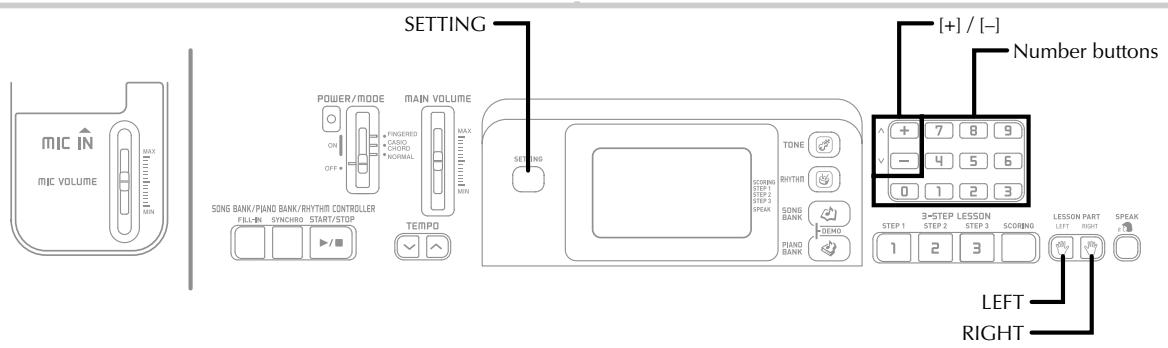
Connecting to a Computer
The keyboard's USB port makes it quick and simple to connect to a computer. After installing the USB MIDI driver onto your computer from the CD-ROM that comes with the keyboard, you will be able to use commercially available MIDI software on your computer to exchange data between the keyboard and your computer.
To install the USB MIDI driver
On the computer to which you plan to connect, install the USB MIDI driver that comes on the CD-ROM that comes bundled with the keyboard.
- For information about installing the USB MIDI driver, see the "CASIO USB MIDI Driver User's Guide" (manual_e.pdf) on the "USB Manual and Driver CD-ROM".
NOTE
-
Before starting actual installation of USB MIDI driver, be sure to read the contents of the "readme.txt" file in the "English" folder on the CD-ROM.
-
Use Adobe Reader or Acrobat Reader to access the USB MIDI driver user's guide.*
- You need to have Adobe Reader or Acrobat Reader installed on your computer in order to view the contents of the "CASIO USB MIDI Driver User's Guide" (manual_e.pdf). If your computer does not have either Adobe Reader or Acrobat Reader installed, use the procedure below to install it.
Installing Adobe Reader (Acrobat Reader**)
- Place the "USB Manual and Driver CD-ROM" into your computer's CD-ROM drive.
- On the CD-ROM, navigate to the folder named "Adobe", open the folder named "English", and then double-click "ar601enu.exe" ("ar505enu.exe"). Follow the instructions that appear on your computer screen to install Adobe Reader.
Adobe Reader cannot be installed on a computer running Windows 98. If your computer is running under Windows 98, double-click "ar505enu.exe" to install Acrobat Reader.
Minimum Computer system Requirements
Supported Operating Systems
Operation is supported under Windows® XP, Windows® 2000, Windows® Me, Windows® 98SE, and Windows® 98.
Universal
- IBM AT or compatible computer
- USB port that provides normal operation under Windows
- CD-ROM drive (for installation)
- At least 2MB of free hard disk space (not including space required for Adobe Reader)
- Windows XP
- 300MHz or higher Pentium processor
- At least 128MB of memory
Windows 2000
166MHz or higher Pentium processor
- At least 64MB of memory
- Windows Me, Windows 98SE, Windows 98
166MHz or higher Pentium processor
- At least 32MB of memory
Driver Signing
- Windows XP
1 Log on to Windows XP using a Computer administrator account. See the documentation that comes with Windows XP for information about Computer administrator accounts.
On the Windows [Start] menu, click [Control Panel].
- If you cannot see the [System] icon on the Control Panel, click [Switch to Classic View].
3 Click the [System] icon. On the dialog box that appears, click the [Hardware] tab, and then click the [Driver Signing] button.
On the dialog box that appears, select [Ignore], and then click [OK].
Windows 2000
1 Log on using an Administrators group account. See the documentation that comes with Windows 2000 for information about the Administrators group.
On the Windows [Start] menu, point to [Settings] and then click [Control Panel].
3 Click the [System] icon. On the dialog box that appears, click the [Hardware] tab, and then click the [Driver Signing] button.
4 On the dialog box that appears, select [Ignore], and then click [OK].
NOTE
- Company and product names used herein are trademarks of their respective owners.
Using the USB port
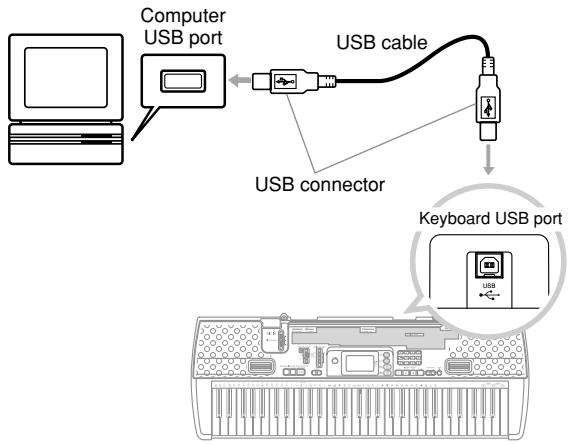
Note that you need to purchase a commercially available USB cable to connect the keyboard to a computer using the USB port. Once you establish a USB connection between the keyboard and a computer, you can exchange data between them.
To connect to a computer using the USB port
Use a commercially available USB cable to connect the keyboard to the computer.
General MIDI Tone
The General MIDI standard defines the tone numbering sequence, the drum sound numbering sequence, the number of MIDI channels that can be used, and other general factors that determine the sound source configuration. Because of this, musical data produced on a General MIDI sound source can be played back using similar tones and identical nuances as the original, even when played on another manufacturers sound source.
This keyboard conforms with General MIDI standards, so it can be connected to a computer and used to play back General MIDI data that has been purchased, downloaded from the Internet, or obtained from any other source.
Changing the Settings
This section tells you how to make the settings required when connecting to a computer.
GM MODE(Default:Off)
on: Configures the keyboard for optimal General MIDI data play (tone specification matching, etc.)
oFF: Returns to default keyboard setup.
Press the SETTING button until the GM MODE screen appears.
Example: When GM MODE is turned off

Use the [+] and [-] or [0] and [1] buttons to turn the setting on and off.
Example: To turn GM MODE on

KEYBOARD CHANNEL (Default: 1)
The keyboard channel is the channel used to send messages from this keyboard to a computer. You can specify one channel from 1 to 16 as the keyboard channel.
Press the SETTING button until the KEYBOARD CHANNEL screen appears.
Keybd Ch
Use the [+] ,[-], and the number buttons to change the channel number.
Example: To specify channel 4
04 Keybd Ch
NAVIGATE CHANNEL (Default: 4)
When messages are received from a computer for play on this keyboard, the navigate channel is the channel whose note data appears on the display. You can select one channel from 01 to 16 as the navigate channel. Since this setting lets you use the data on any channel of commercially available SMF data to light on the on-screen keyboard guide, you can analyze how different parts of an arrangement are played.
Press the SETTING button until the NAVIGATE CHANNEL screen appears.
04 Navi. Ch
Use the [+],[-] , and the number buttons [0] through [9] to change the channel number.
Example: To specify channel 2
02 Navi. Ch
To turn off specific sounds before playing back tune data that is being received
While playing tune data, press the RIGHT button.
- This cuts the sound of the navigate channel, but on-screen keyboard guide keys continue to light in accordance with the channel's data as it is received. Press RIGHT button again to turn the channel back on.
<>
While playing tune data, press the LEFT button.
- This cuts the sound of the channel whose number is one less than the navigate channel, but on-screen keyboard guide keys continue to light in accordance with the channel's data as it is received. Press LEFT button again to turn the channel back on.
Example: If the navigate channel is channel 4, the above operation turns off channel 3.
LOCAL CONTROL (Default: On)
oFF: Anything played on the keyboard is output as a message from the USB port, without being sounded by the internal sound source.
- Note that no sound is produced by the keyboard if LOCAL CONTROL is turned off and no external device is connected.
Press the SETTING button until the LOCAL CONTROL screen appears.
Example: When LOCAL CONTROL is on
on Local
Use the [+] and [-] or [0] and [1] buttons to turn the setting on and off.
Example: To turn LOCAL CONTROL off
oFF Local
| Problem | Possible Cause | Action | See page |
| No keyboard Sound | 1. Power supply problem. 2. Power is not turned on. 3. Volume setting is too low. 4. The POWER/MODE switch is in the CASIO CHORD or FINGERED position. | 1. Correctly attach the AC adaptor, make sure that batteries poles (+/-) are facing correctly, and check to make sure that batteries are not dead. 2. Set the POWER/MODE switch to the NORMAL position. 3. Use the MAIN VOLUME slider to increase volume. 4. Normal play is not possible on the accompaniment keyboard while the POWER/MODE switch is set to CASIO CHORD or FINGERED. Change the POWER/MODE switch setting to NORMAL. | Pages E-12, 13 Page E-15 Page E-15 Page E-15 |
| Any of the following symptoms while using battery power. | Low battery power | Replace the batteries with a set of new ones or use the AC adaptor. | Pages E-12, 13 |
| • Dim power supply indicator • Instrument does not turn on • Dim, difficult to read display • Abnormally low speaker/headphone volume • Distortion of sound output • Occasional interruption of sound when playing at high volumes • Sudden power failure when playing at high volumes | • Dimming of the display when playing at high volume • Continued sound output even after you release a key • A totally different tone may sound • Abnormal rhythm pattern and demo tune play • Abnormally low microphone volume • Distortion of microphone input • Dim power supply indicator when a microphone is used • Sudden power failure when using the microphone | ||
| Auto Accompaniment does not sound. | Accompaniment volume is set to 00. | Use the SETTING button to increase the volume. | Page E-28 |
| On-screen keyboard guide keys stay on. | Keyboard is waiting for play of the correct note during Step 1 or Step 2 play. | 1. Press the lit key to continue with Step 1 or Step 2 play. 2. Press the START/STOP button to quit Step 1 or Step 2 play. | Pages E-25, 26 Pages E-25, 26 |
| When playing with another instrument, keys or tunings do not match. | Transpose or tuning is set to a value other than 00. | Use the SETTING button to display the applicable setting screens and set both transpose and tuning to 00. | Pages E-28, 29 |
| Static noise when a microphone is connected. | 1. Use of a microphone that is a different from the type that is recommended. 2. Use of the microphone in the vicinity of fluorescent lighting. | 1. Use a recommended type microphone. 2. Move the microphone away from source of the static. | Page E-16 Page E-16 |
| No microphone sound | 1. Microphone volume setting is too low. 2. Microphone ON/OFF switch is set to OFF. | 1. Increase the microphone volume setting. 2. Change the microphone ON/OFF switch setting to ON. | Page E-16 Page E-16 |
| After transferring song data from my computer, playback stops part way through. | Digital noise from the USB cable or power cord caused data communication between your computer and keyboard to be interrupted. | Stop playback, disconnect the USB cable from and then reconnect it to the keyboard's USB port, and then try playing back the tune again. If this does not correct the problem, exit the MIDI software you are using, and then disconnect the USB cable from and then reconnect it to the keyboard's USB port. Next, restart your MIDI software and try playback again. | Page E-31 |
| A tone's quality and volume sounds slightly different depending where it is played on the keyboard. | This is an unavoidable result of the digital sampling process,* and does not indicate malfunction. * Multiple digital samples are taken for the low range, middle range, and high range of the original musical instrument. Because of this, there may be a very slight difference in tonal quality and volume between sample ranges. | ||
| Model: | CTK-710 | ||
| Keyboard: | 61 standard-size keys, 5 octaves | ||
| Tones: | 242 (113 panel tones + 128 General MIDI tones + 1 drum set) | ||
| Polyphony: | 32 notes maximum (16 for certain tones) | ||
| Main Volume: | Adjustable | ||
| Auto Accompaniment | |||
| Rhythm Patterns: | 100 | ||
| Chords: | 2 fingering methods (CASIO CHORD, FINGERED) | ||
| Rhythm Controller: | START/STOP, SYNCHRO, FILL-IN | ||
| 3-step Lesson: | |||
| Playback: | 3 lessons (Step 1, 2, 3) | ||
| Lesson Part: | Repeat play of a single tune | ||
| Evaluation Mode: | Left hand, right hand | ||
| Voice Fingering Guide: | Scoring | ||
| On/Off | |||
| Song Bank, Piano Bank | |||
| Number of Tunes: | Song Bank: 50, Piano Bank: 50 | ||
| Controllers: | START/STOP | ||
| Display | |||
| Name display: | TONE, RHYTHM, SONG BANK, PIANO BANK name/number, keyboard settings name/value | ||
| Tempo: | Tempo value, metronome, synchro standby | ||
| Chord: | Chord name, Chord form | ||
| Fingering: | Fingering indicators, parts | ||
| Staff: | 5 octaves with sharp and flat indications, pedal symbol, octave symbol | ||
| Keyboard: | 5 octaves | ||
| Other Functions | |||
| Tempo: | Variable (216 steps, 1 = 40 to 255) | ||
| Transpose: | 25 steps (-12 semitones to +12 semitones) | ||
| Tuning: | Variable (A4 = approximately 440Hz ±50 cents) | ||
| Accompaniment/ | |||
| Song Bank Volume: | Variable (100 steps, 0 to 99) | ||
| Terminals | |||
| USB port: | TYPE B | ||
| Sustain Terminal: | Standard jack | ||
| Phones/Output Terminal: | Stereo standard jack | ||
| Output Impedance: 100Ω | |||
| Output Voltage: 4V (RMS) MAX | |||
| 9V DC | |||
| Standard jack (with microphone volume slider) | |||
| Input impedance: 2kΩ | |||
| Input sensitivity: 10mV | |||
| Power Supply: | |||
| Batteries: | Dual power supply system | ||
| Battery Life: | 6 AA-size batteries | ||
| AC Adaptor: | Approximately 4 hours continuous operation on alkaline batteries | ||
| Approximately 2 hours continuous operation on manganese batteries | |||
| AD-5 | |||
| Auto Power Off: | Turns power off approximately 6 minutes after last key operation. Enabled under battery power only, can be disabled manually. | ||
| Speaker Output: | 2.0W + 2.0W | ||
| Power Consumption: | 9V ... 7.7W | ||
| Dimensions: | 95.6 x 35.6 x 13.3 cm (37 11/16 x 14 1/16 x 5 1/4 inch) | ||
| Weight: | Approximately 4.0kg (8.8lbs) (without batteries) | ||
Tone List/Liste de sonidos
1:No./No
Percussion Instrument List
Fingered Chord Chart
Cuadros de acordes Fingered
This table shows the left-hand fingerings (including inverted forms) for a number of often-used chords. These fingering indications also appear on the keyboard's display. Chords marked with asterisk (*) cannot be played in the Fingered Mode on this keyboard.
| Chord Root Type | M | m | 7 | m7 | dim7 | M7 | m7-5 | dim |
| C | [5,3,1] | [5,3,1] | [5,3,2,1] | [5,3,2,1] | [5,3,2,1] | [5,3,2,1] | [5,3,2,1] | [5,3,2] |
| C# (D#) | [5,3,1] | [5,3,1] | [5,3,2,1] | [5,3,2,1] | [5,3,2,1] | [5,3,2,1] | [5,3,2,1] | [5,3,2] |
| D | [5,3,1] | [5,3,1] | [5,3,2,1] | [5,3,2,1] | [5,3,2,1] | [5,3,2,1] | [5,3,2,1] | [5,3,2] |
| Eb(D#) | [5,3,1] | [5,3,1] | [5,3,2,1] | [5,3,2,1] | [5,3,2,1] | [5,3,2,1] | [5,3,2,1] | [5,3,2] |
| E | [5,3,1] | [5,3,1] | [5,3,2,1] | [5,3,2,1] | [5,3,2,1] | [5,3,2,1] | [5,3,2,1] | [5,3,2] |
| F | [5,3,1] | [5,3,1] | [5,3,2,1] | [5,3,2,1] | [5,3,2,1] | [5,3,2,1] | [5,3,2,1] | [5,3,2] |
| F# (G#) | [5,3,1] | [5,3,1] | [5,3,2,1] | [5,3,2,1] | [5,3,2,1] | [5,3,2,1] | [5,3,2,1] | [5,3,2] |
| G | [5,3,1] | [5,3,1] | [5,3,2,1] | [5,3,2,1] | [5,3,2,1] | [5,4,2,1] | [5,3,2,1] | [5,3,2] |
| Ab(G#) | [5,3,1] | [5,3,1] | [5,4,2,1] | [5,4,2,1] | [5,3,2,1] | [5,4,2,1] | [5,4,2,1] | [5,3,2] |
| A | [5,3,1] | [5,3,1] | [5,4,2,1] | [5,4,2,1] | * | [5,4,2,1] | [5,4,2,1] | [5,3,2] |
| Bb(A#) | [5,3,1] | [5,3,1] | [5,4,2,1] | [5,4,2,1] | * | [5,4,2,1] | [5,4,2,1] | [5,3,2] |
| B | [5,2,1] | [5,2,1] | [5,3,2,1] | [5,3,2,1] | * | [5,3,2,1] | [5,4,2,1] | [5,3,2] |
| Chord Root Type | aug | sus4 | 7 sus4 | m add9 | m M7 | 7-5 | add9 |
| C | [5,3,1] | [5,2,1] | [5,3,2,1] | [4,3,2,1] | [5,3,2,1] | [5,3,2,1] | [4,3,2,1] |
| C# (D#) | [5,3,1] | [5,2,1] | [5,3,2,1] | [4,3,2,1] | [5,3,2,1] | [5,3,2,1] | [4,3,2,1] |
| D | [5,3,1] | [5,2,1] | [5,3,2,1] | [4,3,2,1] | [5,3,2,1] | [5,3,2,1] | [4,3,2,1] |
| E# (D#) | [5,3,1] | [5,2,1] | [5,3,2,1] | [4,3,2,1] | [5,3,2,1] | [5,3,2,1] | [4,3,2,1] |
| E | [5,3,1] | [5,2,1] | [5,3,2,1] | [4,3,2,1] | [5,3,2,1] | [5,3,2,1] | [4,3,2,1] |
| F | [5,3,1] | [5,2,1] | [5,3,2,1] | [4,3,2,1] | [5,3,2,1] | [5,3,2,1] | [4,3,2,1] |
| F# (G#) | [5,3,1] | [5,2,1] | [5,3,2,1] | [4,3,2,1] | [5,3,2,1] | [5,3,2,1] | [4,3,2,1] |
| G | [5,3,1] | [5,2,1] | [5,3,2,1] | [4,3,2,1] | [5,4,2,1] | [5,3,2,1] | [4,3,2,1] |
| Ab (G#) | [5,3,1] | [5,2,1] | [5,4,2,1] | [4,3,2,1] | [5,4,2,1] | [5,4,2,1] | [4,3,2,1] |
| A | [5,3,1] | [5,2,1] | [5,4,2,1] | [4,3,2,1] | [5,4,2,1] | [5,4,2,1] | [4,3,2,1] |
| B# (A#) | * | [5,2,1] | [5,4,2,1] | [4,3,2,1] | [5,4,2,1] | [5,4,2,1] | [4,3,2,1] |
| B | * | [5,2,1] | [5,3,2,1] | [5,3,2,1] | [5,3,2,1] | [4,3,2,1] | [5,3,2,1] |
Rhythm List
Lista de ritmos
| Function ... | Transmitted | Recognized | Remarks | |
| Basic Channel | Default Changed | 1 | 1-16 | |
| 1-16 | 1-16 | |||
| Mode | Default Messages Altered | Mode 3 X | Mode 3 X | |
| ********** | ********** | |||
| Note Number | True voice | 36-96 | 0-127 | *1: Depends on tone |
| ********** | 12-108 *1 | *1: Depende en el sonido | ||
| Velocity | Note ON Note OFF | X 9nH V = 100 | O 9nH V = 1-127 | *2 = no relation |
| X 9nH V = 0 | X 9nH V = 0,8nH V = *2 | *2 = sin relacion | ||
| After Touch | Key's Ch's | X | X | |
| X | X | |||
| Pitch Bender | X | O | ||
| Control Change | 0,32 | O | O | Bank select Modulation Data entry Volume Pan Expression |
| 1 | X | O | ||
| 6,38 | X | O | ||
| 7 | X | O | ||
| 10 | X | O | ||
| 11 | X | O | ||
| 64100, 101120121 | O××× | O○*3○ | Hold1RPN LSB, MSBAll sound offReset all controller |
| ProgramChange :True # | O 0-127********** | O 0-127********** | |
| System Exclusive | × | O *4 | |
| System : Song PosCommon : Song Sel : Tune | ××× | ××× | |
| ×× | ×× | ||
| System : ClockReal Time : Commands | ×× | ×× | |
| AuxMessages : Active Sense : Reset | ×× | ×○× | |
| Remarks | *3 FINE TUNE, COARSE TUNE receive, and PITCH BEND SENSE, RPN Null receive.*3 FINE TUNE, recepción COARSE TUNE, y PITCH BEND SENSE, recepción RPN Null.*4 GM on/off GM ON : [F0] [7E] [7F] [09] [01] [F7] GM OFF : [F0] [7E] [7F] [09] [02] [F7]*4 Activación/desactivación GM GM ON: [F0] [7E] [7F] [09] [01] [F7]GM OFF: [F0] [7E] [7F] [09] [02] [F7] | ||
O:Yes X:No
Mode 2: OMNI ON, MONO Mode 4: OMNI OFF, MONC
Mode 1: OMNI ON, POLY Mode 3: OMNI OFF, POLY

This recycle mark indicates that the packaging conforms to the environmental protection legislation in Germany.
- FCC WARNING
- Declaration of Conformity
- Important!
- Symbols
- DANGER
- WARNING
- CAUTION
- Symbol Examples
- Alkaline Batteries
- Smoke, Strange Odor, Overheating
- AC Adaptor
- Batteries
- Do not incinerate the product.
- Water and Foreign Matter
- Disassembly and Modification
- Dropping and Impact
- Plastic Bags
- Keep off of the product and stand.*
- Location
- Relocating the Product
- Cleaning
- Connectors
- Display Screen
- Sound Volume
- Heavy Objects
- Correct Stand* Assembly
- tones
- rhythms
- Auto Accompaniment
- PIANO BANK button
- 3-Step Lesson System
- built-in tunes, including piano pieces
- Musical Information System
- Avoid heat, humidity or direct sunlight.
- Do not use near a TV or radio.
- Do not use lacquer, thinner or similar chemicals for cleaning.
- Avoid use in areas subjected to temperature extremes.
- NOTE
- Contents
- Safety Precautions. E-1
- Introduction E-5
- Care of your keyboard . . . . . E-5
- General Guide. E-8
- Quick Reference. E-10
- Power Supply E-12
- Connections E-14
- Basic Operations. E-15
- Auto Accompaniment ...... E-17
- Playing a Built-in Tune...... E-21
- 3-Step Lesson......E-24
- Keyboard Settings E-28
- Connection to a Computer ....E-30
- Troubleshooting E-33
- Specifications E-34
- Appendix A-1
- MIDI messages that can be sent and received using the USB port
- SONG BANK/PIANO BANK/RHYTHM CONTROLLER
- 3-STEP LESSON
- *Attachment of the Score Stand
- To play the keyboard
- If you selected lesson Step 1
- If you selected lesson Step 2
- To play an Etude or Concert Piece tune
- Using batteries
- To load batteries
- Remove the battery compartment cover.
- Load 6 AA-size batteries into the battery compartment.
- Insert the tabs on the battery compartment cover into the holes provided and close the cover.
- Important Battery Information
- Using the AC Adaptor
- Specified AC Adaptor: AD-5
- During Use
- During Movement
- During Storage
- Auto Power Off
- To disable Auto Power Off
- Settings
- Phones/Output Terminal
- Connecting Phones (Figure 1)
- Audio Equipment (Figure 2)
- Musical Instrument Amplifier (Figure 3)
- Connecting to a Computer or Other Equipment
- Sustain jack Terminal
- Sustain Pedal
- Microphone Jack
- Accessories and Options
- Playing the Keyboard
- Selecting a Tone
- To select a tone
- Combination tones
- Layered Tones (Tone Numbers: 098 through 107)
- Split Tones (Tone Numbers: 108 through 112)
- Percussion sounds
- Polyphony
- Using the Microphone Jack
- Recommended Microphone Type
- Howling (Feedback Noise)
- Static Noise
- Selecting a Rhythm
- To select a rhythm
- Playing a Rhythm
- To play a rhythm
- Adjusting the Tempo
- To adjust the tempo
- About the Graphic Metronome
- Using Auto Accompaniment
- To use Auto Accompaniment
- Play a chord.
- CASIO CHORD
- CASIO CHORD Accompaniment Keyboard and Melody Keyboard
- Chord Types
- FINGERED
- FINGERED Accompaniment Keyboard and Melody Keyboard
- Using a Fill-in Pattern
- To insert a fill-in
- Synchro Starting Accompaniment with Rhythm Play
- To use synchro start
- To play back a Song Bank tune
- To play back a Piano Bank tune
- To set the tempo
- To change the melody tone
- To play all tunes in succession
- Using the PIANO BANK Button
- Initial Piano Bank Setting
- To use the piano bank
- Tune Types and Their Parts
- Song Bank Tunes
- Piano Bank Tunes
- Display Contents During 3-step Lesson Play
- Note Pitch
- Note Length
- Next Note
- Series of Same Pitch Notes
- 3-step Lesson Tempo Setting
- Evaluation Mode
- Evaluation Mode Display
- Evaluation Results
- Evaluation Rank Display Messages
- Using the Lesson Functions and Evaluation Mode
- Step 1 – Master the timing.
- Step 2 - Master the notes.
- Step 3 – Play at normal speed.
- Evaluation: Find out how the keyboard evaluates your Step 3 play.
- Press the SCORING button.
- Play in accordance with the guidance on the monitor screen and as told by the voice.
- After you finished playing, your evaluation result appears on the display.
- Voice Fingering Guide
- To turn voice fingering guide on or off
- About SETTING button
- Adjusting Accompaniment and Song Bank Volume
- To adjust the accompaniment volume
- To adjust built-in tune volume
- Transposing the Keyboard
- To transpose the keyboard
- Tuning the Keyboard
- To tune the keyboard
- Connecting to a Computer
- To install the USB MIDI driver
- Installing Adobe Reader (Acrobat Reader**)
- Minimum Computer system Requirements
- Supported Operating Systems
- Universal
- - Windows XP
- Windows 2000
- - Windows Me, Windows 98SE, Windows 98
- Driver Signing
- Using the USB port
- To connect to a computer using the USB port
- General MIDI Tone
- Changing the Settings
- GM MODE(Default:Off)
- KEYBOARD CHANNEL (Default: 1)
- NAVIGATE CHANNEL (Default: 4)
- To turn off specific sounds before playing back tune data that is being received
- <>
- LOCAL CONTROL (Default: On)
- Tone List/Liste de sonidos
- Percussion Instrument List
- Fingered Chord Chart
- Cuadros de acordes Fingered
- Rhythm List
- Lista de ritmos
Brand : CASIO
Model : CTK-710
Category : Numeric keypad