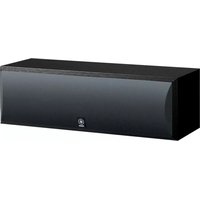
NS-C210BL - Loudspeaker YAMAHA - Free user manual and instructions
Find the device manual for free NS-C210BL YAMAHA in PDF.


| Product Type | Center Speaker |
| Brand | YAMAHA |
| Model | NS-C210BL |
| Color | Black |
| Dimensions (W × H × D) | 400 × 110 × 150 mm |
| Weight | 3.1 kg |
| Impedance | 6 ohms |
| Power Handling | 100 W |
| Sensitivity | 89 dB |
| Frequency Response | 55 Hz - 40 kHz |
| Drivers | 2 × 10 cm (woofers) + 1 dome tweeter |
| Power Supply | Passive (unpowered) |
| Main Features | Center speaker for home theater, magnetic shielding |
| Care and Cleaning | Wipe with a soft dry cloth |
| Safety | Place on a stable surface, avoid exposure to moisture |
| Spare Parts and Repairability | Removable front grille, foam surrounds (replaceable) |
| General Information | Designed for Yamaha systems, compatible with any home theater amplifier |
Frequently Asked Questions - NS-C210BL YAMAHA
User questions about NS-C210BL YAMAHA
0 question about this device. Answer the ones you know or ask your own.
Ask a new question about this device
Download the instructions for your Loudspeaker in PDF format for free! Find your manual NS-C210BL - YAMAHA and take your electronic device back in hand. On this page are published all the documents necessary for the use of your device. NS-C210BL by YAMAHA.
USER MANUAL NS-C210BL YAMAHA
User Manual of Product 1:
Yamaha Audio NS-C210BL Center Channel Speaker - Each (Black)
User Manual of Product 2:
YAMAHA 8" 100W Powered Subwoofer - Black (NS-SW050BL)
NS-B210
NS-C210
Speaker
Enceinte
OWNER'S MANUAL
MODE D'EMPLOI
BEDIENUNGSANLEITUNG
Read this before using the speaker.
• To assure the finest performance, please read this manual carefully. Keep it in a safe place for future reference.
• Install the speaker in a cool, dry, clean place - away from windows, heat sources, sources of excessive vibration, dust, moisture and cold. Avoid sources of electrical noise (transformers, motors). To prevent fire or electrical shock, do not expose this unit to rain or water.
- To prevent the enclosure from warping or discoloring, do not place the speaker where it will be exposed to direct sunlight or excessive humidity.
- Do not place the following objects on the speaker:
Glass, china, small metallic etc.
If glass, etc., falls as a result of vibration and breaks, it may cause personal injury.
A burning candle, etc.
If the candle falls as a result of vibrations, it may cause fire and personal injury.
A vessel with water in it
If the vessel falls as a result of vibrations and water spills, it may cause damage to the speaker, and/or you may get an electric shock.
- Do not place the speaker where foreign material such as dripping water. It might cause fire, damage to this unit, and/or personal injury.
- Do not place the speaker where it is liable to be knocked over or struck by falling objects. Stable placement will also ensure better sound performance.
- Placing the speaker on the same shelf or rack as the turntable can result in acoustical feedback.
- Never put a hand or a foreign object into the port located on the rear of the speaker, as this might cause personal injury and/or damage to the speaker.
- When moving the speaker, do not hold the port, as it might cause personal injury and/or damage to the speaker.
- Any time you notice distortion, reduce the volume control on your amplifier. Never allow your amplifier to be driven into "clipping." Otherwise the speaker may be damaged.
- When using an amplifier with a rated output power higher than the nominal input power of the speaker, care should be taken never to exceed the speaker's maximum input.
- Do not attempt to clean the speaker with chemical solvents, as this might damage the finish. Use a clean, dry cloth.
- Do not attempt to modify or repair the speaker. Contact qualified YAMAHA service personnel when any service is needed. The cabinet should never be opened for any reasons.
- Secure placement and installation is the owner's responsibility. YAMAHA shall not be liable for any accident caused by improper placement or installation of speakers.
Information for Users on Collection and Disposal of Old Equipment

This symbol on the products, packaging, and/or accompanying documents means that used electrical and electronic products should not be mixed with general household waste.
For proper treatment, recovery and recycling of old products, please take them to applicable collection points, in accordance with your national legislation and the Directives 2002/96/EC.
By disposing of these products correctly, you will help to save valuable resources and prevent any potential negative effects on human health and the environment which could otherwise arise from inappropriate waste handling.
For more information about collection and recycling of old products, please contact your local municipality, your waste disposal service or the point of sale where you purchased the items.
[Information on Disposal in other Countries outside the European Union]
This symbol is only valid in the European Union. If you wish to discard these items, please contact your local authorities or dealer and ask for the correct method of disposal.
SUPPLIED ACCESSORIES
NS-B210

natural_image
Illustration of bundled electrical wires with coiled leads (no text or symbols)Speaker cable (10m × 1)
NS-C210

natural_image
Illustration of a bundle of wires tied with a string (no text or symbols)Speaker cable (4m × 1)

Fastener × 2
■Using as 2ch stereo speakers
Better stereo images will be obtained when the speakers are slightly angled in towards the listeners.

natural_image
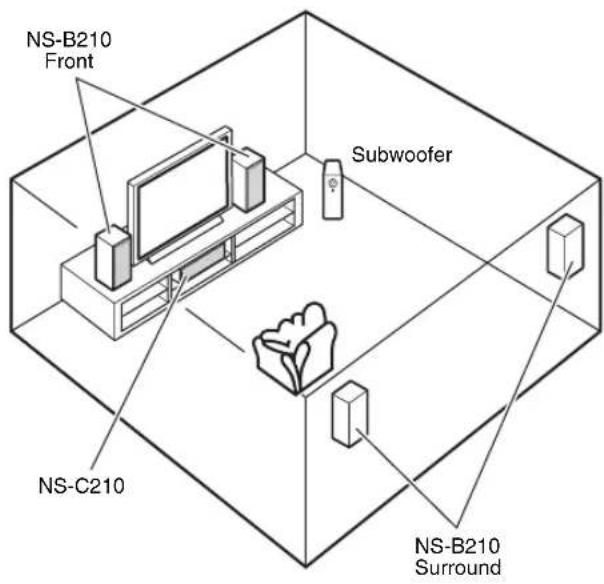
Diagram showing a person inside a container with two devices above, connected by dashed lines (no text or symbols)■Using as front speakers and surround speakers in a surround system
Position the speakers on both sides of the TV. The positioning of speakers is important, since this dictates the overall sound quality of the surround system. Set up the speakers on the basis of your listening position by following the owner's manual supplied with your amplifier.
And mount the speakers on a wall or place the speakers on a shelf. Determine the best position by following the owner's manual supplied with your amplifier.
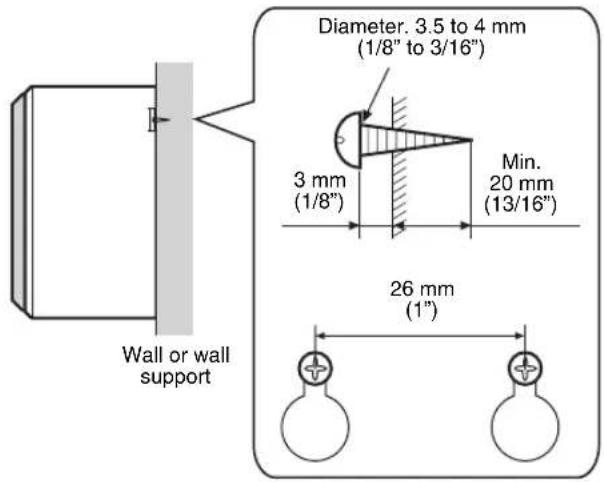
■To mount the speakers on a wall by using the attached mounting bracket
Fasten screws into a firm wall or wall support as shown in the figure, and hang the holes of the mounting bracket on the protruding screws.
* Make sure that the screws are secured in the narrow sections of the holes.
Tapping screw (3.5-4 mm) (1/8" to 3/16") (Available at the hardware store)
You can also use the screw holes on the bottom of the speaker for installing the speaker using a commercially available speaker bracket (if you do not use the attached mounting bracket).

Note
Placing this unit too close to a CRT TV set might impair picture color or create a buzzing noise. Should this happen, move the speaker away (more than 20 cm (7-7/8")) from the TV set.
When using a PDP or LCD TV, it would not happen.
WARNING
- NS-B210 weighs 1.6 kg (3 lbs. 8 oz.). Do not mount it on thin plywood or a wall with soft surface material. If mounted, the screws may come out and the speaker may fall. This may damage the speaker, or cause personal injury.
- Do not install the speaker on a wall with nails, adhesives, or any other unstable hardware. Long term use and vibrations may cause it to fall.
• To avoid accidents resulting from tripping over loose speaker cables, fix them securely to the floor or wall.
For NS-C210
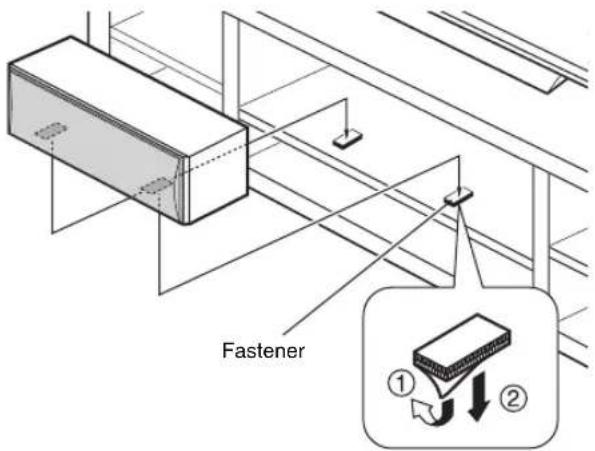
■Using as center speaker
Place the speaker on a TV rack or other stable surface. To prevent the speaker from falling down, attach the fasteners provided in each corner of the speaker's underside.
■To mount the speakers on a wall by using the attached mounting bracket
Fasten screws into a firm wall or wall support as shown in the figure, and hang the holes of the mounting bracket on the protruding screws.


Note
Placing this unit too close to a CRT TV set might impair picture color or create a buzzing noise. Should this happen, move the speaker away (more than 20 cm (7-7/8")) from the TV set.
When using a PDP or LCD TV, it would not happen.
WARNING
- NS-C210 weighs 2 kg (4 lbs. 7 oz.). Do not mount it on thin plywood or a wall with soft surface material. If mounted, the screws may come out and the speaker may fall. This may damage the speaker, or cause personal injury.
- Do not touch the adhesive surface after peeling off the seal as this will weaken its adhesive strength.
- Thoroughly wipe clean the surface where the fasteners are to be attached. Note that adhesive strength is weakened if the surface is dirty, oily or wet, and that this may cause the center speaker to drop.
- Do not install the speaker on a wall with nails, adhesives, or any other unstable hardware. Long term use and vibrations may cause it to fall.
• To avoid accidents resulting from tripping over loose speaker cables, fix them securely to the floor or wall.
CONNECTIONS TO YOUR AMPLIFIER
Before making connections, make sure that the amplifier is switched off.
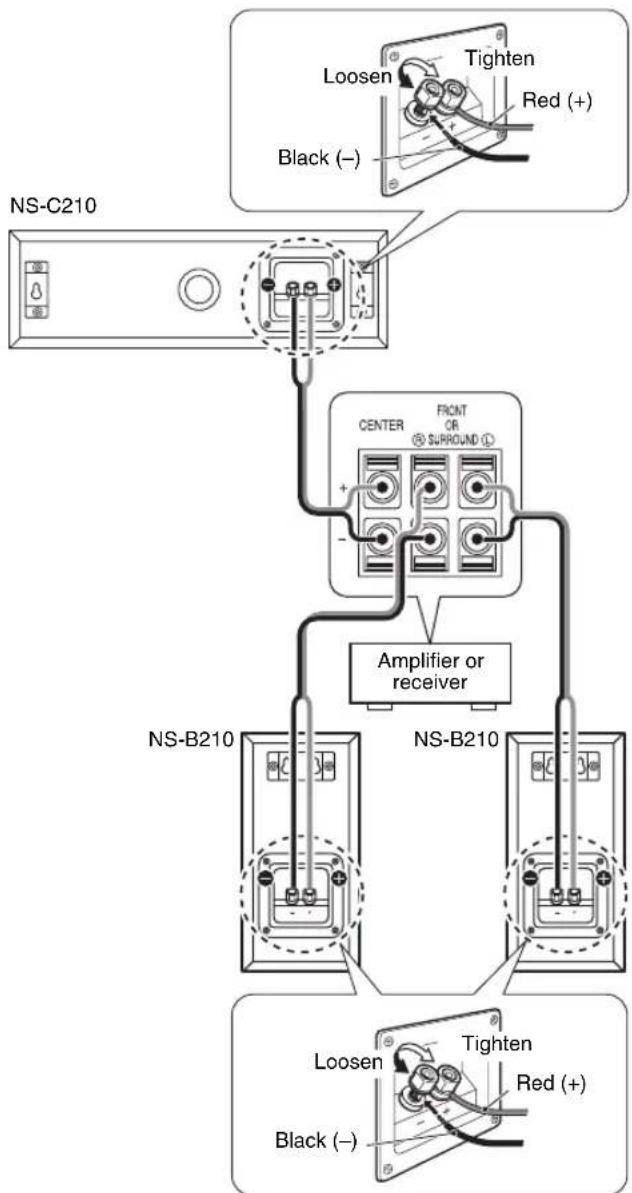
- Connect the screw-type input terminals at the rear of the speakers to the speaker output terminals of the amplifier (or receiver) with the speaker cable.
- Connect the (+) terminals on the amplifier (or receiver) to the (+) terminal of each speaker, making sure to confirm the color-coded wire of the cable at each end. Use the other wire of the cable to connect the (−) terminals of the components.
- Connect one speaker to the left (marked L) terminals of your amplifier, and another speaker to the right (marked R) terminals, making sure not to reverse the polarity (+,-). If one speaker is connected with reversed polarity the sound will be unnatural and lack bass.
■How to connect
1 Loosen the knob.
2 Remove 10 mm (3/8") of insulation from each end of the cables, and twist the exposed conductors together neatly and tightly, as shown below.

3 Insert the bare wire.
4 Tighten the knob and secure the cables.
Test the firmness of the connection by pulling lightly on the cables at the terminal.
Notes
- Do not let the bare speaker wires touch each other as this could damage the speaker or the amplifier, or both.
- Do not insert the insulation into the hole. Sound may not be produced.
■When using a banana plug
Note
Do not take off this cover unless using a banana plug.

1 Remove the cover by pulling it toward you.
2 Tighten the terminal knob.
3 Simply insert the banana plug into the terminal.
SPECIFICATIONS
NS-B210
Type .... full-range acoustic suspension speaker system Non-Magnetic shielding type
Driver 8 cm (3-1/8") full-range × 2
Impedance....6 Ω
Frequency Response .... 75 Hz to 35 kHz (-10 dB) to 50 kHz (-30 dB)
Nominal Input Power.... 40 W
Maximum Input Power 120 W
Sensitivity 86 dB/2.83 V/m
Dimensions (W × H × D).... 105 × 215 × 132 mm (4-1/8" × 8-7/16" × 5-3/16")
Weight....1.6 kg (3 lbs. 8 oz.)
NS-C210
Type ......2-way bass reflex speaker system Non-Magnetic shielding type
Driver .... 8 cm (3-1/8") cone woofer × 2 2.2 cm (1") balanced dome tweeter
Impedance 6 Ω
Frequency Response .... 65 Hz to 45 kHz (-10 dB) to 100 kHz (-30 dB)
Nominal Input Power.... 40 W
Maximum Input Power 120 W
Sensitivity 86 dB/2.83 V/m
Crossover Frequency 8 kHz
Dimensions (W × H × D).... 340 × 105 × 132 mm (13-3/8" × 4-1/8" × 5-3/16")
Weight....2 kg (4 lbs. 7 oz.)
- Specifications subject to change without notice due to product improvements.
- Care should be taken not to exceed the input power values noted above.
Taking care of the speaker
When you wipe this unit, do not use chemical solvents (e.g., alcohol or thinners, etc.): this might damage the finish. Use a clean, dry cloth. For difficult soils, dampen a soft cloth in water, wring it out, and then wipe with the cloth.
(For polish-finished model) Bumping the surface of the instrument with metal, porcelain, or other hard objects can cause the finish to crack or peel. Use caution.
Limited Guarantee for European Economic Area (EEA) and Switzerland
Thank you for having chosen a Yamaha product. In the unlikely event that your Yamaha product needs guarantee service, please contact the dealer from whom it was purchased. If you experience any difficulty, please contact Yamaha representative office in your country. You can find full details on our website (http://www.yamaha-hifi.com/ or http://www.yamaha-uk.com/ for U.K. resident).
The product is guaranteed to be free from defects in workmanship or materials for a period of two years from the date of the original purchase. Yamaha undertakes, subject to the conditions listed below, to have the faulty product or any part(s) repaired, or replaced at Yamaha's discretion, without any charge for parts or labour. Yamaha reserves the right to replace a product with that of a similar kind and/or value and condition, where a model has been discontinued or is considered uneconomic to repair.
Conditions
- The original invoice or sales receipt (showing date of purchase, product code and dealer's name) MUST accompany the defective product, along with a statement detailing the fault. In the absence of this clear proof of purchase, Yamaha reserves the right to refuse to provide free of charge service and the product may be returned at the customer's expense.
- The product MUST have been purchased from an AUTHORISED Yamaha dealer within the European Economic Area (EEA) or Switzerland.
- The product must not have been the subject of any modifications or alterations, unless authorised in writing by Yamaha.
- The following are excluded from this guarantee:
a. Periodic maintenance and repair or replacement of parts due to normal wear and tear.
b. Damage resulting from:
(1) Repairs performed by the customer himself or by an unauthorised third party.
(2) Inadequate packaging or mishandling, when the product is in transit from the customer. Please note that it is the customer's responsibility to ensure the product is adequately packaged when returning the product for repair.
(3) Misuse, including but not limited to (a) failure to use the product for its normal purpose or in accordance with Yamaha's instructions on the proper use, maintenance and storage, and (b) installation or use of the product in a manner inconsistent with the technical or safety standards in force in the country where it is used.
(4) Accidents, lightning, water, fire, improper ventilation, battery leakage or any cause beyond Yamaha's control.
(5) Defects of the system into which this product is incorporated and/or incompatibility with third party products.
(6) Use of a product imported into the EEA and/or Switzerland, not by Yamaha, where that product does not conform to the technical or safety standards of the country of use and/or to the standard specification of a product sold by Yamaha in the EEA and/or Switzerland.
(7) Non AV (Audio Visual) related products. (Products subject to “Yamaha AV Guarantee Statement” are defined in our website at http://www.yamaha-hifi.com/ or http://www.yamaha-uk.com/ for U.K. resident.)
- Where the guarantee differs between the country of purchase and the country of use of the product, the guarantee of the country of use shall apply.
- Yamaha may not be held responsible for any losses or damages, whether direct, consequential or otherwise, save for the repair or replacement of the product.
- Please backup any custom settings or data, as Yamaha may not be held responsible for any alteration or loss to such settings or data.
- This guarantee does not affect the consumer's statutory rights under applicable national laws in force or the consumer's rights against the dealer arising from their sales/purchase contract.
规格
NS-B210
类型……全频声学悬挂式扬声器系统
非磁屏蔽型
驱动单元 8 cm 全频 × 2
阻抗 6 Ω
频率响应 ......75 Hz 至 35 kHz (-10 dB)
至 50 kHz (-30 dB)
标称输入功率 40 W
最大输入功率 120 W
灵敏度 86 dB/2.83 V/m
• Explanation of Graphical Symbols
The lightning flash with arrowhead symbol, within an equilateral triangle, is intended to alert you to the presence of uninsulated "dangerous voltage" within the product's enclosure that may be of sufficient magnitude to constitute a risk of electric shock to persons.

The exclamation point within an equilateral triangle is intended to alert you to the presence of important operating and maintenance (servicing) instructions in the literature accompanying the appliance.
IMPORTANT
Please record the serial number of this system in the space below.
Model:
Serial No.:
The serial number is located on the rear of the main unit.
Retain this Owner's Manual in a safe place for future reference.
1 Read these instructions.
2 Keep these instructions.
3 Heed all warnings.
4 Follow all instructions.
5 Do not use this apparatus near water.
6 Clean only with dry cloth.
7 Do not block any ventilation openings. Install in accordance with the manufacturer's instructions.
8 Do not install near any heat sources such as radiators, heat registers, stoves, or other apparatus (including amplifiers) that produce heat.
9 Do not defeat the safety purpose of the polarized or grounding-type plug. A polarized plug has two blades with one wider than the other. A grounding type plug has two blades and a third grounding prong. The wide blade or the third prong are provided for your safety. If the provided plug does not fit into your outlet, consult an electrician for replacement of the obsolete outlet.
10 Protect the power cord from being walked on or pinched particularly at plugs, convenience receptacles, and the point where they exit from the apparatus.
11 Only use attachments/accessories specified by the manufacturer.
12 Use only with the cart, stand, tripod, bracket, or table specified by the manufacturer, or sold with the apparatus. When a cart is used, use caution when moving the cart/ apparatus combination to avoid injury from tip-over.

13 Unplug this apparatus during lightning storms or when unused for long periods of time.
14 Refer all servicing to qualified service personnel. Servicing is required when the apparatus has been damaged in any way, such as power-supply cord or plug is damaged, liquid has been spilled or objects have fallen into the apparatus, the apparatus has been exposed to rain or moisture, does not operate normally, or has been dropped.
We Want You Listening For A Lifetime
YAMAHA and the Electronic Industries Association's Consumer Electronics Group want you to get the most out of your equipment by playing it at a safe level. One that lets the sound come through loud and clear without annoying blaring or distortion – and, most importantly, without affecting your sensitive hearing.
Since hearing damage from loud sounds is often undetectable until it is too late, YAMAHA and the Electronic Industries Association's Consumer Electronics Group recommend you to avoid prolonged exposure from excessive volume levels.

CAUTION: Read this before operating your unit
Please read the following operating precautions before use. Yamaha will not be held responsible for any damage and/or injury caused by not following the cautions below.
- To assure the finest performance, please read this manual carefully. Keep it in a safe place for future reference.
- Install this unit in a cool, dry, clean place - away from windows, heat sources, sources of excessive vibration, dust, moisture and cold. Avoid sources of humming (transformers, motors). To prevent fire or electrical shock, do not expose this unit to rain or water.
- The voltage to be used must be the same as that specified on the rear panel. Using this unit with a higher voltage than specified is dangerous and may cause a fire and/or electric shock.
- Do not use force on switches, controls or connection wires. When moving the unit, first disconnect the power plug and the wires connected to other equipment. Never pull the wires themselves.
- When not planning to use this unit for a long period (ie., vacation, etc.), disconnect the AC power plug from the wall outlet.
- To prevent lightning damage, disconnect the AC power plug when there is an electric storm.
- Since this unit has a built-in power amplifier, heat will radiate from the rear panel. Place the unit apart from the walls, allowing at least 20 cm of space above, behind and on both sides of the unit to prevent fire or damage. Furthermore, do not position with the rear panel facing down on the floor or other surfaces.
- Do not cover the rear panel of this unit with a newspaper, a tablecloth, a curtain, etc., in order not to obstruct heat radiation. If the temperature inside the unit rises, it may cause fire, damage to the unit and/or personal injury.
- Do not place the following objects on this unit:
- Glass, china, small metallic, etc. If glass, etc., falls as a result of vibrations and breaks, it may cause bodily injury.
- A burning candle etc. If the candle falls as a result of vibration, it may cause fire and bodily injury.
- A vessel containing water If the vessel falls as a result of vibration and water spills, it may cause damage to the speaker, and/or you may get an electric shock.
- Do not place this unit where foreign material, such as dripping water. It might cause fire, damage to this unit, and/or personal injury.
-
Never put a hand or a foreign object into the YST port located on the right side of this unit. When moving this unit, do not hold the port, as it might cause personal injury and/or damage to this unit.
-
Never place a fragile object near the YST port of this unit. If the object falls or drops as a result of the air pressure, it may cause damage to the unit and/or personal injury.
- Never open the cabinet. It might cause an electric shock, since this unit uses a high voltage. It might also cause personal injury and/or damage to this unit. If something drops into the set, contact your dealer.
- When using a humidifier, be sure to avoid condensation inside this unit by allowing enough space around this unit or avoiding excess humidification. Condensation might cause fire, damage to this unit, and/or electric shock.
- Super-bass frequencies reproduced by this unit may cause a turntable to generate a howling sound. In such a case, move this unit away from the turntable.
- This unit may be damaged if certain sounds are continuously output at high volume level. For example, if 20 Hz - 50 Hz sine waves from a test disc, bass sounds from electronic instruments, etc., are continuously output, or when the stylus of a turntable touches the surface of a disc, reduce the volume level to prevent this unit from being damaged.
- If you hear distortion (i.e., unnatural, intermittent “rapping” or “hammering” sounds) coming from this unit, reduce the volume level. Extremely loud playing of a movie soundtrack’s low frequency, bass-heavy sounds or similarly loud popular music passages can damage this speaker system.
- Vibration generated by super-bass frequencies may distort images on a TV. In such a case, move this unit away from the TV set.
- Do not attempt to clean this unit with chemical solvents as this might damage the finish. Use a clean, dry cloth.
- Be sure to read the “TROUBLESHOOTING” section regarding common operating errors before concluding that the unit is faulty.
- Install this unit near the wall outlet and where the AC power plug can be reached easily.
- Secure placement or installation is the owner's responsibility. Yamaha shall not be liable for any accident caused by improper placement or installation of speakers.
WARNING
TO REDUCE THE RISK OF FIRE OR ELECTRIC SHOCK, DO NOT EXPOSE THIS APPLIANCE TO RAIN OR MOISTURE.
• VOLTAGE SELECTOR
(Asia and General models only)
The voltage selector switch on the rear panel of this unit must be set to your local main voltage BEFORE plugging this unit into the AC main supply. Voltages are 110-120/220-240 V AC, 50/60 Hz.
This unit is not disconnected from the AC power source as long as it is connected to the wall outlet, even if this unit itself is turned off. In this state, this unit is designed to consume a very small quantity of power.
For Canadian Customers
To prevent electric shock, match wide blade of plug to wide slot and fully insert.
CAN ICES-3 (B)/NMB-3 (B)
This unit's speakers use magnets. Do not place items that are sensitive to magnetism, such as CRT-type TVs, clocks, credit cards, floppy disks, etc., on or beside this unit.
Taking care of the subwoofer
- When you wipe this unit, do not use chemical solvents (e.g., alcohol or thinners, etc.): this might damage the finish. Use a clean, dry cloth. For difficult soils, dampen a soft cloth in water, wring it out, and then wipe with the cloth.
- (For polish-finished model) Bumping the surface of the instrument with metal, porcelain, or other hard objects can cause the finish to crack or peel. Use caution.
CONTENTS
FEATURES.... 1
CONTROLS AND THEIR FUNCTIONS.... 1
PLACEMENT.... 2
CONNECTIONS.... 3
Connecting to such as subwoofer output terminal or line output (pin jack) terminals of the amplifier..... 3
Plug in the subwoofer to the AC outlet.... 3
ADJUSTING THE SUBWOOFER BEFORE USE.... 4
ADVANCED YAMAHA ACTIVE SERVO
TECHNOLOGY II.... 5
TWISTED FLARE PORT ....5
TROUBLESHOOTING.... 6
SPECIFICATIONS....7
Frequency characteristic.... 7
FEATURES
- This subwoofer employs Advanced Yamaha Active Servo Technology II, which Yamaha has developed for the production of higher quality, super-bass sound. (Refer to page 5 for details on Advanced Yamaha Active Servo Technology II.) This super-bass sound adds a more realistic, theater-in-the-home effect to your audio system.
- Equipped with the smooth super-bass reproducing Twisted Flare Port.
The flared, gently twisting shape diffuses the vortex of air generated around the edge of the port, creating a smooth flow of air. This reduces extraneous noise not present in the original input signal, and provides clear, accurate low frequency reproduction.
CONTROLS AND THEIR FUNCTIONS
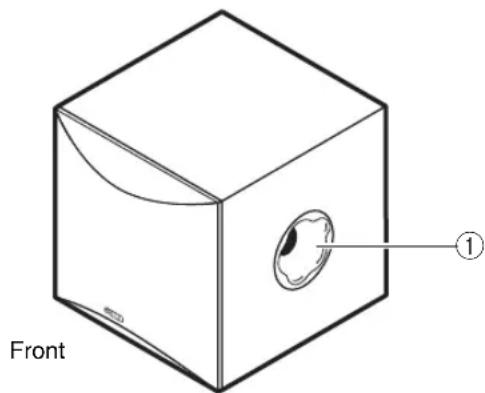

Rear
①Twisted Flare Port
Outputs super-bass sound.
②VOLUME control
Adjusts the volume level. Turn the control clockwise to increase the volume, and counterclockwise to decrease the volume.
③Power indicator
Lights up Green when the POWER switch is turned ON; turns off when the POWER switch is turned OFF.
④INPUT (FROM AMPLIFIER) terminal
Used to connect the subwoofer with the subwoofer terminal of the amplifier.
(Refer to "CONNECTIONS" for details.)
⑤POWER switch
Press this switch to the ON position to turn on the power to the subwoofer. Press this switch again to set it to the OFF position to turn off the power of the subwoofer.
⑥VOLTAGE SELECTOR switch
(Asia and General models only)
If the preset setting of the switch is incorrect, set the switch to the proper voltage (110-120/220-240V) of your area.
Consult your dealer if you are unsure of the correct setting.
WARNING
Be sure to unplug the subwoofer before setting the VOLTAGE SELECTOR switch correctly.
PLACEMENT
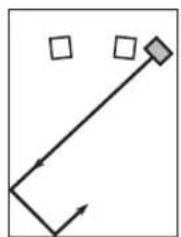
Since the low-end frequencies of audio signals feature long wavelengths, they are almost non-directional to human ears. The super-bass range does not create a stereo image. Therefore, a single subwoofer may be enough to produce a high-quality super-bass sound.
A
flowchart
graph TD
    A["Square Node"] --> B{Decision}
    B -->|Yes| C["Process"]
    B -->|No| D["End"]
or

flowchart
graph TD
    A["Square"] --> B["Right Arrow"]
    C["Square"] --> B
    D["Square"] --> B
B

flowchart
graph TD
    A[" "] --> B[" "]
    C[" "] --> D[" "]
    E[" "] --> F[" "]
or

flowchart
graph TD
    A["Decision"] --> B["Output Arrow"]
    C["Empty Node"] --> A
( : subwoofer, : front speaker)
Note
The placement shown in the figure on the right is also possible. However, if the subwoofer system is placed directly facing a wall, the bass effect may suffer due to phase cancellation caused by the interference between the direct and reflected sounds. To prevent this from happening, place the subwoofer system at an angle.
(Figures A an)

flowchart
graph TD
    A[" "] --> C[" "]
    B[" "] --> C[" "]
    C --> D[" "]
    style C stroke-dasharray: 5 5
Note
There may be a case that you cannot obtain enough super-bass sound from the subwoofer due to standing waves.
Note
- Placing the subwoofer too close to a CRT-type TV may impair the picture color or cause a buzzing noise. In this case, place the subwoofer and TV at a separated position where these effects do not occur. This is not an issue with LCD and plasma TVs.
- If the speaker volume is very loud, furniture or window glass may resonate and the subwoofer itself may vibrate. In this case, lower the volume level. To limit resonance, use a thick curtain or similar cloth that tends to absorb sound vibrations effectively. Also, changing the subwoofer position may be helpful.
CONNECTIONS
Note
- Unplug the subwoofer and other audio/video components before making connections, and do not plug them in until all connections are completed.
- Connecting methods and terminal names on your component (such as an amplifier or receiver) may be different from those used in this book. Please refer to the owner's manual that came with your component.
• After connecting, make sure that cable is connected firmly.
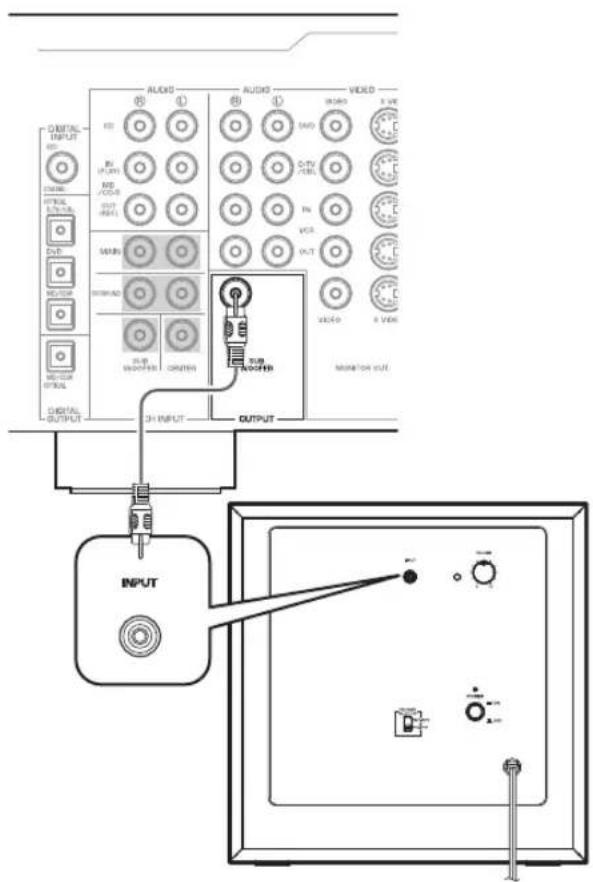
Connecting to such as subwoofer output terminal or line output (pin jack) terminals of the amplifier
Connect to the subwoofer output terminal of the amplifier (or AV receiver) using commercially available audio pin cable.
If the amplifier (or AV receiver) has no subwoofer output terminal, connect to the line output (such as PRE OUT) terminal.
Amplifier (The rear panel of various amplifiers may differ in appearance.)
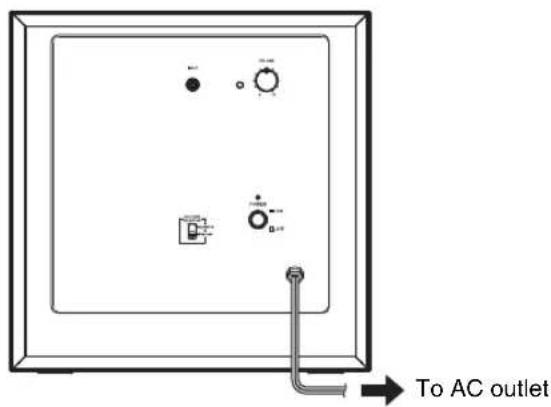
Plug in the subwoofer to the AC outlet
After all connections are completed, plug the subwoofer and other audio/video components into AC outlets.
ADJUSTING THE SUBWOOFER BEFORE USE
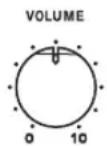
Before using the subwoofer, adjust the subwoofer to obtain the optimum volume balance between the subwoofer and the front speakers by following the procedure described below.


1 Set the VOLUME control to minimum (0).
2 Turn on the power of all the other components.
3 Make sure that the POWER switch is set to the ON position.
* The Power indicator lights up in green.
4 Play a source containing low-frequency components and adjust the amplifier's volume control to the desired listening level.
5 Increase the volume gradually to adjust the volume balance between the subwoofer and the front speakers. To enjoy natural bass sound, keep the subwoofer volume at a level where it is barely distinguishable from other speakers.
Note
It is recommended to set the VOLUME control about in the middle position when using in a multi channel home theater system.
ADVANCED YAMAHA ACTIVE SERVO TECHNOLOGY II
In 1988, Yamaha brought to the marketplace speaker systems utilizing YST (Yamaha Active Servo Technology) to give powerful, high quality bass reproduction. This technique uses a direct connection between the amplifier and speaker, allowing accurate signal transmission and precise speaker control.
As this technology uses speaker units controlled by the negative impedance drive of the amplifier and resonance generated between the speaker cabinet volume and port, it creates more resonant energy (the “air woofer” concept) than the standard bass reflex method. This allows for bass reproduction from much smaller cabinets than was previously possible.
Yamaha's newly developed Advanced YST II adds many refinements to Yamaha Active Servo Technology, allowing better control of the forces driving the amplifier and speaker. From the amplifier's point of view, the speaker impedance changes depending on the sound frequency. Yamaha developed a new circuit design combining negative-impedance and constant-current drives, which provides a more stable performance and clear bass reproduction, without any murkiness.

flowchart
graph TD
    A["High-amplitude bass sound"] --> B["Air woofer (Helmholtz resonator)"]
    B --> C["Advanced impedance Converter"]
    C --> D["Active Servo Processing Amplifier"]
    D --> E["Signals"]
    F["Cabinet"] --> G["Port"]
    G --> H["Signals of low amplitude"]
    H --> I["Signal"]
    I --> D
TWISTED FLARE PORT
Today's bass reflex speakers use a Helmholtz resonator to improve their bass reproduction.
However when reproducing bass that is in the frequency region of this Helmholtz resonator, air moves violently in and out through the port between the interior and exterior of the speaker, sometimes producing noise due to the turbulent air flow at the end of the port.
The port and the cabinet resonate at a frequency that is determined by their dimensions and shape. On the other hand, turbulence in the air flow at the end of the port contains a broad range of frequency components that are not present in the input signal. This noise occurs because the broad range of frequency components includes components that match the resonant frequencies of the port and cabinet, causing strong resonance.

natural_image
Black and white image of a twisted flare port device against a black background (no text or symbols on the device itself)The Twisted Flare Port developed by Yamaha changes the way in which the port widens toward its end, and also adds a “twist” to suppress airflow turbulence at each end of the port and thus prevent noise from occurring.
This eliminates the “muddy sound” and “wind noise” that until now have been characteristic of bass reflex speakers, allowing bass to be reproduced clearly.
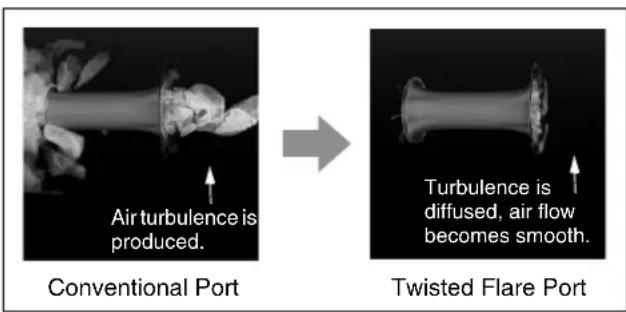
Air turbulence on both ends of the port creates noise
TROUBLESHOOTING
Refer to the chart below if this unit does not function properly.
If the instructions given below do not help, or if the problem you are experiencing is not listed below, turn off the power to the unit, disconnect the power cord and contact an authorized Yamaha dealer or service center.
| Problem Cause What to Do | ||
| Power is not supplied even though the POWER switch is set to the ON position. | The power plug is not securely connected. | Connect it securely. |
| No sound. The volume is set to minimum. | Raise the volume up. | |
| Connections are faulty (or the connections are incomplete). | Connect them securely. | |
| The sound is interrupted. | The volume is too loud. | Since the output is excessive, reduce the volume level. |
| Sound level is too low. A source sound with little bass frequency content is being played. | Play a source sound with bass frequencies. | |
| It is influenced by standing waves. Reposition the subwoofer or break up parallel surfaces by placing bookshelves, etc., along the walls. | ||
SPECIFICATIONS
NS-SW100
Type .....Advanced Yamaha Active Servo Technology II
Driver....25 cm (10") cone woofer Non magnetic shielding type
Amplifier Output (100 Hz, 5 ohms, 10% THD)... 50 W
Dynamic Power.... 100 W, 5 Ω
Frequency Response 25 Hz - 180 Hz
Power Supply
USA and Canada models.... AC 120V, 60 Hz Asia and General models ..... AC 110-120/220-240 V, 50/60 Hz
Power Consumption 40 W
Dimensions (W × H × D) ... 351 mm × 352 mm × 408 mm (13-7/8" × 13-7/8" × 16-1/8")
Weight.... 12 kg (26.5 lbs.)
NS-SW050
Type..... Advanced Yamaha Active Servo Technology II
Driver 20 cm (8") cone woofer Non magnetic shielding type
Amplifier Output (100 Hz, 5 ohms, 10% THD)...50 W
Dynamic Power 100 W, 5 Ω
Frequency Response 28 Hz - 200 Hz
Power Supply
USA and Canada models....AC 120V, 60 Hz Asia and General models .....AC 110-120/220-240 V, 50/60 Hz
Power Consumption 40 W
Dimensions (W × H × D) ...291 mm × 292 mm × 341 mm (11-1/2" × 11-1/2" × 13-3/8")
Weight....8.5 kg (18.7 lbs.)
* The contents of this manual apply to the latest specifications as of the publishing date. To obtain the latest manual, access the Yamaha website then download the manual file.
Frequency characteristic
This subwoofer's frequency characteristic
[NS-SW100]
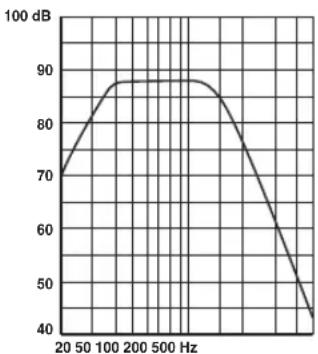
line
| Frequency (Hz) | Value (dB) | |---|---| | 20 | 70 | | 50 | 80 | | 100 | 88 | | 200 | 89 | | 500 | 89 | | 1000 | 88 | | 2000 | 85 | | 5000 | 75 | | 10000 | 60 | | 20000 | 45 |[NS-SW050]
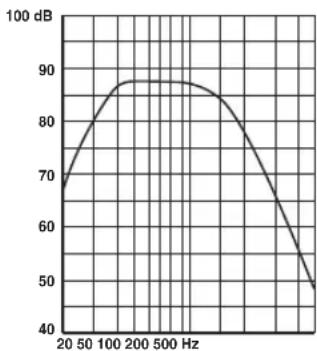
line
| Hz | dB | | ---- | --- | | 20 | 70 | | 50 | 80 | | 100 | 88 | | 200 | 89 | | 500 | 88 | | 1000 | 85 | | 2000 | 75 | | 5000 | 60 | | 10000| 50 |* This diagram does not depict actual frequency response characteristics.
INSTRUCTIONS DE SÉCURITÉ IMPORTANTES
natural_image
Symbolic icon of a person climbing a ladder inside a circle (no text or symbols)flowchart
graph TD
    A["Decision"] --> B["Empty Square"]
    A --> C["Empty Square"]
flowchart
graph TD
    A[" "] --> C[" "]
    B[" "] --> C[" "]
    C --> D[" "]
    style C stroke-dasharray: 5 5
Remarque
natural_image
Black and white image of a twisted flare port device against a black background (no text or symbols on the device itself)Type .....Technologie Advanced Yamaha Active Servo II
(100 Hz, 5 ohms, 10% THD)....50 W
(100 Hz, 5 ohms, 10% THD)....50 W
flowchart
graph TD
    A["Square"] --> B["Right Arrow"]
    C["Square"] --> B
    D["Square"] --> B
B

flowchart
graph TD
    A[" "] --> B[" "]
    C[" "] --> D[" "]
    E[" "] --> F[" "]
0

flowchart
graph TD
    A["Decision"] --> B["Empty Square"]
    A --> C["Empty Square"]
flowchart
graph TD
    A[" "] --> C[" "]
    B[" "] --> C[" "]
    C --> D[" "]
    style C stroke-dasharray: 5 5
Nota
natural_image
Black and white image of a twisted flare port device against a black background (no text or symbols on the device itself)Manual Development Department
© 2016 Yamaha Corporation
Published 06/2016 IP-A0
Printed in Indonesia
ZV03070
- User Manual of Product 1:
- User Manual of Product 2:
- NS-B210
- NS-C210
- Read this before using the speaker.
- Information for Users on Collection and Disposal of Old Equipment
- SUPPLIED ACCESSORIES
- ■Using as 2ch stereo speakers
- ■Using as front speakers and surround speakers in a surround system
- ■To mount the speakers on a wall by using the attached mounting bracket
- Note
- WARNING
- For NS-C210
- ■Using as center speaker
- CONNECTIONS TO YOUR AMPLIFIER
- ■How to connect
- Notes
- ■When using a banana plug
- SPECIFICATIONS
- Taking care of the speaker
- Limited Guarantee for European Economic Area (EEA) and Switzerland
- Conditions
- 规格
- IMPORTANT
- We Want You Listening For A Lifetime
- CAUTION: Read this before operating your unit
- • VOLTAGE SELECTOR
- For Canadian Customers
- Taking care of the subwoofer
- CONTENTS
- FEATURES
- CONTROLS AND THEIR FUNCTIONS
- PLACEMENT
- CONNECTIONS
- Connecting to such as subwoofer output terminal or line output (pin jack) terminals of the amplifier
- Plug in the subwoofer to the AC outlet
- ADJUSTING THE SUBWOOFER BEFORE USE
- ADVANCED YAMAHA ACTIVE SERVO TECHNOLOGY II
- TWISTED FLARE PORT
- TROUBLESHOOTING
- NS-SW100
- NS-SW050
- Frequency characteristic
- INSTRUCTIONS DE SÉCURITÉ IMPORTANTES
- Remarque
- Nota
Brand : YAMAHA
Model : NS-C210BL
Category : Loudspeaker