
Streamium MCI900 - Home Theater System PHILIPS - Free user manual and instructions
Find the device manual for free Streamium MCI900 PHILIPS in PDF.


| Product Type | Home Theater System |
| Brand | Philips |
| Model | Streamium MCI900 |
| Dimensions (W x H x D) | 435 x 105 x 320 mm |
| Weight | 5.2 kg |
| Power Supply | AC 220-240V, 50/60 Hz |
| Power Consumption | 60 W (operating), <0.5 W (standby) |
| Supported Discs | CD, CD-R/CD-RW, MP3-CD, WMA-CD |
| Tuner Bands | FM (87.5-108 MHz), AM (530-1600 kHz) |
| Internet Radio | vTuner (thousands of stations) |
| Wi-Fi | IEEE 802.11b/g/n |
| Ethernet | 10/100 Mbps RJ-45 |
| USB Port | USB 2.0, supports MP3/WMA playback |
| Audio Inputs | 3.5 mm auxiliary (front), RCA (rear) |
| Headphone Output | 3.5 mm jack |
| Speaker Output | 2 x 30 W RMS |
| Frequency Response | 20 Hz - 20 kHz |
| Display | Full-color TFT LCD |
| Remote Control | Included (with batteries) |
| Cleaning Instructions | Wipe with a soft, dry cloth. Do not use liquids or abrasive cleaners. |
| Safety Precautions | Keep away from water and heat sources. Use only in dry indoor environments. |
| Spare Parts Availability | Contact Philips support or authorized dealers for remote control, power cord, and main unit parts. |
| Repairability | Moderate. User-replaceable parts include fuse and remote control batteries. For internal repairs, consult qualified service personnel. |
Frequently Asked Questions - Streamium MCI900 PHILIPS
User questions about Streamium MCI900 PHILIPS
0 question about this device. Answer the ones you know or ask your own.
Ask a new question about this device
Download the instructions for your Home Theater System in PDF format for free! Find your manual Streamium MCI900 - PHILIPS and take your electronic device back in hand. On this page are published all the documents necessary for the use of your device. Streamium MCI900 by PHILIPS.
USER MANUAL Streamium MCI900 PHILIPS
EN User manual 3
Contact information 70
EC DECLARATION OF CONFORMITY
(DECLARATION DE CONFORMITE CE)
We / Nous, PHILIPS CONSUMER LIFESTYLE B.V.
Declare under our responsibility that the electrical product(s):
To which this declaration relates is in conformity with the following harmonized standards:
Following the provisions of :
1999/5/EC (R&TTE Directive)
2004/108/EC (EMC Directive)
2009/125/EC (ErP Directive) – EC/1275/2008
And are produced under a quality scheme at least in conformity with ISO 9001 or CENELEC Permanent Documents
And issued the certificate,
Leuven, February 24, 2010
(place, date / lieu, date)
Frank Dethier
Development Manager, Innovation Lab Leven
Frank Dethier
Environmental notices 6
Recycling 7
Trademark notice 7
2 Your MCi900 9
Introduction 9
What's in the box 9
Overview 10
Top and front view 10
Rear view 12
Remote control 14
Home screen 16
Play screen 17
Text entry 17
3 Prepare 19
Connect the HDD to a computer 19
Copy MCi900 files to the computer 19
Copy media files to the HDD 19
Install batteries into the remote control 20
4 Place the unit 21
Place the Soundsphere speakers 22
5 Connect 24
Connect the main unit and CD/DVD
unit 24
Connect speakers 24
Connect for disc play 24
Connect a TV 24
Play from another speaker system 25
Connect the FM antenna 26
Connect external audio devices 26
Turn on/off 27
Connect power supply 27
Turn on/off 27
6 First-time setup 28
Connect to home Wi-Fi/wired network 29
Wireless connection: One-touch
Wi-Fi Protected Setup (WPS) 30
Wireless connection: Enter
encryption key manually 31
Wireless connection: Enter IP
address manually 32
Wired connection 33
Wired connection: Enter IP
address manually 34
7 Play from home Wi-Fi/wired
network 36
Play from the hard disk drive (HDD) 36
Connect the HDD to MCi900 36
Library on the HDD 36
Play from the HDD 38
Stream from a UPnP server 39
Library on a UPnP server 40
Stream from a UPnP server 40
Play Internet radio stations 41
Tune to Internet radio stations 42
Store preset stations 42
Edit favorite stations 42
Manage Internet radio online 43
Manually add stations online 45
Stream from online music services 45
Stream from Napster 46
Search for music/pictures 46
Alphanumeric search 47
Quickjump 47
Superscroll 47
8 Play music CD/movie DVDs 48
Basic operations 48
Use the disc menu 48
Access the disc menu 49
Play movie discs (DVD/DivX/VCD) 49
Pause/Resume/Stop 4
Search 49
Select languages for disc play 49
Program favorite chapters/tracks 50
Select play options 50
Select Repeat/Shuffle options 50
Zoom in/out image 51
Change a camera angle 51
9 Play FM radio 5
Tune to FM radio stations 52
Autostore 52
Manual tuning 52
Edit preset stations 52
Listen to FM radio 52
RDS (Radio Data System) 53
Use the RDS for clock setting 53
10 Play from an external audio device (AUX) 54
Play from an external audio device 54
11 Settings 55
Play modes 55
Sound settings 55
Bass and treble 55
Full sound 55
Direct Source 55
Audio balance 55
Set the volume from the
external audio device 56
Display settings 56
Brightness 56
Wallpaper 56
Screensaver 56
Slideshow settings 56
Album art 57
Clicker sound 57
Clock settings 5
Alarm 5
Sleep timer 5
Date and time 5
Network settings 5
9 Setup network 5
Device name 6
USB sharing 6
Location and time zone 6
Language 6
Device information 6
Check for software upgrades 6
Demo mode 6
Call center numbers 6
Restore factory settings 61
12 Register MCi900 with Philips 62
Benefits 62
Register MCi900 62
Register on the web site 62
Register on the device 62
Unregister MCi900 63
Check registration information 63
13 Maintenance 64
Cleaning 64
14 Technical data 65
15 Troubleshooting 69
16 Contact information 70
1 Important
Safety
Information for Europe:
Know these safety symbols


The 'exclamation mark' calls attention to features for which you should carefully read the supplied literature to prevent operating and maintenance problems.
The 'lightning bolt' symbol indicates uninsulated components within the product that can cause an electric shock.
To reduce the risk of fire or electric shock, do not expose the product to rain or moisture and do not place any objects filled with liquids, such as vases, on the product.
① Read these instructions. ② Keep these instructions. ③ Heed all warnings. ④ Follow all instructions. ⑤ Do not use this product near water. ⑥ Clean only with dry cloth. ⑦ Do not block any ventilation openings. Install in accordance with the manufacturer's instructions. ⑧ Do not remove the casing of this product.
⑨ Only use this product indoors. Do not expose the product to dripping / splashing water, rain or high humidity.
⑩ Keep this product away from direct sunlight, naked flames or heat.
⑪ Do not install near any heat sources such as radiators, heat registers, stoves, or other electrical equipment (including amplifiers).
⑫ Do not place any other electrical equipment on the product.
⑬ Do not place any sources of danger on the product (e.g. objects containing liquids, burning candles).
⑭ This product may include batteries. Please refer to safety and disposal instructions for batteries in this user manual.
⑮ This product may contain lead and mercury. Disposal of these materials may be regulated due to environmental considerations. Please refer to disposal instructions in this user manual.

Caution
Use of controls or adjustments or performance of procedures other than herein may result in hazardous radiation exposure or other unsafe operation.

Warning
Never remove the casing of this apparatus. Never lubricate any part of this apparatus. Never place this apparatus on other electrical equipment.
Keep this apparatus away from direct sunlight, naked flames or heat.
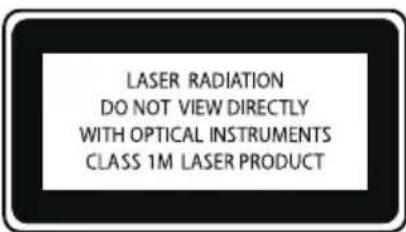
Never look into the laser beam inside this apparatus.
Ensure that you always have easy access to the power cord, plug or adaptor to disconnect this apparatus from the power.
Where the mains plug or an appliance coupler is used as the disconnect device, the disconnect device shall remain readily operable.
Risk of overheating! Never install this apparatus in a confined space. Always leave a space of at least four inches around this apparatus for ventilation. Ensure curtains or other objects never cover the ventilation slots on this apparatus.
Hearing Safety

Listen at a moderate volume:
Using headphones at a high volume can impair your hearing. This product can produce sounds in decibel ranges that may cause hearing loss for a normal person, even for exposure less than a minute. The higher decibel ranges are offered for those that may have already experienced some hearing loss.
Sound can be deceiving. Over time your hearing 'comfort level' adapts to higher volumes of sound. So after prolonged listening, what sounds 'normal' can actually be loud and harmful to your hearing. To guard against this, set your volume to a safe level before your hearing adapts and leave it there.
To establish a safe volume level:
Set your volume control at a low setting.
Slowly increase the sound until you can hear it comfortably and clearly, without distortion.
Listen for reasonable periods of time:
Prolonged exposure to sound, even at normally 'safe' levels, can also cause hearing loss.
Be sure to use your equipment reasonably and take appropriate breaks.
Be sure to observe the following guidelines when using your headphones.
Listen at reasonable volumes for reasonable periods of time.
Be careful not to adjust the volume as your hearing adapts.
Do not turn up the volume so high that you can't hear what's around you.
You should use caution or temporarily discontinue use in potentially hazardous situations.
Environmental notices

This product complies with the radio interference requirements of the European Community.
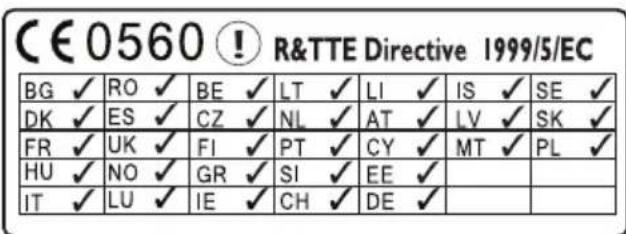
This product complies with the requirement of the 1999/5/EC directive.
This apparatus includes this label:
Class II equipment symbol:

This symbol indicates that this product has a double insulation system.
Modifications
Modifications not authorized by the manufacturer may void user's authority to operate this product.
Recycling

Your product is designed and manufactured with high quality materials and components, which can be recycled and reused.
When you see the crossed-out wheel bin symbol attached to a product, it means the product is covered by the European Directive 2002/96/EC:

Never dispose of your product with other household waste. Please inform yourself about the local rules on the separate collection of electrical and electronic products. The correct disposal of your old product helps prevent potentially negative consequences on the environment and human health.
Information about the use of batteries:

Caution
Risk of leakage: Only use the specified type of batteries. Do not mix new and used batteries. Do not mix different brands of batteries.
Observe correct polarity. Remove batteries from products that are not in use for a longer period of time. Store batteries in a dry place.
Risk of injury: Wear gloves when handling leaking batteries. Keep batteries out of reach of children and pets.
Risk of explosion: Do not short circuit batteries. Do not expose batteries to excessive heat. Do not throw batteries into the fire. Do not damage or disassemble batteries. Do not recharge non-rechargeable batteries.
Battery disposal information:
Your product contains batteries covered by the European Directive 2006/66/EC, which cannot be disposed of with normal household waste.
Please inform yourself about the local rules on separate collection of batteries. The correct disposal of batteries helps prevent potentially negative consequences on the environment and human health.
Trademark notice

HDMI, and HDMI logo and High-Definition Multimedia Interface are trademarks or registered trademarks of HDMI licensing LLC.

Manufactured under license from Dolby Laboratories. Dolby and the double-D symbol are trademarks of Dolby Laboratories.

DivX® and DivX Ultra® are registered trademarks of DivX, Inc. and are used under license. DivX Ultra® Certified to play DivX® video with advanced features and premium content.
ABOUT DIVX VIDEO: DivX® is a digital video format created by DivX, Inc. This is an official DivX Certified device that plays DivX video. Visit www.divx.com for more information and software tools to convert your files into DivX video.
ABOUT DIVX VIDEO-ON-DEMAND: This DivX Certified® device must be registered in order to play DivX Video-on-Demand (VOD) content. To generate the registration code, locate the DivX VOD section in the device setup menu. Go to vod.divx.com with this code to complete the registration process and learn more about DivX VOD.

'DVD Video' is a trademark of DVD Format/Logo Licensing Corporation.
Windows Media and the Windows logo are trademarks, or registered trademarks of Microsoft Corporation in the United States and/or other countries.
The making of unauthorized copies of copy-protected material, including computer programs, files, broadcasts and sound recordings, may be an infringement of copyrights and constitute a criminal offence. This equipment should not be used for such purposes.
This item incorporates copy protection technology that is protected by U.S. patents and other intellectual property rights of Rovi Corporation. Reverse engineering and disassembly are prohibited.
2 Your MCi900
Congratulations on your purchase, and welcome to Philips! To fully benefit from the support that Philips offers, register your product at www.philips.com/welcome.
Introduction
MCi900 can
Connect a hard disk drive (USB mass storage device);
Connect to the existing home Wi-Fi/wired network, which can consist of computers and UPnP devices;
Connect the existing home audio/video systems, including TV, audio systems and MP3 players.
With such connections, you can
Play music stored on a hard disk drive (HDD) through the SoundSphere speakers;
Play Internet radio stations and online music services over the Internet;
Play movie DVDs on a TV;
Play music/photos stored on a computer/UPnP server;
Play music from an audio system/portable media player through the SoundSphere speakers.

Tip
*Online services are available in some countries only.
The DVD player on MCi900 supports these disc formats:

What's in the box
Check and identify the contents of your package:
• Main unit and CD/DVD unit • Hard disk drive (HDD) with a USB plug • 2 SoundSphere speakers (with connection cables) • Remote control with batteries • Composite audio/video cables • FM T-type antenna • AC power cord • Stand for the hard disk drive (HDD) • Software suite (stored in the supplied hard disk drive) • Quick Start Guide
Overview
Top and front view
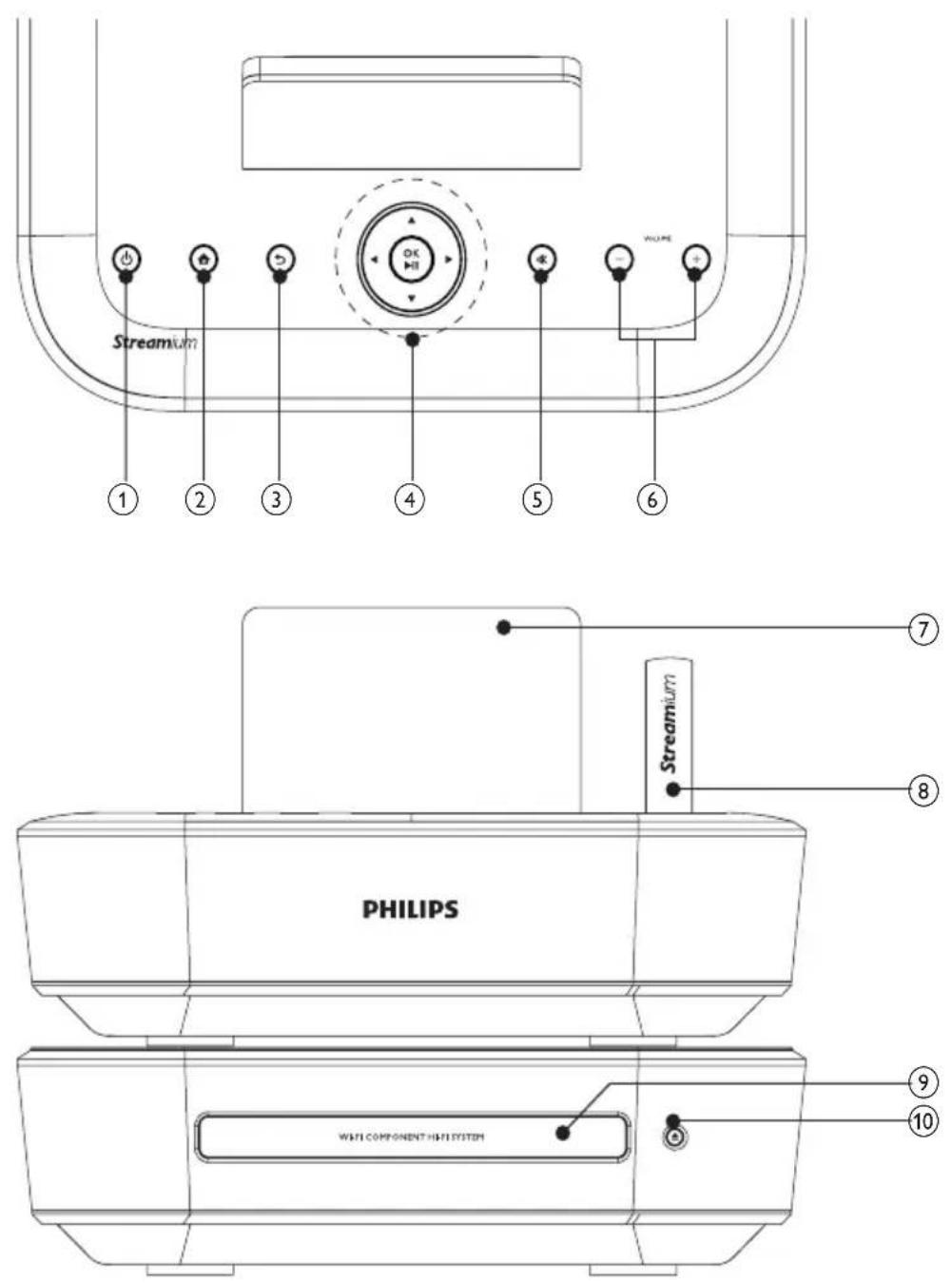
| 1. | + |
| Press to turn on the set; | |
| To turn off, press to switch to active standby; or, press and hold to switch to Eco standby. | |
| Exit Demo mode. | |
| 2. | + |
| Return to Home screen (main menu). | |
| 3. | + |
| Go back to the previous screen. | |
| 4. | ▲/▼/▲▼ Navigation buttonsPress to navigate through menus. |
| ▲/▼ | |
| In MEDIA LIB./HDD/INTERNET RADIO mode: | |
| Superscroll:In a long list of options, press and hold to start Superscroll. Release to jump to the first item starting with current alphabet/number. | |
| In FM RADIO mode: | |
| Press and hold to start the auto tuning to the next available station;Press repeatedly for fine tuning. | |
| In DISC/HDD mode: | |
| Select an album (for MP3/WMA CDs). | |
| OK/ ▶ | |
| Confirm selection. | |
| Start/pause/resume play. | |
| In MEDIA LIB./HDD:Start to play the entire file folder(SuperPlay TM ). | |
| 5. | * |
| Mute/ unmute sound. | |
| 6. | + VOL— |
| Increase/decrease volume. |
| 7. LCD display | |
| 8. Wi-Fi antenna | |
| 9. Disc compartment | |
| 10. | ▲ |
| Open or close the disc compartment. | |
Rear view
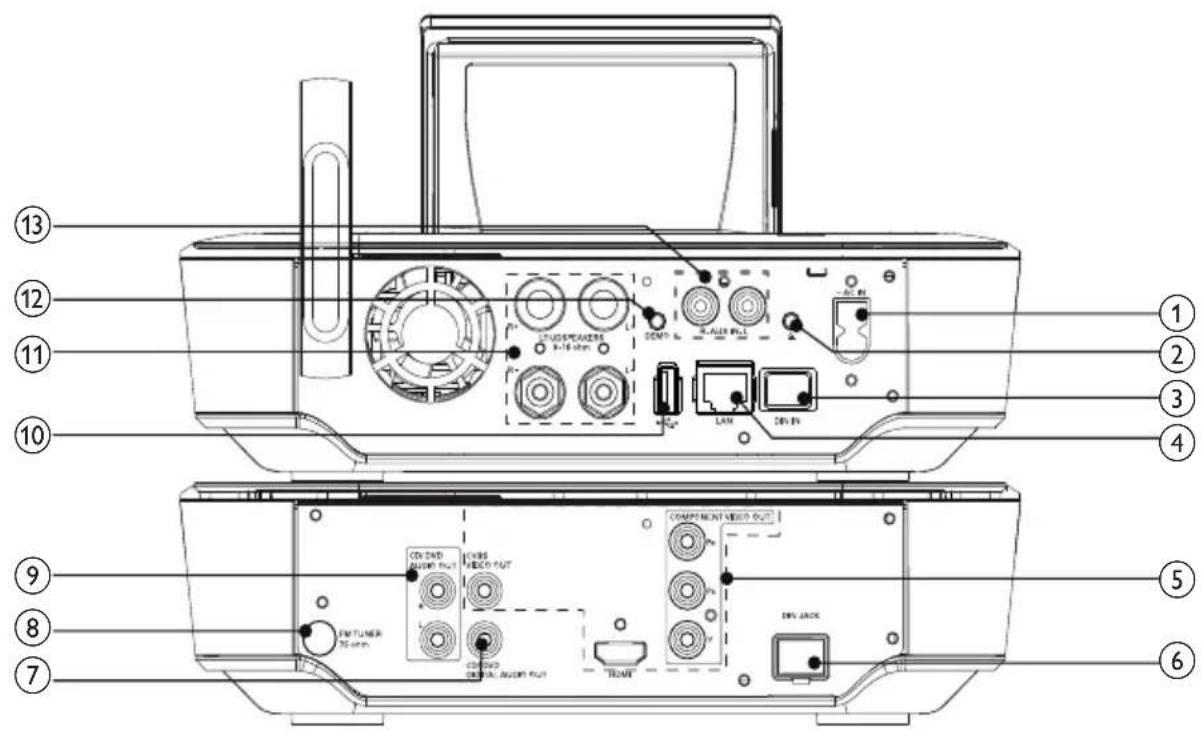
See 'Connect' on page 24.
| 1. ~ AC IN | |
| for AC power cord | |
| 2. | Ω |
| 3.5 mm headphone jack | |
| 3. DIN IN | |
| socket for the connection between the main unit and CD/DVD unit | |
| 4. LAN | |
| for the Ethernet cable that connects MCi900 with home Wi-Fi/wired network, if you want a wired connection to the home Wi-Fi/wired network | |
| 5. HDMI | |
| Video output jacks for the disc play for the HDMI cable (not supplied) that connects the disc player and a high-definition TV (HDTV) | |
| CVBS VIDEO OUT | |
| Video output jacks for the disc play for the supplied composite audio/video cable that connects the disc player and a standard TV | |
| 6. DIN JACK | |
| socket for the connection between the main unit and CD/DVD unit | |
| 7. CD/DVD DIGITAL AUDIO OUT | |
| Digital audio output socket for the disc play through an external speaker system | |
| 8. FM TUNER | |
| for the supplied FM antenna | |
| 9. CD/DVD AUDIO OUT | |
| Analog audio output sockets for the disc play through an external speaker system | |
| 10. | USB port for the hard disk drive |
| 11. LOUDSPEAKERS | |
| for connection cables that connect the supplied Soundsphere speakers | |
| 12. DEMO | |
| for the audio cable supplied to dealers only (for the use by dealers only) | |
| 13. AUX IN L / R | |
| Audio input sockets for a portable media player to play through the speakers on MCi900 | |
Remote control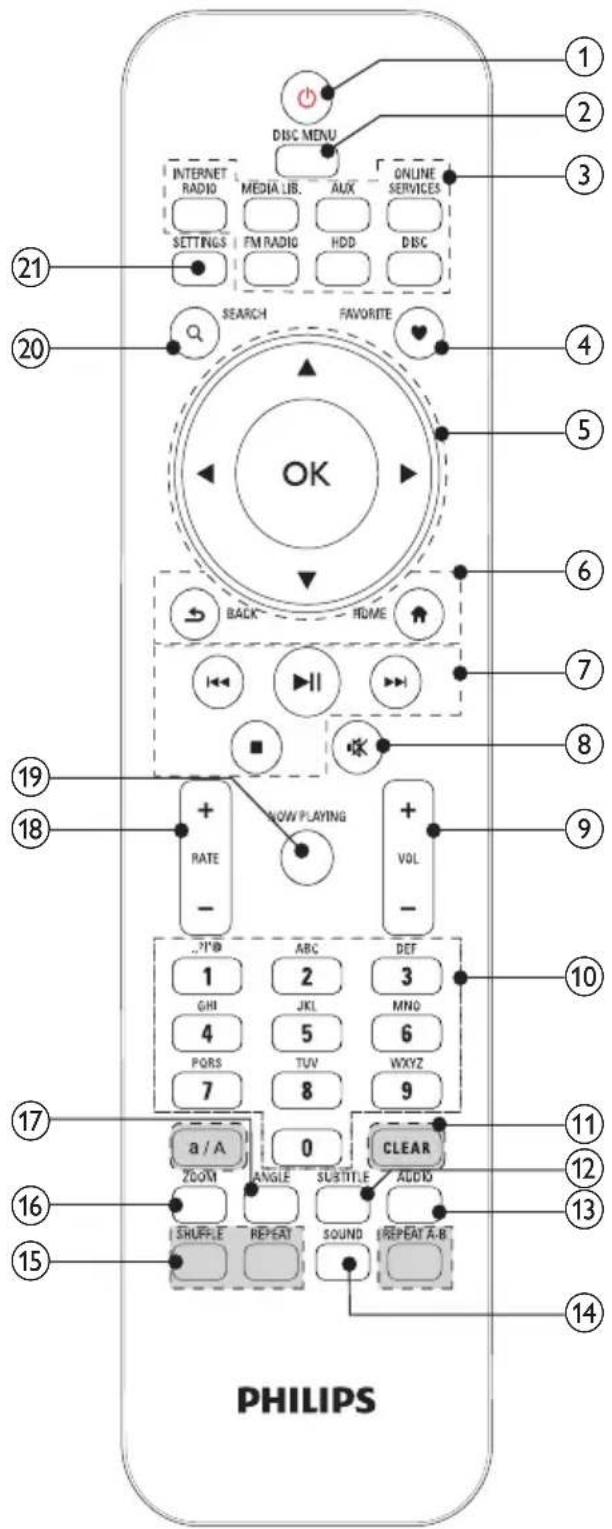
| 1. | ○ |
| Press to turn on the unit;To turn off, press to switch toactive standby; or, press and holdto switch to Eco standby. | |
| Exit Demo mode. |
- DISC MENU
| In DISC mode:Enter or exit the disc menu. |
- Source selector
| Select a media source: | |
| INTERNET RADIO: Radio services provided over the Internet; | |
| MEDIA LIB.: Media library on a UPnP media server; | |
| AUX: Connected external audio device (e.g. an MP3 player or other portable music players); | |
| ONLINE SERVICES: Supported music services provided over the Internet (available in some countries only); | |
| FM RADIO: FM radio stations, with RDS (Radio Data System) supported; | |
| HDD: Media library on the hard disk drive connected to the unit; | |
| DISC: DVDs, DivX/WMA/ MP3/ WMA files on discs, and audio CDs. |
- FAVORITE
| In MEDIA LIB. mode:Add songs to the list of favorites. |
| In INTERNET RADIO mode:Add current station to the list of Favorite Stations. |
| 5. |  |
Navigation buttons
Press to navigate through menus.
| ▲/▼ | |
| In MEDIA LIB./INTERNET RADIO/HDD mode: Superscroll: In a long list of options, press and hold to start Superscroll. Release to jump to the first item starting with current alphabet/number. | |
| In DISC mode: Select an album (for MP3/WMA CDs). | |
| ◀/▶ | |
| In FM RADIO mode: Press and hold to start the auto tuning to the next available station; Press repeatedly for fine tuning. | |
| OK | |
| Confirm selection. | |
| 6. | ▲ |
| HOME: Return to Home screen (main menu). | |
| ⇨ | |
| BACK: Go back to previous screen. | |
| 7. | ◀◀/▶▶ |
| Search buttons on the play screen | |
| In MEDIA LIB./HDD/DISC mode: Press to skip to the previous/ next chapter/track; | |
| ▶II | |
| Start/pause/resume play; In MEDIA LIB./HDD mode: Start to play the entire file folder(SuperPlayTM). | |
| ■ | |
| Stop play; Exit Demo mode. | |
| 8. | ※ |
| Mute/ unmute sound. |
| 9. VOL + - |
| Increase/decrease the volume |
| 10. Alphanumeric buttons |
| For text entry |
| In INTERNET RADIO/FM RADIO mode:On the radio play screen, press and hold a numeric button to store current station in the location as a preset station. |
| In MEDIA LIB./INTERNET RADIO/HDD mode: |
| Quickjump: In a long list of options that are sorted in an alphabetical order, press once or repeatedly to select an alphabet, and jump to the first item that starts with the selected alphabet. |
| 11. CLEAR |
| Press to delete the previous entry;Press and hold to delete all entries. |
| a/A |
| Press to switch between lower and upper cases;In FM RADIO mode, press in the list of presets to start editing station name. |
| 12. SUBTITLE |
| In DISC mode: Select a subtitle language (for video discs only). |
| 13. AUDIO |
| In DISC mode:Select stereo, mono-left, monoright, or mix-mono channel (for VCD discs only);Select an audio language (for DVD and DivX discs only). |
| 14. SOUND |
| Select sound settings. |
15. REPEAT A-B
In DISC mode: Repeat a specific section within a track/disc.
REPEAT
Toggle through repeat play options.
SHUFFLE
Activate/deactivate random order play.
16. ZOOM
In DISC mode: Zoom in/out (for video discs and picture files on CDs).
17. ANGLE
In DISC mode: Select a camera angle (for video discs and picture files on CDs).
18. +RATE -
In ONLINE SERVICES mode: Increase/decrease rating* of current music.
19. NOW PLAYING
Return to play screen.
20. SEARCH
Press to start the search/browsing by alphanumeric entry.
21. SETTINGS
Enter the settings menus.

Note
* Rating current music is available only for music services that support rating, and is available only in some countries.
Home screen
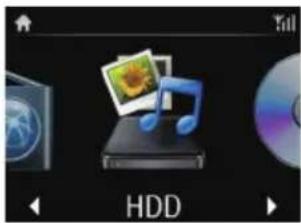
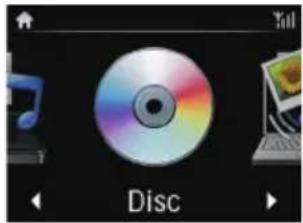
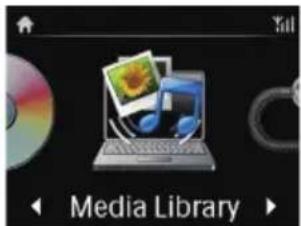
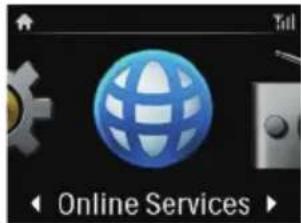
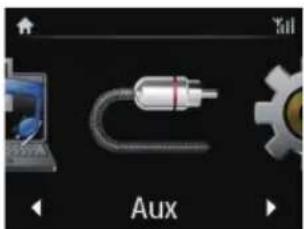
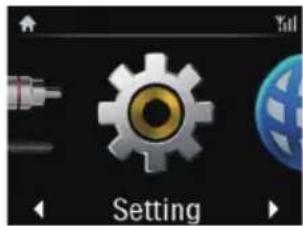
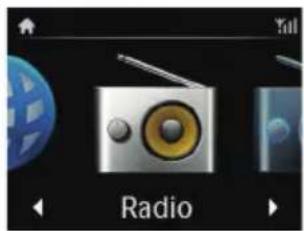
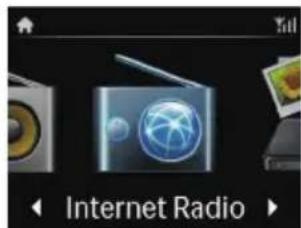
On MCi900, you enter Home screen after the first-time setup is complete.
From Home screen, you can select your desired music source*, or enter [Settings] menu. To do so, do the following:
1 On the remote control, press the Source selector, or use the Navigation buttons ▲/▼/▲ and OK.
2 To move to the next page, press repeatedly until you reach the end of the page.
3 To go back to previous screen, press BACK.
4 To return to Home screen, press HOME.
![graph TD A["SEARCH"] --> B["FONORITE"] B --> C["HOME"] C --> D["BACK"] D --> E["OK"]](/content/2026/06/1278820/images/93ecf50880b589fa5d91634bfec7a25d1a06e53c85c26cbdad3e23278b7d3a38.jpg)

Note
*Online services are available in some countries only.
Play screen
In MEDIA LIB./INTERNET RADIO/ONLINE SERVICES mode, Play screen appears when play starts.
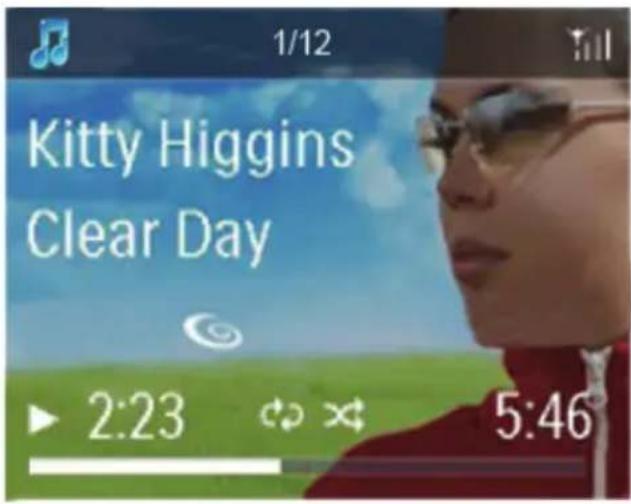
To navigate through menus during music play, do the following:
1 On the remote control, press and then, use the Navigation buttons.
2 To return to Play screen, press NOW PLAYING.

Tip
- On Play screen, you can also press ◀◀ and ▶▶▶ repeatedly to select songs.
Text entry
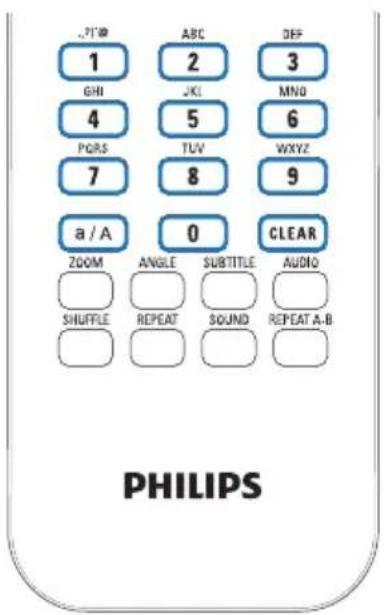
To enter text and symbols, press corresponding alphanumeric buttons on the remote control.
To enter letters/numbers/symbols corresponding to the same alphanumeric button, briefly and repeatedly press the button.
| English | ||
| abc... | ABC... | |
| 1 | 1.,?!'@-_::/""#%& ( )*+<=>[\]^`I | 1.,?!'@-_::/""#%& ( )*+<=>[\]^`{I}~ |
| 2 | abc2 | ABC2 |
| 3 | def3 | DEF3 |
| 4 | ghi4 | GHI4 |
| 5 | jkl5 | JKL5 |
| 6 | mno6 | MNO6 |
| 7 | pqrs7 | PQRS7 |
| 8 | tuv8 | TUV8 |
| 9 | wxyz9 | WXYZ9 |
| 0 | _0 | _0 |
To enter symbols, press 1 repeatedly.
To enter space, press 0.
To switch between lower and upper cases, press a/A.
To delete previous character, press CLEAR. To delete all entries, press and hold CLEAR.

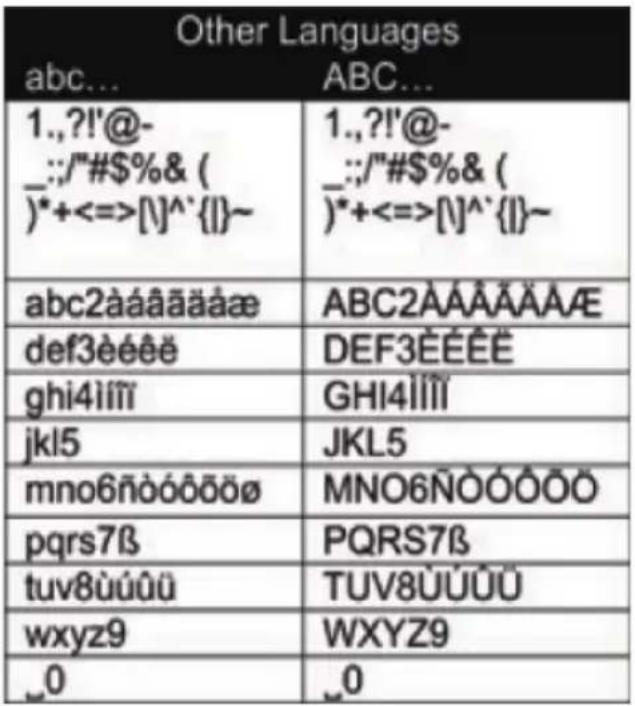
Tip
For languages other than English, letters that an alphanumeric button corresponds to may vary.
| Русский | |
| абв... | АБВ... |
| 1.,?!"@-_::/"#%& ( )*+<=>[\] | 1.,?!"@-_::/"#%& ( )*+<=>[\]^{}~ |
| абвг2abc | АБВГ2ABC |
| дежз3def | ДЕЖЗЗDEF |
| ийкл4ghi | ИЙКЛ4GHI |
| мноп5jkl | МНОП5JKL |
| рстубmno | РСТУ6MNO |
| фхцч7pqrs | ФХЦЧ7PQRS |
| шщьы8tuv | ШЩьы8TUV |
| ьэюя9wxyz | ьэюя9WXYZ |
| _0 | _0 |
 |
3 Prepare
Connect the HDD to a computer
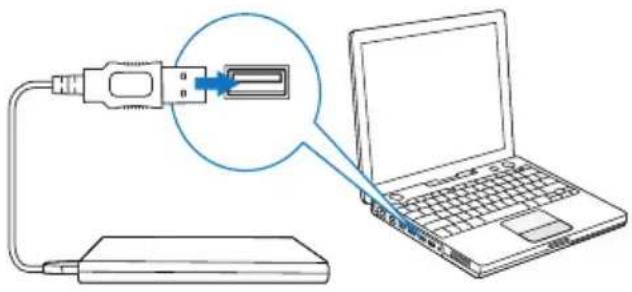
The supplied hard disk drive (HDD) contains the PC/Mac software for MCi900 (Media Browser/TwonkyMedia Server), video tutorial, User Manual, and other information about MCi900 that may be helpful to you.
Connect the supplied HDD to a computer.
Wait till the HDD is detected on the computer.
Copy MCi900 files to the computer
1 On the computer, under [My Computer] or [Computer],
Find the HDD of MCi900;
Find a location on the computer to store the MCi900 files from the HDD.
2 Drag and drop the "MCi900" folder from the HDD to the desired location on the computer.
Copy media files to the HDD
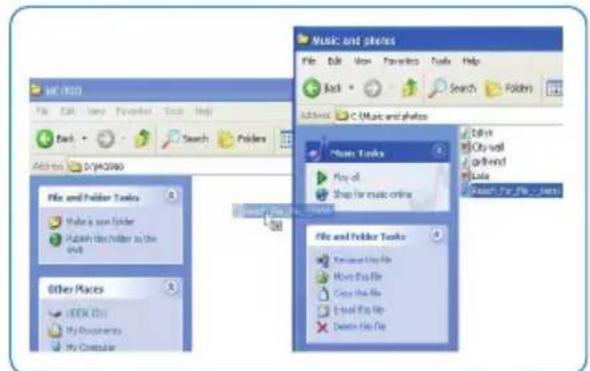
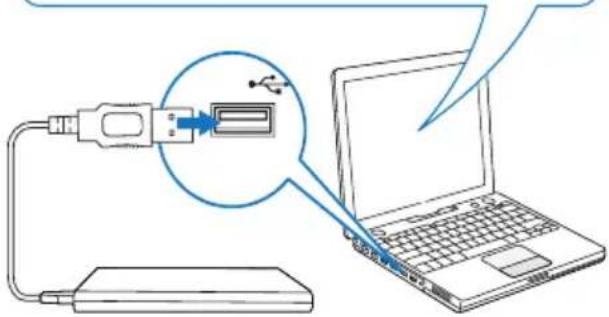
Transfer music/picture files from the computer to HDD. You can play music and photos on MCi900.
1 On the computer, under [My Computer] or [Computer],
Find the HDD of MCi900;
Find the desired music folder.
2 From the music/photo folder on your computer, drag and drop music/picture files to the HDD.

Tip
Copy media files to the HDD, regardless of the folder structure.
The music/picture file transfer may take you some time. You may proceed to next steps when transferring music/picture files to the HDD.
Install batteries into the remote control

Caution
Risk of explosion! Keep batteries away from heat, sunshine or fire. Never discard batteries in fire.
Risk of decreased battery life! Never mix different brands or types of batteries.
Risk of product damage! When the remote control is not used for long periods, remove the batteries.
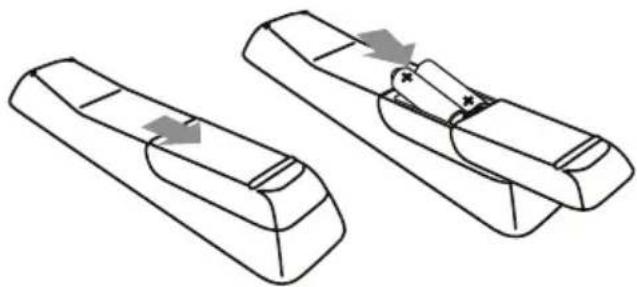
① Open the battery compartment. ② Insert two AAA R03 batteries with correct polarity (+/-) as indicated. ③ Close the battery compartment.
4 Place the unit
![graph TD A["Internet"] --> B["PC"] B --> C["TV"] C --> D["MCi900"] D --> E["Laptop"] E --> F["Internet"] style A fill:#f9f,stroke:#333 style B fill:#ccf,stroke:#333 style C fill:#cfc,stroke:#333 style D fill:#fcc,stroke:#333 style E fill:#ffc,stroke:#333](/content/2026/06/1278820/images/4b6d94a6c218a98e0e937599fe8ca08391582f71d69fbb0b934ce1839a2db796.jpg)
- Place MCi900 near a TV to use the disc player.
For good Wi-Fi reception, place the unit • within the coverage of the router/ Access point (not supplied).
To avoid magnetic interference or • unwanted noise, never place this apparatus and speakers too close to any radiation devices.

Note
Never place this unit in an enclosed cabinet. • Install this unit near the AC outlet where the AC power plug can be easily reached.
Place the Soundsphere speakers
About Soundsphere speakers
The supplied Soundsphere speakers can produce full-frequency sounds throughout the area of coverage.
Unlike conventional speakers, Soundsphere speakers are much less sensitive to exact positioning. The mid- and high-frequency sounds from Soundsphere speakers are retained, even if you move away from the Soundsphere speakers. Thus, the authentic sound experience can be extended to all sides of the speakers.
How to place the soundsphere speakers
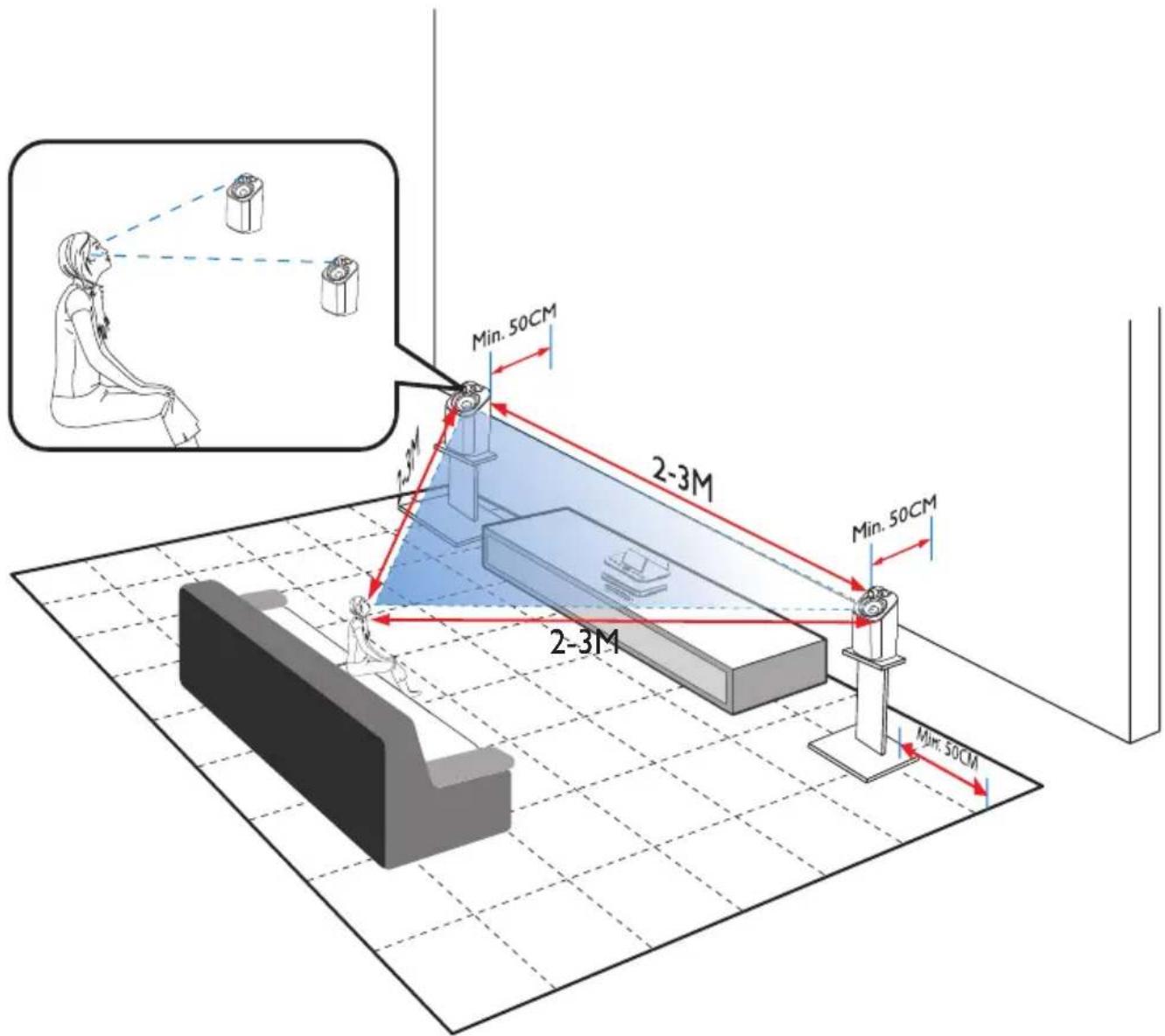
For the best listening experience:
Place the speakers with the tweeters • at the ear height, and at least 50 cm away from the rear wall.
Place the speakers on speaker stands to get the best result.
Place the speakers 2 to 3 meters away from each other, with the two speakers and your preferred listening position forming an equilateral triangle.
Place the speakers with the tweeters facing your preferred listening area.
To keep the tweeters unobstructed, never place the speakers in between shelves.

Tip
Alternatively, you can place the Soundsphere speakers on the floor or on top of shelves, though not preferable.
By placing the speakers at least 50 cm away from the rear wall, you can make the bass tighter and improve your listening experience.
5 Connect
Connect the main unit and CD/DVD unit
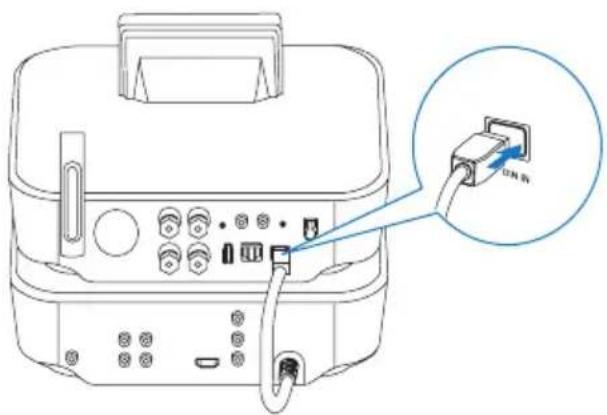
As shown, plug the cable into
Connect speakers

Note
- Always connect the speakers before you connect MCi900 to an AC power outlet. By doing so, you can avoid the big noise that may be caused during speaker installation by the speaker wires on the metallic surface of MCi900. 1 On MCi900, ensure that you connect the left speaker to LOUDSPEAKERS L+, L- and right speaker to LOUDSPEAKERS R+, R-. 2 To connect the speakers,
As shown, unscrew to loosen the connectors;
Fully insert the ends of speaker wires, red end into the red connector, and silver end into the black connector;
Screw the connectors until the speaker wires are securely fastened.
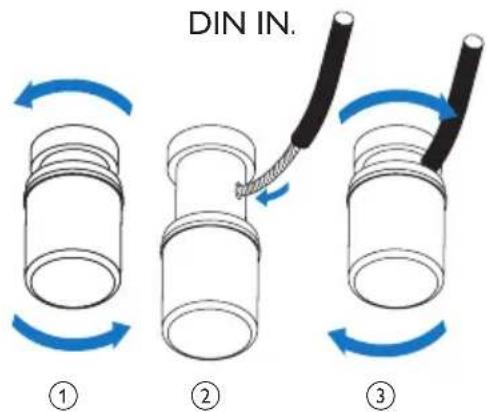
Connect for disc play
For disc play, make audio/video connections.
Connect a TV
On MCi900, you can connect a TV through one of the two video jacks.
Select the video jack that your TV supports:
Composite video (CVBS): for a standard TV;
HDMI jack: for a high-definition TV compliant with HDMI (High Definition Multimedia Interface)/DVI (Digital Visual Interface), and HDCP (High-bandwidth Digital Contents Protection).
Using the CVBS jack
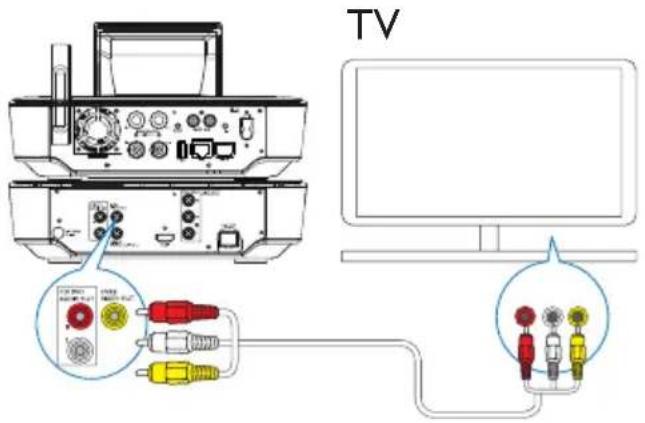
As shown, plug the supplied composite audio/video cable into the corresponding sockets.
Using the HDMI jack (sold separately)
Use the HDMI jack to connect a high-definition TV (HDTV), which is equipped with HDMI (High Definition Multimedia Interface) or DVI (Digital Visual Interface), and compliant with HDCP (High-bandwidth Digital Contents Protection).
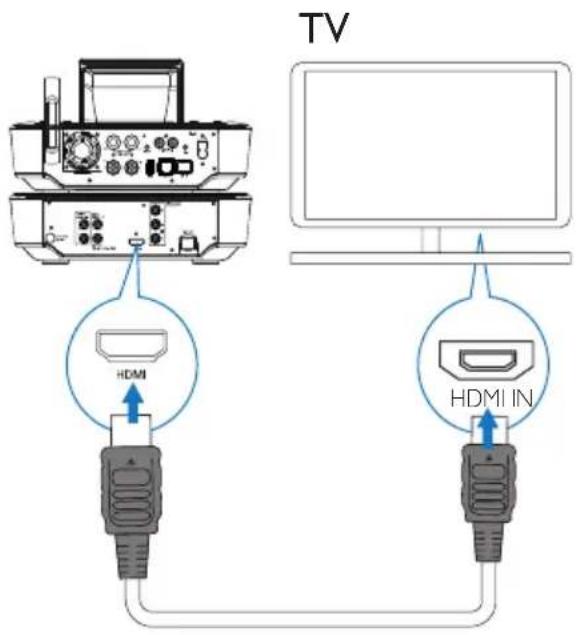
As shown, connect an HDMI cable (not supplied) to:
the HDMI socket on this unit, and the HDMI input socket on the TV.
For TV/monitor with a DVI jack only, use a DVI-to-HDMI adapter.

Tip
As a compact audio/video interface, HDMI transmits uncompressed digital data. With the HDMI connection, high-definition video/audio contents can present optimum video and audio quality on a HDTV.
Play from another speaker system
To play from another speaker system, connect a digital audio cable (not supplied) to:
the CD/DVD DIGITAL AUDIO OUT socket on MCi900;
the digital audio input on an external speaker system.
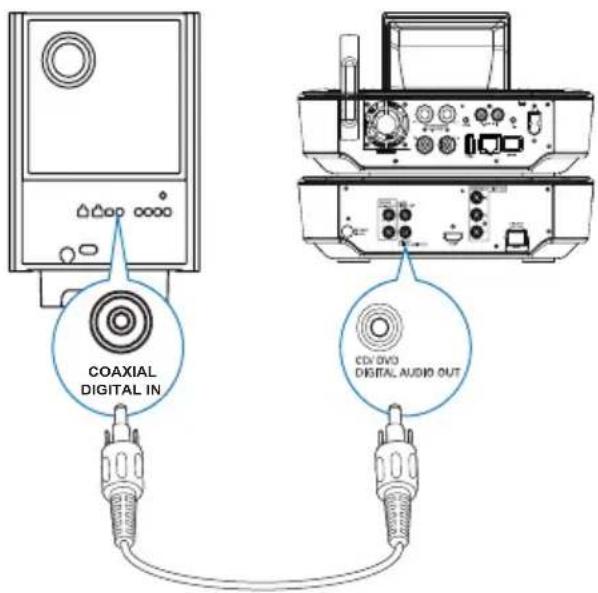

Note
Ensure that the external audio system is switched to the Aux-in mode, if you are playing sounds from the speaker system on an external audio system.
Connect the FM antenna
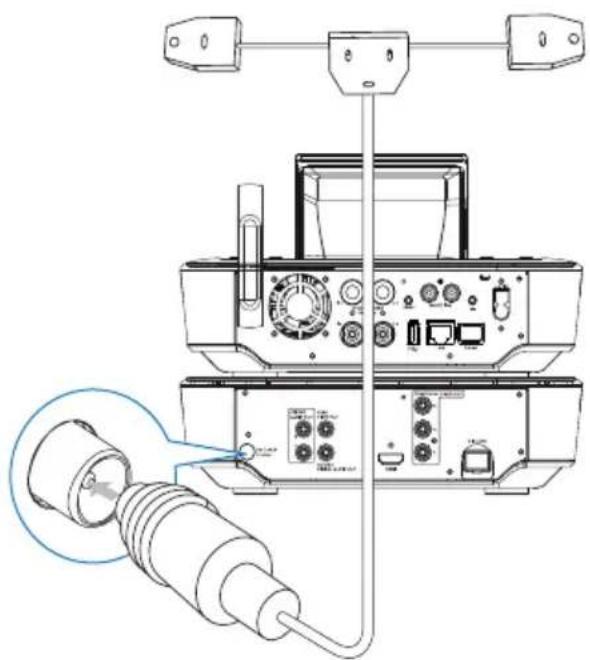

Note
Always plug in the FM antenna before tuning to an FM radio station.
Connect the supplied FM T-type antenna to the FM TUNER socket on the unit;
Stretch the antenna to its full length, and fix it on the wall.
Connect external audio devices
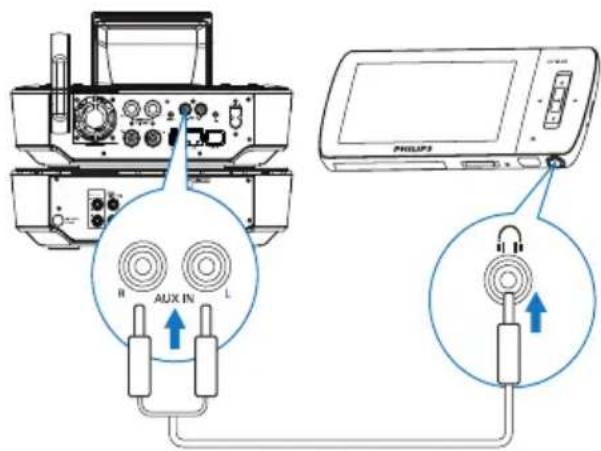
You can listen to an external audio device through the speakers on MCi900. To do so, do the following connections, and then, select the AUX mode on MCi900.
Connect audio cables (red/white - not supplied) to:
the AUX IN L / R sockets on this unit, and
the audio output sockets on the external audio device.
Or, to play from a portable media player with 3.5mm headphone jack
Connect a headphone to RCA cable (not supplied) to:
the AUX IN L / R sockets on this unit, and
the 3.5mm headphone jack on the portable media player.
Turn on/off
Connect power supply

Warning
Risk of product damage! Ensure that the power supply voltage corresponds to the voltage printed on the back or the underside of the product.
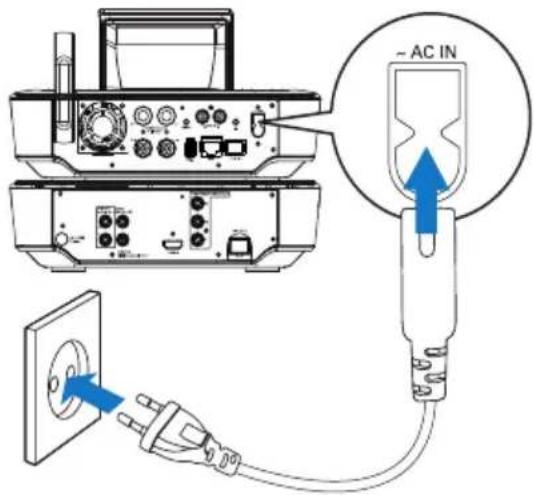
Connect MCi900 to the power supply.

Note
The type plate information is located at the back or at the underside of the product.
Turn on/off
1 Press a source selector to turn on the unit. 2 To turn off the unit, press ⬤ to switch to active standby; or, press and hold ⏻ to switch to Eco standby (energy-saving mode).
Active standby
When in active standby, some major functions of MCi900 remain in the normal state of power consumption, e.g. Wi-Fi connection, clock display. Thus, MCi900 can quickly go to the running state when you switch MCi900 from active standby to on.
In active standby:
The power indicator lights up red;
Clock time is displayed if you have set the clock.
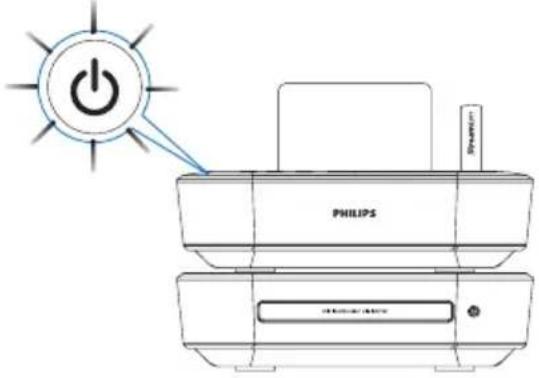
And, the unit is still connected to the Wi-Fi/wired network.
Auto active standby
If no activity happens on MCi900 for 10 minutes, MCi900 can switch to active standby automatically.
Eco standby
Eco standby is an energy-saving mode. In Eco standby, all major functions are switched to a low-power state or off, e.g. micro-processor, Wi-Fi connection, display, and hard disk.
6 First-time setup
The first time you turn on MCi900:
1 Select the desired language on the screen as prompted. 2 To learn major functions on MCi900:
Select [Yes, show me the demo] when asked whether to view demo.
If necessary, press •+VOL to adjust the volume.
To exit the demo play, press 🔊.
The unit is switched to Eco → standby.
Press → again to turn on MCi900, and restart the setup.
To proceed to network setup,
Select • [No], when asked whether to view demo.
3 Select your location and time zone from the list as prompted. 4 Select [Yes], when asked whether to set up network connection.
Connect to home Wi-Fi/wired network
Connect wirelessly
![graph LR A["Global"] --> B["Rutier"] B --> C["Laptop"] C --> D["Mac"] B --> E["Printer"] style A fill:#f9f,stroke:#333 style B fill:#ccf,stroke:#333 style C fill:#cfc,stroke:#333 style D fill:#fcc,stroke:#333 note right of C: Media Browser (PC)/TwonkyMedia Server (Mac)](/content/2026/06/1278820/images/8026ac5c84ff20de01492c814ea62364f602e48cf96bf551c57f486e0e099dff.jpg)
Connect through an Ethernet cable
![graph LR A[" globe "] --> B[" router "] B --> C[" MCi900 "] B --> D[" TwoknyMedia Server (Mac) "] D --> B](/content/2026/06/1278820/images/2ef80eb197a3206ac4f9f54c8ec374f77e456c919ae2bc4bed950da78c87f9cd.jpg)
You can connect MCi900 to home Wi-Fi/wired network in different ways: wireless or wired, automatic or manual.
Use a router (or Access Point) for home • Wi-Fi/wired network. That is, connect computers/devices to a router.
Connect • MCi900 to the router wirelessly or through an Ethernet cable.
To have the unit connected to the • Internet over home Wi-Fi/wired network, ensure that the router connects to the Internet directly and no dial-up is required on the computer.
To switch between different connection methods (wireless or wired, automatic or manual), or switch between different routers, go to [Settings] > [Network settings] > [Setup network].
Wireless connection: One-touch Wi-Fi Protected Setup (WPS)
MCi900 supports Wi-Fi Protected Setup (WPS). You can quickly and securely connect MCi900 to a wireless router that also supports WPS.
You can select one of the two setup methods: PBC (Push Button Configuration), or PIN (Personal Identification Number).

Tip
Wi-Fi Protected Setup (WPS) is a standard created by the Wi-Fi Alliance for easy establishment of secure wireless home networks.
Turn on WPS-PBC on MCi900
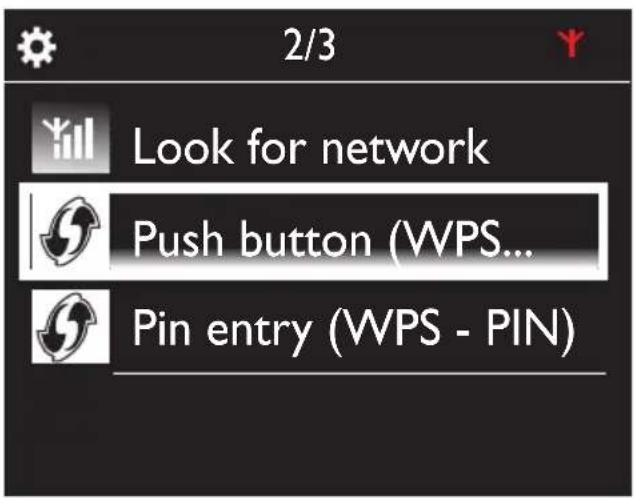
1. Select [Yes] when asked whether to set up network connection (see 'First-time setup' on page 28). 2. Select [Wireless (WiFi)] > [Push button (WPS - PBC)].
Add MCi900 on the router
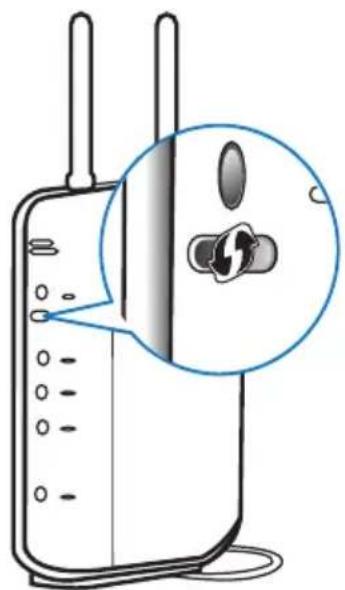
Consult the user manual of the router to learn how to add a WPS device to the router. For example: press and hold the WPS push button.
The router starts to search for a WPS device.
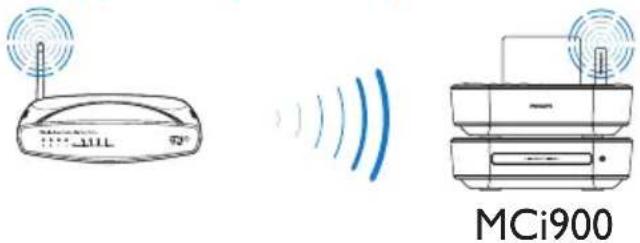
On MCi900, a message appears when the connection is completed successfully.

Tip
To use PIN (Personal Identification Number) as the setup method: On MCi900, select
[Wireless (WiFi)] > [Pin entry (WPS - PIN)], and write down the PIN that is displayed on MCi900; On the router, enter the PIN.
Consult the user manual of the router to learn how to enter the PIN on the router.
Connect to the Internet
Connect to the Internet as prompted. You enter the Home screen after the first-time setup is complete.
![graph TD A[" globe"] --> B[" printer "] B --> C[" router "] style A fill:#f9f,stroke:#333 style B fill:#ccf,stroke:#333 style C fill:#cfc,stroke:#333 note right of B: MCi900](/content/2026/06/1278820/images/ff829a09fd3614ba4335c0843096fa3e25e9358d7109d34666da0e591dd0ddd9.jpg)
Internet

Note
Ensure that the router connects to the Internet directly and no dial-up is required on the computer.
Wireless connection: Enter encryption key manually

Tip
Before you start the network setup, have the encryption key to your router ready.
1 Select [Yes], when asked whether to set up network connection (see 'First-time setup' on page 28). 2 Select [Wireless (WiFi)] > [Look for network]. The unit starts to search for wireless networks. A list of available Wi-Fi networks appears.
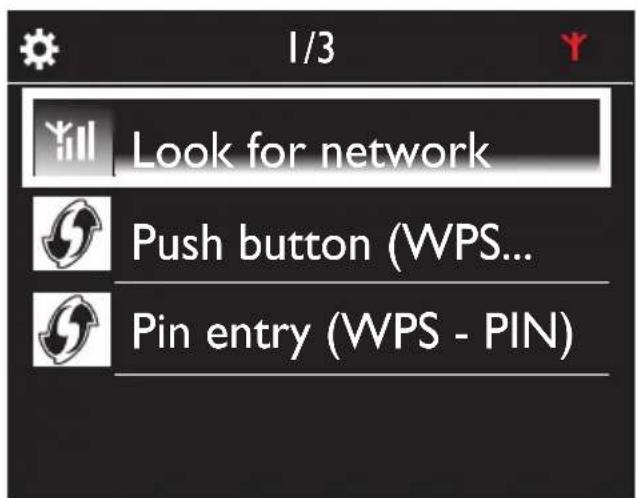
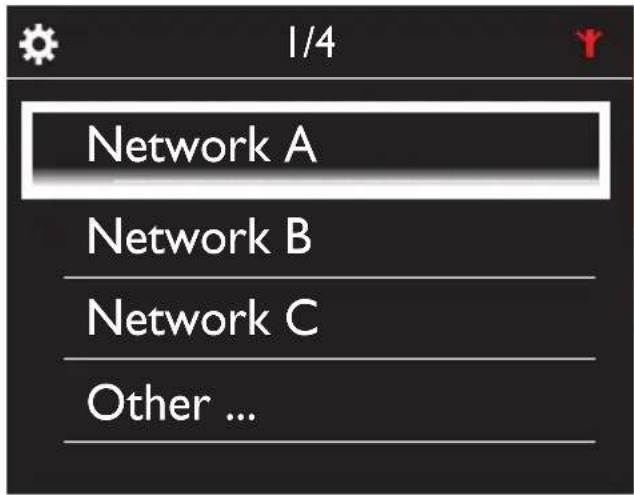
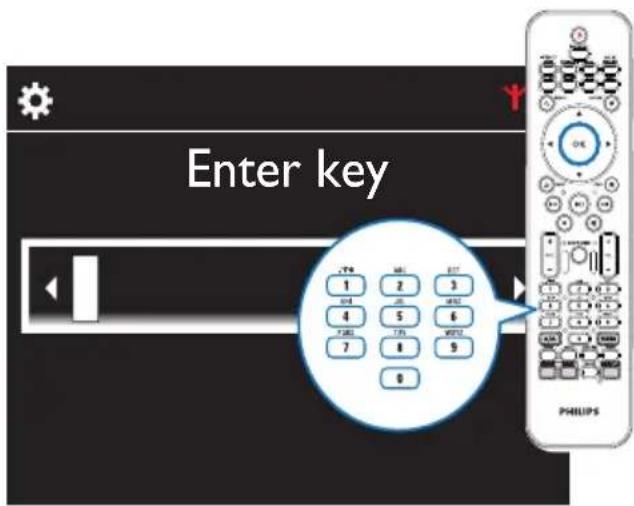
3 Select the desired Wi-Fi network. 4 As prompted, enter the encryption key to the network.
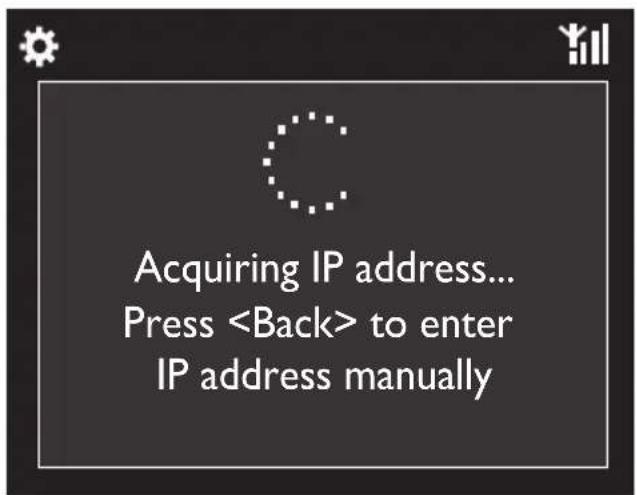
The unit starts to acquire an IP address assigned by the Wi-Fi network automatically.
A message appears when the connection is completed successfully.
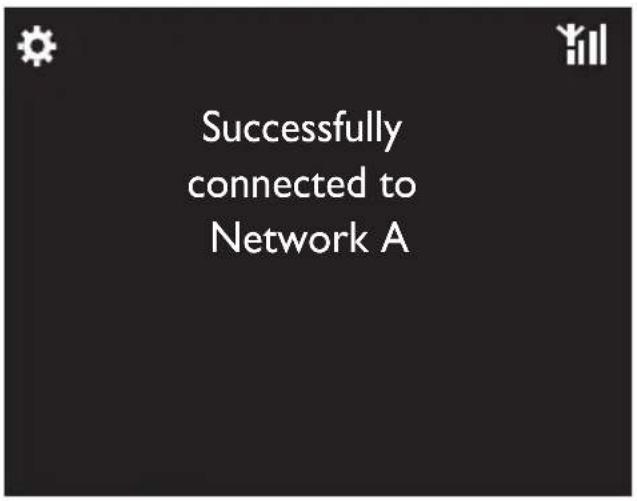

Tip
If you have hidden the SSID of the router (e.g., disable the SSID broadcasting), go to the end of the list of Wi-Fi networks. Select [Other...] > [Manual SSID entry]. In the text box, enter the name of the router.

Note
The router may fail to assign an IP address if the DHCP (Dynamic Host Configuration Protocol) is unavailable or disabled on the router. You may need to enter the IP address manually, or press BACK to start reconnecting.
Wireless connection: Enter IP address manually
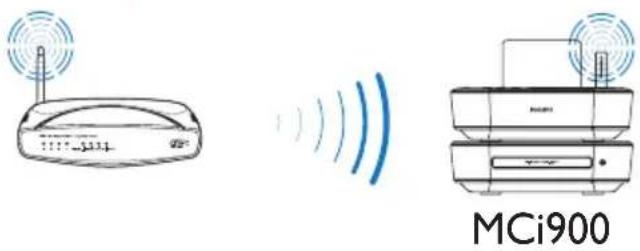
Stop getting Auto IP
1 Search for the home Wi-Fi network, and then connect to it. The unit starts to acquire an IP address assigned by the Wi-Fi network automatically.
2 Press BACK on the remote control to stop getting auto IP.
![graph TD A["SEARCH"] --> B["OK"] C["FAVORITE"] --> B D["BACK"] --> B E["HOME"] --> B](/content/2026/06/1278820/images/7837081588f21d6f1d430183a84b61c630feb512883320fb66a3de6ff157cc7f.jpg)
Get the IP address of the router
Consult the user manual of the router.
Or, to check the settings of the router, enter the IP address (e.g., 192.168.1.1) in the web browser (e.g., Internet Explorer) of the computer, and then get the desired information in the setup page.
Enter the IP address manually
On the MCi900, enter an IP address that allows the unit to be in the same subnet as the router. For example, if the router has IP address: 192.168.1.1, Subnet mask: 255.255.255.000; Then, enter the following on the unit: IP address: 192.168.1.XX (where XX denotes a number), Subnet mask: 255.255.255.000.
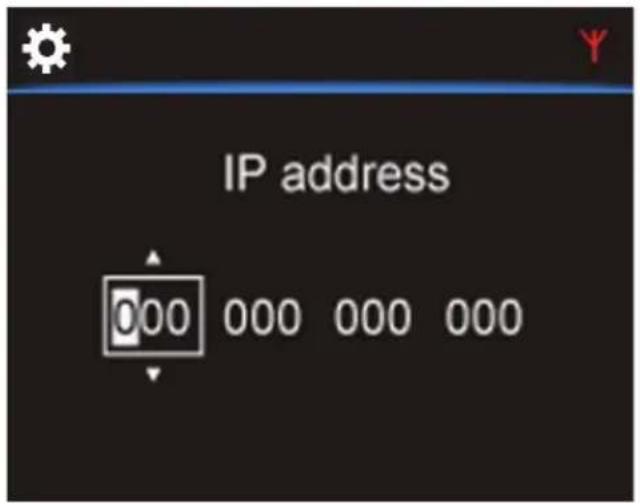
- Press ◄/▶ repeatedly to select the entry location; to enter the desired digits, use the alphanumeric buttons on the remote control; or press ▲/▼ repeatedly.

Note
- Ensure that you never enter an IP address that is already assigned to a computer/device on the network.
Wired connection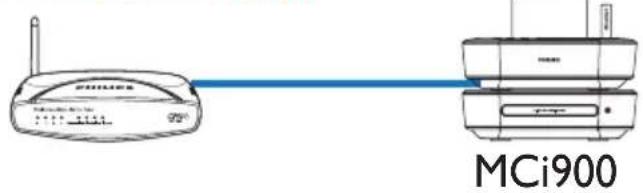
Connect to the router by using the Ethernet cable
1 Select [Yes], when asked whether to set up network connection (see 'First-time setup' on page 28). 2 Use an Ethernet cable to connect the unit to the router.
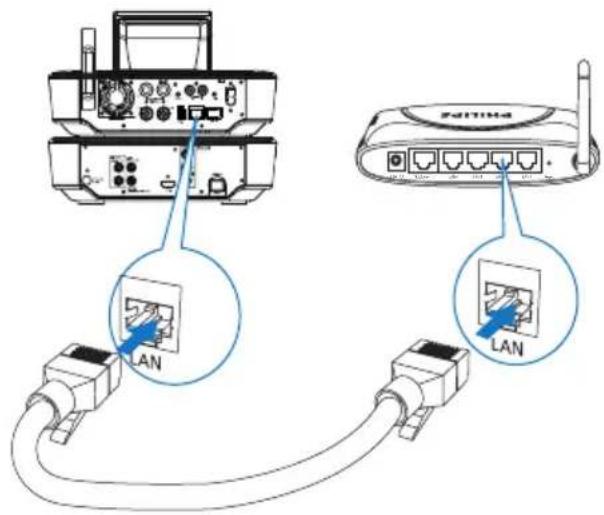
Connect to the home Wi-Fi/wired network
On the unit, select [Wired (Ethernet)].
The unit starts to acquire an IP address assigned by the network automatically.
A message appears when the connection is completed successfully.
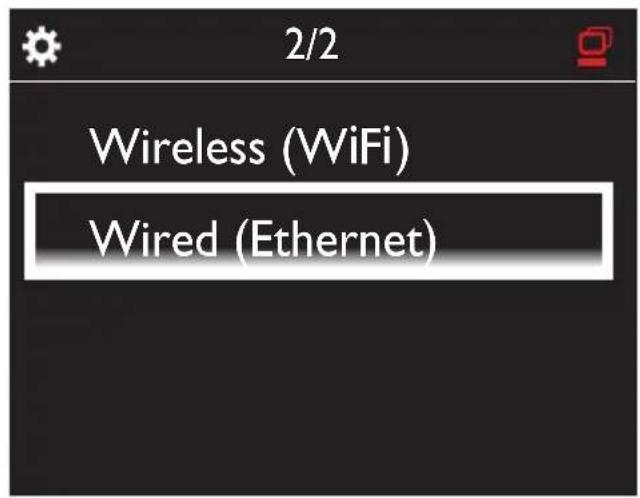

Tip
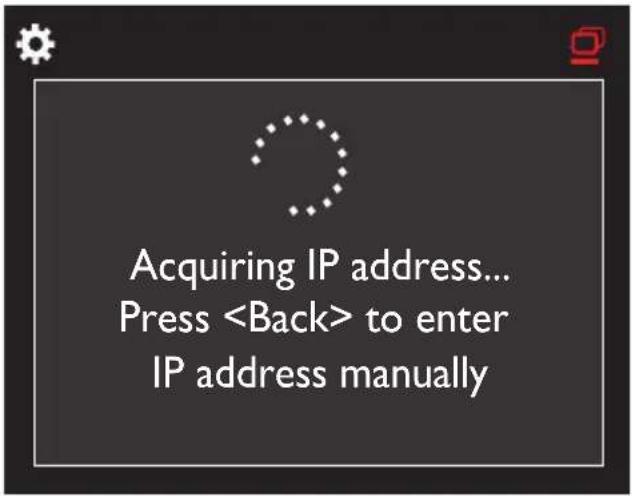
The router may fail to assign an IP address, if the DHCP (Dynamic Host Configuration Protocol) is unavailable or disabled on the router. You may need to enter the IP address manually, or press BACK to start reconnecting.
Connect to the Internet
Connect to the Internet as prompted.
You enter Home screen after the first-time setup is complete.
![graph TD A[" globe"] -->|dashed blue line| B[" printer"] B --> C[" router "] C --> D[" PC"]](/content/2026/06/1278820/images/2a7a4855a32cc072795ccec70dffc997871a79242feb7a661a535df7ebf83706.jpg)
Internet

Note
Ensure that the router connects to the Internet directly and no dial-up is required on the computer.
Wired connection: Enter IP address manually
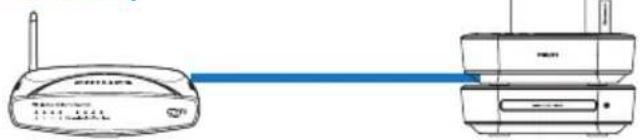
MCi900
Stop getting Auto IP
1. Use an Ethernet cable to connect the unit to the router. 2. On the unit, select [Wired (Ethernet)]. 3. Press BACK on the remote control to stop getting auto IP.
![graph TD A["SEARCH"] --> B["OK"] C["FAVORITE"] --> B D["BACK"] --> B E["HOME"] --> B](/content/2026/06/1278820/images/64c1e6e815f82bddf54aa1da31fef619642a400a9673e9f4f0d2fe247295e817.jpg)
Get the IP address of the router
Consult the user manual of the router. Or, to check the settings of the router, enter the IP address (e.g., 192.168.1.1) in the web browser (e.g., Internet Explorer) of the computer, and then get the desired information in the setup page.
Assign the IP address manually
On the MCi900, enter an IP address that allows the unit to be in the same subnet as the router.
For example, if the router has IP address: 192.168.1.1, Subnet mask: 255.255.255.000;
Then, enter the following on the unit: IP address: 192.168.1.XX (where XX denotes a number), Subnet mask: 255.255.255.000.
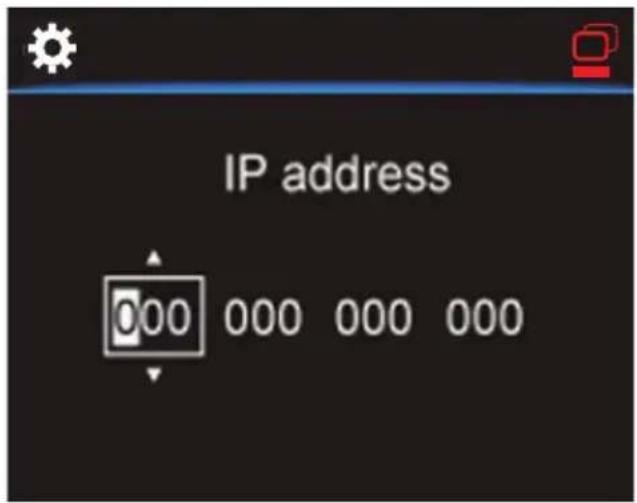
Press ▶ repeatedly to select the entry location;
To enter the desired digits, use the alphanumeric buttons on the remote control; or press ▲/▼ repeatedly.

Note
Ensure that you never enter an IP address that is already assigned to a computer/device on the network.
7. Play from home Wi-Fi/wired network
Play from the hard disk drive (HDD)
Connect the HDD to MCi900
After you have transferred music/picture files from the computer to HDD (see 'Prepare' on page 19),
1 Install the supplied software on the computer: Media Browser for PC, TwonkyMedia Server for Mac. On the computer, find the "MCi900 folder" you copied from the HDD; Run the setup file under • TwonkyMedia folder to start installation on the computer.
2 Ensure that you have removed the HDD safely from the computer.
3 Connect the HDD to MCi900.
![graph TD A["Printer"] -->|Close-up cable to printer via cable connector| B["Laptop"] B --> C["Printer with cable connector"]](/content/2026/06/1278820/images/f238c8e7207850ce4e70d1c73aaa0b18d729533fa8f41070db29c5ef3283d9a8.jpg)

Tip
With the software installed, the computer can work as a music server. You can stream music/pictures from the computer to MCi900, if both of them are connected to the home Wi-Fi/wired network.
Library on the HDD
You can transfer the music/ picture files from a computer to the HDD in two ways:
by using a USB cable that connects the HDD to the computer; or, through the home Wi-Fi/wired network.
Transfer through the home Wi-Fi/wired network
Through the network, you can conveniently transfer a smaller number of songs/pictures from the computer to HDD, without removing the HDD from MCi900.
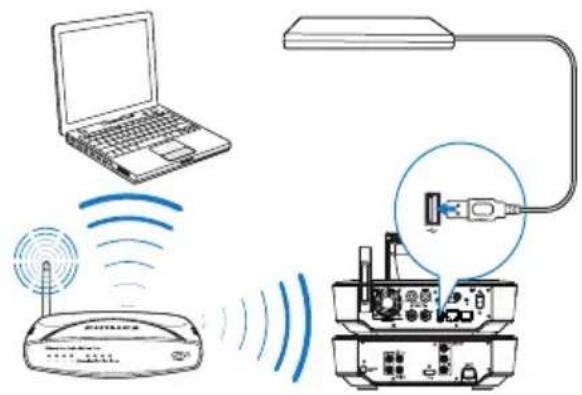
1 Ensure that the computer is connected to the home Wi-Fi/wired network. On MCI900, ensure that The HDD is properly connected;
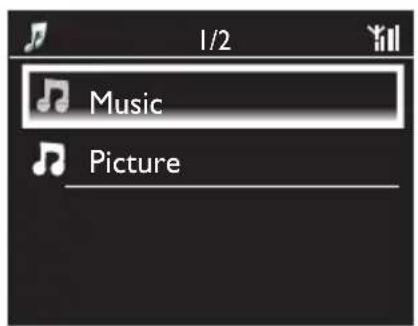
- In [Settings] > [Network settings], "[USB sharing]" is turned on.
For computers running Windows XP Professional:
2 The first time you connect the HDD as a network drive, assign a network drive to the HDD on the computer.
On the computer running Windows XP, double click [My Computer]; On the computer running Windows Vista, double click [Computer].
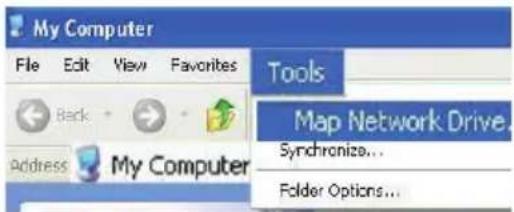
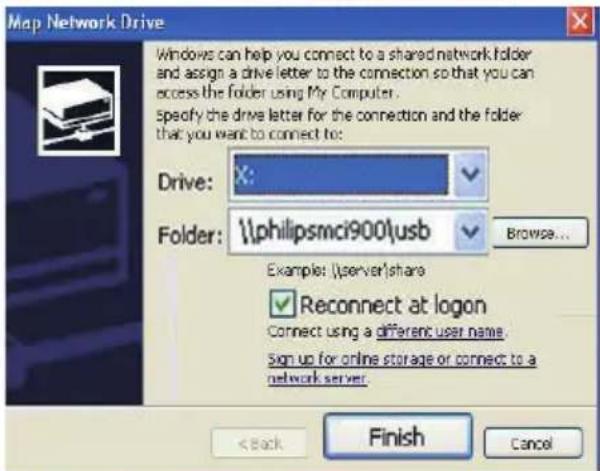
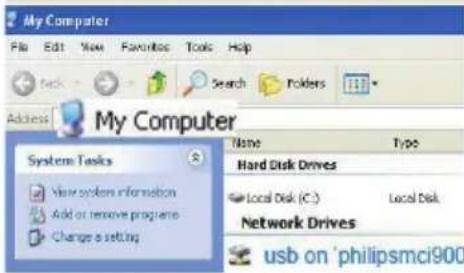
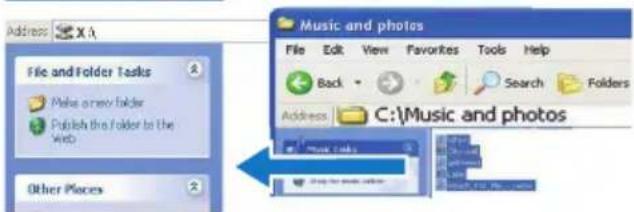
• On [My Computer], select [Tools] > [Map Network Drive]; - Click to assign a network drive to the HDD (e.g. X: as shown). As shown, type in the HDD name \Philipsmci900\usb. Click [Finish].
3 On [My Computer] (Windows XP), or [Computer] (Windows Vista),
Find the HDD under [Network • Drives];
Find the music/photos folder on the computer.
For computers running Mac OS X:
As shown, select [Go] > [Network];•
Under [SHARED], select [All] > • [philips-network];
On [philips-network], select • [philipsmci900], and then [usb].
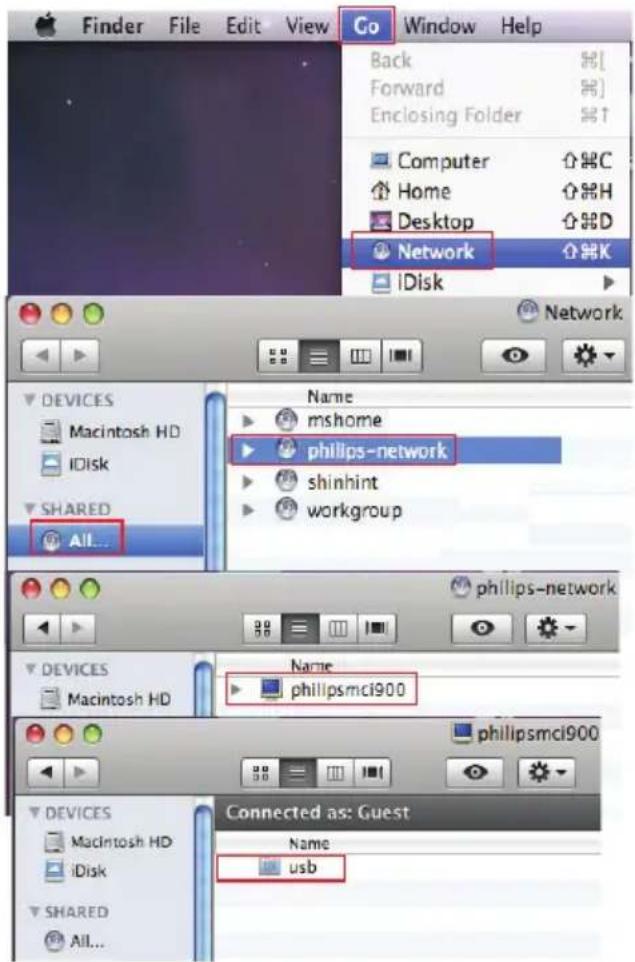
Find the music/photos folder on the computer.
4 Drag and drop music/picture files from the music/photos folder to MCI900.
On MCi900, You can switch to the → music/photo collection on the [HDD] source (Press HDD on the remote control).

Tip
In the case of a large number of media files, • network performance may affect the transfer speed, or even cause the interruption of transfer.
- Philipsmci900 is the default device name. To change the device name, go to [Settings] > [Device ID and information].
Organize files on the HDD
- Audio files:
If the files contain file information (meta tag or ID3 tag), the files can be sorted automatically by the file information, like Artist, Album, Genre, and others.
Launch media management software to check or edit the file information. For example, click as shown in Windows Media Player 11. Select the desired song, and then, double click it to edit.
Media Player 11. Select the desired song, and then double-click it to edit.
![Windows Media Player Library Rip Burr Music > Li Playlists Create Library Recent Artist Album Songs Genre Year Rating Shania Push (148) Unknown Year Beethoven [Vox] Disc 1 Various Artists Classical 2002 Title Symphony No. 9 (Sherzo) Play All Play Add to Now Playing Add to Edit](/content/2026/06/1278820/images/90bf6845f5e791ed80d9a6023552f88ee28f285d9d7e733723eed6d533240430.jpg)
If necessary, you can also organize audio files in different folders as desired.
Organize files in different folders as desired. The folders are sorted in an alphabetical order.
Organize files in different folders as desired. The folders are sorted in alphabetical order.
1 On MCi900, ensure that the HDD is properly connected. 2 On the remote control, press HDD.
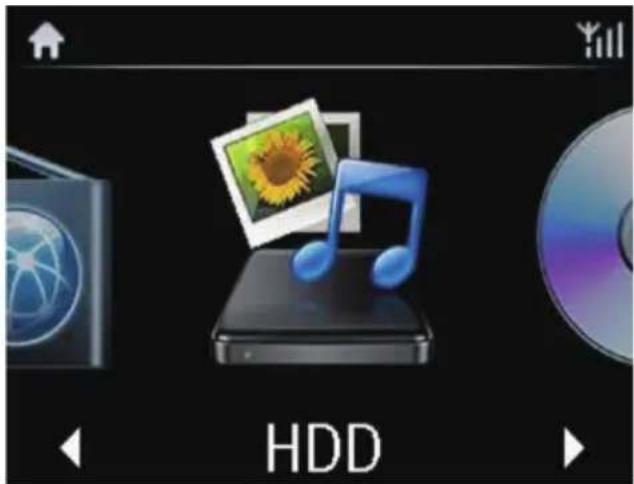
1 On MCi900, ensure that the HDD is properly connected. 2 On the remote control, press HDD.
The file sorting process may take some time. During file sorting, the file folders are displayed.
Audio files are displayed under different categories (e.g. Artist, Album, Genre), if meta/ID3 tags are edited for the files.
3 Select your desired track or album. 4 Press to start play.
3 Select your desired track or album. 4 Press to start play.
Play starts from the beginning of the album, if you press ▶ on an album.
Play screen appears when play starts • (see 'Play screen' on page 17).
5 To stop play, press .
Stream from a UPnP server
Media Browser (PC)/ TwonkyMedia Server (Mac)
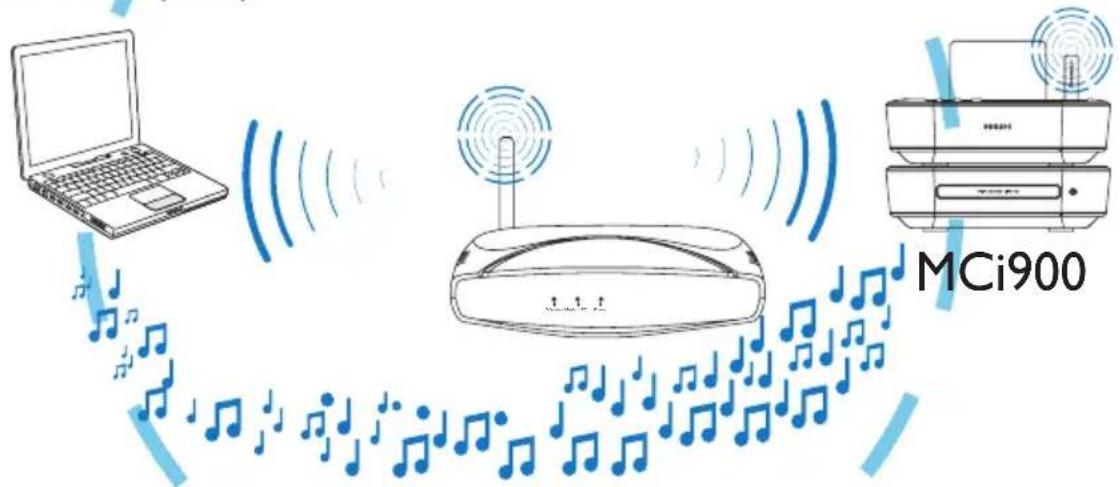
You can stream music/photos between computers and MCi900, when
- MCi900 is connected to home Wi-Fi/wired network;
Music sharing is set up on the computers, • other UPnP servers that are also connected to the home Wi-Fi/wired network.
With the music sharing software (the supplied Media Browser and TwonkyMedia Server), such computers can work as UPnP media servers (music/photo libraries) of MCi900, if they are turned on.
Through the UPnP (Universal Plug and Play) protocols, a UPnP media server allows music or picture files to be streamed from the server to a UPnP client device (e.g. MCi900). On the UPnP client device, you can play the music and pictures from the server.
MCi900 can also be the UPnP media server of such computers and other UPnP devices that are connected to the home Wi-Fi network, if MCi900 is turned on or switched to active standby.
Connect a hard disk drive (HDD)* to MCi900. Music and pictures on the HDD can be played on such computers and UPnP devices.

Tip
*The Hard disk drive (HDD) can have a maximum capacity of 160 GB, or up to 40,000 media files.
Library on a UPnP server
On the computers (UPnP servers), the supplied software Media Browser or TwonkyMedia Server can access music libraries that are organized by different media management software, including Windows Media Player 11 and iTunes.
iTunes is a trademark of Apple Inc., registered in the U.S. and other countries.
Stream from a UPnP server
On MCi900, play music/picture libraries that are streamed from a UPnP server (a computer on the home Wi-Fi/wired network).
1 Ensure that the UPnP server is connected to the home Wi-Fi/wired network.
2 On MCi900, press MEDIA LIB. on the remote control.
• Or, from Home screen, select [Media Library].
3 Select a music/pictures library. You can see the categories by which the music/pictures are sorted (e.g. Artist, Album, Genre).
4 Select your desired track or album.
5 Press ▶ to start play.
• Play starts from the beginning of the album, if you press ▶ on an album.
• Play screen appears when play starts (see 'Play screen' on page 17).
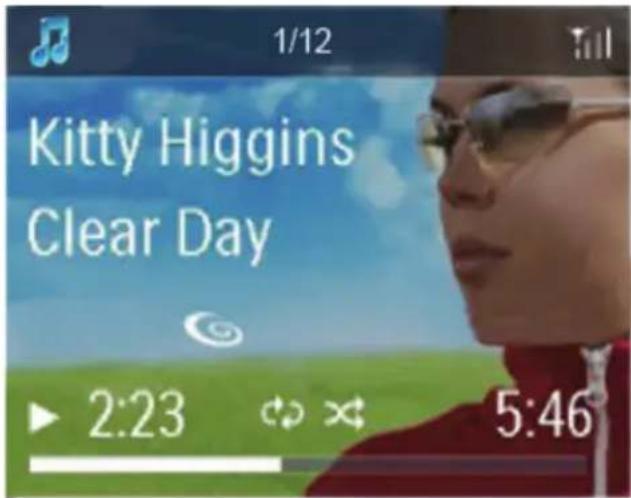
6 To stop play, press .
Play favorite songs
On MCi900, you may wish to listen to certain songs from different artists, albums, and genres. Add the songs to [Favorites].
1 Go to a list of songs.
2 On the remote control, press FAVORITE to add the current song to [Favorites].
Or, press FAVORITE while listening to a song.
A list of favorite songs is created under [Media Library] > [Favorites].
3 To find and play the favorite songs, press HOME on the remote control.
From the home screen, you can find the favorite songs under [Media Library] > [Favorites].
To remove a favorite song from [Favorites]:
Select the song in [Media Library] > [Favorites]. Press FAVORITE on the remote control.
![graph TD A["SEARCH"] --> B["OK"] C["FAVORITE"] --> B D["BACK"] --> B E["HOME"] --> B](/content/2026/06/1278820/images/8293ee05d3b734f751db98b948fcb1e18c85e78078e2e046c80c817a7a8a2e9d.jpg)
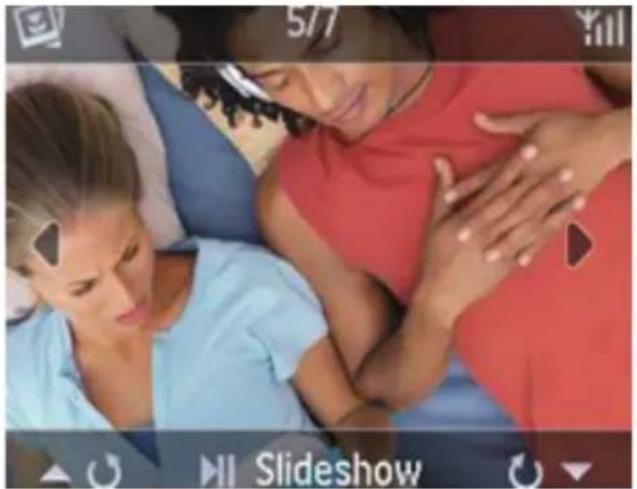
Play photos
Press ▲/▼ to rotate the picture;
Press ◀/▶ to move to the previous/next picture;
Press ▶II to start playing all pictures in slideshow mode.
External control from a PC
Through the home Wi-Fi/wired network, the Media Browser on a PC (UPnP server) allows you to control MCi900.
1 On the PC desktop, launch Media Browser by double-clicking the icon.
2 In Media Browser, select songs to be played on MCi900. Drag the songs to the icon of MCi900.
A green "+" appears if the songs are in supported formats.
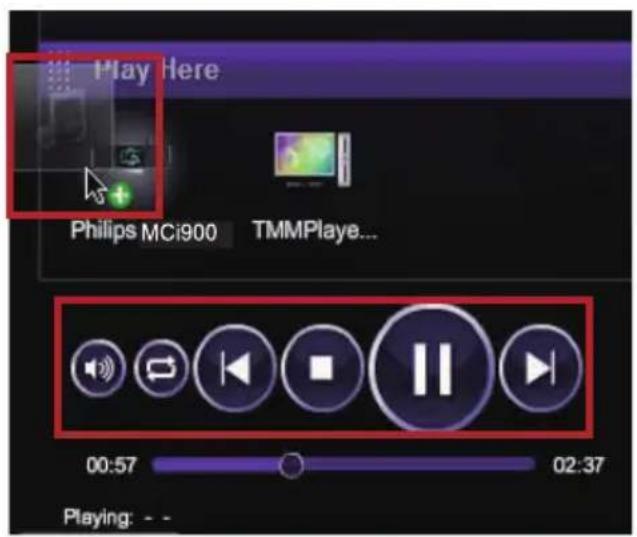
3 On the computer, you can click the buttons to
Adjust the volume;
Select previous/next songs if you have dragged more than one song to MCi900. See Step 2 above.
Fast search forward or backward; play/pause and resume.
4 On MCi900, do the following to exit the external control.
Press • on the remote control;
Press a source selector on the remote control;
Press ;
Press HOME.

Note
The external control is stopped if the sleeper timer is turned on after the set time duration.
Play Internet radio stations
To play Internet radio stations, ensure that
MCi900 is connected to the Internet over the home Wi-Fi/wired network.

Note
- Ensure that the router connects to the Internet directly and no dial-up is required on the computer.
![graph LR A["Internet"] -->|Send| B["MCi900 Printer"] B --> C["Wireless Router"] style A fill:#f9f,stroke:#333 style B fill:#ccf,stroke:#333 style C fill:#cfc,stroke:#333](/content/2026/06/1278820/images/f4d4d1eee74f73a05b924618ffe69578bda6e142a8a884650355ab7ec20cdda5.jpg)
Tune to Internet radio stations
1 Ensure that MCi900 is connected to the Internet. 2 On MCi900, press INTERNET RADIO on the remote control.
Or, from Home screen, select • [Internet Radio].
3 To search for radio stations, Go to [All stations] > [Locations] to • locate stations by region; To search for a station by name, • use the remote control to start alphanumeric search or Superscroll (see 'Search for music/pictures' on page 46).
4 Select the desired station to start play.
Store preset stations
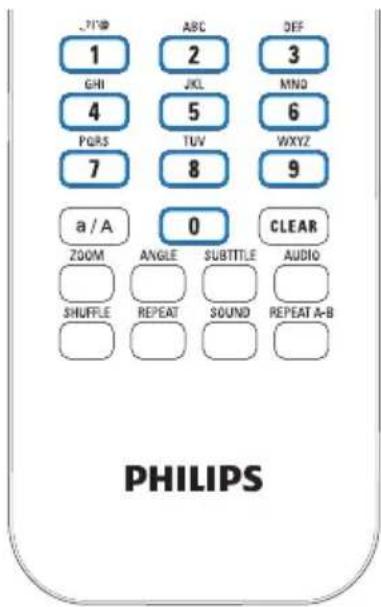
On MCi900, you can store up to 10 preset stations. Each preset station corresponds to a numeric button on the remote control. On the radio play screen, press a numeric button, you quickly switch to the corresponding preset station.
By default, preset stations are pre-loaded to MCi900 according to the location that you select during the first-time setup. To check or change the location, go to [Settings] > [Location and time zone].
To store preset station
1 Play the desired station (see 'Tune to Internet radio stations' on page 42). 2 On the play screen, press and hold the desired numeric button (0-9).
A message appears, indicating that the station is added to the corresponding location.
The new preset replaces the old one if the location has been filled.
To play a preset station
- Go to [Internet Radio] > [Presets]. Or, on the radio play screen, press the corresponding numeric button (0-9).
Edit favorite stations
On MCi900, you can mark an Internet radio station as favorite. All the stations are added to [Internet Radio] > [Favorite stations]. In this way, you can quickly access your favorite stations.
To add a station to [Favorite stations]
- On a list of stations, select the desired station. Press FAVORITE on the remote control. Or, play the desired station. On the play screen, press FAVORITE on the remote control. A message appears, indicating that the station is added to [Favorite stations].
To remove a station from [Favorite stations]
Select the station in the list of stations; or, go to the play screen of the station. Press FAVORITE again.
![graph TD A["SEARCH"] --> B["FAVORITE"] B --> C["OK"] C --> D["BACK"] D --> E["HOME"] E --> F["Return"]](/content/2026/06/1278820/images/536c72243811927d300b2faea1cb4d56a81779fd2afa0cc222bb8a5a955dde21.jpg)
Manage Internet radio online![graph TD A["Internet"] --> B["MCi900"] B --> C["Mac"] B --> D["Router"] C --> E["Computer"] D --> E style A fill:#f9f,stroke:#333 style B fill:#ccf,stroke:#333 style C fill:#cfc,stroke:#333 style D fill:#fcc,stroke:#333 note right of B: http://www.philips.com/welcome](/content/2026/06/1278820/images/65f9a9bf5c0755ce4d8212319405b5bc36edabf0b75c015d0b82d13653ecc3ae.jpg)
By registering MCI900 on www.philips.com/welcome: (see 'Register MCI900 with Philips'
on page 62), you can log in to Club Philips. On Club Philips, you can do the following to manage the Internet Radio on a computer:
Edit favorite stations;
Manually add stations that you are unable to find on MCi900.
Edit favorite stations online
Through Club Philips, you can manage the list of favorite stations on a computer. When connecting MCi900 to the Internet, you update the favorite stations on MCi900.
1 On a computer, log in to Club Philips (see 'Register MCi900 with Philips' on page 62).
2 To mark/unmark stations as favorite:
- Click [Streamium management] > [Favorites] > [Browse];
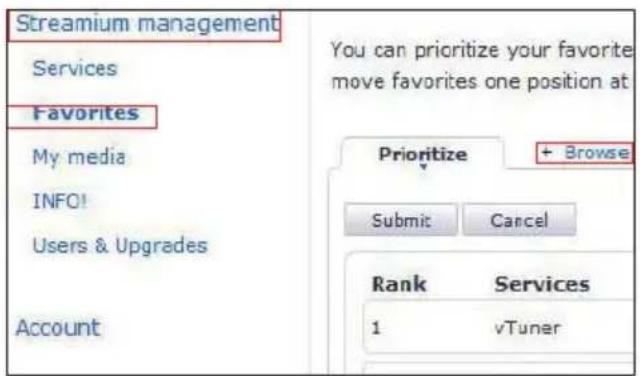
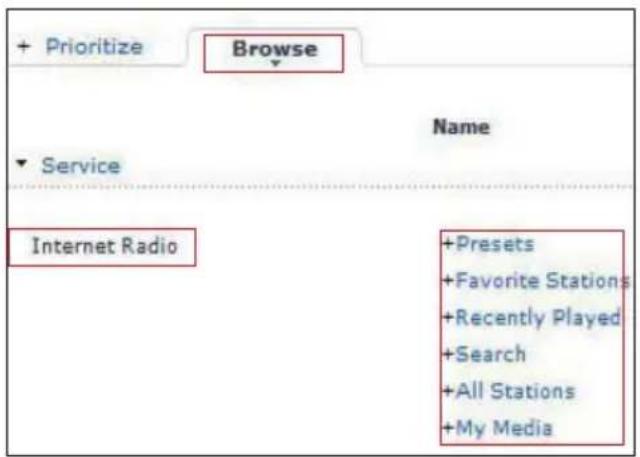
• In [Browse], find the desired stations;
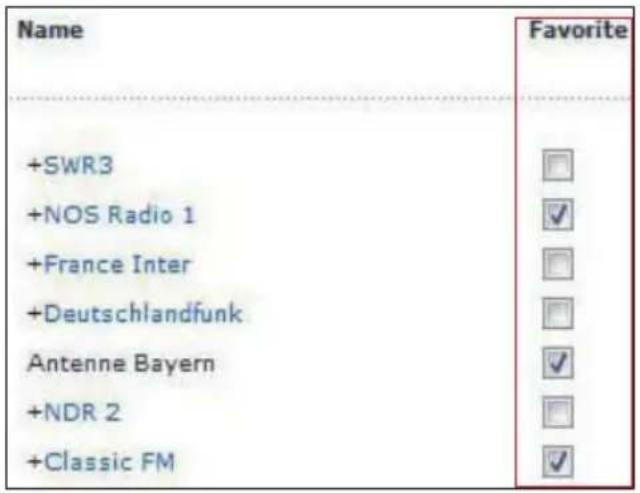
• Under [Favorite], check the box corresponding to the station.
The station is marked as favorite.
To unmark, uncheck the box corresponding to a station.
3 To change the order of favorite stations in the list:
Click [Prioritize];
Click on the row of the station to be moved;
Drag and drop the row upward or downward.
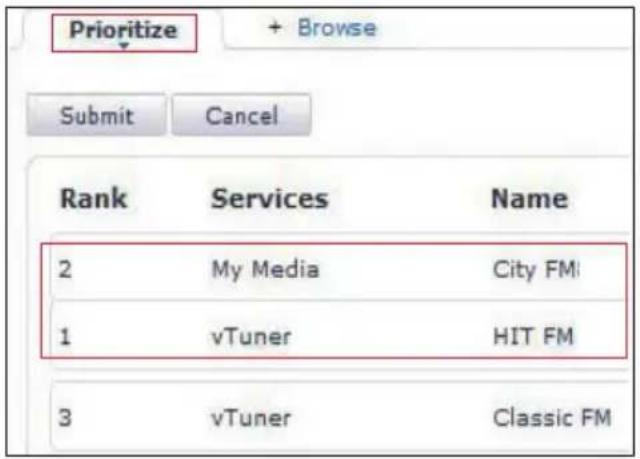
On MCI900, you can find the stations in the desired order under [Internet Radio] > [Favorite stations], if you have connected MCI900 to the Internet.

Tip
In the list of favorite stations, to put a favorite station ahead of the first one, make the station just behind the first one; drag and drop the first station downward.
• To put a station behind the last one, make the station just ahead of the last one; drag and drop the last station upward.
Manually add stations online
Manually add stations
Through Club Philips, you can manually add Internet radio stations to MCi900 on a computer.
1 On a computer, log in to Club Philips (see 'Register MCi900 with Philips' on page 62). 2 To add a station, click [Streamium management] > [My media] > [Music].
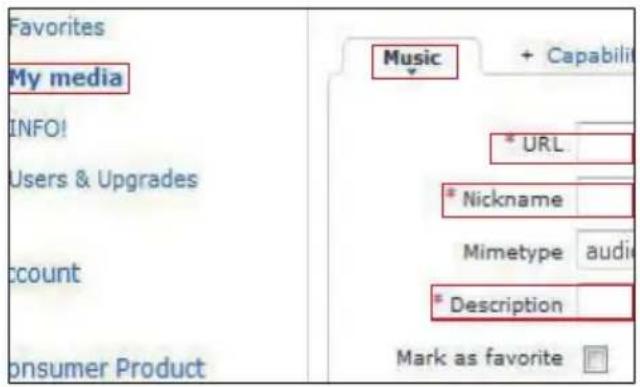
3 In [Music], enter station information in the text boxes:
In [URL], fill in the web site of the station;
In [Nickname], fill in a name that appears as station name in [My media];
In [Description], fill in one-word description about the station, e.g. music, sports, new.
The description is used as a category to sort stations under [My media].
4 Click [Save].
A station is manually added below the edit boxes.
To edit an added station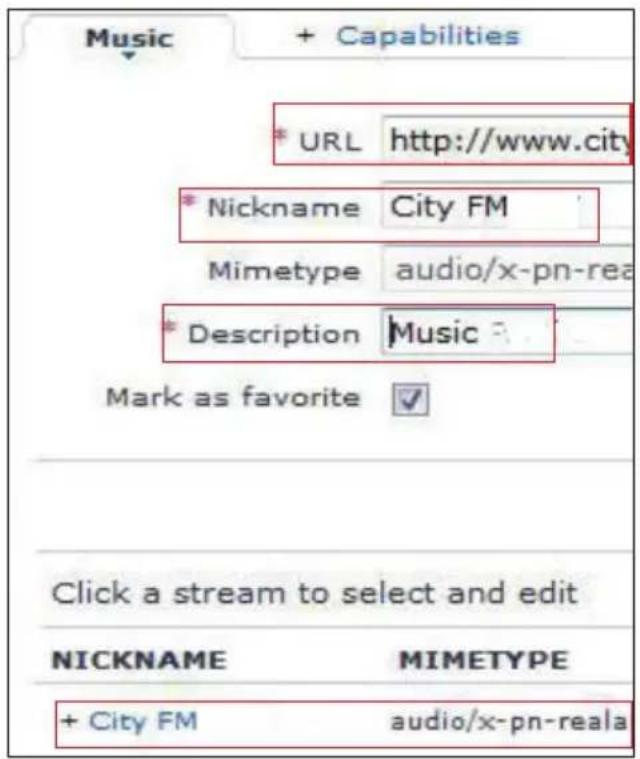
As shown, click the station.
The text boxes are filled, showing the information about the station.
Click on the text boxes to edit the information.
Stream from online music services
On MCi900, you can enjoy the online music services.
With the online music services, you can access their online music libraries.
Create a user account to use the services. To access some features, you may need to subscribe to the services.

Note
• Online services are available in some countries only.
Stream from Napster

Note
- To stream from online music services, ensure that MCi900 is connected to the Internet over the home Wi-Fi/wired network.
Log in to your Napster account
To access Napster online music service, you need to log in to your Napster account. Use your existing Napster account, or use the trial account before you create an account with Napster.
1 On MCi900, press ONLINE SERVICES on the remote control.
• From Home screen, go to [Online services] > [Napster].
2 Log in to the existing account/trial account:
Press ◀ or ▶ to select the entry location;
Use the alphanumeric buttons to enter desired digits/letters;
• You can also press ▲ or ▼ repeatedly, or press and hold ▲ or ▼ until the desired digit/letter appears;
Press • OK to confirm.
→ Next time you select Napster, you will see the account name/password that you previously entered.

Tip
- If you fail to log in to the Napster account, you will be taken to the account management screen. As prompted, log in again or switch to another account.
Search for music
1 On the Napster screen, select [Search] > [Song], [Album], or [Artist]. You can search for music by the name of a song, album, or artist.
2 Enter the name of the desired song, album, or artist.
Press ◀ or ▶ to select the entry location;
Use the alphanumeric buttons to enter desired letters;
You can also press ▲ or ▼ repeatedly, or press and hold ▲ or ▼ until the desired letter appears;
Press • OK to confirm.
Or,
1 On the Napster screen, select [Channels].
2 Select a playlist by genre (e.g., jazz, blues).
Or,
On the Napster screen, select [Catalogue].
You can browse music as sorted and organized by the expert music service of Napster.
Play music
To start play, press ▶II.
To stop play, press
My Library
All your played music is saved to [My Library]. You can search for the music by song, channel, album, artist, and genre.
Search for music/pictures
In a list of options, you can do one of the following to search for what you need.

Tip
- When doing searching in the following ways, ensure that MCi900 is in the mode of [Media Library], [HDD], or [Internet Radio].
Use the navigation keys ▲, ▼, ◀.
Start quick search by using the alphanumeric search, Superscroll, and Quickjump.

Note
- Alphanumeric search, Superscroll and Quickjump are available only when you enter a long sorted list of options (excluding the home screen and lists of menus).
Alphanumeric search
In a long list of options, start alphanumeric search by entering characters that an item starts with or contains.
1 Press SEARCH on the remote control, if necessary.
A text box appears.
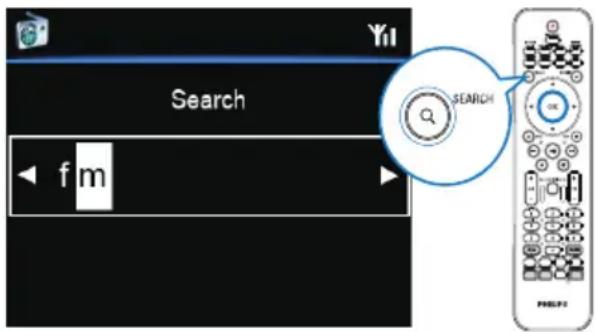
2 Enter characters by using the remote control (see 'Text entry' on page 17).
3 Press OK after completing text entry.
Search starts.
You can find a list of items that contain the characters.
You can find a close match if there is no item that contains the character.
Quickjump
You can also use Quickjump for alphanumeric search.
To reach the first item that starts with a certain letter
On the button corresponding to the letter, press once or repeatedly until the letter appears.
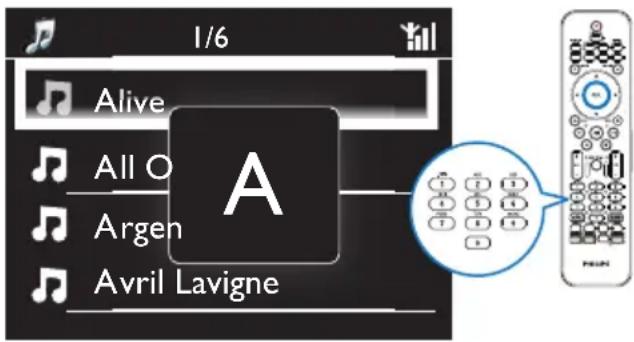
To reach the first item that starts with the next letter
Press ▶.
To reach the first item that starts with the previous letter
Press
Superscroll
In a long list of options, Superscroll allows you to start a search in an alphabetical order. You can quickly reach the first item that starts with the selected alphabet.
1 Press and hold / to start Superscroll.
A pop-up text box appears. Letters are displayed repeatedly in an alphabetical order, starting from current letter.
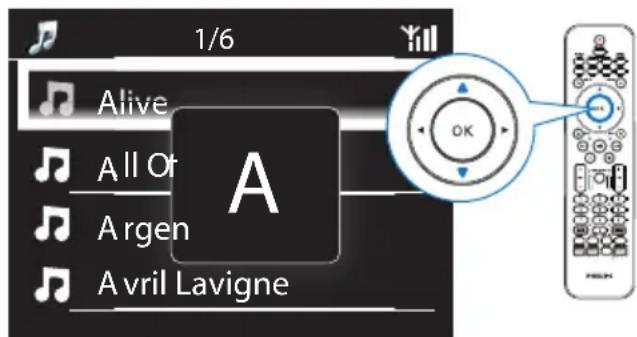
2 Release / when you reach the desired letter.
You reach the first item that starts with → the letter.
8 Play music CD/ movie DVDs

Caution
- Never look at the laser beam inside the unit.
- Risk of product damage! Never play discs with accessories such as disc stabilizer rings or disc treatment sheets.
- Never put any objects other than discs into the disc compartment.

Note
- Ensure that you have made connections for disc play (see 'Connect for disc play' on page 24).
- For the supported disc formats, see 'Introduction' on page 9.
Basic operations
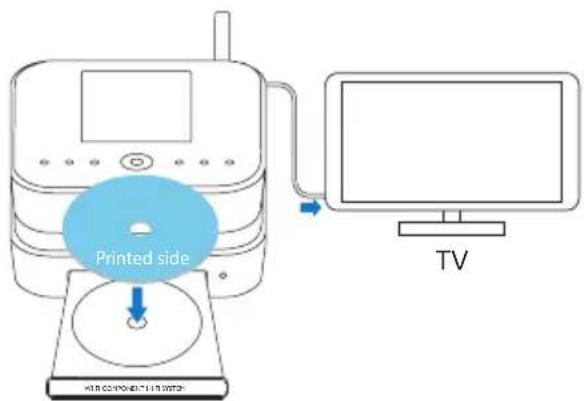
1 On MCi900, press ▲ → The disc tray opens. 2 Load a disc onto the tray, the printed side facing up. Press ▲. → Play starts automatically after disc reading is complete.
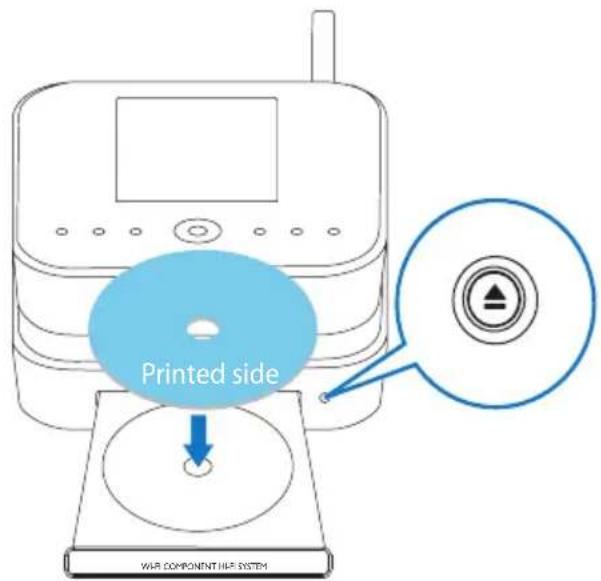
3 If necessary, press DISC on the remote control, and then ▶II to start play. 4 During disc play,
Press ▶/▶ repeatedly to select a track/chapter. For WMA/MP3 files on a CD-R/RW, or recordable DVD, press ▶/▼ to select a file folder.
Press ◀/▶ to search forward/backward.
Press ▶II to pause or resume.
Press • to stop.
Use the disc menu
After loading a disc onto the tray, you can see the disc settings on the TV screen.
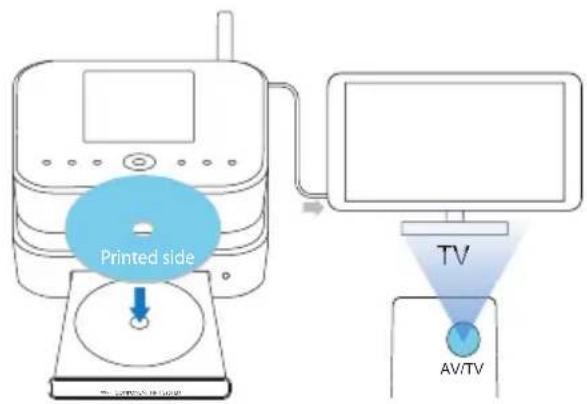
1 On MCi900, load a disc onto the tray. 2 Turn on the TV and switch to the correct video-in channel in one of the following ways:
On the remote control of your TV, press the AV/TV button repeatedly until you see the Philips screen, or the video disc screen.
Go to the lowest channel on your TV, then press the Channel Down button until you see the Philips screen, or the video disc screen.
Press the source button repeatedly on the remote control of your TV.

Tip
The video-in channel is between the lowest and highest channels and may be called FRONT, A/V IN, VIDEO, etc. See the TV user manual on how to select the correct input on the TV.
Access the disc menu
To access or exit the menu manually
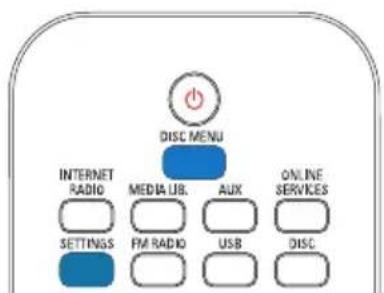
In the DISC mode, press DISC MENU or SETTINGS on the remote control.
Play movie discs (DVD/DivX/VCD)
Pause/Resume/Stop
To pause
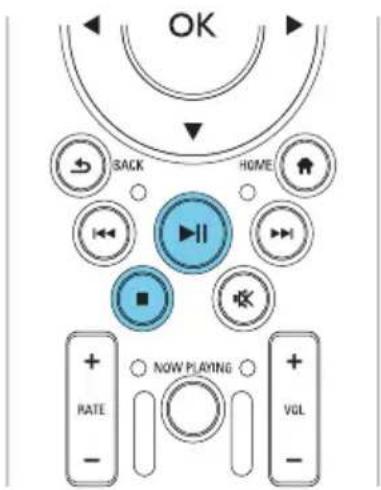
During disc play, press ▶II to pause.
The TV screen shows the scenes where you stop play.
Or, during DVD play, press ■.
The TV screen shows the Philips screen.
To resume
Press ▶II.
The disc play resumes from the last stop point.
To stop
Press again.
Search
Fast search forward/backward
1 During play, press and hold / to select a search speed.
To resume play at normal speed, press ▶II.
Search by time or chapter/track
1 During disc play, press SEARCH until a time field or chapter/track field is displayed.
For the time field, enter the play position in hours, minutes and seconds.
For the chapter/track field, enter the chapter/track.
Play starts automatically at your selected point.
Select languages for disc play
Select an audio language
You can select an audio language on DVDs or DivX discs.
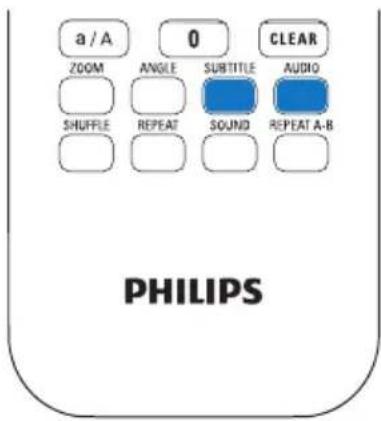
1 During disc play, press AUDIO.
The language options appear. If the selected audio channel is unavailable, the default disc audio channel is used.

Note
- For some DVDs, the language can only be changed from the disc menu.
Select a subtitle language
You can select a subtitle language on DVDs.
• During disc play, press SUBTITLE.

Note
- For some DVDs, the language can only be changed from the disc menu.
Program favorite chapters/tracks
You can play certain chapters/tracks on a disc. Program the chapters/tracks as desired on the TV screen.
1 In the DISC mode, ensure that the disc play stops. 2 Press FAVORITE on the remote control.
On the TV screen, you can see a menu for you to program desired chapters/tracks.
3 Use the remote control to enter the desired chapters/tracks.
To play the program
On the TV screen, select • [Start].
To erase the program
Press ;
Or, remove the disc from the disc tray.
Select play options
Select Repeat/Shuffle options
During disc play, you can repeatedly play a chapter/track, or a file or files in a folder. You can also play tracks or files in a folder in a random order.
To turn on or off the repeat/shuffle options
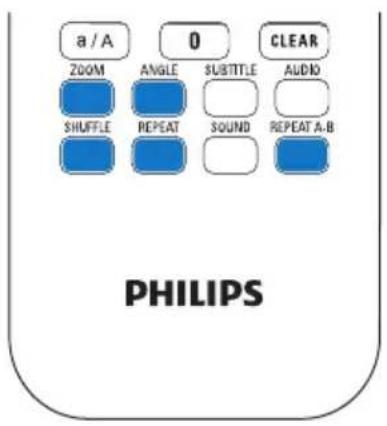
- Press REPEAT or/and SHUFFLE repeatedly.
To repeatedly play a section in a disc
1 During music or video play, press REPEAT A-B at the start point. 2 Press REPEAT A-B at the end point.
The selected section starts to play repeatedly.
→ To cancel repeat play, press REPEAT A-B again.

Note
- The section A and B can be set only within the same track/title.
Zoom in/out image
1 During video/picture play, press ZOOM repeatedly to zoom in/out the image.
When the image is zoomed in, you can press ▲/▼/▲ to pan through the image.
Change a camera angle
Some DVDs contain alternate scenes, such as scenes recorded from different camera angles. For such DVDs, you can select from the available alternate scenes.
1 During DVD play, press ANGLE repeatedly to switch between camera angles.
9 Play FM radio
Tune to FM radio stations

Note
- Before you tune to FM radio stations, ensure that you have properly installed the supplied FM antenna (see 'Connect the FM antenna' on page 26).
Autostore
1 On MCi900, press FM RADIO on the remote control. Or, from Home screen, select • radio].
2 In [FM radio], select [Auto store].
→ MCi900 starts to search for available stations automatically. Radio play starts and a maximum of 60 stations are stored as presets when the auto tune is complete. The preset stations are listed in the order of reception strength, with the RDS stations at the top.
3 To select a preset station, go to [Presets].
Manual tuning
1 In [FM radio], select [Manual tuning]. 2 Press and hold / to start auto tuning. → You tune to the next available station with sufficient reception. 3 Press / repeatedly for fine tuning.
Edit preset stations
Store current station to a location
When listening to a radio station, you can store the current station to a desired location (0-9) in the preset list. The numeric buttons
(0-9) on the remote control correspond to the locations (0-9) in the preset list.
1 Tune to your desired station. 2 On the radio play screen, press and hold a numeric button. If necessary, press • NOW PLAYING to return to the radio play screen. The current station is stored to the • location.
Edit station information
1 In the FM RADIO mode, go to [Presets]. On the radio play screen, press • FAVORITE. 2 In the list of preset stations, Select the station to be edited; Press • a/A to start editing; Press ◀/▶ to select the entry location; press ▲/▼ repeatedly to select desired letters. 3 Press OK to confirm. Press BACK to discard the changes.
Listen to FM radio
1 On MCi900, press FM RADIO on the remote control. Or, from the Home screen, select • radio]. 2 Tune to your desired station (see 'Tune to FM radio stations' on page 52).
• To select a preset station:
Go to [FM radio] > [Presets];
Or, press the corresponding numeric button on the radio play screen (for the first 10 preset stations only).
3 To mute/unmute the radio play, press ✗.
RDS (Radio Data System)
RDS (Radio Data System) is a service that allows FM stations to show additional information.
During Autostore, RDS stations are automatically stored at the top of the list of preset stations.
When tuning to an RDS station, you can see the following information on the screen:
Station name;
Program type, such as news, sports, and pop music;
Frequency;
Scrolling text (RDS text), if available.
Use the RDS for clock setting

Note
When you use an RDS station for clock setting, ensure that the RDS station broadcasts time signals.
1 From Home screen, select [Settings] > [Clock settings] > [Date and time].
To enter [Settings], you can also press SETTINGS on the remote control.
2 In [Date and time], select [Current date and time] > [Automatic (RDS)].
The unit searches for the first preset station automatically.
The time is set according to time signals from the station.
3 To use another RDS station for clock setting, tune to the RDS station immediately.

Tip
- To use an RDS station for regular clock setting, store the station as the first preset station.
10 Play from an external audio device (AUX)
With the AUX IN L / R socket and AUX mode, MCi900 allows you to play an external audio device (e.g. a portable media player) through the speakers of MCi900.
Play from an external audio device
1 Ensure that the external audio device is properly connected to MCi900 (see 'Connect external audio devices' on page 26). 2 On MCi900, select the AUX mode. From Home screen, select • [AUX]. Or, press • AUX on the remote control. 3 On the external audio device, start music play. For the music play, you can use the • sound settings on MCi900 (see 'Sound settings' on page 55).
11 Settings
Play modes
When playing music, you can choose to play repeatedly, in random order, or one by one. Select a play mode as desired.
To select a play mode for music play
Before or during music play,
• From Home screen, go to [Settings] > [Play mode]; Or, - Press REPEAT or SHUFFLE repeatedly on the remote control.
→ ✉ - Play all songs in current folder repeatedly; → 📞-1 - Play current song repeatedly; → ✗ - Play all songs in current folder randomly.
Sound settings
On MCi900, you can select different sound settings in [Settings] > [Sound settings].
1 From Home screen, go to [Settings] > [Sound settings].
Or, press • SETTINGS on the remote control to enter [Settings].
2 Select the option. Press OK to turn it on or off.
Or,
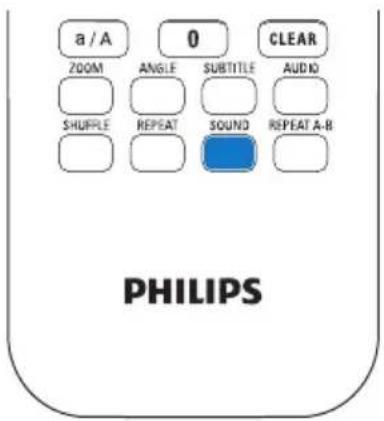
On the remote control, press SOUND to enter the menu of sound settings.
Bass and treble
Use [Bass / Treble] to adjust the low (bass) or high (treble) range of musical notes.
1 From Home screen, go to [Settings] > [Sound settings] > [Bass / Treble].
Or, press • SOUND on the remote control to enter the menu of sound settings.
2 Press / repeatedly to increase/decrease the level.
Press • CLEAR to select neutral level.
Full sound
[FullSound] restores the sonic details that music compression loses (e.g. MP3, WMA).
Turn on or off [FullSound] in [Settings] >[Sound settings].
Direct Source
With [Direct source], you can turn off the sound effects on MCi900, including [FullSound] and [Bass / Treble].
Thus, music plays in an original way, without the sound effects from MCi900.
Turn on or off [Direct source] in [Settings] > [Sound settings].

Tip
- When [Direct source] is on, you can still adjust the volume and [Balance]. - The sound effect settings are retained and enabled when [Direct source] is off.
Audio balance
With [Balance], you can improve listening experience by adjusting the difference between the left and right audio channels.
1 From Home screen, go to [Settings] > [Sound settings] > [Balance].
Or, press SOUND on the remote control to enter the menu of sound settings.
2 Press / repeatedly to increase/decrease the output from left/right audio channels. Press CLEAR for equal output from left/right audio channels.
Set the volume from the external audio device
With [AUX in volume], you can set the volume from the connected external device.
1 From Home screen, go to [Settings] > [Sound settings]. Or, press SOUND on the remote control to enter the menu of sound settings. 2 Go to [AUX in volume]. Select the desired volume level.
Display settings
Brightness
On MCi900, you can adjust the brightness of the display. As desired, the display lights up, dims, or turns off when MCi900 is turned on or switched to active standby.
- In [Settings] > [Display settings] > [Brightness when on] or [Brightness when standby], select an option and press OK.
Wallpaper
For menus on MCi900, you can set the background display (wallpaper).
To set wallpaper
1 On MCi900, select and play a photo. 2 Press SETTINGS on the remote control to select [Settings] > [Display settings] > [Wallpaper]. 3 In [Wallpaper], select [Current picture]. Current picture is set as wallpaper.
Screensaver
On MCi900, the screensaver is turned on when MCi900 is switched to active standby.
When turned on, the selected screensaver appears. The clock is shown on the lower right corner of the screen.
By default, clock display appears as the screensaver.
To set screensaver
1 On MCi900, select and play a picture. 2 Press SETTINGS on the remote control to select [Settings] > [Display settings] > [Screen saver]. 3 In [Screen saver], select [Current picture]. Current picture is set as screensaver.
Slideshow settings
When in the slideshow mode, you can view pictures one by one.
To select a play mode for slideshow
1. From the home screen, go to [Settings] > [Slideshow settings]. Or, press SETTINGS on the remote control to enter [Settings]. 2. Select one of the following play modes. Press OK to turn it on or off. →[Repeat]: Play all pictures repeatedly; →[Shuffle]: Play all pictures randomly.
To set the play time of each picture
1. From Home screen, go to [Settings] > [Slideshow settings] > [Time per slide]. Or, press SETTINGS on the remote control to enter [Settings]. 2. In [Time per slide], select the desired time duration.
Album art
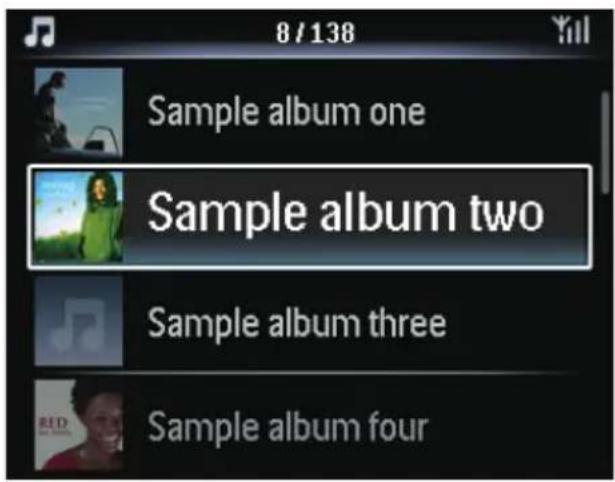
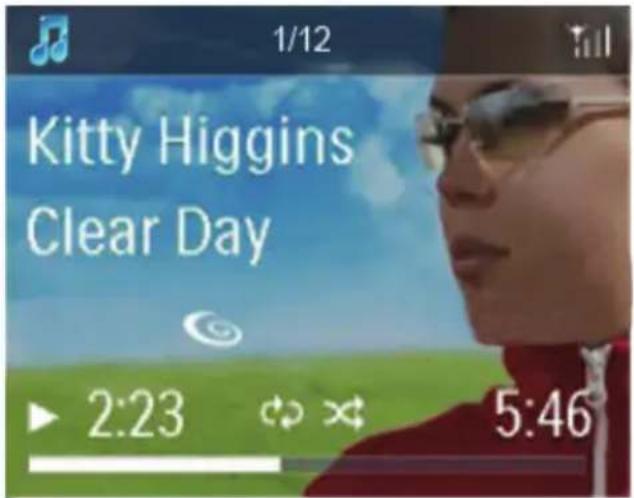
Album art (the picture of CD/album cover) is sometimes available for music downloads. With some media management software, album art can be inserted for the songs. By turning [Album art] on or off, you can choose whether to show the picture of CD/album cover for corresponding songs.
To turn on [Album art]
1. From the home screen, go to [Settings] > [Album art]. Or, press SETTINGS on the remote control to enter [Settings].
2. Select [Album art]. Press OK to turn it on or off.
If [Album art] is on,
In the list of songs, the album art appears as thumbnail along with the corresponding song.
During the song play, the album art is displayed in full screen as the background.
Clicker sound
MCi900 can give you an audible feedback (clicker sound) every time you press a button on the remote control.
You can turn the clicker sound on or off in [Settings] > [Clicker sound].
Clock settings
Alarm
Set the alarm
1 Ensure that you have set the clock (see 'Date and time' on page 58). 2 From Home screen, go to [Settings] > [Clock settings] > [Alarm]. Or, press • SETTINGS on the remote control to enter [Settings].
3 To set the source of alarm sound,
Select • [Music]; At the set alarm time, last played song starts/resumes, or you tune to the last played Internet radio station.
Select • [Buzzer]. At the set alarm time, the buzzer sounds.
4 To set the alarm time,
Press and hold ▲ /▼ or press ▲
/repeatedly until you reach the desired digits. Press OK to confirm.
- Or, enter the desired digits by using the alphanumeric buttons on the remote control.
→ The alarm icon 🔊 appears on the screen.
To play a song or Internet radio station as the next alarm sound
1 Ensure that you have selected [Music] in the Step 3 above; 2 Before you turn off MCi900, or switch MCi900 to active standby,
Go to • [Media Library], and select and play the desired song;
Or, go to [Internet Radio], and tune to the desired station.
Use the alarm
At the set alarm time, music/Internet radio plays as desired, or the buzzer sounds.

Note
- The alarm sounds even if you have switched MCi900 to active standby or Eco standby.
- The buzzer sounds instead, if MCi900 fails to connect to a music library or an Internet radio station.
- MCi900 is unmuted if it has been muted.
- The alarm sounds in a higher volume if the volume level is lower than minimum.
To snooze the alarm
- Press any button on the unit or the remote control (except for the volume buttons).
The alarm sounds again 15 minutes later. The alarm icon remains.
To stop the alarm
Press and hold ✕ or ⏻
The alarm is stopped. The alarm icon disappears. The alarm sounds again next day.
To turn off the alarm
• Go to [Settings] > [Clock settings]
[Alarm]. Select [Alarm off] and press OK on the remote control.
Sleep timer
With the sleep timer, you can have MCi900 turned off automatically after the set timer duration.
To set the time duration
1 From the home screen, go to [Settings] > [Clock settings] > [Sleep timer].
Or, press • SETTINGS on the remote control to enter [Settings].
2 Select an option. Press OK to turn it on.
Date and time
The date and time can be set automatically or manually.
Automatic setting
For automatic clock setting, use the online service over the Internet, or use the time signal from FM RDS radio.
Through the online service over the Internet
1 Turn on the unit, if necessary.
Ensure that the unit is connected to the home Wi-Fi/wired network and Internet.
2 From Home screen, select [Settings] > [Clock settings] > [Date and time].
Or, press • SETTINGS on the remote control to enter [Settings].
3 In [Date and time], select [Current date and time] > [Automatic (Internet)].
The unit starts auto time setting over the Internet.
A message appears when the setting is done.
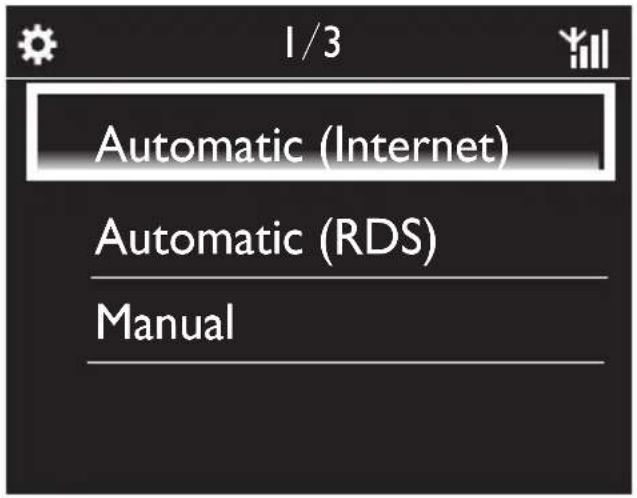

Tip
According to the location and time zone you select, the unit can have the clock time set and adjusted automatically through the online service over the Internet.
• To check and change current location and time zone, go to [Settings] > [Location and time zone].
Through time signals from FM RDS radio
1 On the unit, turn on the FM radio, if necessary.
Ensure that the FM antenna is connected properly (see 'Connect the FM antenna' on page 26).
2 On the first location for preset stations, store an FM RDS station that transmits time signals.
3 From Home screen, select [Settings] > [Clock settings] > [Date and time].
Or, press • SETTINGS on the remote control to enter [Settings].
4 In [Date and time], select [Current date and time] > [Automatic (RDS)].
→ The unit searches for the first preset station automatically.
→ The time is set according to time signals from the station.
Manual setting
1 Turn on the unit, if necessary.
2 From Home screen, select [Settings] > [Clock settings] > [Date and time]. Or, press • SETTINGS on the remote control to enter [Settings].
3 In [Date and time], select [Current date and time] > [Manual].
4 To enter date and time,
Press ◀ or ▶ to select the entry location;
Use the alphanumeric buttons to • enter desired digits;
Press • OK to confirm.
You can also press ▲ or ▼ repeatedly, or press and hold ▲ or ▼ until the desired digit appears.
Set date/time format
Select how date and time are displayed in the clock.
1 Follow Step 1-2 under "Manual setting".
2 In [Date and time], go to [Time format] or [Date format] to select options.
Network settings
Setup network
After the first-time setup, you can change how MCi900 connects to home Wi-Fi/wired network:
Switch between different connection methods (wireless or wired, automatic or manual);
Switch between different routers. To do so, do the following:
1 From Home screen, go to [Settings] > [Network settings] > [Setup network]. Or, press • SETTINGS on the remote control to enter [Settings].
2 Connect MCi900 as you did in the first-time setup (see 'Connect to home Wi-Fi/wired network' on page 29).
Device name
In [Device name], you can name/rename your MCi900. On a connected UPnP server/client, the MCi900 can be found as named.
1 From Home screen, go to [Settings] > [Network settings] > [Device name]. 2 In [Device name], press ◀/▶ to select the entry location; press ▲/▼ repeatedly to select desired letters.
USB sharing
When you connect MCi900 to home Wi-Fi/wired network, the HDD connected to MCi900 can work as a shared disk of the network. Contents on the HDD can be played or shared on computers or UPnP devices that are also connected to the network.
To permit or prohibit the sharing, go to [Settings] > [Network settings] > [USB sharing]. Press OK to turn on or off the sharing.
Location and time zone
After the first-time setup, you can change the selected location and time zone when moving to a new location or time zone.
According to the selected location and time zone, MCi900 can
Set clock automatically over the Internet (see 'Date and time' on page 58);
Pre-load preset Internet radio stations automatically.
Language
After the first-time setup, you can change the language selection in [Settings] > [Language].
Device information
From the home screen, go to [Settings] > [Device ID and information]. You can learn about information about MCi900, including model number, name to be shown on a UPnP server/client, software version, and network settings.
Check for software upgrades
On the MCi900, you can check for software upgrades. After you click to agree to the terms and conditions, the downloading and installation of new upgrades start automatically.
1. Ensure that MCi900 is connected to the Internet. 2. From the Home screen, go to [Settings] > [Check for software upgrades].
Demo mode
After the first-time setup, you can view the demo again.
1. From the Home screen, go to [Settings] > [Demo mode]. Demo play starts.
2. To exit the demo play, press .
The unit is switched to Eco standby.
Call center numbers
If you need help with the usage of MCi900, go to [Settings] > [Call centre numbers] to check the number of your nearest call center.
Restore factory settings
You can restore MCi900 to factory settings. All your settings are removed, including the settings of network, sound, display, clock, alarm and language.
1 Go to [Settings] > [Restore factory settings]. 2 As prompted, select [Yes].
The unit is turned off.
The unit is turned on again automatically when the factory settings are restored.
Start the first-time setup.
12 Register MCi900 with Philips
Benefits
By registering MCi900 on www.philips.com/welcome, you can
• Get free software upgrades; • Manage your own favorite radio stations; • Receive Streamium newsletters.

Note
- Registration of MCi900 requires a valid email address.
Register MCi900
Use a valid email address as the account when you register MCi900 on www.philips.com/welcome.
You can complete the registration directly on www.philips.com/welcome. Or, use an email address to register on the device, and then, complete the registration through the web site link that you received in the email.
Register on the web site
To register MCI900 directly on www.philips.com/welcome, you need to fill in the following information as prompted during registration:
• A valid email address as the registration account; • Product model number; • Product registration ID.
To get the product model number
Look at the packaging box of the device or the product label. You can always find the model number on the packaging box or product label (e.g. MCi900, NP2900).
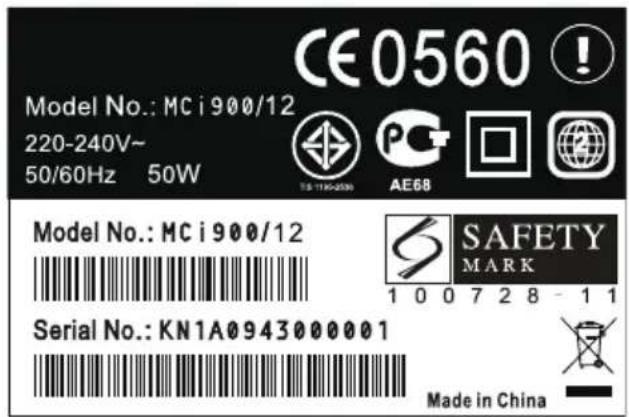
To get the product registration ID
On MCi900, go to [Settings] > [Device ID and information]. Press ▼ repeatedly to find [Product Registration ID].
Register on the device
Use an email address to register on the device, and then, complete the registration through the web site link that you received in the email.
1 Ensure that MCi900 is connected to the Internet. 2 To register with www.philips.com/welcome: On MCi900, select [Settings] > [User registration] > [Register now] > [Register on the device]; As prompted, enter your valid email address (see 'Text entry' on page 17). You receive an email message from ConsumerCare@Philips.com.
On a computer, use the web site link in the email to complete registration.

Tip
To log in to Philips online services later, use the web site link in the email, and the password.
Unregister MCi900
When registering with www.philips.com/welcome, you can only use one account for one unit (e.g., MCi900). For each account, you can maintain a set of favorite stations and manually added stations.
To use another account for registration, you need to unregister the current one.
To unregister an account
1. On MCi900, select [Settings] > [User registration] > [Unregister]. 2. As prompted, confirm to start unregistering the account.

Tip
When re-registering the account, you can recover the Internet radio stations that you maintained with Philips online services.
Check registration information
You can check whether you have registered the MCi900, and what account you have used for registration. To check the information, go to [Settings] > [User registration] > [Registration status].
13 Maintenance
This chapter tells you how to care for MCi900.
Cleaning

Note
Avoid moisture and abrasion.
1. Clean MCi900 only with a soft dry cloth.
14 Technical data
General
AC Power (Main unit)
230V ±10%, 50Hz (for /12, /05, /79)
120V ±10%, 60Hz (for /37)
110V, 60Hz (for /96)
DC Power (DVD unit)
DIN connector (Output provided by Main unit)
DC Power (HDD unit)
5V USB power, 900mA (Provided by Main unit) 1
Dimensions
Main unit: 251 × 251 × 133mm (including LCD)
DVD unit: 251 × 251 × 69mm
HDD unit: 122 × 75 × 13mm
Speaker box: 175 × 202 × 354mm
Weight (net)
12.50kg (all items)

Note
Use HDD only with the by-packed USB wire.
Power consumption
Active (On)
< 45W (according to IEC60065)
(Active) Standby
< 13W (HDD-spun down)
ECO (Passive) Standby
< 0.8W
Audio inputs
Aux in (Line in)
2× Cinch
Input sensitivity
0.5V: Position High
1.0V: Position Medium
2.0V: Position Low
Input impedance
10kΩ (Ohms)
Audio outputs
Headphones
1 × 3.5mm jack, 30 - 18000Hz, 16 - 150Ω
(Ohms)
Signal to noise ratio (Headphones)
typically 90dBA (IEC)
Distortion (Headphones)
< 0.10%
Audio / Video outputs (only provide output during disc playback)
SPDIF
1 × Cinch (Coax), 0.5V, 75 Ohm
Line out
2 × Cinch, 20 – 20000Hz, 1.5V
Signal to noise ratio (Line out)
typically 98dBA (IEC)
CVBS
1 × Cinch, 1Vpp, 75 Ohm
Composite Video output (PbPrY)
3 × Cinch, 75 Ohm, Pb/Pr: 0.7Vpp, Y: 1Vpp
HDMI
480i, 480p, 576i, 576p, 1080i, 1080p
Video system
PAL / NTSC
Video format
4:3 / 16:9
Audio amplifier (Digital)
| Output power |
| 2 × 50W (RMS) (= total power 100W) |
| Frequency response |
| 20Hz to 20000Hz (±0.5dB) |
| Signal to noise ratio |
| typically 92dB/ 95dBA |
Speakers
| Power handling |
| 50W (RMS) / 60W (MPO) |
| Impedance |
| 8Ω (Ohms) |
| Sensitivity |
| 86dB/ 1m/ W |
| Dimensions |
| Woofer: 5.00 inchesTweeter: 1.50 inches |
| Frequency response |
| 45 to 20000Hz |
Sound features
| FullSound® |
| Yes (on/ off) |
| Bass/ Treble control |
| +/- 10 steps |
| Balance control |
| +/- 10 steps |
| Direct Source (Flat) |
| Yes (on/ off) |
Wireless
| Wireless standard |
| 802.11n, backwards compatible to 802.11b/ g |
| Wireless security |
| WEP (64 or 128 bit), WPA / WPA2 (8-63 characters) |
| Frequency range |
| 2412 - 2462 MHz (CH1-CH11) (for /79, /37, /55, /97) |
| 2412 - 2472 MHz (CH1-CH13) (for /12, /05) |
| Antenna |
| 1 × internal / 1 × external, diversity mode enabled |
| Wireless protected setup (WPS) |
| Yes (PBC + PIN) |
| Network mode support |
| Infrastructure |
Wired (LAN / Ethernet)
| Wired standard |
| 802.3 / 802.3 u |
| Speed |
| 10 / 100MBit/s |
| Mode |
| half / full duplex |
| Crossover detection (Auto MDIX) |
| Yes |

Note
The wired and wireless network interfaces cannot be turned on at the same time.
Internet services
| Internet radio |
| My Media |
Decoding capabilities (excluding the disc player)
| MP3 |
| 8 - 320kbps (CBR / VBR) |
| WMA |
| 32 - 192kbps (CBR / VBR) |
| WMT DRM - ND (WMA DRM - 10) |
| Yes, enabled (only from a UPnP server) |
| AAC (M4A) |
| 16 - 320kbps (CBR / VBR) |
| PCM/ WAV |
| 1x (1.4Mbps) |
| FLAC |
| Yes, supported |
| Ogg Vorbis |
| Yes, supported |
| eACC |
| Yes, supported |
| JPEG |
| Yes, supported (Maximum size: 7MB) |
Playlist support (excluding the disc player)
| *.m3u, *.wpl |
| Yes |
| iTunes |
| Yes (via by-packed UPnP Server) |
FM Tuner
| Frequency range |
| 87.50 to 108.00MHz |
| No. of Presets |
| 60 |
| Signal noise ratio |
| ≥ 62dB |
| Tuning grid |
| 50kHz |
| RDS |
| Yes, including RDS clock setting |
| Antenna connector |
| IEC (75 Ohm) |
DISC player
| Supported discs |
| DVD, VCD, SVCD, DVD+RW, DVD-RW, DVD+R, DVD-R, Picture (JPEG) CD, DivX (Ultra) Disc, MP3 / WMA CDR / CDRW, CD (CDDA) |
| Disc size support |
| 8cm/ 12cm |
| Video decoding |
| MPEG 1, MPEG 2, DivX, JPEG |
| Audio decoding |
| MP3: 112 to 320kbps (Sampling rate: 32,44.1,48kHz)WMA: 48 to 192kbps (Sampling rate: 44.1, 48kHz) |
| RDS |
| Yes; PTY, PS, Text including RDS clock setting |
| HDMI Audio support |
| Yes |
USB
USB port type
Type A, Host
Supported media
FAT, FAT-32, NTFS
Supported class
MSC only (no MTP support)
Multi-partition support
No, only first readable partition
Database support
Up to 40000 songs
HDD
Disc type
2.5 inches
Size
160GB 3
Format
FAT32

Note
3 Available disc size is less due to preloaded contents.
Display/Clock
Resolution
Dot matrix, 320 × 240 dots (QVGA), Color TFT
Size
3.5 inches
Backlight
Can be turned on/off and can be dimmed
Clock/Date display
Yes
Wallpaper/Screensaver
Yes
Automatic time setting via Internet (NTP)
Yes, enabled
Sleep timer
Yes
Internal (key) clicker
Yes
Others
UPnP²
DMP (Local renderer, Local control point) /DMS
Shared drive
Yes, Samba share

Note
² Capable to connect to: - Windows Media Player 11/12, Winamp, TwonkyMedia; - Philips Music Center WAC3500 / WAC7500 / MCi500H; - Philips NAS SPD8020CC; - Mobile phone Nokia N85, N95, N900. - Specifications and external appearance are subject to change without notice.
15 Troubleshooting
I cannot hear any sound or the sound is poor, what do I do?
Press • + VOL - to increase the volume. Press the • MUTE button again to reactivate the sound output.
Is there a maximum distance of transmission between a wireless router and MCi900 for effective streaming?
Yes. The maximum distance of Wi-Fi transmission is 250m measured in open spaces. However, in a home environment, where solid obstacles such as walls and doors are present, the effective transmission distance is reduced to 50-100m. Reposition the devices if you experience transmission problems.
I have not received any registration email from ConsumerCare@Philips.com.
Check that the email address entered in the user registration section is valid and spelled correctly. Check that the PC has an active Internet connection. The Internet server may be busy, try again later. Check if the email was redirected to the spam folder.
How do I avoid Wi-Fi interferences from other devices that operate in the same (2.4GHz) frequency spectrum, such as Dect phones or bluetooth devices?
Move MCi900 at least 3m away from such devices.
Use a WEP/WPA encryption key when you create the wireless connection your PC / home network.
Change the operating channel on the interfering devices.
Turn the devices in different directions to minimize interference.
16 Contact information
| Argentina (54-11) 4544-2047 | |
| Australia 1300 363 391 | |
| Austria 0810 000 205 | |
| Belgium 78250145 | |
| Belarus 882000110068 | |
| Brazil 0800 701 02 03 (all except Sao Paulo)(11)2121-0203 (Sao Paulo only) | |
| Bulgaria 8001154424 | |
| Canada 1-888-744-5477 | |
| Chile 600 744 5477(600-PHILIPS) | |
| China 4008 800 008 | |
| Colombia 01 800 700 7445 | |
| Croatia 800222778 | |
| Czech Republic | 800142840 |
| Denmark | 35258759 |
| Estonia 8000100288 | |
| Finland | 923113415 |
| France | 805025510 |
| Germany | 8000007520 |
| Greece 80031221280 | |
| Hong Kong | 852-2619 9663 |
| Hungary | 680018189 |
| India | 1860-180-1111 |
| Ireland | 16011777 |
| Israel 9600900-09 | |
| Italy | 800088774 |
| Japan | 0570-07-6666 |
| Korea | 080-600-6600 |
| Latvia | 80002794 |
| Luxembourg | 4066615644 |
| Malaysia | 1800 880 180 |
| Mexico | 01 800 504 6200 |
| Netherlands | 8000230076 |
| New Zealand | 0800 658 224 |
| Norway | 22708111 |
| Pakistan | 051 580 902-3 |
| Peru | 0800 00100 |
| Philippines | (63 2) 667 9000 |
| Poland | 80 03111318 |
| Portugal | 800780903 |
| Romania | 800894910 |
| Russia Federation | (495)961-1111 (local rate)8-800-200-0880 (mobile phone - free) |
| Singapore 65 6882 3999 | |
| Slovakia | 800004537 |
| South Africa | (011) 471-5194 |
| Spain | 900800655 |
| Sweden 857929100 | |
| Switzerland | 844800544 |
| Taiwan | 0800 231 099 |
| Thailand | 66 2 652 8652 |
| Turkey | 0800 261 3302 |
| Ukraine 8-800-500-69-70 | |
| United Kingdom | 8003316015 |
| United States | 1-888-744-5477 |
| Uruguay | (598-2) 619 6666 |
| Venezuela | 0800 100 4888 |
Streamium terms and conditions
Terms and Conditions of Use of your Philips Streamium-enabled Device
Congratulations on your purchase of a Philips Streamium-enabled Device (“Device”). These Terms and Conditions of Use give you the rights to use certain features on your Device relating to the streaming of content. You must agree to these Terms and Conditions of Use before using the Device. Your use of the Device constitutes your agreement to be bound by these Terms and Conditions of Use and will give you the right to access these features. If you do not agree to these Terms and Conditions of Use, you may return your Device to the point of purchase. These Terms and Conditions of Use supplement, and do not replace, any terms, conditions or disclaimers which were provided with your purchase of the Device. All such terms, conditions and disclaimers remain in full force and effect.
Eligibility for Registration.
You must be at least 14 years of age to assume the responsibilities of these Terms and Conditions of Use. If you are under 14 years of age, you may not use the Device unless one of your parents or legal guardians assumes the responsibilities of these Terms and Conditions of Use. Your use of the Device constitutes your representation that you are either 14 years of age or, if you are under 14 years of age, that your parent or legal guardian has assumed the responsibilities of these Terms and Conditions of Use.
Restrictions on Modification of your Device
Your Device provides access to certain streams of content. As a condition of obtaining access to those streams through the Device, you agree not to tamper with or otherwise modify or attempt to modify the Device in any way (including through the use of software or by making physical alterations to the Device). You agree that you will not circumvent or attempt to circumvent technological measures employed to control access to, or the rights in, any content. You agree that you will not circumvent or attempt to circumvent any copy management system by any means. You agree that you will not decipher or attempt to decipher cryptographic keys or otherwise defeat or attempt to defeat any security features implemented in the Device or in the content streams. You agree that you will not use the Device for any unauthorized purpose or in contravention of any law or regulation.
Disclaimers Regarding Content
The streams of content which are accessible through your Device are not controlled or programmed by Philips. Rather, they are provided by third parties. Think of your Device (in addition to its other features) as a form of “tuner” which allows you to receive the content broadcast by many others outside of your local area. Since the content is provided by others, PHILIPS HAS NO EDITORIAL CONTROL OVER ANY OF THAT CONTENT RECEIVED THROUGH YOUR DEVICE AND, THEREFORE IS NOT LIABLE FOR CONTENT OR ITS NATURE OR DELIVERY. PHILIPS DOES NOT ENDORSE ANY OPINIONS EXPRESSED IN ANY CONTENT RECEIVED THROUGH YOUR DEVICE. PHILIPS DOES NOT GUARANTEE THE TRUTHFULNESS, ACCURACY, RELIABILITY, COMPLETENESS OR TIMELINESS OF CONTENT. YOU AGREE THAT ANY RELIANCE ON CONTENT IS AT YOUR OWN RISK.
Limitations on Access to Streams.
Philips does not guarantee access to any particular stream or to the content contained in any stream. Philips may, in its discretion, add or remove access to any specific stream or content at any time. Some streams are accessible through arrangements with online service providers which determine which streams are listed on their directories. Although Philips will strive to provide a good selection of online service providers, Philips does not guarantee continued access to any specific online service provider. Philips may, in its discretion, add or remove access to any specific online service provider.
Rights in Content
Content may be protected by copyright laws or other intellectual property or proprietary laws. In some situations, such as use of the Device in a commercial environment, it may be necessary for you to obtain, at your own risk, a license or other authorization to use such content. You agree that, in the event such a license or
Authorization is necessary; it is your responsibility to obtain any such license or authorization. You agree that you are solely liable for any damages you may incur resulting from your failure to obtain the proper license or authorization for use of the content accessible through the Device. You agree that Philips will have no liability to you with regard to your use of the content.
Changes in Features
Philips may, in its discretion, change the features of the Device, including adding features to, or removing features from, the Device. Some new features may require changes to these Terms and Conditions of Use. Your use of those new features will constitute your agreement to the revised Terms and Conditions of Use.
Software and Intellectual Property Rights
You may need to use certain software programs to use or have full access to certain features of the Device. You received certain software with the purchase of the Device and may receive other software from time to time in the future. Most of that software is contained in the Device and is not accessible to you. Some of that software is owned by Philips and some is owned by others. Your use of software owned by Philips is subject to these Terms and Conditions of Use and any applicable license agreement. Your use of software owned by others is governed by their applicable license agreements. Your use of software does not transfer any title or ownership rights in the software to you. Philips retains all its rights in software and other intellectual property, including copyrights, patent rights, and rights in its trademarks and trade names. You agree that you will not disassemble, decompile, create derivative works of, reverse engineer, modify, sublicense, distribute the software or use the software for any unauthorized purpose or in contravention of any law or regulation.
Warranty Disclaimer
PHILIPS MAKES NO REPRESENTATION OR WARRANTY, EXPRESS OR IMPLIED, THAT THE DEVICE WILL MEET YOUR REQUIREMENTS OR THAT THE USE OF THE DEVICE WILL BE UNINTERRUPTED, TIMELY, SECURE OR FREE FROM ERRORS. PHILIPS MAKES NO WARRANTY AS TO THE CONTENT CARRIED IN ANY STREAM. PHILIPS MAKES NO REPRESENTATION OR WARRANTY, EXPRESS OR IMPLIED, AS TO THE INFORMATION OR CONTENT ACCESSED THROUGH YOUR DEVICE OR TO YOUR RELIANCE ON, OR USE OF, ANY INFORMATION OR CONTENT ACCESSED THROUGH YOUR DEVICE. SPECIFIC WARRANTIES WERE PROVIDED WITH YOUR PURCHASE OF YOUR DEVICE AND THOSE WARRANTIES, INCLUDING ANY DISCLAIMERS TO THOSE WARRANTIES, CONTINUE TO APPLY. Because some jurisdictions do not permit the disclaimer of implied warranties, such disclaimers may not apply to you.
Limitation of Liability
PHILIPS WILL NOT BE LIABLE TO YOU OR TO ANY OTHER PARTY FOR ANY INDIRECT, INCIDENTAL, PUNITIVE, SPECIAL OR CONSEQUENTIAL DAMAGES (INCLUDING LOST PROFITS OR LOST SAVINGS) OR FOR LOSS OF DATA OR BUSINESS INTERRUPTION ARISING OUT OF OR RELATING TO YOUR USE OF THE DEVICE WHETHER OR NOT SUCH DAMAGES ARE BASED ON TORT, WARRANTY, CONTRACT OR ANY OTHER LEGAL THEORY - EVEN IF PHILIPS HAS BEEN ADVISED, OR IS AWARE, OF THE POSSIBILITY OF SUCH DAMAGES. IN NO EVENT WILL PHILIPS CUMULATIVE LIABILITY FOR DAMAGE (FROM ANY CAUSE WHATSOEVER) EXCEED THE AMOUNT YOU PAID FOR YOUR DEVICE.
Miscellaneous
This agreement will be governed by the laws of the jurisdiction in which the Device was sold and you hereby consent to the non-exclusive jurisdiction of courts in the relevant country. If any provision of this agreement is invalid or unenforceable under applicable law, such provision will be deemed modified to the extent necessary to render such provision valid and enforceable and the other provisions of this agreement will remain in full force and effect. These Terms and Conditions of Use will not be governed by the United Nations Convention of Contracts for the International Sale of Goods, the application of which is hereby expressly waived.
BY USING YOUR DEVICE, YOU REPRESENT THAT YOU HAVE READ AND UNDERSTOOD THESE TERMS AND CONDITIONS OF USE AND THAT YOU ACCEPT THEM.
NOTICE
SOFTWARE END USER LICENSE AGREEMENT
THIS SOFTWARE END USER LICENSE AGREEMENT (“THIS AGREEMENT”) IS A LEGAL AND BINDING AGREEMENT BETWEEN YOU (EITHER AN INDIVIDUAL OR ENTITY) AND PHILIPS CONSUMER ELECTRONICS B.V. A DUTCH LIMITED LIABILITY COMPANY, WITH ITS PRINCIPAL OFFICE AT GLASLAAN 2, 5616 LW EINDHOVEN, THE NETHERLANDS AND ITS SUBSIDIARY COMPANIES (INDIVIDUALLY AND COLLECTIVELY “PHILIPS”). THIS AGREEMENT GIVES YOU THE RIGHT TO USE CERTAIN SOFTWARE (THE “SOFTWARE”) INCLUDING USER DOCUMENTATION IN ELECTRONIC FORM WHICH MAY HAVE BEEN PROVIDED SEPARATELY OR TOGETHER WITH A PHILIPS PRODUCT (THE “DEVICE”) OR A PC. BY DOWNLOADING, INSTALLING OR OTHERWISE USING THE SOFTWARE, YOU ACCEPT AND AGREE TO BE BOUND BY ALL OF THE TERMS AND CONDITIONS OF THIS AGREEMENT. IF YOU DO NOT AGREE TO THESE TERMS AND CONDITIONS, DO NOT DOWNLOAD, INSTALL OR OTHERWISE USE THE SOFTWARE. IF YOU ACQUIRED THE SOFTWARE IN TANGIBLE MEDIA E.G. CD WITHOUT THE OPPORTUNITY TO REVIEW THIS LICENSE AND DO NOT ACCEPT THESE TERMS, YOU MAY RECEIVE A FULL REFUND OF THE AMOUNT, IF ANY, THAT YOU PAID FOR THE SOFTWARE IF YOU RETURN THE SOFTWARE UNUSED WITH PROOF OF PAYMENT WITHIN 30 DAYS FROM THE DATE OF PURCHASE.
- Grant of License. This Agreement grants you a non-exclusive, nontransferable, non-sub licensable license to install and use, on the Device or a PC, as applicable, one (1) copy of the specified version of the Software in object code format as set out in the user documentation solely for your personal use. The Software is “in use” when it is loaded into the temporary or permanent memory (i.e. RAM, hard disk, etc.) of the PC or the Device.
- Ownership. The Software is licensed and not sold to you. This Agreement grants you only the right to use the Software, but you do not acquire any rights, express or implied, in the Software other than those specified in this Agreement. Philips and its licensors retain all right, title, and interest in and to the Software, including all patents, copyrights, trade secrets, and other intellectual property rights incorporated therein. The Software is protected by copyright laws, international treaty provisions, and other intellectual property laws. Therefore, other than as expressly set forth herein, you may not copy the Software without prior written authorization of Philips, except that you may make one (1) copy of the Software for your back-up purposes only. You may not copy any printed materials accompanying the Software, nor print more than one (1) copy of any user documentation provided in electronic form, except that you may make one (1) copy of such printed materials for your back-up purposes only.
- License Restrictions. Except as provided otherwise herein, you shall not rent, lease, sublicense, sell, assign, loan, or otherwise transfer the Software. You shall not, and you shall not permit any third party, to reverse engineer, decompile, or disassemble the Software, except to the extent that applicable law expressly prohibits the foregoing restriction. You may not remove or destroy any product identification, copyright notices, or other proprietary markings or restrictions from the Software. All titles, trademarks, and copyright and restricted rights notices shall be reproduced on your back up copy of the Software. You may not modify or adapt the Software, merge the Software into another program or create derivative works based upon the Software.
- Termination of certain functionality. The Software may contain components of certain licensed software including software licensed from Microsoft Corporation (“Microsoft”) which implements Microsoft’s digital rights management technology for Windows Media. Content providers are using the digital rights management technology for Windows Media (“WM-DRM”) to protect the integrity of their content (“Secure Content”) so that their intellectual property, including copyright, in such content is not misappropriated. Your Device may also use WM-DRM software to transfer or play Secure Content (“WM-DRM Software”). If the security of such WM-DRM Software is compromised, Microsoft may revoke (either on its own or upon the request of the owners of Secure Content (“Secure Content Owners”)) the WM-DRM Software’s right to acquire new licenses to copy, store, transfer, display and/or play Secure Content. Revocation does not alter the WM-DRM Software’s
ability to play unprotected content. A list of revoked WM-DRM Software is sent to your PC and/or your Device whenever you download a license for Secure Content. Microsoft may, in conjunction with such license, also download revocation lists onto your Device on behalf of Secure Content Owners, which may disable your Device's ability to copy, store, display, transfer, and/or play Secure Content. Secure Content Owners may also require you to upgrade some of the WM-DRM components distributed with this Software ("WM-DRM Upgrades") before accessing their content. When you attempt to play Secure Content, WM-DRM Software built by Microsoft will notify you that a WM-DRM Upgrade is required and then ask for your consent before the WM-DRM Upgrade is downloaded. WM-DRM Software built by Philips may do the same. If you decline the upgrade, you will not be able to access Secure Content that requires the WM-DRM Upgrade; however, you will still be able to access unprotected content and Secure Content that does not require the upgrade. WM-DRM features that access the Internet, such as acquiring new licenses and/or performing a required WM-DRM Upgrade, can be switched off. When these features are switched off, you will still be able to play Secure Content if you have a valid license for such content already stored on your Device. However, you will not be able to use certain of the WM-DRM Software features that require Internet access such as the ability to download content that requires the WM-DRM Upgrade. All title and intellectual property rights in and to the Secure Content is the property of the respective Secure Content owners and may be protected by applicable copyright or other intellectual property laws and treaties. This Agreement grants you no rights to use such Secure Content. To summarize, if the Software contains Microsoft WM-DRM components – Secure Content you desire to download, copy, store, display, transfer, and/or play is protected by the Microsoft WM-DRM components of the Software. Microsoft, Secure Content Owners, or Secure Content distributors may deny you access, or restrict your access, to Secure Content even after you have paid for, and/or obtained, it. Neither your consent nor the consent or approval of Philips is necessary for any of them to deny, withhold or otherwise restrict your access to Secure Content. Philips does not guaranty that you will be able to download, copy, store, display, transfer, and/or play Secure Content.
- Open Source Software. (a) This software may contain components that are subject to open-source terms, as stated in the documentation accompanying the Device. This Agreement does not apply to this software as such. (b) Your license rights under this Agreement do not include any right or license to use, distribute or create derivative works of the Software in any manner that would subject the Software to Open Source Terms. “Open Source Terms” means the terms of any license that directly or indirectly (1) create, or purport to create, obligations for Philips with respect to the Software and/or derivative works thereof; or (2) grant, or purport to grant, to any third party any rights or immunities under intellectual property or proprietary rights in the Software or derivative works thereof.
- Termination. This Agreement shall be effective upon installation or first use of the Software and shall terminate (i) at the discretion of Philips, due to your failure to comply with any term of this Agreement; or (ii) upon destruction of all copies of the Software and related materials provided to you by Philips hereunder: Philips's rights and your obligations shall survive the termination of this Agreement.
- Upgrades. Philips may, at its sole option, make upgrades to the Software available by general posting on a website or by any other means or methods. Such upgrades may be made available pursuant to the terms of this Agreement or the release of such upgrades to you may be subject to your acceptance of another agreement.
- Support Services. Philips is not obligated to provide technical or other support (“Support Services”) for the Software. If Philips does provide you with Support Services, these will be governed by separate terms to be agreed between you and Philips.
- Limited Software Warranty. Philips provides the Software 'as is' and without any warranty except that the Software will perform substantially in accordance with the documentation accompanying the Software for a period of one year after your first download, installation or use of the Software, whichever occurs first. Philips' entire liability and your exclusive remedy for breach of this warranty shall be, at Philips' option, either (i) return of the price paid by you for the Software (if any); or (b) repair or replacement of the Software that does not
meet the warranty set forth herein and that is returned to Philips with a copy of your receipt. This limited warranty shall be void if failure of the Software has resulted from any accident, abuse, misuse or wrongful application. Any replacement Software will be warranted for the remainder of the original warranty period or thirty (30) days, whichever is longer. This limited warranty shall not apply to you if the Software was provided to you free of charge on an evaluation only basis.
- NO OTHER WARRANTIES. EXCEPT AS SET FORTH ABOVE, PHILIPS AND ITS LICENSORS DO NOT WARRANT THAT THE SOFTWARE WILL OPERATE ERROR FREE OR UNINTERRUPTED, OR WILL MEET YOUR REQUIREMENTS. YOU ASSUME ALL RESPONSIBILITIES FOR SELECTION OF THE SOFTWARE TO ACHIEVE YOUR INTENDED RESULTS, AND FOR THE INSTALLATION OF, USE OF, AND RESULTS OBTAINED FROM THE SOFTWARE. TO THE MAXIMUM EXTENT PERMITTED BY APPLICABLE LAW, PHILIPS AND ITS LICENSORS DISCLAIM ALL WARRANTIES AND CONDITIONS, WHETHER EXPRESS OR IMPLIED, INCLUDING BUT NOT LIMITED TO THE IMPLIED WARRANTIES OF MERCHANTABILITY, FITNESS FOR A PARTICULAR PURPOSE, AND ACCURACY OR COMPLETENESS OF RESULTS WITH RESPECT TO THE SOFTWARE AND THE ACCOMPANYING MATERIALS. THERE IS NO WARRANTY AGAINST INFRINGEMENT. PHILIPS DOES NOT WARRANT THAT YOU WILL BE ABLE TO DOWNLOAD, COPY, STORE, DISPLAY, TRANSFER, AND/OR PLAY SECURE CONTENT.
- LIMITATION OF LIABILITY. UNDER NO CIRCUMSTANCES WILL PHILIPS OR ITS LICENSORS BE LIABLE FOR ANY CONSEQUENTIAL, SPECIAL, INDIRECT, INCIDENTAL OR PUNITIVE DAMAGES WHATSOEVER, INCLUDING, WITHOUT LIMITATION, DAMAGES FOR LOSS OF PROFITS OR REVENUES, BUSINESS INTERRUPTION, LOSS OF BUSINESS INFORMATION, LOSS OF DATA, LOSS OF USE OR OTHER PECUNIARY LOSS, EVEN IF PHILIPS OR ITS LICENSORS HAVE BEEN ADVISED OF THE POSSIBILITY OF SUCH DAMAGES. IN NO EVENT SHALL PHILIPS' OR ITS LICENSORS' AGGREGATE LIABILITY FOR DAMAGES ARISING OUT OF THIS AGREEMENT EXCEED THE GREATER OF THE PRICE ACTUALLY PAID BY YOU FOR THE SOFTWARE OR FIVE TEN POUNDS STERLINGUS DOLLARS (510.00).
- Trademarks. Certain of the product and Philips names used in this Agreement, the Software, and the printed user documentation may constitute trademarks of the Philips, its licensors or other third parties. You are not authorized to use any such trademarks.
- Export Administration. You agree that you will not directly or indirectly, export or re-export the Software to any country for which the United States Export Administration Act, or any similar United States law or regulation requires an export license or other U.S. Government approval, unless the appropriate export license or approval has first been obtained. By downloading or installing the Software you agree to abide by this Export provision.
- Governing law. This Agreement is governed by the laws of your country of residence, residence, without reference to its conflict of laws principles. Any dispute between you and Philips regarding this Agreement shall be subject to the non-exclusive jurisdiction of the courts of your country of residence.
- General. This Agreement contains the entire agreement between you and Philips and supersedes any prior representation, undertaking or other communication or advertising with respect to the Software and user documentation. If any part of this Agreement is held invalid, the remainder of this Agreement will continue in full force and effect. This Agreement shall not prejudice the statutory rights of any party dealing as a consumer.
Written Offer
Philips Electronics Hong Kong Ltd. hereby offers to deliver, upon request, a copy of the corresponding source code for the open source software packages used in this product for which such offer is requested by the respective licenses. This offer is valid up to three years after product purchase. To obtain source code, please contact open.source@philips.com. If you prefer not to use email or if you do not receive confirmation receipt within a week after mailing to this email address, please write to Open Source Team, Philips Intellectual Property & Standards, P.O. Box 220, 5600 AE Eindhoven, The Netherlands. If you do not receive timely confirmation of your letter, please email to the email address above.
This product uses the following open source software:
uClinux for Blackfin 2009R1 Release http://blackfin.uclinux.org/ , licensed under GPL V2,
BusyBox R1.13.4 http://www.busybox.net/ , licensed under GPL V2,
Samba r3.0.25a http://samba.org/samba/ , licensed under GPL V2,
Wireless Tools for Linux v29 http://www.hpl.hp.com/personal/Jean_Tourrilhes/Linux/Tools.html , licensed under GPL V2,
NTFS-3G driver r2009.11.14 http://www.tuxera.com/community/ , licensed under GPL V2,
Das U-Boot r1.1.6 http://www.denx.de/wiki/U-Boot , with exclusions for user programs.
NOTE! This copyright does *not* cover the so-called "standalone" applications that use U-Boot services by means of the jump table provided by U-Boot exactly for this purpose - this is merely considered normal use of U-Boot, and does *not* fall under the heading of "derived work".
The header files "include/image.h" and "include/asm-*/u-boot.h" define interfaces to U-Boot. Including these (unmodified) header files in another file is considered normal use of U-Boot, and does *not* fall under the heading of "derived work".
Also note that the GPL below is copyrighted by the Free Software Foundation, but the instance of code that it refers to (the U-Boot source code) is copyrighted by me and others who actually wrote it. -- Wolfgang Denk
Linux kernel release 2.6.xx http://kernel.org/ , licensed under GPL V2 with exclusions for user programs.
NOTE! This copyright does *not* cover user programs that use kernel services by normal system calls - this is merely considered normal use of the kernel, and does *not* fall under the heading of "derived work". Also note that the GPL below is copyrighted by the Free Software Foundation, but the instance of code that it refers to (the Linux kernel) is copyrighted by me and others who actually wrote it.
Also note that the only valid version of the GPL as far as the kernel is concerned is _this_ particular version of the license (ie v2, not v2.2 or v3.x or whatever), unless explicitly otherwise stated.
Linus Torvalds
GPL V2
GNU GENERAL PUBLIC LICENSE
Version 2, June 1991
Copyright (C) 1989, 1991 Free Software Foundation, Inc. 51 Franklin St, Fifth Floor, Boston, MA 02110-1301 USA Everyone is permitted to copy and distribute verbatim copies
of this license document, but changing it is not allowed.
Preamble
The licenses for most software are designed to take away your freedom to share and change it. By contrast, the GNU General Public License is intended to guarantee your freedom to share and change free software--to make sure the software is free for all its users. This General Public License applies to most of the Free Software Foundation's software and to any other program whose authors commit to using it. (Some other Free Software Foundation software is covered by the GNU Library General Public License instead.) You can apply it to your programs, too.
When we speak of free software, we are referring to freedom, not price. Our General Public Licenses are designed to make sure that you have the freedom to distribute copies of free software (and charge for this service if you wish), that you receive source code or can get it if you want it, that you can change the software or use pieces of it in new free programs; and that you know you can do these things.
To protect your rights, we need to make restrictions that forbid anyone to deny you these rights or to ask you to surrender the rights. These restrictions translate to certain responsibilities for you if you distribute copies of the software, or if you modify it.
For example, if you distribute copies of such a program, whether gratis or for a fee, you must give the recipients all the rights that you have. You must make sure that they, too, receive or can get the source code. And you must show them these terms so they know their rights.
We protect your rights with two steps: (1) copyright the software, and (2) offer you this license which gives you legal permission to copy, distribute and/or modify the software.
Also, for each author's protection and ours, we want to make certain that everyone understands that there is no warranty for this free
software. If the software is modified by someone else and passed on, we want its recipients to know that what they have is not the original, so that any problems introduced by others will not reflect on the original authors' reputations.
Finally, any free program is threatened constantly by software patents. We wish to avoid the danger that redistributors of a free program will individually obtain patent licenses, in effect making the program proprietary. To prevent this, we have made it clear that any patent must be licensed for everyone's free use or not licensed at all.
The precise terms and conditions for copying, distribution and modification follow.
GNU GENERAL PUBLIC LICENSE
TERMS AND CONDITIONS FOR COPYING, DISTRIBUTION AND MODIFICATION
- This License applies to any program or other work which contains a notice placed by the copyright holder saying it may be distributed under the terms of this General Public License. The "Program", below, refers to any such program or work, and a "work based on the Program" means either the Program or any derivative work under copyright law: that is to say, a work containing the Program or a portion of it, either verbatim or with modifications and/or translated into another language. (Hereinafter, translation is included without limitation in the term "modification".) Each licensee is addressed as "you".
Activities other than copying, distribution and modification are not covered by this License; they are outside its scope. The act of running the Program is not restricted, and the output from the Program is covered only if its contents constitute a work based on the Program (independent of having been made by running the Program). Whether that is true depends on what the Program does.
- You may copy and distribute verbatim copies of the Program's source code as you receive it, in any medium, provided that you conspicuously and appropriately publish on each copy an appropriate copyright notice and disclaimer of warranty; keep intact all the notices that refer to this License and to the absence of any warranty; and give any other recipients of the Program a copy of this License along with the Program.
copyright notice and disclaimer of warranty; keep intact all the notices that refer to this License and to the absence of any warranty; and give any other recipients of the Program a copy of this License along with the Program.
You may charge a fee for the physical act of transferring a copy, and you may at your option offer warranty protection in exchange for a fee.
- You may modify your copy or copies of the Program or any portion of it, thus forming a work based on the Program, and copy and distribute such modifications or work under the terms of Section 1 above, provided that you also meet all of these conditions:
a) You must cause the modified files to carry prominent notices stating that you changed the files and the date of any change.
b) You must cause any work that you distribute or publish, that in whole or in part contains or is derived from the Program or any part thereof, to be licensed as a whole at no charge to all third parties under the terms of this License.
c) If the modified program normally reads commands interactively when run, you must cause it, when started running for such interactive use in the most ordinary way, to print or display an announcement including an appropriate copyright notice and a notice that there is no warranty (or else, saying that you provide a warranty) and that users may redistribute the program under these conditions, and telling the user how to view a copy of this License. (Exception: if the Program itself is interactive but does not normally print such an announcement, your work based on the Program is not required to print an announcement.)
These requirements apply to the modified work as a whole. If identifiable sections of that work are not derived from the Program, and can be reasonably considered independent and separate works in themselves, then this License, and its terms, do not apply to those sections when you distribute them as separate works. But when you distribute the same sections as part of a whole which is a work based
on the Program, the distribution of the whole must be on the terms of this License, whose permissions for other licensees extend to the entire whole, and thus to each and every part regardless of who wrote it.
Thus, it is not the intent of this section to claim rights or contest your rights to work written entirely by you; rather, the intent is to exercise the right to control the distribution of derivative or collective works based on the Program.
In addition, mere aggregation of another work not based on the Program with the Program (or with a work based on the Program) on a volume of a storage or distribution medium does not bring the other work under the scope of this License.
- You may copy and distribute the Program (or a work based on it, under Section 2) in object code or executable form under the terms of Sections 1 and 2 above provided that you also do one of the following:
a) Accompany it with the complete corresponding machine-readable source code, which must be distributed under the terms of Sections 1 and 2 above on a medium customarily used for software interchange; or,
b) Accompany it with a written offer, valid for at least three years, to give any third party, for a charge no more than your cost of physically performing source distribution, a complete machine-readable copy of the corresponding source code, to be distributed under the terms of Sections 1 and 2 above on a medium customarily used for software interchange; or,
c) Accompany it with the information you received as to the offer to distribute corresponding source code. (This alternative is allowed only for noncommercial distribution and only if you received the program in object code or executable form with such an offer, in accord with Subsection b above.)
The source code for a work means the preferred form of the work for making modifications to it. For an executable work, complete source code means all the source code for all modules it contains, plus any
associated interface definition files, plus the scripts used to control compilation and installation of the executable. However, as a special exception, the source code distributed need not include anything that is normally distributed (in either source or binary form) with the major components (compiler, kernel, and so on) of the operating system on which the executable runs, unless that component itself accompanies the executable.
If distribution of executable or object code is made by offering access to copy from a designated place, then offering equivalent access to copy the source code from the same place counts as distribution of the source code, even though third parties are not compelled to copy the source along with the object code.
- You may not copy, modify, sublicense, or distribute the Program except as expressly provided under this License. Any attempt otherwise to copy, modify, sublicense or distribute the Program is void, and will automatically terminate your rights under this License. However, parties who have received copies, or rights, from you under this License will not have their licenses terminated so long as such parties remain in full compliance.
- You are not required to accept this License, since you have not signed it. However, nothing else grants you permission to modify or distribute the Program or its derivative works. These actions are prohibited by law if you do not accept this License. Therefore, by modifying or distributing the Program (or any work based on the Program), you indicate your acceptance of this License to do so, and all its terms and conditions for copying, distributing or modifying the Program or works based on it.
- Each time you redistribute the Program (or any work based on the Program), the recipient automatically receives a license from the original licensor to copy, distribute or modify the Program subject to these terms and conditions. You may not impose any further restrictions on the recipients' exercise of the rights granted herein. You are not responsible for enforcing compliance by third parties to this License.
- If, as a consequence of a court judgment or allegation of patent infringement or for any other reason (not limited to patent issues), conditions are imposed on you (whether by court order, agreement or otherwise) that contradict the conditions of this License, they do not excuse you from the conditions of this License. If you cannot distribute so as to satisfy simultaneously your obligations under this License and any other pertinent obligations, then as a consequence you may not distribute the Program at all. For example, if a patent license would not permit royalty-free redistribution of the Program by all those who receive copies directly or indirectly through you, then the only way you could satisfy both it and this License would be to refrain entirely from distribution of the Program.
If any portion of this section is held invalid or unenforceable under any particular circumstance, the balance of the section is intended to apply and the section as a whole is intended to apply in other circumstances.
It is not the purpose of this section to induce you to infringe any patents or other property right claims or to contest validity of any such claims; this section has the sole purpose of protecting the integrity of the free software distribution system, which is implemented by public license practices. Many people have made generous contributions to the wide range of software distributed through that system in reliance on consistent application of that system; it is up to the author/donor to decide if he or she is willing to distribute software through any other system and a licensee cannot impose that choice.
This section is intended to make thoroughly clear what is believed to be a consequence of the rest of this License.
- If the distribution and/or use of the Program is restricted in certain countries either by patents or by copyrighted interfaces, the original copyright holder who places the Program under this License may add an explicit geographical distribution limitation excluding those countries, so that distribution is permitted only in or among
countries not thus excluded. In such case, this License incorporates the limitation as if written in the body of this License.
- The Free Software Foundation may publish revised and/or new versions of the General Public License from time to time. Such new versions will be similar in spirit to the present version, but may differ in detail to address new problems or concerns.
Each version is given a distinguishing version number. If the Program specifies a version number of this License which applies to it and "any later version", you have the option of following the terms and conditions either of that version or of any later version published by the Free Software Foundation. If the Program does not specify a version number of this License, you may choose any version ever published by the Free Software Foundation.
- If you wish to incorporate parts of the Program into other free programs whose distribution conditions are different, write to the author to ask for permission. For software which is copyrighted by the Free Software Foundation, write to the Free Software Foundation; we sometimes make exceptions for this. Our decision will be guided by the two goals of preserving the free status of all derivatives of our free software and of promoting the sharing and reuse of software generally.
NO WARRANTY
- BECAUSE THE PROGRAM IS LICENSED FREE OF CHARGE, THERE IS NO WARRANTY FOR THE PROGRAM, TO THE EXTENT PERMITTED BY APPLICABLE LAW. EXCEPT WHEN OTHERWISE STATED IN WRITING THE COPYRIGHT HOLDERS AND/OR OTHER PARTIES PROVIDE THE PROGRAM "AS IS" WITHOUT WARRANTY OF ANY KIND, EITHER EXPRESSED OR IMPLIED, INCLUDING, BUT NOT LIMITED TO, THE IMPLIED WARRANTIES OF MERCHANTABILITY AND FITNESS FOR A PARTICULAR PURPOSE. THE ENTIRE RISK AS TO THE QUALITY AND PERFORMANCE OF THE PROGRAM IS WITH YOU. SHOULD THE PROGRAM PROVE DEFECTIVE, YOU ASSUME THE COST OF ALL NECESSARY SERVICING, REPAIR OR CORRECTION.
- IN NO EVENT UNLESS REQUIRED BY APPLICABLE LAW OR AGREED TO IN WRITING WILL ANY COPYRIGHT HOLDER, OR ANY OTHER PARTY WHO MAY MODIFY AND/OR REDISTRIBUTE THE PROGRAM AS PERMITTED ABOVE, BE LIABLE TO YOU FOR DAMAGES, INCLUDING ANY GENERAL, SPECIAL, INCIDENTAL OR CONSEQUENTIAL DAMAGES ARISING OUT OF THE USE OR INABILITY TO USE THE PROGRAM (INCLUDING BUT NOT LIMITED TO LOSS OF DATA OR DATA BEING RENDERED INACCURATE OR LOSSES SUSTAINED BY YOU OR THIRD PARTIES OR A FAILURE OF THE PROGRAM TO OPERATE WITH ANY OTHER PROGRAMS), EVEN IF SUCH HOLDER OR OTHER PARTY HAS BEEN ADVISED OF THE POSSIBILITY OF SUCH DAMAGES.
END OF TERMS AND CONDITIONS
How to Apply These Terms to Your New Programs
If you develop a new program, and you want it to be of the greatest possible use to the public, the best way to achieve this is to make it free software which everyone can redistribute and change under these terms.
To do so, attach the following notices to the program. It is safest to attach them to the start of each source file to most effectively convey the exclusion of warranty; and each file should have at least the "copyright" line and a pointer to where the full notice is found.
Copyright (C)
This program is free software; you can redistribute it and/or modify it under the terms of the GNU General Public License as published by the Free Software Foundation; either version 2 of the License, or (at your option) any later version.
This program is distributed in the hope that it will be useful, but WITHOUT ANY WARRANTY; without even the implied warranty of MERCHANTABILITY or FITNESS FOR A PARTICULAR PURPOSE. See the GNU General Public License for more details.
You should have received a copy of the GNU General Public License along with this program; if not, write to the Free Software Foundation, Inc., 51 Franklin St, Fifth Floor, Boston, MA 02110-1301 USA
Also add information on how to contact you by electronic and paper mail.
If the program is interactive, make it output a short notice like this when it starts in an interactive mode:
Gnomovision version 69, Copyright (C) year name of author Gnomovision comes with ABSOLUTELY NO WARRANTY; for details type 'show w'.
This is free software, and you are welcome to redistribute it under certain conditions; type `show c' for details.
The hypothetical commands `show w' and `show c' should show the appropriate parts of the General Public License. Of course, the commands you use may be called something other than `show w' and `show c'; they could even be mouse-clicks or menu items--whatever suits your program.
You should also get your employer (if you work as a programmer) or your school, if any, to sign a "copyright disclaimer" for the program, if necessary. Here is a sample; alter the names:
Yoyodyne, Inc., hereby disclaims all copyright interest in the program 'Gnomovision' (which makes passes at compilers) written by James Hacker.
, 1 April 1989 Ty Coon, President of Vice
This General Public License does not permit incorporating your program into proprietary programs. If your program is a subroutine library, you may consider it more useful to permit linking proprietary applications with the library. If this is what you want to do, use the GNU Library General Public License instead of this License.
uClibc r0.9 http://www.uclibc.org/ , , licensed under LGPL V2,
LGPL V2
GNU LIBRARY GENERAL PUBLIC LICENSE
Version 2, June 1991
Copyright (C) 1991 Free Software Foundation, Inc.
675 Mass Ave, Cambridge, MA 02139, USA
Everyone is permitted to copy and distribute verbatim copies of this license document, but changing it is not allowed.
[This is the first released version of the library GPL. It is numbered 2 because it goes with version 2 of the ordinary GPL.]
Preamble
The licenses for most software are designed to take away your freedom to share and change it. By contrast, the GNU General Public Licenses are intended to guarantee your freedom to share and change free software--to make sure the software is free for all its users.
This license, the Library General Public License, applies to some specially designated Free Software Foundation software, and to any other libraries whose authors decide to use it. You can use it for your libraries, too.
When we speak of free software, we are referring to freedom, not price. Our General Public Licenses are designed to make sure that you have the freedom to distribute copies of free software (and charge for this service if you wish), that you receive source code or can get it if you want it, that you can change the software or use pieces of it in new free programs; and that you know you can do these things.
To protect your rights, we need to make restrictions that forbid
anyone to deny you these rights or to ask you to surrender the rights. These restrictions translate to certain responsibilities for you if you distribute copies of the library, or if you modify it.
For example, if you distribute copies of the library, whether gratis or for a fee, you must give the recipients all the rights that we gave you. You must make sure that they, too, receive or can get the source code. If you link a program with the library, you must provide complete object files to the recipients so that they can relink them with the library, after making changes to the library and recompiling it. And you must show them these terms so they know their rights.
Our method of protecting your rights has two steps: (1) copyright the library, and (2) offer you this license which gives you legal permission to copy, distribute and/or modify the library.
Also, for each distributor's protection, we want to make certain that everyone understands that there is no warranty for this free library. If the library is modified by someone else and passed on, we want its recipients to know that what they have is not the original version, so that any problems introduced by others will not reflect on the original authors' reputations.
Finally, any free program is threatened constantly by software patents. We wish to avoid the danger that companies distributing free software will individually obtain patent licenses, thus in effect transforming the program into proprietary software. To prevent this, we have made it clear that any patent must be licensed for everyone's free use or not licensed at all.
Most GNU software, including some libraries, is covered by the ordinary GNU General Public License, which was designed for utility programs. This license, the GNU Library General Public License, applies to certain designated libraries. This license is quite different from the ordinary one; be sure to read it in full, and don't assume that anything in it is the same as in the ordinary license.
The reason we have a separate public license for some libraries is that
They blur the distinction we usually make between modifying or adding to a program and simply using it. Linking a program with a library, without changing the library, is in some sense simply using the library, and is analogous to running a utility program or application program. However, in a textual and legal sense, the linked executable is a combined work, a derivative of the original library, and the ordinary General Public License treats it as such.
Because of this blurred distinction, using the ordinary General Public License for libraries did not effectively promote software sharing, because most developers did not use the libraries. We concluded that weaker conditions might promote sharing better.
However, unrestricted linking of non-free programs would deprive the users of those programs of all benefit from the free status of the libraries themselves. This Library General Public License is intended to permit developers of non-free programs to use free libraries, while preserving your freedom as a user of such programs to change the free libraries that are incorporated in them. (We have not seen how to achieve this as regards changes in header files, but we have achieved it as regards changes in the actual functions of the Library.) The hope is that this will lead to faster development of free libraries.
The precise terms and conditions for copying, distribution and modification follow. Pay close attention to the difference between a "work based on the library" and a "work that uses the library". The former contains code derived from the library, while the latter only works together with the library.
Note that it is possible for a library to be covered by the ordinary General Public License rather than by this special one.
GNU LIBRARY GENERAL PUBLIC LICENSE TERMS AND CONDITIONS FOR COPYING, DISTRIBUTION AND MODIFICATION
- This License Agreement applies to any software library which contains a notice placed by the copyright holder or other authorized
party saying it may be distributed under the terms of this Library General Public License (also called "this License"). Each licensee is addressed as "you".
A "library" means a collection of software functions and/or data prepared so as to be conveniently linked with application programs (which use some of those functions and data) to form executables.
The "Library", below, refers to any such software library or work which has been distributed under these terms. A "work based on the Library" means either the Library or any derivative work under copyright law: that is to say, a work containing the Library or a portion of it, either verbatim or with modifications and/or translated straightforwardly into another language. (Hereinafter, translation is included without limitation in the term "modification".)
"Source code" for a work means the preferred form of the work for making modifications to it. For a library, complete source code means all the source code for all modules it contains, plus any associated interface definition files, plus the scripts used to control compilation and installation of the library.
Activities other than copying, distribution and modification are not covered by this License; they are outside its scope. The act of running a program using the Library is not restricted, and output from such a program is covered only if its contents constitute a work based on the Library (independent of the use of the Library in a tool for writing it). Whether that is true depends on what the Library does and what the program that uses the Library does.
- You may copy and distribute verbatim copies of the Library's complete source code as you receive it, in any medium, provided that you conspicuously and appropriately publish on each copy an appropriate copyright notice and disclaimer of warranty; keep intact all the notices that refer to this License and to the absence of any warranty; and distribute a copy of this License along with the Library.
You may charge a fee for the physical act of transferring a copy, and you may at your option offer warranty protection in exchange for a fee.
- You may modify your copy or copies of the Library or any portion of it, thus forming a work based on the Library, and copy and distribute such modifications or work under the terms of Section 1 above, provided that you also meet all of these conditions:
a) The modified work must itself be a software library.
b) You must cause the files modified to carry prominent notices stating that you changed the files and the date of any change.
c) You must cause the whole of the work to be licensed at no charge to all third parties under the terms of this License.
d) If a facility in the modified Library refers to a function or a table of data to be supplied by an application program that uses the facility, other than as an argument passed when the facility is invoked, then you must make a good faith effort to ensure that, in the event an application does not supply such function or table, the facility still operates, and performs whatever part of its purpose remains meaningful.
(For example, a function in a library to compute square roots has a purpose that is entirely well-defined independent of the application. Therefore, Subsection 2d requires that any application-supplied function or table used by this function must be optional: if the application does not supply it, the square root function must still compute square roots.)
These requirements apply to the modified work as a whole. If identifiable sections of that work are not derived from the Library, and can be reasonably considered independent and separate works in themselves, then this License, and its terms, do not apply to those sections when you distribute them as separate works. But when you distribute the same sections as part of a whole which is a work based
on the Library, the distribution of the whole must be on the terms of this License, whose permissions for other licensees extend to the entire whole, and thus to each and every part regardless of who wrote it.
Thus, it is not the intent of this section to claim rights or contest your rights to work written entirely by you; rather, the intent is to exercise the right to control the distribution of derivative or collective works based on the Library.
In addition, mere aggregation of another work not based on the Library with the Library (or with a work based on the Library) on a volume of a storage or distribution medium does not bring the other work under the scope of this License.
- You may opt to apply the terms of the ordinary GNU General Public License instead of this License to a given copy of the Library. To do this, you must alter all the notices that refer to this License, so that they refer to the ordinary GNU General Public License, version 2, instead of to this License. (If a newer version than version 2 of the ordinary GNU General Public License has appeared, then you can specify that version instead if you wish.) Do not make any other change in these notices.
Once this change is made in a given copy, it is irreversible for that copy, so the ordinary GNU General Public License applies to all subsequent copies and derivative works made from that copy.
This option is useful when you wish to copy part of the code of the Library into a program that is not a library.
- You may copy and distribute the Library (or a portion or derivative of it, under Section 2) in object code or executable form under the terms of Sections 1 and 2 above provided that you accompany it with the complete corresponding machine-readable source code, which must be distributed under the terms of Sections 1 and 2 above on a medium customarily used for software interchange.
If distribution of object code is made by offering access to copy from a designated place, then offering equivalent access to copy the source code from the same place satisfies the requirement to distribute the source code, even though third parties are not compelled to copy the source along with the object code.
- A program that contains no derivative of any portion of the Library, but is designed to work with the Library by being compiled or linked with it, is called a "work that uses the Library". Such a work, in isolation, is not a derivative work of the Library, and therefore falls outside the scope of this License.
However, linking a "work that uses the Library" with the Library creates an executable that is a derivative of the Library (because it contains portions of the Library), rather than a "work that uses the library". The executable is therefore covered by this License. Section 6 states terms for distribution of such executables.
When a "work that uses the Library" uses material from a header file that is part of the Library, the object code for the work may be a derivative work of the Library even though the source code is not. Whether this is true is especially significant if the work can be linked without the Library, or if the work is itself a library. The threshold for this to be true is not precisely defined by law.
If such an object file uses only numerical parameters, data structure layouts and accessors, and small macros and small inline functions (ten lines or less in length), then the use of the object file is unrestricted, regardless of whether it is legally a derivative work. (Executables containing this object code plus portions of the Library will still fall under Section 6.)
Otherwise, if the work is a derivative of the Library, you may distribute the object code for the work under the terms of Section 6. Any executables containing that work also fall under Section 6, whether or not they are linked directly with the Library itself.
- As an exception to the Sections above, you may also compile or link a "work that uses the Library" with the Library to produce a work containing portions of the Library, and distribute that work under terms of your choice, provided that the terms permit modification of the work for the customer's own use and reverse engineering for debugging such modifications.
You must give prominent notice with each copy of the work that the Library is used in it and that the Library and its use are covered by this License. You must supply a copy of this License. If the work during execution displays copyright notices, you must include the copyright notice for the Library among them, as well as a reference directing the user to the copy of this License. Also, you must do one of these things:
a) Accompany the work with the complete corresponding machine-readable source code for the Library including whatever changes were used in the work (which must be distributed under Sections 1 and 2 above); and, if the work is an executable linked with the Library, with the complete machine-readable "work that uses the Library", as object code and/or source code, so that the user can modify the Library and then relink to produce a modified executable containing the modified Library. (It is understood that the user who changes the contents of definitions files in the Library will not necessarily be able to recompile the application to use the modified definitions.)
b) Accompany the work with a written offer, valid for at least three years, to give the same user the materials specified in Subsection 6a, above, for a charge no more than the cost of performing this distribution.
c) If distribution of the work is made by offering access to copy from a designated place, offer equivalent access to copy the above specified materials from the same place.
d) Verify that the user has already received a copy of these materials or that you have already sent this user a copy.
For an executable, the required form of the "work that uses the Library" must include any data and utility programs needed for reproducing the executable from it. However, as a special exception, the source code distributed need not include anything that is normally distributed (in either source or binary form) with the major components (compiler, kernel, and so on) of the operating system on which the executable runs, unless that component itself accompanies the executable.
It may happen that this requirement contradicts the license restrictions of other proprietary libraries that do not normally accompany the operating system. Such a contradiction means you cannot use both them and the Library together in an executable that you distribute.
- You may place library facilities that are a work based on the Library side-by-side in a single library together with other library facilities not covered by this License, and distribute such a combined library, provided that the separate distribution of the work based on the Library and of the other library facilities is otherwise permitted, and provided that you do these two things:
a) Accompany the combined library with a copy of the same work based on the Library, uncombined with any other library facilities. This must be distributed under the terms of the Sections above.
b) Give prominent notice with the combined library of the fact that part of it is a work based on the Library, and explaining where to find the accompanying uncombined form of the same work.
- You may not copy, modify, sublicense, link with, or distribute the Library except as expressly provided under this License. Any attempt otherwise to copy, modify, sublicense, link with, or distribute the Library is void, and will automatically terminate your rights under this License. However, parties who have received copies, or rights, from you under this License will not have their licenses
terminated so long as such parties remain in full compliance.
- You are not required to accept this License, since you have not signed it. However, nothing else grants you permission to modify or distribute the Library or its derivative works. These actions are prohibited by law if you do not accept this License. Therefore, by modifying or distributing the Library (or any work based on the Library), you indicate your acceptance of this License to do so, and all its terms and conditions for copying, distributing or modifying the Library or works based on it.
- Each time you redistribute the Library (or any work based on the Library), the recipient automatically receives a license from the original licensor to copy, distribute, link with or modify the Library subject to these terms and conditions. You may not impose any further restrictions on the recipients' exercise of the rights granted herein. You are not responsible for enforcing compliance by third parties to this License.
- If, as a consequence of a court judgment or allegation of patent infringement or for any other reason (not limited to patent issues), conditions are imposed on you (whether by court order, agreement or otherwise) that contradict the conditions of this License, they do not excuse you from the conditions of this License. If you cannot distribute so as to satisfy simultaneously your obligations under this License and any other pertinent obligations, then as a consequence you may not distribute the Library at all. For example, if a patent license would not permit royalty-free redistribution of the Library by all those who receive copies directly or indirectly through you, then the only way you could satisfy both it and this License would be to refrain entirely from distribution of the Library.
If any portion of this section is held invalid or unenforceable under any particular circumstance, the balance of the section is intended to apply, and the section as a whole is intended to apply in other circumstances.
It is not the purpose of this section to induce you to infringe any patents or other property right claims or to contest validity of any
such claims; this section has the sole purpose of protecting the integrity of the free software distribution system which is implemented by public license practices. Many people have made generous contributions to the wide range of software distributed through that system in reliance on consistent application of that system; it is up to the author/donor to decide if he or she is willing to distribute software through any other system and a licensee cannot impose that choice.
This section is intended to make thoroughly clear what is believed to be a consequence of the rest of this License.
- If the distribution and/or use of the Library is restricted in certain countries either by patents or by copyrighted interfaces, the original copyright holder who places the Library under this License may add an explicit geographical distribution limitation excluding those countries, so that distribution is permitted only in or among countries not thus excluded. In such case, this License incorporates the limitation as if written in the body of this License.
- The Free Software Foundation may publish revised and/or new versions of the Library General Public License from time to time. Such new versions will be similar in spirit to the present version, but may differ in detail to address new problems or concerns.
Each version is given a distinguishing version number. If the Library specifies a version number of this License which applies to it and "any later version", you have the option of following the terms and conditions either of that version or of any later version published by the Free Software Foundation. If the Library does not specify a license version number, you may choose any version ever published by the Free Software Foundation.
- If you wish to incorporate parts of the Library into other free programs whose distribution conditions are incompatible with these, write to the author to ask for permission. For software which is copyrighted by the Free Software Foundation, write to the Free Software Foundation; we sometimes make exceptions for this. Our
decision will be guided by the two goals of preserving the free status of all derivatives of our free software and of promoting the sharing and reuse of software generally.
NO WARRANTY
- BECAUSE THE LIBRARY IS LICENSED FREE OF CHARGE, THERE IS NO WARRANTY FOR THE LIBRARY, TO THE EXTENT PERMITTED BY APPLICABLE LAW. EXCEPT WHEN OTHERWISE STATED IN WRITING THE COPYRIGHT HOLDERS AND/OR OTHER PARTIES PROVIDE THE LIBRARY "AS IS" WITHOUT WARRANTY OF ANY KIND, EITHER EXPRESSED OR IMPLIED, INCLUDING, BUT NOT LIMITED TO, THE IMPLIED WARRANTIES OF MERCHANTABILITY AND FITNESS FOR A PARTICULAR PURPOSE. THE ENTIRE RISK AS TO THE QUALITY AND PERFORMANCE OF THE LIBRARY IS WITH YOU. SHOULD THE LIBRARY PROVE DEFECTIVE, YOU ASSUME THE COST OF ALL NECESSARY SERVICING, REPAIR OR CORRECTION.
- IN NO EVENT UNLESS REQUIRED BY APPLICABLE LAW OR AGREED TO IN WRITING WILL ANY COPYRIGHT HOLDER, OR ANY OTHER PARTY WHO MAY MODIFY AND/OR REDISTRIBUTE THE LIBRARY AS PERMITTED ABOVE, BE LIABLE TO YOU FOR DAMAGES, INCLUDING ANY GENERAL, SPECIAL, INCIDENTAL OR CONSEQUENTIAL DAMAGES ARISING OUT OF THE USE OR INABILITY TO USE THE LIBRARY (INCLUDING BUT NOT LIMITED TO LOSS OF DATA OR DATA BEING RENDERED INACCURATE OR LOSSES SUSTAINED BY YOU OR THIRD PARTIES OR A FAILURE OF THE LIBRARY TO OPERATE WITH ANY OTHER SOFTWARE), EVEN IF SUCH HOLDER OR OTHER PARTY HAS BEEN ADVISED OF THE POSSIBILITY OF SUCH DAMAGES.
END OF TERMS AND CONDITIONS
Appendix: How to Apply These Terms to Your New Libraries
If you develop a new library, and you want it to be of the greatest possible use to the public, we recommend making it free software that everyone can redistribute and change. You can do so by permitting redistribution under these terms (or, alternatively, under the terms of the
ordinary General Public License).
To apply these terms, attach the following notices to the library. It is safest to attach them to the start of each source file to most effectively convey the exclusion of warranty; and each file should have at least the "copyright" line and a pointer to where the full notice is found.
Copyright (C)
This library is free software; you can redistribute it and/or modify it under the terms of the GNU Library General Public License as published by the Free Software Foundation; either version 2 of the License, or (at your option) any later version.
This library is distributed in the hope that it will be useful, but WITHOUT ANY WARRANTY; without even the implied warranty of MERCHANTABILITY or FITNESS FOR A PARTICULAR PURPOSE. See the GNU Library General Public License for more details.
You should have received a copy of the GNU Library General Public License along with this library; if not, write to the Free Software Foundation, Inc., 675 Mass Ave, Cambridge, MA 02139, USA.
Also add information on how to contact you by electronic and paper mail.
You should also get your employer (if you work as a programmer) or your school, if any, to sign a "copyright disclaimer" for the library, if necessary. Here is a sample; alter the names:
Yoyodyne, Inc., hereby disclaims all copyright interest in the library `Frob' (a library for tweaking knobs) written by James Random Hacker.
, 1 April 1990 Ty Coon, President of Vice
That's all there is to it!
Curl and libcurl 7.19.7 http://curl.haxx.se/ , licensed under a MIT/X derivate license,
COPYRIGHT AND PERMISSION NOTICE
Copyright (c) 1996 - 2009, Daniel Stenberg, daniel@haxx.se .
All rights reserved.
Permission to use, copy, modify, and distribute this software for any purpose with or without fee is hereby granted, provided that the above copyright notice and this permission notice appear in all copies.
THE SOFTWARE IS PROVIDED "AS IS", WITHOUT WARRANTY OF ANY KIND, EXPRESS OR IMPLIED, INCLUDING BUT NOT LIMITED TO THE WARRANTIES OF MERCHANTABILITY, FITNESS FOR A PARTICULAR PURPOSE AND NONINFRINGEMENT OF THIRD PARTY RIGHTS. IN NO EVENT SHALL THE AUTHORS OR COPYRIGHT HOLDERS BE LIABLE FOR ANY CLAIM, DAMAGES OR OTHER LIABILITY, WHETHER IN AN ACTION OF CONTRACT, TORT OR OTHERWISE, ARISING FROM, OUT OF OR IN CONNECTION WITH THE SOFTWARE OR THE USE OR OTHER DEALINGS IN THE SOFTWARE.
Except as contained in this notice, the name of a copyright holder shall not be used in advertising or otherwise to promote the sale, use or other dealings in this Software without prior written authorization of the copyright holder.
OpenSSL 1.0.0 http://www.openssl.org/ , licensed under both OpenSSL License and Original SSLeay license,
OpenSSL License
/*
* Copyright (c) 1998-2008 The OpenSSL Project. All rights reserved.
*
* Redistribution and use in source and binary forms, with or without
* modification, are permitted provided that the following conditions
* are met:
* 1. Redistributions of source code must retain the above copyright * notice, this list of conditions and the following disclaimer.
* 2. Redistributions in binary form must reproduce the above copyright * notice, this list of conditions and the following disclaimer in * the documentation and/or other materials provided with the * distribution.
* 3. All advertising materials mentioning features or use of this * software must display the following acknowledgment: * "This product includes software developed by the OpenSSL Project" * for use in the OpenSSL Toolkit. (http://www.openssl.org/)
* 4. The names "OpenSSL Toolkit" and "OpenSSL Project" must not be used to * endorse or promote products derived from this software without * prior written permission. For written permission, please contact * openssl-core@openssl.org.
* 5. Products derived from this software may not be called "OpenSSL" * nor may "OpenSSL" appear in their names without prior written * permission of the OpenSSL Project.
* 6. Redistributions of any form whatsoever must retain the following * * acknowledgment: * "This product includes software developed by the OpenSSL Project * for use in the OpenSSL Toolkit (http://www.openssl.org/)
* THIS SOFTWARE IS PROVIDED BY THE OpenSSL PROJECT ``AS IS'' AND ANY EXPRESSED OR IMPLIED WARRANTIES, INCLUDING, BUT NOT LIMITED TO, THE IMPLIED WARRANTIES OF MERCHANTABILITY AND FITNESS FOR A PARTICULAR PURPOSE ARE DISCLAIMED. IN NO EVENT
SHALL THE OpenSSL PROJECT OR ITS CONTRIBUTORS BE LIABLE FOR ANY DIRECT, INDIRECT, INCIDENTAL, SPECIAL, EXEMPLARY, OR CONSEQUENTIAL DAMAGES (INCLUDING, BUT NOT LIMITED TO, PROCUREMENT OF SUBSTITUTE GOODS OR SERVICES; LOSS OF USE, DATA, OR PROFITS; OR BUSINESS INTERRUPTION) HOWEVER CAUSED AND ON ANY THEORY OF LIABILITY, WHETHER IN CONTRACT, STRICT LIABILITY, OR TORT (INCLUDING NEGLIGENCE OR OTHERWISE) ARISING IN ANY WAY OUT OF THE USE OF THIS SOFTWARE, EVEN IF ADVISED OF THE POSSIBILITY OF SUCH DAMAGE.
*
*
* This product includes cryptographic software written by Eric Young
* (eay@cryptsoft.com). This product includes software written by Tim
* Hudson (tjh@cryptsoft.com).
*
*/
Original SSLeay License
/* Copyright (C) 1995-1998 Eric Young (eay@cryptsoft.com)
* All rights reserved.
*
* This package is an SSL implementation written
* by Eric Young (eay@cryptsoft.com).
* The implementation was written so as to conform with Netscapes SSL.
*
* This library is free for commercial and non-commercial use as long as
* the following conditions are aheared to. The following conditions
* apply to all code found in this distribution, be it the RC4, RSA,
* Ihash, DES, etc., code; not just the SSL code. The SSL documentation
* included with this distribution is covered by the same copyright terms
* except that the holder is Tim Hudson (tjh@cryptsoft.com).
*
* Copyright remains Eric Young's, and as such any Copyright notices in
* the code are not to be removed.
* If this package is used in a product, Eric Young should be given attribution
* as the author of the parts of the library used.
* This can be in the form of a textual message at program startup or * in documentation (online or textual) provided with the package. * * Redistribution and use in source and binary forms, with or without * modification, are permitted provided that the following conditions * are met:
* 1. Redistributions of source code must retain the copyright * notice, this list of conditions and the following disclaimer. * 2. Redistributions in binary form must reproduce the above copyright * notice, this list of conditions and the following disclaimer in the * documentation and/or other materials provided with the distribution.
* 3. All advertising materials mentioning features or use of this software
* must display the following acknowledgement:
* "This product includes cryptographic software written by
* Eric Young (eay@cryptsoft.com)"
* The word 'cryptographic' can be left out if the rouines from the library
* being used are not cryptographic related :-).
* 4. If you include any Windows specific code (or a derivative thereof) from
* the apps directory (application code) you must include an acknowledgement:
* "This product includes software written by Tim Hudson (tjh@cryptsoft.com)"
*
* THIS SOFTWARE IS PROVIDED BY ERIC YOUNG ``AS IS'' AND * ANY EXPRESS OR IMPLIED WARRANTIES, INCLUDING, BUT NOT LIMITED TO, THE IMPLIED WARRANTIES OF MERCHANTABILITY AND FITNESS FOR A PARTICULAR PURPOSE ARE DISCLAIMED. IN NO EVENT SHALL THE AUTHOR OR CONTRIBUTORS BE LIABLE FOR ANY DIRECT, INDIRECT, INCIDENTAL, SPECIAL, EXEMPLARY, OR CONSEQUENTIAL DAMAGES (INCLUDING, BUT NOT LIMITED TO, PROCUREMENT OF SUBSTITUTE GOODS OR SERVICES; LOSS OF USE, DATA, OR PROFITS; OR BUSINESS INTERRUPTION) HOWEVER CAUSED AND ON ANY THEORY OF LIABILITY, WHETHER IN CONTRACT, STRICT LIABILITY, OR TORT (INCLUDING NEGLIGENCE OR OTHERWISE) ARISING IN ANY WAY OUT OF THE USE OF THIS SOFTWARE, EVEN IF ADVISED OF THE POSSIBILITY OF SUCH DAMAGE.
*
* The licence and distribution terms for any publicly available version or
* derivative of this code cannot be changed. i.e. this code cannot simply be * copied and put under another distribution licence * [including the GNU Public Licence.] */
Ogg Vorbis http://xiph.org/vorbis/ , licensed as below,
Copyright (c) 2002, Xiph.org Foundation
Redistribution and use in source and binary forms, with or without modification, are permitted provided that the following conditions are met:
- Redistributions of source code must retain the above copyright notice, this list of conditions and the following disclaimer.
- Redistributions in binary form must reproduce the above copyright notice, this list of conditions and the following disclaimer in the documentation and/or other materials provided with the distribution.
- Neither the name of the Xiph.org Foundation nor the names of its contributors may be used to endorse or promote products derived from this software without specific prior written permission.
THIS SOFTWARE IS PROVIDED BY THE COPYRIGHT HOLDERS AND CONTRIBUTORS ``AS IS'' AND ANY EXPRESS OR IMPLIED WARRANTIES, INCLUDING, BUT NOT LIMITED TO, THE IMPLIED WARRANTIES OF MERCHANTABILITY AND FITNESS FOR A PARTICULAR PURPOSE ARE DISCLAIMED. IN NO EVENT SHALL THE FOUNDATION OR CONTRIBUTORS BE LIABLE FOR ANY DIRECT, INDIRECT, INCIDENTAL, SPECIAL, EXEMPLARY, OR CONSEQUENTIAL DAMAGES (INCLUDING, BUT NOT LIMITED TO, PROCUREMENT OF SUBSTITUTE GOODS OR SERVICES; LOSS OF USE, DATA, OR PROFITS; OR BUSINESS INTERRUPTION) HOWEVER CAUSED AND ON ANY THEORY OF LIABILITY, WHETHER IN CONTRACT, STRICT LIABILITY, OR TORT (INCLUDING NEGLIGENCE OR OTHERWISE) ARISING IN ANY WAY OUT
OF THE USE OF THIS SOFTWARE, EVEN IF ADVISED OF THE POSSIBILITY OF SUCH DAMAGE.
FLAC http://flac.sourceforge.net/index.html , licensed as below,
Copyright (C) 2000,2001,2002,2003,2004,2005,2006,2007,2008,2009 Josh Coalson
Redistribution and use in source and binary forms, with or without modification, are permitted provided that the following conditions are met:
- Redistributions of source code must retain the above copyright notice, this list of conditions and the following disclaimer.
- Redistributions in binary form must reproduce the above copyright notice, this list of conditions and the following disclaimer in the documentation and/or other materials provided with the distribution.
- Neither the name of the Xiph.org Foundation nor the names of its contributors may be used to endorse or promote products derived from this software without specific prior written permission.
THIS SOFTWARE IS PROVIDED BY THE COPYRIGHT HOLDERS AND CONTRIBUTORS ``AS IS'' AND ANY EXPRESS OR IMPLIED WARRANTIES, INCLUDING, BUT NOT LIMITED TO, THE IMPLIED WARRANTIES OF MERCHANTABILITY AND FITNESS FOR A PARTICULAR PURPOSE ARE DISCLAIMED. IN NO EVENT SHALL THE FOUNDATION OR CONTRIBUTORS BE LIABLE FOR ANY DIRECT, INDIRECT, INCIDENTAL, SPECIAL, EXEMPLARY, OR CONSEQUENTIAL DAMAGES (INCLUDING, BUT NOT LIMITED TO, PROCUREMENT OF SUBSTITUTE GOODS OR SERVICES; LOSS OF USE, DATA, OR PROFITS; OR BUSINESS INTERRUPTION) HOWEVER CAUSED AND ON ANY THEORY OF LIABILITY, WHETHER IN CONTRACT, STRICT LIABILITY, OR TORT (INCLUDING NEGLIGENCE OR OTHERWISE) ARISING IN ANY WAY OUT
OF THE USE OF THIS SOFTWARE, EVEN IF ADVISED OF THE POSSIBILITY OF SUCH DAMAGE.


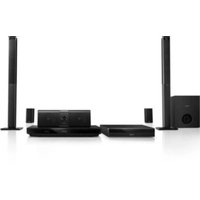

- EC DECLARATION OF CONFORMITY
- YOUR MCI
- PREPARE
- PLACE THE UNIT
- CONNECT
- FIRST-TIME SETUP
- PLAY FROM HOME WI-FI/WIRED
- NETWORK
- PLAY MUSIC CD/MOVIE DVDS
- PLAY FM RADIO
- PLAY FROM AN EXTERNAL AUDIO DEVICE (AUX)
- SETTINGS
- REGISTER MCI900 WITH PHILIPS
- MAINTENANCE
- TECHNICAL DATA
- TROUBLESHOOTING
- CONTACT INFORMATION
- IMPORTANT
- SAFETY
- CAUTION
- WARNING
- HEARING SAFETY
- LISTEN AT A MODERATE VOLUME
- ENVIRONMENTAL NOTICES
- MODIFICATIONS
- RECYCLING
- BATTERY DISPOSAL INFORMATION
- TRADEMARK NOTICE
- INTRODUCTION
- MCI900 CAN
- WITH SUCH CONNECTIONS, YOU CAN
- TIP
- WHAT'S IN THE BOX
- OVERVIEW
- TOP AND FRONT VIEW
- REAR VIEW
- REPEAT A-B
- REPEAT
- SHUFFLE
- ZOOM
- ANGLE
- RATE
- NOW PLAYING
- SEARCH
- NOTE
- HOME SCREEN
- PLAY SCREEN
- TEXT ENTRY
- CONNECT THE HDD TO A COMPUTER
- COPY MCI900 FILES TO THE COMPUTER
- COPY MEDIA FILES TO THE HDD
- INSTALL BATTERIES INTO THE REMOTE CONTROL
- PLACE THE SOUNDSPHERE SPEAKERS
- ABOUT SOUNDSPHERE SPEAKERS
- HOW TO PLACE THE SOUNDSPHERE SPEAKERS
- FOR THE BEST LISTENING EXPERIENCE
- CONNECT THE MAIN UNIT AND CD/DVD UNIT
- CONNECT SPEAKERS
- CONNECT FOR DISC PLAY
- CONNECT A TV
- USING THE CVBS JACK
- USING THE HDMI JACK (SOLD SEPARATELY)
- PLAY FROM ANOTHER SPEAKER SYSTEM
- CONNECT THE FM ANTENNA
- CONNECT EXTERNAL AUDIO DEVICES
- TURN ON/OFF
- CONNECT POWER SUPPLY
- ACTIVE STANDBY
- AUTO ACTIVE STANDBY
- ECO STANDBY
- THE FIRST TIME YOU TURN ON MCI
- TO PROCEED TO NETWORK SETUP
- CONNECT TO HOME WI-FI/WIRED NETWORK
- WIRELESS CONNECTION: ONE-TOUCH WI-FI PROTECTED SETUP (WPS)
- TURN ON WPS-PBC ON MCI
- ADD MCI900 ON THE ROUTER
- CONNECT TO THE INTERNET
- WIRELESS CONNECTION: ENTER ENCRYPTION KEY MANUALLY
- WIRELESS CONNECTION: ENTER IP ADDRESS MANUALLY
- STOP GETTING AUTO IP
- GET THE IP ADDRESS OF THE ROUTER
- ENTER THE IP ADDRESS MANUALLY
- CONNECT TO THE HOME WI-FI/WIRED NETWORK
- WIRED CONNECTION: ENTER IP ADDRESS MANUALLY
- ASSIGN THE IP ADDRESS MANUALLY
- PLAY FROM HOME WI-FI/WIRED NETWORK
- PLAY FROM THE HARD DISK DRIVE (HDD)
- CONNECT THE HDD TO MCI
- LIBRARY ON THE HDD
- TRANSFER THROUGH THE HOME WI-FI/WIRED NETWORK
- FOR COMPUTERS RUNNING WINDOWS XP PROFESSIONAL
- THE FIRST TIME YOU CONNECT THE HDD AS A NETWORK DRIVE, ASSIGN A NETWORK DRIVE TO THE HDD ON THE COMPUTER
- ON [MY COMPUTER] (WINDOWS XP), OR [COMPUTER] (WINDOWS VISTA)
- FOR COMPUTERS RUNNING MAC OS X
- DRAG AND DROP MUSIC/PICTURE FILES FROM THE MUSIC/PHOTOS FOLDER TO MCI
- ORGANIZE FILES ON THE HDD
- ON MCI900, ENSURE THAT THE HDD IS PROPERLY CONNECTED. 2 ON THE REMOTE CONTROL, PRESS HDD
- STREAM FROM A UPNP SERVER
- MEDIA BROWSER (PC)/ TWONKYMEDIA SERVER (MAC)
- LIBRARY ON A UPNP SERVER
- PLAY FAVORITE SONGS
- PLAY PHOTOS
- EXTERNAL CONTROL FROM A PC
- PLAY INTERNET RADIO STATIONS
- TUNE TO INTERNET RADIO STATIONS
- STORE PRESET STATIONS
- TO STORE PRESET STATION
- TO PLAY A PRESET STATION
- EDIT FAVORITE STATIONS
- TO ADD A STATION TO [FAVORITE STATIONS]
- TO REMOVE A STATION FROM [FAVORITE STATIONS]
- EDIT FAVORITE STATIONS ONLINE
- MANUALLY ADD STATIONS ONLINE
- MANUALLY ADD STATIONS
- STREAM FROM ONLINE MUSIC SERVICES
- STREAM FROM NAPSTER
- LOG IN TO YOUR NAPSTER ACCOUNT
- SEARCH FOR MUSIC
- PLAY MUSIC
- MY LIBRARY
- SEARCH FOR MUSIC/PICTURES
- ALPHANUMERIC SEARCH
- QUICKJUMP
- SUPERSCROLL
- PLAY MUSIC CD/ MOVIE DVDS
- BASIC OPERATIONS
- USE THE DISC MENU
- ACCESS THE DISC MENU
- TO ACCESS OR EXIT THE MENU MANUALLY
- PLAY MOVIE DISCS (DVD/DIVX/VCD)
- PAUSE/RESUME/STOP
- TO PAUSE
- TO RESUME
- TO STOP
- FAST SEARCH FORWARD/BACKWARD
- SEARCH BY TIME OR CHAPTER/TRACK
- SELECT LANGUAGES FOR DISC PLAY
- SELECT AN AUDIO LANGUAGE
- SELECT A SUBTITLE LANGUAGE
- PROGRAM FAVORITE CHAPTERS/TRACKS
- SELECT PLAY OPTIONS
- SELECT REPEAT/SHUFFLE OPTIONS
- ZOOM IN/OUT IMAGE
- CHANGE A CAMERA ANGLE
- TUNE TO FM RADIO STATIONS
- AUTOSTORE
- MANUAL TUNING
- EDIT PRESET STATIONS
- STORE CURRENT STATION TO A LOCATION
- EDIT STATION INFORMATION
- LISTEN TO FM RADIO
- RDS (RADIO DATA SYSTEM)
- USE THE RDS FOR CLOCK SETTING
- PLAY FROM AN EXTERNAL AUDIO DEVICE
- PLAY MODES
- TO SELECT A PLAY MODE FOR MUSIC PLAY
- SOUND SETTINGS
- BASS AND TREBLE
- FULL SOUND
- DIRECT SOURCE
- AUDIO BALANCE
- SET THE VOLUME FROM THE EXTERNAL AUDIO DEVICE
- DISPLAY SETTINGS
- BRIGHTNESS
- WALLPAPER
- TO SET WALLPAPER
- SCREENSAVER
- TO SET SCREENSAVER
- SLIDESHOW SETTINGS
- TO SELECT A PLAY MODE FOR SLIDESHOW
- TO SET THE PLAY TIME OF EACH PICTURE
- ALBUM ART
- TO TURN ON [ALBUM ART]
- CLICKER SOUND
- CLOCK SETTINGS
- ALARM
- SET THE ALARM
- TO PLAY A SONG OR INTERNET RADIO STATION AS THE NEXT ALARM SOUND
- USE THE ALARM
- TO SNOOZE THE ALARM
- TO STOP THE ALARM
- TO TURN OFF THE ALARM
- SLEEP TIMER
- TO SET THE TIME DURATION
- DATE AND TIME
- AUTOMATIC SETTING
- THROUGH THE ONLINE SERVICE OVER THE INTERNET
- THROUGH TIME SIGNALS FROM FM RDS RADIO
- MANUAL SETTING
- SET DATE/TIME FORMAT
- NETWORK SETTINGS
- SETUP NETWORK
- DEVICE NAME
- USB SHARING
- LOCATION AND TIME ZONE
- LANGUAGE
- DEVICE INFORMATION
- CHECK FOR SOFTWARE UPGRADES
- DEMO MODE
- CALL CENTER NUMBERS
- RESTORE FACTORY SETTINGS
- BENEFITS
- REGISTER MCI
- REGISTER ON THE WEB SITE
- REGISTER ON THE DEVICE
- UNREGISTER MCI
- TO UNREGISTER AN ACCOUNT
- CHECK REGISTRATION INFORMATION
- CLEANING
- GENERAL
- AC POWER (MAIN UNIT)
- DC POWER (DVD UNIT)
- DC POWER (HDD UNIT)
- DIMENSIONS
- WEIGHT (NET)
- POWER CONSUMPTION
- ACTIVE (ON)
- (ACTIVE) STANDBY
- ECO (PASSIVE) STANDBY
- AUDIO INPUTS
- AUX IN (LINE IN)
- INPUT SENSITIVITY
- INPUT IMPEDANCE
- AUDIO OUTPUTS
- HEADPHONES
- SIGNAL TO NOISE RATIO (HEADPHONES)
- DISTORTION (HEADPHONES)
- AUDIO / VIDEO OUTPUTS (ONLY PROVIDE OUTPUT DURING DISC PLAYBACK)
- SPDIF
- LINE OUT
- SIGNAL TO NOISE RATIO (LINE OUT)
- CVBS
- COMPOSITE VIDEO OUTPUT (PBPRY)
- HDMI
- VIDEO SYSTEM
- VIDEO FORMAT
- USB
- USB PORT TYPE
- SUPPORTED MEDIA
- SUPPORTED CLASS
- MULTI-PARTITION SUPPORT
- DATABASE SUPPORT
- HDD
- DISC TYPE
- SIZE
- FORMAT
- DISPLAY/CLOCK
- RESOLUTION
- BACKLIGHT
- CLOCK/DATE DISPLAY
- WALLPAPER/SCREENSAVER
- AUTOMATIC TIME SETTING VIA INTERNET (NTP)
- INTERNAL (KEY) CLICKER
- OTHERS
- UPNP²
- SHARED DRIVE
- STREAMIUM TERMS AND CONDITIONS
- TERMS AND CONDITIONS OF USE OF YOUR PHILIPS STREAMIUM-ENABLED DEVICE
- ELIGIBILITY FOR REGISTRATION
- RESTRICTIONS ON MODIFICATION OF YOUR DEVICE
- DISCLAIMERS REGARDING CONTENT
- LIMITATIONS ON ACCESS TO STREAMS
- RIGHTS IN CONTENT
- CHANGES IN FEATURES
- SOFTWARE AND INTELLECTUAL PROPERTY RIGHTS
- WARRANTY DISCLAIMER
- LIMITATION OF LIABILITY
- MISCELLANEOUS
- NOTICE
- SOFTWARE END USER LICENSE AGREEMENT
- WRITTEN OFFER
- PREAMBLE
- GNU GENERAL PUBLIC LICENSE
- NO WARRANTY
- END OF TERMS AND CONDITIONS
- COPYRIGHT AND PERMISSION NOTICE
Brand : PHILIPS
Model : Streamium MCI900
Category : Home Theater System