
MWI12IX - Microwave INDESIT - Free user manual and instructions
Find the device manual for free MWI12IX INDESIT in PDF.



| Product type | Microwave oven |
| Brand | Indesit |
| Model | MWI12IX |
| Capacity | 18 liters |
| External dimensions (W x H x D) | 595 x 390 x 320 mm |
| Internal dimensions (W x H x D) | 305 x 210 x 280 mm |
| Weight | 18.6 kg |
| Supply voltage | 230 V / 50 Hz |
| Microwave frequency | 2450 MHz |
| Microwave power | 800 W (max) |
| Grill power | 1000 W |
| Total power | 2200 W |
| Functions | Microwave, Grill, Microwave + Grill (5 combined levels), Defrost, Keep warm |
| Control type | Mechanical (function selector and timer) |
| Turntable | Yes, included |
| Grill rack | Yes, included |
| Interior light | Yes |
| Child safety | Installation at a height of ≥ 80 cm to prevent children from accessing during grill use |
| Cleaning | Interior: damp cloth; turntable dishwasher safe |
| Lamp replacement | By a qualified technician (after-sales service) |
| Repairability | Interventions reserved for the manufacturer or authorized technicians |
| Included accessories | Turntable, grill rack, user manual |
Frequently Asked Questions - MWI12IX INDESIT
User questions about MWI12IX INDESIT
0 question about this device. Answer the ones you know or ask your own.
Ask a new question about this device
Download the instructions for your Microwave in PDF format for free! Find your manual MWI12IX - INDESIT and take your electronic device back in hand. On this page are published all the documents necessary for the use of your device. MWI12IX by INDESIT.
USER MANUAL MWI12IX INDESIT
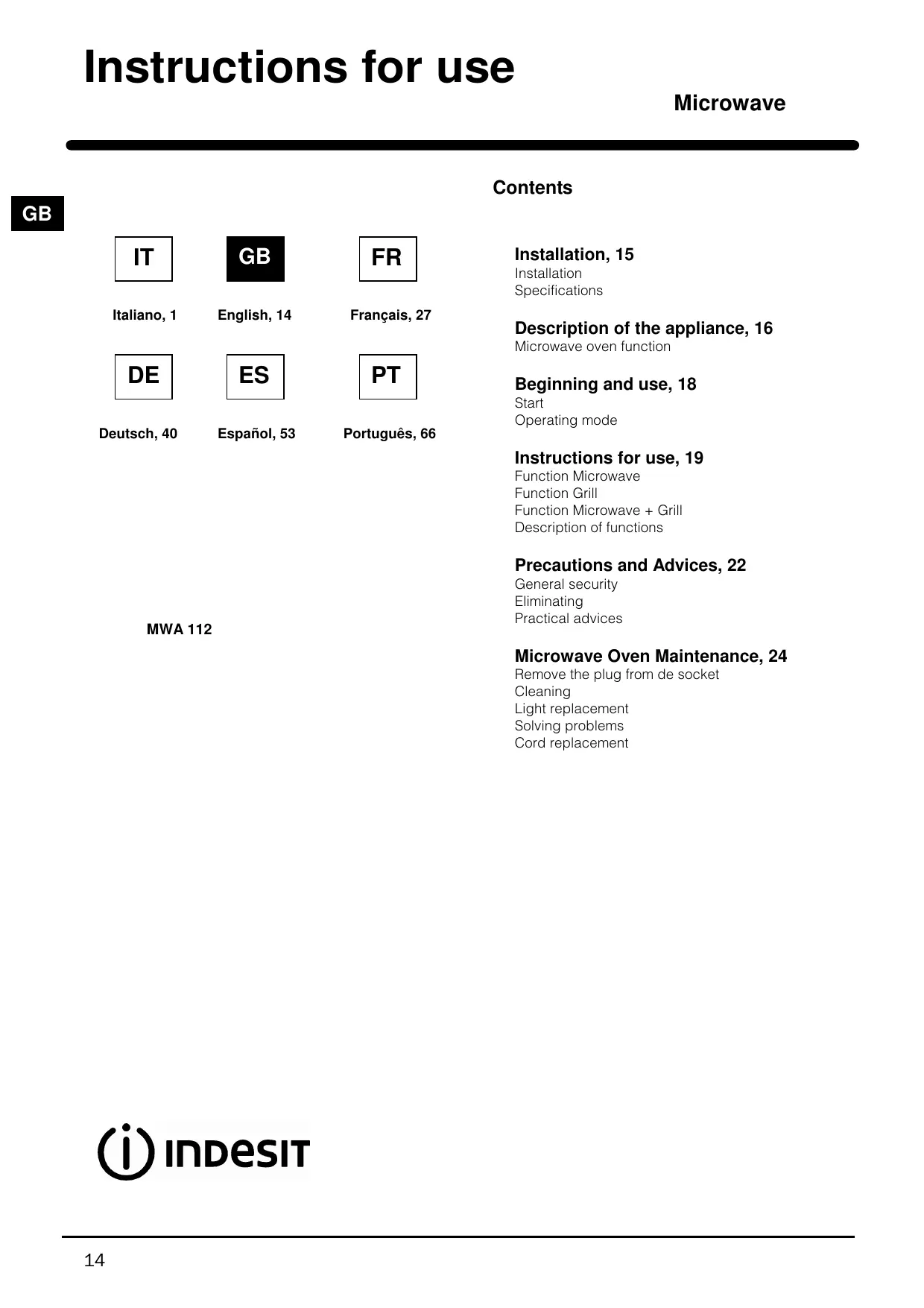
Description of the appliance, 16
Microwave oven function
Beginning and use, 18
Start
Operating mode
Instructions for use, 19
Function Microwave
Function Grill
Function Microwave + Grill
Description of functions
Precautions and Advices, 22
General security
Eliminating
Practical advices
MWA 112
Microwave Oven Maintenance, 24
Remove the plug from the socket
Cleaning
Light replacement
Solving problems
Cord replacement
INDESIT
! It is important to conserve this book to consult at any moment. Keep the operating instructions in a safe place ready to pass on in the event of change of ownership. ! Read the instructions in this book carefully: the instructions contain important information regarding the appliance and its care.
Installation
Remove the microwave oven from the packing.
Remove all packing materials and accessories from the microwave oven cavity.
- Check whether the following parts are in good condition:
- Door and hinges;
- Front of the microwave oven;
- Inside and outside of the microwave oven.
Do not use the appliance if you find any faults. Do not use the microwave oven, and contact your dealer. Place the appliance on a stable, flat surface. To allow efficient cooling of the microwave oven, its installation is recommended in a unit with an opening in the upper part (refer to the installation instructions leaflet enclosed).
The microwave oven plug shall be accessible after installation.
- When installing the microwave oven, great care should be taken to ensure that the mains power cable cannot come into contact with the rear, since the high temperatures involved could cause damage.
- When the microwave oven is installed in a column with a conventional oven, the microwave oven must not be located underneath the conventional oven because of the possibility of condensation forming inside the latter.
The microwave oven has been supplied with a monophase power supply cord. The appliance must be earthed. This appliance must be earthed. The manufacturers and dealers are not liable for any breakdowns or personal accidents should these installation instructions not be observed by the purchaser.
Specifications
AC voltage 230 V / 50 Hz Fuse. 12 A / 250 V Power required 2200 W Grill power 1000 W Microwave output power 800 W Microwave frequency 2450 MHz Outer dimensions (W × A × D) 595 × 390 × 320 mm Cavity dimensions (W × A × D) 305 × 210 × 280 mm Oven capacity 18 ltr Weight 18.6 kg
Description of the appliance
GB
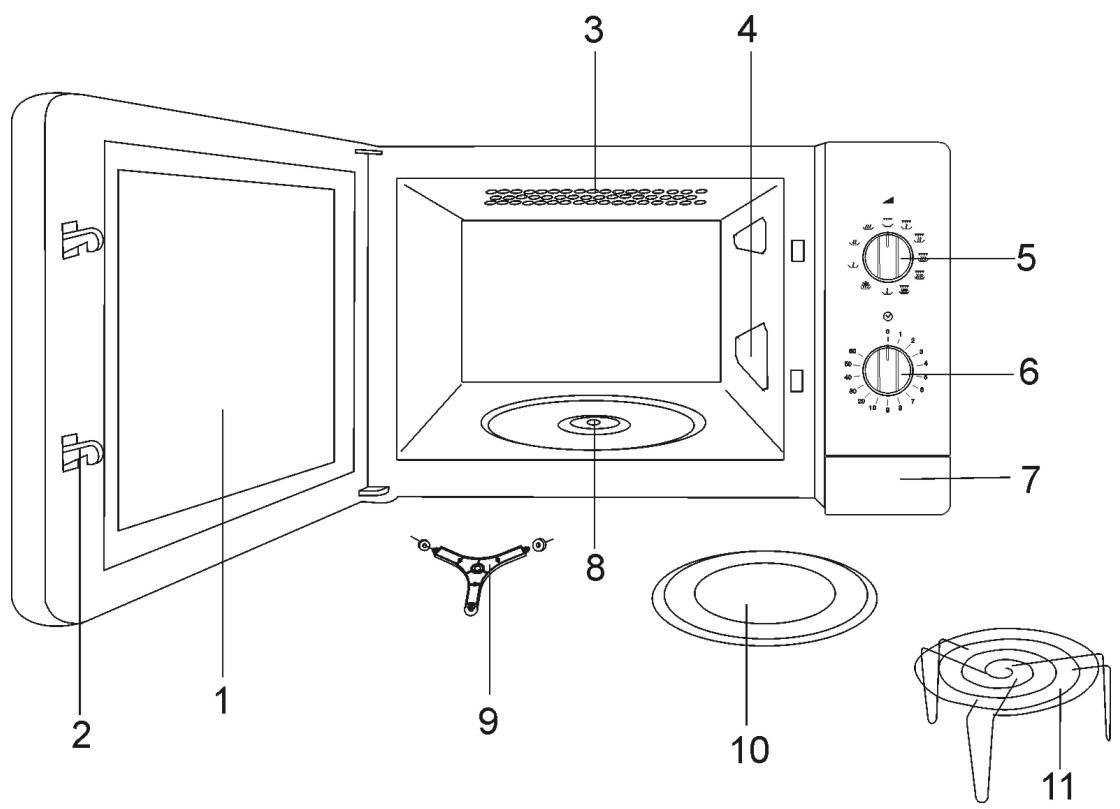
1 – Glass window on the door 2 - Catch 3 - Quartz grill 4 - Mica covers 5 - Function Selector 6 - Timer Selector
7 - Open button 8 - Slot for rotating base 9 - Rotating base
10 - Rotating plate
11 - Grill
Microwave oven function:
In a conventional oven, the heat radiated by the resistances or gas burners slowly penetrates the food from the outside to the inside. There is, therefore, a great loss of energy in the heating of the air, oven components, and recipients.
On the other hand, in microwave ovens the heat is generated in the interior of the food itself, heating it from the inside outwards. There is therefore no loss of energy as the air, interior walls of the oven and recipients (when adequate) do not heat up with microwaves.
Microwave ovens have the following advantages:
- Save on cooking time: in general there is a 3/4 reduction of the cooking time than with conventional methods.
- Ultra-quick defrosting that prevents bacteria development.
- Electricity saving.
- Maintaining the nutritive value of the food due to the cooking time reduction.
- Easy cleaning.
In the microwave oven there is a high voltage valve called "Magnetron" that converts electric energy to Microwave energy. These electromagnetic waves are conducted to the inside of the oven cavity by means of wave-guide and spread by a mode stirrer or by a turntable.
Inside the oven, the Microwaves spread out in all directions and are reflected by the metallic walls, penetrating the food evenly.
Most food contains water, whose molecules vibrate with Microwaves.
The friction between the molecules generates heat, which causes a temperature rise in the food, defrosting it, cooking it or keeping it warm.
As the heat is formed inside the food:
- It may be cooked with little or no liquid or fat;
- Defrosting, heating or cooking in the microwave oven is quicker than in a conventional oven;
- Vitamins, minerals and nutritive substances are preserved;
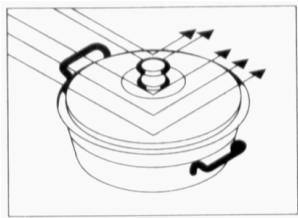
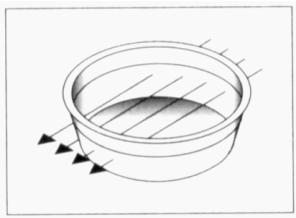
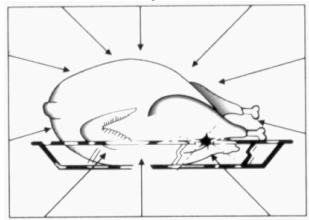
The Microwaves pass through porcelain, glass, cardboard and plastic but not through metal. Therefore, recipients made of or containing metal should not be used in the microwave oven.
The Microwaves are reflected by the metal...
...they pass through Glass and Porcelain...
...and they are absorbed by the food.
Start
Proceed as follows:
- Plug the microwave oven into a suitable outlet (see installation instructions).
- To open the door, press the open button.
- Place the container with the food on the oblate or on the grille.
- Select the function and the cooking time, according to the description contained in the following sections.
- Close the door.
- The microwaves start to function.
The oven door may be opened at any time while in use:
- The microwaves oven is immediately interrupted;
- The grill will be switched off, however, remaining very hot;
- The timer will stop automatically, indicating the time left.
You may then, if you wish:
- Move or turn the foods around to improve uniformity of the heating process;
- Select another function, placing the function selector in another position;
Change the operating time that is left, by turning the timer button.
! When you finish using the oven, always turn the timer button to zero, because otherwise the oven will start to function when you close the door and may be damaged when empty.
! To interrupt the functioning of the microwave, turn the Timer Button to ZERO or open the door. ! It is possible to change the operating time, the power level or the function while the oven is functioning, by turning the respective control.
Operating time
The desired operating time is selected by turning the timer button.
For times under 2 minutes, turn the timer button to a higher time and then go down to the desired time.
As long as the timer button reads other than zero, the oven light should be on.
When the operating time is over, the timer emits a beep and automatically disconnects the oven.
Instructions for use
Function Microwave
Set the function selector to the position that corresponds to the desired power level, according to the following table:
| Position | Power level | Power |
| Maximum | 800 W | |
| Medium | 650 W | |
| Minimum | 460 W | |
| Defrost | 290 W | |
| Keep hot | 150 W |
Before using any dish, make sure that it is appropriate for use in microwaves (SEE ADVICE ON THE USE OF UTENSILS AND RECIPIENTS).
Always make a slit in the food's shell before cooking it.
Whenever heating liquids, use a recipient with a large opening to allow the vapour to escape.
Remember that:
- Larger quantities of food require more cooking time.
- The lower the food temperature, the more cooking time is needed.
- Less dense foods cook faster.
- An even distribution of the food in the oven guarantees better results. The cooking of different types of foods simultaneously is possible by placing the dense food in an outside circle and the less dense in the centre of the plate.
- Better results are achieved by allowing the food to stand before serving because it continues to cook for some time after the oven is switched off.
- The cooking time may be shortened and the liquids preserved (the food doesn't dry out) by covering the food. The lids should be transparent to allow the microwaves through and they should have a small opening for the vapour to escape.
Function Grill
Set the function selector to the appropriate position.
The oven has a temperature limiting device that controls the electrical resistances, connecting and disconnecting them to keep the temperature within certain limits.
We recommend that the grille be used to bring the foods closer to the grill and thus obtain better results.
Do not place the grill rack in contact with the cavity's metal surface as there may be an electric arc and consequent damages.
! While the grill is being used for the first time, the producing of fumes and odours is normal, due to the oils used in the manufacturing process. ! After the first uses of the grill, it is normal for the perforated area that protects the heating elements of the grill to deform and to become a golden colour due to the high temperatures that the grill reaches during use. ! The glass on the door reaches high temperatures during grilling. Therefore the oven should be installed at least 80 cm above the floor, so as to be out of reach of children.
! While in operation, the inside walls of the oven and the grill become very hot, therefore the use of kitchen gloves is recommended. ! During extended use of the grill it is normal for the heating elements to switch off for short periods due to the action of the safety temperature limiter. ! Do not use plastic containers or others that have poor temperature resistance, as these could be destroyed due to the high temperatures that the grill reaches.
Function Microwave + Grill
Set the function selector to the position that corresponds to the desired power level, according to the following table:
| Position | Power level | Power |
| 5 | 800 W | |
| 4 | 680 W | |
| 3 | 530 W | |
| 2 | 390 W | |
| 1 | 240 W |
Table of functions
GB
Description of functions
| Symbol | Description | Power | Foods |
| Keep hot | 150 W | Slow defrosting for delicate foods, keeping food hot | |
| Defrost | 290 W | Cooking at low heat, boiling rice Fast defrosting | |
| Minimum | 460 W | Melting butter Heating baby food | |
| Medium | 650 W | Cooking vegetables and other foods Cooking and heating carefully Heating and cooking small quantities Heating delicates foods | |
| Maximum | 800 W | Cooking and heating liquids and other foods fast | |
| 1 | 240 W | Browning toast | |
| 2 | 390 W | Grilling poultry and meat | |
| 3 | 530 W | Cooking meatloaves and “au gratin” dishes | |
| 4 | 680 W | Preparing meat round | |
| 5 | 800 W | Potatoes “au gratin” | |
| Grill | 1000 W | Grill all sorts of foods |
Precautions and Advices
GB
General security
! If the door or the door hinges are damaged, the oven should not be switched on until repaired by a qualified technician. ! It is dangerous for anyone, except a qualified technician, to tamper with the apparatus or try to repair it in any way by removing any lid or covering which assures protection against the exposure to microwave energy. ! Liquids and other food should not be heated in airtight recipients as these can explode. ! Children should only be allowed to use the oven without adult supervision if they have been given the appropriate instructions so that they can use the oven safely and understand the dangers of its incorrect use. ! When the microwave oven is operated in the Combination mode (Microwaves + Grill), children should only be allowed to use the unit under adult supervision due to the high temperatures generated. ! The microwave oven should be cleaned regularly and any food deposits removed (please see the chapter on Oven Maintenance for details). Failure to maintain the oven in a clean condition could lead to deterioration of the surface that could adversely affect the life of the appliance and possibly result in a hazardous situation. - When heating food in plastic or paper recipients, check the oven frequently in case they ignite. - If any smoke is detected, then switch off the oven or disconnect it and keep the door closed in order for any flame to die out. - After warming up baby bottles or baby food jars stir or shake its contents and check the temperature before feeding, to avoid burns. - Warming up drinks in the microwave oven may result in a delayed eruptive boiling; therefore one should be careful when handling the recipient.
- Eggs with their shell and whole boiled eggs shouldn't be warmed up in microwave ovens as they may explode, even after microwave heating has ended.
- Only use utensils that are suitable for use in microwave ovens. Do not use any metal utensils inside the oven unless they were supplied with the oven and for that purpose.
- Do not warm up liquids or other food in closed recipients as they may explode.
- Do not warm up pure alcohol or alcoholic drinks. FIRE DANGER.
- When in doubt, choose short periods to cook heat or defrost food with microwaves. With long cooking periods the food may become dry and even begin to burn.
- Do not use the microwave oven for anything other than warming, cooking or defrosting food.
- Do not operate the microwave oven without its tray nor when empty.
- Keep the microwave oven ventilation holes open. Never cover any air vents or openings.
- Eliminating the packing materials: use the right bins when discarding all of packing materials. This will ensure that the packaging materials are recycled.
The European Directive 2002/96/EC on Waste Electrical and Electronic Equipment (WEEE) requires that old household electrical appliances must not be disposed of in the normal unsorted municipal waste stream. Old appliances must be collected separately in order to optimize the recovery and recycling of the materials they contain and reduce the impact on human health and the environment.
The crossed out "wheeled bin" symbol on the product reminds you of your obligation that when you dispose of the appliance it must be separately collected.
Consumers should contact their local authority or retailer for information concerning the correct disposal of their old appliance.
Practical advice
- Use heat-resistant ovenware made of glass, ceramic, and porcelain, or heat-resistant plastic. These materials do not block the microwaves.
- This is not the case with ovenware made of metal. The microwaves are obstructed, which means that the food in closed containers remains cold. Ensure that any metal objects – e.g. a spoon – are at least 2 cm away from the oven walls and the inside of the door. The glass on the inside of the door could be damaged by sparks.
- To cook or defrost pieces of meat of irregular sizes, you may cover the thinner parts with tin foil, which should be kept at least 2 cm away from the oven walls, otherwise these may cause an electric arc.
- Metal spits may be used as long as they are smaller than the pieces of meat.
- Crystal contains a percentage of lead, which may cause it to crack if used in the microwave oven. The same may happen to glass dishes with jagged edges.
Porcelain dishes may be used but they should not have hollow handles. Humidity may be formed inside the hollow handles, which will cause an increase in pressure that may cause them to break.
This type of dish may heat considerably.
Painted glazed ceramic dishes may be used if the painting is done under the glaze.
Many glazes and colours contain metallic substances. If this is the case they should not be used in the microwave as they may be damaged.
Recipients with silver and gold glazes may go dark.
Plastic dishes should be heat resistant (at least 180°C) or they may be deformed when used in the microwave. Melamine dishes are not suitable for use in the microwave as they heat up too much.
To cook or heat food in plastic bags, they should be perforated to allow vapour to escape thus preventing the bag from bursting.
! Wooden recipients should not be used in the microwave. Wood contains water, which evaporates and may cause the recipient to crack.
Microwave Oven Maintenance
GB
- If in doubt about the use of glass, glazed ceramic or porcelain dishes in the microwave oven, do the following test:
- Place the empty dish and a glass of water inside the microwave oven;
- Close the door;
- Set the Power Level Selector at maximum power;
- Adjust the timer to 1 minute;
! If during this test you hear any noise along with sparks, turn off the oven immediately. - Any kind of cookware that has this kind of behaviour or is very hot when removed from the oven should not be used in the microwave oven.
! Glazed ceramic dish recipients contain many water molecules and heat a lot, but can be used in the microwave oven.
If in doubt, contact the supplier of the cookware, and make sure that they are appropriate for microwaves.
The use of glass lids, plastic lids or plastic film is advisable because:
- They prevent the release of excessive vapours especially when cooking for longer periods.
- They increase the speed of heating food.
- They prevent the food from drying up.
- They prevent the loss of the food aroma.
The lids should have holes to avoid pressure. Plastic film should be perforated.
Baby bottles, baby food jars and other similar recipients should be warmed up without lids as they can burst.
Remove the plug from the socket.
Make sure that the oven is unplugged before cleaning the oven.
Don't use abrasive cleaning products.
Cleaning
Outside
- Clean the outside surface with neutral detergent, lukewarm water and dry it with a damp cloth.
- Avoid water from entering the oven ventilation holes.
Inside
- Clean the oven walls with a damp cloth after each use.
- Avoid water from entering the ventilation holes in the oven's interior.
- If some time has passed by since the last cleaning and the oven's interior is dirty, place a glass of water on the tray and switch on the oven for 4 minutes on the highest setting. Moisture will form on the oven walls, which will be easily cleaned.
- The tray can be washed with regular dish washing detergent or in the dishwasher.
Door, door seal, and oven front
- These parts should always be clean, especially the contact surface between the door and the oven front, to prevent microwave leakage.
- Use neutral detergent, lukewarm water and dry the surface with a soft cloth.
Light Replacement
The light bulb may only be replaced by the Technical Support Service.
Solving Problems
Repairs or interventions carried out by an unqualified serviceman can cause dangerous situations.
Every and any kind of repair or intervention should be done by the manufacturer, authorized agents or qualified technicians.
If you detect any abnormalities in the oven, check the following before you contact T.A.S:
- Check if the outlet into which the oven is plugged has power. To do so, plug another appliance into the same outlet and check if it works. 2 If the oven lamp switches on, but the food does not heat up, check if the door is well closed (if the door is not properly closed, no microwaves will be produced).
Cord Replacement
If the cord is damaged, it should be replaced by the manufacturer, authorized agents or qualified technicians in order to avoid any dangerous situation and also because special tools are required.
Specifications
Device description, 29
(L x W x H) .595×390×320mm


- DESCRIPTION OF THE APPLIANCE
- BEGINNING AND USE
- INSTRUCTIONS FOR USE
- PRECAUTIONS AND ADVICES
- MICROWAVE OVEN MAINTENANCE
- INSTALLATION
- THE MICROWAVE OVEN PLUG SHALL BE ACCESSIBLE AFTER INSTALLATION
- SPECIFICATIONS
- MICROWAVE OVEN FUNCTION
- START
- OPERATING TIME
- FUNCTION MICROWAVE
- FUNCTION GRILL
- FUNCTION MICROWAVE + GRILL
- TABLE OF FUNCTIONS
- GB
- GENERAL SECURITY
- PRACTICAL ADVICE
- GLAZED CERAMIC DISH RECIPIENTS CONTAIN MANY WATER MOLECULES AND HEAT A LOT, BUT CAN BE USED IN THE MICROWAVE OVEN
- REMOVE THE PLUG FROM THE SOCKET
- CLEANING
- OUTSIDE
- INSIDE
- DOOR, DOOR SEAL, AND OVEN FRONT
- LIGHT REPLACEMENT
- SOLVING PROBLEMS
- EVERY AND ANY KIND OF REPAIR OR INTERVENTION SHOULD BE DONE BY THE MANUFACTURER, AUTHORIZED AGENTS OR QUALIFIED TECHNICIANS
- CORD REPLACEMENT
Brand : INDESIT
Model : MWI12IX
Category : Microwave