MX3 Plus - Blood pressure monitor OMRON - Free user manual and instructions
Find the device manual for free MX3 Plus OMRON in PDF.


User questions about MX3 Plus OMRON
0 question about this device. Answer the ones you know or ask your own.
Ask a new question about this device
Download the instructions for your Blood pressure monitor in PDF format for free! Find your manual MX3 Plus - OMRON and take your electronic device back in hand. On this page are published all the documents necessary for the use of your device. MX3 Plus by OMRON.
USER MANUAL MX3 Plus OMRON
Automatic Blood Pressure Monitor

text_image
SYS mmHg DIA mmHg PULSEmin 128 78 M MX3 Plus omronThe OMRON MX3 Plus measures your blood pressure and pulse simply and quickly from the arm, without the use of an inflation bulb or stethoscope. The measurement values are stored in the memory of the OMRON MX3 Plus.
The OMRON MX3 Plus includes a standard cuff for arm circumferences ranging from 22-32 cm. Optional large cuffs (32-42 cm) can be applied.
Table of contents
1 How to obtain meaningful blood pressure readings 1
2 Overview 2
3 Preparation 3
4 Operation 4
5 Memory 7
6 Error: causes and rectifications 8
7 Maintenance and spare parts 8
8 Technical data 9
9 General information about blood pressure 11
1 How to obtain meaningful blood pressure readings
General
- The OMRON MX3 Plus is not suitable for measuring the frequency of cardiac pacemakers.
-
Consult your doctor during pregnancy, arrhythmia and arteriosclerosis as this can influence the measurement.
-
Avoid eating, drinking (alcohol), smoking, sport and taking a bath before measurement.
- Be calm and relaxed before and during measurement.
-
You should never change the dose of medicines prescribed by your doctor.
-
Store the OMRON MX3 Plus in a dry, closed place with a temperature between -20°C and 60°C.
- Remove the batteries if you not intend to use the OMRON MX3 Plus for 3 months or more.
Tips for use
- Check your blood pressure at least twice a day (before breakfast, after work).
- Do not measure your blood pressure while you are in a vehicle.
• Always measure on the same arm. - Wrap the cuff around your arm before start of measurement.
Caution
- Operating temperature between 10^ and 40^ .
- Operating environment must be free from excessive vibrations, shocks, magnetic fields, electrical noise, etc.
- Stay out of sunlight during measuring.
- Keep portable phones 5 meters away during measurement.
- Do not wrap the cuff around any object other than your arm.
- Do not fold the cuff and the tube.
- Do not drop the OMRON MX3 Plus.
2 Overview
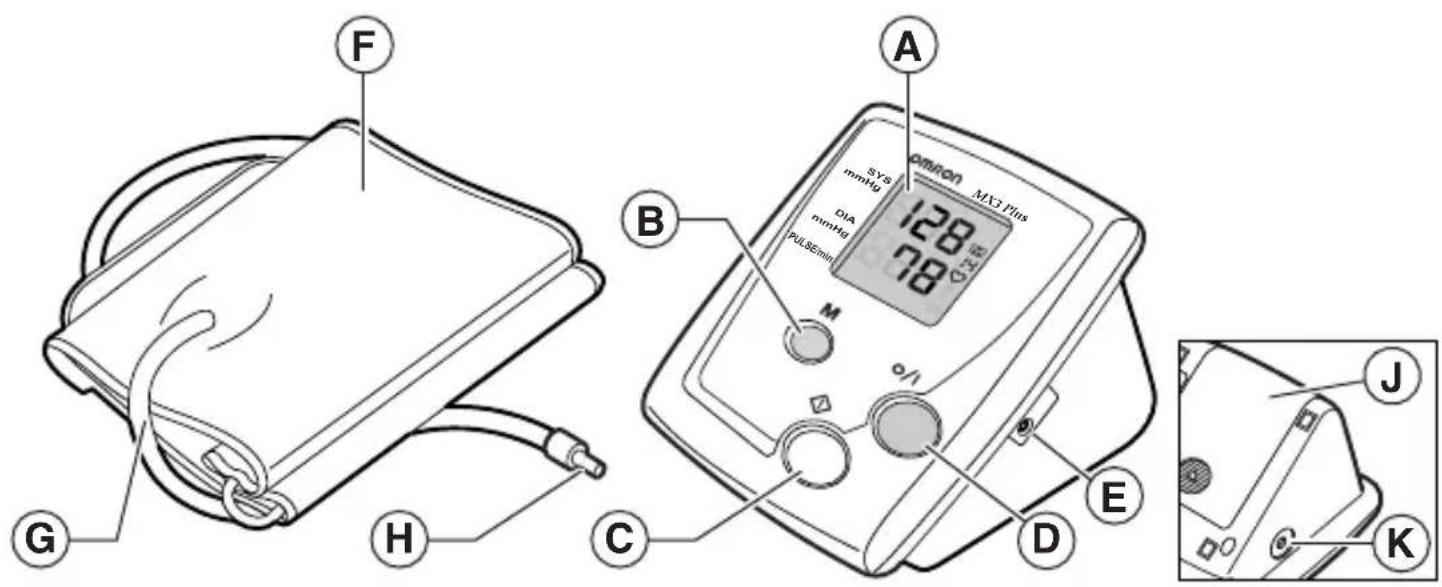
text_image
A B C D E F G H I J K mMn SYS mmHg DIA mmHg PULSEmin 128 78 MHz Plus OMRONA Display
B Memory recall button
C Start button
D On/off button
E AC adapter jack
F Cuff
G Air tube
H Air plug
J Battery compartment
K Air jack
3 Preparation

text_image
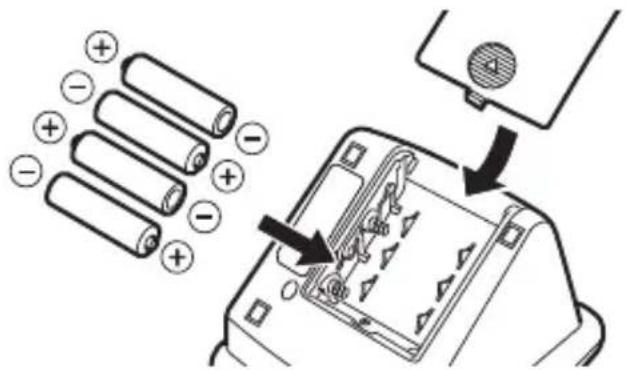
Insert batteries1 Slide off the battery cover.
text_image
Diagram showing battery arrangement and component insertion, with plus/minus signs indicating charge distribution.2 Insert four batteries as indicated in the battery compartment and close compartment
Caution! Use four identical 1.5V alkaline batteries type AA LR6!
Connect cuff
text_image
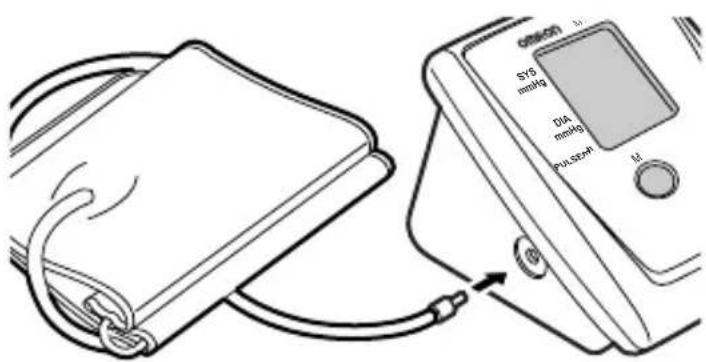
SVS mmHg DA mmHg Pulsch M1 Insert air plug in air jacket.
Fit cuff
Caution! Do not inflate the cuff when not wrapped around the arm!

natural_image
Line drawing of a hand holding an otoscope, no text or symbols present1 Bare your arm.
Caution! Push up your sleeve: avoid constricting the blood flow!
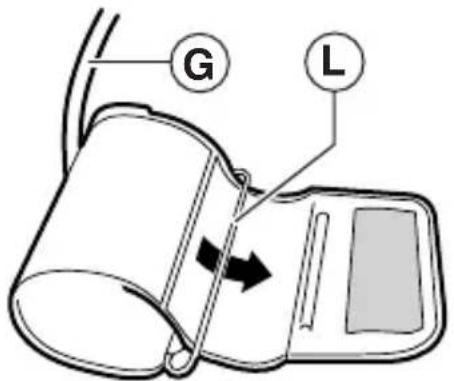
G Air tube
L Ring
text_image
G L2 Pass the end of the cuff through the ring. Caution! Keep the air tube on the outside!
text_image
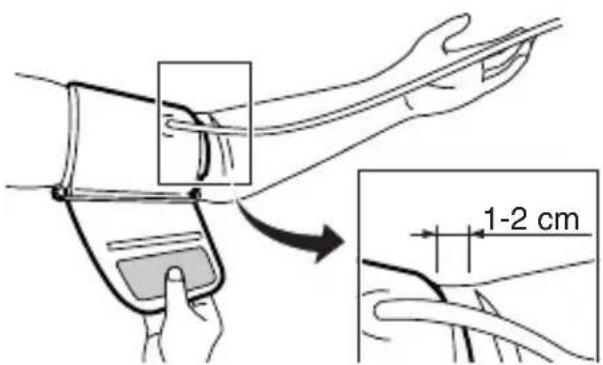
1-2 cm3 Put your arm through the loop.
Note: keep the tube even with your middle finger.

text_image
1-2 cmNote: for right arm use keep the tube parallel with your little finger!

natural_image
Illustration of a hand holding a device with an arrow indicating direction (no text or symbols)4 Hold the end of the cuff and wrap it around your arm.
Caution! Be sure the cuff fits closely; do not pinch your arm!
4 Operation

text_image
omron MG3 Plus S YS mmHg DIA mmHg PULSE/min M O/L B C D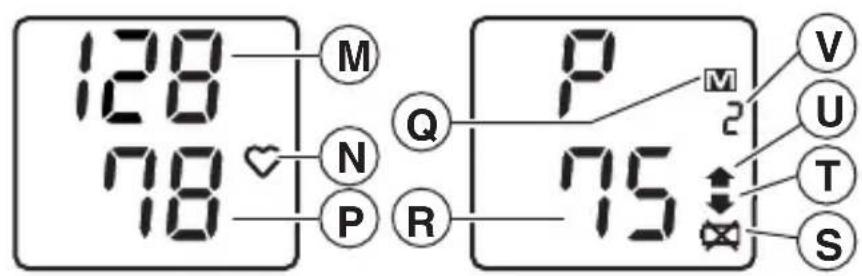
text_image
128 78 M N P Q P 75 V U T SControl functions
B Memory recall button
C Start button
D On/off button
Measurement
M Systolic blood pressure in mmHg.
N Heart symbol: flash - measurement takes place, light up - finish measurement.
P Diastolic blood pressure in mmHg.
Q Memory display: values in memory.
R Pulse: heartbeats per minute.
S Battery exhausted: batteries are weak/exhausted.
T Deflation: cuff deflates and measurement finishes.
U Inflation: cuff inflates and measurement starts.
V Memory position: 1 to 14.
Caution! Allow an interval of at least three minutes between two successive measurements!

natural_image
Line drawing of a person sitting at a desk in a seated posture (no text or symbols)1 Sit comfortably at a table with your feet flat on the floor and rest your arm on the table.
natural_image
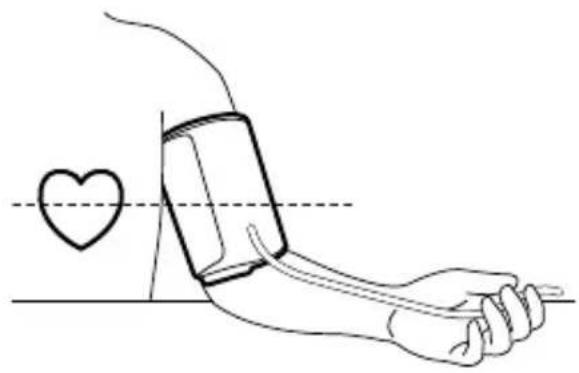
Line drawing of a human arm with a heart symbol placed between the arm and hand (no text or labels)2 Relax your arm and turn your palm upward.
Caution! Cuff at heart height during measurement!

text_image
OMRON MX3 Plus SYS mmHg 888 DIA mmHg 888 PULSE/min M O/I
text_image
omron MX3 Plus S/S mmHg DIA mmHg PULSE/min M O/I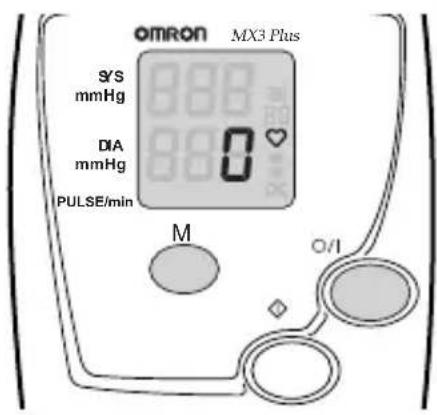
text_image
OMRON MX3 Plus SYS mmHg DIA mmHg PULSE/min M O/I3 Press on/off button.
Caution! Wait for zero and the heart symbol to continue!

text_image
OMRON MX3 Plus SYS mmHg DIA mmHg 170 PULSE/min M O/I4 Press start button
Note: the unit inflates the cuff to 170 mmHg. If required the unit automatically increases the pressure by 40 mmHg.
Note: press and hold the start button to set pressure higher than 170 mmHg.
Caution! Do not inflate over 280 mmHg!
| MX3 Plus | MX3 Plus | MX3 Plus | |
| S YS m mHg | SYS mmHg | SYS mmHg | |
| DIA m mHg | DIA mmHg | DIA mmHg | |
| PULSE/min | PULSE/min | PULSE/min | |
| M | M | M |
Note: the cuff deflates automatically.
Caution! Sit still, do not move and do not speak!
Read display
| MX3 Plus | MX3 Plus | |
| SYS mmHg | SYS mmHg | |
| DIA mmHg | DIA mmHg | |
| PULSE/min | PULSE/min | |
| M | M | |
1 Read the values of blood pressure and pulse from the display.
Note: display shows blood pressures and heartbeats alternately.
text_image
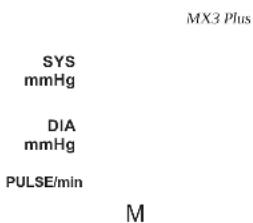
MX3 Plus SYS mmHg DIA mmHg PULSE/min M2 Note values in your personal blood pressure pass.
3 Press on/off button to turn off power. Note: power automatically shuts of in 5 minutes.
5 Memory
Recall previous values
text_image
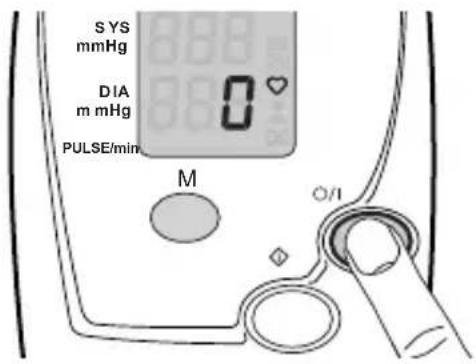
SYS mmHg DIA m mHg PULSE/min M O/I1 Press on/off button to turn on power.
text_image
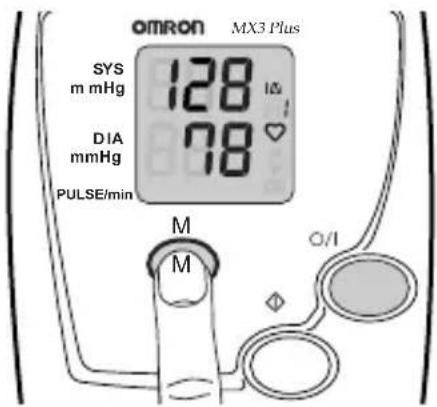
OMRON MX3 Plus SYS m mHg 128 10 DIA mmHg 78 PULSE/min M M O/I2 Press memory recall button for latest and previous values.
Note: display shows alternately blood pressures and heartbeats.
Erase memory
text_image
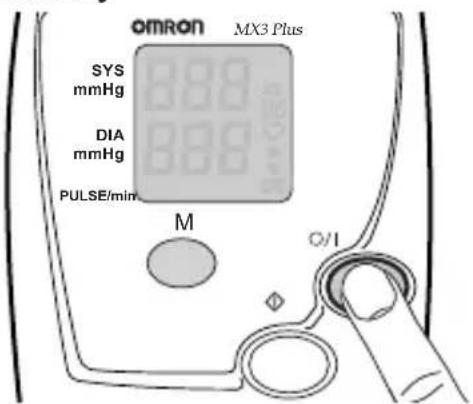
omron MX3 Plus SYS mmHg DIA mmHg PULSE/min M Q/I1 Press on/off button to turn on power.
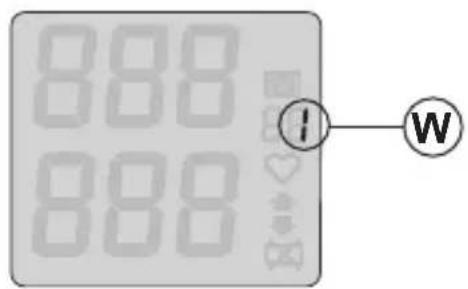
text_image
888 888 I WW Memory position of latest and previous values (1-14).
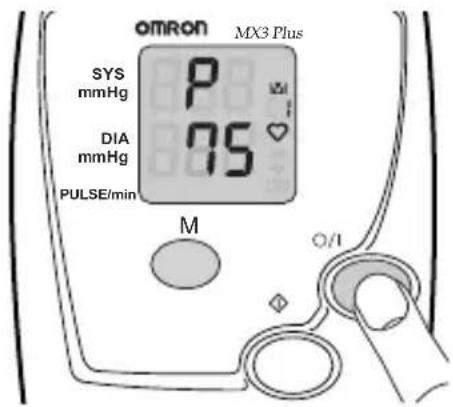
text_image
omron MX3 Plus SYS mmHg PULSE/min P 75 M O/I3 Press on/off button to turn off power.
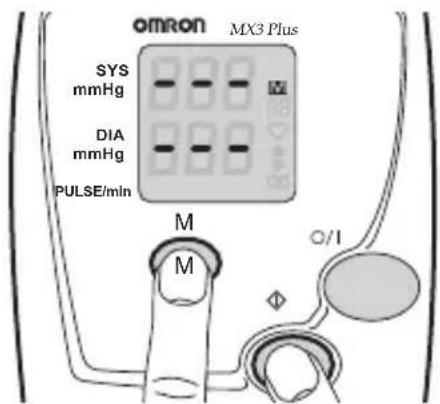
text_image
omron MX3 Plus SYS mmHg DIA mmHg PULSE/min M M O/I2 Press the memory recall button for 2-3 seconds and then, whilst continuing to press the recall button, press the start button.
Caution! All stored values will be erased! Press on/off button to turn off power.
6 Error: causes and rectifications
| Indication Error Cause Rectification | |||
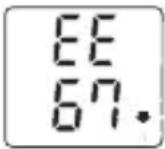 | Correct reading not possible | Cuff pressure | Wait for at least three minutes to repeat measurement. |
| Movement | Inflate the cuff 40 mmHg higher than previous value. | ||
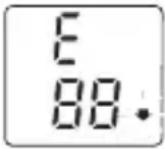 | Very weak artery pulse | Follow instructions, repeat measurement. | |
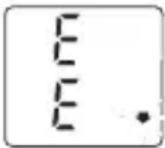 | Cuff pressure too high | Wait for at least three minutes to repeat measurement. | |
| Inflate the cuff 30 mmHg lower than previous value. | |||
| Follow instructions, repeat measurement. | |||
 | Low Batteries weak/ Fit four voltage exhausted alkaline batteries type AA LR6 | ||
| Display empty | |||
7 Maintenance and spare parts
- Use a soft, slightly moistened cloth to clean the OMRON MX3 Plus.
Caution! Do not use petrol, thinners or similar solvents!
- Use a soft, moistened cloth and soap to clean the cuff.
Caution! Do not wash the cuff!
Caution! Do not use petrol, thinners or similar solvents!
- Do not carry out repairs of any kind yourself. If a defect occurs consult your
OMRON retail outlet or distributor as mentioned on the packaging.
Calibration
- It is recommended to have the OMRON MX3 Plus inspected every two years to ensure correct function and accuracy. Consult your OMRON retail outlet or OMRON distributor as mentioned on the packaging.
Replace batteries
- Remove the battery out of the battery
compartment and insert four new identical 1.5V alkaline batteries type AA LR6 batteries.
Spare parts
- Due to high company quality standards, OMRON considers the main unit as a non-serviceable part because the need
for proper calibration after replacement of high tech components.
Attention! Disposal of used batteries should be carried out in accordance with the national regulations for the disposal.
8 Technical data
Product name OMRON MX3 Plus
Model HEM-742-E
Display Digital LCD
Measuring range Pressure: 0 - 299 mmHg / Pulse: 40 - 180 beats/minute
Accuracy Pressure: ± 3 mmHg
Pulse: ± 5% of display reading
Inflation Automatic by electric pump
Deflation Automatic pressure release valve
Rapid pressure release Automatic exhaust valve
Pressure detection
Capacitive pressure sensor
Measuring method Oscilliometric
Power supply 4 x 1.5V alkaline batteries type (LR6) AA
AC adapter (optional part)
Battery life New batteries will last for approximately 300 measurements
Operating temperature/humidity +10°C to +40°C / 30% to max. 85% relative humidity
Operating environment Free from excessive vibrations, shocks, magnetic fields, electrical noise, etc.
Storage temperature/humidity -20°C to +60°C /10% to max. 95% relative humidity
Weight
Approximately 350 gr including cuff, excluding batteries
Outer dimensions
Approximately 118 mm (W) x 90 mm (H) x 130 mm (D)
Cuff dimensions
Approximately 145 mm (W) x 480 mm (L)
Arm circumference
22 cm to 32 cm
Accessories
Cuff, instruction manual, guarantee card, blood pressure pass
Optional parts
Large cuff for arm circumferences between 32 - 42 cm, AC adapter
Note
Subject to technical modification without prior notice


Manufacturer
24, Yamanouchi Yamanoshita-cho, Ukyo-ku, Kyoto, 615-0084 Japan
EU-representative
OMRON HEALTHCARE EUROPE B.V., Kruisweg 577, NL-2132 NA Hoofddorp
Made in China
This device fulfils the provisions of the EC directive 93/42/EEC (Medical Device Directive). This blood pressure monitor is designed according to the European standard EN1060, Non-invasive sphygmomanometers Part 1: General Requirements and Part 3: Supplementary requirements for electromechanical blood pressure measuring systems. This OMRON product is produced under the strict quality system of OMRON HEALTHCARE CO., LTD., Japan. The Core component for OMRON blood pressure monitors, which is the Pressure Sensor, is produced in Japan.
Important information regarding Electro Magnetic Compatibility (EMC)
With the increased number of electronic devices such as PC's and mobile (cellular) telephones, medical devices in use may be susceptible to electromagnetic interference from other devices. Electromagnetic interference may result in incorrect operation of the medical device and create a potentially unsafe situation.
Medical devices should also not interfere with other devices.
In order to regulate the requirements for EMC (Electro Magnetic Compatibility) with the aim to prevent unsafe product situations, the IEC60601-1-2 standard has been implemented. This standard defines the levels of immunity to electromagnetic interferences as well as maximum levels of electromagnetic emissions for medical devices.
This medical device manufactured by OMRON Healthcare conforms to this IEC60601-1-2:2001 standard for both immunity and emissions.
Nevertheless, special precautions need to be observed:
Do not use mobile (cellular) telephones and other devices, which generate strong electrical or electromagnetic fields, near the medical device. This may result in incorrect operation of the unit and create a potentially unsafe situation.
Recommendation is to keep a minimum distance of 7 m. Verify correct operation of the device in case the distance is shorter.
Further documentation in accordance with IEC60601-1-2:2001 is available at OMRON Healthcare Europe at the address mentioned in this instruction manual.
Documentation is also available at www.omron-healthcare.com.
Correct Disposal of This Product
(Waste Electrical & Electronic Equipment)
This marking shown on the product or its literature, indicates that it should not be disposed with other household wastes at the end of its working life. To prevent possible harm to the environment or human health from uncontrolled waste disposal, please separate this from other types of wastes and recycle it responsibly to promote the sustainable reuse of material resources.
Household users should contact either the retailer where they purchased this product, or their local government office, for details of where and how they can take this item for environmentally safe recycling.
Business users should contact their supplier and check the terms and conditions of the purchase contract. This product should not be mixed with other commercial wastes for disposal.

This product does not contain any hazardous substances.
9 General information about blood pressure
Blood circulation
The blood circulation is responsible for supplying the body with oxygen. Blood pressure is the pressure exerted on the arteries.
The systolic blood pressure value (higher pressure or top value) represents the blood pressure produced by contraction of the heart muscle.
The diastolic blood pressure value (lower pressure or lower value) represents the blood pressure produced by relaxation of the heart muscle.
Classification of blood pressure
The World Health Organisation (WHO) and the International Society of Hypertension (ISH) developed the blood pressure classification. This classification is based on the blood pressure values measured while sitting on a chair in the outpatient department of a hospital.
Health and blood pressure
The incidence of hypertension increases with age. In addition, a lack of exercise, excess body fat and high levels of cholesterol (LDL), which sticks to the inside in blood vessels, reduces elasticity of these vessels. Hypertension accelerates arterial sclerosis which can lead to very serious conditions such as stroke and myocardial infarction. For these reasons it is very important to know whether the blood pressure is within a healthy range. Blood pressure fluctuates from minute to minute, throughout the day. Therefore it is essential to take regular measurements to help you identify an average blood pressure.
Symptoms of high blood pressure
High blood pressure can go unnoticed for a long time, since it does not cause noticeable symptoms.
The following are all possible causes of

heatmap
| Blood Pressure Category | Diastolic Blood Pressure (mmHg) | Systolic Blood Pressure (mmHg) | | ------------------------------ | -------------------------------- | ------------------------------ | | Optimal blood pressure (target value) | 80 | 120 | | Normal systolic value | 85 | 130 | | Mild hypertension | 90 | 140 | | Moderate hypertension | 95 | 160 | | Severe hypertension | 100 | 180 |According to the blood pressure classification by the WHO/ISH.
abnormally high blood pressure:
• Overweight
• High cholesterol level
- Smoking
• Excessive alcohol consumption
• Stress and emotional upset
• Excessive consumption of salt
- Lack of physical exercise
• Genetic/hereditary predisposition
• Underlying illnesses, such as kidney disorders or endocrine disturbance
Blood pressure measurement
Measuring your blood pressure daily enables you to recognize high blood pressure at an early stage and obtain medical treatment.
The oscillometric method of measurement determines your blood pressure by measuring the pressure fluctuations caused by the pulse waves.
Since your blood pressure fluctuates within a day (see graphic next page), you should always measure it at the same time each day to ensure that the measurements are genuinely comparable. At the doctor's surgery, nervousness and tension may cause your blood pressure to be higher than in familiar circumstances at home. This is known as “White Coat Hypertension”.
Treatment of high blood pressure
If your blood pressure reaches upper values of 140 - 160 mmHg and lower values of 90 - 95 mmHg in repeated measurements over several days, you should consult your doctor for detailed medical examination. You can assist the treatment prescribed by your doctor in the following ways:
- Loose weight and lower your cholesterol level by reducing the calories and fat in your diet. Cut down on animal fats and eat more fruit and vegetables.
- Reduce the consumption of alcohol.
- Reduce the intake of salt: the German League for Combating High Blood Pressure recommends six grams of salt per day (i.e. one teaspoon) on average.
- Stop smoking.
• Take regular exercise.
• Monitor your blood pressure.
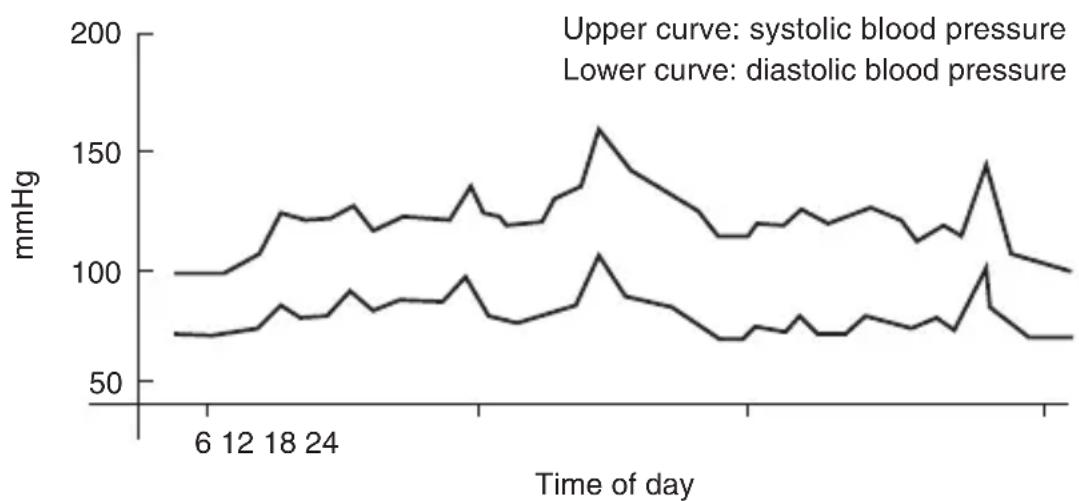
Example: fluctuation within a day (male, 35 years old)
| Manufacturer | OMRON HEALTHCARE CO., LTD.24, Yamanouchi Yamanoshita-cho, Ukyo-ku  Kyoto, 615-0084 Japan Kyoto, 615-0084 Japan |
| EU-representative | OMRON HEALTHCARE EUROPE B.V.Kruisweg 577, 2132 NA Hoofddorp, The Netherlands  www.omron-healthcare.com www.omron-healthcare.com |
| Production facility | OMRON DALIAN CO., LTD.Economic & Technical Development Zone, Dalian 116600, China |
| Subsidiary | OMRON HEALTHCARE UK LTD.Opal Drive, Fox Milne, Milton Keynes MK15 0DG, United Kingdom |
| OMRON Medizintechnik Handelsgesellschaft mbHJohn-Deere-Str. 81a, 68163 Mannheim, Germanywww.omron-medizintechnik.de | |
| OMRON SANTÉ FRANCE SAS14, rue de Lisbonne, 93561 Rosny-sous-Bois Cedex, France |
Made in China