
Gisele - Scale KORONA - Free user manual and instructions
Find the device manual for free Gisele KORONA in PDF.


| Brand | Korona |
| Model | Gisele |
| Product type | Digital glass scale |
| Power supply | 2 button batteries (3V) |
| Maximum capacity | 180 kg (396 lb / 27 st) |
| Units of measurement | kg, lb, st:lb |
| Main functions | Weight measurement, BMI calculation, memory for 4 users with 50 results each, date and time display |
| Number of users | 4 |
| Memory | 50 results per user |
| Display | Digital display |
| Maintenance | Clean with a damp cloth, do not use harsh chemicals, do not immerse |
| Safety | Do not step on one side only, wet surface is slippery, max weight 180 kg, keep batteries away from children |
| Repairability | Repair only by customer service or authorized operator |
| Compliance | EMC Directive 2004/108/EC |
Frequently Asked Questions - Gisele KORONA
User questions about Gisele KORONA
0 question about this device. Answer the ones you know or ask your own.
Ask a new question about this device
Download the instructions for your Scale in PDF format for free! Find your manual Gisele - KORONA and take your electronic device back in hand. On this page are published all the documents necessary for the use of your device. Gisele by KORONA.
USER MANUAL Gisele KORONA
![graph TD A["SET"] --> B["User: 2009-8-1 64.1 x kg"] B --> C["User: 2009-8-1 0.0 kg"] D["MEM/Θ"] --> E["User: M01 2009-8-1 64.3 kg"] E --> F["User: M01 2009-8-1 22.2 BM"] G["▲"] --> H["User: M02 2009-7-28 64.1 kg"] H --> I["User: M02 2009-7-28 22.2 BM"] J["▲"] --> K["User: M03 2009-7-27 63.9 kg"] K -…](/content/2026/06/1244275/images/46f760a43b2f38b97987a4509f33760d11267ab2183952525832a2bab0551022.jpg)
1 Getting to know your instrument
Function of the unit
These digital glass scale allows you to weigh yourself and to calculate your personal body mass index (BMI).
The scale is intended for individual, household use.
The scale is equipped with the following functions, which can be used by up to four different people:
• Measurement of your body weight
• Calculation of your body mass index (BMI)
• Calculation of your average weight.
The memory function lets up to four people access up to 50 previously measured weight values as well as the corresponding BMI values.
2 Signs and symbols
The following symbols appear in these instructions.

Warning Warning instruction indicating a risk of injury or damage to health.

Important Safety note indicating possible damage to the unit/accessory.

Note Note on important information.
3 Safety notes
Safety notes

Warning:
- Do not stand on the outer edge to one side of the scale otherwise it may tip!
- Keep children away from packaging materials (risk of suffocation).
- The surface of the scale is slippery when damp or wet.
Notes on handling batteries

Warning:
- Swallowing batteries can be extremely dangerous. Keep the batteries and scale out of the reach of small children. Should a child swallow a battery, seek medical assistance immediately.
- Batteries must not be recharged, taken apart, thrown into an open fire or short circuited.
- Batteries can contain toxins that are harmful to health and the environment. Always dispose of batteries in accordance with applicable legal regulations. Do not dispose of batteries with the normal household waste.

Warning:
- Replace weak batteries before they discharge completely.
• Always replace all batteries at the same time and use batteries of the same type. - Leaking batteries may damage the device. If you do not intend to use the device for longer periods, remove the batteries from the battery compartment.
- If a battery has leaked, put on protective gloves and clean the battery compartment with a dry cloth.
General notes

- The unit is for personal use only and is not intended for medical or commercial applications.
- Please note that technically related measuring tolerances are possible, as the scale is not calibrated for professional medical applications.
- The scale's maximum load is 180 kg (396 lb/27 st)
- Before submitting any complaint, first check the batteries and replace them if necessary.
• Repairs must only be carried out by Customer Services or authorised suppliers. - Should you have any questions concerning the use of our devices, please contact your dealer or customer service.
- All scales comply with EC Directive 2004/108/EC.
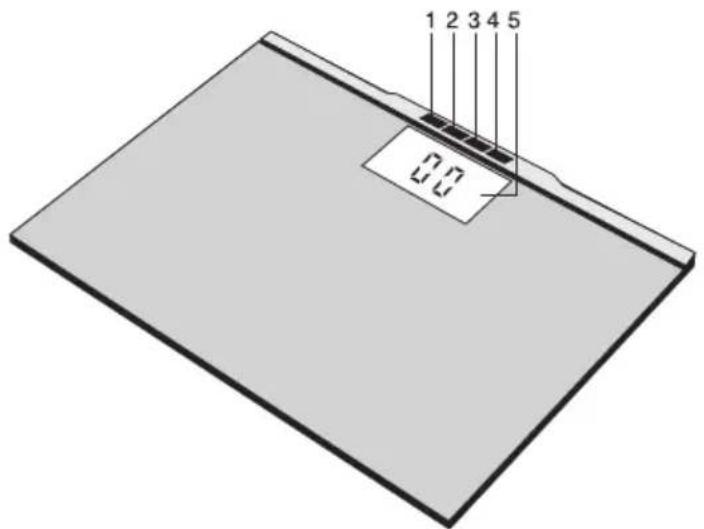
4 Unit description
Overview
1 Down button
2 Up button
3 SET On/Set button
4 NEWS Memory/Time button
5 Display
5 Initial use
Inserting the batteries
Please remove the battery insulating strips and/or position the batteries correctly with regards to the polarity displayed in the battery compartment (as symbol ). If the scale fails to operate, remove the batteries completely and reinsert them.
Changing the weight unit
The scale shows the values in kg. You can set the device to measure in kilograms, pounds ('lb') and stones ('st:lb') using the switch on the back of the device.
Setting up the scale
Set up the scale on a level and solid surface. A solid surface is a prerequisite for a correct measurement.
6 Information
The BMI is calculated using the height value entered and the measured weight value.
General tips
- If possible, always weigh yourself at the same time of day (preferably in the morning), after using the toilet, on an empty stomach and unclothed, in order to achieve comparable results.
7 Switch on the scale
Press the Set button SET
The last user and their average weight (if this has been saved) will be displayed. Wait until '0.0 kg' is displayed. If necessary, change the location where the user data is saved.
When the scale is used for the first time, and each time the batteries are changed, the device will show the date and time at the start during the basic set-up. In these instances, immediately set the current date and time.
8 Settings
Setting date and time year month day
![graph LR A["MEM/OS"] --> B["12:00"] B --> C["SET"] C --> D["08:15"]](/content/2026/06/1244275/images/3385e34e9eeaa89608e7071a908b5184f08c58518880315d3dc43dd6952452df.jpg)
To set the time and date, switch on the scale and press the button for approx. 5 seconds. To set the current date and time, you must proceed in several stages as follows: year – month – day – hour – minute.
The setting to be changed will fl ash each time.
- To change a setting, press the buttons ▼ and ▲
- To save the setting and move onto the next one, or to close the setting, press the SET button. The scale will switch off automatically after this procedure.
The scale will also switch off if no buttons are pressed for more than 15 seconds.
Setting user data
The scale comes equipped with four locations for storing user data and space for more than 50 measurement values per user. You and, for example, the members of your family can save and later access the following personal settings in the storage locations:
| Sequence User data Parameters | ||
| 1 | Memory position 1 to 4 | |
| 2 | Body height 100 to 220 cm (3'-03" to 7'-03") | |
![graph LR A["User"] --> B["SET"] B --> C["User1 2009-8-1 63.8 x kg"] C --> D["SET"] D --> E["User 2009-8-1 0.0 x kg"]](/content/2026/06/1244275/images/466f1db48ccbeb9763adfc19d45c044ab129de9e3b94103797fff042f7da6fcc.jpg)
Switch on the scale.
Initially the last user's average is displayed.
When "0.0 kg" is displayed:
- Press the SET button for several seconds, until "User" begins to flash on the display.
- Press the ▼ and □ buttons to select the desired storage location.
- Confirm the selection with the SET button.
- Press the ▼ and ▲ buttons to set your height.
- Finish entering data by pressing the SET button.
![graph LR A["SET"] --> B["User 1: 2009-1-1<br>0.00 cm"] B --> C["SET"] C --> D["User 1: 2009-1-1<br>0.00 cm"] D --> E["Output"]](/content/2026/06/1244275/images/affce88f30ba31f9eddb566aec3a45fa5bdcbaa4e7e690d80799353b5365a2e4.jpg)


Please note: if you change the height value at a later date, all measurement data saved in your storage location up until that point will be deleted.
9 Operation
Weighing yourself and calculating BMI
To weigh yourself and to calculate your personal body mass index:
- Switch on the scale. After the display shows the average weight results which have been saved from the previous user, "0.0 kg" will be displayed.
- Then select the storage location where your settings have been saved using the ▼ or ▲ buttons. Next, your saved height value will be displayed. Wait until “0.0 kg” is displayed again. You can now use the scale. Stand still whilst weighing yourself.
![graph TD A["User"] --> B["SET"] B --> C["User 1: 2009-8-1 64.1 x kg"] C --> D["User 1: 2009-8-1 0.0 kg"] E["User"] --> F["SET"] F --> G["User 2: 2009-8-1 84 cm"] G --> H["User 2: 2009-8-1 0.0 kg"]](/content/2026/06/1244275/images/6c264eedee902c389f15eb214d1ab035775c3442840d0254e8588ac53e916a5a.jpg)
Display of results
The results are automatically displayed in the following sequence:
| User : 2009 8 kg | User : M01 2009 8 kg | User : M01 2009 8 kg |
| 1. Current weight 2. Switches | between displaying BMI (Body Mass Index) and weight. | |
One value will be saved per day, per person. If you take several measurements per day, the most recent value will be saved. The data saved previously on that day up will be overwritten.
After displaying the weight, the scale automatically switches off.
Accessing saved measurements
To access the saved measurements of the user currently selected:
- Switch on the scale. After the display shows the average weight results which have been saved from the previous user, "0.0 kg" will be displayed.
- If you wish to change the storage location, proceed as described on the previous page.
- Briefly press the MEMS button once, until the "M01" display next to the storage location appears.
- Then browse through the storage locations for the saved values one by one using the ▼ or ▲ buttons.
- The date on which the value was saved will be displayed, as well as the weight and BMI values which will be shown alternately.
![graph TD A["SET"] --> B["User: 2009-8-1 64.1 x kg"] B --> C["User: 2009-8-1 0.0 kg"] D["MEM/Θ"] --> E["User: M01 2009-8-1 64.3 kg"] E --> F["User: M01 2009-8-1 22.2 BM"] G["▲"] --> H["User: M02 2009-7-28 64.1 kg"] H --> I["User: M02 2009-7-28 22.2 BM"] J["▲"] --> K["User: M03 2009-7-27 63.9 kg"] K -…](/content/2026/06/1244275/images/b2542c932b8be9c35949355b078ca9e8dc5129c3f0a79fd1f6dbd68df5ed1dde.jpg)
10 Evaluation of results
Body mass index (BMI)
The body mass index (BMI) is a number that is often called upon to evaluate body weight. The number is calculated from body weight and height, the formula is – body mass index = body weight : height 2 . The measurement unit for BMI is [kg/m 2 ]. According to the BMI, weight is classified for adults (20 years and over) using the following values (source: WHO):
| Category | BMI | |
| Underweight Severely underweight < 16 | ||
| Moderately underweight 16-16,9 | ||
| Slightly underweight 17-18,4 | ||
| Normal weight 18,5-25 | ||
| Overweight Pre-obese 25,1-29,9 | ||
| Obese (overweight) Class | I obese 30-34,9 | |
| Class II obese 35-39,9 | ||
| Class III obese ≥ 40 | ||
Results in relation to time

Remember that only long-term trends are important. Short-term fluctuations in weight over a few days are usually the result of a loss of fl uid.
11 Replacing batteries
The batteries in the scale must be replaced if the message “Lo” appears in the display. If the batteries are too flat, then the scale will switch off automatically.

Note:
- When changing batteries, always use batteries of the same type, brand and capacity.
• Always replace all batteries simultaneously. - Do not use rechargeable batteries.
- Use batteries that are free of heavy metals.
12 Storage and maintenance
The precision of the measurements and service life of the device depends on its careful handling:

Important:
- The unit should be cleaned occasionally. Use a slightly damp cloth to clean the device. You may also use a small quantity of cleaning agent if desired. Do not use abrasive detergents and never immerse the unit in water.
- Do not wash the unit in a dishwasher!
- Do not stand any objects on the scale when not in use.
- Do not press the buttons violently or with pointed objects.
- Protect the scale from knocks, damp, dust, chemicals, drastic changes in temperature, electromagnetic fi elds and nearby sources of heat (ovens, heaters). Do not press the buttons violently or with pointed objects.
13 Disposal
Standard and rechargeable batteries should not be disposed of separately from the household waste. As a consumer, you are legally obliged to return used batteries for proper disposal. You can hand in your used batteries at public collection points in your district or sales outlets where batteries of this type are sold.

Note:

The codes below are printed on batteries containing harmful substances:
Pb = Battery contains lead,
Cd = Battery contains cadmium,
Hg = Battery contains mercury.
For environmental reasons, do not dispose of the scale with the batteries in the household waste at the end of its useful life. Dispose of the unit at a suitable local collection or recycling point.
Observe the local regulations for material disposal.
14 What if there are problems?
If the scale detects and error when measuring, the following is displayed.
| Display Cause Remedy | ||
| Err The maximum | load capacity of 180 kg was exceeded. | Do not load the unit with over 180 kg. |
| Lo The batteries are almost empty. Replace the batteries | ||
| no Accessing a user storage location in which no values have been saved. | The scale will switch off automatically after a short while; switch the scale on again and proceed with the measurements. | |
| ----Scale is searching for correct zero point. | Place the scale on a secure, fl at surface. Wait until “0.0 kg” is displayed. | |
No measurement possible
| Possible errors Remedy | |
| If you stand on the scale to measure your values before the display shows “0.0 kg”, the scale will not function correctly. | Correctly activate the scale (wait for “0.0 kg” to be displayed) and repeat the measurement. |
| The batteries in the scale are empty. Replace the batteries. | |
Incorrect weight measurement
| Possible errors Remedy | |
| Scale is on carpeting. Place the scale on a level and solid surface. | |
| Incorrect zero point of scale. | Switch on the scale and wait until the scale automatically switches off again (do not step onto the scale before then). Then switch on the scale again and repeat the measurement. |
![graph TD A["User"] --> B["SET"] B --> C["User: 2009-8-1 64.1 x4"] C --> D["User: 2009-8-1 0.0 kg"] E["User"] --> F["SET"] F --> G["User: 2009-8-1 84 on"] G --> H["User: 2009-8-1 0.0 kg"]](/content/2026/06/1244275/images/66237cb1a12109d0dc4f619d646199ed9a343c89d44ae2bd9886b1555d0e47fb.jpg)
![graph TD A["SET"] --> B["User: 2009-8-1 64.1 x kg"] B --> C["User: 2009-8-1 0.0 kg"] D["MEM/Θ"] --> E["User: M01 2009-8-1 64.3 kg"] E --> F["User: M01 2009-8-1 22.2 BM"] G["▲"] --> H["User: M02 2009-7-28 64.1 kg"] H --> I["User: M02 2009-7-28 22.2 BM"] J["▲"] --> K["User: M03 2009-7-27 63.9 kg"] K -…](/content/2026/06/1244275/images/7eb74b1878525f5902d75bde786cb0b5ae415645c241a2e00463f6553b788ebc.jpg)
![graph TD A["SET"] --> B["User: 2009-8-1 64.1 x kg"] B --> C["User: 2009-8-1 0.0 kg"] D["MEM/Θ"] --> E["User: M01 2009-8-1 64.3 kg"] E --> F["User: M01 2009-8-1 22.2 BM"] G["▲"] --> H["User: M02 2009-7-28 64.1 kg"] H --> I["User: M02 2009-7-28 22.2 BM"] J["▲"] --> K["User: M03 2009-7-27 63.9 kg"] K -…](/content/2026/06/1244275/images/e40fabca8dc1524a1c19889d8b6f608c7772f790c41a4ade46c2869e28699e67.jpg)
'Ετος Μήνας Ημέρα
![graph TD A["User"] --> B["SET"] B --> C["User: 2009-8-1 64.1 x kg"] C --> D["User: 2009-8-1 0.0 kg"] E["MEM/Ω"] --> F["User: MO: 2009-8-1 64.3 kg"] F --> G["User: MO: 2009-8-1 22.2 SW"] H["▲"] --> I["User: MO2 2009-7-28 64.1 kg"] I --> J["User: MO2 2009-7-28 22.2 SW"] K["▲"] --> L["User: MO3 2009-7-…](/content/2026/06/1244275/images/4384215b4cffeb206e972ccde07f7496800fa1aeaafbdfdb5adfbd1ecd6c0f95.jpg)
Включите весы.
![graph TD A["SET"] --> B["User: 2009-8-1 64.1 x kg"] B --> C["User: 2009-8-1 0.0 kg"] D["MEM/Ω"] --> E["User: M01 2009-8-1 64.3 kg"] E --> F["User: M01 2009-8-1 22.2 km"] G["▲"] --> H["User: M02 2009-7-28 64.1 kg"] H --> I["User: M02 2009-7-28 22.2 km"] J["▲"] --> K["User: M03 2009-7-27 63.9 kg"] K -…](/content/2026/06/1244275/images/6b9c11416aa9b31a6907954facb258605465b3d40a41df03a54753e7c2f68f08.jpg)
Włącz wage.
![graph TD A["SET"] --> B["User: 2009-8-1 64.1 x kg"] B --> C["User: 2009-8-1 0.0 kg"] D["MEM/Θ"] --> E["User: M01 2009-8-1 64.3 kg"] E --> F["User: M01 2009-8-1 22.2 BM"] G["▲"] --> H["User: M02 2009-7-28 64.1 kg"] H --> I["User: M02 2009-7-28 22.2 BM"] J["▲"] --> K["User: M03 2009-7-27 63.9 kg"] K -…](/content/2026/06/1244275/images/86da891baf8efd0455a2877ee10d9a97b8dd505c3cd2b1410c33232da0274666.jpg)
10 Ocena wyników
![graph TD A["SET"] --> B["User: 2009-8-1 64.1 x kg"] B --> C["User: 2009-8-1 0.0 kg"] D["MEM/Θ"] --> E["User: M01 2009-8-1 64.3 kg"] E --> F["User: M01 2009-8-1 22.2 BM"] G["▲"] --> H["User: M02 2009-7-28 64.1 kg"] H --> I["User: M02 2009-7-28 22.2 BM"] J["▲"] --> K["User: M03 2009-7-27 63.9 kg"] K -…](/content/2026/06/1244275/images/0c760e43bd9d451ca4ee8e013cedc261a45167091c0d45719b314c10d39cc644.jpg)
10 Resultaten beoordelen
Body Mass Index (queteletindex)


- 1 GETTING TO KNOW YOUR INSTRUMENT
- FUNCTION OF THE UNIT
- 2 SIGNS AND SYMBOLS
- 3 SAFETY NOTES
- SAFETY NOTES
- WARNING
- NOTES ON HANDLING BATTERIES
- GENERAL NOTES
- 4 UNIT DESCRIPTION
- OVERVIEW
- 5 INITIAL USE
- INSERTING THE BATTERIES
- CHANGING THE WEIGHT UNIT
- SETTING UP THE SCALE
- 6 INFORMATION
- GENERAL TIPS
- 7 SWITCH ON THE SCALE
- 8 SETTINGS
- SETTING USER DATA
- 9 OPERATION
- WEIGHING YOURSELF AND CALCULATING BMI
- DISPLAY OF RESULTS
- ACCESSING SAVED MEASUREMENTS
- 10 EVALUATION OF RESULTS
- BODY MASS INDEX (BMI)
- RESULTS IN RELATION TO TIME
- 11 REPLACING BATTERIES
- NOTE
- 12 STORAGE AND MAINTENANCE
- IMPORTANT
- 13 DISPOSAL
- 14 WHAT IF THERE ARE PROBLEMS
- 10 OCENA WYNIKÓW
- 10 RESULTATEN BEOORDELEN
- BODY MASS INDEX (QUETELETINDEX)
Brand : KORONA
Model : Gisele
Category : Scale