AG-HPX300P - Video camera PANASONIC - Free user manual and instructions
Find the device manual for free AG-HPX300P PANASONIC in PDF.


User questions about AG-HPX300P PANASONIC
0 question about this device. Answer the ones you know or ask your own.
Ask a new question about this device
Download the instructions for your Video camera in PDF format for free! Find your manual AG-HPX300P - PANASONIC and take your electronic device back in hand. On this page are published all the documents necessary for the use of your device. AG-HPX300P by PANASONIC.
USER MANUAL AG-HPX300P PANASONIC
■This product is eligible for the P2HD 5 Year Warranty Repair Program. For details, see page 163.
Operating Instructions
Memory Card Camera-Recorder
PeHD
Model No. AG-HPX300P

natural_image
Illustration of a professional video camera with lens and external frame (no text or symbols visible)
AVC INTRA DVCPRO HD DVCPRO 50 DVCPRO DV
Before operating this product, please read the instructions carefully and save this manual for future use.

CAUTION
RISK OF ELECTRIC SHOCK DO NOT OPEN

CAUTION: TO REDUCE THE RISK OF ELECTRIC SHOCK, DO NOT REMOVE COVER (OR BACK). NO USER-SERVICEABLE PARTS INSIDE. REFER TO SERVICING TO QUALIFIED SERVICE PERSONNEL.

The lightning flash with arrowhead symbol, within an equilateral triangle, is intended to alert the user to the presence of uninsulated “dangerous voltage” within the product’s enclosure that may be of sufficient magnitude to constitute a risk of electric shock to persons.

The exclamation point within an equilateral triangle is intended to alert the user to the presence of important operating and maintenance (servicing) instructions in the literature accompanying the appliance.
WARNING:
• TO REDUCE THE RISK OF FIRE OR SHOCK HAZARD, DO NOT EXPOSE THIS EQUIPMENT TO RAIN OR MOISTURE.
- TO REDUCE THE RISK OF FIRE OR SHOCK HAZARD, KEEP THIS EQUIPMENT AWAY FROM ALL LIQUIDS. USE AND STORE ONLY IN LOCATIONS WHICH ARE NOT EXPOSED TO THE RISK OF DRIPPING OR SPLASHING LIQUIDS, AND DO NOT PLACE ANY LIQUID CONTAINERS ON TOP OF THE EQUIPMENT.
WARNING:
Always keep memory cards (optional accessory) or accessories (FRONT AUDIO LEVEL knob, knob screw, BNC cap, XLR connector cap, rear lens cap, zoom lever, connector cap) out of the reach of babies and small children.
CAUTION:
TO REDUCE THE RISK OF FIRE OR SHOCK HAZARD AND ANNOYING INTERFERENCE, USE THE RECOMMENDED ACCESSORIES ONLY.
CAUTION:
Do not jar, swing, or shake the unit by its handle while the conversion lens or another accessory is attached. Due to the added weight of the conversion lens, any strong jolt to the handle may damage the unit or result in personal injury.
CAUTION:
In order to maintain adequate ventilation, do not install or place this unit in a bookcase, built-in cabinet or any other confined space. To prevent risk of electric shock or fire hazard due to overheating, ensure that curtains and any other materials do not obstruct the ventilation.
CAUTION:
Do not lift the unit by its handle while the tripod is attached. When the tripod is attached, its weight will also affect the unit's handle, possibly causing the handle to break and hurting the user. To carry the unit while the tripod is attached, take hold of the tripod.
CAUTION:
EXCESSIVE SOUND PRESSURE FROM EARPHONES AND HEADPHONES CAN CAUSE HEARING LOSS.
CAUTION:
Do not leave the unit in direct contact with the skin for long periods of time when in use. Low temperature burn injuries may be suffered if the high temperature parts of this unit are in direct contact with the skin for long periods of time. When using the equipment for long periods of time, make use of the tripod.
FCC NOTICE (USA)
Declaration of Conformity
Model Number: AG-HPX300P
Trade Name: Panasonic
Responsible Party: Panasonic Corporation of North America One Panasonic Way, Secaucus, NJ 07094
Support contact: Panasonic Broadcast & Television Systems Company 1-800-524-1448
This device complies with Part 15 of FCC Rules.
Operation is subject to the following two conditions:
(1) This device may not cause harmful interference, and (2) this device must accept any interference received, including interference that may cause undesired operation.
To assure continued compliance, follow the attached installation instructions and do not make any unauthorized modifications.
CAUTION:
This equipment has been tested and found to comply with the limits for a Class B digital device, pursuant to Part 15 of the FCC Rules. These limits are designed to provide reasonable protection against harmful interference in a residential installation. This equipment generates, uses and can radiate radio frequency energy and, if not installed and used in accordance with the instructions, may cause harmful interference to radio communications. However, there is no guarantee that interference will not occur in a particular installation. If this equipment does cause harmful interference to radio or television reception, which can be determined by turning the equipment off and on, the user is encouraged to try to correct the interference by one of the following measures:
- Reorient or relocate the receiving antenna.
- Increase the separation between the equipment and receiver.
- Connect the equipment into an outlet on a circuit different from that to which the receiver is connected.
- Consult the dealer or an experienced radio/TV technician for help.
The user may find the booklet "Something About Interference" available from FCC local regional offices helpful.
FCC Warning:
To assure continued FCC emission limit compliance, follow the attached installation instructions and the user must use only shielded interface cables when connecting to host computer or peripheral devices. Also, any unauthorized changes or modifications to this equipment could void the user's authority to operate this device.
NOTIFICATION (Canada)
This class B digital apparatus complies with Canadian ICES-003.
IMPORTANT
"Unauthorized recording of copyrighted television programs, video tapes and other materials may infringe the right of copyright owners and be contrary to copyright laws."
For USA-California Only
This product contains a CR Coin Cell Lithium Battery which contains Perchlorate Material – special handling may apply.
See www.dtsc.ca.gov/hazardouswaste/perchlorate.
A rechargeable battery that is recyclable powers the product you have purchased.
Precautions for Use
Caution regarding laser beams
The MOS sensor may be damaged if it is exposed to laser light.
When using the camera-recorder in locations where laser irradiation equipment is used, be careful not to allow the laser beam to shine directly on the lens.
PLEASE NOTE:
- When preparing to record important events, always shoot some advance test footage, to verify that both pictures and sound are being recorded normally.
- Should video or audio recording fail due to a malfunction of this camera-recorder or the P2 cards used, we will not assume liability for such failure.
Disposing and transferring ownership of memory card devices
Formatting or deleting a memory card device in this camera or a PC will only change file management data and leave data on the card intact. It is recommended that the card either be physically destroyed or that commercially sold software be used to completely delete any data on the card. Note that managing card data is the owner's responsibility.
Information on software for this product
- Included with this product is software licensed under the GNU General Public License (GPL) and GNU Lesser General Public License (LGPL), and users are hereby informed that they have the right to obtain, change and redistribute the source codes of this software.
Details on GPL and LGPL can be found on the installation CD provided with the unit. Refer to the folder called "LDOC". (Details are given in the original (English-language) text.)
To obtain the source codes, go to the following home page:
The manufacturer asks users to refrain from directing inquiries concerning the source codes they have obtained and other details to its representatives.
- Included with this product is software which is licensed under MIT-License.
Details on MIT-License can be found on the installation CD provided with the unit. Refer to the folder called "LDOC".
(Details are given in the original (English-language) text.)
This product is licensed under the AVC Patent Portfolio License for the personal and non-commercial use of the following activities of a consumer but no license is granted or implied for any other use.
- Encode video in compliance with the AVC standard ("AVC video")
- Decode AVC video that was encoded by a consumer engaged in a personal and non-commercial activity.
- Decode AVC video that was obtained from a video provider licensed to provide AVC video
Additional information may be obtained from MPEG LA, LLC (http://www.mpegla.com).
Trademarks
• The SD and SDHC logos are trademarks.
• Multi Media Card (MMC) is a registered trademark of Infineon Technologies AG.
- Apple, Macintosh, Mac OS are registered trademarks or trademarks of Apple, Inc. in the United States and/or other countries.
- Unislot is a registered trademark of Ikegami Tsushinki Co., Ltd.
- Microsoft and Windows are registered trademarks or trademarks of Microsoft Corporation in the United States and/or other countries.
- Other names of companies and products are trademarks or registered trademarks of the respective companies.
Contents
Read this first! 2
Precautions for Use 4
Chapter 1 Overview
Camera Unit Features 8
Recording and Playback Features 10
Outline of operations 12
Saving and editing on external devices 12
System Configuration 13
Standard accessories 14
Chapter 2 Parts and Their Functions
Power Supply and Accessory Mounting Section 15
Audio (input) Function Section 16
Audio (output) Function Section 17
Shooting and Recording/Playback Functions Section 18
Menu/Thumbnail Operation Section 22
Time Code Section 23
Warning and Status Display Functions 24
LCD Monitor 24
Viewfinder 25
Chapter 3 Recording and Playback
Setting Date and Time of Internal Clock 26
P2 Cards 28
Inserting P2 Cards 28
Removing P2 Cards 28
To Prevent Accidental Erasure of P2 Card Content 29
P2 CARD ACCESS LED and status of P2 cards 29
P2 card recording times 30
Handling P2 Card Recording 31
Basic Procedures 32
Shooting 33
Normal Recording 34
Standard and Native Recording 35
Standard recording (pull-down recording) 35
Native recording 35
Variable Frame Rate (VFR) Recording 36
Native VFR Recording 36
Standard VFR recording(pulldown recording) 36
Using VFR Recording Function 37
Special Recording Modes 39
Pre-recording (PRE REC) 39
Interval recording (INTERVAL REC) 40
One-shot recording (ONE SHOT REC) 40
Loop recording (LOOP REC) 41
PROXY Recording Function (Optional) 41
Hot Swap Recording 41
REC REVIEW Function 41
Shot Marker (SHOT MARK) Recording Function 42
Text Memo Recording Function 42
Normal and Variable Speed Playback 43
Chapter 4 Adjustments and Settings for Recording
Selecting recording signals 44
List of recording formats and functions 45
Recording settings and recording function table 46
Selecting video output 46
List of recording, playback and output formats 47
Adjusting the White Balance and Black Balance 49
Adjusting the White Balance 49
Adjusting the Black Balance 50
Setting the Electronic Shutter 52
Setting the Shutter Mode and Speed 52
Placing the Camera-recorder in SYNCHRO SCAN Mode 52
Assigning functions to USER buttons 53
Selecting Audio Input Signals and Adjusting Recording Levels 54
Selecting Audio Input Signals 54
Adjusting Recording Levels 54
Selecting Function for the FRONT AUDIO LEVEL Control 55
CH3 and CH4 Recording Levels 55
Setting Time Data 56
Recording time codes and user bits 57
Setting user bits 58
Entering the User Bits 58
Setting the Time Code 60
Externally Locking the Time Code 62
Outputting the time code externally 63
GENLOCK and time code input/output connection and setup 64
Counter Setting and Display 64
Viewfinder Screen Status Displays 65
Viewfinder Status Indication Layout 65
Selecting Viewfinder Display Information 65
Screen displays 66
Center Information Display 69
Checking and displaying shooting status 71
MODE CHECK indication 72
Center marker display 73
Safety zone markers 73
Audio level meter magnification 73
Zebra pattern display 74
Focus assist function 75
Adjusting and setting the LCD monitor 76
Waveform monitor function 77
Adjusting and Setting up the Viewfinder 78
Adjusting Right and Left Viewfinder Position 78
Diopter Adjustment 78
Using the Viewfinder 78
Emphasizing Image Outlines 79
Setting the viewfinder to monochrome mode 79
Handling setup data 80
Configuration of setup data files 80
Handling SD memory cards 81
Formatting, Writing and Reading an SD memory card 81
How to Use Scene File Data 82
Saving scene files and other settings on SD memory cards 84
Chapter 5 Preparation
Power Supply 86
Mounting the Battery and Setting the Battery Type 86
Use of the external DC power supply 88
Mounting and Adjusting the Lens 89
Mounting the Lens 89
Adjusting the Lens Flange Back 90
White Shading Compensation 91
Setting Chromatic Aberration Compensation (CAC) 92
Preparing for Audio Input 95
When Using the Front Microphone 95
Using a wireless receiver 95
When Using Audio Devices 96
Attaching Accessories 97
Mounting the Camera on a Tripod 97
Attaching the Shoulder Strap 97
Attaching the Rain Cover 98
Attaching the FRONT AUDIO LEVEL Control Knob 98
DC OUT Connector and External REC Start/Stop Switch Connection 99
Connecting the AJ-RC10G Remote Controller 100
Chapter 6 Manipulating Clips with Thumbnails
Thumbnail Operations 101
Thumbnail Manipulations Overview 101
Thumbnail Screen 102
Selecting Thumbnails 104
Playing back Clips 104
Switching the Thumbnail Display 105
Changing thumbnails 106
Shot Mark 106
Text Memo 107
Deleting Clips 108
Restoring Clips 109
Reconnection of Incomplete Clips 109
Copying Clips 109
Setting of Clip Meta Data 110
Setting of Proxy (optional) 114
Formatting a P2 Card 114
Formatting SD memory cards 115
Setting the Thumbnail Display Mode 115
Properties 116
Chapter 7 Menu Operations
Viewfinder and LCD Menus 120
Using the menus 120
Initializing the menu settings 121
Setup menu structure 122
Setup menu list 124
SCENE FILE screen 124
SYSTEM SETUP screen 126
SW MODE screen 128
RECORDING SETUP screen 129
AUDIO SETUP screen 130
OUTPUT SEL screen 132
DISPLAY SETUP screen 132
BATTERY SETUP screen 134
CARD FUNCTIONS screen 136
LENS SETUP screen 136
OTHER FUNCTIONS screen 137
DIAGNOSTIC screen 138
OPTION MENU screen 138
Chapter 8 Connecting to External Devices
Functionality Provided by Connections to USB 2.0 Connector 139
Connecting to a computer in USB device mode 139
USB host mode 140
Connections to the DVCPRO/DV Connector 145
Recording signals input to the DVCPRO/DV connector 145
Control of external devices through 1394 connection 146
Chapter 9 Maintenance and Inspections
Inspections Before Shooting 147
Preparing for Inspections 147
Inspecting the Camera Unit 147
Inspecting the Memory Recording Functions 148
Maintenance 150
Cleaning Inside the Viewfinder 150
Eyepiece Care 150
Charging the internal battery 150
Warning System 151
Warning Description Tables 151
Warning and Error Display for Thumbnail Operation and USB HOST MODE .... 153
Updating the firmware incorporated into the unit 155
Chapter 10 Index
Chapter 11 Specifications
Dimensions and specifications 160
Dimensions 160
Specifications 160
Connector signal description 164
Chapter 1 Overview
The AG-HPX300P P2 memory card camera-recorder features a camera unit equipped with a 1/3 inch 2.2 megapixel 3MOS sensor and a recording and playback unit that provides AVC-Intra 100 compression recording as standard to offer HD full pixel and full sampling for superb image quality and high-quality video.
It handles multiple HD and SD formats: AVC-Intra, DVCPRO HD, DVCPRO50, DVCPRO and DV compression recording. The P2 card provides a reliability, speed and IT functionality that no other media can match and is destined to revolutionize recording and editing paradigms.
■ Multiple HD/SD formats
The camera supports both the HD and SD video formats making it ready for news gathering, program production and film making in a wide range of professional applications and content production. In 1080i/720P HD recording for broadcasting, the camera uses the highly reliable AVC-Intra or DVCPRO HD codec while also supporting SD multi-codec (DVCPRO50, DVCPRO or DV) recording capability.
The AG-HPX300P provides high quality and uncompressed, 16-bit, 48 kHz, 4-channel recording of audio in all formats.
■ Variable frame rate makes speed effects possible (in the 720P format)
The AG-HPX300P comes with the variable frame rate feature developed for the VariCam HD Cinema camera. In 720P mode ^1 , the frame rate can be set to any of 20 steps between 12P and 60P. This puts features such as undercranking (dropping frames) and overcranking (high frame rate) for quick motion and slow motion cine-like effects at the disposal of the camera crew.
■ Native mode/over 60P mode selectable
- Native mode:
Playing back a recording made at a frame rate set in the camera at the normal rate provides speed effects without using a frame rate converter. Native mode also extends the recording time of a P2 card.
- 720P over 60P mode:
Use of a DVCPRO HD recorder such as the AJ-HD1400 or the FOCUS FS-100 hard disk recorder enables the AG-HPX300P to make backup recordings with a DVCPRO HD stream from the DVCPRO/DV connector. ^2
■ 1080/480 24P advanced mode
Recording 1080/24P or 480/24P makes it possible to select 24PA (advanced) mode ^3 . Using 2:3:3:2 pulldown, the 24PA mode performs 60i conversion to enable nonlinear editing ^4 maintaining an image quality that is better than normal 24P (2:3 pulldown). Recording at 30P applies a 2:2 pulldown.
Camera Unit Features
■ Progressive 3MOS sensor
The AG-HPX300P is equipped with a 1/3 inch 2.2 megapixel 3MOS sensor that enables HD full pixel recording for high-resolution video.
■ 14-bit digital circuit
The high-performance DSP (Digital Signal Processor) in the camera offers 14-bit signal input and 20-bit internal processing. It handles gamma settings and other adjustments for each R/G/B color in 1080/60i video as well as conversion to all HD/SD formats (P/I conversion, line conversion and down conversion). Because of this high-quality images can be produced in all video formats.
■ Seven gamma curves including cine-like gamma
To expand camera capabilities, the AG-HPX300P offers seven gamma curves including cine-like gamma to easily produce recordings with the characteristic warm tone of film.
■ Slow, synchro and high speed shutter
The shutter speed can be set from a slow speed of 1/6 s up to a maximum speed of 1/7200 s. Combined with the variable frame rate functions, this allows you to create blurring or stop motion effects. The AG-HPX300P also features a synchro scan function that is ideal for capturing screen shots from a computer monitor.
■ Scene file dial
This dial allows you to instantly retrieve settings that suit shooting conditions. Six preset files are provided, and you can change the file names and their settings as desired. You can also save up to four files to an SD or SDHC memory card (both referred to as "SD memory card" below) and load files from an SD memory card.
■ Shooting assist functions
- USER buttons:
Three USER buttons each of which can be assigned a frequently used function for immediate access. - Focus assist:
Magnifies the center portion of the image and displays a focus bar to facilitate focusing. - Eight files for compensating lens chromatic aberration and four files for correcting shading for interchangeable lenses are provided.
● Variable color temperature:
Allows fine adjustment after setting the white balance. - REC check:
Provides a quick check of the last few seconds of the most recently recorded clip.
● 4-position optical ND filter provided.
■ Chromatic aberration compensation (CAC)
This function automatically corrects the registration error caused by the slight chromatic aberration that the lens cannot compensate for, in order to minimize color bleeding into surrounding image areas.
■ Remote control support
The camera supports the AJ-RC10G (optional accessory) remote control unit. The remote control allows you to adjust camera image and recording controls at a distance while viewing what you are shooting.
■ Auto Tracking White Balance (ATW)
Automatically adjusts the white balance of the subject in real-time, a convenient function for quick adjustment in recording situations where there is no time for normal white balance adjustment.
■ DRS (Dynamic Range Stretcher) function
This function compresses the video signal level while maintaining contrast to extend the dynamic range making it possible to correctly render highlight areas without overexposure and loss of detail that would otherwise occur. ^1
Recording and Playback Features
■ A variety of interfaces
- USB 2.0 connector (HOST/DEVICE)
A USB 2.0 connection to a computer or other device allows you to use P2 cards in the camera as mass storage. The USB host function makes it possible to save P2 card data to an external hard disk connected via USB 2.0 and clips stored on the hard disk can be viewed and written back to a P2 card.
● DVCPRO/DV input and output provided as standard feature
IEEE 1394 compliant external devices can be connected to enable output and input via the digital interface. Connect a 6-pin plug to this connector. Note that the connector does not support bus power. Input and output via IEEE 1394 is not available when the AVC-Intra codec is selected.
■ P2 cards for high capacity, high speed and high reliability
In addition to exceptional resistance to shock, vibration and temperature fluctuations, the P2 (Professional Plug-in) card has a reliability that guarantees long-term repeated recording/initialization that a tape or hard disk system with their moving parts could never match.
The connectors are professional grade to withstand long-term continual insertion and removal.
The P2 card stores the AV data for each shooting session as a single file that is immediately accessible for nonlinear editing or transfer over a network without digitizing. Transfer speeds far surpassing those of optical disks also help to speed up production processes. The P2 card complies with PC card standards and can be directly plugged into the PC card slot on a computer. ^1
The two P2 card slots allow continuous recording on two P2 cards and also offer the following recording capabilities in a memory card camera-recorder.
- Card selection:
In standby status, you can instantly select (switch to) the slot of the card you wish to record on ^2 Recorded content can be quickly passed on to editing or transferred to minimize interruptions in recording making it far more efficient than systems where tapes or disks have to be exchanged.
● Hot-swap recording:
Cards can be replaced during recording. A full memory card can be replaced while recording is made on another card. Successively swapping cards in this way gives you virtually unlimited recording capacity.
- Loop recording:
Setting the camera for consecutive overwriting, you can repeatedly rerecord on the inserted P2 cards, always maintaining a recording of the most recent, specific period of time.
■ Immediate startup and reliable data protection
When you press the REC button in standby mode, the camera instantly finds a blank area on the P2 card and begins recording. Unlike a VTR system, there is no need to locate a blank section before recording. It can begin recording immediately even when you are using it to preview video. In normal use, there is no chance of accidentally deleting a recording. Recordings will not be erased unless you intentionally delete a file or initialize the card.
■ Other features
- Pre-rec:
This function provides a way to capture moments you otherwise would have missed. In the standby mode, the camera will store video and audio for up to 3 seconds in HD and 7 seconds in SD. When you press the REC button, the three or seven seconds of immediately prior video data stored in internal memory is added at the beginning of the clip you record. - One-shot REC: Convenient for producing animation, this mode records for a set time (from 1 frame to 1 second) each time you press the REC button.
- Interval REC: Recording one frame at a time at set intervals (from 2 frames to 10 minutes), this mode is useful for monitoring, supervision and special ultra undercranking effects.
- Proxy recording (with AJ-YAX800G installed) Installing an optional video encoder card (AJ-YAX800G) in P2 slot number 2 makes it possible to record MPEG4 format video, time code data and other real-time data to P2 cards or SD memory cards simultaneous with camera recording of video and audio. This is a convenient feature for checking clip content and speeding up editing work flow.
■ Clip thumbnail preview
The camera records each cut as a clip (file) and automatically attaches a thumbnail image and file information to it. To preview a clip on the LCD monitor or to check clip data, simply choose the clip you want from the list of thumbnails. These thumbnails and the file data can be viewed on a PC (P2 Viewer ^1 ) or processed in a nonlinear editing program.
■ Shot marker and text memo
If desired, you can add a simple OK/reject shot marker to each clip either during or after recording. When a P2 card is mounted in a PC (P2 Viewer), the PC will display only marked clips.
A text memo function is also provided. Pressing the USER button to which the text memo function has been assigned anywhere in a clip during recording or in preview mode allows you to attach empty post-it like text memos (up to 100) that can later be filled with text on a PC (P2 Viewer).
Using the camera copy function, you can create a new clip by stripping out the desired frames from a clip by copying data between text memo labels.
■ SD memory card slot
The camera provides an SD memory card slot for saving and loading scene files and user settings. A metadata upload file (created using P2 Viewer) containing the name of the person who shot the video, the name of the reporter, the shooting location or a text memo and other information can be saved to an SD memory card. This data file can be loaded as clip metadata.
■ HD/SD SDI output and downconverter supported
Video line outputs (3 BNC connectors) are provided as standard. These outputs can flexibly handle both monitor and line recording. A down-converter is also built-in. Aspect mode can also be selected.
- SDI OUT (HD/SD) 1 system, 2 outputs:
The HD-SDI outputs allow you to make backups on an external VTR (with HD-SDI input) in synch with REC button operation. SD-SDI can also down convert and output HD content.
- VIDEO OUT:
Outputs down converted SD video (composite video).
■ Fine adjustment of sound recording level
The camera features a front-mounted control for fine adjustment of the sound recording level. This control is particularly useful for adjusting the sound level when you have to control both video and audio recording. The control can be disabled.
■ Unislot wireless receiver compatible
The AG-HPX300P is designed to work with optional slot wireless receivers. (page 95)
The camera supports 2-channel wireless receivers.
Outline of operations
The AG-HPX300P records video on P2 cards. Excelling at high transfer speeds, the P2 card enables high vision recording and smooth editing and dubbing.
Saving and editing on external devices
Using USB DEVICE mode to connect an external device via the USB 2.0 connector (Page 139)
The data (file) is transferred for nonlinear editing on your computer or other unit.

flowchart
graph LR
    A["Video Camera"] -->|USB2.0 (DEVICE)| B["P2 card"]
    B --> C["Computer"]
Using USB HOST mode to connect an external device via the USB 2.0 connector (Page 140)
The unit directly controls the external hard disk drive, and transfers the data (file) to it.

flowchart
graph LR
    A["USB2.0 (HOST)"] --> B["External hard disk"]
Connecting an external device via the DVCPRO/DV connector (Page 145)
DVCPRO/DV (Windows/Macintosh)
BNC cable (composite/SDI)
Video equipment/Monitor

Computer/Memory card recorder

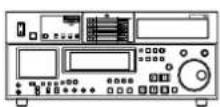
The contents can be transferred as a data stream (digital dubbing).
System Configuration

flowchart
graph TD
    A["AG-HPX300P"] --> B["Soft carrying case"]
    A --> C["Hard carrying case"]
    A --> D["AJ-HT901G"]
    A --> E["Shotgun microphone (Phantom +48 V)"]
    E --> F["AG-MC200G AJ-MC700P"]
    A --> G["Lens² (Bayonet type)"]
    G --> H["FUJINON, CANON"]
    A --> I["Tripod adapter"]
    I --> J["SHAN-TM700"]
    A --> K["Video encoder card AJ-YAX800G⁴"]
    K --> L["SD Memory cards³ P2 Cards³"]
    K --> M["USB2.0 compatible devices"]
    K --> N["Unislot wireless microphone receiver"]

    O["Rain cover"] --> P["SHAN-RC700"]
    Q["Remote control unit⁵"] --> R["AJ-RC10G"]
    S["Battery"] --> T["PROPAC14, TRIMPAC14 HYTRON50/100/140 DIONIC90/160"]
    U["V-mount type battery plate"] --> V["ENDURA E-7/7S ENDURA E-10/10S"]
    W["Holder plate⁶"] --> X["NP-L7"]
    W --> Y["NP battery holder"]

    Z["External power supply"] --> AA["LCD monitor BT-LH80W, BT-LH900 etc."] --> AB["DVCPRO/DV standard device complying with the IEEE1394 standard"]
*1 The camera is equipped with a battery holder as standard.
*2 The camera comes with a Fujinon lens.
*3 For the latest information on P2 cards and SD memory cards not available in the operating Instructions, visit the P2 Support Desk at the following Web sites.
*4 For details, refer to the AJ-YAX800G User's Guide on the supplied CD-ROM.
*5 For details, refer to the AJ-RC10G User's Guide on the supplied CD-ROM.
*6 Attach the NP battery holder to the holder plate before fixing it to the V-mount type battery plate.
Standard accessories
Lens *1 | Front lens cap *1 *2 | Rear lens cap *1 *2 | Zoom lever *1 *2 |
| Connector cap *1 *2 | Lens hood *1 | Lens hood cap *1 *3 | Eye cup |
Shoulder belt FRONT AUDIO | LEVEL knob(screw included)[w56G] | Mount cap *4 | XLR connector cap *4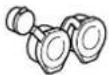 |
BNC cap *4 | CD-ROM | ||
*1 Manufactured by Fujinon Co., Ltd.
*2 This component is part of the lens.
*3 This component is part of the lens hood.
*4 This component is part of the camera.
NOTE
- Be sure to appropriately dispose of the packing material when you have unpacked the product.
- Consult your supplier regarding purchases of accessories.
Chapter 2 Parts and Their Functions
Power Supply and Accessory Mounting Section
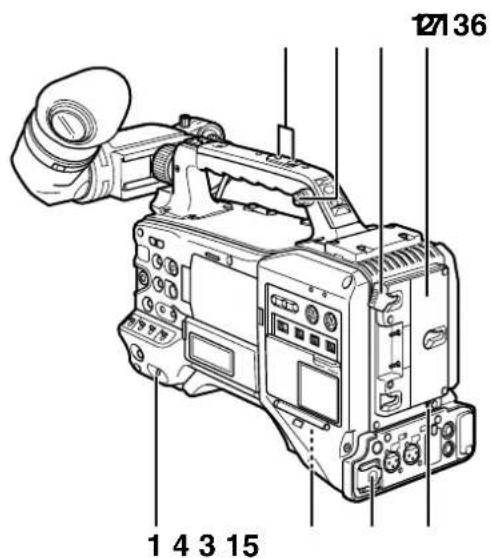
text_image
1 4 3 15 27 36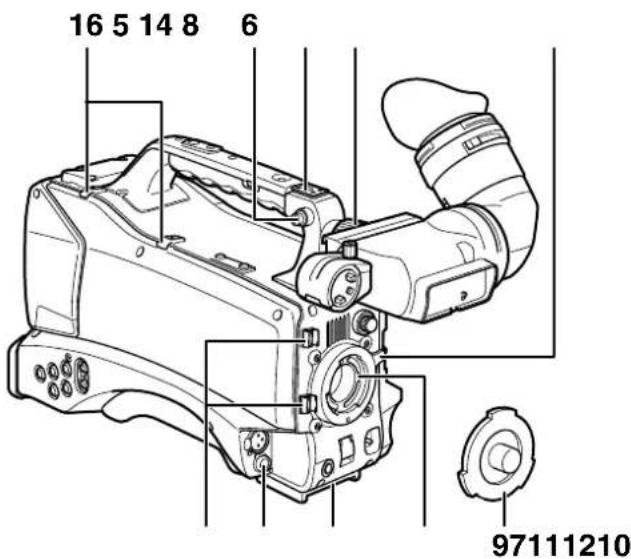
text_image
16 5 14 8 6 971112101 POWER switch
Use to turn the power on and off.
2 Battery holder
A battery from Anton/Bauer is mounted here. For details, refer to [Mounting the Battery and Setting the Battery Type] (page 86).
3 DC IN (external power input) socket (XLR, 4P)
Connect this camera to an external DC power supply. For details, refer to [Use of the external DC power supply] (page 88).
4 BREAKER switch
This switch is located on the camera base. When an excessive amount of current is fed through the video camera recorder, due to a malfunction, the breaker automatically turns off the power to protect the device. Press this button after conducting an internal inspection or repair. The camera will power up if it is working normally.
5 Light shoe
A video light or similar accessory can be attached here. (Size of holes for securing screws)
• 1/4-20UNC (6 mm or shorter screws)
6 Shoulder strap fittings
The shoulder strap is attached here. For details, refer to [Attaching the Shoulder Strap] (page 97).
7 Lens mount (1/3-bayonet mount)
The lens is attached here. For details, refer to [Mounting the Lens] (page 89).
8 Lens lever
Tighten this lever to lock the lens to the lens mount. For details, refer to [Mounting the Lens] (page 89).
9 Mount cap
To remove the cap, raise the lens lever. Replace the cap when a lens is not mounted.
10 Lens cable/microphone cable clamp
This clamp secures the lens and microphone cables. For details, refer to [Mounting the Lens] (page 89).
11 Tripod mount
To mount the camera on a tripod, attach the optional tripod adapter (SHAN-TM700) here. For details, refer to [Mounting the Camera on a Tripod] (page 97).
12 Lens jack (12-pin)
The lens connection cord is connected here. For a detailed description of your lens, refer to the manufacturer's instruction manual.
13 Battery release lever
Pull down the release lever to release the battery.
14 Viewfinder left-right positioning ring
For details, see [Adjusting Right and Left Viewfinder Position] (page 78).
15 Light control switch
For details, refer to [Power Supply] (page 86).
16 Cable holder
Used to secure the light and microphone cables.
17 Accessory mounting hole
Accessories can be attached here. Do not use this hole for purposes other than attaching accessories. (Size of holes for securing screws)
• 1/4-20UNC (10 mm or shorter screws)
• 3/8-16UNC (10 mm or shorter screws)
Audio (input) Function Section
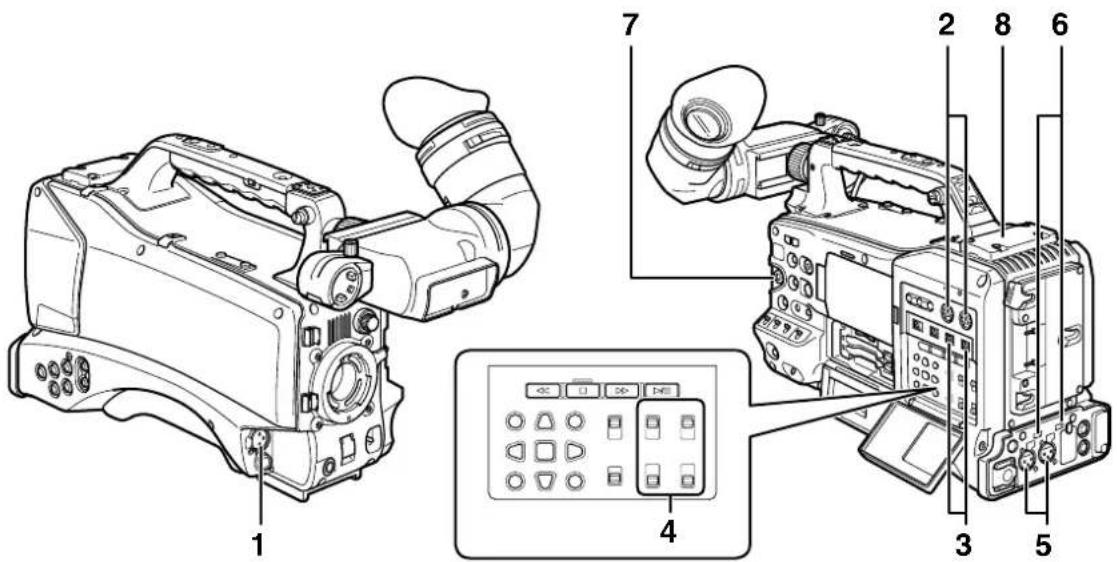
text_image
Technical diagram of a video camera with numbered parts and control panel labels1 MIC IN (microphone input) jack (XLR, 3-pin)
- Connect a microphone (optional accessory) to this jack.
- A phantom-powered microphone may be connected. To use a phantom-powered microphone, set the menu option F.MIC POWER to ON in the AUDIO SETUP screen.
For details, refer to [Preparing for Audio Input] (page 95).
2 AUDIO LEVEL CH1/CH2 (audio channel 1/2 recording level adjustment) controls
- With the AUDIO SELECT CH1/CH2 switch positioned to MAN, these controls can be used to adjust the recording levels for audio channels 1 and 2.
- Note that the controls are designed to be locked. For adjustment, each control must be depressed while turning.
3 AUDIO SELECT CH1/CH2 (audio channel 1/2 automatic/manual level adjustment selector) switch
Use this switch to select recording level control mode for Audio Channels 1 and 2.
AUTO: Recording level automatically controlled.
MAN: Recording level manually controlled.
For details, refer to [Adjusting Recording Levels] (page 54)
4 AUDIO IN (audio input selector) switch
Use this switch to select signals recorded through audio channels 1 - 4.
FRONT: Records signals from a microphone connected to the MIC IN jack.
W.L.(WIRELESS):
Records signals from a wireless receiver.
REAR: Records signals from audio devices or microphones connected to the AUDIO IN CH1/CH2 connectors.
NOTE
To record 2-channel wireless input, switch both CH1 and CH2 to W.L. position and set the menu option WIRELESS TYPE in the AUDIO SETUP screen to DUAL.
5 AUDIO IN CH1/CH2 (audio channel 1/2) connectors (XLR, 3-pin)
Audio devices or microphones may be connected here. For details, refer to [When Using Audio Devices] (page 96).
6 LINE/MIC/+48V (line input/mic input/mic input +48V) selector switch
Use to select audio signals input to the AUDIO IN CH1/CH2 connectors.
LINE: Line input for audio signals input from an audio device
MIC: Audio signal input from microphone with internal power supply (the camera does not supply power to a phantom microphone).
+ 48V: Audio signal input from a microphone that requires an external power supply (The camera supplies power to a phantom microphone).
NOTE
Power is supplied when the menu option R.MICPOWER in the AUDIO SETUP screen is set to ON.
7 FRONT AUDIO LEVEL (audio recording level adjustment) control
- This control adjusts the recording level of audio channels 1 and 2.
- With the AUDIO SELECT CH1/CH2 switch positioned to MAN, this control can be used to adjust the recording levels for audio channels 1 and 2.
- Use the menu options FRONT VR CH1 and FRONT VR CH2 in the AUDIO SETUP screen to select the input connector this control will be used for.
8 Wireless slot
A Unislot wireless receiver (optional accessory) may be attached here.

text_image
1 2 5 6 3 4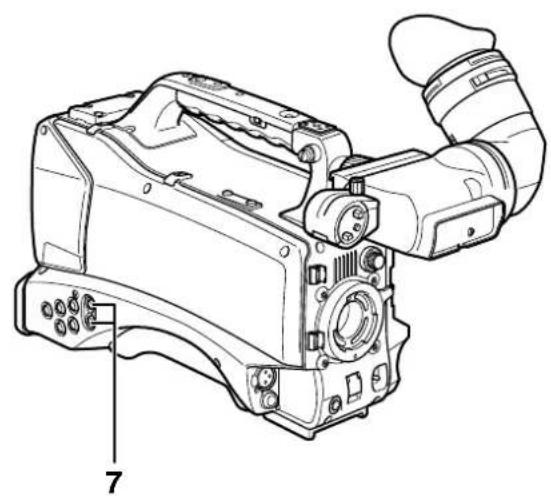
natural_image
Line drawing of a digital camera with labeled parts (no text or symbols present)1 MONITOR SELECT (audio channel) CH1/2, CH3/4 selector switch
Use this switch to select the audio channel whose signals are output to the speaker, earphones or AUDIO OUT connectors.
CH1/2: Signal output of audio channels 1 and 2.
CH3/4: Signal output of audio channels 3 and 4.
The channel indications of the audio level meters in the viewfinder and on the LCD monitor show the channels selected with this switch.
2 MONITOR SELECT (audio selection) CH1/3, ST, CH2/4 selector switch
This switch and the MONITOR SELECT CH1/2, CH3/4 switch select the audio signal output to the speaker, earphones and AUDIO OUT connectors.
| MONITOR SELECT switch (left) | MONITOR SELECT switch (right) | ||
| CH1/2 CH3/4 | |||
| MONITOR SELECT | CH1/3 | Audio Channel 1 | Audio Channel 3 |
| ST | Stereo signals from Audio Channels 1 and 2 ^** | Stereo signals from Audio Channels 3 and 4 ^** | |
| CH2/4 | Audio Channel 2 | Audio Channel 4 | |
*1 MIX in the menu option MONITOR SELECT in the AUDIO SETUP screen allows you to change stereo signals to a mixed signal.
3 MONITOR (volume) control
Use to control the alarm sound volume and volume of sound output from the monitor speaker and earphones.
4 Speaker
The speaker outputs EE sound during recording and reproduced sound during playback. The speaker emits an alarm sound when the warning lamp and indicator light or blink. EE sound and reproduced sound are not output during alarm sound output.
When earphones are connected to the PHONES connector, the sound from the speaker is automatically muted.
5 PHONES (earphones) jack (mini jack)
This connector is designed for audio monitoring (stereo) earphones.
6 DC OUT (DC power supply) output socket.
This is a 12 V DC output socket that provides a maximum current of 1.5 A.
NOTE
Be sure to check polarity before connecting an external device as incorrect connection could lead to damage.
7 AUDIO OUT connector
- This connector outputs audio signals recorded on audio channels 1/2 and 3/4.
- Use the MONITOR SELECT CH1/2, CH3/4 selector switch to select output signals.
Shooting and Recording/Playback Functions Section
text_image
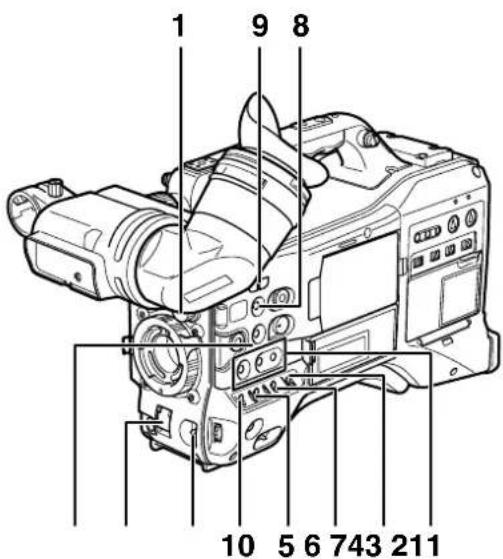
1 9 8 10 5 6 7 43 211■ Shooting and Recording (camera unit)
1 ND FILTER (filter switching) control
Use this control to adjust the amount of light entering the MOS sensor during shooting in strong outdoor lighting.
| Control position | Setting | Description |
| 1 OFF | Does not | use the ND filter. |
| 2 1/4 | Reduces the amount of light entering the MOS sensor to 1/4. | |
| 3 | 1/16 | Reduces the amount of light entering the MOS sensor to 1/16. |
| 4 | 1/64 | Reduces the amount of light entering the MOS sensor to 1/64. |
2 USER MAIN, USER1 and USER2 buttons
These buttons can be assigned user-selected functions in a setting menu. Each button, when pressed, performs the assigned function.
For details, refer to [Assigning functions to USER buttons] (page 53).
3 SHUTTER switch
Use to turn the electronic shutter on and off.
OFF: The electronic shutter is off.
ON: The electronic shutter is on.
SEL: Changes the speed of the electronic shutter.
This dial switch returns to its original position when released. Each push in the SEL direction changes the shutter speed.
For details, refer to [Setting the Electronic Shutter] (page 52).
4 AUTO W/B (white/black) BAL switch
AWB: Automatically adjusts the white balance. Set the WHITE BAL switch on the side to [A] or [B] and use this switch to adjust the white balance, which takes a few seconds. The adjusted value is stored in memory. When the WHITE BAL switch is set to PRST and the AUTO W/B BAL switch is set to AWB to indicate the color temperature, pushing the AUTO W/B BAL switch towards AWB a second time allows you to change the preset color temperature.
ABB: Automatically adjusts the black balance. For details, refer to [Adjusting the White Balance and Black Balance] (page 49).
5 GAIN selector switch
- This switch adjusts video amplifier gain to suit ambient lighting conditions at the time of shooting.
- Use the menu options LOW GAIN, MID GAIN and HIGH GAIN in the SW MODE screen to set the L/M/H position gain values.
- The factory settings for L, M and H positions are 0 dB, 6 dB and 12 dB, respectively.
6 OUTPUT/AUTO KNEE selector switch
This switch selects the video signals sent from the camera unit to the memory card recorder unit, viewfinder and video monitor.
CAM. AUTO KNEE ON:
Video being recorded through the camera is output with the Auto knee circuit activated. A DRS (Dynamic Range Stretcher) function can be used instead of the AUTO KNEE function. For details, refer to [DRS (Dynamic Range Stretcher) function] (page 9).
CAM. AUTO KNEE OFF:
Video being recorded through the camera is output with the Auto knee circuit turned off. The KNEE point is locked to the level set in the menu.
BARS: Color bar signals are output with the AUTO KNEE circuit turned off.
NOTE
■AUTO KNEE function
Usually, when you shoot people or scenery against a strongly lit background and adjust the level to the subject, the background will be totally whited-out, with buildings and other objects blurred. Use of the AUTO KNEE function in situations like these will reproduce the background clearly.
The AUTO KNEE function is effective when:
- The subject is a person positioned in the shade under a clear sky.
- The subject is a person in a vehicle or building and you also want to capture the background visible through a window.
• The subject is a high-contrast scene.
7 WHITE BAL (white balance memory selector) switch
Use to select method of white balance adjustment.
PRST: Use PRST when you have no time to adjust the white balance.
• The factory default setting is 3200 K.
- Use a setting menu or push the AUTO W/B BAL switch towards AWB to display the color temperature. While the color temperature is still indicated, push the AUTO W/B BAL switch once again towards AWB to switch between 3200 K and 5600 K.
A • B: Pushing the AUTO W/B BAL towards AWB will automatically adjust the white balance and save the adjusted value in memory A or memory B. For details, refer to [Adjusting the White Balance] (page 49).
The setting menu also allows you to assign Auto Tracking White balance (ATW) to B. For details, refer to (page 50).
8 DISP/MODE CHK button
- Press this button to turn off the viewfinder and LCD display. (The time code indication stays on.)
- A second press of the button turns the display back on and holding it down displays shooting conditions and functions assigned to USER switches.
- It also serves to turn off the alarm sound.
9 SYNCHRO SCAN switch
This function adjusts the synchro scan speed when the SHUTTER switch is set to ON and synchro scan is selected.
Pressing the - switch sets a slower shutter speed and pressing the + switch sets a faster one.
For example, to record a computer screen, make adjustments to minimize horizontal bar noise in the viewfinder.
In VFR (Variable Frame Rate) mode, press the JOG dial button and this switch to change the frame rate.
For details, refer to [2. JOG dial button] in [Menu/Thumbnail Operation Section] (Page 22).
10 ZEBRA (zebra pattern) switch
Use this switch to display a zebra pattern in the viewfinder and on the LCD monitor. For details, refer to [Zebra pattern display] (page 74).
11 Focal plane index (
This symbol indicates the focal plane of the MOS sensor.
It provides a reference for making accurate focal distance measurements from the subject.
text_image
24 25 20 22 2627 17151614 13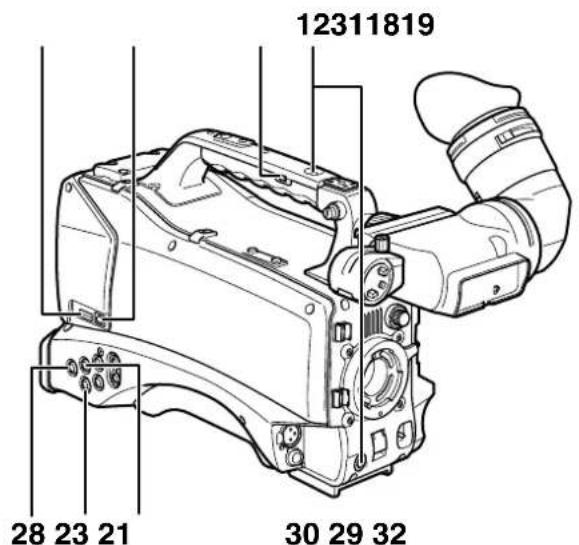
text_image
12311819 28 23 21 30 29 32
natural_image
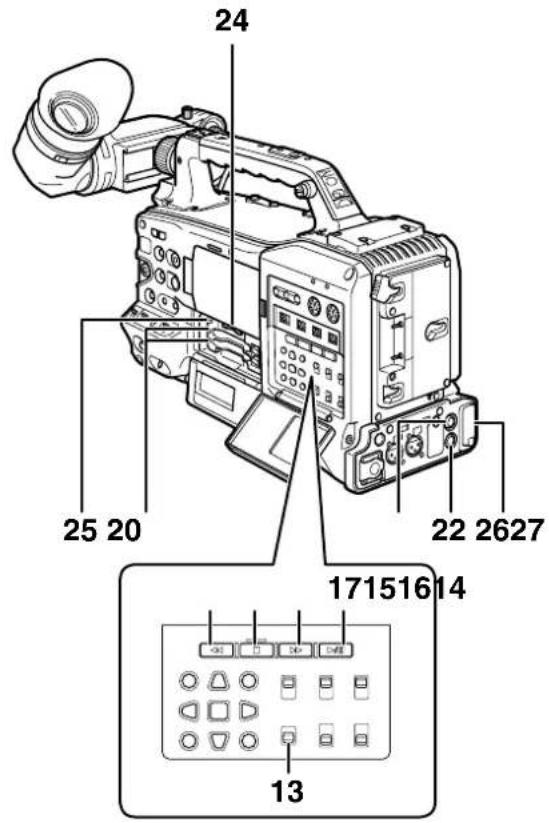
Line drawing of a digital camera with no visible text or symbols■ Shooting and Recording/Playback Function Section (Recorder Unit)
12 REC button
Press this button to start recording and press once again to stop it.
This button operates in the same way as the VTR button on the lens.
13 SDI OUT CHARACTER switch
Use this switch to control the superimposition of character data onto SDI OUT to indicate status or setting menus.
ON: Superimposes characters.
OFF: Does not superimpose characters.
NOTE
In addition to SDI OUT, a setting menu allows you to superimpose characters on VIDEO OUT video.
14 ◀◀REW (rewind) button
In stop mode, press this button for fast-reverse playback.
During playback, press this button for fast-reverse playback at about 4x normal speed.
If this button is pressed when playback is paused, the beginning of the clip being played is located in pause mode (cue-up mode).
15 ▶▶FF (fast forward) button
In stop mode, press this button for fast playback.
During playback, press this button for fast playback at about 4x normal speed.
If this button is pressed when playback is paused, the beginning of the next clip is located in pause mode (cue-up mode).
16 ■ STOP button
Press this button to stop playback.
Press this button to stop interval recording and one-shot recording.
17 PLAY/PAUSE button
Press this button to view playback in the viewfinder or on a color video monitor.
Press it during playback to pause playback.
18 USB 2.0 connector (DEVICE)
19 USB 2.0 connector (HOST)
Connect a USB 2.0 cable to this connector.
To enable transfer of data via USB 2.0, set the menu option PC MODE in the SYSTEM SETUP screen to ON. This setting restricts recording, playback and clip operations with the camera. For details, refer to page 140.
20 P2 CARD ACCESS LED
This LED indicates the recording and playback status of each card.
For details, refer to [P2 CARD ACCESS LED and status of P2 cards]. (Page 29)
21 GENLOCK IN connector
This connector inputs a reference signal when the camera unit is gen-locked, or when the time code is externally locked.
NOTE
- Supply an HD Y signal (1080/59.94i, 720/59.94P) or a composite signal (480/59.94i) as input reference signal. The subcarrier of VIDEO OUT connector output (composite signal) cannot be externally locked. In SD mode, the signal will not lock to the HD signal.
22 REMOTE connector
Some functions can be remote controlled when the remote control unit AJ-RC10G (optional accessory) is connected to the camera.
For details, refer to [Connecting the AJ-RC10G Remote Controller] (page 100).
23 VIDEO OUT connector
This connector outputs video signals.
- In HD mode, down-converted composite video signals are output.
- Use the menu option DOWNCON MODE in the OUTPUT SEL screen to set signal output. (The factory setting is LETTER BOX.)
24 SD memory card slot
Insert an SD memory card (optional accessory) in this slot. It is used for recording and loading camera setting menus or lens files, uploading meta data and recording proxies (optional).
NOTE
■SD memory card precautions
- Use only SD memory cards that conform to the SD standard or the SDHC standard in this camera.
- MultiMediaCards (MMC) cannot be used. (Use of such cards may prevent recording.)
- Be sure to use mini SD card adapters when using mini SD cards with this camera. (Note that this camera will not operate normally when a mini SD adapter is installed without inserting a card. Be sure to insert a card when an adapter is installed.)
- Use of Panasonic SD memory cards and mini SD cards is recommended. Be sure to format such cards in this camera.
- This unit supports the following SD and SDHC memory card capacities.
| SD memory cards | 8MB/16MB/32MB/64MB/128MB/256MB/512MB/1GB/2GB |
| SDHC memory cards | 4GB/6GB/8GB/12GB/16GB/32GB |
For proxy (optional) recording, use 256 MB, 512 MB, 1 GB, 2 GB SD memory cards labeled "High Speed" or SDHC memory cards.
- For the latest information not available in the Operating Instructions, visit the P2 Support Sites at the following Web site.
https://eww.pavc.panasonic.co.jp/pro-av
■About SD and SDHC memory cards
- The SDHC card is a new standard, established by the SD Card Association in 2006, for memory cards with capacities of 2 GB or more.
• The SD logo is a registered trademark. - MMC (MultiMediaCard) is a registered trademark of Infineon Technologies AG.
25 BUSY (operation mode display) lamp
This lamp indicates the active status of the SD memory card. It stays illuminated when the card is active.
NOTE
Do not remove the card while the lamp is on. The SD memory card could be damaged.
26 DVCPRO/DV connector
An IEEE1394 standard connector for input and output of video, audio and data.
For details, refer to [Connections to the DVCPRO/DV Connector] (page 145).
27 SDI OUT 1 connector
28 SDI OUT 2 connector
• This connector outputs SDI signals.
- Use the menu option SDI SELECT in the OUTPUT SEL screen to select AUTO, 1080i or 480i. This connector does not support up-conversion.
It outputs the same signals as SDI OUT.
29 SCENE FILE dial
This dial allows you to select and load shooting conditions from the scene files prerecorded to each of the six positions.
NOTE
During recording, selecting a position with a different frame rate will not change the frame rate until the camera is set to recording standby mode.
For details, refer to [How to use Scene File Data] (page 82).
30 FOCUS ASSIST button
Turns magnification of the center portion of the image on and off.
For details, refer to [Focus assist function] (page 75).
31 REC switch
Switches functions of the REC button on the handle.
ON: Enables the REC button.
OFF: Disables the REC button.
32 USB lamp
This lamp lights when the camera is in USB mode (PC mode).

text_image
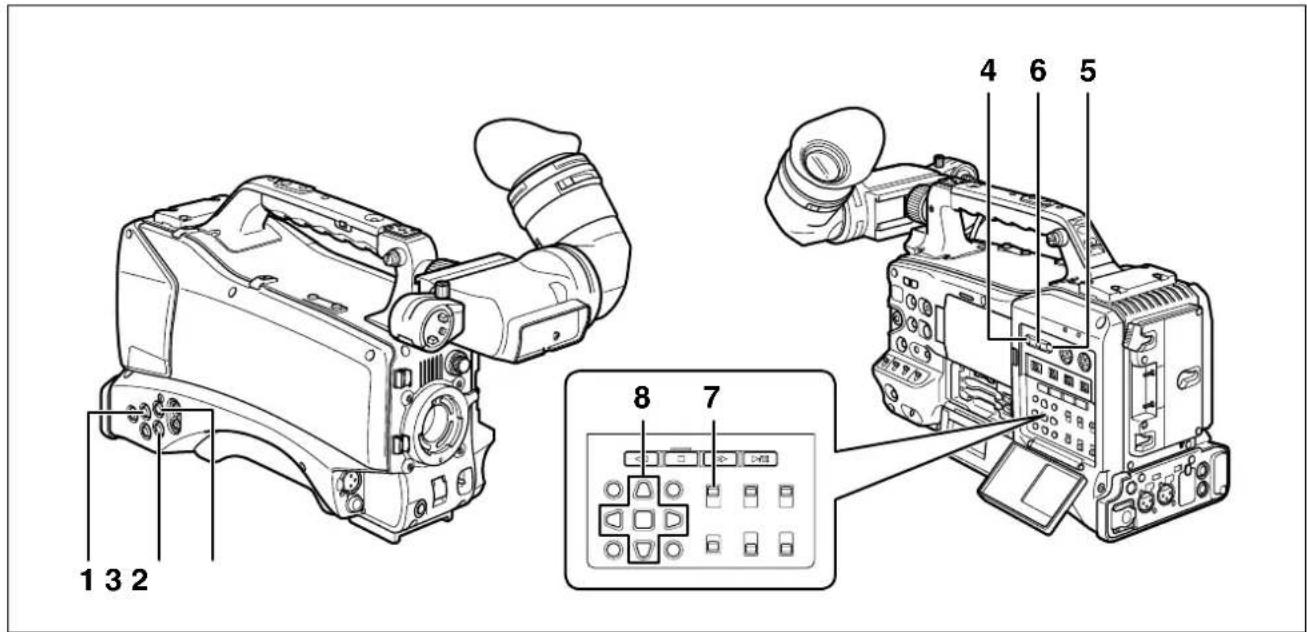
Diagram of a DSLR camera with labeled parts and control panel, showing numbered components from 1 to 7.1 MENU button
- Hold down the button to open a setting menu screen. A second press of the button returns the previous image.
- This function is not available in the thumbnail display and during recording.
2 JOG dial button
- Use this button to go between setting menus and to select and set items in open setting menus.
- In a setting menu, turning the JOG dial button downwards moves the menu cursor downwards and turning it upwards moves the menu cursor upwards. Press the JOG dial button to confirm made settings. For more information, see [Using the menus] (page 120).
- In VFR (Variable Frame Rate) mode, press this button and use the SYNCHRO SCAN switch to change frame rates.
NOTE
Use the JOG dial button to go between setting menus and select items.
For details, refer to [Viewfinder and LCD Menus] (page 120).
3 Thumbnail button
Press this button to open the thumbnail screen. Note that this switchover cannot be performed during recording or playback.
4 Thumbnail menu button
In thumbnail display mode, use this button to access thumbnail menu functions to delete clips, for example.
NOTE
Use the cursor, SET and EXIT/CANCEL buttons to select thumbnails and access menu functions.
For details, see [Manipulating Clips with Thumbnails] (page 101).
5 CURSOR and SET buttons
Use these buttons to manipulate setting menus, the menu bar and thumbnails. The four triangular buttons are cursor buttons and the square center button is the SET button.
6 EXIT/CANCEL button
Press this button to exit an open thumbnail menu or property window to return to the previous image. Pressing this button while holding down the SHIFT button turns it into a cancel function allowing you to cancel clip selections at one time.
7 SHIFT button
Use this button together with other buttons.
- Hold down the SHIFT button and press the cursor button ( ) in a thumbnail screen to move the pointer to the thumbnail at the beginning or end of a clip.
- Hold down the SHIFT button and press the SET button to select all clips from a previously selected clip to the clip at the cursor location.
- SHIFT button + EXIT/CANCEL button
This button combination operates like the cancel function.
For details, refer to [6. EXIT/CANCEL button]. Operations while the SHIFT button is pressed are shown blow each button.
text_image
1 3 2 8 7 4 6 51 GENLOCK IN connector (BNC)
Use this connector to input a reference signal to genlock the camera unit or externally lock the time code. The subcarrier of the VBS signal output by the VIDEO OUT connector of the camera cannot be externally locked.
For details, refer to [Externally Locking the Time Code] (page 62).
2 TC IN connector (BNC)
To externally lock the time code, input a reference time code to this connector.
For details, refer to [Externally Locking the Time Code] (page 62).
3 TC OUT connector (BNC)
Connect this connector to the time code input (TC IN) of the external device to lock the time code of that device to the time code of the AG-HPX300P.
For details, refer to [Outputting the time code externally] (page 63).
4 HOLD button
Pressing this button instantly freezes the time data indication on the counter. Note that time code generation continues. Pressing the button again restarts the counter.
This function allows you to check the time code or CTL count of a recorded scene.
5 RESET button
Use this button to reset the counter value on the time code display to 0.
Pressing this button with the TCG switch positioned at [SET] when the TC PRESET screen and UB PRESET screen are open, resets all set values to 0. Use the Cursor SET button to PRESET.
6 COUNTER (counter display selector) button
Each press of the button displays the counter value, time code, user bit and frame rate data in the viewfinder and LCD display.
7 TCG (time code selector) switch
Use this switch to set the running mode of the built-in time code generator.
F-RUN: Select this position to continuously advance the time code independently of P2 card recording status. Use this position to synchronize the time code with the time of day, or to externally lock the time code.
SET: Select this position to set the time code or user bits.
R-RUN: Select this position to advance the time code only during recording. The time code is continuously recorded during normal recording. But deleting clips and setting a 24P/24PA frame rate to continue recording of clips that are not 24P/24PA clips may break the sequence of time code recording.
NOTE
Always use the CURSOR and SET buttons to set the time code and user bits. The JOG dial button cannot be used for this purpose.
8 CURSOR and SET buttons
Use these buttons to set the time code and user bits. The four triangular buttons are cursor buttons and the square center button is the SET button.
For details, refer to [Setting Time Data] (page 56).
Warning and Status Display Functions
text_image
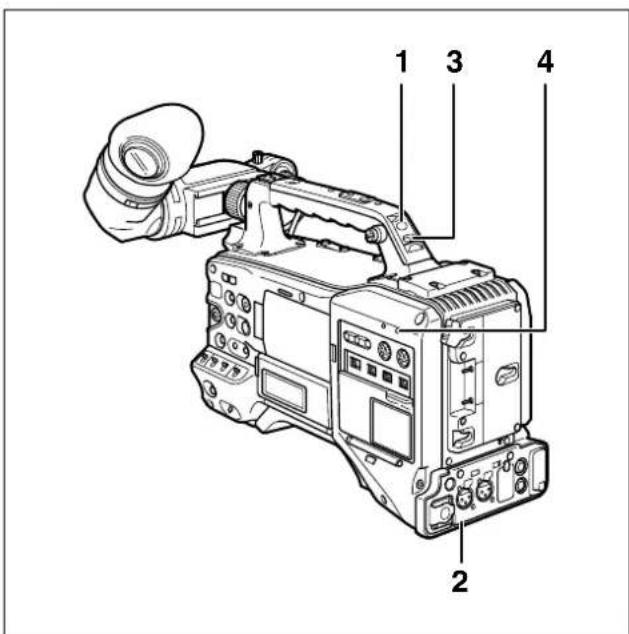
1 2 3 41 Back tally lamp
When the BACK TALLY switch is set to ON, this lamp behaves in the same way as the front tally lamp.
2 Rear tally lamp
When the BACK TALLY switch is set to ON, the rear tally lamp behaves in the same way as the back tally lamp.
3 BACK TALLY switch
Use this switch to control the back and rear tally lamps.
ON: Enables the back and rear tally lamps.
OFF: Disables the back and rear tally lamps.
4 WARNING lamp
This lamp starts blinking or lights when an error is detected in the memory card recorder unit.
LCD Monitor

text_image
Technical diagram of a video camera with labeled parts 1 and 21 LCD Monitor
The LCD monitor displays the video in the viewfinder.
Alternatively, it can show clips on the P2 card in a thumbnail format.
For details on the LCD monitor, refer to [Viewfinder and LCD Menus] (page 120).
In thumbnail display mode, you can use the thumbnail menu buttons, CURSOR and SET buttons to manipulate or delete clips, or format P2 cards.
For details, refer to [Manipulating Clips with Thumbnails] (page 101).
2 OPEN button
Use to open the LCD monitor.

text_image
3 1 5 4 2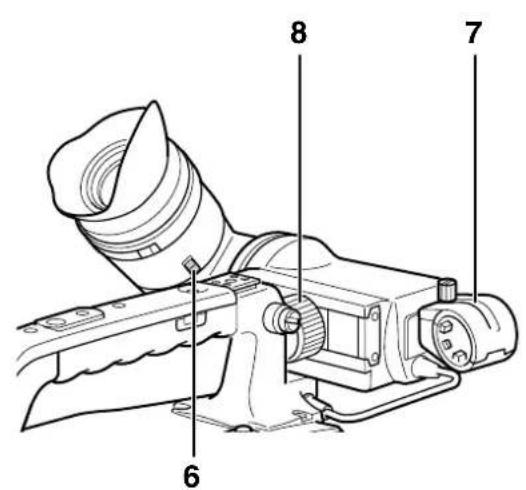
text_image
6 7 81 Viewfinder
The viewfinder displays the video image in color during recording or playback. It also displays warnings and messages – indicating camera operating status and settings – zebra patterns and markers (safety zone and center markers, etc.).
NOTE
The menu option EVF COLOR can be set to monochrome in the DISPLAY SETUP screen.
2 TALLY switch
Use to control the front tally lamp.
ON: Tally lamp goes on
OFF: Tally lamp goes out.
3 Front tally lamp
This lamp goes on during recording when the TALLY switch is set to the [ON]. It blinks to indicate warnings.
4 Eyepiece
5 Diopter adjusting ring
Adjust this ring to suit your vision so that the image in the viewfinder is as clear as possible.
6 Eyepiece lock button
7 Microphone holder
8 Right and left viewfinder positioning rings
Loosen the rings to adjust right and left position, and tighten the ring after completing the adjustment.
Chapter 3 Recording and Playback
Setting Date and Time of Internal Clock
The CLOCK SETTING value is recorded in the contents (clip), and affects the sequence of playback of the thumbnails. Before carrying out recording, be sure to check and set CLOCK SETTING and TIME ZONE.
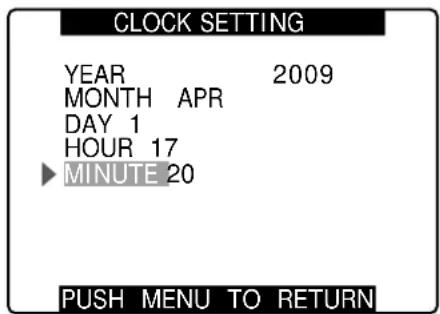
■ This shows you how to adjust the calendar to 5:20 PM on April 1, 2009.
1 Set the POWER switch to ON.
2 Select TIME ZONE item in OTHER FUNCTIONS, then press the JOG dial button.
- For details on menu operation, refer to [Using the menus] (page 120).
3 Use the JOG dial button to set the time difference from Greenwich Mean Time. - Check what time zone you are in and set accordingly.
OTHER FUNCTIONS
| USER FILE | >>> |
| 1394 CONTROL | OFF |
| 1394 CMD SEL | REC P |
| ACCESS LED | ON |
| ALARM | HIGH |
| CLOCK SETTING | >>> |
| TIME ZONE | +9:00 |
| GL PHASE | HD SDI |
PUSH MENU TO RETURN
■Time zone
| Time difference | Area | Time difference | Area |
| 00:00 Greenwich +01:00 Central Europe | |||
| -00:30 +01:30 | |||
| -01:00 Azores Islands +02:00 Eastern Europe | |||
| -01:30 +02:30 | |||
| -02:00 Mid-Atlantic +03:00 Moscow | |||
| -02:30 +03:30 Tehran | |||
| -03:00 Buenos Aires +04:00 Abu Dhabi | |||
| -03:30 Newfoundland Island +04:30 Kabul | |||
| -04:00 Halifax +05:00 Islamabad | |||
| -04:30 +05:30 Bombay | |||
| -05:00 New York +06:00 Dacca | |||
| -05:30 +06:30 Yangon | |||
| -06:00 Chicago +07:00 Bangkok | |||
| -06:30 +07:30 | |||
| -07:00 Denver +08:00 Beijing | |||
| -07:30 +08:30 | |||
| -08:00 Los Angeles +09:00 Tokyo | |||
| -08:30 +09:30 Darwin | |||
| -09:00 Alaska +10:00 Guam | |||
| -09:30 Marquesas Islands +10:30 Lord Howe Island | |||
| -10:00 Hawaii +11:00 Solomon Islands | |||
| -10:30 +11:30 Norfolk island | |||
| -11:00 Midway Island +12:00 New Zealand | |||
| -11:30 +12:45 Chatham Islands | |||
| -12:00 Kwajalein +13:00 | |||
| +00:30 | |||
NOTE
- The clock is accurate to within about ± 30 seconds a month with the power turned off.
- Check and set the time when accurate time is required. After setting the time, change the setting menu TIME ZONE item and the display and the recorded local time will be reset accordingly.
4 Select CHANGE at the CLOCK SET item in OTHER FUNCTIONS, then press the JOG dial button.
• The CLOCK SET screen appears.

text_image
OTHER FUNCTIONS USER FILE >>> 1394 CONTROL OFF 1394 CMD SEL REC P ACCESS LED ON ALARM ON CLOCK SETTING RETURN TIME ZONE CHANGE GL PHASE HD SDI PUSH MENU TO RETURN5 Turn the JOG dial button to select YEAR, then press the JOG dial button.

text_image
CLOCK SETTING YEAR 2009 MONTH APR DAY 1 HOUR 13 MINUTE 7 PUSH MENU TO RETURN6 Turn the JOG dial button to set YEAR to 2009, then press the JOG dial button.
• A year between 2000 to 2037 can be set.
7 Turn the JOG dial button to select MONTH, then press the JOG dial button.
8 Turn the JOG dial button to set MONTH to APR, then press the JOG dial button.
9 Set DAY, HOUR and MINUTE in the same way as setting YEAR and MONTH.
• This is a 24-hour clock.
text_image
CLOCK SETTING YEAR 2009 MONTH APR DAY 1 HOUR 17 ▶ MINUTE 20 PUSH MENU TO RETURNP2 Cards
Inserting P2 Cards

NOTE
When using the camera recorder for the first time, be sure to set the time data beforehand.
For details, refer to [Setting Date and Time of Internal Clock] (page 26).
1 Turn on the POWER switch.
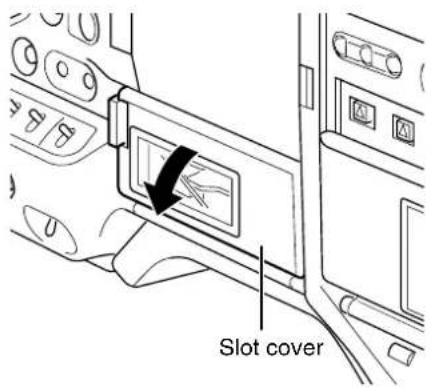
2 Open the card slot cover.
text_image
Slot cover3 Insert a P2 card in a P2 card slot.
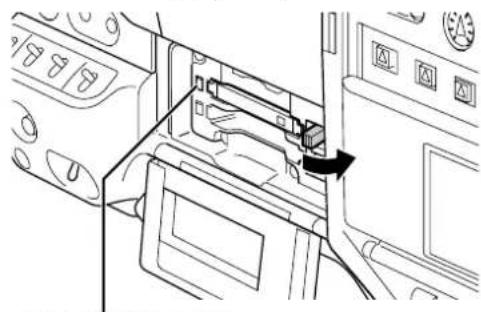
- Press in the card until the eject button pops up.

text_image
EJECT button Insert the card with the logo facing up.
Push the eject button that pops up to the right.
- Insert a P2 card into the AG-HPX300P. The P2 CARD ACCESS LED for the appropriate slot indicates the status of the P2 card.
For details, refer to [P2 CARD ACCESS LED and status of P2 cards] (page 29).
natural_image
Line drawing of a car interior showing dashboard, air vent, and control panel (no text or symbols)P2 CARD ACCESS LED

Close the card slot cover.
NOTE
- To prevent cards from falling out, dust from entering and reduce the risk of exposure to static electricity, close the card slot cover before moving the camera.
- Format P2 cards only on a P2 card device.
Removing P2 Cards
1 Open the card slot cover.
2 Raise the eject button.
3 Then depress the eject button to release the P2 card.

natural_image
Diagram showing two views of a device inside a vehicle's door panel, with arrows indicating movement or assembly (no text or symbols present)Raise the eject button. Press the raised eject button to remove a P2 card.
NOTE
- When a P2 card is being accessed or recognised after insertion (P2 CARD ACCESS LED blinks in orange), do not remove the P2 card. Removing a P2 card during access could damage it.
- If a P2 card being accessed is removed, the viewfinder displays "TURN POWER OFF" and the AG-HPX300P gives a warning using an alarm and the WARNING LED. In addition, all P2 CARD ACCESS LEDs blink rapidly in orange. If this is the case, turn the power off.
For details, refer to [Warning System] (page 151).
- Removing a P2 card during access may corrupt clip data. Check the clips and restore them if required. For details, refer to [Restoring Clips] (page 109).
- If a P2 card being formatted is removed, it may be not be formatted properly. In this case, the viewfinder displays "TURN POWER OFF". If this message appears, turn off the power, then restart the AG-HPX300P to reformat the card.
- If a P2 card is inserted while another P2 card is being played back, the inserted P2 card is not recognised and the P2 CARD ACCESS LED for that card does not come on. Card recognition starts when playback ends.
- A P2 card inserted in an empty slot during recording may not be immediately recognized during the following events.
- Immediately following PRE REC operation
- Immediately before or after a recording that bridges P2 cards in two slots (hot swap recording, etc.)
- The CARD ACCESS LED can be set to stay off in the menu option ACCESS LED in the OTHER FUNCTIONS screen. When the camera is used in this way, remove cards when the camera has been powered down or a sufficiently long time after terminating recording, playback and other operating modes.
- Removing a P2 card during thumbnail display terminates the thumbnail display.
To Prevent Accidental Erasure of P2 Card Content
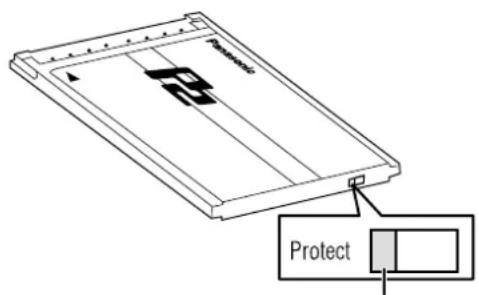
To prevent the content of a P2 card being accidentally erased, position the write-protect switch on the P2 card at [Protect].
text_image
ProtectWrite-protect switch
NOTE
Write-protect switchover can be performed while the card is being accessed (during recording or playback), but does not take effect until access to the card ceases.
P2 CARD ACCESS LED and status of P2 cards
| P2 CARD ACCESS LED | Status of P2 Card | MODE CHECK indication*1 | |
| Stays on in green | Recording enabled | Writing and reading enabled. | ACTIVE |
| Stays on in orange | Selected for recording | Writing and reading enabled for current recording mode (loop, interval or one-shot recording). | ACTIVE |
| Blinks in orange *2 | Being accessed | Writing or reading being performed. | ACCESSING |
| Quickly blinks in orange | Being recognized | The P2 card is being recognised. | INFO READING |
| Blinks in green | Card full | The P2 card has no free space. Only reading is enabled. | FULL |
| Write-protected | The write-protect switch on the P2 card is positioned at [PROTECT]. Only reading is enabled. | PROTECTED | |
| Stays off | Card not supported | The card is not supported by your AG-HPX300P. Replace the card. | NOT SUPPORTED |
| Incorrect format | The P2 card is not properly formatted. Reformat the card. | FORMAT ERROR | |
| Card not inserted | No P2 card is inserted. Card recognition standby. | NO CARD | |
*1 MODE CHECK appears in the viewfinder and on the LCD monitor.
For details, see [Viewfinder Screen Status Displays] (page 65)
*2 Blinks orange also when a PROXY card (optional accessory) is inserted in slot 2.
P2 card recording times
P2 cards available to the AG-HPX300P
This camera supports the following P2 cards.
- AJ-P2C004HG (4 GB)
- AJ-P2C008HG (8 GB)
- AJ-P2C016AG (16 GB)
- AJ-P2C016RG (16 GB)
- AJ-P2C032AG (32 GB)
- AJ-P2C032RG (32 GB)
- AJ-P2C064AG (64 GB)
NOTE
- Card model numbers and capacities above will become available as of January 2009. Greater capacities and technical innovation may extend the recording time.
- This unit cannot use AJ-P2C002SG (2 GB) cards.
- Use of cards other than those listed above may require updating the camera driver.
For details, refer to [Updating the firmware incorporated into the unit] (page 155).
- For the latest information not available in the Operating Instructions, visit the P2 Support Desk at the following Web site.
P2 card recording times
(When using one 64 GB card)
| System mode | Recording format (codec) | Recording time |
| HD (1080i, 720P) | AVC-I 100DVCPRO HD | Approx. 64 min. |
| AVC-I 50 | Approx. 128 min. | |
| SD (480i) | DVCPRO50 | Approx. 128 min. |
| DVCPRO DV | Approx. 256 min. |
NOTE
- The above recording time is for normal recording. Recording in native mode will extend recording time depending on system mode.
For details, refer to [List of recording formats and functions] (page 45).
- Use of 32 GB, 16 GB and 8 GB P2 cards will provide 1/2, 1/4 and 1/8, respectively of above recording times.
- The indicated capacities include a management area so the total area available for recording is somewhat smaller.
Splitting clips recorded on P2 cards
This camera will automatically generate additional clips for a continuous recording on an 8 GB or higher capacity P2 card when the recording exceeds the durations given below. Even so, a P2 device will handle such clips as a single clip in thumbnail operations (display, delete, recover, copy, etc.). Such recordings may be handled as separate clips by nonlinear editing software or a PC.
| Recording format (excluding Native format) | Continuous recording time |
| AVC-I 100DVCPRO HD | Approx. 5 min. |
| AVC-I 50DVCPRO50 | Approx. 10 min. |
| DVCPRODV | Approx. 20 min. |
Handling P2 Card Recording
The P2 card is a semiconductor memory card designed for the DVCPRO P2 series, Panasonic's line of professional video and broadcast equipment.
- Since the DVCPRO P2 format and AVC-Intra record data as files, it is ideally suited for computer processing. The file structure is in a proprietary format that includes audio and video data recorded in the MXF file format as well as various other essential data forming an interrelated folder structure as shown below.
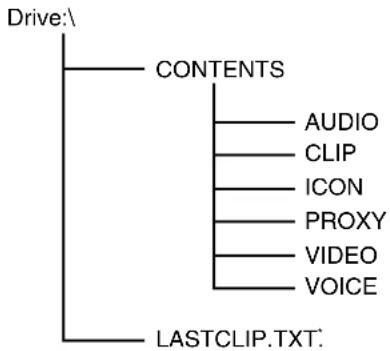
flowchart
graph TD
    A["Drive:\"] --> B["CONTENTS"]
    B --> C["AUDIO"]
    B --> D["CLIP"]
    B --> E["ICON"]
    B --> F["PROXY"]
    B --> G["VIDEO"]
    B --> H["VOICE"]
    A --> I["LASTCLIP.TXT'"]
All these folders are required.
* This file contains the last clip data recorded on a P2 device.
NOTE
If any of this data is changed or lost, it will not be recognized as P2 data or the P2 card may no longer be possible to use in a P2 device.
- To prevent data loss in transferring P2 card data to a PC or write back PC data on a P2 card, use P2 Viewer, which can be downloaded from the Web site listed below. (Supported operating systems: Windows 2000, Windows XP, Windows Vista)
https://eww.pavc.panasonic.co.jp/pro-av/support/desk/e/index.htm
- Follow the steps below to use general software such as Microsoft Windows Explorer or Apple Finder to transfer the data to a PC. Be sure to use P2 Viewer to write data back to a P2 card.
- Treat the CONTENTS folder and the LASTCLIP.TXT file as a unit.
- Do not modify the data below the CONTENTS folder.
- In copying, be sure to copy both the CONTENTS folder and the LASTCLIP.TXT file together.
- When transferring data from multiple P2 cards, create separate folders for each P2 card to prevent overwriting clips with identical names.
- Do not delete data on a P2 card.
- Format P2 cards only on a P2 card device.
Basic Procedures
This section describes the basic procedure for shooting and recording.
Before you embark on a shoot, pre-inspect your system to ensure that it works properly.
For directions on inspecting your memory card camera-recorder, see [Inspections Before Shooting] (page 147).
Battery Set-up to P2 card Insertion
1 Insert a charged battery.
2 Turn the POWER switch to ON to check the battery remaining level in the viewfinder.
- When battery capacity is low, replace it with a fully charged battery.
NOTE
When low battery capacity is indicated after replacing a battery with a fully charged battery, check battery installation.
For details, refer to [BATTERY SETUP screen] (page 134).
3 Insert a P2 card, check that the P2 CARD ACCESS LED lights orange or green before closing the slot cover.
- When more than one P2 card slot contains a P2 card, the card in the slot with the lowest number is used first. However, regardless of slot number, a P2 card inserted later will not be accessed until the other cards have been used.
Example:
If the two slots contain P2 cards, the cards are used in order of slot numbers 1→2. However, if the P2 card in Slot 1 is removed and then re-inserted, the cards will be used in the following order: 2→1.

text_image
Technical diagram showing component assembly with labeled parts and directional arrows indicating movement or flowNote that the recording order is retained even if the power is turned off. When the power is next turned on, the last card written before powering-down will be the target card.
Setting the switches before shooting and recording
When a battery and P2 cards are installed, set the switches as detailed below, before starting to use your AG-HPX300P.
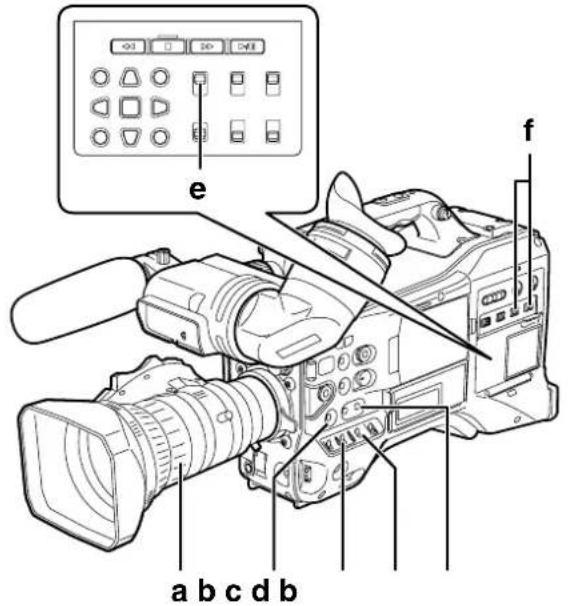
text_image
e f a b c d ba Iris
The iris is automatically adjusted when the lens is set to the auto iris mode.
b USER MAIN/USER1/USER2
Assigning the SLOT SEL function to a USER button allows you to select one of the two inserted P2 cards for recording.
The P2 card selected for recording switches with each press of the USER button, and the P2 CARD ACCESS LED of the selected P2 card lights orange. The slot number of the card to be recorded appears in green in the LCD monitor and the viewfinder.
For more information on viewfinder displays, see [Viewfinder Screen Status Displays] (page 65).
NOTE
- The slot selected for recording cannot be changed when recording has started. Perform this operation during recording standby.
- Use the USER MAIN/USER1/USER2 item in setting menu SW MODE screen to assign functions to the USER MAIN/USER1/USER2 button.
c GAIN switch
Normally, this should be set to L (0 dB). If conditions are too dark, an appropriate gain level should be set.
d AUTO KNEE selector switch
Set to ON or OFF. Selecting BARS turns off this function and outputs a color bar signal.
e TCG
Set to F-RUN or R-RUN.
f AUDIO SELECT CH 1/CH 2
Set to AUTO.
Shooting
White/Black Balance Adjustment to Recording Completion
For shooting, follow the steps below.
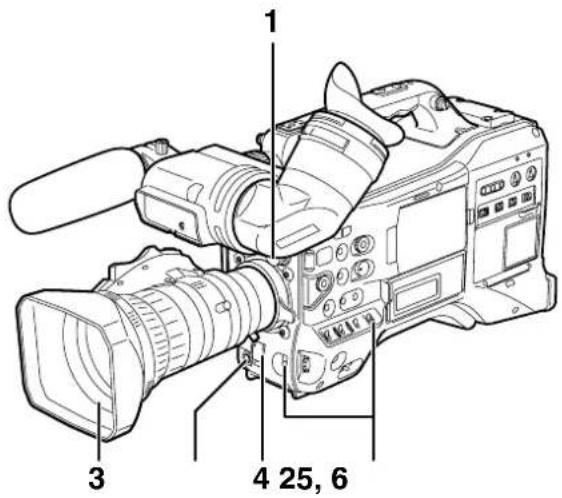
text_image
1 2 3 4 25, 61 Use the ND FILTER control to select a filter according to ambient light conditions.
2 ■ When the white balance is saved:
- Position the WHITE BAL switch to [A] or [B].
■ When the white or black balance is not saved and you have no time to adjust the white balance:
- Position the WHITE BAL switch to [PRST].
- The color temperature can be set to 3200K or 5600K.
■ If the white balance is adjusted on the spot:
- Select a filter according to ambient light conditions. Then, position the WHITE BAL switch to [A] or [B] and shoot a white test subject so that it appears at the center of the screen. Then, follow the steps below to adjust the white balance.
- Turn the AUTO W/B BAL switch toward [AWB] to adjust the white balance.
- Turn the AUTO W/B BAL switch toward [ABB] to adjust the black balance.
- Turn the AUTO W/B BAL switch toward [AWB] to adjust the white balance again.
For directions on making adjustments, see [Adjusting the White Balance] (page 49) and [Adjusting the Black Balance] (page 50).
3 Point the camera at your subject to adjust the focus, and zoom.
4 To use the electronic shutter, set the shutter speed and shutter mode.
For more information, see [Setting the Electronic Shutter] (page 52).
5 Press the REC button to start recording.
6 To stop recording, press the REC button.
NOTE
- Shooting the sun and other very bright subjects may produce a color cast in surrounding areas.
■Operation Buttons
During recording, all operation buttons (REW, FF, PLAY/PAUSE, STOP) are disabled.
Normal Recording
- Pressing the REC button starts recording of video and sound on the P2 card.
- The video and audio (including additional information) recorded in one session is referred to as a clip.

natural_image
Line drawing of a professional video camera with extended lens and control panel (no text or symbols)REC button
NOTE
Pressing the REC button will not immediately stop data write operations to a P2 card in the following situations. And the REC button operation is not recognized.
- When terminating a short recording
- When terminating a recording that has just continued onto a second P2 card
Standard and Native Recording
This camera is capable both of native recording, when it records video data at the frame rate used by the camera, and is also capable of standard recording or recording 59.94 frames with a pulldown.
Standard recording (pull-down recording)
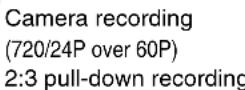
In 24P and 30P mode, 59.94i or 59.94P will be recorded with 2:3 and 2:2 pulldown, respectively. The camera can also handle video shot in the 24PA mode (2:3:3:2 advanced pulldown).
Note that AVC-Intra does not support pulldown recording.
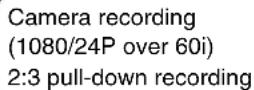
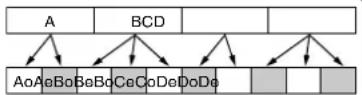

flowchart
graph TD
    A["A"] --> A1["A★"]
    A --> A2["A"]
    A --> A3["B★"]
    A --> A4["B★"]
    A --> A5["B"]
    A --> A6["B"]
    A --> A7["C★"]
    A --> A8["C"]
    A --> A9["D★"]
    A --> A10["D"]
    A --> A11["D"]
    A --> A12["D"]
    B["B C D"] --> B1["★ Active frame"]
    C["C★"] --> C1["★ Active frame"]
    D["D★"] --> D1["★ Active frame"]
    E["D"] --> E1["★ Active frame"]
Native recording
Native recording extracts only the active frames during 1080i AVC-Intra recording as well as 720P DVCPRO HD and AVC-Intra recording.
At 720P, this lengthens the recording time 2 to 2.5 times over pull-down recording.
Also in native recording, the output of camera video and playback video is a 59.94 frame rate.
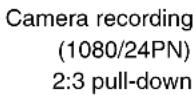
Recording

flowchart
graph TD
    A["A"] --> Ao["Ao"]
    A --> Bcd["BCD"]
    Bcd --> AeAeAeBoBeBoCeCoDeDoDe
    AeAeAeBoBeBoCeCoDeDoDe --> Ao
    AeAeBoBeBoCeCoDeDoDe --> A
    AeBoBeBoCeCoDeDoDe --> A
    AeBoBeBoCeCoDeDoDe --> A
    AeBoBeBoCeCoDeDoDe --> A
    AeBoBeBoCeCoDeDoDe --> A
    AeBoBeBoCeCoDeDoDe --> A
    AeBoBeBoCeCoDeDoDe --> A
    AeBoBeBoCeCoDeDoDe --> A
    AeBoBeBoCeCoDeDoDe & AeBoBeBoCeCoDeDoDe & AeBoBeBoCeCoDeDoDe & AeBoBeBoCeCoDeDoDe & AeBoBeBoCeCoDeDoDe & AeBoBeBoCeCoDeDoDe & AeBoBeBoCeCoDeDoDe & AeBoBeBoCeCoDeDoDe & AeBoBeBoCeCoDeDoDe & AeBoBeBoCeCoDeDoDe & AeBoBeBoCeCoDeDoDe
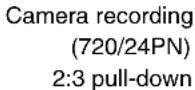
Recording
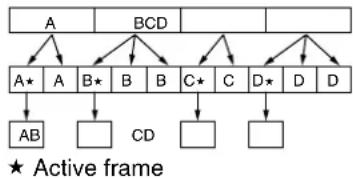
flowchart
graph TD
    A["A"] --> A2["A*"]
    A --> A3["A"]
    A --> A4["B*"]
    A --> A5["B"]
    A --> A6["B"]
    A --> A7["C*"]
    A --> A8["C"]
    A --> A9["D*"]
    A --> A10["D"]
    A --> A11["D"]
    A2 --> AB["AB"]
    A3 --> CD["CD"]
    A4 --> CD
    A5 --> CD
    A6 --> CD
    A7 --> CD
    A8 --> CD
    A9 --> CD
    A10 --> CD
    A11 --> CD
    style A2 fill:#f9f,stroke:#333
    style A3 fill:#f9f,stroke:#333
    style A4 fill:#f9f,stroke:#333
    style A5 fill:#f9f,stroke:#333
    style A6 fill:#f9f,stroke:#333
    style A7 fill:#f9f,stroke:#333
    style A8 fill:#f9f,stroke:#333
    style A9 fill:#f9f,stroke:#333
    style A10 fill:#f9f,stroke:#333
    style AB fill:#ccf,stroke:#333
    style CD fill:#ccf,stroke:#333
    style D fill:#ccf,stroke:#333
    style D1 fill:#ccf,stroke:#333
    style D2 fill:#ccf,stroke:#333
    style D3 fill:#ccf,stroke:#333
    style D4 fill:#ccf,stroke:#333
    style D5 fill:#ccf,stroke:#333
    style D6 fill:#ccf,stroke:#333
    style D7 fill:#ccf,stroke:#333
    style D8 fill:#ccf,stroke:#333
    style D9 fill:#ccf,stroke:#333
NOTE
- In 24P/24PA, 24PN (native recording) and in 30PN (native recording) at 720P, the camera starts recording in 5-frame, 4-frame and 2-frame segments, respectively. For this reason, to continue recording clips in a system mode using a different recording segmentation may break the continuity of the time code.
- The camera uses internal memory for recording, when recording starts as soon as a P2 card is inserted or the camera is powered up. In this situation, recording cannot be stopped until P2 card recognition ends. To check P2 card status, press the DISP/MODE CHK button and check the row for SLOT 1 and 2.
- An editing system that supports 24PA (2:3:3:2 advanced pulldown) will enable editing with less quality loss than 24P (2:3 pulldown).
- Record at standard 24P if a 24PA compatible editing system will not be used.
Variable Frame Rate (VFR) Recording
In 720P mode, this camera is capable of frame skipping (undercranking) and high-speed (overcranking) recording. The camera operator can select between native (PN) recording mode and standard (OVER) recording.
Native VFR Recording
1 In the SYSTEM SETUP screen, set the menu option SYSTEM MODE to 720-59.94P and the menu option REC FORMAT to AVC-I 100/24PN.
2 In the SCENE FILE screen, set the menu option VFR to ON and the menu option FRAME RATE to suit shooting purposes.
- The frame rate can be set to a value between 12 (12P) to 60 frames (60P).
NOTE
Pressing the SYNCHRO SCAN switch while the JOG dial button is held down and the frame rate indication is blinking allows you to change the frame rate as long as recording is not in progress.
3 Press the REC button.
This starts recording in the VFR mode (native VFR).
This mode can be combined with the AVC-I 100, AVC-I 50, DVCPRO HD, 30PN, and 24PN recording formats. For details, refer to [List of recording, playback and output formats] (page 47). For details, refer to [SYSTEM SETUP screen] (page 126).
NOTE
Note the following about native VFR recording.
- The P2 card that is being recorded cannot be changed during recording.
- Pre-recording, loop recording, interval recording and one-shot recording are not available.
- 1394 output is not available during recording and recording standby.
- Changing Scene Dial position during recording does not change VFR on and off position.
- Sound cannot be recorded. ^1
- The time code is locked to Rec Run. ^1
- Thumbnail screens are created 1 frame later than video recorded on a P2 card, but this is not a malfunction.
*1 In 24PN/30PN recording modes, when the frame rate is 24 and 30 frames per second, respectively, audio can also be recorded. The time code can be set to Free Run (F-RUN).
Standard VFR recording (pulldown recording)
1 In the SYSTEM SETUP screen, set the menu option SYSTEM MODE to 720-59.94P and the menu option REC FORMAT to AVC-I 100/60P.
2 In the SCENE FILE screen, set the menu option VFR to ON and the menu option FRAME RATE to suit shooting purposes.
- The frame rate can be set to a value between 12 (12P) to 60 frames (60P).
NOTE
Pressing the SYNCHRO SCAN switch while the JOG dial button is held down and the frame rate indication is blinking allows you to change the frame rate without opening a setting menu as long as recording is not in progress.
3 Press the REC button.
This starts recording in the VFR mode (OVER 60P).
This mode can be combined with the AVC-I 100/60P, AVC-I 50/60P and DVCPRO HD/60P recording formats. For details, refer to [List of recording, playback and output formats] (page 47). For details, refer to [SYSTEM SETUP screen] (page 126).
Setting a low frame rate and recording a fast-moving subject at 60P will produce a smoothly flowing sequence at playback.
NOTE
- Audio playback is disabled when a frame rate converter is used to extract active frames for over and under-cranking.
- Note the following about standard VFR recording.
- The P2 card that is being recorded cannot be changed during recording.
- Pre-recording, loop recording, interval recording and one-shot recording are not available.
- 1394 output is available during recording and recording standby, but not in AVC Intra mode.
- Changing Scene Dial position during recording does not change VFR on and off position.
- Sound is recorded.
Using VFR Recording Function
Standard speed for film production
Screen production normally requires a 24 fps (24 frames per second) frame rate (normal speed) for screening a film. Making the settings described below will provide film-quality playback. The 720P progressive mode and cine-like gamma will make video look like it was shot with a film camera.
Standard setting for film production
| SYSTEM MODE settings | Recording frame rate | ||
| SYSTEM MODE Other | settings | ||
| 720 - 59.94P | REC FORMAT | AVC-I 100/24PN(AVC-I 50/24PN)(DVCPRO HD/24PN) | 24 frames |
| VFR OFF | |||
| 1080 - 59.94i | REC FORMAT | AVC-I 100/24PN(AVC-I 50/24PN)(DVCPRO HD/60i) | |
| CAMERA MODE *1 | 24P | ||
*1 Only when the menu option REC FORMAT is set to DVCPRO HD/60i in the SYSTEM SETUP screen.
Shooting at standard speed for producing commercials and TV programs
Production aimed at HDTV and SDTV broadcasts for TV audiences must use the frame rate (x1) of 30fps (30 frames/s). The settings below allow you to obtain the kind of playback used for broadcast programs. This permits film-like video recording of commercials and music clips that also provide a frame rate suitable for broadcasting.
Standard settings for producing commercials and dramas
| SYSTEM MODE settings | Recording frame rate | ||
| SYSTEM MODE Other | settings | ||
| 720 - 59.94P | REC FORMAT | AVC-I 100/30PN(AVC-I 50/30PN)(DVCPRO HD/30PN) | 30 frame |
| VFR OFF | |||
| 1080 - 59.94i | REC FORMAT | AVC-I 100/30PN(AVC-I 50/30PN)(DVCPRO HD/60i) | |
| CAMERA MODE *2 | 30P | ||
*2 Only when the menu option REC FORMAT is set to DVCPRO HD/60i in the SYSTEM SETUP screen.
Undercranking effects
This effect produces the quick motion often used for showing clouds drifting across the sky, crowds of people swarming past a solitary standing individual, a kung fu demonstration and other performances. For example, selecting a VFR recording frame rate of 12 fps when shooting at a 24P recording format yields a fast-motion effect of 2x normal speed.
Standard setup for undercranking effects
| SYSTEM MODE setup | Recording frame rate | ||
| SYSTEM MODE Other | settings | ||
| 720-59.94P | REC FORMAT | AVC-I 100/24PN(AVC-I 50/24PN)(DVCPRO HD/24PN) | 12 to 22 frames |
| VFR ON | |||
| FRAME RATE Set to 23 frames or less | |||
- With the menu option REC FORMAT set to DVCPRO HD/60P, you can use a nonlinear editing system to generate quick motion effects from the resulting footage.
Overcranking effects
Overcranking produces slow-motion playback, which is frequently used in climax scenes, or for dramatic effects like car chases and action scenes. For example, selecting a recording frame rate of 60 fps when shooting a 24P recording format yields a slow-motion effect that is 2.5 times normal speed. Shooting 720P progressive video will produce smooth and high-quality slow-motion.
Standard setup for overcranking effects
| SYSTEM MODE setup | Recording frame rate | ||
| SYSTEM MODE Other | settings | ||
| 720-59.94P | REC FORMAT | AVC-I 100/24PN(AVC-I 50/24PN)(DVCPRO HD/24PN) | 25 to 60 frames |
| VFR ON | |||
| FRAME RATE Set to 25 frames or more | |||
- With the menu option REC FORMAT set to DVCPRO HD/60P, you can use a nonlinear editing system to generate slow motion effects from the resulting footage.
Special Recording Modes
During P2 card recording, setting items in the menu option RECORDING SETUP screen provides the following special recording modes: pre-recording, interval recording, one-shot recording, and loop recording.
These recording modes are available only with the following settings.
| SYSTEM MODE REC FORMAT Other conditions | ||
| 1080 - 59.94i | DVCPRO HD/60iAVC-I 100/60iAVC-I 50/60i | Set CAMERAMODE to 60i or 30P |
| 720 - 59.94P | DVCPRO HD/60PAVC-I 100/60PAVC-I 50/60P | Turn VFR OFF |
| 480 - 59.94i | DVCPRO 50/60iDVCPRO/60iDV/60i | Set CAMERAMODE to 60i or 30P |
Pre-recording (PRE REC)
This function is used to start recording a certain number of seconds (approx. 3 seconds for HD recordings or approx. 7 seconds for SD recordings) before actual recording starts.

flowchart
graph LR
    A["Starting recording"] --> B["Stopping recording"]
    B --> C["Actual recording time"]
    C --> D["PRE REC time"]
    style A fill:#fff,stroke:#000
    style B fill:#000,stroke:#000
    style C fill:#fff,stroke:#000
    style D fill:#fff,stroke:#000
1 Check that the SYSTEM SETUP screen is set up as described above.
For details on menu operation, refer to [Using the menus] (page 120).
2 Set the menu option PREREC MODE to ON in the RECORDING SETUP screen.
- The following indications appear in the special recording display area in the viewfinder.
Recording: P-REC lights
Pause: P-PAUSE lights
For details, refer to [Screen displays] (page 66).
3 Press the REC button.
This setting will record audio and video a time period prior to start of recording.
- The following recording modes will disable the pre-recording function and start respective recording function when selected.
- Recording of video input via the IEEE1394 connector
- When changing recording formats
• After a change from playback to recording
- During interval recording
• During one-shot recording
- During loop recording
- There may be a short delay in start of audio and video recording when the REC button is pressed directly after switching from thumbnail display or playback to view what you are shooting, after turning the power on and after changing the PREREC MODE.
Interval recording (INTERVAL REC)
This function is used to record 1 frame (1/30 s) at the time interval set in the INTERVAL TIME item.

flowchart
graph LR
    A["Start"] --> B["1 frame recording"]
    B --> C["Set INTERVAL TIME setting"]
    C --> D["1 frame recording"]
    D --> E["Set INTERVAL TIME setting"]
    E --> F["1 frame recording"]
    F --> G["(time)"]
1 Check that the SYSTEM SETUP screen is set up as described on page 39.
For details on menu operation, refer to [Using the menus] (page 120).
2 Select INTERVAL in the menu option REC FUNCTION in the RECORDING SETUP screen.
3 Set the time in the menu option INTERVAL TIME in the RECORDING SETUP screen.
4 Press the REC button.
- The camera will repeat 1-frame recording for the time interval set in the INTERVAL TIME option.
- Press the STOP button to stop recording.
- To cancel this function, turn the camera off or select NORMAL in the REC FUNCTION option.
-
The following indications appear to the left of the operation status display.
-
During recording: "I-REC" stays lit.
- During a pause: "I-PAUSE" stays lit.
When a setting of less than 2 seconds is made in step 3, "I-REC" blinks according to time setting during recording.
- When stopped: "I-" in "I-PAUSE" blinks.
NOTE
- The pre-recording function is not available.
• Sound is not recorded. - Data recorded (until the STOP button is pressed) in this mode is recorded as a single file.
- There is no output from the DVCPRO/DV connector.
One-shot recording (ONE SHOT REC)
This function records a single shot at each unit of time which has been set.
1 Check that the SYSTEM SETUP screen is set up as described on page 39.
For details on menu operation, refer to [Using the menus] (page 120).
2 Select ONE SHOT in the menu option REC FUNCTION in the RECORDING SETUP screen.
3 Set the time in the menu option ONE SHOT TIME in the RECORDING SETUP screen.
4 Press the REC button.
- The camera will pause recording after making a recording that lasts the duration set in step 3.
- Press the STOP button to stop recording.
- To cancel this function, turn the camera off or select NORMAL in the REC FUNCTION option.
-
The following indications appear to the left of the operation status display.
-
During recording: "I-REC" stays lit.
- During a pause: "I-PAUSE" stays lit.
- When stopped: "I-" in "I-PAUSE" blinks.
NOTE
- No other functions are available during operation.
- The pre-recording function is not available.
• Sound is not recorded. - Data recorded (until the STOP button is pressed) in this mode is recorded as a single file.
- There is no output from the DVCPRO/DV connector.
- During continuous one-shot recording, recording operation speed may be decreased.
Loop recording (LOOP REC)
- When two P2 cards are inserted in the P2 card slots, each card is recorded in succession.
- When there is no longer any space left on the cards, recording starts over from the first card by recording new clips over saved old clips.
For the clip recording time, see [Splitting clips recorded on P2 cards] (page 30).
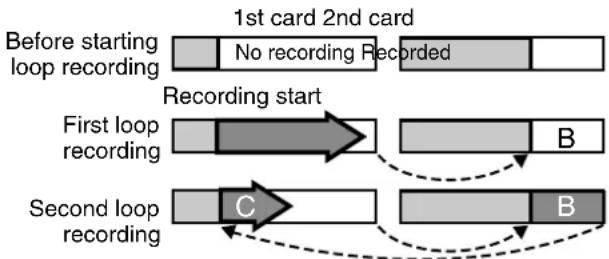
flowchart
graph TD
    A["Before starting loop recording"] --> B["1st card 2nd card"]
    B --> C["No recording Recorded"]
    D["First loop recording"] --> E["Recording start"]
    E --> F["B"]
    G["Second loop recording"] --> H["C"]
    H --> I["B"]
    style A fill:#f9f,stroke:#333
    style D fill:#ccf,stroke:#333
    style G fill:#cfc,stroke:#333
Recording will be made on the areas with no recording consecutively (A, B, then C). When all areas on all cards are recorded, new recording (C) will be made by overwriting the area A.
1 Check that the SYSTEM SETUP screen is set up as described on page 39.
For details on menu operation, refer to [Using the menus] (page 120).
2 Select LOOP in the menu option REC FUNCTION in the RECORDING SETUP screen.
3 Press the REC button.
- Recording starts.
- Press the REC button to stop recording.
- To cancel this function, turn the camera off or select NORMAL in the REC FUNCTION item.
- The following indications appear to the left of the operation status display.
- During recording: "L-REC" stays lit.
- During a pause: "L-PAUSE" stays lit.
- When remaining memory is low: "P2 LACK L-" blinks.
NOTE
- Use two P2 cards with at least one minute of remaining recording time.
- The mode check screen shows standard recording time depending on recording format as remaining P2 card time. When loop recording is stopped right after deleting old data, the time of recordings on the card may be shorter than indicated.
- This function is not available during IEEE1394 input.
- The pre-recording function is not available.
-
Canceling this function may take some time. The succeeding operations are not available until the P2 CARD ACCESS LED goes from blinking to steady lighting.
-
During loop recording, the access LEDs for all P2 cards used in the recording light orange or blinks. Note that removing any of the P2 cards will terminate loop recording.
- Irregularity in the input GENLOCK reference signal during loop recording may terminate recording.
PROXY Recording Function (Optional)
Installing an optional video encoder card (AJ-YAX800G) in P2 card slot 2 makes it possible to record MPEG4 format video, time code data and other real-time data to P2 cards or SD memory cards simultaneous with camera recording of video and audio.
NOTE
Insert the video encoder card when the camera is turned off.
For details, refer to the supplied User's Guide of the video encoder card.
Hot Swap Recording
With a P2 card in each card slot it is possible to make one continuous recording that spans two cards. And by removing any card other than that being recorded, you can make continuous recording on 2 or more cards (hot swap recording).
Note that recognition of a P2 card may be delayed depending on when it is inserted in an empty card slot (for example, immediately after pre-recording or when a recording continues from one card to the next). P2 cards should be inserted when there is still 1 minute or more time left on the card that is being recorded.
NOTE
This function is not compatible with hot-swap playback.
REC REVIEW Function
- Pressing the RET button on the lens after a recording will automatically locate and play back the last two seconds of the most recent clip. Holding down the RET button on the lens will allow you to play back up to 10 seconds. Use this function to check that recording is performed normally. The camera returns to recording standby mode after playback. If the clip is short, holding down the RET button after a return to the beginning of the clip will not result in playback of the clip before the current clip.
- You can use menu options USER MAIN, USER1 and USER2 to assign the REC REVIEW function to a user button. Select these options from the SW MODE screen.
NOTE
Note that a backup recording performed on a backup device connected to the DVCPRO/DV or SDI OUT connector will also record video played back using the REC REVIEW function.
Shot Marker (SHOT MARK) Recording Function
This function can be used to distinguish a clip from other clips by adding a thumbnail to each clip. This also makes possible to display or play back the marked clips only.
To add shot marks
1 In the SW MODE screen, assign SHOT MARK to a user button (USER MAIN, USER1 or USER2) or the RET button on the lens. For details on menu operation, refer to [Using the menus] (page 120).
2 Press the user button (or the RET button on the lens) to which SHOT MARK has been assigned during recording or when recording is paused. - SHOT MARK ON is displayed as a shot mark is inserted in the currently recorded clip. - Pressing this key a second time displays SHOT MARK OFF and the shot mark is deleted.
NOTE
- A shot mark added during a pause after recording is added to the most recently recorded clip.
- Shot marks can be added also in the thumbnail display.
- The shot mark function is not available during loop recording, interval recording and one-shot recording. When this function is not available, pressing this button displays SHOT MARK INVALID.
- Shot marks can be set or cancelled in playback pause mode but not during playback.
- Shot marks cannot be set or deleted for video data created in a single hot-swap recording session consisting of multiple clips unless all the P2 cards that contain the video data for the entire session are inserted. In clips that consist of multiple clips like the one above, shot marks can be added only to the first clip of video data.
Text Memo Recording Function
Use this function to add text memos anywhere in the video during clip recording or playback. This makes it possible to display thumbnails only of clips with text memos, or to display thumbnails and time codes of text memo positions in order, to play back clips from text memo points and select and copy only the sections you want. For details, refer to [Text Memo] (page 107).
To add text memos
1 In the SW MODE screen, assign TEXT MEMO to a user button (USER MAIN, USER1 or USER2) or the RET button on the lens. For details on menu operation, refer to [Using the menus] (page 120).
2 Press the user button (or the RET button on the lens) to which TEXT MEMO has been assigned during recording or playback. - “TEXT MEMO” is displayed and a text memo is inserted at the point the button is pressed.
NOTE
- You can insert up to 100 text memos per clip.
- Text memos cannot be added during loop recording, interval recording and one-shot recording. When this function is not available, pressing this button displays TEXT MEMO INVALID.
Normal and Variable Speed Playback
■Normal speed playback
Press the PLAY/PAUSE button to view playback in the viewfinder and on the LCD monitor in color. Connecting a color video monitor to the VIDEO OUT connector or SDI OUT connector will enable playback of color video. The PLAY/PAUSE button can be used to pause playback.
■Fast-forward/fast-reverse playback
The FF and REW buttons provide 32× and 4× fast playbacks and fast reverse playbacks. In stop mode, this function will play back video at 32× speed and in playback mode, it will play back video at 4× speed.
■Clip cue up
When playback is paused, the FF button locates the beginning of the next clip while staying in pause mode. When playback is paused, the REW button locates the beginning of the current clip while staying in pause mode.
NOTE
- It may take some time to load clip data if playback is started or a thumbnail screen is opened right after removing or inserting a P2 card or turning the power on. The thumbnail screen displays UPDATING at such times.
- If a P2 card is inserted while another P2 card is being played back, the clips on the inserted P2 card will not be played back. A P2 card inserted during playback will be recognised after playback ends.
- If you perform variable speed playback on a clip split across more than one P2 card, sound may disappear for a moment. This is not a malfunction.
- To play back a clip in a different SYSTEM MODE, adjust the SYSTEM MODE to the clip to reset the camera before playback.
- Playback of the audio channels CH5 to CH8 recorded on another device is not possible.
Chapter 4 Adjustments and Settings for Recording
Selecting recording signals
This camera records HD (1080i, 720P) signals using AVC-Intra or DVCPRO HD codecs and use a combination of DVCPRO50, DVCPRO or DV codecs for recording SD (480i) signals.
It provides a variety of capture frame rates and recording frame rates (native recording) to suit specific applications.
Select recording and recording signal in the setting menus listed below.
| Screen Setting menu Setting | ||
| SYSTEM SETUP screen | SYSTEM MODE | Selects the 1080i, 720P or 480i signal format.To change this setting, wait until TURN POWER OFF appears before turning the power off and then turn it back on again. |
| REC SIGNAL Selects | to record using this camera or from the DVCPRO/DV connector. | |
| REC FORMAT | Selects AVC-Intra or DVCPRO HD codec and 60i, 60P, 30PN or 24PN native recording in HD mode.Selects DVCPRO50, DVCPRO or DV codec in SD mode. | |
| CAMERA MODE Selects | 60i, 30P, 24P or 24PA pulldown recording in 1080i or 480i mode. | |
| ASPECT CONV Selects | the video aspect ratio for recording and output in SD mode (480i). | |
| SCENE FILE screen | VFR | Setting this function to ON in 720P mode starts variable frame rate capture which records at the frame rate set in the FRAME RATE option.For details, refer to [Variable Frame Rate (VFR) Recording] (page 36) |
| FRAME RATE | When the VFR option is set to ON, select the frame rate for variable frame rate recording. | |
NOTE
- Changing the menu options SYSTEM MODE, REC SIGNAL, REC FORMAT and CAMERA MODE may distort video and audio, but this is not a malfunction.
List of recording formats and functions
The table below lists the recording formats and recording functions that the camera supports.
Camera recording modes (When the menu option REC SIGNAL is set to CAMERA)
| Setting | Recording format*1 | Recording time*2 | Recording function | ||||||||
| SYSTEM MODE | REC FORMAT | CAMERA MODE | VFR | FRAME RATE [FRAME] | PRE REC | PROXY (optional) | INTERVAL, ONE SHOT | LOOP REC | |||
| 1080-59.94i | AVC-I 100/60I (AVC-I 50/60i) | Disabled | Disabled | Disabled | 1080/60i | AVC-I 100 (AVC-I 50) | Approx. 64 min.(Approx. 128 min.) | ○ | ○ ○ ○ | ||
| AVC-I 100/30PN (AVC-I 50/30PN) | 1080/30PN Native | -- -- | |||||||||
| AVC-I 100/24PN (AVC-I 50/24PN) | 1080/24PN Native | Approx. 80 min.(Approx. 160 min.) | -- -- | ||||||||
| DVCPRO HD/60i | 60i 1080 | Disabled | Disabled | DVCPRO HD | Approx. 64 min. | ○ | ○ ○ ○ | ||||
| 30P | 1080/30P Over60i 2:2 Pull Down | ○ | ○ ○ ○ | ||||||||
| 24P | 1080/24P Over60i 2:3 Pull Down | -- -- | |||||||||
| 24PA | 1080/24PA Over60i 2:3:3:2 Pull Down | -- -- | |||||||||
| 720-59.94P | AVC-I 100/60P (AVC-I 50/60P) | Disabled | OFF Disabled | 720/60P | AVC-I 100 (AVC-I 50) | Approx. 64 min.(Approx. 128 min.) | ○ | ○ ○ ○ | |||
| ON 12-60 | -- -- | ||||||||||
| AVC-I 100/30PN (AVC-I 50/30PN) | OFF Disabled | 720/30PN Native | Approx. 128 min.(Approx. 256 min.) | -- -- | |||||||
| ON | 30 | -- -- | |||||||||
| Other than 30 | 720/30PN Native VFR (Audio cannot be recorded) | -- -- | |||||||||
| AVC-I 100/24PN (AVC-I 50/24PN) | OFF Disabled | 720/24PN Native | Approx. 160 min.(Approx. 320 min.) | -- -- | |||||||
| ON | 24 | -- -- | |||||||||
| Other than 24 | 720/24PN Native VFR (Audio cannot be recorded) | -- -- | |||||||||
| DVCPRO HD/60P | OFF Disabled | 720/60P | DVCPRO HD | Approx. 64 min. | ○ | ○ ○ ○ | |||||
| ON | 60 | -- -- | |||||||||
| 30 | 720/30P Over60P 2:2 Pull Down | -- -- | |||||||||
| 24 | 720/24P Over60P 2:3 Pull Down | -- -- | |||||||||
| Other than above | 720/60P VFR | -- -- | |||||||||
| DVDPRP HD/30PN | OFF Disabled | 720/30PN Native | Approx. 128 min. | -- -- | |||||||
| ON | 30 | -- -- | |||||||||
| Other than 30 | 720/30PN Native VFR (Audio cannot be recorded) | -- -- | |||||||||
| DVDPRP HD/24PN | OFF Disabled | 720/24PN Native | Approx. 160 min. | -- -- | |||||||
| ON | 24 | -- -- | |||||||||
| Other than 24 | 720/24PN Native VFR (Audio cannot be recorded) | -- -- | |||||||||
| 480-59.94i | DVCPRO 50/60i DVCPRO/60i DV/60i | 60i | Disabled | Disabled | 480/60i | DVCPRO50 DVCPRO* DV* | Approx. 128 min. Approx. 256 min. *3 Approx. 256 min. *4 | ○ | ○ ○ ○ | ||
| 30P | 480/30P Over60i 2:2 Pull Down | ○ | ○ ○ ○ | ||||||||
| 24P | 480/24P Over60i 2:3 Pull Down | -- -- | |||||||||
| 24PA | 480/24PA Over60i 2:3:3:2 Pull Down | -- -- | |||||||||
*1 24P and 30P indicate recording at 23.98P and 29.97P, respectively, while 60P and 60i indicate recording at 59.94P and 59.94i, respectively. Native mode records active frames only.
*2 Recording times are indicated for a single 64 GB P2 card. Two cards double the recording time.
Since native VFR mode records only active frames, the recording time and actual shooting time differ.
Example: In 24PN recording, shooting at a frame rate of 60 frames will result in a shooting time of 24/60 (0.4 times).
In 24PN recording, shooting at a frame rate of 12 frames will result in a shooting time of 24/12 (2 times).
*3 For DVCPRO/60i
*4 For DV/60i
1394 input recording mode (when the REC SIGNAL option is set to 1394)
| Setting | Recording format *1 | Recording time *2 | Recording function | ||||||||
| SYSTEM MODE | REC FORMAT | CAMERA MODE | VFR | FRAME RATE [FRAME] | PRE REC | PROXY (optional) | INTERVAL, ONE SHOT | LOOP REC | |||
| 1080-59.94i | Disabled Disabled | Disabled Disabled | 1080/60i | DVCPRO HD | Approx. 64 min. | -- | -- | ||||
| 720-59.94P | Disabled Disabled | Disabled Disabled | 720/60P | -- | -- | ||||||
| 480-59.94i | DVCPRO50/60i | Disabled DVCPRO | sabled Dis | abled 480/60i | DVCPRO50 | Approx. 128 min. | -- | -- | |||
| DVCPRO/50i DV | Approx. 256 min. | -- | -- | ||||||||
| DV/50i DV | -- | -- | |||||||||
*1 60P and 60i is recorded at 59.94P and 59.94i, respectively.
*2 Recording times are indicated for a single 64 GB P2 card. Two cards double the recording time.
Recording settings and recording function table
The recording modes of the camera can be made to operate as described below using the setting menus.
| Operating mode | Recording setting | Enabled and disabled functions and operations | |||||||
| REC SIGNAL (MENU) | REC FUNCTION (MENU) | REC FORMAT, CAMERA MODE (MENU) | VFR (MENU) | PRE REC function | Proxy recording (Thumbnail menu) (optional) | 1394 output | TEXT MEMO | SHOT MARK | |
| Recording via 1394 input | 1394 | Disabled | Disabled (enabled at 480i) | Disabled | Disabled | Disabled | Disabled | Enabled | Enabled |
| INTERVAL REC | CAMERA | INTERVAL | 60i, 60P, 30P only | Disabled (Enabled at playback *3) | Disabled | Disabled | |||
| ONE SHOT REC | ONE SHOT | ||||||||
| LOOP REC | LOOP | Enabled *3 | Disabled *4 | ||||||
| Native VFR | NORMAL | 24PN, 30PN | ON | Disabled (Enabled at playback *3) | Enabled | Enabled | |||
| Native recording (VFR OFF) | OFF | ||||||||
| Standard VFR | Other than 24PN and 30PN | ON | Enabled *3 | ||||||
| Standerd recording (VFR OFF) | OFF | Enabled | Enabled | Enabled *3 | |||||
*3 DV/DVCPRO only disabled in AVC-Intra mode
*4 Enabled in PAUSE mode after LOOP REC
Selecting video output
The table below lists available video output formats.
Use the setting menus listed below to select video output.
| Setting menu | Setting |
| SDI SELECT(OUTPUT SEL screen) | Select the signal format (from AUTO, 1080i, 480i) to be output via the SDI OUT connector *5. |
| SETUP(SYSTEM SETUP screen) | Select the setup level for the signal (composite) output via the VIDEO OUT connector.● 0%: 0% setup level for both output and recording● 7.5%A: 7.5% setup level for output only (0% for recording)• The SETUP menu setting is enabled also during playback. |
| DOWNCON MODE(OUTPUT SEL screen) | Select the screen type for down-converted output (VIDEO OUT and SDI SELECT output as 480i) of HD mode (1080i, 720P). |
*5 HD (1080i, 720P) output cannot display thumbnails and SDI OUT outputs black screen.
List of recording, playback and output formats
Camera recording mode (when the REC SIGNAL option is set to CAMERA)
| Setting | Recording format *1 | SDI OUT *2 | 1394 output | ||||||
| SYSTEM MODE | REC FORMAT | CAMERA MODE | VFR | FRAME RATE [FRAME] | Video format Audio | ||||
| 1080-59.94i | AVC-I 100/60i (AVC-I 50/60i) | Disabled | 60 | Disabled | 1080/60i | AVC-I 100 (AVC-I 50) | 1080-59.94i | 4ch No output | |
| AVC-I 100/30PN (AVC-I 50/30PN) | 1080/30PN Native | 1080-29.97PsF Over59.94i 2:2 | |||||||
| AVC-I 100/24PN (AVC-I 50/24PN) | 1080/24PN Native | 1080-23.98PsF Over59.94i 2:3 | |||||||
| DVCPRO HD/60i | 60i 1080 | 60 | Disabled | 720/60P | AVC-I 100 (AVC-I 50) | 1080-59.94i | 4ch | 1080-59.94i DVCPRO HD | |
| 30P | 1080/30P Over60i 2:2 Pull Down | 1080-29.97PsF Over59.94i 2:2 | |||||||
| 24P | 1080/24P Over60i 2:3 Pull Down | 1080-23.98PsF Over59.94i 2:3 | |||||||
| 24PA | 1080/24PA Over60i 2:3:3:2 Pull Down | 1080-23.98PsF Over59.94i 2:3:3:2 | |||||||
| 720-59.94P | AVC-I 100/60P (AVC-I 50/60P) | Disabled | OFF Disabled | 720/60P | AVC-I 100 (AVC-I 50) | 720-59.94P | 4ch | No output | |
| ON 12-60 720-59.94P | VFR | ||||||||
| AVC-I 100/30PN (AVC-I 50/30PN) | OFF Disabled | 720/30PN Native | 720-29.97P Over59.94P 2:2 | 4ch | |||||
| ON | 30 | ||||||||
| Other than 30 | 720/30PN Native VFR (Audio cannot be recorded) | 720-59.94P VFR Muled | |||||||
| AVC-I 100/24PN (AVC-I 50/24PN) | OFF Disabled | 720/24PN Native | 720-23.98P Over59.94P 2:3 | 4ch | |||||
| ON | 24 | ||||||||
| Other than 24 | 720/24PN Native VFR (Audio cannot be recorded) | 720-59.94P VFR Muled | |||||||
| DVCPRO HD/60P | OFF Disabled | 720/60P | DVCPRO HD | 720-59.94P | 4ch | 720-59.94P DVCPRO HD | |||
| ON | 60 | ||||||||
| 30 | 720/30P Over60P 2:2 Pull Down | 720-29.97P Over59.94P 2:2 | |||||||
| 24 | 720/24P Over60P 2:3 Pull Down | 720-23.98P Over59.94P 2:3 | |||||||
| Other than above | 720/60P VFR 720-59.94P VFR DVCPRO HD | ||||||||
| DVDPRP HD/30PN | OFF Disabled | 720/30PN Native | 720-29.97P Over59.94P 2:2 | No output* | |||||
| ON | 30 | ||||||||
| Other than 30 | 720/30PN Native VFR (Audio cannot be recorded) | 720-59.94P VFR Muled | |||||||
| DVDPRP HD/24PN | OFF Disabled | 720/24PN Native | 720-23.98P Over59.94P 2:3 | 4ch | |||||
| ON | 24 | ||||||||
| Other than 24 | 720/24PN Native VFR (Audio cannot be recorded) | 720-59.94P VFR MVled | |||||||
| 480-59.94i | DVCPRO50/60i DVCPRO60i DV/60i | 60i | Disabled | Disabled | 480/60i | DVCPRO50 DVCPRO* DV* | 480-59.94i | 4ch or 2ch* | 480-59.94i DVCPRO50 DVCPRO* DV* |
| 30P | 480/30P Over60i 2:2 Pull Down | 480-29.97PsF Over59.94i 2:2 | |||||||
| 24P | 480/24P Over60i 2:3 Pull Down | 480-23.98PsF Over59.94i 2:3 | |||||||
| 24PA | 480/24PA Over60i 2:3:3:2 Pull Down | 480-23.98PsF Over59.94i 2:3:3:2 | |||||||
*1 24P and 30P indicate recording at 23.98P and 29.97P, respectively, while 60P and 60i indicate recording at 59.94P and 59.94i, respectively. Native mode records active frames only.
*2 Varies with SDI SELECT option. In the table above the SDI SELECT option is set to AUTO.
AUTO: depends on SYSTEM MODE
1080i: outputs 1080i also when the SYSTEM MODE is 720P.
480i: outputs as 480i at all times
*3 Uses a 4ch setting for DVCPRO50 and observes the 2CH or 4CH setting in the menu option 25M REC CH SEL in the AUDIO SETUP screen for DVCPRO and DV.
*4 Outputs 720-59.94P DVCPRO HD during playback.
*5 For DVCPRO/60i
*6 For DV/60i
1394 input recording mode (when the REC SIGNALoption is set to 1394)
| Setting | Recording format *1 | SDI OUT *2 | ||||||
| SYSTEM MODE | REC FORMAT | CAMERA MODE | VFR | FRAME RATE [FRAME] | Video format | Audio | ||
| 1080-59.94i | Disabled Disabled | Disabled Dis | abled 1080/60i | DVCPRO HD | 1080-59.94i | 4ch | ||
| 720-59.94P | Disabled Disabled | Disabled Dis | abled 720/60P 720-59.94P 4ch | |||||
| 480-59.94i | DVCPRO50/60i | DVO/60i DV | Disabled Dis | abled 480/60i | DVCPRO50 | 480-59.94i | 4ch | |
| DVCPRO/60i DV | ||||||||
| DV/60i DV | 2ch or 4ch | *3 | ||||||
*1 60P and 60i is recorded at 59.94P and 59.94i, respectively.
*2 Varies with the SDI SELECT option. The table above shows operating conditions when the SDI SELECT option is set to AUTO.
AUTO: depends on SYSTEM MODE
1080i: outputs 1080i also when the SYSTEM MODE is 720P.
480i: outputs as 480i at all times
*3 32 kHz 4ch input is converted and recorded at 48 kHz 4ch.
Adjusting the White Balance and Black Balance
To record high-quality video with the AG-HPX300P, the black and white balances must be adjusted according to conditions.
For higher quality, it is recommended that the adjustments should be made in this order AWB (white balance adjustment) → ABB (black balance adjustment) → AWB (white balance adjustment).
Adjusting the White Balance
Whenever light conditions change, the white balance must be readjusted.
To adjust the white balance, follow the steps below.

text_image
c d ebaa ND FILTER control
This control adjusts the amount of light entering the MOS sensor.
b AUTO W/B BAL switch
Use for automatic control of white balance.
c GAIN selector switch
Normally set to 0 dB. If this is too dark, adjust gain as necessary.
d OUTPUT selector switch
Set to CAM.
e WHITE BAL switch
Set to A or B.
1 Set the GAIN, OUTPUT and WHITE BAL switches.
2 Adjust the ND FILTER control according to the light conditions.
For examples of ND FILTER adjustments, see [Shooting and Recording/Playback Functions Section] (page 18).
3 Place a white pattern at a point where the light conditions match those for the light source of the subject. Then zoom-in on the white pattern so that white colour appears in the screen.
- A white object (cloth or wall) may be used instead of a white pattern. The illustration below shows the required size for the white space.
NOTE
- Do not point the camera at a high-brightness area.
- The white object must appear at the center of the screen.
1/3 or more of the screen in width
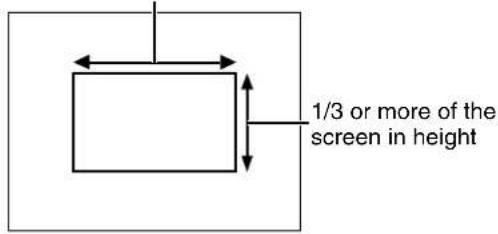
text_image
1/3 or more of the screen in height4 Adjust the lens iris.
- Use the YGET function (for details, refer to page 53) and adjust the iris to a approximately 70% of incoming light.
5 Turn the AUTO W/B BAL switch toward AWB and release it.
- The switch returns to the central position with the white balance automatically adjusted.
6 During an adjustment, the viewfinder displays the following message:
AW8 ACh ACTIVE
7 The adjustment will take effect in a few seconds, and the following message will appear:
- The adjusted value is automatically stored in the selected memory (A or B).
AWB A OK 3.2K
- "C TEMP+7" to "C TEMP-7" will appear when COLOR TEMP of the scene file is set to the value other than 0.
8 If the subject's colour temperature is lower than 2300K or higher than 9900K the following message appears:
- If the arrow points down (↓) the actual colour temperature is lower than the temperature indicated. If the arrow points up (↑) the actual temperature is higher than the temperature indicated.
AWB A OK 2.3K ↓
When you have no time to adjust the white balance
Position the WHITE BAL switch at PRST.
- Turning the AUTO W/B BAL switch to AWB toggles the color temperature between 3200K and 5600K.
When the white balance has not been automatically adjusted
When the white balance has not been successfully adjusted, the viewfinder displays an error message.
| Error message Description | |
| AWB Ach (or Bch) NG | The color temperature is too high or too low. |
| LOW LIGHT There is insufficient light. | |
| LEVEL OVER There is too much light. | |
Viewfinder displays related to white balance
See [Viewfinder Screen Status Displays] (page 65).
Setting auto tracking white balance (ATW)
This camera is equipped with an auto tracking white balance (ATW) function that automatically adjusts the white balance of images in accordance with lighting conditions.
The ATW function can be assigned to the WHITE BAL switch B by setting the menu option ATW in the SW MODE screen to B ch.
It can also be assigned to the USER MAIN, USER1, USER2 buttons.
For details, refer to [Assigning functions to USER buttons] (page 53).

text_image
SW MODE LOW GAIN 0dB MID GAIN 6dB HIGH GAIN 9dB ATW Bch ATW TYPE 1 W.BAL.PRESET 3.2K USER MAIN DRS USER1 REC REVIEW ▼ PUSH MENU TO RETURNCancelling auto tracking white balance
Press the USER button to which ATW was assigned a second time or change the WHITE BAL switch position. If ATW was assigned to the WHITE BAL switch B, the USER button cannot be used to cancel the function.
NOTE
This function does not provide a 100% accurate white balance. The tracking performance relative to changes in ambient lighting and white balance performance have been given a degree of latitude.
Adjusting the Black Balance
The black balance must be adjusted when:
- You use your AG-HPX300P the first time.
- Your AG-HPX300P has not been used for some time.
- The ambient temperature has changed substantially.
• The gain switchover value has been changed. - The menu options SYSTEM MODE and REC FORMAT in the SYSTEM SETUP screen.
Adjust the black balance before shooting to ensure optimum video quality.

text_image
a ba AUTO W/B BAL switch
Use for automatic control of white balance.
b OUTPUT selector switch
Set to CAM.
1 Tilt the AUTO W/B BAL switch so that it is positioned at [ABB], then release it.
- The switch returns to the central position with the black balance automatically adjusted.
2 During adjustment, the viewfinder displays the following message:
ABB ACTIVE
NOTE
During adjustment, the lens iris automatically becomes CLOSE.
3 The adjustment will take effect in a few seconds and the following message will appear:
ABB END
- The adjusted value is automatically stored in the memory.
NOTE
- Ensure that the lens connector is connected and the lens iris is CLOSE.
- During a black balance adjustment, light is automatically cut off.
- ABB NG appears when the lens connector has come loose.
- Black balance adjustment is not available during recording.
- Pressing the REC button during ABB adjustment will not start recording on a P2 card.
Setting the Electronic Shutter
Setting the Shutter Mode and Speed
1 Press the SHUTTER switch positioned at OFF towards ON.
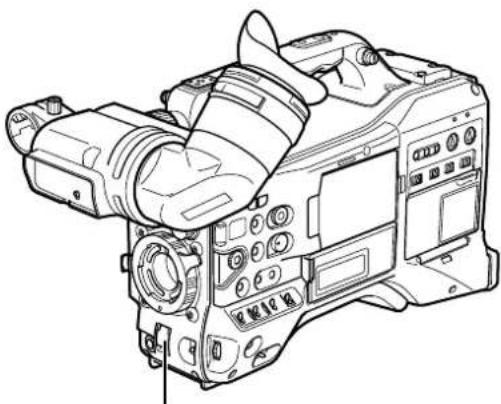
natural_image
Line drawing of a digital camera with control panel and display (no text or symbols)SHUTTER switch
2 Press the SHUTTER switch towards [SEL]. Repeat this switchover until the desired mode or speed appears in the viewfinder screen.
- If all modes and speeds are available, the display changes in the following order:
For 60i and 60P recording

text_image
S/S→(1/15)→(1/30)→1/601≠100 →1/120 →1/250→1/5001≠10001/2000For 30P recording

text_image
S/S→(1/7.5)→(1/15)→1/601≠100 →1/120 →1/250→1/5001≠10001/2000For 24P recording

text_image
S/S→(1/6)→(1/12)→1/601≠100 →1/120 →1/250→1/5001≠10001/2000- The bracketed ( ) speeds cannot be selected when VFR is ON.
NOTE
- In any electronic shutter mode, a slower shutter speed will reduce camera sensitivity.
- In auto iris mode, a faster shutter speed will increase the aperture and lower the depth of field.
- During 1080i operation, speeds in brackets do not allow DRS operation.
- Changes in synchro scan and shutter speed settings may cause screen flicker.
Viewfinder displays relating to the shutter
See [Viewfinder Screen Status Displays] (page 65).
Placing the Camera-recorder in SYNCHRO SCAN Mode
To place the camera-recorder in SYNCHRO SCAN mode, follow the steps below.
1 Press the SHUTTER switch positioned at ON towards SEL, to place the camera-recorder in SYNCHRO SCAN (S/S) mode.

text_image
SHUTTER switch SYNCHRO SCAN switch2 In SYNCHRO SCAN mode, use the SYNCHRO SCAN switch to make stepless changes in the range between 1/60.0 s and 1/249.8 s (for 60i mode).
- Hold down the SYNCHRO SCAN switch to speed up the rate of shutter speed changes. If shutter speed changes stop before the desired shutter speed has been reached, press again to continue changing shutter speeds.
Range of variation in each mode
- 60P/60i mode: 1/60.0 to 1/249.8
• 30P/30PN mode: 1/30.0 to 1/249.8
• 24P/24PA/24PN mode: 1/24.0 to 1/249.8 - When the SYNC SCAN DISP option in DISPLAY SETUP is set to DEG: 3.0d to 359.5d
Setting the menu option SYNC SCAN DISP in the DISPLAY SETUP screen to deg provides a guide to setting and displaying shutter angle.
Assigning functions to USER buttons
The USER MAIN, USER1, and USER2 buttons can be assigned user-selected functions.
Use the menu options USER MAIN, USER1, and USER2 to assign functions to respective button. Select these items from the setting menu SW MODE screen.
| SW MODE | |
| LOW GAIN | 0dB |
| MID GAIN | 6dB |
| HIGH GAIN | 12dB |
| ATW | OFF |
| ATW TYPE | 1 |
| W.BAL.PERSET | 3.2K |
| USER MAIN | Y GET |
| USER1 BACKLIGHT | |
| PUSH MENU TO RETURN | |
Selectable Functions
- REC REVIEW:
Assigns REC REVIEW.
- SPOTLIGHT:
Assigns auto iris control on/off for spotlight.
- BACKLIGHT:
Assigns auto iris control on/off for backlight compensation.
• ATW:
Turns the ATW function on or off.
- ATW LOCK:
Pressing this lock during ATW operation locks the white balance. Press again to start the ATW function again.
• GAIN:24 dB:
Assigns a function that raises gain by 24 dB.
• Y GET:
Assigns a function that displays the brightness level at the center of the image.
• DRS:
Assigns a function that stretches the dynamic range. A function that magnifies the dynamic range by compressing the video level in high-brightness areas.
- TEXT MEMO:
Assigns text memory recording.
- SLOT SEL:
Assigns P2 card slot selection.
- SHOT MARK:
Assigns the shot marker function.
• MAG A. LVL:
Assigns a function that magnifies the audio level meter.
- PRE REC:
Assigns a function that turns the PRE REC function on and off.
- PC MODE:
Assigns a function that switches the USB device mode or the USB host mode on and off. Switching the USB device mode and USB host mode on and off is set by the menu option PC MODE SELECT in the SYSTEM SETUP screen.
• WFM:
Assigns a function that switches WAVE FORM display. The WAVE FORM display is selected using the menu option WFM (page 128) in the SW MODE screen.
NOTE
The default settings are listed below.
- USER MAIN: Y GET
- USER1: BACK LIGHT
- USER2: TEXT MEMO
Selecting Audio Input Signals and Adjusting Recording Level
This AG-HPX300P supports independent four-channel audio recording in any format (HD or SD).
When the AUDIO SELECT CH1/CH2 switch is positioned at [AUTO], the recording levels for Audio Channels 1 and 2 are automatically adjusted. To manually adjust the recording levels, position the switch at [MAN].
A setting menu allows you set the recording levels for Audio Channels 3 and 4 either to automatic adjustment or manual mode.
Selecting Audio Input Signals
The input signals to be recorded on Audio Channels 1, 2, 3, and 4 are selected with the AUDIO IN switch. For more information, see [Audio (input) Function Section] (page 16).

text_image
a b c d ea AUDIO LEVEL CH1/CH2 controls
b AUDIO SELECT CH1/CH2 switch
c MONITOR SELECT CH1/3, ST, CH2/4 selector switch
d MONITOR SELECT CH1/2, CH3/4 selector switch
e AUDIO IN switch
Your AG-HPX300P is factory-set to perform no recording on Audio Channels 3 and 4 in the DVCPRO and DV formats.
To enable four-channel recording, the menu option 25M REC CH SEL on the AUDIO SETUP screen must be set to 4CH.
For details on switch settings and the input system, see [AUDIO IN switch] (page 16).

NOTE
- The audio signals recorded on the four channels are output as is (SDI).
Use the AUDIO SETUP screen in the setting menu to make detailed audio settings.
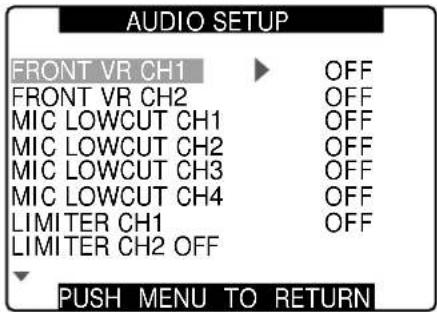
text_image
AUDIO SETUP FRONT VR CH1 ▶ OFF FRONT VR CH2 OFF MIC LOWCUT CH1 OFF MIC LOWCUT CH2 OFF MIC LOWCUT CH3 OFF MIC LOWCUT CH4 OFF LIMITER CH1 OFF LIMITER CH2 OFF PUSH MENU TO RETURNAdjusting Recording Levels
To adjust the recording levels for Audio Channels 1 and 2, follow the steps below.
1 Position the MONITOR SELECT CH1/2, CH3/4-selector switch at CH1/2 so that the audio level meter on the display window will provide CH1 and CH2 indications. Ensure that the channel indications displayed in the window are 1 and 2.
2 Position the AUDIO SELECT CH1/CH2 switch at [MAN].
3 While checking the audio channel level meter in the display window or the audio level meter in the viewfinder, adjust the AUDIO LEVEL CH1/CH2 control.
- Note that if the level exceeds the top bar (0 dB), the word OVER illuminates to show that the input level is excessive. Adjust so that maximum sound levels do not reach the 0 dB bar.
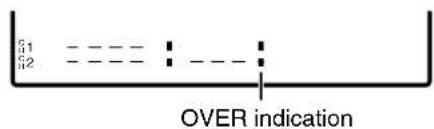
text_image
S1 S2 OVER indicationNOTE
Pressing the USER button to which the magnification of the audio level meters (MAG A.LVL) has been assigned magnifies the audio level meters.
For details, refer to [Audio level meter magnification] (page 73).
When operating the AG-HPX300P without a sound recordist, it is recommended that the FRONT AUDIO LEVEL control should be used to adjust the audio level.
In advance, check the level meter in the viewfinder screen and use the FRONT AUDIO LEVEL control to adjust the appropriate audio channel to prevent input of excessive audio signals.
Selecting Function for the FRONT AUDIO LEVEL Control
Use the menu options FRONT VR CH1 and FRONT VR CH2 in the AUDIO SETUP screen to determine whether or not the FRONT AUDIO LEVEL control should be enabled. Selecting an input signal in the menu will enable FRONT AUDIO LEVEL control operations for that input signal.
- When the FRONT AUDIO LEVEL control is set to level 10, it controls AUDIO LEVEL CH1 and CH2.

text_image
AUDIO SETUP FRONT VR CH1 ▶ OFF FRONT VR CH2 OFF MIC LOWCUT CH1 OFF MIC LOWCUT CH2 OFF MIC LOWCUT CH3 OFF MIC LOWCUT CH4 OFF LIMITER CH1 OFF LIMITER CH2 OFF PUSH MENU TO RETURNCH3 and CH4 Recording Levels
Conditions and input levels set in the menu options AUTO LEVEL CH3 and the AUTO LEVEL CH4 in the AUDIO SETUP screen change the operation of the audio level of channels 3 and 4 as shown below. These functions cannot be manually adjusted.
Each option can be selected in the AUDIO SETUP screen.
| AUTO LEVELCH3/CH4 | Input level | |
| LINE MIC | ||
| ON AGC | ` ON AGC ON | |
| OFF AGC/LIMITER OFF LIMITER ON | ||
* AGC: Audio Gain Control
Setting Time Data
The camera provides time data such as time codes, user bits, time of day (real-time) data, which is recorded on each frame alongside video data. It is also recorded as as data in clip metadata files.
Time data overview
■Time code
Use the TCG switch to select Rec Run or Free Run mode.
- Free Run: The time code advances constantly whether the camera is on or not just like time itself. Recording using a slave-locked time code input to the TC IN or DVCPRO/DV connectors is also possible.
- Rec Run: The time code advances only during recording. This will enable continuation of time codes in previously recorded clips and when the power is turned off or new P2 cards are inserted to continue recording.
NOTE
The following events will disrupt time code continuity.
- When clips are deleted
- When a 24P or 24PA frame rate is selected
- When 24PN or 30PN is selected
- When a recording is interrupted by a REC WARNING or other abnormality
■User bits
- Two types of user bits are provided internally: (LTC UB: recorded as LTC, output via the TC OUT connector as LTC embedded in HD SDI) and VITC (in DVCPRO recorded in the VIDEO AUX area and output as VITC embedded in HD SDI).
- LTC UB enables the recording of user settings, time, date, time codes and similar values, the frame rate data for camera capture and external input values (via TC IN or DVCPRO/DV connector input).
- VITC user bits record the frame rate data of camera capture.
- The user bits in clip metadata record the LTC UB value at the start of recording.
■Date (real time)
- The built-in clock calculates the year, month, day and time from the internal clock to display on video in the LCD, viewfinder and VIDEO OUT and other video output.
- The internal clock is not only used to calculate the free run time code when the power is off and to set the user bit year, date and time, but also to set file creation dates when clips are recorded that determine the order of thumbnails and playback order.
- It is also used for generating clip metadata and UMID (Unique Material Identifier). For details, see [Setting Date and Time of Internal Clock] (page 26).
Recording time codes and user bits
| System setting status Recorded TC Output TC Displayed TC Recorded UB Output UB | ||||||||||||||
| SYSTEM MODE | REC SIGNAL | REC FORMAT | CAMERA MODE | FRAME RATE | LTC VITC | TC OUT | LTC and VITC embedded in HD SDI | TC tc (24/30 conversion) | LTC UB VITC | UB | TC OUT connector UB1 | LTC UB embedded In HD SDI1 | VITC UB embedded In HD SDI | |
| 1080-59.94i | CAMERA | DVCPROHD/60i | 60i, 30P | — | R-RUN/F-RUN3DF/NDF30 frames | Same as LTC value | Outputs LTC | Outputs LTC | TC: 30 frames to: 24 frames | Follows UB MODE.In 'EXT'slaves to UB in TC IN connector | Frame rate data | Outputs LTC UB | Outputs LTC UB | Frame rate data |
| 24P, 24PA | — | R-RUN/F-RUN3NDF locked30 frames | ||||||||||||
| AVC-1100/60iAVC-150/60iAVC-1100/30PNAVC-150/30PN | — | — | R-RUN/F-RUN3DF/NDF30 frames | |||||||||||
| AVC-1100/24PNAVC-150/24PN | — | — | R-RUN/F-RUN3NDF locked30 frames | Converted to 30 frames based on LTC | Converted to 30 frames based on LTC | Recording TC: 24 framesPlayback TC: 24 frames to: 30 frames | Output adjusted to Over 60P based on LTC UB | Output adjusted to Over 60P based on LTC UB | ||||||
| 1394 DV | CVPROHD/60i | — — | R-RUN/F-RUN3DF/NDF30 frames | Records VAUX TC in 1384 input at all times* | Outputs LTC | Outputs LTC | TC: 30 frames to: 24 frames | Follows UB MODE.In 'EXT'slaves to LTC UB in 1394 connector | Records values input to the 1394 connector as is | Outputs LTC UB | Outputs LTC UB | Outputs VITC UB | ||
| 720-59.94P | CAMERA | DVCPROHD/60PAVC-1100/60PAVC-150/60P | — | Other than 24 frames | R-RUN/F-RUN3DF/NDF30 frames | Same as LTC value | Outputs LTC | Outputs LTC | TC: 30 frames to: 24 frames | Follows UB MODE.In 'EXT'slaves to UB in TC IN connector | Frame rate data | Outputs LTC UB | Outputs LTC UB | Frame rate data |
| — 24 frames | R-RUN/F-RUN3NDF locked30 frames | |||||||||||||
| DVCPROHD/30PNAVC-1100/30PNAVC-150/30PN | — 30 frames | R-RUN/F-RUN3DF/NDFEvery active frame30 frames | ||||||||||||
| — | Other than 30 frames | R-RUN lockedDF/NDFEvery active frame30 frames | Matches recorder TC at start of recording 30 frames/s | Matches recorder TC at start of recording 30 frames/s | ||||||||||
| DVCPROHD/24PNAVC-1100/24PNAVC-150/24PN | — 24 frames | R-RUN/F-RUN3NDF lockedEvery active frame24 frames | Converts and outputs LTC to 30 frames | Outputs LTC | Recording TC: 24 framesPlayback TC: 24 frames to: 30 frames | Output adjusted to Over 60P based on LTC UB | Output adjusted to Over 60P based on LTC UB | |||||||
| — | Other than 24 frames | R-RUN lockedDF/NDFEvery active frame24 frames | Matches recorder TC at start of recording 30 frames/s | Matches recorder TC at start of recording 30 frames/s | ||||||||||
| 1394 | DVCPROHD/60P | — — | R-RUN/F-RUN3DF/NDF30 frames | Records VAUX TC in 1394 input at all times* | Outputs LTC | Outputs LTC | TC: 30 frames to: 24 frames | Follows UB MODE.In 'EXT'slaves to LTC UB in 1394 connector | Records values input to the 1394 connector as is | Outputs LTC UB | Outputs LTC UB | Outputs VITC UB | ||
| 480-59.94i | CAMERA | DVCPROHD/60DVCPRO/60iDV/60i | 60i, 30P | — | R-RUN/F-RUN3DF/NDF30 frames | Same as LTC value (but not for DV) | Outputs LTC | None | TC: 30 frames to: 24 frames | Follows UB MODE.In 'EXT'slaves to UB in TC IN connector | Frame rate data | Outputs LTC UB | None | None |
| 24P, 24PA | — | R-RUN/F-RUN3NDF locked30 frames | ||||||||||||
| 1394 | — — | R-RUN/F-RUN3DF/NDF30 frames | Records VAUX TC in 1394 input at all times (No DV)* | Follows UB MODE.In 'EXT'slaves to LTC UB in 1394 connector as is | Records values input to the 1394 connector as is | Outputs LTC UB | ||||||||
*1 When UB MODE is FRM. RATE, playback of native clips is the pulldown frame rate read from VITC UB.
*2 In free run mode, it is slaved to the value input to the DVCPRO/DV connector. It does not slave it to the time code from the TC IN connector.
*3 In Free Run mode, it is slaved to the time code input to the TC IN connector.
*4 In Free Run mode, it is slaved to the time code input to the TC IN connector. But not slaved to it during recording.
*5 In Free Run mode, it is slaved when TC input to the TC IN connector is non-drop frame. But not slaved to it during recording.
*6 VAUX TC is time code recorded in the video AUX area in the DVC format.
Setting user bits
Use the setting menu UB MODE on the RECORDING SETUP screen to select the user bits to record in the subcode area.
- USER:
Records internal user values.
To set user values, set the TCG switch to SET to open the setting menu TC PRESET screen.
Set values are retained after the power is turned off.
See also [Entering the User Bits] (page 58).
• TIME:
Records the time calculated by the internal clock.
• DATE:
Records the year, month and day time digits from the internal clock.
- EXT:
Records the user bits input to the TC IN connector.
Recording of 1394 input also records user bits input to the DVCPRO/DV connector.
• TCG:
Records the time code value.
- FRM. RATE:
Records the frame rate information of camera capture.
A native recorded clip is played back at the same frame rate as the VITC UB regardless of recorded values. Use this setting when a PC or other editing device is to use the user bit frame rate.
For details, see [Frame rate information recorded in user bits] (page 59).
- To slave lock to the user bits input to the TC IN connector, set to EXT.
• In slave mode, the UB indicator is highlighted.
- A slave relationship, once started, continues even after input from the TC IN or DVCPRO/DV connector ends.
Note that the following events release user bit slave status.
- When a UB MODE option is set to something other than EXT.
- When UB PRESET is performed
- Switching to 1394 in the menu option REC SIGNAL in the SYSTEM SETUP screen.
- Turning the power off.
The internal user value retains the slave values even after slave release.
Entering the User Bits
The user bits allow information, including memos that use up to eight-digit hexadecimal numbers (date and time), to be recorded in the Subcode area.
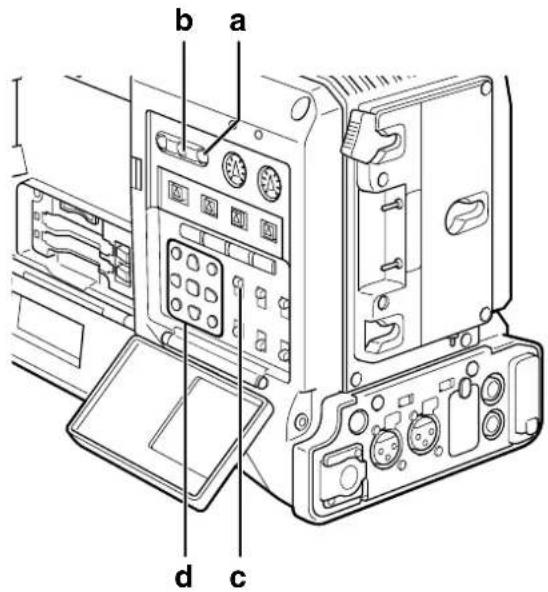
text_image
b a d ca RESET button
b COUNTER button
c TCG switch
d CURSOR and SET buttons
1 Set the COUNTER button to UB.
2 Position the TCG switch at SET.
3 Use CURSOR buttons to set the user bits.
UB PRESET

+/- : PUSH ▲/▼
SEL : PUSH ◀/ ▶
PRESET : PUSH SET
▶ button: Shifts the target (highlighted) digit to the right.
◀ button: Shifts the target (highlighted) digit to the left.
▲ button: Increases the highlighted number by one.
▼ button: Decreases the highlighted number by one.
SET button: Confirms the set user bits.
- Pressing the RESET button while setting the user bits will reset any user bit setting to 0.
4 Press the SET button to confirm the user bit value, and position the TCG switch at F-RUN or R-RUN.
NOTE
Changing the TCG switch setting without pressing the SET button disables the set value.
5 Open the setting menu RECORDING SETUP screen and set the menu option UB MODE to USER.
Retaining the user bits
The data set for the user bits are automatically saved and retained even if the video camera-recorder is turned off.
Frame rate information recorded in user bits
The frame rate value of video data captured and recorded at a frame rate set in the menu option FRAME RATE or other options in the SYSTEM SETUP screen can be recorded in the user bits and be used in editing equipment (computer editing software).
This type of data is recorded in VITC UB at all times. Setting the setting menu UB MODE to FRM RATE, records the information also to the user bits.
In playback of clips recorded in native mode, the same frame rate information as that obtained in playing back the user bits in the VIDEO AUX area is also output to the user bits in the subcode area.
■Frame rate information
Frame rate, video pull-down and time code user bits are related as described below.

flowchart
graph TD
    A["Verification information on the right-hand six digits"] --> B["0 4"]
    B --> C["Fixed value"]
    C --> D["Sequence No. 24P, 24PA: 0-4\nOther than above: locked at F"]
    D --> E["2 4 8 *"]
    E --> F["Media management data\nUpdate frame flag, active frame flag\nREC mark"]
    E --> G["Camera capture mode\nExample:\n60i: 600\n60P: 608\n30P: 308\n24P: 248\n24PA: 24C\n24PN: 24D (recording)\n**P: **9"]
When 1080i or 480i
Frame rate: 24P over 60i (2:3)
☐ First field of updated frame rate
Time code digit

Video

Sequence No.

Updated frame information

Frame rate: 24PA over 60i (2:3:3:2)
Time code digit

Video

Sequence No.

Updated frame information

Frame rate: 30P over 60i (2:2)
Time code digit

Video

Updated frame information

720P mode
Frame rate: 24P over 60P (2:3)

Updated frame
Time code digit

Video

Updated frame information

Frame rate: 30P over 60P (2:2)
Time code digit

Video

Updated frame information

Setting the Time Code
1 Switch the menu option TC MODE on the RECORDING SETUP screen to DF or NDF using the menus.
For details on menu operation, refer to [Using the menus] (page 120).
- Select DF to advance time code in drop frame mode and NDF in non-drop frame mode. Note that 24P, 24PA and 24PN are always recorded in NDF mode.
2 Use the COUNTER button to switch to time code display.
3 Position the TCG switch at SET.
4 Use the CURSOR buttons to set the time code.
- Range of available time code settings: 00:00:00:00 to 23:59:59:29 (other than 24PN), 00:00:00:00 to 23:59:59:23 (24PN)
TC PRESET
REC RUN
00 00 00 00 h min s frm
+/- : PUSH ▲/▼
SEL : PUSH ◀/▶
PRESET : PUSH SET
▶ button: Shifts the target (highlighted) digit to the right.
◀ button: Shifts the target (highlighted) digit to the left.
▲ button: Increases the highlighted number by one.
▼ button: Decreases the highlighted number by one.
SET button: Use to confirm set time code value.
- Pressing the RESET button will reset any time code setting to 0.
5 Press the SET button to confirm the time code setting, and use the TCG switch to select a time code.
- F-RUN steps the time code in free run mode, and R-RUN set it in recording run mode.
NOTE
- When 24P or 24PA is used, the time code is adjusted every 5 frames. It is adjusted to multiples of four for 24PN and to even numbers for 720/30PN. The time code cannot be set during recording.
- The set value is not valid if you change the TCG switch position without pressing the SET button.
Time code function during battery replacement
Even during battery replacement the backup mechanism keeps the time code generator functioning.
NOTE
When the POWER switch has been switched ON → OFF → ON, the backup accuracy of the time code in free run mode is about ±2 frames.
VFR (variable frame rate) time code
- At 24PN, recording is performed at 24 frames and output uses a 2:3 pull-down scheme to produce 30 frames.
- At a frame rate (capture frame rate) of 24P the speed of recording and the output time code matches actual time, but not at any speed other than 24P. (Example: at 60P recording progresses at 60/24 speed)
- Then the camera operates in Rec Run mode and the time code output at start of recording matches the recording time code.
• This is true also for frame rates other than 30P capture in 30PN mode
24PN recording at 60P capture
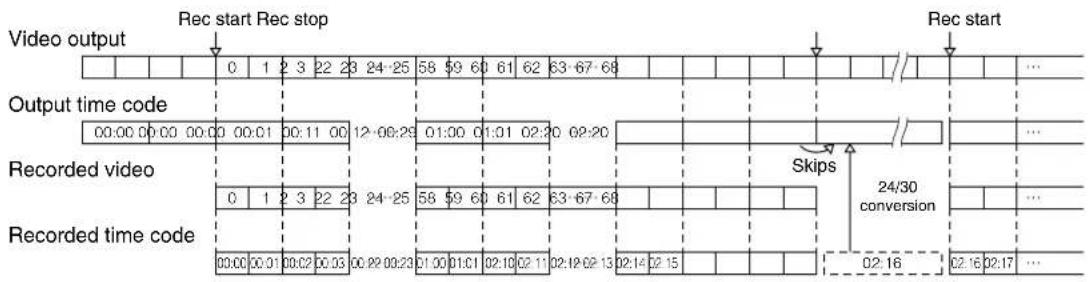
text_image
Video output Rec start Rec stop Output time code 00:00 00:00 00:00 00:01 00:11 00 12-08:29 01:00 01:01 02:30 02:20 Recorded video 0 1 2 3 22 23 24-25 58 59 60 61 62 63-67-68 Recorded time code 00:00 00:01 00:02 00:03 00:22 00:23 01:00 01:01 02:10 02:11 02:12-02-13 02:14 02:15 Rec start Skips 24/30 conversion 02:16 02:16 02:17 ...30PN recording at 15P capture
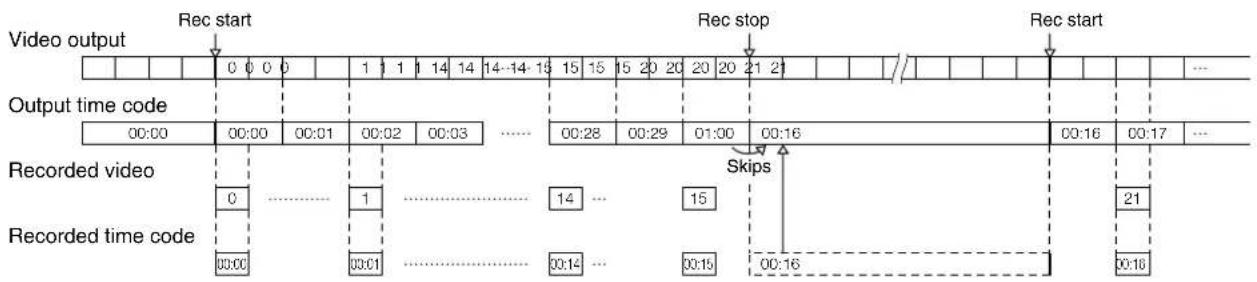
text_image
Video output Rec start Output time code 00:00 00:00 00:01 00:02 00:03 ...... Recorded video 0 ...... Recorded time code 00:00 00:01 ...... 14 ... 15 00:14 ... 00:15 00:16 Rec stop Skips Rec start 00:28 00:29 01:00 00:16 00:16 00:17 ... 21Externally Locking the Time Code
The time code generator built into your AG-HPX300P may be locked to an external generator. It is also possible to lock an external time code generator to the internal generator.
Connections for externally locking the time code (examples)
As illustrated, both the reference video signals and the time code must be input.
■Example 1: Locking the time code to external signals
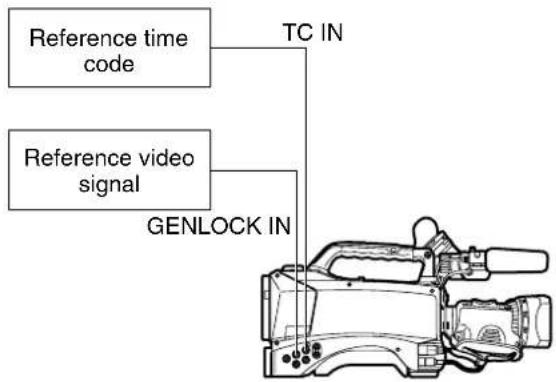
text_image
Reference time code TC IN Reference video signal GENLOCK INNOTE
- In addition to an HD Y reference signal, a composite video signal can also be input as reference signal.
- Input composite video signals when the system mode is 480i (SD) and 720P.
- During HD-Y signal input in 720P system mode, GENLOCK input for the video signal is applied but the time code is delayed by 1 field.
- If the reference GENLOCK input signal becomes irregular and recording cannot be normally performed, "TEMPORARY PAUSE IRREGULAR FRM SIG" blinks in red in the viewfinder and on the LCD screen and the current clip is divided. The continuity of the time code cannot be guaranteed. Recording resumes when the signal returns to normal. Recording will not resume if interval, one-shot or loop recording is in progress.
■Example 2: Connecting two or more AG-HPX300Ps with one another, with one being used as the reference device.

flowchart
graph TD
    A["Reference device"] --> B["Device 1"]
    A --> C["Device 2"]
    A --> D["Device 3"]
    A --> E["Device 4"]
    B --> F["Video OUT"]
    B --> G["TC OUT"]
    C --> H["TC IN"]
    C --> I["GENLOCK IN"]
    D --> J["Video OUT"]
    D --> K["TC OUT"]
    E --> L["TC IN"]
    E --> M["GENLOCK IN"]
    E --> N["Video OUT"]
    E --> O["TC OUT"]
NOTE
- Set the menu option TC VIDEO SYNCHRO to TC IN in the OUTPUT SEL screen and the menu option GL PHASE to COMPOSITE in the OTHER FUNCTIONS screen on both units.
- Setting TC VIDEO SYNCHRO in the OUTPUT SEL screen to TC IN will supply the time code via TC IN to the next slave device without delay.
- The subcarrier in the VBS signal of the VIDEO OUT connector of the camera cannot be externally locked.
To externally lock the time code
Follow the steps below.
1 Turn on the POWER switch.
2 Position the TCG switch at [F-RUN].
3 Set the COUNTER button to TC.
4 Supply a phase-relationship reference time code (that conforms to the time code requirements) and reference video signals to the TC IN and GENLOCK IN connectors, respectively.
- Now the built-in time code generator is locked to the reference time code.
- When locked to an external time code generator, the time code is at all times locked to the external time code, which is displayed as a highlighted value on the counter indicator. Do not engage the recording mode during the few seconds it takes for the sync generator to stabilize.
- Once a slave relationship is established, the TC IN and GENLOCK IN connectors stay in slave status.* Note that the following events release slave status.
- When TC PRESET is performed
- When the REC SIGNAL option in the SYSTEM SETUP screen is set to 1394.
• The power is turned off - The time code mode is switched
• The TCG switch is set to R-RUN - When REC FORMAT and CAMERA MODE have been switched
* The slave function locks the time code to the TC IN input and the device will use this time code even if time code input should subsequently cease.
Setting the user bits when the time code is externally locked
To externally lock user bits, set the setting menu UB MODE (RECORDING SETUP screen) to EXT.
Regardless of an F-RUN or R-RUN setting of the TCG switch, the time code is slaved to user bit values input to the TC IN connector.
For details, refer to [Setting Time Data] (page 56) and [Setting user bits] (page 58).
To unlock the externally locked time code
Discontinue external time code supply, then position the TCG switch at [R-RUN].
Cautions in switching the power source from battery to external power supply
Connect the DC IN socket with the external power supply before removing the battery, in order to keep the time code generator energized. If the battery is removed first, there is no guarantee that the time code will stay externally locked.
External synchronisation of the camera when the time code is externally locked
When the time code is externally locked, the reference video signals input through the GENLOCK IN connector gen-lock the camera.
NOTE
- To lock other devices externally to the AG-HPX300P, as the master device, make sure that the other devices are in the same camera mode as the AG-HPX300P. Note that if some of the connected devices use interlaced scanning while other devices use progressive scanning, there may be breaks in the video and time code.
- When 24P, 24PA or 24PN (native) is selected and the time code is externally locked, be sure to select a non-drop frame time code. The time code cannot be externally locked when drop frame mode is selected. When the time code is externally locked, the video may be distorted, but this is because of adjustment to 5-frame segments and not a malfunction.
Outputting the time code externally
To output time code from the camera's TC OUT connector to a VTR or other recording device in sync with camera picture or playback picture, set the setting menu TC VIDEO SYNCRO (OUTPUT SEL) to VIDEO OUT.
Set the menu option GL SELECT to SDI or COMPOSITE as required by supplied video output in the OTHER FUNCTIONS screen and the menu option TC OUT to TCG/TCR in the OUTPUT SEL screen.
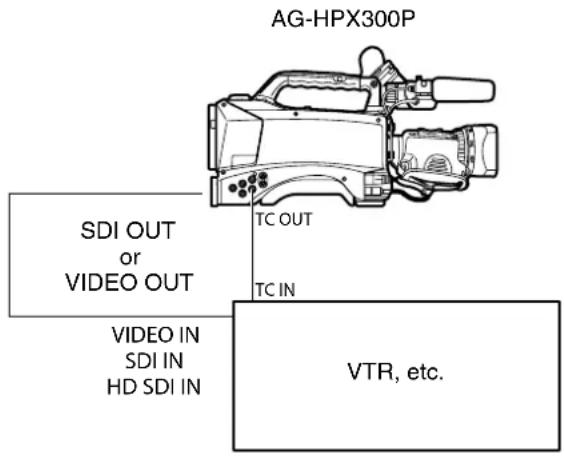
text_image
AG-HPX300P SDI OUT or VIDEO OUT TC OUT TC IN VIDEO IN SDI IN HD SDI IN VTR, etc.NOTE
When the setting menu TC VIDEO SYNCRO is set to VIDEO OUT, the time code is output via TC OUT in tune with VIDEO OUT delay.
GENLOCK and time code input/output connection and setup
| Camera operating conditions Camera setup | GENLOCK input and camera output phase (In phase: O Out of phase: x) | |||||
| Recording format | Video and reference signal to be output externally | GENLOCK input | GL PHASE SDI OUT (HD) | VIDEO OUT, SDI OUT (SD) | TC OUT | |
| 1080i | SDI OUT (1080i) | 1080i | SDI | O | 90H delay | O |
| VIDEO OUT COMPOSITE 90H advance | O | O | ||||
| SDI OUT (1080i) | SD (480i) | SDI | O | 90H delay | O | |
| VIDEO OUT COMPOSITE 90H advance | O | O | ||||
| 720P | SDI OUT (720P) | 720P | SDI | O | 120H delay x | |
| VIDEO OUT COMPOSITE | 120H advance | O | x | |||
| SDI OUT (720P) | SD (480i) | SDI | O | 90H delay | O | |
| VIDEO OUT COMPOSITE | 120H advance | O | O | |||
| 480i | SDI OUT (480i) | SD (480i) Disabled x | O | O | ||
| VIDEO OUT | ||||||
Counter Setting and Display
Pressing the COUNTER button to view the counter displays the counter value on the time code indicator in the LCD and in the viewfinder. The counter value is indicated in "Hour : Minute : Second" format. The counter value is not displayed during playback.
The menu option REC COUNTER in the DISPLAY SETUP screen can be set to display two types of counters.
TOTAL: provides a continuous count until reset by pressing the COUNTER RESET button. The counter value is retained when P2 cards are replaced and when the power is turned off.
CLIP: The counter is reset to 0 at the start of each recording and allows you to keep track of clip recording time while shooting the current clip.
NOTE
- Pressing the RESET button when the counter value is displayed resets the counter to 0.
- The counter value indicates values in the range between 0:00:00 and 9:59:59 in 1-second steps.
Viewfinder Screen Status Displays
In addition to video, the viewfinder shows messages indicating camera settings and operating status, center markers, safety zone markers, zebra patterns and other indications.
Viewfinder Status Indication Layout
The illustration below shows the indications (except MODE CHECK) that are displayed in the viewfinder.
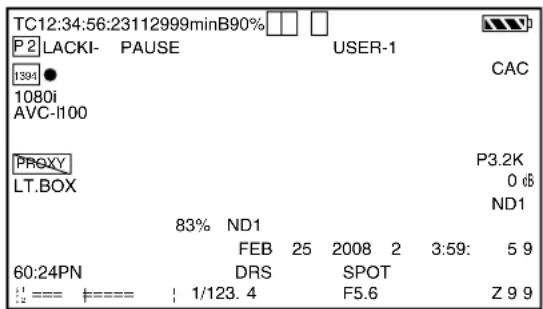
text_image
TC12:34:56:23112999minB90% P2 LACKI- PAUSE USER-1 1394 1080i AVC-I100 PROXY LT.BOX P3.2K 0 c$ ND1 83% ND1 FEB 25 2008 2 3:59: 5 9 60:24PN DRS SPOT 1/123.4 F5.6 Z 9 9For more information, see the following pages:
Selecting Viewfinder Display Information
To select items in the viewfinder screen, open the DISPLAY SETUP screen and turn on or off each item or type. Refer to the section [Using the menus] (page 120).

text_image
DISPLAY SETUP EVF PEAK LEVEL ▶ 0 EVF PEAK FREQ LOW EVF SETTING >>> EVF B. LIGHT NORMAL EVF COLOR ON ZEBRA1 DETECT 70% ZEBRA2 DETECT 85% ZEBRA2 SPOT PUSH MENU TO RETURN
tree
| Node | Label | Value | |---|---|---| | 1 | TC12:34:56:23112999minB90% | 390% | | 2 | P2 LACKI-PAUSE | | | 3 | I394 | | | 4 | 1080i AVC-I100 | | | 5 | 5 | | | 6 | PROXY | | | 7 | LT. BOX | | | 8 | ND1 | 83% | | 9 | FEB25 2008 2 3:59: 5 9 | | | 10 | 60:24PN | | | 11 | DRS 1/1 2 3 . 4 SPOT F 5.6 Z 9 9 | | | 12 | 13 | | | 13 | 14 | | | 14 | 15 | | | 15 | 16 | | | 16 | | | | 22 | CAC | | | 21 | | | | 20 | P3.2K 0 dB ND1 | | | 19 | | | | 18 | | | | 17 | | | | 11 = === || === === |1 Time code displays
Each press of the COUNTER button displays (or turns off) the indications listed below.
• (No indication)
- Counter:
Counter value (during recording only)
- TC: Time code value TC* is indicated when the time code value cannot be correctly read from DVCPRO/DV connector input. The colon between the seconds and the frames changes to a period ( . ) in drop frame mode.
- tc: Time code value (frame digits are indicated in 24/30 frames only) tc* is indicated when the time code value cannot be correctly read from DVCPRO/DV connector input. The colon between the seconds and the frames changes to a period (.) in drop frame mode.
- UB: User bit values UB* is indicated when the user bit value cannot be correctly read from DVCPRO/DV connector input.
• FR: Frame rate information for recording
• FR60I -: 60i interlace mode (60 fields/s)
• FR60P -: 60P progressive mode (60 frames/s)
• FR30P -: 30P progressive mode (30 frames/s)
• FR24P *: 24P progressive mode (24 frames/s)
• FR24PA *: 24P advanced mode (24 frames/s)
*: In FR24P and FR24PA modes, the last digit contains the frame conversion sequence information.
NOTE
When TC, tc and UB are locked to TC IN input, the characters in their icons change to outline characters TC . When the HOLD button is used to temporarily freeze indications, the HOLD indication blinks.
2 Warnings
- P2: Blinks when no P2 card is inserted or the card is write protected.
• P2 FULL: Blinks when there is no more space left on the P2 card.
• P2 LACK: Blinks in loop rec mode when there is not enough space left on the P2 card.
• Lights when the battery for the internal clock is depleted.
3 Backup unit displays
- The following indications show the status of backup units connected to the DVCPRO/DV connector.
- The following indications are not displayed when the menu option 1394 CONTROL in the OTHER FUNCTIONS screen is set to OFF.
• 1394 ●: Recording
• 1394 II: Recording standby
• 1394
The backup unit cannot be controlled.
• 1394: No backup unit is connected.
• 1394 --:
A backup unit is connected but is not in recording or recording standby status.
4 Recording format and system frequency indication
- System mode
• 1080i
• 720P
• 480i
- Recording format
(In 1080i, 720P system mode)
• AVC-I 100: AVC-Intra 100 format
• AVC-I 50: AVC-Intra 50 format
• DVCPRO HD: DVCPRO HD format (in 480i system mode)
• DVCPRO50, DVCPRO, DV
5 Information display
The following information is displayed depending on the situation.
• Performance of auto white balance and auto black balance
- Warning and error indication
- Information on switch and button operations For details, refer to [Center Information Display] (page 69).
6 Proxy information display (optional)
This display provides information on proxy card errors and time remaining in proxy recording on an SD memory card.
7 Letter box recording display
This display appears in the 480i recording format when LETTER BOX is selected in the menu option ASPECT CONV in the SYSTEM SETUP screen.
8 Y GET brightness display
When the Y GET function is used, the image level at the center of the image is indicated in a range between 0% and 109%
9 Calendar

flowchart
graph TD
    A["Month: JAN (January), FEB (February), MAR (March), APR (April), MAY (May), JUN (June), JUL (July), AUG (August), SEP (September), OCT (October), NOV (November), DEC (December)"] --> B["Day of the month"]
    B --> C["Year: 2000 – 2037"]
    C --> D["Hours"]
    C --> E["Minutes"]
    C --> F["Seconds"]
    B --> G["mmm dd yyyy hh:mm:ss"]
10 Recording/playback frame rate display
In native recording, the capture frame rate and recording and playback frame rates are displayed.
Example: 60:24PN (recording 60P with the camera frame rate set to a variable frame rate of 24PN)
Playback applies a 2:3 pull-down to perform 24P over 60P, indicating that 24/60 speed slow playback is performed.
In standard recording only the capture frame rate is indicated.
Example: 24PA (recording 24PA using 2:3:3:2 pulldown for over60i recording)
11 Audio level meter display

By assigning MAG A. LVL (level meter magnification) to a user button makes it possible to switch to display magnification.
For details, refer to [Audio level meter magnification] (page 73).
12 Shutter speed
The shutter speed is displayed here. In synchro scan mode, the display (time (minutes) display or shutter angle icon display) made in the menu option SYNC SCAN DISP in the DISPLAY SETUP screen is used.
13 DRS display
This indicates operation of the dynamic range stretcher function.
14 Iris display
Displays F values.
- NC appears when the lens connector is not connected.
15 Auto-iris control displays
- SPOT: Auto iris control for spot light
- BACK: Auto iris control for backlight compensation
This indication also appears when the lens is set to manual iris, but is not active.
16 Zoom position display
Zoom positions are indicated in a range from Z00 (maximum wide angle) to Z99 (maximum zoom).
17 Recommended ND filter display
This indicates the most suitable ND filter to use under current shooting conditions.
18 ND filter display
• This indicates the selected ND filter.
- An ND -- indication means that the ND FILTER switch is incorrectly set (a position other than ND1 to ND4). Check ND FILTER switch position.
19 Gain display
Indicates the gain value set using the video amplifier.
20 WHITE BAL switch position indication
Indicates the currently selected switch position and also white balance operation when AWB is preset. In ATW (Auto Tracking White Balance) mode, ATW is also indicated and LOCK is displayed when the function is locked.
21 CAC indicator
Indicates that the chromatic aberration function of the lens is operating.
22 Scene file name display
Indicates the name of currently selected SCENE FILE (F1 to F6).
23 Remaining battery charge
As the remaining battery charge drops, the display changes as follows: [1] [2] [3] [4] [5] .
When the battery is completely discharged, □(□)blinks.
(When the AC adapter is being used, a display other than 📄 may appear: this is not a sign of malfunctioning.)
• 13.5 V:
Battery voltage indication
Indicates the current voltage for analog batteries.
• B XX %:
10%\~99%
Indicates the remaining battery level in \% for digital batteries.
- MAX: Indicates that a digital battery is fully charged.
- EMP: Indicates that the remaining capacity of a digital battery is less than 10%.
24 Media remaining memory display
- Set the menu option P2CARD REMAIN in the DISPLAY SETUP screen to ONE-CARD to display the remaining time on the P2 card being recorded and show the number of the slot it resides in on the left. TOTAL displays the remaining time on both cards.
- In a mode check, ONE-CARD and TOTAL are alternately displayed.
- This display does not appear while remaining memory is calculated and when the camera is in USB device mode.
- A mode check during loop recording displays the standard recording time available to loop recording.
- Indicates remaining time in 1-minute increments from 0 to 999 minutes. 999 minutes and longer time periods are also indicated as 999 minutes
- The display blinks when 2 minutes or less time is left.
25 Media information display
Indicates the slots that contain P2 cards and general information on the media.
• 1 Lights orange:
P2 card selected for recording
• 1 lights green:
P2 card ready for recording
- 1 flashes:
The card is being recognized
- -: No card inserted
• P: Write-protected
• F: Full
- X: Cannot recognize
- E: P2 card in an invalid format (formatting will take care of this problem)
• o: P2 card slot contains a PROXY card.
26 Recording and playback
- REC: Recording
• PAUSE:
- REC: Recording - PAUSE:
Recording standby
•II: Playback pause
•▶: Play
•▶▶(◀◀):
Fast-forward/fast-forward playback (fast-reverse/fast-reverse playback)
• 4X ▶▶ (4X ◀◀):
4x speed search
- CLIP ▶ (CLIP ▶):
Clip forward (clip reverse), cue up of single clips
In DISPLAY OFF, only REC display is shown at top right. (Also displayed at top right, when pre-recording, interval recording or one-shot recording is set.)
Special recording display
This display appears when the menu option REC FUNCTION in the RECORDING SETUP screen is set to INTERVAL, ONE SHOT or LOOP and when PRE REC is set to ON.
A P2 card inserted during recording will not be used for recording.
Stop recording before inserting the P2 card.
• L – : LOOP (loop recording)
• I – : INTERVAL, ONE SHOT
- P - : PRE REC
Center Information Display
The following information displays (for details, refer to page 67) are provided.
P2 card recording and playback data indications
• BOS
Beginning of stream. No more data is available in the rearward playback direction.
- CANNOT PLAY
Appears when playback is disabled.
- CARD ERR (1) (2) (1/2):
The number identifies the P2 card that is giving trouble.
- UPDATING: Reading card data
- CANNOT REC
Appears when recording cannot be started by pressing the REC button.
• EOS
End of stream. No more data is available in the forward playback direction.
- PRE REC ON (OFF) (INVALID)
Appears when the user button to which pre-recording has been assigned is pressed.
- SHOT MARK ON (OFF) (INVALID)
SHOT MARK appears when the user button or the lens RET button to which it has been assigned is pressed.
- SLOT SEL (INVALID)
Appears when pressing the user button to which SLOT SEL is assigned.
- TEXTMEMO (INVALID)
TEXT MEMO appears when the user button or the lens RET button to which it has been assigned is pressed.
Errors and warnings
Errors and warnings appear when something goes wrong with the camera or a P2 card malfunctions. If the problem cannot be solved by turning off the camera and turning it back on, try replacing the card and if that does not help, it may be necessary to consult your supplier.
• 1394
This error occurs in a 1394 connection or when signal faults occur.
• 1394 INITIAL ERROR: a connection error
• 1394 INPUT ERROR: an input error
- 1394 INPUT ERROR (OTHER FORMAT): (different input format)
- COPY INHIBITED:
This indicates that a copy-guarded signal entered DV format input from the DVCPRO/DV connector.
• DIR ENTRY NG CARD
This message indicates that the directory on the card has become corrupted and that normal recording cannot be guaranteed if operation continues. Make a quick backup of card data and reformat the card.
• EXTERNAL1394 DISCONNECT
This message appears when the menu option 1394 CONTROL in the OTHER FUNCTIONS screen is set to EXT and recording is attempted without connecting an external device to the DVCPRO/DV connector.
- FORMAT ERR!
This indicates a P2 card that does not meet the P2 card standard
• INCOMPATIBLE CARD
This message indicates that the inserted card does not meet required standards and cannot be used. It may also appear when a proxy card is inserted when the power is on.
- LOW BATTERY
This message indicates that the battery is depleted.
- REC WARNING
This is displayed during a recording error. Do the recording over. If this does not solve the problem, consult your supplier.
- CARD ERR (1) (2) (1/2): The number indicates the P2 card that is giving trouble.
- Turn the power off if the warning continues.
- If the warning persists after rerecording, replace the card with another card.
- ERROR: Other causes (This indicates that an attempt was made to record 1000 or more clips on one card, for example.)
- PULL DOWN ERROR: Video pull-down sequence error in 24P mode
• REC RAM OVERFLOW: Overflow of recording memory
• RUN DOWN CARD
This message indicates that a P2 card has been overwritten the maximum number of times and that normal recording cannot be guaranteed if operation continues.
It is best to replace such P2 cards with a new card.
- SYSTEM ERROR
This message indicates that a system error has occurred. This type of error can often be corrected by turning off the power and turning it back on again.
- CAM MICON ERROR: The microprocessor in the camera is not responding.
- P2 CONTROL ERROR: a P2 control error has occurred.
- P2 MICON ERROR: The P2 microprocessor does not respond
• TEMPORARY PAUSE
IRREGULAR FRM SIG:
This message indicates that input GENLOCK reference signal is irregular and that recording has been terminated.
- TURN POWER OFF
This message indicates that an abnormal event has occurred, for example, that a card was removed during access or that a system mode change was made. Turn the power off and then turn it back on again.
- WIRELESS RF
This message indicates that reception from the wireless receiver is poor.
Camera status display
• ABB
ABB indicator
- ATW ACTIVE
Appears when the AUTO W/B BAL switch is set to AWB and ATW is running.
- ATW (ATW LOCK)
Appears when the WHITE BAL switch is set to B and ATW has been assigned.
• AUTO KNEE (ON/OFF)
Displayed when changing the AUTO KNEE switch position.
• AWB
AWB indicator
• AWB P3.2K/AWB P5.6K
Displays the color temperature assigned to PRST when the WHITE BAL switch is set to PRST. Also displayed when AWB is performed in the PRST position.
- BACK LIGHT (OFF)
Displayed during iris control when back light status is changed by pressing the user button to which BACK LIGHT is assigned.
- DRS ON (OFF)
Displayed when DRS operation has been changed.
- GAIN**dB
Displayed when GAIN is switched.
• ND NG
Displayed when the ND filter is not positioned correctly.
• SCENE*****
Displays the name of a scene file selected by turning the SCENE FILE dial.
• SHUTTER 1/**** (OFF)
Displayed when the shutter speed is changed.
- SPOT LIGHT (OFF)
Displayed during iris control when back light status is changed by pressing the user button to which SPOT LIGHT is assigned.
Checking and displaying shooting status
- Hold down the DISP/MODE CHK button in recording standby or during recording to display the settings of each shooting function, the list of functions assigned to USER buttons and all other information. Release the button to return to the regular screen.
- Press the DISP/MODE CHK button during recording standby or recording clears all displays. Press again to return to the regular display.
- These settings are maintained when the unit is turned off and also when switching media and operating mode.
- The following items can be displayed in the viewfinder and on the LCD monitor by pressing the DISPMODE CHK button or by configuring the menu option OTHER DISPLAY in the DISPLAY SETUP screen.
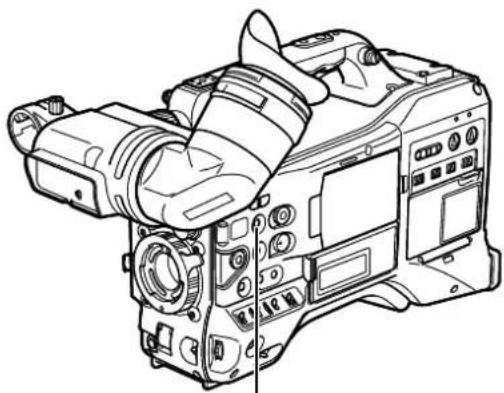
natural_image
Line drawing of a digital camera with attached display panel (no text or symbols)DISP/MODE CHK button
| No | Displays | Displays that MODE CHECK brings up O | Displays that DISPLAY OFF clears O | Displays opened or hidden by settings in the OTHER DISPLAY option -: Not affected, O: Opens, x: Clears | Other menus that clear displays -: Not affected | ||
| ALL | PARTIAL OFF | ||||||
| 1 | Time code displays | O | Is not cleared | -- | -- | ||
| 2 | Warnings | O | Is not cleared | -- | -- | ||
| 3 | Backup unit displays | O | Is not cleared | -- | -- | ||
| 4 | Recording format and system frequency indication | O O | O | x | x | - | |
| 5 | Information display | x | Is not cleared | -- | -- | ||
| 6 | Proxy information display (optional) | O | Is not cleared | -- | -- | ||
| 7 | Letter box recording display | O | O | -- | -- | ||
| 8 | Y GET brightness display | O | Is not cleared | -- | -- | ||
| 9 | Calendar | O | O | -- | - | Date/Time | |
| 10 | Recording/playback frame rate display | O O | O O | x | - | ||
| 11 | Audio level meter display | O | O | -- | - | LEVEL METER | |
| 12 | Shutter speed | O O | O O | x | - | ||
| 13 | DRS display | O O | O O | x | - | ||
| 14 | Iris display | O O | O O | x | - | ||
| 15 | Auto-iris control displays | O O | O O | x | - | ||
| 16 | Zoom position display | O | O | -- | - | Zoom | |
| 17 | Recommended ND filter display | O O | O O | x | - | ||
| 18 | ND filter display | O O | O | x | x | - | |
| 19 | Gain display | O O | O | O Does not indicate 0 dB | x | - | |
| 20 | WHITE BAL switch position indication | O O | O | O Displays only ATW. LOCK, P3.2K and P5.6K | x | - | |
| 21 | CAC indicator | O | O | -- | -- | ||
| 22 | Scene file name display | O O | O | x | x | - | |
| 23 | Remaining battery charge | O | O Goes on when battery charge drops | -- | - | CARD/BATT | |
| 24 | Media remaining memory display | O | O Goes on when battery charge drops | -- | - | CARD/BATT | |
| 25 | Media information display | O | O Lights when SLOT SEL is performed | O | O | xLights when SLOT SEL is performed | CARD/BATT |
| 26 | Recording and playback | O | O Appears at top right only during recording and in special recording modes | O | O | x Appears at top right only during recording and in special recording modes | - |
MODE CHECK indication
MODE CHECK provides an almost complete set of camera information. Items 1 to 4 below are provided only by MODE CHECK.
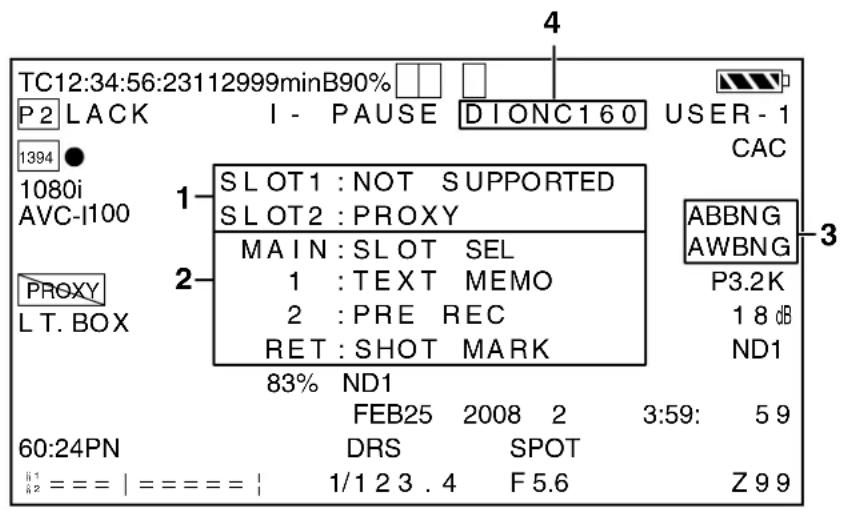
text_image
TC12:34:56:23112999minB90% P2 LACK I - PAUSE DIONC160 USER - 1 1394 1080i AVC-I100 PROXY LT. BOX 1 SLOT1 : NOT SUPPORTED SLOT2 : PROXY MAIN : SLOT SEL 1 : TEXT MEMO 2 : PRE REC RET : SHOT MARK 83% ND1 FEB25 2008 2 3:59: 5 9 60:24PN DRS SPOT i= i = = | = = = = = | 1/1 2 3 . 4 F 5.6 Z 9 91 P2 card slot status display
Displays status for P2 card slots 1 and 2.
- ACTIVE: Indicates cards that are ready for read and write operations (includes cards selected for recording)
- ACCESSING: Indicates a card that is currently read or being written to
- INFO READING: Card in the recognition phase
• FULL: No more space available on the P2 card
• PROTECTED: The P2 card is write-protected.
- NOT SUPPORTED: The P2 card cannot be used or recognized.
- FORMAT ERROR: The P2 card is not properly formatted.
- NO CARD: No card has been inserted.
• PROXY: (optional) Proxy card
- No indication: The camera is in the USB DEVICE mode
2 Information on user button and lens RET button assignment
Information to check what functions are assigned to user buttons and the lens RET button are provided in the following sections.
For details, refer to [Assigning functions to USER buttons] (page 53). For details, refer to [RET SW] (page 128).
3 AWB, ABB error display
A mode check indicates when AWB and ABB fail to operate normally.
4 Battery type
This indicates the battery type selected for detection of remaining battery charge.
Center marker display
A center marker is displayed when the menu option MARKER in the DISPLAY SETUP screen is set to ON.
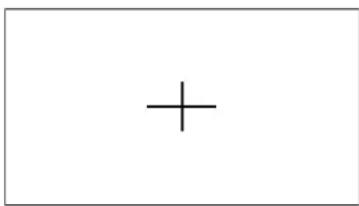
natural_image
Simple geometric diagram with a plus sign inside a rectangle (no text or symbols)NOTE
The center marker display appears only on the LCD monitor and in the viewfinder. It is not superimposed on signals output via the VIDEO OUT and SDI OUT connectors.
Safety zone markers
A safety zone marker is displayed when the menu option SAFETY ZONE is selected in the DISPLAY SETUP screen.
- OFF: Not displayed
- 90%: indicates the display area on a normal household TV
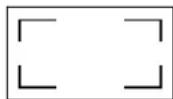
• 4:3: Indicates display area available at a 4:3 aspect ratio.
- 13:9: Indicates the display area available at a 13:9 aspect ratio.

- 14:9: Indicates the display area available at a 14:9 aspect ratio.

NOTE
- The 4:3, 13:9 and 14:9 zones do not appear when selected when the menu options SYSTEM MODE and ASPECT CONV are set to 480-59.94i and S-CROP, respectively in the SYSTEM SETUP screen.
- Safety zone markers appear only on the LCD monitor and in the viewfinder. They are not superimposed on signals output via the VIDEO OUT and SDI OUT connectors.
Audio level meter magnification
Press the user button to which MAG A. LVL has been assigned to display a magnification of the audio level meter (available also when LEVEL METER in the DISPLAY SETUP menu is set to OFF).
Press the button again to return to normal audio level meter size.
Turning on MODE CHECK during audio level meter magnification clears the audio level meter display. After MODE CHECK use, the audio level meter reappears at normal size.
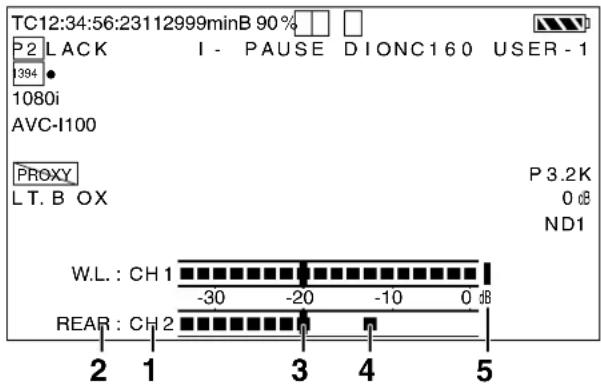
text_image
TC12:34:56:23112999minB 90% P2 LACK I - PAUSE DIONC160 USER - 1 394 1080i AVC-I100 PROXY P 3.2K LT.B OX 0 dB ND1 W.L.: CH1 -30 -20 -10 0 dB REAR: CH2 2 1 3 4 51 Channel display
This displays the currently monitored audio channel.
2 Input system display
This displays the audio input system (AUDIO IN switch).
- FRONT
• W.L. (WIRELESS) - REAR
3 Standard level bar
This bar indicates a -20 dB or -18 dB headroom level depending on the menu option HEADROOM setting in the AUDIO SETUP menu.
4 Peak hold display
Holds the audio peak level indication for 1 second.
5 Excessive level indicator
An audio level that is set too high is indicated in red.
Zebra pattern display
The AG-HPX300P can display two zebra patterns.
Turning the ZEBRA switch on displays the zebra pattern set in the menu in the viewfinder and LCD monitor. A menu setting makes it possible to also display the zebra pattern on video output via the VIDEO OUT connector.
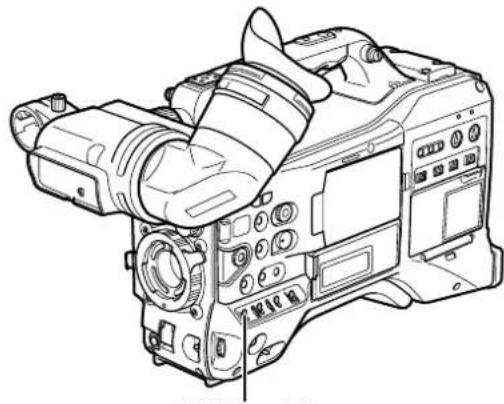
natural_image
Line drawing of a digital camera with control panel and display (no text or symbols)ZEBRA switch
Use the DISPLAY SETUP screen to set the level of zebra pattern display.
| Item Setting Description | ||
| ZEBRA1 DETECT | 50%...70%...109% | Sets the level of the right-leaning zebra pattern 1. |
| ZEBRA2 DETECT | 50%...85%...109% | Sets the level of the left-leaning zebra pattern 2. |
| ZEBRA2 ON, SPOT_OFF | Selects the ZEBRA2 type. | |
Underlined values indicate factory defaults.
SPOT: A video level between ZEBRA1 and ZEBRA2 displays a zebra pattern.
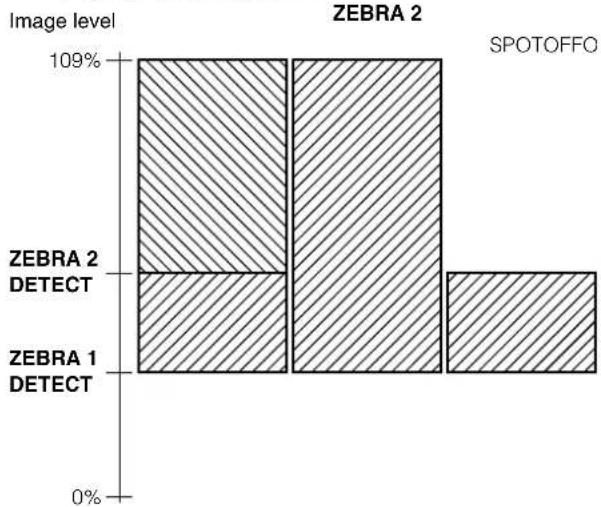
bar
| Category | Value | | -------------- | ----- | | Image level | 109% | | ZEBRA 2 | | | ZEBRA 2 DETECT | | | ZEBRA 1 DETECT | | | SPOTOFFO | |To display a zebra pattern on video output via the VIDEO OUT connector, make the required settings in the OUTPUT SEL screen.
OUTPUTSEL screen
| Item Setting Description | ||
| VIDEO OUT ZEBRA | ON:Displays the zebra pattern shown on the LCD monitor and viewfinder of this camera also in video output via the VIDEO OUT connector.OFF:The zebra pattern is not displayed in video output from the VIDEO OUT connector. | Specifies whether or not the zebra pattern is superimposed on VIDEO OUT signals. |
Focus assist function
Pressing the FOCUS ASSIST button magnifies the image at the center to facilitate focusing.
Set the menu option FOCUS BAR to ON in the DISPLAY SET UP screen to display the FOCUS BAR.
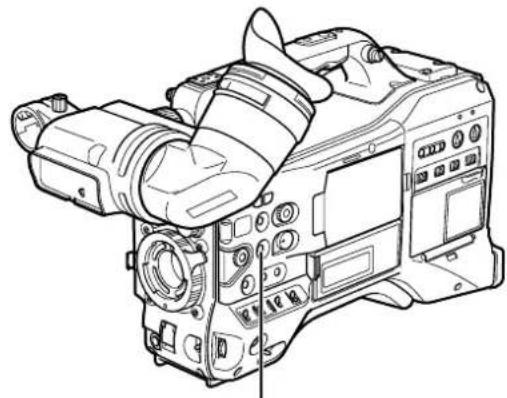
natural_image
Line drawing of a digital camera with no visible text or symbolsFOCUS ASSIST button
NOTE
This function magnifies only the image at the center of the LCD monitor and viewfinder. It is not superimposed on signals output via the VIDEO OUT and SDI OUT connectors.
EXPANDED: (FOCUS\_ASSIST button)
Trebles the size of the center of the image.
The status indication and the zebra pattern disappears and EXPANDED appears at the top of the screen.

text_image
EXPANDED EXPANDED- The EXPANDED display is available only during recording and does not work in external input mode.
NOTE
In VIDEO OUT and SDI OUT, the center of the image is not magnified and status indications do not appear.
FOCUS\_BAR: (DISPLAY SETUP menu)
The length of the bar indicates whether the image is in focus.
The FOCUS BAR extends to the far right when the image is in focus.
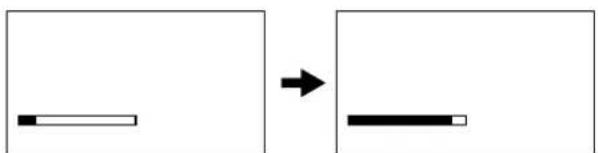
natural_image
Simple diagram showing a rectangular block transforming into a horizontal bar, with an arrow indicating the process (no text or symbols)Out of focus The bar extends to the
right when the image is in focus.
Adjusting and setting the LCD monitor
Using the LCD Monitor
1 Turn on the POWER switch of the AG-HPX300P.
2 Slide the OPEN button in the arrow ① direction to open the LCD monitor.

text_image
Diagram of a digital camera with labeled control panel and screen interface, showing mechanical components and adjustment arrows.NOTE
The LCD monitor opens to an angle of 120 degrees. Attempts to open it further will damage the monitor.
3 Adjust the angle of the LCD monitor for most convenient viewing.
- The monitor can turn up to 180 degrees towards the lens and up to 90 degrees towards you.
NOTE
To prevent camera-recorder failure, do not use force when adjusting the monitor (when open).

natural_image
Diagram showing three steps of appliance assembly or installation, with no visible text or symbols.4 Use the subscreen in the menu option LCD SETTING in the DISPLAY SETUP screen to adjust screen color level, brightness and contrast.
For details on menu operation, refer to [Using the menus] (page 120).
- At LCD SETTING of the DISPLAY SETUP screen, select CHANGE.
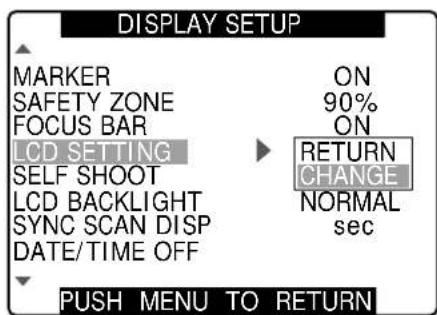
text_image
DISPLAY SETUP MARKER SAFETY ZONE FOCUS BAR LCD SETTING SELF SHOOT LCD BACKLIGHT SYNC SCAN DISP DATE/TIME OFF ON 90% ON RETURN CHANGE NORMAL sec PUSH MENU TO RETURN5 Use the JOG dial button to select an item.
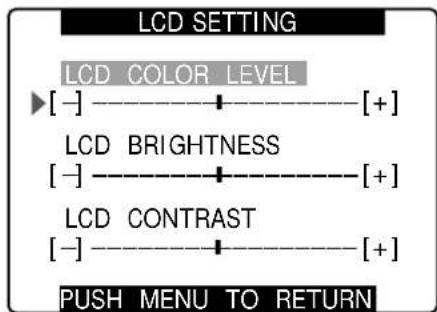
text_image
LCD SETTING LCD COLOR LEVEL [−] [+] LCD BRIGHTNESS [−] [+] LCD CONTRAST [−] [+] PUSH MENU TO RETURN6 Press the JOG dial button, and turn the JOG dial button to adjust the selected item.
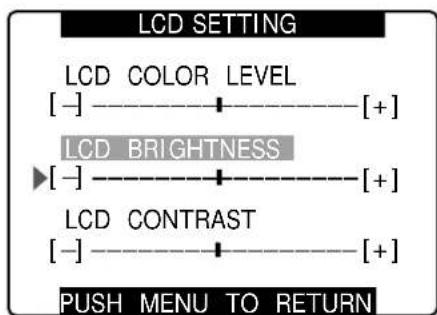
text_image
LCD SETTING LCD COLOR LEVEL [-] [+] LCD BRIGHTNESS [−] [+] LCD CONTRAST [−] [+] PUSH MENU TO RETURNNOTE
- Pressing the RESET button when a value that can be adjusted is selected in the setting menu LCD SETTING will return the setting to its factory default.
- When closing the LCD monitor make sure that it is shut tight.
- In an environment with sudden temperature changes, condensation may form on the liquid crystal surface of the monitor. If this happens, wipe off the moisture with a soft, dry cloth.
- When the camera-recorder is very cold, the video image in the LCD monitor will appear slightly darker immediately after the power is turned on. Once the interior of the camera-recorder warms up, the LCD monitor delivers normal brightness.
Self-portrait Shooting
When shooting with the LCD display angled 180 degrees towards the lens, you can set the menu option SELF SHOOT to MIRROR, to horizontally flip the video image on the LCD display, and allow you to view a mirror image while shooting.
Note that only the video image on the LCD monitor is horizontally flipped, not the actual video being recorded. This function clears any status display, waveform and vectorscope display on the LCD monitor. Setting menus and thumbnail displays are not flipped horizontally.
Waveform monitor function
Assign the WFM function to a user button and press that user button to display a waveform for an image in the LCD monitor. Another press of the WFM button closes the waveform display.
- The menu option WFM (Page 128) in the SW MODE screen allows you to switch between the waveform and vectorscope displays.
- The waveform display does not appear in the viewfinder.
- The waveform display does not appear when the focus assist function is used.
- The waveform display cannot be recorded.
Adjusting and Setting up the Viewfinder
Adjusting Right and Left Viewfinder Position
Using the Viewfinder
1 Loosen the viewfinder left-right positioning rings.
2 Slide the viewfinder right and left to find a position that facilitates viewing.
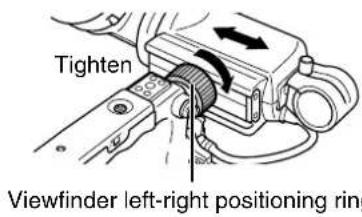
text_image
Tighten Viewfinder left-right positioning ring3 Tighten the viewfinder left-right positioning rings.
Diopter Adjustment
1 Turn on the POWER switch on the camera.
- Look at the image in the viewfinder.
2 Turn the diopter adjusting ring until you get the sharpest possible image in the viewfinder.
Diopter adjusting ring

natural_image
Technical line drawing of a mechanical device with no visible text or symbols1 Turn on the POWER switch.
2 Use the subscreen in the menu option EVF SETTING in the DISPLAY SETUP screen to adjust screen brightness and contrast.
For details on menu operations, refer to [Using the menus] (page 120).
- Select CHANGE in the EVF SETTING.
DISPLAY SETUP

text_image
EVF PEAK LEVEL EVF PEAK FREQ EVE SETTING EVF B. LIGHT EVF COLOR ZEBRA1 DETECT ZEBRA2 DETECT ZEBRA2 SPOT 0 LOW RETURN CHANGE ON 100% 85%PUSH MENU TO RETURN
3 Use the JOG dial Button to select items to set.
EVF SETTING
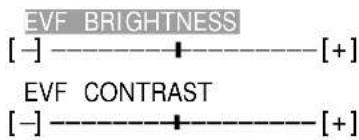
text_image
EVF BRIGHTNESS [-]----[+] EVF CONTRAST [-]----[+]PUSH MENU TO RETURN
4 Press the JOG dial button to select an item and turn the button to make adjustments.
EVF SETTING

text_image
EVF BRIGHTNESS [-]----[+] EVF CONTRAST [-]----[+]PUSH MENU TO RETURN
NOTE
- Pressing the RESET button when an adjustable value is selected in the setting menu EVF SETTING will return that setting to its factory default.
- The LCD monitor will appear darker than usual if the camera recorder is cold when it is turned on. The display will return to its normal brightness as it warms up.
Emphasizing Image Outlines
Emphasizing outlines of images in the viewfinder and on the LCD monitor makes it easier to focus. This function does not affect video output from the camera or video recorded by the camera.
1 Adjust EVF PEAK LEVEL and EVF PEAK FREQ in the DISPLAY SETUP screen.

text_image
DISPLAY SETUP EVF PEAK LEVEL 0 EVF PEAK FREQ ▼ LOW EVF SETTING >>> EVF B. LIGHT NORMAL EVF COLOR ON ZEBRA1 DETECT 100% ZEBRA2 DETECT 85% ZEBRA2 SPOT ▼ PUSH MENU TO RETURNSetting the viewfinder to monochrome mode
Set the menu option EVF COLOR to OFF in the DISPLAY SETUP screen to change the viewfinder to monochrome mode.
Handling setup data
Configuration of setup data files
This camera makes it possible to save a scene file to each of the F1 to F6 positions on the SCENE FILE dial.
Use of an SD memory card makes it possible to save up to four of the F1 to F6 files on an SD card for later retrieval.
The setting menu values can be stored as a user file in the camera and up to four files can be stored on the SD memory card.
The setting data files are configured as shown below.
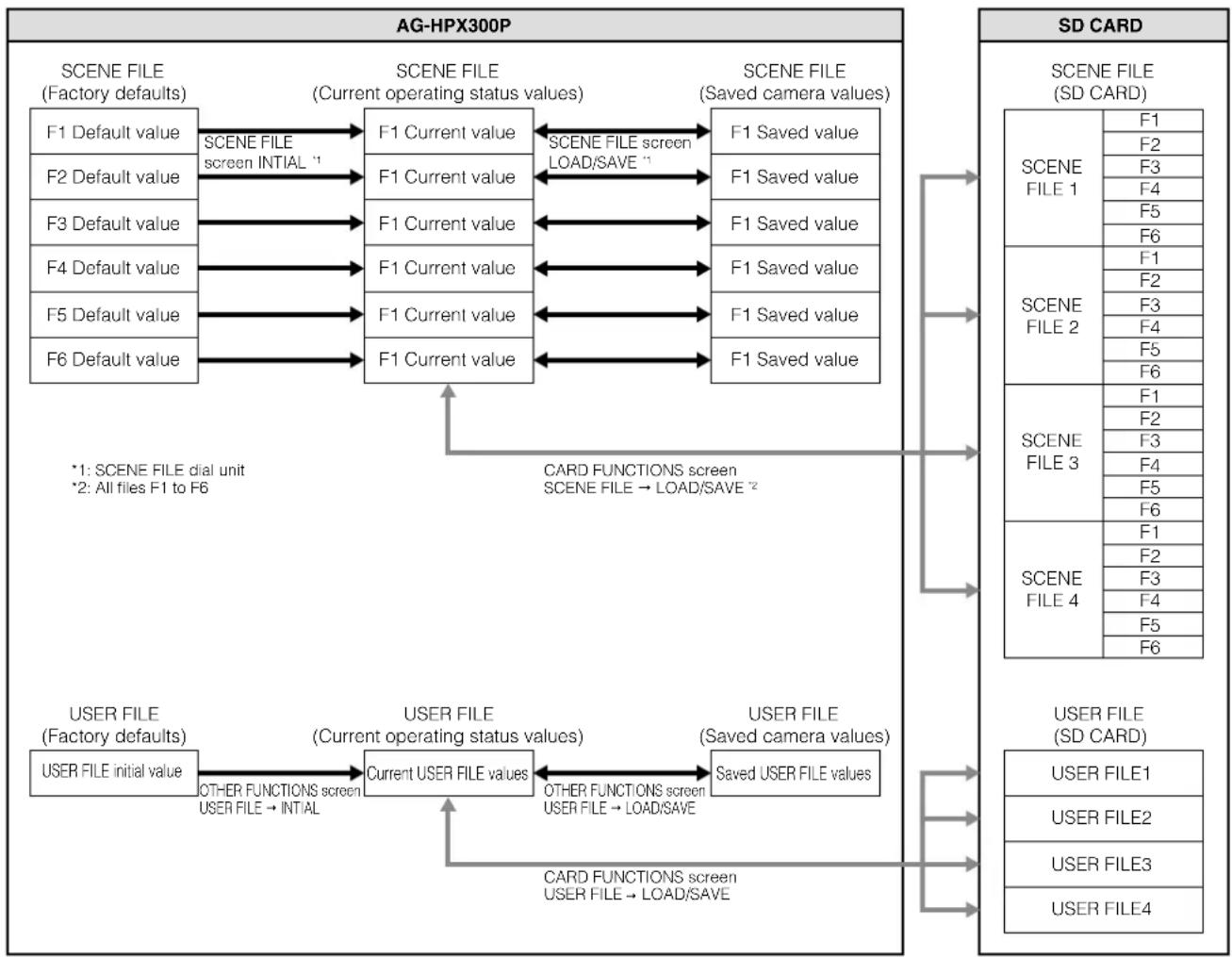
flowchart
graph TD
    subgraph_AG-HPX300P["AG-HPX300P"]
        A1["SCENE FILE (Factory defaults)"]
        A2["F1 Default value"] -->|SCENE FILE screen INITIAL '1'| B1["F1 Current value"]
        A2 -->|SCENE FILE screen LOAD/SAVE '1'| B2["F1 Current value"]
        A3["F2 Default value"] --> B3["F1 Current value"]
        A3 -->|SCENE FILE screen LOAD/SAVE '1'| B4["F1 Current value"]
        A4["F3 Default value"] --> B5["F1 Current value"]
        A4 -->|SCENE FILE Screen LOAD/SAVE '1'| B6["F1 Current value"]
        A5["F4 Default value"] --> B7["F1 Current value"]
        A5 -->|SCENE FILE Screen LOAD/SAVE '1'| B8["F1 Current value"]
        A6["F5 Default value"] --> B9["F1 Current value"]
        A6 -->|SCENE FILE Screen LOAD/SAVE '1'| B10["F1 Current value"]
        A7["F6 Default value"] --> B11["F1 Current value"]
        B1 --> C1["F1 Saved value"]
        B2 --> C2["F1 Saved value"]
        B3 --> C3["F1 Saved value"]
        B4 --> C4["F1 Saved value"]
        B5 --> C5["F1 Saved value"]
        B6 --> C6["F1 Saved value"]
    end

    subgraph_SD_CARD["SD CARD"]
        D1["SCENE FILE (SD CARD)"]
        D2["SCENE FILE 1"] --> E1["F1"]
        D2 --> E2["F2"]
        D3["SCENE FILE 2"] --> F1["F1"]
        D3 --> F2["F2"]
        D4["SCENE FILE 3"] --> F3["F3"]
        D4 --> F4["F4"]
        D5["SCENE FILE 4"] --> F5["F5"]
        D5 --> F6["F6"]
        D6["SCENE FILE 1"] --> E3["F1"]
        D6 --> E4["F2"]
        D7["SCENE FILE 2"] --> F4["F3"]
        D7 --> F5["F5"]
        D8["SCENE FILE 3"] --> F6["F6"]
        D9["SCENE FILE 4"] --> F7["F1"]
        D9 --> F8["F2"]
        D10["SCENE FILE 4"] --> F9["F3"]
        D10 --> F10["F4"]
        D11["SCENE FILE 4"] --> F11["F5"]
        D11 --> F12["F6"]
    end

    subgraph_USER_FILE["USER FILE (SD CARD)"]
        G1["USER FILE (SD CARD)"]
        G2["USER FILE 1"]
        G3["USER FILE 2"]
        G4["USER FILE 3"]
        G5["USER FILE 4"]
    end

    H1["USER FILE (Current operating status values)"]
    H2["USER FILE (Saved camera values)"]
    H3["OTHER FUNCTIONS screen USER FILE → INITIAL"] --> I["User FILE (Current operating status values)"]
    H4["OTHER FUNCTIONS screen USER FILE → LOAD/SAVE"] --> J["User FILE (Current operating status values)"]
    H5["CARD FUNCTIONS screen USER FILE → LOAD/SAVE"] --> K["User FILE (Current operating status values)"]
    H6["CARD FUNCTIONS screen USER FILE → LOAD/SAVE"] --> L["User FILE (Current operating status values)"]
    H7["OTHER FUNCTIONS screen USER FILE → LOAD/SAVE"] --> M["User FILE (Current operating status values)"]
    H8["OTHER FUNCTIONS screen USER FILE → LOAD/SAVE"] --> N["User FILE (Current operating status values)"]
    H9["OTHER FUNCTIONS screen USER FILE → LOAD/SAVE"] --> O["User FILE (Current operating status values)"]
    H10["OTHER FUNCTIONS screen USER FILE → LOAD/SAVE"] --> P["User FILE (Current operating status values)"]
    H11["OTHER FUNCTIONS screen USER FILE → LOAD/SAVE"] --> Q["User File (Saved camera values)"]
    H12["OTHER FUNCTIONS screen USER FILE → LOAD/SAVE"] --> R["User File (Saved camera values)"]
    H13["OTHER FUNCTIONS screen USER FILE → LOAD/SAVE"] --> S["User File (Saved camera values)"]
    H14["OTHER FUNCTIONS screen USER FILE → LOAD/SAVE"] --> T["User File (Saved camera values)"]
    H15["OTHER FUNCTIONS screen USER FILE → LOAD/SAVE"] --> U["User File (Saved camera values)"]
    H16["OTHER FUNCTIONS screen USER FILE → LOAD/SAVE"] --> V["User File (Saved camera values)"]
    H17["OTHER FUNCTIONS screen USER FILE → LOAD/SAVE"] --> W["User File (Saved camera values)"]
    H18["OTHER FUNCTIONS screen USER FILE → LOAD/SAVE"] --> X["User File (Saved camera values)"]
    H19["OTHER FUNCTIONS screen USER FILE → LOAD/SAVE"] --> Y["User File (Saved camera values)"]
    H20["OTHER FUNCTIONS screen USER FILE → LOAD/SAVE"] --> Z["User File (Saved camera values)"]
    H21["OTHER FUNCTIONS screen USER FILE → LOAD/SAVE"] --> AA["User File (Saved camera values)"]
    H22["OTHER FUNCTIONS screen USER FILE → LOAD/SAVE"] --> AB["User File (Saved camera values)"]
    H23["OTHER FUNCTIONS screen USER FILE → LOAD/SAVE"] --> AC["User File (Saved camera values)"]
    H24["OTHER FUNCTIONS screen USER FILE → LOAD/SAVE"] --> AD["User File (Saved camera values)"]
    H25["OTHER FUNCTIONS screen USER FILE → LOAD/SAVE"] --> AE["User File (Saved camera values)"]
    H26["OTHER FUNCTIONS screen USER FILE → LOAD/SAVE"] --> AF["User File (Saved camera values)"]
    H27["OTHER FUNCTIONS screen USER FILE → LOAD/SAVE"] --> AG["User File (Saved camera values)"]
    H28["OTHER FUNCTIONS screen USER FILE → LOAD/SAVE"] --> AH["User File (Saved camera values)"]
    H29["OTHER FUNCTIONS screen USER FILE → LOAD/SAVE"] --> AI["User File (Saved camera values)"]
    H30["OTHER FUNCTIONS screen USER FILE → LOAD/SAVE"] --> AJ["User File (Saved camera values)"]
    H31["OTHER FUNCTIONS screen USER FILE → LOAD/SAVE"] --> AK["User File (Saved camera values)"]
    H32["OTHER FUNCTIONS screen USER FILE → LOAD/SAVE"] --> AL["User File (Saved camera values)"]
    H33["OTHER FUNCTIONS screen USER FILE → LOAD/SAVE"] --> AM["User File (Saved camera values)"]
    H34["OTHER FUNCTIONS screen USER FILE → LOAD/SAVE"] --> AN["User File (Saved camera values)"]
    H35["OTHER FUNCTIONS screen USER FILE → LOAD/SAVE"] --> AO["User File (Saved camera values)"]
    H36["OTHER FUNCTIONS screen USER FILE → LOAD/SAVE"] --> AP["User File (Saved camera values)"]
    H37["OTHER FUNCTIONS screen USER FILE → LOAD/SAVE"] --> AQ["User File (Saved camera values)"]
    H38["OTHER FUNCTIONS screen USER FILE → LOAD/SAVE"] --> AR["User File (Saved camera values)"]
    H39["OTHER FUNCTIONS screen USER FILE → LOAD/SAVE"] --> AS["User File (Saved camera values)"]
    H40["OTHER FUNCTIONS screen USER FILE → LOAD/SAVE"] --> AT["User File (Saved camera values)"]
    H41["OTHER FUNCTIONS screen USER FILE → LOAD/SAVE"] --> AU["User File (Saved camera values)"]
    H42["OTHER FUNCTIONS screen USER FILE → LOAD/SAVE"] --> AV["User File (Saved camera values)"]
    H43["OTHER FUNCTIONS screen USER FILE → LOAD/SAVE"] --> AW["User File (Saved camera values)"]
    H44["OTHER FUNCTIONS screen USER FILE → LOAD/SAVE"] --> AX["User File (Saved camera values)"]
    H45["OTHER FUNCTIONS screen USER FILE → LOAD/SAVE"] --> AY["User File (Saved camera values)"]
    H46["OTHER FUNCTIONS screen USER FILE → LOAD/SAVE"] --> AZ["User File (Saved camera values)"]
    H47["OTHER FUNCTIONS screen USER FILE → LOAD/SAVE"] --> BA["User File (Saved camera values)"]
    H48["OTHER FUNCTIONS screen USER FILE → LOAD/SAVE"] --> BB["User File (Saved camera values)"]
    H49["OTHER FUNCTIONS screen USER FILE → LOAD/SAVE"] --> BC["User File (Saved camera values)"]
    H50["OTHER FUNCTIONS screen USER FILE → LOAD/SAVE"] --> BD["User File (Saved camera values)"]
    H51["OTHER FUNCTIONS screen USER FILE → LOAD/SAVE"] --> BE["User File (Saved camera values)"]
    H52["OTHER FUNCTIONS screen USER FILE → LOAD/SAVE"] --> BF["User File (Saved camera values)"]
    H53["OTHER FUNCTIONS screen USER FILE → LOAD/SAVE"] --> BG["User File (Saved camera values)"]
    H54["OTHER FUNCTIONS screen USER FILE → LOAD/SAVE"] --> BH["User File (Saved camera values)"]
NOTE
- Running the menu option MENU INIT in the OTHER FUNCTIONS screen returns all current operating status values in the F1 to F6 scene files, values stored in the camera, current user file settings and camera settings to their factory defaults. This function does not return the TIMEZONE setting to its factory default.
- Setting data file operations may end in error during playback or when the menu option PC MODE is set to ON in the SYSTEM SETUP screen. Set PC MODE to OFF before performing file operations.
Setting Data Using an SD memory card
By saving up to four files of setup menu settings on an SD or SDHC memory card (optional accessory), you can create a setup card that will allow you to quickly configure camera settings before recording.
Handling SD memory cards
An SD memory card may be inserted or removed, either before or after the power is turned on.
To insert an SD memory card
Open the slot cover, insert the SD memory card (optional accessory) in the slot with the label side of the card facing upwards and close the slot cover.

natural_image
Diagram showing a device inside an automotive enclosure with a close-up view of the internal components (no text or symbols visible)NOTE
- An SD memory card must be inserted with the right side facing the slot. If the card cannot be inserted, it may the wrong side up or back-to-front. Do not force it into the slot. Check the card before reinserting it.
- Use only SD memory cards that conform to the SD standard or the SDHC standard in this camera.
Be sure to read [SD memory card precautions] (page 21) regarding SD memory handling.
To remove the SD memory card
Open the slot cover and make sure that the BUSY lamp is not on before pushing the SD memory card further into the slot and releasing it. This will cause the SD memory card to pop out of the slot. Remove the SD memory card and close the slot cover.
SD memory cards must not be used or stored in an environment where they may be
- Exposed to high temperatures/humidities;
- Exposed to water droplets; or
- Electrically charged.
For storage, the SD memory card must be kept inserted into the AG-HPX300P with the lid closed.
Formatting, Writing and Reading an SD memory card
Open the CARD FUNCTIONS screen from the setting menu to format SD memory cards, write setting data to SD memory cards and to read data stored on an SD memory card.
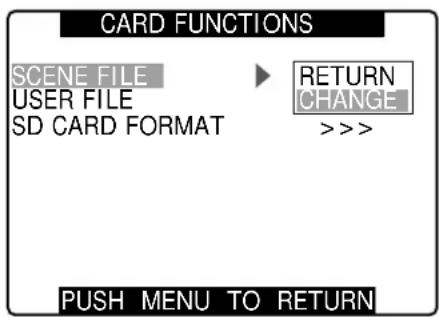
text_image
CARD FUNCTIONS SCENE FILE USER FILE SD CARD FORMAT RETURN CHANGE >>>> PUSH MENU TO RETURNUse of SD memory cards in a non-SD/SDHC format formatted on a device other than this camera will display a FORMAT ERROR message at the top right of the screen. Reformat such SD cards in the camera before use. See [To format an SD memory card] (page 81).
To format an SD memory card
NOTE
SD memory cards may be formatted via the thumbnail screen. For more information, see [Formatting SD memory cards] (page 115).
1 Select SD CARD FORMAT item in CARD FUNCTIONS, then press the JOG dial button.
For details on menu operation, refer to [Using the menus] (page 120).
2 Select EXCUTE, then press the JOG dial button.
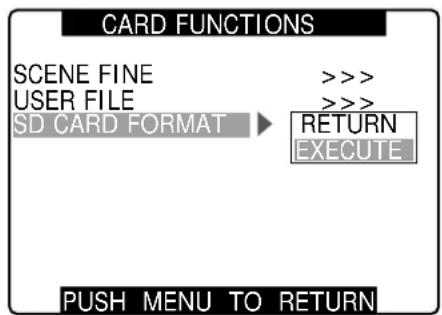
text_image
CARD FUNCTIONS SCENE FINE >>> USER FILE >>> SD CARD FORMAT RETURN EXECUTE PUSH MENU TO RETURN3 Select YES in the confirmation screen and press the JOG dial button.
- "SD CARD FORMAT OK" appears and the SD memory card is formatted.
The card will not be formatted if the following message appears when the JOG dial button is pressed:
| Error message Remedy | |
| SD CARD FORMAT NGNO CARD(No SD memory card inserted.) | Insert an SD memory card. |
| SD CARD FORMAT NGERROR(SD memory card cannot be formatted.) | The card may be defective.Replace the card. |
| SD CARD FORMAT NGWRITE PROTECT(SD memory card is write-protected.) | Remove the card and cancel the protect. |
| SD CARD FORMAT NGCANNOT ACCESS(SD memory card not accessible). | The SD memory card is not accessible. When the current access operation ends, reformat the card. |
How to Use Scene File Data
• Each position of the SCENE FILE dial stores settings for specific shooting situations.
- When shooting, you can retrieve the necessary file instantly using scene file dial.
- You can also use menu options to change set scene file values. A modified scene file can be saved to each scene file dial position.
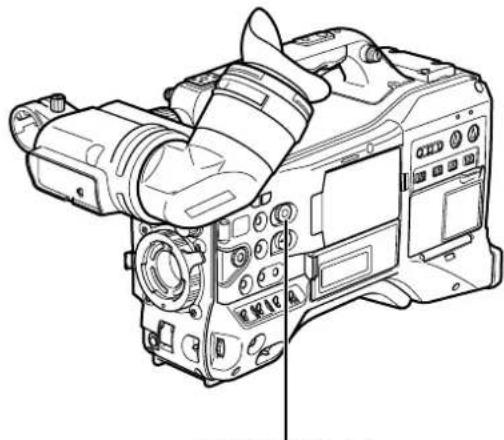
natural_image
Line drawing of a DSLR camera with control panel and buttons (no text or symbols)SCENE FILE dial
- Note that changing scene files during recording will not change VFR and frame rate settings. To make such changes, set the camera to recording standby status.
■ Factory setting
• F1: SCENE
File suitable for normal shooting.
• F2: SCENE FLUO.
File suitable for shooting under fluorescent lights, ie. indoors.
• F3: SCENE SPARK
File suitable for SD shooting with a greater range of resolution, coloring and contrast.
• F4: SCENE B-STR
File for increasing the contrast of dark areas, such as when shooting sunsets.
• F5: SCENE CINE V
File suitable for shooting movie-like scenes where the contrast is to be emphasized.
• F6: SCENE CINE D
File suitable for shooting movie-like scenes where the dynamic range is to be emphasized.
NOTE
Changes to scene files do not affect SYSTEM MODE settings. Use the SYSTEM SETUP screen to make such changes.
Changing scene file settings
■ Example1: Change the name of the scene file.
1 Turn the scene file dial, then select the scene file to be changed.
2 Select the menu option NAME EDIT in the SCENE FILE screen, then press the JOG dial button.
For details on menu operation, refer to [Using the menus] (page 120).

text_image
SCENE FILE F3:SPARK MATRIX NORM1 SKIN TONE DTL OFF V DETAIL FREQ THIN NAME EDIT RETURN CHANGE PUSH MENU TO RETURN3 Select CHANGE and press the JOG dial button.
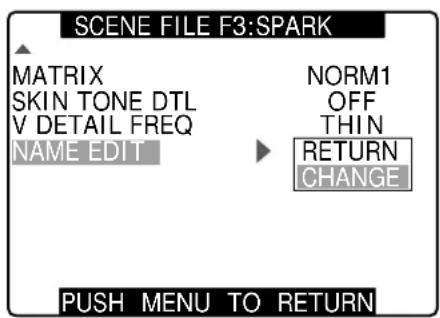
text_image
SCENE FILE F3:SPARK MATRIX NORM1 SKIN TONE DTL OFF V DETAIL FREQ THIN NAME EDIT RETURN CHANGE PUSH MENU TO RETURN4 When the screen shown below appears, use the JOG dial button to enter a 6-character file name.
- Turning the JOG dial button changes the character display in the following order: space (□) → alphabet (A to Z) → numerics (0 to 9) → symbols (; : <= > ? @ [ \ ] ^_-./). - If the RESET button is pressed when the filename has been set, the characters are cleared.
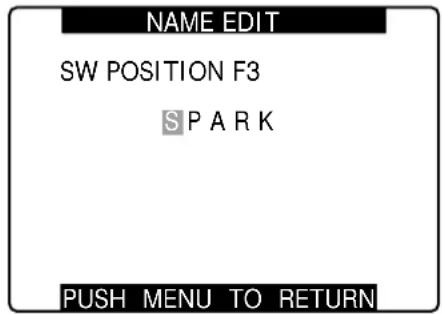
text_image
NAME EDIT SW POSITION F3 SPARK PUSH MENU TO RETURN- After you finish setting the filename, press the MENU button. This completes the NAME EDIT change. A change that has been confirmed is retained after a power down and is not affected by dial position. Items set for the scene file are also retained.
■ Example2: Save the F1 scene file to the camera.
1 Select the menu option LOAD/SAVE/INT in the SCENE FILE screen, then press the JOG dial button.
For details on menu operation, refer to [Using the menus] (page 120).
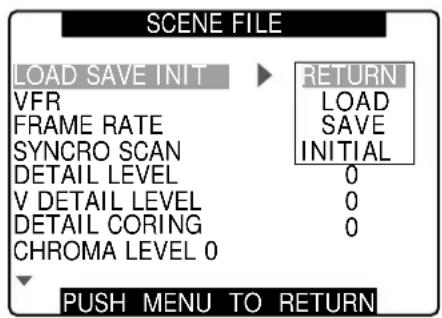
text_image
SCENE FILE LOAD SAVE INIT ▶ RETURN VFR LOAD FRAME RATE SAVE SYNCRO SCAN INITIAL DETAIL LEVEL 0 V DETAIL LEVEL 0 DETAIL CORING 0 CHROMA LEVEL 0 ▼ PUSH MENU TO RETURN2 Select SAVE and press the JOG dial button.
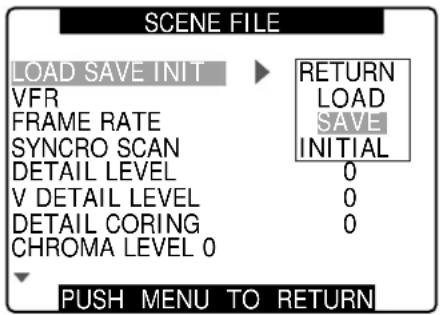
text_image
SCENE FILE LOAD SAVE INIT ▶ RETURN VFR LOAD FRAME RATE SAVE SYNCRO SCAN INITIAL DETAIL LEVEL 0 V DETAIL LEVEL 0 DETAIL CORING 0 CHROMA LEVEL 0 PUSH MENU TO RETURN3 Select YES and press the JOG dial button.
- To return to the menu level above, press the MENU button.
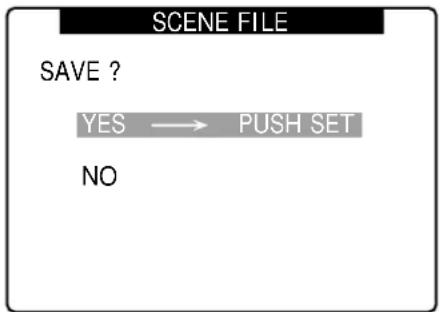
text_image
SCENE FILE SAVE ? YES → PUSH SET NO- "PROCESSING" appears and the following message is shown when all settings have been completed.

text_image
SAVE COMPLETED !- After changing the scene file settings, to return to the settings to the previously saved values, select LOAD in step 2 and perform the operation described in step 3.
- To return the scene file settings to their factory defaults, select INITIAL in step 2 and perform the operation described in step 3.
- To save and read user file settings or return them to their factory defaults, open the setting menu OTHER FUNCTIONS screen and run USER FILE in the same way as when handling scene files.
Saving scene files and other settings on SD memory cards
You can save up to four scene file settings or other settings as files on an SD memory card, and you can also load them from the card.
- Current scene file settings are automatically saved in the camera and written to an SD memory card. When data has been read from an SD memory card, the current settings are rewritten at the same time as the data saved inside the unit.
- The data in all the scene files, F1 to F6, is rewritten. Be sure to read [Handling SD memory cards] (page 81) regarding SD memory handling.
The following procedure shows how to save scene files.
1 Set the unit's POWER switch to ON.
2 Select the menu option SCENE FILE in the CARD FUNCTIONS screen, then press the JOG dial button.
For details on menu operation, refer to [Using the menus] (page 120).
3 Select CHANGE and press the JOG dial button.
- Select the menu option USER FILE for other settings.

text_image
CARD FUNCTIONS SCENE FILE USER FILE SD CARD FORMAT RETURN CHANGE >>>> PUSH MENU TO RETURN4 Select the file number (1 to 4) using the JOG dial button.
- Press the JOG dial button again to confirm the setting.
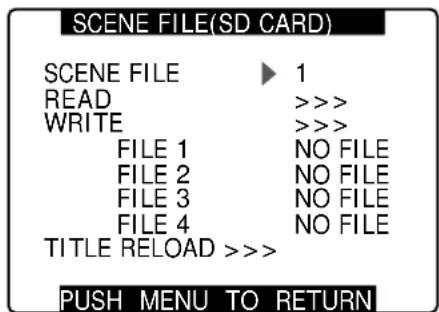
text_image
SCENE FILE(SD CARD) SCENE FILE ▶ 1 READ >>> WRITE >>> FILE 1 NO FILE FILE 2 NO FILE FILE 3 NO FILE FILE 4 NO FILE TITLE RELOAD >>> PUSH MENU TO RETURN5 Select WRITE and press the JOG dial button, then select EXECUTE and press the JOG dial button.

text_image
SCENE FILE(SD CARD) SCENE FILE 1 READ >>> WRITE ▶ RETURN FILE 1 EXECUTE FILE 2 NO FILE FILE 3 NO FILE FILE 4 NO FILE TITLE RELOAD >>> PUSH MENU TO RETURN6 Press the cursor button, turn the JOG dial button to move to YES and again press the JOG dial button.
- In the following example, TITLE 1 is the filename.
- When writing is completed, WRITE OK appears.
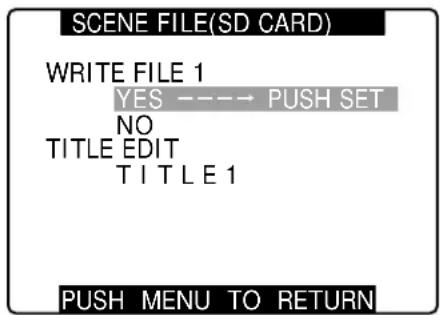
text_image
SCENE FILE(SD CARD) WRITE FILE 1 YES ---- PUSH SET NO TITLE EDIT TITLE 1 PUSH MENU TO RETURNTo load a file
Perform steps 1 to 4. Select READ in step 5, select EXECUTE and press the JOG dial button. READ OK appears when loading completes. Like scene files, process user files by using the menu option USER FILE in the CARD FUNCTION screen.
Reloading Files From an SD Memory Card
Perform steps 1 to 3, move to TITLE RELOAD so that YES is displayed in step 5, and press the JOG dial button. The file is reloaded.
To title a file
1 Perform steps 1 to 5.
2 Use the JOG dial button to select characters, then press the JOG dial button to move to the next character.
- You can input any of the following characters: Space, A to Z, 0 to 9, : ; <= > ? @ [ \ ] ^_-./
- You can erase all characters using the RESET button.
3 When all entries have been made, move the cursor to the right of the entered title.
4 Select YES and press the JOG dial button.
text_image
SCENE FILE(SD CARD) WRITE FILE 1 YES ---- PUSH SET NO TITLE EDIT TITLE 1 PUSH MENU TO RETURN- "WRITE OK" appears when the title is written.
NOTE
- If WRITE NG FORMAT ERROR appears, format the SD memory card.
- If WRITE NG WRITE PROTECT appears, change the lock tab position to enable writing.
- If WRITE NG CANNOT ACCESS appears, quit all other operations (such as playback) before proceeding.
- If WRITE NG ERROR appears, the SD memory card may be defective. Replace it.
Chapter 5 Preparation
Power Supply
A battery or an external DC power supply can be used as the power supply for the camera-recorder.
Using a Battery
The following is a list of batteries that have been tested and verified to work with the camera.
■Anton/Bauer batteries
PROPAC14, TRIMPACK14
HYTRON50, HYTRON140
DIONIC90, DIONIC160
■IDX batteries
NP-L7, ENDURA7, ENDURA10
■Sony batteries
BP-GL65/95
■PAG batteries
PAGL95
NOTE
- Although other batteries may be used by changing the menu setting, it is recommended that you use batteries that have been tested and verified to work with camera.
- Charge the battery with the battery charger before using it. (Please refer to the battery charger's instruction manual for information about charging.)
Mounting the Battery and Setting the Battery Type
Using an Anton/Bauer Battery
1 Mount an Anton/Bauer battery.
Power supply output connector for lighting
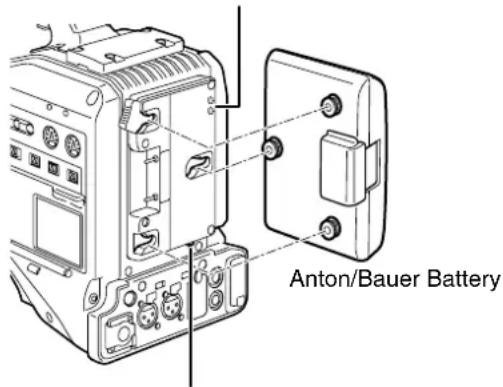
text_image
Anton/Bauer BatteryLighting control switch
NOTE
The Anton/Bauer battery holder includes both a power supply output connector for lighting and a lighting control switch, which are convenient when attaching a light. Please contact Anton/Bauer for information about the lighting system.
2 Insert the battery and slide it in the direction of the arrow.
Release lever
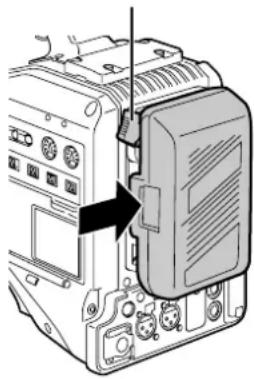
natural_image
Diagram of an electronic device with a black arrow pointing to a component, showing no text or symbols.NOTE
■Removing the battery
Completely push down and hold the release lever on the battery holder. Then, slide the battery in the opposite direction to the arrow while holding the lever down.
3 Set the battery type.
- Select the battery type listed under BATTERY SELECT. Select the menu option BATTERY SELECT from the setting menu BATTERY SETUP screen.
When using a V-mount type battery
Mount the V-mount adapter plate. Insert the plate and slide it as shown below.
- To remove the plate, slide the release lever downwards.
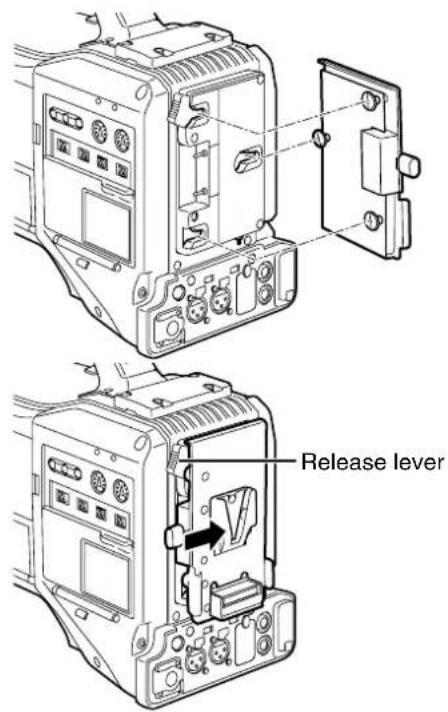
text_image
Release leverSetting the battery type
- Select the battery type listed under BATTERY SELECT. Select the menu option BATTERY SELECT from the setting menu BATTERY SETUP screen.
- When using a battery not listed under BATTERY SELECT: If it is a NiCD battery, select "NiCd14(14V)" and set each item according to the battery characteristics. If it is not a NiCd battery, select TYPE A or TYPE B and set each item according to the battery characteristics. For details, refer to [BATTERY SETUP screen] (page 134).
NOTE
- For information about the V-mount adapter plate, please contact the store where you purchased the camera-recorder.
- With the V-mount adapter plate installed, % (percent) values cannot be displayed when using batteries that show the remaining battery capacity.
Use of the external DC power supply
1 Connect the external DC power supply to the DC IN socket on the unit.
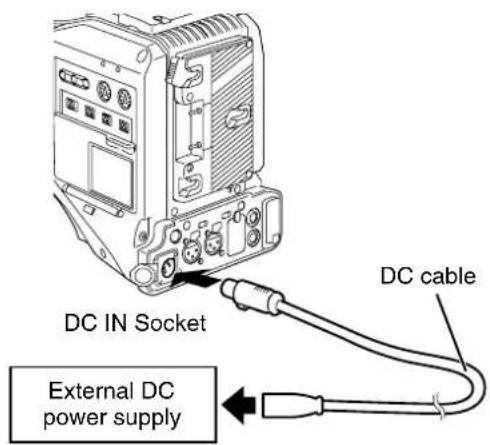
text_image
DC IN Socket External DC power supply DC cable2 Turn "ON" the power switch of the external DC power supply. (If the power switch is available on the external DC power supply)
3 Turn the camera-recorder power switch ON.
■Use of external DC power supply
Make sure that the output voltage of the external DC power supply meets the rated voltage of the camera before making a connection.
The output current of the external DC power supply should be large enough to provide the connected camera with its total amperage needs with a reasonable margin.
Use the following formula to calculate the total amperage of the camera.
total power consumption ÷ voltage
When the power is turned on, a rush current occurs. If the power supply is insufficient during this time, the camera may be damaged. Therefore, we recommend using an external DC power supply that provides at least twice the total power consumed by the camera and all the devices connected to the unit that power on when the camera powers on (example: lens, wireless microphone receiver). We also recommend using the proper DC cable recommended for your external DC power supply.
- When using an external power supply other than the AC adapter, check the DC IN socket pin information to ensure correct polarity. If a +12 V power supply is accidentally connected to the GND terminal, this could cause a fire or personal injury.
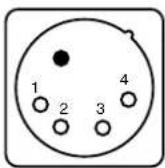
| Pin No. Signal | |
| 1 GND | |
| 2,3 | — |
| 4 +12V | |
NOTE
- When both the battery and the external DC power supply are connected, power is supplied from the external DC power supply. The battery can be removed or mounted while using an external DC power supply.
- When using an external DC power supply, make sure you turn on the external DC power supply before turning on the camera-recorder's power switch. If this sequence is reversed, the camera-recorder may malfunction due to slow rising of the external DC power supply voltage.
- To connect a battery to the DC IN connector, select BATTERY in the menu option EXT DC IN SEL, and select the battery type in the menu option BATTERY SELECT in the BATTERY SETUP screen. Note that with these settings, the “%” indication cannot be displayed, even for batteries capable of indicating remaining power.
Mounting and Adjusting the Lens
Mounting the Lens
1 Raise the lens clamping lever and remove the mount cap.

text_image
Lens Clamping Lever Mount Cap2 To mount the lens, align the indentation at the top center of the lens mount with the center mark of the lens.
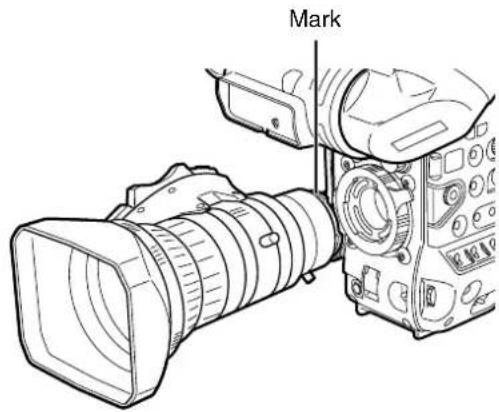
text_image
Mark3 Lower the lens lever to firmly tighten the lens.
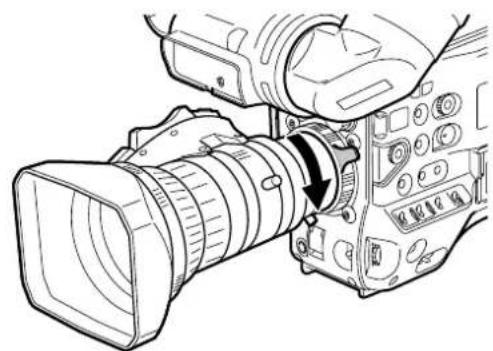
natural_image
Line drawing of a professional video camera with lens and control panel (no text or symbols)4 Secure the cable through the cable clamp, and plug it into the LENS connector.
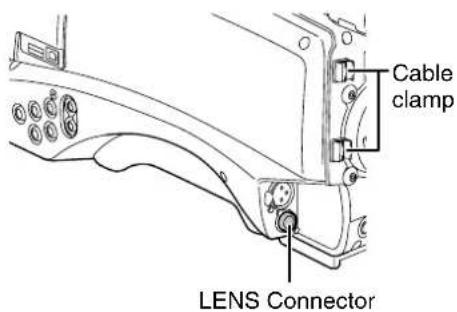
text_image
Cable clamp LENS Connector5 Adjust the lens flange back.
For details, refer to [Adjusting the Lens Flange Back] (page 90).
NOTE
- Please refer to the lens instruction manual for guidance on lens handling.
- When the lens is removed, install the mount cap to protect the device.
Adjusting the Lens Flange Back
If images are not clearly focused at both telephoto and wide-angle positions during zoom operations, adjust the flange back (distance from the lens mounting surface to the image formation surface).
Once adjusted, the flange back does not need to be re-adjusted as long as the same lens is mounted on the camera.
NOTE
Please also refer to the lens instruction manual for directions on adjustment and locations of individual lens parts.
1 Mount the lens on the camera.
- Make sure you connect the lens cable.
2 Set the lens iris to manual, and fully open the iris.

text_image
Approximately 3 m3 Place the flange back adjustment chart about 3 m from the lens and adjust the lighting on the chart to obtain an appropriate video output level.
- If the video level is too high, use the filters or the shutter.
4 Loosen the F.f (Flange focus) ring clamping screw.
NOTE
F.b (Flange back) may be indicated on some lenses.
5 Set the zoom ring to the telephoto position, either manually or by electric drive.
6 Shoot the flange back adjustment chart and turn the distance ring to adjust focus.
7 Set the zoom ring to the wide-angle position and turn the F.f (flange focus) ring to adjust focus.
- Do not move the distance ring during focusing.
8 Repeat Steps 5 to 7 until the lens is in focus at both the telephoto and wide-angle positions.
9 Firmly tighten the F.f ring clamping screw.
White Shading Compensation
The camera can use DEFAULT (fixed value) and three user adjustable functions (USER1, USER2, USER3) to store white shading compensation data. Select SHADING SELECT in the setting menu LENS SETUP screen to set compensation data. Selecting OFF turns off shading compensation.
Selecting White Shading Compensation Data
1 Select SHADING SELECT in LENS SETUP, then press the JOG dial button.
For details on menu operation, refer to [Using the menus] (page 120).

text_image
LENS SETUP SHADING SELECT ▶ DEFAULT SHADING(USER) >>> CAC ON CAC PROPERTY >>> CAC CARD READ >>> CAC FILE DELETE >>> CAC FILE INIT >>> IRIS ADJUST >>> PUSH MENU TO RETURN2 Use the JOG dial button to select DEFAULT, USER1, USER2, USER3 or OFF and press the JOG dial button.
- To adjust the white shading, select USER1, USER2 or USER3.
- The USER1, USER2 or USER3 settings do not contain any compensation data by default.
- DEFAULT stores compensation data that suits XT17x4.5BRM-K14. For lenses other than those above, perform the "White Shading Adjustment" described below.
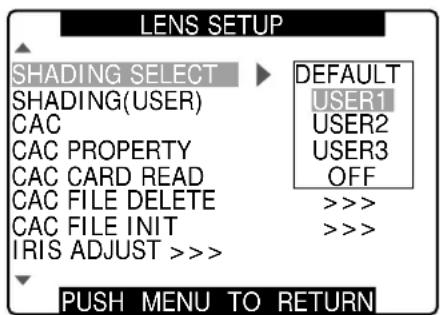
text_image
LENS SETUP SHADING SELECT ▶ DEFAULT SHADING(USER) User1 CAC USER2 CAC PROPERTY USER3 CAC CARD READ OFF CAC FILE DELETE >>> CAC FILE INIT >>> IRIS ADJUST >>> PUSH MENU TO RETURNWhite Shading Adjustment
NOTE
Coloring may occur in the vertical direction near the open setting of the lens iris even when the white shading has been adjusted. This is an optical characteristic and not indicative of a failure.
1 Place the camera in the adjustment mode.
(1) Mount a lens on the camera.
- Do not forget to connect the lens cable.
(2) Turn the shutter switch off and set 0 dB gain
(3) If the lens comes with an extender, disengage it.
(4) Open the setting menu LENS SETUP screen and select USER1, USER2 or USER3 under SHADING SELECT.
(5) Use the JOG dial button to select SHADING (USER), select EXECUTE and press the JOG dial button.
- The message "CHECK LUMINANCE LEVEL ZEBRA ON VF" appears.

text_image
LENS SETUP SHADING SELECT SHADING(USER) CAC CAC PROPERTY CAC CARD READ CAC FILE DELETE CAC FILE INIT IRIS ADJUST > > > USER1 RETURN EXECUTE >>> > >>> > >>> > >>> > PUSH MENU TO RETURN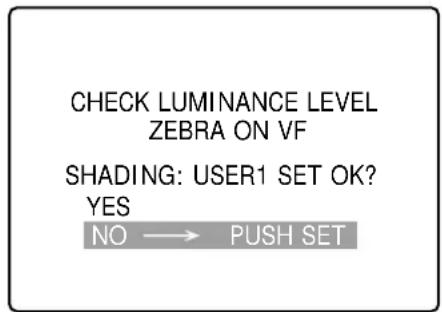
text_image
CHECK LUMINANCE LEVEL ZEBRA ON VF SHADING: USER1 SET OK? YES NO → PUSH SET2 Set the image.
(1) Shoot a solid white sheet of paper.
(2) Set the lens iris to manual and adjust the iris so that a zebra pattern fills the entire viewfinder screen.
- When the piece of paper is unevenly lit, the zebra pattern will not cover the entire screen. Adjust as required.
- Make sure that the white paper is not exposed to multiple light sources (example, fluorescent lighting or halogen lamps) of different color temperatures.
SHADING: USER1 SET OK?
YES

NOTE
- Adjust the white shading in sunlight, under halogen lamp light or other light source that does not flicker. Fluorescent light and mercury lamps tend to flicker and should not be used for this adjustment.
- Adjust the light source if the lens iris is out of the range between F4 and F11.
• Make sure the electronic shutter is set to off.
3 Adjust white and black balance.
(1) Set the WHITE BAL switch to A or B and use the AUTO W/B BAL switch to make an automatic white balance adjustment.
(2) Use the AUTO W/B BAL switch to make an automatic black balance adjustment.
(3) Again, use the AUTO W/B BAL switch to make an automatic white balance adjustment.
4 Repeat the operation in step 2-(2).
5 Adjust white shading.
(1) Use the JOG dial button to select YES and press the JOG dial button.
(2) The message "SHADING ACTIVE" appears on the screen during adjustment.
(3) When the adjustment ends after a few seconds, the message "SHADING OK" appears.
- When an error message such as "SHADING NG LEVEL OVER" or "SHADING NG LOW LIGHT" appears, adjust the iris.
- The adjusted value is automatically stored in memory (USER1, USER2, USER3).
6 If the lens is provided with an extender, turn on the extender function and perform steps 2 to 5 again.
- The white shading adjustment need not be readjusted when the extender is later turned off.
Setting Chromatic Aberration Compensation (CAC)
The CAC function of the camera corrects the registration error caused by the slight chromatic aberration that the lens cannot compensate for. This minimizes color bleeding into the surrounding image areas.
Lenses compatible with the CAC function whose CAC data is registered in the camera will automatically start CAC operation.
CAC data for the following lenses have been stored in the camera as default values.
| Camera indication | Model numbers of compatible lenses |
| ZT17X4.5BRM-K14 XT17x4.5BRM-K14 | |
NOTE
- One of the lens model number appearing in the menu represents the lens group.
- The CAC function in this camera operates in horizontal direction only.
• The CAC function does not operate at +24 dB. - The CAC function may not operate normally in macro shooting.
- After the release of this camera, visit our Web site at the address given below for details on new lenses compatible with this function and any changes in this function.
Checking CAC Operating Status
When the menu is not open, the CAC indication at the top right of the screen indicates that the CAC function is on.
Checking CAC data number and CAC data during operation
1 Open the LENS SETUP screen.
For details on menu operation, refer to [Using the menus] (page 120).
2 Turn the JOG dial button to select CAC PROPERTY and select DISPLAY to open the CAC PROPERTY screen.
• The CAC property list appears.
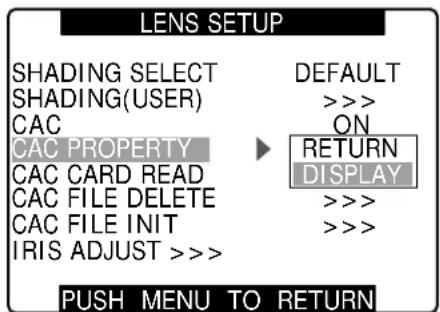
text_image
LENS SETUP SHADING SELECT DEFAULT SHADING(USER) >>> CAC ON CAC PROPERTY RETURN CAC CARD READ DISPLAY CAC FILE DELETE >>> CAC FILE INIT >>> IRIS ADJUST >>> PUSH MENU TO RETURN■CAC Property
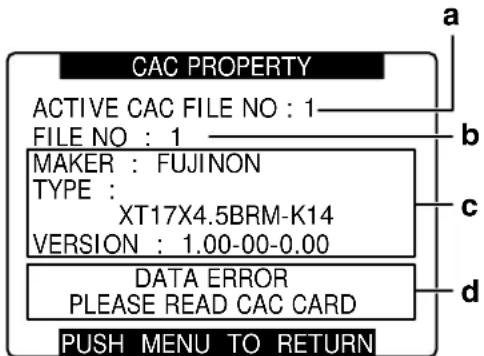
text_image
CAC PROPERTY ACTIVE CAC FILE NO : 1 FILE NO : 1 MAKER : FUJINON TYPE : XT17X4.5BRM-K14 VERSION : 1.00-00-0.00 DATA ERROR PLEASE READ CAC CARD PUSH MENU TO RETURNa Current CAC data number
b Data number of CAC you wish to check
Turn the JOG dial to select.
c CAC data of the specified file (b)
d Error messages
The file cannot be used if an error message appears. Initialize the CAC data or reload the CAC file from an SD card.
For details, see [Initializing CAC File] (page 94) or [Loading CAC File From an SD Card] (page 93).
Loading CAC File From an SD Card
1 Open the LENS SETUP screen.
For details on menu operation, refer to [Using the menus] (page 120).
2 Use the JOG dial button to select CAC CARD READ. Then select EXECUTE to open the CAC CARD READ screen.
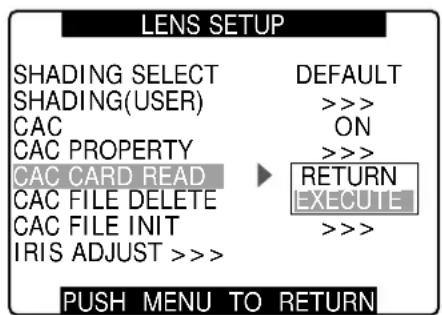
text_image
LENS SETUP SHADING SELECT DEFAULT SHADING(USER) >>> CAC ON CAC PROPERTY >>> CAC CARD READ RETURN CAC FILE DELETE EXECUTE CAC FILE INIT >>> IRIS ADJUST > >> PUSH MENU TO RETURN3 Use the JOG dial button to select the CAC file to load. Then select YES and press the JOG dial button.

text_image
CAC CARD READ ZT17X4.5BRM-K1 ---- ---- ---- ---- ---- ---- ---- ---- PUSH MENU TO RETURN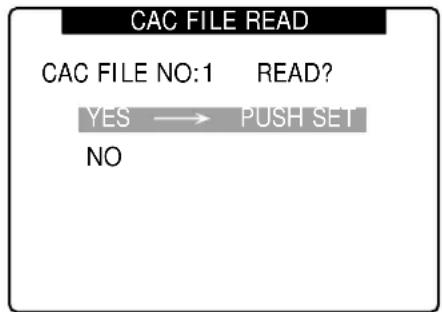
text_image
CAC FILE READ CAC FILE NO:1 READ? YES → PUSH SET NO
NOTE
• The camera can load up to 8 files.
When an attempt is made to load a new file while 8 files have already been loaded, "READ NG CAC FILE FULL" appears. To load a new file, delete an existing file before loading the new file.
For details, see [Deleting CAC File] (page 96).
- "READ NG FORMAT ERROR" indicates the file cannot be used and will not be loaded. Make sure the file is in a format the camera supports and that the file on the SD card is not corrupted.
Deleting CAC File
1 Open the LENS SETUP screen.
For details on menu operation, refer to [Using the menus] (page 120).
2 Use the JOG dial button to select CAC FILE DELETE, select EXECUTE and press the JOG dial.
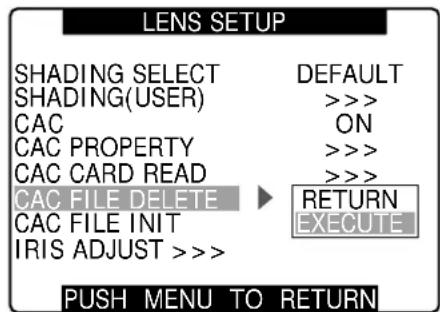
text_image
LENS SETUP SHADING SELECT DEFAULT SHADING(USER) >>> CAC ON CAC PROPERTY >>> CAC CARD READ >>> CAC FILE DELETE RETURN CAC FILE INIT EXECUTE IRIS ADJUST >>> PUSH MENU TO RETURN3 Use the JOG dial to select the CAC file to be deleted. Then select YES and press the JOG dial button.
"----" is indicated when deletion ends.

text_image
CAC FILE DELETE 1:XT17X4.5BRM-K14 2: ---- 3: ---- 4: ---- 5: ---- 6: ---- 7: ---- 8: ---- PUSH MENU TO RETURN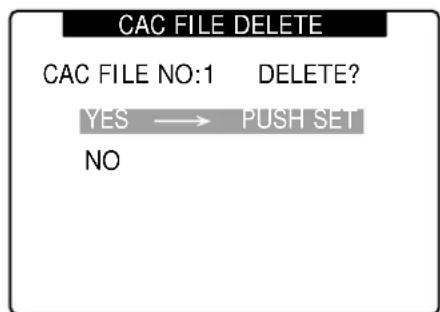
text_image
CAC FILE DELETE CAC FILE NO:1 DELETE? YES → PUSH SET NOInitializing CAC File (Returning Data to Their Factory Defaults)
1 Open the LENS SETUP screen.
For details on menu operation, refer to [Using the menus] (page 120).
2 Use the JOG dial button to select CAC FILE INIT. Then select YES to display the confirmation screen.
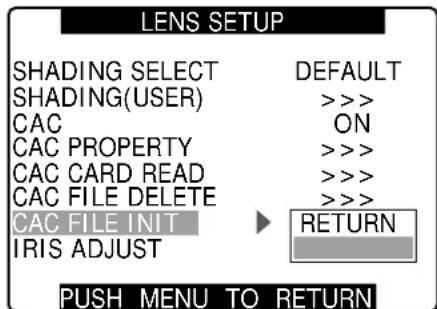
text_image
LENS SETUP SHADING SELECT DEFAULT SHADING(USER) >>> CAC ON CAC PROPERTY >>> CAC CARD READ >>> CAC FILE DELETE >>> CAC FILE INIT RETURN IRIS ADJUST PUSH MENU TO RETURN3 Select YES in the confirmation screen and press the JOG dial button.
- CAC FILE INIT PROCESSING COMPLETED (these three appear in succession) to indicate that initialization has been completed. - The LENS SET UP screen appears after completion.
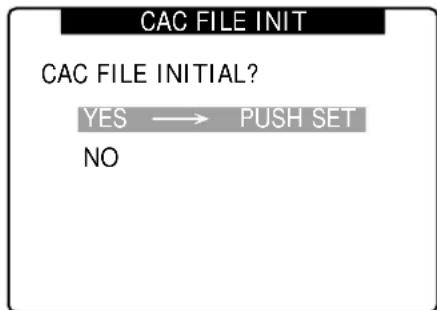
text_image
CAC FILE INIT CAC FILE INITIAL? YES → PUSH SET NONOTE
This operation deletes all files loaded into the camera and returns the four CAC data files to their factory defaults.
Preparing for Audio Input
Take the following steps to prepare the camera for connecting audio input devices.
When Using the Front Microphone
The AG-MC200G microphone kit (optional) includes a microphone that can be mounted on the camera.
1 Open the microphone holder.
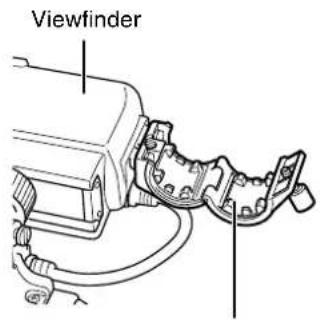
text_image
ViewfinderMicrophone holder
2 Mount the microphone and tighten the clamping screw.
Clamping Screw

natural_image
Technical line drawing of a mechanical assembly with no visible text or symbols3 Connect the microphone cable to the MIC IN jack on the camera.
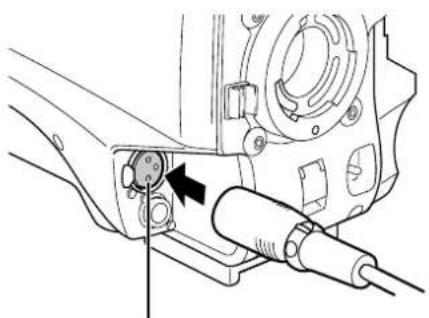
natural_image
Technical line drawing of a mechanical assembly with no visible text or symbolsMIC IN Jack
4 Set the AUDIO IN switch to [FRONT] depending on the audio channel to be recorded.
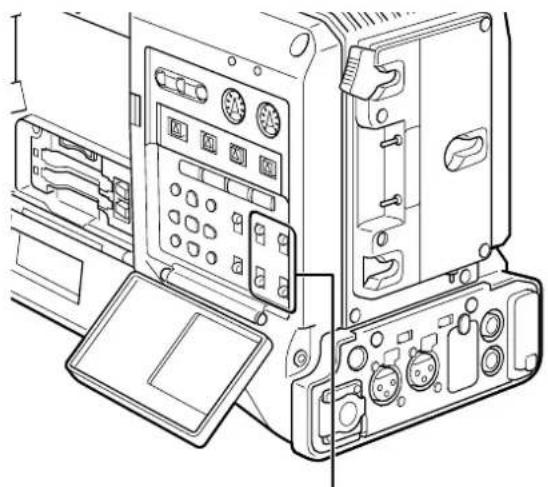
natural_image
Technical line drawing of a device chassis showing front panel, control panel, and rear panel (no text or symbols)AUDIO IN Switch
Using a wireless receiver
1 Remove the lid, install the wireless receiver and screw it down.
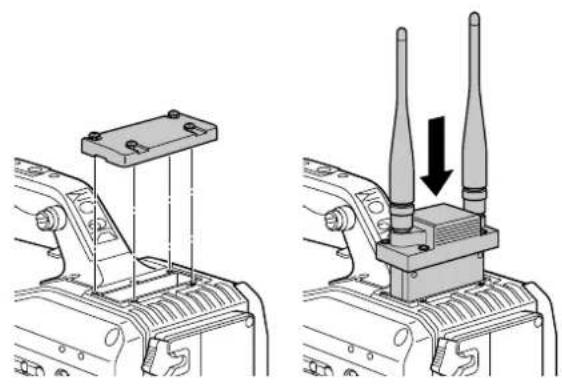
natural_image
Technical illustration of mechanical assembly with two views showing internal components and a downward arrow indicating motion (no text or symbols)2 Set the AUDIO IN switch to W.L. for the audio channels that will be recorded.
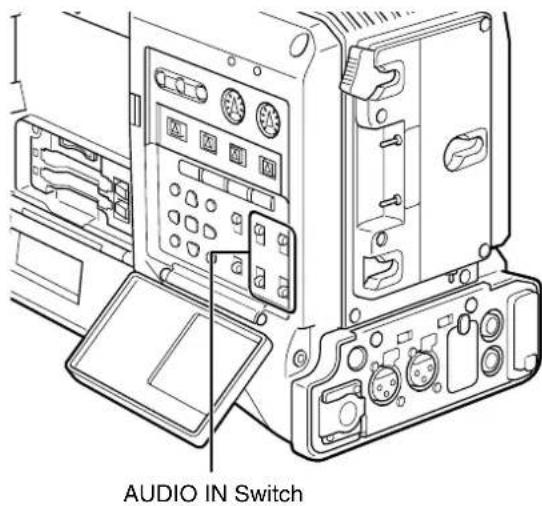
text_image
AUDIO IN Switch- Set the menu option WIRELESS TYPE in the AUDIO SETUP screen to DUAL for a 2-channel wireless receiver.
When Using Audio Devices
1 Connect the audio device to the AUDIO IN jack with the XLR cable.
2 Set the AUDIO IN switch to [REAR] for the channel to which the XLR cable is connected.
3 Set the LINE/MIC/+48V selector switch on the rear panel to [LINE].

text_image
LINE/MIC/+48V Selector Switch AUDIO IN Switch AUDIO IN JackAttaching Accessories
Mounting the Camera on a Tripod
Use an optional (SHAN-TM700) tripod adapter to place the camera on a tripod.
1 Attach the tripod adapter to the tripod.

text_image
Tripod adapter Pan headNOTE
Use the holes in the tripod adapter that will make it possible to position the camera over the tripod adapter's center of gravity.
Also, make sure that the diameter of the selected hole matches the diameter of the pan head screw.
2 Attach the camera to the tripod adapter.
- Slide the camera forward along the grooves until you hear a "click".
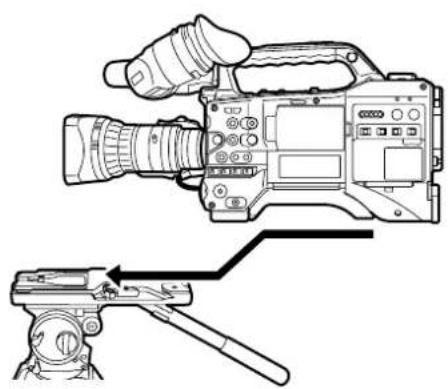
natural_image
Line drawing of a professional video camera with attached tool (no text or symbols)Removing the Camera from the Tripod Adapter
While holding the red lever down, move the black lever in the direction of the arrow, and slide the camera backward to remove it.
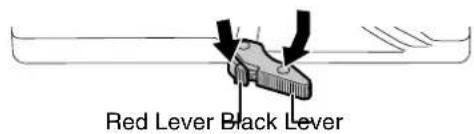
text_image
Red Lever Black LeverNOTE
If the tripod adapter's pin does not return to its original position after the camera has been removed, hold the red lever down and move the black lever in the direction of the arrow again, in order to return the pin to its original position. Please note that the camera cannot be mounted if the pin remains in the center.
Attaching the Shoulder Strap
Attach the shoulder strap to the shoulder strap bracket. To detach the shoulder strap, first open the hooks, then detach the strap.
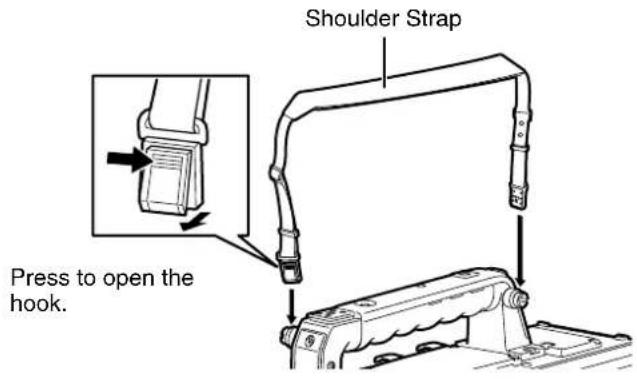
text_image
Shoulder Strap Press to open the hook.NOTE
Make sure that the shoulder strap is securely attached.
Attaching the Rain Cover
When using the SHAN-RC700 Rain Cover
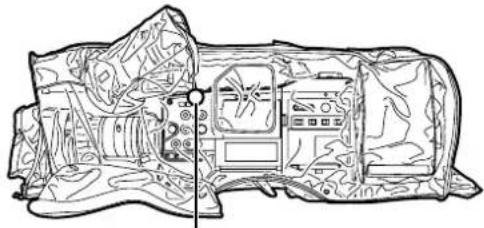
natural_image
Line drawing of a mechanical component with internal components and no visible text or symbolsTighten the cord
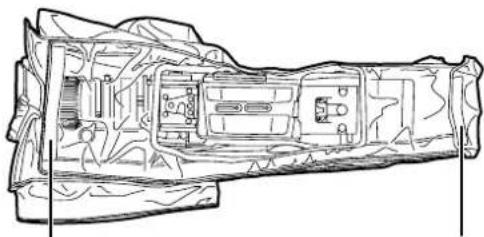
natural_image
Technical line drawing of a vehicle chassis frame with internal components (no text or labels)Secure with the surface fastener
Secure with the surface fastener
Attaching the FRONT AUDIO LEVEL Control Knob
If you use the FRONT AUDIO LEVEL control frequently, attach the accessory knob so that it can be easily operated.
FRONT AUDIO LEVEL Control Knob (Accessory)
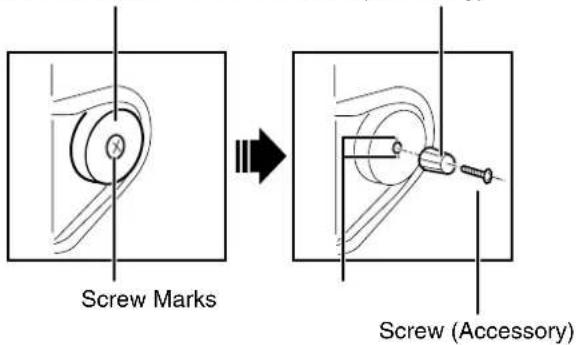
text_image
Screw Marks Screw (Accessory)Remove the screw in the center of the FRONT AUDIO LEVEL control, and attach the accessory knob using the screw (included). When attaching the knob, be sure to align the marks on the control with the marks on the knob.
DC OUT Connector and External REC Start/Stop Switch Connection
The DC OUT connector on the camera can output a 1.5 A current.
Connecting an external switch to this connector enables REC Start and Stop control.
An LED can be connected and used as a tally lamp, which is convenient when the camera is mounted on a crane during recording.
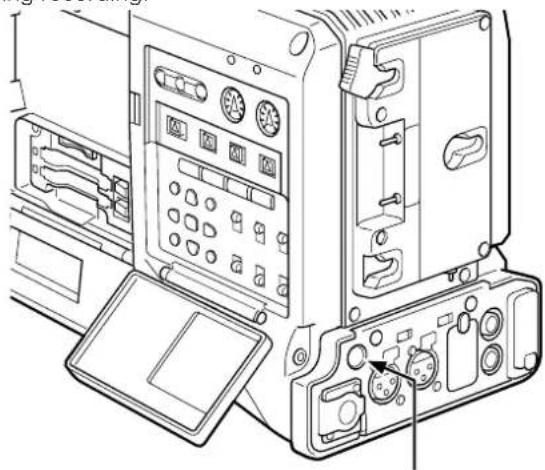
natural_image
Technical line drawing of an electronic device chassis with control panel and buttons (no text or symbols)DC OUT connector
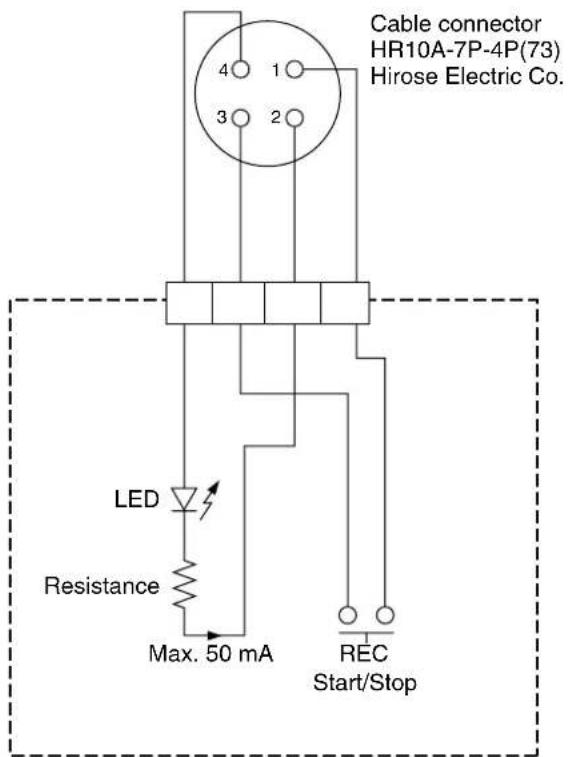
text_image
Cable connector HR10A-7P-4P(73) Hirose Electric Co. 4 1 3 2 LED Resistance Max. 50 mA REC Start/Stop1: GND
2: TALLY OUT
The AG-HPX300P has open collector output
TALLY ON:
Low impedance
TALLY OFF:
High impedance
3: REC Start/Stop switch
This pin is connected in parallel with the REC button and the lens VTR button.
4: +12 V
NOTE:
- Make sure that the total current output by DC OUT, REMOTE, VF and LENS connectors does not exceed 2.5 A.
- Be sure to check polarity before connecting an external device as incorrect connection could lead to damage.
Connecting the AJ-RC10G Remote Controller
- Some functions can be remote-controlled when the remote control unit AJ-RC10G (optional accessory) is connected to the camera.
- When the AJ-RC10G is connected, the camera automatically enters remote control mode after the power switches of both the camera and the AJ-RC10G are turned ON.

natural_image
Diagram showing a device panel with ports and an external control panel connected by an arrow (no text or symbols present)REMOTE connector AJ-RC10G
NOTE
- Be sure to turn the POWER switches on the camera and the AJ-RC10G off before connecting or disconnecting the controller cable.
- Use only designated cables or optional cables to connect the AJ-RC10G. Use of other cables could result in equipment damage.
- The USER buttons and MENU button do not work when the AJ-RC10G is connected.
- Refer to the Operating Instructions of the AJ-RC10G included in the supplied CD-ROM.
Chapter 6 Manipulating Clips with Thumbnails
A clip is a data group that includes the images and sounds created from one shooting session, together with additional information such as text memos and meta data.
The following manipulations can be performed using the cursor and SET buttons, while checking the images displayed on the LCD monitor:
- Playback, delete, copy or restore the clip.
- Add or delete a shot mark and a text memo on the clip thumbnail.
• Copy part of a clip by using the text memo. - Use a text memo to change thumbnail images
- Format P2 cards and SD memory cards.
- Uploading and editing clip metadata from the SD memory card
Thumbnail Operations
Thumbnail Manipulations Overview
Thumbnail screens are configured as follows:
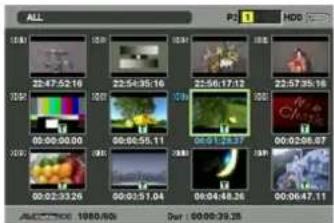
text_image
ALL 22:47:52.16 00:00:00.00 00:02:53.26 22:54:35.16 00:00:55.11 00:01:51.04 22:56:17.12 00:04:48.26 22:57:35.16 00:02:56.87 00:06:47.11 AUSTRY 1980/9/8 Dur 00:00:39.28THUMBNAIL OPERATION PROPERTY
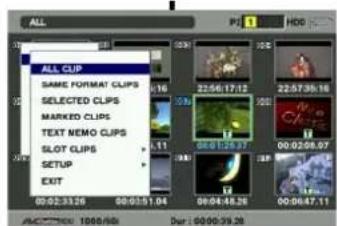
text_image
ALL ALL CLIP SAME FORMAT CLIPS SELECTED CLIPS MARKED CLIPS TEXT NEMO CLIPS SLOT CLIPS SETUP EXIT 00:02:33.26 00:03:51.04 22:56:17.12 22:57:35.16 00:02:58.07 00:04:18.26 00:04:57.11 ACCTON 1000/HSI Dur : 00:00:39.26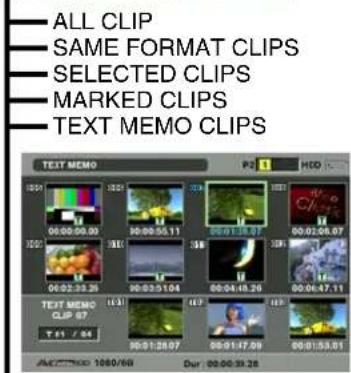
text_image
ALL CLIP SAME FORMAT CLIPS SELECTED CLIPS MARKED CLIPS TEXT MEMO CLIPS TEXT MEMO CLIP 07 T:1 / 04 P: 1 HCD 12 06:00:00.03 06:00:00.11 06:00:00.25 06:00:00.31/04 06:00:00.39 06:00:00.48/29 06:00:00.57/11 06:00:00.66/28 06:00:00.75/27 06:00:00.84/26 06:00:00.93/25 06:00:01.02/24 06:00:01.11/23 06:00:01.20/22 06:00:01.31/21 06:00:01.42/20 06:00:01.53/19 06:00:01.64/18 06:00:01.75/17 06:00:01.86/16 06:00:01.97/15 06:00:01.18/14 06:00:01.29/13 06:00:01.42/12 06:00:01.55/11 AutoCAD 108D/68 Dur 08:00:39.28
flowchart
graph TD
    A["SLOT CLIPS"] --> B["EXIT"]
    C["SETUP"] --> B
    D["INDICATOR"] --> B
    E["DATA DISPLAY"] --> B
    F["DATE FORMAT"] --> B
    G["THUMBNAIL SIZE"] --> B
    H["PLAYBACK RESUME"] --> B
    I["THUMBNAIL INIT"] --> B
    J["EXIT"] --> B
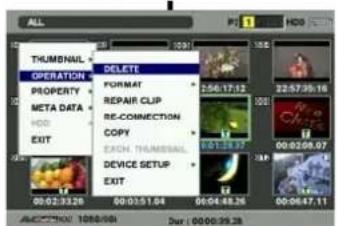
text_image
ALL THUMBNIL OPERATION DELET PROPERTY META DATA HDD EXIT 00:02:33.26 00:02:51.04 00:04:48.26 00:06:47.11 2:56:17.12 REPAIR CLIP RE-CONNECTION COPY EXCH THUMBIL DEVICE SETUP EXIT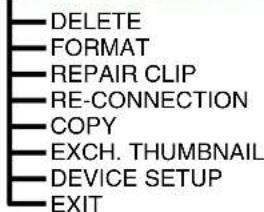
text_image
DELETE FORMAT REPAIR CLIP RE-CONNECTION COPY EXCH. THUMBNAIL DEVICE SETUP EXIT
text_image
ALL THUMBNAIL OPERATION PROPERTY META DATA HDD EXIT CLIP PROPERTY CARD STATUS DEVICES PROPERTY SETUP EXIT 00:02.35.26 00:03.51.04 00:04.45.29 00:06.47.11 00:06.37.12 22:57:35:16 00:02.05.07 00:06.37.11 Dur : 00:00-35:28
text_image
CLIP PROPERTY PROPERTY 0009 11 VOICE MEMO 0 TEXT MEMO 4 GLOBAL CLIP ID USER CLIP NAME VIDEO AUDIO ACCESS DEVICE SHOOT SCENARIO NEWS MEMO THUNDERWAL. CLIP NAME : 000SPH START TG : 960128.47 START UB : 00000000 DATE : AUG-03-2005 TIME : 13:36:56 (MINT-06:00) CURATION : 00:00:39.38 V FORMAT : AYCL_104_1080/59.94 FRAME OUTPUT : 16.541 REC RATE : ACCESS PUSH "EXIT" IN MENUTO EXIT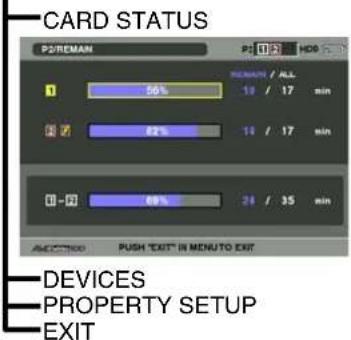
text_image
CARD STATUS PORTERMAN P: 10 / HDD 1 56% 19 / 17 min 2 82% 19 / 17 min 0 - 31 69% 24 / 35 min ANDCSTOO PUSH "EXIT" IN MENUTO EXIT DEVICES PROPERTY SETUP EXITHDD

META DATA

text_image
LOAD RECORD USER CLIP NAME INITIALIZE PROPERTY EXITThumbnail Screen
Press the THUMBNAIL button to display the thumbnail screen on the LCD monitor. Pressing the THUMBNAIL button again returns the display to the regular display. When switching is done from the regular screen display to the thumbnail screen display, all the clips will be displayed on the thumbnail screen. Pressing the THUMBNAIL MENU button allows you to navigate the thumbnail menu.

NOTE
When the TCG switch is set to "SET" to set the time code and user bits or when the camera menu is open, the THUMBNAIL button does not work.
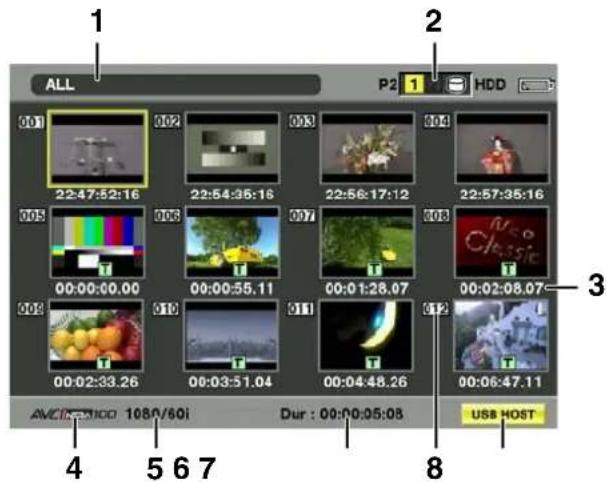
text_image
ALL P2 1 HDD 001 22:47:52:16 002 22:54:36:16 003 22:56:17:12 004 22:57:36:16 005 00:00:00.00 006 00:00:55.11 007 00:01:28.07 008 00:02:08.07 009 00:02:33.26 010 00:03:51.04 011 00:04:48.26 012 00:06:47.11 AVCC#130D 108V/60i Dur : 00:00:05:08 USB HOST 4 5 6 7 8
text_image
9 10 X! MPTEW 11 12 13 14 151 Display Mode
Displays thumbnail types and other information screens.
ALL: Display all clips.
SAME FORMAT:
The clips in the same format as the system format are shown. To check the format, consult system mode and REC FORMAT indicated on the STATUS screen of the viewfinder. For details, see [Viewfinder Screen Status Displays] (page 65).
SELECT: The clips selected with the SET button are shown.
MARKER:
Display clips with shot marks.
TEXT MEMO:
Display clips with text memo data.
SLOT n: This indicates a specific clip on the P2 card. (n: slot number 1 or 2)
UPDATING..:
Indicated when the unit is updating the screen or reading data. When the screen is being updated, the rotating icon is indicated. For details, refer to [Switching the Thumbnail Display] page 105).
2 Slot numbers and HDD status
This function indicates on which P2 card the selected clip is recorded. The number of the slot that contains the appropriate P2 card is indicated in yellow. If the clip is recorded on more than one P2 card, then the numbers of all slots that contain the appropriate cards are indicated. The numbers of the other slots are shown in white if they contain P2 cards.
When the following P2 card is inserted, the slot number is displayed with a pink frame.
● RUN DOWN CARD
(A P2 card on which the maximum number of overwrites has been exceeded.)
- DIR ENTRY NG CARD
(A P2 card on which the directory structure is not supported.)
The USB HDD section is indicated as follows:
● Other than the USB HOST mode: gray
● Not connected in USB HOST mode: gray
- HDD recognized and usable in USB HOST mode: white
- HDD recognized and thumbnails shown in USB HOST mode: yellow
- HDD recognized and data unable to be copied in USB HOST: red
3 Time Display
You can set this to display the time code at the start of clip recording, the user bits at the start of clip recording, the shooting time, the shooting date, the shooting date and time or USER CLIP NAME.
4 Recording mode
The recording mode for the clip on which the pointer is located is indicated.
5 System mode
The format for the clip on which the pointer is located is indicated.
6 Duration
The duration of the clip on which the pointer is located is indicated.
7 USB HOST mode indicator
Indicated when the mode has been switched to USB HOST.
8 Clip Number
The numbers set by the camera for all the clips recognized correctly by the P2 card. These numbers are allocated in chronological order, by shooting dates and times.
If clips cannot be played because of different recording formats, they are displayed in red.
9 ☒ Defective Clip Indicator and
? Unknown Clip indicator
This marker is displayed for defective clips, which may result from a variety of causes, e.g., powering-down during recording.
Clip with yellow defective clip indicators can be restored in some cases. Please refer to [Restoring Clips] (page 109) for more information.
A clip displayed with a red defective clip indicator cannot be restored and must be deleted. If the clip cannot be deleted, format the P2 card.
☐ is displayed for clips such as those which differ in format from the P2 standard.
10 ! Incomplete Clip Indicator
Indicates that although a clip is recorded across multiple P2 cards, one of these cards is not inserted into a P2 card slot.
11 M Shot Mark Indicator
This marker is displayed for a clip with a shot mark attached. For details, refer to [Shot Marker (SHOT MARK) Recording Function] (page 42).
12 P Indicator for clips with proxy
This marker is displayed for clips with proxy attached.
13 T Text Memo Indicator
This marker is displayed for a clip with a text memo attached.
14 Edit Copied Clip Indicator
In models which support edit copying, such as the AJ-HPM110, this marker is displayed on clips which have undergone edit copying. For more information about edit copying, see the instruction manual for a model that supports edit copying.
15 W Wide Clip Indicator
This marker is displayed for clips recorded with the 16:9 aspect ratio. However, it does not accompany clips in HD format.
Selecting Thumbnails
Multiple thumbnails can be randomly selected in the thumbnail screen.
1 Use the cursor buttons to move the pointer (yellow frame) to the desired clip and press the SET button.
- The frame around the selected thumbnail changes to a blue frame. Press the SET button again to deselect the clip.
2 Additional clips can be selected by repeating step 1.
It is possible to display only the selected thumbnails in the thumbnail screen for playback. Please refer to [Switching the Thumbnail Display] (page 105) for more information.
NOTE
- To move the pointer to the first or last clip, hold down the SHIFT button and press the up and down cursor ( / ) buttons.
- To select a sequence of clips, select the first clip and move the pointer to another clip. Then hold down the SHIFT button and press the SET button. This will select all clips from the clip selected first to the clip at the pointer and all clips in between.
- To cancel selected clips, hold down the SHIFT button while pressing the EXIT button.
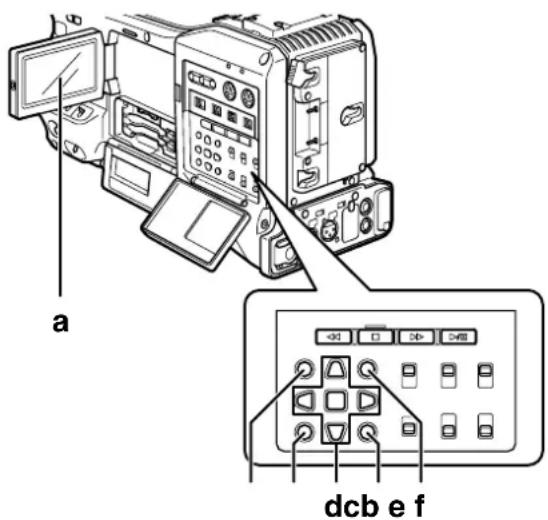
text_image
a dcb e fa LCD monitor
b THUMBNAIL button
c EXIT button
d ▲▶▼◀cursor buttons
SET button
e THUMBNAIL MENU button
f SHIFT button
Playing back Clips
1 Press the THUMBNAIL button.
- The thumbnail screen appears on the LCD monitor.
2 Use the cursor buttons to move the pointer over the desired clip.
3 Press the PLAY/PAUSE button.
- The clip at pointer position is played back on the LCD monitor.
- After the clip at the cursor location has been played, subsequent clips are played back in order. When the last clip has been played, the thumbnail screen appears.
NOTE
- When playing back clips, it is not necessary to "select" the clips (blue frames around the thumbnails).
-
Clips with clip numbers displayed in red cannot be played.
-
During playback, pressing the REW button starts 4X speed reverse playback, and the FF button starts 4X speed fast playback. Press the PLAY/PAUSE button to return to normal playback.
- During clip playback, pressing the PLAY/PAUSE button will temporarily stop (pause) the process.
- During playback, pressing the REW button starts 4X speed reverse playback, and the FF button starts 4X speed fast playback. Press the PLAY/PAUSE button to return to normal playback.
- During clip playback, pressing the PLAY/PAUSE button will temporarily stop (pause) the process.
During a pause, pressing the REW button moves the pause position to the beginning of the clip. Pressing the REW button again moves the pause position to the beginning of the previous clip. During a pause, pressing the FF button moves the pause position to the beginning of the next clip. - Pressing the STOP button during clip playback stops the playback and returns the display to the thumbnail screen.
NOTE
- When playback is stopped, the position of the pointer moves to the clip that was being played back, regardless of where playback started.
- When the PLAY/PAUSE button is pressed again, playback will start from the beginning of the clip on which the pointer is positioned. To begin playback from the last stop position, set PLAYBACK RESUME to on. Refer to [Setting the Thumbnail Display Mode] (page 115) for further details.
- After closing the thumbnail screen by pressing the THUMBNAIL button, pressing the PLAY/PAUSE button plays back the first clip (i.e., the clip with the earliest recording date and time), not the clip on which the pointer was last positioned.
Switching the Thumbnail Display
The display can be switched so that only those clips matching the specified conditions are displayed in the thumbnail screen.
1 Press the THUMBNAIL button.
- The thumbnail screen appears on the LCD monitor.
2 Press the THUMBNAIL MENU button.
• The thumbnail menu opens.

natural_image
Technical line drawing of a device chassis showing front panel, internal components, and base panel (no text or symbols)a THUMBNAIL MENU button
3 Select THUMBNAIL from the thumbnail menu.
- Switch the thumbnail display by selecting one of the following items:
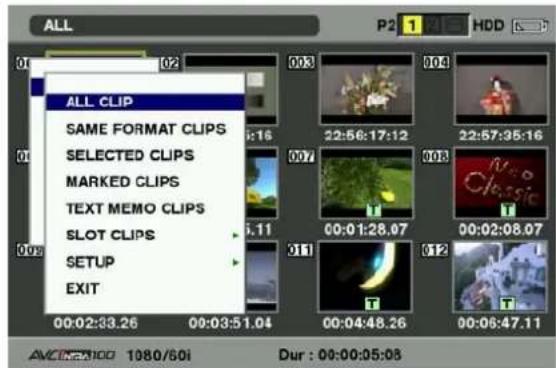
text_image
ALL ALL CLIP SAME FORMAT CLIPS SELECTED CLIPS MARKED CLIPS TEXT MEMO CLIPS SLOT CLIPS SETUP EXIT 00:02:33.26 00:03:51.04 00:04:48.26 00:06:47.11 AVCC#100 1080/60i Dur : 00:00:05:08ALL CLIP:
Display all clips.
SAME FORMAT CLIPS:
Displays clips of the current system format.
SELECTED CLIPS:
Display randomly selected clips.
MARKED CLIPS:
Display clips with shot marks attached.
TEXT MEMO CLIPS:
Display clips with text memo data attached.
SLOT CLIPS:
Display clips recorded in the P2 card inserted in the specified slot. When this item is selected, "SLOT1" to "SLOT2" are displayed as a sub-menu. Select the desired slot to display the clips.
SETUP:
Please refer to [Setting the Thumbnail Display Mode] (page 115) for information about this item.
EXIT:
Close the sub-menu.
Changing thumbnails
It is possible to replace thumbnails with images that include previously attached text memos while images are recorded or played back.
1 Add text memos to images that you intend to change.
- For details on how to add text memos, refer to [Text Memo Recording Function] (page 42).
2 Select THUMBNAIL → TEXT MEMO CLIPS to display thumbnails of the clips with text memos.
3 Place the pointer on the clip of the thumbnail that you intend to change, and then press SET button. Move the pointer to the text memo display on the lower row.
4 Select the thumbnail that you intend to replace, place the pointer on it, and then select OPERATION → EXCH. THUMBNAIL on the thumbnail menu.
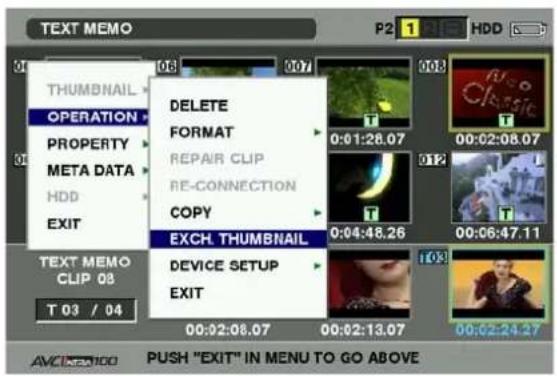
text_image
TEXT MEMO P2 1 RIE HDD 03 007 003 THUMBNAIL OPERATION PROPERTY META DATA HDD EXIT DELETE FORMAT REPAIR CLIP RE-CONNECTION COPY EXCH. THUMBNAIL DEVICE SETUP EXIT 0:01:26.07 0:02:08.07 0:04:48.26 0:06:47.11 T 03 / 04 00:02:08.07 00:02:13.07 00:02:24.27 AVOCES100 PUSH "EXIT" IN MENU TO GO ABOVE5 Press SET button. When the YES/NO confirmation window is displayed, select YES by using the cursor button and the SET button.
- The menu closes and the thumbnail for the clip is replaced.

text_image
TEXT MEMO 00:00:00.00 00:00:00.00 00:00:55.11 00:01:28.07 00:02:08.07 00:02:33.26 00:03:51.04 00:04:48.26 00:04:47.11 T 01 / 04 T 01 / 04 AVG 24.37 PUSH "EXIT" IN MENU TO GO ABOVENOTE
Display clip properties by selecting PROPERTY → CLIP PROPERTY on the thumbnail menu to confirm the position of the thumbnail (the number of frames from the top of the clip). Since thumbnails come generally from the top of the clip, "0" is displayed.
Shot Mark
A shot mark can be added to a clip thumbnail to distinguish this clip from other clips.
1 Press the THUMBNAIL button.
- The thumbnail screen appears on the LCD monitor.
2 Use the cursor buttons to move the pointer over the clip to which you want to attach a shot mark.
3 Press the USER button or RET button to which the shot mark function has been assigned.
- This adds a shot mark to the thumbnail of the clip at the pointer position.
To delete a shot mark, place the pointer on the clip a second time and press the USER button or RET button to which the shot mark function has been assigned.

natural_image
Technical line drawing of a mechanical device with no visible text or symbolsUSER MAIN, USER1 and USER2 buttons
NOTE
- A shot mark can be attached during recording.
- Adding shot marks after recording stops, attaches the shot mark to the most recently recorded clip.
Please refer to [Shot Marker (SHOT MARK) Recording Function] (page 42) for more information.
- When adding a shot mark to (or deleting the shot mark from) a clip recorded across multiple P2 cards, do this with all these P2 cards inserted into P2 card slots.
Text Memo
During recording or playback, you can add text memos to clips. Text memos can be used to play back clips at some point or break clips into chunks and copy the necessary portions.
Adding a text memo
Text memos can be added in one of the following ways.
- Press the USER button or RET button to which the text memo function has been assigned during recording or playback.
This adds text memos where respective button was pressed.
- Pressing the USER button or RET button to which the text memo function has been assigned when a thumbnail screen is open, adds a text memo at the beginning of a clip.

natural_image
Technical line drawing of a camera module with no visible text or symbolsUSER MAIN, USER1 and USER2 buttons
NOTE
One clip can have up to 100 text and voice memos in combination. Note that the unit is not capable of adding or showing voice memos.
Playing back a clip at the position where a text memo is recorded
1 Press the THUMBNAIL button.
- The thumbnail screen appears on the LCD monitor.
2 Press the THUMBNAIL MENU button and select THUMBNAIL → TEXT MEMO CLIPS from the thumbnail menu.
- The clip thumbnails with text memos attached are displayed in the upper section of the LCD monitor. The lower section of the LCD monitor shows information about the text memo on the clip selected by the pointer.
Thumbnail display

text_image
TEXT MEMO P2 1 HDD 00:00:00.00 00:00:55.11 00:01:28.07 00:02:08.07 00:02:33.26 06:02:51.04 06:04:48.26 06:06:47.11 TEXT MEMO CLIP 07 T 01 / 04 (0) 102 109 06:01:28.07 06:01:47.04 06:01:53.01 AVCC 1080/60i Dur : 00:01 39.28 Shows the still image that the text memo is related to.Shows the total number of text memos attached to the clip.
3 Move the pointer over the clip that contains the desired text memo to playback and press the SET button.
- The pointer moves to the lower part of the LCD monitor.
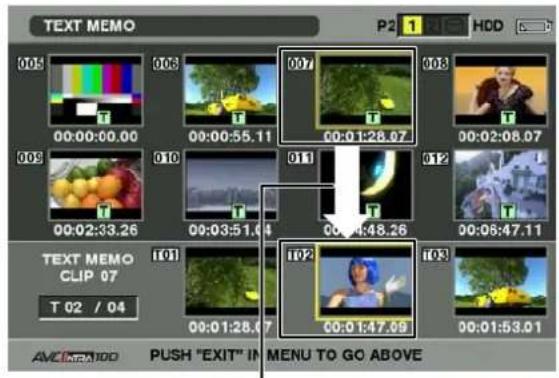
text_image
TEXT MEMO P2 1 HDD 005 003 007 003 00:00:00.00 00:00:55.11 00:01:28.07 00:02:08.07 009 010 011 012 00:02:33.26 00:03:51.04 00:04:48.26 00:08:47.11 TEXT MEMO CLIP 07 T 02 / 04 [01] [02] [03] 00:01:28.07 00:01:47.69 00:01:53.01 AVOC#R10D PUSH "EXIT" IN MENU TO GO ABOVEThe pointer moves down.
4 With the pointer located in the lower part, move the pointer to the desired text memo number using the cursor right and left buttons (◀/▶). Then, press the PLAY/PAUSE button.
- Playback will start from the time code position of the text memo where the pointer is located. If the STOP button is pressed during playback or playback finishes at the end of the clip, the thumbnail screen appears again with the pointer located on the text memo where playback started
- Press the THUMBNAIL MENU button to select EXIT or press the EXIT button to return the pointer to the upper part of the thumbnail screen.
NOTE
- Pressing the REC button in the text memo screen will not start recording.
- Text memo thumbnails for AVC-Intra format clips that cannot be played back appear in gray.
Deleting a text memo
1 Select the desired text memo by carrying out steps 1-3 for [Playing back a clip at the position where a text memo is recorded] (page 107).
2 Move the pointer to the desired text memo, and then press the SET button.
3 Press the THUMBNAIL MENU button to select OPERATION → DELETE from the thumbnail menu.
- YES and NO appear to confirm deletion. Use the cursor buttons and the SET button to select YES. The text memo is deleted.
Using a text memo to break a clip and copy the necessary portion
1 Select the desired text memo in a clip by carrying out steps 1-3 for [Playing back a clip at the position where a text memo is recorded] (page 107).
2 Move the pointer to the desired text memo, and then press the SET button.
- You can select more than one text memo.
3 Press the THUMBNAIL MENU button to select OPERATION → COPY.
4 Use the cursor buttons and the SET button to select the slot to copy to and select YES.
- Copying starts.
- The portion between the selected text memo and the next one is copied. If no text memo is found after the selected memo, then the remainder of the clip after the selected text memo is copied.
- If multiple text memos are selected, the selected sections are copied.
- When the clip is being copied, the unit indicates the progress of the copy process and cancellation status. To discontinue the copy process, press the SET button. Then, a YES/NO confirmation screen is displayed. Use the cursor buttons and SET button to select YES.
NOTE
In clip division and copying using the text memo function, the area copied may be automatically modified depending on the recording format of the clip.
Deleting Clips
1 Press the THUMBNAIL button.
- The thumbnail screen appears on the LCD monitor.
2 Use the cursor buttons to move the pointer to the clip to be deleted and press the SET button to select the clip.
3 Press the THUMBNAIL MENU button and select OPERATION → DELETE from the thumbnail menu.
4 The following screen appears. Use the cursor buttons and the SET button to select YES.
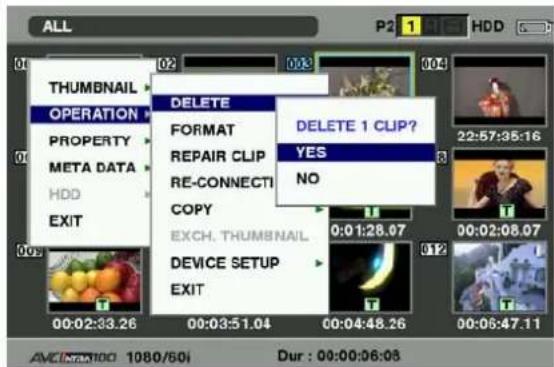
text_image
ALL P2 1 HDD 002 003 004 THUMBNAIL OPERATION PROPERTY META DATA HDD EXIT DELETE FORMAT REPAIR CLIP RE-CONNECTI COPY EXCH. THUMBNAIL DEVICE SETUP EXIT DELETE 1 CLIP? YES NO 0:01:28.07 00:02:08.07 00:06:47.11 AVC#100 1080/60i Dur : 00:00:06:08- The clip is deleted. All selected clips (in blue frames) are deleted by this operation.
NOTE
To interrupt deleting, press the SHIFT and EXIT buttons or the SET button to cancel the operation. Partially deleted clips cannot be restored by canceling.
Restoring Clips
Restores clips that are defective as a result of sudden powering-down during recording, or removal of the P2 card being accessed.
NOTE
Only those clips with yellow defective clip indicators can be restored. Delete the clips with red defective clip indicators. If the clip cannot be deleted, format the P2 card. During restoration of the clips, however, the defective-clip indicator may change from yellow to red, resulting in inability to restore the clips.
1 Press the THUMBNAIL button.
- The thumbnail screen appears on the LCD monitor.
2 Use the cursor buttons to move the pointer over the clip you want to restore (defective clips are indicated by defective clip indicators). Press the SET button to select the clip.
3 Press the THUMBNAIL MENU button, and select OPERATION → REPAIR CLIP from the thumbnail menu.
- When a confirmation screen asks you to confirm that you want to repair the clip, use a cursor button and the SET button to select YES if you want to restore the clip.
Reconnection of Incomplete Clips
Incomplete clips may be generated when clips recorded on multiple P2 cards (connected clips) are separately copied to different cards. The reconnection function generates one clip (the original, connected clip) from incomplete clips.
1 Press the THUMBNAIL button.
- The thumbnail screen appears on the LCD monitor.
2 Use the cursor and SET button to select incomplete clips to reconnect.
- Usually, thumbnails of incomplete clips (clips with marker) are displayed in line.
3 Press the THUMBNAIL MENU button and select OPERATION → RE-CONNECTION from the thumbnail menu.
- When a confirmation screen asks you to confirm that you want to reconnect the clip, use a cursor button and the SET button to select YES if you want to reconnect the clip.
NOTE
Clips that are connected as a group must be grouped together or they will be displayed as incomplete clips.
Copying Clips
Selected clips can be copied to the P2 card in the desired slot or SD memory card.
1 Press the THUMBNAIL button.
- The thumbnail screen appears on the LCD monitor.
2 Use the cursor buttons to move the pointer to the desired clip and press the SET button.
3 Press the THUMBNAIL MENU button and select OPERATION → COPY from the thumbnail menu.
- Select slot 1-2 or SD memory card as the destination.
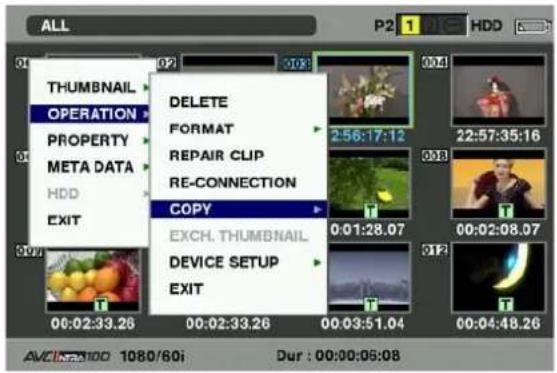
text_image
ALL P2 1 HD HDD THUMBNAIL OPERATION PROPERTY META DATA HDD EXIT DELETE FORMAT REPAIR CLIP RE-CONNECTION COPY EXCH. THUMBNAIL DEVICE SETUP EXIT 00:02:33.26 00:02:33.26 00:03:51.04 00:04:48.26 AVOC#S10D 1080/60i Dur : 00:00:05:08- When a confirmation screen asks you to confirm that you want to copy the clip, use a cursor button and the SET button to select YES if you want to copy the clip.

text_image
ALL THUMBNAIL OPERATION PROPERTY META DATA HDD EXIT DELETE FORMAT SLOT1 COPY 1 CLIP? YES NO CODE EXC DEVICE SETUP EXIT 00:02:33.26 00:02:33.26 00:03:51.04 00:04:48.26 AVCRAM100 1080/60i Dur : 00:00:06:08NOTE
- Do not turn off the power or remove a P2 card while data is being copied. Otherwise the P2 card may fail or defective clips may be generated. Delete any defective clips that are generated and copy them again.
- When clips are copied to P2 cards, all the information on the clips is copied. However, when they are copied to the SD memory card ‘i’, video and sound information is not copied, only thumbnails, clip metadata, icons, voice memo, text memo, proxy, and real-time metadata.
- When there is insufficient recording capacity on the destination, the message "LACK OF REC CAPACITY!" is displayed, and copying will not proceed. When clips selected for copying contain defective clips, the message "CANNOT COPY" appears and copying will not proceed. If the selected clips include clips already on the destination P2 card, copying will not proceed.
- To interrupt copying, press the SHIFT and EXIT buttons or the SET button. The clip that was being copied is deleted at the destination.
- When identical clips exist on the destination card, the "OVERWRITE?" is displayed. Select "YES" or "NO".
*1 Regarding SD memory cards to be used, see [SD memory card precautions] (page 21).
Setting of Clip Meta Data
Information such as the name of the person who shot the video, the name of the reporter, the shooting location, or a text memo can be read from the SD memory card, and can be recorded as Clip Meta Data.
Reading the SD memory card that contains the Clip Meta Data (metadata upload file).
1 Insert the SD memory card that contains the Clip Meta Data (metadata upload file).
2 Press the THUMBNAIL button.
- The thumbnail screen appears on the LCD monitor.
NOTE
Press the THUMBNAIL button while pressing DISP/ MODE CHK button when a thumbnail is displayed to move to step 4.
3 Press the THUMBNAIL MENU button and Select META DATA → LOAD from the thumbnail menu, and press the SET button.
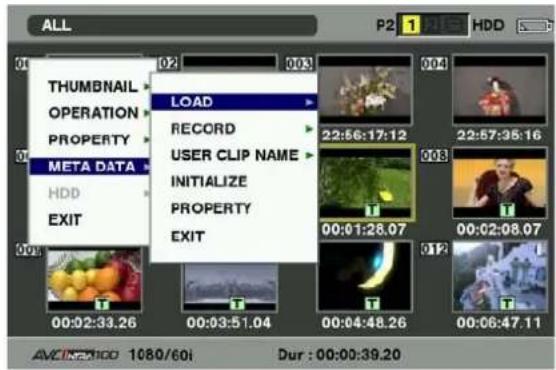
text_image
ALL THUMBNAIL OPERATION PROPERTY META DATA HDD EXIT LOAD RECORD USER CLIP NAME INITIALIZE PROPERTY EXIT 22:56:17:12 22:57:35:16 00:01:28.07 00:02:08.07 00:03:51.04 00:04:48.26 00:06:47.11 AVIC#200 1080/60i Dur : 00:00:39.204 Names of metadata upload files stored on the SD memory card are displayed ^2 . Select the desired files using the cursor buttons, and choose YES.
- Uploading starts.
- Uploaded metadata is retained even if the power is turned off.
- For more information on confirmation of uploaded data, see [Checking and modifying read metadata] (page 111).
*2 Press the cursor button (▷) to display the full name of the file, up to 100 characters, at the cursor position. Press the cursor button (◀) to return to the previous location.
Clip Meta Data items
Clip Meta Data includes the following items: Underlined items can be set by reading the metadata upload file on the SD memory card. Other items are set automatically during shooting. Using the latest update version of P2 Viewer, metadata upload files can be written to SD memory cards using a PC. Download the latest update version of P2 Viewer from the following URL and install it on your PC:
https://eww.pavc.panasonic.co.jp/pro-av/ Regarding SD memory cards to be used, see [SD memory card precautions] (page 21).
NOTE
Files edited using software other than P2 Viewer are displayed as "UNKNOWN DATA!", and may not be read.
GLOBAL CLIP ID:
Displays the global clip ID, which indicates the shooting status of the clip.
USER CLIP NAME:
Displays the clip name specified by the user. ^1
VIDEO: Displays [FRAME RATE] (frame rate of the clip), [PULL DOWN], and [ASPECT RATIO].
AUDIO: [SAMPLING RATE] (sampling frequency of recorded sound) and [BITS PER SAMPLE] (digitized bit[s] of recorded sound).
ACCESS: Displays [CREATOR] (person who recorded the clip), [CREATION DATE] (date when the clip was recorded), [LAST UPDATE DATE] (date of the latest update of the clip), and [LAST UPDATE PERSON] (person who made the latest update of the clip).
DEVICE: Displays [MANUFACTURER] (name of the device manufacturer), [SERIAL NO.] (serial number of the device) and [MODEL NAME] (model name of the device).
SHOOT ^2 : Displays [SHOOTER] (name of the person who shot the video), [START DATE] (start date of shooting), [END DATE] (end date of shooting), and [LOCATION] ALTITUDE/LONGITUDE/LATITUDE/SOURCE/PLACE NAME (altitude, longitude, latitude, and source of the information and name of the location).
SCENARIO:
Displays [PROGRAM NAME], [SCENE NO], and [TAKE NO].
NEWS: Displays [REPORTER] (name of the reporter), [PURPOSE] (purpose of shooting), and [OBJECT] (object of shooting).
MEMO ^3 : Displays [NO.] (the number of the text memo), [OFFSET] (location of the frame with added text memo in relation to the beginning of the clip), [PERSON] (person who recorded the text memo added to the clip), and [TEXT] (contents of the text memo).
THUMBNAIL:
Displays the location of the frame (frame offset) and the size (height and width) of the image selected as the thumbnail image.
*1 The USER CLIP NAME recording method is selectable. For details, refer to [Selecting the USER CLIP NAME recording method] (page 112).
*2 During recording, the camera does not automatically set altitude, latitude and longitude of the shoot. Such data can be set in the property of a recorded clip.
*3 Be sure to enter [TEXT] when entering MEMO. It is not possible to record only [PERSON] or [OFFSET].
NOTE
- This unit only displays printable ASCII characters.
Checking and modifying read metadata
The unit allows you to check details of metadata read from SD memory cards.
1 Press the THUMBNAIL button.
- The thumbnail screen appears on the LCD monitor.
2 Press the THUMBNAIL MENU button to select META DATA → PROPERTY from the thumbnail menu.
- Then the screen shown below appears.

text_image
META DATA REC META DATA REC : OFF META NAME : USER CLIP NAME CREATOR LAST UPDATE PERSON SHOOT PLACE NAME SCENARIO NEWS MEMO AVGIRAX100 PUSH "EXIT" IN MENU TO EXIT3 Use the cursor buttons to move the pointer to the item to confirm and press the SET button.
- Use this function to check loaded metadata settings.

text_image
META DATA P2 1 1E HDD REC META DATA REC : OFF META NAME : USER CLIP NAME CREATOR 107#047E PERSON PROGRAM NAME : TEST_DATA SCENE NO. : 3 TAKE NO. : 10 OK AVC#R#100 PUSH "EXIT" IN MENU TO EXIT4 While viewing metadata settings, use the cursor buttons to move the pointer to the desired option. Then, press the SET button.
- A soft keyboard screen is displayed, allowing you to modify the setting.
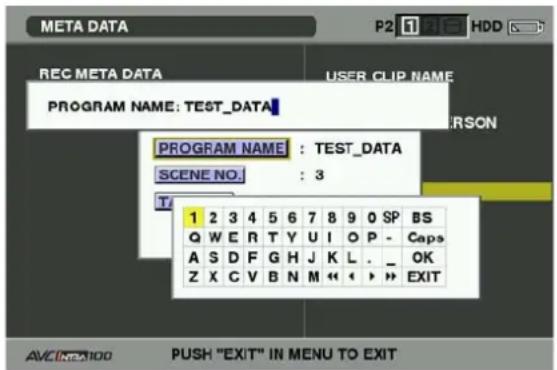
text_image
META DATA P2 1 HDD REC META DATA USER CLIP NAME PROGRAM NAME: TEST_DATA! PROGRAM NAME : TEST_DATA SCENE NO.: 3 T: 1 2 3 4 5 6 7 8 9 0 SP BS Q W E R T Y U I O P - Caps A S D F G H J K L . _ OK Z X C V B N M << >> EXIT AVC#00100 PUSH "EXIT" IN MENU TO EXITTo set whether or not the uploaded metadata is recorded
Set "ON"/"OFF" in META DATA → RECORD from the thumbnail menu. The factory setting is "OFF".
Selecting the USER CLIP NAME recording method
Select META DATA → USER CLIP NAME from the thumbnail menu to select the recording method. Two options are available: TYPE1 and TYPE2.
●TYPE1(Factory defaults)
| USER CLIP NAME to be recorded | |
| If clip metadata has been read in | Uploaded data |
| If no clip metadata has been read in or if the setting for recording clip metadata has been turned off | Same as GLOBAL CLIP ID (UMID data) |
●TYPE2
| USER CLIP NAME to be recorded | |
| If clip metadata has been read in | Uploaded data + COUNT value*1 |
| If no clip metadata has been read in or if the setting for recording clip metadata has been turned off | Same as CLIP NAME |
*1 The COUNT value is indicated as a four-digit number. The COUNT value is incremented each time a new clip is captured if clip metadata has been read in and TYPE2 has been selected as the recording method. The COUNT value can be reset using the following procedure. Select META DATA → PROPERTY from the thumbnail menu, then select USER CLIP NAME to display the menu shown below. Select "COUNT RESET" with the cursor and press the SET button to reset the COUNT value to 1.

text_image
META DATA P2 1 1 HDD REC META DATA REC : OFF META NAME : USER CLIP NAME CREATOR LOGO/RESET PERSON LOAD DATA : TEST_CLIP COUNT : 0001 REC DATA :NOTE
When an 8 GB or larger capacity P2 is used and the recording session exceeds the prescribed duration (DVCPRO HD and the AVCIntra100: about 5 minutes; AVC-Intra50: about 10 minutes) or spans more than one P2 card, the recording will automatically be split into separate clips. At this time, each clip will be provided with its own COUNT value.
Example of recording (DVCPRO HD) a clip on one P2 card:
Recording start Recording pause
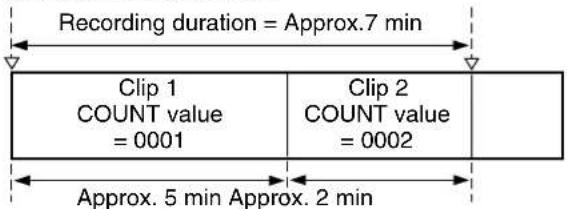
text_image
Recording duration = Approx.7 min Clip 1 COUNT value = 0001 Clip 2 COUNT value = 0002 Approx. 5 min Approx. 2 minExample of recording a clip on two P2 cards:
Recording start Recording pause

text_image
Clip 1 COUNT value = 0003 Clip 2 COUNT value = 0004 1st card 2nd cardIf the clip thumbnails are displayed as shown in the example above or their properties are indicated using a P2 device, the thumbnail and COUNT value of clip 1 will be displayed.
Clearing uploaded metadata
Select META DATA → INITIALIZE from the thumbnail menu, and press the SET button. Select YES when the confirmation screen is displayed.
Setting of Proxy (optional)
Installing the video encoder card (AJ-YAX800G, optional accessory) in P2 card slot 2 makes it possible to set up the proxy recording function.
The video encoder card is not recognized when inserted if the power for the unit is turned on. Insert the video encoder card after turning off the power for the unit.
Select OPERATION → DEVICE SETUP → PROXY from the thumbnail menu to specify the setting.
For details on how to install and set up the video encoder card, refer to the User's Guide of the video encoder card.
NOTE
When "PROXY CARD ERROR" is indicated in the viewfinder, either check the video encoder card or set the unit so that proxy recording is not performed.
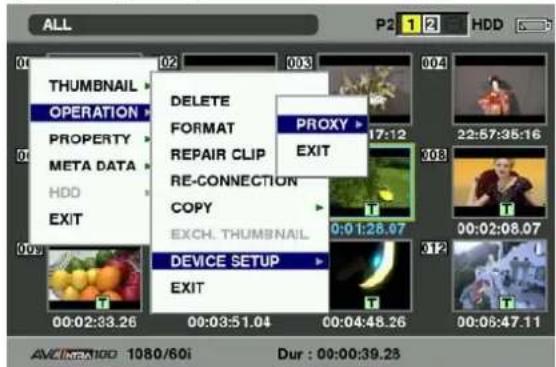
text_image
ALL THUMBNAIL OPERATION PROPERTY META DATA HDD EXIT DELETE FORMAT REPAIR CLIP RE-CONNECTION COPY EXCH. THUMBNAIL DEVICE SETUP EXIT PROXY EXIT 0:01:28.07 00:02:33.26 00:03:51.04 00:04:48.26 00:05:47.11 AVIC/EN100 1080/60i Dur : 00:00:39.25Formatting a P2 Card
1 Press the THUMBNAIL button.
- The thumbnail screen appears on the LCD monitor.
2 Press the THUMBNAIL MENU button and select OPERATION → FORMAT from the thumbnail menu.
- When the screen shown below appears, select the slot number of the P2 card you want to format and press the SET button.
- Select EXIT if formatting is not required.

text_image
ALL P2 1 P2 HDD S 001 THUMBNAIL OPERATION 002 PROPERTY 003 META DATA 004 HDD 005 EXIT DELETE FORMAT REPAIR CLIP RE-CONNECTI COPY EXCH. THUMBNAIL DEVICE SETUP EXIT SLOT1 SLOT2 SD CARD EXIT 00:02:33.26 00:03:51.04 00:04:48.26 00:06:47.11 AVL#100 1080/60i Dur : 00:00:39.283 The following screen appears. Use the cursor buttons and the SET button to select YES.
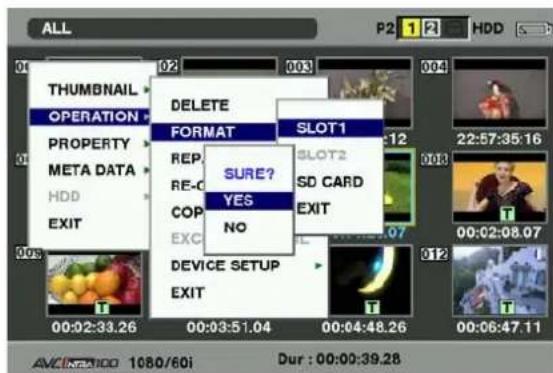
text_image
ALL P2 1 R HDD 004 003 002 001 000 THUMBNAIL OPERATION DELETE FORMAT SLOT1 012 22:57:35:16 PROPERTY RE- SORE? SD CARD META DATA COP EXIT EXIT 00:02:33.26 00:03:51.04 00:04:48.26 00:06:47.11 AVG/94/100 1080/60i Dur : 00:00:39.28• The selected P2 card is formatted.
Formatting SD memory cards
SD memory cards can also be formatted from the thumbnail screen. With an SD memory card inserted into the unit, perform the following operation:
1 Press the THUMBNAIL button.
- The thumbnail screen appears on the LCD monitor.
2 Press the THUMBNAIL MENU button and select OPERATION → FORMAT from the thumbnail menu.
- Select "SD CARD" and press the SET button when the screen shown below appears.
- Select "EXIT" if formatting is not required.

text_image
ALL P2 1 2 HDD THUMBNAIL OPERATION PROPERTY META DATA HDD EXIT DELETE FORMAT REPAIR CLIP RE-CONNECTI COPY EXCH. THUMBNAIL DEVICE SETUP EXIT SLOT1 SLOT2 SD CARD EXIT AVCA#100 1080/50i Dur : 00:00:39.283 The following screen appears. Use the cursor buttons and the SET button to select YES.
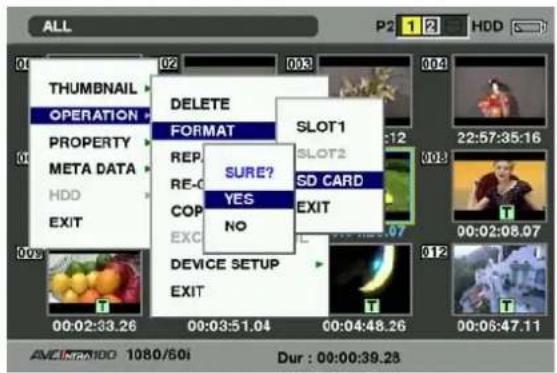
text_image
ALL P2 1 内 HDD 01 THUMBNAIL OPERATION 02 PROPERTY META DATA HDD EXIT DELETE FORMAT SLOT1 0:12 22:57:35:16 01 RE- COP EXC SURE? YES NO SD CARD EXIT 00:02:33.26 00:03:51.04 00:04:48.26 00:06:47.11 AVOC#2500 1080/60i Dur : 00:00:39.28• The SD memory card is formatted.
NOTE
You can also use the menu option SD CARD FORMAT in the CARD FUNCTIONS screen to format SD memory cards.
For details, refer to [Formatting, Writing and Reading an SD memory card] (page 81).
Setting the Thumbnail Display Mode
The thumbnail display mode can be customized to suit your preferences.
1 Press the THUMBNAIL button.
- The thumbnail screen appears on the LCD monitor.
2 Press the THUMBNAIL MENU button and select THUMBNAIL → SETUP from the thumbnail menu.
• The following screen appears.

text_image
ALL P2 1 2 HDD ALL CLIP SAME FORMAT CLIP SELECTED CLIPS MARKED CLIPS TEXT MEMO CLIPS SLOT CLIPS SETUP EXIT INDICATOR DATA DISPLAY DATE FORMAT THUMBNAIL SIZE PLAYBACK RESUME THUMBNAIL INIT EXIT ALL HIDE ✓ MARKER ✓ TEXT MEMO ✓ WIDE ✓ PROXY 00:02:33.26 00:03:51.04 00:04:48.26 00:06:47.11 AVCC#100 1080/60i Dur : 00:00:39.28INDICATOR:
Select which indicators you want to show on thumbnails and which you want to hide.
- ALL HIDE:
ON: No indicators are displayed.
OFF: Indication/No indication will be set depending on the following menu. The factory settings are as follows.
- MARKER:
Switches the shot mark marker between indication and no indication (ON/OFF). The factory setting is ON (indication).
- TEXT MEMO:
Switches the text memo marker between indication and no indication (ON/OFF). The factory setting is ON (indication).
- WIDE:
Switches the wide marker between indication and no indication (ON/OFF). The factory setting is ON (indication).
- PROXY:
Switches the proxy marker between indication and no indication (ON/OFF). The factory setting is ON (indication).
DATA DISPLAY:
The time display field of the clip offers a choice of Time Code (TC), User Bits (UB), Shooting Time (TIME), Shooting Date (DATE), Shooting Date and Time (DATE/TIME) or USER CLIP NAME. The factory setting is Time Code.
DATE FORMAT:
You can specify the display order for the shooting date as either Year/Month/Day (Y-M-D), Month/Day/Year (M-D-Y) or Day/Month/Year (D-M-Y).
The factory setting is Month/Day/Year.
This setting is reflected in the recording date shown in the clip property and the shooting date shown when DATE is selected under the item DATA DISPLAY.
THUMBNAIL SIZE:
For the size of thumbnails displayed on one screen, either LARGE (3 X 2 thumbnails displayed) or NORMAL (4 X 3 thumbnails displayed) can be selected. The factory default value is NORMAL.
PLAYBACK RESUME:
Selecting a position to restart playback after stopping playback on the thumbnails screen using the STOP button.
ON: Playback starts from the stop position.
OFF: Playback starts from the beginning of the clip indicated by the pointer.
Note that if the pointer is moved after stopping playback, the playback will restart from the beginning of the clip indicated by the pointer regardless of this setting. Also, attempting to play back from the end of all the available clips will cause the screen to flash momentarily, indicating that the there are no more clips which can be played back.
THUMBNAIL INIT:
Returns the above thumbnail display settings to their factory default values. Move the cursor to this option, and press the SET button. Select YES in the confirmation screen that appears.
EXIT:
Returns to the previous menu.
Properties
Properties display clip properties and P2 card status. It is possible to edit and rewrite recorded clip metadata while clip properties are displayed.
Clip Property
From the thumbnail menu, select PROPERTY → CLIP PROPERTY. The following screen appears.
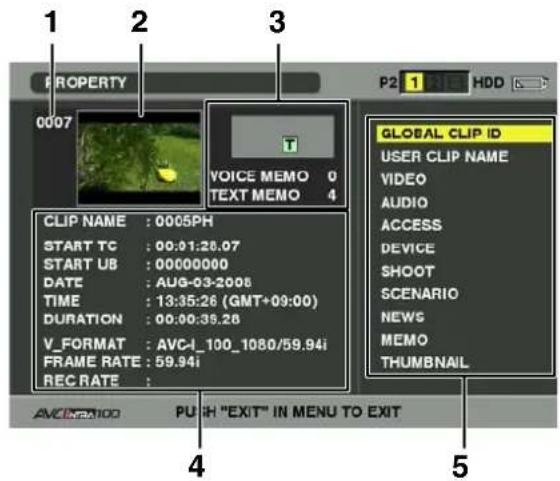
text_image
1 2 3 PROPERTY P2 1 DIE HDD 0007 VOICE MEMO 0 TEXT MEMO 4 CLIP NAME : 0005PH START TC : 00:01:28.07 START UB : 00000000 DATE : AUG-03-2006 TIME : 13:35:26 (GMT+09:00) DURATION : 00:00:35.28 V_FORMAT : AVC-1_100_1080/59.94i FRAME RATE : 59.94i REC RATE : GLOBAL CLIP ID USER CLIP NAME VIDEO AUDIO ACCESS DEVICE SHOOT SCENARIO NEWS MEMO THUMBNAIL AVCI#R100 PUSH "EXIT" IN MENU TO EXIT 4 51 Clip Number
2 Thumbnail
3 Clip Information
Indicates the indicators added to the clip and the number of text and voice memos added to the clip. The mark appears if the clip is recorded on a write-protected P2 card.
NOTE
The unit is not capable of recording or playing back voice memos.
4 Clip Information
Displays detailed information about the clip.
CLIP NAME:
Display clip names.
START TC:
The time code value at the start of the recording.
START UB:
The user bit value at the start of the recording.
DATE:
The date of the recording.
TIME:
The time at the start of the recording.
DURATION:
The time length of the clip.
V\_FORMAT:
The recording format for the clip.
FRAME RATE:
The frame rate for the playback.
REC RATE:
The recording frame rate is displayed. (Only displayed for clips recorded using native recording with the VFR function.)
5 Clip Meta Data
Displays more detailed data about the clip. Use the cursor buttons to move the pointer, and press the SET button to check the detailed content. For more information on displayed metadata, see [Setting of Clip Meta Data] (page 110).
Modification of recorded clip metadata
1 Display the window for detailed clip metadata that you intend to modify in the clip properties window.
2 Place the cursor on the item to be modified using the cursor button.
- The metadata that can be modified are shown like [CREATOR] in the following figure.
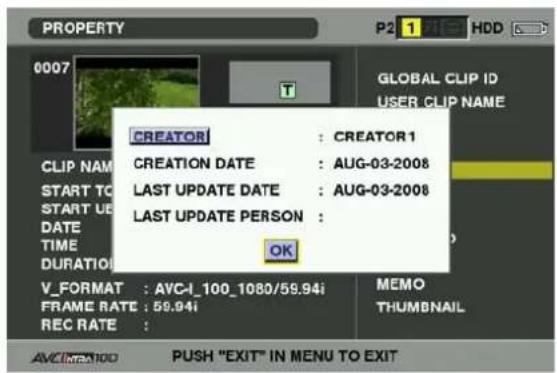
text_image
CREATOR : CREATOR1 CREATION DATE : AUG-03-2008 LAST UPDATE DATE : AUG-03-2008 LAST UPDATE PERSON : OK V_FORMAT : AVC_I_100_1080/59.94i MEMO FRAME RATE : 59.94i THUMBNAIL REC RATE : AVIC#100 PUSH "EXIT" IN MENU TO EXIT3 Press the SET button.
- The input window (soft keyboard) for modifying metadata is displayed.
- Use the keyboard to modify the metadata.
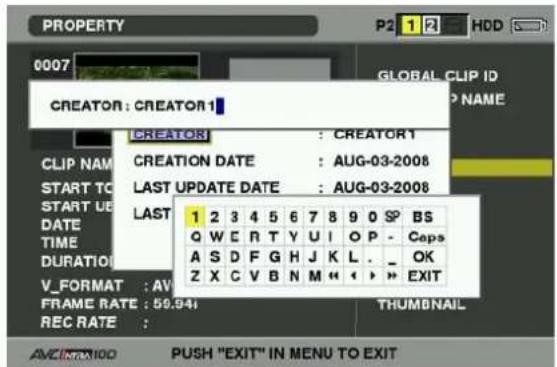
text_image
PROPERTY P2 1 2 HDD 0007 GLOBAL CLIP ID CREATOR: CREATOR1 CREATOR : CREATOR1 CREATION DATE : AUG-03-2008 LAST UPDATE DATE : AUG-03-2008 LAST 1 2 3 4 5 6 7 8 9 0 SP BS Q W E R T Y U I O P - Ceps A S D F G H J K L . _ OK Z X C V B N M " " EXIT V_FORMAT : AV FRAME RATE : 59.941 THUMBNAIL REC RATE : AVCRN100 PUSH "EXIT" IN MENU TO EXITUse the keyboard operations described in [Checking and modifying read metadata] (page 111).
4 Press OK on the keyboard to write the modified metadata on the clip and return to the metadata window.
NOTE
- LOCATION (recording location data) data for a SHOOT cannot be deleted independently. Thus by setting ALTITUDE to empty will also delete the LONGITUDE and LATITUDE settings.
- The metadata for a clip with the ⚠️ incomplete clip indicator cannot be modified. Metadata on clips recorded on multiple P2 cards must be modified when all P2 cards that contain the data are inserted.
- Any MEMO with 101 characters or more cannot be modified.
P2 Card Status Display
■ P2 Card Status Display Settings
Select PROPERTY → CARD STATUS from the thumbnail menu to set the desired indication mode (remaining free space or used memory capacity) for the P2 card status display.
1 Press the THUMBNAIL button.
- The thumbnail screen appears on the LCD monitor.
2 Press the THUMBNAIL MENU button and select PROPERTY → PROPERTY SETUP → P2 CARD CAP from the thumbnail menu.
- The following screen appears. Select the P2 card status display settings from the P2 CARD CAP menu option.

text_image
ALL THUMBNAIL OPERATION PROPERTY META DATA HDD EXIT 02 003 004 01 009 010 011 00:02:33.26 00:03:51.04 00:04:48.26 00:06:47.11 CLIP PROPERTY CARD STATUS DEVICES PROPERTY SETU EXIT P2 CARD CAP EXIT REMAIN USED 0:01:28.07 AVG 1080/60i Dur : 00:00:30.03REMAIN:
Show remaining free space on the P2 card as the P2 card status display. (Factory setting)
USED:
Show used memory capacity on the P2 card as the P2 card status display.
■ Contents of P2 Card Status Display Settings
From the thumbnail menu, select PROPERTY → CARD STATUS. The following screen appears.
When "REMAIN" is selected:
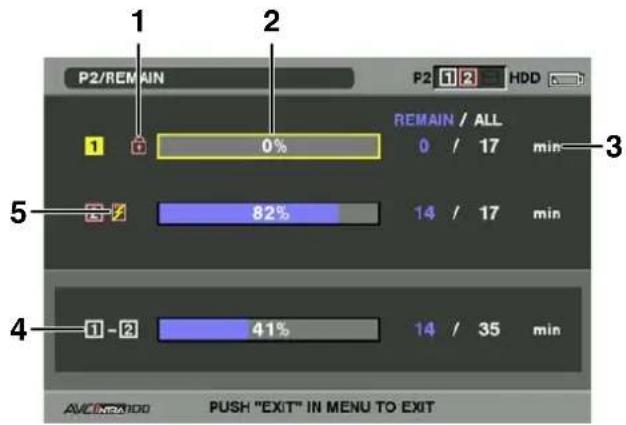
text_image
P2/REMAIN 1 2 P2 1 2 HDD 1 0% REMAIN / ALL 0 / 17 min 3 5 82% 14 / 17 min 4 1 - 2 41% 14 / 35 min AVC#EX100 PUSH "EXIT" IN MENU TO EXIT1 Write-protect Mark
The 🔒 mark appears if the P2 card is write-protected.
2 P2 Card Status (remaining free space)
The remaining memory capacity of the P2 card is indicated by a bar graph and percentage. The bar graph indicator moves to the left as the remaining free space decreases. The following indications may appear, depending on the card status:
FORMAT ERROR!:
An unformatted P2 card is inserted.
NOT SUPPORTED!:
An unsupported card is inserted in the camera.
NO CARD!
No P2 cards are inserted.
Use the cursor button to place the cursor on the P2 card for data you want to access and press the SET button to display detailed information about the P2 card to check individual information such as the serial number and the user ID.
3 P2 Card Remaining Capacity/Total Capacity
Displays the P2 card remaining capacity and total capacity in minutes. The total remaining capacity for each P2 card will not show actual capacity since only time in minutes is displayed.
Note that the indicated capacity will vary according to the frame rate in native recording with VFR operation.
4 Total remaining free space for the slot
Displays the total remaining free space for both slots. Please note that the remaining capacity of a write-protected P2 card is not included in the total remaining capacity.
5 Warning symbol
Inserting the following type of P2 cards will display the (☐) symbol.
RUN DOWN CARD:
The maximum number of overwrites on the P2 card has been exceeded.
DIR ENTRY NG CARD:
The directory structure on the P2 card is not supported.
For details on P2 card status indications, refer to [2. P2 Card Status (remaining free space)].
When "USED" is selected:
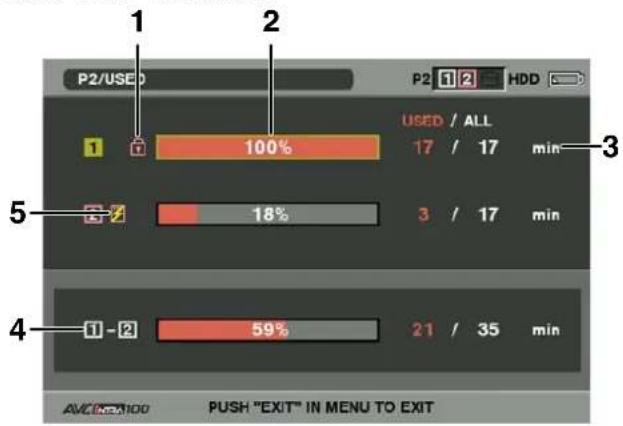
text_image
1 P2/USE 2 P2 1 2 HDD USED / ALL 17 / 17 min 3 / 17 min 5 18% 4 - 2 59% 21 / 35 min AVG#0-100 PUSH "EXIT" IN MENU TO EXIT1 Write-protect Mark
The 🔒 mark appears if the P2 card is write-protected.
2 P2 Card Status (used memory capacity)
The used memory capacity of the P2 card is indicated by a bar graph and a percentage figure. The bar graph indicator moves to the right as the used memory capacity increases.
The following indications may appear, depending on the card status:
FORMAT ERROR!:
An unformatted P2 card is inserted.
NOT SUPPORTED!:
An unsupported card is inserted in the camera.
NO CARD!
P2 cards are not inserted.
Use the cursor button to place the cursor on the P2 card for data you want to access and press the SET button to display detailed information about the P2 card to check individual information such as the serial number and the user ID.
3 P2 Card used memory capacity/Total Capacity
Displays the used memory capacity on a P2 card and the total capacity, in minutes. Because fractions are truncated, the figure shown for used memory capacity on a P2 card may differ from the figure for total capacity. The used memory capacity of a write-protected P2 card is displayed as 100%.
Note that the indicated capacity will vary according to the frame rate in native recording with VFR operation.
4 Total used memory capacity for all slots
Displays the total used memory capacity for both slots.
5 Warning symbol
Inserting the following type of P2 cards will display the (☐) symbol.
RUN DOWN CARD:
The maximum number of overwrites on the P2 card has been exceeded.
DIR ENTRY NG CARD:
The directory structure on the P2 card is not supported.
For details on P2 card status indications, refer to [2. P2
Card Status (used memory capacity)]
SD memory card Status Display
The status display enables a confirmation of the SD memory card formatted condition, available memory capacity etc. From the thumbnail menu, select PROPERTY → DEVICES → SD CARD.
If the format is compatible with SD standards, the message
SD STANDARD : SUPPORTED
If the format is not compatible with SD standards, the message
SD STANDARD : NOT SUPPORTED
is displayed. If this is the case, writing or reading will not be successful. Format the card with the unit. For more information on formatting SD memory cards, see [Formatting SD memory cards] (page 115).
NOTE
The indication of remaining capacity on an SD memory card (PROXY REM) provides only a rough estimate of remaining capacity and may differ from actual remaining capacity. SD and SDHC cards with Speed Class Ratings may indicate recording times that are significantly lower than actual capacity, especially when used for recording a large number of short video clips. The remaining capacity is displayed only when proxy recording is set up to record on an SD memory card. For details on setup procedures, refer to the User's Guide of the video encoder card (AJ-YAX800G, an optional accessory).
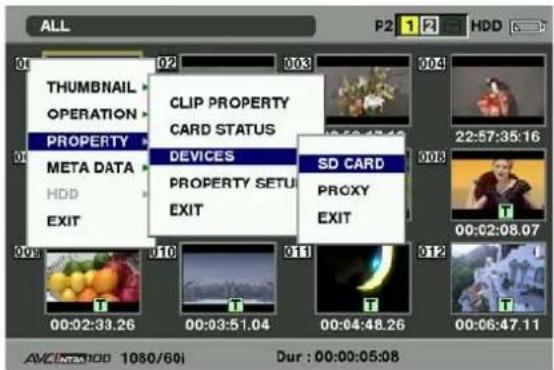
text_image
ALL THUMBNAIL OPERATION PROPERTY META DATA HDD EXIT 02 003 CLIP PROPERTY CARD STATUS DEVICES PROPERTY SETU EXIT SD CARD PROXY EXIT 00:02:33.26 00:03:51.04 00:04:48.26 00:06:47.11 AVCA#100 1080/60i Dur : 00:00:05:08Video Encoder Card Status Display (optional)
Attaching the video encoder card (AJ-YAX800G, optional), select PROPERTY → DEVICES → PROXY from the thumbnail menu.
The slot in which the video encoder card is inserted, and version information is displayed.
Chapter 7 Menu Operations
Viewfinder and LCD Menus
Using the menus
Use the setup menus to change the settings to suit the scenes you are shooting or what you are recording.
- If the thumbnail menu is displayed, press the THUMBNAIL button to clear the display.
- The menu items indicated in the blue characters cannot be used.
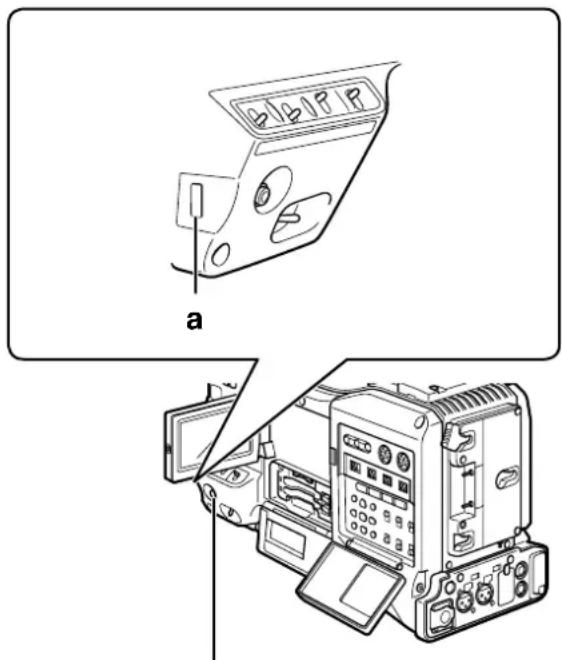
natural_image
Technical line drawing showing a device panel with a close-up of its internal components (no text or symbols present)b
a JOG dial button
b MENU button
1 Press the MENU button to end any mode other than recording.
- Hold down the MENU button for about 1 second.
- The function screen appears in the viewfinder and on the LCD screen.
MAIN MENU
1.SCENE FINE
2.SYSTEM SETUP
3.SW MODE
4.RECORDING SETUP
5. AUDIO SETUP
6. OUTPUT SEL
7.DISPLAY SETUP
8. BATTERY SETUP

PUSH MENU TO EXIT
2 Use the JOG dial button (or the Up and Down cursor buttons) to highlight the function you want to change.
MAIN MENU
1.SCENE FINE
2.SYSTEM SETUP
3.SW MODE
4.RECORDING SETUP
5. AUDIO SETUP
6. OUTPUT SEL
7.DISPLAY SETUP
8. BATTERY SETUP
PUSH MENU TO EXIT
3 Press the JOG dial button to display the items.
SW MODE
LOW GAIN
MID GAIN
HIGH GAIN
ATW
ATW TYPE
W.BAL.PRESET
USER MAIN
USER1 BACK LIGHT

PUSH MENU TO RETURN
4 Use the JOG dial button to highlight the item you want to change.
SW MODE
LOW GAIN
MID GAIN
HIGH GAIN
ATW
ATW TYPE
W.BAL.PRESET
USER MAIN
USER1 BACK LIGHT

PUSH MENU TO RETURN
5 Use the JOG dial button to change the setting value.
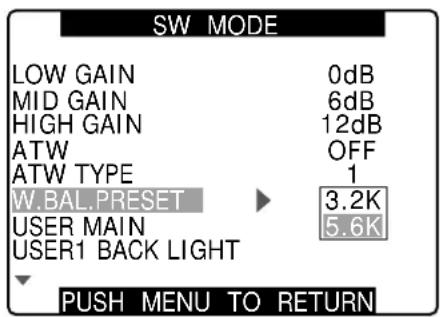
text_image
SW MODE LOW GAIN 0dB MID GAIN 6dB HIGH GAIN 12dB ATW OFF ATW TYPE 1 W.BAL.PRESET 3.2K USER MAIN 5.6K USER1 BACK LIGHT PUSH MENU TO RETURN6 To change other settings, repeat steps 4 and 5.
- When you finish, press the MENU button to return to the function screen.
7 To change other functions, repeat steps 2 to 5.
- To exit the function screen and return to the normal screen, press the MENU button again.
NOTE
■Direct close function
When the MENU button is pressed and held down after making a menu setting, the setting menu screen closes without first returning to the previous setting menu.
■To quickly change settings (MASTER PED and HPHASE only)
- Fast UP
Hold down the JOG dial button while turning it upwards and maintain this position.
- Fast DOWN
Hold down the JOG dial button while turning it downwards and maintain this position.
Initializing the menu settings
The menu settings contain both the user file settings and the scene file settings. You can initialize them separately.
To initialize scene files (i.e. all the settings other than the scene file settings)
Select INITIAL in USER FILE of the OTHER FUNCTIONS screen. The current menu settings of user file will return to the factory settings.
To initialize the scene file
From the 6 scene files, select the one you want to initialize with the SCENE FILE dial. Then in the SCENE FILE screen, LOAD/SAVE/INIT, select INITIAL.
The settings for only the selected scene file are returned to the factory settings.
• This does not affect the other scene files.
Initializing user files and scene files simultaneously
You can return the user files and the six scene files to their factory defaults by selecting YES in the menu option MENU INIT in the OTHER FUNCTIONS screen.
Setup menu structure
MAIN MENU
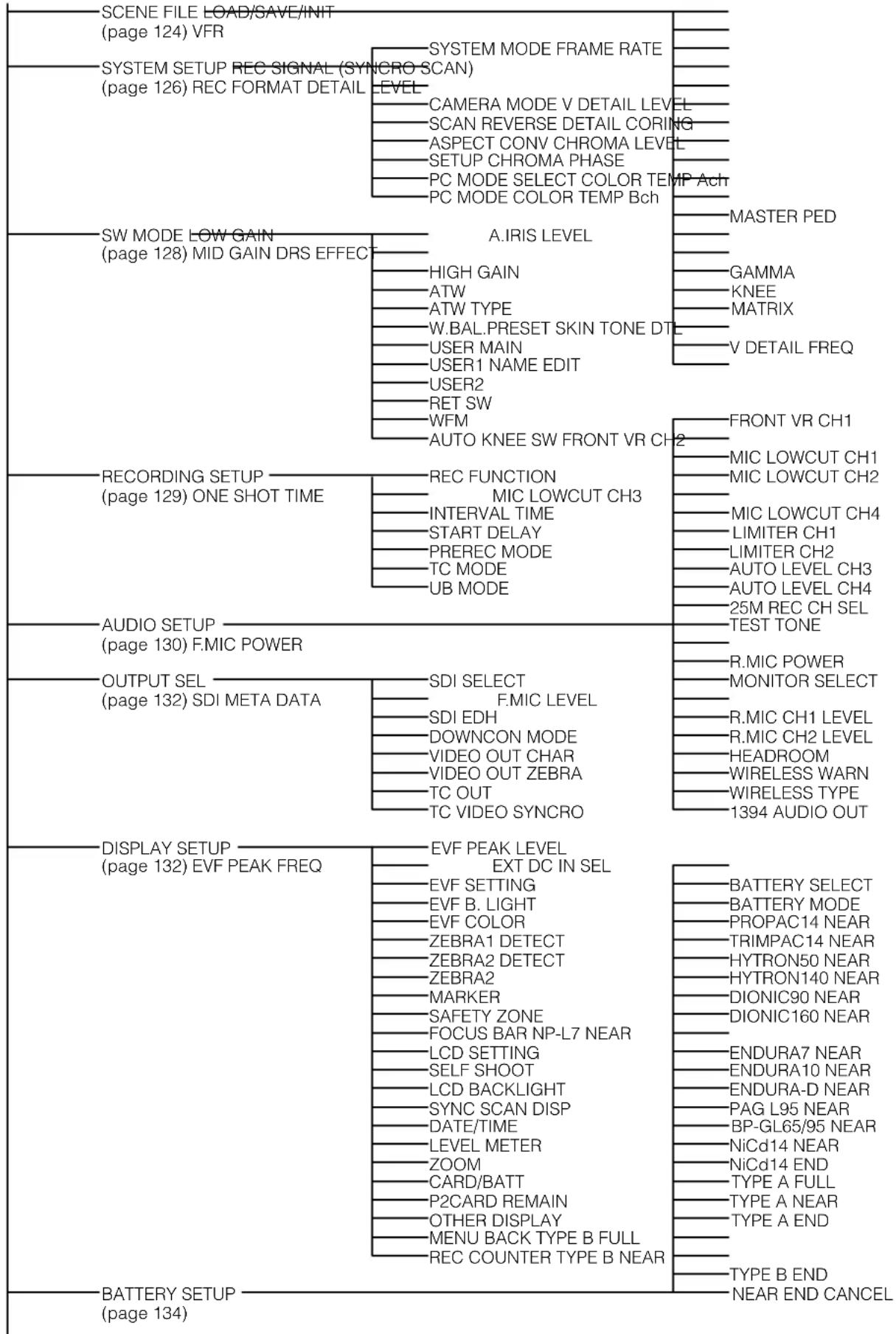
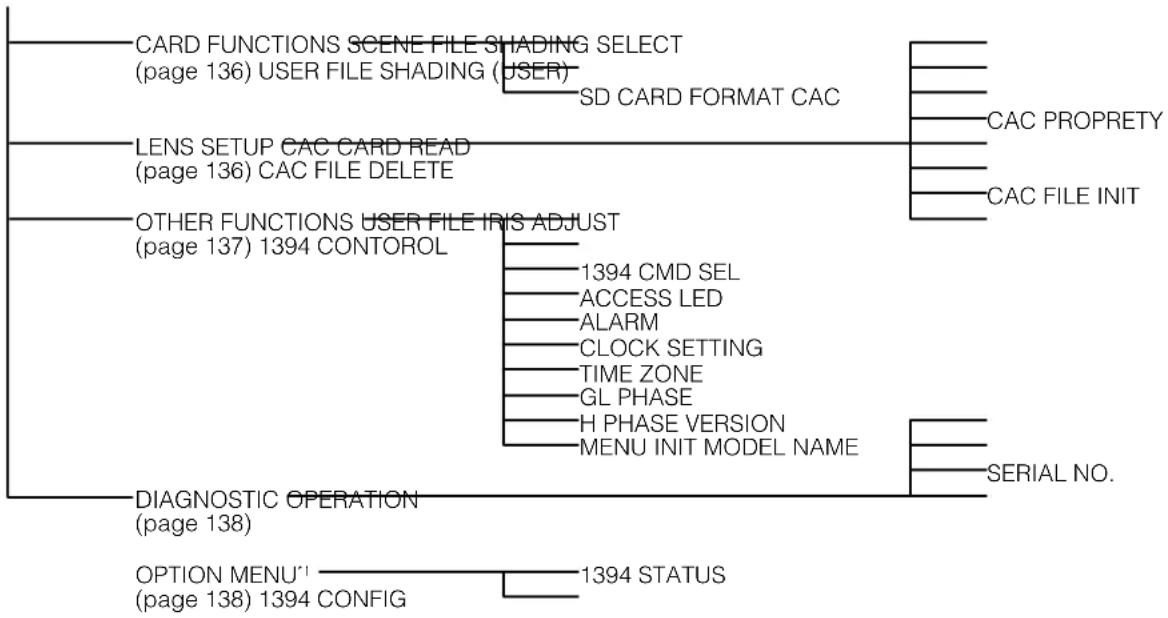
flowchart
graph TD
    A["CARD FUNCTIONS SCENE FILE SHADING SELECT (page 136) USER FILE SHADING (USER)"] --> B["SD CARD FORMAT CAC"]
    C["LENS SETUP CAC CARD READ (page 136) CAC FILE DELETE"] --> D["CAC PROPRETY"]
    E["OTHER FUNCTIONS USER FILE IRIS ADJUST (page 137) 1394 CONTOROL"] --> F["1394 CMD SEL"]
    F --> G["ACCESS LED"]
    G --> H["ALARM"]
    H --> I["CLOCK SETTING"]
    I --> J["TIME ZONE"]
    J --> K["GL PHASE"]
    K --> L["H PHASE VERSION"]
    L --> M["MENU INIT MODEL NAME"]
    N["DIAGNOSTIC OPERATION (page 138)"] --> O["OPTION MENU'1 (page 138) 1394 CONFIG"]
    P["OPTION MENU'1"] --> Q["1394 STATUS"]
    R["SERIAL NO."] --> S["CAC FILE INIT"]
*1 To open the OPTION MENU, hold down the DISP/MODE CHK button and press the MENU button.
Setup menu list
SCENE FILE screen
| Item Setting Notes | |
| LOAD/SAVE/INIT Loads, saves and initializes settings of the scene file assigned to the current scene dial position (one F1 - F6 scene file).LOAD: Loads data stored in camera memory.SAVE: Saves current values in camera memory.INITIAL: Returns settings to their factory defaults. | A change in scene files affects only the scene file at the current scene dial position. |
| VFR Enables or disables variable frame rate (VFR) mode at 720P.ON: VFR operationOFF: VFR off | Available only in 720P system mode. (This message does not appear in modes other than 720P.)This setting cannot be made when REC SIGNAL is 1394. |
| FRAME RATE Adjusts the frame rate and exposure time at 720P when VFR is on.12, 15, 18, 20, 21, 22, 24, 25, 26, 27, 28, 30, 32, 34, 36, 40, 44, 48, 54,60 FRAME | Available only in 720P system mode and when VFR is set to ON. (This message does not appear in modes other than 720P.)This setting cannot be made when REC SIGNAL is 1394.A change to 24 fps may cause the screen to flicker momentarily. |
| (SYNCHRO SCAN) Displays synchro scan shutter speeds to enable the operator to synchronize the camera to computer monitors.This function only displays the shutter speeds. Use the SYNCHRO SCAN switch to set a shutter speed.Set values (displayed values) are assigned to the current scene file and manipulated using the LOAD, SAVE and INIT functions.For details, refer to [Placing the Camera-recorder in SYNCHRO SCAN Mode] (page 52).1/60.0 | Displayed in blue when not set to synchro scan mode and when the SYNCHRO SCAN switch settings are not available. |
| DETAIL LEVEL Adjusts the level of image outline correction (in horizontal and vertical directions).-7 ... 0*1... +7 | |
| V DETAIL LEVEL Adjusts the level of correction in vertical direction.-7 ... 0*1... +7 | |
| DETAIL CORING Adjusts the level of noise reduction of the detail signal.-7 ... 0*1... +7Adjust towards - for a clearer image. Noise increases slightly.Adjust towards + for less noise. | |
| CHROMA LEVEL Adjusts the chroma level.-7 ... 0*1... +7 | |
| CHROMA PHASE Makes fine adjustments to the chroma phase.-7 ... 0*1... +7 | |
| COLOR TEMP Ach Makes fine adjustments to the color temperature (after Ach white balance adjustment).-7 ... 0*1... +7 | |
| COLOR TEMP Bch Makes fine adjustments to the color temperature (after Bch white balance adjustment).-7 ... 0*1... +7 |
*1 The factory default when the SCENE FILE dial is set to F1.
| Item Setting Notes | ||
| MASTER PED Adjusts the | black master pedestal that serves as the video reference. -100 +15' +100 | Hold down the JOG dial button and turn it downwards or upwards and maintain this position to quickly change values.When a remote controller (AJ-RC10G) is connected, use the M-PED control on the remote controller to adjust. |
| A. IRIS LEVEL Sets the AUTO IRIS target value. -10 0' +10 | ||
| DRS EFFECT Sets the compression level in high-brightness areas of the DRS (dynamic range stretcher) function.This function compresses the video signal level to extend the dynamic range making it possible to correctly render highlight areas without overexposure and loss of detail that would otherwise occur. 1,2,3' Higher numbers mean a higher compression level of high-brightness areas and more noise in dark areas. | Not available at 1080/30P or 1080/24P.The 1/15 and 1/30 shutter speeds are not available in 1080/60i mode. | |
| GAMMA Selects the gamma curve.HD NORM ^1 :Gamma setting for HD recording.LOW:Applies a gently rising gamma curve to low-brightness areas for a balanced look.SD NORM:Normal video setting inherited from the DVX100 series.HIGH:Applies a steep gamma curve to low brightness areas to expand the tonality of dark areas for video with greater brightness. Contrast softens as a result.B.PRESS:Produces sharper contrast than LOW.CINE-LIKE D:Applies a gamma curve to produce video with a cine-like feel.CINE-LIKE V:Applies a gamma curve to produce high-contrast video with a cine-like feel.A lens aperture set lower than normal video level (approx. 1/2) is recommended when using cine-like gamma to enjoy the full benefit of the function. | A change in settings during DRS operation will not change video quality. | |
| KNEE Sets the compression level (knee point) of the high brightness video signals received through the MOS sensor to avoid overexposure.HIGH:High setting (compression starts at approx. 100%)MID:Medium setting (compression starts at approx. 90%)LOW ^1 :Low setting (compression starts at approx. 80%) | A change in settings during DRS operation will not change video quality. | |
| MATRIX Selects the MATRIX table to reproduce color during shooting.NORM1 ^1 :Ensures proper color rendition when shooting out in the open or under halogen lighting.NORM2:Produces more vivid colors than NORM1.FLUO:Ensures proper color rendition when shooting indoors under fluorescent lighting.CINE-LIKE:Produces a tone similar to movie film. | ||
| SKIN TONE DTL Turns the skin tone detail on or off.When on, reduces detail to hide any skin blemishes.ON,OFF ^1 | ||
*1 The factory default when the SCENE FILE dial is set to F1.
| Item Setting Notes | ||
| V DETAIL FREQ Sets vertical detail. | THIN: Produces fine detail. | |
| MID: Produces less detail and wider edging. | ||
| THICK: Produces even less detail and the widest edging effect. | ||
| Progressive recording made at THIN or MID cause horizontal lines or oblique lines that are almost horizontal to flicker when viewed on a normal monitor TV (60i: Interlace). THIN and MID settings will produce higher resolution video than THICK when shooting progressive footage that will later be edited. | ||
| NAME EDIT Edits the name of scene files selected using the SCENE FILE dial. | ||
SYSTEM SETUP screen
| Item Setting Notes | ||
| SYSTEM MODE Specifies | the signal format used by this camera.1080-59.94i, 720-59.94P, 480-59.94iWhen a setting is changed, the message “TURN POWER OFF” appears. Then turn the power off and turn it back on again. | Not available in USB DEVICE mode. |
| REC SIGNAL Selects the | input signal in the DVCPRO format.CAMERA:Records the camera recording signal.1394:Records signals input to the DVCPRO/DV connector.This function is always set to CAMERA when the power is turned on. | Not available when the menu option REC FORMAT is set to AVC-Intra or DVCPRO HD during native recording. |
| REC FORMAT Selects the | recording codec as well as shooting and recording modes.(when SYSTEM MODE is 1080-59.94i)AVC-I100/60i, AVC-I100/30PN,AVC-I100/24PN:Uses the AVC-I 100 codec for recording. Shooting and recording at 60i, 30PN (native recording) and 24PN (native recording).AVC-I 50/60i, AVC-I 50/30PN,AVC-I 50/24PN:Uses the AVC-I 50 codec for recording. Shooting and recording at 60i, 30PN (native recording) and 24PN (native recording).DVCPROHD/60i:Uses the DVCPRO HD codec for recording. Use CAMERA MODE options to set shooting mode. Recording is locked to 60i.(when SYSTEM MODE is 720-59.94P)AVC-I100/60P, AVC-I100/30PN,AVC-I100/24PN:Uses the AVC-I 100 codec for recording. Shooting and recording at 60i, 30PN (native recording) and 24PN (native recording).AVC-I 50/60P, AVC-I 50/30PN,AVC-I 50/24PN:Uses the AVC-I 50 codec for recording. Shooting and recording at 60i, 30PN (native recording) and 24PN (native recording).(Continued on the next page) | Not available when 1080i or 720P is set in SYSTEM MODE and REC SIGNAL is 1394.Not available in USB DEVICE mode. |
| REC FORMAT (Continued) | from the previous page)DVCPRO HD/60P, DVCPRO HD/30PN, DVCPROHD/24PN:Uses the DVCPRO HD codec for recording.Shooting and recording at 60P, 30PN (nativerecording) and 24PN (native recording).(when SYSTEM MODE is 480 – 59.94i)DVCPRO50/60i, DVCPRO/60i, DV/60i:These useDVCPRO50, DVCPRO and DV codecs, respectively.Use CAMERA MODE options to set shooting mode.Recording is locked at 60i. | Not available when 1080i or 720Pis set in SYSTEM MODE and REC SIGNAL is 1394.Not available in USB DEVICE mode. |
| CAMERA MODE Sets the | DVCPRO HD codec at 1080-59.94i and a CAMERA MODE of 480-59.94i.60i, 30P, 24P, 24PA | Does not appear when SYSTEM MODE is set to 720-59.94P.Not available in the following conditions.- When the REC SIGNAL option is set to 1394.- Available only when SYSTEM MODE is set to 1080-59.94i and REC FORMAT is set to something other than DVCPROHD/60i. |
| SCAN REVERSE Cancels | the image inversion that occurs with film lenses and anamorphic lenses.ON, OFF | |
| ASPECT CONV Selects the | e aspect ratio for recording at 480i.SIDE CROP:Crops the right and left edges of the image.LETTER BOX:Adds black bands at the top and bottom of the image.SQUEEZE:Compresses the image horizontally. | Not available when SYSTEM MODE is set to 1080-59.94i or 720-59.94P. |
| SETUP Selects the setup | level for the 480i video signal.0%: Setup is switched to 0% for both VIDEO OUT output and recording.7.5%A: Setup is switched to 7.5% for VIDEO OUT output and 0% for recording. | |
| PC MODE SELECT Sets of | camera operating mode when PC MODE is set to ON and an external device is connected via USB.USB HOST:Selects USB 2.0 for connecting an external hard disk drive. (For details, refer to page 140.)USB DEVICE:Makes it possible to connect the camera to a computer via USB 2.0 to enable use of a P2 card as mass storage. (For details, refer to page 139.) | Not available when PC MODE is set to ON. |
| PC MODE Operates the | camera according to mode selected using PC MODE SELECT.ON: Operates in PC MODE.OFF: Terminates PC MODE and returns the camera to normal operation.This function is always set to OFF when the power is turned on. | |
| LOW GAIN Sets the gain | value assigned to the L position of the GAIN switch.-3dB, 0dB, 3dB, 6dB, 9dB, 12dB | |
| MID GAIN Sets the gain value | value assigned to the M position of the GAIN switch.-3dB, 0dB, 3dB, 6dB, 9dB, 12dB | |
| HIGH GAIN Sets the gain | value assigned to the H position of the GAIN switch.-3dB, 0dB, 3dB, 6dB, 9dB, 12dB | |
| ATW Allows you to assign the ATW (Auto Tracking White Balance) function to the WHITE BAL switch. (For details, refer to page 50.)Bch: Controls the ATW function when the WHITE BAL switch is set to B position.OFF: Does not assign the ATW function to the WHITE BAL switch. | A USER button to which ATW has been assigned cannot be used to turn ATW off when the WHITE BAL switch is set to B position and this menu is set to Bch. | |
| ATW TYPE Selects type of ATW (Auto Tracking White Balance) function operation.1: Standard ATW operation2: Further restricts the color of the light source range that is tracked than setting 1.ATW operation reduces the risk of miscalculating light sources. | ||
| W.BAL.PRESET Sets the color temperature assigned to the PRST position of the WHITE BAL switch.3.2K, 5.6K | ||
| USER MAIN Sets the function assigned to the USER MAIN button.REC REVIEW, SPOTLIGHT, BACKLIGHT, ATW, ATWLOCK, GAIN: 24 dB, Y GET, DRS, TEXT MEMO, SLOT SEL, SHOT MARK, MAG A. LVL, PRE REC, PC MODE, WFMFor details, refer to [Assigning functions to USER buttons] (page 53). | When a remote controller (AJ-RC10G) is connected, the SPOTLIGHT and BACKLIGHT functions are not available. | |
| USER1 Sets a function assigned to the USER1 button. The functions that can be assigned to this button are the same as for the USER MAIN button.BACKLIGHT (factory default setting)For details, refer to [Assigning functions to USER buttons] (page 53). | ||
| USER2 Sets a function assigned to the USER2 button. The functions that can be assigned to this button are the same as for the USER MAIN button.TEXT MEMO (factory default setting)For details, refer to [Assigning functions to USER buttons] (page 53). | ||
| RET SW Sets the function assigned to the RET button on the lens.REC REVIEW, TEXT MEMO, SHOT MARK | ||
| WFM | Selects the waveform displayed in the LCD monitor when the user button to which WFM has been assigned is pressed.WAVE: Displays a waveform.VECTOR: Vectorscope displayWAVE/VECT: Each press of the button, switches the settings in the following order: OFF → WAVE (waveform) → VECTOR → OFF. | |
| Item Setting Notes | |
| AUTO KNEE SW Selects the function of the OUTPUT/AUTO KNEE.ON:Setting AUTO KNEE to ON turns on the AUTO KNEE function.OFF:The AUTO KNEE function is not available even when AUTO KNEE is set to ON.DRS:Setting AUTO KNEE to ON turns on the DRS (Dynamic Range Stretcher) function. (For details, refer to page 9.) | • Selecting the 1/15 and 1/30 shutter speeds in the 1080/30P, 1080/24P1080/60i modes and setting AUTO KNEE to ON will activate the AUTO KNEE function even if DRS has been set. |
RECORDING SETUP screen
| Item Setting Notes | ||
| REC FUNCTION Sets special recording modes.NORMAL: The special recording modes are not used. INTERVAL: Sets interval recording. ONE SHOT: Sets one-shot recording. LOOP: Sets loop recording. For details, refer to [Special Recording Modes] (page 39).This function is always set to NORMAL when the power is turned on. | Not available in the following conditions.When REC SIGNAL is set to 1394When REC FORMAT is set to native recording.When SYSTEM MODE is set to 1080-59.94i or 480-59.94i; and CAMERA MODE is set to 24P or 24PA. | |
| ONE SHOT TIME Sets the time interval for one-shot recording.1frm, 2frm, 4frm, 8frm, 16frm, 1sFor details, refer to [One shot recording (ONE SHOT REC)] (page 40). | Not available when REC FUNCTION is set to ONE SHOT. | |
| INTERVAL TIME Sets the time interval of interval recording.2frm, 4frm, 8frm, 16frm, 1s, 2s, 5s, 10s, 30s, 1min, 5min, 10minFor details, refer to [Interval recording (INTERVAL REC)] (page 40). | Not available when REC FUNCTION is set to INTERVAL. | |
| START DELAY This delays the start of interval and one-shot recording by about 1 second.ON, OFF | Not available when REC FUNCTION is set to INTERVAL or ONE SHOT. | |
| PREREC MODE Sets PRE REC.ON, OFFFor details, refer to [Pre-recording (PRE REC)] (page 39). | Not available in the following conditions.When REC SIGNAL is set to 1394When SYSTEM MODE is set to 720-59.94P and VFR is set to ON.When REC FORMAT is set to native recording.When SYSTEM MODE is set to 1080-59.94i or 480-59.94i; and CAMERA MODE is set to 24P or 24PA.When REC FUNCTION is set to something other than NORMAL.When the VFR option is set to ON. | |
| TC MODE Sets count correction when using the internal time code generator.DF: Drop frame time codeNDF: Non drop frame time codeFor details, refer to [Setting the Time Code] (page 60). | Not available when operating at 24P, 24PA and 24PN. Then NDF is counted at all times. | |
| UB MODE Sets the data recorded in the camera user bits.USER, TIME, DATE, EXT, TCG, FRM.RATEFor details, refer to [Setting user bits] (page 58). | ||
| FRONT VR CH1 Enables/disables Front Audio Level control of CH1 input.FRONT:Enables Front Audio Level control of microphone input to CH1.W.L.:Enables Front Audio Level control of audio from a wireless receiver input to CH1.REAR:Enables Front Audio Level control of rear input that is input to CH1.ALL:Enables Front Audio Level control when front, wireless, rear and other inputs are input to CH1.OFF:Disables Front Audio Level control of CH1. | When the AUDIO SELECT CH1 switch is set to AUTO and auto adjustment mode is active, the Front Audio Level control is disabled regardless of these settings. | |
| FRONT VR CH2 Enables/disables Front Audio Level control of CH2 input.Same setting as FRONT VR CH1.OFF(factory default setting) | When the AUDIO SELECT CH2 switch is set to AUTO and auto adjustment mode is active, the Front Audio Level control is disabled regardless of these settings. | |
| MIC LOWCUT CH1*1 | Sets the CH1 microphone low-cut filter.FRONT:Operates for the front microphone input.W.L.:Operates for wireless receiver input.REAR:Operates for the rear microphone input.OFF:Turns off the filter for all inputs. | |
| MIC LOWCUT CH2*1 | Sets the CH2 microphone low-cut filter.Same setting as MIC LOWCUT CH1.OFF(factory default setting) | |
| MIC LOWCUT CH3*1 | Sets the CH3 microphone low-cut filter.Same setting as MIC LOWCUT CH1.OFF(factory default setting) | |
| MIC LOWCUT CH4*1 | Sets the CH4 microphone low-cut filter.Same setting as MIC LOWCUT CH1.OFF(factory default setting) | |
| LIMITER CH1 Sets the CH1 limiter.ON,OFF | When the AUDIO SELECT CH1 switch is set to AUTO and auto adjustment mode is active, the limiter is disabled regardless of these settings. | |
| LIMITER CH2 Sets the CH2 limiter.ON,OFF | When the AUDIO SELECT CH2 switch is set to AUTO and auto adjustment mode is active, the limiter is disabled regardless of these settings. | |
| AUTO LEVEL CH3 Selects the method for setting CH3 level.ON:Engages the auto adjustment mode. The limiter is not available.OFF:Locks the level. (The limiter operates lines other than the rear line.) | ||
| AUTO LEVEL CH4 Selects the method for setting CH4 level.Same setting as AUTO LEVEL CH3.ON(factory default setting) | ||
*1 The frequency characteristics for a microphone low-cut filter is 200 Hz – 10 kHz.
| Item Setting Notes | ||
| 25M REC CH SEL Selects | the audio channels to be recorded in the DVCPRO and DV formats.2CH: Only recorded on CH1 and CH2.4CH: Records on all four channels. | Not available in the following conditions.When SYSTEM MODE is 1080i-59.94i or 720-59.94P.Available only when SYSTEM MODE is set to 480-59.94i and REC FORMAT is set to the DVCPRO50 codec.REC SIGNAL is set to 1394 (operation depends on 1394 input status). |
| TEST TONE Selects the test signal.NORMAL: Outputs test tones to channels 1, 2, 3 and 4 when the OUTPUT/AUTO KNEE selector switch is set to BARS and the AUDIO IN switch CH1 is set to FRONT.ALWAYS: Outputs test tones to channels 1, 2, 3 and 4 at all times when the OUTPUT/AUTO KNEE selector switch is set to BARS.CHSEL: Outputs test tones to channels selected by setting the AUDIO IN switch CH1 or CH2 to FRONT and the OUTPUT/AUTO KNEE selector switch is set to BARS. (Test tones are not output to CH3 and CH4.)OFF: Does not output a test tone. | ||
| F.MIC POWER Turns on and off the phantom power supply for the front microphone.ON, OFF | ||
| R.MIC POWER Turns on and off the phantom power supply for the rear microphone.ON: Turns on the phantom power supply to the microphone when the rear LINE/MIC/+48V switch is set to +48V.OFF: Does not supply phantom power to the microphone even when the rear LINE/MIC/+48V switch is set to +48V. | ||
| MONITOR SELECT Switches the output signal to AUDIO OUT, earphones and speaker when the MONITOR SELECT switch is set to ST.STEREO, MIX | ||
| F.MIC LEVEL Selects the input level for the front microphone.-40dB, -50dB, -60dB | ||
| R.MIC CH1 LEVEL Selects the input level for the rear microphone connected to CH1.-50dB, -60dB | ||
| R.MIC CH2 LEVEL Selects the input level for the rear microphone connected to CH2.-50dB, -60dB | ||
| HEADROOM Sets the headroom (standard level).18dB, 20dB | ||
| WIRELESS WARN Sets whether a warning should be output when wireless receiver reception is poor.ON, OFF | ||
| WIRELESS TYPE Selects wireless receiver type.SINGLE: 1-channel receiverDUAL: 2-channel receiverWhen DUAL is selected for a 1-channel wireless receiver, CH2 and CH4 will stay mute. | ||
| 1394 AUDIO OUT Selects audio channel output to 1394 OUT in DVCPRO or DV mode.CH1/CH2, CH3/CH4 | Available only when SYSTEM MODE is set to 480-59.94i and REC FORMAT is set to DVCPRO or DV. | |
OUTPUT SEL screen
| Item Setting Notes | ||
| SDI SELECT Sets the signal format type output from the SDI OUT connector.AUTO:Depends on SYSTEM MODE setting.1080i1:Outputs 1080-59.94i also when SYSTEM MODE setting is 720-59.94P.480i:Output is locked to 480-59.94i regardless of SYSTEM MODE setting. | Not available when SYSTEM MODE is set to 480-59.94i. Then 480i is output at all times. | |
| SDI METADATA Sets metadata (UMID) superimposition onto SDI OUT.ON:Superimposes metadata.OFF:Does not superimpose metadata. | ||
| SDI EDH Sets EDH superimposition when SDI OUT is an SD signal (480i).ON:Superimposes EDH.OFF:Does not superimpose EDH. | ||
| DOWNCON MODE Sets downconverter output (VIDEO OUT and 480i SDI OUT) in HD mode (1080i, 720P).SIDE CROP, LETTER BOX, SQUEEZE | Not available when SYSTEM MODE is set to 480-59.94i. | |
| VIDEO OUT CHAR Specifies whether or not characters are superimposed on VIDEO OUT signals.ON:Superimposes characters.OFF:Does not superimpose characters. | This setting is disabled when RC10 (remote controller) is connected in which case RC10 settings have priority. | |
| VIDEO OUT ZEBRA Specifies whether or not zebra pattern is superimposed on VIDEO OUT signals.ON:Displays a zebra pattern also on images output via the VIDEO OUT connector.OFF:The zebra pattern is not displayed in video output from the VIDEO OUT connector. | ||
| TC OUT Sets the time code type output from the TC OUT connector.TCG:Outputs the time code generator value of the camera at all times.TCG/TCR:Outputs time code generator value during camera recording and outputs the played back time code during video playback. | ||
| TC VIDEO SYNCRO Sets the delay of time code output from the TC OUT connector.TC IN:Does not delay output of input to TC IN connector.VIDEO OUT:Outputs the time code in line with delay of video output from the VIDEO OUT connector. | ||
*1 Use 1080i selected in a SYSTEM MODE setting of 720-59.94P for checking video.
DISPLAY SETUP screen
| Item Setting Notes | ||
| EVF PEAK LEVEL Adjusts | the peaking level of the viewfinder and the LCD monitor. -7 ... 0 ... 7 | |
| EVF PEAK FREQ | Adjusts the peaking frequency of the viewfinder and the LCD monitor. HIGH, LOW | |
| EVF SETTING Adjusts viewfinder brightness and contrast on a subscreen.(Subscreen)EVF BRIGHTNESSEVF CONTRAST | ||
| EVF B.LIGHT Adjusts viewfinder backlight brightness.HIGH, NORMAL, LOW | ||
| EVF COLOR Selects whether the viewfinder image will be displayed in color or monochrome.ON: Color displayOFF: Monochrome display | ||
| ZEBRA1 DETECT Sets the level of the right-leaning zebra pattern 1.50% ... 70% ... 109% | ||
| ZEBRA2 DETECT Sets the level of the left-leaning zebra pattern 2.50% ... 85% ... 109% | ||
| ZEBRA2 Selects ZEBRA2 type. (For details, refer to page 74.)ON, SPOT, OFF | ||
| MARKER Turns center marker displayed in the viewfinder and on the LCD monitor on and off. (For details, refer to page 73.)ON, OFF | ||
| SAFETY ZONE Sets the safety zone displayed in the viewfinder and on the LCD monitor. (For details, refer to page 73.)90%, 4:3, 13:9, 14:9, OFF | The safety zone is not displayed when 4:3, 13:9 or 14:9 is selected when SYSTEM MODE is set to 480-59.94i and ASPECT CONV is set to S-CROP or LETTER BOX. | |
| FOCUS BAR The length of the focus bar indicates accuracy of focusing.ON: Displays the focus bar.OFF: Does not display the focus bar. | This function is not interlocked with the FOCUS ASSIST button. | |
| LCD SETTING Makes it possible to set video color level, brightness and contrast displayed in the LCD monitor in a subscreen.(Subscreen)LCD COLOR LEVELLCD BRIGHTNESSLCD CONTRAST | ||
| SELF SHOOT Sets the LCD screen display when taking self portraits.NORMAL: The LCD image is not inverted sideways.MIRROR: The LCD image is inverted sideways.LCD monitor status displays do not appear when this function is set to MIRROR to shoot self portraits. | ||
| LCD BACKLIGHT | Adjusts LCD monitor backlight brightness.HIGH, NORMAL, LOW | |
| SYNC SCAN DISP | Selects synchro scan shutter display.sec: Indicates shutter speed in fractions.deg: Provides a shutter angle indication. | Brightness may change when settings are modified. |
| DATE/TIME | Sets the date and time display.TIME: Hours, minutes and second displayDATE: Year, month and day displayTIME&DATE: Hours, minutes, seconds and year, month and day displayOFF: Not displayed | |
| LEVEL METER | Sets the Audio Level Meter display.ON, OFF | |
| ZOOM | Sets the lens zoom value display.ON, OFF | |
| CARD/BATT | Sets the remaining P2 card capacity and battery charge.ON, OFF | |
| P2CARD REMAIN Determin | ines how remaining P2 card capacity is displayed. TOTAL: Displays value for both cards. ONE-CARD: Indicates the remaining capacity of the card that is being recorded. | |
| OTHER DISPLAY Sets display of other data. PARTIAL: Displays some of the data. ALL: Displays all data. OFF: Not displayed | ||
| MENU BACK Select whether to lower the transparency of the background to make menu text easier to read. ON: Lowers background transparency. (However, the transparency of LCD SETTING and EVF SETTING is not lowered.) OFF: Does not lower background transparency. | ||
| REC COUNTER Select counter operation during recording. TOTAL: Provides a continuous count until reset by pressing the COUNTER_RESET button. CLIP: Clears the count value at start of recording and counts time of recording. | ||
BATTERY SETUP screen
| Item Setting Notes | ||
| EXT DC IN SEL Selects external DC power supply type. AC ADAPTER: AC adapter BATTERY: Battery | ||
| BATTERY SELECT Sets the battery type. PROPAC14, TRIMPAC14, HYTRON50, HYTRON140, DIONIC90, DIONIC160, NP-L7, ENDURA7, ENDURA10, ENDURA-D, PAG L95, BP-GL65/95, NiCd14, TYPE A, TYPE B | ||
| BATTERY MODE Sets near end. AUTO: Automatically selects one of the battery types selected in BATTERY SELECT. MANUAL: Manually sets the near end voltage. | ||
| PROPAC14 NEAR Sets the near end voltage for PROPAC14. (Adjustable in 0.1 V units.) 11.0 V ... 13.5 V ... 15.0 V | ||
| TRIMPAC14 NEAR Sets the near end voltage for PROPAC14. (Adjustable in 0.1 V units.) 11.0 V ... 13.4 V ... 15.0 V | ||
| HYTRON50 NEAR Sets the near end voltage for HYTRON50. (Adjustable in 0.1 V units.) 11.0 V ... 13.4 V ... 15.0 V | ||
| HYTRON140 NEAR Sets the near end voltage for HYTRON140. (Adjustable in 0.1 V units.) 11.0 V ... 13.1 V ... 15.0 V | ||
| DIONIC90 NEAR Sets the near end voltage for DIONIC90. (Adjustable in 0.1 V units.) 11.0 V ... 13.7 V ... 15.0 V | ||
| DIONIC160 NEAR Sets the near end voltage for DIONIC160. (Adjustable in 0.1 V units.) 11.0 V ... 13.3 V ... 15.0 V | ||
| NP-L7 NEARENDURA7 NEAR Sets the | Sets the near end voltage for NP-L7. (Adjustable in 0.1 V units.) 11.0 V ... 13.6 V ... 15.0 Vnear end voltage for ENDURA7. (Adjustable in 0.1 V units.) 11.0 V 13.4 V 15.0 V | |
| ENDURA10 NEAR Sets the | near end voltage for ENDURA10. (Adjustable in 0.1 V units.) 11.0 V 13.4 V 15.0 V | |
| ENDURA-D NEAR Sets the | near end voltage for ENDURA-D. (Adjustable in 0.1 V units.) 11.0 V 13.4 V 15.0 V | |
| PAG L95 NEAR Sets the | near end voltage for PAG L95. (Adjustable in 0.1 V units.) 11.0 V 13.8 V 15.0 V | |
| BP-GL65/95 NEAR Sets the | near end voltage for BP-GL65/95. (Adjustable in 0.1 V units.) 11.0 V 13.4 V 15.0 V | |
| NiCd14 NEAR Sets the ne | ear end voltage for NiCd14. (Adjustable in 0.1 V units.) 11.0 V 13.5 V 15.0 V | |
| NiCd14 END Sets the end | voltage for NiCd14. (Adjustable in 0.1 V units.) 11.0 V 13.1 V 15.0 V | |
| TYPE A FULL Sets the full | voltage for TYPE A. (Adjustable in 0.1 V units.) 12.0 V 15.7 V 17.0 V | |
| TYPE A NEAR Sets the ne | ear end voltage for TYPE A. (Adjustable in 0.1 V units.) 11.0 V 13.7 V 15.0 V | |
| TYPE A END Sets the end | voltage for TYPE A. (Adjustable in 0.1 V units.) 11.0 V 13.3 V 15.0 V | |
| TYPE B FULL Sets the full | voltage for TYPE B. (Adjustable in 0.1 V units.) 12.0 V 16.0 V 17.0 V | |
| TYPE B NEAR Sets the ne | ear end voltage for TYPE B. (Adjustable in 0.1 V units.) 11.0 V 13.1 V 15.0 V | |
| TYPE B END Sets the end | voltage for TYPE B. (Adjustable in 0.1 V units.) 11.0 V 12.8 V 15.0 V | |
| NEAR END CANCEL Sets | to cancel battery near end warning. ON, OFF.ON, OFFWhen set to ON, pressing the DISP/MODE CHK button stops the flashing of warning and tally lamps. | |
CARD FUNCTIONS screen
| Item Setting Notes | ||
| SCENE FILE Reads/writes | scene files from/onto the SD memory card.FILE SELECT: Selects scene files (1 to 4).READ: Reads the selected scene file (1 – 4) settings stored on the SD memory card.WRITE: Saves the current scene file (1 – 4) settings to the SD memory card.TITLE RELOAD: Reloads title list. | |
| USER FILE Reads/writes | user files (files other than SCENE FILES) from/onto the SD memory card.FILE SELECT: Selects user files (1 to 4).READ: Reads the user file (1 – 4) settings stored on the SD memory card.WRITE: Saves the current user file (1 – 4) settings to the SD memory card.TITLE RELOAD: Reloads title list. | |
| SD CARD FORMAT Formats | SD memory cards. | |
- Setting data file operations may end in error during playback or when the menu option PC MODE is set to ON in the SYSTEM SETUP screen. Set the menu option PC MODE to OFF before making file operations.
LENS SETUP screen
| Item Setting Notes | ||
| SHADING SELECT Sets of | one of the following shading compensation parameters. DEFAULT: Standard lens setting USER1: User setting 1 USER2: User setting 2 USER3: User setting 3 OFF: Sets shading compensation to OFF. | |
| SHADING (USER) Selects | whether or not to set shading parameters to SHADING SELECT USER 1, 2 and 3. | Not available when SHADING SELECT is set to DEFAULT or OFF. |
| CAC Determines whether | or not to use the lens chromatic aberration compensation (CAC) function.ON: Uses CACOFF: Does not use CAC. | |
| CAC PROPERTY Displays | currently used CAC file number and CAC file data loaded in the camera. | |
| CAC CARD READ Loads | CAC file data from the SD card. | |
| CAC FILE DELETE | Displays a list of CAC files loaded in the camera and delete selected files. | |
| CAC FILE INIT | Returns the CAC files loaded in the camera to their factory default settings. | |
| IRIS ADJUST | Forcibly sets the iris.F2.8, F16 | |
| USER FILE Saves user files | is to camera memory, loads them intocamera memory or initializes them. (For details, referto page 80.)LOAD, SAVE, INITIALThis does not affect options in the SCENE FILEscreen. | Not available when PC MODE SELECTis set to USB DEVICE and PC MODEis set to ON. |
| 1394 CONTROL Selects | the method the camera uses for controllingexternal devices connected to the DVCPRO/DVconnector. (For details, refer to page 145.)EXT: Controls only the external device, but does nottransfer data to the camera for recording.BOTH: Controls both the external device and thecamera, and also records.CHAIN: When there is no more space left for recordingin the camera, recording is automatically made to theexternal device.OFF: No control | Not available in AVC-Intra mode andDVCPRO HD native mode.Not available during interval, one-shotand loop recording. |
| 1394 CMD SEL Determines | how recording is stopped when thecamera controls an external device connected to theDVCPRO/DV connector.REC_P: Engages REC/PAUSE status.STOP: Stops recording. | Not available in AVC-Intra mode andDVCPRO HD native mode.Not available during interval, one-shotand loop recording. |
| ACCESS LED Determines | whether or not the P2 CARD ACCESS LEDshould light.ON, OFF | |
| ALARM Sets the alarm sound output when an alarm occurs.HIGH, LOW, OFF | ||
| CLOCK SETTING Sets the internal calendar (date)For details, see [Setting Date and Time of InternalClock] (page 26). | ||
| TIME ZONE Sets the time | difference relative to Greenwich MeanTime (GMT).-12:00 ... 0:00 ... +13:00For details, see [Setting Date and Time of InternalClock] (page 26). | This setting cannot be initialized byperforming the MENU INIT option andthe INITIAL option in USER FILE. |
| GL PHASE Selects the output signal whose phase is locked tothe signal input to the GENLOCK IN connector in HD(1080i, 720P) mode. (For details, refer to page 64.)HD SDI: The HD SDI is locked to the genlock input.COMPOSITE: The down-converted composite signal(VIDEO OUT or SDI OUT 480i signal) is locked to thegenlock input. | Input signal whose phase is locked tothe signal input to the GENLOCK IN connector.-512 ... 0 ... +511 | Not available when SYSTEM MODE isset to 480-59.94i. |
| H PHASE Adjusts the horizontal phase when phase is locked tothe signal input to the GENLOCK IN connector.-512 ... 0 ... +511 | Hold down the JOG dial button andturn it downwards or upwards andmaintain this position to quicklychange values. | |
| MENU INIT | Restores all setting menu values including all scenefiles F1 to F6 and user files to their factory defaults. | Not available when PC MODE SELECTis set to USB DEVICE and PC MODEis set to ON. |
DIAGNOSTIC screen
| Item Setting Notes | |
| VERSION Indicates the version of the firmware used in this camera.A subscreen provides details on which firmware versions are used.(Subscreen)CAM SOFT: Camera microprocessor softwareSYSCON SOFT: Software for system control microprocessorP2CS BL2-1: Boot program 1 for P2 control microprocessorP2CS BL2-2: Boot program 2 for P2 control microprocessorP2CS KR: P2 control microprocessor kernelP2CS AP: P2 control microprocessor applicationVUP: System software used for updating all camera firmwareVUP FS: File system for updating the camera?DM FPGA: Main FPGA configuration ROM | |
| MODEL NAME Indicates the model name of this camera. | |
| SERIAL NO. Indicates serial number of this camera. | |
| OPERATION Indicates the time of the camera has been on. |
OPTION MENU screen
Open this menu by holding down the DISP/MODE CHK button and when shooting status appears press the front MENU button. Use this function to check connection status during nonlinear editing.
| Item Setting Notes | ||
| 1394 STATUS Opens the | subscreen that shows 1394 status. FORMAT: Format of input or output signals RATE: Transfer rate of input or output signals 60/50: Signal system of input or output signals CH: Channel of input or output signals SPEED: Transfer rate of input or output signals STATUS: Status of signals output or input via the IEEE 1394 digital interface VIDEO: Status of input or output video signals AUDIO: Status of input or output audio signals | |
| 1394 CONFIG Opens a m | menu for configuring 1394 functionality. DFLT, 1-255 Use DFLT for normal operation. |
Chapter 8 Connecting to External Devices
Functionality Provided by Connections to USB 2.0 Connector
Connecting to a computer in USB device mode
A USB 2.0 connection to a computer or other device allows you to use P2 cards in the camera as mass storage.
Procedures for making connections to a computer
1 Connect a USB cable to the USB 2.0 connector.
NOTE
- A USB 2.0 cable is not supplied with the AG-HPX300P. Use a commercially available USB cable that supports USB 2.0 (a shielded cable with a ferrite core).
- The camera supports USB cable lengths up to 5 meters. However, we recommend use of a USB cable shorter than 3 meters.
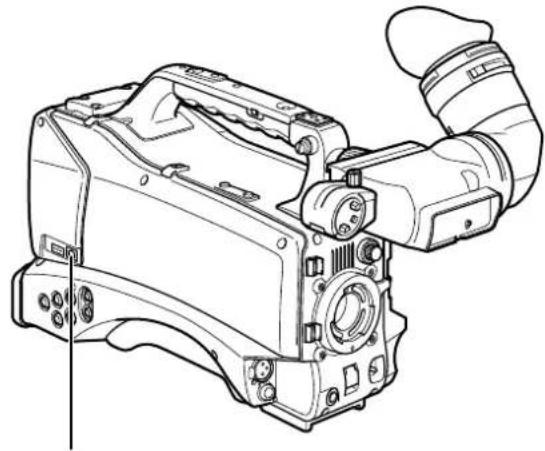
natural_image
Technical line drawing of a camera module with no visible text or symbolsUSB 2.0 Connector (DEVICE)
2 Set the menu option PC MODE SELECT in the SYSTEM SETUP screen to USB DEVICE and set PC MODE to ON.
For details on menu operation, refer to [Using the menus] (page 120).
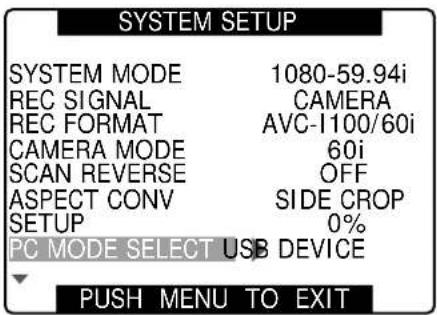
text_image
SYSTEM SETUP SYSTEM MODE 1080-59.94i REC SIGNAL CAMERA REC FORMAT AVC-I100/60i CAMERA MODE 60i SCAN REVERSE OFF ASPECT CONV SIDE CROP SETUP 0% PC MODE SELECT USB DEVICE PUSH MENU TO EXITNOTE
You can use the menu option USER MAIN/USER1/ USER2 in the SW MODE screen to assign PC MODE settings to a user button.
Note that the USER button functions are not available when the menu is open.
To make a USB connection, you must first install the P2 software on the supplied CD-ROM on the computer. Select the "AG-HPX300" driver. This USB driver supports only the Windows operating system. For details, refer to the installation manual.
NOTE
- A USB driver must be installed on the computer.
- Use a computer that supports USB 2.0 since the camera supports only USB 2.0.
- Connect only one camera to a computer via USB.
- Do not remove P2 cards when the camera is connect to a computer via USB.
- In a USB connection, the P2 CARD ACCESS LED is on only when the card is accessed.
- In USB device operation, recording, playback and clip thumbnail operations are not available.
- When a USB device is running, the remaining capacity of P2 cards is not indicated. Audio is not output through the SDI OUT or DVCPRO/DV connector and the AUDIO level meters do not appear.
- The USB lamp on the camera lights during USB connection and USB DEVICE CONNECT appears in the center of the viewfinder. If a normal connection cannot be established, the USB lamp blinks and DISCONNECT appears in the viewfinder.

text_image
USB LED(Viewfinder display)

text_image
USB DEVICE CONNECT3 Terminating USB mode
Use one of the following three methods.
- Set the camera POWER switch to OFF.
- Set the PC MODE option in the SYSTEM SETUP screen to OFF.
- Press the USER button to which PC MODE has been assigned.
USB host mode
This mode allows you to connect the camera to a hard disk drive that supports USB 2.0 to save card data, view thumbnails of the stored clips and write data back to P2 cards.
Switching to USB Host Mode
1 Set the menu option PC MODE SELECT in the SYSTEM SETUP screen to USB HOST and set PC MODE to ON.
• This engages the USB host mode.
- The USB LED on the camera lights in USB host mode and USB HOST CONNECT appears in the center of the viewfinder. When a normal connection cannot be established with the hard disk, the USB LED flashes and DISCONNECT appears in the viewfinder.
- When PC MODE is assigned to a user button, press that user button to switch between USB host mode and normal mode. However, a user button cannot be used for switching in the thumbnail mode.
For details, refer to [Assigning functions to USER Buttons] (page 53).
2 Press the THUMBNAIL button.
• The thumbnail screen opens.
• Make sure that USB HOST appears at the bottom right of the screen.
- When the camera is connected to a hard disk drive, the HDD icon appears at the top right of the screen. If the icon lights red this indicates that data cannot be copied to or from the hard disk. Check hard disk drive type.
For details on hard disk drives, refer to [Thumbnail Screen] (page 102).
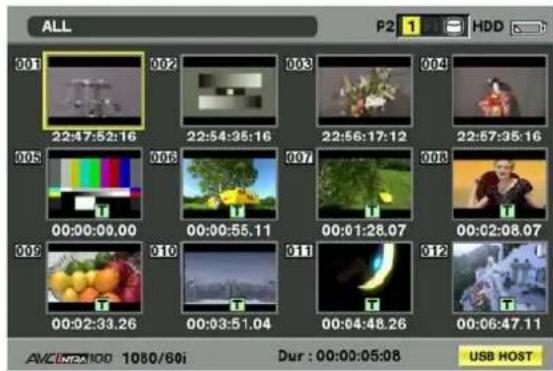
text_image
ALL P2 1 HDD 001 22:47:52:16 002 22:54:35:16 003 22:56:17:12 004 22:57:35:16 005 00:00:00.00 006 00:00:55.11 007 00:01:28.07 008 00:02:08.07 009 00:02:33.26 010 00:03:51.04 011 00:04:48.26 012 00:06:47.11 AVICAM100 1080/60i Dur : 00:00:05:08 USB HOSTNOTE
The USB host mode allows playback of P2 cards but not recording of camera video or external input. And clips on the hard disk must be written back to a P2 card before they can be played back.
For details, refer to [Writing back data to P2 cards] (page 143).
3 Terminating USB host mode.
Use one of the following three methods.
- Set the camera POWER switch to OFF.
- Close the thumbnail screen and set the menu option PC mode in the SYSTEM SETUP screen to OFF.
- Press the USER button to which PC MODE has been assigned. ^1
*1 In thumbnail mode, pressing a user button will not terminate USB host mode.
Using USB host mode
Supported hard disks
• A hard disk drive that supports the USB 2.0 interface
• P2 STORE (the optional AJ-PCS060G hard drive)
NOTE
- This camera supports USB bus power (5.V, 0.5A) but some hard disks may not be able to use USB bus power. Such hard disk drives should be provided with a separate power supply.
- Do not connect a hard disk to hubs or other connections that involve multiple units even if it is not powered on. Do not connect other devices to the hard disk drive via a hub or other device.
- This unit does not support hard disk drives that are 2 TB or larger.
Viewing hard disk drive data
Use the following procedures to view data on a hard disk drive connected via USB.
1 Switch to USB host mode.
For details, refer to [Switching to USB Host Mode] (page 140).
2 Connect a hard disk drive via USB.
3 Press the THUMBNAIL button. Open the thumbnail screen.
4 Press the THUMBNAIL button and select HDD → EXPLORE in the thumbnail menu.
- This opens a screen that shows hard disk drive data.
TYPE S or P2 STORE
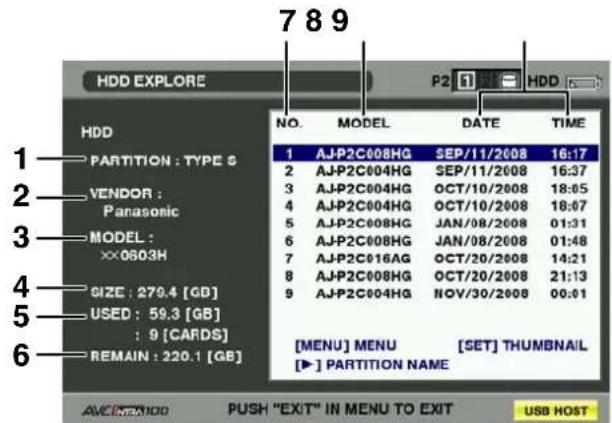
text_image
7 8 9 HDD EXPLORE P2 1 HDD NO. MODEL DATE TIME 1 AJP2C008HG SEP/11/2008 16:17 2 AJP2C004HG SEP/11/2008 16:37 3 AJP2C004HG OCT/10/2008 18:05 4 AJP2C004HG OCT/10/2008 18:07 5 AJP2C008HG JAN/08/2008 01:31 6 AJP2C008HG JAN/08/2008 01:48 7 AJP2C016AG OCT/20/2008 14:21 8 AJP2C008HG OCT/20/2008 21:13 9 AJP2C004HG NOV/30/2008 00:01 [MENU] MENU [SET] THUMBNAIL [▶] PARTITION NAME AVOCEN100 PUSH "EXIT" IN MENU TO EXIT USB HOSTPress the SET button. ↓ ↑ Press the EXIT button.

text_image
ALL(HDD) 001 002 003 004 005 006 007 008 00:02:33.26 00:43:18:29 00:25:33:01 00:00:00.00 SERIAL: ADD06D2064 MODEL: AJ-P2C008HG NUMBER: 1 DATE: SEP/11/2008 TIME: 16:17:17 VERIFY: ON/FINISHED NAME: TEST1 PARTITION: TYPE S SIZE: 279.4 [GB] USED: 59.3 [GB] 9 [CARDS] REMAIN: 220.1 [GB] EVCPRO +1 1080/60i Dur : 00:00:39.28 USB HOSTFAT formatted hard disk
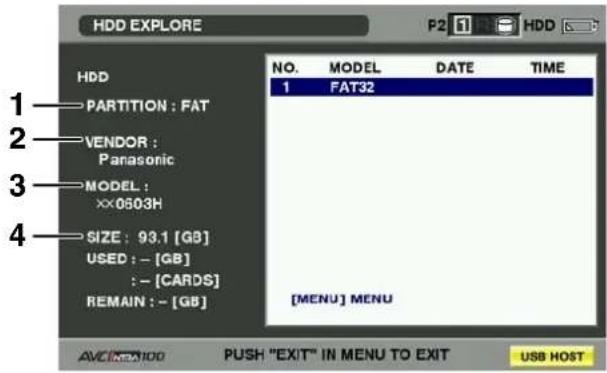
text_image
HDD EXPLORE P2 1 HDD NO. MODEL DATE TIME 1 FAT32 2 3 4 PARTITION : FAT VENDOR : Panasonic MODEL : ××0603H SIZE : 93.1 [GB] USED : - [GB] : - [CARDS] REMAIN : - [GB] [MENU] MENU AVC/MAN100 PUSH "EXIT" IN MENU TO EXIT USB HOST1 PARTITION
Use this function to view hard disk drive type.
Operations differ depending on hard disk drive type.
| Hard disk drive type | Features | Supported functions |
| TYPE S | A special format that permits high-speed loading and write back of data in card units.This is the format used by the camera. | This format allows thumbnail display, loading and write back of data in card units, and write back of data and formatting in clip units. |
| P2STORE | This is the P2 STORE (AJ-PCS060G) hard disk driveCannot be used for writing data. | This format displays thumbnails, write back data in card units and write back data in clip units. |
| FAT | The basic primary partition on a PC is FAT 16 or FAT 32.The root directory of such a partition must contain a CONTENTS directory. | Display thumbnails, write back video data by the clip and formatting* Handled as a “TYPE S” hard disk after formatting. |
| OTHER | Hard disk other than those above* This refers to file systems where root does not contain a directory called “CONTENTS” or a NTFS file system other than FAT16 or FAT32. | Format* Handled as a “TYPE S” hard disk after formatting. |
| Hard disk drive type | Features | Supported functions |
| TYPE S | A special format that permits high-speed loading and write back of data in card units.This is the format used by the camera. | This format allows thumbnail display, loading and write back of data in card units, and write back of data and formatting in clip units. |
| P2STORE | This is the P2 STORE (AJ-PCS060G) hard disk driveCannot be used for writing data. | This format displays thumbnails, write back data in card units and write back data in clip units. |
| FAT | The basic primary partition on a PC is FAT 16 or FAT 32.The root directory of such a partition must contain a CONTENTS directory. | Display thumbnails, write back video data by the clip and formatting* Handled as a “TYPE S” hard disk after formatting. |
| OTHER | Hard disk other than those above* This refers to file systems where root does not contain a directory called “CONTENTS” or a NTFS file system other than FAT16 or FAT32. | Format* Handled as a “TYPE S” hard disk after formatting. |
2 VENDOR
Indicates hard disk drive vendor.
3 MODEL
Indicates hard disk drive model.
4 SIZE
Indicates the total capacity of the hard disk drive.
5 USED
Indicates the size of used space on the hard disk drive (units: GB) and used P2 card area (units: cards).
6 REMAIN
Indicates remaining capacity (units: GB) on the hard disk drive.
7 Partition number
Indicates the number of partitions (in units of P2 cards) on the hard disk drive.
NOTE
The screen can show up to 10 partitions. When there are 11 or more partitions, use the cursor button ( ) to move down to display the remaining partitions.
8 MODEL
Indicates the model of P2 card that originally recorded the data in the partition.
NOTE
Press the cursor button (▶) to switch to PARTITION NAME. Use the cursor button (◀) to return to the previous model.
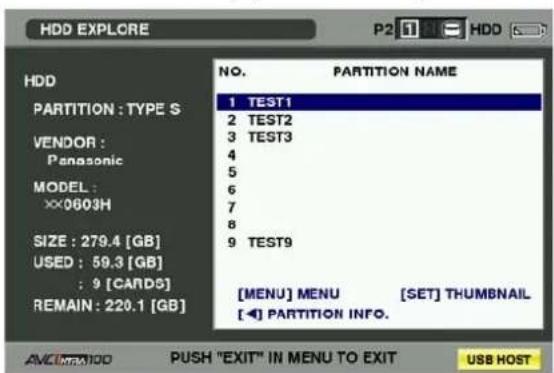
text_image
HDD EXPLORE P2 1 HDD HDD PARTITION : TYPE S VENDOR : Panasonic MODEL : xx0603H SIZE : 279.4 [GB] USED : 59.3 [GB] : 9 [CARDS] REMAIN : 220.1 [GB] NO. PARTITION NAME 1 TEST1 2 TEST2 3 TEST3 4 5 6 7 8 9 TEST9 [MEN] MENU [SET] THUMBNAIL [◀] PARTITION INFO. AVCIMM100 PUSH "EXIT" IN MENU TO EXIT USB HOSTWhen hard disk drive thumbnails are displayed, select CHANGE PARTITION NAME in the OPERATION menu to enter the PARTITION NAME on the software keyboard. (up to 20 characters)
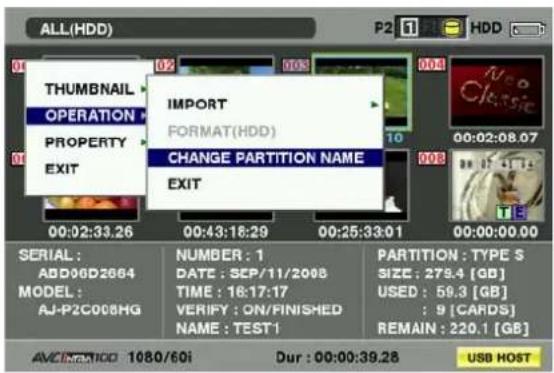
text_image
ALL(HDD) THUMBNAIL OPERATION PROPERTY EXIT IMPORT FORMAT(HDD) CHANGE PARTITION NAME EXIT 00:02:33.26 00:43:18:29 00:25:33:01 00:00:00.00 SERIAL : ABD06D2064 MODEL : AJ-P2C008HG NUMBER : 1 DATE : SEP/11/2098 TIME : 18:17:17 VERIFY : ON/FINISHED NAME : TEST: PARTITION : TYPE S SIZE : 279.4 [GB] USED : 59.3 [GB] : 9 [CARDS] REMAIN : 220.1 [GB] AVIC/ANIO 1080/60i Dur : 00:00:39.28 USB HOST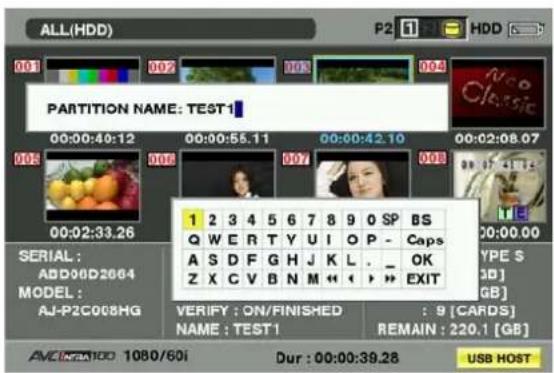
text_image
ALL(HDD) 001 002 003 004 PARTITION NAME: TEST-1 00:00:40:12 00:00:55.11 00:00:42.10 00:02:08.07 00:02:33.26 SERIAL: ABD00D2064 MODEL: AJ-P2C008HG 1 2 3 4 5 6 7 8 9 0 SP BS Q W E R T Y U I O P - Caps A S D F G H J K L . _ OK Z X C V B N M << >> EXIT VERIFY : ON/FINISHED NAME : TEST1 9 [CARDS] REMAIN : 220.1 [GB] AVOC#100 1080/60i Dur : 00:00:39.28 USB HOST9 DATE/TIME
Indicates the date and time data was recorded on the partition.
10 SERIAL
Indicates the serial number of P2 card that originally recorded the data in the partition.
11 VERIFY
Indicates verify settings and results when data was recorded to a partition.
ON:FINISHED:
Runned verify and verify results were matched.
ON:FAILED:
Runned verify but verify results could not be matched.
OFF:
Did not run verify.
---:
No verify information available.
NOTE
- Hard disk drives formatted using FAT can handle up to 1000 clips. Any clips beyond that limit cannot be opened.
- Only the first partition of a hard disk drive formatted using FAT can display information.
- An invalid partition on P2 STORE (AJ-PCS060G) is indicated in gray.
12 NAME
Indicates the PARTITION NAME.
Formatting Hard Disks
1 Switch to the USB host mode.
For details, refer to [Switching to USB Host Mode] (page 140).
2 Connect a hard disk drive via USB.
3 Press the THUMBNAIL button to open the thumbnail screen.
4 Press the THUMBNAIL button and select HDD → EXPLORE in the thumbnail menu.
- This opens a screen that shows hard disk drive data.
5 Select OPERATION → FORMAT (HDD) in the menu and use a cursor button and the SET button to select YES.
- Select YES in the confirmation message that appears again to start hard disk drive formatting.
- Handled as a "TYPE S" hard disk drive after formatting.
NOTE
All data on a hard disk drive is deleted when the disk is formatted. It is not possible to select part of a partition to delete.
Writing to hard disk drive
1 Switch to the USB host mode.
For details, refer to [Switching to USB Host Mode] (page 140).
2 Connect a hard disk drive via USB.
If the hard disk drive has not been formatted by the camera, format it according to the instructions provided in [Formatting Hard Disks] (page 142).
3 Insert a P2 card.
4 Press the THUMBNAIL button to open the thumbnail screen.
5 Press the THUMBNAIL button and select HDD → EXPORT from the thumbnail menu and specify the slot of the P2 card with the data you want to write to the hard disk drive.
6 Select YES.
• This starts the write process.
- A progress bar appears during the write process. To interrupt writing, press the SET button. Selecting YES in the cancel confirmation that appears will stop the write process.
- COPY COMPLETED! announces the end of the write process.
NOTE
- To turn off the verify phase in a write operation, select HDD → SETUP in the thumbnail menu and set VERIFY to OFF. This speeds up the write time but does not verify the written data.
- Selecting ALL SLOT writes the data on all inserted P2 cards inserted in the camera to the hard disk drive.
NOTE
- A TYPE S hard disk drive can write data in card units. Up to 23 P2 cards can be saved to a hard disk drive. The P2 card data recorded on a hard disk drive are recognized as separate drives.
- To write P2 cards with bad clips, it is a good idea to repair these clips before writing them to a hard disk drive.
- Ending a recording during the verify phase will end writing of data from the P2 card to the hard disk drive.
Writing back data to P2 cards
This allows you to select a clip from the hard disk drive and write it back to a P2 card.
1 Switch to the USB host mode.
For details, refer to [Switching to USB Host Mode] (page 140).
2 Connect a hard disk drive via USB.
3 Insert the P2 card to which data will be written back to.
4 Press the THUMBNAIL button, select HDD → EXPLORE from the thumbnail menu, move to the partition with the data that will be read and press the SET button.
5 Select the clip to be written to the P2 card from the thumbnail on the hard disk drive.
6 Press the THUMBNAIL button, select OPERATION → IMPORT → SELECTED CLIPS from the thumbnail menu and select the slot of the P2 card to write the data to.
7 Select YES.
• This starts the data write to the P2 card.
- When the write process ends, "COPY COMPLETED!" appears.
NOTE
- When clips are selected for writing, verify is not performed.
A TYPE S and P2 STORE hard disk drive allows you to write back data in card units. Format the P2 card to prepare for write back.
1 Switch to the USB host mode.
For details, refer to [Switching to USB Host Mode] (page 140).
2 Connect a hard disk drive via USB.
3 Insert the P2 card to which data will be written back to.
4 Press the THUMBNAIL button, select HDD → EXPLORE from the thumbnail menu, move to the partition with the data that will be written and press the SET button.
5 Select OPERATION → IMPORT → ALL from the thumbnail menu and select a slot with an empty P2 card for writing to.
6 Select YES.
- This starts the write process to the card.
- COPY COMPLETED! announces the end of the write back process.
NOTE
- It is not possible to import data by the partition between P2 cards with different model numbers. Import data in clip units from cards with a different model number.
- To turn off the verify phase in a write back operation, select HDD → SETUP in the thumbnail menu and set VERIFY to OFF. This speeds up the write back time but does not verify the written data.
- When a clip is written back to a P2 card it was not originally on may make that clip an incomplete clip. Should this happen, reconnect it.
Refer to [Reconnection of Incomplete Clips] (page 109).
Hard disk drive precautions
- Use hard disk drives (including P2 STORE (AJ-PCS060G)) according to the following conditions.
- Operate hard disk drives within their operating specifications (temperature, etc.).
-
Do not use hard disk drives in locations that are unstable or exposed to vibration.
-
Some hard disk drives may not operate normally.
- SATA (serial ATA) or PATA (parallel ATA) interface hard disk drives connected using a USB conversion cable may not be recognized.
- Use hard disk drives with plenty of capacity for copying data.
- During formatting and copying, do not disconnect cables or remove a P2 card that is involved in these activities and do not power off this camera and the hard disk drive, as the camera and hard disk drive will otherwise have to be rebooted.
- A hard disk drive is a precision instrument whose read and write functions may fail in some operating environments.
- Please note that Panasonic accepts no liability whatsoever for data loss or other losses either direct or indirect arising from hard disk damage or other defects.
- When data from this camera is copied to a hard disk and is edited on another computer, the data may no longer work in this unit and the hard disk data may become corrupted.
- Use of the drive mount converter distributed by the below URL allows you to mount specific folders when a hard disk drive is connected.
Connections to the DVCPRO/DV Connector
Recording signals input to the DVCPRO/DV connector
1 Connect a 1394 cable (DV cable).
For details, see [Precautions in 1394 Connections] (page 146).
- Make sure that the signal format of the camera and the connected device is the same.
2 To route inputs via the IEEE 1394 interface, set the menu option REC SIGNAL in the SYSTEM SETUP screen to 1394.
- To use HD (1080i, 720P) set the menu option REC FORMAT in the SYSTEM SETUP screen to DVCPRO HD/60i or DVCPRO HD/60P.
The AVC-Intra format and DVCPRO HD native recording do not allow input via the IEEE 1394 interface.
NOTE
- Signals that have the same format as that set in the menu options SYSTEM MODE and REC FORMAT in the SYSTEM SETUP screen should be input to the IEEE 1394 interface. A signal in a different format will not be correctly recorded on a P2 card. Video and audio recording and EE type video and audio of signal inputs other than 1x speed playback signals may not work.
For details, see [Warning and Error Display for Thumbnail Operation and USB HOST MODE] (page 153). - Audio signal inputs are input signals from the DVCPRO/DV connector.
- 32 kHz/4CH (12 bit) audio signals input via the IEEE1394 interface are recorded as 48 kHz/4CH (16 bit) on a P2 card.
- It is not possible to use the GENLOCK IN connector to synchronize to an external reference signal.
- Signals output from the VIDEO OUT or AUDIO OUT connectors differ from actual input signals. Use such signals for monitoring.
- The following functions do not operate.
• Pre-recording function - Loop recording function
- Interval recording and one-shot recording function
Time Code and User Bits
- When input from the IEEE1394 interface is selected, the time code or user bits input to the TC IN connector cannot be recorded on a P2 card.
- When input from the IEEE1394 interface is selected, time code output from the TC OUT connector is not synchronized to the video signal output from the VIDEO OUT connector.
Subcode area time codes and user bits
- When input from the IEEE 1394 interface is selected and the TCG switch is set to F-RUN, the time code of the subcode area input from the DVCPRO/DV connector can be recorded on the P2 card.
- To record user bits input from the DVCPRO/DV connector on a P2 card, set the menu option UB MODE in RECORDING SETUP to EXT.
VAUX area time codes and user bits
When input from the IEEE1394 interface is selected, time code and user bits of the VAUX area input from the DVCPRO/DV connector is recorded on a P2 card regardless of camera menu settings and switch positions.
Recording UMID (Unique Material Identifier) data
When input from the IEEE1394 interface is selected, UMID data input via the DVCPRO/DV connector is recorded on a P2 card. When no UMID data is available, the camera generates and records such data.
UMID data is not recorded when the camera is operating in the DV mode.
Control of external devices through 1394 connection
Connecting an external device for backup recording to the DVCPRO/DV connector allows the operator to control start and stop recording from the camera.
1 Connect a 1394 cable (DV cable).
For details, see [Precautions in 1394 Connections] (page 146).
- Set 1394 CONTROL in the setting menu OTHER FUNCTIONS screen to BOTH.
2 Use the setting menu 1394 CMD SEL (OTHER FUNCTIONS) to select the command for terminating recording that external devices receive.
For details on menu operation, refer to [Using the menus] (page 120).
NOTE
- When the camera is set to REC RUN to perform backup recording on a connected external device, the advance of time code from the DVCPRO/DV connector will stop when all P2 cards have been fully recorded regardless of whether backup recording continues.
- It may not be possible for an external device to back up recording when quick transitions are made between recording and stopping.
- When the AVC-Intra format or DVCPRO HD native recording format is selected, control of an external device via a 1394 connection is not possible.
- Interval recording, one-shot recording and loop recording do not allow control of an external device via 1394.
Precautions in 1394 Connections
- The camera does not supply power via the cable.
-
Observe the following in connections using a 1394 cable.
-
Connect this unit to only one other device.
- Do not expose the 1394 connector to excessive force when connecting a 1394 cable to avoid damaging the connector.
- If an error (1394 INITIAL ERROR) should occur when making a connection, reinsert the 1394 cable or turn the camera off and then turn it back on again.
- Make sure that the camera and all connected devices are connected to ground (or connected to a common ground). If the equipment cannot be connected to ground, turn off all connected devices before connecting or disconnecting an IEEE 1394 cable.
- When connecting the unit to a device with a 4-pin connector, connect the cable to the 6-pin connector on the camera first.
- Be sure to properly connect the 1394 cable to the DVCPRO/DV on a computer with a 6-pin connector. Note that inserting the plug the wrong way round may damage the connector.
6-pin type

natural_image
Two types of connected USB connectors shown in line (no text or symbols visible)4-pin type
- AV signals may be disrupted when connected devices are turned on and off or when the interface cable is connected or disconnected.
- It may take the system a few seconds to stabilize after switching input signals or changing modes. Start recording after the system has stabilized.
- The AUDIO LEVEL control does not work in recordings that involve IEEE1394 interface input or output signals.
-
Observe the following precautions when controlling a P2 memory card camera-recorder using PC application software (editing software).
-
Recording cannot be inserted to a portion within a clip. It can only be appended to the end of the newest clip.
-
Do not open the thumbnail screen during application software operation as this may prevent normal software operation.
-
Unprocessed video and audio signals are output via the IEEE 1394 interface during special playback. When monitored on another device, these video and audio signals may sound different than when played back on this unit.
- A DV or DVCPRO output format makes it possible to select audio channel CH1/CH2 or CH3/CH4 output from the IEEE 1394 interface in the menu option 1394 AUDIO OUT in the AUDIO SETUP screen.
Chapter 9 Maintenance and Inspections
Inspections Before Shooting
Make sure you check that the system is operating normally before embarking on a shoot. We recommend using a colour video monitor to check the image.
Preparing for Inspections
1 Mount a charged battery.
2 Turn the POWER switch to ON to check the battery remaining level in the viewfinder.
- When battery capacity is low, replace it with a fully charged battery.
1999minB90%
DIONC160USER-1

CAC
3 Insert a P2 card in the card slot and close the slot cover.
- Confirm that the P2 CARD ACCESS LED for the inserted card slot lights up in orange. When P2 cards are installed in both card slots, the P2 CARD ACCESS LED for the first inserted card (that was first accessed) will light orange while the P2 CARD ACCESS LED for a subsequently inserted card will light green.
- If the access LED for the P2 card slot in which a P2 card is inserted keeps blinking in green, or if there is no display, recording is not possible on that particular P2 card.
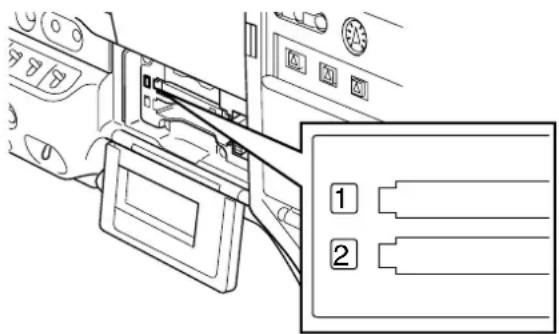
text_image
Diagram showing car interior with labeled compartments and a zoomed-in section highlighting two compartments labeled 1 and 2.Inspecting the Camera Unit
1 Set the zoom to electric zoom mode and check the zoom operation.
- Check that the image changes to telephoto and wide angle.
2 Set the zoom to manual zoom mode and check the zoom operation.
- Turn the manual zoom lever to check that the image changes to telephoto and wide angle.
3 Set the iris to automatic adjustment mode and aim the lens at objects with different degrees of brightness, to check that the automatic iris adjustment operates normally.
4 Set the iris to manual adjustment mode and turn the iris ring, to check the manual iris adjustment.
5 Return the iris to automatic adjustment mode and change the GAIN switch setting to L, M, and H, to check the following items:
- The iris is adjusted for objects with the same brightness according to the switch setting.
- The gain value displayed on the viewfinder screen changes according to the switch setting.
6 When a lens with an extender is mounted, set the extender to the operating position to check that the extender operates properly.
Inspecting the Memory Recording Functions
Make sure you successively carry out the inspections from [Inspecting the P2 Card Recording] to [Inspecting the Earphone and Speaker].
Inspecting the P2 Card Recording
1 Check on the display inside the viewfinder that the remaining P2 card recording capacity is sufficient.
For details, refer to [Screen displays] (page 66).
2 Press the camera's REC button to check the following items:
• The P2 access LED blinks in orange.
- The REC indication in the viewfinder lights.
- System warnings do not appear inside the viewfinder.
3 Press the camera's REC button again.
- Check that the P2 access LED lights orange and that REC indication in the viewfinder clears.
4 Using the REC button on the handle, repeat Steps 2 to 3 to check the same operation.
- Check the VTR button on the lens in the same way.
5 Press the THUMBNAIL button to switch the thumbnail screen to play back currently recorded clip from thumbnail.
- Check that playback is operating normally.
6 Use the USER button to which the SLOT SEL function has been assigned to select P2 cards for recording when more than one P2 card is inserted in the card slots.
- Repeat the operations in Steps 2 to 3 and 5 to check that recording and playback operate properly.
Inspecting the Audio Level Automatic Adjustment
1 Set the AUDIO SELECT CH1 and CH2 switches to [AUTO].
2 Set the AUDIO IN switch to [FRONT].
3 Aim the microphone connected to the MIC IN jack at an appropriate sound source. Then, check that the level displays for both CH1 and CH2 change according to the sound level.
Inspecting the Audio Level Manual Adjustment
1 Set the AUDIO IN switch to [FRONT].
2 Set the AUDIO SELECT CH1 and CH2 switches to [MAN].
3 Turn the AUDIO LEVEL CH1 and CH2 controls.
- Check that the level display increases when the controls are turned to the right.
Inspecting the Earphone and Speaker
1 Turn the MONITOR control to check that the speaker volume changes.
2 Connect an earphone to the PHONES jack.
- Check that the speaker is turned off and the microphone sound can be heard from the earphone.
3 Turn the MONITOR control to check that the earphone volume changes.
Inspection for Using an External Microphone
1 Connect an external microphone to the REAR 1 and REAR 2 connectors.
2 Set the AUDIO IN switch to [REAR].
3 Set the LINE/MIC/+48V selector switches on the rear panel to [MIC] or [+48V], depending on the power supply type of the external microphone.
- MIC: For a microphone with internal power supply.
- +48V: For a microphone with external power supply.
4 Aim the microphone at the sound source and check that the sound level indication in the LCD or viewfinder varies with changes in sound intensity.
- The channels can also be checked separately by connecting a single microphone to each channel.
Inspection of the clock, time code, and user bits
1 Set the user bits as required.
Please refer to [Setting user bits] (page 58) for the setting procedures.
2 Set the time code.
Please refer to [Setting the Time Code] (page 60) for the setting procedures.
3 Set the TCG switch to R-RUN.
- Press the COUNTER button to display the time code on the LCD monitor or in the viewfinder.
4 Press the REC button.
- Check that the counter display number changes as recording progresses.
5 Press the REC button again.
- Check that recording stops and the counter display number stops changing.
6 Set the TCG switch to F-RUN.
- Check that the counter display number changes regardless of recording status.
7 Hold down the DISP/MODE CHK button to check the date and time on the LCD monitor or in the viewfinder.
- Adjust the date and time setting if the DATE, TIME and time zone is not correctly displayed. For details, see [Setting Date and Time of Internal Clock] (page 26).
NOTE
Note that date and time data set for DATE, TIME, and time zone is recorded in clips, and affects the playback sequence, etc. at the time of thumbnail manipulations.
Maintenance
Cleaning Inside the Viewfinder
- Do not use thinner or other solvents to remove dirt from the viewfinder.
- Wipe the lens with a commercially available lens cleaner.
Eyepiece Care
If dust adheres to the LCD screen, open the eyepiece to remove it.

text_image
Eyepiece Eyepiece lock buttonDetaching the eyepiece
Slide the eyepiece lock button and turn the eyepiece clockwise.
Mounting the eyepiece
Line up the protrusion on the eyepiece lock button with the mark on the viewfinder and slide in the eyepiece. Turn the eyepiece counterclockwise until the lock knob clicks.
NOTE
When outdoors, never carry or set up the camera with the eyepiece facing up to prevent sunlight, which could damage the internal parts of the eyepiece.
Charging the internal battery
The internal battery preserves the date and time settings. The appearance of in the viewfinder or LCD monitor indicates that the internal battery is exhausted. Follow the steps below to recharge the battery. Set the date and time when the battery has been fully charged.
1 Connect the camera to an external power source.
- Leave the POWER switch on the camera off.
2 Leave the camera for about 4 hours.
- This is the time it takes to fully charge the internal battery.
- Check the time code, date display and setting menus after charging the battery.
Replace the internal battery if appears after charging. Consult your distributor.
Warning System
Warning Description Tables
If a problem is detected immediately after the power is turned on, or during operation, this will be indicated by the WARNING lamp, lamps inside the viewfinder and a warning tone.
| Priority | Warning type | LCD or viewfinder indication | Tally lamp | Warning lamp | Alarm tone*6 | Warning description and recording/playback operation | Countermeasures |
| 1 | System error | SYSTEM ERROR Cause indication *1 Red blinking | Blinks 4 times per second | Blinks 4 times per second | Continuous tone | P2 microprocessor or control failure. Operation stops. | Check the cause indication *1 and consult your distributor. |
| 2 | Incorrect P2 card removal | TURN POWER OFF Blinks red | Blinks 4 times per second | Blinks 4 times per second | Continuous tone | A P2 card was removed during access and card data was corrupted. Both access LEDs light orange. | Turn off the power. Repair the P2 card if the clips on the card are corrupted. |
| 3 | The battery is exhausted | LOW BATTERY Red blinking, and the battery level bar blinks with the empty status. (This indication appears also when MENU indications have been turned OFF.) | Blinks 1 time per second | Lights | Continuous tone | The battery is exhausted. Recording and playback stop. The camera stops automatically when the voltage drops. | Replace the battery. |
| 4 | P2 card fully recorded | FULL Blinks red (appears only for 3 seconds in MCR mode.) | Blinks 4 times per second after completion of recording. | Lights after completing recording | Continuous tone after completing recording | No more space on P2 cards left for recording. Stop recording.*3 | Delete clips that are no longer needed or insert a new card. |
| 5 | Recording error | REC WARNING Cause indication *2 Blinks red | Blinks 4 times per second | Blinks 4 times per second | Intermittent tone 4 times per second | A recording error has occurred. The error may terminate recording or let it continue.*4 | Turn the power off and then back on again and check recording and playback. Replace any P2 card that does not enable normal recording. |
| 6 | Irregular reference signal | TEMPORARY PAUSE IRREGULAR FRM SIG Blinks red. | Blinks 4 times per second | Blinks 4 times per second | Intermittent tone 4 times per second | An irregular reference signal input to GENLOCK IN prevents normal recording by pausing recording. The recorded clip is divided.• Recording resumes when the signal returns to normal. Recording does not resume if interval, one-shot or loop recording is in progress. | Check the GENLOCK IN signal. |
| 7 | Drop in reception quality of wireless receiver transmission | WIRELESS RF Blinks red | Blinks 4 times per second (Recording only) | Blinks 4 times per second | No | Indicates poor reception from the wireless receiver. Recording continues but wireless microphone cannot be received. | Check microphone power supply and receiver reception status. |
(Continued on the next page)
(Continued from the previous page)
| Priority | Warning type | LCD or viewfinder indication | Tally lamp | Warning lamp | Alarm tone*6 | Warning description and recording/playback operation | Countermeasures |
| 8 | 1394 connection error | 1394 INITIAL ERROR Blinks red | Blinks 4 times per second | Blinks 4 times per second | No | The DVCPRO/DV cable has become disconnected or multiple devices are connected. | Check the camera and device connections, reconnect them if necessary, then turn the power off and back on again. |
| 9 | Battery nearly empty | The last bar in the battery level indication blinks (This indication appears also when MENU indications have been turned OFF.) | Blinks 1 time per second | Blinks 1 time per second | No | The battery is near depletion. Operation continues.*5 | Replace the battery as necessary. |
| 10 | P2 card nearly fully recorded | The P2CARD level indicator blinks. | Blinks 1 time per second during recording. | Blinks 1 time per second during recording. | No | Less than 2 minutes is left on the P2 cards (level indicator shows 1 minute or less). This warning appears only during recording. | Replace or insert additional P2 cards. |
*1 P2 SYSTEM ERROR cause indication
- P2 MICON ERROR: The P2 microprocessor does not respond.
- P2 CONTROL ERROR: A P2 recording control error has occurred.
- CAM MICON ERROR: The camera microprocessor does not respond.
*2 REC WARNING cause indication
- CARD ERROR*: P2CARD error (* indicates the number of the slot of the card with the error.) Stops recording.
- REC RAM OVERFLOW: Overflow of recording RAM. Stops recording.
- PULL DOWN ERROR: 24P, 30P video pulldown error. Recording continues.
- ERROR: Other recording errors (When an attempt is made to record 1000 or more clips on one P2 card.)
*3 Perform either of the following procedures to cancel this warning.
- Press a playback control button.
- Press the THUMBNAIL button.
- Remove the P2 card and insert another card.
*4 Perform either of the following procedures to cancel this warning.
- Press the REC button.
- Press a playback control button.
- Press the THUMBNAIL button.
- Remove all cards.
*5 When NEAR END CANCEL is set to ON, you can press the DISP/MODE CHK button to cancel the alarm.
*6 When the alarm sounds, audio is not output to the camera speakers or earphones. The DISP/MODE CHK button cancels only the alarm tone when pressed during an alarm.
Warning and Error Display for Thumbnail Operation and USB HOST MODE
| Item Message Description Measure | |||
| Thunnalis | CANNOT ACCESS! | Data cannot be accessed because it is corrupted or for other reasons. | Restore media and clips to normal state before access. |
| CANNOT CHANGE! | Any thumbnails that cannot be produced on the AVC-Intra 100 or AVC-Intra 50 and displayed in gray cannot be changed at the text memo position. | Set SYSTEM MODE according to the clips. | |
| CANNOT COPY! Images cannot be copied. Check the conditions for copying. | |||
| CANNOT DELETE ! | P2 card contains contents version mismatches or bad clips. | Match devices and contents versions, and repair bad clips. | |
| CANNOT FORMAT! P2 card problem prevents formatting. Check P2 card. | |||
| CANNOT RECONNECT! | A clip that does not span multiple P2 cards cannot be reconnected. | Check selected content. | |
| CANNOT REPAIR! | Data cannot be repaired since content that cannot be repaired is selected. | Check selected content. | |
| CANNOT REPAIR IN SELECTION! | Some of the selected clip could not be repaired. | — | |
| CARD FULL! The P2 or SD card is full. Insert media with sufficient capacity. | |||
| INVALID VALUE! Entered data was invalid. Enter data in a valid range. | |||
| LACK OF REC CAPACITY! | There is not enough recording capacity left on the card. | Insert a card with sufficient recording capacity. | |
| MISSING CLIP! | A shot mark will be added to the clips recorded on multiple P2 cards when all P2 cards are not inserted yet. | Insert all P2 cards with recorded clips, and confirm that the incomplete clip indicators disappear, and then add shot marks. | |
| NO CARD! No P2 or SD card is inserted. Insert compatible media. | |||
| NO COPY TO SAME CARD! | A clip cannot be copied to the card storing the original clip. | Copy the selected clip to a card that does not contain the original clip. | |
| NO FILE! | The designated file is not found. | Check the file. | |
| NO SD CARD! | No SD card is inserted. | Insert an SD card. | |
| SAME CLIP IS SELECTED! | The clip cannot be copied because a clip that has already been copied and the original clip have been selected. | Confirm the selected clip and release either the source clip or the destination clip and then execute the copy operation. | |
| TOO MANY CLIPS! | Too many clips are selected. | Reduce the number of selected clips. | |
| UNKNOWN CONTENTS FORMAT! | P2 card contains contents version mismatches or corrupted content. | Match devices and contents versions, and repair bad clips. | |
| UNKNOWN DATA! | The metadata character code is invalid. | Use UTF-8 for the metadata character code. Use the viewer to enter correct characters. | |
| USER CLIP NAME MODIFIED! | Characters in the clip name had to be deleted in adding the counter value. | The user clip name plus the counter value can only contain up to 100 bytes. Characters in the clip name are automatically deleted when the total exceeds 100bytes. | |
| WRITE PROTECTED! | The P2 or SD card is write protected. | Insert write-enabled media. | |
| Soft keyboard | CANNOT CHANGE! | [PERSON] will be entered while the text memo is not available. | Enter [TEXT] before entering [PERSON]. |
| CANNOT SET! INVALID VALUE! | The entered value is incorrect. | Change the value. | |
(Continued on the next page)
(Continued from the previous page)
| Item Message Description Measure | |||
| HDD (USB HOST MODE) | CANNOT ACCESS CARD! | An error occurred during P2 card access. Check P2 card. | |
| CANNOT ACCESS TARGET! | An error occurred during hard disk access. Check hard disk status and connection. | ||
| CANNOT FORMAT! The | hard disk cannot be initialized. Connect another hard disk drive. | ||
| CANNOT RECOGNIZE HDD! | The destination target cannot be properly recognized. | Reboot the hard disk or connect a different hard disk. | |
| CARD IS EMPTY! CANNOT COPY! | The P2 selected for copying is empty. | Copying is not performed since the card is empty. | |
| HDD CAPACITY FULL! | Not enough space left on the hard disk. | There is not enough space on the connected hard disk. Use a new hard disk or formatted hard disk. | |
| HDD DISCONNECTED! | The unit is not connected to a hard disk. | Reconnect the USB cable. If the hard disk does not operate normally, turn it off and turn it back on again. | |
| MISMATCH COMPONENT! | Copying cannot be made because the destination card is in the wrong format. | Use a P2 card with the same model number or import video in clip units. | |
| P2 CARD IS UNFORMATTED! | The P2 card is not formatted. Use a formatted | P2 card. | |
| PLEASE FORMAT P2 CARD! | This warning indicates that data could not be imported from a hard disk to a P2 card because the P2 card contained recorded data. | You cannot copy to a P2 card that contains data. Format the card on a P2 device and copy again. | |
| TOO MANY PARTITIONS! | There are too many partitions. | Hard disks can handle up to 23 partitions. Use a new hard disk or formatted hard disk. | |
| TOO MANY TARGETS! | Multiple devices are connected. | Disconnect devices, turn off the unit and turn it back on again. | |
| UNKNOWN DEVICE CONNECTED! | The connected DVD drive is not compatible. | Disconnect devices, turn off the unit and turn it back on again. | |
| VERIFICATION FAILED! | The compare check after copying failed. Copy the data again. | ||
Updating the firmware incorporated into the unit
The firmware can be updated using either of the following two methods.
1 Checking the current version of firmware and performing the update using the dedicated tool (P2\_Status\_Logger)
PASS (P2 Asset Support System) is only available to customers who have completed customer registration with Panasonic.
Log in to PASS and use the dedicated tool (P2_Status_Logger) to check the version information of the firmware on the unit and download links to pages containing the necessary firmware. For further information about downloading and using P2_Status_Logger, log in to PASS and refer to the relevant pages. Besides access to PASS, completing customer registration has a number of other benefits. For further details, refer to the PASS (P2 Asset Support System) website (https://eww.pavc.panasonic.co.jp/pro-av/).
2 Checking the current version of the firmware using the unit and performing the update
Check firmware version of the camera in the DIAGNOSTIC screen. Then access the site listed in the NOTE below to check the most recent firmware information and download any firmware you require.
NOTE
- The update is completed by loading the downloaded file onto the unit via an SD memory card. For further details about the updating methods, refer to the following website.
- Be sure to use a compatible SD memory card. The unit is compatible with SD memory cards based on the SD and SDHC standards. Also, be sure to format the memory card using the unit before use.
Chapter 10 Index
1
MENU 1394 AUDIO OUT 131
MENU 1394 CMD SEL 137
MENU 1394 CONFIG 138
1394 connection 146
MENU 1394 CONTROL 137
MENU 1394 STATUS 138
2
MENU 25M REC CH 131
A
MENU A.IRIS LEVEL 125
MENU ACCESS LED 137
MENU ALARM 137
MENU ASPECT CONV 127
MENU ATW 128
MENU ATW TYPE 128
Audio Input 54
Audio level meter magnification 73
MENU AUDIO SETUP screen 130
Auto Black Balance 50
Auto Black Balance 50
MENU AUTO KNEE SW 129
MENU AUTO LEVEL CH3 130
MENU AUTO LEVEL CH4 130
Auto tracking white balance 50
Auto tracking white balance 50
B
MENU BATTERY MODE 134
MENU BATTERY SELECT 134
MENU BATTERY SETUP screen 134
battery
Setting 86
Mounting 86
Black Balance 49
MENU BP-GL65/95 NEAR 135
C
MENU CAC 136
MENU CAC CARD READ 136
MENU CAC FILE DELETE 136
MENU CAC FILE INIT 136
MENU CAC PROPERTY 136
Chromatic Aberration Compensation (CAC) ..... 92
Chromatic Aberration Compensation (CAC) ..... 92
cine-like gamma 37
clip 101
MENU CLOCK SETTING 137
MENU COLOR TEMP Ach 124
MENU COLOR TEMP Bch 124
Connector signal 164
Control of external devices 146
Copying 109
Counter 64
cue up 43
ID
Date and Time 26
MENU DATE/TIME 133
DC power 88
Deleting 108
MENU DETAIL CORING 124
MENU DETAIL LEVEL 124
MENU DIAGNOSTIC screen 138
Dimensions 160
MENU DIONIC160 NEAR 134
MENU DIONIC90 NEAR 134
Diopter Adjustment 78
MENU DISPLAY SETUP screen 132
MENU DOWNCON MODE 132
MENU DRS EFFECT 125
DVCPRO/DV Connector 145
Dynamic Range Stretcher 9
Dynamic Range Stretcher 53
E
Electronic Shutter 52
external DC power 88
external power 88
IF
Fast-forward playback 43
Fast-reverse playback 43
firmware 155
Flange Back 90
Focus assist 75
MENU FOCUS BAR 133
Formatting
P2 Card 114
SD memory card 81, 115
Hard Disks 142
MENU FRAME RATE 124
FRONT AUDIO LEVEL Control 55
FRONT AUDIO LEVEL Control Knob 98
Front Microphone 95
MENU FRONT VR CH1 130
MENU FRONT VR CH2 130
G
MENU GAMMA 125
GENLOCK 64
MENU GL PHASE 137
H
MENU H PHASE 137
MENU HEADROOM 131
MENU HIGH GAIN 128
Hot Swap Recording 41
MENU HYTRON140 NEAR 134
MENU HYTRON50 NEAR 134
|
internal battery 150
Internal Clock 26
Interval recording 40
Interval recording 40
MENU INTERVAL TIME 129
MENU IRIS ADJUST 136
K
MENU KNEE 125
L
LCD 120
Loop recording (LOOP REC) 41
Loop recording (LOOP REC) 41
MENU LOW GAIN 128
M
MENU MAIN MENU 122
MENU MARKER 133
MENU MASTER PED 125
MENU MATRIX 125
MENU MENU BACK 134
MENU MENU INIT 137
menu
THUMBNAIL MENU 102
menus 120
menus
Using 120
Initializing 121, 120
Meta Data 110
MENU MIC LOWCUT CH1 130
MENU MIC LOWCUT CH2 130
MENU MIC LOWCUT CH3 130
MENU MIC LOWCUT CH4 130
Microphone 95
MENU MID GAIN 128
MODE CHECK 72
MENU MODEL NAME 138
MENU MONITOR SELECT 131
N
MENU NAME EDIT 126
Native recording 35
Native recording 35
Native VFR Recording 36
Native VFR Recording 36
MENU NEAR END CANCEL 135
MENU NiCd14 END 135
MENU NiCd14 NEAR 135
Normal Recording 34
Normal speed playback 43
MENU NP-L7 NEAR 134
10
One-shot recording (ONE SHOT REC) 40
One-shot recording (ONE SHOT REC) 40
MENU OPERATION 138
MENU OPTION MENU screen 138
MENU OTHER DISPLAY 134
MENU OTHER FUNCTIONS screen 137
MENU OUTPUT SEL screen 132
overcranking effects 38
P
P2 Cards Inserting 28
Writing back 143
Recording times 30
Status 29
Status Display 72
Removing 28
Formatting 114
Prevent Accidental Erasure 29, 28
MENU P2CARD REMAIN 134
MENU PAG L95 NEAR 135
MENU PC MODE 127
MENU PC MODE SELECT 127
playback 43
Playing back 104
MENU PREREC MODE 129
Pre-recording 39
Pre-recording 39
MENU PROPAC14 NEAR 134
Properties 116
PROXY 41, 114
PROXY 41,114
pull-down recording 35
R
MENU R.MIC CH1 LEVEL 131
MENU R.MIC CH2 LEVEL 131
MENU R.MIC POWER 131
Rain Cover 98
MENU REC COUNTER 134
MENU REC FORMAT 126
MENU REC FUNCTION 129
REC REVIEW Function 41
REC REVIEW Function 41
MENU REC SIGNAL 126
Reconnection 109
Recording formats 45
Recording functions 39, 45
Recording level 54
MENU RECORDING SETUP screen 129
remote control 100
Restoring 109
MENU RET SW 128
s
MENU SAFETY ZONE 133
Safety zone markers 73
MENU SCAN REVERSE 127
Scene File 82
MENU SCENE FILE 136
Scene File Data 82
MENU SCENE FILE screen 124
MENU SD CARD FORMAT 136
SD memory cards
Insert 81
Status Display 119
Formatting, Writing and Reading 81
Handling 81
Remove 81
Format 81,21
MENU SDI EDH 132
MENU SDI METADATA 132
MENU SDI SELECT 132
MENU SELF SHOOT 133
Self-portrait Shooting 77
MENU SERIAL NO. 138
MENU SETUP 127
MENU SHADING (USER) 136
MENU SHADING SELECT 136
Shooting 33
Shot Marker (SHOT MARK) 42
Shot Marker (SHOT MARK) 42
Shoulder Strap 97
Shutter Mode 52
Shutter Speed 52
MENU SKIN TONE DTL 125
Specifications 160
Standard VFR recording 36
MENU START DELAY 129
MENU SW MODE screen 128
MENU SYNC SCAN DISP 133
SYNCHRO SCAN 52
SYNCHRO SCAN....52
MENU SYNCHRO SCAN....124
MENU SYSTEM MODE 126
MENU SYSTEM SETUP screen 126
T
MENU TC MODE 129
MENU TC OUT 132
MENU TC VIDEO SYNCHRO 132
MENU TEST TONE 131
Text Memo 42
THUMBNAIL 101
Thumbnail Switching 105
Selecting 104
Changing 106
menu 101
Time Code 60
Time Data 56
Time zone 26
MENU TIME ZONE 137
MENU TRIMPAC14 NEAR 134
Tripod 97
MENU TYPE A END 135
MENU TYPE A FULL 135
MENU TYPE A NEAR 135
MENU TYPE B END 135
undercranking effects 38
Updating 155
USB device mode .... 139 host mode .... 140
User bits 56
USER buttons 53
USER CLIP NAME 112
MENU USER FILE 136, 137
MENU USER MAIN 128
MENU USER1 128
MENU USER2 128
v
MENU V DETAIL FREQ 126
MENU V DETAIL LEVEL 124
White Shading Compensation 91
wireless receiver 95
MENU WIRELESS TYPE 131
MENU WIRELESS WARN 131
Z
Zebra pattern 74
MENU ZEBRA1 DETECT 133
MENU ZEBRA2 133
MENU ZEBRA2 DETECT 133
MENU ZOOM 133
Chapter 11 Specifications
Dimensions and specifications
Dimensions

Specifications
General
| Power supply: DC12 V (11 V to 17 V) |
| Power consumption: 18 W (with the supplied lens, 3.2 LCD monitor) |

indicates safety information.
| Ambient operating temperature/humidity: | 0 °C to 40 °C (32 °F to 104 °F)/10% to 85% (relative humidity) |
| Storage temperature: -20 °C to 60 °C (-4 °F to 140 °F) | |
| Weight: Approx. 3.6 kg (7.93 lb) (camera unit only) | |
| Approx 5.0 kg (11.02 lb) (Including lens and lens hood) | |
| Dimensions: | |
| (Camera, viewfinder only) | 246 mm (width) × 251 mm (height) × 441 mm (depth) |
| 9-11/16 inches (width) × 9-7/8 inches (height) × 17-3/8 inches (depth) (excluding protrusions) | |
| (With supplied lens) | 246 mm (width) × 251 mm (height) × 549 mm (depth) |
| 9-11/16 inches (width) × 9-7/8 inches (height) × 21-5/8 inches (depth) (excluding protrusions) | |
Camera Unit
| Pickup devices: 1/3 inch progressive, 2.2 megapixel, 3MOS sensor | |
| Lens mount: 1/3-inch bayonet type | |
| Color separation optical system: | Prism system |
| ND filter: 4 positions (CLEAR, 1/4, 1/16, 1/64) | |
| Gain settings: -3/0/+3/+6/+9/+12/+24 dB | |
| Shutter speed: | 60i/60p mode: 1/60 (OFF), 1/100, 1/120, 1/250, 1/500, 1/1000, 1/2000 sec.30p mode: 1/30 (OFF), 1/60, 1/100, 1/120, 1/250, 1/500, 1/1000, 1/2000 sec.24p mode: 1/24 (OFF), 1/60, 1/100, 1/120, 1/250, 1/500, 1/1000, 1/2000 sec. |
| Shutter speed (Synchro scan): | 60i/60p mode: 1/60.0 to 1/249.830p mode: 1/30.0 to 1/249.824p mode: 1/24.0 to 1/249.8 |
| Shutter speed (slow): | 60i/60p mode: 1/15, 1/3030p mode: 1/15, 1/7.524p mode: 1/12, 1/6 |
| Shutter opening angle: 3 degrees to 359.5 degrees in 0.5-degree increments | |
| Frame rates: 12/15/18/20/21/22/24/25/26/27/28/30/32/34/36/40/44/48/54/60 fps (frames per second) | |
| Sensitivity: F7 (typ. 2000 lx) | |
| Horizontal resolution: 1000 TV lines or more (center) | |
Memory card recorder Unit
| Recording media: P2 card |
| Recording Formats: AVC-Intra 100/AVC-Intra 50/DVCPRO HD/DVCPRO50/DVCPRO/DV formats switchable |
| Recording/Playback Time: AVC-Intra 100/DVCPRO HD: |
| 8 GB × 1 approx. 8 min |
| 16 GB × 1 approx. 16 min |
| 32 GB × 1 approx. 32 min |
| 64 GB × 1 approx. 64 min |
| AVC-Intra 50/DVCPRO50: |
| 8 GB × 1 approx. 16 min |
| 16 GB × 1 approx. 32 min |
| 32 GB × 1 approx. 64 min |
| 64 GB × 1 approx. 128 min |
| DVCPRO/DV: |
| 8 GB × 1 approx. 32 min |
| 16 GB × 1 approx. 64 min |
| 32 GB × 1 approx. 128 min |
| 64 GB × 1 approx. 256 min |
| The times listed above can be continuously recorded as one clip. The number of recording clips will reduce the above figures somewhat. |
| Recorded video signals: 1080/59.94i, 1080/29.97p, 1080/29.97pN, 1080/23.98p, 1080/23.98pA, 1080/23.98pN, 720/59.94p, 720/29.97p, 720/29.97pN, 720/23.98p, 720/23.98pN, 480/59.94i, 480/29.97p, 480/23.98p, 480/23.98pA |
Digital video Unit
| Sampling Frequency: AVC-Intra 100/DVCPRO HD: | |
| Y: 74.1758 MHz, P_B/P_R : 37.0879 MHz | |
| DVCPRO50: | |
| Y: 13.5 MHz, P_B/P_R : 6.75 MHz | |
| DVCPRO: | |
| Y: 13.5 MHz, P_B/P_R : 3.375 MHz | |
| Quantizing: AVC-Intra 100/AVC-Intra 50: 10bits | |
| DVCPRO HD/DVCPRO50/DVCPRO/DV: 8bits | |
| Video Compression Format: AVC-Intra 100/AVC-Intra 50: | |
| MPEG-4 AVC/H.264 Intra Profile | |
| DVCPRO HD: | |
| DV-Based Compression (SMPTE 370M) | |
| DVCPRO50/DVCPRO: | |
| DV-Based Compression (SMPTE 314M) | |
| DV: | |
| DV Compression (IEC 61834-2) | |
Digital audio Unit
| Audio Recording Signal: AVC-Intra 100/AVC-Intra 50/DVCPRO HD: | |
| 48 kHz/16bits, 4CH | |
| DVCPRO50: | |
| 48 kHz/16bits, 4CH | |
| DVCPRO/DV: | |
| 48 kHz/16bits, 2CH/4CH switchable | |
| Head room: 20 dB/18 dB Menu selectable | |
Video Input/Output Unit
| GEN LOCK IN: BNC × 1, 1.0 V p-p, 75 Ω |
| VIDEO OUT: BNC × 1, 1.0 V p-p, 75 Ω |
| SDI OUT: • BNC × 2, 0.8 V p-p, 75 Ω• HD: compliant with SMPTE 292M/296M/299M• SD: compliant with SMPTE 259M-C/272M-A/ITU-R.BT656-4 |
Audio Input/Output Unit
| MIC IN: • XLR, 3-pin | |
| • + 48 V (available) | |
| • available menu selections: -40 dBu/-50 dBu/-60 dBu | |
| AUDIO IN: • XLR × 2, 3-pin (CH1, CH2) | |
| • LINE/MIC / + 48 V (selectable) | |
| • LINE: 0 dBu | |
| • MIC: available menu selections: -50 dBu/-60 dBu | |
| WIRELESS: 25-pin, D-SUB, -40 dBu | |
| AUDIO OUT: Pin jack × 2 (CH 1, CH 2), Output: 316 mV, 600 Ω | |
| Earphone: ø3.5 mm stereo mini jack × 1 | |
| Internal speaker: | 28 mm diameter × 1 |
Other Input/Output Unit
TC IN: BNC × 1, 0.5 V p-p to 8 V p-p, 10 kΩ
TC OUT: BNC × 1, low impedance, 2.0 V p-p ± 0.5 V p-p
IEEE1394: 6 pins, digital input/output (compliant with IEEE 1394)
DC IN: XLR × 1, 4 pins, DC 12 V (11.0 V to 17.0 V)
DC OUT: 4 pins, DC 12 V (11.0 V to 17.0 V), Maximum rated current: 1.5 A
REMOTE: 10 pins
LENS: 12 pins
USB2.0 (DEVICE): Type-B, 4 pin USB (compliant with USB ver. 2.0)
USB2.0 (HOST): Type-A, 4 pin USB (compliant with USB ver. 2.0)
LCD Monitor Unit
LCD monitor: 3.2 inch color LCD monitor with approx. 921,000 dots (16:9)
Viewfinder Unit
LCD monitor: 0.45 inch color LCD monitor with approx. 1,226,000 dots (16:9)
P2HD 5 Year Warranty Repair Program\*1
Thank you for purchasing this Panasonic P2HD device.
Register as a user for this device to receive a special service warranty up to five years of free warranty repairs.
Customers who register as users on the website will receive an extended warranty repair valid for up to five years.

text_image
5 YEAR WARRANTY| 1styear 2 | ndyear 3 | rdyear 4 | thyear | 5thyear*5 | |
| P2HD device*2 | Basic warranty *3 | Extended warranty repair*4 | |||
*1: Please note that this extended warranty is not available in some countries/regions. *2: Not all models eligible for extended warranty coverage.
*3: The basic warranty period may vary depending on the country/region. *4: Not all repair work is covered by this extended warranty.
*5: The maximum warranty period may be adjusted depending on the number of hours the device has been used.

Purchase P2 produc


Register online within 1 month


"Registration Notice"
e-mail sent
Free 5 years of Warranty Repairs
Make sure to save the "Registration Notice" e-mail during the warranty period.
Details about user registration and the extended warranty: http://panasonic.biz/sav/pass_e
Please note, this is a site that is not maintained by Panasonic Canada Inc. The Panasonic Canada Inc. privacy policy does not apply and is not applicable in relation to any information submitted. This link is provided to you for convenience.
Connector signal description
| DC IN | |
| 1 GND | |
| 2 | NC |
| 3 | NC |
| 4 +12V | |
Panasonic Part No. K1AA104H0038
Manufacturer Part No. HA16RX-4P (SW1) (76)
(Hirose Electric Co.)
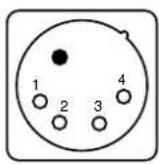
NOTE
Be sure to use correct polarity when using external power supplies.
| FRONT MIC IN | |
| 1 GND | |
| 2 AUDIO IN (H) | |
| 3 AUDIO IN (C) | |
Panasonic Part No. K1AY103A0001
Manufacturer Part No. HA16PRM-35G (72)
(Hirose Electric Co.)
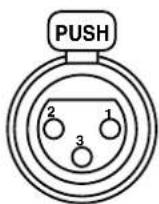
| AUDIO IN | |
| 1 GND | |
| 2 AUDIO IN (H) | |
| 3 AUDIO IN (C) | |
Panasonic Part No. K1AY103A0001
Manufacturer Part No. HA16PRM-3SG (72)
(Hirose Electric Co.)

| REMOTE | |
| 1 CAM DATA (H) | |
| 2 CAM DATA (C) | |
| 3 CAM CONT (H) | |
| 4 CAM CONT (C) | |
| 5 R/C ON | |
| 6 R/C VIDEO OUT | |
| 7 R/C VIDEO GND | |
| 8 | NC |
| 9 UNREG 12V (Max 0.6 A) | |
| 10 GND | |
Panasonic Part No. K1AY110JA001
Manufacturer Part No. HR10A-10R-10SC (71)
(Hirose Electric Co.)

text_image
8 7 10 9 2 6 3 5 4| DC OUT | |
| 1 GND | |
| 2 | R TALLY (open connector) |
| 3 | REC START SW |
| 4 | +12V OUT (Max 1.5 A) |
Panasonic Part No. K1AY104J0001
Manufacturer Part No. HR10A-7R-4SC (73)
(Hirose Electric Co.)
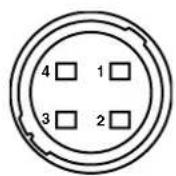
| LENS | |
| 1 RET-SW | |
| 2 REC | |
| 3 GND | |
| 4 IRIS-AUTO | |
| 5 IRIS-CONT | |
| 6 UNREG+12V (Max 0.4 A) | |
| 7 IRIS-POSI | |
| 8 IRIS-G-MAX | |
| 9 EXT-POSI | |
| 10 ZOOM-POSI | |
| 11 FOCUS-POS | |
| 12 SPARE | |
Panasonic Part No. K1AY112JA001
Manufacturer Part No. HR10A-10R-12SC (71)
(Hirose Electric Co.)
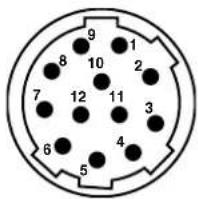
text_image
9 1 8 10 2 7 12 11 3 6 5 4| Wireless receiver interface | ||
| 1 CH SHIELD | GND | |
| 2 | CH-1 HOT | Audio input from a wireless receiver: CH1 HOT |
| 3 CH-1 COLD | Audio input from a wireless receiver: CH1 COLD | |
| 4 | GND | GND |
| 5 | +12V UNREG | Power supply for a wireless receiver |
| 6 | RX ON | Remote power output to a wireless receiver. |
| 7 | FR WARN | RF warning input from a wireless receiver |
| 8 | RM5 | Not used |
| 9 | RM4 | Not used |
| 10 | SPARE 1 | Not used |
| 11 | SPARE 2 | Not used |
| 12 | EXT CLK | Not used |
| 13 | CLK SHIELD | Not used |
| 14 | CH-2 SHIELD | GND |
| 15 | CH-2 HOT | Audio input from a wireless receiver: CH2 HOT |
| 16 | CH2-COLD | Audio input from a wireless receiver: CH2 COLD |
| 17 | +5.6V | Power supply for a wireless receiver |
| 18 | VIDEO OUT Not used | |
| 19 | VIDEO RET | Not used |
| 20 VIDEO EN | Not used | |
| 21 | RM1 (RM CLK) | Not used |
| 22 | RM2 (RM DATA) | Not used |
| 23 | RM3 (RM WR) | Not used |
| 24 | RM +5V | Not used |
| 25 | RM GND | Not used |
Panasonic Part No. K1GB25A00010
Manufacturer Part No. HDBB-25S (05)
(Hirose Electric Co.)
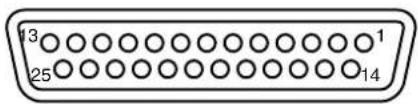
text_image
13 25 1 14Information on Disposal in other Countries outside the European Union

This symbol is only valid in the European Union. If you wish to discard this product, please contact your local authorities or dealer and ask for the correct method of disposal.
Panasonic Broadcast & Television Systems Company
Unit Company of Panasonic Corporation of North America
Executive Office: One Panasonic Way 4E-7, Secaucus, NJ 07094 Tel: 201-348-7000
Eastern Zone: One Panasonic Way 4E-7, Secaucus, NJ 07094 Tel: 201-348-7196
Southeast Region: Tel: 201-392-6151
Western Zone: 3330 Cahuenga Blvd W., Los Angeles, CA 90068 Tel: 323-436-3608
Government Marketing Department:
One Panasonic Way 2E-10, Secaucus, NJ 07094 Tel: 201-348-7587
Broadcast PARTS INFORMATION & ORDERING:
9:00 a.m. - 5:00 p.m. (EST) Tel: 800-334-4881/24 Hr. Fax: 800-334-4880
Emergency after hour parts orders Tel: 800-334-4881
e-mail: PBTSparts@us.panasonic.com
TECHNICAL SUPPORT: Emergency 24 Hour Service Tel: 800-222-0741
e-mail: PBTSCservice@us.panasonic.com
Panasonic Canada Inc.
5770 Ambler Drive, Mississauga, Ontario L4W 2T3 Tel: 905-624-5010