Octavia (2006) - Car SKODA - Free user manual and instructions
Find the device manual for free Octavia (2006) SKODA in PDF.


User questions about Octavia (2006) SKODA
0 question about this device. Answer the ones you know or ask your own.
Ask a new question about this device
Download the instructions for your Car in PDF format for free! Find your manual Octavia (2006) - SKODA and take your electronic device back in hand. On this page are published all the documents necessary for the use of your device. Octavia (2006) by SKODA.
USER MANUAL Octavia (2006) SKODA
ŠKODA Octavia Owner's Manual
natural_image
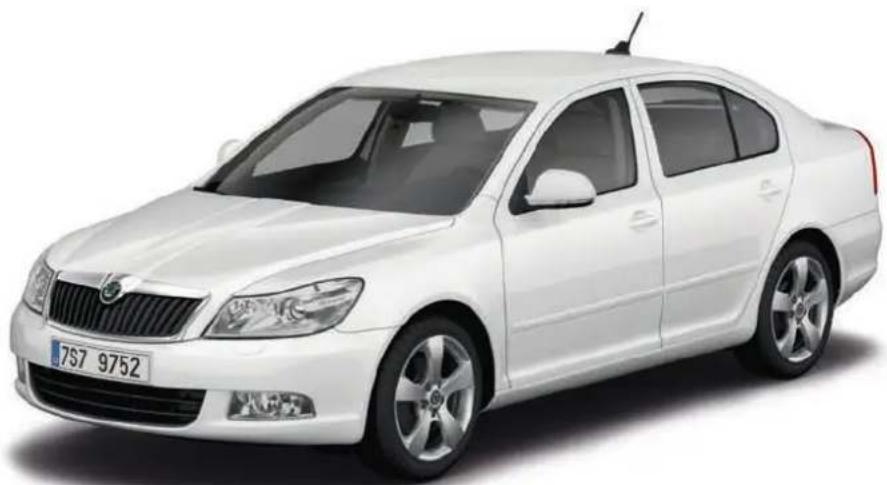
Exterior view of a white sedan car with visible license plate number 757 9752 (no other text or symbols)Layout of this Owner's Manual (explanations)
This Owner's Manual has been systematically designed to make it easy for you to search for and obtain the information you require.
Chapters, table of contents and subject index
The text of the Owner's manual is divided into relatively short sections which are combined into easy-to-read chapters. The chapter you are reading at any particular moment is always specified on the bottom right of the page.
The Table of contents is arranged according to the chapters and the detailed Subject index at the end of the Owner's Manual helps you to rapidly find the information you are looking for.
Direction indications
All direction indications such as "left", "right", "front", "rear" relate to the direction of travel of the vehicle.
Units of measurement
All values are expressed in metric units.
Explanation of symbols
Denotes a reference to a section with important information and safety advice in a chapter.
■ Denotes the end of a section.
▶ Denotes the continuation of a section on the next page.
Indicates situations where the vehicle must be stopped as soon as possible.
^8 Denotes a registered trademark.
Notes
! WARNING
The most important notes are marked with the heading WARNING. These WARNING notes draw your attention to a serious risk of accident or injury.
! CAUTION
A Caution note draws your attention to the possibility of damage to your vehicle (e.g. damage to gearbox), or points out general risks of an accident.
For the sake of the environment
An Environmental note draws your attention to environmental protection aspects. This is where you will, for example, find tips aimed at reducing your fuel consumption.
i Note
A normal Note draws your attention to important information about the operation of your vehicle.
Preface
You have opted for a ŠKODA – our sincere thanks for your confidence in us.
You have received a vehicle with the latest technology and range of amenities. Please read this Owner's
Manual carefully, because the operation in accordance with these instructions is a prerequisite for proper use of the vehicle.
If you have any questions about your vehicle, please contact a ŠKODA Service Partner.
We wish you much pleasure with your ŠKODA and pleasant motoring at all times.
Your ŠKODA AUTO a.s. (hereinafter referred to as ŠKODA)
The on-board literature
The on-board literature for your vehicle consists of this "Owner's Manual" as well as a "Service schedule" and the "Help on the road" brochure.
Depending on the vehicle model and equipment, other additional operating manuals and instructions may be provided (e.g. an operating manual for the radio).
If one of the publications listed above is missing, please contact a ŠKODA Service Partner.
The Owner's Manual
These operating instructions describe all possible equipment variants without identifying them as special equipment, model variants or market-dependent equipment.
Consequently, this vehicle does not need to contain all of the equipment components described in this Owner's manual.
The level of equipment of your vehicle refers to your purchase contract of the vehicle. For more information, contact your local ŠKODA retailer.
The illustrations can differ in minor details from your vehicle; they are only intended for general information.
The Service Plan:
includes vehicle data including information on service work performed;
is a record of services provided;
is provided for entries relating to the mobility warranty (valid only for some countries);
serves as warranty certificate of the ŠKODA dealer.
The service records are one of the conditions for warranty claims.
Please always present the Service schedule when you take your car to a ŠKODA specialist garage.
If the Service Schedule is missing or worn, please contact the ŠKODA specialist garage that regularly services your car. You will receive a duplicate, in which the previously carried out service work is confirmed by the ŠKODA specialist garage.
The Help on the Road brochure
The brochure contains the important emergency telephone numbers as well as telephone numbers and contact addresses of ŠKODA Service Partners in different countries.
Table of Contents
Abbreviations
Using the system
Cockpit 7
Overview 6
Instruments and warning lights 8.
Instrument cluster 8
Multifunction display (onboard computer) 12
MAXI DOT (information display) 15
Warning lights 18
Unlocking and locking 26
Vehicle key 26
Child safety lock 27
Central locking system 27
Remote control 30
Anti-theft alarm system 31
Boot lid 33
Electric power windows 34
Electric sliding/tilting roof 37
Lights and visibility
Lights
Interior light
Visibility
Windscreen wipers and washers
Rear window
Seats and Stowage
Front seats 54
Seat heaters
Head restraints
Rear seats
Boot
Variable loading floor in the boot ____ 64
Net partition (Combi) 65
Roof rack system 66
Cup holder 68
Ashtray 68
Cigarette lighter, 12-volt power socket
Storage compartments 70
Clothes hooks 77
Parking ticket holder 77
Heating and air conditioning system
Heating and air conditioning system
Air outlet vents 80
Heating 80
Air conditioning system (manual air conditioning system)
Climatronic (automatic air conditioning
system) 85
Auxiliary heating (auxiliary heating and
ventilation) 87
Starting-off and Driving
Starting and stopping the engine 91
Brakes and brake assist systems
Shifting (manual gearbox) 97
pedals 97
Parking aid 98
Cruise control system (CCS) 99
START/STOP 100
Automatic gearbox
Automatic gearbox 102
Communication
Mobile phones and two-way radio systems ____ 107
Operating the phone on the multifunction
steering wheel 108
Symbols in the information display ____ 109
Phone Phonebook 109
Universal telephone preinstallation GSM II ____ 109
Universal telephone preinstallation GSM III 112
Voice control 116
Multimedia 118
Safety
Passive Safety 121
General information 121
Correct seated position 122
Seat belts 125
Seat belts 125
Airbag system 129
Description of the airbag system 129
Front airbags 130
Side airbags 131
Head airbags 132
Deactivating airbags 133
Transporting children safely 135
Child seat 135
Driving Tips
Driving and the Environment 139
The first 1500 km 139
Catalytic converter 139
Economical and environmentally friendly
driving 140
Environmental compatibility 142
Driving abroad 143
Avoiding damage to your vehicle 143
Driving through water on the street 144
Towing a trailer 145
Towing a trailer 145
General Maintenance
Taking care of and cleaning the vehicle 148
Taking care of your vehicle 148
Inspecting and replenishing 155
Fuel 155
Engine compartment 158
Vehicle battery 165
Wheels and Tyres 170
Tyres 170
Accessories, changes and replacement of parts 177
Introductory information 177
Changes and impairments of the airbag
system 177
Do-it-yourself
Do-it-yourself 178
First-aid kit and warning triangle 178
Fire extinguisher 178
Vehicle tool kit 179
Changing a wheel 179
Breakdown kit 182
Jump-starting 185
Towing the vehicle 186
Fuses and light bulbs 189
Fuses 189
Bulbs 191
Technical data
Technical data 197
Introductory information 197
Data on the vehicle data sticker and the type
plate 197
Dimensions 198
Specifications and engine oil capacity 200
Vehicle-specific information depending on
engine type 201
Multi-purpose vehicles (AF) 207
Index
Abbreviations
| Abbreviation Definition | |
| rpm Engine revolutions per minute | |
| ABS Anti-lock brake system | |
| AF Multi-purpose vehicles | |
| AG Automatic gearbox | |
| TCS Traction control | |
| CO_2 in g/km discharged quantity of carbon dioxide in grams per driven kilometer | |
| DPF Diesel particle filter | |
| DSG Automatic double clutch gearbox | |
| DSR Active driver-steering recommendation | |
| EDL Electronic differential lock | |
| EPC EPC fault light | |
| ESC Electronic Stability Control | |
| kW Kilowatt, measuring unit for the engine output | |
| MG Manual gearbox | |
| MFD Multifunction display | |
| N1 Panel van intended exclusively or mainly for the transportation of goods | |
| Nm Newton meter, measuring unit for the engine torque | |
| TDI CR Diesel engine with turbocharging and common rail injection system | |
| TDI PD Diesel engine with injection system and unit injector injection system | |
| TSI Petrol engine with turbocharging and direct injection |
text_image
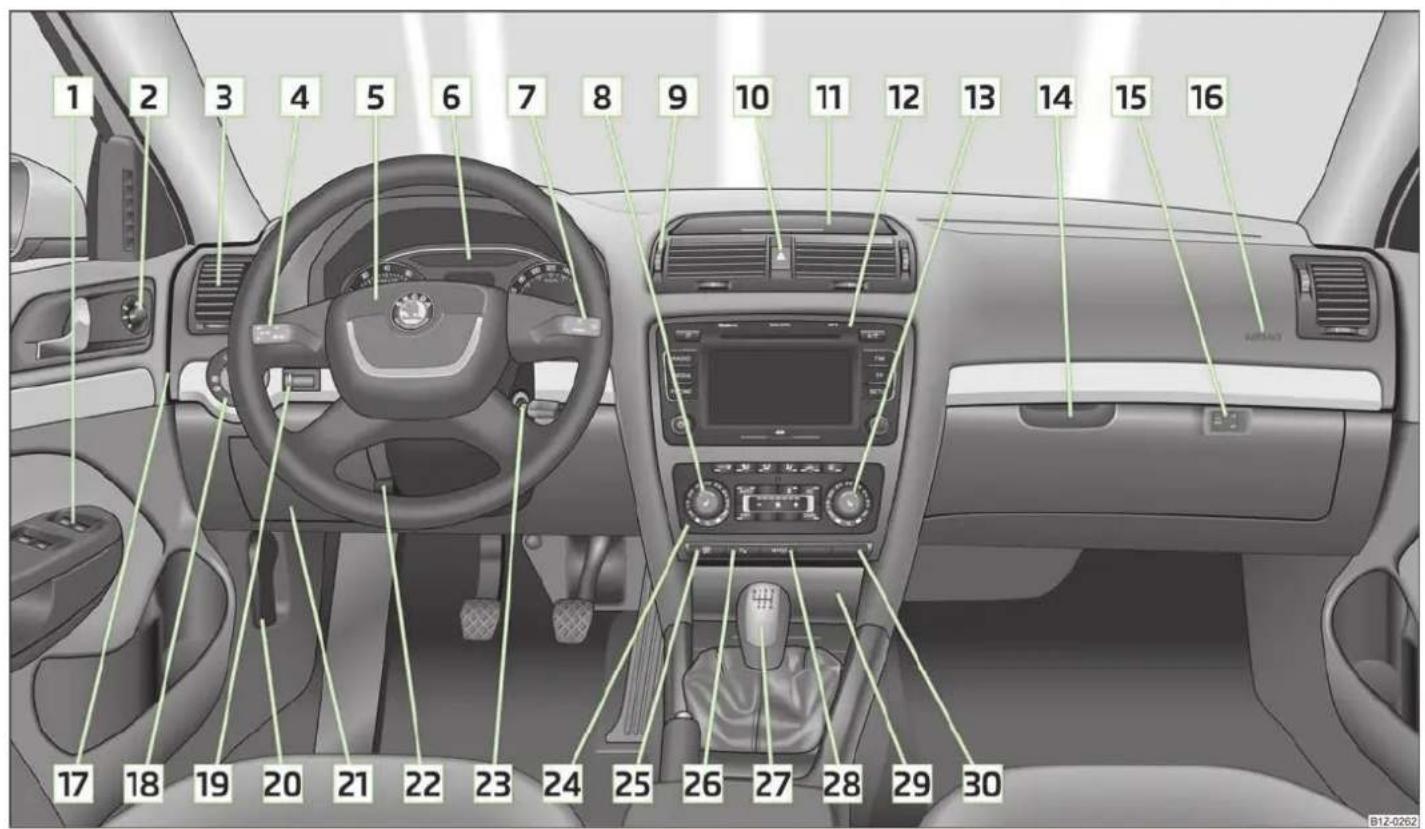
1 2 3 4 5 6 7 8 9 10 11 12 13 14 15 16 17 18 19 20 21 22 23 24 25 26 27 28 29 30 B1Z-0262Fig. 1 Cockpit
Using the system
Cockpit
Overview
1 Electric windows 34
2 Electric exterior mirror adjustment 52
3 Air outlet vents 80
4 Lever for the multifunction switch:
Turn signal light, headlight and parking light, headlight flasher 45
Speed regulating system 99
5 Steering wheel:
With horn
With driver's front airbag 130
with pushbuttons for radio, navigation system and mobile phone 108, 118
6 Instrument cluster: Instruments and warning lights 8.
7 Lever for the multifunction switch:
Multifunction display 12
Windscreen wiper and wash system 48
8 Regulator for front left seat heating 57
9 Air outlet vents 80
10 Switch for hazard warning lights 44
11 Storage compartment on the dash panel 72
12 Depending on equipment fitted:
Radio
Navigation system
13 Regulator for front right seat heating 57
14 Storage compartment on the front passenger side 71
15 Key switch for switching off the front passenger airbag (in front passenger storage compartment) 133
16 Front passenger airbag 130
17 Fuse box (on side of dash panel) 190
18 Light switch 40
19 Regulator for the instrument lighting and regulator for the head-light beam range adjustment 43, 44
20 Bonnet release lever 160
21 Storage compartment on the driver's side ____ 71
22 Lever for adjusting the steering wheel 92
23 Ignition lock 93
24 Depending on equipment fitted:
Operating controls for the heating 80
Operating controls for the air conditioning system 82
Operating controls for Climatronic 85
25 TCS switch 96
26 Front and rear parking aid 98
27 Depending on equipment fitted:
Gearshift lever (manual gearbox) 97
Selector lever (automatic gearbox) 103
28 Tyre pressure monitoring system 175
29 Depending on equipment fitted:
Ashtrays 68
Storage compartment 72
30 Warning light for the deactivated front seat passenger airbag ____ 133
i Note
The arrangement of the controls and switches and the location of some items on right-hand drive models may differ from that shown in » Fig. 1. The symbols on the controls and switches are the same as for left-hand drive models.
Instruments and warning lights
Instrument cluster

Introduction
This chapter contains information on the following subjects:
Overview 8
Engine revolutions counter 9
Speedometer 9
Coolant temperature gauge 9
Fuel gauge 9
Counter for distance driven 10
Service Interval Display 10
Digital clock 11
Recommended gear 11

WARNING
■ Concentrate fully at all times on your driving! As the driver you are fully responsible for the operation of your vehicle.
■ Never operate the controls in the instrument cluster while driving, only when the vehicle is stationary!
Overview
text_image
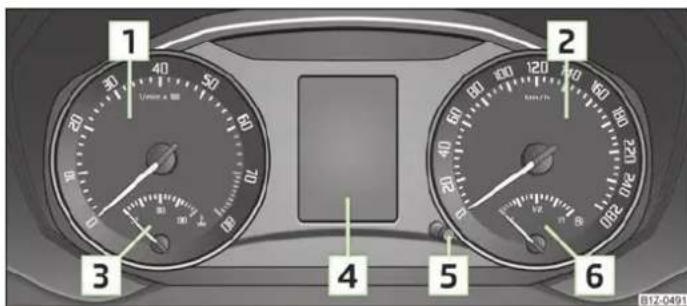
1 2 3 4 5 6 B12-0491Fig. 2 Instrument cluster

First read and observe the introductory information and safety warnings on page 8.

Engine revolutions counter » page 9

Speedometer » page 9

Coolant temperature gauge » page 9

Display:
With counter for distance driven » page 10 With service interval display » page 10
With digital clock » page 11
With multifunction display » page 12 With information display » page 15

Knob for the selection of the mode (turn knob)/the setting (press knob):
Setting the hours/minutes
Activating/deactivating the second speed in mph or km/h
Service intervals - Display of the number of days and kilometres remaining until the next Inspection Service
Reset trip counter for the distance driven
Resetting Service Interval Display
Activate/deactivate display mode

Fuel gauge » page 9
Engine revolutions counter

First read and observe the introductory information and safety warnings on page 8.
The red scale of the rev counter 1» Fig. 2 on page 8 indicates the range in which the engine control unit begins to limit the engine speed. The engine control unit restricts the engine speed to a steady limit.
You should shift into the next higher gear before the red scale of the revolution counter is reached, or move the selector lever into position D if your car is fitted with an automatic gearbox.
To maintain the optimum motor speed, observe the gearshift indicator » page 11.

For the sake of the environment
Shifting to a higher gear in good time helps to lower fuel consumption, minimises operating noise levels, protects the environment and contributes to a longer life and reliability of the engine.
Speedometer

First read and observe the introductory information and safety warnings on page 8.
Warning against excessive speeds
An audible warning signal will sound when the vehicle speed exceeds 120 km/h. The audible warning signal is switched off when the vehicle speed falls below this speed limit.

Note
This function is only valid for some countries.
Coolant temperature gauge

First read and observe the introductory information and safety warnings on page 8.
The coolant temperature gauge 3 » Fig. 2 on page 8 operates only when the ignition is switched on.
The following guidelines regarding the temperature ranges must be observed to avoid any damage to the engine.
Cold range
If the pointer is still in the left area of the scale it means that the engine has not yet reached its operating temperature. Avoid high speeds, full throttle and high engine loads.
The operating range
The engine has reached its operating temperature as soon as the pointer moves into the mid-range of the scale, for a normal style of driving. The pointer may also move further to the right at high engine loads and high outside temperatures.

CAUTION
Additional headlights and other attached components in front of the fresh air inlet impair the cooling efficiency of the coolant. There is then a risk of the engine overheating at high outside temperatures and high engine loads » page 20.
Fuel gauge

First read and observe the introductory information and safety warnings on page 8.
The fuel gauge 6 » Fig. 2 on page 8 only operates when the ignition is switched on.
The fuel tank has a capacity of about 55 litres or 60 litres ^1 . The warning light in the instrument cluster lights up when the pointer reaches the reserve marking ^2 » page 23.
An audible signal sounds as a warning signal.
! CAUTION
Never drive until the fuel tank is completely empty! An irregular supply of fuel can lead to irregular engine running. Unburnt fuel may get into the exhaust system and damage the catalytic converter.
i Note
After filling up, it can occur that during dynamic driving (e.g. numerous curves, braking, driving downhill and climbing a steep hill) the fuel gauge indicates approx. a fraction less. When stopping or during less dynamic driving, the fuel gauge displays the correct fuel level again. This is not a fault.
Counter for distance driven

First read and observe the introductory information and safety warnings on page 8.
The distance which you have driven with your vehicle is shown in kilometres (km). In some countries the measuring unit miles (mph) is used.
Daily trip counter (trip)
The daily trip counter indicates the distance which you have driven since it was last reset - in steps of 100 metres or 1/10 of a mile.
Press the button [5] » Fig. 2 on page 8 for more than 1 second to reset the display of the daily trip counter.
Odometer
The odometer indicates the total distance in kilometres or miles which the vehicle has been driven.
Fault display
If there is a fault in the instrument cluster Error will appear continuously in the display. Ensure the fault is rectified as soon as possible by ŠKODA a specialist garage.
i Note
For vehicles fitted with the information display, if the display of the second speed is activated in mph or km/h, this driving speed is indicated instead of the counter for the total distance driven.
Service Interval Display
text_image
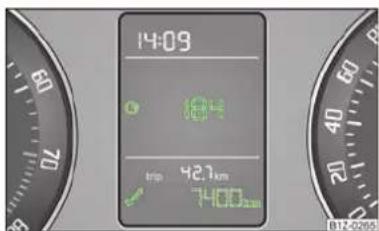
14:09 184 42.7um 7400mm 012-0265Fig. 3 Service Interval Display: Note
First read and observe the introductory information and safety warnings on page 8.
The display can vary depending on the equipment.
Service Interval Display
Before the next service interval a key symbol and the remaining kilometres are indicated for 10 seconds after switching on the ignition » Fig. 3. At the same time, the remaining days until the next service interval are displayed.
The following is displayed in the information display:
Service in ... km or ... days.
The kilometre indicator or the days indicator reduces in steps of 100 km or, where applicable, days until the service due date is reached.
As soon as the due date for the service is reached, a flashing key symbol and the text Service appears in the display for 20 seconds after the ignition has been switched on.
The following is displayed in the information display:
Service now!
Displaying the distance and days until the next service interval
You can use the button 5 to display the remaining distance and the days until the next service interval » Fig. 2 on page 8.
A key symbol and the remaining distance appear for 10 seconds in the display. At the same time, the remaining days until the next service interval are displayed
On vehicles which are equipped with the information display, you can call up this display in the menu Settings » page 16.
The following will be displayed in the information display for 10 seconds:
Service in ... km or ... days.
Resetting Service Interval Display
It is only possible to reset the Service Interval Display, if a service message or at least a pre-warning is shown in the instrument cluster display.
We recommend that this reset is completed by a ŠKODA specialist garage.
The ŠKODA specialist garage:
Resets the memory of the display after the appropriate inspection
Adds an entry to the Service Schedule
- Affixes the sticker with the entry of the following service interval to the side of the dashboard on the driver's side
Reset the service interval display by using the knob 5 » Fig. 2 on page 8.
On vehicles which are equipped with the information display, you can reset the Service Interval Display in the menu Settings » page 16.

CAUTION
We recommend that you do not reset the Service Interval Display yourself as this can result in the incorrect setting of the Service Interval Display, which can also cause possible problems with the operation of your vehicle.

Note
- Never reset the display between service intervals, as this will result in the incorrect display.
■ Information is retained in the Service Interval Display even after the vehicle battery is disconnected. - If the instrument cluster is exchanged after a repair, the correct values must be entered in the counter for the Service Interval Display. This work is carried out by a ŠKODA specialist garage.
- After resetting the display with flexible service intervals, the displayed data is the same as that for a vehicle with fixed service intervals. We therefore recommend that the Service Interval Display is only reset by a SKODA Service Partner, who will reset the display with a vehicle system tester.
■ For more information on the service intervals » Service Plan.
Digital clock

First read and observe the introductory information and safety warnings on page 8.
The clock is set using the knob 5 » Fig. 2 on page 8.
Turn the knob 5 to select the display you wish to change. Make the change by pressing the knob.
On vehicles that are fitted with the information display, it is also possible to set the clock in the menu Time » page 16.
Recommended gear

text_image
13:49 A B 610 km 17.2 km 1148 km B1Z-0266Fig. 4 Recommended gear

First read and observe the introductory information and safety warnings on page 8.
The currently engaged gear A is shown in the instrument cluster display » Fig. 4. In order to minimise the fuel consumption, a recommendation for shifting into another gear is indicated in the display.
If the control unit recognises that it is beneficial to change gear, an arrow B is shown in the display. The arrow points up or down, depending on whether you should shift into a higher or lower gear.
At the same time, the recommended gear is indicated instead of the currently engaged gear A.

CAUTION
The driver is always responsible for selecting the correct gear in different driving situations, such as overtaking.
Multifunction display (onboard computer)

Introduction
This chapter contains information on the following subjects:
Memory 12
Operation 13
Multifunction display details 13
Warning against excessive speeds 14
The multifunction display can only be operated when the ignition is switched on. After the ignition is switched on, the function displayed is the one which you last selected before switching off the ignition.
The multi-functional indicator appears in the display » Fig. 5 on page 12 or in the information display » page 15 depending on the equipment fitted to your vehicle.
In vehicles with an information display » page 15, there is an option to fade out some of the information.

WARNING
■ Concentrate fully at all times on your driving! As the driver you are fully responsible for the operation of your vehicle.
- Do not only rely upon the information given on the outside temperature display that there is no ice on the road. Even at temperatures around +4 °C, black ice may still be on the road surface - warning, drive with care!

Note
■ In certain national versions the displays appear in the Imperial system of measures.
■ If the display of the second speed is activated in mph, the current speed is not indicated in km/h on the display.
Memory
text_image
13:51 6.9 fps 19.1um 1150cm BY-2017Fig. 5 Multifunction display

First read and observe the introductory information and safety warnings on page 12.
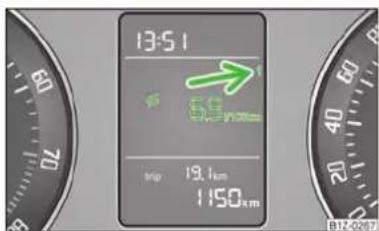
The multifunction display is equipped with two automatic memories. The selected memory is shown in the Display » Fig. 5.
The data of the single-trip memory (memory 1) is shown if a 1 appears in the display. A 2 shown in the display means that data relates to the total distance memory (memory 2).
Switching over the memory using the button B» Fig. 6 on page 13 on the windscreen wiper lever or using the adjustment wheel D on the multifunction steering wheel.
Single-trip memory (memory 1)
The single-trip memory collates the driving information from the moment the ignition is switched on until it is switched off. New data will also flow into the calculation of the current driving information if the trip is continued within 2 hours after switching off the ignition. If the trip is interrupted for more than 2 hours, the memory is automatically erased.
Total-trip memory (memory 2)
The total-trip memory gathers data from any number of individual journeys up to a total of 19 hours and 59 minutes driving or 1 999 kilometres driven, and on vehicles which are fitted with an information display up to a total of 99 hours and 59 minutes driving or 9 999 kilometres driven. The memory is deleted when either of these limits is reached and the calculation starts all over again.
Unlike the single-trip memory, the total-trip memory is not deleted after a period of interruption of driving of 2 hours.

Note
All information in the memory 1 and 2 is erased if the battery of the vehicle is disconnected.
Operation

text_image
A B
text_image
C D B1Z-0395Fig. 6 Multifunction display: Control elements on the windscreen wiper lever/control elements on the multifunction steering wheel

First read and observe the introductory information and safety warnings on page 12.
The rocker switch A » Fig. 6 and the button B are located on the windscreen wiper lever. Switching over and resetting is performed with the adjustment wheel D on the multifunction steering wheel.
Select memory
Press the button B » Fig. 6 or D.
Selecting functions using the windscreen wiper lever
Briefly press the rocker switch A » Fig. 6 up or down. This opens the individual functions of the multifunction display one after the other.
Selecting functions using the multifunction steering wheel
Press the button C » Fig. 6.
Turn the adjustment wheel D upwards or downwards. This opens the individual functions of the multifunction display one after the other.
Reseting
Select the desired memory.
Press and hold the button B » Fig. 6 or D for a short while.
The following readouts of the selected memory will be set to zero with the button B » Fig. 6 or D:
Average fuel consumption
Distance driven
Average speed
Driving time
Multifunction display details

First read and observe the introductory information and safety warnings on page 12.
Outside temperature
The current outside temperature is shown in the display.
If the outside temperature drops below +4 °C, a snow flake symbol (warning signal for ice on the road) appears before the temperature indicator and an audible signal will sound. After pressing the rocker switch [A] » Fig. 6 on page 13 or [C], the function shown last is indicated.
Driving time
The driving time which has elapsed since the memory was last erased, appears in the display. If you wish to measure the driving time from a particular time, you need to set the memory to zero at this point in time by pressing the button
B » Fig. 6 on page 13 or D for more than 1 second.
The maximum time indicated in both memories is 19 hours and 59 minutes and on vehicles which are fitted with an information display, it is 99 hours and 59 minutes. The indicator is set back to zero if this period is exceeded.
Current fuel consumption
The current fuel consumption level is shown in the display in litres/100 km ^1 . You can use this information to adapt your driving style to the desired fuel consumption.
The display appears in litres/hour if the vehicle is stationary or driving at a low speed ^1 .
Average fuel consumption
The average fuel consumption since the memory was last erased is shown in the display in litres/100 km ^2 » page 12.
If you wish to determine the average fuel consumption over a certain period of time, you must set the memory at the start of the new measurement to zero using the button [B]» Fig. 6 on page 13. After erasing the memory, no value appears in the display until you have driven 300m .
The display is updated regularly while you are driving.
Range
The estimated range in kilometres is shown on the display. It indicates the distance you can still drive with your vehicle based on the level of fuel in the tank and the same style of driving.
The display is shown in steps of 10 km. After lighting up of the warning light for the fuel reserve the display is shown in steps of 5 km.
The fuel consumption over the last 50 km is used to calculate the range. The range will increase if you drive in a more economical manner.
If the memory is set to zero (after disconnecting the battery), the fuel consumption of 10 ltr./100 km is calculated for the range; afterwards the value is adapted accordingly to the style of driving.
Distance travelled
The distance driven since the memory was last erased appears in the display » page 12.
If you wish to measure the distance travelled from a particular point in time, you need to set the memory to zero at this point in time by pressing the button B. Fig. 6 on page 13 or D.
The maximum distance indicated in both memories is 1999 km or 9999 km on vehicles with an information display. The indicator is set back to zero if this period is exceeded.
Average speed
The average speed since the memory was last erased is shown in the display in km/hour » page 12. If you wish to determine the average speed over a certain period of time, you need to set the memory to zero at the start of the measurement using the button B » Fig. 6 on page 13 or D
After erasing the memory, no value appears in the display until you have driven approx. 300 m.
The display is updated regularly while you are driving.
Current speed
The current speed which is identical to the display of the speedometer 2 » Fig. 2 on page 8 is indicated on the display.
Oil temperature
If the oil temperature is lower than 50 °C or if a fault in the system for checking the oil temperature is present, - - - is displayed instead of the oil temperature.
Warning against excessive speeds

First read and observe the introductory information and safety warnings on page 12.
Adjust the speed limit while the vehicle is stationary
With the button A » Fig. 6 on page 13 or, if applicable, the adjustment wheel D select the menu item Warning against excessive speeds.
Press the button B or D to activate the ability to set the speed limit (value flashes).
Set the desired speed limit, e.g. 50 km/h, with the button A or, if applicable, the adjustment wheel D
Press the button B or D to confirm the set speed limit, or wait approx. 5 seconds and the setting is saved automatically (the value stops flashing).
This allows you to set the speed in 5 km/h intervals.
Adjusting the speed limit while the vehicle is moving
With the button A » Fig. 6 on page 13 or, if applicable, the adjustment wheel D, select the menu item Warning against excessive speeds.
Drive at the desired speed, e.g. 50 km/h.Press the button B or D to accept the current speed as the speed limit (the value flashes).
If you wish to change the set speed limit, it is changed in 5 km/h intervals (e.g. the accepted speed of 47 km/h increases to 50 km/h or decreases to 45 km/h).
Press again the button B or D to confirm the speed limit, or wait approx. 5 seconds and the setting is saved automatically (the value stops flashing).
Change or delete speed limit
With the button A » Fig. 6 on page 13 or, if applicable, the adjustment wheel D, select the menu item Warning against excessive speeds.
Pressing the button B or D deletes the speed limit.
Pressing the button B or D again activates change mode for the speed limit.
If the set speed limit is exceeded, an audible signal will sound as a warning. At the same time the message Warning against excessive speeds appears on the display with the set limit value.
The set speed limit value remains stored even after switching off the ignition.
MAXI DOT (information display)

Introduction
This chapter contains information on the following subjects:
Main menu 15
Settings 16
Door, boot lid and bonnet warning 17
Auto Check Control 17
The information display provides you with information on the current operating state of your vehicle. The information system also provides you with data (depending on the equipment installed in the vehicle) relating to the radio, mobile phone, multi-functional indicator, navigation system, the unit connected to the MDI input and the automatic gearbox » page 102.
! WARNING
Concentrate fully at all times on your driving! As the driver you are fully responsible for the operation of your vehicle.

CAUTION
Pull out the ignition key if coming in contact with the display (e.g. when cleaning) to prevent any possible damage.
Main menu

text_image
A B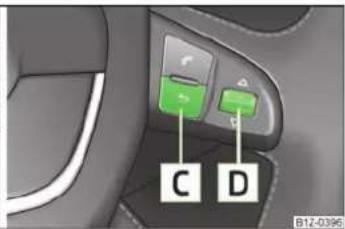
text_image
C D B1Z-0396Fig. 7 Information display: Control elements on the windscreen wiper lever/control elements on the multifunction steering wheel

First read and observe the introductory information and safety warnings on page 15.
Operating with the buttons on the windscreen wiper lever
Activate the Main menu by pressing the rocker switch A » Fig. 7 for longer.
Individual menu items can be selected by means of the rocker switch A. When the pushbutton B is briefly pressed, the information you have selected is displayed.
Operating with the buttons on the multifunction steering wheel
Activate the Main menu by pressing and holding the button C» Fig. 7 for a short while.
By briefly pressing the C button you will reach one level higher.
The individual menus can be selected by pressing the adjustment wheel D. The selected menu is displayed after briefly pressing the adjustment wheel D.
The following information can be selected (depending on the equipment installed on the vehicle):
■ MFD » page 12
■ Audio » Operating instructions for the radio
■ Navigation » Operating instructions for the navigation system
The menu items Audio and Navigation are only displayed when the factory-fitted radio or navigation system is switched on.
The menu item Aux. heating is only displayed if a factory-fitted auxiliary heating is installed.
The menu point Assistants is only then displayed, if the vehicle is fitted with cornering lights.
i Note
- If warning messages are shown in the information display, these messages must be confirmed with the button B» Fig. 7 on the windscreen wiper lever or with the button D on the multifunction steering wheel to call up the main menu. - If the information display is not activated at that moment, the menu always shifts to one of the higher levels after approx. 10 seconds.
Settings

First read and observe the introductory information and safety warnings on page 15.
You can change certain settings by means of the information display. The current setting is shown on the information display in the respective menu at the top below the line.
The following information can be selected (depending on the equipment installed on the vehicle):
■ Language
■ MFD Data
■ Convenience
■ Lights & Vision
■ Time
■ Winter tyres
■ Units
■ Assistants
■ Alternative speed displayed
■ Service
■ Factory setting
■ Back
Select the menu item Back to return to one level higher in the menu.
Language
You can set the language for the warning and information texts here.
MFD displays
Activate or deactivate certain displays of the multifunction display here.
Comfort
This is where the following functions can be activated, deactivated or adjusted:
| Rain closing | Switch on/off the function for automatically closing the window and panoramic tilt/slide sunroof in a locked vehicle when it starts raining ^a . If the function is set and it is not raining, the windows including the panoramic tilt/slide sunroof will close automatically after approx. 12 hours. |
| Central locking Switch | on/off the central locking and automatic locking function. |
| ATA confirm Switch | on/off the audible signal indicating activation of the anti-theft alarm system. |
| Window op. Only | convenience mode for the driver window or for all of the windows can be adjusted here. |
| Mirror down Switch | on/off the function for mirror lowering on the front passenger side when engaging the reverse gear ^b . |
| Mirror adjust. Switch | on/off the function for left and right exterior mirror setting simultaneously. |
| Factory setting | Restore the Convenience factory setting. |
^a) This function is only available on vehicles with a rain sensor.
b) This function is only available on vehicles with an electrically adjustable driver seat.
Lights and visibility
This is where the following functions can be activated, deactivated or adjusted:
| Coming Home Switch on/off and adjust the light duration of the COMING HOME function. |
| Leaving Home Switch on/off and adjust the light duration of the LEAVING HOME function. |
| Dayl. drl. light | Switch on/off the "DAY LIGHT" function. |
| Rear wiper Switch | on/off the function for automatic rear window wiping. |
| Lane ch. flash | Switch on/off the convenience flashing function. |
| Travel mode | Switch on/off the travel model function. |
| Factory setting | Restore the factory setting for the lighting. |
Time
The time, time format (12 or 24 hour indicator) and the changeover between summer/winter time can be set here.
Winter tyres
Here, you can set the speed at which an audible signal should sound. This function is, for example, used for winter tyres where the maximum permissible speed is lower than the maximum speed of the vehicle.
When exceeding the speed, the following is shown on the information display:
Winter tyres: max. speed ... km/h
Units of measurement
The units for the temperature, consumption and distance driven can be set here.
Assistants
The tones of the audible signals for the parking aid can be adjusted here.
Second speed
The display of the second speed in mph or in km/h can be switched on here.
Service
Here you can have the remaining kilometres and days until the next service interval displayed, and reset the Service Interval Display.
Factory setting
After selecting the menu Factory setting the factory setting of the information display is restored.
Door, boot lid and bonnet warning

First read and observe the introductory information and safety warnings on page 15.
If at least one door is open, or the boot or bonnet is open, the information display indicates the relevant open door or boot/bonnet.
An audible signal also sounds if the vehicle is travelling at more than 6 km/h.
Auto Check Control

First read and observe the introductory information and safety warnings on page 15.
Vehicle condition
Certain functions and conditions of individual vehicle systems are checked continuously when the ignition is switched on and also while driving.
Some error messages and other information are displayed in the information display. The messages are displayed at the same time as the symbols in the information display or the warning lights in the instrument cluster » page 18.
If there is at least one error message, the menu item Vehicle status is displayed in the menu. After selecting this menu the first of the error messages is displayed. Several error messages are shown on the display under the message e.g. 1/3. This indicates that the first of a total of three error messages is being displayed.
Warning symbols
| Engine oil pressure too low » page 21 | ||
| Clutches of the automatic gearbox DSG are too hot | » page 17 | |
| Check engine oil level, engine oil sensor faulty | » page 21 | |
| Problem with engine oil pressure » page 18 |
Clutches of the automatic gearbox DSG are too hot Ⓐ
A symbol ⚙ in the information display indicates that the temperature of the clutches of the automatic gearbox is too high.
The following is displayed in the information display:
Gearbox overheated. Stop! Owner's man.!
Stop the vehicle, switch off the engine, and wait until the symbol Ⓞ disappears - risk of gearbox damage! You can continue your journey as soon as the symbol disappears.
Problem with the engine oil pressure!
If the symbol ☑ is shown in the information display, you must have your vehicle checked immediately by a ŠKODA specialist garage. The information about the maximum permissible engine speed is displayed together with this symbol.
WARNING
If you have to stop for technical reasons, then park the vehicle at a safe distance from the traffic, switch off the engine and activate the hazard warning light system » page 44.
i Note
As long as the operational faults are not rectified, the symbols are always indicated again. After they are displayed for the first time, the symbols continue to be indicated without any extra messages for the driver.
Warning lights
Overview
The warning lights show certain functions/faults and may be accompanied by audible signals.
| (P) | Handbrake » page 19 | |
| (1) | Brake system » page 19 | |
| Seat belt warning light » page 19 | ||
| Generator » page 20 |
| Open door » page 20 | ||
| Coolant temperature/coolant level » page 20 | ||
| Bonnet » page 20 | ||
| Boot lid » page 21 | ||
| Engine oil » page 21 | ||
| Electromechanical power steering » page 21 | ||
| Traction control (TCS) » page 21 | ||
| Electronic Stability Control (ESC) » page 22 | ||
| Antilock brake system (ABS) » page 22 | ||
| Rear fog light » page 22 | ||
| Bulb failure » page 22 | ||
| Exhaust inspection system » page 22 | ||
| Glow plug system (diesel engine) » page 23 | ||
| EPC | EPC fault light (petrol engine) | » page 23 |
| Diesel particle filter (diesel engine) » page 23 | ||
| Fuel reserve | » page 23 | |
| Airbag system | » page 24 | |
| Tyre control display » page 24 | ||
| Windscreen washer fluid level » page 24 | ||
| Traction control (TCS) switched off » page 24 | ||
| Turn signal (left/right). » page 24 | ||
| Fog lights » page 24 | ||
| Speed regulating system » page 25 | ||
| Low beam » page 25 | ||
| Selector lever lock » page 25 | ||
| Main beam » page 25 |
! WARNING
■ If illuminated warning lights and the corresponding descriptions and warning notes are not observed, this may result in severe injuries or major vehicle damage.
- The engine compartment of your car is a hazardous area. There is a risk of injuries, scalding, accidents and fire when working in the engine compartment, e.g. inspecting and replenishing oil and other fluids. It is essential to observe safety notes » page 158, Engine compartment.
i Note
- The arrangement of the warning lights depends on the model version. The symbols shown in the following functional description are to be found as warning lights in the instrument cluster.
Handbrake (P)
The warning light Ⓞ comes on if the handbrake is applied. An audible warning is also given if you drive the vehicle for at least 3 seconds at a speed of more than 6 km/h.
The following is displayed in the information display:
Release parking brake!
Brake system (1)
The warning light Ⓓ illuminates if the brake fluid level is too low or there is a fault in the ABS.
The following is displayed in the information display:
Brake fluid: Owner's manual!
Stop the vehicle, switch off the engine, and check the level of the brake fluid » page 164 »
! WARNING
■ If you have to stop for technical reasons, then park the vehicle at a safe distance from the traffic, switch off the engine and activate the hazard warning light system » page 44.
- The following guidelines should be observed when opening the bonnet and checking the brake fluid level » page 158, Engine compartment.
■ If the warning light Ⓓ is displayed simultaneously with warning light ⚙ » page 22, Antilock brake system (ABS) 📋, 📌 do not continue your journey! Seek help from a ŠKODA specialist garage.
■ A fault to the braking system can increase the vehicle's braking distance!
Seat belt warning light
The warning light ⚠ comes on after the ignition is switched on as a reminder for the driver to fasten the seat belt. The warning light only goes out if the driver has fastened his seat belt.
If the seat belt has not been fastened by the driver, a permanent warning signal sounds at vehicle speeds greater than 20 km/h and simultaneously the warning light flashes.
If the seat belt is not fastened by the driver during the next 90 seconds, the warning signal is deactivated and the warning light lights up permanently.
Further information » page 125, Seat belts.
Dynamo
If the warning light lights up ☐ when the engine is running, the vehicle battery is not being charged.
Seek help from a ŠKODA specialist garage. The electrical system requires checking.
! WARNING
If you have to stop for technical reasons, then park the vehicle at a safe distance from the traffic, switch off the engine and activate the hazard warning light system » page 44.
! CAUTION
If the warning light ↓ (cooling system fault) comes on in addition to the warning light ☐ when driving, stop the vehicle immediately and switch the engine off - risk of engine damage!
Open door
The warning light ⇌ comes on, if one or several doors are opened.
The warning light comes on even when the ignition is switched off. The warning light lights up for a maximum of 5 minutes.
! WARNING
If you have to stop for technical reasons, then park the vehicle at a safe distance from the traffic, switch off the engine and activate the hazard warning light system » page 44.
Coolant temperature/coolant level
If the warning light lights up or flashes, either the coolant temperature is too high or the coolant level is too low.
The following is displayed in the information display:
Check coolant! Owner's manual!
Stop the vehicle, switch off the engine, check the level of the coolant » page 163, and refill the coolant if necessary » page 163.
If the coolant is within the specified range, the increased temperature may be caused by an operating problem at the radiator fan. Check the fuse for the radiator fan, replace if necessary » page 191, Fuses in the engine compartment.
If the warning light ⊥ does not go off even though the coolant level is correct and the fuse for the fan is in working order do not continue driving!
Seek help from a ŠKODA specialist garage.
! WARNING
- If you have to stop for technical reasons, then park the vehicle at a safe distance from the traffic, switch off the engine and activate the hazard warning light system » page 44.
- Carefully open the coolant expansion bottle. If the engine is hot, the cooling system is pressurized - risk of scalding! It is therefore best to allow the engine to cool down before removing the cap.
- Do not touch the radiator fan. The radiator fan may switch itself on automatically even if the ignition is off.
Bonnet
The warning light ≈ comes on if the bonnet is unlocked. If the bonnet unlocks while driving, the warning light ≈ lights up and an audible signal sounds.
The warning light comes on even when the ignition is switched off. The warning light lights up for a maximum of 5 minutes.

WARNING
If you have to stop for technical reasons, then park the vehicle at a safe distance from the traffic, switch off the engine and activate the hazard warning light system » page 44.
Boot lid

The warning light ⇌ comes on when the ignition is switched on if the luggage compartment door is open. If the boot lid opens while driving ⇌, the warning light lights up and an audible signal sounds.
The warning light comes on even when the ignition is switched off. The warning light lights up for a maximum of 5 minutes.
Engine oil


The warning light lights up red (low oil pressure) The following is displayed in the information display:
Oil Pressure: Engine off! Owner's manual!
Stop the vehicle, switch off the engine, and check the level of the engine oil » page 161, Checking the engine oil level.
Even if the oil level is correct, do not drive any further if the warning light is flashing. Also do not leave the engine running at an idling speed.
Seek help from a ŠKODA specialist garage.
The warning light lights up yellow (oil quantity too low) The following is displayed in the information display:
Check oil level!
Stop the vehicle, switch off the engine, and check the level of the engine oil » page 161.
The warning light will go out if the bonnet is left open for more than 30 seconds. If no engine oil has been replenished, the warning light will come on again after driving about 100km .
The warning light 🔍 flashes yellow (engine oil level sensor faulty) The following is displayed in the information display: Oil sensor: Workshop!
If the engine oil level sensor is faulty, the warning light flashes ⚙ several times and an audible signal sounds when the ignition is turned on.
Seek help from a ŠKODA specialist garage.

WARNING
If you have to stop for technical reasons, then park the vehicle at a safe distance from the traffic, switch off the engine and activate the hazard warning light system » page 44.
Electromechanical power steering Ⓜ! Ⓜ!
If the warning light 😊 lights up, this indicates a partial failure of the power steering and the steering forces can be greater. Seek help from a ŠKODA specialist garage.
If the warning light lights up, this indicates a complete failure of the power steering and the steering assist has failed (significantly higher steering forces). Seek help from a ŠKODA specialist garage.
Further information » page 92.

WARNING
If you have to stop for technical reasons, then park the vehicle at a safe distance from the traffic, switch off the engine and activate the hazard warning light system » page 44.

Note
If the vehicle battery has been disconnected and reconnected, the yellow warning light ⚙️ comes on after switching on the ignition. The warning light should go out after driving a short distance. If the yellow warning light ⚙️ does not go out after starting the engine again and a short drive, it is necessary to visit a ŠKODA specialist garage.
Traction control system (TCS)
The warning light flashes to show that the ASR is currently operating.
If the warning light ⚙ comes on immediately after starting the engine, the ASR can be switched off for technical reasons. Switch the ignition off and on again. If the warning light does not light up after you switch the engine back on, the ASR is fully functional again.
If the warning light lights up, there is a fault in the ASR.
The following is displayed in the information display:
Error: traction control (ASR)
Seek help from a ŠKODA specialist garage.
Further information » page 96, Traction control system (TCS).
i Note
If the vehicle's battery has been disconnected and reconnected, the warning light comes on after switching on the ignition. The warning light should go out after driving a short distance.
Electronic Stability Control (ESC)
The warning light flashes to show that the ESC is currently operating.
If the warning light ⚙ comes on immediately after you start the engine, the ESC might be switched off due to technical reasons. Switch the ignition off and on again. If the warning light does not light up after you switch the engine back on, the ESR is fully functional again.
If the warning light lights up, there is a fault in the ESC.
The following is displayed in the information display:
Error: Electronic Stability Control (ESC)
Seek help from a ŠKODA specialist garage.
Further information » page 95, Stabilisation Control (ESC).
i Note
If the vehicle's battery has been disconnected and reconnected, the warning light comes on after switching on the ignition. The warning light must go out after driving a short distance.
Antilock brake system (ABS)
If the warning light ⚙ lights up, there is a fault in the ABS.
The following is displayed in the information display:
Error: ABS
The vehicle will only be braked by the normal brake system without the ABS.
Seek help from a ŠKODA specialist garage.
Further information » page 96, Antilock brake system (ABS).
! WARNING
- If you have to stop for technical reasons, then park the vehicle at a safe distance from the traffic, switch off the engine and activate the hazard warning light system » page 44.
■ If the warning light Ⓔ is displayed simultaneously with warning light Ⓞ, Ⓡ do not continue your journey! Seek help from a ŠKODA specialist garage. - A fault to the ABS system or the braking system can increase the vehicle's braking distance - risk of accident!
The rear fog light ⏻
The warning light ⌘ comes on when the rear fog lights are operating » page 43.
Bulb failure
The warning light ⚙ comes on if a bulb is faulty:
within 2 seconds of the ignition being switched on;
when switching on the defective light bulb.
The following is displayed in the information display:
Check front-right dipped beam!
Exhaust inspection system
If the warning light lights up, there is a fault in the exhaust inspection system. The engine control unit allows the vehicle to run in emergency mode.
Seek help from a ŠKODA specialist garage.
Glow plug system 00 (diesel engine)
The warning light ⬤ comes on after the ignition has been switched on. The engine can be started immediately after the pre-glow warning light goes out.
There is a fault in the glow plug system if the warning light ☑ does not come on at all or lights up continuously.
If the warning light ⬤ begins to flash while driving, a fault exists in the engine control. The engine control unit allows the vehicle to run in emergency mode.
Seek help from a ŠKODA specialist garage.
EPC EPC fault light (petrol engine)
If the warning light EPC lights up, there is a fault in the engine control. The engine control unit allows the vehicle to run in emergency mode.
Seek help from a ŠKODA specialist garage.
Diesel particulate filter (diesel engine)
The diesel particulate filter separates the soot particles from the exhaust. The soot particles collect in the diesel particulate filter where they are burnt on a regular basis.
If the warning light lights up, soot has accumulated in the diesel particulate filter.
To clean the diesel particle filter, the vehicle should be driven at an even speed of at least 60 km/h » at engine speeds of 1 800 - 2 500 rpm for at least 15 minutes or until the warning light goes out with the 4th or 5th gear engaged (automatic gearbox: position S) when the traffic situation permits it.
The warning light 🙏 only goes out after the diesel particulate filter has been successfully cleaned.
If the filter is not properly cleaned, the warning light 🔗 does not go out and the warning light 🔗 begins to flash.
The following is displayed in the information display:
Diesel particulate filter Owner's manual!
- Seek help from a ŠKODA specialist garage.
! WARNING
- The diesel particle filter achieves very high temperatures. Therefore do not park in areas where the hot filter can come into direct contact with dry grass or other combustible materials - risk of fire!
■ Always adjust your speed to suit weather, road, region and traffic conditions. The recommendations indicated by the warning light must not tempt you to disregard the national regulations for road traffic.
! CAUTION
As long as the warning light lights up, one must take into account an increased fuel consumption and in certain circumstances a power reduction of the engine.
i Note
■ To assist the combustion process of the soot particles, we recommend that regularly driving over short distances should be avoided.
- Using diesel fuel with an increased sulphur content can considerably reduce the life of the diesel particle filter. A ŠKODA specialist garage will be able to tell you which countries use only diesel fuel with high sulphur content.
Fuel reserve
The warning light will come on if the fuel level is less than 9 litres.
An audible signal sounds as a warning signal.
The following is displayed in the information display:
Please refuel! Range ... km
i Note
The text in the information display goes out only after refuelling and driving a short distance.
Airbag system

If the warning light lights up, there is a fault in the airbag system.
The following is displayed in the information display:
Error: Airbag
The functionality of the airbag system is monitored electronically even if one of the airbags is switched off.
If a front, side or head airbag or belt tensioner has been switched off using the vehicle system tester:
The warning light lights up for around 4 seconds after switching on the ignition and then flashes approximately another 12 seconds in 2 second intervals.
The following is displayed in the information display:
Airbag/belt tensioner deactivated!
The following applies if the airbag has been switched off using the key switch in the storage compartment:
The warning light ⚙ comes on for 4 seconds after the ignition has been switched on.
Switching off the airbag is indicated by the lighting up of the warning light AIRBAG OFF (airbag switched off) in the middle of the dash panel » page 133.
! WARNING
If there is a fault, have the airbag system checked immediately by a ŠKODA specialist garage. Otherwise, there is a risk of the airbag not being activated in the event of an accident.
Tyre control display ⚠️
The warning light (1) lights up, if there is a substantial drop in inflation pressure in one of the tyres. Check and adjust the pressure in all tyres » page 170.
An audible signal sounds as a warning signal.
If the warning light (↓) lights up, there is a fault in the system.
Seek help from a ŠKODA specialist garage.
Further information » page 175, Tyre control display.

Note
If the battery has been disconnected, the warning light ⏻ illuminates after the ignition is switched on. The warning light should go out after driving a short distance.
Windscreen washer fluid level

If the windscreen washer fluid level is too low, the warning light ⚙️ comes on. Top up with liquid » page 165.
The following is displayed in the information display:
Top up wash fluid!
Switching off traction control system (TCS)

The ASR is switched off by pressing the button » Fig. 96 on page 95 and the warning light ⚙ illuminates.
The following is displayed in the information display:
Traction control (ASR) deactivated.
Turn signal system
Either the left ⇔ or right ➔ warning light flashes depending on the position of the turn signal lever.
If a turn signal light fails, the warning light flashes at twice its normal rate. This does not apply when towing a trailer.
Switching off the hazard warning light system is switched on will cause all of the turn signal lights as well as both warning lights to flash.
Further information » page 45, Turn signal and main beam lever.
Fog lights扣
The warning light D comes on when the fog lights are operating » page 42.
Speed regulating system 📞
The warning light 📋 comes on when the cruise control is operating » page 99.
Low beam
The warning light ⬆ comes on when low beam is selected » page 40.
Selector lever lock
If the warning light ⚙ lights up, operate the brake pedal. This is necessary, to be able to move the selector lever from position P or N » page 105.
Main beam
The warning light ☐ comes on when the main beam or headlight flasher are selected » page 45.
Unlocking and locking
Vehicle key
Introductory information

natural_image
3D rendered image of a key with a circular head and handle, no visible text or symbols
text_image
B ED ED B1Z-0393Fig. 8 Key without remote control/key with remote control (remote control key)
Two keys are provided with the vehicle. Depending on the equipment, your vehicle can be equipped with keys without radio remote control » Fig. 8 - [A] or with radio remote control» Fig. 8 - [B].
! WARNING
■ Always withdraw the key whenever you leave the vehicle - even if it is only for a short time. This is particularly important if children are left in the vehicle. The children might otherwise start the engine or operate electrical equipment (e.g. power windows) - risk of injury!
- Do not withdraw the ignition key from the ignition lock until the vehicle has come to a stop. The steering lock might otherwise engage unintentionally - risk of accident!
! CAUTION
■ Each key contains electronic components; therefore it must be protected against moisture and severe shocks.
- Keep the groove of the keys absolutely clean. Impurities (textile fibres, dust, etc.) have a negative effect on the functionality of the locking cylinder and ignition lock.
i Note
Please approach a ŠKODA Service Partner if you lose a key as they can obtain a new one for you.
Replacing the battery in the remote control key
text_image
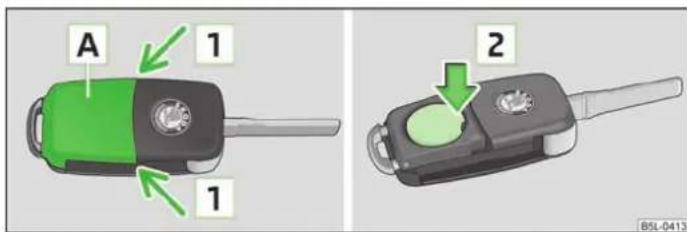
A 1 1 2 B5L-0413Fig. 9 Remote control key: Remove cover/remove battery
Each remote control key contains a battery that is located under the cover
A » Fig. 9. The battery needs replacing if red warning light » Fig. 8 on page 26 - B does not go on when you press a button on the remote control key. We recommend that you ask a ŠKODA Service Partner to replace the key battery. However, if you would like to replace the discharged battery yourself proceed as follows.
Flip out the key.
Press off the battery cover with your thumb or using a flat screwdriver in the region of arrows [1]» Fig. 9.
Remove the discharged battery from the key by pressing the battery downwards in the region of arrow 2.
Insert the new battery. Ensure that the "+" symbol on the battery is facing upwards. The correct polarity is shown on the battery cover.
Place the battery cover on the key and press it down until it clicks into place.

CAUTION
■ Pay attention to the correct polarity when changing the battery.
■ The replacement battery must have the same specification as the original battery.

For the sake of the environment
Dispose of the used battery in accordance with national legal provisions.

Note
- Please approach a ŠKODA Service Partner if you lose a key as they can obtain a new one for you.
- The system has to be synchronised, if the vehicle cannot be unlocked or locked with the remote control key after replacing the battery » page 31.
Child safety lock

natural_image
Close-up of a car door panel with a green arrow pointing to the door handle (no text or symbols visible)Fig. 10
Child safety locks on the rear doors
The child safety lock prevents the rear door from being opened from the inside. The door can only be opened from the outside.
You can switch the child safety lock on and off using the vehicle key.
Switching on
Use the vehicle key to turn the slit in the rear door in the direction of the arrow » Fig. 10.
Switching off
Use the vehicle key to turn the slit to the right in the opposite direction to the arrow.
Central locking system
Introductory information
When using the central locking and unlocking system, all the doors and the fuel filler flap are locked or unlocked at the same time (if it was not set differently in the menu item Settings - Convenience of the information display). The boot lid is unlocked when opening.
Warning light in the driver's door
After locking the vehicle, the warning light flashes for around 2 seconds in quick succession, afterwards it begins to flash evenly at longer intervals.
If the vehicle is locked and the safe securing system » page 28 is not operating, the warning light in the driver door flashes for about 2 seconds fast, goes out and starts to flash evenly at longer intervals after about 30 seconds.
If the warning light first of all flashes fast for about 2 seconds, afterwards lights up for about 30 seconds without interruption and then flashes slowly, there is a fault in the system of the central locking or in the interior monitor and in the towing protection monitoring » page 32. Seek help from a ŠKODA specialist garage.
Convenience operation of windows
The windows can be opened and closed when unlocking and locking the vehicle » page 36.
Individual settings
Opening a single door
This selection function makes it possible to only unlock the driver's door. The other doors and the fuel filler flap remain locked and are only unlocked after being opened again.
Automatic locking and unlocking
All the doors and the boot lid are locked automatically once the car reaches a speed of about 15 km/h.
If the ignition key is withdrawn, the car is then automatically unlocked again. In addition, it is possible for the driver or front passenger to unlock the car by pressing the central locking button @» page 29.
The doors can be unlocked and opened from the inside by pulling on the opening lever of the respective door. By the first pull on the opening lever, the door is unlocked. By the second pull on the opening lever, the door is opened.
! WARNING
Locked doors prevent unwanted entry into the vehicle from outside, for example at road crossings. Locked doors do, however, make it more difficult for rescuers to get into the vehicle in an emergency - danger to life!
i Note
- You can have the individual settings activated by a ŠKODA Service Partner or you can activate them yourself with the help of the information display » page 16, Settings.
- In the event of an accident in which the airbags are deployed, the locked doors are automatically unlocked in order to enable rescuers to gain access to the vehicle.
- Only the driver's door can be unlocked or locked using the key if the central locking system fails » page 28. The other doors and the boot lid can be manually locked or unlocked.
Emergency locking of the door » page 32.
Emergency unlocking of the boot lid » page 34.
Safe securing system
The central locking system is equipped with a safe securing system. The door locks are blocked automatically if the vehicle is locked from the outside. The warning light flashes for around 2 seconds in quick succession, afterwards it begins to flash evenly at longer intervals. It is not possible to open the doors with the door handle either from the inside or from the outside. This acts as an effective deterrent for attempts to break into your vehicle.
The safe securing system can be deactivated within 2 seconds by double locking the vehicle.
If the safe securing system is not operating, the warning light in the driver door flashes for about 2 seconds fast, goes out and starts to flash evenly at longer intervals after about 30 seconds.
The safe securing system is activated again the next time the vehicle is unlocked and locked.
If the vehicle is locked and the safe securing system is deactivated, the door can be unlocked and opened from the inside by pulling on the opening lever of the respective door. By the first pull on the opening lever, the door is unlocked. By the second pull on the opening lever, the door is opened.
! WARNING
If the vehicle is locked from the outside and the safe securing system is activated, there must not be any person in the vehicle as it is then no longer possible to open either a door or a window from the inside. The locked doors make it more difficult for rescuers to get into the vehicle in an emergency - hazard!
i Note
■ The anti-theft alarm system is activated when the vehicle is locked even if the safe securing system is deactivated. The interior monitor is however not activated.
■ After locking the vehicle, you will be informed that the safe securing system is activated by means of the message CHECK DEADLOCK on the instrument cluster display. On vehicles that are equipped with an information display, the following message will appear Check deadlock! Owner's manual! appears.
Unlocking the vehicle using the key
text_image
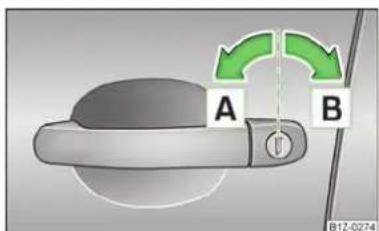
A B B12-0274Fig. 11 Turning the key for unlocking and locking the vehicle
Turn the key in the locking cylinder of the driver's door in the direction of travel (unlock position) [A] » Fig. 11.
Pull the door handle and open the door.
All the doors (only the driver's door on vehicles with anti-theft alarm system) and the fuel filler flap are unlocked.
The boot lid is then unlocked.
The switched on interior lights come on over the door contact.
The safe securing system is deactivated.
The windows open while the key is held in the unlock position.
The warning light in the driver door stops flashing if the car is not fitted with an anti-theft alarm system » page 31.

Note
If the vehicle is equipped with an anti-theft alarm system, you must insert the key into the ignition lock and switch the ignition on within 15 seconds after unlocking the door in order to deactivate the anti-theft alarm system. The alarm is triggered if the ignition is not switched on within 15 seconds.
Locking the vehicle with the key
Turn the key in the locking cylinder of the driver's door in the opposite direction of travel (lock position) B » Fig. 11 on page 28.
The doors, the boot lid and the fuel filler flap are locked.
The switched on interior lights will switch off over the door contact.
The windows and the electric sliding/tilting roof close while the key is held in the lock position.
The safe securing system is immediately activated.
The warning light in the driver door begins flashing.

Note
If the driver's door has been opened, the vehicle cannot be locked.
Vehicle locking/unlocking from the inside
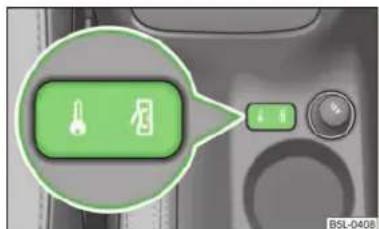
text_image
Camera control panel interface with green indicator lights and a dial, showing function buttons and status barFig. 12 Centre console: Central locking button
If the vehicle was not locked from the outside, you can also unlock and lock it with the rocker switch » Fig. 12 without the ignition switched on.
Locking all doors and the boot lid
Press the button in the area 🎉 Fig. 12. The symbol 🎉 in the button comes on.
Unlocking all doors and the boot lid
Press the button in the area ☐ » Fig. 12. The symbol ↓ in the button is no longer illuminated.
The following applies if your vehicle has been locked using the central locking button.
It is not possible to open the doors or the boot lid from the outside (safety feature, e.g. when stopping at traffic lights etc.).
The doors can be unlocked and opened from the inside by pulling on the opening lever of the respective door. By the first pull on the opening lever, the door is unlocked. By the second pull on the opening lever, the door is opened.
If at least one door has been opened, the vehicle cannot be locked.
In the event of an accident in which the airbags are deployed, the locked doors are automatically unlocked from the inside in order to enable rescuers to gain access to the vehicle.
The central locking button can be used to control the convenience opening and closing of the windows » page 36.

WARNING
The central locking system also operates if the ignition is switched off. Children should never be left unattended in the vehicle since it is difficult to provide assistance from the outside when the doors are locked. Locked doors make it difficult for rescuers to get into the vehicle in an emergency - hazard!

Note
If the safe securing system is activated» page 28, the door opening lever and the central locking buttons do not operate.