
TKF 7230 - Tumble dryer BLOMBERG - Free user manual and instructions
Find the device manual for free TKF 7230 BLOMBERG in PDF.


| Product Type | Condenser Tumble Dryer with Electronic Sensor Control |
| Brand | Blomberg |
| Model | TKF 7230 |
| Capacity (Cotton) | 7.0 kg |
| Capacity (Synthetics) | 3.0 kg |
| Capacity (Single Piece) | 1.5 kg |
| Capacity (Delicates) | 1.0 kg |
| Dimensions (H x W x D) | 85.0 x 59.5 x 60.0 cm |
| Depth with Door Open | 106.5 cm |
| Net Weight | 42 kg |
| Power Consumption | 2800 W (Heating) / 1900 W (Motor) |
| Voltage / Frequency | 230 V / 50 Hz |
| Fuse Rating | 16 A / 10 A |
| Drying Programs | Cottons (Extra Dry, Cupboard Dry, Iron Dry), Synthetics, Single Piece, Delicates, Ventilation, Timer (10-60 min), Anti-creasing |
| Auxiliary Functions | Time Delay (3/6/9 h), Child-proof Lock, Cancel Audio Warning |
| Filter System | Cover Filter, Filter Drawer (sponge), Condenser Sponge |
| Condenser Cleaning Interval | Every 20 cycles or once a month |
| Water Tank (Condenser/Heat Pump) | Must be emptied after each cycle |
| Installation Options | Freestanding, Under Counter, On Washing Machine (with fitting kit, part no. 295 560 0100) |
| Spare Parts Supplied | Filter Drawer Sponge, Condenser Sponge |
Frequently Asked Questions - TKF 7230 BLOMBERG
User questions about TKF 7230 BLOMBERG
0 question about this device. Answer the ones you know or ask your own.
Ask a new question about this device
Download the instructions for your Tumble dryer in PDF format for free! Find your manual TKF 7230 - BLOMBERG and take your electronic device back in hand. On this page are published all the documents necessary for the use of your device. TKF 7230 by BLOMBERG.
USER MANUAL TKF 7230 BLOMBERG
natural_image
Pure mechanical diagram showing a suspended component with arrows indicating motion (no text or symbols)natural_image
Technical diagram showing a mechanical assembly with tubing and a close-up of a structural detail (no text or symbols present)natural_image
Simple line drawing of a bowl with decorative patterns and a fan (no text or symbols)natural_image
Simple line drawing showing three abstract shapes: a pair of fingers pointing at dots, a row of dots, and a circle with an arrow (no text or symbols)natural_image
Line drawing of a hand pressing down on a mechanical device with a perforated grille (no text or symbols)natural_image
Illustration of a hand inserting a device into a washing machine while another hand cleaner uses a labeled plastic bag (no text or symbols present)natural_image
Hand inserting a component into a rack (no text or symbols visible)natural_image
Line drawings of hands installing or adjusting a device into two compartments (no text or symbols)heraus.
natural_image
Line drawing of a mechanical component with a textured band and tool, no visible text or symbolsnatural_image
Diagram of a device interior with a grid-patterned top panel and a central mechanical component (no text or symbols)
natural_image
Pure diagram of a grid-patterned structure with no text, numbers, or symbolsnatural_image
Line drawing of a hand using a tool to adjust or install a component on a vehicle (no text or symbols visible)Kondensatorschwamm:
natural_image
Simple line drawing of a computer monitor with a grid-patterned screen (no text or symbols)Wichtig:
natural_image
Line drawing of a hand holding a pen inside a curved container (no text or symbols)natural_image
Diagram of a mechanical device with directional arrows indicating movement or force (no text or symbols)Please read this manual first!
Dear Customer,
We hope that your product which has been manufactured in modern facilities and passed through a strict quality control procedure will give you the best results.
Therefore, we advise you to read through this manual carefully before using your product and keep it for future reference.
This operation manual will...
...help you use your machine in a fast and safe way.
- Please read the Operation Manual before installing and starting your machine.
• Particularly follow the instructions related to safety. - Keep this Operating Manual within easy reach. You may need it in the future.
- Please read all additional documents supplied with this machine.
Please note that this Operating Manual may be applicable for several other models.
Differences between models will be identified in the manual.
Explanation of symbols
Throughout this Operation Manual the following symbols are used:
i Important information or useful hints about usage.
⚠ Warning for hazardous situations with regard to life and property.
⚠ Warning for supply voltage.

This appliance's packaging material is recyclable. Help recycle it and protect the environment by dropping it off in the municipal receptacles provided for this purpose. Your appliance also contains a great amount of recyclable material. It is marked with this label to indicate the used appliances that should not be mixed with other waste. This way, the appliance recycling organised by your manufacturer will be done under the best possible conditions, in compliance with European Directive 2002/96/EC on Waste Electrical and Electronic Equipment. Contact your town hall or your retailer for the used appliance collection points closest to your home. We thank you doing
your part to protect the environment.
TABLE OF CONTENTS
1 Your Dryer 3
Overview 3
Technical Specifications 4
2 Warnings 5
General Safety 5
First Use 5
Intended use 5
Safety instructions 5
If there are children in your house... 5
3 Installation 6
Appropriate installation location 6
Under Counter Installation 6
Use on a washing machine 6
Adjusting the feet 6
Ventilation hose and connection (for products equipped with an outlet vent) 6
Connection to a water drain (for products equipped with a condenser and heat pump) 7
Electrical connection 7
Destroying the packaging material 8
Disposing of the old machine 8
4 Initial preparations for drying9
Garments suitable for drying in the
machine 9
Preparing clothes to be dried 9
Correct load capacity 9
Loading door 10
5 Selecting a Program and
Operating Your Machine 11
Control panel 11
Turning the machine on 11
Program selection 11
Program selection and consumption table 13
Auxiliary function 14
Warning indicators 14
Time delay 14
Starting the Program 14
Progress of program 15
Changing the program after the program
has started 15
Child-proof lock 15
Ending the program through canceling16
End of program 16
6 Maintenance and cleaning 17
Cover filter 17
For the condenser (products equipped with a condenser); 17
Filter drawer (for products equipped with a heat pump) 17
Condenser sponge (for products equipped with a heat pump) 18
Sensor and drum fin 19
Water tank (for products equipped with a
Condenser and a Heat pump) 19
7 Solution suggestions for problems 20
1 Your Dryer
Overview
Figure 1
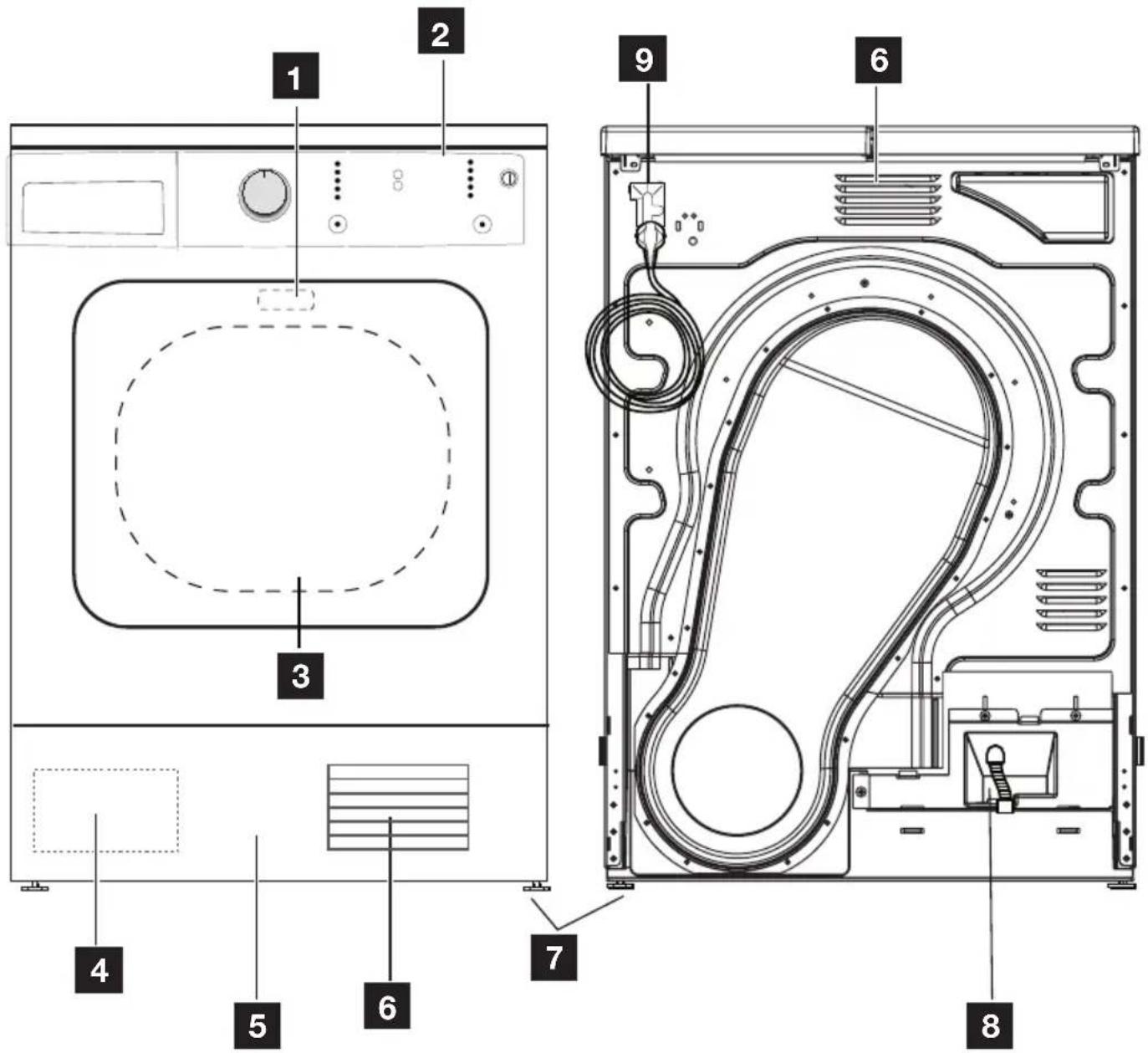
1 Rating label
2 Control Panel
3 Cover filter (inside the cover).
4 Filter drawer (behind the kick plate)
5 Kick plate
6 Ventilation grid
7 Adjustable Feet
8 Pump cap
9 Power cord
Technical Specifications
| Filling capacity (Dry laundry weight placed in the washing machine) | |||||
| White / Colored / Cotton clothes max.kg 7.0 | |||||
| Synthetics max.kg 3.0 | |||||
| Single piece max.kg 1.5 | |||||
| Ventilation/Refreshing max.kg 7,0 / 3,0 | |||||
| Time programmes (10', 20', 40', 60') max.kg 7,0 / 3,0 | |||||
| Delicates max. 4 pieces kg 1.0 | |||||
| Drying system Condenser Dryer with electronic Sensor control | |||||
| Dimensions | |||||
| Height / Height forfixed installation cm 85,0 / 82,0 | |||||
| Width cm 59,5 | |||||
| Depth / Depth for under counter installation cm | 60 / 59 | ||||
| Depth with door opened cm | 106.5 | ||||
| Adjusting height of the feet cm | 0.5 | ||||
| Weight Unpacked | ~ | 42 | |||
| Ambient temperature | (+5°C), (+35°C) | ||||
| Electrical connection | |||||
| Voltage | 230 V 50 Hz | ||||
| Power | 2800 W / 1900W | ||||
| Fuse | 16 A / 10 A | ||||
| Directly delivering the condensed water to outdoors | |||||
| Hose diameter cm | 1 | ||||
| Hose length max.cm | 140 | ||||
| Highest point of the hose max.cm | 80 | ||||
| Consumption values | Amount of Laundry (kg) | Spin Speed (rpm) | Remaining humidity (%) | Power (kwh) Time (minutes) | |
| Cottons Ready to Wear | 7 | 1400 | %50 | 4.00 | |
| Cottons Ready to Iron | |||||
| Cottons Ready to Wear* | 7 | 1000 | %60 | 4.38 | |
| Cottons Ready to Iron | 7 | 1000 | %60 | 4.00 | |
| Synthetics Ready to Wear | 3 | 600 | %50 | 1.70 | |
* : Energy Label standard program (EN 61121:2005)
All values given in the table have been fixed according to EN 61121:2005 Standard. Consumption values may deviate from the table up to 10% according to the laundry type, laundry spin speed, environmental conditions and voltage fluctuations.
Specifications of this appliance may change without notice to improve the quality of the product. Figures in this manual are schematic and may not match your product exactly.
Values stated on the machine labels or in the documentation accompanying it are obtained in laboratory in accordance with the relevant standards. Depending on operational and environmental conditions of the appliance, values may vary.
2 Warnings
Please read the following information. Otherwise, there may be the risk of personal injury or material damage. Moreover, any warranty and reliability commitment will become void.
General Safety
- Never place your machine on a carpet covered floor. Otherwise, lack of airflow from below of your machine may cause electrical parts to overheat. This may cause problems with your machine.
- If the power cable or mains plug is damaged you must call Authorized Service for repair.
- Your washing machine is designed to stop operating in the event of power resuming after a power failure. Press Start/Pause/Cancel button to resume the program. Press the “Start/Pause/Cancel” button for 3 seconds to cancel the program. (see, Canceling a Program) (see, Canceling a Program)
- Your machine can be operated at temperatures between +5°C and +35°C.
First Use
- Current value of the fuse at your home must conform to the current value of the machine indicated on the “technical specifications table”.
- Do not neglect to have the grounding installation made by a qualified electrician. Our company shall not be liable for any damages that may arise when the machine is used on a line without grounding.
- Please call the Authorized Service to commission your machine.
- When operating your machine for the first time, partly load it with wet pieces of clothes and let it run approximately for 15 minutes.
- You may smell an unpleasant odor and excessive fibre/lint may accumulate during first drying cycle.
- For safety and performance purposes, clean the filters after each drying cycle.
Intended use
- This product has been designed for home use.
- The appliance may only be used for drying of textiles that are marked accordingly.
- Please follow the maintenance and care instructions given on the textile labels.
Safety instructions
- This appliance must be connected to an earthed outlet protected by a fuse of suitable capacity.
- Unplug the machine when it is not in use.
- Never wash down the appliance with water! There is the risk of electric shock! Always disconnect from the mains by unplugging before cleaning.
- Never touch the plug with wet hands. Never unplug by pulling on the cable, always pull out from the plug only. Do not operate the machine if the power cord or plug is damaged.
- Never attempt to repair the machine yourself. Otherwise, you may be putting yours and other's lives in danger.
- For malfunctions that cannot be solved by information in the operating manual: Turn off and unplug the appliance and call an authorized service agent.
- Do not use your dryer to dry garments that were dry-cleaned or processed with stain removers. Vapors from the material may be combustible, poisonous and explosive. It may harm you or damage your machine.
If there are children in your house...
- Electrical appliances may be dangerous for the children. Keep children away from the machine when it is operating. Do not let them tamper with the machine.
- Close the loading door when you leave the area where the machine is located.
3
Installation
Appropriate installation location
• Install your machine in environments which have no risk of freezing and in a stable and level position.
- Do not place your machine on a long pile rug or on similar surfaces.
- Operate your machine in a well ventilated, dust-free environment.
- Do not block the air ducts in front of and under the machine with materials such as long pile rugs and wooden bands.
⚠️ Make sure that your machine is not placed on the power cable.
⚠️ Keep at least 1.5 cm from the edges of other furniture.
Under Counter Installation
- A special part (Part no: 295 950 0100) replacing the top trim must be provided and installed by the Authorized Service in order to use the machine under a counter or in a cupboard. It should never be operated without the top trim.
- Leave at least 3 cm of space between the side and rear walls of the machine and the walls of the counter/cupboard when installing your machine under a counter or in a cupboard.
Use on a washing machine
- A fitting device should be used between the two machines for use on a washing machine. The fitting device (Part no. 295 560 0100) must be installed by the Authorized Service.
- Place the machine on a sound floor. If it is to be placed on top of a washing machine, the approximate weight together may reach 180 kg when they are full. Therefore, the floor must be capable of carrying the load on it!
Adjusting the feet
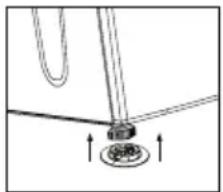
In order to ensure that your machine operates more silently and vibration-free, it must stand level and balanced on its feet. Balance the machine by adjusting the feet. Rotate the feet to adjust until the machine stands level and firmly.
natural_image
Simple line drawing of a mechanical assembly with no text or symbolsi Never unscrew the adjustable feet from their housings.
Ventilation hose and connection (for products equipped with an outlet vent)
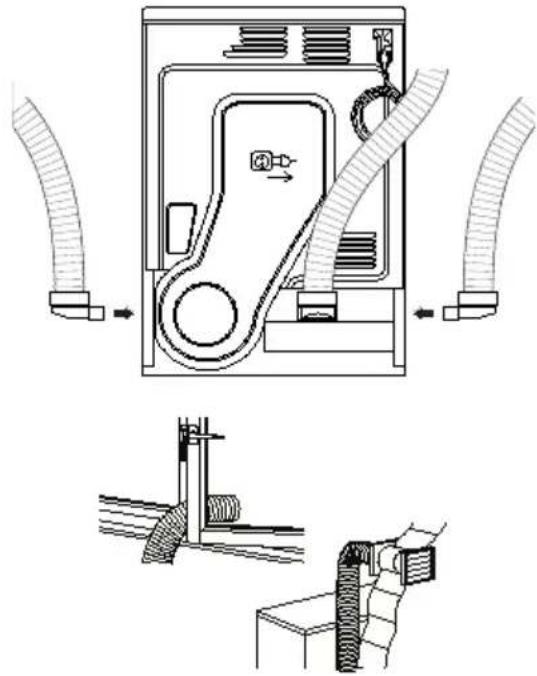
Ventilation hose assures exhausting of the air from inside the machine.
There are 3 air outlets on the rear, left and right sides of a vented dryer. The sides are covered by a replaceable plastic cover.
Stainless sheet metal or aluminum pipes can be used instead of the hose. The diameter of the pipe to be used should be minimum 10 cm.
Maximum hose and pipe lengths are given in the table below.
| Hose Pipe | |
| Maximum length 8 m | 10 m |
| 1 elbow 45° -1.0 m | -0.3 m |
| 1 elbow 90° -1.8 m | -0.6 m |
| 1 elbow 90° short | -2.7 m |
| 1 wall passage | -2.0 m |
i Each elbow and other passages should be subtracted from the above maximum length.
To connect a ventilation hose;
-
Fit the hose adaptor (90° or flat adaptor) by pressing it on the air outlet at the rear of your machine. Close the remaining 2 air outlets with plastic covers.
-
Connect the air outlet hose to the hose spacer piece (90° or flat adaptor) by turning it anti-clockwise.
-
Make the hose passages as shown below.
i Exhaust of humid air from the dryer into the room is inconvenient. It may damage the walls and furniture in the room.
The ventilation hose can be routed outdoors via a window or it can be connected to the air outlet in the bathroom.
Air outlet hose must be extended directly to the outdoors. There must be a small number of elbows as not to hinder air ventilation.
To prevent water accumulation in the hose, make sure that it is not folded on the floor.
natural_image
Technical line drawing of a gasifier with hoses and internal components, showing assembly steps (no text or symbols)The air ventilation hose should not be connected to the chimney of a stove or a fireplace.
Do not operate your machine at the same time with heaters such as a coal or gas stove. Airflow may cause the chimney to flare up. Airflow may cause the chimney to flame up.
Connection to a water drain (for products equipped with a condenser and heat pump)
In products equipped with a condenser unit the water accumulated during the drying cycle is collected in the water tank. You should drain the accumulated water after each washing cycle. You can directly send the accumulated water out through the water drain hose supplied with the machine instead of periodically draining the water collected in the water tank.
Connecting the water drain hose;
- Remove the hose on the machine by pulling it out from its end. Do not use any tools to take out the hose.
- Connect the special drain hose supplied with the machine to the pipe fitting.
- The other end of the drain hose can be directly connected to the wastewater drain or to the washbasin. The fitting must always be secured in all types of connections. Your house may be flooded if the hose gets out of its housing during water discharge.
When you direct the water drain out, "Water Tank" warning LED will light up at the end of each program.

natural_image
Pure mechanical diagram showing two configurations of a valve or pump assembly without any text, labels, or symbols.Important:
• The hose should be attached to a height of maximum 80 cm.
• You must be careful not the pinch or bend the hose.
- The end of the hose should not be bent, it should not be stepped on and it must not be folded between the drain and the machine.
Electrical connection
Connect the machine to an earthed outlet protected by a fuse of suitable capacity. Important:
• Connection should comply with national regulations.
• Power cord plug must be within easy reach after installation.
- The voltage and the allowed fuse protection are specified in the section "Technical Specifications".
- The specified voltage must be equal to your mains voltage.
- Connection via extension cords or multi-plugs should not be made.
- The main fuse and switches must have a contact distance of minimum 3 mm.
A damaged power cable must be replaced by a qualified electrician.
The appliance must not be operated unless it is repaired! There is the risk of electric shock!
Destroying the packaging material
Packaging material can be dangerous to children. Keep the packaging materials out of the reach of children or dispose of them accordingly. Do not dispose them together with normal domestic wastes.
Packaging materials of your machine are manufactured from recyclable materials.
Disposing of the old machine
Dispose of your old appliance in an environmental friendly manner.
- You may refer to your local agent or solid waste collection center in your municipality to learn how to dispose of your machine.
Before disposing of your old washing machine, cut off the mains plug and make the door lock unusable.
4 Initial preparations for drying
Garments suitable for drying in the machine
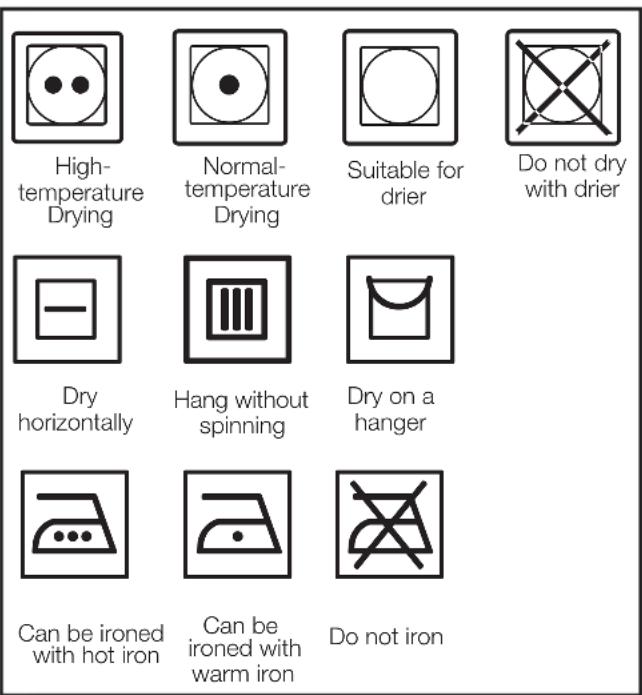
Always follow the advice on the garment labels. With this dryer, dry only the laundry having a label stating that they are suitable for drying in a dryer by selecting the appropriate program.
Garments unsuitable for drying in the machine
- Laundry items with metal attachments such as, belt buckles and metal buttons can damage your machine.
- Do not dry items such as woolen, silk garments and nylon stockings, delicate embroidered fabrics, garments with metal accessories and items such as sleeping bags in the machine.
- Garments made of delicate and valuable fabrics as well as lace curtains can be creased. Do not dry these in your machine!
- Do not dry items made of hermetic fibers such as pillows and quilts in the drying machine.
- Garments made of foam or rubber may be deformed.
- Do not dry clothes containing rubber in the machine.
• Do not dry clothes exposed to
petroleum, oil, combustible or explosive agents in the machine even if they are washed beforehand.
- Overly wet laundry or laundry with dripping water must not be put into the machine.
Preparing clothes to be dried
- All laundry must be spun at the highest possible spin speed your washing machine allows for the textile type.
- Laundry may be tangled after washing. Separate your laundry before placing them into your dryer.
- Sort your laundry according to their types and thicknesses. Dry the same type of laundry together. E.g.: fine kitchen towels and table cloths dry faster than the thick bath towels.
Correct load capacity
⚠️ Please consider the information in the "Program Selection Table". Always start the program in accordance with the maximum load capacity.
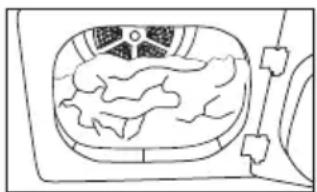
i Adding laundry to the machine more than the level shown in the figure is not recommended.. Drying performance will degrade when the machine is overloaded. Furthermore, your machine and your clothes might be damaged.
natural_image
Simple line drawing of a bowl with decorative patterns and a side panel (no text or symbols)Place your garments into the drum loosely so that they will not get tangled..
Large pieces (E.g.: bed sheets, quilt covers, large tablecloths) may bunch-up. Stop the machine 1-2 times during drying process to separate bunched-up laundry.
Following weights are given as examples.
| Home articles Approximate weights (gr) | |
| Cotton quit covers (double) 1500 | |
| Cotton quit covers (single) 1000 | |
| Bed sheets (double) 500 | |
| Bed sheets (single) 350 | |
| Large tablecloths 700 | |
| Small tablecloths 250 | |
| Tea napkins 100 | |
| Bath towels 700 | |
| Hand towels 350 | |
| Garments Approximate weights (gr) | |
| Blouses 150 | |
| Cotton shirts 300 | |
| Shirt 200 | |
| Cotton dresses 500 | |
| Dresses 350 | |
| Jeans | 700 |
| Handkerchiefs | 100 |
| T-Shirts | 125 |
Loading door
- Open the loading door.
- Place laundry items loosely into the machine.
- Push the loading door to close. Ensure that no items are caught in the door.
5 Selecting a Program and Operating Your Machine
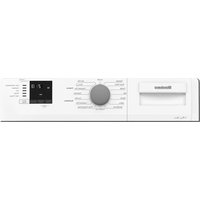
Control panel
Figure 2
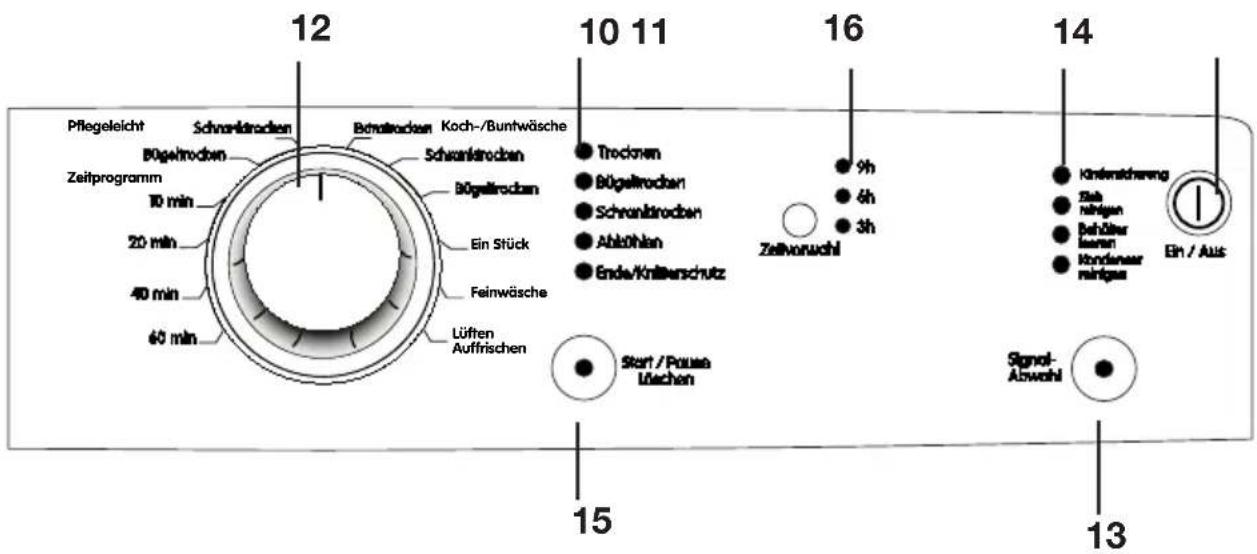
- Program follow-up indicator
- On/off button
- Program selection knob
-
Auxiliary functions
-
Warning indicators
- Start/Pause button
- Time delaying buttons
Turning the machine on
Prepare machine for program selection by pressing the "On/Off" button.
i Pressing the "On/Off" button does not necessarily mean the program has started. Press "Start/Pause/Cancel" button to allow the machine start the program.
Program selection
Decide the appropriate program from the table below which includes drying temperature in degrees. Select the desired program with the program selection button.
| Extra dry | Dry at high temperature only for cotton laundry. Thick and multi layered laundry (E.g.: towels, linens, jeans) are dried in a way that they do not require ironing before placing in the Cupboard. |
| Ready to Wear | Normal laundry (E.g.: tablecloths, underwear) are dried in a way that they do not require ironing before placing in the drawers. |
| Ready to Iron | Normal laundry. (E.g., Shirts, dresses) are dried ready to be ironed. |
Always select the highest temperature required for drying. High temperature will ensure energy and time saving.
For further program details, see, "Program Selection Table"
Main programs
Depending on the type of textile, the following main programs are available:
•Cottons
You can dry your durable clothes with this program. Dries at a higher temperature. It is recommended to use for your cotton items (such as bed sheets, quilt cover, underclothing, etc.).
•Synthetics
You can dry your less durable clothes with this program. It dries at a lower temperature compared to the cottons program. It is recommended for your synthetic clothes (such as shirts, blouses, synthetic/cotton blended garments, etc.).
Do not dry curtains and lace in your machine.
- Anti-creasing
A 2-hour anti creasing program to prevent laundry from creasing will be activated if you do not take the laundry out after the program has come to an end. This program rotates the laundry in 60-second intervals to prevent creasing.
Special programs
For special cases, there are also extra programs available:
i Additional programs may differ according to the model of your machine.
- Single Piece
You can dry single items (such as, jeans, sweatshirts, etc.) in a shorter time.
•Delicates
You can dry at a lower temperature your very delicate laundry that are suitable for drying or laundry which is advised to be hand-washed.
i It is recommended to use a cloth bag to avoid certain delicate garments and laundry from getting creased or damaged. Take your garments immediately out of the dryer and hang them after the program ends in order to prevent them being creased.
- Ventilation
Only ventilation is performed for 20 minutes without blowing hot air. You can air your clothes that have been kept at closed environments for a long time thanks to this program to deodorize unpleasant odors.
- Timer programs
are composed of 10, ..... 60-minute programs. You can perform drying under standard temperature within the time you selected.
This program may come to an end at the end of the selected time or may be stopped by the drying sensor when the laundry reaches to the extra dryness level in order to protect the laundry.
Program selection and consumption table
| Symbol Program Laundry type | Capacity | ||
| Cottons | |||
 | Extra dry | For durable laundry, e.g., bed sheet, towel, bathrobe, underwear | 7.0 |
| Cupboard dry | |||
| Iron dry | |||
| Synthetics | |||
 | Cupboard dry | For your synthetic clothes that are not resistant to high heat, e.g., thirst, blouses, clothes with synthetic blends | 3.0 |
| Iron dry | |||
| Special programs | |||
 | Single piece For your single item laundry, e.g. jeans | 1.5 | |
| Silk For your silk clothes | 1.5 | ||
| Woolens For your clothes with a dry cleaning label, e.g., woolens | 1-4 pieces | ||
| Delicates For your delicate clothes E.g.: Fine undergarments | 1 | ||
| Ventilation To ventilate laundry and remove odors, e.g., tobacco odor | 7.0/3.0 | ||
| Timer programs | |||
 | 60 minutes | To dry wet clothes in little amount within the desired time, | 7.0/3.0 |
| 40 minutes | |||
| 20 minutes | |||
| 10 minutes | |||
* : Energy Label standard program (EN 61121:2005)
All values given in the table have been fixed according to EN 61121:2005 Standard. These values may deviate from the table according to the laundry type, laundry spin speed, environmental conditions and voltage fluctuations.
Auxiliary function Cancel Audio Warning
Your machine will send out an audio warning when the program comes to an end. If you do not want to hear this buzzing, you need to press the “Cancel Audio Warning” button. The relevant LED will light up when this button is pressed and an audio warning will not be given when the program comes to an end.
You can select this function either before or after the program starts.
Warning indicators
i Warning indicators may differ according to the model of your machine.
Child-proof lock
A warning LED will light up as long as the child-proof lock remains activated.
Filter cleaning
A warning LED will light up to remind filter cleaning after the program finishes.
If the filter cleaning warning lights up continuously, please refer to, "Solution suggestions for problems".
Tank full
A warning LED will light up at the end of the program or when the tank is full with water. The machine stops operating when this warning LED lights up during a program running. To restart the machine, please drain the water in the water tank. Press "Start/Pause/Cancel" button to start the program after you have emptied the water tank. The warning LED goes off and the program resumes operating.
Cleaning the condenser.
It will light up periodically after maximum 5 drying cycles for the purpose of reminding. In this case and after drying, clean as explained in the section “Maintenance and Cleaning”.
Time delay
If you wish to dry your clothes at a later time, thanks to the time delay function, you can delay the program start up to 3 hours, 6 hours or 9 hours.
-
Open the loading door and put the laundry in.
i Make sure that all air outlets are open, door filter is cleaned and the water tank is empty. -
Set the drying program, temperature, spin speed and, if required, the auxiliary functions.
-
When the time programming button is pressed once, a 3 hour delay is selected and the relevant led lights. When the same button is pressed again, 6 hours; and if pressed once more, 9 hours delay will be selected. If the time programming button is pressed one more time, time delaying function will be cancelled. Set the time delay as you require.
-
Delayed operation of the selected program is started by pressing the "Start/Pause/Cancel" button after selecting the time delay.
i Additional laundry may be loaded / taken out during the time delay period.
Canceling the time delay
If you want to cancel the time delay countdown and start the program:
-
Press "Start/Pause/Cancel" button for about 4 seconds. The ":" in the middle of the screen will stop flashing. "Start/Pause/Cancel" light will go off and the remaining time on the screen disappears.
-
Press "Start/Pause/Cancel" button to start the program right away.
Starting the Program
-
Press "Start/Pause/Cancel" button to start the program.
-
"Start/Pause/Cancel" button will light up to indicate that the program has started.
Progress of program
Progress of a running program is shown through the program follow-up indicator. At the beginning of every program step, the relevant indicator lamp will light up and light of the completed step will turn off.
"Drying":
- Drying level will be illuminated during the whole drying process until the drying degree reaches "iron dry".
"Iron Dry":
- Starts to illuminate when the drying degree reaches "iron dry" step and remains illuminated until the next step.
" Cupboard Dry":
- Starts to illuminate when the drying degree reaches " Cupboard dry" step and remains illuminated until the next step.
"Cooling":
- It lights up during the 4-minute cooling phase at the end of drying.
"Final / Anti-creasing":
- Illuminates when the program comes to an end and anti-releasing function is activated.
Important:
If more than one LED light up or flash concurrently, it means there is malfunctioning or a failure (please see, Solution suggestions for problems).
Changing the program after the program has started
You can use this feature after your machine has started to dry your clothes under higher or lower temperatures.
For example;
Press and hold the “Start/Pause/Cancel” button for about 4 seconds to “Cancel” the program in order to select “Extra Dry” program instead of “Iron Ready” program. Select the “Extra Dry” program by rotating the program knob.
Press "Start/Pause/Cancel" button to start the program.
The program which is selected first will go on even if the program selection button is moved and another program mode is selected while the machine is operating. You must cancel the ongoing program in order to change the drying program. (See, Ending the program through canceling)
Adding/removing laundry in standby mode
In order to add or take out laundry after the start-up of the program;
-
Press the "Start/Pause/Cancel" button to switch the machine to "Pause" mode. Drying process will stop.
-
Open the door at Pause position and close it again after adding or taking out laundry.
-
Press "Start/Pause/Cancel" button to start the program.
i Any laundry added after the drying process was started may cause the already dried clothes in the machine intermingle with wet clothes and the result will be wet laundry after the drying process is over.
i Laundry may be added or taken out as much as desired during a drying process, but as this process will interrupt drying continuously, it will extend the program duration and increase energy consumption. Therefore, it is recommended to add laundry before the drying program is started.
Child-proof lock
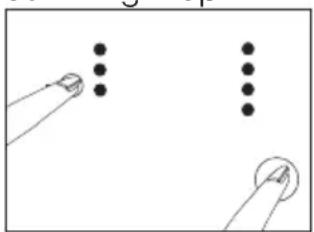
There is a childproof lock to prevent any program interruption due to the pressing of keys while the program is on. In order to activate the childproof lock, press on the “Audio Warning” and “time delay” buttons simultaneously for 2 seconds. The “Childproof lock” will be activated and a warning led will light up.
natural_image
Simple diagram showing two arrows pointing at three vertical dots, with one arrow pointing to a circle (no text or symbols)To start a new program after the program is over or to interrupt the program, the childproof lock should be deactivated. To deactivate the childproof lock, press the same buttons for 2 sec. The “Childproof lock” will be deactivated and the warning light will go off.
Ending the program through canceling
The program which is selected first will keep on going even if the position of the program selection button is changed. A new program can be selected and started after “Program cancel” is activated in order to change the drying program.
To cancel any selected program;
- Press “Start/Pause/Cancel” button for about a duration of 4 seconds. The “Filter cleaning”, “End/Anti-creasing” warning lights will light up at the end of this period for reminding purposes.
As the inside of the machine will be excessively hot when you cancel the program while the machine is running, activate the ventilation program to cool it down.
End of program
The “End/Anti-creasing” lamp and the “Filter cleaning” warning led on the program follow up indicator will light up when the program comes to an end. The door can be opened and the machine becomes ready for a second cycle.
Press the "On/Off" button to shut down the machine.
i A 2-hour anti creasing program to prevent laundry from creasing will be activated if you do not take the laundry out after the program has come to an end.
i Clean the filter after each drying (please see, Filter cleaning).
6
Maintenance and cleaning
Cover filter
Lint and fibres released from the laundry to the air during the drying cycle are collected in the "Cover Filter". Such fibre and lint are generally formed during wearing and washing.
i Always clean the filter after each Drying process.
natural_image
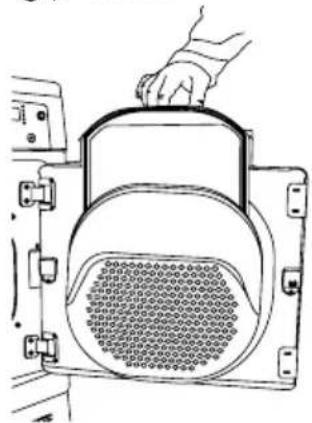
Line drawing of a hand pressing down on a mechanical device with a perforated grille (no text or symbols)For Filter cleaning;
1 Take out the cover
2 Lift the Cover filter up to pull out.
3 Clean lint, fibre, and cotton raveling by hand or with a soft piece of cloth.
4 Place the filter back into its place.
For the condenser (products equipped with a condenser);
Hot and humid air in the condenser is cooled with the cold air from the room. Thus, the humid air circulating in your machine is condensed and then pumped into the tank.
i Clean the condenser after every 20 drying cycles or once a month.
To clean the condenser;
1 If a drying process has been carried out, open the door of the machine and wait until it cools down.
2 Unlock the 3 condenser locks after opening the kick plate.
3 Pull out the condenser.
4 Clean the condenser with pressurized water and wait until the water drains.
5 Replace the condenser with the side labeled "Top" facing upwards. Lock the 3 condenser locks.
6 Close the kick plate cover.
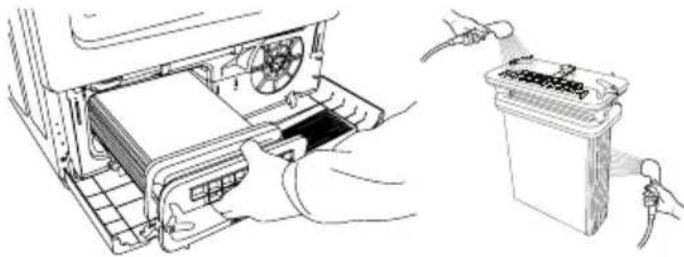
natural_image
Illustration of a hand inserting a device into an oven with a trash bin nearby (no text or symbols)Filter drawer (for products equipped with a heat pump)
Lint and fibre that could not be caught by the cover filter are blocked in the filter drawer behind the kick plate. “Condenser cleaning” warning light will light up periodically after a maximum 5 drying cycles as a reminder.
In order to get the best performance from your machine, clean the cover filter and the filter drawer after each drying cycle. There is a two-phase filter in the drawer. The first phase is the cover filter and the second phase is the filter sponge in the filter drawer.
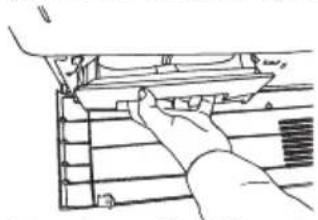
natural_image
Hand inserting a component into an air conditioner unit (no text or symbols visible)To clean the filter drawer;
1 Pull out the filter drawer.
2 Clean lint, fibre, and cotton raveling by hand or with a soft piece of cloth.
3 Open the filter drawer by pressing the red button.
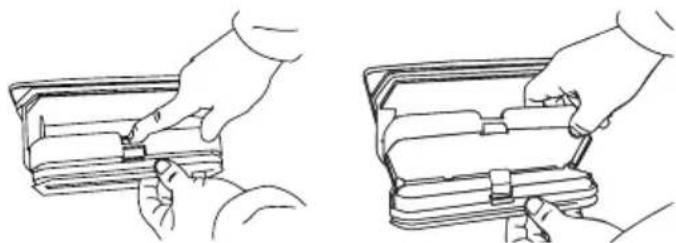
natural_image
Line drawings of hands installing or adjusting a device into two compartments (no text or symbols)4 Take out the filter drawer sponge.
5 If the sponge is covered with lint and fibers, it must be cleaned. Wash the sponge by hand to clean it and squeeze to drain excessive water. After washing the sponge, any remaining
lint particles among the pores is not important.
i If the lint and fibres collected in the drawer is sparse and small, you do not have to clean the sponge.
6 Place the sponge back into its place.

natural_image
Line drawing of a mechanical component with a textured mesh pattern (no text or symbols)7 Close the filter unit as to lock the red button.
- Place the filter drawer back into its place and push forward until a click sound is heard.
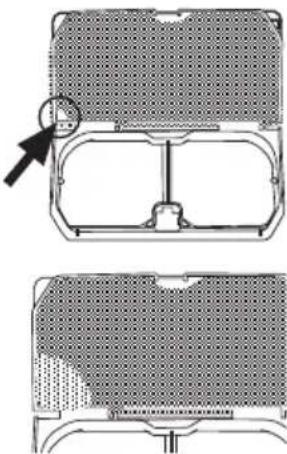
natural_image
Technical diagram showing two views of a mechanical component with a magnified inset (no text or symbols)Important:
- Drying without the filter sponge will damage your machine!
- A dirty heat pump will cause longer drying periods and higher energy consumption.
- Place the sponge as shown below, without forcing it. Pay attention to seat the left side of the sponge into the appropriate housing in the filter drawer as marked in the picture.
- Do not squeeze the sponge to make it go into the inner frame as shown in the picture below.
Condenser sponge (for products equipped with a heat pump)
It is very important that the lint and fibres are caught completely by the filters of your machine which is equipped with a condenser with heat pump. Failure in functioning of the filters may cause a drop in the performance or breakdown of your machine. Therefore, in addition to the “Cover Filter” and “Filter Drawer” filtering phases in your machine, there is also a “Condenser Sponge” piece for protection purpose. If the “Cover Filter” and “Filter Drawer” are functioning appropriately, , “the “Condenser Sponge” piece should be checked every 3 months. Any layer of accumulated lint on the sponge must be removed.
i If the lint and fibre collected on the sponge is sparse and small, you do not have to clean the sponge.
To clean the condenser sponge;
1 Take out the condenser sponge from its place.

natural_image
Line drawing of a hand inserting a component into a vehicle's vent (no text or symbols)You can reach the condenser filter after taking out the filter drawer.
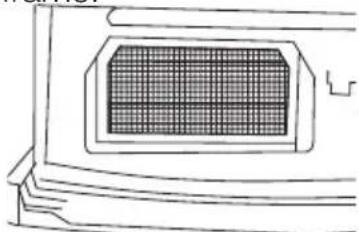
i A wire grid can be seen after taking out the condenser sponge.
2 Clean the sponge and place it properly back into its place. Put the sponge in its housing between the wire grid and plastic frame.
natural_image
Line drawing of a computer monitor with a grid-patterned screen, placed on a stack of books (no text or symbols)Important:
- When placing the condenser sponge, make sure that some part or whole of
the sponge does not run over the plastic frame. Misplacing will lead unsatisfactory filtering and may cause a drop in the performance of or damage to your machine.
A spare "Filter Drawer Sponge" and a spare "Condenser Sponge" piece are supplied together with the machine. You must be careful not the lose these spare parts.
Sensor and drum fin
There are humidity sensors in your machine that detect whether the laundry is dry or not.

natural_image
Line drawing of a hand holding a pen inside a curved container (no text or symbols)To clean the sensors and drum fin;
1 Open the cover of your machine.
2 Allow the machine to cool off if drying has been carried out.
3 Wipe the metal sensors with a soft cloth, dampened with vinegar and dry them.
i Clean metal sensors 4 times a year.
⚠️ Never use solvents, cleaning agents or substances alike when cleaning as these might cause fire and explosion!
Water tank (for products equipped with a Condenser and a Heat pump)
The moisture in the damp laundry is taken from the laundry and condensed. Drain the water tank after each drying cycle or during drying when "tank full" warning light comes on.
You can use the water in the water tank in your steam irons or air humidifiers.
⚠️ Never take out the water tank when the program is running!
⚠️ Condensed water is not drinkable!
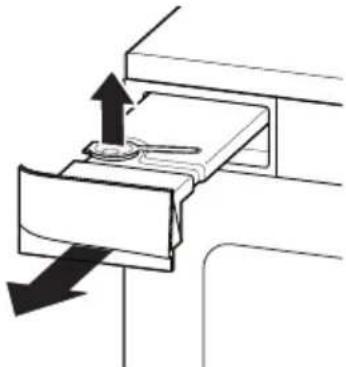
If you forget to drain the water tank, your machine will stop during the following drying cycles when the water tank is full and the "Tank Full" warning light will light on. If this is the case, press the "Start/Pause/Cancel" button to resume the drying cycle after draining the water tank. In order to drain the water tank;
natural_image
Diagram of a mechanical device with directional arrows indicating movement or force (no text or symbols)1 Carefully pull the water tank to take it out.
3 Drain the water.
4 If there is lint accumulation in the cover, clean it and press to close.
5 Slide in the water tank until it stops.
7 Solution suggestions for problems
| Problem Cause | Explanation / Suggestion | |
| Drying process takes too much time. | Cover filter and filter drawer might have not been cleaned. | * Clean the cover filter and Filter drawer. |
| Laundry come out wet at the end of drying. | * Cover filter and filter drawer might have not been cleaned.* Excessive laundry might have been loaded in. | * Clean the cover filter and Filter drawer.* Do not overload the machine. |
| Machine does not switch on or the program does not start. Machine is not activated when set. | * It might have not been plugged in.* The loading door may be ajar.* Program might have not been set or the "Start/Pause/Cancel" button might have not been pressed.* "Childproof lock" might have been activated. | * Make sure that the machine is plugged in.* Make sure that the loading door is properly closed.* Make sure that the program has been set and it is not in "Stop" mode.* Deactivate the childproof lock. |
| Program has been interrupted without any cause. | * The loading door may be ajar.* Electricity may be cut off. | * Make sure that the loading door is properly closed.* Press the "Start/Pause/Cancel" button to start the program. |
| Laundry has shrunk, become felted or deteriorated. | * A program suitable for the laundry type might have not been used. | * Dry only the laundry which is suitable for drying in your machine after checking the labels on your clothes.* Select a program with suitable temperature for the laundry type to dry your clothes. |
| Drum lightning does not come on.(for models equipped with a lamp) | * The machine might have not been started by using the On/Off button.* Bulb may have blown. | * Make sure that the machine is On.* Call the authorized service to replace the bulb. |
| “Final / Anti-creasing” light flashes. | * The 2-hour anti creasing program to prevent laundry from creasing might have been activated. | * Turn off the machine and take out the laundry. |
| “Final / Anti-creasing” light is on. | * Program has come to an end. * | Turn off the machine and take out the laundry. |
| The “Drying” light flashes. | * A heat sensor failure has occurred. Machine ends the program without heating. | * Turn off the machine and take out the laundry. Call your authorized service. |
| Also, for products equipped with a “Condenser” and a “Heat pump” | ||
| “Tank full” warning light is on. | * Water may be full.* Anti-creasing program might be running. | * Drain the water in the water tank. |
| “Filter cleaning” light is on. | * Filter might have not been cleaned. | * Clean the cover filter. |
| “Condenser cleaning” light is on. | * Filter drawer/Condenser might have not been cleaned. | * Clean the filters in the condenser/filter drawer under the kick plate. |
⚠️ Call an authorized service if the problem persists.
Garantiebedingungen
Anschrift:
- Kondensatorschwamm:
- Wichtig:
- Please read this manual first!
- This operation manual will...
- Explanation of symbols
- TABLE OF CONTENTS
- Your Dryer 3
- Warnings 5
- Installation 6
- Initial preparations for drying9
- Selecting a Program and
- Operating Your Machine 11
- Maintenance and cleaning 17
- Solution suggestions for problems 20
- Your Dryer
- Overview
- Warnings
- General Safety
- First Use
- Intended use
- Safety instructions
- If there are children in your house...
- 3
- Installation
- Appropriate installation location
- Under Counter Installation
- Use on a washing machine
- Adjusting the feet
- Ventilation hose and connection (for products equipped with an outlet vent)
- Connection to a water drain (for products equipped with a condenser and heat pump)
- Electrical connection
- Destroying the packaging material
- Disposing of the old machine
- Initial preparations for drying
- Garments suitable for drying in the machine
- Garments unsuitable for drying in the machine
- Preparing clothes to be dried
- Correct load capacity
- Loading door
- Selecting a Program and Operating Your Machine
- Control panel
- Turning the machine on
- Program selection
- Main programs
- •Cottons
- •Synthetics
- - Anti-creasing
- Special programs
- - Single Piece
- •Delicates
- - Ventilation
- - Timer programs
- Auxiliary function Cancel Audio Warning
- Warning indicators
- Child-proof lock
- Filter cleaning
- Tank full
- Cleaning the condenser.
- Time delay
- Canceling the time delay
- Starting the Program
- Progress of program
- "Drying":
- "Iron Dry":
- " Cupboard Dry":
- "Cooling":
- "Final / Anti-creasing":
- Important:
- Changing the program after the program has started
- For example;
- Adding/removing laundry in standby mode
- Ending the program through canceling
- End of program
- 6
- Maintenance and cleaning
- Cover filter
- For the condenser (products equipped with a condenser);
- Filter drawer (for products equipped with a heat pump)
- Condenser sponge (for products equipped with a heat pump)
- Sensor and drum fin
- Water tank (for products equipped with a Condenser and a Heat pump)
- Solution suggestions for problems
- Garantiebedingungen
- Anschrift:
Brand : BLOMBERG
Model : TKF 7230
Category : Tumble dryer