hobbylock 4762 - Sewing machine PFAFF - Free user manual and instructions
Find the device manual for free hobbylock 4762 PFAFF in PDF.


User questions about hobbylock 4762 PFAFF
0 question about this device. Answer the ones you know or ask your own.
Ask a new question about this device
Download the instructions for your Sewing machine in PDF format for free! Find your manual hobbylock 4762 - PFAFF and take your electronic device back in hand. On this page are published all the documents necessary for the use of your device. hobbylock 4762 by PFAFF.
USER MANUAL hobbylock 4762 PFAFF
natural_image
Black-and-white photo of a PFAFF hover loiter (hobbylock 4762) with no visible text or symbols on the device body.Instruction manual
For easier understanding of this instruction manual please fold this or the last page out when reading.
text_image
Warning symbol image with exclamation mark inside triangleSafety rules
For the United Kingdom only
The leads must definitely not be connected to the safety lead terminal I nor to a plug with three pins.
The wires in the mains lead are coloured according to the following code:
Blue: Neutral Brown. Live
As the colours of the wires in the mains lead of this appliance may not correspond with the colour coding of the terminals in your plug, proceed es follows:
The wire which is coloured blue must be connected to the terminal which is marked with the letter N or coloured black.
The wire which is coloured brown must be connected to the terminal which is marked with the letter L or coloured red.
Cut-off mains plugs are definitely not to be used, but disposed of immediately. Defective mains leads must be replaced completely.
Only 3 A spare fuses must be used as approved by ASTA according to BS 1362 and the fuse cover must be marked 3 A or with the corresponding colour code.
The plug must never be used without fuse cover. Spare fuse covers are available from electrical suppliers or the PFAFF agencies.
Please also observe the general safety notes on page 2.
You will find the Contents on pages 4 and 5
text_image
Warning symbol image with exclamation mark inside triangleImportant safety instructions
For the United States only
When you use an electrical appliance, basic safety precautions should always be adhered to es follows: Read all instructions before using this sewing machine.
DANGER
To reduce the risk of electric shock:
- The sewing machine should never be left unattended when plugged in. Always unplug this appliance from the electric outlet immediately after using and before cleaning it.
- Always unplug before relamping. Replace bulb with same type rated 15 Watts.
- Do not reach for a sewing machine that has fallen into water. Unplug immediately.
- Do not place or store a sewing machine where it can fall or be pulled into a tub or sink. Do not place in or drop into water or other liquid.
WARNING
To reduce the risk of burns, fire, electric shock, or injury to persons:
- Do not allow to be used as a toy. Close attention is necessary when this sewing machine is used by or near children.
- Use this sewing machine only for its intended use as described in this manual. Use only attachments recommended by the manufacturer as contained in this manual.
- Nover operate this sewing machine if it has a damaged cord or plug, if it is not working properly, if it has been dropped or damaged, or dropped into water. Return the appliance to the nearest authorized dealer or service center for examination, repair, electrical or mechanical adjustment.
- Never operate the sewing machine with any air openings blocked. Keep ventilation openings of the sewing machine and foot control free from the accumulation of lint, dust and loose cloth.
- Never drop or insert any object into any opening.
- Do not use outdoors.
- Do not operate where aerosol (spray) products are being used or where oxygen is being administered.
- To disconnect, turn all controls to off ("0") position, then remove plug from outlet.
- Never operate on a soft surface such as a bed or couch where the air openings may be blocked.
- Do not unplug by pulling on cord. To unplug, grasp the plug, not the cord.
- Keep fingers away from all moving parts. Special care is required around the sewing machine needle.
- Always use the proper needle plate. The wrong plate can cause the needle to break.
- Do not use bent or blunt needles. Use needles recommended by the manufacturer only.
- Do not pull or push fabric while stitching. It may deflect the needle, causing it to break.
- Switch the sewing machine off ("0") when making any adjustments in the needle area, such as threading needle, changing needle, threading bobbin, or changing presser foot, etc.
- Always unplug sewing machine from the electric outlet when removing covers, lubricating, or when making any other user servicing adjustments mentioned in the instruction manual.
- Hold plug when rewinding into cord reel. Do not allow plug to whip when rewinding.
Please also observe the general safety notes on page 2.
Keep these instructions in a safe place
This sewing machine is designed and manufactured for HOUSEHOLD use only.
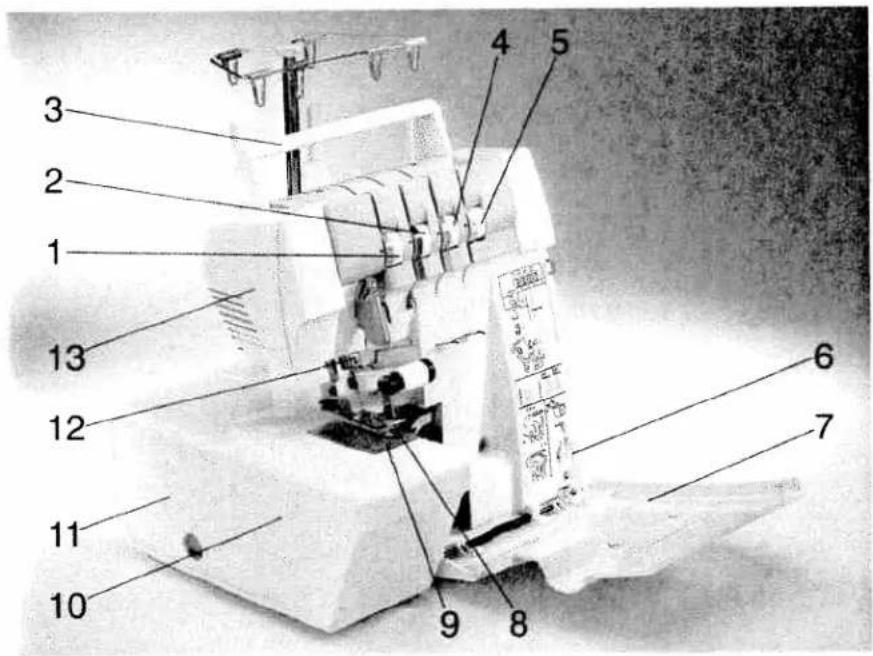
text_image
Labeled diagram of a sewing machine with numbered parts for identification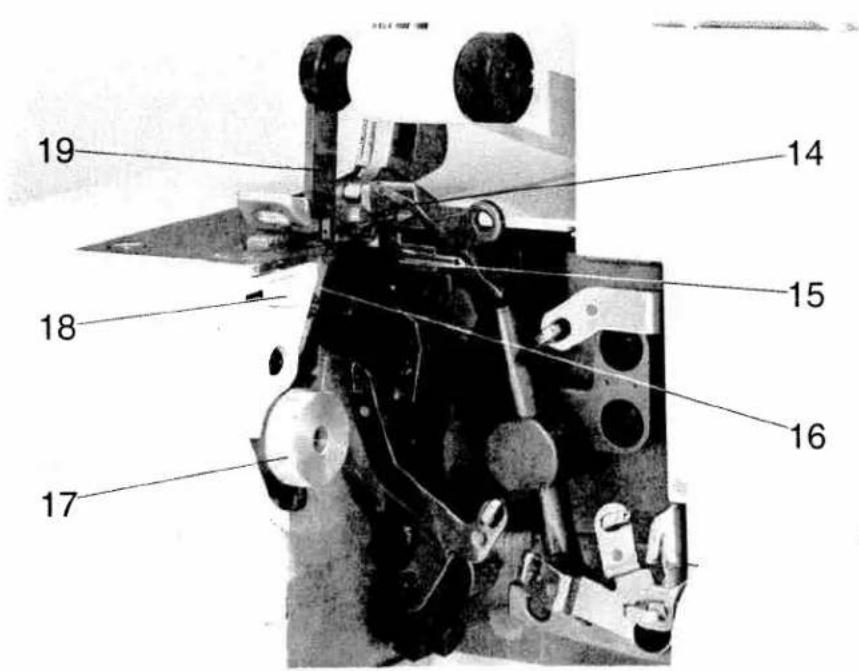
text_image
19 14 18 15 16 17Parts of the hobbylock 4762
1 Thread tension dial/left needle
2 Thread tension dial/right needle
3 Carrying handle
4 Thread tension dial/right looper
5 Thread tension dial/left looper
6 Converter
7 Looper cover
8 Sewing foot
9 Needle plate
10 Detachable work support
11 Accessory box
12 Needle holder
13 Lamp cover
14 Right overedge looper
15 Left overedge looper
16 Fixed lower knife
17 Seam width adjustment knob
18 Bed slide for stitch width chaining land
19 Movable upper knife
Notes on Safety
Notes on safety for domestic sewing machines accordance with EN 60335-2-28 and IEC 60335-2-28.
- The user must exercise adequate caution with regard to the up and down movement of the needle and constantly observe the sewing area while sewing.
- When leaving the machine unattended, during maintenance work or when replacing mechanical parts or accessories, always disconnect the machine from the mains by pulling out the mains plug.
- The maximum permissible wattage for the sewing lamp is 15 Watts.
- The tension of the drive belt may only be adjusted by a PFAFF mechanic.
- The machine must be put into operation in accordance with the indication plate.
- Do not insert any objects in openings on the machine.
- Do not use the sewing machine if:
- there is visible damage,
- its function is disturbed
- it is wet, e.g. with condensation which can occur when a cold machine is brought into a warm room.
- Do not pull the mains plug out of the socket by its cord.
- If this appliance is used for a purpose than that for which it is intended or if it is wrongly operated, we cannot accept any liability for any damage caused.
- To avoid the risk of electric shock, do not open the machine. There are no parts inside the machine which the user can repair. This is solely the responsibility of our qualified service staff.
- Be sure to use only original PFAFF parts.
-
Be sure to use only original PFAFF parts.
-
The machine is designed for a mains supply with a nominal voltage of +/-10% and a rated frequency of +/-4% .
- When used properly, the temperature of the outer components of a non-electronically controlled foot control can reach up to 85°C. Constant use at a low speed is therefore not permitted in order to avoid damage.
Environment
The recommended environment is: Ambient temperature 10°C to 40°C, Humidity 20% to 80%.
The machine is suppressed and immune to interference; however, it should not be operated near electronic devices such as radios, TVs, PCs, broadcasting transmitters etc.
This sewing machine is a high-quality electronic-mechanical appliance; it is a machine for supervised use in the home. It should be operated in such a way that it is not subjected to: dust, severe dampness, direct sunlight, static electricity, heat-producing objects, corrosive chemicals or liquids.
For ventilation purposes the machine must be free-standing, on a surface which is both firm and even.
Care of the machine
Always protect the machine against damage which may occur by knocking or dropping.
Cleaning
Housing
To clean the housing use a dry, clean, soft and lint-free cloth. Any stubborn dirt can be removed with a soft cloth and alcohol or paraffin.
Please Note!
Do not use any insecticides or chemical products such as benzine (petroleum) or fluid chemicals for cleaning the housing.
Simple, up-to-date sewing
Congratulations! You have bought a high-quality product that provides unique advantages. Your new hobbylock 4760 can take any material in its stride and will sew, trim and neaten up for you in one operation.
Your PFAFF hobbylock features the very latest in design and technology, and it is just as easy to use as this instruction manual is to follow.
If you now take a little time to study the instruction manual, nothing can go amiss.
It is certainly time well spent, since it is the only way to find out just what your machine can do and put it to full use.
If you have any further questions — just ask your PFAFF dealer. He is happy to be of service with any help or advice.
So, now let's get started! We wish you many enjoyable hours creating your very own fashion ideas.
Contents
| Page | |
| Accessory box | 7 |
| Accessories | 7 |
| Adjusting the seam width | 22 |
| Adjusting the stitch length | 23 |
| Adjusting the thread tension | 32-43 |
| Bead sewing foot | 53 |
| Blind stitch foot | 48 |
| Changing the light bulb (sewing light) | 46 |
| Changing the lower knife | 45 |
| Changing the needle | 11 |
| Changing the sewing foot | 19 |
| Cleaning rubber feet | 44 |
| Cleaning the machine | 44 |
| Connecting foot control | 8 |
| Cording foot | 52 |
| Differential feed | 24 - 25 |
| Elastic tape sewing foot | 50 |
| Engaging/disengaging the upper knife | 20 |
| Folded 2-thread rolled hem | 42 |
| Folded 3-thread rolled hem | 38 |
| Free arm | 26 |
| Lace sewing foot | 54 |
| Lint box | 9 |
| Looper cover | 9 |
| Lubricating the machine | 44 |
| Machine cover | 7 |
| Machine maintenance | 44 |
| Mains switch | 8 |
| Mounting the converter | 21 |
| Needle position | 11 |
| Program summary | 28 - 31 |
| Setting the bed slide for stitch width chaining land | 27 |
| Sewing foot lift | 19 |
| Sewing foot pressure | 23 |
| Sewing problems and their solutions | 56 - 57 |
| Shirring foot | 51 |
| Special accessories | 47 - 54 |
| Specifications | 58 |
| String sewing foot | 49 |
| Thread spool stand | 10 |
Page
Telescopic thread guide 10
Thread spool net. 10
Thread unreeling disc . . . . . . . . . . . . . . . . . . . 10
Threading/guide wires. 12
Threading right overedge looper(red) 13
Threading left overedge looper (yellow) . . . . . . . . . . . . 14 - 15
Threading right needle A (green) 16
Threading left needle B (blue) 17
Thread reel change on threaded machine . . . . . . . . . . . . 18
Thread chain cutter. 19
Thread table for 2-, 3- and 4-thread overedge seam . . . . . . . . 55
2-needle, 3-thread overedge closing seam. 43
2-thread overedge seam FLATLOCK (wide, narrow) . . . . . . . 39
2-thread serging seam (wide, narrow) 40
2-thread rolled hem 41
3-thread overedge seam (wide, narrow)....34
3-thread serging seam (wide, narrow) 35
3-thread decorative seam serging FLATLOCK/wide, narrow ..... 36
3-thread rolled hem 37
4-thread overedge seam . . . . . . . . . . . . . . . . . . 32 - 33
natural_image
Black-and-white photo of a smiling athlete in a striped top and goggles, seated on steps (no visible text or symbols)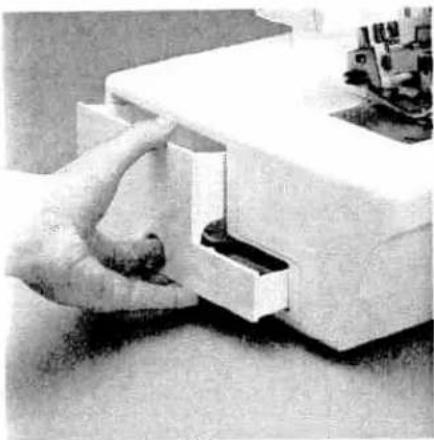
natural_image
Close-up of a hand pressing down on a small mechanical component (no visible text or symbols)Accessory box
Pull accessory box 11 to the left and remove the accessories.
text_image
1 2 3 4 5 6 7 8Accessories
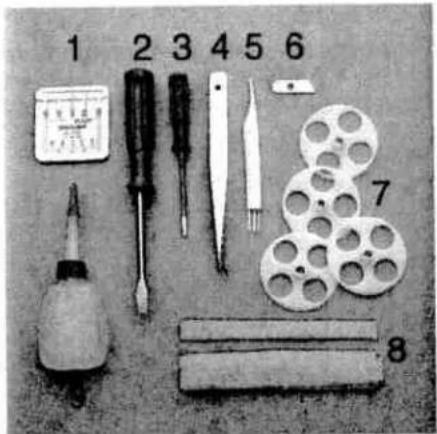
The following accessories are included with the machine:
1 Overedge needles system EL X 705, Cat. Nr. 2002
2 Screwdriver (large)
3 Screwdriver (small)
4 Pair of tweezers
5 Cleaning brush
6 Lower knife
7 Thread unreeling discs (4x)
8 Thread spool nets (4x)
9 Machine oil
text_image
PFAFFMachine Cover
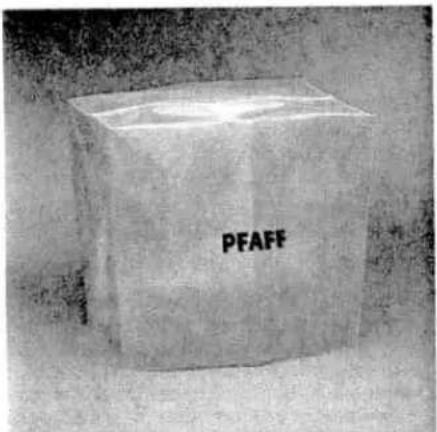
The machine cover protects the machine against dust and dirt. After each use push in telescopic thread guide 21. Thread spool stand 24 with or without thread spool must be pushed against the machine as far as it will go. The machine cover can now be placed in position.
natural_image
Close-up of hands operating a sewing machine with a white fabric on a table (no visible text or symbols)Connecting the foot control
Insert the plugs of the foot control into machine socket 27 and the power source respectively. Sewing speed is regulated by applying pressure to the foot control. In addition, sewing speed can be set by means of the bed slide adjuster at the top end of the foot control.
Position ▶ = half speed
Position ◀◀ = full speed

natural_image
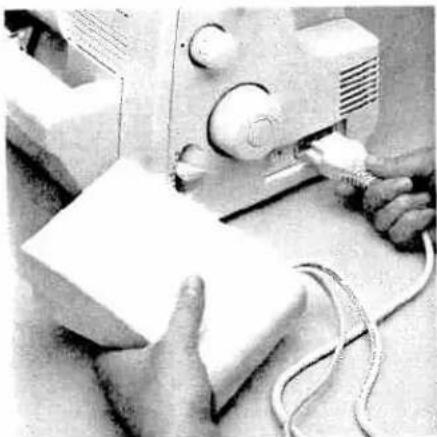
Close-up of a white portable projector with ventilation slots and a cable inserted (no visible text or symbols)Mains switch
The sewing light lights up when mains switch 28 is switched on.
The machine is now ready for operation.
Notes on safety
This appliance has a polarized plug (one blade wider than the other). To reduce the risk of electric shock, this plug is intended to fit in a polarized outlet only one way. If the plug does not fit fully in the outlet, reverse the plug. If it still does not fit, contact a qualified electrician to install the proper outlet. Do not modify the plug in any way.
Foot control sewing machine, foot controller type AE 033 has to be used.
text_image
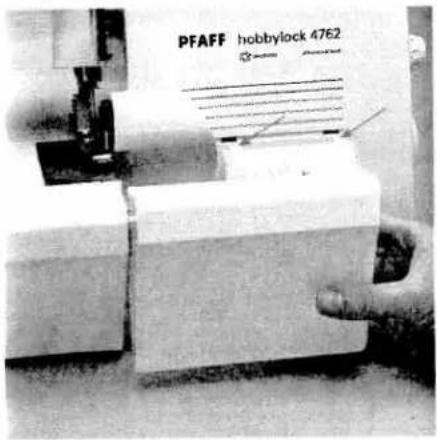
PFAFF hobbylock 4762Lint box
Insert the upper tabs of lint box 34 into the upper slots of looper cover 7.
text_image
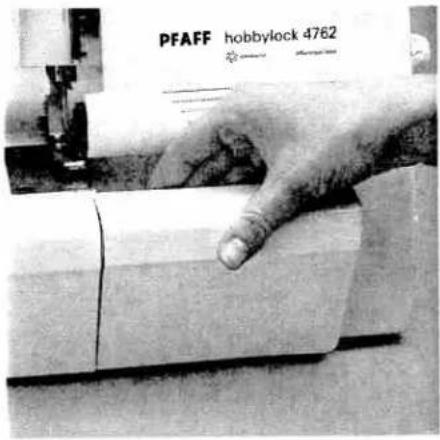
PFAFF hobbylock 4762 www.hobbylock.comPress against the lower part of the container until the lower tabs snap into the lower slots of the looper cover.
For removal of the lint box, use the reverse sequence.

text_image
PFAFF hobbylock 4762Looper cover
Slide looper cover 7 as far as it will go to the right and swing it downwards. Individual threading paths are displayed in colour on the inside of the machine, as well as the threading method of the over-edge looper. In addition, the mounting procedure for the converter and the three most common stitch types are shown symbolically.
Note: For safety reasons, as soon as the looper cover is opened, the power supply to the machine is interrupted, i.e. the machine will not operate.
natural_image
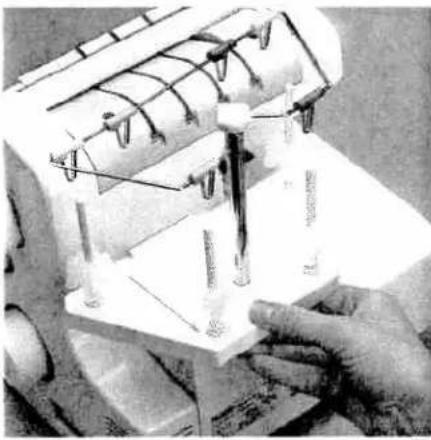
Close-up of a hand operating a mechanical device with wires and components (no visible text or symbols)Thread spool stand
Before the thread spools are set in place, thread spool stand 24 must be pulled as far as it will go to the back.

natural_image
Hand holding a vertical rod above a mechanical device with multiple pins (no visible text or symbols)Telescopic thread guide
Extend telescopic thread guide 21 upwards.
To ensure optimum thread take-off, the two upper telescopes must be rotated slowly until their locking balls are heard to lock into place.

natural_image
Close-up of hands holding a fabric with a knitted sleeve and string (no visible text or symbols)Thread spool net
The thread spool net included in the accessories should be used for synthetic yarns which unwind easily from the spool. The net must be slid over the thread spool from below before placing it on the thread spool stand.

natural_image
Close-up of hands assembling a small white object with black and white patterns (no text or symbols visible)Thread unreeling disc
The thread unreeling disc included in the accessories is intended for use with smaller thread spools. Insert the thread unreeling disc into the thread spool and place them both on the cone adapter of the thread spool pin.

natural_image
Mechanical assembly diagram showing two circular components connected to a central component labeled A and B (no text or symbols present)Needle position
As shown in the illustration, up to two needles can be inserted into the needle holder. Retaining screw A belongs to the right overedge needle, retaining screw B to the left overedge needle.

text_image
right overedge needle threaded A B left overedge needle threaded B A left and right overedge needles threadedIn this instructions manual the various needle positions are shown in a schematic drawing of the needle holder. See the above examples.
Note: If both the left and right overedge needles have been inserted, the left needle will be somewhat higher than the right needle.

natural_image
Simple line drawing of two vertical cylindrical objects with arrows pointing upward (no text or symbols)Changing the needle Switch off at the mains switch.
Overedge needles for system EL X 705, Cat. Nr. 2002 are required for this machine. Lower the sewing foot with the sewing foot lift and turn the handwheel until the needle is at its highest point.

natural_image
Close-up of hands operating a sewing machine with a white cylindrical component (no visible text or symbols)Loosen the needle fastening screw (without removable it completely) with the small screwdriver included in the accessories and remove the needle in a downward motion. Insert a new needle into the needle holder with the flat side to the rear and retighten the respective fastening screw.
natural_image
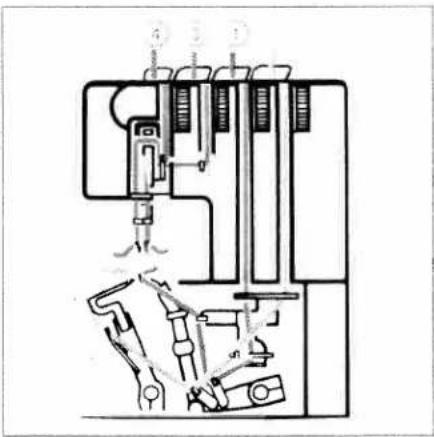
Cross-sectional diagram of a mechanical device showing internal components and fluid flow (no text or labels)Threading
A colour-coded threading diagram for quick reference is to be found behind the looper cover, i.e. inside the machine.
Thread the individual threads — as shown — following steps 1 to 4.
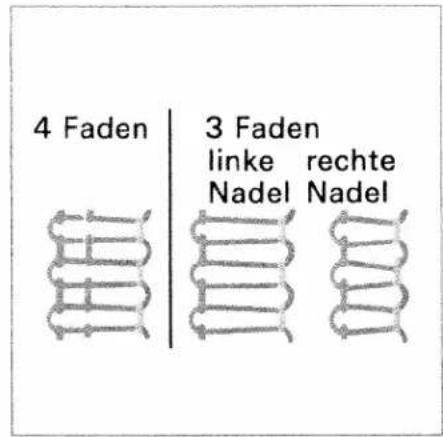
text_image
4 Faden | 3 Faden linke rechte Nadel NadelThe colour markings are applicable as follows:
- Right overedge looper = red
- Left overedge looper = yellow
- Right needle = green
- Left needle = blue

natural_image
Close-up of a sewing machine with vertical rods and base mount (no visible text or symbols)Threading/guide wires
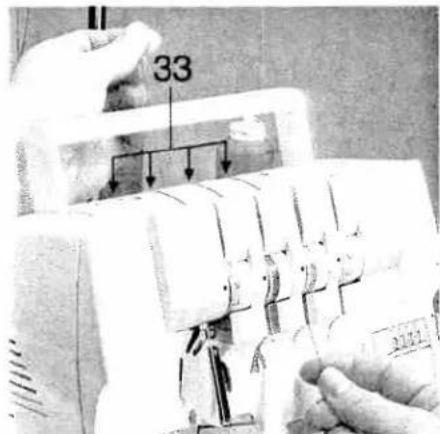
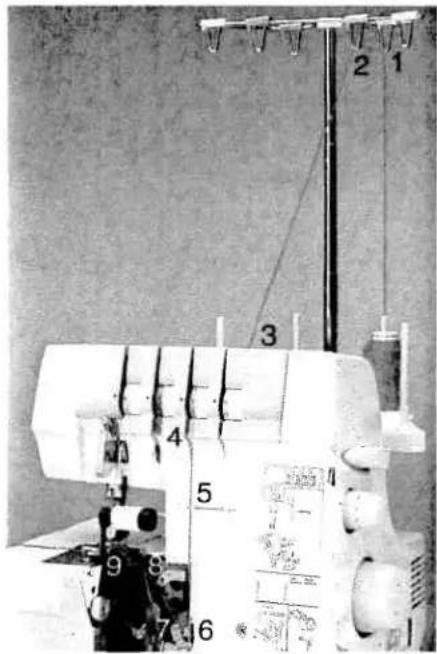
Place the thread spools on thread spool stands 25. Use cone adapters 26 only with conical spools. Further notes on the thread spool net and thread unreeling disc are to be found on page 10. Insert the threads through the guide wires 20 from back to front according to the colour coding.
text_image
33Lift carrying handle 3. Insert the threads beneath the handle and through rear guides 33 by pulling down with both hands until the yarn slips under the guide wire. Now pull the thread between the tension discs and press it down until it is lodged between the latter. Return the carrying handle to its closed position.
text_image
Black-and-white photo of a sewing machine with numbered parts and a small inset image showing a product box.Threading/right overedge looper (red)
Thread by following steps 1 to 9.
Note: To facilitate threading, use the tweezers included in the accessory box.

text_image
Labeled mechanical device image with numbered components, likely a sewing machine or sewing machine.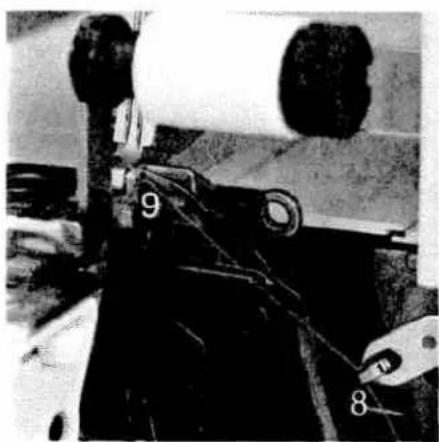
text_image
9 8Insert the thread along the path marked in red through guides 5 to 8.
Insert the thread from the front through the eye in overedge looper 9. Pull about 10 cm of thread through the looper and lay it to the left underneath the sewing foot.
natural_image
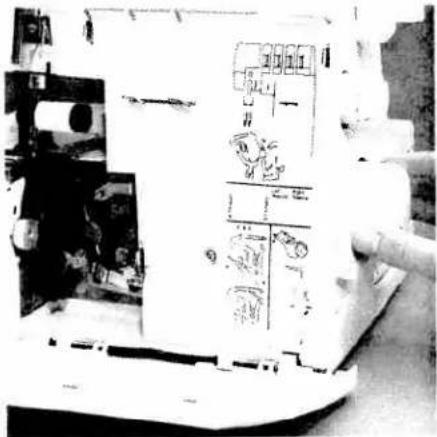
Close-up of a sewing machine's front panel with visible buttons and a cartoon character on the door (no readable text or symbols)Threading the left overedge loopers (yellow)
Turn the handwheel in the direction of the arrow you until overedge looper 15 is positioned at the extreme right.
natural_image
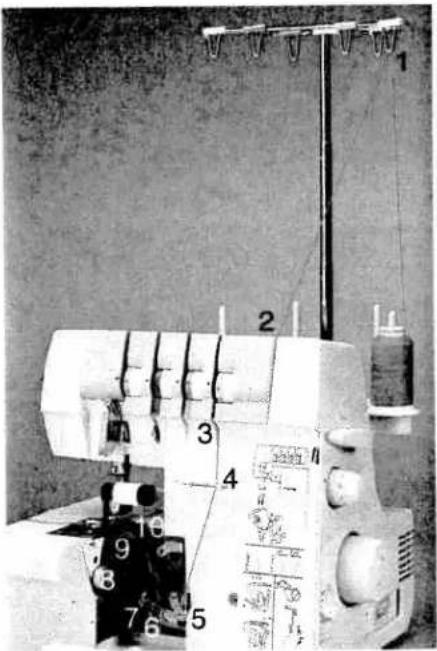
Black-and-white photo of a sewing machine with numbered parts and a spool, no visible text or symbols.Insert the thread by following steps 1 to 10.
Note: To facilitate threading, use the tweezers included in the accessory box.

text_image
Black-and-white photo of a vintage mechanical device with numbered parts labeled 4, 5, 6, 7, and 8.Insert the thread along the path marked in yellow through guides 4 to 8.
The diagrams to be found behind the looper cover illustrate the principles of threading.

text_image
B ← ALay the thread from back to front over the right-hand side of the looper. Carefully pull the thread to the left and slightly down until it slips into notch B (= threading point 9) of the looper.

natural_image
Pure mechanical diagram showing a lever mechanism with labeled component 'C' (no text or symbols beyond label)Insert the thread from the front through the eye of left overedge looper C (= threading point 10). The thread must run along the groove in the looper.

natural_image
Close-up of mechanical components with numbered parts (8, 9, 10) and no visible text or symbolsPull about 10 cm of thread through the looper and lay it to the left underneath the sewing foot.

text_image
1 2 3 4 5 6 7 8 9Threading/right needle A (green)
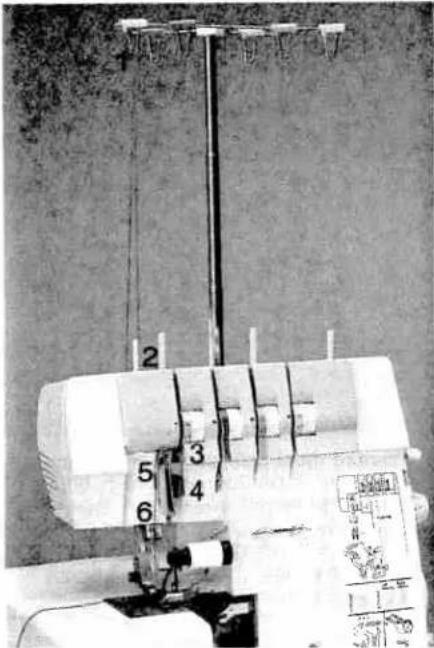
Insert the thread by following steps 1 to 9.

natural_image
Close-up of a sewing machine needle with numbered parts (no visible text or symbols)Note: The thread must run through the upper slot in guide 7.

text_image
8 9Pull about 10 cm of thread through the looper and lay it to the left underneath the sewing foot.
Note: To facilitate threading of the needle eye, use the tweezers included in the accessory box and lower the sewing foot.
natural_image
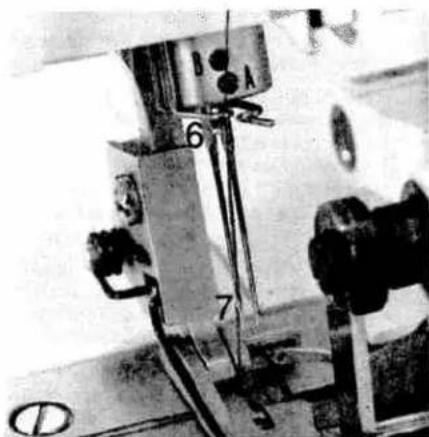
Close-up of a sewing machine with numbered components (no visible text or symbols)Threading/left needle B (blue)
Thread the left needle B by following steps 1 to 7.

text_image
5 4 6Note: The thread must run through the lower slot in guide 5.
text_image
6 7Pull about 10 cm of thread through the needle eye and lay it to the left underneath the sewing foot.
Note: To facilitate threading of the needle eye, use the tweezers included in the accessory box and lower the sewing foot.
text_image
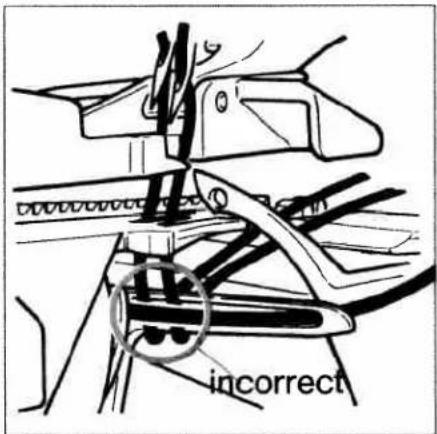
incorrectImportant note on threading:
The needle threads must always be inserted last in order to avoid mistakes with the left looper thread and thread breakage or missed stitches.
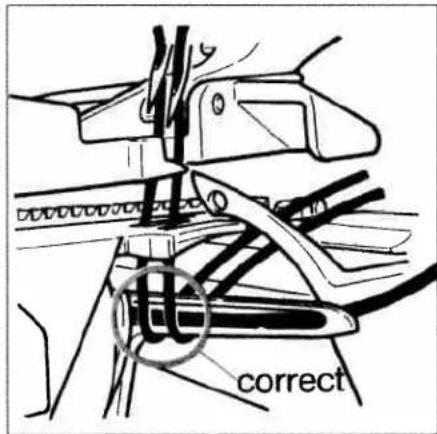
text_image
correctThe thread must also be removed from the needle(s) if the looper threads break. Re-insert the looper thread first, then re-thread the needle(s).
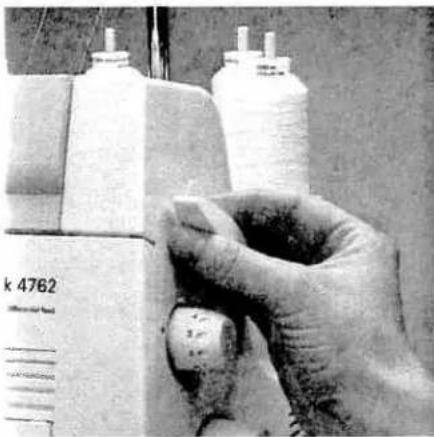
Thread reel change on threaded machine
Cut the threads close to the thread spool and set the new thread reels in place. Tie together the threads still in the machine and the new threads, and pull the threads out of the needles. Set all the thread tensions to -5. Now pull on the needle threads until the knots are about 15 cm past the last thread guide before the needles. Cut the knots off and pull the threads through the respective needle eyes. The looper threads can be pulled continuously past the looper eye and laid to the left underneath the sewing foot.
natural_image
Close-up of a hand operating a sewing machine with spools of thread (no visible text or symbols)Sewing foot lift
The sewing foot can be raised and lowered with sewing foot lift 32. The maximum vertical lift of 6 mm for the sewing foot for particularly thick fabrics can be achieved by also depressing the sewing foot lift towards the back.
natural_image
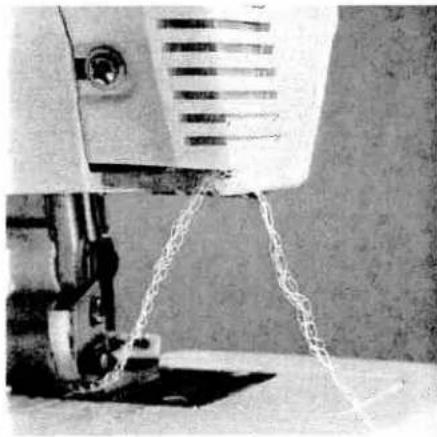
Close-up of a sewing machine needle with chains attached, no visible text or symbolsThread chain cutter
After finishing a seam, continue to sew a thread chain of 15 - 20 cm. Pull the thread chain towards the front over thread chain cutter 23. The thread chain will thus be cut.
natural_image
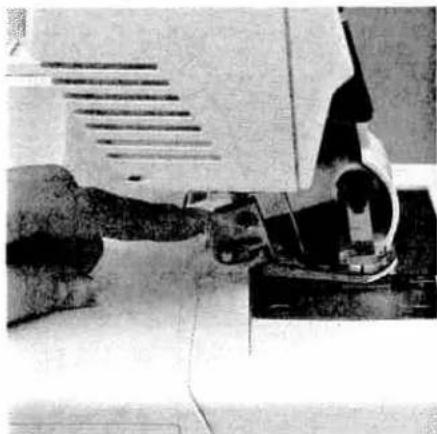
Close-up of a mechanical device with a lever and base, no visible text or symbolsChanging the sewing foot Switch off at the mains switch
To remove: Raise the needle(s) to the highest position and lift the sewing foot. Press the white lever at the rear of the sewing foot holder. The sewing foot will be released automatically from the holder and can be removed to the left. To do this, lift the spring slightly.
To insert: Lift the spring slightly and insert the sewing foot under the holder so that when the sewing foot lever is lowered, the pin of the foot locks into the sewing foot holder.
Check: Please lift the sewing foot lever to ensure that the sewing foot is properly locked into place.

natural_image
Close-up of hands operating a sewing machine (no visible text or symbols)
natural_image
Person operating a sewing machine with a white cylindrical roller (no visible text or symbols)Disengaging the upper knife Switch off at the mains switch
Raise upper knife 19 to its uppermost position by rotating the handwheel. Detach the lint box and open the looper cover. Now slide the holder of the movable upper knife fully towards the right.
Turn the head of the upper knife away from you until the upper knife locks into a horizontal position.

natural_image
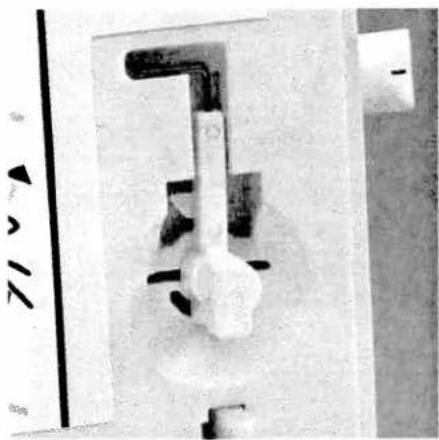
Close-up of hands operating a sewing machine with a white cylindrical component (no visible text or symbols)Engaging the upper knife
Slide the holder of the movable upper knife towards the right and swing the knife back until it locks into its working position. Close the looper cover and re-attach the lint box.
natural_image
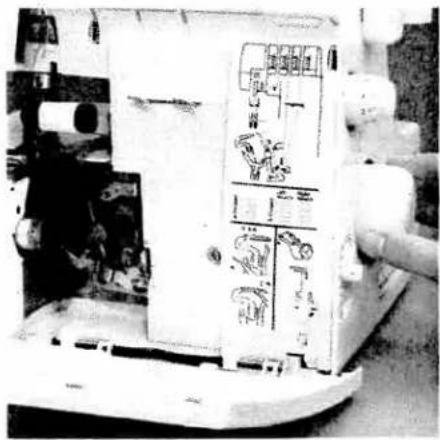
Close-up of a mechanical device with a white handle and black components, no visible text or symbolsMounting the converter Switch off at the mains switch
The converter must be mounted for all 2-thread seams and the 2-needle, 3-thread overedge closing seam. Detach the lint box and open the looper cover. Converter 6 is located in the front of the machine housing. Pull it out.
natural_image
Close-up of a vintage mechanical device with visible components and no readable text or symbolsRotate the handwheel until the right over-edge looper is positioned to the right of the movable upper knife.

natural_image
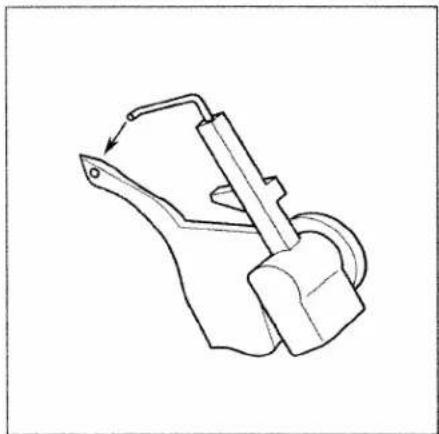
Technical line drawing of a mechanical component with labeled parts A and an arrow indicating direction (no text or symbols beyond labels)Insert hub A of the converter into the aperture of the right overedge looper.
natural_image
Line drawing of a mechanical clamp or lever mechanism (no text or symbols)Rotate the converter towards the left and press the upper part slightly to the rear so that the tip of the converter locks into the eye of the looper.
The converter can be removed by following these directions in reverse order.

natural_image
Close-up of a hand using a sewing machine to cut or adjust fabric (no visible text or symbols)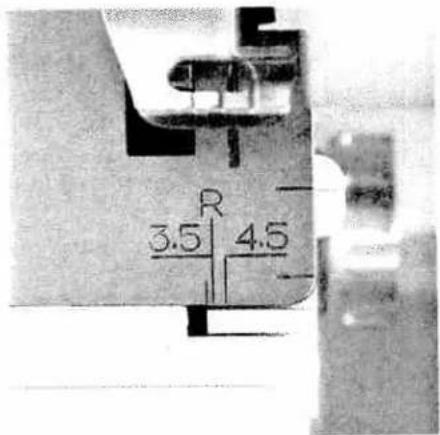
text_image
R 3.5 4.5Adjusting seam width Switch off at the mains switch
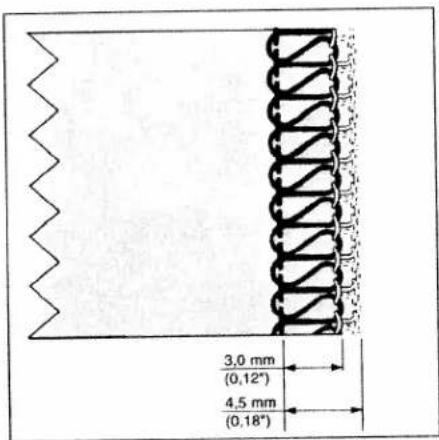
Detach the lint box. The seam width can be continuously adjusted as desired from 3.0 mm to 4.5 mm by turning seam width adjustment knob 17. The seam width is can be more easily adjusted if the upper knife holder is pushed slightly to the right.
The adjustments are marked on the needle plate. R is the seam width adjustment for rolled seams.
text_image
3,0 mm (0,12°) 4,5 mm (0,18°)
text_image
5,2 mm (0,20") 6,7 mm (0,24)Note: The seam width adjustments between 3.0 mm and 4.5 mm apply to the right needle only. For the left needle, the set value is increased by 2.3 mm, i.e. the seam width can be continuously adjusted from 5.2 mm to 6.7 mm.
text_image
4 3 2Adjusting the stitch length
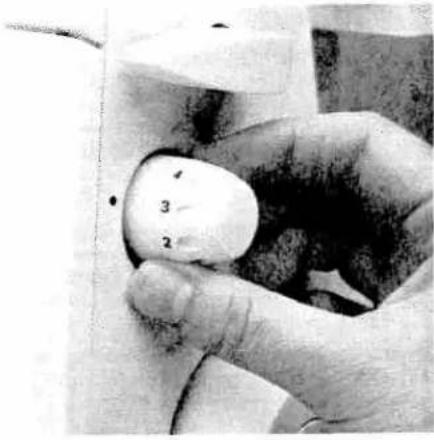
The stitch length can be set as desired from F ( 1 mm) to 4 mm by turning stitch length adjustment knob 31.
For most sewing work, the stitch length adjustment knob should be set at 3 mm. When working with close-knit fabrics, set the adjustment knob to 4 mm.
natural_image
Close-up of a hand using a sewing machine to work on fabric, no visible text or symbolsSewing foot pressure
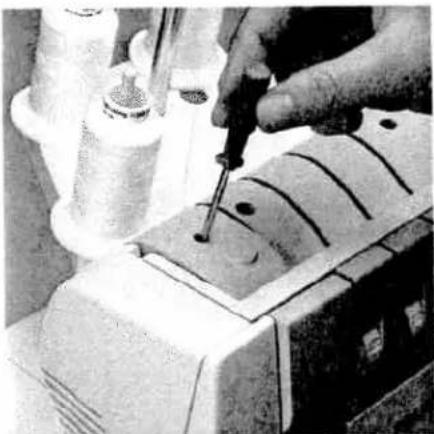
The machine's factory-set sewing foot pressure is suitable for medium-heavy fabrics.
The sewing foot pressure does not need to be changed for most fabrics. If lighter or heavier fabrics are sewn, it may however become necessary to reset the pressure.
In this event, insert the small screwdriver from the accessory box into set screw 22 for adjusting the sewing foot pressure. The pressure is adjusted by turning the set screw to the left or right. For lightweight fabrics: reduce pressure by turning the set screw to the left. For heavyweight fabrics: increase pressure by turning the set screw to the right.
Note: Turn the set screw to the right until it strikes against the top lid. Then turn the screw back to the left, rotating it 6 times. Now the standard sewing foot pressure is set.
text_image
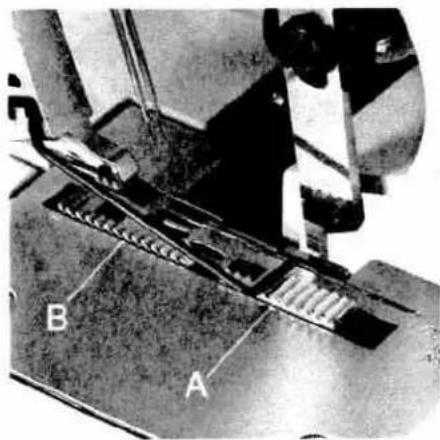
B ADifferential feed
The differential feed consists of two feed dogs (A + B), arranged one behind the other, which move the workpiece. Adjustment lever 30 regulates the movement of the front feed dog (A), and thus the amount of fabric to be fed through. It can be adjusted within the range 0.5 and 2.0.
The standard adjustment is 1.0, by which the front feed dog (A) moves synchronously with the rear feed dog (B), i.e. the front and rear feed dogs both move the same amount of fabric.
Note: The effectiveness of the differential feed also depends on the stitch length selected and the type of fabric used.

natural_image
Close-up of a sewing machine needle with measurement scale (0.5 to 2.0) and circular head (no visible text or symbols)
natural_image
Close-up of a textured surface with a diagonal line and a wavy boundary, labeled A and B (no text or symbols beyond labels)If differential feed adjustment lever 30 is set to 0.5, the front feed dog moves half as fast as the rear feed dog, i.e. the front feed dog feeds through only half as much fabric as the rear feed dog.
As a result, the fabric is stretched.
This prevents the seam from becoming gathered when sewing very delicate fabrics such as silk and taffeta. The result is a smooth seam (A).
Fashionable touches can also be introduced in this way, such as the wave effect when using rib knit (B).

natural_image
Close-up of a sewing machine drum dial with measurement scale (no visible text or symbols)Set differential feed adjustment lever 30 to 2.0 so that the front feed dog moves twice as fast as the rear feed dog, i.e. the front feed dog feeds through twice as much fabric as the rear feed dog.
As a result, the fabric is gathered.

natural_image
Microscopic view of a textured surface with labeled regions C and D, showing layered patterns (no text or symbols beyond labels)This prevents the seam from becoming stretched when sewing knitted fabrics such as Jersey and rib stitch goods. The result is a smooth seam (C).
Fashionable touches can also be introduced in this way, such as the gather effect when using very delicate fabrics (D).
The following table indicates possible settings for the differential feed. However, you should always perform a sewing test on your fabric before starting work.
| Fabric type/Effects | Differential feed setting | ||
| gather >2,0< | normal >1,0< | stretch >0,5< | |
| very thin fabrics: silk, satin, poplin, taffeta, lining fabrics. | ● | ● | |
| normal fabrics: lightweight cotton, medium cotton, fine cord, thermal fabrics. | ● | ||
| thin knitted fabrics: Jersey, polo fabric, nicki, frotté, fine knitwear and cuffs. | ● | ● | |
| thick knitted fabrics: sweatshirt fabric, thick cuffs, knitwear. | ● | ||
| Stretch - wave effect: medium- and lightweight knitted fabrics, Jersey, knitwear, frilled edges on sleeves and neck openings, skirt hems, set tight stitch length. | ● | ||
| Crimping: Frills made from thin fabrics and lace, seam allowances in circular cut-outs, curves on blouses, shirts, skirts, round pockets, flaps and lapels, gathering or slightly crimping sleeve (shoulder) curves, sewing sleeves onto cuffs or wristbands. | ● | ||

natural_image
Close-up of hands operating a sewing machine with visible mechanical components (no text or symbols)Sewing with the free arm Detach the work support
Remove the lint box and pull detachable work support 10 towards the left.
Reattach the lint box.

natural_image
Close-up of a mechanical device mounted on a curved base, possibly a tool or device (no visible text or symbols)The free arm is particularly useful for sewing tubular items such as trouser legs and sleeves. Insert the article over the free arm.
text_image
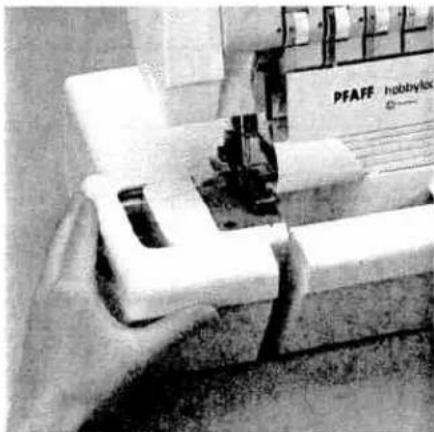
PFAFF hobbyker ©-Reattaching the work support
Position the detachable work support so that it is level with the machine cover, then slide it to the right until it locks into position.

natural_image
Close-up of a mechanical component with no visible text or symbolsSetting the bed slide for the stitch width chaining land
For standard overlock seams:
Set the bed slide for chaining land 18 to position S.

text_image
A 35 45Chaining land A will be pushed forward. All standard overlock seams can be sewn with this adjustment.

natural_image
Close-up of a mechanical component with no visible text or symbolsFor rolled hems
Set the bed slide for chaining land 18 to position R.
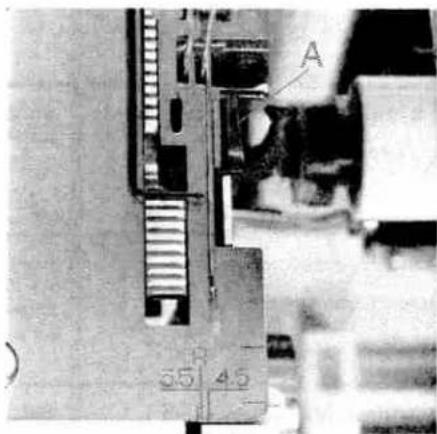
text_image
A 55 45Chaining land A will be pushed backward. All rolled hems can be sewn with this adjustment.
Program summary
| Program | Application | Needle position  \ \  = links= rechts = links= rechts |
4-thread overedge seam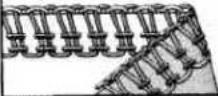 | Sewing together any material,especially elastic fabrics, withsimultaneous serging. |  |
3-thread overedge seam (wide)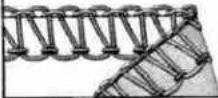 | Serging tightly-woven(easily frayed) fabrics |  |
3-thread-overedge seam (narrow)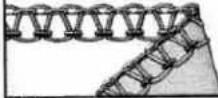 | Serging lightweight(easily-frayed) fabrics |  |
3-thread serging seam (wide) | Serging tightly-woven(non-fraying) fabrics |  |
3-thread serging seam (narrow) | Serging lightweight(easily-frayed) fabrics |  |
3-thread decorative seam | Serging medium-heavy fabrics.As flatlock seam for sewingtogether stretch fabrics andas a decorative finished edge. |  |
3-thread decorative seam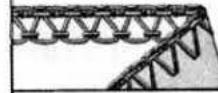 | Serging medium-heavy fabrics.As flatlock seam for sewingtogether stretch fabrics andas a decorative finished edge. |  |
3-thread rolled hem | Serging medium-heavy fabrics southerived finished edges. |  |
| Needle thread tension The settings are for medium-heavy fabrics and normal polyester yarn. | Stitch length | Stitch-width | Position of bed slide for chaining land | Converter ■ = with □ = without | |||
| blue | green | red | yellow | ||||
| N | -2 | -2 | -1 | 3 | 3.5 | S | ☐ |
| N | -2 | -1 | 3 | 3.5 | S | ☐ | |
| N | -2 | -1 | 3 | 3.5 | S | ☐ | |
| N | -5 | +3.5 | 3 | 3.5 | S | ☐ | |
| N | -5 | +4 | 3 | 3.5 | S | ☐ | |
| -4.5 | N | +2 | 3 | 3.5 | S | ☐ | |
| -4.5 | N | +2 | 3 | 3.5 | S | ☐ | |
| -1 | +2 | -1 | F | R | R | ☐ | |
Program summary
| Programs | Application | Needle position = left = right |
Folded 3-thread rolled hem | Serging lightweight to medium-heavy fabrics. Decorative finished edges. |  |
2-thread overedge seam (wide) FLATLOCK | Serging medium-heavy fabrics. As flatlock seam for sewing together stretch fabrics. |  |
2-thread overedge seam (narrow) FLATLOCK | Serging lightweight fabrics. As flatlock seam for sewing together stretch fabrics. |  |
2-thread serging seam (wide)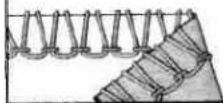 | Serging lightweight fabrics. |  |
2-thread serging seam (narrow) | Serging lightweight fabrics. |  |
2-thread rolled hem | Serging very lightweight fabrics. Decorative finished edges. |  |
Folded 2-thread rolled hem | Serging very lightweight fabrics. Decorative finished edges. |  |
2-needle, 3-thread overedge closing seam | Sewing together and simultaneous serging of lightweight, high-stretch fabrics. |  |
| Needle thread tensionThe settings are for meddium-heavy fabrics and normal polyester yarn. | Stitch-length | Stitch-width | Position of bed slide for chaining land | Converter■= with□= without | |||
| blue | green | red | yellow | ||||
| -2 | N | +3 | F | R | R | ☐ | |
| -4 | +2.5 | 3 | 3.5 | S | ■ | ||
| -4 | +2 | 3 | 3.5 | S | ■ | ||
| N | -3.5 | 3 | 3.5 | S | ■ | ||
| N | -3.5 | 3 | 3.5 | S | ■ | ||
| -4 | +1 | F | R | R | ■ | ||
| -1 | -2 | F | R | R | ■ | ||
| -1 | -2 | -4 | 3 | 3.5 | S | ■ | |
text_image
PFAFF hobbylockAdjusting the thread tension
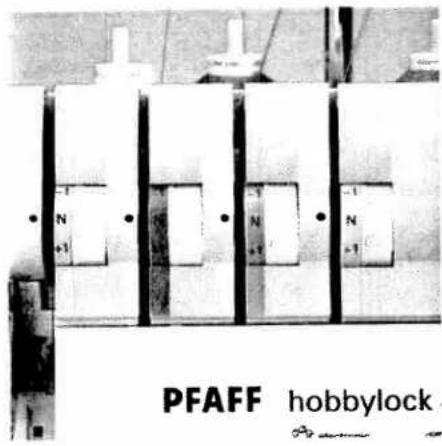
The following pages contain directions for setting thread tensions for all programs. Adjust the tension by turning the tensioning wheel until the dot marker is at the desired setting.
The settings for adjusting thread tension are recommendations. Fabric type, yarn quality and needle gauge will influence seam results. For this reason it is always best to sew a test seam to check the interlocking of threads. It may be necessary to correct the thread tension settings.
Tip: When testing, it is a good idea to use thread colours corresponding to the individual thread tensions, e.g. thread the right overedge looper with red yarn, the left overedge looper with yellow yarn, etc.
Note: All further settings required for individual programs (needle position, stitch length, stitch width, etc.) are to be found in the program summary on pages 28 to 31.
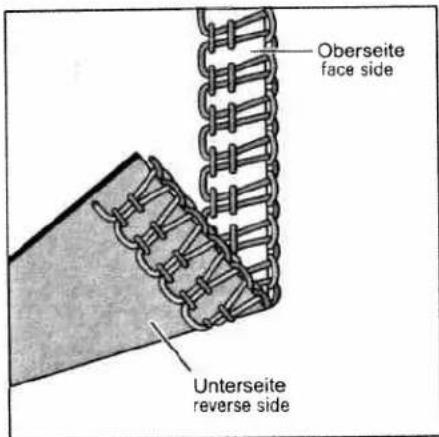
4-thread overedge seam
| blue | green | red | yellow |
| N | -2 | -2 | -1 |
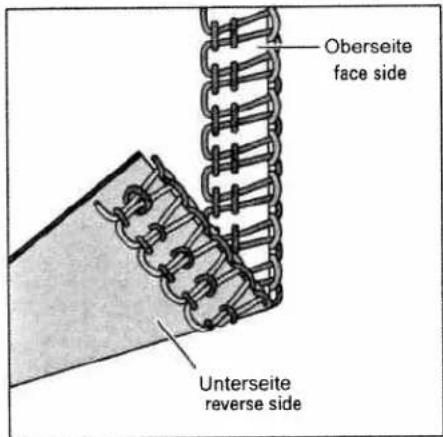
If all tensions are optimally set, the two looper threads will be interlocked at the very edge of the fabric.
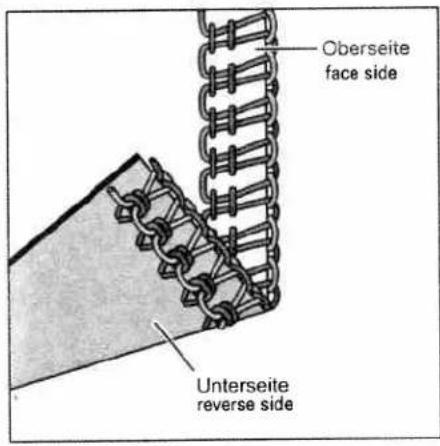
The left needle thread (blue) is too loose. Increase the tension of the blue thread.
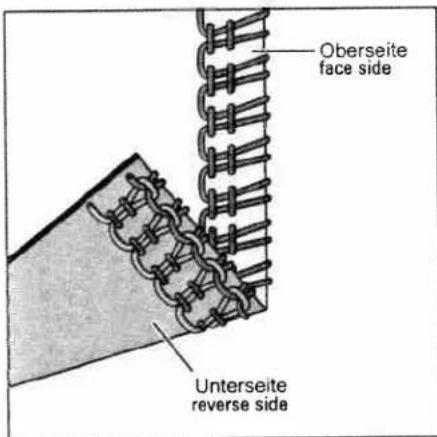
The right needle thread (green) is too loose. Increase the tension of the green thread.
The right looper thread (red) is visible on the reverse side of the fabric. Increase the tension of the red thread and/or reduce the tension of the yellow thread.
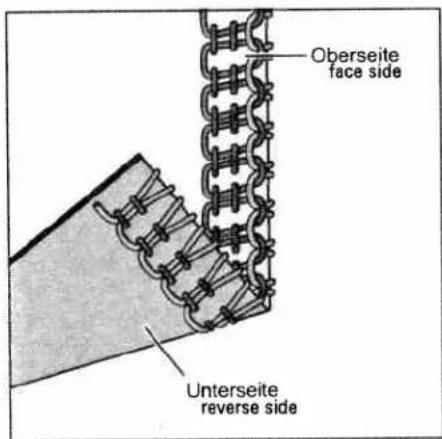
The left looper thread (yellow) is visible on the face side of the fabric. Increase the tension of the yellow thread and/or reduce the tension of the red thread.

text_image
face side reverse side
text_image
face side reverse side3-thread overedge seam
| wide | blue | green | red | yellow |
| N | -2 | -1 |
The needle thread is too loose. Increase the tension of the respective needle thread.
| narrow | blue | green | red | yellow |
| N | -2 | -1 |

text_image
face side reverse side
text_image
face side reverse sideThe right looper thread (red) is visible on the reverse side of the fabric.
Increase the tension of the red thread and/or reduce the tension of the yellow thread.
The left looper thread (yellow) is visible on the face side of the fabric.
Increase the tension of the yellow thread and/or reduce the tension of the red thread.

text_image
face side reverse side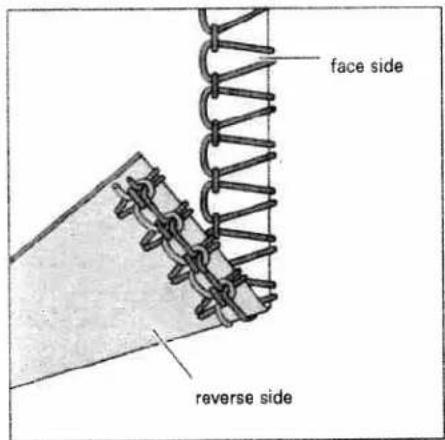
text_image
face side reverse side3-thread serging seam
| wide | blue | green | red | yellow |
| N | -5 | +3.5 |
The needle thread is too loose.
Increase the tension of the respective needle thread.
| narrow | blue | green | red | yellow |
| N | -5 | +4 |

text_image
face side reverse side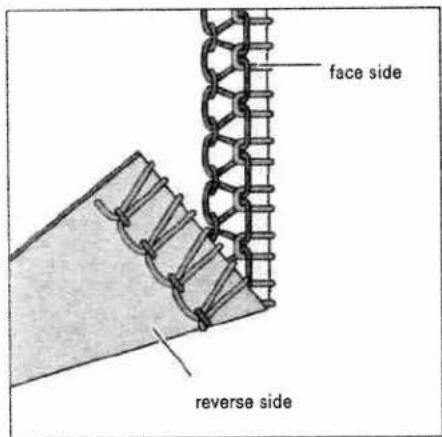
text_image
face side reverse sideThe right looper thread (red) is only partly looped around the edge of the fabric.
Reduce the tension of the red thread and/or increase the tension of the yellow thread.
The left looper thread (yellow) is visible on the face side of the fabric.
Increase the tension of the yellow thread and/or reduce the tension of the red thread.
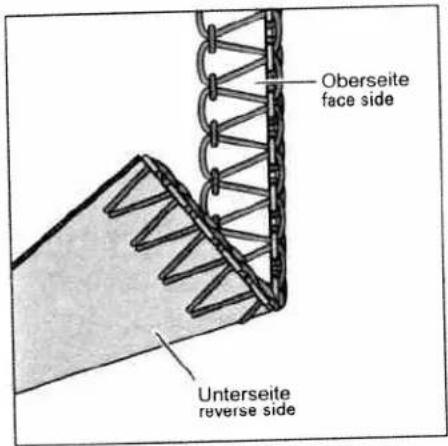
3-thread decorative seam serging, FLATLOCK

The needle thread is too tight.
Reduce the tension of the respective needle thread.
| wide | blue | green | red | yellow |
| -4,5 | N | +2 |
| narrow | blue | green | red | yellow |
| -4,5 | N | +2 |

The right looper thread (red) is visible on the reverse side of the fabric. Increase the tension of the red thread.

The left looper thread (yellow) is too loose.
Increase the tension of the yellow thread.
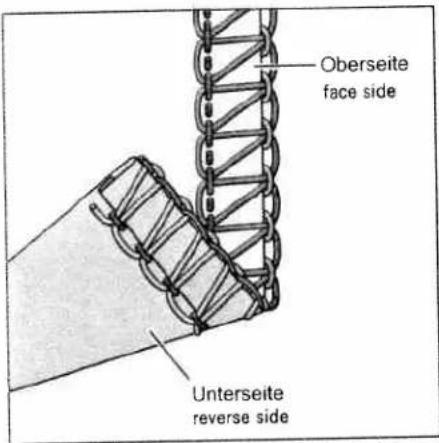
The right needle thread (green) is too loose.
Increase the tension of the green thread.
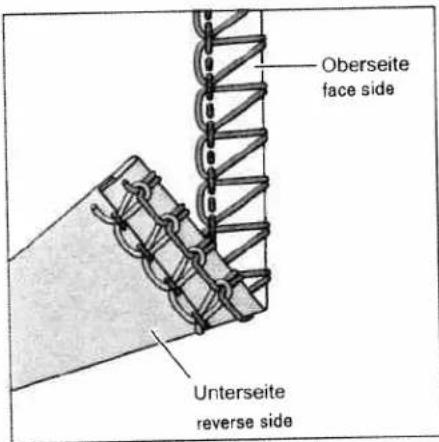
The right looper thread (red) is visible on the reverse side of the fabric.
Increase the tension of the red thread and/or reduce the tension of the yellow thread.

The left looper thread (yellow) is visible on the face side of the fabric.
Increase the tension of the yellow thread and/or reduce the tension of the red thread.

text_image
face side reverse sideFolded 3-thread rolled hem
| blue | green | red | yellow |
| -2 | N | +3 |

text_image
face side reverse sideThe right needle thread (green) is too loose. Increase the tension of the green thread.

text_image
face side reverse sideThe right looper thread (red) only partly loops around the edge of the fabric. Reduce the tension of the red thread and/or increase the tension of the yellow thread.
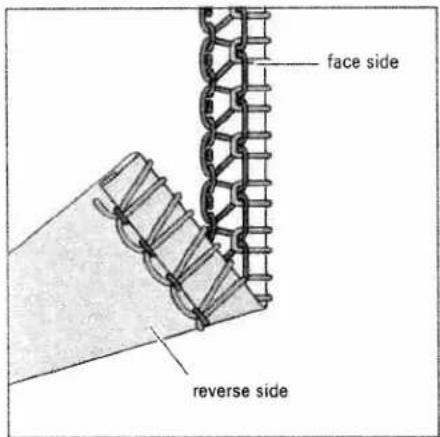
text_image
face side reverse sideThe left looper thread (yellow) is visible on the face side of the fabric. Increase the tension of the yellow thread and/or reduce the tension of the red thread.

text_image
face side reverse side2-thread overedge seam, FLATLOCK
| wide | blue | green | red | yellow |
| -4 | +2,5 |
| narrow | blue | green | red | yellow |
| -4 | +2 |
Note: Attach the converter (see page 21) for sewing 2-thread overedge seams (FLATLOCK).

text_image
face side reverse sideThe needle thread is too loose or the left looper thread (yellow) is too tight. Increase the tension of the respective needle thread and/or reduce the tension of the yellow thread.

text_image
face side reverse sideThe left looper thread (yellow) is visible on the reverse side of the fabric. Increase the tension of the yellow thread and/or reduce the respective needle thread tension.
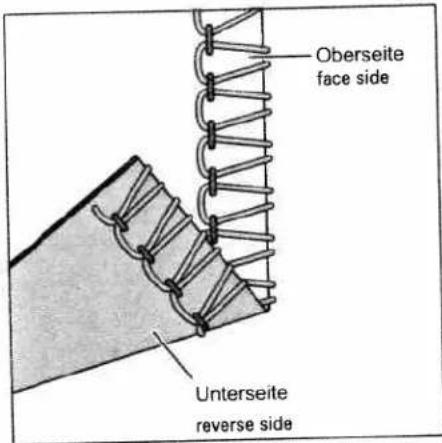
2-thread serging seam
| wide | blue | green | red | yellow |
| N | -3,5 |
| narrow | blue | green | red | yellow |
| N | -3,5 |
Note: Attach the converter (see page 21) for sewing 2-thread serging seams (FLATLOCK).
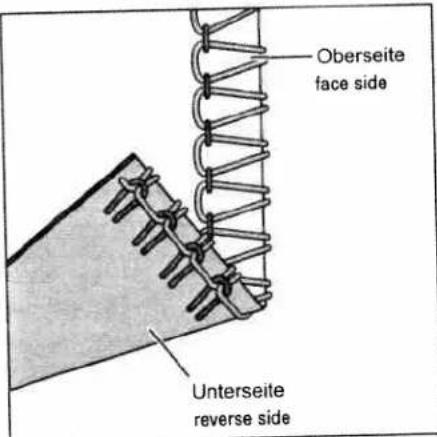
The needle thread is too loose.
Increase the tension of the respective needle thread and/or reduce the tension of the yellow thread.

The left looper thread (yellow) is too loose.
Increase the tension of the yellow thread.

text_image
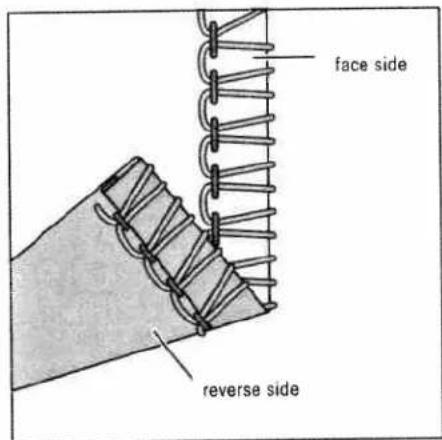
face side reverse side2-thread rolled hem
| blue | green | red | yellow |
| -4 | +1 |
Note: Attach the converter (see page 21) for sewing 2-thread rolled hems.

text_image
face side reverse sideThe right needle thread (green) is too tight.
Reduce the tension of the green thread and/or increase the tension of the yellow thread.
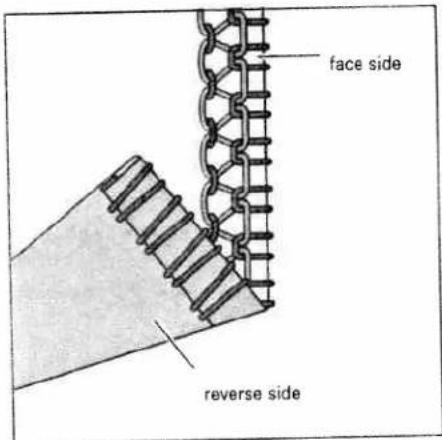
text_image
face side reverse sideThe left looper thread (yellow) is too tight.
Reduce the tension of the yellow thread and/or increase the tension of the green thread.
text_image
face side reverse sideFolded 2-thread rolled hem
| blue | green | red | yellow |
| -1 | -2 |
Note: Attach the converter (see page 21) for sewing 2-thread rolled hems.
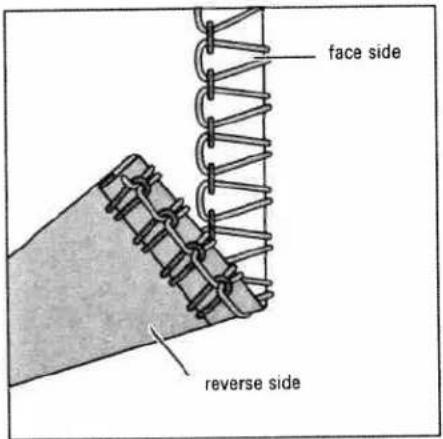
text_image
face side reverse sideThe right needle thread (green) is too loose.
Increase the tension of the green thread and/or reduce the tension of the yellow thread.
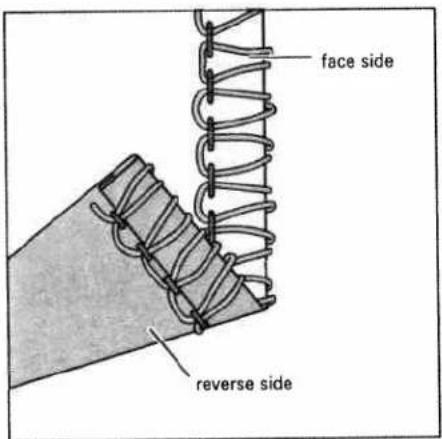
text_image
face side reverse sideThe left looper thread (yellow) is too tight.
Reduce the tension of the yellow thread and/or increase the tension of the green thread.
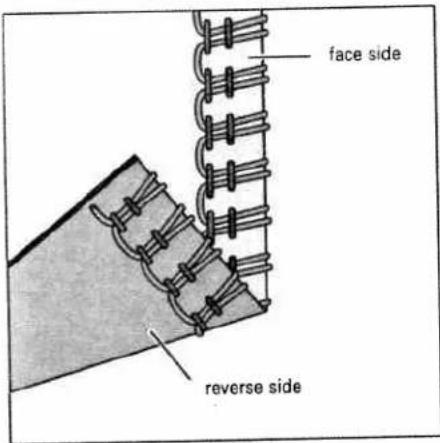
text_image
face side reverse side2-needle, 3-thread overedge closing seam

text_image
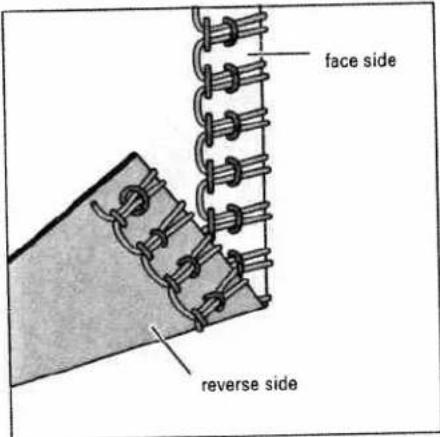
face side reverse sideThe left needle thread (blue) is too loose. Increase the tension of the blue thread.
| blue | green | red | yellow |
| -1 | -2 | -4 |
Note: Attach the converter (see page 21) for sewing 2-needle, 3-thread overedge closing seams.
text_image
face side reverse sideThe right needle thread (green) is too loose. Increase the tension of the green thread.
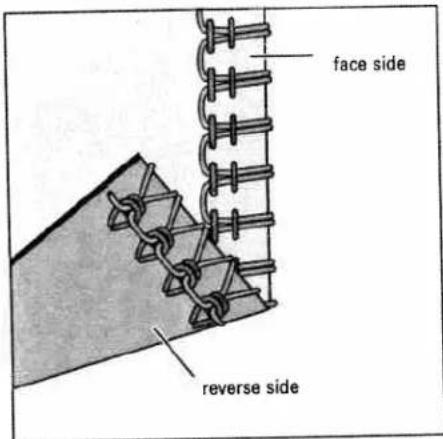
text_image
face side reverse sideThe left looper thread (yellow) is too tight. Reduce the tension of the yellow thread.
natural_image
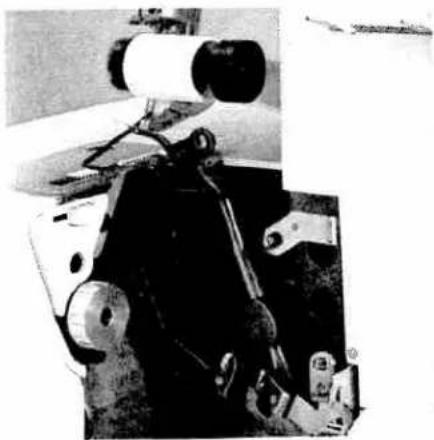
Close-up of a mechanical device with cylindrical components and metal fittings (no visible text or symbols)Machine maintenance Cleaning the machine Switch off at the mains switch
Detach the lint box and open the looper cover. Disengage the upper knife and remove the sewing foot.

natural_image
Close-up of a mechanical device with no visible text or symbolsUse the lint brush from the accessories to remove lint from the needle plate, the upper and lower knives and looper area.
natural_image
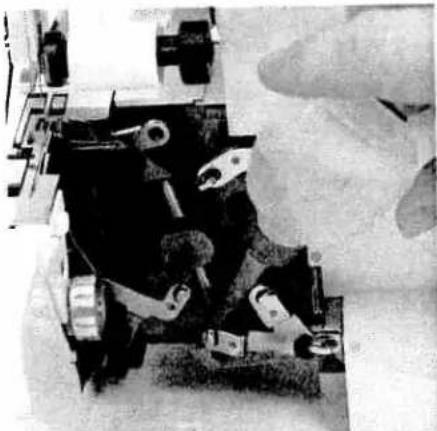
Close-up of a mechanical device with visible components and no readable text or symbolsLubricating the machine Switch off at the mains switch
The point shown above should be lubricated with the oil from the accessories every time the machine is cleaned. One or two drops of PFAFF sewing machine oil are sufficient. All other parts are manufactured from special material and do not require lubrication.
Cleaning the rubber feet
Clean the machine's rubber feet from time to time with rubbing alcohol. This ensures good stability.
natural_image
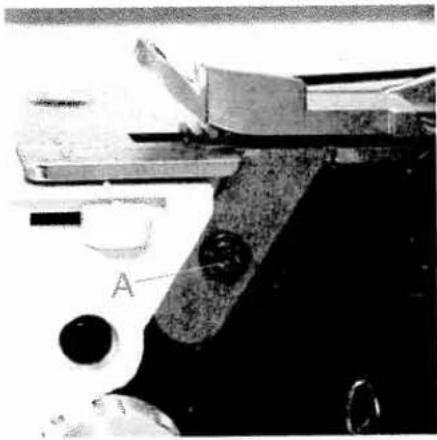
Close-up of a mechanical component with labeled parts A and B, no readable text or symbols beyond labelsChanging the lower knife Switch off at the mains switch
Removal: Detach the lint box and open the looper cover. Disengage the upper knife and move the needle(s) to the uppermost position. Use the arge screw-driver from the accessories to loosen lower knife retaining screw A. Remove the screw and the lower knife.
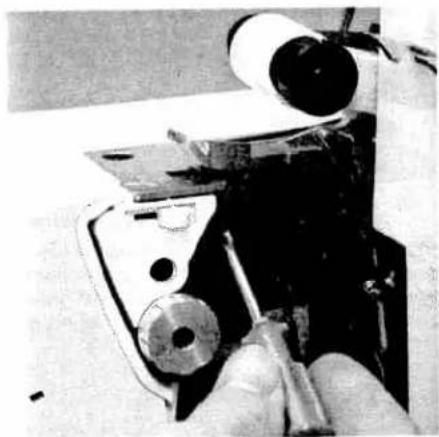
natural_image
Close-up of a hand using a sewing machine to adjust or install a mechanical component (no visible text or symbols)Insertion: Insert a new lower knife into the recess provided and tighten the retaining screw. Engage the upper knife and close the looper cover.
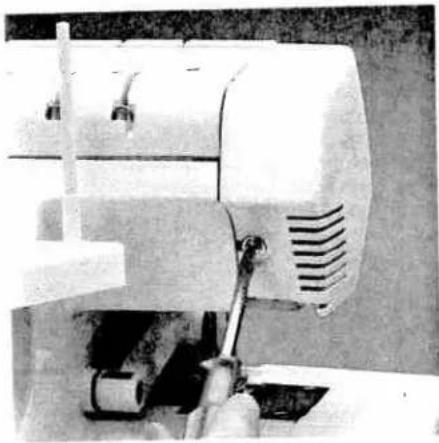
natural_image
Close-up of a sewing machine with a tool inserted, no visible text or symbolsChanging the light bulb (sewing light) Switch off at the mains switch
Use the large screwdriver from the accessories to loosen the retaining screw of sewing light cover 13 until the latter can be removed.

natural_image
Close-up of hands operating a mechanical switch or electrical component (no visible text or symbols)Push the bulb into the socket, give it a half-turn in a counter-clockwise direction and remove it.

natural_image
Close-up of a mechanical component with internal parts and no visible text or symbolsInsert a new bulb (max. 15 Watt) into the socket and rotate it until the two cams of the bulb lock in. Push the bulb into the socket, thereby rotating it in a clockwise direction until it is firmly in place. Replace the sewing lamp cover and tighten the retaining screw.

natural_image
Black-and-white illustration of a woman kneeling with arms crossed, looking upward (no text or symbols)Special accessories
On the following pages you will find descriptions of all sewing foots available as special accessories to help you to get the best from your hobbylock 4762. By using these sewing feet, you can perform various sewing steps in one, thus saving time and ensuring perfect sewing results.
The special accessories can be purchased from your PFAFF dealer.
| Special accessory | Order No. |
| Blindstitch sewing foot | 93-415 506-23/000 |
| String thread sewing foot | 93-415 507-00/000 |
| Elastic tape sewing foot | 93-415 506-21/000 |
| Shirring foot | 93-415 506-20/000 |
| Cording foot | 93-415 506-22/000 |
| Bead sewing foot | 93-415 506-24/000 |
| Lace sewing foot | 93-415 507-69/000 |
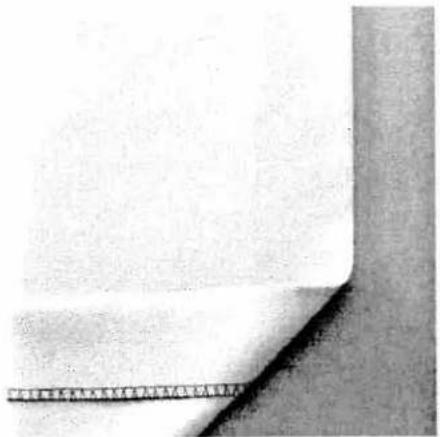
natural_image
Close-up of a white surface with a diagonal line and a small ruler at the bottom (no text or symbols visible)Blindstitch foot
The blindstitch foot is ideal for professional sewing of invisible seams on medium-heavy and thick fabrics. The seam is trimmed, serged and "blind" stitched in a single operation.
Setting the machine
Remove the left needle. Set your machine to 3-thread overedge seam (narrow) and select stitch length 4.
Working:
Raise the needle to its uppermost position and insert the blindstitch foot. Fold the seam inwards. Now fold the seam once again outwards so that the edge protrudes approx. 1 cm. Position the seam under the sewing foot so that the folded seam part 3 lies beneath edge guide 2. Crease 4 must thereby run along the edge of guide 2.

text_image
Technical diagram of a mechanical device with numbered components labeled 1 to 4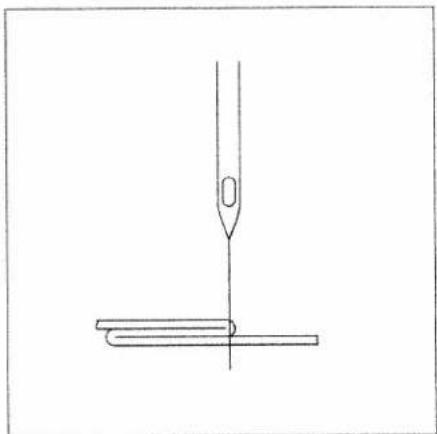
natural_image
Simple line drawing of a tool tip interacting with two parallel plates (no text or symbols)Loosen set screw 1 and adjust edge guide 2 so that upon penetration only one thread of the upper fabric is caught by the needle. Sew a test seam.
natural_image
Abstract sketch of overlapping curved lines and shapes (no text or symbols)String sewing foot
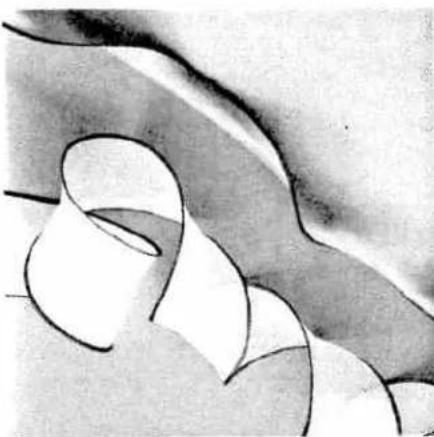
This sewing foot is used for sewing in gimp threads (cords, synthetic threads) up to a thickness of 1.0 mm. It creates a wavelike hem finish in delicate fabrics e.g. for evening dresses and bridal gowns or curtains.
Setting the machine
Set your machine to folded 3-thread rolled hem.
text_image
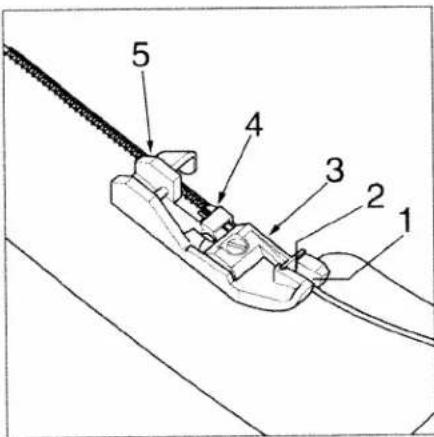
Technical diagram of a mechanical clamp or connector with numbered parts labeled 1 through 5Working
Raise the needle to its uppermost position and insert the string sewing foot. Insert the gimp thread into guide 1 and pull it through hole 2 into lateral guide 3. Then lay the thread under guides 4 and 5 so hat it projects approx. 10 cm towards the back. Hold the gimp thread in place with a sew stitches, then lay the fabric under the sewing foot and continue sewing (the face side of the fabric should be upwards). View a test seam.
lote: The wave effect can be accentuated by setting the differential feed to 0.5 and utting your workpiece diagonal to the breadline.
natural_image
Close-up of a textured surface with parallel grooves and a vertical seam, no visible text or symbolsElastic tape sewing foot
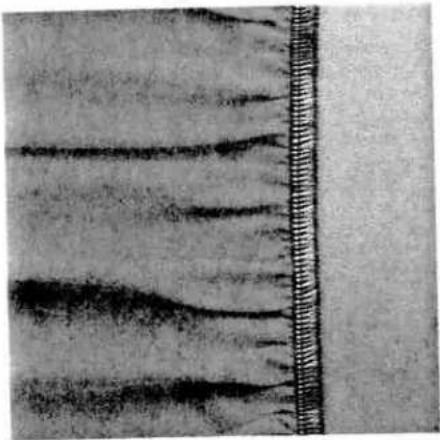
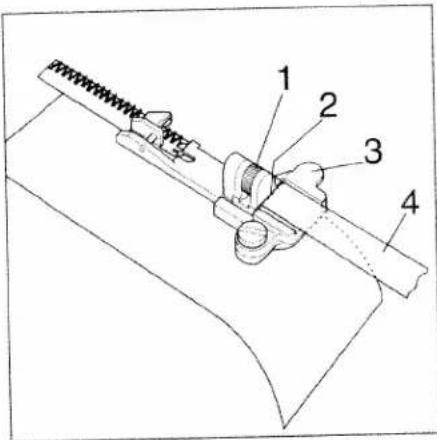
This sewing foot is used for sewing on elastic tape. In the same operation, the fabric is trimmed and serged, and also gathered by the contracting elastic tape.
Setting the machine
Set your machine to 4-thread overedge seam. The seam width is determined by the width of the elastic tape.
text_image
Technical diagram of a mechanical assembly with numbered componentsWorking
Raise the needle to its uppermost position and insert the elastic tape sewing foot. Loosen screw 1 so that brake 3 at opening 2 is opened by approx. 2 mm. Insert elastic tape 4 into opening 2 and pull it beneath the sewing foot so that it protrudes approx. 10 cm behind the latter. Re-tighten screw 1. The more the screw is tightened, the greater the pressure brake 3 exerts on the elastic tape and thus the greater the gather effect. Sew a test seam.
natural_image
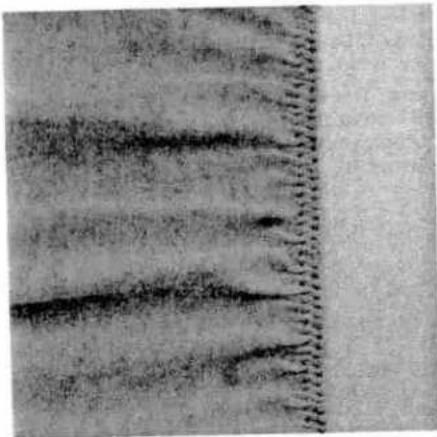
Close-up of a textured surface with horizontal striations and a vertical dotted line (no text or symbols)The next step is normally to stitch the elastic tape towards the left with one of your machinels elastic (expandable) stitches (see figure).
Sewing on a non-elastic tape prevents stretching of the seams (e.g. shoulder seams) in stretch fabrics.
Loosen screw 1 until the non-elastic tape can pass through opening 2 without hindrance.

natural_image
Close-up of textured fabric with layered patterns and a small inset showing a sloped edge (no text or symbols)Shirring foot
The shirring foot enables two fabrics to be sewn together, whereby the bottom ply is automatically gathered. It is ideal for children's wear, as well as fascinating gathered valances for curtains, table linen or tiered skirts.
Setting the machine
Set your machine to 4-thread overedge seam and the differential feed to 2.

natural_image
Technical line drawing of a mechanical assembly with spring and housing (no text or symbols)Working
Raise the needle to its uppermost position and insert the shirring foot. Lift the sewing foot and insert the fabric ply to be shirred (face side up). Insert the second fabric ply (face side down) under the sewing foot so that plate 1 lies between the two plies. Lower the sewing foot and sew the two fabric plies together. Sew a test seam.
Note: The degree of shirring can be changed by adjusting the differential feed.

natural_image
Illustration of a landscape with trees, hills, and water (no text or symbols)Cording foot
This sewing foot allows you to sew together two fabric plies, with a cording tape between them, in one operation. Ideal for casual wear, sports bags and upholstery covers.
Setting the machine
Set your machine to 4-thread overedge seam and seam width 4.5 mm.

natural_image
Technical line drawing of a mechanical assembly with spring and base components (no text or symbols)Working
Raise the needle to its uppermost position and insert the cording foot. Place the two fabric plies on top of one another (face side to face side) and insert the cording tape between the two plies. Position the workpiece beneath the cording foot, ensuring that the cording (piping) runs through groove 1 in the foot. Sew a test seam.

natural_image
Close-up of a textured surface with a vertical column of evenly spaced white circular objects on the right side (no text or symbols visible)Bead sewing foot
This sewing foot is used for sewing on beads, sequins, strass bands, lead and ordinary cords.
Setting the machine
Set your machine to 3-thread overedge seam (narrow or wide depending on bead size). Stitch length should be between 3 and 4.

text_image
Technical diagram showing a mechanical assembly with labeled parts 1 and 2, likely illustrating a conveyor or track system.Working
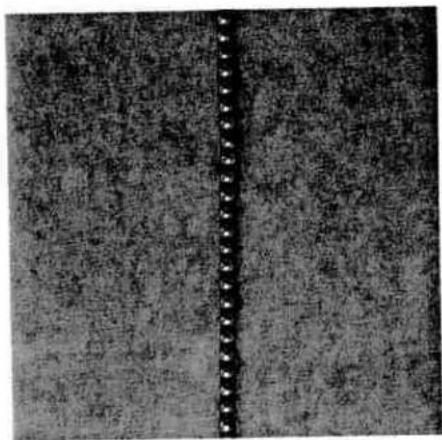
Raise the needle to its uppermost position and insert the bead sewing foot. Insert the string of beads into guide 1 and beneath guide 2 approx. 5 cm behind the sewing foot. Hold the beads in place with a few stitches, then lay the fabric face up under the sewing foot and sew the beads onto the selvedge.
Note: For sewing on lead beading, we recommend threading the two overedge loopers with bulk thread and correcting the tension if necessary.
natural_image
Close-up of a textured surface with a vertical dotted line dividing it into two sections (no text or symbols)If you wish to sew the beading into the fabric as shown to the left, the needle thread tension must be loose (approx. -5). Lay the material reverse side to reverse side and guide the crease past the upper knife while sewing. Pull the fabric apart; the beading is now on top.
Sew a test seam.

natural_image
Decorative floral pattern with floral motifs and heart-shaped cutouts on a textured background (no text or symbols)Lace sewing foot
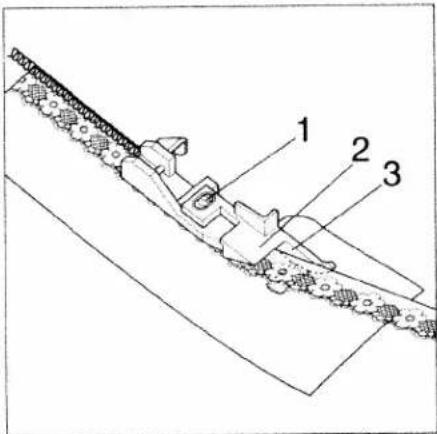
The lace sewing foot enables you to sew lace and wide bands together or onto another workpiece.
Setting the machine
Set your machine to 3-thread overedge seam (narrow) and select a stitch length between 1.5 and 2.0.
text_image
Technical diagram of a mechanical assembly with numbered components labeled 1, 2, and 3Working
Raise the needle to its uppermost position and insert the lace sewing foot. Use the large screwdriver from the accessories to loosen screw 1 and adjust guide 2 so that the needle penetrates the lace as close to the edge as possible. Tighten screw 1. Lay the lace onto the fabric, face side to face side, at a distance of 1.5 to 2.0 cm (depending on seam allowance) away from the selvedge and sew it on.

natural_image
Close-up of a textured, abstract pattern with repeating diamond-like shapes and small circular holes (no text or symbols)When sewing two lace workpieces together, the two halves must be guided flush along edge guide 3.
| Thread chart for 2-, 3- and 4-thread overedge seam | ||
| Fabric | Faden | Stichlänge |
| Lightweight fabrics:Organdy, light-knit fabric, taffeta, silk, lining fabrics | Cotton No. 50 – 70Synthetic yarn No. 70 – 140 | 2,0 – 4,0 mm |
| Medium-heavy fabrics:Cotton, tricot, linnen, dress materials | Cotton No. 40 – 60Synthetic yarn No. 70 – 140 | 2,0 – 4,0 mm |
| Heavy fabrics:Tweed, suit materials, denim, heavy cloth | Cotton No. 30 – 50Synthetic yarn No. 70 – 140 | 2,0 – 4,0 mm |
| Knitwear: | Cotton No. 40 – 60Synthetic yarn No. 70 – 140 | 2,0 – 4,0 mm |
| 2- or 3-threadrolled hems | Polyester yarn No. 120 – 140Mercerized yarn(bulk thread) | 1,0 – 2,0 mm |
Sewing problems and their solutions
These machines have been developed for ease of operation and no difficult adjustments must be made. Sewing problems of the kind described below may occur due to minor adjustment and operating errors. They can be easily corrected by following the instructions.
| Problem | Cause | Solution |
| Needle breakage | Needle bent or point damagedNeedle not fully insertedMaterial was pulled too firmly | Insert new needle (see page 11).Insert needle correctly (see page 11).Do not pull material during sewing |
| Thread breakage | Incorrectly threadedThread has caughtThread tension too tightNeedle not fully insertedIncorrect needle used | Thread correctly (see pages 12 – 18).Check whether thread catches at reel stand etc.Correct tension (see pages 32 – 43).Insert needle correctly (see page 11).Use needle system EL X 705. |
| Skipped stitches | Needle bent or point damagedNeedle not fully insertedIncorrect needle usedIncorrectly threaded | Insert new needle (see page 11).Insert needle correctly (see page 11).Use needle system EL X 705 Thread correctly (see pages 12 – 18). |
| Incorrect stitch formation | Incorrect setting of thread tensions | Reset thread tensions (see pages 32 – 43). |
| The 3- or 4-thread overedge seam has an irregular appearance and the right loooper thread has not interlocked in the seam. | The converter is attached | Converter must be detached. |
| Machine will not operate, although mainns switch is on | Power supply interrupted | Close looper cover (see page 9). |
| Fabric not neatly trimmed | Sewing lint between upper and lower knifeLower knifeis blunt | Clean knivesReplaces lower knife (see page 45). |
| Puckered seams | Thread tension too tightIncorrect setting of differential feedThread hgas caught due to incorrect threading | Reduce thread tension.Re-adjust diffential feed (see pages 24, 25).Thread correctly (see pages 12 - 18). |
| Workpiece not fed through evenly transportiert | Stitches too shortSewing foot pressure too low for heavy fabricsSewing foot pressure to high for lightweight fabrics | Increase stitch length (see page 23).Increase sewing foot pressure (see page 23).Reduce sewing foot pressure (see page 23). |
Specifications:
| Max. Sewing speed | 1300 stitches per minute |
| Seam width | 3 - 6.7 mm |
| Stitch length | F (≈ 1 mm) - 4 mm |
| Sewing foot | hinged |
| Lubrication | manual |
| Sewing foot height | 4.5 mm |
| Overedge stroke | 1.5 mm |
| Needle system | EL X 705, Cat. No. 2002 |
| Needle size | 80/11, 90/14 |
| Number of threads | 2, 3, 4 |
| Dimensions (length x height x width) | 300 x 285 x 275 mm |
| Weight | 6,5 kg |
Contents of cardboard box
| 1 machine |
| 1 foot control |
| 1 instruction manual/guarantee certificate |
| 1 lint box |
| 1 machine cover |
natural_image
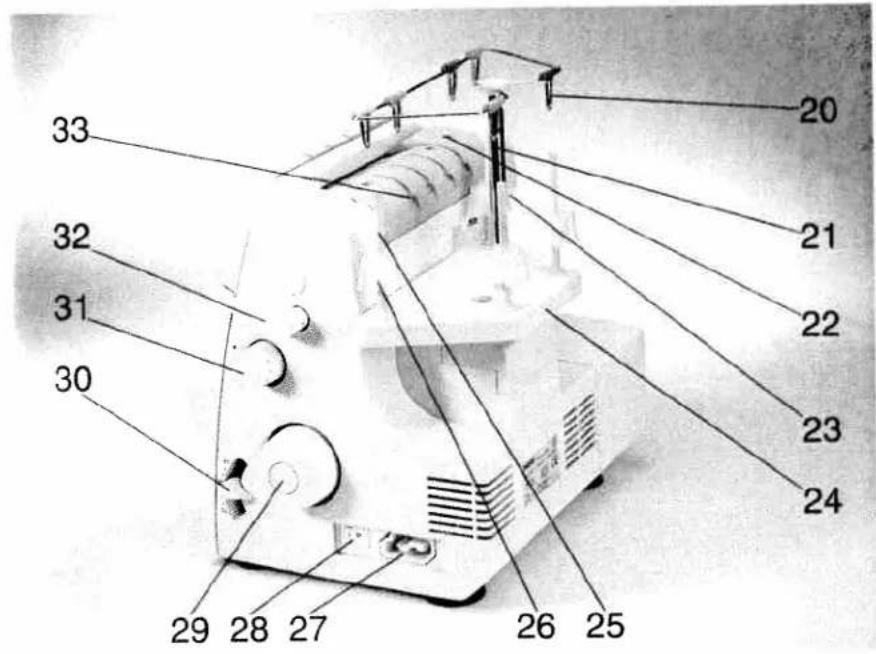
Black-and-white photo of a person in traditional embroidered attire holding a tool, standing outdoors (no visible text or symbols)hobbylock 4762 parts
20 Thread guides with colour coding
21 Telescopic thread guide
22 Set screw for adjusting sewing foot pressure
23 Thread chain cutter
24 Thread spool stand
25 Spool pin
26 Cote adapter
27 Machine socket, foot control with mains cord
28 Mains switch
29 Handwheel
30 Adjustment lever for differential feed
31 stitch length adjustment knob
32 Sewing foot lift
33 Rear thread guides
34 Lint box
35 Foot control
36 Foot control plug for machine
37 Mains plug
text_image
20 21 22 23 24 33 32 31 30 29 28 27 26 25