coverlock 4852 - Sewing machine PFAFF - Free user manual and instructions
Find the device manual for free coverlock 4852 PFAFF in PDF.


User questions about coverlock 4852 PFAFF
0 question about this device. Answer the ones you know or ask your own.
Ask a new question about this device
Download the instructions for your Sewing machine in PDF format for free! Find your manual coverlock 4852 - PFAFF and take your electronic device back in hand. On this page are published all the documents necessary for the use of your device. coverlock 4852 by PFAFF.
USER MANUAL coverlock 4852 PFAFF
natural_image
White sewing machine labeled 'PFAFF coverlock 4852' with paperclip and control panel (no readable text beyond label)Owner's manual

text_image
Labeled diagram of a sewing machine with numbered parts and a paper feed tray for test purposes.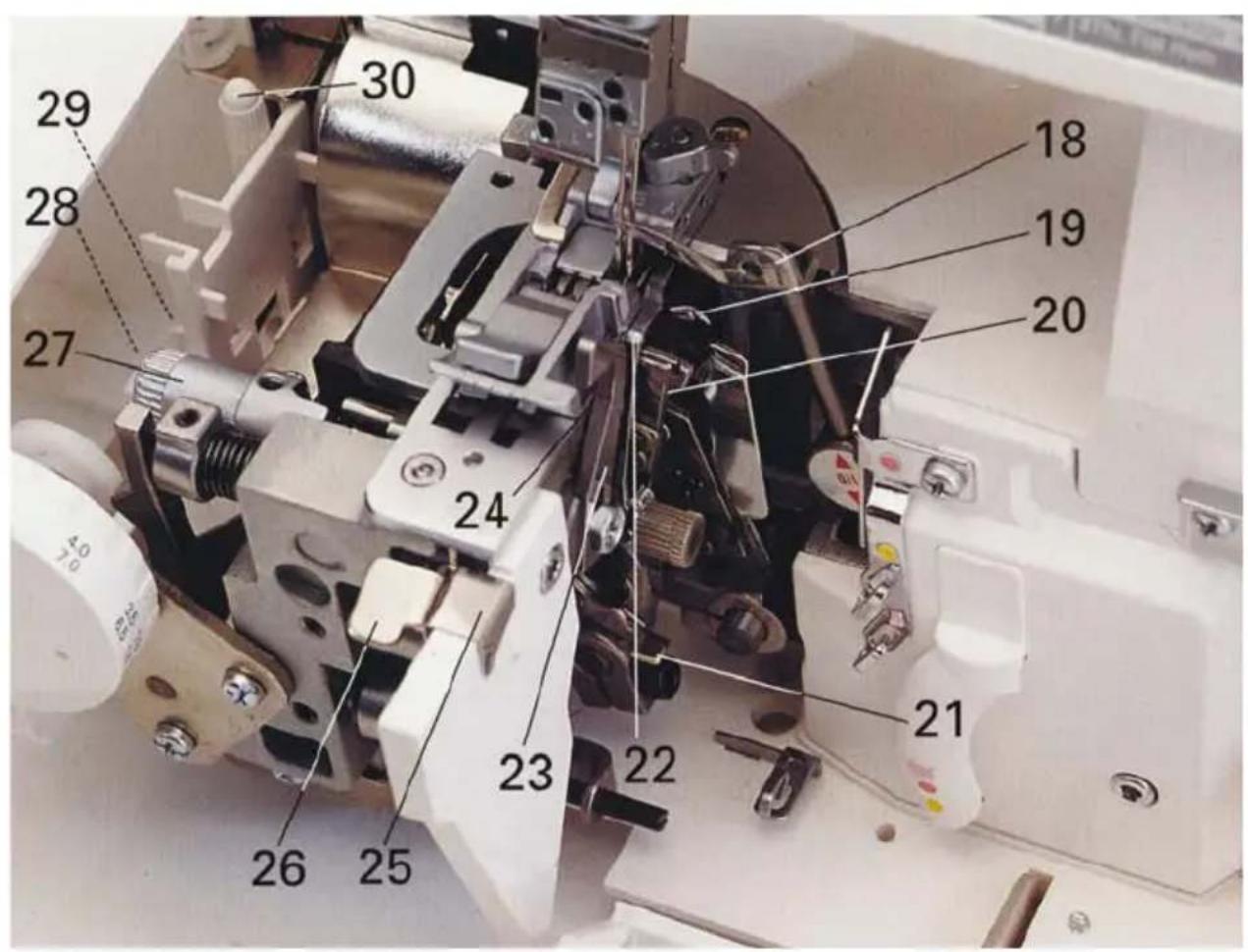
text_image
29 28 27 30 18 19 20 24 23 22 21 26 25Parts of the coverlock 4852
1 Upper needle-thread tension
2 Upper needle-thread tension
3 Carry handle
4 Thread tension/upper looper thread
5 Thread tension/lower looper thread
6 Thread tension/two-thread chainstitch looper/cover stitch looper
7 Looper cover
8 Blade guard
9 Looper disengaging lever
10 Standard presser foot
11 Needle plate
12 Swivel plate
13 Adjusting knob for seam width
14 Seam width viewing window
15 Needle holder
16 Sewing light cover
17 Adjusting knob for presser foot pressure
18 Upper overedge looper
19 Lower overedge looper
20 Two-thread chainstitch looper
21 Threading aid for the two-thread chainstitch looper/cover stitch looper
22 Swiveling stitch width latch
23 Movable upper blade
24 Fixed lower blade
25 Clamp spring for serging thread chains
26 Needle plate disengaging lever
27 Handwheel for lowering the upper blade
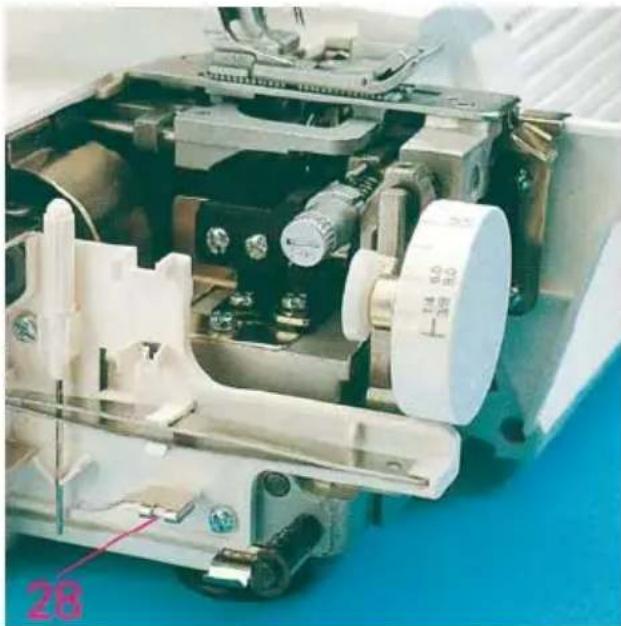
28 Converter
29 Tweezers
30 Allen key
This household sewing machine is designed to comply with IEC/EN 60335-2-28 and UL1594
IMPORTANT SAFETY INSTRUCTIONS
When using an electrical appliance, basic safety precautions should always be followed, including the following:
Read all instructions before using this household sewing machine.
DANGER - To reduce the risk of electric shock:
- A sewing machine should never be left unattended when plugged in. Always unplug this sewing machine from the electric outlet immediately after using and before cleaning.
• Always unplug before relamping. Replace bulb with same type rated 15 Watt.
WARNING - To reduce the risk of burns, fi re, electric shock, or injury to persons:
- Do not allow to be used as a toy. Close attention is necessary when this sewing machine is used by or near children and infi rm persons.
- Use this sewing machine only for its intended use as described in this manual. Use only attachments recommended by the manufacturer as contained in this manual.
- Never operate this sewing machine if it has a damaged cord or plug, if it is not working properly, if it has been dropped or damaged, or dropped into water. Return the sewing machine to the nearest authorized dealer or service center for examination, repair, electrical or mechanical adjustment.
- Never operate the sewing machine with any air openings blocked. Keep ventilation openings of the sewing machine and foot controller free from the accumulation of lint, dust, and loose cloth.
- Keep fingers away from all moving parts. Special care is required around the sewing machine needle and blades.
• Always use the proper needle plate. The wrong plate can cause the needle to break. - Do not use bent needles.
- Do not pull or push fabric while stitching. It may deflect the needle causing it to break.
- Switch the sewing machine off ("0") when making any adjustment in the needle area, such as threading needle, changing needle, threading bobbin, or changing presser foot, etc.
- Always unplug sewing machine from the electrical outlet when removing covers, lubricating, or when making any other user servicing adjustments mentioned in the instruction manual.
- Never drop or insert any object into any opening.
- Do not use outdoors.
- Do not operate where aerosol (spray) products are being used or where oxygen is being administrated.
- To disconnect, turn all controls to the off ("0") position, then remove plug from outlet.
- Do not unplug by pulling on cord. To unplug, grasp the plug, not the cord.
SAVE THESE INSTRUCTIONS
natural_image
Aerial view of an industrial complex with a prominent orange chimney and surrounding buildings under a blue sky with clouds (no visible text or symbols)Simple, up-to-date sewing
Congratulations! You have bought a high-quality product that provides unique advantages. Your new coverlock 4852 can take any material in its stride and will sew through thick and thin for you.
Your PFAFF coverlock features the very latest in design and technology, and it is just as simple to operate as this instruction manual is to follow.
Before you start sewing, please take the time to read these instructions carefully. It is certainly time well spent, and is the best way to find out just what your machine can do and make full use of all its features.
If you have any further questions, just ask your authorized PFAFF dealer. Your dealer is happy to be of service with any help or advice.
Lets get started! We wish you many enjoyable hours creating your very own fashions and projects!
Contents
Page
Accessories 6
Accessories, optional 62, 63
Accessory box....6
Adjusting the machine to Prog. 01, 02 .... 34, 35
Changing a spool on a threaded machine 24
Clamp spring....29
Cleaning the machine....58
Cone thread adapter....10
Converter, attaching 32
Cover stitch, important notes on sewing 44, 45
Differential feed 36, 37
Edge guide 45
Electrical connection 7
Electrical power master switch 7
Foot control, connecting 7
Light bulb (sewing lamp), changing 60
Loopercover 8
Lubricating the machine 58
Machine cover 6
Maintenance 58 - 60
Needle holder 13
Needle inserting tool 13
Needle plate disengaging lever 38
Needle plate, removing....38
Needle position 12
Needle threader 25
Needle, changing 13
Power table 35
Presser foot lifter 10
Presser foot pressure 28
Presser foot....11
Presser foot, changing 11
Program overview 40 - 43
Rubber feet, cleaning 58
Safety instructions....1, 2
eam width adjusting knob 33
Seam width viewing window 33
eam width, setting 33
Sewing light cover 60
Contents
Page
Sewing problems and their solutions 61
Specifications 64
Spool dise 10
Spool holder 9
Stitch formation correction measures 46 - 56
Stitch length adjustment knob 38
Stitch length, adjusting 38
Stitch width latch, swivelling 31
Telescoping thread guide 9
Thread chain cutter 29
Thread chart 57
Thread guide, clip on....10
Thread net 9
Thread tensions, setting....39
Thread unreeling disc....9
Threading aid for the 2 thread chain stitch looped/cover stitch looped ..... 19, 21
Threading paths/overview 26 - 28
Threading the 2 thread chain stitch looped/cover stitch looped (violet) ...... 18 - 21
Threading the lower overedge looper (yellow) 16, 17
Threading the needle(s) 22,23
Threading the upper overedge looper (pink) 15
Threading, important note 24
Threading/Thread guides 14
Upper blade, changing....59
Upper blade, disengaging 30
Upper blade, securing 39
Waste container 8
text_image
1 2 3 4 5 6 7 8 9 10 11 12 13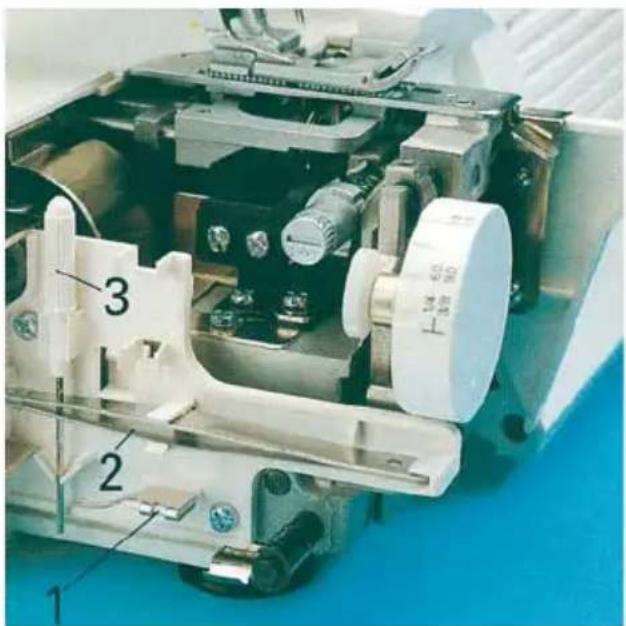
text_image
Labeled mechanical device image showing components numbered 1, 2, and 3 with visible parts and a dial indicator.
text_image
PFAFF coverlockAccessory box
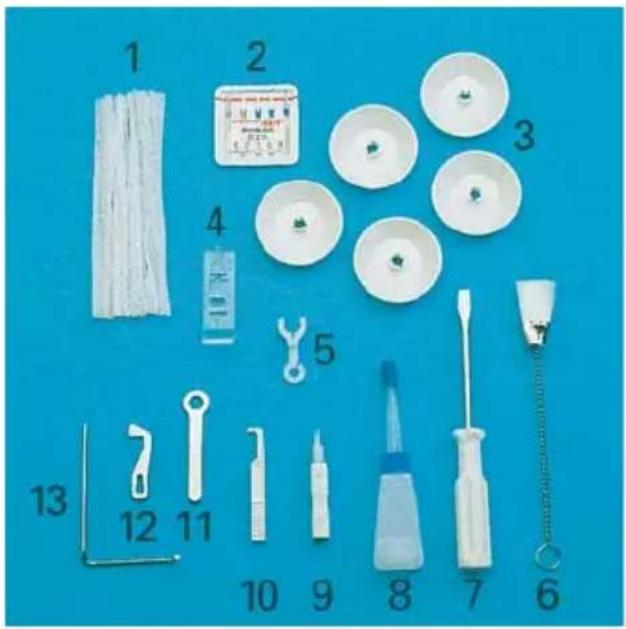
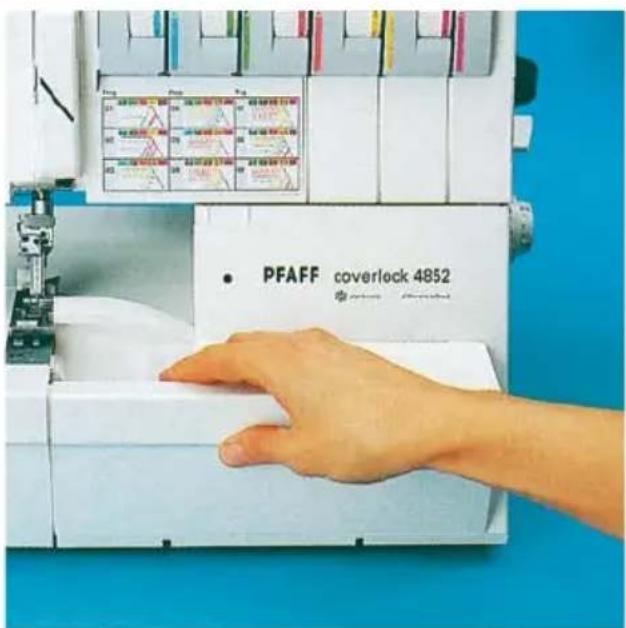
Open the accessory box 49 by gently pressing the bottom of the box inwards. The following accessories can be found in the box:
1 Thread nets (5)
2 Overlock needle system EL X 705, cat. no. 2002
3 Thread unreeling discs (5)
4 Transparent presser foot (F) for cover stitch and two thread chainstitch
5 Clip on thread guide
6 Cleaning brush
7 Screw driver
8 Machine oil
9 Needlethreader
10 Needle inserting tool
11 Wrench
12 Replacement upper blade
13 Edge guide
Further accessories
The following accessories can be found behind the swivel plate 12:
1 Converter
2 Tweezers
3 Allen key
Machine cover
The machine cover protects the machine from dust and dirt. When the sewing process is fi nished, push the telescopic thread guide 32 together. The spool stand 34 must be pushed to its full extent in to the machine, regardless of whether a spool is attached. Place the cover over the machine. The accessories should be stored in the accessory box or compartments behind the swivel plate.

natural_image
Close-up of hands operating a white sewing machine on a blue surface (no visible text or symbols)Connecting the foot control
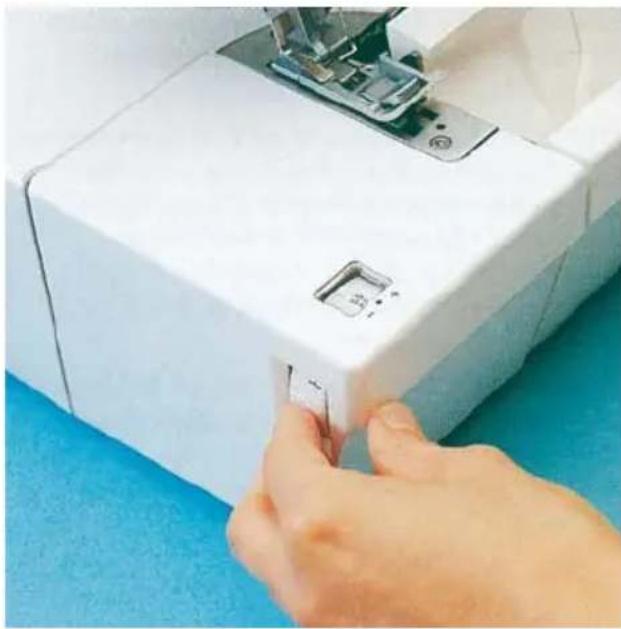
Connect the plug of the foot control to the connection socket 39 of the machine. The sewing speed is regulated by activating the foot control. You may also regulate the sewing speed by adjusting the slide on the front side of the foot control.
Setting ◀ = half of final speed
Setting ▶ = full final speed
natural_image
Close-up of a white laboratory instrument with control knobs and ventilation slots against a blue background (no visible text or symbols)Master switch
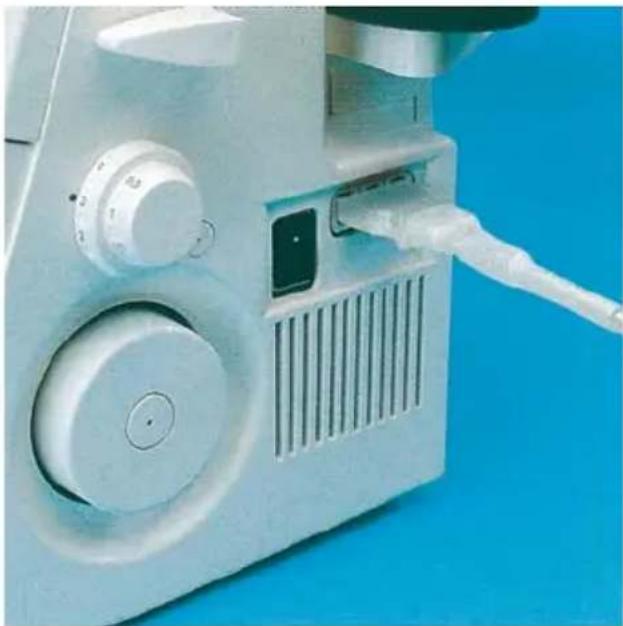
When you turn on the master switch 38 the sewing lamp is illuminated. The machine is now operational.
text_image
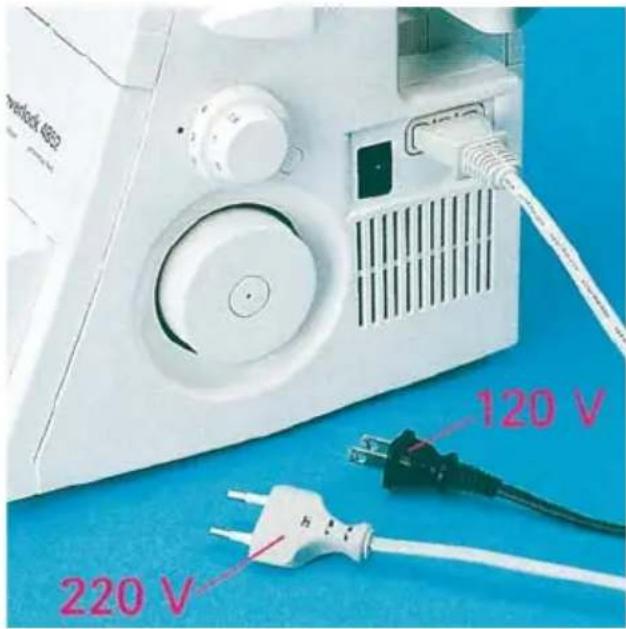
120 V 220 VElectrical connection
Connect the foot control cord with the wall outlet.
Foot controls to be used:
AE040 - EU
AE044 - Australia
AE046 - United Kingdom
AE043 - USA/Canada
For the USA and Canada
This appliance has a polarized plug (one blade wider than the other).
To reduce the risk of electric shock, it is designed to fi t into a plorized outlet only one way. If the plug does not fi t correctly into the outlet, reverse the plug. If it still does not fi t, contact a qualifi ed electrician to install the proper outlet.
Do not modify the plug in any way.
text_image
PFAFF coverlock 4852Looper cover
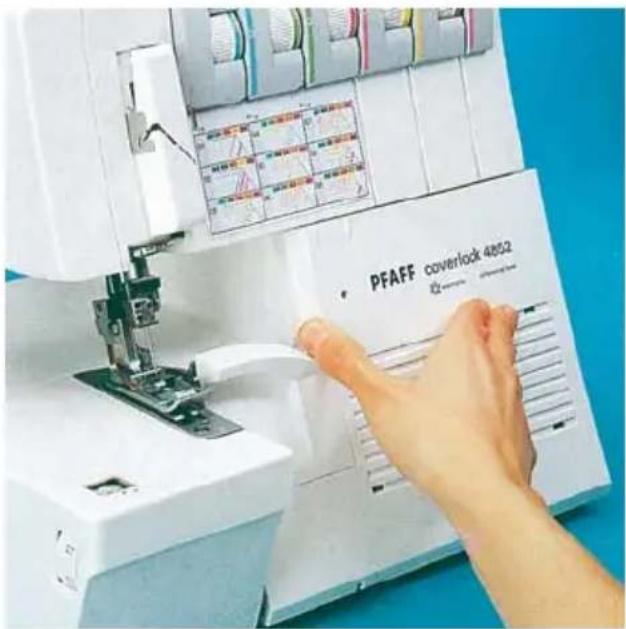
Push the looper cover 7 fully to the right and then swivel it down. Five types of stitches and their threading paths are portrayed in color on the inside of the looper cover.
Note: The electricity supply of the machine is cut off as soon as the looper cover or swivel plate 12 is opened, for safety reasons, i.e. sewing with the machine is no longer possible.

text_image
PFAFF coverlock 4852Waste container
Insert the upper latch of the waste container 45 into the upper slot of the looper cover 7.
Apply pressure to the lower part of the container until the lower latches flick into place in the lower slots of the looper cover.
text_image
PFAFF coverlock 4852To remove the waste container, repeat this procedure in the reverse order.

natural_image
Hand operating a sewing machine with multiple spools and black base (no visible text or symbols)Spool holder
Before placing thread cones/spools on machine you must pull the spool holder 34 fully away from the back of machine.
natural_image
Close-up of a sewing machine needle with colorful paper clips and a hand adjusting a metal clip against a blue background (no visible text or symbols)Telescopic thread guide
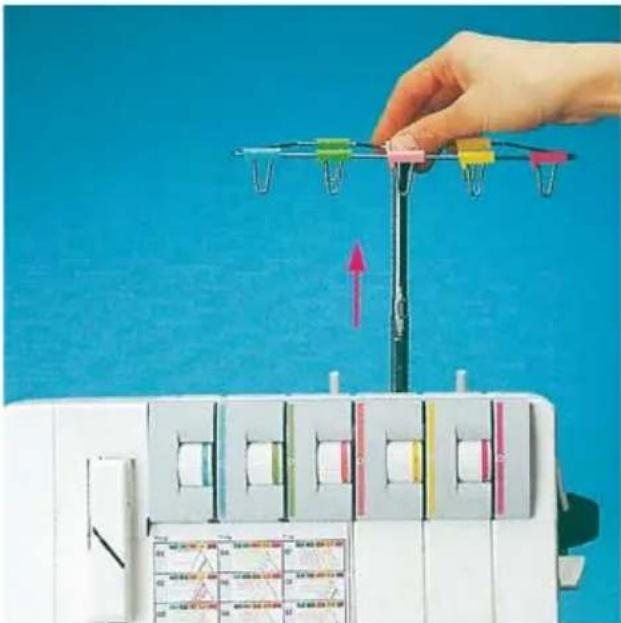
Pull the telescopic thread guide 32 upwards to its highest position.
To ensure optimum thread feed, turn the telescopic parts slowly until you hear the locking balls flick into place.
natural_image
Close-up of hands holding a flexible, mesh-wrapped object against a blue background (no text or symbols visible)Thread net
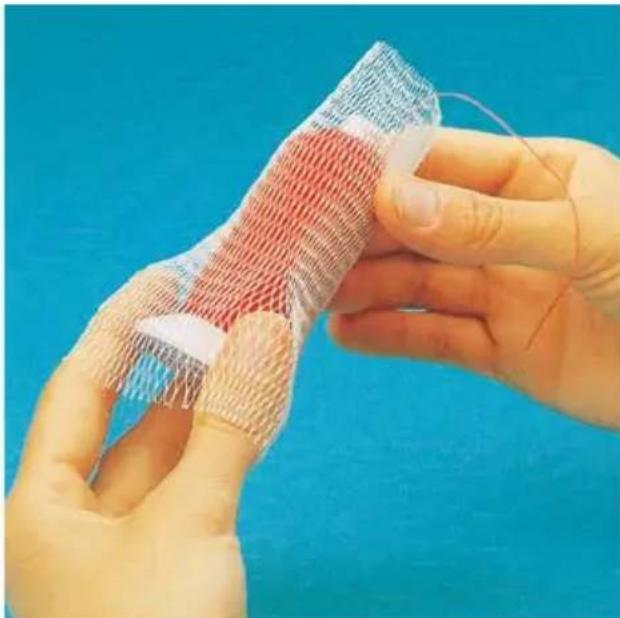
Synthetic threads generally unwind too quickly from the thread spool. Thread nets have been included to allow easy use of these threads. Pull the thread net (located in the accessory box) over the spool from below. Place the spool on the spool holder catching the bottom of the thread net with the spool pin.
natural_image
Close-up of a sewing machine with spools and a red thread, no visible text or symbolsThread unreeling disc
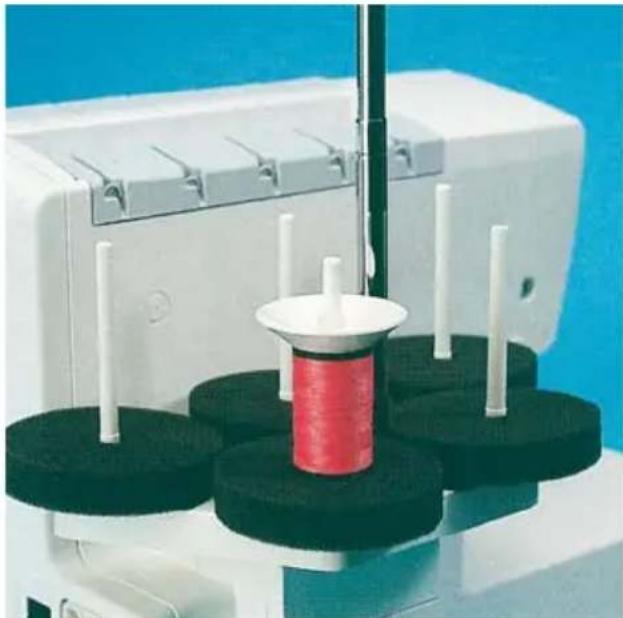
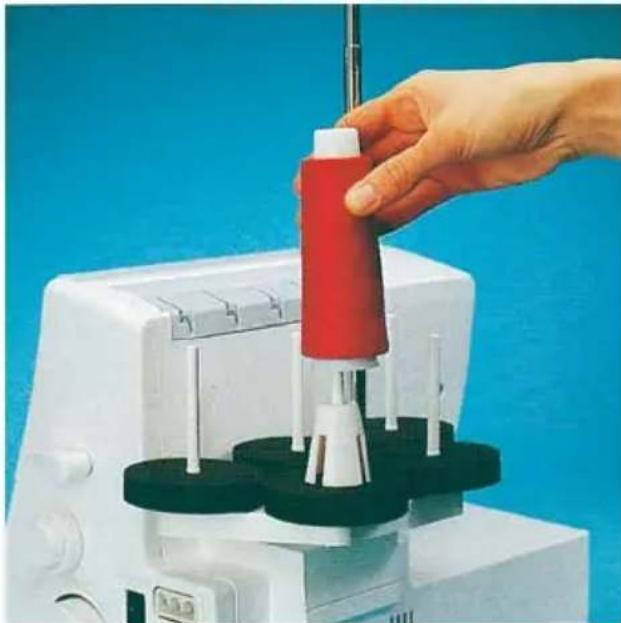
The thread unreeling disc (in the accessory box) is used for small spools/spools with notched or rough ends. Place the spool on the spool pin 35. Place the thread unreeling disc on top of the spool. Make sure the spool dise 37 is used under the spool.
natural_image
Hand operating a sewing machine with a red and black spool, against a blue background (no text or symbols visible)Spool disc/cone thread adapter
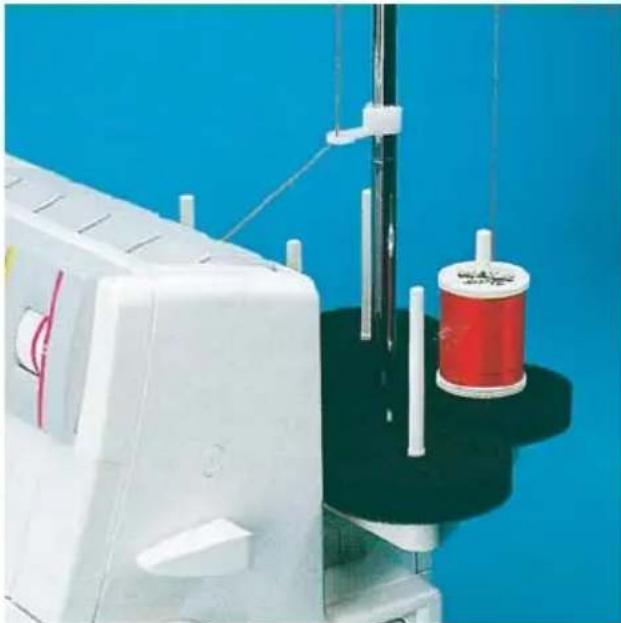
It is advantageous to use the spool dise 37 when sewing with large spools (5,000 10,000 m). To do this, place the cone thread adapter 36 onto the spool pin 35. With synthetic threads, the spool discs help eliminate vibration of the cones/spools aiding in smoother feeding of the threads.
natural_image
Close-up of a sewing machine with a red thread spool attached against a blue background (no text or symbols visible)Clip on thread guide
Use the clip on thread guide accessory when sewing with decorative thread. Clip this onto the telescoping thread guide 32 and thread the machine as shown in the illustration. Use the thread net and/or the thread unreeling disc if needed.

natural_image
Close-up of a hand operating a sewing machine with spools and a needle, against a blue background (no visible text or symbols)Presser foot lifter
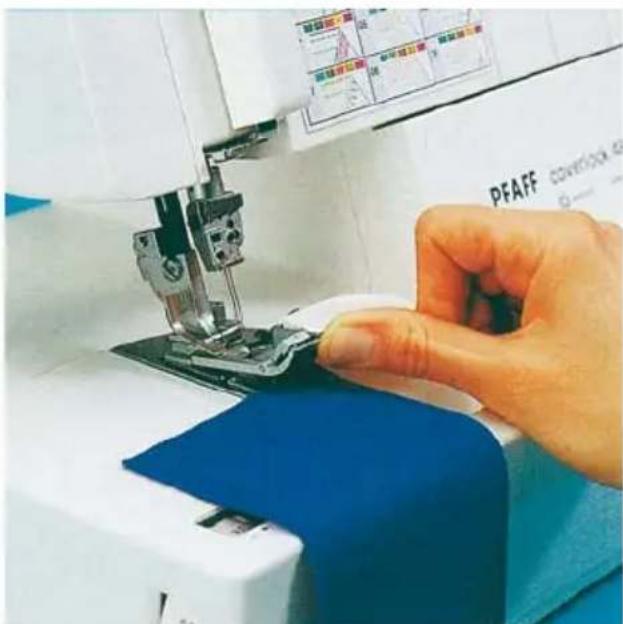
The presser foot can be raised and lowered using the presser foot lifter 43. The maximum vertical lift of 6.5 mm for the presser foot for particularly thick fabrics can be achieved by pressing the presser foot lifter towards the rear.
natural_image
Close-up of a hand operating a sewing machine with blue fabric, no visible text or symbols on the machine itself.Once an initial thread chain has been created, the presser foot lifter no longer needs to be raised if you continue working with the same thread and presser foot. It is suffi cient to gently lift the front part of the presser foot using your thumb. Slide the fabric under the raised part of the presser foot. The fabric is automatically taken up and fed into the machine when you activate the foot control.

text_image
A B 10 F
text_image
A
natural_image
Close-up of a mechanical device with internal components and mounting holes (no visible text or symbols)Presserfoot
With standard presser foot 10 use setting "A" on the spring loaded presser foot latch for the cover stitch (Prog. 02), the 2 thread chainstitch (Prog. 01), the 5 thread safety stitch seam (Prog. 09) and the 4 thread safety stitch seam (Prog. 08).
Transparent presser foot F from the accessories can also be used for the cover stitch (Prog. 02).
For all other programs use standard presser foot 10 and setting "B" on the springloaded presser foot latch.
Changing the presser foot
Switch off the electrical power
To remove: Raise the needle(s) to the highest position by turning the hand wheel towards you. Raise the presser foot and press lever A at the rear of the presser foot holder. The presser foot will be released automatically from the holder. Pivot the presser foot clockwise until the front half of presser foot clears holder and remove by sliding foot away from you towards back of machine.
To attach: Place the presser foot behind and perpendicular to the presser foot holder. Pivot the presser foot counterclockwise until the pin of the foot is directly under the presser foot holder clamp. Lower the presser foot lever and press lever A, if necessary, until the foot then clicks into place.
Check: Please lift the presser foot lever to ensure that the presser foot is properly locked into place.
text_image
R1 R2Needle position
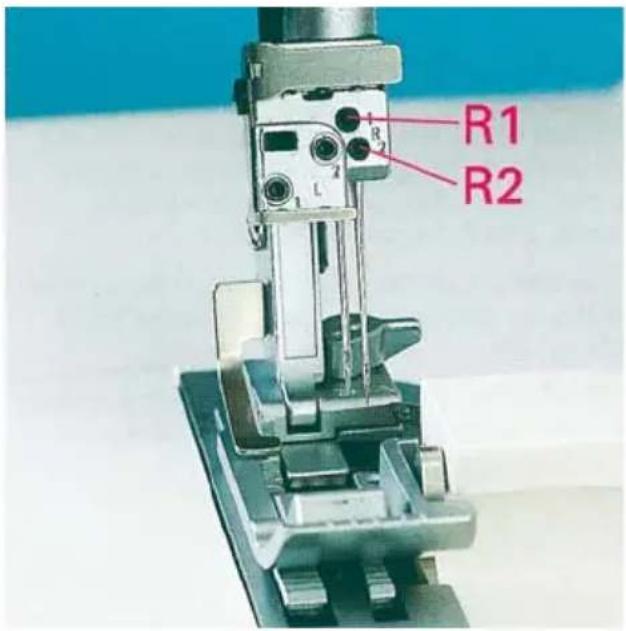
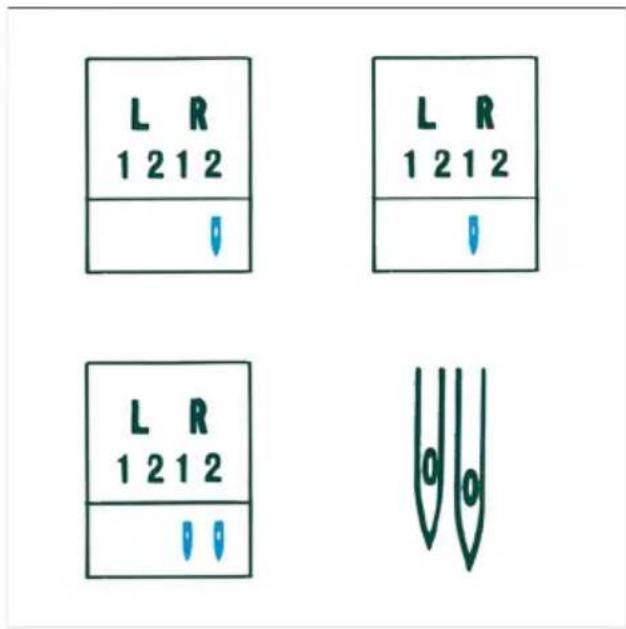
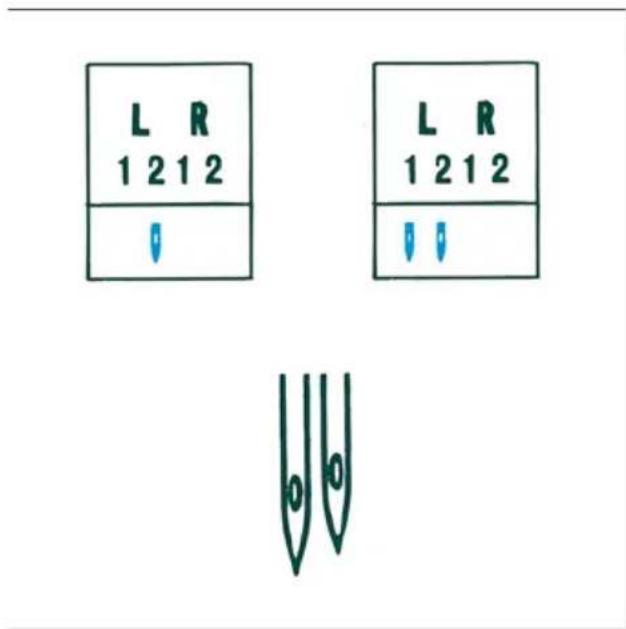
This machine has 4 needle positions and can sew with a maximum of two needles at any one time. The needle positions are 1 1, L2, R11 and R2. The fastening screw is located directly above the corresponding needle.

text_image
L2 L1Note: If the needles 1 11 and L2 have been inserted, the left needle will be somewhat lower than the right needle.
text_image
L R 1 2 1 2 L R 1 2 1 2 L R 1 2 1 2 0 0The different needle positions are depicted in a schematic drawing in the instruction manual. Also refer to the examples above and below. Insert the needle(s) as shown on the program overview (see pages 40-43).
Note: If the needles R2 and 131 have been inserted, the left needle will be somewhat higher than the right needle.
text_image
L R 1 2 1 2 L R 1 2 1 2 0 0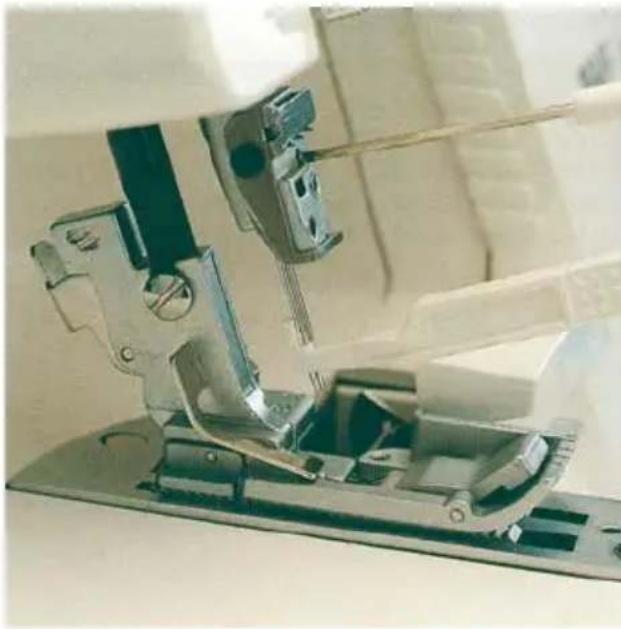
natural_image
Close-up of a sewing machine needle and base mechanism (no visible text or symbols)Changing the needle
Switch off the electrical power
To remove: Lower the presser foot and move the needle(s) to the highest position by turning the handwheel towards you. Push the needle inserting tool (from the accessory box 49) from below upward fully over the needle. Loosen the fastening screw of the needle (without removing it) with the Allen key (behind the swivel plate) and pull the needle down to remove.
text_image
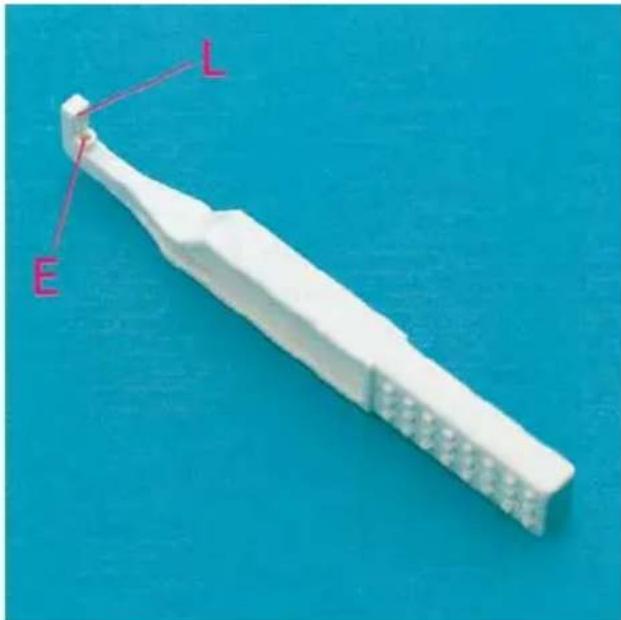
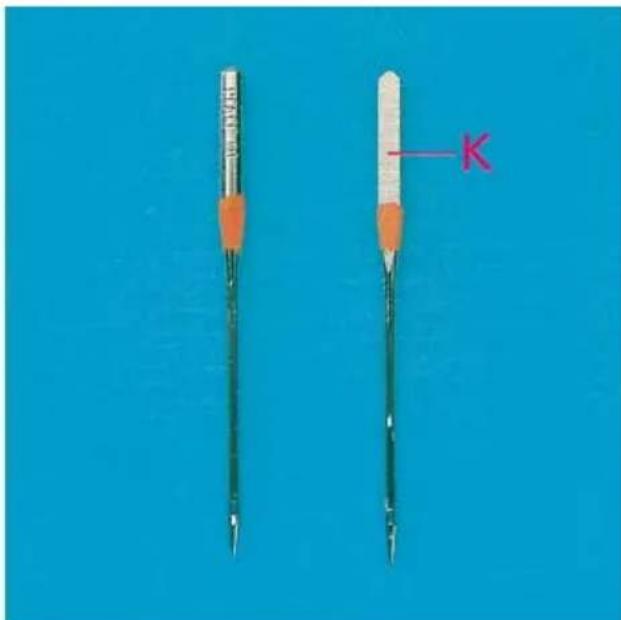
E LTo insert: Insert the needle into hole E of the needle inserting tool, so that the fl at needle shank K faces the fl at side L of the inserting tool. Insert the needle fully into the holder and tighten the fastening screws. Remove the needle inserting tool.
natural_image
Two dental screwdrivers with orange end caps and green tips against a blue background (no text or symbols visible)Overlock needles types EL X 705, cat. no. 2002 are required for this machine.

natural_image
Close-up of a sewing machine needle with multiple spools and metal clamps against a clear blue background (no text or symbols visible)
natural_image
Close-up of hands operating a sewing machine with spools and fabric swatches against a blue background (no visible text or symbols)
text_image
③ ④ ① ② ⑤Threading the thread guides
Place the spools on the spool pins 35. You will find information on the thread net, thread unreeling disc, spool disc and cone thread adapter on pages 9 and 10. Thread through the thread guides 31 from the back to the front following the colored threading paths.
Lift the carry handle 3 upwards. Thread through the underside of the carrying handle and through the rear thread guides 44 using both hands to pull the thread down until it slips under the thread guide. Guide the thread through the tension discs and pull it down until it is positioned firmly between the tension discs. Return the carrying handle to its original position.
Note:
Thread in a sequence of 1 to 5.
text_image
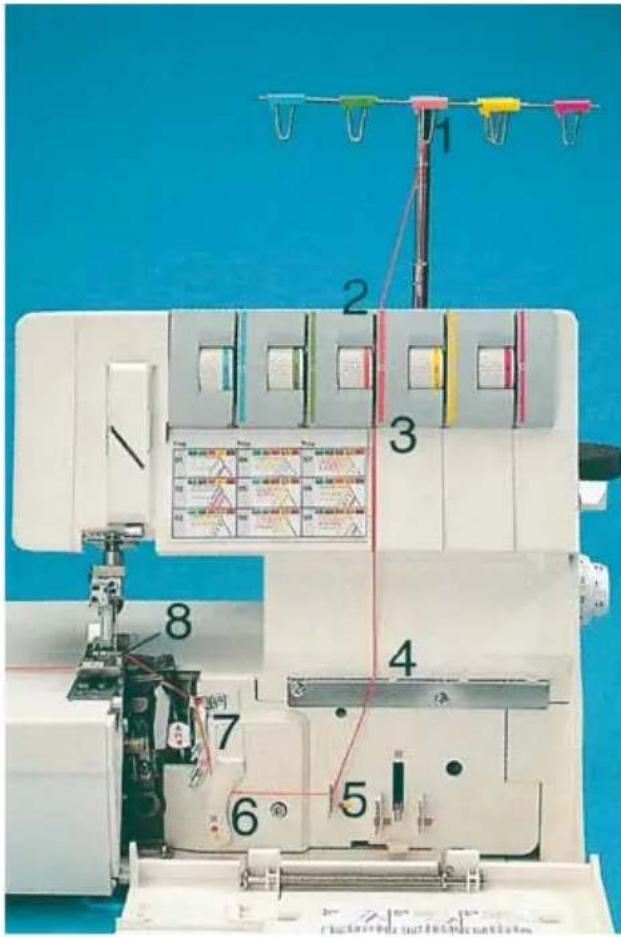
Labeled diagram of a sewing machine with numbered components and test tubes, showing internal wiring and measurement grids.Threading the upper overedge looper (pink)
Turn the handwheel towards you until the upper overedge looper 18 is in its highest position. Thread in a sequence of 1 to 8.
Note:
To make this task easier, use the tweezers which can be found behind the swivel plate.

text_image
8 7 4 6 5Thread through the thread guides 1 to 7, which are marked with a pink dot.

natural_image
Close-up of a sewing machine with metal components and wiring, no visible text or symbolsThread from the front through the eye of the upper overedge looper 8. Pull approximately 4" (10 cm) of thread through the looper and place it to the left under the presser foot.

natural_image
Close-up of a sewing machine's internal components, showing gears and buttons (no visible text or symbols)Threading the lower overedge looper (yellow)
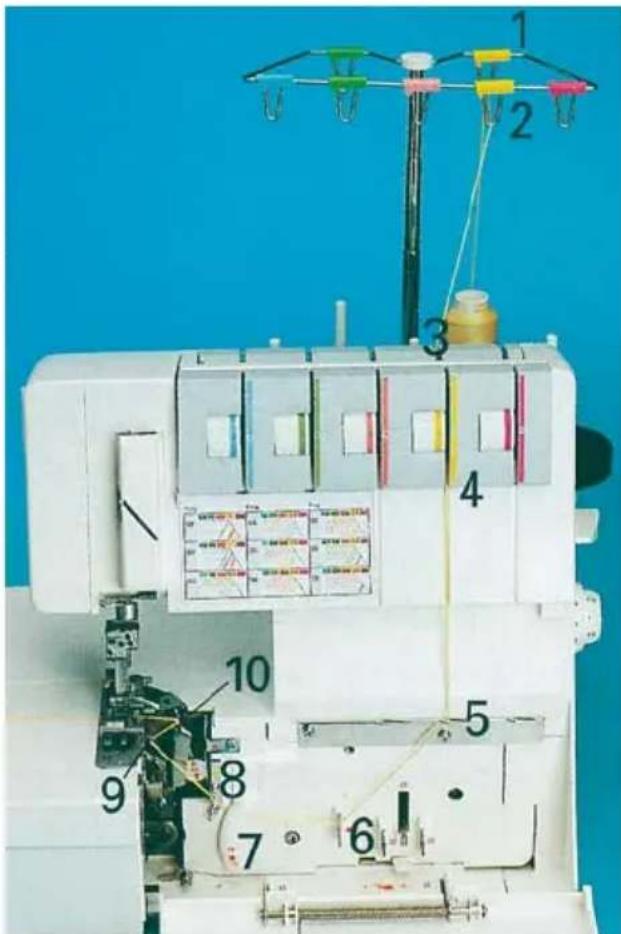
Turn the handwheel towards you until the lower overedge looper 19 is on the extreme right.
text_image
Labeled diagram of a sewing machine with numbered parts and internal components, likely for industrial sewing or textile work.Thread in a sequence of 1 to 10.
Note:
To make this task easier, use the tweezers which can be found behind the swivel plate.

text_image
Labeled industrial sewing machine diagram with numbered components and wiring connectionsThread through the thread guides 1 to 8, marked yellow.
text_image
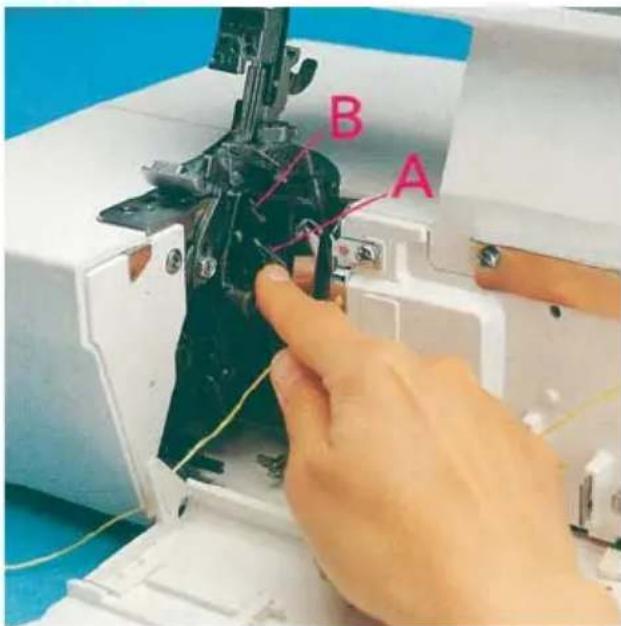
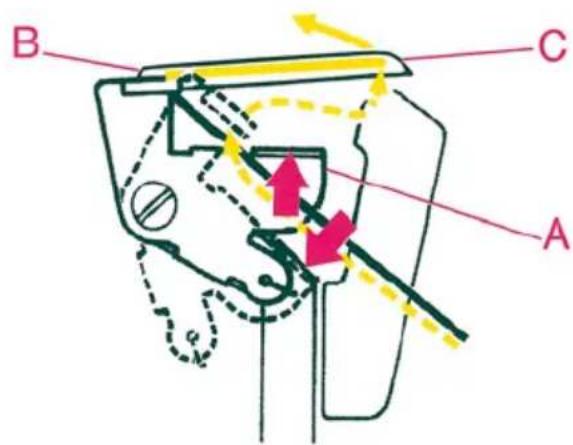
B APress lever A downwards and hook the thread into guide B. Please also refer to the drawing below.
Note:
The lever returns automatically to its position as soon as you start sewing.
text_image
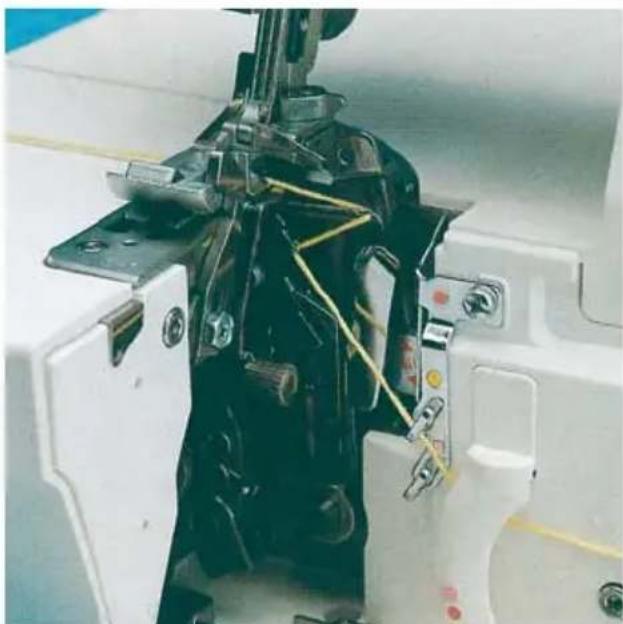
B C AThread from the front through the eye of the lower overedge looper C (= threading point 10).
natural_image
Close-up of a sewing machine needle stitching black fabric, with visible wiring and mounting brackets (no text or symbols)Pull approximately 4" (10 cm) of thread through the looper and place it to the left under the presser foot.

text_image
20Threading the two thread chainstitch looper and cover stitch looper (violet) for the chainstitch
Turn the handwheel towards you until the two thread chainstitch looper 20 is on the extreme right.

text_image
Labeled diagram of a sewing machine with numbered parts and component layoutsThread in a sequence of 1 to 11.
Note:
To make this task easier, use the tweezers which can be found behind the swivel plate.
text_image
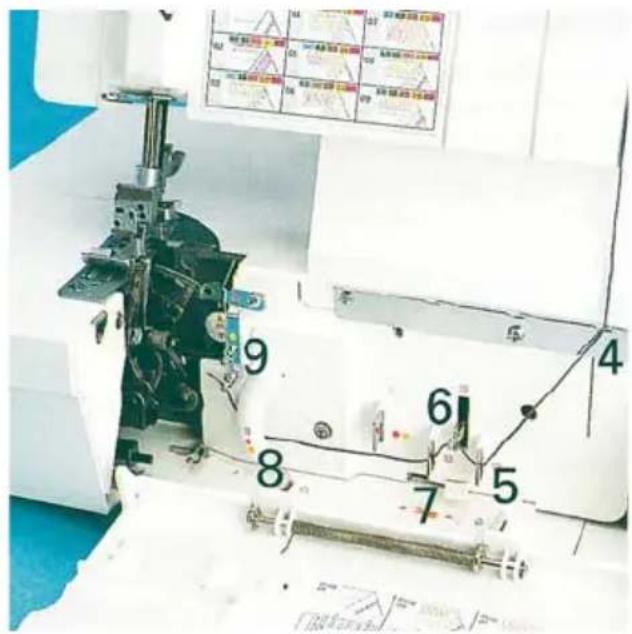
Machine tool image with numbered parts and control panel interface visibleThread the thread guides which are marked with a violet square in a sequence of 1 to 9.

text_image
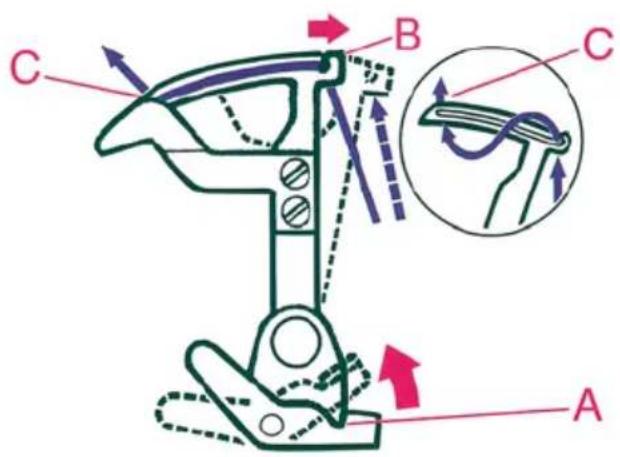
A BPush lever A upward and hook the thread into slot B. Also refer to the drawing below.
Note:
The lever returns automatically to its position as soon as you start sewing.
text_image
C B C AThread from the front through eye C of the two thread chainstitch looper and the cover stitch looper (= threading point 11).

natural_image
Close-up of a sewing machine needle stitching internal components (no visible text or symbols)Pull approximately 4" (10 cm) of thread through the looper and place it to the left under the presser foot.
text_image
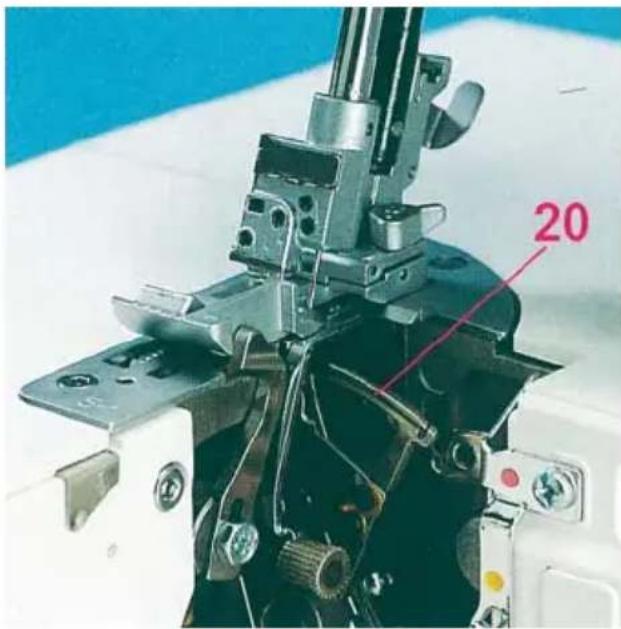
20Exception:
Threading the two-thread chainstitch looper and cover stitch looper for the cover stitch (violet) (Prog. 02)
Turn the handwheel towards you until the two thread chainstitch looper 20 is on the extreme right.
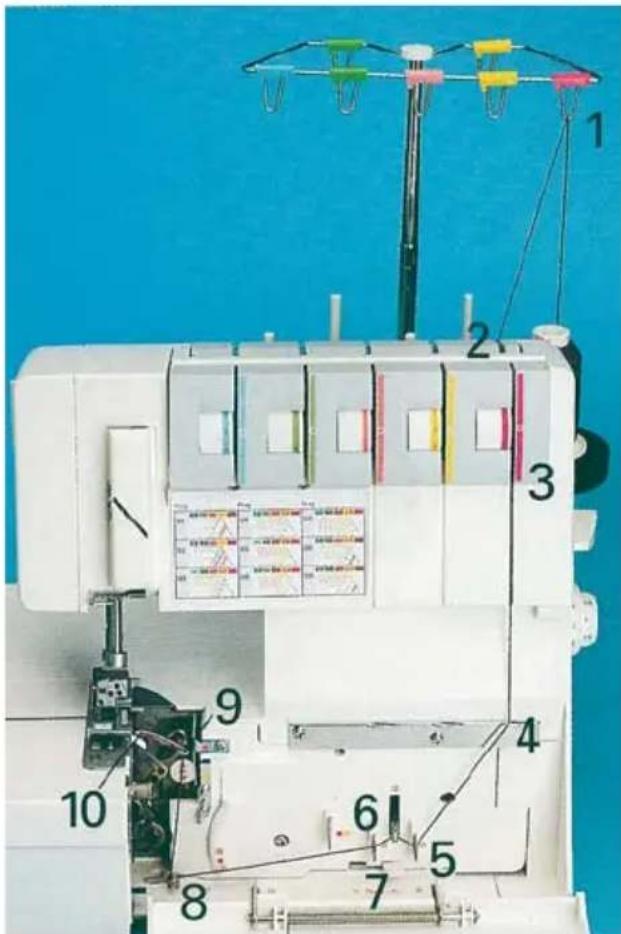
text_image
Labeled diagram of a sewing machine with numbered parts and internal wiring, likely for industrial sewing or textile work.Thread in a sequence of 1 to 10.
Note:
To make this task easier, use the tweezers which can be found behind the swivel plate.
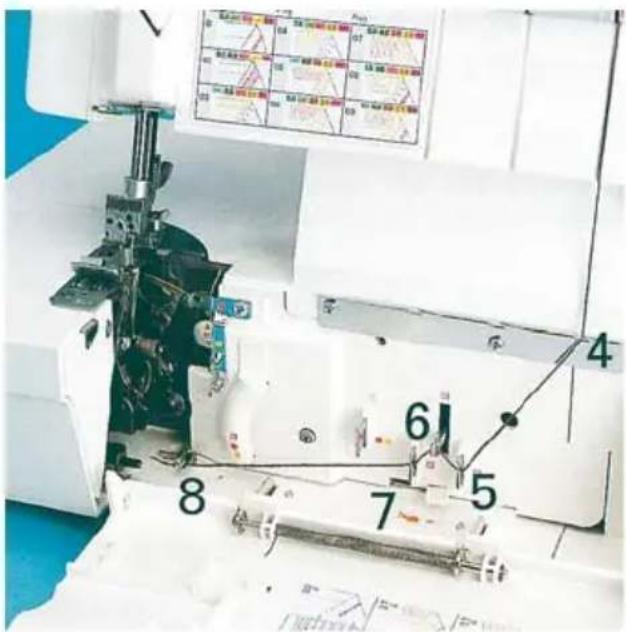
text_image
Machine tool image with numbered annotations and a control panel showing measurement dataThread the thread guides, as shown in the diagram, in a sequence of 1 to 8. Some of the threads guides are marked with a violet square.
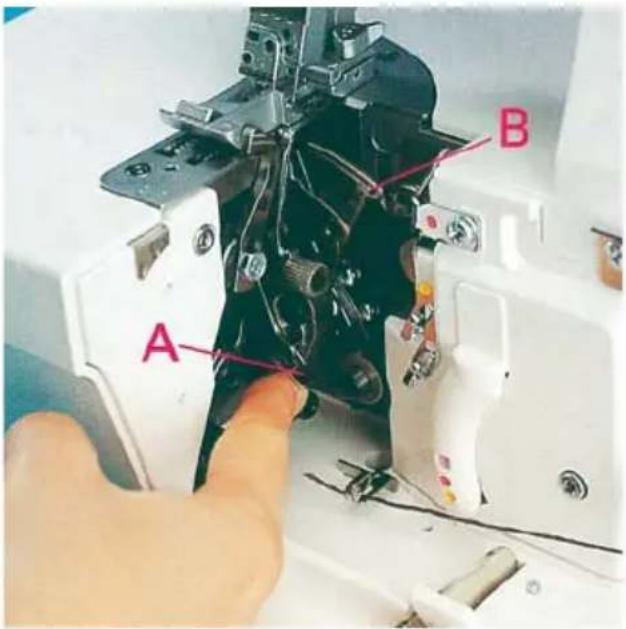
text_image
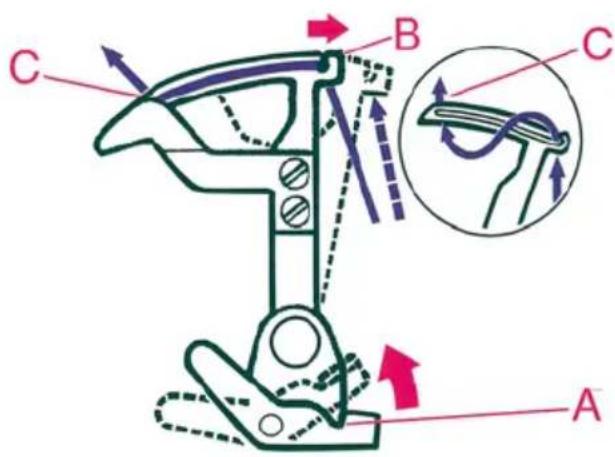
A BPress lever A upward and hook the thread into slot B. Also refer to the drawing below.
Note: The lever returns automatically to its position as soon as you start sewing.
text_image
C B C AThread from the front through eye C of the two-thread chainstitch looper and the cover stitch looper (= threading point 10).

natural_image
Close-up of a sewing machine's internal components, showing mechanical parts and wiring (no visible text or symbols)Pull approximately 4" (10 cm) of thread through the looper and place it to the left under the presser foot.
text_image
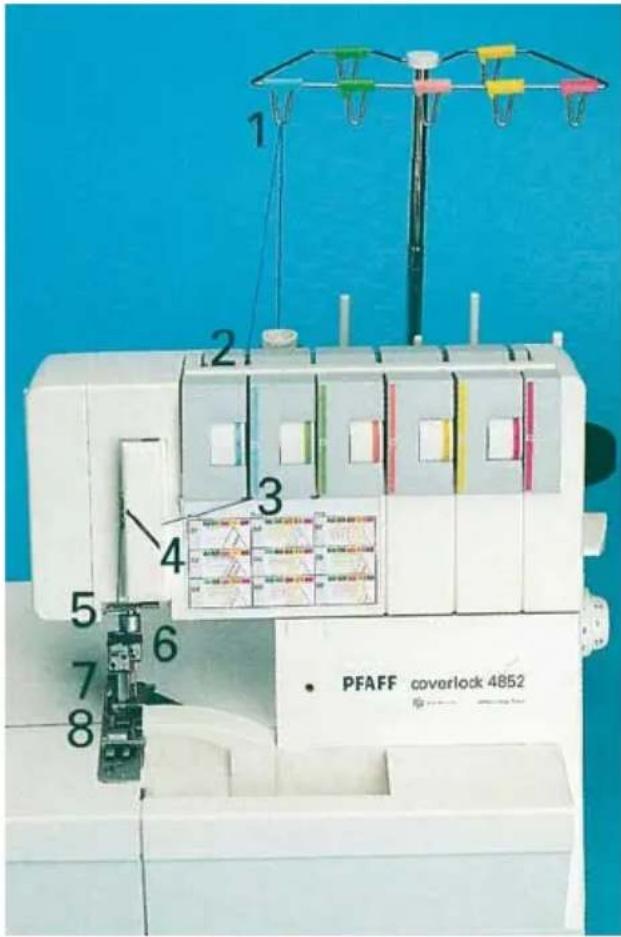
1 2 3 4 5 6 7 8 PFAFF coverlock 4852Threading the needles
Thread in a sequence of 1 to 8.
Note:
To make this task easier, use the tweezers which can be found behind the swivel plate.

text_image
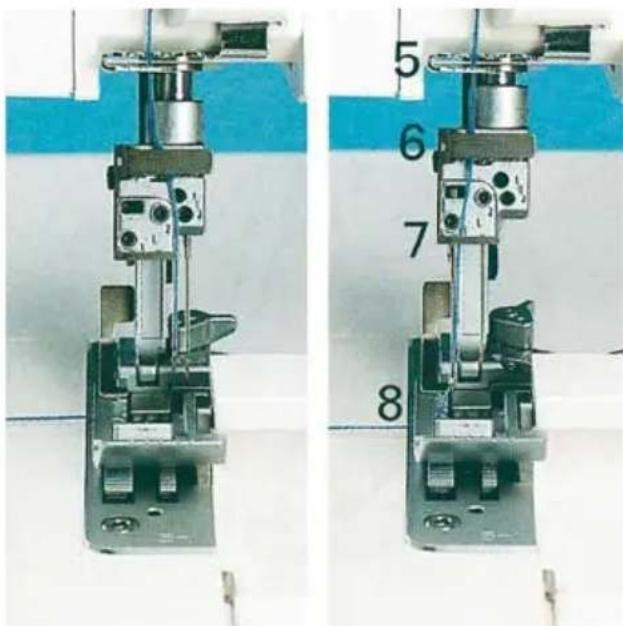
4 Prog Prog 01 50 21 1.5 04 8.0 6.0 4.0 3.0 2 02 05 1.5 5.0 03 06 5.0 2.0 2The thread must be guided through the lower slot of thread guide 4.
natural_image
Close-up of a sewing machine needle with numbered callouts (5–8), no visible text or symbols on the device itself.Pull approximately 4" (10 cm) of thread through the looper and place it to the left under the presser foot.
Note:
For the cover stitch the thread must also be guided through the lower thread guide 7.
text_image
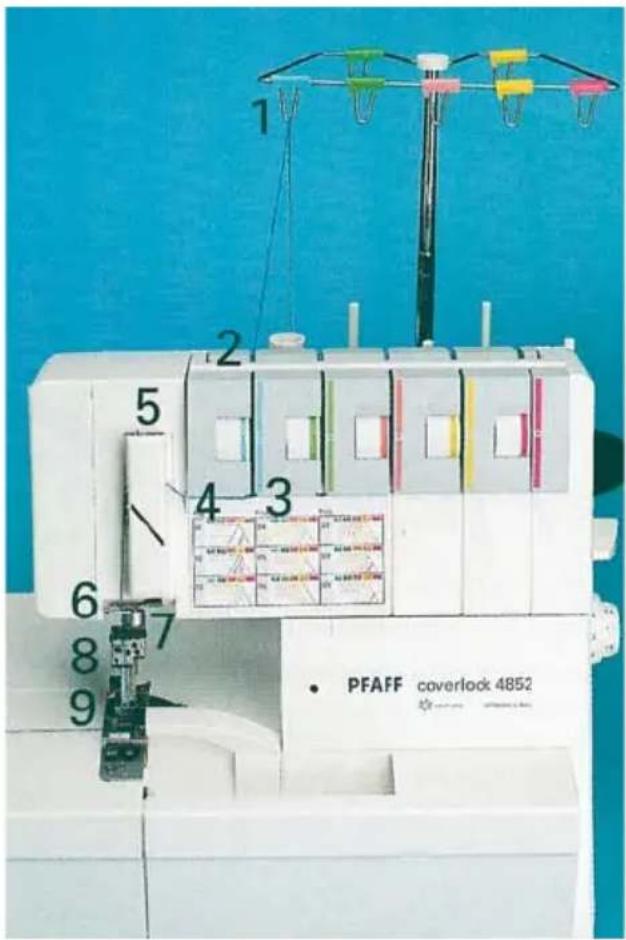
1 2 3 4 5 6 7 8 9 PFAFF coverlock 4852Exception:
Threading needle L2 when sewing a 5-thread safety-stitch seam (Prog. 09), a 4-thread safety-stitch seam (Prog. 08) and a 2-thread chainstitch (Prog. 01)
Thread in a sequence of 1 to 9.
Note:
To make this task easier, use the tweezers which can be found behind the swivel plate.

text_image
5 Prog Prog 01 5.0 2.0 1.5 04 6.0 6.0 - 10 05 02 03 15 5.0 5.0 2.0 06 5.0 2.0 50000The thread must be guided through the upper slot of thread guide 5.
natural_image
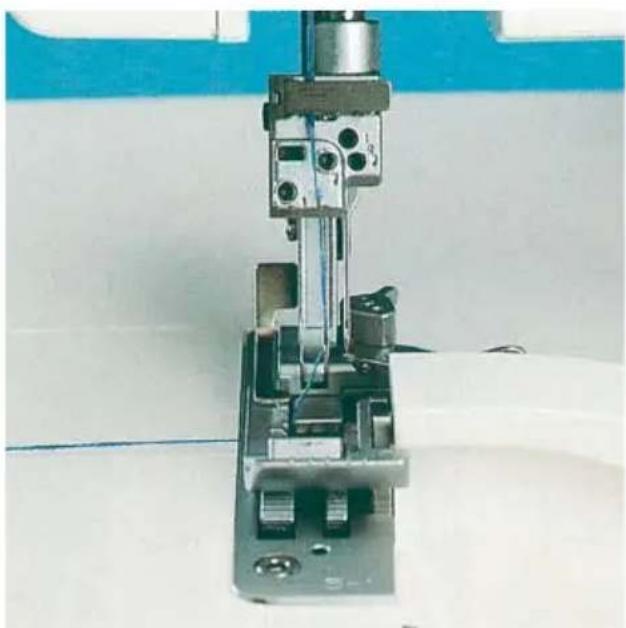
Close-up of a sewing machine needle with metal components and wiring (no visible text or symbols)Pull approximately 4" (10 cm) of thread through the looper and place it to the left under the presser foot.
text_image
Technical diagram showing mechanical assembly with labeled component '1' and a highlighted circular areaImportant note on threading
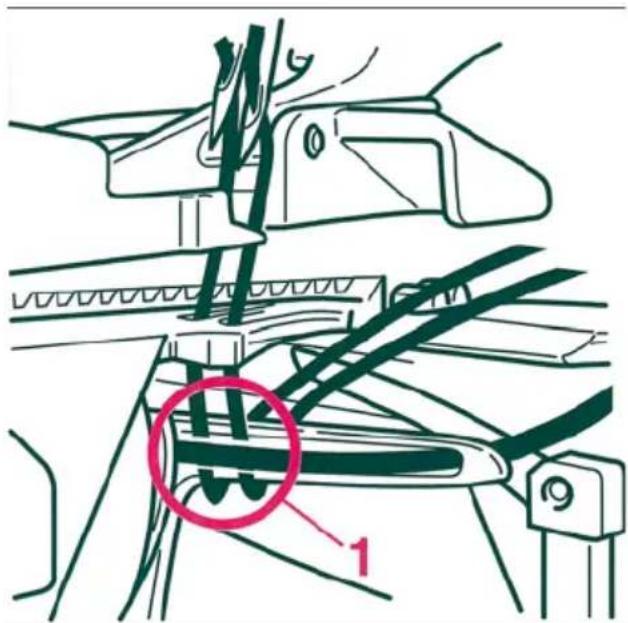
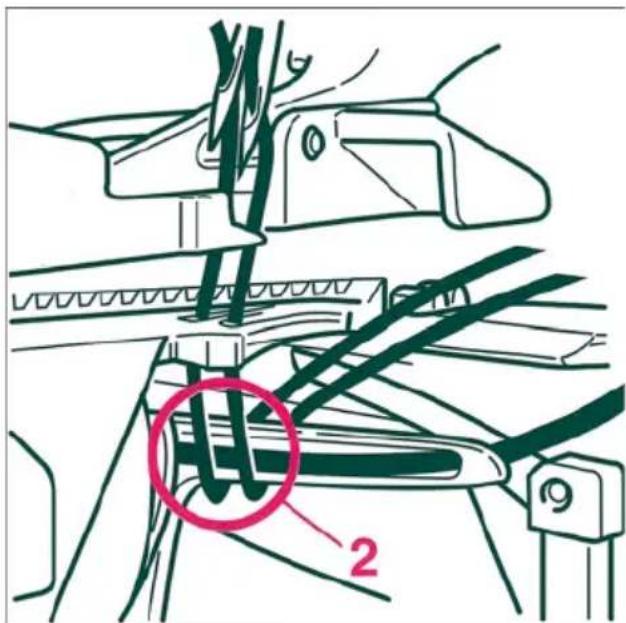
The needle(s) must always be threaded last so that the needle threads do not run under the looper thread as seen in drawing 1, but instead over the looper thread as depicted in drawing 2. Should this sequence not be followed, thread breakage or missed stitches can occur.
text_image
Technical diagram showing mechanical assembly with labeled component '2' and a highlighted circular featureIf the looper threads break, you must pull the needle threads out of the needle eye, rethread the loopier thread and then rethread the needle threads.
natural_image
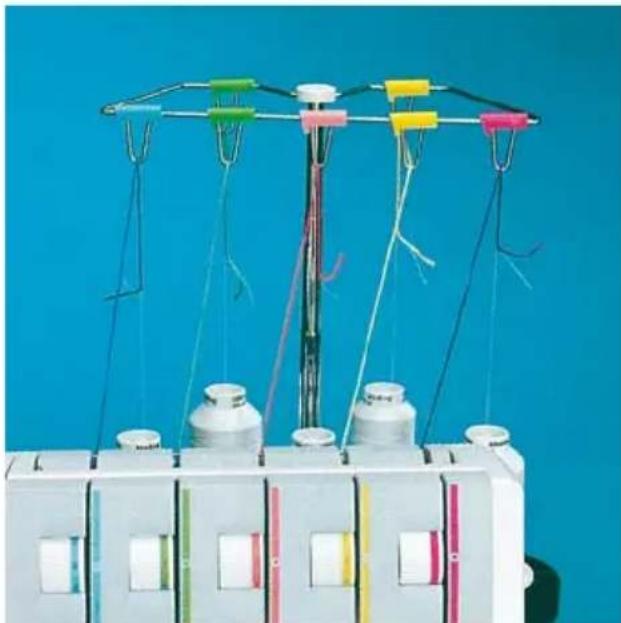
Close-up of a sewing machine with multiple thread spools and metal clamps against a blue background (no text or symbols visible)Changing a spool on a threaded machine
Cut the threads off close to the spool and replace with new spools. Tie together the threads which are still in the machine with the new threads, and pull the threads out of the needle eyes. Raise the presser foot. Pull on the needle threads until the knots are about 6 inches (15 cm) past the last thread guide in front of the needles. Cut the knots off and pull the threads through the respective needle eyes. The looper threads can be pulled continuously past the looper eye and placed to the left underneath the presser foot.
natural_image
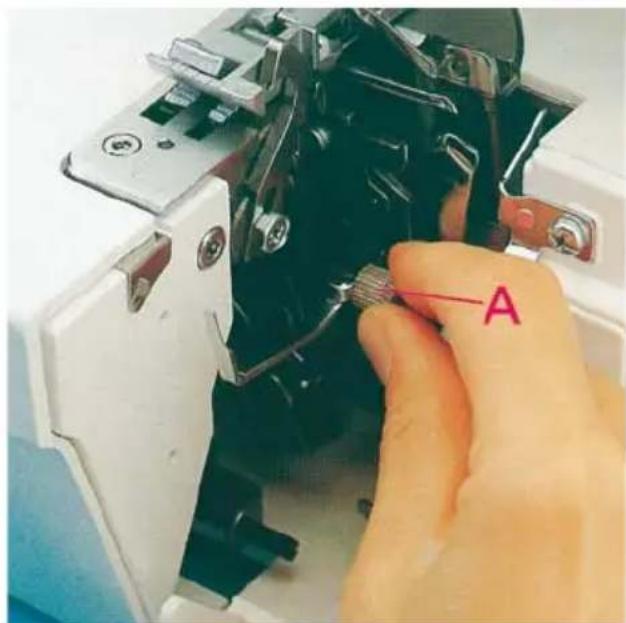
Close-up of hands using a sewing machine to adjust or install a component, labeled 'A' with no visible text or symbols beyond the label.Needle threader
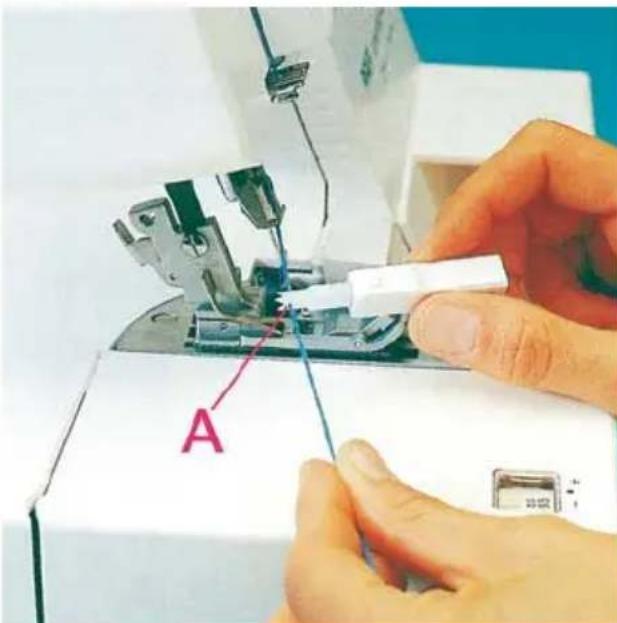
Move the needle(s) into the highest position and lower the presser foot. Place the thread from right to left in notch A of the needle threader (to be found in the accessory box). One of the two triangles must point upwards.

natural_image
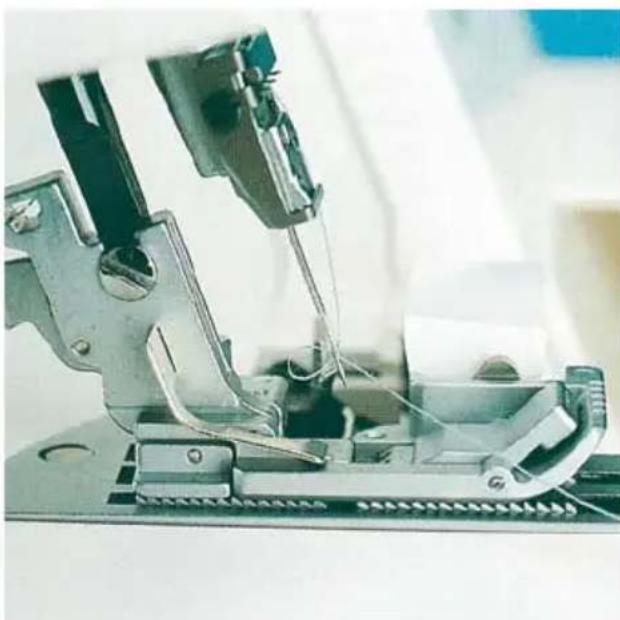
Close-up of a hand using a sewing machine to cut fabric, no visible text or symbolsPlace the needle threader onto the front groove of the needle. Slide the needle threader down to the needle eye and press it lightly against the needle.
natural_image
Close-up of a mechanical sewing machine with metal clamps and wiring (no visible text or symbols)A small metal pin is pushed through the needle eye and the needle is automatically threaded. Thread loops must be pulled to the back.
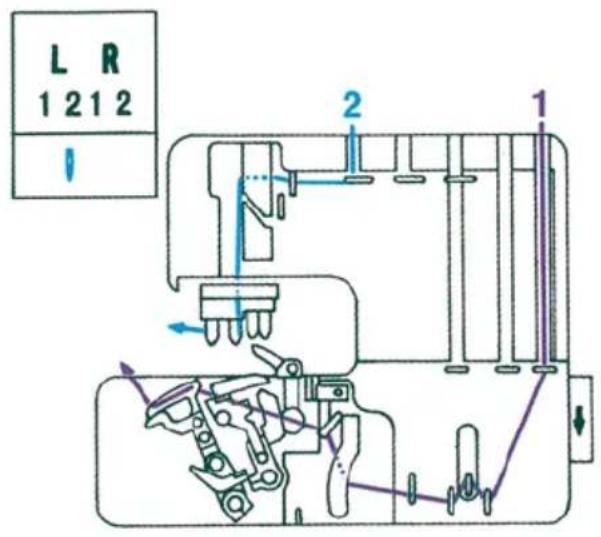
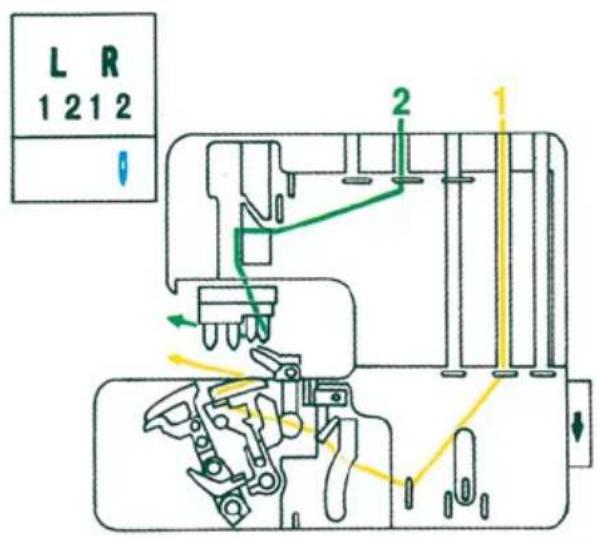
Overview of the threading paths and threading sequences
text_image
L R 1 2 1 2 1 2 1Program 01: 2-thread chainstitch

text_image
L R 1 2 1 2 2 3 1Program 02: cover stitch
text_image
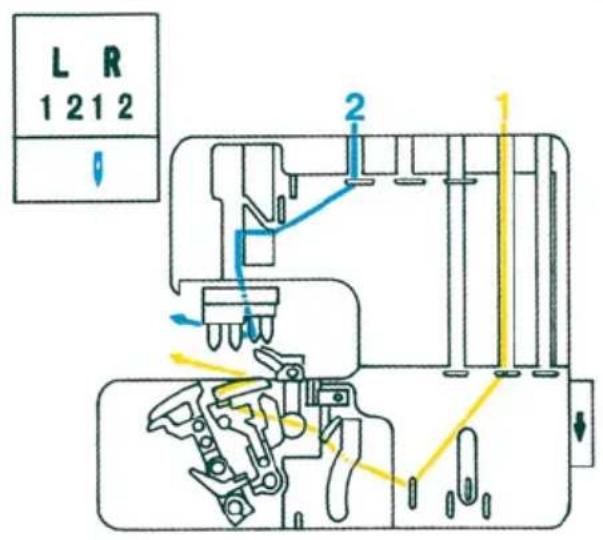
L R 1 2 1 2 2Program 03: 2-thread fl atlock, narrow
Program 11: 2-thread serging, narrow
Program 12: 2-thread rolled hem
Program 13: folded 2-thread rolled hem
text_image
L R 1 2 1 2 2Program 04 2-thread fl atlock, wide
Overview of the threading paths and threading sequences

text_image
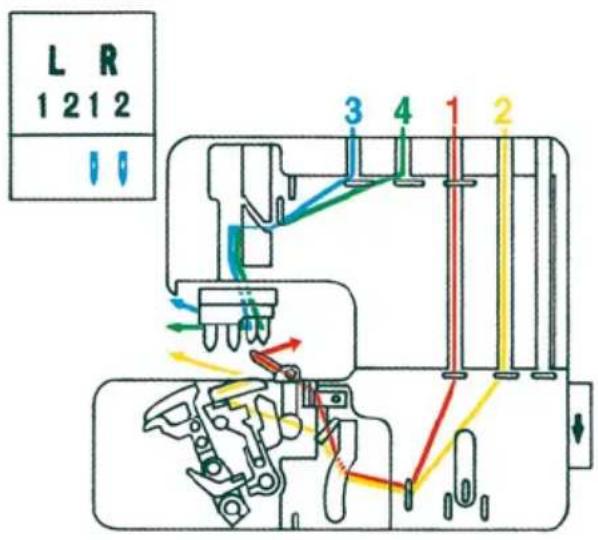
L R 1 2 1 2 3 1 2Program 05:
3-thread overedge. narrow
Program 14:
3-thread rolled hem
Program 15:
folded 3-thread rolled hem
Program 16
3-thread fl atlock, narrow
text_image
L R 1 2 1 2 3 4 1 2Program 07
4-thread overedge seam

text_image
L R 1 2 1 2 3 1 2Program 06:
3-thread overedge, wide
Program 17:
3-thread serging, wide
Program 18:
3-thread fl atlock, wide
text_image
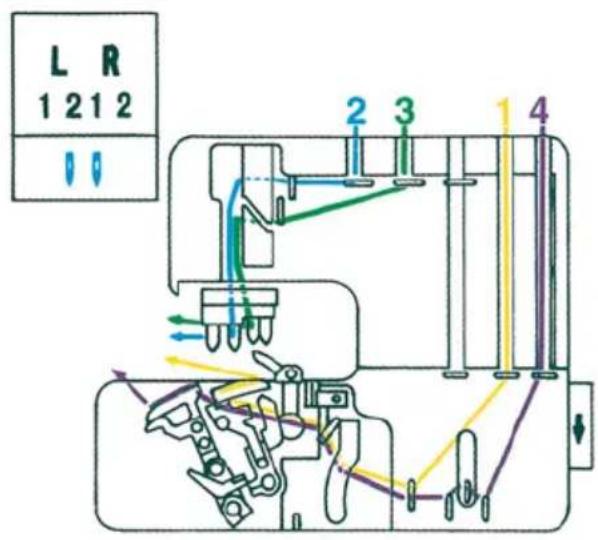
L R 1 2 1 2 2 3 1 4Program 08:
4-thread safety-stitch seam
Overview of the threading paths and threading sequences
text_image
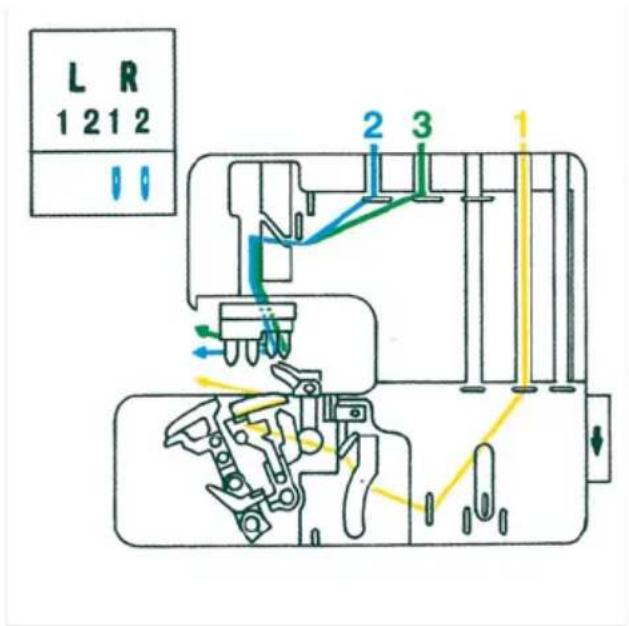
L R 1 2 1 2 2 3Program 09: 5-thread safety-stitch seam
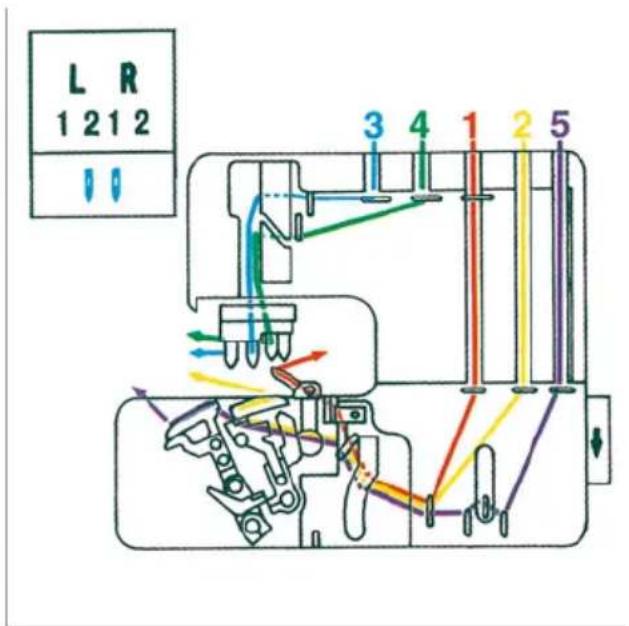
text_image
L R 1 2 1 2 3 4 1 2 5Program 10: 2-needle 3-thread assembly seam
text_image
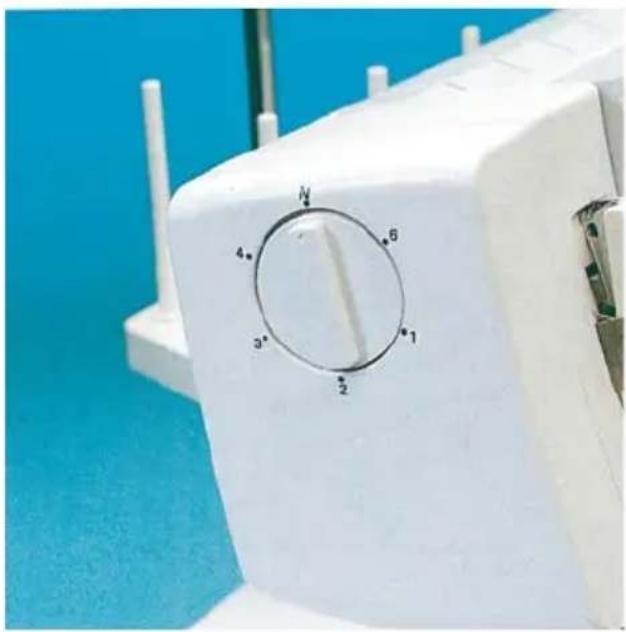
N 4 6 3 1 2Presser foot pressure
The pre-set presser foot pressure on the machine is suitable for medium heavy fabrics. The presser foot pressure does not need to be adjusted for most fabrics. If you are working with light or heavy fabrics then you may need to adjust the pressure. In this case, 6 setting positions are available which you can select using the adjusting knob for the presser foot pressure 17. The standard setting is "N".
natural_image
Close-up of a sewing machine needle stitching fabric, no visible text or symbols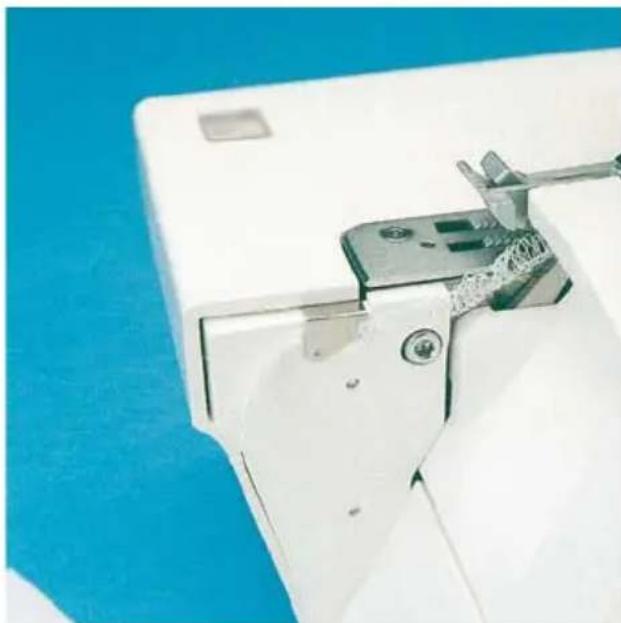
natural_image
Close-up of a sewing machine needle with metal clamps against a blue background (no visible text or symbols)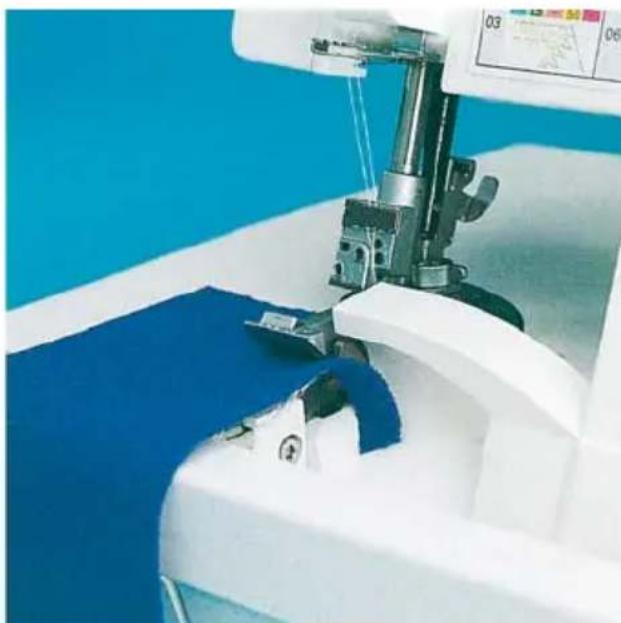
natural_image
Close-up of a sewing machine needle stitching blue fabric, no visible text or symbolsThread chain cutter
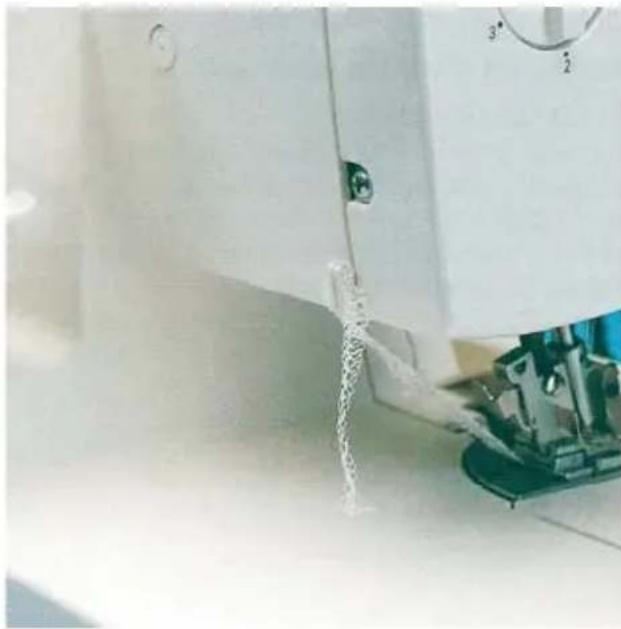
After fi nishing the seam, sew an approx. 6" - 8,1" (15 20 cm) long thread chain. Pull the thread chain from the right to left over the thread chain cutter 33. This will cut off the thread chain.
Clamp spring for serging thread chain 25
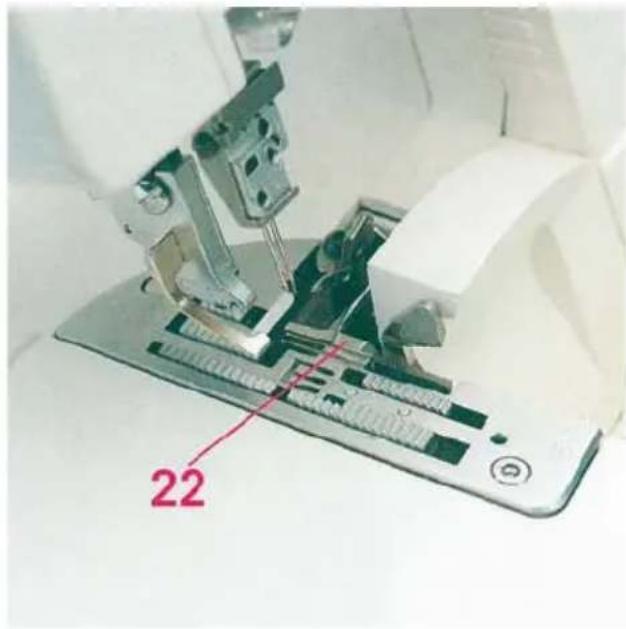
Using this feature you can secure the thread chain at the start of the fabric by pulling it into the seam. Stitch off a minimum 4" (10 cm) long thread chain and raise the presser foot. Remove the thread chain carefully from the swiveling stitch width latch 22. Pull the thread chain forwards and clamp it under the spring.
Butt the fabric up against the front of the needle(s). If necessary, make an approx. 1.5" (3 cm) cut into the fabric along the cut line using a pair of scissors. Lower the presser foot and start sewing. The thread chain pulls automatically into the inside of the seam.
Note:
This feature cannot be used for either the 2-thread safety-stitch seam, the 4-thread safety-stitch seam, the 2-thread chainstitch or for the rolled hem.
natural_image
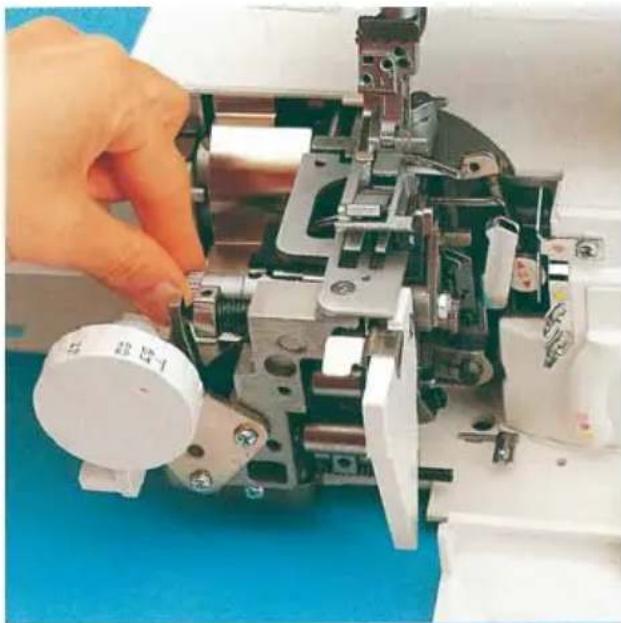
Close-up of a hand adjusting a mechanical component with a white circular knob (no visible text or symbols)Disengaging the upper blade Switch off the electrical power
Move the movable upper blade 23 into its highest position by turning the handwheel towards you. Remove the waste container and open the looper cover and the swivel plate. Push the knob for lowering the upper blade 27 fully to the right.
natural_image
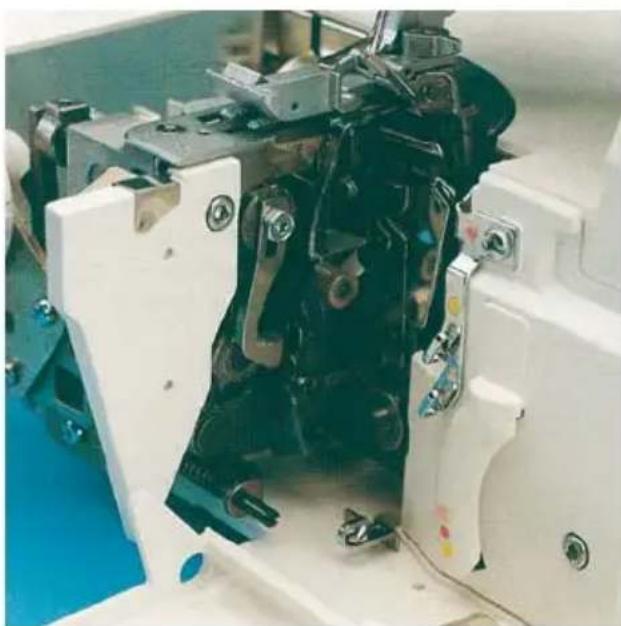
Close-up of a sewing machine with black mechanical components and white base panels (no visible text or symbols)To lower the upper blade turn the knob towards you until the upper blades clicks into place below. The upper blade is now disengaged.

natural_image
Close-up of a sewing machine's internal components, showing needle, clamps, and stitching (no visible text or symbols)Engaging the upper blade
Push the knob for lowering the upper blade to the right and swivel the blade back until it clicks into the operating position again. Close the looper cover and the swivel plate and reattach the waste container.
text_image
22Swiveling stitch width latch
For standard overlock seams:
The swiveling stitch width latch 22 remains in the basic position when sewing all types of standard overlock seams (exception: Program 01, 02).
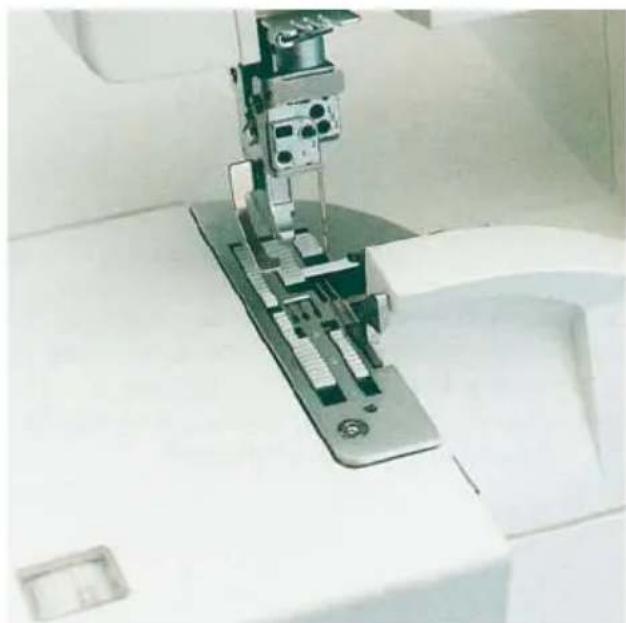
text_image
AFor rolled hems:
Pull knob (A) to the right and swivel the swiveling stitch width latch 22 downwards.
natural_image
Close-up of a sewing machine needle stitching white fabric (no visible text or symbols)This setting allows you to sew all types of rolled hems.
natural_image
Close-up of a mechanical device with visible gears and components, no text or symbols presentAttaching the converter
Switch off the electrical power
The converter 28 must be attached for all two thread seams (exception: Program 01) and the two needle three thread assembly seam. Open the swivel plate and remove the converter 28 from its storage place.

text_image
18Position the upper overedge looper 18 right next to the needle by turning the handwheel towards you.

natural_image
Close-up of a hand operating a sewing machine needle, showing metal components and a red arrow indicating the process (no text or symbols visible)Push the tip of the converter into the back side of the upper overedge looper until it clicks into place and push the converter onto the overedge looper bracket.

natural_image
Close-up of a hand operating a sewing machine with metal components and a red triangular warning label (no visible text or symbols)To remove the converter, gently push the point of the converter from the eye of the upper overedge looper. You can now remove the converter by pulling it upwards from the overedge looper bracket.
natural_image
Close-up of a hand operating a sewing machine on a blue fabric surface (no visible text or symbols)Setting the seam width
The required seam width can be adjusted anywhere between 3.5 and 6 mm by turning the adjusting knob for seam width 13. The setting can be seen through the viewing window 14.
The two thread chainstitch is sewn with a clearance of 6.5 to 9 mm.

natural_image
Pure electrical circuit lines without any symbolsA

natural_image
Pure diagram of a blue rectangular block with a vertical striped pattern on the right side (no text or symbols)B
Illustration A: Should loops project out of the workpiece, move the movable upper blade 23 to the right by turning the seam width adjusting knob upwards.
Illustration B: Should the stitching be too tight, move the movable upper blade 23 to the left by turning the seam width adjusting knob downwards.
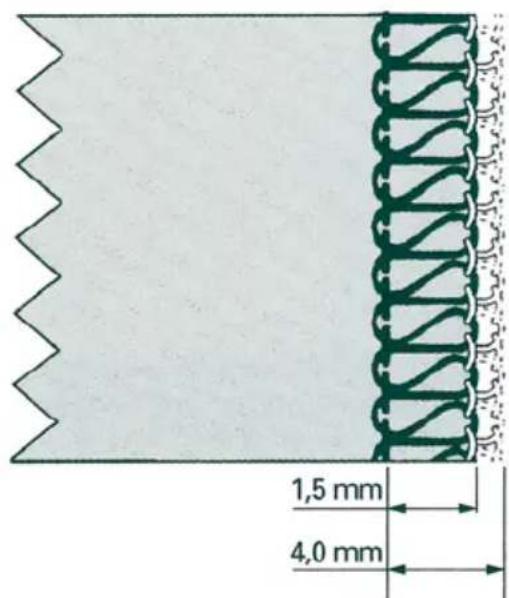
text_image
1,5 mm 4,0 mm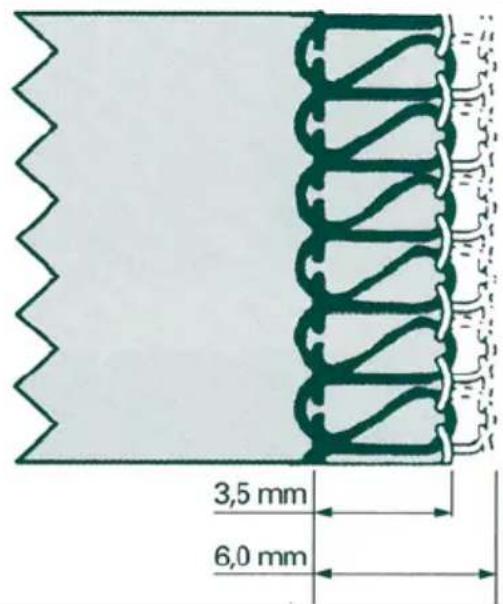
text_image
3,5 mm 6,0 mmNote:
The top row of numbers on the dial refers to the seam width of a standard 3 thread overedge seam. The width settings 3.5 mm through 6.0 mm are measured from needle R1 to the outer fabric edge. This width is decreased by 2.0 mm when only using needle R2, i. e. you have a seam width that is completely adjustable from 1.5 mm to 4.0 mm.
The bottom row of numbers refers to the seam of the 4 or 5 thread safety stitch seam. The width settings 6.5mm through 9mm are measured from needle L2 to the outer fabric edge.
Measurements are shown in metric and fractions.
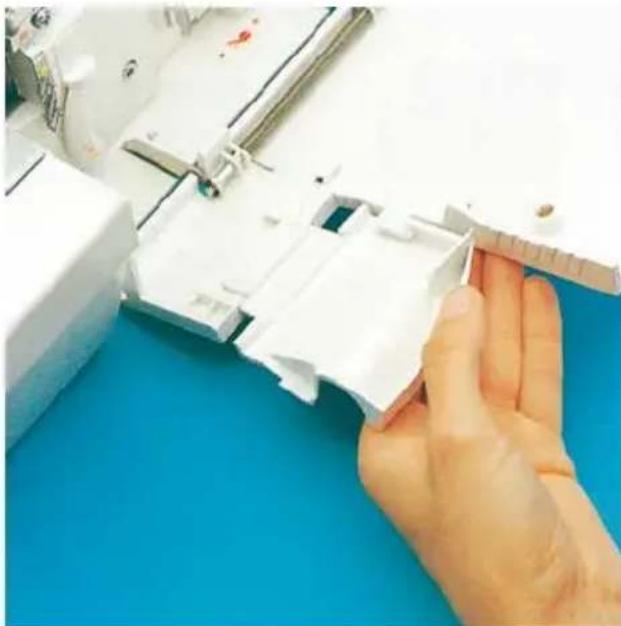
natural_image
Close-up of a hand operating a sewing machine on a blue workbench (no visible text or symbols)Adjusting the machine to the cover stitch (Prog. 02) and two thread chainstitch (Prog. 01)
This is only necessary if you do not want to trim the fabric edge. Insert the needle(s) (see page 13) according to the overview of the threading paths and threading sequences (see page 26). Open the looper cover and remove the blade guard 8 by pulling it towards you.
Lower the swiveling stitch width latch (see page 31) and disengage the upper blade (see page 30). Ensure that the upper blade is disengaged by turning the handwheel towards you.
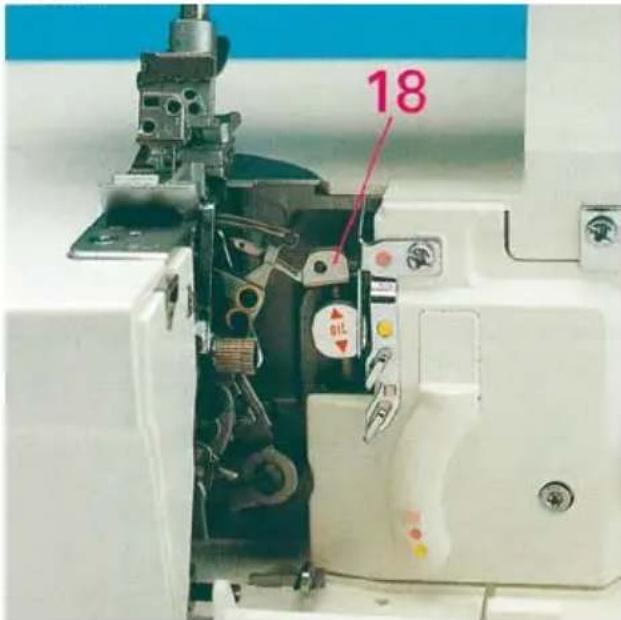
text_image
18Disengage the upper overedge looper. Move the upper overedge looper 18 into its lowest position by turning the handwheel towards you.

natural_image
Close-up of a sewing machine needle stitching fabric, with a hand adjusting the component (no visible text or symbols)Move the looper disengaging lever 9 to the left. Ensure that the looper is disengaged by turning the handwheel towards you.
Thread the two thread chainstitch looper and the cover stitch looper (see pages 18 to 21) and then the needle(s) (see page 22 and 23).
natural_image
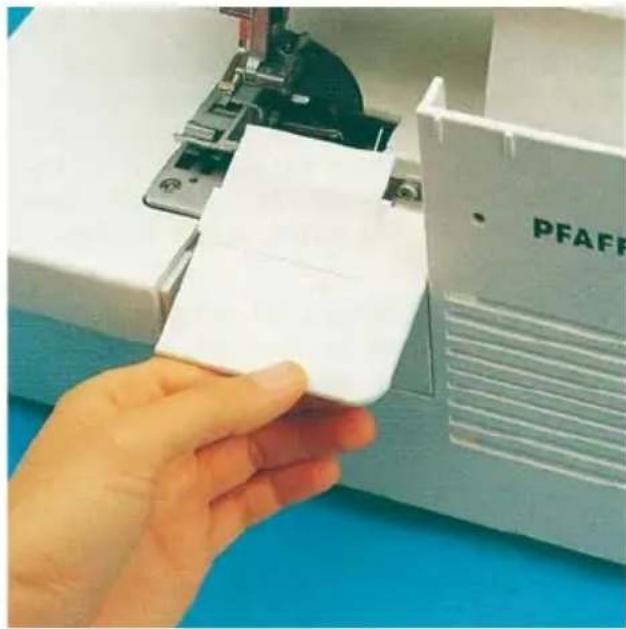
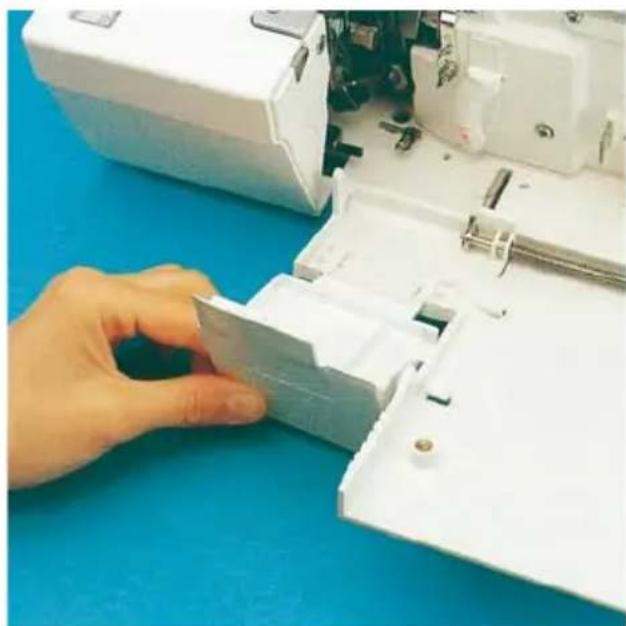
Hand holding a white plastic bag attached to a sewing machine, with no visible text or symbols on the device itself.Press the power table 50 downwards into the designated slot on the looper cover. Close looper cover.
Note:
Please ensure that the upper overedge looper is disengaged before attaching the power table 50.
natural_image
Close-up of a hand inserting a plastic component into a white sewing machine on a blue surface (no text or symbols visible)To return the machine to its previous settings after sewing with the cover stitch or two thread chainstitch:
Open the looper cover and remove the power table.
natural_image
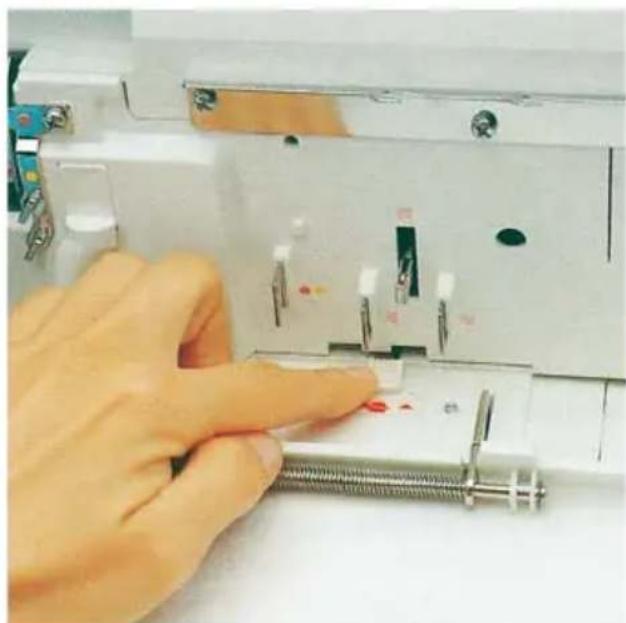
Close-up of a hand operating a sewing machine needle with metal fasteners (no visible text or symbols)Move the looper disengaging lever to the right, thus re-engaging the upper overedge looper.
Bring the swiveling stitch width latch into the basic position (see page 31) and engage the upper blade (see page 30).
Push the blade guard into the looper cover and close the looper cover.
text_image
B ADifferential feed
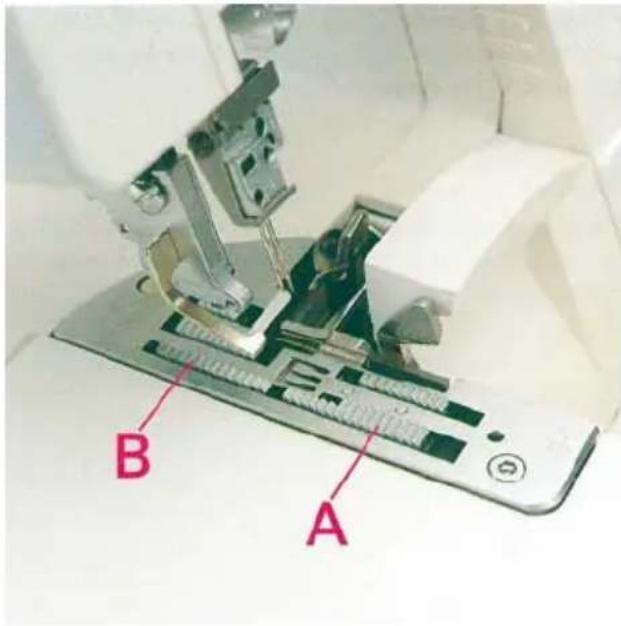
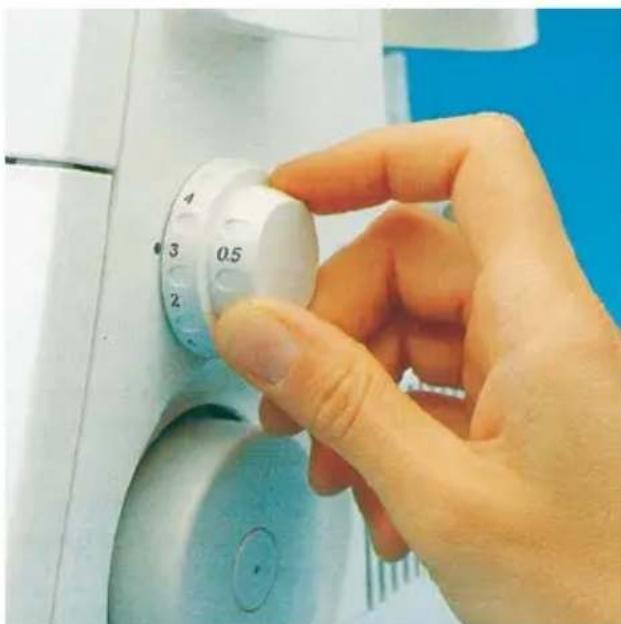
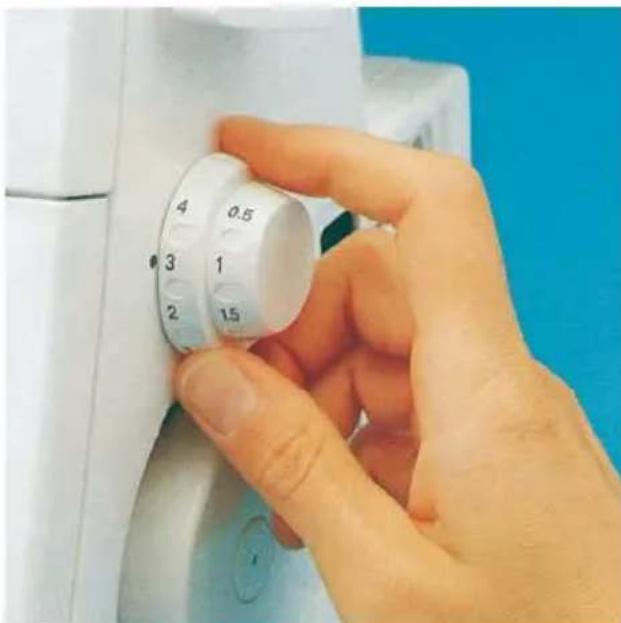
The differential feed consists of two feed dogs (A + B), one behind the other, which feed the fabric. The movement of the front feed dog (A) and thus the amount of material to be fed can be regulated using the regulator wheel 41. The setting range is between 0.5 and 2.0.
The standard setting is 1.0, where the movement of the front feed dog (A) is synchronized with the rear feed dog (B). This means that the front feed dog feeds the same amount of fabric as the rear feed dog.
Note:
The function of the differential feed also depends on the set stitch length and the type of fabric being used.
natural_image
Hand operating a white circular switch dial with numbered buttons (no text or symbols visible)Set the regulator wheel for the differential feed 41 to 0.5. At this setting the front feed dog feeds half as fast as the rear feed dog. This means that the front feed dog feeds only half as much fabric as the rear feed dog, causing the fabric to stretch.

text_image
A BHere you will avoid gathering/puckering of the seam when working with very light fabrics, such as silk and taffeta. Instead, a smooth seam (A) will be achieved.
You can also achieve decorative effects with the differential feed dog. For example the wavelike effect when using a rib knit (B).

natural_image
Hand operating a sewing machine dial with numbered buttons (no visible text or symbols)Set the regulator wheel for the differential feed 41 to 2.0.
Here the front feed dog feeds twice as fast as the rear feed dog. This means that the front feed dog feeds twice as much fabric as the rear feed dog, causing the material to gather.

natural_image
Close-up of fabric layers with labeled sections A and B, showing textured surfaces and a diagonal seam (no text or symbols beyond labels)Here you will avoid stretching in the seam when working with knitwear, such as jerseys or gathered fabrics. Instead, a smooth seam (A) will be achieved.
You can also achieve decorative effects with the differential feed dog. For example the gathering effect when using very light fabrics (B).
The following table contains information on the differential feed settings. However, you should always test your setting fi rst on a piece of scrap fabric.
| Type of fabric / effect | Differential feed setting | ||
| gather <2.0> | normal <1.0> | stretch <0.5> | |
| Very light fabrics: silk, satin, poplin, taffeta, linings. | ● | ● | |
| Normal fabrics: light and medium-heavy cottons, fi ne cords, thermal-wear. | ● | ||
| Light knitwear: jerseys, polo fabrics, cut-pile pullovers, tricot, fi ne knitwear and gathered fabrics. | ● | ● | |
| Heavy knitwear: sweatshirt fl eece, heavy gathered fabrics, heavy knitwear. | ● | ||
| Stretch - wavelike effect: medium and light knitwear, jerseys, knitwear, ruffl ed sleeve and collar edges, skirt hems, dense stitch lengths. | ● | ||
| Gathering: ruffl ing light materials and lace, seam allowances for curves, arches on blouses, shirts, skirts, round pockets, fl aps, stretching or gentle ruffl ing of arched sleeves (shoulders), sleeve widths for cuffs or gathered fabrics. | ● | ||
natural_image
Hand holding a white rotary dial with numbered buttons (0.5, 1, 1.5) against a blue background (no text or symbols visible)
natural_image
Close-up of a sewing machine needle being adjusted, with a hand pointing to the component (no visible text or symbols)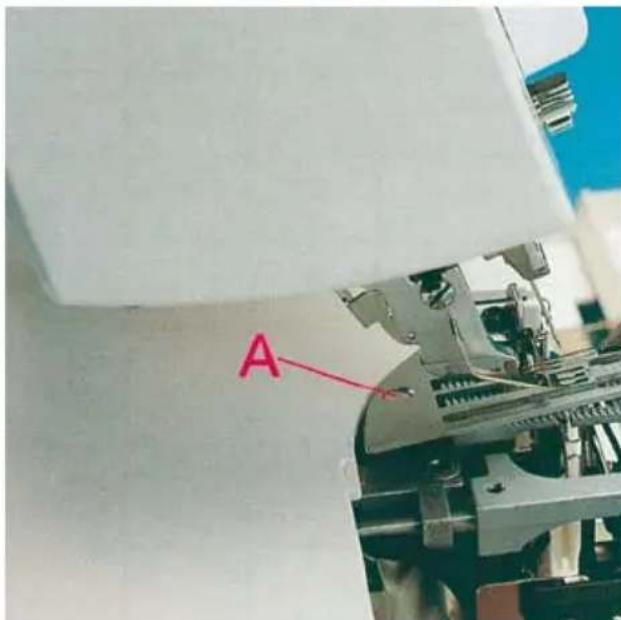
text_image
AAdjusting the stitch length
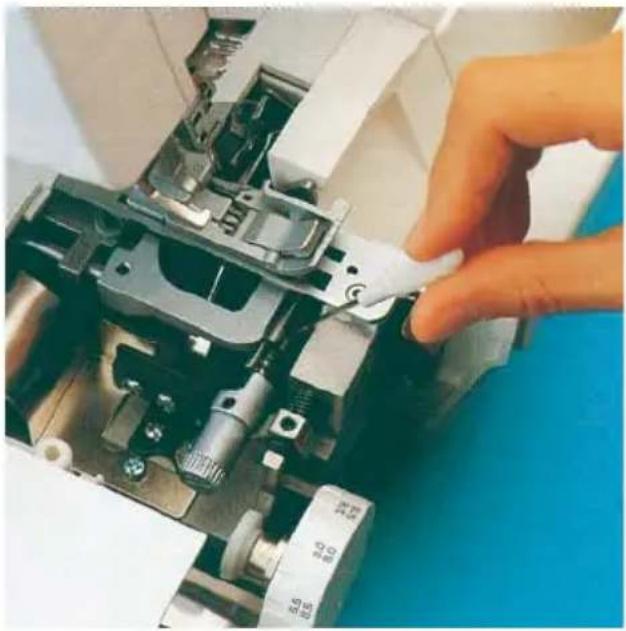
You can set the desired stitch length between 0.5 mm to 4.0 mm by turning the stitch length adjustment knob (42).
Note
For the two thread chainstitch, the setting should be 3.0 or higher.
Removing the needle plate
Raise the presser foot and move the needle(s) to the highest position. Remove the presser foot and open the swivel plate. Press down the needle plate disengaging lever 26. The needle plate 11 is raised out of its mount. The needle plate can be removed to the left.
Note:
The machine should be unthreaded when removing the needle plate.
Inserting the needle plate
Place the needle plate to the rear on the guide pin (A) and press down at the front until you hear it click into place.
natural_image
Close-up of a hand using a sewing machine to adjust internal components (no visible text or symbols)Securing the upper blade Switch off the electrical power
It is recommended to secure the movable upper blade 23 before sewing heavy fabrics. Raise the needle(s) to its highest position and open the swivel plate. Tighten the screw fully using the Allen key. This screw should always be slightly loosened again after sewing heavy fabrics.
Note:
The seam width can no longer be adjusted once the upper blade is secured.

text_image
Experimental setup with labeled test tubes and a bottle, showing color-coded sections and measurement markingsSetting thread tension
The following pages contain directions for setting thread tensions for all programs. Adjust the tension by turning the tensioning wheel until the dot marker is at the desired setting.
The settings for adjusting thread tension are recommendations. Fabric type, thread quality and needle gauge will influence seam results. Always sew off a test seam onto a piece of scrap fabric and check the thread loops. Adjust the thread tension if necessary.
Adjusting the tension settings is described on pages 46 to 56.
| Program Application | Needle position | Stitch length | Stitch width | |||||
Program 012 thread chainstitch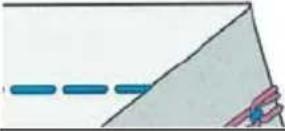 | Joining fabric layers where a traditional pressed open seam is required. Also works well as a basting stitch for test fi tting garments. | 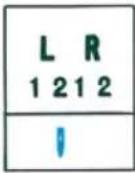 | 3-4 3.5 | |||||
Program 02Cover stitch | Sewing hems and fancy stitches. |  | 3-4 3.5 | |||||
Program 032-thread fl atlock, narrow | Serging light fabrics. Joining stretch fabrics with a fl atlock seam. |  | 2 5.5 | |||||
Program 042-thread fl atlock, wide | Serging medium heavy fabrics. Joining stretch fabrics with a fl atlock seam. |  | 2 5.5 | |||||
Program 053-thread overedge narrow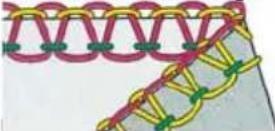 | Serging light (easily frayed) fabrics. | 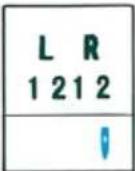 | 2 5.5 | |||||
Program 063-thread overedge wide | Serging tightly woven (easily frayed) fabrics. | 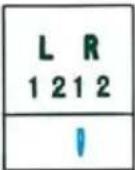 | 3 5.5 | |||||
Program 074-thread overedge | Joining and simultaneous serging of all fabrics, in particular stretchy fabrics. | 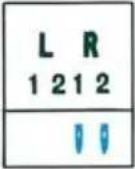 | 2.5 5.5 | |||||
Program 084-thread safety-stitch seam | Joining and simultaneous serging of tightly woven fabrics. |  | 3 8.5 | |||||
Program 095-thread safety-stitch seam | Joining and simultaneous serging of tightly woven fabrics. | 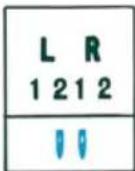 | 3 8.5 | |||||
| Stitch width latch 22■ = top □ = bottom | Looper disengaging level 9 | Power table 50● = with○ = without | Converter 28■ = with□ = without | Thread tensionThevaluerefertmedium-heavyfabricsandnomiaIpolyesterthread | ||||
| blue | green | pink | yellow | violet | ||||
| □ | ▼ | ● | □ | 5.0 2.0 | ||||
| □ | ▼ | ● | □ | 6.0 6.0 1.0 | ||||
| ■ | ▲ | ○ | ■ | 1.5 5.0 | ||||
| ■ | ▲ | ○ | ■ | 1.5 5.5 | ||||
| ■ | ▲ | ○ | □ | 4.0 3.0 2.0 | ||||
| ■ | ▲ | ○ | □ | 5.0 2.0 2.0 | ||||
| ■ | ▲ | ○ | □ | 5.0 4.0 2.0 2.0 | ||||
| ■ | ▲ | ○ | ■ | 5.0 1.5 5.5 2.0 | ||||
| ■ | ▲ | ○ | □ | 5.0 5.0 2.0 2.0 2.0 | ||||
| Program Application | Needle position | Stitch length | Stitch width | |||||
Program 102-needle, 3-thread assembly seam | Joining and simultaneous serging of light, very stretchy fabrics. |  | 2 5.5 | |||||
Program 112-thread serging, narrow | Serging light fabrics. | 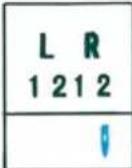 | 1.5 5.5 | |||||
Program 122-thread rolled hem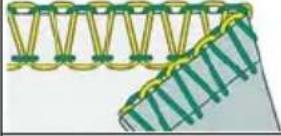 | Serging very light fabrics. Decorative edges. | 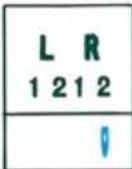 | 1-2 5.5 | |||||
Program 13Folded 2-thread rolled hem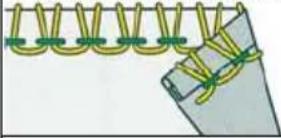 | Serging very light fabrics. Decorative edges. |  | 1-2 5.5 | |||||
Program 143-thread rolled hem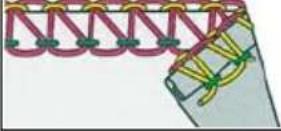 | Serging light to medium-heavy fabrics. Decorative edges. |  | 1-2 5.5 | |||||
Program 15Folded 3-thread rolled hem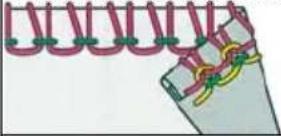 | Serging light to medium-heavy fabrics. Decorative edges. | 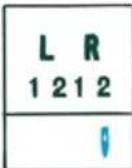 | 1-2 5.5 | |||||
Program 163-thread fl atlock, narrow | Serging medium heavy fabrics. Joining stretch fabrics with a fl atlock seam and decorative edges. | 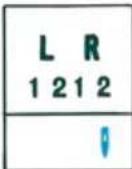 | 1.5 5.5 | |||||
Program 173-thread serging, wide | Serging tightly woven (non-fraying) fabrics. |  | 2 5.5 | |||||
Program 183-thread fl atlock, wide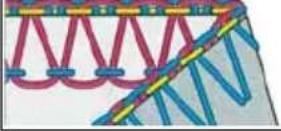 | Joining stretch fabrics with a fl atlock seam and decorative edges. |  | 2 5.5 | |||||
| Stitch width latch 22■ = top □ = bottom | Looper disengaging level 9 | Power table 50● = with○ = without | Converter 28■ = with□ = without | Thread tensionThevaluerefortemedium-heavyfabricsandnomiaIpolyesterthread | ||||
| blue | green | pink | yellow | violet | ||||
| ■ | ▲ | ○ | ■ | 5.0 4.0 1.0 | ||||
| ■ | ▲ | ○ | ■ | 4.0 1.0 | ||||
| □ | ▲ | ○ | ■ | 1.5 6.0 | ||||
| □ | ▲ | ○ | ■ | 4.0 4.0 | ||||
| □ | ▲ | ○ | □ | 5.0 4.0 3.0 | ||||
| □ | ▲ | ○ | □ | 5.0 2.5 7.5 | ||||
| ■ | ▲ | ○ | □ | 1.5 2.0 6.0 | ||||
| ■ | ▲ | ○ | □ | 7.0 0.5 8.0 | ||||
| ■ | ▲ | ○ | □ | 1.0 2.0 7.0 | ||||

natural_image
Two translucent plastic sheets on a blue background, no text or symbols visibleImportant notes on sewing with the cover stitch
The power table is marked with various units of measurement. The upper fi gures are in cm. The lower fi gures are in inches.
Note: The hemmer guide H2 is available as an optional accessory. With this optional accessory you can hem your fabric effortlessly without having to press under the hem edge prior to sewing the cover stitch.
natural_image
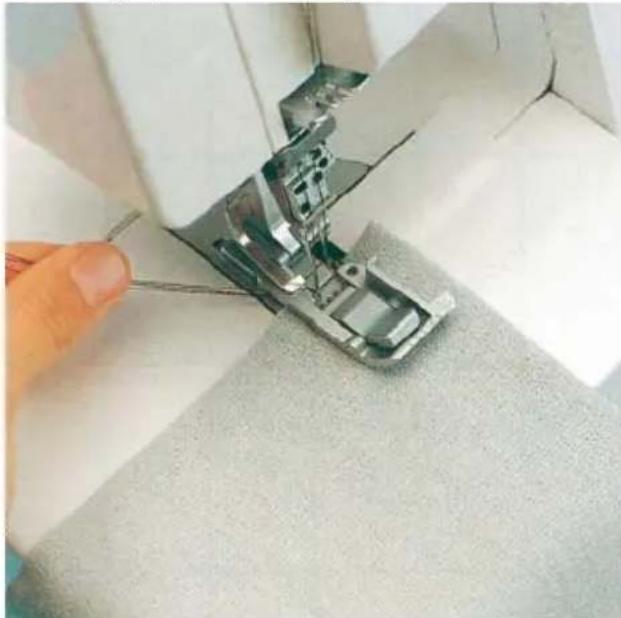
Close-up of a hand using a sewing machine to cut fabric, no visible text or symbolsTo start sewing:
Raise the presser foot and place the fabric under the presser foot so the needles pierce the fabric for the fi rst stitch. Position the fabric at the desired width using the marked guidelines on the power table. When starting to sew, pull the fabric taut towards the rear and sew slowly. The speed may be increased as you sew further along the fabric.
natural_image
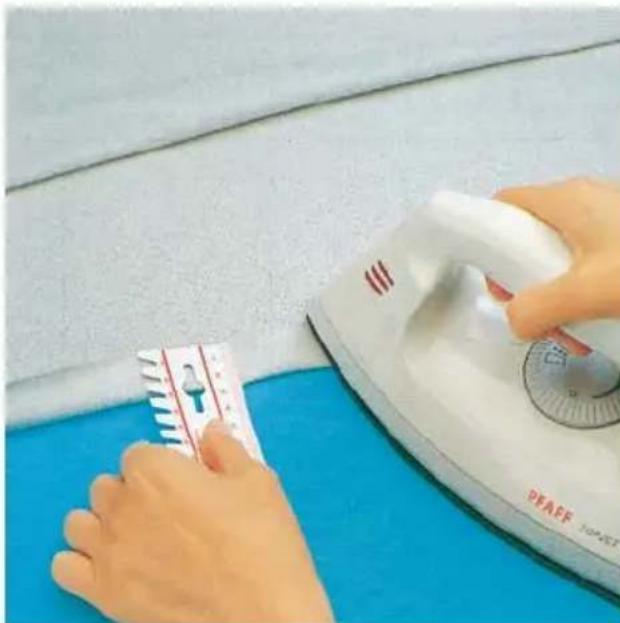
Close-up of hands using a white ironing iron on a blue surface next to a white cloth, with no visible text or symbols.Preparing the fabric:
When not using the H2 optional accessory guide, it is useful to press under the fabric edge before hemming it. The width of fabric to be pressed under must be 0.5 cm wider than the fi nished hem width. Example: Press under a one inch (2.5 cm) fabric width to sew a fi nished hem of 3/4 inch (2 cm).
Note: Set the seam width at 3.5 cm.
natural_image
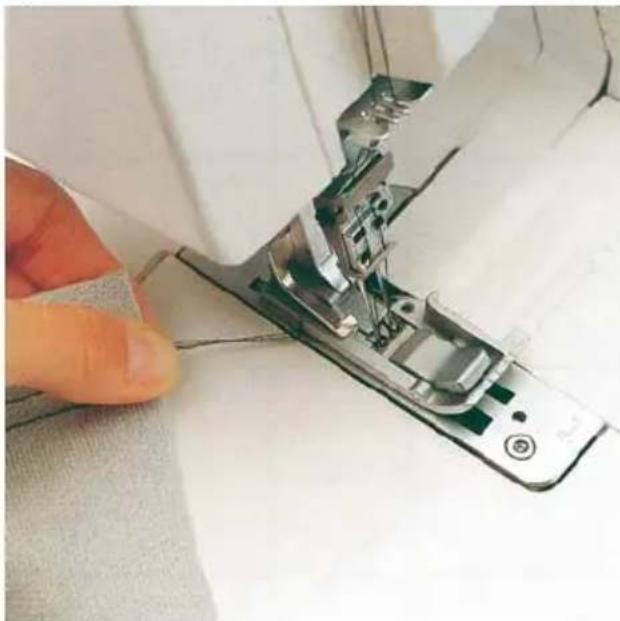
Close-up of a hand using a sewing machine to cut fabric, showing needle and clasp mechanism (no text or symbols visible)Finishing sewing:
- When sewing to the end of the fabric: Tightly hold the threads at the end of the seam. Sew slowly off the fabric while lightly pulling the threads toward the rear of the machine.
Note: The differential feed may need to be adjusted slightly to allow your fabric to lie perfectly smooth. Test your settings fi rst on a piece of scrap fabric.
natural_image
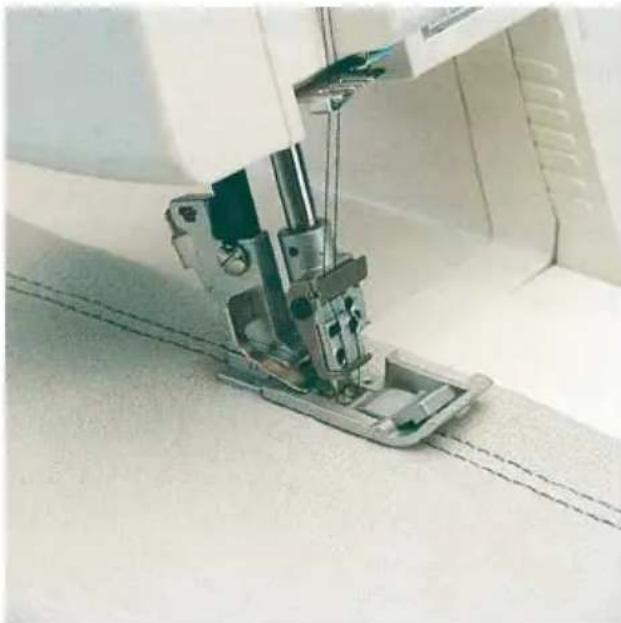
Close-up of a sewing machine needle stitching white fabric, no visible text or symbols- If sewing on a tubular item, i.e. pant or sleeve hem:
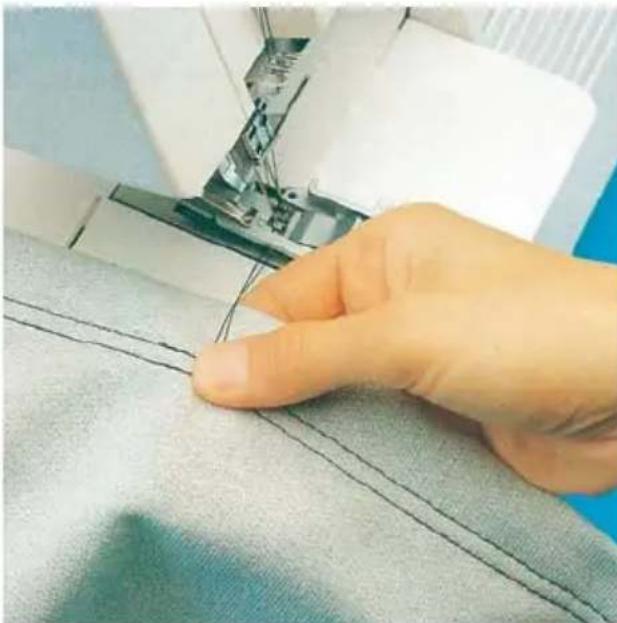
Sew around tubular item, oversewing 4-5 stitches at the beginning of your seam ' After the last stitch, turn the hand wheel towards you until the needles pierce the fabric and you have heard each needle "click" (just before the needles are in the lowest position).
natural_image
Close-up of a hand sewing a garment with visible stitching lines (no text or symbols)After the second "click" tum the handwheel away from you until the needles are in their highest position. Raise the presser foot (this will release the tension on the threads). Hold the threads tightly at the end of the seam and pull the fabric from the machine. Cut the threads. Pull the threads through to the back of the fabric and knot them.

natural_image
Close-up of a sewing machine needle stitching metal components, with a red arrow labeled 'A' pointing to a component (no text or symbols on the main subject)Edge guide
Push the edge guide (included in your accessory box) into the guide holder A from the left. The edge guide can be set as required by sliding it to the left or right.

natural_image
Close-up of a sewing machine needle stitching on a textured fabric background (no visible text or symbols)The edge guide is useful for serging searm at regular intervals with the cover stitch or two thread chainstitch.
text_image
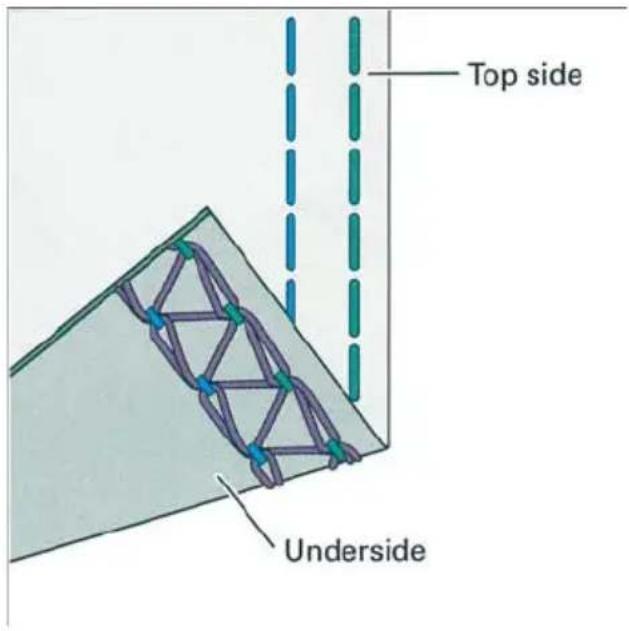
Top side UndersideStitch formation correction measures cover stitch
Program 02
When all tensions are correctly set, the needle threads (green and blue) are just slightly visible on the underside of the fabric. The looper thread (violet) is situated loosely in between.

text_image
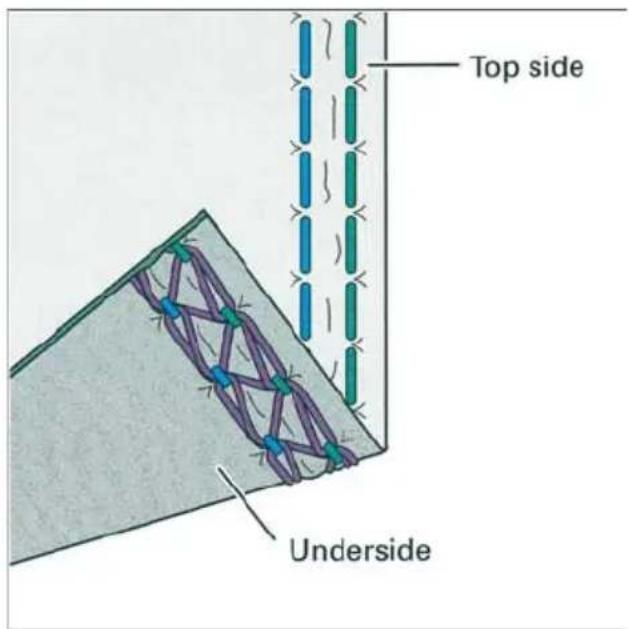
Top side UndersideThe right needle thread (green) is too loose, causing large loops on the underside of the fabric.
Set the green thread tension to a higher value.
text_image
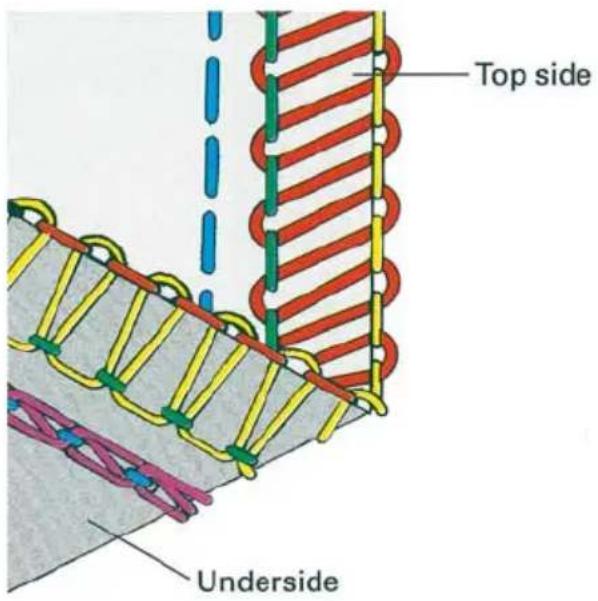
Top side UndersideThe needle threads (green and blue) are set too tightly causing folds in the fabric.
Set the green and blue thread tension to a lower value.
text_image
Top side Underside5-thread safety-stitch seam
Program 09
Since the 5-thread safety stitch seam consists of the 2-thread chainstitch and the 3-thread overedge seam, you can refer to the correction possibilities of these seam below and on page 49.

text_image
Top side Underside2-thread chainstitch
Program 01
When all tensions are correctly set, the needle thread (blue) is just slightly visible on the underside of the fabric.

text_image
Top side Underside4-thread safety-stitch seam
Program 08
Since the 4-thread safety stitch seam consists of the 2-thread chainstitch and the 2-thread flatlock, you can refer to the correction possibilities of these seam below and on page 51.
Note: Attach the converter (see page 32), when sewing a 4-thread safety stitch seam.
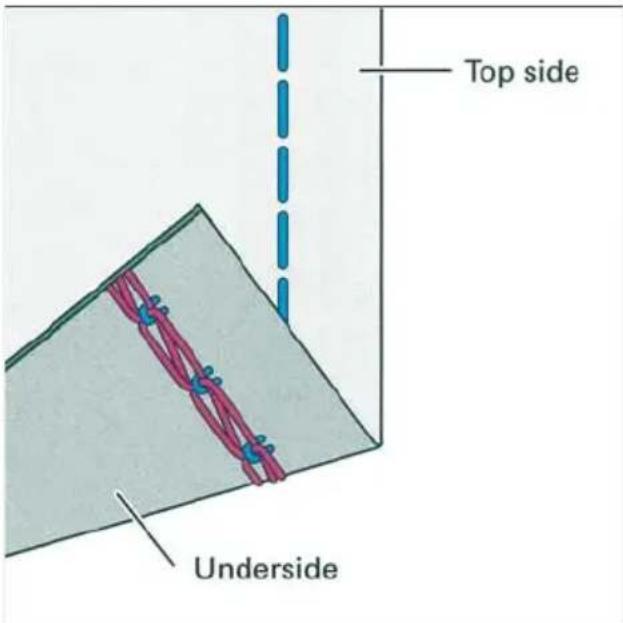
text_image
Top side UndersideThe needle thread (blue) is too loose, causing larger needle thread loops on the underside of the fabric.
Set the blue thread tension to a higher value.

text_image
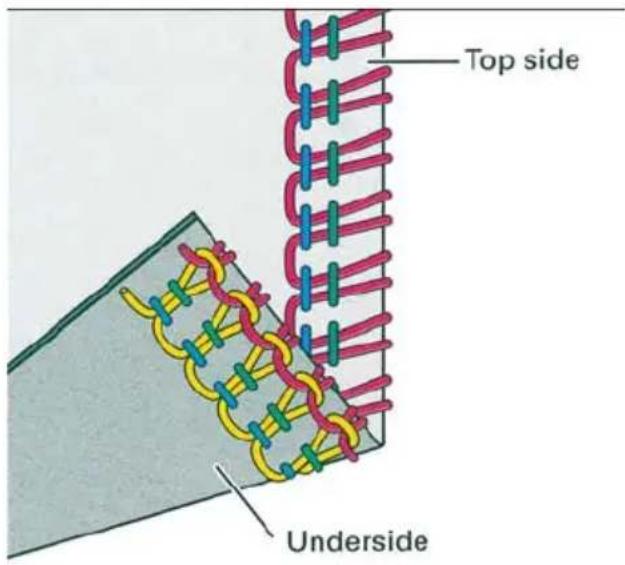
Top side Underside4-thread overedge seam
Program 07
When all tensions are correctly set, the loops of both looper threads (pink and yellow) are directly on the edge of the fabric.

text_image
Top side UndersideThe needle threads (blue and green) are too loose, causing larger loops of needle thread on the underside of the fabric.
Set the blue and green thread tension to a higher value.
text_image
Top side UndersideThe upper looper thread (pink) appears on the underside of the fabric.
Set the pink thread tension to a higher value and/or the yellow thread tension to a lower value.

text_image
Top side UndersideThe lower looper thread (yellow) appears on the top side of the fabric.
Set the yellow thread tension to a higher value and/or the pink thread tension to a lower value.
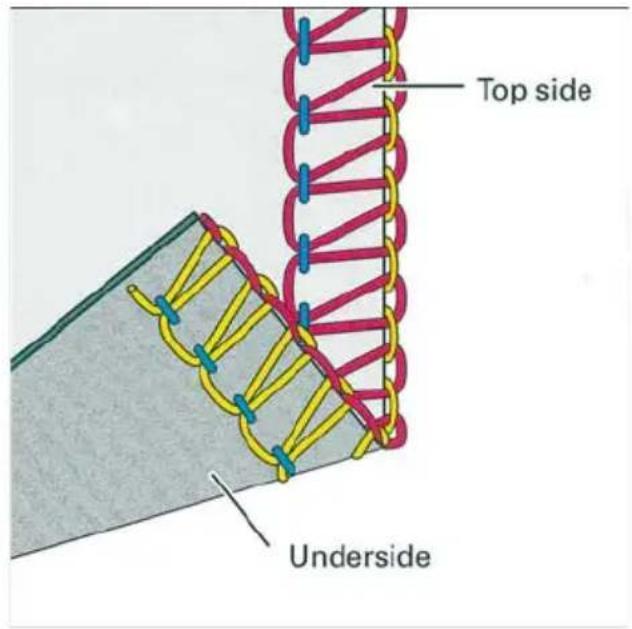
text_image
Top side Underside3-thread overedge seam
narrow and wide
Program 05 and 06
When all tensions are correctly set, the loops of both looper threads (pink and yellow) are directly on the edge of the fabric.
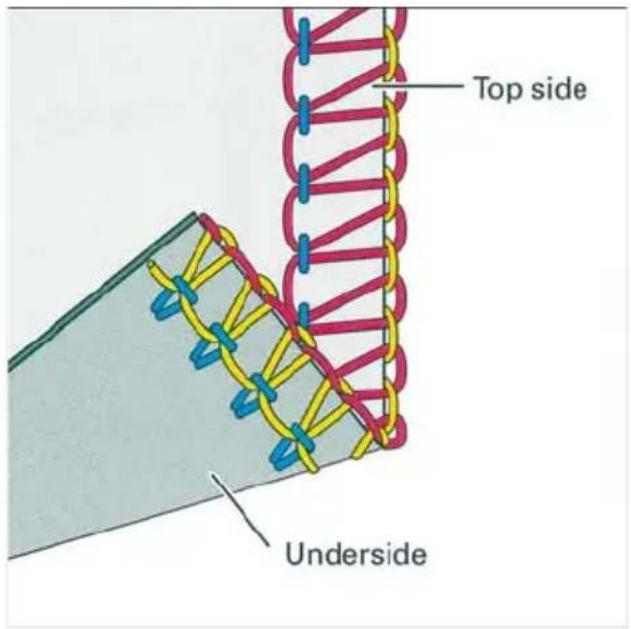
text_image
Top side UndersideThe needle thread is too loose, causing loops on the underside of the fabric.
Set the relevant needle thread tension to a higher value.

text_image
Top side UndersideThe upper looper thread (pink) appears on the underside of the fabric.
Set the pink thread tension to a higher value and/or the yellow thread tension to a lower value.
text_image
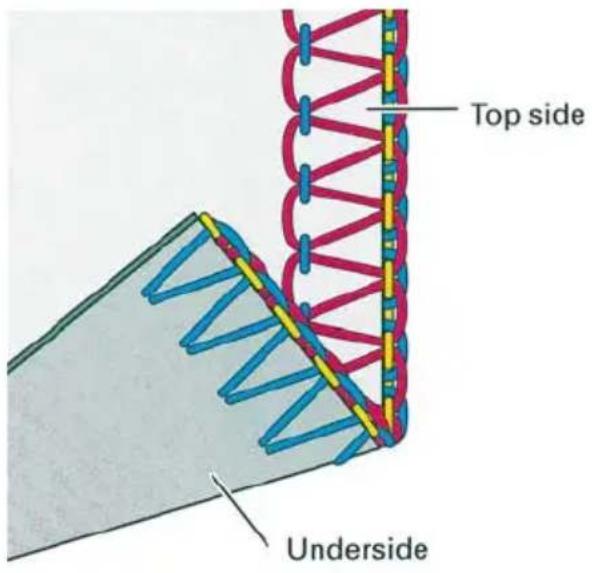
Top side UndersideThe lower looper thread (yellow) appears on the top side of the fabric.
Set the yellow thread tension to a higher value and/or the pink thread tension to a lower value.
text_image
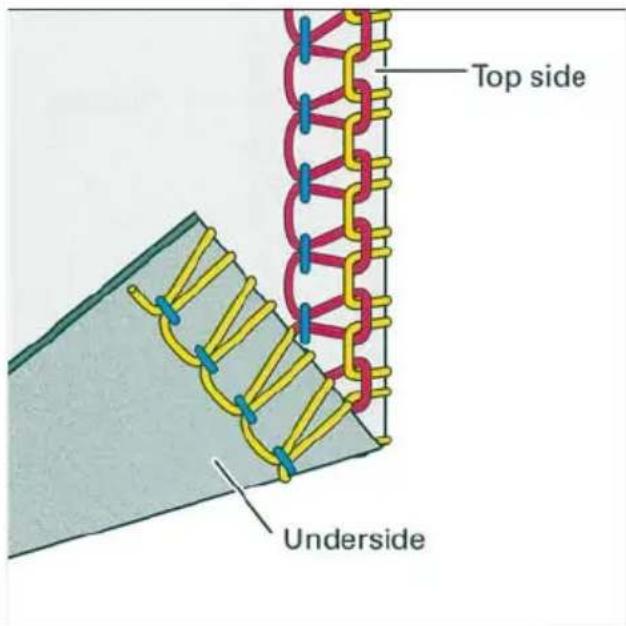
Top side Underside3-thread fl atlock narrow and wide Program 16 and 18

text_image
Top side UndersideThe needle thread is too tight. Set the needle thread tension (blue) to a lower value.

text_image
Top side UndersideThe upper looper thread (pink) appears on the underside of the fabric.
Set the pink thread tension to a higher value.

text_image
Top side UndersideThe lower looper thread (yellow) is too loose. Set the yellow thread tension to a higher value.

text_image
Top side Underside2-thread fl atlock
narrow and wide
Program 03 and 04
When all tensions are correctly set, the loops of both threads are directly on the underside of the fabric.
Note: The converter (see page 32) must be attached to sew the 2-thread fl atlock seam.
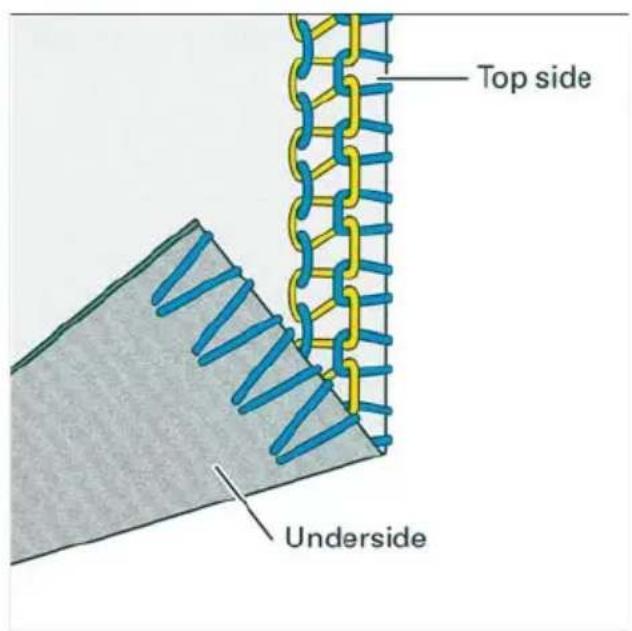
text_image
Top side UndersideThe needle thread is too loose or the lower looper thread (yellow) is too tight.
Set the relevant needle thread tension to a higher value and/or the yellow thread tension to a lower value.
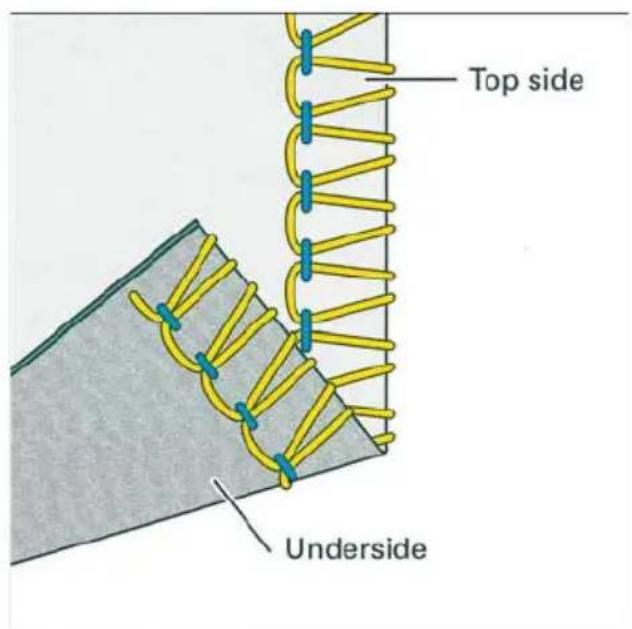
text_image
Top side UndersideThe lower looper thread (yellow) is too loose and/or the needle thread is too tight.
Set the yellow thread tension to a higher value and/or the relevant needle thread tension to a lower value.

text_image
Top side Underside3-thread rolled hem Program 14
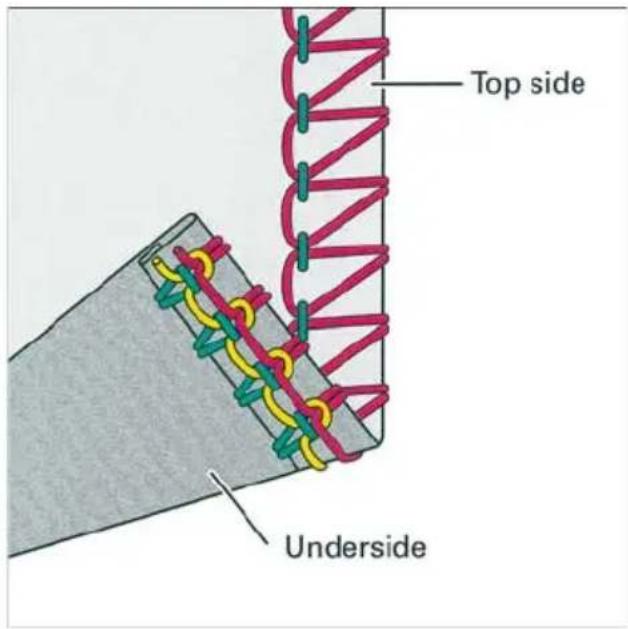
text_image
Top side UndersideThe upper needle thread (green) is too loose. Set the green thread tension to a higher value
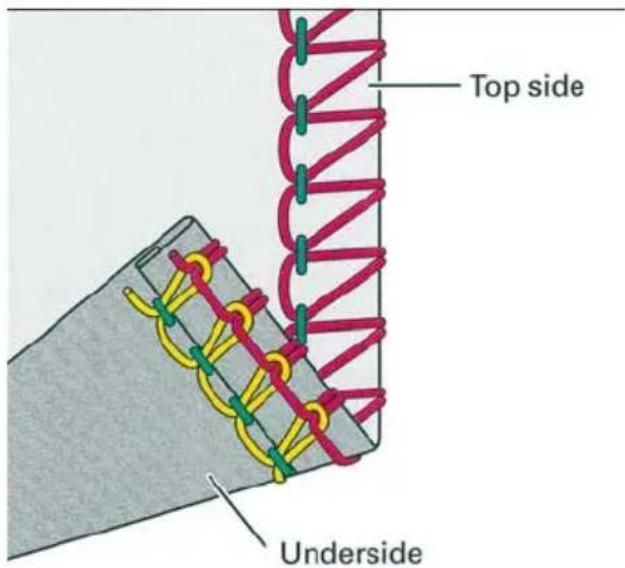
text_image
Top side UndersideThe upper looper thread (pink) appears on the underside of the fabric.
Set the pink thread tension to a higher value and/or the yellow thread tension to a lower value.
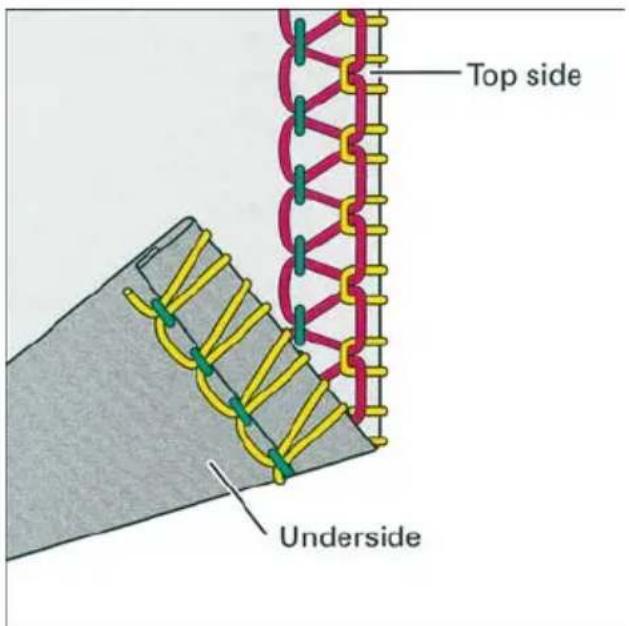
text_image
Top side UndersideThe lower looper thread (yellow) appears on the top side of the fabric.
Set the yellow thread tension to a higher value and/or the pink thread tension to a lower value.
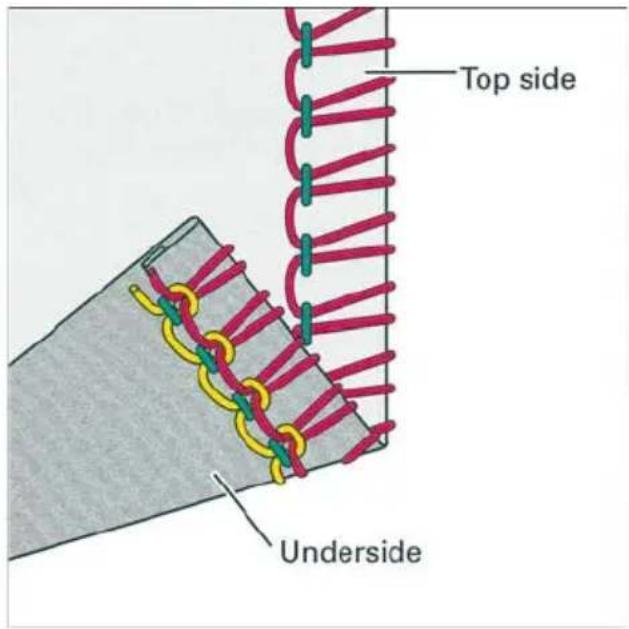
text_image
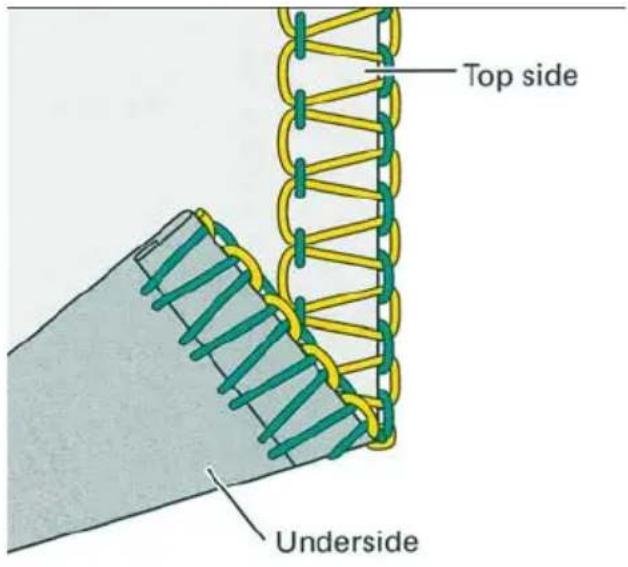
Top side Underside3-thread rolled hem (folded) Program 15

text_image
Top side UndersideThe upper needle thread (green) is too loose. Set the green thread tension to a higher value.
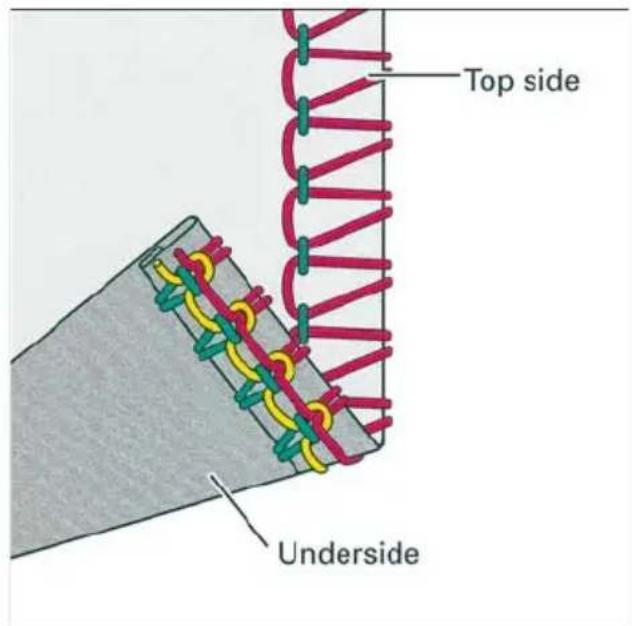
text_image
Top side UndersideThe upper looper thread (pink) only partly loops around the fabric edge.
Set the pink thread tension to a lower value and/or the yellow thread tension to a higher value.
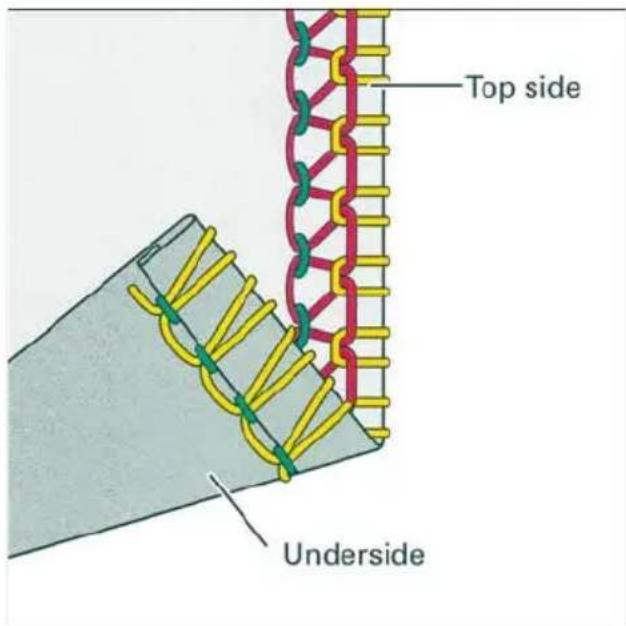
text_image
Top side UndersideThe lower looper thread (yellow) appears on the top side of the fabric.
Set the yellow thread tension to a higher value and/or the pink one to a lower value.
text_image
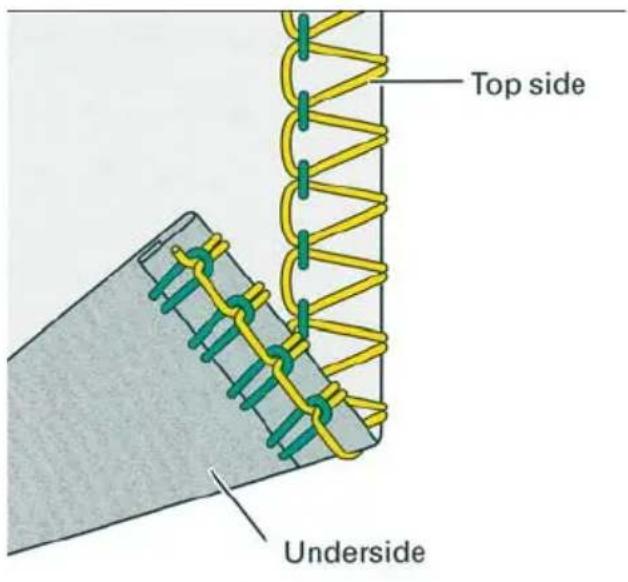
Top side Underside2-thread rolled hem
Program 12
Note: The converter (see page 32) must be attached to sew the 2 thread rolled hem.
text_image
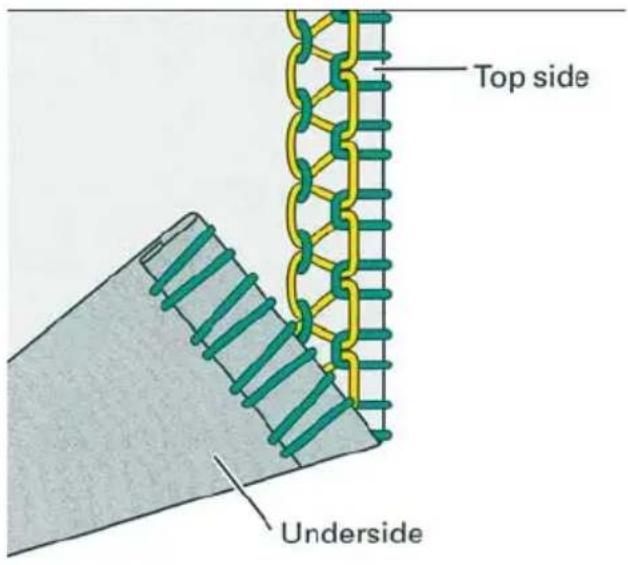
Top side UndersideThe upper needle thread (green) is too tight. Set the green thread tension to a lower value and/or the yellow thread tension to a higher value.
text_image
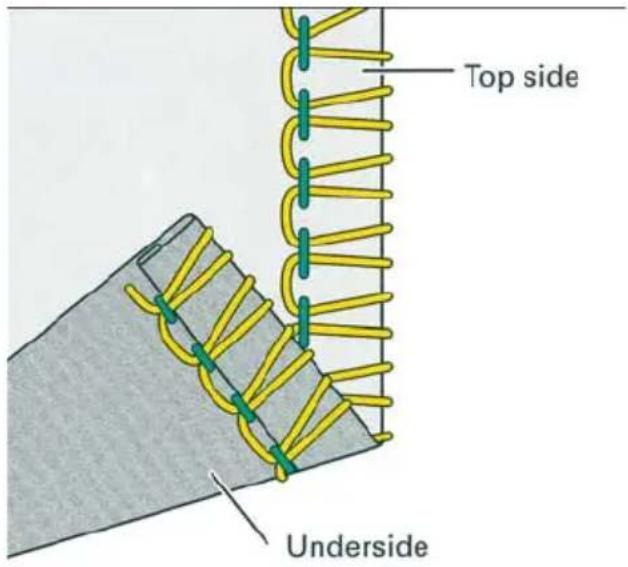
Top side UndersideThe lower looper thread (yellow) is too tight. Set the yellow thread tension to a lower value and/or the green thread tension to a higher value.
text_image
Top side Underside2-thread rolled hem (folded)
Program 13
Note: The converter (see page 32) must be attached to sew the 2 thread rolled hem.

text_image
Top side UndersideThe upper needle thread (green) is too loose.
Set the green thread tension to a higher value and/or the yellow thread tension to a lower value.

text_image
Top side UndersideThe lower looper thread (yellow) is too loose.
Set the yellow thread tension too a higher value.

text_image
Top side Underside2-needle 3-thread assembly seam
Program 10
Note: The converter (see page 32) must be attached to sew the 2-needle 3-thread assembly seam.

text_image
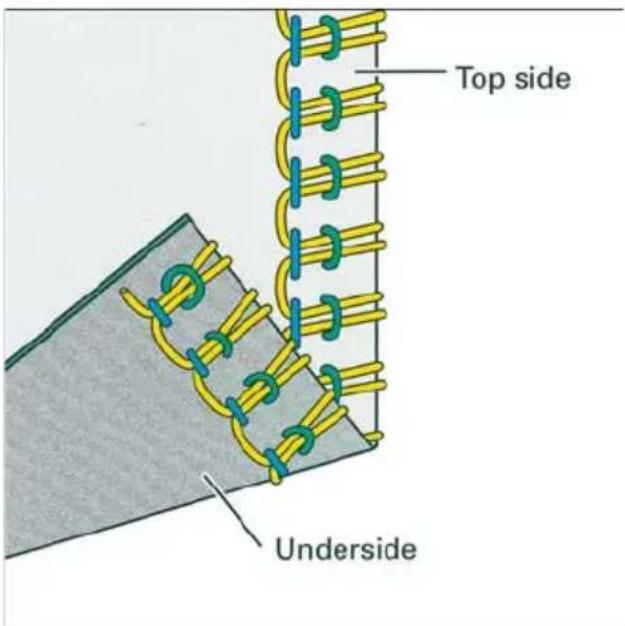
Top side UndersideThe lower needle thread (blue) is too loose. Set the blue thread tension to a higher value.
text_image
Top side UndersideThe upper needle thread (green) is too loose.
Set the green thread tension to a higher value.

text_image
Top side UndersideThe lower looper thread (yellow) is too tight.
Set the yellow thread tension to a lower value.
| Thread chart for 2-, 3- and 4-thread overedge seams | ||
| Fabric Thread Stitch length | ||
| Light fabrics:organdy, fi ne knitwear,taffeta, silk,lining fabrics | Cotton no. 50 - 70Synthetic thread no. 70 - 140 | 2.0 - 4.0 mm |
| Medium heavy fabrics:cotton, tricot, linen, dressfabrics | Cotton no. 40 - 60Synthetic thread no. 70 - 140 | 2.0 - 4.0 mm |
| Heavy fabrics: tweed, suitfabrics, denim, heavy cloth | Cotton no. 30 - 50Synthetic thread no. 70 - 140 | 2.0 - 4.0 mm |
| Knitwear: Cotton no. 40 - 60 | Synthetic thread no. 70 - 140 | 2.0 - 4.0 mm |
| 2- or 3-thread rolled hems Polyester thread no. 120 - 140Mercerized thread (bulk thread) | 1.0 - 2.0 mm | |
natural_image
Close-up of a sewing machine needle stitching a white fabric, with a hand adjusting the thread (no visible text or symbols)Machine maintenance
Cleaning the machine
Switch off the electrical power
Remove the waste container and open the looper cover and swivel plate. Disengage the upper blade (see page 30) and remove the presser foot and the needle plate.
Use the accessory brush provided to remove any waste thread from the upper and lower blades, the differential feed and the looper area.

natural_image
Close-up of a sewing machine's internal components with red arrows indicating parts (no visible text or symbols)Lubricating the machine
Switch off the electrical power
Move the upper overedge looper into its highest position. Lubricate the points shown above with the oil provided (located in the accessory box) every time you clean the machine. One or two drops of PFAFF sewing machine oil are sufficient. All other parts are manufactured from special materials and do not require any lubrication.

natural_image
Close-up of a hand cleaning a white sewing machine with a blue cloth (no text or symbols visible)Cleaning the rubber feet
Clean the rubber feet from time to time with alcohol. This ensures good stability.
text_image
A
natural_image
Close-up of a hand operating a sewing machine with black components, against a blue background (no visible text or symbols)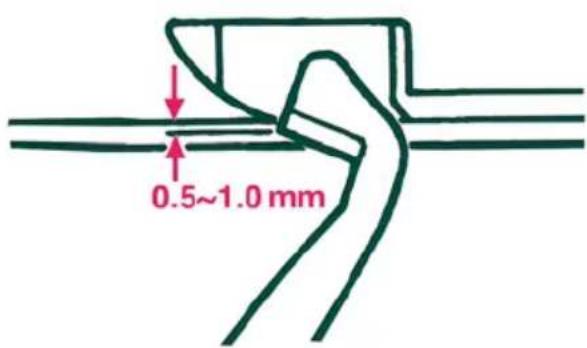
text_image
0.5~1.0 mmChanging the upper blade Switch off the electrical power
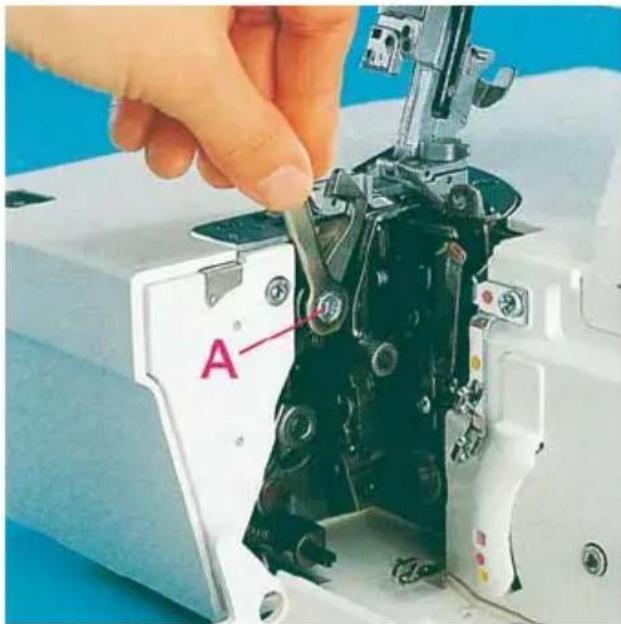
To remove: Set the adjusting knob for seam width to 3.5 mm. Fasten the upper blade (see page 39) before loosening the fastening screw (A) with the wrench provided in the accessory box. Then remove the upper blade.
To insert: Attach the new upper blade and gently tighten the fastening screw. Then turn the handwheel until the upper blade is in the lowest position.
In this position the front edge of the upper blade must be 0.5 to 1.0 mm lower than the cutting edge of the lower blade. When the upper blade has been properly inserted you can fully tighten the fastening screw. Loosen the screw to the movable upper blade.
natural_image
Close-up of a hand operating a sewing machine with a tool, against a blue background (no visible text or symbols)Changing the light bulb
Switch off the electrical power
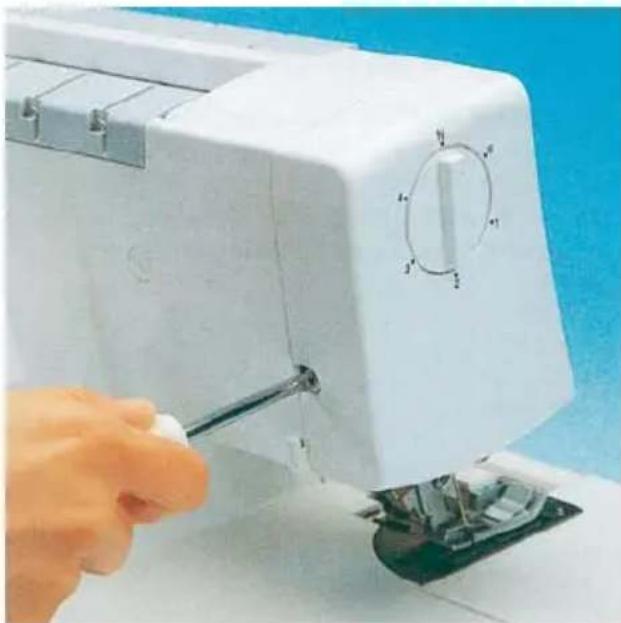
Using the screw driver in the accessory box loosen the fastening screw to the sewing light cover 16 until the cover can be removed.
natural_image
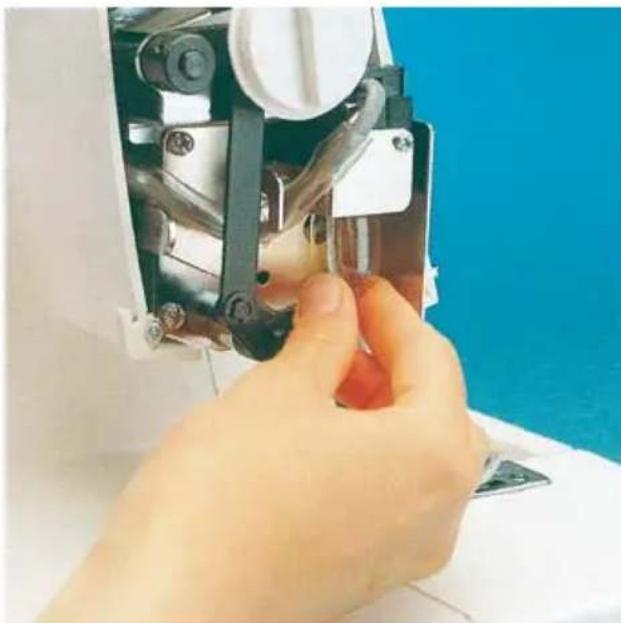
Close-up of a hand operating a sewing machine with metal clamps and a small component, against a blue background (no text or symbols visible)Push the light bulb fully into its socket. Rotate counter clockwise through half a turn and remove.

natural_image
Close-up of a hand operating a sewing machine with a small tool inserted, against a blue background (no visible text or symbols)Guide the new light bulb (max. 15 W) into the socket and twist until both pins on the bulb click into place. Press the bulb right into the socket, twisting it clockwise until it is securely fixed.
Replace the sewing light cover and tighten the fastening screw.
Sewing problems and their solutions
This machine has been developed with ease of operation in mind. No diffi cult or tricky set tings need to be made. Sewing problems of the kind described below may occur as a result of minor adjustment and operating errors. They can be easily adjusted by following the in structions.
| Problem Cause Solution | ||
| Needle breakage The | needle was bent or the point damaged.The needle was not fully inserted.The fabric was pulled too fi rmly. | Insert new needle (see page 13).Insert needle fully (see page 13).Do not pull on the fabric when sewing. |
| Thread breaks Incorrectly threaded.Thread has caught.Thread tension is too tight.Needle not fully insert.Incorrect needle used. | Thread properly (see page 14 - 23).Check if the thread is caught on the spool stand etc.Correct the tension (see page 46 - 56).Insert needle correctly (see page 13).Use needle system EL X 705. | |
| Skipping stitches Needle | bent or point damage.Needle not fully inserted.Incorrect needle used.incorrectly threaded. | Insert new needle (see page 13).Insert needle correctly (see page 13).Use needle system EL X 705.Thread properly (see page 14 - 23). |
| Stitch formation faulty | Incorrect setting of thread tension. | Re-set thread tensions (see page 46 - 56). |
| 3- or 4-thread overedge seam has an irregular appearance and the upper looper thread has not interlocked in the seam. | The converter is attached. The | converter must be removed (see page 32). |
| Machine will not operate although master switch is on. | Power supply interrupted. Close | looper cover (see page 8). |
| Fabric not neatly trimmed | Waste thread between upper and lower bladeUpper blade is blunt. | Clean blades.Replace upper blade (see page 59). |
| Puckered seams Thread | tension too tight.Incorrect setting of differential feed.Thread has caught due to incorrect threading | Reduce thread tension.Re adjust differential feed (see pages 36, 37).Thread correctly (see pages 14 - 23). |
| Fabric not fed through evenly | Stitches too short.Sewing foot pressure too low for heavy fabrics.Sewing foot pressure too high for lightweight fabrics. | Increase stitch length (see page 38).Increase sewing foot pressure (see page 28).Reduce sewing foot pressure (see page 28). |
Optional accessories
This machine offers a wide range of optional accessories for special serging details. Consult your PFAFF dealer.
| Optional accessory Order No. Use | ||
| Multi-purpose foot M 29 | 924 993 82-002 Foot, | to which guides H1, H2 and H3 can be attached. |
| Lace and braiding guide H1 | 29 924 993 82-003 Guide for applying lace or braiding (to the under side of the fabric). | |
| Hemmer guide H2 29 92 | 4 993 82-001 Guide for hemming/turns under one inch while serging. | |
| Bias tape guide H3 29 92 | 4 993 82-004 Guide for applying bias tape as edging. | |
| Clear foot N 29 924 993 | 82-006 Presser foot with groove.It can be used together with guide N1. | |
| Fancy stitch guide NI 29 | 924 993 82-007 For stitching down a double chainstitch or a 3 thread overedge seam and for decorative effects. | |
| Faggoting guide F2 29 92 | 24 993 82-008 Guide for edge joining two pieces of fabric with consistent clearance. Use transparent presser foot F from the accessory box. | |
| Lace guide F3 29 924 993 | 82-005 Guide for applying lace (on the top side of the fabric). Use transparent presser foot F from the accessory box. | |
| Flat-felled-seam guide F4 | 29 924 993 82-009 Guide for sewing fl at-felled seams. Use transparent presser foot F from the accessory box. | |
| Cording foot K 29 924 993 | 82-011 For serging pintucks with the cording tomgue K1 and the guide K2 | |
| Cording tongue K1 29 924 | 993 82-012 For serging pintucks. | |
| Cording guide K2 29 924 | 993 82-010 For serging pintucks with gimp thread. | |
| Strap and belt loop foot L | 29 924 993 82-013 For sewing belt loops and straps, and for ornamental stitches with a cover stitch. | |
| Universal tape binder 29 | 924 993 82-014 For binding fabric edges with various widths of pre-made bias tape. | |
| Beading foot P 29 924 993 | 82-015 For serging on beading and sequins. | |
| Bead needle plate P | 29 924 993 82-016 The bead needle plate P together with the beading foot P allows you to serge on beading and make a rolled hem simultaneously. | |
| Multi-purpose foot C 29 | 924 993 82-017 For sewing on bands, elastic tape, elastic thread and fi shing line together with the various elastic tape inserts. | |
| Elastic tape insert 7.5 mm | 29 924 993 82-034 For sewing on elastic tape with a width up to 7.5 mm. | |
| Elastic tape insert 10 mm | 29 924 993 82-035 For sewing on elastic tape with a width from 7.5 mm - 10 mm. | |
| Elastic tape insert 13 mm | 29 924 993 82-036 For sewing on elastic tape with a width from 10 mm - 13 mm. | |
| Shirring/Gathering foot G | 29 924 993 82-018 For shirring/gathering and joining two pieces of fabric simultaneously. | |
| Blindstitch foot D 29 924 | 993 82-019 For serging blind hems and ornamental seams. | |
| Band and braiding foot Q | 29 924 993 82-020 For sewing on bands and braiding. Gimp cords and thread and bands with decorative threads can be stitched over using this foot together with guide K2. | |
| Piping and welting foot E | 29 924 993 82-028 Presser foot for guiding and sewing in piping and welting. | |
| Accessory holder 29 924 | 993 82-021 Holder, to which the following accessories together with the retaining screw and the swiveling arm can be attached. | |
| Retaining screw 29 924 | 993 82-023 For securing the following accessories to the accessory holder. | |
| Edge guide with units of measurement | 29 924 993 82-022 For guiding the fabric edge and measuring cut widths and seam widths simultaneously (use the machine's standard presser foot). | |
| Gathering/Shirring tongue | 29 924 993 82-027 For gathering/shirring and joining two pieces of fabric simultaneously (use the machine's standard presser foot). | |
| Tape binder 40 mm 29 | 924 993 82-031 For binding the fabric edge with 40 mm tape. Binding width 10 - 12 mm. (Use the machine's standard presser foot.) | |
| Swiveling arm 29 924 | 993 82-024 For attaching the following accessories to the accessory holder. | |
| Curved seam guide 29 | 924 993 82-025 For serging a curved piece to a straight piece of fabric (use the machine's standard presser foot). | |
| Piping and welting accessory | 29 924 993 82-030 Together with piping foot E, for binding and guiding piping and gimp between two layers of fabric. | |
Specifications
Maximum sewing speed 1300 stitches/min.
Seam width 1.4 mm - 9.0 mm
Cover stitch width 5 mm
Stitch length 0.5 mm - 4 mm
Presser foot exchangeable
Lubrication
manual
Presser foot height 4.5 mm
Overedge stroke 2.0 mm
Needle system EL X 705, cat no. 2002
Needle siw 80/12, 90/14
Number of threads 2,3,4,5
Dimensions (width x height x depth) 355 x 290 x 300 mm
Weight
8.6
Packing contents
1 machine
1 foot control
1 instruction manual/guarantee card
1 waste container
1 machine cover
1 accessory box
1 power table
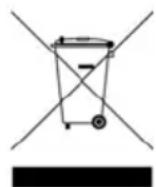
Please note that on disposal, this product must be safely recycled in accordance with relevant National legislation relating to electrical/electronic products. If in doubt please contact your retailer for guidance.
Intellectual property
Patents protecting this product are listed on a label positioned underneath the sewing machine.
PFAFF and IDT (image) are registered trademarks or trademarks of VSM Group AB.
Parts of the coverlock 4852
31 Thread guides with color coding
32 Telescoping thread guide
33 Thread chain cutter
34 Thread spool stand
35 Thread spool pin
36 Cone thread adapter
37 Spool disc
38 Electrical power master switch
39 Machine socket, foot control
40 Handwheel
41 Regulator wheel for differential feed
42 Stitch length adjustment knob
43 Presser foot lifter
44 Rear thread guides
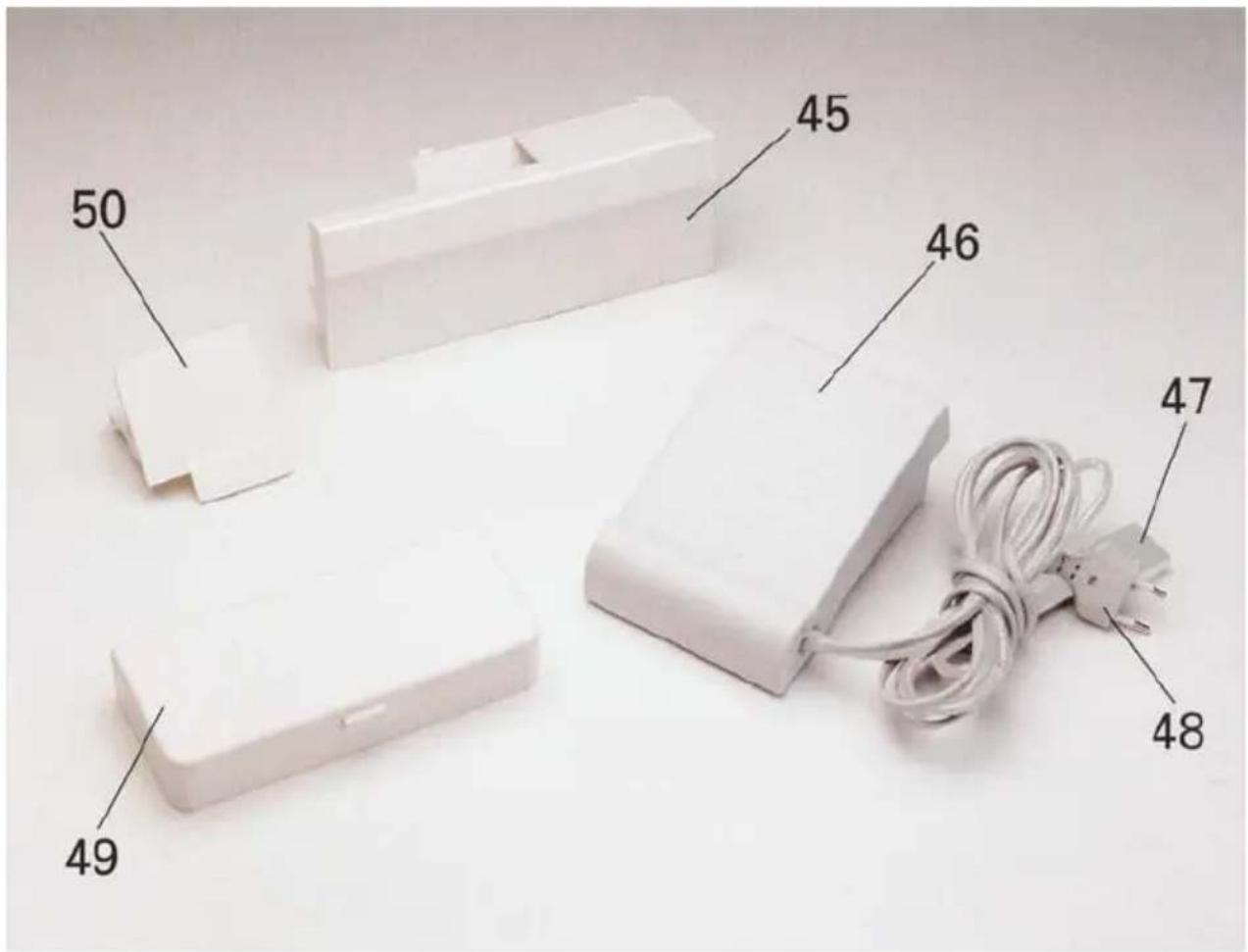
45 Waste container
46 Foot control
47 Foot control plug for machine
48 Power cord
49 Accessory box
50 Power table

text_image
31 32 33 44 43 42 41 40 38 39 37 36 35 34