ClassicStyle home 1529 - Sewing machine PFAFF - Free user manual and instructions
Find the device manual for free ClassicStyle home 1529 PFAFF in PDF.


User questions about ClassicStyle home 1529 PFAFF
0 question about this device. Answer the ones you know or ask your own.
Ask a new question about this device
Download the instructions for your Sewing machine in PDF format for free! Find your manual ClassicStyle home 1529 - PFAFF and take your electronic device back in hand. On this page are published all the documents necessary for the use of your device. ClassicStyle home 1529 by PFAFF.
USER MANUAL ClassicStyle home 1529 PFAFF
text_image
PFAFF PFAFF CassadockClassicStyle
home 1529
Owner's manual

text_image
PFAFF ClassicStyle Name 1 2 3 4 5 6 7 8 9 10 11 12 13 16 17 18
text_image
PFAFF ClassicStyle 21 19 20 27 26 25 22 23 24Machine Overview
-
Connection socket "foot control with main cord"
-
Main switch
-
Handwheel release disk
-
Handwheel
-
Bobbin winder
-
Lid with stitches
-
Extra spool holder
-
Spool holder with spool cap
-
Take-up lever
-
Needle thread tension dial
-
Threading slots
-
Thread cutter
-
Presser foot holder with presser foot
-
Removable accessory tray
-
Base plate
-
Needle holder with fi xing screw
-
IDT System / Integrated Dual Feed
-
Presser foot lifter
-
Stitch width dial
-
Needle position dial
-
Carrying handle
-
Stitch selection
-
Button for "reverse sewing"
-
Stitch length dial
-
Needle plate
-
Thread guide
-
Sewing lamp (max. 15 watt)
Some fabrics have a lot of excess dye which can cause discoloration on other fabric but also on your sewing machine. This discoloring may be very diffi cult or impossible to remove. Fleece and denim fabric in especially red and blue often contain a lot of excess dye. If you suspect that your fabric/ready-to-wear garment contains a lot of excess dye, always pre-wash it before sewing to avoid the discoloring.
Presser feet (normal accessories)
For more information about accessories, please contact your PFAFF dealer.
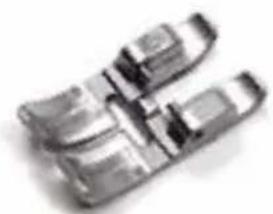
0 Standard Presser Foot with IDT
Part No. 820250-096 (pictured) (select 1546 and 1536)
Part No. 820258-096 (select 1526)
1 Clearview Foot
(Fancy-stitch foot without IDT)
Part No. 820229-096
3 Blindhem/Overlock Foot with IDT
Part No. 820256-096 (pictured) (select 1546 and 1536)
Part No. 820264-096 (select 1526)
4 Zipper Foot with IDT
Part No. 820248-096 (pictured) (select 1546 and 1536)
Part No. 820261-096 (select 1526)
5 Buttonhole Foot
Part No. 820295-096

text_image
31045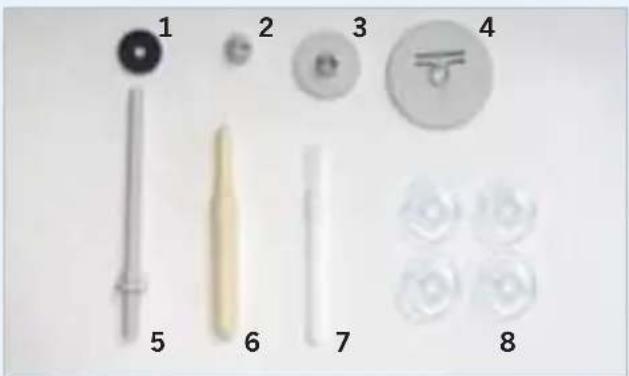
text_image
1 2 3 4 5 6 7 81 Felt pad
Part No. 93-033 064-05
2-4 Spool cap
-
Part No. 93-036 048-44
-
Part No. 93-035 050-44
-
Part No. 93-036 049-44
5 Extra spool pin
Part No. 93-033 063-44
6 Seam ripper
Part No.99-053-016-91
7 Brush
Part No. 93-847 979-91
8 Bobbins
Part No. 93-040 970-45
Stitches
Stitch descriptions are found in the introduction section.
| PFAFF 1529 | 5 | 5 | 5 | 5 | 5 | 5 | 0/1 | 0/1 | 0/1 | 0/1 | 0 | 0/1 | 0/3 | 0/1 | 0 | 1 | 3 | 4 | 5 | |||||||||||||||||||||||||||||||||||||||||||||||||||||||||||||||||||||||||||||||||||||||||||||
| stretch | ||||||||||||||||||||||||||||||||||||||||||||||||||||||||||||||||||||||||||||||||||||||||||||||||||||||||||||||||
ClassicStyle home ^1529
Enjoy the creativity of home style sewing!
Congratulations!
You have purchased a top quality Pfaff sewing machine with great features to create textiles and accessories for your home.
To learn about your ClassicStyle home ^1529 , follow the instructions for the select ^1536 .
Your ClassicStyle home ^1529 has the same features as the select ^1536 except from some stitches and accessories. In this manual other accessories are described, they are optional and can be purchased from your Pfaff dealer.
You will find the overview of the stitches and presserfeet included with your ClassicStyle home ^1529 on the next page.
www.pfaff.com
You are invited to www.pfaff.com to discover the wonderful features of your new sewing machine. Here you will find inspiration in creative sewing projects and learn more about the special accessories available for your machine.
This household sewing machine is designed to comply with IEC/EN 60335-2-28 and UL1594.
IMPORTANT SAFETY INSTRUCTIONS
When using an electrical appliance, basic safety precautions should always be followed, including the following:
Read all instructions before using this household sewing machine.
DANGER - To reduce the risk of electric shock:
- A sewing machine should never be left unattended when plugged in. Always unplug this sewing machine from the electric outlet immediately after using and before cleaning.
• Always unplug before relamping. Replace bulb with same type rated 15 Watt.
WARNING - To reduce the risk of burns, fire, electric shock, or injury to persons:
- Do not allow to be used as a toy. Close attention is necessary when this sewing machine is used by or near children or infirm persons.
- Use this sewing machine only for its intended use as described in this manual. Use only attachments recommended by the manufacturer as contained in this manual.
- Never operate this sewing machine if it has a damaged cord or plug, if it is not working properly, if it has been dropped or damaged, or dropped into water. Return the sewing machine to the nearest authorized dealer or service center for examination, repair, electrical or mechanical adjustment.
- Never operate the sewing machine with any air openings blocked. Keep ventilation openings of the sewing machine and foot controller free from the accumulation of lint, dust, and loose threads.
- Keep fingers away from all moving parts. Special care is required around the sewing machine needle.
• Always use the proper needle plate. The wrong plate can cause the needle to break. - Do not use bent needles.
- Do not pull or push fabric while stitching. It may deflect the needle causing it to break.
- Switch the sewing machine off ("0") when making any adjustment in the needle area, such as threading needle, changing needle, threading bobbin, or changing presser foot, etc.
- Always unplug the sewing machine from the electrical outlet when removing covers, lubricating, or when making any other user servicing adjustments mentioned in the instruction manual.
- Never drop or insert any object into any opening.
- Do not use outdoors.
- Do not operate where aerosol (spray) products are being used or where oxygen is being administrated.
- To disconnect, turn all controls to the off ("0") position, then remove plug from outlet.
- Do not unplug by pulling on cord. To unplug, grasp the plug, not the cord.
SAVE THESE INSTRUCTIONS
Contents
Introduction
Standard accessories IV
Stitch table VI
1. Operate your Pfaff select
Electrical connection 1:2
Removable accessory tray 1:3
Bobbins 1:4
Bobbin case 1:8
Threading the needle 1:10
Needle threader 1:11
Pulling up the bobbin thread 1:12
Presser foot lifter 1:13
Thread cutter 1:12
Changing the presser foot 1:13
IDT System/Integrated Dual Feed 1:14
Changing the needle 1:15
Needle thread tension 1:15
Lowering the feed dog 1:15
Stitch width dial 1:16
Needle position dial 1:16
Reverse sewing 1:17
Stitch length dial 1:17
Stitch selection 1:18
2. Utility stitches and practical sewing
Sewing chart 2:2
General sewing aids 2:3
Non-elastic stitches 2:4
Elastic stitches 2:6
Overlock stitches 2:8
Covering stitches 2:10
Buttonhole 2:12
Button sewing 2:14
Hemming with the twin needle 2:15
Smocking 2:15
Gathering 2:16
Darning 2:17
Sewing on zippers 2:19
Stabilizing edges 2:22
Sewing lace 2:23
Shell edging 2:24
3. Decorative sewing and embroidery techniques
Sewing table for decorative
sewing 3:2
Decorative stitches 3:3
Monograms 3:4
Embroidering with the dense
zigzag stitch/Tapering 3:5
Appliqué 3:7
Richelieu 3:8
Eyelet embroidery 3:8
Patchwork quilt 3:9
Hemstitching 3:10
4. Maintenance and trouble-shooting
Changing the needle plate 4:2
Cleaning 4:2
Replacing the sewing lamp 4:3
Trouble-shooting 4:4
Index 4:6
Presser feet (normal accessories)
For more information about accessories, please contact your PFAFF dealer.
0 Standard Presser Foot with IDT
Part No. 820250-096 (pictured)
(select 1546 and 1536)
Part No. 820258-096
(select 1526)
1 Fancy Stitch Foot, with IDT
Part No. 820253-096
(select 1546)
1 Clearview Foot
(Fancy-stitch foot without IDT)
Part No. 820229-096
3 Blindhem/Overlock Foot with IDT
Part No. 820256-096 (pictured)
(select 1546 and 1536)
Part No. 820264-096
(select 1526)
4 Zipper Foot with IDT
Part No. 820248-096 (pictured)
(select 1546 and 1536)
Part No. 820261-096
(select 1526)
natural_image
Close-up of metallic mechanical components with no visible text or symbols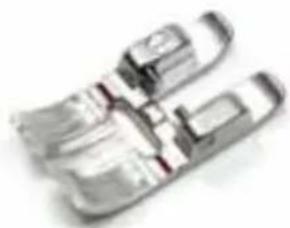
natural_image
Close-up of metallic mechanical components with no visible text or symbols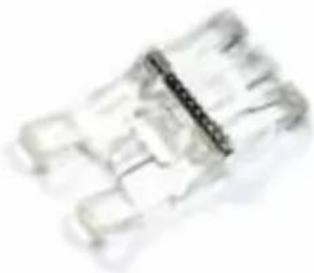
natural_image
Close-up of a transparent plastic mechanical component with a central rod (no visible text or symbols)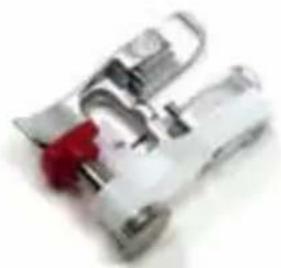
natural_image
Close-up of metallic mechanical components with a red accent, no visible text or symbols
natural_image
Close-up of a metallic electrical connector component (no visible text or symbols)
5 Buttonhole Foot
Part No. 820295-096
6 Darning Foot
Part No. 820243-096
(select 1546)
7 Rolled Hem Foot, 3 mm
Part No. 820249-096
(select 1546)
8 Edge Guide/Quilting Guide
Part No. 820251-096

text_image
1 2 3 4 5 6 7 81 Felt pad
Part No. 93-033 064-05
2-4 Spool cap
-
Part No. 93-036 048-44
-
Part No. 93-035 050-44
-
Part No. 93-036 049-44
5 Extra spool pin
Part No. 93-033 063-44
6 Seam ripper
Part No.99-053-016-91
7 Brush
Part No. 93-847 979-91
8 Bobbins
Part No. 93-040 970-45
Stitch table (non-elastic stitches)

text_image
As Bs Cs Dos Ean Fan Gan Gun Gun Gun Hao Ios Koo Lon Min IGan LCan LGan Llan MDFonselect 1546

text_image
Aa Bs Cs Bs Dt Eat EaE EaE EaF GaH Hs Ios Kaselect 1536 & select 1526
Stitch Description Application
1546 1536/1526
| A/ B/C | A/B/C | Buttonhole Standard buttonhole for blouses or bed linens | |
| D | H | Blind stitch with zigzag (elastic) | For invisible hemming with simultaneous seam/ overcasting. Especially for stretch material |
| E | - | Greek stitch with zigzag A traditional decorative stitch e.g. for towel borders | |
| F | - | Scallop stitch A traditional decorative stitch e.g. for towel borders | |
| G | E | Straight stitch, 15 needle positions, stitch width dial set at 0 | For all straight stitching and topstitching work up to 6 mm |
| Zigzag stitch, 15 needle positions, stitch width dial set at 0.5 - 5 | For serging and appliqué. Also suitable for tapering, eyelet embroidery and cording work | ||
| Left needle position (for straight stitch and zigzag stitch) | Straight stitch: For all sewing and top-stitching operations which require a left needle position. Zigzag stitch: For serging, appliqué and tapering. | ||
| Center needle position operations. | Straight stitch: For most sewing and top-stitching operations. Zigzag for most zigzag operations | ||
| Right needle position (for straight stitch and zigzag stitch) | For all sewing and top-stitching operations which require a right needle position. Zigzag stitch: For serging, appliqué, tapering and cording work | ||
| H | - | Blind stitch For invisible hemming on sturdier materials | |
| I | K | Greek stitch, wide A traditional decorative stitch | |
| K | I | Shell-edging stitch For fl at overlapped seams | |
| L | - | Fancy elastic stitch For overcasting, sewing on elastic, darning tears and inserting patches | |
| M | F | Elastic stitch For overcasting, sewing on elastic, darning tears and inserting patches | |
| IG | - | Viennese stitch Decorative stitch e.g. for household textiles | |
| LC | - | Emperor stitch, narrow | A dainty decorative stitch |
| LG | - | Emperor stitch, wide | A dainty decorative stitch |
| LI | - | Greek stitch, narrow | A traditional decorative stitch |
| MDF | - | Decorative stitch | A traditional decorative stitch |
| - | G | Decorative stitch | Decorative stitch e.g. for quilting |
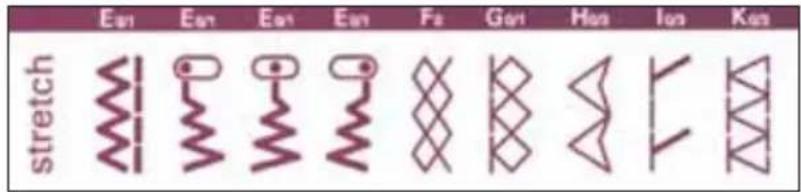
Stitch table (stretch stitches)
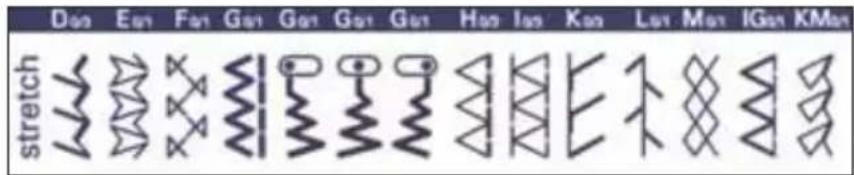
text_image
Doo Eun Fan Gan Got Got Gun Has Ios Kos Luy Mat IGan KMan stretchselect 1546
text_image
Ean Ean Ea En Fa Gnt Ha Is Ka stretchselect 1536 & select 1526
Stitch Description Application
1546 1536/1526
| D | H | Peacock's eye stitch Elastic closing and serging seam. The material must be turned by 180 degrees | |
| E | - | Cover stitch For top-stitching and overstitching stretch materials, e.g. cuffs, hems and panels | |
| F | - | Herringbone stitch A decorative stitch for top-stitching or whip stitching hems, e.g. pajamas and sweatsuits | |
| G | E | Stretch triple straight stitch, 15 needle positions Stretch triple zigzag stitch, 15 needle positions Stitch width knob 0.5 - 5▶ | For stretch seams, e.g. inside seams as well as seams on sportswear and workwear For sewing elastic bands on elastic materials or seams on stretch materials |
| Left needle position (for stretch triple straight and zigzag stitches) | For elastic seams which require a left needle position | ||
| Center needle position (for stretch triple straight and zigzag stitches) | For elastic seams which require a center needle position | ||
| Right needle position (for stretch triple straight and zigzag stitches) | For elastic seams which require a right needle position | ||
| H | - | Pullover stitch Elastic closing and serging seams for jersey. The material must be turned by 180 degrees | |
| I | K | Closed overlock stitch A closing and serging seam for materials which fray easily | |
| K | I | Open overlock stitch A closing and serging seam for sturdy materials or materials which do not fray easily | |
| L | - | Feather stitch For joining two fi nished edges with a gap between, e.g. hemstitching. Also for crazy quilting | |
| M | F | Honeycomb stitch For sewing on elastic thread, overstitching terry | |
| IG | - | Penant stitch A decorative stitch also used as a covering stitch | |
| KM | - | Cord stitch A loose decorative stitch | |
| -- | G | Heavy open overlock stitch | A closing and serging seam on heavy materials |
| -- | H | Decorative stitch | Embellishment |
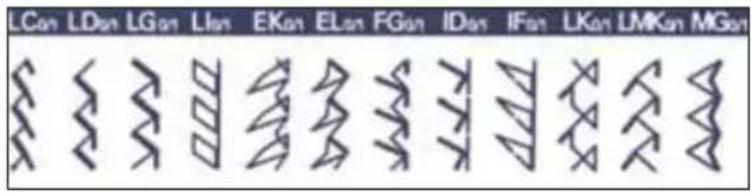
Stitch table (stretch stitches)
text_image
LCon LDon LGOn Llon EKan ELon FGon IDon IFon LKan LMKan MGonselect 1546
Stitch Description Application
1546
| LC | Dutch stitch, narrow A decorative stitch, e.g. for household textiles |
| LD | Dutch stitch A decorative stitch, e.g. for household textiles |
| LG | Border stitch A decorative stitch, e.g. for traditional embroidery |
| LI | Weaving stitch An ornamental stitch, e.g. for bath accessories |
| EK | Spiral stitch A decorative stitch, e.g. for household textiles |
| EL | Diagonal coverstitch For top-stitching and overstitching stretch materials, i.e. cuffs, hems and panels |
| FG | Turkish stitch with zigzag A top-stitching seam for patchwork and quilting |
| ID | Branch stitch A decorative elastic stitch, e.g. for sportswear |
| IF | Floss stitch For whip-stitching hems, e.g. on pajamas and sweatsuits.The material must be turned by 180 degrees |
| LK | Diagonal stitch An elastic decorative stitch |
| LMK | Triangle stitch A decorative, elastic stitch |
| MG | Florentine stitch A stretch, decorative stitch |
1. Operate your Pfaff select
Carrying-case
Place the cords, foot control and instruction book in the front pocket of te carrying case.
Top cover
Open the folding cover (6) upwards. The stitches of the sewing machine are illustrated on the inside of the top cover.

natural_image
White portable electronic device with open lid and internal compartments (no visible text or symbols)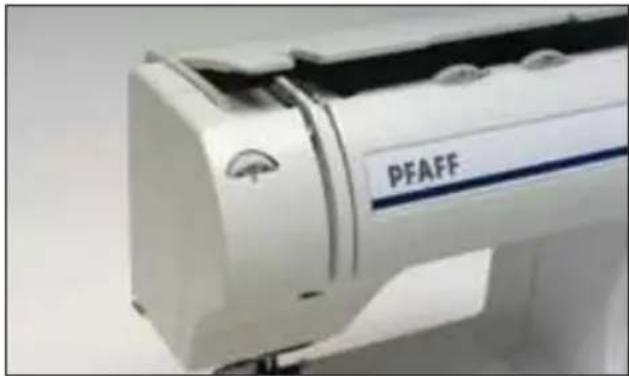
natural_image
Close-up of a white sewing machine with 'PEAFF' branding visible on its side (no additional text or symbols)Connecting the foot control
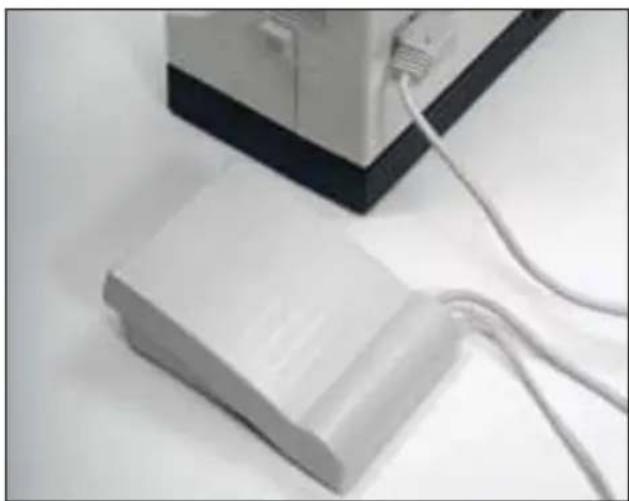
Connect the plug of the foot control to the connecting socket (1) of the sewing machine and to the wall socket. The sewing speed is regulated by pressing the foot control.
You can regulate the sewing speed by moving the slide on the front part of the foot control.
Position▶ = half speed Position▶▶ = full speed
AE023 - 120V, USA and Canada AE020 - 230V, Europe AE024 - 240V, Australia
Main switch
When the main switch (2) is switched on, the sewing bulb lights up. The sewing machine is now ready to use.
natural_image
Close-up of a white electronic device with a coiled cable and a black wall-mounted device in the background (no visible text or symbols)For the USA and Canada
This appliance has a polarized plug (one blade wider than the other). To reduce the risk of electric shock, this plug is intended to fi t in a polarized outlet only one way. If the plug does not fi t fully in the outlet, reverse the plug. If it still does not fi t, contact a qualifi ed electrician to install the proper outlet.
DO NOT modify the plug in any way.
natural_image
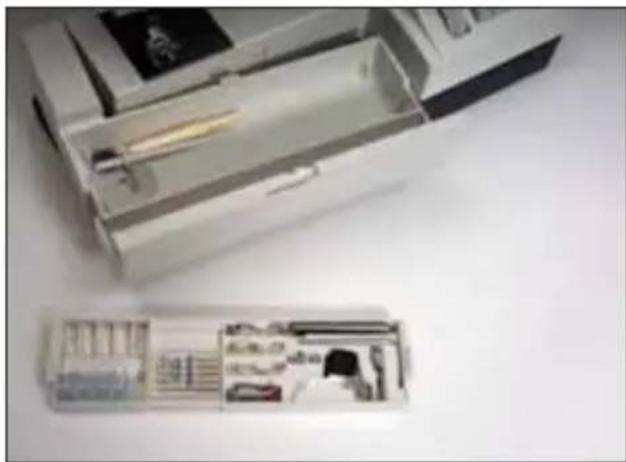
Interior view of a printer drawer and its open case showing internal compartments (no text or symbols visible)Accessory tray
Your Pfaff select sewing machine has a removable accessory tray (15) which is also used as an extended work support.
Model 1546, has a special removable accessory organizer. The enclosed accessories are numbered. Sort the enclosed accessories into the corresponding sections of the accessory organizer.

natural_image
Close-up of a white laboratory instrument with a dark component, possibly a scanner or optical device (no visible text or symbols)Using the free arm
In order to sew with the free arm, you must remove the accessory tray. Using both hands, swing the accessory tray (15) to the left and lift it out of the hole.
When replacing the removable accessory tray to its proper position, ensure that it is flush with the free arm of the sewing machine.
Preparing the machine for bobbin winding
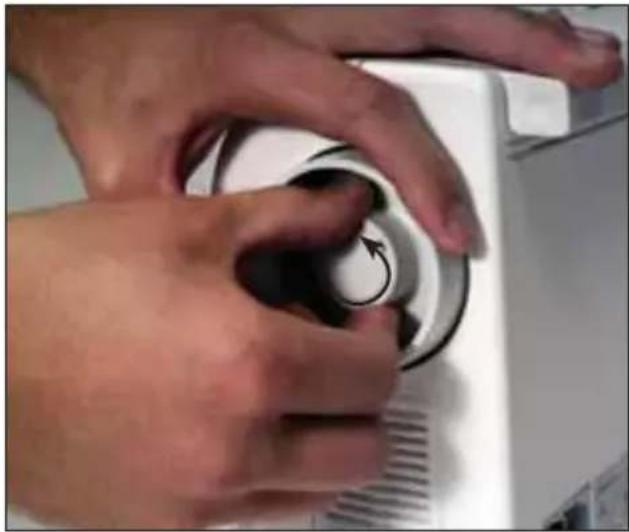
Hold the handwheel (4) firmly and turn the handwheel release disc (3) until it stops in the direction of the arrow. This stops the needle from moving while the machine is winding the bobbin.
natural_image
Close-up of hands operating a circular device with a rotary knob (no visible text or symbols)Placing the bobbin

Switch off the main switch (2)
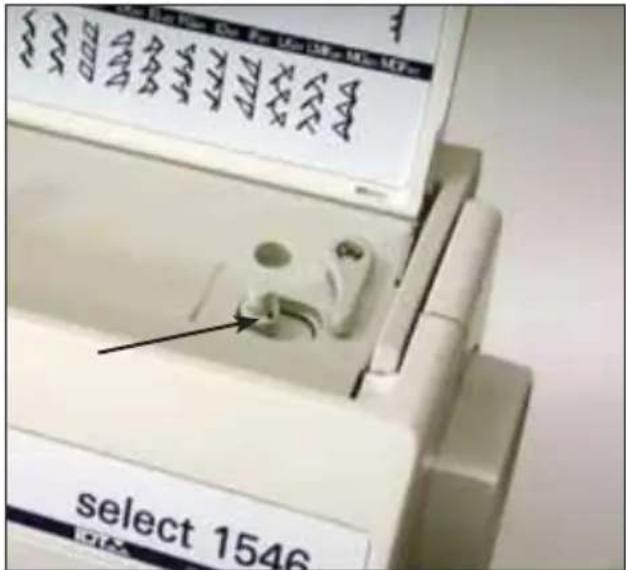
Place the empty bobbin so that the black pin of the bobbin winder (5) snaps into the slot of the bobbin. The Pfaff logo is facing up.
text_image
select 1546Push the bobbin to the right
Note: The bobbin can only be wound when it is moved fully to the right.

text_image
select 1546
text_image
select 1546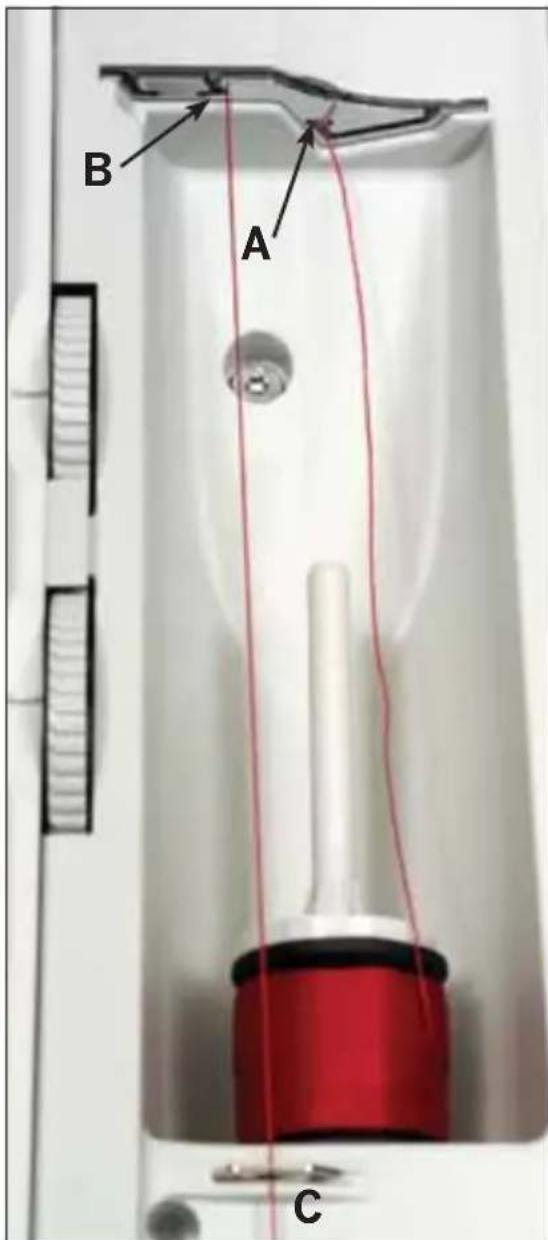
text_image
B A CWinding the bobbin from the spool holder
Place the sewing thread on the spool holder (8). To guarantee free movement of the thread and to give additional hold to the thread spool, fi t a spool cap corresponding to the size of the thread spool
Threading
Place the thread into guide A and pull it through opening B and to the right under the hook C. Wind the thread clockwise a few times around in the bobbin.
Switch on the main switch
Hold the end of the thread fi rmly and press the foot control. The winding action will stop automatically as soon as the bobbin is full. Cut the thread, push the bobbin to the left and remove it.
Don't forget:
Turn the handwheel release disk (3) fully back again. Then turn the handwheel (4) towards you until it snaps into place.

text_image
select 1546Winding from the second spool holder
Push the second spool holder (7) into its hole and place a spool of thread with the corresponding spool cap on it.
Threading
Place the thread into guide A and pull it through opening B to the right under hook C. Wind the thread clockwise a few times around the bobbin.
Switch on the main switch
Hold the end of thread firmly and press the foot control. The winding action will stop automatically as soon as the bobbin is full.
Cut the thread, push the bobbin to the left and remove it.
Don't forget:
Turn the handwheel release disk (3) back again. Then turn the handwheel (4) towards you until it snaps into place.
TIP: If the machine is already threaded, you can easily wind thread from the second spool holder without having to unthread the machine.

text_image
A B C
text_image
PFAFF select 1546 C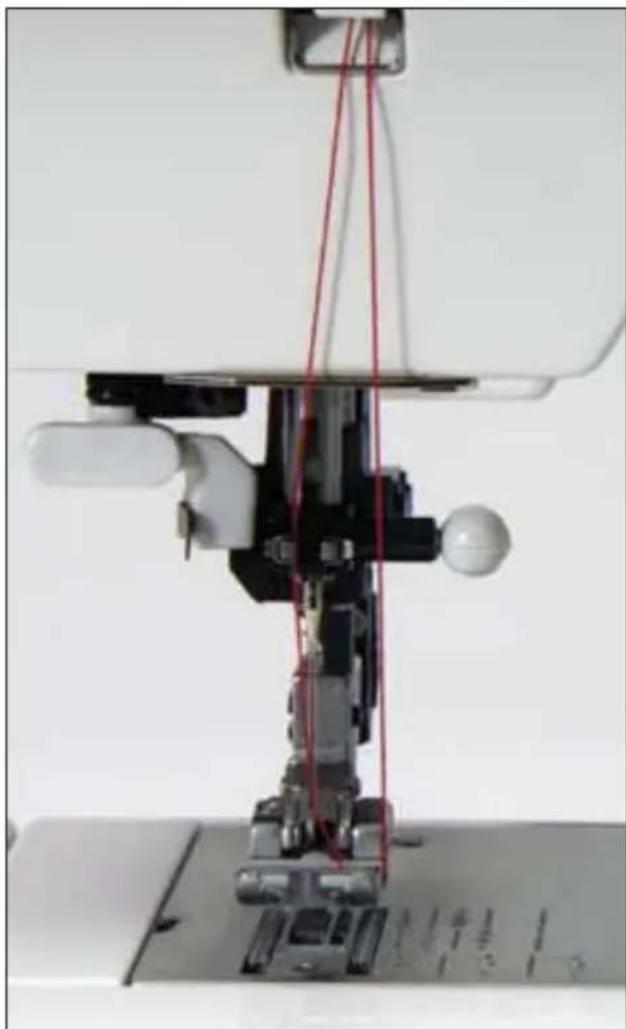
natural_image
Close-up of a sewing machine needle with red and white components, no visible text or symbolsWinding through the needle
Even if the machine has been completely threaded, you can still wind the bobbin.
Raise presser foot lifter (19). Pass the needle thread through the presser foot and downwards; then through the right threading slot (11) and upwards.
Now, pull the thread into the take-up lever from left to right (9). The take-up lever must be positioned at its very top.
Pass the thread to the right under the guide hook C. Then wind the thread several times around the bobbin. Press the foot control and winding the bobbin.
Don't forget:
Make sure to stop the needle from moving while winding the bobbin (see page 1:4).
Bobbin Case/Hook Cover

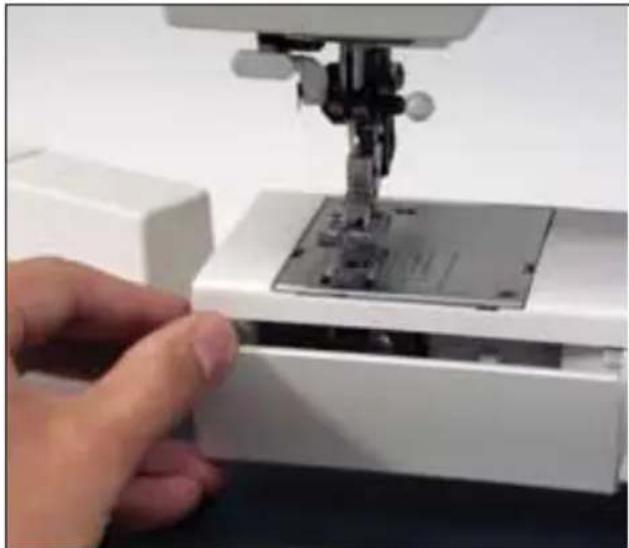
Switch off the main switch.
Hold the side of the bobbin case/hook cover and open it towards you.
natural_image
Close-up of a hand operating a sewing machine needle into a small electronic device (no visible text or symbols)Removing the bobbin case
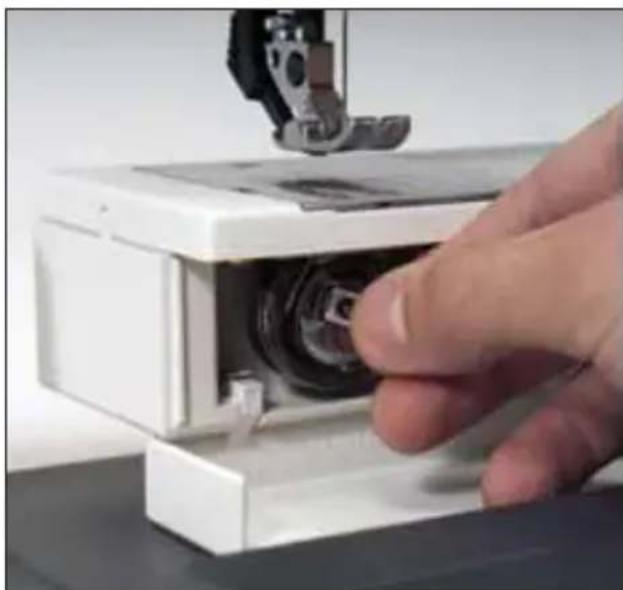
Raise the bobbin case lever and pull out the bobbin case. Release the lever and remove the empty bobbin.
natural_image
Close-up of a hand inserting a small mechanical component into a white electronic device (no visible text or symbols)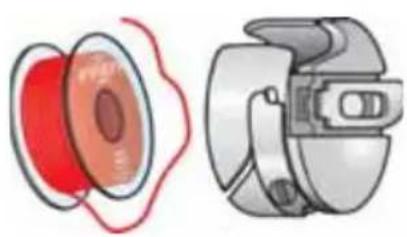
natural_image
Illustration of a red cable wrapped in a film reel and a mechanical device (no text or symbols)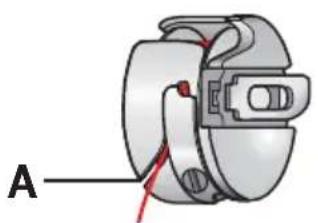
natural_image
Mechanical component diagram showing a clamping mechanism with labeled point A (no text or symbols beyond label)
text_image
B
natural_image
Mechanical component diagram showing a circular housing with a central hole and labeled point C (no text or symbols beyond label)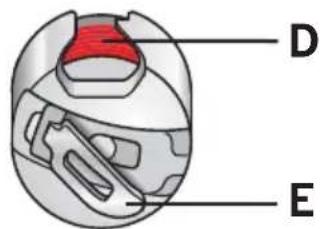
text_image
D EInserting the bobbin
Insert the full bobbin (with the Pfaff logo facing towards the bobbin case) into the bobbin case. In doing so, pull the thread sideways through slot A, then under the tension plate B until it rests in the opening (see arrow).
Check: When you look at the bobbin and pull the thread, the bobbin must turn clockwise.
Inserting the bobbin case
Lift lever E and slide the bobbin case onto the hook pin C as far as it will go. Opening D of the bobbin case must face upwards.
Check: Pull the bobbin thread sharply. The bobbin case must not fall out of the hook.
Threading the needle thread

Switch off the main switch
Raise the presser foot lifter (19) and turn the handwheel until the take-up lever (9) has moved to the top. Place the thread on the spool holder (8) and fit the corresponding spool cap.
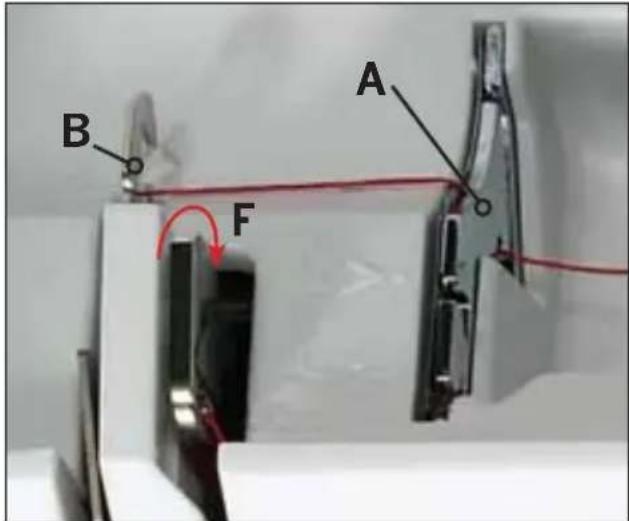
Now, using both hands, pull the thread into guide A and under thread guide hook B. Pass the thread through the lefthand threading slot C and downwards. Pull the thread around stop D into the righthand threading slot and upwards E to the take-up lever F.
The thread must be pulled into the take-up lever F from left to right and downwards again in the right hand threading slot. Floss the thread from the side behind one of the two thread guides H.
To thread the needle, stick the thread from front to back through the needle eye.
To thread the needle using the needle threader, please refer to the next page.
text_image
A B F
text_image
G 5 A C E G D H F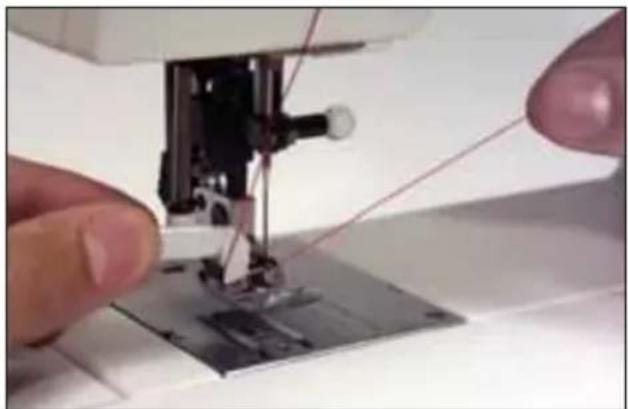
natural_image
Close-up of hands operating a sewing machine needle on a fabric (no visible text or symbols)
text_image
below. Turn the need rear, releasing allow the th You can now needle eye. A BNeedle threader (Model 1546)
To make threading the needle easier and quicker, use the PFAFF needle threader (13). Lower the presser foot. Turn the handwheel until the needle is at its highest position. Place the needle thread under hook A and hold it taut. Move the needle threader fully downwards and turn it towards the needle so that the small hook B goes through the needle eye. Place the thread into the hook from below.
Turn the needle threader towards the rear, releasing the thread carefully, and allow the threader to move upwards. You can now pull the thread through the needle eye.

text_image
c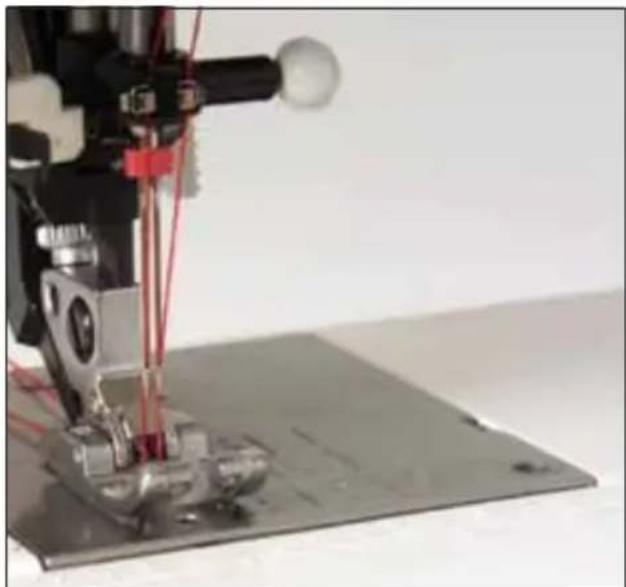
natural_image
Close-up of a sewing machine needle stitching metal fabric on a flat base (no visible text or symbols)Threading the twin needle
Insert the twin needle.
Fit the second spool holder and place one spool of thread on each holder.
In the left threading slot (11) you will find tension disk C. During threading, make sure that you pass one thread left and one thread right over tension disk C.
Carry on threading in the usual way, but make sure the threads are not twisted with each other.
Pull the threads right and left into thread guide (25) and thread the needles.
Note: You cannot use the needle threader for a twin needle.
Drawing up the bobbin thread

Turn off the main switch.
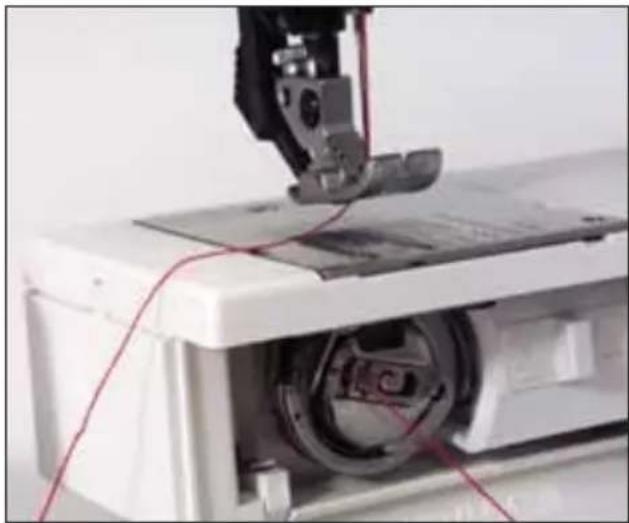
Raise the presser foot. Hold the needle thread and turn the handwheel towards you until the needle is in the highest position and the bobbin thread has formed a loop. Pull the needle thread to draw up the bobbin thread.
natural_image
Close-up of a sewing machine needle stitching a circular component with red wire (no visible text or symbols)Bobbin thread
Close the bobbin case/hook cover and pull the thread under the presser foot to the left.

natural_image
Close-up of a sewing machine needle stitching fabric, with red wire and blue thread visible (no text or symbols)Thread cutter
Pull the threads from the back to the front over the thread cutter (12).

natural_image
Close-up of a sewing machine needle and base mount (no visible text or symbols)
natural_image
Close-up of a sewing machine needle and foot presser's base (no visible text or symbols)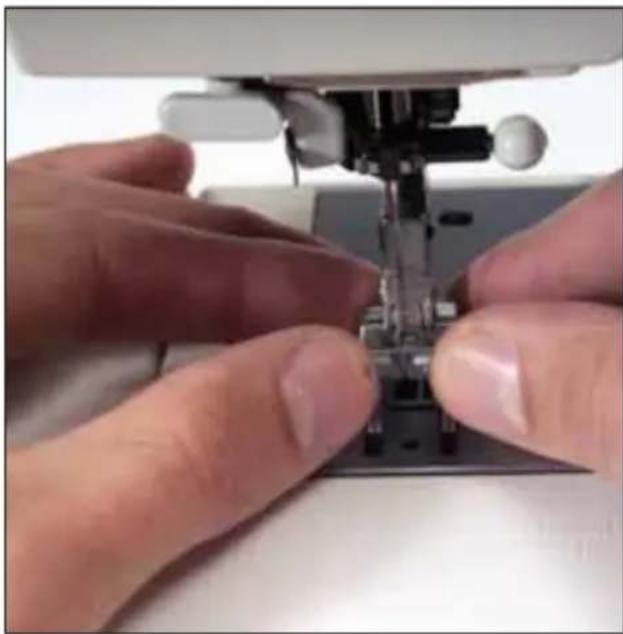
natural_image
Close-up of hands operating a sewing machine needle on a workbench (no visible text or symbols)
natural_image
Close-up of a sewing machine needle stitching metal components on a workbench (no visible text or symbols)Presser foot lifter
The presser foot is raised or lowered with the presser foot lifter (19).
Removing the presser foot

Turn off the main switch.
Position the needle at its highest point. Press the presser foot upwards at the front and down at the back at the same time so that it disengages from the presser foot holder (14).
Engaging the presser foot
Place the presser foot under the presser foot holder (14) so that when the presser foot lifter (19) is lowered, the pins of the foot engage in the presser foot holder.
Check: Please check that the presser foot is properly engaged by raising the presser foot lifter.
The Integrated dual feed/IDT System
(Models 1536 and 1546)
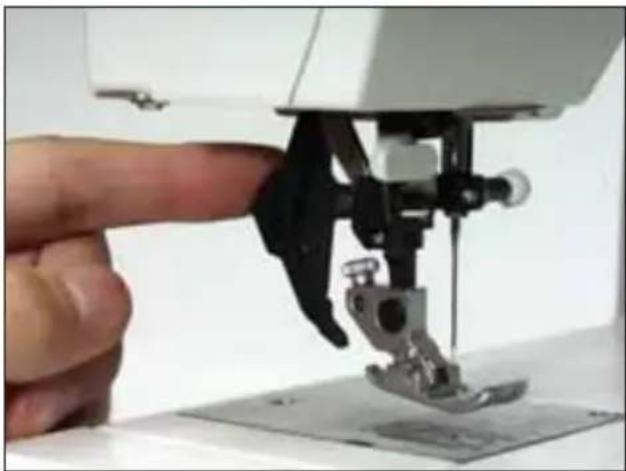
PFAFF offers the ideal solution for sewing diffi cult materials: the integrated dual feed. This system feeds the material from the top and bottom simultaneously as is done in industrial sewing machines. The fabric is fed precisely. When sewing light or diffi cult materials such as silk and rayon fabrics, the dual feed prevents seam puckering.
natural_image
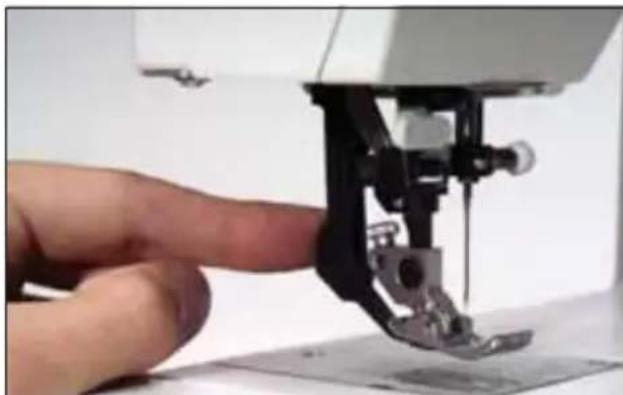
Close-up of a hand operating a sewing machine with a finger pointing to the blade (no visible text or symbols)Engaging the Integrated Dual feed
Important! For all sewing jobs with the top feed, only use sewing feet with cutout at the back.
Raise the presser foot. Then push the top feed (17) downwards until it snaps into place.
natural_image
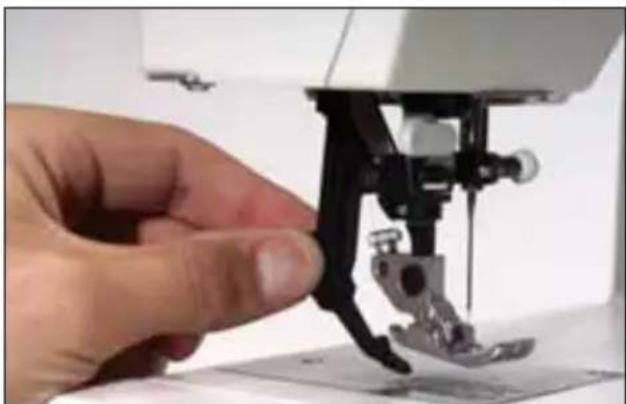
Close-up of a hand operating a sewing machine needle, no visible text or symbolsDisengaging the Integrated Dual Feed
Hold the dual feed with two fingers at the marked places. Push the top feed (17) down a little and out to the rear, and let it move slowly upwards.
natural_image
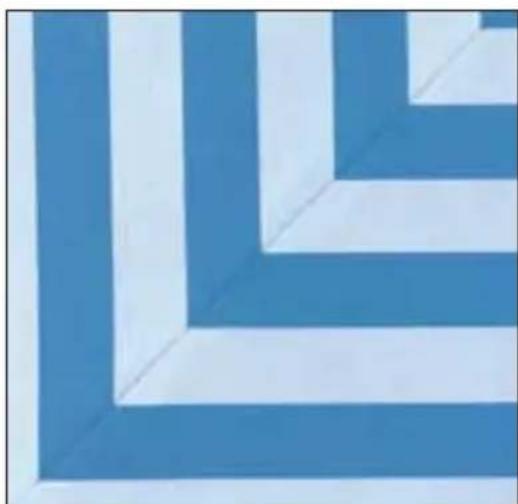
Close-up of a hand operating a sewing machine needle, no visible text or symbolsThe even feeding action also ensures perfect matching of checked and striped fabrics.
natural_image
Abstract geometric pattern with blue and white diagonal stripes (no text or symbols)
natural_image
Close-up of hands operating a sewing machine needle to press fabric (no visible text or symbols)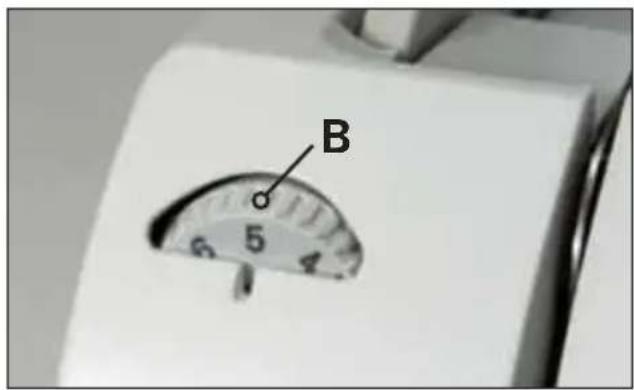
text_image
B
natural_image
Close-up of a mechanical device with a circular component and a labeled switch (no readable text or symbols)Changing the needle


Switch off the main switch.
To remove: Lower the presser foot and move the needle to its highest point. Now loosen the needle screw (18) and pull the needle down.
To insert: The fl at side A of the needle must face to the rear. Lower the presser foot and insert the needle, pushing it up as far as it goes. Hold the needle and tighten the needle screw (18) firmly.
Setting the needle thread tension
Set the required needle thread tension (10) with the help of the mark B.
The normal setting for sewing is 4 to 5.
For embroidering, darning and button-hole set the tension between 2 and 3.
Dropping the feed dog
For certain sewing work, e.g. darning the feed dog has to be dropped.
To do this, open the bobbin case/hook cover and move slide C fully to the right. Now the feed dog is dropped.
Stitch width dial
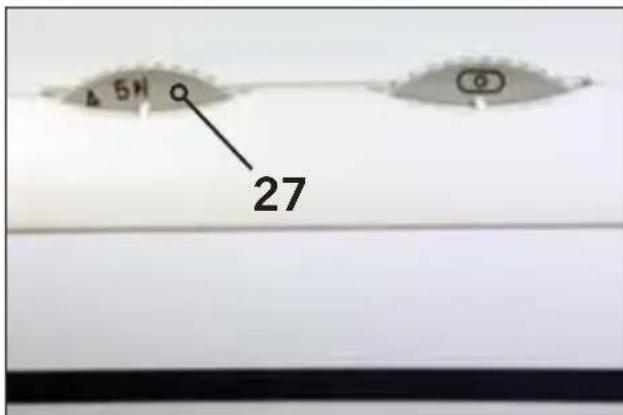
The stitch width can be adjusted with this dial (27). When selecting the width, the needle must not be in the material.
Basic setting: Turn the stitch width knob (27) to the symbol ▶ (maximum stitch width).
Exception: Straight stitch is sewn with stitch width 0.
In chapter "2. Utility stitches and practical sewing", you will find recommendations in the tables for the stitch width selection of individual stitches. During sewing you can also change the stitch width.
text_image
5H 27Needle position dial
In the center needle position Ⓞ, 14 additional needle positions can be selected by turning the needle positioning dial (28) in increments to the left or right.
The furthest needle position to the left can be achieved by turning the dial (28) as far as it will go to the right. The furthest needle position to the right can be achieved by turning the dial as far as it will go the left. When the position of the needle is being changed, the needle must not be in the material.
Note: If you have selected the right needle position, you can now use the width dial (27) to increase or reduce the width of the left side of the stitch. The reverse applies also for needle position to the left.

text_image
5H 28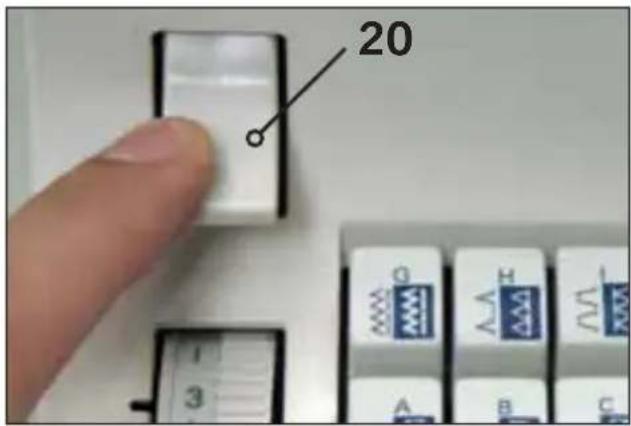
text_image
20 I 3 A B CReverse sewing
The machine sews in reverse only as long as the reverse sewing button (20) is pressed.

text_image
21 3 1 2 1Stitch length adjustment dial
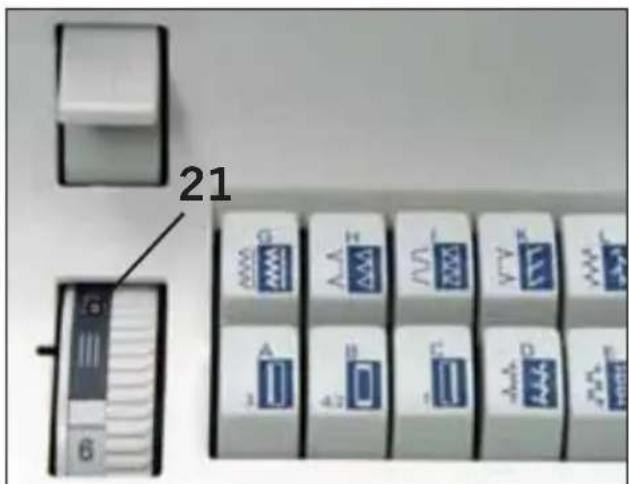
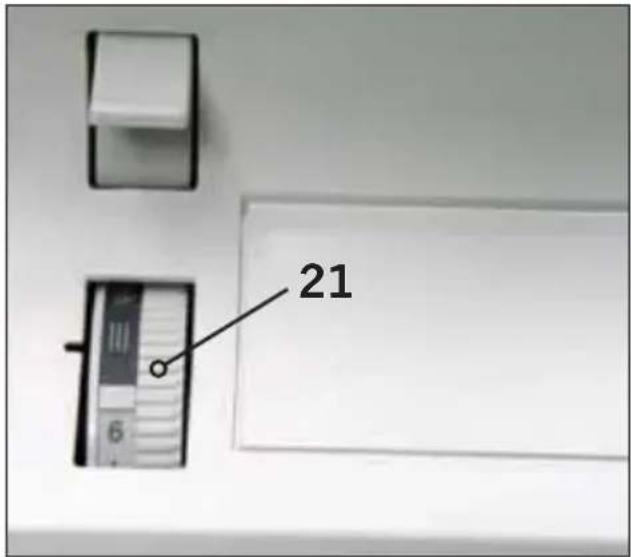
With the stitch length adjustment dial (21) you can adjust the stitch length between 0 and 6 mm by turning the point marking on the button to the required length.

text_image
ABetween the numbers 0 and 1 you will find the "buttonhole" symbol. This area is the optimum stitch density for sewing buttonholes and embroidering.
The further you turn the dial to 0, the higher the density of the stitch.
text_image
21 6To sew stretch stitches (dark background), you must turn the stitch length adjustment dial (21) as far as it will go in the grey area.
Stitch selection, Easy Select System – select 1546
Utility stitches
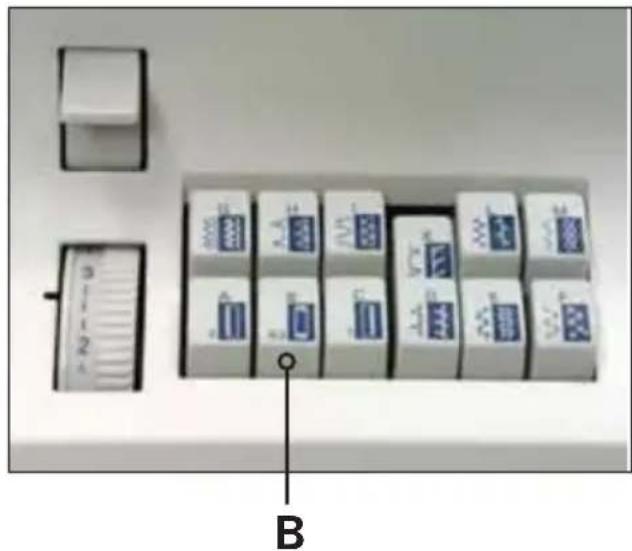
Each stitch has been given a letter that you can find on the push button controls. By pressing the correct button, the stitch is selected and the machine is ready to sew. Button B releases the buttons that have been activated.
Under the lid (6) you will find the stitch table with all the utility stitches and stitch combinations.
text_image
BStretch stitches
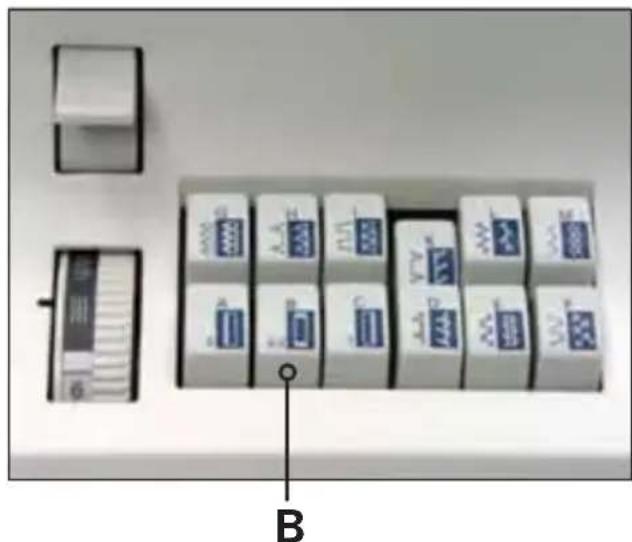
All the stitches with a colored background are stretch stitches, i.e. they are suitable for stretch material. Press the selected button down and turn the stitch length dial (21) as far as it will go in the grey area.
Button B releases the button that have already been selected.
natural_image
Interior view of a computer mouse with multiple drive units and a labeled component (B), no readable text or symbols beyond the label.Utility and stretch stitch combinations
By pushing two or several buttons you can create combinations in the utility stitch range.
The stitch length dial can either be in the normal sewing range or in the stretch range.
All the stitch combinations are illustrated on the stitch table in the lid. You can release buttons that are already activated with button B.

natural_image
Diagram of a mechanical or electrical component with multiple blocks and a labeled point B (no readable text or symbols)Stitch selection, stitch dial – select 1536, 1526

text_image
select IDTM A 24Utility stitches
Each stitch is identified by a letter. The stitches and their corresponding letters are shown on the inside of the lid, a chart is also found in the Introduction chapter.
Turn the dial (24) until the corresponding letter is positioned below mark A.
text_image
21Stretch stitches
All the stitches with a colored background are stretch stitches, i.e. they are suitable for stretch material.
Turn the dial (24) until the corresponding letter is positioned below mark A.
Turn the stitch length dial (21) as far as it will go in the grey area.
text_image
PFAFF 2. Utility stitches and practical sewing- Utility stitches and practical sewing
Explanation of the sewing chart
The following charts show the recommended settings for each stitch or technique.
These charts also provide you with instructions that are necessary when sewing the selected stitches.
The choice of the sewing foot, the setting of the needle thread tension and whether to use IDT or not.
Always use the "center" needle position ☐ if not otherwise specified in the instructions.
| stitch | ||||||
| 1546 | ||||||
| 1536 | ||||||
| 1526 | - |
stitch Stitch number
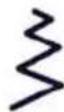
Stitch width in mm

Stitch length in mm

Dual feed on = ●
off =

Thread tension

Presser foot number
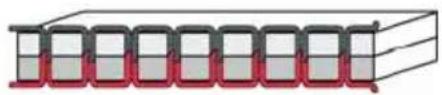
natural_image
Pure diagram of a 3D rectangular block with internal red and black components, no text or symbols present.Perfect tension
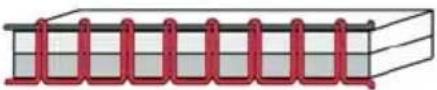
natural_image
Pure diagram of a red helical spring attached to a rectangular frame (no text or symbols)Too high tension
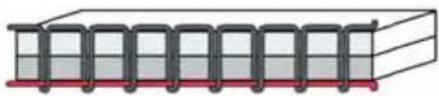
natural_image
Pure diagram of a mechanical or structural component with no text, numbers, or symbolsToo low tension

text_image
A B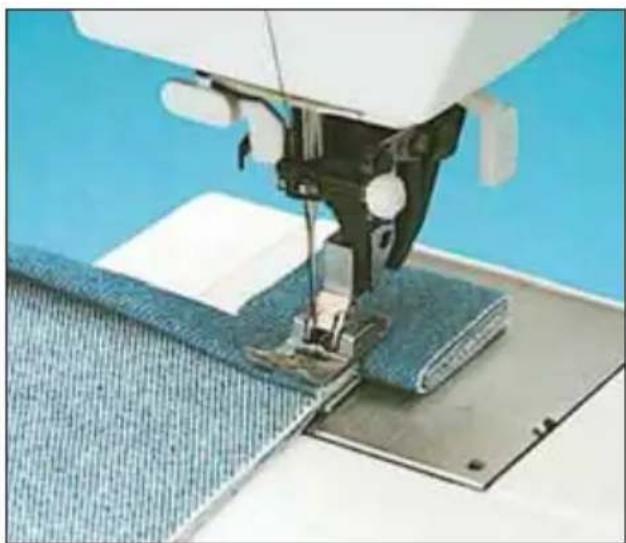
natural_image
Close-up of a sewing machine needle stitching blue fabric on a metal workbench against a clear blue background (no text or symbols visible)Needle thread tension
To get perfect sewing results, the needle and bobbin thread tensions must be perfectly tuned to each other. The normal setting for utility stitches is in the range of 4-5.
Check the tension with a wide zigzag stitch. The threads must be interlaced between the two fabric pieces.
If the needle thread tension is too high the threads are interlaced above the top fabric. If the needle thread tension is too low, the threads are interlaced below the lower fabric.
The adjustment of the needle thread tension is described on page 1:15.
Topstitching
Straight stitch G (1546)/E (1536, 1526) can be sewn using any of 15 various needle positions in such a way that you can always guide the sewing foot along the fabric edge for top-stitching work. The top-stitch needle position is determined by the needle position dial. If you wish to top-stitch farther from the fabric edge, simply guide the fabric along the guide marks on the needle plate or use the edge guide (standard accessory No.8). The edge guide is inserted into hole A and is secured with fi xing screw B.
Sewing aid for thick seams
To ensure a consistent feed when beginning sewing at a thick seam, we recommend supporting the presser foot on a piece of fabric of the same height as the workpiece
natural_image
Two vertical panels with a single horizontal line, no text or symbols present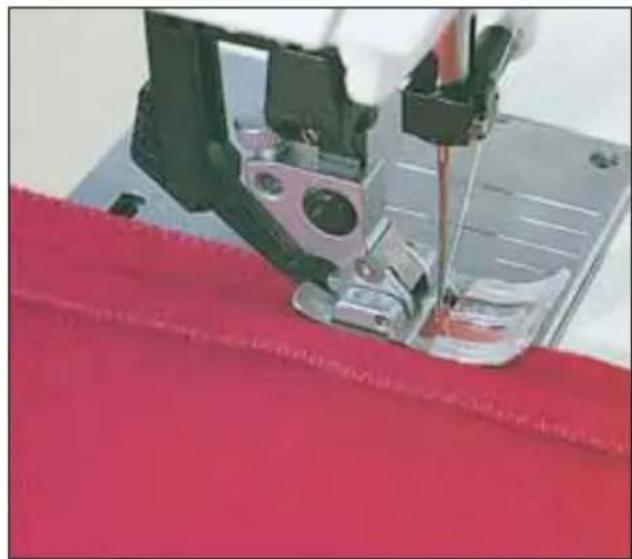
natural_image
Close-up of a sewing machine needle stitching red fabric (no visible text or symbols)| stitch | ||||||
| 1546 | G | 0 | 2,5 | ● | 3-5 | 0/1 |
| 1536 | E | 0 | 2,5 | ● | 3-5 | 0/1 |
| 1526 | E | 0 | 2,5 | - | 3-5 | 0/1 |
| stitch | ||||||
| 1546 | G | 2-▶ | 1-2 | ● | 3-5 | 0/1 |
| 1536 | E | 2-▶ | 1-2 | ● | 3-5 | 0/1 |
| 1526 | E | 2-▶ | 1-2 | - | 3-5 | 0/1 |
Straight stitch
Stitch G/E is the basic straight stitch. The stitch length can be increased up to 6 mm.
It is easier to do some sewing jobs by changing the needle position, e.g. top-stitching a collar or sewing in a zipper. You can select up to 15 different needle positions (see page 1:16).
Please ensure that the needle is at its highest position when adjusting the needle position.
text_image
Technical diagram of a mechanical assembly with labeled parts A, B, and CZigzag stitch
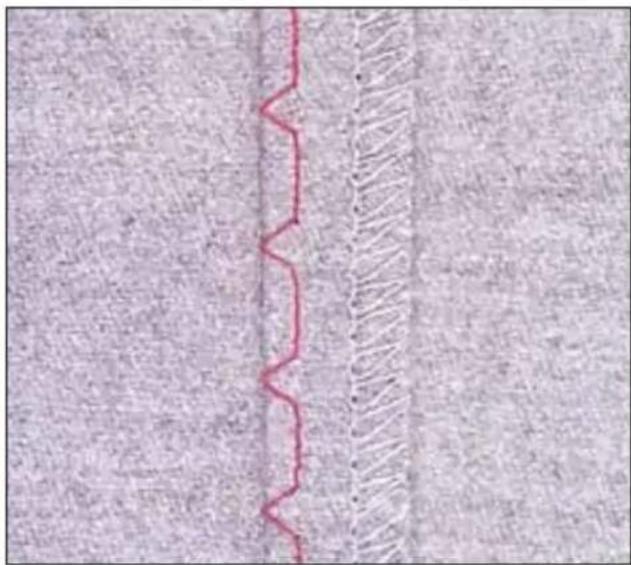
In addition to overlock stitching, zigzag stitch G, stitch width 5▶, is also suitable for overcasting various materials. In this case, the material should only be positioned halfway under the sewing foot.
When overcasting the edge, make sure the needle goes into the material and over the edge alternately.
The width for overcasting can be reduced up to 2 mm.
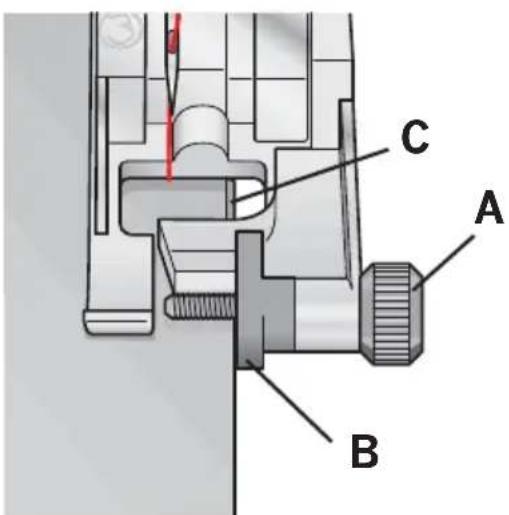
For overcasting diffi cult materials, blind stitch foot No. 3 is very useful. When sewing, the thread lies over pin C, thus preventing curling of the fabric edge. In this way you can sew beautiful smooth seams.
The raw edge must be guided along edge guide B. You can adjust this edge guide with adjusting screw A.
Important: When the blindhem stitch foot is used for overcasting with the zigzag stitch, select the right needle position. Choose a stitch width in the range of 3-5 mm (do not use any other needle position).
text_image
Cropped image showing a red zigzag line and a vertical white hatched band, likely from a technical drawing or CAD software.| stitch | ||||||
| 1546 | H/D | 5-▶ | 1-2 | ● | 3-5 | 0/3 |
| 1536 | -/H | 5-▶ | 1-2 | ● | 3-5 | 0/3 |
| 1526 | -/H | 5-▶ | 1-2 | - | 3-5 | 0/3 |
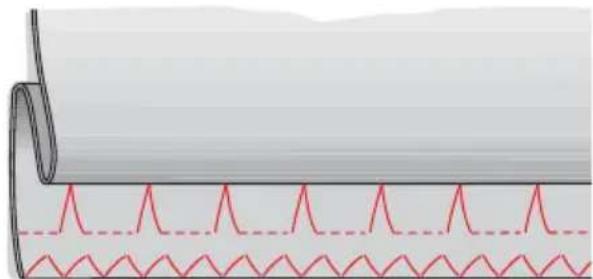
Blindhem stitch (Model 1546)
Blindhem stitch H is best suited for invisible hems; sewing by hand is no longer necessary.
- Serge the edge of the hem
- Fold the edge inwards by the hem width.
• Now unfold the hem again so that the hem edge protrudes by about 1 cm
- Place the fabric under the sewing foot so that the crease line runs along edge guide B.
• Using the needle positioning knob 28, select the needle position to the right
- When the needle enters the crease line, it must only pick up one fiber of the fabric.
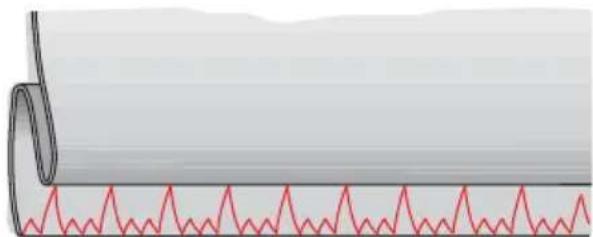
Blindhem stitch (elastic)
Stitch D (1546) or H (1536/1526) is a blind stitch for woven or elastic fabrics. The hem is sewn and overcast at the same time.

text_image
A BRemember!
When blindhem stitching, if you select a needle position other than right, and stitch width other than 5, make sure the needle does not strike the bar of presser foot 3.
If the stitches are visible on the right side, adjust edge guide B by turning adjusting screw A.
Use the needle position ⓞ and the width dial (27) to regulate the penetration of the needle in the crease.
natural_image
Diagram showing a wave pattern with red oscillations and dashed lines, no text or symbols presentStitch H (1546)
natural_image
Diagram of a rolled-up cable with a red waveform pattern below, no text or symbols presentStitch D (1546), stitch H (1536/1526)
Stretch triple zigzag stitch
The stretch triple zigzag stitch is a highly elastic and decorative seam which is very suitable for hems on T-shirts and underwear.
- Serge the edge of the hem.
- Fold the hem inwards at the required width.
- Topstitch the hem from the right side.

natural_image
Close-up of a wooden surface with a red zigzag line at the bottom (no text or symbols)| stitch | ||||||
| 1546 | G | 3-5▶ | Stretch | ● | 3-5 | 0/1 |
| 1536 | E | 3-5▶ | Stretch | ● | 3-5 | 0/1 |
| 1526 | E | 3-5▶ | Stretch | - | 3-5 | 0/1 |
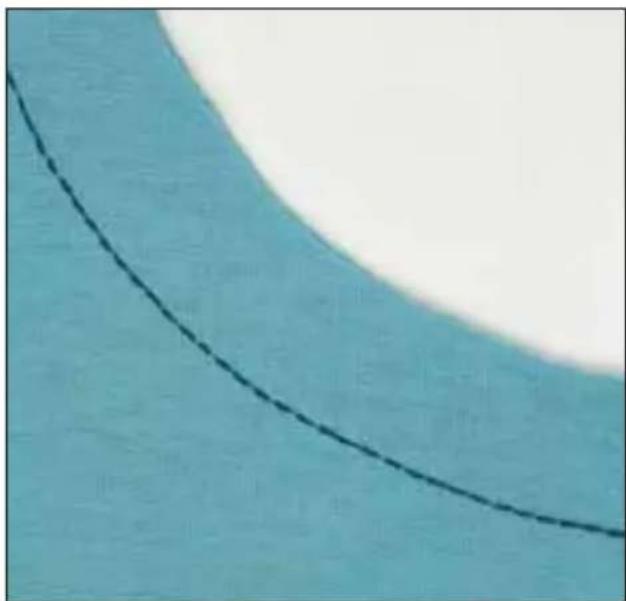
Stretch triple straight stitch
This stitch is used for sewing all seams where reinforcement is needed, e.g. inside trouser seams.
Turn the stitch length dial away from you as far as it will go for the longest stitch length.
natural_image
Abstract curved line on teal background with partial white circular shape above (no text or symbols)| stitch | ||||||
| 1546 | G | 0 | Stretch | ● | 3-5 | 0/1 |
| 1536 | E | 0 | Stretch | ● | 3-5 | 0/1 |
| 1526 | E | 0 | Stretch | - | 3-5 | 0/1 |

natural_image
Close-up of a pinkish surface with a wavy line above it, no text or symbols visible.| stitch | ||||||
| 1546 | M | 5-▶ | 1-2,5 | ● | 3-5 | 0/1 |
| 1536 | F | 5-▶ | 1-2,5 | ● | 3-5 | 0/1 |
| 1526 | F | 5-▶ | 1-2,5 | - | 3-5 | 0/1 |
natural_image
Close-up of a sewing machine needle stitching white fabric, no visible text or symbols| stitch | ||||||
| 1546 | M | 5-▶ | Stretch | ● | 3-5 | 0/1 |
| 1536 | F | 5-▶ | Stretch | ● | 3-5 | 0/1 |
| 1526 | F | 5-▶ | Stretch | - | 3-5 | 0/1 |
Elastic stitch
Because of its high elasticity, this stitch can be used for sewing elastic on swimwear, skirts or lingerie.
• Mark elastic and fabric in quarters.
- Pin elastic to fabric at quarter markings.
- Place fabric and elastic under sewing foot.
- Stretch elastic to fit the fabric. Begin sewing.
Note: When stretching elastic, make sure to stretch from the front and back of the sewing foot.
Honeycomb stitch
The honeycomb stitch is an elastic and decorative hem which is particularly suitable for hems on T-shirts and childrens clothes.
- Fold the hem over double and overstitch it.
What is an overlock stitch?
For stretch fabrics, the select models offer overlock stitches which sew two fabric layers together and overcast simultaneously. They are more elastic than normal seams, very durable and quickly sewn.
Tip: We recommend using blindhem stitch foot No. 3 when sewing overlock seams. It guides particularly well and prevents the seam from puckering even on wide seams.
natural_image
Close-up portrait of a woman with blonde hair wearing a light blue collared shirt (no text or symbols visible)Open overlock stitch
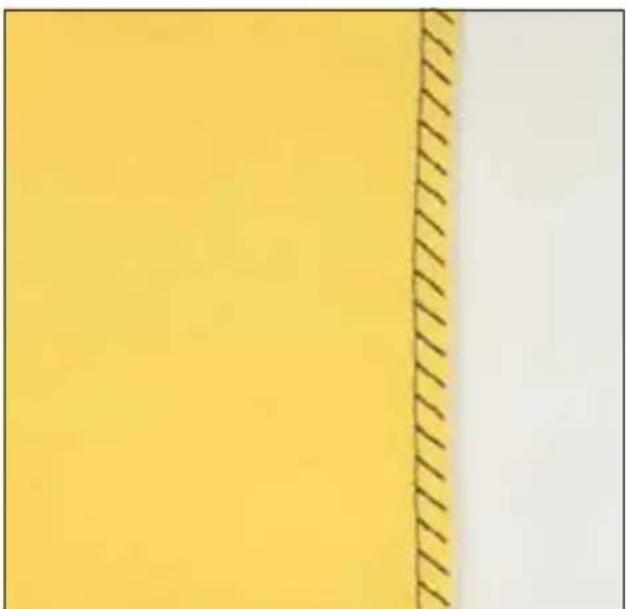
With this stitch, thicker fabrics and fabrics which do not fray too much can be sewn together perfectly.
TIP: Make sure that the needle sews to the right of the fabric just over the edge and not in it.
natural_image
Solid yellow background with a vertical dashed line on the right edge (no text or symbols)| stitch |  |  |  | |||
 | K |  | Stretch |  | 3-5 | 0/3 |
 | I |  | Stretch |  | 3-5 | 0/3 |
 | I |  | Stretch | - | 3-5 | 0/3 |
natural_image
Simple line drawing of a rectangular shape with a diagonal hatched border on the right side (no text or symbols)| stitch | ||||||
| 1546 | I | 5-▶ | Stretch | ● | 3-5 | 0/3 |
| 1536 | K | 5-▶ | Stretch | ● | 3-5 | 0/3 |
| 1526 | K | 5-▶ | Stretch | - | 3-5 | 0/3 |

natural_image
Close-up of a pink knitted fabric with wavy texture and no visible text or symbols| stitch | ||||||
| 1546 | H | 5-▶ | Stretch | ● | 3-5 | 0/1 |
| 1536 | - | - | - | - | - | |
| 1526 | - | - | - | - | - | - |
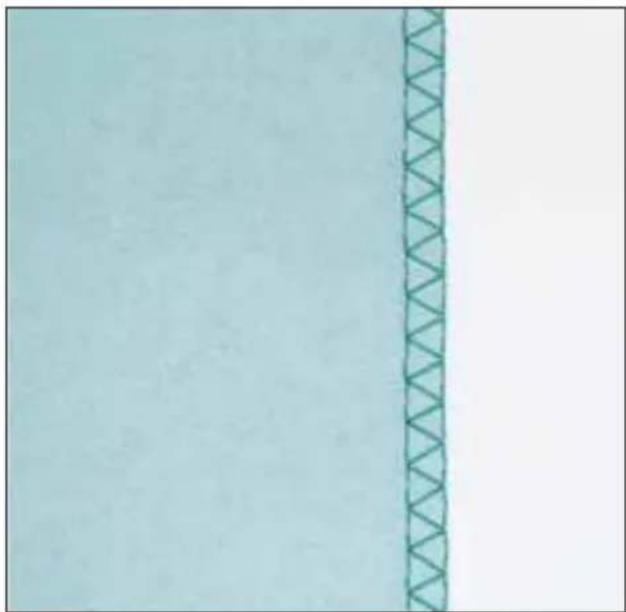
Closed overlock stitch
The closed overlock stitch is perfect for sewing jersey knits. You can also sew sleeve cuffs and knit collars which are well-sewn and long-lasting.
TIP: Ensure that the sleeve cuff is stretched while it is being sewn.
Remember!
When overlocking, if you select a needle position other than center, and stitch width other than 5▶ make sure the needle does not strike the bar of sewing foot 3.
Pullover stitch (Model 1546)
This stitch is suitable for open-knit fabrics. Fashion-knit garment sections can also be joined effortlessly with this stitch. Make sure that the fabric is fed to the right of the needle, not to the left.
TIP: To prevent the seam from stretching while sewing, it is advisable to add a woolen thread under light tension.
What is a covering stitch?
You can use the following stitches for sewing a fl at covering seam. This produces a "fl atlock effect" with a professional look on collar plackets or raglan seams.
The covering stitches are only available on select 1546.
Feather stitch (Model 1546)
With the feather stitch you can sew very stretchy fabrics with an effect similar to that of hemstitching, e.g. lingerie.
- Serge the fabric edges and baste them over.
- Lay the edges to be sewn underneath the pressing foot with a distance between the edges of about 3 mm.
- Stitch from the face side, ensuring that the needle perforates the fabric both right and left.

natural_image
Close-up of a sewing machine needle stitching white fabric, no visible text or symbols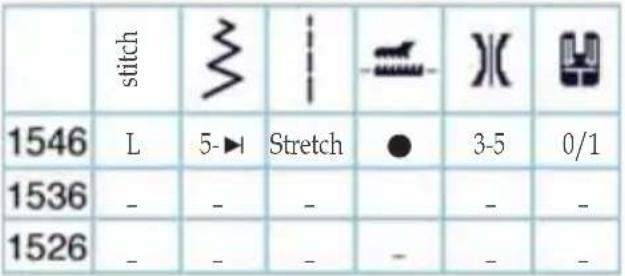 |
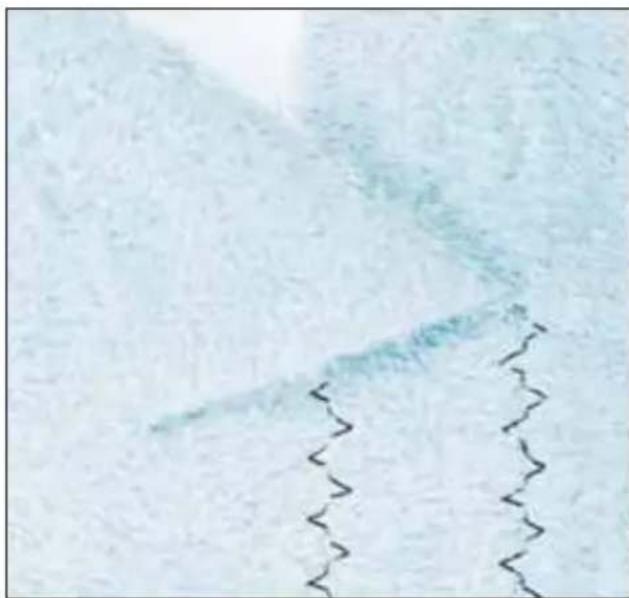
natural_image
Close-up of a textured surface with two wavy black lines, no visible text or symbols| stitch | ||||||
| 1546 | L | 5-▶ | 1-2 | ● | 3-5 | 0/1 |
| 1536 | - | - | - | - | - | |
| 1526 | - | - | - | - | - | - |

natural_image
Abstract layered structure with purple and pink hues, no text or symbols visible| stitch | ||||||
| 1546 | IG | 5-▶ | Stretch | ● | 3-5 | 0/1 |
| 1536 | - | - | - | - | - | |
| 1526 | - | - | - | - | - | - |
Fancy elastic stitch (Model 1546)
The fancy elastic stitch is very useful for fabrics that require a fl at seam, e.g. terry cloth and fl eece.
- Place the two fabric edges so that they overlap by about 2 cm and overstitch each edge with fancy elastic stitch.
Pennant stitch (Model 1546)
The pennant stitch is one of the many types of covering stitches. Since it can be stretched it is particularly suitable for overstitching the bands on elastic fabrics, e.g. sweatshirts or sportswear.
- Sew the band onto the part with an overlock stitch (see pgs 2:8,2:9)
- The seam allowance can now be overstitched from the right side of the fabric. Make sure that the needle enters in the shadow of the seam.
Buttonholes
Sewing buttonholes is very easy with all the models with push button controls since the fabric does not have to be turned.
Buttonholes are generally sewn onto a piece of doubled fabric. However, for some fabrics, e.g. silk, organza and viscose, it is necessary to use stabilizer to prevent the fabric from contracting while sewing.
To produce beautiful seams, embroidering or darning threads are ideal.
Mark the starting point of the buttonhole either with a magic pen or dress pin, and always sew a sample buttonhole fi rst.
Note: Before starting any buttonhole, always push the guide of the buttonhole foot fully to the front, i.e. so that the red arrow is at the first red mark. The red marks are arranged at an interval of 0.5 cm. They are a guide when determining the length of the buttonhole.
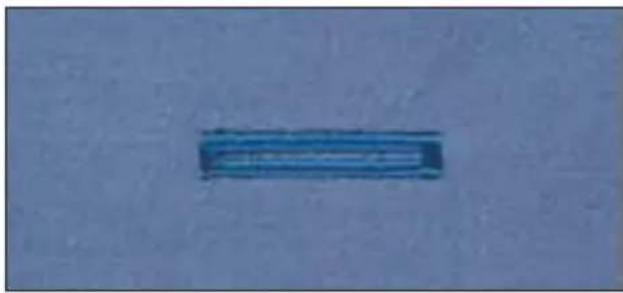
natural_image
Simple blue rectangular object on a light blue textured background (no text or symbols)| stitch | ||||||
| 1546 | CBA | 5▶ | ○ | 0/1 | ||
| 1536 | - | - | ||||
| 1526 | - | - | - |
1546 - Standard buttonhole
- Insert the buttonhole foot and slide the foot forward as far as it will go.
- Select stitch 1 (C) and sew the right side of the buttonhole to the required length. Clip the top thread after a few stitches.
- Select stitch 2 (B) and hold the button down as you sew a few bartacks.
- Select stitch 3 (A) and sew the left side of the buttonhole until it matches the previous side in length.
- Select stitch 4 (B) and hold the button down as you sew a few bartacks.
- Release button B and sew a couple stitches to secure your buttonhole.
- Carefully cut open your buttonhole.
Tip: For fine buttonholes, you can reduce the buttonhole width with the stitch width dial (27) down to approx. 3 mm. Use the center needle position ☐.

natural_image
Simple blue rectangular object on a light blue textured background (no text or symbols)| stitch | ||||||
| 1546 | - | - | - | |||
| 1536 | ABC | 5-▶ | ○ | 0/1 | ||
| 1526 | ABC | 5-▶ | - | 0/1 |
1526/1536 - Standard buttonhole
- Insert the buttonhole foot and slide the foot forward as far as it will go.
- Select stitch A. Sew the left side of the buttonhole to the required length. Clip the top thread after a few stitches.
- Select stitch B and sew a few bartacks while holding the fabric securely.
- Select stitch C. Sew the right side of the buttonhole until it matches the previous side in length.
- Select stitch B and sew a few bartacks while holding the fabric securely.
- Select stitch D. Secure the buttonhole by sewing a few stitches.
• Carfully cut open your buttonhole.
Tip: For fine buttonholes, you can reduce the buttonhole width with the stitch width dial (27) down to approx. 3 mm. Use the center needle position ☐.

natural_image
Close-up of a blue and white plastic strip with two wires, lying on a plain blue surface (no text or symbols visible)Standard buttonhole with gimp thread
To sew especially durable buttonholes, on heavy fabrics, knits or sportswear, we recommend using a gimp thread.
On knits the gimp thread is particularly important to prevent the buttonhole from stretching.
- Lay the gimp thread over the rear protrusion A and pass the thread ends underneath the presser foot towards the front.
- Clamp the threads to the left and right of protrusion B.
- Slide the buttonhole runner as far forwards as possible and sew the buttonhole as described for your select model.
- Pull the loop of the gimp thread into the buttonhole and cut the threads.
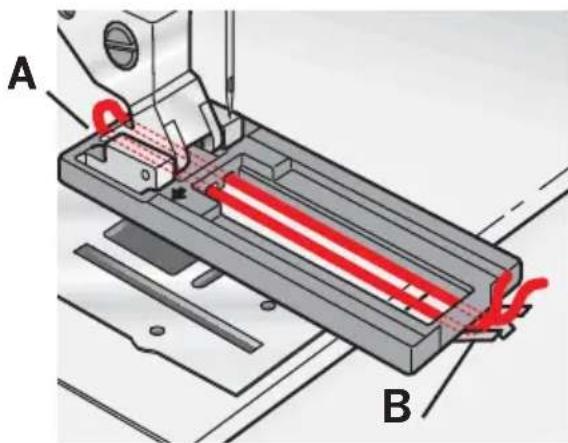
natural_image
Mechanical assembly diagram showing a component with red strips and labeled parts A and B (no text or symbols beyond labels)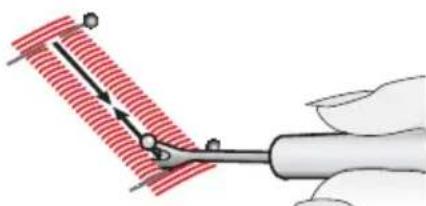
natural_image
Diagram showing a tool interacting with a red hatched surface, no text or symbols presentCarfully cut open your buttonhole with scissors or a seam ripper.
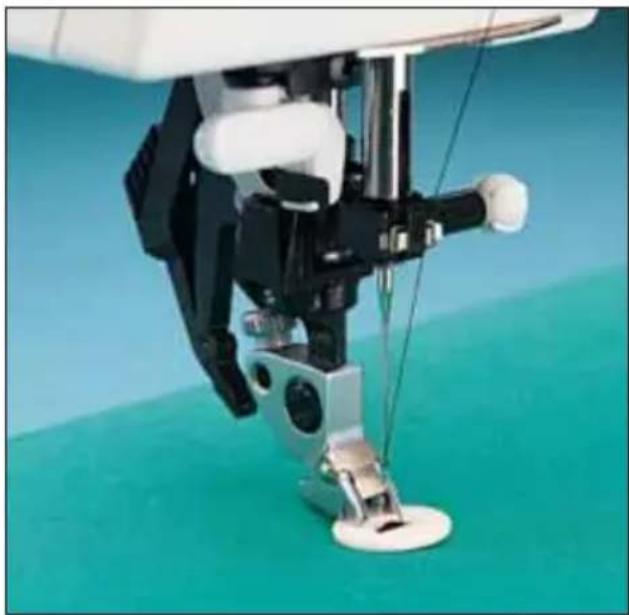
Sewing on buttons
With zigzag stitch G/E (stitch width 4 mm) you can sew on two and four hole buttons.
- Remove the sewing foot and lower the feed dog.
- Turn the handwheel towards you and move the button so that the needle enters the left hole in the button.
- Now lower the presser foot lifter; this holds the button in place.
- Sew on the button. Take care to ensure that the needle also enters the right-hand hole in the button.
Securing
- Select straight stitch by turning the width dial (27) to 0.
- Change the needle position with the needle position dial (28) so that the needle enters one of the two holes.
- Sew a few securing stitches.
natural_image
Close-up of a sewing machine needle with metal clamps and a white base, against a teal background (no text or symbols visible)| [054] |  | [052] | [059] | [064] | ||
| 1546 | G | 4 | - | ○ | 2-3 | - |
| 1536 | E | 4 | - | ○ | 2-3 | - |
| 1526 | E | 4 | - | - | 2-3 | - |
natural_image
Blue textured surface with a horizontal dark line and white border (no text or symbols)| stitch | ||||||
| 1546 | G | 0 | 3 | ● | 3-5 | 0/1 |
| 1536 | E | 0 | 3 | ● | 3-5 | 0/1 |
| 1526 | E | 0 | 3 | - | 3-5 | 0/1 |
natural_image
Close-up of a sewing machine stitching yellow fabric (no text or symbols visible)| stitch | ||||||
| 1546 | G | 0 | 3-4 | ● | 3-5 | 0/1 |
| 1536 | E | 0 | 3-4 | ● | 3-5 | 0/1 |
| 1526 | E | 0 | 3-4 | - | 3-5 | 0/1 |
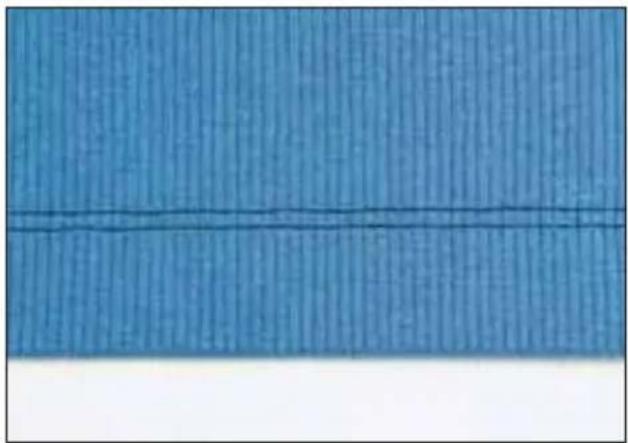
Hemming with the twin needle
Use the twin needle to make beatiful topstitch seams.
Using the twin needle you can add a professional touch to hems on stretch fabrics such as T-shirts, knitted articles or cycling shorts both quickly and easily.
Twin needles are available in different widths. The traditional width for topstitching is 4 mm. To prevent the needle from striking the needle plate, you must make sure that you select the center needle position.
- First fold and iron the width of fabric desired for the hem.
- Then topstitch the hem from the right side.
• Finally, cut the protruding hem edge back to the seam.
Use only a stretch needle when sewing stretch fabric!
Tip: On difficult fabrics such as ribbed knitwear it is advisable to baste the hem before topstitching it.
On page 1:11 you will find a description of how to thread the twin needle.
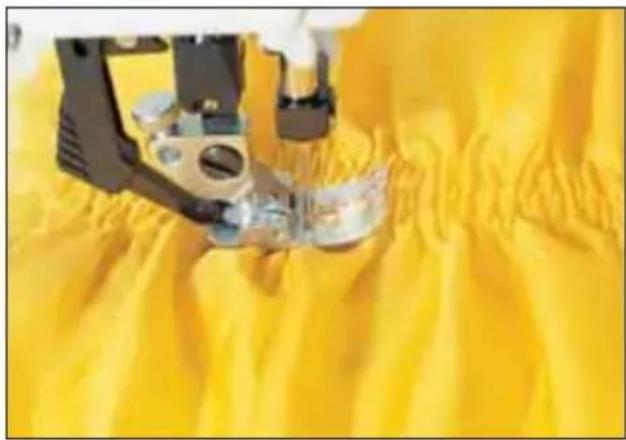
Smocking effect with elastic threads
Fine, light fabrics such as Bastiste, rayon and silk are particularly suitable for beautiful smocking work. For smocking work with the elastic thread, you should use an additional bobbin case and wind the bobbin by hand with the elastic thread. As the elastic thread is much stronger than the normal bobbin thread, the tension of the bobbin case must be set at very low.
Don't forget, the higher the bobbin thread tension, the more intense the gathering effect.
- Sew a test seam to determine the level of gather.
- Mark the first line on the right side of the fabric and sew along it.
• Each additional seam can be sewn at a presser foot's width from the first row. - When sewing several seams next to one another, you must stretch the fabric to its original length when sewing the subsequent seams. Otherwise, the gather will be irregular.
- Knot the threads at the beginning and end of the seam on the reverse side.
Gathering with the straight stitch
Using a straight stitch, you can gather sleeves, skirts and valances with a stitch length of 6 mm. To ensure consistent gathering you should sew two or three rows of gathering.
- Mark the first line on the right side of the fabric and sew along it. Allow the threads to extend approx. 10 - 20 cm.
• Each subsequent seam can be sewn one presser foot width from the last.
• Gather the piece of fabric by pulling the bobbin thread. You determine the amount of gather by how much you pull the thread.
• Finally, the thread ends are knotted to secure the gather.
Tip: The three-groove cording foot (optional accessory) is very helpful for gathering. Due to its guide grooves the elastic is fed evenly during the sewing process.

natural_image
Close-up of a sewing machine needle stitching teal fabric, with a close-up inset showing the same pattern (no text or symbols visible)| stitch | ||||||
| 1546 | G | 0 | 6 | ● | 3-5 | 0/1 |
| 1536 | E | 0 | 6 | ● | 3-5 | 0/1 |
| 1526 | E | 0 | 6 | - | 3-5 | 0/1 |
Gathering with elastic thread
Sleeve and waist seams can be gathered by sewing over an elastic thread.
• Mark the first gathering seam on the reverse side of the fabric.
- Sew a few stitches using stitch M/F. Leave the needle in the fabric. The needle must be in the center of the presser foot. Raise the presser foot and lay the elastic thread around the needle.
- Lower the presser foot and sew a few stitches. Then pull the elastic thread evenly at both ends.
• Determine the amount of gather by the amount you pull the threads.
• The gather can also be altered after sewing by pulling the ends of the elastic threads.
• Finally, knot the threads and elastic.
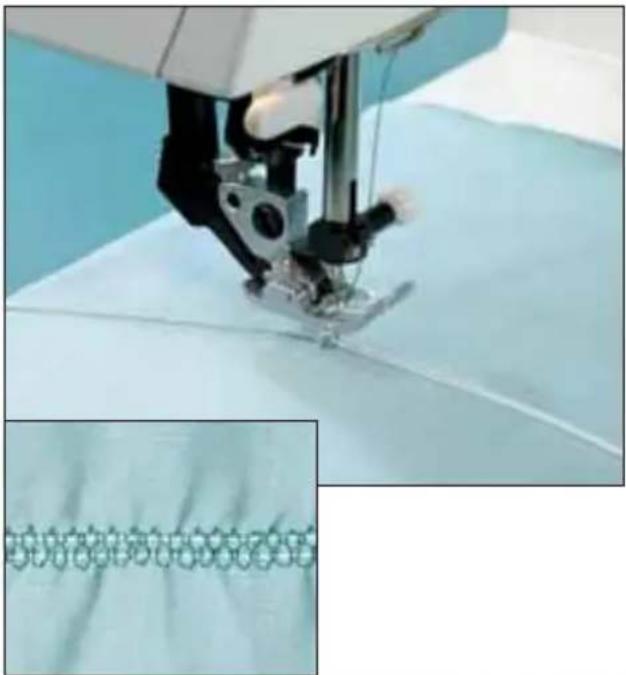
natural_image
Close-up of a sewing machine needle stitching light blue fabric, with an inset showing close-up of a woven pattern (no text or symbols visible)| stitch |  |  |  | |||
| 1546 | M | 5-▶ | Stretch | ● | 3-5 | 0/1 |
| 1536 | F | 5-▶ | Stretch | ● | 3-5 | 0/1 |
| 1526 | F | 5-▶ | Stretch | - | 3-5 | 0/1 |
| stitch | ||||||
| 1546 | G | 0 | 6 | ● | 3-5 | 0/1 |
| 1536 | E | 0 | 6 | ● | 3-5 | 0/1 |
| 1526 | E | 0 | 6 | - | 3-5 | 0/1 |
natural_image
Close-up of a sewing machine needle stitching light blue fabric, with an inset showing close-up of a woven pattern (no text or symbols visible)
text_image
Technical diagram of a sewing machine with labeled parts including D, C, F, G, and E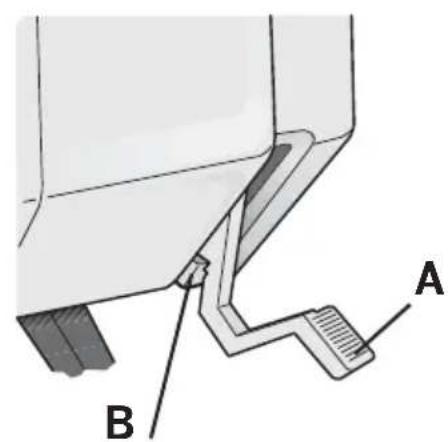
text_image
Technical diagram showing a mechanical assembly with labeled parts A and B, likely illustrating a component or assembly.
natural_image
Mechanical sewing machine needle stitching a patterned surface (no text or symbols visible)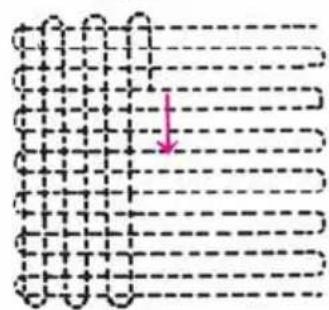
natural_image
Grid pattern with dashed lines and a pink arrow pointing downward (no text or symbols)| stitch | ||||||
| 1546 | G | 0 | - | ○ | 2-3 | 6 |
| 1536 | E | 0 | - | ○ | 2-3 | Optional |
| 1526 | E | 0 | - | - | 2-3 | Optional |
Darning with the straight stitch
Insert the darning foot:
Loosen screw D. Set the needle at its highest point and push the pin of the darning foot fully into the hole C of the sewing foot holder. When doing this, the guide fork G should position itself around the presser bar. The lever E must be behind the fixing screw F. Now tighten screw D.
Darning position:
Lower the presser foot lifter (A) while pushing it lightly to the rear. This snaps the presser foot lifter into a notch (B) on the back side of the sewing machine into the darning position.
- Place the darning work in the darning hoop.
- Drop the feed dog.
- Pull up the bobbin thread and hold the threads when you start sewing.
- Darn the damaged area by guiding the fabric back and forth evenly in the prescribed direction while ensuring that each line ends with a small curve. This helps to avoid the fabric ripping again.
- When you have fi nished sewing the damaged area, rotate the fabric again.
You determine the stitch length yourself by moving the fabric back and forth.
Tip: If you move the fabric too slowly, small knots will appear on the reverse side of the fabric.
Darning with the elastic stitch
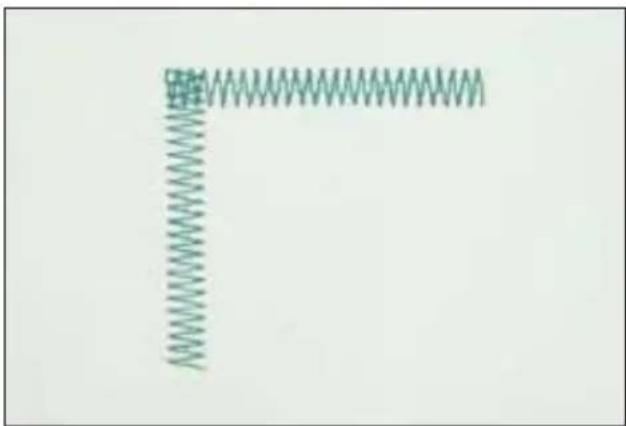
Darn with the elastic stitch for repairing damaged areas.
- Sew over the damaged area in rows until it is well covered. Take care to ensure that the rows overlap.

natural_image
Pure diagram of a vertical structure with repeating zigzag patterns, no text or symbols present| stitch | ||||||
| 1546 | M | 5-▶ | 0,2-1,5 | ● | 3-5 | 0/1 |
| 1536 | F | 5-▶ | 0,2-1,5 | ● | 3-5 | 0/1 |
| 1526 | F | 5-▶ | 0,2-1,5 | - | 3-5 | 0/1 |
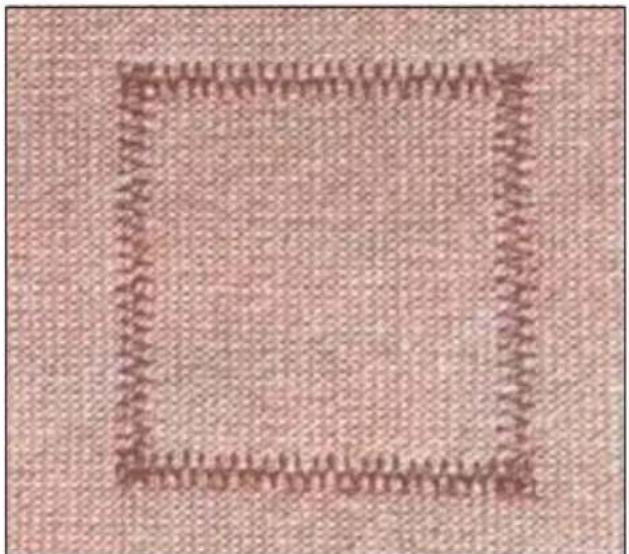
Repairing tears
On tears, frayed edges or small holes lay a piece of fabric under the reverse side of the fabric. The underlayed fabric reinforces the workpiece and ensures perfect repair.
- Lay a piece of fabric underneath the damaged fabric. It must be a little larger than the damaged area.
• Now sew over the damaged area. - Cut the underlayed piece of fabric back to the seam.
natural_image
Pure diagram of a spring with no text, numbers, or symbolsSewing on patches
To cover larger holes is it necessary to sew a new piece of fabric onto the damaged area.
- Baste the new piece of fabric onto the damaged area of the face side of the fabric.
- Sew over the fabric edges with the elastic stitch.
- Now cut the damaged area back to the seam from the reverse side of the fabric.
natural_image
Close-up of a textured fabric background with a decorative square frame and wavy edge patterns (no text or symbols)
natural_image
Woman smiling while holding hands in a blue blouse and skirt, no visible text or symbolsSewing on zippers
There are various methods of sewing on zippers. For skirts, we recommend the fully concealed zipper, for men's and ladies' trousers the semi concealed zipper. Various zippers are available. We recommend using a metal zipper for strong fabrics such as denim. For all other fabrics we recommend a plastic zipper.
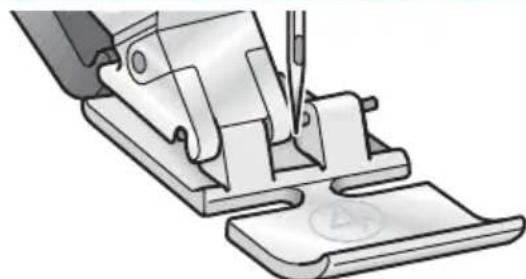
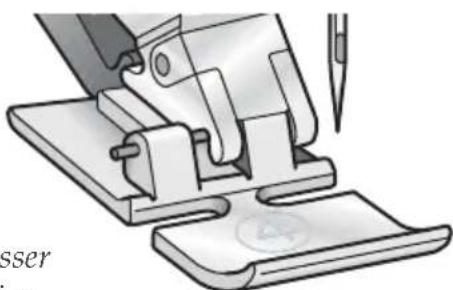
It is important for all types of zippers to sew very close to the edge of the teeth of the zipper. This is why it is possible to insert the zipper foot either on the right or the left of the presser foot holder.
You can set the needle so that it enters close to the edge of the zipper teeth by using one of the 15 available needle positions. If the foot is engaged to the right, the needle must only be moved to the right. If the foot is engaged left, the needle must only be moved to the left.
| stitch | ||||||
| 1546 | G | 0 | 3 | ● | 3-5 | 4 |
| 1536 | E | 0 | 3 | ● | 3-5 | 4 |
| 1526 | E | 0 | 3 | - | 3-5 | 4 |
natural_image
Illustration of a sewing machine needle stitching a metal clamp (no text or symbols visible)Left presser foot position
natural_image
Illustration of a sewing machine needle stitching fabric, no text or symbols visibleRight presser foot position
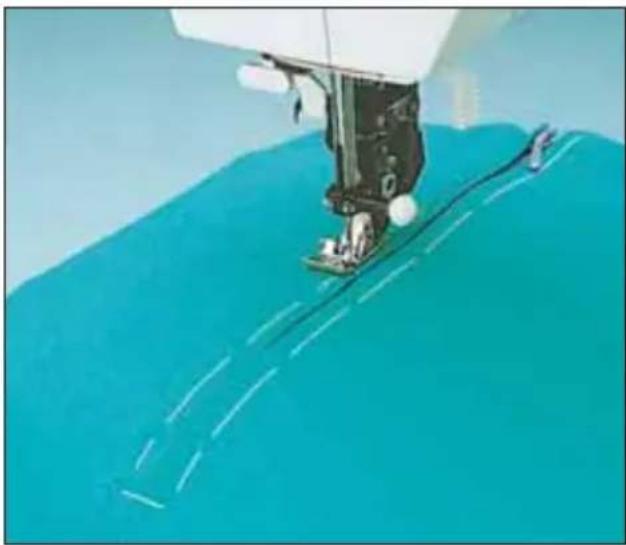
Fully concealed, sew-in zipper
- Insert the zipper foot on the right side.
- Baste in the zipper and lay it underneath the presser foot so that the teeth of the zipper run alongside the foot.
- Stitch in half of the zipper, leave the needle in the fabric, raise the presser foot and close the zipper.
- Now you can continue sewing the seam up to the end of the zipper and sew the cross seam.
natural_image
Close-up of a sewing machine needle stitching a blue fabric, no visible text or symbols- Sew the second half of the zipper parallel at the same distance.
- Stop after the first half and leave the needle in the fabric. Raise the presser foot and open the zipper.
• Now you can fi nish sewing the seam.

natural_image
Close-up of a sewing machine needle stitching teal fabric, no visible text or symbols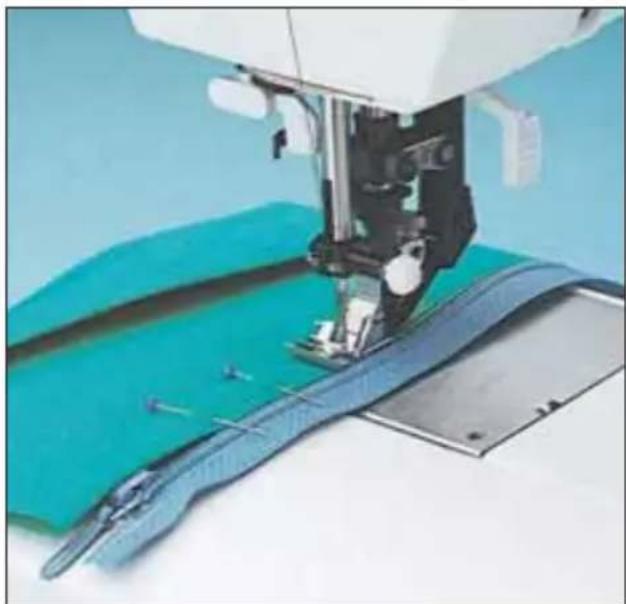
natural_image
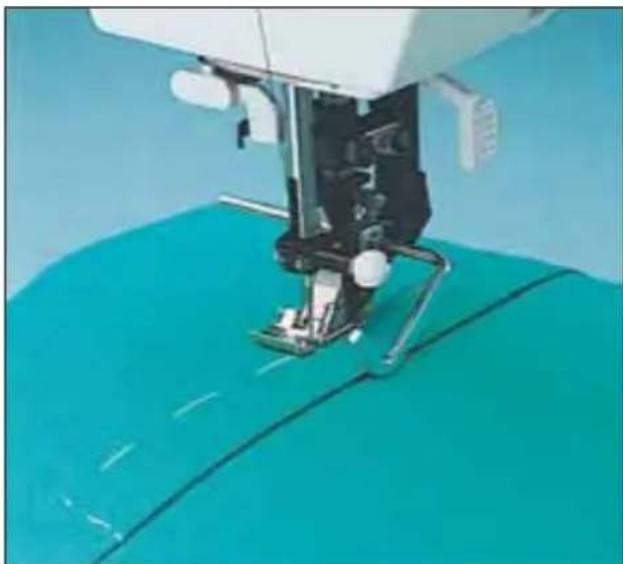
Close-up of a sewing machine needle stitching a blue fabric piece, with no visible text or symbols.The trouser zipper
- Iron the seam allowances, taking care to ensure that the underlap extends by about 4 mm.
- Baste the zipper under the underlap so that the teeth are visible.
- Insert the zipper foot on the right side and move the needle to the right needle position ⓞ.
- Stitch along the edge of the zipper.
- Just before the end of the seam, open the zipper and fi nish sewing the seam.
natural_image
Close-up of a sewing machine needle stitching teal fabric, no visible text or symbols- Close the zipper and baste the overlap evenly to the other half of the zipper.
• Then sew through the basted seam.
Tip: To achieve a perfect seam, we recommend using the edge guide.
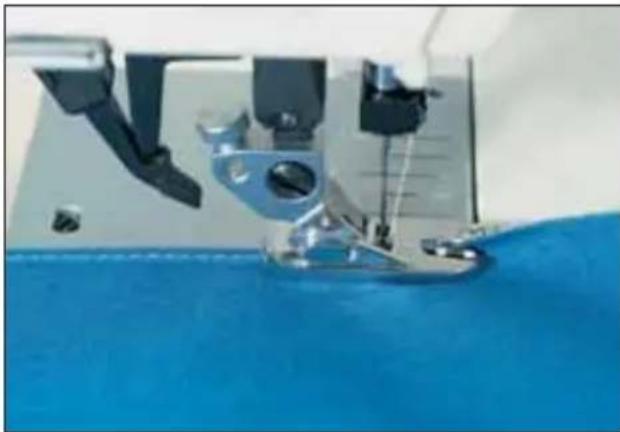
Stabilizing edges
With the hemmer foot you can hem blouses, silk scarves and valances with ease, without having to pre-iron the fabric edges. The hemming prevents the edges from fraying and a clean, durable edge is the result.
- Fold the beginning of the fabric edge over twice (approx. 2 mm)
- Lay the folded fabric edge underneath the hemmer and sew a few stitches.
- Leave the needle in the fabric, raise the presser foot and insert the fabric into the hemmer foot scroll.
- Lower the presser foot and guide the fabric evenly into the hemmer foot.
Take care that the fabric does not run under the right half of the presser foot.

natural_image
Close-up of a sewing machine needle stitching a blue fabric (no visible text or symbols)| stitch | ||||||
| 1546 | G | 0 | 3 | ○ | 3-5 | 7 |
| 1536 | E | 0 | 3 | ○ | 3-5 | Optional |
| 1526 | E | 0 | 3 | - | 3-5 | Optional |
natural_image
Close-up of a sewing machine needle stitching blue fabric, no visible text or symbolsTip: On silk, Bastiste and chiffon fabrics, the roll hem is particularly attractive with a zigzag stitch

natural_image
Close-up of a sewing machine needle stitching fabric (no visible text or symbols)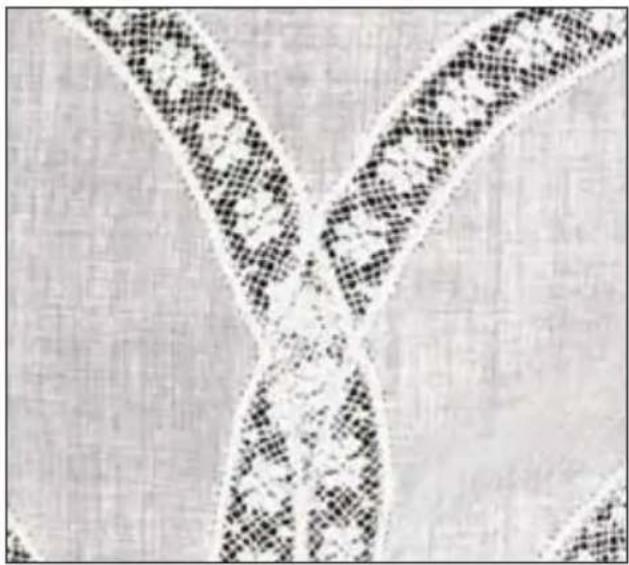
natural_image
Close-up of a Y-shaped DNA strand with visible banding pattern (no text or symbols)| stitch | ||||||
| 1546 | G | 0 | 2,5 | ● | 3-5 | 0/1 |
| 1536 | E | 0 | 2,5 | ● | 3-5 | 0/1 |
| 1526 | E | 0 | 2,5 | - | 3-5 | 0/1 |
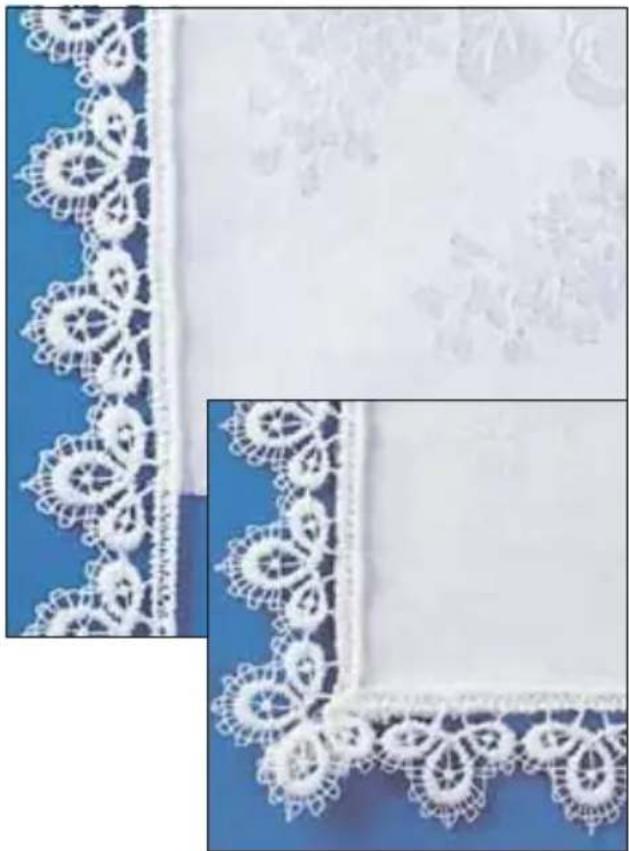
natural_image
Close-up of a decorative white lace border with blue background, no text or symbols visibleInserting lace
You can achieve a beautiful effect by inserting lace, e.g. on babywear and children's clothing.
- First the lace is basted onto the right side of the fabric.
- Sew on both sides of the lace at a narrow margin.
• The fabric underneath the lace is cut down the middle and ironed to the side. - Sew over both edges of the lace with a small, dense, zigzag stitch (stitch width 2-4 mm).
• Cut back the extra fabric.
Attaching lace
You can beautify and remodel home textiles with lace as often as you like.
Here's how it's done:
- First serge the cut edges.
- Sew the lace onto the face side of the fabric up to the first corner.
- Fold the corner and sew over it diagonally.
- Sew the following sides in the same way.
Shell-edging
Shell-edging is attractive on thin, soft fabrics such as silk and Bastiste.
It is often used as a decorative edging on lingerie.
The higher the needle thread tension, the deeper the shell edge scallop.
- Serge the fabric edge and iron the seam allowance to the left.
• Take care that the fabric only runs half underneath the presser foot while sewing. This intensifi es the effect of the shell-edging.
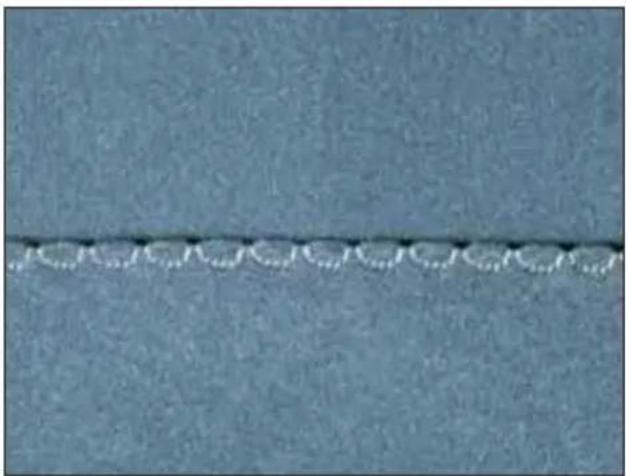
natural_image
Close-up of a textured blue surface with a horizontal white line and faint patterns (no text or symbols)| select | ||||||
| 1546 | K | 4,5 | 1,5 | ● | 4-5 | 0/1 |
| 1536 | I | 4,5 | 1,5 | ● | 4-5 | 0/1 |
| 1526 | I | 4,5 | 1,5 | - | 4-5 | 0/1 |
Tip: By sewing a colored woollen or 12 wt. cotton thread into the seam you strengthen the shell-edge while also creating an attractive contrast in the seam. A fine fabric of another color can also be used instead of a woollen thread.
Just lay the heavy thread against the edge of the fold and let the zigzag swing of the stitch catch the heavy thread forming a scallop.

natural_image
Close-up of a white chain-link fence on a blue textured background (no text or symbols)
text_image
PFAFF 3. Decorative sewing and embroidery techniques- Decorative sewing and embroidery techniques
Decorative stitches
To enhance home textiles or garments, select different stitches, using different thread/fabric colors or vary length and width of the stitches.
For decorative stitches we recommend using special embroidery threads which are available from your Pfaff dealer. Use stabilizer under the fabric. This prevents the fabric from pulling. Use a magic pen or marking chalk to mark a line for your first row of stitching.
The following recommendations apply to all samples on the following pages.
The stitch length and stitch width can be varied as required.
Always use the center needle position ☐ if not otherwise indicated
| stitch | ||||||
| 1546 | - | 5-▶ | 0,5-1 | ○ | 2-3 | |
| 1536 | - | 5-▶ | 0,5-1 | ○ | 2-3 | |
| 1526 | - | 5-▶ | 0,5-1 | - | 2-3 |
stitch
Stitch number

Stitch width in mm

Stitch length in mm

Dual feed on =
off


Thread tension

Presser foot number
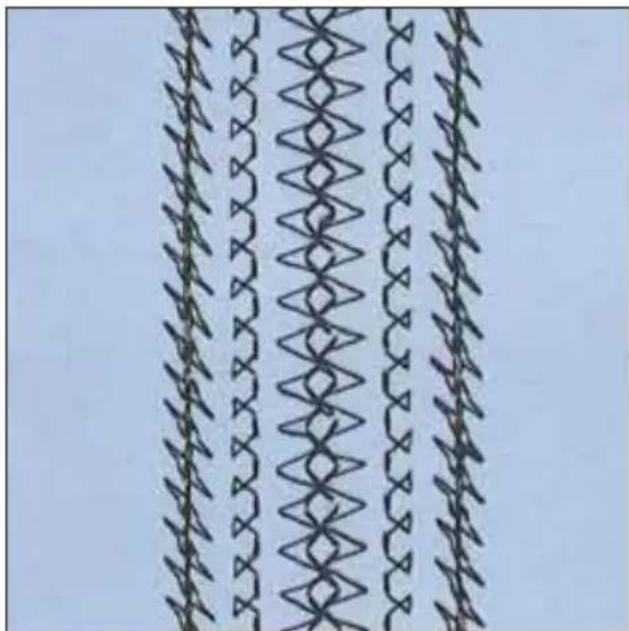
natural_image
Close-up of three identical black zigzag line patterns against a light blue background (no text or symbols)Borders with a combination of stitches
(only on select 1546)
By combining different stitches you can easily achieve embroidery effects. This is a simple way to embellish tablecloths and garments.
- Place appropriate stabilizer under the fabric.
• Mark the center with tailor's chalk. - Begin with the combination M / G Stretch, stitch width 5▶. Embroider along the marked line. Then turn the fabric and embroider back down the border in reverse.
- Sew close to the first border with the combination L / K Stretch stitch width 5▶.
- 1/F Stretch, stitch width 5 , completes the border. Embroider one row. Then turn the fabric and embroider back down the border in reverse.
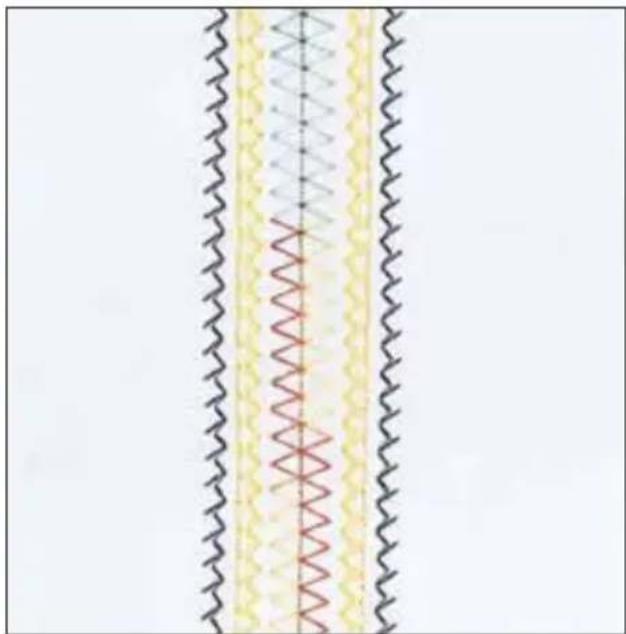
natural_image
Pure diagram of a zigzag line pattern with no text, numbers, or symbolsCombinations with colored thread
(only on select 1546)
Additional effects can be produced with different colored thread. Multi-colored thread was used for the middle border in this example. You can purchase it in a great variety of shades from your PFAFF dealer.
- Place appropriate stabilizer under the fabric.
• Mark the middle with tailor's chalk. - Begin with the stitch H Stretch, stitch width 5 ▶. Embroider along the marked line. Then turn the fabric and embroider back down the border in reverse.
- Sew close to the first border with the stitch I/G Stretch, stitch width 2-4 mm.
- F/G Stretch, stitch width 3-4 mm completes the border.
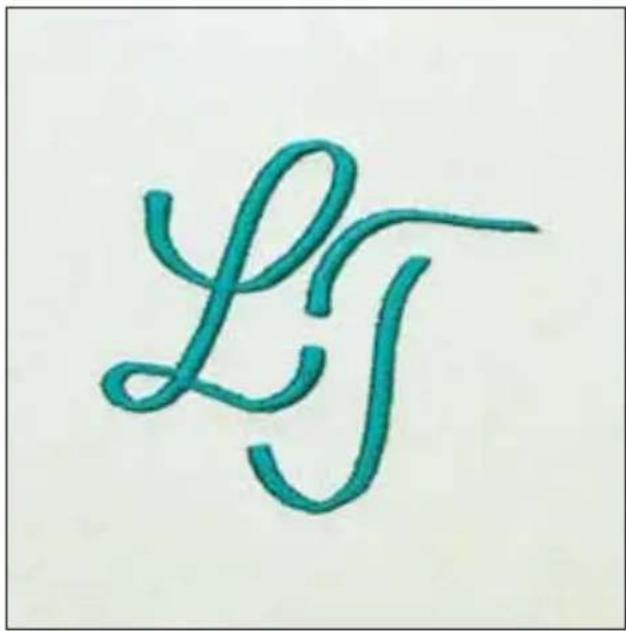
text_image
LfMonograms
You can embroider initials of your own design using the darning foot and stitch G (1546), E (1536/1526), stitch width 2.5-5 ▶!
Sewing this way without a set pattern does, however, require a little practice.
- Draw the initials onto the fabric with an invisible-ink marker.
- Drop the feed dog. Insert the darning foot and lower the presser bar into the free-motion/darning position (see page 2:17).
- Place stabilizer under the fabric.
- Hoop the fabric in an embroidery hoop and embroider using the zigzag stitch.
- Tie off the threads and remove the stabilizer.
Tip: By sewing quickly and moving the material slowly, you will achieve dense stitches.
When embroidering on terry-cloth, the monogram must first be sewn with a narrow zigzag stitch and then stitched again with a wider zigzag stitch. This way the terry-cloth loops are completely covered.

text_image
EFEmbroidering block letters is somewhat easier. Here the feed dog is not dropped which means that free sewing is no longer necessary. You can simply sew along the lines with stitch G (1546), E (1536/1526), stitch width 2.5-5▶.
- Place stabilizer under the fabric.
- Before sewing, draw the monogram onto the fabric.
- Sew along the lines you have sketched using the zigzag stitch.

natural_image
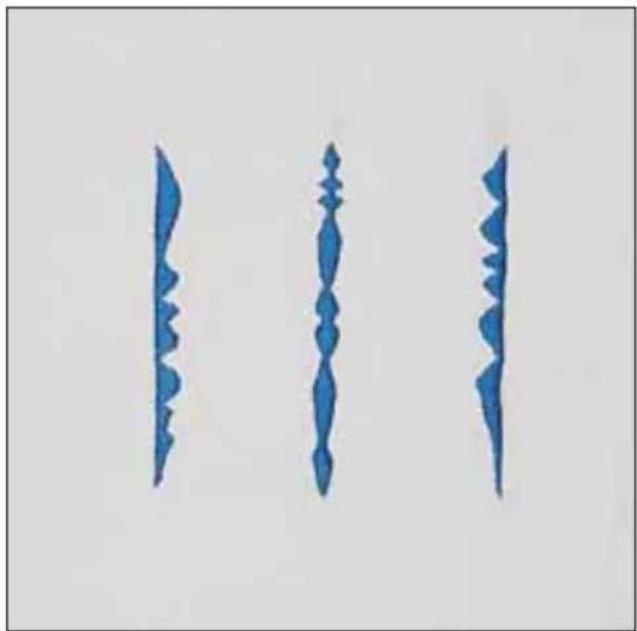
Three vertical, elongated, dark, pointed shapes on a plain background (no text or symbols)Embroidering with a dense zigzag stitch/Tapering
Tapering is easy with your select sewing machine. By adjusting the width of this dense zigzag stitch you can create interesting embroidery.
Even embroidering
- Place stabilizer under the fabric.
- Set needle thread tension to "buttonhole", select zigzag stitch G (1546), E (1536/1526), set stitch length to "buttonhole" and select the center needle position.
- Turn the width dial (27) smoothly and consistently from 0 to 5 ▶ mm and back again to 0 while sewing at a constant speed through the procedure.
Note: If you selected the right or left needle position, the stitch width will only change in one direction.
natural_image
Three blue abstract wavy lines on a plain background, no text or symbols presentUneven embroidering
- Place stabilizer under the fabric.
- Set needle thread tension to "buttonhole", select zigzag stitch G (1546), E (1536/1526), set stitch length to "buttonhole" and select the center needle position Ⓞ.
- Increase or decrease the width of the stitch using the width dial (27).
Note: If you selected the right or left needle position, the stitch width will only change in one direction.
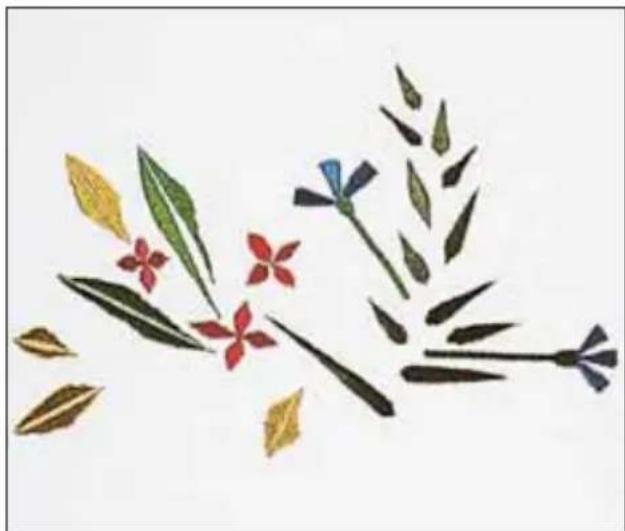
natural_image
Decorative floral pattern with leaves and arrows, no text or symbols presentFloral embroidery
For this fl ower arrangement, only a dense zigzag stitch was used in combination with the variable stitch width and the various needle positions.
- Place stabilizer under the fabric.
- Draw the contours of a flower motif with a self-erasing textile pen.
- Set needle thread tension to "buttonhole", select zigzag stitch G (1546), E (1536/1526), set stitch length to "buttonhole".
- Flowers:
Select center needle position Ⓞ and embroider individual petals. Adjust the stitch width with the width dial (34) during sewing according to the contours of the flower.
• Leaves:
Select right needle position Ⓞ and embroider half of the leaf. Vary the stitch width using the width dial (27). Turn the handwheel towards you after fi nishing the fi rst half of the leaf until the needle is in the fabric.
• Turn the fabric 180 degrees and embroider the other half of the leaf

natural_image
Abstract geometric shapes made of blue and green blocks forming a 3D-like structure (no text or symbols)Embroidering corners
By changing the stitch width during sewing of dense zigzag stitches you can embroider corners with 45 degree angles.
- Set needle thread tension to "buttonhole", zigzag stitch G (1546), E (1536/1526), set stitch length to "buttonhole" and stitch width 5 mm.
- Select right needle position and embroider a straight line.
- Embroider corner:
After the needle has penetrated the fabric to the right, reduce the stitch width using the width dial (27) by 0.5 mm to 4.5 mm. Sew a stitch.
- Reduce the width once again by 0.5 mm and sew a stitch. Continue in this manner until the stitch width is 0.5 mm.
- Turn the handwheel towards you until the needle penetrates the fabric. Turn the fabric 90 degrees and sew a stitch.
- Increase the width by 0.5 mm to 1.0 mm. Sew one stitch.
- Increase the width by 0.5 mm again and sew one stitch. Continue in this manner until the initial width is achieved. Now embroider a straight line.
If the corner is to continue in the opposite direction, use the outermost left needle position Ⓞ.

natural_image
Simple geometric shape with a yellow top, blue bottom, and green/teal diagonal stripe (no text or symbols)Decorative buttonhole
This buttonhole is a beautiful alternative to the traditional buttonhole (see page 2:12-2:13). Since you determine the width of the buttonhole seam, the buttonhole can have a width of up to 10 mm.
- Sew two buttonhole seams about 1 mm apart using a dense zigzag stitch (stitch G (1546), E (1536/1526), stitch width 3-5▶ mm). The needle thread tension is set to "buttonhole".
- Select the right needle position and sew over both ends of the buttonhole seam with a triangle. To do this, turn the stitch width dial (27) during sewing constantly from 0 to 5▶ and back to 0. The top of the triangle should meet the middle of both buttonhole seams.

natural_image
Illustration of an orange flower with five petals and two white centers, no text or symbols present.Appliqué
Appliqués are quickly made and always produce a beautiful fancy effect. By using different fabrics and patterns you can sew many different variations. You can make a perfect, densely stitched seam with the appliqué foot (special accessories), because it has a special cutout on the underside for the buttonhole seam. Use a fusible backing fabric to iron the appliqué onto the fabric, making it easier for you to appliqué.
- Insert the appliqué foot in the sewing machine.
- Transfer your drafted pattern to the face side, smooth side, of the fusible backing fabric. Remember that e.g. letters have to be drawn as a mirror image.
- Now iron the backing fabric onto the appliqué fabric. Cut the motif out and pull the paper off.
- Place and iron on the appliqué parts on the base fabric.
- Sew over a appliqué fabric edges with the dense zigzag, stitch G (1546), E (1536/1526), stitch width 2-4 mm, stitch length "buttonhole". The needle thread tension is in the "buttonhole" area. Make sure the needle stitches over the outer edge so that no fraying occurs later.
Tip: For appliqué pieces which are pointed at the ends, you can make the zigzag stitch narrower using the width dial (27) so that the ends are pointed.

natural_image
Close-up of a white fabric with ruffled edges and a small inset image of three figures (no text or symbols visible)Richelieu
This artistic form of eyelet and insert embroidery is easy to sew with your sewing machine.
• Using a magic marker, draw your motif onto the right side of the fabric.
- Then place two layers of water-soluble stabilizer underneath the fabric to be embroidered and hoop both the fabric and the stabilizer into an embroidery hoop.
- Insert decorative embroidery foot number 1.
• To lend more durability to the embroidery, sew all of the contours twice using the straight stitch (stitch length approx. 1 mm).
- Then carefully cut out the fabric 2 mm next to the contour from the areas which are to be hollow. The stabilizer must not move.
- Embroider the contours with a dense zigzag stitch.
• Finally, simply dissolve the stabilizer in cold water and your one-of-a-kind design is fi nished.
natural_image
Woman in white dress using a laptop with a pink icon, writing on a keyboard (no visible text or symbols)Eyelet embroidery
Traditional eyelet embroidery which previously had to be made laboriously by hand can now be made quite easily with the help of an eyelet plate (special accessory).
This is very effective on blouses, bed or table linen. Use utility stitches such as the zigzag stitch, blindhem stitch, or elastic stitch.
For classic eyelet embroidery, use stitch G (1546), E (1536/1526), with a stitch width 3-5 mm.
- Remove the presser foot. Set the presser bar lifter at the darning position (see page 2:17).
- Place the eyelet plate on the needle plate, making sure pin A fi ts in the middle cutout of the needle plate. Then push the plate down at the front.
- Place the marked fabric taut in an embroidery hoop. Cut one or two of the fabric threads and push the fabric over the pin in the eyelet plate. The fabric must fit snugly around the pin.
- Draw up the bobbin thread and hold it for the first few stitches.
- Stitch around the cut with the selected stitch. It is important to turn the fabric slowly and evenly. The stitches should be very close to each other.
• Afterwards secure with straight stitch.
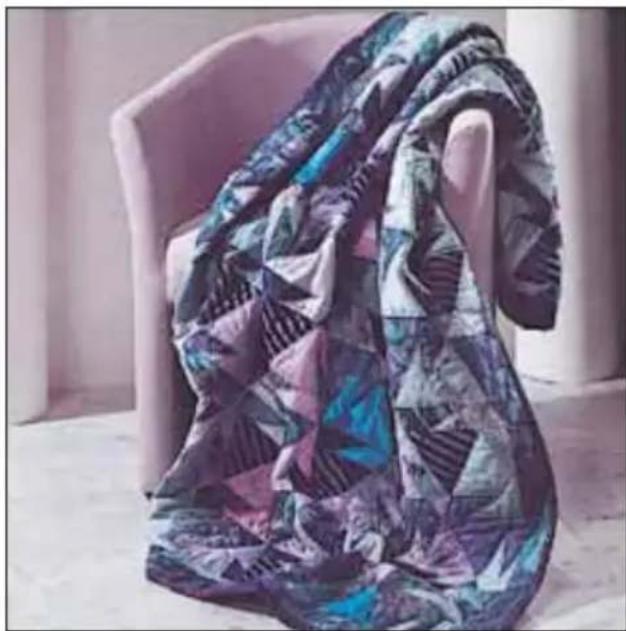
natural_image
Folded fabric with geometric patterns on a white chair, no visible text or symbolsPatchwork quilt
Patchwork and quilting are traditional handicraft techniques which were originally used by North American pioneer women to make use of left-over fabric. Over the years it has developed into a creative hobby.
Traditionally patchwork was sewn by hand. Today your creative ideas can be realized in a much shorter time with your select sewing machine.
A patchwork quilt consists of three layers of fabric, two layers of fabric with a layer of batting sandwiched between. Many pieces of fabric are joined together in patterns to form the top layer of the quilt. This is tacked to a middle layer of polyester or cotton batting and a backing layer.
The quilt and patchwork foot (special accessory - see page 4:4) is particularly helpful for sewing patchwork and quilting. The distance of the needle to the outer edge of the foot is 1/4 inch (6 mm) and 1/8 inch (3 mm) to the inner edge.

natural_image
Abstract geometric pattern composed of overlapping triangles and zigzag lines in purple, pink, and blue tones (no text or symbols)And this is how it's done:
- Cut the pieces necessary for your quilt top, making sure to include a seam allowance of 1/4 inch (6 mm).
- Sew the pieces together as required by the block chosen. These squares will then be sewn together and will form the top of the quilt.
- Baste the finished top of the quilt onto the batting and the bottom quilt layer.
- Use your Pfaff select model to sew all layers together. Work from the inside of the quilt out. Use a straight stitch for long seams. Use stitches such as FG or L stretch (select 1546) to add a decorative touch.
Experiment with other stitches on a scrap of fabric. Contact your Pfaff dealer, library, or bookstore for more information on quilting.
Hemstitch seam
The hemstitch seam is an embroidery technique and can be used to secure edges on table linen as well as for decoration on clothing. For hemstitching you will require a wing needle and natural fi ber, woven fabric that you can easily pull single threads. Lightweight darning thread is particularly suitable. With the stretch zigzag stitch you can sew various hemstitching techniques such as the wale hemstitch seam, a hem sewn with the hemstitch and a hemstitch seam as an edge. Use the decorative stitch foot 1.
Hem edge sewn with hemstitch seam
- Iron the hem over twice and pull one or more threads out from above the hem.
- Using the stretch zigzag, stitch width 2-3 mm, sew the hem from the face side. The needle must perforate the hem on the right hand side and bundle the pulled threads on the lefthand side.

natural_image
Close-up of a textured fabric with a wavy pattern and a horizontal seam (no text or symbols)Hemstitching seam as edge
This edge is used for very fine, think materials. It is great for valances and ruffles.
- Using the Stretch stitch (G/E), width 2-3 mm, sew at a presser foot's width along the edge of the fabric.
• Using a small pair of scissors, trim off the excess fabric on the hemstitch edge.
Wale hemstitch seam
- As with the hand hemstitch seam, the threads are pulled out to the desired width.
- Using stretch zigzag stitch, stitch width 2-3 mm, sew along both of the fabric edges. The needle must perforate the area of the pulled threads just next to the edges. This bundles the threads.

text_image
Scanned document with dense Chinese text, likely a formal letter or official notice
natural_image
Close-up of a metallic threaded spring against a light blue textured background (no text or symbols)
text_image
PFAFF 4. Maintenance and trouble-shooting4. Maintenance and trouble-shooting
Changing the needle plate

Switch off the main switch.
It is very important to clean and oil your sewing machine, because it will reward you with a longer service life. The more often you use the machine, the more care it needs.
Removal:
- Raise the sewing foot and remove the removable accessory tray.
- Push the point of a small screwdriver into the opening between needle plate and sewing machine.
Twist it lightly to the right and the needle plate will snap half way out of its mounting. Now push the screwdriver into the left opening and take the needle plate out.
Replacing:
- Place the needle plate on fl at at the back and push it down with both hands at the front until you hear it snap in place. Before you start sewing, check that the needle plate is lying fl at.
Cleaning

Switch off the main switch
- Remove the needle plate and lower the feed dog.
- Clean the feed dog and hook area with the brush.
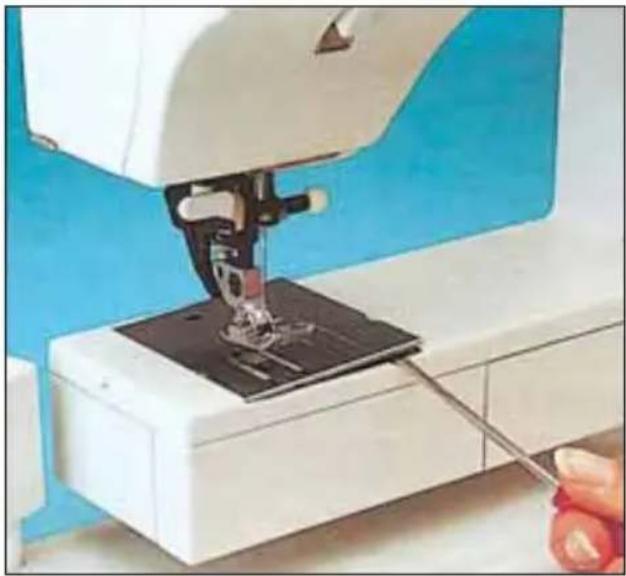
natural_image
Close-up of a sewing machine needle stitching fabric, with a hand holding the tool (no visible text or symbols)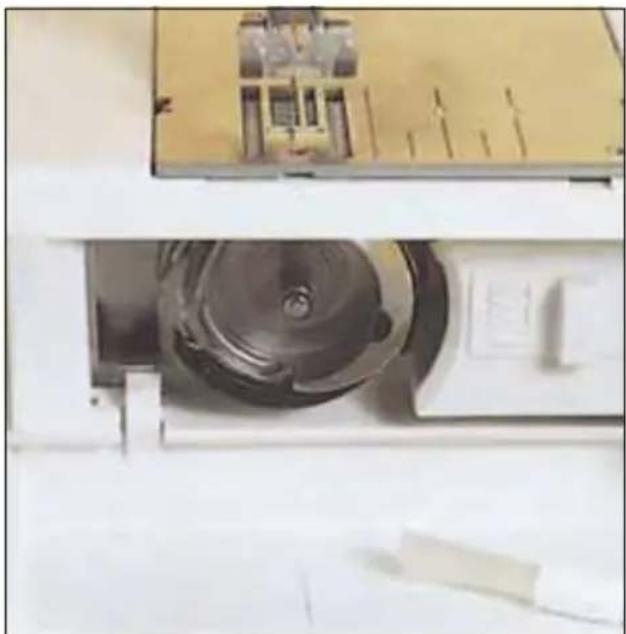
natural_image
Close-up of a kitchen appliance with a circular vent and internal components (no visible text or symbols)
natural_image
Close-up of a robotic arm with white components against a blue background (no visible text or symbols)Changing the sewing bulb

Switch off the main switch
- Disconnect the mains plug and the foot control plug from the machine.
• Take off the removable accessory tray (15).
The sewing bulb is located inside the left side of the sewing machine
Removal:
- Hold the sewing machine tightly.
- Push the bulb into its socket as far as it will go.
- At the same time, turn the bulb a half turn anti-clockwise and remove it.
Insertion:
- Insert the bulb in the diagonal socket and turn it so that both stops of the bulb engage.
- Now push the bulb fully into the socket and turn it clockwise so that it is held firmly.
Note: The bulb changer (available as a special accessory) will make changing the bulb much easier.
Important!
The maximum allowed wattage of the bulb with a plug-in socket is 15 watts!
Trouble-shooting
The machine skips stitches
| The needle is not properly inserted. | Push needle fully upwards, flat side facing the back. |
| The wrong needle is inserted Use a needle system 130/705 H. | |
| Needle is bent or blunt. Insert a new needle. | |
| Machine is not properly threaded. Check how machine is threaded. | |
| Needle is too small for thread. Use a larger needle. | |
Needle thread breaks
| See reasons above. See above. | |
| Thread tension is too tight. Adjust thread tension. | |
| Thread is poor or has slubs in it, or has become dry after too-long storage. | Only use good threads. |
| Thread is too thick. | Use needle with large eye (System 130 N). |
Needle breaks off
| Needle is not pushed fully in Insert new needle and push fully in. | |
| Needle is bent Insert new needle. | |
| Needle is too thick or too thin | Insert new needle. |
| Needle is bent, and has hit the needle plate because you are pulling or pushing the fabric | Let the machine feed the fabric.Only guide the fabric lightly |
| The bobbin case is not properly installed When you insert the bobbin case, push it fully into the stop. | |
Seam is sewn unevenly
| The tension needs adjusting Check top and bottom tensions. | |
| Thread is too thick, slubbed or hard Only use perfect threads | |
| The bobbin thread is unevenly wound Do not wind thread free-hand, but run it on through the winding tension. | |
| Thread bunching at top or bottom side of fabric | Thread up correctly. Check needle and bobbin thread tensions |
Machine does not feed or feeds irregularly
| Sewing lint has collected between the feed dog teeth rows | Remove needle plate, remove lint with brush. |
| Feed dog is lowered, slide A (see page 1:15) at right. | Push slide B (see page 1:15) to left. |
Machine is running with diffi culty
| There are thread remnants in the hook race | Remove the threads. |
Important note!
Before you replace sewing feet or needles, you must switch off the main switch.
Do not start the threaded machine without fabric in it.
If you leave the machine, even for a short time, do not forget to switch off the main switch. This is important if children are nearby.
Index
A
Accessories IV
Accessory tray 1:3
Appliqué 3:7
B
Blindhem stitch 2:5
Bobbin case 1:8-9
Buttonholes 2:13,
C
Changing the needle plate 4:2
Changing the needle 1:15
Cleaning 4:2
Closed overlock stitch 2:9
Covering stitch 2:10-11
D
Darning with the elastic stitch 2:18
Darning with the straight stitch 2:17
Darning 2:17-18
Decorative sewing 3:3-10
Drawing up the bobbin thread 1:12
Dropping the feed dog 1:15
E
Easy Select System 1:18
Elastic stitch 2:7
Elastic stitches 2:6-9
Electrical connection 1:2
Embroidering with a dense zigzag stitch 3:4-7
Eyelet embroidery 3:8
F
Feather stitch 2:10
Free arm 1:3
G
Gathering with elastic thread 2:16
Gathering with the straight stitch 2:16
General information on sewing 2:3
3:7
H
Handwheel release disk 1:4
Hemming with the twin needle 2:15
Hemstitch seam 3:10
Honeycomb stitch 2:7
|
Inserting lace 2:23
Integrated Dual Feed / IDT 1:14
L
Left needle position 1:16
M
Main switch 1:2
Maintenance and trouble-shooting 4:1-4
Monograms 3:4
N
Needle thread tension 1:5,2:3
Needle threader 1:11
Non-elastic stitches 2:4-5
0
Open overlock stitch 2:8
Overlock stitches 2:8-9
P
Patchwork quilt 3:9
Pennant stitch 2:11
Placing sewing thread on spool holder 1:5
Practical sewing 2:1-24
Presser foot lifter 1:13
Pullover stitch 2:9
Q
Quilting 3:9
R
Removable accessory tray 1:3
Removing the presser foot 1:13
Repairing tears 2:18
Reverse sewing 1:17
Richelieu 3:8
Right needle position 1:16
Ruffl er 3:7
S
Selecting needle position 1:16
Selecting stitch width 1:16
Serging with blindstitch and overlock stitch 2:5,8-9
Serging with zigzag stitch 2:4
Setting stretch stitches 1:7-9
Setting utility stitches 1:7-9
Sewing light 4:2
Sewing on buttons 3:14
Sewing on patches 3:18
Sewing on zippers 2:20-21
Shell-edging 2:24
Smocking 2:15
Stabilizing edges 2:22
Standard buttonhole 2:13
Standard buttonhole with gimp thread 2:13
Stitch density 1:17
Stitch length adjustment dial 1:17
Stitch selection dial 1:19
Stitch table VI
Straight stitch 2:4
Stretch triple straight stitch 2:6
Stretch triple zigzag stitch 2:6
T
Tapering 3:5-7
Thread tension 1:15
Thread cutter 1:12
Threading the upper thread 1:10
Top feed (Integrated
Dual Feed) 1:14
Top-stitching 2:3
Trouble-shooting 4:4
Twin needle 1:11, 2:15
W
Winding from the second spool holder 1:6
Winding the bobbin 1:4-7
Winding through the needle 1:7
Z
Zigzag stitch 2:4
We reserve the right to change the machine equipment and the ass ort ment of accessories without prior notice, or make modifi cations to the performance or design.
Such modifi cations, however, will always be to the benefit of the user and the product.
Please note that on disposal, this product must be safely recycled in accordance with relevant National legislation relating to electrical/electronic products. If in doubt please contact your retailer for guidance.
natural_image
Close-up of a soft, textured cushion with light blue and purple gradients (no text or symbols visible)
text_image
PEAFD ClassicStyle home
natural_image
Close-up of a white laboratory instrument with a blue label (no visible text or symbols on the device itself)