calanda 132 - Sewing machine PFAFF - Free user manual and instructions
Find the device manual for free calanda 132 PFAFF in PDF.


User questions about calanda 132 PFAFF
0 question about this device. Answer the ones you know or ask your own.
Ask a new question about this device
Download the instructions for your Sewing machine in PDF format for free! Find your manual calanda 132 - PFAFF and take your electronic device back in hand. On this page are published all the documents necessary for the use of your device. calanda 132 by PFAFF.
USER MANUAL calanda 132 PFAFF
At last you are the proud owner of this Sewing Machine!
The machine was fully explained to you and you were delighted with the many useful and wonderful things performed on this true wonder of engineering.
Although everything is quite clear to you now, it is possible that in time some of the directions given to you for making the various adjustments may escape your memory - because, it is unlikely that you will immediately try your hand at all the different kinds of sewing your machine can do.
We have therefore prepared this informative instruction book and hope you will find it a useful guide. Before putting the machine to work we advise you to glance briefly at the pages of this book, so that you will have a rough idea of the contents. This will help you when reverting later on to any one of the chapters.
It is a good plan to open out to the left page 1, for the information given on that page should be read in conjunction with the directions. The same applies to page 2.
Your attention is drawn particularly to sections 1, 2 and 4. After reading the information contained in those three chapters you will be thoroughly acquainted with the working of your sewing machine; it will become a living thing to you, placed under your care and protection.
The more you understand your machine, the greater will be your appreciation of its scope and capacity.
Contents
Important Hints . . . . . . . . . . . . . . . . . . . . . . . . . . . . . . . . . . . . . . . . . . . . . . . . . . . . . . . . . . . . . . . . . . . . . . . . . . . . Page 5
Choice of Needle Sizes and Thread Numbers . . . 5
-
To Prepare for Sewing . . . . . . . . . . . . . . . . . . . . . . . . . . . . . . . . . . . . . . . . . 6
-
Sewing 11
-
Cleaning and Oiling 14
-
Cause of Faults and Simple Home Service ... 18
The Electric Motor 24
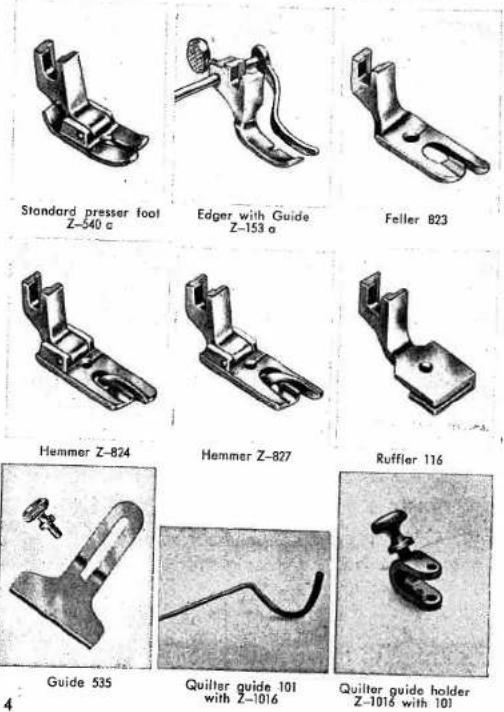
The following accessories are available at slight additional charge
1 box for housing accessories, No. 1466 a
1 edger with guide Z-153 a
1 feller No. 823
1 hemmer No. Z-824, 4 mm
bobbins No. 970
sewing machine needles, System No. 130 R
1 threader, No. 188
1 screwdriver, No. 140 c (medium size)
1 screwdriver, No. 533 (small size)
1 oil can (plastic), with oil, No. 132 a
1 quilter guide, No. 101
1 quilter guide holder, complete with screws, No. Z-1016
1 hemmer, 2 mm, No. 827
1 ruffler, No. 116
1 guide, No. 535
1 thumb screw, No. 410
1 hemmer No. Z-827 (2 mm)
Presser feet and their designations
Important Hints
Always obtain oil and needles from your Sewing Machine Dealer. Never use just any kind of lubricating oil, but only best quality sewing machine oil.
Use only needles of System No. 130.
Only Sewing Machine Experts should be entrusted with any repairs to your machine.
Recommended Needle and Thread Sizes
| Fabrics | Size of Thread | System 130 R ^TM Size of Needle | |
| Cotton | Silk | ||
| Fine Fabricsgeorgette, chiffon, batiste, voile,lown and fine silks | 80to100 | 0 to000twist | 60 or 70 |
| Lightweight Fabricsdress silks and cottons, shirtings,shear woolens and droperies | 70to80 | A & Btwist | 80 |
| Medium Fabricslightweight woolens, cretons, heavysilks and rayons, muslin, brocadesand gobardine | 50to70 | B & Ctwist | 90 |
| Heavy Fabricscoating, denim, corduroy, slipcoverfabrics, bed tickings and lightweightcanvas | 40to50 | C & Dtwist | 100 |
If you want to sew very fine texture materials or exceptionally heavy-weight fabrics, first try the needle and thread selected on a suitable piece of material. For the under thread (in the bobbin) preferably employ a slightly softer and thinner thread than in the needle. For woollen and silk goods you will mostly use sewing silk; both threads should be identical.
For darning and embroidery we recommend colour-fast mercerised thread No. 50 (for upper and under thread) and needles No. 60-70.
To prepare for sewing
1.
Before despatch from the works, each machine is subjected to a severe test run. Therefore, should you experience any trouble with the machine, the cause may well be due to wrong manipulation. Do not interfere with any settings without first carefully checking the upper and under threading, the tensions, the needle and the position of the feed dog, the control of which should be set at "Sewing".
Inserting the Needle
Raise the needle bar to its highest point. With thumb and forefinger of your left hand insert the needle into the clamp. Push the needle up as far as it will go. The flat side of the needle shank must be to the right.
Then tighten the thumb screw.
Attaching the Presser Foot
Slide the foot on to the presser bar, right up against the screw and firmly tighten the latter with a screwdriver. All other types of presser feet supplied for use with the machine are attached and secured in the same manner
Under Threading
Figs. 1–5
Removing the Bobbin Case
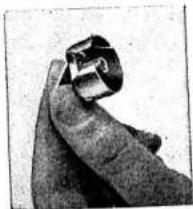
Place the needle bar in topmost position and tilt the head over. With thumb and forefinger of your left hand, grip the small latch on bobbin case (Fig. 1), lift the latch and re-
move the case with bobbin inside. Release the latch, turn the bobbin case upside down, and let the bobbin drop into your other hand.
natural_image
Close-up of a hand holding a small mechanical component (no visible text or symbols)Fig. 1
Winding the Bobbin
Before winding the bobbin, disconnect the sewing mechanism. Proceed as follows:
Hold the balance wheel with your left hand and loosen the stop motion screw with your right hand;
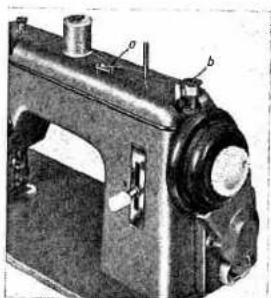
this screw must be turned outwards as far as it will go (Fig. 2). After placing the reel on the spool pin, draw the thread once round tensioner a (fig. 3) and to bobbin b placed on the winder pin. With your left hand then wind the end of the thread a few times from front to back round the bobbin.

Fig. 2
natural_image
Mechanical device with labeled parts (a, b) and no visible text or symbolsFig. 3
Now press on the winder by means of latch and turn the free balance wheel over towards you to set it in motion as you start treadling. The winder action stops automatically when the bobbin is fully loaded. Finally, the stop motion screw is firmly retightened by screwing it inwards against the balance wheel.
Threading the Bobbin Case
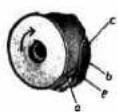
Fig. 4
Hold the case with its open side up and insert the bobbin as indicated by the arrow, i. e. so that the thread unwinds from left to right (Fig. 4). Pass the thread through slot a, along and underneath the spring b and out through opening c in the side of the bobbin case.

Fig. 5
the bobbin case down so
sition.
Replacing the Bobbin Case
With thumb and forefinger of your left hand hold the bobbin case (complete with bobbin) by its latch (Fig. 1) and slide the case on to the small stud in the center of the hook (Fig. 5). Now press
that the latch clicks into po-
Upper Threading Fig. 6
Place the spool of thread on the spool pin and bring the thread below the guide and to the left, then from left to right into the upper slot in guide b and from right to left through the lower slot. From there pass the thread down and from right to left through the slot in thread tensioner and take-up spring c, then up again and from right to left through the take-up lever d, then down and through the guide in needle bar e and finally from left to right through the eye of the needle.

text_image
Technical diagram of a sewing machine with labeled parts (a, b, c, o) for identification.Fig. 6
Picking up the Lower Thread - Fig. 7
natural_image
Close-up of a sewing machine needle stitching fabric (no visible text or symbols)Fig. 7
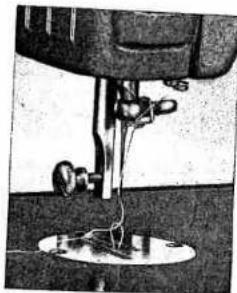
With your left hand hold the end of the upper thread above the bed-plate, leaving the thread slack.
Turn the balance wheel towards you to allow the needle to travel down and up again to its highest point; the lower thread will be brought up in a loop through the needle plate.
Place the ends of both threads under the presser foot to the back.
Do not move the threaded needle unless a piece of material has been placed beneath it.
2.
Sewing
General
Turn the balance wheel to move the thread take-up lever to its highest point. Place the material under the presser foot, lower the presser bar and commence to sew. When making the first few stitches, hold the ends of both threads in your hand, so that they do not get sewn down or get drawn into the race. Never force the material along by either pushing or pulling it, but merely guide the work; otherwise the needle may break. It is best to always make a short practice run on a remnant before commencing on your work.
When sewing hard or thick pieces of material, or when stitching across seams, assist the needle by carefully turning the balance wheel with your hand. This practice will guard against the needle bending or breaking.
before sewing the corner of a seam, with a hand sewing needle draw a thread through the fabric and sew along one edge. At the corner leave the needle in the fabric to act as a pivot, turn the material and continue to sew while holding both ends of the tacking thread. This way you will prevent stoppages at corners which, otherwise, easily occur.
Setting the Length of Stitch - Fig. 8
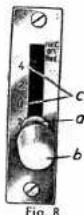
The machine has in front, on the right, a stitch regulating lever a with thumb screw b , with which the required stitch length may be selected on the scale c . Before you can make any adjustment the thumb screw must be turned to the left. The more you loosen this screw, the greater the up and down movement of the regulating lever will be, and the stitches will increase or decrease accordingly. For reverse sewing you must move the lever to the top.
Regulating the Thread Tensions - Figs. 9-11
The Upper Thread Tension is regulated by turning the setting flange of upper thread tensioner a (Fig. 6). - Clockwise turning increases the tension; anti-clockwise turning loosens the tension.
The Under Thread Tension is regulated by turning the small screw e (Fig. 4) with a screwdriver. Here too the tension is increased by clockwise adjustment and decreased by anti-clockwise adjustment.
It is generally only necessary to adjust the upper thread tension.
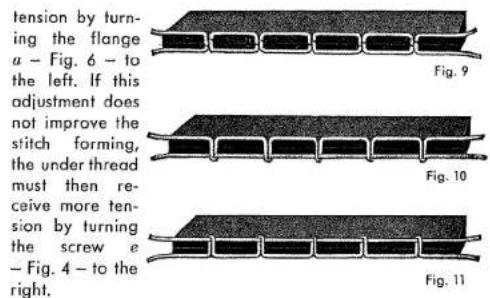
Satisfactory stitching is possible only if upper and under thread tensions are correctly set. After you have sewn an inch or two, inspect the stitching on top and underneath. The tensions are satisfactory if both threads are drawn into the material equally and lock in the center of the work (see Fig. 9). If, however, loops have formed on the underside, the upper thread is too slack and must be given more tension by turning the setting flange a (Fig. 6) to the right (Fig. 10). If loops continue to be formed on the underside of the work, it is possible that the under thread has been tensioned too severely and this must be corrected by turning the small screw e (Fig. 4) a little to the left.
If, on the other hand, the thread is lying flat on top of the material (Fig. 11), or if loops have formed, the upper thread may be too tight and you must loosen the
text_image
tension by turning the flange a - Fig. 6 - to the left. If this adjustment does not improve the stitch forming, the under thread must then receive more tension by turning the screw e - Fig. 4 - to the right.Regulating the Presser Foot
The presser foot must exert on the material sufficient pressure to ensure satisfactory feeding of the material. The presser bar is set for all regular sewing work on light and medium weight goods. Heavy or hard texture materials require more pressure. To increase the pressure, turn the setting screw to the right; to decrease the pressure, turn the screw to the left, i. e. upwards.
Removing the Work from the Machine
Raise the take-up lever to its highest and lift the presser foot. Draw the work to the back of the machine, away from the needle. The ends of the thread should be cut approx. 3" from the needle and be placed under the foot to the back, thus leaving the machine ready for the next run.
Cleaning and oiling
3.
natural_image
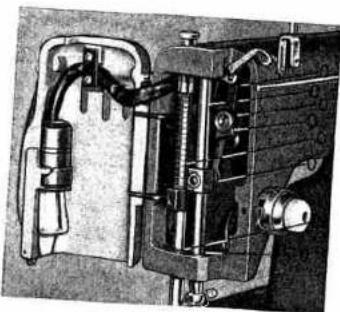
Mechanical assembly diagram showing internal components and wiring (no visible text or labels)Fig. 12 Sewing Machine Head with open Face Cover Plate
Regular oiling is essential for the smooth running of the machine. Lint and thread ends settle in the working mechanism and eventually impede the free running of the machine.
It is necessary, therefore, to give all parts specified hereafter a regular, thorough cleaning. Never use a screwdriver or other metal instrument for cleaning, not even a needle, but only a small pointed stick, so that no damage is done to the sewing mechanism.
After cleaning apply a few drops of high-grade sewing machine oil to all working parts. Do not, however, apply too much oil; a few drops at the right places will prove adequate. After oiling run the machine rapidly for a short while and then, before you start to sew, wipe all parts clear of any surplus oil.
If the machine has not been used for some time, or if it has been used continuously, a few drops of paraffin should be applied to all lubrication points and the machine worked rapidly for a minute or two. Then clean the machine with a soft rag and oil the mechanism.
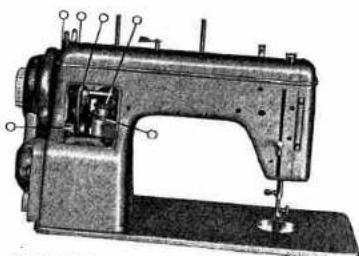
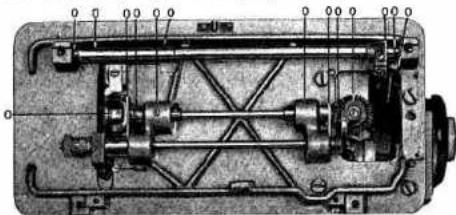
The following points, which are marked thus 0 in the illustration must be cleaned and oiled in proper sequence:
natural_image
Technical illustration of a sewing machine with visible components and mounting holes (no text or labels)Fig. 13 Machine Head with removed Arm Cover Plate
- The Head (Fig. 12). Open the hinged face cover plate.
- The Arm (Fig. 13). Lubricate all points marked thus 0.
- The Needle Plate. Take out the screws and remove the plate.
text_image
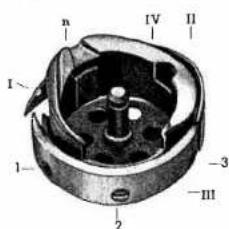
I II III IV I 2 3Fig. 14
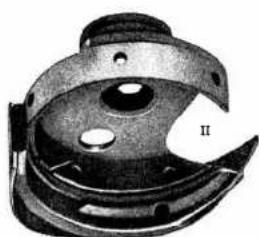
- The Hook (Fig. 14). Move the needle bar to its highest and tilt the head over on its hinges. With a small brush dust the hook. Apply a few drops of paraffin to the race between the hook II and the bobbin carrier IV; then work the machine rapidly for a short while. Now apply a few drops of oil. Should this prove ineffective in dislodging any dirt from the hook, or should thread ends impede the free movement, then the hook must be carefully dismantled. This is done by removing the race guide III, after the small
natural_image
Mechanical component with curved and flat surfaces, labeled 'II' (no text or symbols on the object itself)Fig. 15
16
screws 1, 2 and 3 have been taken out. Now the bobbin carrier IV can be removed. All dismantled parts should be carefully wiped with a clean rag.
Before reassembling the parts move the thread take-up lever to its highest point so that the point I of the hook is on the left, and on top, as shown in Fig. 14. Then replace the bobbin carrier IV into the hook II, and let the retaining key engage into the groove n - see Fig. 14. Finally, replace the guide III and fix it down with screws 1, 2 and 3.
You must also lubricate all Fig. 17 other points indicated in the illustrations, making sure that after oiling all parts are properly replaced.
natural_image
Cross-sectional diagram of a mechanical device with internal components and mounting holes (no text or labels)Fig. 18: View of Underside of Machine Bedplate

Fig. 16

IV
Fig. 17
Cause of faults and simple home service
4.
Please always remember: many machine troubles may be caused by your not carefully following these working instructions. In many cases, faulty working of your machine can be remedied merely by cleaning and oiling.
Machine works heavily
- Thread ends have become entangled in the hook race — remove all obstructions.
- Certain working parts of the machine are dry – apply a few drops of oil.
- The machine is dirty - thoroughly clean it.
- The wrong kind of oil has been used - clean the machine with paraffin.
The machine is noisy
- Thread ends have become entangled in the hook race – remove all obstructions.
18
- Certain working parts of the machine are dry – apply a few drops of oil.
- A component part has worked itself loose - retighten it with a screwdriver.
The upper thread breaks
- Inferior quality, knotty sewing thread breaks easily - use a better quality.
- The needle selected is too fine for the thread or material used - use a thicker needle (see page 5: "Relative Needle and Thread Sizes").
- The upper thread tension is too severe - loosen the setting flange on tensioner (see page 12: "Regulating the Thread Tensions").
- The needle is wrong inserted, or it is bent - change the needle (see page 6: "Inserting the Needle").
- The eye of the needle has a knife edge - change the needle.
- Thread ends or dirt are interfering with the free movement of the feed dog, resulting in bad feeding of the
material - remove the needle plate and thoroughly clean the feed dog.
- The bobbin case has developed a rough edge, causing the thread to break – remove the case and consult a sewing machine specialist.
The under thread breaks
- Inferior quality, knotty sewing thread breaks easily - use a better quality.
- The bobbin thread tension is too severe - loosen the tension screw (see page 12: "Regulating the Thread Tensions").
- The bobbin thread tension is too weak - tighten the screw with a screwdriver (see page 12: "Regulating the Thread Tensions").
Stitches are missed
- The needle has not been set high enough - change the needle, (see page 6: "Inserting the Needle").
- The needle is bent or blunt - change the needle.
- The needle selected is too fine or too thick for the 20
thread used - change the needle or the thread to give the correct relation between the two; (see page 5: "Relative Needle and Thread Sizes").
- The thread curls, because it is unsuitable for machine sewing - use a different thread.
- The needle used is not of the correct system - obtain correct needles from the suppliers of your machine.
The needle breaks
- The needle is wrongly inserted - reset the needle.
The needle is bent or blunt - change the needle (see p. 6: "Inserting the Needle"). - The needle used is too fine for the thread or material - use a thicker needle; (see page 5: "Relative Needle and Thread Sizes").
- The upper thread tension is too severe - loosen the setting flange on tensioner; (see page 12: "Regulating the Thread Tensions").
Faulty feeding
- Thread ends or dirt are interfering with the free movement of the feed dog, resulting in bad feeding of the
material - remove the needle plate and thoroughly clean the feed dog.
The material puckers
- Both tensions are too severe – loosen the setting flange on upper thread tensioner and the screw on bobbin case; (see page 12: "Regulating the Thread Tensions").
- The presser foot exerts too much pressur on the work – reduce the pressure by adjusting the regulating screw 13 – see page 1.
Uneven stitching
- The thread is uneven or too thick - change the thread.
- The tension is wrong – regulate the tension (see p. 12: "Regulating the Thread Tensions").
- Upper and under thread are drawing off unequally from reel or bobbin respectively, owing to a dirty setting flange or bobbin – remove all obstructions.
- The needle is blunt or bent - use a new needle.
- The bobbin is wrongly positioned – remove the bobbin case and make sure the bobbin is properly inserted in the case; (see page 9: "Replacing the Bobbin Case").
22
In all cases where faulty working of your sewing machine cannot be rectified by your following the above directions, please consult your Sewing Machine Dealer. He will always be glad to advise you.
natural_image
Black industrial sewing machine with visible mechanical components and base (no text or symbols)Fig. 19 Rear View of machine showing support opened
The Electric Motor
- Line Voltage
The motor works on 115 volts.
- Tensioning the Drive Belt
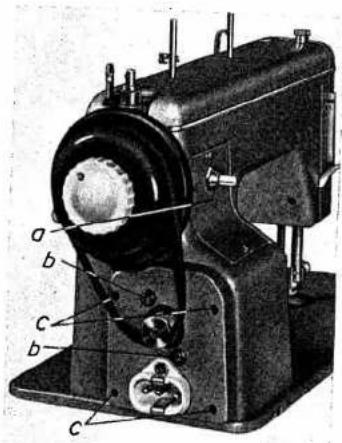
a) Loosen both screws holding the guard to motor and remove the guard.
Fig. 20 shows Motor Housing with Guard removed.
b) Loosen the two screws b which are now visible – see Fig. 20.
c) By moving the motor up or down, the correct belt tension may be obtained. Retighten both screws.
- Changing the Carbon Brushes
a) Remove the V-belt.
b) Take out the 4 screws c in motor end shield plate - see Fig. 20.
The motor, complete with plate, can now be drawn from the motor housing, to give free access to the carbon brushes - see Fig. 20.
text_image
a b c b cFig. 20
End shield plate with screws
for regulating the belt tension and
with fixing screws for access to carbon brushes
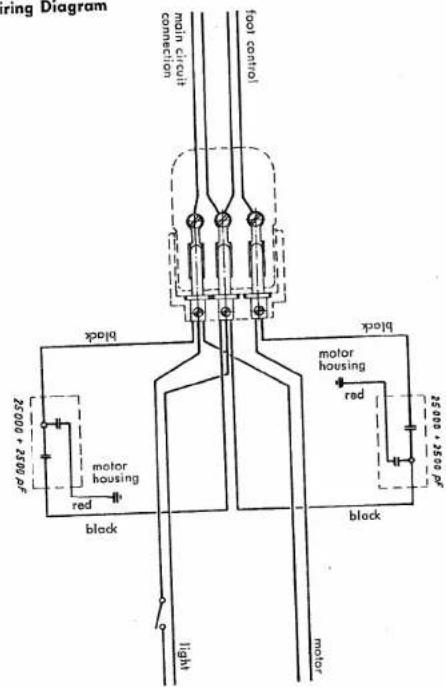
Wiring Diagram