90 - Sewing machine PFAFF - Free user manual and instructions
Find the device manual for free 90 PFAFF in PDF.


User questions about 90 PFAFF
0 question about this device. Answer the ones you know or ask your own.
Ask a new question about this device
Download the instructions for your Sewing machine in PDF format for free! Find your manual 90 - PFAFF and take your electronic device back in hand. On this page are published all the documents necessary for the use of your device. 90 by PFAFF.
USER MANUAL 90 PFAFF
natural_image
Vintage sewing machine with needle and control panel (no visible text or symbols)INSTRUCTION BOOK
PFAFF®
90
INSTRUCTIONS
FOREWORD
Your dream has come true!
You are now the proud owner of a Pfaff 90, the sewing machine which will enable you to master all ordinary sewing, ornamental stitching and darning jobs that may come up in a home.
This instruction book will help you understand the machine and give you valuable tips to make sewing more fun for you.
Even if you are an experienced seamstress, you will find this book a valuable guide to easy sewing.
Follow these simple instructions and familiarize yourself with the exclusive features of your machine. You will find sewing exciting on your easy-to-operate Pfaff 90.
If you have any sewing problems, please contact your Pfaff dealer. He will be glad to help you at any time.
G.M. PFAFF AG
1 Face cover
2 Take-up lever
3 Thread retainer
4 Spool pins
5 Stitch width dial
6 Needle position lever
7 Bobbin winder
8 Balance wheel
9 Stop motion knob
10 Stitch length control
11 Reverse feed control
12 Bed slide
13 PFAFF rotary sewing hook
14 Dual-purpose needle plate
15 Sewing foot thumb screw
16 Light switch
17 Needle thread tension
18 Presser bor lifter
19 Needle set screw
20 Sewing foot
Fundamentals of Machine Operation
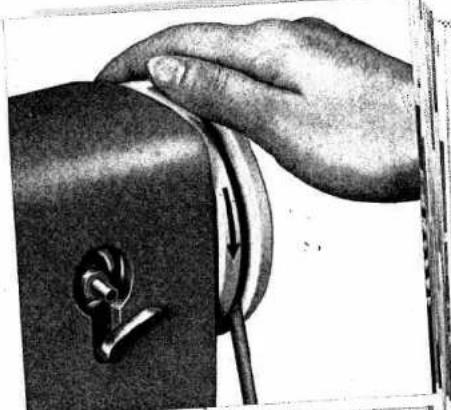
you have to turn the balance wheel, turn it toward you
- Whenever you have to form a clockwise (counter-clockwise as shown by black arrow).
- Make sure stop motion knob on the balance wheel is tightened before you begin sewing.
- Never run a threaded machine unless you have fabric under the sewing foot.
- Place both threads back under the sewing foot before you put fabric into the machine.
- The machine will feed the material under the sewing foot automatically. All you have to do is guide the work.
● Always bring take-up lever to its highest position before you begin and after you have completed a seam.
Failure to observe this rule may cause the thread to slip out of the needle eye. Also, it is easier to remove the work with the take-up lever up.
natural_image
Close-up of a hand adjusting a small electronic device with a cable (no visible text or symbols)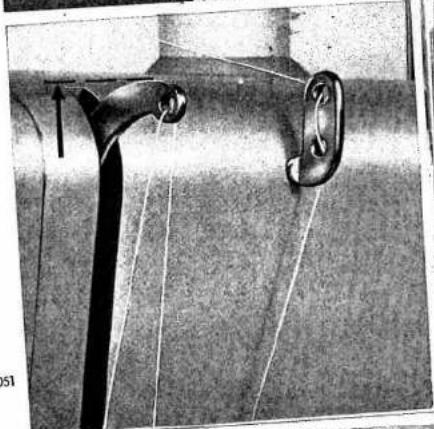
natural_image
Close-up of a mechanical component with wires and a curved handle, no visible text or symbols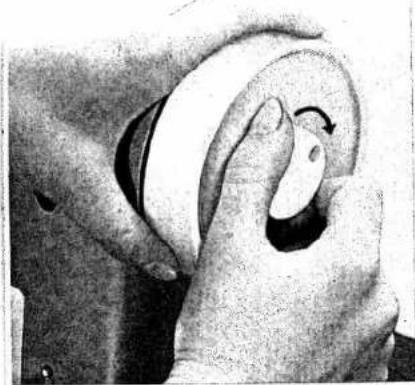
natural_image
Close-up of hands using a tool to clean or adjust a circular object, no visible text or symbolsR 8218 A
Operation of Your Sewing Machine
Engaging the Sewing Mechanism
Hold balance wheel and turn stop motion knob clockwise.
Disengaging the Sewing Mechanism
Hold balance wheel and turn stop motion knob counter-clockwise (toward you). The sewing mechanism is then disengaged for bobbin winding.
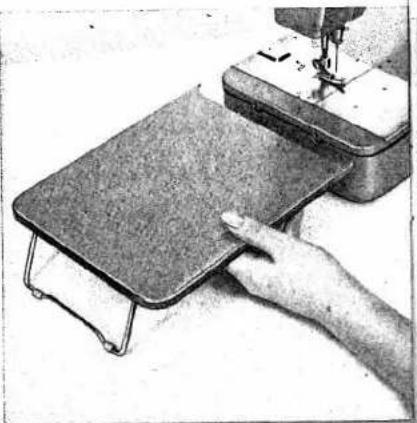
Bedplate Extension
To enlarge the sewing area of portable machines, an extension may be attached to the left side of the bedplate. This extension is kept on the left of the carrying case.
R 8287
natural_image
Close-up of a hand operating a sewing machine on a fabric tray (no visible text or symbols)natural_image
Line drawing of a mechanical device with a knob and handle (no text or symbols)Frnebling af motor
natural_image
Simple line drawing of a mechanical device with a circular component and base mount (no text or symbols)Motor Disengaging Mechanism
Your machine features a lever underneath the balance wheel which serves to swing the motor to its operative position. To do this, flick the lever down to the dot mark. After you have completed sewing and before you put the machine away, flick the lever to its top position in order to return the motor to the inoperative position. With the motor swung out of engagement, the machine with treadle mechanism can be driven by foot power.
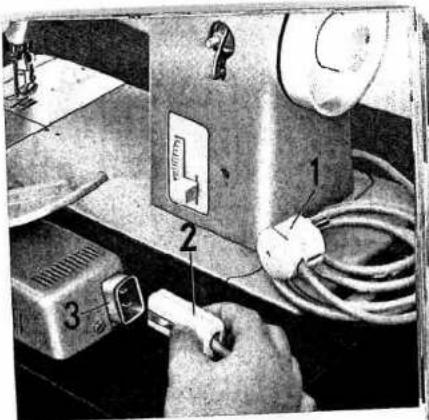
Push plug 1 into wall outlet and plug 2 into receptacle 3 on foot control.
Foot Drive
Push sewlight plug into wall outlet. Mount driving belt. To switch on sewlight, push button on face cover. Before you drop the machine remove the belt from the stand wheel, pulling it to the right.
GR 010
text_image
Labeled mechanical device setup with numbered components and a warning label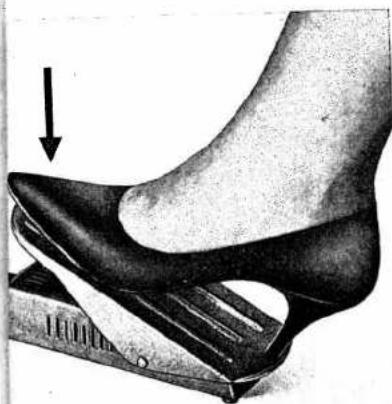
natural_image
Illustration of a foot pressing down on a curved object, with an arrow indicating motion (no text or symbols present)Foot Control
Place the foot control under the cabinet within easy reach of your foot. Rest the right foot on the control pedal and press. The harder you press, the faster the machine will run.
R 7132
5
text_image
A BGR 018
Straight Stitching
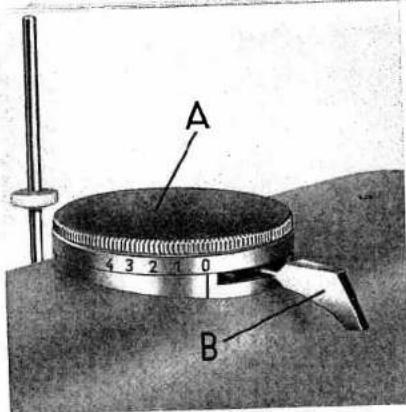
For straight-stitch sewing set:
Dial A - 0
Lever B — Center ↓
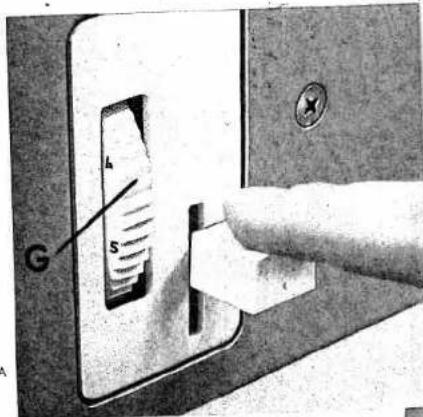
Control G regulates the stitch length. For detailed instructions please refer to page 18. To backtrack the end of a seam, simply depress the finger-tip control.
text_image
G 4 56
GR 009A
GR 052
Zigzag Sewing
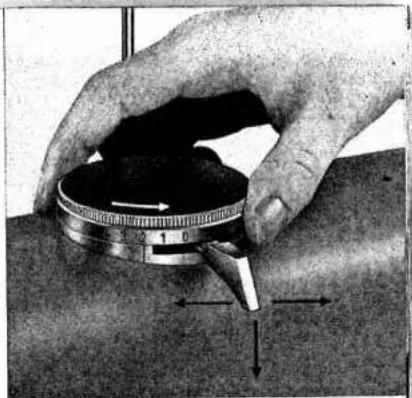
If you want to switch from straight (A on „0") to zigzag stitching, turn dial A to desired stitch width (indicated by numbers 1 to 4).
Lever B changes the position of the needle in the needle plate slot. Thus the stitching can be moved from the center to the left or right of the slot, as desired.
natural_image
Close-up of a hand using a vernier caliper to measure a circular object, with arrows indicating measurement direction (no text or symbols visible)The position of lever B (left, center, right) indicates the position of the needle in the needle plate slot.
Control G lengthens zig-zog stitches or packs them more closely together (satin stitch).
11111111


natural_image
Close-up of hands operating a sewing machine on a metal fabric (no visible text or symbols)GR 014
Removing the Bobbin Case
The needle has to clear the needle-plate. Lift front end of bed slide and pull.

natural_image
Close-up of a hand using a sewing machine to adjust or install a mechanical component (no visible text or symbols)Lift latch k with the thumb of your left hand and pull out bobbin case with bobbin. When you release the latch, the bobbin drops out.
GR 013
8
Winding the Bobbin
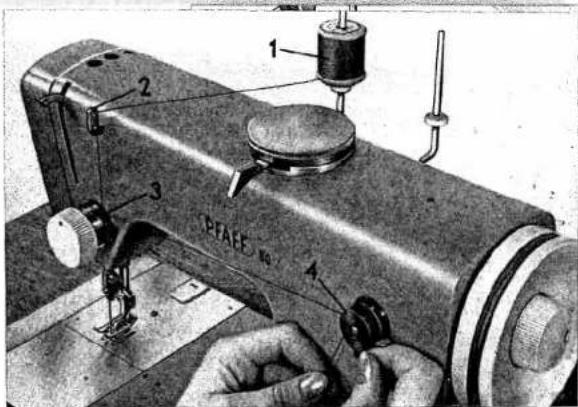
Disengage the sewing mechanism (see page 4) and flick presser bar lifter to highest position. Raise the spool pins to the vertical position. Place spool of thread on one of the spool pins and set bobbin on bobbin winder spindle so that the key at base of spindle enters slot in bobbin.
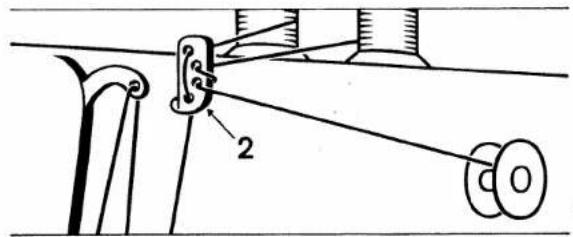
Thread retainer with two holes: Pull thread from spool 1 and pass it through the holes in thread retainer 2, clockwise around tension 3 (between the rear and centre tension discs) and clockwise around bobbin 4. Pass end of thread through slot in bobbin, from inside. Press bobbin winder lever toward bobbin and start winding. Having wound a few turns, break off end of thread. Bobbin winder will stop automatically when bobbin is full.
Thread retainer with four holes: Lead thread as shown by design below.
Before you drop the machine into the cabinet or place it in the carrying case (portable machines) the spool pins should be swung forward to the horizontal position.
text_image
1 2 3 4 SFAEE NO.GR 027
text_image
Technical diagram showing mechanical assembly with labeled components and directional arrowsInserting a Full Bobbin into Bobbin Case
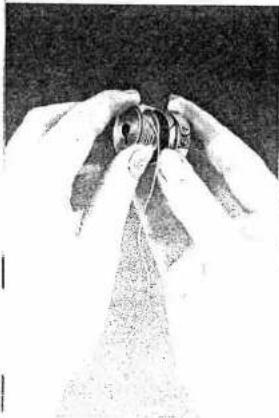
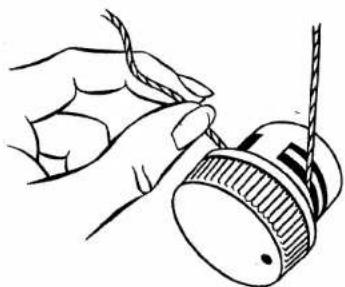
① As shown in illustration 1, hold bobbin in left hand so that the thread end falls from the top down toward you, and insert bobbin into bobbin case.
② Hold the bobbin firmly in the bobbin case and pull the thread into the case slot.
③ Pull the thread under the tension spring until it emerges from the opening at the end of the spring. Leave about three inches of thread hanging from the bobbin case.
④ Hold the case by its open latch so that the bobbin cannot fall out.
R 5867 1
R 5869
2
R 5870
3
R 5868
4
natural_image
Close-up of hands holding a small object, possibly a tool or device, with no visible text or symbols.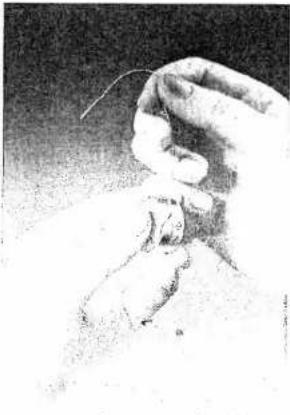
natural_image
Black-and-white sketch of a hand holding a small object, possibly a tool or device, with no visible text or symbols.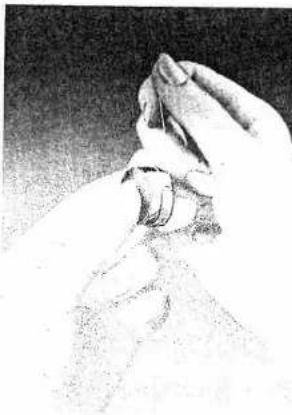
natural_image
Close-up of a hand holding an object, possibly a tool or device, against a dark background (no visible text or symbols)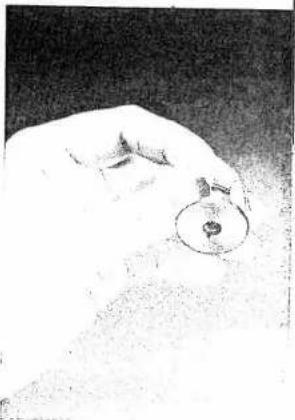
natural_image
Close-up of a hand holding a small circular object with a small symbol, against a dark background (no text or symbols visible)Inserting the Bobbin Case
Raise take-up lever to its highest point and lift the latch with the thumb and forefinger of your right hand. Turn bobbin case until slot points up (see arrow). Place bobbin case on center stud s of hook.
In replacing the bobbin case, it is best to hold the loose end of thread so that it will not get jammed between bobbin case and hook. Release the latch and press against bobbin case until you hear it snap into place. An improperly inserted bobbin case will cause needle breakage.
GR 015

natural_image
Technical illustration of a mechanical device with gears and tubing (no visible text or symbols)| Types of Fabrics | Morcerized Cotton | Silk | Needle Size |
| Fine Fabrics such as georgette, chiffon, batiste, voile, lawn, silk. | 80 to 100 | 0 to 000 twist | 60 or 70 |
| Lightweight Fabrics such as dress silks and cottons, sheer woolens, shirting, draperies. | 70 to 80 | A & B twist | 80 |
| Medium Fabrics such as lightweight woolens, madras, muslin, brocades, heavy silks and rayon, gabardine. | 50 to 70 | B & C twist | 90 |
| Heavy Fabrics such as coating, denim, corduroy, slipcover fabrics, bed tickings, lightweight canvas. | 40 to 50 | C & D twist | 100 |
| Synthetics, Rayon, Acetate including nylon, orlon, dacon, plastics, etc. | Determined by weight of fabric 40 to 50 | Determined by thread size 60 to 80 | |
Recommended Needle and Thread
Sizes
The appearance of the finished seam is dependent on the correct relationship between needle, thread and fabric. Select the proper thread sizes and needles from this chart.
The same size threads should be used in the needle and on the bobbin. Some experienced seamstresses prefer a somewhat thinner bobbin thread. However, the bobbin thread never should be thicker than the needle thread.
For embroidery and darning work, a No. 50 thread should normally be used.
Important Facts about Needles
On Pfaff 90 sewing machines, System 130 R, flat-shank needles are used for all ordinary sewing and embroidery work. The last column in the chart on page 12 gives you the needle size required for the material in hand. Genuine Pfaff needles, System 130 R, are available from every Pfaff dealer. Bent or blunt needles should not be used.
Changing the Needle
Bring needle bar to its highest point and lower sewing foot.
Loosen needle set screw a half a turn and pull old needle out of needle clamp. Make sure that the flat side of the shank faces toward the back and long groove toward you. Insert new needle into opening of needle clamp and push it up as far as it will go. Tighten needle set screw a.

natural_image
Close-up of hands operating a sewing machine needle, showing fabric and metal components (no text or symbols visible)GR 028
Upper Threading
Place spool of thread on one of the spool pins 1 and lead thread end through both thread retainer openings 2.
Lead thread clockwise around tension and pull it between any two of the tension discs 3. Make sure that the presser bar lifter is at its top position II (see page 21).
Bring take-up lever 4 as high as it will go and pass thread from right to left through the hole at its end and into slot at left of thread guide 5. Then thread needle, front to back.
For thread retainer with four holes see page 9.
natural_image
Hand holding a small object with a string, no visible text or symbols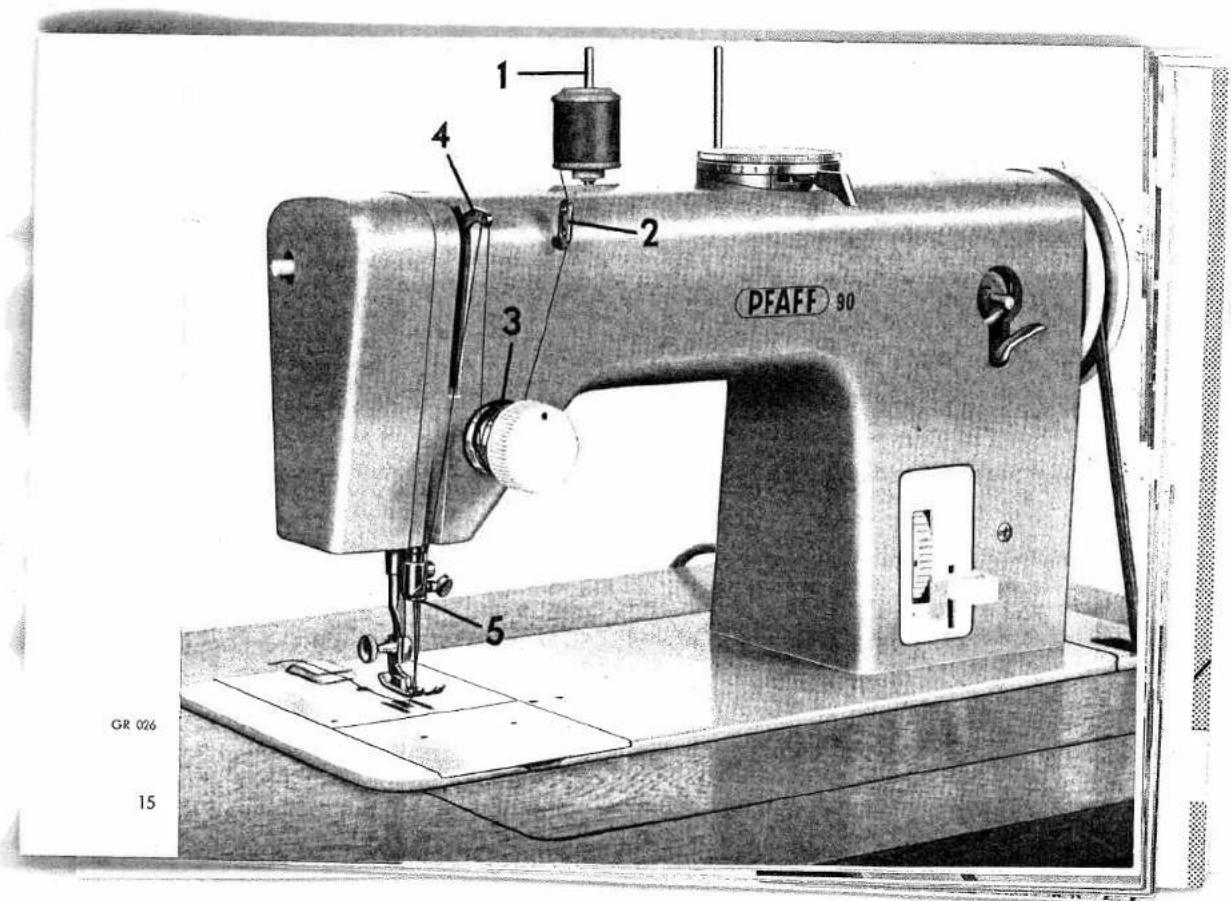
text_image
PFAFF 90 1 2 3 4 5 GR 026 15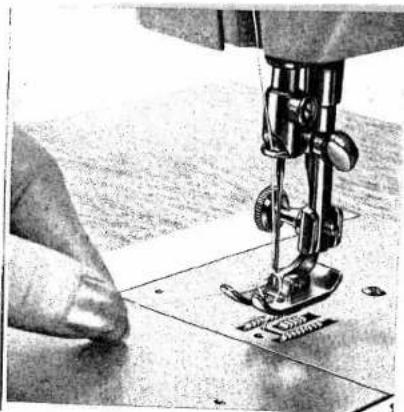
natural_image
Close-up of a sewing machine needle stitching fabric on a cutting line (no visible text or symbols)GR 046
Drawing Up the Bobbin Thread
Hold needle thread lightly in your left hand. Turn balance wheel toward you until the needle moves once down and up again. Lightly pull needle thread to draw bobbin thread up through the needle hole. Place both threads back under the sewing foot.
Correct Tension Regulation
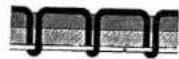
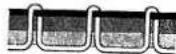
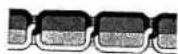
Balanced tensions are essential for sewing. If your tension is correct, you will have perfect seams as sketched below (III).
Sketch I — The threads interlock on the underside of the fabric.
Cause:
Upper tension too loose or lower tension too tight. Sketch II — The threads interlock on the surface of the fabric.
Cause:
Upper tension too tight or lower tension too loose.
1
11
III
Regulating the Thread Tension
The bobbin thread tension has been set for a medium grade and need not be adjusted for all ordinary sewing operations. If a special sewing operation should require a looser or tighter tension, turn the small knurled screw on the bobbin case with the tip of your thumb as follows:
Turn it left ← — for looser tension. Turn it right → — for tighter tension.
Determine whether the bobbin thread tension is set for a medium grade by holding the thread end between thumb and forefinger and letting the bobbin case hang freely. The tension should be strong enough to keep the bobbin case from being pulled down by its own weight. However, as you jerk your hand slightly, the bobbin case should gradually slide down. Do not turn the knurled screw too far to the left to keep it from falling out. Choose the lower tension slightly stronger when doing ornamental stitching to be sure you always have a neat satin stitch on the right side of the fabric.
GR 012

natural_image
Close-up of a hand holding a small metallic object with wires, no visible text or symbols
natural_image
Close-up of hands holding a small mechanical component (no visible text or symbols)
natural_image
Hand holding a small mechanical component with a connecting rod (no text or symbols visible)R 8029
17
The final stitch appearance can be regulated by the upper tension knob, as follows:
Turn left — for looser tension.
Turn right ➞ — for tighter tension.
The marks on the tension housing and the dot on the tension knob make it easy to restore any tension setting whenever you have had to change the tension for another sewing job. (The longer the mark, the tighter the tension.) The upper tension has a third disc for two-needle work.

text_image
4 5GR 008
Stitch Length Regulation
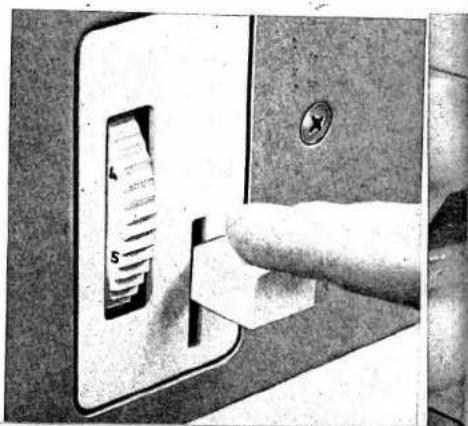
The stitch length control serves to regulate the 'stitch length and to limit it in sewing backwards.
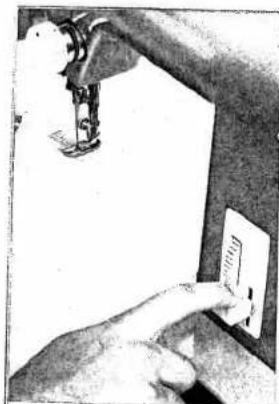
Numbers 0 to 9 on the control indicate the stitch length (the higher the number, the longer the stitch). When the control is set on "0", the machine ceases feeding, the longest stitch is obtained by setting the control on "9" (about 6 stitches to the inch). To regulate the stitch length, turn the control until the desired number is fully visible at the top of the slot (see arrow).
Reverse Sewing
To sew in reverse, simply press the finger-tip control down. When the control is released, the machine resumes forward sewing.
This feature is ideal for backtacking the beginning or end of a seam and for darning rips.
18
GR 009
natural_image
Close-up of a hand pressing down on a door panel with a ruler and handle (no visible text or symbols)Changing the Sewing Foot
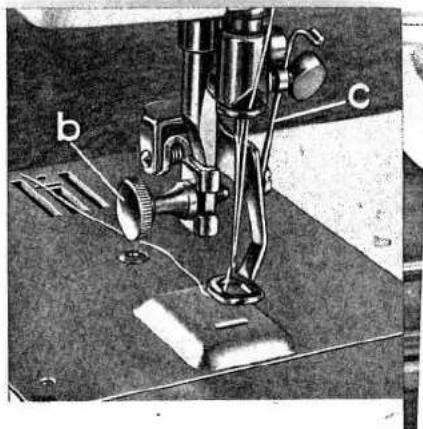
Lift both needle and presser bar to their highest positions and turn sewing foot thumb screw b to the left. Tilt the foot sideways and pull it down.
GR 042

natural_image
Close-up of hands operating a sewing machine needle and fabric (no visible text or symbols)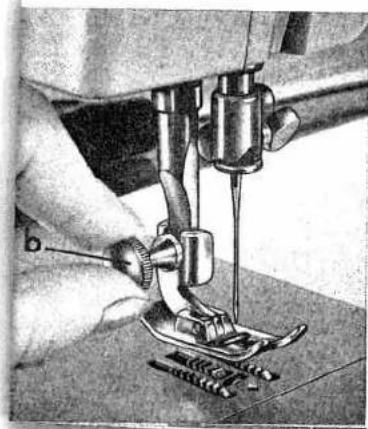
natural_image
Close-up of a sewing machine needle stitching fabric (no visible text or symbols)Reverse procedure to slip on new foot and tighten screw b securely.
GR 043
19

natural_image
Close-up of hands operating a sewing machine needle and cutting a component (no visible text or symbols)GR 006
Preparing Your Machine for Dawning
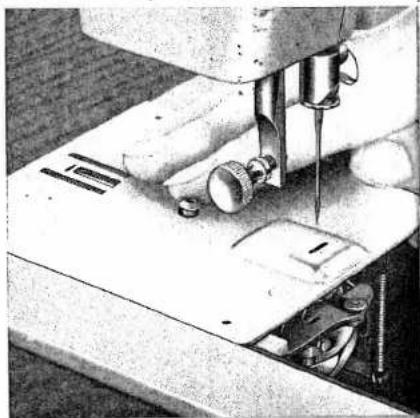
Remove the sewing foot and the bed slide. Lift front end of needle plate and tilt out.
Turn needle plate half a turn so that raised portion is at the front (see illustration) and replace. Press down stud and replace bed slide. Thread the needle with darning wool and flick presser bar lifter to position 1 (see page 21).
20
GR 007
natural_image
Close-up of a sewing machine needle and screwdriver (no visible text or symbols)
Dawning Foot
Remove the sewing foot. Attach darning foot No. 847610 from the rear. Hold spring clip c so that it is behind the needle set screw, and tighten screw b.
If your sewing machine has a presser bar lifter with only position II, use darning foot No. 93-100154-91.
R 047
text_image
b c
text_image
II IPositions of Two-Position Presser Bar Lifter
When the presser bar lifter is flicked to position 1, the presser bar is raised but the needle thread tension is still activated (important for embroidering and darning).
When set at position II, the presser bar lifter disengages the needle thread tension (which facilitates winding the bobbin and removing the work from the machine).
Some machines have a presser bar lifter with only position II.
GR 016
21

Care and Maintenance
Longevity and smooth machine performance are dependent on regular and proper cleaning and oiling.
Use Pfaff sewing machine oil only. Never lubricate machine with animal or vegetable oils.
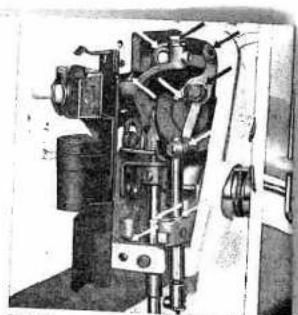
All moving and rotating parts require regular lubrication. Begin under the bedplate. If you have a portable machine, tilt it back, loosen the large thumb screw on the underside of the machine base, and remove the base.
In replacing the machine base, make sure that the cable sheath is located in the appropriate hole in the base. Lightly tighten thumb screw ↗.
natural_image
Mechanical assembly diagram showing internal components and gears (no visible text or labels)
natural_image
Mechanical assembly diagram showing internal components like gears and shafts (no text or labels visible)R 8220
22
From time to time, lubricate the needle bar frame bearings in the sewing head.
Removing.the face cover see page 24.
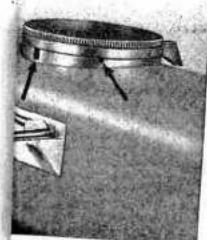
The principal oiling points are marked by arrows in the illustrations on these pages.
natural_image
Close-up of a metallic cylindrical object with a triangular base and arrow pointing to it (no visible text or symbols)GR 054
There are two openings in the rim of the stitch width dial, one on the left and the other at the back (see arrows). These openings are the oil holes of the zigzag mechanism.
Do not lubricate the bobbin winder.
The raceway in the sewing hook is the most important oiling point. Put one drop of oil into the raceway each day you sew (see picture at top right).
From time to time, remove the needle plate and clean the machine feed with a soft brush. Take a toothpick and remove accumulations of packed lint. Take out the bobbin case and the bobbin and clean the vicinity of the sewing hook.
Before you begin to oil the mechanism under the bedplate and at the needle-bar end of the machine, remove the dirt and lint which has accumulated on these parts.
GR 023 GR 017

natural_image
Mechanical assembly diagram showing a mechanical component with no visible text or symbols
natural_image
Close-up of a mechanical device with internal components and mounting holes (no visible text or symbols)
natural_image
Close-up of a hand operating a sewing machine tool with a black arrow indicating the direction (no text or symbols visible)GR 024
Changing the Light Bulb
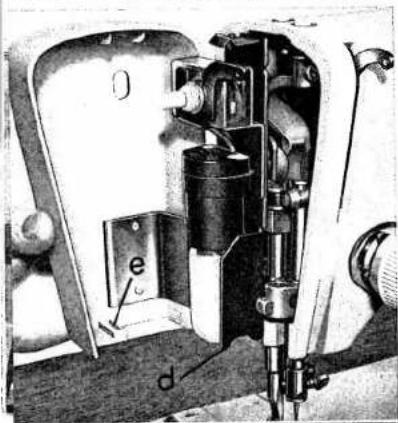
The built-in 15-watt sewing light illuminates the area of stitching perfectly. To change the light bulb, remove the face cover, push the bulb into its socket, turn left, and pull out. When inserting sew light bulb, be sure to slide bulb pins into socket slots. Press bulb in and turn right.
text_image
Technical diagram of a sewing machine with labeled parts including e, d, and ORemoving the Face Cover
To change the light bulb or oil the parts at the needle-bar end, remove the face cover by pulling it upwards.
Replacing the Face Cover
Slip tip d into slot e and push face ◀ cover up until it snaps into place.
GR 029
24
GR 030
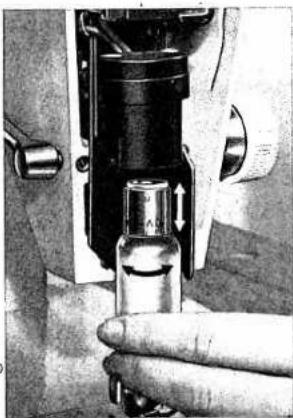
natural_image
Close-up of a hand using a microscope to measure a small object (no visible text or symbols)Trouble Shooting
1. Machine Skips Stitches
Cause:
Remedy:
Needle incorrectly inserted.
Push needle up as far as it will go and be sure that the long groove faces toward you, and flat side of shank away from you.
Wrong needle.
Choose the correct needle from chart on page 12. (For ordinary sewing, use System 130 R needles.)
Needle bent.
Insert new needle.
Machine threaded improperly.
Check and correct threading as instructed on pages 14 and 15.
Needle too fine or too thick for the thread.
Use correct needle and thread (see chart on page 12).
2. Needle Thread Breaks
Cause:
Remedy:
The above mentioned may cause thread breakage.
See remedies listed under 1, above.
Thread tension too tight.
Adjust tensions as instructed.
Poor or knotty thread used.
Use good quality threads only.
Hook raceway is jammed with thread or needs oiling.
Clean and oil hook raceway.
Burrs or sharp edges on needle plate slot.
Polish needle plate slot with fine emery cloth.
3. Needle Breaks
Cause:
Remedy:
Bent needle strikes point of sewing hook.
Replace needle at once to prevent further damage.
Needle too thin or thread too heavy.
Use correct needle and thread sizes.
Fabric pulls needle so it bends and strikes needle plate.
Don't force the feeding motion. Guide the material lightly.
Bobbin case inserted incorrectly.
Push bobbin case until you hear it snap into place.
4. Faulty Stitch Formation
Cause:
Remedy:
Improper tension.
Adjust tensions as instructed.
Thread too heavy, knotty or hard.
Use only first-rate thread — the correct size for the needle and fabric.
Bobbin unevenly wound.
Don't run thread over finger when winding the bobbin, but lead it around needle thread tension.
Pieces of thread between tension discs.
Raise presser bar lifter and remove thread.
5. Machine Feeds Improperly
Cause:
Remedy:
Machine does not feed because stitch length control set on "0".
Regulate stitch length, as desired.
Accumulations of lint packed between feed teeth.
Take off needle plate and remove lint with a stiff brush.
6. Machine Works Heavily
Cause:
Remedy:
Hook raceway lacks oil or is obstructed by pieces of thread.
Clean and oil hook raceway.
Mechanism clogged by inferior oil.
Use only Pfaff sewing machine oil — never salad oil or glycerine.
Bobbin winder working while sewing.
Stop bobbin winder.
Thread Jamming
The new PFAFF rotary hook will not normally jam, even if the machine should be handled improved.
If thread should happen to jam in the raceway of the sewing hook, jerk the balance wheel back and forth to overcome hard working of the mechanism. Thread jamming can be avoided, however, by following the instructions on page 3.
Using Sewing Feet and Attachments (setting see page 6)
Zipper Insertion
Machine Setting: A — 0 · B —
Pin or baste closed zipper on wrong side of fabric. Position of zipper depends on whether or not you want the edge of the fabric to overlap the zipper. Turn fabric to right side. Run a straight seam close to left edge of zipper, stitch across end and up the other side in one continuous operation. Use right edge of foot as a guide.

natural_image
Close-up of a sewing machine needle stitching fabric, with hands visible below (no text or symbols)Edge Stitching
Machine Setting: A - 0 to 4 - B- Sew parallel rows of straight or zigzag stitches at various distances from the fabric edge by using adjustable seam guide No. 53 077 and the edge stitcher (without quilting gauge). The seam guide is fastened to the machine bed with the long thumb screw. For wider marginal stitching, turn edge guide half a turn and use low end as a guide.
Quilting
Machine Setting: A—0·B—
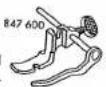
Edge stitcher No. 847600 used with the quilting gauge sews parallel rows of stitching at any distance over the entire surface of the fabric. Always guide the gauge finger along the preceding row of stitches.
Attractive tea cosies, slippers, seat pads and covers can be quilted.
28
GR OCε

natural_image
Close-up of a sewing machine stitching fabric with visible stitching details (no text or symbols)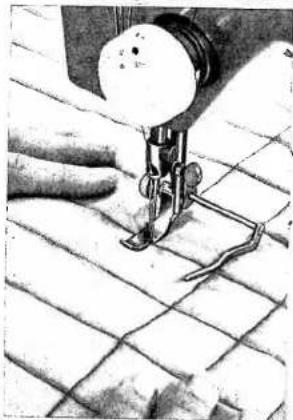
natural_image
Close-up of a sewing machine needle stitching on a grid-patterned fabric (no text or symbols visible)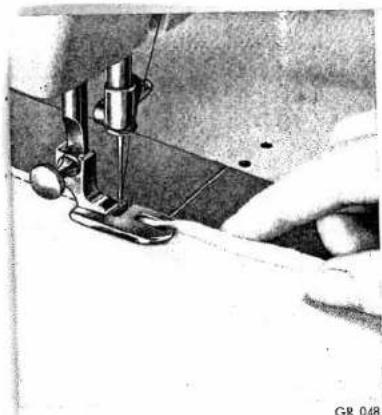
natural_image
Close-up of a sewing machine needle stitching fabric (no visible text or symbols)
Flat Felled Seams
Machine Setting: A — 0 or 2 · B — ↓
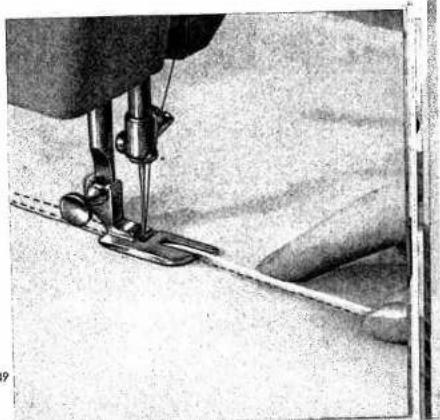
Flat felled seems are used to durably join two pieces of fabric. They are made in two operations.
Flat felled seams usually are straight-stitched. Narrow zigzag stitches are used for felling on elasticized fabrics only.
First Seam
Lay pieces together with the wrong sides facing and the bottom piece protruding 12 inch. Feed both pieces into felling foot, as illustrated, so that the bottom fabric is folded over
edge of top piece and stitched down. Make sure that protruding seam allowance is not folded twice.
natural_image
Close-up of a sewing machine needle stitching fabric (no visible text or symbols)Second Seam
Open the two pieces, place them under the needle right side up, insert seam ridge into felling foot opening, and stitch down to the left. Make sure that second seam is placed close to the edge but not beyond it.
The felling foot has a needle slot, rather than a needle hole, to permit zigzag felling.
29
GR 049

Hemming
Machine Setting: A—0 or 2 to 3·B—
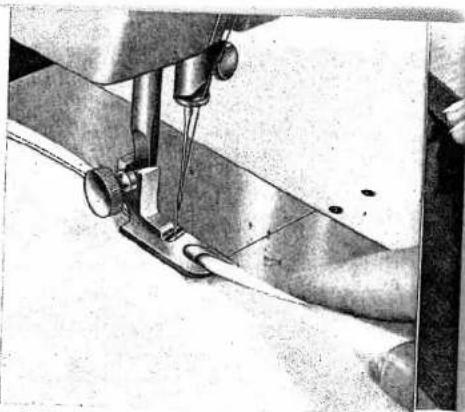
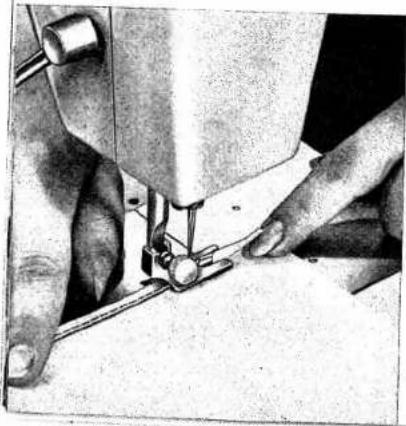
The hemmer foot is indispensable if you want to sew a uniform hem. You can hem with straight or zigzag stitches, depending on the type of fabric you are using. Clip off the corner of the fabric to facilitate insertion into the hemmer foot curl. Feed fabric so that the raw edge is in line with the left edge of the hemmer foot. If you feed less, the fabric will not be folded twice and the raw edge will show.
natural_image
Close-up of a sewing machine needle stitching fabric, with a hand operating the seam (no visible text or symbols)GR 004
natural_image
Close-up of hands operating a sewing machine needle on fabric (no visible text or symbols)Avoid ugly ends by slowing down feeding. To do this, press the fabric against the needle plate on the left side of the foot before you come to the end of the hem.
GR 005
30

natural_image
Close-up of a sewing machine needle stitching fabric (no visible text or symbols)GR 037
Butt Seaming
Machine Setting: A—3 or 4·B—↓

Overcasting Edges
Machine Setting: A—2 to 4·B—
Overcasting prevents frayed edges. Use a long wide zigzag stitch and sew edge with the needle taking one stitch into the fabric and the other over its edge (normal tension setting). You may overcast edges after fabric is cut and before the pieces are joined.


natural_image
Close-up of a sewing machine needle stitching fabric, no visible text or symbols31
GR 045

natural_image
Three-panel illustration showing sewing techniques: fabric cutting, needle stitching, and fabric application (no text or symbols)GR 055
R 7157

Inserting Patches
Machine Setting: A—4·B—
Large holes can be patched quickly. The following method may particularly be used for jersey fabrics. Cut patch square or rectangular so that the grain will match the rest of the fabric. Place the patch over the damaged area. Sew it down with a wide zigzag stitch of medium length.
For additional strength stitch over corners twice. Turn over and trim close to seams.

Attaching Lace
Machine Setting: A — 2 · B —
You can attach lace edging in one simple operation. Fold the edge of the fabric about 38 " over to the wrong side, following the texture, and preferably iron it down. Place the straight edge of the lace on the fold of the fabric and sew it down with narrow zigzag stitches, taking one stitch into lace and fabric and the other into lace only. Cut off excessive cloth on the wrong side of the material close to the seam.
GR 044
32

natural_image
Close-up of a sewing machine needle stitching a flower (no text or symbols visible)GR 033

Machine Setting:
Applique Work
A—1½ to 2·B—
Applique is easy and modern.
Trace design on wrong side of fabric and baste a piece of contrasting material to right side. Outline design on wrong side with a narrow zigzag stitch—and the motive will appear on right side.
Applique is very effective on buster suits, pinafores, bibs, frocks, covers, wall hangings, or wherever a gay note is desired.
Fill out small, but essential sections of design with granite stitches.

natural_image
Black-and-white sketch of a hand holding a flower with scissors, no text or symbols presentTrim excess material close to the seam and sew over edges of applique with a medium-wide satin stitch. If you want to give the design a plastic effect, use buttonhole foot No. 847 616, flick lever B to the left and satin-stitch over a filler thread (see also page 36).
R 7167
33
R 7220

natural_image
Illustration of a girl kneeling beside a house and pumpkins (no text or symbols)
natural_image
Close-up of a sewing machine needle and foot mechanism (no visible text or symbols)GR 001
natural_image
Close-up of a woven fabric with diamond-shaped patterns and small dark spots, no visible text or symbols
Straight-Stitch Hemstitching
Machine Setting: A—O·B—
Stitch Length: 2—4
Insert twin hemstitching needle, System 130 Zwi-Ho, as instructed on page 13. Turn out needle set screw a little further than for ordinary needles.
The thread size, threading procedure and thread tension are the same as for cording work (see page 41).
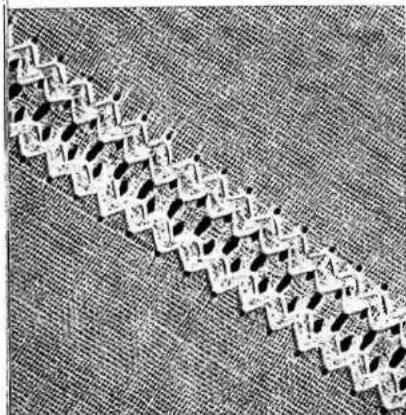
Beautiful hemstitching effects on blouses, dresses, handkerchiefs, doilies and so forth, can be obtained with Pfaff's System 130 twin needle. The harder the fabric yarn, the more pronounced the hemstitching will be. For this reason, batiste, organdy, georgette, etc. are best suited to hemstitching, while woolly fabrics are not recommended.
Procedure
Fold fabric to mark seamline or trace seamline on fabric. Sew first row. Guide fabric so that wing needle stitches along traced line. At the end of the seam, turn fabric half a turn and sew second row. Guide fabric in such a way that wing needle penetrates the needle holes it has made and enlarged previously.
Imitation hemstitching thus requires at least two operations. If desired, additional straight or curved ornamental seams may be stitched parallel to the first one. Exciting decorative effects may be obtained by using vari-colored embroidery and darning threads.
Zigzag Hemstitching
Machine Setting: A — Up to 1^1/2 · B — ↓
Procedure
Same as above, except that the wing needle should penetrate the traced line only when it is on the left of its throw.
R 8427

Button Sewing
Don't be afraid to sew on buttons, hooks, eyes or rings with your PFAFF. The needle wont break and the threads will not get loose either. The latter may happen only with ready-made clothing sewn with a chain stitch. It won't be worthwhile to take the machine out for sewing on a single button, but you will appreciate this feature when sewing lines of buttons on pillow and bed covers, on shirts or dresses, or when fastening hooks, eyelets and rings on curtains etc. There your machine will come in very handy. Attach button sewing foot No. 847608 and turn the needle plate half a turn so that the raised portion is at the front (see picture at the bottom of page 20). The raised portion of the needle plate features an elongated needle hole.
GR 036

natural_image
Black-and-white photo of a sewing machine needle stitching small circular components (no visible text or symbols)Machine Setting: A—0·B—
Place button under button sewing foot and align so that needle will enter left hole. Let needle stitch through hole and make one or two tying stitches. Raise needle. Turn dial A counter-clockwise, usually to 3, until needle on the right of its throw is centered over right hole. Start machine and sew as many zigzag stitches as you deem necessary to fasten button securely. Return dial A to 0 and make two or three tying stitches. When sewing on four-hole buttons, reposition button and repeat the above process, stitching through the second pair of holes.
Hooks, eyes or rings are attached in the same manner.
natural_image
Close-up of a sewing machine needle stitching fabric (no visible text or symbols)GR 034
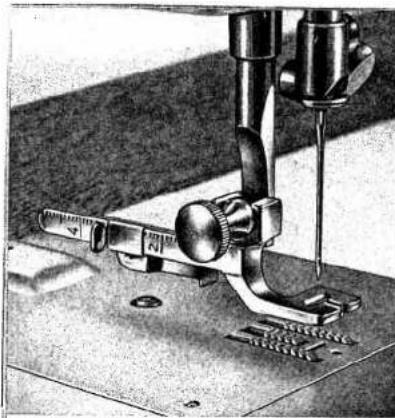
Attach buttonhole foot No. 847 616 and set slide on buttonhole gauge, to buttonhole length desired. The buttonhole is the right length when beginning of first seam reaches red end of slide indicator (see arrow).
When you follow the procedure on the opposite page, the 'bartacks at each end of your buttonhole will be twice as wide as a buttonhole seam.
Sewing Buttonholes
Machine Setting: A — 1½ (2) (first notch) · B —
Stitch Length (for buttonhole seam): Almost 0
Use only embroidery and darning thread No. 50.

natural_image
Close-up of a sewing machine needle and fabric with a metal strip (no visible text or symbols)If you prefer more prominent buttonholes, pull a filler cord through the hole in left toe of foot. To get the correct stitch length, sew on a piece of scrap material. In making buttonholes in soft or loosely woven fabrics, it is advisable to place a piece of tissue paper under the material. To strengthen buttonholes in tricot and knit fabrics, insert a piece of firmly woven cotton material between the fabric layers.
GR 035
36
Instructions for Buttonholing
1 Sew first side over a filler cord. When beginning of seam reaches red end of slide indicator on buttonhole gauge, it is the right length. Leave needle in fabric on right side of its throw.
2 Lift foot, turn fabric around clockwise, using needle as a pivot. Lower foot, take one stitch to the left, pull filler cord taut and lay it parallel to completed line of stitching.
3 Turn dial A until it is caught in second notch (or stops at 4). Make 4 to 6 bartack stitches, slightly holding the material to reduce length of bar.

natural_image
Illustration of a tool applying material to a textured surface (no text or symbols)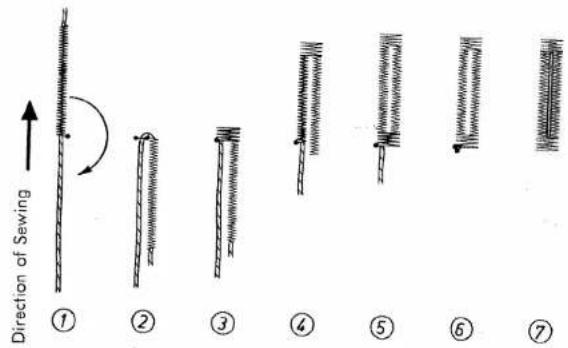
text_image
Direction of Sewing ① ② ③ ④ ⑤ ⑥ ⑦4 Change dial A to "1 ½" (2). Trim filler cord at end of first stitch row. Sew second row and stop about 4 to 6 stitches (1/10") from end of first row.
5 Turn dial A to second notch position (or "4"). Make second tack, as instructed above (under 3).
6 Turn dial A to "0" and make 3 or 4 fastening stitches.
7 Trim both the sewing and filler threads. Open the buttonhole with your seam ripper. Be careful not to injure the bartacks.
natural_image
Person using a sewing machine to press or install a printed card (no visible text or symbols)GRCH
natural_image
Close-up of hands operating a sewing machine with a loop handle (no visible text or symbols)GR 056
natural_image
Close-up of a hand using a sewing machine to cut fabric (no visible text or symbols)GR 057
Darning
Machine setting: A—0·B—
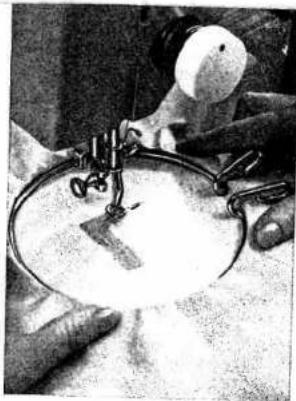
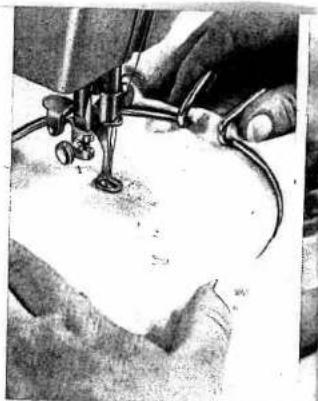
Prepare your machine for darning as instructed on pages 20 and 21. Note that for darning the presser bar lifter should be set at position I. Place fabric into darning hoop, the damaged area being in the center of the hoop.
Thin Spots
Remember that "a stitch in time saves nine" and reinforce spots that have worn thin with short stitches made lengthwise and across worn section. If fabric is clamped into darning hoops, move it under the needle with both hands.
Long rips may be darned with the normal sewing foot and without hoops. Set needle plate in its normal, or sewing, position and use forward-reverse feed control.
Triangular Tears
Triangular tears are best darned by placing the torn section between hoops and making close stitches across and lengthwise. Move work under the needle with both hands.
Small Holes
Darn small and medium-size holes by trimming ragged edges with the fabric grain. First stitch back and forth across the hole from one side to the other with the machine running at high speed. Then turn the fabric at right angles and sew back and forth over preceding work with short stitches. Make sure the stitches are taken right into the good material.

natural_image
Close-up of hands manipulating a rope or wire loop with a metal hook (no text or symbols visible)GR 038 Monogram Embroidery
Machine Setting: A—3 to 4·B—
Prepare machine as for darning. Script letters are best for monogram embroidery without a sewing foot. It requires a little practice. You will soon enjoy creative embroidery once you have learned to move the material at a uniform rate. The fabric should be held taut in the hoops and the presser bar lifter lowered to position 1. Let the needle stitch into the fabric at the beginning of your design and draw bobbin thread up through the fabric. Hold both thread ends and sew over outline, moving hoops slowly and evenly. To give your monogram dimensional quality, embroider outline twice. Be sure stitches are closely spaced.

Sewing Monograms
Machine Setting: A — 2 ½ to 3 · B — ↓
The procedure below is primarily used for block letters. Set needle plate so that feed dog feeds the material. Attach zigzag sewing foot No. 838 954 and set machine for satin stitch. Sew outlines of monogram, making sure that seams do not overlap at joints of letters.

natural_image
Close-up of a sewing machine needle stitching fabric, with hands operating (no visible text or symbols)Cording
Machine Setting: A—0·B—
To cord on your Pfaff 90, use a cording foot and a twin needle.
Twin needles are available for needle distances of 1.2 (3/64"), 1.6 (1/16"), 1.8, 2.0 (5/64"), 2.5 (3'32"), 3.0, and 4.0 (5/32") millimeters.
Cording feet are available in three varieties, as follows:
Pin tucks are made with cording foot No. 847 680 (7 grooves, 3/64" wide each) and a 1.2-mm twin needle.
For narrow cording use cording foot No. 847 675 (5 grooves, 1/16" wide each; see ill.) and a 1.6-mm twin needle.
Wider cording is made with cording foot No. 847 671 (3 grooves, 5/64" wide each) and a twin needle with a needle distance of 2.0 or 2.5 millimeters.
Cording feet and twin needles, System 130, are supplied on special request and at extra cost.

text_image
Technical diagram of a sewing machine with labeled parts (a, b, f, g)Changing the Needle and the Sewing Foot
Bring take-up lever to highest point, loosen needle set screw a, and pull ordinary needle out of needle clamp. Insert twin needle into opening of needle clamp and push it up as far as it will go. Make sure that the flat side of the shank faces toward the back. Tighten needle set screw a securely.
GR 020
40
Turn sewing foot thumb screw b to the left and take out the sewing foot. Slip on cording foot and tighten screw b securely.
It is best to turn out screw b completely if you want to slip on a cording foot with the guide attached. Thread Sir
Thread Size
Pin tucks and narrow cording are made with a No. 50 embroidery thread, wider cording with sewing silk in the needle and on the bobbin.
Set the machine for a medium stitch length (about 4).
Upper Threading
Place a spool of thread on each of the two spool pins. Pass both thread ends through both thread retainer openings 2, as illustrated on page 15. Lead one thread between the rear and center tension discs, and the other between the center and front tension discs of upper tension 3. Raise take-up lever 4 to its highest position and pass both threads through the hole at its end. Pull threads into slot 5, and thread each needle from front to back.
The bobbin thread is drawn up as instructed on page 16. To do this, hold both needle threads in your left hand.
Thread Tension
Slightly increase the bobbin thread tension, and increase or decrease the needle thread tension depending on the type of fabric used. If the tension has been set correctly, the bobbin thread should appear as a faint zigzag line on the other side.
Filled Cording
If you want to make cording in filmy fabrics or render your cording more prominent, Pfaff recommends that you insert a filler cord. Its thickness depends on the cording size you want.
Remove the bed slide and pass the filler cord from below through hole g located in front of the oval needle hole f (see ill. on page 40). Lay the end of the filler cord back under the cording foot (together with the needle and bobbin thread ends). Pull a filler cord forward under the bed slide and place the ball in your lap.
GR 019

natural_image
Close-up of a sewing machine needle and foot assembly (no visible text or symbols)Spacing between Tucks
To ensure uniform spacing between parallel tucks, place the preceding seam into one of the grooves of the foot and use it as a guide. For a larger spacing between tucks, use the adjustable guide (see ill. on page 41) which is part of every cording foot.
Various Cording Effects
Attractive cording effects may be obtained by combining horizontal, vertical and diagonal tucks or stitching curved tucks (see ill. below). If you want to turn a corner, leave needle in fabric (up to needle eye only), lift foot, turn fabric, lower foot, and continue sewing. To stitch an acute angle, turn fabric halfway, let needle make one stitch; turn fabric all the way, and resume stitching.
GR OSB

natural_image
Black-and-white sketch of a long-sleeve button-up shirt with buttons and clasp (no text or symbols)

natural_image
Close-up of a dark fabric sleeve with a patterned black and white garment edge (no text or symbols visible)GR 059

Ornamental Sewing
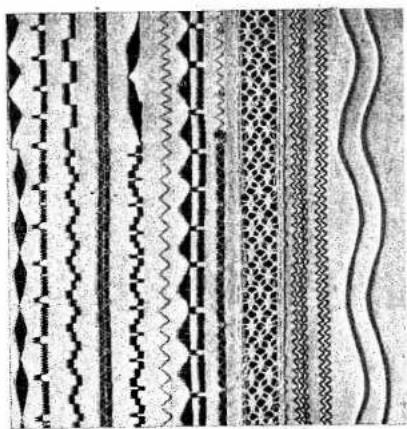
You can make exciting fashion stitch designs by alternating straight and zigzag stitching, varying stitch length, stitch width or needle position by hand. This will be easy after you have had sufficient practice. Some of the designs you can make are illustrated below. For ornamental sewing, use zigzag sewing foot No. 838 954.
Interesting two-needle effects can be obtained by using a 1.6-mm twin needle (see page 40) and different color thread. For twin-needle sewing, the stitch width dial should not be turned beyond "1½".
43
R 5414
natural_image
Patterned textile or fabric with repeating zigzag and diamond-like textures (no text or symbols)Contents
Page
Foreword 1
Essential Parts 2
Fundamentals of Machine Operation ..... 3
Bedplate Extension 4
Power and Foot Drive 5
Straight Stitching 6
Zigzag Sewing 7
Removing the Bobbin Case 8
Winding the Bobbin 9
Inserting a Full Bobbin into Bobbin Case .... 10
Inserting the Bobbin Case 11
Recommended Needle and Thread Sizes . . . 12
Important Facts about Needles ..... 13
Changing the Needle 13
Upper Threading 14
Correct Tension Regulation ..... 16
Drawing Up the Bobbin Thread ..... 16
Regulating the Thread Tension ..... 17
Stitch Length Regulation 18
Reverse Sewing 18
Changing the Sewing Foot 19
Preparing Your Machine for Darning ..... 20
Darning Foot 21
Positions of Presser Bar Lifter ..... 21
Operation of Your Sewing Machine
Page
Care and Maintenance
Cleaning and Oiling 22
Removing and Replacing the Face Cover . . . 24
Changing the Light Bulb 24
Trouble Shooting 25
Using Sewing Feet and Attachments
Zipper Insertion 28
Edge Stitching 28
Quilting 28
Flat Felled Seams 29
Hemming 30
Overcasting Edges 31
Butt Seaming 31
Inserting Patches 32
Attaching Lace 32
Applique Work 33
Straight-Stitch Hemstitching 34
Zigzag Hemstitching 34
Button Sewing 35
Sewing Buttonholes 36
Dorning 38
Monogram Sewing, Embroidery ..... 39
Sewing Monograms 39
Cording 40
Ornamental Sewing 43
Here is another interesting Pfaff product for you:
Pfaff Ironers
PFAFF
System Ironrite
Incorporating the latest technological advances, these machines are ideal for every modern home because they make ironing-day drudgery a matter of the past.
With the Pfaff Ironers you can iron your household wash three times as fast as before. And what is more, you work while you are seated, holding your arms in a comfortable position. These efficient machines are easy to move from room to room and, thanks to their fold-away side flaps, take up very little space.
With these new machines Pfaff offers progressive women a household appliance which embodies the same high quality standards as are incorporated in the long-valued Pfaff sewing machines.

natural_image
Mechanical device with cylindrical top and two supports (no visible text or symbols)Rigid floor model
Yor Pfaff dealer will be glad to give you a free demonstration of these new ironers, without any obligation on your part. You may choose between a rigid floor model and a folding roll-away model.