79 - Sewing machine PFAFF - Free user manual and instructions
Find the device manual for free 79 PFAFF in PDF.


User questions about 79 PFAFF
0 question about this device. Answer the ones you know or ask your own.
Ask a new question about this device
Download the instructions for your Sewing machine in PDF format for free! Find your manual 79 - PFAFF and take your electronic device back in hand. On this page are published all the documents necessary for the use of your device. 79 by PFAFF.
USER MANUAL 79 PFAFF
natural_image
Front view of a vintage sewing machine (no visible text or labels)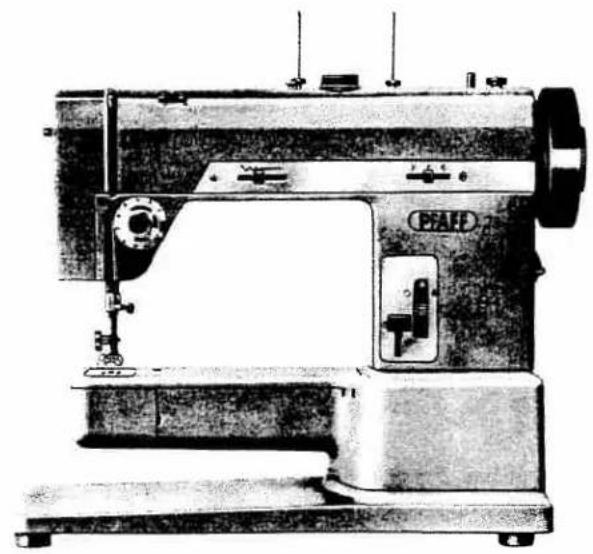
natural_image
Vintage sewing machine with needle and control panel (no visible text or symbols)PFAFF
78
PFAFF
79
Instructions
PFAFF
78 and 79
Decorative Stitch Zigzag Sewing Machine
Foreword
Your new Pfaff sewing machine will enable you to master a large variety of sewing, embroidering and darning jobs easily and quickly.
With the built-in decorative stitch mechanism you also can sew various functional seams as are used on non-elastic as well as stretch fabrics, such as tricot, jersey and Helanca.
This instruction book has been compiled in order to familiarize you thoroughly with all the sewing jobs coming up in a home.
We suggest that you try out the various sewing techniques discussed in this book so that you will become well acquainted with your machine.
If you have any sewing problems, please do not hesitate to contact your Pfaff dealer who will be glad to help you at any time. We hope you will always enjoy sewing with your Pfaff.
Needle and Thread Chart
| Type of Fabric | Thread | Needle | ||
| Type | Size | Size | Point Style | |
| Bed linenFine linenMuslin | Cotton | 40 | 8070 - 8070 - 80 | 130 R |
| Dress fabrics, such as brocade,satin ottoman, taffeta, georgette,crepe, chiffon, batiste, blousefabrics and poplin shirting | Silk | 50 | 70 - 80 | |
| Cotton or mercerizedcotton | 50 | |||
| Suitings and mantlings | Silk | 40 | 80 - 90 | |
| Twill, denim | Cotton | 40 | 90 - 100 | |
| Heavy linen | Cotton | 40 | 90 - 100 | |
| Burlap | Cotton or linenLinen | 4040 | 90 - 100110 | |
| Terry cloth, chenille goods,knitted pile fabric for bath-robes, corduroy | Cotton | 40 | 80 - 90 | |
| Silk | 50 | |||
| Cotton, rayon staple fabrics | Cotton | 50 | 70 - 80 | |
| Jersey fabrics (synthetic) | Synthetic | 50 | 70 - 80 | 130 ses |
| Cotton | 50 | |||
| Lastex, Helanca fabrics | Synthetic | 50 | 70 - 90 | 130 ses |
| Silk | 50 | |||
| Foambacks | Synthetic | 40 | 70 - 80 | 130 R |
| Silk | 40 | 90 | ||
| Jersey fabrics (wool)Woolens | Silk | 50 | 80 | 130 ses |
| Mercerized cotton | 50 | 70 - 80 | 130 R | |
| Cotton curtainsSynthetic curtains | Mercerized cotton | 40 | 70 - 80 | 130 suk |
| Synthetic thread | 40 | 70 - 80 | ||
| Acella, leatherette, oilcloth | Cotton | 40 | 80 | PCL |
| Elastic corsetry fabrics, Firmcorsetry fabrics, corset satin | Synthetic thread | 40 | 70 - 90 | 130 ses |
| Cotton | 40 | 90 | ||
| Leather | CottonLinen | 4040 | 110 | 130 Lr |
| Decorative stitching | Embroidery thread | 30 - 50 | 70 | 130 R |
| Heavy embroidery thread | 90 - 100 | |||
| Buttonhole silk | 90 - 100 | |||
| Embroidery anddarning thread | 30 | 80 | ||
| 50 | 70 - 80 | |||
| Silver-gold threadSilver thread | 70 | 80 - 100 | ||
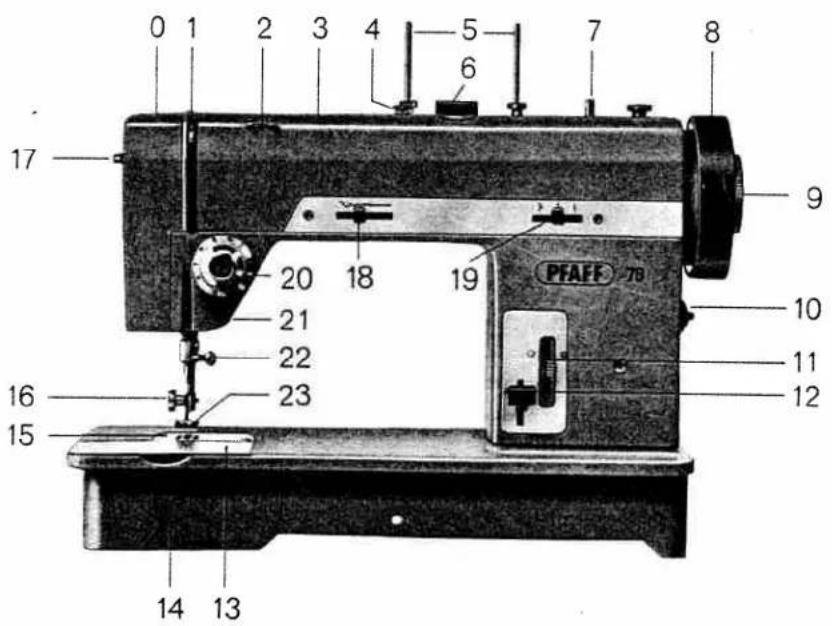
text_image
0 1 2 3 4 5 6 7 8 17 20 18 19 PFAFF 70 10 21 22 23 16 15 14 130 Face cover
1 Take-up lever
2 Thread guide
3 Top cover
4 Thread retainer stud
5 Spool pins
6 Stitch control
7 Bobbin winder
8 Balance wheel
9 Stop motion knob
10 Motor disengaging mechanism
11 Stitch length control
12 Reverse feed control
13 Bed cover
14 Transverse rotary hook (below bedplate)
15 Needle plate
16 Sewing foot thumb screw
17 Light switch
18 Stitch width control
19 Needle position lever
20 Needle thread tension
21 Presser bar lifter (on back of machine arm)
22 Needle set screw
23 Sewing foot
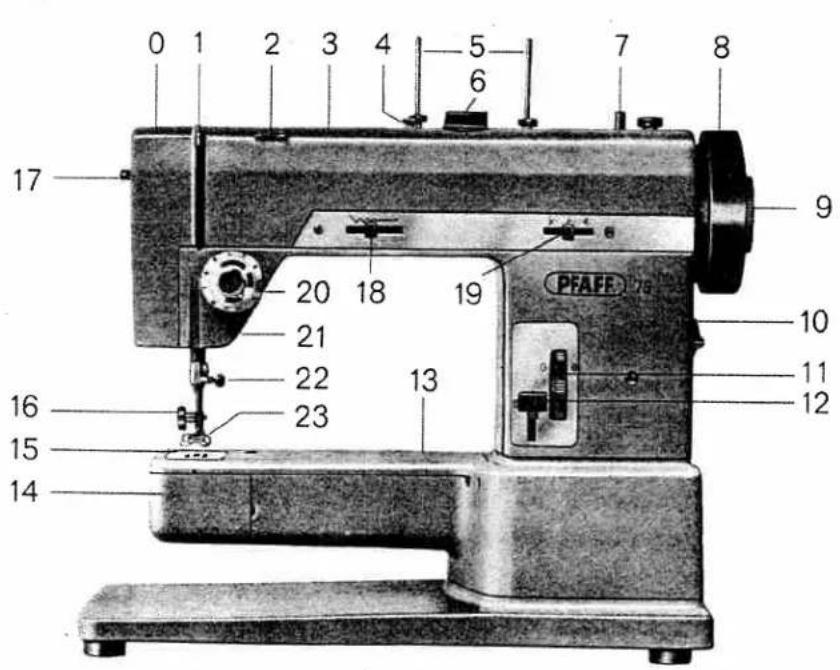
text_image
0 1 2 3 4 5 6 7 8 17 20 18 19 21 22 13 23 16 15 14 PFAFF 75 9 10 11 120 Face cover
1 Take-up lever
2 Thread guide
3 Top cover
4 Thread retainer stud
5 Spool pins
6 Stitch control
7 Bobbin winder
8 Balance wheel
9 Stop motion knob
10 Motor disengaging mechanism
11 Stitch length control
12 Reverse feed control
13 Free arm
14 Free arm cover
(enclosing transverse rotary hook)
15 Needle plate
16 Sewing foot thumb screw
17 Light switch
18 Stitch width control
19 Needle position lever
20 Needle thread tension
21 Presser bar lifter (on back of machine arm)
22 Needle set screw
23 Sewing foot
Push plug A into the receptable on the back of the machine and the plug at the other end of the cord into wall outlet.

natural_image
Close-up of hands using a tool to cut electrical wires (no visible text or symbols)To switch on the sewlight, push the button on the face cover (see ill.).
natural_image
Close-up of a vintage mechanical device with a rectangular housing and mounting bracket (no visible text or symbols)4
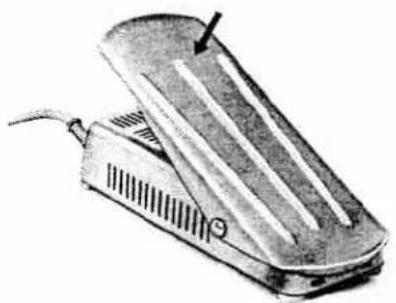
Place the foot control within easy reach of your foot and press down the pedal. The harder you press, the faster the machine will run.
natural_image
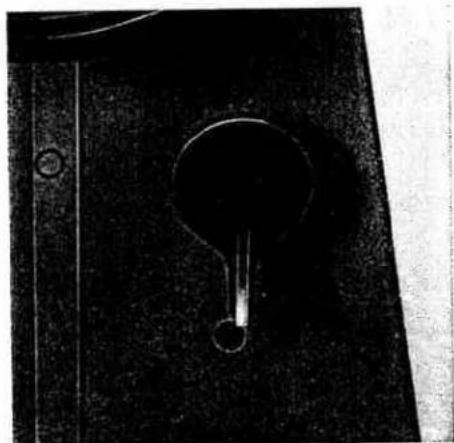
Illustration of a handheld device with a handle and spout, no visible text or symbolsThe machines feature a lever (10) underneath the balance wheel which serves to swing the motor to its operative position. To engage the motor, flick this lever down. After you have completed sewing, flick this lever to its top position.
natural_image
Close-up of a mechanical component with a circular hole and a curved shaft, mounted on a dark surface (no visible text or symbols)R
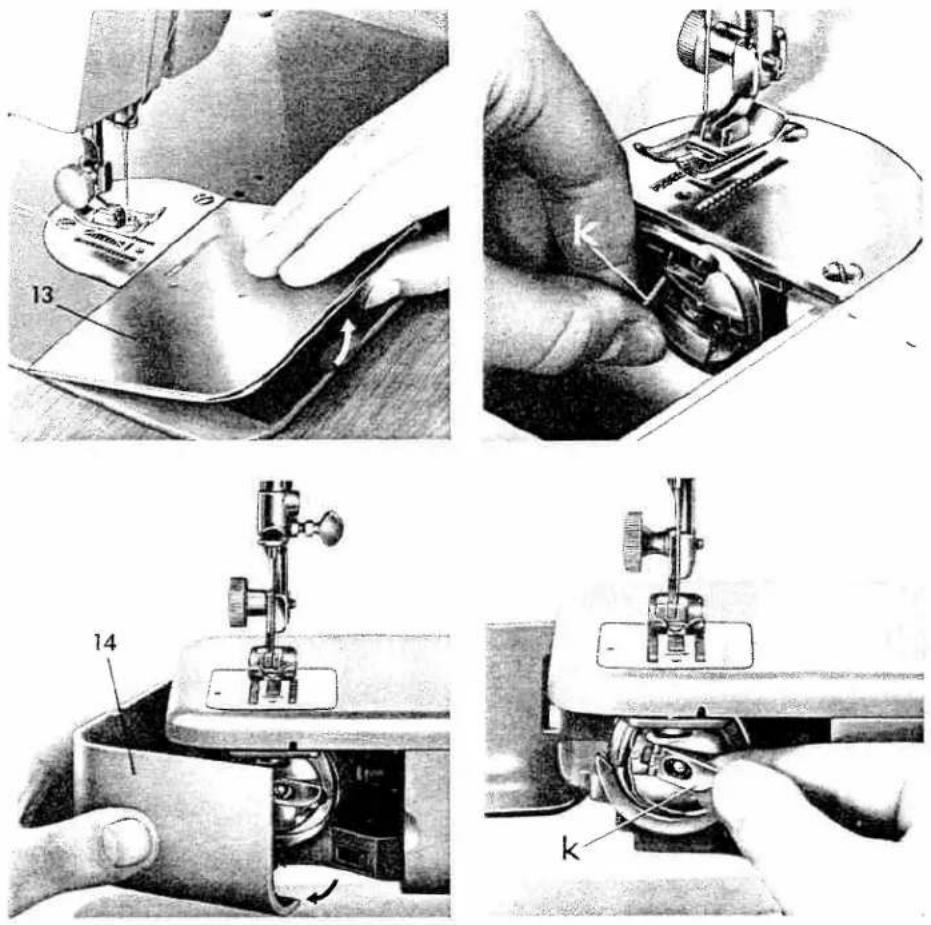
To remove the bobbin case, turn the balance wheel until the needle is at the top of its stroke.
On the Pfaiff 78, remove bed cover (13), as illustrated. Lift latch k on the bobbin case and pull out the bobbin case with the bobbin.
The bobbin cannot fall out as long as you hold the case by its open latch. Upon releasing the latch, the empty bobbin drops out.
On the Pfaff 79, the bobbin case is removed just like on the Pfaff 78. To get at the bobbin case, however, you must first open free arm cover (14) swinging it toward the left.
6
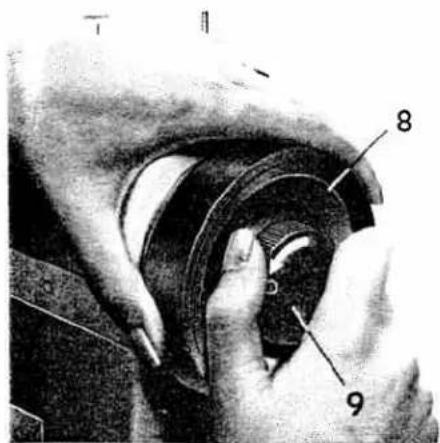
For bobbin winding, disengage the sewing mechanism. Hold balance wheel (8) while turning stop motion knob (9) toward you (see ill).
To engage the sewing mechanism after the bobbin has been wound, turn the stop motion knob away from you (as indicated by the arrow in the ill.).
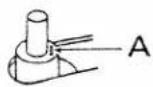
Pass the thread around thread retainer stud (2) in the direction indicated by the arrow. Place a bobbin on the bobbin winder spindle, making sure that key A at its base enters slot B in the bobbin (see ill.).
Wind a few turns of thread on the bobbin and push the bobbin toward the right. Start the machine.
When the bobbin is full, it is pushed toward the left and can be removed from the spindle.

text_image
Medical diagram showing a hand holding a device with labeled parts 8 and 9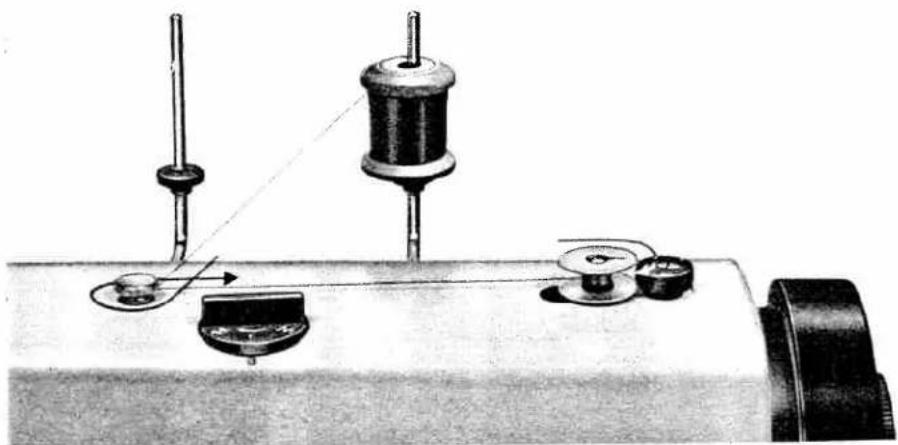
natural_image
Mechanical setup with three cylindrical components and a base, no visible text or symbols7
the bobbin case.
Pull the thread into slot (2) and under spring (3). As you pull the thread, the bobbin should rotate clockwise (4). Leave about three inches of thread hanging from the bobbin case.
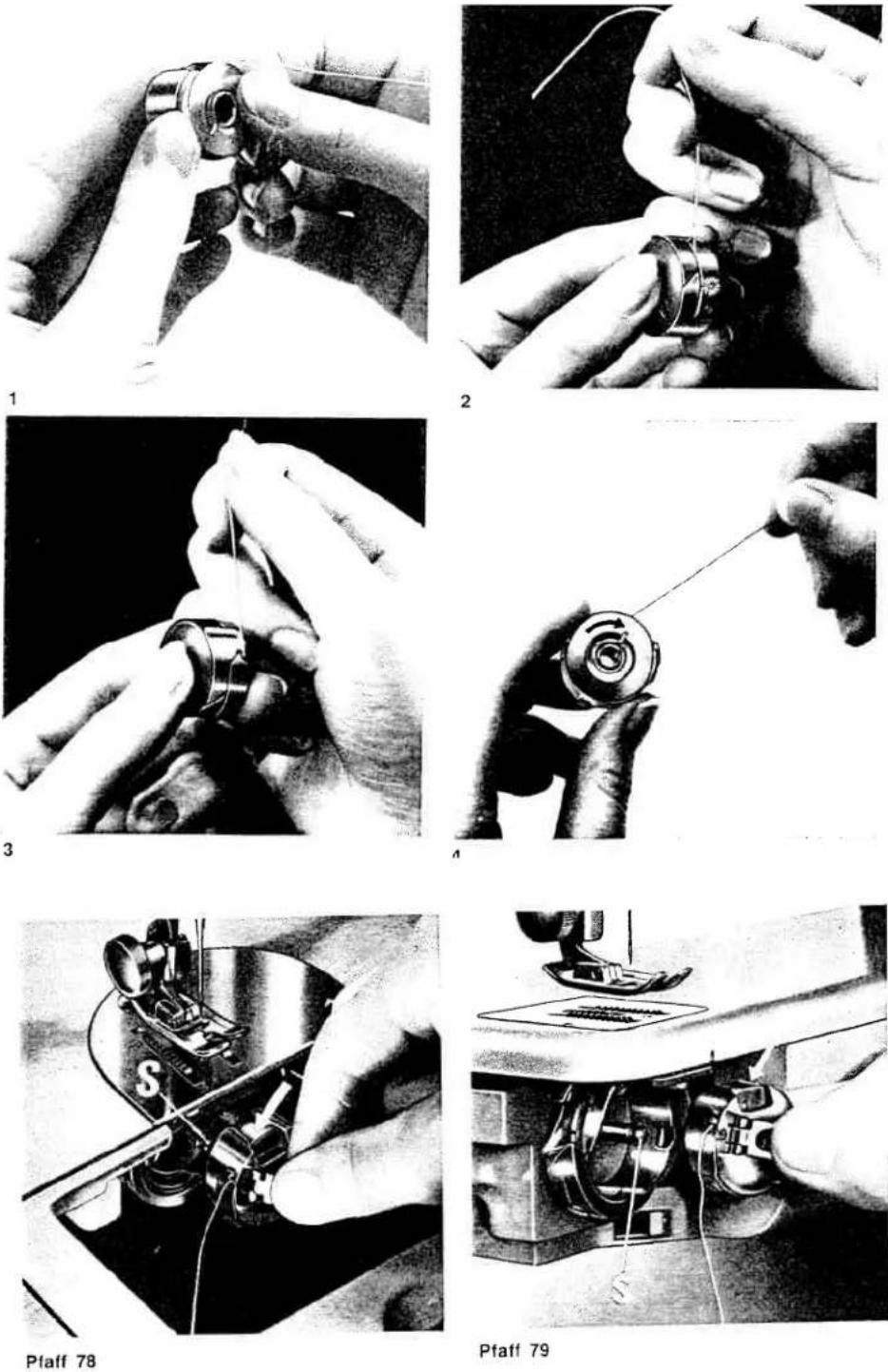
To insert the bobbin case into the machine, turn the balance wheel until the needle is at its highest point. Lift the latch and place the bobbin case on center stud s (see ill.), making sure its slot (white arrow) points up. Release the latch and press against the bobbin case until you hear it snap into place.

natural_image
Mechanical sewing machine needle and cutting tool (no text or symbols visible)1
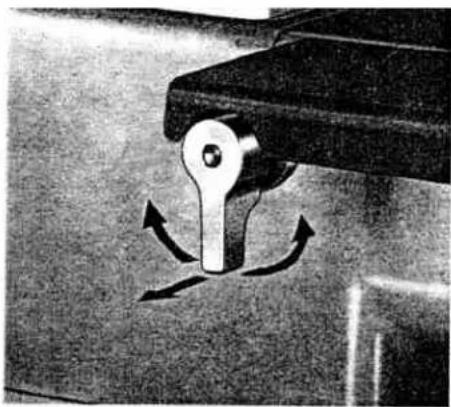
To enlarge the sewing area of the Pfaff 79 for ordinary sewing operations, push the workplate onto the free arm as far as it will go (1). Then lock it in place by turning down the lever on the back of the machine (2) until the locking stud snaps into the hole in the free arm. Press the workplate support against the machine base until it snaps into place (3).
To remove the workplate, swing up its support and unlock it by pulling out and swinging up the lever on the back of the machine (see arrow in Fig. 2).
On machines having no carrying case base, the workplate support is pressed against the baseplate of the machine.
10
natural_image
Mechanical component with directional arrows indicating motion or force (no text or symbols)2

natural_image
Mechanical device with clamping mechanism and mounting base (no visible text or symbols)3

2

text_image
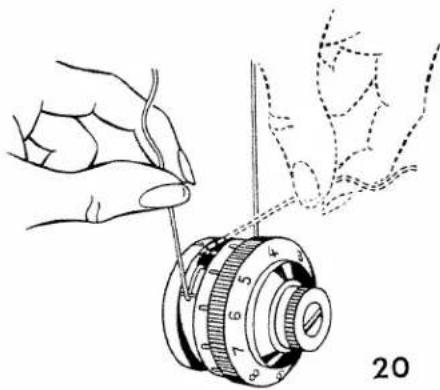
2 20Upper threading as illustrated:
Please note that the thread is placed between any two of the tension discs (20), pulled clockwise around the tension stud and drawn toward the right with a jerk (see ill.). As you do this, hold on to the spool so that thread cannot unwind.
Thread the needle from front to back.
natural_image
Illustration of hands using a tool to adjust a mechanical component, labeled with numbers 30 and 20 (no text or symbols on the diagram itself)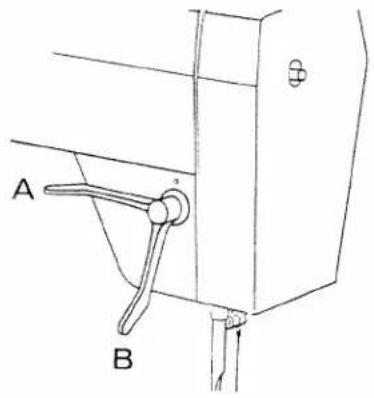
natural_image
Technical line drawing of a mechanical device with labeled parts A and B (no text or symbols beyond labels)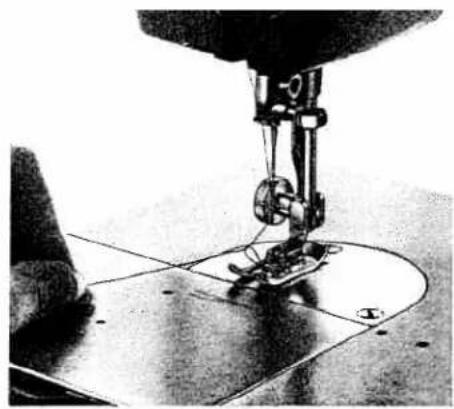
natural_image
Close-up of a sewing machine needle stitching fabric (no visible text or symbols)The sewing foot is raised and lowered by operating the presser bar lifter (21) on the back of the machine (see ill.).
A = Presser bar lifter up
B = Presser bar lifter down
12
To draw up the bobbin thread, hold the needle thread and lower the sewing foot.
Turn the balance wheel toward you a full turn. Pull the needle thread to draw up the bobbin thread.
Place both threads back under the sewing foot after it has been raised again.
Fundamentals of Machine Operation
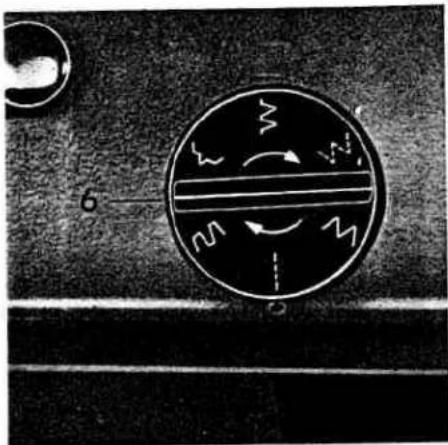
Turn stitch control (6) clockwise (as indicated by arrows in Fig. 1) until the symbol of the desired stitch is at the bottom.
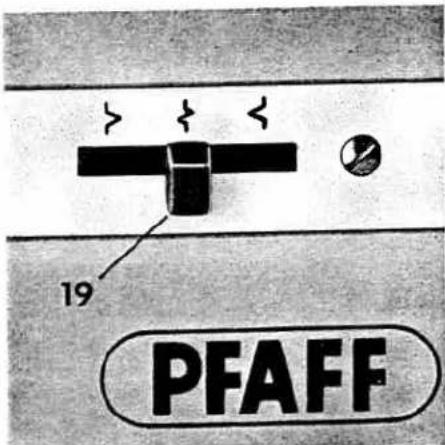
For ordinary sewing, needle position lever (19) should be in its center position (Fig. 2).
natural_image
Close-up of a circular mechanical component with internal flow arrows and a dashed line, no visible text or symbols.1
text_image
19 PFAFF2
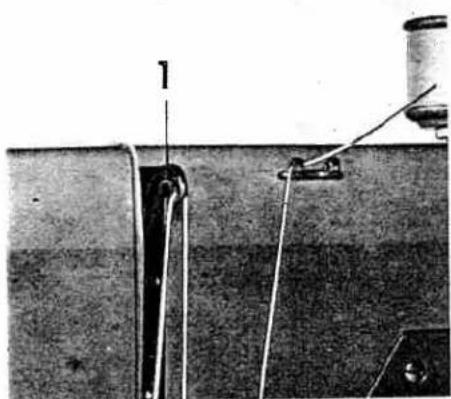
Make sure take-up lever (1) is at highest point before you begin and after you have completed a seam (Fig. 3).
Always turn balance wheel (8) toward you (see arrow). As you do this, check to make sure stop motion knob (9) is tightened firmly (Fig. 4).
natural_image
Close-up of a mechanical component with wires and a labeled part (no visible text or symbols)3

natural_image
Close-up of a hand holding a small mechanical component with a knob, showing a curved arrow labeled '8' (no text or symbols beyond the number)4
13
pushed to the right as far as it will go.
natural_image
Diagram of a mechanical component with zigzag lines and a labeled part (18), no readable text or symbols present.
text_image
11To sew longer straight-stitch seams, turn stitch control (6) until the straight-stitch symbol is at the bottom (see ill.).

text_image
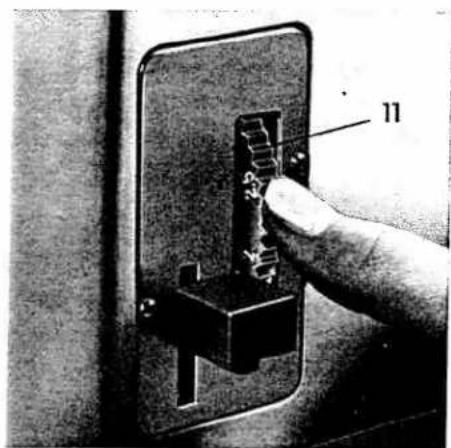
6The stitch length is regulated by turning stitch length control (11). The number indicating the stitch length chosen should be opposite the dot on the left-hand side of the slot.
For ordinary sewing operations, set the stitch length control on "2".
Place the material under the sewing foot and lower the presser bar lifter.
Place the foot control within easy reach of your foot and press down the pedal. The harder you press, the faster the machine will run.
14
To sew in reverse or backtack the end of a seam, simply press down finger tip control (12).

text_image
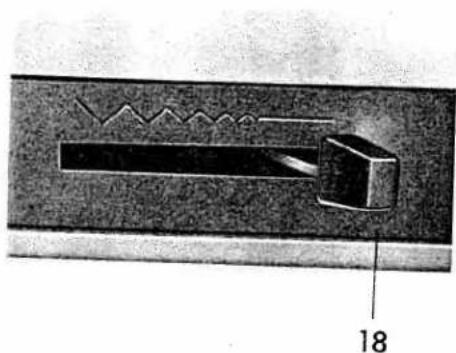
12 18For zigzag sewing, turn stitch control (6) until the zigzag-stitch symbol is at the bottom. Then regulate the stitch width by pushing stitch width control (18) toward the left, as desired.
Various zigzag sewing operations are discussed on page 26 and the following pages. Setting the machine for sewing the various design patterns is explained on page 34, while the following pages contain instructions for various sewing operations.
needle and bobbin threads interlock in the center of the material.
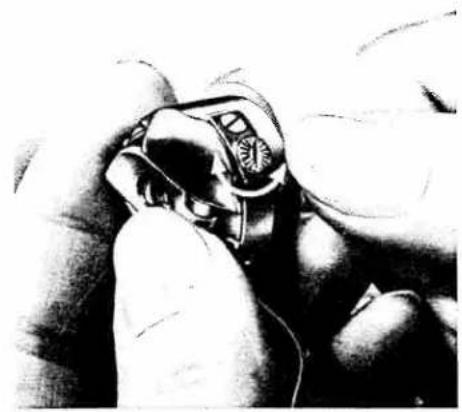
The bobbin thread tension is regulated by turning the small knurled screw on the bobbin case.
Turn this screw right (with your thumb nail) for a tighter tension, or left for a looser tension.
If the same size threads are used in the needle and on the bobbin, there is no need to adjust the bobbin thread tension.
This tension is set correctly if a slight resistance has to be overcome when pulling the thread.
natural_image
Close-up of a hand holding a small electronic device with a clock face (no visible text or symbols)bottom
natural_image
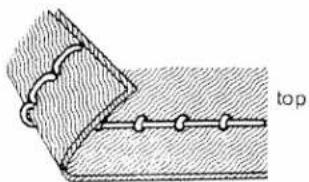
Diagram of a mechanical joint or fastener with labeled 'top' (no other text or symbols)Upper tension too tight or lower tension too loose.

natural_image
Close-up of a gloved hand adjusting a mechanical dial (no visible text or symbols)bottom
natural_image
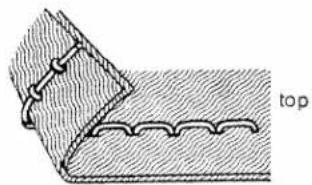
Diagram of a mechanical joint or clamping mechanism with no visible text or symbolsbottom
natural_image
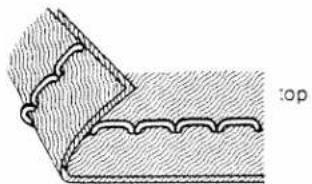
Technical line drawing of a corner joint with textured fill (no text or symbols)Both tensions correctly balanced.
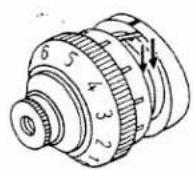
Numbers 0 to 10 indicate different degrees of tension on the upper tension dial. The higher the number, the tighter the tension. For ordinary sewing operations, the upper tension should be set at about 5.
Please note: Ease both tensions somewhat for sewing synthetic fabrics.
16
The accessory box which belongs to your machine contains several sewing feet for special sewing operations.
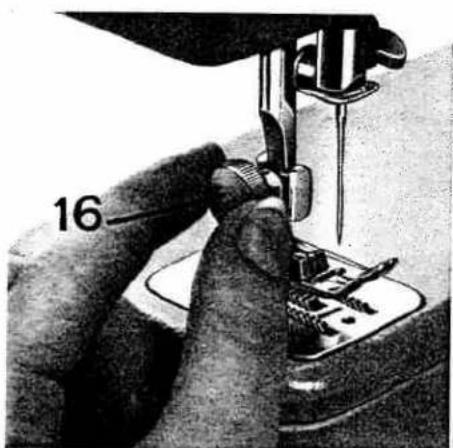
To change the sewing foot, bring the needle to its highest point and raise the foot. Turn screw (16) until the sewing foot can be removed, tilting it sideways (see Figs. 1 & 2). The new foot is attached in the reverse order.
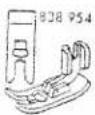
For sewing elastic fabrics, attach ordinary sewing foot No. 93-838 954-00 rather than clear-view sewing foot No. 93-100 179-00.
natural_image
Close-up of hands operating a sewing machine with a numbered label '16' on the side (no other text or symbols visible)1

text_image
223

natural_image
Close-up of a sewing machine needle stitching fabric, with no visible text or symbols2
To change the needle, bring the needle bar to its highest point and lower the sewing foot. Loosen needle set screw (22) and pull the old needle out of the needle clamp.
Insert new needle and push it up as far as it will go (Fig. 3), making sure that the flat side of its shank faces toward the back. Tighten screw (22) securely.
Use System 130 R needles only.
Replace the ordinary sewing foot by darning foot No. 93-102 826-91, attaching it from the rear so that spring clip c rests on needle set screw (22). Tighten sewing foot thumb screw (16). Lower the presser bar lifter.
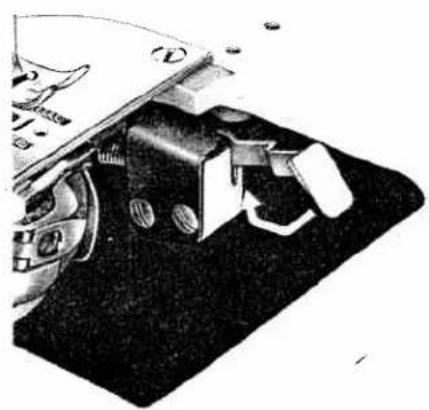
Now drop the machine feed. On the Pfaff 78, this is done by removing bed cover (13) and pressing the drop feed lever down slantwise, as indicated by the white arrow.
To raise the machine feed, press this lever down and let it return to its original position.
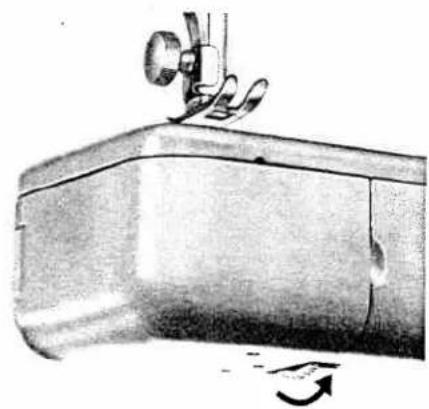
On the Pfaff 79, the machine feed is dropped by simply turning the thumb screw on the underside of the free arm. To raise the machine feed again, turn this screw in the opposite direction.

text_image
C 22 1618
natural_image
Close-up of a mechanical component with no visible text or symbols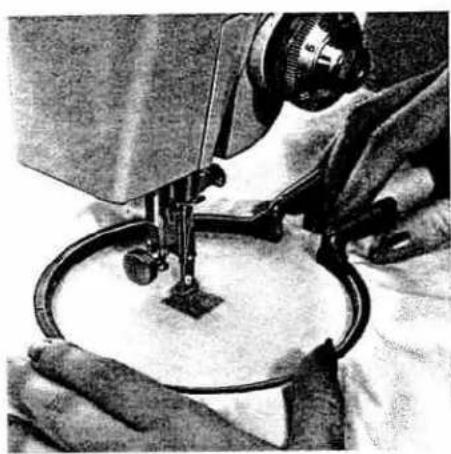
natural_image
Close-up of a sewing machine needle stitching fabric, hands operating it (no visible text or symbols)Darning sheer and soft materials is greatly facilitated by placing them in dark hoops. Draw up the bobbin thread and hold both threads lightly with your left hand while the first stitches are being made. Trim the threads and start stitching back and forth across the hole in sewing direction. Make sure the threads are anchored in the unworn area around the hole.
Turn the fabric at right angles and sew back and forth over the preceding work with short stitches.
Select the darning hoops in a size matching the darning job to be performed.
If the needle thread should break, the upper tension is too tight.
natural_image
Mechanical component with a rotating arrow indicating rotation (no text or symbols visible)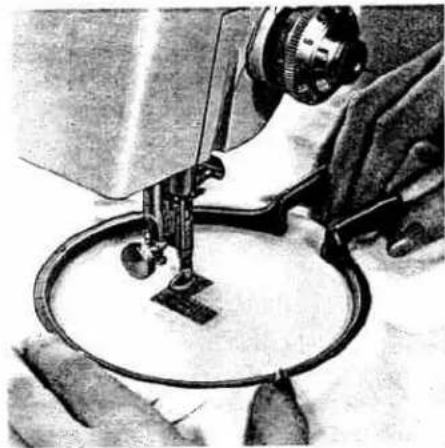
natural_image
Close-up of a sewing machine needle stitching a circular component (no visible text or symbols)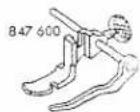
Attach zipper foot without quilting gauge.
Stition length: 1.5 to 2
it. Stitch close to the left edge of the zipper for about 1 inch, guiding the right edge of the foot along the zipper teeth (1). Leave the needle in the material, raise the zipper foot and close the zipper (2).
Continue stitching until you reach the end of the zipper. Then stitch across this end (3) and up to the other side.
The finished zipper closure is shown in Fig. 4.

text_image
1 2 3 420

natural_image
Close-up of a hand operating a sewing machine needle (no visible text or symbols)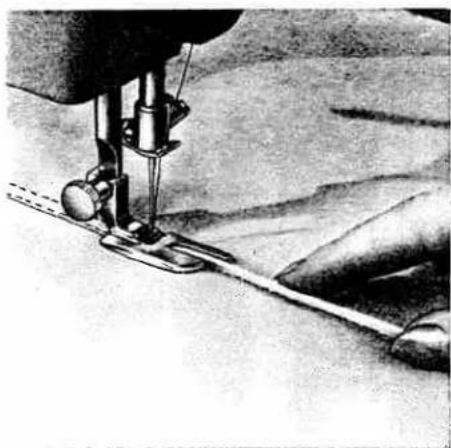
natural_image
Close-up of a sewing machine needle stitching fabric (no visible text or symbols)
natural_image
Black-and-white photo of a traditional Chinese-style jacket with vertical ribs and pleated front panel (no text or symbols visible)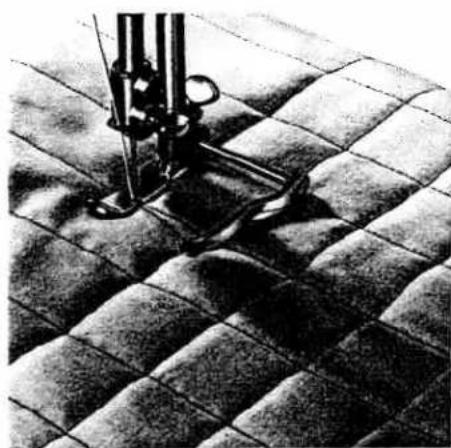
natural_image
Close-up of a sewing machine needle stitching a textured tiled surface (no text or symbols visible)Flat Felled Seams
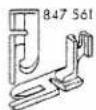
Attach felling foot
No. 93-847 561-00.
Stitch length: 1.5 to 2
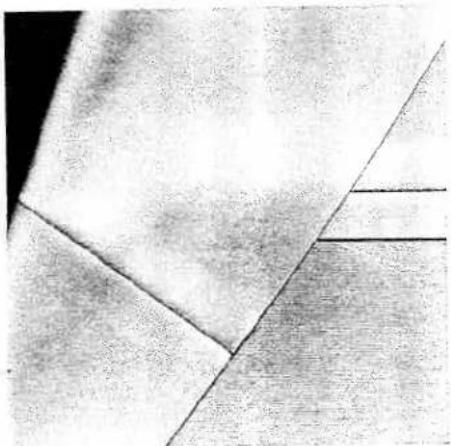
Flat felled seams are used to durably join two pieces of fabric and are usually straight-stitched.
First Seam: Lay pieces together with the right sides facing and the bottom piece protruding about 18 inch. Make sure the fabric enters the felling foot evenly and the bottom fabric is folded over the edge of the top piece (see ill. at left), but the top piece is not folded.
Open the two pieces.
Second Seam: Lightly flatten the fabric by pressing it against the needle plate in front of the foot. Insert the seam ridge into the felling foot and stitch down (see ill. at right).
Quilting

Use zipper foot No. 93-847 600-00 with quilting gauge for sewing parallel seams over the entire surface of the fabric.

No. 93-487 551-00
Stitch length: 1.5 to 2
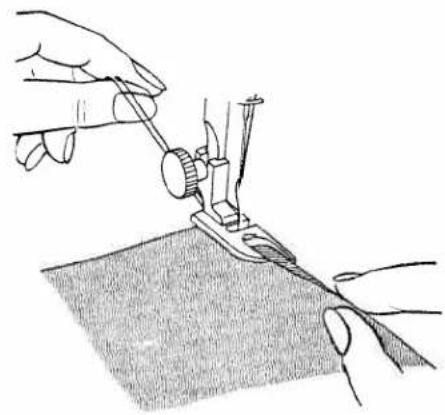
long. I have the material under the hemmer and lower same.
Make 3 to 4 straight stitches to secure the folded edge in place.
Draw the fabric into the hemmer by pulling both threads backwards, as shown in the drawing.
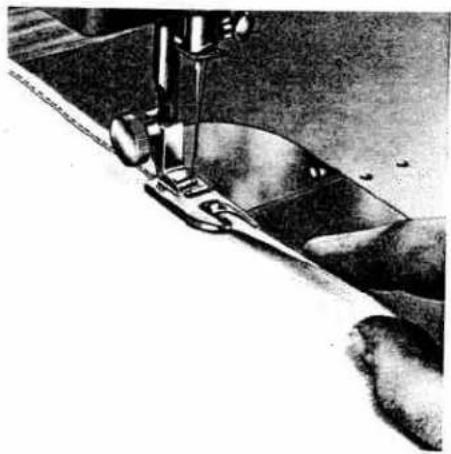
Feed the fabric edge into the hemmer scroll with your right hand (see ill.), making sure that the scroll is well filled with fabric at all times and the fabric does not slip sideways under the right half of the foot.
To produce an elastic hem on soft fabrics, use zigzag stitches. Set the stitch width, as instructed on page 25.
natural_image
Illustration of hands operating a sewing machine on a fabric (no text or symbols visible)22
natural_image
Close-up of a sewing machine needle stitching fabric (no visible text or symbols)Cording
Use ordinary sewing foot No. 93-836 954-00, and insert a twin needle (which can be obtained from your Pfaff dealer).
Stitch length: 1.5 to 2.
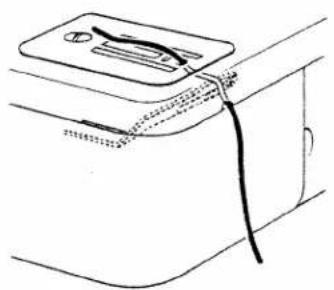
Cording is made with two needle threads. When threading the needles, make sure to lead each thread between a separate pair of tension discs (see ill.).
To render your cording more prominent, insert a filler cord. Select the twin needle gauge and the size of the filler cord to suit the type of material used. The thicker the fabric the wider the needle gauge.
Lace the filler cord through the hole in the needle plate, as illustrated.
Hold both needle threads lightly and turn the balance wheel to draw up the bobbin thread.
The smallest distance between cording seams made with the ordinary sewing foot is approx. 14 inch. For narrower cording, use one of the cording feet listed below.
To make different size cording, the following twin needles and cording feet can be supplied at extra cost:
Twin needles for needle distances of 1.2 (3/64"), 1.6 (1/16"), 1.8, 2.0 (5/64"), 2.5 (3/32"), 3.0 and 4.0 (5/32") mm.
Cording foot No. 93-847 671-00, with 3 grooves is used for heavy materials,
cording foot No. 93-847 675-00 with 5 grooves for medium-heavy fabrics, and
ccording foot No. 93-847 680-00 with 7 grooves for lightweight materials.

natural_image
Close-up of a sewing machine needle and base (no visible text or symbols)Pfaff 78
Piaff 79
natural_image
Simple line drawing of a device with a cable and a clip, no text or symbols present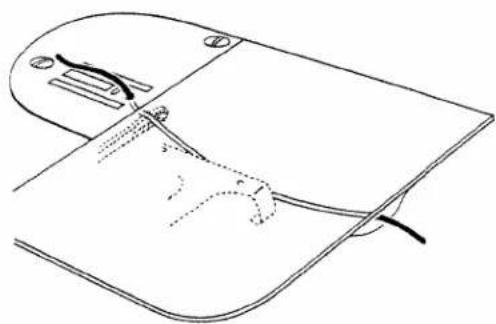
natural_image
Line drawing of a mechanical component with curved surfaces and internal features (no text or symbols)
Use transparent sewing foot No. 93-100 179-00
Stitch length: 2 to 2.5
text_image
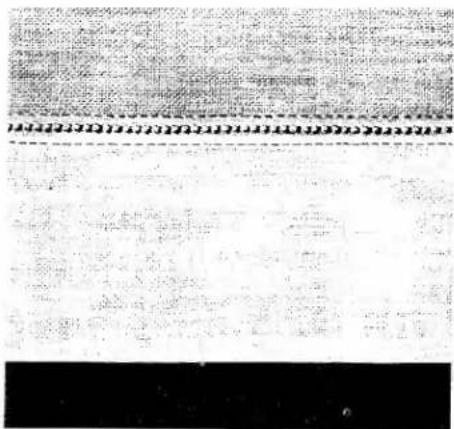
Scanned document with dense text, tables, and a grid of handwritten or typed notesUse a thread which is not too heavy and matches the material being hemstitched (preferably a No. 50 embroidery thread).
Insert a twin hemstitch needle.
Make sure the needle and bobbin threads are the same size. The threading procedure is the same as for cording work. Slightly increase the needle thread tension.
The hemstitching effect is produced by the left wing needle penetrating the fabric. Turn the fabric by half a turn and sew the second seam, guiding the material so that the wing needle enters the needle holes it has made in the fabric previously.
You can produce a nice hemstitching effect along the hemmed edge of the fabric (see ill.) by guiding the material so that the left needle stitches into the fabric close to the hem.

natural_image
Close-up of a textured surface with repeating dark and light spots, no visible text or symbols24
Zigzag-Stitching
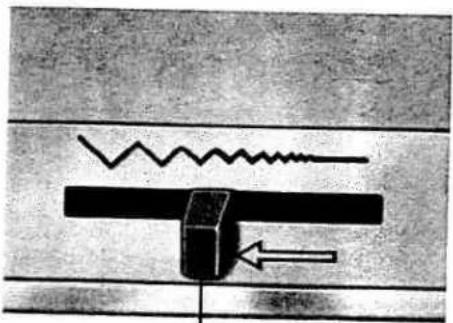
Turn stitch control (6) clockwise until the zigzag-stitch symbol is at the bottom.
The stitch width is regulated by pushing stitch width control (18) toward the left, as far as is desired.
Never change the stitch width setting unless the needle is outside the fabric.

natural_image
Close-up of a circular mechanical component with internal blades and motion arrows, no visible text or symbols1
text_image
Diagram showing a mechanical or electrical component with waveform and directional arrow, likely illustrating a signal or motion process.18
text_image
113
The stitch length is regulated by turning stitch length control (11), as illustrated in Fig. 3.
2

Turn stitch control (6) to zigzag-stitch symbol.
Stitch length: 2
Stitch width (see below)
To overcast the edges of light and medium-weight fabrics, set the machine for its maximum stitch width.
Soft and flimsy fabrics are best overcast with a zigzag stitch of medium width.
Make sure the needle takes one stitch into the fabric and the other over its edge. This will cover the fabric edge securely.

natural_image
Close-up of hands operating a sewing machine needle on fabric (no visible text or symbols)26
Inserting Patches

Attach ordinary sewing foot. Stich width: medium.

natural_image
Abstract textured background with a central white square and dark border (no text or symbols)Larger holes can be patched quickly. Trim away the ragged edges around the hole, cutting exactly along the fabric yarns.
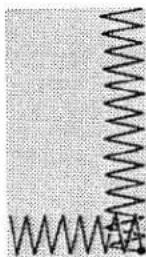
Cut a patch about 12 inch larger than the hole and place it under the hole, matching its grain to that of the fabric.
Set the stitch length control on "1" and the stitch width control in the middle of its slot and stitch along the edge of the patch.
Set the stitch length control on "0.5" and the stitch width control at the extreme left of its slot and sew over first seam.
At the corners, stop the machine with the needle down in the material on the right of its throw. Then turn the fabric so that the corners are stitched twice (see ill.). Trim away the excess material on the wrong side.
Elastic materials are patched in the same manner.
text_image
Scanned text of contract clauses with dense handwritten or printed characters
text_image
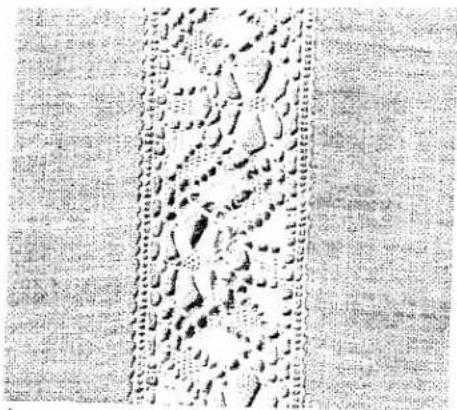
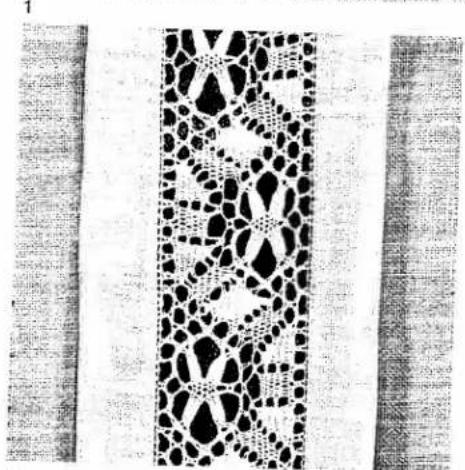
Scanned page with dense handwritten Chinese text and a sketch of a hand holding a pen, likely from a historical or technical document.Place the lace on the material and stitch it down with straight stitches on both sides (1).
Cut the fabric open under the lace insertion (2) and iron it on both sides of the lace.
Turn the fabric to the right side and sew over the edges of the lace with short zigzag stitches of medium width (3).
Trim the fabric edges away on the wrong side (4).
28
natural_image
Microscopic view of a porous cellular structure with irregular black and white voids, embedded in a textured gray panel (no text or symbols)
natural_image
Microscopic view of a porous material structure with irregular voids and pores (no text or symbols)3
4
Appliqué Work
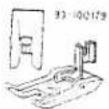
Use transparent sewing foot No. 93-100 179-00.

natural_image
Close-up of a sewing machine stitching a square fabric with zigzag stitching (no text or symbols visible)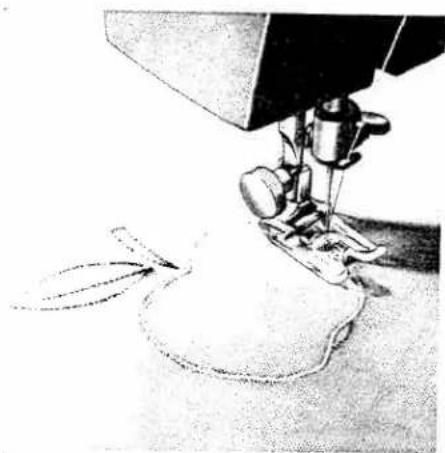
natural_image
Close-up of a sewing machine needle stitching fabric (no visible text or symbols)1
2
To make applique, proceed as follow:
- Trace the design on the right side.
- Set the stitch length control on "1" and stitch along the outlines.
- Sew the fabric to be appliqued to the right side with long stitches (1).
- Follow the outlines of the design on the wrong side with a narrow zigzag stitch (stitch length control on "1"), as shown (2).
- Trim the excess material close to the seam on the right side (3).
- Sew over the edges of the applique with closely packed zigzag stitches (stitch length: 0.2; stitch width: medium), as illustrated (4).

natural_image
Close-up of scissors cutting a textured fabric with a circular hole (no text or symbols visible)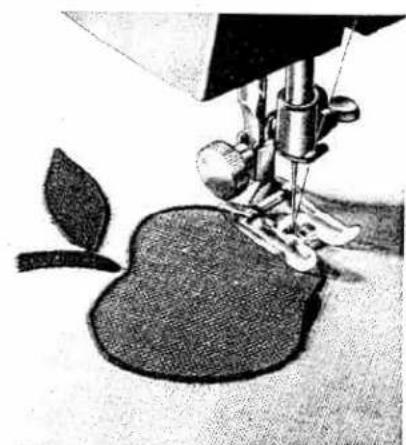
natural_image
Close-up of a sewing machine needle stitching a heart-shaped fabric, with a leaf visible (no text or symbols)3
4
29
Monogram Embroidery
Regulate the stitch width to suit the size of the monogram.
Remove the sewing foot and drop the machine feed. Lower the presser bar lifter. Trace the monogram on the fabric and place the material in darning hoop.
Let the needle stitch into the fabric at the beginning of the design and draw the bobbin thread up through the fabric. Hold both thread ends and start your machine.
Slowly move the hoops in "writing" direction, without turning them, while the machine is running at high speed.
To give your monogram dimensional quality, embroider the outlines twice.

natural_image
Illustration of a sewing machine needle stitching a rope, with hands operating it (no text or symbols visible)Sewing Curtains
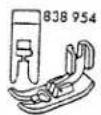

Stitch length: 2.5 to 3 Stitch width: medium
Use a thin needle (see Needle and Thread Chart).
Ease the needle thread tension somewhat. Hold synthetic materials a little taut while sewing.
30
natural_image
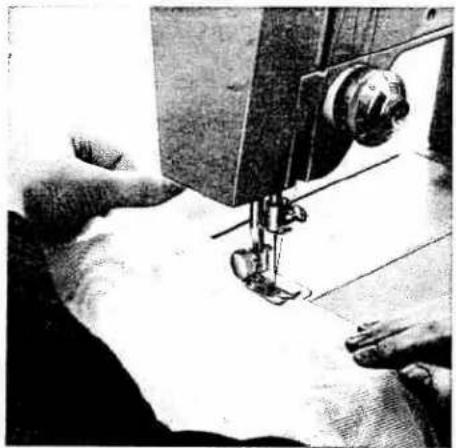
Close-up of hands operating a sewing machine with fabric (no visible text or symbols)Changing the Needle Position
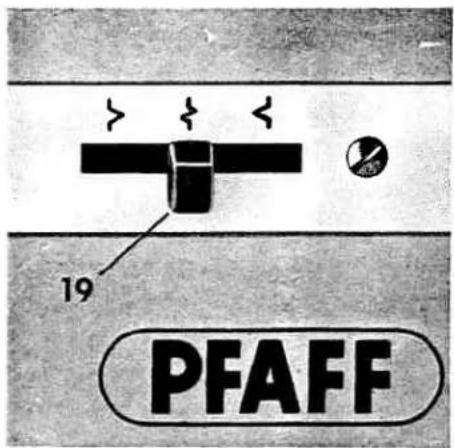
Some special sewing jobs are made with the needle switched to the right or left of the needle plate slot. This is done by moving lever (19) to the right and left, respectively.
The needle position lever is indispensable for sewing on buttons and sewing button-holes, for instance.
text_image
19 PFAFF
text_image
Lever at left center rightButton Sewing
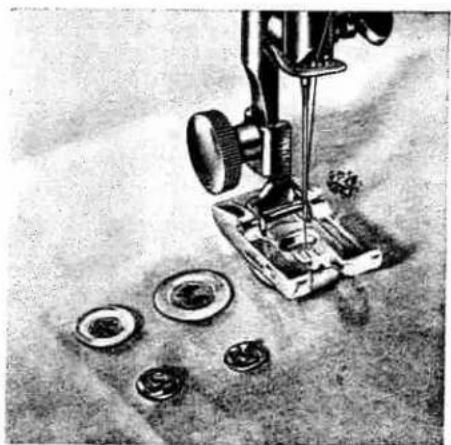
Attach transparent sewing foot No. 93-100 179-00.
Flick the needle to its right position and drop the machine feed.
Place the button under the foot and align so that needle will enter the right hole.
Raise the needle, but retain the foot in its lowered position. Turn the stitch control to the zigzag-stitch symbol and regulate the stitch width until the needle alternately stitches through both holes. Sew on the button.
Move stitch width control (18) toward the right and make two or three tying stitches.
natural_image
Black-and-white illustration of a sewing machine needle stitching several circular components (no text or symbols visible)Apply buttonhole foot No. 93-847 616-00
Attach buttonhole foot to the machine and set the slide on the buttonhole gauge to the buttonhole length desired (Fig. 1). The number indicating the buttonhole length should be in line with the right edge of the slide. The buttonhole is the right length when the beginning of the first seam reaches the red end of the slide indicator (see arrow).
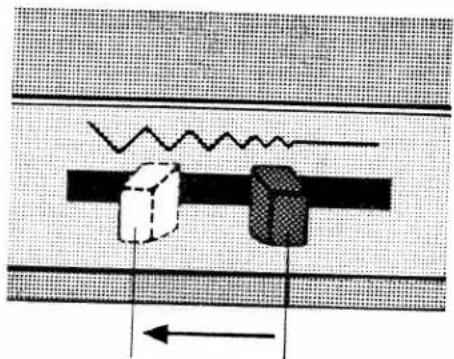
Flick needle position lever (19) to the left (Fig. 2) and put stitch width control (18) in notch R 1 (Fig. 3).
Turn stitch control (6) to zigzag-stitch symbol. When using No. 50 embroidery thread, set the stitch length control so that both dots are opposite each other (Fig. 4).
For heavier threads, slightly increase the stitch length.
To obtain more prominent buttonholes, place a filler cord of medium size in the left groove of the sewing foot.
All-purpose sewing foot No. 91-100 179-00 may also be used for this operation.
32

natural_image
Close-up of a sewing machine needle stitching fabric, with a white arrow pointing to the needle (no text or symbols visible)1

natural_image
Diagram of a tool emitting motion lines, showing a rectangular block with arrows indicating direction (no text or symbols)2
natural_image
Pure mechanical diagram showing a shaft and block assembly with no text or symbolsR2
R1
3

natural_image
Simple line drawing of a mechanical device with a spring-like element mounted on a base (no text or symbols)4
Sew the first seam over the filler cord. When the buttonhole is the right length, leave the needle in the fabric on the right of its throw (1).
Lift the sewing foot, turn the fabric around clockwise by half a turn, place the filler cord around the needle and pull it forward, placing it in the left groove of the foot.
Lower the foot and let the needle descend on the left of its throw (3).
Move stitch width control (18) to the second notch R 2, make 4 to 6 bartack stitches, slightly holding the materials to reduce the length of bar (4).
Push stitch width control (18) back to the first notch R 1 and sew the second button-hole seam, stopping about 116 inch from the end of the first seam.
Push stitch width control (18) to the second notch R 2 and sew the second tack, slightly holding the material to reduce the length of bar. Flick the stitch width control all the way to right and make 3 to 4 fastening stitches.
Slightly pull the filler cord and trim t close to the bar (5).
Open the buttonhole with your seam ripper which is included in the accessory box.
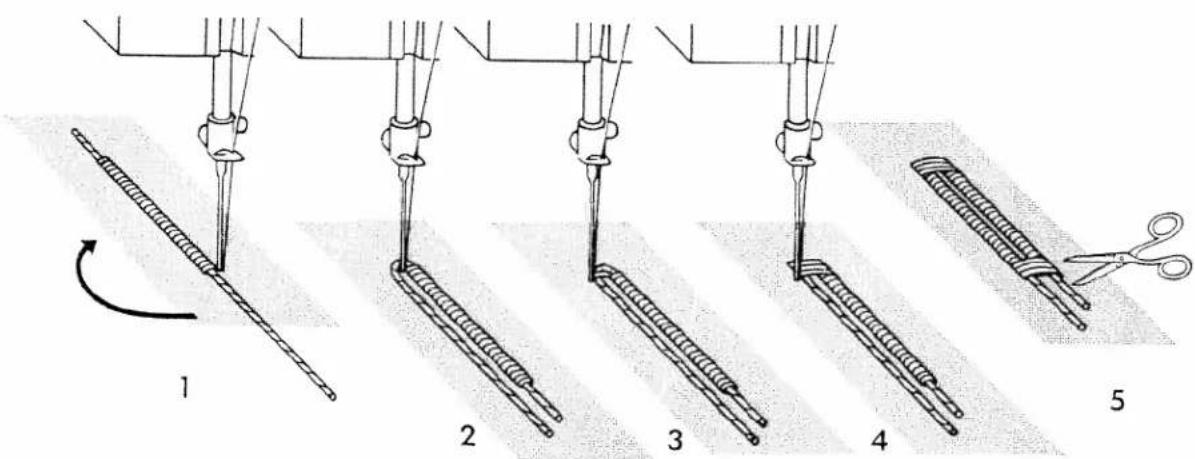
text_image
Diagram illustrating five steps of hairpin application: cutting, threading, forming, and cutting with scissors.To set the machine for decorative-stitch sewing, turn control (6) clockwise (as indicated by arrows) until the symbol of the desired stitch is opposite the dot at the bottom (see ill.).
The stitch width is regulated by moving control (18) to the right or left, as may be desired. The stitch width recommended for the various utility-stitch sewing operations is indicated in the respective instructions.
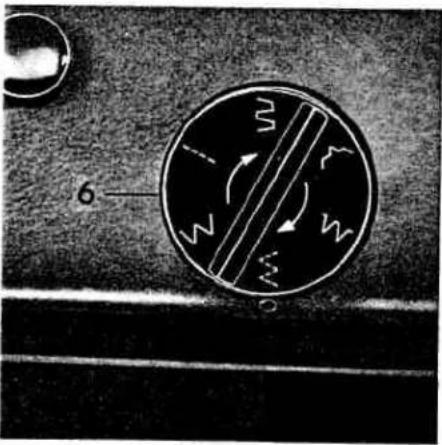
text_image
634
Zigzag seam

Elastic seam

Blindstitch seam

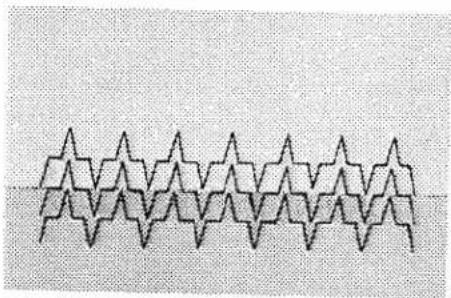
"Pinnacle" seam

"Lamp-shade" seam

Ordinary zigzag seams.
Sewing on elastic, inserting patches in knitted fabrics, automatic darning of rips and worn areas, finishing edges in lightweight fabrics.
Blindstitch seam, shell edging, joining knitted fabrics, borders.
Sewing terry cloth, inserting patches, sewing stockings with elastic thread, attaching lace edging, couching.
Elastic edge finishing, inseams of Helanca slacks, sewing on braiding and borders.
Blindstitching
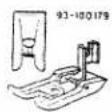
Apply transparent sewing foot No. 91-100 179-00.
Turn stitch control (6) to blindstitch symbol (see page 34)
Stitch length: 2-3
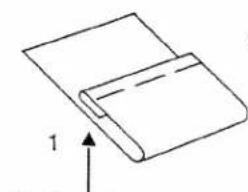
natural_image
Simple line drawing of two folded sheets with a label '1' and an arrow, no text or symbols present.Basting seam

natural_image
Simple line drawing of a stack of papers with one sheet and one spine, no text or symbols presentFold
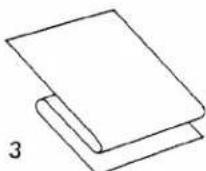
Baste the hem about 316 inch from the fabric edge, as illustrated (1).
Reduce the needle thread tension by one grade.
Fold the hem (2) and place the fabric under the sewing foot so that the folded edge is in line with the left groove of the foot (see ill.).
Regulate the stitch width at top so that the needle takes the left stitch exactly in the folded edge, catching merely one fabric yarn.
Please note:
Fold the hem of heavy woolens only once (3) and finish the raw edge with zigzag stitches before it is hemmed.

natural_image
Close-up of a sewing machine needle stitching fabric, showing mechanical components and fabric layers (no text or symbols visible)
natural_image
Close-up of a textured surface with a dark vertical edge and a horizontal line, no visible text or symbols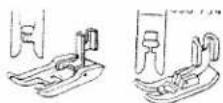
Attach transparent sewing foot
No. 93-100 179-00 or ordinary sewing foot No. 93-838 954-00.
Turn stitch control (6) to blindstitch symbol.
Push stitch width lever (18) to the left as far as it will go (maximum stitch width).
Stitch length: 0.5 to 2
Shell edging makes a nice trimming on lingerie or garments made of delicate, soft fabrics or tricot.
Fold the fabric along the line which is to be enhanced by shell edging. Sew along this folded edge with the needle alternately taking one stitch into the fabric and the other over its edge. As the threads are interlocked outside the fabric, the fabric edge is drawn inwardly thus producing a shell edging effect.
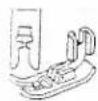
foot.
Turn stitch control (6) to blindstitch symbol.
Maximum stitch length: 0.5
Set stitch width lever (18) for a zigzag stitch of medium to maximum width.
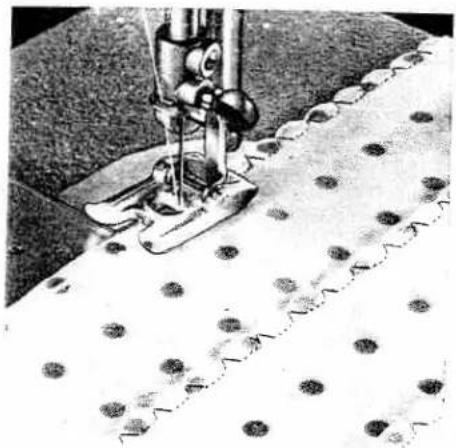
The blindstitch seam is ideally suited for sewing knit underwear and finishing the edges of the fabric.
Place the two pieces of material to be joined one on top of the other and sew along the edge so that the needle alternately stitches into the fabric and over its edge (see drawing).
natural_image
Close-up of a sewing machine stitching a patterned fabric (no visible text or symbols)36

natural_image
Close-up of a sewing machine needle stitching fabric, no visible text or symbols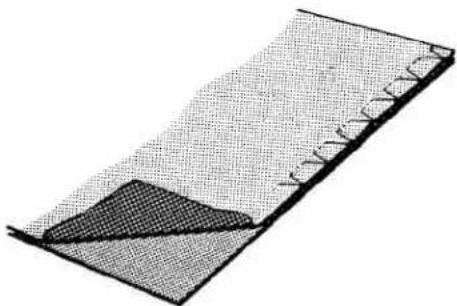
natural_image
Diagram of a folded paper or sheet with a shaded triangular section and wavy edge (no text or symbols)Inserting Patches

Apply the ordinary sewing foot.
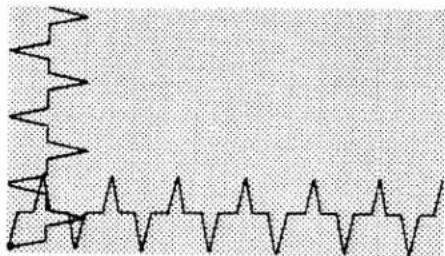
Turn stitch control (6) to the symbol of the "pinnacle" seam (see page 34).
Maximum stitch length: 0.5 Stitch width: maximum
natural_image
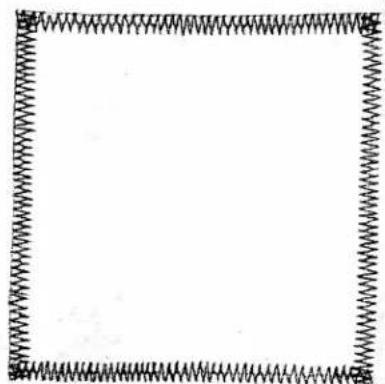
Abstract pattern of jagged black lines on a dotted grid background (no text or symbols)Cut the patch a little larger than the damaged area and place it over the thin spot so that its grain matches the rest of the fabric.
Sew the patch down by stitching along its edges. Turn the material over and trim close to the seams.
The seam which joins the patch to the fabric is highly elastic.
natural_image
Empty rectangular frame with a coiled spring pattern at the bottom (no text or symbols)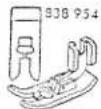
Attach the ordinary sewing foot.
Turn stitch control (6) to the symbol of the "pinnacle" seam.
Stitch length: 0.5
Stitch width: maximum
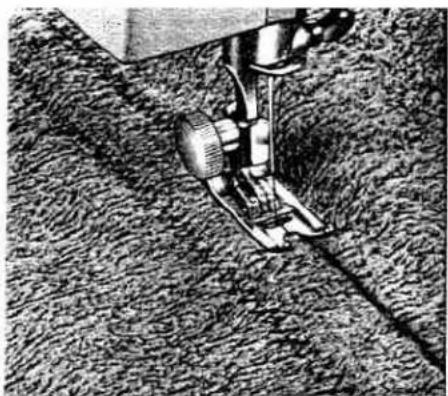
(1). Sew down one cut edge, then turn fabric and stitch down second cut edge.
If the seam is exposed to great stress, lay the two fabric edges together, one over the other, and join them with straight stitches (setting both the stitch length and stitch width controls on 1.5 to 2). Press the seam open, then sew the raw edges down with one of the decorative-stitches (2).
natural_image
Close-up of a sewing machine needle stitching fabric (no visible text or symbols)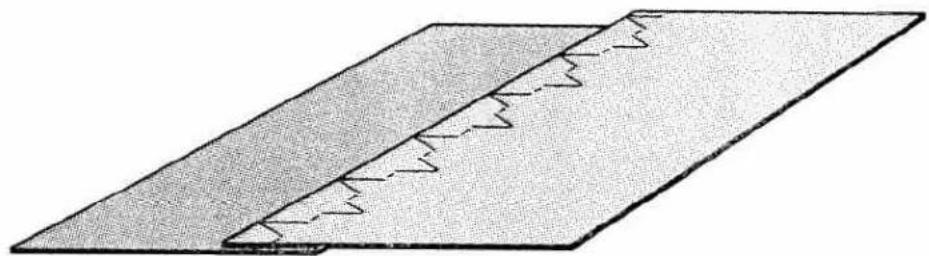
natural_image
Two overlapping sheets with a wavy line inside, no text or symbols present1

natural_image
Close-up of a sewing machine needle stitching fabric (no visible text or symbols)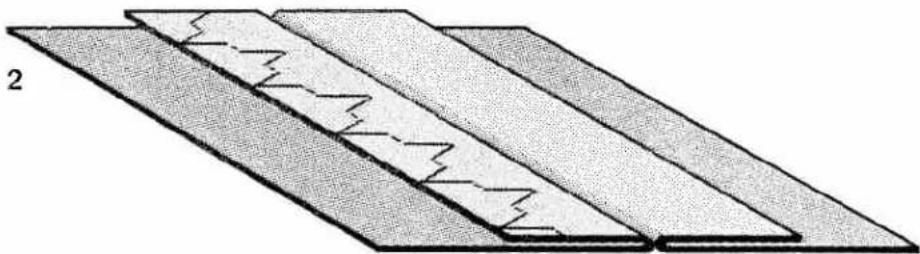
natural_image
Diagram of layered materials with zigzag patterns, no text or symbols present38
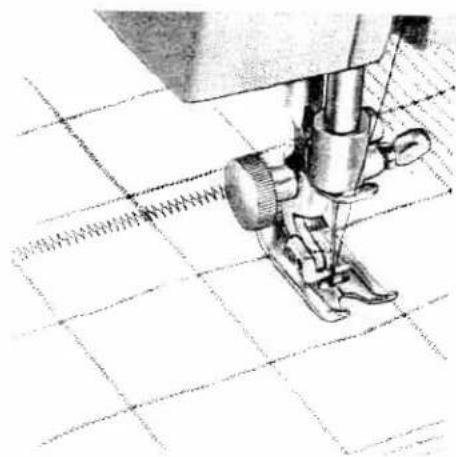
Darning Rips

Apply the ordinary sewing foot.
Turn stitch control (6) to the symbol of the "pinnacle" seam.
Maximum stitch length: 0.5
Stitch width: maximum
natural_image
Close-up of a sewing machine needle stitching a grid-patterned surface (no text or symbols visible)Place a suitable piece of material under the rip and close the rip with the needle stitching alternately into the material on the right and left. If the edges of the rip are ragged, sew along the first seam on the right and left of the rip, overlapping the seams.
natural_image
Abstract geometric pattern composed of repeating zigzag lines on a textured background (no text or symbols)
text_image
A BBull Seaming
Use the ordinary sewing foot.
Turn stitch control (6) to the symbol of the "pinnacle" seam.
Maximum stitch length: 0.5
Stitch width: maximum
Lay both law edges about to wrong side and press. Lay both pieces under the needle with their folded edges abutting and sew together with decorative stitches (see ill.). Trim excess material on wrong side.
If the fabric has a firm selvaged edge, the edges need not be folded and pressed. Simply place both pieces under the sewing foot so that the abutted edges are centered under the needle and join them, as instructed above.

natural_image
Close-up illustration of a sewing machine needle stitching fabric (no text or symbols visible)Mending Hems
Apply the ordinary sewing foot.
Turn stitch control (6) to the symbol of the elastic seam.
Maximum stitch length: 0.5
Stitch width: maximum
Rip open the section of the hem seam opposite the damaged area. Take a piece of suitable material in the right size, fold it on the double and press. Then insert this piece in the hem so that its folded edge is in line with the folded edge of the hem.
Sew it down with decorative stitches, overlapping the seams.

natural_image
Close-up of a sewing machine needle stitching fabric (no visible text or symbols)40
Sewing on Elastic
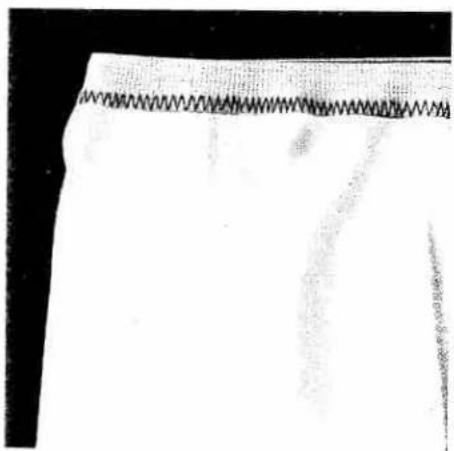
Attach the ordinary sewing foot.
Turn stitch control (6) to the symbol of the elastic seam (see page 34).
Stitch length: 1
Stitch width: maximum
Lay the elastic on the fabric edge, stretching it with both hands, as illustrated. Then sew the stretched elastic down.
The more you stretch the elastic. the more the fabric will be gathered.
natural_image
Close-up of a fabric with a wavy seam and a small mark, no visible text or symbols
natural_image
Illustration of a hand holding a tool next to a textured surface, with a ruler partially visible on the right side (no text or symbols)
Use the ordinary sewing foot.
Turn stitch control (6) to the symbol of the "lamp-shade" seam.
Stitch length: 0.5
Stitch width: minimum

natural_image
Close-up of a sewing machine needle and screwdriver (no visible text or symbols)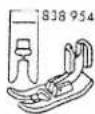
Apply the ordinary setting foot.
Turn stitch conirol (6) to the symbol of the elastic seam.
Maximum stitch length: 0.5
Stitch width: maximum
The same procedure is applied as is used for inserting patches with a "pinnacle" seam (see page 37).
natural_image
Abstract geometric pattern with intersecting diagonal lines and shaded regions (no text or symbols)Sew the two pieces of material together with the machine set as indicated above then press the seam open. This seam is particularly well suited for stretch fabrics. When sewing synthetic stretch fabrics, please note the instructions given for regulating the tension on page 16.
The same machine setting is used for closing inseams of trousers.
42
Reinforcing Hems in Knit Underwear

Attach the ordinary sewing foot.
Turn stitch control (6) to the symbol of the "lamp-shade" seam (see page 34).
Maximum stitch length: 0.5
Stitch width: maximum
Ornamental Seams

Apply transparent sewing foot No. 93-100 179-00.
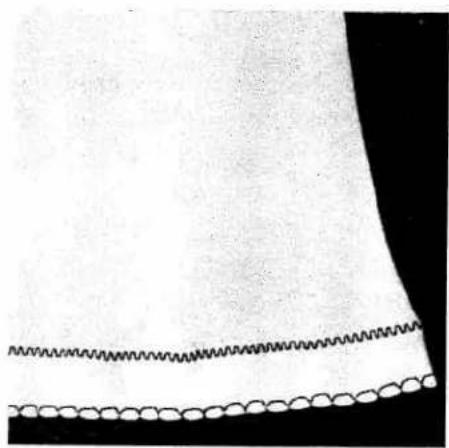
Turn hem allowance and baste. Set the machine as indicated above and stitch the raw edge of the hem (see ill.).
natural_image
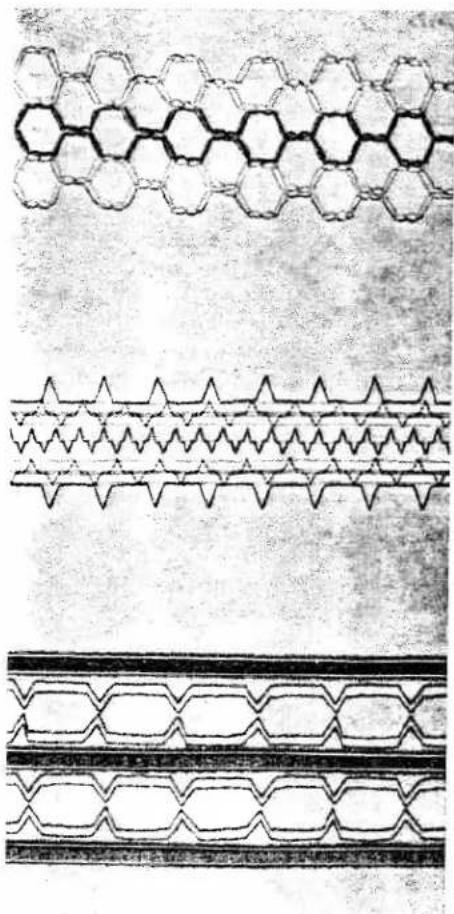
Close-up of a fabric with a wavy seam and a dotted line at the bottom (no text or symbols)All the different stitches will also be used to make exciting fashion-stitch designs, using threads in different sizes and colors.
Some of the designs that can be made are illustrated on the right.
Set stitch length and stitch width to suit the desired pattern.
natural_image
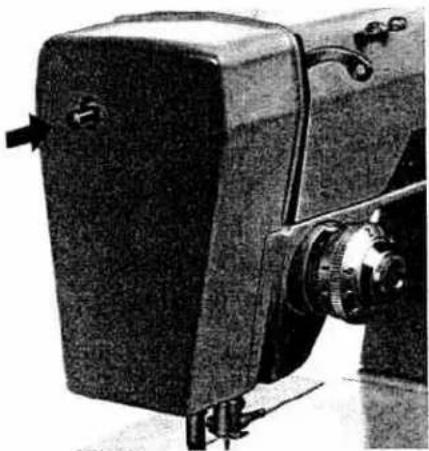
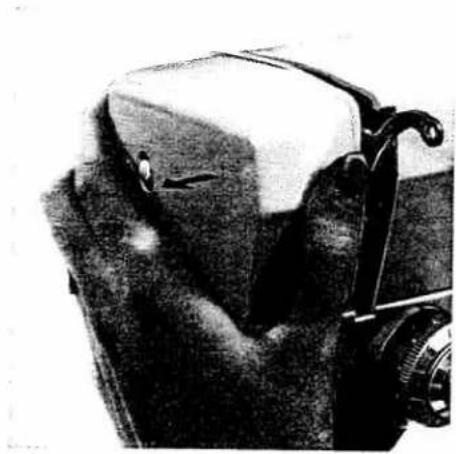
Abstract geometric pattern with repeating hexagonal and star-like shapes (no text or symbols)To change the light bulb, remove the face cover by pulling it in the direction indicated by the arrow.
Push the light bulb into its socket, turn left and pull out. Insert the new bulb so that its pins slide into the socket slots. Press the bulb in and turn right.
As you replace the face cover, slip tip d into slot c, then push against the face cover until it snaps into place.
natural_image
Close-up of a vintage mechanical device with a flat top and scroll wheel (no visible text or symbols)44
natural_image
Close-up of hands operating a sewing machine needle (no visible text or symbols)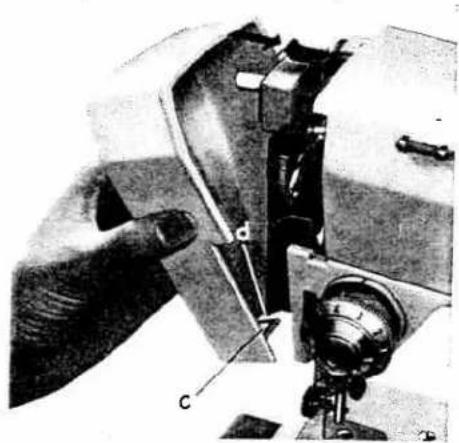
natural_image
Close-up of a sewing machine needle and screwdriver (no visible text or symbols)Machine Care
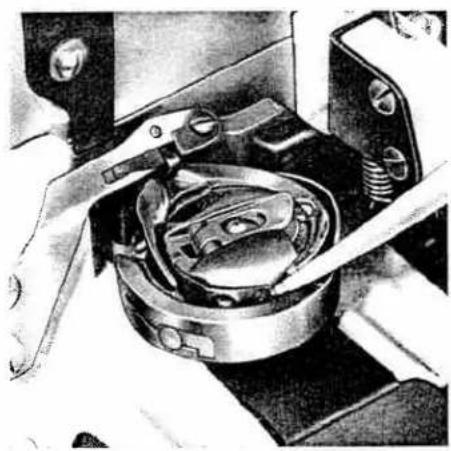
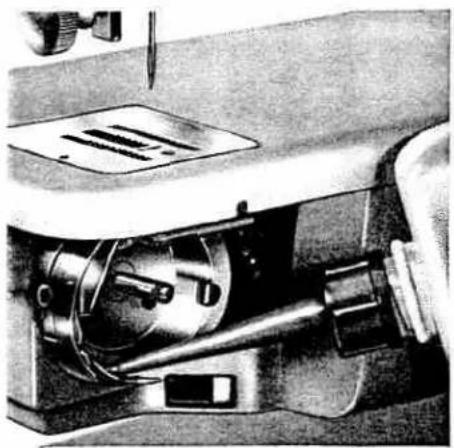
Longevity and smooth machine performance are dependent on regular cleaning and proper oiling. Since your Pfaff sewing machine has been made from high-grade materials, there are only a few oiling points left.
The raceway in the sewing hook is the most important oiling point. From time to time, put a drop of oil into the hook raceway (see ill. at left and center).
To get at the sewing hook of the Pfaff 78, tilt the machine back.
Pfaff 78
natural_image
Close-up of mechanical components including a bearing and clamping mechanism (no visible text or symbols)Pfaff 79
natural_image
Close-up of a mechanical device with internal components and no visible text or symbols
natural_image
Close-up mechanical assembly of a precision optical instrument (no visible text or symbols)The other oiling points in the machine are illustrated above. (Remove the face cover as instructed on page 44).
Contents
| Page | Page | ||
| Applique Work | 29 | Machine Care | 45 |
| Blindstitching | 35 | Mending Hems | 40 |
| Button Sewing | 31 | Monogram Embroidery | 30 |
| Butt Seaming | 40 | Motor Disengaging Mechanism | 5 |
| Changing the Light Bulb | 44 | Oiling | 45 |
| Changing the Needle | 17 | Ornamental Seams | 43 |
| Changing the Needle Position | 31 | Overcasting Edges | 26 |
| Changing the Sewing Foot | 17 | Pressed-open Seams | 42 |
| Cleaning | 46 | Quilting | 21 |
| Cording | 23 | Raising and Lowering the Sewing Foot | 12 |
| Darning | 18 | Regulating the Stitch Length | 14 |
| Darning Foot | 18 | Regulating the Thread Tensions | 16 |
| Darning Rips | 39 | Reinforcing Hems in Knit Underwear | 43 |
| Drawing Up the Bobbin Thread | 12 | Removing the Bobbin Case | 6 |
| Dropping the Machine Feed | 18 | Removing the Face Cover | 44 |
| Electrical Equipment | 4 | Removing the Top Cover | 46 |
| Engaging and Disengaging the Sewing Mechanism | 7 | Reverse Sewing | 15 |
| Essential Parts of the Pfaff 78 | 2 | Sewing Buttonholes | 32 |
| Essential Parts of the Pfaff 79 | 3 | Sewing Curtains | 30 |
| Flat Felled Seams | 21 | Sewing Knit Underwear | 36 |
| Foot Control | 5 | Sewing on Elastic | 41 |
| Foreword | 1 | Shell Edging | 36 |
| Fundamentals of Machine Operation | 13 | Stitching Terry Cloth | 38 |
| Hemming | 22 | Straight Stitching | 14 |
| Hemstitching | 24 | Trouble Shooting | 47 |
| Inseams | 42 | Upper Threading | 11 |
| Inserting a Full Bobbin | 8 | Decorative Stitch Seams | 34 |
| Inserting Lace | 28 | Winding the Bobbin | 7 |
| Inserting Patches with Zigzag Stitches | 27 | Workplate of the Pfaff 78 | 10 |
| Inserting Patches with Decorative Stitches | 37, 42 | Workplate of the Pfaff 79 | 10 |
| Zigzag Stitching | 25 | ||
| Zipper Insertion | 20 | ||
| Inserting the Bobbin Case | 9 |