130-6 - Sewing machine PFAFF - Free user manual and instructions
Find the device manual for free 130-6 PFAFF in PDF.


User questions about 130-6 PFAFF
0 question about this device. Answer the ones you know or ask your own.
Ask a new question about this device
Download the instructions for your Sewing machine in PDF format for free! Find your manual 130-6 - PFAFF and take your electronic device back in hand. On this page are published all the documents necessary for the use of your device. 130-6 by PFAFF.
USER MANUAL 130-6 PFAFF
natural_image
Vintage sewing machine with visible brand and model number (no text or symbols on body)PFAFF 130-6
Instruction book for the PFAFF Sewing Machine (Model 130)
For best results, study these instructions carefully—particularly those parts on the care of the machine. Before leaving the factory your PFAFF was adjusted, carefully tested, and found to be perfect in every respect. If you follow the simple suggestions outlined here, you will enjoy your PFAFF... find it endlessly useful... and, through-out the years be glad that your choice is the finest sewing machine in the world.
I. Useful hints to help you get the best results with your PFAFF
Use fine thread and a fine needle adjusted for loose tension when sewing thin, light fabrics.
For ordinary lock stitch or zigzag seams, regulate the tension so that the interlacing of upper and under threads takes place in the center of the stitching. For making buttonholes, stitching on buttons, eyeletting, rolling seams, and hemstitching, the tension of the under thread should be somewhat tight, since it is desirable to have the threads interlock more toward the underside of the fabric.
Use unglazed thread for ordinary sewing, and soft yarn for embroidering, darning, etc. Since these yarns are smoother and more flexible than the hard and brittle glazed cotton, they assure well-drawn-in stitches, thus protecting the seams when the fabric is washed.
Skipping of stitches may be caused by:
- Needle not having been inserted properly.
- Using other than the recommended PFAFF Needles.
- Needle being bent by wrong handling, or too fine for the thread used.
Thread breaking may be caused by:
- Any of the three reasons mentioned above.
- Tension too tight.
- Using bad or knotty thread.
Bad stitches may be caused as a result of:
- Tensions being too loose or too tight. Both tensions should be equal.
- Using needles and threads that do not conform to the thickness of the fabric. Top and bottom thread should be the same.
- Fluff having accumulated between the upper tension discs, or underneath the tension spring of the bobbin case.
Heavy working of the machine may be caused by:
- The motor belt having become too loose after constant use, therefore, not pulling properly. In that case, the motor bracket has to be adjusted.
- The motor belt being too tight. Do not over-tighten it.
- The shuttle race being obstructed by fluff, which must be removed.
- The machine having become clogged. Note the following instructions for proper oiling and cleaning.
II. To oil and clean the machine
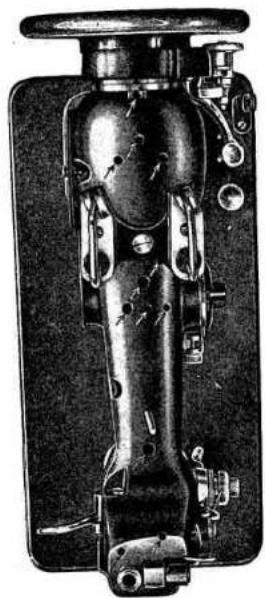
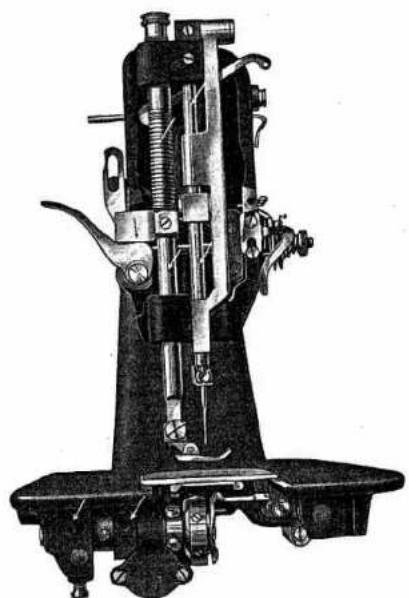
Apply rust-proof grease on all nickel-plated and polished parts. This done, all greased parts should be cleaned with a clean rag. Then, apply a little PFAFF-Sewing Machine Oil at the oiling points marked with arrows in Figures 1, 2, and 3.
natural_image
Technical illustration of a mechanical device with no visible text or symbolsFig. 1

natural_image
Mechanical device with multiple arms and levers (no visible text or symbols)Fig. 2
natural_image
Technical illustration of a mechanical device with springs and levers (no visible text or symbols)Fig. 3
After raising the presser foot, run the machine for a little while without thread, wipe off the down-dripping oil and apply a drop of PFAFF Sewing Machine Oil to all points where there is friction. Make it a rule to clean and oil the machine from time to time, especially when it has been in constant use, or has not been used for a long time.
VERY IMPORTANT: Before using the machine for the first time, apply to the hook a drop of PFAFF Sewing Machine Oil.
Keep the oil can clean.
The needle plate should be taken off frequently and cleaned of accumulated fluff on the underside.
III. The needle
If the needle is inserted incorrectly, the top thread will jam in the hook, and tear. The correct way to install the needle is with the flat of the shank toward the hand lift.
In general, follow this simple rule: Use a finer needle for finer thread and a heavier needle for heavier thread.
IV. Feeding
If the material does not feed (move), turn presser bar pressure screw to the right to increase the pressure. There should be as little pressure as possible on the presser bar—use just enough to feed the material.
Too much pressure causes excessive wear in feeder and foot.
When in doubt, call in qualified PFAFF mechanic.
IMPORTANT—When inserting a new needle, make sure that the needle thumb screw is loose enough to permit you to slice the needle all the way up to the stop pin, then tighten the thumb screw. If the needle is not inserted in this way, it will cause SKIPPING of stitches, and possible needle breakage.
1. Threading the needle
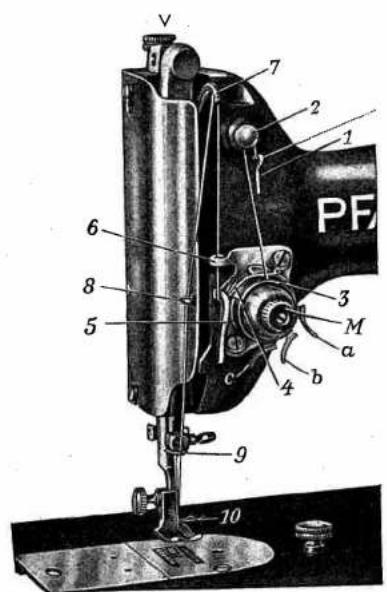
Put spool on spindle, draw through hook guide 1, around circular guide 2, around the tension discs 3, and through check spring 4, around guides 5 and 6, and into the lower hole of the take-up 7, down through thread guide 8 into guide above the needle 9—and thread needle from front to back. (Fig. 4).
2. To set the needle
LOOSEN lock screw above needle clamp. Insert needle with flat shank to back, tighten lock screw—and you're ready to sew.
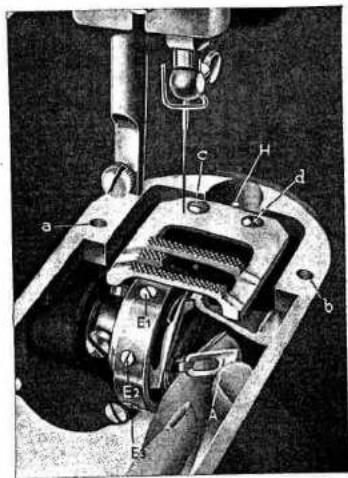
3. To remove bobbin case (Fig. 5)
Turn the machine back on its hinges. Open latch in bobbin case by grasping latch between thumb and forefinger (it is easier with the left hand)—and pull. The bobbin case comes right out. To remove the bobbin, release latch again and the bobbin will drop right out. Practice a few times, so as to get used to this operation.
4. To wind the bobbin (Fig. 6)
For beginners it is suggested that the balance wheel be disconnected so that the machine will not turn. For experienced operators, the balance wheel can remain connected if desired so that a bobbin can be wound while sewing on a garment. Wind thread around the bobbin a couple of times away from you. Place bobbin on winder spindle so that the single slot fits into the pin in the side of the winder spindle.
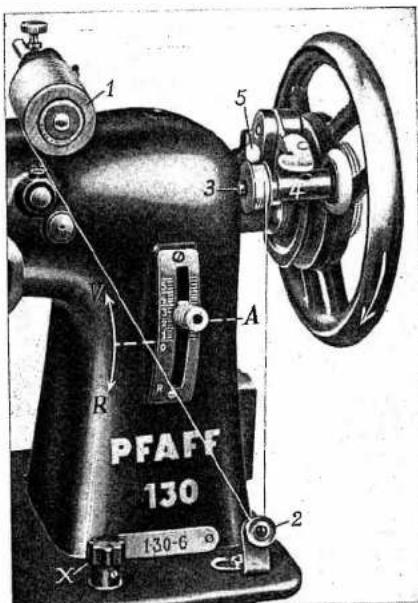
Place spool of thread 1 on either spool holder (1). Draw thread down between tension disc 2 to the bobbin placed on winder spindle 3. Press down on winder catch 4 to lock bobbin in winding position. Now you are ready to wind bobbin. Turn on power until bobbin is wound. If you do not wish to wind the bobbin to capacity, press winder disconnect lever 5. When bobbin is full, release is automatic.
text_image
V 7 2 1 6 8 5 3 M a c 4 b 9 10 PFFig. 4
text_image
Technical diagram of a mechanical device with labeled parts (a, b, c, d, E, H) and directional arrows indicating motion or assembly.Fig. 5
text_image
PFAFF 130 130-6 2 A R 5 3 4 XFig. 6
5. To replace bobbin case (Fig. 7)
Slip bobbin into bobbin case, and draw the thread through the bobbin case slot 1, away from you, under tension spring 2. Turn machine back on its hinges exposing base for bobbin case. With bobbin case latch opened, between thumb and forefinger, slip bobbin into center hook and drop latch back. Push down bobbin case with thumb to make sure that case is locked in position.

text_image
Technical diagram showing a mechanical component with labeled parts 1 and 2, likely for assembly or manufacturing documentation.- To commence sewing
IMPORTANT—Turn wheel towards you to pick-up bobbin thread.
Allow needle to descend and rise once. The under thread then appears in the form of a loop out of the needle hole.
Then lower presser foot by means of presser foot lever. Draw both upper and lower thread ends under the presser foot, and to the rear.
To protect presser foot and feed, never operate machine without placing fabric under the presser foot.
With the cloth inserted and the presser foot lowered, turn the balance wheel toward you. At the same time, give a slight pressure with your knee against the knee control—or against the foot control on some portable models.
7. To remove the work
Stop the machine. Turn the balance wheel toward you until the take-up (see section on threading the needle) is at its highest point. (Or turn the wheel to complete the stitch.) Raise presser foot. (On lifting the presser foot, the tension is automatically released.) Draw the cloth to the rear of the needle. Cut the thread close to the material on the thread cutter.
8. To regulate the tension of the upper thread
The tension of the upper thread is regulated by means of tension nut (M), (Fig. 4). Turning this screw clockwise, the tension will become tighter. Unscrewing it, counterclockwise, it will become looser.
Having adjusted the tension for a certain kind of thread, (you can best judge this tension for yourself by pulling the thread gently with your hand when you have threaded the machine through the tension spring), just glance at the number marked in the bell behind the tension nut, and note its relative position.
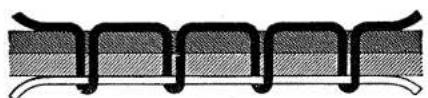
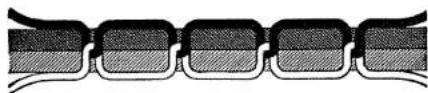
If the upper tension is too loose, the under thread will pull down the upper thread, forming little knots or loops as shown in Fig. 8. If the upper tension is too tight, the under thread is drawn up, as illustrated in Fig. 9 Fig.10 shows the locking in the two threads in the center of the material, as a result of the proper adjustment of both tensions.
natural_image
Pure diagram of a coiled spring or tube structure without any text, numbers, or symbolsFig. 8
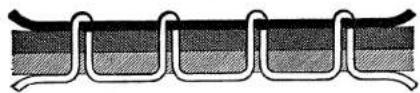
Fig. 9
natural_image
Pure diagram of a multi-layered structure with no text, numbers, or symbolsFig. 10
9. To regulate tension of the under thread
If the tension is too loose, take the bobbin case out of the machine (Fig. 5), and tighten the small tension screw (Z) in a clockwise direction with the aid of the screw driver. If the tension is too tight, unscrew it in a counterclockwise direction. (Fig. 11).
10. To regulate the length of stitch
The length of the stitches is regulated by the stitch regulator screw. (Fig. 6). In the zero—(or neutral)—position, there is no feeding at all. The numbers above zero are for forward stitching; the space below for reverse stitching.

text_image
Technical diagram of a mechanical component with labeled axes X, Y, ZFig. 11
Loosen regulator screw, and push up to desired position from 1 to 5. Position one is the smallest stitch. When you have chosen the size of stitch you want, tighten the screw. To sew in reverse, simply push the locked screw downward, below position zero. It will automatically sew the same size stitch in reverse.
11. The Dial-A-Stitch
If the nose of the Dial-A-Stitch lever (G), (Fig.12), is on point zero of the scale, the machine is performing the straight stitch. If you turn the lever, (G), to the left, the machine is doing the zigzag stitch. The width of the zigzag stitch is increased as the lever, (G), is turned to the left, bringing the width of the zigzag stitch up to a maximum of 11/64".
If lever H (Fig. 12) is pressed against the body of the machine, and then shifted down into position II, the machine will sew to the right of the stitch made in the normal position. In position III, it will sew still farther to the right, continuing the same kind of stitch for which the
dial is set. This is useful for applique, fancy stitching, straight sewing, embroidery, buttonholes, and sewing on buttons.
If the machine is not running, the shifting procedure should not be made, or the size of the zigzag stitch should not be changed, unless the needle is raised. Otherwise, the needle might be bent or broken.

text_image
B Z S 2 10 H I II IIIFig. 12
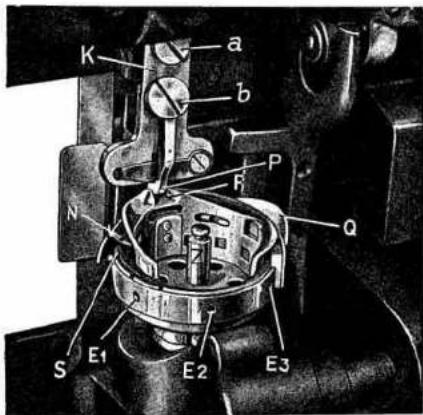
12. To take apart and clean the hook (Fig. 13)
If pieces of thread, lint or dust have gotten inside the hook, impeding the action of the machine, it is necessary
to remove the upper and lower parts of the bobbin case. Turn the balance wheel so as to see clearly screws E-1, E-2, and E-3. Unscrew these, and take off the hook bow. NOTE: Since these screws are extremely small, it is necessary to use great care so as not to lose them.
Grasp center hook between thumb and forefinger, and turn the balance wheel gently until the lower case slips out. Clear out the dirt with a cloth, and put a drop of oil on the running surface under the case. Replace lower bobbin case. Do not force it, as it will damage the part. Replace the hook bow, and screw the three screws back
text_image
K a b P R N Q S E1 E2 E3Fig. 13
into position. If this is difficult, do not force it—call for your mechanic. Parts damaged by force will not be replaced free of charge.
13. To regulate pressure of the presser foot
Screw or unscrew the bushing (V), (Fig. 4), to increase or decrease pressure of the presser foot, and to regulate it for the type of material used.
14. Adjusting the tension of the thread controller spring
For embroidering and darning, ease the tension of the thread controller spring a little more than in the case of sewing. When working on thick or hard materials, the tension should be tighter. To tighten the tension, turn the lever of the tension sleeve as shown in Fig. 4.
a) indicating the position for darning and embroidering;
b) indicating the normal position;
c) indicating the position for sewing thick and hard materials.
The direction for turning the lever is indicated by "L" for loose (light), and "F" for fast (tight).
15. The needle
Make sure that you use the PFAFF needles designed for your machine—Needle Series 130 R. These are finely machined, tempered and polished steel, and are available in sizes 7 to 11, for the most delicate to the heaviest sewing.
16. To lower the feed
For darning and embroidering, the feed can be lowered by turning the knob (X), (Fig. 6), on the front right-hand side of the bed plate. Turn it right to lower the feed; turn it left to raise the feed.
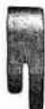
NO ATTACHMENTS ARE NEEDED for all normal sewing and most types of fancy sewing. The PFAFF comes equipped with a hinged presser foot. No. 44088 (Fig. 14), which is used for these purposes. This should remain on your machine most of the time. To remove it, loosen the screw, and lift presser foot out to the left. To replace it, slip it

44088

44088
back into position, holding it firmly in place between the thumb and forefinger of the right hand and tighten the screw.
Fig. 14
45037
45037
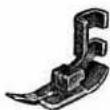
For plain sewing the standard type of presser foot, No. 45037, (Fig. 15), is included for those who prefer to use it.
Fig. 15
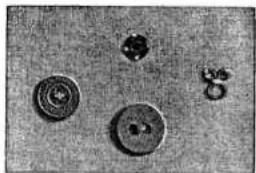
17. Sewing on buttons (Fig. 16 and 17)
Use foot No. 46120 for sewing on two- or four-hole buttons, for snaps, hooks and small bone or metal rings.

46120

40120
Fig. 17

natural_image
Close-up of a mechanical device with a central knob and attached components (no visible text or symbols)Fig. 18
natural_image
Close-up of several mechanical components on a textured surface (no visible text or symbols)With stitch regulator set between 1 and 2, place button on fabric, under button foot, so that needle passes through center of right hole of the button. Then adjust the zigzag stitch with the dial so that the needle passes through the center of the left hole of the button.
To fix the button to the fabric, four or five double stitches will do. When stitching on buttons having four holes, place the fabric with the button as far back as necessary to permit fastening the second pair of holes, too.
At the last stitch, leave the needle at the right and adjust the machine for straight stitches of which a few will suffice to lock the stitch.
18. Buttonholes (Fig. 19 and 20)
Screw on buttonhole foot, No. 42297. (Buttonholes can be made with or without cord. The cord used can be varied, depending on your choice, from the finest to Pearl Cotton No. 5).
For corded buttonhole, draw the cord through the hole in the buttonhole foot, towards the rear. The tension of the upper and under thread must be tightened to obtain a well drawn-in stitch.
The length of the buttonhole should be marked in pencil on the fabric.
With Dial-A-Stitch lever H in position I, (Fig. 12), adjust stitch regulator between zero and one. Adjust the fineness of the zigzag stitch with screw B, to the left of

natural_image
Close-up of a sewing machine needle stitching fabric, no visible text or symbolsFig. 19
the dial, according to the heaviness of cording used. If the zigzag is set at number two, this is adequate for most cordings.
After these preparations, the first edge is sewn to the marked length. When this is done, leave the needle at the right side of this edge in the fabric. Now, raise the presser bar and swing the fabric half around, clockwise, so that the edge now lies at the right of the needle, parallel with the cord guide. Keep the work clean. Cut off excess cord. This makes neater buttonholes. Then lower the presser bar and allow the needle to make one more stitch to the left.

natural_image
Close-up of a mechanical sewing machine needle stitching fabric (no visible text or symbols)Fig. 20
The needle is now in the fabric at the left of the cord. Raise the needle and push lever G into its second groove by turning it to the left. In this way, the wider zigzag stitch for the first bar tack is set. To make the bar, four to five zigzag stitches are necessary, and while doing these, the fabric must be held somewhat to reduce the forward feeding. On making the last stitch of the bar, leave the needle in the fabric to the left. Then, bring the needle up and push lever G back into its first groove in the position in which you sewed the first edge. Now sew edge two. Readjust the lever into the second groove to make the second bar tack, being sure that the needle is raised before switching the zigzag lever. This second bar tack mode, again raise the needle and push lever G back to the farthest position on the right and make some plain stitches to lock the threads.
The cutting of the buttonhole is made with the button-hole knife. This must be performed with care to avoid damaging the buttonhole threads. Insert either the narrow or the broad blade into the holder and fasten it by tightening the screw.
19. Ornamental seams
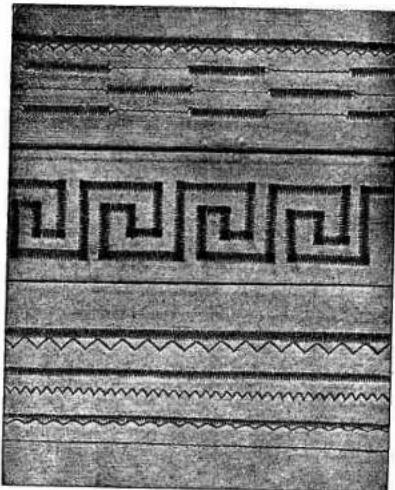
For plain and straight ornamental seams use the normal presser foot. For parallel seams use the edge stitcher with ruler, No. 41350. By skillfully alternating straight and zigzag stitches of varying width and length, you can make any number of attractive patterns—especially interesting as dress decorations. (Fig. 21).
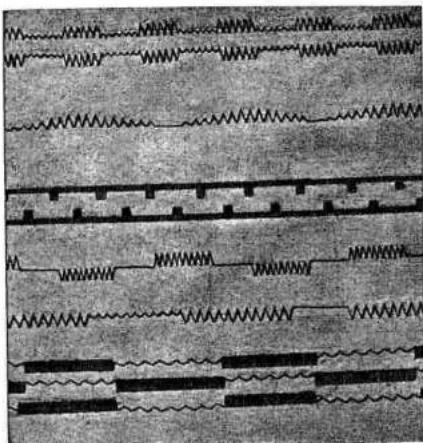
An additional variety of effects is produced by alternating seams to the right and left of center. (Fig. 22). To sew left of center, push lever H up; to sew right of center, push lever H down.
Colored thread is often used to enhance the appearance of the work.
natural_image
Ancient geometric pattern with interlocking angular motifs and zigzag lines (no text or symbols)Fig. 21
20. Overedged hems
Overedged hems are very popular for trimming ladies' and children's dresses, underwear, etc. Fold the edge as required and baste if necessary. Then cover the folded edge with zigzag stitches, small to medium-small, at a stitch length of 1/16th inch. Cut the projecting edge off carefully with a pair of scissors.
natural_image
Pure electrical circuit lines without any symbolsFig. 22
An additional ornamental seam, parallel to the edging, adds a handsome effect. (Fig. 23).
21. Applique work
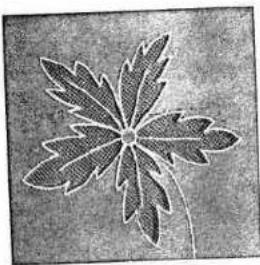
Trace the design on both fabrics, with the cloth to be appliqued extending 1/16th inch beyond the edge of the design. Place the cutting on the fabric so that it corresponds to the pattern, and baste it on.

natural_image
Detailed black-and-white illustration of a knitted garment with zigzag stitching (no text or symbols)Fig. 23
natural_image
Black-and-white illustration of a stylized flower with petal-like petals and textured stem (no text or symbols)Fig. 24

natural_image
Abstract pattern of interlocking heart shapes on a textured background (no text or symbols)Fig. 25
Follow the lines of the design with a narrow and not too dense zigzag stitch, and cut the projecting edges off the cutting. Then reinforce the seam with a wider and more dense zigzag seam. (See Fig. 24 and 25).

41621

41621
If a cord is to be appliqued, or a more raised effect is desired, use the special cording foot No. 41621. (Fig. 26). This is available at extra cost.
Fig. 26
22. Running on lace
This is done with the regular sewing foot, unless cord is to be used. If so, use foot No. 41621. (Fig. 26).
With strong fabric such as linen, shirting, etc. the lace is applied 1/16th inch from the edge, and basted on if necessary. The edge of the lace is then covered with ziazzag stitches and the projecting fabric cut off.
In the case of finer fabrics such as voile and cambric, the lace is sewn on with straight stitches as above des-
natural_image
Close-up of a sewing machine stitching fabric (no visible text or symbols)Fig. 27
cribed. Then the projecting edge of the fabric is folded under, the double edge is covered with zigzag stitches, and the projecting fabric cut off. In this manner, opening of the fabric is made impossible.
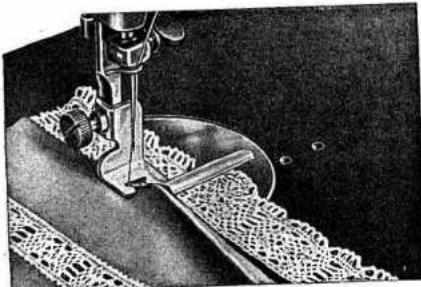
If special, clean-edge lace borders are desired for sewing curtains, bed linens, etc., a special foot, No. 41746, is available at extra cost. This curls the edge of the fabric under as the lace is sewn on. (Fig. 27). By holding the lace back, or letting it go forward, lace borders can be shirred or sewn on flat.
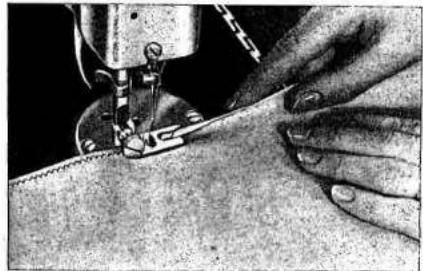
23. Even hems (Fig. 30)
Even hems are sewn by using hemming foot, No. 41246, (Fig. 28), or with the larger hemming foot, No. 41248, (Fig. 29), with the machine set for straight zigzag stitch. With light tension and medium-sized zigzag stitches, the rolled edge of the fabric remains even and smooth. With tight tension and broad zigzag stitches an undulating rolled hem is obtained, especially desirable in the case of knitted silk goonds. Special effects are obtained by using thread of different shades.

natural_image
Four identical metal bracket components with no visible text or symbolsFig. 28
Fig. 29
24. Felling (Fig. 32)
For felling, use the felling foot No. 41242. (Fig. 31). Place the two fabrics together so that the lower layer projects about 14 " on the right side. Then guide the two pieces into the feller, just as when hemming. The lower
fabric is then folded once, and sewn to the top piece. Now infold the two pieces of cloth as shown in Fig. 32, flatten the seam, and once more guide the edge thus formed through the feller. When felling, use the straight lock stitch, except for thin or elastic fabrics and knitted goods, which require a medium-sized zigzag stitch for good strong seams.
natural_image
Close-up of hands operating a sewing machine on a fabric (no visible text or symbols)Fig. 30

natural_image
Technical illustrations of mechanical components, including a cylindrical component and a bracket (no text or symbols visible)Fig. 31
Fig. 32
text_image
C A B 48266Fig. 33
25. Embroidering and darning
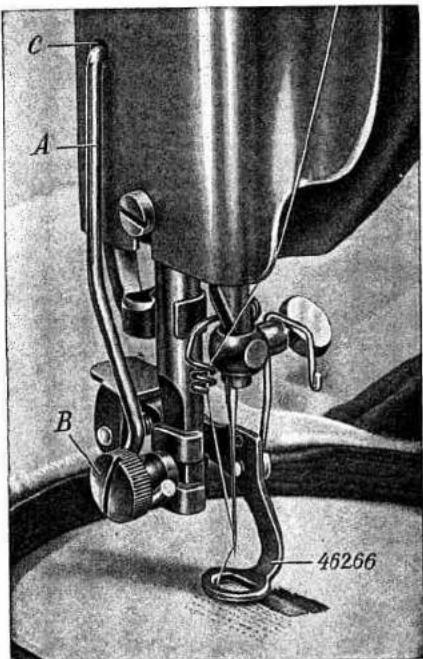
Remove the presser foot and lower the feed. Raise the presser bar, place wire clamp (A) with its bent end around the shank of foot screw (B); and with the short end into hole (C) of the face plate. (Fig. 33). By lowering the presser bar lever, the thread tension is re-established. It is helpful to use an embroidery ring in any convenient size. For darning, use soft, mercerized cotton No. 40 to 80 depending on the thickness of the fabric.
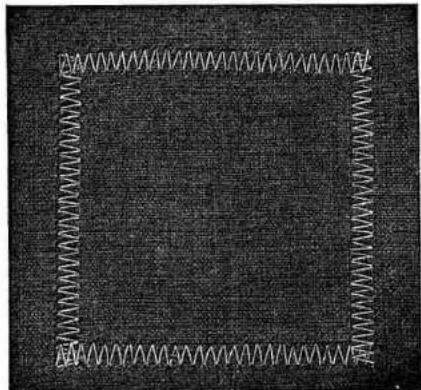
If large parts are to be mended, we recommend cutting out the damaged pieces, inserting a fresh piece of fabric, and fastening it with zigzag stitches, as shown in Fig. 34
natural_image
Black textured background with a white zigzag border and faint circular patterns (no text or symbols)Fig. 34
26. Covered cords
Covered cords are made with the feed cover plate and cord guide No. 41842, in addition to the cording foot, No. 41319 with five grooves. All of these are available at a slight extra cost.
Embroidery yarn No. 40, sewing silk, or standard sewing cotton, may be used Crochet yarn No. 3 or 5 can serve as cord.
Pass the crochet yarn through the cording guide, and place the fabric under the presser foot. Sew the cord on the line you have traced, with a medium zig-zag stitch.
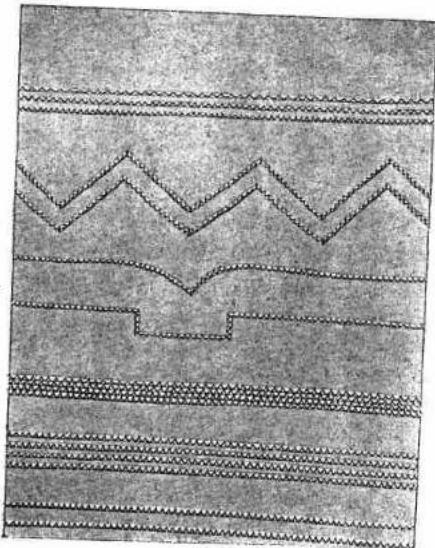
Soft cording effects can be obtained by using a filler thread. This, (as shown in Fig. 35), is done with smaller zigzag stitches.
27. Ruffling
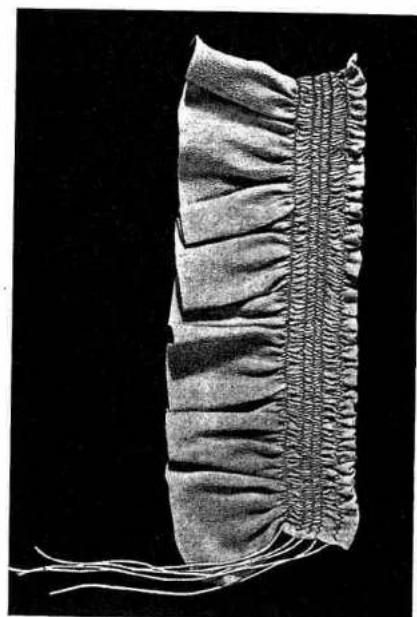
Ruffling is done with the same type of cording mentioned above. (See Fig. 36).
Fasten one end of the filler thread, and tighten it after completing the seam. The fabric can now be puckered together for uniform ruffling. The opposite end of the cord must be fixed, to prevent the ruffling from becoming undone.
First draw the threads according to the pattern, just as if hemstitching by hand. The two edges where the threads have been drawn must now be sewn with narrow zigzag stitches, using the regular presser foot. The length of stitch depends on the effect you wish to obtain. When sewing the second edge, make sure that the same threads are covered, and that the length of stitch is the same as on the first edge, to assure a uniform appearance. For this work an embroidery ring is very useful.
natural_image
Abstract pattern of repeating zigzag and rectangular lines on a textured gray background (no text or symbols)Fig. 35
natural_image
Black-and-white photograph of a fabric knocker with pleated texture and tassels (no text or symbols)Fig. 36

natural_image
Abstract patterned textile or decorative design with horizontal bands and floral motifs (no text or symbols)Fig. 37
29. Picot edging
Picot edging is obtained by cutting the above hem-stitched hem along the center. (Fig. 38). This type of edging is used to prevent the unravelling of the plain cloth-edge.

natural_image
Close-up of a textured fabric with vertical seam pattern (no text or symbols)Fig. 38
30. Rolled hems
Rolled hems are produced with the aid of sewing foot No. 46261 × 1,5 (Fig. 39). Use small zigzag stitches to ensure a neat effect.

Fig. 39

natural_image
Close-up of a sewing machine needle stitching fabric (no visible text or symbols)Fig. 40
31. Scalloped rolled hems (Fig. 41)
Scalloped rolled hems on knitted goods are made with foot No. 46261 × 3, available at extra cost. The scalloped form of the hem is the result of the wide zigzag stitch sewn with firm tension.
Fig. 41

natural_image
Mechanical assembly diagram showing a lever and guide mechanism (no text or labels visible)32. Scalloped edge (Fig. 42)
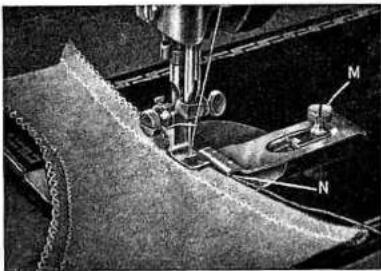
On neck pieces and lingerie straps of heavy knit goods, the rolled hem described above is too thick. In this case, the making of a scalloped edge with edge stitcher No. 41350 and the ruler with cording guide, No. 26862, is recommended. The latter one is available at slight extra cost.
natural_image
Close-up of a sewing machine needle stitching fabric, labeled with parts M and N (no text or symbols beyond labels)Fig. 42
V. Mechanical Adjustments
(These are suggested only for those who have complete mechanical familiarity with the machine.)
1. Setting the Height of the Needle Bar
Remove the face plate. Make sure dial is set on zero, and lever (H) is set in center. Turn hand wheel until needle bar is at lowest point. Loosen needle-bar clamp lock-screw. Lower needle-bar until the top of the eye of the needle is level with the top of the base of the hook. Hold needle bar so that it does not move, and lock with needle-bar clamp lock-screw.
Now the height of the needle bar is set, and you can proceed with the timing of the hook.
38
2. Timing of the Hook
Set zigzag dial on Position 4 (widest stitch). Loosen the two lock-screws of the hook and take off base. stop. Turn hand wheel until needle bar is on extreme left, and at the lowest point. Bring the point of the hook around to the needle. Hold it there and turn hand wheel in direction of rotation (towards front of machine) until the top of the eye of the needle is approximately 1/32" below the bottom of the point of the hook. Bring the hook as close as possible to the needle without touching the needle, and lock the hook in position on the hook shaft. Replace base stop, and push it towards the front of the machine until you've got a least 1/32" or more clearance between the base stop and the base. Now the hook is timed.
Index
- Useful hints . . . . . . . . . . . . . . . . . . 1
II. To oil and clean the machine 2
III. The needle 6
IV. Feeding 6
-
Threading the needle 7
-
To set the needle 7
-
To remove bobbin case . . . . . . . . . . 7
-
To wind the bobbin 7
-
To replace bobbin case 11
-
To commence sewing ..... 11
-
To remove the work 12
-
To regulate the tension of the upper thread . 12
-
To regulate the tension of the under thread . 13
-
To regulate the length of stitch ..... 13
-
The Dial-A-Stitch . . . . . . . . . . . . 14
-
To take apart and clean the hook ..... 15
39
-
To regulate pressure of the presser foot . . 17
-
Adjusting the tension of the thread controller spring 17
-
The needle . . . . . . . . . . . . . . 17
-
To lower the feed . . . . . . . . . . . . . 17
-
Sewing on buttons 18
-
Buttonholes 20
-
Ornamental seams . . . . . . . . . . . . . . 22
-
Overedged hems 23
-
Applique work . . . . . . . . . . . . . . . . . . . . . . . . . . . . . . . . . . . . . . . . . . . . . . . . . . . . . . . 27
-
Running on lace
-
Even hems . . . . . . . . . . . . . . . . . 28
-
Felling
-
Embroidering and darning . . . . . . . . . . . 31
-
Covered cords . . . . . . . . . . . . . . . . . . . . 32
-
Ruffling . . . . . . . . . . . . . . . . . . . . . . . . . . . . . . . . . . . . . . . . . . . . . . . . . 32
-
Hemstitching
-
Picot edging 30
-
Rolled hems 50
-
Scalloped rolled hems
-
Scalloped edge
V. Mechanical adjustments 38
-
Setting the Height of the Needle Bar . . . . 38
-
Timing of the Hook . . . . . . . . . . . . . 39
Printed in Germany
Nr. 7723 P 954
40