EB-S12 - Projector EPSON - Free user manual and instructions
Find the device manual for free EB-S12 EPSON in PDF.


User questions about EB-S12 EPSON
0 question about this device. Answer the ones you know or ask your own.
Ask a new question about this device
Download the instructions for your Projector in PDF format for free! Find your manual EB-S12 - EPSON and take your electronic device back in hand. On this page are published all the documents necessary for the use of your device. EB-S12 by EPSON.
USER MANUAL EB-S12 EPSON
Notations Used in This Guide
•Safety indications
The documentation and the projector use graphical symbols to show how to use the projector safely.
Please understand and respect these caution symbols in order to avoid injury to persons or property.
| Warning | This symbol indicates information that, if ignored, could possibly result in personal injury or even death due to incorrect handling. |
| Caution | This symbol indicates information that, if ignored, could possibly result in personal injury or physical damage due to incorrect handling. |
•General information indications
| Attention | Indicates procedures which may result in damage or injury if sufficient care is not taken. |
 | Indicates additional information and points which may be useful to know regarding a topic. |
| Indicates a page where detailed information regarding a topic can be found. | |
| Indicates that an explanation of the underlined word or words in front of this symbol appears in the glossary of terms. See the "Glossary" section of the "Appendix". "Glossary" p.109 | |
| [Name] Indicates the name of the buttons on the remote control or the control panel.Example: [Esc] button | |
| Menu Name Indicates Configuration menu items.Example:Select Brightness from Image.Image - Brightness | |
Notations Used in This Guide 2
Connecting Image Sources....
Connecting USB Devices
Connecting External Equipment (EB-S12/EB-X11/EB-S1
Introduction
Basic Usage
Projector Features
Projecting Images 30
List of Functions by Model
Quick and Easy Setup, Projection, and Storage
Connecting with a USB cable and projecting (USB)
Detecting projector movements and automatically correcting image distortion
(EB-X14/EB-W12/EB-X12/EB-S12/EB-X11 only)
Horizontal keystone adjuster (EB-X14/EB-W12/EB-X12/EB-S12/EB-X11 only) ..... 8
Useful Functions for Projecting Images
Increasing projection content in wide (WXGA) scre
Making the most of the remote control.
Enlarge and project your files with the Document Camera....9
Enhanced security functions
Automatically Detect Input Signals and Change the Projected Image (Source Search)
31
Switching to the Target Image by Remote Control
Projecting with USB Display
System requirements
E B-W 12 o n l y) for the first time
11 pini stafling 3.4
ra....9
Adjusting Projected Images 36
Part Names and Functions
Correcting Keystone Distortion
Front/Top....10
R e a r 1 1
Base 13
Control Panel....14, adjusting the Image Position
Remote Control....
Replacing theremote control batteries
Remote control operating range
5 Correcting the Focus
Correcting the Focus A derivative in T.7
Adjusting the volume
Selecting the Projection Quality (Selecting Color Mod
Setting Autolris....4
Changing the Aspect Ratio of the Projected Image
Changing methods 4
Changing the aspect mode
Preparing the Projector
Installing the Project or 20
.....20
Installation Methods
Installation methods
Screen Size and Approximate Projection Distance....21
Useful Functions
Connecting Equipment 23
Projection Functions 47
Connecting a Computer
Projecting Without a Computer (Slideshow)
Specifications for files that can be projected using Slideshow 47
Contents

Slideshow examples....L47o Menu (Display Only)....
Slideshow operating methods ......Res.e.t4Menu ......73
Projecting the selected image....49
Projecting image files in a folder in sequence (Slideshow)....50
Image file display settings and Slideshow operation Troubleshooting......51
Hiding the Image and Sound Temporarily (A/V Mute)....52
Freezing the Image (Freeze)....Using the Help .... 75
Pointer Function (Pointer) 53
Enlarging Part of the Image (E-Zoom)
Using the Remote Control to Operate the Mouse Pointer (Wireless Mouse) ..... 55
Saving a User's Logo
Security Functions 58 Problems relating to Images No images appear 80
Managing Users (Password Protect).... Moving images are not displayed (only the moving image portion turns black) Kinds of Password Protect.... 5.8.... 81
Setting Password Protect....Projection stops automatically....
Entering the Password
Restricting Operation (Control Panel Lock)
Anti-Theft Lock
Installing the wirelock
Monitoring and Controlling 62
ESC/VP21 Commands....62mades appear dark....8
Before starting....6 problems when Projection Starts....
Command list 62 The projector does not turn on.
Communications protocol....Oth@Problems....86
Configuration Menu
Using the Configuration Menu 65
List of Functions 66
Configuration Menu Table....66
Image Menu....67Cleaning....89
Signal Menu 68
Settings Menu....70 Cleaning the projector surface....8 Cleaning the lens
Extended Menu....71 Cleaning the Air Filter
Maintenance
Contents

Replacing Consumables....1@dex....112
Replacing the Lamp 91
Lamp replacement period 91
How to replace the lamp....91
Resetting the lamphours 94
Replacing the Air Filter 94
Air filter replacement period....94
How to replace the air filter 94
Appendix
Optional Accessories and Consumables 97
Optional Accessories....97
Consumables....97
Screen Size and Projection Distance 98
Projection Distance (For EB-W12) 98
Projection Distance (For EB-X14/EB-X12/EB-X11)....99
Projection Distance (For EB-S12/EB-S11).... 100
Supported Monitor Displays 102
Supported Resolutions....102
Computersignals (analog RGB) 102
Component Video 103
Composite video 103
Input signal from the HDMI port (EB-X14/EB-W12/EB-X12 only)....103
Specifications 104
Projector General Specifications....104
Appearance 108
Glossary 109
General Notes 111
About Notations 111
General Notice: 111

Introduction
This chapter explains the projector's features and the part names.
Projector Features

List of Functions by Model
Available functions differ depending on the model being used. See the table below for a list of the functions available for each model.
| Function EB-X14 | EB-W12 EB-X1 | 12 EB-S12 EB | X11 EB-S11 | |||
| USB Display | √ | √ | √ | √ | √ | √ |
| HDMI Connection - | √- | √- | √ | |||
| External Equipment Connection | - | - | - | √*1 | √ | √ |
| Auto V-Keystone - | √ | √ | √ | √ | √ | |
| H Keystone Adjuster | √ | √ | √ | √ | √ | -*2 |
| Quick Corner | √ | √ | √ | √ | √ | √ |
| Slideshow | √ | √ | √ | √ | √ | √ |
*1 Depending on the area of purchase, this may not be available.
*2 Although the horizontal keystone adjuster is not installed for this model, you can perform H-Keystone from the control panel or the Configuration menu.
Quick and Easy Set up, Projection, and Storage
- Turn the projector on and off by simply plugging in or unplugging.
- Project onto large screens from a short distance.
- Make easy height adjustments with one lever.
- No cool down delay makes it easy to put away.
Connecting with a USB cable and projecting (USB Display)
By simply connecting a USB cable, you can project images from a computer's screen without a computer cable.
"Projecting with USB Display" p.32

flowchart
graph TD
    A["Computer"] -->|USB| B["Monitor"]
    B --> C["Graph Chart"]
    C --> D["Graph Chart with Line Graph"]
    style A fill:#f9f,stroke:#333
    style B fill:#bbf,stroke:#333
    style C fill:#bfb,stroke:#333
    style D fill:#ffb,stroke:#333
Detecting projector movements and automatically correcting image distortion (EB-X14/EB-W12/EB-X12/EB-S12/EB-X11 only)
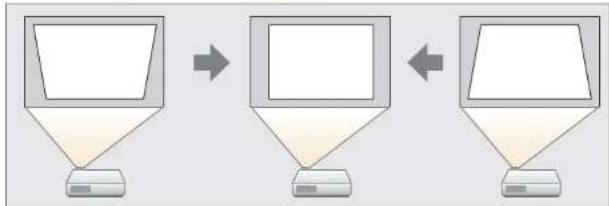
This projector automatically corrects vertical keystone distortion which occurs when positioning or moving the projector.
"Correcting automatically" p.36
flowchart
graph LR
    A["Computer monitor"] --> B["Computer monitor icon"]
    B --> C["Computer monitor icon with arrow"]
Horizontal keystone adjuster (EB-X14/EB-W12/EB-X12/EB-S12/EB-X11 only)
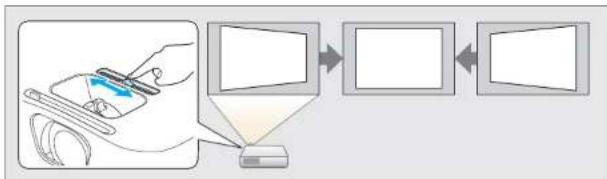
This allows you to quickly correct horizontal distortion in the projected image. This is useful if you cannot install the projector parallel to the screen.
"Correcting manually" p.37
flowchart
graph LR
    A["Receipts"] --> B["Screen"]
    B --> C["Output Screen"]
    style A fill:#f9f,stroke:#333
    style B fill:#ccf,stroke:#333
    style C fill:#cfc,stroke:#333
Useful Functions for Projecting Images
Increasing projection content in wide (WXGA) screen (EB-W12 only)
With a computer that has a 16:10 WXGA wide LCD display, the image can be projected in the same aspect. You can use whiteboards and other landscape format screens.
"Changing the Aspect Ratio of the Projected Image" p.43

text_image
4:3(XGA) 16:10(WXGA)Making the most of the remote control
You can use the remote control to perform operations such as enlarging part of the image. You can also use the remote control as a pointer during presentations or as a mouse for the computer.
"Pointer Function (Pointer)" p.53
"Enlarging Part of the Image (E-Zoom)" p.54
"Using the Remote Control to Operate the Mouse Pointer (Wireless Mouse)" p.55
Enlarge and project your files with the Document Camera
You can project paper documents and objects using the optional Document Camera. Image focus is automatically adjusted using the auto focus function. You can also enlarge images using digital zoom.
"Optional Accessories" p.97
Enhanced security functions
- Password Protect to restrict and manage users
By setting a Password you can restrict who can use the projector.
"Managing Users (Password Protect)" p.58
- Control Panel Lock restricts button operation on the control panel
You can use this to prevent people changing projector settings without permission at events, in schools, and so on.
"Restricting Operation (Control Panel Lock)" p.60
•Equipped with various anti-theft devices
The projector is equipped with the following types of anti-theft security devices.
•Security slot
•Security cable installation point
"Anti-Theft Lock" p.61
All of the features in this guide are explained using illustrations of EB-W12 unless otherwise mentioned.
Front/Top

text_image
1 2 3 4 5 6 7 8 9 10 11 12 13 14 15 7 EB-S12/EB-S11| Name Function | ||
| 1 | Air exhaust vent | Exhaust vent for air used to cool the projector internally. CautionWhile projecting, do not put your face or hands near the air exhaust vent, and do not place objects that may become warped or damaged by heat near the vent. CautionWhile projecting, do not put your face or hands near the air exhaust vent, and do not place objects that may become warped or damaged by heat near the vent. |
| 2 | A/V mute slide knob | Slide the knob to open and close the A/V mute slide. |
| 2 | Name Function | |
| 3 | Foot adjust lever | Press the foot adjust lever to extend and retract the front adjustable foot.➤ "Adjusting the Image Position" p.40 |
| 4 | Front adjustable foot | When setup on a surface such as a desk, extend the foot to adjust the position of the image.➤ "Adjusting the Image Position" p.40 |
| 5 | A/V mute slide | Close when not using the projector to protect the lens. By closing during projection you can hide the image and the sound.➤ "Hiding the Image and Sound Temporarily (A/V Mute)" p.52 |
| 6 | Remote receiver | Receives signals from the remote control. |
| 7 | Focus ring | Adjusts the image focus.➤ "Correcting the Focus" p.41 |
| 8 | Zoom ring(EB-X14/EB-W12/EB-X12/EB-X11 only) | Adjusts the image size.➤ "Adjusting the Image Size" p.40 |
| 9 | Air intake vent(air filter) | Takes in air to cool the projector internally.➤ "Cleaning the Air Filter" p.89 |
| 10 | Air filter cover | Opens and closes the air filter cover.➤ "Replacing the Air Filter" p.94 |
| 11 | Speaker | Outputs audio. |
| 12 | Indicators | Indicates the projector's status.➤ "Reading the Indicators" p.76 |
| 13 | Control panel | Operates the projector.➤ "Base" p.13 |
| 14 | Horizontal keystone adjuster(EB-X14/EB-W12/EB-X12/EB-S12/EB-X11 only) | Corrects horizontal distortion in the projected image.➤ "Correcting manually" p.37 |
Part Names and Functions

| Name Function | ||
| 15 | Lamp cover | Open when replacing the projector's lamp. ➕ "Replacing the Lamp" p.91 |
Rear
EB-X14/EB-W12/EB-X12
text_image
Labeled diagram of a projector rear panel showing numbered components and connectorstext_image
Labeled diagram of an electronic device rear panel showing ports, connectors, and ports numbered 1 to 14| Name Function | ||
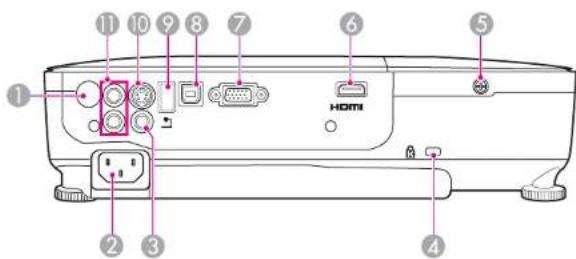
| 1 | Remote receiver | Receives signals from the remote control. |
| 2 | Power inlet | Connects the power cable to the projector."From Installation to Projection" p.30 |
| 3 | Video port | Inputs composite video signals from video sources |
Part Names and Functions

| Name Function | ||
| 4 | Security slot | The Security slot is compatible with the Microsave Security System manufactured by Kensington.➤ "Anti-Theft Lock" p.61 |
| 5 | Lamp Cover Fixing Screw | Screw to fix the lamp cover in place. |
| 6 | HDMI port (EB-X14/EB-W12/EB-X12 only) | Inputs video signals from HDMI compatible video equipment and computers. This projector is compatible with LIDCP➤.➤ "Connecting Equipment" p.23 |
| 7 | Computer port | Inputs image signals from a computer and component video signals from other video sources. |
| 8 | USB(TypeB) port | ●Connects the projector to a computer via the USB cable, and the image on the computer is projecte➤ "Projecting with USB Display" p.32●Also use this port to connect to a computer via the USB cable to use the Wireless Mouse function.➤ "Using the Remote Control to Operate the Mouse Pointer (Wireless Mouse)" p.55 |
| 9 | USB(TypeA) port | ●Connects a USB memory device or a digital camera, and projects images as a Slideshow.➤ "Projecting Without a Computer (Slideshow)" p.47●Connects the optional Document Camera. |
| 10 | S-Video port | For S-video signals from video sources. |
| 11 | Audio-L/R port | Inputs audio from equipment connected to the Computer port, the S-Video port, or the Video port |
| 12 | Monitor Out port (EB-S12/EB-X11/EB-S11 only) | Outputs analog RGB signals input from the Computer port to an external monitor. You cannot output signals input from other ports or component video signals. |
| Name Function | ||
| 13 | Audio Output port * (EB-S12/EB-X11/EB-S11 only) | Outputs the sound of the image currently being projected to external speakers. |
| 14 | RS-232C port (EB-X11/EB-S11 only) | When controlling the projector from a computer, connect it to the computer with an RS-232C cab This port is for control use and should not normal be used.◆ "ESC/VP21 Commands" p.62 |
* Depending on the area of purchase, the Monitor Out port and the Audio Output port may not be available for EB-S12.
Base
text_image
Technical diagram of a device casing with numbered components and highlighted connection points| Name Function | ||
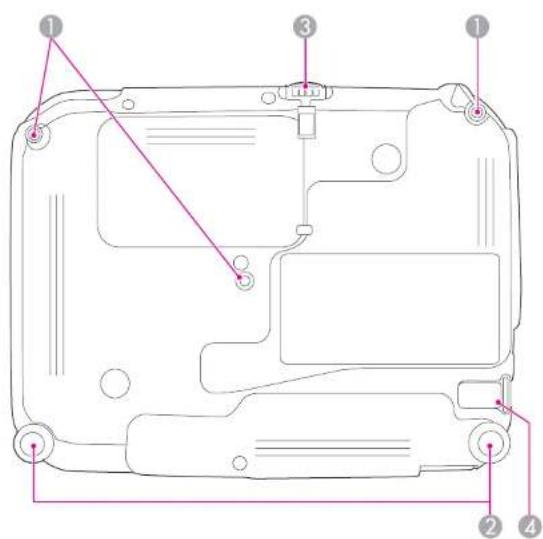
| 1 | Ceiling mount fixing points (three points) | Attach the optional Ceiling Mount here when suspending the projector from a ceiling.➤ "Installing the Projector" p.20➤ "Optional Accessories" p.97 |
| 2 | Rear feet | When setup on a surface such as a desk, turn to extend and retract to adjust the horizontal tilt.➤ "Adjusting the Horizontal Tilt" p.41 |
| Name Function | ||
| 3 | Front adjustable foot | When setup on a surface such as a desk, extend the foot to adjust the position of the image. "Adjusting the Image Position" p.40 |
| 4 | Security cable installation point | Pass a commercially available wire lock through here and lock it in place. "Installing the wire lock" p.61 |
Control Panel

flowchart
graph TD
    A["Input Source"] --> B["Menu"]
    C["Source Search"] --> D["Enter"]
    E["Help"] --> F["?"]
    B --> G["Esc"]
    D --> G
    F --> G
    style A fill:#fff,stroke:#000
    style C fill:#fff,stroke:#000
    style E fill:#fff,stroke:#000
    style G fill:#fff,stroke:#000
| Name Function | ||
| 1 | [∅] button | Turns the projector power on or off."From Installation to Projection" p.30 |
| 2 | [Source Search] button | Changes to the next input source that is sending an image."Automatically Detect Input Signals and Change the Projected Image (Source Search)" p.31 |
| 3 | [Enter] button [ ↗ ] | ·When the Configuration menu or the Help screen is displayed, it accepts and enters the current selection and moves to the next level.·If pressed while projecting analog RGB signals from the Computer port, you can automatically optimize Tracking, Sync., and Position. |
| Name Function | ||
| 4 | [☐][☒] buttons | •Displays the Keystone screen allowing you to correct keystone distortion in vertical and horizontal directions.➤ "Correcting manually" p.37•If pressed when the Configuration menu or the Help screen is displayed, these buttons select menu items and setting values.➤ "Using the Configuration Menu" p.65➤ "Using the Help" p.75 |
| 5 | [Help] button | Displays and closes the Help screen which shows you how to deal with problems if they occur.➤ "Using the Help" p.75 |
| 6 | [Esc] button | •Stops the current function.•If pressed when the Configuration menu is displayed, it moves to the previous menu level.➤ "Using the Configuration Menu" p.65 |
| 7 | [☐][☒] buttons or [Wide][Tele] buttons | •For EB-X14/EB-W12/EB-X12/EB-X11[☐] Decreases the volume.[☒] Increases the volume.➤ "Adjusting the Volume" p.41•For EB-S12/EB-S11 [Wide]: Enlarges the size of the projected image. [Tele]: Reduces the size of the projected image.➤ "Adjusting the Image Size" p.40•Corrects keystone distortion in the horizontal direction when the Keystone screen is displayed.➤ "H/V-Keystone" p.37•If pressed when the Configuration menu or the Help screen is displayed, these buttons select menu items and setting values.➤ "Using the Configuration Menu" p.65➤ "Using the Help" p.75 |
| 8 | [Menu] button | Displays and closes the Configuration menu.➤ "Using the Configuration Menu" p.65 |
Remote Control
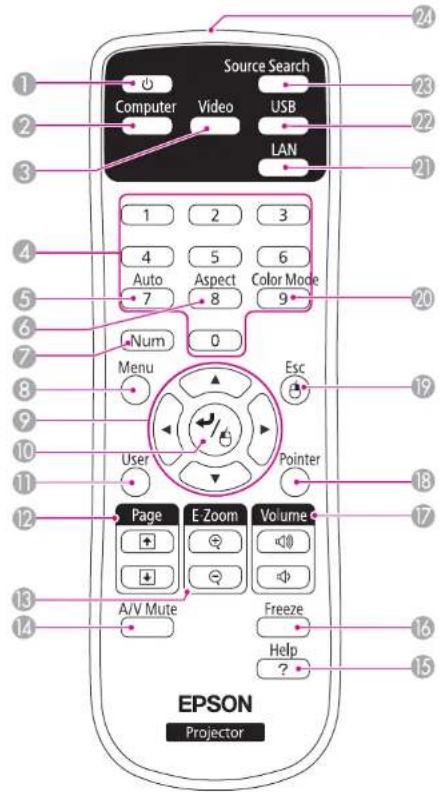
text_image
Source Search Computer Video USB LAN 1 2 3 4 5 6 Auto Aspect Color Mode 7 8 9 Num 0 Menu Esc User Pointer Page E Zoom Volume A/V Mute Freeze Help EPSON Projector| Name Function | ||
| 1 | [0] button | Turns the projector power on or off.➤ "From Installation to Projection" p.30 |
| 2 | [Computer] button | Changes to images from the Computer port. |
| 3 | [Video] button | ●For EB-X14/EB-W12/EB-X12Each time the button is pressed, the image cycles through the S-Video, Video, and HDMI ports.●For EB-S12/EB-X11/EB-S11Each time the button is pressed, the input changes between images from the S-Video port to the Video port. |
| 4 | Numeric buttons | Enter the Password.➤ "Setting Password Protect" p.58 |
| 5 | [Auto] button | If pressed while projecting analog RGB signals from the Computer port, you can automatically optimize Tracking, Sync., and Position. |
| 6 | [Aspect] button | Each time the button is pressed, the aspect mode changes.➤ "Changing the Aspect Ratio of the Projected Image "p.43 |
| 7 | [Num] button | Ihold down this button and press the numeric buttons to enter passwords and numbers.➤ "Setting Password Protect" p.58 |
| 8 | [Menu] button | Displays and closes the Configuration menu.➤ "Using the Configuration Menu" p.65 |
| 9 | buttons | When the Configuration menu or the Help screen is displayed, pressing these buttons selects menu items and setting values."Using the Configuration Menu" p.65When projecting a Slideshow, pressing these buttons displays the previous/next image, rotates the image, and so on.Slideshow operating methods" p.47During Wireless Mouse function, the mouse pointer moves in the direction of the button that was pushed."Using the Remote Control to Operate the Mouse Pointer (Wireless Mouse)" p.55 |
| 10 | [Button] | When the Configuration menu or the Help screen is displayed, it accepts and enters the current selection and moves to the next level."Using the Configuration Menu" p.65Acts as a mouse's left button when using the Wireless Mouse function."Using the Remote Control to Operate the Mouse Pointer (Wireless Mouse)" p.55 |
| 11 | [User] button | Select any frequently used item from the five available Configuration menu items, and assign it to this button. By pressing the [User] button, the assigned menu item selection/adjustment screen is displayed, allowing you to make one-touch settings/adjustments."Settings Menu" p.70Power Consumptionis assigned as the default setting. |
| Name Function | ||
| 12 | [Page] buttons [+] [+] | Changes pages in files such as PowerPoint files when using the following projection methods.When using the Wireless Mouse function"Using the Remote Control to Operate the Mouse Pointer (Wireless Mouse)" p.55When using USB Display"Projecting with USB Display" p.32When projecting images using Slideshow, pressing these buttons displays the previous/next screen. |
| 13 | [E-Zoom] buttons [+] [÷] | Enlarges or reduces the image without changing the projection size."Enlarging Part of the Image (E-Zoom)" p.54 |
| 14 | [A/V Mute] button | Turns the video and audio on or off.Hiding the Image and Sound Temporarily (A/V Mute)" p.52You can change the Projection mode as follows by pressing the button for about five seconds.Front↔Front/CeilingRear↔Rear/Ceiling |
| 15 | [Help] button | Displays and closes the Help screen which shows you how to deal with problems if they occur."Using the Help" p.75 |
| 16 | [Freeze] button | Images are paused or unpaused."Freezing the Image (Freeze)" p.52 |
| 17 | [Volume] buttons [÷][÷] | Decreases the volume.Increases the volume."Adjusting the Volume" p.41 |
| 18 | [Pointer] button | Displays the on-screen pointer."Pointer Function (Pointer)" p.53 |
| 19 | [Esc] button | •Stops the current function.•If pressed when the Configuration menu is displayed, it moves to the previous level.●“Using the Configuration Menu” p.65•Acts as a mouse's right button when using the Wireless Mouse function.●“Using the Remote Control to Operate the Mouse Pointer (Wireless Mouse)” p.55 |
| 20 | [Color Mode] button | Each time the button is pressed, the Color Mode changes.●“Selecting the Projection Quality (Selecting Color Mode)” p.41 |
| 21 | [LAN] button | Not available for this projector. |
| 22 | [USB] button | Each time the button is pressed, it cycles through the following images:•USB Display•Images from the device connected to the USB(TypeA) port |
| 23 | [Source Search] button | Changes to the next input source that is sending an image.●“Automatically Detect Input Signals and Change the Projected Image (Source Search)” p.31 |
| 24 | Remote control light-emitting area | Outputs remote control signals. |
Replacing the remote control batteries
If delays in the responsiveness of the remote control occur or if it does not operate after it has been used for some time, it probably means that the batteries are becoming flat. When this happens, replace them with new batteries. Have two AA size manganese or alkaline batteries ready. You cannot use other batteries except for the AA size manganese or alkaline.
Attention
Make sure you read the following manual before handling the batteries.
Safety Instructions
1 Remove the battery cover.
While pushing the battery compartment cover catch, lift the cover up.

natural_image
Illustration of a mobile phone with a blue screen and scroll icon (no text or symbols)2 Replace the old batteries with new batteries.
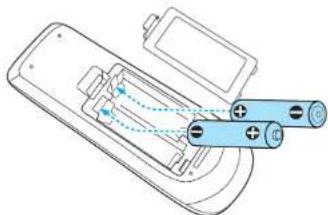
natural_image
Diagram of a battery pack with two batteries connected by wires, no text or symbols present
Caution
Check the positions of the (+) and (-) marks inside the battery holder to ensure the batteries are inserted the correct way.

Replace the battery cover.
Press the battery compartment cover until it clicks into place.
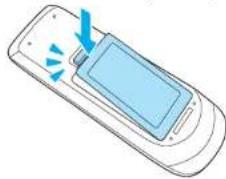
natural_image
Illustration of a mobile phone with a screen and a blue indicator light, no text or symbols presentRemote control operating range

text_image
30° 30° 6m 30° 30° 6m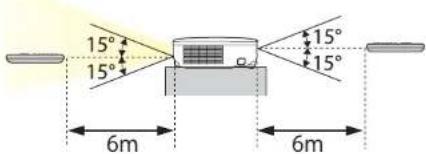
text_image
15° 15° 15° 15° 6m 6m
Preparing the Projector
This chapter explains how to install the projector and connect projection sources.
Installation Methods
The projector supports the following four different projection methods. Install the projector according to the conditions of the installation location.
- Project images from in front of the screen. (Front projection)
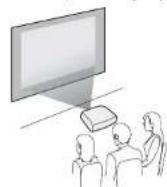
- Project images from behind a translucent screen. (Rear projection)

- Suspend the projector from the ceiling and project images from in front of a screen. (Front/Ceiling projection)

- Suspend the projector from the ceiling and project images from behind a translucent screen. (Rear/Ceiling projection)


Warning
- A special method of installation is required when suspending the projector from a ceiling (ceiling mount). If it is not installed correctly, it could fall causing an accident and injury.
- If you use adhesives on the Ceiling mount fixing points to prevent the screws from loosening, or if you use things such as lubricants or oils on the projector, the projector case may crack causing it to fall from its ceiling mount. This could cause serious injury to anyone under the ceiling mount and could damage the projector.
When installing or adjusting the ceiling mount, do not use adhesives to prevent the screws from loosening and do not use oils or lubricants and so on.
Attention
- Do not use the projector on its side. This may cause malfunctions to occur.
- Do not cover the projector's air intake vent or air exhaust vent. If either of the vents are covered, the internal temperature could rise and cause a fire.

- An optional Ceiling mount is required when suspending the projector from a ceiling.
"Optional Accessories" p.97 - The default Projection setting is Front. You can change from Front to Rear from the Configuration menu.
Extended - Projection p.71 - You can change the Projection mode as follows by pressing down the [A/V Mute] button on the remote control for about five seconds. Front↔Front/Ceiling
Rear↔Rear/Ceiling
Installation methods
Install the projector as follows.
Installing the Projector

• Install the projector so that it is parallel to the screen. If the projector is installed at an angle to the screen, keystone distortion occurs in the projected image.
- Place the projector on a level surface. If the projector is tilted the projected image is also tilted.


•See the following if you cannot install the projector parallel to the screen.
"Correcting Keystone Distortion" p.36
• See the following if you cannot install the projector on a level surface.
"Adjusting the Horizontal 'Tilt" p.41
"Correcting Keystone Distortion" p.36
Screen Size and Approximate Projection Distance
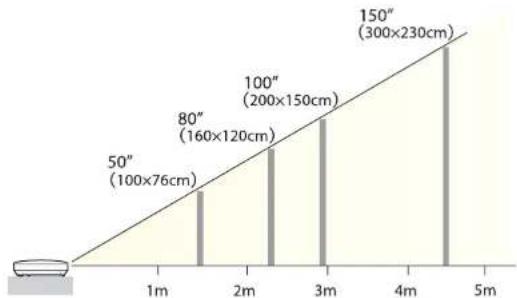
Projection size is determined by the distance from the projector to the screen. See the illustrations on the right to select the best position according to the screen size. The illustrations show the approximate shortest distance at maximum zoom. See the following for more information on the projection distance.
"Screen Size and Projection Distance" p.98

When you correct keystone distortion, the projected image may be reduced.
16:10 Screen Size
EB-W12

bar
| Distance (m) | Height (cm) | |---|---| | 1m | 50 | | 1m | 110 | | 2m | 80 | | 2m | 170 | | 3m | 100 | | 3m | 220 | | 4m | 150 | | 4m | 320 | | 5m | |4:3 Screen Size
EB-X14/EB-X12/EB-X11

bar
| Distance (cm) | Length (cm) | |---|---| | 100 | 76 | | 160 | 120 | | 200 | 150 | | 300 | 230 |EB-S12/EB-S11
bar
| Width (cm) | Height (cm) | |---|---| | 100 | 76 | | 80 | 120 | | 100 | 150 | | 150 | 230 |Connecting Equipment

Illustrations in this section are of EB-X14/EB-W12/EB-X12 or EB-X11/EB-S11.
The port name, location, and connector orientation differ depending on the source being connected.
Connecting a Computer
To project images from a computer, connect the computer using one of the following methods.
① When using the supplied computer cable
Connect the computer's display output port to the projector's Computer port.
You can output audio from the projector's speaker by connecting the audio output port on the computer to the projector's Audio Input port using a commercially available audio cable.
② When using the supplied or commercially available USB cable
Connect the computer's USB port to the projector's USB(TypeB) port.
You can send the computer's audio with the projected image.
③ When using a commercially available HDMI cable (EB-X14/EB-W12/EB-X12 only)
Connect the computer's HDMI port to the projector's HDMI port.
You can send the computer's audio with the projected image.

text_image
① Computer Audio ② USB TypeB ③ HDMI
- You can use a USB cable to connect the projector to a computer to project images from the computer. This function is called USB Display.
"Projecting with USB Display" p.32 - Depending on the model used and the area of purchase, the USB cable may not be supplied with the projector.
Connecting Image Sources
To project images from DVD players or VHS video and so on, connect to the projector using one of the following methods.
When using a commercially available video or S-video cable
Connect the video output port on the image source to the projector's Video port.
Or, connect the S-video output port on the image source to the projector's S-Video port.
You can output audio from the projector's speaker by connecting the audio output port on the image source to the projector's Audio Input port using a commercially available audio
cable.
② When using the optional component video cable
"Optional Accessories" p.97
Connect the component output port on the image source to the projector's Computer input port.
You can output audio from the projector's speaker by connecting the audio output port on the image source to the projector's Audio Input port using a commercially available audio
cable.
③ When using a commercially available HDMI cable (EB-X14/EB-W12/EB-X12 only)
Connect the HDMI port on the image source to the projector's HDMI port.
You can send the image source's audio with the projected image.

flowchart
graph TD
    A["1"] --> B["2"]
    B --> C["3"]
    D["1"] --> E["2"]
    E --> F["3"]
    G["1"] --> H["2"]
    H --> I["3"]
    J["1"] --> K["2"]
    K --> L["3"]
    M["1"] --> N["2"]
    N --> O["3"]
    P["1"] --> Q["2"]
    Q --> R["3"]
    S["1"] --> T["2"]
    T --> U["3"]
    V["1"] --> W["2"]
    W --> X["3"]
    Y["1"] --> Z["2"]
    Z --> AA["3"]
    AB["1"] --> AC["2"]
    AC --> AD["3"]
    AE["1"] --> AF["2"]
    AF --> AG["3"]
    AH["1"] --> AI["2"]
    AI --> AJ["3"]
    AK["1"] --> AL["2"]
    AL --> AM["3"]
    AN["1"] --> AO["2"]
    AO --> AP["3"]
    AQ["1"] --> AR["2"]
    AR --> AS["3"]
    AT["1"] --> AU["2"]
    AU --> AV["3"]
    AW["1"] --> AX["2"]
    AX --> AY["3"]
Attention
- If the input source is on when you connect it to the projector, it could cause a malfunction.
- If the orientation or shape of the plug differs, do not try to force it in. The device could be damaged or could malfunction.

- If the source you want to connect to has an unusually shaped port, use the cable supplied with the device or an optional cable to connect to the projector.
- When using a commercially available 2RCA(L/R)/stereo mini-pin audio cable, make sure it is labeled "No resistance".
Connecting USB Devices
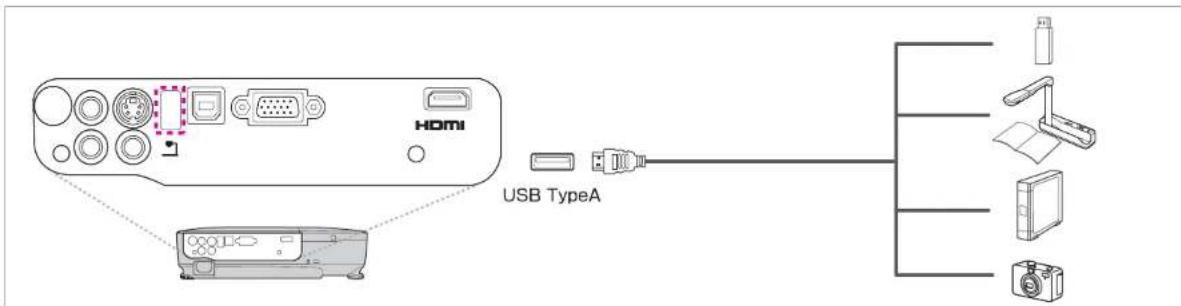
You can connect devices such as USB memory, the optional Document Camera, and USB compatible hard disks and digital cameras. Using the USB cable supplied with the USB device, connect the USB device to the USB(TypeA) port on the projector.
text_image
HDMI USB TypeAWhen the USB device is connected, you can project image files on the USB memory or digital camera using Slideshow.
"Slideshow examples" p.47
If the Document Camera is connected while projecting images from another input port, press the [USB] button on the remote control, or the [Source Search] button on the control panel, to switch to images from the Document Camera.
"Automatically Detect Input Signals and Change the Projected Image (Source Search)" p.31
Attention
- If you use a USB hub, the connection may not operate correctly. Devices such as digital cameras and USB devices should be connected to the projector directly.
- When connecting and using a USB-compatible hard disk, make sure you connect the AC adaptor supplied with the hard disk.
- Connect a digital camera or hard disk to the projector using the USB cable provided with the device.
- Use a USB cable less than 3 m in length. If the cable exceeds 3 m, Slideshow may not function correctly.
Removing USB devices
After finishing projecting, remove USB devices from the projector. For devices such as digital cameras or hard disks, turn off the device and then remove it from the projector.
Connecting External Equipment (EB-S12/EB-X11/EB-S11 only)
You can output images and audio by connecting an external monitor or speaker.
① When outputting images to an external monitor
Connect the external monitor to the projector's Monitor Out port using the cable supplied with the external monitor.
② When outputting audio to an external speaker
Connect the external speaker to the projector's Audio Out port using a commercially available audio cable.

text_image
RS-232C Monitor Out D-Sub Audio Out Audio In
- If you set Standby Mode to Communication On, you can output images to an external monitor even if the projector is in standby mode.
Extended - Standby Mode p.71
- Only analog RGB signals from the Computer port can be output to an external monitor. You cannot output signals input from other ports or component video signals.
- Setting gauges for functions such as Keystone, Configuration Menu, or Help screens are not output to the external monitor.
- When the audio cable jack is inserted into the Audio Out port, audio stops being output from the projector's built-in speakers and switches to external output.
- Depending on the area of purchase, the external equipment connection may not be available for EB-S12.

Basic Usage
This chapter explains how to project and adjust images.
From Installation to Projection
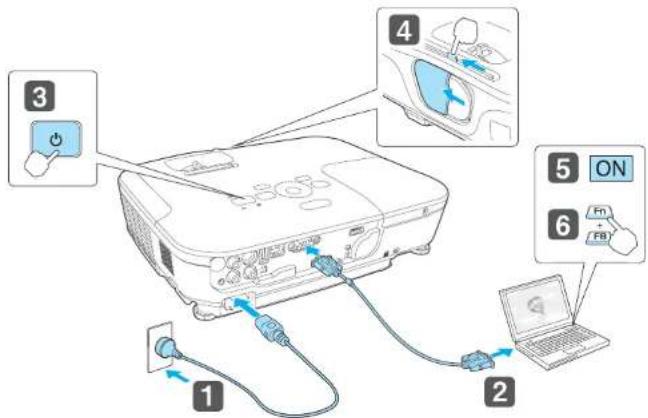
This section explains the procedure for connecting the projector to a computer with the computer cable and projecting images.
text_image
Diagram showing a projector connected to a laptop via cable, with labeled buttons and ports for navigation or testing.1 Connect the projector to an electrical outlet with the power cable.
2 Connect the projector to the computer with the computer cable.
3 Turn on the projector.
4 Slide open the A/V mute slide.
5 Turn on your computer.
6 Change the computer's screen output.
When using a laptop computer, you need to change the screen output from the computer.
Hold down the Fn key (function key), and press the ▲/□ key.

The method for changing differs depending on the computer being used. See the documentation supplied with the computer.
If the image is not projected, you can change the projected image using one of the following methods.
- Press the [Source Search] button on the control panel or the remote control.
"Automatically Detect Input Signals and Change the Projected Image (Source Search)" p.31 - Press the button for the target port on the remote control.
"Switching to the 'Target Image by Remote Control" p.32

After projecting the image, adjust the image if necessary.
"Correcting Keystone Distortion" p.36
"Correcting the Focus" p.41
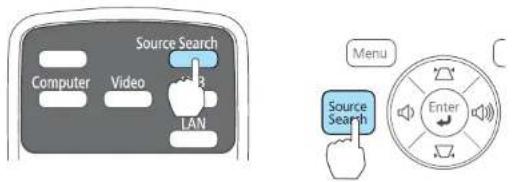
Automatically Detect Input Signals and Change the Projected Image (Source Search)
Press the [Source Search] button to project images from the port currently receiving an image.
Using the remote control Using the control panel
text_image
Source Search Computer Video LAN Menu Source Search Enter
flowchart
graph TD
    A["Computer"] --> B["S-Video"]
    B --> C["Video"]
    C --> D["HDMI*"]
    D --> E["USB Display"]
    E --> F["USB"]
    F --> A
* (EB-X14/EB-W12/EB-X12 only)
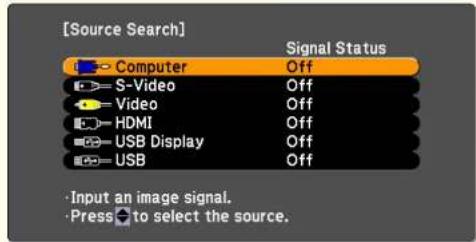
When two or more image sources are connected, press the [Source Search] button until the target image is projected.
When your video equipment is connected, start playback before beginning this operation.

The following screen is displayed while no image signals are input.
Example: EB-X14/EB-W12/EB-X12
text_image
[Source Search] Computer S-Video Video HDMI USB Display USB Signal Status Off Off Off Off Off Input an image signal. Press to select the source.Switching to the Target Image by Remote Control
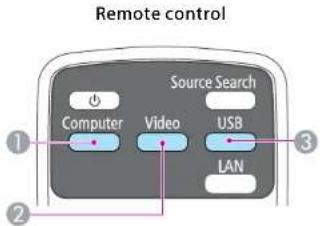
You can change directly to the target image by pressing the following buttons on the remote control.
text_image
Remote control Computer Video Source Search USB LAN ① ② ③① Changes to images from the Computer port. ② Each time the button is pressed, it cycles through the images being input from the following sources.
•S-Video port
•Video port
•HDMI port (EB-X14/EB-W12/EB-X12 only)
③ Each time the button is pressed, it cycles through the images being input from the following sources.
- USB Display
- Images from the device connected to the USB(TypeA) port
Projecting with USB Display
You can use a USB cable to connect the projector to a computer to project images from the computer.
You can send the computer's audio with the projected image.
For EB-X14/EB-W12/EB-X12/EB-S12, set USB Type B to USB Display from the Configuration menu.
Extended - USB Type B p.71
System requirements
| OS | Windows 20001 | |
| Windows XP2 | Professional 32 bitHome Edition 32 bitTablet PC Edition 32 bit | |
| Windows Vista Ultimate | 32 bitEnterprise 32 bitBusiness 32 bitHome Premium 32 bitHome Basic 32 bit | |
| Windows 7 Ultimate | 32/64 bitEnterprise 32/64 bitProfessional 32/64 bitHome Premium 32/64 bitHome Basic 32 bitStarter 32 bit | |
| CPU | Mobile Pentium III 1.2 GHz or fasterRecommended: Pentium M 1.6 GHz or faster | |
| Amount of Memory | 256 MB or moreRecommended: 512 MB or more | |
| Hard Disk Space | 20 MB or more | |
| Display | Resolution of no less than 640x480 and no higher than 1600x1200.Display color in 16-bit color or greater | |
*1 Service Pack 4 only
*2 Except for Service Pack 1
For Mac OS
| OS | Mac OS X 10.5.xMac OS X 10.6.x |
| CPU | Power PC G4 1GHz or fasterRecommended: Core Duo 1.83GHz or faster |
| Amount of Memory | 512 MB or more |
| Hard Disk Space | 20 MB or more |
| Display | Resolution of no less than 640x480 and no higher than 1600x1200.Display color in 16-bit color or greater |
Connecting for the first time
The first time you connect the projector and the computer using the USB cable, the driver needs to be installed. The procedure is different for Windows and Mac OS.

- You do not need to install the driver the next time you connect.
- When inputting images from multiple sources, change the input source to USB Display.
- If you use a USB hub, the connection may not operate correctly. Connect the USB cable directly to the projector.
- Depending on the model used and the area of purchase, the USB cable may not be supplied with the projector.
For Windows

Connect the computer's USB port to the projector's USB(TypeB) port using a USB cable.

For Windows 2000 or Windows XP, a message asking you if you want to restart your computer may be displayed. Select No.
For Windows 2000
Double-click Computer, EPSON PJ_UD, and then EMP_UDSE.EXE.
For Windows XP
Driver installation starts automatically.
For Windows Vista/Windows 7
When the dialog box is displayed, click Run EMP_UDSE.exe.
When the License Agreement screen is displayed, click Agree.
3 Computer images are projected.
It may take a while before computer images are projected. Until computer images are projected, leave the equipment as it is and do not disconnect the USB cable or turn off the power to the projector.
4 Disconnect the USB cable when you finish projection.
When disconnecting the USB cable, there is no need to use Safely Remove Hardware.

- If it is not installed automatically, double-click My Computer - EPSON_PJ_UD - EMP_UDSE.EXE on your computer.
- If nothing is projected for some reason, click All Programs EPSON Projector - Epson USB Display - Epson USB Display Vx.xx on your computer.
- When using a computer running Windows 2000 under user authority, a Windows error message is displayed and you may not be able to use the software. In this case, try updating Windows to the latest version, restart, and then try to connect again.
For more details, contact your local dealer or the nearest address provided in the following document.
Epson Projector Contact List
4 When the License Agreement screen is displayed, click Agree. Enter the administrator authority password and start the installation. When the installation is complete, the USB Display icon is displayed in the Dock and menu bar.
5 Computer images are projected.
It may take a while before computer images are projected. Until computer images are projected, leave the equipment as it is and do not disconnect the USB cable or turn off the power to the projector.
6 When you finish projection, select Disconnect from the USB Display icon menu on the menu bar or Dock, and then remove the USB cable.

- If the USB Display setup folder is not displayed automatically in the Finder, double-click EPSON PJ_UD - USB Display Installer on your computer.
- If nothing is projected for some reason, click the USB Display icon in the Dock.
- If there is no USB Display icon in the Dock, double-click USB Display from the Applications folder.
- If you select Exit from the USB Display icon menu on the Dock, USB Display does not start automatically when you connect the USB cable.
For Mac OS
1 Connect the computer's USB port to the projector's USB(TypeB) port using a USB cable.
The Setup folder of USB Display is displayed in the Finder.
2 Double-click the USB Display Installer icon.
3 Follow the on-screen instructions to install.
Uninstalling
For Windows 2000
1 Click Start, select Settings, and then click Control Panel.
2 Double-click Add/Remove Programs.
3 Click Change or Remove Programs.
4 Select Epson USB Display and click Change/Remove.
For Windows XP
1 Click Start, and then click Control Panel.
2 Double-click Add or Remove Programs.
3 Select Epson USB Display and click Remove.
For Windows Vista/Windows 7
1 Click Start, and then click Control Panel.
2 Click Uninstall a program under Programs.
3 Select Epson USB Display and click Uninstall.
For Mac OS
1 Open the Applications folder, double-click USB Display, and then double-click Tool.
2 Run USB Display UnInstaller.
Correcting Keystone Distortion
You can correct keystone distortion using one of the following methods.
- Correcting automatically (Auto V-Keystone) (EB-X14/EB-W12/EB-X12/EB-S12/EB-X11 only) Automatically corrects vertical keystone distortion.
- Correcting manually (H-Keystone Adjuster) (EB-X14/EB-W12/EB-X12/EB-S12/EB-X11 only) Manually corrects horizontal keystone distortion using the horizontal keystone adjuster.

flowchart
graph LR
    A["Receipt"] --> B["Monitor Icon"]
    B --> C["Output Box"]
    style A fill:#f9f,stroke:#333
    style B fill:#ccf,stroke:#333
    style C fill:#cfc,stroke:#333
- Correcting manually (H/V-Keystone) Manually correct distortion in the horizontal and vertical directions independently.

flowchart
graph LR
    A["Desktop"] --> B["Device 1"]
    B --> C["Device 2"]
    C --> D["Device 3"]
    D --> E["Device 4"]
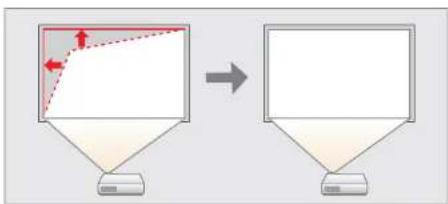
- Correcting manually (Quick Corner) Manually correct the four corners independently.
flowchart
graph TD
    A["Computer monitor"] --> B["Screen"]
    style A fill:#f9f,stroke:#333
    style B fill:#bbf,stroke:#333

When you correct keystone distortion, the projected image may be reduced.
Correcting automatically
Auto V-Keystone (EB-X14/EB-W12/EB-X12/EB-S12/EB-X11 only)
When the projector detects any movement, for example when it is installed, moved, or tilted, it automatically corrects vertical keystone distortion. This function is called Auto V-Keystone.
When the projector remains still for about two seconds after it detects movement, it displays a screen for adjustment and then automatically corrects the projected image.
You can use Auto V-Keystone to correct the projected image under the following conditions.
Correction angle: approx. 30° up and down
Adjusting Projected Images


- Auto V-Keystone works only when Projection is set to Front from the Configuration menu.
Extended - Projection p.71
- If you do not want to use Auto V-Keystone, set Auto V-Keystone to Off.
Settings - Keystone - H/V-Keystone - Auto V-Keystone p.70
Correcting manually
You can manually correct keystone distortion.
You can use H/V-Keystone to correct the projected image under the following conditions.
Correction angle: approx 30° right and left/approx. 30° up and down
H-Keystone Adjuster (EB-X14/EB-W12/EB-X12/EB-S12/EB-X11 only)
Move the horizontal keystone adjuster to the right or left to perform horizontal keystone correction.

flowchart
graph LR
    A["EB-X14/EB-W12/EB-X12/EB-X11"] --> B["Central Unit"]
    C["EB-S12"] --> B
    B --> D["Output 1"]
    B --> E["Output 2"]

- When using horizontal keystone adjuster, set H-Keystone Adjuster to On.
Settings - Keystone - H/V-Keystone - H-Keystone Adjuster p.70
- You can also correct keystone distortion in the horizontal direction using H/V-Keystone.
H/V-Keystone
Manually correct distortion in the horizontal and vertical directions independently.
1 Press the [☐] or [☐] buttons on the control panel during projection to display the Keystone screen.
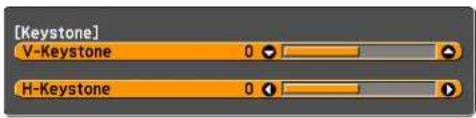
text_image
[Keystone] V-Keystone 0 H-Keystone 0[◆]:V-Keystone [◆]:H-Keystone
2 Press the following buttons to correct keystone distortion. Press the ☐ or |☐| buttons to correct vertical distortion.
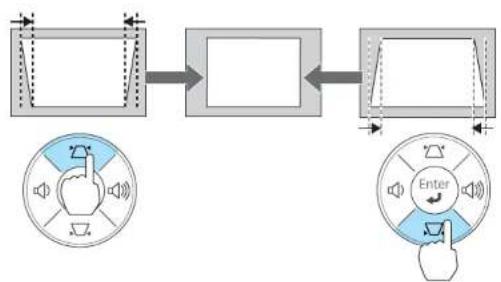
flowchart
graph LR
    A["Input"] --> B["Process Step"]
    B --> C["Output"]
    subgraph Control
        D["Control Icon 1"]
        E["Control Icon 2"]
        F["Control Icon 3"]
        G["Control Icon 4"]
        H["Control Icon 5"]
        I["Control Icon 6"]
        J["Control Icon 7"]
        K["Control Icon 8"]
        L["Control Icon 9"]
        M["Control Icon 10"]
    end
Press the ⌘]/[◀] buttons or the [Wide]/[Tele] buttons to correct horizontal distortion.

flowchart
graph LR
    A["Input"] --> B["Process Step"]
    B --> C["Output"]
    D["Hand Icon"] --> E["Center"]
    F["Arrow"] --> G["Arrow"]

You can also set H/V-Keystone from the Configuration menu.
Settings - Keystone - H/V-Keystone p.70
Quick Corner
This allows you to manually correct each of the four corners of the projected image separately.
1 Press the [Menu] button while projecting.
"Using the Configuration Menu" p.65
Using the remote control Using the control panel
![EPSON EB-S12 - Press the [Menu] button while projecting. - 1](/content/2026/06/1240400/images/18faa7e47a797124df0ce88f69806972337d179c35617e4fa9e1311cac566446.jpg)
text_image
Menu User Esc Pointer![EPSON EB-S12 - Press the [Menu] button while projecting. - 2](/content/2026/06/1240400/images/81a331f0e3cd878d3e62588982f138807b585b02682de4c5319b297fd2200a27.jpg)
2 Select Keystone from Settings.

text_image
Image Signal Settings Extended Info Reset Return Keystone H/V-Keystone Zoom Control Panel Lock Full Lock Pointer Shape Pointer 1 Power Consumption ECO Volume 0 Remote Receiver Front/Rear User Button Power Consum... Test Pattern Reset [Esc] :Return [◆] :Select [●] :Enter [Menu]:Exit3 Select Quick Corner, and then press the [←] button.
![EPSON EB-S12 - Select Quick Corner, and then press the [←] button. - 1](/content/2026/06/1240400/images/144c303ab9fd582ac316dee4224de66b0a7b68bec5ae59c04dc3b755c74fb31a.jpg)
text_image
[Keystone] Return IH/V-Keystone Quick Corner [Esc]:Return [◆]:Select [◆]:Enter [Menu]:ExitAdjusting Projected Images

4 Using the [☐], [☐], [☐], and [☐] buttons on the remote control, or the [☒], [☒], [☒], and [☒] buttons (or the [Wide]/[Tele] buttons) on the control panel, select the corner to correct, and then press the [◀] button.
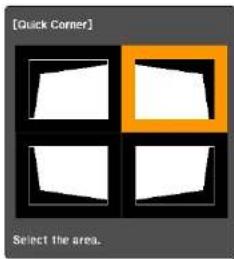
text_image
[Quick Corner] Select the area.5 Using the [☐], [☐], [☐], and [☐] buttons on the remote control, or the [☐], [☐], [☐], and [☐] buttons (or the [Wide]/[Tele] buttons) on the control panel, correct the position of the corner.
When you press the [J] button, the screen shown in step 4 is displayed.
If the message "Cannot adjust any further." is displayed while adjusting, you cannot adjust the shape any further in the direction indicated by the gray triangle.
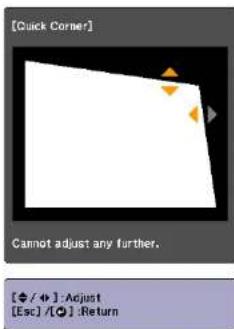
text_image
[Quick Corner] Cannot adjust any further. [◇ / ◆ ] :Adjust [Esc] / [◇ ] :Return6 Repeat procedures 4 and 5 as needed to adjust any remaining corners.
7 When you are done, press the Esc button to exit the correction menu.
Because Keystone was changed to Quick Corner, the corner selection screen shown in step 4 is displayed the next time you press the [☐] or [☒] buttons on the control panel. Change Keystone to H/V-Keystone if you want to perform horizontal and vertical correction using the [☐] or [☒] buttons on the control panel.
Settings - Keystone - H/V-Keystone p.70

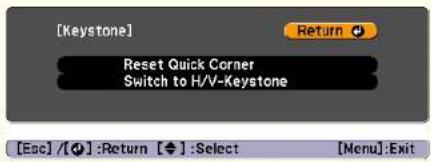
If the Esc button is held down for about two seconds while the corner selection screen from step 4 is displayed, the following screen is displayed.
text_image
[Keystone] Reset Quick Corner Switch to H/V-Keystone [Esc] / [O]: Return [L]: Select [Menu]: ExitReset Quick Corner: Resets the result of Quick Corner corrections. Switch to H/V-Keystone: Switches the correction method to H/V-Keystone. "Settings Menu" p.70
Adjusting the Image Size
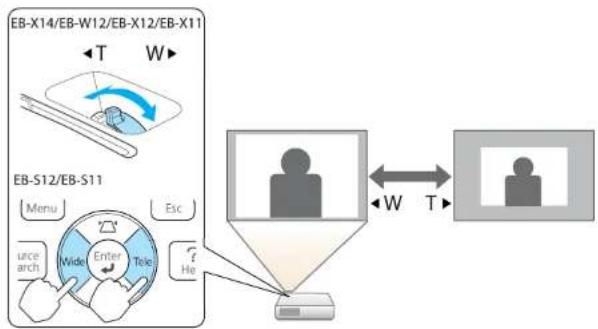
EB-X14/EB-W12/EB-X12/EB-X11
Turn the zoom ring to adjust the size of the projected image.
EB-S12/EB-S11
Adjust by using the [Wide]/[Tele] buttons on the control panel.
Wide: Enlarges the size of the projected image.
Tele: Reduces the size of the projected image.
flowchart
graph TD
    A["EB-X14/EB-W12/EB-X12/EB-X11"] -->|T| B["User Interface"]
    B --> C["W"]
    C --> D["T"]
    D --> E["Esc"]
    E --> F["Enter"]
    F --> G["Tele"]
    G --> H["He"]
    H --> I["User Interface"]
    I --> J["W"]
    J --> K["T"]
    K --> L["Esc"]
    L --> M["Enter"]
    M --> N["Tele"]
    N --> O["He"]
    O --> P["User Interface"]
    P --> Q["W"]
    Q --> R["T"]
    R --> S["Esc"]
    S --> T["Enter"]
    T --> U["Tele"]
    U --> V["He"]
    V --> W["User Interface"]
    W --> X["W"]
    X --> Y["T"]
    Y --> Z["Esc"]
    Z --> AA["Enter"]
    AA --> AB["Tele"]
    AB --> AC["He"]
    AC --> AD["User Interface"]
Adjusting the Image Position
Press the foot adjust lever to extend and retract the front adjustable foot. You can adjust the position of the image by tilting the projector up to 12 degrees.

text_image
Diagram illustrating light refraction and reflection with labeled components and directional arrows
The larger the angle of tilt, the harder it becomes to focus. Install the projector so that it only needs to be tilted at a small angle.
Adjusting the Horizontal Tilt
Extend and retract the rear feet to adjust the projector's horizontal tilt.

flowchart
graph TD
    A["Input"] --> B["Data Collection"]
    B --> C["Output"]
    D["Device 1"] --> E["Control Button ①"]
    F["Device 2"] --> G["Control Button ②"]
1 Extend the rear foot.
② Retract the rear foot.
Correcting the Focus
You can correct the focus using the focus ring.

flowchart
graph TD
    A["EB-X14/EB-W12/EB-X12/EB-X11"] --> B["User Interface"]
    C["EB-S12/EB-S11"] --> B
    B --> D["User Group"]
    D --> E["Output"]
Adjusting the Volume
You can adjust the volume using one of the following methods.
- Press the [Volume] button on the control panel or the remote control to adjust the volume.
[◀] Decreases the volume.
[◀] Increases the volume.
Using the remote control Using the control panel
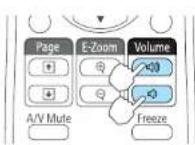
(EB-X14/EB-W12/EB-X12/EB-X11 only)

- Adjust the volume from the Configuration menu.
Settings - Volume p.70

Caution
Do not start at high volume.
A sudden excessive volume may cause loss of hearing. Always lower the volume before powering off, so that you can power on and then gradually increase the volume.
Selecting the Projection Quality (Selecting Color Mode)
You can easily obtain the optimum image quality simply by selecting the setting that best corresponds to your surroundings when projecting. The brightness of the image varies depending on the mode selected.
Adjusting Projected Images

| Mode Application | |
| Dynamic | Ideal for use in a bright room. This is the brightest mode, and reproduces shadow tones well. |
| Presentation | Ideal for making presentations using color materials in a bright room. |
| Theatre | Ideal for watching films in a dark room. Gives images a natural tone. |
| Photo*1 | Ideal for projecting still pictures, such as photos, in a bright room. The images are vivid and brought into contrast. |
| Sports*2 | Ideal for watching TV programmes in a bright room. The images are vivid and brought to life |
| sRGB | Ideal for images that conform to theRGBcolor standard. |
| Blackboard | Even if you are projecting onto a blackboard (greenboard), this setting gives your images a natural tint, just like when projecting onto a screen. |
| Whiteboard | Ideal for making presentations using a whiteboard |
*1 This selection is only available when the input signal is RGB or when the source is USB Display or USB.
*2 This selection is only available when the input signal is component video, or when the input source is Video or S-Video.
Each time you press the [Color Mode] button, the Color Mode name is displayed on the screen and the Color Mode changes.
Remote control

text_image
4 Auto 7 Num Menu 5 Aspect 8 0 6 Color Mode 9 ESC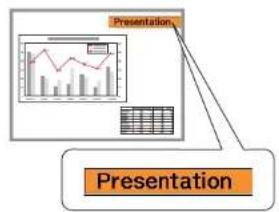
flowchart
graph TD
    A["Presentation"] --> B["Line Chart"]
    B --> C["Output"]
    D["Graph"] --> E["Bar Chart"]
    E --> F["Data Table"]
    G["Presentation"] --> H["Output"]

You can set Color Mode from the Configuration menu.
Image - Color Mode p.67
Setting Auto Iris
By automatically setting the luminance according to the brightness of the displayed image, it lets you enjoy deep and rich images.
1 Press the [Menu] button.
"Using the Configuration Menu" p.65
Using the remote control Using the control panel


2 Select Auto Iris from Image.

text_image
Image Signal Settings Extended Info Reset Color Mode Dynamic Brightness 0 Contrast 0 Sharpness 0 Color Temp. High Color Adjustment Auto Iris Off Reset Return [Esc] :Return [◆] :Select [●] :Enter [Menu]:Exit
Select On.
The setting is stored for each Color Mode.

Press the [Menu] button to finish making settings.

Auto Iris can only be set when the Color Mode is Dynamic or Theatre.
Changing the Aspect Ratio of the Projected Image
You can change the Aspect Ratio of the projected image to suit the type, the ratio of height and width, and the resolution of the input signals.
Available aspect modes vary depending on the image signal currently being projected.
Changing methods
Each time you press the [Aspect] button on the remote control, the aspect mode name is displayed on the screen and the aspect ratio changes.
Remote control

text_image
4 Auto 7 Num Menu Aspect 8 Esc Color Mode 9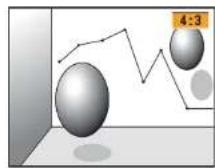

You can set the aspect ratio from the Configuration menu.
Signal - Aspect p.68
Changing the aspect mode
Projecting images from video equipment or from the HDMI port (for EB-W12)
Each time the [Aspect] button is pressed, the aspect mode changes in the order Normal or Auto, 16:9, Full, Zoom, and Native.
Example: 1080p signal input (resolution: 1920x1080, aspect ratio: 16:9)
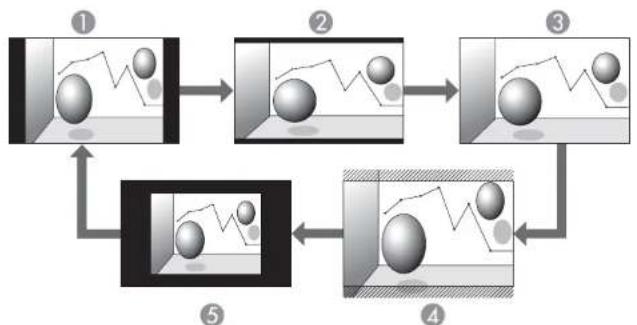
flowchart
graph TD
    A["①"] --> B["②"]
    B --> C["③"]
    C --> D["④"]
    D --> E["⑤"]
    E --> A
    style A fill:#f9f,stroke:#333
    style B fill:#ccf,stroke:#333
    style C fill:#cfc,stroke:#333
    style D fill:#fcc,stroke:#333
    style E fill:#cff,stroke:#333
1 Normal or Auto
② 16:9
③ Full
4 Zoom
5 Native
Projecting images from video equipment (for EB-X14/EB-X12/EB-S12/EB-X11/EB-S11)
Each time the [Aspect] button is pressed, the aspect mode changes in the order 4:3 and 16:9.
When inputting a 720p/1080i signal and the aspect mode is set to 4:3, a 4:3 zoom is applied (the right and left sides of the image are cut off).
Example: 720p signal input (resolution: 1280x720, aspect ratio: 16:9)

flowchart
graph TD
    A["①: Bubble on cube"] --> B["②: Surface change with particles"]
1 4:3
② 16:9
Projecting images from the HDMI port (for EB-X14/EB-X12)
Each time the Aspect button is pressed, the aspect mode changes in the order Auto, 4:3, and 16:9.
Example: 1080p signal input (resolution: 1920x1080, aspect ratio: 16:9)
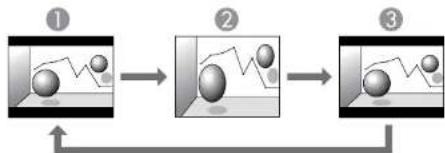
flowchart
graph LR
    A["①"] --> B["②"]
    B --> C["③"]
    C --> A
① Auto
② 4:3
③ 16:9
Projecting images from a computer
The following shows projection examples for each aspect mode.
EB-W12
| Aspect Mode Input Signal | ||
| XGA 1024X768(4:3) WXGA 1280X800(16:10) | ||
| Normal | 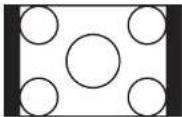 |  |
| 16:9 |  | 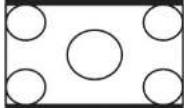 |
| Full | 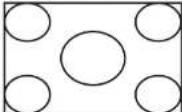 | 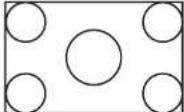 |
| Zoom | 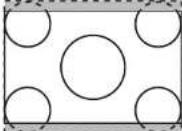 |  |
| Native | 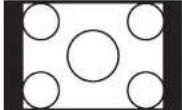 | 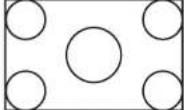 |
EB-X14/EB-X12/EB-S12/EB-X11/EB-S11
| Aspect Mode | Input Signal | |
| XGA 1024X768(4:3) WXGA 1280X800(16:10) | ||
| Normal |  | 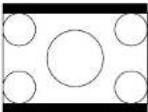 |
| 4:3 |  | |
| 16:9 | 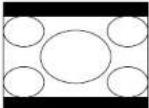 | 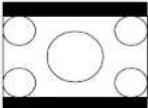 |

If parts of the image are missing, set the Resolution setting to Wide or Normal from the Configuration menu, according to the size of the computer panel.
Signal - Resolution p.68

Useful Functions
This chapter explains useful tips for giving presentations, and the Security functions.
Projecting Without a Computer (Slideshow)
By connecting a USB storage device such as a USB memory or a USB hard disk to the projector, you can project the files stored on the device without using a computer. This function is called Slideshow.

- You may not be able to use USB storage devices that incorporate security functions.
- You cannot correct keystone distortion while projecting a Slideshow, even if you press the [☐] and [☐] buttons on the control panel.
Specifications for files that can be projected using Slideshow
| Type File Type (Extension) | Notes |
| Image .jpg The following cannot be projected.- CMYK color mode formats- Progressive formats- Images with a resolution greater than 8192x8192Due to the characteristics of JPEG files, images may not be projected clearly if the compression ratio is too high. | |
| .bmp Cannot project images with a resolution greater than 1280x800. | |
| .gif •Cannot project images with a resolution greater than 1280x800.•Cannot project animated GIFs. | |
| .png Cannot project images with a resolution greater than 1280x800. | |

- When connecting and using a USB-compatible hard disk, make sure you connect the AC adaptor supplied with the hard disk.
- The projector does not support some file systems, so use media that has been formatted in Windows.
- Format the media in FAT16/32.
Slideshow examples
Projecting images stored on USB storage


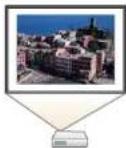
"Projecting the selected image" p.49
"Projecting image files in a folder in sequence (Slideshow)" p.50
Slideshow operating methods
Although the following steps are explained based on the remote control, you can perform the same operations from the control panel.
Starting Slideshow
1 Change the source to USB.
"Switching to the Target Image by Remote Control" p.32
2 Connect the USB storage device or digital camera to the projector.
"Connecting USB Devices" p.26
Slideshow starts and the file list screen is displayed.
- JPEG files are displayed as thumbnails (file contents are displayed as small images).
- Other files or folders are displayed as icons as shown in the following table.
| Icon File Icon File | |||
 | JPEG files* |  | BMP files |
 | GIF files PNG files |  | |
* When it cannot be displayed as a thumbnail, it is displayed as an icon.

- You can also insert a memory card into a USB card reader and then connect the reader to the projector. However, some commercially available USB card readers may not be compatible with the projector. - If the following screen (Select Drive screen) is displayed, press the [→], [→], [→], and [→] buttons to select the drive you want to use, and then press the [→] button.
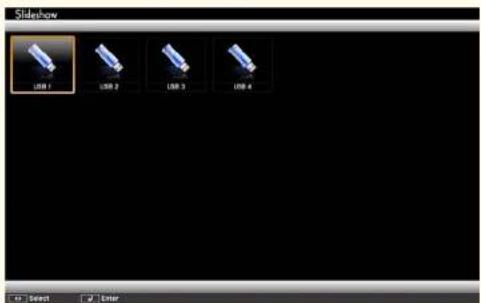
text_image
Slideshow USB 1 USB 2 USB 3 USB 4 0 Select Enter- To display the Select Drive screen, position the cursor on Select Drive at the top of the file list screen, and then press [button.
Projecting images
1 Use the [☐], [☐], [☐], and [☐] buttons to select the file or folder you want to project.
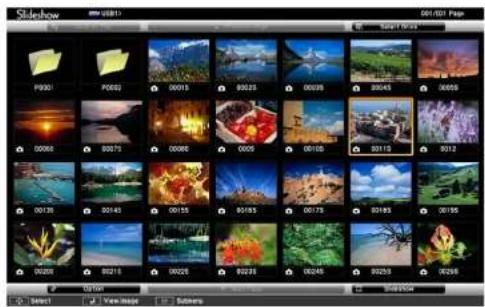
text_image
Slideshow 001001 Page P9001 P9002 00015 00225 00028 00245 00558 00068 00275 00086 0005 00105 00119 0012 00135 00143 00155 00165 00172 00185 00195 00206 00218 00225 00238 00245 00258 00265 00169 Select View Image Buttons
If not all of the files and folders are displayed on the current screen, press the [ ] button on the remote control, or position the cursor on Next Page at the bottom of the screen and press the [ ] button.
To return to the previous screen, press the [+] button on the remote control, or position the cursor on Previous Page at the top of the screen and press the] button.
2 Press the [button.
The selected image is displayed.
When a folder is selected, the files in the selected folder are displayed. To return to the previous screen, position the cursor on Back to Top and press the button.
Rotating images
You can rotate the played images in 90° increments. The rotating function is also available during Slideshow.
1 Play images, or run Slideshow.
2 While projecting, press the [] or [] button.
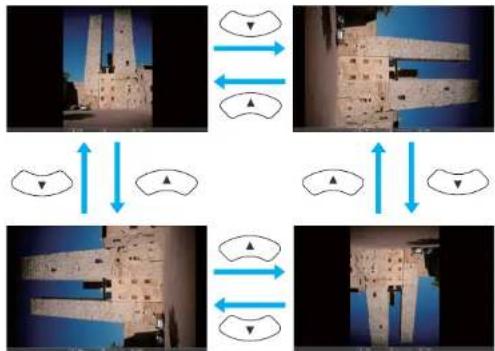
flowchart
graph TD
    A["Step 1: Object tracking"] --> B["Step 2: Object alignment"]
    B --> C["Step 3: Object movement"]
    C --> D["Step 4: Object alignment"]
    D --> E["Step 5: Object alignment"]
    E --> F["Step 6: Object alignment"]
    F --> G["Step 7: Object alignment"]
    G --> H["Step 8: Object alignment"]
    H --> I["Step 9: Object alignment"]
    I --> J["Step 10: Object alignment"]
Stopping Slideshow
To close Slideshow, disconnect the USB device from the USB port on the projector. For digital cameras, hard disks, and so on, turn off the power to the device and then remove.
Projecting the selected image
Attention
Do not disconnect the USB storage device while it is being accessed. Slideshow may not operate correctly.
1 Start Slideshow.
The file list screen is displayed.
"Starting Slideshow" p.47
2 Press the [☐], [☐], [☐], and [☐] buttons to select the image file you want to project.

text_image
Slideshow 00101 Page 00101.jpg P0001 P0002 B0018 B0028 00015 00046 00059 00063 00075 B0085 B009 00165 00112 0012 00135 00145 B0138 B0168 B0178 00185 00193 00205 00219 B0228 B0238 00245 00266 00269 OK/OK/OK Select View Steps Submers3 Press the [button. The image is displayed.
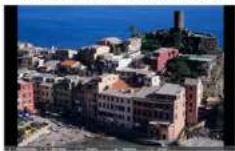

Press the ● buttons to move to the next or previous image file.
4 Press the Esc button to return to the file list screen.
Projecting image files in a folder in sequence (Slideshow)
You can project the image files in a folder in sequence, one at a time. This function is called Slideshow. Use the following procedure to run Slideshow.

To change files automatically when you run Slideshow, set Screen Switching Time from Option in Slideshow to anything other than No. The default setting is 3 seconds.
"Image file display settings and Slideshow operation settings" p.51
1 Start Slideshow.
The file list screen is displayed.
"Starting Slideshow" p.47
2 Use the [☐], [☐], [☐], and [☐] buttons to position the cursor over the folder for the Slideshow that you want to run, and then press the [☐] button.
3 Select Slideshow at the bottom right of the file list screen, and then press the ⬆J button.
Slideshow starts, and the image files in the folder are automatically projected in sequence, one at a time.
When the last file is projected, the file list is displayed again automatically. If you set Continuous Play to On in the Option window, projection starts again from the beginning when it reaches the end.
"Image file display settings and Slideshow operation settings" p.51
You can proceed to the next screen, return to the previous screen, or stop playback while projecting a Slideshow.

If Screen Switching Time on the Option screen is set to No, files do not change automatically when you select Play Slideshow. Press the [→] button, the [←] button, or the [□] button to continue to the next file.
You can use the following functions when projecting an image file with Slideshow.
- Freeze
"Freezing the Image (Freeze)" p.52
•A/V Mute
"Hiding the Image and Sound Temporarily (A/V Mute)" p.52
•E-Zoom
"Enlarging Part of the Image (E-Zoom)" p.54
Image file display settings and Slideshow operation settings
You can set the file display order and Slideshow operations on the Option screen.
1 Press the [☐], [☐], [☐] and [☐] buttons to position the cursor over the folder where you want to set display conditions and press the Esc button. Select Option from the submenu displayed, then press the [☐] button.
2 When the following Option screen is displayed, set each of the items.
Enable settings by positioning the cursor on the target item and pressing the || button.
The following table shows the details for each item.

text_image
Option Display Setting Display Order Name Order Date Order Sort Order In Ascending In Descending Glideshow Setup Continuous Play On Off Screen Switching Time 3 Seconds Effect No Wide Dissolve Random OK Cancel| Display Order | You can select to display the files in Name Order or Date Order. |
| Sort Order | You can select to sort the files In Ascending or In Descending order. |
| Continuous Play | You can set whether to repeat the Slideshow. |
| Screen Switching Time | You can set the time for a single file to be displayed in Slideshow. You can set a time between No (0) to 60 Seconds. When you set No, auto play is disabled. |
| Effect | You can set the screen effects when changing slides. |
3 When you have finished making settings, use the [☐], [☐], [☐], and [☐] buttons to position the cursor over OK, and then press the [☐] button.
The settings are applied.
If you do not want to apply the settings, position the cursor on Cancel, and then press the←| button.
Hiding the Image and Sound Temporarily (A/V Mute)
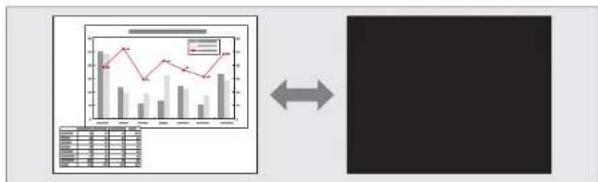
You can use this when you want to focus the audience's attention on what you are saying, or if you do not want to show details such as when you are changing between files during presentations from a computer.
bar_line
| Category | Bar Value | Line Value | |---|---|---| | Bar Value | 100 | 100 | | Line Value | 80 | 90 | | Bar Value (Right Axis) | 70 | 85 | | Bar Value (Left Axis) | 60 | 80 | | Bar Value (Bottom Axis) | 50 | 75 | | Bar Value (Right Axis) | 40 | 70 | The chart displays two data series: one for 'Bar' and one for 'Line'. The 'Bar' series shows a generally increasing trend from left to right, while the 'Line' series shows a decreasing trend. A bidirectional arrow between the bars indicates a possible correlation or transformation between the two metrics.Each time you press the [A/V Mute] button, or open/close the lens cover A/V Mute turns on or off.

text_image
Remote control Projector A/V Mute Freeze Help ?
- When projecting moving images, the images and sound continue to be played back while A/V Mute is on. It is not possible to resume projection from the point where A/V Mute was activated.
- You can select the screen displayed when the [A/V Mute] button is pressed from the Configuration menu.
Extended - Display - A/V Mute p.71
- When the A/V mute slide is closed for approximately 30 minutes, Lens Cover Timer activates and the power is automatically turned off. If you do not want Lens Cover Timer to activate, set Lens Cover Timer to Off.
Extended - Operation - Lens Cover Timer p.71 - The lamp is still lit during A/V Mute, so the lamp hours continue to accumulate.
Freezing the Image (Freeze)
When Freeze is activated on moving images, the frozen image continues to project on the screen, so you can project a moving image one frame at a time like a still photo. Also, you can perform operations such as changing between files during presentations from a computer without projecting any images if the Freeze function is activated beforehand.
Each time you press the [Freeze] button, Freeze turns on or off.
Remote control


•Audio does not stop.
- When projecting moving images, the images continue to be played back while the screen is frozen. It is not possible to resume projection from the point where the screen was frozen.
- If the [Freeze] button is pressed while the Configuration menu or the Help screen is displayed, the menu or the Help screen that is displayed is closed.
- Freeze still works while E-Zoom is being used.
Pointer Function (Pointer)
This allows you to move a Pointer icon on the projected image, and helps you draw attention to the area you are talking about.

text_image
Diagram illustrating a financial or statistical analysis with bar charts and trend lines, showing data flow from a central point.1 Display the Pointer.
Each time you press the [Pointer] button, the pointer appears or disappears.
Remote control
text_image
User Page E-Zoom Pointer2 Move the Pointer icon 7.
Remote control

flowchart
graph TD
    A["Menu"] --> B["User"]
    B --> C["Esc"]
    C --> D["Pointer"]
    D --> E["Volume"]
    style A fill:#fff,stroke:#000
    style B fill:#fff,stroke:#000
    style C fill:#fff,stroke:#000
    style D fill:#fff,stroke:#000
    style E fill:#fff,stroke:#000

When any pair of adjacent [☐], [☐], [☐], or [☐] buttons are pressed at the same time, the pointer can be moved diagonally.

You can select the shape of the pointer icon from the Configuration menu.
Settings - Pointer Shape p.70
Enlarging Part of the Image (E-Zoom)
This is useful when you want to expand images to see them in greater detail, such as graphs and tables.
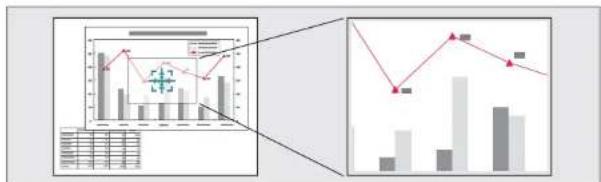
bar_line
| Category | Value | | -------- | ----- | | Bar1 | 1.0 | | Bar2 | 0.8 | | Bar3 | 0.9 | | Bar4 | 1.1 | | Bar5 | 0.7 | | Bar6 | 0.6 | | Bar7 | 0.5 | | Bar8 | 0.4 | | Bar9 | 0.3 | | Bar10 | 0.2 | | Bar11 | 0.1 | | Bar12 | 0.05 | | Bar13 | 0.03 | | Bar14 | 0.02 | | Bar15 | 0.01 | | Bar16 | 0.005 | | Bar17 | 0.003 | | Bar18 | 0.002 | | Bar19 | 0.001 | | Bar20 | 0.0005| | Bar21 | 0.0003| | Bar22 | 0.0002| | Bar23 | 0.0001| | Bar24 | 0.00005| | Bar25 | 0.00003| | Bar26 | 0.00002| | Bar27 | 0.00001| | Bar28 | 0.000005| | Bar29 | 0.000003| | Bar30 | 0.000002| | Bar31 | 0.000001| | Bar32 | 0.0000005| | Bar33 | 0.0000003| | Bar34 | 0.0000002| | Bar35 | 0.0000001| | Bar36 | 0.00000005| | Bar37 | 0.00000003| | Bar38 | 0.00000002| | Bar39 | 0.00000001| | Bar40 | 0.000000005| | Bar41 | 0.000000003| | Bar42 | 0.000000002| | Bar43 | 0.000000001| | Bar44 | 0.0000000005| | Bar45 | 0.0000000003| | Bar46 | 0.0000000002| | Bar47 | 0.0000000001| | Bar48 | 0.0000000001| | Bar49 | 0.0000000001| | Bar50 | 0.5 | | Bar51 | 1.5 | | Bar52 | 2.5 | | Bar53 | 3.5 | | Bar54 | 4.5 | | Bar55 | 5.5 | | Bar56 | 6.5 | | Bar57 | 7.5 | | Bar58 | 8.5 | | Bar59 | 9.5 | | Bar60 | 1.5 | | Bar61 | 2.5 | | Bar62 | 3.5 | | Bar63 | 4.5 | | Bar64 | 5.5 | | Bar65 | 6.5 | | Bar66 | 7.5 | | Bar67 | 8.5 | | Bar68 | 9.5 | | Bar69 | 1.5 | | Bar70 | 2.5 | | Bar71 | 3.5 | | Bar72 | 4.5 | | Bar73 | 5.5 | | Bar74 | 6.5 | | Bar75 | 7.5 | | Bar76 | 8.5 | | Bar77 | 9.5 | | Bar78 | 1.5 | | Bar79 | 2.5 | | Bar80 | 3.5 | | Bar81 | 4.5 | | Bar82 | 5.5 | | Bar83 | 6.5 | | Bar84 | 7.5 | | Bar85 | 8.5 | | Bar86 | 9.5 | | Bar87 | 1.5 | | Bar88 | 2.5 | | Bar89 | 3.5 | | Bar90 | 4.5 | | Bar91 | 5.5 | | Bar92 | 6.5 | | Bar93 | 7.5 | | Bar94 | 8.5 | | Bar95 | 9.5 | | Bar96 | 1.5 | | Bar97 | 2.5 | | Bar98 | 3.5 | | Bar99 | 4.5 | | Bar100 | 5.5 |1 Start E-Zoom.
Press the Ⓔ] button to display the Cross().

text_image
Remote control Page E-Zoom Volume A/V Mute Freeze2 Move the Cross (1) to the area of the image that you want to enlarge.
Remote control

flowchart
graph TD
    A["Menu"] --> B["User"]
    B --> C["Pointer"]
    C --> D["Volume"]
    style A fill:#fff,stroke:#000
    style B fill:#fff,stroke:#000
    style C fill:#fff,stroke:#000
    style D fill:#fff,stroke:#000
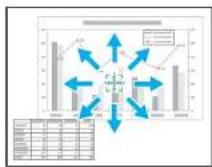
When any pair of adjacent [•], [•], [•], or [•] buttons are pressed at the same time, the pointer can be moved diagonally.
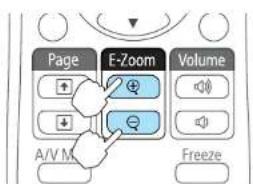
3 Enlarge.
Remote control
text_image
Page E-Zoom Volume A/V M Freeze[⊕] button: Expands the area each time it is pressed. You can expand quickly by holding the button down.
[∅] button: Reduces images that have been enlarged.
Esc button: Cancels E-Zoom.

- The enlargement ratio appears on the screen. The selected area can be enlarged to between 1 to 4 times in 25 incremental steps.
- During enlarged projection, press the [→], [→], and [→] buttons to scroll the image.
Using the Remote Control to Operate the Mouse Pointer (Wireless Mouse)
You can control the computer's mouse pointer from the projector's remote control. This function is called Wireless Mouse.
The following operating systems are compatible with Wireless Mouse.
| Windows Mac OS | ||
| OS | Windows 98 | Mac OS X 10.3.x |
| Windows 98SE | Mac OS X 10.4.x | |
| Windows Me | Mac OS X 10.5.x | |
| Windows 2000 | Mac OS X 10.6.x | |
| Windows XP | ||
| Windows Vista | ||
| Windows 7 |
*It may not be possible to use the Wireless Mouse function under some versions of the operating systems.
Use the following procedure to enable the Wireless Mouse function.
1 Connect the projector to the computer with the USB cable. "Connecting a Computer" p.23
2 Change the source to one of the following. •USB Display •Computer •HDMI ■ "Switching to the Target Image by Remote Control" p.32
Once set, the mouse pointer can be controlled as follows.
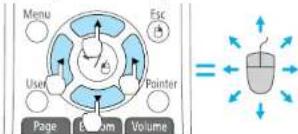
Moving the mouse pointer
text_image
Menu Esc User Pointer Page Button Volume =[[]][]-buttons Moves the mouse pointer.
Mouse clicks

text_image
Menu User Page E Zoom Volume Esc PointerEsc button: Right click. [◀] button: Left click. Press quickly twice to double click.
Drag and drop
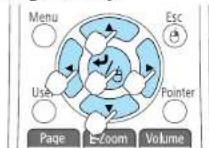
While holding down the [▲button, press the [○], [□, □], and [ ] buttons. Release the [◀] button to drop at the desired location.
Page Up/Down

[+] button: Moves to the previous page. [+] button: Moves to the next page.

- When any pair of adjacent [☐], [☐], [☐], or [☐] buttons are pressed at the same time, the pointer can be moved diagonally.
- If the mouse button settings are set to reverse on the computer, the operation of the remote control buttons will also be reversed.
•The Wireless Mouse function does not work under the following conditions.
- When the Configuration menu or a Help screen is displayed - When operating functions other than the Wireless Mouse function (such as adjusting the volume)
However, when using the E-Zoom or Pointer function, the page up or down function is available.
Saving a User's Logo
You can save the image that is currently being projected as a User's Logo.

Once a User's Logo has been saved, the logo cannot be returned to the factory default.
1 Project the image you want to save as the User's Logo, and then press the [Menu] button.
"Using the Configuration Menu" p.65
Using the remote control Using the control panel


2 Select User's Logo from Extended.

text_image
Image Signal Settings Extended Info Reset Display User's Logo Projection Operation Standby Mode Language Reset Return Front Communication Off EnglishEsc:Return [◆]:Select ●:Enter [Menu]:Exit

- When User's Logo Protect from Password Protect is set to On, a message is displayed and the User's Logo cannot be changed. You can make changes after setting User's Logo Protect to Off.
"Managing Users (Password Protect)" p.58
- If User's Logo is selected when Keystone, E-Zoom, Aspect, or Adjust Zoom are being performed, the function currently being performed is temporarily cancelled.
3 When the message "Choose this image as the User's Logo?" is displayed, select Yes.

When you press the ⏻ button on the remote control or the control panel, the screen size may change depending on the signal to match the actual resolution of the image signal.
4 Move the box to select the part of the image to use as the User's Logo.
You can perform the same operations from the projector's control panel.
Remote control

flowchart
graph TD
    A["Menu"] --> B["User"]
    B --> C["Esc"]
    C --> D["Pointer"]
    D --> E["Volume"]
    style A fill:#fff,stroke:#000
    style B fill:#fff,stroke:#000
    style C fill:#fff,stroke:#000
    style D fill:#fff,stroke:#000
    style E fill:#fff,stroke:#000
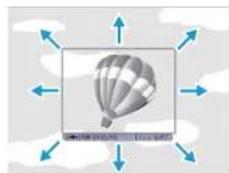
natural_image
Illustration of a hot air balloon inside a cloud with directional arrows (no text or symbols)
You can save at 400x300 dots in size.
5 When you press the [F] button and the message "Select this image?" is displayed, select Yes.
6 Select the zoom factor from the zoom setting screen.

text_image
[User's Logo] Set the zoom factor. Zoom factor: 100% 200% 300%Esc:Return [◆]:Select ●:Set [Menu]:Exit
7 When the message "Save this image as the User's Logo?" is displayed, select Yes.
The image is saved. After the image has been saved, the message "Completed." is displayed.

- When a User's Logo is saved, the previous User's Logo is erased. - It takes a while to save. Do not operate the projector or any connected equipment while it is saving, otherwise malfunctions may occur.
Security Functions

The projector has the following enhanced security functions.
- Password Protect
You can limit who can use the projector.
•Control Panel Lock
You can prevent people changing the settings on the projector without permission.
"Restricting Operation (Control Panel Lock)" p.60
- Anti-Theft Lock
The projector is equipped with the following anti-theft security device.
"Anti-Theft Lock" p.61
Managing Users (Password Protect)
When Password Protect is activated, people who do not know the password cannot use the projector to project images even if the projector power is on. Furthermore, the user's logo that is displayed when you turn on the projector cannot be changed. This acts as an anti-theft function as the projector cannot be used even if it is stolen. At the time of purchase, Password Protect is not activated.
Kinds of Password Protect
The following two kinds of Password Protect settings can be made according to how the projector is being used.
•Power On Protect
When Power On Protect is On, you need to enter a preset password after the projector is plugged in and turned on (this also applies to Direct Power On). If the correct password is not entered, projection does not start.
-User's Logo Protect
Even if someone tries to change the User's Logo set by the owner of the projector, it cannot be changed. When User's Logo Protect is set to On, the following setting changes for the User's Logo are prohibited.
•Capturing a User's Logo
- Setting Display Background, Startup Screen, or A/V Mute from Display
Extended - Display p.71
Setting Password Protect
Use the following procedure to set Password Protect.
1 During projection, hold down the [Freeze] button for about five seconds.
The Password Protect setting menu is displayed.
Remote control

text_image
A/V Mute Freeze
- If Password Protect is already activated, you must enter the password.
If the password is entered correctly, the Password Protect setting menu is displayed.
"Entering the Password" p.59
- When the password is set, stick the password protect sticker in a visible position on the projector as a further theft deterrent.
Password Protect Sticker
2 Select the type of Password Protect you want to set, and then press the [√] button.
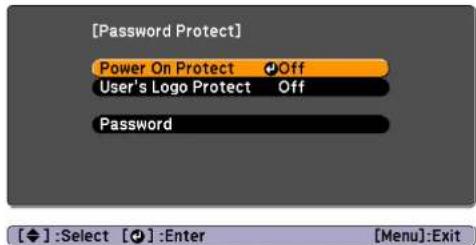
text_image
[Password Protect] Power On Protect Off User's Logo Protect Off Password [◆]:Select [◆]:Enter [Menu]:Exit3 Select On, and then press the [←] button.
Press the Esc button, the screen displayed in step 2 is displayed again.
4 Set the password.
(1) Select Password, and then press the [←] button.
(2) When the message "Change the password?" is displayed, select Yes and then press the [◀] button. The default password is set to "0000". Change this to your own desired Password. If you select No, the screen displayed in step 2 is displayed again.
(3) While holding down the [Num] button, enter a four digit number using the numeric buttons. The number entered is displayed as "***". When you enter the fourth digit, the confirmation screen is displayed.

text_image
Remote control 1 2 3 4 5 6 Auto Act Color Mode 7 9 N-m 0 Esc (4) Re-enter the password. The message "Password accepted." is displayed. If you enter the password incorrectly, a message is displayed prompting you to re-enter the password.Entering the Password
When the password entry screen is displayed, enter the password using the remote control.
While holding down the [Num] button, enter the password by pressing the numeric buttons.
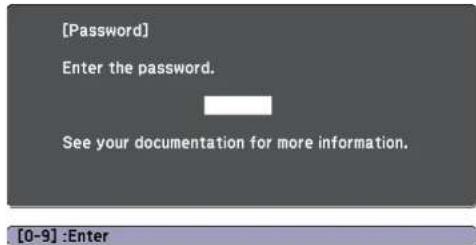
text_image
[Password] Enter the password. See your documentation for more information. [0-9] :EnterWhen you enter the correct password, Password Protect is temporarily released.
Attention
- If an incorrect password is entered three times in succession, the message "The projector's operation will be locked." is displayed for approximately five minutes, and then the projector switches to standby mode. If this happens, disconnect the power plug from the electrical outlet and then reinsert it and turn the projector's power back on. The projector displays the password entry screen again so that you can enter the correct password.
- If you have forgotten the password, make a note of the "Request Code: xxxxx" number that appears on the screen and contact the nearest address provided in the Epson Projector Contact List.
Epson Projector Contact List
- If you continue to repeat the above operation and enter the wrong password thirty times in succession, the following message is displayed and the projector does not accept any more password entries. "The projector's operation will be locked. Contact Epson as described in your documentation."
Epson Projector Contact List
Restricting Operation (Control Panel Lock)
Perform one of the following to lock the operation buttons on the control panel.
•Full Lock
All of the buttons on the control panel are locked. You cannot perform any operations from the control panel, including turning the power on or off.
- Partial Lock
All of the buttons on the control panel, except for the button, are locked.
This is useful at events or shows when you want to deactivate all buttons during projection or at schools when you want to limit button operation. The projector can still be operated using the remote control.
1 Press the [Menu] button while projecting.
"Using the Configuration Menu" p.65
Using the remote control Using the control panel

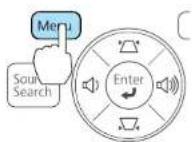
2 Select Control Panel Lock from Settings.
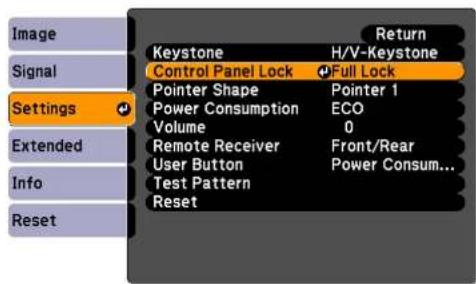
text_image
Image Signal Settings Extended Info Reset Keystone Control Panel Lock Pointer Shape Power Consumption Volume Remote Receiver User Button Test Pattern Reset H/V-Keystone Full Lock Pointer 1 ECO 0 Front/Rear Power Consum...Esc:Return [◆]:Select ●:Enter [Menu]:Exit
3 Select either Full Lock or Partial Lock according to your purpose.
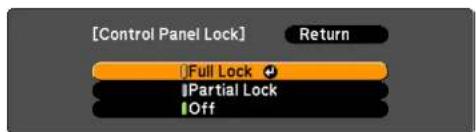
text_image
[Control Panel Lock] Return Full Lock Partial Lock OffEsc:Return [◆]:Select ●:Set [Menu]:Exit
4 Select Yes when the confirmation message is displayed.
The control panel buttons are locked according to the setting you chose.

You can release the control panel lock by one of the following two methods.
- Select Off from Control Panel Lock.
Settings - Control Panel Lock p.70
- Press and hold down the ↓] button on the control panel for about seven seconds, a message is displayed and the lock is released.
Anti-Theft Lock
The projector is equipped with the following types of anti-theft security devices.
•Security slot
The security slot is compatible with the Microsaver Security System manufactured by Kensington.
See the following for more details on the Microsaver Security System.
http://www.kensington.com/
•Security cable installation point
A commercially available theft-prevention wire lock can be passed through the installation point to secure the projector to a desk or pillar.
Installing the wire lock
Pass an anti-theft wire lock through the installation point.
See the documentation supplied with the wire lock for locking instructions.
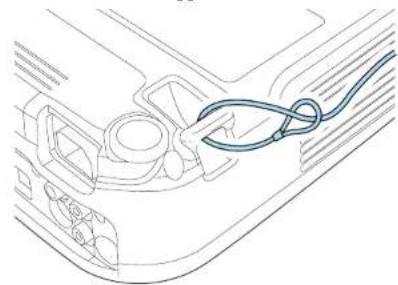
natural_image
Line drawing of a car interior with a blue cable being inserted into the engine compartment (no text or symbols)ESC/VP21 Commands
You can control the projector from an external device using ESC/VP21.
Before starting
EB-X14/EB-W12/EB-X12/EB-S12
1 Install the USB communication driver (EPSON USB-COM Driver) to your computer. For information about the EPSON USB-COM Driver, contact your local dealer or the nearest address provided in the Epson Projector Contact List.
Epson Projector Contact List
2 Set USB Type B to Link 21L from the Extended menu.
Extended - USB Type B p.71
3 Connect the computer's USB port to the projector's USB (Type B) port with a USB cable.
Start from step 2 from the second time.
EB-X11/EB-S11
Connect the computer's serial port (D-Sub 9pin) to the projector's RS-232C port with a PC serial cable.
- Connector shape: D-Sub 9-pin (male)
-Projector input port name: RS-232C
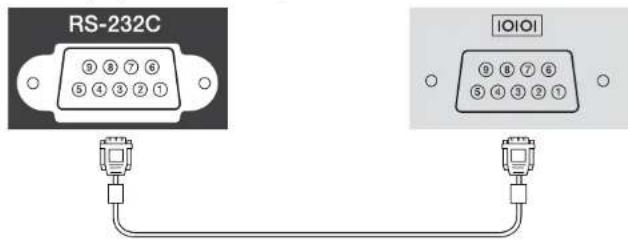
text_image
RS-232C IOIOI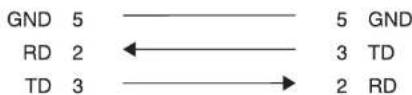
| Signal Name Function | |
| GND Signal wire ground | |
| TD Transmit data | |
| RD Receive data | |
Command list
When the power ON command is transmitted to the projector, the power turns on and it enters warm-up mode. When the projector's power has turned on, a colon ":" (3Ah) is returned.
When a command is input, the projector executes the command and returns a "", and then accepts the next command.
If the command being processed terminates abnormally, an error message is output and a ":" is returned.
The main contents are listed below.
| Item Command | |||
| Power ON/OFF On PWR ON | |||
| Off PWR OFF | |||
| Signal selection Computer Auto SOURCE 1F | |||
| RGB SOURCE 11 | |||
| Component SOURCE 14 | |||
| HDMI SOURCE 30 | |||
| Video SOURCE 41 | |||
| S-Video SOURCE 42 | |||
| USB Display | SOURCE 51 | ||
| USB | SOURCE 52 | ||
| A/V Mute On/Off | On MUTE ON | ||
| Off MUTE OFF | |||
Add a Carriage Return (CR) code (0Dh) to the end of each command and transmit.
For more details, contact your local dealer or the nearest address provided in the Epson Projector Contact List.
Epson Projector Contact List
- Flow control: None
Communications protocol
- Default baud rate setting: 9600 bps
- Data length: 8 bit
- Parity: None
- Stop-bit: 1 bit

Configuration Menu
This chapter explains how to use the Configuration menu and its functions.
Using the Configuration Menu

This section explains how to use the Configuration menu.
Although steps are explained using the remote control as an example, you can perform the same operations from the control panel. Check the guide under the menu for the available buttons and their operations.
1 Display the Configuration menu screen.


text_image
Image Signal Settings Extended Info Reset Color Mode Photo Brightness 0 Contrast 0 Sharpness 0 Color Temp. High Color Adjustment Auto Iris Off Reset [Esc] / [O]: Return [◆]: Select [Menu]: Exit2 Select a top menu item.
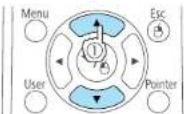
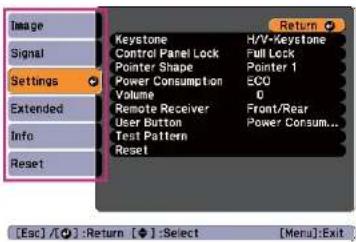
text_image
Image Signal Settings Extended Info Reset Keystone H/V-Keystone Control Panel Lock Full Lock Pointer Shape Pointer 1 Power Consumption ECO Volume 0 Remote Receiver Front/Rear User Button Power Consum... Test Pattern Reset [Esc] / [O]: Return [◆]: Select [Menu]: Exit
3 Select a submenu item.

text_image
Menu ① 7 8 User Pointer ② Menu Esc User Pointer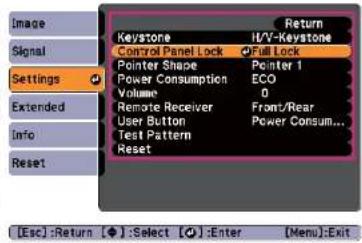
text_image
Image Signal Settings Extended Info Reset Keystone Control Panel Lock Pointer Shape Power Consumption Volume Remote Receiver User Button Test Pattern Reset H/V-Keystone Full Lock Pointer 1 ECO 0 Front/Rear Power Consum... Return [Esc]:Return [◆]:Select [○]:Enter [Menu]:Exit4 Change settings.

text_image
Menu Esc User 5 1 Pointer ① ② Menu Esc User Pointer
text_image
[Settings] Volume 0 Return [Power Consumption] Return [Normal] IECO5 Press the [Menu] button to finish making settings.
Configuration Menu Table
Settable items vary depending on the model being used and the image signal and source being projected.
| Top Menu Name Submenu Name Items or Setting Values | ||
| Image menu p.67 | Color Mode Dynamic, | Presentation, Theatre, Photo, Sports, sRGB, Blackboard, and Whiteboard |
| Brightness -24 to 24 | ||
| Contrast -24 to 24 | ||
| Color Saturation -32 to 32 | ||
| Tint -32 to 32 | ||
| Sharpness -5 to 5 | ||
| Color Temp. High, Medium, and Low | ||
| Color Adjustment Red: -16 to 16 Green: -16 to 16 Blue: -16 to 16 | ||
| Auto Iris On and Off | ||
| Signal menu p.68 | Auto Setup On and Off | |
| Resolution | Auto, Wide, and Normal | |
| Tracking | - | |
| Sync. | 0 to 31 | |
| Position | Up, Down, Left, and Right | |
| Progressive | Off, Video, and Film/Auto (EB X14/EB-W12/EB-X12 only) On and Off (EB-S12/EB-X11/EB-S11 only) | |
| Noise Reduction | Off, NR1, and NR2 | |
| HDMI Video Range | Auto, Normal, and Expanded | |
| Input Signal | Auto, RGB, and Component | |
| Top Menu Name | Submenu Name Items | or Setting Values |
| Video Signal | Auto, NTSC, NTSC4.43, PAL, M-PAL, N-PAL, PAL60, and SECAM | |
| Aspect | Normal, Auto, 4:3, 16:9, Full, Zoom, and Native | |
| Overscan | Auto, Off, 4%, and 8% | |
| Settings menu p.70 | Keystone | H/V-Keystone and Quick Corner |
| Zoom | - | |
| Control Panel Lock | Full Lock, Partial Lock, and Off | |
| Pointer Shape | Pointer 1, 2, and 3 | |
| Power Consumption | Normal and ECO | |
| Volume | 0 to 10 | |
| Remote Receiver | Front/Rear, Front, Rear and Off | |
| User Button | Brightness Control, Info, Progressive, Test Pattern, Resolution | |
| Test Pattern | - | |
| Extended menu p.71 | Display | Messages, Display Background, Startup Screen, and A/V Mute |
| User's Logo | - | |
| Projection | Front, Front/Ceiling, Rear, and Rear/Ceiling | |
| Operation | Direct Power On, Sleep Mode, Sleep Mode Timer, Lens Cover Timer, and High Altitude Mode | |
| Standby Mode | Communication On and Communication Off | |
| USB Type B USB Display and Link 21L | ||
| Language | 15 or 35 language ^§ | |
| Top Menu Name Submenu Name Items or Setting Values | ||
| Info menup.72 | Lamp Hours - | |
| Source - | ||
| Input Signal - | ||
| Resolution - | ||
| Video Signal - | ||
| Refresh Rate - | ||
| Sync Info - | ||
| Status - | ||
| Serial Number - | ||
| Reset menup.73 | Reset All - | |
| Reset Lamp Hours - | ||
*1 The number of supported languages differs depending on the region where the projector is used.
Image Menu
Settable items vary depending on the image signal and source currently being projected. Setting details are saved for each image signal.
"Automatically Detect Input Signals and Change the Projected Image (Source Search)" p.31
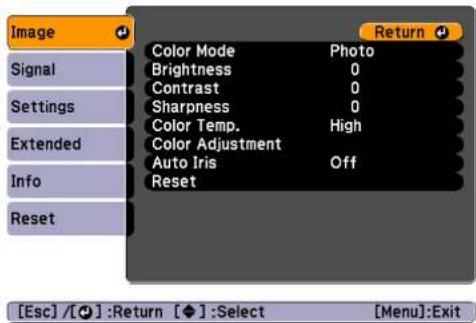
text_image
Image Signal Settings Extended Info Reset Color Mode Photo Brightness 0 Contrast 0 Sharpness 0 Color Temp. High Color Adjustment Auto Iris Off Reset [Esc] / [◆] : Return [◆] : Select [Menu] : Exit| Submenu | Function |
| Color Mode | You can select the quality of the image to suit your surroundings.➤ "Selecting the Projection Quality (Selecting Color Mode)" p.41 |
| Brightness | You can adjust the image brightness. |
| Contrast | You can adjust the difference between light and dark in the images. |
| Color Saturation | You can adjust the color saturation for the images. |
| Tint | (Adjustment is possible when a component video signal is being input. If a composite video or S-video signal is input, adjustment is only possible when NTSC signals are being input.) You can adjust the image tint. |
| Sharpness | You can adjust the image sharpness. |
| Color Temp. | (This item cannot be selected if Color Mode is set to sRGB)You can adjust the overall tint of the image. You can adjust tints in three stages from High, Medium, and Low. The image is tinted blue when High is selected and tinted red when Low is selected. |
| Submenu Function | |
| Color Adjustment | (This item cannot be selected if Color Mode is set to sRGB.)You can adjust the color strength for Red, Green, and Blue individually. |
| Auto Iris | (This item can be set only if Color Mode is set to Dynamic or Theatre.)Set to On to adjust the iris to obtain the optimum light for images being projected.The setting is stored for each Color Mode."Setting Auto Iris" p.42 |
| Reset | You can reset all adjustment values for the Image menu to their default settings. See the following to return all menu items to their default settings."Reset Menu" p.73 |
Signal Menu
Settable items vary depending on the image signal and source currently being projected. Setting details are saved for each image signal.
You cannot make settings on the Signal menu when the source is USB Display or USB.
"Automatically Detect Input Signals and Change the Projected Image (Source Search)" p.31
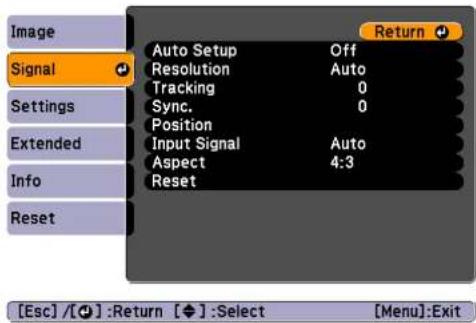
text_image
Image Signal Settings Extended Info Reset Auto Setup Off Resolution Auto Tracking 0 Sync. 0 Position Input Signal Auto Aspect 4:3 Reset Return [Esc] / [◆]: Return [◆]: Select [Menu]: Exit| Submenu Function | |
| Auto Setup | Set to On to automatically adjust Tracking, Sync., and Position to the optimum state when the input signal changes. |
| Resolution | Set to Auto to automatically identify the resolution of the input signal. If images are not projected correctly when set to Auto, for example if some of the image is missing, adjust to Wide for wide screens, or set to Normal for 4:3 or 5:4 screens depending on the connected computer. |
| Tracking | You can adjust computer images when vertical stripes appear in the images. |
| Sync. | You can adjust computer images when flickering, fuzziness, or interference appear in the images. |
| Position | You can adjust the display position up, down, left, and right when a part of the image is missing so that the whole image is projected. |
| Progressive | (This setting can only be adjusted when a component video or RGB video with an interlaced signal (480i/576i/1080i) is input. This cannot be set when a digital RGB signal is input.)Interlace ^ (i) signal is converted toProgressive ^ (p). (IP conversion)For EB-X14/EB-W12/EB-X12Off: Ideal for images with a large amount of movement.Vidco: Ideal for general video images.Film/Auto: This is ideal for movie films, computer graphics, and animation.For EB-S12/EB-X11/EB-S11On: Ideal for still images.Off: Ideal for images with a large amount of movement. |
| Noise Reduction (EB-X14/EB-W12/EB-X12 only) | (This cannot be set when a digital RGB signal is input, or when an interlace signal is being displayed whenProgressiveis set to Off.)Smoothes out rough images. There are two modes. Select your favorite setting. It is recommended that this is set toOffwhen viewing image sources in which noise is very low, such as for DVDs. |
| HDMI Video Range (EB-X14/EB-W12/EB-X12 only) | When the projector’s HDMI port is connected to a DVD player, the projector's video range is set according to the DVD player's video range setting. |
| Input Signal | You can select input signal from Computer port.If set toAuto, the input signal is set automatically according to the connected equipment.If colors do not appear correctly when set toAuto, select the appropriate signal according to the connected equipment. |
| Video Signal | You can select the input signal from the Video port. If this is set toAuto, video signals are recognized automatically. If interference appears in the image or a problem occurs such as no image is being projected when set toAuto, select the appropriate signal depending on the connected equipment. |
| Submenu Function | |
| Aspect | You can set the aspect ratio for projected images.⇨ "Changing the Aspect Ratio of the Projected Image" p.43 |
| Overscan | Changes the output image ratio (the range of the projected image). You can set the cropping range to Off, 4%, or 8%. When the source is HDMI, Auto is available (EB-X14/EB-W12/EB-X12 only). When Auto is selected, it automatically changes to Off or 8% according to the input signal. |
| Reset | You can reset all adjustment values on the Signal menu to their default settings, except for Input Signal.See the following to return all menu items to their default settings.⇨ "Reset Menu" p.73 |
Settings Menu

text_image
Image Signal Settings Extended Info Reset Keystone H/V-Keystone Control Panel Lock Full Lock Pointer Shape Pointer 1 Power Consumption ECO Volume 0 Remote Receiver Front/Rear User Button Power Consum... Test Pattern Reset Return [Esc] / [◆] : Return [◆] : Select [Menu]: Exit| Submenu Function | |
| Keystone | You can correct keystone distortion.When H/V-Keystoneis selected:Adjust V-Keystoneand H-Keystoneto correct horizontal and vertical keystone distortion.You can also set Auto V-Keystone and H-KeystoneAdjuster toOnor Off.(EB-X14/EB-W12/EB-X12/EB-S12/EB-X11 only)When Quick Corneris selected:Select and correct the four corners of the projected image."Quick Corner" p.38 |
| Zoom(EB-S12/EB-S11 only) | Adjusts the size of the projected image. |
| Control Panel Lock | You can use this to restrict operation of the projector's control panel."Restricting Operation (Control Panel Lock)" p.60 |
| Submenu Function | |
| Pointer Shape | You can select the shape of the pointer.Pointer 1:Pointer 2:Pointer 3:"Pointer Function (Pointer)" p.53 |
| Power Consumption | You can set the lamp brightness to one of two settings.Select ECO if the images being projected are too bright, such as when projecting images in a dark room or onto a small screen. When ECO is selected, the power consumption and the lamp's operating life are changed as follows, and fan rotation noise during projection is reduced.Electrical consumption: about 17.5% decrease, lamp life: about 1.25 times longerWhen the projector is used at a high altitude or in a location subject to high temperatures, the ECO setting may be used automatically. If this happens, Power Consumption is grayed out and cannot be adjusted. |
| Volume | You can adjust the volume. Setting values are saved for each source. |
| Remote Receiver | You can limit the reception of the operation signal from the remote control.When set to Off, you cannot perform any operations from the remote control. If you want to make operations from the remote control, hold down the [Menu] button on the remote control for at least 15 seconds to reset the setting to its default value. |
| User Button | You can select and assign an item from the Configuration menu with the remote control's [User] button. Pressing the [User] button directly displays the assigned menu item selection/adjustment screen, allowing you to make one-touch changes to settings/adjustments. You can assign one of the following items to the [User] button.Brightness Control, Info, Progressive, Test Pattern, Resolution |
| Test Pattern | When the projector is set up, a test pattern is displayed so that you can adjust the projection status without connecting equipment. While the test pattern is displayed, zoom, focus adjustments, and keystone correction can be performed. To cancel the test pattern, press the [Esc] button on the remote control or the control panel.AttentionIf a pattern is displayed for a long time, a residue image may be visible in projected images. |
| Reset | You can reset all adjustment values on the Settings menu to their default settings, except for Zoom (EB-S12/EB-S11 only) and User Button.See the following to return all menu items to their default settings."Reset Menu" p.73 |
Extended Menu

text_image
Image Signal Settings Extended Info Reset Display User's Logo Projection Operation Standby Mode USB Type B Language Reset Return Front Communication Off USB Display English [Esc] / [◆] : Return [◆] : Select [Menu] : Exit| Submenu Function | |
| Display | You can make settings related to the projector's display. Messages: When set to Off, the following items will not be displayed. Item names when the Source, Color Mode, or Aspect Ratio is changed, messages when no signal is being input, and warnings such as High Temp Warning. Display Background1: You can set the screen background to Black, Blue, or Logo when no image signal is available. Startup Screen1: Set to On to display the User's Logo when projection starts. A/V Mute1: You can set the screen displayed when the remote control's [A/V Mute] button is pressed to Black, Blue, or Logo. |
| User's Logo*1 | You can change the user's logo that is displayed as a background during Display Background, A/V Mute, and so on. "Saving a User's Logo" p.56 |
| Projection | Select from one of the following projection methods depending on how the projector is installed. Front, Front/Ceiling, Rear, and Rear/Ceiling You can change the setting as follows by pressing down the [A/V Mute] button on the remote control for about five seconds. Front↔Front/Ceiling Rear↔Rear/Ceiling "Installation Methods" p.20 |
| Operation | Direct Power On: Set to On to turn on the projector simply by plugging it in.When the power cable is plugged in, note that the projector turns on automatically in cases such as a power outage being restored.Sleep Mode: When set to On, this automatically stops projection when no image signal is being input and no operations are carried out.Sleep Mode Timer: When Sleep Mode is set to On, you can set the time before the projector automatically turns off within a range of 1 to 30 minutes Lens Cover Timer: When set to On, this turns off the power automatically 30 minutes after the A/V mute slide is closed.This is set to On by default.High Altitude Mode: Set to On when using the projector above an altitude of 1500 m. |
| Standby Mode | If you set Communication On, you can perform the following operations even if the projector is in standby mode.Monitoring and controlling the projector from the computer"Monitoring and Controlling" p.62Outputting analog RGB signals from the Computer port to an external monitor (EB-S12/EB-X11/EB-S11 only) |
| USB Type B (EB-X14/EB-W12/EB-X12/EB-S12 only) | USB Display: Enables USB Display."Projecting with USB Display" p.32Link 21L: Enables ESC/VP21 commands."ESC/VP21 Commands" p.62 |
| Language | You can set the language for messages and menus. |
| Submenu Function | |
| Reset | You can reset the adjustment values for Display and Operation*2 from the Extended menu to their default settings.See the following to return all menu items to their default settings."Reset Menu" p.73 |
*1 When User's Logo Protect is set to On in Password Protect, settings related to user's logo cannot be changed. You can make changes after setting User's Logo Protect to Off.
"Managing Users (Password Protect)" p.58
*2 Except for High Altitude Mode.
Info Menu (Display Only)
Lets you check the status of the image signals being projected and the status of the projector. Items that can be displayed vary depending on the source currently being projected. Depending on the model used, some input sources are not supported.
"Automatically Detect Input Signals and Change the Projected Image (Source Search)" p.31
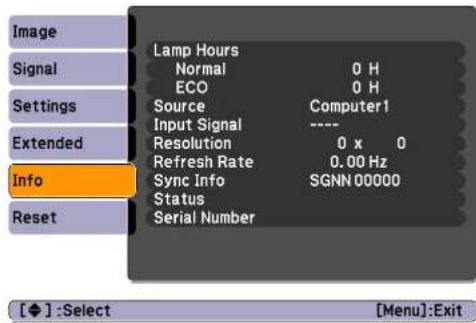
text_image
Image Signal Settings Extended Info Reset Lamp Hours Normal 0 H ECO 0 H Source Computer1 Input Signal ---- Resolution 0 x 0 Refresh Rate 0.00 Hz Sync Info SGNN 00000 Status Serial Number [◆] :Select [Menu]:Exit| Submenu Function | |
| Lamp Hours | You can display the cumulative lamp operating timeWhen it reaches the lamp warning time, the characters are displayed in yellow. |
| Source | You can display the source name for the connected equipment currently being projected. |
| Input Signal | You can display the content of Input Signal set in the Signal menu according to the source. |
| Resolution | You can display the resolution. |
| Refresh Rate | You can display therefresh rate . |
| Sync Info | You can display the image signal information.This information may be needed if service is required. |
| Video Signal | You can display the settings for Video Signal in the Signal menu. |
| Status | This is information about errors that have occurred on the projector.This information may be needed if service is required. |
| Submenu Function | |
| Serial Number | Displays the projector's serial number. |
* The cumulative use time is displayed as "0H" for the first 10 hours. 10 hours and above is displayed as "10H", "11H", and so on.
Reset Menu
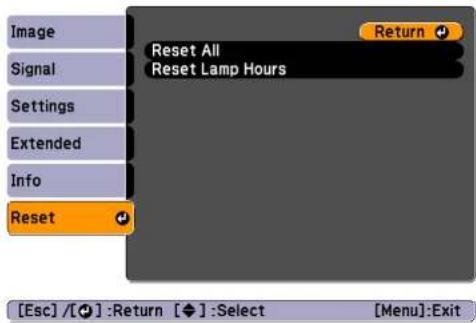
text_image
Image Signal Settings Extended Info Reset Return Reset All Reset Lamp Hours [Esc] / [◆] : Return [◆] : Select [Menu] : Exit| Submenu Function | |
| Reset All | You can reset all items in the Configuration menu to their default settings.The following items are not reset to their defaults: Input Signal,User's Logo,Lamp Hours,Language,Password,Zoom (EB-S12/EB-S11 only), and User Button. |
| Reset LampHours | Clears the cumulative lamp hours use time. Reset when you replace the lamp. |

Troubleshooting
This chapter explains how to identify problems and what to do if a problem is found.
Using the Help

If a problem occurs with the projector, the Help screen is displayed to assist you by pressing the Help button. You can solve problems by answering the questions.
1 Press the [Help] button.
The Help screen is displayed.
Using the remote control Using the control panel
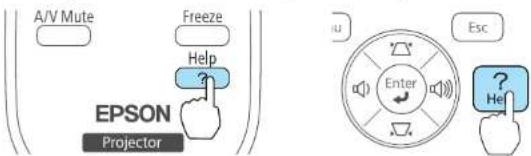
text_image
A/V Mute Freeze Help EPSON Projector Enter Esc Hei2 Select a menu item.

text_image
[Help] The image is small. The image is projected as a trapezoid. The color tone is unusual. There is no audio or it is too low.
Using the remote control Using the control panel
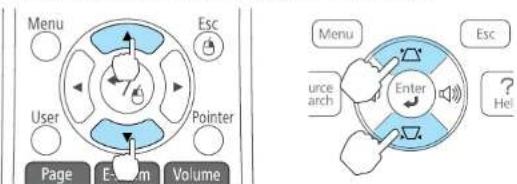
flowchart
graph TD
    A["Menu"] --> B["User"]
    B --> C["Page"]
    B --> D["Esc"]
    B --> E["Volume"]
    F["Esc"] --> G["Pointer"]
    H["Enter"] --> I["Menu"]
    I --> J["urse arch"]
    I --> K["Esc"]
    I --> L["Hel"]
3 Confirm the selection.

text_image
Using the remote control Using the control panel Menu Esc User Pointer Menu Esc urce arch Enter HelQuestions and solutions are displayed as shown on the screen below. Press the [Help] button to exit the Help.

text_image
The image is small. Is zoom set to minimum? -Use the zoom ring to change the size of the image. Is the projector too close to the screen? -Move the projector away from the screen.

text_image
See the following if the Help function does not provide a solution to the problem. "Problem Solving" p.76Problem Solving

If you are having a problem with the projector, first check the projector's indicators and refer to "Reading the Indicators" below.
See the following if the indicators do not show clearly what the problem might be.
"When the Indicators Provide No Help" p.79
Reading the Indicators
The projector is provided with the following three indicators that indicate the operating status of the projector.

text_image
1 2 3 左 Lamp Temp① Power indicator Indicates the operating status.
Standby condition
When the [∅] button is pressed in this condition, projection starts.
Preparing for monitoring via USB communication/serial connection or cool down in progress All buttons are disabled while the indicator is flashing.
Warming up
Warm-up time is about 30 seconds. After warm-up is complete, the indicator stops flashing. The [⏻] button is disabled during warm-up.
Projecting
② Lamp indicator Indicates the projection lamp status.
③ Temp indicator Indicates the internal temperature status.
② Lamp indicator Indicates the projection lamp status. ③ Temp indicator Indicates the internal temperature status.
Refer to the following table to see what the indicators mean and how to remedy problems that they indicate.
If all indicators are off, check that the power cable is connected correctly and that the power is being supplied normally.
Sometimes, when the power cable is unplugged, the [ ◎] indicator remains lit for a short period, but this is not a fault.
■ : Lit ☐: Flashing □ : Off ■ : Varies according to the projector status
| Status Cause | Remedy or Status | |
| Internal Error | Stop using the projector, remove the power plug from the electrical outlet, and contact your local dealer or the nearest address provided in the Epson Projector Contact List.Epson Projector Contact List | |
| Fan ErrorSensor Error | Stop using the projector, remove the power plug from the electrical outlet, and contact your local dealer or the nearest address provided in the Epson Projector Contact List.Epson Projector Contact List | |
| High Temp Error (overheating) | The lamp turns off automatically and projection stops. Wait for about five minutes. After about five minutes the projector switches to standby mode, so check the following two points.Check that the air filter and air exhaust vent are clear, and that the projector is not positioned against a wall.If the air filter is clogged, clean or replace it."Cleaning the Air Filter" p.89, "Replacing the Air Filter" p.94If the error continues after checking the points above, stop using the projector, remove the power plug from the electrical outlet, and contact your local dealer or the nearest address provided in the Epson Projector Contact List.Epson Projector Contact List | |
| When using at an altitude of 1500 m or more, set High Altitude Modc to On."Extended Menu" p.71 | ||
| Lamp ErrorLamp Failure | Check the following two points.Take out the lamp and check if it is cracked."Replacing the Lamp" p.91Clean the air filter."Cleaning the Air Filter" p.89If the lamp is not cracked: Reinstall the lamp and turn on the power.If the error continues: Replace the lamp with a new one and then turn on the power.If the error continues: Stop using the projector, remove the power plug from the electrical outlet, and contact your local dealer or the nearest address provided in the Epson Projector Contact List.Epson Projector Contact List | |
| If the lamp is cracked: Contact your local dealer or the nearest address provided in the Epson Projector Contact List. (Images cannot be projected until the lamp is replaced.)Epson Projector Contact List | ||
| When using at an altitude of 1500 m or more, set High Altitude Mode to On."Extended Menu" p.71 | ||
 | Auto Iris ErrorPower Err. | Stop using the projector, remove the power plug from the electrical outlet, and contact your local dealer or the nearest address provided in the Epson Projector Contact List.Epson Projector Contact List |
 | High Temp Warning | (This is not an abnormality. However, if the temperature rises too high again, projection stops automatically.)Check that the air filter and air exhaust vent are clear, and that the projector is not positioned against a wall.If the air filter is clogged, clean or replace it."Cleaning the Air Filter" p.89, "Replacing the Air Filter" p.94 |
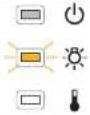 | Replace Lamp Replace it | with a new lamp."Replacing the Lamp" p.91If you continue to use the lamp after the replacement period has passed, the possibility that the lamp may explode increases. Replace it with a new lamp as soon as possible. |

• See the following if the projector is not operating properly, even though the indicators are all showing normal.
"When the Indicators Provide No Help" p.79
- If the indicators are in a state not shown in this table, stop using the projector, remove the power plug from the electrical outlet, and contact your local dealer or the nearest address provided in the Epson Projector Contact List.
Epson Projector Contact List
When the Indicators Provide No Help
If any of the following problems occur and the indicators do not offer a solution, refer to the pages given for each problem.
Problems Relating to Images
| •No images appearProjection does not start, the projection area is completely black, or the projection area is completely blue. | p.80 |
| •Moving images are not displayedMoving images being projected from a computer appear black and nothing is projected. | p.81 |
| • Projection stops automatically | p.81 |
| • The message "Not supported" is displayed | p.81 |
| • The message "No Signal" is displayed | p.81 |
| • Images are fuzzy, out of focus, or distorted | p.82 |
| • Interference or distortion appear in images | p.83 |
| •The image is truncated (large) or small, or the aspect ratio is not suitableOnly part of the image is displayed, or the height and width ratios of the image are not correct. | p.83 |
| •Image colors are not rightThe whole image appears purplish or greenish, images are black & white, or colors appear dull. | p.84 |
| • Images appear dark | p.85 |
Problems when projection starts
| • The projector does not turn on | p.85 |
Other Problems
| • No sound can be heard or the sound is faint | p.86 |
| • The remote control does not work | p.86 |
| • I want to change the language for messages and menus | p.87 |
| • Image file names are not displayed correctly in Slideshow | p.87 |
Problems Relating to Images
No images appear
| Check Remedy | |
| Did you press the [∅] button? | Press the [∅] button to turn the power on. |
| Are the indicators switched off? | The power cable is not connected correctly or power is not being supplied.Connect the projector's power cable correctly."From Installation to Projection" p.30Check that your electrical outlet or power source is functioning correctly. |
| Is A/V Mute active? Press the [A/V Mute] button on the remote control to cancel A/V Mute."Hiding the Image and Sound Temporarily (A/V Mute)" p.52 | |
| Is the A/V mute slide closed? Open the A/V mute slide. | "Front/Top" p.10 |
| Are the Configuration menu settings correct? Reset all of the settings. | Reset - Reset All p.73 |
| Is the image to be projected completely black?(Only when projecting computer images) | Some input images, such as screen savers, may be completely black. |
| Is the image signal format setting correct?(Only when projecting images from a video source) | Change the setting according to the signal for the connected equipment.Signal - Video Signal p.68 |
| Is the USB cable connected correctly?(Only when projecting USB Display) | Check that the USB cable is connected correctly. Reconnect it if it is not connected or not connected properly. |
| Is Windows Media Center displayed in full screen?(Only when projecting USB Display) | When Windows Media Center is displayed at full screen, you cannot project using USB Display. Reduce the screen size. |
| Is an application using the Windows DirectX function displayed?(Only when projecting USB Display) | Applications using the Windows DirectX function may not display images correctly. |
Moving images are not displayed (only the moving image portion turns black)
| Check Remedy | |
| Is the computer's image signal being output to the LCD and the monitor?(Only when projecting images from a laptop computer or a computer with a built-in LCD screen) | Change the image signal from the computer to external output only. Check your computer's documentation, or contact the computer's manufacturer. |
Projection stops automatically
| Check Remedy | |
| Is Sleep Mode set to On? | Press the [∅] button to turn the power on. If you do not want to use Sleep Mode, change the setting to Off. ➕ Extended - Operation - Sleep Mode p.71 |
The message "Not supported" is displayed.
| Check Remedy | |
| Is the image signal format setting correct?(Only when projecting images from a video source) | Change the setting according to the signal for the connected equipment.➤ Signal - Video Signal p.68 |
| Do the image signal resolution and the refresh rate correspond to the mode?(Only when projecting computer images) | Refer to the computer's documentation for how to change the image signal resolution and the refresh rate output from the computer.➤ "Supported Monitor Displays" p.102 |
The message "No Signal" is displayed.
| Check Remedy | |
| Are the cables connected correctly? | Check that all the cables required for projection are securely connected.◆ "From Installation to Projection" p.30 |
| Is the correct port selected? | Change the image by pressing the [Source Search] button on the remote control or the control panel.◆ "Automatically Detect Input Signals and Change the Projected Image (Source Search)" p.31 |
| Is the power for the computer or video source turned on? Turn the power on for the equipment. | |
| Are the image signals being output to the projector?(Only when projecting images from a laptop computer or a computer with a built-in LCD screen) | If the image signals are only being output to the computer's LCD monitor or to the accessory monitor, you need to change the output to an external destination as well as the computer's own monitor. For some computer models, when the image signals are output externally, they no longer appear on the LCD monitor or accessory monitor.If the connection is made while the power of the projector or computer is already turned on, the I'n key (I'unction key) that changes the computer's image signal to external output may not work. Turn the power for the computer and the projector off and then back on again."From Installation to Projection" p.30Computer's documentation |
Images are fuzzy, out of focus, or distorted
| Check Remedy | |
| Is Auto V-Keystone set to Off?(EB-X14/EB-W12/EB-X12/EB-S12/EB-X11 only) | Setting it to On enables Auto V-Keystone.● Settings - Keystone - H/V-Keystone - Auto V-Keystone p.70If you are using the projector with this setting off, manually adjust the projected image.● "Correcting manually" p.37 |
| Is the focus adjusted correctly? Turn the focus ring to adjust the focus.● "Correcting the Focus" p.41 | |
| Is the projector at the correct distance? | Is it projecting outside of the recommended projection distance range?Setup within the recommended range.● "Screen Size and Projection Distance" p.98 |
| Is the keystone adjustment value too large? | Lower the projection angle to reduce the amount of keystone correction.● "Adjusting the Image Position" p.40 |
| Has condensation formed on the lens? | If the projector is suddenly taken from a cold environment to a warm environment, or if sudden ambient temperature changes occur, condensation may form on the surface of the lens, and this may cause the images to appear fuzzy. Set the projector up in the room about one hour before it is used. If condensation forms on the lens, turn the projector off and wait for the condensation to disappear. |
Interference or distortion appear in images
| Check Remedy | |
| Is the image signal format setting correct?(Only when projecting images from a video source) | Change the setting according to the signal for the connected equipment.➤ Signal - Video Signal p.68 |
| Are the cables connected correctly? | Check that all the cables required for projection are securely connected.➤ "Connecting Equipment" p.23 |
| Is an extension cable being used? | If an extension cable is used, electrical interference may affect the signals. Use the cables supplied with the projector to check if the cables you are using may be causing the problem. |
| Is the correct resolution selected?(Only when projecting computer images) | Set the computer so that the signals being output are compatible with the projector.➤ "Supported Monitor Displays" p.102➤ Computer's documentation |
| Are the Sync.♭ and Tracking♭ settings adjusted correctly?(Only when projecting computer images) | Press the [Auto] button on the remote control or the [ ◀ ] button on the control panel to perform automatic adjustment. If the images are not adjusted correctly even after performing automatic adjustment, you can also make adjustments from the Configuration menu.➤ Signal - Tracking, Sync. p.68 |
| Is Transfer layered window selected?(Only when projecting USB Display) | Click All Programs - EPSON Projector - Epson USB Display - Epson USB Display Vx.xx Settings, and then clear the Transfer layered window checkbox. |
The image is truncated (large) or small, or the aspect is not suitable
| Check Remedy | |
| Is a wide panel computer image being projected?(Only when projecting computer images) | Change the setting according to the signal for the connected equipment.➤ Signal - Resolution p.68 |
| Is the image still being enlarged by E-Zoom? | Press the [Esc] button on the remote control to cancel E-Zoom.➤ "Enlarging Part of the Image (E-Zoom)" p.54 |
| Is the image position adjusted correctly? | (Only when projecting analog RGB signals input from the Computer port)Press the [Auto] button on the remote control or the [←] button on the control panel to adjust the position.You can also adjust the position from the Configuration menu.➤ Signal - Position p.68 |
Problem Solving

| Check Remedy | |
| Is the computer set for dual display?(Only when projecting computer images) | If dual display is activated in the Display Properties of the computer's Control Panel, only about half of the image on the computer screen is projected. To display the entire image on the computer screen, turn off the dual display setting. ➕ Computer video driver documentation |
| Is the correct resolution selected?(Only when projecting computer images) | Set the computer so that the signals being output are compatible with the projector. ➕ "Supported Monitor Displays" p.102 ➕ Computer's documentation |
Image colors are not right
| Check Remedy | |
| Do the input signal settings match the signals from the connected device? | Change the following settings according to the signal for the connected equipment.When the image is from a device connected to the Computer portSignal - Input Signal p.68When the image is from a device connected to the Video or S-Video port.Signal - Video Signal p.68 |
| Is the image brightness adjusted correctly? | Adjust the Brightness setting from the Configuration menu.Image - Brightness p.67 |
| Are the cables connected correctly? | Check that all the cables required for projection are securely connected."Connecting Equipment" p.23 |
| Is thecontrastadjusted correctly? | Adjust the Contrast setting from the Configuration menu.Image - Contrast p.67 |
| Is the color adjustment set correctly? | Adjust the Color Adjustment setting from the Configuration menu.Image - Color Adjustment p.67 |
| Are the color saturation and tint adjusted correctly?(Only when projecting images from a video source) | Adjust the Color Saturation and Tint settings from the Configuration menu.Image - Color Saturation, Tint p.67 |
Images appear dark
| Check Remedy | |
| Is the image brightness set correctly? | Adjust the Brightness and Power Consumption settings from the Configuration menu. ➕ Image - Brightness p.67 ➕ Settings - Power Consumption p.70 |
| Is the contrast▶ adjusted correctly? | Adjust the Contrast setting from the Configuration menu. ➕ Image - Contrast p.67 |
| Is it time to replace the lamp? | When the lamp is nearly ready for replacement, the images become darker and the color quality becomes poorer. When this happens, replace the lamp with a new lamp. ➕ "Replacing the Lamp" p.91 |
| Is the projector being used at a high altitude or in a location subject to high temperatures? | When the projector is used at a high altitude or in a location subject to high temperatures, the Power Consumption setting may be automatically set to ECO. This may make the screen dark. If this happens, the Power Consumption setting cannot be changed. |
Problems when Projection Starts
The projector does not turn on
| Check Remedy | |
| Did you press the [∅] button? Press the [ | ∅] button to turn the power on. |
| Are the indicators switched off? | The power cable is not connected correctly or power is not being supplied.Disconnect and then reconnect the power cable."From Installation to Projection" p.30Check that your electrical outlet or power source is functioning correctly. |
| Do the indicators turn on and off when the power cable is touched? | There is probably a poor contact in the power cable, or the power cable may be defective. Reinsert the power cable. If this does not solve the problem, stop using the projector, disconnect the power cable from the electrical outlet, and contact your local dealer or the nearest address provided in the Epson Projector Contact List.Epson Projector Contact List |
| Is the Control Panel Lock set to Full Lock? | Press the [∅] button on the remote control. If you do not want to use Control Panel Lock, change the setting to Off.Settings - Control Panel Lock p.70 |
| Is the correct setting for the remote receiver selected? | Check the Remote Receiver from the Configuration menu. ⬆ Settings - Remote Receiver p.70 |
Other Problems
No sound can be heard or the sound is faint
| Check Remedy | |
| Check that the audio/video cable is securely attached to both the projector and audio source. | Disconnect the cable from the Audio port, and then reconnect the cable. |
| Is the volume adjusted to the minimum setting? | Adjust the volume so that sound can be heard.● Settings - Volume p.70● "Adjusting the Volume" p.41 |
| Is A/V Mute active? Press the [A/V Mute] button on the remote control to cancel A/V Mute.● "I1iding the Image and Sound 'Temporarily (A/V Mute)" p.52 | |
| Is the audio cable's specification "No resistance"? | When using a commercially available audio cable, make sure it is labeled "No resistance". |
| Is it connected with an HDMI cable?(EB-X14/EB-W12/EB-X12 only) | If no audio is output when connecting via an HDMI cable, set the connected equipment to PCM output. |
| Is Output audio from the projector selected?(Only when projecting USB Display) | Click All Programs - EPSON Projector - Epson USB Display - Epson USB Display Vx.xx Settings, and then select Output audio from the projector. |
The remote control does not work
| Check Remedy | |
| Is the remote control light-emitting area pointing towards the remote receiver on the projector during operation? | Point the remote control towards the remote receiver.◆ "Remote control operating range" p.18 |
| Is the remote control too far from the projector? | The operating range for the remote control is about 6 m.◆ "Remote control operating range" p.18 |
Problem Solving

| Check Remedy | |
| Is direct sunlight or strong light from fluorescent lamps shining onto the remote receiver? | Set the projector up in a location where strong light does not shine onto the remote receiver. Or set the remote receiver to Off from Remote Receiver in the Configuration menu.Settings - Remote Receiver p.70 |
| Is the correct setting for the Remote Receiver selected? | Check the Remote Receiver from the Configuration menu.Settings - Remote Receiver p.70 |
| Are the batteries dead or have the batteries been inserted correctly? | Make sure the batteries are inserted correctly or replace the batteries with new ones if necessary."Replacing the remote control batteries" p.17 |
I want to change the language for messages and menus
| Check Remedy | |
| Change the Language setting. | Adjust the Language setting from the Configuration menu. ➕ Extended - Language p.71 |
Image file names are not displayed correctly in Slideshow
| Check Remedy | |
| Is the file name too long? | The file name can be up to 8 characters long. For file names longer than this, the middle of the name is omitted to shorten the name to 8 characters. |
| Are there any 2-byte characters in the file name? | Only alphanumeric characters and symbols can be used in file names. Any other characters are replaced with a question mark (?). |

Maintenance
This chapter provides information on maintenance procedures to ensure the best level of performance from the projector for a long time to come.
Cleaning

89
You should clean the projector if it becomes dirty or if the quality of projected images starts to deteriorate.
Attention
Turn off the projector's power before cleaning.
Cleaning the Projector's Surface
Clean the projector's surface by wiping it gently with a soft cloth.
If the projector is particularly dirty, moisten the cloth with water containing a small amount of neutral detergent, and then firmly wring the cloth dry before using it to wipe the projector's surface.
Attention
Do not use volatile substances such as wax, alcohol, or thinner to clean the projector's surface. The quality of the case may change or become discolored.
Cleaning the Lens
Use a commercially available cloth for cleaning glasses to gently wipe the lens.

Warning
Do not use sprays that contain flammable gas to remove dust and lint from the lens. The projector may catch fire due to the high internal temperature of the lamp.
Attention
Do not rub the lens with harsh materials or subject the lens to shocks, as it can easily become damaged.
Cleaning the Air Filter
Clean the air filter and the air intake vent when the following message is displayed.
"The projector is overheating. Make sure nothing is blocking the air vent, and clean or replace the air filter."
Attention
- If dust collects on the air filter, it can cause the internal temperature of the projector to rise, and this can lead to problems with operation and shorten the optical engine's service life. Clean the air filter immediately when the message is displayed.
- Do not rinse the air filter in water. Do not use detergents or solvents.

natural_image
Line drawing of a projector with a magnified inset showing internal structure (no text or symbols)Cleaning


- If a message is frequently displayed, even after cleaning, it is time to replace the air filter. Replace it with a new air filter.
"Replacing the Air Filter" p.94
- It is recommended that you clean these parts at least once every three months. Clean them more often than this if using the projector in a particularly dusty environment.
Replacing Consumables

This section explains how to replace the lamp and the air filter.
Replacing the Lamp
Lamp replacement period
It is time to replace the lamp when:
•The following message is displayed.
"I'me to replace the lamp. Please contact your Epson projector reseller or visit www.epson.com to purchase."
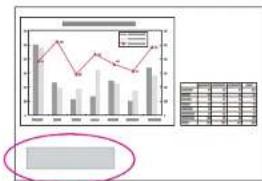
bar_line
| Date | Bar Value | Line Value | | ---------- | --------- | ---------- | | 01-02 | 1.5 | 1.8 | | 02-03 | 1.2 | 1.6 | | 03-04 | 1.7 | 2.0 | | 04-05 | 1.4 | 1.7 | | 05-06 | 1.6 | 1.9 | | 06-07 | 1.3 | 1.5 | | 07-08 | 1.8 | 2.1 | | 08-09 | 1.5 | 1.8 | | 09-10 | 1.7 | 2.0 | | 10-11 | 1.4 | 1.6 | | 11-12 | 1.6 | 1.9 | | 12-13 | 1.3 | 1.5 | | 13-14 | 1.8 | 2.2 | | 14-15 | 1.5 | 2.0 | | 15-16 | 1.7 | 2.3 | | 16-17 | 1.4 | 1.9 | | 17-18 | 1.6 | 2.1 | | 18-19 | 1.3 | 1.7 | | 19-20 | 1.8 | 2.4 | | 20-21 | 1.5 | 2.2 | | 21-22 | 1.7 | 2.5 | | 22-23 | 1.4 | 2.0 | | 23-24 | 1.6 | 2.3 | | 24-25 | 1.3 | 1.8 | | 25-26 | 1.8 | 2.6 | | 26-27 | 1.5 | 2.4 | | 27-28 | 1.7 | 2.7 | | 28-29 | 1.4 | 2.3 | | 29-30 | 1.6 | 2.5 | | 30-31 | 1.3 | 2.0 | | | | |The message is displayed for 30 seconds.
•The lamp indicator flashes orange.
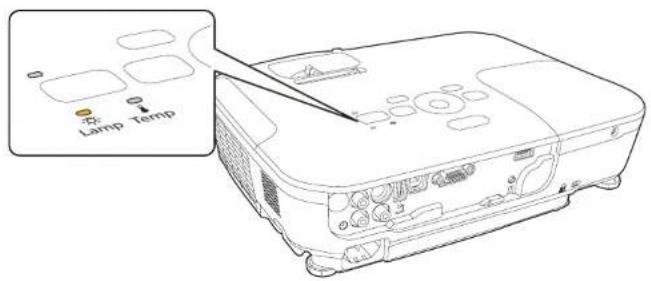
text_image
Lamp Temp•The projected image gets darker or starts to deteriorate.
Attention
- The lamp replacement message is set to appear after the following time periods in order to maintain the initial brightness and quality of the projected images.
When Power Consumption is set to Normal: About 3900 hours When Power Consumption is set to ECO: About 4900 hours
Settings - Power Consumption p.70
- If you continue to use the lamp after the replacement period has passed, the possibility that the lamp may explode increases. When the lamp replacement message appears, replace the lamp with a new one as soon as possible, even if it is still working.
- Do not repeatedly turn off the power and immediately back on. Turning the power on and off frequently may shorten the lamp's operating life.
- Depending on the characteristics of the lamp and the way it has been used, the lamp may become darker or stop working before the lamp warning message appears. You should always have a spare lamp unit ready in case it is needed.
How to replace the lamp
The lamp can be replaced even when the projector is suspended from a ceiling.

Warning
- When replacing the lamp because it has stopped illuminating, there is a possibility that the lamp may be broken. If replacing the lamp of a projector which has been installed on the ceiling, you should always assume that the lamp is cracked, and you should stand to the side of the lamp cover, not underneath it. Remove the lamp cover gently.
- Never disassemble or remodel the lamp. If a modified or disassembled lamp is installed in the projector and used, it could cause a fire, electric shock, or an accident.

Caution
Wait until the lamp has cooled down sufficiently before removing the lamp cover. If the lamp is still hot, burns or other injuries may result. It takes about one hour after the power has been turned off for the lamp to be cool enough.
1 After you turn off the projector's power and the confirmation buzzer beeps twice, disconnect the power cable.
2 Wait until the lamp has sufficiently cooled down, and then remove the lamp cover at the top of the projector.
Loosen the Lamp cover fixing screw with the screwdriver supplied with the new lamp unit or a Phillips screwdriver. Then slide the lamp cover straight forward and lift it to remove.
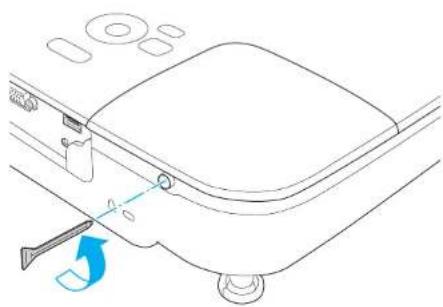
natural_image
Line drawing of a car interior showing a seat, dashboard, and steering wheel (no text or symbols)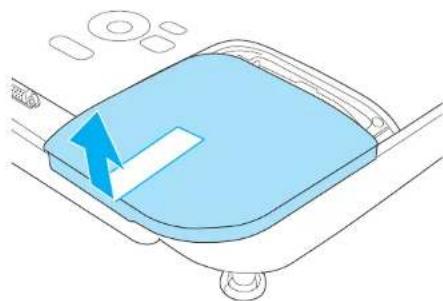
natural_image
Diagram of a car interior showing a blue and white component with an arrow indicating direction (no text or symbols)
Loosen the two lamp fixing screws.
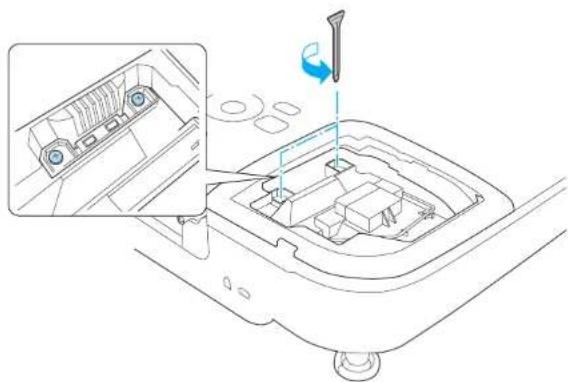
natural_image
Technical line drawing of a car interior showing engine compartment and fan assembly (no text or symbols)4 Take out the old Lamp by pulling the handle.
If the Lamp is cracked, replace it with a new lamp, or contact your local dealer for further advice.
Epson Projector Contact List

text_image
Diagram showing a hand operating a device with labeled parts and directional arrows indicating motion or movement.5 Install the new lamp.
Insert the new Lamp along the guide rail in the correct direction so that it fits in place, push in firmly, and once it is fully inserted tighten the two screws.

text_image
Diagram showing a hand inserting a component into a car intake bay, with labeled parts ① and ②.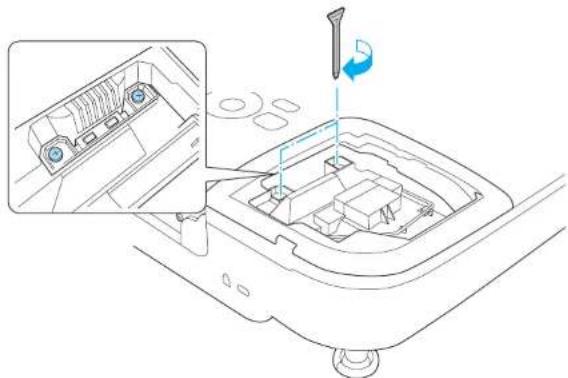
natural_image
Diagram of a car interior showing the engine compartment with a tool and fan, no text or symbols present6 Replace the lamp cover.

natural_image
Diagram of a car interior showing a lever and adjustment mechanism with no text or symbolsAttention
- Make sure you install the lamp securely. If the lamp cover is removed, the power turns off automatically as a safety precaution. If the lamp or the lamp cover is not installed correctly, the power does not turn on.
- This product includes a lamp component that contains mercury (Hg). Please consult your local regulations regarding disposal or recycling. Do not dispose of it with normal waste.
Resetting the lamp hours
The projector records how long the lamp is turned on and a message and indicator notify you when it is time to replace the lamp. After replacing the lamp, make sure you reset the Lamp Hours from the Reset menu.
Reset - Reset Lamp Hours p.73

Only reset the Lamp Hours after the lamp has been replaced. Otherwise the lamp replacement period is not indicated correctly.
Replacing the Air Filter
Air filter replacement period
If the message is displayed frequently even though the air filter has been cleaned, replace the air filter.
How to replace the air filter
The air filter can be replaced even when the projector is suspended from a ceiling.
1 After you turn off the projector's power and the confirmation buzzer beeps twice, disconnect the power cable.
2 Open the air filter cover.

natural_image
Diagram of a car interior showing a blue plastic cover with arrows indicating direction (no text or symbols)Replacing Consumables

3 Remove the air filter.
Grip the air filter cover tab and pull it straight out.

natural_image
Line drawing of a hand inserting a blue card into a device casing (no text or symbols)4 Install the new air filter.
Slide the air filter from the outside and press in until it firmly clicks into place.
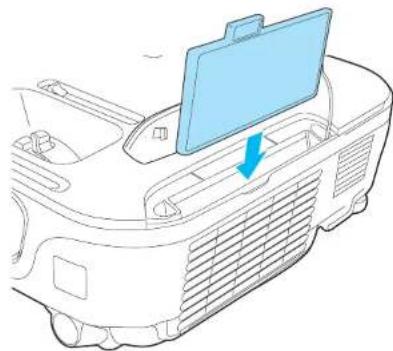
natural_image
Diagram of a car interior with a blue folder and arrow indicating direction (no text or symbols)5 Close the air filter cover.

Dispose of used air filters properly in accordance with your
local regulations.
Filter frame: ABS
Filter: Polyurethane foam

Appendix
Optional Accessories and Consumables

The following optional accessories and consumables are available. Please purchase these products as and when needed. The following list of optional accessories and consumables is current as of: May 2011. Details of accessories are subject to change without notice and availability may vary depending on the country of purchase.
Optional Accessories
| Interactive Unit ELPIU01Use when operating the computer screen on the projection surface. |
| Document Camera ELPDC06/ELPDC11Use when projecting images such as books, OHP documents, or slides. |
| Soft carrying case ELPKS63A soft case to carry the projector. |
| 50" portable screen ELPSC32A compact screen that can be carried easily. (Aspect Ratio 4:3) |
| 60" portable screen ELPSC2780" portable screen ELPSC28100" screen ELPSC29Portable roll-type screens. (aspect ratio 4:3) |
| 70" portable screen ELPSC2380" portable screen ELPSC2490" portable screen ELPSC25Portable roll-type screens. (aspect ratio 16:10) |
| 53" portable screen ELPSC3064" portable screen ELPSC31Portable magnetic screens. (aspect ratio 4:3) |
| Multi-aspect screen ELPSC26A portable multi-aspect screen. |
| Computer cable ELPKC02(1.8 m - for mini D-Sub15-pin/mini D-Sub 15pin) |
| Computer cable ELPKC09(3 m - for mini D-Sub15-pin/mini D-Sub 15pin)Computer cable ELPKC10(20 m - for mini D-Sub15-pin/mini D-Sub 15pin) |
| Component video cable ELPKC19(3 m - for mini D-Sub 15-pin/RCA maB)Use to connect a component videosource. |
| Ceiling pipe (450 mm)* ELPFP13Ceiling pipe (700 mm)* ELPFP14Use when installing the projector on a high ceiling. |
| Ceiling mount* ELPMB23Use when installing the projector on a ceiling. |
* Special expertise is required to suspend the projector from a ceiling. Contact your local dealer or the nearest address provided in the Epson Projector Contact List.
Epson Projector Contact List
Consumables
| Lamp unit ELPLP67Use as a replacement for used lamps. |
| Air filter ELPAF32Use as a replacement for used air filters. |
Projection Distance (For EB-W12)
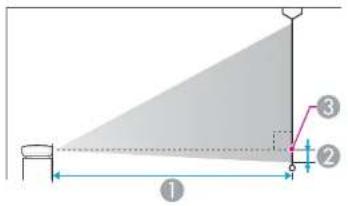
text_image
Diagram showing a geometric setup with labeled components and measurement indicators
text_image
Diagram showing a geometric setup with labeled components and measurement lines, including numbered annotations ①, ②, and ③.① Projection distance
② Distance from the center of the lens to the base of the screen (or to the top of the screen, if suspended from a ceiling)
③ Center of lens
Unit: cm
| 4:3 Screen Size | 1 | 2 | |
| Minimum (Wide) to Maximum (Tele) | |||
| 30" 61x4 | 6 94 - 113 -7 | ||
| 40" 81x6 | 1 126 - 152 -9 | ||
| 50" 100x | 76 158 - 190 -11 | ||
| 4:3 Screen Size | 1 | 2 |
| Minimum (Wide) to Maximum (Tele) | ||
| 60" 120x91 190 - 229 -13 | ||
| 70" 142x107 222 - 267 -15 | ||
| 80" 160x120 255 - 306 -17 | ||
| 100" 200x150 319 - 383 -22 | ||
| 150" 300x230 480 - 577 -33 | ||
| 200" 410x300 641 - 770 -44 | ||
| 280" 570 x 430 898 - 1079 | -61 |
Unit: cm
| 16:9 Screen Size | 1 | 2 | |
| Minimum (Wide) to Maximum (Tele) | |||
| 35" 78x44 | 99 - 120 -4 | ||
| 40" 89x50 | 114 - 137 -5 | ||
| 50" 110x62 | 143 - 172 -6 | ||
| 60" 130x75 | 172 - 208 -8 | ||
| 70" 155x87 | 202 - 243 -9 | ||
| 80" 180x100 | 231 - 278 -10 | ||
| 100" 220x120 | 289 - 348 -13 | ||
| 150" 330x190 | 435 - 523 -19 | ||
| 200" 440x250 | 582 - 699 -26 | ||
| 310" 690 x | 390 903 - 1084 | -40 | |
Unit: cm
| 16:10 Screen Size | 1 | 2 | |
| Minimum (Wide) to Maximum (Tele) | |||
| 35" 76x4 | 7 97 - 117 -7 | ||
| 40" 86x5 | 4 111 - 134 -8 | ||
| 50" 110x6 | 67 139 - 168 -10 | ||
| 60" 130x8 | 81 168 - 202 -12 | ||
| 80" 170x1 | 110 225 - 270 -15 | ||
| 100" 220x1 | 130 281 - 338 -19 | ||
| 150" 320x2 | 200 424 - 509 -29 | ||
| 200" 430x2 | 270 566 - 680 -38 | ||
| 320" 690 x | 430 907 - 1089 | -62 | |
Projection Distance (For EB-X14/EB-X12/EB-X11)

text_image
Diagram showing a geometric setup with labeled components and dimensions, including a shaded triangular region and numbered annotations ① and ②.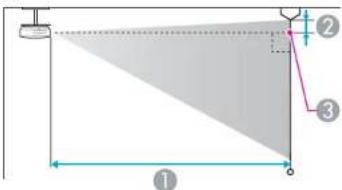
text_image
Diagram showing a geometric setup with labeled components and dimensions, including a shaded triangular region and numbered annotations ①, ②, and ③.① Projection distance
② Distance from the center of the lens to the base of the screen (or to the top of the screen, if suspended from a ceiling)
③ Center of lens
Unit: cm
| 4:3 Screen Size | 1 | 2 | |
| Minimum (Wide) to Maximum (Tele) | |||
| 30" 61x46 | 89 - 107 -5 | ||
| 40" 81x61 | 119 - 143 -7 | ||
| 50" 100x76 | 150 - 180 -8 | ||
| 60" 120x | 91 180 - 217 -10 | ||
| 80" 160x | 120 241 - 290 -14 | ||
| 100" 200x | 150 302 - 363 -17 | ||
| 150" 300x | 230 454 - 546 -25 | ||
| 200" 410x | 300 607 - 729 -34 | ||
| 250" 510x | 380 759 - 912 -42 | ||
| 300" 610x | 460 912 - 1095 -51 | ||
Unit: cm
| 16:9 Screen Size | 1 | 2 | |
| Minimum (Wide) to Maximum (Tele) | |||
| 30" 66x3 | 7 97 - 117 1 | ||
| 40" 89x5 | 0 130 - 156 1 | ||
| 50" 110x | 62 163 - 196 1 | ||
| 60" 130x | 75 196 - 236 1 | ||
| 80" 180x | 100 263 - 316 2 | ||
| 100" 220x | 120 329 - 396 2 | ||
| 150" 330x | 190 495 - 595 3 | ||
| 200" 440x | 250 661 - 794 5 | ||
| 250" 550x | 310 827 - 994 6 | ||
| 275" 610x | 340 910 - 1093 | 6 | |
Projection Distance (For EB-S12/EB-S11)

text_image
Diagram showing a geometric setup with labeled components and dimensions, including points ①, ②, and ③.
text_image
Diagram showing a geometric setup with labeled components and dimensions, including angles and measurements.① Projection distance
② Distance from the center of the lens to the base of the screen (or to the top of the screen, if suspended from a ceiling)
③ Center of lens
Unit: cm
| 4:3 Screen Size | 1 | 2 |
| Minimum (Wide) to Maximum (Tele) | (Wide) | |
| 30" 61x46 88 - 119 | -5 | |
| 50" 100x76 147 - 200 | -8 | |
| 60" 120x91 177 - 240 -10 |
| 4:3 Screen Size | 1 | 2 | |
| Minimum (Wide) to Maximum (Tele) | (Wide) | ||
| 70" 142x | 107 207 - 280 -12 | ||
| 80" 160x | 120 237 - 321 -13 | ||
| 100" 200x | 150 297 - 401 -17 | ||
| 150" 300x | 230 446 - 603 -25 | ||
| 200" 410x | 300 595 - 805 -33 | ||
Unit: cm
| 16:9 Screen Size | 1 | 2 | |
| Minimum (Wide) to Maximum (Tele) | (Wide) | ||
| 30" 66x3 | 7 96 - 130 1 | ||
| 50" 110x | 62 161 - 218 1 | ||
| 60" 130x | 75 193 - 262 2 | ||
| 70" 155x | 87 226 - 306 2 | ||
| 80" 180x | 100 258 - 349 2 | ||
| 100" 220x | 120 323 - 437 3 | ||
| 150" 330x | 190 486 - 657 4 | ||
| 200" 440x | 250 649 - 877 5 | ||
Supported Resolutions
Computer signals (analog RGB)
For EB-X14/EB-W12/EB-X12/EB-X11
| Signal Refresh Rate (Hz) Resolution (dots) | ||
| VGA 60/72/7 | 5/85 640x480 | |
| SVGA 56/60/7 | 2/75/85 800x600 | |
| XGA 60/70/7 | 5/85 1024x768 | |
| WXGA 60 128 | 0x768 | |
| 60 1360x768 | ||
| 60/75/85 1280x800 | ||
| WXGA+ 60/75 | 85 1440x900 | |
| SXGA 70/75/85 | 1152x864 | |
| 60/75/85 1280x1024 | ||
| 60/75/85 1280x960 | ||
| SXGA+ | 60/75 | 1400x1050 |
| WSXGA+*1. 2 | 60 | 1680x1050 |
| UXGA | 60 | 1600x1200 |
| MAC13" | 67 | 640x480 |
| MAC16" | 75 | 832x624 |
| MAC19" | 75 1024x768 | |
| 59 1024x768 | ||
| Signal | Refresh Rate (Hz) | Resolution (dots) |
| MAC21" | 75 1152x870 |
*1 EB-W12 only.
*2 Only compatible when Wide is selected as the Resolution from the Configuration menu.
For EB-S12/EB-S11
| Signal | Refresh Rate (Hz) | Resolution (dots) |
| VGA 60/72/75 | 85 640x480 | |
| SVGA 56/60/72 | 75/85 800x600 | |
| XGA 60/70/75 | 85 1024x768 | |
| WXGA 60 128 | 0x768 | |
| 60 1360x768 | ||
| 60/75 | 1280x800 | |
| WXGA+ | 60 1440x900 | |
| SXGA | 70/75 | 1152x864 |
| 60 | 1280x1024 | |
| 60 1280x960 | ||
| SXGA+ | 60 | 1400x1050 |
| MAC13" | 67 | 640x480 |
| MAC16" | 75 | 832x624 |
| MAC19" | 75 1024x768 | |
| 59 1024x768 | ||
| MAC21" | 75 1152x870 |
Even when signals other than those mentioned above are input, it is likely that the image can be projected. However, not all functions may be supported.
Component Video
| Signal Refresh Rate (Hz) Resolution (dots) | |
| SDTV (480i) 60 720x480 | |
| SDTV (576i) 50 720x576 | |
| SDTV (480p) 60 720x480 | |
| SDTV (576p) 50 720x576 | |
| 11DTV (720p) 50/60 1280x720 | |
| HDTV (1080i) 50/60 1920x1080 |
Composite video
| Signal Refresh | Rate (Hz) Resolution (dots) | |
| TV (NTSC) 60 720x480 | ||
| TV (SECAM) 50 720x576 | ||
| TV (PAL) 50/60 | 720x576 | |
| Signal | Refresh Rate (Hz) | Resolution (dots) |
| SDTV (480i/480p) | 60 | 720x480 |
| SDTV (576i/576p) | 50 | 720x576 |
| 11DTV (720p) | 50/60 | 1280x720 |
| HDTV (1080i) | 50/60 | 1920x1080 |
| 11DTV (1080p) | 24/30/50/60 | 1920x1080 |
Input signal from the HDMI port (EB-X14/EB-W12/EB-X12 only)
| Signal | Refresh Rate (Hz) | Resolution (dots) |
| VGA 60 | 640x480 | |
| SVGA | 60 | 800x600 |
| XGA | 60 | 1024x768 |
| WXGA | 60 | 1280x800 |
| SXGA | 60 | 1280x960 |
| 60 | 1280x1024 | |
| SXGA+ | 60 | 1400x1050 |
| UXGA | 60 | 1600x1200 |
Projector General Specifications
| Product name | EB-X14 EB-W12 | EB-X12 EB-S12 EB-X1 | 1 EB-S11 | ||||
| Dimensions | 295 (W) x 79 (H) x 228 (D) mm | ||||||
| LCD panel size | 0.55" 0.59" Wide | 0.55" 0.55" 0.55" 0.55" | |||||
| Display method | Polysilicon 'I'I' active matrix | ||||||
| Resolution | 786,432 pixelsXGA (1024 (W) x 768(II) dots)x 3 | 1,024,000 pixelsWXGA (1280 (W)x800 (II) dots)x 3 | 786,432 pixelsXGA (1024 (W) x 768(II) dots)x 3 | 480,000 pixelsSVGA (800 (W) x 600(II) dots) x 3 | 786,432 pixelsXGA (1024 (W) x 768(II) dots)x 3 | 480,000 pixelsSVGA (800 (W) x 600(II) dots) x 3 | |
| Focus adjustment | Manual | ||||||
| Zoom adjustment | Manual (1 to 1.2) | Manual (1 to 1.2) | Manual (1 to 1.2) | Digital (1 to 1.35) | Manual (1 to 1.2) | Digital (1 to 1.35) | |
| Lamp | UHF lamp, 200 W Model No.: EI.PLP67 | ||||||
| Max. audio output | 2 W | ||||||
| Speaker | 1 | ||||||
| Power supply | 100 to 240 V AC±10%, 50/60 Hz 2.9 to 1.3 A | ||||||
| Power con-sumption | 100 to 120 V area | Operating: 283 WStandby power consumption (Communication On): 2.9 WStandby power consumption (Communication Off): 0.36 W | |||||
| 220 to 240 V area | Operating: 270 WStandby power consumption (Communication On): 3.3 WStandby power consumption (Communication Off): 0.47 W | ||||||
| Operating altitude | Altitude 0 to 2,286 m | ||||||
| Operating temperature | 5 to +35°C (No condensation) | ||||||
| Storage temperature | -10 to +60°C (No condensation) | ||||||
| Mass | Approx. 2.3 kg | ||||||
| Connectors Computer Input Port 1 | Mini D-Sub15-pin (female) | |
| Video port 1 | RCA pin jack |
Specifications

| S-Video port 1 | Mini DIN 4-pin | |
| Audio Input port 1 | RCA pin jack x 2 | |
| Audio Output port *1 | 1 | Stereo mini jack |
| Monitor Out port1 | 1 | Mini D-Sub15-pin (female) |
| HDMI port2 | 1 | I HDMI (Audio is only supported by PCM) |
| USB(TypeA) port*3 | 1 | USB connector (Type A) |
| USB(TypeB) port*3 | 1 | USB connector (Type B) |
| RS-232C port*4 | 1 | Mini D-Sub 9-pin (male) |
*1 EB-S12/EB-X11/EB-S11 only.
*2 EB-X14/EB-W12/EB-X12 only.
*3 Supports USB 2.0. However, USB ports are not guaranteed to operate all devices that support USB.
*4 EB-X11/EB-S11 only.
Specifications

106
This product is also designed for IT power distribution system with phase-to-phase voltage 230V.
Angle of tilt
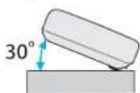

If you use the projector tilted at an angle of more than 30^ it could be damaged and cause an accident.
DECLARATION of CONFORMITY
According to 47CFR, Part 2 and 15
Class B Personal Computers and Peripherals; and/or
CPU Boards and Power Supplies used with Class B Personal Computers
We: Epson America, Inc.
Located at: 3840 Kilroy Airport Way
MS: 3-13
Long Beach, CA 90806
Tel: 562-290-5254
Declare under sole responsibility that the product identified herein, complies with 47CFR Part 2 and 15 of the FCC rules as a Class B digital device. Each product marketed, is identical to the representative unit tested and found to be compliant with the standards. Records maintained continue to reflect the equipment being produced can be expected to be within the variation accepted, due to quantity production and testing on a statistical basis as required by 47CFR 2.909. Operation is subject to the following two conditions: (1) this device may not cause harmful interference, and (2) this device must accept any interference received, including interference that may cause undesired operation.
Trade Name: EPSON
Type of Product: Projector
Model: H428C/H429C/H430C/H431C/H432C/H433C/
H434C/H435C/H436C/H437C/H438C/H439C
FCC Compliance Statement
For United States Users
This equipment has been tested and found to comply with the limits for a Class B digital device, pursuant to Part 15 of the FCC Rules. These limits are designed to provide reasonable protection against harmful interference in a residential installation. This equipment generates, uses, and can radiate radio frequency energy and, if not installed and used in accordance with the instructions, may cause harmful interference to radio or television reception. However, there is no guarantee that interference will not occur in a particular installation. If this equipment does cause interference to radio and television reception, which can be determined by turning the equipment off and on, the user is encouraged to try to correct the interference by one or more of the following measures.
•Reorient or relocate the receiving antenna.
- Increase the separation between the equipment and receiver.
- Connect the equipment into an outlet on a circuit different from that to which the receiver is connected.
- Consult the dealer or an experienced radio/TV technician for help.
WARNING
The connection of a non-shielded equipment interface cable to this equipment will invalidate the FCC Certification or Declaration of this device and may cause interference levels which exceed the limits established by the FCC for this equipment. It is the responsibility of the user to obtain and use a shielded equipment interface cable with this device. If this equipment has more than one interface connector, do not leave cables connected to unused interfaces. Changes or modifications not expressly approved by the manufacturer could void the user's authority to operate the equipment.
Appearance

108
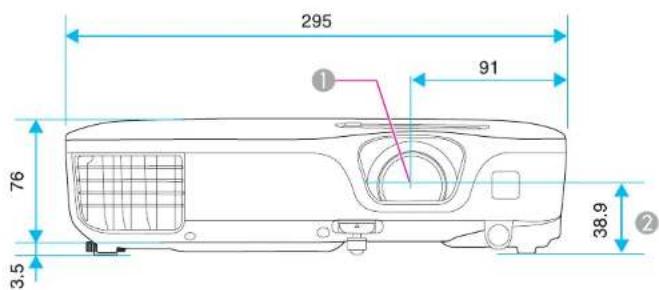
text_image
295 91 76 3.5 38.9 ① ②① Center of lens
② Distance from center of lens to suspension bracket fixing point
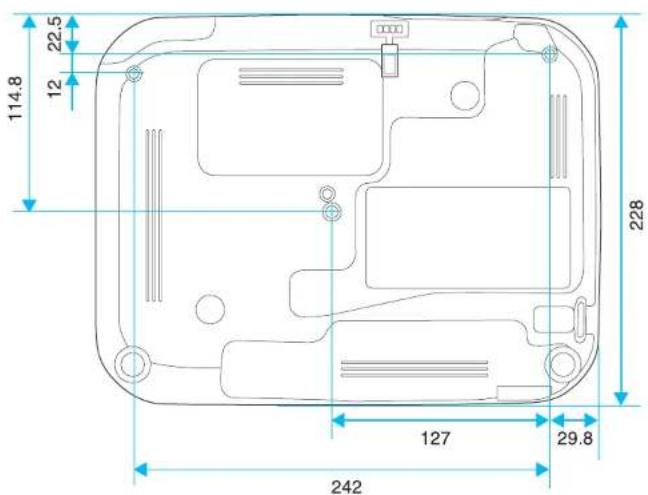
text_image
114.8 22.5 12 228 127 29.8 242Units: mm
This section briefly explains the difficult terms that are not explained in the text of this guide. For details, refer to other commercially available publications.
| Aspect Ratio | The ratio between an image's length and its height. Screens with a horizontal:vertical ratio of 16:9, such as HDTV screens, are known as wide screens. SDTV and general computer displays have an aspect ratio of 4:3. |
| Component Video | A method that separates the video signal into a luminance component (Y), and a blue minus luminance (Cb or Pb) and a red minus luminance (Cr or Pr). |
| Composite video | A method that combines the video signal into a luminance component and a color component for transmission down a single cable. |
| Contrast | The relative brightness of the light and dark areas of an image can be increased or decreased to make text and graphics stand out more clearly, or to make them appear softer. Adjusting this particular property of an image is called contrast adjustment. |
| HDCP | HDCP is an abbreviation for High-bandwidth Digital Content Protection. It is used to prevent illegal copying and protect copyrights by encrypting digital signals sent over DVI and HDMI ports. Because the HDMI port on this projector supports HDCP, it can project digital images protected by HDCP technology. However, the projector may not be able to project images protected with updated or revised versions of HDCP encryption. |
| HDTV | An abbreviation for High-Definition Television that refers to high-definition systems which satisfy the following conditions.●Vertical resolution of 720p or 1080i or greater (p = Progressive, i = Interlace)●Screen aspect ratio of 16:9 |
| Interlace | Transmits information needed to create one screen by sending every other line, starting from the top of the image and working down to the bottom. Images are more likely to flicker because one frame is displayed every other line. |
| Progressive | Projects information to create one screen at a time, displaying the image for one frame. Even though the number of scan lines is the same, the amount of flicker in images decreases because the volume of information has doubled compared with an interlace system. |
| Refresh Rate | The light-emitting element of a display maintains the same luminosity and color for an extremely short time. Because of this, the image must be scanned many times per second to refresh the light-emitting element. The number of refresh operations per second is called the Refresh Rate and is expressed in hertz (Hz). |
| SDTV | An abbreviation for Standard Definition Television that refers to standard television systems which do not satisfy the conditions for HDTVHigh-Definition Television. |
| sRGB | An international standard for color intervals that was formulated so that colors that are reproduced by video equipment can be handled easily by computer operating systems (OS) and the Internet. If the connected source has an sRGB mode, set both the projector and the connected signal source to sRGB. |
| SVGA | A screen size standard with a resolution of 800 (horizontal) x 600 (vertical) dots. |
| S-Video | A method that separates the video signal into a luminance component (Y) and a color component (C). |
| SXGA | A screen size standard with a resolution of 1,280 (horizontal) x 1,024 (vertical) dots. |
| Sync. | The signals output from computers have a specific frequency. If the projector frequency does not match this frequency, the resulting images are not of a good quality. The process of matching the phases of these signals (the relative position of the crests and the troughs in the signal) is called Synchronization. If the signals are not synchronized, flickering, blurriness, and horizontal interference occur. |
Glossary

| Tracking | The signals output from computers have a specific frequency. If the projector frequency does not match this frequency, the resulting images are not of a good quality. The process of matching the frequency of these signals (the number of crests in the signal) is called Tracking. If Tracking is not carried out correctly, wide vertical stripes appear in the signal. |
| VGA | A screen size standard with a resolution of 640 (horizontal) x 480 (vertical) dots. |
| XGA | A screen size standard with a resolution of 1,024 (horizontal) x 768 (vertical) dots. |
General Notes

All rights reserved. No part of this publication may be reproduced, stored in a retrieval system, or transmitted in any form or by any means, electronic, mechanical, photocopying, recording, or otherwise, without the prior written permission of Seiko Epson Corporation. No patent liability is assumed with respect to the use of the information contained herein. Neither is any liability assumed for damages resulting from the use of the information contained herein.
Neither Seiko Epson Corporation nor its affiliates shall be liable to the purchaser of this product or third parties for damages, losses, costs, or expenses incurred by the purchaser or third parties as a result of: accident, misuse, or abuse of this product or unauthorized modifications, repairs, or alterations to this product, or (excluding the U.S.) failure to strictly comply with Seiko Epson Corporation's operating and maintenance instructions.
Seiko Epson Corporation shall not be liable against any damages or problems arising from the use of any options or any consumable products other than those designated as Original Epson Products or Epson Approved Products by Seiko Epson Corporation.
The contents of this guide may be changed or updated without further notice.
Illustrations in this guide and the actual projector may differ.
About Notations
Microsoft® Windows® 98 operating system Microsoft® Windows® Me operating system Microsoft® Windows® 2000 operating system Microsoft® Windows® XP operating system Microsoft® Windows Vista® operating system Microsoft® Windows® 7 operating system
In this guide, the operating systems above are referred to as "Windows 98", "Windows Me", "Windows 2000", "Windows XP", "Windows Vista", and "Windows 7". Furthermore, the collective term Windows may be used to refer to Windows 98, Windows Me, Windows 2000, Windows XP, Windows Vista, and Windows 7, and multiple versions of Windows may be
referred to as, for example, Windows 98/Me/2000/XP/Vista, with the Windows notation omitted.
Mac OS X 10.3.x Mac OS X 10.4.x Mac OS X 10.5.x Mac OS X 10.6.x
In this guide, the operating systems above are referred to as "Mac OS X 10.3.9", "Mac OS X 10.4.x", "Mac OS X 10.5.x", and "Mac OS X 10.6.x". Furthermore, the collective term "Mac OS" is used to refer to them.
General Notice:
IBM, DOS/V, and XGA are trademarks or registered trademarks of International Business Machines Corp.
Macintosh, Mac, Mac OS, and iMac are trademarks of Apple Inc. Microsoft, Windows, Windows NT, Windows Vista, PowerPoint, and Windows logo are trademarks or registered trademarks of Microsoft Corporation in the United States and/or other countries.
HDMI and High-Definition Multimedia Interface are the trademarks or registered trademarks of HDMI Licensing LLC. HDMI
Other product names used herein are also for identification purposes only and may be trademarks of their respective owners. Epson disclaims any and all rights in those marks.
©SEIKO EPSON CORPORATION 2011. All rights reserved.
Index

A
A/V Mute 52
Air exhaust vent 10
Air filter replacement period 94
Aspect 43,69
Auto Iris 42,68
Auto Setup 68
Auto V-Keystone 70
B
Blackboard 42
Brightness 67
C
Ceiling 20,71
Ceiling mount fixing points 13
Cleaning 89
Cleaning the air filter and air intake vent 89
Cleaning the Projector's Surface 89
Color Adjustment 68
Color Mode 41,67
Color Saturation 67
Color Temp. 67
Computer port 12
Configuration menu 65
Consumables 97
Continuous 51
Contrast 67
Control panel 14
Control Panel Lock 60,70
Cross 54
D
Direct Power On 72
Display 71
Display Background 71
Display order 51
Display Settings 51
Distance 98
Document Camera 97
Dynamic 42
E
ESC/VP21 62
Extended menu 71
E-Zoom 54
F
Focus ring 10
Foot adjust lever 10
Freeze 52
Front 20,71
Front adjustable foot 10
Full Lock 60
H
HDMI port 12
HDMI Video Range 69
Help function 75
High Altitude Mode 72
H-Keystone Adjuster 8,37
Horizontal keystone adjuster 37
How to replace the air filter 94
How to replace the lamp 91
I
Image menu 67
Indicators 76
Info menu 72
Input Signal 69,73
K
Keystone 70
L
Lamp cover 11
Lamp hours 73
Lamp indicator 76
Lamp replacement period 91
Language 72
Lens Cover Timer 72
M
Messages 71
Monitor Displays 102
Mouse pointer 55
N
Noise Reduction 69
0
Operating temperature 104
Operation 72
Optional accessories 97
Overheating 77
Index

P
Part Names and Functions ...... 10
Password protect 58
Password Protect Sticker 58
Photo 42
Pointer 53
Pointer Shape 70
Position 68
Power Consumption 70
Power indicator 76
Power inlet 11
Power On Protect 58
Presentation 42, 47
Problem Solving 76
Progressive 69
Projection 71
Q
Quick Corner 70
R
Rear 20,71
Rear feet 13
Rear screen 20
Refresh Rate 73
Remote control 15
Remote receiver 10, 11
Replacing batteries 17
Reset All 73
Reset menu 73
Resetting the lamp operating time ..... 73, 94
Resolution 73
Rotating images 49
s
Screen size 98
Screen switching time 51
Select Drive 48
Settings menu 70
Sharpness 67
Signal menu 68
Sleep Mode 72
Slideshow 47,50
Source 73
Source Search 14,31
Specifications 104
Sports 42
sRGB 42
Standby Mode 72
Startup Screen 71
Storage temperature 104
Supported Monitor Displays 102
S-Video Port 12
Sync Info 73
Sync. 68
T
Temp indicator 76
Test Pattern 71
Theatre 42
Tint 67
Tracking 68
U
USB Type B 72
USB(TypeA) port 12
USB(TypeB) port 12
User Button 70
User's Logo 56
User's Logo Protect 58
V
Video Port 11
Video Signal 69,73
Volume 70
Volume Button 14
W
Whiteboard 42
Wireless mouse function 55
Z
Zoom 70
Zoom ring 10