TI-84 Plus - Calculator TEXAS INSTRUMENTS - Free user manual and instructions
Find the device manual for free TI-84 Plus TEXAS INSTRUMENTS in PDF.


User questions about TI-84 Plus TEXAS INSTRUMENTS
0 question about this device. Answer the ones you know or ask your own.
Ask a new question about this device
Download the instructions for your Calculator in PDF format for free! Find your manual TI-84 Plus - TEXAS INSTRUMENTS and take your electronic device back in hand. On this page are published all the documents necessary for the use of your device. TI-84 Plus by TEXAS INSTRUMENTS.
USER MANUAL TI-84 Plus TEXAS INSTRUMENTS
TI-84 Plus and TI-84 Plus Silver Edition Guidebook
Note: This guidebook for the TI-84 Plus or TI-84 Plus Silver Edition with operating system (OS) version 2.55MP. If your calculator has a previous OS version, your screens may look different and some features may not be available. You can download the latest OS education.ti.com/guides.
Important Information
Texas Instruments makes no warranty, either express or implied, including but not limited to any implied warranties of merchantability and fitness for a particular purpose, regarding any programs or book materials and makes such materials available solely on an "as-is" basis. In no event shall Texas Instruments be liable to anyone for special, collateral, incidental, or consequential damages in connection with or arising out of the purchase or use of these materials, and the sole and exclusive liability of Texas Instruments, regardless of the form of action, shall not exceed the purchase price of this product. Moreover, Texas Instruments shall not be liable for any claim of any kind whatsoever against the use of these materials by any other party.
© 2004–2010 Texas Instruments Incorporated
Vernier EasyData, Vernier LabPro, and Vernier Go! Motion are a trademarks of Vernier Software & Technology.
Contents
Important Information .... ii
Chapter 1:
Operating the TI-84 Plus Silver Edition 1
Documentation Conventions .... 1
TI-84 Plus Keyboard 1
Turning On and Turning Off the TI-84 Plus 3
Setting the Display Contrast 4
The Display 5
Interchangeable Faceplates 8
Using the Clock 9
Entering Expressions and Instructions 11
Setting Modes 14
Using TI-84 Plus Variable Names 19
Storing Variable Values 20
Recalling Variable Values 21
Scrolling Through Previous Entries on the Home Screen 22
ENTRY (Last Entry) Storage Area 22
TI-84 Plus Menus 25
VARS and VARS Y-VARS Menus 27
Equation Operating System (EOS™) 29
Special Features of the TI-84 Plus 30
Other TI-84 Plus Features 31
Error Conditions 33
Chapter 2:
Math, Angle, and Test Operations 35
Getting Started: Coin Flip 35
Keyboard Math Operations 36
MATH Operations 38
Using the Equation Solver 42
MATH NUM (Number) Operations 45
Entering and Using Complex Numbers 50
MATH CPX (Complex) Operations 54
MATH PRB (Probability) Operations 56
ANGLE Operations 59
TEST (Relational) Operations 62
TEST LOGIC (Boolean) Operations 63
Chapter 3:
Function Graphing 65
Getting Started: Graphing a Circle 65
Defining Graphs 66
Setting the Graph Modes 67
Defining Functions 68
Selecting and Deselecting Functions 69
Setting Graph Styles for Functions 71
Setting the Viewing Window Variables 73
Setting the Graph Format 74
Displaying Graphs 76
Exploring Graphs with the Free-Moving Cursor 78
Exploring Graphs with TRACE 78
Exploring Graphs with the ZOOM Instructions 80
Using ZOOM MEMORY 85
Using the CALC (Calculate) Operations 87
Chapter 4:
Parametric Graphing 91
Getting Started: Path of a Ball 91
Defining and Displaying Parametric Graphs 93
Exploring Parametric Graphs 95
Chapter 5:
Polar Graphing 97
Getting Started: Polar Rose 97
Defining and Displaying Polar Graphs 98
Exploring Polar Graphs 100
Chapter 6:
Sequence Graphing 102
Getting Started: Forest and Trees 102
Defining and Displaying Sequence Graphs 103
Selecting Axes Combinations 107
Exploring Sequence Graphs 107
Graphing Web Plots 109
Using Web Plots to Illustrate Convergence 110
Graphing Phase Plots 111
Comparing TI-84 Plus and TI-82 Sequence Variables 113
Keystroke Differences Between TI-84 Plus
and TI-82 114
Chapter 7:
Tables 115
Getting Started: Roots of a Function 115
Setting Up the Table 116
Defining the Dependent Variables 117
Displaying the Table 118
Chapter 8:
Draw Instructions 121
Getting Started: Drawing a Tangent Line 121
Using the DRAW Menu 122
Clearing Drawings 123
Drawing Line Segments 124
Drawing Horizontal and Vertical Lines 125
Drawing Tangent Lines 126
Drawing Functions and Inverses 127
Shading Areas on a Graph 128
Drawing Circles 128
Placing Text on a Graph 129
Using Pen to Draw on a Graph 130
Drawing Points on a Graph 131
Drawing Pixels 132
Storing Graph Pictures (Pic) 134
Recalling Graph Pictures (Pic) 135
Storing Graph Databases (GDB) 135
Recalling Graph Databases (GDB) 136
Chapter 9:
Split Screen 137
Getting Started: Exploring the Unit Circle 137
Using Split Screen 138
Horiz (Horizontal) Split Screen 139
G-T (Graph-Table) Split Screen 140
TI-84 Plus Pixels in Horiz and G-T Modes 141
Chapter 10:
Matrices 143
Getting Started: Using the MTRX Shortcut Menu 143
Getting Started: Systems of Linear Equations 144
Defining a Matrix 145
Viewing and Editing Matrix Elements 146
Using Matrices with Expressions 148
Displaying and Copying Matrices 149
Using Math Functions with Matrices 151
Using the MATRIX MATH Operations 154
Chapter 11:
Lists 161
Getting Started: Generating a Sequence 161
Naming Lists 162
Storing and Displaying Lists 163
Entering List Names 164
Attaching Formulas to List Names 165
Using Lists in Expressions 167
LIST OPS Menu 168
LIST MATH Menu 175
Chapter 12:
Statistics 178
Getting Started: Pendulum Lengths and Periods 178
Setting Up Statistical Analyses 184
Using the Stat List Editor 185
Attaching Formulas to List Names 188
Detaching Formulas from List Names 190
Switching Stat List Editor Contexts 190
Stat List Editor Contexts 192
STAT EDIT Menu 193
Regression Model Features 195
STAT CALC Menu 198
Statistical Variables 206
Statistical Analysis in a Program 207
Statistical Plotting 208
Statistical Plotting in a Program 212
Chapter 13:
Inferential Statistics and Distributions 215
Getting Started: Mean Height of a Population 215
Inferential Stat Editors 218
STAT TESTS Menu 221
Inferential Statistics Input Descriptions 239
Test and Interval Output Variables 240
Distribution Functions 241
Distribution Shading 248
Chapter 14:
Applications 251
The Applications Menu 251
Getting Started: Financing a Car 252
Getting Started: Computing Compound Interest 253
Using the TVM Solver 253
Using the Financial Functions 254
Calculating Time Value of Money (TVM) 255
Calculating Cash Flows 257
Calculating Amortization 258
Calculating Interest Conversion 261
Finding Days between Dates/Defining Payment Method 261
Using the TVM Variables 262
The EasyData™ Application 263
Chapter 15:
CATALOG, Strings, Hyperbolic Functions 266
Browsing the TI-84 Plus CATALOG 266
Entering and Using Strings 267
Storing Strings to String Variables 268
String Functions and Instructions in the CATALOG 269
Hyperbolic Functions in the CATALOG 273
Chapter 16:
Programming 275
Getting Started: Volume of a Cylinder 275
Creating and Deleting Programs 276
Entering Command Lines and Executing Programs 278
Editing Programs 279
Copying and Renaming Programs 280
PRGM CTL (Control) Instructions 281
PRGM I/O (Input/Output) Instructions 288
Calling Other Programs as Subroutines 293
Running an Assembly Language Program 294
Chapter 17:
Activities 296
The Quadratic Formula 296
Box with Lid 299
Comparing Test Results Using Box Plots 306
Graphing Piecewise Functions 308
Graphing Inequalities 309
Solving a System of Nonlinear Equations 310
Using a Program to Create the Sierpinski Triangle 311
Graphing Cobweb Attractors 312
Using a Program to Guess the Coefficients 313
Graphing the Unit Circle and Trigonometric Curves 315
Finding the Area between Curves 316
Using Parametric Equations: Ferris Wheel Problem 317
Demonstrating the Fundamental Theorem of Calculus 319
Computing Areas of Regular N-Sided Polygons 321
Computing and Graphing Mortgage Payments 323
Chapter 18:
Memory and Variable Management 326
Checking Available Memory 326
Deleting Items from Memory 329
Clearing Entries and List Elements 329
Archiving and UnArchiving Variables 330
Resetting the TI-84 Plus 333
Grouping and Ungrouping Variables 336
Garbage Collection 339
ERR:ARCHIVE FULL Message 343
Chapter 19:
Communication Link 344
Getting Started: Sending Variables 344
TI-84 Plus LINK 345
Selecting Items to Send 347
Receiving Items 350
Backing Up RAM Memory 351
Error Conditions 352
Appendix A:
Functions and Instructions 354
Appendix B:
Reference Information 383
Variables 383
Statistics Formulas 384
Financial Formulas 387
Important Things You Need to Know About Your TI-84 Plus 391
Error Conditions 394
Accuracy Information 398
Appendix C:
Service and Warranty Information 400
Texas Instruments Support and Service 400
Battery Information 400
In Case of Difficulty 402
Chapter 1:
Operating the TI-84 Plus Silver Edition
Documentation Conventions
In the body of this guidebook, TI-84 Plus refers to the TI-84 Plus Silver Edition, but all of the instructions, examples, and functions in this guidebook also work for the TI-84 Plus. The two graphing calculators differ only in available RAM memory, interchangeable faceplates, and Flash application ROM memory. Sometimes, as in Chapter 19, the full name TI-84 Plus Silver Edition is used to distinguish it from the TI-84 Plus.
Screen shots were taken using OS version 2.53MP and higher in either MathPrint™ or Classic mode. All features are available in both modes; however, screens make look slightly different depending on the mode setting. Many examples highlight features that are not available in previous OS versions. If your calculator does not have the latest OS, features may not be available and your screens may look different. You can download the latest OS from education.ti.com.
A new MODE menu item, STAT WIZARDS is available with OS version 2.55MP for syntax entry help for commands and functions in the STAT CALC menu, DISTR DISTR menu, DISTR DRAW menu and the seq(function (sequence) in the LIST OPS menu. When selecting a supported statistics command, regression or distribution with the STAT WIZARDS setting ON: (the default setting) a syntax help (wizard) screen is displayed. The wizard allows the entry of required and optional arguments. The function or command will paste with the entered arguments to the Home Screen history or in most other locations where the cursor is available for input. If a command or function is accessed from [CATALOG] the command or function will paste without wizard support. Run the Catalog Help application ([APPS]) for more syntax help when needed. APPS
TI-84 Plus Keyboard
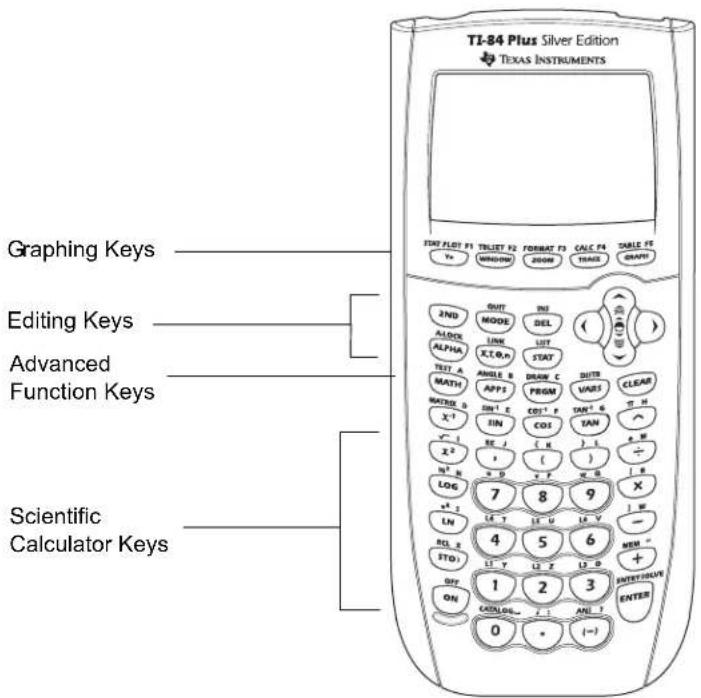
Generally, the keyboard is divided into these zones: graphing keys, editing keys, advanced function keys, and scientific calculator keys.
Keyboard Zones
Graphing — Graphing keys access the interactive graphing features. The third function of these keys (ALPHA [F1]-[F4]) displays the shortcut menus, which include templates for fractions, n/d, quick matrix entry, and some of the functions found on the MATH and VARS menus.
Editing — Editing keys allow you to edit expressions and values.
Advanced — Advanced function keys display menus that access the advanced functions.
Scientific — Scientific calculator keys access the capabilities of a standard scientific calculator.
TI-84 Plus Silver Edition
text_image
TI-84 Plus Silver Edition TEXAS INSTRUMENTS GRAPHING KEYS Editing KEYS Advanced Function KEYS Scientific Calculator Keys START PLOT F1 Y+ TRUET F2 WINDOW FORMAT F3 ZOOM CALC F4 TRADE TABLE FE GRAPY 2ND MODE DEL ALDO LINE LUT ALPHA X, E, n STAT TEST A ANGLE B DRAM C MATH APP1 PROM WATEX D DIN¹ E CO²⁺¹ F TAN¹ G X¹⁻¹ EJ - J ( N ) ( ) - N²⁻¹ N + D X²⁻¹ LOG 7 8 9 + 2 LN LE 1 LE U LE V RCL 2 STO: 4 5 6 LI Y LI Z LI D OFF: ON 1 2 3 CASOLOG... 2 ANL 2 0 - (-)Using the Color-Coded Keyboard
The keys on the TI-84 Plus are color-coded to help you easily locate the key you need.
The light colored keys are the number keys. The keys along the right side of the keyboard are the common math functions. The keys across the top set up and display graphs. The [APPS] key provides access to applications such as the Inequality Graphing, Transformation Graphing, Conic Graphing, Polynomial Root Finder and Simultaneous Equation Solver, and Catalog Help.
The primary function of each key is printed on the keys. For example, when you press [MATH], the MATH menu is displayed.
Using the 2nd and ALPHA Keys
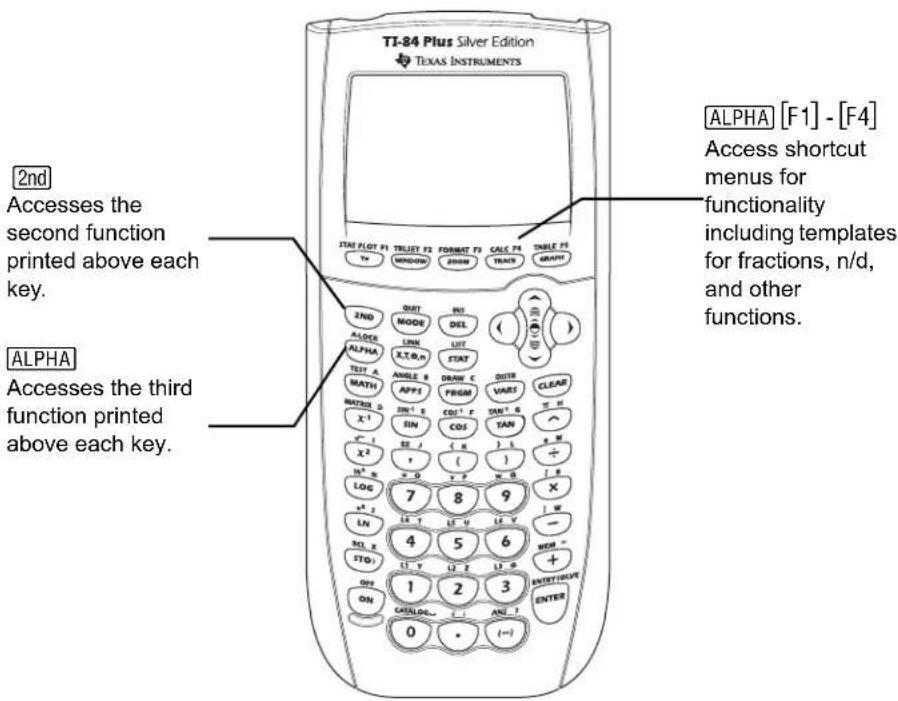
The secondary function of each key is printed above the key. When you press the 2nd key, the character, abbreviation, or word printed above the other keys becomes active for the next keystroke. For example, when you press 2nd and then MATH, the TEST menu is displayed. This guidebook describes this keystroke combination as 2nd [TEST].
Many keys also have a third function. These functions are printed above the keys in the same color as the ALPHA key. The third functions enter alphabetic characters and special symbols as well as access SOLVE and shortcut menus. For example, when you press ALPHA and then MATH, the letter A is entered. This guidebook describes this keystroke combination as ALPHA [A].
If you want to enter several alphabetic characters in a row, you can press 2nd [A-LOCK] to lock the alpha key in the On position and avoid having to press ALPHA multiple times. Press ALPHA a second time to unlock it.
Note: The flashing cursor changes to ⓗ when you press ALPHA, even if you are accessing a function or a menu.
text_image
TI-84 Plus Silver Edition TEXAS INSTRUMENTS 2nd Accesses the second function printed above each key. ALPHA Accesses the third function printed above each key. [ALPHA [F1] - [F4] Access shortcut menus for functionality including templates for fractions, n/d, and other functions.Turning On and Turning Off the TI-84 Plus
Turning On the Graphing Calculator
To turn on the TI-84 Plus, press ON. An information screen displays reminding you that you can press ALPHA [F1] - [F4] to display the shortcut menus. This message also displays when you reset RAM.
▶ To continue but not see this information screen again, press 1.
To continue and see this information screen again the next time you turn on the TI-84 Plus, press 2.
- If you previously had turned off the graphing calculator by pressing 2nd [OFF], the TI-84 Plus displays the home screen as it was when you last used it and clears any error. (The information screen displays first, unless you chose not to see it again.) If the home screen is blank, press ▶ to scroll through the history of previous calculations.
- If Automatic Power Down™ (APD™) had previously turned off the graphing calculator, the TI-84 Plus will return exactly as you left it, including the display, cursor, and any error.
- If the TI-84 Plus is turned off and connected to another graphing calculator or personal computer, any communication activity will "wake up" the TI-84 Plus.
To prolong the life of the batteries, APD ^™ turns off the TI-84 Plus automatically after about five minutes without any activity.
Turning Off the Graphing Calculator
To turn off the TI-84 Plus manually, press 2nd [OFF].
- All settings and memory contents are retained by the Constant Memory™ function.
- Any error condition is cleared.
Batteries
The TI-84 Plus uses five batteries: four AAA alkaline batteries and one button cell backup battery. The backup battery provides auxiliary power to retain memory while you replace the AAA batteries. To replace batteries without losing any information stored in memory, follow the steps in Appendix C.
Setting the Display Contrast
Adjusting the Display Contrast
You can adjust the display contrast to suit your viewing angle and lighting conditions. As you change the contrast setting, a number from 0 (lightest) to 9 (darkest) in the top-right corner indicates the current level. You may not be able to see the number if contrast is too light or too dark.
Note: The TI-84 Plus has 40 contrast settings, so each number 0 through 9 represents four settings.
The TI-84 Plus retains the contrast setting in memory when it is turned off.
To adjust the contrast, follow these steps.
▶ Press 2nd ▲ to darken the screen one level at a time.
▶ Press 2nd ▼ to lighten the screen one level at a time.
Note: If you adjust the contrast setting to 0, the display may become completely blank. To restore the screen, press 2nd until the display reappears.
When to Replace Batteries
When the batteries are low, a low-battery message is displayed when you turn on the graphing calculator.
To replace the batteries without losing any information in memory, follow the steps in Appendix C.
Generally, the graphing calculator will continue to operate for one or two weeks after the low-battery message is first displayed. After this period, the TI-84 Plus will turn off automatically and the unit will not operate. Batteries must be replaced. All memory should be retained.
Note:
- The operating period following the first low-battery message could be longer than two weeks if you use the graphing calculator infrequently.
- Always replace batteries before attempting to install a new operating system.
The Display
Types of Displays
The TI-84 Plus displays both text and graphs. Chapter 3 describes graphs. Chapter 9 describes how the TI-84 Plus can display a horizontally or vertically split screen to show graphs and text simultaneously.
Home Screen
The home screen is the primary screen of the TI-84 Plus. On this screen, enter instructions to execute and expressions to evaluate. The answers are displayed on the same screen. Most calculations are stored in the history on the home screen. You can press ▲ and ▼ to scroll through the history of entries on the home screen and you can paste the entries or answers to the current entry line.
Displaying Entries and Answers
- When text is displayed, the TI-84 Plus screen can display a maximum of 8 lines with a maximum of 16 characters per line in Classic mode. In MathPrint™ mode, fewer lines and fewer characters per line may be displayed.
- If all lines of the display are full, text scrolls off the top of the display.
- To view previous entries and answers, press ▲.
- To copy a previous entry or answer and paste it to the current entry line, move the cursor to the entry or answer you want to copy and press ENTER.
Note: List and matrix outputs cannot be copied. If you try to copy and paste a list or matrix output, the cursor returns to the input line.
- If an expression on the home screen, the Y= editor (Chapter 3), or the program editor (Chapter 16) is longer than one line, it wraps to the beginning of the next line in Classic mode. In MathPrint™ mode, an expression on the home screen or Y= editor that is longer than one line scrolls off the screen to the right. An arrow on the right side of the screen indicates that you can scroll right to see more of the expression. In numeric editors such as the window screen (Chapter 3), a long expression scrolls to the right and left in both Classic and MathPrint™ modes. Press 2nd ▶ to move the cursor to the end of the line. Press 2nd ◀ to move the cursor to the beginning of the line.
When an entry is executed on the home screen, the answer is displayed on the right side of the next line.

The mode settings control the way the TI-84 Plus interprets expressions and displays answers.
If an answer, such as a list or matrix, is too long to display entirely on one line, an arrow (MathPrint™) or an ellipsis (Classic) is displayed to the right or left. Press ▶ and ◀ to display the answer.

text_image
MathPrint™ L1 (25.12 874.2 36) Entry Answer Classic L1 (25.12 874.2 36...) Entry Answer X³+5.2X²+3.8X+5. 5.12 Entry Answer X^3+5.2X²+3.8X+5 .12 5.12 Entry AnswerUsing Shortcut Menus
text_image
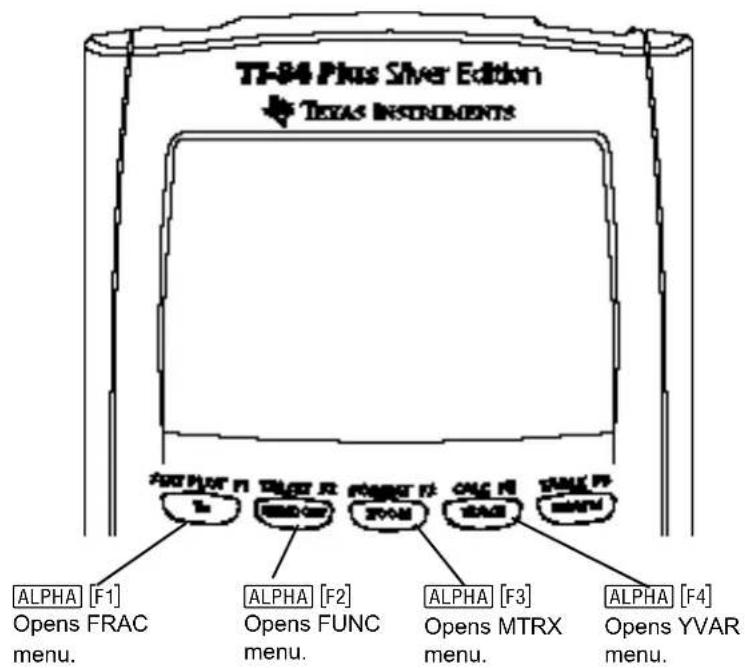
T3-84 Plus Silver Edition TEXAS INSTRUMENTS FOR PLOT FT 1st TRILOFT FT FINDOFT 200M ORIGOT FT 200M ONC FT 500M THYK FT 500M ALPHA [F1] Opens FRAC menu. ALPHA [F2] Opens FUNC menu. ALPHA [F3] Opens MTRX menu. ALPHA [F4] Opens YVAR menu.Shortcut menus allow quick access to the following:
- Templates to enter fractions and selected functions from the MATH MATH and MATH NUM menus as you would see them in a textbook. Functions include absolute value, summation, numeric differentiation, numeric integration, and log base n.
- Matrix entry.
- Names of function variables from the VARS Y-VARS menu.
Initially, the menus are hidden. To open a menu, press ALPHA plus the F-key that corresponds to the menu, that is, [F1] for FRAC, [F2] for FUNC, [F3] for MTRX, or [F4] for YVAR. To select a menu item, either press the number corresponding to the item, or use the arrow keys to move the cursor to the appropriate line and then press ENTER.
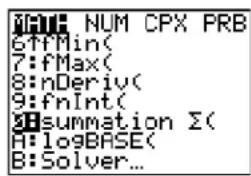
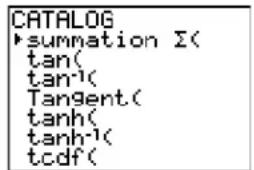
All shortcut menu items except matrix templates can also be selected using standard menus. For example, you can choose the summation template from three places:
FUNC shortcut menu

text_image
1: obs( 2: Σ( 3: nDeriv( 4: fnInt( 5: 103BASEC |FRAC FUNC MTR8 |YVARMATH MATH menu
text_image
NUM CPX PRB 6ffMin( 7:fMax( 8:nDeriv( 9:fnInt( 1summation Σ( H:logBASE( B:Solver...Catalog
text_image
CATALOG ▶summation Σ( tan( tan-1( Tangent( tanh( tanh-1( tcdf(The shortcut menus are available to use where input is allowed. If the calculator is in Classic mode, or if a screen is displayed that does not support MathPrint ^™ display, entries will be displayed in Classic display. The MTRX menu is only available in MathPrint ^™ mode on the home screen and in the Y= editor.
Note: Shortcut menus may not be available if ALPHA plus F-key combinations are used by an application that is running, such as Inequality Graphing or Transformation Graphing.
Returning to the Home Screen
To return to the home screen from any other screen, press 2nd [QUIT].
Busy Indicator
When the TI-84 Plus is calculating or graphing, a vertical moving line is displayed as a busy indicator in the top-right corner of the screen. When you pause a graph or a program, the busy indicator becomes a vertical moving dotted line.
Display Cursors
In most cases, the appearance of the cursor indicates what will happen when you press the next key or select the next menu item to be pasted as a character.
| Cursor Appearance Effect of Next Keystroke | |
| Entry Solid rectangle | A character is entered at the cursor; any existing character is overwritten |
| Insert Underline | A character is inserted in front of the cursor location |
| Second Reverse arrow | A 2nd character is entered or a 2nd operation is executed |
| Alpha Reverse A | An alpha character is entered, SOLVE is executed, or shortcut menus are displayed. |
| Full Checkerboard rectangle | No entry; the maximum characters are entered at a prompt or memory is full |
| MathPrintTM Right arrow | The cursor moves to either the next part of the template or out of the template. |
If you press ALPHA during an insertion, the cursor becomes an underlined A (A). If you press 2nd during an insertion, the underlined cursors becomes an underlined ( ).
Note: If you highlight a small character such as a colon or a comma and then press ALPHA or 2nd, the cursor does not change because the cursor width is too narrow.
Graphs and editors sometimes display additional cursors, which are described in other chapters.
Interchangeable Faceplates
The TI-84 Plus Silver Edition has interchangeable faceplates that let you customize the appearance of your unit. To purchase additional faceplates, refer to the TI Online Store at education.ti.com.
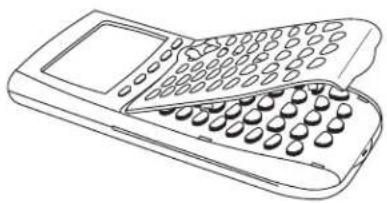
Removing a Faceplate
-
Lift the tab at the bottom edge of the faceplate away from the TI-84 Plus Silver Edition case.
-
Carefully lift the faceplate away from the unit until it releases. Be careful not to damage the faceplate or the keyboard.
natural_image
Line drawing of a handheld remote control device with keypad and display (no text or symbols)Installing New Faceplates
-
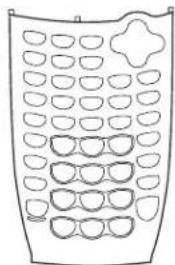
Align the top of the faceplate in the corresponding grooves of the TI-84 Plus Silver Edition case.
-
Gently click the faceplate into place. Do not force.
natural_image
Simple line drawing of a container with multiple compartments and a star-shaped symbol on the side (no text or labels)- Make sure you gently press each of the grooves to ensure the faceplate is installed properly. See the diagram for proper groove placement.

natural_image
Line drawing of a remote control device with keypad and buttons (no text or symbols)Using the Clock
Use the clock to set the time and date, select the clock display format, and turn the clock on and off. The clock is turned on by default and is accessed from the mode screen.
Displaying the Clock Settings
-
Press MODE.
-
Press the ▼ to move the cursor to SET CLOCK.
-
Press ENTER.

text_image
↑BACK↑ MATHPRINT CLASSIC 0/2 Un/d ANSWERS: AUTO DEC FRAC GOTO FORMAT GRAPH: NO YES STAT DIAGNOSTICS: OFF ON STAT WIZARDS: ON OFF SET CLOCK 09/02/10 B:00AMChanging the Clock Settings
- Press the ▶ or ◀ to highlight the date format you want. Press ENTER.
- Press ▼ to highlight YEAR. Press CLEAR and type the year.
- Press ▼ to highlight MONTH. Press CLEAR and type the number of the month (1-12).
- Press ▼ to highlight DAY. Press CLEAR and type the date.
- Press ▼ to highlight TIME. Press ▶ or ◀ to highlight the time format you want. Press ENTER.
- Press ▼ to highlight HOUR. Press CLEAR and type the hour (a number from 1-12 or 0-23).
- Press ▼ to highlight MINUTE. Press CLEAR and type the minutes (a number from 0-59).
- Press ▼ to highlight AM/PM. Press ▶ or ◀ to highlight the format. Press ENTER.
- To save changes, press ▼ to highlight SAVE. Press ENTER.

text_image
FORMAT: M/D/V D/M/Y Y/M/D YEAR: 2009 MONTH: 10 DAY: 31 TIME: 12HOUR 24HOUR HOUR: 9 MINUTE: 14 AM/FM: AM PM SAVEError Messages
If you type the wrong date for the month, for example, June 31 (June does not have 31 days), you will receive an error message with two choices:
- To quit the clock application and return to the home screen, select 1: Quit.
— or —
- To return to the clock application and correct the error, select 2: Goto.

text_image
ERR:DATE 1:Quit 2: Goto Invalid day for month selected.Turning the Clock On
There are two options to turn the clock on. One option is through the MODE screen, the other is through the Catalog.
Using the Mode Screen to turn the clock on
- If the clock is turned off, Press ▼ to highlight TURN CLOCK ON.
- Press ENTER ENTER.

text_image
TEBACK MATHPRINT CLASSIC n/d Un/d ANSHERS: AUTO DEC FRAC GOTO FORMAT GRAPH: 10 YES STATO DIAGNOSTICS: OFF ON STATWIZARDS: ON OFF SET CLOCK TURN CLOCK ONUsing the Catalog to turn the clock on
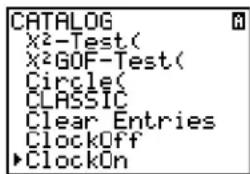
- If the clock is turned off, Press 2nd [CATALOG]
- Press ▼ or ▲ to scroll the CATALOG until the selection cursor points to ClockOn.
- Press ENTER ENTER.
text_image
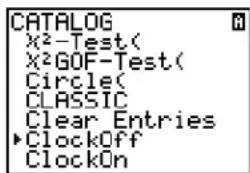
CATALOG X²-Test( X²GOF-Test( Circle( CLASSIC Clear Entries ClockOff ►ClockOnTurning the Clock Off
- Press 2nd [CATALOG].
- Press ▼ or ▲ to scroll the CATALOG until the selection cursor points to ClockOff.
- Press ENTER ENTER.
text_image
CATALOG X²-Test( X²GOF-Test( Circle( CLASSIC Clear Entries ClockOff ClockOnEntering Expressions and Instructions
What Is an Expression?
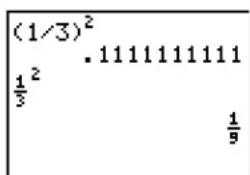
An expression is a group of numbers, variables, functions and their arguments, or a combination of these elements. An expression evaluates to a single answer. On the TI-84 Plus, you enter an expression in the same order as you would write it on paper. For example, R^2 is an expression.
You can use an expression on the home screen to calculate an answer. In most places where a value is required, you can use an expression to enter a value.
text_image
(1/3)² .1111111111 ½ ¼/9
Entering an Expression
To create an expression, you enter numbers, variables, and functions using the keyboard and menus. An expression is completed when you press ENTER, regardless of the cursor location. The entire expression is evaluated according to Equation Operating System (EOS™) rules, and the answer is displayed according to the mode setting for Answer.
Most TI-84 Plus functions and operations are symbols comprising several characters. You must enter the symbol from the keyboard or a menu; do not spell it out. For example, to calculate the log of 45, you must press LOG 45. Do not enter the letters L, O, and G. If you enter LOG, the TI-84 Plus interprets the entry as implied multiplication of the variables L, O, and G.
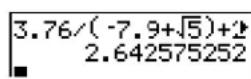
Calculate 3.76 ÷ (-7.9 + 5) + 2 45 .


MathPrint™
Classic
Multiple Entries on a Line
To enter two or more expressions or instructions on a line, separate them with colons (ALPHA [:]). All instructions are stored together in last entry (ENTRY).

Entering a Number in Scientific Notation
- Enter the part of the number that precedes the exponent. This value can be an expression.
- Press [2nd][EE] . E is pasted to the cursor location.
- Enter the exponent, which can be one or two digits.
Note: If the exponent is negative, press (-) , and then enter the exponent.
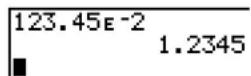
When you enter a number in scientific notation, the TI-84 Plus does not automatically display answers in scientific or engineering notation. The mode settings and the size of the number determine the display format.
Functions
A function returns a value. For example, ( \div, -, +, \sqrt{} ) , and ( \log(\text{are the functions in the example on the previous page. In general, the first letter of each function is lowercase on the TI-84 Plus. Most functions take at least one argument, as indicated by an open parenthesis following the name. For example, ( \sin(\text{requires one argument}, \sin(\text{value}) ) .
Note: The Catalog Help App contains syntax information for most of the functions in the catalog.
Instructions
An instruction initiates an action. For example, ClrDraw is an instruction that clears any drawn elements from a graph. Instructions cannot be used in expressions. In general, the first letter of each instruction name is uppercase. Some instructions take more than one argument, as indicated by an open parenthesis at the end of the name. For example, Circle( requires three arguments, Circle(X,Y,radius).
Interrupting a Calculation
To interrupt a calculation or graph in progress, which is indicated by the busy indicator, press ON.
When you interrupt a calculation, a menu is displayed.
• To return to the home screen, select 1:Quit.
• To go to the location of the interruption, select 2:Goto.
When you interrupt a graph, a partial graph is displayed.
• To return to the home screen, press CLEAR or any non-graphing key.
- To restart graphing, press a graphing key or select a graphing instruction.
TI-84 Plus Edit Keys
| Keystrokes Result | |
| or | Moves the cursor within an expression; these keys repeat. |
| or | Moves the cursor from line to line within an expression that occupies more than one line; these keys repeat.Moves the cursor from term to term within an expression in MathPrint^TM mode; these keys repeat.On the home screen, scrolls through the history of entries and answers. |
| 2nd | Moves the cursor to the beginning of an expression. |
| 2nd | Moves the cursor to the end of an expression. |
| 2nd | On the home screen, moves the cursor out of a MathPrint^TM expression.In the Y=editor, moves the cursor from a MathPrint^TM expression to the previous Y-var. |
| 2nd | In the Y=editor, moves the cursor from a MathPrint^TM expression to the next Y-var. |
| ENTER | Evaluates an expression or executes an instruction. |
| CLEAR | On a line with text on the home screen, clears the current line.On a blank line on the home screen, clears everything on the home screen.In an editor, clears the expression or value where the cursor is located; it does not store a zero. |
| DEL | Deletes a character at the cursor; this key repeats. |
| 2nd [INS] | Changes the cursor to an underline (____); inserts characters in front of the underline cursor; to end insertion, press 2nd [INS] or press ▼, ▲, ▶, or ▼. |
| 2nd | Changes the cursor to 1; the next keystroke performs a 2nd function (displayed above a key and to the left); to cancel 2nd, press 2nd again. |
| ALPHA | Changes the cursor to 1; the next keystroke performs a third function of that key (displayed above a key and to the right), executes SOLVE (Chapters 10 and 11), or accesses a shortcut menu; to cancel ALPHA, press ALPHA or press ▼, ▲, ▶, or ▼. |
| 2nd [A-LOCK] | Changes the cursor to 1; sets alpha-lock; subsequent keystrokes access the third functions of the keys pressed; to cancel alpha-lock, press ALPHA. If you are prompted to enter a name such as for a group or a program, alpha-lock is set automatically. |
| X,T,Θ,n | Pastes an X in Func mode, a T in Par mode, a θ in Pol mode, or an n in Seq mode with one keystroke. |
Setting Modes
Checking Mode Settings
Mode settings control how the TI-84 Plus displays and interprets numbers and graphs. Mode settings are retained by the Constant 'Memory™ feature when the TI-84 Plus is turned off. All numbers, including elements of matrices and lists, are displayed according to the current mode settings.
To display the mode settings, press MODE. The current settings are highlighted. Defaults are highlighted below. The following pages describe the mode settings in detail.
| Normal Sci Eng | Numeric notation |
| Float 0123456789 | Number of decimal places in answers |
| Radian Degree | Unit of angle measure |
| Func Par Pol Seq | Type of graphing |
| Connected Dot | Whether to connect graph points |
| Sequential Simul | Whether to plot simultaneously |
| Real a+bi re^θi | Real, rectangular complex, or polar complex |
| Full Horiz G-T | Full screen, two split-screen modes |
| MathPrint Classic | Controls whether inputs and outputs on the home screen and in the Y= editor are displayed as they are in textbooks |
| n/d Un/d | Displays results as simple fractions or mixed fractions |
| Answers: Auto Dec Frac | Controls the format of the answers |
| GoTo Format Graph: No Yes | Shortcut to the Format Graph screen (2nd [FORMAT]) |
| StatDiagnostics: Off On | Determines which information is displayed in a statistical regression calculation |
| StatWizards: On Off | Determines if syntax help prompts are provided for optional and required arguments for many statistical, regression and distribution commands and functions.On: Selection of menu items in STAT CALC, DISTR DISTR, DISTR DRAW and seq( in LIST OPS displays a screen which provides syntax help (wizard) for the entry of required and optional arguments into the command or function. The function or command will paste the entered arguments to the Home Screen history or to most other locations where the cursor is available for input. Some calculations will compute directly from the wizard. If a command or function is accessed from [CATALOG] the command or function will paste without wizard support.Run the Catalog Help application (APPS) for more syntax help when needed.Off: The function or command will paste to the cursor location with no syntax help (wizard). |
| Set Clock | Sets the time and date |
Changing Mode Settings
To change mode settings, follow these steps.
- Press ▼ or ▲ to move the cursor to the line of the setting that you want to change.
- Press ▶ or ◀ to move the cursor to the setting you want.
- Press ENTER.
Setting a Mode from a Program
You can set a mode from a program by entering the name of the mode as an instruction; for example, Func or Float. From a blank program command line, select the mode setting from the mode screen; the instruction is pasted to the cursor location.
PROGRAM: TEST : Func
Normal, Sci, Eng
Notation modes only affect the way an answer is displayed on the home screen. Numeric answers can be displayed with up to 10 digits and a two-digit exponent and as fractions. You can enter a number in any format.
Normal notation mode is the usual way we express numbers, with digits to the left and right of the decimal, as in 12345.67.
Sci (scientific) notation mode expresses numbers in two parts. The significant digits display with one digit to the left of the decimal. The appropriate power of 10 displays to the right of E, as in 1.234567E4.
Eng (engineering) notation mode is similar to scientific notation. However, the number can have one, two, or three digits before the decimal; and the power-of-10 exponent is a multiple of three, as in 12.34567E3.
Note: If you select Normal notation, but the answer cannot display in 10 digits (or the absolute value is less than .001), the TI-84 Plus expresses the answer in scientific notation.
Float, 0123456789
Float (floating) decimal mode displays up to 10 digits, plus the sign and decimal.
0123456789 (fixed) decimal mode specifies the number of digits (0 through 9) to display to the right of the decimal for decimal answers.
The decimal setting applies to Normal, Sci, and Eng notation modes.
The decimal setting applies to these numbers, with respect to the Answer mode setting:
- An answer displayed on the home screen
- Coordinates on a graph (Chapters 3, 4, 5, and 6)
- T Tangent( DRAW instruction equation of the line, x, and dy/dx values (Chapter 8)
• Results of CALCULATE operations (Chapters 3, 4, 5, and 6) - The regression equation stored after the execution of a regression model (Chapter 12)
Radian, Degree
Angle modes control how the TI-84 Plus interprets angle values in trigonometric functions and polar/rectangular conversions.
Radian mode interprets angle values as radians. Answers display in radians.
Degree mode interprets angle values as degrees. Answers display in degrees.
Func, Par, Pol, Seq
Graphing modes define the graphing parameters. Chapters 3, 4, 5, and 6 describe these modes in detail.
Func (function) graphing mode plots functions, where Y is a function of X (Chapter 3).
Par (parametric) graphing mode plots relations, where X and Y are functions of T (Chapter 4).
Pol (polar) graphing mode plots functions, where r is a function of (Chapter 5).
Seq (sequence) graphing mode plots sequences (Chapter 6).
Connected, Dot
Connected plotting mode draws a line connecting each point calculated for the selected functions.
Dot plotting mode plots only the calculated points of the selected functions.
Sequential, Simul
Sequential graphing-order mode evaluates and plots one function completely before the next function is evaluated and plotted.
Simul (simultaneous) graphing-order mode evaluates and plots all selected functions for a single value of X and then evaluates and plots them for the next value of X.
Note: Regardless of which graphing mode is selected, the TI-84 Plus will sequentially graph all stat plots before it graphs any functions.
Real, a+bi, re^θi
Real mode does not display complex results unless complex numbers are entered as input.
Two complex modes display complex results.
• a+bi (rectangular complex mode) displays complex numbers in the form a+bi .
• re^_i (polar complex mode) displays complex numbers in the form re^_i .
Note: When you use the n/d template, both n and d must be real numbers. For example, you can enter 12 + 14i (the answer is displayed as a decimal value) but if you enter (1-i)i , a data type error displays. To perform division with a complex number in the numerator or denominator, use regular division instead of the n/d template.

text_image
½ + ¼ i (1-i) / i .5+ .25i -1-iFull, Horiz, G-T
Full screen mode uses the entire screen to display a graph or edit screen.
Each split-screen mode displays two screens simultaneously.
- Horiz (horizontal) mode displays the current graph on the top half of the screen; it displays the home screen or an editor on the bottom half (Chapter 9).
- G-T (graph-table) mode displays the current graph on the left half of the screen; it displays the table screen on the right half (Chapter 9).
MathPrint™, Classic
MathPrint™ mode displays most inputs and outputs the way they are shown in textbooks, such as
$$ \frac {1}{2} \quad \frac {3}{4} + \text { and } \int_ {1} ^ {2} ^ {2} d x $$
Classic mode displays expressions and answers as if written on one line, such as 1/2 + 3/4.
Note: If you switch between these modes, most entries will be preserved; however matrix calculations will not be preserved.
n/d, Un/d
n/d displays results as a simple fraction. Fractions may contain a maximum of six digits in the numerator; the value of the denominator may not exceed 9999.
Un/d displays results as a mixed number, if applicable. U, n, and d must be all be integers. If U is a non-integer, the result may be converted U * n/d. If n or d is a non-integer, a syntax error is displayed. The whole number, numerator, and denominator may each contain a maximum of three digits.
Answers: Auto, Dec, Frac
Auto displays answers in a similar format as the input. For example, if a fraction is entered in an expression, the answer will be in fraction form, if possible. If a decimal appears in the expression, the output will be a decimal number.
Dec displays answers as integers or decimal numbers.
Frac displays answers as fractions, if possible.
Note: The Answers mode setting also affects how values in sequences, lists, and tables are displayed. Choose Dec or Frac to ensure that values are displayed in either decimal or fraction form. You can also convert values from decimal to fraction or fraction to decimal using the FRAC shortcut menu or the MATH menu.
GoTo Format Graph: No, Yes
No does not display the FORMAT graph screen, but can always be accessed by pressing [2nd] [FORMAT].
Yes leaves the mode screen and displays the FORMAT graph screen when you press ENTER so that you can change the graph format settings. To return to the mode screen, press MODE.
Stat Diagnostics: Off, On
Off displays a statistical regression calculation without the correlation coefficient (r) or the coefficient of determination ( r^2 ).
On displays a statistical regression calculation with the correlation coefficient (r), and the coefficient of determination ( r^2 ), as appropriate.
Stat Wizards: On, Off
On: Selection of menu items in STAT CALC, DISTR DISTR, DISTR DRAW and seq(in LIST OPS displays a screen which provides syntax help (wizard) for the entry of required and optional arguments into the command or function. The function or command will paste the entered arguments to the Home Screen history or to most other locations where the cursor is available for input. Some calculations will compute directly from the wizard. If a command or function is accessed from [CATALOG] the command or function will paste without wizard support. Run the Catalog Help application (APPS) for more syntax help when needed.
Off: The function or command will paste to the cursor location with no syntax help (wizard)
Set Clock
Use the clock to set the time, date, and clock display formats.
Using TI-84 Plus Variable Names
Variables and Defined Items
On the TI-84 Plus you can enter and use several types of data, including real and complex numbers, matrices, lists, functions, stat plots, graph databases, graph pictures, and strings.
The TI-84 Plus uses assigned names for variables and other items saved in memory. For lists, you also can create your own five-character names.
| Variable Type Names | |
| Real numbers (including fractions) | A, B, ..., Z, θ |
| Complex numbers | A, B, ..., Z, θ |
| Matrices | [A], [B], [C], ..., [J] |
| Lists | L1, L2, L3, L4, L5, L6, and user-defined names |
| Functions | Y1, Y2, ..., Y9, Y0 |
| Parametric equations | X1T and Y1T, ..., X6T and Y6T |
| Variable Type | Names |
| Polar functions | r1, r2, r3, r4, r5, r6 |
| Sequence functions | u, v, w |
| Stat plots Plot1, Plot2, Plot3 | |
| Graph databases | GDB1, GDB2, ..., GDB9, GDB0 |
| Graph pictures | Pic1, Pic2, ..., Pic9, Pic0 |
| Strings | Str1, Str2, ..., Str9, Str0 |
| Apps Applications | |
| AppVars | Application variables |
| Groups | Grouped variables |
| System variables | Xmin, Xmax, and others |
Notes about Variables
- You can create as many list names as memory will allow (Chapter 11).
- Programs have user-defined names and share memory with variables (Chapter 16).
- From the home screen or from a program, you can store to matrices (Chapter 10), lists (Chapter 11), strings (Chapter 15), system variables such as Xmax (Chapter 1), TblStart (Chapter 7), and all Y= functions (Chapters 3, 4, 5, and 6).
- From an editor, you can store to matrices, lists, and Y = functions (Chapter 3).
- From the home screen, a program, or an editor, you can store a value to a matrix element or a list element.
- You can use DRAW STO menu items to store and recall graph databases and pictures (Chapter 8).
- Although most variables can be archived, system variables including r, T, X, Y, and cannot be archived (Chapter 18)
- Apps are independent applications. which are stored in Flash ROM. AppVars is a variable holder used to store variables created by independent applications. You cannot edit or change variables in AppVars unless you do so through the application which created them.
Storing Variable Values
Storing Values in a Variable
Values are stored to and recalled from memory using variable names. When an expression containing the name of a variable is evaluated, the value of the variable at that time is used.
To store a value to a variable from the home screen or a program using the STO◆ key, begin on a blank line and follow these steps.
- Enter the value you want to store. The value can be an expression.
-
Press STO▶. → is copied to the cursor location.
-
Press ALPHA and then the letter of the variable to which you want to store the value.
- Press ENTER. If you entered an expression, it is evaluated. The value is stored to the variable.

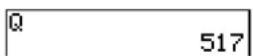
Displaying a Variable Value
To display the value of a variable, enter the name on a blank line on the home screen, and then press ENTER.
Archiving Variables (Archive, Unarchive)
You can archive data, programs, or other variables in a section of memory called user data archive where they cannot be edited or deleted inadvertently. Archived variables are indicated by asterisks (*) to the left of the variable names. Archived variables cannot be edited or executed. They can only be seen and unarchived. For example, if you archive list L1, you will see that L1 exists in memory but if you select it and paste the name L1 to the home screen, you won't be able to see its contents or edit it until it is unarchived.
Recalling Variable Values
Using Recall (RCL)
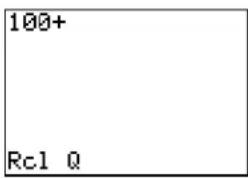
To recall and copy variable contents to the current cursor location, follow these steps. To leave RCL, press CLEAR.
- Press 2nd [RCL]. RCL and the edit cursor are displayed on the bottom line of the screen.
- Enter the name of the variable in one of five ways.
- Press ALPHA and then the letter of the variable.
- Press 2nd [LIST], and then select the name of the list, or press 2nd [Ln].
- Press 2nd [MATRIX], and then select the name of the matrix.
- Press VARS to display the VARS menu or VARS ▶ to display the VARS Y-VARS menu; then select the type and then the name of the variable or function.
- Press ALPHA [F4] to display the YVAR shortcut menu, then select the name of the function.
- Press PRGM, and then select the name of the program (in the program editor only).
The variable name you selected is displayed on the bottom line and the cursor disappears.
text_image
100+ Rc1 Q- Press ENTER. The variable contents are inserted where the cursor was located before you began these steps.

Note: You can edit the characters pasted to the expression without affecting the value in memory.
Scrolling Through Previous Entries on the Home Screen
You can scroll up through previous entries and answers on the home screen, even if you have cleared the screen. When you find an entry or answer that you want to use, you can select it and paste it on the current entry line.
Note: List and matrix answers cannot be copied and pasted to the new entry line. However, you can copy the list or matrix command to the new entry line and execute the command again to display the answer.
▶ Press ▲ or ▼ to move the cursor to the entry or answer you want to copy and then press ENTER. The entry or answer that you copied is automatically pasted on the current input line at the cursor location.
Note: If the cursor is in a MathPrint™ expression, press 2nd to move the cursor out of the expression and then move the cursor to the entry or answer you want to copy.
▶ Press CLEAR or DEL to delete an entry/answer pair. After an entry/answer pair has been deleted, it cannot be displayed or recalled again.
ENTRY (Last Entry) Storage Area
Using ENTRY (Last Entry)
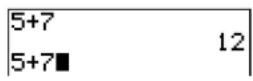
When you press ENTER on the home screen to evaluate an expression or execute an instruction, the expression or instruction is placed in a storage area called ENTRY (last entry). When you turn off the TI-84 Plus, ENTRY is retained in memory.
To recall ENTRY, press [2nd][ENTRY] . The last entry is pasted to the current cursor location, where you can edit and execute it. On the home screen or in an editor, the current line is cleared and the last entry is pasted to the line.
Because the TI-84 Plus updates ENTRY only when you press ENTER, you can recall the previous entry even if you have begun to enter the next expression.

Accessing a Previous Entry
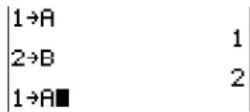
The TI-84 Plus retains as many previous entries as possible in ENTRY, up to a capacity of 128 bytes. To scroll those entries, press 2nd repeatedly. If a single entry is more than 128 bytes, it is retained for ENTRY, but it cannot be placed in the ENTRY storage area.
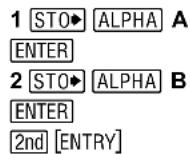
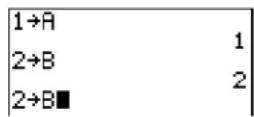
If you press [2nd] [ENTRY] after displaying the oldest stored entry, the newest stored entry is displayed again, then the next-newest entry, and so on.
Executing the Previous Entry Again
After you have pasted the last entry to the home screen and edited it (if you chose to edit it), you can execute the entry. To execute the last entry, press ENTER.
To execute the displayed entry again, press ENTER again. Each subsequent execution displays the entry and the new answer.
0 STO▶ ALPHA N
ENTER
ALPHA N + 1 STO▶ ALPHA N
ALPHA [ : ] ALPHA N x^2 ENTER
ENTER
ENTER

text_image
0→N N+1→N:N² N+1→N:N² 0 1 4Multiple Entry Values on a Line
To store to ENTRY two or more expressions or instructions, separate each expression or instruction with a colon, then press ENTER. All expressions and instructions separated by colons are stored in ENTRY.
When you press 2nd [ENTRY], all the expressions and instructions separated by colons are pasted to the current cursor location. You can edit any of the entries, and then execute all of them when you press ENTER.
Example: For the equation A= r^2 , use trial and error to find the radius of a circle that covers 200 square centimeters. Use 8 as your first guess.

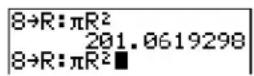


Continue until the answer is as accurate as you want.
Clearing ENTRY
Clear Entries (Chapter 18) clears all data that the TI-84 Plus is holding in the ENTRY storage area.
Using Ans in an Expression
When an expression is evaluated successfully from the home screen or from a program, the TI-84 Plus stores the answer to a storage area called Ans (last answer). Ans may be a real or complex number, a list, a matrix, or a string. When you turn off the TI-84 Plus, the value in Ans is retained in memory.
You can use the variable Ans to represent the last answer in most places. Press [2nd] [ANS] to copy the variable name Ans to the cursor location. When the expression is evaluated, the TI-84 Plus uses the value of Ans in the calculation.
Calculate the area of a garden plot 1.7 meters by 4.2 meters. Then calculate the yield per square meter if the plot produces a total of 147 tomatoes.


Continuing an Expression
You can use Ans as the first entry in the next expression without entering the value again or pressing [2nd][ANS] . On a blank line on the home screen, enter the function. The TI-84 Plus pastes the variable name Ans to the screen, then the function.
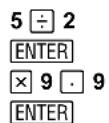

Storing Answers
To store an answer, storeAns to a variable before you evaluate another expression.
Calculate the area of a circle of radius 5 meters. Next, calculate the volume of a cylinder of radius 5 meters and height 3.3 meters, and then store the result in the variable V.

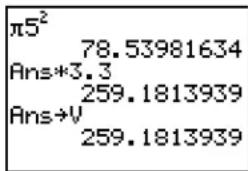
text_image
π5² 78.53981634 Ans*3.3 259.1813939 Ans→V 259.1813939TI-84 Plus Menus
Using a TI-84 Plus Menu
You can access most TI-84 Plus operations using menus. When you press a key or key combination to display a menu, one or more menu names appear on the top line of the screen.
- The menu name on the left side of the top line is highlighted. Up to seven items in that menu are displayed, beginning with item 1, which also is highlighted.
- A number or letter identifies each menu item's place in the menu. The order is 1 through 9, then 0, then A, B, C, and so on. The LIST NAMES, PRGM EXEC, and PRGM EDIT menus only label items 1 through 9 and 0.
- When the menu continues beyond the displayed items, a down arrow (↓) replaces the colon next to the last displayed item.
- When a menu item ends in an ellipsis ( ...), the item displays a secondary menu or editor when you select it.
- When an asterisk (*) appears to the left of a menu item, that item is stored in user data archive (Chapter 18).

Displaying a Menu
While using your TI-84 Plus, you often will need to access items from its menus.
When you press a key that displays a menu, that menu temporarily replaces the screen where you are working. For example, when you press [MATH], the MATH menu is displayed as a full screen.
After you select an item from a menu, the screen where you are working usually is displayed again.
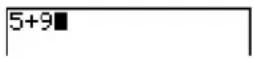
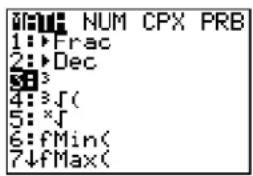
text_image
NUM CPX PRB 1::Frac 2::Dec 3: 4::J( 5: *J 6:fMin( 7↓fMax(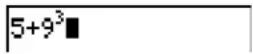
Moving from One Menu to Another
Some keys access more than one menu. When you press such a key, the names of all accessible menus are displayed on the top line. When you highlight a menu name, the items in that menu are displayed. Press ▶ and ◀ to highlight each menu name.
Note: FRAC shortcut menu items are also found on the MATH NUM menu. FUNC shortcut menu items are also found on the MATH MATH menu.

text_image
MATH NUM CPX PRB abs( 2:round( 3:iPart( 4:fPart( 5:int( 6:min( 7↓max(Scrolling a Menu
To scroll down the menu items, press ▼. To scroll up the menu items, press ▲.
To page down six menu items at a time, press ALPHA ▼. To page up six menu items at a time, press ALPHA ▲.
To go to the last menu item directly from the first menu item, press ▶. To go to the first menu item directly from the last menu item, press ▼.
Selecting an Item from a Menu
You can select an item from a menu in either of two ways.
- Press the number or letter of the item you want to select. The cursor can be anywhere on the menu, and the item you select need not be displayed on the screen.
- Press ▼ or ▲ to move the cursor to the item you want, and then press ENTER.
After you select an item from a menu, the TI-84 Plus typically displays the previous screen.
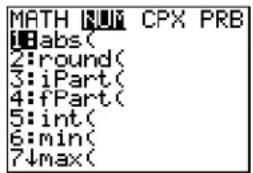
text_image
MATH CPU CPX PRB abs( 2:round( 3:iPart( 4:fPart( 5:int( 6:min( 7↓max(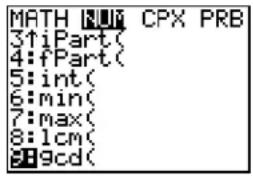
text_image
MATH CPX PRB 3↑iPart( 4:fPart( 5:int( 6:min( 7:max( 8:1cm( 9gcd( )Note: On the LIST NAMES, PRGM EXEC, and PRGM EDIT menus, only items 1 through 9 and 0 are labeled in such a way that you can select them by pressing the appropriate number key. To move the cursor to the first item beginning with any alpha character or , press the key combination for that alpha character or . If no items begin with that character, the cursor moves beyond it to the next item.
Example: Calculate ^3[3]27 .


Leaving a Menu without Making a Selection
You can leave a menu without making a selection in any of four ways.
- Press 2nd [QUIT] to return to the home screen.
- Press CLEAR to return to the previous screen.
- Press a key or key combination for a different menu, such as MATH or 2nd [LIST].
- Press a key or key combination for a different screen, such as Y= or 2nd [TABLE].
VARS and VARS Y-VARS Menus
VARS Menu
You can enter the names of functions and system variables in an expression or store to them directly.
To display the VARS menu, press VARS. All VARS menu items display secondary menus, which show the names of the system variables. 1:Window, 2:Zoom, and 5:Statistics each access more than one secondary menu.
| VARS Y-VARS | |
| 1: Window... | X/Y, T/θ, and U/V/W variables |
| 2: Zoom... | ZX/ZY, ZT/Zθ, and ZU variables |
| 3: GDB... | Graph database variables |
| 4: Picture... | Picture variables |
| 5: Statistics... | XY, Σ EQ, TEST, and PTS variables |
| 6: Table... | TABLE variables |
| 7: String... | String variables |
Selecting a Variable from the VARS Menu or VARS Y-VARS Menu
To display the VARS Y-VARS menu, press VARS ▶. 1:Function, 2:Parametric, and 3:Polar display secondary menus of the Y= function variables.
| VARS Y-VARS | |
| 1: Function... | Y_n functions |
| 2: Parametric... | X_nT,Y_nT functions, also found on the YVARS shortcut menu |
| 3: Polar... | r_n functions, also found on the YVARS shortcut menu |
| 4: On/Off... | Lets you select/deselect functions |
Note:
- The sequence variables (u,v,w) are located on the keyboard as the second functions of 7, 8, and 9.
- These Y= function variables are also on the YVAR shortcut menu.
To select a variable from the VARS or VARS Y-VARS menu, follow these steps.
-
Display the VARS or VARS Y-VARS menu.
-
Press VARS to display the VARS menu.
-
Press VARS ▶ to display the VARS Y-VARS menu.
-
Select the type of variable, such as 2:Zoom from the VARS menu or 3:Polar from the VARS Y-VARS menu. A secondary menu is displayed.
- If you selected 1:Window, 2:Zoom, or 5:Statistics from the VARS menu, you can press ▶ or ▼ to display other secondary menus.
- Select a variable name from the menu. It is pasted to the cursor location.
Equation Operating System (EOS™)
Order of Evaluation
The Equation Operating System (EOS ^™ ) defines the order in which functions in expressions are entered and evaluated on the TI-84 Plus. EOS ^™ lets you enter numbers and functions in a simple, straightforward sequence.
EOS ^™ evaluates the functions in an expression in this order.
| Order Number Function | |
| 1 | Functions that precede the argument, such as , (·) , or (·) |
| 2 | Functions that are entered after the argument, such as ^2 , ^-1 , !, °, r, and conversions |
| 3 | Powers and roots, such as 2^5 or 5^x32 |
| 4 | Permutations (nPr) and combinations (nCr) |
| 5 | Multiplication, implied multiplication, and division |
| 6 | Addition and subtraction |
| 7 | Relational functions, such as > or ≤ |
| 8 | Logic operator and |
| 9 | Logic operators or and xor |
Note: Within a priority level, EOS ^™ evaluates functions from left to right. Calculations within parentheses are evaluated first.
Implied Multiplication
The TI-84 Plus recognizes implied multiplication, so you need not press × to express multiplication in all cases. For example, the TI-84 Plus interprets 2 , 4(46) , 5(1+2) , and (2*5)7 as implied multiplication.
Note: TI-84 Plus implied multiplication rules, although like the TI-83, differ from those of the TI-82. For example, the TI-84 Plus evaluates 1/2X as (1/2)*X, while the TI-82 evaluates 1/2X as 1/(2*X) (Chapter 2).
Parentheses
All calculations inside a pair of parentheses are completed first. For example, in the expression 4(1+2) , EOS first evaluates the portion inside the parentheses, 1+2 , and then multiplies the answer, 3, by 4.
| 4*1+2 | 6 |
| 4(1+2) | 12 |
Negation
To enter a negative number, use the negation key. Press (-) and then enter the number. On the TI-84 Plus, negation is in the third level in the EOS ^™ hierarchy. Functions in the first level, such as squaring, are evaluated before negation.
Example: -X^2 , evaluates to a negative number (or 0). Use parentheses to square a negative number.

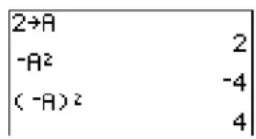
Note: Use the key for subtraction and the key for negation. If you press to enter a negative number, as in 9 × 7, or if you press to indicate subtraction, as in 9 7, an error occurs. If you press ALPHA A ALPHA B, it is interpreted as implied multiplication (A*-B).
Special Features of the TI-84 Plus
Flash – Electronic Upgradability
The TI-84 Plus uses Flash technology, which lets you upgrade to future software versions without buying a new graphing calculator.
As new functionality becomes available, you can electronically upgrade your TI-84 Plus from the Internet. Future software versions include maintenance upgrades that will be released free of charge, as well as new applications and major software upgrades that will be available for purchase from the TI Web site: education.ti.com. For details, refer to Chapter 19.
1.5 Megabytes of Available Memory
1.5 MB of available memory are built into the TI-84 Plus Silver Edition, and 0.5 MB for the TI-84 Plus. About 24 kilobytes (K) of RAM (random access memory) are available for you to compute and store functions, programs, and data.
About 1.5 M of user data archive allow you to store data, programs, applications, or any other variables to a safe location where they cannot be edited or deleted inadvertently. You can also free up RAM by archiving variables to user data. For details, refer to Chapter 18.
Applications
Many applications are preloaded on your TI-84 Plus and others can be installed to customize the TI-84 Plus to your needs. The 1.5 MB archive space lets you store up to 94 applications at one time on the TI-84 Plus Silver Edition. Applications can also be stored on a computer for later use or linked unit-to-unit. There are 30 App slots for the TI-84 Plus. For details, refer to Chapter 18.
Archiving
You can store variables in the TI-84 Plus user data archive, a protected area of memory separate from RAM. The user data archive lets you:
- Store data, programs, applications or any other variables to a safe location where they cannot be edited or deleted inadvertently.
- Create additional free RAM by archiving variables.
By archiving variables that do not need to be edited frequently, you can free up RAM for applications that may require additional memory. For details, refer to: Chapter 18.
Other TI-84 Plus Features
The TI-84 Plus guidebook that is included with your graphing calculator has introduced you to basic TI-84 Plus operations. This guidebook covers the other features and capabilities of the TI-84 Plus in greater detail.
Graphing
You can store, graph, and analyze up to 10 functions, up to six parametric functions, up to six polar functions, and up to three sequences. You can use DRAW instructions to annotate graphs.
The graphing chapters appear in this order: Function, Parametric, Polar, Sequence, and DRAW. For graphing details, refer to Chapters 3, 4, 5, 6, 8.
Sequences
You can generate sequences and graph them over time. Or, you can graph them as web plots or as phase plots. For details, refer to Chapter 6.
Tables
You can create function evaluation tables to analyze many functions simultaneously. For details, refer to Chapter 7.
Split Screen
You can split the screen horizontally to display both a graph and a related editor (such as the Y=editor), the table, the stat list editor, or the home screen. Also, you can split the screen vertically to display a graph and its table simultaneously. For details, refer to Chapter 9.
Matrices
You can enter and save up to 10 matrices and perform standard matrix operations on them. For details, refer to Chapter 10.
Lists
You can enter and save as many lists as memory allows for use in statistical analyses. You can attach formulas to lists for automatic computation. You can use lists to evaluate expressions at multiple values simultaneously and to graph a family of curves. For details, refer to: Chapter 11.
Statistics
You can perform one- and two-variable, list-based statistical analyses, including logistic and sine regression analysis. You can plot the data as a histogram, xyLine, scatter plot, modified or regular box-and-whisker plot, or normal probability plot. You can define and store up to three stat plot definitions. For details, refer to Chapter 12.
Inferential Statistics
You can perform 16 hypothesis tests and confidence intervals and 15 distribution functions. You can display hypothesis test results graphically or numerically. For details, refer to Chapter 13.
Applications
Press APPS to see the complete list of applications that came with your graphing calculator.
Visit education.ti.com/guides for additional Flash application guidebooks. For details, refer to Chapter 14.
CATALOG
The CATALOG is a convenient, alphabetical list of all functions and instructions on the TI-84 Plus. You can paste any function or instruction from the CATALOG to the current cursor location. For details, refer to Chapter 15.
Programming
You can enter and store programs that include extensive control and input/output instructions. For details, refer to Chapter 16.
Archiving
Archiving allows you to store data, programs, or other variables to user data archive where they cannot be edited or deleted inadvertently. Archiving also allows you to free up RAM for variables that may require additional memory.
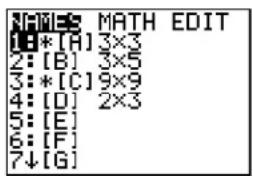
Archived variables are indicated by asterisks (*) to the left of the variable names.
text_image
NAME: MATH EDIT 10:*[A]3×3 2:[B] 3×5 3:*[C]9×9 4:[D] 2×3 5:[E] 6:[F] 7↓[G]For details, refer to Chapter 16.
Communication Link
The TI-84 Plus has a USB port using a USB unit-to-unit cable to connect and communicate with another TI-84 Plus or TI-84 Plus Silver Edition. The TI-84 Plus also has an I/O port using an I/O unit-to-unit cable to communicate with a TI-84 Plus Silver Edition, a TI-84 Plus, a TI-83 Plus Silver Edition, a TI-83 Plus, a TI-83, a TI-82, a TI-73, CBL 2 ^™ , or a CBR ^™ System.
With TI Connect™ software and a USB computer cable, you can also link the TI-84 Plus to a personal computer.
As future software upgrades become available on the TI Web site, you can download the software to your PC and then use the TI Connect™ software and a USB computer cable to upgrade your TI-84 Plus.
For details, refer to: Chapter 19
Error Conditions
Diagnosing an Error
The TI-84 Plus detects errors while performing these tasks.
- Evaluating an expression
- Executing an instruction
- Plotting a graph
- Storing a value
When the TI-84 Plus detects an error, it returns an error message as a menu title, such as ERR:SYNTAX or ERR:DOMAIN. Appendix B describes each error type and possible reasons for the error.
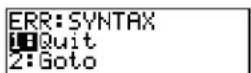
- If you select 1:Quit (or press 2nd [QUIT] or CLEAR), then the home screen is displayed.
- If you select location. 2: Goto, then the previous screen is displayed with the cursor at or near the error
Note: If a syntax error occurs in the contents of a Y= function during program execution, then the Goto option returns to the Y= editor, not to the program.
Correcting an Error
To correct an error, follow these steps.
- Note the error type (ERR:error type).
- Select 2:Goto, if it is available. The previous screen is displayed with the cursor at or near the error location.
- Determine the error. If you cannot recognize the error, refer to Appendix B.
- Correct the expression.
Chapter 2:
Math, Angle, and Test Operations
Getting Started: Coin Flip
Getting Started is a fast-paced introduction. Read the chapter for details. For more probability simulations, try the Probability Simulations App for the TI-84 Plus. You can download this App from education.ti.com.
Suppose you want to model flipping a fair coin 10 times. You want to track how many of those 10 coin flips result in heads. You want to perform this simulation 40 times. With a fair coin, the probability of a coin flip resulting in heads is 0.5 and the probability of a coin flip resulting in tails is 0.5.
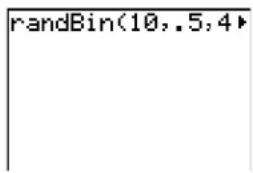
- Begin on the home screen. Press MATH ▶ to display the MATH PRB menu. Press 7 to select 7:randBin( (random Binomial). randBin( is pasted to the home screen. Press 10 to enter the number of coin flips. Press ▶. Press ▶ 5 to enter the probability of heads. Press ▶. Press 40 to enter the number of simulations. Press ▶.
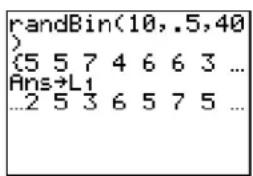
- Press ENTER to evaluate the expression. A list of 40 elements is generated with the first 7 displayed. The list contains the count of heads resulting from each set of 10 coin flips. The list has 40 elements because this simulation was performed 40 times. In this example, the coin came up heads five times in the first set of 10 coin flips, five times in the second set of 10 coin flips, and so on.
- Press ▶ or ▶ to view the additional counts in the list. An arrow (MathPrint™ mode) or an ellipses (Classic mode) indicate that the list continues beyond the screen.
- Press STO▶ 2nd [L1] ENTER to store the data to the list name L1. You then can use the data for another activity, such as plotting a histogram (Chapter 12).
Note: Since randBin( generates random numbers, your list elements may differ from those in the example.
text_image
randBin(10,.5,4)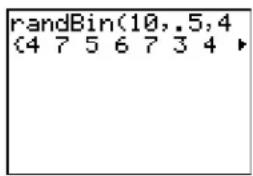
text_image
randBin(10,.5,4 {4 7 5 6 7 3 4 ▶
text_image
randBin(10,.5,4 ← 5 6 7 3 4 5 3 Ans→L1 (4 7 5 6 7 3 4)MathPrint™
text_image
randBin(10,.5,40) ) {5 5 7 4 6 6 3 ... Ams→L1 ...2 5 3 6 5 7 5 ...Classic
Keyboard Math Operations
Using Lists with Math Operations
Math operations that are valid for lists return a list calculated element by element. If you use two lists in the same expression, they must be the same length.
$$ \overline {{(1 , 2) + (3 , 4) + 5}} _ {(9 1 1)} $$
Addition, Subtraction, Multiplication, Division
You can use + (addition, + ), - (subtraction, - ), * (multiplication, × ), and / (division, ÷ ) with real and complex numbers, expressions, lists, and matrices. You cannot use / with matrices. If you need to input A/2, enter this as A *1/2 or A *.5.
| valueA+valueB | valueA - valueB |
| valueA*valueB | valueA / valueB |
Trigonometric Functions
You can use the trigonometric (trig) functions (sine, SIN; cosine, COS; and tangent, TAN) with real numbers, expressions, and lists. The current angle mode setting affects interpretation. For example, sin(30) in radian mode returns -.9880316241; in degree mode it returns .5.
sin(value) cos(value) tan(value)
You can use the inverse trig functions (arcsine, 2nd [SIN^-] ; arccosine, 2nd [COS^-] ; and arctangent, 2nd [TAN^-] ) with real numbers, expressions, and lists. The current angle mode setting affects interpretation.
sin ^-1 (value) c ^-1 (value) o t ^-1 (value) a n
Note: The trig functions do not operate on complex numbers.
Power, Square, Square Root
You can use ^ (power, ), ^2 (square, ^2 ), and (square root, 2nd [√]) with real and complex numbers, expressions, lists, and matrices. You cannot use (with matrices.
MathPrint™: value ^power value ^2 √(value)
Classic: value^power
Inverse
You can use ^-1 (inverse, -1 ) with real and complex numbers, expressions, lists, and matrices. The multiplicative inverse is equivalent to the reciprocal, 1/x.
value ^-1

log(, 10^(), ln(
You can use log( (logarithm, LOG), 10^( (power of 10, 2nd [10^x]), and ln( (natural log, LN) with real or complex numbers, expressions, and lists.
log(value)
MathPrint™: 10power
In(value)
Classic: 10^(power)
Exponential
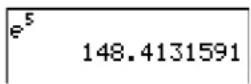
e^( (exponential, 2nd [e^-x] ) returns the constant e raised to a power. You can use e^( with real or complex numbers, expressions, and lists.
MathPrint™: e ^power
Classic: e^(power)

Constant
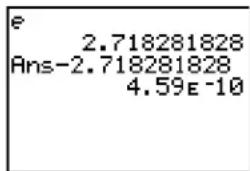
e (constant, 2nd [e]) is stored as a constant on the TI-84 Plus. Press 2nd [e] to copy e to the cursor location. In calculations, the TI-84 Plus uses 2.718281828459 for e.
text_image
e 2.718281828 Ans-2.718281828 4.59E-10Negation
- (negation, (-) ) returns the negative of value. You can use - with real or complex numbers, expressions, lists, and matrices.
-value
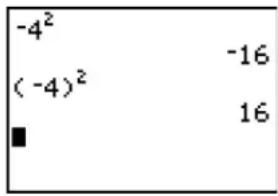
EOS ^™ rules (Chapter 1) determine when negation is evaluated. For example, -4^2 returns a negative number, because squaring is evaluated before negation. Use parentheses to square a negated number, as in (-4)^2 .
text_image
-4² (-4)² ■ -16 16Note: On the TI-84 Plus, the negation symbol (-) is shorter and higher than the subtraction sign (-), which is displayed when you press ☐.
Pi
(Pi, [2nd] [] ) is stored as a constant in the TI-84 Plus. In calculations, the TI-84 Plus uses 3.1415926535898 for .

text_image
π 3.141592654 Ans-3.141592654 -4.102E-10MATH Operations
MATH Menu
To display the MATH menu, press MATH.
MATH NUM CPX PRB
1: ▶Frac Displays the answer as a fraction.
2: ▶Dec Displays the answer as a decimal.
3: 3 Calculates the cube.
4: ^3[3]( Calculates the cube root.
5: ^x[x]( Calculates the x ^th root.
6: fMin( Finds the minimum of a function.
7: fMax( Finds the maximum of a function.
8: nDeriv( Computes the numerical derivative.
MATH NUM CPX PRB
9: fnInt( Computes the function integral.
0: summation (Returns the sum of elements of list from start to end, where start <= end.
A: logBASE( Returns the logarithm of a specified value determined from a specified base: logBASE(value, base).
B: Solver... Displays the equation solver.
▶Frac, ▶Dec
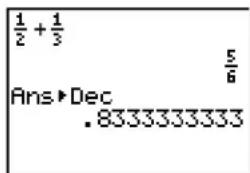
▶Frac (display as a fraction) displays an answer as its rational equivalent. You can use ▶Frac with real or complex numbers, expressions, lists, and matrices. If the answer cannot be simplified or the resulting denominator is more than three digits, the decimal equivalent is returned. You can only use ▶Frac following value.
value ▶Frac
▶Dec (display as a decimal) displays an answer in decimal form. You can use ▶Dec with real or complex numbers, expressions, lists, and matrices. You can only use ▶Dec following value.
value ▶Dec
text_image
1/2 + 1/3 5/6 Ans ▶ Dec .83333333333Note: You can quickly convert from one number type to the other by using the FRAC shortcut menu. Press ALPHA [F1] 4:▶F▶D to convert a value.
Cube, Cube Root
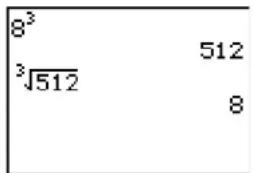
^3 (cube) returns the cube of value. You can use ^3 with real or complex numbers, expressions, lists, and square matrices.
value ^3
^3[3](cube root) (cube root) returns the cube root of value. You can use ^3[3](with real or complex numbers, expressions, and lists.
^3 (value)
text_image
8³ 3√512 512 8x_ (Root)
^x(x^th root) returns the x^th root of value. You can use ^x with real or complex numbers, expressions, and lists.
x^throot^x

fMin(, fMax(
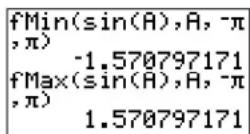
fMin( function minimum) and fMax( function maximum) return the value at which the local minimum or local maximum value of expression with respect to variable occurs, between lower and upper values for variable. fMin( and fMax( are not valid in expression. The accuracy is controlled by tolerance (if not specified, the default is 1E-5).
fMin(expression,variable,lower,upper[,tolerance])
fMax(expression,variable,lower,upper[,tolerance])
Note: In this guidebook, optional arguments and the commas that accompany them are enclosed in brackets ([ ]).

MathPrint™
Classic
nDeriv(
nDeriv( (numerical derivative) returns an approximate derivative of expression with respect to variable, given the value at which to calculate the derivative and (if not specified, the default is 1E-3). nDeriv( is valid only for real numbers.
MathPrint™: ·s ()|_ =
Classic: nDeriv(expression, variable, value[, ε])
nDeriv( uses the symmetric difference quotient method, which approximates the numerical derivative value as the slope of the secant line through these points.
$$ f ^ {\prime} x (\quad) \frac {f (x + \varepsilon) - f (x - \varepsilon)}{2 \varepsilon} $$
As becomes smaller, the approximation usually becomes more accurate. In MathPrint ^™ mode, the default is 1E-3. You can switch to Classic mode to change for investigations.
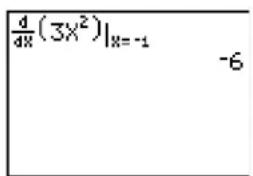
text_image
d/dx(3x²)|_{x=-1} -6MathPrint™
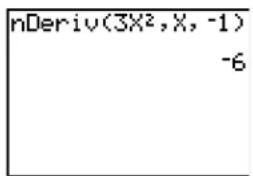
text_image
nDeriv(3X²,X,-1) -6Classic
You can use nDeriv( once in expression. Because of the method used to calculate nDeriv(, the TI-84 Plus can return a false derivative value at a nondifferentiable point.
fnInt(
fnInt( function integral) returns the numerical integral (Gauss-Kronrod method) of expression with respect to variable, given lower limit, upper limit, and a tolerance (if not specified, the default is 1E-5). fnInt( is valid only for real numbers.
MathPrint™: _^ () d
$$ \boxed { \begin{array}{l l} \int_ {1} ^ {5} \left(3 X ^ {2} + \frac {1}{2} X\right) d X & \ & 1 3 0 \end{array} } $$
Classic: fnInt(expression, variable, lower, upper[, tolerance])
$$ \boxed { \begin{array}{c} f n I n t (3 X ^ {2} + 1 / 2 X, X \ , 1, 5) \ 1 3 0. 0 0 \end{array} } $$
In MathPrint ^™ mode, the default is 1E-3. You can switch to Classic mode to change for investigations.
Note: To speed the drawing of integration graphs (when fnInt( is used in a Y= equation), increase the value of the Xres window variable before you press GRAPH.
Using the Equation Solver
Solver
Solver displays the equation solver, in which you can solve for any variable in an equation. The equation is assumed to be equal to zero. Solver is valid only for real numbers.
When you select Solver, one of two screens is displayed.
- The equation editor (see step 1 picture below) is displayed when the equation variable eqn is empty.
- The interactive solver editor is displayed when an equation is stored in eqn.
Entering an Expression in the Equation Solver
To enter an expression in the equation solver, assuming that the variable eqn is empty, follow these steps.
- Select B: Solver from the MATH menu to display the equation editor.
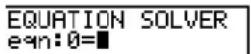
-
Enter the expression in any of three ways.
-
Enter the expression directly into the equation solver.
- Paste a Y= variable name from the YVARS shortcut menu (ALPHA [F4]) to the equation solver.
- Press 2nd [RCL], paste a Y= variable name from the YVARS shortcut menu, and press ENTER. The expression is pasted to the equation solver.
The expression is stored to the variable eqn as you enter it.
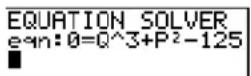
- Press ENTER or ▼. The interactive solver editor is displayed.

• The equation stored in eqn is set equal to zero and displayed on the top line.
- Variables in the equation are listed in the order in which they appear in the equation. Any values stored to the listed variables also are displayed.
- The default lower and upper bounds appear in the last line of the editor (bound={-1E99,1E99}).
- A ↓ is displayed in the first column of the bottom line if the editor continues beyond the screen.
Note: To use the solver to solve an equation such as K=.5MV^2 , enter eqn:0=K-.5MV ^2 in the equation editor.
Entering and Editing Variable Values
When you enter or edit a value for a variable in the interactive solver editor, the new value is stored in memory to that variable.
You can enter an expression for a variable value. It is evaluated when you move to the next variable. Expressions must resolve to real numbers at each step during the iteration.
You can store equations to any VARS Y-VARS variables, such as Y1 or r6, and then reference the variables in the equation. The interactive solver editor displays all variables of all Y= functions recalled in the equation.

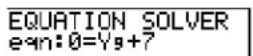
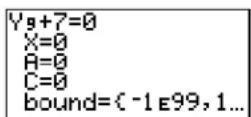
Solving for a Variable in the Equation Solver
To solve for a variable using the equation solver after an equation has been stored to eqn, follow these steps.
- Select B: Solver from the MATH menu to display the interactive solver editor, if not already displayed.
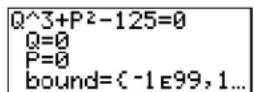
- Enter or edit the value of each known variable. All variables, except the unknown variable, must contain a value. To move the cursor to the next variable, press ENTER or ▼.

- Enter an initial guess for the variable for which you are solving. This is optional, but it may help find the solution more quickly. Also, for equations with multiple roots, the TI-84 Plus will attempt to display the solution that is closest to your guess.

The default guess is calculated as lower+2
-
Edit bound={lower,upper}. lower and upper are the bounds between which the TI-84 Plus searches for a solution. This is optional, but it may help find the solution more quickly. The default is bound={-1E99,1E99}.
-
Move the cursor to the variable for which you want to solve and press ALPHA [SOLVE].
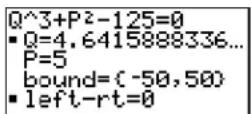
- The solution is displayed next to the variable for which you solved. A solid square in the first column marks the variable for which you solved and indicates that the equation is balanced. An ellipsis shows that the value continues beyond the screen.
Note: When a number continues beyond the screen, be sure to press ▶ to scroll to the end of the number to see whether it ends with a negative or positive exponent. A very small number may appear to be a large number until you scroll right to see the exponent. - The values of the variables are updated in memory.
- left-rt=diff is displayed in the last line of the editor. diff is the difference between the left and right sides of the equation when evaluated at the calculated solution. A solid square in the first column next to left-rt indicates that the equation has been evaluated at the new value of the variable for which you solved.
Editing an Equation Stored to eqn
To edit or replace an equation stored to eqn when the interactive equation solver is displayed, press ▶ until the equation editor is displayed. Then edit the equation.
Equations with Multiple Roots
Some equations have more than one solution. You can enter a new initial guess or new bounds to look for additional solutions.
Further Solutions
After you solve for a variable, you can continue to explore solutions from the interactive solver editor. Edit the values of one or more variables. When you edit any variable value, the solid
squares next to the previous solution and left-rt=diff disappear. Move the cursor to the variable for which you now want to solve and press ALPHA [SOLVE].
Controlling the Solution for Solver or solve(
The TI-84 Plus solves equations through an iterative process. To control that process, enter bounds that are relatively close to the solution and enter an initial guess within those bounds. This will help to find a solution more quickly. Also, it will define which solution you want for equations with multiple solutions.
Using solve( on the Home Screen or from a Program
The function solve( is available only from CATALOG or from within a program. It returns a solution (root) of expression for variable, given an initial guess, and lower and upper bounds within which the solution is sought. The default for lower is -1E99. The default for upper is -1E99. solve( is valid only for real numbers.
solve(expression,variable,guess[,{lower,upper}])
expression is assumed equal to zero. The value of variable will not be updated in memory. guess may be a value or a list of two values. Values must be stored for every variable in expression, except variable, before expression is evaluated. lower and upper must be entered in list format.

text_image
5→P solve(Q³+(P²-125) 4.641588834MathPrint™

Classic
MATH NUM (Number) Operations
MATH NUM Menu
To display the MATH NUM menu, press MATH ▶.
MATH NUM CPX PRB
1: abs ( Absolute value
2: round( Round
3: iPart( Integer part
MATH NUM CPX PRB
| 4: fPart( | Fractional part |
| 5: int( | Greatest integer |
| 6: min( | Minimum value |
| 7: max( | Maximum value |
| 8: lcm( | Least common multiple |
| 9: gcd( | Greatest common divisor |
| 0: remainder( | Reports the remainder as a whole number from a division of two whole numbers where the divisor is not zero. |
| A: ▶n/d◀▶Un/d | Converts an improper fraction to a mixed number or a mixed number to an improper fraction. |
| B: ▶F◀▶D | Converts a decimal to a fraction or a fraction to a decimal. |
| C: Un/d | Displays the mixed number template in MathPrintTM mode. In Classic mode, displays a small u between the whole number and fraction. |
| D: n/d | Displays the fraction template in MathPrintTM mode. In Classic mode, displays a thick fraction bar between the numerator and the denominator. |
abs(
abs( (absolute value) returns the absolute value of real or complex (modulus) numbers, expressions, lists, and matrices.
Note: abs( is also found on the FUNC shortcut menu (ALPHA [F2] 1).
abs(value)
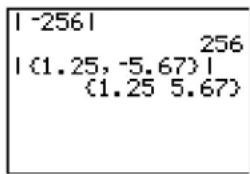
text_image
-256| 256 (1.25,-5.67)| (1.25 5.67)MathPrint™
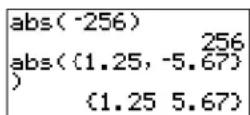
Classic
Note: abs( is also available on the MATH CPX menu.
round(
round( returns a number, expression, list, or matrix rounded to #decimals (≤9). If #decimals is omitted, value is rounded to the digits that are displayed, up to 10 digits.
round(value[,#decimals])
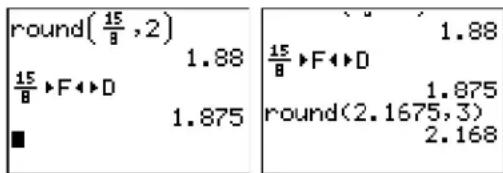
text_image
round(15/8,2) 1.88 15/8▶F▶D 1.875 ■ 1.88 15/8▶F▶D 1.875 round(2.1675,3) 2.168iPart(, fPart(
iPart( integer part) returns the integer part or parts of real or complex numbers, expressions, lists, and matrices.
iPart(value)
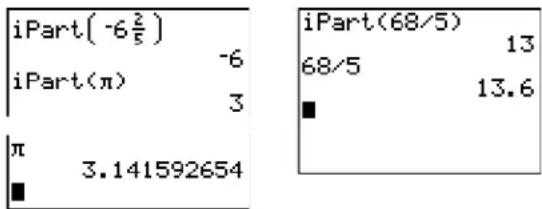
text_image
iPart(-6\u00bd\u00bd) -iPart(π) -6 3 π 3.141592654 iPart(68/5) 13 68/5 13.6fPart( fractional part) returns the fractional part or parts of real or complex numbers, expressions, lists, and matrices.
fPart(value)
Note: The way the fractional result is displayed depends on the Answers mode setting. To convert from one format to another, use ▶F◀▶D on the FRAC shortcut menu (ALPHA [F1] 4).
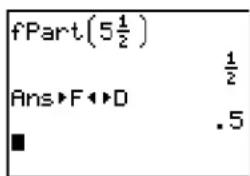
text_image
fPart(5½) Ans▶F◀▶D ■ ½ .5int(
int( (greatest integer) returns the largest integer ≤ real or complex numbers, expressions, lists, and matrices.
int(value)

text_image
int(3.58) 3 int(-3) -3 ■ int(-2 5/6) -3 int(-3.58) -4Note: For a given value, the result of int( is the same as the result of iPart( for nonnegative numbers and negative integers, but one integer less than the result of iPart( for negative noninteger numbers.
min(, max(
min( (minimum value) returns the smaller of valueA and valueB or the smallest element in list. If listA and listB are compared, min( returns a list of the smaller of each pair of elements. If list and value are compared, min( compares each element in list with value.
max( (maximum value) returns the larger of valueA and valueB or the largest element in list. If listA and listB are compared, max( returns a list of the larger of each pair of elements. If list and value are compared, max( compares each element in list with value.
| min(valueA,valueB) | max(valueA,valueB) |
| min(list) | max(list) |
| min(listA,listB) | max(listA,listB) |
| min(list,value) | max(list,value) |
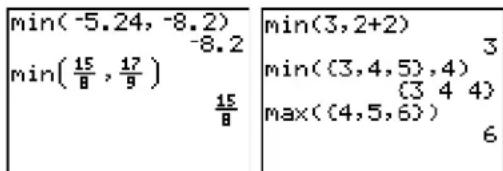
text_image
min(-5.24,-8.2) -8.2 min(15/8,17/9) 15/8 min(3,2+2) 3 min((3,4,5),4) (3 4 4) max((4,5,6)) 6Note: min( and max( also are available on the LIST MATH menu.
lcm(, gcd(
Icm( returns the least common multiple of valueA and valueB, both of which must be nonnegative integers. When listA and listB are specified, Icm( returns a list of the least common multiple of each pair of elements. If list and value are specified, Icm( finds the least common multiple of each element in list and value.
gcd( returns the greatest common divisor of valueA and valueB, both of which must be nonnegative integers. When listA and listB are specified, gcd( returns a list of the greatest common divisor of each pair of elements. If list and value are specified, gcd( finds the greatest common divisor of each element in list and value.
| lcm(valueA,valueB) | gcd(valueA,valueB) |
| lcm(listA,listB) | gcd(listA,listB) |
| lcm(list,value) | gcd(list,value) |
1cm(2,5)
9cd((48,66), (64,
122))
(16 2)
remainder(
remainder( returns the remainder resulting from the division of two positive whole numbers, dividend and divisor, each of which can be a list. The divisor cannot be zero. If both arguments are lists, they must have the same number of elements. If one argument is a list and the other a non-list, the non-list is paired with each element of the list, and a list is returned.
remainder(dividend, divisor)

text_image
remainder(10,4) 2remainder(list, divisor)

text_image
(5,5,5,5,5)→L1 (5 5 5 5 5) remainder(L1,2) (1 1 1 1 1)remainder(dividend, list)
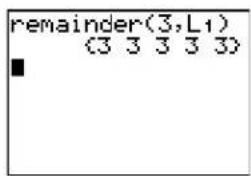
text_image
remainder(3,L1) (3 3 3 3 3)remainder(list, list)

text_image
(1,2,3,4,5)+L₂ (1 2 3 4 5) remainder(L₁,L₂) (0 1 2 1 0)▶n/d◀▶Un/d
▶n/d▶Un/d converts an improper fraction to a mixed number or a mixed number to an improper fraction. You can also access ▶n/d▶Un/d from the FRAC shortcut menu ([ALPHA [F1] 3).
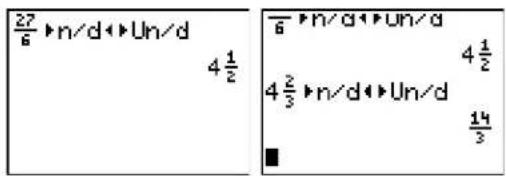
text_image
27/6 ▶n/d ▶Un/d 4 1/2 6 ▶n/d ▶Un/d 4 1/2 4 2/3 ▶n/d ▶Un/d 14/3F D
▶F◀▶D converts a fraction to a decimal or a decimal to a fraction. You can also access ▶F◀▶D from the FRAC shortcut menu ([ALPHA] [F1] 4).

text_image
17 21 ►F◄►D .8095238095 .865►F◄►D 173 200Un/d
Un/d displays the mixed number template. You can also access Un/d from the FRAC shortcut menu (ALPHA [F1] 2). In the fraction, n and d must be non-negative integers.
MathPrint™

Classic
n/d
n/d displays the mixed number template. You can also access n/d from the FRAC shortcut menu (ALPHA [F1] 1). n and d can be real numbers or expressions but may not contain complex numbers.
MathPrint™

Classic
Entering and Using Complex Numbers
Complex-Number Modes
The TI-84 Plus displays complex numbers in rectangular form and polar form. To select a complex-number mode, press MODE, and then select either of the two modes.
• a+bi (rectangular-complex mode)
• re^θi (polar-complex mode)
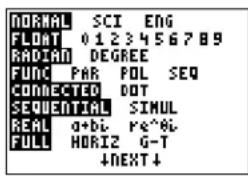
text_image
NORMAL SCI ENG FLOAT 0123456789 RADIAN DEGREE FUNC PAR POL SEQ CONNECTED DOT SEQUENTIAL SIMUL REAL a+bi re^i FULL HORIZ G-T ↓NEXT↓On the TI-84 Plus, complex numbers can be stored to variables. Also, complex numbers are valid list elements.
In Real mode, complex-number results return an error, unless you entered a complex number as input. For example, in Real mode (-1) returns an error; in a+bi mode (-1) returns an answer.
Real mode a+bi mode

text_image
|In(-1)■ ↓ ERR:NONREAL ANS [+]Quit 2:Goto
text_image
ln(-1) ↓ ln(-1) 3.141592654iEntering Complex Numbers
Complex numbers are stored in rectangular form, but you can enter a complex number in rectangular form or polar form, regardless of the mode setting. The components of complex numbers can be real numbers or expressions that evaluate to real numbers; expressions are evaluated when the command is executed.
You can enter fractions in complex numbers, but the output will always be a decimal value.

text_image
1/2 + 1/4 i .5 + .25iWhen you use the n/d template, a fraction cannot contain a complex number.

text_image
1+i 1-i ERR:DATA TYPE 1:Quit 2:GotoYou can use division to compute the answer:
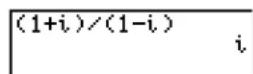
Note about Radian Versus Degree Mode
Radian mode is recommended for complex number calculations. Internally, the TI-84 Plus converts all entered trigonometric values to radians, but it does not convert values for exponential, logarithmic, or hyperbolic functions.
In degree mode, complex identities such as e^(i) = () + i () are not generally true because the values for cos and sin are converted to radians, while those for e^() are not. For example, e^(i45) = (45) + i (45) is treated internally as e^(i45) = (/4) + i (/4) .
Complex identities are always true in radian mode.
Interpreting Complex Results
Complex numbers in results, including list elements, are displayed in either rectangular or polar form, as specified by the mode setting or by a display conversion instruction. In the example below, polar-complex (re^θi) and Radian modes are set.
MathPrint™:
$$ \boxed { \begin{array}{l} (2 + i) - \left(1 e ^ {\frac {\pi}{4} i}\right) \ 1. 3 2 5 6 5 4 2 9 6 e ^ {. 2 2 2 7}, \end{array} } $$
Classic:
$$ \begin{array}{l} \boxed {(2 + i) - (1 e ^ {\wedge} (\pi / 4 i)} \ \boxed {1. 3 2 5 6 5 4 2 9 6 e ^ {\wedge} (. \dots} \end{array} $$
Rectangular-Complex Mode
Rectangular-complex mode recognizes and displays a complex number in the form a+b i , where a is the real component, b is the imaginary component, and i is a constant equal to -1 .
$$ \begin{array}{c} \text {ln(-1)} \ 3. 1 4 1 5 9 2 6 5 4 i \end{array} $$
To enter a complex number in rectangular form, enter the value of a (real component), press + or - , enter the value of b (imaginary component), and press 2nd[i] (constant).
real component(+ or -)imaginary component i
$$ \boxed { \begin{array}{c c} 4 + 2 i & \ & 4 + 2 i \end{array} } $$
Polar-Complex Mode
Polar-complex mode recognizes and displays a complex number in the form re^ i , where r is the magnitude, e is the base of the natural log, is the angle, and i is a constant equal to -1 .
$$ \boxed { \begin{array}{l} \ln (- 1) \ 3. 1 4 1 5 9 2 6 5 4 e ^ {\wedge} (1 \dots \end{array} } $$
To enter a complex number in polar form, enter the value of r (magnitude), press 2nd[e^x] (exponential function), enter the value of (angle), press 2nd[i] (constant), and then press · .
magnitudee^ (anglei)

text_image
10e^{\frac{\pi}{3}i} 10e^{1.047197551i}MathPrint™

Classic
MATH CPX (Complex) Operations
MATH CPX Menu
To display the MATH CPX menu, press MATH ▶ ▶.
MATH NUM CPX PRB
1: conj( Returns the complex conjugate.
2: real( Returns the real part.
3: imag( Returns the imaginary part.
4: angle( Returns the polar angle.
5: abs( Returns the magnitude (modulus).
6: ▶Rect Displays the result in rectangular form.
7: ▶Polar Displays the result in polar form.
conj(
conj( (conjugate) returns the complex conjugate of a complex number or list of complex numbers.
conj(a+bi) returns a-bi in a+bi mode.
conj(r e^(θi)) returns r e^(−θi) in re^θi mode.
MathPrint™ Classic
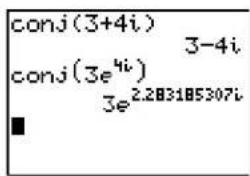
text_image
conj(3+4i) 3-4i conj(3e^4i) 3e^2.283185307i
real(
real( (real part) returns the real part of a complex number or list of complex numbers.
real(a+bi) returns a.
real(r e^(θi)) returns r*cos(θ).
MathPrint™ Classic
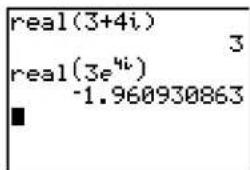
text_image
real(3+4i) real(3e^4i) -1.960930863
imag(
imag( (imaginary part) returns the imaginary (nonreal) part of a complex number or list of complex numbers.
imag(a+bi) returns b.
imag(r e^( i)) returns r* ()
MathPrint™ Classic
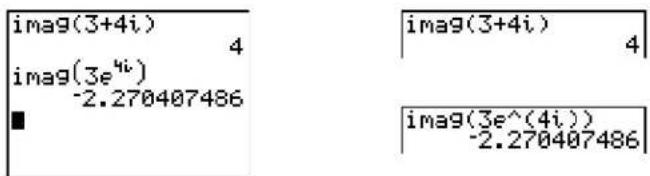
text_image
imag(3+4i) 4 imag(3e^4i) -2.270407486 imag(3+4i) 4 imag(3e^(4i)) -2.270407486angle(
angle( returns the polar angle of a complex number or list of complex numbers, calculated as ^-1 (b/a), where b is the imaginary part and a is the real part. The calculation is adjusted by + in the second quadrant or - in the third quadrant.
angle(a+bi) returns tan ^-1 (b/a).
angle( re^( i) ) returns , where -<< .
MathPrint™ Classic

text_image
angle(3+4i) .927295218 angle(3e^4i) -2.283185307 angle(3+4i) .927295218 angle(3e^(4i)) -2.283185307abs(
abs( (absolute value) returns the magnitude (modulus), ^2 + imag^2 , of a complex number or list of complex numbers. You can also access abs( from the FUNC shortcut menu ([ALPHA] [F2] 1).
abs(a+bi) returns ^2+b^2 . abs(r e^(θi)) returns r (magnitude).
$$ \sqrt {\text { real } ^ {2} + \text { imag } ^ {2}} $$
$$ \begin{array}{c c} \hline \text {abs(3 + 4i)} & 5 \ \hline \text {abs(3e^{\wedge}(4i))} & 3 \ \hline \end{array} $$
▶Rect
▶Rect (display as rectangular) displays a complex result in rectangular form. It is valid only at the end of an expression. It is not valid if the result is real.
complex result▶Rect returns a+bi.
$$ \begin{array}{c} \sqrt {(- 2)} \triangleright \text { Rect } \ 1. 4 1 4 2 1 3 5 6 2 i \end{array} $$
▶ Polar
▶Polar (display as polar) displays a complex result in polar form. It is valid only at the end of an expression. It is not valid if the result is real.
complex result▶Polar returns re^( i) .
$$ \begin{array}{c} \sqrt {(- 2)} \triangleright \text { Polar } \ 1. 4 1 4 2 1 3 5 6 2 e ^ {1. 5 7 0}; \ \blacksquare \end{array} $$
MATH PRB (Probability) Operations
MATH PRB Menu
To display the MATH PRB menu, press MATH ▼.
MATH NUM CPX PRB
1: rand
Random-number generator
MATH NUM CPX PRB
2: nPr Number of permutations
3: nCr Number of combinations
4: ! Factorial
5: randInt( Random-integer generator
6: randNorm( Random # from Normal distribution
7: randBin( Random # from Binomial distribution
8: randIntNoRep( Random ordered list of integers in a range
rand
rand (random number) generates and returns one or more random numbers > 0 and < 1. To generate a list of random-numbers, specify an integer > 1 for numtrials (number of trials). The default for numtrials is 1.
rand[(numtrials)]
Note: To generate random numbers beyond the range of 0 to 1, you can include rand in an expression. For example, rand5 generates a random number > 0 and < 5.
With each rand execution, the TI-84 Plus generates the same random-number sequence for a given seed value. The TI-84 Plus factory-set seed value for rand is 0. To generate a different random-number sequence, store any nonzero seed value to rand. To restore the factory-set seed value, store 0 to rand or reset the defaults (Chapter 18).
Note: The seed value also affects randInt(, randNorm(, and randBin( instructions.
rand .0125655621
1→rand 1
rand(3)
(.7455607728 .8)
nPr, nCr
nPr (number of permutations) returns the number of permutations of items taken number at a time. items and number must be nonnegative integers. Both items and number can be lists.
items nPr number
nCr (number of combinations) returns the number of combinations of items taken number at a time. items and number must be nonnegative integers. Both items and number can be lists.
items nCr number

Factorial
! (factorial) returns the factorial of either an integer or a multiple of .5. For a list, it returns factorials for each integer or multiple of .5. value must be ≥ - .5 and ≤ 69.
value!
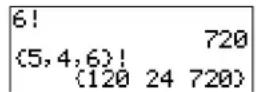
Note: The factorial is computed recursively using the relationship (n+1)! = n*n! , until n is reduced to either 0 or -1/2. At that point, the definition 0!=1 or the definition (-1/2)!= is used to complete the calculation. Hence:
n!=n*(n-1)*(n-2)* ... *2*1, if n is an integer ≥ 0 n!= n*(n-1)*(n-2)* ... *1/2*√π, if n+1/2 is an integer ≥ 0 n! is an error, if neither n nor n+1/2 is an integer ≥ 0.
(The variable n equals value in the syntax description above.)
randInt(
randInt( (random integer) generates and displays a random integer within a range specified by lower and upper integer bounds. To generate a list of random numbers, specify an integer > 1 for numtrials (number of trials); if not specified, the default is 1.
randInt(lower,upper[,numtrials])

randNorm(
randNorm( (random Normal) generates and displays a random real number from a specified Normal distribution. Each generated value could be any real number, but most will be within the interval [-3(), +3()] . To generate a list of random numbers, specify an integer >1 for numtrials (number of trials); if not specified, the default is 1.
randNorm(μ,σ[,numtrials])
randNorm(0,1)
.0772076175
randNorm(35,2,100)
(34.02701938 37...
randBin(
randBin( (random Binomial) generates and displays a random integer from a specified Binomial distribution. numtrials (number of trials) must be ≥ 1 . prob (probability of success) must be ≥ 0 and ≤ 1 . To generate a list of random numbers, specify an integer > 1 for numsimulations (number of simulations); if not specified, the default is 1.
randBin(numtrials,prob[,numsimulations])
randBin(5,.2) randBin(7,.4,10) ^3 (3 3 2 5 1 2 2 ...
Note: The seed value stored to rand also affects randInt(, randNorm(, and randBin( instructions.
randIntNoRep(
randIntNoRep( returns a random ordered list of integers from a lower integer to an upper integer. The list of integers may include the lower integer and the upper integer.
randIntNoRep(lowerint, upperint)
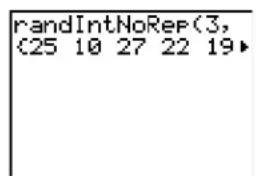
text_image
randIntNoRep(3, C25 10 27 22 19▶MathPrint™

text_image
randIntNoRep(3,3 5) (21 10 15 32 12...Classic
ANGLE Operations
ANGLE Menu
To display the ANGLE menu, press [2nd][ANGLE] . The ANGLE menu displays angle indicators and instructions. The Radian/Degree mode setting affects the TI-84 Plus's interpretation of ANGLE menu entries.
ANGLE
1:°
Degree notation
2: '
DMS minute notation
ANGLE
3: r Radian notation
4: ▶DMS Displays as degree/minute/second
5: R▶Pr (Returns r, given X and Y
6: R▶Pθ (Returns θ, given X and Y
7: P▶Rx (Returns x, given R and θ
8: P▶Ry (Returns y, given R and θ
Entry Notation
DMS (degrees/minutes/seconds) entry notation comprises the degree symbol (°), the minute symbol (*), and the second symbol ("). degrees must be a real number; minutes and seconds must be real numbers ≥ 0.
Note: DMS entry notation does not support fractions in minutes or seconds.
degrees°minutes'seconds"
For example, we know that 30 degrees is the same as /6 radians, and we can verify that by looking at the values in degree and radian modes. If the angle mode is not set to Degree, you must use ^ so that the TI-84 Plus can interpret the argument as degrees, minutes, and seconds.
Degree mode Radian mode
sin(30)
.5
sin(30°)
.5
sin(π/6)
.0091383954
sin(30)
-.9880316241
sin(30°)
.5
sin(π/6)
.5
Degree
° (degree) designates an angle or list of angles as degrees, regardless of the current angle mode setting. In Radian mode, you can use ° to convert degrees to radians.
value°
{value1,value2,value3,value4,...,value n}°
° also designates degrees (D) in DMS format.
* (minutes) designates minutes (M) in DMS format.
" (seconds) designates seconds (S) in DMS format.
Note: " is not on the ANGLE menu. To enter ", press ALPHA ["]
Radians
^r (radians) designates an angle or list of angles as radians, regardless of the current angle mode setting. In Degree mode, you can use ^r to convert radians to degrees.
$$ v a l u e ^ {r} $$
Degree mode

▶DMS
▶DMS (degree/minute/second) displays answer in DMS format. The mode setting must be Degree for answer to be interpreted as degrees, minutes, and seconds. ▶DMS is valid only at the end of a line.
$$ a n s w e r \triangleright D M S $$
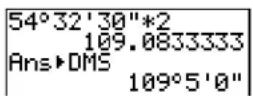
R Pr(, R P(, P Rx(, P Ry(
R▶Pr( converts rectangular coordinates to polar coordinates and returns r. R▶Pθ( converts rectangular coordinates to polar coordinates and returns θ. x and y can be lists.
Note: Radian mode is set.
P▶Rx( converts polar coordinates to rectangular coordinates and returns x. P▶Ry( converts polar coordinates to rectangular coordinates and returns y. r and θ can be lists.
$$ \mathbf {P} \triangleright \mathbf {R x} (r, \theta), \mathbf {P} \triangleright \mathbf {R y} (r, \theta) $$
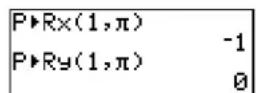
Note: Radian mode is set.
TEST (Relational) Operations
TEST Menu
To display the TEST menu, press 2nd [TEST].
This operator... Returns 1 (true) if...
| TEST | LOGIC | |
| 1: = | Equal | |
| 2: ≠ | Not equal to | |
| 3: > | Greater than | |
| 4: ≥ | Greater than or equal to | |
| 5: < | Less than | |
| 6: ≤ | Less than or equal to | |
$$ = , \neq , >, \geq , < , \leq $$
Relational operators compare valueA and valueB and return 1 if the test is true or 0 if the test is false. valueA and valueB can be real numbers, expressions, or lists. For = and ≠ only, valueA and valueB also can be matrices or complex numbers. If valueA and valueB are matrices, both must have the same dimensions.
Relational operators are often used in programs to control program flow and in graphing to control the graph of a function over specific values.
| valueA=valueB | valueA≠valueB |
| valueA>valueB | valueA≥valueB |
| valueA<valueB | valueA≤valueB |
| 25=26(1,2,3)<3(1,2,3)≠(3,2,1)(1 0 1) | 12 >23 12 < 23 | 01 |
Using Tests
Relational operators are evaluated after mathematical functions according to EOS rules (Chapter 1).
- The expression 2 + 2 = 2 + 3 returns 0. The TI-84 Plus performs the addition first because of EOS rules, and then it compares 4 to 5.
- The expression 2 + (2 = 2) + 3 returns 6. The TI-84 Plus performs the relational test first because it is in parentheses, and then it adds 2, 1, and 3.
TEST LOGIC (Boolean) Operations
TEST LOGIC Menu
To display the TEST LOGIC menu, press 2nd [TEST] ▶.
This operator... Returns a 1 (true) if...
| TEST | LOGIC | |
| 1: and | Both values are nonzero (true). | |
| 2: or | At least one value is nonzero (true). | |
| 3: xor | Only one value is zero (false). | |
| 4: not ( | The value is zero (false). | |
Boolean Operators
Boolean operators are often used in programs to control program flow and in graphing to control the graph of the function over specific values. Values are interpreted as zero (false) or nonzero (true).
and, or, xor
and, or, and xor (exclusive or) return a value of 1 if an expression is true or 0 if an expression is false, according to the table below. valueA and valueB can be real numbers, expressions, or lists.
valueA and valueB
valueA or valueB
valueA xor valueB
| valueA valueB and or xor | ||
| ≠0 ≠0 | returns 1 1 0 | |
| ≠0 | 0 returns 0 1 1 | |
| 0 | ≠0 | returns 0 1 1 |
| 0 0 returns 0 0 0 | ||
not(
not( returns 1 if value (which can be an expression) is 0.
not(value)
Using Boolean Operations
Boolean logic is often used with relational tests. In the following program, the instructions store 4 into C.
PROGRAM:BOOLEAN
:2→A:3→B
:If A=2 and B=3
:Then:4→C
:Else:5→C
:End
Chapter 3: Function Graphing
Getting Started: Graphing a Circle
Getting Started is a fast-paced introduction. Read the chapter for details.
Graph a circle of radius 10, centered on the origin in the standard viewing window. To graph this circle, you must enter separate formulas for the upper and lower portions of the circle. Then use ZSquare (zoom square) to adjust the display and make the functions appear as a circle.
- In Func mode, press = to display the Y= editor. Press 2nd [√] (100 - X,T,Θ,n x²) ENTER to enter the expression Y=(100-X^2) , which defines the top half of the circle.

text_image
Plot1 Plot2 Plot3 Y1 = √(100-X²) Y2 = ■ Y3 = Y4 = Y5 = Y6 =The expression Y=-(100-X^2) defines the bottom half of the circle. On the TI-84 Plus, you can define one function in terms of another. To define Y2=-Y1, press [-] to enter the negation sign. Press ALPHA [F4] to display the Y-VARS shortcut menu, and then press ENTER to select Y1.

text_image
Plot1 Plot2 Plot3 Y1 = √(100 - Y²) Y2 = Y1 Y6 Y3 = Y2 Y7 Y4 = Y3 Y8 Y5 = Y4 Y9 Frac Func MTR YVAR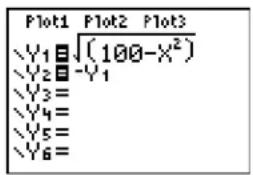
text_image
Plot1 Plot2 Plot3 Y1 = √(100-X²) Y2 = -Y1 Y3 = Y4 = Y5 = Y6 =- Press ZOOM 6 to select 6:ZStandard. This is a quick way to reset the window variables to the standard values. It also graphs the functions; you do not need to press GRAPH.
Notice that the functions appear as an ellipse in the standard viewing window. This is due to the range of values that ZStandard defines for the X-axis and Y-axis.
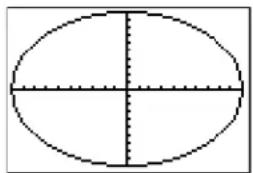
natural_image
Simple geometric diagram of an ellipse with dashed cross lines (no text or labels)- To adjust the display so that each pixel represents an equal width and height, press ZOOM 5 to select 5:ZSquare. The functions are replotted and now appear as a circle on the display.

natural_image
Simple geometric diagram showing a circle intersected by two perpendicular lines (no text or labels)- To see the ZSquare window variables, press WINDOW and notice the new values for Xmin, Xmax, Ymin, and Ymax.
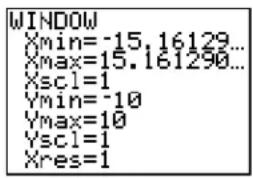
text_image
WINDOW Xmin=-15.16129... Xmax=15.161290... Xscl=1 Ymin=-10 Ymax=10 Yscl=1 Xres=1Defining Graphs
TI-84 Plus—Graphing Mode Similarities
Chapter 3 specifically describes function graphing, but the steps shown here are similar for each TI-84 Plus graphing mode. Chapters 4, 5, and 6 describe aspects that are unique to parametric graphing, polar graphing, and sequence graphing.
Defining a Graph
To define a graph in any graphing mode, follow these steps. Some steps are not always necessary.
- Press MODE and set the appropriate graph mode.
- Press Y= and enter, edit, or select one or more functions in the Y= editor.
- Deselect stat plots, if necessary.
- Set the graph style for each function.
- Press WINDOW and define the viewing window variables.
- Press 2nd [FORMAT] and select the graph format settings.
Displaying and Exploring a Graph
After you have defined a graph, press GRAPH to display it. Explore the behavior of the function or functions using the TI-84 Plus tools described in this chapter.
Saving a Graph for Later Use
You can store the elements that define the current graph to any of 10 graph database variables (GDB1 through GDB9, and GDB0; Chapter 8). To recreate the current graph later, simply recall the graph database to which you stored the original graph.
These types of information are stored in a GDB.
• Y = function s
- Graph style settings
- Window settings
- Format settings
You can store a picture of the current graph display to any of 10 graph picture variables (Pic1 through Pic9, and Pic0; Chapter 8). Then you can superimpose one or more stored pictures onto the current graph.
Setting the Graph Modes
Checking and Changing the Graphing Mode
To display the mode screen, press MODE. The default settings are highlighted below. To graph functions, you must select Func mode before you enter values for the window variables and before you enter the functions.
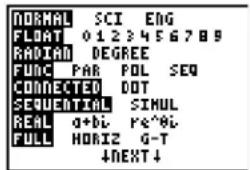
text_image
NORMAL SCI ENG FLOAT 0123456789 RADIAN DEGREE FUNC PAR POL SEQ CONNECTED DOT SEQUENTIAL SIMUL REAL a+bi re^8i FULL HORIZ G-T ↓NEXT↓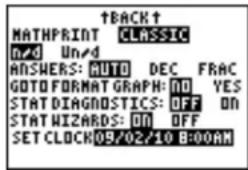
text_image
↑BACK ↑ MATHPRINT CLASSIC #7d Un/d ANSWERS: AUTO DEC FRAC GOTO FORMAT GRAPH: NO YES STAT DIAGNOSTICS: OFF ON STAT WIZARDS: ON OFF SET CLOCK 09/02/10 B:00AMThe TI-84 Plus has four graphing modes.
• Func (function graphing)
• Par (parametric graphing; Chapter 4)
• Pol (polar graphing; Chapter 5)
• Seq (sequence graphing; Chapter 6)
Other mode settings affect graphing results. Chapter 1 describes each mode setting.
- Float or 0123456789 (fixed) decimal mode affects displayed graph coordinates.
• Radian or Degree angle mode affects interpretation of some functions. - Connected or Dot plotting mode affects plotting of selected functions.
- Sequential or Simul graphing-order mode affects function plotting when more than one function is selected.
Setting Modes from a Program
To set the graphing mode and other modes from a program, begin on a blank line in the program editor and follow these steps.
- Press MODE to display the mode settings.
- Press ▼, ▶, ◀, and ▲ to place the cursor on the mode that you want to select.
- Press ENTER to paste the mode name to the cursor location.
The mode is changed when the program is executed.
Defining Functions
Displaying Functions in the Y=Editor
To display the Y= editor, press [Y=] . You can store up to 10 functions to the function variables Y1 through Y9, and Y0. You can graph one or more defined functions at once. In this example, functions Y1 and Y2 are defined and selected.

text_image
Plot1 Plot2 Plot3 \Y1 = √(100-X²) \Y2 = -Y1 \Y3 = \Y4 = \Y5 = \Y6 =Defining or Editing a Function
To define or edit a function, follow these steps.
- Press Y= to display the Y= editor.
- Press ☑ to move the cursor to the function you want to define or edit. To erase a function, press CLEAR.
- Enter or edit the expression to define the function.
- You may use functions and variables (including matrices and lists) in the expression.
When the expression evaluates to a nonreal number, the value is not plotted; no error is returned.
• You can access the shortcut menus by pressing ALPHA [F1] - [F4].
- The independent variable in the function is X. Func mode defines ,T,,n as X. To enter X, press ,T,,n or press [X].
- When you enter the first character, the = is highlighted, indicating that the function is selected.
As you enter the expression, it is stored to the variable Y_n as a user-defined function in the Y= editor.
- Press ENTER or ▼ to move the cursor to the next function.
Defining a Function from the Home Screen or a Program
To define a function from the home screen or a program, begin on a blank line and follow these steps.
- Press ALPHA ["], enter the expression, and then press ALPHA ["] again.
-
Press STO▶.
-
Press [ALPHA] [F4] to display the YVAR shortcut menu, move the cursor to the function name, and then press ENTER.
"expression"→Yn
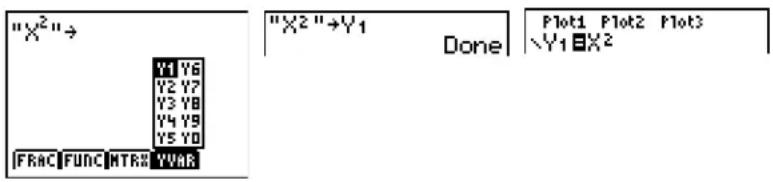
text_image
"X²"→ Y1 Y6 Y2 Y7 Y3 Y8 Y4 Y9 Y5 Y0 FRAC FUNC MTRS YVAR "X²"→Y1 Done Plot1 Plot2 Plot3 \Y1\X²When the instruction is executed, the TI-84 Plus stores the expression to the designated variable Y_n , selects the function, and displays the message Done.
Evaluating Y= Functions in Expressions
You can calculate the value of a Y= functionYn at a specified value of X. A list of values returns a list.
Yn(value)
Yn({value1,value2,value3,...,value n})
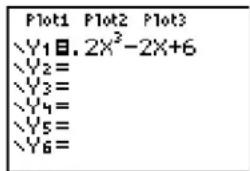
text_image
Plot1 Plot2 Plot3 \Y1日. 2X²-2X+6 \Y2= \Y3= \Y4= \Y5= \Y6=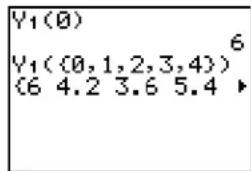
text_image
Y1(0) Y1((0,1,2,3,4)) (6 4.2 3.6 5.4)Selecting and Deselecting Functions
Selecting and Deselecting a Function
You can select and deselect (turn on and turn off) a function in the Y= editor. A function is selected when the = sign is highlighted. The TI-84 Plus graphs only the selected functions. You can select any or all functions Y1 through Y9, and Y0.
To select or deselect a function in the Y= editor, follow these steps.
- Press Y= to display the Y= editor.
- Move the cursor to the function you want to select or deselect.
- Press ▶ to place the cursor on the function's = sign.
- Press ENTER to change the selection status.
When you enter or edit a function, it is selected automatically. When you clear a function, it is deselected.
Turning On or Turning Off a Stat Plot in the Y= Editor
To view and change the on/off status of a stat plot in the Y= editor, use Plot1 Plot2 Plot3 (the top line of the Y= editor). When a plot is on, its name is highlighted on this line.
To change the on/off status of a stat plot from the Y= editor, press ▲ and ▶ to place the cursor on Plot1, Plot2, or Plot3, and then press ENTER.

text_image
Plot1 Plot2 Plot3 \(Y_1\) 2X³-2X+6 \(Y_2\) -Y_1 \(Y_3\) 2X+X² \(Y_4\) = \(Y_5\) = \(Y_6\) = Plot1 is turned on. Plot2 and Plot3 are turned off.Selecting and Deselecting Functions from the Home Screen or a Program
To select or deselect a function from the home screen or a program, begin on a blank line and follow these steps.
- Press VARS ▶ to display the VARS Y-VARS menu.
- Select 4:On/Off to display the ON/OFF secondary menu.
- Select 1:FnOn to turn on one or more functions or 2:FnOff to turn off one or more functions. The instruction you select is copied to the cursor location.
-
Enter the number (1 through 9, or 0; not the variable Y_n ) of each function you want to turn on or turn off.
-
If you enter two or more numbers, separate them with commas.
• To turn on or turn off all functions, do not enter a number after FnOn or FnOff.
FnOn[function#, function#, . . ., function n]
FnOff[function#, function#, . . ., function n]
- Press ENTER. When the instruction is executed, the status of each function in the current mode is set and Done is displayed.
For example, in Func mode, FnOff :FnOn 1,3 turns off all functions in the Y= editor, and then turns on Y1 and Y3.

text_image
FnOff :FnOn 1,3 Done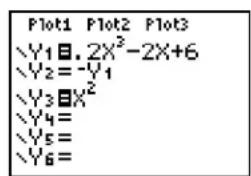
text_image
Plot1 Plot2 Plot3 \Y1 = .2X² - 2X + 6 \Y2 = -Y1 \Y3 = X² \Y4 = \Y5 = \Y6 =Setting Graph Styles for Functions
MATH Graph Style Icons in the Y= Editor
This table describes the graph styles available for function graphing. Use the styles to visually differentiate functions to be graphed together. For example, you can set Y1 as a solid line, Y2 as a dotted line, and Y3 as a thick line.
| Icon Style Description | |
| Line A solid line connects plotted points; this is the default in Connected mode | |
| Thick A thick solid line connects plotted points | |
| Above Shading covers the area above the graph | |
| Below Shading covers the area below the graph | |
| Path A circular cursor traces the leading edge of the graph and draws a path | |
| Animate A circular cursor traces the leading edge of the graph without drawing a path | |
| Dot A small dot represents each plotted point; this is the default in Dot mode | |
Note: Some graph styles are not available in all graphing modes. Chapters 4, 5, and 6 list the styles for Par, Pol, and Seq modes.
Setting the Graph Style
To set the graph style for a function, follow these steps.
- Press Y= to display the Y= editor.
- Press ▼ and ▲ to move the cursor to the function.
- Press ☐ to move the cursor left, past the = sign, to the graph style icon in the first column. The insert cursor is displayed. (Steps 2 and 3 are interchangeable.)
- Press ENTER repeatedly to rotate through the graph styles. The seven styles rotate in the same order in which they are listed in the table above.
- Press ▶, ▲, or ▼ when you have selected a style.

text_image
Plot1 Plot2 Plot3 \Y1 8sin(X) \Y2 8cos(X) \Y3= \Y4= \Y5= \Y6= \Y7=
natural_image
Pure waveform diagram showing two identical oscillating waveforms with no text or symbolsShading Above and Below
When you select 📋 or 🔊 for two or more functions, the TI-84 Plus rotates through four shading patterns.
• Vertical lines shade the first function with a ▼ or ▲ graph style.
• Horizontal lines shade the second.
- Negatively sloping diagonal lines shade the third.
- Positively sloping diagonal lines shade the fourth.
- The rotation returns to vertical lines for the fifth or , function, repeating the order described above.
When shaded areas intersect, the patterns overlap.

natural_image
Abstract geometric pattern with shaded regions and a central white line (no text or symbols)Note: When or is selected for a Y= function that graphs a family of curves, such as Y1=1,2,3X , the four shading patterns rotate for each member of the family of curves.
Setting a Graph Style from a Program
To set the graph style from a program, select H:GraphStyle( from the PRGM CTL menu. To display this menu, press PRGM while in the program editor. function# is the number of the Y= function name in the current graphing mode. graphstyle# is an integer from 1 to 7 that corresponds to the graph style, as shown below.
$$ \begin{array}{l} 1 = \text { (line) } \ 5 = \text { ♦ } (\text { path }) \ 2 = \text { (thick) } \ 6 = \text { ♀ } (\text { animate }) \ 3 = \text { (above) } \ 7 = \ddots (\text { dot }) \ 4 = \text { (below) } \ \end{array} $$
GraphStyle(function#, graphstyle#)
For example, when this program is executed in Func mode, GraphStyle(1,3) sets Y1 to (above).
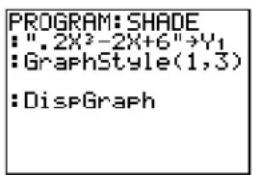
text_image
PROGRAM: SHADE :.2X^2-2X+6"->Y1 : GraphStyle(1,3) : DispGraph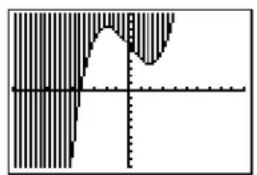
line
| X-Axis | Y-Axis | |---|---| | 0 | 0 | | 1 | -1 | | 2 | 0 | | 3 | 1 | | 4 | 2 | | 5 | 3 | | 6 | 4 | | 7 | 5 | | 8 | 6 | | 9 | 7 | | 10 | 8 | | 11 | 9 | | 12 | 10 | | 13 | 11 | | 14 | 12 | | 15 | 13 | | 16 | 14 | | 17 | 15 | | 18 | 16 | | 19 | 17 | | 20 | 18 | | 21 | 19 | | 22 | 20 | | 23 | 21 | | 24 | 22 | | 25 | 23 | | 26 | 24 | | 27 | 25 | | 28 | 26 | | 29 | 27 | | 30 | 28 | | 31 | 29 | | 32 | 30 | | 33 | 31 | | 34 | 32 | | 35 | 33 | | 36 | 34 | | 37 | 35 | | 38 | 36 | | 39 | 37 | | 40 | 38 | | 41 | 39 | | 42 | 40 | | 43 | 41 | | 44 | 42 | | 45 | 43 | | 46 | 44 | | 47 | 45 | | 48 | 46 | | 49 | 47 | | 50 | 48 | | 51 | 49 | | 52 | 50 | | 53 | 51 | | 54 | 52 | | 55 | 53 | | 56 | 54 | | 57 | 55 | | 58 | 56 | | 59 | 57 | | 60 | 58 | | 61 | 59 | | 62 | 60 | | 63 | 61 | | 64 | 62 | | 65 | 63 | | 66 | 64 | | 67 | 65 | | 68 | 66 | | 69 | 67 | | 70 | 68 | | 71 | 69 | | 72 | 70 | | 73 | 71 | | 74 | 72 | | 75 | 73 | | 76 | 74 | | 77 | 75 | | 78 | 76 | | 79 | 77 | | 80 | 78 | | 81 | 79 | | 82 | 80 | | 83 | 81 | | 84 | 82 | | 85 | 83 | | 86 | 84 | | 87 | 85 | | 88 | 86 | | 89 | 87 | | 90 | 88 | | 91 | 89 | | 92 | 90 | | 93 | 91 | | 94 | 92 | | 95 | 93 | | 96 | 94 | | 97 | 95 | | 98 | 96 | | 99 | 97 | | Note: The y-axis label 'A' is estimated based on the chart's visual context and may be omitted from the data points. The y-axis label 'B' is not explicitly labeled but corresponds to the label 'C'. The y-axis label 'D' is not explicitly labeled but corresponds to the label 'E' (which is not explicitly labeled). The y-axis label 'F' is not explicitly labeled, but it is implied by the label 'G' (which is not explicitly labeled). The y-axis label 'H' is not explicitly labeled, but it is implied by the label 'I' (which is not explicitly labeled). The y-axis label 'J' is not explicitly labeled, but it is implied by the label 'K' (which is not explicitly labeled). The y-axis label 'L' is not explicitly labeled, but it is implied by the label 'M' (which is not explicitly labeled). The y-axis label 'N' is not explicitly labeled, but it is implied by the label 'O' (which is not explicitly labeled). The y-axis label 'P' is not explicitly labeled, but it is implied by the label 'Q' (which is not explicitly labeled). The y-axis label 'R' is not explicitly labeled, but it is implied by the label 'S' (which is not explicitly labeled). The y-axis label 'T' is not explicitly labeled, but it is implied by the label 'U' (which is not explicitly labeled). The y-axis label 'U' is also labeled 'N' (which is not explicitly labeled), but it is implied by the label 'U' (which is not explicitly labeled). The y-axis label 'V' is also labeled 'O' (which is not explicitly labeled). The y-axis label 'V' is also labeled 'P' (which is not explicitly labeled). The y-axis label 'W' is also labeled 'Q' (which is not explicitly labeled). The y-axis label 'W' is also labeled 'R' (which is not explicitly labeled). The y-axis label 'W' is also labeled 'L' (which is not explicitly labeled). The y-axis label 'W' is also labeled 'O' (which is not explicitly labeled). The y-axis label 'W' is also labeled 'P' (which is not explicitly labeled). The y-axis label 'W' is also labeled 'Q' (which is not explicitly labeled). The y-axis label 'W' is also labeled 'O' (which is not explicitly labeled). The y-axis label 'W' is also labeled 'P' (which is not explicitly labeled). The y-axis label 'W' is also labeled 'Q' (which is not explicitly labeled). The y-axis label 'W' is also labeled 'L' (which is not explicitly labeled). The y-axis label 'W' is also labeled 'O' (which is not explicitly labeled). The y-axis label 'W' is also labeled 'P' (which is not explicitly labeled). The y-axis label 'W' is also labeled 'O' (which is not explicitly labeled). The y-axis label 'W' is also labeled 'P' (which is not explicitly labeled). The y-axis label 'W' is also labeled 'Q' (which is not explicitly labeled). The y-axis label 'W' is also labeled 'O' (which is not explicitly labeled). The y-axis label 'W' is also labeled 'p' (which appears twice in the image instead of the chart).Setting the Viewing Window Variables
The TI-84 Plus Viewing Window
The viewing window is the portion of the coordinate plane defined by Xmin, Xmax, Ymin, and Ymax. Xscl (X scale) defines the distance between tick marks on the x-axis. Yscl (Y scale) defines the distance between tick marks on the y-axis. To turn off tick marks, setXscl=0 and Yscl=0.
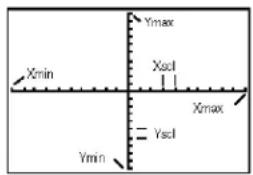
text_image
Xmin Ymax Xsc1 Ysc1 Xmax Ymin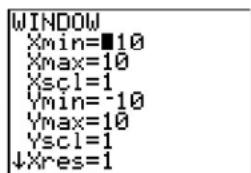
text_image
WINDOW Xmin=■10 Xmax=10 Xscl=1 Ymin=-10 Ymax=10 Yscl=1 ↓Xres=1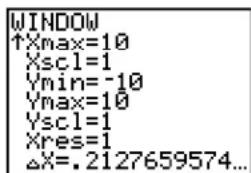
text_image
WINDOW ↑Xmax=10 Xsc1=1 Ymin=-10 Ymax=10 Ysc1=1 Xres=1 △X=.2127659574...Displaying the Window Variables
To display the current window variable values, press WINDOW. The window editor above and to the right shows the default values in Func graphing mode and Radian angle mode. The window variables differ from one graphing mode to another.
Xres sets pixel resolution (1 through 8) for function graphs only. The default is 1.
- At Xres=1, functions are evaluated and graphed at each pixel on the x-axis.
- At Xres=8, functions are evaluated and graphed at every eighth pixel along the x-axis.
Note: Small Xres values improve graph resolution but may cause the TI-84 Plus to draw graphs more slowly.
Changing a Window Variable Value
To change a window variable value from the window editor, follow these steps.
- Press ▼ or ▲ to move the cursor to the window variable you want to change.
-
Edit the value, which can be an expression.
-
Enter a new value, which clears the original value.
-
Move the cursor to a specific digit, and then edit it.
-
Press ENTER, ▼, or ▲. If you entered an expression, the TI-84 Plus evaluates it. The new value is stored.
Note: Xmin<Xmax and Ymin<Ymax must be true in order to graph.
Storing to a Window Variable from the Home Screen or a Program
To store a value, which can be an expression, to a window variable, begin on a blank line and follow these steps.
- Enter the value you want to store.
- Press STO▶.
- Press VARS to display the VARS menu.
- Select 1:Window to display the Func window variables (X/Y secondary menu).
- Press ▶ to display the Par and Pol window variables (T/θ secondary menu).
- Press ▶ ▶ to display the Seq window variables (U/V/W secondary menu).
-
Select the window variable to which you want to store a value. The name of the variable is pasted to the current cursor location.
-
Press ENTER to complete the instruction.
When the instruction is executed, the TI-84 Plus stores the value to the window variable and displays the value.
$$ \boxed { \begin{array}{c c} 1 4 \div X \max & \ & 1 4 \end{array} } $$
ΔX and ΔY
The variables X and Y (items 8 and 9 on the VARS (1:Window) X/Y secondary menu; X is also on the Window screen) define the distance from the center of one pixel to the center of any adjacent pixel on a graph (graphing accuracy). X and Y are calculated from Xmin, Xmax, Ymin, and Ymax when you display a graph.
$$ \Delta \mathrm{X} \quad \frac {\mathrm{XmaxXmin-(}}{9 4} = \Delta \mathrm{Y} \quad \frac {\mathrm{YmaxYmin-(}}{6 2} = \tag {1} $$
You can store values to X and Y . If you do, Xmax and Ymax are calculated from X , Xmin, Y , and Ymin.
Note: The ZFrac ZOOM settings (Zfrac1/2, ZFrac1/3, ZFrac1/4, ZFrac1/5, ZFrac1/8, ZFrac1/10) change X and Y to fractional values. If fractions are not needed for your problem, you can adjust X and Y to suit your needs.
Setting the Graph Format
Displaying the Format Settings
To display the format settings, press 2nd [FORMAT]. The default settings are highlighted below.
Note: You can also go to the Format Graph screen from the Mode screen by selecting YES at the GoTo Format Graph prompt. After you make changes, press MODE to return to the Mode screen.
| RectGC PolarGC | Sets cursor coordinates. | |
| CoordOn | CoordOff | Sets coordinates display on or off. |
| GridOff | GridOn | Sets grid off or on. |
| AxesOn AxesOff | Sets axes on or off. |
| LabelOff LabelOn | Sets axes label off or on. |
| ExprOn ExprOff | Sets expression display on or off. |
Format settings define a graph's appearance on the display. Format settings apply to all graphing modes. Seq graphing mode has an additional mode setting (Chapter 6).
Changing a Format Setting
To change a format setting, follow these steps.
-
Press ▼, ▶, ▲, and ◀ as necessary to move the cursor to the setting you want to select.
-
Press ENTER to select the highlighted setting.
RectGC, PolarGC
RectGC (rectangular graphing coordinates) displays the cursor location as rectangular coordinates X and Y.
PolarGC (polar graphing coordinates) displays the cursor location as polar coordinates R and .
The RectGC/PolarGC setting determines which variables are updated when you plot the graph, move the free-moving cursor, or trace.
- RectGC updates X and Y; if CoordOn format is selected, X and Y are displayed.
- PolarGC updates X, Y, R, and ; if CoordOn format is selected, R and are displayed.
CoordOn, CoordOff
CoordOn (coordinates on) displays the cursor coordinates at the bottom of the graph. If ExprOff format is selected, the function number is displayed in the top-right corner.
CoordOff (coordinates off) does not display the function number or coordinates.
GridOff, GridOn
Grid points cover the viewing window in rows that correspond to the tick marks on each axis.
GridOff does not display grid points.
GridOn displays grid points.
AxesOn, AxesOff
AxesOn displays the axes.
AxesOff does not display the axes.
This overrides the LabelOff/LabelOn format setting.
LabelOff, LabelOn
LabelOff and LabelOn determine whether to display labels for the axes (X and Y), if AxesOn format is also selected.
ExprOn, ExprOff
ExprOn and ExprOff determine whether to display the Y= expression when the trace cursor is active. This format setting also applies to stat plots.
When ExprOn is selected, the expression is displayed in the top-left corner of the graph screen.
When ExprOff and CoordOn both are selected, the number in the top-right corner specifies which function is being traced.
Displaying Graphs
Displaying a New Graph
To display the graph of the selected function or functions, press GRAPH. TRACE, ZOOM instructions, and CALC operations display the graph automatically. As the TI-84 Plus plots the graph, the busy indicator is on. As the graph is plotted, X and Y are updated.
Pausing or Stopping a Graph
While plotting a graph, you can pause or stop graphing.
- Press ENTER to pause; then press ENTER to resume.
- Press ON to stop; then press GRAPH to redraw.
Smart Graph
Smart Graph is a TI-84 Plus feature that redisplays the last graph immediately when you press GRAPH, but only if all graphing factors that would cause replotting have remained the same since the graph was last displayed.
If you performed any of the following actions since the graph was last displayed, the TI-84 Plus will replot the graph based on new values when you press GRAPH.
- Changed a mode setting that affects graphs
- Changed a function in the current picture
-
Selected or deselected a function or stat plot
-
Changed the value of a variable in a selected function
- Changed a window variable or graph format setting
- Cleared drawings by selecting ClrDraw
- Changed a stat plot definition
Overlaying Functions on a Graph
On the TI-84 Plus, you can graph one or more new functions without replotting existing functions. For example, store (X) to Y1 in the Y= editor and press GRAPH. Then store (X) to Y2 and press GRAPH again. The function Y2 is graphed on top of Y1, the original function.
natural_image
Pure waveforms plotted on a Cartesian coordinate system with no text or symbols
natural_image
Pure waveforms plotted on a Cartesian coordinate system with no text or symbolsGraphing a Family of Curves
If you enter a list (Chapter 11) as an element in an expression, the TI-84 Plus plots the function for each value in the list, thereby graphing a family of curves. In Simul graphing-order mode, it graphs all functions sequentially for the first element in each list, and then for the second, and so on.
2,4,6(X) graphs three functions: 2 sin(X), 4 sin(X), and 6 sin(X).

text_image
Plot1 Plot2 Plot3 \Y1□(2,4,6)sin(●) \Y2= \Y3= \Y4= \Y5= \Y6= \Y7=
natural_image
Symmetrical waveforms plotted against a vertical axis (no text or labels)2,4,6(1,2,3X) graphs 2(X) , 4(2X) , and 6(3X) .
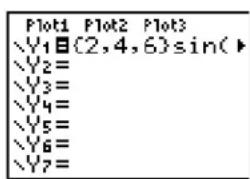
text_image
Plot1 Plot2 Plot3 \Y1=(2,4,6)sin(▶ \Y2= \Y3= \Y4= \Y5= \Y6= \Y7=
natural_image
Pure electrical circuit lines without any symbolsNote: When using more than one list, the lists must have the same dimensions.
Exploring Graphs with the Free-Moving Cursor
Free-Moving Cursor
When a graph is displayed, press ↓, ▶, ▲, or ▼ to move the cursor around the graph. When you first display the graph, no cursor is visible. When you press ↓, ▶, ▲, or ▼, the cursor moves from the center of the viewing window.
As you move the cursor around the graph, the coordinate values of the cursor location are displayed at the bottom of the screen if CoordOn format is selected. The Float/Fix decimal mode setting determines the number of decimal digits displayed for the coordinate values.
To display the graph with no cursor and no coordinate values, press CLEAR or ENTER. When you press ↓, ▶, △, or ↓, the cursor moves from the same position.
Graphing Accuracy
The free-moving cursor moves from pixel to pixel on the screen. When you move the cursor to a pixel that appears to be on the function, the cursor may be near, but not actually on, the function. The coordinate value displayed at the bottom of the screen actually may not be a point on the function. To move the cursor along a function, use TRACE.
The coordinate values displayed as you move the cursor approximate actual math coordinates, accurate to within the width and height of the pixel. As Xmin, Xmax, Ymin, and Ymax get closer together (as in a Zoom In) graphing accuracy increases, and the coordinate values more closely approximate the math coordinates.
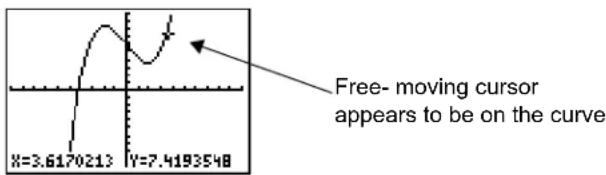
line
| X Value | Y Value | | ------- | ------- | | 3.6170213 | 7.4193548 | | (Curved Point) | (Curved Point) |Exploring Graphs with TRACE
Beginning a Trace
Use TRACE to move the cursor from one plotted point to the next along a function. To begin a trace, press TRACE. If the graph is not displayed already, press TRACE to display it. The trace cursor is on the first selected function in the Y= editor, at the middle X value on the screen. The cursor coordinates are displayed at the bottom of the screen if CoordOn format is selected. The Y= expression is displayed in the top-left corner of the screen, if ExprOn format is selected.
Moving the Trace Cursor
To move the TRACE cursor do this:
| To the previous or next plotted point, | press ▶ or ▶. |
| Five plotted points on a function (Xres affects this), | press 2nd ▶ or 2nd ▶. |
| To any valid X value on a function, | enter a value, and then press ENTER. |
| From one function to another, | press ▶ or ▶. |
When the trace cursor moves along a function, the Y value is calculated from the X value; that is, Y=Y_n(X) . If the function is undefined at an X value, the Y value is blank.

line
| X Value | Y Value | |---------|---------| | 3.1914894 | 2X3-2X+6 | | 6.1184709 | 2X3-2X+6 |If you move the trace cursor beyond the top or bottom of the screen, the coordinate values at the bottom of the screen continue to change appropriately.
Moving the Trace Cursor from Function to Function
To move the trace cursor from function to function, press ▼ and ▲. The cursor follows the order of the selected functions in the Y= editor. The trace cursor moves to each function at the same X value. If ExprOn format is selected, the expression is updated.
Moving the Trace Cursor to Any Valid X Value
To move the trace cursor to any valid X value on the current function, enter the value. When you enter the first digit, an X= prompt and the number you entered are displayed in the bottom-left corner of the screen. You can enter an expression at the X= prompt. The value must be valid for the current viewing window. When you have completed the entry, press ENTER to move the cursor.
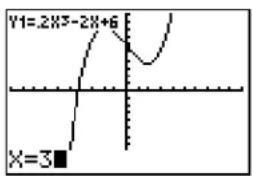

line
| X | Y | |---|---| | 3 | 2x-2x+6 | | 5.4 | 5.4 |Note: This feature does not apply to stat plots.
Panning to the Left or Right
If you trace a function beyond the left or right side of the screen, the viewing window automatically pans to the left or right. Xmin and Xmax are updated to correspond to the new viewing window.
Quick Zoom
While tracing, you can press ENTER to adjust the viewing window so that the cursor location becomes the center of the new viewing window, even if the cursor is above or below the display. This allows panning up and down. After Quick Zoom, the cursor remains in TRACE.
Leaving and Returning to TRACE
When you leave and return to TRACE, the trace cursor is displayed in the same location it was in when you left TRACE, unless Smart Graph has replotted the graph.
Using TRACE in a Program
On a blank line in the program editor, press TRACE. The instruction Trace is pasted to the cursor location. When the instruction is encountered during program execution, the graph is displayed with the trace cursor on the first selected function. As you trace, the cursor coordinate values are updated. When you finish tracing the functions, press ENTER to resume program execution.
Exploring Graphs with the ZOOM Instructions
ZOOM Menu
To display the ZOOM menu, press ZOOM. You can adjust the viewing window of the graph quickly in several ways. All ZOOM instructions are accessible from programs.
| ZOOM MEMORY | |
| 1: ZBox | Draws a box to define the viewing window. |
| 2: Zoom In | Magnifies the graph around the cursor. |
| 3: Zoom Out | Views more of a graph around the cursor. |
| 4: ZDecimal | Sets X and Y to 0.1. |
| 5: ZSquare | Sets equal-size pixels on the X and Y axes. |
| 6: ZStandard | Sets the standard window variables. |
| 7: ZTrig | Sets the built-in trig window variables. |
| 8: ZInteger | Sets integer values on the X and Y axes. |
| 9: ZoomStat | Sets the values for current stat lists. |
| 0: ZoomFit | Fits YMin and YMax between XMin and XMax. |
| A: ZQuadrant1 | Displays the portion of the graph that is in quadrant 1 |
| B: ZFrac1/2 | Sets the window variables so that you can trace in increments of 12 , if possible. Sets X and Y to 12 . |
| C: ZFrac1/3 | Sets the window variables so that you can trace in increments of 13 , if possible. Sets X and Y to 13 . |
| D: ZFrac1/4 | Sets the window variables so that you can trace in increments of 14 , if possible. Sets X and Y to 14 . |
| E: ZFrac1/5 | Sets the window variables so that you can trace in increments of 15 , if possible. Sets X and Y to 15 . |
| F: ZFrac1/8 | Sets the window variables so that you can trace in increments of 18 , if possible. Sets X and Y to 18 . |
| G: ZFrac1/10 | Sets the window variables so that you can trace in increments of 110 , if possible. Sets X and Y to 110 . |
Note: You can adjust all window variables from the VARS menu by pressing VARS 1:Window and then selecting the variable from the X/Y, T/θ, or U/V/W menu.
Zoom Cursor
When you select 1:ZBox, 2:Zoom In, or 3:Zoom Out, the cursor on the graph becomes the zoom cursor (+), a smaller version of the free-moving cursor (+).
ZBox
To define a new viewing window using ZBox, follow these steps.
- Select 1:ZBox from the ZOOM menu. The zoom cursor is displayed at the center of the screen.
- Move the zoom cursor to any spot you want to define as a corner of the box, and then press ENTER. When you move the cursor away from the first defined corner, a small, square dot indicates the spot.
- Press ☐, ▲, ▶, or ▼. As you move the cursor, the sides of the box lengthen or shorten proportionately on the screen.
Note: To cancel ZBox before you press ENTER, press CLEAR.
- When you have defined the box, press ENTER to replot the graph.

line
| X Value | Y Value | | ------- | ------- | | 3.1914894 | 1.9354839 |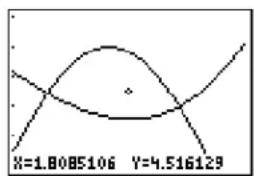
text_image
X=1.8085106 Y=4.516129To use ZBox to define another box within the new graph, repeat steps 2 through 4. To cancel ZBox, press CLEAR.
Zoom In, Zoom Out
Zoom In magnifies the part of the graph that surrounds the cursor location. Zoom Out displays a greater portion of the graph, centered on the cursor location. The XFact and YFact settings determine the extent of the zoom.
To zoom in on a graph, follow these steps.
- Check XFact and YFact; change as needed.
- Select 2:Zoom In from the ZOOM menu. The zoom cursor is displayed.
- Move the zoom cursor to the point that is to be the center of the new viewing window.
- Press ENTER. The TI-83 Plus adjusts the viewing window by XFact and YFact; updates the window variables; and replots the selected functions, centered on the cursor location.
- Zoom in on the graph again in either of two ways.
- To zoom in at the same point, press ENTER.
- To zoom in at a new point, move the cursor to the point that you want as the center of the new viewing window, and then press ENTER.
To zoom out on a graph, select 3:Zoom Out and repeat steps 3 through 5.
To cancel Zoom In or Zoom Out, press CLEAR.
ZDecimal
ZDecimal replots the functions immediately. It updates the window variables to preset values, as shown below. These values set X and Y equal to 0.1 and set the X and Y value of each pixel to one decimal place.
| Xmin=-4.7 | Ymin=-3.1 |
| Xmax=4.7 | Ymax=3.1 |
| Xscl=1 | Yscl=1 |
ZSquare
ZSquare replots the functions immediately. It redefines the viewing window based on the current values of the window variables. It adjusts in only one direction so that X = Y , which makes the graph of a circle look like a circle. XscI and YscI remain unchanged. The midpoint of the current graph (not the intersection of the axes) becomes the midpoint of the new graph.
ZStandard
ZStandard replots the functions immediately. It updates the window variables to the standard values shown below.
Xmin=-10
Ymin=-10
Xres=1
Xmax=10
Ymax=10
Xsc1=1
Ysc1=1
ZTrig
ZTrig replots the functions immediately. It updates the window variables to preset values that are appropriate for plotting trig functions. Those preset values in Radian mode are shown below.
Xmin=-(47/24)π (decimal equivalent)
Ymin=-4
Xmax=(47/24)π (decimal equivalent)
Ymax=4
Xscl=π/2 (decimal equivalent)
Ysc1=1
ZInteger
ZInteger redefines the viewing window to the dimensions shown below. To use ZInteger, move the cursor to the point that you want to be the center of the new window, and then press ENTER;
ZInteger replots the functions.
X = 1
Xscl=10
Y = 1
Yscl=10
ZoomStat
ZoomStat redefines the viewing window so that all statistical data points are displayed. For regular and modified box plots, only Xmin and Xmax are adjusted.
ZoomFit
ZoomFit replots the functions immediately. ZoomFit recalculates YMin and YMax to include the minimum and maximum Y values of the selected functions between the current XMin and XMax. XMin and XMax are not changed.
ZQuadrant1
ZQuandrant1 replots the function immediately. It redefines the window settings so that only quadrant 1 is displayed.
ZFrac1/2
ZFrac1/2 replots the functions immediately. It updates the window variables to preset values, as shown below. These values set X and Y equal to 1/2 and set the X and Y value of each pixel to one decimal place.
| Xmin=-47/2 | Ymin=-31/2 |
| Xmax=47/2 | Ymax=31/2 |
| Xscl=1 | Yscl=1 |
ZFrac1/3
ZFrac1/3 replots the functions immediately. It updates the window variables to preset values, as shown below. These values set X and Y equal to 1/3 and set the X and Y value of each pixel to one decimal place.
| Xmin=-47/3 | Ymin=-31/3 |
| Xmax=47/3 | Ymax=31/3 |
| Xscl=1 | Yscl=1 |
ZFrac1/4
ZFrac1/4 replots the functions immediately. It updates the window variables to preset values, as shown below. These values set X and Y equal to 1/4 and set the X and Y value of each pixel to one decimal place.
| Xmin=-47/4 | Ymin=-31/4 |
| Xmax=47/4 | Ymax=31/4 |
| Xscl=1 | Yscl=1 |
ZFrac1/5
ZFrac1/5 replots the functions immediately. It updates the window variables to preset values, as shown below. These values set X and Y equal to 1/5 and set the X and Y value of each pixel to one decimal place.
| Xmin=-47/5 | Ymin=-31/5 |
| Xmax=47/5 | Ymax=31/5 |
| Xscl=1 | Yscl=1 |
ZFrac1/8
ZDecimal replots the functions immediately. It updates the window variables to preset values, as shown below. These values set X and Y equal to 1/8 and set the X and Y value of each pixel to one decimal place.
| Xmin=-47/8 | Ymin=-31/8 |
| Xmax=47/8 | Ymax=31/8 |
| Xscl=1 | Yscl=1 |
ZFrac1/10
ZFrac1/10 replots the functions immediately. It updates the window variables to preset values, as shown below. These values set X and Y equal to 1/10 and set the X and Y value of each pixel to one decimal place.
| Xmin=-47/10 | Ymin=-31/10 |
| Xmax=47/10 | Ymax=31/10 |
| Xscl=1 | Yscl=1 |
Using ZOOM MEMORY
ZOOM MEMORY Menu
To display the ZOOM MEMORY menu, press ZOOM ▶.
| ZOOM MEMORY | |
| 1: ZPrevious | Uses the previous viewing window. |
| 2: ZoomSto | Stores the user-defined window. |
| 3: ZoomRcl | Recalls the user-defined window. |
| 4: SetFactors... | Changes Zoom In and Zoom Out factors. |
ZPrevious
ZPrevious replots the graph using the window variables of the graph that was displayed before you executed the last ZOOM instruction.
ZoomSto
ZoomSto immediately stores the current viewing window. The graph is displayed, and the values of the current window variables are stored in the user-defined ZOOM variables ZXmin, ZXmax, ZXscl, ZYmin, ZYmax, ZYscl, and ZXres.
These variables apply to all graphing modes. For example, changing the value of ZXmin in Func mode also changes it in Par mode.
ZoomRcl
ZoomRcl graphs the selected functions in a user-defined viewing window. The user-defined viewing window is determined by the values stored with the ZoomSto instruction. The window variables are updated with the user-defined values, and the graph is plotted.
ZOOM FACTORS
The zoom factors, XFact and YFact, are positive numbers (not necessarily integers) greater than or equal to 1. They define the magnification or reduction factor used to Zoom In or Zoom Out around a point.
Checking XFact and YFact
To display the ZOOM FACTORS screen, where you can review the current values for XFact and YFact, select 4:SetFactors from the ZOOM MEMORY menu. The values shown are the defaults.
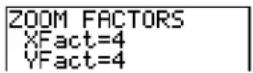
Changing XFact and YFact
You can change XFact and YFact in either of two ways.
- Enter a new value. The original value is cleared automatically when you enter the first digit.
- Place the cursor on the digit you want to change, and then enter a value or press DEL to delete it.
Using ZOOM MEMORY Menu Items from the Home Screen or a Program
From the home screen or a program, you can store directly to any of the user-defined ZOOM variables.

From a program, you can select the ZoomSto and ZoomRcl instructions from the ZOOM MEMORY menu.
Using the CALC (Calculate) Operations
CALCULATE Menu
To display the CALCULATE menu, press 2nd [CALC]. Use the items on this menu to analyze the current graph functions.
CALCULATE
| 1: value | Calculates a function Y value for a given X. |
| 2: zero | Finds a zero (x-intercept) of a function. |
| 3: minimum | Finds a minimum of a function. |
| 4: maximum | Finds a maximum of a function. |
| 5: intersect | Finds an intersection of two functions. |
| 6: dy/dx | Finds a numeric derivative of a function. |
| 7: ∫f(x)dx | Finds a numeric integral of a function. |
value
value evaluates one or more currently selected functions for a specified value of X.
Note: When a value is displayed for X, press CLEAR to clear the value. When no value is displayed, press CLEAR to cancel the value operation.
To evaluate a selected function at X, follow these steps.
- Select 1:value from the CALCULATE menu. The graph is displayed with X= in the bottom-left corner.
- Enter a real value, which can be an expression, for X between Xmin and Xmax.
- Press ENTER.

text_image
X=3■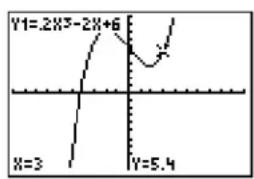
line
| X | Y | |---|---| | 3 | 2X5 - 2X6 | | 5.4 | 5.4 |The cursor is on the first selected function in the Y= editor at the X value you entered, and the coordinates are displayed, even if CoordOff format is selected.
To move the cursor from function to function at the entered X value, press ▲ or ▼. To restore the free-moving cursor, press ◀ or ▶.
zero
zero finds a zero (x-intercept or root) of a function using solve(). Functions can have more than one x-intercept value; zero finds the zero closest to your guess.
The time zero spends to find the correct zero value depends on the accuracy of the values you specify for the left and right bounds and the accuracy of your guess.
To find a zero of a function, follow these steps.
- Select 2: zero from the CALCULATE menu. The current graph is displayed with Left Bound? in the bottom-left corner.
- Press ▲ or ▼ to move the cursor onto the function for which you want to find a zero.
- Press ▶ or ▶ (or enter a value) to select the x-value for the left bound of the interval, and then press ENTER. A ▶ indicator on the graph screen shows the left bound. Right Bound? is displayed in the bottom-left corner. Press ▶ or ▶ (or enter a value) to select the x-value for the right bound, and then press ENTER. A ▶ indicator on the graph screen shows the right bound. Guess? is then displayed in the bottom-left corner.
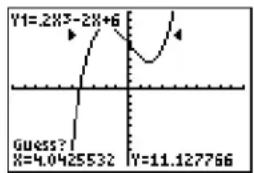
line
| Point | X | Y | |---|---|---| | 1 | 4.0425532 | 11.127766 | | 2 | 4.0425532 | 11.127766 | | 3 | 4.0425532 | 11.127766 | | 4 | 4.0425532 | 11.127766 | | 5 | 4.0425532 | 11.127766 | | 6 | 4.0425532 | 11.127766 | | 7 | 4.0425532 | 11.127766 | | 8 | 4.0425532 | 11.127766 | | 9 | 4.0425532 | 11.127766 | | 10 | 4.0425532 | 11.127766 | | 11 | 4.0425532 | 11.127766 | | 12 | 4.0425532 | 11.127766 | | 13 | 4.0425532 | 11.127766 | | 14 | 4.0425532 | 11.127766 | | 15 | 4.0425532 | 11.127766 | | 16 | 4.0425532 | 11.127766 | | 17 | 4.0425532 | 11.127766 | | 18 | 4.0425532 | 11.127766 | | 19 | 4.0425532 | 11.127766 | | 20 | 4.0425532 | 11.127766 | | 21 | 4.0425532 | 11.127766 | | 22 | 4.0425532 | 11.127766 | | 23 | 4.0425532 | 11.127766 | | 24 | 4.0425532 | 11.127766 | | 25 | 4.0425532 | 11.127766 | | 26 | 4.0425532 | 11.127766 | | 27 | 4.0425532 | 11.127766 | | 28 | 4.0425532 | 11.127766 | | 29 | 4.0425532 | 11.127766 | | 30 | 4.0425532 | 11.127766 | | 31 | 4.0425532 | 11.127766 | | 32 | 4.0425532 | 11.127766 | | 33 | 4.0425532 | 11.127766 | | 34 | 4.0425532 | 11.127766 | | 35 | 4.0425532 | 11.127766 | | 36 | 4.0425532 | 11.127766 | | 37 | 4.0425532 | 11.127766 | | 38 | 4.0425532 | 11.127766 | | 39 | 4.0425532 | 11.127766 | | 40 | 4.0425532 | 11.127766 | | 41 | 4.0425532 | 11.127766 | | 42 | 4.0425532 | 11.127766 | | 43 | 4.0425532 | 11.127766 | | 44 | 4.0425532 | 11.127766 | | 45 | 4.0425532 | 11.127766 | | 46 | 4.0425532 | 11.127766 | | 47 | 4.0425532 | 11.127766 | | 48 | 4.0425532 | 11.127766 | | 49 | 4.0425532 | 11.127766 | | 50 | 4.0425532 | 11.127766 | | ... (Note: The values in the chart are estimated based on the provided code) and the given values for 'Y' and 'X' are not explicitly labeled in the image.- Press ☑ or ▶ (or enter a value) to select a point near the zero of the function, between the bounds, and then press ENTER.
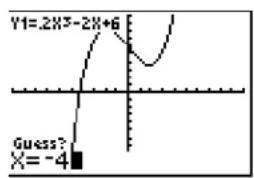
line
| Point | Value | |---|---| | 1 | 285-28+6 | | 2 | -4 | | 3 | -4 |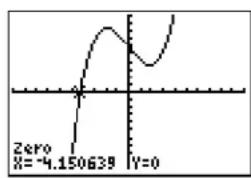
line
| x | y | |---|---| | -4.150639 | 0 | | 0 | Peak (approximate) | | 0 | 0 | | 0 | 0 | | 0 | 0 |The cursor is on the solution and the coordinates are displayed, even if CoordOff format is selected. To move to the same x-value for other selected functions, press ▲ or ▼. To restore the free-moving cursor, press ◀ or ▶.
minimum, maximum
minimum and maximum find a minimum or maximum of a function within a specified interval to a tolerance of 1E-5.
To find a minimum or maximum, follow these steps.
- Select 3: minimum or 4: maximum from the CALCULATE menu. The current graph is displayed.
- Select the function and set left bound, right bound, and guess as described for zero.
The cursor is on the solution, and the coordinates are displayed, even if you have selected CoordOff format; Minimum or Maximum is displayed in the bottom-left corner.
To move to the same x-value for other selected functions, press ▲ or ▼. To restore the free-moving cursor, press ◀ or ▶.
intersect
intersect finds the coordinates of a point at which two or more functions intersect using solve(). The intersection must appear on the display to use intersect.
To find an intersection, follow these steps.
- Select 5: intersect from the CALCULATE menu. The current graph is displayed with First curve? in the bottom-left corner.
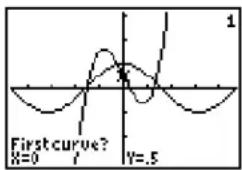
text_image
Firstcurve? x=0 y=.5- Press ▼ or ▲, if necessary, to move the cursor to the first function, and then press ENTER. Second curve? is displayed in the bottom-left corner.
- Press ▼ or ▲, if necessary, to move the cursor to the second function, and then press ENTER.
- Press ▶ or ◀ to move the cursor to the point that is your guess as to location of the intersection, and then press ENTER.
The cursor is on the solution and the coordinates are displayed, even if CoordOff format is selected. Intersection is displayed in the bottom-left corner. To restore the free-moving cursor, press ↓, ▲, ▶, or ▼.
dy/dx
dy/dx (numerical derivative) finds the numerical derivative (slope) of a function at a point, with =1E-3 .
To find a function's slope at a point, follow these steps.
- Select 6:dy/dx from the CALCULATE menu. The current graph is displayed.
- Press ▲ or ▼ to select the function for which you want to find the numerical derivative.
- Press ☑ or ▶ (or enter a value) to select the X value at which to calculate the derivative, and then press ENTER.
The cursor is on the solution and the numerical derivative is displayed.
To move to the same x-value for other selected functions, press ▶ or ▼. To restore the free-moving cursor, press ◀ or ▶.
∫f(x)dx
f(x)dx (numerical integral) finds the numerical integral of a function in a specified interval. It uses the fnInt( function, with a tolerance of =1E-3 ).
To find the numerical integral of a function, follow these steps.
- Select 7:jf(x)dx from the CALCULATE menu. The current graph is displayed with Lower Limit? in the bottom-left corner.
- Press ▲ or ▼ to move the cursor to the function for which you want to calculate the integral.
- Set lower and upper limits as you would set left and right bounds for zero. The integral value is displayed, and the integrated area is shaded.
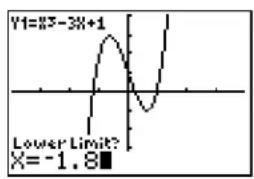
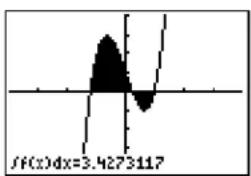
line
| x | y | | ------- | ------- | | 0 | 0 | | 1 | 3.4273117 | | 2 | 0 | | 3 | 0 | | 4 | 0 | | 5 | 0 | | 6 | 0 | | 7 | 0 | | 8 | 0 | | 9 | 0 | | 10 | 0 | | 11 | 0 | | 12 | 0 | | 13 | 0 | | 14 | 0 | | 15 | 0 | | 16 | 0 | | 17 | 0 | | 18 | 0 | | 19 | 0 | | 20 | 0 | | 21 | 0 | | 22 | 0 | | 23 | 0 | | 24 | 0 | | 25 | 0 | | 26 | 0 | | 27 | 0 | | 28 | 0 | | 29 | 0 | | 30 | 0 | | 31 | 0 | | 32 | 0 | | 33 | 0 | | 34 | 0 | | 35 | 0 | | 36 | 0 | | 37 | 0 | | 38 | 0 | | 39 | 0 | | 40 | 0 | | 41 | 0 | | 42 | 0 | | 43 | 0 | | 44 | 0 | | 45 | 0 | | 46 | 0 | | 47 | 0 | | 48 | 0 | | 49 | 0 | | 50 | 0 | | 51 | 0 | | 52 | 0 | | 53 | 0 | | 54 | 0 | | 55 | 0 | | 56 | 0 | | 57 | 0 | | 58 | 0 | | 59 | 0 | | 60 | 0 | | 61 | 0 | | 62 | 0 | | 63 | 0 | | 64 | 0 | | 65 | 0 | | 66 | 0 | | 67 | 0 | | 68 | 0 | | 69 | 0 | | 70 | 0 | | 71 | 0 | | 72 | 0 | | 73 | 0 | | 74 | 0 | | 75 | 0 | | 76 | 0 | | 77 | 0 | | 78 | 0 | | 79 | 0 | | 80 | 0 | | 81 | 0 | | 82 | 0 | | 83 | 0 | | 84 | 0 | | 85 | 0 | | 86 | 0 | | 87 | 0 | | 88 | 0 | | 89 | 0 | | 90 | 0 | | 91 | 0 | | 92 | 0 | | 93 | 0 | | 94 | 0 | | 95 | 0 | | 96 | 0 | | 97 | 0 | | 98 | 0 | | 99 | 0 | | Note: The y-values are estimated based on the provided code execution in the code editor's output 'df(x)dx'. The actual y-values for the other y-values are not explicitly provided in the code editor's output. There is no label for the y-values. The output y-value is estimated based on the input y-value.Note: The shaded area is a drawing. Use CIrDraw (Chapter 8) or any action that invokes Smart Graph to clear the shaded area.
Chapter 4: Parametric Graphing
Getting Started: Path of a Ball
Getting Started is a fast-paced introduction. Read the chapter for details.
Graph the parametric equation that describes the path of a ball hit at an initial speed of 30 meters per second, at an initial angle of 25 degrees with the horizontal from ground level. How far does the ball travel? When does it hit the ground? How high does it go? Ignore all forces except gravity.
For initial velocity v_0 and angle , the position of the ball as a function of time has horizontal and vertical components.
Horizontal: X1(t)=tycos(θ)
Vertical:
$$ Y 1 (t) = \sin (\theta) - \frac {1}{2} \quad 2 t $$
The vertical and horizontal vectors of the ball's motion also will be graphed.
Vertical vector:
X2(t)=0
Y2(t)=Y1(t)
Horizontal vector:
X3(t)=X1(t)
Y3(t)=0
Gravity constant:
g=9.8 m/sec ^2
-
Press MODE. Press ▼ ▼ ▼ ENTER to select Par mode. Press ▼ ▼ ▼ ENTER to select Simul for simultaneous graphing of all three parametric equations in this example.
-
Press ▼ ▼ ▼ ▼ ▼ ▶ ENTER to go to the Format Graph screen. Press ▼ ▼ ▼ ▶ ENTER to select AxesOff, which turns off the axes.

text_image
NORMAL SCI ENG FLOAT 0123456789 RADIAN DEGREE FUNC PAR POL SEQ CONNECTED DOT SEQUENTIAL SIMUL REAL a+bi re^8i FULL HORIZ 6-T ↓NEXT↓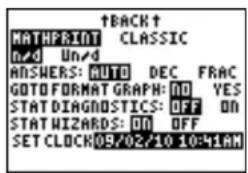
text_image
†BACK † MATHPRINT CLASSIC n/d Un/d ANSWERS: AUTO DEC FRAC GOTO FORMAT GRAPH: NO YES STATDIAGNOSTICS: OFF ON STATWIZARDS: ON OFF SET CLOCK:05/02/10 10:41AM
text_image
rectG: PolarGC CoordOn: CoordOff GridOff: GridOn AxesOn: AxesOff LabelOff: LabelOn ExprOn: ExprOff- Press Y=. Press 30 X,T,Θ,n COS 25 2nd [ANGLE] 1 (to select °) ) ENTER to define X1T in terms of T.
- Press 30 X,T,Θ,n SIN 25 2nd [ANGLE] 1 } - ALPHA [F1] 1 (to select n/d) 9.8 ▶ 2 ▶ X,T,Θ,n x² ENTER to define Y1T.
The vertical component vector is defined by X2T and Y2T.
- Press 0 ENTER to define X2T.
- Press ALPHA [F4] ▼ ENTER ENTER to define Y2T.
The horizontal component vector is defined by X3T and Y3T.
- Press ALPHA [F4] ENTER ENTER to define X3T.
- Press 0 ENTER to define Y3T.
- Press ▶ ▶ ▶ ENTER to change the graph style to ▶ for X3T and Y3T. Press ▶ ENTER ENTER to change the graph style to ▶ for X2T and Y2T. Press ▶ ENTER ENTER to change the graph style to ▶ for X1T and Y1T. (These keystrokes assume that all graph styles were set to ▶ originally.)
- Press WINDOW. Enter these values for the window variables.
| Tmin=0 | Xmin=-10 | Ymin=-5 |
| Tmax=5 | Xmax=100 | Ymax=15 |
| Tstep=.1 | Xscl=50 | Yscl=10 |
Note: You can check all WINDOW variables, including X and Y by pressing VARS 1:Window.
- Press GRAPH. The plotting action simultaneously shows the ball in flight and the vertical and horizontal component vectors of the motion.
Note: To simulate the ball flying through the air, set graph style to (animate) for X1T and Y1T.
| Plot1 Plot2 Plot3 X_1T = 30T(25^) Y_1T = 30T(25^) |
| X_2T = Y_2T = X_3T = |
| Plot1 Plot2 Plot3 |
| X_1T 30Tcos(25°) |
| Y_1T 30Tsin(25°) |
| X_2T = 0 |
| Y_2T = |
| X_3T = |
| Y_3T = |
| Plot1 Plot2 Plot3 |
| X_1T 30Tcos(25°) |
| Y_1T 30Tsin(25°) |
| X_2T 0 |
| Y_2T BY1T■ |
| X_3T = |
| Y_3T = |
| Plot1 Plot2 Plot3 |
| X_1T 30Tcos(25°) |
| Y_1T 30Tsin(25°) |
| X_2T 0 |
| Y_2T Y_1T |
| X_3T X_1T |
| Y_3T 0 |
| Plot1 | Plot2 | Plot3 |
| -0X_1T | 30T(25^) | |
| Y_1T | 30(25^) | |
| -0X_2T | ||
| Y_2T | Y_1T | |
| X_3T | X_1T | |
| Y_3T | ||
| WINDOW |
| ↑Tstep=.1 |
| Xmin=-10 |
| Xmax=100 |
| Xscl=50 |
| Ymin=-5 |
| Ymax=15 |
| Yscl=10 |

natural_image
Simple line drawing of a curved arc above a horizontal baseline, with no text or symbols present.- Press TRACE to obtain numerical results and answer the questions at the beginning of this section.
Tracing begins at Tmin on the first parametric equation (X1T and Y1T). As you press ▶ to trace the curve, the cursor follows the path of the ball over time. The values for X (distance), Y (height), and T (time) are displayed at the bottom of the screen.

line
| X-axis Label | Y-axis Value | |--------------|--------------| | T | 19.032464 | | Y | 6.4739835 |Defining and Displaying Parametric Graphs
TI-84 Plus Graphing Mode Similarities
The steps for defining a parametric graph are similar to the steps for defining a function graph. Chapter 4 assumes that you are familiar with Chapter 3: Function Graphing. Chapter 4 details aspects of parametric graphing that differ from function graphing.
Setting Parametric Graphing Mode
To display the mode screen, press MODE. To graph parametric equations, you must select parametric graphing mode before you enter window variables and before you enter the components of parametric equations.
Displaying the Parametric Y=Editor
After selecting parametric graphing mode, press Y= to display the parametric Y= editor.

text_image
Plot1 Plot2 Plot3 X1T= Y1T= X2T= Y2T= X3T= Y3T= X4T=In this editor, you can display and enter both the X and Y components of up to six equations, X1T and Y1T through X6T and Y6T. Each is defined in terms of the independent variable T. A common application of parametric graphs is graphing equations over time.
Selecting a Graph Style
The icons to the left of X1T through X6T represent the graph style of each parametric equation. The default in parametric mode is (line), which connects plotted points. Line, (thick), (path), (animate), and (dot) styles are available for parametric graphing.
Defining and Editing Parametric Equations
To define or edit a parametric equation, follow the steps in Chapter 3 for defining a function or editing a function. The independent variable in a parametric equation is T. In parametric graphing mode, you can enter the parametric variable T in either of two ways.
- Press X,T, ,n
- Press ALPHA [ T].
Two components, X and Y, define a single parametric equation. You must define both of them.
Selecting and Deselecting Parametric Equations
The TI-84 Plus graphs only the selected parametric equations. In the Y= editor, a parametric equation is selected when the = signs of both the X and Y components are highlighted. You may select any or all of the equations X1T and Y1T through X6T and Y6T.
To change the selection status, move the cursor onto the = sign of either the X or Y component and press ENTER. The status of both the X and Y components is changed.
Setting Window Variables
To display the window variable values, press WINDOW. These variables define the viewing window. The values below are defaults for parametric graphing in Radian angle mode.
| Tmin=0 | Smallest T value to evaluate |
| Tmax=6.2831853... | Largest T value to evaluate (2 ) |
| Tstep=.1308996... | T value increment ( /24 ) |
| Xmin=-10 | Smallest X value to be displayed |
| Xmax=10 | Largest X value to be displayed |
| Xscl=1 | Spacing between the X tick marks |
| Ymin=-10 | Smallest Y value to be displayed |
| Ymax=10 | Largest Y value to be displayed |
| Yscl=1 | Spacing between the Y tick marks |
Note: To ensure that sufficient points are plotted, you may want to change the T window variables.
Setting the Graph Format
To display the current graph format settings, press 2nd [FORMAT]. Chapter 3 describes the format settings in detail. The other graphing modes share these format settings; Seq graphing mode has an additional axes format setting.
Displaying a Graph
When you press GRAPH, the TI-84 Plus plots the selected parametric equations. It evaluates the X and Y components for each value of T (from Tmin to Tmax in intervals of Tstep), and then plots each point defined by X and Y. The window variables define the viewing window.
As the graph is plotted, X, Y, and T are updated.
Smart Graph applies to parametric graphs.
Window Variables and Y-VARS Menus
You can perform these actions from the home screen or a program.
- Access functions by using the name of the X or Y component of the equation as a variable.
$$ \begin{array}{c} \hline X _ {1 r} *. 5 \ 9 4. 7 0 9 1 6 3 7 5 \end{array} $$
- Store parametric equations.
$$ \left| \begin{array}{l} \text {"sin(T)" \to X_{1T}} \ \text {"cos(T)" \to Y_{1T}} \ \text {Done} \ \text {Done} \end{array} \right| $$
$$ \begin{array}{c} \text {Plot1 Plot2 Plot3} \ \backslash X _ {1 T} \text {Sin(T)} \ Y _ {1 T} \text {cos(T)} \ \backslash X _ {2 T} = \ Y _ {2 T} = \end{array} $$
- Select or deselect parametric equations.
$$ \boxed { \begin{array}{c c} \text {FnOff 1} & \ & \text {Done} \end{array} } $$
$$ \begin{array}{c} \text {Plot1 Plot2 Plot3} \ \backslash X _ {1 T} = \cos (T) \ Y _ {1 T} = \sin (T) \ \backslash X _ {2 T} = \ Y _ {2 T} = \end{array} $$
- Store values directly to window variables.
$$ \begin{array}{c c}\hline 3 6 0 \rightarrow T \max&\&3 6 0\end{array} $$
Exploring Parametric Graphs
Free-Moving Cursor
The free-moving cursor in parametric graphing works the same as in Func graphing.
In RectGC format, moving the cursor updates the values of X and Y; if CoordOn format is selected, X and Y are displayed.
In PolarGC format, X, Y, R, and are updated; if CoordOn format is selected, R and are displayed.
TRACE
To activate TRACE, press TRACE. When TRACE is active, you can move the trace cursor along the graph of the equation one Tstep at a time. When you begin a trace, the trace cursor is on the first selected function at Tmin. If ExprOn is selected, then the function is displayed.
In RectGC format, TRACE updates and displays the values of X, Y, and T if CoordOn format is on.
In PolarGC format, X, Y, R, and T are updated; if CoordOn format is selected, R, , and T are displayed. The X and Y (or R and ) values are calculated from T.
To move five plotted points at a time on a function, press 2nd or 2nd. If you move the cursor beyond the top or bottom of the screen, the coordinate values at the bottom of the screen continue to change appropriately.
Quick Zoom is available in parametric graphing; panning is not.
Moving the Trace Cursor to Any Valid T Value
To move the trace cursor to any valid T value on the current function, enter the number. When you enter the first digit, a T= prompt and the number you entered are displayed in the bottom-left corner of the screen. You can enter an expression at the T= prompt. The value must be valid for the current viewing window. When you have completed the entry, press ENTER to move the cursor.
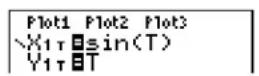
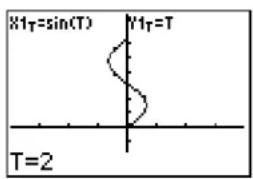
text_image
X1T=sin(T) Y1T=T T=2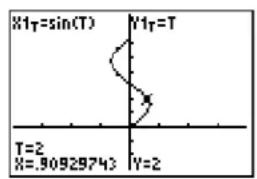
line
| X | Y | |---|---| | 0.90929743 | 0.90929743 | | 1.0000 | 1.0000 | | 1.1000 | 1.1000 | | 1.2000 | 1.2000 | | 1.3000 | 1.3000 | | 1.4000 | 1.4000 | | 1.5000 | 1.5000 | | 1.6000 | 1.6000 | | 1.7000 | 1.7000 | | 1.8000 | 1.8000 | | 1.9000 | 1.9000 | | 2.0000 | 2.0000 | | 2.1000 | 2.1000 | | 2.2000 | 2.2000 | | 2.3000 | 2.3000 | | 2.4000 | 2.4000 | | 2.5000 | 2.5000 | | 2.6000 | 2.6000 | | 2.7000 | 2.7000 | | 2.8000 | 2.8000 | | 2.9000 | 2.9000 | | 3.0000 | 3.0000 | | 3.1000 | 3.1000 | | 3.2000 | 3.2000 | | 3.3000 | 3.3000 | | 3.4000 | 3.4000 | | 3.5000 | 3.5000 | | 3.6000 | 3.6000 | | 3.7000 | 3.7000 | | 3.8000 | 3.8000 | | 3.9000 | 3.9000 | | 4.0000 | 4.0000 | | 4.1000 | 4.1000 | | 4.2000 | 4.2000 | | 4.3000 | 4.3000 | | 4.4000 | 4.4000 | | 4.5000 | 4.5000 | | 4.6000 | 4.6000 | | 4.7000 | 4.7 | | 4.8e-1 | 4.8e-1 | | 4.9e-1 | 4.9e-1 | | 5e-1 | 5e-1 | | 5e-2 | 5e-2 | | 5e-3 | 5e-3 | | 5e-4 | 5e-4 | | 5e-5 | 5e-5 | | 5e-6 | 5e-6 | | 5e-7 | 5e-7 | | 5e-8 | 5e-8 | | 5e-9 | 5e-9 | | 5e-1e | 5e-1e | | 5e-11 | 5e-11 | | 5e-12 | 5e-12 | | 5e-13 | 5e-13 | | 5e-14 | 5e-14 | | 5e-15 | 5e-15 | | 5e-16 | 5e-16 | | 5e-17 | 5e-17 | | 5e-18 | 5e-18 | | 5e-19 | 5e-19 | | 5e-2e | 5e-2e | | 5e-21 | 5e-21 | | 5e-22 | 5e-22 | | 5e-23 | 5e-23 | | 5e-24 | 5e-24 | | 5e-25 | 5e-25 | | 5e-26 | 5e-26 | | 5e-27 | 5e-27 | | 5e-28 | 5e-28 | | 5e-29 | 5e-29 | | 5e-3e | 5e-3e | | 5e-31 | 5e-31 | | T=2: X=9.999743; Y=2: Y=2ZOOM
ZOOM operations in parametric graphing work the same as in Func graphing. Only the X (Xmin, Xmax, and XscI) and Y (Ymin, Ymax, and YscI) window variables are affected.
The T window variables (Tmin, Tmax, and Tstep) are only affected when you select ZStandard. The VARS ZOOM secondary menu ZT/Zθ items 1:ZTmin, 2:ZTmax, and 3:ZTstep are the zoom memory variables for parametric graphing.
CALC
CALC operations in parametric graphing work the same as in Func graphing. The CALCULATE menu items available in parametric graphing are 1:value, 2:dy/dx, 3:dy/dt, and 4:dx/dt.
Chapter 5: Polar Graphing
Getting Started: Polar Rose
Getting Started is a fast-paced introduction. Read the chapter for details.
The polar equation R=Asin(B) graphs a rose. Graph the rose for A=8 and B=2.5, and then explore the appearance of the rose for other values of A and B.
-
Press MODE to display the MODE screen. Press ▼ ▼ ▶ ▶ ENTER to select Pol graphing mode. Select the defaults (the options on the left) for the other mode settings.
-
Press Y= to display the polar Y= editor. Press 8 SIN 2.5 X,T,Θ,n) ENTER to define r1.
-
Press ZOOM 6 to select 6:ZStandard and graph the equation in the standard viewing window. The graph shows only five petals of the rose, and the rose does not appear to be symmetrical. This is because the standard window sets _ = 2 and defines the window, rather than the pixels, as square.
-
Press WINDOW to display the window variables. Press ▼ 4 2nd [π] to increase the value of θmax to 4π.
-
Press ZOOM 5 to select 5:ZSquare and plot the graph.
-
Repeat steps 2 through 5 with new values for the variables A and B in the polar equation r1=A(B) . Observe how the new values affect the graph.
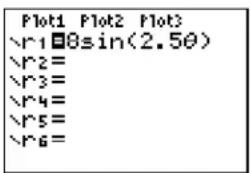
text_image
Plot1 Plot2 Plot3 -r1 ■8sin(2.50) -r2= -r3= -r4= -r5= -r6=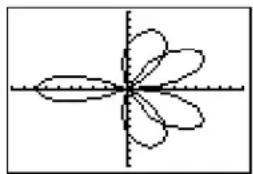
natural_image
Symmetrical abstract line drawing with five petal-like shapes radiating from a central point, intersected by two perpendicular lines (no text or symbols)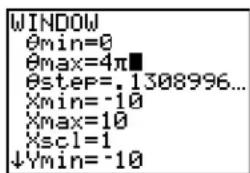
text_image
WINDOW θmin=0 θmax=4π■ θstep=.1308996... Xmin=-10 Xmax=10 Xsc1=1 ↓Ymin=-10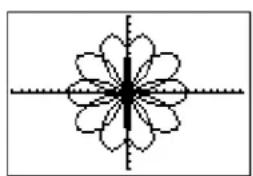
natural_image
Symmetrical abstract flower-like pattern with intersecting lines (no text or symbols)Defining and Displaying Polar Graphs
TI-84 Plus Graphing Mode Similarities
The steps for defining a polar graph are similar to the steps for defining a function graph. Chapter 5 assumes that you are familiar with Chapter 3: Function Graphing. Chapter 5 details aspects of polar graphing that differ from function graphing.
Setting Polar Graphing Mode
To display the mode screen, press MODE. To graph polar equations, you must select Pol graphing mode before you enter values for the window variables and before you enter polar equations.
Displaying the Polar Y=Editor
After selecting Pol graphing mode, press = to display the polar Y= editor.
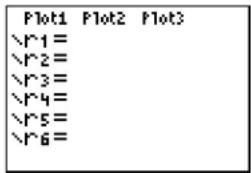
text_image
Plot1 Plot2 Plot3 \r1= \r2= \r3= \r4= \r5= \r6=In this editor, you can enter and display up to six polar equations, r1 through r6. Each is defined in terms of the independent variable .
Selecting Graph Styles
The icons to the left of r1 through r6 represent the graph style of each polar equation. The default in Pol graphing mode is (line), which connects plotted points. Line, (thick), (path), (animate), and (dot) styles are available for polar graphing.
Defining and Editing Polar Equations
To define or edit a polar equation, follow the steps in Chapter 3 for defining a function or editing a function. The independent variable in a polar equation is . In Pol graphing mode, you can enter the polar variable in either of two ways.
- Press X,T,,n .
- Press ALPHA [θ].
Selecting and Deselecting Polar Equations
The TI-84 Plus graphs only the selected polar equations. In the Y= editor, a polar equation is selected when the = sign is highlighted. You may select any or all of the equations.
To change the selection status, move the cursor onto the= sign, and then press ENTER.
Setting Window Variables
To display the window variable values, press WINDOW. These variables define the viewing window. The values below are defaults for Pol graphing in Radian angle mode.
| _min=0 | Smallest value to evaluate |
| _max=6.2831853... | Largest value to evaluate ( 2 ) |
| _step=.1308996... | Increment between values ( /24 ) |
| Xmin=-10 | Smallest X value to be displayed |
| Xmax=10 | Largest X value to be displayed |
| Xscl=1 | Spacing between the X tick marks |
| Ymin=-10 | Smallest Y value to be displayed |
| Ymax=10 | Largest Y value to be displayed |
| Yscl=1 | Spacing between the Y tick marks |
Note: To ensure that sufficient points are plotted, you may want to change the window variables.
Setting the Graph Format
To display the current graph format settings, press 2nd [FORMAT]. Chapter 3 describes the format settings in detail. The other graphing modes share these format settings.
Displaying a Graph
When you press , the TI-84 Plus plots the selected polar equations. It evaluates R for each value of (from _min to _max in intervals of _step ) and then plots each point. The window variables define the viewing window.
As the graph is plotted, X, Y, R, and are updated.
Smart Graph applies to polar graphs.
Window Variables and Y-VARS Menus
You can perform these actions from the home screen or a program.
- Access functions by using the name of the equation as a variable. These function names are available on the YVARS shortcut menu ([ALPHA] [F4]).
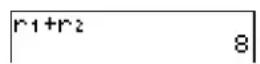
- Store polar equations.

text_image
"5θ"+r1 Done Plot1 Plot2 Plot3text_image
FnOff 1 Done Plot1 Plot2 Plot3 \r1850 \r2=Exploring Polar Graphs
Free-Moving Cursor
The free-moving cursor in Pol graphing works the same as in Func graphing. In RectGC format, moving the cursor updates the values of X and Y; if CoordOn format is selected, X and Y are displayed. In PolarGC format, X, Y, R, and are updated; if CoordOn format is selected, R and are displayed.TRACE
To activate TRACE, press TRACE. When TRACE is active, you can move the trace cursor along the graph of the equation one _step at a time. When you begin a trace, the trace cursor is on the first selected function at _min . If ExprOn format is selected, then the equation is displayed. In RectGC format, TRACE updates the values of X, Y, and ; if CoordOn format is selected, X, Y, and are displayed. In PolarGC format, TRACE updates X, Y, R, and ; if CoordOn format is selected, R and are displayed. To move five plotted points at a time on a function, press 2nd or 2nd. If you move the trace cursor beyond the top or bottom of the screen, the coordinate values at the bottom of the screen continue to change appropriately. Quick Zoom is available in Pol graphing mode; panning is not.Moving the Trace Cursor to Any Valid Theta Value
To move the trace cursor to any valid value on the current function, enter the number. When you enter the first digit, a = prompt and the number you entered are displayed in the bottom-left corner of the screen. You can enter an expression at the = prompt. The value must be valid for the current viewing window. When you complete the entry, press ENTER to move the cursor.ZOOM
ZOOM operations in Pol graphing work the same as in Func graphing. Only the X (Xmin, Xmax, and XscI) and Y (Ymin, Ymax, and YscI) window variables are affected. The window variables ( _min , _max , and _step ) are not affected, except when you select ZStandard. The VARS ZOOM secondary menu ZT/Z items 4:Z _min , 5:Z _max , and 6:Z _step are zoom memory variables for Pol graphing.CALC
CALC operations in Pol graphing work the same as in Func graphing. The CALCULATE menu items available in Pol graphing are 1:value, 2:dy/dx, and 3:dr/dθ.Chapter 6: Sequence Graphing
Getting Started: Forest and Trees
Note: Getting Started is a fast-paced introduction. Read the chapter for details. A small forest of 4,000 trees is under a new forestry plan. Each year 20 percent of the trees will be harvested and 1,000 new trees will be planted. Will the forest eventually disappear? Will the forest size stabilize? If so, in how many years and with how many trees? 1. Press MODE. Press ▼▼▼▶▶▶ ENTER to select Seq graphing mode. text_image
NORMAL SCI ENG FLOAT 0123456789 RADIAN DEGREE FUNC PAR POL SEQ CONNECTED DOT SEQUENTIAL SIMUL REAL a+bi re^8i FULL HORIZ G-T 4NEXT↓text_image
timeWeb uv vw uw Rect00 PolarGC Coord0r CoordOff GridOff GridOn Axes0r AxesOff Label0f LabelOn Expr0f ExprOfftext_image
Plot1 Plot2 Plot3 xMin=0 ·u(n) □iPart(.8u) u(xMin) □(4000) ·v(n)= v(xMin)= ·w(n)= w(xMin)=line
| x | y | |---|---| | 14 | 1000 | | 14 | 4954 |Defining and Displaying Sequence Graphs
TI-84 Plus Graphing Mode Similarities
The steps for defining a sequence graph are similar to the steps for defining a function graph. Chapter 6 assumes that you are familiar with Chapter 3: Function Graphing. Chapter 6 details aspects of sequence graphing that differ from function graphing.Setting Sequence Graphing Mode
To display the mode screen, press MODE. To graph sequence functions, you must select Seq graphing mode before you enter window variables and before you enter sequence functions. Sequence graphs automatically plot in Simul mode, regardless of the current plotting-order mode setting.TI-84 Plus Sequence Functions u, v, and w
The TI-84 Plus has three sequence functions that you can enter from the keyboard: u, v, and w. They are second functions of the 7, 8, and 9 keys. Press 2nd [u] to enter u, for example. You can define sequence functions in terms of: • The independent variable n • The previous term in the sequence function, such as u(n-1) • The term that precedes the previous term in the sequence function, such as u(n-2) - The previous term or the term that precedes the previous term in another sequence function, such as u(n - 1) or u(n - 2) referenced in the sequence v(n) . Note: Statements in this chapter about u(n) are also true for v(n) and w(n) ; statements about u(n-1) are also true for v(n-1) and w(n-1) ; statements about u(n-2) are also true for v(n-2) and w(n-2) .Displaying the Sequence Y= Editor
After selecting Seq mode, press Y= to display the sequence Y= editor. Plot1 Plot2 Plot3 nMin=1 u(n)= u(nMin)= v(n)= v(nMin)= w(n)= w(nMin)= In this editor, you can display and enter sequences for u(n) , v(n) , and w(n) . Also, you can edit the value for nMin , which is the sequence window variable that defines the minimum n value to evaluate. The sequence Y = editor displays the nMin value because of its relevance to u(nMin) , v(nMin) , and w(nMin) , which are the initial values for the sequence equations u(n) , v(n) , and w(n) , respectively. nMin in the Y= editor is the same as nMin in the window editor. If you enter a new value for nMin in one editor, the new value for nMin is updated in both editors. Note: Use u(nMin) , v(nMin) , or w(nMin) only with a recursive sequence, which requires an initial value.Selecting Graph Styles
The icons to the left of u(n) , v(n) , and w(n) represent the graph style of each sequence (Chapter 3). The default in Seq mode is · . (dot), which shows discrete values. Dot, · (line), and · (thick) styles are available for sequence graphing. Graph styles are ignored in Web format.Selecting and Deselecting Sequence Functions
The TI-84 Plus graphs only the selected sequence functions. In the Y= editor, a sequence function is selected when the = signs of both u(n)= and u(nMin)= are highlighted. To change the selection status of a sequence function, move the cursor onto the = sign of the function name, and then press ENTER. The status is changed for both the sequence function u(n) and its initial value u(nMin).Defining and Editing a Sequence Function
To define or edit a sequence function, follow the steps in Chapter 3 for defining a function. The independent variable in a sequence is n . In Seq graphing mode, you can enter the sequence variable in either of two ways. - Press X,T, ,n - Press 2nd [CATALOG] [N]. You can enter the function name from the keyboard (2nd [u], 2nd [v], 2nd [w]). Generally, sequences are either nonrecursive or recursive. Sequences are evaluated only at consecutive integer values. n is always a series of consecutive integers, starting at zero or any positive integer.Nonrecursive Sequences
In a nonrecursive sequence, the nth term is a function of the independent variable n. Each term is independent of all other terms. For example, in the nonrecursive sequence below, you can calculate u(5) directly, without first calculating u(1) or any previous term.Plot1 Plot2 Plot3
nMin=1
·u(n)■2*n
u(nMin)■
·v(n)=
v(nMin)=
·w(n)=
w(nMin)=
Recursive Sequences
In a recursive sequence, the n th term in the sequence is defined in relation to the previous term or the term that precedes the previous term, represented by u(n-1) and u(n-2) . A recursive sequence may also be defined in relation to n , as in u(n)=u(n-1)+n . For example, in the sequence below you cannot calculate u(5) without first calculating u(1), u(2), u(3), and u(4).Plot1 Plot2 Plot3
nMin=1
·u(n)■2*u(n-1)
u(nMin)■1
Plot1 Plot2 Plot3
nMin=1
u(n)■.8u(n-1)
u(nMin)■(100)
v(n)=■
w(n)=
w(n)=
w(nMin)=
Plot1 Plot2 Plot3
xMin=1
u(n)B.8u(n-1)+#
u(xMin)B(1,1)
v(n)=
v(xMin)=
w(n)=
w(xMin)=
Setting Window Variables
To display the window variables, press WINDOW. These variables define the viewing window. The values below are defaults for Seq graphing in both Radian and Degree angle modes.| nMin=1 | Smallest n value to evaluate |
| nMax=10 | Largest n value to evaluate |
| PlotStart=1 | First term number to be plotted |
| PlotStep=1 | Incremental n value (for graphing only) |
| Xmin=-10 | Smallest X value to be displayed |
| Xmax=10 | Largest X value to be displayed |
| Xscl=1 | Spacing between the X tick marks |
| Ymin=-10 | Smallest Y value to be displayed |
| Ymax=10 | Largest Y value to be displayed |
| Yscl=1 | Spacing between the Y tick marks |
Selecting Axes Combinations
Setting the Graph Format
To display the current graph format settings, press [2nd] [FORMAT]. Chapter 3 describes the format settings in detail. The other graphing modes share these format settings. The axes setting on the top line of the screen is available only in Seq mode.| Time Web uv vw uw | Type of sequence plot (axes) |
| RectGC Polar GC | Rectangular or polar output |
| CoordOn CoordOff | Cursor coordinate display on/off |
| GridOff GridOn | Grid display off or on |
| AxesOn AxesOff | Axes display on or off |
| LableOff LabelOn | Axes label display off or on |
| ExprOn ExprOff | Expression display on or off |
Setting Axes Format
For sequence graphing, you can select from five axes formats. The table below shows the values that are plotted on the x-axis and y-axis for each axes setting.| Axes Setting x-axis y-axis | ||
| Time | n | u(n), v(n), w(n) |
| Web | u(n-1), v(n-1), w(n-1) | u(n), v(n), w(n) |
| uv u(n) | v | ( |
| vw | v(n) | w(n) |
| uw | u(n) | w(n) |
Displaying a Sequence Graph
To plot the selected sequence functions, press GRAPH. As a graph is plotted, the TI-84 Plus updates X, Y, and n. Smart Graph applies to sequence graphs (Chapter 3).Exploring Sequence Graphs
Free-Moving Cursor
The free-moving cursor in Seq graphing works the same as in Func graphing. In RectGC format, moving the cursor updates the values of X and Y; if CoordOn format is selected, X and Y are displayed. In PolarGC format, X, Y, R, and are updated; if CoordOn format is selected, R and are displayed.TRACE
The axes format setting affects TRACE. When Time, uv, vw, or uw axes format is selected, TRACE moves the cursor along the sequence one PlotStep increment at a time. To move five plotted points at once, press 2nd ▶ or 2nd ◄. - When you begin a trace, the trace cursor is on the first selected sequence at the term number specified by PlotStart, even if it is outside the viewing window. - Quick Zoom applies to all directions. To center the viewing window on the current cursor location after you have moved the trace cursor, press ENTER. The trace cursor returns to nMin. In Web format, the trail of the cursor helps identify points with attracting and repelling behavior in the sequence. When you begin a trace, the cursor is on the x-axis at the initial value of the first selected function. Note: To move the cursor to a specified n during a trace, enter a value for n, and press ENTER. For example, to quickly return the cursor to the beginning of the sequence, paste nMin to the n= prompt and press ENTER.Moving the Trace Cursor to Any Valid n Value
To move the trace cursor to any valid n value on the current function, enter the number. When you enter the first digit, an n= prompt and the number you entered are displayed in the bottom-left corner of the screen. You can enter an expression at the n= prompt. The value must be valid for the current viewing window. When you have completed the entry, press ENTER to move the cursor. scatter
| x | y | |---|---| | 0 | 0 | | 1 | 0 | | 2 | 0 | | 3 | 0 | | 4 | 0 | | 5 | 0 | | 6 | 0 | | 7 | 0 | | 8 | 0 | | 9 | 0 | | 10 | 0 | | 11 | 0 | | 12 | 0 | | 13 | 0 | | 14 | 0 | | 15 | 0 | | 16 | 0 | | 17 | 0 | | 18 | 0 | | 19 | 0 | | 20 | 0 | | 21 | 0 | | 22 | 0 | | 23 | 0 | | 24 | 0 | | 25 | 0 | | 26 | 0 | | 27 | 0 | | 28 | 0 | | 29 | 0 | | 30 | 0 | | 31 | 0 | | 32 | 0 | | 33 | 0 | | 34 | 0 | | 35 | 0 | | 36 | 0 | | 37 | 0 | | 38 | 0 | | 39 | 0 | | 40 | 0 | | 41 | 0 | | 42 | 0 | | 43 | 0 | | 44 | 0 | | 45 | 0 | | 46 | 0 | | 47 | 0 | | 48 | 0 | | 49 | 0 | | 50 | 0 | | 51 | 0 | | 52 | 0 | | 53 | 0 | | 54 | 0 | | 55 | 0 | | 56 | 0 | | 57 | 0 | | 58 | 0 | | 59 | 0 | | 60 | 0 | | 61 | 0 | | 62 | 0 | | 63 | 0 | | 64 | 0 | | 65 | 0 | | 66 | 0 | | 67 | 0 | | 68 | 0 | | 69 | 0 | | 70 | 0 | | 71 | 0 | | 72 | 0 | | 73 | 0 | | 74 | 0 | | 75 | 0 | | 76 | 0 | | 77 | 0 | | 78 | 0 | | 79 | 0 | | 80 | 0 | | 81 | 0 | | 82 | 0 | | 83 | 0 | | 84 | 0 | | 85 | 0 | | 86 | 0 | | 87 | 0 | | 88 | 0 | | 89 | 0 | | 90 | 0 | | 91 | 0 | | 92 | 0 | | 93 | 0 | | 94 | 0 | | 95 | 0 | | 96 | 0 | | 97 | 0 | | 98 | 0 | | 99 | 0 | | Note: The actual values for 'u' and 'x' are not provided in the code. The numbers 'x' appear to be the result of the expression 'u'.scatter
| x | y | |---|---| | 5 | 5 | | 3 | 3 | | 1 | 1 | | 0 | 0 |ZOOM
ZOOM operations in Seq graphing work the same as in Func graphing. Only the X (Xmin, Xmax, and Xscl) and Y (Ymin, Ymax, and Yscl) window variables are affected. PlotStart, PlotStep, nMin, and nMax are only affected when you select ZStandard. The VARS Zoom secondary menu ZU items 1 through 7 are the ZOOM MEMORY variables for Seq graphing.CALC
The only CALC operation available in Seq graphing is value. - When Time axes format is selected, value displays Y (the u(n) value) for a specified n value. - When Web axes format is selected, value draws the web and displays Y (the u(n) value) for a specified n value. - When uv, vw, or uw axes format is selected, value displays X and Y according to the axes format setting. For example, for uv axes format, X represents u(n) and Y represents v(n) .Evaluating u, v, and w
To enter the sequence names u, v, or w, press 2nd [u], 2nd [v], or 2nd [w]. You can evaluate these names in any of three ways. - Calculate the n th value in a sequence. - Calculate a list of values in a sequence. - Generate a sequence with u(nstart,nstop[,nstep]). nstep is optional; default is 1. $$ \left| \begin{array}{l} ^ {\prime \prime} n ^ {2} ^ {\prime \prime} + u: u (3) \\ u ((1, 3, 5, 7, 9)) \\ (1 9 2 5 4 9 8 1) \\ u (1, 9, 2) \\ (1 9 2 5 4 9 8 1) \end{array} \right| $$Graphing Web Plots
Graphing a Web Plot
To select Web axes format, press [2nd] [FORMAT] ▶ ENTER. A web plot graphs u(n) versus u(n-1) , which you can use to study long-term behavior (convergence, divergence, or oscillation) of a recursive sequence. You can see how the sequence may change behavior as its initial value changes.Valid Functions for Web Plots
When Web axes format is selected, a sequence will not graph properly or will generate an error. - It must be recursive with only one recursion level ( u(n - 1) but not u(n - 2) ). - It cannot reference n directly. - It cannot reference any defined sequence except itself.Displaying the Graph Screen
In Web format, press GRAPH to display the graph screen. The TI-84 Plus: • D r y=x reference line in AxesOn format. - Plots the selected sequences with u(n - 1) as the independent variable. Note: A potential convergence point occurs whenever a sequence intersects the y=x reference line. However, the sequence may or may not actually converge at that point, depending on the sequence's initial value.Drawing the Web
To activate the trace cursor, press TRACE. The screen displays the sequence and the current n, X, and Y values (X represents u(n-1) and Y represents u(n) ). Press ▶ repeatedly to draw the web step by step, starting at nMin. In Web format, the trace cursor follows this course. 1. It starts on the x-axis at the initial value u(nMin) (when PlotStart=1). 2. It moves vertically (up or down) to the sequence. 3. It moves horizontally to the y=x reference line. 4. It repeats this vertical and horizontal movement as you continue to press ▶.Using Web Plots to Illustrate Convergence
Example: Convergence
1. Press = in Seq mode to display the sequence Y= editor. Make sure the graph style is set to (dot), and then define nMin, u(n) and u(nMin) as u(n) = -.8u(n-1) + 3.6. text_image
Plot1 Plot2 Plot3 nMin=1 ·u(n)■-.8u(n-1)· u(nMin)■(-4) ·v(n)= v(nMin)= ·w(n)= w(nMin)=scatter
| x | y | | ---- | ---- | | 0 | 100 | | 1 | 95 | | 2 | 90 | | 3 | 85 | | 4 | 80 | | 5 | 75 | | 6 | 70 | | 7 | 65 | | 8 | 60 | | 9 | 55 | | 10 | 50 | | 11 | 45 | | 12 | 40 | | 13 | 35 | | 14 | 30 | | 15 | 25 | | 16 | 20 | | 17 | 15 | | 18 | 10 | | 19 | 5 | | 20 | 0 |text_image
u=-.8u(n-1)+3.6 n=15 X=1.7361172 Y=1.7361172Graphing Phase Plots
Graphing with uv, vw, and uw
The phase-plot axes settings uv, vw, and uw show relationships between two sequences. To select a phase-plot axes setting, press 2nd [FORMAT], press ▶ until the cursor is on uv, vw, or uw, and then press ENTER.| Axes Setting x-axis y-axis | ||
| uv u(n) | v | ( n) |
| vw v(n) | w | ( n) |
| uw u(n) | w | ( n) |
Example: Predator-Prey Model
Use the predator-prey model to determine the regional populations of a predator and its prey that would maintain population equilibrium for the two species. This example uses the model to determine the equilibrium populations of foxes and rabbits, with initial populations of 200 rabbits (u(nMin)) and 50 foxes (v(nMin)). These are the variables (given values are in parentheses): R = number of rabbits M = rabbit population growth rate without foxes (.05) K = rabbit population death rate with foxes (.001) W = number of foxes G = fox population growth rate with rabbits (.0002) D = fox population death rate without rabbits (.03) n = time (in months) $$ R _ {n} \quad = R _ {n - 1} (1 + M - K W _ {n - 1}) $$ $$ W _ {n} \quad = W _ {n - 1} (1 + G R _ {n - 1} - D) $$ 1. Press in Seq mode to display the sequence Y= editor. Define the sequences and initial values for R_n and W_n as shown below. Enter the sequence R_n as u(n) and enter the sequence W_n as v(n) . $$ u (n) = u (n - 1) \times (1 + 0. 0 5 - 0. 0 0 1 \times v (n - 1)) $$ $$ v (n) = v (n - 1) \times (1 + 0. 0 0 0 2 \times u (n - 1) - 0. 0 3) $$ text_image
Plot1 Plot2 Plot3 xMin=1 ·u(n)■u(n-1)*(1· u(xMin)■(200) ·v(n)■v(n-1)*(1· v(xMin)■(50) ·w(n)= w(xMin)=| nMin=0 | Xmin=0 | Ymin=0 |
| nMax=400 | Xmax=400 | Ymax=300 |
| PlotStart=1 | Xscl=100 | Yscl=100 |
| PlotStep=1 |
natural_image
Abstract wavy line pattern with no text or symbolsline
| x | y | | ---- | ----- | | 0 | 0 | | 1 | 1 | | 2 | 0 | | 3 | -1 | | 4 | 0 | | 5 | 1 | | 6 | 0 | | 7 | -1 | | 8 | 0 | | 9 | 1 | | 10 | 0 | | 11 | -1 | | 12 | 0 | | 13 | 1 | | 14 | 0 | | 15 | -1 | | 16 | 0 | | 17 | 1 | | 18 | 0 | | 19 | -1 | | 20 | 0 |line
| x | y | | ---- | ------ | | 20 | 181.75152 |text_image
u=u(x-1)*(1+.05-.001*v(_ x=31 X=160.48358 Y=62.662849Comparing TI-84 Plus and TI-82 Sequence Variables
Sequences and Window Variables
Refer to the table if you are familiar with the TI-82. It shows TI-84 Plus sequences and sequence window variables, as well as their TI-82 counterparts.| TI-84 Plus TI-82 | ||
| In the Y= editor: | ||
| u(n) | U | n |
| u(nMin) | UnStart (window variable) | |
| v(n) | V | n |
| v(nMin) | VnStart (window variable) | |
| w(n) not available | ||
| w(nMin) not available | ||
| In the window editor: | ||
| n Min nStart | ||
| n Max nMax | ||
| PlotStart nMin | ||
| PlotStep | not available | |
Keystroke Differences Between TI-84 Plus and TI-82
Sequence Keystroke Changes
Refer to the table if you are familiar with the TI-82. It compares TI-84 Plus sequence-name syntax and variable syntax with TI-82 sequence-name syntax and variable syntax. TI-84 Plus / TI-82 On TI-84 Plus, press: On TI-82, press:| n/n | ,T,,n | 2nd | [n] |
| u(n)/Un | 2nd [u]( ,T,,n ) | 2nd [Y-VARS] 4 1 | |
| v(n)/Vn | 2nd [v]( ,T,,n ) | 2nd [Y-VARS] 4 2 | |
| w(n) | 2nd [w]( ,T,,n ) | not available | |
| u(n-1)/Un-1 | 2nd [u]( ,T,,n - 1 ) | 2nd [Un-1] | |
| v(n-1)/Vn-1 | 2nd [v]( ,T,,n - 1 ) | 2nd [Vn-1] | |
| w(n-1) | 2nd [w]( ,T,,n - 1 ) | not available | |
Chapter 7: Tables
Getting Started: Roots of a Function
Getting Started is a fast-paced introduction. Read the chapter for details. Evaluate the function Y = X^3 - 2X at each integer between -10 and 10. How many sign changes occur, and at what X values? 1. Press MODE ▼ ▼ ▼ ENTER to set Func graphing mode. 2. Press Y=. Press ,T,,n MATH 3 to select ^3 . Then press -2 ,T,,n to enter the function Y1=X^3-2X . 3. Press 2nd [TBLSET] to display the TABLE SETUP screen. Press (-) 10 ENTER to set TblStart=-10. Press 1 ENTER to set ΔTbl=1. text_image
Plot1 Plot2 Plot3 \Y1 \X^2 - 2X \Y2 = \Y3 = \Y4 = \Y5 = \Y6 =text_image
TABLE SETUP TblStart=-10 △Tbl=1 IndPent: Huto Ask Depend: Huto Asktext_image
X Y1 -10 -980 -9 -711 -8 -496 -7 -329 -6 -204 -5 -115 -4 -56 Press + for △16Jtext_image
X Y1 -3 -2 -1 0 1 2 8 -21 -4 1 0 -1 4 21 X=3Setting Up the Table
TABLE SETUP Screen
To display the TABLE SETUP screen, press 2nd [TBLSET]. TblStart, ΔTbl
TblStart (table start) defines the initial value for the independent variable. TblStart applies only when the independent variable is generated automatically (when Indpnt: Auto is selected). Tbl (table step) defines the increment for the independent variable. Indpnt: Auto, Indpnt: Ask, Depend: Auto, Depend: Ask| Selections Table Characteristics | |
| Indpnt: Auto Depend: Auto | Values are displayed automatically in both the independent-variable column and in all dependent-variable columns. |
| Indpnt: Ask Depend: Auto | The table is empty. When you enter a value for the independent variable, all corresponding dependent-variable values are calculated and displayed automatically. |
| Indpnt: Auto Depend: Ask | Values are displayed automatically for the independent variable. To generate a value for a dependent variable, move the cursor to that cell and press ENTER. |
| Indpnt: Ask Depend: Ask | The table is empty; enter values for the independent variable. To generate a value for a dependent variable, move the cursor to that cell and press ENTER. |
Setting Up the Table from the Home Screen or a Program
To store a value to TblStart, Tbl, or TblInput from the home screen or a program, select the variable name from the VARS TABLE secondary menu. TblInput is a list of independent-variable values in the current table. When you press [2nd] [TBLSET] in the program editor, you can select IndpntAuto, IndpntAsk, DependAuto, and DependAsk.Defining the Dependent Variables
Defining Dependent Variables from the Y= Editor
In the Y= editor, enter the functions that define the dependent variables. Only functions that are selected in the Y= editor are displayed in the table. The current graphing mode is used. In parametric mode, you must define both components of each parametric equation (Chapter 4).Editing Dependent Variables from the Table Editor
To edit a selected Y= function from the table editor, follow these steps. 1. Press [2nd][TABLE] to display the table, then press ▶ or ▶ to move the cursor to a dependent-variable column. 2. Press ▲ until the cursor is on the function name at the top of the column. The function is displayed on the bottom line. text_image
X | 0 0 0 1 -1 2 4 3 21 4 56 5 115 6 204 Y₁×X³−2Xtext_image
X | Y1 | 0 0 1 -1 2 4 3 21 4 56 5 115 6 204 Y1■3-2Xtext_image
X | Y1 | 0 0 1 -1 2 4 3 21 4 56 5 115 6 204 Y1B×3-4Xtext_image
X | Y1 | 0 0 1 -3 2 0 3 15 4 48 5 105 6 192 Y1=0Displaying the Table
The Table
To display the table, press 2nd [TABLE]. Note: The table abbreviates the values, if necessary. other
| Column | Independent-variable values in the first column | Dependent-variable values in the second and third columns | | :--- | :--- | :--- | | X | -39.172 | -49.17 | | Y1 | -44.86 | -54.86 | | Y2 | -47.08 | -57.08 | | 10 | -52.86 | -62.86 | | 11 | -56.98 | -66.98 | | 12 | -59.2 | -69.2 | | 13 | -64.59 | -74.59 | Y1 = -39.173120459Independent and Dependent Variables
The current graphing mode determines which independent and dependent variables are displayed in the table (Chapter 1). In the table above, for example, the independent variable X and the dependent variables Y1 and Y2 are displayed because Func graphing mode is set.| Graphing Mode | Independent Variable | |
| Dependent Variable | ||
| Func (function) | X | Y1 through Y9, and Y0 |
| Par (parametric) | T | X1T/Y1T through X6T/Y6T |
| Pol (polar) | θ | r1 through r6 |
| Seq (sequence) | n | u(n), v(n), and w(n) |
Clearing the Table from the Home Screen or a Program
From the home screen, select the ClrTable instruction from the CATALOG. To clear the table, press ENTER. From a program, select 9:ClrTable from the PRGM I/O menu or from the CATALOG. The table is cleared upon execution. If IndpntAsk is selected, all independent and dependent variable values on the table are cleared. If DependAsk is selected, all dependent variable values on the table are cleared.Scrolling Independent-Variable Values
If Indpnt: Auto is selected, you can press ▶ and ▼ in the independent-variable column to display more values. As you scroll the column, the corresponding dependent-variable values also are displayed. All dependent-variable values may not be displayed if Depend: Ask is selected. text_image
X Y1 Y2 0 0 0 1 -1 -3 2 4 0 3 21 15 4 56 48 5 115 105 6 204 192 X=0text_image
X | Y1 | Y2 1 3 0 0 0 1 -1 -3 2 4 0 3 21 15 4 56 48 5 115 105 X=-1Changing Table Settings from the Table View
You can change table settings from the table view by highlighting a value in the table, pressing + , and entering a new value. 1. Press Y= and then press 1 ALPHA [F1] 1 2 ▶ X,T,Θ,n to enter the function Y1=1/2x. text_image
Plot1 Plot2 Plot3 \Y1 = 1/2 X \Y2 = ■ \Y3 = \Y4 = \Y5 = \Y6 =text_image
X | Y1 | 0 0 1 1/2 2 1 3 3/2 4 2 5 5/2 6 3 Press + for △Tb1text_image
X | Y1 | 0 0 1 1/2 2 1 3 2/2 4 2 5 5/2 6 3 △Tb1=1/25. Press ENTER.
text_image
X Y1 8 3/2 7/2 7/4 4 2 9/2 9/4 5 5/2 11/2 11/4 6 3 X=3Displaying Other Dependent Variables
If you have defined more than two dependent variables, the first two selected Y= functions are displayed initially. Press ▶ or ▶ to display dependent variables defined by other selected Y= functions. The independent variable always remains in the left column, except during a trace with parametric graphing mode and G-T split-screen mode set. text_image
X Y2 Y3 -4 -4 +48 -3 -6 -18 -2 -5 -10 -1 -4 -4 0 0 0 1 6 2 2 14 2 Y3=-28Chapter 8: Draw Instructions
Getting Started: Drawing a Tangent Line
Getting Started is a fast-paced introduction. Read the chapter for details. Suppose you want to find the equation of the tangent line at X = 22 for the function Y = (X) . 1. Before you begin, press MODE and select 4, Radian and Func, if necessary. text_image
NORMAL SCI ENG FLOAT 0123456789 RADIAN DEGREE FUNC PAR POL SEQ CONNECTED DOT SEQUENTIAL SIMUL REAL a+bi re^8i FULL HORIZ G-T 4NEXT↓text_image
Plot1 Plot2 Plot3 Y1sin(X) Y2= Y3= Y4= Y5= Y6= Y7=natural_image
Pure waveforms without any text, numbers, or symbolstext_image
Y1=sin(X) X=0 Y=0text_image
Y1=sin(3D) X=√(2)/2line
| x | y (sine wave) | y (linear) | | ---- | ------------- | ---------- | | 0 | 7071 | 76028 | | 1 | 7071 | 76028 | | 2 | 7071 | 76028 | | 3 | 7071 | 76028 | | 4 | 7071 | 76028 | | 5 | 7071 | 76028 | | 6 | 7071 | 76028 | | 7 | 7071 | 76028 | | 8 | 7071 | 76028 | | 9 | 7071 | 76028 | | 10 | 7071 | 76028 | | 11 | 7071 | 76028 | | 12 | 7071 | 76028 | | 13 | 7071 | 76028 | | 14 | 7071 | 76028 | | 15 | 7071 | 76028 | | 16 | 7071 | 76028 | | 17 | 7071 | 76028 | | 18 | 7071 | 76028 | | 19 | 7071 | 76028 | | 20 | 7071 | 76028 | | 21 | 7071 | 76028 | | 22 | 7071 | 76028 | | 23 | 7071 | 76028 | | 24 | 7071 | 76028 | | 25 | 7071 | 76028 | | 26 | 7071 | 76028 | | 27 | 7071 | 76028 | | 28 | 7071 | 76028 | | 29 | 7071 | 76028 | | 30 | 7071 | 76028 | | 31 | 7071 | 76028 | | 32 | 7071 | 76028 | | 33 | 7071 | 76028 | | 34 | 7071 | 76028 | | 35 | 7071 | 76028 | | 36 | 7071 | 76028 | | 37 | 7071 | 76028 | | 38 | 7071 | 76028 | | 39 | 7071 | 76028 | | 40 | 7071 | 76028 | | 41 | 7071 | 76028 | | 42 | 7071 | 76028 | | 43 | 7071 | 76028 | | 44 | 7071 | 76028 | | 45 | 7071 | 76028 | | 46 | 7071 | 76028 | | 47 | 7071 | 76028 | | 48 | 7071 | 76028 | | 49 | 7071 | 76028 | | 50 | 7071 | 76028 | | ... (multiple values) between x=3 and x=5 are not explicitly labeled in the code; the numbers inside the curves are estimated based on the formula y = -x^(-x/4). The label 'x' appears twice: 'x = -x/4' and 'y = -x/4'.line
| x | y | |---|---| | 0 | 0 | | 1 | 0.70710678 | | 2 | 0.76024447037%+112062_ | The chart displays a single oscillating wave with a linear trendline (y = -x) and a constant value of 0 for the x-axis.Using the DRAW Menu
DRAW Menu
To display the DRAW menu, press [2nd] [DRAW]. The TI-84 Plus's interpretation of these instructions depends on whether you accessed the menu from the home screen or the program editor or directly from a graph. DRAW POINTS STO| 1: ClrDraw | Clears all drawn elements. |
| 2: Line( | Draws a line segment between 2 points. |
| 3: Horizontal | Draws a horizontal line. |
| 4: Vertical | Draws a vertical line. |
| 5: Tangent( | Draws a line segment tangent to a function. |
| 6: DrawF | Draws a function. |
| 7: Shade( | Shades an area between two functions. |
| 8: DrawInv | Draws the inverse of a function. |
| 9: Circle( | Draws a circle. |
| 0: Text( | Draws text on a graph screen. |
| A: Pen | Activates the free-form drawing tool. |
Before Drawing on a Graph
The DRAW instructions draw on top of graphs. Therefore, before you use the DRAW instructions, consider whether you want to perform one or more of the following actions. - Change the mode settings on the mode screen. - Change the format settings on the format screen. You can press 2nd [FORMAT] or use the shortcut on the mode screen to go to the format graph screen. - Enter or edit functions in the Y= editor. - Select or deselect functions in the Y= editor. - Change the window variable values. - Turn stat plots on or off. - Clear existing drawings with CIrDraw. Note: If you draw on a graph and then perform any of the actions listed above, the graph is replotted without the drawings when you display the graph again. Before you clear drawings, you can store them with StorePic.Drawing on a Graph
You can use any DRAW menu instructions except DrawInv to draw on Func, Par, Pol, and Seq graphs. DrawInv is valid only in Func graphing. The coordinates for all DRAW instructions are the display's x-coordinate and y-coordinate values. You can use most DRAW menu and DRAW POINTS menu instructions to draw directly on a graph, using the cursor to identify the coordinates. You also can execute these instructions from the home screen or from within a program. If a graph is not displayed when you select a DRAW menu instruction, the home screen is displayed.Clearing Drawings
Clearing Drawings When a Graph Is Displayed
All points, lines, and shading drawn on a graph with DRAW instructions are temporary. To clear drawings from the currently displayed graph, select1:ClrDraw from the DRAW menu. The current graph is replotted and displayed with no drawn elements.Clearing Drawings from the Home Screen or a Program
To clear drawings on a graph from the home screen or a program, begin on a blank line on the home screen or in the program editor. Select 1:ClrDraw from the DRAW menu. The instruction is copied to the cursor location. Press ENTER. When CIrDraw is executed, it clears all drawings from the current graph and displays the message Done. When you display the graph again, all drawn points, lines, circles, and shaded areas will be gone. C1rDraw Done Note: Before you clear drawings, you can store them with StorePic.Drawing Line Segments
Drawing a Line Segment Directly on a Graph
To draw a line segment when a graph is displayed, follow these steps. 1. Select 2:Line(from the DRAW menu. 2. Place the cursor on the point where you want the line segment to begin, and then press ENTER. 3. Move the cursor to the point where you want the line segment to end. The line is displayed as you move the cursor. Press ENTER. scatter
| X | Y | |---|---| | 5.3191489 | 6.4516129 |Drawing a Line Segment from the Home Screen or a Program
Line( also draws a line segment between the coordinates (X1,Y1) and (X2,Y2) . The values may be entered as expressions. Line(X1,Y1,X2,Y2) text_image
Line(0,0,6,9)natural_image
Pure geometric diagram with intersecting lines and dashed grid lines (no text or symbols)text_image
Line(2,3,4,6,0)natural_image
Simple geometric diagram with four quadrants and a diagonal line, no text or symbols present.Drawing Horizontal and Vertical Lines
Drawing a Line Directly on a Graph
To draw a horizontal or vertical line when a graph is displayed, follow these steps. 1. Select 3: Horizontal or 4: Vertical from the DRAW menu. A line is displayed that moves as you move the cursor. 2. Place the cursor on the y-coordinate (for horizontal lines) or x-coordinate (for vertical lines) through which you want the drawn line to pass. 3. Press ENTER to draw the line on the graph. text_image
X=-2.765957 Y=4.1835484Drawing a Line from the Home Screen or a Program
Horizontal (horizontal line) draws a horizontal line at Y=y, y, which can be an expression but not a list. Horizontal y Vertical (vertical line) draws a vertical line at X = x.x , which can be an expression but not a list. Vertical x To instruct the TI-84 Plus to draw more than one horizontal or vertical line, separate each instruction with a colon ( : ). MathPrint™ Classic text_image
Horizontal 7:Ve Horizontal 7:Vertical 4:Vertical 5natural_image
Pure grid lines without any text, numbers, or symbolsnatural_image
Pure geometric grid lines without any text, numbers, or symbolsDrawing Tangent Lines
Drawing a Tangent Line Directly on a Graph
To draw a tangent line when a graph is displayed, follow these steps. 1. Select 5:Tangent(from the DRAW menu. 2. Press ▼ and ▲ to move the cursor to the function for which you want to draw the tangent line. The current graph's Y= function is displayed in the top-left corner, if ExprOn is selected. 3. Press ▶ and ◀ or enter a number to select the point on the function at which you want to draw the tangent line. 4. Press ENTER. In Func mode, the X value at which the tangent line was drawn is displayed on the bottom of the screen, along with the equation of the tangent line. In all other modes, the dy/dx value is displayed. line
| x | y | |-------|--------| | 1.963 | 4954 | | 1.382 | 60735 | | 1.675 | - |line
| x | y | | ------- | ------ | | 1.9635 | -1.3827| | 1.6753 | -1.6753|Drawing a Tangent Line from the Home Screen or a Program
Tangent( (tangent line) draws a line tangent to expression in terms of X, such as Y1 or X^2 , at point X=value. X can be an expression. expression is interpreted as being in Func mode. Tangent(expression,value) text_image
Tangent(Y1,3)text_image
Hand-drawn mathematical graph showing a curve intersecting a horizontal axis with vertical tick marksDrawing Functions and Inverses
Drawing a Function
DrawF (draw function) draws expression as a function in terms of X on the current graph. When you select 6:DrawF from the DRAW menu, the TI-84 Plus returns to the home screen or the program editor. DrawF is not interactive. DrawF expression text_image
DrawF Y1-5■natural_image
Pure mathematical line graph with intersecting curves and a vertical axis (no text or labels)Drawing an Inverse of a Function
DrawInv (draw inverse) draws the inverse of expression by plotting X values on the y-axis and Y values on the x-axis. When you select 8:DrawInv from the DRAW menu, the TI-84 Plus returns to the home screen or the program editor. DrawInv is not interactive. DrawInv works in Func mode only. DrawInv expression text_image
DrawInv Y1■natural_image
Pure electrical circuit lines without any symbolsShading Areas on a Graph
Shading a Graph
To shade an area on a graph, select 7:Shade( from the DRAW menu. The instruction is pasted to the home screen or to the program editor. Shade(lowerfunc,upperfunc[,Xleft,Xright,pattern,patres]) text_image
Shade(X³-8X, X-2) Done Shade(X-2, X³-8X,) Donetext_image
Shade(X^3-8X,X-2) ) Shade(X-2,X^3-8X, ,-3,2,2,3) Done Donenatural_image
Abstract geometric diagram with shaded and unshaded regions intersecting axes (no text or symbols)| pattern=1 | vertical (default) |
| pattern=2 | horizontal |
| pattern=3 | negative—slope 45° |
| pattern=4 | positive—slope 45° |
| patres=1 | shades every pixel (default) |
| patres=2 | shades every second pixel |
| patres=3 | shades every third pixel |
| patres=4 | shades every fourth pixel |
| patres=5 | shades every fifth pixel |
| patres=6 | shades every sixth pixel |
| patres=7 | shades every seventh pixel |
| patres=8 | shades every eighth pixel |
Drawing Circles
Drawing a Circle Directly on a Graph
To draw a circle directly on a displayed graph using the cursor, follow these steps. 1. Select 9:Circle(from the DRAW menu. 2. Place the cursor at the center of the circle you want to draw. Press ENTER. 3. Move the cursor to a point on the circumference. Press ENTER to draw the circle on the graph. text_image
X=0 Y=8.7096774Drawing a Circle from the Home Screen or a Program
Circle( draws a circle with center (X,Y) and radius. These values can be expressions. Circle(X,Y,radius) text_image
Circle(0,0,7)natural_image
Simple geometric diagram with an ellipse and two perpendicular lines (no text or symbols)Placing Text on a Graph
Placing Text Directly on a Graph
To place text on a graph when the graph is displayed, follow these steps. 1. Select 0:Text( from the DRAW menu. 2. Place the cursor where you want the text to begin. 3. Enter the characters. Press ALPHA or 2nd [A-LOCK] to enter letters and . You may enter TI-84 Plus functions, variables, and instructions. The font is proportional, so the exact number of characters you can place on the graph varies. As you type, the characters are placed on top of the graph. To cancel Text(, press CLEAR).Placing Text on a Graph from the Home Screen or a Program
Text( places on the current graph the characters comprising value, which can include TI-84 Plus functions and instructions. The top-left corner of the first character is at pixel (row,column), where row is an integer between 0 and 57 and column is an integer between 0 and 94. Both row and column can be expressions. heatmap
| | (0,0) | (0,94) | (57,0) | (57,94) | |---|---|---|---|---| | Top-left | | | | | | Top-right | | | | | | Bottom-left | | | | | | Bottom-right | | | | |text_image
Text(42,50,"Y1=. 2X²-2X+6")■line
| X | Y | |---|---| | -2K | 0 | | -1K | 0.5 | | 0 | 1 | | 1 | 0.75 | | 2 | 0.5 | | 3 | 0.25 | | 4 | 0.1 | | 5 | 0.05 | | 6 | 0.025 | | 7 | 0.01 | | 8 | 0.005 | | 9 | 0.0025 | | 10 | 0.001 | | 11 | 0.0005 | | 12 | 0.00025 | | 13 | 0.0001 | | 14 | 0.00005 | | 15 | 0.000025 | | 16 | 0.00001 | | 17 | 0.000005 | | 18 | 0.0000025 | | 19 | 0.000001 | | 20 | 0.0000005 | | 21 | 0.00000025 | | 22 | 0.0000001 | | 23 | 0.00000005 | | 24 | 0.000000025 | | 25 | 0.00000001 | | 26 | 0.000000005 | | 27 | 0.0000000025 | | 28 | 0.000000001 | | 29 | 0.0000000005 | | 30 | 0.25 | | 31 | 1 | | 32 | 2 | | 33 | 3 | | 34 | 4 | | 35 | 5 | | 36 | 6 | | 37 | 7 | | 38 | 8 | | 39 | 9 | | 40 | 1 | | 41 | 2 | | 42 | 3 | | 43 | 4 | | 44 | 5 | | 45 | 6 | | 46 | 7 | | 47 | 8 | | 48 | 9 | | 49 | 1 | | 50 | 2 | | 51 | 3 | | 52 | 4 | | 53 | 5 | | 54 | 6 | | 55 | 7 | | 56 | 8 | | 57 | 9 | | 58 | 1 | | 59 | 2 | | 60 | 3 | | 61 | 4 | | 62 | 5 | | 63 | 6 | | 64 | 7 | | 65 | 8 | | 66 | 9 | | 67 | 1 | | 68 | 2 | | 69 | 3 | | 70 | 4 | | 71 | 5 | | 72 | 6 | | 73 | 7 | | 74 | 8 | | 75 | 9 | | 76 | 1 | | 77 | 2 | | 78 | 3 | | 79 | 4 | | 80 | 5 | | 81 | 6 | | 82 | 7 | | 83 | 8 | | 84 | 9 | | 85 | 1 | | 86 | 2 | | 87 | 3 | | 88 | 4 | | 89 | 5 | | 90 | 6 | | 91 | 7 | | 92 | 8 | | 93 | 9 | | 94 | 1 | | Note: The y-axis label 'Y1 = .2X^3 - .2X + .6' is not explicitly provided in the image, so it is not included in the chart title. The y-axis label 'Y' is estimated based on the y-axis label 'Y'.Split Screen
On a Horiz split screen, the maximum value for row is 25. On a G-T split screen, the maximum value for row is 45, and the maximum value for column is 46.Using Pen to Draw on a Graph
Using Pen to Draw on a Graph
Pen draws directly on a graph only. You cannot execute Pen from the home screen or a program. You can capture the image you created using TI-Connect™ software and save it to your computer for homework or teaching material or store it as a picture file on your TI-84 Plus (see Storing Graph Pictures below). To draw on a displayed graph, follow these steps. 1. Select A: Pen from the DRAW menu. 2. Place the cursor on the point where you want to begin drawing. Press ENTER to turn on the pen. 3. Move the cursor. As you move the cursor, you draw on the graph, shading one pixel at a time. 4. Press ENTER to turn off the pen. For example, Pen was used to create the arrow pointing to the local minimum of the selected function. text_image
Handwritten mathematical diagram showing a curve with an arrow indicating direction, possibly representing a function or transformation.Drawing Points on a Graph
DRAW POINTS Menu
To display the DRAW POINTS menu, press 2nd [DRAW] ▶. The TI-84 Plus's interpretation of these instructions depends on whether you accessed this menu from the home screen or the program editor or directly from a graph.| DRAW POINTS | STO |
| 1: Pt-On( | Turns on a point. |
| 2: Pt-Off( | Turns off a point. |
| 3: Pt-Change( | Toggles a point on or off. |
| 4: Pxl-On( | Turns on a pixel. |
| 5: Pxl-Off( | Turns off a pixel. |
| 6: Pxl-Change( | Toggles a pixel on or off. |
| 7: pxl-Test( | Returns 1 if pixel on, 0 if pixel off. |
Drawing Points Directly on a Graph with Pt-On(
To draw a point on a graph, follow these steps. 1. Select 1:Pt-On( from the DRAW POINTS menu. 2. Move the cursor to the position where you want to draw the point. 3. Press ENTER to draw the point. scatter
| X | Y | |---|---| | 4.4680851 | 4.8387097 |Erasing Points with Pt-Off(
To erase (turn off) a drawn point on a graph, follow these steps. 1. Select 2:Pt-Off( (point off) from the DRAW POINTS menu. 2. Move the cursor to the point you want to erase. 3. Press ENTER to erase the point. To continue erasing points, repeat steps 2 and 3. To cancel Pt-Off(, press CLEAR).Changing Points with Pt-Change(
To change (toggle on or off) a point on a graph, follow these steps. 1. Select 3:Pt-Change( (point change) from the DRAW POINTS menu. 2. Move the cursor to the point you want to change. 3. Press ENTER to change the point's on/off status. To continue changing points, repeat steps 2 and 3. To cancel Pt-Change(, press CLEAR).Drawing Points from the Home Screen or a Program
Pt-On( point on) turns on the point at (X=x,Y=y) . Pt-Off( turns the point off. Pt-Change( toggles the point on or off. mark is optional; it determines the point's appearance; specify 1, 2, or 3, where: $$ 1 = \bullet (\text { dot }; \text { default }) \quad 2 = \square (\text { box }) \quad 3 = + (\text { cross }) $$ Pt-On(x,y[,mark]) Pt-Off(x,y[,mark]) Pt-Change(x,y) text_image
Pt-On(2,5,2) Pt-On(5,5,3) Pt-On(8,5,1)natural_image
Simple cross-shaped diagram with a central square and tick marks, no text or symbols present.Drawing Pixels
TI-84 Plus Pixels
A pixel is a square dot on the TI-84 Plus display. The PxI- (pixel) instructions let you turn on, turn off, or reverse a pixel (dot) on the graph using the cursor. When you select a pixel instruction from the DRAW POINTS menu, the TI-84 Plus returns to the home screen or the program editor. The pixel instructions are not interactive.| (0,0) | (0,94) |
| (62,0) | (62,94) |
Turning On and Off Pixels with PxI-On( and PxI-Off(
Pxl-On( (pixel on) turns on the pixel at (row,column), where row is an integer between 0 and 62 and column is an integer between 0 and 94. Pxl-Off( turns the pixel off. Pxl-Change( toggles the pixel on and off. Pxl-On(row,column) Pxl-Off(row, column) Pxl-Change(row,column)Using pxl-Test(
pxl-Test( (pixel test) returns 1 if the pixel at (row,column) is turned on or 0 if the pixel is turned off on the current graph. row must be an integer between 0 and 62. column must be an integer between 0 and 94. pxl-Test(row,column)Split Screen
On a Horiz split screen, the maximum value for row is 30 for PxI-On(, PxI-Off(, PxI-Change(, and pxl-Test( On a G-T split screen, the maximum value for row is 50 and the maximum value for column is 46 for Pxl-On(, Pxl-Off(, Pxl-Change(, and pxl-Test(Storing Graph Pictures (Pic)
DRAW STO Menu
To display the DRAW STO menu, press 2nd [DRAW] ◀. When you select an instruction from the DRAW STO menu, the TI-84 Plus returns to the home screen or the program editor. The picture and graph database instructions are not interactive.| DRAW POINTS STO | |
| 1: StorePic | Stores the current picture. |
| 2: RecallPic | Recalls a saved picture. |
| 3: StoreGDB | Stores the current graph database. |
| 4: RecallGDB | Recalls a saved graph database. |
Storing a Graph Picture
You can store up to 10 graph pictures, each of which is an image of the current graph display, in picture variables Pic1 through Pic9, or Pic0. Later, you can superimpose the stored picture onto a displayed graph from the home screen or a program. A picture includes drawn elements, plotted functions, axes, and tick marks. The picture does not include axes labels, lower and upper bound indicators, prompts, or cursor coordinates. Any parts of the display hidden by these items are stored with the picture. To store a graph picture, follow these steps. 1. Select 1: StorePic from the DRAW STO menu. StorePic is pasted to the current cursor location. 2. Enter the number (from 1 to 9, or 0) of the picture variable to which you want to store the picture. For example, if you enter 3, the TI-84 Plus will store the picture to Pic3. StorePic 3 Note: You also can select a variable from the PICTURE secondary menu (IVARS 4). The variable is pasted next to StorePic. 3. Press ENTER to display the current graph and store the picture.Recalling Graph Pictures (Pic)
Recalling a Graph Picture
To recall a graph picture, follow these steps. 1. Select 2: RecallPic from the DRAW STO menu. RecallPic is pasted to the current cursor location. 2. Enter the number (from 1 to 9, or 0) of the picture variable from which you want to recall a picture. For example, if you enter 3, the TI-84 Plus will recall the picture stored to Pic3. RecallPic 3 Note: You also can select a variable from the PICTURE secondary menu (VARS 4). The variable is pasted next to RecallPic. 3. Press ENTER to display the current graph with the picture superimposed on it. Note: Pictures are drawings. You cannot trace a curve that is part of a picture.Deleting a Graph Picture
To delete graph pictures from memory, use the MEMORY MANAGEMENT/DELETE secondary menu (Chapter 18).Storing Graph Databases (GDB)
What Is a Graph Database?
A graph database (GDB) contains the set of elements that defines a particular graph. You can recreate the graph from these elements. You can store up to 10 GDBs in variables GDB1 through GDB9, or GDB0 and recall them to recreate graphs. A GDB stores five elements of a graph. - Graphing mode - Window variables - Format settings - All functions in the Y= editor and the selection status of each - Graph style for each Y= function GDBs do not contain drawn items or stat plot definitions.Storing a Graph Database
To store a graph database, follow these steps. 1. Select 3:StoreGDB from the DRAW STO menu. StoreGDB is pasted to the current cursor location. 2. Enter the number (from 1 to 9, or 0) of the GDB variable to which you want to store the graph database. For example, if you enter 7, the TI-84 Plus will store the GDB to GDB7. StoreGDB 7 Note: You also can select a variable from the GDB secondary menu (IVARS 3). The variable is pasted next to StoreGDB. 3. Press ENTER to store the current database to the specified GDB variable.Recalling Graph Databases (GDB)
Recalling a Graph Database
CAUTION: When you recall a GDB, it replaces all existing Y= functions. Consider storing the current Y= functions to another database before recalling a stored GDB. To recall a graph database, follow these steps. 1. Select 4:RecallGDB from the DRAW STO menu. RecallGDB is pasted to the current cursor location. 2. Enter the number (from 1 to 9, or 0) of the GDB variable from which you want to recall a GDB. For example, if you enter 7, the TI-84 Plus will recall the GDB stored to GDB7. RecallGDB 7 Note: You also can select a variable from the GDB secondary menu (VARS 3). The variable is pasted next to RecallGDB. 3. Press ENTER to replace the current GDB with the recalled GDB. The new graph is not plotted. The TI-84 Plus changes the graphing mode automatically, if necessary.Deleting a Graph Database
To delete a GDB from memory, use the MEMORY MANAGEMENT/DELETE secondary menu (Chapter 18).Chapter 9: Split Screen
Getting Started: Exploring the Unit Circle
Getting Started is a fast-paced introduction. Read the chapter for details. Use G-T (graph-table) split-screen mode to explore the unit circle and its relationship to the numeric values for the commonly used trigonometric angles of 0^ 30^ , 45^ , 60^ , 90^ , and so on. 1. Press MODE to display the mode screen. Press ▼ ▼ ENTER to select Degree mode. Press ▼ ▼ ENTER to select Par (parametric) graphing mode. Press ▼ ▼ ▼ ▼ ▶ ENTER to select G-T (graph-table) split-screen mode. text_image
NORMAL SCI ENG FLOAT 0123456789 RADIAN DEGREE FUNC PAR POL SEQ CONNECTED DOT SEQUENTIAL SIMUL REAL d+bi re^8i FULL HORIZ G-T ↓NEXT↓text_image
rectGC PolarGC CoordOn CoordOff GridOff GridOn AxesOn AxesOff LabelOff LabelOn ExprOn ExprOfftext_image
Plot1 Plot2 Plot3 X1T cos(T) Y1T sin(T) X2T = Y2T = X3T = Y3T = X4T =| Tmin=0 | Xmin=-2.3 | Ymin=-2.5 |
| Tmax=360 | Xmax=2.3 | Ymax=2.5 |
| Tstep=15 | Xscl=1 | Yscl=1 |
other
| X | Y | |---|---| | 0.9659 | 0 | | .7071 | .2588 | | .7071 | .2588 | | .866 | .2588 | | .9659 | 1 | | .2588 | 0 | | .2588 | 0 | | .2588 | 0 | | .2588 | 0 | | .2588 | 0 | | .2588 | 0 | | .2588 | 0 | | .2588 | 0 | | .2588 | 0 | | .2588 | 0 | | .2588 | 1 | T=20 X=.8660254 Y=.5text_image
T X1r Press + for △1b1text_image
T .63 .24 .309 X1T .9999 1 1 T=Using Split Screen
Setting a Split-Screen Mode
To set a split-screen mode, press MODE, and then move the cursor to Horiz or G-T and press ENTER. • S e Hdriz (horizontal) to display the graph screen and another screen split horizontally. • S e G-T (geaphetable) to display the graph screen and table screen split vertically. text_image
NORMAL SCI ENG FLOAT 0123456789 RADIAN DEGREE FUNC PAR POL SEQ CONNECTED DOT SEQUENTIAL SIMUL REAL q+bi Re^0i FULL HORTG G-T ↓NEXT↓text_image
NORMAL SCI ENG FLOAT 0123456789 RADIAN DEGREE FUNC PAR POL SEQ CONNECTED DOT SEQUENTIAL SIMUL REAL a+bi re^8i FULL HORIZ G-T ↓NEXT↓text_image
Plot1 Plot2 Plot3 Y1 sin(X²) Y2 cos(X²) Y3=other
| X | Y | |---|---| | 0 | 0 | | .1 | .01 | | .2 | .04 | | .3 | .0899 | | .4 | .1593 | | .5 | .2474 | | .6 | .3523 | X=0line
| X | Y | |---|---| | -1.30 | -1.30 | | -1.22 | .089 | | -1.13 | .289 | | -1.04 | .464 | | -.957 | .610 | | -.870 | .737 | | 2.718 | 1.118 | | X=-.783, Y=0.818Horiz (Horizontal) Split Screen
Horiz Mode
In Horiz (horizontal) split-screen mode, a horizontal line splits the screen into top and bottom halves. text_image
Plot1 Plot2 Plot3 Y1 sin(X²) Y2 cos(X²) Y3=Moving from Half to Half in Horiz Mode
To use the top half of the split screen: - Press GRAPH or TRACE. - Select a ZOOM or CALC operation. To use the bottom half of the split screen: - Press any key or key combination that displays the home screen. - Press Y= (Y= editor). - Press STAT ENTER (stat list editor). - Press WINDOW (window editor). - Press 2nd [TABLE] (table editor).Full Screens in Horiz Mode
All other screens are displayed as full screens in Horiz split-screen mode. To return to the Horiz split screen from a full screen when in Horiz mode, press any key or key combination that displays the graph, home screen, Y= editor, stat list editor, window editor, or table editor.G-T (Graph-Table) Split Screen
G-T Mode
In G-T (graph-table) split-screen mode, a vertical line splits the screen into left and right halves. other
| X | Y1 | |---|---| | 0 | 0 | | .1 | .01 | | .2 | .04 | | .3 | .0899 | | .4 | .1593 | | .5 | .2474 | | .6 | .3523 | X=0Moving from Half to Half in G-T Mode
To use the left half of the split screen: - Press GRAPH or TRACE. - Select a ZOOM or CALC operation. To use the right half of the split screen, press [2nd][TABLE] . If the values on the right are list data, these values can be edited similarly to using the Stat List Editor.Using TRACE in G-T Mode
As you press ▶ or ▶ to move the trace cursor along a graph in the split screen's left half in G-T mode, the table on the right half automatically scrolls to match the current cursor values. If more than one graph or plot is active, you can press ▶ or ▶ to select a different graph or plot. other
| X | Y1 | |---|---| | 0 | 0 | | .2675 | .2643 | | .535 | .5088 | | .10043 | .9243 | | 1.07 | .8772 | | 1.337 | .9729 | | 1.605 | .9994 | Y = .71907618Full Screens in G-T Mode
All screens other than the graph and the table are displayed as full screens in G-T split-screen mode. To return to the G-T split screen from a full screen when in G-T mode, press any key or key combination that displays the graph or the table.TI-84 Plus Pixels in Horiz and G-T Modes
TI-84 Plus Pixels in Horiz and G-T Modes
text_image
(0,0) (20,0) (0,94) (20,94)bar
| X | Value | |---|---| | 0 | 46 | | 15 | 0 | | 20 | 0 | | 30 | 0 | | 45 | 0 | | 60 | 0 | | 75 | 0 | | 90 | 0 | | X=0 | 0 |DRAW POINTS Menu Pixel Instructions
For Pxl-On(, Pxl-Off(, Pxl-Change(, and pxl-Test(: • In Horiz mode, row must be ≤30; column must be ≤94. • In G-T mode, row must be ≤50; column must be ≤46. Pxl-On(row, column)DRAW Menu Text( Instruction
For the Text( instruction: • In Horiz mode, row must be ≤25; column must be ≤94. • In G-T mode, row must be ≤45; column must be ≤46. Text(row, column, "text")PRGM I/O Menu Output( Instruction
For the Output( instruction: • In Horiz mode, row must be ≤4; column must be ≤16. • In G-T mode, row must be ≤8; column must be ≤16. Output(row,column,"text") Note: The Output( instruction can only be used within a program.Setting a Split-Screen Mode from the Home Screen or a Program
To set Horiz or G-T from a program, follow these steps. 1. Press MODE while the cursor is on a blank line in the program editor. 2. Select Horiz or G-T. The instruction is pasted to the cursor location. The mode is set when the instruction is encountered during program execution. It remains in effect after execution. Note: You also can paste Horiz or G-T to the home screen or program editor from the CATALOG (Chapter 15).Chapter 10: Matrices
Getting Started: Using the MTRX Shortcut Menu
Getting Started is a fast-paced introduction. Read the chapter for details. You can use the MTRX shortcut menu (ALPHA[F3]) to enter a quick matrix calculation on the home screen or in the Y= editor. Note: To input a fraction in a matrix, delete the pre-populated zero first. Example: Add the following matrices: 2 & -3 \\3 & 84 & 3 \\2 & 1 and store the result to matrix C. 1. Press ALPHA [F3] to display the quick matrix editor. The default size of the matrix is two rows by two columns. text_image
ROW: 1 2 3 4 5 6 COL: 1 2 3 4 5 6 OK [FRAC FUNC MTR YVAR]text_image
[0 0] [0 0]text_image
[2 -3] [5 8]text_image
[2 -3] + [4 3] [5 8] [2 1] [6 0] [7 9]text_image
NATH 1: [A] 2: [B] 3: [C] 4: [D] 5: [E] 6: [F] 7↓[G]text_image
[5 8 ]^T [2 1] [6 0] [7 9] Ans→[C] [6 0] [7 9]text_image
NATM 1: [A] 2: [B] 3: [C] 4: [D] 5: [E] 6: [F] 7↓[G]text_image
NAMES MATH 1: [A] 2: [B] 3: [C] 2×2 4: [D] 5: [E] 6: [F] 7↓[G]text_image
MATRIX[C] 2 ×2 [5 0 ] [7 9 ] 1,1=6Getting Started: Systems of Linear Equations
Getting Started is a fast-paced introduction. Read the chapter for details. Find the solution of X + 2Y + 3Z = 3 and 2X + 3Y + 4Z = 3 . On the TI-84 Plus, you can solve a system of linear equations by entering the coefficients as elements in a matrix, and then using rref( to obtain the reduced row-echelon form. 1. Press 2nd MATRIX. Press ▶ to display the MATRIX EDIT menu. Press 1 to select 1: [A]. 2. Press 2 ENTER 4 ENTER to define a 2 × 4 matrix. The rectangular cursor indicates the current element. Ellipses (...) indicate additional columns beyond the screen. 3. Press 1 ENTER to enter the first element. The rectangular cursor moves to the second column of the first row. text_image
MATRIX[A] 2 ×4 [0] 0 0 = [0] 0 0 = 1, 1=0text_image
MATRIX[A] 2 ×4 [ 1 0 0 = [ 0 0 0 = 1, 2=0text_image
MATRIX[A] 2 ×4 -2 3 3 1 -3 4 8 1 2,4=3text_image
rref(■)text_image
rref([A]) [1 0 -1 -3] [0 1 2 3]Defining a Matrix
What Is a Matrix?
A matrix is a two-dimensional array. You can display, define, or edit a matrix in the matrix editor. You can also define a matrix using the MTRX shortcut menu (ALPHA [F3]). The TI-84 Plus has 10 matrix variables, [A] through [J]. You can define a matrix directly in an expression. A matrix, depending on available memory, may have up to 99 rows or columns. You can store only real numbers in TI-84 Plus matrices. Fractions are stored as real numbers and can be used in matrices.Selecting a Matrix
Before you can define or display a matrix in the editor, you first must select the matrix name. To do so, follow these steps. 1. Press 2nd MATRIX to display the MATRIX EDIT menu. The dimensions of any previously defined matrices are displayed. text_image
NAMES MATH E001 13 [A] 2×4 2: [B] 3: [C] 4: [D] 5: [E] 6: [F] 7↓[G]MATRIX[B] 1 ×1
[0]
Accepting or Changing Matrix Dimensions
The dimensions of the matrix (row × column) are displayed on the top line. The dimensions of a new matrix are 1 × 1 . You must accept or change the dimensions each time you edit a matrix. When you select a matrix to define, the cursor highlights the row dimension. - To accept the row dimension, press ENTER. - To change the row dimension, enter the number of rows (up to 99), and then press ENTER. The cursor moves to the column dimension, which you must accept or change the same way you accepted or changed the row dimension. When you press ENTER, the rectangular cursor moves to the first matrix element.Viewing and Editing Matrix Elements
Displaying Matrix Elements
After you have set the dimensions of the matrix, you can view the matrix and enter values for the matrix elements. In a new matrix, all values are zero. Select the matrix from the MATRIX EDIT menu and enter or accept the dimensions. The center portion of the matrix editor displays up to seven rows and three columns of a matrix, showing the values of the elements in abbreviated form if necessary. The full value of the current element, which is indicated by the rectangular cursor, is displayed on the bottom line. text_image
MATRIX[A] 8 ×4 [0] 12 1/2 - [-12.5] 1.4142 0 - [0] 0 0 - [0] 0 0 - [5.3/8] 25/2 0 - [0] 0 .125 - [2.7183] 0 0 1 1, 1=3.141592653...Deleting a Matrix
To delete matrices from memory, use the MEMORY MANAGEMENT/DELETE secondary menu (Chapter 18).Viewing a Matrix
The matrix editor has two contexts, viewing and editing. In viewing context, you can use the cursor keys to move quickly from one matrix element to the next. The full value of the highlighted element is displayed on the edit line. Select the matrix from the MATRIX EDIT menu, and then enter or accept the dimensions. text_image
MATRIX[A] 8 ×4 [0] 12 1/2 - [-12.5] 1.4142 0 - [0] 0 0 - [0] 0 0 - [5.3/8] 25/3 0 - [0] 0 .125 - [2.7183] 0 0 4 1,1=3.141592653...| Key Function | |
| or ▶ | Moves the cursor within the current row |
| or ▲ | Moves the cursor within the current column; on the top row, ▲ moves the cursor to the column dimension; on the column dimension, ▲ moves the cursor to the row dimension |
| ENTER | Switches to editing context; activates the edit cursor on the bottom line |
| CLEAR | Switches to editing context; clears the value on the bottom line |
| Any entry character Switches to editing context; clears the value on the bottom line; copies the character to the bottom line | |
| 2nd [INS] | Nothing |
| DEL | Nothing |
Editing a Matrix Element
In editing context, an edit cursor is active on the bottom line. To edit a matrix element value, follow these steps. 1. Select the matrix from the MATRIX EDIT menu, and then enter or accept the dimensions. 2. Press □, ▲, ▶, and ▼ to move the cursor to the matrix element you want to change. 3. Switch to editing context by pressing ENTER, CLEAR, or an entry key. 4. Change the value of the matrix element using the editing-context keys described below. You may enter an expression, which is evaluated when you leave editing context. Note: You can press CLEAR ENTER to restore the value at the cursor if you make a mistake. 5. Press ENTER, ▲, or ▼ to move to another element. text_image
MATRIX[A] 8 ×4 [ 3.1416 -3.142 13 - [ 2322 3.1416 0 - [ 0 0 0 - [ 0 0 88 - [ 1.8 0 0 - [ 0 .85714 0 - [ 0 0 2 ↓ 3,1=2×2+3■text_image
MATRIX[A] 8 ×4 [3.1416 -3.142 13 - [2322 3.1416 0 - [112.33 0 0 - [0 0 88 - [1.8 0 0 - [0 .85714 0 - [0 0 2 ↓ 3, 2=0| Key Function | |
| or ▶ | Moves the edit cursor within the value |
| or ▲ | Stores the value displayed on the edit line to the matrix element; switches to viewing context and moves the cursor within the column |
| ENTER | Stores the value displayed on the edit line to the matrix element; switches to viewing context and moves the cursor to the next row element |
| CLEAR | Clears the value on the bottom line |
| Any entry character | Copies the character to the location of the edit cursor on the bottom line |
| 2nd [INS] | Activates the insert cursor |
| DEL | Deletes the character under the edit cursor on the bottom line |
Using Matrices with Expressions
To use a matrix in an expression, you can do any of the following. - Copy the name from the MATRIX NAMES menu. - Recall the contents of the matrix into the expression with 2nd [RCL] (Chapter 1). - Enter the matrix directly (see below).Entering a Matrix in an Expression
You can enter, edit, and store a matrix in the matrix editor. You also can enter a matrix directly in an expression. To enter a matrix in an expression, follow these steps. 1. Press 2nd [ ] to indicate the beginning of the matrix. 2. Press 2nd [ [ ] to indicate the beginning of a row. 3. Enter a value, which can be an expression, for each element in the row. Separate the values with commas. 4. Press 2nd [] to indicate the end of a row. 5. Repeat steps 2 through 4 to enter all of the rows. 6. Press 2nd [] to indicate the end of the matrix. The resulting matrix is displayed in the form: [[element1,1,...,element1,n],...,[elementm,1,...,elementm,n]] Any expressions are evaluated when the entry is executed. Note:
- The commas that you must enter to separate elements are not displayed on output. - Closing brackets are required when you enter a matrix directly on the home screen or in an expression. - When you define a matrix using the matrix editor, it is automatically stored. However, when you enter a matrix directly on the home screen or in an expression, it is not automatically stored, but you can store it. In MathPrint™ mode, you could also use the MTRX shortcut menu to enter this kind of matrix: 1. Press ALPHA [F3] ▼ ▶ ▶ ENTER ▼ ENTER to define the matrix dimension. 2. Press 1 ▶ 2 ▶ 2 ▶ 4 ▶ 5 ▶ 6 ▶ to define the matrix. 3. Press ENTER to perform the calculation. text_image
2* \begin{bmatrix} 1 & 2 & 2 \\ 4 & 5 & 6 \end{bmatrix} \n \begin{bmatrix} 2 & 4 & 4 \\ 8 & 10 & 12 \end{bmatrix}Displaying and Copying Matrices
Displaying a Matrix
To display the contents of a matrix on the home screen, select the matrix from the MATRIX NAMES menu, and then press ENTER. text_image
[A] [7 8 9] [3 2 1]text_image
-9 4 -9 -1 -4 9 4 -4 -5 8 3 -4 -8 9 -6 2 2 -8 -9 -9 -1 9 1 1 3 -5 2 -7 -7 -1text_image
46.0000 161.0↑ 116.0000 -188... 49.0000 -62.0... 235.0000 -96.0... 2.0000 65.00... 47.0000 136.0... 3.0000 -69.0↓Note:
- You cannot copy a matrix output from the history. - Matrix calculations are not saved when you change from MathPrint™ mode to Classic mode or vice-versa.Copying One Matrix to Another
To copy a matrix, follow these steps. 1. Press 2nd [MATRIX] to display the MATRIX NAMES menu. 2. Select the name of the matrix you want to copy. 3. Press STO▶. 4. Press [2nd][MATRIX] again and select the name of the new matrix to which you want to copy the existing matrix. 5. Press ENTER to copy the matrix to the new matrix name. text_image
[A]→[B] [7 8 9] [3 2 1]Accessing a Matrix Element
On the home screen or from within a program, you can store a value to, or recall a value from, a matrix element. The element must be within the currently defined matrix dimensions. Select matrix from the MATRIX NAMES menu. [matrix](row,column) text_image
0→[B](2,3): [B] [7 8 9] [3 2 0] [B](2,3) 0Using Math Functions with Matrices
Using Math Functions with Matrices
You can use many of the math functions on the TI-84 Plus keypad, the MATH menu, the MATH NUM menu, and the MATH TEST menu with matrices. However, the dimensions must be appropriate. Each of the functions below creates a new matrix; the original matrix remains the same.Addition, Subtraction, Multiplication
To add or subtract matrices, the dimensions must be the same. The answer is a matrix in which the elements are the sum or difference of the individual corresponding elements. matrixA+matrixB matrixA-matrixB To multiply two matrices together, the column dimension of matrixA must match the row dimension of matrixB. matrixA\*matrixB text_image
[A] [2 2] [3 4] [B] [0 5] [4 3]text_image
[A]+[B] [2 7] [7 7] [A]*[B] [8 16] [16 27]text_image
[A]*3 [6 6] [9 12]Negation
Negating a matrix returns a matrix in which the sign of every element is changed. -matrix text_image
[A] [2 2] - [A] [3 4] [-2 -2] [-3 -4]abs(
abs( (absolute value, MATH NUM menu) returns a matrix containing the absolute value of each element of matrix. abs(matrix) text_image
[C] [ -23 -69 ] [ -25 -14 ] I [C] | [23 69] [25 14]round(
round( (MATH NUM menu) returns a matrix. It rounds every element in matrix to #decimals (≤ 9). If #decimals is omitted, the elements are rounded to 10 digits. round(matrix[,#decimals]) text_image
[A] [1.259 2.333] [3.662 4.123] round([A],2) [1.26 2.33] [3.66 4.12]Inverse
Use the ^-1 function (x-1) or △ -1 to invert a matrix. matrice must be square. The determinant cannot equal zero. matrix ^-1  Powers
To raise a matrix to a power, matrix must be square. You can use ^2(^2) , ^3 (MATH menu), or _power() for integer power between 0 and 255. matrix ^2 matrix ^3 matrix^power  text_image
[A]³ [37 54] 81 118] [A]⁵ [1069 1558] 2337 3406]text_image
[A]^3 [[37 54] [81 118]] [A]^5 [[1069 1558] [2337 3406]]Relational Operations
To compare two matrices using the relational operations = and ≠ (TEST menu), they must have the same dimensions. = and ≠ compare matrixA and matrixB on an element-by-element basis. The other relational operations are not valid with matrices. matrixA=matrixB returns 1 if every comparison is true; it returns 0 if any comparison is false. matrixA≠matrixB returns 1 if at least one comparison is false; it returns 0 if no comparison is false. text_image
[A] [1 2 3] [3 2 1] [B] [3 2 1] [1 2 3]text_image
[A]=[B] 0 [A]≠[B] 1text_image
[C] \begin{bmatrix} \frac{5}{4} & \frac{10}{3} \\ \frac{201}{2} & \frac{943}{20} \end{bmatrix}text_image
[D] [1.25 3.333] [100.5 47.15]text_image
iPart([D]) [1 3] [100 47] fPart([D]) [.25 .333] [.5 .15]Using the MATRIX MATH Operations
MATRIX MATH Menu
To display the MATRIX MATH menu, press 2nd MATRIX ▶.| NAMES | MATH | EDIT |
| 1: | det( | Calculates the determinant. |
| 2: | Transposes the matrix. | |
| 3: | dim( | Returns the matrix dimensions. |
| 4: | Fill( | Fills all elements with a constant. |
| 5: | identity( | Returns the identity matrix. |
| 6: | randM( | Returns a random matrix. |
| 7: | augment( | Appends two matrices. |
| 8: | Matr list( | Stores a matrix to a list. |
| 9: | List▶matr( | Stores a list to a matrix. |
| 0: | cumSum( | Returns the cumulative sums of a matrix. |
| A: | ref( | Returns the row-echelon form of a matrix. |
| B: | rref( | Returns the reduced row-echelon form. |
| C: | rowSwap( | Swaps two rows of a matrix. |
| D: | row+( | Adds two rows; stores in the second row. |
| E: | *row( | Multiplies the row by a number. |
| F: | *row+( | Multiplies the row, adds to the second row. |
Transpose
^T (transpose) returns a matrix in which each element (row, column) is swapped with the corresponding element (column, row) of matrix. matrix ^T text_image
[A] [1 2 3] [3 2 1]text_image
[A]^T [1 3] [2 2] [3 1]Accessing Matrix Dimensions with dim(
dim( (dimension) returns a list containing the dimensions (\{rows columns\}) of matrix. dim(matrix) Note: (matrix) Ln:Ln(1) returns the number of rows. (matrix) Ln:Ln(2) returns the number of columns. text_image
dim([2 7 1] -8 3 1] (2 3)text_image
GIM[ L-8 3 1] (2 3) Ans→L1 (2 3) L1(1) 2Creating a Matrix with dim(
Use dim( with STO▶ to create a new matrixname of dimensions rows × columns with 0 as each element. {rows,columns}→dim(matrixname) text_image
(2,2)→dim([E]) (E) (2 2) [0 0] [0 0]Redimensioning a Matrix with dim(
Use dim( with STO▶ to redimension an existing matrixname to dimensions rows × columns. The elements in the old matrixname that are within the new dimensions are not changed. Additional created elements are zeros. Matrix elements that are outside the new dimensions are deleted. {rows,columns}→dim(matrixname)Fill(
Fill( stores value to every element in matrixname. Fill(value, matrixname) text_image
Fill(5, [E]) [ E ] Done [5 5] [5 5]identity(
identity( returns the identity matrix of dimension rows × dimension columns. identity(dimension) text_image
identity(4) [1 0 0 0] [0 1 0 0] [0 0 1 0] [0 0 0 1]randM(
randM( (create random matrix) returns a rows × columns random matrix of integers ≥ -9 and ≤ 9. The seed value stored to the rand function controls the values (Chapter 2). randM(rows,columns) text_image
0→rand:randM(2,) [0 -7] [8 8]augment(
augment( appends matrixA to matrixB as new columns. matrixA and matrixB both must have the same number of rows. augment(matrixA, matrixB) text_image
[1/3 2/4]→[A] [1/3 2/4]text_image
[5 6]→[B] [1 2] [3 4] [5 6] [7 8]text_image
[7 8]^(7[0)] [5 6] [7 8] augment([A],[B]) [1 2 5 6] [3 4 7 8]Matr▶list(
Matrlist( (matrix stored to list) fills each lastname with elements from each column in matrix. Matrlist( ignores extra lastname arguments. Likewise, Matrlist( ignores extra matrix columns. Matr>list(matrix, listnameA,..., listname n) text_image
[A] [1 2 3] [4 5 6] Matr list([A],3) Done ■ L1 L2 L3 (1 4) (2 5) (3 6)text_image
[A] [1 2 3] [4 5 6] Matr list([A],3 Done L1 (3 6)List▶matr(
Listmatr( lists stored to matrix) fills matrixname column by column with the elements from each list. If dimensions of all lists are not equal, Listmatr( fills each extra matrixname row with 0. Complex lists are not valid. Listmatr(listA,...,list n,matrixname) text_image
(1,2,3)→LX (4,5,6)→LY (7,8,9)→LB (7 8 9) List→matr(LX, LY) Done [C] [1 4 7] [2 5 8] [3 6 9]cumSum(
cumSum( returns cumulative sums of the elements in matrix, starting with the first element. Each element is the cumulative sum of the column from top to bottom. cumSum(matrix) text_image
[D] [1 2] [3 4] [5 6] cumSum([D]) [1 2] [4 6] [9 12]Row Operations
MATRIX MATH menu items A through F are row operations. You can use a row operation in an expression. Row operations do not change matrix in memory. You can enter all row numbers and values as expressions. You can select the matrix from the MATRIX NAMES menu. ref(, rref( ref( row-echelon form) returns the row-echelon form of a real matrix. The number of columns must be greater than or equal to the number of rows. ref(matrix) rref( (reduced row-echelon form) returns the reduced row-echelon form of a real matrix. The number of columns must be greater than or equal to the number of rows. rref(matrix) text_image
[B] [4 10 -5] [2 8 2]text_image
ref([B]) [1 2.5 -1.25] [0 1 1.5] rref([B]) [1 0 -5] [0 1 1.5]text_image
[F] [2 3 6 9] [5 8 4 7] [2 5 1 0] [6 3 8 5]text_image
rowSwap([F],2,4) [2 3 6 9] [6 3 8 5] [2 5 1 0] [5 8 4 7]text_image
[2 5 7] [8 9 4]→[0] [2 5 7] [8 9 4]text_image
row+([0],1,2) [2 5 7] [10 14 11]text_image
[1 2 3] [4 5 6]→[E] [1 2 3] [4 5 6]text_image
*row+(3,[E],1,2) [1 2 3] [7 11 15]Chapter 11: Lists
Getting Started: Generating a Sequence
Getting Started is a fast-paced introduction. Read the chapter for details. Calculate the first eight terms of the sequence 1/A^2 . Store the results to a user-created list. Then display the results in fraction form. Begin this example on a blank line on the home screen. 1. Press 2nd [LIST] ▶ to display the LIST OPS menu. text_image
NAMES MATH SortA( 2: SortD( 3: dim( 4: Fill( 5: seq( 6: cumSum( 7: List(text_image
Expr: Variable: start: end: step: Pastetext_image
Expr:1/A² Variable:A start:1 end:8 step:1 Pastetext_image
seq(1/n², A, 1, 8, 1)text_image
seq[±/A², A, 1, 8, 1] {1 1/4 1/9 1/16 1/25 1/36} Ans→SEQ1 {1 1/4 1/9 1/16 1/25 1/36}text_image
NAMES OPS MATH L1 L2 L3 L4 L5 L6 SEQ1text_image
{1 4 9 16 25 36} Ans→SEQ1 {1 1/4 1/9 1/16 1/25 1/36} LSEQ→Dec {1 .25 .1111111}Naming Lists
Using TI-84 Plus List Names L1 through L6
The TI-84 Plus has six list names in memory: L1, L2, L3, L4, L5, and L6. The list names L1 through L6 are the second functions of ① through ⑥. To paste one of these names to a valid screen, press ②nd, and then press the appropriate key. L1 through L6 are stored in stat list editor columns 1 through 6 when you reset memory.Creating a List Name on the Home Screen
To create a list name on the home screen, follow these steps. 1. Press 2nd [i] , enter one or more list elements, and then press 2nd [i] . Separate list elements with commas. List elements can be real numbers, complex numbers, or expressions.(1,2,3,4)
(1,2,3,4)→TEST
Storing and Displaying Lists
Storing Elements to a List
You can store list elements in either of two ways. \- Use brackets and STO▶ on the home screen.  \- Use the stat list editor (Chapter 12). The maximum dimension of a list is 999 elements. Note: When you store a complex number to a list, the entire list is converted to a list of complex numbers. To convert the list to a list of real numbers, display the home screen, and then enter real(listname)→listname.Displaying a List on the Home Screen
To display the elements of a list on the home screen, enter the name of the list (preceded by L, if necessary), and then press ENTER. An ellipsis indicates that the list continues beyond the viewing window. Press ▶ repeatedly (or press and hold ▶) to scroll the list and view all the list elements. Copying One List to Another
To copy a list, store it to another list. Accessing a List Element
You can store a value to or recall a value from a specific list element. You can store to any element within the current list dimension or one element beyond. listname(element) $$ \left|\begin{array}{c c c c}(1, 2, 3) \rightarrow L _ {3}&(1&2&3)\\4 \rightarrow L _ {3} (4): L _ {3}&(1&2&3&4)\\L _ {3} (2)&&&2\end{array}\right| $$Deleting a List from Memory
To delete lists from memory, including L1 through L6, use the MEMORY MANAGEMENT/DELETE secondary menu (Chapter 18). Resetting memory restores L1 through L6. Removing a list from the stat list editor does not delete it from memory.Using Lists in Graphing
To graph a family of curves, you can use lists (Chapter 3) or the Transformation Graphing App.Entering List Names
Using the LIST NAMES Menu
To display the LIST NAMES menu, press 2nd [LIST]. Each item is a user-created list name except for L1 through L6. LIST NAMES menu items are sorted automatically in alphanumerical order. Only the first 10 items are labeled, using 1 through 9, then 0. To jump to the first list name that begins with a particular alpha character or , press ALPHA [letter from A to Z or ].  Note: From the top of a menu, press ▶ to move to the bottom. From the bottom, press ▼ to move to the top. When you select a list name from the LIST NAMES menu, the list name is pasted to the current cursor location. \- The list name symbol L precedes a list name when the name is pasted where non-list name data also is valid, such as the home screen. LTEST (1 2 3 4) \- The L symbol does not precede a list name when the name is pasted where a list name is the only valid input, such as the stat list editor's Name= prompt or the stat plot editor's XList: and YList: prompts.Entering a User-Created List Name Directly
To enter an existing list name directly, follow these steps. 1. Press 2nd [LIST] ▶ to display the LIST OPS menu. 2. Select B:L, which pastes L to the current cursor location. L is not always necessary. text_image
NAMES MATH 6↑cumSum( 7: aList( 8: Select( 9: augment( 0: List→matr( A: Matr→list( 3 LAttaching Formulas to List Names
Attaching a Formula to a List Name
You can attach a formula to a list name so that each list element is a result of the formula. When executed, the attached formula must resolve to a list. When anything in the attached formula changes, the list to which the formula is attached is updated automatically. - When you edit an element of a list that is referenced in the formula, the corresponding element in the list to which the formula is attached is updated. - When you edit the formula itself, all elements in the list to which the formula is attached are updated. For example, the first screen below shows that elements are stored to L3, and the formula L3+10 is attached to the list name LADD10. The quotation marks designate the formula to be attached to LADD10. Each element of LADD10 is the sum of an element in L3 and 10.  The next screen shows another list, L4. The elements of L4 are the sum of the same formula that is attached to L3. However, quotation marks are not entered, so the formula is not attached to L4. On the next line, -6 L3(1) :L3 changes the first element in L3 to -6, and then redisplays L3. $$ \begin{array}{c} \text {L3 + 10\to L4} \\ \text {(11 12 13)} \\ - 6 \text {+L3(1):L3} \\ \text {(-6 2 3)} \end{array} $$ The last screen shows that editing L3 updated LADD10, but did not change L4. This is because the formula L3+10 is attached to LADD10, but it is not attached to L4. $$ \begin{array}{c c c c} \hline L A D D 1 0 & \\ & (4 & 1 2 & 1 3) \\ L _ {4} & \\ & (1 1 & 1 2 & 1 3) \end{array} $$ Note: To view a formula that is attached to a list name, use the stat list editor (Chapter 12).Attaching a Formula to a List on the Home Screen or in a Program
To attach a formula to a list name from a blank line on the home screen or from a program, follow these steps. 1. Press ALPHA ["], enter the formula (which must resolve to a list), and press ALPHA ["] again. Note: When you include more than one list name in a formula, each list must have the same dimension. 2. Press STO▶. 3. Enter the name of the list to which you want to attach the formula. - Press 2nd, and then enter a TI-84 Plus list name L1 through L6. - Press 2nd [LIST] and select a user-created list name from the LIST NAMES menu. • Enter a user-created list name directly using L. 4. Press ENTER. $$ \begin{array}{c}(4, 8, 9) \rightarrow L _ {1}\\\text {"5*L_1"} \rightarrow L L I S T\\5 * L _ {1}\\L L I S T\end{array}\tag {204045} $$ Note: The stat list editor displays a formula-lock symbol next to each list name that has an attached formula. Chapter 12 describes how to use the stat list editor to attach formulas to lists, edit attached formulas, and detach formulas from lists.Detaching a Formula from a List
You can detach (clear) an attached formula from a list in several ways. For example: \- E n t listcameron the home screen. - Edit any element of a list to which a formula is attached. - Use the stat list editor (Chapter 12). - Use ClrList or ClrAllList to detach a formula from a list (Chapter 18).Using Lists in Expressions
You can use lists in an expression in any of three ways. When you press ENTER, any expression is evaluated for each list element, and a list is displayed. • U B1–L6 or any user-created list name in an expression. $$ \begin{array}{c}\hline (2, 5, 1 0) \rightarrow L _ {1}\\2 0 / L _ {1}\end{array}\begin{array}{c}(2 5 1 0)\\(1 0 4 2)\end{array} $$ \- Enter the list elements directly. $$ \begin{array}{c} \hline 2 0 / (2, 5, 1 0) \\ \text {(10 4 2)} \end{array} $$ \- Use [2nd] [RCL] to recall the contents of the list into an expression at the cursor location (Chapter 1). text_image
Rcl L1 → (2,5,10)² (4 25 100)Using Lists with Math Functions
You can use a list to input several values for some math functions. See Appendix A specify for information about where a list is valid. The function is evaluated for each list element, and a list is displayed. \- When you use a list with a function, the function must be valid for every element in the list. In graphing, an invalid element, such as -1 in (\1,0,-1\) , is ignored. $$ \sqrt {((1 , 0 , - 1))} $$ This returns an error. $$ \begin{array}{c} \text { Plot1 Plot2 Plot3 } \\ \sqrt {\mathrm{Y} _ {1} \mathrm{BX} \sqrt {(1 , 0 , - 1)}} \end{array} $$ This graphs X*(1) and X*(0) , but skips X*(-1) . \- When you use two lists with a two-argument function, the dimension of each list must be the same. The function is evaluated for corresponding elements.(1,2,3)+(4,5,6) (5 7 9)
(1,2,3)+4 (5 6 7)
LIST OPS Menu
LIST OPS Menu
To display the LIST OPS menu, press 2nd [LIST] ▶.| NAMES OPS MATH | |
| 1: SortA( | Sorts lists in ascending order. |
| 2: SortD( | Sorts lists in descending order. |
| 3: dim( | Sets the list dimension. |
| 4: Fill( | Fills all elements with a constant. |
| 5: seq( | Creates a sequence. |
| 6: cumSum( | Returns a list of cumulative sums. |
| 7: ΔList( | Returns difference of successive elements. |
| 8: Select( | Selects specific data points. |
| 9: augment( | Concatenates two lists. |
| 0: List▶matr( | Stores a list to a matrix. |
| A: Matr▶list( | Stores a matrix to a list. |
| B: L | Designates the list-name data type. |
SortA(, SortD(
SortA( (sort ascending) sorts list elements from low to high values. SortD( (sort descending) sorts list elements from high to low values. Complex lists are sorted based on magnitude (modulus). With one list, SortA( and SortD( sort the elements of lastname and update the list in memory. SortA(listname)  SortD(listname)  With two or more lists, SortA( and SortD( sort keylistname, and then sort each dependlist by placing its elements in the same order as the corresponding elements in keylistname. All lists must have the same dimension. SortA(keylistname,dependlist1[,dependlist2,...,dependlist n]) SortD(keylistname,dependlist1[,dependlist2,...,dependlist n])  Note:
- In the example, 5 is the first element in L4, and 1 is the first element in L5. After SortA(L4,L5), 5 becomes the second element of L4, and likewise, 1 becomes the second element of L5. - SortA( and SortD( are the same as SortA( and SortD( on the STAT EDIT menu (Chapter 12). - You cannot sort a locked list.Using dim( to Find List Dimensions
dim( (dimension) returns the length (number of elements) of list. dim(list) $$ \overline {{\dim ((1 , 3 , 5 , 7))}} \quad 4 $$Using dim( to Create a List
You can use dim( with STO to create a new lastname with dimension length from 1 to 999. The elements are zeros. length→dim(listname) Using dim( to Redimension a List
You can use dim with STO to redimension an existing lastname to dimension length from 1 to 999. - The elements in the old lastname that are within the new dimension are not changed. - Extra list elements are filled by 0. - Elements in the old list that are outside the new dimension are deleted. length→dim(listname)  Fill(
Fill( replaces each element in lastname with value. Fill(value, listname)   Note: dim( and Fill( are the same as dim( and Fill( on the MATRIX MATH menu (Chapter 10).seq(
seq( (sequence) returns a list in which each element is the result of the evaluation of expression with regard to variable for the values ranging from begin to end at steps of increment. variable need not be defined in memory. increment can be negative; the default value for increment is 1. seq( is not valid within expression. Complex lists are not valid. A wizard will open to assist the entry of the syntax. Note: seq( is the only function in LIST OPS that has a wizard. seq(expression, variable, begin, end[, increment])  text_image
Expr:A² Variable:A start:1 end:11 step:3 PastecumSum(
cumSum( (cumulative sum) returns the cumulative sums of the elements in list, starting with the first element. list elements can be real or complex numbers. cumSum(list)cumSum((1,2,3,4,5)) (1 3 6 10 15)
ΔList(
List( returns a list containing the differences between consecutive elements in list. List subtracts the first element in list from the second element, subtracts the second element from the third, and so on. The list of differences is always one element shorter than the original list. list elements can be a real or complex numbers. ΔList(list)(20,30,45,70)→LD
IST
(20 30 45 70)
△List(↓DIST)
(10 15 25)
Select(
Select( selects one or more specific data points from a scatter plot or xyLine plot (only), and then stores the selected data points to two new lists, xlistname and ylistname. For example, you can use Select( to select and then analyze a portion of plotted CBL 2 ^TM /CBL ^TM or CBR ^TM data. Select(xlistname, ylistname) Note: Before you use Select(, you must have selected (turned on) a scatter plot or xyLine plot. Also, the plot must be displayed in the current viewing window.Before Using Select(
Before using Select(, follow these steps. 1. Create two list names and enter the data. 2. Tum on a stat plot, select ⬆ (scatter plot) or ⬇ (xyLine), and enter the two list names for Xlist: and Ylist: (Chapter 12). 3. Use ZoomStat to plot the data (Chapter 3). text_image
(1,2,3,4,5,6,7,) (1 2 3 4 5 6 7) (15,15,15,13,11) (15 15 15 13 11)text_image
Plot1 Plot2 Plot3 Off Off Type: Xlist: DIST Ylist: TIME Mark: + .scatter
| X | Y | |---|---| | 0.0 | 100 | | 0.2 | 98 | | 0.4 | 95 | | 0.6 | 90 | | 0.8 | 85 | | 1.0 | 80 | | 1.2 | 75 | | 1.4 | 70 | | 1.6 | 65 | | 1.8 | 60 | | 2.0 | 55 | | 2.2 | 50 | | 2.4 | 45 | | 2.6 | 40 | | 2.8 | 35 | | 3.0 | 30 | | 3.2 | 25 | | 3.4 | 20 | | 3.6 | 15 | | 3.8 | 10 | | 4.0 | 5 |text_image
(1,2,3,4,5,6,7,8, 9,9.5,10)→DIST (1 2 3 4 5 6 7 ... (15,15,15,13,11, 9,7,5,3,2,2)→TIM E (15 15 15 13 11...Using Select( to Select Data Points from a Plot
To select data points from a scatter plot or xyLine plot, follow these steps. 1. Press 2nd [LIST] ▶ 8 to select 8:Select( from the LIST OPS menu. Select( is pasted to the home screen. 2. Enter xlistname, press ☐, enter ylistname, and then press ☐ to designate list names into which you want the selected data to be stored.  3. Press ENTER. The graph screen is displayed with Left Bound? in the bottom-left corner. text_image
P1:DIST,TIME Left Bound? X=1 Y=15text_image
P1:DIST,TIME Left Bound? X=4 Y=13text_image
P 1:DIST,TIME Right Bound? X=4 Y=13scatter
| P1:DIST,TIME | Right Bound? | | :--- | :--- | | □ | □ | | ▼ | ▲ | | ▽ | ▽ | | ▼ | ▽ | | ▼ | ▽ | | ▼ | ▽ | | ▼ | ▽ | | ▼ | ▽ | | ▼ | ▽ | | ▼ | ▽ | | ▼ | ▽ | | ▼ | ▽ | | ▼ | ▽ | | ▼ | ▽ | | ▼ | ▽ | | ▼ | ▽ | | ▼ | ▽ | | ▼ | ∞ | | ▼ | ▽ | | ▼ | ▽ | | ▼ | ▽ | | ▼ | ▽ | | ▼ | ▽ | | ▼ | ▽ | | ▼ | ▽ | | ▼ | ▽ | | ▼ | ▽ | | ▼ | ▽ | | ▼ | ▽ | | ▼ | ▽ | | ▼ | ▽ | | ▼ | ▽ | | | ▼ | ▽ | | ▼ | ▽ | | ▼ | ▽ | | ▼ | ▽ | | ▼ | ▽ | | ▼ | ▽ | | ▼ | ▽ | | ▼ | ▽ | | ▼ | ▽ | | ▼ | ▽ | | ▼ | ▽ | | ▼ | ▽ | | ▼ | ▽ | | ▼ | ▽ | | ■ | — | | ■ | — | | ■ | — | | ■ | — | | ■ | — | | ■ | — | | ■ | — | | ■ | — | | ■ | — | | ■ | — | | ■ | — | | ■ | — | | ■ | — | | ■ | — | | ■ | — | | ■ | — | | ■ | — | | ■ | — | | ■ | — | | ■ | — | | ■ | -3.5 (X=10) | | ■ | -3.5 (Y=2) | The chart displays a scatter plot with two data series: one labeled 'P1:DIST,TIME' and another labeled 'Right Bound?'scatter
| x | y | |---|---| | 0.0 | 1.0 | | 0.2 | 0.9 | | 0.4 | 0.8 | | 0.6 | 0.7 | | 0.8 | 0.6 | | 1.0 | 0.5 | | 1.2 | 0.4 | | 1.4 | 0.3 | | 1.6 | 0.2 | | 1.8 | 0.1 |text_image
L1 4 5 6 7 8 9 9. L2 13 11 9 7 5 3text_image
Plot1 Plot2 Plot3 Or Off Type: Xlist:L1 Ylist:L2 Mark: +augment(
augment( concatenates the elements of listA and listB. The list elements can be real or complex numbers. augment(listA, listB) text_image
(1, 17, 21)→L3 (1 17 21) augment(L3, (25,)) (1 17 21 25 30)List▶matr(
Listmatr( lists stored to matrix) fills matrixname column by column with the elements from each list. If the dimensions of all lists are not equal, then Listmatr( fills each extra matrixname row with 0. Complex lists are not valid. List▶matr(list1, list2, ..., list n, matrixname) text_image
(1,2,3)→LX (4,5,6)→LY (7,8,9)→LB (7 8 9) List·matr(LX, LY, LB, [C]) Done [C] [[1 4 7] [2 5 8] [3 6 9]]Matr▶list(
Matrlist( (matrix stored to lists) fills each listname with elements from each column in matrix. If the number of listname arguments exceeds the number of columns in matrix, then Matrlist( ignores extra listname arguments. Likewise, if the number of columns in matrix exceeds the number of listname arguments, then Matrlist( ignores extra matrix columns. Matr>list(matrix, listname1, listname2, ..., listname n) text_image
[A] [[1 2 3]] [4 5 6]] Matr•list([A],L1 ,L2,L3) Done → L1 (1 4) L2 (2 5) L3 (3 6)text_image
[A] [[1 2 3]] [4 5 6]] Matr•list([A],3, L1) Done L1 (3 6)LIST MATH Menu
LIST MATH Menu
To display the LIST MATH menu, press 2nd [LIST] ▼. NAMES OPS MATH| 1: min( | Returns minimum element of a list. |
| 2: max( | Returns maximum element of a list. |
| 3: mean( | Returns mean of a list. |
| 4: median( | Returns median of a list. |
| 5: sum( | Returns sum of elements in a list. |
| 6: prod( | Returns product of elements in list. |
| 7: stdDev( | Returns standard deviation of a list. |
| 8: variance( | Returns the variance of a list. |
min(, max(
min( (minimum) and max( (maximum) return the smallest or largest element of listA. If two lists are compared, it returns a list of the smaller or larger of each pair of elements in listA and listB. For a complex list, the element with smallest or largest magnitude (modulus) is returned. min(listA[,listB]) max(listA[,listB])  MathPrint™  Classic Note: min( and max( are the same as min( and max( on the MATH NUM menu.mean(, median(
mean( returns the mean value of list. median( returns the median value of list. The default value for freqlist is 1. Each freqlist element counts the number of consecutive occurrences of the corresponding element in list. Complex lists are not valid. mean(list[,freqlist]) median(list[,freqlist])  MathPrint™  Classicsum(, prod(
sum( (summation) returns the sum of the elements in list. start and end are optional; they specify a range of elements. list elements can be real or complex numbers. prod( returns the product of all elements of list. start and end elements are optional; they specify a range of list elements. list elements can be real or complex numbers. sum(list[,start,end]) prod(list[,start,end])  Sums and Products of Numeric Sequences
You can combine sum( or prod( with seq( to obtain: upper upper expression(x) expression(x) x=lower x=lower To evaluate 2^(N-1) from N=1 to 4: stdDev(, variance(
stdDev( returns the standard deviation of the elements in list. The default value for freqlist is 1. Each freqlist element counts the number of consecutive occurrences of the corresponding element in list. Complex lists are not valid. stdDev(list[,freqlist])  MathPrint™  Classic variance( returns the variance of the elements in list. The default value for freqlist is 1. Each freqlist element counts the number of consecutive occurrences of the corresponding element in list. Complex lists are not valid. variance(list[,freqlist])  MathPrint™  ClassicChapter 12: Statistics
Getting Started: Pendulum Lengths and Periods
Getting Started is a fast-paced introduction. Read the chapter for details. A group of students is attempting to determine the mathematical relationship between the length of a pendulum and its period (one complete swing of a pendulum). The group makes a simple pendulum from string and washers and then suspends it from the ceiling. They record the pendulum's period for each of 12 string lengths.\*| Length (cm) Time (sec) Length (cm) Time (sec) | ||||
| 6 | . | 5 | 0 | . |
| 11.0 0.68 26.6 1.08 | ||||
| 13.2 0.73 30.5 1.13 | ||||
| 15.0 0.79 34.3 1.26 | ||||
| 18.0 0.88 37.6 1.28 | ||||
| 23.1 0.99 41.5 1.32 | ||||
text_image
SetUpEditor Donetext_image
L1 L2 L3 1 L1(0)=text_image
L1 L2 L3 1 24.4 26.6 30.5 34.3 37.6 41.5 L1(13) =text_image
L1 L2 L3 2 24.4 1.01 26.6 1.08 30.5 1.13 34.3 1.26 37.6 1.28 41.5 1.32 --------[Figure] L2(13) =text_image
Plot1 Plot2 Plot3 \Y₁=■ \Y₂= \Y₃= \Y₄= \Y₅= \Y₆= \Y₇=text_image
Plot1 Plot2 Plot3 Un Off Type: Xlist:L1 Ylist:L2 Mark: + .text_image
Plot1 Plot2 Plot3 Off Type: Xlist:L1 Ylist:L2 Mark: +scatter
| X | Y | |---|---| | 0.0 | 0.0 | | 0.1 | 0.1 | | 0.2 | 0.2 | | 0.3 | 0.3 | | 0.4 | 0.4 | | 0.5 | 0.5 | | 0.6 | 0.6 | | 0.7 | 0.7 | | 0.8 | 0.8 | | 0.9 | 0.9 | | 1.0 | 1.0 |text_image
LinkRs3(ox+b) Xlist:L1 Ylist:L2 FreqList: Store ReqEQ: CalculateNote:
- You can control the number of decimal places displayed by changing the decimal mode setting. - The statistics reported are not stored in the history on the home screen. - P rVARS 5 ➤ ➤ ➤ to access the statistical variables. - Press CLEAR to return to the home screen. 13. The stat wizard pastes the populated command in the home screen history for repeated use, if needed (press CLEAR ▲ to view the home screen history as show in the screen). 14. Press GRAPH. The regression line and the scatter plot are displayed. text_image
LinkRs9(ox+b) Xlist:L1 Ylist:L2 FreqList: Store ReqEQ:Y1 Calculatetext_image
y=ax+b a=.0230877122 b=.4296826236text_image
_inReg(ax+b) _1 Donenatural_image
Simple diagonal line with plus markers, no text or symbols presenttext_image
L1 L2 3 6.5 .51 11 .68 13.2 .73 15 .79 18 .88 23.1 .99 24.4 1.01 Name=0text_image
NAMES OPS MATH RESIDtext_image
L1 L2 3 6.5 .51 11 .68 13.2 .73 15 .79 18 .88 23.1 .99 24.4 1.01 Name=RESIDXXtext_image
L1 L2 3 6.5 .51 -.0698 11 .68 -.0036 13.2 .73 -.0044 15 .79 .014 18 .88 .03474 23.1 .99 .02699 24.4 1.01 .01698 RESID = { - .0697527...text_image
Plot1 On Off Type: Xlist:L1 Ylist:L2 Mark: + .text_image
Plot1 Plot2 Plot3 Off Type: Xlist:L1 Ylist:RESID Mark: +text_image
Plot1 Plot3 Plot3 Y1 = .0230877121 Y2 = Y3 = Y4 = Y5 = Y6 = Y7 =scatter
| x | y | |---|---| | 0.0 | 0.0 | | 0.1 | 0.1 | | 0.2 | 0.2 | | 0.3 | 0.3 | | 0.4 | 0.4 | | 0.5 | 0.5 | | 0.6 | 0.6 | | 0.7 | 0.7 | | 0.8 | 0.8 | | 0.9 | 0.9 | | 1.0 | 1.0 |text_image
2Tot1 Plot2 Plot3 Y1= Y2= Y3= Y4= Y5= Y6= Y7=scatter
| X | Y | |---|---| | 0.0 | 0.0 | | 1.0 | 0.5 | | 2.0 | 1.0 | | 3.0 | 1.5 | | 4.0 | 2.0 | | 5.0 | 2.5 | | 6.0 | 3.0 | | 7.0 | 3.5 | | 8.0 | 4.0 | | 9.0 | 4.5 | | 10.0 | 5.0 | | 11.0 | 5.5 | | 12.0 | 6.0 | | 13.0 | 6.5 | | 14.0 | 7.0 | | 15.0 | 7.5 | | 16.0 | 8.0 | | 17.0 | 8.5 | | 18.0 | 9.0 | | 19.0 | 9.5 | | 20.0 | 10.0 |text_image
PwRRe3 Xlist:L1 Ylist:L2 FreqList: Store ReqEQ:Y1 Calculatetext_image
y=a*x^b a=.1922828621 b=.5224982852natural_image
Simple curved line with arrowheads, no text or symbols presenttext_image
Plot1 Plot2 Plot3 Y1日.19228286213 Y2= Y3= Y4= Y5=scatter
| X | Y | |---|---| | 1 | 2 | | 2 | 3 | | 3 | 4 | | 4 | 5 | | 5 | 6 | | 6 | 7 | | 7 | 8 | | 8 | 9 | | 9 | 10 | | 10 | 11 | | 11 | 12 | | 12 | 13 | | 13 | 14 | | 14 | 15 | | 15 | 16 | | 16 | 17 | | 17 | 18 | | 18 | 19 | | 19 | 20 | | 20 | 21 | | 21 | 22 | | 22 | 23 | | 23 | 24 | | 24 | 25 | | 25 | 26 | | 26 | 27 | | 27 | 28 | | 28 | 29 | | 29 | 30 | | 30 | 31 | | 31 | 32 | | 32 | 33 | | 33 | 34 | | 34 | 35 | | 35 | 36 | | 36 | 37 | | 37 | 38 | | 38 | 39 | | 39 | 40 | | 40 | 41 | | 41 | 42 | | 42 | 43 | | 43 | 44 | | 44 | 45 | | 45 | 46 | | 46 | 47 | | 47 | 48 | | 48 | 49 | | 49 | 50 | | 50 | 51 | | 51 | 52 | | 52 | 53 | | 53 | 54 | | 54 | 55 | | 55 | 56 | | 56 | 57 | | 57 | 58 | | 58 | 59 | | 59 | 60 | | 60 | 61 | | 61 | 62 | | 62 | 63 | | 63 | 64 | | 64 | 65 | | 65 | 66 | | 66 | 67 | | 67 | 68 | | 68 | 69 | | 69 | 70 | | 70 | 71 | | 71 | 72 | | 72 | 73 | | 73 | 74 | | 74 | 75 | | 75 | 76 | | 76 | 77 | | 77 | 78 | | 78 | 79 | | 79 | 80 | | 80 | 81 | | 81 | 82 | | 82 | 83 | | 83 | 84 | | 84 | 85 | | 85 | 86 | | 86 | 87 | | 87 | 88 | | 88 | 89 | | 89 | 90 | | 90 | 91 | | 91 | 92 | | 92 | 93 | | 93 | 94 | | 94 | 95 | | 95 | 96 | | 96 | 97 | | 97 | 98 | | 98 | 99 | | Note: The actual values for 'Y' and 'X' are not explicitly labeled in the image but are inferred from the visual context of the scatter plot. The 'X' series is not included in the chart. The 'Y' series is not included in the chart. There is only one data point labeled 'X'.scatter
| X | Y | |-------|--------| | 41.5 | -0.027001 |text_image
Y1■text_image
Y1(20) .9198701364text_image
Y1(20) 9198701364 Y1(50) 1.484736865Setting Up Statistical Analyses
Using Lists to Store Data
Data for statistical analyses is stored in lists, which you can create and edit using the stat list editor. The TI-84 Plus has six list variables in memory, L1 through L6, to which you can store data for statistical calculations. Also, you can store data to list names that you create (Chapter 11).Setting Up a Statistical Analysis
To set up a statistical analysis, follow these steps. Read the chapter for details. 1. Enter the statistical data into one or more lists. 2. Plot the data. 3. Calculate the statistical variables or fit a model to the data. 4. Graph the regression equation for the plotted data. 5. Graph the residuals list for the given regression model.Displaying the Stat List Editor
The stat list editor is a table where you can store, edit, and view up to 20 lists that are in memory. Also, you can create list names from the stat list editor. To display the stat list editor, press STAT, and then select 1:Edit from the STAT EDIT menu. text_image
001 CALC TESTS 10Edit... 2:SortA( 3:SortD( 4:C1rList 5:SetUpEditortext_image
L1 L2 L3 1 L1C0=Using the Stat List Editor
Entering a List Name in the Stat List Editor
To enter a list name in the stat list editor, follow these steps. 1. Display the Name= prompt in the entry line in either of two ways. - Move the cursor onto the list name in the column where you want to insert a list, and then press 2nd [INS]. An unnamed column is displayed and the remaining lists shift right one column. - Press ▶ until the cursor is on the top line, and then press ▶ until you reach the unnamed column. Note: If list names are stored to all 20 columns, you must remove a list name to make room for an unnamed column. The Name= prompt is displayed and alpha-lock is on. text_image
L1 L2 1 Name=0text_image
T301 L1 L2 1 ABC =Creating a Name in the Stat List Editor
To create a name in the stat list editor, follow these steps. 1. Display the Name= prompt. 2. Press [letter from A to Z or ] to enter the first letter of the name. The first character cannot be a number. 3. Enter zero to four letters, , or numbers to complete the new user-created list name. List names can be one to five characters long. 4. Press ENTER or ▼ to store the list name in the current column of the stat list editor. The list name becomes an item on the LIST NAMES menu (Chapter 11).Removing a List from the Stat List Editor
To remove a list from the stat list editor, move the cursor onto the list name and then press DEL. The list is not deleted from memory; it is only removed from the stat list editor.Notes:
- To delete a list name from memory, use the MEMORY MANAGEMENT/DELETE secondary menu (Chapter 18). - If you archive a list, it will be removed from the stat list editor.Removing All Lists and Restoring L1 through L6
You can remove all user-created lists from the stat list editor and restore list namesL1 through L6 to columns 1 through 6 in either of two ways. - Use SetUpEditor with no arguments. - Reset all memory (Chapter 18).Clearing All Elements from a List
You can clear all elements from a list in any of five ways. - Use ClrList to clear specified lists. - In the stat list editor, press ▲ to move the cursor onto a list name, and then press CLEAR ENTER. • In the stat list editor, move the cursor onto each element, and then press DEL one by one. - On the home screen or in the program editor, enter 0→dim(listname) to set the dimension of listname to 0 (Chapter 11). • U ©IrAllLists to clear all lists in memory (Chapter 18).Editing a List Element
To edit a list element, follow these steps. 1. Move the cursor onto the element you want to edit. 2. Press ENTER to move the cursor to the entry line. Note: If you want to replace the current value, you can enter a new value without first pressing ENTER. When you enter the first character, the current value is cleared automatically. 3. Edit the element in the entry line. \- Press one or more keys to enter the new value. When you enter the first character, the current value is cleared automatically. You can use the shortcut menus to enter values. When you use n/d to enter a fraction, it is not displayed as a stacked fraction in the list. Instead, the fraction has a thick bar separating the numerator and denominator. Thick-bar fraction on the list editor entry line: SEQ1(2) = 2/3 Thin-bar fraction on the home screen (regular division): 2/3 Note: Order of operations applies to fractions. For example, L2(1)=1+2/3 evaluates to 53 because the order of operations dictates that division is performed before addition. To evaluate 1+23 , enter with parenthees around the numerator. - Press ▶ to move the cursor to the character before which you want to insert, press 2nd [INS], and then enter one or more characters. - Press ▶ to move the cursor to a character you want to delete, and then press DEL to delete the character. To cancel any editing and restore the original element at the rectangular cursor, press CLEAR ENTER. text_image
ABC L1 L2 1 5 10 13 20 25 ABC(3)=25*1000■text_image
ABC L1 L2 1 5 10 25000 20 25 ---- ABC(4)=20Attaching Formulas to List Names
Attaching a Formula to a List Name in Stat List Editor
You can attach a formula to a list name in the stat list editor, and then display and edit the calculated list elements. When executed, the attached formula must resolve to a list. Chapter 11 describes in detail the concept of attaching formulas to list names. To attach a formula to a list name that is stored in the stat list editor, follow these steps. 1. Press STAT ENTER to display the stat list editor. 2. Press ▲ to move the cursor to the top line. 3. Press ▶ or ▶, if necessary, to move the cursor onto the list name to which you want to attach the formula. Note: If a formula in quotation marks is displayed on the entry line, then a formula is already attached to the list name. To edit the formula, press ENTER, and then edit the formula. 4. Press ALPHA ["], enter the formula, and press ALPHA ["]. Note: If you do not use quotation marks, the TI-84 Plus calculates and displays the same initial list of answers, but does not attach the formula for future calculations. text_image
ABC □ L2 2 5 10 25000 20 25 -----_ L1 = "LABC+10"text_image
ABC L1 * L2 2 5 F6 10 20 25000 25010 20 30 25 35 ----- ----- L1(0)=15 lock symbolUsing the Stat List Editor When Formula-Generated Lists Are Displayed
When you edit an element of a list referenced in an attached formula, the TI-84 Plus updates the corresponding element in the list to which the formula is attached (Chapter 11). text_image
ABC L1 * L2 1 8 15 10 20 25000 25010 20 20 25 35 ---- ABC(1) =6text_image
ABC 6 10 25000 20 25 ABC(2)=10 L1 * L2 1 16 20 25010 20 35 ---- ABC(2)=10Handling Errors Resulting from Attached Formulas
On the home screen, you can attach to a list a formula that references another list with dimension 0 (Chapter 11). However, you cannot display the formula-generated list in the stat list editor or on the home screen until you enter at least one element to the list that the formula references. All elements of a list referenced by an attached formula must be valid for the attached formula. For example, if Real number mode is set and the attached formula is (L1) , then each element of L1 must be greater than 0, since the logarithm of a negative number returns a complex result. When you use the shortcut menus, all values must be valid for use in the templates. For example, if you use the n/d template, both the numerator and denominator must be integers.Notes:
\- If an error menu is returned when you attempt to display a formula-generated list in the stat list editor, you can select 2:Goto, write down the formula that is attached to the list, and then press CLEAR ENTER to detach (clear) the formula. You then can use the stat list editor to find the source of the error. After making the appropriate changes, you can reattach the formula to a list. \- If you do not want to clear the formula, you can select 1:Quit, display the referenced list on the home screen, and find and edit the source of the error. To edit an element of a list on the home screen, store the new value to listname(element#) (Chapter 11).Detaching Formulas from List Names
Detaching a Formula from a List Name
You can detach (clear) a formula from a list name in several ways. For example: - In the stat list editor, move the cursor onto the name of the list to which a formula is attached. Press ENTER CLEAR ENTER. All list elements remain, but the formula is detached and the lock symbol disappears. - In the stat list editor, move the cursor onto an element of the list to which a formula is attached. Press ENTER, edit the element, and then press ENTER. The element changes, the formula is detached, and the lock symbol disappears. All other list elements remain. - U GlrList. All elements of one or more specified lists are cleared, each formula is detached, and each lock symbol disappears. All list names remain. - Use CIrAllLists (Chapter 18). All elements of all lists in memory are cleared, all formulas are detached from all list names, and all lock symbols disappear. All list names remain.Editing an Element of a Formula-Generated List
As described above, one way to detach a formula from a list name is to edit an element of the list to which the formula is attached. The TI-84 Plus protects against inadvertently detaching the formula from the list name by editing an element of the formula-generated list. Because of the protection feature, you must press ENTER before you can edit an element of a formula-generated list. The protection feature does not allow you to delete an element of a list to which a formula is attached. To delete an element of a list to which a formula is attached, you must first detach the formula in any of the ways described above.Switching Stat List Editor Contexts
Stat List Editor Contexts
The stat list editor has four contexts. • View-elements context - View-names context - Edit-elements context - Enter-name context The stat list editor is first displayed in view-elements context. To switch through the four contexts, select 1:Edit from the STAT EDIT menu and follow these steps. 1. Press ▶ to move the cursor onto a list name and switch to view-names context. Press ▶ and ◄ to view list names stored in other stat list editor columns.| TID | L1 * | L2 1 |
| 5 | 15 | ---- |
| 10 | 20 | |
| 2.5E7 | 2.5E7 | |
| 20 | 20 | |
| 25 | 35 | |
| ---- | ---- | |
| ABC = (5, 10, 25000... | ||
| T30 | L1 * | L2 1 |
| 5 | 15 | ---- |
| 10 | 20 | |
| 2.5E7 | 2.5E7 | |
| 20 | 30 | |
| 25 | 35 | |
| ---- | ---- | |
| ABC =■5, 10, 25000... | ||
| ABC | L1 * | L2 2 |
| 5 | 15 | |
| 10 | 20 | |
| 2.5E7 | 2.3E7 | |
| 20 | 20 | |
| 25 | 35 | |
| ---- | ---- | |
| L1(3)=25000010 | ||
| ABC | L1 * | L2 2 |
| 5 | 15 | |
| 10 | 20 | |
| 2.5E7 | P372 | |
| 20 | 20 | |
| 25 | 35 | |
| ---- | ---- | |
| L1(3)=■5000010 | ||
| ABC | L1 ♦ 2 | |
| 5 | 15 | |
| 10 | 20 | |
| 2.5E7 | 2.5E7 | |
| 20 | 30 | |
| 25 | 35 | |
| ---- | ---- | |
| Name=0 | ||
| ABC | 可 | * | L2 | 2 |
| 5 | 15 | ---- | ||
| 10 | 20 | |||
| 2.5E7 | 2.5E7 | |||
| 20 | 30 | |||
| 25 | 35 | |||
| ---- | ---- | |||
| ABC | L1 * | L2 2 |
| 5 | 13 | |
| 10 | 20 | ---- |
| 2.5E7 | 2.5E7 | |
| 20 | 20 | |
| 25 | 35 | |
| ---- | ---- | |
| L1(0)=15 | ||
Stat List Editor Contexts
View-Elements Context
In view-elements context, the entry line displays the list name, the current element's place in that list, and the full value of the current element, up to 12 characters at a time. An ellipsis (...) indicates that the element continues beyond 12 characters. text_image
ABC L1 ● L2 2 5 15 10 20 2.5E7 4.84 20 30 25 35 -------- ---- L1(3)=25000010Edit-Elements Context
In edit-elements context, the data displayed in the entry line depends on the previous context. \- When you switch to edit-elements context from view-elements context, the full value of the current element is displayed. You can edit the value of this element, and then press ▼ and ▲ to edit other list elements. text_image
ABC L1 ● L2 1 5 15 10 20 P4000 25010 20 30 25 35 ----------------- ABC(3)=25000text_image
ABC L1 * L2 1 5 15 ---- 10 20 ---- F5000 25010 20 30 25 35 ---- ---- ABC(3)=■5000text_image
7-10 L1 * L2 1 5 15 10 20 25000 25010 20 20 25 35 -------- ---- ABC = (5, 10, 25000...)text_image
5 10 25000 20 25 ---- L1 * L2 1 15 20 25010 20 35 ---- ABC =■5, 10, 25000...View-Names Context
In view-names context, the entry line displays the list name and the list elements. text_image
T30 L1 * L2 1 5 15 ---- 10 20 25000 25010 20 20 25 35 ----------------- ABC = (5, 10, 25000...)Enter-Name Context
In enter-name context, the Name= prompt is displayed in the entry line, and alpha-lock is on. At the Name= prompt, you can create a new list name, paste a list name from L1 to L6 from the keyboard, or paste an existing list name from the LIST NAMES menu (Chapter 11). The L symbol is not required at the Name= prompt. text_image
ABC L1 1 5 15 10 20 25000 25010 20 30 25 35 ----------------- Name=0STAT EDIT Menu
STAT EDIT Menu
To display the STAT EDIT menu, press STAT. EDIT CALC TESTS| 1: Edit... | Displays the stat list editor. |
| 2: SortA( | Sorts a list in ascending order. |
| 3: SortD( | Sorts a list in descending order. |
| 4: ClrList | Deletes all elements of a list. |
| 5: SetUpEditor | Stores specified lists in the stat list editor. |
SortA(, SortD(
SortA( (sort ascending) sorts list elements from low to high values. SortD( (sort descending) sorts list elements from high to low values. Complex lists are sorted based on magnitude (modulus). SortA( and SortD( each can sort in either of two ways. - With one lastname, SortA( and SortD( sort the elements in lastname and update the list in memory. - With two or more lists, SortA( and SortD( sort keylistname, and then sort each dependlist by placing its elements in the same order as the corresponding elements in keylistname. This lets you sort two-variable data on X and keep the data pairs together. All lists must have the same dimension. The sorted lists are updated in memory. SortA(listname) SortD(listname) SortA(keylistname,dependlist1[,dependlist2,...,dependlist n]) SortD(keylistname,dependlist1[,dependlist2,...,dependlist n])   Note: SortA( and SortD( are the same as SortA( and SortD( on the LIST OPS menu.ClrList
ClrList clears (deletes) from memory the elements of one or more listnames. ClrList also detaches any formula attached to a lastname. ClrList listname1,listname2,...,listname n Note: To clear from memory all elements of all list names, use CIrAllLists (Chapter 18).SetUpEditor
With SetUpEditor you can set up the stat list editor to display one or more listnames in the order that you specify. You can specify zero to 20 listnames. Additionally, if you want to use listnames which happen to be archived, the SetUp Editor will automatically unarchive the listnames and place them in the stat list editor at the same time. SetUpEditor [listname1, listname2,..., listname n] SetUpEditor removes all list names from the stat list editor and then stores listnames in the stat list editor columns in the specified order, beginning in column 1.  MathPrint™  Classic text_image
RESID L3 L6 • 1 .0008 1 11 .00692 2 12 .0104 3 13 .0015 4 14 .0094 5 15 .0018 6 16 .0106 ---- ---- RESID(1) = -.0013125...text_image
TIME 150 120 30 180 --------. TIME(1) =60 LONG 56 82 74 55 26 98 74 A123 4 5 10 15 20 25 30 --------.Restoring L1 through L6 to the Stat List Editor
SetUpEditor with no listnames removes all list names from the stat list editor and restores list names L1 through L6 in the stat list editor columns 1 through 6.  text_image
L1 L2 L3 1 6.5 .51 1 11 .68 2 13.2 .73 3 15 .79 4 18 .88 5 23.1 .99 6 24.4 1.01 --------+ L1(0)=6.5text_image
L4 L5 L6 * 4 11 12 13 14 15 16 L4(0)=Regression Model Features
Regression Model Features
STAT CALC menu items 3 through C are regression models. The automatic residual list and automatic regression equation features apply to all regression models. Diagnostics display mode applies to some regression models.Automatic Residual List
When you execute a regression model, the automatic residual list feature computes and stores the residuals to the list name RESID. RESID becomes an item on the LIST NAMES menu (Chapter 11).  The TI-84 Plus uses the formula below to compute RESID list elements. The next section describes the variable RegEQ. $$ \text { RESID } = \text { Ylistname } - \text { RegEQ } (\text { Xlistname }) $$Automatic Regression Equation
Each regression model has an optional argument, regequ, for which you can specify a Y= variable such as Y1. Upon execution, the regression equation is stored automatically to the specified Y= variable and the Y= function is selected.  MathPrint™  MathPrint™  MathPrint™  Classic  Classic Regardless of whether you specify a Y= variable for regequ, the regression equation always is stored to the TI-84 Plus variable RegEQ, which is item 1 on the VARS Statistics EQ secondary menu.  Note: For the regression equation, you can use the fixed-decimal mode setting to control the number of digits stored after the decimal point (Chapter 1). However, limiting the number of digits to a small number could affect the accuracy of the fit.Diagnostics Display Mode
When you execute some regression models, the TI-84 Plus computes and stores diagnostics values for r (correlation coefficient) and r^2 (coefficient of determination) or for R^2 (coefficient of determination). You can control whether these values are displayed by turning StatDiagnostics on or off on the mode screen. r and r^2 are computed and stored for these regression models. LinReg(ax+b) LinReg(a+bx) LnReg ExpRe PwrReg R^2 is computed and stored for these regression models.QuadReg CubicReg QuartReg
The r and r^2 that are computed for LnReg, ExpReg, and PwrReg are based on the linearly transformed data. For example, for ExpReg ( y=ab^ ), r and r^2 are computed on ln y=ln a+x(ln b). By default, these values are not displayed with the results of a regression model when you execute it. However, you can set the diagnostics display mode by executing the DiagnosticOn or DiagnosticOff instruction. Each instruction is in the CATALOG (Chapter 15).  - To turn diagnostics on or off from the mode screen, select On or Off for StatDiagnostics. The default is Off. - T o DiagnosticOh or DiagnosticOff from the home screen, press 2nd [CATALOG], and then select the instruction for the mode you want. The instruction is pasted to the home screen. Press ENTER to set the mode. When DiagnosticOn is set, diagnostics are displayed with the results when you execute a regression model.  MathPrint™   Classic When DiagnosticOff is set, diagnostics are not displayed with the results when you execute a regression model.  MathPrint™   ClassicSTAT CALC Menu
STAT CALC Menu
To display the STAT CALC menu, press STAT ▶.| EDIT | CALC | TESTS |
| 1: | 1-Var Stats | Calculates 1-variable statistics. |
| 2: | 2-Var Stats | Calculates 2-variable statistics. |
| 3: | Med-Med | Calculates a median-median line. |
| 4: | LinReg(ax+b) | Fits a linear model to data. |
| 5: | QuadReg | Fits a quadratic model to data. |
| 6: | CubicReg | Fits a cubic model to data. |
| 7: | QuartReg | Fits a quartic model to data. |
| 8: | LinReg(a+bx) | Fits a linear model to data. |
| 9: | LnReg | Fits a logarithmic model to data. |
| 0: | ExpReg | Fits an exponential model to data. |
| A: | PwrReg | Fits a power model to data. |
| B: | Logistic | Fits a logistic model to data. |
| C: | SinReg | Fits a sinusoidal model to data. |
| D: | Manual Linear Fit | Fits a linear equation interactively to a scatter plot. |
STAT WIZARDS in STAT CALC
When STAT WIZARDS is set to ON in MODE, a wizard will open by default. The wizard will prompt for required and optional arguments. In STAT CALC, select Calculate to paste the populated command to home screen and display the results to a temporary view. Note: After a calculation, statistical variables are available in the VARS menu. text_image
†BACK † MATHPRINT CLASSIC n/d Un/d ANSWERS: AUTO DEC FRAC GOTO FORMAT GRAPH: NO YES STAT DIAGNOSTICS: OFF ON STAT WIZARDS: ON OFF SET CLOCK 05/02/10 1515PMtext_image
EDIT CHD TESTS 1:1-Var Stats 2:2-Var Stats 3:Med-Med 4:LinReg(ax+b) 5:QuadReg 6:CubicReg 7↓QuartRegtext_image
1-Year Stats x=23.475 Σx=281.7 Σx²=7965.77 5x=11.08997295 σx=10.61784073 ↓n=12text_image
1-Var Stat: ↑αx=10.61784073 n=12 minX=6.5 Q1=14.1 Med=23.75 ↓Q3=32.4Frequency of Occurrence for Data Points
For most STAT CALC menu items, you can specify a list of data occurrences, or frequencies (freqlist). Each element in freqlist indicates how many times the corresponding data point or data pair occurs in the data set you are analyzing. For example, if L1={15,12,9,14} and LFREQ={1,4,1,3}, then the TI-84 Plus interprets the instruction 1-Var Stats L1, LFREQ to mean that 15 occurs once, 12 occurs four times, 9 occurs once, and 14 occurs three times. Each element in freqlist must be ≥ 0 , and at least one element must be > 0. Noninteger freqlist elements are valid. This is useful when entering frequencies expressed as percentages or parts that add up to 1. However, if freqlist contains noninteger frequencies, Sx and Sy are undefined; values are not displayed for Sx and Sy in the statistical results.1-Var Stats
1-Var Stats (one-variable statistics) analyzes data with one measured variable. Each element in freqlist is the frequency of occurrence for each corresponding data point in Xlistname, freqlist elements must be real numbers > 0. 1-Var Stats [Xlistname, freqlist]  2-Var Stats
 (two-variable statistics) analyzes paired data. Xlistname is the independent variable. Ylistname is the dependent variable. Each element in freqlist is the frequency of occurrence for each data pair (Xlistname, Ylistname). 2-Var Stats [Xlistname, Ylistname, freqlist] Med-Med (ax+b)
Med-Med (median-median) fits the model equation y=ax+b to the data using the median-median line (resistant line) technique, calculating the summary points x1, y1, x2, y2, x3, and y3. Med-Med displays values for a (slope) and b (y-intercept). Med-Med [Xlistname, Ylistname, freqlist, regequ]  LinReg (ax+b)
LinReg(ax+b) (linear regression) fits the model equation y=ax+b to the data using a least-squares fit. It displays values for a (slope) and b (y-intercept); when DiagnosticOn is set, it also displays values for r^2 and r. LinReg(ax+b) [Xlistname, Ylistname, freqlist, regequ] text_image
LinReg9(ox+b) Xlist:L1 Ylist:L2 FreqList: Store RegEQ: CalculateQuadReg (ax ^2 +bx+c)
QuadReg (quadratic regression) fits the second-degree polynomial y=ax^2+bx+c to the data. It displays values for a, b, and c; when DiagnosticOn is set, it also displays a value for R^2 . For three data points, the equation is a polynomial fit; for four or more, it is a polynomial regression. At least three data points are required. QuadReg [Xlistname, Ylistname, freqlist, regequ] CubicReg—(ax ^3 +bx ^2 +cx+d)
CubicReg (cubic regression) fits the third-degree polynomial y=ax^3+bx^2+cx+d to the data. It displays values for a, b, c, and d; when DiagnosticOn is set, it also displays a value for R^2 . For four points, the equation is a polynomial fit; for five or more, it is a polynomial regression. At least four points are required. CubicReg [Xlistname, Ylistname, freqlist, regequ] text_image
Cubicres3 Xlist:L1 Ylist:L2 FreqList: Store ReqEQ: CalculateLinReg—(a+bx)
LinReg(a+bx) (linear regression) fits the model equation y=a+bx to the data using a least-squares fit. It displays values for a (y-intercept) and b (slope); when DiagnosticOn is set, it also displays values for r^2 and r. LinReg(a+bx) [Xlistname,Ylistname,freqlist,regequ] LnReg—(a+b ln(x))
LnReg (logarithmic regression) fits the model equation y=a+b(x) to the data using a least-squares fit and transformed values (x) and y. It displays values for a and b; when DiagnosticOn is set, it also displays values for r^2 and r. LnReg [Xlistname, Ylistname, freqlist, regequ] ExpReg—(ab ^x )
ExpReg (exponential regression) fits the model equation y=ab^x to the data using a least-squares fit and transformed values x and (y) . It displays values for a and b; when DiagnosticOn is set, it also displays values for r^2 and r. ExpReg [Xlistname, Ylistname, freqlist, regequ]  PwrReg—(ax ^b ) PwrReg (power regression) fits the model equation y=ax^b to the data using a least-squares fit and transformed values (x) and (y) . It displays values for a and b; when DiagnosticOn is set, it also displays values for r^2 and r. PwrReg [Xlistname, Ylistname, freqlist, regequ] text_image
FwRRe3 Xlist:L1 Ylist:L2 FreqList: Store ReqEQ: Calculatetext_image
Logistic Xlist:L1 Ylist:L2 FreqList: Store ReqEQ: CalculateSinReg—a sin(bx+c)+d
SinReg (sinusoidal regression) fits the model equation y=a(bx+c)+d to the data using an iterative least-squares fit. It displays values for a, b, c, and d. At least four data points are required. At least two data points per cycle are required in order to avoid aliased frequency estimates. SinReg [iterations, Xlistname, Ylistname, period, regequ] text_image
SinRis Iterations:3 Xlist:L1 Ylist:L2 Period: Store Re#EQ: CalculateSinReg Example: Daylight Hours in Alaska for One Year
Compute the regression model for the number of hours of daylight in Alaska during one year. text_image
seq(X,X,1,361,3) 5.5 19 19.5 17 MathPrint™ seq(X,X,1,361,30) →L₁: (5.5,8,11,1 3.5,16.5,19,19.5 ,17,14.5,12.5,8. 5,6.5,5.5)→L₂ (5.5 8 11 13.5 ... Classic SinReg L₁,L₂,Y₁ SinReg y=a*sin(bx+c)+d a=6.770292445 b=.0162697853 c=-1.215498579 d=12.18138372 → Plot2 Plot3 Or Off Type: Xlist:L₁ Ylist:L₂ Mark: · · · · · · · · · · · · · · · · · · · · · · · · · · · · · · · · · · · · · · · · · · · · · · · · · · · · · · · · · · · · · · · · · · · · · · · -1 period →Manual Linear Fit
Manual Linear Fit allows you to visually fit a linear function to a scatter plot. Manual Linear Fit is an option in the [STAT] [CALC] menu. After entering List data and viewing the StatPlot, select the Manual-Fit function. 1. Press STAT to display the Stat menu. Press ▶ to select CALC. Press ▼ several times to scroll down to select D:Manual-Fit. Press ENTER. This displays a free-floating cursor at the center of the display screen. text_image
EDIT [C:\]D TESTS 8\LinReg(a+bx) 9:LnReg 0:ExpReg A:PwrReg B:Logistic C:SinReg ##Manual-Fitscatter
| X | Y | |---|---| | 0.1 | 0.2 | | 0.3 | 0.4 | | 0.5 | 0.6 | | 0.7 | 0.8 | | 0.9 | 1.0 | | 1.1 | 1.2 | | 1.3 | 1.4 | | 1.5 | 1.6 | | 1.7 | 1.8 | | 1.9 | 2.0 | | 2.1 | 2.2 | | 2.3 | 2.4 | | 2.5 | 2.6 | | 2.7 | 2.8 | | 2.9 | 3.0 | | 3.1 | 3.2 | | 3.3 | 3.4 | | 3.5 | 3.6 | | 3.7 | 3.8 | | 3.9 | 4.0 | | 4.1 | 4.2 | | 4.3 | 4.4 | | 4.5 | 4.6 | | 4.7 | 4.8 | | 4.9 | 5.0 | | 5.1 | 5.2 | | 5.3 | 5.4 | | 5.5 | 5.6 | | 5.7 | 5.8 | | 5.9 | 6.0 | | 6.1 | 6.2 | | 6.3 | 6.4 | | 6.5 | 6.6 | | 6.7 | 6.8 | | 6.9 | 7.0 | | 7.1 | 7.2 | | 7.3 | 7.4 | | 7.5 | 7.6 | | 7.7 | 7.8 | | 7.9 | 8.0 | | 8.1 | 8.2 | | 8.3 | 8.4 | | 8.5 | 8.6 | | 8.7 | 8.8 | | 8.9 | 9.0 | | 9.1 | 9.2 | | 9.3 | 9.4 | | 9.5 | 9.6 | | 9.7 | 9.8 | | 9.9 | 10.0 |Modify parameter values
Press the cursor navigation keys (◀▶) to move from the first parameter (m) or (b) the second parameter. You can press ENTER and type a new parameter value. Press ENTER to display the new parameter value. When you edit the value of the selected parameter, the edit can include insert, delete, type over, or mathematical expression. line
| X | Y | |---|---| | 0 | 1.5161 | | 1 | 2.0348 | | 2 | 2.5625 | | 3 | 3.1000 | | 4 | 3.6376 | | 5 | 4.1749 | | 6 | 4.7122 | | 7 | 5.2605 | | 8 | 5.7179 | | 9 | 6.2844 | | 10 | 6.8319 | | 11 | 7.3695 | | 12 | 8.0069 | | 13 | 8.6542 | | 14 | 9.2915 | | 15 | 9.9388 | | 16 | 10.5851 | | 17 | 11.2324 | | 18 | 11.8797 | | 19 | 12.5260 | | 20 | 13.1733 | | 21 | 13.8206 | | 22 | 14.4679 | | 23 | 15.0153 | | 24 | 15.6627 | | 25 | 16.2101 | | 26 | 16.7575 | | 27 | 17.3049 | | 28 | 17.8524 | | 29 | 18.4009 | | 30 | 18.9484 | | 31 | 19.5069 | | 32 | 20.0645 | | 33 | 20.6121 | | 34 | 21.1696 | | 35 | 21.7272 | | 36 | 22.2847 | | 37 | 22.8322 | | 38 | 23.3897 | | 39 | 23.9472 | | 40 | 24.4947 | | 41 | 25.0422 | | 42 | 25.5897 | | 43 | 26.1462 | | 44 | 26.6936 | | 45 | 27.2401 | | 46 | 27.7875 | | 47 | 28.3349 | | 48 | 28.8824 | | 49 | 29.4299 | | 50 | 29.9774 | | 51 | 30.5249 | | 52 | 31.0624 | | 53 | 31.5999 | | 54 | 32.1474 | | 55 | 32.6859 | | 56 | 33.2334 | | 57 | 33.7709 | | 58 | 34.3084 | | 59 | 34.8459 | | 60 | 35.3834 | | 61 | 35.9209 | | 62 | 36.4584 | | 63 | 37.0060 | | 64 | 37.5435 | | 65 | 38.0809 | | 66 | 38.6184 | | 67 | 39.1559 | | 68 | 39.6934 | | 69 | 40.2309 | | 70 | 40.7684 | | 71 | 41.2959 | | 72 | 41.8334 | | 73 | 42.3709 | | 74 | 42.8084 | | 75 | 43.2459 | | 76 | 43.7834 | | 77 | 44.2199 | | 78 | 44.6564 | | 79 | 45.0939 | | 80 | 45.5304 | | 81 | 45.9679 | | 82 | 46.3944 | | 83 | 46.8219 | | 84 | 47.2484 | | 85 | 47.6759 | | 86 | 48.0924 | | 87 | 48.5199 | | 88 | 48.9464 | | 89 | 49.3739 | | 90 | 49.7904 | | 91 | 50.1979 | | 92 | nan |line
| X | Y | |---|---| | 0 | 1.5161X + 3.5484 | | 1 | 2.0794X + 3.5484 | | 2 | 2.6327X + 3.5484 | | 3 | 3.1850X + 3.5484 | | 4 | 3.7384X + 3.5484 | | 5 | 4.2917X + 3.5484 | | 6 | 4.8450X + 3.5484 | | 7 | 5.3984X + 3.5484 | | 8 | 6.0517X + 3.5484 | | 9 | 6.6050X + 3.5484 | | 10 | 7.1584X + 3.5484 | | 11 | 7.7117X + 3.5484 | | 12 | 8.2650X + 3.5484 | | 13 | 8.8184X + 3.5484 | | 14 | 9.3717X + 3.5484 | | 15 | 9.9250X + 3.5484 | | 16 | 10.4784X + 3.5484 | | 17 | 11.0317X + 3.5484 | | 18 | 11.5850X + 3.5484 | | 19 | 12.1384X + 3.5484 | | 20 | 12.6917X + 3.5484 | | 21 | 13.2450X + 3.5484 | | 22 | 13.7984X + 3.5484 | | 23 | 14.3517X + 3.5484 | | 24 | 14.8950X + 3.5484 | | 25 | 15.4484X + 3.5484 | | 26 | 16.0017X + 3.5484 | | 27 | 16.5550X + 3.5484 | | 28 | 17.0084X + 3.5484 | | 29 | 17.5617X + 3.5484 | | 30 | 18.0140X + 3.5484 | | 31 | 18.4673X + 3.5484 | | 32 | 19.0196X + 3.5484 | | 33 | 19.5729X + 3.5484 | | 34 | 20.0352X + 3.5484 | | 35 | 20.5985X + 3.5484 | | 36 | 21.1617X + 3.5484 | | 37 | 21.6240X + 3.5484 | | 38 | 22.0863X + 3.5484 | | 39 | 22.6486X + 3.5484 | | 40 | 23.2109X + 3.5484 | | 41 | 23.7732X + 3.5484 | | 42 | 24.3355X + 3.5484 | | 43 | 24.8978X + 3.5484 | | 44 | 25.4601X + 3.5484 | | 45 | 26.0224X + 3.5484 | | 46 | 26.5847X + 3.5484 | | 47 | 27.1470X + 3.5484 | | 48 | 27.7093X + 3.5484 | | 49 | 28.2706X + 3.5484 | | 50 | b: -3.5484 (labeled on chart) |Statistical Variables
The statistical variables are calculated and stored as indicated below. To access these variables for use in expressions, press VARS, and select 5:Statistics. Then select the VARS menu shown in the column below under VARS menu. If you edit a list or change the type of analysis, all statistical variables are cleared.| Variables | 1-Var Stats | 2-Var Stats Other | VARS menu |
| mean of x values | XY | ||
| sum of x values | x x | ||
| sum of x^2 values x | ^2 | x^2 | |
| sample standard deviation of x Sx Sx XY | |||
| population standard deviation of x | x x | XY | |
| number of data points n n XY | |||
| mean of y values | XY | ||
| sum of y values | y | ||
| sum of y^2 values y | ^2 | ||
| sample standard deviation of y | Sy XY | ||
| population standard deviation of y | y | XY | |
| sum of x * y | xy | ||
| minimum of x values | minX | minX | XY |
| maximum of x values | maxX maxX | XY | |
| minimum of y values | minY | XY | |
| maximum of y values | maxY | XY | |
| 1st quartile | Q1 | PTS | |
| median | Med | PTS | |
| 3rd quartile | Q3 | PTS | |
| regression/fit coefficients | a, b | EQ | |
| polynomial, Logistic, and SinReg coefficients | a, b, c, d, e | EQ | |
| correlation coefficient r EQ | |||
| coefficient of determination | r^2, R^2 | EQ | |
| regression equation RegEQ EQ | |||
| summary points (Med-Med only) x1, y1, x2, | y2, x3, y3 | PTS | |
Q1 and Q3
The first quartile (Q1) is the median of points between minX and Med (median). The third quartile (Q3) is the median of points between Med and maxX.Statistical Analysis in a Program
Entering Stat Data
You can enter statistical data, calculate statistical results, and fit models to data from a program. You can enter statistical data into lists directly within the program (Chapter 11). Statistical Calculations
To perform a statistical calculation from a program, follow these steps. 1. On a blank line in the program editor, select the type of calculation from the STAT CALC menu. 2. Enter the names of the lists to use in the calculation. Separate the list names with a comma. 3. Enter a comma and then the name of a Y= variable, if you want to store the regression equation to a Y= variable. Statistical Plotting
Steps for Plotting Statistical Data in Lists
You can plot statistical data that is stored in lists. The six types of plots available are scatter plot, xyLine, histogram, modified box plot, regular box plot, and normal probability plot. You can define up to three plots. To plot statistical data in lists, follow these steps. 1. Store the stat data in one or more lists. 2. Select or deselect Y= functions as appropriate. 3. Define the stat plot. 4. Turn on the plots you want to display. 5. Define the viewing window. 6. Display and explore the graph.Scatter
Scatter ( ·s ) plots plot the data points from Xlist and Ylist as coordinate pairs, showing each point as a box ( ), cross ( + ), or dot ( · ). Xlist and Ylist must be the same length. You can use the same list for Xlist and Ylist. text_image
Plot1 Plot2 Plot3 On Off Type: Xlist:L1 Vlist:L2 Mark: -scatter
| X | Y | |---|---| | 0.0 | 0.0 | | 0.2 | 0.1 | | 0.4 | 0.2 | | 0.6 | 0.3 | | 0.8 | 0.4 | | 1.0 | 0.5 | | 1.2 | 0.6 | | 1.4 | 0.7 | | 1.6 | 0.8 | | 1.8 | 0.9 | | 2.0 | 1.0 | | 2.2 | 1.1 | | 2.4 | 1.2 | | 2.6 | 1.3 | | 2.8 | 1.4 | | 3.0 | 1.5 | | 3.2 | 1.6 | | 3.4 | 1.7 | | 3.6 | 1.8 | | 3.8 | 1.9 | | 4.0 | 2.0 | | 4.2 | 2.1 | | 4.4 | 2.2 | | 4.6 | 2.3 | | 4.8 | 2.4 | | 5.0 | 2.5 | | 5.2 | 2.6 | | 5.4 | 2.7 | | 5.6 | 2.8 | | 5.8 | 2.9 | | 6.0 | 3.0 | | 6.2 | 3.1 | | 6.4 | 3.2 | | 6.6 | 3.3 | | 6.8 | 3.4 | | 7.0 | 3.5 | | 7.2 | 3.6 | | 7.4 | 3.7 | | 7.6 | 3.8 | | 7.8 | 3.9 | | 8.0 | 4.0 | | 8.2 | 4.1 | | 8.4 | 4.2 | | 8.6 | 4.3 | | 8.8 | 4.4 | | 9.0 | 4.5 | | 9.2 | 4.6 | | 9.4 | 4.7 | | 9.6 | 4.8 | | 9.8 | 4.9 | | 10.0 | 5.0 |xyLine
xyLine (l△) is a scatter plot in which the data points are plotted and connected in order of appearance in Xlist and Ylist. You may want to use SortA( or SortD( to sort the lists before you plot them. text_image
Plot1 Off Type: Xlist:L1 Ylist:L2 Mark: +line
| X | Y | |---|---| | 0 | 0 | | 1 | 1 | | 2 | 2 | | 3 | 3 | | 4 | 4 | | 5 | 5 | | 6 | 6 | | 7 | 7 | | 8 | 8 | | 9 | 9 | | 10 | 10 |Histogram
Histogram (☐) plots one-variable data. The XscI window variable value determines the width of each bar, beginning at Xmin. ZoomStat adjusts Xmin, Xmax, Ymin, and Ymax to include all values, and also adjusts XscI. The inequality (Xmax - Xmin) / XscI ≤ 47 must be true. A value that occurs on the edge of a bar is counted in the bar to the right. text_image
Plot1 Plot2 Plot3 Off Off Type: L1 Xlist:L1 Freq:1histogram
| Statistic | Value | | --------- | ----- | | min | 35.481309 | | max | 36.985507 | | n | 13 |ModBoxplot
ModBoxplot ( ·s ) (modified box plot) plots one-variable data, like the regular box plot, except points that are 1.5 \* Interquartile Range beyond the quartiles. (The Interquartile Range is defined as the difference between the third quartile Q3 and the first quartile Q1.) These points are plotted individually beyond the whisker, using the Mark ( or + or •) you select. You can trace these points, which are called outliers. The prompt for outlier points is x=, except when the outlier is the maximum point (maxX) or the minimum point (minX). When outliers exist, the end of each whisker will display x=. When no outliers exist, minX and maxX are the prompts for the end of each whisker. Q1, Med (median), and Q3 define the box. Box plots are plotted with respect to Xmin and Xmax, but ignore Ymin and Ymax. When two box plots are plotted, the first one plots at the top of the screen and the second plots in the middle. When three are plotted, the first one plots at the top, the second in the middle, and the third at the bottom. text_image
1: Plot1...On #L1 1 + 2: Plot2...On #L2 1 + 3: Plot3...Off L1 L2 * 4↓PlotsOfftext_image
P 2:L2 Q3=24.5Boxplot
Boxplot (☐-)(regular box plot) plots one-variable data. The whiskers on the plot extend from the minimum data point in the set (minX) to the first quartile (Q1) and from the third quartile (Q3) to the maximum point (maxX). The box is defined by Q1, Med (median), and Q3. Box plots are plotted with respect to Xmin and Xmax, but ignore Ymin and Ymax. When two box plots are plotted, the first one plots at the top of the screen and the second plots in the middle. When three are plotted, the first one plots at the top, the second in the middle, and the third at the bottom. text_image
SIF-PIOTS 1: Plot1...On L1 1 2: Plot2...On L2 1 3: Plot3...Off L3 1 4↓PlotsOfftext_image
P 3:L1 M=d=10 ......NormProbPlot
NormProbPlot ( ) (normal probability plot) plots each observation X in Data List versus the corresponding quantile z of the standard normal distribution. If the plotted points lie close to a straight line, then the plot indicates that the data are normal. Enter a valid list name in the Data List field. Select X or Y for the Data Axis setting. - If you select X, the TI-84 Plus plots the data on the x-axis and the z-values on the y-axis. - If you select Y, the TI-84 Plus plots the data on the y-axis and the z-values on the x-axis.  text_image
Plot1 Plot2 Plot3 UP Off Type: Data List: L4 Data Axis: X Y Mark: +scatter
| X | Y | |-------|-------| | 36.513216 | -74618519 |Defining the Plots
To define a plot, follow these steps. 1. Press 2nd [STAT PLOT]. The STAT PLOTS menu is displayed with the current plot definitions. text_image
SHP-PLots 1:Plot1...0ff L1 L2 2:Plot2...0ff L1 L2 3:Plot3...0ff L1 L2 4↓PlotsOfftext_image
Plot1 Plot2 Plot3 Un Off Type: Xlist:L1 Ylist:L2 Mark: + .| Plot Type XList YList Mark Freq | Data List | Data Axis | ||||||
| Scatter | ☑ | ☑ | ☑ | ☐ | ☐ | ☐ | ||
| xyLine | ☑ | ☑ | ☑ | ☐ | ☐ | |||
| Histogram | ☑ | ☐ | ☐ | ☑ | ☐ | ☐ | ||
| ModBoxplot | ☑ | ☐ | ☑ | ☑ | ☐ | ☐ | ||
| Boxplot | ☑ | ☐ | ☐ | ☑ | ☐ | ☐ | ||
| NormProbPlot | ☐ | ☐ | ☑ | ☐ | ☑ | ☑ | ||
Displaying Other Stat Plot Editors
Each stat plot has a unique stat plot editor. The name of the current stat plot (Plot1, Plot2, or Plot3) is highlighted in the top line of the stat plot editor. To display the stat plot editor for a different plot, press ▶ and ▶ to move the cursor onto the name in the top line, and then press ENTER. The stat plot editor for the selected plot is displayed, and the selected name remains highlighted. text_image
Plot1 Plot2 Plot3 Un Off Type: Xlist:L1 Ylist:L2 Mark: +Turning On and Turning Off Stat Plots
PlotsOn and PlotsOff allow you to turn on or turn off stat plots from the home screen or a program. With no plot number, PlotsOn turns on all plots and PlotsOff turns off all plots. With one or more plot numbers (1, 2, and 3), PlotsOn turns on specified plots, and PlotsOff turns off specified plots. PlotsOff [1,2,3] PlotsOn [1,2,3] text_image
PlotsOff Done PlotsOn 3 Donetext_image
SIF-PLOTS 1: Plot1...Off On: L1 1 2: Plot2...Off L1 RESID 3: Plot3...On L4 X-axis 4↓PlotsOffDefining the Viewing Window
Stat plots are displayed on the current graph. To define the viewing window, press WINDOW and enter values for the window variables. ZoomStat redefines the viewing window to display all statistical data points.Tracing a Stat Plot
When you trace a scatter plot or xyLine, tracing begins at the first element in the lists. When you trace a histogram, the cursor moves from the top center of one column to the top center of the next, starting at the first column. When you trace a box plot, tracing begins at Med (the median). Press ▶ to trace to Q1 and minX. Press ▶ to trace to Q3 and maxX. When you press ▶ or ▼ to move to another plot or to another Y= function, tracing moves to the current or beginning point on that plot (not the nearest pixel). The ExprOn/ExprOff format setting applies to stat plots (Chapter 3). When ExprOn is selected, the plot number and plotted data lists are displayed in the top-left corner.Statistical Plotting in a Program
Defining a Stat Plot in a Program
To display a stat plot from a program, define the plot, and then display the graph. To define a stat plot from a program, begin on a blank line in the program editor and enter data into one or more lists; then, follow these steps. 1. Press 2nd [STAT PLOT] to display the STAT PLOTS menu.  2. Select the plot to define, which pastes Plot1(, Plot2(, or Plot3( to the cursor location.  3. Press 2nd [STAT PLOT] ▶ to display the STAT TYPE menu.  4. Select the type of plot, which pastes the name of the plot type to the cursor location.  5. Press ☐. Enter the list names, separated by commas. 6. Press □, 2nd [STAT PLOT] ▼ to display the STAT PLOT MARK menu. (This step is not necessary if you selected 3:Histogram or 5:Boxplot in step 4.)  Select the type of mark (☐ or + or •) for each data point. The selected mark symbol is pasted to the cursor location. 7. Press ☐ ENTER to complete the command line. Displaying a Stat Plot from a Program
To display a plot from a program, use the DispGraph instruction (Chapter 16) or any of the ZOOM instructions (Chapter 3). text_image
PROGRAM:PLOT :(1,2,3,4)→L1 :(5,6,7,8)→L2 :Plot2(Scatter,L 1,L2,,) :DispGraph :text_image
PROGRAM:PLOT :(1,2,3,4)→L1 :(5,6,7,8)→L2 :Plot2(Scatter,L 1,L2,a) :ZoomStat :■Chapter 13:
Inferential Statistics and Distributions
Getting Started: Mean Height of a Population
Getting Started is a fast-paced introduction. Read the chapter for details. Suppose you want to estimate the mean height of a population of women given the random sample below. Because heights among a biological population tend to be normally distributed, a t distribution confidence interval can be used when estimating the mean. The 10 height values below are the first 10 of 90 values, randomly generated from a normally distributed population with an assumed mean of 165.1 centimeters and a standard deviation of 6.35 centimeters (randNorm(165.1,6.35,90) with a seed of 789).Height (in centimeters) of Each of 10 Women
169.43 168.33 159.55 169.97 159.79 181.42 171.17 162.04 167.15 159.53 1. Press STAT ENTER to display the stat list editor. Press ▲ to move the cursor onto L1, and then press 2nd [INS] to insert a new list. The Name= prompt is displayed on the bottom line. The A cursor indicates that alpha-lock is on. The existing list name columns shift to the right. Note: Your stat editor may not look like the one pictured here, depending on the lists you have already stored. text_image
L1 L2 1 Name=0text_image
HGHT L1 L2 1 HGHT(1) =text_image
HGHT L1 L2 3 159.78 181.42 171.17 162.04 167.15 159.53 HGHT(11) =text_image
EDIT CALC 2↑T-Test... 3:2-SampZTest... 4:2-SampTTest... 5:1-PropZTest... 6:2-PropZTest... 7:ZInterval... 8:TInterval...text_image
Interval Inpt:Date Stats List:HGHT Freq:1 C-Level:99 Calculatetext_image
Interval (159.74,173.94) x=166.838 Sx=6.907879237 n=10Interpreting the results
The first line, (159.74,173.94), shows that the 99 percent confidence interval for the population mean is between about 159.74 centimeters and 173.94 centimeters. This is about a 14.2 centimeters spread. The .99 confidence level indicates that in a very large number of samples, we expect 99 percent of the intervals calculated to contain the population mean. The actual mean of the population sampled is 165.1 centimeters, which is in the calculated interval. The second line gives the mean height of the sample used to compute this interval. The third line gives the sample standard deviation Sx. The bottom line gives the sample size n. To obtain a more precise bound on the population mean of women's heights, increase the sample size to 90. Use a sample mean of 163.8 and sample standard deviation Sx of 7.1 calculated from the larger random sample. This time, use the Stats (summary statistics) input option. 1. Press STAT 8 to display the inferential stat editor for TInterval. Press ▶ ENTER to select Inpt:Stats. The editor changes so that you can enter summary statistics as input. text_image
Interval Inpt:Data State x:166.838 Sx:6.907879237... n:10 C-Level:99 Calculatetext_image
Interval Inpt:Data State x:163.8 Sx:7.1 n:90 C-Level:99 Calculatetext_image
Interval (161.83, 165.77) x=163.8 Sx=7.1 n=90text_image
OSTK DRAW 1:normalpdf( 2:normalcdf( 3:invNorm( 4:invT( 5:tPdf( 6:tcdf( 7↓x²Pdf( )text_image
invform area:.95 μ:165.1 σ:6.35 Pastetext_image
invNorm(.95,165) 175.5448205text_image
WINDOW Xmin=145 Xmax=185 Xsc1=5 Ymin=.02 Ymax=.08 Ysc1=0 ↓Xres=1text_image
DISTR 10:ShadeNorm( 2:Shade_t( 3:Shadex2( 4:ShadeF(text_image
ShadesNorm lower: -1ε99 upper: μ:0 σ:1 Drawtext_image
Shadeform lower: 175.5448... upper: 1e99 μ: 165.1 σ: 6.35 Drawarea
| Category | Value | |---|---| | Area | 0.05 | | Low | 175.545 | | Upper Bound | 1899 |Inferential Stat Editors
Displaying the Inferential Stat Editors
When you select a hypothesis test or confidence interval instruction from the home screen, the appropriate inferential statistics editor is displayed. The editors vary according to each test or interval's input requirements. Below is the inferential stat editor for T-Test. text_image
Inpt:Date Stats μ0:0 List:L1 Freq:1 μ:Fμ0 <μ0 >μ0 Calculate DrawUsing an Inferential Stat Editor
To use an inferential stat editor, follow these steps. 1. Select a hypothesis test or confidence interval from the STAT TESTS menu. The appropriate editor is displayed. 2. Select Data or Stats input, if the selection is available. The appropriate editor is displayed. 3. Enter real numbers, list names, or expressions for each argument in the editor. 4. Select the alternative hypothesis ( , <, or >) against which to test, if the selection is available. 5. Select No or Yes for the Pooled option, if the selection is available. 6. Select Calculate or Draw (when Draw is available) to execute the instruction. - When you select Calculate, the results are displayed on the home screen. - When you select Draw, the results are displayed in a graph. This chapter describes the selections in the above steps for each hypothesis test and confidence interval instruction. text_image
Select Data or Stats input Enter values for arguments 3-Test Inft:Date Stats μ0:0 σ:0 List:L1 Freq:1 μ:7μ0 <μ0 >μ0 Calculate Draw Select an alternative hypothesis Select Calculate or Draw outputSelecting Data or Stats
Most inferential stat editors prompt you to select one of two types of input. (1-PropZInt and 2-PropZTest, 1-PropZInt and 2-PropZInt, ^2 -Test, ^2 GOF-Test, LinRegTInt, and LinRegTTest do not.) • S e Data to enter the data lists as input. • S e Stats to enter summary statistics, such as , Sx, and n, as input. To select Data or Stats, move the cursor to either Data or Stats, and then press ENTER.Entering the Values for Arguments
Inferential stat editors require a value for every argument. If you do not know what a particular argument symbol represents, see the Inferential Statistics Input Descriptions tables. When you enter values in any inferential stat editor, the TI-84 Plus stores them in memory so that you can run many tests or intervals without having to reenter every value.Selecting an Alternative Hypothesis ( < > )
Most of the inferential stat editors for the hypothesis tests prompt you to select one of three alternative hypotheses. • The first is a ≠ alternative hypothesis, such as 0 for the Z-Test. - The second is a < alternative hypothesis, such as 1 < 2 for the 2-SampTTest. \- The third is a > alternative hypothesis, such as p1>p2 for the 2-PropZTest. To select an alternative hypothesis, move the cursor to the appropriate alternative, and then press ENTER.Selecting the Pooled Option
Pooled (2-SampTTest and 2-SampTInt only) specifies whether the variances are to be pooled for the calculation. • S e Nd if yeu do not want the variances pooled. Population variances can be unequal. • S e Yes if you want the variances pooled. Population variances are assumed to be equal. To select the Pooled option, move the cursor to Yes, and then press ENTER.Selecting Calculate or Draw for a Hypothesis Test
After you have entered all arguments in an inferential stat editor for a hypothesis test, you must select whether you want to see the calculated results on the home screen (Calculate) or on the graph screen (Draw). - Calculate calculates the test results and displays the outputs on the home screen. - Draw draws a graph of the test results and displays the test statistic and p-value with the graph. The window variables are adjusted automatically to fit the graph. To select Calculate or Draw, move the cursor to either Calculate or Draw, and then press ENTER. The instruction is immediately executed.Selecting Calculate for a Confidence Interval
After you have entered all arguments in an inferential stat editor for a confidence interval, select Calculate to display the results. The Draw option is not available. When you press ENTER, Calculate calculates the confidence interval results and displays the outputs on the home screen.Bypassing the Inferential Stat Editors
To paste a hypothesis test or confidence interval instruction to the home screen without displaying the corresponding inferential stat editor, select the instruction you want from the CATALOG menu. Appendix A describes the input syntax for each hypothesis test and confidence interval instruction. 2-SampZTest( Note: You can paste a hypothesis test or confidence interval instruction to a command line in a program. From within the program editor, select the instruction from either the CATALOG (Chapter 15) or the STAT TESTS menu.STAT TESTS Menu
STAT TESTS Menu
To display the STAT TESTS menu, press STAT ▼. When you select an inferential statistics instruction, the appropriate inferential stat editor is displayed. Most STAT TESTS instructions store some output variables to memory. For a list of these variables, see the Test and Interval Output Variables table.| EDIT CALC TESTS | |
| 1: Z-Test... | Test for 1 μ, known σ |
| 2: T-Test... | Test for 1 μ, unknown σ |
| 3: 2-SampZTest... | Test comparing 2 μ's, known σ's |
| 4: 2-SampTTest... | Test comparing 2 μ's, unknown σ's |
| 5: 1-PropZTest... | Test for 1 proportion |
| 6: 2-PropZTest... | Test comparing 2 proportions |
| 7: ZInterval... | Confidence interval for 1 μ, known σ |
| 8: TInterval... | Confidence interval for 1 μ, unknown σ |
| 9: 2-SampZInt... | Confidence interval for difference of 2 μ's, known σ's |
| 0: 2-SampTInt... | Confidence interval for difference of 2 μ's, unknown σ's |
| A: 1-PropZInt... | Confidence interval for 1 proportion |
| B: 2-PropZInt... | Confidence interval for difference of 2 proportions |
| C: ^2 -Test... Chi-square test for 2-way tables | |
| D: ^2 -GOF Test... | Chi-square Goodness of Fit test |
| E: 2-SampFTest... | Test comparing 2 σ's |
| F: LinRegTTest... | t test for regression slope and ρ |
| G: LinRegTInt... | Confidence interval for linear regression slope coefficient b |
| H: ANOVA( | One-way analysis of variance |
Inferential Stat Editors for the STAT TESTS Instructions
In this chapter, the description of each STAT TESTS instruction shows the unique inferential stat editor for that instruction with example arguments. \- Descriptions of instructions that offer the screens. Data/Stats input choice show both types of input \- Descriptions of instructions that do not offer the Data/Stats input choice show only one input screen. The description then shows the unique output screen for that instruction with the example results. \- Descriptions of instructions that offer the Calculate/Draw output choice show both types of screens: calculated and graphic results. \- Descriptions of instructions that offer only the results on the home screen. Calculate output choice show the calculatedZ-Test
Z-Test (one-sample z test; item 1) performs a hypothesis test for a single unknown population mean when the population standard deviation is known. It tests the null hypothesis H_0 : =_0 against one of the alternatives below. • H_a:_0(:0) - H_a : < _0 ( : < 0 ) - H_a: > _0 ( : > 0) In the example: L1={299.4, 297.7, 301, 298.9, 300.2, 297}  Note: All STAT TESTS examples assume a fixed-decimal mode setting of 4 (Chapter 1). If you set the decimal mode to Float or a different fixed-decimal setting, your output may differ from the output in the examples.T-Test
T-Test (one-sample t test; item 2) performs a hypothesis test for a single unknown population mean when the population standard deviation is unknown. It tests the null hypothesis H_0 : =_0 against one of the alternatives below. • H_a:_0(:0) - H_a : < _0 ( : < 0 ) - H_a: > _0 ( : > 0) In the example: TEST={91.9, 97.8, 111.4, 122.3, 105.4, 95} histogram
| Input | Data Stats | Calculated results | Drawn results | |-------|------------|--------------------|---------------| | | | T-Test | t=-.2207 | | | | μ≠105 | p=.834 | | | | t=-.2207336784 | p=.834 | | | | p=.8340302114 | p=.834 | | | | x=103.9666667 | Sx=11.46693798 | | | | Sx=11.46693798 | n=6 | | | | μ≠100 <μ₀ >μ₀ | μ≠100 <μ₀ >μ₀ | | | | Calculate Draw | Calculate Draw | | | | T-Test | t=-.2207 | | | | μ≠105 | p=.834 | | | | t=-.2207336784 | p=.834 | | | | p=.8340302114 | p=.834 | | | | x=1O3.9666667 | Sx=11.46693798 | | | | Sx=11.46693798 | n=6 | | | | μ≠100 <μ₀ >μ₀ | μ≠100 <μ₀ >μ₀ | | | | Calculate Draw | Calculate Draw | The data is extracted from the image. The extracted data is presented in the table above as follows: - Data Stats; Calculated results: T-Test; Drawn results: T-Test.2-SampZTest
2-SampZTest (two-sample z test; item 3) tests the equality of the means of two populations ( _1 and _2 ) based on independent samples when both population standard deviations ( _1 and _2 ) are known. The null hypothesis H_0 : _1=_2 is tested against one of the alternatives below. • H_a:_1_2(_1:_2) • H_a:_1<_2(1:<2) - H_a : _1 > _2 ( 1: > 2 ) In the example: LISTA={154, 109, 137, 115, 140} LISTB={108, 115, 126, 92, 146} other
| Input | Data Stats | Inft:Data Stats | z | |-------|------------|-----------------|------| | μ1 | #μ2 | <μ2 Calculate Draw | 1.479484958 | | z1 | 131 | 18.6145105 | 0.0695054075 | | x2 | 117.4 | 20.1941 | 131 | | n1 | 5 | 1.4795 | 5 | | n2 | 5 | 1.4795 | 0.0685 |2-SampTTest
2-SampTTest (two-sample i test; item 4) tests the equality of the means of two populations ( _1 and _2 ) based on independent samples when neither population standard deviation ( _1 or _2 ) is known. The null hypothesis H_0 : _1 = _2 is tested against one of the alternatives below. • H_a:_1_2(_1:_2) • H_a:_1<_2(1:<2) - H_a : _1 > _2 ( 1: > 2 ) In the example: SAMP1={12.207, 16.869, 25.05, 22.429, 8.456, 10.589} SAMP2={11.074, 9.686, 12.064, 9.351, 8.182, 6.642} other
| Input | Data Stats | Calculate Draw | |-------|------------|----------------| | μ1 | Data Stats | μ1≠μ2 | | t | Data Stats | t=2.245140574 | | p | Data Stats | p=.0671104729 | | df | Data Stats | df=5.836942239 | | x1 | Data Stats | x1=15.9105 | | x2 | Data Stats | x2=9.499833333 | | n1 | Data Stats | n1=6 | | n2 | Data Stats | n2=6 | | Sx1 | Data Stats | Sx1=6.7014 | | Sx2 | Data Stats | Sx2=1.9501 | | n1 | Data Stats | n1=6 | | n2 | Data Stats | n2=6 | | t | Drawn | Drawn | | t | Drawn | t=2.2579 | | p | Drawn | p=.0659 | | p | Drawn | p=.0659 |1-PropZTest
1-PropZTest (one-proportion z test; item 5) computes a test for an unknown proportion of successes (prop). It takes as input the count of successes in the sample x and the count of observations in the sample n. 1-PropZTest tests the null hypothesis H_0 : prop=p0 against one of the alternatives below. • H_a : prop≠p0 (prop:≠p0) • H_a : prop < p0 (prop:flowchart
graph TD
    A["Input: L-Prop2Test\nP0:5\nx:2048\nn:4040\nPROFF1 <P0 >P0\nCalculate Draw"] --> B["Calculated results: L-Prop2Test\nPROF=.5000\nz=.8810\nP=.3783\nP=.5069\nn=4040.0000"]
    B --> C["Drawn results: z=.881\nP=.3783"]
2-PropZTest
2-PropZTest (two-proportion z test; item 6) computes a test to compare the proportion of successes (p_1 and p_2) from two populations. It takes as input the count of successes in each sample (x_1 and x_2) and the count of observations in each sample (n_1 and n_2) . 2-PropZTest tests the null hypothesis H_0: p_1=p_2 (using the pooled sample proportion ) against one of the alternatives below. • H_a : p_1 p_2 (p1:≠p2) • H_a : p_1flowchart
graph TD
    A["Input: z-Prop2Test\nx1:45\nn1:61\nx2:38\nn2:62\nP1:HP2 <P2 >P2\nCalculate Draw"] --> B["Calculated results: z-Prop2Test\nP1≠P2\nz=1.4773\nP=.1396\nP1=.7377\nP2=.6129\n↓P=.6748"]
    B --> C["Drawn results: z=1.4773\nP=.1396"]
ZInterval
ZInterval (one-sample z confidence interval; item 7) computes a confidence interval for an unknown population mean when the population standard deviation is known. The computed confidence interval depends on the user-specified confidence level. In the example: L1={299.4, 297.7, 301, 298.9, 300.2, 297} Data Stats flowchart
graph TD
    A["Input: Inft:Data Stats<br>σ:3<br>List:L1<br>Freq:1<br>C-Level:9<br>Calculate"] --> B["Calculated results: 2Interval<br>(298.89,299.17)<br>x=299.0333333<br>Sx=1.502886112<br>n=6"]
    C["Input: 2Interval<br>Inft:Data Stats<br>σ:3<br>x:299.0333<br>n:6<br>C-Level:9<br>Calculate"] --> D["Calculated results: 2Interval<br>(298.89,299.17)<br>x=299.0333<br>n=6"]
TInterval
TInterval (one-sample t confidence interval; item 8) computes a confidence interval for an unknown population mean when the population standard deviation is unknown. The computed confidence interval depends on the user-specified confidence level. In the example: L6={1.6, 1.7, 1.8, 1.9} Data Stats text_image
Input: Interval Inpt:Date Stats List:L6 Freq:1 C-Level:95 Calculate Interval Inpt:Data Stats x:1.75 Sx:1291 n:4 C-Level:95 Calculatetext_image
Interval (1.5446,1.9554) x=1.75 Sx=.1290994449 n=4text_image
Interval (-2053,2056) x=1.75 Sx=1291 n=42-SampZInt
2-SampZInt (two-sample z confidence interval; item 9) computes a confidence interval for the difference between two population means (_1-_2) when both population standard deviations (_1 and _2) are known. The computed confidence interval depends on the user-specified confidence level. In the example: LISTC={154, 109, 137, 115, 140} LISTD={108, 115, 126, 92, 146} Data Stats Input: text_image
2-Samp2Int InPt:0st2 Stats σ1:15.5 σ2:13.5 List1:LISTC List2:LISTD Freq1:1 ↓Freq2:1text_image
2-Samp2Int InPt:Data Stats σ1:15.5 σ2:13.5 x1:131 n1:5 x2:117.4 ↓n2:5text_image
2-Samp2Int (-10.08,37.278) X₁=131 X₂=117.4 Sx₁=18.6145105 Sx₂=20.1940585 ↓n₁=5text_image
2-Samp2Int (-10.08,37.278) x₁=131 x₂=117.4 n₁=5 n₂=52-SampTInt
2-SampTInt (two-sample t confidence interval; item 0) computes a confidence interval for the difference between two population means ( _1-_2 ) when both population standard deviations ( _1 and _2 ) are unknown. The computed confidence interval depends on the user-specified confidence level. In the example: SAMP1={12.207, 16.869, 25.05, 22.429, 8.456, 10.589} SAMP2={11.074, 9.686, 12.064, 9.351, 8.182, 6.642} Data Stats flowchart
graph TD
    A["Input: Inpt:Date Stats<br>List1:SAMP1<br>List2:SAMP2<br>Freq1:1<br>Freq2:1<br>C-Level:95<br>↓Pooled:No Yes"] --> B["Calculate"]
    C["Input: Inpt:Data Stats<br>x1:1.59333<br>Sx1:6.7014<br>n1:6<br>x2:9.4998<br>Sx2:1.9501<br>↓n2:6"] --> D["Calculate results"]
    E["Input: C-Level:.95<br>Pooled:No Yes<br>Calculate"] --> F["Calculate results"]
    G["Input: n1=6.0000<br>n2=6.0000"] --> H["Calculate results"]
    I["Input: n1=6.0000<br>n2=6.0000"] --> J["Calculate results"]
1-PropZInt
1-PropZInt (one-proportion z confidence interval; item A) computes a confidence interval for an unknown proportion of successes. It takes as input the count of successes in the sample x and the count of observations in the sample n. The computed confidence interval depends on the user-specified confidence level. text_image
Input: x:2048 n:4040 C-Level:99 Calculate ↓ Calculated results: L-Prop2Int (.4867, .5272) ρ=.5069 n=4040.00002-PropZInt
2-PropZInt (two-proportion z confidence interval; item B) computes a confidence interval for the difference between the proportion of successes in two populations (p_1-p_2) . It takes as input the count of successes in each sample (x_1 and x_2) and the count of observations in each sample (n_1 and n_2) . The computed confidence interval depends on the user-specified confidence level. text_image
Input: z-Prop2Int x1:49 n1:61 x2:38 n2:62 C-Level:95 Calculate ↓ Calculated results: z-Prop2Int (.0334, .3474) P1=.8033 P2=.6129 n1=61.0000 n2=62.0000^2 -Test
^2 -Test (chi-square test; item C) computes a chi-square test for association on the two-way table of counts in the specified Observed matrix. The null hypothesis H_0 for a two-way table is: no association exists between row variables and column variables. The alternative hypothesis is: the variables are related. Before computing a ^2 -Test, enter the observed counts in a matrix. Enter that matrix variable name at the Observed: prompt in the ^2 -Test editor; default=[A]. At the Expected: prompt, enter the matrix variable name to which you want the computed expected counts to be stored; default=[B]. flowchart
graph TD
    A["Matrix editor: MATRIX[A"] 3 ×2\n["5.0000 19.000"]\n["8.0000 16.000"]\n["11.000 15.000"]] --> B["Input: x2-TcsX\nObserved: [A"]\nExpected: [B]\nCalculate Draw]
    B --> C["Calculated results: x2-TcsX\nx²=3.3750\nP=.1850\ndf=2.0000"]
    C --> D["Drawn results: x²=3.375 p=.185"]
^2 GOF-Test
^2 GOF-Test (Chi Square Goodness of Fit; item D) performs a test to confirm that sample data is from a population that conforms to a specified distribution. For example, ^2 GOF can confirm that the sample data came from a normal distribution. In the example: list 1={16, 25, 22, 8, 10} list 2={16.2, 21.6, 16.2, 14.4, 12.6} The Chi-square Goodness of Fit input screen: text_image
82GDF-Test Observed:L1 Expected:L2 df:4 Calculate Drawtext_image
x2=5.995149912 P=.1995107739 df=4 CNTRB=C.002469...area
| x | y | |-------|--------| | 0.2 | 0.0 | | 0.4 | 0.8 | | 0.6 | 0.9 | | 0.8 | 0.7 | | 1.0 | 0.5 | | 1.2 | 0.3 | | 1.4 | 0.2 | | 1.6 | 0.1 | | 1.8 | 0.05 | | 2.0 | 0.0 |2-SampFTest
2-SampFTest (two-sample F-test; item E) computes an F-test to compare two normal population standard deviations ( _1 and _2 ). The population means and standard deviations are all unknown. 2-SampFTest, which uses the ratio of sample variances Sx1^2/Sx2^2 , tests the null hypothesis H_0: _1=_2 against one of the alternatives below. H_a:_1_2(1:2) • H_a:_1<_2(_1:<_2) • H_a:_1>_2(_1:_2) In the example: SAMP4={7,-4,18,17,-3,-5,1,10,11,-2} SAMP5={-1, 12, -1, -3, 3, -5, 5, 2, -11, -1, -3} Data Stats Input: text_image
2-SAMPTest Inpt:Date Stats List1:SAMP4 List2:SAMP5 Freq1:1 Freq2:1 σ1:σ2 <σ2 >σ2 Calculate Drawtext_image
2-SAMPFTest InP:Data State Sx1:8.74325136... n1:10 Sx2:5.90069333... n2:11 σ1:τ02 <σ2 >σ2 Calculate Drawtext_image
2-SampFTest σ₁≠σ₂ F=2.1955 P=.2365 S×₁=8.7433 S×₂=5.9007 ↓x₁=5.0000text_image
E-SampFTest σ1≠σ2 F=2.1955 P=.2365 Sx1=8.7433 Sx2=5.9007 ↓n1=10.0000histogram
| Statistic | Value | | --------- | ------- | | F | 2.1955 | | P | 2.365 |histogram
| Statistic | Value | | --------- | ------- | | F | 2.1956 | | p | 2.364 |LinRegTTest
LinRegTTest (linear regression t test; item F) computes a linear regression on the given data and a t test on the value of slope and the correlation coefficient for the equation y=+ x . It tests the null hypothesis H_0:=0 (equivalently, =0 ) against one of the alternatives below. • H_a:0 and 0 ( \&:0 ) • H_a : <0 and <0 ( \&:<0 ) • H_a : >0 and >0 ( \&:>0 ) The regression equation is automatically stored to RegEQ (VARS Statistics EQ secondary menu). If you enter a Y= variable name at the RegEQ: prompt, the calculated regression equation is automatically stored to the specified Y= equation. In the example below, the regression equation is stored to Y1, which is then selected (turned on). In the example: L3={38, 56, 59, 64, 74} L4={41, 63, 70, 72, 84} flowchart
graph TD
    A["Input: LinkedInTest\nXlist:L3\nYlist:L4\nFreq:1\n8 & P:## <0 >0\nRegEQ:Y1\nCalculate"] --> B["Calculated results: LinkedInTest\ny=a+bx\n8≠0 and P≠0\nt=15.9405\nP=5.3684e-4\ndf=3.0000\n↓a=-3.6596"]
    A --> C["Plot1 Plot2 Plot3\n¥1B -3.6596+1.19\n69X\n¥2=\n¥3=\n¥4=\n¥5=\n¥6="]
    B --> D["↑b=1.1969\ns=1.9820\nr²=.9883\nr=.9941"]
LinRegTInt
LinRegTInt computes a linear regression T confidence interval for the slope coefficient b. If the confidence interval contains 0, this is insufficient evidence to indicate that the data exhibits a linear relationship. In the example: list 1={4, 5, 6, 7, 8} list 2={1, 2, 3, 3.5, 4.5} text_image
LinRegTInt input screen: Xlist:L1 Ylist:L2 Freq:1 C-Level:95 RegEQ: Calculate Note: Press STAT ▶ ▶ to select TESTS. Press ▼ several times to select G:LinRegTint... Press ENTER. Press ▼ several times to select Calculate. Press ENTER. Calculated results: LinRegTInt y=a+bx (.69088,1.0091) b=.85 df=3 s=.158113883 ↓a=-2.3 ↑df=3 s=.158113883 a=-2.3 r²=.9897260274 r=.9948497512ANOVA(
ANOVA( (one-way analysis of variance; item H) computes a one-way analysis of variance for comparing the means of two to 20 populations. The ANOVA procedure for comparing these means involves analysis of the variation in the sample data. The null hypothesis H_0 : _1=_2==_k is tested against the alternative H_a : not all _1_k are equal. ANOVA(list1, list2[, ..., list20]) In the example: L1={7 4 6 6 5} L2={6 5 5 8 7} L3={4 7 6 7 6} text_image
Input: ANOVA(L1,L2,L3) ↓ Calculated results: One-way ANOVA F=.3111 P=.7384 Factor df=2.0000 SS=.9333 ↓ MS=.4667 Error df=12.0000 SS=18.0000 MS=1.5000 SxP=1.2247Inferential Statistics Input Descriptions
The tables in this section describe the inferential statistics inputs discussed in this chapter. You enter values for these inputs in the inferential stat editors. The tables present the inputs in the same order that they appear in this chapter.| Input Description | |
| _0 | Hypothesized value of the population mean that you are testing. |
| The known population standard deviation; must be a real number > 0. | |
| List The name of the list containing the data you are testing. | |
| Freq The name of the list containing the frequency values for the data in List. Default=1. All elements must be integers ≥ 0. | |
| Calculate/Draw | Determines the type of output to generate for tests and intervals. Calculate displays the output on the home screen. In tests, Draw draws a graph of the results. |
| , Sx, n | Summary statistics (mean, standard deviation, and sample size) for the one-sample tests and intervals. |
| 1 | The known population standard deviation from the first population for the two-sample tests and intervals. Must be a real number > 0. |
| 2 | The known population standard deviation from the second population for the two-sample tests and intervals. Must be a real number > 0. |
| List1, List2 | The names of the lists containing the data you are testing for the two-sample tests and intervals. Defaults are L1 and L2, respectively. |
| Freq1, Freq2 | The names of the lists containing the frequencies for the data in List1 and List2 for the two-sample tests and intervals. Defaults=1. All elements must be integers ≥ 0. |
| 1, Sx1, n1, 2, Sx2, n2 | Summary statistics (mean, standard deviation, and sample size) for sample one and sample two in the two-sample tests and intervals. |
| Pooled | Specifies whether variances are to be pooled for 2-SampTTest and 2-SampTInt. No instructs the TI-84 Plus not to pool the variances. Yes instructs the TI-84 Plus to pool the variances. |
| p_0 | The expected sample proportion for 1-PropZTest. Must be a real number, such that 0 < p_0 < 1 . |
| x | The count of successes in the sample for the 1-PropZTest and 1-PropZInt. Must be an integer ≥ 0. |
| n | The count of observations in the sample for the 1-PropZTest and 1-PropZInt. Must be an integer > 0. |
| x1 | The count of successes from sample one for the 2-PropZTest and 2-PropZInt. Must be an integer ≥ 0. |
| x2 | The count of successes from sample two for the 2-PropZTest and 2-PropZInt. Must be an integer ≥ 0. |
| Input | Description |
| n1 | The count of observations in sample one for the 2-PropZTest and 2-PropZInt. Must be an integer >0. |
| n2 | The count of observations in sample two for the 2-PropZTest and 2-PropZInt. Must be an integer >0. |
| C-Level | The confidence level for the interval instructions. Must be ≥0 and <100. If it is ≥1, it is assumed to be given as a percent and is divided by 100. Default=0.95. |
| Observed (Matrix) | The matrix name that represents the columns and rows for the observed values of a two-way table of counts for the ^2 -Test and ^2 GOF-Test. Observed must contain all integers ≥0. Matrix dimensions must be at least 2×2. |
| Expected (Matrix) | The matrix name that specifies where the expected values should be stored. Expected is created upon successful completion of the ^2 -Test and ^2 GOF-Test. |
| df df (degree of freedom) | represents (number of sample categories)- (number of estimated parameters for the selected distribution + 1). |
| Xlist, Ylist | The names of the lists containing the data for LinRegTTest and LinRegTInt. Defaults are L1 and L2, respectively. The dimensions of Xlist and Ylist must be the same. |
| RegEQ | The prompt for the name of the Y= variable where the calculated regression equation is to be stored. If a Y= variable is specified, that equation is automatically selected (turned on). The default is to store the regression equation to the RegEQ variable only. |
Test and Interval Output Variables
The inferential statistics variables are calculated as indicated below. To access these variables for use in expressions, press VARS 5 (5:Statistics), and then select the VARS menu listed in the last column below.| Variables Tests Intervals | LinRegTTest, ANOVA | VARS Menu | ||
| p-value p | p | TEST | ||
| test statistics | z, t, ^2, F | t, F | TEST | |
| degrees of freedom | df | df | df | TEST |
| sample mean of x values for sample 1 and sample 2 | 1, 2 | 1, 2 | TEST | |
| sample standard deviation of x for sample 1 and sample 2 | Sx1, Sx2 | Sx1, Sx2 | TEST | |
| number of data points for sample 1 and sample 2 | n1, n2 | n1, n2 | TEST | |
| pooled standard deviation | SxP | SxP | SxP | TEST |
| Variables | Tests | Intervals | LinRegTTest, ANOVA | VARS Menu |
| estimated sample proportion | TEST | |||
| estimated sample proportion for population 1 | 1 1 | TEST | ||
| estimated sample proportion for population 2 | 2 2 | TEST | ||
| confidence interval pair lower, | upper | TEST | ||
| mean of x values | XY | |||
| sample standard deviation of x Sx Sx XY | ||||
| number of data points n | n | XY | ||
| standard error about the line s TEST | ||||
| regression/fit coefficients a, b EQ | ||||
| correlation coefficient r | EQ | |||
| coefficient of determination | r2 | EQ | ||
| regression equation | RegEQ | EQ | ||
Distribution Functions
DISTR menu
Note: Selection of any of the DISTR functions will take the user to a wizard screen for that function. To display the DISTR menu, press 2nd [DISTR]. DISTR DRAW| 1: | normalpdf( | nn probability density function |
| 2: | normalcdf( | nn cumulative distribution function |
| 3: | invNorm( | Inverse cumulative normal distribution |
| 4: | invT( | Inverse cumulative Student-t distribution |
| 5: | tpdf( | Student-t probability density |
| 6: | tcdf( | Student-t distribution probability |
| 7: | ^2pdf ( | Chi-square probability density |
| 8: | ^2cdf | Chi-square distribution probability |
| 9: | Fpdf( | Fprobability density |
| 0: | Fcdf( | Fdistribution probability |
DISTR DRAW
| A: binompdf( | Binomial probability |
| B: binomcdf( | Binomial cumulative density |
| C: poissonpdf( | Poisson probability |
| D: poissoncdf( | Poisson cumulative density |
| E: geometpdf( | Geometric probability |
| F: geometcdf( | Geometric cumulative density |
normalpdf(
normalpdf( computes the probability density function (pdf) for the normal distribution at a specified x value. The defaults are mean =0 and standard deviation =1 . To plot the normal distribution, paste normalpdf( to the Y= editor. The probability density function (pdf) is: $$ f x (\quad) \frac {1}{\sqrt {2 \pi \sigma}} e ^ {- \frac {x \mu - \left(^ {2} \quad\right)}{2 \sigma^ {2}}} \sigma 0 >, = $$ normalpdf(x[,μ,σ]) Plot1 Plot2 Plot3 Y1normalPdf(X, 35, 2) line
| x | y | | ---- | ----- | | 0 | 0.000 | | 1 | 0.054 | | 2 | 0.178 | | 3 | 0.369 | | 4 | 0.540 | | 5 | 0.681 | | 6 | 0.792 | | 7 | 0.842 | | 8 | 0.842 | | 9 | 0.792 | | 10 | 0.681 | | 11 | 0.540 | | 12 | 0.369 | | 13 | 0.178 | | 14 | 0.054 | | 15 | 0.000 |text_image
normalpdf x value:X μ:35 σ:2 Pastenormalcdf(
normalcdf( computes the normal distribution probability between lowerbound and upperbound for the specified mean and standard deviation . The defaults are =0 and =1 . normalcdf(lowerbound,upperbound[,μ,σ])  text_image
normalcdf lower: -1e99 upper: 36 μ: 35 σ: 2 PasteinvNorm(
invNorm( computes the inverse cumulative normal distribution function for a given area under the normal distribution curve specified by mean and standard deviation . It calculates the x value associated with an area to the left of the x value. 0 ≤ area ≤ 1 must be true. The defaults are =0 and =1 . invNorm(area[,μ,σ])  text_image
invnorm area:.691462467 μ:35 σ:2 PasteinvT(
invT( computes the inverse cumulative Student-t probability function specified by Degree of Freedom, df for a given Area under the curve. invT(area,df) text_image
invT(.95,24) 1.710882023text_image
area:.95 df:24 Pastetpdf(
tpdf( computes the probability density function (pdf) for the Student- t distribution at a specified x value. df (degrees of freedom) must be >0 . To plot the Student- t distribution, paste tpdf( to the Y= editor. The probability density function (pdf) is: $$ f x (\quad) \frac {\Gamma [ (d f + 1) / 2 ]}{\Gamma d f 2 / (\quad)} = \frac {(1 + x ^ {2} / d f) ^ {- (d f + 1) / 2}}{\sqrt {\pi d f}} $$ tpdf(x,df) Plot1 Plot2 Plot3 \Y1\tPdf(X,2) Note: For this example, Xmin = -4.5 Xmax = 4.5 Ymin = 0 Ymax = .4 text_image
tpdf x value:X df:2 Pasteline
| x | y | | ---- | ----- | | -3.0 | 0.001 | | -2.5 | 0.004 | | -2.0 | 0.016 | | -1.5 | 0.054 | | -1.0 | 0.128 | | -0.5 | 0.242 | | 0.0 | 0.368 | | 0.5 | 0.242 | | 1.0 | 0.128 | | 1.5 | 0.054 | | 2.0 | 0.016 | | 2.5 | 0.004 | | 3.0 | 0.001 |tcdf(
tcdf( computes the Student- t distribution probability between lowerbound and upperbound for the specified df (degrees of freedom), which must be >0 . tcdf(lowerbound,upperbound,df) tcdf(-2,3,18) .9657465644 text_image
kcdf lower: -2 upper: 3 df: 18 Paste^2pdf(
^2 pdf( computes the probability density function (pdf) for the ^2 (chi-square) distribution at a specified x value. df (degrees of freedom) must be an integer >0 . To plot the ^2 distribution, paste ^2 pdf( to the Y= editor. The probability density function (pdf) is: $$ f x (\quad) \frac {1}{\Gamma d f 2 / (} 1 / 2 \left\{^ {d f / 2} x ^ {d f 2 - 1} e ^ {- x / 2} x 0 \geq , = \right. $$ $$ \chi^ {2} \mathbf {p d f} (x, d f) $$ text_image
Plot1 Plot2 Plot3 \Y1 X²Pdf (X, 9) \Y2 X²Pdf (X, 7) \Y3 = \Y4 = \Y5 = \Y6 = \Y7 =text_image
X4Pdf x value:X df:9 Pasteline
| x | y1 | y2 | | ---- | ------ | ------ | | 0 | 0.0000 | 0.0000 | | 1 | 0.1234 | 0.0987 | | 2 | 0.3678 | 0.2543 | | 3 | 0.5901 | 0.4210 | | 4 | 0.7843 | 0.5678 | | 5 | 0.9512 | 0.7235 | | 6 | 0.9987 | 0.8563 | | 7 | 0.9999 | 0.9421 | | 8 | 0.9999 | 0.9789 | | 9 | 0.9999 | 0.9895 | | 10 | 0.9999 | 0.9947 | | 11 | 0.9999 | 0.9963 | | 12 | 0.9999 | 0.9975 | | 13 | 0.9999 | 0.9982 | | 14 | 0.9999 | 0.9987 | | 15 | 0.9999 | 0.9988 | | 16 | 0.9999 | 0.9988 | | 17 | 0.9999 | 0.9987 | | 18 | 0.9999 | 0.9985 | | 19 | 0.9998 | 0.9982 | | 20 | 0.9997 | 0.9978 | | 21 | 0.9995 | 0.9973 | | 22 | 0.9992 | 0.9966 | | 23 | 0.9988 | 0.9957 | | 24 | 0.9983 | 0.9946 | | 25 | 0.9976 | 0.9934 | | 26 | 0.9967 | 0.9921 | | 27 | 0.9956 | 0.9898 | | 28 | 0.9943 | 0.9874 | | 29 | 0.9928 | 0.9847 | | 30 | 0.9911 | 0.9817 | | 31 | 0.9884 | 0.9776 | | 32 | 0.9847 | 0.9724 | | 33 | 0.9787 | 0.9663 | | 34 | 0.9718 | 0.9583 | | 35 | 0.9638 | 0.9483 | | 36 | 0.9537 | 0.9363 | | 37 | 0.9424 | 0.9233 | | 38 | 0.9301 | 0.9103 | | 39 | 0.9167 | 0.8863 | | 40 | 0.8983 | 0.8613 | | 41 | 0.8787 | 0.8343 | | 42 | 0.8576 | 0.7963 | | 43 | 0.8354 | 0.7563 | | 44 | 0.8112 | 0.7143 | | 45 | 0.7858 | 0.6713 | | 46 | 0.7574 | 0.6263 | | 47 | 0.7287 | 0.5783 | | 48 | 0.6987 | 0.5263 | | 49 | 0.6654 | 0.4713 | | 50 | 0.6312 | 0.4143 | | 51 | 0.5867 | 0.3563 | | 52 | 0.5412 | 0.2963 | | 53 | 0.4857 | 0.2363 | | 54 | 0.4287 | 0.1763 | | 55 | 0.3687 | 0.1163 | | 56 | 0.2967 | - | | 57 | - | - | | 58 | - | - | | 59 | - | - | | 60 | - | - | | Note: The actual data values are not provided in the code image, so they are estimated from the provided code to be generated by the code.text_image
lower:0 upper:19.023 df:9 PasteFpdf(
Fpdf( computes the probability density function (pdf) for the F distribution at a specified x value. numerator df (degrees of freedom) and denominator df must be integers > 0. To plot the F distribution, paste F pdf( to the Y= editor. The probability density function (pdf) is: $$ f x (=) \frac {\Gamma [ (n + d) / 2 ]}{\Gamma (n / 2) \Gamma (d / 2)} \left(\frac {n}{d}\right) ^ {n / 2} x ^ {n / 2 - 1 -} (1 + n x / d) ^ {- (n + d) / 2}, x \geq 0 $$ where n = numerator degrees of freedom d = denominator degrees of freedom Fpdf(x, numerator df, denominator df)  Note: For this example, Xmin = 0 Xmax = 5 Ymin = 0 Ymax = 1 text_image
Fpdf x value:X dfNumer:24 dfDenom:19 Pasteline
| x | y | | ---- | ----- | | 0.0 | 0.0 | | 0.2 | 0.5 | | 0.4 | 1.0 | | 0.6 | 0.8 | | 0.8 | 0.3 | | 1.0 | 0.1 |Fcdf(
Fcdf( computes the F distribution probability between lowerbound and upperbound for the specified numerator df (degrees of freedom) and denominator df. numerator df and denominator df must be integers > 0. Fcdf(lowerbound,upperbound,numerator df,denominator df)  text_image
Fcdf lower:0 upper:2.4523 dfNumer:24 dfDenom:19 Pastebinompdf
binompdf( computes a probability at x for the discrete binomial distribution with the specified numtrials and probability of success (p) on each trial. x can be an integer or a list of integers. 0 ≤ p ≤ 1 must be true. numtrials must be an integer > 0. If you do not specify x, a list of probabilities from 0 to numtrials is returned. The probability density function (pdf) is: $$ f x (\quad) \binom {n} {x} p ^ {x} 1 p - \left(^ {n} x\right), 0, 1, \dots , n = $$ where n = numtrials binompdf(numtrials,p[,x])  = text_image
binompdf trials:5 P:.6 x value: (3,4,5) Pastebinomcdf(
binomcdf( computes a cumulative probability at x for the discrete binomial distribution with the specified numtrials and probability of success (p) on each trial. x can be a real number or a list of real numbers. 0 ≤ p ≤ 1 must be true. numtrials must be an integer > 0. If you do not specify x, a list of cumulative probabilities is returned. binomcdf(numtrials,p[,x])binomcdf(5,.6,(3,4,5))
(.66304 .92224 ...
text_image
binomcdf trials:5 P:.6 x value: (3,4,5) Pastepoissonpdf(
poissonpdf( computes a probability at x for the discrete Poisson distribution with the specified mean , which must be a real number >0. x can be an integer or a list of integers. The probability density function (pdf) is: $$ f x (=) ^ {\mu - x} \mu e / x!, x = 0, 1, 2, \dots $$ poissonpdf(μ,x)PoissonPdf(6,10)
.0413030934
text_image
PoissonPDF λ:6 × value:10 Pastepoissoncdf(
poissoncdf( computes a cumulative probability at x for the discrete Poisson distribution with the specified mean , which must be a real number >0. x can be a real number or a list of real numbers. poissoncdf(μ,x)Poissoncdf(.126, (0,1,2,3))
(.8816148468 .9...
text_image
roissoncdi λ: .126 × value: ...1, 2, 3) Pastegeometpdf(
geometpdf( computes a probability at x , the number of the trial on which the first success occurs, for the discrete geometric distribution with the specified probability of success p . 0 ≤ p ≤ 1 must be true. x can be an integer or a list of integers. The probability density function (pdf) is: $$ f (x) \quad p (1 - p) ^ {x 1 -} x, 1, 2, \dots = \quad = $$ geometpdf(p,x) $$ \boxed { \begin{array}{c} \text { GeometPdf (.4,6) } \\ . 0 3 1 1 0 4 \end{array} } $$ text_image
Seometrdf P:.4 × value:6 Pastegeometcdf(
geometcdf( computes a cumulative probability at x , the number of the trial on which the first success occurs, for the discrete geometric distribution with the specified probability of success p . 0 ≤ p ≤ 1 must be true. x can be a real number or a list of real numbers. geometcdf(p,x) $$ \begin{array}{c} \text {Geometcdf (.5, (1)} \\ \text {(.5 .75 .875)} \end{array} $$ MathPrint™ $$ \begin{array}{c} \text {geometcdf (.5, (1,} \\ 2, 3)) \\ \text {(.5 .75 .875)} \end{array} $$ Classic text_image
Seometcdf P: .5 x value: ..., 2, 3) PasteDistribution Shading
DISTR DRAW Menu
To display the DISTR DRAW menu, press 2nd [DISTR] ▶. DISTR DRAW instructions draw various types of density functions, shade the area specified by lowerbound and upperbound, and display the computed area value. Selecting an item from the DIST DRAW menu opens a wizard for the input of syntax for that item. Some of the arguments are optional. If an argument is not optional, the cursor will not move on to the next argument until a value is entered. If you access any of these functions through CATALOG, the command or function will paste and you will be required to fill in the arguments. To clear the drawings, select 1:ClrDraw from the DRAW menu (Chapter 8). Note: Before you execute a DISTR DRAW instruction, you must set the window variables so that the desired distribution fits the screen. DISTR DRAW 1: ShadeNorm( Shades normal distribution. 2: Shade_t( Shades Student-t distribution. 3: Shade ^2 ( Shades ^2 distribution. 4: ShadeF( Shades Fdistribution. Note: -1E99 and 1E99 specify infinity. If you want to view the area left of upperbound, for example, specify lowerbound=-1E99.ShadeNorm(
ShadeNorm(draws the normal density function specified by mean and standard deviation and shades the area between lowerbound and upperbound. The defaults are = 0 and = 1 . ShadeNorm(lowerbound,upperbound[,μ,σ])  Classic histogram
| Statistic | Value | |-----------|-------| | Area | 756539 | | Low | 60 | | Up | 66 |text_image
Shadsnorm lower:60 upper:66 μ:63.6 σ:2.5 DrawShade\_t(
Shade\_t( draws the density function for the Student-t distribution specified by df (degrees of freedom) and shades the area between lowerbound and upperbound. Shade\_t(lowerbound,upperbound,df)  Classic area
| Statistic | Value | | --------- | --------- | | Area | .81305 | | Low | -1 | | df | 4 | | up | 1E99 |text_image
Shade_t lower: -1 upper: 1e99 df: 4 DrawShade ^2 (
Shade ^2 (draws the density function for the ^2 (chi-square) distribution specified by df (degrees of freedom) and shades the area between lowerbound and upperbound. Shade ^2 (lowerbound,upperbound,df) Shadeײ(0,4,10) Classic area
| Parameter | Value | | :--- | :--- | | Areq | 0.052653 | | df | 10 | | low | 0 | | up | 4 |text_image
Shade32 lower:0 upper:4 df:10 DrawShadeF(
ShadeF( draws the density function for the F distribution specified by numerator df (degrees of freedom) and denominator df and shades the area between lowerbound and upperbound. ShadeF(lowerbound,upperbound,numerator df,denominator df) ShadeF(1,2,10,15) Classic area
| Category | Value | | -------- | ----- | | Area | 37534 | | low | 1 | | UP | 2 |text_image
ShadeF lower:1 upper:2 dfNumer:10 dfDenom:15 DrawChapter 14: Applications
The Applications Menu
The TI-84 Plus comes with several applications already installed and listed on the APPLICATIONS menu. These applications include the following: Finance Topics in Algebra 1 Science Tools Catalog Help 1.1 CellSheet™ Conic Graphing Inequality Graphing Transformation Graphing Vernier EasyData™ DataMate Polynomial Root Finder and Simultaneous Equation Solver StudyCards™ LearningCheck™ Except for the Finance application, you can add and remove applications as space permits. The Finance application is built into the TI-84 Plus code and cannot be deleted. Many other applications in addition to the ones mentioned above, including language localization applications, are included on your TI-84 Plus. Press APPS to see the complete list of applications that came with your calculator. You can download additional TI-84 Plus software applications from education.ti.com that allow you to customize your calculator's functionality even further. The calculator reserves 1.54 M of space within ROM memory specifically for applications. Guidebooks for applications are on the Texas Instruments Web site at: education.ti.com/guides.Steps for Running the Finance Application
Follow these basic steps when using the Finance application. 1. Press APPS ENTER to select the Finance application.  2. Select from list of functions. text_image
VARS 1:TVM Solver... 2:tvn_Pmt 3:tvn_I% 4:tvn_PV 5:tvn_N 6:tvn_FV 7↓nFV(Getting Started: Financing a Car
Getting Started is a fast-paced introduction. Read the chapter for details. You have found a car you would like to buy. You can afford payments of 250 per month for four years. The car costs 9,000. Your bank offers an interest rate of 5% . What will your payments be? Can you afford it? 1. Press MODE ▼ ▶ ▶ ▶ ENTER to set the fixed-decimal mode setting to 2. text_image
NORMAL SCI ENG FLOAT 0123456789 RADIAN DEGREE FUNC PAR POL SEQ CONNECTED DOT SEQUENTIAL SIMUL REAL a+bi re^0i FULL HORIZ G-T 4NEXT4text_image
VARS TVM Solver... tvn_Pmt tvn_I% tvn_PV tvn_N tvn_PV 7↓nFV(text_image
N=0.00 I%=0.00 PV=0.00 PMT=0.00 FV=0.00 P/Y=1.00 C/Y=1.00 PMT: BEGINtext_image
N=48.00 I%=5.00 PV=9000.00 PMT=-207.26 FV=0.00 P/Y=12.00 C/Y=12.00 PMT:EN# BEGINGetting Started: Computing Compound Interest
At what annual interest rate, compounded monthly, will 1,250 accumulate to 2,000 in 7 years? Note: Because there are no payments when you solve compound interest problems, PMT must be set to 0 and P/Y must be set to 1. 1. Press APPS ENTER to select 1:Finance from the APPLICATIONS menu. text_image
VARS TVM Solver... tvn_Pmt tvn_1% tvn_PV tvn_N tvn_FV 7↓nFV(text_image
N=7 I%=0 PV=-1250 PMT=0 FV=2000 P/Y=1 C/Y=12 PMT: BEGINtext_image
N=7.00 ■ I%=6.73 PV=-1250.00 PMT=0.00 FV=2000.00 P/Y=1.00 C/Y=12.00 PMT: BEGINUsing the TVM Solver
Using the TVM Solver
The TVM Solver displays the time-value-of-money (TVM) variables. Given four variable values, the TVM Solver solves for the fifth variable. The FINANCE VARS menu section describes the five TVM variables (N, I%, PV, PMT, and FV) and P/Y and C/Y. PMT: END BEGIN in the TVM Solver corresponds to the FINANCE CALC menu items Pmt\_End (payment at the end of each period) and Pmt\_Bgn (payment at the beginning of each period). To solve for an unknown TVM variable, follow these steps. 1. Press APPS ENTER ENTER to display the TVM Solver. The screen below shows the default values with the fixed-decimal mode set to two decimal places. text_image
N=0.00 I%=0.00 PV=0.00 PMT=0.00 FV=0.00 P/Y=1.00 C/Y=1.00 PMT: BEGINtext_image
N=360.00 I%=18.00 PV=100000.00 ■PMT=-1507.09 FV=0.00 P/V=12.00 C/V=12.00 PMT: BEGINUsing the Financial Functions
Entering Cash Inflows and Cash Outflows
When using the TI-84 Plus financial functions, you must enter cash inflows (cash received) as positive numbers and cash outflows (cash paid) as negative numbers. The TI-84 Plus follows this convention when computing and displaying answers.FINANCE CALC Menu
To display the FINANCE CALC menu, press APPS ENTER.CALC VARS
| 1: TVM Solver... | Displays the TVM Solver. |
| 2: tvm_Pmt | Computes the amount of each payment. |
| 3: tvm_I% | Computes the interest rate per year. |
| 4: tvm_PV | Computes the present value. |
| 5: tvm_N | Computes the number of payment periods. |
| 6: tvm_FV | Computes the future value. |
| 7: npv( | Computes the net present value. |
| CALC VARS | |
| 8: irr( | Computes the internal rate of return. |
| 9: bal( | Computes the amortization sched. balance. |
| 0: ΣPrn( | Computes the amort. sched. princ. sum. |
| A: ΣInt( | Computes the amort. sched. interest sum. |
| B: ▶Nom( | Computes the nominal interest rate. |
| C: ▶Eff( | Computes the effective interest rate. |
| D: dbd( | Calculates the days between two dates. |
| E: Pmt_End | Selects ordinary annuity (end of period). |
| F: Pmt_Bgn | Selects annuity due (beginning of period). |
TVM Solver
TVM Solver displays the TVM Solver.Calculating Time Value of Money (TVM)
Calculating Time Value of Money
Use time-value-of-money (TVM) functions (menu items 2 through 6) to analyze financial instruments such as annuities, loans, mortgages, leases, and savings. Each TVM function takes zero to six arguments, which must be real numbers. The values that you specify as arguments for TVM functions are not stored to the TVM variables. Note: To store a value to a TVM variable, use the TVM Solver or use STO and any TVM variable on the FINANCE VARS menu. text_image
CALC WHERE I:N 2:I½ 3:PV 4:PMT 5:FV 6:P/V 7:C/Vtext_image
N=360 I%=8.5 PV=100000 PMT=0 FV=0 P/Y=12 C/Y=12 PMT: BEGINtext_image
tvm_Pmt -768.91 tvm_Pmt(360,9.5) -840.85text_image
tvm_I%(48, 10000) 9.24 Ans→I% 9.24text_image
tvm_PV(360,11,- 10500.63text_image
tvm_PV(360,11,-1 00,0,12,12) 10500.63text_image
tvm_N(6,9000,-3 36.47text_image
tvn_N(6,9000,-35 0,0,3,3) 36.47text_image
tvm_FV(6,8,-550 8727.81text_image
tvm_FV(6,8,-5500 ,0,1,1) 8727.81Calculating Cash Flows
Calculating a Cash Flow
Use the cash flow functions (menu items 7 and 8) to analyze the value of money over equal time periods. You can enter unequal cash flows, which can be cash inflows or outflows. The syntax descriptions for npv( and irr( use these arguments. - interest rate is the rate by which to discount the cash flows (the cost of money) over one period. - CF0 is the initial cash flow at time 0; it must be a real number. - CFList is a list of cash flow amounts after the initial cash flow CF0. - CFFreq is a list in which each element specifies the frequency of occurrence for a grouped (consecutive) cash flow amount, which is the corresponding element of CFList. The default is 1; if you enter values, they must be positive integers < 10,000. For example, express this uneven cash flow in lists. text_image
20004000400020002000 -3000bar
| Value | Description | |---|---| | 1000 | | | 0 | | | 5 | | | 0 | | | 3 | | | 0 | | | 0 | | | -2000 | | | -2500 | | | (1000, -2500, 0, 50, 00, 3000)→L1 (1000.00 -2500... | nFV(6, -2000,L1) 2920.65 irr(-2000,L1) 27.88 |Calculating Amortization
Calculating an Amortization Schedule
Use the amortization functions (menu items9, 0, and A) to calculate balance, sum of principal, and sum of interest for an amortization schedule.bal(
bal( computes the balance for an amortization schedule using stored values for I%, PV, and PMT. npmt is the number of the payment at which you want to calculate a balance. It must be a positive integer < 10,000. roundvalue specifies the internal precision the calculator uses to calculate the balance; if you do not specify roundvalue, then the TI-84 Plus uses the current Float/Fix decimal-mode setting. bal(npmt[,roundvalue]) text_image
100000→PV 8.5→I% -768.91→PMT -768.91→PMT -768.91→PMT -768.91→PMT -768.91→PMT -768.91→PMT -768.91→PMT -768.91→PMT -768.91→PMT -768.91→PMT 8.50 -768.91→PMT -768.91→PMT 12→P/V bal(12) 12.00 99244.07ΣPrn(, ΣInt(
ΣPrn( computes the sum of the principal during a specified period for an amortization schedule using stored values for I%, PV, and PMT. pmt1 is the starting payment. pmt2 is the ending payment in the range. pmt1 and pmt2 must be positive integers < 10,000. roundvalue specifies the internal precision the calculator uses to calculate the principal; if you do not specify roundvalue, the TI-84 Plus uses the current Float/Fix decimal-mode setting. Note: You must enter values for I%, PV, PMT, and before computing the principal. ΣPrn(pmt1,pmt2[,roundvalue]) Int( computes the sum of the interest during a specified period for an amortization schedule using stored values for I%, PV, and PMT. pmt1 is the starting payment. pmt2 is the ending payment in the range. pmt1 and pmt2 must be positive integers < 10,000 . roundvalue specifies the internal precision the calculator uses to calculate the interest; if you do not specify roundvalue, the TI-84 Plus uses the current Float/Fix decimal-mode setting. ΣInt(pmt1,pmt2[,roundvalue]) text_image
100000→PV 100000.00 8.5→I% 8.50 -768.91→PMT -768.91 8.50 -768.91→PMT -768.91 12→P/Y 12.00 ΣPrn(1,12) ΣInt(1,12) -755.93 -755.93 -768.91 12→P/Y 12.00 ΣPrn(1,12) -755.93 -8470.99Amortization Example: Calculating an Outstanding Loan Balance
You want to buy a home with a 30-year mortgage at 8 percent APR. Monthly payments are 800. Calculate the outstanding loan balance after each payment and display the results in a graph and in the table. 1. Press MODE. Press ▼▶▶▶ ENTER to set the fixed-decimal mode setting to 2. Press ▼▼▶ENTER to select Par graphing mode. text_image
NORMAL SCI ENG FLOAT 0123456789 RADIAN DEGREE FUNC PAR POL SEQ CONNECTED DOT SEQUENTIAL SIMUL REAL a+bi re^&i FULL HORIZ G-T 4NEXT↓text_image
N=360.00 I%=8.00 PV=0.00 PMT=-800.00 FV=0.00 P/Y=12.00 C/Y=12.00 PMT: BEGINtext_image
N=360.00 I%=8.00 ■PV=109026.80 PMT=-800.00 FV=0.00 P/Y=12.00 C/Y=12.00 PMT:□□□ BEGINline
| X-axis Label | Y-axis Label | |---|---| | X₁ₜ=T | Y₁ₜ=b₀₁(T) | | T=120 | | | X=120 | Y=95643.49 | The chart displays a single descending curve from left to right, indicating a decreasing trend in the measured variable as the X-axis value increases.text_image
T X1T Y1T 0.00 0.00 109027 12.00 12.00 108116 24.00 24.00 107130 26.00 26.00 106061 48.00 48.00 104905 60.00 60.00 103652 72.00 72.00 102295 T=0line
| X1T=T | Y1T=ba | |---|---| | 60.00 | 1.0E5 | | 72.00 | 1.0E5 | | 84.00 | 1.0E5 | | 96.00 | 99234 | | 108.0 | 97510 | | 120.0 | 95643 | | 93621.91 | (未标注) |Calculating Interest Conversion
Calculating an Interest Conversion
Use the interest conversion functions (menu items B and C) to convert interest rates from an annual effective rate to a nominal rate ( Nom() or from a nominal rate to an annual effective rate ( Eff() ).▶Nom(
▶Nom( computes the nominal interest rate. effective rate and compounding periods must be real numbers. compounding periods must be >0. ▶Nom(effective rate, compounding periods)Nom(15.87,4)
15.00
▶Eff(
▶Eff( computes the effective interest rate. nominal rate and compounding periods must be real numbers. compounding periods must be >0. ▶Eff(nominal rate, compounding periods)▶Eff(8,12) 8.30
Finding Days between Dates/Defining Payment Method
dbd(
Use the date function dbd( (menu item D) to calculate the number of days between two dates using the actual-day-count method. date1 and date2 can be numbers or lists of numbers within the range of the dates on the standard calendar. Note: Dates must be between the years 1950 through 2049. dbd(date1, date2) You can enter date1 and date2 in either of two formats. • MM.DDYY (United States) • DDMM.YY (Europe) The decimal placement differentiates the date formats. (12.3190,12.\\731.00 (12.3190,12.3\\192)\\731.00 MathPrintTM ClassicDefining the Payment Method
Pmt\_End and Pmt\_Bgn (menu items E and F) specify a transaction as an ordinary annuity or an annuity due. When you execute either command, the TVM Solver is updated.Pmt\_End
Pmt\_End (payment end) specifies an ordinary annuity, where payments occur at the end of each payment period. Most loans are in this category. Pmt\_End is the default. Pmt\_End On the TVM Solver's PMT:END BEGIN line, select END to set PMT to ordinary annuity.Pmt\_Bgn
Pmt\_Bgn (payment beginning) specifies an annuity due, where payments occur at the beginning of each payment period. Most leases are in this category. Pmt\_Bgn On the TVM Solver's PMT:END BEGIN line, select BEGIN to set PMT to annuity due.Using the TVM Variables
FINANCE VARS Menu
To display the FINANCE VARS menu, press APPS ENTER. You can use TVM variables in TVM functions and store values to them on the home screen. CALC VARS 1: N Total number of payment periods 2: I% Annual interest rate 3: PV Present value 4: PMT Payment amount 5: FV Future value 6: P/Y Number of payment periods per year N, I%, PV, PMT, FV N, I%, PV, PMT, and FV are the five TVM variables. They represent the elements of common financial transactions, as described in the table above. I% is an annual interest rate that is converted to a per-period rate based on the values of P/Y and C/Y.P/Y and C/Y
P/Y is the number of payment periods per year in a financial transaction. C/Y is the number of compounding periods per year in the same transaction. When you store a value to P/Y, the value for C/Y automatically changes to the same value. To store a unique value to C/Y, you must store the value to C/Y after you have stored a value to P/Y.The EasyData™ Application
The Vernier EasyData™ application by Vernier Software & Technology allows you to view and analyze real-world data when the TI-84 Plus is connected to data collection devices such as Texas Instruments CBR 2™, CBL 2™, Vernier LabPro®, Vernier USB sensors, Vernier Go!™Motion, or Vernier Motion Detector Unit. The TI-84 Plus comes with the EasyData™ App already installed. Note: The application will only work with Vernier auto-ID sensors when using CBL 2 ^™ and Vernier LabPro ^® . The EasyData™ App will autolaunch on your TI-84 Plus if you plug in a USB sensor such as the CBR 2™ or Vernier USB Temperature sensor.Steps for Running the EasyData™ App
Follow these basic steps when using the EasyData™ App.Starting the EasyData™ App
1. Attach your data collection device to your TI-84 Plus. Make sure the cables are firmly connected. 2. If the EasyData™ App has not auto-launched, press APPS and the ▲ or ▼ to select the EasyData™ App. 3. Press ENTER. The EasyData™ information screen is displayed for about three seconds followed by the main screen. text_image
Distance(m) .56 Mode: Time Graph: 5(s) File Setup Start Graph QuitQuitting the EasyData™ App
1. To quit the EasyData™ App, select Quit (press GRAPH). The Ready to quit? screen is displayed, which indicates that the collected data has been transferred to lists L1 through L4 on the TI-84 Plus. 2. Press OK (press GRAPH) to quit.EasyData™ Settings
Changing EasyData™ settings
The EasyData™ App displays the most commonly used settings before data collection begins. To change a predefined setting: 1. From the main screen in the EasyData™ App, choose Setup and select 2: Time Graph. The current settings are displayed on the calculator. Note: If using a motion detector, settings for 3: Distance Match and 4: Ball Bounce in the Setup menu are preset and cannot be changed. 2. Select Next (press ZOOM) to move to the setting you want to change. Press CLEAR to clear a setting. 3. Repeat to cycle through the available options. When the option is correct, select Next to move to the next option. 4. To change a setting, enter 1 or 2 digits, and then select Next (press ZOOM). 5. When all the settings are correct, select OK (press GRAPH) to return to the main menu. 6. Select Start (press ZOOM) to begin collecting data.Restoring the EasyData™ App to the default settings
The default settings are appropriate for a wide variety of sampling situations. If you are unsure of the best settings, begin with the default settings, and then adjust the settings for your specific activity. To restore the default settings in the EasyData™ App while a data collection device is connected to the TI-84 Plus, choose File and select 1:New.Starting and Stopping Data Collection
Starting Data Collection
To start sampling, select Start (press [ZOOM]). Sampling will automatically stop when the number of samples set in the Time Graph Settings menu is reached. The TI-84 Plus will then display a graph of the sampled data.Stopping Data Collection
To stop sampling before it automatically stops, select Stop (press and hold ZOOM) at any time during the sampling process. When sampling stops, a graph of the sampled data is displayed.Saving Collected Data
Collected data is automatically transferred to the TI-84 Plus and stored in lists L1 through L4 when data collection is complete. When you exit the EasyData™ App, a prompt reminds you of the lists in which time, distance, velocity, and acceleration are stored. text_image
Ready to quit? Time in List L1. Distance in List L2. Velocity in List L3. Acceleration in List L4.Chapter 15:
CATALOG, Strings, Hyperbolic Functions
Browsing the TI-84 Plus CATALOG
What Is the CATALOG?
The CATALOG is an alphabetical list of all functions and instructions on the TI-84 Plus. You also can access each CATALOG item from a menu or the keyboard, except: • The six string functions • The six hyperbolic functions • T solve instruction without the equation solver editor (Chapter 2) - The inferential stat functions without the inferential stat editors (Chapter 13) Note: The only CATALOG programming commands you can execute from the home screen are GetCalc, Get, and Send.Selecting an Item from the CATALOG
To select a CATALOG item, follow these steps. 1. Press 2nd [CATALOG] to display the CATALOG. text_image
CATALOG abs( and angle( ANOVA( Rns Archive Asm(Note:
- From the top of the CATALOG menu, press ▶ to move to the bottom. From the bottom, press ▼ to move to the top. - When your TI-84 Plus is in MathPrint™ mode, many functions will paste the MathPrint™ template on the home screen. For example, abs( pastes the absolute value template on the home screen instead of abs(). text_image
MathPrint™ abs(■) ClassicEntering and Using Strings
What Is a String?
A string is a sequence of characters that you enclose within quotation marks. On the TI-84 Plus, a string has two primary applications. - It defines text to be displayed in a program. - It accepts input from the keyboard in a program. Characters are the units that you combine to form a string. • Each number, letter, and space counts as one character. • Each instruction or function name, such as (or (, counts as one character; the TI-84 Plus interprets each instruction or function name as one character.)Entering a String
To enter a string on a blank line on the home screen or in a program, follow these steps. 1. Press ALPHA ["] to indicate the beginning of the string. 2. Enter the characters that comprise the string. \- Use any combination of numbers, letters, function names, or instruction names to create the string. \- To enter a blank space, press ALPHA [\_]. • To enter several alpha characters in a row, press 2nd [A-LOCK] to activate alpha-lock. 3. Press ALPHA ["] to indicate the end of the string. "string" 4. Press ENTER. On the home screen, the string is displayed on the next line without quotations. An ellipsis (...) indicates that the string continues beyond the screen. To scroll to see the entire string, press ▶ and ◀.  Note: A string must be enclosed in quotation marks. The quotation marks do not count as string characters.Storing Strings to String Variables
String Variables
The TI-84 Plus has 10 variables to which you can store strings. You can use string variables with string functions and instructions. To display the VARS STRING menu, follow these steps. 1. Press VARS to display the VARS menu. Move the cursor to 7:String. text_image
VARS Y-VARS 1: Window... 2: Zoom... 3: GDB... 4: Picture... 5: Statistics... 6: Table... 7: String...text_image
STRING 1:Str1 2:Str2 3:Str3 4:Str4 5:Str5 6:Str6 7:Str7Storing a String to a String Variable
To store a string to a string variable, follow these steps. 1. Press ALPHA [''], enter the string, and press ALPHA ['']. 2. Press STO▶. 3. Press VARS 7 to display the VARS STRING menu. 4. Select the string variable (from Str1 to Str9, or Str0) to which you want to store the string. text_image
STRING 1:str1 2:str2 3:str3 4:str4 5:str5 6:str6 7:↓str7Displaying the Contents of a String Variable
To display the contents of a string variable on the home screen, select the string variable from the VARS STRING menu, and then press ENTER. The string is displayed. String Functions and Instructions in the CATALOG
Displaying String Functions and Instructions in the CATALOG
String functions and instructions are available only from the CATALOG. The table below lists the string functions and instructions in the order in which they appear among the other CATALOG menu items. The ellipses in the table indicate the presence of additional CATALOG items.CATALOG
...
Equ>String( Converts an equation to a string.
...
expr( Converts a string to an expression.
...
inString( Returns a character's place number.
...
length( Returns a string's character length.
...
String>Equ( Converts a string to an equation.
sub( Returns a string subset as a string.
...
Concatenation
To concatenate two or more strings, follow these steps. 1. Enter string1, which can be a string or string name. 2. Press +. 3. Enter string2, which can be a string or string name. If necessary, press + and enter string3, and so on. string1+string2+string3... 4. Press ENTER to display the strings as a single string. text_image
"HIJK "→Str1 HIJK Ans+"LMNOP" HIJK LMNOPSelecting a String Function from the CATALOG
To select a string function or instruction and paste it to the current screen, follow the steps for selecting an item from the CATALOG.Equ>String(
Equ>String( converts an equation to a string. The equation must be store in a VARS Y-VARS variable. Yn contains the equation. Strn (from Str1 to Str9, or Str0) is the string variable to which you want the equation to be stored. Equ>String(Yn,Strn) text_image
"3X"+Y1 Done EquiString(Y1,St r1) Done Str1 3Xtext_image
2→X "5X"→Str1 5X expr(Str1)→A A 2 10 10 expr("1+2+X²") 7inString(
inString( returns the character position in string of the first character of substring. string can be a string or a string variable. start is an optional character position at which to start the search; the default is 1. inString(string,substring[,start])  Note: If string does not contain substring, or start is greater than the length of string, inString( returns 0.length(
length( returns the number of characters in string. string can be a string or string variable. Note: An instruction or function name, such as sin( or cos(), counts as one character. length(string) String▶Equ(
 converts string into an equation and stores the equation to Yn. string can be a string or string variable. String▶Equ( is the inverse of Equ▶String(. String▶Equ(string,Yn)  sub(
sub( returns a string that is a subset of an existing string. string can be a string or a string variable. begin is the position number of the first character of the subset. length is the number of characters in the subset. sub(string,begin,length) Entering a Function to Graph during Program Execution
In a program, you can enter a function to graph during program execution using these commands.   natural_image
Pure geometric lines forming intersecting and intersecting lines within a square frame (no text or symbols)Hyperbolic Functions in the CATALOG
Hyperbolic Functions
The hyperbolic functions are available only from the CATALOG. The table below lists the hyperbolic functions in the order in which they appear among the other CATALOG menu items. The ellipses in the table indicate the presence of additional CATALOG items. CATALOG ... cosh( Hyperbolic cosine cosh ^-1 ( Hyperbolic arccosine ... sinh( Hyperbolic sine sinh ^-1 ( Hyperbolic arcsine ... tanh( Hyperbolic tangent tanh ^-1 ( Hyperbolic arctangent ... sinh(, cosh(, tanh( sinh(, cosh(, and tanh( are the hyperbolic functions. Each is valid for real numbers, expressions, and lists. sinh(value) cosh(value) tanh(value)sinh(.5)
.5210953055
cosh((.25,.5,1))
(1.0314131 1.12)
Chapter 16: Programming
Getting Started: Volume of a Cylinder
Getting Started is a fast-paced introduction. Read the chapter for details. A program is a set of commands that the TI-84 Plus executes sequentially, as if you had entered them from the keyboard. Create a program that prompts for the radius R and the height H of a cylinder and then computes its volume. 1. Press PRGM ▶ to display the PRGM NEW menu. text_image
EXEC EDIT NEW Create Newtext_image
PROGRAM: CYLINDER ■text_image
PROGRAM: CYLINDER : Prompt R,H : ■text_image
PROGRAM: CYLINDER : Prompt R,H : πR²H→Vtext_image
PROGRAM: CYLINDER : Prompt R,H : πR²H→V : Disp "VOLUME IS ",V : ■text_image
EXIT EDIT NEW CYLINDERtext_image
Pr9mCYLINDER■text_image
Pr9mCYLINDER R=?1.5 H=?3 VOLUME IS 21.20575041 DoneCreating and Deleting Programs
What Is a Program?
A program is a set of one or more command lines. Each line contains one or more instructions. When you execute a program, the TI-84 Plus performs each instruction on each command line in the same order in which you entered them. The number and size of programs that the TI-84 Plus can store is limited only by available memory.Operating Systems versions and programming
- Programs created with OS 2.43 and earlier should run correctly but may give unexpected results when you run them using OS 2.53MP and higher. You should test programs created with earlier OS versions to make sure you get the desired results. - Programs can run in Classic or MathPrint™ mode. - Shortcut menus are available wherever the MATH menu can be accessed. - MathPrint™ templates are not available for programs. All input and output is in Classic format. - You can use fractions in programs, but you should test the program to make sure that you get the desired results. - The spacing of the display may be slightly different in MathPrint™ mode than in Classic mode. If you prefer the spacing in Classic mode, set the mode using a command in your program. Screen shots for the examples in this chapter were taken in Classic mode. - Stat Wizards are available only for syntax help for functions in the DISTR DISTR menu and the seq( function (sequence) in the LIST OPS menu. Run the Catalog Help application for more syntax help when programming.Creating a New Program
To create a new program, follow these steps. 1. Press PRGM ▶ to display the PRGM NEW menu.  2. Press ENTER to select 1:Create New. The Name= prompt is displayed, and alpha-lock is on. 3. Press a letter from A to Z or to enter the first character of the new program name. Note: A program name can be one to eight characters long. The first character must be a letter from A to Z or . The second through eighth characters can be letters, numbers, or . 4. Enter zero to seven letters, numbers, or to complete the new program name. 5. Press ENTER. The program editor is displayed. 6. Enter one or more program commands. 7. Press 2nd [QUIT] to leave the program editor and return to the home screen.Managing Memory and Deleting a Program
To check whether adequate memory is available for a program you want to enter: 1. Press 2nd [MEM] to display the MEMORY menu. 2. Select 2:Mem Mgmt/Del to display the MEMORY MANAGEMENT/DELETE menu (Chapter 18). 3. Select 7:Prgm to display the PRGM editor.  The TI-84 Plus expresses memory quantities in bytes. You can increase available memory in one of two ways. You can delete one or more programs or you can archive some programs. To increase available memory by deleting a specific program: 1. Press 2nd [MEM] and then select 2:Mem Mgmt/Del from the MEMORY menu. text_image
NETWORK 1:About 2: Men Mgmt/Del... 3: Clear Entries 4: C1rAllLists 5: Archive 6: UnArchive 7: Reset...Entering Command Lines and Executing Programs
Entering a Program Command Line
You can enter on a command line any instruction or expression that you could execute from the home screen. In the program editor, each new command line begins with a colon. To enter more than one instruction or expression on a single command line, separate each with a colon. Note: A command line can be longer than the screen is wide. While in the program editor, you can display and select from menus. You can return to the program editor from a menu in either of two ways. - Select a menu item, which pastes the item to the current command line. — or — - Press CLEAR. When you complete a command line, press ENTER. The cursor moves to the next command line. Programs can access variables, lists, matrices, and strings saved in memory. If a program stores a new value to a variable, list, matrix, or string, the program changes the value in memory during execution. You can call another program as a subroutine.Executing a Program
To execute a program, begin on a blank line on the home screen and follow these steps. 1. Press PRGM to display the PRGM EXEC menu. 2. Select a program name from the PRGM EXEC menu. prgmname is pasted to the home screen (for example, prgmCYLINDER). 3. Press ENTER to execute the program. While the program is executing, the busy indicator is on. Last Answer (Ans) is updated during program execution. Last Entry is not updated as each command is executed (Chapter 1). The TI-84 Plus checks for errors during program execution. It does not check for errors as you enter a program.Breaking a Program
To stop program execution, press ON. The ERR:BREAK menu is displayed. • To return to the home screen, select 1:Quit. • To go where the interruption occurred, select 2:Goto.Editing Programs
Editing a Program
To edit a stored program, follow these steps. 1. Press PRGM ▶ to display the PRGM EDIT menu. 2. Select a program name from the PRGM EDIT menu. Up to the first seven lines of the program are displayed. Note: The program editor does not display a ↓ to indicate that a program continues beyond the screen. 3. Edit the program command lines. - Move the cursor to the appropriate location, and then delete, overwrite, or insert. - Press CLEAR to clear all program commands on the command line (the leading colon remains), and then enter a new program command. Note: To move the cursor to the beginning of a command line, press 2nd; to move to the end, press 2nd. To scroll the cursor down seven command lines, press ALPHA. To scroll the cursor up seven command lines, press ALPHA.Inserting and Deleting Command Lines
To insert a new command line anywhere in the program, place the cursor where you want the new line, press [2nd][INS] , and then press ENTER. A colon indicates a new line. To delete a command line, place the cursor on the line, press CLEAR to clear all instructions and expressions on the line, and then press DEL to delete the command line, including the colon.Copying and Renaming Programs
Copying and Renaming a Program
To copy all command lines from one program into a new program, follow steps 1 through 5 for Creating a New Program, and then follow these steps. 1. Press [2nd] [RCL]. Rcl is displayed on the bottom line of the program editor in the new program (Chapter 1). 2. Press PRGM ▼ to display the PRGM EXEC menu. 3. Select a name from the menu. prgmname is pasted to the bottom line of the program editor. 4. Press ENTER. All command lines from the selected program are copied into the new program. Copying programs has at least two convenient applications. - You can create a template for groups of instructions that you use frequently. - You can rename a program by copying its contents into a new program. Note: You also can copy all the command lines from one existing program to another existing program using RCL.Scrolling the PRGM EXEC and PRGM EDIT Menus
The TI-84 Plus sorts PRGM EXEC and PRGM EDIT menu items automatically into alphanumeric order. Each menu only labels the first 10 items using 1 through 9, then 0. To jump to the first program name that begins with a particular alpha character or , press ALPHA [letter from A to Z or ]. Note: From the top of either the PRGM EXEC or PRGM EDIT menu, press ▲ to move to the bottom. From the bottom, press ▼ to move to the top. To scroll the cursor down the menu seven items, press ALPHA ▼. To scroll the cursor up the menu seven items, press ALPHA ▲.PRGM CTL (Control) Instructions
PRGM CTL Menu
To display the PRGM CTL (program control) menu, press PRGM from the program editor only.| CTL I/O EXEC | |
| 1: If | Creates a conditional test. |
| 2: Then | Executes commands when If is true. |
| 3: Else | Executes commands when If is false. |
| 4: For( | Creates an incrementing loop. |
| 5: While | Creates a conditional loop. |
| 6: Repeat | Creates a conditional loop. |
| 7: End | Signifies the end of a block. |
| 8: Pause | Pauses program execution. |
| 9: Lbl | Defines a label. |
| 0: Goto | Goes to a label. |
| A: IS>( | Increments and skips if greater than. |
| B: DS<( | Decrements and skips if less than. |
| C: Menu( | Defines menu items and branches. |
| D: prgm | Executes a program as a subroutine. |
| E: Return | Returns from a subroutine. |
| F: Stop | Stops execution. |
| G: DelVar | Deletes a variable from within program. |
| H: GraphStyle( | Designates the graph style to be drawn. |
| I: OpenLib( | No longer used. |
| J: ExecLib( | No longer used. |
Controlling Program Flow
Program control instructions tell the TI-84 Plus which command to execute next in a program. If, While, and Repeat check a defined condition to determine which command to execute next. Conditions frequently use relational or Boolean tests (Chapter 2), as in: If A<7:A+1⇒A or If N=1 and M=1:Goto ZIf
Use If for testing and branching. If condition is false (zero), then the command immediately following If is skipped. If condition is true (nonzero), then the next command is executed. If instructions can be nested. :If condition :command (if true) :commandProgram Output
text_image
PROGRAM: COUNT :0→A :Lb1 Z :A+1→A :Disp "A IS",A :If A≥2 :Stop :Goto Ztext_image
PrgmCOUNT A IS A IS 1 2 DoneIf-Then
Then following an If executes a group of commands if condition is true (nonzero). End identifies the end of the group of commands. :If condition :Then :command (if true) :command (if true) :End :commandProgram Output
text_image
PROGRAM: TEST : 1→X:10→Y : If X<10 : Then : 2X+3→X : 2Y-3→Y : End : Disp X,Ytext_image
Pr9mTEST 5 17 DoneIf-Then-Else
Else following If-Then executes a group of commands if condition is false (zero). End identifies the end of the group of commands. :If condition :Then :command (if true) :command (if true) :Else :command (if false) :command (if false) :End :command Program Output text_image
PROGRAM: TESTELSE : Input "X=",X : If X<0 : Then : X2→Y : Else : X→Y : End : Disp (X,Y)text_image
PRGMTESTELSE X=5 (5 5) Done PRGMTESTELSE X=-5 (-5 25) DoneFor(
For( loops and increments. It increments variable from begin to end by increment. increment is optional (default is 1) and can be negative (endtext_image
PROGRAM: SQUARE :For(A,0,8,2) :Disp A² :End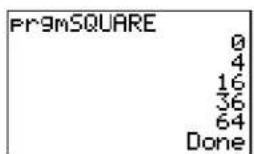
text_image
Pr9mSQUARE 0 4 16 36 64 DoneWhile
While performs a group of commands while condition is true. condition is frequently a relational test (Chapter 2). condition is tested when While is encountered. If condition is true (nonzero), the program executes a group of commands. End signifies the end of the group. When condition is false (zero), the program executes each command following End. While instructions can be nested.
:While condition
:command (while condition is true)
:command (while condition is true)
:End
:command
Program Output
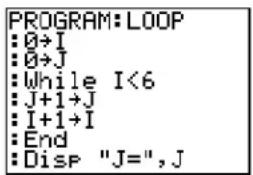
text_image
PROGRAM:LOOP :0→I :0→J :While I<6 :J+1→J :I+1→I :End :Disp "J=",J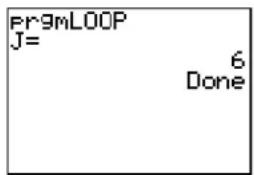
text_image
Pr9mLOOP J= 6 DoneRepeat
Repeat repeats a group of commands until condition is true (nonzero). It is similar to While, but condition is tested when End is encountered; therefore, the group of commands is always executed at least once. Repeat instructions can be nested.
:Repeat condition
:command (until condition is true)
:command (until condition is true)
:End
:Command
Program Output

text_image
PROGRAM: RLOOP :0→I :0→J :Repeat I≥6 :J+1→J :I+1→I :End :Disp "J=", J
text_image
Pr9mRL00P J= 6 DoneEnd
End identifies the end of a group of commands. You must include an End instruction at the end of each For(), While, or Repeat loop. Also, you must paste an End instruction at the end of each If-Then group and each If-Then-Else group.
Pause
Pause suspends execution of the program so that you can see answers or graphs. During the pause, the pause indicator is on in the top-right corner. Press ENTER to resume execution.
- Pause without a value temporarily pauses the program. If the DispGraph or Disp instruction has been executed, the appropriate screen is displayed.
- Pause with value displays value on the current home screen. value can be scrolled.
Pause [value]
Program Output
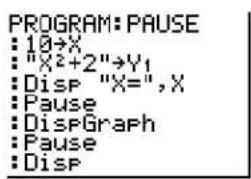
text_image
PROGRAM: PAUSE : 10→X : "X²+2"→Y₁ : Disp "X=",X : Pause : DispGraph : Pause : Disp
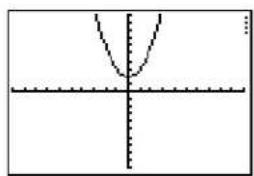
natural_image
Simple geometric diagram showing a parabola and a horizontal line intersecting at the origin (no text or labels)
Lbl, Goto
Lbl (label) and Goto (go to) are used together for branching.
Lbl specifies the label for a command. label can be one or two characters (A through Z, 0 through 99, or θ).
Lbl label
Goto causes the program to branch to label when Goto is encountered.
Goto label
Program Output
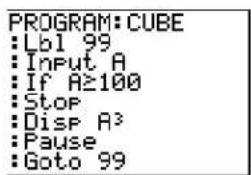
text_image
PROGRAM:CUBE :Lbl 99 :Input A :If A≥100 :Stop :Disp A³ :Pause :Goto 99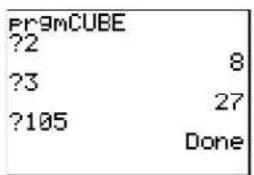
text_image
Pr9mCUBE ?2 8 ?3 27 ?105 DoneIS>(
IS>( increment and skip) adds 1 to variable. If the answer is > value (which can be an expression), the next command is skipped; if the answer is ≤ value, the next command is executed. variable cannot be a system variable.
:IS>(variable,value)
:command (if answer ≤ value)
:command (if answer > value)
Program Output

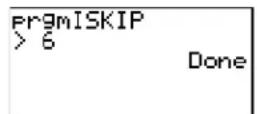
Note: IS>(is not a looping instruction.
DS<(
DS<(decrement and skip) subtracts 1 from variable. If the answer is < value (which can be an expression), the next command is skipped; if the answer is ≥ value, the next command is executed. variable cannot be a system variable.
:DS<(variable,value)
:command (if answer ≥ value)
:command (if answer < value)
Program Output
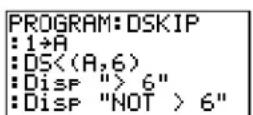
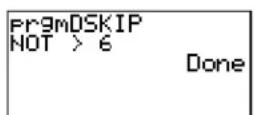
Note: DS<( is not a looping instruction.
Menu(
Menu( sets up branching within a program. If Menu( is encountered during program execution, the menu screen is displayed with the specified menu items, the pause indicator is on, and execution pauses until you select a menu item.
The menu title is enclosed in quotation marks ( " ). Up to seven pairs of menu items follow. Each pair comprises a text item (also enclosed in quotation marks) to be displayed as a menu selection, and a label item to which to branch if you select the corresponding menu selection.
Menu("title","text1",label1,"text2",label2,...)
Program Output


The program above pauses until you select 1 or 2. If you select 2, for example, the menu disappears and the program continues execution at Lbl B.
prgm
Use prgm to execute other programs as subroutines. When you select prgm, it is pasted to the cursor location. Enter characters to spell a program name. Using prgm is equivalent to selecting existing programs from the PRGM EXEC menu; however, it allows you to enter the name of a program that you have not yet created.
prgmname
Note: You cannot directly enter the subroutine name when using RCL. You must paste the name from the PRGM EXEC menu.
Return
Return quits the subroutine and returns execution to the calling program, even if encountered within nested loops. Any loops are ended. An implied Return exists at the end of any program that is called as a subroutine. Within the main program, Return stops execution and returns to the home screen.
Stop
Stop stops execution of a program and returns to the home screen. Stop is optional at the end of a program.
DelVar
DelVar deletes from memory the contents of variable.
DelVar variable

GraphStyle(
GraphStyle( designates the style of the graph to be drawn. function# is the number of the Y= function name in the current graphing mode. graphstyle is a number from 1 to 7 that corresponds to the graph style, as shown below.
| 1 = (line) | 5 = (path) |
| 2 = (thick) | 6 = (animate) |
| 3 = (shade above) | 7 = (dot) |
| 4 = (shade below) |
GraphStyle(function#, graphstyle)
For example, GraphStyle(1,5) in Func mode sets the graph style for Y1 to (path; 5).
Not all graph styles are available in all graphing modes. For a detailed description of each graph style, see the Graph Styles table in Chapter 3.
PRGM I/O (Input/Output) Instructions
PRGM I/O Menu
To display the PRGM I/O (program input/output) menu, press PRGM ▶ from within the program editor only.
| CTL | I/O | EXEC |
| 1: | Input | Enters a value or uses the cursor. |
| 2: | Prompt | Prompts for entry of variable values. |
| 3: | Disp | Displays text, value, or the home screen. |
| 4: | DispGraph | Displays the current graph. |
| 5: | DispTable | Displays the current table. |
| 6: | Output( | Displays text at a specified position. |
| 7: | getKey | Checks the keyboard for a keystroke. |
| 8: | ClrHome | Clears the display. |
| 9: | ClrTable | Clears the current table. |
| 0: | GetCalc( | Gets a variable from another TI-84 Plus. |
| A: | Get( | Gets a variable from CBL 2TM or CBRTM. |
| B: | Send( | Sends a variable to CBL 2 or CBR. |
These instructions control input to and output from a program during execution. They allow you to enter values and display answers during program execution.
To return to the program editor without selecting an item, press CLEAR.
Displaying a Graph with Input
Input without a variable displays the current graph. You can move the free-moving cursor, which updates X and Y (and R and for PolarGC format). The pause indicator is on. Press ENTER to resume program execution.
Input
Program Output

text_image
PROGRAM:GINPUT :EnOff :ZDecimal :Input :Disp X,Y
text_image
Pr9mGINPUT X=2.6 Y=1.5 Pr9mGINPUT 2:6 1:5 DoneStoring a Variable Value with Input
Input with variable displays a ? (question mark) prompt during execution. variable may be a real number, complex number, list, matrix, string, or Y= function. During program execution, enter a value, which can be an expression, and then press ENTER. The value is evaluated and stored to variable, and the program resumes execution.
Input [variable]
You can display text or the contents of Strn (a string variable) of up to 16 characters as a prompt. During program execution, enter a value after the prompt and then press ENTER. The value is stored to variable, and the program resumes execution.
Input ["text", variable] Input [Strn, variable]
Program Output

text_image
PROGRAM:HINPUT : Input A : Input L1 : Input "Y1=",Y1 : Input "DATA=",L DATA : Disp Y1(A) : Disp Y1(L1) : Disp Y1(LDATA)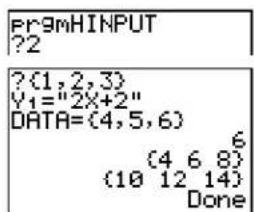
text_image
Pr9mHINPUT ?2 ?(1,2,3) Y1="2X+2" DATA=(4,5,6) (4 6 8) (10 12 14) DoneNote: When a program prompts for input of lists and Y_n functions during execution, you must include the braces ( {} ) around the list elements and quotation marks ( " ) around the expressions.
Prompt
During program execution, Prompt displays each variable, one at a time, followed by =?. At each prompt, enter a value or expression for each variable, and then press ENTER. The values are stored, and the program resumes execution.
Prompt variableA[,variableB,...,variable n]
Program Output

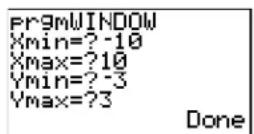
Note: Y= functions are not valid with Prompt.
Displaying the Home Screen
Disp (display) without a value displays the home screen. To view the home screen during program execution, follow the Disp instruction with a Pause instruction.
Disp
Displaying Values and Messages
Disp with one or more values displays the value of each.
Disp [valueA,valueB,valueC,...,value n]
- If value is a variable, the current value is displayed.
- If value is an expression, it is evaluated and the result is displayed on the right side of the next line.
- If value is text within quotation marks, it is displayed on the left side of the current display line. is not valid as text.
Program Output
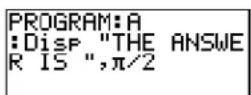
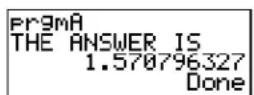
If Pause is encountered after Disp, the program halts temporarily so you can examine the screen. To resume execution, press ENTER.
Note: If a matrix or list is too large to display in its entirety, ellipses (...) are displayed in the last column, but the matrix or list cannot be scrolled. To scroll, use Pause value.
DispGraph
DispGraph (display graph) displays the current graph. If Pause is encountered after DispGraph, the program halts temporarily so you can examine the screen. Press ENTER to resume execution.
DispTable
DispTable (display table) displays the current table. The program halts temporarily so you can examine the screen. Press ENTER to resume execution.
Output(
Output( displays text or value on the current home screen beginning at row (1 through 8) and column (1 through 16), overwriting any existing characters.
Note: You may want to precede Output( with CIrHome.
Expressions are evaluated and values are displayed according to the current mode settings. Matrices are displayed in entry format and wrap to the next line. is not valid as text.
Output(row,column,"text") Output(row,column,value)
Program Output
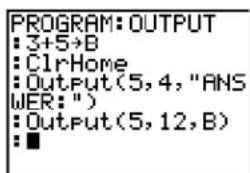
text_image
PROGRAM: OUTPUT : 3+5→B : C1rHome : Output(5,4,"ANS WER: ") : Output(5,12,B) : ■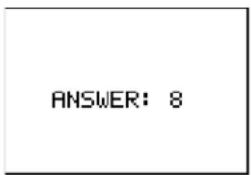
text_image
ANSWER: 8For Output( on a Horiz split screen, the maximum value for row is 4.
getKey
getKey returns a number corresponding to the last key pressed, according to the key code diagram below. If no key has been pressed, getKey returns 0. Use getKey inside loops to transfer control, for example, when creating video games.
Program Output
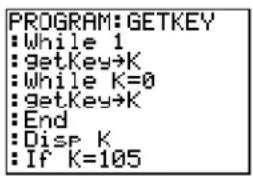
text_image
PROGRAM:GETKEY :While 1 :getKey→K :While K=0 :getKey→K :End :Disp K :If K=105

Note: MATH, APPS, PRGM, and ENTER were pressed during program execution.
Note: You can press ON at any time during execution to break the program.
TI-84 Plus Key Code Diagram
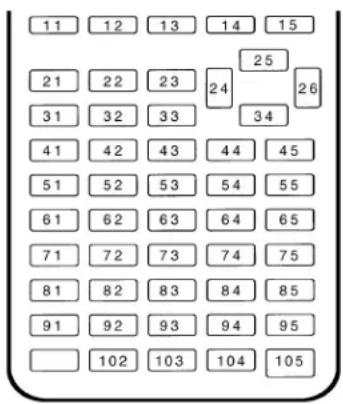
text_image
11 12 13 14 15 21 22 23 24 25 26 31 32 33 34 41 42 43 44 45 51 52 53 54 55 61 62 63 64 65 71 72 73 74 75 81 82 83 84 85 91 92 93 94 95 102 103 104 105ClrHome, ClrTable
ClrHome (clear home screen) clears the home screen during program execution.
ClrTable (clear table) clears the values in the table during program execution.
GetCalc(
GetCalc( gets the contents of variable on another TI-84 Plus and stores it to variable on the receiving TI-84 Plus. variable can be a real or complex number, list element, list name, matrix element, matrix name, string, Y= variable, graph database, or picture.
GetCalc(variable[,portflag])
By default, the TI-84 Plus uses the USB port if it is connected. If the USB cable is not connected, it uses the I/O port. If you want to specify either the USB or I/O port, use the following portflag numbers:
poriflag=0 use USB port if connected;
portflag=1 use USB port;
portflag=2 use I/O port
Note: GetCalc( does not work between TI-82 and TI-83 Plus or a TI-82 and TI-84 Plus calculators.
Get(, Send(
Get( gets data from the CBL 2 ^TM or CBR ^TM and stores it to variable on the receiving TI-84 Plus. variable can be a real number, list element, list name, matrix element, matrix name, string, Y= variable, graph database, or picture.
Get(variable)
Note: If you transfer a program that references the Get command to the TI-84 Plus from a TI-82, the TI-84 Plus will interpret it as the Get described above. Use GetCalc to get data from another TI-84 Plus.
Send( sends the contents of variable to the CBL 2 ^TM or CBR ^TM . You cannot use it to send to another TI-84 Plus. variable can be a real number, list element, list name, matrix element, matrix name, string, Y= variable, graph database, or picture. variable can be a list of elements.
Send(variable)
PROGRAM:GETSOUND
:Send(3,00025,
99,1,0,0,0,0,1)
:Get(L1)
:Get(L2)
Note: This program gets sound data and time in seconds from CBL 2 ^TM .
Note: You can access Get(, Send(, and GetCalc( from the CATALOG to execute them from the home screen (Chapter 15).
Calling Other Programs as Subroutines
Calling a Program from Another Program
On the TI-84 Plus, any stored program can be called from another program as a subroutine. Enter the name of the program to use as a subroutine on a line by itself.
You can enter a program name on a command line in either of two ways.
- Press PRGM ▼ to display the PRGM EXEC menu and select the name of the program prgmname is pasted to the current cursor location on a command line.
• S e prgm from the PRGM CTL menu, and then enter the program name.
prgmname
When prgmname is encountered during execution, the next command that the program executes is the first command in the second program. It returns to the subsequent command in the first program when it encounters either Return or the implied Return at the end of the second program.
Program Output

text_image
PROGRAM:VOLCYL : Input "0=",0 : Input "0=",H : Pr9mA8EACIR : A*H+V : Disp V pr9mVOLCYL D=4 H=5 62.83185307 DoneSubroutine ↓ ↑
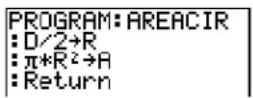
Notes about Calling Programs
Variables are global.
label used with Goto and Lbl is local to the program where it is located. label in one program is not recognized by another program. You cannot use Goto to branch to a label in another program.
Return exits a subroutine and returns to the calling program, even if it is encountered within nested loops.
Running an Assembly Language Program
You can run programs written for the TI-84 Plus in assembly language. Typically, assembly language programs run much faster and provide greater control than the keystroke programs that you write with the built-in program editor.
Note: Because an assembly language program has greater control over the calculator, if your assembly language program has error(s), it may cause your calculator to reset and lose all data, programs, and applications stored in memory.
When you download an assembly language program, it is stored among the other programs as a PRGM menu item. You can:
- Transmit it using the TI-84 Plus communication link (Chapter 19).
- Delete it using the MEM MGMT DEL screen (Chapter 18).
To run an assembly Program, the syntax is: Asm(assemblyprgmname)
If you write an assembly language program, use the two instructions below from the CATALOG to identify and compile the program.
Instructions Comments
| AsmComp(prgmASM1, prgmASM2) | Compiles an assembly language program written in ASCII and stores the hex version |
| AsmPrgm | Identifies an assembly language program; must be entered as the first line of an assembly language program |
To compile an assembly program that you have written:
- Follow the steps for writing a program (16-4) but be sure to include AsmPrgm as the first line of your program.
- From the home screen, press 2nd [CATALOG] and then select AsmComp( to paste it to the screen.
- Press PRGM to display the PRGM EXEC menu.
- Select the program you want to compile. It will be pasted to the home screen.
- Press □ and then select prgm from the CATALOG.
-
Key in the name you have chosen for the output program.
Note: This name must be unique — not a copy of an existing program name. -
Press ☐ to complete the sequence.
The sequence of the arguments should be as follows:
AsmComp(prgmASM1, prgmASM2)
- Press ENTER to compile your program and generate the output program.
Chapter 17: Activities
The Quadratic Formula
Note: This example uses MathPrint™ mode for real answers and Classic mode for non-real (complex) results. You can also use the Polynomial Root Finder/Simultaneous Equation Solver application to solve these types of problems with a quick set-up. This application comes preloaded on your TI-84 Plus and can be downloaded from education.ti.com.
Use the quadratic formula to solve the quadratic equations 2x^2 - 11x + 14 = 0 and 2x^2 - 6x + 5 = 0 .
Graphing the Functions
Before you begin, look at the graphs of the functions to see the approximate locations of the solutions.
-
Press Y= to display the Y= editor.
-
Press 2 X,T,,n x^2 - 11 X,T,,n + 14 for Y1, and then press ENTER.
-
Press 2 X,T,Θ,n x² - 6 X,T,Θ,n + 5 for Y2.
-
Press ZOOM and select 4:ZDecimal. The graph of the functions displays.
You can see that the graph of the first function, 2x^2 - 11x + 14 = 0 , crosses the x-axis, so it has a real solution. The graph of the second function does not cross the x-axis, so it has a complex solution.
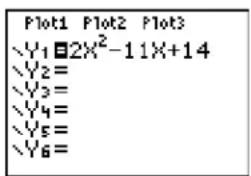
text_image
Plot1 Plot2 Plot3 \Y1=2X²-11X+14 \Y2= \Y3= \Y4= \Y5= \Y6=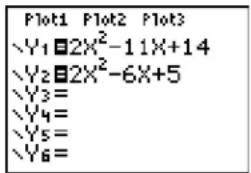
text_image
Plot1 Plot2 Plot3 \Y1□2X²-11X+14 \Y2□2X²-6X+5 \Y3= \Y4= \Y5= \Y6=
natural_image
Pure mathematical line diagram with intersecting curves and grid lines (no text or symbols)Entering a Calculation
Begin with the equation 2x^2-11x+14=0 .
- Press 2 STO▶ ALPHA A to store the coefficient of the x^2 term.
- Press ALPHA [:]. The colon allows you to enter more than one instruction on a line.
- Press (-) 11 STO▶ ALPHA B to store the coefficient of the X term. Press ALPHA [:] to enter a new instruction on the same line. Press 14 STO▶ ALPHA C to store the constant.
- Press ENTER to store the values to the variables A, B, and C.
The last value you stored is shown on the right side of the display. The cursor moves to the next line, ready for your next entry.
- Press ALPHA [F1] 1 (-) ALPHA B + 2nd [√] ALPHA B x^2 - 4 ALPHA A ALPHA C ▶ 2 ALPHA A to enter the expression for one of the solutions for the quadratic formula,
$$ \frac {b - b \sqrt [ 2 ]{4 a c} - \pm}{2 a} $$
- Press ENTER to find one solution for the equation 2x^2 - 11x + 14 = 0 .
The answer is shown on the right side of the display. The cursor moves to the next line, ready for you to enter the next expression.
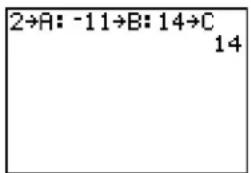
text_image
2→A: -11→B: 14→C 14
text_image
2→A: -11→B: 14→C - B + √( B^2 - 4AC ) 2AD 14
text_image
2→A: -11→B: 14→C - B + √( B^2 - 4AC ) 2A 14 7/2Converting to a Decimal
You can show the solution as a decimal.
- Press ALPHA [F1] 4 to select ▶F◀▶D from the FRAC shortcut menu.
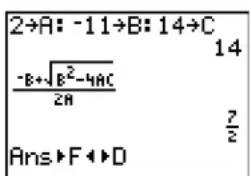
text_image
2→A: -11→B: 14→C - B + √( B² - 4AC ) 2A Ans ▶ F ▶ D 14 7/2- Press ENTER to convert the result to a decimal.
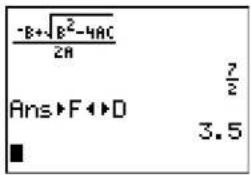
text_image
-B+√B²-4AC 2A Ans>F↔D 7/2 3.5To save keystrokes, you can scroll up to find an expression you entered, copy it, and then edit it for a new calculation.
- Press ▲ to highlight (-B+^2-4AC)and 2A then press ENTER to paste it to the entry line.

text_image
-B+√B²-4AC 2A Ans→F↔D 7/2 3.5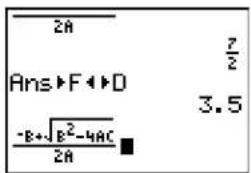
text_image
2A Ans▶F◀▶D -8+√E²-4AC 2A 7/2 3.5- Press □ until the cursor is on the + sign in the formula. Press □ to edit the quadratic-formula expression to become (-B-^2-4AC)2A .

text_image
Ans>F↔D - B-√B²-4nC 2A 2 3.5 2- Press ENTER to find the other solution for the quadratic equation 2x^2 - 11x + 14 = 0 .
Displaying Complex Results
Now solve the equation 2x^2-6x+5=0 . When you set a+b_i complex number mode, the TI-84 Plus displays complex results.
- Press MODE ▼ ▼ ▼ ▼ ▼ (6 times), and then press ▶ to highlight a+bi. Press ENTER to select a+bi complex-number mode.

text_image
NORMAL SCI ENG FLOAT 0123456789 RADIAN DEGREE FUNC PAR POL SEQ CONNECTED DOT SEQUENTIAL SIMUL REAL q+bi re^6i FULL HORIZ G-T +NEXT+-
Press [2nd][QUIT] to return to the home screen, and then press CLEAR to clear it.
-
Press 2 STO▶ ALPHA A ALPHA [:] (-) 6 STO▶ ALPHA B ALPHA [:] 5 STO▶ ALPHA C ENTER.
The coefficient of the x^2 term, the coefficient of the X term, and the constant for the new equation are stored to A, B, and C, respectively.
- Enter the quadratic formula using Classic entry: (-) ALPHA B + 2nd [] ALPHA B x^2 - 4 ALPHA A ALPHA C ▶ ) ÷ (2 ALPHA A ).
Because the solution is a complex number, you have to enter the formula using the division operation instead of using the n/d shortcut template. Complex numbers are not valid in the n/d template in input or output and will cause Error: Data Type to display.
- Press ENTER to find one solution for the equation 2x^2-6x+5=0 .
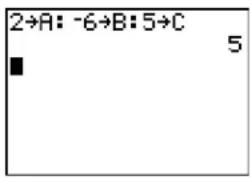
text_image
2→A: -6→B:5→C 5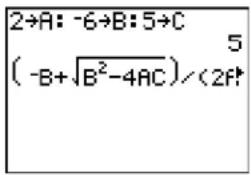
text_image
2→A: -6→B:5→C (-B+√B²-4AC)/(2F)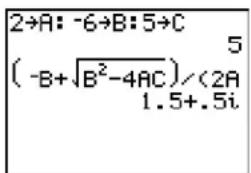
text_image
2→A: -6→B:5→C ( -B+√B²-4AC )/(2A 1.5+.5i-
Press ▲ to highlight the quadratic-formula expression, and then press ENTER to paste it to the entry line.
-
Press □ until the cursor is on the + sign in the formula. Press □ to edit the quadratic-formula expression to become (-B-^2-4AC)/(2A) .
-
Press ENTER to find the other solution for the quadratic equation: 2x^2 - 6x + 5 = 0 .

Take a 20 cm × 25 cm. sheet of paper and cut X × X squares from two corners. Cut X × 12½ cm rectangles from the other two corners as shown in the diagram below. Fold the paper into a box with a lid. What value of X would give your box the maximum volume V? Use the table and graphs to determine the solution.
Begin by defining a function that describes the volume of the box.
From the diagram:
$$ 2 X + A = 2 0 $$
$$ 2 X + 2 B = 2 5 $$
$$ V = A * B * X $$
Substituting:
$$ V = (2 0 - 2 X) (2 5 / 2 - X) X $$

text_image
X 20 A X B X B 25- Press Y= to display the Y= editor, which is where you define functions for tables and graphing.

text_image
Plot1 Plot2 Plot3 \Y1=■ \Y2= \Y3= \Y4= \Y5= \Y6= \Y7=- Press 20-2,T,,n1 25 ALPHA [F1] 1 2 -X,T,,n1 ,T,,n ENTER to define the volume function as Y1 in terms of X.
,T,,n lets you enter X quickly, without having to press . The highlighted = sign indicates that Y1 is selected.
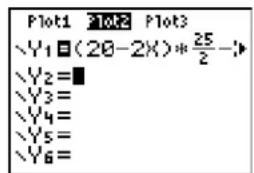
text_image
Plot1 Plot2 Plot3 Y1 □ (20-2X) * 25/2 -# Y2 = ■ Y3 = Y4 = Y5 = Y6 =Defining a Table of Values
The table feature of the TI-84 Plus displays numeric information about a function. You can use a table of values from the function you just defined to estimate an answer to the problem.
- Press 2nd [TBLSET] to display the TABLE SETUP menu.
- Press ENTER to accept TclStart=0.
- Press 1 ENTER to define the table increment Tbl = 1 . Leave Indpnt: Auto and Depend: Auto so that the table will be generated automatically.
- Press 2nd [TABLE] to display the table.
Notice that the maximum value for Y1 (box's volume) occurs when X is about 4, between 3 and 5.
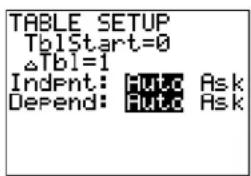
text_image
TABLE SETUP TblStart=0 △Tbl=1 IndPnt: Huto Ask Depend: Huto Ask
text_image
X Y1 0 1 2 3 4 5 6 0 207 336 399 408 375 312 X=4- Press and hold ▼ to scroll the table until a negative result for Y1 is displayed.
Notice that the maximum length of X for this problem occurs where the sign of Y1 (box's volume) changes from positive to negative, between 10 and 11.
- Press 2nd [TBLSET].
Notice that TblStart has changed to 5 to reflect the first line of the table as it was last displayed. (In step 5, the first value of X displayed in the table is 5.)
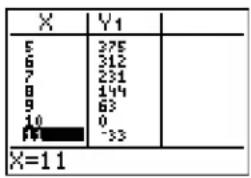
text_image
X Y1 5 375 6 312 7 231 8 144 9 63 10 0 -33 X=11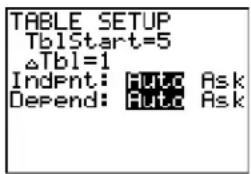
text_image
TABLE SETUP TblStart=5 △Tbl=1 IndFont: Huto Ask Defend: Huto AskZooming In on the Table
You can adjust the way a table is displayed to get more information about a defined function. With smaller values for Tbl , you can zoom in on the table. You can change the values on the TBLSET screen by pressing [2nd][TBLSET] or by pressing on the TABLE screen
- Press 2nd [TABLE].
- Press ▲ to move the cursor to highlight
- Press ☐. The Tbl displays on the entry line.
-
Enter ☐ 1 ENTER. The table updates, showing the changes in X in increments of 0.1.
Notice that the maximum value for Y1 in this table view is 410.26, which occurs at X=3.7. Therefore, the maximum occurs where 3.6<X<3.8. -
With X=3.6 highlighted, press + .01 ENTER to set Tbl=0.01 .

text_image
X Y1 8 399 4 408 5 375 6 312 7 231 8 144 9 63 △Tbl=.1■
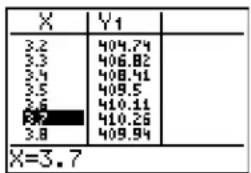
other
| Category | Value | |---|---| | 3.2 | 404.74 | | 3.3 | 406.82 | | 3.4 | 408.41 | | 3.5 | 409.5 | | 3.6 | 410.11 | | B7 | 410.26 | | 3.8 | 409.94 | X=3.7
text_image
X Y1 3.65 410.11 3.61 410.15 3.62 410.18 3.63 410.2 3.64 410.23 3.65 410.24 3.66 410.25 X=3.6- Press ▼ and ▲ to scroll the table.
Four equivalent maximum values are shown, 410.26 at X=3.67, 3.68, 3.69, and 3.70.

text_image
X Y1 3.65 410.24 3.66 410.25 3.67 410.26 3.68 410.26 3.69 410.26 3.7 410.26 3.71 410.25 X=3.67- Press ▼ or ▲ to move the cursor to 3.67. Press ▶ to move the cursor into the Y1 column.
The value of Y1 at X=3.67 is displayed on the bottom line in full precision as 410.261226.

text_image
X | Y1 | 3.66 410.25 3.67 410.26 3.68 410.26 3.69 410.26 3.7 410.26 3.71 410.25 3.72 410.23 Y1=410.261226- Press ▼ to display the other maximum.
The value of Y1 at X=3.68 in full precision is 410.264064, at X=3.69 is 410.262318 and at X=3.7 is 410.256.
The maximum volume of the box would occur at 3.68 if you could measure and cut the paper at .01-centimeter increments.
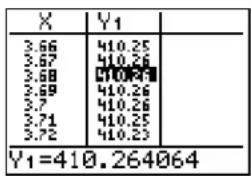
text_image
X | Y1 | 3.66 410.25 3.67 410.26 3.68 410.26 3.69 410.26 3.7 410.26 3.71 410.25 3.72 410.23 Y1=410.264064Setting the Viewing Window
You also can use the graphing features of the TI-84 Plus to find the maximum value of a previously defined function. When the graph is activated, the viewing window defines the displayed portion of the coordinate plane. The values of the window variables determine the size of the viewing window.
- Press WINDOW to display the window editor, where you can view and edit the values of the window variables.
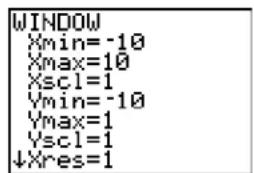
text_image
WINDOW Xmin=-10 Xmax=10 Xsc1=1 Ymin=-10 Ymax=1 Ysc1=1 ↓Xres=1The standard window variables define the viewing window as shown. Xmin, Xmax, Ymin, and Ymax define the boundaries of the display. Xscl and Yscl define the distance between tick marks on the X and Y axes. Xres controls resolution.
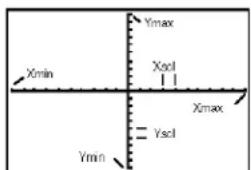
text_image
Ymax Xsol Ysol Xmin Ymin Ysol-
Press 0 ENTER to define Xmin.
-
Press 20 ÷ 2 to define Xmax using an expression.
Note: For this example, the division sign is used for the calculation. However, you can use n/d entry format where fraction output can be experienced, depending on mode settings.

text_image
WINDOW Xmin=0 Xmax=20/2■ Xscl=1 Ymin=-10 Ymax=10 Yscl=1 Xres=1- Press ENTER. The expression is evaluated, and 10 is stored in Xmax. Press ENTER to accept Xscl as 1.
- Press 0 ENTER 500 ENTER 100 ENTER 1 ENTER to define the remaining window variables.

text_image
WINDOW Xmin=0 Xmax=10 Xscl=1 Ymin=0 Ymax=500 Yscl=100■ ↓Xres=1Displaying and Tracing the Graph
Now that you have defined the function to be graphed and the window in which to graph it, you can display and explore the graph. You can trace along a function using the TRACE feature.
- Press GRAPH to graph the selected function in the viewing window. The graph of Y1=(20-2X)(25/2-X)X is displayed.
- Press ▶ to activate the free-moving graph cursor. The X and Y coordinate values for the position of the graph cursor are displayed on the bottom line.
- Press ▶, ▶, ▶, and ▼ to move the free-moving cursor to the apparent maximum of the function. As you move the cursor, the X and Y coordinate values are updated continually.
- Press TRACE. The trace cursor is displayed on the Y1 function. The function that you are tracing is displayed in the top-left corner.
- Press ▶ and ▶ to trace along Y1, one X dot at a time, evaluating Y1 at each X. You also can enter your estimate for the maximum value of X.
- Press 3 □ 8. When you press a number key while in TRACE, the X= prompt is displayed in the bottom-left corner.

line
| X-Axis | Y-Axis | |---|---| | 0 | 0 | | 1 | 1 | | 2 | 3 | | 3 | 5 | | 4 | 6 | | 5 | 5 | | 6 | 3 | | 7 | 1 | | 8 | 0 |
line
| X | Y | |---|---| | 5.106383 | 250 |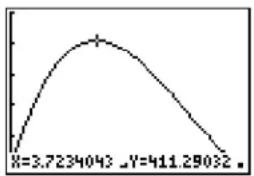
line
| X | Y | |---|---| | 3.7234043 | 411.29032 |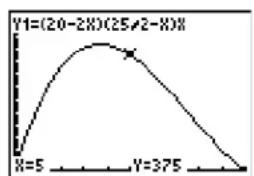
line
| X | Y | |---|---| | 5 | 20-24 | | 375 | 25-28 |
line
| X | Y | |---|---| | 3.8 | (20-2K)(25,2-X)X |- Press ENTER.
The trace cursor jumps to the point on the Y1 function evaluated at X=3.8.
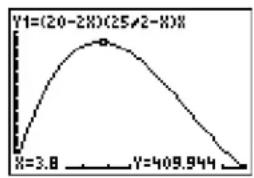
line
| X | Y | |---|---| | 3.8 | 20-2X | | 409.944 | 25/2-X |- Press ▶ and ▶ until you are on the maximum Y value.
This is the maximum of Y1(X) for the X pixel values. The actual, precise maximum may lie between pixel values.
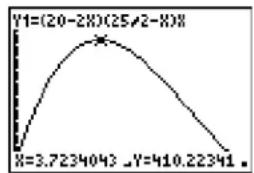
line
| X | Y | |---|---| | 3.7234043 | 410.22341 | | (20-28)(25/2-X)8 | |Zooming In on the Graph
To help identify maximums, minimums, roots, and intersections of functions, you can magnify the viewing window at a specific location using the ZOOM instructions.
- Press ZOOM to display the ZOOM menu.
This menu is a typical TI-84 Plus menu. To select an item, you can either press the number or letter next to the item, or you can press ▼ until the item number or letter is highlighted, and then press ENTER.

text_image
2001 MEMORY 182Box 2:Zoom In 3:Zoom Out 4:ZDecimal 5:ZSquare 6:ZStandard 7↓ZTrig- Press 2 to select 2:Zoom In.
The graph is displayed again. The cursor has changed to indicate that you are using a ZOOM instruction.
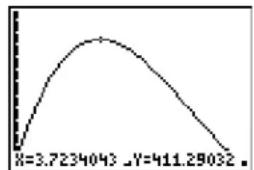
line
| X | Y | |---|---| | 3.7234043 | 411.29032 |- With the cursor near the maximum value of the function, press ENTER.
The new viewing window is displayed. Both Xmax-Xmin and Ymax-Ymin have been adjusted by factors of 4, the default values for the zoom factors.

line
| X | Y | |---|---| | 3.7234043 | 411.29032 |-
Press ▶ and ▶ to search for the maximum value.
-
Press WINDOW to display the new window settings.
Note: To return to the previous graph, press ZOOM ▶ 1:ZPrevious.
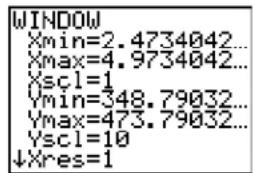
text_image
WINDOW Xmin=2.4734042... Xmax=4.9734042... Xsc1=1 Ymin=348.79032... Ymax=473.79032... Ysc1=10 ↓Xres=1Finding the Calculated Maximum
You can use a CALCULATE menu operation to calculate a local maximum of a function. To do this, pick a point to the left of where you think the maximum is on the graph. This is called the left bound. Next, pick a point to the right of the maximum. This is called the right bound. Finally, guess the maximum by moving the cursor to a point between the left and right bounds. With this information, the maximum can be calculated by the methods programmed in the TI-84 Plus.
- Press 2nd [CALC] to display the CALCULATE menu. Press 4 to select 4:maximum.
The graph is displayed again with a Left Bound? prompt.
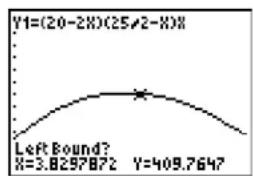
line
| X | Y | |---|---| | 20 | 20 | | 25 | 25 | | 30 | 30 | | 35 | 35 | | 40 | 40 | | 45 | 45 | | 50 | 50 | | 55 | 55 | | 60 | 60 | | 65 | 65 | | 70 | 70 | | 75 | 75 | | 80 | 80 | | 85 | 85 | | 90 | 90 | | 95 | 95 | | 100 | 100 |- Press ☐ to trace along the curve to a point to the left of the maximum, and then press ENTER.
A▶ at the top of the screen indicates the selected bound.
A Right Bound? prompt is displayed.

line
| X | Y | |---|---| | 20-2X | 25/2-X | | 3.2180851 | 405.15149 |- Press ▶ to trace along the curve to a point to the right of the maximum, and then press ENTER.
A ◀ at the top of the screen indicates the selected bound.
A Guess? prompt is displayed.

line
| Point | Value | |---|---| | Y1=(20-2X)(25/2-X)X | 4 | | Guess? | 4.1489362 | | Y=405.45568 | |- Press ☐ to trace to a point near the maximum, and then press ENTER.
Or, press 3 □ 8, and then press ENTER to enter a guess for the maximum.
When you press a number key in TRACE, the X= prompt is displayed in the bottom-left corner.
Notice how the values for the calculated maximum compare with the maximums found with the free-moving cursor, the trace cursor, and the table.
Note: In steps 2 and 3 above, you can enter values directly for Left Bound and Right Bound, in the same way as described in step 4.

line
| X | Y | |---|---| | 3.8 | (20-2X)(25/2-X)X |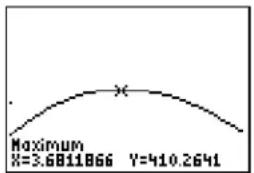
text_image
Maximum X=3.6811866 Y=410.2641Comparing Test Results Using Box Plots
Problem
An experiment found a significant difference between boys and girls pertaining to their ability to identify objects held in their left hands, which are controlled by the right side of their brains, versus their right hands, which are controlled by the left side of their brains. The TI Graphics team conducted a similar test for adult men and women.
The test involved 30 small objects, which participants were not allowed to see. First, they held 15 of the objects one by one in their left hands and guessed what they were. Then they held the other 15 objects one by one in their right hands and guessed what they were. Use box plots to compare visually the correct-guess data from this table.
Each row in the table represents the results observed for one subject. Note that 10 women and 12 men were tested.
| Correct Guesses | |||
| Women Left | Women Right | Men Left | Men Right |
| 8 | 4 | 7 | 1 |
| 9 | 1 | 8 | 6 |
| 12 8 7 12 | |||
| 11 12 5 12 | |||
| 10 11 7 7 | |||
| 8 | 1 | 1 | 8 |
| 12 | 13 11 12 | ||
| 7 | 12 | 4 | 8 |
| 9 | 1 | 1 | 10 |
| 11 12 | 14 11 | ||
| 13 | 9 | ||
| 5 | 9 | ||
Procedure
- Press STAT 5 to select 5:SetUpEditor. Enter list names WLEFT, WRGHT, MLEFT, and MRGHT, separated by commas. Press ENTER. The stat list editor now contains only these four lists. (See Chapter 11: Lists for detailed instructions for using the SetUpEditor.)
- Press STAT 1 to select 1:Edit.
- Enter into WLEFT the number of correct guesses each woman made using her left hand (Women Left). Press ▶ to move to WRGHT and enter the number of correct guesses each woman made using her right hand (Women Right).
-
Likewise, enter each man's correct guesses in MLEFT (Men Left) and MRGHT (Men Right).
-
Press [2nd] [STAT PLOT]. Select 1:Plot1. Turn on plot 1; define it as a modified box plot ·s that uses Xlist as WLEFT. Move the cursor to the top line and select Plot2. Turn on plot 2; define it as a modified box plot that uses Xlist as WRGHT. (See Chapter 12: Statistics for detailed information on using Stat Plots.)
-
Press Y=. Turn off all functions.
-
Press WINDOW. Set Xscl=1 and Yscl=0. Press ZOOM 9 to select 9:ZoomStat. This adjusts the viewing window and displays the box plots for the women's results.
-
Press TRACE.
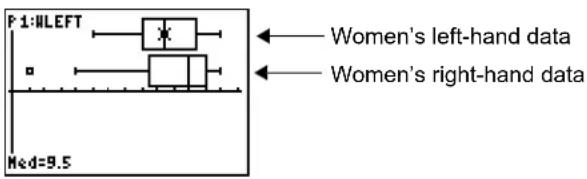
text_image
P 1:HLEFT Med=9.5 Women's left-hand data Women's right-hand dataUse ▶ and ▶ to examine minX, Q1, Med, Q3, and maxX for each plot. Notice the outlier to the women's right-hand data. What is the median for the left hand? For the right hand? With which hand were the women more accurate guessers, according to the box plots?
- Examine the men's results. Redefine plot 1 to use MLEFT, redefine plot 2 to use MRGHT. Press TRACE.
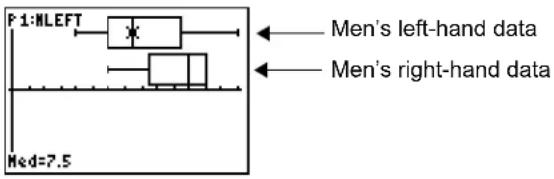
text_image
P 1:NLEFT Men's left-hand data Men's right-hand data Med=7.5Press ▶ and ▶ to examine minX, Q1, Med, Q3, and maxX for each plot. What difference do you see between the plots?
-
Compare the left-hand results. Redefine plot 1 to use WLEFT, redefine plot 2 to use MLEFT, and then press TRACE to examine minX, Q1, Med, Q3, and maxX for each plot. Who were the better left-hand guessers, men or women?
-
Compare the right-hand results. Define plot 1 to use WRGHT, define plot 2 to use MRGHT, and then press TRACE to examine minX, Q1, Med, Q3, and maxX for each plot. Who were the better right-hand guessers?
In the original experiment boys did not guess as well with right hands, while girls guessed equally well with either hand. This is not what our box plots show for adults. Do you think that this is because adults have learned to adapt or because our sample was not large enough?
Graphing Piecewise Functions
Problem
The fine for speeding on a road with a speed limit of 45 kilometers per hour (kph) is 50; plus 5 for each kph from 46 to 55 kph; plus 10 for each kph from 56 to 65 kph; plus 20 for each kph from 66 kph and above. Graph the piecewise function that describes the cost of the ticket.
The fine (Y) as a function of kilometers per hour (X) is:
$$ Y = \left{ \begin{array}{l l} 0 & 0 < X \leq 4 5 \ 5 0 + 5 (X - 4 5) & 4 5 < X \leq 5 5 \ 5 0 + 5 * 1 0 + 1 0 (X - 5 5) & 5 5 < X \leq 6 5 \ 5 0 + 5 * 1 0 + 1 0 * 1 0 + 2 0 (X - 6 5) & 6 5 < X \end{array} \right. $$
which simplifies to:
$$ Y = \left{ \begin{array}{l l} 0 & 0 < X \leq 4 5 \ 5 0 + 5 (X - 4 5) & 4 5 < X \leq 5 5 \ 1 0 0 + 1 0 (X - 5 5) & 5 5 < X \leq 6 5 \ 2 0 0 + 2 0 (X - 6 5) & 6 5 < X \end{array} \right. $$
Procedure
- Press MODE. Select Func and Classic.
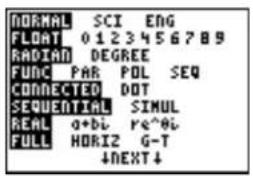
text_image
NORMAL SCI ENG FLOAT 0123456789 RADIAN DEGREE FUNC PAR POL SEQ CONNECTED DOT SEQUENTIAL SIMUL REAL a+bi re^0i FULL HORIZ G-T 4NEXT4
text_image
TEBACK MATHPRINT CLASSIC 0.4 Un/d ANSHERS: AUTO DEC FRAC GOTO FORMAT GRAPH: 00 YES STAT DIAGNOSTICS: OFF ON STAT HIZARDS: 00 OFF SET CLOCK 09/03/10 1:58PM- Press Y=. Turn off all functions and stat plots. Enter the Y= function to describe the fine. Use the TEST menu operations to define the piecewise function. Set the graph style for Y1 to . (dot).
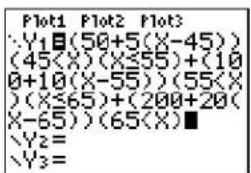
text_image
Plot1 Plot2 Plot3 Y1=(50+5(X-45)) (45line
| X | Y | |---|---| | 68 | 50+5(8-45))(45<3)(8=2) | | 260 | 50+5(8-45))(45<3)(8=2) |Graphing Inequalities
Problem
Graph the inequality 0.4x^3 - 3x + 5 < 0.2x + 4 . Use the TEST menu operations to explore the values of X where the inequality is true and where it is false. Note: You can also investigate graphing inequalities using the Inequality Graphing application. The application is pre-loaded on your TI-84 Plus and can be downloaded from education.ti.com.Procedure
1. Press MODE. Select Dot, Simul, and the default settings. Setting Dot mode changes all graph style icons to '. (dot) in the Y= editor. 2. Press |=| . Turn off all functions and stat plots. Enter the left side of the inequality as Y4 and the right side as Y5. text_image
Plot1 Plot2 Plot3 Y1= Y2= Y3= Y4 B. 4X³-3X+5 Y5 B. 2X+4■ Y6=text_image
Plot1 Plot2 Plot3 Y1= Y2= Y3= Y4■.4X³-3X+5 Y5■.2X+4 Y6■Y4line
| X | Y | |---|---| | 0.63829787 | 1 | | 0.64529787 | 1 | | 0.65239787 | 1 | | 0.65949787 | 1 | | 0.66659787 | 1 | | 0.67369787 | 1 | | 0.68079787 | 1 | | 0.68789787 | 1 | | 0.69499787 | 1 | | 0.70209787 | 1 | | 0.70919787 | 1 | | 0.71629787 | 1 | | 0.72339787 | 1 | | 0.73049787 | 1 | | 0.73759787 | 1 | | 0.74469787 | 1 | | 0.75179787 | 1 | | 0.75889787 | 1 | | 0.76599787 | 1 | | 0.77209787 | 1 | | 0.77919787 | 1 | | 0.78529787 | 1 | | 0.79139787 | 1 | | 0.79749787 | 1 | | 0.80359787 | 1 | | 0.80969787 | 1 | | 0.81579787 | 1 | | 0.82189787 | 1 | | 0.82809787 | 1 | | 0.83329787 | 1 | | 0.83949787 | 1 | | 0.84569787 | 1 | | 0.85189787 | 1 | | 0.85809787 | 1 | | 0.86429787 | 1 | | 0.86949787 | 1 | | 0.87569787 | 1 | | 0.88189787 | 1 | | 0.88809787 | 1 | | 0.89429787 | 1 | | 0.89949787 | 1 | | 0.90569787 | 1 | | 0.91189787 | 1 | | 0.91809787 | 1 | | 0.92429787 | 1 | | 0.93049787 | 1 | | 0.93669787 | 1 | | 0.94289787 | 1 | | 0.94909787 | 1 | | 0.95529787 | 1 | | 0.96149787 | 1 | | 0.96769787 | 1 | | 0.97389787 | 1 | | 0.97909787 | 1 | | 0.98529787 | 1 | | 0.99149787 | 1 | | 0.99769787 | 1 | | 1.00389787 | 1 | | ... (repeated) | ... (repeated)text_image
Y7=Y6*Y4 X=-1.489362 Y=0text_image
YB=Y6*Y5 X=-1.489362 Y=0Solving a System of Nonlinear Equations
Problem
Using a graph, solve the equation x^3 - 2x = 2(x) . Stated another way, solve the system of two equations and two unknowns: y = x^3 - 2x and y = 2(x) . Use ZOOM factors to control the decimal places displayed on the graph and use [2nd] [CALC] 5: intersect to find an approximate solution.Procedure
1. Press MODE. Select the default mode settings. Press Y=. Turn off all functions and stat plots. Enter the functions.  2. Press [ZOOM] 4 to select 4:ZDecimal. The display shows that two solutions may exist (points where the two functions appear to intersect). natural_image
Pure mathematical curve diagram with no text, numbers, or symbolsUsing a Program to Create the Sierpinski Triangle
Setting up the Program
This program creates a drawing of a famous fractal, the Sierpinski Triangle, and stores the drawing to a picture. To begin, press PRGM ▶ ▶ 1. Name the program SIERPINS, and then press ENTER. The program editor is displayed. Note: After you run this program, press 2nd [FORMAT] ▼ ▼ ▼ ENTER to turn on the axes in the graph screen.Program
PROGRAM:SIERPINS
:FnOff :ClrDraw
:PlotsOff
:AxesOff
:0→Xmin:1→Xmax
:0→Ymin:1→Ymax
:rand→X:rand→Y
text_image
:For (K,1,3000) :rand→N :If N≤1/3 :Then :.5X→X :.5Y→Y :End :If 1/3natural_image
Fractal geometric pattern composed of nested triangles (no text or symbols)Graphing Cobweb Attractors
Problem
Using Web format, you can identify points with attracting and repelling behavior in sequence graphing.Procedure
1. Press MODE. Select Seq and the default mode settings. Press 2nd [FORMAT]. Select Web format and the default format settings. 2. Press |=| . Clear all functions and turn off all stat plots. Enter the sequence that corresponds to the expression Y = K X(1 - X) . $$ \mathbf {u} (n) = \mathbf {K u} (n - 1) (1 - \mathbf {u} (n - 1)) $$ $$ \mathbf {u} (n \text { Min }) = . 0 1 $$ 3. Press 2nd [QUIT] to return to the home screen, and then store 2.9 to K. 4. Press WINDOW. Set the window variables.| nMin=0 | Xmin=0 | Ymin=-.26 |
| nMax=10 | Xmax=1 | Ymax=1.1 |
| PlotStart=1 | Xscl=1 | Yscl=1 |
| PlotStep=1 |
text_image
u=Ku(x-1)(1-u(x-1)) x=19 X=.66878578 Y=.66878578text_image
u=Ku(n-1)(1-u(n-1)) x=14 X=.5112669 Y=.88455062Using a Program to Guess the Coefficients
Setting Up the Program
This program graphs the function A sin(BX) with random integer coefficients between 1 and 10. Try to guess the coefficients and graph your guess as C sin(DX). The program continues until your guess is correct. Note: This program changes the graph window and graph styles. After you run the program, you can change individual settings as needed or you can press 2nd [MEM] 7 2 2 to return to default settings. Programs typically do not restore your settings in MODE, Y=, WINDOW and other locations that were used by the program. This is dependent on who created the program.Program
PROGRAM: GUESS :PlotsOff :Func :FnOff :Radian :ClrHome text_image
"Asin (BX) ->Y1 :"Csin (DX) ->Y2 :GraphStyle (1,1) :GraphStyle (2,5) :FnOff 2 :randInt (1,10)→A :randInt (1,10)→B :0→C:0→D :-2π→Xmin :2π→Xmax :π/2→Xscl :-10→Ymin :10→Ymax :1→Yscl :DispGraph :Pause :FnOn 2 :Lbl Z :Prompt C,D :DispGraph :Pause :If C=A :Text(1,1,"C IS OK") :If C≠A :Text(1,1,"C IS WRONG") :If D=B :Text(1,50,"D IS OK") :If D≠B :Text(1,50,"D IS WRONG") :DispGraph :Pause :If C=A and D=B :Stop :Goto Z Define equations. Set line and path graph styles. Initialize coefficients. Set viewing window. Display graph. Prompt for guess. Display graph. Display results. Quit if guesses are correct.Graphing the Unit Circle and Trigonometric Curves
Problem
Using parametric graphing mode, graph the unit circle and the sine curve to show the relationship between them. Any function that can be plotted in Func mode can be plotted in Par mode by defining the X component as T and the Y component as F(T).Procedure
1. Press MODE. Select Par, Simul, and the default settings. 2. Press WINDOW. Set the viewing window. Tmin=0 Xmin=-2 Ymin=-3 Tmax=2π Xmax=7.4 Ymax=3 Tstep=.1 Xsc1=π/2 Yscl=1 3. Press = . Turn off all functions and stat plots. Enter the expressions to define the unit circle centered on (0,0) .  4. Enter the expressions to define the sine curve.  5. Press TRACE. As the graph is plotting, you may press ENTER to pause and ENTER again to resume graphing as you watch the sine function "unwrap" from the unit circle. text_image
X1T=cos(T) Y1T=sin(T) T=0 X=1 Y=0Note:
\- You can generalize the unwrapping. Replace (T) in Y2T with any other trig function to unwrap that function. \- You can graph the functions again by turning the functions off and then turning them back on on the Y= editor or by using the FuncOFF and FuncON commands on the home screen.Finding the Area between Curves
Problem
Find the area of the region bounded by: $$ f (x) = 3 0 0 x / \left(x ^ {2} + 6 2 5\right) $$ $$ g (x) = 3 \cos (. 1 x) $$ $$ x = 7 5 $$Procedure
1. Press MODE. Select the default mode settings. 2. Press WINDOW. Set the viewing window. Xmin=0 Ymin=-5 Xres=1 Xmax=100 Ymax=10 Xscl=10 Yscl=1 3. Press Y=. Turn off all functions and stat plots. Enter the upper and lower functions. Y1=300X/(X²+625) Y2=3cos(.1X) 4. Press [2nd][CALC] 5 to select 5:Intersect. The graph is displayed. Select a first curve, second curve, and guess for the intersection toward the left side of the display. The solution is displayed, and the value of X at the intersection, which is the lower limit of the integral, is stored in Ans and X. 5. Press [2nd][QUIT] to go to the home screen. Press [2nd][DRAW] 7 and use Shade( to see the area graphically. Shade(Y2,Y1,Ans,75) natural_image
Abstract black shape with curved lines on white background, no text or symbols presentUsing Parametric Equations: Ferris Wheel Problem
Problem
Using two pairs of parametric equations, determine when two objects in motion are closest to each other in the same plane. A ferris wheel has a diameter (d) of 20 meters and is rotating counterclockwise at a rate (s) of one revolution every 12 seconds. The parametric equations below describe the location of a ferris wheel passenger at time T, where is the angle of rotation, (0,0) is the bottom center of the ferris wheel, and (10,10) is the passenger's location at the rightmost point, when T=0. $$ X (T) = r \cos \alpha $$ $$ \text { where } \alpha = 2 \pi \text { Ts and } r = d / 2 $$ $$ Y (T) = r + r \sin \alpha $$ A person standing on the ground throws a ball to the ferris wheel passenger. The thrower's arm is at the same height as the bottom of the ferris wheel, but 25 meters (b) to the right of the ferris wheel's lowest point (25,0). The person throws the ball with velocity (v_0) of 22 meters per second at an angle () of 66^ from the horizontal. The parametric equations below describe the location of the ball at time T. $$ X (T) = b - T v _ {0} \cos \theta $$ $$ Y (T) = T v _ {0} \sin \theta - (g / 2) T ^ {2} \text { where } g = 9. 8 m / s e c ^ {2} $$Procedure
1. Press MODE. Select Par, Simul, and the default settings. Simul (simultaneous) mode simulates the two objects in motion over time. 2. Press WINDOW. Set the viewing window. Tmin=0 Xmin=-13 Ymin=0 Tmax=12 Xmax=34 Ymax=31 Tstep=.1 Xscl=10 Yscl=10 3. Press Y=. Turn off all functions and stat plots. Enter the expressions to define the path of the ferris wheel and the path of the ball. Set the graph style for X2T to 0 (path). text_image
Plot1 Plot2 Plot3 X1T 10cos(πT/6) Y1T 10+10sin(πT/6) X2T 25-22Tcos(66°) Y2T 22Tsin(66°)natural_image
Simple geometric diagram showing a circle intersected by a parabola and a horizontal line, with no text or symbols present.line
| X | Y | |---|---| | 10 | 10 | | 24 | 10 | | 30 | 10 | | 36 | 10 | | 42 | 10 | | 48 | 10 | | 54 | 10 | | 60 | 10 | | 66 | 10 | | 72 | 10 | | 78 | 10 | | 84 | 10 | | 90 | 10 | | 96 | 10 | | 102 | 10 | | 108 | 10 | | 114 | 10 | | 120 | 10 | | 126 | 10 | | 132 | 10 | | 138 | 10 | | 144 | 10 | | 150 | 10 | | 156 | 10 | | 162 | 10 | | 168 | 10 | | 174 | 10 | | 180 | 10 | | 186 | 10 | | 192 | 10 | | 198 | 10 | | 204 | 10 | | 210 | 10 | | 216 | 10 | | 222 | 10 | | 228 | 10 | | 234 | 10 | | 240 | 10 | | 246 | 10 | | 252 | 10 | | 258 | 10 | | 264 | 10 | | 270 | 10 | | 276 | 10 | | 282 | 10 | | 288 | 10 | | 294 | 10 | | 300 | 10 | | 306 | 10 | | 312 | 10 | | 318 | 10 | | 324 | 10 | | 330 | 10 | | 336 | 10 | | 342 | 10 | | 348 | 10 | | 354 | 10 | | 360 | 10 | | 366 | 10 | | 372 | 10 | | 378 | 10 | | 384 | 10 | | 390 | 10 | | 396 | 10 | | 402 | 10 | | 408 | 10 | | 414 | 10 | | 420 | 10 | | 426 | 10 | | 432 | 10 | | 438 | 10 | | 444 | 10 | | 450 | 10 | | 456 | 10 | | 462 | 10 | | 468 | 10 | | 474 | 10 | | 480 | 10 | | 486 | 10 | | 492 | 10 | | 498 | 10 | | 504 | 10 | | Note: The values in the chart are estimated based on the provided code (e.g., 'X') and 'Y'). The numbers above the curve are not explicitly labeled in the image.text_image
X2T=25-22T. Y2T=22Tsin(. T=2.41 X=3.4348232 Y=19.97649Demonstrating the Fundamental Theorem of Calculus
Problem 1
Using the functions fnInt( and nDeriv( from the FUNC shortcut menu or the MATH menu to graph functions defined by integrals and derivatives demonstrates graphically that: $$ F (x) = \int_ {1} ^ {x} \frac {1}{t} d t = \ln (x), x > 0 \quad \text { and that } $$ $$ \frac {d}{d x} \left[ \int_ {1} ^ {x} \frac {1}{t} d t \right] = \frac {1}{x} $$Procedure 1
1. Press MODE. Select the default settings. 2. Press WINDOW. Set the viewing window. Xmin=.01 Xmax=10 Xsc1=1 Ymin=-1.5 Ymax=2.5 Ysc1=1 Xres=3 3. Press Y=. Turn off all functions and stat plots. Enter the numerical integral of 1/T from 1 to X and the function ln(X). Set the graph style for Y1 to \ (line) and Y2 to \ (path). text_image
Plot1 Plot2 Plot3 Y1 B ∫₁^X (1/T) dT φY2 B ln(X) Y3 = Y4 = Y5 =text_image
Plot1 Plot2 Plot3 J1 0Y2 |ln(X) Y3 |d/d8(Y1)|X=X Y4 |1/x Y5=line
| X | Y | |---|---| | 3.1982979 | 0.0000 | | 3.1266632 | 0.0000 |line
| X | Y | |---|---| | 0 | 1 / X | | 3.1982979 | 3.1266631 |Problem 2
Explore the functions defined by $$ v = \int_ {- 2} ^ {x} t ^ {2} d t, \int_ {0} ^ {x} ^ {2} d t, \text { and } \int_ {2} ^ {x} ^ {2} d t $$Procedure 2
1. Press Y=. Turn off all functions and stat plots. Use a list to define these three functions simultaneously. Store the function in Y5. text_image
Plot1 Plot2 Plot3 Y3 = d/dX (Y1) |R=X Y4 = 1/8 Y5 = ∫_{< -2,0,2>}^R (T²)d▶text_image
Plot1 Plot2 Plot3 \Y4 = \frac{X}{X} \Y5 = \int_{< -2,0,2>}^{X} (T^2) d\triangleright \Y6 = \frac{d}{dx}(Y5)|_{x=X} \Y7 = \squareline
| X | Y | |---|---| | -1.914894 | 3.6668179 |Computing Areas of Regular N-Sided Polygons
Problem
Use the equation solver to store a formula for the area of a regular N-sided polygon, and then solve for each variable, given the other variables. Explore the fact that the limiting case is the area of a circle, r^2 . Consider the formula A = NB^2 (/N) (/N) for the area of a regular polygon with N sides of equal length and B distance from the center to a vertex.  N = 4 sides  N = 8 sides  N = 12 sidesProcedure
1. Press MATH ALPHA B to select B: Solver from the MATH menu. Either the equation editor or the interactive solver editor is displayed. If the interactive solver editor is displayed, press ▲ to display the equation editor. 2. Enter the formula as 0=A-NB^2(/N)(/N) , and then press ENTER. The interactive solver editor is displayed. text_image
A-NB²sin(π/N)...=0 A=0 N=0 B=0 bound={-1ε99,1...}text_image
A-NB²sin(π/N)...=0 ■ A=72.000000000... N=4 B=6 bound=(-1e99,1... ■ left-rt=0text_image
A-NB²sin(π/N)...=0 A=200 N=6 ■ B=8.7738267530... bound=(-1e99,1... ■ left-rt=0text_image
A-NB²sin(π/N)...=0 A=200 N=8 ■ B=8, 4089641525... bound=(-1e99,1... ■ left-rt=0text_image
A-NB²sin(π/N)...=0 A=200 N=9 ■ B=8.3152439046... bound=(-1e99,1... ■ left-rt=0text_image
A-NB: sin(π/N)...=0 A=200 N=10 ■ B=8.2493675314... bound=(-1e99,1... ■ left-rt=0text_image
A-NB2 sin(π/N)..=0 ■ A=105.80134541... N=10 B=6 bound=(-1e99,1... ■ left-rt=0text_image
A-NB²sin(π/N)..=0 ■ A=113.02293515... N=100 B=6 bound=(-1e99,1... ■ left-rt=0text_image
A-NB²sin(π/N)..=0 ■ A=113.06426506... N=150 B=6 bound=(-1e99,1... ■ left-rt=0text_image
A-NB²sin(π/N)..=0 ■ A=113.09659138... N=1000 B=6 bound={-1e99,1... ■ left-rt=0text_image
A-NB²sin(π/N)...=0 ■ A=113.09732808... N=10000 B=6 bound={-1e99,1... ■ left-rt=0text_image
Plot1 Plot2 Plot3 \Y1\BxB^2sin(π/X)c os(π/X) -0\Y2\B^πB^2 \Y3= \Y4= \Y5= \Y6=line
| X | Y | |---|---| | 187.23404 | 113.07611 |line
| X | Y | |---|---| | 187.23404 | πB^2 | | 113.09734 | |Computing and Graphing Mortgage Payments
Problem
You are a loan officer at a mortgage company, and you recently closed on a 30-year home mortgage at 8 percent interest with monthly payments of 800. The new home owners want to know how much will be applied to the interest and how much will be applied to the principal when they make the 240th payment 20 years from now.Procedure
1. Press MODE and set the fixed-decimal mode to 2 decimal places. Set the other mode settings to the defaults. text_image
NORMAL SCI ENG FLOAT 0123456789 RADIAN DEGREE FUNC PAR POL SEQ CONNECTED DOT SEQUENTIAL SIMUL REAL q+bi re^0i FULL HORIZ G-T ↓NEXT↓text_image
N=360.00 I%=8.00 • PV=-109026.80 PMT=800.00 FV=0.00 P/Y=12.00 C/Y=12.00 PMT:□□□ BEGIN| Tmin=1 |
| Tmax=360 |
| Tstep=12 |
| Xmin=0 |
| Xmax=360 |
| Xscl=10 |
| Ymin=0 |
| Ymax=1000 |
| Yscl=100 |
line
| X-axis Label | Y-axis Value | |---|---| | T=240 | 358.03 | | Y=358.03 | 358.03 |line
| X2T=T | Y2T=ΣInt(T) | |-------|-------------| | 240 | 441.97 |text_image
bal(239) -66295.33 Ans*(.08/12) -441.97Chapter 18:
Memory and Variable Management
Checking Available Memory
MEMORY Menu
At any time you can check available memory or manage existing memory by selecting items from the MEMORY menu. To access this menu, press 2nd [MEM]. MEMORY| 1: About... | Displays information about the graphing calculator including current OS version number. |
| 2: Mem Mgmt/Del... | Reports memory availability and variable usage. |
| 3: Clear Entries | Clears ENTRY (last-entry storage). |
| 4: ClrAllLists | Clears all lists in memory. |
| 5: Archive... | Archives a selected variable. |
| 6: UnArchive... | UnArchives a selected variable. |
| 7: Reset... | Displays the RAM, ARCHIVE, and ALL menus |
| 8: Group... | Displays GROUP and UNGROUP menus. |
text_image
RAM FREE 24298 ARC FREE 311200 All... 2: Real... 3: Complex... 4: List... 5: Matrix... 6↓Y-Vars...Available RAM, Archive, and App Slots
The TI-84 Plus / TI-84 Plus Silver Edition has Archive, RAM, and Application (App) slot memory for you to use and manage. The available RAM stores computations, lists, variables, and data. The available Archive lets you store programs, Apps, groups, and other variables. The App slots are actually individual sectors of Flash ROM where Apps are stored.| Graphing calculator | Available RAM Available Archive | App Slots |
| TI-84 Plus 24 Kilobytes | 491 Kilobytes 30 | |
| TI-84 Plus Silver Edition | 24 Kilobytes 1.5 Megabytes 94 |
Displaying the About Screen
About displays information about the TI-84 Plus Operating System (OS) Version, Product Number, Product Identification (ID), and Flash Application (App) Certificate Revision Number. To display the About screen, press 2nd [MEM] and then select 1:About. text_image
Displays the type of graphing calculator. TI-B4Plus Silver Edition 2.55MP PROD #: 0A-3-02-37 Help: education.ti.com Displays the Product ID. Each Flash-based graphing calculator has a unique product ID, which you may need if you contact technical support. You can also use this 14 digit ID to register your calculator at education.ti.com, or identify your calculator in the event that it is lost or stolen. Displays the OS version. As new software upgrades become available, you can electronically upgrade your unit.Displaying the MEMORY MANAGEMENT/DELETE Menu
Mem Mgmt/Del displays the MEMORY MANAGEMENT/DELETE menu. The two lines at the top report the total amount of available RAM (RAM FREE) and Archive (ARC FREE) memory. By selecting menu items on this screen, you can see the amount of memory each variable type is using. This information can help you determine if you need to delete variables from memory to make room for new data, such as programs or Apps. To check memory usage, follow these steps. Press 2nd [MEM] to display the MEMORY menu. text_image
NETWORK 1:About 2:Mem Mgmt/Del... 3:Clear Entries 4:C1rAllLists 5:Archive 6:UnArchive 7↓Reset...text_image
RAM FREE 24317 ARC FREE 1540K 1■A11... 2:Real... 3:Complex... 4:List... 5:Matrix... 6↓Y-Vars... 7↑Prgm... 8:Pic... 9:GOB... 0:String... A:Apps... B↓AppVars... C:Group...Deleting Items from Memory
Deleting an Item
To increase available memory by deleting the contents of any variable (real or complex number, list, matrix, Y= variable, program, Apps, AppVars, picture, graph database, or string), follow these steps. 1. Press 2nd [MEM] to display the MEMORY menu. 2. Select 2:Mem Mgmt/Del to display the MEMORY MANAGEMENT/DELETE menu. 3. Select the type of data you want to delete, or select 1:All for a list of all variables of all types. A screen is displayed listing each variable of the type you selected and the number of bytes each variable is using. For example, if you select 4:List, the LIST editor screen is displayed.  4. Press ▲ and ▼ to move the selection cursor (▶) next to the item you want to delete, and then press DEL. The variable is deleted from memory. You can delete individual variables one by one from this screen. No warning will be given to verify the deletion. Note: If you are deleting programs or Apps, you will receive a message asking you to confirm this delete action. Select 2:Yes to continue. To leave any variable screen without deleting anything, press 2nd [QUIT], which displays the home screen. You cannot delete some system variables, such as the last-answer variable Ans and the statistical variable RegEQ.Clearing Entries and List Elements
Clear Entries
Clear Entries clears the contents of the ENTRY (last entry on home screen) storage area. To clear the ENTRY storage area, follow these steps. 1. Press 2nd [MEM] to display the MEMORY menu. 2. Select 3: Clear Entries to paste the instruction to the home screen. 3. Press ENTER to clear the ENTRY storage area. Clear Entries Done To cancel Clear Entries, press CLEAR. Note: If you select 3:Clear Entries from within a program, the Clear Entries instruction is pasted to the program editor, and the Entry (last entry) is cleared when the program is executed.ClrAllLists
ClrAllLists sets the dimension of each list in RAM to 0. To clear all elements from all lists, follow these steps. 1. Press 2nd [MEM] to display the MEMORY menu. 2. Select 4:ClrAllLists to paste the instruction to the home screen. 3. Press ENTER to set the dimension of each list in memory to 0.  To cancel CIrAllLists, press CLEAR. CirAllLists does not delete list names from memory, from the LIST NAMES menu, or from the stat list editor. Note: If you select 4:CIrAllLists from within a program, the CIrAllLists instruction is pasted to the program editor. The lists are cleared when the program is executed.Archiving and UnArchiving Variables
Archiving and UnArchiving Variables
Archiving lets you store data, programs, or other variables to the user data archive (ARC) where they cannot be edited or deleted inadvertently. Archiving also allows you to free up RAM for variables that may require additional memory. Archived variables cannot be edited or executed. They can only be seen and unarchived. For example, if you archive list L1, you will see that L1 exists in memory but if you select it and paste the name L1 to the home screen, you won't be able to see its contents or edit it. Note: Not all variables may be archived. Not all archived variables may be unarchived. For example, system variables including r, t, x, y, and cannot be archived. Apps and Groups always exist in Flash ROM so there is no need to archive them. Groups cannot be unarchived. However, you can ungroup or delete them.| Variable Type | Names | Archive? (yes/no) | UnArchive? (yes/no) |
| Real numbers | A, B, ..., Z | yes | yes |
| Complex numbers | A, B, ..., Z | yes | yes |
| Matrices | [A], [B], [C], ..., [J] | yes | yes |
| Lists | L1, L2, L3, L4, L5, L6, and user-defined names | yes yes | |
| Programs yes yes | |||
| Functions | Y1, Y2, . . . , Y9, Y0 | no | not applicable |
| Parametric equations | X1T and Y1T, ... , X6T and Y6T | no not | applicable |
| Polar functions | r1, r2, r3, r4, r5, r6 | no | not applicable |
| Sequence functions | u, v, w | no | not applicable |
| Stat plots | Plot1, Plot2, Plot3 | no | not applicable |
| Graph databases | GDB1, GDB2,... | yes | yes |
| Graph pictures | Pic1, Pic2, ... , Pic9, Pic0 | yes yes | |
| Strings | Str1, Str2, . . . Str9, Str0 | yes | yes |
| Tables | TblStart, ΔTbl, TblInput | no not | applicable |
| Apps | Applications | see Note above | no |
| AppVars | Application variables | yes | yes |
| Groups | see Note above | no | |
| Variables with reserved names | minX, maxX, RegEQ, and others | no not | applicable |
| System variables | Xmin, Xmax, and others | no | not applicable |
| For: | Sizes must be such that: |
| Archive | Archive free size > variable size |
| For: Sizes must be | such that: |
| UnArchive RAM free | size > variable size |
text_image
1:About 2:Men Mgmt/Del... 3:Clear Entries 4:ClrAllLists 5:Archive 6:UnArchive 7:Reset...text_image
NETWORK 1:About 2:Mem Mgmt/Del... 3:Clear Entries 4:C1rAllLists 5:Archive 6:UnArchive 7:Reset...text_image
RAM FREE 23896 ARC FREE 868260 All... 2: Real... 3: Complex... 4: List... 5: Matrix... 6↓Y-Vars...text_image
RAM FREE 23896 ARC FREE 868260 L1 12 L2 12 L3 12 L4 12 L5 12 L6 12text_image
RAM FREE 23894 ARC FREE 868235 * L1 12 L2 12 L3 12 L4 12 L5 12 L6 12Resetting the TI-84 Plus
RAM ARCHIVE ALL Menu
Reset displays the RAM ARCHIVE ALL menu. This menu gives you the option of resetting all memory (including default settings) or resetting selected portions of memory while preserving other data stored in memory, such as programs and Y= functions. For instance, you can choose to reset all of RAM or just restore the default settings. Be aware that if you choose to reset RAM, all data and programs in RAM will be erased. For archive memory, you can reset variables (Vars), applications (Apps), or both of these. Be aware that if you choose to reset Vars, all data and programs in archive memory will be erased. If you choose to reset Apps, all applications in archive memory will be erased. When you reset defaults on the TI-84 Plus, all defaults in RAM are restored to the factory settings. Stored data and programs are not changed. These are some examples of TI-84 Plus defaults that are restored by resetting the defaults. \- Mode settings such as Normal (notation); Func (graphing); Real (numbers); and Full (screen) • Y= functions off - Window variable values such as Xmin = -10, Xmax = 10, Xscl = 1, Yscl = 1, and Xres = 1 - STAT PLOTS off - Format settings such as CoordOn (graphing coordinates on); AxesOn; and ExprOn (expression on) - rand seed value to 0Displaying the RAM ARCHIVE ALL Menu
To display the RAM ARCHIVE ALL menu on the TI-84 Plus, follow these steps. 1. Press [2nd][MEM] to display the MEMORY menu. 2. Select 7: Reset to display the RAM ARCHIVE ALL menu. Resetting RAM Memory
Resetting all RAM restores RAM system variables to factory settings and deletes all nonsystem variables and all programs. Resetting RAM defaults restores all system variables to default settings without deleting variables and programs in RAM. Resetting all RAM or resetting defaults does not affect variables and applications in user data archive. Note: Before you reset all RAM memory, consider restoring sufficient available memory by deleting only selected data. To reset all RAM memory or RAM defaults on the TI-84 Plus, follow these steps. 1. From the RAM ARCHIVE ALL menu, select 1:All RAM to display the RESET RAM menu or 2:Defaults to display the RESET DEFAULTS menu. text_image
RESET: RAM 1: No 2: Reset Resetting RAM erases all data and programs from RAM.text_image
RESET DEFAULTS 1: No 2: ResetResetting Archive Memory
When resetting archive memory on the TI-84 Plus, you can choose to delete from user data archive all variables, all applications, or both variables and applications. To reset all or part of user data archive memory, follow these steps. 1. From the RAM ARCHIVE ALL menu, press ▶ to display the ARCHIVE menu.  2. Select one of the following: 1:Vars to display the RESET ARC VARS menu. text_image
RESET HRC VARS 1:No 2:Reset Resetting Vars erases all data and programs from Archive.text_image
RESET HRC APPS 18 No 2: Reset Resetting Apps erases all Apps from Archive.text_image
RESET FROM BOTH 1:No 2:Reset Resetting Both erases all data, programs & APPs from Archive.Resetting All Memory
When resetting all memory on the TI-84 Plus, RAM and user data archive memory is restored to factory settings. All nonsystem variables, applications, and programs are deleted. All system variables are reset to default settings. Before you reset all memory, consider restoring sufficient available memory by deleting only selected data. To reset all memory on the TI-84 Plus, follow these steps. 1. From the RAM ARCHIVE ALL menu, press ▶▶ to display the ALL menu.  2. Select 1: All Memory to display the RESET MEMORY menu. text_image
RESET MEMORY 1: No 2: Reset Resetting ALL will delete all data, programs & Apps from RAM & Archive.Grouping and Ungrouping Variables
Grouping Variables
Grouping allows you to make a copy of two or more variables residing in RAM and then store them as a group in user data archive. The variables in RAM are not erased. The variables must exist in RAM before they can be grouped. In other words, archived data cannot be included in a group. Once grouped, the variables can be deleted from RAM to open memory. When the variables are needed later, they can be ungrouped for use. To create a group of variables: 1. Press 2nd [MEM] to display the MEMORY menu. text_image
NETWORK 2↑Mem Mgmt/Del... 3: Clear Entries 4: C1rAllLists 5: Archive 6: UnArchive 7: Reset... ##Group...text_image
GROUP 1:All+... 2:All-... 3:Prgm... 4:List... 5:GOB... 6:Pic... 7↓Matrix...text_image
Done PROGRAM1 PRGM PROGRAM2 PRGM GDB1 GDB L1 LIST L2 LIST L3 LIST L4 LISTtext_image
SELL Done PROGRAM1 PRGM PROGRAM2 PRGM GDB1 GDB L1 LIST L2 LIST L3 LIST L4 LISTUngrouping Variables
Ungrouping allows you to make a copy of variables in a group stored in user data archive and place them ungrouped in RAM.DuplicateName Menu
During the ungrouping action, if a duplicate variable name is detected in RAM, the DUPLICATE NAME menu is displayed.| DuplicateName | |
| 1: Rename | Prompts to rename receiving variable. |
| 2: Overwrite | Overwrites data in receiving duplicate variable. |
| 3: Overwrite All | Overwrites data in all receiving duplicate variables. |
| 4: Omit | Skips ungrouping of sending variable. |
| 5: Quit | Stops ungrouping at duplicate variable. |
Notes about Menu Items:
\- When you select 1:Rename, the Name= prompt is displayed, and alpha-lock is on. Enter a new variable name, and then press ENTER. Ungrouping resumes. - When you select 2:Overwrite, the unit overwrites the data of the duplicate variable name found in RAM. Ungrouping resumes. - When you select 3: Overwrite All, the unit overwrites the data of all duplicate variable names found in RAM. Ungrouping resumes. - When you select 4:Omit, the unit does not ungroup the variable in conflict with the duplicated variable name found in RAM. Ungrouping resumes with the next item. - When you select 5:Quit, ungrouping stops, and no further changes are made. To ungroup a group of variables: 1. Press 2nd [MEM] to display the MEMORY menu. text_image
NETWORK 2†Men Mgmt/Del... 3:Clear Entries 4:ClrAllLists 5:Archive 6:UnArchive 7:Reset... ##Group...Garbage Collection
Garbage Collection Message
If you use the user data archive extensively, you may see a Garbage Collect? message. This occurs if you try to archive a variable when there is not enough free contiguous archive memory. The Garbage Collect? message lets you know an archive will take longer than usual. It also alerts you that the archive will fail if there is not enough memory. The message can also alert you when a program is caught in a loop that repetitively fills the user data archive. Select No to cancel the garbage collection process, and then find and correct the errors in your program. When YES is selected, the TI-84 Plus will attempt to rearrange the archived variables to make additional room.Responding to the Garbage Collection Message
- To cancel, select 1:No. - If you select 1:No, the message ERR:ARCHIVE FULL will be displayed. • To continue archiving, select 2:Yes. \- If you select 2:Yes, the process message Garbage Collecting... or Defragmenting... will be displayed. text_image
Garbage Collect? 1: No 2: YesWhy Is Garbage Collection Necessary?
The user data archive is divided into sectors. When you first begin archiving, variables are stored consecutively in sector 1. This continues to the end of the sector. An archived variable is stored in a continuous block within a single sector. Unlike an application stored in user data archive, an archived variable cannot cross a sector boundary. If there is not enough space left in the sector, the next variable is stored at the beginning of the next sector. Typically, this leaves an empty block at the end of the previous sector. flowchart
graph TD
    A["variable D"] --> B["depending on its size, variable D is stored in one of these locations."]
    B --> C["variable A"]
    B --> D["variable B"]
    B --> E["variable C"]
    C --> F["Sector 1"]
    D --> G["Sector 2"]
    E --> H["Sector 3"]
    style A fill:#f9f,stroke:#333
    style B fill:#ccf,stroke:#333
    style C fill:#cfc,stroke:#333
    style D fill:#fcc,stroke:#333
    style E fill:#cff,stroke:#333
    style F fill:#ffc,stroke:#333
    style G fill:#cfc,stroke:#333
    style H fill:#fcc,stroke:#333
How Unarchiving a Variable Affects the Process
When you unarchive a variable, it is copied to RAM but it is not actually deleted from user data archive memory. Unarchived variables are “marked for deletion,” meaning they will be deleted during the next garbage collection. text_image
After you unarchive variables B and C, they continue to take up space. variable A sector 1 sector 2 variable D sector 3If the MEMORY Screen Shows Enough Free Space
Even if the MEMORY screen shows enough free space to archive a variable or store an application, you may still get a Garbage Collect? message or an ERR: ARCHIVE FULL message. When you unarchive a variable, the Archive free amount increases immediately, but the space is not actually available until after the next garbage collection. If the Archive free amount shows enough available space for your variable, there probably will be enough space to archive it after garbage collection (depending on the usability of any empty blocks).The Garbage Collection Process
The garbage collection process: - Deletes unarchived variables from the user data archive. - Rearranges the remaining variables into consecutive blocks. text_image
variable A variable D Sector 1 Sector 2Using the GarbageCollect Command
You can reduce the number of automatic garbage collections by periodically optimizing memory. This is done by using the GarbageCollect command. To use the GarbageCollect command, follow these steps. 1. From the HOME screen, press 2nd [CATALOG] to display the CATALOG. text_image
CATALOG abs( and angle( ANOVA( Ans Archive Rsm(ERR:ARCHIVE FULL Message
Even if the MEMORY screen shows enough free space to archive a variable or store an application, you may still get an ERR: ARCHIVE FULL message. text_image
ERR: ARCHIVE FULL Quit Largest single... Variable= 9662 APP = 0Chapter 19: Communication Link
Getting Started: Sending Variables
Getting Started is a fast-paced introduction. Read the chapter for details. Create and store a variable and a matrix, and then transfer them to another TI-84 Plus. 1. On the home screen of the sending unit, press 5 □ 5 STO▶ ALPHA Q. Press ENTER to store 5.5 to Q. 2. Press ALPHA [F3] ▼ ▼ ENTER to display the 2x2 matrix template. Press 1 ▶ 2 ▶ 3 ▶ 4 ▶ to enter the values. Press STO▶ 2nd [MATRIX] 1 ENTER to store the matrix to [A]. 3. On the sending unit, press 2nd [MEM] to display the MEMORY menu. 4. On the sending unit, press 2 to select 2:Mem Mgmt/Del. The MEMORY MANAGEMENT menu is displayed. 5. On the sending unit, press 5 to select 5:Matrix. The MATRIX editor screen is displayed. 6. On the sending unit, press ENTER to archive [A]. An asterisk (\*) will appear, signifying that [A] is now archived. 7. Connect the graphing calculators with the USB unit-to-unit cable. Push both ends in firmly. 8. On the receiving unit, press 2nd [LINK] to display the RECEIVE menu. Press 1 to select 1:Receive. The message Waiting... is displayed and the busy indicator is on. text_image
5.5→Q [1 2]→[A] 5.5 [1 2] [3 4]text_image
NETWORK 1:About 2:Men Mgmt/Del... 3:Clear Entries 4:ClrAllLists 5:Archive 6:UnArchive 7↓Reset...text_image
RAM FREE 23896 ARC FREE 868260 1:All... 2:Real... 3:Complex... 4:List... 5:Matrix... 6↓Y-Vars...text_image
SEN RECEIVE 1:All+... 2:All-... 3:Prgm... 4:List... 5:Lists to TI82... 6:GDB... 7:Pic...text_image
SELECT TRANSMIT ■ * [A] MATRIX Y1 EQU Y2 EQU Window WINDOW RelWindowZSTO TblSet TABLE Q REALTI-84 Plus LINK
This chapter describes how to communicate with compatible TI units. The TI-84 Plus has a USB port to connect and communicate with another TI-84 series calculator. A USB unit-to-unit cable is included with the TI-84 Plus. The TI-84 Plus also has an I/O port using a I/O unit-to-unit cable to communicate with: • TI-83 Plus Silver Edition • T I - 8 2 • TI-83 Plus • T I - 7 3 • T I - 8 3 • CBL 2 ^TM or a CBR ^TM You can send items from a calculator with an older OS to a calculator with OS 2.53MP and higher. However, you may receive a version error if you send items from a calculator with OS 2.53MP or higher to a calculator with an older OS. Transferring files between calculators works best if both calculators have the latest operating system software installed. For example, if you send a list that contains fractions (OS 2.53MP and higher) to a calculator with OS 2.43, a version error displays because OS 2.43 does not support fractions.Connecting Two Graphing Calculators with a USB Unit-to-Unit Cable or an I/O Unit-to-Unit Cable
USB Unit-to-Unit Cable
The TI-84 Plus USB link port is located at the top right edge of the graphing calculator. 1. Firmly insert either end of the USB unit-to-unit cable into the USB port. 2. Insert the other end of the cable into the other graphing calculator's USB port. natural_image
Two identical mobile phones with control buttons and a connecting cable (no visible text or symbols)I/O Unit-to-Unit Cable
The TI-84 Plus I/O link port is located at the top left edge of the graphing calculator. 1. Firmly insert either end of the I/O unit-to-unit cable into the port. 2. Insert the other end of the cable into the other graphing calculator's I/O port. text_image
Two identical 3G phones with one connected via a cable, displaying screen and keypad interface.TI-84 Plus to a TI-83 Plus using I/O Unit-to-Unit Cable
The TI-84 Plus I/O link port is located at the top left edge of the graphing calculator. The TI-83 Plus I/O link port is located at the bottom edge of the graphing calculator. 1. Firmly insert either end of the I/O unit-to-unit cable into the port. 2. Insert the other end of the cable into the other graphing calculator's I/O port. natural_image
Two identical electronic call-to-text devices connected by a cable, no visible text or symbols.Linking to the CBL/CBR System
The CBL 2 ^™ system and the CBR ^™ system are optional accessories that also connect to a TI-84 Plus with the I/O unit-to-unit cable. With a CBL 2 ^™ system or CBR ^™ system and a TI-84 Plus, you can collect and analyze real-world data.Linking to a Computer
With TI Connect™ software and the USB computer cable that is included with your TI-84 Plus, you can link the graphing calculator to a personal computer.Selecting Items to Send
LINK SEND Menu
To display the LINK SEND menu, press 2nd [LINK].| SEND RECEIVE | |
| 1: All+... | Displays all items as selected, including RAM and Flash applications. |
| 2: All-... | Displays all items as deselected. |
| 3: Prgm... | Displays all program names. |
| 4: List... | Displays all list names. |
| 5: Lists to TI82... | Displays list names L1 through L6. |
| 6: GDB... | Displays all graph databases. |
| 7: Pic... | Displays all picture data types. |
| 8: Matrix... | Displays all matrix data types. |
| 9: Real... | Displays all real variables. |
| 0: Complex... | Displays all complex variables. |
| A: Y-Vars... | Displays all Y=variables. |
| B: String... | Displays all string variables. |
| C: Apps... | Displays all software applications. |
| D: AppVars... | Displays all software application variables. |
| E: Group... | Displays all grouped variables. |
| F: SendId | Sends the Calculator ID number immediately.(You do not need to select SEND.) |
| G: SendOS | Sends operating system updates to another TI-84 Plus Silver Edition or TI-84 Plus. You can not send the operating system to the TI-83 Plus product family. |
| H: Back Up... | Selects all RAM and mode settings (no Flash applications or archived items) for backup to another TI-84 Plus, TI-84 Plus Silver Edition, TI-83 Plus Silver Edition, or to a TI-83 Plus. |
text_image
SELECT TRANSMIT ■ *PROGRAM1 PRGM PROGRAM2 PRGM ■ *GDB1 GDB ■ L1 LIST ■ *L2 LIST ■ *L3 LIST ► L4 LISTSending the Selected Items
After you have selected items to send on the sending unit and set the receiving unit to receive, follow these steps to transmit the items. To set the receiving unit, see Receiving Items. 1. Press ▶ on the sending unit to display the TRANSMIT menu.  2. Confirm that Waiting... is displayed on the receiving unit, which indicates it is set to receive. 3. Press ENTER to select 1:Transmit. The name and type of each item are displayed line-by-line on the sending unit as the item is queued for transmission, and then on the receiving unit as each item is accepted.   Note: Items sent from the RAM of the sending unit are transmitted to the RAM of the receiving unit. Items sent from user data archive (flash) of the sending unit are transmitted to user data archive (flash) of the receiving unit. After all selected items have been transmitted, the message Done is displayed on both calculators. Press ▶ and ▼ to scroll through the names.Sending to a TI-84 Plus Silver Edition or TI-84 Plus
You can transfer variables (all types), programs, and Flash applications to another TI-84 Plus Silver Edition or TI-84 Plus. You can also backup the RAM memory of one unit to another. Note: Keep in mind that the TI-84 Plus has less Flash memory than the TI-84 Plus Silver Edition. - Variables stored in RAM on the sending TI-84 Plus Silver Edition will be sent to the RAM of the receiving TI-84 Plus Silver Edition or TI-84 Plus. - Variables and applications stored in the user data archive of the sending TI-84 Plus Silver Edition will be sent to the user data archive of the receiving TI-84 Plus Silver Edition or TI-84 Plus. After sending or receiving data, you can repeat the same transmission to additional TI-84 Plus Silver Edition or TI-84 Plus units—from either the sending unit or the receiving unit—without having to reselect data to send. The current items remain selected. However, you cannot repeat transmission if you selected All+ or All-. To send data to an additional TI-84 Plus Silver Edition or a TI-84 Plus: 1. Use a USB unit-to-unit cable to link two units together. 2. On the sending unit press [2nd] [LINK] and select a data type and items to SEND. 3. Press ▶ on the sending unit to display the TRANSMIT menu. 4. On the other unit, press 2nd [LINK] ▶ to display the RECEIVE menu. 5. Press ENTER on the receiving unit. 6. Press ENTER on the sending unit. A copy of the selected item(s) is sent to the receiving unit. 7. Disconnect the link cable only from the receiving unit and connect it to another unit. 8. Press 2nd [LINK] on the sending unit. 9. Select only the data type. For example, if the unit just sent a list, select 4:LIST. Note: The item(s) you want to send are pre-selected from the last transmission. Do not select or deselect any items. If you select or deselect an item, all selections or deselections from the last transmission are cleared. 10. Press ▶ on the sending unit to display the TRANSMIT menu. 11. On the new receiving unit, press 2nd [LINK] ▶ to display the RECEIVE menu. 12. Press ENTER on the receiving unit. 13. Press ENTER on the sending unit. A copy of the selected item(s) is sent to the receiving unit. 14. Repeat steps 7 through 13 until the items are sent to all additional units.Sending to a TI-83 Plus or TI-83 Plus Silver Edition
You can send all variables from a TI-84 Plus to a TI-83 Plus or TI-83 Plus Silver Edition except Flash applications with new features, or programs with new features in them. If archived variables on the TI-84 Plus are variable types recognized and used on the TI-83 Plus or TI-83 Plus Silver Edition, you can send these variables to the TI-83 Plus or TI-83 Plus Silver Edition. They will be automatically sent to the RAM of the TI-83 Plus or TI-83 Plus Silver Edition during the transfer process. It will send to archive if the item is from archive. To send data to a TI-83 Plus or TI-83 Plus Silver Edition: 1. Use an I/O unit-to-unit cable to link the two units together. 2. Set the TI-83 Plus or TI-83 Plus Silver Edition to receive. 3. Press 2nd [LINK] on the sending TI-84 Plus to display the LINK SEND menu. 4. Select the menu of the items you want to transmit. 5. Press ▶ on the sending TI-84 Plus to display the LINK TRANSMIT menu. 6. Confirm that the receiving unit is set to receive. 7. Press ENTER on the sending TI-84 Plus to select 1:Transmit and begin transmitting.Receiving Items
LINK RECEIVE Menu
To display the LINK RECEIVE menu, press 2nd [LINK] ▶. SEND RECEIVE 1: Receive Sets unit to receive data transmission.Receiving Unit
When you select 1:Receive from the LINK RECEIVE menu on the receiving unit, the message Waiting... and the busy indicator are displayed. The receiving unit is ready to receive transmitted items. To exit the receive mode without receiving items, press ON, and then select 1:Quit from the Error in Xmit menu. When transmission is complete, the unit exits the receive mode. You can select 1:Receive again to receive more items. The receiving unit then displays a list of items received. Press 2nd [QUIT] to exit the receive mode.DuplicateName Menu
During transmission, if a variable name is duplicated, the DuplicateName menu is displayed on the receiving unit. DuplicateName| 1: Rename | Prompts to rename receiving variable. |
| 2: Overwrite | Overwrites data in receiving variable. |
| 3: Omit | Skips transmission of sending variable. |
| 4: Quit | Stops transmission at duplicate variable. |
Receiving from a TI-84 Plus Silver Edition or TI-84 Plus
The TI-84 Plus Silver Edition and the TI-84 Plus are totally compatible. Keep in mind, however that the TI-84 Plus has less Flash memory than a TI-84 Plus Silver Edition. You cannot send memory backups between the TI-84 Plus product family and the TI-83 Plus product family.Receiving from a TI-83 Plus Silver Edition or TI-83 Plus
The TI-84 Plus product family and the TI-83 Plus product family are compatible with a few exceptions.Receiving from a TI-83
You can transfer all variables and programs from a TI-83 to a TI-84 Plus if they fit in the RAM of the TI-84 Plus. The RAM of the TI-84 Plus is slightly less than the RAM of the TI-83.Backing Up RAM Memory
Warning: H:Back Up overwrites the RAM memory and mode settings in the receiving unit. All information in the RAM memory of the receiving unit is lost. Note: Archived items on the receiving unit are not overwritten. You can backup the contents of RAM memory and mode settings (no Flash applications or archived items) to another TI-84 Plus Silver Edition. You can also backup RAM memory and mode settings to a TI-84 Plus. The backup calculator must also have OS 2.55MP installed. To perform a RAM memory backup: 1. Use a USB unit-to-unit cable to link two TI-84 Plus units, or a TI-84 Plus and a TI-84 Plus Silver Edition together. 2. On the sending unit press [2nd] [LINK] and select H:Back Up. The MEMORYBACKUP screen displays.  3. On the receiving unit, press 2nd [LINK] ▶ to display the RECEIVE menu. 4. Press ENTER on the receiving unit. 5. Press ENTER on the sending unit. A WARNING — Backup message displays on the receiving unit. 6. Press ENTER on the receiving unit to continue the backup. — or — Press 2: Quit on the receiving unit to cancel the backup and return to the LINK SEND menu Note: If a transmission error is returned during a backup, the receiving unit is reset.Memory Backup Complete
When the backup is complete, both the sending graphing calculator and receiving graphing calculator display a confirmation screen. MEMORY BACKUP DoneError Conditions
A transmission error occurs after one or two seconds if: - A cable is not attached to the sending unit. - A cable is not attached to the receiving unit. Note: If the cable is attached, push it in firmly and try again. \- The receiving unit is not set to receive transmission. • You attempt a backup between a TI-73, TI-82, TI-83, TI-83 Plus, or TI-83 Plus Silver Edition. \- You attempt a data transfer from a TI-84 Plus to a TI-83 Plus, TI-83 Plus Silver Edition, TI-83, TI-82, or TI-73 with variables or features not recognized by the TI-83 Plus, TI-83 Plus Silver Edition, TI-83, TI-82, or TI-73. New variable types and features not recognized by the TI-83, TI-83 Plus, TI-82, or TI-73 include applications, application variables, grouped variables, new variable types, or programs with new features in them such as Archive, UnArchive, SendID, SendOS, Asm(), AsmComp(), AsmPrgm, checkTmr(), ClockOff, ClockOn, dayOfWk(), getDate, getDtFmt, getDtStr(), getTime, getTmFmt, getTmStr, isClockOn, randIntNoRep(), setDate(), setDtFmt(), setTime(), setTmFmt(), startTmr, summation(), timeCnv and fractions. \- You attempt a data transfer from a TI-84 Plus to a TI-82 with data other than real lists L1 through L6 or without using menu item 5:Lists to TI82. \- You attempt a data transfer from a TI-84 Plus to a TI-73 with data other than real numbers, pics, real lists L1 through L6 or named lists with as part of the name. Although a transmission error does not occur, these two conditions may prevent successful transmission. \- You try to use Get( with a graphing calculator instead of a CBL 2^TM system or CBR ^TM system. \- You try to use GetCalc( with a TI-83 instead of a TI-84 Plus or TI-84 Plus Silver Edition.Insufficient Memory in Receiving Unit
- During transmission, if the receiving unit does not have sufficient memory to receive an item, the Memory Full menu is displayed on the receiving unit. - To skip this item for the current transmission, select 1:Omit. Transmission resumes with the next item. - To cancel the transmission and exit receive mode, select 2:Quit.Appendix A:
Functions and Instructions
Functions return a value, list, or matrix. You can use functions in an expression. Instructions initiate an action. Some functions and instructions have arguments. Optional arguments and accompanying commas are enclosed in brackets ([]). For details about an item, including argument descriptions and restrictions, turn to the page listed on the right side of the table. From the CATALOG, you can paste any function or instruction to the home screen or to a command line in the program editor. However, some functions and instructions are not valid on the home screen. The items in this table appear in the same order as they appear in the CATALOG. † indicates either keystrokes that are valid in the program editor only or ones that paste certain instructions when you are in the program editor. Some keystrokes display menus that are available only in the program editor. Others paste mode, format, or table-set instructions only when you are in the program editor.| Function or Instruction/Arguments | Result | Key or Keys/Menu or Screen/Item |
| abs(value) | Returns the absolute value of a real number, expression, list, or matrix. | MATHNUM1:abs( |
| abs(complex value) | Returns the magnitude of a complex number or list. | MATHCPX5:abs( |
| valueA and valueB | Returns 1 if both valueA and valueB are ≠ 0. valueA and valueB can be real numbers, expressions, or lists. | 2nd [TEST]LOGIC1:and |
| angle(value) | Returns the polar angle of a complex number or list of complex numbers. | MATHCPX4:angle( |
| ANOVA(list1,list2[,list3,...,list20]) | Performs a one-way analysis of variance for comparing the means of two to 20 populations. | STATTESTSH:ANOVA( |
| Ans Returns the last answer. | 2nd [ANS] | |
| Archive Moves the specified variables from RAM to the user data archive memory. | 2nd [MEM]5:Archive | |
| Asm(assemblyprgmname) | Executes an assembly language program. | 2nd [CATALOG]Asm( |
| AsmComp(prgmASM1, prgmASM2) | Compiles an assembly language program written in ASCII and stores the hex version. | 2nd [CATALOG]AsmComp( |
| AsmPrgm Must be used as the first line of an assembly language program. | 2nd [CATALOG]AsmPrgm | |
| augment(matrixA, matrixB) | Returns a matrix, which is matrixB appended to matrixA as new columns. | 2nd [MATRIX]MATH7:augment( |
| augment(listA, listB) | Returns a list, which islistBconcatenated to the end oflistA. | 2nd [LIST]OPS9:augment( |
| AUTO Answer Displays answers in a similar format as the input. | MODEAnswers: AUTO | |
| AxesOff Turns off the graph axes. | † 2nd [FORMAT]AxesOff | |
| AxesOn Turns on the graph axes. | † 2nd [FORMAT]AxesOn | |
| a+bi Sets the mode to rectangular complex number mode (a+bi). | † MODEa+bi | |
| bal(npmt[,roundvalue]) | Computes the balance at npmt for an amortization schedule using stored values for PV, I%, and PMT and rounds the computation to roundvalue. | [APPS] 1:FinanceCALC9:bal( |
| binomcdf(numtrials,p [,x]) | Computes a cumulative probability at x for the discrete binomial distribution with the specified numtrials and probability p of success on each trial. | 2nd [DISTR]DISTRB:binomcdf( |
| binompdf(numtrials,p [,x]) | Computes a probability at x for the discrete binomial distribution with the specified numtrials and probability p of success on each trial. | 2nd [DISTR]DISTRA:binompdf( |
| checkTmr(starttime) | Returns the number of seconds since you used startTmr to start the timer. The starttime is the value displayed by startTmr. | 2nd [CATALOG]checkTmr( |
| ^2 cdf(lowerbound, upperbound, df) | Computes the ^2 distribution probability between lowerbound and upperbound for the specified degrees of freedom df. | 2nd [DISTR]DISTR8: ^2 cdf( |
| ^2 pdf(x, df) | Computes the probability density function (pdf) for the ^2 distribution at a specified x value for the specified degrees of freedom df. | 2nd [DISTR]DISTR7: ^2 pdf( |
| ^2-Test(observedmatrix, expectedmatrix [,drawflag]) | Performs a chi-square test. drawflag=1 draws results; drawflag=0 calculates results. | † STATTESTSC: ^2-Test( |
| ^2 GOF-Test(observedlist, expectedlist, df) | Performs a test to confirm that sample data is from a population that conforms to a specified distribution. | † STATTESTSD: ^2 GOF-Test( |
| Circle(X,Y,radius) | Draws a circle with center (X,Y) and radius. | 2nd [DRAW]DRAW9:Circle( |
| CLASSIC Displays inputs and outputs on a single line, such as 1/2+3/4. | MODECLASSIC | |
| Clear Entries Clears the contents of the Last Entry storage area. | 2nd [MEM]MEMORY3:Clear Entries | |
| ClockOff Turns off the clock display in the mode screen. | 2nd [CATALOG]ClockOff | |
| ClockOn Turns on the clock display in the mode screen. | 2nd [CATALOG]ClockOn | |
| ClrAllLists Sets to 0 the dimension of all lists in memory. | 2nd [MEM]MEMORY4:ClrAllLists | |
| ClrDraw Clears all drawn elements from a graph or drawing. | 2nd [DRAW]DRAW1:ClrDraw | |
| ClrHome Clears the home screen. | PRGMI/O8:ClrHome | |
| ClrList listname1[,listname2,...,listname n] | Sets to 0 the dimension of one or more listnames. | STATEDIT4:ClrList |
| ClrTable Clears all values from the table. | PRGMI/O9:ClrTable | |
| conj(value) | Returns the complex conjugate of a complex number or list of complex numbers. | MATHCPX1:conj( |
| Connected | Sets connected plotting mode; resets all Y= editor graph-style settings to . | MODEConnected |
| CoordOff Turns off cursor coordinate value display. | 2nd [FORMAT]CoordOff | |
| CoordOn Turns on cursor coordinate value display. | 2nd [FORMAT]CoordOn | |
| cos(value) | Returns cosine of a real number, expression, or list. | COS |
| cos^-1 (value) | Returns arccosine of a real number, expression, or list. | 2nd [COS-] |
| cosh(value) | Returns hyperbolic cosine of a real number, expression, or list. | 2nd [CATALOG]cosh( |
| cosh^-1 (value) | Returns hyperbolic arccosine of a real number, expression, or list. | 2nd [CATALOG] cosh^-1 ( |
| CubicReg [Xlistname,Ylistname,freqlist,regequ] | Fits a cubic regression model to Xlistname and Ylistname with frequency freqlist, and stores the regression equation to regequ. | STATCALC6:CubicReg |
| cumSum(list) | Returns a list of the cumulative sums of the elements in list, starting with the first element. | 2nd [LIST]OPS6:cumSum( |
| cumSum(matrix) | Returns a matrix of the cumulative sums of matrix elements. Each element in the returned matrix is a cumulative sum of a matrix column from top to bottom. | 2nd [MATRIX]MATH0:cumSum( |
| dayOfWk(year,month, day) | Returns an integer from 1 to 7, with each integer representing a day of the week. Use dayOfWk( to determine on which day of the week a particular date would occur. The year must be 4 digits; month and day can be 1 or 2 digit. | 2nd [CATALOG]dayOfWk(1:Sunday2:Monday3:Tuesday... |
| dbd(date1,date2) | Calculates the number of days between date1 and date2 using the actual-day-count method. | APPS 1:FinanceCALCD:dbd( |
| DEC Answers Displays answers as integers or decimal numbers. | MODEAnswers: DEC | |
| value>Dec | Displays a real or complex number, expression, list, or matrix in decimal format. | MATHMATH2:>Dec |
| Degree Sets degree angle mode. | † MODEDegree | |
| DelVar variable | Deletes from memory the contents of variable. | † PRGMCTLG:DelVar |
| DependAsk Sets table to ask for dependent-variable values. | † 2nd [TBLSET]Depend: Ask | |
| DependAuto Sets table to generate dependent-variable values automatically. | † 2nd [TBLSET]Depend: Auto | |
| det(matrix) | Returns determinant of matrix. | 2nd [MATRIX]MATH1:det( |
| DiagnosticOff | Sets diagnostics-off mode; r, r^2 , and R^2 are not displayed as regression model results. | 2nd [CATALOG]DiagnosticOff |
| DiagnosticOn | Sets diagnostics-on mode; r, r^2 , and R^2 are displayed as regression model results. | 2nd [CATALOG]DiagnosticOn |
| dim(listname) | Returns the dimension of listname. | 2nd [LIST]OPS3:dim( |
| dim(matrixname) | Returns the dimension of matrixname as a list. | 2nd [MATRIX]MATH3:dim( |
| length>dim(listname) | Assigns a new dimension (length) to a new or existing listname. | [2nd][LIST]OPS3:dim( |
| ,columns\>dim(matrixname) | Assigns new dimensions to a new or existing matrixname. | [2nd][MATRIX]MATH3:dim( |
| Disp Displays the home screen. | [PRGM]I/O3:Disp | |
| Disp [valueA,valueB,valueC,...,value n] | Displays each value. | [PRGM]I/O3:Disp |
| DispGraph Displays the graph. | [PRGM]I/O4:DispGraph | |
| DispTable Displays the table. | [PRGM]I/O5:DispTable | |
| value>DMS | Displays value in DMS format. | [2nd][ANGLE]ANGLE4:DMS |
| Dot | Sets dot plotting mode; resets all Y= editor graph-style settings to ‘:. . | [MODE]Dot |
| DrawF expression | Draws expression (in terms of X) on the graph. | [2nd][DRAW]DRAW6:DrawF |
| DrawInv expression | Draws the inverse of expression by plotting X values on the y-axis and Y values on the x-axis. | [2nd][DRAW]DRAW8:DrawInv |
| :DS<(variable,value):commandA:commands | Decrements variable by 1; skips commandA if variable < value. | [PRGM]CTLB:DS<( |
| e Returns e. | [2nd][e] | |
| e^(power) | Returns e raised to power. | [2nd][e^x] |
| e^(list) | Returns a list of e raised to a list of powers. | [2nd][e^x] |
| Exponent: valueExponent | Returns value times 10 to the exponent. | [2nd][EE] |
| Exponent: lisExponent | Returns list elements times 10 to the exponent. | [2nd][EE] |
| Exponent: matrixExponent | Returns matrix elements times 10 to the exponent. | [2nd][EE] |
| 4Eff(nominal rate, compounding periods) | Computes the effective interest rate. | [APPS] 1:FinanceCALCC: 4Eff( |
| ElseSee If:Then:Else | ||
| End | Identifies end of For(, If-Then-Else, Repeat, or While loop. | [PRGM]CTL7:End |
| Eng Sets engineering display mode. | [MODE]Eng | |
| Equ 4String(Y=var,Strn) | Converts the contents of a Y=var to a string and stores it in Strn. | [2nd] [CATALOG]Equ 4String( |
| expr(string) | Converts string to an expression and executes it. | [2nd] [CATALOG]expr( |
| ExpReg [Xlistname, Ylistname,freqlist,regequ] | Fits an exponential regression model to Xlistname and Ylistname with frequency freqlist, and stores the regression equation to regequ. | [STAT]CALC0:ExpReg |
| ExprOff | Turns off the expression display during TRACE. | [2nd] [FORMAT]ExprOff |
| ExprOn | Turns on the expression display during TRACE. | [2nd] [FORMAT]ExprOn |
| Fcdf(lowerbound, upperbound, numerator df, denominator df) | Computes the F distribution probability between lowerbound and upperbound for the specified numerator df (degrees of freedom) and denominator df. | [2nd] [DISTR]DISTR0:Fcdf( |
| 4 F 3 4 D | Converts an answer from a fraction to a decimal or from a decimal to a fraction. | [ALPHA] [F1]4: 4 F 3 4 Dor[MATH]NUM8: 4 F 3 4 D |
| Fill(value,matrixname) | Stores value to each element in matrixname. | [2nd] [MATRIX]MATH4:Fill( |
| Fill(value,listname) | Stores value to each element in listname. | [2nd] [LIST]OPS4:Fill( |
| Fix # Sets fixed-decimal mode for # of decimal places. | [MODE]0123456789(select one) | |
| Float Sets floating decimal mode. | [MODE]Float | |
| fMax(expression, variable,lower,upper [,tolerance]) | Returns the value of variable where the local maximum of expression occurs, between lower and upper, with specified tolerance. | MATHMATH7:fMax( |
| fMin(expression,variable, lower,upper[,tolerance]) | Returns the value of variable where the local minimum of expression occurs, between lower and upper, with specified tolerance. | MATHMATH6:fMin( |
| fnInt(expression,variable, lower,upper[,tolerance]) | Returns the function integral of expression with respect to variable, between lower and upper, with specified tolerance. | MATHMATH9:fnInt( |
| FnOff [function#, function#,...,function n] | Deselects all Y= functions or specified Y= functions. | VARSY-VARS4:On/Off2:FnOff |
| FnOn [function#, function#,...,function n] | Selects all Y= functions or specified Y= functions. | VARSY-VARS4:On/Off1:FnOn |
| :For(variable,begin,end [,increment]) :commands :End :commands | Executes commands through End, incrementing variable from begin by increment until variable>end. | † PRGMCTL4:For( |
| fPart(value) | Returns the fractional part or parts of a real or complex number, expression, list, or matrix. | MATHNUM4:fPart( |
| Fpdf(x,numerator df, denominator df) | Computes the F distribution probability between lowerbound and upperbound for the specified numerator df (degrees of freedom) and denominator df. | 2nd [DISTR]DISTR9:Fpdf( |
| FRAC Answers Displays answers as fractions, if possible. | MODEAnswers: FRAC | |
| value>Frac | Displays a real or complex number, expression, list, or matrix as a fraction simplified to its simplest terms. | MATHMATH1:>Frac |
| Full Sets full screen mode. | † MODEFull | |
| Func Sets function graphing mode. | † MODEFunc | |
| GarbageCollect Displays the garbage collection menu to allow cleanup of unused archive memory. | 2nd [CATALOG]GarbageCollect | |
| gcd(valueA,valueB)geometcdf(p,x) | Returns the greatest common divisor of valueA and valueB, which can be real numbers or lists.Computes a cumulative probability at x, the number of the trial on which the first success occurs, for the discrete geometric distribution with the specified probability of success p. | MATHNUM9:gcd(2nd [DISTR] DISTR F:geometcdf( |
| geometpdf(p,x) | Computes a probability at x, the number of the trial on which the first success occurs, for the discrete geometric distribution with the specified probability of success p. | 2nd [DISTR] DISTR E:geometpdf( |
| Get(variable) | Gets data from the CBL 2TM or CBRTM System and stores it in variable. | † PRGM I/O A:Get( |
| GetCalc(variable [,portflag]) | Gets contents of variable on another TI-84 Plus and stores it to variable on the receiving TI-84 Plus. By default, the TI-84 Plus uses the USB port if it is connected. If the USB cable is not connected, it uses the I/O port.portflag=0 use USB port if connected; portflag=1 use USB port; portflag=2 use I/O port. | † PRGM I/O 0:GetCalc( |
| getDate Returns a list giving the date according to the current value of the clock. The list is in {year,month,day} format. | 2nd [CATALOG] getDate | |
| getDtFmt | Returns an integer representing the date format that is currently set on the device.1 = M/D/Y2 = D/M/Y3 = Y/M/D | 2nd [CATALOG] getDtFmt |
| getDtStr(integer) | Returns a string of the current date in the format specified by integer, where:1 = M/D/Y2 = D/M/Y3 = Y/M/D | 2nd [CATALOG] getDtStr( |
| getTime Returns a list giving the time according to the current value of the clock. The list is in {hour,minute,second} format. The time is returned in the 24 hour format. | 2nd [CATALOG] getTime | |
| getTmFmt Returns an integer representing the clock time format that is currently set on the device.12 = 12 hour format24 = 24 hour format | 2nd [CATALOG] getTmFmt | |
| getTmStr(integer) | Returns a string of the current clock time in the format specified by integer, where:12 = 12 hour format24 = 24 hour format | 2nd [CATALOG] getTmStr( |
| getKey | Returns the key code for the current keystroke, or 0, if no key is pressed. | † PRGM I/O 7:getKey |
| Goto label | Transfers control to label. | † PRGM CTL 0:Goto |
| GraphStyle(function#, graphstyle#) | Sets a graphstyle for function#. | [PRGM]CTLH:GraphStyle( |
| GridOff Turns off grid format. | [2nd [FORMAT]GridOff | |
| GridOn Turns on grid format. | [2nd [FORMAT]GridOn | |
| G-T Sets graph-table vertical split-screen mode. | [MODE]G-T | |
| Horiz Sets horizontal split-screen mode. | [MODE]Horiz | |
| Horizontal y | Draws a horizontal line at y. | [2nd] [DRAW]DRAW3:Horizontal |
| i | Returns a complex number. | [2nd] [i] |
| identity(dimension) | Returns the identity matrix of dimension rows x dimension columns. | [2nd] [MATRIX]MATH5:identity( |
| :If condition:commandA:commands | If condition = 0 (false), skips commandA. | [PRGM]CTL1:If |
| :If condition:Then:commands:End:commands | Executes commands from Then to End if condition = 1 (true). | [PRGM]CTL2:Then |
| :If condition:Then:commands:Else:commands:End:commands | Executes commands from Then to Else if condition = 1 (true); from Else to End if condition = 0 (false). | [PRGM]CTL3:Else |
| imag(value) | Returns the imaginary (nonreal) part of a complex number or list of complex numbers. | [MATH]CPX3:imag( |
| IndpntAsk Sets table to ask for independent-variable values. | [2nd] [TBLSET]Indpnt: Ask | |
| IndpntAuto Sets table to generate independent-variable values automatically. | [2nd] [TBLSET]Indpnt: Auto | |
| Input Displays graph. | [PRGM]I/O1:Input | |
| Input [variable] Input ["text",variable] | Prompts for value to store to variable. | [PRGM] I/O 1:Input |
| Input [Strn,variable] | Displays Strn and stores entered value to variable. | [PRGM] I/O 1:Input |
| inString(string,substring [,start]) | Returns the character position in string of the first character of substring beginning at start. | 2nd [CATALOG] inString( |
| int(value) | Returns the largest integer ≤ a real or complex number, expression, list, or matrix. | MATH NUM 5:int( |
| Int(pmt1,pmt2[,roundvalue]) | Computes the sum, rounded to roundvalue, of the interest amount between pmt1 and pmt2 for an amortization schedule. | APPS 1:Finance CALC A: Int ( |
| invNorm(area[,μ,σ]) | Computes the inverse cumulative normal distribution function for a given area under the normal distribution curve specified by μ and σ. | 2nd [DISTR] DISTR 3:invNorm( |
| invT(area,df) | Computes the inverse cumulative student-t probability function specified by degree of freedom, df for a given area under the curve. | 2nd [DISTR] DISTR 4:invT( |
| iPart(value) | Returns the integer part of a real or complex number, expression, list, or matrix. | MATH NUM 3:iPart( |
| irr(CF0,CFList[,CFFreq]) | Returns the interest rate at which the net present value of the cash flow is equal to zero. | APPS 1:Finance CALC 8:irr( |
| isClockOn | Identifies if clock is ON or OFF. Returns 1 if the clock is ON. Returns 0 if the clock is OFF. | 2nd [CATALOG] isClockOn |
| :IS>(variable,value):commandA:commands | Increments variable by 1; skips commandA if variable>value. | [PRGM] CTL A:IS>( |
| Llistname | Identifies the next one to five characters as a user-created list name. | 2nd [LIST] OPS B:L |
| LabelOff Turns off axes labels. | 2nd [FORMAT] LabelOff | |
| LabelOn Turns on axes labels. | 2nd [FORMAT] LabelOn | |
| Lbl label | Creates a label of one or two characters. | [PRGM] CTL 9:Lbl |
| lcm(valueA,valueB) | Returns the least common multiple of valueA and valueB, which can be real numbers or lists. | MATHNUM8:lcm( |
| length(string) | Returns the number of characters in string. | 2nd [CATALOG] length( |
| Line(X1,Y1,X2,Y2) | Draws a line from (X1,Y1) to (X2,Y2). | 2nd [DRAW] DRAW2:Line( |
| Line(X1,Y1,X2,Y2,0) | Erases a line from (X1,Y1) to (X2,Y2). | 2nd [DRAW] DRAW2:Line( |
| LinReg(a+bx) [Xlistname, Ylistname,freqlist, regequ] | Fits a linear regression model to Xlistname and Ylistname with frequency freqlist, and stores the regression equation to regequ. | STATCALC8:LinReg(a+bx) |
| LinReg(ax+b) [Xlistname, Ylistname,freqlist, regequ] | Fits a linear regression model to Xlistname and Ylistname with frequency freqlist, and stores the regression equation to regequ. | STATCALC4:LinReg(ax+b) |
| LinRegTInt [Xlistname, Ylistname,freqlist, confidence level, regequ] | Performs a linear regression and computes the t confidence interval for the slope coefficient b. | † STATTESTSG:LinRegTInt |
| LinRegTTest [Xlistname, Ylistname,freqlist, alternative,regequ] | Performs a linear regression and a t-test.alternative=-1 is <; alternative=0 is ≠; alternative=1 is >. | † STATTESTSF:LinRegTTest |
| ΔList(list) | Returns a list containing the differences between consecutive elements in list. | 2nd [LIST] OPS7:ΔList( |
| List ► matr(listname1,..., lastname n,matrixname) | Fills matrixname column by column with the elements from each specified lastname. | 2nd [LIST] OPS0:List ► matr( |
| ln(value) | Returns the natural logarithm of a real or complex number, expression, or list. | LN |
| LnReg [Xlistname, Ylistname,freqlist, regequ] | Fits a logarithmic regression model to Xlistname and Ylistname with frequency freqlist, and stores the regression equation to regequ. | STATCALC9:LnReg |
| log(value) | Returns logarithm of a real or complex number, expression, or list. | LOG |
| logBASE(value, base) | Returns the logarithm of a specified value determined from a specified base: logBASE(value, base). | MATHA: logBASE |
| Logistic [Xlistname, Ylistname,freqlist, regequ] | Fits a logistic regression model to Xlistname and Ylistname with frequency freqlist, and stores the regression equation to regequ. | STATCALCB:Logistic |
| Manual-Fit equname | Fits a linear equation to a scatter plot. | STATCALCD:Manual-Fit |
| MATHPRINT Displays most entries and answers the way they are displayed in textbooks, such as 12 + 34 | MODEMATHPRINT | |
| Matrlist(matrix, listnameA,...,listname n) | Fills eachlistnamewith elements from each column in matrix. | 2nd [LIST]OPSA:Matrlist( |
| Matrlist(matrix, column#,listname) | Fills alistnamewith elements from a specifiedcolumn#in matrix. | 2nd [LIST]OPSA:Matrlist( |
| max(valueA,valueB) | Returns the larger ofvalueAand valueB. | MATHNUM7:max( |
| max(list) | Returns largest real or complex element inlist. | 2nd [LIST]MATH2:max( |
| max(listA,listB) | Returns a real or complex list of the larger of each pair of elements inlistAandlistB. | 2nd [LIST]MATH2:max( |
| max(valuelist) | Returns a real or complex list of the larger ofvalueor eachlistelement. | 2nd [LIST]MATH2:max( |
| mean(list[,freqlist]) | Returns the mean oflistwith frequencyfreqlist. | 2nd [LIST]MATH3:mean( |
| median(list[,freqlist]) | Returns the median oflistwith frequencyfreqlist. | 2nd [LIST]MATH4:median( |
| Med-Med[Xlistname,Ylistname,freqlist,regequ] | Fits a median-median model toXlistnameandYlistname with frequencyfreqlist,and stores the regression equation to regequ. | STATCALC3:Med-Med |
| Menu("title","text1",label1[,...,"text7",label7]) | Generates a menu of up to seven items during program execution. | †PRGMC TLC:Menu( |
| min(valueA,valueB) | Returns smaller ofvalueAandvalueB. | MATHNUM6:min( |
| min(list) | Returns smallest real or complex element inlist. | 2nd [LIST]MATH1:min( |
| min(listA, listB) | Returns real or complex list of the smaller of each pair of elements inlistAandlistB. | 2nd [LIST]MATH1:min( |
| min(value, list) | Returns a real or complex list of the smaller ofvalueoreachlistelement. | 2nd [LIST]MATH1:min( |
| valueAnCr valueB | Returns the number of combinations ofvalueAtakenvalueBat a time. | MATHPRB3:nCr |
| value nCr list | Returns a list of the combinations ofvaluetaken each element inlistat a time. | MATHPRB3:nCr |
| list nCr value | Returns a list of the combinations of each element inlisttakenvalueat a time. | MATHPRB3:nCr |
| listAnCr listB | Returns a list of the combinations of each element inlistAtaken each element inlistBat a time. | MATHPRB3:nCr |
| n/d Displays results as a simple fraction. | ALPHA [F1]1: n/dorMATHNUMD: n/d | |
| nDeriv(expression, variable,value[,ε]) | Returns approximate numerical derivative ofexpressionwith respect tovariableat value, with specified ε. | MATHMATH8:nDeriv( |
| ►n/d◄►Un/d | Converts the results from a fraction to mixed number or from a mixed number to a fraction, if applicable. | ALPHA [F1]3: ►n/d◄►Un/dorMATHNUMA: ►n/d◄►Un/d |
| ►Nom(effective rate, compounding periods) | Computes the nominal interest rate. | APPS 1:FinanceCALCB:►Nom( |
| Normal Sets normal display mode. | †MODENormal | |
| normalcdf(lowerbound, upperbound[,μ,σ]) | Computes the normal distribution probability betweenlowerbound andupperboundfor the specified μ and σ. | 2nd [DISTR]DISTR2:normalcdf( |
| normalpdf(x[,μ,σ]) | Computes the probability density function for the normal distribution at a specifiedxvalue for the specified μ and σ. | 2nd [DISTR]DISTR1:normalpdf( |
| not(value) | Returns 0 if value is ≠ 0. value can be a real number, expression, or list. | 2nd [TEST]LOGIC4:not( |
| valueA nPr valueB | Returns the number of permutations of valueA taken valueB at a time. | MATHPRB2:nPr |
| value nPr list | Returns a list of the permutations of value taken each element in list at a time. | MATHPRB2:nPr |
| list nPr value | Returns a list of the permutations of each element in list taken value at a time. | MATHPRB2:nPr |
| listA nPr listB | Returns a list of the permutations of each element in listA taken each element in listB at a time. | MATHPRB2:nPr |
| npv(interest rate,CF0, CFList[, CFFreq]) | Computes the sum of the present values for cash inflows and outflows. | APPS 1:FinanceCALC7:npv( |
| valueA or valueB | Returns 1 if valueA or valueB is ≠ 0. valueA and valueB can be real numbers, expressions, or lists. | 2nd [TEST]LOGIC2:or |
| Output(row,column, "text") | Displays text beginning at specified row and column. | † PRGMI/O6:Output( |
| Output(row,column, value) | Displays value beginning at specified row and column. | † PRGMI/O6:Output( |
| Param Sets parametric graphing mode. | † MODEPar | |
| Pause | Suspends program execution until you press ENTER. | † PRGMCCTL8:Pause |
| Pause [value] | Displays value; suspends program execution until you press ENTER. | † PRGMCCTL8:Pause |
| Plot#(type,Xlistname, Ylistname, mark) | Defines Plot# (1, 2, or 3) of type Scatter or xyLine for Xlistname and Ylistname using mark. | † 2nd [STAT PLOT]STAT PLOTS1:Plot1-2:Plot2-3:Plot3- |
| Plot#(type,Xlistname, freqlist) | Defines Plot# (1, 2, or 3) of type Histogram or Boxplot for Xlistname with frequency freqlist. | † 2nd [STAT PLOT]STAT PLOTS1:Plot1-2:Plot2-3:Plot3- |
| Plot#(type,Xlistname, freqlist, mark) | Defines Plot# (1, 2, or 3) of type ModBoxplot for Xlistname with frequency freqlist using mark. | [2nd][STAT PLOT] STAT PLOTS 1:Plot1-2:Plot2-3:Plot3- |
| Plot#(type,datalistname, data axis, mark) | Defines Plot# (1, 2, or 3) of type NormProbPlot for datalistname on data axis using mark. data axis can be X or Y. | [2nd][STAT PLOT] STAT PLOTS 1:Plot1-2:Plot2-3:Plot3- |
| PlotsOff [1,2,3] | Deselects all stat plots or one or more specified stat plots (1, 2, or 3). | 2nd [STAT PLOT] STAT PLOTS 4:PlotsOff |
| PlotsOn [1,2,3] | Selects all stat plots or one or more specified stat plots (1, 2, or 3). | 2nd [STAT PLOT] STAT PLOTS 5:PlotsOn |
| Pmt_Bgn Specifies an annuity due, where payments occur at the beginning of each payment period. | 1:Finance CALC F:Pmt_Bgn | |
| Pmt_End Specifies an ordinary annuity, where payments occur at the end of each payment period. | 1:Finance CALC E:Pmt_End | |
| poissoncdf( ,x ) | Computes a cumulative probability at x for the discrete Poisson distribution with specified mean . | 2nd [DISTR] DISTR D:poissoncdf( |
| poissonpdf( ,x ) | Computes a probability at x for the discrete Poisson distribution with the specified mean . | 2nd [DISTR] DISTR C:poissonpdf( |
| Polar Sets polar graphing mode. | [MODE] Pol | |
| complex value ▶ Polar | Displays complex value in polar format. | CPX 7:▶Polar |
| PolarGC Sets polar graphing coordinates format. | [2nd][FORMAT] PolarGC | |
| prgmname | Executes the program name. | [PRGM] CTRL D:prgm |
| Prn(pmt1,pmt2[,roundvalue]) | Computes the sum, rounded to roundvalue, of the principal amount between pmt1 and pmt2 for an amortization schedule. | 1:Finance CALC 0: Prn( |
| prod(list[,start,end])Prompt variableA[,variableB,...,variable n] | Returns product of list elements between start and end.Prompts for value for variableA, then variableB, and so on. | 2nd [LIST] MATH 6:prod( [PRGM]I/O2:Prompt |
| 1-PropZInt(x,n[,confidence level]) | Computes a one-proportion z confidence interval. | [STAT]TESTSA:1-PropZInt( |
| 2-PropZInt(x1,n1,x2,n2[,confidence level]) | Computes a two-proportion z confidence interval. | [STAT]TESTSB:2-PropZInt( |
| 1-PropZTest(p0,x,n[,alternative,drawflag]) | Computes a one-proportion z test.alternative=-1is<; alternative=0is≠; alternative=1is>. drawflag=1draws results; drawflag=0calculates results. | [STAT]TESTS5:1-PropZTest( |
| 2-PropZTest(x1,n1,x2,n2[,alternative,drawflag]) | Computes a two-proportion z test.alternative=-1is<; alternative=0is≠; alternative=1is>. drawflag=1draws results; drawflag=0calculates results. | [STAT]TESTS6:2-PropZTest( |
| Pt-Change(x,y) | Reverses a point at (x,y). | 2nd [DRAW]POINTS3:Pt-Change( |
| Pt-Off(x,y[,mark]) | Erases a point at (x,y) using mark. | 2nd [DRAW]POINTS2:Pt-Off( |
| Pt-On(x,y[,mark]) | Draws a point at (x,y) using mark. | 2nd [DRAW]POINTS1:Pt-On( |
| PwrReg [Xlistname,Ylistname,freqlist,regequ] | Fits a power regression model to Xlistname and Ylistname with frequency freqlist, and stores the regression equation to regequ. | STATCALCA:PwrReg |
| Pxl-Change(row,column) | Reverses pixel at (row,column); 0≤row≤62 and 0≤column≤94. | 2nd [DRAW]POINTS6:Pxl-Change( |
| Pxl-Off(row,column) | Erases pixel at (row,column); 0≤row≤62 and 0≤column≤94. | 2nd [DRAW]POINTS5:Pxl-Off( |
| Pxl-On(row,column) | Draws pixel at (row,column); 0≤row≤62 and 0≤column≤94. | 2nd [DRAW]POINTS4:Pxl-On( |
| pxl-Test(row,column) | Returns 1 if pixel (row,column) is on, 0 if it is off; 0≤row≤62 and 0≤column≤94. | 2nd [DRAW]POINTS7:pxl-Test( |
| P>Rx(r,θ) | Returns X, given polar coordinates r and θ or a list of polar coordinates. | 2nd [ANGLE]ANGLE7:P>Rx( |
| P>Ry(r,θ) | Returns Y, given polar coordinates r and θ or a list of polar coordinates. | 2nd [ANGLE]ANGLE8:P>Ry( |
| QuadReg [Xlistname,Ylistname,freqlist,regequ] | Fits a quadratic regression model to Xlistname and Ylistname with frequency freqlist, and stores the regression equation to regequ. | STATCALC5:QuadReg |
| QuartReg [Xlistname,Ylistname,freqlist,regequ] | Fits a quartic regression model to Xlistname and Ylistname with frequency freqlist, and stores the regression equation to regequ. | STATCALC7:QuartReg |
| Radian Sets radian angle mode. | † MODERadian | |
| rand[(numtrials)] | Returns a random number between 0 and 1 for a specified number of trials numtrials. | MATHPRB1:rand |
| randBin(numtrials,prob[,numsimulations]) | Generates and displays a random real number from a specified Binomial distribution. | MATHPRB7:randBin( |
| randInt(lower,upper[,numtrials]) | Generates and displays a random integer within a range specified by lower and upper integer bounds for a specified number of trials numtrials. | MATHPRB5:randInt( |
| randIntNoRep(lowerint,upperint) | Returns a random ordered list of integers from a lower integer to an upper integer which may include the lower integer and upper integer. | MATHPRB8:randIntNoRep( |
| randM(rows,columns) | Returns a random matrix of rows (1-99) × columns (1-99). | 2nd [MATRIX]MATH6:randM( |
| randNorm(μ,σ[,numtrials]) | Generates and displays a random real number from a specified Normal distribution specified by μ and σ for a specified number of trials numtrials. | MATHPRB6:randNorm( |
| re^θi | Sets the mode to polar complex number mode (re^θi). | † MODEre^θi |
| Real | Sets mode to display complex results only when you enter complex numbers. | † MODEReal |
| real(value) | Returns the real part of a complex number or list of complex numbers. | MATHCPX2:real( |
| RecallGDB n | Restores all settings stored in the graph database variable GDBn. | 2nd [DRAW]STO4:RecallGDB |
| RecallPic n | Displays the graph and adds the picture stored in Picn. | 2nd [DRAW]STO2:RecallPic |
| complex value ▶Rect | Displays complex value or list in rectangular format. | [MATHCPX6:▶Rect |
| RectGC Sets rectangular graphing coordinates format. | † [2nd] [FORMAT]RectGC | |
| ref(matrix) | Returns the row-echelon form of a matrix. | [2nd] [MATRIX]MATHA:ref( |
| remainder(dividend, divisor) | Reports the remainder as a whole number from a division of two whole numbers where the divisor is not zero. | [MATHNUM0:remainder( |
| remainder(list, divisor) | Reports the remainder as a whole number from a division of two lists where the divisor is not zero. | [MATHNUM0:remainder( |
| remainder(dividend, list) | Reports the remainder as a whole number from a division of two whole numbers where the divisor is a list. | [MATHNUM0:remainder( |
| remainder(list, list) | Reports the remainder as a whole number from a division of two lists. | [MATHNUM0:remainder( |
| :Repeat condition:commands:End:commands | Executes commands until condition is true. | † [PRGM]CTL6:Repeat |
| Return Returns to the calling program. | † [PRGM]CTLE:Return | |
| round(value[,#decimals]) | Returns a number, expression, list, or matrix rounded to #decimals (≤9). | [MATHNUM2:round( |
| *row(value,matrix,row) | Returns a matrix with row of matrix multiplied by value and stored in row. | [2nd] [MATRIX]MATHE:*row( |
| row+(matrix,rowA,rowB) | Returns a matrix with rowA of matrix added to rowB and stored in rowB. | [2nd] [MATRIX]MATHD:row+( |
| *row+(value,matrix, rowA,rowB) | Returns a matrix with rowA of matrix multiplied by value, added to rowB, and stored in rowB. | [2nd] [MATRIX]MATHF:*row+( |
| rowSwap(matrix,rowA, rowB)rref(matrix) | Returns a matrix with rowA of matrix swapped with rowB.Returns the reduced row-echelon form of a matrix. | [2nd] [MATRIX]MATHC:rowSwap(2nd [MATRIX]MATHB:rref( |
| RPr(x,y) | Returns R, given rectangular coordinates x and y or a list of rectangular coordinates. | 2nd [ANGLE]ANGLE5:RPr( |
| RPrθ(x,y) | Returns θ, given rectangular coordinates x and y or a list of rectangular coordinates. | 2nd [ANGLE]ANGLE6:RPr( |
| 2-SampFTest [listname1, listname2,freqlist1, freqlist2,alternative, drawflag](Data list input) | Performs a two-sample F test.alternative=-1 is<; alternative=0 is ≠; alternative=1 is>. drawflag=1 draws results; drawflag=0 calculates results. | † STATTESTSE:2-SampFTest |
| 2-SampFTest Sx1,n1, Sx2,n2[,alternative, drawflag](Summary stats input) | Performs a two-sample F test.alternative=-1 is<; alternative=0 is ≠; alternative=1 is>. drawflag=1 draws results; drawflag=0 calculates results. | † STATTESTSE:2-SampFTest |
| 2-SampTInt [listname1, listname2, freqlist1,freqlist2, confidence level,pooled](Data list input) | Computes a two-sample t confidence interval.pooled=1 pools variances;pooled=0 does not pool variances. | † STATTESTS0:2-SampTInt |
| 2-SampTInt X1,Sx1,n1, X2,Sx2,n2[,confidence level,pooled](Summary stats input) | Computes a two-sample t confidence interval.pooled=1 pools variances;pooled=0 does not pool variances. | † STATTESTS0:2-SampTInt |
| 2-SampTTest [listname1, listname2,freqlist1, freqlist2,alternative, pooled,drawflag](Data list input) | Computes a two-sample t test.alternative=-1 is<; alternative=0 is ≠; alternative=1 is>. pooled=1 pools variances;pooled=0 does not pool variances. drawflag=1 draws results; drawflag=0 calculates results. | † STATTESTS4:2-SampTTest |
| 2-SampTTest X1,Sx1,n1, v2,Sx2,n2[,alternative, pooled,drawflag](Summary stats input) | Computes a two-sample t test.alternative=-1 is<; alternative=0 is ≠; alternative=1 is>. pooled=1 pools variances;pooled=0 does not pool variances. drawflag=1 draws results; drawflag=0 calculates results. | † STATTESTS4:2-SampTTest |
| 2-SampZInt(σ1,σ2[,listname1,listname2, freqlist1,freqlist2, confidence level])(Data list input) | Computes a two-sample z confidence interval. | † STATTESTS9:2-SampZInt( |
| 2-SampZInt(σ1,σ2, X1,n1,X2,n2[,confidence level])(Summary stats input) | Computes a two-sample z confidence interval. | † STATTESTS9:2-SampZInt( |
| 2-SampZTest( _1, _2 ,listname1,listname2,freqlist1,freqlist2,alternative,drawflag))(Data list input) | Computes a two-sample z test.alternative=-1 is<; alternative=0is ≠; alternative=1is>. drawflag=1 draws results; drawflag=0calculates results. | †STATTESTS3:2-SampZTest( |
| 2-SampZTest( _1, _2 , _1,n1,_2,n2 ,[alternative,drawflag])(Summary stats input) | Computes a two-sample z test.alternative=-1 is<; alternative=0is ≠; alternative=1is>. drawflag=1 draws results; drawflag=0calculates results. | †STATTESTS3:2-SampZTest( |
| Sci Sets scientific notation display mode. | †MODESci | |
| Select(Xlistname,Ylistname) | Selects one or more specific data points from a scatter plot or xyLine plot (only), and then store•s the selected data points to two new lists,XlistnameandYlistname. | 2nd[LIST]OPS8:Select( |
| Send(variable) | Sends contents ofvariableto the CBL 2TMor CBRTMSystem. | †PRGMI/OB:Send( |
| seq(expression,variable,begin,end[,increment]) | Returns list created by evaluating expression with regard to variable, from begin to end by increment. | 2nd[LIST]OPS5:seq( |
| Seq Sets sequence graphing mode. | †MODESeq | |
| Sequential Sets mode to graph functions sequentially. | †MODESequential | |
| setDate(year,month,day) | Sets the date using a year, month, day format. The year must be 4 digits;monthanddaycan be 1 or 2 digit. | 2nd[CATALOGotecDate( |
| setDtFmt(integer) | Sets the date format.1 = M/D/Y2 = D/M/Y3 = Y/M/D | 2nd[CATALOGsetDtFmt( |
| setTime(hour,minute,second) | Sets the time using an hour, minute, second format. The hour must be in 24 hour format, in which 13 = 1 p.m. | 2nd[CATALOGsetTime( |
| setTmFmt(integer) | Sets the time format.12 = 12 hour format24 = 24 hour format | 2nd[CATALOGsetTmFmt( |
| SetUpEditor Removes all list names from the stat list editor, and then restores list namesL1through L6to columns1through 6. | STATEDIT5:SetUpEditor | |
| SetUpEditor listname1[,listname2,...,listname20] | Removes all list names from the stat list editor, then sets it up to display one or morelistnamesin the specified order, starting with column1. | STATEDIT5:SetUpEditor |
| Shade(lowerfunc,upperfunc[,Xleft,Xright,pattern,patres]) | Drawslowerfuncandupperfuncin terms of Xon the current graph and usespatternandpatresto shade the area bounded bylowerfunc,upperfunc,Xleft,andXright. | 2nd[DRAW]DRAW7:Shade( |
| Shade^2(lowerbound, upperbound, df) | Draws the density function for the ^2 distribution specified by degrees of freedom df and shades the area between lowerbound and upperbound. | [2nd] [DISTR] DRAW 3:Shade^2( |
| ShadeF(lowerbound, upperbound, numerator df, denominator df) | Draws the density function for the F distribution specified by numerator df and denominator df and shades the area between lowerbound and upperbound. | [2nd] [DISTR] DRAW 4:ShadeF( |
| ShadeNorm(lowerbound, upperbound[,μ,σ]) | Draws the normal density function specified by μ and σ and shades the area between lowerbound and upperbound. | [2nd] [DISTR] DRAW 1:ShadeNorm( |
| Shade\_t(lowerbound, upperbound, df) | Draws the density function for the Student-t distribution specified by degrees of freedom df, and shades the area between lowerbound and upperbound. | [2nd] [DISTR] DRAW 2:Shade\_t( |
| Simul Sets mode to graph functions simultaneously. | [MODE] Simul | |
| sin(value) | Returns the sine of a real number, expression, or list. | SIN |
| sin^-1(value) | Returns the arcsine of a real number, expression, or list. | [2nd] [SIN^-1] |
| sinh(value) | Returns the hyperbolic sine of a real number, expression, or list. | [2nd] [CATALOG] sinh( |
| sinh^-1(value) | Returns the hyperbolic arcsine of a real number, expression, or list. | [2nd] [CATALOG] sinh^-1( |
| SinReg[iterations, Xlistname, Ylistname, period, regequ] | Attempts iterations times to fit a sinusoidal regression model to Xlistname and Ylistname using a period guess, and stores the regression equation to regequ. | STAT CALCC:SinReg |
| solve(expression, variable,guess, {lower,upper}) | Solves expression for variable, given an initial guess and lower and upper bounds within which the solution is sought. | [MATH] MATH 0:solve( |
| SortA(listname) | Sorts elements of lostname in ascending order. | [2nd] [LIST] OPS 1:SortA( |
| SortA(keylistname, dependlist1[,dependlist2, ...,dependlist n]) | Sorts elements of keylistname in ascending order, then sorts each dependlist as a dependent list. | [2nd] [LIST] OPS 1:SortA( |
| SortD(listname) | Sorts elements of lostname in descending order. | [2nd] [LIST] OPS 2:SortD( |
| SortD(keylistname, dependlist1[,dependlist2, ...,dependlist n]) | Sorts elements of keylistname in descending order, then sorts each dependlist as a dependent list. | [2nd] [LIST] OPS 2:SortD( |
| startTmr Starts the clock timer. Store or note the displayed value, and use it as the argument for checkTmr() to check the elapsed time. | [2nd] [CATALOG] startTmr | |
| STATWIZARD OFF | Disables wizard syntax help for statistical commands, distributions, and seq(. | 2nd [CATALOG] STATWIZARD OFF |
| STATWIZARD ON | Enables wizard syntax help for statistical commands, distributions, and seq(. | 2nd [CATALOG] STATWIZARD ON( |
| stdDev(list[,freqlist]) | Returns the standard deviation of the elements in list with frequency freqlist. | 2nd [LIST] MATH 7:stdDev( |
| Stop Ends program execution; returns to home screen. | [PRGM] CTL F:Stop | |
| Store: value variable | Stores value in variable. | STO |
| StoreGDB n | Stores current graph in database GDBn. | 2nd [DRAW] STO 3:StoreGDB |
| StorePic n | Stores current picture in picture Picn. | 2nd [DRAW] STO 1:StorePic |
| String Equ(string,Y=var) | Converts string into an equation and stores it in Y=var. | 2nd [CATALOG] String Equ( |
| sub(string,begin,length) | Returns a string that is a subset of another string, from begin to length. | 2nd [CATALOG] sub( |
| sum(list[,start,end]) | Returns the sum of elements of list from start to end. | 2nd [LIST] MATH 5:sum( |
| summation (expression [,start,end]) | Displays the MathPrint ^TM summation entry template and returns the sum of elements of list from start to end, where start <= end. | MATH NUM 0: summation ( |
| tan(value) | Returns the tangent of a real number, expression, or list. | TAN |
| tan^-1 (value) | Returns the arctangent of a real number, expression, or list. | 2nd [TAN ^-1 ] |
| Tangent(expression, value) | Draws a line tangent to expression at X=value. | 2nd [DRAW] DRAW 5:Tangent( |
| tanh(value) | Returns hyperbolic tangent of a real number, expression, or list. | 2nd [CATALOG] tanh( |
| tanh^-1 (value) | Returns the hyperbolic arctangent of a real number, expression, or list. | 2nd [CATALOG] tanh^-1 ( |
| tcdf(lowerbound, upperbound,df)Text(row,column,text1,text2,...,text n) | Computes the Student- t distribution probability between lowerbound and upperbound for the specified degrees of freedom df.Writes text on graph beginning at pixel (row,column), where 0 ≤ row ≤ 57 and 0 ≤ column ≤ 94. | 2nd [DISTR] DISTR 6:tcdf([2nd] [DRAW] DRAW 0:Text( |
| Then See If:Then | ||
| Time Sets sequence graphs to plot with respect to time. | † [2nd] [FORMAT] Time | |
| timeCnv(seconds) | Converts seconds to units of time that can be more easily understood for evaluation. The list is in {days,hours,minutes,seconds} format. | [2nd] [CATALOG] timeCnv |
| TInterval [listname,freqlist,confidence level](Data list input) | Computes a t confidence interval. | † STAT TESTS 8:TInterval |
| TInterval ,Sx,n [,confidence level](Summary stats input) | Computes a t confidence interval. | † STAT TESTS 8:TInterval |
| tpdf(x,df) | Computes the probability density function (pdf) for the Student-t distribution at a specified x value with specified degrees of freedom df. | [2nd] [DISTR] DISTR 5:tpdf( |
| Trace | Displays the graph and enters TRACE mode. | TRACE |
| T-Test μ0[,listname,freqlist,alternative, drawflag](Data list input) | Performs a t test with frequency freqlist. alternative=-1 is <; alternative=0 is ≠; alternative=1 is >. drawflag=1 draws results; drawflag=0 calculates results. | † STAT TESTS 2:T-Test |
| T-Test μ0, ,Sx,n [,alternative,drawflag](Summary stats input) | Performs a t test with frequency freqlist. alternative=-1 is <; alternative=0 is ≠; alternative=1 is >. drawflag=1 draws results; drawflag=0 calculates results. | † STAT TESTS 2:T-Test |
| tvm_FV[(N,I%,PV,PMT,P/Y,C/Y)] | Computes the future value. | [APPS] 1:Finance CALC 6:tvm_FV |
| tvm_I%[(N,PV,PMT,FV,P/Y,C/Y)] | Computes the annual interest rate. | [APPS] 1:Finance CALC 3:tvm_I% |
| tvm_N[(I%,PV,PMT,FV,P/Y,C/Y)] | Computes the number of payment periods. | [APPS] 1:Finance CALC 5:tvm_N |
| tvm_Pmt[(N,I%,PV,FV,P/Y,C/Y)] | Computes the amount of each payment. | [APPS] 1:Finance CALC 2:tvm_Pmt |
| tvm_PV[(N,I%,PMT,FV,P/Y,C/Y)] | Computes the present value. | [APPS] 1:Finance CALC 4:tvm_PV |
| UnArchive Moves the specified variables from the user data archive memory to RAM.To archive variables, use Archive. | 2nd [MEM]6:UnArchive | |
| Un/d Displays results as a mixed number, if applicable. | MATHNUMC: Un/d | |
| uvAxes | Sets sequence graphs to plot u(n) on the x-axis and v(n) on the y-axis. | † 2nd [FORMAT] uv |
| uwAxes | Sets sequence graphs to plot u(n) on the x-axis and w(n) on the y-axis. | † 2nd [FORMAT] uw |
| 1-Var Stats [Xlistname,freqlist] | Performs one-variable analysis on the data in Xlistname with frequency freqlist. | STATCALC1:1-Var Stats |
| 2-Var Stats [Xlistname,Ylistname,freqlist] | Performs two-variable analysis on the data in Xlistname and Ylistname with frequency freqlist. | STATCALC2:2-Var Stats |
| variance(list[,freqlist]) | Returns the variance of the elements in list with frequency freqlist. | 2nd [LIST]MATH8:variance( |
| Vertical x | Draws a vertical line at x. | 2nd [DRAW] DRAW4:Vertical |
| vwAxes | Sets sequence graphs to plot v(n) on the x-axis and w(n) on the y-axis. | † 2nd [FORMAT] vw |
| Web Sets sequence graphs to trace as webs. | † 2nd [FORMAT] Web | |
| :While condition:commands:End:command | Executes commands while condition is true. | † PRGMCTL5:While |
| valueAxor valueB | Returns 1 if only valueA or valueB = 0. valueA and valueB can be real numbers, expressions, or lists. | 2nd [TEST]LOGIC3:xor |
| ZBox Displays a graph, lets you draw a box that defines a new viewing window, and updates the window. | † ZOOMZOOM1:ZBox | |
| ZDecimal | Adjusts the viewing window so that ΔX=0.1 and ΔY=0.1, and displays the graph screen with the origin centered on the screen. | † ZOOMZOOM4:ZDecimal |
| ZFrac 1/2 Sets the window variables so that you can trace in increments of 1/2, if possible. Sets ΔX and ΔY to 1/2. | ZOOMZOOMB:ZFrac1/2 | |
| ZFrac 1/3 Sets the window variables so that you can trace in increments of 13 if possible. Sets X and Y to 13 . | ZOOMC:ZFrac1/3 | |
| ZFrac 1/4 Sets the window variables so that you can trace in increments of 14 if possible. Sets X and Y to 14 . | ZOOMD:ZFrac1/4 | |
| ZFrac 1/5 Sets the window variables so that you can trace in increments of 15 if possible. Sets X and Y to 15 . | ZOOME:ZFrac1/5 | |
| ZFrac 1/8 Sets the window variables so that you can trace in increments of 18 if possible. Sets X and Y to 18 . | ZOOMF:ZFrac1/8 | |
| ZFrac 1/10 Sets the window variables so that you can trace in increments of 110 , if possible. Sets X and Y to 110 . | ZOOMG:ZFrac1/10 | |
| ZInteger | Redefines the viewing window using these dimensions: X=1 Xscl=10 Y=1 Yscl=10 | ZOOM8:ZInteger |
| ZInterval σ[,listname,freqlist,confidence level](Data list input) | Computes a z confidence interval. | TESTS7:ZInterval |
| ZInterval σ, ,n [,confidence level](Summary stats input) | Computes a z confidence interval. | TESTS7:ZInterval |
| Zoom In | Magnifies the part of the graph that surrounds the cursor location. | ZOOM2:Zoom In |
| Zoom Out | Displays a greater portion of the graph, centered on the cursor location. | ZOOM3:Zoom Out |
| ZoomFit | Recalculates Ymin and Ymax to include the minimum and maximum Y values, between Xmin and Xmax, of the selected functions and replots the functions. | ZOOM0:ZoomFit |
| ZoomRcl | Graphs the selected functions in a user-defined viewing window. | MEMORY3:ZoomRcl |
| ZoomStat | Redefines the viewing window so that all statistical data points are displayed. | ZOOM9:ZoomStat |
| ZoomSto | Immediately stores the current viewing window. | MEMORY2:ZoomSto |
| ZPrevious Replots the graph using the window variables of the graph that was displayed before you executed the last ZOOM instruction. | [ZOOM]MEMORY1:ZPrevious | |
| ZQuadrant1 | Displays the portion of the graph that is in quadrant 1. | [ZOOM]ZOOMA:ZQuadrant1 |
| ZSquare | Adjusts the X or Y window settings so that each pixel represents an equal width and height in the coordinate system, and updates the viewing window. | [ZOOM]ZOOM5:ZSquare |
| ZStandard Replots the functions immediately, updating the window variables to the default values. | [ZOOM]ZOOM6:ZStandard | |
| Z-Test(μ0,σ[,listname,freqlist,alternative,drawflag])(Data list input) | Performs a z test with frequency freqlist.alternative=-1is<; alternative=0is≠; alternative=1is>. drawflag=1 draws results; drawflag=0 calculates results. | [STAT]TESTS1:Z-Test( |
| Z-Test(μ0,σ, ,n[,alternative,drawflag])(Summary stats input) | Performs a z test.alternative=-1is<; alternative=0is≠; alternative=1is>. drawflag=1 draws results; drawflag=0 calculates results. | [STAT]TESTS1:Z-Test( |
| ZTrig Replots the functions immediately, updating the window variables to preset values for plotting trig functions. | [ZOOM]ZOOM7:ZTrig | |
| Factorial: value! | Returns factorial of value. | [MATH]PRB4:! |
| Factorial: list! | Returns factorial of list elements. | [MATH]PRB4:! |
| Degrees notation: value° | Interprets value as degrees; designates degrees in DMS format. | [2nd][ANGLE]ANGLE1:° |
| Radian: angle ^r | Interprets angle as radians. | [2nd][ANGLE]ANGLE3: ^r |
| Transpose: matrix ^ | Returns a matrix in which each element (row, column) is swapped with the corresponding element (column, row) of matrix. | [2nd][MATRIX]MATH2: ^ |
| x^throot^X Returns x | ^throot of value. | [MATH]MATH5: ^x |
| x^throot^X Returns x | ^throot of list elements. | [MATH]MATH5: ^x |
| listX√value | Returns list roots of value. | MATHMATH5:X√ |
| listAX√listB | Returns listA roots of listB. | MATHMATH5:X√ |
| Cube: value3 | Returns the cube of a real or complex number, expression, list, or square matrix. | MATHMATH3:3 |
| Cube root: 3√(value) | Returns the cube root of a real or complex number, expression, or list. | MATHMATH4:3√( |
| Equal: valueA=valueB | Returns 1 if valueA = valueB. Returns 0 if valueA ≠ valueB. valueA and valueB can be real or complex numbers, expressions, lists, or matrices. | 2nd [TEST]TEST1:= |
| Not equal: valueA≠valueB | Returns 1 if valueA ≠ valueB. Returns 0 if valueA = valueB. valueA and valueB can be real or complex numbers, expressions, lists, or matrices. | 2nd [TEST]TEST2:≠ |
| Less than: valueA<valueB | Returns 1 if valueA < valueB. Returns 0 if valueA ≥ valueB. valueA and valueB can be real or complex numbers, expressions, or lists. | 2nd [TEST]TEST5:< |
| Greater than: valueA>valueB | Returns 1 if valueA > valueB. Returns 0 if valueA ≤ valueB. valueA and valueB can be real or complex numbers, expressions, or lists. | 2nd [TEST]TEST3:> |
| Less than or equal: valueA≤valueB | Returns 1 if valueA ≤ valueB. Returns 0 if valueA > valueB. valueA and valueB can be real or complex numbers, expressions, or lists. | 2nd [TEST]TEST6:≤ |
| Greater than or equal: valueA≥valueB | Returns 1 if valueA ≥ valueB. Returns 0 if valueA < valueB. valueA and valueB can be real or complex numbers, expressions, or lists. | 2nd [TEST]TEST4:≥ |
| Inverse: value-1 | Returns 1 divided by a real or complex number or expression. | x-1 |
| Inverse: list-1 | Returns 1 divided by list elements. | x-1 |
| Inverse: matrix-1 | Returns matrix inverted. | x-1 |
| Square: value2 | Returns value multiplied by itself. value can be a real or complex number or expression. | x2 |
| Square: list2 | Returns list elements squared. | x2 |
| Square: matrix2 | Returns matrix multiplied by itself. | x2 |
| Powers: value^power | Returns value raised to power. value can be a real or complex number or expression. | ^ |
| Powers: list^power | Returns list elements raised to power. | ^ |
| Powers: value^list | Returns value raised to list elements. | ^ |
| Powers: matrix^power | Returns matrix elements raised to power. | ^ |
| Negation: -value | Returns the negative of a real or complex number, expression, list, or matrix. | (-) |
| Power of ten: 10^(value) | Returns 10 raised to the value power. value can be a real or complex number or expression. | 2nd [10^x] |
| Power of ten: 10^(list) | Returns a list of 10 raised to the list power. | 2nd [10^x] |
| Square root: √(value) | Returns square root of a real or complex number, expression, or list. | 2nd [√] |
| Multiplication: valueA*valueB | Returns valueA times valueB. | ✕ |
| Multiplication: value*list | Returns value times each list element. | ✕ |
| Multiplication: list*value | Returns each list element times value. | ✕ |
| Multiplication: listA*listB | Returns listA elements times listB elements. | ✕ |
| Multiplication: value*matrix | Returns value times matrix elements. | ✕ |
| Multiplication: matrixA*matrixB | Returns matrixA times matrixB. | ✕ |
| Division: valueA/valueB | Returns valueA divided by valueB. | ÷ |
| Division: list/value | Returns list elements divided by value. | ÷ |
| Division: value/list | Returns value divided by list elements. | ÷ |
| Division: listA/listB | Returns listA elements divided by listB elements. | ÷ |
| Addition: valueA+valueB | Returns valueA plus valueB. | + |
| Addition: list+value | Returns list in which value is added to each list element. | + |
| Addition: listA+listB | Returns listA elements plus listB elements. | + |
| Addition: matrixA+matrixB | Returns matrixA elements plus matrixB elements. | + |
| Concatenation: string1+string2 | Concatenates two or more strings. | + |
| Subtraction: valueA-valueB | Subtracts valueB from valueA. | - |
| Subtraction: value-list | Subtracts list elements from value. | - |
| Subtraction: list-value | Subtracts value from list elements. | - |
| Subtraction: listA-listB | Subtracts listB elements from listA elements. | - |
| Subtraction: matrixA-matrixB | Subtracts matrixB elements from matrixA elements. | - |
| Minutes notation:degrees°minutes's seconds" | Interprets minutes angle measurement as minutes. | 2nd [ANGLE] ANGLE 2:' |
| Seconds notation: degrees°minutes'sseconds" | Interprets seconds angle measurement as seconds. | ALPHA ["] |
Appendix B: Reference Information
Variables User Variables The TI-84 Plus uses the variables listed below in various ways. Some variables are restricted to specific data types. The variables A through Z and are defined as real or complex numbers. You may store to them. The TI-84 Plus can update X, Y, R, , and T during graphing, so you may want to avoid using these variables to store nongraphing data. The variables (list names) L1 through L6 are restricted to lists; you cannot store another type of data to them. The variables (matrix names) [A] through [J] are restricted to matrices; you cannot store another type of data to them. The variables Pic1 through Pic9 and Pic0 are restricted to pictures; you cannot store another type of data to them. The variables GDB1 through GDB9 and GDB0 are restricted to graph databases; you cannot store another type of data to them. The variables Str1 through Str9 and Str0 are restricted to strings; you cannot store another type of data to them. Except for system variables, you can store any string of characters, functions, instructions, or variables to the functions Y_n , (1 through 9, and 0), X_nT/Y_nT (1 through 6), r_n (1 through 6), u(n) , v(n) , and w(n) directly or through the Y= editor. The validity of the string is determined when the function is evaluated.Archive Variables
You can store data, programs or any variable from RAM to user data archive memory where they cannot be edited or deleted inadvertently. Archiving also allows you to free up RAM for variables that may require additional memory. The names of archived variables are preceded by an asterisk (\*) indicating they are in user data archive.System Variables
The variables below must be real numbers. You may store to them. Since the TI-84 Plus can update some of them, as the result of a ZOOM, for example, you may want to avoid using these variables to store nongraphing data. \- Xmin, Xmax, Xscl, ΔX, XFact, Tstep, PlotStart, nMin, and other window variables. \- ZXmin, ZXmax, ZXscl, ZTstep, ZPlotStart, Zu(nMin), and other ZOOM variables. The variables below are reserved for use by the TI-84 Plus. You cannot store to them. n, , Sx, x , minX, maxX, Gy, y^2 , xy , a, b, c, RegEQ, x1, x2, y1, z, t, F, ^2 , , 1 , Sx1, n1, lower, upper, r^2 , R^2 and other statistical variables.Statistics Formulas
This section contains statistics formulas for the Logistic and SinReg regressions, ANOVA, 2-SampFTest, and 2-SampTTest.Logistic
The logistic regression algorithm applies nonlinear recursive least-squares techniques to optimize the following cost function: $$ J = \sum_ {i 1 =} ^ {N} \left(\frac {c}{1 a e ^ {- b x _ {i}}} y _ {i}\right) ^ {2} $$ which is the sum of the squares of the residual errors, where: x = the independent variable list y = the dependent variable list N = the dimension of the lists This technique attempts to estimate the constants a, b , and c recursively to make J as small as possible.SinReg
The sine regression algorithm applies nonlinear recursive least-squares techniques to optimize the following cost function: $$ J = \sum_ {i 1 =} ^ {N} a _ {i} \sin (b x - + [ i) ^ {2} d y ] $$ which is the sum of the squares of the residual errors, where: x = the independent variable list y = the dependent variable list N = the dimension of the lists This technique attempts to recursively estimate the constants a, b, c, and d to make J as small as possible.ANOVA(
The ANOVA F statistic is: $$ \mathbf {F} = \frac {\text { FactorMS }}{\text { ErrorMS }} $$ The mean squares (MS) that make up F are: $$ \text { FactorMS } \quad \frac {\text { FactorSS }}{\text { Factordf }} $$ $$ E r r o r M S \quad \frac {E r r o r S S}{E r r o r d f} $$ The sum of squares (SS) that make up the mean squares are: $$ \text { FactorSS } \pi = \sum_ {i 1 =} ^ {I} _ {i} \bar {x} _ {i} \bar {x} - (2) $$ $$ \text { ErrorSS } \pi = \sum_ {i 1 =} ^ {I} _ {i} 1 - \left( \begin{array}{c c} & 2 \\ & i \end{array} \right) \quad S x $$ The degrees of freedom df that make up the mean squares are: $$ \text { Factord } f = I - 1 = \text { numerator } d f \text { for } \mathbf {F} $$ $$ \text { Error } f \neq \sum_ {i = 1} ^ {I} i - (1 = \text { denominator } d f \text { for } \mathbf {F} $$ where: I = number of populations _i = the mean of each list S_xi = the standard deviation of each list _ni = the length of each list = the mean of all lists2-SampFTest
Below is the definition for the 2-SampFTest. $$ \begin{array}{l l} S x 1, S x 2 & = \text { Sample standard deviations having } n _ {1} - 1 \\ & \text { and } n _ {2} - 1 \text { degrees of freedom } d f, \\ & \text { respectively. } \end{array} $$ $$ \mathbf {F} = \mathbf {F} - \text { statistic } = \left(\frac {S x 1}{S x 2}\right) ^ {2} $$ $$ \begin{array}{l} d f (x, n _ {1} - 1, n _ {2} - 1) = \mathsf {F} p d f (\mathbf {\Phi}) \text {with degrees of freedom} d f, n _ {1} - 1, \\ \text { and } n _ {2} - 1 \\ p \quad = \text { reported } p \text { value } \\ \end{array} $$ 2-SampFTest for the alternative hypothesis _1 > _2 . $$ p \quad \int_ {F} ^ {\alpha} f x n _ {1} \quad 1 n _ {2} \quad 1 -, -, (\quad) \quad d x = $$ 2-SampFTest for the alternative hypothesis _1<_2 $$ p \quad \int_ {0} ^ {F} f x n _ {1} \quad 1 n _ {2} \quad 1 -, -, (\quad) \quad d x = $$ 2-SampFTest for the alternative hypothesis _1 _2 . Limits must satisfy the following: $$ \frac {p}{2} f = x \int_ {0} ^ {L _ {b n d}} 1 n _ {2} 1 -, -, (= \int_ {U _ {b n d}} ^ {\infty} f x n _ {1}) 1 n _ {2} 1 -, -, (x d) x d $$ where: [Lbnd,Ubnd] = lower and upper limits The F-statistic is used as the bound producing the smallest integral. The remaining bound is selected to achieve the preceding integral's equality relationship.2-SampTTest
The following is the definition for the 2-SampTTest. The two-sample t statistic with degrees of freedom df is: $$ t \quad \frac {\bar {x} _ {1} - \bar {x} _ {2}}{S} $$ where the computation of S and df are dependent on whether the variances are pooled. If the variances are not pooled: $$ S \sqrt {\frac {S x _ {1} ^ {2}}{n _ {1}} \frac {S x _ {2} ^ {2}}{n _ {2}}} + = $$ $$ d f = \frac {\left(\frac {S x _ {1} ^ {2}}{n _ {1}} \right. \left. \frac {S x _ {2} ^ {2}}{n _ {2}}\right) ^ {2}}{\frac {1}{n _ {1} - 1} \left(\frac {S x _ {1} ^ {2}}{n _ {1}}\right) ^ {2} + \frac {1}{n _ {2} - 1} \left(\frac {S x _ {2} ^ {2}}{n _ {2}}\right) ^ {2}} $$ otherwise: $$ S x _ {p} \quad \frac {n _ {1} 1 - \left(_ {1} ^ {2} +\right) n _ {2} 1 S \left(x _ {2} ^ {2} -\right)}{d f} \quad S x $$ $$ S = \sqrt {\frac {1}{n _ {1}} + \frac {1}{n _ {2}} S x _ {p}} $$ $$ d f = n _ {1} + n _ {2} - 2 $$ and Sxp is the pooled variance.Financial Formulas
This section contains financial formulas for computing time value of money, amortization, cash flow, interest-rate conversions, and days between dates.Time Value of Money
$$ i \quad [ e ^ {(y \times \ln (x + 1))} ] \quad 1 = $$ where PMT ≠ 0 : y = C/Y ÷ P/Y x = (.01 × I%) ÷ C/Y C/Y = compounding periods per year P/Y = payment periods per year 1% = interest rate per year $$ i \quad (= F \not \in P V) ^ {(1 \div N)} 1 - $$ where: PMT = 0 The iteration used to compute i: $$ 0 P V P M T G \quad i \left[ \frac {1 - 1}{i} + \binom {N} {i} \right] F V * i * (t =) ^ {N -} $$ $$ I \% = 1 \quad \times 0 / 0 \times [ C ^ {(y \times \ln (x + 1))} e ^ {- 1} ] $$ where: x = i $$ y = P / Y \div C / Y $$ $$ G _ {i} = 1 + i \times k $$ where: k = 0 for end-of-period payments k = 1 for beginning-of-period payments $$ N = \frac {\ln \left(\frac {P M T \times G _ {i} - F V \times i}{P M T \times G _ {i} + P V \times i}\right)}{\ln (1 + i)} $$ where: i 0 $$ N = - (P V + F V) \div P M T $$ where: i = 0 $$ P M T = \frac {- i}{G _ {i}} \times \left[ P V + \frac {P V F V}{1 i + (N - 1)} \right] $$ where: i 0 $$ P M T = \neg (P V + F V) \div N $$ where: i = 0 $$ P V = \left[ \frac {P M T \mathcal {G} _ {i}}{i} - F V \right] \times \frac {1}{1 i + (^ {N})} - \frac {P M T \mathcal {G} _ {i}}{i} $$ where: i 0 $$ P V = - (F V + P M T \times N) $$ where: i = 0 $$ F V = \frac {P M T \times G _ {i}}{i} - (1 + i) ^ {N} \times \left(P V + \frac {P M T \times G _ {i}}{i}\right) $$ where: i 0 $$ F V = ^ {-} (P V + P M T \times N) $$ where: i = 0Amortization
If computing bal(), pmt2 = npmt Let bal(0) = RND(PV) Iterate from m = 1 to pmt2 $$ \left\{ \begin{array}{l} I _ {m} = R N D [ R N D 1 2 (- i \times b a l (m - 1)) ] \\ b a l (m) = b a l (m - 1) - I _ {m} + R N D (P M T) \end{array} \right. $$ then: $$ b a l () = b a l (p m t 2) $$ $$ \Sigma \operatorname * {P r} n (\mathbf {\Theta}) = b a l (p m t 2) - b a l (p m t 1) $$ $$ \Sigma I n t (\mathbf {\theta}) = (p m t 2 - p m t 1 + 1) \times R N D (P M T) - \Sigma \operatorname * {P r} n (\mathbf {\theta}) $$ where: RND = round the display to the number of decimal places selected $$ R N D 1 2 = \text { round to } 1 2 \text { decimal places } $$ Balance, principal, and interest are dependent on the values of PMT, PV, I%, and pmt1 and pmt2.Cash Flow
$$ n p v (\mathbf {\theta}) = C F _ {0} + \sum_ {j = 1} ^ {N} C F _ {j} (1 + i) ^ {- S _ {j} - 1} \frac {(1 - (1 + i) ^ {- n _ {j}})}{i} $$ where: S_j=\ _i=1^j n_i & & j ≥ 1 \ 0 & j & 0= . Net present value is dependent on the values of the initial cash flow (CF_0) , subsequent cash flows (CF_j) , frequency of each cash flow (nj) , and the specified interest rate (i) . $$ i r r () = 1 0 0 \times i, \text { where } i \text { satisfies } n p v () = 0 $$ Internal rate of return is dependent on the values of the initial cash flow (CF0) and subsequent cash flows (CFj). $$ i = I \% \div 100 $$Interest Rate Conversions
$$ \triangleright E f f = 1 0 0 (e ^ {C P \times \ln (x + 1)} 1) - \times $$ where: x = .01 × Nom ÷ CP $$ \triangleright \text { Nom } = 1 0 0 C P [ \times \times e ^ {\div C P \times \ln (x + 1)} 1 ] - $$ where: x = .01 × Eff $$ E f f = e f f e c t i v e r a t e $$ $$ C P = \text { compounding periods } $$ $$ \text { Nom } = \text { nominal rate } $$Days between Dates
With the dbd( function, you can enter or compute a date within the range Jan. 1, 1950, through Dec. 31, 2049. Actual/actual day-count method (assumes actual number of days per month and actual number of days per year): dbd( (days between dates) = Number of Days II - Number of Days I Number of Days I = (Y1-YB) × 365 \+ (number of days MB to M1) \+ DTI \+ (Y1 - YB)4 Number of Days II = ( Y2-YB) × 365 \+ (number of days MB to M2) \+ DT2 \+ (Y2-YB)4 where: M1 = month of first date DT1 = day of first date Y1 = year of first date M2 = month of second date DT2 = day of second date Y2 = year of second date MB = base month (January) DB = base day (1) YB = base year (first year after leap year)Important Things You Need to Know About Your TI-84 Plus
TI-84 Plus Results
There may be a number of reasons that your TI-84 Plus is not displaying the expected results; however, the most common solutions involve order of operations or mode settings. Your calculator uses an Equation Operating System ^™ (EOS ^™ ) which evaluates the functions in an expression in the following order: 1. Functions that precede the argument, such as square root, sin(, or log( 2. Functions that are entered after the argument, such as exponents, factorial, r , ^ , and conversions 3. Powers and roots, such as 2^5 , or 5^* square root(32) 4. Permutations (nPr) and combinations (nCr) 5. Multiplication, implied multiplication, and division 6. Addition and subtraction 7. Relational functions, such as > or < 8. Logic operator and 9. Logic operators or and xor Remember that EOS ^™ evaluates from left to right and calculations within parentheses are evaluated first. You should use parentheses where the rules of algebra may not be clear. In OS 2.53 MP, parentheses may be pasted in an expression to indicate how the input is interpreted. If you are using trigonometric functions or performing polar and rectangular conversions, the unexpected results may be caused by an angle mode setting. The Radian and Degree angle mode settings control how the TI-84 Plus interprets angle values. To change the angle mode settings, follow these steps: 1. Press MODE to display the Mode settings. 2. Select Degree or Radian. 3. Press ENTER to save the angle mode setting.ERR:DIM MISMATCH Error
Your TI-84 Plus displays the ERR:DIM MISMATCH error if you are trying to perform an operation that references one or more lists or matrices whose dimensions do not match. For example, multiplying L1\*L2, where L1={1,2,3,4,5} and L2={1,2} produces an ERR:DIM MISMATCH error because the number of elements in L1 and L2 do not match.ERR:INVALID DIM Error
The ERR:INVALID DIM error message may occur if you are trying to graph a function that does not involve the stat plot features. The error can be corrected by turning off the stat plots. To turn the stat plots off, press [2nd][STAT PLOT] and then select 4:PlotsOff.Link-Receive L1 (or any file) to Restore Message
Your TI-84 Plus displays the Link-Receive L1 (or any file) to Restore message if it has been disabled for testing, and not re-enabled. To restore your calculator to full functionality after testing, link to another TI-84 Plus and transfer any file to the disabled calculator, or use TI Connect™ software to download a file from your computer to your TI-84 Plus. To transfer a file from another TI-84 Plus: 1. On the receiving unit, press 2nd [LINK] and then select RECEIVE. 2. On the sending calculator, Press [2nd] [LINK]. 3. Select a file to send by selecting a category, and then selecting a file to send. text_image
RECEIVE 1:AI1+... 2:All-... 3:Pr9m... 5:List... 5:Lists to TI82... 6:GDB... 7:Pic...text_image
S≡≡≡≡ ■ L1 ■ L2 ▶ L3 L4 L5 L6 TRANSMIT LIST LIST LIST LIST LIST LIST LIST LISTtext_image
SELECT TRANSMIT I:B TransmitContrast Feature
If the contrast setting is too dark (set to 9) or too dim (set to 0) the unit may appear as if it is malfunctioning or turned off. To adjust the contrast, press and release [2nd] , and then press and hold ▲ or ▼.TI-84 Plus Identification Code
Your graphing calculator has a unique identification (ID) code that you should record and keep. You can use this 14 digit ID to register your calculator at education.ti.com or identify your calculator in the event that it is lost or stolen. A valid ID includes numbers 0 through 9 and the letters A through F. You can view the calculator's Operating System, Product Number, ID, and Certificate Revision Number from the About screen. To display the About screen, press 2nd [MEM] and then select 1:About. TI-84 Plus Silver Edition 2.55MP PROD #: 0A-3-02-37 Help: education.ti.com Your unique product ID code: \_\_\_\_Backups
Your TI-84 Plus is similar to a computer, in that it stores files and Apps that are important to you. It is always a good idea to back up your graphing calculator device files and Apps using the TI Connect™ software and a USB computer cable. You can find the specific procedures for backing up your calculator's device files and Apps in the TI Connect™ Help file.Apps
TI-84 Plus Software Applications (Apps) is software that you can add to your calculator in the same way you would add software to your computer. Apps let you customize your calculator for peak performance in specific areas of study. You can find apps for the TI-84 Plus at education.ti.com.TI-Cares KnowledgeBase
The TI-Cares KnowledgeBase provides 24-hour access through the Web to find answers to frequently asked questions. The TI-Cares KnowledgeBase searches its repository of known solutions and presents you with the solutions that are most likely to solve your problem. You can search the TI-Cares KnowledgeBase at education.ti.com/support.Error Conditions
When the TI-84 Plus detects an error, it returns an error message as a menu title, such as ERR:SYNTAX or ERR:DOMAIN. This table contains each error type, possible causes, and suggestions for correction. The error types listed in this table are each preceded by ERR: on your graphing calculator display. For example, you will see ERR:ARCHIVED as a menu title when your graphing calculator detects an ARCHIVED error type.| Error Type Possible Causes and Suggested Remedies | |
| ARCHIVED | You have attempted to use, edit, or delete an archived variable. For example,the expression dim(L1) produces an error if L1 is archived. |
| ARCHIVE FULL | You have attempted to archive a variable and there is not enough space inarchive to receive it. |
| ARGUMENT | A function or instruction does not have the correct number of arguments. SeeAppendix A for function and instruction syntax.Appendix A displays the arguments and punctuation needed to execute thefunction or instruction. For example, stdDev(list[,freqlist)) is a function of theTI-84 Plus. The arguments are shown in italics. The arguments in brackets areoptional and you need not type them. You must also be sure to separate multiple arguments with a comma (.), For example, stdDev(list[,freqlist)) mightbe entered as stdDev(L1) or stdDev(L1,L2) since the frequency list or freqlist isoptional. |
| BAD ADDRESS You have attempted to send or receive an application and an error (e.g.electrical interference) has occurred in the transmission. | |
| BAD GUESS | In aCALCoperation, you specified aGuessthat is not betweenLeft BoundandRight Bound.For thesolve(function or the equation solver, you specified aguessthat is notbetweenlowerandupper.Your guess and several points around it are undefined.Examine a graph of the function. If the equation has a solution, change thebounds and/or the initial guess. |
| BOUND | In aCALCoperation or withSelect(, you definedLeft Bound > Right Bound.In fMin(, fMax(, solve(, or the equation solver, you entered lower ≥ upper. |
| BREAK | You pressed theONkey to break execution of a program, to halt aDRAWinstruction, or to stop evaluation of an expression. |
| DATA TYPE | You entered a value or variable that is the wrong data type.For a function (including implied multiplication) or an instruction, you enteredan argument that is an invalid data type, such as a complex number where areal number is required. See Appendix A and the appropriate chapter.In an editor, you entered a type that is not allowed, such as a matrix enteredas an element in the stat list editor. See the appropriate chapter.You attempted to store an incorrect data type, such as a matrix, to a list. |
| DIM MISMATCH | Your calculator displays theERR:DIM MISMATCHerror if you are trying toperform an operation that references one or more lists or matrices whosedimensions do not match. For example, multiplying L1*L2, whereL1={1,2,3,4,5} and L2={1,2} produces anERR:DIM MISMATCHerror becausethe number of elements in L1 and L2 do not match. |
| DIVIDE BY 0 | You attempted to divide by zero. This error is not returned during graphing.The TI-84 Plus allows for undefined values on a graph.You attempted a linear regression with a vertical line. |
| DOMAIN | You specified an argument to a function or instruction outside the valid range.This error is not returned during graphing. The TI-84 Plus allows for undefined values on a graph. See Appendix A.You attempted a logarithmic or power regression with a-X or an exponential or power regression with a -Y.You attempted to compute ΣPrn( or ΣInt( with pmt2 < pmt1 . |
| DUPLICATE You attempted to create a duplicate group name. | |
| Duplicate Name | A variable you attempted to transmit cannot be transmitted because a variable with that name already exists in the receiving unit. |
| EXPIRED | You have attempted to run an application with a limited trial period which has expired. |
| Error in Xmit | The TI-84 Plus was unable to transmit an item. Check to see that the cable is firmly connected to both units and that the receiving unit is in receive mode.You pressed ON to break during transmission.You attempted to perform a backup from a TI-82 to a TI-84 Plus.You attempted to transfer data (other than L1 through L6) from a TI-84 Plus to a TI-82.You attempted to transfer L1 through L6 from a TI-84 Plus to a TI-82 without using 5:Lists to TI82 on the LINK SEND menu. |
| ID NOT FOUND | This error occurs when the SendID command is executed but the proper graphing calculator ID cannot be found. |
| ILLEGAL NEST | You attempted to use an invalid function in an argument to a function, such as seq( within expression for seq( . |
| INCREMENT | The increment in seq( is 0 or has the wrong sign. This error is not returned during graphing. The TI-84 Plus allows for undefined values on a graph.The increment in a For( loop is 0 . |
| INVALID | You attempted to reference a variable or use a function where it is not valid.For example, Yn cannot reference Y, Xmin, ΔX, or TblStart.You attempted to reference a variable or function that was transferred from the TI-82 and is not valid for the TI-84 Plus For example, you may have transferred Un-1 to the TI-84 Plus from the TI-82 and then tried to reference it.In Seq mode, you attempted to graph a phase plot without defining both equations of the phase plot.In Seq mode, you attempted to graph a recursive sequence without having input the correct number of initial conditions.In Seq mode, you attempted to reference terms other than (n-1) or (n-2).You attempted to designate a graph style that is invalid within the current graph mode.You attempted to use Select( without having selected (turned on) at least one xyLine or scatter plot. |
| INVALID DIM | The ERR:INVALID DIM error message may occur if you are trying to graph a function that does not involve the stat plot features. The error can be corrected by turning off the stat plots. To turn the stat plots off, press2nd [STAT PLOT] and then select 4:PlotsOff.You specified a list dimension as something other than an integer between 1 and 999.You specified a matrix dimension as something other than an integer between 1 and 99.You attempted to invert a matrix that is not square. |
| ITERATIONS | Thesolve(function or the equation solver has exceeded the maximum number of permitted iterations. Examine a graph of the function. If the equation has a solution, change the bounds, or the initial guess, or both.irr( has exceeded the maximum number of permitted iterations.When computing I%, the maximum number of iterations was exceeded. |
| LABEL | The label in the Goto instruction is not defined with a Lbl instruction in the program. |
| LINK L1 (or any other file) to Restore | The calculator has been disabled for testing. To restore full functionality, use TI ConnectTM software to download a file to your calculator from your computer, or transfer any file to your calculator from another TI-84 Plus. (See the instructions under Important Things to Know about your TI-84 Plus, earlier in this chapter.) |
| MEMORY | Memory is insufficient to perform the instruction or function. You must delete items from memory before executing the instruction or function.Recursive problems return this error; for example, graphing the equation Y1=Y1.Branching out of an If/Then, For, While, or Repeat loop with a Goto also can return this error because the End statement that terminates the loop is never reached. |
| MemoryFull | You are unable to transmit an item because the receiving unit's available memory is insufficient. You may skip the item or exit receive mode.During a memory backup, the receiving unit's available memory is insufficient to receive all items in the sending unit's memory. A message indicates the number of bytes the sending unit must delete to do the memory backup. Delete items and try again. |
| MODE You attempted to store to a window variable in another graphing mode or to perform an instruction while in the wrong mode; for example, DrawInv in a graphing mode other than Func. | |
| NO SIGN CHNG | The solve(function or the equation solver did not detect a sign change.You attempted to compute I% when FV, (N*PMT), and PV are all ≥ 0, or when FV, (N*PMT), and PV are all ≤ 0.You attempted to compute irr( when neither CFList nor CFO is > 0, or when neither CFList nor CFO is < 0. |
| NONREAL ANS | In Real mode, the result of a calculation yielded a complex result. This error is not returned during graphing. The TI-84 Plus allows for undefined values on a graph. |
| OVERFLOW | You attempted to enter, or you have calculated, a number that is beyond the range of the graphing calculator. This error is not returned during graphing. The TI-84 Plus allows for undefined values on a graph. |
| Error Type | Possible Causes and Suggested Remedies |
| RESERVED You attempted to use a system variable inappropriately. See Appendix A. | |
| SINGULAR MAT | A singular matrix (determinant = 0) is not valid as the argument for -1.The SinReg instruction or a polynomial regression generated a singular matrix (determinant = 0) because it could not find a solution, or a solution does not exist.This error is not returned during graphing. The TI-84 Plus allows for undefined values on a graph. |
| SINGULARITY | expression in the solve( function or the equation solver contains a singularity (a point at which the function is not defined). Examine a graph of the function. If the equation has a solution, change the bounds or the initial guess or both. |
| STAT | You attempted a stat calculation with lists that are not appropriate.Statistical analyses must have at least two data points.Med-Med must have at least three points in each partition.When you use a frequency list, its elements must be ≥ 0 .(Xmax - Xmin) / Xscl must be ≤ 47 for a histogram. |
| STAT PLOT | You attempted to display a graph when a stat plot that uses an undefined list is turned on. |
| SYNTAX The command contains a syntax error. Look for misplaced functions,arguments, parentheses, or commas. Appendix A displays the arguments and punctuation needed to execute the function or instruction.For example, stdDev(list,freqlist) is a function of the TI-84 Plus. The arguments are shown in italics. The arguments in brackets are optional and you need not type them. You must also be sure to separate multiple arguments with a comma (.), For example stdDev(list,freqlist) might be entered as stdDev(L1) or stdDev(L1,L2) since the frequency list or freqlist is optional. | |
| TOL NOT MET | You requested a tolerance to which the algorithm cannot return an accurate result. |
| UNDEFINED You referenced a variable that is not currently defined. For example, you referenced a stat variable when there is no current calculation because a list has been edited, or you referenced a variable when the variable is not valid for the current calculation, such as a after Med-Med. | |
| VALIDATION | Electrical interference caused a link to fail or this graphing calculator is not authorized to run the application. |
| VARIABLE | You have tried to archive a variable that cannot be archived or you have tried to unarchive an application or group.Examples of variables that cannot be archived include:Real numbers LRESID, R, T, X, Y, Theta, Statistic variables under Vars, STATISTICS menu, Yvars, and the AppIdList. |
| VERSION | You have attempted to receive an incompatible variable version from another graphing calculator. |
Error Type Possible Causes and Suggested Remedies
WINDOW RANGE A problem exists with the window variables. • You defined Xmax ≤ Xmin or Ymax ≤ Ymin. - You defined _ ≤ _ and _step > 0 (or vice versa). - You attempted to define Tstep=0. - You defined Tmax ≤ Tmin and Tstep > 0 (or vice versa). - Window variables are too small or too large to graph correctly. You may have attempted to zoom in or zoom out to a point that exceeds the TI-84 Plus's numerical range. ZOOM • A point or a line, instead of a box, is defined in ZBox. • A ZOOM operation returned a math error.Accuracy Information
Computational Accuracy
To maximize accuracy, the TI-84 Plus carries more digits internally than it displays. Values are stored in memory using up to 14 digits with a two-digit exponent. - You can store a value in the window variables using up to 10 digits (12 for Xscl, Yscl, Tstep, and step). - Displayed values are rounded as specified by the mode setting with a maximum of 10 digits and a two-digit exponent. - RegEQ displays up to 14 digits in Float mode. Using a fixed-decimal setting other than Float causes RegEQ results to be rounded and stored with the specified number of decimal places. Xmin is the center of the leftmost pixel, Xmax is the center of the next-to-the-rightmost pixel. (The rightmost pixel is reserved for the busy indicator.) X is the distance between the centers of two adjacent pixels. - In Full screen mode, X is calculated as (Xmax - Xmin) / 94. In G-T split-screen mode, X is calculated as (Xmax - Xmin) / 46. - If you enter a value for X from the home screen or a program in Full screen mode, X_max is calculated as X_min + X * 94 . In G-T split-screen mode, X_max is calculated as X_min + X * 46 . Ymin is the center of the next-to-the-bottom pixel; Ymax is the center of the top pixel. Y is the distance between the centers of two adjacent pixels. - In Full screen mode, Y is calculated as (Ymax - Ymin) / 62. In Horiz split-screen mode, Y is calculated as (Ymax - Ymin) / 30. In G-T split-screen mode, Y is calculated as (Ymax - Ymin) / 50. - If you enter a value for Y from the home screen or a program in Full screen mode, Ymax is calculated as Ymin + Y \* 62. In Horiz split-screen mode, Ymax is calculated as Ymin + Y \* 30. In G-T split-screen mode, Ymax is calculated as Ymin + Y \* 50. Cursor coordinates are displayed as eight-character numbers (which may include a negative sign, decimal point, and exponent) when Float mode is selected. X and Y are updated with a maximum accuracy of eight digits. minimum and maximum on the CALCULATE menu are calculated with a tolerance of 1E-5; f(x)dx is calculated at 1E-3. Therefore, the result displayed may not be accurate to all eight displayed digits. For most functions, at least five accurate digits exist. For fMin(), fMax(), and fnInt() on the MATH menu and solve() in the CATALOG, the tolerance can be specified. Function Limits| Function Range of Input Values | |
| x, x, x | 0 ≤ |x| < 10^12 (radian or degree) |
| ^-1x, ^-1x | -1 ≤ x ≤ 1 |
| x, x | 10^-100 < x < 10^100 |
| ex | -10^100 < x ≤ 230.25850929940 |
| 10x | -10^100 < x < 100 |
| x, x | |x| ≤ 230.25850929940 |
| x | |x| < 10^100 |
| ^-1x |x| < 5 × 10 | 99 |
| ^-1x | 1 ≤ x < 5 × 10^99 |
| ^-1x | -1 < x < 1 |
| (real mode) | 0 ≤ x < 10^100 |
| (complex mode) | |x| < 10^100 |
| xl | -.5 ≤ x ≤ 69 , where x is a multiple of .5 |
| Function Range of Result | ||
| ^-1x, ^-1x | -90° to 90° | or -π/2 to π/2 (radians) |
| ^-1x | 0° to 180° | or 0 to π (radians) |