TI-30XS Multiview - Calculator TEXAS INSTRUMENTS - Free user manual and instructions
Find the device manual for free TI-30XS Multiview TEXAS INSTRUMENTS in PDF.


User questions about TI-30XS Multiview TEXAS INSTRUMENTS
0 question about this device. Answer the ones you know or ask your own.
Ask a new question about this device
Download the instructions for your Calculator in PDF format for free! Find your manual TI-30XS Multiview - TEXAS INSTRUMENTS and take your electronic device back in hand. On this page are published all the documents necessary for the use of your device. TI-30XS Multiview by TEXAS INSTRUMENTS.
USER MANUAL TI-30XS Multiview TEXAS INSTRUMENTS
A Guide for Teachers
Developed by
Texas Instruments Incorporated
Activities developed by
Gary Hanson, Aletha Paskett, and Margo Lynn Mankus
Illustrated by
Jay Garrison and David Garrison
About the authors
Gary Hanson and Aletha Paskett are math teachers in the Jordan Independent School District in Sandy, Utah. They developed several of the activities and assisted in evaluating the appropriateness of the examples in the How to use the TI-30XS MultiView™ section of this guide.
Margo Lynn Mankus currently works in Mathematics and Technology Education at the State University of New York at New Paltz. She has reviewed and updated the materials for the TI-30XS MultiView and developed several activities for this guide.
Important notice regarding book materials
Texas Instruments makes no warranty, either express or implied, including but not limited to any implied warranties of merchantability and fitness for a particular purpose, regarding any programs or book materials and makes such materials available solely on an “as-is” basis. In no event shall Texas Instruments be liable to anyone for special, collateral, incidental, or consequential damages in connection with or arising out of the purchase or use of these materials, and the sole and exclusive liability of Texas Instruments, regardless of the form of action, shall not exceed the purchase price of this product. Moreover, Texas Instruments shall not be liable for any claim of any kind whatsoever against the use of these materials by any other party.
Permission is hereby granted to teachers to reprint or photocopy in classroom, workshop, or seminar quantities the pages in this work that carry a Texas Instruments copyright notice. These pages are designed to be reproduced by teachers for use in their classes, workshops, or seminars, provided each copy made shows the copyright notice. Such copies may not be sold, and further distribution is expressly prohibited. Except as authorized above, prior written permission must be obtained from Texas Instruments Incorporated to reproduce or transmit this work or portions thereof in any other form or by any other electronic or mechanical means, including any information storage or retrieval system, unless expressly permitted by federal copyright law. Send inquiries to this address:
Texas Instruments Incorporated
7800 Banner Drive, M/S 3918
Dallas, TX 75251
Attention: Manager, Business Services
Copyright © 1999, 2000, 2006 Texas Instruments Incorporated. Except for the specific rights granted herein, all rights are reserved.
Printed in the United States of America.
MultiView, MathPrint, Automatic Power Down, APD, and EOS are trademarks of Texas Instruments Incorporated.
Table of contents
CHAPTER PAGE CHAPTER PAGE
About the teacher guide v
About the TI-30XS MultiView™ calculator vi
Activities
Star voyage
Scientific notation 3
Heart rates
1-variable statistics 7
At the movies
Data formulas at the box office 13
Name that rule
Algebraic expressions 21
How to use the TI-30XS MultiView calculator
1 TI-30XS MultiView basic operations 29
2 Clearing and correcting 41
3 Basic math 45
4 Order of operations and parentheses 49
5 Numeric notation 55
6 Fractions 59
7 Decimals and decimal places 65
8 Constant 67
9 Memory and stored variables 71
10 Data editor and list formulas 79
How to use the TI-30XS MultiView calculator (Continued)
11 Statistics 83
12 Probability 89
13 Function table 97
14 Powers, roots, and reciprocals 101
15 Logarithms and exponential functions 109
16 Pi 113
17 Angle settings and conversions 117
18 Polar and rectangular conversions 121
19 Trigonometry 123
20 Hyperbolics 131
Appendix A
Quick reference to keys A-1
Appendix B
Display indicators B-1
Appendix C
Error messages C-1
Appendix D
Support and service information D-1
Appendix E
Battery information E-1
About the teacher guide

How the teacher guide is organized
This guide is for the TI-30XS MultiView™ and TI-30XB MultiView scientific calculators. All subsequent references in this guide refer to the TI-30XS MultiView, but are also applicable for the TI-30XB MultiView.
This guide consists of two sections: Activities and How to use the TI-30XS MultiView calculator. The Activities section is a collection of activities for integrating the TI-30XS MultiView into mathematics instruction.
The How to use the TI-30XS MultiView calculator section is designed to help you teach students how to use the calculator.
Each section uses the default settings, including the MathPrint ^™ mode, unless indicated otherwise.
Activities
Each activity is self-contained and includes the following:
- An overview of the mathematical purpose of the activity.
• The mathematical concepts being developed. - The materials needed to perform the activity.
- The detailed procedure, including step-by-step TI-30XS MultiView key presses.
• A student activity sheet.
How to use the TI-30XS MultiView
This section contains examples on transparency masters. Chapters are numbered and include the following.
- An introductory page describing the calculator keys presented in the example, the location of those keys on the TI-30XS MultiView, and any pertinent notes about their functions.
- Transparency masters following the introductory page provide examples of practical applications of the key(s) being discussed. The key(s) being discussed are shown in black on the TI-30XS MultiView keyboard. The mode settings for the example are also shown.
Reset the TI-30XS MultiView
- You can ensure that everyone starts at the same point by having students reset the calculator: Press on and clear simultaneously or press 2nd [reset] and then select 2 (Yes).
Conventions used in the teacher guide
- In the text, brackets [ ] around a key's symbol/name indicate that the key is a second, or alternate, function.
For example: 2nd[ ^-1 ]
How to order additional teacher guides
To place an order or to request information about Texas Instruments (TI) calculators, use our e-mail address: ti-cares@ti.com, visit our home page: education.ti.com, or call our toll-free number:
About the TI-30XS MultiView™ calculator
Home screen
On the Home screen, you can enter mathematical expressions and functions, along with other instructions. The answers are displayed on the Home screen. The TI-30XS MultiView screen can display a maximum of four lines with a maximum of 16 characters per line. For entries and expressions of more than 16 characters, you can scroll left and right (◀ and ▶) to view the entire entry or expression.
When you press 2nd[quit], the TI-30XS MultiView calculator returns you to a blank Home screen. Press ⬆ and ⬇ to view and reuse previous entries. (See Previous Entries, page vii.)
In the MathPrint™ mode, you can enter up to four levels of consecutive nested functions and expressions, which include fractions, square roots, exponents with , , and 10^x .
When you calculate an entry on the Home screen, depending upon space, the answer is displayed either directly to the right of the entry or on the right side of the next line.
Display indicators
Refer to Appendix B for a list of the display indicators.
Order of operations
The TI-30XS MultiView uses the Equation Operating System (EOS™) to evaluate expressions. The operation priorities are listed on the transparency master in Chapter 4, Order of operations and parentheses.
Because operations inside parentheses are performed first, you can use ☐ to change the order of operations and, therefore, change the result.
Mode
Use mode to choose modes. Press ↙ ↙ ↙ to choose a mode, and enter to select it. Press clear or 2nd [quit] to return to the Home screen and perform your work using the chosen mode settings. Default settings are shown.

Classic mode displays inputs and outputs in a single line.
MathPrint mode displays most inputs and outputs in textbook format. Use MathPrint mode for better visual confirmation that math expressions have been entered correctly and to better reinforce the correct math notation.
Note: Switching the mode between Classic and MathPrint clears calculator history and the Constant value.
2nd functions
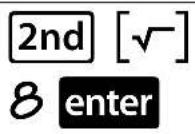
Pressing 2nd displays the 2nd indicator, and then accesses the function printed above the next key pressed. For example, 2nd [] 25 enter calculates the square root of 25 and returns the result, 5.
Menus
Certain keys display menus: prb, 2nd [angle], data, 2nd [stat], 2nd [reset], 2nd [recall], and 2nd [clear var]. Press ▶ or ⬇ to scroll and select a menu item, or press the corresponding number next to the menu item. To return to the previous screen without selecting the item, press clear. To exit a menu or application and return to the Home screen, press 2nd [quit].
Previous entries ▲ ↘
After an expression is evaluated, use ⬆ and ⬇ to scroll through previous entries, which are stored in the TI-30XS MultiView history. You can reuse a previous entry by pressing enter to paste it on the bottom line, and then editing and evaluating a new expression.
Answer toggle
The toggle key displays the last calculated result into different output formats, where possible. Press to toggle between fraction and decimal answers, exact square root and decimal, and exact pi and decimal.
Last answer (Ans)
The most recently calculated result is stored to the variable Ans. Ans is retained in memory, even after the TI-30XS MultiView is turned off. To recall the value of Ans:
- Press 2nd [ans] (Ans displays on the screen), or
- Press any operation key (⊕, -, and so forth) as the first part of an entry. Ans and the operator are both displayed.
Resetting the TI-30XS MultiView
Pressing on and clear simultaneously or pressing 2nd [reset] and then selecting 2 (Yes) resets the calculator.
Resetting the calculator:
- Returns settings to their defaults — standard notation (floating decimal) and degree (DEG) mode.
- Clears memory variables, pending operations, entries in history, statistical data, constants, and Ans (Last answer).
Note: The examples on the transparency masters assume all default settings.
Automatic Power Down™ (APD™)
If the TI-30XS MultiView remains inactive for about 5 minutes, the APD feature turns it off automatically. Press on to restore power. The display, pending operations, settings, and memory are retained.
Error messages
Refer to Appendix C for a listing of the error messages.

natural_image
Simple line drawing of a notepad with horizontal lines and a pencil resting on it (no text or symbols)Activities
Star Voyage —
Scientific notation 3
Heart Rates —
1-variable statistics 7
At the movies —
Data formulas at the box office 13
Name that rule —
Algebraic expressions 21
Star voyage — scientific notation
Overview
Students investigate scientific notation by changing numbers into scientific notation, and then using them in calculations.
Math Concepts
- scientific notation
- additio
- division
Materials
• TI-30XS MultiView™
pencil
- student activity
Introduction
Set up the activity by telling your students:
The standard form for scientific notation is a × 10^n , where a is greater than or equal to 1 and less than 10, and n is an integer.
- Have students practice writing the following numbers in scientific notation using pencil and paper.
a. 93 000 000 9.3 × 10^7
b. 384 000 000 000 3.84 × 10^11
c. 0.000000000000234 2.34 × 10^-12
d. 0.0000000157 1.57 × 10^-8
- Have students change the following numbers into scientific notation (SCI) using the TI-30XS MultiView scientific calculator.
a. 12 000 000 1.2 × 10^7
b. 974 000 000 9.74 × 10^8
c. 0.0000034 3.4 × 10^-6
d. 0.000000004 4 × 10^-9
Note: Noters assume the default floating decimal setting.
- Have students change the following numbers into standard (NORM) notation.
a. 5.8 × 10^7 58 000 000
b. 7.32 × 10^5 732000
c. 6.2 × 10^-6 0.0000062
d. 3 × 10^-8 0.00000003
Note: Note enter a negative number, press (-) and then enter the number.
Follow these steps:
-
Enter the first number, 12000000.
-
Press mode.
-
Press ▶ enter clear enter to display the number in scientific notation.
$$ 1. 2 * 1 0 ^ {7} $$
Follow these steps:
-
Enter 5.8; press ×10^n .
-
Enter 7; press mode
-
Press ▼ enter clear enter . 58000000
Activity
Present the following problem to students:
You are a captain of a starship in the distant future. You have been assigned to go to Alpha Centauri and you have 5 years to get there. The distance from our sun to Alpha Centauri is 2.5 × 10^13 miles. The distance from the earth to our sun is approximately 9.3 × 10^7 miles.
Although we have not yet discovered how to travel at the speed of light, you live in a time where your ship can travel at the speed of light.
Light travels the approximate distance of 6 × 10^12 miles in 1 light year. You will take a path from earth by our sun and then on to Alpha Centauri. Will you be able to get to Alpha Centauri on time?
Procedure
- Using the TI-30XS MultiView ^™ calculator, find the total distance you need to travel.
$$ 2. 5 \times 1 0 ^ {1 3} + 9. 3 \times 1 0 ^ {7} = 2. 5 0 0 0 0 9 3 \times 1 0 ^ {1 3} \text { miles } $$
- Next, find out how long it will take you to travel the distance. (Distance traveled ÷ 1 light year)
$$ \frac {2 . 5 0 0 0 0 9 3 \times 1 0 ^ {- 1 3}}{6 \times 1 0 ^ {1 2}} = 4. 1 6 6 6 8 2 1 6 7 2 \text { years } $$
- Can you make the trip in the allotted time of 5 years?
Yes, if your ship really could travel at the speed of light.
Extension
Light travels at 186,000 miles per second. A light year is the distance that light can travel in a year. Have students convert one light year to miles traveled per light year.
$$ \frac {1 8 6 , 0 0 0 \text { miles }}{1 \sec} \times \frac {6 0 \sec}{1 \min} \times \frac {6 0 \min}{1 \mathrm{hr}} \times \frac {2 4 \mathrm{hrs}}{1 \mathrm{day}} \times \frac {3 6 5 \text { days }}{1 \text { year }} \approx \frac {5 . 8 7 \times 1 0 ^ {1 2} \text { miles }}{1 \text { year }} $$
We approximate this value using 6 × 10^12 miles in 1 light year in this activity.
Answer to student extension: It will take the starship approximately 15 years to get to Delta Centauri.
Hint: Make sure the TI-30XS MultiView calculator is in MathPrint™ mode to work this problem.

Hint: The Earth is approximately 9.3 × 10^7 miles from the Sun.
Follow these steps:
- Press 2.5 ×10 ^n 13 ▶ + 9.3 ×10 ^n 7 enter .
2.5000093*10 ^13
- Press 2nd [ans] 6 ×10 ^n 12 enter .
4.166682167
Depending on the problem, remind students to include parentheses where needed to ensure the intended order of operations. Example: (2.5000093 × 10^13) ÷ (6 × 10^12) must include the parentheses in order to get the correct result.
Students can learn more about this topic by visiting NASA web sites on the Internet.
Star voyage — scientific notation
Name ____
Date

Problems
- Write the following numbers in scientific notation.
Standard Notation Scientific Notation
a. 93 000 000
b. 384 000 000 000
c. 0.00000000000234
d. 0.0000000157
- Using the TI-30XS MultiView™ calculator, change the following numbers into scientific notation using SCI mode.
Standard Notation Scientific Notation
a. 12 000 000
b. 974 000 000
c. 0.0000034
d. 0.000000004
- Using the TI-30XS MultiView calculator, change the following numbers into standard decimal notation using NORM mode.
Scientific Notation Standard Notation
a. 5.8 × 10^7
b. 7.32 × 10^5
c. 6.2 × 10^-6
d. 3 × 10^-8
Star voyage — scientific notation
Name
Date

Problem
You are a captain of a starship in the distant future. You have been assigned to go to Alpha Centauri and you have 5 years to get there. The distance from our sun to Alpha Centauri is 2.5 × 10^13 miles. The distance from the earth to our sun is approximately 9.3 × 10^7 miles.
Although we have not yet discovered how to travel at the speed of light, you live in a time where your ship can travel at the speed of light.
Light travels the approximate distance of 6 × 10^12 miles in 1 light year. You will take a path from earth by our sun and then on to Alpha Centauri. Will you be able to get to Alpha Centauri on time?
Procedure
- Using the TI-30XS MultiView™ calculator, find the total distance that you need to travel. For this rough estimate, assume that you are measuring the distance as a straight line from the earth to our sun and then on to Alpha Centauri.
Hint: Make sure your calculator is in scientific notation mode before you begin the calculation.
Next, find out how long it will take you to travel the distance.
(Distance traveled ÷ 1 light year)
Hint: Make sure you use parentheses if needed in order to get the correct result for this division problem.
- Can you make the trip in the allotted time of 5 years?
Extension
Now that you have been successful, you have been asked to make another trip. The distance from the Sun to Delta Centauri is 9 × 10^13 miles. How long will it take you to get there from Earth?
Hint: The Earth is approximately 9.3 × 10^7 miles from the Sun.
Your trip on this starship is fictitious. If you are interested in finding out more about the nearest star and cosmic distances, visit NASA web sites on the Internet.

natural_image
Line drawing of a futuristic flying saucer with propellers and motion lines (no text or symbols)Heart rates — 1-variable statistics
Overview
Students use the data editor and statistics function of the TI-30XS MultiView™ calculator to investigate the effect of exercise on heart rate.
Math Concepts
• mean, minimum, maximum, and range
Materials
• TI-30XS MultiView
- stopwatch or a watch with a second hand
- student activity
Introduction
Students may be placed in smaller groups for this activity to minimize the amount of data to be entered. Ask students:
• What do you think the average heart rate is for someone your age?
• What about after exercising?
Activity
Have students complete the following investigation to check their estimations.
- Have students check their resting heart rate by timing their pulse for 1 minute. (You could have them time for 10 seconds and then multiply by 6, but this could be the quietest minute of your day!)
- Collect data on the chart. Enter each student's heart rate and a mark in the frequency column. As other students have the same heart rate, add another tally mark in the frequency column.
- Enter the heart rate data into the TI-30XS MultiView scientific calculator.
a. Enter the first heart rate on the chart in L1, and the number of tallies for that heart rate in L2. You will use L2 as the frequency.
b. You must press ⬤ between entries. For example, enter the first heart rate, and then press ⬤.
c. For example, assume a class of 22 students:
Rate Students Rate Students
| 6 | 0 | 3 | 6 | 3 |
| 6 | 1 | 5 | 6 | 4 |
| 6 | 2 | 6 | 6 | 5 |

Follow these steps:
-
Press data to enter the heart rates and frequencies. Enter the heart rates in L1 and the frequencies in
L2. Press ⬇ between entries, and ⬇ to get from L1 to L2. -
Continue entering until you have entered all the heart rates and frequencies.
-
Press 2nd [stat].
-
Press 1 to choose 1-var stats.
-
Choose L1 for the data, and L2 for the frequency.
-
Press ▼ enter to view the data.
-
Check the statistics calculations. After students display _x (Sigma x), explain that _x is the sum of all the heart rates. Ask students:
-
How many heartbeats were entered from all of the student in one minute? This is _x .
- How many students were entered? This is m.
- How can we calculate the average heart rate? This is . xn 62.27272727=
-
Is the average heart rate higher or lower than you expected?
-
Now we will see the effect of some exercise on heart rate. To accommodate various student's needs, pair students with other students who will be able to complete the task. Also consider designing some task that an individual student can safely undertake to raise their heart rate. Tell students:
If at any point during this portion of the activity you experience pain, weakness, or shortness of breath, stop immediately.
- Have the students run in place for 2 minutes and then give them these instructions:
a. Time your pulse for 1 minute.
b. Record your heart rate as before.
c. Enter the data into the calculator.
d. Compare the average heart rate after running with the resting heart rate.
-
Now have the students do jumping jacks for 2 minutes. Instruct them to time their pulse for 1 minute again and record as before. Have them enter the data into the calculator again and calculate the average heart rate after jumping jacks. Compare to the other 2 averages.
-
Instruct students to make a bar graph of the 3 sets of data they collected. Ask students:
• How are the bar graphs the same?
• How are they different?
- Is the data grouped the same, or is it more spread out in one graph compared to another?
Follow these steps:
-
View the statistical data.
n should equal the total number of students sampled. For this example, n = 22. -
Press ⬇ to to see the average heart rate.
= 62.27272727 -
Press until you see x .
±b = 1370
Note: The numbers show the results for the example described in this activity. Your students' results will vary depending on the size of the group and the heart rate readings.
Heart rates — 1-variable statistics
Name
Date

Problem
What do you think the average heart rate is for someone your age? What about after exercising?
Procedure
- Use this table to record your class or group data (resting).
| Heartbeats per minute (resting) | Frequency |
-
What is the class (group) average?
-
Answer the following questions from the data:
a. What is the total number of heartbeats for the minute? Write the symbol and the number from the calculator.
b. What is the total number of student's heartbeats entered? Write the symbol and the number from the calculator.
c. How would you compute the average heart rate? ____ Is your answer the same as in question 2? ____
Heart rates — 1-variable statistics
Name
Date

- Use this table to record your class or group data (running).
| Heartbeats per minute (running) | Frequency |
-
What is the class (group) average?
-
Answer the following questions from the data:
a. What is the total number of heartbeats for the minute? Write the symbol and the number from the calculator.
b. What is the total number of student's heartbeats entered? Write the symbol and the number from the calculator.
c. How would you compute the average heart rate? ____ Is your answer the same as in question 5? ____
natural_image
Line drawing of a person jogging (no text or symbols)Heart rates — 1-variable statistics
Name
Date

- Use this table to record your class or group data (jumping).
| Heartbeats per minute (jumping) | Frequency |
-
What is the class (group) average?
-
What is the total number of heartbeats for the minute?
-
Answer the following questions from the data:
a. What is the total number of heartbeats for the minute? Write the symbol and the number from the calculator.
b. What is the total number of student's heartbeats entered? Write the symbol and the number from the calculator.
c. How would you compute the average heart rate? ____ Is your answer the same as in question 8? ____
Heart rates — 1-variable statistics
Name
Date

- Make a bar graph for each of the 3 sets of data you collected.
Resting Running Jumping
12.How are the bar graphs the same? How are they different? ____
- Is the data grouped the same or is it more spread out in one graph compared to another?
At the movies — data formulas at the box office
Overview
Students investigate a table of values and observe patterns in the table. Students use data on the TI-30XS MultiView™ calculator to enter data into a list and test their generalizations.
Math Concepts Materials
- patterns
- algebra expressions
- linear functions
- variables
• TI-30XS MultiView
• pencil
- graph paper
- student activity
Introduction
The warm up question is given to help you launch the student sheet activity. You can skip the warm up activity but you will have to provide more guidance during the investigation of the problem on the student sheet.
Warm up
Guide students in the use of tables and data to see a pattern and write a generalization. Present the following story problem.
Every Wednesday, Keisha gets home from work too late to walk her dog, Max. She asked her neighbor Kyle to walk her dog after he comes home from school. Kyle is happy to help! Keisha pays Kyle \$4 each week to walk Max. Kyle likes to save his money. Create a table of how much money Kyle has each week for 5 weeks.
Guide students to create the following table on their papers. You can think of this table as a data list of two numbers which depend on each other. It is important to have students write their calculation and outcome in the Money (output) column in order to see any patterns. This helps them to write algebraic sentences from the words and to make generalizations using inductive reasoning.
Use these columns for different learning styles if needed.
| Week | Money Repeated |
| 1 | 1 x |
| 2 2x4=8 | |
| 3 | 3x4=12 |
| 4 | 4x4=16 |
| 5 | 5x4=20 |
| addition Adding on | |
| 4 = 4 | 4 |
| 4+4=8 4+4=8 | |
| 4+4+4=12 | 8+4=12 |
| 4+4+4+4=16 | 12+4=16 |
| 4+4+4+4+4=20 | 16+4=20 |
4 4 = 4
Point out that the Money column looks like the multiplication table for the number 4. This connects them back to something familiar. Remind the students that they know that Kyle earns \$4 per week. This is the rate of Kyle's savings and it can be written in fractional form as
$$ \text { rate } = \frac {\$ 4}{1 \text { week }} $$
Ask the students to fill in more of the table describing how much Kyle will save. Have them fill in the table for weeks 6 and 7, and then ask if they can determine the amount of money for 10 weeks, 25 weeks, and 100 weeks. Finally, ask them if they could fill in the amount of money after some number of weeks. Call the unknown number of weeks a variable and use the letter W to represent weeks. Use the variable M to represent money.
| Week (W) | Money (M) | |
| 1 | 1 | x |
| 2 | 2 | x |
| 3 | 3 | x |
| 4 | 4 | x |
| 5 | 5 | x |
| 6 | 6 | x |
| 7 | 7 | x |
| 10 10x4=40 | ||
| 25 25x4=100 | ||
| W | W | x |
All of this investigation should be done without the calculator for these basic multiplication facts. If students need support with their multiplication, encourage looking up facts in a chart rather than using the calculator, to promote mental math and appropriate calculator use.
Ask students to write the expression for the calculation using W, x, and 4.*
(Answer: W x 4)
| 4 | = | 4 |
| 4 | = | 8 |
| 4 | = | 1 |
| 4 | = | 1 |
| 4 | = | 2 |
| 4 | = | 2 |
| 4 | = | 2 |
4 *
Ask the students the following:
"If you calculate W weeks times \$4, you get a number. What does that number mean to Kyle?" You are prompting the student to say Money (M) and lead them into writing the formula or sentence in two variables, M = W x 4. Typically, you write the number and then the letter with implied multiplication. Remind students that multiplication is commutative so M = W x 4 = 4 x W = 4W.
Support the investigation using the data editor (data) on the TI-30XS MultiView™ calculator by having the students look at many values of their algebraic expression to see if they match the table they created.
- Have students enter their table into the data list.
Notice there are three lists available: L1, L2, and L3.
Discuss that they will enter the Week (W) values in L1. - Have the students enter the first three values of W from their table, 1, 2, 3 .
- Enter a formula to validate the work: L2 = 4 x L1. Notice that W = L1 and M = L2.
- Add input to L1 to see L2 update automatically with the output value of the formula. Scroll to an open entry space in L1. Ask them to check their table for 4 weeks and then 100 weeks.
Before starting the group investigation on the student sheet, have the students clear the data in the lists.
(Continued)
Remind students that for this activity they are using the features in data and not table.
If students are not familiar with the TI-30XS MultiView calculator, have them turn on the calculator and press mode.
Make sure all students have their calculator mode set as shown:
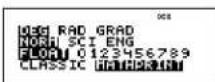
To return to the Home screen, press clear.
- Enter the first three values of W: data 1 ▼ 2 ▼ 3 ▼.
- Enter the formula: ▶ data ▶ 1 4 ✗ data 1 enter.
- Add input to L1: ← ▼ ▼ ▼ 4 enter 100 enter.
- To view the formula in L2 again, press ① data ② 1.
- Edit the formula, if desired, and press enter to set the formula again.
- To clear data, press data 4.
Hint: Remember that pressing 2nd[quit] takes you back to the Home screen.
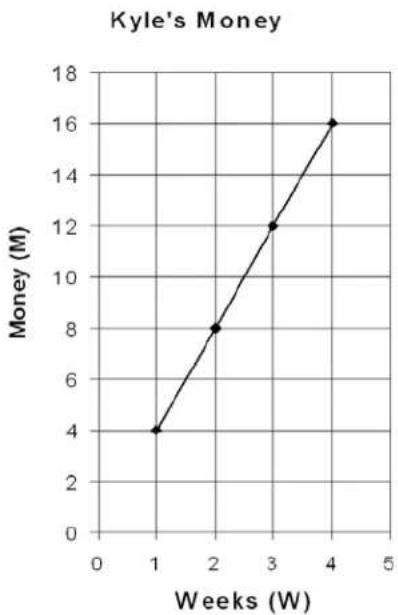
The students now have taken data from words to a table of values, to a pattern they can view, to writing an algebraic expression. The next step is to show them a view of how the number pattern plots on a graph. What is the shape of M = 4W? Have students plot the first 4 points in the table. Notice the points fall on a straight line. You can mention that they can describe the increase of Money (M) as "for every 1 week (W) Kyle works, his amount of money (M) increases by \$4." This is an obvious statement but sets the foundation for talking about rates and how they affect the tilt of a line (slope).
The number of weeks and amount of money are both positive so the graph makes sense in the first quadrant. Have your students use graph paper to make the graphs of their data.
Activity
Students repeat a similar investigation in groups looking at patterns to write algebraic expressions and sentences. They also create a graph of the values in the table. Have students read the problem on the student sheet before breaking up into groups so they understand their task.
Students fill in the table using mental math. They write all calculations to help them see the formula. They are encouraged to use mental math as much as they can before using the calculator to find the results for the amount of money.
| Number of People (P) | Calculation Amount (M) |
| 1 1 x 11.50 11.50 | |
| 2 2 x 11.5023.00 | |
| 3 3 x 11.50 34.50 | |
| 4 4 x 11.5046.00 | |
| ... | |
| 10 10 x 11.50 115.00 | |
| ... | |
| 100 100 x 11.501150.00 | |
| ... | |
| 1000 | 1000 x 11.50 $11500.00 |
| ... | |
| P | Px 11.50 M = Px 11.50 |
line
| Weeks (W) | Money (M) | | --------- | --------- | | 1 | 4 | | 2 | 8 | | 3 | 12 | | 4 | 16 |Procedure
Students should write the algebraic equation from the pattern showing in their table: M = P x 11.50 or using implicit multiplication, M = 11.50 P.
Students check their formula using the data editor (data) on the TI-30XS MultiView™ calculator, as in the warm up example.
- Have the students check to see how the calculator is set up.
- Enter the first three values in L1 {1, 2, 3}.
- Translate your formula to the calculator formula and enter the formula into L2.
Your formula: M = ____
The calculator formula: L2 = ____
- Enter more values into L1 to check the table of values and the formula. This activity validates the formula for several values.
- Enter 7500 in L1 to find the amount of money in L2. Write the math as M = 11.50 x 7500 = \$86,250.
- Create a report by filling in a table of values and a graph. Write a paragraph describing the work for the presentation.
Answers in the paragraph will vary. Make sure that the students explain the table, graph, and algebraic sentence (formula) in the paragraph.
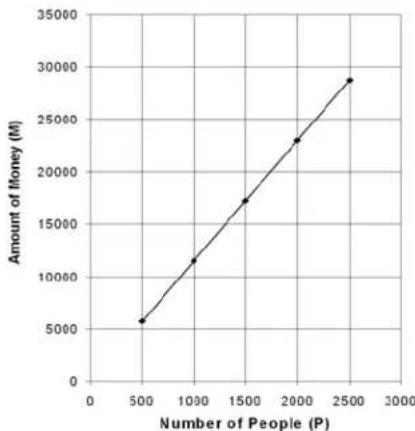
| P | M |
| 500 5750 | |
| 100011500 | |
| 1500 17250 | |
| 200023000 | |
| 2500 $28750 |
Make sure the calculator mode is set as shown.
- Press mode.

- Press data 1 ◀ 2 ◀ 3 ◀.
- Enter the formula in L2.
data 1
11 · 50 × data 1 enter.
- Press ⬇ ▼ ▼ ▼ 4 enter
5 enter 6 enter 10 enter
100 enter 1000 enter . - Press 7500 enter .
Box Office at Multiplex
line
| Number of People (P) | Amount of Money (M) | |---|---| | 500 | 6000 | | 1000 | 12000 | | 1500 | 17500 | | 2000 | 23000 | | 2500 | 29000 |Problem
A blockbuster movie is opening this weekend. On the news, you hear that tickets will be \11.50 per person. The reporter says that a family of two will spend \23 and a family of three will spend \$34.50. They show a graphic with this information in a table format.
| Number of People Amount of Money | |
| 1 | |
| 223.00 | |
| 3 $34.50 | |
1
1
The reporter also mentions that the local theater, MultiPlex, has twenty-five screens and can seat 7,500 people. This blockbuster will open on all screens at the theater. The owners predict that all seats will be sold out on the first day!
The owners of MultiPlex want to know how much money they can expect to take in at the ticket office. They would like a general formula so they can quickly find out the amount of money for any amount of people that buy tickets.
Your job: You have been hired as the accountant for MultiPlex! Congratulations! Your boss wants a formula that will tell her how much money will be taken in at the box office, depending on how many people buy tickets.
Procedure
- Use the table to investigate the amount of money taken in at the ticket office depending on the number of people going to the movie. Fill in the following table. Write all of your calculations at each step. Use mental math as much as you can before using the calculator to find the results for the amount of money.
| Number of People (P) | Calculation | Amount of Money (M) |
| 1 | 1 x 11.50 | 11.50 |
| 2 | 2 x 11.50 | 23.00 |
| 3 | 3 x 11.50 | $34.50 |
| 4 | ||
| 5 | ||
| 6 | ||
| ... | ||
| 10 | ||
| ... | ||
| 100 | ||
| ... | ||
| 1000 | ||
| ... | ||

text_image
ADMIT ONE SX03000 00030XS- What pattern do you see from your table? Using the information in your table, write a formula (an algebraic expression) which describes the amount of money (M) depending on the number of people (P) that buy a ticket to the show.
M = ____
- Check your formula using the data list editor (data) on the TI-30XS MultiView™ calculator.
a. In column L1, enter only the first three entries in the number of people (P) list from the table above. (Enter {1, 2, 3}.)
b. Enter your formula from part 2 in L2. Be careful: to use the calculator, you have to translate your variables (letters). The letter P is now L1 and M is L2.
Rewrite your formula here in terms of L1 and L2 so you can enter the formula in your calculator.
Your formula: M = ____
The calculator formula: L2 = ____
c. Check the numbers in L2 with the numbers in your table above. Do they match?
d. Enter more values from the number of people list from your table into L1. Check the values in L2 against your table above. Do they match? Does your formula work?
-
Use the data editor on the calculator to find the amount of money (M) that the owners will take in at the ticket office if the entire theater is filled during one showing with 7500 people (P). Write how you would find this answer by hand using your formula.
-
Your boss wants you to make a presentation to the people who invest money in MultiPlex. The investors want to see numbers and graphs in your presentation! Fill in the table below using the data editor on your calculator. Graph the points from this table. This is another way that an accountant can show how the amount of money (M) depends on the number of people (P). This gives a picture of the data!
| P | M |
| 500 | |
| 1000 | |
| 1500 | |
| 2000 | |
| 2500 |
Amount of Money (M)
Number of People (P)
- Write a paragraph below about what you would say to your boss and the investors about your work. Include how you determined the formula for the amount of money and what the table and graph tell them about the amount of money that will be taken in at the box office.
Name that rule!
Overview
Students guess the algebraic expression (function) from a table of values in a game format. Students use table on the TI-30XS MultiView™ calculator to enter an expression as a function (y=) in order to play the game.
Math Concepts
- algebra expressions
- functions
Materials
- 61-30XS MultiView
- pencil
- student activity
• strips of paper and paper bag
Introduction
Students will warm up for this activity by evaluating expressions and filling out a table of values. They then play a game, "Name that rule!" The game uses the TI-30XS MultiView calculator to create a table of values.
Have students fill out the following tables which appear on the student sheet.
Note Not consider varying the variable letter in the warm up. The variable on the calculator, however, will always be x.
| x | x+3 |
| -21 | -222 |
| -12 | -144 |
| 0 | 3 |
| 1 | 4 |
| 2 | 5 |
| x | 2x+6 2( x+3)* | |
| 0 | 6 | |
| 1 | 8 | |
| 2 | 10 10 | |
*The students should notice that the tables for 2x + 6 and 2(x + 3) are the same. Discuss why these are equivalent expressions and verify this by using the Distributive Property of Multiplication over Addition. You can also have students use tiles to display the area model, 2(x + 3) = 2x + 6 .
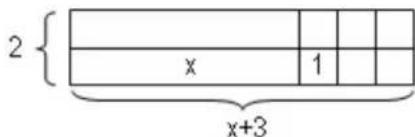
text_image
2 { x 1 x+3Show the students how to enter the expression in table on the TI-30XS MultiView. They enter the expression as a function. This may be a new concept for your students. If needed, use a function machine
to provide an alternate way of thinking about evaluating an expression for different values of x. Here, an input of x = 1 gives an output of y = 1 + 3 = 4 . Discuss that the expression, x + 3 , can be thought of as the rule to find y. Later in the game, the students will think backwards to guess the "rule." If needed, discuss how students follow the rules to their favorite board games. They need to follow the rules in order to play. When they evaluate an expression, they follow a rule to change one number to another.
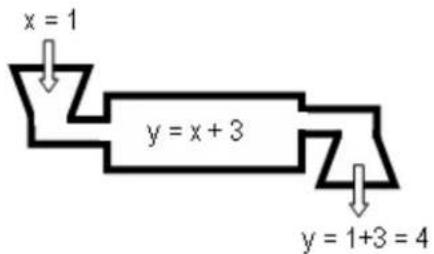
text_image
x = 1 y = x + 3 y = 1 + 3 = 4Set up the table on the calculator using the Auto feature in table. Auto automatically sets up a table of values to start at a given value and increment by a value. To have the calculator create the same table of values as above, set start at -2 and increment the x values by the step size of 1. Have students compare their table done by hand against the calculator table.
Activity
Play one or two games of "Name that rule!" with the whole class, using the rules on the next page. For the whole class introduction of the game, the teacher plays the role of the Ruler. This game uses table and the Ask-x feature on the TI-30XS MultiView™ calculator.
Follow these steps:
- Press mode and set mode as shown.

- Enter the expression y=x+3 :

- Enter table setup values: (-) 2

- Use and to scroll through values of x and y = x + 3 .
Hint: Copy the game sheets from the student activity section for as many games as needed.
Rules for group play
- Form groups of three to four students.
- Assign one student to be the Ruler of the game.
- The Ruler is in charge of the calculator for the game.
- The Ruler picks an algebraic expression from a paper bag (or any container) and keeps it hidden from the other players, or the Ruler writes an algebraic expression on a piece of paper for the game and gets approval to use the expression from the teacher.
- The Ruler enters the algebraic expression into table and selects the Ask- x feature. NoteNBhe Ruler may have to delete each line in the Ask- x table before playing a new rule. (See keystroke instructions.)
• Each player other than the Ruler takes turns saying a value for x. The Ruler enters that value and tells the players the y value output.
• Each player keeps a table of values as a record of play.
- A player can guess the expression or rule only during the player's turn.
- Once a rule is guessed by a player, every player must check if the rule is true for all values already played, or challenge the rule by trying to find a value that does not work.
- If the guessed rule is shown to be incorrect by a player or the Ruler, the player who guessed the rule loses his or her next turn.
- If the algebraic expression guessed by a player is not in the same form as the expression entered by the Ruler, for example, 2(x + 1) and 2x + 2 , and all players agree that the guessed expression is correct, the Ruler reveals the expression on the calculator and the player who guessed the rule must explain why the two expressions are the same.
- The first player to guess the rule correctly and defend their rule wins.
- The role of Ruler then rotates to another player for the next round of play.
Follow these steps:
- Press mode and set mode as shown.

- Enter the function y = 2x + 5 :
clear table 2 x_abc^yzt + 5 enter
Note: If a function is already entered on the y= screen, press clear before entering a new function.
- Enter table setup values: ◀ ◀ ⬇
enter ▼ enter
- Enter x-values: 5 enter 6 enter 10
enter
Hint: To enter more values, highlight any of the three lines in the x column, enter the number, and press enter.
- To review the y= screen, press table. You will have to cycle through the setup screen again to see the table of values.
To play again:
-
Clear the old expression, pick the next expression, and enter it: table clear x_abc^yst + n d 1 ◼ 2.
-
Enter the desired table setup values, highlight OK, and press enter.
Notice that only 3 guesses show on the screen. Students can overwrite a number to see a new output.
Algebraic expression list
Copy these or other expressions on pieces of paper so the Ruler of each team of players can pick the expression to play. You can also have the Ruler write an expression which you can approve before the start of a game. Having the student write an expression gives them ownership and is an assessment of their knowledge.
Pick a list or mix the lists depending on the level of your students. Expand the lists depending on your students' level. Students should document all work on their student sheet.
Examples of one-step expressions
$$ x + 3 2 $$
$$ x - 9 \cdot 4 $$
$$ x \frac {1}{2} + $$
$$ x - 2. 5 $$
$$ x + 1 5 1. 5 $$
$$ x - \frac {1}{5} $$
Examples of two-step expressions
$$ x + 3 $$
$$ x + 5 $$
$$ 2 x + 6 \text { or } 2 (x + 3) $$
$$ \frac {1}{2} x 4 - $$
$$ x + 2. 5 $$
Modifications of the game
- Include expressions that would need to be simplified by the players such as 2x + 4 + 3x - 6 . If a player guesses 5x - 2 , they will have to justify the expression is equivalent to 2x + 4 + 3x - 6 which adds another assessment layer to the game.
- Include expressions in words such as "four less than twice a number." Have the Rulers pick the expression from the container and change the words to an expression for your approval before they return to their group to play the game.
Example: Four less than twice a number is picked. The Ruler translates this to 2x - 4, you indicate if they are correct, and then they return to their group to play.
Problem
We follow rules every day. Can you follow the rules to your favorite board game? Do you have to carefully follow the rules to play? We also follow rules when we work with numbers and expressions.
Example: If x = 1 , then x + 3 = 1 + 3 = 4

text_image
x = 1 y = x + 3 y = 1 + 3 = 4The expression x + 3 has one variable, x. Depending on the value of x, x + 3 will be equal to different numbers. You can think of x + 3 as a rule. Fill out the following table to warm up. The values of x have been picked for you.
| x | x+3 |
| -2-2 | -2 |
| -1-1 | -1 |
| 0 | |
| 1 | |
| 2 |
| x | 2x+6 |
| 0 | |
| 1 | |
| 2 |
| x | 2(x+3) |
| 0 | |
| 1 | |
| 2 |
-
What do you notice about the table for 2 x + 6 and 2(x + 3) ?
-
Check the tables above using table on the TI-30XS MultiView™ calculator.
-
Play the game "Name that rule!", using the game sheet on the next page. In this game, you will not know the expression (rule). You will have to guess the rule by thinking backwards! Your teacher will give you the instructions to play.

Name That Rule!


Think backwards!
Guess the rule from a table of values!

Player names: Ruler:
Your teacher will give you the instructions on how to play. Use the table to keep track of the x and y values for every player's turn during the game. Use the Guess columns to check the rule. If a player's rule is not correct, continue playing.
| x | Calculator y value | Guess 1y=_Check every x value!Is this guess correct? _ | Guess 2y=_Check every x value!Is this guess correct? _ |
| x | Calculator y value | Guess 3y=_Check every x value!Is this guess correct? _ | Guess 4y=_Check every x value!Is this guess correct? _ |

natural_image
Simple line drawing of a calculator with no text or symbolsHow to use the TI-30XS MultiView™ calculator
TI-30XS MultiView basic operations 29
Clearing and correcting 41
Basic math 45
Order of operations and parentheses 49
Numeric notation 55
Fractions 59
Decimals and decimal places 65
Constant 67
Memory and stored variables 71
Data editor and list formulas 79
Statistics 83
Probability 89
Function table 97
Powers, roots, and reciprocals 101
Logarithms and exponential functions 109
Pi 113
Angle settings and conversions 117
Polar and rectangular conversions 121
Trigonometry 123
Hyperbolics 131
TI-30XS MultiView™ basic operations
Keys
-
on turns on the calculator.
-
2nd turns on the 2nd indicator and accesses the function shown above the next key you press.
-
2nd [off] turns off the calculator and clears the display.
-
enter completes the operation or executes the command.
-
2nd [ans] recalls the most recently calculated result and displays it as Ans.
-
⬆ toggles the answer between fraction and decimal, exact square root and decimal, and exact pi and decimal formats.
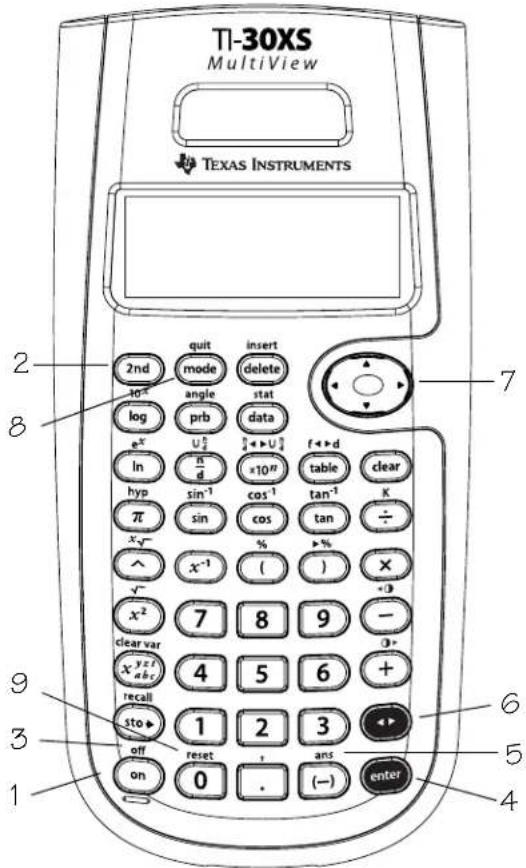
text_image
TI-30XS MultiView TEXAS INSTRUMENTS 2nd 10" log e^x ln hyp π ^ x^- 7 quit mode angle prb U_i^2 n/d sin^-1 sin x^-1 quit delete stat data *10^2 cos^1 cos % ×10^2 table tan^-1 tan × clear K × ×10^2 clear var x^z+1 abc recall sto off on reset 0 insert ×10^2 ×10^2 ×10^2 ×10^2 ×10^2 ×10^2 ×10^2 ×10^2 ×10^2 ×10^2 ×10^2 ×10^2 ×10^2 ×10^2 ×10^2 ×10^2 ×10^2 ×1O ×1O ×1O ×1O ×1O ×1O ×1O ×1O- ⏻ and ⏻ move the cursor left and right to scroll entries on the Home screen and to navigate in menus.
2nd ◀ or 2nd ⬆ scrolls to the beginning or end of a current entry.
and move the cursor up and down through menu items, previous entries on the Home screen, and entries in Data editor and Function table.
2nd moves the cursor to the top entry of the active column in Data editor, or to the previous entry on the Home screen. Press
2nd again to move the cursor to the oldest entry on the Home screen. In fractions, press 2nd to paste a previous entry to the denominator. (See Chapter 6, Fractions, for more information.)
2nd moves the cursor to the first blank row of the active column in Data editor, or below the last entry on the Home screen.
-
mode lets you set the angle, numeric, decimal, and display modes. Press ⬇ ⬇ ⬇ to choose a mode, and enter to select it. Press clear or 2nd[quit] to exit the mode menu.
-
2nd [reset] displays the Reset menu.
- Press 1 (No) to return to the previous screen without resetting the calculator.
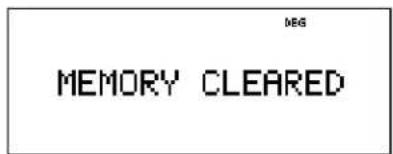
- Press 2 (Yes) to reset the calculator. The message MEMORY CLEARED is displayed.
Note: Pressing on and clear simultaneously resets the calculator immediately. No menu or message is displayed.
- Resetting the calculator:
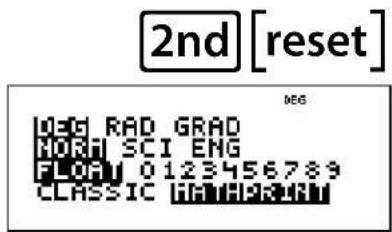
- Returns settings to their defaults: degree (DEG) angle mode, normal numeric notation (NORM), floating decimal notation (FLOAT) and MathPrint™ display mode.
- Clears memory variables, pending operations, entries in history, statistical data, constants, and Ans (Last answer).
TI-30XS MultiView™ basic operations (Continued)
Notes
- The examples on the transparency masters assume all default settings (See page vi).
- ▶ can be used in an entry before pressing enter. Pressing ▶ more than once in a current entry may result in a Syntax error. To achieve the desired result, you can:
- Enter the expression, press ▶ enter, and then press ▶ again after the result is displayed.
- Enter the expression and press enter, and then press ◀ as many times as desired to toggle the display and view the alternate format of the answer.
- When ◀ or ▶ appears in the display, the entry line contains more characters to the left or right.
- Press on after the Automatic Power Down™ (APD™) feature activates to restore power. The display, pending operations, settings, and memory are retained.
Second, off, arrows, enter
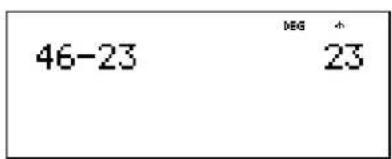
- Enter 46 - 23.
- Change 46 to 41. Change 23 to 26 and complete the operation.
- Enter 2/5 + 3/10 and complete the operation.
- Turn the TI-30XS MultiView™ calculator off and back on. The Home screen is blank; scroll up to view history.
Press Display
46-
23 enter
text_image
46-23 MBS 小 23enter
◀ ◀ ◀ ◀ 1
→→ 6 enter
2 5 ⬆ + 3
10 enter
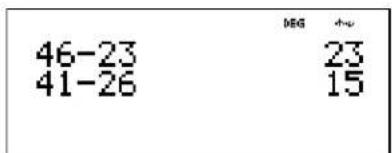
text_image
46-23 41-26 23 152nd [off] on
◀ ▲

text_image
46-23 41-26 2/5+3/10 MEG 46 23 15 7/10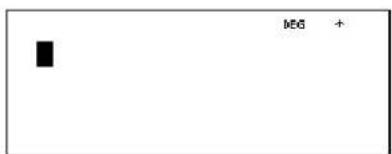
text_image
MEG +
text_image
41-26 2/5+3/10 M66 +# 7/10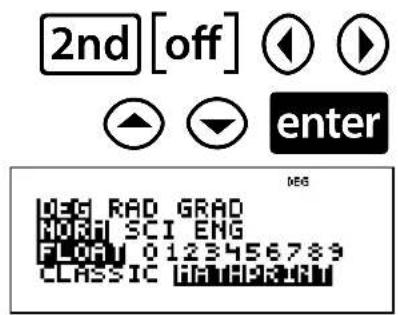
text_image
2nd [off] enter WEG RAD GRAD MORI SCI ENG FLOAY 0123456789 CLASSIC IHTHPRAH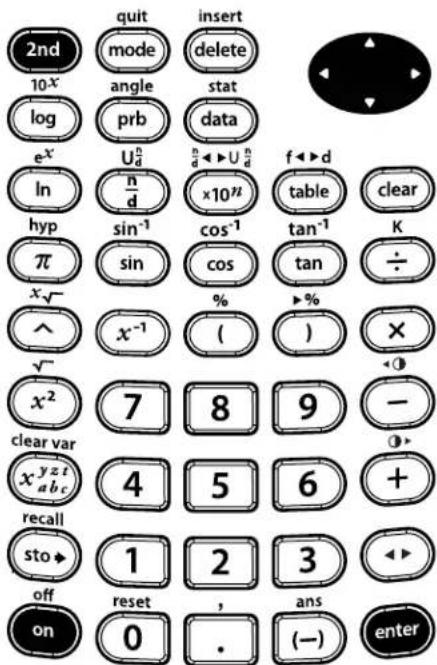
text_image
2nd 10x log e^x ln hyp π x√ ^ x² clear var x^y z t abc recall sto off on quit mode angle prb U_d^n d ×10^n sin⁻¹ sin x⁻¹ 7 4 1 reset 0 insert delete data cos⁻¹ cos % ( ) ×10^n f◄►d table tan⁻¹ tan ►% ) ) - 9 6 3 ans (-) enterReset
Reset the calculator.
Press Display

text_image
Reset 1: No 2: Yes2
text_image
MEG MEMORY CLEARED
text_image
BEGPressing on and clear at the same time also resets the calculator immediately. No menu or message is displayed.
Using 2nd [reset] or on and clear returns all settings to their defaults and clears the memory.
text_image
2nd [reset] REG REG RAD GRAD NORT SCI ENG FLOT 0123456789 CLASSIC H1H9R4M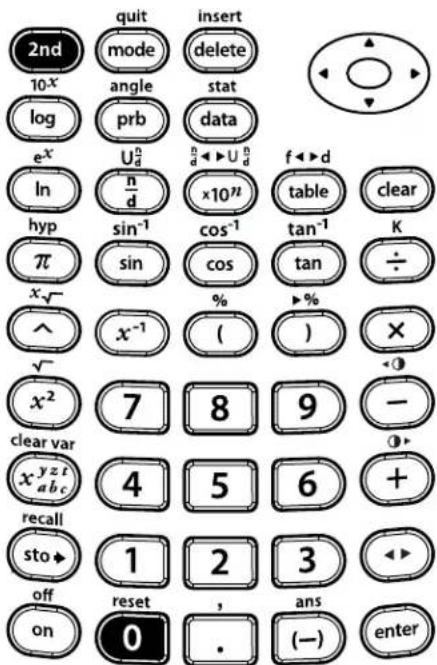
text_image
2nd 10^x log e^x ln hyp π x√ ^ x² clear var x^y z t abc recall sto off on quit mode angle prb U_d^n n/d sin⁻¹ sin x⁻¹ quit delete stat data ×10^n cos⁻¹ cos % ( ) ×10^n f◄►d table clear tan⁻¹ tan K ÷ % ►% ) × 7 8 9 - 4 5 6 + 1 2 3 ←► reset , ans (-) enterMode
mode
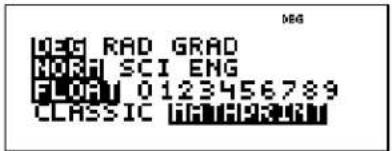
Use mode to choose modes. Press ▼ ◀ ◀ ▶ to choose a mode, and enter to select it. Press clear or 2nd [quit] to return to the Home screen and perform your work using the chosen mode settings.
Default mode settings are shown highlighted.
text_image
WEG RAD GRAD NORT SCI ENG FLOAF 0123456789 CLASSIC HHH900RJDEG RAD GRAD Sets the angle mode to degrees, radians, or gradians.
NORM SCI ENG Sets the numeric notation mode. Numeric notation modes affect only the display of results, and not the accuracy of the values stored in the calculator, which remain maximal.
mode

text_image
2nd 10^x log e^x ln hyp π ^ √ clear var recall sto on quit mode angle prb U_d^n n/d sin^-1 sin x^-1 quit delete stat data ×10^n cos^-1 cos % ( ) 7 8 9 4 5 6 1 2 3 reset , ans (-) enterNORM displays results with digits to the left and right of the decimal, as in 123456.78.
SCI expresses numbers with one digit to the left of the decimal and the appropriate power of 10, as in 1.2345678 × 10^5 (which is the same as 123456.78).
ENG displays results as a number from 1 to 1000 times 10 to an integer power. The integer power is always a multiple of 3.
Note: × 10^n is a shortcut key to enter a number in scientific notation format. The result displays in the numeric notation format set in mode.
FLOAT 0123456789
Sets the decimal notation mode.
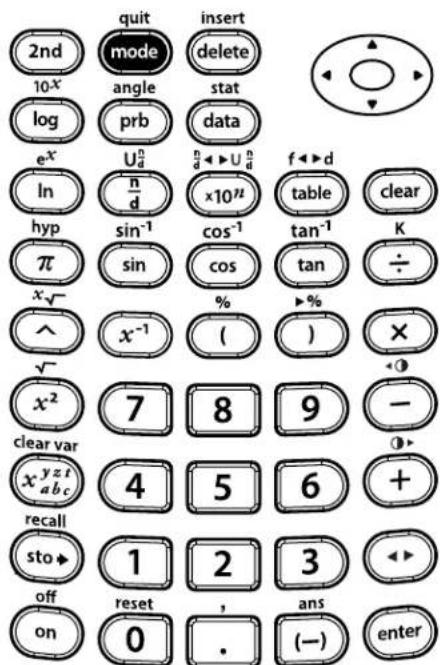
FLOAT (floating decimal point) displays up to 10 digits, plus the sign and decimal.

text_image
2nd 10-x log e^x ln hyp π x√ ^ x² clear var x^y z t abc recall sto off on quit mode angle prb U_d^n n/d sin⁻¹ sin x⁻¹ quit delete stat data ×10^n cos⁻¹ cos % ( ) ×10^n f d d table clear tan⁻¹ tan K ÷ % % ) × 7 8 9 - 4 5 6 + 1 2 3 reset , ans (-) enter0123456789 (fixed decimal point) specifies the number of digits (O through 9) to display to the right of the decimal.
CLASSIC MATHPRINT sets the display input and output.
CLASSIC displays inputs and outputs in a single line.
MATHPRINT displays most inputs and outputs in textbook format. Use MathPrint mode for better visual confirmation that math expressions have been entered correctly and to better reinforce the correct math notation.
Note: Switching the mode between Classic and MathPrint clears calculator history and the Constant value.
mode
text_image
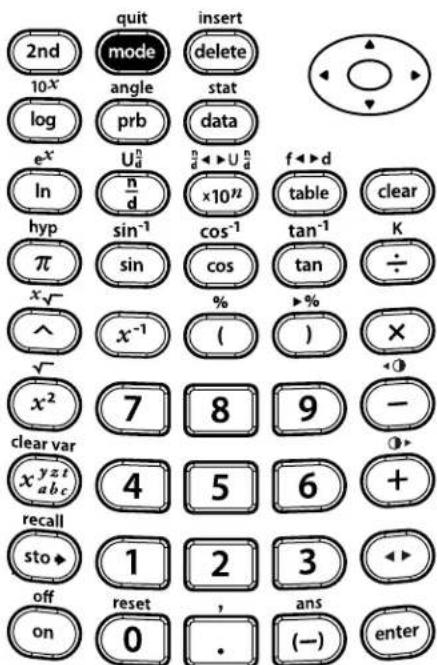
2nd 10^x log e^x ln hyp π ^ √ clear var x^y z t abc recall sto off on quit mode angle prb U_d^n d ×10^n sin^-1 sin x^-1 7 4 reset 0 insert delete data cos^-1 cos % ( 8 5 2 - ans (-) clear K ÷ - - - - - - - - - - - - - - - - - - - - - - - - - - - - - - - - - - - - - - - - - - - - - - - - - - - - - - - - - - - - - - - - - - - - - - - - - - - - - - - -Certain keys display menus: prb, 2nd [angle], data, 2nd [stat], 2nd [reset], 2nd [recall], and 2nd [clear var]. Some keys may display more than one menu.
Press ⬇ and ⬇ to scroll and select a menu item, or press the corresponding number next to the menu item. To return to the previous screen without selecting the item, press clear. To exit a menu or application and return to the Home screen, press 2nd [quit]. The Home screen is blank; scroll up to view history.
Some sample menus:
prb 2nd [angle]
PRB RAND DMS R
| 1: nPr | 1: rand | 1: ° | 1: R ▶ Pr( |
| 2: nCr | 2: randint( | 2: ' | 2: R ▶ P θ( |
| 3: ! | 3: " | 3: P ▶ Rx( | |
| 4: r | 4: P ▶ Ry( | ||
| 5: g | |||
| 6: ▶ DMS |
data
(Press data once to display the Data editor screen. Press again to display the menu.)
CLEAR FORMULA
1: Clear L1 1: Add/Edit Frmla
2: Clear L2 2: Clear L1 Frmla
3: Clear L3 3: Clear L2 Frmla
4: Clear ALL 4: Clear L3 Frmla
5: Clear ALL
Press data while you are in the Add/Edit Frmla option of the FORMULA menu to display this menu:
Ls
1: L1
2: L2
3: L3
2nd [stat]
STATS
This menu option displays after you calculate 1-var or 2-var stats.
StatVars menu:
1: n
2:
3: 5x
Etc. See Chapter 11, Statistics, for a full list.
Last answer (Ans)
Use Last answer (Ans) to calculate 5^2 + 12^2 .
Press Display
5 x^2 + 12
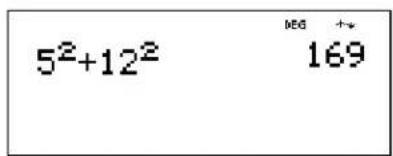
text_image
5²+12² ME6 ↑ 1692nd [√] 2nd
[ans] enter
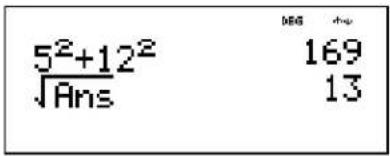
text_image
5²+12² √Ans 169 13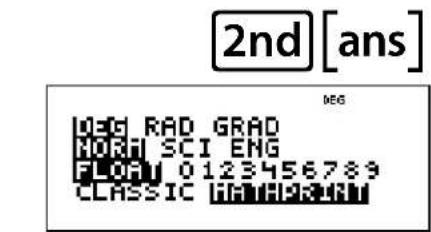
text_image
2nd [ans] REG REG RAD GRAD HORT SCI ENG FLOG 0123456789 CLASSIC HHTHPK4N
text_image
2nd 10^x log e^x ln hyp π x√ ^ x² clear var x^y z t abc recall sto off on quit mode angle prb U_d^0 d ×10^n sin^-1 sin x-1 quit delete stat data f d d table clear tan^-1 tan K ÷ % ( ) × 7 8 9 - 4 5 6 + 1 2 3 reset , ans (-) enterAnswer toggle
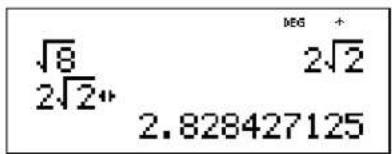
Press ▶ to toggle the display result between fraction and decimal answers, exact square root and decimal, and exact pi and decimal.
Press Display

text_image
√8 MBS + 2√2
text_image
√8 2√2 2√2+ 2.828427125
text_image
MEG RAD GRAD MORI SCI ENG FLOPA 0123456789 CLASS IC HIGH9848H
text_image
2nd 10-x log e^x ln hyp π ^ x² clear var x^y z t abc recall sto◆ off on quit mode angle prb stat data U_d^n d/d ×10^n sin⁻¹ sin x⁻¹ 7 4 1 reset 0 insert delete n←→U_d^n ×10^n cos⁻¹ cos % ( 8 5 2 - ans (-) f←→d table tan⁻¹ tan %> ( ) × K ÷ -① 9 6 3 + 3 (-) enterClearing and correcting
2
Keys
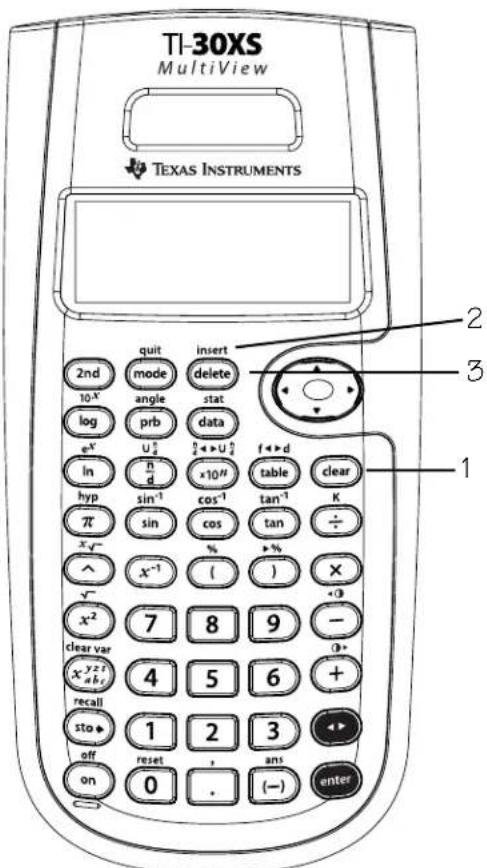
- clear clears characters and error messages. Press clear once to clear an uncompleted entry; press it again to clear the display. You can scroll up and use clear to clear entries in history. clear backs up one screen in applications.
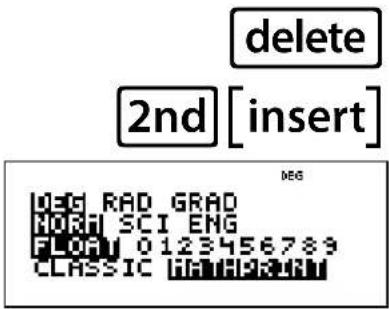
- 2nd [insert] lets you insert a character at the cursor.
- delete deletes the character at the cursor. Then, each time you press delete, it deletes 1 character to the left of the cursor.
Notes
- The examples on the transparency masters assume all default settings.
- Pressing clear does not affect the memory, statistical registers, angle units, or numeric notation.
text_image
TI-30XS MultiView TEXAS INSTRUMENTS 2nd 10^X log e^X in hyp π x^Y- √ clear var recall stop on quit mode angle prb U_1^2 d sin^-1 sin x^-1 4 reset 0 insert delete stat data ×10^N cos^-1 cos % ( ) tan^-1 tan K × +0 -3 + ans (-) enter 2 3 1Delete and insert
Enter 4569 + 285, and then change it to 459 + 2865. Complete the problem.
Press Display
4569 + 285
4569+285
◀◀◀◀◀◀
delete
459+285
◀◀◀◀
2nd [insert] 6
459+2865
enter
459+2865
DEG +
3324
text_image
delete 2nd [insert] REG REG RAD GRAD NORF SCI ENG FLOAY 0123456789 CLASSIC HIGH/High/High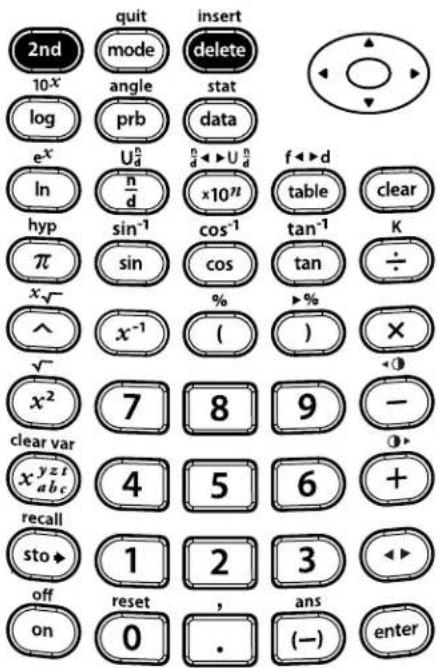
text_image
2nd 10^x log e^x ln hyp π x√ ^ x² clear var x^y z t abc recall sto off on quit mode angle prb delete stat data U_d^n d ×10^n sin⁻¹ sin % ( ) reset 0 insert f d d table tan⁻¹ tan %> ( ) ans (-) enterClear
Enter 21595.
Clear the 95.
Clear the entry.
Press Display
21595
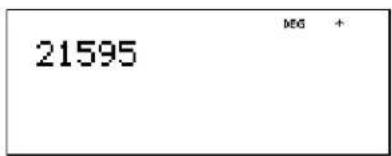
text_image
21595 MOS +clear
(Clear to right)
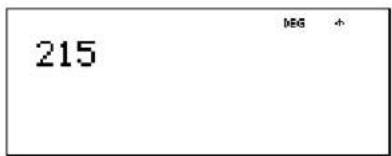
text_image
215 MEG +clear
(Clear entry)
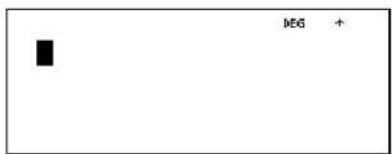
text_image
MEG +
text_image
clear MEG MEG RAD GRAD NORFI SCI ENG FLOFU 0123456789 CLASS IC HIGH/HEART
text_image
2nd 10^x log e^x ln hyp π ^ √ clear var recall sto on quit mode angle prb stat data U_d^n ×10^n sin^-1 sin x^-1 7 4 reset 0 insert delete U_d^n U_d^n ×10^n cos^-1 cos % ( ) reset , ans (-) clear K ÷ × - + - + - enterKeys
-
- adds.
-
- subtracts.
- × multiplies.
- ÷ divides.
- enter completes the operation or executes the command.
- (-) lets you enter a negative number.
- 2nd [%] appends the % sign to a number.
Notes
- The examples on the transparency masters assume all default settings.
- The TI-30XS MultiView™ allows implied multiplication.
Example: 3 (4+3) = 21
- Do not confuse (-) with - . - allows subtraction.
- Use parentheses to group the negation sign with the number if needed.
Example: -2^2 = -4 , and (-2)^2 = 4 .
- Results of percent calculations display according to the decimal notation mode setting.

text_image
TI-30XS MultiView TEXAS INSTRUMENTS 2nd mode insert 10^ angle delete log prb stat e^ U^ 2 d data In n d ×10^7 f→d hyp sin^-1 cos^-1 table clear π sin cos tan^-1 K x^- x^- % - % ÷ x^ 7 8 9 X clear var 4 5 6 + recall 1 2 3 + sto 1 2 3 ← on reset ans enter on 0 . (-)Add, subtract, multiply, divide, equals
Find:
$$ 2 + 5 4 - 6 = $$
$$ 1 6 \times 2 1 = $$
$$ \frac {1}{2} \times 1 0 = $$
$$ 1 2 \times (5 + 6) = $$
Press Display
2 + 54 -
6 enter

text_image
2+54-6 MAG ↑ 5016 × 21 enter

text_image
2+54-6 16*21 50 3361 2 ⬆ ×
10 enter

text_image
2+54-6 16*21 ½*10 50 336 512 × ( ) 5 +
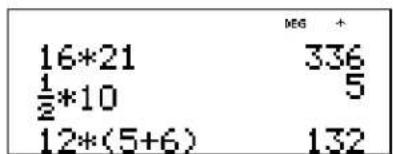
text_image
16*21 336 ½*10 5 12*(5+6) 1326 ) enter


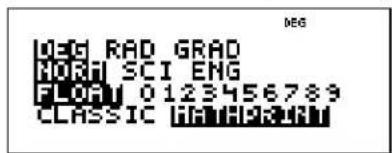
text_image
WEG RAD GRAD NORF SCI ENG FLOW 0123456789 CLASSIC HHH9401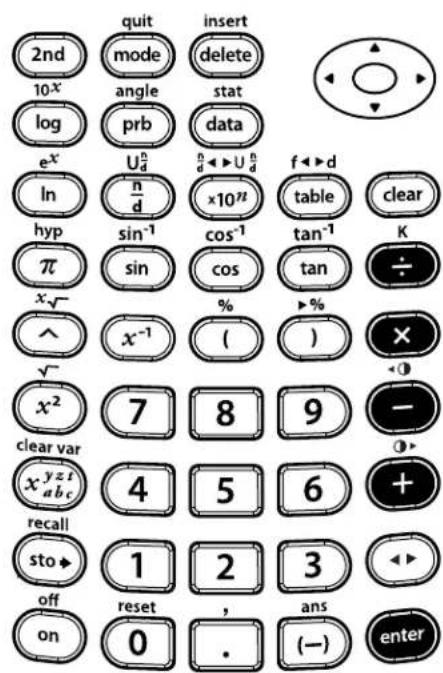
text_image
2nd 10^x log e^x ln hyp π x√ √ clear var x^y z i recall sto off on quit mode angle prb U_d^n n/d sin^-1 sin x^-1 quit delete stat data ×10^n cos^-1 cos % ( 7 4 1 reset 0 insert , . ans (-) f←→d table tan^-1 tan %> ( ) × K × -1 - 0> 3 + ←→ enterNegative numbers
The temperature in Utah was -3°C at 6:00 a.m. By 10:00 a.m. the temperature had risen 12°C. What was the temperature at 10:00 a.m.?
Press Display
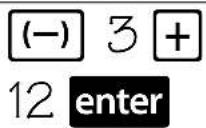

text_image
-3+12 NEG + 9The temperature at 10:00 a.m. was 9°C.
text_image
(一) NEG RAD GRAD NORFI SCI ENG FLOFU 0123456789 CLASS IC HIGH/HR/GRW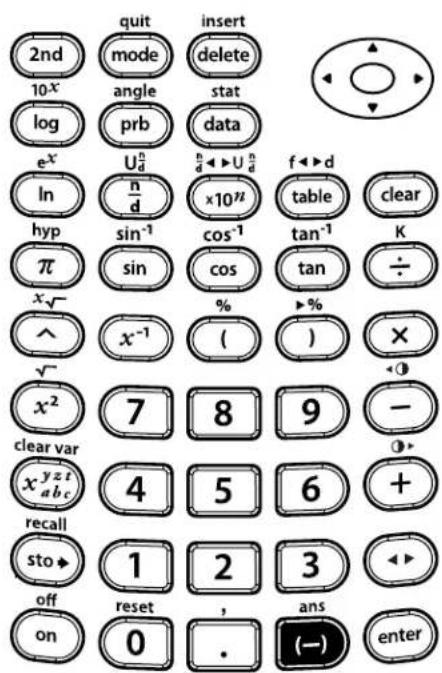
text_image
2nd 10^x log e^x ln hyp π x√ ^ √ x² clear var x^y z i abc recall sto off on quit mode angle prb U_d^n n/d ×10^n sin⁻¹ sin ^-1 quit delete stat data f◄►d table clear tan⁻¹ tan ÷ % ( ) × 7 8 9 - 5 6 + 1 2 3 ans (-) enterPercent
Mike makes \$80 per week. He saves 15% of his earnings. How much does Mike save per week?
Press Display
15
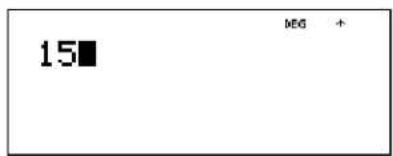
text_image
15 MEG ↑2nd [%] ×
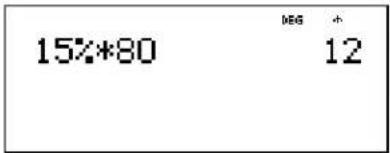
text_image
15%*80 1280 enter
Mike saves \$12 per week.

text_image
2nd [%] REG REG RAD GRAD NORI SCI ENG FLOOR 0123456789 CLASSIC [H1H9A1H]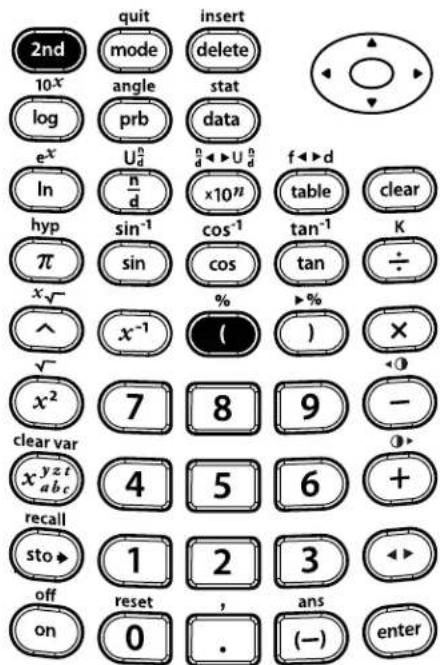
text_image
2nd 10-x log e^x ln hyp π x√ ^ x² clear var x^y z t abc recall sto off on quit mode angle prb insert delete stat data U_d^n d ◀ U_d^n ×10^n sin⁻¹ sin cos⁻¹ cos % ( ) × 7 8 9 4 5 6 1 2 3 reset , ans (-) enterOrder of operations and parentheses
4
Keys
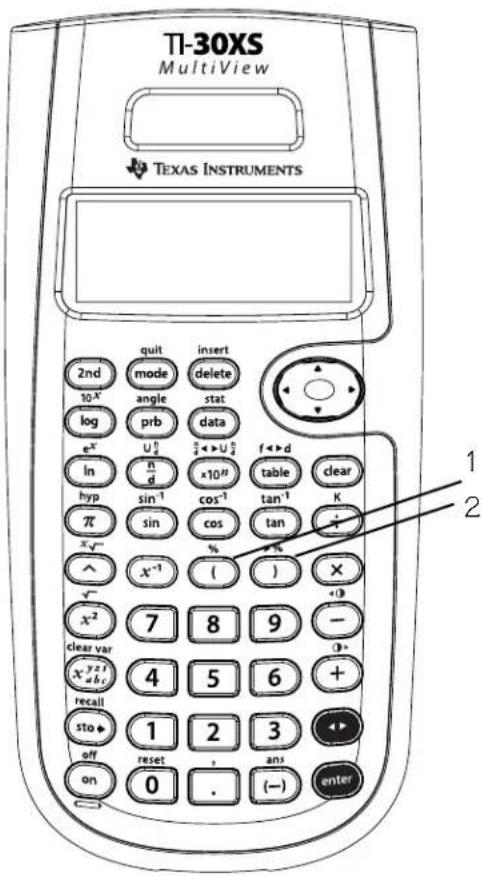
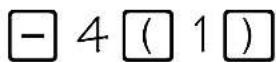
- ☐ opens a parenthetical expression.
- ☐ closes a parenthetical expression.
Notes
- The examples on the transparency masters assume all default settings.
- The transparency master showing the Equation Operating System (EOS™) demonstrates the order in which the TI-30XS MultiView™ calculator completes calculations.
- Operations inside parentheses are performed first. Use (☐) to change the order of operations and, therefore, change the result.
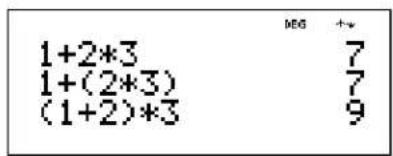
Example: 1 + 2 × 3 = 7
(1 + 2) × 3 = 9
text_image
TI-30XS MultiView TEXAS INSTRUMENTS 2nd 10^X log e^x in hyp π ^ √ clear var recall sto + off on quit mode angle prb U_d^s sin^-1 sin x^-1 7 4 1 reset × insert delete stat data x10^p cos^-1 % ( ) × × 8 5 2 ans (一) f↔d table tan^-1 tan K clear + - × - 9 - 6 + - ×10^p ×10^pEquation Operating System (EOS™)
| 1 (first) Expressions inside [☐ ☐] | |
| 2 Functions that need a ☐ and precede the expression, such as sin, log, and some menu items | |
| 3 Fractions | |
| 4 Functions entered after the expression, such as x^2 and angle unit modifiers (°, ', "", r, g) | |
| 5 | Exponentiation (^) and roots (2nd[x√])Note: In Classic mode, exponentiation using the ^ key is evaluated from left to right. The expression 2^3^2 is evaluated as (2^3)^2, with a result of 64.In MathPrintTM mode, exponentiation using the ^ key is evaluated from right to left. Pressing 2^3^2 displays as 2^3^2 , with the result of 512.The TI-30XS MultiViewTM scientific calculator evaluates expressions entered with x^2 and x^-1 from left to right in both Classic and MathPrint modes. Pressing 3 x^2 x^2 displays as322This is calculated as (3^2)^2 = 81 . |
Equation Operating System (EOS™) (Continued)
| 6 Negation ( (-) ) | |
| 7 | Permutations (nPr) and combinations (nCr) |
| 8 Multiplication, implied multiplication, and division | |
| 9 Addition and subtraction | |
| 10 | Conversions ( 2nd[n/d] ▶▶U _d^n ], 2nd[f] ▶▶d], 2nd[ ] ▶%, and ▶DMS) |
| 11 (last) enter completes all operations and closes all open parentheses. | |
Order of operations
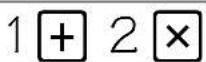
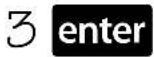
$$ 1 + 2 \times 3 = $$
Press Display
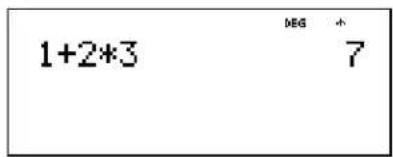
text_image
1+2*3 NEG 7$$ 1 + (2 \times 3) = $$
Press Display


text_image
1+2*3 1+(2*3)$$ (1 + 2) \times 3 = $$
Press Display


text_image
1+2*3 1+(2*3) (1+2)*3 NEG +# 7 7 9

text_image
WEG RAD GRAD NORT SCI ENG FLOAI 0123456789 CLASSIC MATHPRINT
text_image
2nd 10^x log e^x ln hyp π x√ ^ x² clear var x^yz abc recall sto off on quit mode angle prb U_d^n n/d sin⁻¹ sin x⁻¹ quit delete stat data ×10^n cos⁻¹ cos % ( ) 7 8 9 4 5 6 1 2 3 reset , ans (-) enterOrder of operations (Continued)
$$ \sqrt {5 ^ {2} - 4 (1) (3)} = (\text {Classic mode}) $$
Press Display



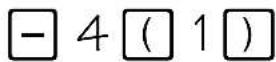

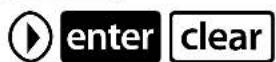
$$ \sqrt {5 ^ {2} - 4 (1) (3)} = (\text { MathPrint } ^ {\text { TM }} \text { mode }) $$
Press Display





text_image
√5²-4(1)(3) √13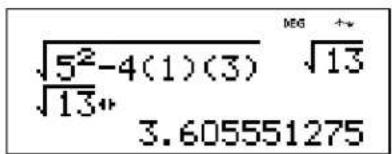
text_image
√5²-4(1)(3) √13 √13* 3.605551275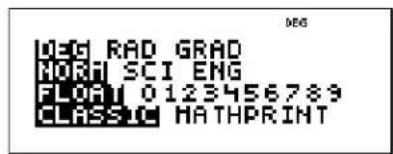
text_image
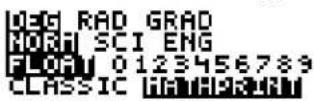
NEG RAD GRAD NORTH SCI ENG FLOAT 0123456789 CLASSIC HATHPRINT
text_image
WEG RAD GRAD NORT SCI ENG FLOW 0123456789 CLASSIC HHHHPART
text_image
2nd 10^x log e^x ln hyp π x√ ^ x² clear var x^y z t abc recall sto off on quit mode angle prb U_d^n n/d ▶ U_d^n ×10^n sin⁻¹ sin cos⁻¹ cos % ( ) 7 8 9 4 5 6 1 2 3 reset , ans (-) enterNumeric notation
Keys
- mode lets you choose from the following numeric notation menu.
NORM Restores standard mode (floating decimal).
SCI Turns on scientific mode and displays results as a number from 1 to 10 (1 ≤ n < 10) times 10 to an integer power.
ENG Turns on engineering mode and displays results as a number from 1 to 1000 (1 ≤ n < 1000) times 10 to an integer power. The integer power is always a multiple of 3.
- ×10^n is a shortcut key to enter a number in scientific notation format.

text_image
TI-30XS MultiView TEXAS INSTRUMENTS 1 2nd 10^x log e^x In hyp π x^y- √ x^2 clear var x^z z recall sto off on quit mode angle prb U# d sin^-1 sin x^-1 quit delete stat data +10^7/ cos^-1 cos % ( ) × × × × × × × × × × × × × × × × × × × × × × × ×Notes
- The examples on the transparency masters assume all default settings.
- You can enter a value in scientific notation regardless of the numeric notation mode setting. For a negative exponent, press (−) before entering it.
• Results requiring more than 10 digits are automatically displayed in scientific notation. - For the decimal notation mode, refer to Chapter 7, Decimals and decimal places.
• These modes (NORM, SCI, and ENG) affect only the display of results.
Engineering, scientific, floating decimal
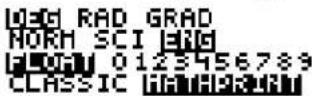
Enter 12543, which will be in floating decimal notation and normal numeric notation (both default settings in mode). Alternate the display result between normal, scientific, and engineering notations by changing settings on the mode screen.
Press Display
12543
enter
12543
12543
mode


enter
WEG RAD GRAD NORM SOD ENG ECON 0123456789 CLASSIC HGH9348H
clear
enter
12543 12543
12543 1.2543*10 ^4
mode


enter
WED RAD GRAD NORM SCI EING FLOWI 0123456789 CLASSIC LIFH9244H
clear
enter
12543
ENG DES + 1.2543*10 ^4 12.543*10 ^3
mode


text_image
2nd 10^x log e^x ln hyp π x√ ^ x² clear var x^y z i abc recall sto off on quit mode angle prb U_d^n n/d sin⁻¹ sin x⁻¹ quit delete stat data ×10^n cos⁻¹ cos % ( ) reset 0 insert U_d^n U_d^n U_d^n f←→d table clear tan⁻¹ tan × K ÷ % % ) - ①> 3 + ←→ ans (-) enterEngineering, scientific, floating decimal (Continued)


text_image
12543 12.543*10³ 12543 12543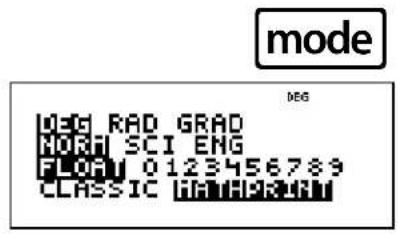
text_image
mode REG REG RAD GRAD NORTH SCI ENG FLOFY 0123456789 CLASSIC HIGH/HR/GRM
text_image
2nd 10-x log e^x ln hyp π x√ ^ x² clear var x^y z i abc recall sto off on quit mode angle prb U_d^n n/d ▶ U_d^n ×10^n sin^-1 sin cos^-1 cos % ( ) 7 8 9 4 5 6 1 2 3 reset , ans (-) enterScientific notation
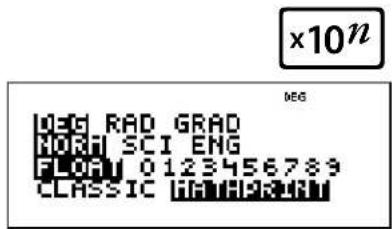
With the TI-30XS MultiView™ calculator in Norm and MathPrint™ modes (both defaults), enter the following problem in scientific notation using the × 10^n key.
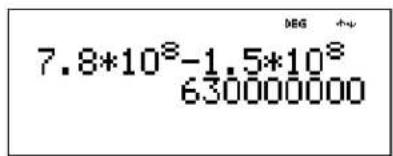
The Earth is approximately 1.5 × 10^8 kilometers from the Sun. Jupiter is approximately 7.8 × 10^8 kilometers from the Sun. Assuming the orbits of the planets are circular and the planets are on the same side of the sun, how close will Jupiter come to Earth?
Press Display
8

8


[NO TEXT]

8

text_image
7.8*10^8-1.5*10^8 630000000Jupiter and Earth could be approximately 630,000,000 = 6.3 × 10 ^8 kilometers apart.
text_image
×10^n REG REG RAD GRAD MORT SCI ENG FLOAY 0123456789 CLASSIC IHTH9R4M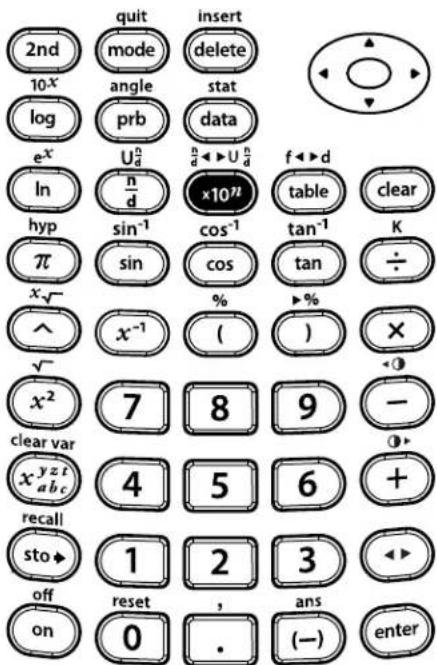
text_image
2nd 10^x log e^x ln hyp π x√ ^ x² clear var x^y z t abc recall sto off on quit mode angle prb U_d^n n_d^n U_d^n stat data x10^n sin⁻¹ sin cos⁻¹ cos⁻¹ % ( ) ×10^n f←→d table tan⁻¹ tan K ÷ % %> ( ) × 7 8 9 - 4 5 6 + 1 2 3 reset , ans (-) enterKeys
- 2nd [U_d^n] lets you enter mixed numbers and fractions. The unit must be an integer. The numerator and denominator can contain decimals.
To enter a mixed number, enter an integer for the unit, and then press 2nd[U_d^n] to enter a numerator.
In MathPrint™ mode, pressing 2nd[U _a^n ] before entering an integer displays a fraction template, and allows only one digit to be entered for the unit.

text_image
TI-30XS MultiView TEXAS INSTRUMENTS 2nd 10^x log ln hyp π ^ x² clear var recall sto on quit mode angle prb insert delete stat data U# ×10^H sin⁻¹ sin x⁻¹ 7 4 5 1 reset 0 insert × stat tan⁻¹ tan × ( ) × + - ans (-) enter f←→d table clear K K ×- Let you enter a simple fraction. Pressing before or after a number can result in differing behavior. In MathPrint™ mode, entering a number before pressing usually makes that number the numerator. In MathPrint mode can also be used for more complex fractional or formula computations that include operators and other functions by pressing before you enter the numerator.
In MathPrint™ mode, press ⬇ between the entry of the numerator and the denominator. In Classic mode, press n d between the entry of the numerator and the denominator.
-
2nd [] converts a simple fraction to a mixed number or a mixed number to a simple fraction.
-
2nd [f◄►d] converts a fraction to its decimal equivalent or changes a decimal to its fractional equivalent, if possible.
Notes
- The examples on the transparency masters assume all default settings.
- In MathPrint mode, fractions with can include operation keys ( + , , etc.) and most function keys ( x^2 , 2nd [%], etc.). In Classic mode, fractions with do not allow operation keys, functions, or complex fractions in the numerator or denominator.
- In MathPrint mode, you can enter variables (x, y, z, t, a, b, and c) in the numerator and denominator of a fraction. In Classic mode, fractions with do not allow variables.
- In Classic mode, data editor, and table, use ÷ along with ☐ and ☐ where needed to perform complex division problems.
Fractions (Continued)
- To paste a previous entry in the denominator, place the cursor in the denominator, press 2nd to scroll to the desired entry, and then press enter to paste the entry to the denominator.
- To paste a previous entry in the numerator or unit, place the cursor in the numerator or unit, press ⬆ or 2nd ⬆ to scroll to the desired entry, and then press enter to paste the entry to the numerator or unit.
- Fractional results and entries are automatically simplified to their lowest terms.
- Calculations using fractions can display fraction or decimal results, depending on input.
Fractions
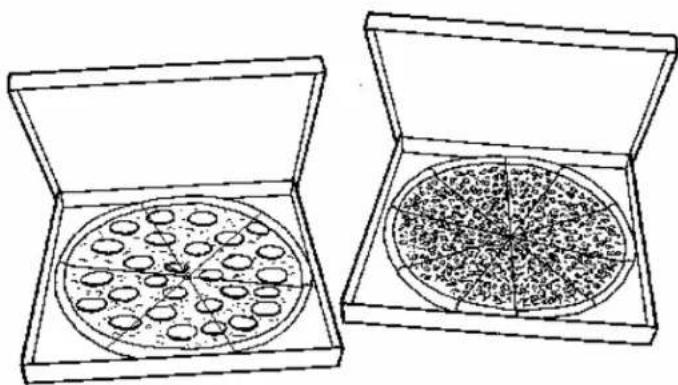
At the party, you ate 56 of the
pepperoni pizza and 110 of the
sausage pizza. The pizzas are the same size. If you put the pieces together, how much of one whole pizza did you eat?
natural_image
Two open pizza slices with visible side dishes, one divided into two halves (no text or labels)Press Display
5 n/d 6 ▶ +1
10 enter

text_image
5/6 + 1/10 MEG + 1.4/15You ate 1415 of the size of one whole
pizza. That is almost an entire pizza!

text_image
n/d REG RAD GRAD NORT SCI ENG FLOA 0123456789 CLASSIC IHTH9R4H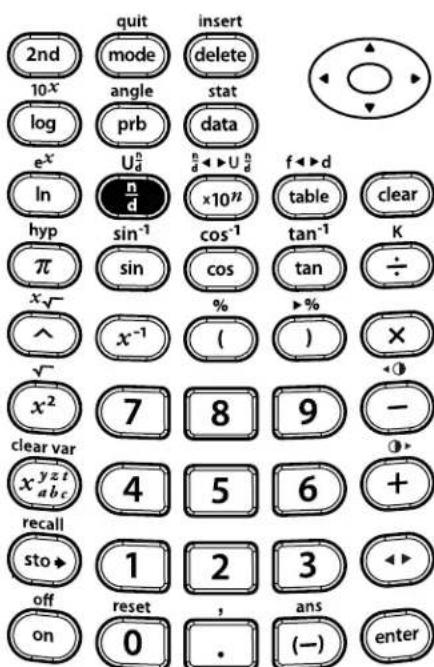
text_image
2nd 10x log e^x ln hyp π x√ ^ √ clear var x^y z t abc recall sto off on quit mode angle prb U_d^n d ×10^n sin^-1 sin x^-1 quit delete stat data f◀▶d table tan^-1 tan % ( ) × 8 4 5 1 reset , . ans (-) clear K ÷ × -Mixed numbers
A baby weighed 4 38 pounds at birth. In the next 6 months, she gained 2 34 pounds. How much does she weigh?

natural_image
Simple line drawing of a sleeping baby lying on a patterned blanket (no text or symbols)Press Display
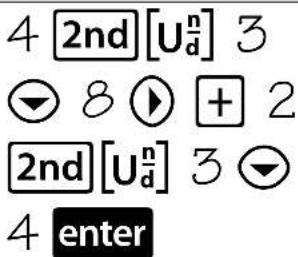
text_image
4 2nd [Uₐⁿ] 3 ⊗ 8 ▶ + 2 2nd [Uₐⁿ] 3 ◀ 4 enter

text_image
43/8 + 23/4 NEG + 57/8
text_image
PB 43/8 + 23/4 57/8 57/8 ▶ % ▶ U% MEG + 57/8 71/8After 6 months, the baby weighs 7 18 pounds.

text_image
2nd [Uₙ/d] 2nd [n/d ◀ ►Uₙ/d] NEG NEG RAD GRAD NORT SCI ENG FLOAY 0123456789 CLASSIC HATHARUM
text_image
2nd 10^x log e^x ln hyp π x√ ^ x² clear var x^y z t abc recall sto◆ off on quit mode angle prb U_d^n d ×10^n sin⁻¹ sin 7 4 reset 0 insert delete data cos⁻¹ cos % ( 8 5 2 - ans (-) clear K ÷ ) - - - - - - - - - - - - - - - - - - - - - - - - - - - - - - - - - - - - - - - - - - - - - - - - - - - - - - - - - - - - - - - - - - - - - - - - - - - - -Converting fractions and decimals
Juan swims 20 laps in 5.72 minutes.
Mary swims 20 laps in 5 34 minutes.
Change Mary's time to a decimal to determine who swims faster.
Press Display
5 2nd [U_d^n] 3
4
2nd [f ◀ ▶ d]
enter
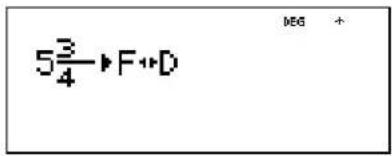
text_image
5\u00bd 4 F+D M6 + 1
text_image
53/4 F D 5.75Juan swims faster than Mary since he swims 20 laps in 5.72 minutes.
Change 2.25 to its fractional equivalent.
Press Display
2 · 25 2nd
[f ◀ ▶ d] enter
or
2 · 25 enter
[Non-Text]
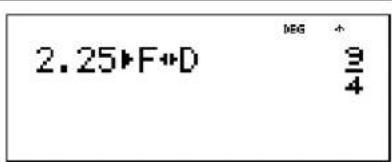
text_image
2.25F+D 3/4
text_image
2.25 2.25" MBS 4 2.25 2/4

text_image
NEG RAD GRAD NORT SCI ENG FLOOR 0123456789 CLASSIC HIGH/FAIR
text_image
2nd 10^x log e^x ln hyp π ^ √ clear var x^y z t abc recall sto off on quit mode angle prb U_d^n d ×10^n sin^-1 sin x^-1 7 4 reset 0 insert delete stat data f←d table clear tan^-1 tan % ( ) 8 9 5 6 3 ans (-) enterDecimals and decimal places
Keys
-
□ enters a decimal point.
-
mode lets you set the number of decimal places. Press ⬇ and then ⬇ to the choice of decimal desired. Press enter to select it.
FLOAT Sets floating decimal (standard) notation.
O-9 Sets the number of decimal places displayed. FIX displays when a decimal mode is set from O-9.

text_image
TI-30XS MultiView TEXAS INSTRUMENTS 2nd 10^x log e^x ln hyp π x√ √ clear var x^y≥i abc recall sto off on quit mode angle print U^2/d sin^-1 sin x^-1 7 4 reset 0 insert delete stat data ×10^10 cos^-1 cos % # ×10^10 tan^-1 tan % # ×10^10 f←d table clear K ÷ + - + - + - + - + - + - + - + - + - + - + - + - + - + - + - + - + - + - + - + - + - + - + - + - + - + - + - + - + - + - + - + - + - + - + - + - + - + - + - + - + - + - + - + - + - + - + - + - + - + - + + - + - + - + - + - + - + - + - + - + - + - + - + - + - + - + - + - + - + - + - + - + - + - + - + - + - + - + - + - + - + - + - + - + - + - + - + - + - + - + - + - + - + - + - + - + - + - + - + - + -Notes
- The examples on the transparency masters assume all default settings.
- Press mode ▼ enter to return to standard notation (floating decimal).
- The decimal mode setting affects most decimal results and the mantissa of scientific and engineering notation results.
- The TI-30XS MultiView™ calculator automatically rounds the result to the number of decimal places selected. For example, when the decimal is set to 2 places, 0.147 becomes 0.15 when you press enter. The TI-30XS MultiView calculator also rounds or pads resulting values with trailing zeros to fit the selected setting. For example, when the decimal is set to 5 places, 0.147 becomes 0.14700 when you press enter.
- Resetting the calculator clears the decimal setting and resets to the default, FLOAT.
- The decimal setting does not affect the internal precision of results. It affects only the way results are displayed.
Decimal
Round 12.345 to the hundredths place, to the tenths place, and then to floating notation.
Press Display
12
345
enter
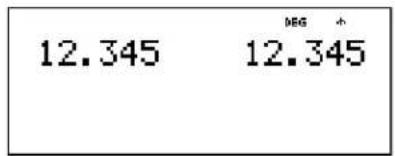
text_image
12.345 12.345mode
[NO TEXT]
[NO TEXT]
▶
▶▶
enter

text_image
FIX NEG RAD GRAD NOST SCI ENG FLOAT 01#3456789 CLASSIC HATH9847Mclear
enter
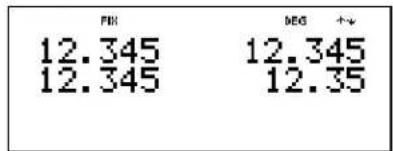
text_image
PIN 12.345 12.345 BEG +# 12.345 12.35mode
[NO TEXT]
[NO TEXT]
▶
▶
enter
clear
enter

text_image
REG RAD GRAD NORD SCI ENG FLOAT 0123456789 CLASSICmode
[NO TEXT]
[NO TEXT]
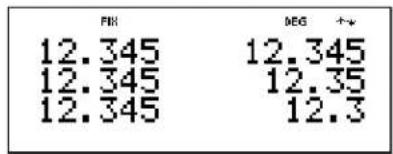
text_image
FIN 12.345 12.345 12.345 12.345 NEG +# 12.345 12.35 12.3enter
[Non-Text]
[Non-Text]
clear
enter
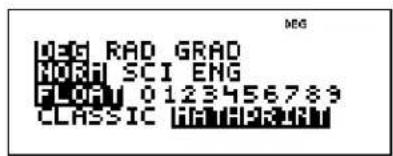
text_image
WEG RAD GRAD MORT SCI ENG FLOW 0123456789 CLASSIC HIGH/GOOD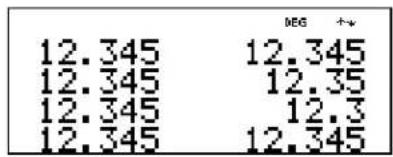
text_image
12.345 12.345 12.345 12.345 12.345 MEG +* 12.345 12.35 12.3 12.345mode
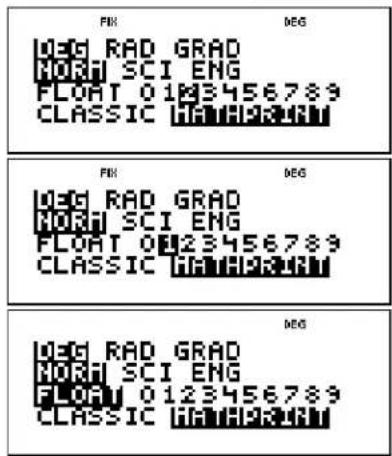
text_image
FIM DEG WEG RAD GRAD NORT SCI ENG FLOAT 0123456789 CLASSIC HATHARUT FIM DEG WEG RAD GRAD NORT SCI ENG FLOAT 0123456789 CLASSIC HATHARUT MOS WEG RAD GRAD NORT SCI ENG FLOAT 0123456789 CLASSIC HATHARUT
text_image
2nd 10-x log e^x ln hyp π x√ ^ x² clear var x^y z i abc recall sto off on quit mode angle prb insert delete stat data U_d^n n/d ×10^n sin⁻¹ sin cos⁻¹ cos % ( ) 7 8 9 4 5 6 1 2 3 reset , ans (-) enterKeys
- 2nd [K] turns the constant feature on and off, and lets you define a constant number, operation, or expression for a shortcut when repeating a set of keystrokes. K displays when the constant mode is on.
- enter places the contents of K at the end of the expression in the display.

text_image
TI-30XS MultiView TEXAS INSTRUMENTS 2nd 10-x log e^x ln hyp π x√- x² clear var x^y x^z abc recall sto off on quit mode angle prb U^2 n/d sin^-1 sin x^-1 quit delete stat data ×10^2 cos^-1 cos % table tan^-1 tan %> clear K ÷ × 7 8 9 - + 4 5 6 1 2 3 reset ans (-) enterNotes
- The examples on the transparency masters assume all default settings.
-
All operations, functions, and values work in constant mode.
• To enter a constant: -
Press 2nd [K]. If a constant is already stored, press clear to clear it.
- Enter the constant (any set of operations, functions, and values).
- Press enter to turn on the constant feature. K appears in the display to indicate the constant feature is on.
- Press clear to clear the display.
- Enter an initial value. If you do not enter a value, O is assumed, and Ans will appear in the display.
- Press enter to place the contents of K at the end of the expression and evaluate it.
- Continue pressing enter to repeat the constant.
- Press 2nd [K] again to turn off the constant feature.
Constant
Three people babysit for \$5.25 each per hour. The first person works 16 hours. The second person works 12 hours. The third person works 17 hours. How much did each person earn?
Press Display


text_image
K=■ NEG

text_image
K K=*5.25 MAG

text_image
K MEG + ■
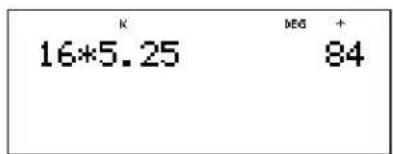
text_image
K 16*5.25 MEG + 84

text_image
K 16*5.25 12*5.25 MEG + 84 63
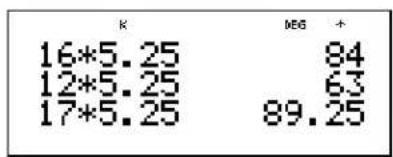
text_image
16*5.25 12*5.25 17*5.25 84 63 89.25
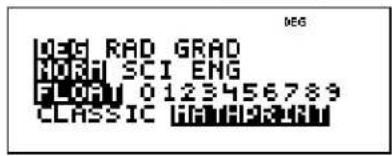
text_image
WEG RAD GRAD NORT SCI ENG FLOW 0123456789 CLASSIC HIGH/GOOD
text_image
2nd 10^x log e^x ln hyp π x√ √ clear var x^y z i abc recall sto off on quit mode angle prb U_d^n n/d sin^-1 sin x^-1 quit delete stat data ×10^n cos^-1 cos % ( ) select table tan^-1 tan %> ( ) clear K × 7 8 9 - 5 6 + 1 2 3 reset , ans (-) enterConstant (Continued)
2nd [K]
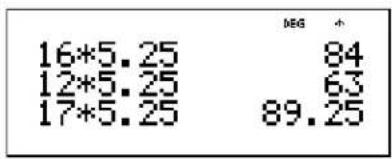
text_image
16*5.25 12*5.25 17*5.25 84 63 89.25(Constant mode is off.)

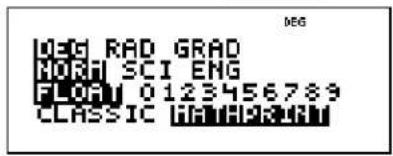
text_image
WEG RAD GRAD MORT SCI ENG FLOW 0123456789 CLASSIC HIGH/WEALTH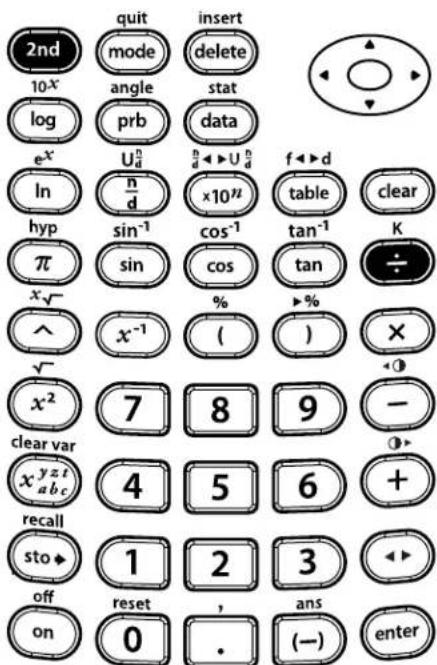
text_image
2nd 10^x log e^x ln hyp π ^ √ clear var recall sto on quit mode angle prb U_d^n n/d sin^-1 sin x^-1 quit delete stat data ×10^n cos^-1 cos % ( ) 7 4 1 reset 0 insert ans (-) enterMemory and stored variables
Keys
-
sto▶ lets you store values to variables. Press sto▶ to store a variable, and press x_abc^yzt to select the variable to store. Press enter to store the value in the selected variable. If this variable already has a value, that value is replaced by the new one.
-
_abc^yzt accesses variables. Press this key multiple times to choose x, y, z, t, a, b, or c. You can also use _abc^yzt to recall the stored values for these variables.
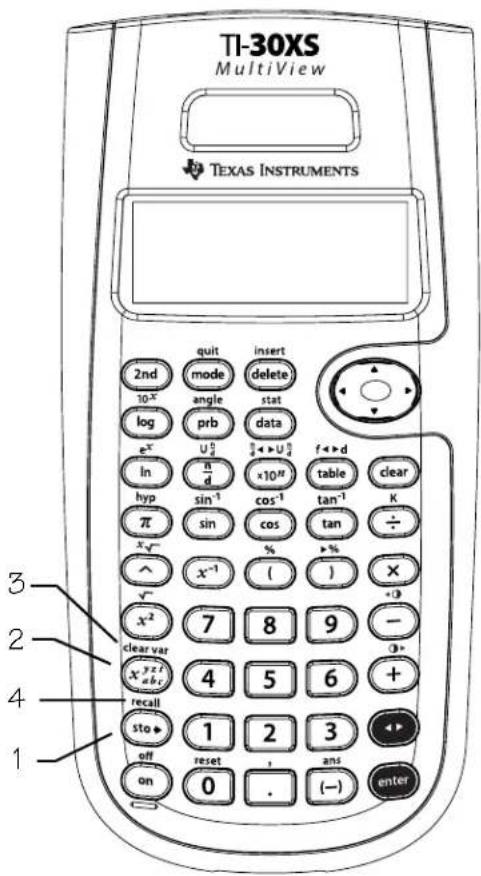
text_image
TI-30XS MultiView TEXAS INSTRUMENTS 2nd 10^x log e^x In hyp π ^ x^y clear var recall 1 on quit mode angle prb U^2 n/d sin^-1 sin x^-1 quit delete stat data ×10^H cos^-1 cos % tan^-1 tan ×% clear clear ×10^3 7 8 9 - 4 5 6 + 1 2 3 reset on 0 . ans (-) enter- 2nd [clear var] clears all variables.
- 2nd [recall] displays a menu of the variables x, y, z, t, a, b, and c, and lets you view their stored values before pasting to the display.
Notes
- The examples on the transparency masters assume all default settings.
- You can store a number or an expression that results in a number to a memory variable.
- When you select a variable using _abc^y* , the variable name (x, y, z, t, a, b, or c) is displayed. The variable name is inserted into the current entry, but the value assigned to the variable is used to evaluate the expression.
- When you select a variable using 2nd [recall], a menu is displayed showing the value of the stored variables. Select the variable by pressing the corresponding menu number. The value assigned to the variable is inserted into the current entry and used to evaluate the expression.
- Resetting the calculator clears all memory variables.
Store, variables
Following are your scores for tests and homework in your math class.
Test scores: 96, 76, 85.
Homework scores: 92, 83, 97, 86.
- Find your test grade as the average of your test scores.
- Find your homework grade as the average of your homework scores.
3.Your teacher will compute your final grade as the average of your test grade and your homework grade. What is your final grade? Your teacher will round to the nearest whole number if needed.
Press Display
96 + 76 +
85 enter
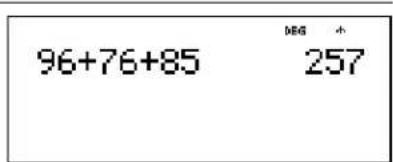
text_image
96+76+85 NEG + 257
text_image
sto → x^yzt abc 2nd [recall] REG RAD GRAD MORT SCI ENG FLOF 0123456789 CLASSIC FHTH9344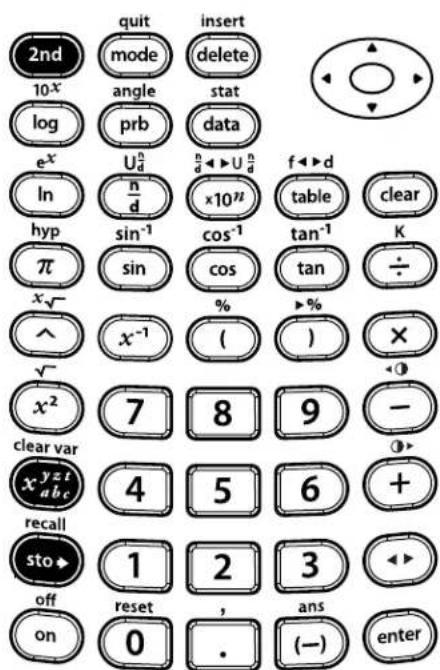
text_image
2nd 10^x log e^x ln hyp π ^ x² clear var recall sto on quit mode angle prb delete stat data U_d^n n_d^n U_d^n ×10^n sin^-1 sin x^-1 7 4 1 reset 0 insert , . ans (-) enterStore, variables (Continued)


text_image
96+76+85 257 Ans÷3 85.66666667

Your final grade is 88 rounded to the nearest whole number.
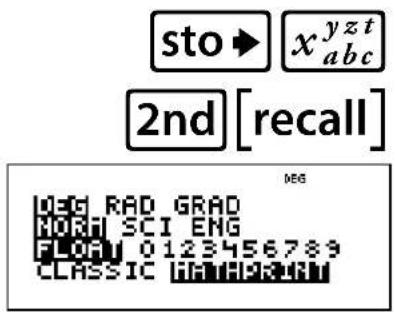
text_image
sto → x^yzt abc 2nd [recall] WEG RAD GRAD MORI SCI ENG FLOAY 0123456789 CLASSIC IHHH9444
text_image
2nd 10x log e^x ln hyp π x√ ^ x² clear var x^y z t abc recall sto off on quit mode angle prb delete stat data U_d^n n_d^n U_n_d^n ×10^n sin⁻¹ sin cos⁻¹ cos % ( ) 7 8 9 4 5 6 1 2 3 reset , ans (-) enterStore, recall
You are going to ship a gift to each of two friends. You see the gifts at two web sites for the same price. The shipping charges are different at each site. The packages weigh 4.5 pounds and 3.2 pounds. Store A will ship a package for €2 plus €1.40 per pound. Store B will ship the package for €3 plus €1.10 per pound. Which store will charge the least for shipping each gift?
Press Display
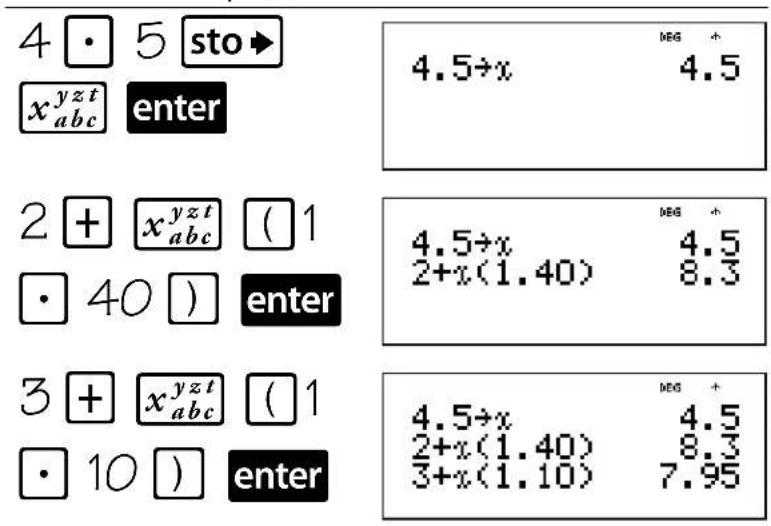
Store A charges €8.30 and store B charges €7.95. Store B charges less to ship the gift that weighs 4.5 pounds.

text_image
sto 2nd [recall] WEG RAD GRAD NORFI SCI ENG FLOAY 0123456789 CLASSIC HIGH/GOOD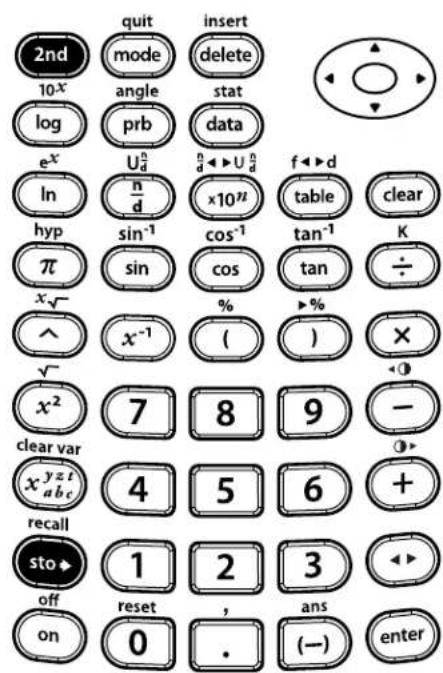
text_image
2nd 10^x log e^x ln hyp π x√ √ clear var recall sto on quit mode angle prb stat delete data U_d^n ×10^n sin^-1 sin x^-1 7 4 reset 0 insert stat tan^-1 tan % ( ) 8 5 2 ans (-) clear K ÷ × - + + enterStore, recall (Continued)

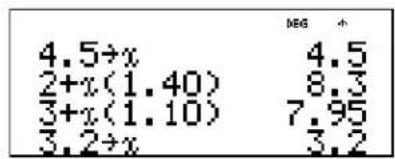
Store A charges €6.48 and store B charges €6.52. Store A charges less to ship the gift that weighs 3.2 pounds.
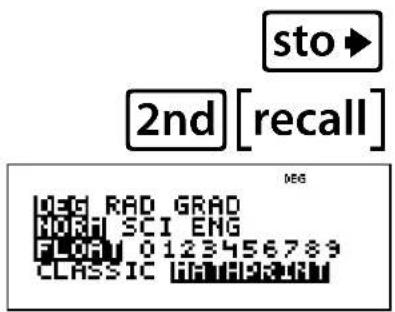
text_image
sto 2nd [recall] WEG RAD GRAD MORI SCI ENG FLOAY 0123456789 CLASSIC IHH9844H
text_image
2nd 10-x log e^x ln hyp π ^ x² clear var x^y z t abc recall sto off on quit mode angle prb U_d^n d ×10^n sin^-1 sin x^-1 quit delete stat data f d d table clear tan^-1 tan % ( ) 7 8 9 4 5 6 1 2 3 reset , ans (-) enterStore, recall (Continued)
Shop Purchases Qty Cost
| A | s | h | i | r | t |
| B | t | i | e | s | |
| C | b | e | l | t |
suspenders 1 €9.98
How much did you spend at each shop, and how much did you spend altogether?

other
| Category | Value | | :--- | :--- | | Enter | 2*13.98 | | Neg | 27.96 | | sto ▶ x^yzt abc enter | 2*13.98 | | Neg | 27.96 | | Ans→x | 27.96 | | sto ▶ x^yzt abc enter | 2*13.98 | | Neg | 27.96 | | Ans→x | 27.96 | | sto ▶ x^yzt abc enter | 3*7.98 | | Neg | 23.94 | | Ans→y | 23.94 | | sto ▶ x^yzt abc enter | 2*13.98 | | Neg | 27.96 | | Ans→x | 27.96 | | sto ▶ x^yzt abc enter | 3*7.98 | | Neg | 23.94 |
text_image
sto 2nd [recall] €13.98 ea. €7.98 ea. NEG RAD GRAD NORI SCH ENG FLOAY 0123456789 CLASSIC WITH HRS4H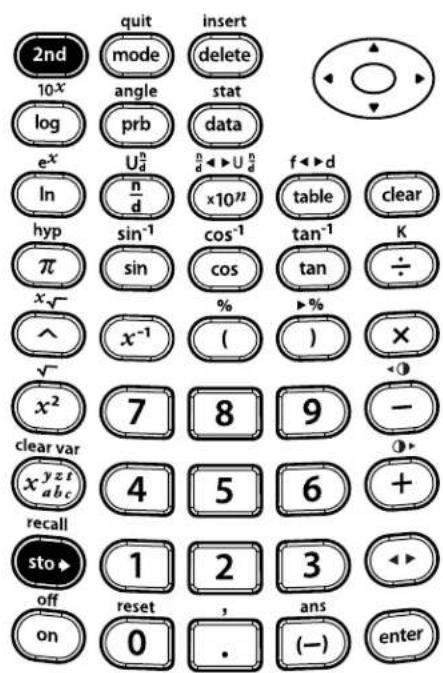
text_image
2nd 10^x log e^x ln hyp π x√ √ clear var recall sto on quit mode angle prb delete stat data U_d^n n/d sin^-1 sin x^-1 4 reset 0 insert ×10^n cos^-1 cos % ( ) select tan^-1 tan %> ( ) × 7 8 9 4 5 6 3 , ans (-) clear K ÷ × -Store, recall (Continued)

text_image
6 · 98 + 9 · 98 enter
text_image
Ans+x 27.96 3*7.98 23.94 Ans+y 23.94 6.98+9.98 16.96
text_image
sto x^yzt abc x^yzt abc x^yzt abc enter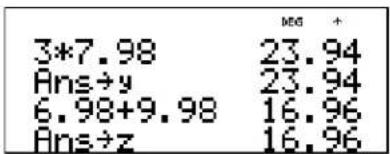
text_image
3*7.98 23.94 Ans+y 23.94 6.98+9.98 16.96 Ans+z 16.96
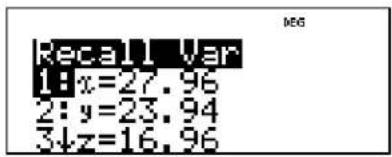
text_image
Recall Var 1: x=27.96 2: y=23.94 3: z=16.96
text_image
1+2nd [recall] 2+2nd [recall] 3 enter
text_image
6.98+9.98 16.96 Ans÷z 16.96 27.96+23.94+16.9 68.86You spent:
€27.96 at shop A,
€23.94 at shop B,
€16.96 at shop C.
You spent €68.86 at all three shops.
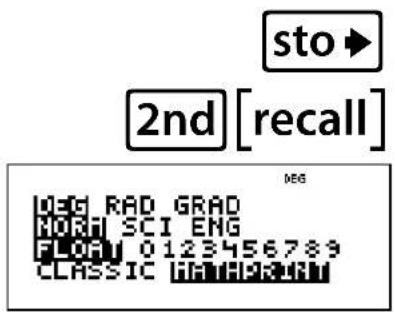
text_image
sto 2nd [recall] WEG RAD GRAD MORI SCI ENG FLOAY 0123456789 CLASSIC IHH9848H
text_image
2nd 10^x log e^x ln hyp π ^ √ clear var recall sto on quit mode angle prb U_d^n n/d sin^-1 sin x^-1 quit delete stat data ×10^n cos^-1 cos % ( ) ×10^n tan^-1 tan K ÷ f◄►d table clear tan^-1 tan %►% ( ) × 7 8 9 4 5 6 + 1 2 3 reset , ans (—) enterData editor and list formulas
Keys
- data displays a data editor with three lists. Each list can contain up to 42 items. To enter data, navigate to a list and enter a number. Press the arrow keys to navigate list elements.
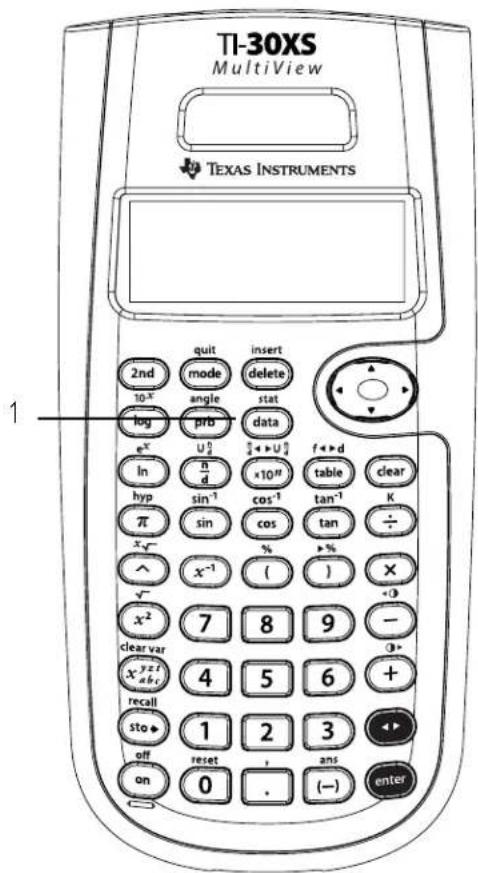
text_image
TI-30XS MultiView TEXAS INSTRUMENTS 2nd top^x log e^x ln hyp π ^ x^- clear var recall sto + off on quit mode angle prb U^0 n/d sin^1 sin x^-1 quit delete stat data insert table tan^1 tan × × × × × × × × × × × × × × × × × × × × × ×Notes
- The examples on the transparency masters assume all default settings.
- List formulas accept all calculator functions.
- In formulas, use (☐ and ☐) around variables or list names to ensure the desired order of operations.
- If a formula is entered to a list, the formula list automatically updates if a referenced list element is updated.
Note: Pressing enter in a formula list automatically deletes the formula. No message is displayed.
- When a formula is deleted, the data remains for use. The data is no longer updated.
- Pressing data again from the data editor screen opens menus with options to clear lists or to enter and manage formulas.
- Pressing data again when in "Add/edit formula" option opens a menu containing list names you can use when adding or editing formulas.
- Pressing clear backs up screens within the data editor.
- Pressing 2nd [quit] exits the data editor and returns you to the Home screen.
- In the data editor, scientific notation displays as E to conserve space but still show the magnitude of a number.
Example: 2 × 10^3 appears as 2E3.
Entering data and formulas
On a November day, a weather report on the Internet listed the following temperatures.
Paris, France 8°C Moscow, Russia -1°C Montreal, Canada 4°C
Convert these temperatures from degrees Celsius to degrees Fahrenheit.
Reminder: F = 95 + 32 .
Press Display
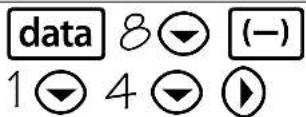
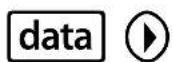

text_image
0 -1 4 L2(1)=
text_image
CLEAR FORMUL 1:Add/Edit Frmla 2:Clear L1 Frmla 3:Clear L2 Frmla1


text_image
8 -1 4 L2=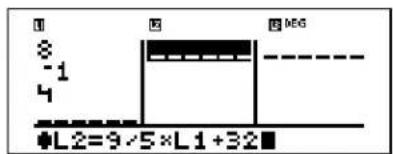
text_image
8 -1 4 ΦL2=9/5×L1+32

text_image
WEG RAD GRAD NORT SCI ENG FLOW 0123456789 CLASSIC HHH944N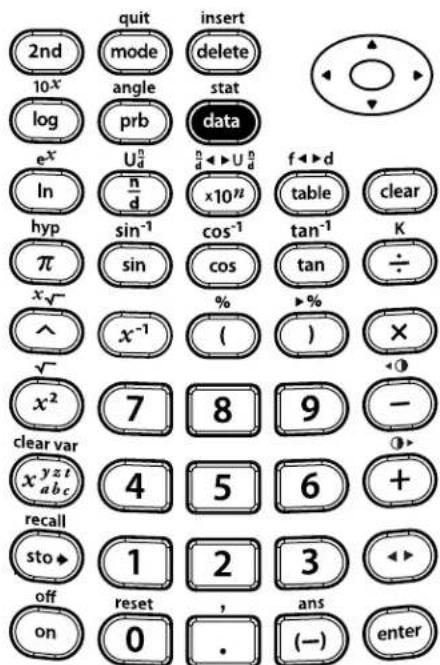
text_image
2nd 10-x log e^x ln hyp π x√ ^ x² clear var x^y z t abc recall sto off on quit mode angle prb data insert delete stat U_d^n ×10^n sin⁻¹ sin cos⁻¹ cos % ( ) 7 8 9 4 5 6 1 2 3 reset , ans (-) enterEntering data and formulas (Continued)


text_image
8 -1 4 L2(1)=46.4 48.4 30.2 39.2 MEGNotice L2 is highlighted, since it is the result of a formula.
The degrees Fahrenheit are:
Paris, France 46.4°F
Moscow, Russia 30.2°F
Montreal, Canada 39.2°F
If Sydney, Australia is 21^ C , find the temperature in degrees Fahrenheit.

21

enter

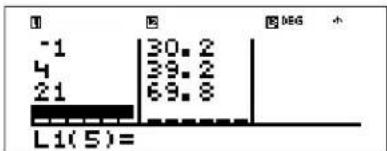
text_image
-1 4 21 L1(5)= 30.2 39.2 69.8 图BEG 小The temperature in Sydney, Australia is 69.8°F.
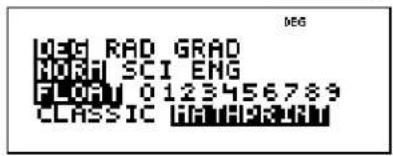
text_image
NEG RAD GRAD MORT SCI ENG FLOW 0123456789 CLASSIC HIGH/WEALTH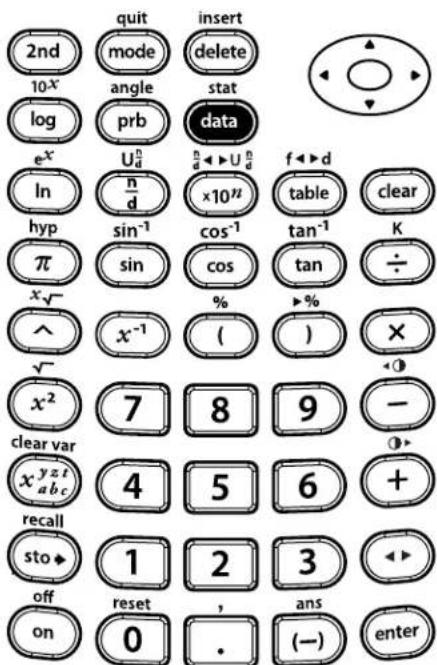
text_image
2nd 10^x log e^x ln hyp π ^ √ clear var recall sto on quit mode angle prb insert delete stat data U_d^n n/d sin^-1 sin x^-1 7 4 1 reset 0 insert ×10^n cos^-1 cos % ( 8 5 2 - ans (-) f◄►d table tan^-1 tan ►% ) 9 6 3 + 3 - × -Keys
-
data lets you enter data points ( x for 1-Var stats; x and y for 2-Var stats). (See Chapter 10, Data editor and list formulas, for more details on data.)
-
2nd[stat] displays a menu from which you can select 1-Var, 2-Var or StatVars.
1-Var Analyzes data from 1 set of data with 1 measured variable—x.
2-Var Analyzes paired data from 2 sets of data with 2 measured variables—x, the independent variable, and y, the dependent variable.
StatVars This option appears only after you have calculated 1-var or 2-var stats. Displays the menu of variables with their current values.
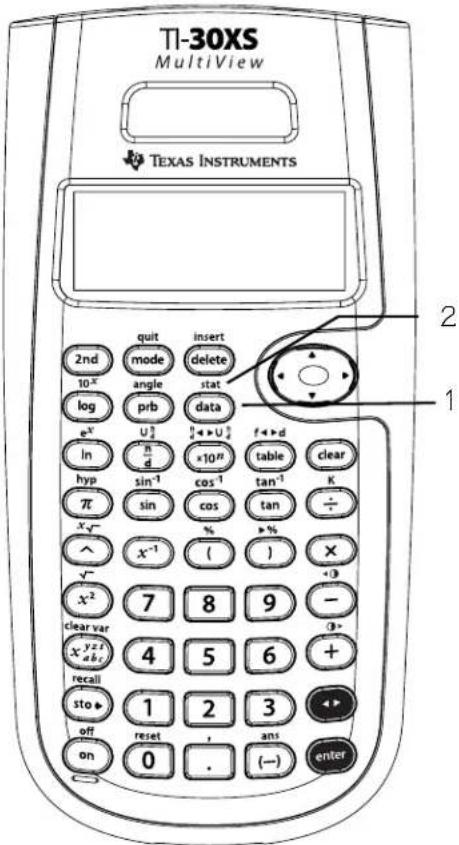
text_image
TI-30XS MultiView TEXAS INSTRUMENTS 2nd 10^x log e^x ln hyp π x^√ √ x^2 clear var x^y=1 abc recall sto off on quit mode angle prb U^3/d sin^-1 sin x^-1 7 4 reset 0 insert delete stat data ×10^n cos^-1 % ( ) cos ( ) tan ×% × ( ) × + - ( ) - + ( ) + + ( ) - + ( ) - + ( ) - + ( ) - + ( ) - + ( ) - + ( ) - + ( ) - + ( ) - + ( ) - + ( ) - + ( ) - + ( ) - + ( ) - + ( ) - + ( ) - + ( ) - + ( ) - + ( ) - + ( ) - + ( ) - + ( ) - + ( ) - + ( ) - + ( ) - + ( )-StatVars menu:
n Number of x (or x,y) data points.
or Mean of all x or y values.
Sx or Sy Sample standard deviation of x or y.
σx or σy Population standard deviation of x or y.
Σx or Σy Sum of all x values or y values.
x^2 or y^2 Sum of all x^2 values or y^2 values.
Σxy Sum of the product of x and y for all x-y pairs in the 2 lists.
a Linear regression slope.
b Linear regression y-intercept.
r Correlation coefficient.
x' (2-var) Uses a and b to calculate predicted x value when you input a y value.
y' (2-var) Uses a and b to calculate predicted y value when you input an x value.
minX Minimum of x values.
Q1 (1-var) Median of the elements between minX and Med (1st quartile).
Med Median of all data points.
Q3 (1-var) Median of the elements between Med and maxX (3rd quartile).
maxX Maximum of x values.
Notes
- The examples on the transparency masters assume all default settings.
- You can change data points by going to the Data editor, navigating to the data element, and changing the value entered.
Note: You must then recalculate 1-var or 2-var stats to display the StatVars option.
Entering 1-Var stat data
Five students took a math test.
Using their scores, enter the data points—85, 85, 97, 53, 77.
Press Display
data

text_image
L1(1)=85 ◀ 97 ◀ 53
77
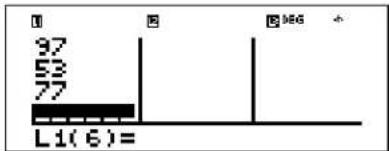
text_image
37 53 77 L1(6)=▶ 2 ◀ 1 ◀ 1
1
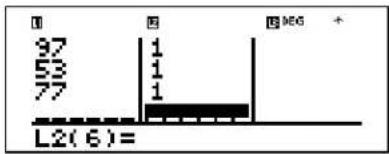
bar
| Category | Value | |---|---| | A | 37 | | B | 53 | | C | 77 | L2(6)= Total sum B=1, C=1, A=1Continued

text_image
2nd [stat] data REG RAD GRAD NORTH SCI ENG FLOAY 0123456789 CLASSIC IHTH9R4H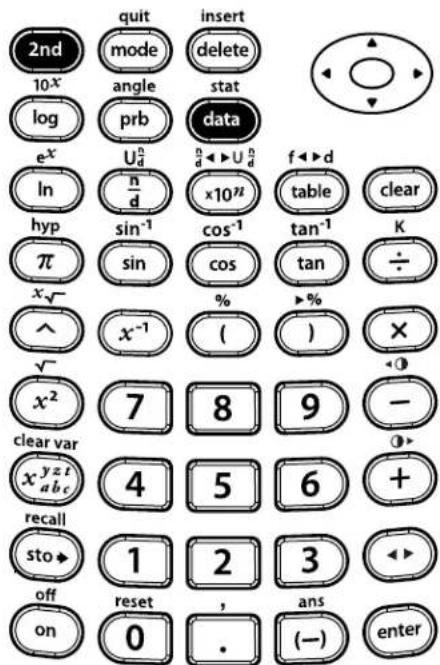
text_image
2nd 10^x log e^x ln hyp π x√ ^ x² clear var x^y z i abc recall sto off on quit mode angle prb data insert delete stat U_d^n ×10^n sin^-1 sin cos^-1 cos % ( ) reset 0 ans (—) enterViewing the statistics
Find the number of data points (n), the mean ( ), the sample standard deviation (Sx), the population standard deviation (σx), the sum of the scores (Σx), the sum of the squares (Σx ^2 ), and the five-number summary of the data, minX, Q1, Q2, and maxX.
Press Display

text_image
2nd [stat] Status 1-Var Stats 2:2-Var Stats 1 VAR STATS DATA: L1 L2 L3 FRQ: ONE L1 L2 L3 CALC enter enter 1-Var L1.L2 1n=5 2:x=79.4 3↓5x=16.39512123 1-Var L1.L2 4↑σx=14.66424222 5:Σx=397 6↓Σx²=32597 1-Var L1.L2 7↑minX=53 8:Q1=77 9↓Med=85 1-Var L1.L2 9↑Med=85 A:Q3=85 18maxX=97
text_image
2nd [stat] data REG RAD GRAD NORTH SCI ENG FLOAY 0123456789 CLASSIC HATHPRTM
text_image
2nd 10x log e^x ln hyp π x√ ^ x² clear var x^yzt abc recall sto off on quit mode angle prb data insert delete stat U_d^n ×10^n sin⁻¹ sin x⁻¹ 7 4 1 reset 0 f◄►d table tan⁻¹ tan % ( ) 8 5 2 ans (—) clear K ÷ × - + ←● -Removing data points
Drop the lowest test score by editing the data in L1 in the data editor.
Make sure you update the frequency list, L2, if needed. Find the new mean ( ). Finally, clear the data from all of the lists.
Press Display
data

bar
| Category | Value | |---|---| | Bar 1 | 85 | | Bar 2 | 2 | | Bar 3 | 97 | | Bar 4 | 53 | | Bar 5 | 77 | L1(1)=85

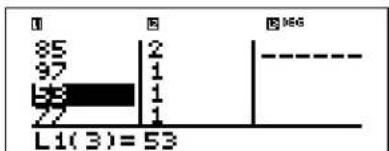
bar
| Category | Value | |---|---| | 85 | 2 | | 97 | 1 | | 85 (Bottom) | 1 | | 97 (Top) | 1 | L1(3)=53delete

delete
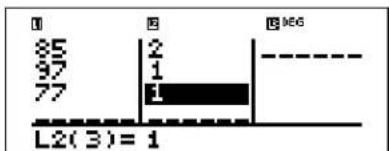
bar
| Category | Value | |---|---| | 1 | 85 | | 2 | 97 | | 3 | 77 | L2(3) = 12nd
[stat] 1


enter

text_image
1=Var:1,2 1:n=4 2:x=86 3+5x=8,246211251data
data
4
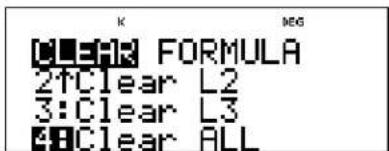
text_image
C#EAR FORMULA 2↑Clear L2 3:Clear L3 #C#lear ALL2nd
[quit]
text_image
BEGdata

text_image
WEG RAD GRAD NORT SCI ENG FLOW 0123456789 CLASSIC WHTHPART
text_image
2nd 10^x log e^x ln hyp π ^ √ clear var recall sto on quit mode angle prb U_d^n n_d^n ×10^n sin^-1 sin x^-1 quit delete stat data f d d table tan^-1 tan % ( ) 7 8 9 4 5 6 1 2 3 reset , . (-) insert clear K ÷ × × -Entering 2-Var stat data
The table below shows the number of pairs of athletic shoes sold by a small shoe store. The table shows the total number of pairs of shoes sold for two months and the total number of pairs of Brand A shoes sold during the same months. Enter this data in the data editor.
| Month | Total No. (x) | Brand A (y) | |
| April | 58 | 35 | |
| May | 47 | 28 | |
Press Display

47

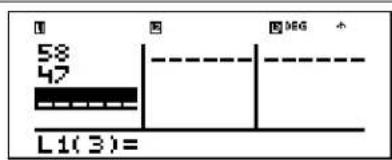
text_image
图 53 47 L1(3)=
text_image
图 58 47 L2(3)= 图066 35 28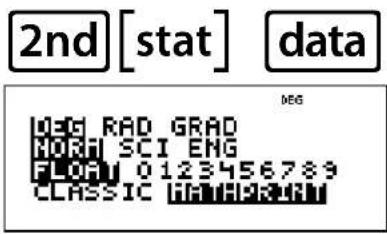
text_image
2nd [stat] data REG RAD GRAD NORT SCI ENG FLOA 0123456789 CLASS IC IHTH9R4H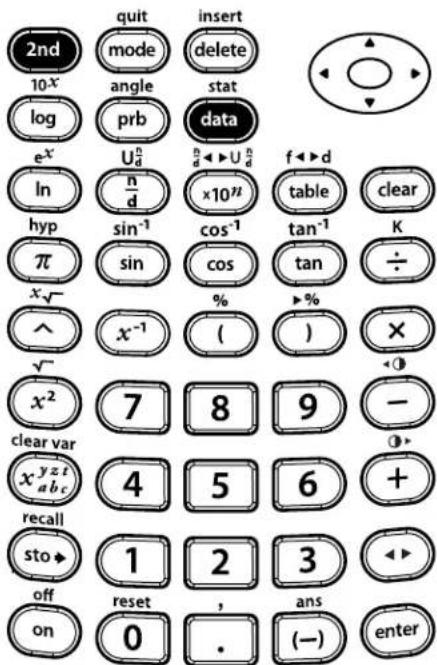
text_image
2nd 10x log e^x ln hyp π x√ ^ x² clear var x^y z t abc recall sto off on quit mode angle prb data insert delete stat U_d^n ×10^n sin⁻¹ sin x⁻¹ 7 4 1 reset 0 insert cancel ←→d table tan⁻¹ tan × clear K ÷% % ( ) × 8 5 2 3 - 6 + ans (-) enterViewing the statistics
Assuming that the rate of shoe sales is a constant, you can use two data points to predict the June sales of Brand A if we know the total June sales. Use a line of best fit to find the June sales of Brand A if the store sells a total of 32 pairs in June. Hint: Find y'(32).
Press Display
2nd [stat]
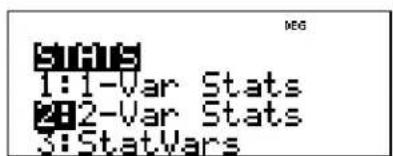
text_image
STATS 1:1-Var Stats 2:2-Var Stats 3:StatVars2 ◀ ◀

text_image
2-VAR STATS xDATA: L2 L3 yDATA: L1 L2 L3 CALCenter
(scroll down to y')
text_image
y' (■) MEGenter
32☐
enter

text_image
y'(32) 18.4545454518 pairs of Brand A will be sold in June if the total sales are 32 pairs.

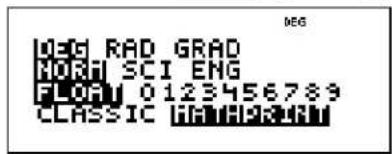
text_image
WEG RAD GRAD NORT SCI ENG FLOW 0123456789 CLASSIC HHHPART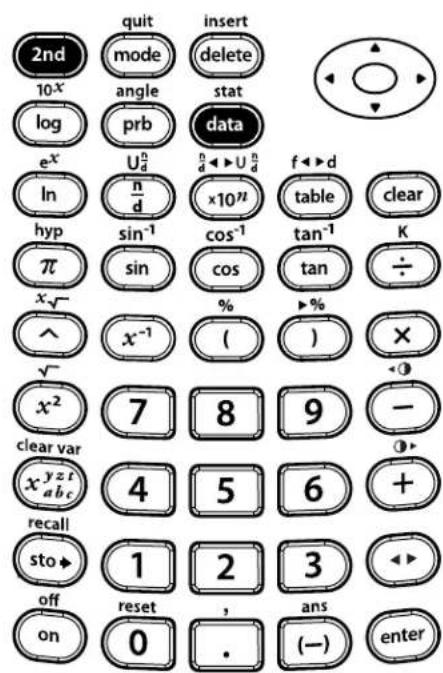
text_image
2nd 10^x log e^x ln hyp π x√ ^ x² clear var x^y z abc recall sto off on quit mode angle prb insert delete data U_d^n ×10^n sin⁻¹ sin cos⁻¹ cos % ( ) reset 0 insert stat U_d^n f d d table tan⁻¹ tan %> ( ) × 8 9 4 5 6 3 ans (-) enterProbability
Keys
- prb displays the following menu of functions.
nPr Calculates the number of possible permutations.
nCr Calculates the number of possible combinations.
! Calculates the factorial of a number.
Rand Generates a random number between O and 1.
Randint( Generates a random integer between 2 integers, A and B, where A ≤ Randint ≤ B.

text_image
TI-30XS MultiView TEXAS INSTRUMENTS 2nd 10^x log e^x ln hyp π x^y^- √ x^2 clear var x^y^z recall sto+ off on quit mode angle prb u^z sin^1 sin x^-1 7 4 1 reset 0 insert delete stat data x10^n cos^-1 % ( ) tan^-1 tan × clear K × + - ( ) - + 3- 6 3 ans (-) enterNotes
- The examples on the transparency masters assume all default settings.
- A combination is an arrangement of objects in which the order is not important, as in a hand of cards.
- A permutation is an arrangement of objects in which the order is important, as in a race.
- A factorial is the product of all the positive integers from 1 to n , where n is a positive whole number ≤ 69 .
- You can store (sto) an integer to Rand just as you would store values to memory variables. If you wish to control the random numbers generated by all calculators in your class, have all students store the same number to Rand; the sequence of random numbers is then the same on all of the calculators.
- For Randint, use a comma to separate the numbers that you specify.
Combination (nCr)
You have space for 2 books on your bookshelf. You have 4 books to put on the shelf. Use this formula to find how many ways you could place the 4 books in the 2 spaces.
4 nCr 2

A

B

C

D
AB and BA—AB AC AD count as only 1 BA BC BD combination GA GB CD DA DB DC—
Press Display
4


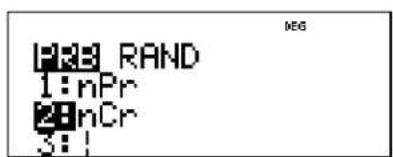
text_image
P:83 RAND 1:nPr 2:nCr 3:1enter
2
enter
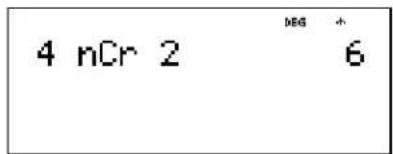
text_image
4 nCr 2 MBG * 6There are 6 unique combinations of 2 books chosen from 4 different books.

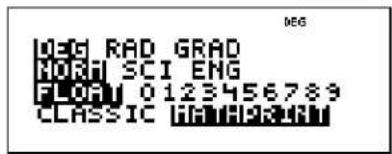
text_image
WEG RAD GRAD NORT SCI ENG FLOA 0123456789 CLASSIC HHHPART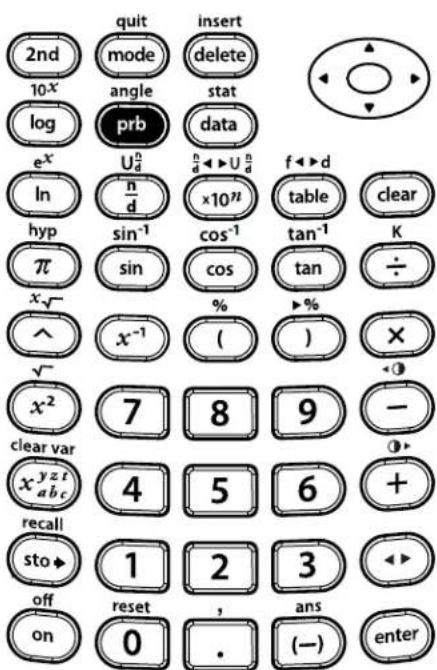
text_image
2nd 10^x log e^x ln hyp π ^ x² clear var x^y z t abc recall sto on quit mode angle prb insert delete stat data U_d^n n_d^n ×10^n sin^-1 sin x^-1 7 4 reset 0 insert stat clear tan^-1 tan % ( ) 8 9 5 6 3 ans (-) enterPermutation (nPr)
Four different people are running in a race. Use this formula to find how many different ways they can place 1st and 2nd.

text_image
4 nPr 2 A B CAB and BA—AB AC AD count as 2 BA BC BD permutations CA CB CD DA DB DC
Press Display
4 prb
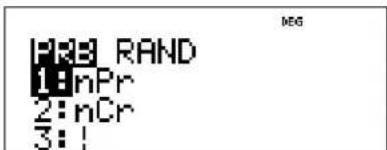
text_image
P:3 RAND 1:nPr 2:nCr 3:1enter 2 enter

text_image
4 nPr 2 MEG + 12There are 12 different permutations for the 1st and 2nd place results of the race.
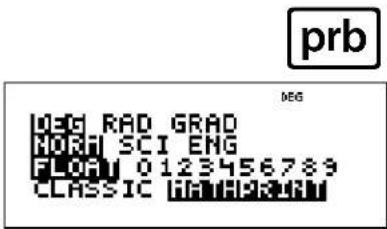
text_image
prb WEG RAD GRAD NORFI SCI ENG FLOAY 0123456789 CLASSIC HHH98488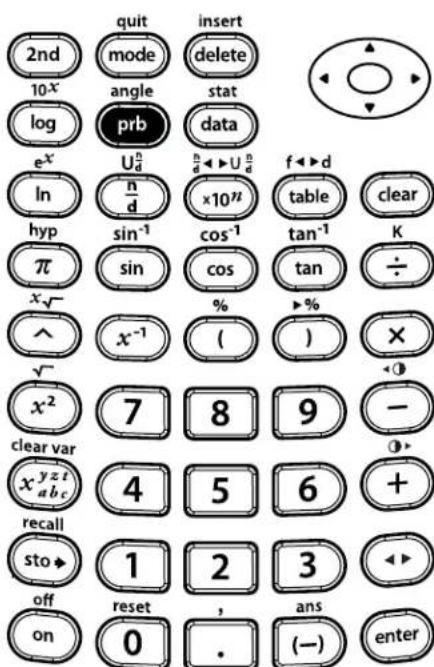
text_image
2nd 10x log e^x ln hyp π ^ √ clear var recall off on quit mode angle prb stat data U_d^n n/d^n ×10^n sin^-1 sin x^-1 quit insert delete stat U_d^n U_d^n ×10^n cos^-1 cos % ( ) × 8 4 5 1 reset 0 ans (一) enterFactorial (!)
State license plates contain different numbers and letters to create a unique identification number for each car. Make your own license plates each containing a 4-digit number. Using the digits 1, 3, 7, and 9 without repetition, how many 4-digit numbers can you form?
You can use a tree diagram to create the following list of license plates. Are you sure you found them all?
Hint: Find 4!
| 1379 | 1397 | 1739 | 1793 | 1937 | 1973 |
| 3179 | 3197 | 3719 | 3791 | 3917 | 3971 |
| 7139 | 7193 | 7319 | 7391 | 7913 | 7931 |
| 9137 | 9173 | 9317 | 9371 | 9713 | 9731 |
Press Display
4 prb


enter
enter
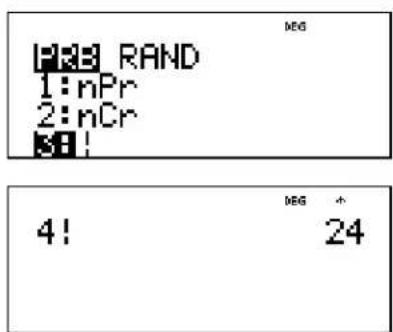
text_image
RGB RAND 1:nPr 2:nCr 4! 24You can make 24 unique license plates using 1, 3, 7 and 9 without repetition.
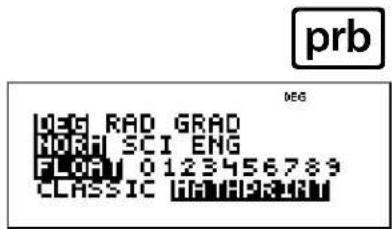
text_image
prb WEG RAD GRAD NORT SCI ENG FLOT 0123456789 CLASSIC IHTH9R4M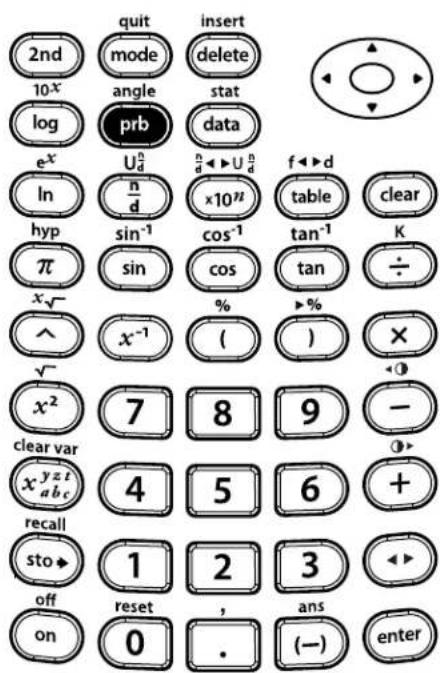
text_image
2nd 10^x log e^x ln hyp π x√ ^ x² clear var x^y z i abc recall sto off on quit mode angle prb stat data U_d^n n_d ◀ U_d^n ×10^n sin⁻¹ sin x⁻¹ 7 4 1 reset 0 insert delete f ◀ d table tan⁻¹ tan % ( ) 8 9 5 6 3 ans (-) clear K ÷ × -① -Random (rand)
Generate a sequence of random numbers.
Press Display


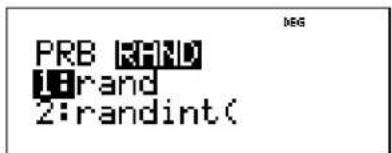
text_image
PRB RND Brand 2:randint(


text_image
rand 0.390926039
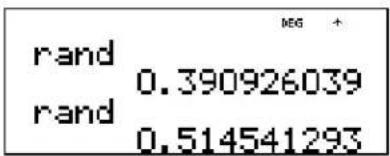
text_image
rand 0.390926039 rand 0.514541293Results will vary.

text_image
prb MEG RAD GRAD MORI SCI ENG FLOFU 0123456789 CLASS IC L1H1H934H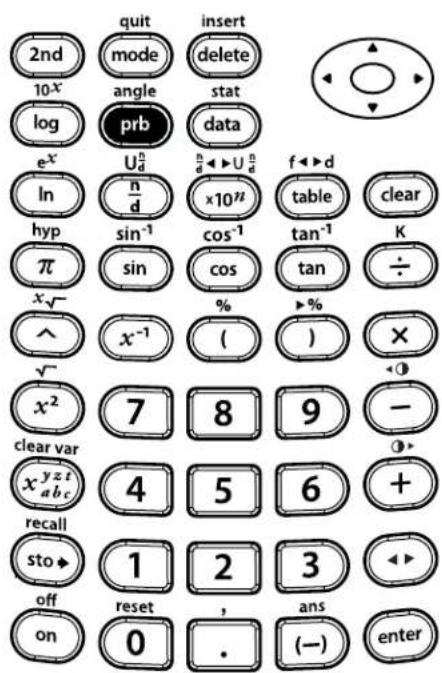
text_image
2nd 10^x log e^x ln hyp π x√ ^ √ x² clear var x^y z i abc recall sto off on quit mode angle prb stat data U_n_d n_d ▶ U_n_d ×10^n sin⁻¹ sin cos⁻¹ cos % ( ) 7 8 9 4 5 6 1 2 3 reset , ans (-) enterSetting a random (rand) seed
Set 1 as the current seed and generate a sequence of random numbers.
Press Display


enter
1→rand

1≠rand
DEG
1


enter
1→rand rand
DEG +
1

1≠rand
rand
0.000018633

rand
0.000018633
rand
0.745579721
Note: Your results will be the same as this example if you use the same number to store to random seed.

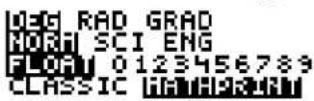
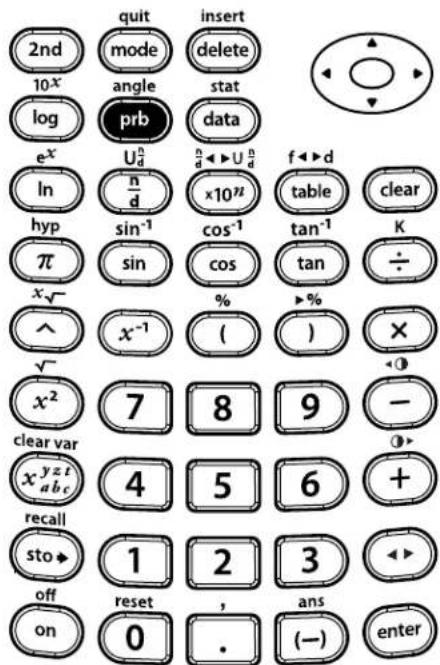
text_image
2nd 10^x log e^x ln hyp π x√ ^ x² clear var x^y z i recall sto off on quit mode angle prb data insert delete stat U_d^n ×10^n sin⁻¹ sin 7 4 reset 0 insert U_d^n U_d^n cos⁻¹ cos % ( ) ×10^n f◄►d table tan⁻¹ tan ►% ( ) 8 9 5 6 3 ans (-) clear K ÷ × -Random integer (randint)
Create your own calculator spinner. Your spinner will pick numbers from 2 through 10.
Hint: Generate a random integer from 2 through 10.
Press Display

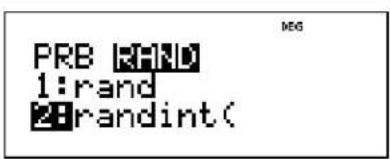
text_image
PRB RAND 1:rand 2:randint(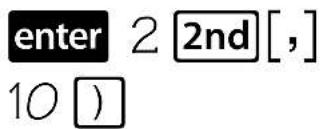
text_image
enter 2 2nd [,] 10 )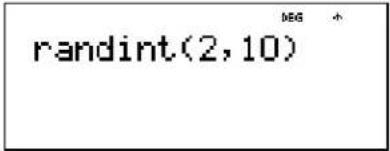
text_image
randint(2,10)

text_image
randint(2,10) 2 randint(2,10) 7 randint(2,10) 8Results will vary.

text_image
prb MEG RAD GRAD MORI SCI ENG FLOFU 0123456789 CLASS IC L1H1H934H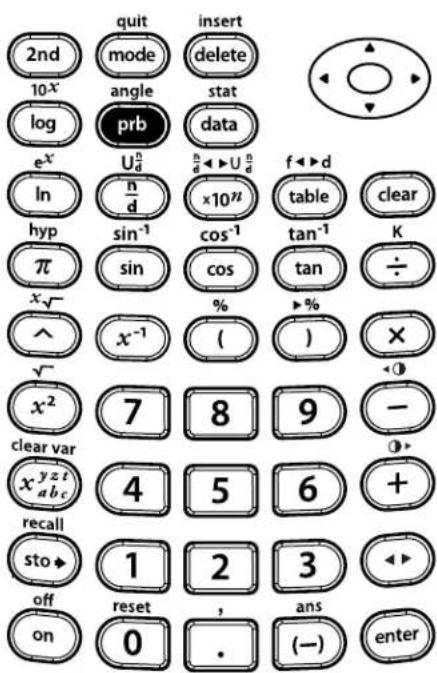
text_image
2nd 10^x log e^x ln hyp π x√ ^ x² clear var x^y z t abc recall sto off on quit mode angle prb delete stat data U_n^a n^a ×10^n sin^-1 sin cos^-1 cos % ( ) quit select table clear tan^-1 tan K ÷ % % ) - 9 6 + 3 ans (-) enterKeys
- table allows you to display a defined function in a tabular form. To set up a function table:
a. Press table.
b. Enter a function in terms of x and press enter.
c. Select the start and step values, and auto or ask-x options, and press enter.
The table is displayed using the specified values.
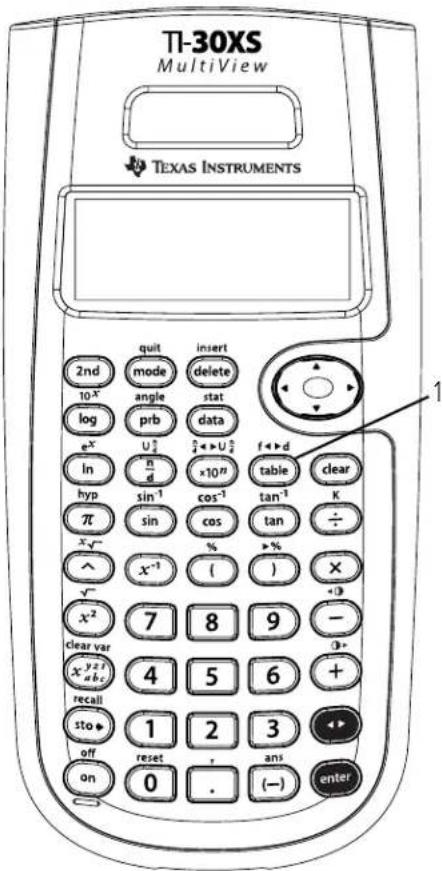
text_image
TI-30XS MultiView TEXAS INSTRUMENTS 2nd to-x log e^x in hyp π x√- x² clear var recall stop on quit mode angle prb U# ×10^n sin⁻¹ sin x⁻¹ quit delete stat data ×10^n cos⁻¹ cos % ( ) 7 8 9 4 5 6 1 reset r ans (—) enterNotes
- The examples on the transparency masters assume all default settings.
- Enter the function (expression) at the y= prompt. Functions can contain stacked fractions and most built-in functions such as sine, cosine, e^x , and so forth. Functions can not contain ▶ or the functions rand and randint.
- To change a value on the table setup screen, press clear and then enter a new value.
- Depending on the function and the step values, you may be able to affect the format (decimal or fraction) of the y values. When a decimal number (like 2.0) is used in the function or the step values, answers can be forced to decimal.
- To clear the table in ask-x, press delete on each entry.
- In ask- x , if you input a decimal, the x -value displays as a decimal. For example, if you enter 2 , the x -value displays 2 . If you enter 2.0 , the x -value displays 6.28319. If you enter a fraction using , the x -value displays as a fraction.
- Press clear to back up screens within the function table.
- The TI-30XS MultiView™ calculator retains the last entered function in memory when you quit the function table application (2nd [quit]).
Using auto
Find the vertex of the parabola y = x(36 - x) using a table of values.
Reminder: The vertex of the parabola is a point on the line of symmetry of the parabola. Notice that (O, O) and (36, O) are x-intercepts and the parabola is open (concave) down. The vertex will be between x = O and x = 36.
Press Display
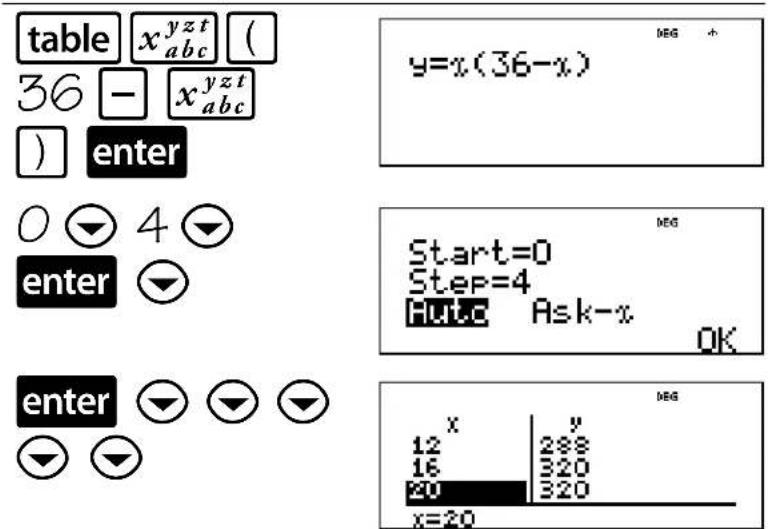
text_image
table x^yzt (( 36 - x^yzt ) enter 0 4 enter enter y=x(36-x) Start=0 Step=4 HUTC Ask-x OK x y 12 288 16 320 20 320 x=20Notice that the vertex must be between x = 16 and x = 20 since the y -values are the same. The y -values must be increasing and decreasing for x = 16 to x = 20 .

text_image
table REG REG RAD GRAD NORT SCI ENG FLOT 0123456789 CLASSIC IHTHGRATM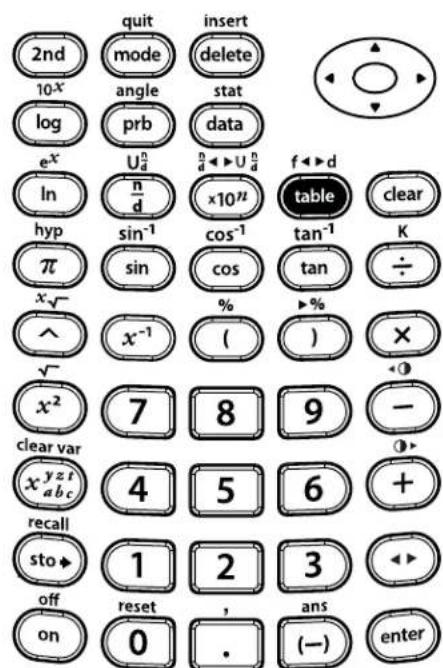
text_image
2nd 10^-x log e^x ln hyp π x√ ^ x² clear var x^y z t a b c recall sto off on quit mode angle prb stat data U_d^n ×10^n sin⁻¹ sin x⁻¹ 7 8 4 1 reset 0 insert delete U_d^n U_d^n cos⁻¹ cos % ( ) 9 5 2 - ans (-) table tan⁻¹ tan % ) × K ÷ -Using auto (Continued)


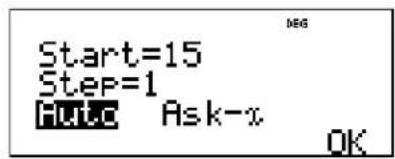
text_image
Start=15 Step=1 Hute Ask-x OK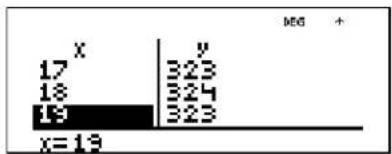
bar
| Category | Value | |---|---| | x | 17 | | y | 18 | | 323 | 19 | | 324 | | | 323 | x=19 |On your own:
Start at 17 and change the step size to 0.25. What happens around x = 18 ? Can you locate the vertex? Why?
After searching close to x = 18, the point (18, 324) appears to be the vertex of the parabola since it appears to be the turning point of the set of points of this function.

text_image
table REG RAD GRAD MORI SCI ENG FLOFU 0123456789 CLASSIC HIGH98499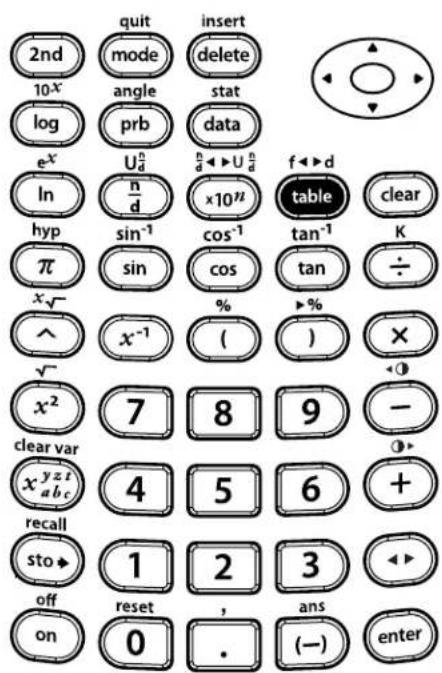
text_image
2nd 10^x log e^x ln hyp π x√ ^ √ x² clear var x^y z i abc recall sto off on quit mode angle prb U_d^n n/d ▶ U_d^n stat data ×10^n sin⁻¹ sin cos⁻¹ cos % ( ) ×10^n table tan⁻¹ tan K ÷ % ▶% ) × 7 8 9 - 9 4 5 6 + 1 2 3 ←> reset , ans (—) enterUsing ask-x
A charity collected \3,600 to help support a local food kitchen. \450 will be given to the food kitchen every month until the funds run out. How many months will the charity support the kitchen?
Reminder: If x = months and y = money left, then y = 3600 - 45x.0
Press Display
table
Press clear if necessary to clear a previous function.
3600 -450




Input good guesses for the number of months, x. enter

text_image
y=3600-450x MSS +
text_image
Start=0 Step=1 Auto HSK-x OK
text_image
x 6 7 8 x=8 y 900 450 0 MEG +The charity will be able to support the food kitchen at this rate for 8 months.

text_image
table REG REG RAD GRAD NORT SCI ENG FLOT 0123456789 CLASSIC IHTH9441M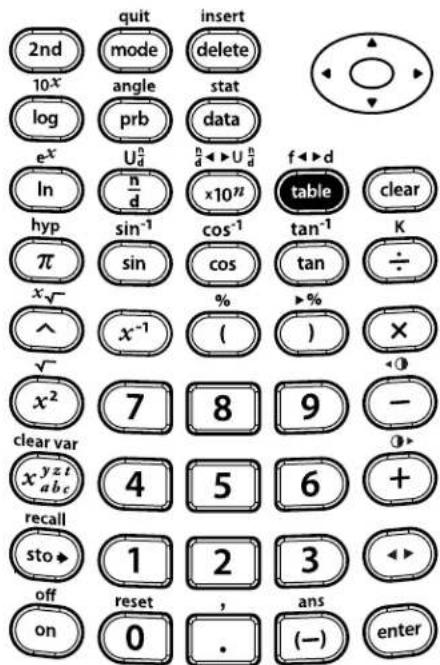
text_image
2nd 10^x log e^x ln hyp π x√ ^ x² clear var x^y z t abc recall sto off on quit mode angle prb U_d^n n/d sin⁻¹ sin x⁻¹ quit delete stat data ×10^n cos⁻¹ cos % ( ) reset 0 insert f◄►d table tan⁻¹ tan %> ( ) ans (-) clear K ÷ × - ①► + ◀► enterPowers, roots, and reciprocals
Keys
- x^2 squares the value.
- 2nd [√] calculates the square root.
- 2nd [x-] calculates the specified root (x) of the value.
- x^-1 calculates the reciprocal.
- ▲ raises a value to a specified power.

text_image
TI-30XS MultiView TEXAS INSTRUMENTS 2nd 10^x log e^x In hyp x^y ^ x^2 clear var recall sto + off on quit mode angle prb U# n/d sin¹ sin x⁻¹ 7 4 reset 0 insert delete stat data x10^n cos¹ % ( ) tan³ tan × clear K ÷ × 9 6 + 3 ans (-) enter 4 3 5 2 1Notes
- The examples on the transparency masters assume all default settings.
- To use , enter the base, press , and then enter the exponent.
- In Classic mode, exponentiation using the key is evaluated from left to right. The expression 2^32 is evaluated as (2^3)^2 , with the result of 64.
In MathPrint™ mode, exponentiation using the key is evaluated from right to left.
Pressing 2 △ 3 △ 2 displays as 2^3^2 , with the result of 512.
- The result of calculations with must be within the range of the TI-30XS MultiView™ calculator.
- The TI-30 MultiView calculator evaluates expressions entered with [x^2] and [x^-1] from left to right in both Classic and MathPrint modes. Pressing 3 [x^2] [x^2] displays as 3^22 . This is calculated as (3^2)^2 = 81 .
- The base and the exponent may be either positive or negative. Refer to Domain under Error Messages in Appendix C for restrictions.
- Use parentheses where needed to obtain the desired results.
Example: -5^2 = -25
$$ (- 5) ^ {2} = 2 5 $$
Squares
Use this formula to find the size of the tarpaulin needed to cover the entire baseball infield.
A = x ^2 = 27.4 ^2 square meters
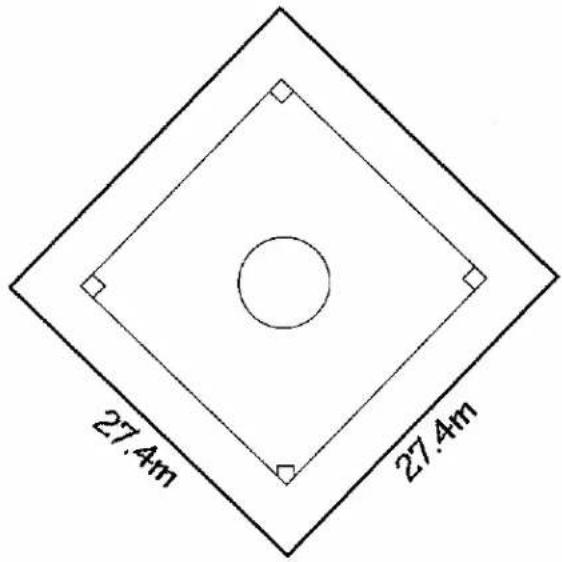
text_image
27.4m 27.4mPress Display

or

text_image
27.4² 750.76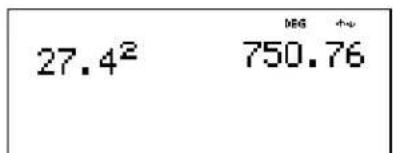
text_image
27.4² 750.76The area of the tarpaulin is 750.76 square meters.
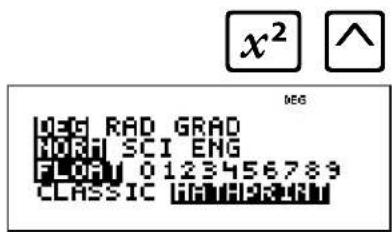
text_image
x² ↑ NEG RAD GRAD NORT SCI ENG FLOT 0123456789 CLASSIC HATHAUR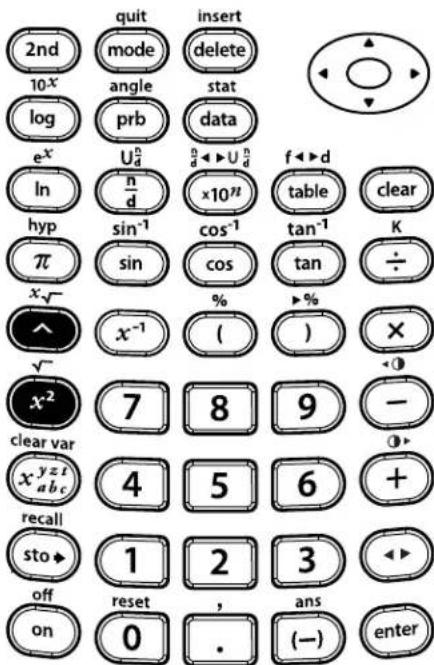
text_image
2nd 10^x log e^x ln hyp π x√ x² clear var x^y z i abc recall sto off on quit mode angle prb delete stat data U_d^n d ▶ U_d^n ×10^n sin^-1 sin % ( ) 7 8 4 5 1 reset , ans (—) enterSquare roots
Use this formula to find the length of the side of a square clubhouse if 3m^2 of carpet would cover the floor. Round your answer to O decimal places.
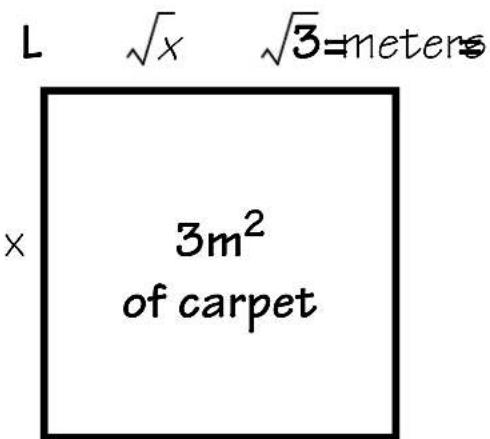
text_image
L √x √3=meters x 3m² of carpetPress Display

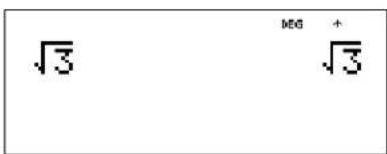
text_image
√3 BEG + √3
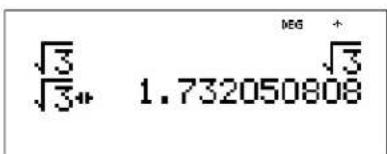
text_image
√3 √3+ 1.732050808

text_image
FEI BEG + √3 √3 √3* 1.732050808 √3* 2

The length of a side of the square clubhouse is 2 meters rounded to 0 decimal places.
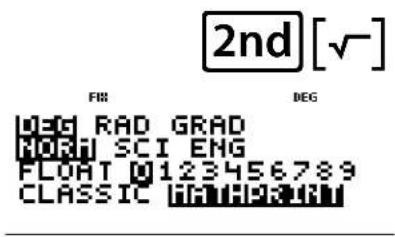
text_image
2nd [√] REG REG RAD GRAD NOR SCI ENG FLOAT 0123456789 CLASSIC 0123456789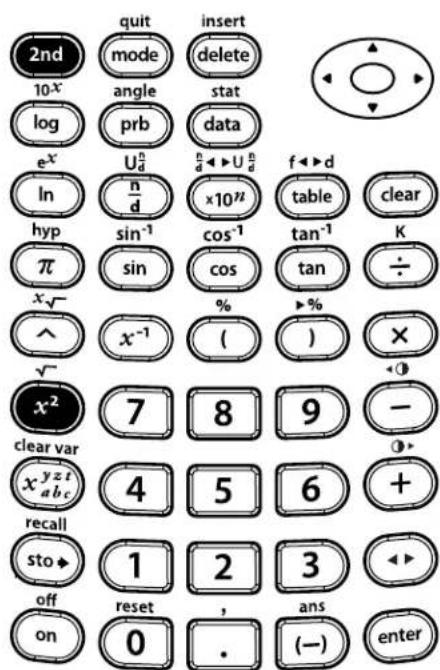
text_image
2nd 10^x log e^x ln hyp π x√ ^ √ clear var x^y z t recall sto off on quit mode angle prb delete stat data U_d^n n_d^n U_d^n ×10^n sin^-1 sin cos^-1 cos % ( ) ×10^n f d d table tan^-1 tan K ÷ % % ( ) × 7 8 9 - 4 5 6 + 1 2 3 reset , ans (-) enterCubes
Use this formula to find the volume of a cube with sides 2.3 meters long. Change your answer to a fraction.
$$ V = L ^ {3} = 2. 3 ^ {3} \text { cubic meters } $$
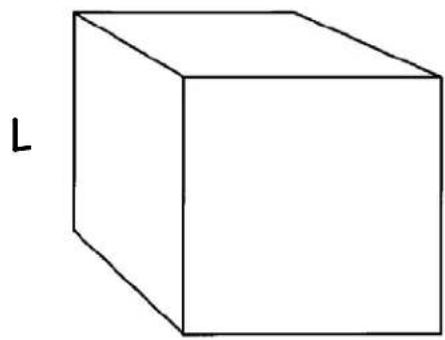
natural_image
Simple line drawing of a 3D cube with label 'L' on the side (no other text or symbols)Press Display
2 □ 3 ▲
3 enter

text_image
2.3³ 12.167
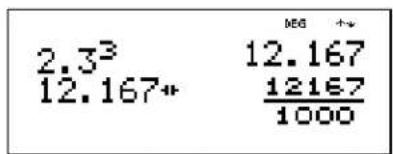
text_image
2.3³ 12.167* 12.167 12167 1000The volume of the cube is 12.167 cubic meters.

text_image
WEG RAD GRAD NORI SCI ENG FLOOR 0123456789 CLASSIC LIFH9R41M
text_image
2nd 10^x log e^x ln hyp π x√ √ clear var x^y z t abc recall sto off on quit mode angle prb delete stat data U_d^n n/d ◀ U_n/d ×10^n sin^-1 sin cos^-1 cos % ( ) ×10^n f ◀ d table tan^-1 tan K ÷ ×^-1 7 8 9 - 4 5 6 + 1 2 3 reset , ans (-) enterPowers
Fold a piece of paper in half, in half again, and so on until you cannot physically fold it in half again. How many sections would there be after 10 folds? After 15 folds?
Press Display
2^10 enter
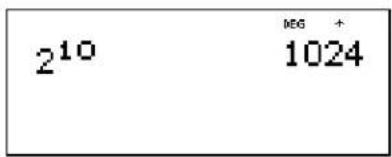
text_image
2^10 DEG + 10242^15 enter
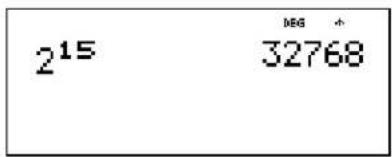
text_image
2¹⁵ 32768Fold the paper in half once and you will see two sections. Fold the paper in half again and you will see four sections. Folding again yields 8 sections, and so on. After 10 folds there will be 1,024 sections. After 15 folds, there will be 32,768 sections!

text_image
REG REG RAD GRAD NORI SCI ENG FLOOR 0123456789 CLASS IC L1H1H9341H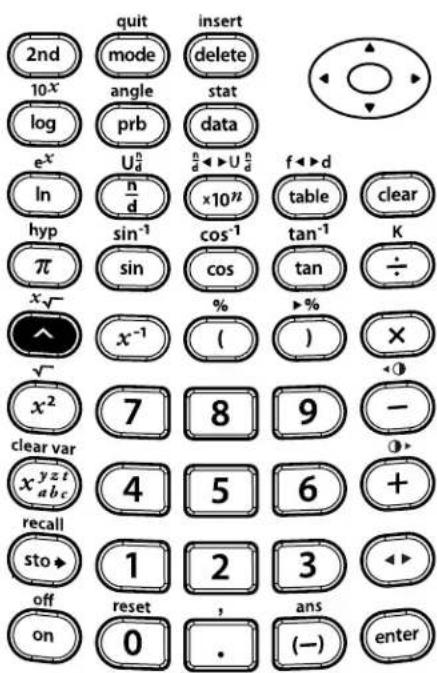
text_image
2nd 10^x log e^x ln hyp π x√ √ clear var x^y z t recall sto off on quit mode angle prb U_n/d n/d ×10^n sin^-1 sin x^-1 quit delete stat data f◄►d table clear tan^-1 tan K ÷ % ►% ( ) × 7 8 9 - 3► 4 5 6 + 1 2 3 ans (-) enterRoots
If the volume of a cube is 125 ~cm^3 , what is the length of each side?
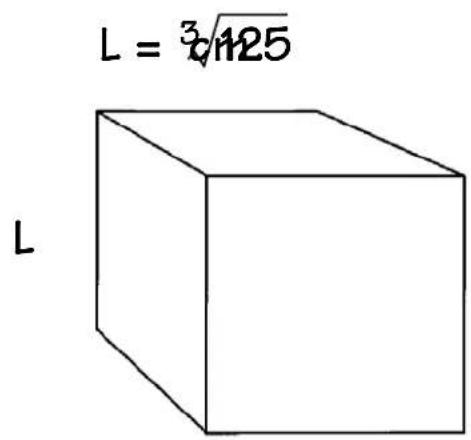
text_image
L = 3√125 LPress Display
3 2nd[x√]
125 enter
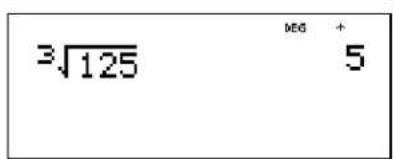
text_image
3√125 NOG + 5The length of each side is 5 cm.

text_image
2nd [x√] REG W3G RAD GRAD NORF SCI ENG FLOF 0123456789 CLASSIC FLAFLR4L4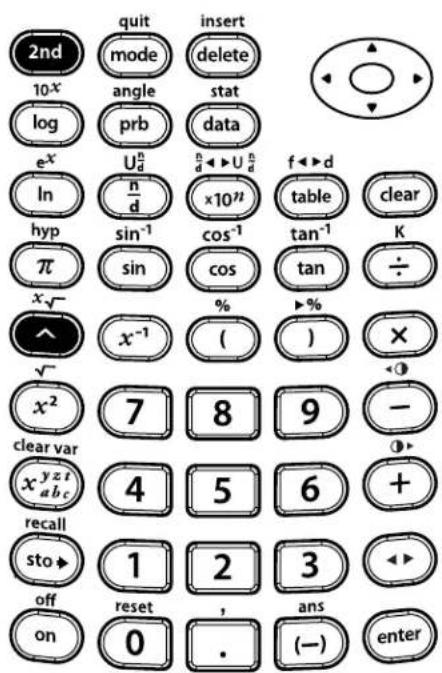
text_image
2nd 10^x log e^x ln hyp π x√ √ clear var recall sto on quit mode angle prb U_d^n n/d sin^-1 sin x^-1 quit delete stat data ×10^n cos^-1 cos % ( ) select table tan^-1 tan %> ( ) clear K ÷ × 7 8 9 - 4 5 6 + 1 2 3 reset , ans (-) enterReciprocals
The chart below shows the amount of time spent building model ships.
Time Portion
Spent Completed
Ships Building Per Hour
Sailing 10 hrs. ?
Steam 5 hrs. ?
Luxury 5 1/3 hrs. ?
How much of each model was completed per hour?
Press Display
Sailing ship:
10 x^-1 enter

text_image
10^-1 NEG + 1/10Steam ship:
5 x^-1 enter
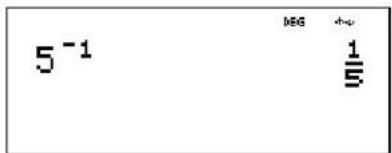
text_image
5⁻¹ NEG +40 ½Luxury liner:
5 2nd [U_d^n]1
3 ▶ enter
x^-1 enter
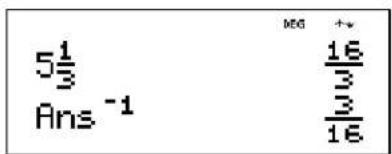
text_image
5½ Ans⁻¹ 16/3 3/16
text_image
WEG RAD GRAD MORT SCI ENG FLOFU 0123456789 CLASSIC HIGHGRAD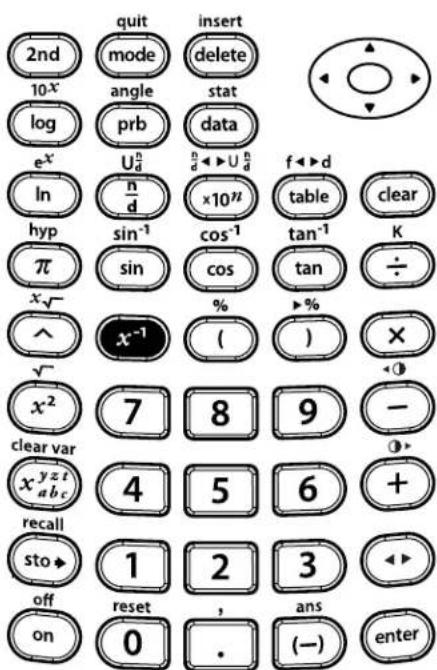
text_image
2nd 10^x log e^x ln hyp π x√ ^ x² clear var x^y z t abc recall sto off on quit mode angle prb U_d^n n/d sin⁻¹ sin x⁻¹ 7 4 1 reset 0 insert delete data ×10^n cos⁻¹ cos % ( 8 5 2 - ans (−) clear K ÷ × -Logarithms and exponential functions
Keys
- log calculates the common logarithm (base 10).
- [2nd] [10^x] calculates 10 raised to the power of the value entered as the exponent (common antilogarithm).
- In calculates the natural logarithm (base e, where e ≈ 718281828459).
- 2nd [e^x] calculates e raised to the power of the value entered as the exponent (natural antilogarithm).
Notes
- The examples on the transparency masters assume all default settings.
- ) ends a logarithmic function.
- In MathPrint™ mode, press ⬆ to exit the exponent function.
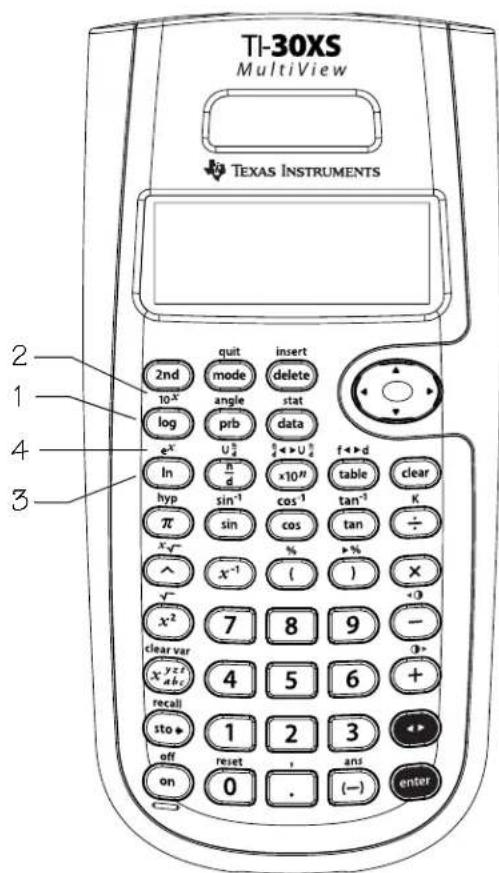
text_image
TI-30XS MultiView TEXAS INSTRUMENTS 2nd 10^x log e^x In hyp π x^y- ^ x^2 clear var x^yz abc recall sto + off on quit mode angle prb U_0^2 d sin^-1 sin x^-1 7 4 1 reset 0 insert delete stat data ×10^n cos^-1 % ( ) tan^-1 tan × clear K ÷ + - 9 6 ans (-) enterCommon logarithm, natural logarithm
Find log 23 rounded to 4 decimal places. Then find In 23 rounded to 4 decimal places and return to floating decimal notation.
Press Display
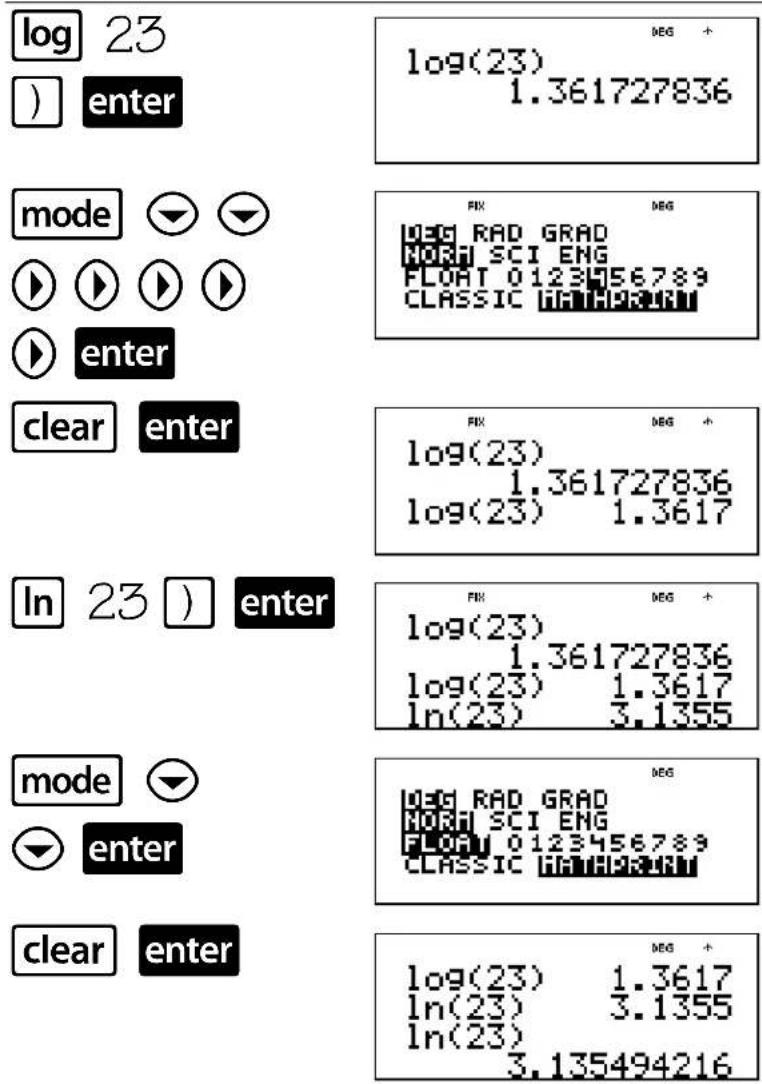
text_image
log 23 ) enter mode ▶ ▶ ▶ ▶ ▶ enter clear enter ln 23 ) enter mode ▼ enter clear enter log(23) 1.361727836 FIX REG NEG RAD GRAD NORF SCI ENG FLOAT 0123456789 CLASSIC FHTH9RRT FIX REG log(23) 1.361727836 log(23) 1.3617 FIX REG log(23) 1.361727836 log(23) 1.3617 ln(23) 3.1355 NEG RAD GRAD NORF SCI ENG FLOAT 0123456789 CLASSIC FHTH9RRT NEG log(23) 1.3617 ln(23) 3.1355 ln(23) 3.135494216
text_image
log In DEG DEG RAD GRAD NORT SCI ENG FLOAT 0123456789 CLASSIC FINTH934R FIN DEG DEG RAD GRAD NORT SCI ENG FLOAT 0123456789 CLASSIC FINTH934R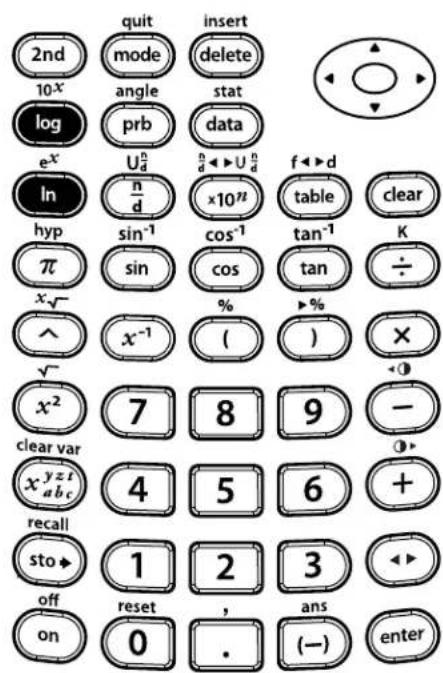
text_image
2nd 10^x log e^x ln hyp π x√ √ clear var x^y z i abc recall sto off on quit mode angle prb stat data U_d^n ×10^n sin^-1 sin x^-1 7 4 reset 0 insert delete U_d^n U_d^n cos^-1 cos % ( 8 5 2 - ans (一) clear tan^-1 tan %> ( ) × - 9 6 + 3 enterCommon antilogarithm, natural antilogarithm
Find antilog 3.9824 rounded to 4 decimal places. Then find antiln 3.9824 rounded to 4 decimal places. When finished, return to floating decimal notation.
Press Display
2nd [10^x] 3
9824 enter

text_image
10³·9824 9602.846792mode
◀◀◀◀
enter
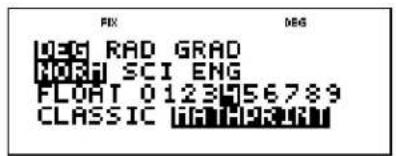
text_image
REG RAD GRAD REG SCI ENG FLOAT 0123456789 CLASSIC IHTH984Mclear enter
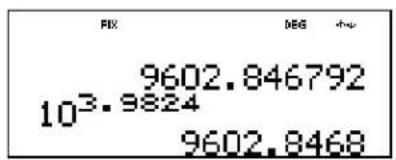
text_image
FIX 086 中心 9602.846792 10³·9824 9602.84682nd [e^x] 3
9824 enter

text_image
10³·9824 9602.8468 e³·9824 53.6456mode
enter

text_image
WEG RAD GRAD MORT SCI ENG FLOW 0123456789 CLASSIC HIGH/GOODclear enter

text_image
e3.9824 53.6456 e3.9824 53.64562936
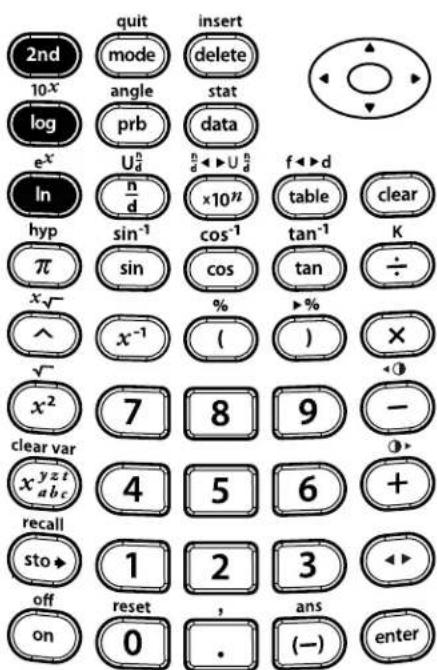
text_image
2nd 10^x log e^x ln hyp π x√ ^ x² clear var x^y z t abc recall sto off on quit mode angle prb U_d^n d ×10^n sin⁻¹ sin x⁻¹ 7 4 1 reset 0 insert delete stat data f←→d table tan⁻¹ tan % ( ) 8 5 2 ans (—) clear K ÷ × -① 9 6 3 enterKeys
- displays the value of pi rounded to 10 digits (3.141592654).

text_image
TI-30XS MultiView TEXAS INSTRUMENTS 2nd 10^x log e^x ln hyp π ^ x^- clear var recall sto off on quit mode angle prb sin^-1 x^-1 quit delete stat data ×10^7 cos^-1 cos % ( ) 7 4 1 reset 0 insert clear tan^-1 tan × ( ) 2 3 ans (-) enterNotes
- The examples on the transparency masters assume all default settings.
- In MathPrint™ mode, include a decimal number inside the expression with pi to receive a decimal output. For example, if you enter 2π, the TI-30XS MultiView™ calculator displays 2π. If you enter 2.0π, the calculator displays the decimal version, 6.28319.
- You can use ◀ to toggle the answer between decimal and pi formats.
- Internally, pi is stored to 13 digits (3.141592653590).
- You can select the number of decimal places from the mode menu.
Circumference
Use this formula to find the amount of border you need if you want to put a circular border all the way around the tree.
$$ C = 2 \pi r = 2 \times \pi \times 1. 5 m $$

natural_image
Illustration of a tree with a circular base marked 1.5m (no text or symbols on the tree itself)Press Display
2 × π ×
1 □ 5 enter
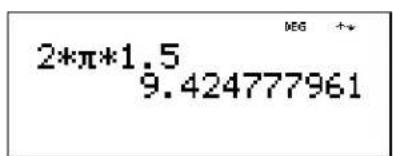
text_image
2*π*1.5 9.424777961

text_image
2*π*1.5 9.424777961 9.42477796077* 3πThe border length is 3 m. You will need approximately 9.4 m for the border.
π
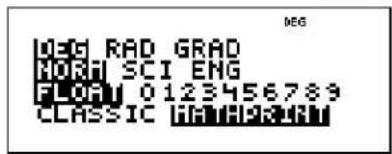
text_image
WEG RAD GRAD NORT SCI ENG FLOW 0123456789 CLASSIC HHH944N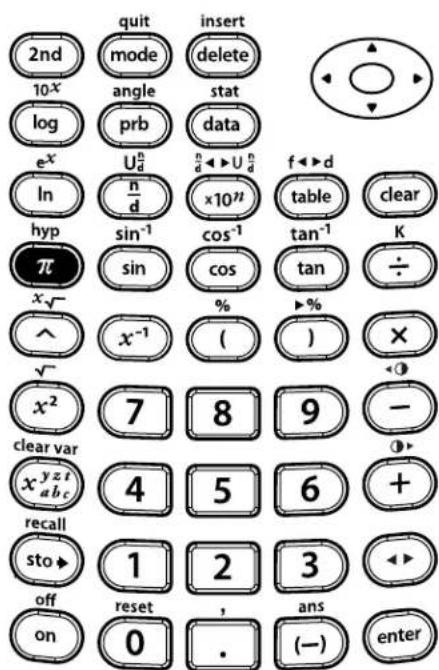
text_image
2nd 10^x log e^x ln hyp π ^ √ clear var recall sto on quit mode angle prb U_d^n n/d ▶ U_d^n ×10^n sin^-1 sin x^-1 7 4 1 reset 0 insert delete stat data cos^-1 cos % ( ) ×10^n f◀▶d table tan^-1 tan ▶% ( ) × 8 9 5 6 3 ans (-) clear K ÷ × -Area
Use this formula to find how much of a lawn would be covered by the sprinkler. Round your answer to the nearest whole number, and then return to floating decimal mode.
$$ A = \pi r ^ {2} = \pi \times 4 ^ {2} s q u a r e m e t e r s $$

text_image
4mPress Display








text_image
π*4² NEG + 16π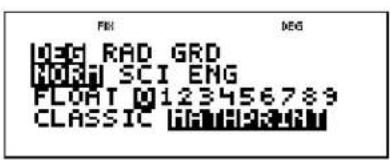
text_image
FBI NEG RAD GRD NORI SCI ENG FLOAT D123456789 CLASSIC HIGHH98401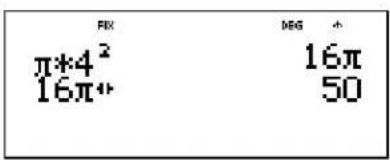
text_image
π*4² 16π⁺ 16π 50 MBS +
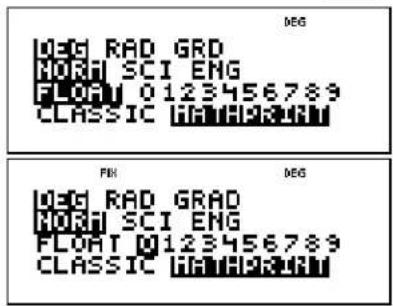
text_image
DEG 10.5G RAD GRD NORF SCI ENG FLOT 0123456789 CLASSIC HIGH/98348H FN DEG 10.5G RAD GRD NORF SCI ENG FLOAT 0123456789 CLASSIC HIGH/98348H
text_image
2nd 10^x log e^x ln hyp π ^ √ clear var x^y z t abc recall sto off on quit mode angle prb delete stat data U_n_d n_d ×10^n sin^-1 sin x^-1 7 4 reset 0 insert , . ans (-) enter


text_image
NEG RAD GRD NORF SCI ENG FLOW 0123456789 CLASSIC HIGH/GOOD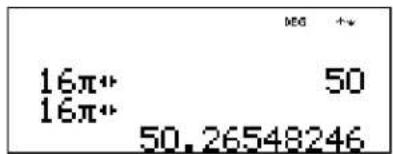
text_image
16π* 50 16π* 50.26548246The area that will be covered by the sprinkler is approximately 50 square meters.
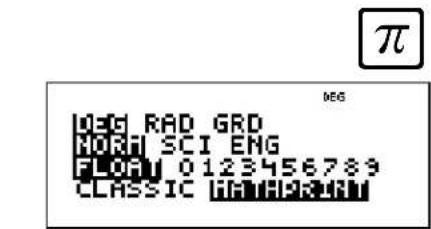
text_image
π REG RAD GRD NORI SCI ENG FLOG 0123456789 CLASSIC FIHHPK4N1
text_image
2nd 10^x log e^x ln hyp π x√ √ clear var recall sto on quit mode angle prb U_d^n ×10^n sin^-1 sin x^-1 quit insert delete stat data U_d^n ×10^n cos^-1 cos % ( ) 7 8 9 4 5 6 1 2 3 reset , ans (-) enterAngle settings and conversions
Keys
- 2nd [angle] displays a choice of two submenus that enable you to specify the angle unit modifier as degrees (°), minutes ('), seconds (''); radian (r); gradian (g), or convert units using ▶DMS. You can also convert between rectangular coordinate form (R) and polar coordinate form (P). (See Chapter 18, Polar and rectangular conversions, for more information.)
Choose an angle mode from the mode screen. You can choose from DEG (default), RAD, or GRAD. Entries are interpreted and results displayed according to the angle mode setting without the need to enter an angle unit modifier.
If you specify an angle unit modifier from the Angle menu, the calculation is performed in that angle type, but the result will be given in the angle mode setting.
Notes
- The examples on the transparency masters assume all default settings.
- DMS angles are entered as ° (degrees), ' (minutes), and " (seconds).
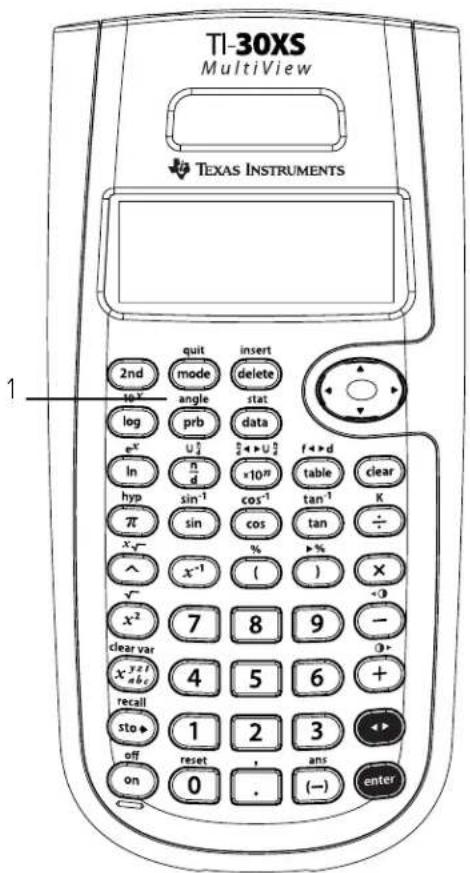
text_image
TI-30XS MultiView TEXAS INSTRUMENTS 2nd up+ log e^x ln hyp π x^- √ x² clear var x^y+1 abc recall sto off on quit mode angle prb U# sin⁻¹ sin x⁻¹ quit delete stat data ×10⁹ cos⁻¹ cos % ( ) ×10⁹ ×10⁹ ×10⁹ ×10⁹ ×10⁹ ×10⁹ ×10⁹ ×10⁹ ×10⁹ ×10⁹ ×10⁹ ×10⁹ ×10⁹ ×10⁹ ×10⁹ ×10⁹ ×10⁹ ×10⁻¹ ×10⁻¹ ×10⁻¹ ×10⁻¹ ×10⁻¹ ×10⁻¹ ×10⁻¹ ×10⁻¹ ×10⁻¹ ×10⁻¹ ×10⁻¹ ×10⁻¹ ×10⁻¹ ×10⁻¹ ×10⁻¹ ×10⁻¹ ×10⁻¹ ×1.56789999999999999999999999999999999999999999999999999999999999999999999999999999999999999999999999999999 345678888888888888888888888888888888888888888888888888888888888888 345678888888888888888888888888 345678888888888888888 345678 34567 34567 34567 34567 34567 34567 34567 34567 34567 34567 34567 34567 34567 34567 34567 34567 34567 34 34567 34567 34567 34567 34567 34567 34567 34567 34567 34567 34567 34567 34567 34567 34567 34567 34Degrees, minutes, and seconds to decimal
Find the measure of the third angle of a triangle if one angle measures 45^30' and the other angle measures 36^15' . Express the angle measure in degrees, minutes, and seconds.
Press Display
45 2nd [angle] 1
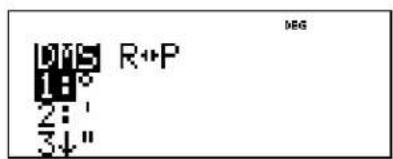
text_image
075 R+P 18° 2: 1 3↓"30 2nd [angle] 2 + 36 2nd
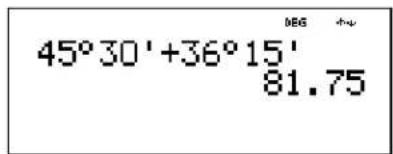
text_image
45°30' + 36°15' 81.75[angle]1 15 2nd [angle]
2 enter
180 2nd [angle] 1 - 2nd [ans]
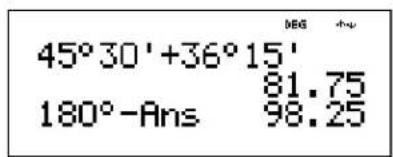
text_image
45°30' + 36°15' 180°-Ans 81.75 98.25enter 2nd [angle] 6 enter
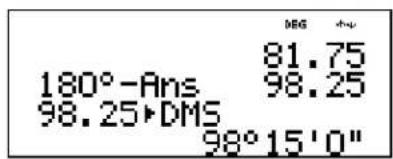
text_image
180°-Ans 98.25→DMS 98°15'0" 81.75 98.25The measure of the third angle is 98^15' .


text_image
WEG RAD GRAD NORT SCI ENG FLOW 0123456789 CLASSIC HHHPART
text_image
2nd 10-x log e^x ln hyp π x√ ^ x² clear var x^yz abc recall sto off on quit mode angle prb insert delete data U_d^n ×10^n sin⁻¹ sin 7 4 reset 0 insert delete U_d^n U_d^n U_d^n cos⁻¹ cos % ( ) 8 9 5 6 2 3 - ans (-) clear K ÷ × -Decimal to degrees, minutes, and seconds
You are visiting Beijing, China. Your GPS gives your location (latitude and longitude) as 39.55° N 116.20° E. Change your location information to degrees, minutes and seconds.
Press Display
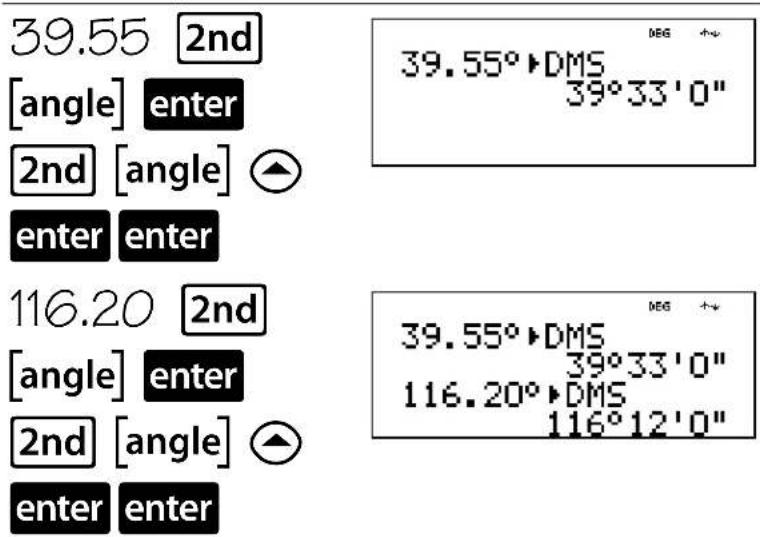
text_image
39.55 2nd [angle] enter 2nd [angle] ▲ enter enter 116.20 2nd [angle] enter 2nd [angle] ▲ enter enter 39.55°▶DMS 39°33'0" DEG ↑↓ 39.55°▶DMS 39°33'0" 116.20°▶DMS 116°12'0"Your location in Beijing, China is 39° 33' N 116° 12' E.
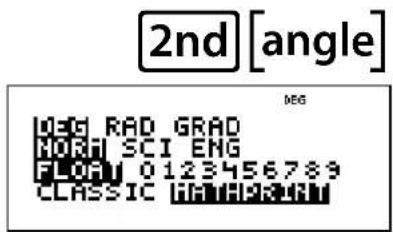
text_image
2nd [angle] NEG RAD GRAD MORT SCI ENG FLOT 0123456789 CLASSIC H1H1H1H1H1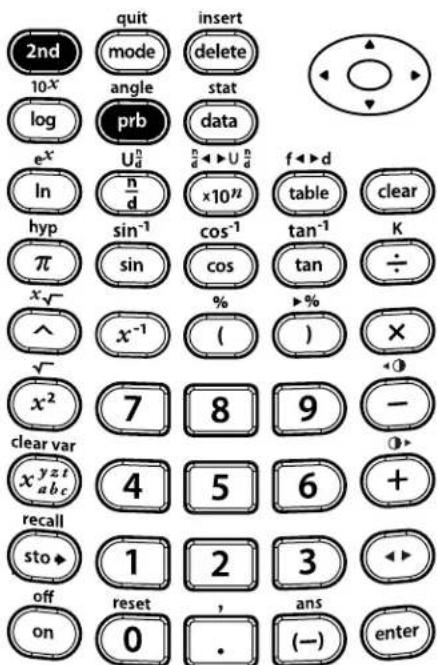
text_image
2nd 10^x log e^x ln hyp π ^ √ clear var recall sto on quit mode angle prb stat data U_d^n d ×10^n sin^-1 sin x^-1 7 4 reset 0 insert delete U_d^n d ×10^n cos^-1 cos % ( 8 5 2 - ans (-) f◄►d table tan^-1 tan ►% ) ( ) 9 6 3 + -Degrees, radians, and gradians
Calculate the following:
cos(180 degrees)
cos(π radians)
cos(200 grad)
Remember:
180 degrees = π radians = 200 grad.
Press Display
cos 180 2nd
[angle]1 ) enter
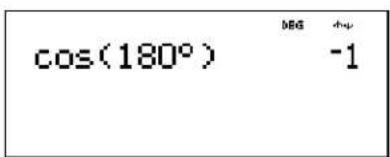
text_image
cos(180°) MEG +ψ -1cos π 2nd
[angle]4)
enter cos 200
2nd [angle] 5
) enter

text_image
cos(180°) -1 cos(πr) -1 cos(200°) -1
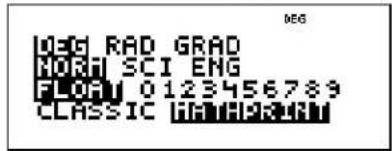
text_image
WEG RAD GRAD NORT SCI ENG FLOA 0123456789 CLASSIC HATHRAH
text_image
2nd 10^x log e^x ln hyp π x√ ^ x² clear var x^y z t abc recall sto off on quit mode angle prb insert delete stat data U_d^n n_d^n ← U_d^n ×10^n sin⁻¹ sin cos⁻¹ cos % ( ) ×10^n f ← d table clear tan⁻¹ tan ÷ K × % ►% ) ←① 7 8 9 - ①→ 4 5 6 + 1 2 3 ←→ reset , ans (-) enterPolar and rectangular conversions
Keys
- 2nd [angle] displays the choice of two submenus that let you convert rectangular coordinates (x,y) to polar coordinates (r,θ) or vice versa. You can also specify the angle unit modifier. (See Chapter 17, Angle settings and conversions, for more information.)
R▶Pr(Converts rectangular coordinate to polar coordinate r.
R·Pθ( Converts rectangular coordinate to polar coordinate θ.
P ▶ Rx( Converts polar coordinate to rectangular coordinate x.
P▶Ry( Converts polar coordinate to rectangular coordinate y.
- 2nd [, ] enters a comma.
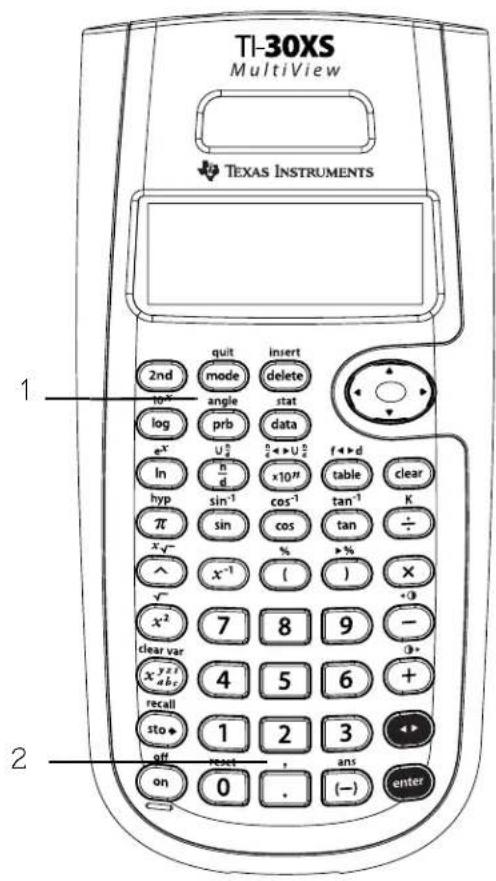
text_image
TI-30XS MultiView TEXAS INSTRUMENTS 2nd to- 10" log e^x ln hyp π ^x √ clear var recall sto off on quit mode angle prb U²/d sin⁻¹ sin x⁻¹ 7 4 1 reset . insert delete stat data ×10" cos⁻¹ % ( ) cos ( ) ×10" tan⁻¹ tan ×10" tan⁻¹ table clear K ×10" ×10" ×10" ×10" ×10" ×10" ×10" ×10" ×10" ×10" ×10" ×10" ×10" ×10" ×10" ×10" ×10" ×10" ×10" ×10" ×10" ×10" ×10" ×10" ×10" ×10" d" ×10" ×10" ×10" ×10" ×10" ×10" ×10" ×10" ×10" ×10" ×10" ×10" ×10" ×10" ×10" ×10" ×10" ×10" ×10" ×10" ×10" ×10" ×10" ×10" ×1O d" ×1O d" ×1O d" ×1O d" ×1O d" ×1O d" ×1O d" ×1O d" ×1O d" ×1O d" ×1O d" ×1O d" ×1O d" ×1O d" ×1O d" ×1O d" ×1O d" ×1O d" ×1O d" ×1O d" ×1O enterNotes
- The example on the transparency master assumes all default settings.
- Before starting calculations, set the angle mode as necessary.
Polar to rectangular
Convert the polar ordered pair (7, 30°) to rectangular coordinates.

line
| x | y | |---|---| | 1 | 0 | | 2 | 1 | | 3 | 2 | | 4 | 3 | | 5 | 4 | | 6 | 5 | | 7 | 6 | (x = ?, y = ?)Press Display
2nd [angle]
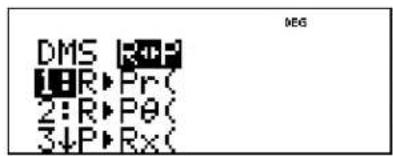
text_image
DMS RHP LDR Pr( 2:R P0( 3↓P Rx)○ ○

text_image
P▶Rx(C) MGG +enter 7 2nd [,] 30 ) enter
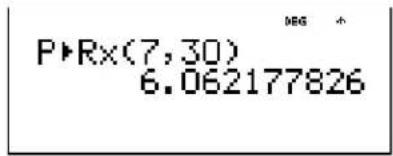
text_image
P→Rx(7,30) 6.0621778262nd [angle] ▶ ▼ ▼ ▼ enter 7 2nd [, ] 30
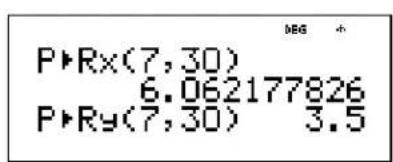
text_image
P▶Rx(7,30) 6.062177826 P▶Ry(7,30) 3.5) enter
The rectangular ordered pair is (x, y) = (6.062177826, 3.5.)
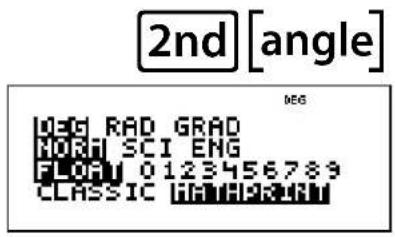
text_image
2nd [angle] NEG RAD GRAD NORTH SCI ENG FLOAF 0123456789 CLASSIC HIGH/984R
text_image
2nd 10x log e^x ln hyp π x√ ^ x² clear var x^y z t abc recall sto off on quit mode angle prb insert delete stat data U_d^n d/d U_d^n ◀ ◀ ◀ d ×10^n sin⁻¹ sin x⁻¹ f ◀ ◀ d table tan⁻¹ tan × cos⁻¹ cos % ( ) × ▶ pfactor ( ) 7 8 9 4 5 6 3 1 2 3 reset , ans (—) enterTrigonometry
Keys
- sin calculates the sine of an angle.
- 2nd [sin^-1] calculates the inverse sine.
- cos calculates the cosine of an angle.
- 2nd [^-1] calculates the inverse cosine.
- tan calculates the tangent of an angle.
- 2nd [tan ^-1 ] calculates the inverse tangent.
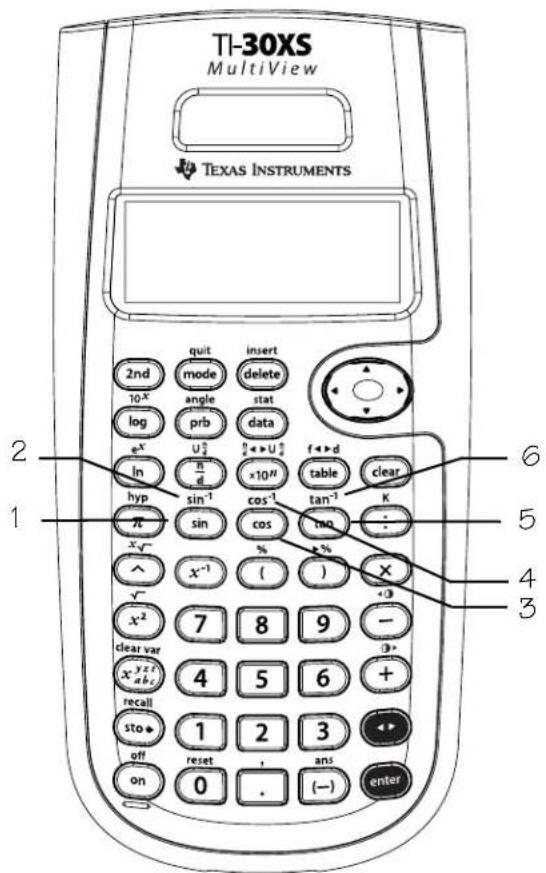
text_image
TI-30XS MultiView TEXAS INSTRUMENTS 2nd 10^x log e^x ln hyp π x^y y^y clear var x^y x^z abc recall sto off on quit mode angle prb U^z n/d sin^-1 sin x^-1 quit delete stat data ×10^m cos^-1 cos % ( ) ×10^m f←→d table clear tan^-1 traq K × 7 8 9 - 3> 4 + - (-) 3 ×3Notes
- The examples on the transparency masters assume all default settings.
- Before starting a trigonometric calculation, be sure to select the appropriate angle mode setting (DEG, RAD, or GRAD—See Chapter 17, Angle settings and conversions). The calculator interprets values according to the current angle-unit mode setting.
- In MathPrint™ mode and the corresponding mode setting of DEG or RAD, evaluating trigonometric functions at multiples of 15 degree or pi/12 increments yields exact radical output in many cases.
- ☐ closes the argument of a trigonometric function.
Tangent
Use this formula to find the distance from the lighthouse to the boat. Round your answer to the nearest whole number, and then return to floating decimal mode.
$$ D = \frac {7 8}{T A N 2 7} $$
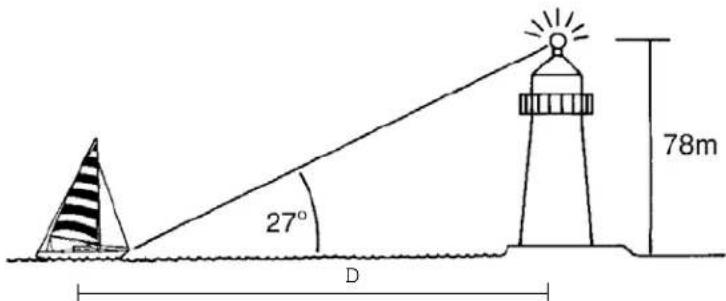
text_image
27° D 78mPress Display
78 tan 27
2nd [angle] enter
) enter
mode
enter
clear enter
mode ▼ ▼ enter
clear enter

text_image
78 tan(270) 153.0836194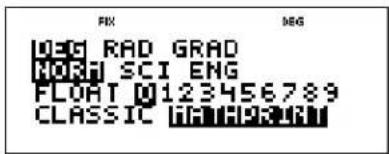
text_image
NOG RAD GRAD NOG SCI ENG FLOAT 0123456789 CLASSIC H1HPRRT
text_image
FRI MEG +* tan(270) 153.0836194 78 153 tan(270)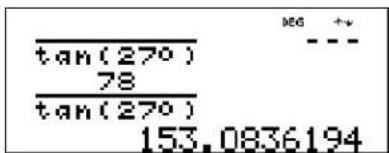
text_image
tan(270) 78 tan(270) 153.0836194The distance from the lighthouse to the boat is approximately 153 m.
tan

text_image
RAD GRAD SCI ENG FLOAT 0123456789 CLASSIC WTHH9A4N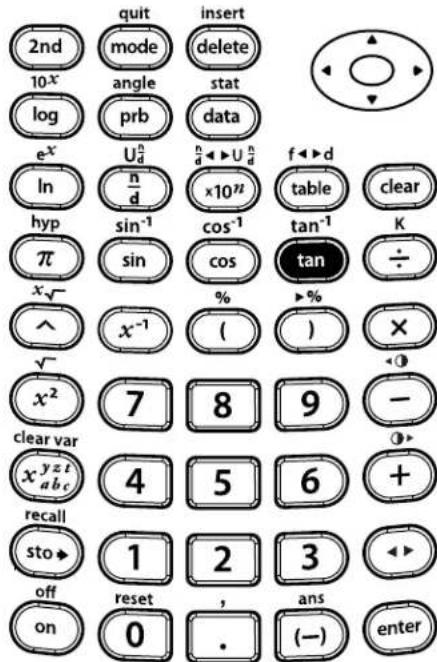
text_image
2nd 10^x log e^x ln hyp π ^ √ clear var recall sto on quit mode angle prb stat data U_d^n n/d ▶ U_d^n ×10^n sin^-1 sin x^-1 7 4 reset 0 insert delete data cos^-1 % ans ( ) ( ) tan^-1 tan × ( ) ( ) ( ) ( ) ( ) ( )Inverse tangent
Use this formula to find the angle of depression, x. Round your answer to the nearest tenth, and then return to floating decimal mode.
$$ x = \mathrm{TAN} ^ {- 1} \frac {6 0 0}{2 5 0 0} $$
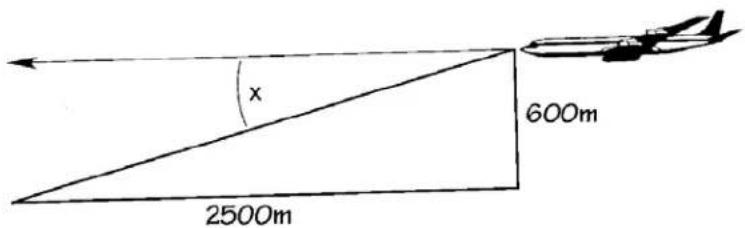
text_image
x 2500m 600mPress Display
2nd [tan ^-1 ] 600
2500
) enter
mode
enter
clear enter
mode
enter clear enter
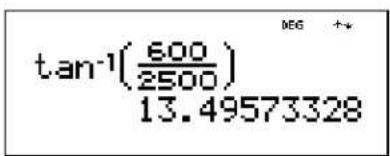
text_image
tan⁻¹(600/2500) 13.49573328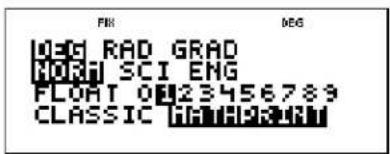
text_image
RAD GRAD SCI ENG FLOAT 0123456789 CLASSIC
text_image
tan1'(2500) 13.49573328 tan-1(600/2500) 13.5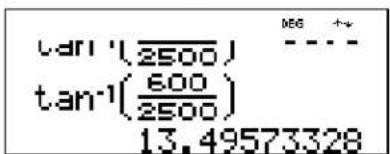
text_image
tan1(2500) tan-1(600/2500) 13.49573328The angle of depression is x = 13.5^ rounded to the nearest tenth.
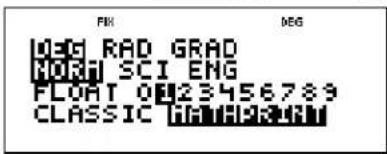
text_image
NOG RAD GRAD NO3J SCI ENG FLOAT 0123456789 CLASSIC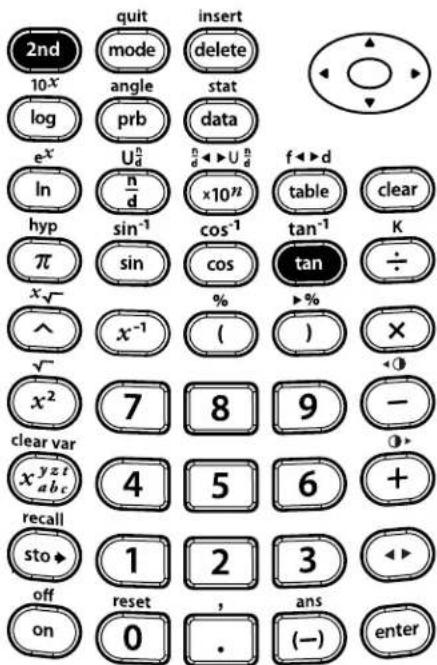
text_image
2nd 10x log e^x ln hyp π x√ ^ x² clear var x^y z t abc recall sto off on quit mode angle prb U_d^n n/d sin⁻¹ sin x⁻¹ quit delete stat data ×10^n cos⁻¹ cos % ( ) ×10^n f◄►d table clear tan⁻¹ K tan tan % ►% ) × 7 8 9 - 4 5 6 + 1 2 3 reset , ans (-) enterCosine
Use this formula to find the distance, D, from the base of the ladder to the house. Round your answer to the nearest whole number, and then return to floating decimal mode.
D = 5 × COS(74) meters

text_image
5m 74° DPress Display
5 × cos 74
) enter
5*cos(74) 1.378186779
mode
enter
REG RAD GRAD NOSI SCI ENG FLOAT D123456789 CLASSIC IWHHFAH
clear enter
5*cos(74) 1.378186779 5*cos(74) 1
mode enter clear enter
1.378186779 5*cos(74) 1 5*cos(74) 1.378186779
The distance is approximately 1 meter.
COS

text_image
PK WEG RAD GRAD NOSI SCI ENG FLOAT D123456789 CLASSIC WTHH9840M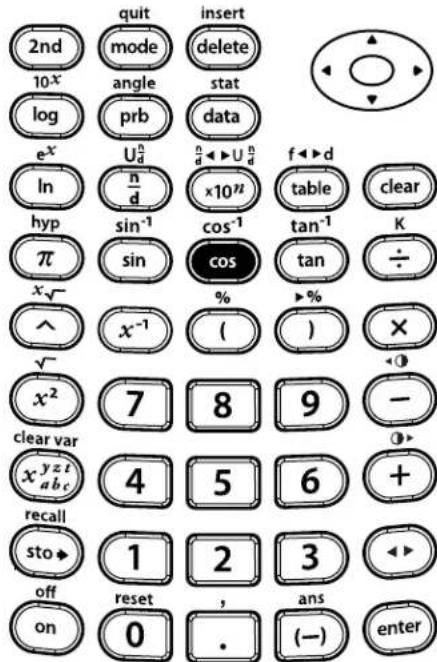
text_image
2nd 10x log e^x ln hyp π ^ x² clear var recall sto on quit mode angle prb U_d^n n/d ▶ U_d^n ×10^n sin⁻¹ sin x⁻¹ 7 4 reset 0 insert delete data cos⁻¹ % f ▶ d table tan⁻¹ tan ▶% ( ) ( ) × 8 5 2 3 , . ans (-) enterInverse cosine
Use this formula to find the angle of the ski jump, x. Round your answer to the nearest tenth, and then return to floating decimal mode.
$$ x = C O S ^ {- 1} \frac {4 5 3}{5 0 0} $$
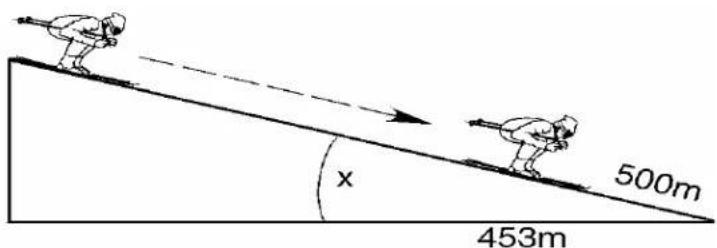
text_image
500m 453mPress Display
2nd[cos-1] 453
500
) enter
mode
enter
clear enter
mode
enter clear enter
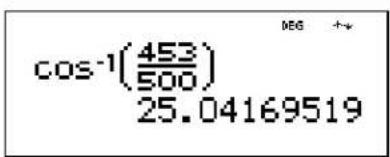
text_image
cos⁻¹(453/500) 25.04169519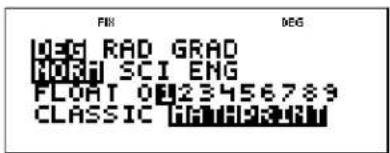
text_image
REG RAD GRAD NO3J SCI ENG FLOAT 0823456789 CLASSIC HANHRAH
text_image
cos > (500) 25.04169519 cos^-1(453/500) 25.0
text_image
cos 1(500) cos-1(453/500) 25.04169519The angle of the ski jump is x = 25.0 rounded to the nearest tenth.

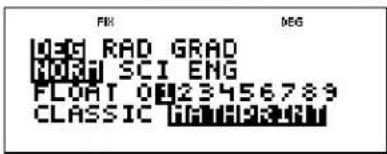
text_image
NOG RAD GRAD NO3J SCI ENG FLOAT 0123456789 CLASSIC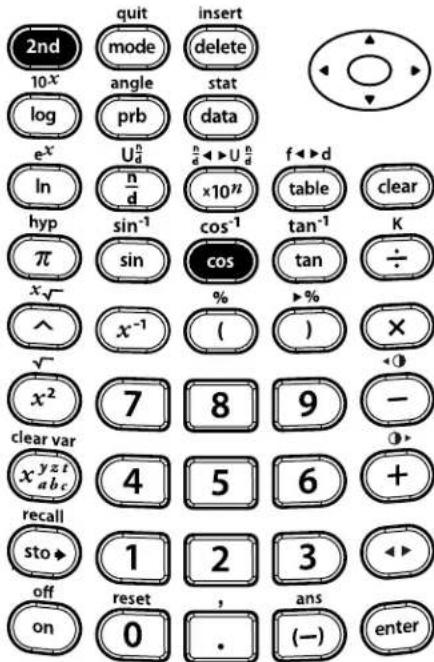
text_image
2nd 10x log e^x ln hyp π ^ √ clear var recall sto on quit mode angle prb U_d^n n/d ▶ U_d^n ×10^n sin^-1 sin x^-1 7 4 1 reset 0 insert delete data cos^-1 cos % ( ) ×10^n f ▶ d table tan^-1 tan ▶ % ( ) × 8 5 2 3 , . ans (-) clear K ÷ × -Sine
Use this formula to find the length of the ramp, D. Round your answer to the nearest whole number, and then return to floating decimal mode.
$$ D = \frac {1 . 5}{\text { meters }} 1 2 ^ {\circ} (\quad) \quad \sin $$
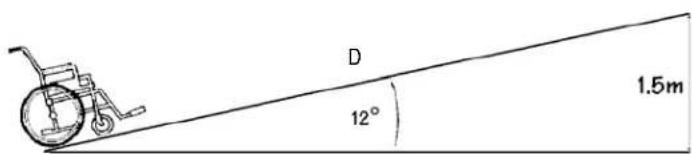
text_image
D 12° 1.5mPress Display
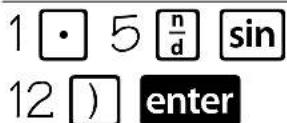

text_image
1.5 sin(12) 7.214601517
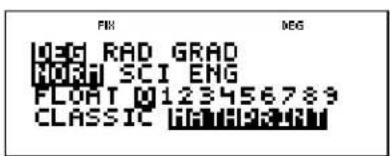
text_image
REG RAD GRAD REG SCI ENG FLOAT 0123456789 CLASSIC HIGH/GOOD

text_image
FIN sin(12) 7.214601517 1.5 sin(12)
text_image
mode enter clear enter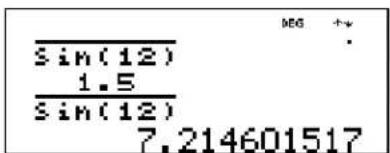
text_image
sin(12) 1.5 sin(12) 7.214601517The length of the ramp is D = 7 m rounded to the nearest whole number.

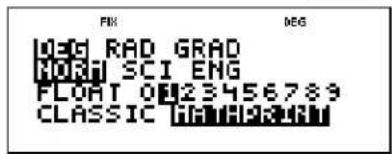
text_image
RAD GRAD SCI ENG FLOT 0123456789 CLASSIC
text_image
2nd 10^x log e^x ln hyp π ^ √ clear var recall sto on quit mode angle prb U_d^n n/d sin^-1 sin x^-1 quit delete stat data ×10^n cos^-1 cos % ( ) × quit d table tan^-1 tan %> ( ) 7 8 9 4 5 6 1 2 3 reset , ans (-) enterInverse sine
Use this formula to find the angle of the conveyor belt, x. Round your answer to the nearest tenth, and then return to floating decimal mode.
$$ x = \sin^ {- 1} \frac {1 3}{2 0} \text { meters } $$
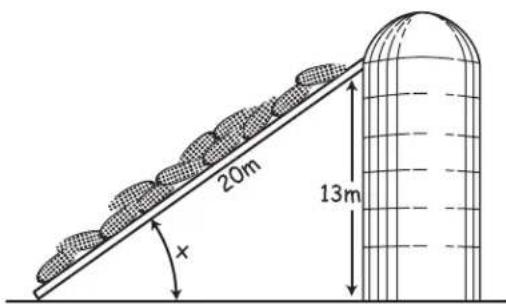
text_image
20m 13mPress Display

text_image
2nd [sin⁻¹] 13 n/d 20 ▶ ) enter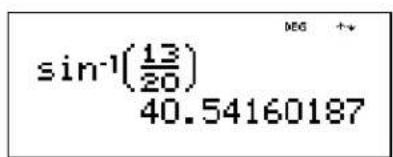
text_image
sin⁻¹(13/20) 40.54160187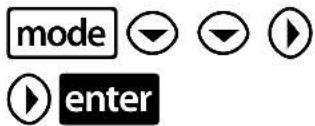
text_image
mode enter
text_image
REG RAD GRAD REG SCI ENG FLOAT 023456789 CLASSIC H9841H

text_image
FHN ≥1π'(20) 40.54160187 sin⁻¹(13/20) 40.5
text_image
mode enter clear enter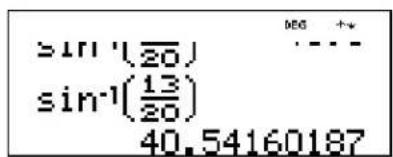
text_image
sin1(20) sin-1(13/20) 40.54160187The angle of the conveyor belt is x = 40.5rounded to the nearest tenth.

text_image
PK DEG RAD GRAD NO3J SCI ENG FLOAT 0123456789 CLASSIC HANHIN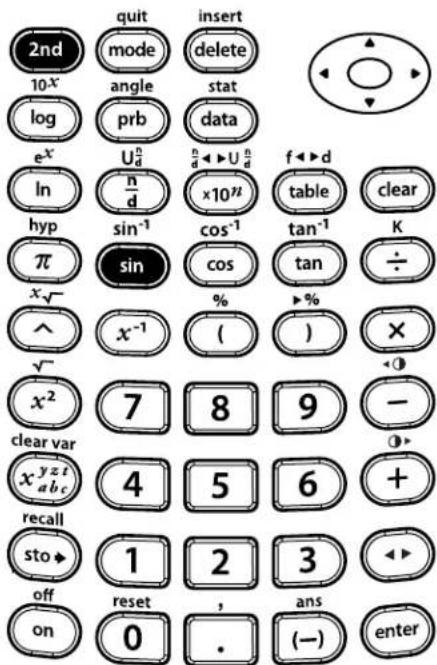
text_image
2nd 10^x log e^x ln hyp π x√ ^ x² clear var x^y z t abc recall sto off on quit mode angle prb U_d^n n/d sin⁻¹ sin x⁻¹ quit delete stat data ×10^n cos⁻¹ cos % ( ) reset 0 insert U_n^n U_d^n U_d^n U_d^n f←d table tan⁻¹ tan × clear ÷ K × 7 8 9 - 4 5 6 + 1 2 3 ans (-) enterHyperbolics
Keys
- 2nd [hyp] accesses the hyperbolic function (sinh, cosh, tanh; and ^-1 , ^-1 , ^-1 ) of the next trig key that you press.
Notes
- The example on the transparency masters assumes all default settings.
• Hyperbolic calculations are not affected by the angle mode setting-whether or not the calculator is in RAD (radian), GRAD (gradian), or DEG (degree) modes.

text_image
TI-30XS MultiView TEXAS INSTRUMENTS 2nd 10^x log e^x In hyp π x^y- √ clear var recall sto on quit mode angle prb U# sin-1 sin x-1 quit delete stat data ×10^n cos-1 cos % ( ) ×10^x ×10^x ×10^x ×10^x ×10^x ×10^x ×10^x ×10^x ×10^x ×10^x ×10^x ×10^x ×10^x ×10^x ×10^x ×10^x ×10^x ×10^-x ×10^-x ×10^-x ×10^-x ×10^-x ×10^-x ×10^-x ×10^-x ×10^-x ×10^-x ×10^-x ×10^-x ×10^-x ×10^-x ×10^-x ×10^-x ×10^-x × 10^-x × 10^-x × 10^-x × 10^-x × 10^-x × 10^-x × 10^-x × 10^-x × 10^-x × 10^-x × 10^-x × 10^-x × 10^-x × 10^-x × 1 -3 × 9 -3 × 6 + × 3 + × (-) × (−) × (+) × (−) × (−) × (−) × (−) × (−) × (−) × (−) × (−) × (−) × (−) × (−) × (−) × (−) × (−) × (−) × (−) × (−) × (−) × (−) × (−) × (−)Sinh, cosh, and tanh
Find the (2) and the ^-1(2) . Repeat for and . What do you notice?
Press Display

text_image
2nd [hyp] sin 2 ) enter 2nd [hyp] 2nd [sin⁻¹] 2nd [ans] ) enter 2nd [hyp] cos 2 ) enter 2nd [hyp] 2nd [cos⁻¹] 2nd [ans] ) enter 2nd [hyp] tan 2 ) enter 2nd [hyp] 2nd [tan⁻¹] 2nd [ans] ) enter sinh(2) 3.626860408 sinh(2) 3.626860408 sinh⁻¹(Ans) 2 cosh(2) 3.762195691 cosh(2) 3.762195691 cosh⁻¹(Ans) 2 tanh(2) 0.96402758 tanh(2) 0.96402758 tanh⁻¹(Ans) 2
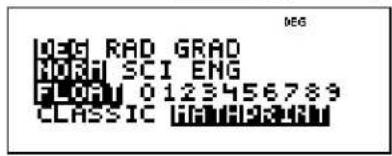
text_image
WEG RAD GRAD NORT SCI ENG FLOW 0123456789 CLASSIC HIGH/WEALTH
text_image
2nd 10^x log e^x ln hyp π x√ √ clear var recall sto on quit mode angle prb delete stat data U_d^n n_d^n U_d^n ×10^n sin^-1 sin x^-1 7 4 reset 0 insert stat tan^-1 tan cos^-1 % ( ) × 8 5 9 6 ans (-) clear K ÷ % ▶% × -Quick reference to keys
A
| KEY FUNCTION | |
| ➊➁ | ➊ move the cursor left and right so you can scroll an entry on the Home screen. |
| ➌➇ | Press 2nd or 2nd to scroll to the beginning or end of a current entry.➌ move the cursor up and down to navigate menu items, view entries in the data editor and function table, and view previous entries on the Home screen.2nd moves the cursor to the oldest entry on the Home screen, and to the top entry of the active column in Data editor.2nd moves the cursor below the last entry on the Home screen, and to the bottom entry of the active column in Data editor. |
| + - × ÷ Adds, subtracts, multiplies, and divides. | |
| 0 - 9 Enters the digits | O through 9. |
| ( ) | Opens a parenthetical expression.Closes a parenthetical expression. |
| x-1 Calculates the reciprocal. | |
| x2 Squares the value. | |
| π | Enters the value of pi rounded to 10 digits (3.141592654). |
| · Enters a decimal point. | |
| (-) Indicates the value is negative. | |
| ^ Raises a value to a specified power. | |
| 2nd | Turns on the 2nd indicator and accesses the function shown above the next key that you press. |
A
Quick reference to keys (Continued)
| KEY | FUNCTION |
| 2nd [angle] | Displays the following menus.DMS lets you specify the unit of an angle.R ▶P lets you convert rectangular coordinates to polar coordinates, or vice versa.DMS R ▶P1:° 1:R ▶Pr(2:′ 2:R ▶Pθ(3:′′ 3: P ▶ ▶Rx(4: r 4: P ▶ ▶Ry(5: g6: ▶DMS |
| × 10^n | × 10^n is a shortcut key to enter a number in scientific notation format. |
| 2nd [√] Calculates the square root. | |
| 2nd [%] | Appends the % sign to a number. Results display according to the decimal notation mode setting. |
| 2nd [,] Enters a comma. | |
| 2nd [x√] Calculates the specified root (x) of the value. | |
| 2nd [Ua] | Lets you enter mixed numbers and fractions. Press 2nd[Ua] between the entry of the unit, and the numerator. |
| nd | Lets you enter a simple fraction. In MathPrintTM mode, press ➤ between the entry of the numerator and the denominator. In Classic mode, press nd between the entry of the numerator and the denominator. |
| 2nd [d ◀ Ua] | Converts a simple fraction to a mixed number or a mixed number to a simple fraction. |
| 2nd [ans] | Recalls the most recently calculated result, displaying it as Ans. |
| clear | Clears characters and error messages on the entry line. |
| 2nd [clear var] | Clears all memory variables. |
| sin | Calculates the sine of an angle. |
| 2nd [sin-1] | Calculates the inverse sine. |
| cos | Calculates the cosine of an angle. |
Quick reference to keys (Continued)
A
| KEY | FUNCTION |
| 2nd [cos-1] Calculates the inverse cosine. | |
| tan Calculates the tangent of an angle. | |
| 2nd [tan-1] Calculates the inverse tangent. | |
| data | Lets you enter the statistical data points for 1-Var stats and 2-Var stats. |
| data data | Press data once to display the data editor screen. Press again to display the Clear and Formula menus. Lets you access list names when in the Formula menu. |
| delete Deletes the character at the cursor. | |
| 2nd [ex] | Calculates the natural antilogarithm (e raised to the power of the value). |
| 2nd [f◄►d] | Converts a fraction to its decimal equivalent or converts a decimal to its fractional equivalent, if possible. |
| 2nd [hyp] | Accesses the hyperbolic function (sinh, cosh, tanh; and sinh-1, cosh-1, tanh-1) of the next trig key that you press. |
| 2nd [insert] Let you insert a character at the cursor. | |
| 2nd [K] | Turns on the constant mode and lets you define a constant. |
| ln | Calculates the natural logarithm (base e, where e ≈ 2.718281828459). |
| log | Calculates the common logarithm (base 10). |
| x y z t abc | Accesses variables. Press this key multiple times to choose x, y, z, t, a, b, or c. You can also use x y z t abc to recall the stored values for these variables. |
| 2nd [off] | Turns off the calculator and clears the display. |
| on Turns on the calculator. | |
| prb | Displays the following menu of functions.nPr Calculates the number of possible permutations.nCr Calculates the number of possible combinations.! Calculates the factorial.rand Generates a random number between O and 1 Generation( Generates a random integer between 2 integers, A and B, where A ≤ Randint ≤ B. |
| 2nd [recall] Recalls the stored values to the display. | |
A
Quick reference to keys (Continued)
| KEY | FUNCTION |
| 2nd [stat] | Displays the following menu from which you can select 1-Var, 2-Var, or StatVars.1-Var Analyzes data from 1 set of data with 1 measured variable-x.2-Var Analyzes paired data from 2 sets of data with 2 measured variables-x, the independent variable, and y, the dependent variable.StatVars After choosing 1-var or 2-var stats, displays data values.StatVars displays the following menu of stat variables with their current values.n Number of x (or x,y) data points. or Mean of all x or y values.Sx or Sy Sample standard deviation of x or y.σx or σy Population standard deviation of x or y. x or y Sum of all x values or y values. x^2 or y^2 Sum of all x^2 values or y^2 values. xy Sum of the product of x and y for all xy pairs in 2 lists.a Linear regression slope.b Linear regression y-intercept.r Correlation coefficient.x' (2-Var) Uses a and b to calculate predicted x value when you input a y value.y' (2-Var) Uses a and b to calculate predicted y value when you input an x value.minX Minimum of x values.Q1 (1-Var) Median of the elements between minX and Med (1st quartile).Med Median of all data points.Q3 (1-Var) Median of the elements between Med and maxX (3rd quartile).maxX Maximum of x values. |
Quick reference to keys (Continued)
A
| KEY FUNCTION | |
| 2nd[reset] Displays the RESET menu. | RESET1: No2: YesPress 1 (No) to return to the previous screen without resetting the calculator.Press 2 (Yes) to reset the calculator. The message MEMORY CLEARED is displayed.You can press on and clear simultaneously to reset the calculator immediately. No menu or message is displayed. |
| sto◆ | Lets you store values to variables. Press sto◆ to store a variable, and press x_abc^yzt to select the variable to store. x_abc^yzt displays the following menu of variables: xyz t a b c.Press enter to store the value in the selected variable. If this variable already has a value, that value is replaced by the new one. |
| enter Completes the operation or executes the command. | |
Display indicators
B
INDICATOR MEANING
| 2nd 2nd function. | |
| HYP Hyperbolic function. | |
| FIX | Fixed-decimal setting. (See the Mode section in Chapter 1, TI-30XS MultiViewTM basic operations, and Chapter 7, Decimals and decimal places.) |
| SCI, ENG | Scientific or engineering notation. (See the Mode section in Chapter 1, TI-30XS MultiView basic operations.) |
| DEG, RAD, GRAD | Angle mode (degrees, radians, or gradians). (See the Mode section in Chapter 1, TI-30XS MultiView basic operations.) |
| K Constant feature is on. | |
| L1, L2, L3 Displays above the lists in data editor. | |
| The TI-30XS MultiView calculator is performing an operation. | |
| ↑↓ | An entry is stored in memory before and/or after the active screen. Press ⬇ and ⬇ to scroll. |
| ←→ | An entry or menu displays beyond 16 digits. Press ⏻ or ⭺ to scroll. |
Error messages
C
When the TI-30XS MultiView™ calculator detects an error, it returns an error message with the type of error.
To correct the error, note the error type and determine the cause of the error. If you cannot recognize the error, use the following list, which describes error messages in detail.
Press clear to clear the error message. The previous screen is displayed with the cursor at or near the error location. Correct the expression.
MESSAGE MEANING
| ARGUMENT A function does not have the correct number of arguments. | |
| DIVIDE BY O You attempted to divide by O.In statistics, n = 1. | |
| DOMAIN You specified an argument to a function outside the valid range. For example:For x√—x = 0 or y < 0 and x is not an odd integer.Foryx—y and x = 0; y < 0 and x is not an integer.For√x — x < 0.For LOG or LN — x ≤ 0.For TAN — x = 90°, -90°, 270°, -270°, 450°, etc.For SIN-1or COS-1— |x| >1.For nCr or nPr — n or r are not integers ≥ 0.For x! — x is not an integer between 0 and 69. | |
| EQUATION LENGTHERROR | An entry exceeds the available space (80 digits for statistics entries or 47 for constant entries); for example, combining an entry with a constant that exceeds the limit. |
| FRQ DOMAIN | FRQ value (in 1-variable statistics) < 0 or >99. |
| OVERFLOW | |θ| ≥ 1x10n, where θ is an angle in a trig, hyperbolic, or R▶Pr function. |
| STAT Attempting to calculate 1-var or 2-var stats with no defined data points, or attempting to calculate 2-var stats when the data lists are not of equal length. | |
| DIM MISMATCH Attempting to create a formula when the lists are not of equal length. | |
| FORMULA | The formula does not contain a list name (L1, L2, or L3), or the formula for a list contains its own name; for example, a formula for L1 contains L1. |
Error messages (Continued)
MESSAGE MEANING
| SYNTAX The command contains a syntax error—entering more than 23 pending operations, 8 pending values, or having misplaced functions, arguments, conversions, variables, parentheses, or commas. If using , try using ÷ . |
| INVALID FUNCTION You entered an invalid function in the function table. |
| LOW BATTERY Replace the battery.Note: This message displays briefly and then disappears. Pressingcleardoes not clear this message. |
Texas Instruments support and service
D
For general information
| Home Page: | education.ti.com |
| KnowledgeBase and e-mail inquiries: | education.ti.com/support |
| Phone: | (800) TI-CARES / (800) 842-2737For U.S., Canada, Mexico, Puerto Rico, and Virgin Islands only |
| International Information: | education.ti.com/international |
For technical support
| KnowledgeBase and e-mail inquiries:Phone (not toll-free): | education.ti.com/support(972) 917-8324 |
For product (hardware) service
| Customers in the U.S., Canada, Mexico, Puerto Rico and Virgin Islands:All other customers: | Always contact Texas Instruments Customer Support before returning a product for service.Refer to the leaflet enclosed with this product (hardware) or contact your local Texas Instruments retailer/distributor. |
Battery information
E
Battery precautions
- Do not leave batteries within the reach of children.
- Do not mix new and used batteries. Do not mix brands (or types within brands) of batteries.
- Do not mix rechargeable and non-rechargeable batteries.
• Install batteries according to polarity (+ and -) diagrams. - Do not place non-rechargeable batteries in a battery recharger.
- Properly dispose of used batteries immediately.
- Do not incinerate or dismantle batteries.
- Seek Medical Advice immediately if a cell or battery has been swallowed. (In the USA, contact the National Capital Poison Center at 1-800-222-1222.)
Battery disposal
Do not mutilate, puncture, or dispose of batteries in fire. The batteries can burst or explode, releasing hazardous chemicals. Discard used batteries according to local regulations.
Remove or replace the battery
Remove the protective cover and turn the TI-30XS MultiView™ face downwards.
- With a small screwdriver, remove the screws from the back of the case.
- From the bottom, carefully separate the front from the back. BE CAREFUL not to damage any of the internal parts.
- With a small screwdriver (if required), remove the battery.
- To replace the battery, check the polarity (+ and -) and slide in a new battery. Press firmly to snap the new battery into place. Important: When replacing the battery, avoid any contact with the other components of the TI-30XS MultiView calculator.
- If necessary, press on and clear simultaneously to reinitialize the calculator (erases the memory and all the settings and displays a MEM DELETED message).
- Dispose of the dead batteries immediately and in accordance with local regulations.
Type of battery
The TI-30XS MultiView calculator uses one 3 volt CR2032 lithium battery.
Per CA Regulation 22 CCR 67384.4, the following applies to the button cell battery in this unit:
Perchlorate Material - Special handling may apply.
See www.dtsc.ca.gov/hazardouswaste/perchlorate