3200 GT (2006) - Car Maserati - Free user manual and instructions
Find the device manual for free 3200 GT (2006) Maserati in PDF.


User questions about 3200 GT (2006) Maserati
0 question about this device. Answer the ones you know or ask your own.
Ask a new question about this device
Download the instructions for your Car in PDF format for free! Find your manual 3200 GT (2006) - Maserati and take your electronic device back in hand. On this page are published all the documents necessary for the use of your device. 3200 GT (2006) by Maserati.
USER MANUAL 3200 GT (2006) Maserati
thank you for choosing a MASERATI.
This vehicle represents the result of MASERATI's great experience in the design and construction of sports, touring and racing vehicles.
The purpose of this manual is to provide you with an understanding of the equipment, systems and controls in the vehicle and to explain how they work.
In the final section of this manual you will also find instructions for basic maintenance procedures and the complete Maintenance Schedule, which are needed to ensure steady levels of performance, quality and safe driving.
In addition, keep in mind that proper maintenance is an essential factor to help preserve the value of the vehicle over time and protect the environment.
For Scheduled Maintenance or any other operation, please contact the Maserati Dealers: you can trust their trained technical staff, who are constantly updated and provided with the equipment required to ensure that all service operations are performed properly and reliably.
For improved safety, we recommend that you to read this manual carefully before driving the vehicle.
The Owner's Manual is an integral part of the vehicle and it must always be kept on board.
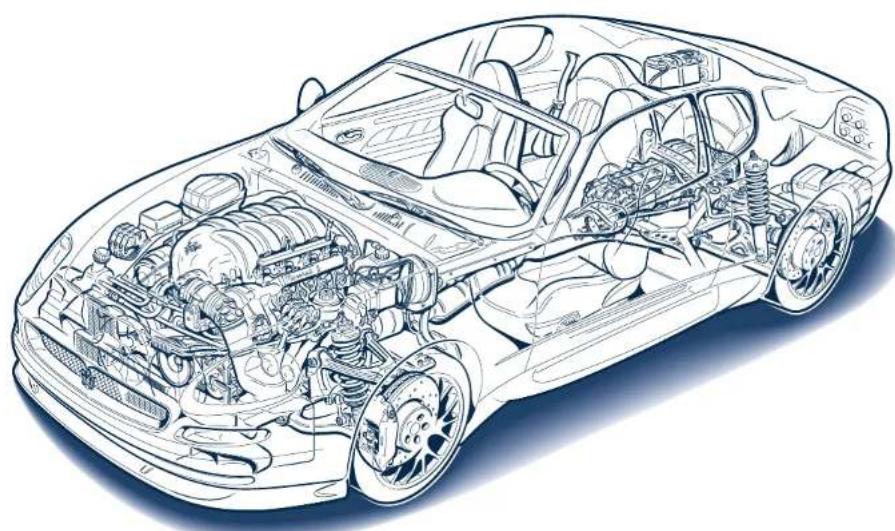
natural_image
Cutaway illustration of a car showing internal engine and drivetrain components (no text or labels)

Historical Background
1914
"Alfieri Maserati Garage Workshop" begins its activity in Bologna.
1926
Targa Florio, Type 26: debut and victory for the car which carries the Trident emblem on its hood, symbol of Bologna Neptune statue.
1927
Emilio Maserati wins the Italian champion title with Type 26.
1929
Baconin Borzacchini, Type V4: breaks the world speed 10 km record at 246 km/h.
1930
Borzacchini, V4: first victory in a Grand Prix, at Tripoli.
1933
Maserati is the first among the European manufacturers to introduce hydraulic brake controls on its racing cars. Giuseppe Campari, with Type 8CM, wins the Grand Prix of France and Tazio Nuvolari the Grand Prix of Belgium and of Nice.
1934
Giuseppe Furmanik, Type 4CM: breaks the world speed record for the 1100 class at 222 km/h.
1939
Wilbur Shaw with 8CTF wins the Indianapolis 500. Maserati still remains today the first and only Italian manufacturer to have won this legendary track.
1940
Maserati moves to Modena.
1947
Presentation of the first GT car: the A6 1500, with Pininfarina bodywork. The racing version A6GCS comes out winning with Alberto Ascari on the Modena track.
1954
The 250F is victorious in Argentina; this single-seater will enable Maserati to win the Formula 1 World Championship.
1957
Fangio wins the world titles with the 250F. At the end of the year Maserati officially retires from racing.
1961
The 3500 GT is the first Italian car available with fuel-injection.
1963
Creation of Mistral and Quattroporte, then the fastest sedan in the world.
1966
Presentation of Ghibli, a coupé designed by Giugiaro.
1968
Citrōen joins as a partner, and the V6 engine production is started. Presentation of 2+2 Indy.
1971
Presentation of Bora, the first Maserati GT with central engine. Merak will follow a year later.
1973
Khamsin, designed by Bertone, replaces Ghibli.
1975
Citrôen leaves the company, taken over by Alejandro de Tomaso.
1976
The new Quattroporte, designed by Giugiaro, is introduced as a high profile car and will be used even by the President of the Italian Republic.
1981
De Tomaso changes strategy and starts producing Biturbo, a sedan with 2 doors with 6-cylinder engine.
1989
Shamal is the first car featuring the new Biturbo 8-cylinder with 3200 hp.
1993
Fiat Auto purchases remaining shares of Maserati and in 1998 presents the new Quattroporte.
1997
Ferrari acquires the control of Maserati.
1998
natural_image
Line drawing of a classic sedan car with no visible text or symbols3500 GT
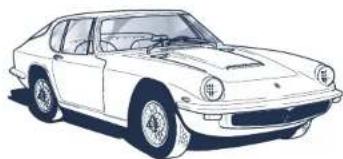
natural_image
Line drawing of a classic white sports car with front headlights and grille (no text or symbols)Mistral coupé

natural_image
Line drawing of a classic car with no visible text, numbers, or symbolsGhibli coupé
Historical Background

Introduction
Consulting the Manual
To facilitate reading and rapid use, the topics are subdivided into SECTIONS and CHAPTERS.
The important parts requiring particular attention are easily identifiable in the sections and chapters.

EXTREME CAUTION
REQUIRED: non-compliance
with the instructions can
cause SERIOUS DANGER involving the safety of persons and damage to the vehicle!
WARNING: warning to prevent any damage to the vehicle and thus hazards involving the safety of persons.
Abbreviations
Some descriptions and terms with particular meanings are found in this manual in an abbreviated form:
A.C.- AIR CONDITIONING
ABS - ANTILOCK BRAKING SYSTEM - Wheel locking prevention system during braking
ASR - ANTI SLIP REGULATION - Prevention of skidding during acceleration
EBD - ELECTRONIC BRAKE-FORCE DISTRIBUTION - Electronically-controlled distributor of braking force
ECU - ELECTRONIC CONTROL UNIT
MSP - MASERATISTABILITY PROGRAM Yaw prevention monitoring system
"Cambiocorsa" - Electronically controlled gearbox.
Updating
The vehicle's high quality level is maintained by constant improvements. Therefore, there may prove to be differences between this manual and your vehicle.
All specifications and illustrations contained in this manual refer to those vehicle specifications as of the printing date, and are subject to change without notice.
Service
The information contained in this manual is limited to those instructions and indications that are strictly required for the use and maintenance of the vehicle.
The Owner will certainly obtain greater satisfaction and the best performance from the vehicle by following these instructions carefully. We also advise you to have all the maintenance and checking procedures carried out at your Authorized Maserati Dealer, as it has properly trained staff and and equipment for your vehicle. See the Manual entitled "SALES AND SERVICE NETWORK" for locations of AUTHORIZED MASERATI DEALERS.
"Cambiocorsa" gearbox
The vehicle is equipped with a mechanical gearbox system with dry double-disc clutch, controlled by an electro-hydraulic system using steering wheel levers.
Although the system can be used in "automatic" mode, the
"Cambiocorsa" should not be considered as an automatic transmission. Therefore, for correct use, carefully follow the instructions in the respective section of this manual.
NHTSA's Toll-free Auto Safety Hotline
If you believe that your vehicle has a defect which could cause a crash, injury or death, you should immediately inform the National Highway Traffic Safety Administration (NHTSA) in addition to notifying Maserati S.p.A. or Maserati North America, Inc.
If NHTSA receives similar complaints, it may open an investigation, and if it finds that a safety defect exists in a group of vehicles, it may order a recall and remedy campaign. However, NHTSA cannot become involved in individual problems between you, your dealer, or Maserati North America, Inc.
To contact NHTSA, you may either call the Auto Safety Hotline toll-free at 1-800-424-9393 (or 1-703-366-0123 in Washington, D.C. area) or write to: NHTSA, U.S. Department of Transportation, Washington, D.C. 20590. You can also obtain other information about motor vehicle safety by calling the Hotline.

Symbols
There are specific colored plates on or near some of the components on your MASERATI. The related symbols are important warnings that the user must follow when using the particular component.
Symbols included in the labeling on your MASERATI are listed here, along with the component involved with that symbol.
Danger symbols

Battery
Corrosive liquid.

Battery
Explosion.

Fan
Can start up automatically even with the engine stopped.

Expansion tank
Do not remove the cap when the coolant is hot.

Coil
High voltage.

Belts and pulleys
Moving parts; Keep body parts and clothing away.

Air-conditioning lines
Do not open. Gas under high pressure.
Symbols of prohibitions

Battery
Do not approach with open flames.

Battery
Keep children at a safe distance.

Heat guards - belts - pulleys - fans Do not rest your hands on it.
Warning symbols

Catalytic muffler
Do not park or stop over flammable surfaces. Refer to section: "Pollution control devices".

Hydraulic steering
Do not exceed the maximum level of fluid in the tank. Only use lubricants of the type prescribed in the chapter "Capacities and technical specifications".

Brake circuit
Do not exceed the maximum level of fluid in the tank. Only use fluids of the type prescribed in the chapter "Capacities and technical specifications".

Windshield wiper
Only use fluids of the type prescribed in the chapter "Capacities and technical specifications".

Engine
Only use lubricants of the type prescribed in the chapter "Capacities and technical specifications".

Vehicle using lead-free gasoline
Only "Premium gasoline" with an AKI (Anti Knock Index) rating no lower than 91 (approximately 96 R.O.N.) must be used.

Expansion tank
Only use fluid of the type prescribed in the chapter "Capacities and Technical Specifications".
Symbols indicating compulsory measures

Battery
Protect your eyes.

Battery - Jack
Refer to the Owner's Manual.

General contents
Car identification data
Active and passive safety
Instruments and controls
Before you drive
Using the vehicle
In an emergency
Capacities and technical specifications
Maintenance
Contents

1
2
3
4
5
6
7
8
9

Car identification data
Identification plates 14
Homologation plates 15
Instructions plates 17
Key codes 18
Electronic alarm device code 19

Identification plates
Chassis marking
The vehicle's identification number can be found on the dashboard panel in front of the passenger seat. To read this number, lift the mat and open the flap A.
Engine marking
The engine B serial number is stamped on the lower part of the crankcase, in the starter motor area.
The engine type is given on the summary plate located on the front crossmember of the car.

text_image
AIdentification plates

text_image
B MASERATI M136 ×000000Homologation plates
- V.I.N. plate;
- Plate for compliance with safety standards;

text_image
Diagram showing a labeled rectangular object with internal text and a circular arrow, possibly indicating a process or annotation.
natural_image
Diagram of a device with a vertical bar and connector, no visible text or symbols
text_image
ZAMB00A000000000Homologation plates

1
- Emission control data plate.
16
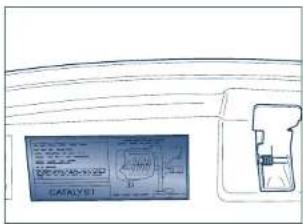
text_image
Technical diagram showing a 3D model with a labeled inset image and Chinese text annotationsHomologation plates
Instructions plates
- Lubricant plate.
– Tire specification plate;
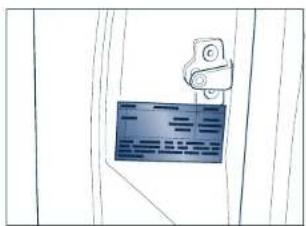
natural_image
Simple line drawing of a door with a mounted bracket and a blue screen (no text or symbols)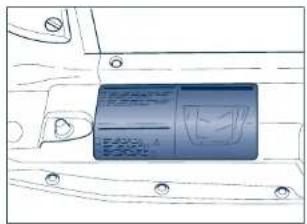
natural_image
Technical line drawing of a vehicle interior with no visible text or symbolsInstructions plates

Key codes
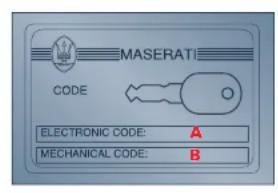
The two keys are provided with a CODE CARD, where you will find:
– the electronic code A to be used for "emergency starting";
- the mechanical code B for the keys, to be given to your Authorized Maserati Dealer in the case that you request duplicates of the keys.
WARNING: The code numbers shown on the CODE CARD must be kept in a safe place.
WARNING: You are advised to always keep the CODE CARD number with you, because it is absolutely necessary in the event of "emergency starting" (see on page 144).
WARNING: In the event of a vehicle ownership transfer, it is essential that the new owner is provided with all the keys and the CODE CARD.
WARNING: It is advisable to write down and keep the codes listed on the plates delivered with the keys and the remote control in a safe place (not in the car) in order to request duplicates if needed.
text_image
MASERATI CODE ELECTRONIC CODE: A MECHANICAL CODE: BKey codes
Electronic alarm device code
Rolling Code
Each time the radio operated control is used, the code changes.
Keep the plate with the Rolling Code with care and in a safe place. To order extra keys fitted with radio operated controls, contact your Authorized
Maserati Dealer indicating your complete Rolling Code.

text_image
CODE CARD 1-2 3.4.5.6.7 META WEDDElectronic alarm device code

text_image
20Active and passive safety
Seat belts 22
Proper transport of children 27
Front and side airbags 29
MSP System 34
ABS and EBD systems 35
ASR system (electronic anti-skid device) 37
Parking sensors (optional) 38
Fire extinguisher (optional) 41
Fuel cut-off inertia switch 42
Seat belts
The vehicle is equipped with seat belts with automatic retractors for maximum freedom of movement. The seat belts are equipped with electronically-operated pretensioners and the lower attachments points are connected directly to the seat, to help provide maximum protection whatever the seat position. The passenger seat belt is fitted with the KISI system, which improves safety when children are travelling in special child seats. The system is activated by pulling out the belt to its full length: once the child seat is securely fastened, the belt can no longer be pulled out and hence the belt/child seat system is exceptionally secure.

text_image
Diagram showing a tool interacting with two objects, labeled with point A and a crown iconSeat belts
When the belt is released and fully retracted, the system deactivates and resumes its normal operation.
Before fastening the seat belts make sure they are correctly fitted into the guide A on the seat.
No child under 12 should travel in the front passenger seat.
Fastening the seat belts
After recovering the lower part of the seat belt from the external side of the seat, grasp the connection tab to fasten the belt B and pull the seat belt out until the tab is fully inserted in the buckle C

text_image
Diagram showing hands using a switch to adjust a car seatbelt, labeled with points A, B, C, and D.The belt is correctly engaged when the lock clicks into position. Press the button D to release the seat belts. If the driver's seat belt is not fastened, when the ignition key is rotated into position MAR, the warning light on the instrument panel will switch on and a buzzer will activate for approximately 8 seconds.
The retractor locking device is designed to activate whenever the belt is pulled out too rapidly or in case of sudden braking or collision. If the belt locks due to too rapid extraction, allow it to retract a short distance to disengage the locking device.
The retractor allows the belt to automatically fit to the passenger's body, allowing him to move freely. When the vehicle is parked on a steep slope, the retractor may lock: this is normal.
WARNING: Feed the belt back into the retractor by hand to avoid twisting and snagging.
Front seat belt height adjustment

The seat belt height must be adjusted with the car stationary
Always adjust the height of the front seat belts in relation to the height of the driver and the passenger. This precaution can help to substantially reduce the risk of injury in the event of a collision. The belt is correctly adjusted when it passes about halfway between the neck and the shoulder. The seat belt upper anchoring point comes equipped with a swinging ring which can be moved in 4 different positions, allowing the height of the seat belts to be adjusted.

text_image
Diagram showing a car's seatbelt mechanism with labeled parts E and F, indicating directional movement or force vectors.To raise the anchoring point grip ring E directly; to move the anchoring point downwards use handle F.
After adjustment, always check that the slider to which the ring is fastened is locked in one of the set positions. Then, with the handle released, push downwards once more to allow the anchoring device to click into place in the event that it has not been released in one of the set positions.
Load limiting devices
To help increase passive safety, the front seat belt retractors are equipped with a load limiting device which is designed to make it possible to control the belt reeling out so that the force exerted on the shoulders while the seat belt is in restraining mode can be limited.
Pretensioners
To help make the front seat belts still more efficient, the vehicle is equipped with pretensioners.
These devices "are notified" by a sensor that the vehicle is in a collision and retract the belts slightly. This helps ensure that the belts adhere to the occupants' bodies before they brake their forward motion.
When the belt locks, this indicates that the pretensioners have been activated; a small amount of smoke may be visible.
The smoke is not toxic and is not indicative of fire.
Following the pretensioner activation, the seat belt can be normally released by pressing the button on the buckle.
Seat belts
The pretensioners do not require maintenance or lubrication. Tampering with the devices will compromise their efficient operation. If, as a result of exceptional natural circumstances (floods, heavy seas, etc.), the device has been in contact with water and or sludge, it is absolutely essential to replace it. To ensure the best protection from the pretensioners, secure the belt snugly across your chest and pelvis.
The pretensioners will operate only once, and will operate even if the belts are not fastened. Therefore, they must be replaced by your Authorized Maserati Dealer after they are activated. The units have a ten year service life from the date of manufacture; they must be replaced when their service life is near expiration.
Seat belts
WARNING: Work on the vehicle which involves blows, vibrations or localized heating (over 212 °F - 100 °C for 6 hours) in the area of the pretensioners may damage or activate them: vibrations due to bad road surfaces or mounting the pavement, for instance, should not affect the units. Please contact your Authorized Maserati Dealer if service must be carried out.
Do not tamper with the pretensioner components. Any intervention must be carried out only by qualified and authorized personnel. Always contact your Authorized Maserati Dealer.
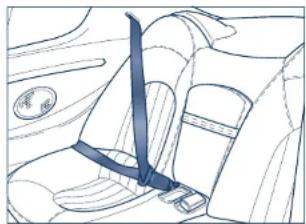
Use of the rear seat belts
The rear seat belts must be fastened as shown in the figure.
Remember that, in the event of a violent collision, passengers in the back seat who are not wearing seat belts not only take a serious personal risk but are also a danger to passengers in the front seats.
Wear the seat belts with your back in an upright position and leaning against the seatback. When the back seats are not occupied, fasten the seat belt buckles into their relative seats.
natural_image
Line drawing of a car seatbelt and seatbelt connector (no text or symbols)General warnings regarding the seat belts
The driver is obligated by law to respect and enforce the provisions of local legislation regarding the compulsory use of seat belts.
To help provide maximum protection, you are advised to keep the seatback in the most upright position possible and the seat belt close to your chest and pelvis. If the seat belt is loose, in the event of an accident you could move too far forward and could be injured. Travelling with the seatback too far reclined could also be dangerous: even if the seat belts are fastened, they may not work correctly. In fact, the belt itself may not be close enough to your body and, if it is in front of you, it could cause injuries in an accident. Also, in an accident, the lower section of the belt could press against the upper part of your stomach rather than the pelvic area, causing serious internal injuries.
Always fasten the seat belts. Traveling without the seat belts fastened increases the risk of injury in the event of a collision, even with the airbags, as airbags are designed only to provide supplementary protection. In the event of a collision, the seat belts are designed to help reduce the possibility of the vehicle's occupants being thrown against the parts of the passenger compartment or out of the vehicle. The airbags are designed to work together with the seat belts, not to substitute them. The front airbags only intervene in the event of certain head-on collisions of medium or high intensity; They will not be activated if the vehicle rolls over, or in the event of rear or low intensity frontal collisions, or front angular collisions.
Do not fasten your seat belt using the buckle for the other seat: in the event of an accident, the lower section of the belt could press against the upper part of your stomach rather than the pelvic area and cause you serious internal injuries.
It is extremely dangerous to travel with the belt positioned underneath your arm. In the event of an accident you could be thrown forward and could suffer head, neck, and other injuries. Also, if the belt presses against your ribs, it could cause serious internal injuries.
The belt itself must not be twisted. In an accident, the restraining force would not be distributed evenly across the belt and could consequently cause injuries. Make sure that it is snugly fitted to the occupants' bodies. The upper section of the belt must be correctly fitted in the seat guide and pass over the shoulder and diagonally over the chest. The lower section must be adhere to your pelvis, not the stomach, to avoid sliding forward in case of collision. Do not use devices (clamps, fasteners etc.) to hold the seat belts away from the passengers' bodies.
Seat belts

Do not carry children on a passenger's lap. Children must be seated in their own seat.

If the seat belt has been subjected to strong mechanical stress, for a time during a collision, it must be easily replaced together with its poses, the anchor point screws are pretensioner. In fact, even if the no visible defects, the seat would have lost some of its place.

Pregnant women must always observe local legislation regarding the use of seat make sure in any case that the section of the belt is secured own on the hips, below the anal region of the body.
Proper use of the seat belts
1) Always use the seat belts with the belt completely flat, not twisted; Make sure the belt can move freely and is not obstructed by anything.
2) The seat belts must be replaced any time the pretensioners are activated or whenever the belt is clearly damaged or worn.
3) Wash the seat belts by hand using water and Ph neutral soap, rinse them and allow them to dry in the shade. Do not use strong detergents, bleaches, colorants or other chemicals which may weaken the belt fabric.
4) Make sure the retractors do not get wet: they are designed to work correctly only if kept dry.
Proper transport of children
For the best protection in the event of a collision, all the vehicle's occupants must travel seated and protected by all the suitable restraining systems. The seat belts are designed to be used by persons whose physical characteristics (age, height, weight) are provided for by established legislation in each country. Anyone who does not comply with these provisions may not travel in the passenger seat.
This also applies to children. Their heads are proportionally heavier and larger than those of adults, while their bones and muscles are relatively undeveloped. For children to be restrained correctly in the event of a collision, suitable restraining or safety systems must be used.

No child under 12 should travel in the front passenger seat.
We recommend to carry children using suitable child-restraint systems and always in the back seat, as this is the most protected position in the event of a collision.
Children must never travel seated on a passenger's lap. A child weighs very little until a collision occurs! In a collision, a child becomes so heavy it is impossible to hold onto him or her. For example, in a collision at only 25 mph (40 km/h), a child weighing 12 lb (5.5 kg) exerts a force of 240 lb (110 kg) against the arms of the person holding him or her. Children must always be protected by a suitable restraining system when travelling.
Children who are resting on the airbag or are too close to it when it is activated, may be seriously injured. The airbags and pretensioners offer suitable protection for adults and teenagers, but not for children and babies. Neither the seat belts or the airbags are designed for them.
A child traveling in a rearward-facing seat could be seriously injured by an airbag being activated. This could happen because the seat back of the child's seat may be positioned extremely close to the airbag at the moment it is inflated.
The structure of a child's body is completely different from adult's or a teenager's (who the seat belts are designed for). A child's hips are so small that seat belt will not stay in the correct position on them. The belt may rise up on the child's stomach and, in the event of a collision, cause serious internal injuries.
Proper transport of children
The vehicle is equipped with three anchorage points (two lower and an upper one) for child seats, as provided by the country regulations.
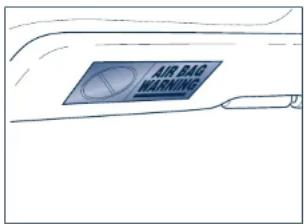
The vehicle is not provided with a manual deactivation switch for the passenger side airbag; it is prohibited to carry children on a rearward facing child-seat mounted on the passenger seat. This regulation is also indicated on the plates attached on the visors and inside the glove compartment.

text_image
WARNING ①Proper transport of children
text_image
AIR BAG WARNINGFront and side airbags
text_image
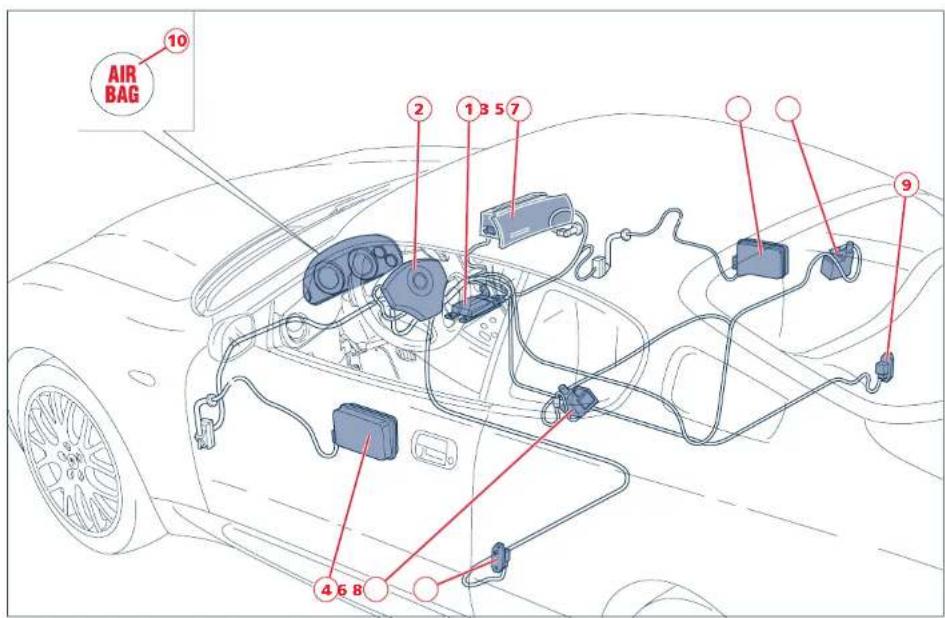
AIR BAG 10 2 1 3 5 7 9 4 6 8Front and side airbags
The vehicle is equipped with 4 airbags (2 front and 2 side) and electronically-controlled pre-tensioners for the front seat belts.
The system components connected to the ECU are as follows:
1) Electronic Control Unit
2) Driver's frontal airbag
3) Passenger's frontal airbag
4) Driver's side airbag
5) Passenger's side airbag
6) Front left-hand seat belt pretensioner
7) Front right-hand seat belt pretensioner
8) Left-hand satellite sensor
9) Right-hand satellite sensor
10) Air bag system failure warning light
Front airbags
The frontal airbags (for the driver and passenger) are safety devices which are designed to intervene in the event of certain head-on collisions.
It consists of an almost
instantaneously inflating bag
contained in a special housing:
– in the center of the steering wheel on the driver side;
– in the dashboard and with a larger size bag on the passenger side.
The frontal airbags (for the driver and passenger) are safety devices designed to help protect the occupants in the event of a medium or high intensity head-on collision, which act by placing a cushion (bag) between the occupant and the steering wheel or the instrument panel dashboard.
In the event of such a collision, an ECU is designed to process signals from a deceleration sensor and trigger, the inflation of the bag.
The bag inflates almost instantaneously between the front passengers and potentially harmful structures. The bag deflates immediately afterwards.

In the event of a collision,
anyone not wearing a seat belt will be thrown forward
and will come into contact with the bag before it is fully inflated. This reduces the protection offered by the bag. That the front airbags (driver and passenger side) do not replace or substitute the seat belts but supplement them, and hence the seat belts must always be worn as provided by established legislation in most states and other parts of the world.

Remember that, in the event
of a violent collision,
passengers in the back seat who are not wearing seat belts not only take a serious personal risk but are also a danger to passengers in the front seats.
In case of a low impact head on collision (in which the retaining action of the seat belts affords adequate protection), or front angular collisions, the airbags do not inflate. In case of a rear collision (e.g., impact from behind by another vehicle) or the airbags do not inflate as they do not offer any additional protection. Therefore the bag's failure to engage in these cases is not an indication of a system malfunction.
Passenger side airbag
The passenger side airbag is designed to afford supplementary protection to a person wearing the seat belt. It is larger than the driver's side airbag to fill the larger part of the space between the occupant and the dashboard.
Side airbags (side bags)
The side airbags are designed to help provide better protection for those in the front seats in the event of certain moderate to severe side-on collisions. They consist of almost instantaneously inflating bags housed in the door panels.
In case of a lateral collision, the electronic control unit processes the signals from the two satellite sensors mounted near to the rear wheelhouse to determine the local acceleration and it activates the side air bag if necessary. The side bag inflates by bursting through the special seam in the door knob.
The bag inflates instantaneously between the passenger body and the door. It then deflates immediately. In case of low impact lateral collisions (for which the retaining action of the seat belts affords adequate protection), the airbags are designed to not inflate.
It follows that the side airbags do not replace or substitute the seat belts but supplement them, and hence the seat belts must always be worn as provided by established legislation and in most state and other parts of the world.
WARNING: The front and/or side airbags may inflate if the vehicle suffers a violent impact beneath the car body, for example when hitting curbs, colliding with steps or speed bumps, potholes etc.
WARNING: Airbag inflation releases a small amount of powder. This powder is not harmful and does not indicate the presence of fire. Also, the surface of the deployed bag and the interior of the vehicle may be covered with a powdery residue: this powder may irritate skin and eyes. If contact occurs, wash with a pH neutral soap and water.
Front and side airbags
If the AUR warning light switches on when the vehicle is running (indicating a fault), contact your Authorized Maserati Dealer as soon as possible to have the system checked.
WARNING: The airbag system has a service life of ten years. When this expiration date is approaching, contact your Authorized Maserati Dealer.
In case of a collision with consequent airbag deployment, contact your
Authorized Maserati Dealer for replacement of the entire safety system, electronic control unit, seat belts, pretensioners, and to have the vehicle's electrical system checked.
All testing, repairs and replacement of the airbag system must be done by your Authorized Maserati Dealer.
Never remove the steering wheel. This operation, when needed, must be performed only by authorized personnel of your Authorized Maserati Dealer.
WARNING: To scrap the vehicle, please contact your Authorized Maserati Dealer to have the system deactivated.
If the vehicle is sold, the new owner must be informed of how to use the vehicle and of the aforesaid warnings and he must also be given the Owner's Manual.
The electronic control unit activates the pretensioners and front/side airbags on the basis of different criteria according to the type of collision. The fact that one or the other system do not activate is not indicative of system malfunction.
General warnings
When the ignition key is rotated to the MAR position the AR learning light switches on, but it should switch off after approximately 5 seconds. If the light fails to come on at this time, or stays on, or lights up when driving, contact your Authorized Maserati Dealer immediately.
Drive with both hands on the steering wheel so that if the airbag inflates it can do so freely without encountering obstacles which can cause serious injuries. Do not drive with the body curved forward but keep the seat back upright to support your back.
Do not apply stickers or other objects to the steering wheel or the passenger side airbag housing.
Do not travel with objects in your lap or in front of your chest a pipe, pencil or other object held in your mouth; in the event of a collision, the deployment of the airbag could result in serious injury.
Note that with the ignition key inserted and turned to the MAR position, even with the engine switched off, the airbags can inflate even if the vehicle is stationary, if it is run into by another vehicle. Thus, even with the vehicle stationary, occupants should be belted in their seats. On the other hand, the airbags will not inflate in case of collision with the vehicle stationary if the key is not inserted and turned; failure of the airbags to inflate in these circumstances is not indicative of system malfunction.
If the vehicle has been the object of theft or attempted theft, if it has been vandalized or involved in flooding, contact your Authorized Maserati Dealer to have the vehicle and the airbag system checked.
If service is carried out on the electrical system incorrectly, the airbag could be activated, thereby causing injuries to anyone in the vicinity.
The airbags do not replace the seat belts but afford supplementary protection. Furthermore, in case of low impact head-on, rear impact, or roll-overs, the passengers are protected exclusively by the seat belts, which must always be secured.
Do not wash the internal door panels with water or pressurized vapor.
MSP System
The vehicle is equipped with an MSP (Maserati Stability Program) yaw prevention monitoring system encompassing all of the vehicle's control systems: ABS, EBD, ASR and MSR. It has a model within it that predicts the vehicle's behaviour with extreme accuracy. The system is designed to detect whether the driver is about to lose control of the vehicle. In this case, it can activate the brake calipers individually and engine control, in order to create a torque sufficient to resist the vehicle's yawing moment.
text_image
Marshall HWD PWH AMSP System
Activating the MSP system
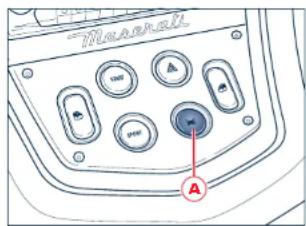
The MSP system is automatically enabled each time the engine is started. During the activation phases, the initials MSP switch on in green on the multi-function display. To disable it, press button A for about 2 seconds. When the system is disabled, the MSP initials, on the multi-function display and the LED on the button light up. Press button A to switch on the system again: the warning light on the multi-function display and the button led go off.
Fault signals
In the event of a fault, the system is automatically disabled and cannot be re-activated. When driving, this condition is signalled by the LED on the button switching off and by the initials lighting up on the multi-function display. When the engine is started, any system malfunction is signalled by the initials lighting up on the multi-function display.
WARNING In the event of a malfunction with the MSP disabled, the vehicle will react as if it were not equipped with this system. In any case, have the MSP system checked at the Maserati Service Network as soon as possible.
WARNING If you have to tow the car with 2 wheels raised, ensure that the ignition key is in the STOP position. Otherwise, with the MSP switched on, the respective control unit stores a malfunction in the memory resulting in the models lighting up on the instrument panel, which requires the intervention of the Maserati Service Network for resetting of the system.
WARNING In low grip conditions (when there is ice, snow, sand etc.) It is advisable not to use the SPORT mode function, even with the MSP enabled.
|ABS and EBD systems
The vehicle is equipped with ABS (Antilock-Braking System) and EBD (Electronic Brakeforce Distribution) systems which, via the ECU and the ABS sensors, help increase the braking system's performance.
In the event of an emergency stop or braking on slippery surfaces (where there is snow, ice, etc.), the ABS, together with the conventional braking system, are designed to allow the driver to apply maximum braking force without the wheels locking and the driver consequently losing control of the vehicle.
The system is based on an ECU which processes the signals transmitted by the 4 sensors located on the 4 wheels. When a wheel is tending to lock, the sensor warns the ECU which, in turn, informs to the electro-hydraulic unit to intervene by modulating the pressure exerted on the brake calipers. The driver will feel a "pulsing" sensation coming from the brake pedal, which is normal.
In the event of a failure, the system will be deactivated, but this will not affect the efficiency of the standard braking system.
The failure is indicated by the red warning ABS (ABX) switching on on the instrument panel.
In this case, we recommend you contact the nearest Authorized Maserati Dealer, which, thanks to the self-diagnostics system the vehicle is equipped with, should be able to identify the problem.
The vehicles must be fitted with wheel rims, tires and brake lining of the kind and make approved for this model by the manufacturer.
Although this device contributes greatly to the vehicle's safety, it is still essential to drive with particular care, especially when the road is wet or there is snow or ice on the road.
The vehicle is equipped with the EBD (Electronic Brakeforce Distribution) system. If the warning lights “BRAKE” switches on when the engine is running, this indicates a malfunction in the EBD system; in this case sharp braking could lead to the rear wheels locking too early, and the vehicle may skid. Driving extremely carefully, go directly to the nearest Authorized Maserati Dealer to have the system checked.
ABS and EBD systems
If only the warning light switches on while the engine is running, this normally indicates a malfunction in the ABS only. In this case, the braking system maintains its efficiency, but the anti-locking device cannot be used. In these conditions the EBD system may also function less efficiently. Also, in this case we recommend you go to your Authorized Maserati Dealer as soon as possible to have the system checked, avoiding any sharp braking while you drive.
If the low brake fluid warning light "BRAKE" comes on, you must stop the vehicle immediately and check the brake fluid level in the tank: if the level is below the minimum, top it up with the prescribed fluid and contact your Authorized Maserati Dealer to have the system checked. In fact, any fluid leaks from the hydraulic system will jeopardize the operation of both the standard braking and the ABS systems.
The system's performance, in terms of active safety, must not lead the driver to take unnecessary futile and unjustified risks. The vehicle must always be driven suitably with regard to the weather and road conditions, visibility and the traffic.
The maximum deceleration that can be reached always depends on the tires' grip on the road. Obviously, if there is snow or ice on the road, the grip is greatly reduced and therefore, in these conditions the braking distance is greater, even with the activation of the ABS system.
ASR system (electronic anti-skid device)
The ASR system helps prevent the driving wheels from skidding during acceleration via the engine's ECU action (delayed spark advance, reduced engine supply throttle opening and injection cut-off), and that of the rear brakes.
The ASR's action helps to increase the stability and the vehicle's active safety when it is running, especially in the following situations:
- internal wheel skidding on curves because of the dynamic variations of the load or excessive acceleration
– excessive power transmitted to the wheels, also in relation to road conditions - acceleration on slippery surfaces or where there is snow or ice,
– in the event of loss of grip on wet roads (aquaplaning).
The ASR acts in combination with the electronic suspension adjustment system: in normal conditions (SPORT mode disabled) stability is prioritized in low and medium grip conditions, while with the SPORT mode enabled the system gives priority to the traction, optimizing the vehicle's performance.
MSR function (engine braking torque adjustment)
The ASR system also helps control the engine braking torque when the accelerator pedal is released under low grip conditions (snow, ice etc.): in these conditions, in fact, the engine's high braking torque may cause instability of the vehicle.
The system, using the same sensors as the ABS, detects the skidding from one or both of the driving wheels when the accelerator is released and opens the engine supply motorized throttle, thereby reducing the braking torque and restoring the driving wheels' maximum grip conditions.
WARNING: The maximum deceleration that can be obtained with the engine brake still depends on the tire grip on the road. Obviously, snow or ice on the road greatly reduce the grip values.
Parking sensors (optional)
During parking maneuvers, the parking sensors provide the driver with information on the distance between obstacles found behind the vehicle. The information on the presence and distance of the obstacle is transmitted to the driver by warning beeps which sound with an increasing frequency as the vehicle approaches the obstacle. By supplementing his/her direct visual information with that provided by the system's warning sound signals, the driver may avoid potential collisions.

However, the driver remains responsible during parking maneuvers and in other
potentially dangerous situations. The system has actually been designed only as a supplementary aid during parking maneuvers, since it helps the driver to detect objects outside the field of vision.
Parking sensors (optional)
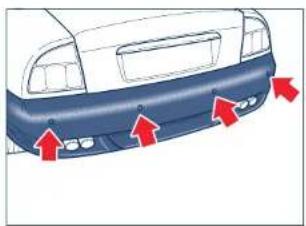
The parking system sensors, housed in the rear bumper, are activated automatically when the key is turned to the MAR position and the reverse gear is engaged. When the reverse gear is engaged, a beep warns the driver that the system is active. The system then begins to beep as soon as an obstruction is detected, with the frequency increasing as the vehicle approaches the obstacle. When the obstacle is located at a distance of less than 12 in (30 cm), the beep is continuous.
The warning beep stops immediately if the distance between the vehicle and the obstacle increases. The tone cycle is constant if the distance measured by the central sensors remains unaltered, while if this occurs with the lateral sensors, the signal stops after approximately 3 seconds, to prevent for example continuous beeps in the event of maneuvers alongside walls.
Sensors
To detect the distance of the obstacles, the system uses 4 sensors housed in the rear bumper.

For the system to operate correctly the sensors positioned on the bumper
must be kept clean (remove any mud, dirt, snow or ice).
WARNING: When cleaning the sensors, take special care not to scratch or damage them. Do not use dry, rough or hard cloths. The sensors must be washed with clean water, possibly with car shampoo added. In car-washes which use steam jet or high pressure cleaning machines, keep the nozzle at least 4 in (10 cm) away from the sensors.
Sensor range
The sensors allow the system to monitor the rear of the vehicle; in fact, their position covers the central and lateral zones at the rear of the vehicle.
If there is an object located in the central zone, it will be detected at distances of less than 1.64 yd (1.50 m). If the obstacle is located in a lateral position, it will be detected at distances of less than 24 in (0.6 m).
natural_image
Top-down view of a car's rear bumper with red arrows pointing to the side (no text or symbols)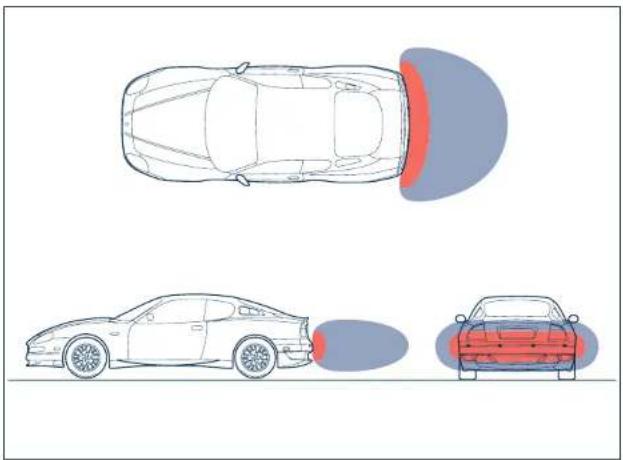
natural_image
Top-down diagram of a car showing front, side, and rear views with colored sensor or impact zones (no text or symbols)Parking sensors (optional)
Fault signals
The system's ECU runs all the checks on the components every time the reverse gear is engaged.
A parking sensor system failure is indicated by a continuous warning signal from the buzzer when the reverse gear is engaged.
In the event of a failure signal, stop the vehicle and rotate the ignition key to the STOP position. Then try cleaning the sensors or moving the vehicle away from any possible ultrasound sources
(e.g., pneumatic truck brakes or pneumatic hammers) and rotate the ignition key to the MAR position. This way, if the cause of the operating fault has been removed, the system will start functioning again automatically and the failure buzzer will stop.
If however, the failure beep continues, contact your Authorized Maserati Dealer to have the system checked.
WARNING: During parking maneuvers, always take the utmost care with obstacles that could be located above or underneath the sensors. In fact, in certain circumstances, objects located near the rear of the vehicle may not be detected by the system and therefore could damage the vehicle or be damaged themselves.
WARNING: The signals transmitted by the sensors can also be altered by damage to the sensors or by dirt, snow or ice on the latter or even by ultrasound systems (e.g. pneumatic truck brakes or pneumatic hammers) in the vicinity.

The driver remains responsible during parking maneuvers and in other ally dangerous situations.
When these maneuvers are performed, always make sure there are no people (especially children) or animals in the maneuvering area. The parking sensors are only a supplementary aid for the driver.
Fire extinguisher (optional)
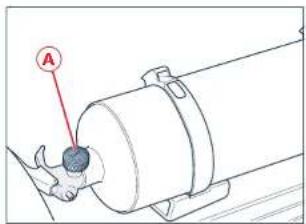
A portable fire extinguisher is located on the passenger compartment floor for immediate accessibility in case of need. The extinguisher is fastened by means of special brackets.
Charged with powder, it has a 4.4 lb (2 kg) capacity (8 second nominal discharge time) and does not contain chlorofluorocarbons.
Check the pressure and the charge status using the pressure gauge A regularly.
The fire extinguisher must always be fastened to its special brackets. If it is not used, we recommend you remove the entire device to free the passenger foot area from the fire extinguisher brackets.
WARNING: To use the fire extinguisher, follow the specific instructions indicated on the device.
text_image
AFire extinguisher (optional)
Fuel cut-off inertia switch
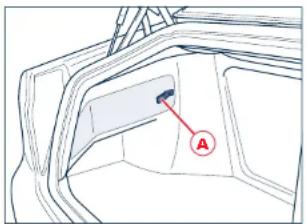
The vehicle is equipped with a safety switch which is designed to intervene in the event of a collision, cutting off the fuel supply and consequently causing the engine to stop. It also prevents the fuel spreading if the fuel lines are damaged during the accident. The intervention of the safety switch is indicated by the warning light appearing on the instrument panel. The switch is positioned inside the left-hand service compartment, in the luggage compartment. To gain access to the switch, open the compartment hatch by pulling the handgrip A.
After impact, if you smell fuel or note any leakage from the fuel supply system, do not reactivate the switch in order to prevent any fire risks. Contact your local Authorized Maserati Dealer immediately.
Resetting the switch
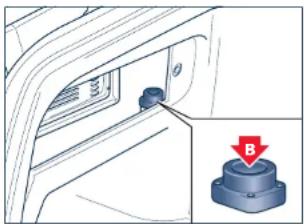
Rotate the ignition key to the STOP position. Check that there is no leakage from the fuel system. If no leaks are found, reset the inertia switch which stops the fuel pump operation, by pressing the button B on the switch. Rotate the ignition key to the MAR position, wait for a few seconds and then move it to the ACC. position.
Check that the meaning light on the instrument panel is switched off. Check once again that there are no fuel leaks.
text_image
Technical diagram of a vehicle rear compartment with labeled component A and a red arrow pointing to the interior area.Fuel cut-off inertia switch
natural_image
Interior view of a car showing a door panel with a knob and a labeled component (no text or symbols visible)Instruments and controls
Dashboard (version with "Cambiocorsa" gearbox) 44
Instrument panel 46
Indicators and warning lights 48
Instruments and indicators 51
Trip odometer reset button 55
Instrument panel dimmer switch 55
Controls and interior equipment 56
Dashboard (version with "Cambiocorsa" gearbox)
text_image
1 2 3 4 5 6 7 8 9 10 11 12 13 14 15 14 15 16 17 19 20 21 24 22 23 28 27 26 19 18 25 31 32 30 29 33Dashboard (version with 'Cambiocorsa' gearbox)
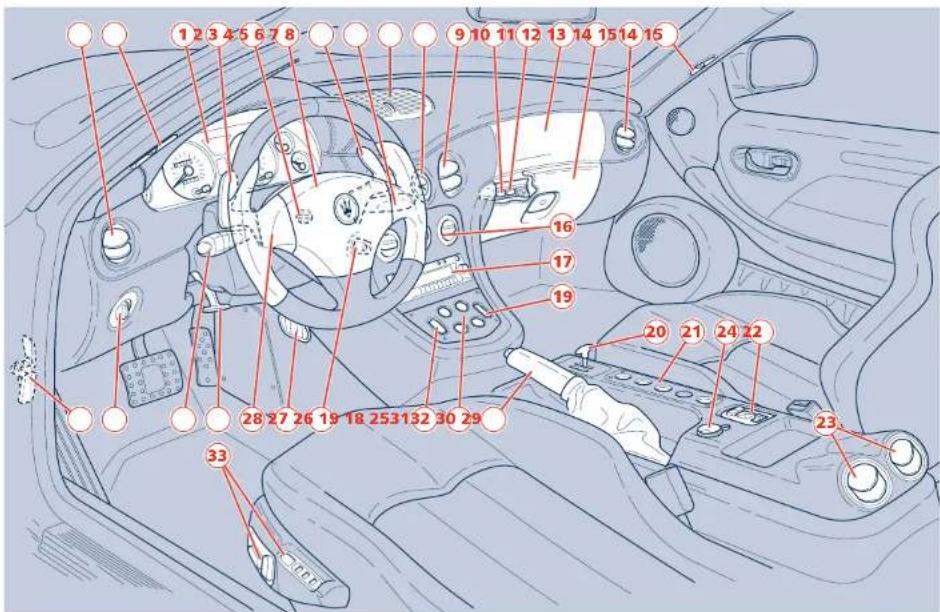
1) Instrument panel
2) Lower gear activation lever DOWN
3) Interior temperature sensor
4) Driver's airbag
5) Upper gear activation lever UP
6) Windshield/headlight wiper/washer control lever (optional)
7) Upper ventilation and heating outlet
8) Clock
9) Central air-conditioning and heating vents
10) Fuel tank flap control button (located in the glove compartment)
11) Luggage compartment lid control button (in the glove compartment)
12) Passenger's airbag
13) Glove compartment
14) Air conditioning and heating
system vents
15) Side window vents
16) Ventilation and heating controls
17) Stereo
18) Dashboard switch cluster
19) Electric window controls
20) Joystick for shifting to 1 ^st and reverse gears
21) Tunnel switch cluster
22) External rear-view mirror controls
23) Rear air-conditioning and heating vents
24) 12-Volt socket
25) Handbrake lever
26) Starter/steering wheel lock switch
27) Lower air-conditioning/heating vents
28) Horn control
29) Steering wheel height and depth adjuster lever
30) Cruise Control control lever (optional), direction indicators and low/high beam switch
31) External lights control
32) Hood opening lever
33) Seat adjustment controls
Instrument panel

text_image
USA - CDN version 3 4 5 6 7 8 9 10 11 12 13 14 15 16 21 MSP OEP SPORT OILUSE AUTO LEVEL ICE 22 23 24 25 30 20 19 29 28 27 26 mpk mpx x 1000 1/2 volt 17 18 2 1 270 195 T psi 100 120 140 160 180 200 22 23 24 25Instrument panel
1) Oil pressure gauge and low pressure warning light
2) Coolant thermometer and high temperature warning light
3) Front seat heating warning light
4) Parking lights/low beams warning light
5) Rear fog light warning light
6) Air bag/pretensioners failure warning light
7) Light failure warning light
8) High beams warning light
9) Warning light for OBDII engine control system failure
10) Catalytic converter high temperature warning light
11) ABS system failure warning light
12) Front brake pad worn/low brake fluid warning light
13) Handbrake on warning light
14) Direction indicator warning light
15) Maserati CODE system warning light
16) Driver's seat belt warning light
17) Voltmeter and generator warning
light
18) Fuel level gauge and low fuel indicator
19) Tacometer
20) Instrument panel dimmer switch
21) Multi-function display
22) Doors, engine/luggage
compartment open display
23) Inertia switch activated warning light
24) Front brake pad worn/low brake fluid warning light
25) Indicator for "Cambiocorsa" gear engaged / parking lights on
26) External temperature gauge
27) External temperature LED: it switches on when the temperature is equal to or lower than 36 °F (+2 °C) (icy road surface hazard)
28) Electronic alarm device LED
29) Speedometer with trip and total distance odometer
30) Trip odometer reset button
Indicators and warning lights

Seat heating (optional)
Indicates that the heating device of one or both front
seats is turned on.

Parking lights/low beams
It switches on when the dipped lights, low beams or lights are turned on.

Rear fog lights
This lights up when the rear fog lights are switched on.

Airbag/pre-tensioner failure
When the pre-tensioner and/or airbag system is defective.

Turning the key to MAR, the light comes on but it should go out after a few seconds the engine running.

If the light stays on or if it does not come on or if it comes on during running,
stop immediately and consult the your Authorized Maserati Dealer.

Light failure warning light
It switches on in the case of system failure or burning-out of the bulbs for the parking, license plate, stop or rear fog lights.

High beams
When the high beams are turned on or flashing.

Engine control system failure OBDII
Under normal conditions, the warning light should switch on when the ignition key is turned to the MAR position and switch off as soon as the engine is started. This will show that the warning light is working properly. If the warning light remains on or switches on while driving, it indicates that there is a failure in the fuel supply/ignition and emission control systems. The failure could cause high exhaust emissions, loss of performance, poor driving conditions and high fuel consumption levels.
Under these conditions you can proceed slowly without demanding engine performance or high speed. Prolonged use of the car when the warning light is on can cause damage. For this reason, you should contact your Authorized Maserati Dealer as soon as possible. The warning light will go out if the problem disappears. The error will be stored by the system in any case.
WARNING: When you turn the ignition key to the MAR position and the does not light up or switches on when driving the car, contact your Authorized Maserati Dealer as soon as possible.
SLOW DOWN
Catalytic converter high temperature warning light
Turning the key to MAR the warning light comes on for self-diagnosis, but should go out after starting the engine.
This warning light starts flashing or comes on with a fixed light when engine malfunction results in high exhaust system temperature.

WARNING LIGHT FLASHING: catalyst temperature is too high. Reduce speed
immediately until the warning light goes out and then drive carefully at moderate speed. Contact your
Authorized Maserati Dealer as soon as possible for service.

IF THE WARNING LIGHT CONTINUES FLASHING OR STAYS ON AFTER HAVING
REDUCED THE SPEED: dangerous temperature in the catalytic converters, catalysts can be damaged. Stop the car immediately and have it towed to the nearest Authorized Maserati Dealer for service.

Maserati declines all responsibility any damage caused from non compliance above mentioned warnings.

Defective wheel anti-lock system (ABS)
Switches on when a problem is detected in the ABS system is defective. The normal brake system remains operational, but it is advisable to contact your Authorized Maserati Daler as soon as possible.
BRAKE
Front brake pads worn/brake fluid low
Switches on when the front brake pads reach the wear limit or the brake fluid level drops below the minimum level. The operation of the warning light can be checked by pressing the button on the brake fluid reservoir cover located in the engine compartment.
When replacing the front brake pads, also check the rear brake pads for wear.

If the warning light comes on when the car is travelling immediately check brake fluid
level. If fluid level is below the minimum limit there could be a leakage. Contact your Authorized Maserati Dealer before restarting the car.

Handbrake on
The warning light flashes when the handbrake is operated.

Direction indicators
This lights up when the direction indicators or
the hazard lights are switched on.

Maserati CODE
When the ignition key is turned to the MAR position,
it may switch on under three possible conditions:
- One flash - key code recognized. The engine can be started.
- Fixed light - key code not recognised. To start the engine, follow the emergency starting procedure as specified in the chapter "emergency situations", after having attempted to start it with other keys.
- Flashing light - vehicle not protected by the Maserati CODE. The engine can, however, be started but, contact your Authorized Maserati Dealer as soon as possible because the car is not protected against attempts at theft.

Seat belts
Switches on when the driver's seat belt is not fastened or fastened incorrectly. A buzzer is also activated for 8 seconds when the light is on.

Fuel shut-off inertia switch on
Switches on when the inertia switch has been activated following a collision, thereby shutting off the fuel supply.

After impact, if you smell fuel or leakage is noted from the fuel system do not re-activate such in order to prevent the risk. Contact your local Authorized Dealer immediately.
Instruments and indicators
1 - Oil pressure gauge
It indicates the engine oil pressure. In normal operation, the needle must be at the center (35 to 70 psi) (2.5 to 5 bar). If it moves towards 0 and at the same time the warning light switches on, stop the car and carry out the necessary checks. The warning light also switches on when the ignition key is turned to the MAR position, but it should switch off as soon as the engine starts. A delay in the light going out is permitted only when the engine is idling. If the engine has been required to work at maximum rate, the warning light may flash with the engine idling but it should go out when accelerating lightly.
2 - Coolant temperature gauge
It indicates the temperature of the coolant. If the needle indicates high temperature and at the same time the warning light switches on, stop the car immediately and have the cooling system checked by your Authorized Maserati Dealer.
19 - Tachometer
It indicates the engine's r.p.m. Correct driving allows the driver to utilize the engine performance fully, without the need for over-revving.

text_image
35 70 psi
text_image
195 1.20 270 °F 35
text_image
Mineral Gaussvort rpm x 1000Instruments and indicators
17 - Voltmeter
It indicates the battery voltage and the consequent normal operation of the charging system. With the battery in good condition, the engine off and the starter key in MAR position, it is located between 10V and 13V.
With the engine running the indicator moves to values over 13V. The low recharge warning light inside the voltmeter indicates possible problems in the recharging system.
When the starter key is turned to the MAR position, the warning light switches on, but it should switch off as soon as the engine starts. Any delay in its switching off with the engine idling is not indicative of malfunctioning.
18 - Fuel level gauge
The warning light inside the instrument switches on to indicate that there are about 5 US gallons (18 liters) fuel left in the tank.

text_image
14 10 16 volt 1/2Instruments and indicators

text_image
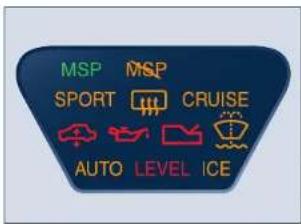
1/2 2 4/421 - Multi-function display
MSP Switches on when the MSP
system is activated.
Indicates deactivation or failure of the MSP system
MSP
SPORT Indicates electronic
suspensions "sport" setting. This indicates the defroster for the rear window and external rear-view mirrors is switched on.
↑↑↑
CRUISE Indicates that the Cruise Control is activated.

Indicates a failure in the electronic suspensions system.

Engine oil pressure low.

Indicates a failure in the "Cambiocorsa" gearbox. Indicates windshield/headlight washer fluid low.
AUTO Indicates that the
"automatic transmission" mode is set for the "Cambiocorsa" gearbox.
LEVEL Indicates low
"Cambiocorsa" gearbox oil level.
ICE Indicates that the "low grip" mode is set for the "Canciocorsa" gearbox.
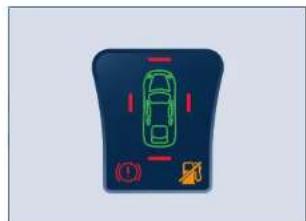
22 – Doors and engine/luggage compartment open display
Indicates that doors and hood/trunk are open or not properly closed.
natural_image
Top-down view of a car control panel with red and green indicator lights (no text or symbols)Instruments and indicators
text_image
MSP MSP SPORT CRUISE AUTO LEVEL ICE26 – Indicator for "Cambiocorsa" gear engaged / parking lights on
When the ignition key is turned to the MAR position, it indicates that the
"Cambiocorsa" gear is engaged:
- N (neutral)
-R (reverse) - 1 (1 ^st gear)
-2 ( 2^nd gear)
-3 (3 rd gear)
-4 (4th gear)
-5 ( 5^th gear)
-6 (6 ^th gear)
When the key is removed, it indicates, through the warning light P ≤slant , that the parking lights are on.
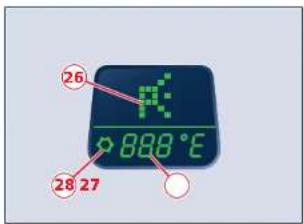
27 - External temperature gauge
Indicates the external temperature in ^ C or ^ F, according to the market.
WARNING: When the letter "E" is displayed for several seconds (when starting the engine and before the outside ambient temperature appears) it indicates a malfunction in the heating/air-conditioning system. Contact your Authorized Maserati Dealer as soon as possible for service.
28 - Outside temperature LED
Switches on when the outside temperature is equal to or lower than 36 °F (+ 2 °C) to indicate the risk of icy road surfaces.

text_image
26 888 °CInstruments and indicators
text_image
26 888°C 28 27Trip odometer reset button
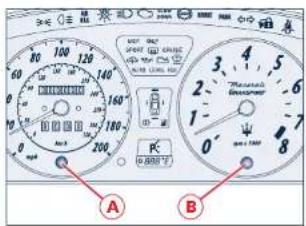
Press button A to set the trip odometer to zero.
Instrument panel dimmer switch
Turn button B, with the external lights on, to adjust the instrument panel lighting.
text_image
A BTip Odometer reset button / Instrument panel dimmer switch
Controls and interior equipment
Hazard warning lights
Press button A to turn on the hazard warning lights. Their operation does not depend upon the position of the ignition key. Press the button again to turn them off.
When these lights are on, the directional indicators, the related warning lights on the instrument panel and the button are flashing.
WARNING: When the hazard warning lights are activated, the directional indicators control is disabled.
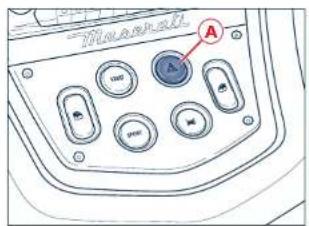
MSP system
The MSP system is automatically activated when starting the engine. It is possible to disconnect or reconnect the system during running by pressing button B. To prevent inadvertent deactivation, the button is to be pressed for about 2 seconds for deactivating the MSP system. When the MSP system is on, the button led is off, when the system is on the MSP warning light on the multifunction display lights up. When the system is off, the LEDs on the pushbutton and the letters MSP the multifunction display light up.
SPORT setting
Pressing button C will select the SPORT mode, which sets the suspensions, traction control and Cambiocorsa gearbox (if available) to a racing-type driving style.
Please note that selecting the SPORT mode strongly decreases driving comfort, especially in city traffic and on uneven roadbeds.
text_image
Air vent AControls and interior equipment

text_image
Maserell A B
text_image
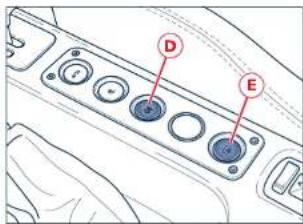
Airbox CRear fog lights
Press button D to switch on the rear fog lights. They only work with the front fog lights or low beams on. The LED on the pushbutton switches on when the lights are on.

Do not use the rear fog lights in normal visibility conditions to avoid dazzling vehicles
Heated side window and side-view mirror defroster
Activation of the heated side window and of the side rear view mirror defroster is only possible when the ignition key is in the MAR position and by pressing button E. Although activation of the heated side window is timed, it is advisable to turn it off as soon as the window is cleared of mist or frost to avoid overloading the battery. When the heated side window is activated, the LED on the button lights up.
WARNING: To prevent the battery from going flat, it is advisable to activate the heated side window only when the engine is running.
12-Volt socket
WARNING: The current plug is powered only when the key is turned to MAR and it can only be connected to devices with a power absorption of 15A maximum (180W power). Do not connect devices with a higher power absorption to the current plug. A prolonged power absorption can discharge the battery, preventing the engine from being started once again.
To access the socket, lift the cover.
text_image
Diagram of a car interior with labeled buttons D and E pointing to circular control elements
natural_image
Top-down view of a car interior showing the dashboard with a blue circular icon and control buttons (no text or symbols visible)Controls and interior equipment
Opening the luggage compartment
Press pushbutton F (located inside the glove compartment) to open the trunk lid.
Vehicles are also equipped with a lever inside the luggage compartment, which permits opening from the inside.
Opening the fuel tank flap
Press the G pushbutton (inside the glove compartment) to open the fuel tank flap on the right-hand rear side of the car.
Clock
Press pushbutton H to set the clock: slight pressure = slow adjustment prolonged pressure = fast adjustment. The clock lights up when the external lights are turned on.

text_image
FControls and interior equipment

text_image
Diagram showing a device with labeled component G and a directional arrow indicating rotation or movement
text_image
Technical diagram of a pressure gauge with labeled component H and directional arrowFront overhead lights
The overhead lights include one central light and one reading light. The central light switches on automatically when one of the doors is opened and switches off a set period of time after they are closed. It can also be switched on manually by pressing button L. The reading light is controlled by button M.
Rear overhead lights
The rear overhead lights N, which switch on automatically when one of the doors is opened and off again after a set time period, are activated manually by pressing the transparent panel at point P.
Sun visors
These can be positioned to the front or to the side. To place the visor sideways, lower it and unhook it from the retainer Q.
The vanity mirror is accessed by lowering the passenger side visor. Its built-in light switches on automatically (with the ignition key on MAR) when the protective cover is opened. Before raising the visor, close the mirror cover.

text_image
L M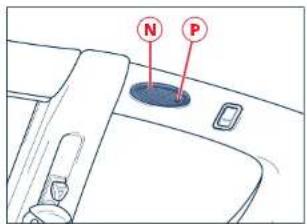
text_image
N P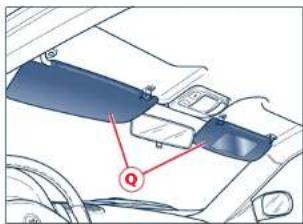
text_image
Diagram of a vehicle interior showing labeled components with red annotation 'Q'Controls and interior equipment
Glove compartment
It is positioned in the lower part of the dashboard on the passenger's side, and the opening pushbutton R is equipped with a lock. The compartment is lit by a courtesy light when it is opened.
The glove and luggage compartment locks cannot be operated using the "garage" key. This key therefore, can be used when leaving the vehicle with a garage or parking facility, as it allows the staff to move the car but not to open the glove compartment (if it is closed beforehand with the main key) or the luggage compartment (see on page 67).

To ensure passenger safety, the glove compartment must always remain closed when is running.
Seat pockets
The front seats come equipped with a map pocket on the back.
WARNING: Do not store heavy or pointed objects in the seat pockets.

natural_image
Diagram of a biological structure with a highlighted region and label R (no text or symbols present)Controls and interior equipment

natural_image
Line drawing of a car interior showing handle, seat, and dashboard components (no text or symbols)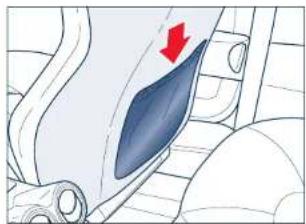
natural_image
Diagram of a car interior showing a blue vehicle and a red arrow indicating direction (no text or symbols)Coat-hooks
These are found in the rear of the passenger compartment. To pull out a hook press button S. To reposition it back, push it upwards in its seating.

When the hooks are not in use, turn them to the closed position.

text_image
Diagram showing a car interior with a sensor labeled 'S' pointing to a device, alongside a vehicle on the surface.Controls and interior equipment

text_image
62Before you drive
Doors 64
Engine compartment hood 66
Luggage compartment 67
Fuel tank flap 68
Keys 69
Ignition switch 72
Electronic alarm device 73
Front seats 78
Rear seats 82
Side-view mirrors 83
Steering wheel 85
External lights and directional indicators 86
Windshield wipers and headlight washers (optional) 88
Sound system 90
Air conditioning and heating system 92
Specific luggage set (optional) 99
Doors
Opening doors from the outside
Switch off the alarm device and the centralized door locking by the electronically operated control (see paragraph "Electronic alarm device" on page 75).
With the central lock released, lift the handle to open the door. With alarm device off it is possible to open the door by inserting and turning the key in the lock of one of the doors. Never use the lateral aerodynamic extensions located underneath the door as a step. They are not designed to support the weight of a person and could cause injuries if they break.

Never use the lateral
aerodynamic extensions
located underneath the door
as a step.

natural_image
Diagram of a blue battery handle with a red arrow indicating direction (no text or symbols)Doors
They are not designed to support the weight of a person and could cause injuries if they break.
From the inside
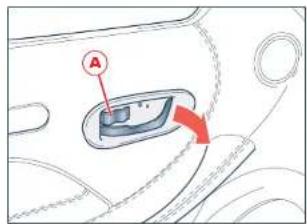
The central door lock is switched on or off from the inside of the car using the safety button A on any one of the doors.
The central door locking is automatically released by pulling the internal handle of one of the doors.
WARNING: If one of the doors is not closed properly or there is a problem in the system, the central door lock will not switch on and after some attempts, the device is disabled for several minutes. During that time, the doors can still be locked or unlocked manually without the activation of the electrical system.
text_image
AAfter this period the unit is once again ready to receive instructions. If the cause of the malfunction has been eliminated, the device will resume normal operation. If not, the disabling cycle will be repeated.
Door open warning lights
These warning lights, on the instrument panel, come on when the doors, engine and luggage compartment lids are not properly closed.
Power windows
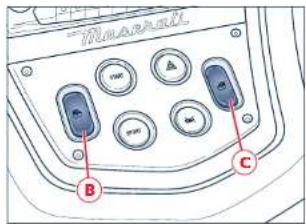
Activation is possible only with the ignition key in the MAR position. The controls are found on the central console, in front of the gearshift lever. B - Open/close front left-hand window C - Open/close front right-hand window.
text_image
B CPressing the window button on the driver side B with the key in the MAR position operates the window in automatic mode: the window is closed when it reaches the limit stop (or by pressing the button again).
WARNING: If the power window is operated with the door open, the window stops before reaching the upper threshold to prevent interference with the strip when closing the door.

When the door is opened, the window is slightly lowered and then closes automatically after the door is closed: take the utmost care to avoid passengers (especially children) being near the windows when opening/closing the doors.

Improper use of electric window controls can be dangerous. Check that passengers are away from the side windows before closing them. Always remove the ignition key when you get out of the car in order to avoid accidental activation of the power windows - they can be hazardous for passengers remaining in the car.
Never leave children unattended inside the vehicle: if one or both doors are open or not closed properly, both power windows work even if the ignition key is in the STOP position or if it has been removed. The possibility of the window controls being operated can be very dangerous.
Leaving children in a parked car with the windows shut is dangerous. The temperature inside the car can reach very high levels, causing fainting and serious injury.
WARNING: Before disconnecting the battery, lower the side windows by at least 1.5-2 in (4-5 centimeters), in order to avoid damaging the strips when opening and closing the doors. When the battery is connected and loaded, this operation is carried out automatically upon opening and closing the door. The windows must remain lowered until the battery is connected once again. If the battery runs flat when the windows are fully raised, open the door only if necessary and taking utmost care. Do not close the door as long as the window cannot be lowered.
Door open indicator
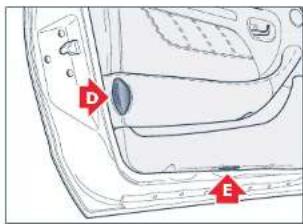
Each door is fitted with a reflector D fitted to the door panel.
Buzzer
An intermittent buzzer is activated when, with the driver's door open, the ignition key is turned from position "0" to position "II".
Door courtesy light
Each door is equipped with a courtesy light E, fitted on the lower part of the door panel to light up the access/exit area of the car.
text_image
Diagram of a car door panel with labeled buttons and indicators, including D and E labelsDoors
Engine compartment hood
To open the engine compartment hood: pull lever A located on the lower left hand side of the dashboard.
WARNING: If necessary, the engine compartment hood can be released by pulling the eyelet on the emergency cable found near the lever.
Release the safety device by lifting button B located in the middle of the grille.
Lifting the engine compartment lid: The procedure is facilitated by the side gas struts.
The engine compartment lid positions itself at the maximum opening position and does not require support stays.
To close the engine compartment lid: lower it to about 8 in (20 cm) from the engine compartment and let it drop; it closes automatically.

Always check that the hood is properly shut so that it cannot open while the car is moving.

text_image
Technical diagram showing a mechanical component with labeled parts and a red arrow indicating direction or force.Engine compartment hood

text_image
Diagram showing a person climbing a car with labeled points B and a red arrow indicating directionLuggage compartment
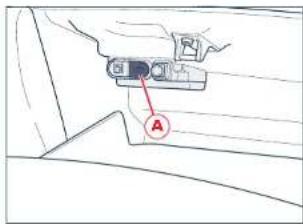
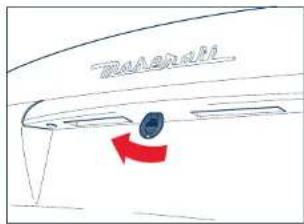
The luggage compartment trunk can be opened from the inside or outside of the car. To open it from the inside use button A, which is found in the glove compartment.
To open the trunk from the outside, use the ignition key.
Raising the lid is is facilitated by the action of the gas struts.
Vehicles are also equipped with a lever inside the luggage compartment, which permits opening from the inside. In addition, the glove and luggage compartment locks cannot be operated using the "garage" key. This key therefore, can be used when leaving the vehicle with a garage or parking facility, as it allows the staff to
text_image
Diagram showing a mechanical component with labeled point A and directional arrow, likely from an engineering or manufacturing context.move the car but not to open the glove compartment (if it is closed beforehand with the main key) or the luggage compartment.
WARNING: The struts are calibrated to help ensure proper operation with the weights specified by the manufacturer. Arbitrary additions of objects (spoilers, trunk racks, etc.) can jeopardize proper operation and safety in the use of the luggage compartment lid.
When using the trunk, never exceed the maximum loads allowed (see chapter 7, "Capacities and Technical Specifications"). Also check that the objects contained in the trunk are arranged properly.
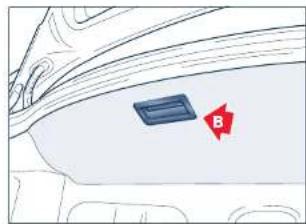
The luggage compartment is illuminated by the ceiling light B which switches on automatically when the lid
text_image
TOMATOis opened and it switches off after a timed interval.
If the luggage compartment lid is left open, the light switches off after several minutes. To switch it on again, close the lid and then re-open it.
natural_image
Diagram of a car interior showing a blue rectangular object and a red star labeled 'B' (no text or symbols beyond the label)Luggage compartment
Fuel tank flap
The fuel tank flap is found on the right-hand rear side of the car. To open the flap, press pushbutton A which is located inside the glove compartment. The cap's hermetic seal may result in a slight pressure increase in the tank. Any hissing noise while the cap is being released is normal.
When refueling, the cap must remain hanging from the flap by means of the respective hook B. The cap is joined to the filler neck with a strap to prevent misplacement while refueling. The flap must be re-closed manually. Before closing the flap, check that the fuel filler cap is fully tightened.
Do not bring open flames or lit cigarettes close to the filler because of the risk of fire! Also do not put your face close to the filler so as not to inhale noxious fumes.
Fuel tank flap emergency opening
If necessary the flap can be opened by pulling the cable C located on the right hand side of the luggage compartment.
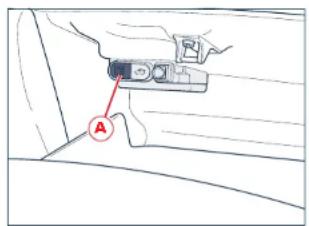
text_image
Diagram showing a hand holding a device with labeled point A and a small inset image showing a letter R.Fuel tank flap
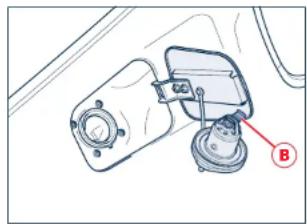
natural_image
Mechanical component diagram showing a housing and mounting bracket with labeled point B (no text or symbols beyond label)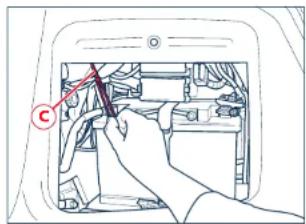
text_image
Technical diagram showing a hand operating a mechanical component with labeled point CKeys
The Maserati CODE system
In order to increase protection against attempts at theft, the car is equipped with an electronic engine immobilizer system (Maserati CODE), which is automatically activated when the starter key is removed.
Each starter key contains an electronic device which transmits a code signal to the Maserati CODE control unit, and engine ignition is enabled only if the key code is recognized by the system. The keys supplied are two of type A and one "valet" key, B.
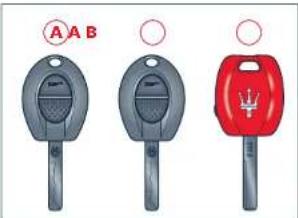
text_image
A A B ○ ○Key A can be used for all functions. Key B is used for:
- ignition
- alarm activation/deactivation. It can be used when the vehicle is left with a garage or parking facility, as it allows the staff to move the car but not to open the glove compartment (if it is closed beforehand with the main key) or the luggage compartment.
Operation
Each time the ignition key is removed from the STOP position the protection system activates the engine immobilizer.
Upon starting the engine, when the key is turned to the MARMAR position: 1) If the code is recognized, the CODE on the instrument panel turns off within a second, while the OBDII warning light, once the ECU diagnosis has been completed switches off after about four seconds. Under these conditions, the protection system recognizes the key code and deactivates the engine immobilizer. The engine starts when the key is turned to MAR and the START button is pressed.
2) If the warning light CODE remains on and the warning light OBDII switches off and comes on again immediately, after the four second diagnostics for the ECU control units, the code has not been recognized. In this case, it is advisable to turn the key back into position STOP and then back to MAR; if the immobilizer stays on, try with the other keys. If it is still not possible to start the engine, try the emergency start-up procedure (see chapter "Emergency starting" on page 144) and contact your Authorized Maserati Dealer.
Driving with the ignition key on MAR: 1) If the warning light CODE switches on, it means that the system is carrying out a self-diagnosis check. At the first stop you can test the system: turn the engine off by rotating the ignition key to the STOP position and then turn the key back into position. MAR: the warning light CODE switch on and off within a second. If the LED stays on, repeat the procedure described previously leaving the key at STOP for more than 30 seconds. If the problem persists, please contact your Authorized Maserati Dealer.
Keys
2) If the warning light CODE is flashing, it means that the vehicle is not protected by the engine immobilizing device. Contact your Authorized Maserati Dealer immediately to have all the keys stored in the memory.
WARNING: Strong impact can damage the electronic components in the key.
WARNING: Each key supplied has its own specific code, which must be stored in the memory of the system control unit.
Duplicating the keys
When ordering additional keys, remember that memorizing (up to maximum of 7 keys) must be carried out on all the keys, including those already in your possession. Contact your Authorized Maserati Dealer directly, bringing with you all the keys in your possession, the Maserati CODE system CODE CARD, the electronic alarm device CODE CARD, a personal ID and the identification and registration documents proving ownership of the car. The codes of any keys that are not available when the new storage procedure is carried out will be deleted from the memory to prevent any lost or stolen keys being used to start the car.
Emergency starting
If the Maserati CODE is unable to deactivate the engine immobilizer, the warning light CODE remains on, whereas the warning light OBDII switches off for four seconds to come on again immediately, and the engine does not start. The engine can only be started with the emergency procedure.
WARNING: It is recommended to read the whole procedure through carefully before carrying it out. If an error is made, turn the key back into position STOP And repeat the procedure starting from step 1.
1) Read the 5-digit electronic code found on the CODE CARD.
2) Turn the key to position MAR: at this point, the CODE 🔒 and OBDII warning lights stay on.
3) press the accelerator pedal down and keep it pressed. After about 8 seconds, the warning light OBDII switches off. Release the accelerator pedal and count the number of times the warning light OBDII flashes.
4) Wait until the number of flashes is the same as the first digit on the CODE CARD and then press the accelerator pedal down and keep it pressed until the warning light OBDII switch off, after being lit for about 4 seconds, then release the accelerator.
5) The warning light OBDII will start flashing again. As soon as the displayed number of flashing is equal to the second digit of your CODE
CARD, press down the accelerator pedal and keep it pressed.
6) Proceed in the same manner for the remaining digits in the code on the CODE CARD.
7) When the last digit has been entered, keep the accelerator pedal pressed down. The warning light OBDII
will switch on for 4 seconds and then switch off; release the accelerator.
8) Rapid flashing of the warning light OBDII (for about 4 seconds) confirms that the procedure has been completed.
s9) Start the engine by turning the key to position MAR.
If the warning light OBDII remains on, turn the key to position STOP and repeat the procedure from step 1.
WARNING: After an emergency start-up procedure, we advise you to contact your Authorized Maserati Dealer since the emergency procedure must be performed after each start.
Ignition switch
The ignition key can be turned to 3 positions:
STOP - Engine off, engine immobilizer and steering wheel lock activated, connected devices excluded apart from those that are not key-controlled (e.g. centralized door lock, trunk opening control, etc.). The key is removable.
ACC - Position for cigarette lighter. The key is not removable.
MAR (ON) - Position for engine starting and driving. All electrical devices can operate.
AVV - Position with no functions.
Start button
Press the START button A to start the engine.
When the engine has started, release the START button.
Avoid keeping the START button pressed for a prolonged length of time. For the starting procedure, see "Starting the engine".

In the event of tampering with the ignition switch (e.g. attempted theft), have it
checked by the Maserati Service Network before continuing travelling. When you get out of the vehicle, always remove the key to avoid activating the controls inadvertently.

Remember to engage the handbrake and, if the vehicle is parked on an uphill or
downhill slope, engage the first or reverse gear respectively.

Never leave children unattended in the vehicle
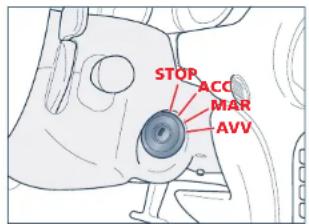
text_image
STOP ACC MAR AVVIgnition switch

text_image
A NasellaElectronic alarm device
The electronic alarm device carries out the following functions:
- remote management of the centralized door locking/unlocking
– perimeter surveillance, detecting the opening of doors, engine hood and trunk lid
– motion surveillance, detecting intrusion in the passenger compartment - car movement surveillance.
WARNING: The engine immobilizer function is provided by the Maserati CODE system, which is automatically activated when the ignition key is removed from the starter switch.
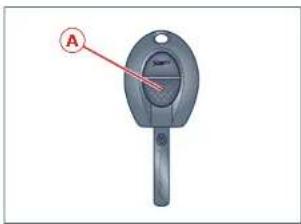
natural_image
Close-up of a black key-shaped object with a red arrow pointing to a labeled point A (no text or symbols on the object itself)System activation
To turn on the electronic alarm system, press button A on the key:
- the direction indicators flash twice; - the red LED B flashes on the instrument panel; - the car's centralized door locking system is activated, thereby locking the doors.
WARNING: If the button on the key has been pressed out of its range more than 16 times, it must be pressed twice consecutively in order to control the electronic alarm system again.
The alarm system becomes operative after approximately 25 seconds and the alarm is activated when:
- a door is opened
– the luggage compartment trunk is opened
– the engine engine compartment hood is opened - someone attempts to enter the car from a window
- the power supply is off
- the siren is disconnected
- the car is moved.

text_image
80 100 120 140 160 180 200 B P: AUTO LEVEL 960 3. 2- 1- 0' 75m GaussElectronic alarm device
Should directional indicators be flashing 8 times when you activate the alarm system, this means that one of the doors or the hood/trunk is not closed and therefore is not protected by the perimetral surveillance. Check for correct closing of doors, hood/ trunk and close the open one without deactivating the alarm system: the directional indicators flashing once indicate that now the door, hood/ trunk are closed properly and are protected by the perimetral surveillance.
WARNING: If the directional indicators flash 8 times when the alarm system is activated with doors, hood and trunk properly closed, it means that the self-diagnosis function has detected a malfunction in the system and that you should contact your Authorized Maserati Dealer to have the system checked.
Electronic alarm device
Deactivation
To switch the electronic car alarm off, press the key button A:
- the directional indicators flash once; - the red led B on the instrument panel switches off;
– the centralized door lock system is activated and the doors are unlocked.
The alarm system is off and it is therefore possible to get into the car and to start the engine.
Exclusion of passenger compartment motion sensor (ultrasound system)
If you wish to park the car with the windows lowered or leave a child or pet in the car and activate the alarm system, the internal motion sensor must be deactivated.
To activate the electronic alarm system excluding the passenger compartment motion sensor control, keep the key button pressed for approximately 3 seconds during activation:
- the direction indicators flash once; - the red LED on the instrument panel remains on for about 25 seconds.
The system is active after about 25 seconds, but movement inside the passenger compartment or intrusions through the open windows will not activate the alarm.
Alarm memory
Should the red LED B on the instrument panel be flashing when you deactivate the alarm system, this means that during your absence the alarm system was activated.
1 switching off ever 6 seconds = passenger compartment volume control alarm
2 switching offs ever 6 seconds = door alarm
4 switching offs ever 6 seconds = hood/trunk alarm
16 switching offs ever 6 seconds = self-powering alarm.
The alarm system memory is reset when you turn the ignition key.
Market homologation
The electronic alarm device is compliant with the current federal legislation covering radio frequencies. For those markets that require the transmitter and/or receiver marking, the approval number is found on the component.
Ordering extra radio operated controls
For purchasing new keys with a remote control contact your Authorized Maserati Dealer and remember to bring with you:
– all the keys in your possession with related remote control
– the Maserati CODE system CODE CARD
– the electronic alarm device CODE CARD
- a personal ID
– the identification and registration documents proving ownership of the car.
WARNING: Radio-operated controls that are not provided for the new code storing procedure will be automatically deactivated in order to prevent any lost or stolen radio-operated controls from being used to deactivate the electronic alarm device.
Replacing the Key radio control batteries
If pressing one of the two key buttons, A or B, the related function (activation/deactivation of the electronic alarm, opening of the luggage compartment lid) is not activated, check that the alarm system is working using the other key. If it functions using the other key, the first radio control battery must be replaced.
To replace the radio control battery: -separate the two halves of the key using a small screwdriver
- take the battery C off the retaining ring D
- insert a new battery of the same type under the ring, observing the indicated polarity
- put the two halves of the key back together.
WARNING: Do not use sharp tools to separate or join the key casing and take the maximum care to avoid damages.
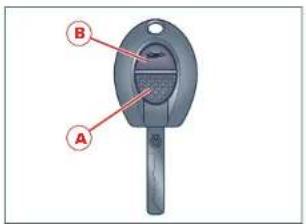
text_image
A BElectronic alarm device
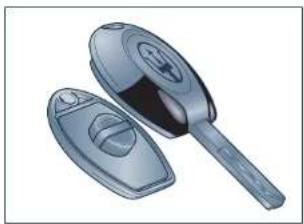
natural_image
Illustration of a car key with a handle and two open doors (no text or symbols)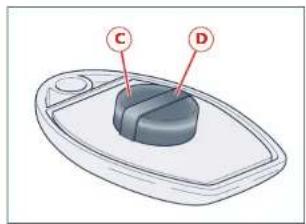
text_image
Diagram of a device with labeled parts C and D, showing a component on a tray-like surface.Replacing "valet" key radio control batteries
If pressing the radio operated control button does not cause the electronic alarm activation or deactivation, the battery must be replaced (after checking correct operation of the electronic alarm with another radio operated control).
To replace radio operated control batteries:
– separate the two parts of the key casing using a small screwdriver
- remove the ring with the two batteries
– insert the new batteries in the ring with the (+) sign facing upwards
– re-position the ring with the batteries
– close the key casings.
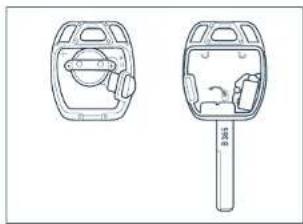
natural_image
Line drawing of two car key holders with internal compartments and a handle (no text or symbols)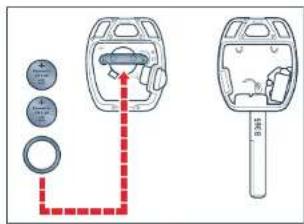
text_image
Diagram showing car keyway components with numbered parts and a red dashed line indicating connection or movement.Electronic alarm device
Front seats
Only adjust the seat when the car is stationary. You could lose control of the car while driving. Moving the seat could distract you or make you press a pedal unintentionally. Adjust the driver's seat only when the car is stopped.
Seat adjustment is possible only with the ignition key in the MAR position. However, with the door closed, seat adjustment operation is possible for about 15 seconds after turning the ignition key to the STOP position and then for another 15 seconds after the last operation.
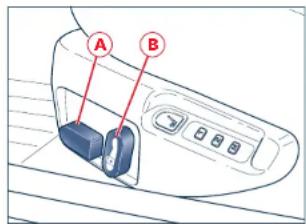
text_image
A BFront seats
Back/forward adjustment
Push control A on the outer side of the seat forward or back.
WARNING: On vehicles equipped a fire extinguisher (optional), forward movement of the passenger seat is limited in order to prevent interference with the fire extinguisher.
Height adjustment
Grip control A at the center and push down or up.
Seat angle adjustment
- Front part of seat: push the front end of control A up or down.
– Rear part of seat: push the rear end of control A up or down.
Seat back angle adjustment
Push lever B forward or backward to bring the seat backrest to raise or lower the backrest.
Sitting in a reclined position while the vehicle is in motion could be dangerous. The seatback should not be tilted back too far. The 3-point shoulder/lap belt must remain firm against the occupant's body in order to function properly. Therefore, both the driver's and passenger's reclining seatbacks must always be in a fairly upright position while the vehicle is in motion; otherwise the 3-point shoulder/lap belt would not remain firm against the occupant. Serious injury could result!
Lumbar support adjustment
Push lever B up or down to the most comfortable position.
Seatback tilt
To tilt the seatback on the front seats, lift lever C and move the seatback forward. To facilitate access to the rear seats or getting out of the car, the front seats come equipped with the "Easy Entry" device (operational only with the door open), which moves them forward and downward automatically when the seat back is completely tilted and returns them to the driving position when it is straightened.
WARNING: The system (excluding the seat with position memory) also includes a safety device which stops the seat and then moves it a short distance forward if the seatback knocks against passengers sitting in the back seats. To stop the seat at any point during the automatic forward or reverse movement, use control A.
The front seat must not be occupied when tilting or straightening the seatback. Passengers may only get into and out of the rear seat when the front ones are stationary. Be very careful that rear seat passengers (especially children) do not touch the seat and its guides when it is in motion.
Seat heating (optional)
To turn on the seat heating option, press the respective pushbutton D for a few seconds. Seat heating is independent: you can heat the right seat or the left one or both. Heating of one or both seats is displayed by the relevant LED on the instrument panel.
WARNING: Turn off the seat heating option when it is not needed, in order to avoid unnecessary power consumption.

text_image
Technical diagram showing a mechanical component with labeled parts and an arrow indicating direction or force.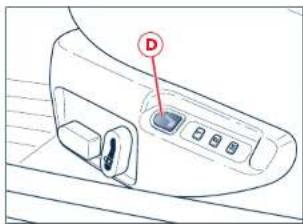
text_image
Diagram of a car interior control panel with labeled component D and buttonsFront seats
Storing the seat and side rear view mirror position (optional)
The system allows the user to store and recall two different positions of the driver's seat and of the side rear view mirrors.
Storage is only possible with the ignition key in the "MAR" position. Adjust the seat and side rear view mirror positions, then shift the gear to reverse and arrange the mirrors once again so as to find the optimum field of view for executing maneuvers. Afterwards, disengage the reverse gear.
Then, simultaneously press button "M" and button "1" or "2", each one corresponding to a storable position, until the double beep is heard for confirmation.
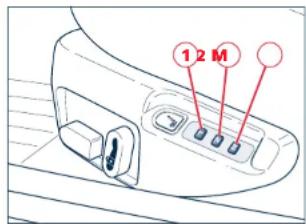
text_image
12 MFront seats
Storage of the seat position does not include the lumbar area seat-back adjustment.
When a new seat position is stored, the previous one memorized with the same button is automatically deleted. To recall one of the positions stored, with the door open, push the relevant button "1" or "2" for approximately 3 seconds.
A stored position can also be recalled with the door closed, keeping the relevant button pressed until the seat-locking beep is heard.
WARNING: To stop the seat, press one of the following pushbuttons "M", "1" or "2", or one of the adjustment controls.
WARNING: Malfunctioning of the seat control unit is indicated by a sequence of 5 tones emitted when the ignition key is turned to the STOP position: see your Authorized Maserati Dealer for service.
System initialization
When reconnecting the power supply after a power cut-off (e.g. the battery master switch is activated, the fuse burns out or the battery goes flat), check that the seats work correctly: if not, carry out the following procedures on both seats.
With the ignition key in the STOP position and the door closed on the side of the seat concerned, open the door and start the following procedure within 5 seconds.
You must then complete it within 10 seconds:
1) forward - STOP
2) backward - STOP
3) forward - STOP
4) backward - STOP
5) tilt the seatback completely and wait until the seat performs two complete travels (forward and backward)
6) return the seatback to the normal position.
Headrest
Headrests are integrated in the seats.
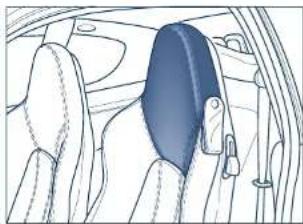
natural_image
Interior view of a car showing the dashboard and seat area (no text or symbols visible)Front seats

4
81
Rear seats
Armrest
The rear armrest is movable and can be inserted into the backseat. To lower it, pull handle A.
Headrest
The rear headrests are a fixed part of the seatback.
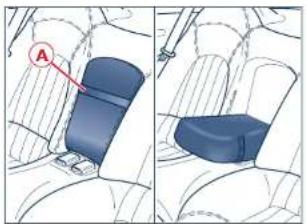
natural_image
Side-by-side illustration of a car seatbelt with a highlighted section (no text or symbols)Rear seats

natural_image
Illustration of a medical procedure with a blue instrument inserted into a white container (no text or symbols visible)Side-view mirrors
External side-view mirrors
Can be adjusted electrically (with the ignition key in the MAR position) and they are equipped with anti-mist defrosters.
- Mirror selection (right-hand or left-hand): move the selector A to the right or left, depending upon the mirror you wish to adjust. Bring the selector back to the center to prevent mirror position being changed involuntarily.
- Mirror positioning: control B allows each mirror to be adjusted with four movements (up - down - right - left).
- Mirror retraction: when button C is pressed, both mirrors retract to allow parking in restricted spaces. Pressing the button again returns the mirrors to their open position. The mirrors will yield in both directions in the event of a collision.
On versions equipped with memory seats, the position of the side rear view mirrors is automatically stored along with that of the seat, whether they are positioned for normal car driving or for reverse maneuvers.
To store a new side rear view mirror position, turn the ignition key to "MAR" and adjust the mirror positions; then shift the gear to reverse and arrange the mirrors once again so as to find the optimum field of view for executing maneuvers. Afterwards, disengage the reverse gear. Lastly, simultaneously press button "M" and buttons "1" or "2", each one corresponding to a storable position, until the double beep is heard for confirmation. The new side rear view mirror position will be stored automatically along with the seat position. It is also possible to modify the side rear view mirror position for normal driving only or for reverse maneuvers.
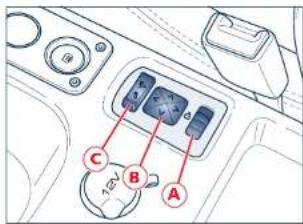
text_image
A B C 120V
natural_image
Diagram showing a car's side profile with red arrows indicating direction (no text or symbols)Side-view mirrors
The side rear view mirrors feature different curvatures; the left-hand mirror is flat, while the right-hand one is convex.

Pay particular attention as objects viewed in the right-hand mirror are closer than
they appear.
WARNING: Do not retract the mirrors manually as this could damage the powering mechanism.

The mirrors must always be in the open unretracted position when the car is moving.
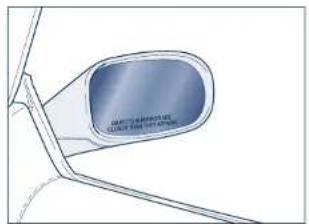
natural_image
Diagram of a car side mirror with a blue lens, showing no text or symbolsSide-view mirrors
Electrically-shaded interior rear-view mirror
The electrically shaded rearview mirror automatically operates an anti-blinding function by gradually shading as the light shining on the mirror increases.
This function is automatically deactivated in reverse to ensure maximum visibility of obstacles.
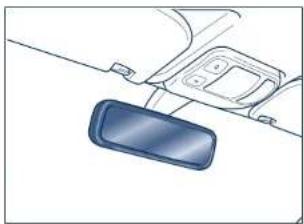
natural_image
Diagram of a car interior showing a blue rectangular object and a curved panel (no text or symbols)Steering wheel
The steering wheel can be adjusted for height and depth.
- Move lever A to position 1.
- Make the steering wheel height and depth adjustments.
- Move lever A back to position 2 to re-lock the steering wheel.

Do not adjust the steering wheel with the car moving.

Under no circumstances remove the steering wheel; this procedure, if necessary, is carried out by an Authorized Dealer.
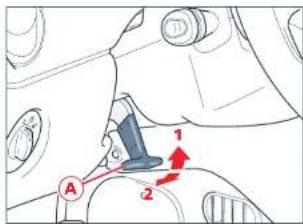
text_image
Technical diagram showing a mechanical component with labeled parts and directional arrows indicating movement or force.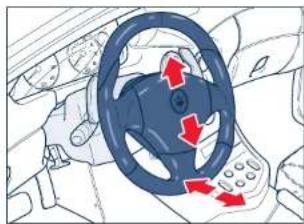
natural_image
Interior view of a car dashboard with steering wheel and directional arrows indicating motion (no text or symbols)Steering wheel
External lights and directional indicators
The external lights and directional indicators switch on only with the ignition key in the MAR position, with the exception of the parking lights, which can be turned on at any time. On CANADIAN version vehicles, in accordance with the current regulations, when the ignition key is turned to the "MAR" position the dipped, low beam, license plate and side-marker lights switch on automatically, even during the day, and cannot be switched off ("Day Time Running Lights" function).
External lights and directional indicators
Light switch
Switch A has 4 settings:
0 - Lights off
- Dipped, license plate and side-marker lights on
D- Low beams on
P≤- Parking lights
High beams
To turn on the high beams with the light switch in the position, push the left lever towards the dashboard. Subsequently pushing the lever towards the steering wheel will switch off the high beams and switch on the low beams.
WARNING: For the use of the high beams, observe local driving regulations.

text_image
A
text_image
Diagram showing car seatbelt mechanism with valve and belt labelsFlashing the headlights
Headlights can be flashed by pulling the left-hand lever towards the steering wheel.
Headlights can be flashed even with the lights switched off, if the ignition key is in the MAR position.
WARNING: Flashing takes place with the high beams. Observe current local driving regulations.
Parking lights
The parking lights work only with the ignition key in the STOP or ACC positions, or with the key removed. They are switched on by turning the light switch to the P ≤slant position. When the parking lights are on, the warning light on the P ≤slant switches on. With the parking lights turned on, the dipped lights only on the left-hand side can be turned on by lowering the left-hand lever, whereas only the right-hand dipped lights turn on when you shift it upwards.
Directions indicators
3-position lever:
B - Off
C - Lever up: right indicators
D - Lever down: left indicators.
WARNING: To indicate a temporary lane change, requiring only a slight turn of the steering wheel, it is possible to shift the lever without clicking it into position (non-permanent position).
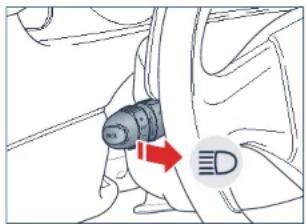
text_image
Diagram showing a car seatbelt with a red arrow indicating clockwise direction and a 'D' label on the belt.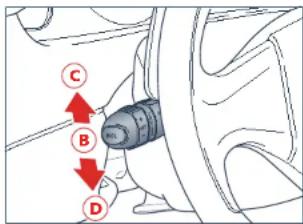
text_image
Diagram showing car wheel and seat with labeled arrows C, B, and D indicating directional movement or positioning.External lights and directional indicators
Windshield wipers and headlight washers (optional)
The windshield wiper and washer work only with the ignition key in the MAR position.
Windshield wiper
The lever has 5-settings:
A - Windshield wiper stopped.
B - Adjustable intermittent operation (lever stopped on the first click).
C - Slow continuous operation (lever stopped on the second click).
D - Fast continuous operation (lever stepped on the third click).
E - Fast temporary operation (non-permanent position).
The windshield wiper is started by shifting the lever in the E position. Windshield wiper operation is limited to the time in which the lever is manually held in that position. Upon release, the lever automatically returns to the A setting and the windshield wiper stops.
Intermittent operation-frequency
To regulate the frequency of intermittent operation, with the lever on the B position, turn lockring F.
Turning the coaxial lockring clockwise, intermittent operation varies from fast intermittent wipe to slow intermittent wipe.

text_image
A B C D E
text_image
Technical diagram of a mechanical component with labeled parts and annotation 'F'Windshield wipers and headlight washers (optional)
Windshield washer
Pulling the lever towards the steering wheel (non-permanent position) activates the windshield washer and wiper.
When the windshield washer is activated, the windshield wiper starts automatically. Releasing the lever cuts off the jet of fluid while the blades continue to wipe for a for strokes.
WARNING: Do not start the windshield washer during the cold months until the windshield has warmed up. If it has not warmed up, the liquid could freeze on the glass and block the view.
Headlight washers (optional)
The headlight washers are activated automatically when the windshield washer is started and the external lights are on.
The headlight washer liquid is contained in the same windshield washer tank and depletion is indicated when the respective warning light on the instrument panel lights up.

natural_image
Interior view of a vehicle dashboard with steering wheel and dashboard (no visible text or symbols)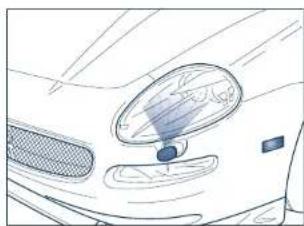
natural_image
Line drawing of a car's front bumper with a circular lens and grille (no text or symbols)Windshield wipers and headlight washers (optional)
Sound system
The stereo system is comprised of a Becker Mono Sinto "on line pro" CD player capable of reading MP3 files using the CD-R and memory card. The sound system can also be integrated with a GPS navigator, plus GSM tri-band 900-1800-1900Mhz telephone.
WARNING: This option is only available in the markets where both the territory maps and GSM network are available
The sound system in the car consists of: - a tweeter speaker A and a woofer speaker B on each door panel
- two mid-range loudspeakers C on the rear side valance panels
- two subwoofer loudspeakers D on the back shelf
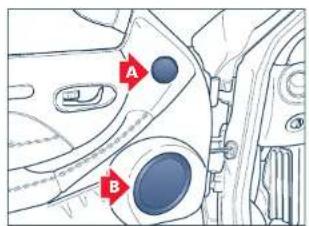
text_image
Diagram of a car interior with labeled parts A and B, showing structural components and directional arrows.Sound system
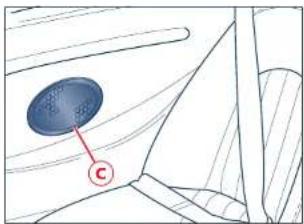
natural_image
Diagram of a biological structure with labeled point C, showing layered components and curved boundaries (no text or symbols)
text_image
Diagram showing a blue oval object with a red arrow labeled 'D' pointing to it, possibly indicating a location or feature.- built-in aerial in the rear window
- aerial incorporated in the windshield
- CD-changer E (optional) positioned on the left-hand side of the trunk.
WARNING: The cable for installation of the CD player in the luggage compartment is supplied only in cars equipped with CD-changers.
Diversity system
It consists of two combined aerials, that are activated alternatively, depending on the one that better receives the signal.
High output stereo system (optional)
The high-output stereo system is equipped with:
- a 4-channel amplifier
– specific high-output speakers.
The nominal power is approximately 200 Watt with a peak of 400 Watt. The amplifier is housed on the left-hand side of the luggage
compartment and it is protected by a fuse located on the amplifier itself.
You are advised to contact your Authorized Maserati Dealer to have the fuse replaced.
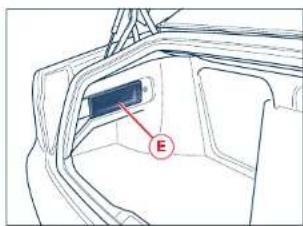
text_image
Technical diagram of a vehicle door with labeled component E and red annotation arrowSound system
Air conditioning and heating system
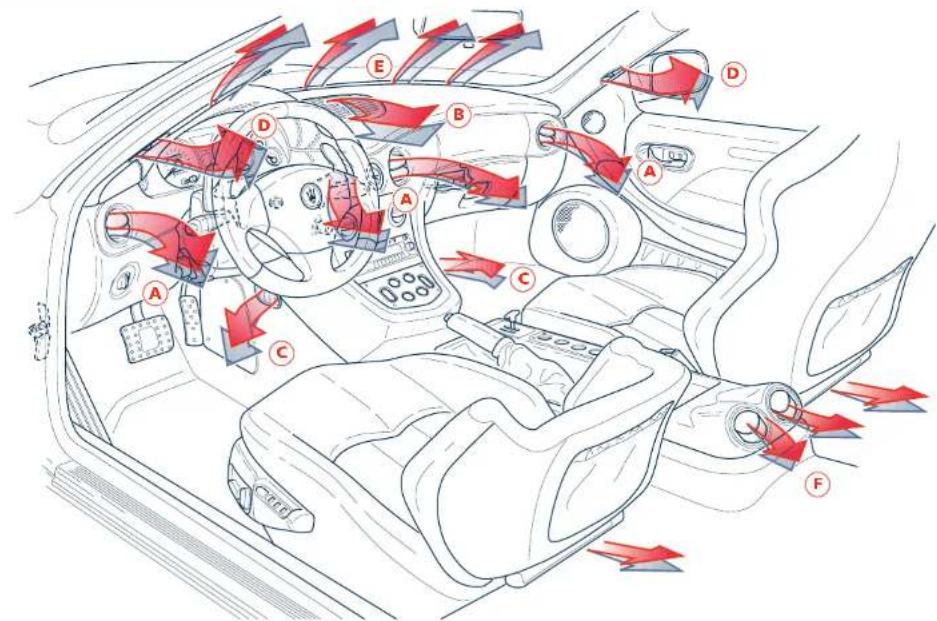
text_image
Diagram of car interior with labeled sections A-F and directional arrows indicating traffic or movement, likely for vehicle safety or emergency control.Air conditioning and heating system
A - Dashboard central and side vents
B - Dashboard upper vent
C - Dashboard lower vents
D - Side window demisting/defrosting vents
E - Windshield demisting/defrosting vents
F - Rear vents
Upper dashboard outlet
Turn control G to open/close the upper outlet and adjust air flow.
Central and side dashboard vents
Press the tab in point H to open the central and side outlets.
Turn the vent with open tabs to obtain the required air flow direction.
Front windshield pillar vents
Vents L positioned on the windshield pillars are fixed and directed for demisting/defrosting the front side windows.

text_image
Diagram of a car interior with a labeled component 'G' pointing to the grille area
natural_image
Diagram of a car dashboard with three seats and a labeled sensor (no text or symbols present)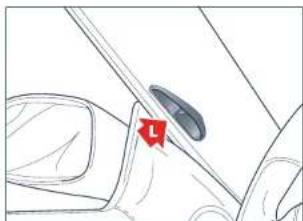
natural_image
Line drawing of a car's side profile with a red arrow pointing to the nose area (no text or symbols)Air conditioning and heating system
Lower dashboard vents
Vents M are positioned on the lower dashboard sides, and they cannot be aimed.
Rear vents
The rear seat air-conditioning and heating vents are positioned at the end of the central console.
To open the vents, press the fin at point N.
The airflow can be directed as desired by turning the vent with the fins open.

natural_image
Diagram of a car interior showing a vehicle's seat and dashboard with a red arrow labeled 'M' pointing to the wheel (no text or symbols beyond the label)Air conditioning and heating system
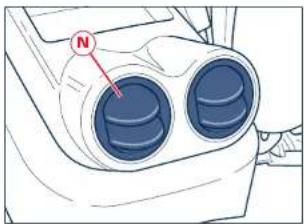
natural_image
Close-up of a car air vent system with two blue chambers and a red circle labeled 'N' pointing to the left side (no text or symbols beyond the label)Automatic air conditioning and heating controls
1) Knob for setting the required "comfort" temperature
2) Knob for adjusting fan speed and switching off the system
3) Air distribution knob
4) Pushbutton for air recirculation activation/deactivation
5) ECON pushbutton for deactivation of the ventilation compressor
Equivalent temperature
The systems allows automatic and manual control of the temperature and humidity inside the passenger compartment. The temperature set with the controls is called "equivalent temperature" and it corresponds to a comfortable climate based on the actual temperature inside and outside the passenger compartment.
Description of controls
1) Control for setting the required "equivalent" temperature
Sets the desired temperature inside the passenger compartment. The "LO" and "HI" functions (the minimum and maximum temperatures respectively) are at the outermost positions.
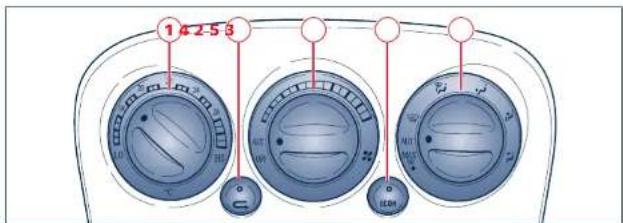
text_image
1 4 2 5 3 0 0 0 0 0 0 0 0 0 0 0 0 0 0 0 0 0 0 0 0 0 0 0 0 0 0 0 0 0 0 0 0 0 0 0 0 0 0 0 0 0 0 0 0 0 0 0 0 0 0 1 4 2 5 3Air conditioning and heating system
2) System deactivation and fan speed adjustment control
Turning the control to the left or the right respectively decreases or increases the fan speed and therefore the amount of air blown into the passenger compartment, thereby maintaining the equivalent temperature requested.
AUT fan speed is adjusted automatically by the system. OFF the air conditioning system is switched off.
3) Air distribution control
This performs the following functions according to its position:
AUT - The air distribution is automatically set by the system. In addition, the heated rear window and the external rear view mirror elements (and the relative LED on the button and warning light on the instrument panel) switch on automatically for a preset time..

Activates the windshield and side dow demisting and/or defrosting tion.

Airflow towards the windshield front side windows.
Air conditioning and heating system
Airflow distribution between the windshield/front side windows and the lower section of the passenger compartment.
Main air flow towards the lower section of the passenger compartment and secondary air flow towards the windshield/front side windows.
Air flow distribution between the upper central vent, the central, side and rear vents and the lower section of the passenger compartment.
Air flow towards the upper central vent, the central and side vents on the dashboard and the rear vents.
4) Activation/deactivation button for air re-circulation
When re-circulation is activated, the air flow comes from within the passenger compartment. Visually the LED on the button switches on. To deactivate the re-circulation function press the button again; the LED on it switches off. According to the climatic conditions, re-circulation can be inserted automatically by the system if it has not previously been activated/deactivated manually.
WARNING: Depending upon the system operation (to heat or cool the passenger compartment) the recirculation function makes it possible to reach the desired conditions more rapidly. On particularly damp/cold days you are advised not to use this function since this could cause the windshield to mist up. This function is recommended during traffic jams, especially in tunnels, to avoid polluted air entering the compartment.
The prolonged use of this function is however to be avoided when there are many passengers.
5) Deactivation button for the air-conditioning system compressor Pressing the ECON button disables the air-conditioning system compressor function. When this is disabled the LED on the button switches on. To deactivate the ECON function, press the button again. The LED on the button will turn off. The air is cooled and/or dehumidified according to the temperature set.
WARNING: It is not possible to have air flow in the passenger compartment at a lower temperature than the outside air temperature when the compressor is switched off; Under special environmental conditions the windows could fog up quickly.
Description of operating strategies
During automatic operation, the system controls the following functions:
- temperature of the air entering the compartment
– fan speed (stepless change)
– air distribution
– air recirculation function - ventilation compressor activation.
It is however possible to manually intervene on the following functions:
- fan speed
– air distribution
– air recirculation function - ventilation compressor activation. Functions activated manually have priority over automatic functions and are stored in the memory until automatic control is reactivated.
With one or more manually operated functions, air temperature adjustment continues to be automatically controlled by the system, except with deactivated compressor: under this condition, the temperature of the air entering the compartment shall not be lower than outside temperature.
The system can be operating under one of the following conditions:
– automatic control of the fan speed and air distribution
– automatic control only of the fan speed or air distribution, according to the preferences of the user
- manual operation, in which the user directly controls fan speed and air distribution.
When the ECON button is pressed, the ventilation compressor is switched off. With deactivated compressor, the air entering the compartment cannot be cooled or dehumidified and the recirculating air function is automatically deactivated to avoid window steaming. Pressing again the ECON button with disabled compressor, activates the previous operating conditions. Turn knob 2 to OFF to switch off the air conditioning and heating system; no air will be delivered to the passenger compartment that remains isolated from the outside environment.
WARNING: When the air conditioning and heating system is off (knob 2 on OFF) air enters the passenger compartment and thus, under certain environmental conditions or with more than one person in the car, the windows could fog up quickly.
Air conditioning and heating system
If air distribution is selected manually using knob 3, the simple automatic mode is obtained: that is, the system selects fan speed and air mixing to reach the requested "comfort" temperature, however, without changing the air distribution selected manually.
Pressing button 4, corresponding to the air recirculation function, automatically reactivates the compressor, if it has been manually deactivated, in order to prevent the windows from fogging up.
During the automatic operation the system can automatically activate the recirculating air function or deactivate the ventilation compressor to cool/heat the compartment or to demist/defrost windshield and front side windows.
WARNING: When the engine is started, the system keeps the settings selected manually prior to switching off.
Dust/pollen air cleaner
The ventilation and heating system is provided with an air cleaner which combines the mechanic air filtering function with an electrostatic effect in order to help clean the air entering the compartment from dust, pollen, etc.
Filtering is performed with both outside air intake (recirculating air function off) and recirculating air intake conditions (recirculating air function on).
Have your air cleaner replaced at least once a year at your Authorized Maserati Dealer (possibly in spring or early summer).
In the event of use of the car primarily in polutted or dusty areas, more frequent air filter replacement is advisable.
WARNING: Failure to replace the air cleaner can reduce the ventilation and heating system efficiency considerably.
Specific luggage set (optional)
The specific luggage set allows the passengers to use the vehicle luggage compartment capacity very efficiently.
Specific luggage set (optional)

text_image
100Using the vehicle
Starting the engine 102
"Cambiocorsa" gearbox 104
Optimization of fuel consumption 111
Using the brakes 112
Use of the engine 113
Constant speed control Cruise Control 115
Electronic suspension Skyhook 118
Headlights 121
Driving conditions 122
Pollution control devices 126
Parking 128
Tires 129
Starting the engine

Keep the brake pedal pressed when starting the engine.

It is dangerous to operate the engine in a closed space. The engine consumes oxygen and gases carbon dioxide, carbon dioxide and other toxic gases.
WARNING: Before starting-up the vehicle, deactivate both the electronic alarm by pressing the radio-controlled key and the electrical devices with high power absorption (air-conditioning, heated side window, headlights etc.).
WARNING: Do not start the engine if the fuel in the tank is low.
WARNING: When the engine is started, the "cambiocorsa" feature is active.
1) Ensure the handbrake is engaged and the doors are closed.
2) Keep the brake pedal pressed when starting the engine.
3) Do not press the accelerator pedal.
4) Put the gearshift in neutral, pulling both the UP and DOWN levers towards the steering wheel, and ensure the gear indicator shows N and that it is not flashing.
5) Turn the ignition key to the MAR position.
6) Press the START button and release it as soon as the engine starts. Do not keep the START button pressed for a prolonged time.
If the engine fails to start, turn the key back to the STOP position and wait for the gear indicator to switch off before repeating the procedure.
The engine can also be started with a gear engaged. Turn the ignition key to the MAR position, keep the brake pedal pressed and press the START button. The system will allow the clutch to open and the gearshift to engage the neutral gear.
Then the starter motor receives clearance for start-up. This procedure normally requires a time lapse of one second. At very low temperatures, the procedure might be slightly slower. If, instead, the gearshift is in neutral (N), the start-up is immediate. If the engine fails to start, after turning the key back to the STOP position, wait until the gearshift display switches off and then repeat the entire procedure.
Starting-off when the engine is cool
Start-off slowly, avoiding sudden accelerations and rev the engine at low-medium speeds. High-performance driving should be avoided until the water temperature reaches 122^-140^ ( 50^-60^ ).
Emergency starting with auxiliary battery
If the battery is discharged, the engine can be started using another battery having the same or slightly higher capacity than the flat one. Follow the below instructions:
1) Connect the positive terminals (+) of the two batteries with a jumper cable.
2) Connect the negative terminals (−) of the two batteries with a jumper cable.
3) Start the engine.
4) When the engine starts, remove the jumpers cables in reverse order. If the car does not start after several attempts, contact your Authorized Maserati Dealer.
Do not carry out this procedure if you do not have experience: incorrect maneuvers can cause high electrical discharges and even cause the battery to explode.
Do not to approach the battery with open flames or lit cigarettes or sparks because of risk of explosion and fire.
WARNING: Do not use a battery-charger for emergency starting under any circumstances. This could damage the electronic systems, particularly the control units performing the ignition and fuel supply functions.
Starting with inertia maneuvers (push-start, etc.)
WARNING: Since the car is catalyzed, under no circumstances should it be started by pushing, towing or on downward slopes. These actions could cause fuel to flow into the catalytic converter and damage it beyond repair.
Remember that when the engine is not started, the brake servo and power steering systems are not activated and therefore the effort required on the brake pedal and steering wheel is much greater.
Turning off the engine
With the engine idling, rotate the ignition key to the STOP position. A "burst" on the accelerator pedal before turning off the engine has no purpose and increases fuel consumption.
"Cambiocorsa" gearbox
The "Cambiocorsa" gearbox is controlled by the levers on the steering wheel for gear-shifting, by the lever on the central console for engaging the reverse gear and by the pushbuttons to activate the "automatic transmission" and "low grip" functions.
The "Cambiocorsa" gearbox controls are the following:
A - Lower gear engagement lever - DOWN
B - Upper engagement lever - UP
C - Joystick for shifting to 1 ^st and reverse gears
D - "Automatic transmission" function switch
E - Low grip ^® function switch.
The display F on the instrument panel indicates the gear currently engaged,
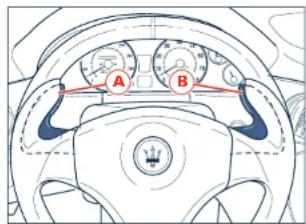
text_image
A B"Cambiocorsa" gearbox
whereas the warning light L on the multi-function display indicates a system failure. When the "automatic transmission" and "low grip" functions are switched on, the AUTO and ICE messages light up on the multi-function display, respectively. An insufficient oil level in the gearbox is indicated by the LEVEL message lighting up on the multi-function display.
Starting the ignition system
Turn the ignition key to the MAR position to activate and light up the gearbox display F. The respective failure warning light t will also switch on and then switch off if no malfunctioning is detected after several seconds.
The gear currently engaged will remain highlighted on the display.
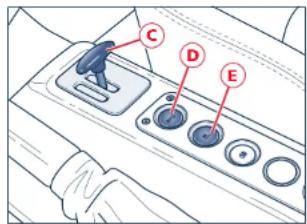
text_image
Diagram of a car interior control panel with labeled buttons C, D, and E pointing to the handle.WARNING: It is sometimes possible to hear a buzzing coming from the gearbox unit when the driver's door is opened; this is produced by pre-ignition procedures. The failure warning light t may also flash for a brief period of time (approx.10 sec.) and then switch off. The system completes the "ignition" stage and then it is correctly activated. Avoid entering any commands to the system during this stage.

If the warning light t continues to flash without switching off, re-start the
system after having switched it off. If this malfunctioning persists, contact your Authorized Maserati Dealer for service.
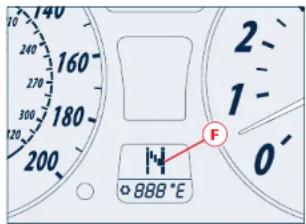
text_image
140 160 270 300 180 200 2 1 F 0' 888°EIf the warning light ☑ remains on, there may be a system multifunction. This status is also indicated by a beep when the key is brought to the MAR position.
WARNING: Contact your Authorized Maserati Dealer for service to have the cause of this malfunctioning eliminated.
Operation with the engine switched off
After completing the "system start-up" stage, the gear currently engaged will appear on the display:
- N (Idle)
- R (Reverse gear)
- 1 (1 ^st gear).

text_image
AUTO LEVEL ICEIf the indication is flashing (which can also occur with N), it means that the gear is not perfectly engaged or disengaged; shift it to neutral (N) and then to the desired gear.

If a horizontal dash appears on the display, there may be system multifunction.
With the engine switched off, all gears can be engaged, including the neutral (N); keeping the brake pedal pressed, you must proceed as follows:
- N (Neutral): pull both levers found behind the steering wheel.
- R (Reverse gear): raise and pull joystick C away from you.
- 1^st gear engagement: push the joystick forwards.
- Up-shifting: pull the UP lever (B) towards the steering wheel.
- Downshifting: pull the DOWN lever (A) towards the steering wheel.

To engage the reverse gear, keep the joystick C pulled towards the rear, until the R appears on the display.

To engage the opposite gear using the 1st gear and reverse gear (C) joystick, keep it forward until number "1" on the display.
WARNING: Release the UP, DOWN and R levers immediately after the gearshift request. A prolonged maneuver could make the failure warning light and sound signal switch on. Do not operate the system with the engine switched off to prevent discharging of the battery. Avoid shifting of gears with the engine off, to prevent overheating of the system.
Driving the car
With the engine running, the car stationary and the brake pedal pressed, release the brake and press the accelerator to start moving. With the engine on and the car stopped, it is possible to shift directly from the 1^st gear to R (reverse) using the joystick C, and from the reverse gear to the 1^st gear by pushing the joystick C forward or by pulling the lever UP towards the steering wheel.
"Cambiocorsa" gearbox
WARNING: Engagement of the reverse gear is accompanied by a safety sound signal, which sounds intermittently for the entire time in which it is engaged.
When shifting from reverse to 1^st gear, if the system automatically engages the 2^nd gear, it indicates that a problem has occurred with the 1st gear. Therefore, this is not a failure, as it falls into the logic of the system operation. For the same reason, the system automatically engages neutral (N) in case of interference when shifting from 1^st gear to reverse. During prolonged parking periods with the engine running, it is advisable to keep the gearshift in neutral (N).
WARNING: On certain occur on downhill routes, if you leave the car in neutral (N), when you request a higher gear UP, the gear engaged will depend on the current speed of the car.
For your safety reasons, the system activates the sound signal and automatically sets the neutral gear (N) when the car is stopped, the engine is on and the gear is engaged:
- if the brake pedal or the accelerator is not used for over 1 minute
"Cambiocorsa" gearbox
- if the brake pedal is pressed for more than 10 minutes
- if the door is opened without pressing the brake pedal or the accelerator
- if the engine lid is opened.
WARNING: The warning buzzer is activated also if the clutch overheats during the starting "pickup" maneuver.
In this case, the departure procedure must be "forced", avoiding hesitation or keeping the car stopped and applying on the brake pedal after having released the accelerator.
Hill Holder Strategy
The Hill Holder system helps the driver when starting-off on an uphill slope. It intervenes only following a vehicle stop when the brake pedal is released, keeping the car stopped for a moment, so as to allow the driver to move from the brake to the accelerator pedal.
The system is capable of varying its intervention time depending on the road slope. This time ranges from a minimum (0.06 seconds) on downhill stretches and a maximum (1.2 seconds) on uphill stretches, so that the driver will not perceive the vehicle as "braked" downhill.
The function that calculates the road gradient is only active at speeds of over 8 km/h, therefore gradient changes at lower speeds will not be detected.
Example: if you are driving uphill and you make a reversing manoeuvre, the system will not detect a gradient change, and its maximum intervention time will remain 1.2 seconds.
Important
– With the car stationary and a gear engaged, keep the brake pedal pressed until starting-off.
- Engage the reverse gear only when the car is at a full stop and with the brake pedal pressed.
- When the MSP device is switched off, the antiskid system is deactivated.
Up-shifting "UP"
Use the right-hand UP lever, without releasing the accelerator pedal. UP-shifting is not accepted if the gear engagement requested would produce a too low engine speed rate or if an UP-shift is already in progress due to overrevving.
Gear-shifting is faster if requested with the accelerator pressed down to the floor and with the engine exceeding 5,500 r.p.m.
In any case, it is best to:
- Shift gears without releasing the accelerator pedal if it is pressed.
- Wait until the gearshift in progress is completed before requesting the next one, avoiding a rapid sequence of multiple requests.
UP for overrunning speed rate
The system switches to an upper gear "automatically" if the engine reaches a value approaching the "overrunning rate" and the accelerator pedal is pressed.
This condition does not occur with the system in the "SPORT" mode.
Downshifting "DOWN"
Use the left-hand lever DOWN, even without releasing the accelerator pedal.
DOWN-shifting is not accepted if the gear requested forces the engine overrunning, depending upon the gear requested, or if a DOWN-shift is already in progress due to a too low engine speed rate.
In any case, it is best to:
- Shift gears without releasing the accelerator pedal if it is pressed.
– In the case of a DOWN-shift request for overtaking, where rapid acceleration is required, press the accelerator pedal just before moving the lever. - Wait until the gearshift in progress is completed before requesting the next one, avoiding multiple requests in rapid sequence.
DOWN for underrunning speed rate
The system shifts down the gears "automatically", if the engine runs below the minimum speed rate set at 1.300 r.p.m.
The DOWN command is ignored if gear-shifting due a low speed rate is in progress.
Requesting neutral (N)
If necessary, it is possible to request neutral (N) at any speed.
Subsequently, if the UP lever is used, the system switches to a gear in keeping with the speed of the car.
Stopping the car
When the car is stopped, the system automatically switches to 1^st gear (unless N has already been selected previously).
With the car stopped and the engine running, keep the brake pedal pressed until you are ready to depart again.
"Cambiocorsa" gearbox
Switching off the engine and the system
The engine can only be switched off with the gearbox in 1^st , or reverse gear R.
After turning the key from the MAR to the STOP position, the display remains on for several seconds, showing the gear currently engaged. If the gearshift is in neutral (N) a buzzer is activated.

Never leave the car with the gearshift in neutral (N).
Switch to 1 ^st gear or reverse,
ensure that the display is not flashing and always engage the handbrake. Do not leave the car with the engine running.

Do not remove the key with the car moving! The system (and thus the display) would
remain activated but operating irregularly until the car stops and the steering wheel would lock automatically at the first turn of the wheel.
In this case, the failure □ warning light lights up and before driving once again, the system (and thus the display) must be switched off and the
"system start-up" phase repeated. In any case, it is best to:
– Switch off the engine and the system keeping the brake pedal pressed.
- Do not request a gearshift while the system is turning off.
Other system functions
"Low-grip" mode
This mode can be used on particularly slippery roads (snow, ice) and it is activated/deactivated by pressing switch E. This will make the respective ICE indicator on the instrument panel light up.
When driving, the system automatically switches to the upper gear if the engine reaches the pre-established speed rate (3,200 r.p.m.). The "low-grip" mode has priority over the other functions ("automatic gearshift" and "SPORT") and it assists the MSP system.
A DOWN request from 6th to 5^th gear will only be accepted if the engine speed rate in 5^th gear proves to be lower than 3,200 r.p.m. As the "low-grip" mode can be activated at any time and the system limits the engine's speed rate to 3,200 r.p.m. in all gears except for the 6th, unrequested UP shifts could take place.
It is a good rule to switch off the other operating modes ("automatic gearshift" and "SPORT") before you select the "low-grip" mode.
"Automatic gearshift" mode
This mode is activated/deactivated by pressing switch D. The AUTO message will light up on the instrument panel and the system will automatically adjust the gears UP and DOWN according to the car speed, the engine speed rate and the driver's request for torque/power.
WARNING: The "automatic gearshift" mode has priority over the "SPORT" mode. Therefore, if the AUTO pushbutton D is pressed when in the "SPORT" mode, even if the "SPORT" indicator remains on, the AUTO indicator will light up and the system will operate in the "automatic gearshift" mode, while keeping the suspensions in the "SPORT" position in any case.
It is possible to return to the "normal" mode (or "SPORT" mode, if this mode was active) by requesting a gear-shifting or keeping switch D pressed until the "AUTO" indicator switches off. When the car is stopped, the request for N, 1^st or R does not cause a change from the "automatic transmission" mode to the "normal" mode. It is a good rule to switch off the other operating modes before you select the "automatic transmission" mode.
"SPORT" mode
This mode is activated by pressing switch G. The respective SPORT indicator will light up on the instrument panel. To return to the "normal" mode from the "SPORT" mode press the switch again. As the "SPORT" mode has lower priority with respect to the "low-grip" and "automatic transmission" modes, if the latter are already active when you activate the "SPORT" mode, the system will ignore the command even though the respective warning light switches on.

text_image
Mnackell G"Cambiocorso" geanbox
The "SPORT" mode is characterized by a stiffening of the suspension and faster gearshift compared to gear-shifting in the "normal" mode.
Gear-shifting is "faster" if requested with the accelerator pedal pressed down to the floor and when exceeding about 7,000 r.p.m. Under these conditions, even on dry roads, the driving wheels could start to skid (particularly in low gears). DOWN shifts with the accelerator pedal released, will have a braking effect approaching the skidding limit of the driving wheels on dry asphalt. Under sporty driving conditions with gearshifts at high engine speed rates, double-clutching when down-shifting is performed automatically.
Do not to use the "SPORT" mode on roads with low or medium "grip" conditions (e.g., ice, snow, or wet roads) as the driving wheels could skid during gearshifts.
"Cambiocorsa" gearbox
It is a good rule to switch off the other operating functions ("low-grip" and "automatic transmission") before you select the "SPORT" mode.
WARNING: In the event of malfunctioning of the control lever unit, in addition to activating the buzzer and switching on the failure warning light, the system enables the "automatic transmission" mode and any gearshift command, including the request for N and R, will be ignored.
WARNING: If the malfunctioning persists, contact your Authorized Maserati Dealer as soon as possible for service.
Optimization of fuel consumption
This procedure is valid for versions with manual gearbox and for those with the Cambiocorsa gearbox (in "Manual" mode)
In order to optimize fuel consumption, Maserati recommends that you shift gears "UP" as follows:
| Gearshifting | Vehicle speed during gearshifting [mph] |
| 1^st 2^nd | 15 |
| 2^nd 3^rd | 20 |
| 3^rd 4^th | 25 |
| 4^th 5^th | 30 |
| 5^th 6^th | 35 |
Shifting gears as outlined above, will allow you to improve fuel consumption levels without significantly reducing performance. This does not apply when gears are shifted "DOWN".
The instrument panel is equipped with an indicator, SIL (Shift Indicator Light), which shows when you are recommended to shift gears by illuminating the word UP, in the area where the outside temperature is usually displayed. Please see the figures below.
"SIL" (Shift Indicator Light) operating modes
The word "UP" appears just before you reach the speed recommended for operating the UP lever (for Cambiocorsa gearbox version) or for upshifting using the gearbox lever (for Manual Gearbox version). After gearshifting, the indicator goes off. If the recommended gearshift is delayed or not performed, the SIL will show the word "UP" for a few seconds, after which the outside temperature will be displayed once again. Whenever the conditions recommended for gearshifting occur, the indicator shows the word "UP" as described above.
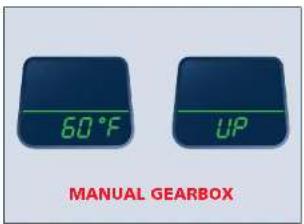
text_image
60°F UP MANUAL GEARBOX
text_image
3 60°F 3 UP CAMBIOCORSA GEARBOXOptimization of fuel consumption
Using the brakes
WARNING: In order to run in the brake pads and discs suitably, avoid sudden and sharp brakings during the first 190 miles (300 Km).
ABS is a component of the braking system that offers two basic advantages:
– It helps avoids locking of the wheels and thus skidding during emergency braking and especially under low grip conditions.
- It makes it possible to brake and steer at the same time in order to avoid unexpected obstacles or to direct the car where desired when braking, this is in keeping with the physical limits of the tire's side grip.
You will note a light vibration of the brake pedal during emergency braking or braking under low grip conditions. This is a sign that the ABS is operating. Do not release the pedal but continue to press it to give continuity to the braking action.
The ABS helps prevent the wheels from locking, but it does not increase the physical grip limits between the tires and the road. Therefore, even if your car is fitted with ABS, always ensure to keep to a safe distance from the car in front of yours and reduce your speed when entering a curve.
Use of the engine
Breaking-in
Today's modern methods of production afford high precision in the construction and coupling of components. However, the moving parts do undergo a breaking-in process, basically in the first hours of the car's operation.
Engine and transmission
Avoid exceeding 5000 r.p.m. for the first 600 miles (1,000 km).
After starting the car, do not exceed 4,000 r.p.m. until the engine has warmed up sufficiently (water temperature: approx. 150-160 °F (65-70 °C).
Do not keep the car at a constant high speed rate for a prolonged time.
Driving the car
Never travel with the Tachometer indicator approaching the peak r.p.m. not even downhill.
When the Tachometer indicator is approaching the peak r.p.m. (red-colored line), take precautions to avoid exceeding that limit.
WARNING: Under normal operating conditions, no red light warning indicators on the instrument panel should be displayed. When they switch on, they indicate a problem in the respective system.
Ensure proper operation of the various devices by checking the respective control instruments.
WARNING: Continuing to drive when a red warning light switches on could cause serious damage to the car and affect performance.
Do not travel downhill with the engine off because the servo brake is not operating due to lack of vacuum: after several brakings, the system loses almost all efficiency.
Engine control system OBDII
This system continuously monitors the components of the vehicle related to emissions; it also warns the user about the deterioration condition of the components themselves, by means of the warning light 📋 on the instrument panel.
The objective is the following:
- keep engine systems operating efficiently
– indicate when a problem causes an increase in emissions exceeding the threshold established by federal regulations
– indicate the need for replacement of deteriorated components.
In addition, the system includes a diagnostics connector that can be interfaced with suitable instruments.
This makes it possible to read the error codes stored in the control unit, together with a set of specific parameters for engine operation diagnostics, in compliance with OBDII rules.
WARNING: When the ignition key is turned to the MAR position, if the warning light does not switch on or if it switches on while driving, contact your Authorized Maserati Dealer as soon as possible.
WARNING: After the problem has been eliminated, your Authorized Maserati Dealer personnel is required to perform tests of the system and if necessary, also road tests.
Constant speed control Cruise Control
General information
The electronic cruise control makes it possible to drive the car at the desired speed without pressing the accelerator pedal. This helps reduce driving fatigue, especially on long trips because the speed stored in the memory is kept constant automatically.
WARNING: The device can only be switched on at speeds exceeding 18 mph (30 km/h) and it switches off automatically when the brake pedal is pressed.
The speed control must only be activated when traffic and the route permit a constant speed to be maintained safely for a sufficiently long distance.
Controls
The speed control is activated by the switch A, by the ring band B and by the pushbutton C (RCL).
The switch A has two settings:
- OFF the device is deactivated in this position;
- ON the normal operating position of the device. When the device is switched on, the message CRUISE lights up on the instrument panel display.
The ring band B is used to store the car speed in the memory and to maintain it, or to increase or decrease the speed stored.
Turn the ring nut B to the (+) position to save the speed reached or to increase the speed stored in the memory.
Turn the ring nut B to the (−) position to decrease the speed memorized. Each time the ring nut B is moved the speed increases or decreases by about 1 mph. When the ring nut is kept turned, the speed varies continuously. When a new speed is reached, it will automatically remain constant. Pushbutton C (RCL) is used to restore the speed saved in the memory.
WARNING: When the ignition key is turned to STOP or switch A is in the OFF position, the speed saved is erased and the system switches off.
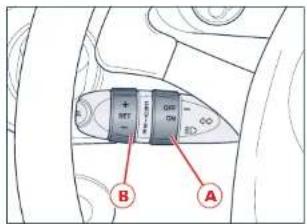
text_image
+ SET OFF ON BC B A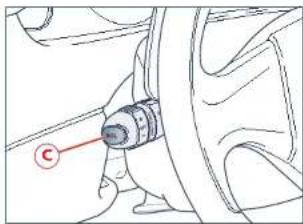
text_image
Technical diagram showing a car seatbelt with a red label 'C' pointing to the seatbelt component.Constant speed control Cruise Control
Storing a speed
Turn switch A to the ON position and reach the desired speed of the vehicle in a normal manner. Turn the ring nut B to (+) for at least three seconds and then release it. The car speed is saved and the accelerator pedal can then be released.
The car will proceed at the constant speed stored in the memory until the brake pedal is pressed.
If necessary, (for example, to pass another vehicle), you can accelerate by simply pressing the accelerator pedal. Afterwards, when you release the accelerator pedal, the car will return to the speed saved previously.
Restoring the speed stored in the memory
If the device has been switched off after braking, the speed saved previously can be restored as follows:
– accelerate gradually until you reach a speed close to the one stored in the memory;
- shift normally until the gear selected when the speed was saved in the memory ( 4^th , 5^th or 6^th gear)
- press the pushbutton C (RCL).
Increasing the speed stored in the memory
The speed stored in the memory can be increased in two ways:
- by pressing the accelerator and then saving the new speed reached (turn the ring nut B for more than three seconds)
0
– by turning ring nut B temporarily to position (+): Each pulse transmitted by the ring nut will originate a slight increase in speed of about 1 mph, whereas constant pressure will cause a continuous increase in speed.
When ring nut B is released, the new speed is automatically stored in the memory.
Reducing a speed saved in the memory
The speed stored in the memory can be reduced in two ways:
- by switching off the device, pressing the brake pedal and then saving the new speed in the memory (turning ring nut B to the (+) position for at least three seconds);
or
- by keeping ring nut B turned to the (−) position until the new speed is reached: the latter will be stored automatically.
Resetting the speed stored in the memory
The speed stored in the memory is automatically zero-reset:
– by switching the engine off or
- by putting the switch A on the OFF position.
When driving with the speed control activated, do not shift to neutral. It is advisable to switch on the cruise control only when traffic and road conditions permit proper use of this device, that is: on straight and dry roads, expressways or highways, smooth-flowing traffic and smooth asphalt. Do not switch this device on in the city or in heavy traffic.

The speed control can only be switched on at speeds exceeding 18 mph (30 km/h).

The device can only be switched on in 4^th , 5^th or 6^th gear, depending upon the car

When driving downhill with the device switched on, the car may pick up speed slightly during the speed stored in the way due to the change in the load.
In the case of faulty operation or failure of the device, move switch A to the OFF position and contact your Authorized Maserati Dealer after having checked the fuse.
Switch A can be left on the ON position at all times without damaging the device. However case, it is advisable to deactivate the device when it is not in use. Move switch A to the OFF position to prevent speeds from being unintentionally saved in the memory.
Electronic suspension Skyhook
The electronic system managing the vehicle suspensions is the result of the sophisticated processing run by the onboard sensors, which are designed to optimize performance.
The system is capable of constantly monitoring suspension damping by means of the actuator fitted on each shock absorber. It is possible to adjust the shock absorber setting according to the road and to the vehicle dynamic conditions, improving comfort and road grip.
By pressing button A, even when the car is running, the driver can choose a normal or sport setting for the suspensions, depending on his/her own driving style. The system will operate with a "softer" shock absorber setting if the normal mode is chosen, or with a more "rigid" setting if the SPORT mode is selected.
Electronic suspension Skyhook
The system is managed by an electronic control unit which controls the solenoid valves on each shock absorber, modifying their damping and therefore their setting.
The sensors which allow the ECU to calculate the car speed, vertical and lateral acceleration, instantaneous pressure in the braking system and thereby to manage the suspension damping are the following:
- vertical acceleration sensor
– LH front vertical acceleration sensor
– RH front vertical acceleration sensor
– Rear vertical acceleration sensor
– LH front wheel acceleration sensor
– RH front wheel acceleration sensor
– drive speed sensor
- brake pedal switch.
The strategy adopted by the system for controlling suspension damping is designed to minimize the vehicle's vertical vibrations (rolling and pitching).
The activation of the SPORT mode with suspension sport setting also affects the ASR system and the "Cambiocorsa" gearbox (when fitted), modifying their setting as well for a sportier drive.
Self-diagnosis
Each time the engine is started, the system performs a self-diagnosis, which indicated by the switching on of the warning light on the multifunction display.
Setting selection
The driver can select, in relation to roadbed, speed, driving style and comfort, one of the two setting levels provided by the system: normal or "sport".
Normal setting, active when the SPORT function is deactivated, favors comfort and higher driving stability with low and average grip conditions.
"Sport" setting, active when the SPORT function is enabled, favors and permits sportier driving with the improved road holding.
Whenever the car is started, the system will provide the last setting selected before engine switching off.
The "sport" setting can be switched on only with the ignition key in the MAR position and it is enabled by pressing the pushbutton A, even when the car is moving. when the SPORT mode is activated the SPORT warning light on the multi-function display and the button led light up.
WARNING: The SPORT setting is not advisable when roads are not in excellent condition or are slippery.
Press pushbutton A again to reset the normal setting, even when the car is moving: when the normal setting is activated the SPORT warning light on the multi-function display and the button LED go off.

text_image
Maserell A AThe electronic suspension control system works in combination with the MSP system (electronic anti-yaw device): when the suspensions are set to normal, stability is increased under medium and low grip conditions, while when the SPORT mode is enabled, the MSP system optimizes a sport-type driving.
WARNING Under low grip conditions (when there is ice, snow, sand, etc.) do not enable the SPORT mode, even with the MSP switched on.
Electronic suspension Skyhook
Fault signals
When driving the car, if one or more of the electrical components in the system is malfunctioning, in addition to switching on of the warning light on the multi-function display, the electronic control unit checks that the shock absorbers are set to a pre-established calibration, which permits a normal car set-up.
Should the fault involve one shock absorber only, this is no longer controlled by the electronic control unit and remains in the position it had when the fault occurred. It is therefore possible for one of the four shock absorbers to work with a fixed setting, different from that of the other ones.
WARNING: In the event of a malfunction in the electronic system controlling the suspensions, which is indicated by the warning light on the multi-function display switching on while driving the car, you should keep a moderate speed and have the car checked as soon as possible by your Authorized Maserati Dealer.
If a problem occurs while driving, indicated by the warning light on the multi-function display switching on, it is advisable to stop the car when possible and turn the ignition key to the STOP position and then re-start the engine.
If the problem is no longer present and the warning light can the multifunction display does not switch on again, the electronic suspension system will resume normal operation.
However, if the problem persists, the warning light on the multi-function display will switch on again. In both cases, the system must be checked by your Authorized Maserati Dealer.
The detected fault is memorized by the electronic control unit and can be diagnosed at your Authorized Maserati Dealer even if it has disappeared spontaneously.
|Headlights
Headlight beam aiming
It is essential that the headlights are adjusted properly, not only for the comfort and safety of the driver but also for all road users. Moreover, correct beam aiming is an essential requirement of local traffic laws. To ensure that the driver and all other users benefit from the best visibility conditions when travelling with the lights on, the car must feature a correct beam setting.
Consult your Authorized Maserati Dealer for a check and any adjustments required.
Xenon headlights (optional)
The gas-emitting (Xenon) headlights work with an electric arc saturated with Xenon gas under pressure, instead of the incandescent filament. The light produced is markedly superior to that of traditional light bulbs, in terms of quality (brighter light) as well as of the span and positioning of the area illuminated. The advantages offered by better lighting are perceptible (less eye strain and increased orientation for the driver and thus driving safety) especially in the case of bad weather, fog and/or insufficient road indications owing to the broader illumination of the side zones, which are normally left in the dark.
The much broader illumination of the side zones is designed to increase driving safety as it offers the driver better detection of other persons on the side of the road (pedestrians, bicycle riders, and motorcycle drivers). The electric arc requires very high voltage for striking, but afterwards power is supplied at a lower voltage. The headlights reach maximum brightness about 0.5 seconds after being switched on.
The strong light produced by this type of headlight requires the use of an automatic system to keep the position of the headlights constant and to prevent glare for approaching cars, in the case of braking, acceleration or load transport.
The electromechanical system for automatic retention of the constant position renders the device for headlight angle adjustment unnecessary.
The Xenon headlights are very long-life.
DANGER - RISK OF ELECTRICAL SHOCKS! If bulb replacement is necessary, contact your local Authorized Maserati Dealer.
Headlights
| Driving conditions
Before your trip
Check the following at regular intervals and always before long trips:
– tire pressure and conditions
– levels of fluids and lubricants
– conditions of the windshield wiper blades
– proper operation of the warning lights and of the external lights.
WARNING: In any case, it is advisable to carry out these checks at least every 500 mi (800 km), and to always comply with the compulsory measures prescribed by the factory scheduled maintenance plan.
It is also advisable to:
– clean the glass on the external light and all other glass surfaces
– correctly adjust the mirrors, steering wheel, seats and seat belts.
Capacities
WARNING: Use unleaded fuel only! The use of fuel containing lead would irreparably damage the catalytic converters.
For lubricant and fluid specifications and amounts, follow the instructions listed in the chapter on "CAPACITIES AND TECHNICAL SPECIFICATIONS".
Safe driving
Although the car is fitted with active and passive safety devices, the driver's conduct is always a decisive factor for road safety.
Below are some simple rules for traveling safely in different conditions. You will be, no doubt, familiar with some of them but, in any case, it would be useful to read them carefully.
Before you drive
- Ensure that lights and headlights are working properly.
- Carefully adjust the positions of the seat, steering wheel, seat belts and rear-view mirrors to obtain the best driving position.
- Ensure that nothing (mat covers, etc.) is blocking the pedals.
- Carefully arrange any objects in the luggage compartment, to prevent sudden stops from jerking them forward.
- Avoid heavy meals before a trip. A light snack helps to keep your reflexes sharp. In particular, avoid drinking alcohol.
– Remember to check the indications contained in the section "Before your trip", in this chapter, periodically.

In addition to being prohibited by current regulations, it is extremely
dangerous to travel inside the luggage compartment or on the car hood. In the event of an accident, persons transported in this manner are at a much greater risk of serious injury. Passengers must only travel seated in the car seats, with the seat belts properly fastened. Always check that both you and car occupants have their seat belts correctly fastened.
Travelling
- The first rule for safe driving is caution. Being careful also means being in a position to be able to predict driving behavior of other drivers that is improper or careless.
- Keep a safe distance from vehicles in front of you, adjusting this distance in accordance to the car speed and traffic conditions.
– Strictly follow all traffic regulations and, stay within posted speed limits - Long trips should be undertaken in optimal physical condition.

Driving under the influence of drugs alcohol, or certain medicines is extremely
dangerous for the driver and for others.

Always fasten your seat belts. Traveling without your seat belt fastened increases the
risk of serious injury in the event of a collision.
- Do not drive for too many hours at a time. Make frequent stops to stretch your legs and refresh yourself.
- Ensure that the air inside the passenger compartment is changed constantly.
- Never coast downhill with the engine off: the braking action requires greater effort on the pedal due to the absence of the engine brake and of the brake servo.
Driving conditions
Driving at night
The main guidelines to follow when driving at night are set out below:
– Use extra caution: at night, driving conditions are more demanding.
- Reduce your speed, especially on roads with no streetlights.
- At the first signs of drowsiness, stop: to continue driving would be a risk for yourself and for others. Proceed only after you have had proper rest.
- Keep the car at a greater distance from vehicles in front of you than you would use during the day: it is difficult to assess the speed of other vehicles when you can only see their lights.
- Ensure that the headlights are aimed correctly: if they are too low, they reduce visibility and strain the eyes. If they are too high, they may bother the drivers of other cars.
- Use the high beams only outside of densely-populated areas and when you are sure that they will not disturb other drivers.
- When another vehicle is approaching, switch from high beams (if on) to low beams.
- Keep lights and headlights clean.
- Outside of densely-populated areas, beware of animals crossing the road.
Driving in the rain
If driving too fast through deep puddles or stagnant water, water may infiltrate through the engine air intake, which might cause severe damage to the engine.
Never drive through puddles where the water level is above or just slightly below the underbody of the vehicle.
Rain and wet roads are dangerous. On a wet road all maneuvers are more difficult since wheel grip on the asphalt is significantly reduced. This means that the braking distances increase considerably and the road holding decreases.
The main guidelines to follow when driving in the rain are set out below:
- Reduce your speed and keep a greater safety distance from the vehicles in front of you. High speed may result in a loss of control and aquaplaning.
- Heavy rain also substantially reduces visibility. In these circumstances, even during the day, turn on the low beams, to be more visible to other drivers.
– Position the air conditioning and heating system controls for the demisting function, in order to avoid any visibility problems.
– Periodically check the conditions of the windshield wiper blades.
Driving in fog
If the fog is dense avoid traveling where possible.
When driving in mist or fog:
- Keep a moderate speed.
- Even in the daytime, turn on the low beams, and the front and rear fog lights. Do not use the high beams.
– Remember that fog creates dampness on the asphalt and thus any type of maneuver is more difficult and braking distances are extended. - Keep a greater than normal distance from the vehicle in front of you.
- Avoid sudden changes in speed as much as possible.
– Whenever possible, avoid passing other vehicles. - If you are forced to stop the car (breakdowns, impossibility of proceeding due to poor visibility, etc.), move the vehicle to the shoulder of if possible. Then turn on the hazard warning lights and if possible, the low beams.
– Sound the car horn rhythmically if you hear another car approaching.
Driving in the mountains
On downhill roads, use the engine to assist in braking by engaging lower gears so as not to overheat the brakes.
– Never coast downhill with the engine off or in neutral, and never with the ignition key removed.
- Drive at a moderate speed, avoid "cutting" corners.
– Remember that passing other vehicles when driving uphill is slower and thus requires more distance on the road. If you are being overtaken on a hill, slow down and allow the other car to pass.
Driving on snow or ice
Below are some general advice for driving in snow or ice conditions:
- Keep a very moderate speed.
- Fit the chains (see on page 141-183) or snow tires subject to local laws, (see on page 140-182) when the road is covered with snow.
- Mainly use the engine braking power and avoid sharp braking.
- Avoid sudden acceleration and sharp changes in direction.
– During the winter season, even apparently dry roads can have icy sections. Be careful when crossing bridges, viaducts and roads that have little exposure to the sun and are bordered by trees and rocks. They may be icy. - Keep a greater than normal distance from the vehicles in front of you.
Driving conditions
Pollution control devices
Even if the car is fitted with anti-pollution devices, the environment deserves the utmost respect from every one of us.
By following a few simple rules, the car driver can help reduce damage to the environment and very often can reduce his fuel consumption as well. In this regard, some useful information is listed here below.
The correct operation of the anti-pollution devices is not only less harmful to the environment, but also affects vehicle efficiency.
So, keeping these devices in good working condition is the first rule for driving both ecologically sound and economically.
The first rule is to follow the factory Scheduled Maintenance Plan carefully. Always use unleaded fuel.
If starting is difficult, do not make prolonged attempts.
For any emergency starting, only use an auxiliary battery.
When driving, if the engine starts running poorly, continue driving, but reduce the engine performance required to a minimum and contact your Authorized Maserati Dealer as soon as possible.
Never run the engine, even if only for testing, with one or more spark plugs disconnected.
Do not warm up the engine making it idle before starting off, apart from when the external temperature is very low and, even then, for no longer than 30 seconds.
During normal operation the catalytic converter develops high temperatures. Do not, therefore, park the car on flammable materials (grass, dry leaves, pine needles, etc.): risk of fire.
Do not install heat guards and do not remove those already fitted to the catalytic converter and to the exhaust manifold.
Do not spray anything on the catalytic converter, Lambda sensor and exhaust manifold.
In addition to the catalytic and pre-catalytic converters, the vehicles are equipped with a system for controlling fuel vapor emissions. This system, named ORVR, has been designed to help reduce atmospheric pollution by the evaporation from the fuel system. Also, specific to these vehicles is the filler neck which comes equipped with a sealed plug that is grounded to avoid possible sparking during re-fueling. These devices allow the vehicle to be classified in the LEV. 1 homologation category.

Failure to comply with these rules can originate fire hazards.
Engine exhaust, some of its constituents, and certain vehicle components contain or emit chemicals known to the State of California to cause cancer and birth defects and reproductive harm. In addition, certain fluids contained in vehicles and certain products of component wear contain or emit chemicals known to the State of California to cause cancer and birth defects or other reproductive harm.
Other tips
- Do not warm up the engine with the car stopped: in these conditions the engine heats up much more slowly and increases fuel consumption and emissions. It is much better to move off slowly, avoiding high engine speeds.
- As soon as traffic conditions and the route permit it, use a higher gear.
- Avoid pressing the accelerator repeatedly when stopped at traffic lights or before turning off the engine.
-
Keep your speed as even as possible, avoiding unnecessary braking and accelerations, which cause excess fuel consumption and markedly increases exhaust emissions.
-
Turn the engine off when stopping for long periods of time.
- Check tire pressure regularly: if the pressure is too low, fuel consumption increases and the tires are damaged.
- Do not transport unnecessary objects left in the luggage compartment. The weight of the vehicle affects fuel consumption considerably.
- Use the car's electrical devices only for the time necessary. The power required increases fuel consumption.
Pollution control devices
Parking
Engage the handbrake, leave the 1st gear engaged when travelling both up and downhill, turn the wheels and switch off the engine.
As 1 ^st gear is the lowest gear, it is suited to use the engine as a brake. When parking on a sharp incline, use a wedge or rock to block the wheels. Never leave the ignition key in the MAR position.
Always remove the key when getting out of the car.

Never leave children unattended in the car.

Do not park the car on paper, grass, dry leaves or other flammable materials. They match fire if they come into with hot parts of the exhaust
could catch fire if they come into contact with hot parts of the exhaust system.

Do not leave the engine running with the car unattended.
Parking
Handbrake
The handbrake lever is located between the front seats. To operate the lever, pull it upwards to ensure that the car is secured in position.
WARNING: If the car is not blocked with the lever between the 3rd and 5th click, contact your Authorized Maserati Dealer to have adjustments made.
With the handbrake engaged and the ignition key in the MAR position, the warning light "PARK" on the instrument panel lights up.

text_image
Diagram showing car gear shift with red arrows indicating clockwise motion, labeled 'A' at the head.To release the handbrake:
1) Slightly lift the lever and press the release button A.
2) Lower the lever while keeping the button pressed. The warning light "PARK" goes out.
Tires
Tire inflation pressure when cold The tire inflation values, indicated in this manual, are intended for cold tires
The maximum speed that can be reached with winter tires is indicated by the tire manufacturer. Always comply with the local regulations.
When using the spare wheel (emergency wheel) do not exceed 50 mph (80 km/h). Avoid driving at full throttle, braking sharply and cornering at high speeds.
Uniform Tire Quality Grading
All passenger car tires must conform to Federal Safety requirements in addition to these grades.
DOT Quality Grades
Tires
Tread
wear
Michelin Pilot Sport 220 AA A
Treadwear
The treadwear grade is a comparative rating based on the wear rate of the tire when tested under controlled conditions on a specified government test course.
For example, a tire graded 150 would wear one and one-half ( 1^1/2 ) times as well on the government course as a tire graded 100.
The relative performance of tires depends upon the actual conditions of their use, however, and may depart significantly from the norm due to variations in driving habits, service practices and differences in road characteristics and climate.
Traction
The traction grades, from highset to lowest, are "AA", "A", "B", and "C". Those grades represent the tire's ability to stop on wet pavement as measured under controlled conditions on specified government test surfaces of asphalt and concrete.
The traction grade assigned to this tire is based on straight-ahead braking traction tests, and does not include acceleration, cornering, hydroplaning, or peak traction characteristics
Tires
Temperature
The temperature grades are "A" (the highest), "B", and "C", representing the tire's resistance to the generation of heat and its ability to dissipate heat when tested under controlled conditions on a specified indoor laboratory test wheel. Sustained high temperature can cause the material of the tire to degenerate and reduce tire life, and excessive temperature can lead to sudden tire failure. The grade "C" corresponds to a level of performance which all passenger car tires must meet under the Federal Motor Safety Standard No. 109. Grades "B" and "A" represent higher levels of performance on the laboratory test wheel than the minimum required by law.
The temperature grade for this tire is established for a tire that is properly inflated and not overloaded. Excessive speed, underinflation, or excessive loading, either separately or in combination, can cause heat buildup and possible tire failure.
Tires
Winter tires
These tires are specially designed for driving on snow and ice and are fitted to replace the ones supplied with the car.

Only use winter tires of the prescribed dimensions and brand.
Your Authorized Maserati Dealer is available to provide suggestions as to the types of tires most suited to the use foreseen.
For the type of tires to use, inflation pressures and relative specifications for winter tires, carefully follow the indications found in the "Capacities and Technical Specifications" chapter. The features of these tires are markedly reduced in winter when tread depth is less than 0.16 in (4 mm). In this case, they should be replaced.
The specific features of the winter tires lead to lower performance under normal environmental conditions or on long highway trips, compared to the standard tires.
Therefore, their use should be limited to the performance for which they have been type-approved.

Fit identical (manufacturer and tread) tires on all four wheels, in order to help
ensure safe driving, braking and good maneuverability.

Remember that the direction of tire rotation should not be reversed.
Snow chains
The use of snow chains is subject to the local state and provincial law.
Use snow chains of reduced
dimensions, with a maximum protuberance of 0.35 in. (9mm) beyond the tire tread.
The chains should be fitted only on the driving wheel tires (rear wheels).
Check chain tension after driving for a distance of about 55 yards (50 meters) with the chains fitted.
Deactivation of the MSP system is advised when chains are fitted on the tires.
Snow chains: brand/type
Konig/SUPER MAGIC
Rear tire
265/30 ZR19
WARNING: Before purchasing or using snow chains or snow tires, we advise you to contact your Authorized Maserati Dealer for information.
WARNING: Keep a moderate speed, when chains are fitted on the tires. Do not exceed 30 mph (50 km/h). Avoid potholes in the road, do not drive over steps or sidewalks and do not drive on long sections of roads without snow. This will help prevent damage to the car and the road.
Tires

text_image
132In an emergency
Emergency starting 134
Toolkit
If a tire gets a puncture 136
If an exterior light goes out 143
If an interior light goes out 146
If a fuse blows 149
If the battery is fully discharged 159
If you have to jack up the car 160
If you have to tow the car 161
In the event of an accident 162
Emergency starting
If the MASERATI CODE does not deactivate the engine immobilizer, the warning light CODE is permanently lit, whereas the warning light OBDII turns off after 4 seconds and then switches on again immediately. In these conditions the engine cannot be started. To start the engine, it is necessary to follow the emergency starting procedure.
WARNING: We recommend to carefully read the entire procedure before carrying it out. If you make a mistake, you should turn the starter key to STOP and repeat the operations from the beginning (step 1).
1) Read the five-digit electronic code on the CODE CARD.
2) Turn the ignition key to the MAR position: the CODE 🔒 and OBDII warning lights will remain lit.
3) Press down the accelerator pedal and keep it pressed. After about 8 seconds, the warning light OBDII turns off: you can now release the accelerator pedal and start counting the number of times the warning light OBDII flashes.
4) As soon as the displayed number of flashing is equal to the first digit of your CODE CARD, press down the accelerator pedal and keep it pressed until the warning light OBDII turns off after having remained on for about 4 seconds: then release the accelerator. The warning light OBDII will start flashing again: as soon as the displayed number of flashing is equal to the second digit of your CODE CARD, press down the accelerator pedal and keep it pressed.
5) Proceed as above for the remaining digits of your CODE CARD.
6) Enter the last digit and keep the accelerator pedal pressed down. The warning light OBDII turns on for 4 seconds and then switches off: you can now release the accelerator.
7) Rapid flashing of the warning light OBDII (for about 4 seconds) confirms that the operation has been completed correctly.
8) Start the engine by pressing the START button.
If the warning light OBDII remains lit, turn the key to STOP and repeat the procedure from step 1.
WARNING: After an emergency starting, we recommend to contact your Authorized Maserati Dealer as the emergency procedure must be then carried out each time the vehicle is started until the vehicle is serviced.
Toolkit
The car is equipped with the following tools:
- toolkit, located in the luggage compartment
- spare wheel with electric compressor, jack and tools is (optional) located inside the spare wheel itself.
The tools which may be contained in the box fixed to the luggage compartment panel by belt, are:
- universal pliers
- 8 mm open end wrench
- 10 mm open end wrench
- 13 mm open end wrench
- 17 mm open end wrench
- slot screwdriver
- phillips-head screwdriver
- towing hook.

natural_image
Line drawing of a toolbox with various wrenches and tools (no text or labels)Toolkit
If a tire gets a puncture
Precautions in the event of a puncture
If a tire is punctured, you can make a first emergency repair using the special Fix&Go kit located in the trunk. Tire punctures of up to 7/32 inch (6 mm) can be repaired; the kit can be used in all weather conditions. Do not remove the foreign object from the punched tire, i.e., screw or nail. Remove the special Fix&Go kit from the vehicle, take it out from the bag and place it near the punched tire. Screw the clear flexible filling tube A, to the tire valve B. Insert the plug C into the vehicle power outlet socket D.
Start the vehicle engine (see on page 72).
Press the Fix&Go power switch E to the "I" position. The electric compressor will be turned on, sealant and air will inflate the tire.
Minimum 26 psi (1.8 bar) of pressure should be reached within 20 minutes. If the pressure has not been reached turn off and remove the Fix&Go, drive the vehicle 30 feet (10 meters) back and forth, to better distribute the sealant inside the tire.
Attach the clear flexible filling tube of the compessor directly to the tire valve and repeat the inflation process.
WARNING: If the minimum pressure can not be reached, do not drive the vehicle; contact the nearest Authorized Maserati Dealer.
When the correct pressure has been reached, start driving the vehicle to uniformly distribute the sealant inside the tire.
After 10 minutes, stop and check the tire pressure. If the pressure is below 19 psi (1.3 bar), do not drive the vehicle, as the tire is too damaged, contact the nearest Authorized Maserati Dealer.
If the pressure is at 19 psi (1.3 bar) or above repeat the inflation process to reach the correct tire pressure and continue driving.
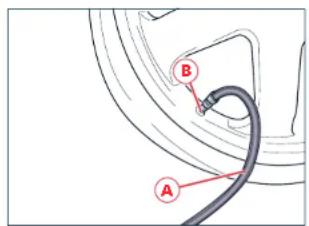
text_image
Diagram showing a car wheel with labeled points A and B, likely indicating positions or features in a mechanical or electrical component.If a tire gets a puncture

text_image
Diagram of a vehicle engine bay with labeled components D and C, showing internal components and wiring.
text_image
E O I ↑Peel off the warning label F from the bottle and place it on the dashboard as a reminder to the driver that the tire has been treated with Fix&Go.

Do not drive over the speed limit or exceed 65 mph (110 km/h) whichever is less. Have checked as soon as possible at orized Maserati Dealer.

The sealant maybe harmful or irritant. Do not swallow, avoid contact with eyes & skin. In contact rinse with plenty of
Contact a physician in case of allergic reaction. Keep the sealant away from children. Dispose of the used sealant canister at your local Authorized Maserati Dealer.
WARNING: Replace the sealant canister prior to the expiration date at your Authorized Maserati Dealer.

text_image
F MAX 110 65 MAXIf a tire gets a puncture
Spare wheel (emergency wheel - optional)
With the spare wheel fitted, never exceed the maximum speed of 50 mph / 80 Km/h; in fact, exceeding this speed jeopardizes the stability, road holding and braking of the car. Avoid driving at full throttle, braking sharply and cornering at high speeds.
Upon request, the car can be fitted with an optional spare wheel (emergency wheel), jack and tools for replacing a wheel. The spare wheel is of a special type and is housed in the luggage compartment. The spare wheel is supplied deflated, for space-saving reasons, with an electric compressor to inflate it. If a tire is punctured, proceed as follows:
- Stop the car in safe place, where it does not represent a hazard situation for the road traffic and where the wheel can be replaced safely. The car must be parked on a level and firm ground.
– Pull the handbrake. - Engage the 1st or reverse gear.
If a tire gets a puncture
- If necessary, turn on the hazard warning lights and position the warning triangle at the prescribed distance.
WARNING: In the event or downhill or uneven roads, place wedges or other objects under the wheels, in order to hold the car. - Remove the spare wheel covering from the luggage compartment panel.
Unscrew knob G, remove the cover H and take out the spare wheel with the jack, the compressor and the tools for replacing the wheel.
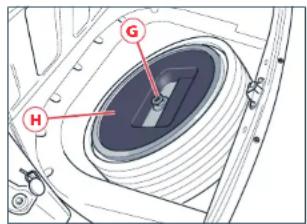
text_image
Technical diagram of a mechanical component with labeled parts H and GThe box located inside the spare wheel contains:
– an electric compressor I, including a pressure gauge and the special union for inflating the spare wheel
- a wrench J for the wheel studs and for the jack operation
- a bushing K to be fitted on the wrench to loosen the wheel studs and to operate the jack
– no. 5 studs L for fitting the spare wheel
- a jack M.

text_image
I J K M L- Open the compressor cover and take out the hose with the pressure gauge N and the electric wire O with the power plug.
- Unscrew the spare wheel's valve cap and screw down the union P for the inflating pipe on the valve.
- Open the cap of the power plug R, housed in the right hand side of the luggage compartment, and insert the connection O.
- Turn the ignition key to MAR to supply power to the plug and activate the compressor pressing switch Q.
- Stop the compressor when the pressure indicated on the pressure gauge N is 2.5 bar (250 kPa / 35 psi) and screw the valve cap.
WARNING: We recommend to check the tire pressure on the gauge when the compressor is off, in order to have a more precise reading.
WARNING: Do not use the compressor for more than 20 minutes: risk of overheating! The compressor has been designed for inflating the spare wheel only; do not use it to inflate mattresses, rubber boats etc.
WARNING: Power is supplied to the current plug only when the key is turned to MAR and it can only be connected to devices with a power absorption of 15A maximum (180W power). Do not connect devices with a higher power absorption to the current plug. A prolonged power absorption can discharge the battery, preventing the engine from being started once again.
- Fit the bushing K onto the wrench J and loosen the 5 fastening studs on the wheel to be replaced by about one turn.

text_image
Diagram of a pressure measurement setup with labeled components O, Q, P, and N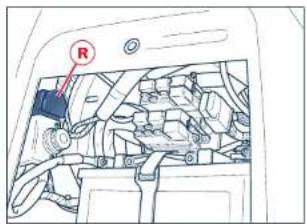
text_image
R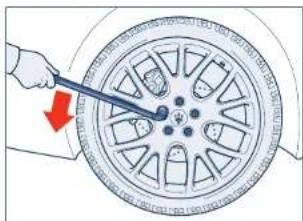
natural_image
Illustration of a car tire being towed with a tool, showing tire positioning and wheel rim (no text or symbols)If a tire gets a puncture
- Take out the jack from the box and open it partially.
- Place the jack near the wheel to be replaced, in one of the indicated positions.
- Make sure that the jack head is properly fitted into one of the special seats on the side member.

Failure to position the jack correctly could result in the car dropping, damage to the men raised, and personal injury.
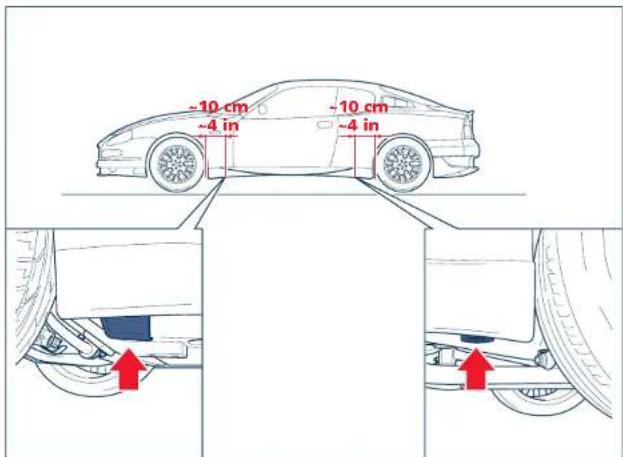
text_image
-10 cm -4 in -10 cm -4 inIf a tire gets a puncture
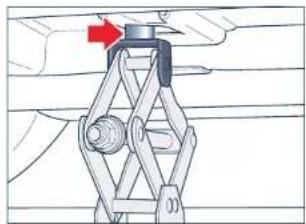
natural_image
Mechanical assembly diagram showing a linkage mechanism with a red arrow indicating direction (no text or symbols present)- Insert the wrench onto the jack and rotate it until the wheel rises a few inches off the ground.
- Loosen the 5 studs completely and remove the wheel.
- Fit the spare wheel and fix it using the 5 special studs L, found in the box.
- Screw the 5 new fixing studs.
The spare wheel must be fitted using the supplied studs only. Remember to keep the studs from the removed wheel, which must be used when refitting the wheel after repair.
– Turn the jack wrench to lower the car and withdraw the jack.
– Fully tighten the studs as shown in the illustration, starting first with one stud and then with the one diagonally opposed and so on.
The spare wheel is narrower than the standard ones and must be used only to travel the necessary distance to reach a service station, where the punctured tire can be repaired.
The inflating pressure for the spare wheel must be 2.5 bar (250 kPa / 35 psi).
For safety reasons, it is absolutely forbidden to travel with more than one spare wheel fitted on the vehicle at the same time.
Snow chains cannot be fitted on spare wheels.
The maximum total life of the spare wheel is approx. 1,860 miles / 3,000 km.
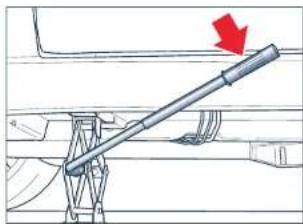
natural_image
Mechanical lever diagram showing a lever with a red arrow indicating direction (no text or symbols present)
text_image
Diagram showing a car tire with numbered parts and a hand using a tool to measure the rim, highlighting a red arrow.If a tire gets a puncture
Refitting the standard wheel
– Following the procedure described above, lift the car and remove the spare wheel.
- Fit the standard wheel using the tighten studs, removed during the disassembly procedure.
– Tighten the studs using the special wrench.
The standard wheel must be fitted using the specific studs only. Put back the spare wheel's studs into the box, to use them again in the event of refitting the spare wheel.
– Lower the car and remove the jack.
– Fully tighten the studs following the sequence indicated before.

Observe the tightening torque for the wheel studs (98 ± 10 Nm).
On completion of the operation:
- Thoroughly deflate the spare wheel, exerting pressure on the valve through the protruding piece of the valve cap.
- Position the jack, the wrench with the bushing and the special studs in their box and put it back into the spare wheel.
- Position the spare wheel in the luggage compartment, close it with its cover and secure it to the panel with the clamping device.
– Cover the spare wheel with the luggage compartment covering panel.

After refitting the standard wheel, check the tire pressure.

The jack can be used only to replace the wheels. Never be use it repairs under the car.
If an exterior light goes out
WARNING: Before replacing a lamp, make sure that the corresponding fuse is in good working condition. Use only new and original bulbs having the same features as the older ones for replacement.
Front lights
To access the front lights under the car it is necessary to remove the wheel housing.
It is therefore recommended to contact your Authorized Maserati Dealer to replace the bulbs for the low beams, high beams, fog lights, parking lights and direction indicators.
In case of cars equipped with gas-emitting headlights (Xenon headlights), to check the system and to replace the bulbs if necessary, contact your Authorized Maserati Dealer only: RISK OF ELECTRICAL SHOCKS!
Rear lights
The rear light bulbs are arranged as follows:
A - Dipped light bulb (P 21/5W)
B – Direction indicator light bulb (PY 21W)
C - Stop light bulb (P 21 W)
D - Rear fog light bulb (P 21 W)
E - Reverse gear light bulb (P 21 W).
To replace a light bulb:
1) Lift the luggage compartment lid.
2) Open the covering panel on the light.
3) Rotate the bulb holder F in a counter clockwise direction and slide it out.
4) Remove the bulb G gently pushing it and rotating it in counter-clockwise direction.
5) Insert the new bulb by slightly pushing it and rotating it in a clockwise direction.
6) Insert the bulb holder and rotate it in a clockwise direction.
7) Close the covering panel.
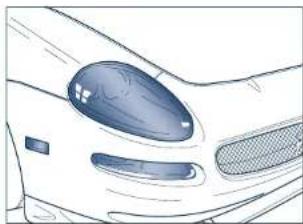
natural_image
Line drawing of a car's front bumper with no text or symbols
text_image
B E A C D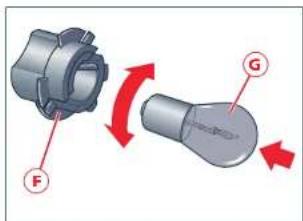
text_image
Diagram showing mechanical component F and G with directional arrows indicating motion or transformationIf an exterior light goes out
Directional indicator lights
To replace the direction indicator light bulb (5W):
1) Push forward the directional indicator to press on the spring clip H.
2) Remove the rear part releasing the retaining tab L and remove the unit.
3) Remove the bulb holder M turning it in an a counter direction.
4) Remove and replace the bulb.
5) Refit the bulb holder turning it in a clockwise direction.
6) Refit the direction indicator inserting first the retaining tab on the rear part and then pressing the front part until hearing the spring clip click into position.
WARNING: Proceed with care when removing the side directional indicator light to avoid damages to the car body or to the indicator itself.
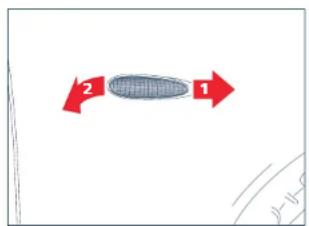
text_image
1 2If an exterior light goes out
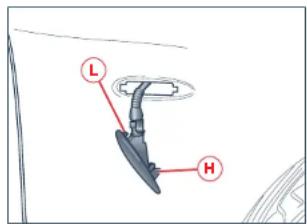
text_image
L H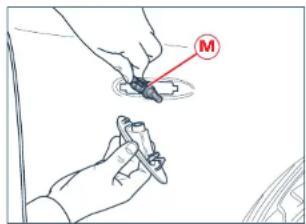
text_image
Diagram showing hand positioning of a small object labeled 'M' on a surface, with another hand holding a tool.Side marker lamp
To replace the side marker lamps, we recommended to contact your Authorized Maserati Dealer.
Third stop light
In order to replace the bulbs, the lens unit has to be removed. It is therefore recommended that you contact your Authorized Maserati Dealer.
License plate lights
To replace the license plate light bulb: 1) Loosen the fastening screws for the lens/bulb holder unit. 2) Remove the unit and replace the bulb.
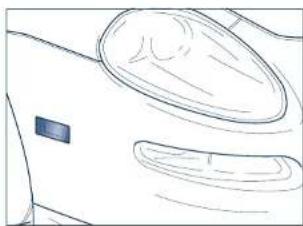
natural_image
Line drawing of a car's front and side panels (no text or symbols)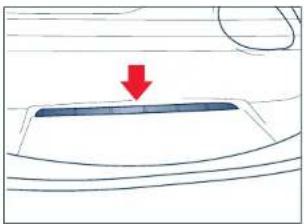
natural_image
Simple line drawing of a car interior with a red arrow pointing to the bottom panel (no text or symbols)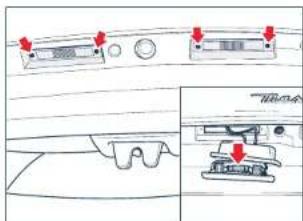
text_image
Diagram showing front and side views of a device with red arrows indicating features, likely illustrating a mechanical or electrical component layout.If an exterior light goes out
If an interior light goes out
WARNING: Before replacing a lamp, make sure that the corresponding fuse is in good working condition. Use only new and original bulbs having the same features as the older ones for replacement.
Front overhead lights
To replace the bulbs:
1) Remove the overhead light by gently levering it out with a flat head screwdriver at point A.
2) Replace the bulb concerned:
-timed light B (12V - 10W torpedo)
- reading light C (12V - 3W).
3) Refit the overhead light inserting the left-hand side first and then pushing the right-hand side into place.
WARNING: When refitting the overhead light, make sure that the electric wires are correctly arranged and do not interfere with the edges of the overhead lights or its retaining tongues
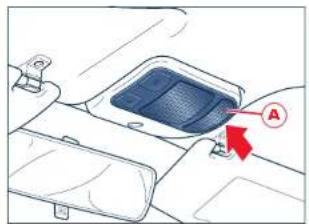
natural_image
Diagram of a car interior showing a vent and side-mounted sensors (no text or symbols)If an interior light goes out

text_image
Technical diagram of a vehicle interior with labeled components A, B, and CRear overhead lights
To replace the bulb (12V - 5W torpedo):
1) Remove the ceiling light by gently levering it out with a flat head screwdriver at point D.
2) Replace the bulb.
3) Refit the ceiling light inserting the connector side first and then pressing on the other side until it fits into place.
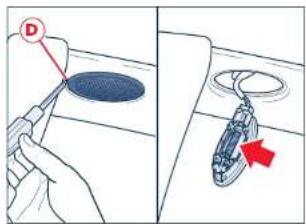
text_image
Diagram showing a hand holding a pen near a blue oval object and a mechanical device with a red arrow indicating rotation or change.Vanity mirror light
To replace the bulb (12V - 5W torpedo):
1) Remove the fixing plate by levering it out at points E.
2) Replace the bulb.
3) Refit the fixing plate by pressing it into place.
Glove compartment light
To replace the bulb
(12V - 5W "torpedo" type):
1) Remove the lens by levering it out gently in point F with a flat head screwdriver.
2) Replace the bulb.
3) Refit the lens, inserting first the two-tab side and then pressing on the other side.
Courtesy lights (below door)
To replace the bulb (12V - 5W all glass):
1) Lever it out gently from its ceiling light seat G with a flat head screwdriver and remove it.
2) Press the sides of lens H to release the retaining tabs and remove the lens.
3) Replace the pressure-fitted bulb.
4) Refit the lens.
5) Refit the lighting unit inserting first the electrical connector side and then pressing on the other side to hook up the clip.

text_image
Diagram showing a car interior with a blue vehicle and red directional arrows labeled 'E' pointing to the dashboard panel.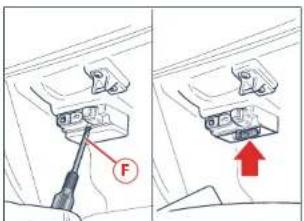
text_image
Diagram showing a tool inserted into a car compartment with a red arrow indicating direction, labeled 'F' and an upward arrow.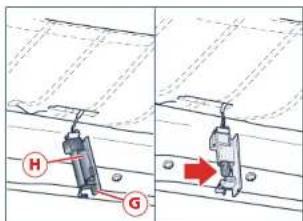
text_image
Technical diagram showing mechanical assembly with labeled parts H and G, including a red arrow indicating direction or force.If an interior light goes out
Luggage compartment light
To replace the bulb (12V - 5W all glass): 1) Lever it out gently from its ceiling light seat L with a flat head screwdriver and remove it.
2) Press the sides of lens M to release the retaining tabs and remove the lens.
3) Replace the pressure-fitted bulb. 4) Refit the lens.
5) Refit the lighting unit inserting first the left side and then pressing on the right side to hook up the clip N.
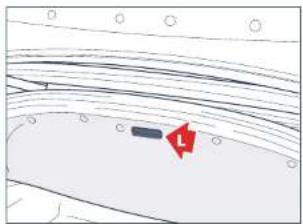
natural_image
Diagram showing layered structure with a red arrow and circle markers, no readable text or symbols present.If an interior light goes out
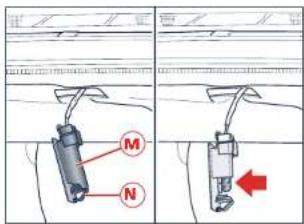
text_image
Diagram showing two mechanical assembly steps with labeled parts M and N, including a red arrow indicating direction of movement.If a fuse blows
Replacing the fuses
When an electrical device ceases to work, check that the corresponding fuse is sound.
A - Sound fuse.
B - Blown fuse.
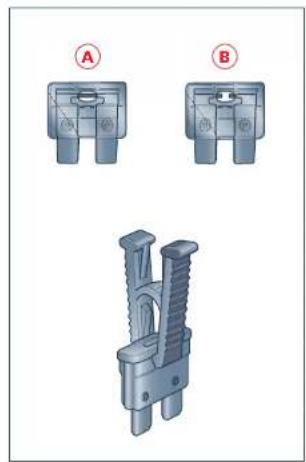
natural_image
Three mechanical component diagrams labeled A, B, and C, showing different mounting or mounting features (no text or symbols beyond labels)Replace the faulty fuse with a new one featuring the same rating (same color). If the fault reoccurs, consult your Authorized Maserati Dealer.

Never replace a blown fuse with anything other than a sound fuse (same rating/
Position of fuses/relays
The fuses/relays are located in various parts of the car, namely:
- Under the dashboard on the right hand side.
- In the engine compartment.
- In the right hand side of the luggage compartment.
Fuse Color
| ocher yellow | brown red | pale blue | yellow white green | |
| Amps A5 A7.5 A10 A15 A20 A25 A30 | ||||
Maxi Fuse Colors
| yellow | green orange red blue |
| Amps A20 A30 A40 A50 A60 | |
Fuses and relays under the dashboard, on the right hand side
To gain access to the fuses/relays it is necessary to remove the mat, lift the covering panel and open the protection cover C loosening its fastening screws.
The fuses/relays are contained in 4 box units, protected by covers. To remove the covers, gently lever up the fastening tabs D and slide them out.
Spare fuses are positioned vertically. The fuse and relay list is shown in the following pages.
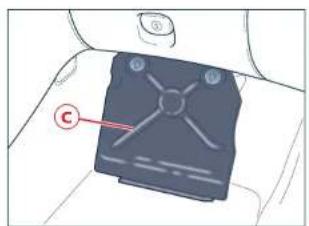
natural_image
Diagram of a mechanical component with labeled point C, no readable text or symbols present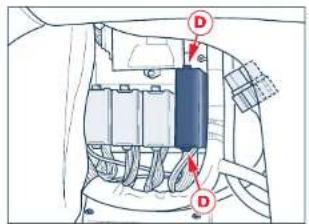
text_image
Technical diagram of a vehicle interior with labeled components and directional arrows indicating movement or flow.If a fuse blows


Relays under the dashboard
A Micro 20A Driver's seat heating
B Micro 20A Passenger's seat heating
C Micro 30A Connected devices cut out during ignition
D Micro 30A Connected devices not cut out during ignition
E Micro 20A Electronic injection main relay
F Micro 20A Maserati CODE System
G Micro 20A Air conditioner compressor
H Micro 20A Horns
I Micro 20A High beams
L Micro 20A Fog lights
M Micro 30A Starter motor
N Micro 20A Low beams
O Micro 20A A.C. status indicator/ heated rear window
P Micro 20A Start-up disable
Fuses under the dashboard
Posit. Amps. Color System/Component
1 30A Green +30 driver's seat
2 30A Green +30 Passenger's seat
3 7.5A Brown Passenger's seat heating
4 7.5A Brown Driver's seat heating
5 30A Green Air conditioning and ventilation unit
6 30A Green Headlight washer timer
Posit. Amps. Color System/Component
7 10A Red +87 main relay
8 15A Pale blue +87 main relay for Lambda sensor, air flow meter etc.
9 15A Pale blue +87 main relay for injectors, coils
10 7.5A Brown Air conditioner compressor
11 10A Red +15 ABS from electronic injection main relay
12 15A Pale blue Horns
13 15A Pale blue Fog lights
14 10A Red RH high beam
15 15A Pale blue LH low beam and headlight aiming adjuster
16 10A Red LH high beam, high beam warning light
17 15A Pale blue RH low beam, headlight washer enable, manual headlight aiming adjuster
18 30A Green Starter motor
19 -- Not used
20 -- Not used
21 20A Yellow Directional lights intermittance
22 7.5A Brown Maserati CODE system, CAN line interface, navigator cable bundle instrument (+15 not cut out during ignition)
23 -- Not used
24 10A Red Stop, clutch
25 7.5A Brown ECU for CAN line interface, OBD, Maserati CODE system, multifuncion display
26 5A Ochre yellow BOGE system (+15 connected devices not cut out during ignition)
27 -- Not used
Posit. Amps. Color System/Component
| 28 5A | Ochre yellow | IGE ECU, ceiling light timer, light switch (+15 connected devices not cut out during ignition) |
| 29 10A Red | Ceiling lights, ceiling light timer, (electricals,) seats, luggage compartment and fuel flap opening controls | |
| 30 10A Red Airbag (+15 connected devices not cut out during ignition) | ||
| 31 10A Red Navigator (if present), clock | ||
| 32 10A Red +15 light switch, Cruise Control, headlight aiming ECU (+15 cut out during ignition) | ||
| 33 5A | Ochre yellow | Alarm system, preset for satellite alarm |
| 34 10A Red +15 electronic injection | ||
| 35 15A Pale blue +30 IGE ECU | ||
| 36 15A Pale blue +30 IGE ECU | ||
| 37 25A White | Windshield wiper, windshield wiper washing pumps, wiper (+15 cut out during ignition) | |
| 38 15A Pale blue +30 ignition switch | ||
| 39 15A Pale blue Stereo, navigator (if present) | ||
| 40 20A Yellow Centralized lock | ||
| 41 15A Pale blue | Cigarette lighter, radio, engine indic., rear view mirrors, ceiling light, glove compartment lamp (+15 cut out during ignition) | |
| 42 30A Green Electronic injection main relay | ||
| 43 30A Green Passenger side power window | ||
| 44 30A Green Driver side power windows | ||
| 45 5A | Ochre yellow | Air conditioning and ventilation system, navigator cable bundle, (+15 connected devices cut out during ignition) |
| 46 7.5A Brown +30 electronic injection | ||
if a fuse blows
Fuses/relays in the engine compartment
The fuses/relays in the engine compartment, are located on the right-hand side and on the rear panel, right-hand side.
To gain access to the side relays, remove the right-hand covering E of the engine compartment, loosening, then lift the cover F releasing it from the retaining tab.
If necessary, the cover can be removed by pulling it upwards. To refit the engine compartment covering, position it correctly, then press it and rotate the fastening studs.
Side relay
A Mini 50A Electronic cooling fan (second speed)
B Mini 50A Electronic cooling fan (first speed)
C Mini 50A Air pump
D Timer Headlight washer with timer

text_image
Technical diagram of a car engine compartment with red arrows indicating parts of the component, labeled 'E' in the upper right corner.If a fuse blows
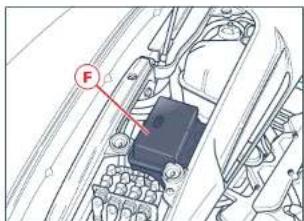
text_image
Technical diagram of a mechanical component with labeled parts F and a highlighted section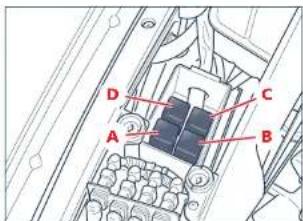
text_image
D A C BTo gain access to the fuses on the engine compartment rear panel, remove the rear covering, backing off the fastening screws.
WARNING: This work should be performed by your Authorized Maserati Dealer.
To access the fuses, remove cover G gently levering up the fastening tabs H.
Fuses on the rear panel
Posit. Amp. Color System/Component
1 Maxi 60A Blue Air pump
2 Maxi 60A Blue ABS
3 Maxi 40A Orange First speed fans
4 Maxi 50A Red Second speed fans
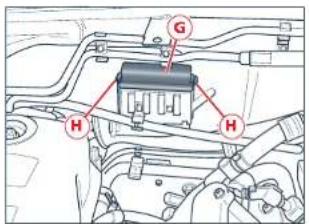
text_image
Technical diagram of an engine bay with labeled components H and G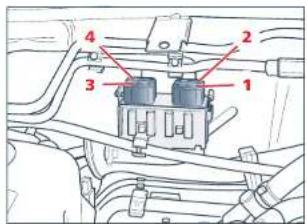
text_image
Technical diagram of a mechanical assembly with numbered components labeled 1 to 4if a fuse blows
Relay/fuse box units in the luggage compartment
To gain access to the fuses/relays, open the covering panel L, fixed with a Velcro strap on the right-hand side of the luggage compartment.
There are three fuse and relay box units which are located as follows:
M- over the battery
N - above the M ECU
O - above the power socket
P - next to the M and N ECUs
To gain access to the fuses and relays of units M and N, remove the covers by opening the fastening clips.
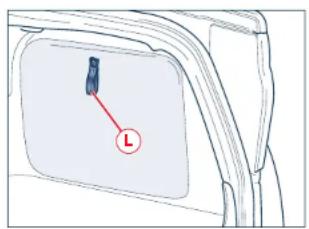
text_image
L
text_image
O 14 13 I N E F G 11 9 7 H 12 10 8 P 16 15 M A B C 5 3 1 D 6 4 2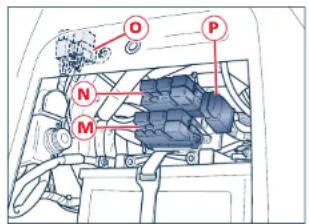
text_image
O P N MIf a fuse blows
Luggage compartment relays
A Micro 30A Luggage compartment lid opening alarm
B Micro 30A Rear Defroster
C Micro Fuel pump (first speed)
D Micro Fuel pump (second speed)
E Micro Luggage compartment lid and fuel tank flap relay cut out
F Micro 20A Reverse gear
G Micro 30A Fuel tank flap
H Micro 30A Luggage compartment lid
I Mini "Cambiocorsa" electronically controlled gearbox
Luggage compartment fuses
Posit. Amp. Color System/Component
| 1 -- Not used | |
| 2 20A Yellow Fuel pump (rear) | |
| 3 7.5A Brown Heated rear window and mirror defrosting (rear) | |
| 4 30A Green Defroster | |
| 5 -- Not used | |
| 6 30A Green Radio amplifier | |
| 7 30A Green Fuel tank flap (rear) | |
| 8 -- Not used | |
| 9 25A White | Luggage compartment lid, coil for luggage compartment and fuel tank flap opening cut out relay (rear) |
| 10 15A Pale blue Power socket | |
| 11 7.5A Brown | Reverse gear, parking sensors, CAN line interface, mirror memory, electronic mirror (rear) |
| 12 -- Not used | |
| 13 Maxi 20A Yellow ECU for “Cambiocorsa” electronically controlled gearbox | |
| 14 Maxi 30A Green Pump for “Cambiocorsa” electronically controlled gearbox | |
| 15 Maxi 40A Orange Relay and fuse control units | |
| 16 Maxi 50A Red Relay and fuse control units | |
If the battery is fully discharged
First of all, you are advised to carefully read the Chapter "Maintenance", where a specific section illustrates the precautions to take to prevent the battery from discharging and to help ensure long life.
WARNING: Before disconnecting the battery, lower the side windows by at least 1.5-2 in (4-5 centimeters), in order to avoid damaging the strips when opening and closing the doors. When the battery is connected and loaded, this operation is carried out automatically upon opening and closing the door. The windows must remain lowered until the battery is connected once again. If the battery runs flat when the windows are fully raised, open the door only if necessary and taking utmost care. Do not close the door if the window cannot be lowered.
Starting with the auxiliary battery
See the section "Starting the engine" contained in the chapter "Using the Vehicle".
WARNING: Under no circumstances should a battery charger be used for an emergency start-up: This could damage the electronic systems, particularly the control units managing the ignition and fuel supply functions.
Recharging the battery
You are advised to recharge the battery slowly and at a low amperage for about 24 hours. Follow the below instructions:
1) Deactivate the electronic alarm using the radio control. 2) Open the trunk and disconnect the terminals of the electrical system from the battery terminals.
WARNING: First disconnect the negative pole terminal (-) then the positive pole one (+).
3) Connect the recharger wires to the battery terminals.
4) Switch on the recharger.
5) When the battery is recharged, turn off the recharger before disconnecting it from the battery.
6) Reconnect the terminals to the battery poles, observing the polarity.
WARNING: First reconnect the positive pole terminal (+) then the negative pole one (-).
7) Check that the seats work correctly: if not, carry out the "initialization" procedures described in the section "Seats", contained in the chapter "Before you drive".
The fluid contained in the battery is poisonous and corrosive. Avoid contact with the skin and eyes. The battery recharging procedure must be carried out in a ventilated environment away from open flames or possible sources of sparks: risk of explosion and fire.
Battery posts, terminals and related accessories contain lead and lead compounds. Wash your hands after handling.
If the battery is fully discharged
If you have to jack up the car
The jack can be used only to replace the wheels. Under no circumstance should it be used for repairs under the car.
Using the jack
See the section "If a tire gets a puncture", in this chapter (pg. 136).

text_image
-10 cm -4 in -10 cm -4 inIf you have to jack up the car
If you have to tow the car
The car is fitted with a front emergency towing hook.
The towing hook is located in the tool box.
Do not use other attachment points for towing.
To access the towing hook seat, remove the cap on the lower right-hand side of the front bumpers.
Screw down the hook into its seat.
WARNING: If you have to tow the vehicle with 2 wheels raised, make sure the ignition key is in the STOP position. differently, with the MSP system activated, the relevant control unit would store a malfunction causing the indicator. This come up on the multifunction display. This requires the intervention of your Authorized Maserati Dealer to have the system restored.
When towing the car, make sure that you observe the road traffic regulations concerning both the towing device and driving conduct.
Before towing the vehicle, turn the ignition key to the MAR position, engage neutral ("N"), then turn back the key to STOP without removing it! Removing the key automatically activates the steering wheel lock, consequently making it impossible to steer the wheels.
When towing the car with the engine off, remember that without the assistance of the brake servo, a stronger effort will be required on the brake pedal and on the steering wheel for steering.
Screw down the hook into its seat (approx. 11 turns). Clean the threaded seat before tightening the hook.
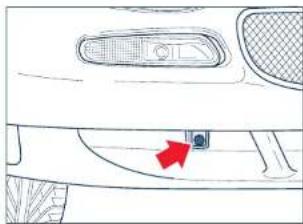
natural_image
Diagram of a car's front and side panels with a red arrow pointing to a small object on the door (no text or symbols present)
text_image
Diagram showing car interior with a wrench and red circular mark, labeled in Japanese charactersif you have to tow the car
In the event of an accident
It is important always to stay calm.
- If you are not directly involved, stop at a distance of at least ten yards or meters away from the accident area.
- If you are on a highway, stop without obstructing the emergency lane.
– Turn off the engine and switch on the hazard warning lights.
- At night, illuminate the accident area with the headlights.
- Always act with caution: do not risk someone crashing into you.
– Indicate that an accident has occurred by placing the emergency triangle in a well visible position and at the prescribed distance.
- Call the police or other emergency services, providing as much information as possible.
- Remove the ignition key from the vehicles involved.
- If you smell fuel or other chemical products, do not smoke and ask people around you to extinguish their cigarettes.
To extinguish fires, even small ones, use a fire extinguisher, blankets, sand or earth. Never use water. In accidents on highways, particularly where visibility is poor, there is a high risk of being involved in other collisions. Leave your vehicle immediately and move away from it.
If there are injured persons
– Never leave an injured person alone.
- Do not crowd around injured persons.
– Reassure the injured person that assistance is on the way and stay close to him/her to help with possible fear.
- Release or cut the seat belts restraining the injured persons.
- Do not give the injured persons anything to drink.
– The injured person should never be moved.
- Remove the injured person from the vehicle only if absolutely necessary. When removing an injured person, do not pull his/her limbs, his/her head and keep the body in a horizontal position.
Capacities and Technical Specifications
Fuel 164
Engine oil 164
Capacities: quantities and specifications of the products
to be used 165
Fuel consumption 167
Technical specifications 168
Tire pressure 175
Fuel
Only "Premium gasoline" with an AKI (Anti Knock Index) rating no lower than 91 (approximately 96 R.O.N.) must be used. Tank capacity: about 23 US gallons (88 liters), including a reserve of about 5 US gallons (18 liters).
WARNING: The anti-pollution devices of the car require unleaded gasoline to be used at all times. Under no circumstance, not even in emergency situations, should leaded gasoline or gasoline containing benzene be supplied to the fuel tank as you would damage the catalytic converter beyond repair.
WARNING: An inefficient catalytic converter results in noxious exhaust emissions which are harmful for the environment.
Engine oil
To check level, please consult the chapter "Maintenance". Do not top up with, otherwise or use oil having characteristics other than those of the oil already used. The gap between the MIN and MAX reference marks on the dipstick corresponds to about 1 liter of oil. Use SAE 5W/40 API SG/CD - CCMC G5 oil for gasoline-powered engines.
| Capacities: quantities and specifications of the products to be used
Recommended quantities and products
Parts to be refilled Quantity Product specifications
| Fuel tank (reserve included) about 23 US | gallons (88 liters) | Premium gasoline with a minimum of 91 AKI. |
| Fuel reserve about 5 US | gallons (18 liters) | |
| Engine oil: Multi-grade semi-synthetic or fully synthetic lubricants with SAE 5W/40 strength, over API SG - CD - CCMC - G5 standards. Recommended AGIP TECSINT SL 5W/40. | ||
| - scheduled replacement 2.06 US gallons(7.8 liters) | ||
| - top up from MIN to MAX level 0.26 US gallons(1 liter) | WARNING: Do not top up using oil with features other than those of the oil already contained in the engine. | |
| - oil consumption (according to use conditions) | 0.13 US gallons/600 mi(0.5 liters/1.000 km) | WARNING: The engine oil consumption depends on the driving style and on the car use conditions. |
| Windshield/headlight washer fluid reservoir | 1.72 US gallons(6.5 liters) | Water and detergent fluid mixture, in the percentage indicated on the product box. |
| Detergent fluid: alcohols and tensio-actives CUNA NC 956-II. Recommended type DP1 | ||
| WARNING: In the event of temperatures below -4 °F (-20 °C), use pure detergent only. | ||
| Cooling system 3.04 US gallons | 11.5 liters | Water and coolant fluid mixture, in the percentage indicated on the product box. |
| Coolant: protective with anti-freeze action, inhibited mono-ethylene glycol based, CUNA NC 956-16. Recommended AGIP ANTIFREEZE PLUS ECOPERMANENT. | ||
Capacities: quantities and specifications of the products to be used
Parts to be refilled Quantity Product specifications
| Battery | 74 Ah700 AMPS | Cold cran king start |
| Hydraulic servo steering | 0.26 US gallons1 liter | Oil type ATF DEXRON II D LEV, SAE 10W.Recommended AGIP ATF II D. |
| "Cambiocorsa" gearbox | 0.74 US gallons2.8 liters | 75W/90 over the API GL4-GL5C API MT1-PG2 standardsRecommended ROTRA LSX. |
| "Cambiocorsa" system | 0.26 US gallons1 liter | Oil type CHFRecommended AGIP CHF. |
| Brake system circuit | 0.29 US gallons1.1 liters | Synthetic fluid NHTSA n.116 DOT4, ISO 4925, SAE J1703 – J1704, CUNA NC 956-01Recommended AGIP BRAKE FLUID DOT 4 PLUS. |
| Air conditioning system coolant 1,100 g R134a | ||
| Air conditioning and ventilation system compressor oil | 135 cc Type SP 10 (Sanden) | |
MASERATI recommends to use AGIP products complying with the above mentioned specifications.
Fuel consumption
The fuel consumption values shown in the following table were established based on homologation tests.
Fuel consumption
Urban
Extra-urban
12.55 mpg 21.3 mpg
WARNING: The type of route, traffic conditions, weather conditions, driving style, general condition of the vehicle, set-up/equipment/accessories in the car, use of the air conditioning system, car load, roof rack and other items or situations which may negatively affect the car aerodynamics or wind resistance lead to consumption ratios differing from the reported ones.
Fuel consumption
Technical specifications
Engine
General
Type code M138P
Cylinder number and position 8 - 90° V
Number of valves per cylinder 4
Piston bore and stroke mm 92 x 79.8
Total displacement cm 3 4,244
Compression ratio 11.11±0.2:1
Maximum output (EEC) kW
295
HP 400
corresponding rpm r.p.m. 7,000
Maximum torque (EEC) Nm
451
kgm 46
corresponding rpm r.p.m. 4,500
Injection - Ignition
The ignition - injection system is controlled by a single microprocessor electronic control unit (ECU). Engine performance and fuel consumption are both optimized, the former due an improved car drivability and the latter to a better engine operation with partial loads.
Injection
– Bosch ME7.1.1 type
Ignition
- Static ignition
– Firing sequence: 1-8-6-2-7-3-4-5
– Bosch ignition coil
- NGK PMR8A spark plugs.
Lubrication system
The engine lubrication system is of the dry sump type with scavenge and delivery pumps aligned with the cooling pump, in a single unit driven by the crankshaft through a chain.
Cooling system
The engine is cooled by means of an anti-freeze mixture with circulates inside a specific line system equipped with a radiator, a centrifugal pump and an expansion tank.
Transmission
Clutch
Dry double-plate clutch with servo-assisted hydraulic control.
Gearbox
Six forward speeds and one reverse.
Gear Ratios Total reduction ratios
| (engine revolutions/wheel revolutions) | ||
| 1^st speed | 3,286 | 12,247 |
| 2^nd speed | 2,158 8,043 | |
| 3^rd speed | 1,609 5,997 | |
| 4^th speed | 1,269 4,730 | |
| 5^th speed | 1,034 3,854 | |
| 6^th speed | 0,816 3,040 | |
| Reverse | 2,733 | 10,186 |
"Cambiocorsa" gearbox
The electronic gearbox technology, which was originally designed for Formula 1 racing, has become today a standard production component. The "Cambiocorsa" is a "hydraulic servo" system for the gearbox and the clutch, which however features all the advantages of the dry clutch and mechanical gearbox (reduced weights, strength and reliability, low consumption levels). At the same time, it is more user-friendly, reduces strain from driving in the city traffic or when a frequent gearshifting is required.
Furthermore, it provides excellent performance, soft gearshifting and progressive torque on the wheels. Thanks to the hydraulic servo and to the interface with the engine controller (ECU) as well as with the drive control devices (ASR/MSR), the system is capable of performing "sport" or "comfort" gearshifting, depending on the driver's needs and driving style.
The clutch pedal is not fitted in the passenger compartment; the gearshift lever is replaced by electric controls (Up-Down) on the steering wheel, just like on Formula 1 autos.
Technical specifications
The "Canciocorsa" gearbox helps relieve the driver from bothering and straining aspects of manual transmission management, without depriving him of the pleasure of controlling gearshifting directly. In the event that the driver, in particular situations, prefers to give up this option as well, the total automatic mode can be also enabled. The servo assisted system basically consists of a hydraulic actuator, fitted directly onto the gearbox housing, which manages both the gear selection and engagement by means of two different pistons. The two pistons are controlled by a series of solenoid valves, hydraulically powered by an electric pump and a storage battery. An electronic control unit, after receiving the requests from the driver and after evaluation of the vehicle operation conditions, detected through a series of sensors, autonomously manages gearshifting, thereby controlling clutch, gearbox and engine torque directly.
Technical specifications
When shifting gears, the engine control is assisted by the gearbox control. Interfacing between gearbox and engine control remarkably improves the system performance and relieves the driver, during gearshifting, from any need to synchronize the clutch-accelerator operations. Actually, the accelerator pedal can be even kept pressed down. The "Canciocorsa" gearbox not only manages the transmission upon the driver's request, but also "tutors" and assists him while driving.
As a matter of fact, the system is designed to automatically exclude all wrong gearshifting requests. As far as driving assistance is concerned, it furthermore ensures that the first speed is immediately available when the vehicle is stopped and that gears are automatically downshifted in case of sudden deceleration, with subsequent sharp request for acceleration. These aspects help improve driving safety, since the possibilities for the driver to carry out wrong maneuvers are decreased. A display on the instrument panel indicates the gear currently engaged, while diagnostics messages are managed by the electronic control unit through a warning light and a buzzer.
Differential
Differential reduction torque
3.727
Brakes
Service and emergency brakes
Disc-type, on four wheels, self-ventilating.
Two diagonally opposed and independent hydraulic control circuits. Vacuum brake servo.
4-channel ABS system with Electronic Brake force Distribution (EBD).
Handbrake
Mechanical type, on the rear wheels, operated through the central lever.
Suspension
Front and rear
Articulated quadrilateral.
Adjustable damping suspension Skyhook
This system allows the driver to choose two settings for the shock absorbers, depending upon the roadbed conditions, speed and comfort.
Technical specifications
Steering
Rack and pinion hydraulic steering, with pump driven by the drive shaft and reservoir. Articulated steering column, with energy absorption and adjustable inclination and height.
- Steering diameter = 39 ft (12 m)
- No. of steering wheel turns = 1,5 (to the left and to the right).
Wheels
Rims and tires
Rim size Tire size Brand tires
front 8"J x 19" 235/35 ZR19 PIRELLI P ZERO ROSSO
rear 9.5"J x 19" 265/30 ZR19 PIRELLI P ZERO ROSSO
*front 8"J x 18" 225/40 R18 MICHELIN PILOT ALPIN
*rear 9.5"J x 18" 265/35 R18 MICHELIN PILOT ALPIN
* Winter tires
The maximum speed that can be reached with winter tires is indicated by the tire manufacturer. In any case, always comply with local regulations in force.
Only use winter tires of the prescribed dimensions and brand.
WARNING: Notwithstanding the prescribed sizes, it is essential that tires of the same brand and type are fitted to all the wheels in order to ensure safe driving.
WARNING: Do not use air chambers on Tubeless tires.
Spare wheel (emergency wheel - optional)
Alloy rim.
Tire size Brand tire
185/60-17 93P VREDESTEIN
Snow chains
Maximum radial protuberance permitted over the tire profile: 0.35 in (9 mm).
Rear tire Snow chains: brand/type
WARNING: Snow chains must be fitted only on the rear wheels. Use is subject to local laws Contact your Athorized Maserati Dealer for purchasing your snow chains.
Performance
Maximum speed km/h mph
| 290 180 | |
| The maximum speed that can be reached with winter tires is indicated by the tire manufacturer. In any case, always comply with local regulations. | |
| Accelerations at standing start (in seconds) | 0-100 km/h 0-62 mph | 400 m 437 yd | 1,000 m 1,094 yd |
| 4.85 | 12.8 23 |
Weights
Weights
| Unladen car weight (with fluids, fuel, tools and accessories) | 3,726 lb 1,690 kg |
| Full load weight (4 occupants and 60 lb (28 kg) in the luggage compartment) | 4,387 lb 1,990 kg |
Dimensions

text_image
946 mm 37.24 in 2660 mm 104.72 in 903 mm 35.55 in 4509 mm 177.51 inTrunk volume (VDA standard): approx. 340 dm ^3 including approx. 60 dm ^3 for spare wheel compartment

text_image
1295 mm 50.98 in 1525 mm 60.03 inThe height refers to an unladen car Dimensions in mm
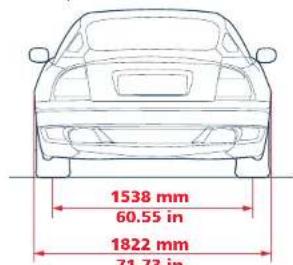
text_image
1538 mm 60.55 in 1822 mm 71.73 inTechnical specifications
Tire pressure
Tire inflation pressure when cold (psi/bar).
| Rim size Tire size Tire brand Inflation pressure | when cold (psi) | Inflation pressure when cold (bar) | |||
| front 8"J x 19" 235/35 ZR19 PIRELLI P ZERO ROSSO 35 2.4 | |||||
| rear 9.5"J x 19" 265/30 ZR19 PIRELLI P ZERO ROSSO 32 2.2 | |||||
| * front 8"J x 18" 225/40 R18 MICHELIN PILOT ALPIN 29 2.0 | |||||
| * rear 9.5"J x 18" 265/35 R18 MICHELIN PILOT ALPIN 29 2.0 | |||||
| spare wheel(emergency wheel) | - | 185/60-17 93P VREDESTEIN | 36 2.5 | ||
* Winter tires

The maximum speed that can be reached with winter tires is indicated by the tire manufacturer. In any case, always comply with local regulations. Only use winter tires of the prescribed dimensions and brand.
Tire pressure

text_image
176Maintenance
Scheduled Maintenance 178
Additional checks 182
Level checks 183
Air filters 188
Anti-dust/anti-pollen filter 188
Battery 189
Electronic Control Units 191
Spark plugs 191
Wheels and tires 192
Windshield wipers 194
Air conditioning 195
Bodywork 195
Interiors 197
If the car is not used for long periods 198
Battery master switch 200

Scheduled Maintenance
Correct maintenance is clearly the best way to maintain car performance and safety features, ensure respect for the environment and help lower operating costs.
WARNING: Also remember that the proper observance of the maintenance procedures is essential for maintaining warranty coverage.
For this reason, MASERATI has provided a series of checks and maintenance operations including the first service at 6,000 miles (10,000 km) and subsequently every 12,500 miles (20,000 km) up to 106,000 miles (170,000 km).
Over 106 thousand miles (170,000 kilometers)
When 106,000 miles have been reached (170,000 kilometers), the scheduled maintenance restarts with the same operations provided for at 18,500 miles (30,000 km), than 31,000 miles (50,000 km), etc.
WARNING: The Scheduled Maintenance services are prescribed by the Manufacturer. Failure to have the services carried may invalidate the warranty.
The Scheduled Maintenance service is provided by Authorized Maserati Dealers. In the event that, when a service is performed, further replacements or repairs are found to be necessary in addition to the scheduled operations, these can be carried out only with the specific consent of the Customer.
WARNING: You are advised to notify your Authorized Maserati Dealer of any minor operating problems, without waiting for the next service.
Main operations to be performed at the specified mileage
| Main operations | Kilometres covered (in thousands) | 10 | 30 | 50 | 70 | 90 | 110 | 130 | 150 | 170 | ||||
| Miles covered (in thousands) | 6 | 18.5 | 31 | 43.5 | 56 | 68.5 | 81 | 93.5 | 106 | |||||
| Belts for alternator, air conditioning/heating system compressor and power steering control | I-A I* I-A I* I-A I* I-A I* I-A Replace at least every 3 years | |||||||||||||
| Engine oil and filter R | R | R | R | R | R | R | R | R | ||||||
| Replace once a year | ||||||||||||||
| Cooling system connections and lines I | I | * | I | * | I | * | I | * | I | * | I | |||
| Air filters R* R R* R R* R R* R | ||||||||||||||
| Fuel injection connections and lines I* I* I | ||||||||||||||
| Ignition system cables and connections I* I* I | ||||||||||||||
| Spark plugs R | R | R | ||||||||||||
| Active charcoal filter and Lambda sensors | Replace at least every 4 years | R | ||||||||||||
| Air injection system: lines and connection valves | I | I | I | I | I | I | I | I | I | |||||
| Blow-by system | I | I | I | I | ||||||||||
| Fuel emission control system: lines, connections, seal and valves | I | I | I | I | ||||||||||
| Differential and gearbox oil | I | R | I | I | R | I | I | R | ||||||
| Replace every two years | ||||||||||||||
| "Cambiocorsa" gearbox system oil level | I | I | I | I | I | I | I | I | I | |||||
| Check every year | ||||||||||||||
| Hydraulic steering fluid level (drain if necessary) | I | I | I | I | I | I | I | I | I | |||||
| Replace every 2 years | ||||||||||||||
I = Check and carry out any other necessary operation
A = Adjust
R = Replace
Scheduled Maintenance
| Main operations | Kilometres covered (in thousands) | 10 | 30 | 50 | 70 | 90 | 110 | 130 | 150 | 170 | ||||
| Miles covered (in thousands) | 6 | 18.5 | 31 | 43.5 | 56 | 68.5 | 81 | 93.5 | 106 | |||||
| Engine coolant level I | I | I | I | I | I | I | I | I | ||||||
| Replace every 2 years | ||||||||||||||
| Brake fluid level (drain if necessary) I | I | I | I | I | I | I | I | I | ||||||
| Replace every year | ||||||||||||||
| Brake system: lines, calipers, connections Dashboard warning light efficiency Handbrake operation | I | I | I | I | I | I | I | I | I | |||||
| Wear condition of the braking elements (discs, pads); replace if necessary | I | I | I | I | I | I | I | I | I | |||||
| Joints for front and rear suspensions, front and rear underchassis - tightening torques | I | I | I | I | I | I | I | I | I | |||||
| Steering system components, joint protection, rack boots on the steering wheel levers and on the axle shafts | I | I | I | I | I | I | I | I | ||||||
| Tightening of screws, nuts and bolts (including those for the exhaust system), couplings, retaining clips and clamps | I | I | I | I | I | I | I | I | I | |||||
| Battery: connections and charge conditions I | I | I | I | I | I | I | I | I | I | |||||
| Air conditioning and heating system; compressor oil level I | I | I | I | I | I | I | I | |||||||
| Replace coolant and filter every 2 years | ||||||||||||||
| Anti-pollen filter R | R | R | R | R | R | R | R | |||||||
| Replace every year.In the event of the car frequent use in dusty or strongly polluted environments, a more frequent replacement is recommended | ||||||||||||||
| Starter motor and generator: power absorption and charge | I | I | I | I | I | I | I | |||||||
| I = Check and carry out any other necessary operation | A = Adjust | R = Replace | ||||||||||||
Scheduled Maintenance
| Main operations | Kilometres covered (in thousands) | 10 | 30 | 50 | 70 | 90 | 110 | 130 | 150 | 170 | ||||
| Miles covered (in thousands) | 6 | 18.5 | 31 | 43.5 | 56 | 68.5 | 81 | 93.5 | 106 | |||||
| Wheel alignment I | I | I | I | I | I | I | ||||||||
| Controls and adjustment systems in general, hinges, doors, hood/trunk | I | I | I | I | I | I | I | I | I | |||||
| Correct operation and reliability of the seats and safety belts | I | I | I | I | I | I | I | I | I | |||||
| Fastening screws and nuts on the bodywork I | I | I | I | I | ||||||||||
| Headlight aiming I | I | I | I | I | I | I | I | I | ||||||
| Chassis and protected area integrity I | I | I | I | I | I | I | I | |||||||
| Check every 2 years | ||||||||||||||
| Leather interiors treatment I | I | I | I | I | I | I | I | I | ||||||
| Test the car on the road (any time this may be necessary) I | I | I | I | I | I | I | I | I | I | |||||
| I = Check and carry out any other necessary operation A = Adjust R = Replace | ||||||||||||||
All the operations marked with and asterisk (*) are not compulsory but rather recommended, in the event that the vehicle is frequently used in heavy-traffic conditions or on dusty or sandy roads.
The warranty concerning emissions and the Manufacturer's responsibility to recall the vehicle in case of problems shall not be invalidated if the Customer does not carry out the operations marked with the asterisk (*).

Additional checks
Every 300 miles (500 km) or before long journeys, check and if necessary restore:
- engine coolant level
– windshield washer fluid level
– tire pressure and condition.
WARNING - Engine oil
If the car is used mainly in one of the following particularly severe conditions:
- dusty roads
- short (less than 5 miles/7-8 km) and repeated trips with outside temperature below 32^ (0 °C)
– engine running frequently at idle speed without reaching a full speed operating temperature, the engine oil must be replaced more often than indicated in the Scheduled Maintenance plan.
WARNING - Air filters
When using the car on dusty roads, replace the air filters more frequently than indicated on the Scheduled Maintenance plan.
Consult your Authorized Maserati
Dealer if you have any doubts about the frequency for the engine oil and air filter replacements, in the relation to the car's conditions of use.
WARNING: We strong by recommend that the maintenance of the vehicle must be carried out by your
Authorized Maserati Dealer. For those routine and minor maintenance operations which you can carry out yourself, make sure that you always use the right equipment, original Maserati spare parts and the prescribed fluids; however, never carry out these operations if you have no experience.
Level checks
1) Engine oil
2) Engine coolant
3) Windshield washer fluid
4) Brake fluid
5) Power steering fluid

text_image
Technical diagram of a car engine compartment with numbered parts for identificationLevel checks
Engine compartment panels
To check and top up the engine oil and coolant level, remove the right-hand covering panel A of the engine compartment.
To check and top up the brakes fluid and the power steering fluid, remove the left-hand covering panel B of the engine compartment.
To remove the engine compartment panels, rotate the fixing pins. To refit the panels, position them correctly then screw the tightening pins.
Engine oil
The level checks must be carried out with the car on a level ground and with the engine warm idling. The oil level must be comprised between the MIN and MAX reference marks on the dipstick C. The gap between MIN and MAX corresponds to about 1 liter of oil.

With the engine warm, be very careful when working inside the engine
compartment: risk of burns! Remember that, with the engine warm, the electric fan could start to rotate: risk of injuries!

text_image
Technical diagram of an engine compartment with red arrows indicating parts of the component, labeled A.Level checks
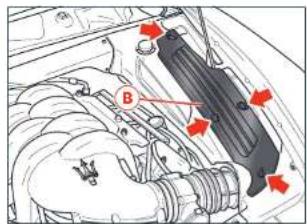
text_image
Technical diagram of a car engine bay with labeled components and red arrows indicating parts of the valve or valve.
text_image
Technical diagram of a mechanical component with labeled parts C and DIf the oil level is near or even below the MIN reference mark, top up with oil pouring it through the filler cap D until reaching the MAX reference mark. The oil level should never exceed the MAX reference.
WARNING: Do not top up with oil having characteristics other than those of the oil already used in the engine.
After topping-up or replacing the oil, check the level once again.
WARNING: The engine oil used and the oil filter replaced contain substances that are dangerous for the environment. For replacing the oil and the filters you are advised to contact your Authorized Maserati Dealer, where all the necessary equipment is available to dispose of the used oil and filters in compliance with local regulations and in an environment-friendly manner.
Used engine oil contains chemicals that have caused cancer in laboratory animals. Always protect your skin by washing thoroughly with soap and water.
"Cambiocorsa" gearbox oil
Consult your Authorized Maserati Dealer for the oil level check.
WARNING: Do not top up with oil having characteristics other than those of the oil already used in the engine.
WARNING: The gearbox waste oil contains substances that are dangerous for the environment. For replacing the oil, you are advised to contact your Authorized Maserati Dealer, where the necessary equipment is available to dispose of the used oil in compliance with local regulations and in an environment-friendly manner.

text_image
MIN MAXLevel checks
Engine coolant

When the engine is very hot, do not remove the cap from the pan: risk of burns!
To gain access to the pan, remove the right-hand panel of the engine compartment, following the instructions contained in the section "Engine compartment panels" (pag. 194). The fluid level must be checked when the engine is cold, and it must fall between the MIN and MAX references marked on the pan. If the level is too low, slowly pour the prescribed fluid through the filler neck, until the level is close to the MAX reference mark.
Windshield/headlight washer fluid
For topping up, open the cap E, pull out the filler extension and pour in a mixture of water and detergent fluid in the percentages indicated on the product container.
WARNING: If the temperature is below -4 °F (-20°C), use pure detergent fluid.
WARNING: Do not drive with the windshield washer reservoir empty: the use of washer fluid is essential for improving visibility.
Power steering fluid
WARNING: Make sure that the power steering fluid does not come in touch with hot engine parts as it is flammable.
To gain access to the reservoir, remove the LH panel of the engine compartment following the instructions contained in the section "Engine compartment panels" (pag. 194). With the car on a level ground and the engine cold, check that the fluid level corresponds with the MAX notch on the tank cap dipstick. To carry out the check, unscrew the cap, clean the dipstick, tighten the cap back, remove it again and check the level.

text_image
MAX MINLevel checks
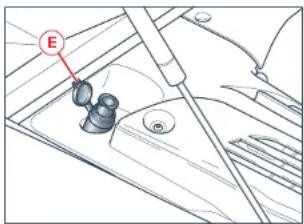
text_image
E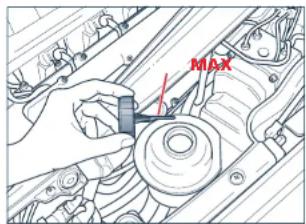
text_image
MAXWith the oil hot the level may also exceed the MAX notch.
If necessary, top up with fluid making sure that it has the same characteristics as the one already used in the system.
Brake fluid
To gain access to the reservoir, remove the LH panel of the engine compartment following the instructions contained in the section "Engine compartment panels" (pag. 194). Check that the fluid level in the reservoir is at the maximum level. If the level drops below the minimum, with the ignition key in the MAR position, the warning light "BRAKE" will light up on the instrument panel. To check the operation of the warning light bulb, press the center of the filler cap. If fluid is needed, use only the type classified as DOT4.
WARNING: The brake fluid is hygroscopic (i.e., it absorbs humidity). For this reason, if the car is used mainly in areas with a high rate of atmospheric humidity, the fluid should be changed more frequently than indicated in the Scheduled Maintenance Plan.
WARNING: Do not let the brake fluid, which is highly corrosive, come into contact with the paintwork. If this should happen, wash the paintwork immediately with water.
WARNING: The symbol @ the container identifies the synthetic type of brake fluid, distinguishing it from the mineral type. Using mineral fluids damages the special rubber linings of the brake system beyond repair.
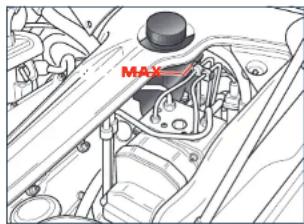
text_image
MAXLevel checks
Air filters
To replace the air filters, please contact your Authorized Maserati Dealer.
WARNING: Always replace both filters at the same time.
Anti-dust/anti-pollen filter
This filter performs mechanical/electrostatic air filtering, provided that windows and doors are closed properly. Have your anti-dust/anti-pollen filter replaced at least once a year at your Authorized Maserati Dealer, preferably at the beginning of the summer period. If the car is mainly used in the city traffic, on highways or dusty roads, we recommend to replace the filters more frequently than prescribed in the Scheduled Maintenance Plan.
WARNING: Failure to replace the filter may considerably reduce the air conditioning and heating system efficiency.

The anti-dust/anti-pollen filter replacement involves disassembling of the wiper
blade arms, which have to be replaced after two disassembly operations.

The special arm fixing system provides for proper mechanical stability only after
the first two refitting operations, provided that the specified tightening torque is observed.

We recommend therefore to have the anti-dust/anti-pollen filter, and consequently the
windshield wiper blade arms, removed and replaced only at your Authorized Maserati Dealer.
Battery
The battery fitted is of the "low maintenance" type, and is located on the right side of the luggage compartment.
To gain access to the battery, open panel A, which is fastened through a Velcro strap.
The battery fluid (electrolyte), with the car on a level ground, must always fall between the reference marks MIN and MAX on the battery.
In the event that the level is below the MIN reference mark, please contact your Authorized Maserati Dealer to have the system checked.
To recharge the battery, see the section "In an emergency" on page 168.
The fluid contained in the battery is poisonous and corrosive. Avoid contact with the skin and eyes. Do not approach the battery with open flames or possible sources of sparks: risk of explosion and fire.
Batteries contain substances that are very harmful for the environment. To replace the battery, please contact your Authorized Maserati Dealer, where the battery will be disposed of in full compliance with local regulations and in an environment-friendly manner.
Battery posts, terminals and related accessories contain lead and lead compounds. Wash your hands after handling.
WARNING: Incorrect assembly of electrical and electronic accessories can cause serious damage to the car.
WARNING: Before disconnecting the battery, lower the side windows by at least 1.5-2 in (4-5 centimeters), in order to avoid damaging the strips when opening and closing the doors. When the battery is connected and loaded, this operation is carried out automatically upon opening and closing the door. The windows must remain lowered until the battery is connected once again. If the battery runs flat when the windows are fully raised, open the door only if necessary and taking utmost care. Do not close the door as long as the window cannot be lowered.
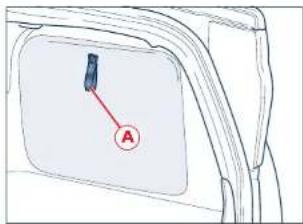
text_image
Diagram of a car door panel with labeled component A and a red arrow pointing to the handle area.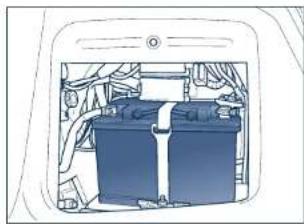
natural_image
Diagram of a battery inside a device frame, showing internal components and wiring (no text or labels)WARNING: Each time the battery is reconnected, wait at least 30 seconds with the ignition key in the "MAR" position before starting the engine so as to allow the electronic system which operates the motor-driven valves to perform the self-learning process. During this time it is essential not to activate any device.
Battery
WARNING: Ventilation hose: The battery generates hydrogen gas, which is flammable and explosive. The battery is fitted with a ventilation hose which vents hydrogen gas out of the battery compartment through a ventilation opening in the bottom of this compartment. If the battery must be replaced, it is essential that the ventilation hose is properly connected to the battery and that it is routed through the ventilation opening provided (see illustration). Be sure the ventilation hose is free of the debris. Only use replacement batteries equipped with a ventilation hose. Consult your local Authorized Maserati Dealer.
Useful hints for extending the life of the battery
When parking the car, make sure that the doors, trunk, hood and flaps are properly closed. All interior lights should be off.
When the engine is turned off, do not keep the connected devices switched on for a long time (for example the radio, the hazard warning lights, the fan, etc.).
WARNING: If the battery charge remains below 50% for a long period of time, it will be damaged due to sulfating; its performance and starting power will be reduced and it will be more subject to freezing (this can happen even at 14 °F (-10 °C).
We recommend to have the battery charge condition checked, preferably at the beginning of the cold season, to prevent the electrolyte from freezing. This check should be carried out more frequently if the car is used mainly for short trips or if it is equipped with power absorbing devices that remain permanently on even if when the ignition key is removed. This applies especially if these devices have been fitted "after market".
If the car is not used for long periods of time, please refer to the section "If the car is not used for long periods" on page 208.
WARNING: If additional systems have to be fitted in the car, there is the risk of creating dangerous branches changes in the design of the original electric wiring.
Electronic Control Units
No special precautions are required for the normal use of the car. In case of repairs to the electrical system or in an emergency starting, the following instructions must be strictly followed:
– Never disconnect the battery from the electrical system when the engine is running.
- Disconnect the battery from the electrical system when recharging it.
WARNING: When disconnecting the battery, first detach the negative terminal post (-) and then the positive one (+). When reconnecting the battery, first attach the positive terminal post (+) and then the negative one (-).
– Never carry out the emergency starting procedure using a battery charger: always use an auxiliary battery.
- Take special care when connecting the battery to the electrical system, checking both for correct polarity and for the connection efficiency.
– Never connect or disconnect the Electronic Control Units terminals when the ignition key is in the MAR position.
- Do not check the electric polarities through sparking.
- Disconnect the Electronic Control Units when carrying out electric weldings on the body. Remove them if the temperature is over 176 °F (80°C) (special interventions on the bodywork, etc.).
WARNING: Incorrect installation or modifications to the audio and alarm systems may interfere with the proper operation of the Electronic Control Units.
WARNING: Changes or repairs to the electrical system carried out in an incorrect manner or without taking into account the technical specifications of the system may cause operating anomalies with the risk of fire.
Spark plugs
It is essential that the spark plugs are sound and clean for the engine to work efficiently and to ensure that polluting emissions are kept to a minimum level.
WARNING: The spark plugs must be changed at the intervals specified in the Scheduled Maintenance Plan. Only use the prescribed spark plugs.
Wheels and tires
To obtain the best performances and the longest mileage from the tires, comply with the following precautions during the first 300 miles (500 Km):
- do not drive at maximum allowed speed
- drive on curves at low speed
- avoid sudden steering
- avoid sudden braking
- avoid sudden accelerations
- do not drive at high speed for a prolonged period of time.
How to use the tires
WARNING: The tires must be constantly kept in good condition to ensure safe driving.
The tire inflation pressure must correspond to the prescribed values and should be checked only when the tires are cold, as the pressure increases as the tire temperature progressively rises.
Never reduce the pressure if tires are warm.
Insufficient tire inflating pressure can cause tire overheating and possible internal damages, which may even lead to the tire destruction.

Check the tire inflating pressure at least every two weeks and before long trips.
Impacts with curbs, holes and obstacles in the road, and prolonged trips on rough roads can cause tire damage which may not be visible to the naked eye.
Check your tires regularly for any signs of damage (e.g. scratches, cuts, cracks, bulges, etc.).
If sharp objects penetrate the tires, they can cause damage which is only visible when the tire is removed.
In any case, any possible damage must be inspected by an experienced tire fitter, as it may seriously reduce the tire life.
Remember that tires deteriorate with time, even if used little or not at all.
Cracks in the tire tread and sides, and possible bulging, are a signs of deterioration.
Have the old tires inspected by an experienced tire fitter, to make sure they can still be used safely. If the same tire has been on your car for 4 or 5 years, have it inspected by an experienced tire fitter.
Never fit tires of uncertain origin.
"Directional" tires have an arrow on their side showing the rolling direction. To keep the best performance when replacing a tire, make sure that the rolling direction corresponds to the one marked by the arrow.
During the tire life the rolling direction of the first fitting shall always be observed, also in case of "non-directional" tires.
Check the depth of the tire tread at regular intervals(minimum allowed value 0.063 in - 1.6 mm). The thinner is the tread, the greater is the risk of skidding.
Drive carefully on wet roads to decrease the risk of aquaplaning.
|Windshield wipers
Clean the rubber parts regularly using the appropriate products. Change the blades if the edge of the rubber is deformed or worn. In any case, the blades should be changed about once a year.

Travelling with worn wiper blades is very dangerous because it reduces the y in the event of poor heric conditions.

The arms of the wiper blade have to be replaced with new ones after two disassembling ops. The special arm fixing helps provide for mechanical only after the first two operating operations, provided that the and tightening torque is

It is therefore recommended to contact your Authorized Maserati Dealer for any mention involving wiper arm mbling (e.g., necessary to ment of the dust/pollen filter)
Windshield wipers
Some simple measures may reduce the possibility of damage to the blades.
- In the event of temperatures below 32^ (0^) , make sure that ice has not "glued" the wiper to the windshield. If necessary, release with an anti-ice product.
- Remove any snow deposited on the windshield: as well as protecting the blades, this avoids forcing and overheating the electric wiper motor.
- Do not activate windshield wiper when the windshield is dry.

natural_image
Diagram of a mechanical component with two red arrows indicating direction (no text or symbols present)Spray nozzles
If the jet does not work, first check that there is fluid in the container (see "Level checks" in this chapter on page 193) then check that the nozzles are not clogged.
Replacing the wiper blades
1) Raise the arm of the wiper blade slightly.
2) Push the blade as shown by arrow A to release it from the arm and then withdraw the blade.
3) Fit the new blade and secure it in the seat of the arm as shown by arrow B.
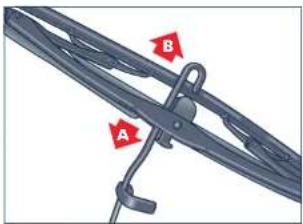
natural_image
Mechanical component diagram showing a linkage mechanism with labeled points A and B (no text or symbols beyond labels)Air conditioning
During the winter, the air conditioning system should be operated at least once a month for about 10 minutes. Before the summer season have the system efficiency checked by your Authorized Maserati Dealer.
WARNING: The system uses R134a type coolant that, in the event of accidental leakage, is not harmful for the environment. Under no circumstances should you use R12 fluid that, in addition to being incompatible with the system components, contains chloro-fluoro-carbons (CFCs).
Bodywork
Protection from atmospheric agents
The main causes of body corrosion are:
– atmospheric pollution
– salinity and humidity in the atmosphere(sea areas or humid climate)
– seasonal environmental conditions.
– salt used to remove snow/ice from roads.
The abrasive action of atmospheric dust and wind-carried sand, mud and stones should not be underestimated. On your car, MASERATI has adopted the best technological solutions to help protect the bodywork from corrosion.
The main measures are:
– Paint products and systems that provide the car with particular resistance against corrosion and abrasion.
– Use of galvanized(or pre-treated) body panels whose most exposed parts are highly resistant against corrosion.
- Spraying of the underbody, engine compartment, internal part of the wheelhouse and of other parts using highly protective wax products.
- Spraying of the plastic material most exposed parts with protective function: under the doors, inside part of the fenders, edges, etc.
- Use of ventilated box sections treated with wax products, to help prevent water condensation and stemming, which may lead to the internal formation of rust.
Tips for keeping the bodywork in good condition
Paint
Paint does not only have an aesthetic function but also serves to protect the body panels. In the event of abrasions or deep scratches, we recommend to have the necessary touch-ups made immediately, to avoid any rust formation.
Touch-ups do not feature particular difficulties, even on metallic finishes. For all paint touch-ups, use only original products indicated on the plate applied on the engine compartment hood.
Air conditioning / Bodywork
Normal paint maintenance consists in washing, the frequency of which depends on the conditions of use and of the environment. For example, in areas where there is high atmospheric pollution or the roads are spread with anti-freeze salt, it is advisable to wash the car more frequently.
WARNING: Detergents pollute water. Therefore the car should be washed in areas equipped for the collection and purification of the fluids used for washing.
For correct washing:
- Wet the bodywork with a low-pressure water jet.
- Run a sponge soaked in a neutral detergent solution over the bodywork, remembering to rinse the sponge frequently.
– Thoroughly rinse with water and dry with a jet of air or chamois.
When drying, take particular care with the parts that are less visible, such as the door bays, hood, headlight edges, in which water can be trapped more easily.
Bodywork
You are recommended not to take the car immediately into an enclosed environment, but leave it in the open air so as to allow the water to evaporate. Do not wash the car after it has been left in the sun or when the hood is hot: the paint gloss could be affected. External plastic parts must be cleaned with the same procedure followed for the normal washing of the car. Avoid, as far as possible, parking the car under trees; the resinous substances that very often drop from the trees give the paint a dull appearance and increase the possibility of originating corrosive processes.
WARNING: Bird droppings must be washed off immediately and thoroughly, since their acidity is particularly corrosive.
WARNING: To provide better protection for the paint, polish the car at intervals with a suitable product leaving a protective film on the paint.
Windows
To clean the windows use special detergents. Only use clean cloths so as not to scratch the windows or render them less transparent.
WARNING: To avoid damaging the electrical resistors on the internal surface of the rear window, wipe it gently following the direction of the resistors.
Interiors
Check at regular intervals that there is no water trapped under the mats (due to drips off shoes, umbrellas etc.) which may cause the metal parts to oxidize.
Cleaning the leather upholstery
- Remove the dried dirt with a slightly damp deerskin or a cloth, without rubbing too hard.
- Remove any liquid or grease stains with a dry absorbent cloth, without rubbing.
- Then run a soft cloth or deerskin damped with water and neutral detergent.
- If the stain persists, use specific products carefully following the instructions for use.
WARNING: Never use alcohol, alcohol-based products or solvents.
Leather upholstery treatment
Have the leather upholstery only treated, as provided in the Scheduled Maintenance Plan, by your Authorized Maserati Dealer which has the required specific products.
Briar wood parts
Remove any dirt with a deerskin leather or damp cloth.
WARNING: Do not use alcohol, gasoline or solvents to clean the instrument panel's transparent dome.

Do not keep aerosol cans in the car. Risk of explosion.
Aerosol cans should never be exposed to a temperature above 122 °F (50°C). The temperature inside the car when exposed to the sun may easily exceed this threshold.
If the car is not used for long periods
If the car has to stand idle for several months, take the following precautions:
– Wash and dry the car thoroughly.
– Park the car, in a covered, dry and possibly ventilated area.
- Engage a gear.
WARNING: Before disconnecting the battery, lower the side windows by at least 1.5-2 in (4-5 centimeters), in order to avoid damaging the strips when opening and closing the doors. When the battery is connected and loaded, this operation is carried out automatically upon opening and closing the door. The windows must remain lowered until the battery is connected once again. If the battery runs flat when the windows are fully raised, open the door only if necessary and taking utmost care. Do not close the door as long as the window cannot be lowered.
If the car is not used for long periods
- Disconnect the battery using the battery master switch found in the right-hand box of the luggage compartment (see on page 210).
- Check the battery charge condition. This check should be carried out monthly while the car is idle. Recharge the battery if the load-free voltage is below 12.5 V.
- Verify that the handbrake is not engaged.
– Clean and protect the painted parts applying protective waxes.
– Clean and protect polished metal parts with specific products available on the market.
– Talc the windshield wiper blades and raise them from the windshield. - Cover the car with a long cloth in transpirating fabric (available at your Authorized Maserati Dealer). Do not use thick plastic sheets, which do not allow the humidity on the car surface to evaporate.
- Inflate the tires up to a pressure which must be 7.3 psi (+0.5 bar) higher than the normally prescribed one, and check it at regular intervals.

The tire pressure must be brought back to the prescribed value before using
the vehicle again.
- Do not drain the engine cooling system.
Restarting the car
Before restarting the car after a long period of inactivity, we recommend to carry out the following operations:

Check the tires for pressure and for any damages, cuts or cracks. If this is the case, have placed.
- Do not dry-rub the external surface of the car.
- Visually check if there are any fluid leaks (oil, brake and clutch fluid, engine coolant etc.).
– Have the engine oil and filter replaced. - Check the fluid levels in the brake-clutch system, as well as the engine coolant level.
- Check the air filters and have them replaced if necessary.
- Check the condition of the engine belts.
– Reconnect the battery after having checked its charge condition. - Release the door locks with the key.
-
Reactivate the electronic alarm device pressing the remote control button once.
-
Set the clock.
- Check that the seats work correctly: if not, carry out the "initialization" procedures described in the section "Seats" pg. 80, contained in the chapter "Before you drive".
– With the gearshift in neutral, let the engine idle for several minutes pressing the clutch pedal repeatedly.

This procedure must be performed outdoors. Exhaust gases contain carbon
monoxide which is strongly toxic and potentially lethal.
Battery master switch
If the car is not used for long periods of time, we advise to disconnect the battery using the switch found to its left, on the right-hand side compartment of the trunk. To open the compartment, pull the cover using handle A.
Before disconnecting the battery:
- Make sure that the electronic alarm is not activated.
WARNING: Before disconnecting the battery, lower the side windows by at least 1.5-2 in (4-5 centimeters), in order to avoid damaging the strips when opening and closing the doors. When the battery is connected and loaded, this operation is carried out automatically upon opening and closing the door. The windows must remain lowered until the battery is connected once again. If the battery runs flat when the windows are fully raised, open the door only if necessary and taking utmost care. Do not close the door as long as the window cannot be lowered.
Battery master switch
- Open the luggage compartment.
- Close the doors and lock them using the key (in order to avoid their being opened when the battery is disconnected).
WARNING: Disconnect the battery only several minutes after the engine has been switched off.

text_image
Diagram of a vehicle door panel with labeled component A and red arrow indicatorWARNING: When the battery is disconnected, some standard series systems or "after market" mounted systems could lose some of the data stored; in the event that a satellite alarm system is installed, remember to contact the Operative Headquarters before disconnecting the battery.
WARNING: When the battery is disconnected, the side window will not be lowered automatically upon opening the door. Therefore, closing the door without due care may cause the side window to break.
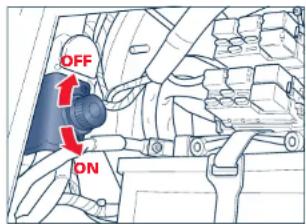
text_image
OFF ONRe-connecting the battery
- Open the luggage compartment with the key.
- Connect the battery.
- Release the door locks with the key.
- Reactivate the electronic alarm device pressing the remote control button once.
- Set the clock.
- Check that the seats work correctly: if not, carry out the "initialization" procedures described in the section "Seats" pg. 80, contained in the chapter "Before you drive".
WARNING: Each time the battery is reconnected, wait at least 30 seconds with the ignition key in the "MAR" position before starting the engine so as to allow the electronic system which operates the motor-driven valves to perform the self-learning process. During this time it is essential not to activate any device.
Battery master switch

Conversion Table
| Distance | ||
| 1 km = 0,6214 mi 1 mi = 1,609 km | ||
| 1 m = 3,2808 ft 1 ft = 0,3048 m | ||
| 1 m = 1,0936 yd 1 yd = 0,9144 m | ||
| 1 cm = 0,3937 in 1 in = 2,54 cm | ||
| Volume | ||
| 1 l = 0,2642 US gallon 1 US gallon = 3,785 l | ||
| Weight | ||
| 1 kg = 2,2046 lb 1 lb = 0,4536 kg | ||
| Power | ||
| 1 kW = 1,341 hp | 1 hp | = 0,746 kW |
| Pressure | ||
| 1 bar = 14,5 psi | 1 psi | = 0,0689 bar |
| Consumption | ||
| 1 km/l = 0,4251 mpg | 1 mpg | = 2,3524 km/l |
Contents
Contents

text_image
9 203Historical Background 4
Introduction 6
Consulting the Manual 6
Abbreviations 6
Updating 6
Service 7
"Cambiocorsa" gearbox 7
NHTSA's Toll-free
Auto Safety Hotline 7
Symbols 8
Danger symbols 8
Symbols of prohibitions 8
Warning symbols 9
Symbols indicating compulsory
measures 9
General contents 11
Car identification data 13
identification plates 14
Chassis marking
Engine marking
Homologation plates
Instructions plates
Key codes
Electronic alarm device code
Rolling Code 19
Active and passive safety
Seat belts
Fastening the seat belts
Front seat belt height adjustment
Load limiting devices
Pretensioners
Use of the rear seat belts
General warnings regarding
the seat belts
Proper use of the seat belts
Proper transport of children
Front and side airbags
Front airbags
Passenger side airbag
Side airbags (side bags)
General warnings
MSP System
Activating the MSP system
Fault signals
ABS and EBD systems
14 ASR system (electronic anti-skid
15 device) 37
17 MSR function (engine braking
18 torque adjustment)
19 Parking sensors (optional)
Sensors
Sensor range
Fault signals
Fire extinguisher (optional)
Fuel cut-off inertia switch
Resetting the switch
21 Instruments and controls 43
22 Dashboard (version with
22 "Cambiocorsa" gearbox) 44
23 Instrument panel 46
23 Indicators and warning lights 48
23 Instruments
24 and indicators 51
25 1 - Oil pressure gauge
2 - Coolant temperature gauge
20 19 - Tachometer
27 17-Voltmeter
29 18-Fuel level gauge
30 21 - Multi-function display
31 22 - Doors and engine/luggage
31 compartment open display
32 26 - Indicator for "Cambiocorsa
34 gear engaged / parking lights on 54
34 27 - External temperature gauge 54
34 28 - Outside temperature LED 34
55 Trip odometer reset button 55
Instrument panel dimmer switch 55
Controls and interior equipment
Hazard warning lights 56
37 MSP system 56
38 SPORT setting 56
38 Rear fog lights 57
39 Heated side window
40 and side-view mirror defroster 57
41 12-Volt socket 57
42 Opening the luggage
42 compartment 58
Opening the fuel tank flap
Clock 58
Front overhead lights 59
Rear overhead lights 59
Sun visors 59
Glove compartment 60
Seat pockets 60
Coat-hooks 61
Before you drive 63
Doors 64
Opening doors from the outside 64
From the inside 64
Door open warning lights 64
Power windows 64
Door open indicator 65
Buzzer 65
Door courtesy light 65
Engine compartment hood 66
Luggage compartment 67
Fuel tank flap 68
Fuel tank flap emergency
opening
Keys
The Maserati CODE system
Operation
Duplicating the keys
Emergency starting
Ignition switch
Start button
Electronic alarm
device
System activation
Deactivation
Exclusion of passenger
compartment motion sensor
(ultrasound system)
74
Alarm memory 75
Market homologation
Ordering extra radio operated
controls
Replacing the Key radio control
batteries
Replacing "valet" key radio
control batteries 77
Front seats 78
Back/forward adjustment
Height adjustment
Seat angle adjustment
Seat back angle adjustment
Lumbar support adjustment
Seatback tilt
Seat heating (optional)
Storing the seat and side rear
view mirror position (optional)
System initialization
Headrest 81
Rear seats 82
Armrest 82
Headrest 82
Side-view mirrors
External side-view mirrors
Electrically-shaded interior
rear-view mirror
Steering wheel 85
External lights and directional
indicators 86
Light switch 86
High beams
Flashing the headlights
Parking lights 87
Directions indicators 87
Windshield wipers and headlight
washers (optional) 88
Windshield wiper 88
Intermittent operation-frequency 88
Windshield washer 89
Headlight washers (optional) 89
Sound system 90
Diversity system 91
High output stereo system
(optional) 91
Air conditioning and heating
system 92
Upper dashboard outlet 93
Central and side dashboard vents 93
Front windshield pillar vents 93
Lower dashboard vents 94
Rear vents 94
Automatic air conditioning
and heating controls 95
Equivalent temperature 95
Description of controls 95
Description of operating
strategies 97
Dust/pollen air cleaner 99
Specific luggage set (optional) 99
Contents
Using the vehicle 101
Starting the engine 102
Starting-off when the engine
is cool 103
Emergency starting with
auxiliary battery 103
Starting with inertia maneuvers
Turning off the engine 103
"Cambiocorsa" gearbox 104
Starting the ignition system 104
Operation with the engine
switched off 105
Driving the car 105
Up-shifting "UP" 107
UP for overrunning speed rate 107
Downshifting "DOWN" 107
DOWN for underrunning
speed rate 107
Requesting neutral (N) 107
Stopping the car 107
Switching off the engine
and the system 108
Other system functions 108
Optimization of fuel consumption 111
"SIL" (Shift Indicator Light)
operating modes 111
Using the brakes 112
Use of the engine 113
Breaking-in 113
Engine and transmission
Driving the car 113
Engine control system OBDII 114
Constant speed control
(Cruise Control) 115
General information
Controls
Storing a speed
Restoring the speed stored
in the memory
Increasing the speed stored
in the memory
Reducing a speed saved
in the memory
Resetting the speed stored
in the memory
Electronic suspension (optional) 118
Self-diagnosis
Setting selection 119
Fault signals
Headlights
Headlight beam aiming
Gas-emitting headlights
(optional)
Driving conditions 122
Before your trip
Capacities
Safe driving
Before you drive 122
Travelling
Driving at night
Driving in the rain
Driving in fog
Driving in the mountains
Driving on snow or ice
Pollution control devices
Other tips
Parking
Handbrake 128
Tires 129
Tire inflation pressure when
cold 129
Uniform Tire Quality Grading 129
DOT Quality Grades 129
Treadwear 129
Traction 129
Temperature 130
Winter tires 130
Snow chains 131
In an emergency 133
Emergency starting 134
Toolkit 135
If a tire gets a puncture 136
Precautions in the event
of a puncture 136
Spare wheel
(emergency wheel - optional) 138
Refitting the standard wheel 142
If an exterior light
goes out 143
Front lights 143
Rear lights 143
Directional indicator lights 144
Side marker lamp 145
Third stop light 145
License plate lights 145
If an interior light
goes out 146
Front overhead lights 146
Rear overhead lights 146
Vanity mirror light 147
Glove compartment light 147
Courtesy lights (below door) 147
Luggage compartment light 148
If a fuse blows 149
Replacing the fuses 149
Position of fuses/relays 149
Fuse Color 149
Maxi Fuse Colors 149
Fuses and relays under
the dashboard, on the right hand
side 150
Relays under the dashboard 151
Fuses under the dashboard 151
Fuses/relays in the engine
compartment 154
Side relay 154
Fuses on the rear panel 155
Relay/fuse box units in
the luggage compartment 156
Luggage compartment relays 157
Luggage compartment fuses 158
If the battery is fully discharged 159
Starting with the auxiliary
battery 159
Recharging the battery 159
If you have to jack up the car 160
Using the jack 160
If you have to tow the car 161
In the event
of an accident 162
If there are injured persons 162
Capacities and Technical
Specifications
Fuel
Engine oil
Capacities: quantities and
specifications of the products to
be used
Recommended quantities
and products 165
Fuel consumption
Fuel consumption
Technical specifications
Engine
Injection - Ignition
Lubrication system
Cooling system
Transmission
Brakes
Suspension
Steering
Wheels
Performance
Weights
Dimensions
Tire pressure
Maintenance
163 Scheduled Maintenance 178
164 Over 106 thousand miles
164 (170,000 kilometers) 178
Main operations to be performed
at the specified mileage 179
165 Additional checks 182
WARNING - Engine oil 182
WARNING - Air filters 182
167 Level checks 183
167 Engine compartment panels 184
168 Engine oil 184
168 "Cambiocorsa" gearbox oil 185
168 Engine coolant 186
169 Windshield/headlight washer
169 fluid 186
169 Power steering fluid 186
171 Brake fluid 187
171 Air filters 188
172 Anti-dust/anti-pollen filter 188
172 Battery 189
173 Useful hints for extending
173 the life of the battery 190
174 Electronic Control Units 191
175 Spark plugs 191
Wheels and tires 192
How to use the tires 192
Windshield wipers 194
Spray nozzles 194
Replacing the wiper blades 194
Air conditioning 195
Bodywork 195
Contents

Protection from atmospheric
agents 195
Tips for keeping the bodywork
in good condition 195
Interiors 197
Cleaning the leather upholstery 197
Leather upholstery treatment 197
Briar wood parts 197
If the car is not used for long
periods 198
Restarting the car 199
Battery master switch 200
Re-connecting the battery 201
Conversion Table 202
Contents 203
Details to be recorded 209
Details to be recorded
Owner Number plate
Registration no.
Address Engine identification no.
Paint identification no.
Code number of spare parts
Details to be recorded

All the information contained in this manual is of a purely indicative nature since MASERATI car versions and models can be modified for either legal or commercial reasons without notice.
MASERATI does therefore reserve the right to make any modification to the cars described in this manual, at any time, for either technical or commercial reasons without notice.
Ask your MASERATI Dealer for any further information you may require.
For safety reasons and for the car best performance, as well as to preserve its original value, we recommend not to modify the vehicle equipment in such a way that may not correspond to the specifications contained in the provided homologation.
© 2006. Maserati North America, Inc.
Publication no. 69501400 - 2 ^nd edition - 04/2006
All rights reserved. This document must not be reproduced, even partially, without the written consent of Maserati S.p.A. and Maserati North America, Inc.