DIR-412 - Router D-LINK - Free user manual and instructions
Find the device manual for free DIR-412 D-LINK in PDF.


User questions about DIR-412 D-LINK
0 question about this device. Answer the ones you know or ask your own.
Ask a new question about this device
Download the instructions for your Router in PDF format for free! Find your manual DIR-412 - D-LINK and take your electronic device back in hand. On this page are published all the documents necessary for the use of your device. DIR-412 by D-LINK.
USER MANUAL DIR-412 D-LINK
D-Link reserves the right to revise this publication and to make changes in the content hereof without obligation to notify any person or organization of such revisions or changes.
Manual Revisions
| Revision Date Description | |
| 1.0 November 11, 2009 First Release |
Trademarks
D-Link and the D-Link logo are trademarks or registered trademarks of D-Link Corporation or its subsidiaries in the United States or other countries. All other company or product names mentioned herein are trademarks or registered trademarks of their respective companies.
Copyright © 2009 by D-Link Systems, Inc.
All rights reserved. This publication may not be reproduced, in whole or in part, without prior expressed written permission from D-Link Systems, Inc.
Table of Contents
Preface......i
Manual Revisions ...... i
Trademarks ...... i
Product Overview 1
Package Contents ....1
System Requirements 2
Features 3
Hardware Overview 4
Connections 4
Top View 5
Switching Between WAN Mode/3G Router Mode 6
Installation 7
Before you Begin 7
Wireless Installation Considerations 8
Network Diagram ....9 WAN Connection Mode ....9
Network Diagram ....10 3G Connection Mode ....10
Connect to Cable/DSL .... 11 Connect to a 3G Internet Service .... 12
Configuration 13
Web-based Configuration Utility .... 13 Internet Connection Setup Wizard (3G Mode).14 Manual Configuration (3G Mode) .... 17
3G Internet Connection 17
Internet Connection Setup Wizard (WAN Mode) 18
Manual Configuration (WAN Mode) 25 Static IP Address 26
Dynamic IP Address (DHCP) 27
PPPoE (Username/Password) ......28
PPTP (Username/Password) 30
L2TP (Username/Password) ....32 Russia PPTP (Dual Access) ....34 Russia PPPoE (Dual Access) ....36
Wireless Settings .... 38 Manual Wireless Network Setup .... 39
Network Settings .... 41 DHCP Server Settings .... 42 DHCP Reservation .... 43
Virtual Server 44
Port Forwarding 46
Application Rules 47
QoS Engine 48
Network Filters 49
Website Filters 50
Firewall Settings .... 51 Firewall Rules .... 52
Advanced Wireless Settings .... 53 Wi-Fi Protected Setup .... 54 Advanced Network Settings .... 55
Table of Contents
| UPnP .....55 | Configure WPA/WPA2 .....78 |
| Internet Ping Block .....55 | Connect Using WCN 2.0 .....80 |
| Internet Port Speed .....55 | Using Windows® XP .....81 |
| Multicast Streams .....55 | Configure WPA-PSK .....82 |
| Administrator Settings .....56 | |
| Change Password .....56 | Troubleshooting .....84 |
| Remote Management .....56 | Wireless Basics .....88 |
| Time Settings .....57 | What is Wireless? .....89 |
| E-mail Settings .....58 | Tips .....91 |
| System Settings .....59 | Wireless Modes .....92 |
| Update Firmware .....60 | |
| DDNS .....61 | Networking Basics .....93 |
| System Check .....62 | Check your IP address .....93 |
| Schedules .....63 | Statically Assign an IP address .....94 |
| Device Information .....64 | Technical Specifications .....95 |
| Logs .....65 | |
| Statistics .....66 | |
| Internet Sessions .....67 | |
| Wireless .....68 | |
| Support .....69 | |
| Wireless Security .....70 | |
| What is WPA? .....70 | |
| Wireless Connection Setup Wizard .....71 | |
| Add Wireless Device with WPS Wizard .....74 | |
| Configure WPA-Personal (PSK) .....75 | |
| Configure WPA-Enterprise (RADIUS) .....76 | |
| Connect to a Wireless Network .....77 | |
| Using Windows Vista® .....77 |
Package Contents
| D-Link DIR-412 Mobile Wireless Router (Available in White or Black*) |  |
| Power Adapter |  |
| Ethernet Cable | 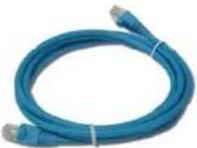 |
| CD-ROM | 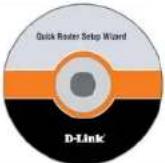 |
Note: Using a power supply with a different voltage rating than the one included with the DIR-412 will cause damage and void the warranty for this product.
*The white version of the DIR-412 Wireless N Router will be used for all diagrams in this user manual.
System Requirements
| Network Requirements | An Ethernet-based Cable or DSL modemIEEE 802.11n-draft/g wireless clients10/100 Ethernet |
| Web-based Configuration Utility Requirements | Computer with the following:Windows®, Macintosh, or Linux-based operating systemAn installed Ethernet adapterBrowser Requirements:Internet Explorer 6.0 or higherMozilla 1.7.12 or higherFirefox 1.5 or higherSafari 1.0 or higher (with Java 1.3.1 or higher)Flock 0.7.14 or higherOpera 6.0 or higherWindows® Users: Make sure you have the latest version of Java installed. Visit www.java.com to download the latest version. |
| CD Installation Wizard Requirements | Computer with the following:Windows® XP with Service Pack 2 or Vista®An installed Ethernet adapterCD-ROM drive |
Features
- Faster Wireless Networking - The DIR-412 provides up to 150Mbps* wireless connection with other 802.11n wireless clients. This capability allows users to participate in real-time activities online, such as video streaming, online gaming, and real-time audio.
- Compatible with 802.11g Devices - The DIR-412 is still fully compatible with the IEEE 802.11g standard, so it can connect with existing 802.11g PCI, USB and Cardbus adapters.
- 3G Internet Connection Support - Connect a 3G USB dongle to the DIR-412 to access 3G Internet Services.
-
Advanced Firewall Features - The Web-based user interface displays a number of advanced network management features including:
-
Content Filtering - Easily applied content filtering based on MAC Address, URL, and/or Domain Name.
- Filter Scheduling - These filters can be scheduled to be active on certain days or for a duration of hours or minutes.
- Secure Multiple/Concurrent Sessions - The DIR-412 can pass through VPN sessions. It supports multiple and concurrent IPSec, PPTP, and L2TP sessions, so users behind the DIR-412 can securely access corporate networks.
- User-friendly Setup Wizard - Through its easy-to-use Web-based user interface, the DIR-412 lets you control what information is accessible to those on the wireless network, whether from the Internet or from your company's server. Configure your router to your specific settings within minutes.
* Maximum wireless signal rate derived from IEEE Standard 802.11g and Draft 802.11n specifications. Actual data throughput will vary. Network conditions and environmental factors, including volume of network traffic, building materials and construction, and network overhead, lower actual data throughput rate. Environmental conditions will adversely affect wireless signal range.
Hardware Overview Connections
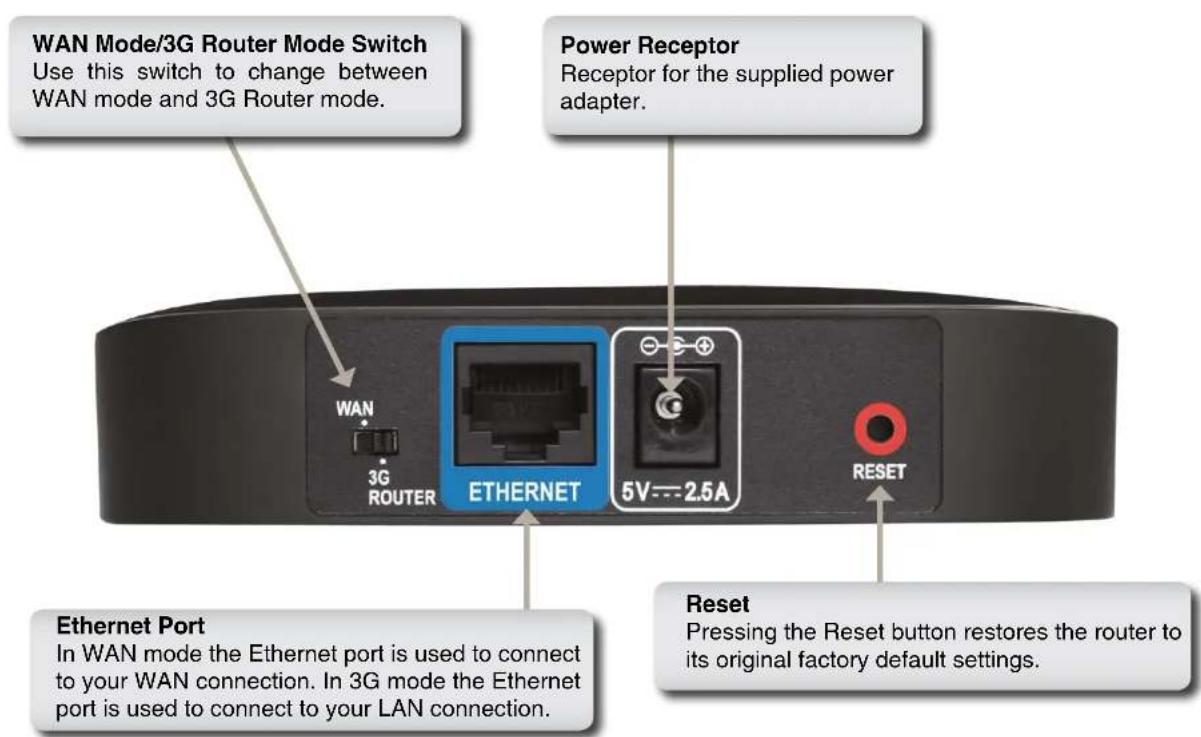
text_image
WAN Mode/3G Router Mode Switch Use this switch to change between WAN mode and 3G Router mode. Power Receptor Receptor for the supplied power adapter. WAN 3G ROUTER ETHERNET 5V---2.5A RESET Ethernet Port In WAN mode the Ethernet port is used to connect to your WAN connection. In 3G mode the Ethernet port is used to connect to your LAN connection. Reset Pressing the Reset button restores the router to its original factory default settings.Hardware Overview Top View
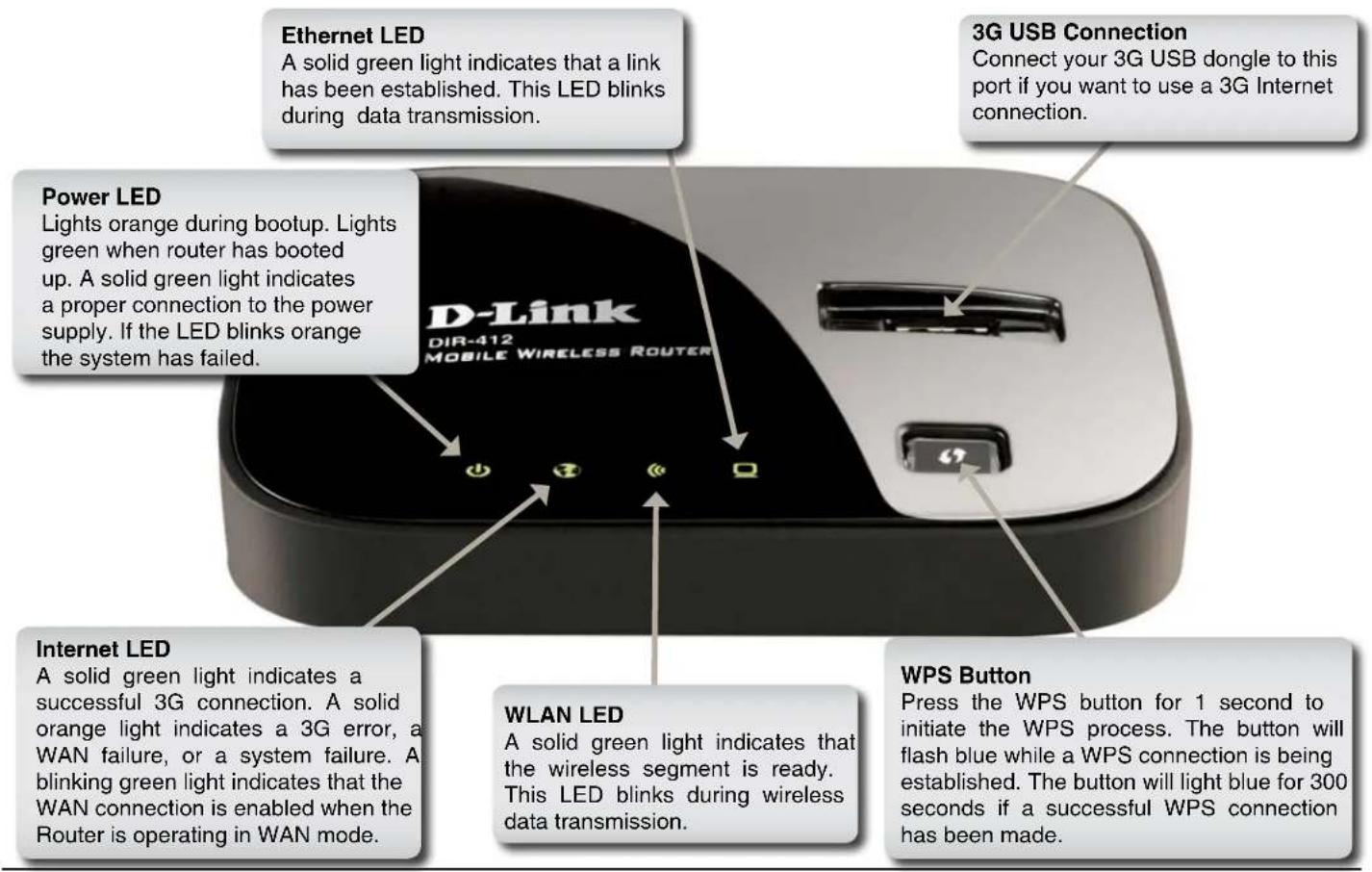
text_image
Ethernet LED A solid green light indicates that a link has been established. This LED blinks during data transmission. 3G USB Connection Connect your 3G USB dongle to this port if you want to use a 3G Internet connection. Power LED Lights orange during bootup. Lights green when router has booted up. A solid green light indicates a proper connection to the power supply. If the LED blinks orange the system has failed. D-Link DIR-412 MOBILE WIRELESS ROUTER Internet LED A solid green light indicates a successful 3G connection. A solid orange light indicates a 3G error, a WAN failure, or a system failure. A blinking green light indicates that the WAN connection is enabled when the Router is operating in WAN mode. WLAN LED A solid green light indicates that the wireless segment is ready. This LED blinks during wireless data transmission. WPS Button Press the WPS button for 1 second to initiate the WPS process. The button will flash blue while a WPS connection is being established. The button will light blue for 300 seconds if a successful WPS connection has been made.Hardware Overview Switching Between WAN Mode/3G Router Mode
The DIR-412 features a hardware switch that enables users to switch between WAN mode and 3G router mode.
When the DIR-412 is operating in WAN mode, WAN connectivity is achieved via the DIR-412's Ethernet port. In this mode LAN clients need to access the DIR-412 via the DIR-412's wireless connection. When the DIR-412 is operating in WAN mode network connectivity is more resilient as Internet connectivity can be failed over to a backup 3G connection, if the main WAN connection fails.
When the DIR-412 is in 3G router mode, LAN clients can access the DIR-412 via the DIR-412's Ethernet connection, as well as via the wireless connection.
Installation
This section will walk you through the installation process. Placement of the router is very important. Do not place the router in an enclosed area such as a closet, cabinet, or in the attic or garage.
Before you Begin
- Please configure the router with the computer that was last connected directly to your modem.
- You can only use the Ethernet port or 3G modem. If you were using the 3G USB modem before using the router, then you must turn off your modem, disconnect the USB cable and connect an Ethernet cable to the Ethernet port on the router, and then turn the modem back on. In some cases, you may need to call your ISP to change connection types (USB to Ethernet).
- If you have DSL and are connecting via PPPoE, make sure you disable or uninstall any PPPoE software such as WinPoet, Broadjump, or Enternet 300 from your computer or you will not be able to connect to the Internet.
Wireless Installation Considerations
The D-Link wireless router lets you access your network using a wireless connection from virtually anywhere within the operating range of your wireless network. Keep in mind, however, that the number, thickness and location of walls, ceilings, or other objects that the wireless signals must pass through, may limit the range. Typical ranges vary depending on the types of materials and background RF (radio frequency) noise in your home or business. The key to maximizing wireless range is to follow these basic guidelines:
- Keep the number of walls and ceilings between the D-Link router and other network devices to a minimum - each wall or ceiling can reduce your adapter's range from 3-90 feet (1-30 meters.) Position your devices so that the number of walls or ceilings is minimized.
- Be aware of the direct line between network devices. A wall that is 1.5 feet thick (.5 meters), at a 45-degree angle appears to be almost 3 feet (1 meter) thick. At a 2-degree angle it looks over 42 feet (14 meters) thick! Position devices so that the signal will travel straight through a wall or ceiling (instead of at an angle) for better reception.
- Building Materials make a difference. A solid metal door or aluminum studs may have a negative effect on range. Try to position access points, wireless routers, and computers so that the signal passes through drywall or open doorways. Materials and objects such as glass, steel, metal, walls with insulation, water (fish tanks), mirrors, file cabinets, brick, and concrete will degrade your wireless signal.
- Keep your product away (at least 3-6 feet or 1-2 meters) from electrical devices or appliances that generate RF noise.
- If you are using 2.4GHz cordless phones or X-10 (wireless products such as ceiling fans, lights, and home security systems), your wireless connection may degrade dramatically or drop completely. Make sure your 2.4GHz phone base is as far away from your wireless devices as possible. The base transmits a signal even if the phone in not in use.
Network Diagram
WAN Connection Mode
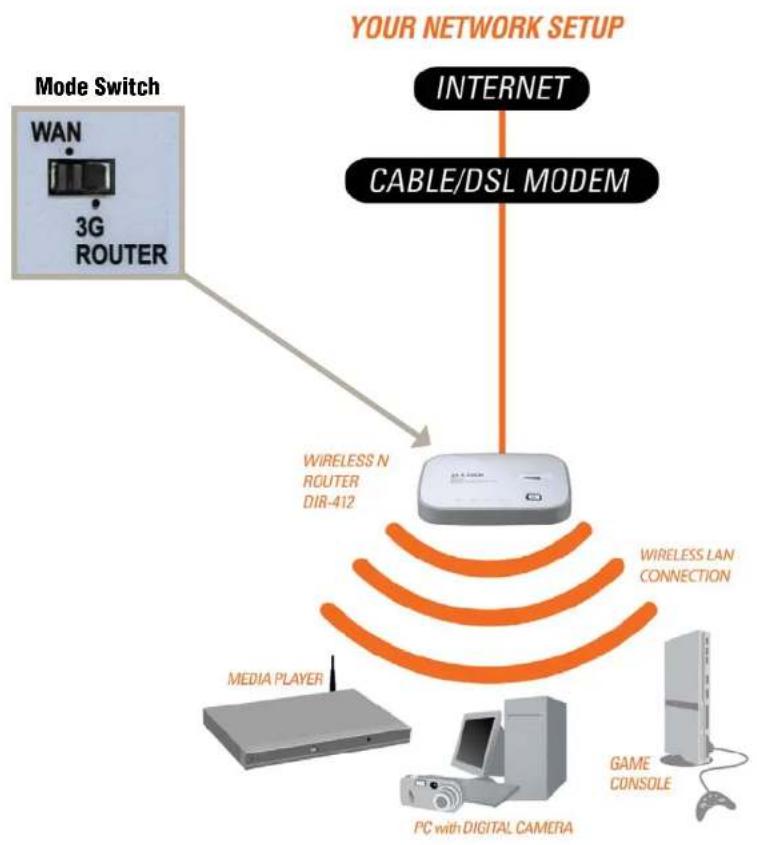
flowchart
graph TD
    A["MODE SWITCH"] --> B["WAN 3G ROUTER"]
    B --> C["INTERNET"]
    C --> D["CABLE/DSL MODEM"]
    D --> E["WIRELESS N ROUTER DIR-412"]
    E --> F["MEDIA PLAYER"]
    F --> G["PC with DIGITAL CAMERA"]
    G --> H["GAME CONSOLE"]
    H --> I["WIRELESS LAN CONNECTION"]
    I --> E
Network Diagram 3G Connection Mode
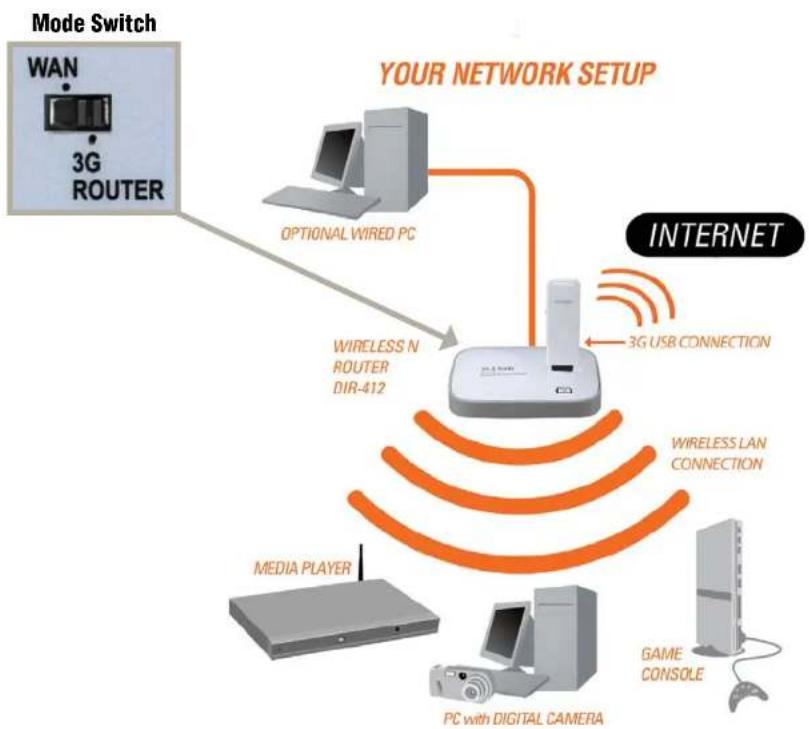
flowchart
graph TD
    A["Mode Switch WAN"] --> B["3G ROUTER"]
    B --> C["OPTIONAL WIRED PC"]
    C --> D["3G USB CONNECTION"]
    D --> E["INTERNET"]
    F["MEDIA PLAYER"] --> G["PC with DIGITAL CAMERA"]
    G --> H["GAME CONSOLE"]
    H --> I["3G USB CONNECTION"]
    I --> J["WIRELESS LAN CONNECTION"]
    J --> D
    style A fill:#f9f,stroke:#333
    style F fill:#ccf,stroke:#333
    style G fill:#cfc,stroke:#333
    style H fill:#fcc,stroke:#333
    style I fill:#cff,stroke:#333
Connect to Cable/DSL
If your Internet connection is provided using a cable/DSL/satellite modem, carry out the following procedure before connecting the router to a cable/DSL/satellite modem:
- If using the DIR-412 for the first time, please select the default mode as 3G Router to adjust your configuration. Move the toggle switch on the back of the router to the 3G Router mode position.
- Configure the wireless settings on the DIR-412 in 3G Router mode (see the Wireless Settings page for more information).
- After configuring the wireless settings, move the switch to the WAN Mode position and wait for the device to reboot.
To connect to a cable/DSL/Satellite modem, please follow the steps below:
- Unplug the Ethernet cable (that connects your computer to your modem) from your computer and place it into the Ethernet port on the router.
- Plug the power adapter into the router and connect it to an outlet or power strip. Wait about 50 seconds for the router to boot.
- Connect the DIR-412 to your computer wirelessly using the settings (SSID, encryption key) you configured previously.
- Verify the link lights on the router. The power light, Internet light, and the Wireless LAN light should be lit. If not, make sure your computer, modem, and router are powered on and verify the cable connections are correct.
Connect to a 3G Internet Service
If you are using a 3G USB dongle to connect to the Internet, please follow the steps below:
- Move the toggle switch to the 3G Router mode position and wait for the DIR-412 to reboot.
- Insert your 3G USB dongle into the DIR-412's 3G USB port.
- Plug one end of Ethernet cable into the DIR-412, and the other end into your PC.
- Plug the power adapter to the router and connect to an outlet or power strip. Wait about 50 seconds for the router to boot.
- Verify the link lights on the router. The power light, Internet light, and the Wireless LAN light should be lit. If not, make sure your computer and router are powered on and verify the cable connections are correct.
Configuration
This section will show you how to configure your new D-Link wireless router using the web-based configuration utility.
Web-based Configuration Utility
To access the configuration utility, open a web-browser such as Internet Explorer and enter the IP address of the router (192.168.0.1).
Type Admin in the User Name field and then enter your password. Leave the password blank by default.
Click the Login button to log in to the router.
If you get a Page Cannot be Displayed error, please refer to the Troubleshooting section for assistance.
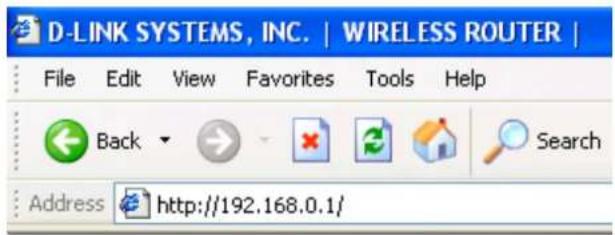
text_image
D-LINK SYSTEMS, INC. | WIRELESS ROUTER | File Edit View Favorites Tools Help Back Search Address http://192.168.0.1/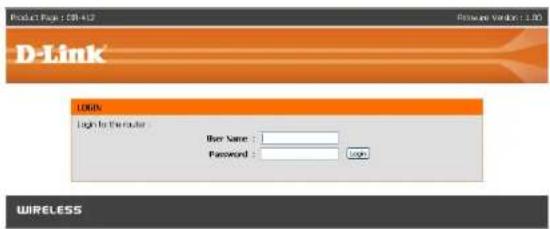
text_image
Product Page: 08-42 D-Link LOGIN Look to the route Bor Name : Password : Login WIRELESSInternet Connection Setup Wizard (3G Mode)
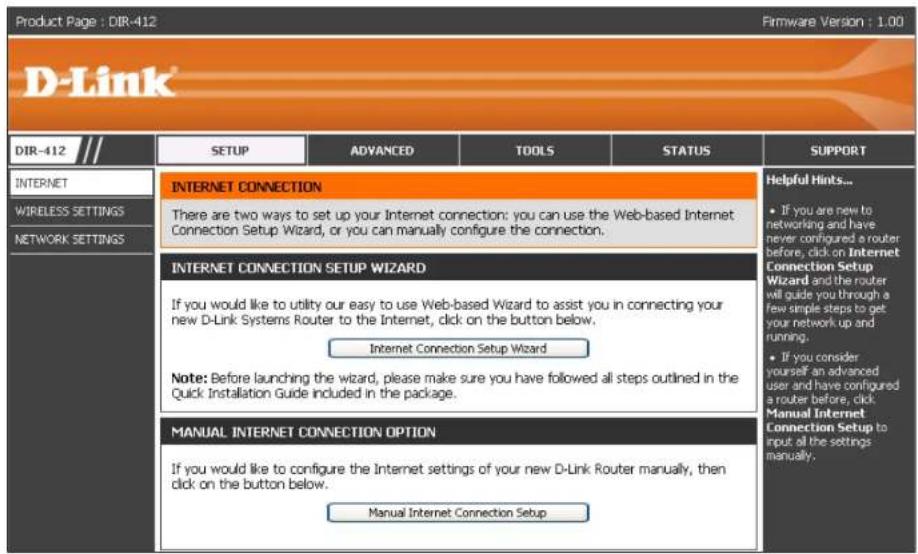
Once logged into the web interface of the router, the Setup > Internet page will appear. Click the Internet Connection Setup Wizard button to quickly configure your router using the setup wizard.
If you want to enter your settings without running the wizard, click Manual Internet Connection Setup and skip to "Manual Configuration (3G Mode)".
text_image
Product Page : DIR-412 Firmware Version : 1.00 D-Link® DIR-412 /// INTERNET CONNECTION There are two ways to set up your Internet connection: you can use the Web-based Internet Connection Setup Wizard, or you can manually configure the connection. INTERNET CONNECTION SETUP WIZARD If you would like to utility our easy to use Web-based Wizard to assist you in connecting your new D-Link Systems Router to the Internet, click on the button below. Internet Connection Setup Wizard Note: Before launching the wizard, please make sure you have followed all steps outlined in the Quick Installation Guide included in the package. MANUAL INTERNET CONNECTION OPTION If you would like to configure the Internet settings of your new D-Link Router manually, then click on the button below. Manual Internet Connection Setup Helpful Hints... • If you are new to networking and have never configured a router before, click on Internet Connection Setup Wizard and the router will guide you through a few simple steps to get your network up and running. • If you consider yourself an advanced user and have configured a router before, click Manual Internet Connection Setup to input all the settings manually.Section 3 - Configuration
Click Next to continue.
WELCOME TO THE D-LINK INTERNET CONNECTION SETUP WIZARD
This wizard will guide you through a step-by-step process to configure your new D-Link router and connect to the Internet.
• Step 1: Set your Password
• Step 2: Select your Time Zone
• Step 3: Configure your Internet Connection
• Step 4: Save Settings and Connect

Create a new password and then click Next to continue.
STEP 1: SET YOUR PASSWORD
By default, your new D-Link Router does not have a password configured for administrator access to the Web-based configuration pages. To secure your new networking device, please set and verify a password below:

Select your time zone from the drop-down menu and then click Next to continue.
STEP 2: SELECT YOUR TIME ZONE
Select the appropriate time zone for your location. This information is required to configure the time-based options for the router.
Time Zone : (GMT) Greenwich Mean Time : Dublin, Edinburgh, Lisbon, London

Section 3 - Configuration
Configure your 3G Internet Connection settings and then click Next to continue.
Click Connect to save your settings. Once the router has finished rebooting, click Continue. Please allow 1-2 minutes to connect.

text_image
3G INTERNET CONNECTION Enter the information provided by your Internet Service Provider (ISP). Country : select country ISP : select ISP User Name : (optional) Password : (optional) Dial Number : APN : (optional) Reconnect Mode : ○ Always-on ○ Connect-on demand ● Manual Maximum Idle Time : 0 (minutes, 0=infinite) MTU : 1492 Prev Next Cancel Connect
text_image
SETUP COMPLETE! The Internet Connection Setup Wizard has completed. Click the Connect button to save your settings and reboot the router. Prev Next Cancel ConnectManual Configuration (3G Mode) 3G Internet Connection
If you opt to set up your Internet connection manually, you will be redirected to a WAN page that allows you to configure your 3G configuration parameters.
Country: Select your country from the drop-down menu.
ISP: Select your Internet Service Provider (ISP) from the drop-down menu.
User Name: Enter the user name for your 3G Internet connection.
Password: Enter the password for your 3G Internet connection.
Dial Number: Enter the dial number for your 3G service provider.
APN: Enter the Access Point Name (APN) for your 3G service provider.
Reconnect Click a radio button to choose a reconnection mode. Mode: The options are Always-on, Connect on demand, or Manual.
Maximum Enter the maximum amount of time the Internet connection Idle Time: should be maintained during inactivity. To disable this feature, enable the Always-on reconnect mode.
MTU: Maximum Transmission Unit. You may need to change the MTU for optimal performance with your specific ISP. The default is 1500.
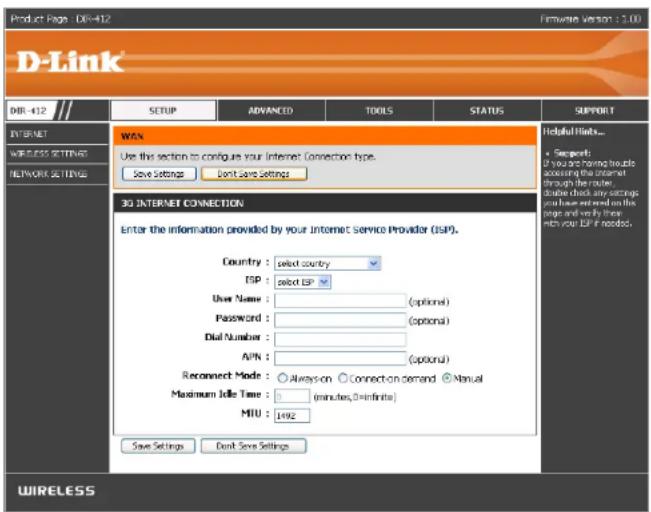
text_image
Product Page DX-412 Firmware Version : 1.00 D-Link DIR - 412 SETUP ADVANCED TOOLS STATUS SUPPORT INTERNET WIRELESS SETTINGS NETWORK SETTINGS WIN Use this section to configure your Internet Connection type. Save Settings Don't save Settings 3D INTERNET CONNECTION Enter the information provided by your Internet Service Provider (ISP). Country : select country ISP : select ISP User Name : _ Password : _ Dial Number : _ APN : _ Reconnect Mode : ○ Always-on ○ Connect-on demand ○ Manual Maximum Idle Time : 0 (minutes, 0=infinite) MIU : 1492 Save Settings Don't Save Settings Helpful Help... • Support: If you are having trouble accessing the Internet through the router, double check any settings you have entered on the page and write lines with your ISP if needed. WIRELESSClick the Save Settings button when you have finished configuring the 3G connection.
Internet Connection Setup Wizard (WAN Mode)
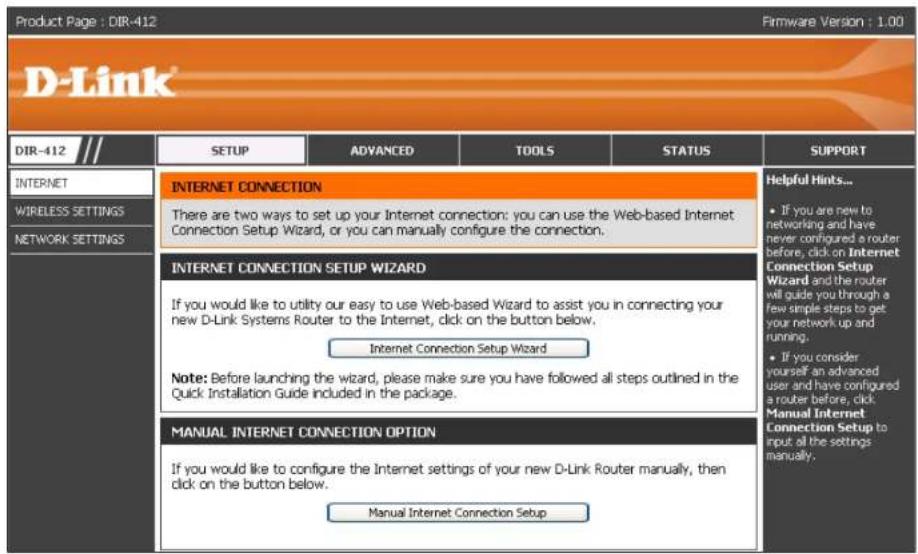
Once logged into the web interface of the router, the Setup > Internet page will appear. Click the Internet Connection Setup Wizard button to quickly configure your router using the setup wizard.
If you want to enter your settings without running the wizard, click Manual Internet Connection Setup and skip to "Manual Configuration (WAN Mode)" on page.
text_image
Product Page : DIR-412 Firmware Version : 1.00 D-Link® DIR-412 /// INTERNET CONNECTION There are two ways to set up your Internet connection: you can use the Web-based Internet Connection Setup Wizard, or you can manually configure the connection. INTERNET CONNECTION SETUP WIZARD If you would like to utility our easy to use Web-based Wizard to assist you in connecting your new D-Link Systems Router to the Internet, click on the button below. Internet Connection Setup Wizard Note: Before launching the wizard, please make sure you have followed all steps outlined in the Quick Installation Guide included in the package. MANUAL INTERNET CONNECTION OPTION If you would like to configure the Internet settings of your new D-Link Router manually, then click on the button below. Manual Internet Connection Setup Helpful Hints... • If you are new to networking and have never configured a router before, click on Internet Connection Setup Wizard and the router will guide you through a few simple steps to get your network up and running. • If you consider yourself an advanced user and have configured a router before, click Manual Internet Connection Setup to input all the settings manually.Section 3 - Configuration
Click Next to continue.
WELCOME TO THE D-LINK INTERNET CONNECTION SETUP WIZARD
This wizard will guide you through a step-by-step process to configure your new D-Link router and connect to the Internet.
• Step 1: Set your Password
• Step 2: Select your Time Zone
• Step 3: Configure your Internet Connection
• Step 4: Save Settings and Connect

Create a new password and then click Next to continue.
STEP 1: SET YOUR PASSWORD
By default, your new D-Link Router does not have a password configured for administrator access to the Web-based configuration pages. To secure your new networking device, please set and verify a password below:

Select your time zone from the drop-down menu and then click Next to continue.
STEP 2: SELECT YOUR TIME ZONE
Select the appropriate time zone for your location. This information is required to configure the time-based options for the router.
Time Zone : (GMT) Greenwich Mean Time : Dublin, Edinburgh, Lisbon, London

Select the type of Internet connection you will use on your WAN connection. If using the DIR-412 for the first time, leave the Skip 3G Configuration box unchecked. Check the Skip 3G Configuration box if you do not want to configure the router's 3G connection.
Click Next to continue.
If you selected Dynamic IP Address, you may need to enter the MAC address of the computer that was last connected directly to your modem. If you are currently using that computer, click Copy Your PC's MAC Address and then click Next to continue.
The Host Name is optional but may be required by some ISPs. The default host name is "DIR-412".
STEP 3: CONFIGURE YOUR INTERNET CONNECTION
DHCP Connection (Dynamic IP Address)
Choose this if your Internet connection automatically provides you with an IP Address. Most Cable Modems use this type of connection.
○ Username / Password Connection (PPPoE)
Choose this option if your Internet connection requires a username and password to get online. Most DSL modems use this type of connection.
○ Username / Password Connection (PPTP)
Choose this option if your Internet connection requires a username and password to get online. Most DSL modems use this type of connection.
○ Username / Password Connection (L2TP)
Choose this option if your Internet connection requires a username and password to get online. Most DSL modems use this type of connection.
Static IP Address Connection
Choose this option if your Internet Setup Provider provided you with IP Address information that has to be manually configured.
Russia PPTP (Dual Access)
Choose this option if your Internet connection requires a username and password to get online as well as a static route to access the Internet Service Provider's internal network. Certain ISPs in Russia use this type of connection.
Russia PPPoE (Dual Access)
Choose this option if your Internet connection requires a username and password to get online as well as a static route to access the Internet Service Provider's internal network. Certain ISPs in Russia use this type of connection.
3G INTERNET CONNECTION
Skip 3G Configuration


DHCP CONNECTION (DYNAMIC IP ADDRESS)
To set up this connection, please make sure that you are connected to the D-Link Router with the PC that was originally connected to your broadband connection. If you are, then click the Clone MAC button to copy your computer's MAC Address to the D-Link Router.
MAC Address
00:1D:6A:48:D8:AD (optional)

Host Name
DIR-412
Note: You may also need to provide a Host Name. If you do not have or know this information, please contact your ISP.


Section 3 - Configuration
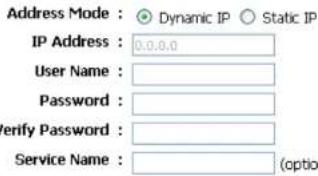
If you selected PPPoE, enter your PPPoE username and password. Click Next to continue.
Select Static if your ISP assigned you the IP address, subnet mask, gateway, and DNS server addresses.
Note: Make sure to remove your PPPoE software from your computer. The software is no longer needed and will not work through a router.
SET USERNAME AND PASSWORD CONNECTION (PPPOE)
To set up this connection you will need to have a Username and Password from your Internet Service Provider. If you do not have this information, please contact your ISP.
text_image
Address Mode : Dynamic IP Static IP IP Address : 0.0.0.0 User Name : Password : Verify Password : Service Name : (option)Note: You may also need to provide a Service Name. If you do not have or know this information, please contact your ISP.
Prev Next Cancel Connect
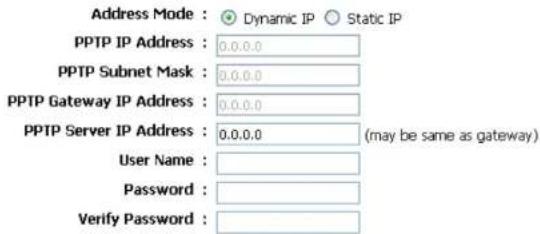
If you selected PPTP, enter your PPTP username and password. Click Next to continue.
SET USERNAME AND PASSWORD CONNECTION (PPTP)
To set up this connection you will need to have a Username and Password from your Internet Service Provider. You also need PPTP IP address. If you do not have this information, please contact your ISP.
text_image
Address Mode : Dynamic IP Static IP PPTP IP Address : 0.0.0.0 PPTP Subnet Mask : 0.0.0.0 PPTP Gateway IP Address : 0.0.0.0 PPTP Server IP Address : 0.0.0.0 (may be same as gateway) User Name : Password : Verify Password :Prev Next Cancel Connect
Section 3 - Configuration
If you selected L2TP, enter your L2TP username and password. Click Next to continue.
SET USERNAME AND PASSWORD CONNECTION (L2TP)
To set up this connection you will need to have a Username and Password from your Internet Service Provider. You also need L2TP IP address. If you do not have this information, please contact your ISP.

text_image
Address Mode : Dynamic IP Static IP L2TP IP Address : 0.0.0.0 L2TP Subnet Mask : 0.0.0.0 L2TP Gateway IP Address : 0.0.0.0 L2TP Server IP Address : 0.0.0.0 (may be same as gateway) User Name : Password : Verify Password :


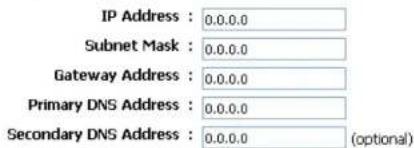
If you selected Static IP Address Connection, enter the network settings supplied by your Internet provider. Click Next to continue.
SET STATIC IP ADDRESS CONNECTION
To set up this connection you will need to have a complete list of IP information provided by your Internet Service Provider. If you have a Static IP connection and do not have this information, please contact your ISP.
text_image
IP Address : 0.0.0.0 Subnet Mask : 0.0.0.0 Gateway Address : 0.0.0.0 Primary DNS Address : 0.0.0.0 Secondary DNS Address : 0.0.0.0 (optional)


Section 3 - Configuration
Russia PPTP (dual mode) and Russia PPPoE (dual mode) are specifically for Russian users. Please fill in the username and password given by Russia ISPs and click Next to continue.
Other users may ignore these 2 settings.
SET USERNAME AND PASSWORD CONNECTION (PPTP)
To set up this connection you will need to have a Username and Password from your Internet Service Provider. You also need PPTP IP address. If you do not have this information, please contact your ISP.

text_image
Address Mode : Dynamic IP Static IP PPTP IP Address : 0.0 0.0 PPTP Subnet Mask : 0.0 0.0 PPTP Gateway IP Address : 0.0 0.0 PPTP Server IP Address : 0.0 0.0 (may be same as gateway) User Name : Password : Verify Password :


SET USERNAME AND PASSWORD CONNECTION (PPPOE)
To set up this connection you will need to have a Username and Password from your Internet Service Provider. If you do not have this information, please contact your ISP.

Note: You may also need to provide a Service Name. If you do not have or know this information, please contact your ISP.
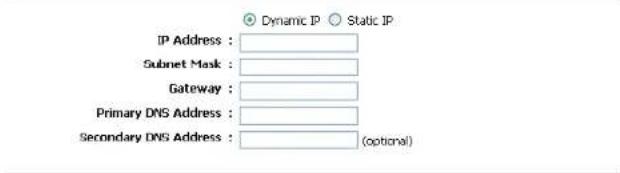
WAN PHYSICAL SETTINGS
text_image
IP Address : Subnet Mask : Gateway : Primary DNS Address : Secondary DNS Address : (optional)


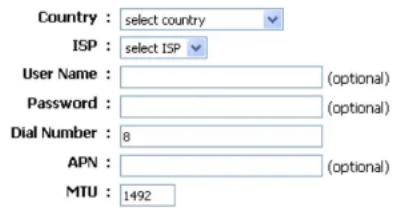
If you left the Skip 3G Configuration checkbox unchecked in Step 3 of the Internet Connection Setup Wizard, the following window appears:
Configure the parameters for your 3G Internet Connection and click next to Continue.
3G INTERNET CONNECTION
Enter the information provided by your Internet Service Provider (ISP).
text_image
Country : select country ISP : select ISP User Name : (optional) Password : (optional) Dial Number : 8 APN : (optional) MTU : 1492


Click Connect to save your settings and reboot the router. Please allow 1-2 minutes to connect.
SETUP COMPLETE!
The Internet Connection Setup Wizard has completed. Click the Connect button to save your settings and reboot the router.


Manual Configuration (WAN Mode)
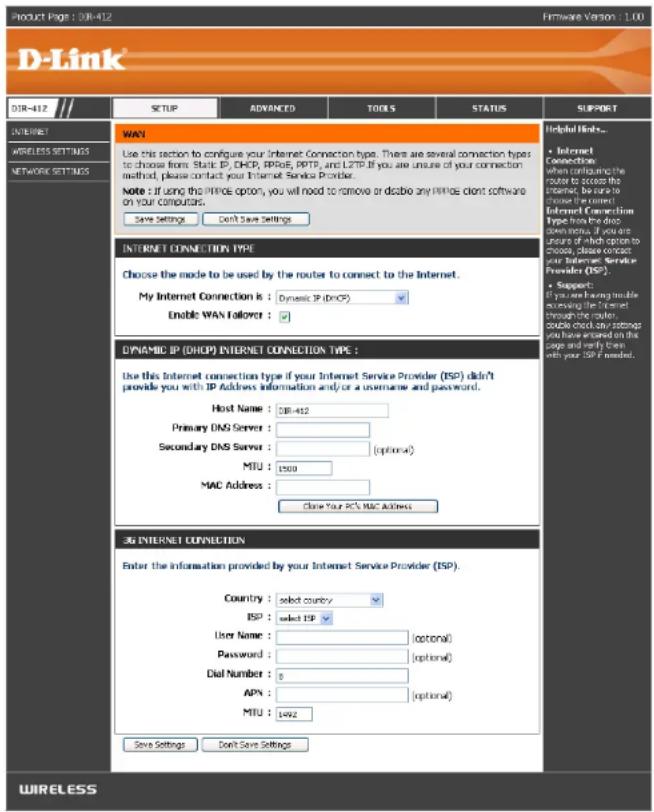
If you opt to set up your Internet connection manually, you will be redirected to a WAN page that allows you to select your Internet type and enter the correct configuration parameters.
Internet Select your Internet connection type using Connection the "My Internet Connection is:" drop-down Type: menu. To enable the Router to connect to the Internet via the 3G Internet connection in the event that the WAN connection fails, check the Enable WAN Failover box. Configure the parameters for your WAN connection in the section below the Internet Connection Type section as described in the following pages.
3G Internet If enabling the WAN Failover feature, Connection: configure the parameters for your 3G Internet Connection.
Click the Save Settings button when you have finished configuring the WAN connection.
text_image
Product Page : JDR-412 Firmware Version : 1.00 D-Link® DJR-412 SETUP ADVANCED TOOLS STATUS SUPPORT USTRUMENT WIRELESS SETTINGS NETWORK SETTINGS WAN Use this section to configure your Internet Connection type. There are several connection types to choose from: Static IP, DHCP, RPOE, PPTP, and LZTP. If you are unsure of your connection method, please contact your Internet Service Provider. Note : If using the RPOE option, you will need to remove or disable any RPOE client software on your computers. Save Settings Don't Save Settings Internet CONNECTION TYPE Choose the mode to be used by the router to connect to the Internet. My Internet Connection is : Dynamic IP (DHCP) Enable WAN Follower : ✓ DYNAMIC IP (DHCP) INTERNET CONNECTION TYPE : Use this Internet connection type if your Internet Service Provider (ISP) didn't provide you with IP Address information and/or a username and password. Host Name : JDR-412 Primary DNS Server : Secondary DNS Server : (optional) MTU : 1500 MAC Address : Close Your PC's MAC Address JG INTERNET CONNECTION Enter the information provided by your Internet Service Provider (ISP). Country : select country ISP : select ISP User Name : (optional) Password : (optional) Dial Number : 0 API : (optional) MTU : 1492 Save Settings Don't Save Settings Helpful Links... • Internet Connection when connecting the router to access the internet, be sure to choose the Internet Connection Type from the disc down menu. If you are unsure of which option to choose, please contact your Internet Service Provider (ISP). • Support: If you are having made accessing the Internet through the router, please check any settings you have issued on this page and verify then with your ISP needed.Manual Configuration (WAN Mode) Manual Configuration (Static IP Address
Choose Static IP (DHCP) from the My Internet Connection is drop-down menu if all the Internet port's IP information is provided to you by your ISP. You will need to enter in the IP address, subnet mask, gateway address, and DNS address(es) provided to you by your ISP. Each IP address entered in the fields must be in the appropriate IP form, which are four octets separated by a dot (x.x.x.x). The Router will not accept the IP address if it is not in this format.
IP Address: Enter the IP address assigned by your ISP.
Subnet Mask: Enter the Subnet Mask assigned by your ISP.
Default Gateway: Enter the Gateway assigned by your ISP.
DNS Servers: Enter the Primary and Secondary DNS server IP addresses assigned by your ISP.
MTU: Maximum Transmission Unit - You may need to change the MTU for optimal performance with your specific ISP. 1500 is the default MTU.
MAC Address: The default MAC Address is set to the Internet port's physical interface MAC address on the Broadband Router. It is not recommended that you change the default MAC address unless required by your ISP. You can use the Clone Your PC's MAC Address button to replace the Internet port's MAC address with the MAC address of your Ethernet card.

text_image
STATIC IP ADDRESS INTERNET CONNECTION TYPE : Enter the static address information provided by your Internet Service Provider (ISP). IP Address : Subnet Mask : 0.0.0.0 Default Gateway : Primary DNS Server : Secondary DNS Server : (optional) MTU : 1500 MAC Address : 00:1D:6A:48:D8:AD Clone Your PC's MAC AddressManual Configuration (WAN Mode) Dynamic IP Address (DHCP)
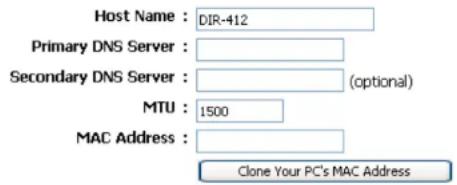
Choose Dynamic IP (DHCP) from the My Internet Connection is drop-down menu if all WAN IP information is obtained from your ISP.
Host Name: The Host Name is optional but may be required by some ISPs. The default host name is the device name of the Router and may be changed.
DNS Addresses: Enter the Primary and Secondary DNS server IP addresses assigned by your ISP.
MTU: Maximum Transmission Unit - you may need to change the MTU for optimal performance with your specific ISP. 1500 is the default MTU.
MAC Address: The default MAC Address is set to the Internet port's physical interface MAC address on the Broadband Router. It is not recommended that you change the default MAC address unless required by your ISP. You can use the Clone Your PC's MAC Address button to replace the Internet port's MAC address with the MAC address of your Ethernet card.
DYNAMIC IP (DHCP) INTERNET CONNECTION TYPE :
Use this Internet connection type if your Internet Service Provider (ISP) didn't provide you with IP Address information and/or a username and password.
text_image
Host Name : DIR-412 Primary DNS Server : Secondary DNS Server : (optional) MTU : 1500 MAC Address : Clone Your PC's MAC AddressManual Configuration (WAN Mode) PPPoE (Username/Password)
Choose PPPoE (Username/Password) from the My Internet Connection is drop-down menu if your ISP uses a PPPoE connection. Your ISP will provide you with a username and password. This option is typically used for DSL services. Make sure to remove your PPPoE software from your computer. The software is no longer needed and will not work through a router.
Address Mode: Select Static if your ISP assigned you the IP address, subnet mask, gateway, and DNS server addresses. In most cases, select Dynamic.
IP Address: Enter the IP address (Static PPPoE only).
User Name: Enter your PPPoE user name.
Password: Enter your PPPoE password and then retype the password in the next box.
Service Name: Enter the ISP Service Name (optional).
Reconnect Select either Always-on, On-Demand, or Mode: Manual.
Maximum Idle Enter a maximum idle time during which the Time: Internet connection is maintained during inactivity. To disable this feature, enable Auto-reconnect.
PPPOE INTERNET CONNECTION TYPE :
Enter the information provided by your Internet Service Provider (ISP).

text_image
Address Mode : Dynamic IP Static IP IP Address : Username : Password : Verify Password : Service Name : (optional) Reconnect Mode : Always New Schedule On demand Manual Maximum Idle Time : 0 (minutes, 0=infinite) DNS Mode : Receive DNS from ISP Enter DNS Manually Primary DNS Server : ndary DNS Server : (optional) MTU : 1454 MAC Address : Clone Your PC's MAC AddressSection 3 - Configuration
DNS Mode: Click the Receive DNS from ISP radio button if you want to dynamically receive the DNS Server IP addresses from your ISP. To manually enter the DNS Server IP addresses, click the Enter DNS Manually radio button and enter the DNS Server IP addresses in the Primary DNS Server and Secondary DNS Server fields.
MTU: Maximum Transmission Unit - You may need to change the MTU for optimal performance with your specific ISP. 1492 is the default MTU.
MAC Address: The default MAC Address is set to the Internet port's physical interface MAC address on the Broadband Router. It is not recommended that you change the default MAC address unless required by your ISP. You can use the Clone Your PC's MAC Address button to replace the Internet port's MAC address with the MAC address of your Ethernet card.
Manual Configuration (WAN Mode) PPTP (Username/Password)
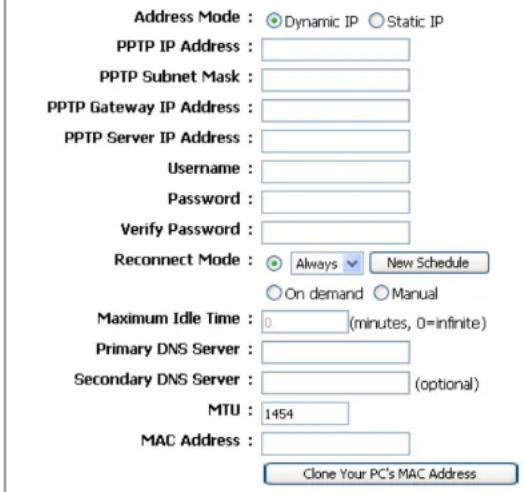
Choose PPTP (Username/Password) from the My Internet Connection is drop-down menu if your ISP uses a PPTP connection. Your ISP will provide you with a username and password. This option is typically used for DSL services.
Address Mode: Select Static if your ISP assigned you the IP address, subnet mask, gateway, and DNS server addresses. In most cases, select Dynamic.
PPTP IP Address: Enter the IP address (Static PPTP only).
PPTP Subnet Enter the Subnet Mask (Static PPTP only). Mask:
PPTP Gateway IP Enter the Gateway IP address provided by your Address: ISP (Static PPTP only).
PPTP Server IP Enter the Server IP provided by your ISP Address: (optional).
Username: Enter your PPTP username.
Password: Enter your PPTP password and password in the next box.
Reconnect Mode: Select either Always-on, On-Demand, or Manual.
Maximum Idle Enter a maximum idle time during which the Time: Internet connection is maintained during inactivity. To disable this feature, enable Auto-reconnect.
PPTP INTERNET CONNECTION TYPE :
Enter the information provided by your Internet Service Provider (ISP).
text_image
Address Mode : Dynamic IP Static IP PPTP IP Address : PPTP Subnet Mask : PPTP Gateway IP Address : PPTP Server IP Address : Username : Password : Verify Password : Reconnect Mode : Always New Schedule On demand Manual Maximum Idle Time : 0 (minutes, 0=infinite) Primary DNS Server : Secondary DNS Server : (optional) MTU : 1454 MAC Address : Clone Your PC's MAC AddressDNS Servers: Enter the Primary and Secondary DNS Server Addresses (Static PPTP only).
MTU: Maximum Transmission Unit - You may need to change the MTU for optimal performance with your specific ISP. 1400 is the default MTU.
MAC Address: The default MAC Address is set to the Internet port's physical interface MAC address on the Broadband Router. It is not recommended that you change the default MAC address unless required by your ISP. You can use the Clone Your PC's MAC Address button to replace the Internet port's MAC address with the MAC address of your Ethernet card.
Manual Configuration (WAN Mode) L2TP (Username/Password)
Choose L2TP (Username/Password) from the My Internet Connection is drop-down menu if your ISP uses an L2TP connection. Your ISP will provide you with a username and password. This option is typically used for DSL services.
Address Mode: Select Static IP if your ISP assigned you the IP address, subnet mask, gateway, and DNS server addresses. In most cases, select Dynamic IP.
L2TP IP Address: Enter the L2TP IP address supplied by your ISP (Static IP only).
L2TP Subnet Enter the Subnet Mask supplied by your ISP Mask: (Static L2TP only).
L2TP Gateway IP Enter the Gateway IP address provided by your Address: ISP (Static L2TP only).
L2TP Server IP Enter the Server IP address provided by your Address: ISP (optional).
User Name: Enter your L2TP user name.
Password: Enter your L2TP password and then retype the password in the next box.
Reconnect Mode: Select either Always-on, On-Demand, or Manual.
L2TP INTERNET CONNECTION TYPE :
Enter the information provided by your Internet Service Provider (ISP).

text_image
Address Mode : Dynamic IP Static IP L2TP IP Address : L2TP Subnet Mask : L2TP Gateway IP Address : L2TP Server IP Address : Username : Password : Verify Password : Reconnect Mode : Always New Schedule On demand Manual Maximum Idle Time : 0 (minutes, 0=infinite) Primary DNS Server : Secondary DNS Server : (optional) MTU : 1454 MAC Address : Clone Your PC's MAC AddressSection 3 - Configuration
Maximum Idle Enter a maximum idle time during which the Internet connection is maintained during inactivity. To disable this feature, enable Time: Auto-reconnect.
DNS Servers: Enter the Primary and Secondary DNS Server Addresses (Static L2TP only).
MTU: Maximum Transmission Unit - You may need to change the MTU for optimal performance with your specific ISP. 1400 is the default MTU.
MAC Address: The default MAC Address is set to the Internet port's physical interface MAC address on the Broadband Router. It is not recommended that you change the default MAC address unless required by your ISP. You can use the Clone Your PC's MAC Address button to replace the Internet port's MAC address with the MAC address of your Ethernet card.
Manual Configuration (WAN Mode) Russia PPTP (Dual Access)
Choose Russia PPTP (Dual Access) from the My Internet Connection is drop-down menu if your ISP uses a PPTP connection. Your ISP will provide you with a username and password. This option is typically used for DSL services.
Address Mode: Select Static IP if your ISP assigned you the IP address, subnet mask, gateway, and DNS server addresses. In most cases, select Dynamic IP.
PPTP IP Address: Enter the IP address (Static PPTP only).
PPTP Subnet Enter the Subnet Mask (Static PPTP only). Mask:
PPTP Gateway IP Enter the Gateway IP address provided by your Address: ISP (Static PPTP only).
PPTP Server IP Enter the Server IP provided by your ISP Address: (optional).
Username: Enter your PPTP username. Check the MPPE box to enable the MPPE encryption protocol between the DIR-412 and PPTP server.
Password: Enter your PPTP password and then retype the password in the next box.
Reconnect Mode: Select either Always-on, On-Demand, or Manual.
PPTP INTERNET CONNECTION TYPE :
Enter the information provided by your Internet Service Provider (ISP).
Address Mode : Dynamic IP Static IP
PPTP IP Address :
PPTP Subnet Mask :
PPTP Gateway IP Address :
PPTP Server IP Address :
Username : MPPE : □
Password :
Verify Password :
Reconnect Mode : Always New Schedule
On demand Manual
Maximum Idle Time : 0 (minutes, 0=infinite)
Primary DNS Server :
Secondary DNS Server : (optional)

Clone Your PC's MAC Address
Maximum Idle Enter a maximum idle time during which the Internet connection is maintained during inactivity. To disable this feature, enable Time: Auto-reconnect.
DNS Servers: Enter the Primary and Secondary DNS Server Addresses (Static PPTP only).
MTU: Maximum Transmission Unit - You may need to change the MTU for optimal performance with your specific ISP. 1400 is the default MTU.
MAC Address: The default MAC Address is set to the Internet port's physical interface MAC address on the Broadband Router. It is not recommended that you change the default MAC address unless required by your ISP. You can use the Clone Your PC's MAC Address button to replace the Internet port's MAC address with the MAC address of your Ethernet card.
Manual Configuration (WAN Mode)
Russia PPPoE (Dual Access)
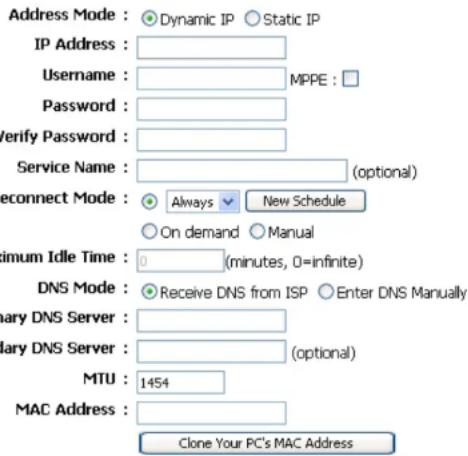
Choose Russia PPoE (Dual Access) from the My Internet Connection is drop-down menu if your ISP uses a PPPoE connection. Your ISP will provide you with a username and password. This option is typically used for DSL services.
Address Mode: Select Static if your ISP assigned you the IP address, subnet mask, gateway, and DNS server addresses. In most cases, select Dynamic.
IP Address: Enter the IP address (Static PPPoE only).
User Name: Enter your PPPoE user name. Check the MPPE box to enable the MPPE encryption protocol between the DIR-412 and PPPoE server.
Password: Enter your PPPoE password and then retype the password in the next box.
Service Name: Enter the ISP Service Name (optional).
Reconnect Select either Always-on, On-Demand, or Mode: Manual.
Maximum Idle Enter a maximum idle time during which the Time: Internet connection is maintained during inactivity. To disable this feature, enable Auto-reconnect.
PPPOE INTERNET CONNECTION TYPE :
Enter the information provided by your Internet Service Provider (ISP).
text_image
Address Mode : Dynamic IP Static IP IP Address : Username : MPPE : Password : Verify Password : Service Name : (optional) Reconnect Mode : Always New Schedule On demand Manual Minimum Idle Time : 0 (minutes, 0=infinite) DNS Mode : Receive DNS from ISP Enter DNS Manually Mary DNS Server : Mary DNS Server : (optional) MTU : 1454 MAC Address : Clone Your PC's MAC AddressDNS Mode: Click the Receive DNS from ISP radio button if you want to dynamically receive the DNS Server IP addresses from your ISP. To manually enter the DNS Server IP addresses, click the Enter DNS Manually radio button and enter the DNS Server IP addresses in the Primary DNS Server and Secondary DNS Server fields.
MAC Address: The default MAC Address is set to the Internet port's physical interface MAC address on the Broadband Router. It is not recommended that you change the default MAC address unless required by your ISP. You can use the Clone Your PC's MAC Address button to replace the Internet port's MAC address with the MAC address of your Ethernet card.
MTU: Maximum Transmission Unit - You may need to change the MTU for optimal performance with your specific ISP. 1492 is the default MTU.
Wireless Settings
If you want to configure the wireless settings on your router using the wizard, click Wireless Network Setup Wizard and refer to "Wireless Connection Setup Wizard" on page.
Click Add Wireless Device with WPS if you want to add a wireless device using Wi-Fi Protected Setup (WPS) and refer to "Add Wireless Device with WPS Wizard" on page.
If you want to manually configure the wireless settings on your router click Manual Wireless Network Setup and refer to the next page.

text_image
Product Page : DR-412 Firmware Version : 1.00 D-Link® DR-412 SETUP ADVANCED TOOLS STATUS SUPPORT INTERNET WIRELESS SETTINGS THE following Web based wizards are designed to assist you in your wireless network setup and wireless device connection. Before launching these wizards, please make sure you have followed all steps outlined in the quick installation guide included in the package. WI-HI Protected Setup, did on Add Wireless Device with WIPS to add new device to your wireless network. WI-HI NETWORK SETUP WIZARD This wizard is designed to assist you in your wireless network setup. It will guide you through step-by-step instructions on how to set up your wireless network and how to make it secure. Wireless Network Setup Wizard Note: Some changes made using this Setup Wizard may require you to change some settings on your wireless client adapters so they can still connect to the D-Link Router. ADD WIRELESS DEVICE WITH WIPS (WI-HI PROTECTED SETUP) WIZARD This wizard is designed to assist you in connecting your wireless device to your wireless router. It will guide you through step-by-step instructions on how to get your wireless device connected. Click the button below to begin. Add Wireless Device with WIPS MANUAL WIRELESS NETWORK SETUP If your wireless network is already set up with WI-HI Protected Setup, manual configuration of the wireless network will destroy the existing wireless network. If you would like to configure the wireless settings of your new D-Link Systems Router manually, then click on the Manual Wireless Network Setup button below. Manual Wireless Network Setup Helpful Links... • If you already have a wireless network setup with WI-HI Protected Setup, did on Add Wireless Device with WIPS to add new device to your wireless network. • If you are ready to wireless networking and have never configured a wireless router before, did on Wireless Connection Setup Wizard and the router will guide you through a few kinds of access to put your wireless network up and running. • If you consider yourself on advanced user and have configured a wireless router before, did Manual Wireless Connection Setup to input all the earnings manually. WI-WIRELESSManual Wireless Network Setup
Enable Wireless: Check the box to enable the wireless function. If you do not want to use wireless, uncheck the box to disable all the wireless functions. Click Add New to create your own time schedule to enable the wireless function.
Wireless Network Service Set Identifier (SSID) is the name of your Name: wireless network. Create a name using up to 32 characters. The SSID is case-sensitive.
Enable Auto The Auto Channel Scan setting can be selected Channel Selection: to allow the DIR-412 to choose the channel with the least amount of interference.
Wireless Channel: Indicates the channel setting for the DIR-412. By default the channel is set to 6. The Channel can be changed to t the channel setting for an existing wireless network or to customize the wireless network. If you enable Auto Channel Scan, this option will be greyed out.
Transmission Select the transmit rate. It is strongly suggested Rate: to select Best (Auto) for best performance.
WMM Enable: WMM (Wi-Fi Multimedia) is QoS for your wireless network. Check this box to improve the quality of video and voice applications for your wireless clients. This feature is not available in 802.11n con gurations.

text_image
Product: Page : DIR-412 Firmware Version : 1.00 D-Link® DIR-412 SETUP ADVANCED TOOLS STATUS SUPPORT WIRELESS NETWORK Use this section to configure the wireless settings for your D-Link router. Please note that changes made in this section may also need to be duplicated on your wireless client. To protect your privacy you can configure wireless security features. This device supports three wireless security modes including WEP, WPA and WPA2. Save Settings Don't Save Settings Helpful hints... • Change your Windows will wait then is the first step in securing your wireless network. We recommend that you change it to a friendly name that does not contain any personal information. • Enable Auto Channel to the router can select the best possible channel for your wireless network to operate on. • Enable WMM can help control license and/or when transmitting multimedia content over a wireless connection. • Enable Hidden Mode to other networks provide your network with this option enabled, no wireless devices will be able to send your wireless network when they perform a plan to see what's available. In order for your wireless devices to connect to your router, you will need to manualize on the wireless network. Name on each device. • If you have enabled Wireless Security, we will save you write down the WEP-Cay or Passphrase that you have configured. You will need to enter the information on any wireless device that you connect to your wireless network. WIRELESS NETWORK SETTINGS Enable Wireless : ✓ Always ✓ New Schedule Wireless Network Name : link (Also called the SSID) Enable Auto Channel Selection : Wireless Channel : 6 Transmission Rate : Best (automatic) ✓ Max/s WMM Enable : ✓ (Wireless Opt) Enable Hidden Wireless : □ (Also called the SSID Broadcast) WIRELESS SECURITY MODE Security Mode : Decide Wireless Security (not recommended) Save Settings Don't Save Settings WIRELESSSection 3 - Configuration
Enable Hidden Enabling Hidden Mode is another way to secure your network. With this option enabled, no wireless clients will Wireless: be able to see your wireless network when they perform a scan to see what's available. In order for your wireless devices to connect to your router, you will need to manually enter the Wireless Network Name on each device.
Wireless Security: Refer to Section 4- Wireless security for more information regarding wireless security.
Network Settings
This section will allow you to change the local network settings of the router and to configure the DHCP settings.
Router IP Address: Enter the IP address of the router. The default IP address is 192.168.0.1.
If you change the IP address, once you click Apply, you will need to enter the new IP address in your browser to get back into the configuration utility.
Default Subnet Mask: Enter the Subnet Mask. The default subnet mask is 255.255.255.0.
Device Name: Enter the Device name (set to "DIR-412" by default).
Local Domain Name: Enter the Domain name (Optional).
Enable DNS Relay: Uncheck the box to transfer the DNS server information from your ISP to your computers. If checked, your computers will use the router for a DNS server.

text_image
Product Page: D-Link D-Link SETUP ADRAKSO TOOLS STATUS SUPPORT NETWORK SETTINGS Use this section to configure the internal network settings of your router and also to configure the built-in DHCP server to assign IP address to computers on your network. The IP address that is configured here is the IP address that you use to access the Web based management interface. If you change the IP address in the section, you may need to adjust your PC's network settings to access the network again. Please note that this section is optional and you do not need to change any of the settings here to get your network up and running. New Settings Next New Settings ROUTER SETTINGS Use this section to configure the internal network settings of your router. This IP address that is configured here is the IP address that you use to access the Web based management interface. If you change the IP address, then you may need to adjust your PCS network settings to access the network again. Router IP Address: 202.143.8.1 Default Subnet Mask: 205.255.256.0 Device Name: 208-442 Local Domain Name: (optional) Enable DNS Relay: ✓ DHCP SERVER SETTINGS Use this section to configure the built-in DHCP server to assign IP address to the computers on your networks. Enable DHCP Server: ✓ DHCP IP Address Range: 200 to 199 (addresses within the LAN subnet) DHCP Lease Time: 1440 (minutes) DHCP RESERVATIONS LIST Host Name IP Address MAC Address Expired Time NUMBER OF DYNAMIC DHCP CLIENTS Host Name IP Address MAC Address Expired Time DHCP Subscription: 192.168.0.100 DC-CHP-02.0.35.06 22 Hours 10 Minutes 24 - DHCP RESERVATION Remaining number of rules that can be created: 24 Computer Name IP Address MAC Address Computer Name Computer Name Computer Name Computer Name Computer NameDHCP Server Settings
DHCP stands for Dynamic Host Control Protocol. The DIR-412 has a built-in DHCP server. The DHCP Server will automatically assign an IP address to the computers on the LAN/private network. Be sure to set your computers to be DHCP clients by setting their TCP/IP settings to "Obtain an IP Address Automatically." When you turn your computers on, they will automatically load the proper TCP/IP settings provided by the DIR-412. The DHCP Server will automatically allocate an unused IP address from the IP address pool to the requesting computer. You must specify the starting and ending address of the IP address pool.
Enable DHCP Check this box to enable the DHCP server on Server: your router. Uncheck to disable this function.
DHCP IP Address Enter the starting and ending IP addresses for Range: the DHCP server's IP assignment.
Note: If you statically (manually) assign IP addresses to your computers or devices, make sure the IP addresses are outside of this range or you may have an IP conflict.
DHCP SERVER SETTINGS
Use this section to configure the built-in DHCP server to assign IP address to the computers on your network.
Enable DHCP Server : √
DHCP IP Address Range : 100 to 199 (addresses within the LAN subnet)
DHCP Lease Time : 1440 (minutes)
DHCP Lease Time: The length of time for the IP address lease. Enter the Lease time in minutes.
DHCP Reservation
If you want a computer or device to always have the same IP address assigned, you can create a DHCP reservation. The router will assign the IP address only to that computer or device.
Configure the parameters, as described below, to create a new DHCP Reservation.
Note: This IP address must be within the DHCP IP Address Range.
DHCP Displays a list of the DHCP reservations that have been configured Reservations List: on the router.
Number of In this section, you can see information about the LAN devices Dynamic DHCP that are currently being leased IP addresses. Clients:
Computer Name: Enter the computer name or select a computer name from the drop-down menu on the right-hand side and click <<.
IP Address: Enter the IP address you want to assign to the computer or device. This IP Address must be within the DHCP IP Address Range.
MAC Address: Enter the MAC address of the computer or device.
| DHCP RESERVATIONS LIST | |||
| Host Name | IP Address | MAC Address | Expired Time |
| robert-pc | 192.168.0.100 | 00:1d:5a:48:d8:ad | Narver |
| NUMBER OF DYNAMIC DHCP CLIENTS | |||
| Host Name | IP Address | MAC Address | Expired Time |
| Computer Name | IP Address | MAC Address |
When you have finished configuring the above settings, check the boxes next to the DHCP Reservation entries you want to add to the DHCP Reservations List and click the Save Settings button at the top or bottom of the window to save your entries and activate your reservations.
Virtual Server
The DIR-412 can be configured as a virtual server so that remote users accessing Web or FTP services via the public IP address can be automatically redirected to local servers in the LAN (Local Area Network).
The DIR-412 firewall feature filters out unrecognized packets to protect your LAN network so all computers networked with the DIR-412 are invisible to the outside world. If you wish, you can make some of the LAN computers accessible from the Internet by enabling Virtual Server. Depending on the requested service, the DIR-412 redirects the external service request to the appropriate server within the LAN network.
The DIR-412 is also capable of port-redirection meaning incoming traffic to a particular port may be redirected to a different port on the server computer.
Each virtual service that is created will be listed at the bottom of the screen in the Virtual Servers List. Pre-defined virtual services are already listed in the table. You may use them by enabling them and assigning the server IP to use that particular virtual service.
For a list of ports for common applications, please visit the Support section for more information.

text_image
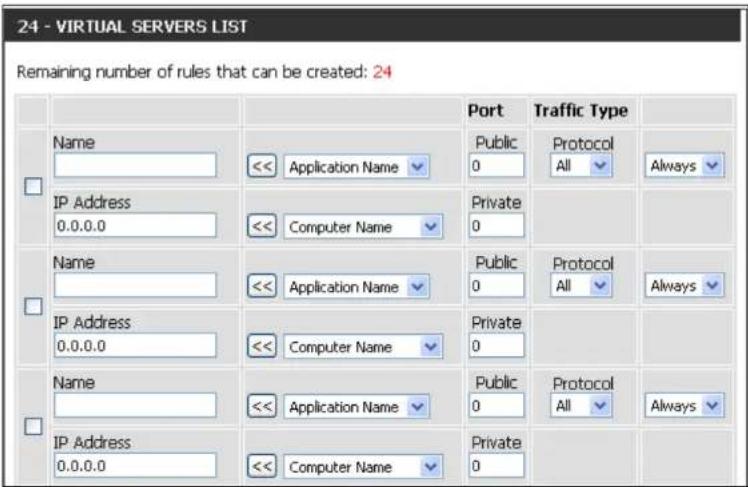
Product Page - 120-12 D-Link OK - 122 SETUP ADVANCED TOOLS STATUS SUPPORT VIRTUAL SERVER The virtual server option allows you to define a single public port on your route. For redirection to an internal LAN IP Address and Private LAN port if required. This feature is useful for maintaining other functions such as PTR or Node Server. Virtual settings: You can select a computer from the list of TCP services in the Computer Name list (e.g. Windows, Windows, Linux, Chrome OS). You can also select any other function categories of the computer or other types of the computer with any available ports. You can also select any other function categories of the computer or other types of the computer with any available ports. You can also select any other function categories of the computer or other types of the computer with any available ports. You can also select any other function categories of the computer or other types of the computer with any available ports. You can also select any other function categories of the computer or other types of the computer with any available ports. You can also select any other function categories of the computer and other types of the computer with any available ports. You can also select any other function categories of the computer and other types of the computer with any available ports. You can also select any other function categories of the computer and other types of the computer with any available ports. You can also select any other function categories of the computer and other types of the computer with any available ports. You can also select any other function categories of the computer and other types of the computer with any available ports. You cannot choose a virtual server list or a network, but this is selected that you can choose a virtual server list or a network, but this is selected that you can choose a virtual server list or a network, but this is selected that you can choose a virtual server list or a network, but this is selected that you can choose a virtual server list or a network, but this is selected that you can choose a virtual server list or a network, but this is selected that you can choose a virtual server list or a network, but this is selected that you can choose a virtual Server List Remaining number of rules that can be created: 24 Name Public A1 Always IP Address Private 0 Name Public A1 Always IP Address Private 0 Name Public A1 Always IP Address Private 0 Name Public A1 Always IP Address Private 0 Name Public A1 Always IP Address Private 0 Name Public A1 Always IP Address Private 0 Name Public A1 Always IP Address Private 0 Name Applicator Name Public A1 Always IP Address Private 0 Name Applicator Name Public A1 Always IP Address Private 0 Name Applicator Name Public A1 AlwaysThe Virtual Server feature allows you to open a single port. If you would like to open a range of ports, refer to the next page. Configure the parameters, as described below, to create a new Virtual Server entry.
Name: Enter a name for the rule or select an application from the drop-down menu. Select an application and click << to populate the fields.
IP Address: Enter the IP address of the computer on your local network that you want to allow the incoming service to. If your computer is receiving an IP address automatically from the router (DHCP), you computer will be listed in the "Computer Name" drop-down menu. Select your computer and click <<.
Public Port/ Enter the port number that you want to open next to Private Port and Public Port. The private and public ports are usually the same. The private port is the port being used by the application on the computer within your local network, and the public port is the port seen from the Internet side.
text_image
24 - VIRTUAL SERVERS LIST Remaining number of rules that can be created: 24 Port Traffic Type Name << Application Name Public 0 Protocol All Always IP Address 0.0.0.0 << Computer Name Private 0 Name << Application Name Public 0 Protocol All Always IP Address 0.0.0.0 << Computer Name Private 0 Name << Application Name Public 0 Protocol All Always IP Address 0.0.0.0 << Computer Name Private 0Protocol Type: Select TCP, UDP, or Both from the drop-down menu.
Schedule: The schedule of time when the Virtual Server Rule will be enabled. The schedule may be set to Always, which will allow the particular service to always be enabled. You can create your own times in the Tools > Schedules section.
Port Forwarding
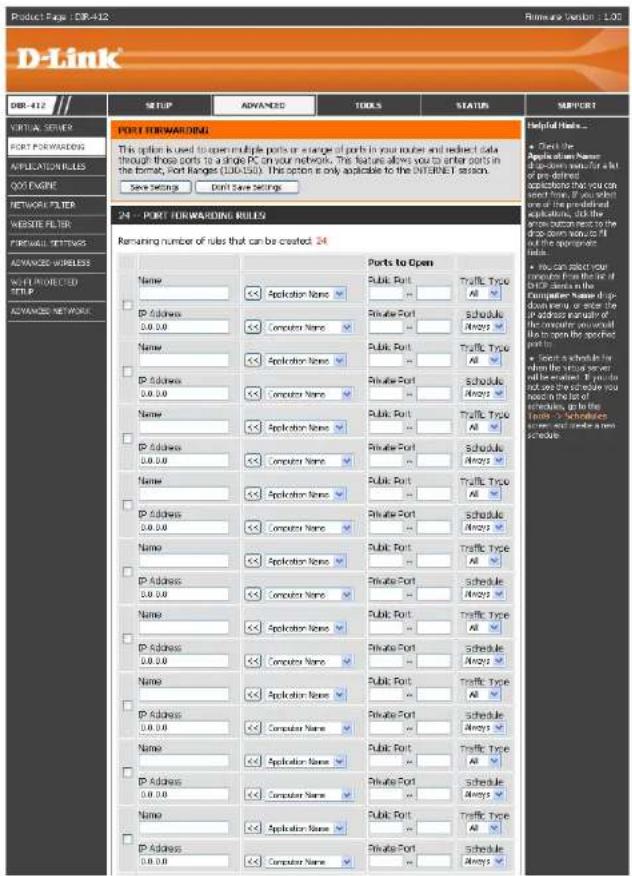
Port Forwarding is a feature that allows you to open a single port or a range of ports and redirect the data received through those ports to a single PC on your network.
Name: Enter a name for the rule or select an application from the drop-down menu. Select an application and click << to populate the fields.
IP Address: Enter the IP address of the computer on your local network that you want to allow the incoming service to. If your computer is receiving an IP address automatically from the router (DHCP), you computer will be listed in the "Computer Name" drop-down menu. Select your computer and click <<.
Public Port/ Enter the range of ports that you want to open Private Port: next to the Private Port and Public Port fields. The private and public ports are usually the same. The private ports are the ports being used by the application on the computer within your local network, and the public ports are the ports seen from the Internet side.
Traffic Type: Use the drop-down menu to select whether TCP, UDP, or All types of traffic are being used for the port forwarding rule.
Schedule: Select a schedule for when the Port Forwarding Rule will be enabled. The schedule may be set to Always, which will allow the particular service to always be enabled. You can create your own times in the Tools > Schedules section.
text_image
Product Page: D8-412 Primary Version: 1.00 D-Link DBR-412 SETUP ADVANCED TOOLS STATUS SUPPORT PORT FORWARDING This option is used to open multiple ports or range of ports in your route and reduce data through those ports to a single PC on your network. The feature allows you to enter ports in the format, root ranges (LUX-350). This option is only applicable to the INTERFACE version. Save Settings Done Save Settings 24 - PORT FORWARDING RULES Remaining number of rules that can be created: 24 Ports to Open Name Application Name Private Port All Traffic Type P Address 0.0.00 Computer Name Private Port Schedule Always Name Application Name Private Port All Traffic Type P Address 0.0.00 Computer Name Private Port Schedule Always Name Application Name Private Port All Traffic Type P Address 0.0.00 Computer Name Private Port Schedule Always Name Application Name Private Port All Traffic Type P Address 0.0.00 Computer Name Private Port Schedule AlwaysApplication Rules
Some applications require multiple connections, such as Internet gaming, video conferencing, Internet telephony and others. These applications have difficulties working through NAT (Network Address Translation). Special Applications makes some of these applications work with the DIR-412. If you need to run applications that require multiple connections, specify the port normally associated with an application in the “Trigger Port” field, select the protocol type as TCP or UDP, then enter the firewall (public) ports associated with the trigger port to open them for inbound traffic.
The DIR-412 provides some predefined applications in the table on the bottom of the web page. Select the application you want to use and enable it.
Name: Enter a name for the rule. You may select a pre-defined application from the drop-down menu and click <<.
Trigger: This is the port used to trigger the application. It can be either a single port or a range of ports.
Traffic Type: Select the protocol of the trigger port (TCP, UDP, or All).
Firewall: This is the port number on the Internet side that will be used to access the application. You may define a single port or a range of ports. You can use a comma to add multiple ports or port ranges.
Traffic Type: Select the protocol of the firewall port (TCP, UDP, or All).
Schedule: Select a schedule for when the Application Rule will be enabled. If you do not see the schedule you need in the list of schedules, go to the Tools -> Schedules screen and create a new schedule.

text_image
D-Link DR-412 SETUP ADVANCED TOOLS STATUS SUPPORT APPLICATION RULES The Application Rules option is used to open single or multiple ports in your firewall when the router service data sent to the Internet, then outgoing "Trigger" port or port range. Special Application rules apply to all computers on your internal network. Save Settings Don't Save Settings 24 - APPLICATION RULES Remaining number of rules that can be created 2x Port Traffic Type Schedule Name Application Trigger Protocol All Schedule Advanced WIRELESS Application Name Firewall Protocol All Average Name Application Trigger Protocol All Schedule Advanced WIRELESS Application Name Firewall Protocol All Average Name Application Trigger Protocol All Schedule Advanced WIRELESS Application Name Firewall Protocol All Average Name Application Trigger Protocol All Schedule Average Application Name does not mean to run a lot of time. Defined application that you can select lines. If you select one if the one defined application calls the new button next to the application menu will turn out the appropriate fields. APPLICATION RULES Helpful Features... • Use the feature if you are trying to create a list of the listed network applications and it is not required calling as expected. • Use the Application Name does not mean to run a lot of time. Defined application that you can select lines. If you select one if the one defined application calls the new button next to the application menu will turn out the appropriate fields.QoS Engine
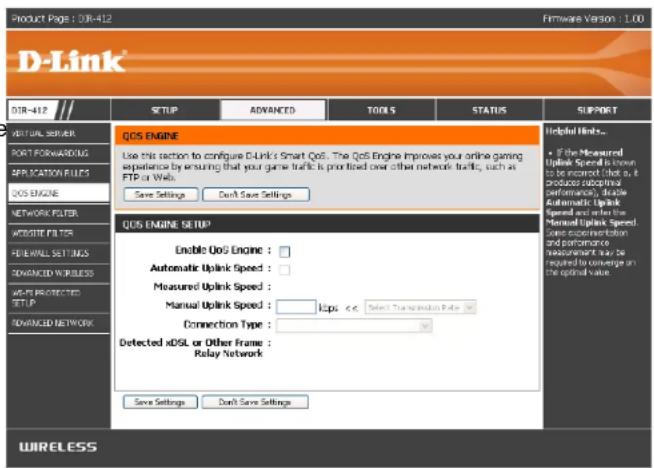
The QoS Engine option helps improve your network gaming performance by prioritizing applications. By default the QoS Engine settings are disabled and application priority is not classified automatically.
Enable QoS Engine: This option is disabled by default. Enable this option for better performance and experience with online games and other interactive applications, such as VoIP.
Automatic Uplink This option will allow your router to automatically determine Speed: the uplink speed of your Internet connection.
Measured Uplink This displays the detected uplink speed. Speed:
Manual Uplink The speed at which data can be transferred from the router to your ISP. This is determined by your ISP. ISP's offer speed as a download/upload pair. For example, 1.5Mbits/284Kbits. Using this example, you would enter 284. Alternatively you can test your uplink speed with a service such as www.dslreports.com.
text_image
Product Page : DOR-412 Firmware Version : 1.00 D-Link® DOR-412 QUIRCELL SERVER PORT FORWARDING APPLICATION RULES QOS ENGINE NETWORK FILTER ADDRESS FILTER HEDDLWALL SETTINGS AMOUNT PROTECTED SETUP AMOUNT PROTECTED ADWANCED NETWORK QOS ENGINE Use this section to configure D-Link's Smart QoS. The QoS Engine Improves your online gaming sequence by ensuring that your game traffic is provided over other network traffic, such as FTP or Web. Save Settings Don't Save Settings QOS ENGINE SETUP Enable QoS Engine : Automatic Uplink Speed : Measured Uplink Speed : Manual Uplink Speed : 1kps cc Select Transmission Rate # Connection Type : Detected xDSL or Other Frame : Relay Network Save Settings Don't Save Settings Helpful Links... • If the Measured Uplink Speed is known to be recorded (check it, produces suboptimal performable). Enable Automatic Uplink Speed and/or the Manual Uplink Speed. Some experience- tion and performance measurement may be required to coverage on the optimal value. WIRELESSConnection Type: This option allows you to select your connection type. Users can select "auto-detect" or choose the xDSL or cable networks if they know.
Detected xDSL or This displays if xDSL or another type of frame relay network has been detected. The DIR-412 can detect the network and Other Frame Relay the user can confirm this.
Network:
Network Filters
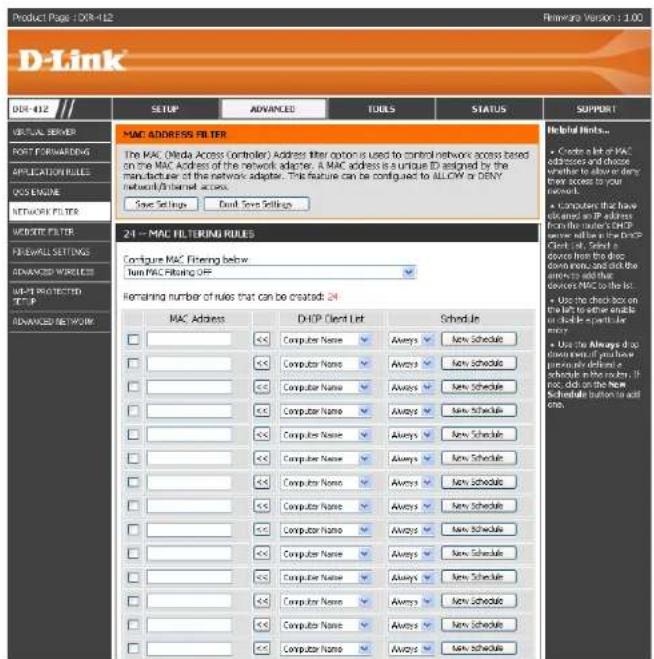
Use MAC (Media Access Control) Filters to allow or deny LAN (Local Area Network) computers by their MAC addresses from accessing the Network. You can either manually add a MAC address or select the MAC address from the list of clients that are currently connected to the Broadband Router.
Configure MAC Select Turn MAC Filtering Off, allow MAC addresses Filtering: listed below, or deny MAC addresses listed below from the drop-down menu.
MAC Address: Enter the MAC address you would like to filter.
To find the MAC address on a computer, please refer to the Networking Basics section in this manual.
DHCP Client: Select a DHCP client from the drop-down menu and click << to copy the MAC Address from the DHCP client.
Schedule: Select a schedule for when the Network Filter will be enabled. The user can click the New Schedule button to bring up the "Schedule Webpage" to configure a new schedule.
text_image
Product Page: DOR-412 Rimware Version: 1.00 D-Link DOR-412 SETUP ADVANCED TOOLS STATUS SUPPORT MASC ADDRESS FILTER The MAC (Media Access Controller) Address filter option is used to control network access based on the MAC Address of the network adapter. A MAC address is a unique ID designed by the manufacturer or the network adapter. The feature can be configured to ALLOW or deny network packet access. Save Settings Done Save Settings MAC ADDRESS FILTER The MAC (Media Access Controller) Address filter option is used to control network access based on the MAC Address of the network adapter. A MAC address is a unique ID designed by the manufacturer or the network adapter. The feature can be configured to ALLOW or deny network packet access. Save Settings Done Save Settings 24 - MAC FILTERING RULES Configure MAC Filtering below: New MAC Filtering OFF Remaining number of rules that can be created: 24 MAC Address Computer Name Always New Schedule Computer Name Always New Schedule Computer Name Always New Schedule Computer Name Always New Schedule Computer Name Always New Schedule Computer Name Always New Schedule Computer Name Always New Schedule Computer Name Always New Schedule Computer Name Always New ScheduleWebsite Filters
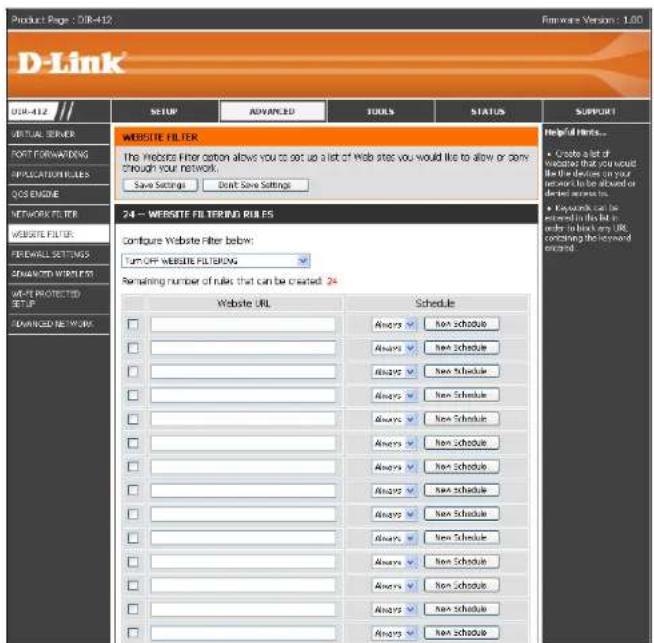
Website Filters are used to allow you to set up a list of allowed Web sites that can be used by multiple users through the network. To use this feature select to Allow or Deny, enter the domain or website and click Add, and then click Save Settings. You must also select Apply Web Filter under the Access Control section.
Configure Website Select Deny or Allow computers access to Filter Below: only these sites.
Website URL: Enter the URLs that you want to allow or deny.
Schedule: Use the drop-down menu to select the schedule for the Network Filter rule. Click the New Schedule button to bring up the "Schedule Webpage" to configure the new schedule.
text_image
Product Page : DLR-412 D-Link EUR-412 SETUP ADVANCED TOOLS STATUS SUPPORT VEGETARY SERVER POST FORWARDING APPLICATION RULES QOS ENGINE NETWORK FILTER WEBSITE FILTER PREADWALL SETTINGS SPRINGWATER FILTERS WHERE PROTECTED SETUP ADVANCED NETWORK WEBSITE FILTER The Websites Filter option allows you to set up a list of Web sites you would like to allow or some through your network. Save Settings Don't Save Settings 24 - WEBSITE FILTERING RULES Configure Website Filter below: Turn OFF WEBSITE FILTERING Remaining number of rules that can be created: 24 Website URL Schedule Always New Schedule Always New Schedule Always New Schedule Always New Schedule Always New Schedule Always New Schedule Always New Schedule Always New Schedule Always New ScheduleFirewall Settings
A firewall protects your network from the outside world. The D-Link DIR-412 offers a firewall type functionality. The SPI feature helps prevent cyber attacks. Sometimes you may want a computer exposed to the outside world for certain types of applications. If you choose to expose a computer, you can enable DMZ. DMZ is short for Demilitarized Zone. This option will expose the chosen computer completely to the outside world.
Enable SPI: SPI (Stateful Packet Inspection, also known as dynamic packet filtering) helps to prevent cyber attacks by tracking more state per session. It validates that the traffic passing through the session conforms to the protocol.
DMZ Host: Check the Enable DMZ box and specify the IP address of the computer on the LAN that you want to have unrestricted Internet communication in the DMZ IP Address field. Use the drop-down menu to specify a host that currently has a DHCP lease from the DIR-412. If this computer has obtained its IP address automatically using DHCP, be sure to make a static reservation on the System > Network Settings page so that the IP address of the DMZ machine does not change.
Firewall Rules: Use this section to create rules that deny or allow traffic from passing through the device. See the following page for information on how to create firewall rules.
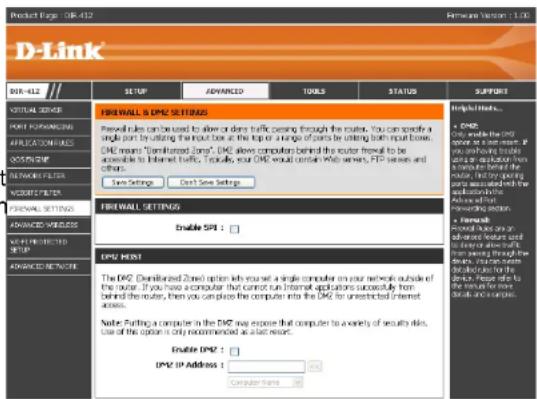
text_image
Product Page: 08-412 Hardware Version 1.03 D-Link DIR-412 EXIT TITLE SENSOR WRITE FORMANING APPLICATIONS BOSNAME NETWORK FILTER MODEL PLETTER PREFWALL SETTINGS AMOUNTED VERSIONS AMOUNTED VERSION AVANCED VERSIONS AVANCED VERSION AVANCED NETWORK FIREWALL EPMZ SETTINGS Preval rules can be used to allow or store traffic passing through the route. You can specify a single port building the input box at the top or a range of ports by ordering both input boxes. EPC means "Amplified Zone". EPC allows computer behind the outer firewall to be accessible to Internet traffic. Therefore, your EPC would contain this server, FIP servers and other. Save Settings Cash/Save Settings FIREWALL SETTINGS Enable SPI : EMV NEXT The EPC (Amplified Zone) option lets you set a single computer on your network outside of the water. If you have a computer that cannot run Internet applications successfully from behind the route, then you can please the computer into the EPC for unrestricted Internet access. Note: Foring a computer in the EPC may expose that computer to a variety of security risks, use of the option is only recommended at last resort. Enable EMS : IPVX IP Address : Computer Name: Help! Have...? • OPEA • Only include the only program or a website. If you have been able to be able to use the EPC, you can be a member of the EPC, first being going and also being used by the wall within the EPC's website. The following design: • Email • Updated via: Next on an adherence feature used • After which we can change it, you can be using through the route, you can state the epcade to the EPC. Please select to the route for more than direct and complete.Firewall Rules
To create a firewall rule, configure the parameters as described below:
Name: Enter a name for the firewall rule.
Action: Use the drop-down menu to specify if the router should Allow or Deny traffic matching the firewall rule.
Interface: Use the drop-down menus to select the Source and Destination interfaces for the Firewall Rule
Use the IP Address fields next to each Interface drop-down menu to specify the IP address ranges for the Source/Destination interfaces.
The first host in the IP address range should be entered in the top field and the last host in the IP address range should be entered in the field beneath for both the Source/Destination interfaces.
Protocol: Use the drop-down menu to select the protocol that will be used for the firewall rule (TCP, UDP, ICMP, or ALL).
Port Range: Enter the range of ports that the firewall rule will apply to.
The first port in the port range should be entered in the top field and the last host in the port range should be entered in the field beneath.
Schedule: Use the drop-down menu to select the schedule for the Network Filter rule. Click the New Schedule button to bring up the "Schedule Webpage" to configure the new schedule.
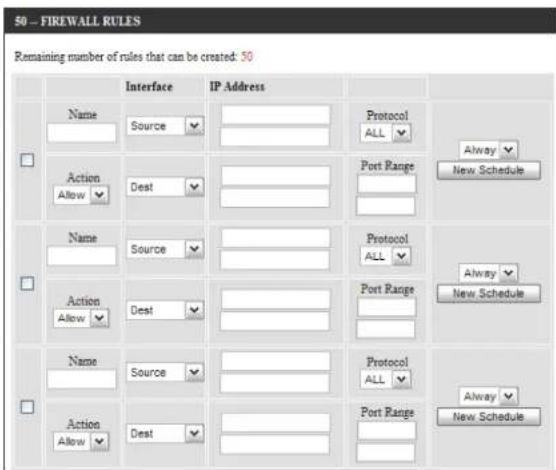
text_image
50 - FIREWALL RULES Remaining number of rules that can be created: 50 Interface IP Address Name Source Protocol ALL Alway Action Dest Port Range New Schedule Name Source Protocol ALL Alway Action Dest Port Range New Schedule Name Source Protocol ALL Alway Action Dest Port Range New ScheduleAdvanced Wireless Settings
Transmit Power: Set the transmit power of the antennas.
Beacon Period: Beacons are packets sent by an Access Point to synchronize a wireless network. Specify a value. 100 is the default setting and is recommended.
RTS Threshold: This value should remain at its default setting of 2432. If inconsistent data flow is a problem, only a minor modification should be made.
Fragmentation: The fragmentation threshold, which is specified in bytes, determines whether packets will be fragmented. Packets exceeding the 2346 byte setting will be fragmented before transmission. 2346 is the default setting.
DTIM Interval: (Delivery Traffic Indication Message) 1 is the default setting. A DTIM is a countdown informing clients of the next window for listening to broadcast and multicast messages.

text_image
Product Page : DIR=412 Firmware Version : 1.00 D-Link® DIR-412 SETUP ADVANCED TOOLS STATUS SUPPORT VIRTUAL SERVER PORT FORMULATIONS APPLICATION RULES QOS ENGINE NETWORK FILTER WEBSITE FILTER FIREWALL SETTINGS ADVANCED WIRELESS WEFT PROTECTED SETUP ADVANCED NETWORK ADVANCED WIRELESS SETTINGS These options are for users that wish to change the behavior of their 802.13m wireless radio from the standard settings. We do not recommend charging these settings from the factory defaults. Incorrect settings may impact the performance of your wireless radios. The default settings should provide the best wireless radio performance in most environments. Save Settings Don't Save Settings Helpful Hints... • It is recommended that you have these parameters with how default values. Adjusting their capacity in the performance of your wireless network. • Use 602.13m only for counties where it is required. ADVANCED WIRELESS POWERING Transmit Power : 100% Beacon interval : 100 RTG Threshold : 2346 Fragmentation : 2346 DTIM Interval : 1 Preamble Type : ○Short Presmble ○Long Presmble Wireless Mode : 802.13 Mixed/No(A) Band Width : 20/40 MHz(Auto) Short Guard Interval : ✓ Save Settings Don't Save Settings WIRELESSPreamble Type: Select Short or Long Preamble. The preamble defines the length of the CRC block (Cyclic Redundancy Check is a common technique for detecting data transmission errors) for communication between the wireless router and the roaming wireless network adapters. Note: High network traffic areas should use the Short Preamble type.
Wireless Mode: Use the drop-down menu to select the wireless modes you want to enable on the router. The available options are 802.11n only, 802.11 Mixed(g/b), and 802.11 Mixed(n/g/b).
Band Width: This setting can be used to adjust the bandwidth of the wireless signal. The default setting is 20/40 MHz (Auto).
Short Guard Check this box to reduce the guard interval time therefore increasing the data capacity. However, it's less reliable and may Interval: create higher data loss.
Wi-Fi Protected Setup
Wi-Fi Protected Check this box to enable the function Setup:
PIN Settings: Use the buttons to generate a new PIN or Reset the PIN to Default settings.
Add Wireless Click the button to start the wizard that sets up the Station: WPA function. Please refer to Section 4-Wireless security "Add wireless device with WPA wizard" for more information.
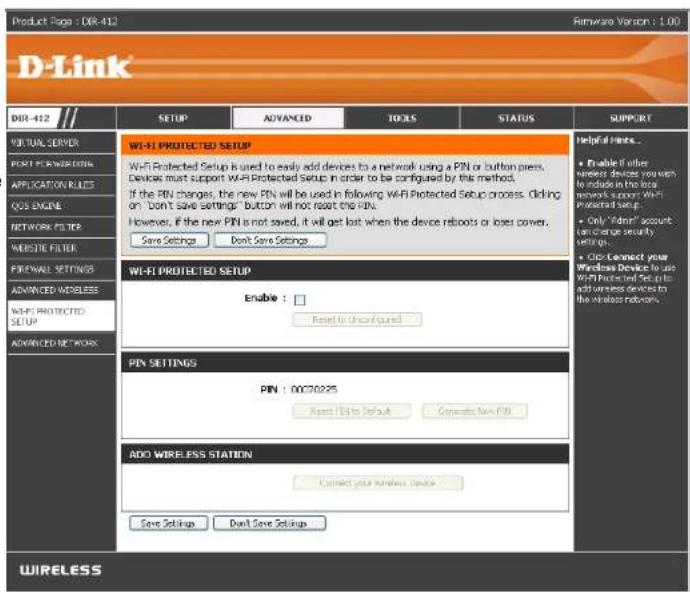
text_image
Product Page : DIR-412 D-Link DIR-412 SETUP ADVANCED TOOLS STATUS SUPPORT VIRTUAL SERVER PORT FORWARDING APPLICATION RULES QUS ENGINE NETWORK FILTER WEBSITE FILTER FIREWALL SETTINGS ADVANCED WIDELESS WiFi PROTECTED SETUP ADVANCED NETWORK WiFi-PROTECTED SETUP WiFi-Protected Setup is used to easily add devices to a network using a PIN or button press. Devices must support WiFi-Protected Setup in order to be configured by this method. If the PIN changes, the new PIN will be used in following WiFi-Protected Setup process. Clicking on "Don't save settings" button will not reset the PIN. However, if the new PIN is not saved, it will get lost when the device reboots or loses power. Save Settings Don't Save Settings Helpful Hints... • Enable if other wireless devices you want to include in the hot network support WiFi-Protected Setup... • Only "Idem" account can change security settings. • Our Connect your Wireless Device to use WiFi Protected Setup to add wireless devices to the wireless networks. WiFi-PROTECTED SETUP Enable : Reset to Unread Found PIN SETTINGS PIN : 00070225 Reset /Drive Default Generate New PIN ADO WIRELESS STATION Connect your Wireless Device Save Settings Don't Save Settings WIRELESSAdvanced Network Settings
UPnP: To use the Universal Plug and Play (UPnP™) feature check the Enable UPNP box. UPNP provides compatibility with networking equipment, software and peripherals.
WAN Ping: Unchecking the box will not allow the DIR-412 to respond to pings. Blocking the Ping may provide some extra security from hackers. Check the box to allow the Internet port to be "pinged".
WAN Port Speed: You may set the port speed of the Internet port to 10Mbps, 100Mbps, or auto. Some older cable or DSL modems may require you to set the port speed to 10Mbps.
Multicast Check the Enable Multicast Streams box to allow Streams: multicast traffic to pass through the router from the Internet.
Check the Wireless Enhance Mode box to enable the router to forward all multicast streams from the Internet to the wireless station using a unicast stream. This feature helps improve the quality of multimedia applications for wireless users.
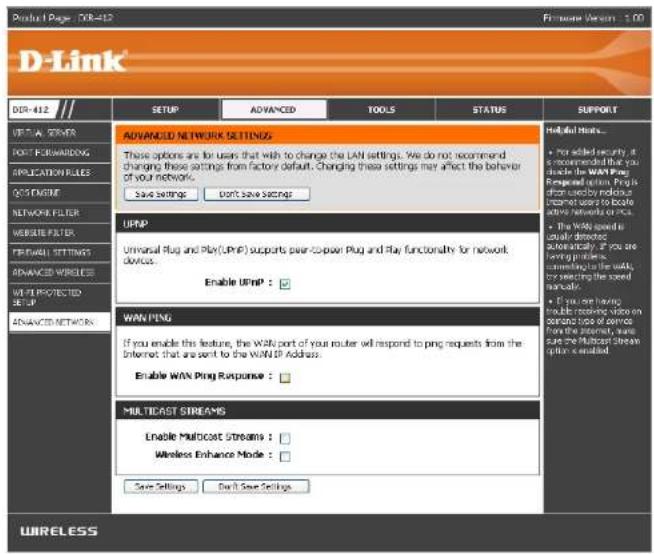
text_image
D-Link DSR-412 UPR1A SETM POST FORWARDING APPLICATION RULES QSTNGUE NETWORK FILTER WEBEATE FILTER PREADWELL SETTINGS ADVANCED WIRELESS WITH PROTECTED SETUP ADVANCED NETWORK SETUP ADVANCED TOOLS STATUS SUPPORT ADWARD NETWORK SETTINGS These options are for users that wish to change the LAN settings. We do not recommend changing these settings from factory default. Changing these settings may affect the behavior of your network. Save Settings Don't save Settings UPRP Universal Plug and Play (UPRP) supports pair-to-peer Plug and Play functionality for network devices. Enable UPRP : WIN PING If you enable this feature, the WAN port of your router will respond to ping requests from the Internet that are sent to the WIN IP Address. Enable WIN Ping Response : MULTICAST STREAMS Enable Multicast Streams : Wireless Enhance Mode : Save Settings Don't Save Settings Helpful thanks... • Not added security, it is recommended that you make the WAN Ping Request upon PinP is done by notice a packet of users to locate active networks or PCs. • The WAN speed is usually directed automatically if you are having problems something in the network, but searching the speed horizontally. • If you have having trouble receiving video on broadband use of service from the network, we save the Multicast Stream option can be enabled. WIRELESSAdministrator Settings
This page will allow you to change the Administrator and User passwords. You can also enable Remote Management. There are two accounts that can access the management interface through the web browser. The accounts are admin and user. Admin has read/write access while user has read-only access. User can only view the settings but cannot make any changes. Only the admin account has the ability to change both admin and user account passwords.
Admin Password: Enter and confirm a new password for the Administrator Login Name. The administrator can make changes to the settings.
Enable Graphical Check this box to enable graphical authentication. The Authentication: device supports this function to prevent phishing.
Enable Remote Management: Remote management allows the DIR-412 to be configured from the Internet by a web browser. A username and password is still required to access the Web-Management interface. In general, only a member of your network can browse the built-in web pages to perform Administrator tasks. This feature enables you to perform Administrator tasks from the remote (Internet) host.
Remote Admin The port number used to access the DIR-412. Port: Example: http://x.x.x.x:8080 whereas x.x.x.x is the Internet IP address of the DIR-412 and 8080 is the port used for the Web Management interface.
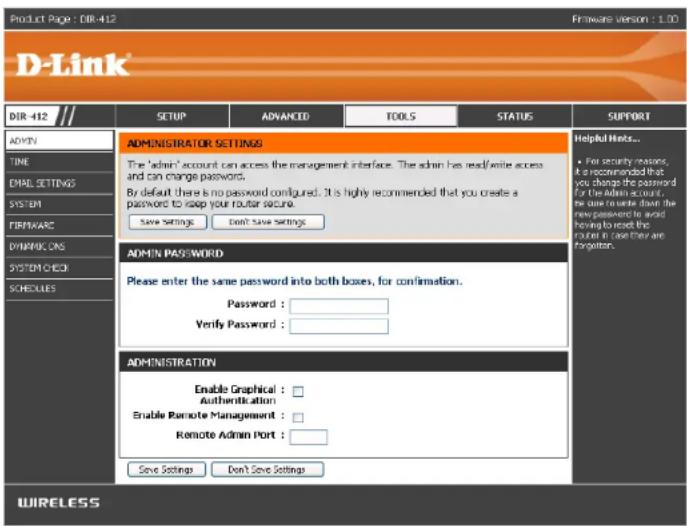
text_image
DIR-412 Firmware version: 1.00 D-Link DIR-412 /// SETUP ADVANCED TOOLS STATUS SUPPORT ADMIN TINE EMAIL SETTINGS SYSTEM FIRMWARE DYNAMIC DNS SYSTEM CHECK SCHEDULES ADMINISTRATOR SETTINGS The 'admin' account can access the management interface. The admin has read/write access and can change passwords. By default there is no password configured. It is highly recommended that you create a password to keep your router secure. Save Settings Don't Save Settings Helpful Hotx... • For security reasons, it is recommended that you change the password for the admin account, be done to write down the new password to avoid having to read the output if one they are forgotten. ADMIN PASSWORD Please enter the same password into both boxes, for confirmation. Password: Verify Password: ADMINISTRATION Enable Graphical: Authentication Enable Remote Management: Remote Admin Port: Save Settings Don't Save Settings WIRELESSTime Settings
The Time Configuration option allows you to configure, update, and maintain the correct time on the internal system clock. From this section you can set the time zone that you are in and set the Time Server. Daylight Saving can also be configured to automatically adjust the time when needed.
Time Zone: Select the Time Zone from the drop-down menu.
Enable Daylight Check the box to enable Daylight Saving time. Saving:
Sync your Click this button to set the device's time the same to Computer's Time local PC. Settings:
Automatic Check the box to enable the device to automatically Time and Date synchronize with a D-Link NTP Server. NTP stands for Configuration: Network Time Protocol. NTP synchronizes computer clock times in a network of computers. This will only connect to a server on the Internet, not a local server.
NTP Server Used: Select one of the D-Link NTP Servers from the drop-down menu. The DIR-412 will then synchronize it's clock to be the same time as the D-Link Internet time server. Click the Update Now button to synchronize with the D-Link Internet time server immediatley.
Set the Time and Date Manually: To manually input the time, use the drop-down menus to enter the values in these fields for the Year, Month, Day, Hour, Minute, and Second.

text_image
Product Page : DOR-412 D-Link® DOR-412 /// SETUP ADVANCED TOOLS STATUS SUPPORT ADMIN TIME EMAIL SETTINGS SYSTEM FORMWARE DYNAMIC DOS SYSTEM CHECK SCHEDULES TIME AND DATE The Time and Date Configuration option allows you to configure, update, and maintain the correct time on the internal system clock. From this account you can set the time zone you are in and set the NTP (Network Time Protocol) Server. Daylight Saving can also be configured to adjust the time when needed. Save Settings Don't Save Settings Time AND DATE CONFIGURATION Time : 2009/09/21, 22:18:04 Time Zone : (GMT+00:00) Tape Enable Daylight Saving : Sync. your computer's line settings AUTOMATIC TIME AND DATE CONFIGURATION Automatically synchronise with D-Link's Internet time server NTP Server Used : Select NTP Server Update Now SET THE TIME AND DATE MANUALLY Your 2009 Month Oct Day 3 Hour 14 Minute 62 second 1 Save Settings Don't Save Settings Helpful Home... • Other enter the time probably by ordering the Sync. Your Computers Time Settings Button, or use the Automatic Time Configuration option to have your router synthesize with a line server on the Frontnet. WIRELESSClick the Save Settings button to save any changes made.
E-mail Settings
The E-mail feature can be used to send the system log files, router alert messages, and firmware update notification to your e-mail address.
From E-mail This e-mail address will appear as the sender when Address: you receive a log file or firmware upgrade notification via e-mail.
To E-mail Address: Enter the e-mail address where you want the e-mail sent.
E-mail Subject: Enter a subject for the e-mails that will be sent from the Router.
SMTP Server Enter the IP address of the SMTP server for sending Address: e-mail.
Account Name: Enter your account name for sending e-mail.
Password: Enter the password associated with the account. Re-type the password associated with the account in the Verify Password field.
Send Mail Now: Click the Send Mail Now button to send a test message from the Router to the specified e-mail address.

text_image
Product Page: DIR-412 Firmware Version : 1.00 D-Link® DIR-412 /// SETUP ADVANCED TOOLS STATUS SUPPORT ADMIN TIME EMAIL SETTINGS System PAYWARE DYNAMIC DUE SYSTEM CHECK SCHEDULES EMAIL SETTINGS The Email feature can be used to send the system log files, router alert messages. Save Settings Don't Save Settings Email Settings From Email Address : To Email Address : Email Subject : SMTP Server Address : Account Name : Password : Verify Password : Send Mail Now Save Settings Don't Save Settings Helpful Hinks... • You may work to wake the email settings within those of your email client program. WIRELESSSystem Settings
Save Settings to Local Hard Drive: Use this option to save the current router con guration settings to a le on the hard disk of the computer you are using. First, click the Save button. You will then see a le dialog, where you can select a location and le name for the settings.
Load Settings Use this option to load previously saved router from Local Hard con guration settings. First, use the Browse control Drive: to nd a previously save le of con guration settings. Then, click the Load button to transfer those settings to the router.
Restore to Factory Default Settings: Click the Restore button to restore all con guration settings back to the settings that were in effect at the time the router was shipped from the factory. Any settings that have not been saved will be lost, including any rules that you have created. If you want to save the current router con guration settings, use the Save button above.
Reboot the Click to reboot the router. Device:
Clear Language Click the Clear button to restore the device back to the Pack: English interface version and remove other languages installed for the system web pages.
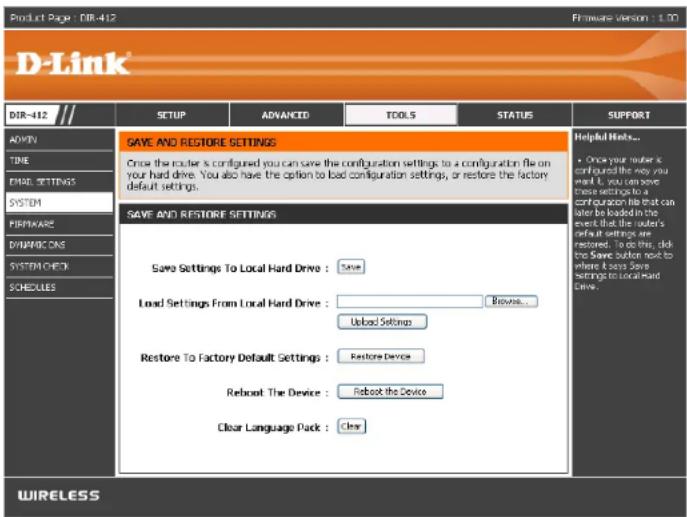
text_image
Product Page : DIR-412 D-Link DIR-412 SETUP ADVANCED TOOLS STATUS SUPPORT HAPPY TIME EMAIL SETTINGS SYSTEM FIRIPWARE DYMPRING CASE SYSTEM CHECK SCHEDULES SAVE AND RESTORE SETTINGS Once the router is configured you can save the configuration settings to a configuration file on your hard drive. You also have the option to load configuration settings, or restore the factory default settings. SAVE AND RESTORE SETTINGS Save Settings To Local Hard Drive : Save Load Settings From Local Hard Drive : Reverse... Upload Settings Restore To Factory Default Settings : Restore Device Reboot The Device : Reboot the Device Clear Language Pack : Clear Helpful Links... Once your router is configured the way you want it, you can save these settings to a configuration file that can later be loaded in the event that the router's default settings are restored. To do this, did the Save button next to where it has save settings to local hard drive. WIRELESSUpdate Firmware
You can upgrade the firmware of the Router here. Make sure the firmware you want to use is on the local hard drive of the computer. Click on Browse to locate the firmware file to be used for the update. Please check the D-Link support site for firmware updates at http://support.dlink.com. You can download firmware upgrades to your hard drive from the D-Link support site.
Firmware Displays the current firmware version and date. Information:
You can also check the availability of a new firmware version online. If so, download the new firmware to your hard drive.
Firmware After you have downloaded the new firmware, click Upgrade: the Browse control to locate the firmware update on your hard drive. Click Upload to complete the firmware upgrade.
Language Pack This function allows the user to transfer the language Upgrade: of the GUI from English to their own language by upgrading the language pack. Click the Browse control to locate the desired language pack on your hard drive. Click Upload to complete the language pack upgrade.
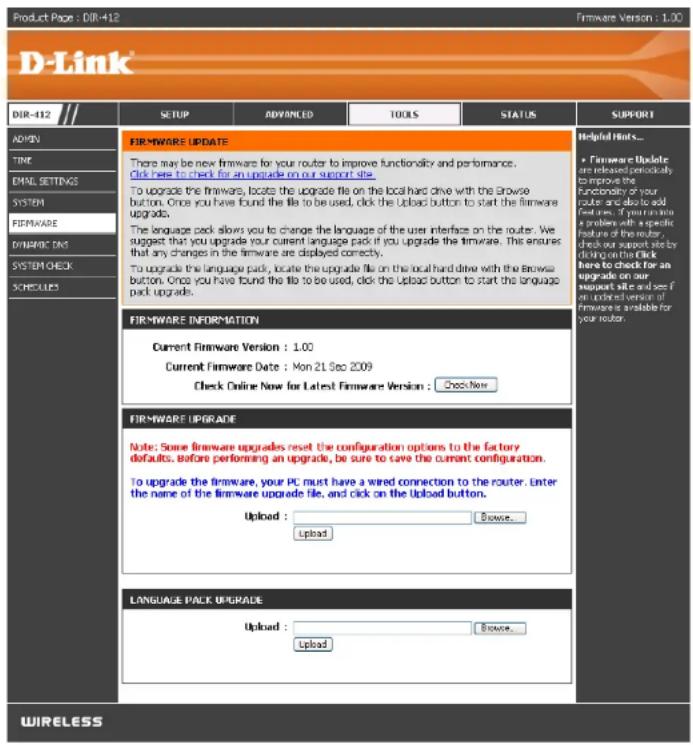
text_image
Product Page : DIR-412 Firmware Version : 1.00 DIR-412 /// SETUP ADVANCED TOOLS STATUS SUPPORT ADMIN TIME EMAIL SETTINGS SYSTEM FIRMWARE DYNAMIC DNS SYSTEM CHECK SCHEDULES FIRMWARE UPDATE There may be new firmware for your router to improve functionality and performance. Click here to check for an upgrade on our support site. To upgrade the firmware, locate the upgrade file on the local hard drive with the browse button. Once you have found the file to be used, click the Upload button to start the firmware upgrade. The language pack allows you to change the language of the user interface on the router. We suggest that you upgrade your current language pack if you upgrade the firmware. This ensures that any changes in the firmware are displayed correctly. To upgrade the language pack, locate the upgrade file on the local hard drive with the browse button. Once you have found the file to be used, click the Upload button to start the language pack upgrade. FIRMWARE INFORMATION Current Firmware Version : 1.00 Current Firmware Date : Mon 21 Sep 2009 Check Online Now for Latest Firmware Version : Check Now FIRMWARE UPGRADE Note: Some firmware upgrades reset the configuration options to the factory defaults, before performing an upgrade, be sure to save the current configuration. To upgrade the firmware, your PC must have a wired connection to the router. Enter the name of the firmware upgrade file, and click on the Upload button. Upload : Browse... Upload LANGUAGE PACK UPGRADE Upload : Browse... Upload Helpful Hits... • Firmware Update are released periodically to improve the functionality or your route and also to add features. If your main problem with a specific feature of the router, check our support site by doing on this. Click here to check for an upgrade on our support site and see if an update version of firmware is available for your router. WIRELESSDDNS
The DDNS feature allows you to host a server (Web, FTP, Game Server, etc...) using a domain name that you have purchased (www.whateveryournameis.com) with your dynamically assigned IP address. Most broadband Internet Service Providers assign dynamic (changing) IP addresses. Using a DDNS service provider, your friends can enter in your domain name to connect to your server no matter what your IP address is.
Enable DDNS: Dynamic Domain Name System is a method of keeping a domain name linked to a changing IP Address. Check the box to enable DDNS.
Server Address: Choose your DDNS provider from the drop down menu.
Host Name: Enter the Host Name that you registered with your DDNS service provider.
User Account: Enter the User Name for your DDNS account.
Password: Enter the Password for your DDNS account.
DDNS Account This is to test if the DDNS account is valid for use. Testing:

text_image
Product Page : DIR-412 Firmware Version : 1.00 D-Link® DIR-412 /// SETUP ADVANCED TOOLS STATUS SUPPORT ADMIN TIME EMAIL SETTINGS SYSTEM FILENAME DYNAMIC DNS SYSTEM CHECK SCHEDULES DYNAMIC DNS SETTINGS Enable DONS : Server Address : Host Name : User Account : Password : DNS Account Testing Save Settings Don't Save Settings Helpful Links... To use this feature, you must live have a Dynamic DNS account from one of the providers in the drop down menu. Save Settings Don't Save Settings WIRELESSSystem Check
The System Check feature allows you to verify the physical connectivity on both the LAN and Internet interface.
Ping Test: The Ping Test is used to send Ping packets to test if a computer is on the Internet. Enter the IP Address that you wish to Ping, and click Ping.
Ping Results: The results of your ping attempts will be displayed here.
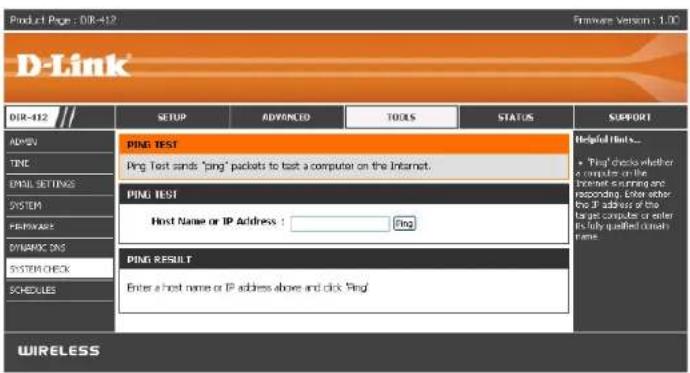
text_image
Product Page : DIR-412 D-Link Product Version : 1.00 DIR-412 /// SETUP ADVANCED TOOLS STATUS SUPPORT AD/SEV TINC EMAIL SETTINGS SYSTEM PERFORMANCE DYNAMIC DNS SYSTEM CHECK SCHEDULES PING TEST Ping Test sends "ping" packets to test a computer on the Internet. PING TEST Host Name or IP Address : Ping PING RESULT Enter a host name or IP address above and click Ping/ WIRELESSSchedules
Name: Enter a name for your new schedule.
Days: Select a day, a range of days, or All Week to include every day.
Time: Check All Day - 24hrs or use the Start Time and End Time fields to specify the start and end time for your schedule.
Add: Click Add to add your schedule.
Schedule Rules The list of schedules will be listed here. Click the List: Edit icon to make changes or click the Delete icon to remove the schedule.

text_image
Product Page : EDR-412 D-Link DIR-412 /// SETUP ADVANCED TOOLS STATUS SUPPORT ADVENT TIME EMAIL SETTINGS SYSTEM FIRIPWARE DIMANCING SYSTEM CHECK SCHEDULES SCHEDULES SCHEDULES THE SCHEDULE CONFIGURATION OPTION IS USED TO MANAGE SCHEDULE RULES FOR "Virtual server", "Port Forwarding", "MAC FILTERING", "Access Control", "Website Filter". ADD SCHEDULE RULE Name : Day(s) : ○ All Week ○ Select Day(s) □ Sun □ Mon □ Tue □ Wed □ Thu □ Fri □ Sat All Day - 24 hrs : Start Time : 12 : 0 AV (hourminutes, 12 hour time) End Time : 11 : 59 PK (hourminutes, 12 hour time) Add Cancel SCHEDULE RULES LIST Name Day(s) Time Frame Helpful Hinks... • Schedule required with a number of other features to define when those features are in select. • Give each schedule a name that is meaningful to you. For example, a schedule for Monday through Friday from 3 September 2000 might be called "After School". WIRELESSDevice Information
This page displays the current information for the DIR-412. It will display the LAN, WAN (Internet), and Wireless information.
If your Internet connection is set up for a Dynamic IP address then a Release button and a Renew button will be displayed. Use Release to disconnect from your ISP and use Renew to connect to your ISP.
If your Internet connection is set up for PPPoE, PPTP, L2TP, Russia PPTP, or Russia PPPoE a Connect button and a Disconnect button will be displayed. Use Disconnect to drop the Internet connection and use Connect to establish the Internet connection.
See the following for more information.
General: Displays the router's time and firmware version.
3G WAN/WAN: Displays the MAC address and the public IP settings for the router.
LAN: Displays the MAC address and the private (local) IP settings for the router.
Wireless LAN: Displays the wireless MAC address and your wireless settings such as SSID and Channel.

text_image
Product Page: D81412 D-Link DSR-412 SETUP ADVANCED TOOLS STATUS SUPPORT DEVICE INFOVATION All of your Internet and network connection details are displayed on the page. The firmware version is also displayed here. GENERAL Time : 2009/09/21 29:13:45 Firmware Version : 2,000 Mon 21 Sep 2009 3U WAY Network Status : Decomsected Connect Connection Up Time : 0 Day 0 Hour 3 PM 0 Sec Local address : 0.0.0.0 Subnet Mark : 0.0.0.0 Peer address : 0.0.0.0 Primary DNS Server : 0.0.0.0 Secondary DNS Server : 0.0.0.0 LAN MAC Address : 00:24:01:13d71e JP Address : 392:196:0.1 Subnet Mark : 255:255:255.0 CHCP Server : Enabled WIRELESS LAN Wireless Radio : Enabled MAC Address : 00:24:01:13d71e 002.1.1 Mode : Mixed 002.1in, 002.1ip and 602.1lb Channel Width : 20*40Hz Channel : 6 Network Name (OSID) : dirk Wi-Fi Protected Setup : Disabled Security : Disabled Helpful Notes... • All of your Web: Internet and website: $2.21% Connection Gains are Opened help. WIRELESSLogs
The router automatically logs (records) events of possible interest in it's internal memory. If there isn't enough internal memory for all events, logs of older events are deleted but logs of the latest events are retained. The Logs option allows you to view the router logs. You can define what types of events you want to view and the level of the events to view. This router also has external Syslog Server support so you can send the log files to a computer on your network that is running a Syslog utility.
Log Type: Use the radio buttons to choose the types of messages that should be displayed from the log. System, Firewall & Security, and Router Status messages can be selected.
Log Level: There are three levels of message importance: Informational, Warning, and Critical. Use the radio buttons to select the levels that should be displayed in the log.
First Page: Click this button to view the first page of the log file.
Last Page: Click this button to view the last page of the log file.
Previous: Click this button to view the previous page of the log file.
Next: Click this button to view the next page of the log file.
Clear: Clears all of the log contents.
Link to Log The user can click the button to "link to log settings" Settings: and save the logs to a local hard drive or to a Syslog server.

text_image
Product Page : DIR-412 Firmware Version : LOG D-Link DIR-412 VIEW LOG The View Log displays the activities occurring on the DIR-412. Save Settings Done Save Settings LOG TYPE & LEVEL Log Type: ○ System ○ Firewall & Security ○ Router Status Log Level: ○ Critical ○ Warning ○ Information LOG FILES First Page Last Page Previous Next Clear Link To Log Settings Page 3 of 7 Time Message Mon Sep 21 00:00:10 2009 purse config file can't open /etc/judv/sudv.conf as config file no such file or directory Mon Sep 21 00:00:19 2009 warning: no upstream servers configured Mon Sep 21 16:30:00 2009 Got new client [DCI/PDB/AD/SDC] associated from VLAN-L Mon Sep 21 16:30:07 2009 DHCP: Server receive REQUEST from 00.1f3b ad 35.0b. Mon Sep 21 16:30:07 2009 DHCP: Server sending NAK to 00.1f3b ad 35.0b. Mon Sep 21 16:38:12 2009 DHCP: Server receive DISCOVER from 00.1f3b ad 35.0b. Mon Sep 21 16:38:14 2009 DHCP: Server sending OFFEI of 192.168.0.100. Mon Sep 21 16:38:14 2009 DHCP: Server receive REQUEST from 00.1f3b ad 35.0b. Mon Sep 21 16:38:14 2009 DHCP: Server sending ACK to 192.168.0.100, (Lease time = 85+00) Mon Sep 21 16:39:37 2009 DHCP: Server receive REQUEST from 00.1f3b ad 35.0b. WIRELESSStatistics
The screen below displays the Traffic Statistics. Here you can view the amount of packets that pass through the DIR-412 on the Internet, LAN and Wireless connections. The traffic counter will reset if the device is rebooted.
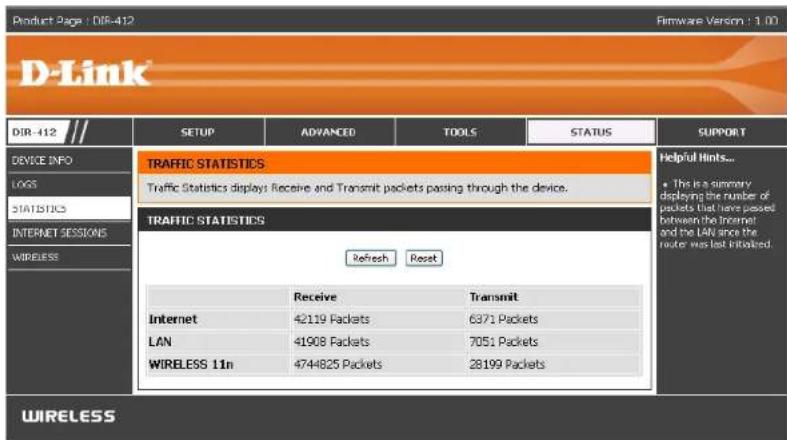
text_image
Product Page : DIR-412 Firmware Version : 1.00 D-Link DIR-412 SETUP ADVANCED TOOLS STATUS SUPPORT DEVICE INFO LOGS STATISTICS INTERNET SESSIONS WIRELESS TRAFFIC STATISTICS Traffic Statistics displays Receive and Transmit packets passing through the device. TRAFFIC STATISTICS Refresh Reset Internet 42119 Packets 6371 Packets LAN 41908 Packets 7051 Packets WIRELESS 11n 4744825 Packets 28199 Packets WIRELESS Helpful Hinks... * The is a summary displaying the number of packets that here passed between the Internet and the LAN since the router was last initiated.Internet Sessions
The Internet Sessions page displays full details of active Internet sessions through your router. An Internet session is a conversation between a program or application on a LAN-side computer and a program or application on a WAN-side computer.
NAPT Sessions: Displays information about the NAPT Sessions on the router. Including the number of TCP Sessions, the number of UDP Sessions, and the combined number TCP and UDP NAPT Sessions.
NAPT Active Displays the IP address of the local application Sessions: and the TCP/UDP packets being sent by the source IP address for each NAPT Active Session.

text_image
Product Page : IDR-412 Hardware Version : 1.00 D-Link DIR-412 SETUP ADVANCED TOOLS STATUS SUPPORT DEVICE INFO LOGS STATISTICS INTERNET SESSIONS WIRELESS INTERNET SESSIONS This page displays Source and Destination packets passing through the device. Refresh NAPT SESSIONS TCP Sessions : 1 UDP Sessions : 0 Total : 1 NAPT ACTIVE SESSIONS IP Address TCP Sessions UDP Sessions 192.168.0.88 1 0 helpful notes... • An Active session is a conversation between a program or application on a UAA-side computer and a program or application on a WAI-size computer. WIRELESSWireless
The wireless client table displays a list of current connected wireless clients. This table also displays the connection time and MAC address of the connected wireless clients.
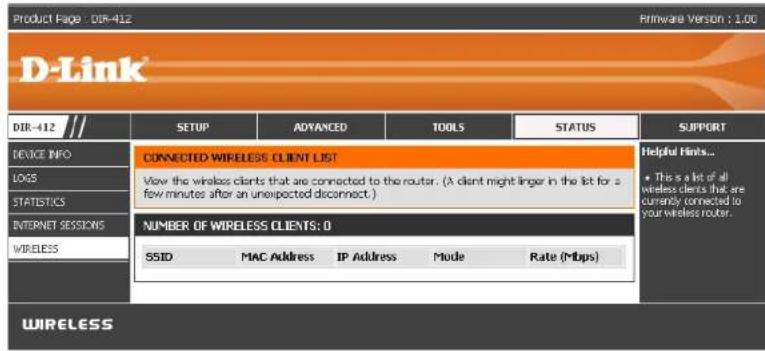
text_image
Product Page : DIR-412 Rimware Version : 1.00 D-Link DIR-412 // Setup ADVANCED TOOLS STATUS SUPPORT DEVICE INFO CONNECTED WIRELESS CLIENT LIST Helpful Links... LOGS View the wireless clients that are connected to the router. (A client might linger in the list for a few minutes after an unexpected disconnect.) STATISTICS INTERNET SESSIONS NUMBER OF WIRELESS CLIENTS: 0 This is a list of all wireless clients that are currently connected to your wireless router. WIRELESS SSID MAC Address IP Address Mode Rate (Mbps) WIRELESSSupport

text_image
Product Page : DIR-412 Firmware version : 1.00 D-Link DIR-412 // SETUP ADVANCED TODLS STATUS SUPPORT MENU SETUP ADVANCED TOOLS STATUS SUPPORT MENU • Setup • Advanced • Tools • Status SETUP HELP • Internet • Wireless Settings • Network Settings ADVANCED HELP • Virtual Server • Port Forwarding • Application Rules • Oil Engine • Network Filter • Website Filter • Firewall Settings • Advanced Wireless • Advanced Network TOOLS HELP • Device Administration • Time and Date • Email Settings • System • Hardware • Dynamic DVD • System Cards • Schedules STATUS HELP • Device Info • Logs • Statistics • Internet Sessions • Wireless WIRELESSWireless Security
This section will show you the different levels of security you can use to protect your data from intruders. The DIR-412 offers the following types of security:
• WPA2 (Wi-Fi Protected Access 2)
• WPA2-PSK(Pre-Shared Key)
• WPA (Wi-Fi Protected Access)
• WPA-PSK (Pre-Shared Key)
What is WPA?
WPA, or Wi-Fi Protected Access, is a Wi-Fi standard that was designed to improve the security features of WEP (Wired Equivalent Privacy).
The 2 major improvements over WEP:
- Improved data encryption through the Temporal Key Integrity Protocol (TKIP). TKIP scrambles the keys using a hashing algorithm and, by adding an integrity-checking feature, ensures that the keys haven't been tampered with. WPA2 is based on 802.11i and uses Advanced Encryption Standard (AES) instead of TKIP.
- User authentication, which is generally missing in WEP, through the extensible authentication protocol (EAP). WEP regulates access to a wireless network based on a computer's hardware-specific MAC address, which is relatively simple to be sniffed out and stolen. EAP is built on a more secure public-key encryption system to ensure that only authorized network users can access the network.
WPA-PSK/WPA2-PSK uses a passphrase or key to authenticate your wireless connection. The key is an alpha-numeric password between 8 and 63 characters long. The password can include symbols (!?*&_) and spaces. This key must be the exact same key entered on your wireless router or access point.
WPA/WPA2 incorporates user authentication through the Extensible Authentication Protocol (EAP). EAP is built on a more secure public key encryption system to ensure that only authorized network users can access the network.
Wireless Connection Setup Wizard
To run the security wizard, browse to the Setup page and then click the Wireless Network Setup Wizard button.
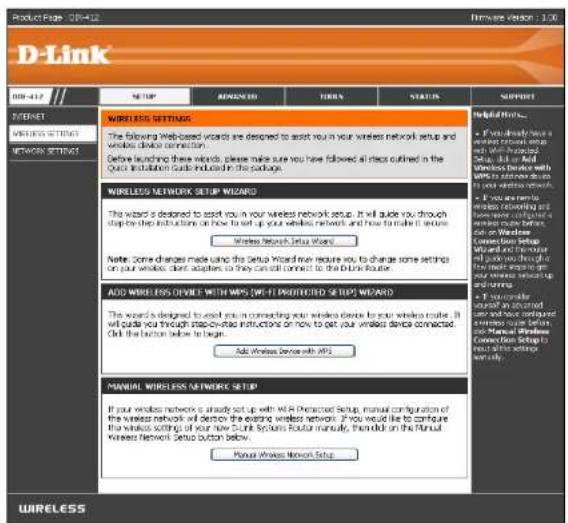
text_image
Product Page: CD-42 D-Link WIRELESS SETTINGS The following Web-based words are designed to assist you in your wireless network setup and wireless device connection. Before launching these instructions, please make sure you have followed all steps outlined in the Quick Installation Guide instead of the package. WIRELESS NETWORK SETUP WIZARD The wizard is designed to assist you in your wireless network setup. It will guide you through step-by-step instructions on how to set up your wireless network and how to make it secure. Wireless Setup Wizard Note: some changes made using the Setup Wizard must require you to change some settings on your wireless client adapters so they can still connect to the Blue Route. ADD WIRELESS DEVICE WITH MIPS (WEFT PROTECTED SETUP) WIZARD The wizard is designed to assist you in connecting your wireless device to your wireless router. It will guide you through step-by-step instructions on how to get your wireless device connected. Click the button below to begin. Add wireless device with MIPS MANUAL WIRELESS NETWORKS SETUP If your wireless network is already set up with Wi-Fi Projected Setup, manual configuration of the wireless network will denote the existing wireless network. If you would like to configure the wireless settings of our new Digital Systems Router manually, then add on the Plural Wireless Network Setup button. Plural Wireless Network Setup Help us here... • For instance we use a wireless network setup with Wi-Fi Projected Setup, did not add wireless devices with Wi-Fi to ensure do so on its wireless network. • If you are remote, wireless following and/or have been configured a wireless mode for the Linux, can on Windows Connection Setup Wizard and/or any other will guide you through the next engine get any wireless receiving and/oring. • For virtualized mobile in connected user and/or configured a wireless system Setup or Plural Wireless Connection Setup by real-time settings were used.Section 4 - Security
Enter the SSID (Service Set Identifier). The SSID is the name of your wireless network. Create a name using up to 32 characters. The SSID is case-sensitive.
If you would like the router to automatically assign a network key to your network, click the Automatically assign a network key radio button.
Click Next to continue.
Alternatively, click the Manually assign a network key radio button to create your own network key.
Click Next to continue.
The following window appears if you selected the option to manually create your own network key.
Type a password that you would like to use for wireless security in the Wireless Security Password field.
Click Next to continue.
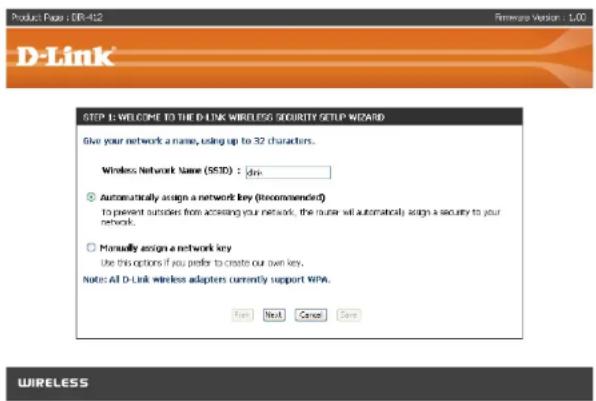
text_image
Product Page : DP-412 Wireless Version : L00 D-Link STEP 1: WELCOME TO THE D-Link WIRELESS SECURITY SETUP WEARD Give your network a name, using up to 32 characters. Wireless Network Name (SSID) : dirk Automatically assign a network key (Recommended) To prevent outstakes from accessing your network, the router will automatically assign a security to your network. Manually assign a network key Use this option if you prefer to create our own key. Notes: All D-Link wireless adapters currently support WIPA. Form Next Cancel Save WIRELESS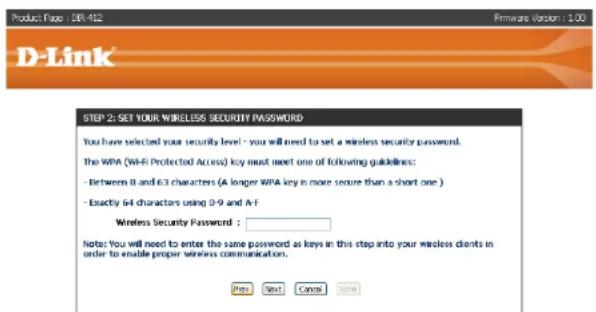
text_image
Product Page : 28-412 D-Link Step 2: SET YOUR WIRELESS SECURITY PASSWORD You have selected your security level: - you will need to set a wireless security password. The WPA (Wi-Fi Protected Access) key must meet one of following guidelines: - Between B and E3 characters (A longer WPA key is more secure than a short one ) - Exactly 64 characters using B-9 and A-f Wireless Security Password : Note: You will need to enter the same password as keys in this step into your wireless clients in order to enable proper wireless communication. Post Visit Cancel SaveSection 4 - Security
The following window appears to indicate that the Wireless Connection Setup Wizard is complete.
If you selected the option that automatically generated a network key, the automatically generated key will display next to the Pre-Shared Key field.
If you manually specified a network key, the Wireless Security Password that you specified will display next to the Pre-Shared Key field.

text_image
Product Page - D8-412 Firmware Version 1:00 D-Link SETMP COMPLES! Below is a detailed summary of your wireless security settings. Please print this page out, or write the information on a piece of paper, so you can configure the correct settings on your wireless client adapters. Wireless Band: 2.4GHz Band Wireless Network Name (SSIE): disk Security Mode: Auto (WPA or WPA2) - Personal Cipher Type: TKP and PAB Pre-Shared Key: FJG0094443322202222222222 Pre Cancel Save WIRELESSClick Save to finish the Security Wizard.
Add Wireless Device with WPS Wizard
From the Setup > Wireless Settings screen, click Add Wireless Device with WPS.
ADD WIRELESS DEVICE WITH WPS (WI-FI PROTECTED SETUP) WIZARD
This wizard is designed to assist you in connecting your wireless device to your wireless router. It will guide you through step-by-step instructions on how to get your wireless device connected. Click the button below to begin.
Add Wireless Device with WPS
Select Auto to add a wireless client using WPS (Wi-Fi Protecte Setup). Once you select Auto and click Connect, you will have a 120 second time limit to apply the settings to your wireless client(s) and successfully establish a connection.
If you select Manual, a settings summary screen will appear. Write down the security key and enter this on your wireless clients.
STEP 1: SELECT CONFIGURATION METHOD FOR YOUR WIRELESS NETWORK
Please select one of following configuration methods and click next to continue.
Auto Select this option if your wireless device supports WPS (Wi-Fi Protected Setup)
Manual ○ Select this option will display the current wireless settings for you to configure the wireless device manually


PIN: Select this option to use PIN method. In order to use this method you must know the wireless client's 8 digit PIN and click Connect.
PBC: Select this option to use PBC (Push Button) method to add a wireless client. Click Connect.
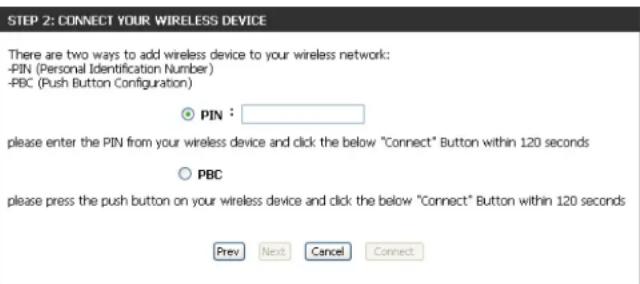
text_image
STEP 2: CONNECT YOUR WIRELESS DEVICE There are two ways to add wireless device to your wireless network: -PIN (Personal Identification Number) -PBC (Push Button Configuration) • PIN : please enter the PIN from your wireless device and click the below "Connect" Button within 120 seconds • PBC please press the push button on your wireless device and click the below "Connect" Button within 120 seconds Prev Next Cancel ConnectConfigure WPA-Personal (PSK)
It is recommended to enable encryption on your wireless router before your wireless network adapters. Please establish wireless connectivity before enabling encryption. Your wireless signal may degrade when enabling encryption due to the added overhead.
- Log into the web-based configuration by opening a web browser and entering the IP address of the router (192.168.0.1). Click on Setup and then click Wireless Settings on the left side and then click the Manual Wireless Network Setup button.
- Select Enable WPA/WPA2 Wireless Security (enhanced) from the Security Mode drop-down menu.
- Select Auto(TKIP/AES), TKIP, or AES from the Cipher Type drop-down menu. If you have wireless clients that use both types use TKIP/AES.
- Select PSK from the PSK / EAP drop-down menu.
- Enter a key (passphrase) in the Network Key field. The key is entered as a pass-phrase in either ASCII or HEX format. If using ASCII format the pass-phrase must be between 8-63 characters. If using HEX format the pass-phrase must be 64 characters. The ASCII or HEX pass-phrase must be the same at both ends of the wireless connection.
- Click Save Settings to save your settings. If you are configuring the router with a wireless adapter, you will lose connectivity until you enable WPA-PSK on your adapter and enter the same passphrase as you did on the router.
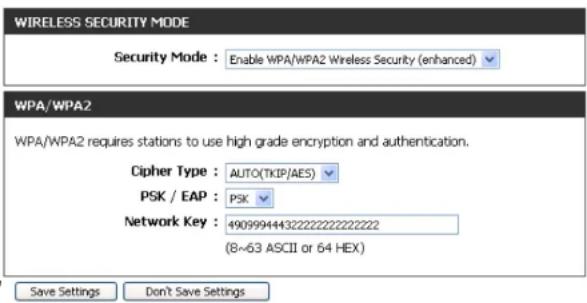
text_image
WIRELESS SECURITY MODE Security Mode : Enable WPA/WPA2 Wireless Security (enhanced) WPA/WPA2 WPA/WPA2 requires stations to use high grade encryption and authentication. Cipher Type : AUTO(TKIP/AES) PSK / EAP : PSK Network Key : 49099944432222222222222 (8~63 ASCII or 64 HEX) Save Settings Don't Save SettingsConfigure WPA-Enterprise (RADIUS)
It is recommended to enable encryption on your wireless router before your wireless network adapters. Please establish wireless connectivity before enabling encryption. Your wireless signal may degrade when enabling encryption due to the added overhead.
- Log into the web-based configuration by opening a web browser and entering the IP address of the router (192.168.0.1). Click on Setup and then click Wireless Settings on the left side and then click the Manual Wireless Network Setup button.
- Select Enable WPA/WPA2 Wireless Security (Enhanced) from the Security Mode drop-down menu.
- Select Auto(TKIP/AES), TKIP, or AES from the Cipher Type drop-down menu. If you have wireless clients that use both types, use TKIP/AES.
- Select EAP from the PSK / EAP drop-down menu.
- Enter the IP Address of your RADIUS server in the RADIUS Server IP Address field.
- Enter the port you are using with your RADIUS server in the Port field.
- Enter the security key in the Shared Secret field.
- Click Save Settings to save your settings. If you are configuring the router with a wireless adapter, you will lose connectivity until you enable WPA-Enterprise (RADIUS) on your adapter and enter the same passphrase as you did on the router.
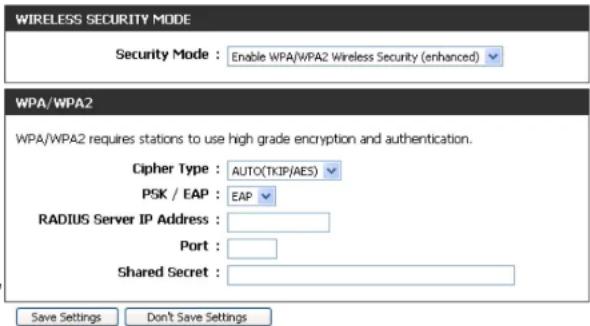
text_image
WIRELESS SECURITY MODE Security Mode : Enable WPA/WPA2 Wireless Security (enhanced) WPA/WPA2 WPA/WPA2 requires stations to use high grade encryption and authentication. Cipher Type : AUTO(TKIP/AES) PSK / EAP : EAP RADIUS Server IP Address : Port : Shared Secret : Save Settings Don't Save SettingsConnect to a Wireless Network Using Windows Vista®
Windows Vista® users may use the built-in wireless utility. If you are using another company's utility or Windows®2000, please refer to the user manual of your wireless adapter for help with connecting to a wireless network. Most utilities will have a "site survey" option similar to the Windows Vista® utility as seen below.
If you receive the Wireless Networks Detected bubble, click on the center of the bubble to access the utility.
or
Right-click on the wireless computer icon in your system tray (lower-right corner next to the time). Select Connect to a network.
The utility will display any available wireless networks in your area. Click on a network (displayed using the SSID) and click the Connect button.
If you get a good signal but cannot access the Internet, check you TCP/IP settings for your wireless adapter. Refer to the Networking Basics section in this manual for more information.

text_image
Not Connected Wireless networks are available. Connect to a network Network and Sharing Center 12:01 PM Friday 8/17/2007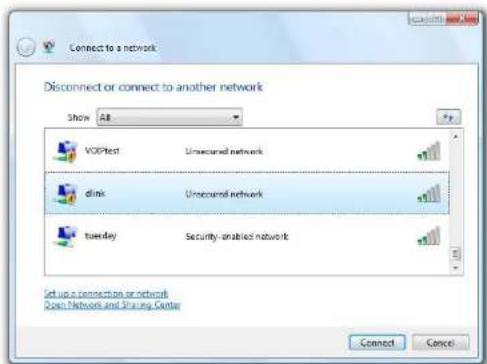
text_image
Connect to a network Disconnect or connect to another network Show All VoIPtest Unsecured network dlink Unsecured network Tuesday Security-enabled network Set up a connection or network Open Networks and Sharing Center Connect CancelConfigure WPA/WPA2
It is recommended to enable wireless security (WPA/WPA2) on your wireless router or access point before configuring your wireless adapter. If you are joining an existing network, you will need to know the security key or passphrase being used.
-
Open the Windows Vista® Wireless Utility by right-clicking on the wireless computer icon in your system tray (lower right corner of screen). Select Connect to a network.
-
Highlight the wireless network (SSID) you would like to connect to and click Connect.

text_image
Not Connected Wireless networks are available. Connect to a network Network and Sharing Center 12:01 PM Friday 8/17/2007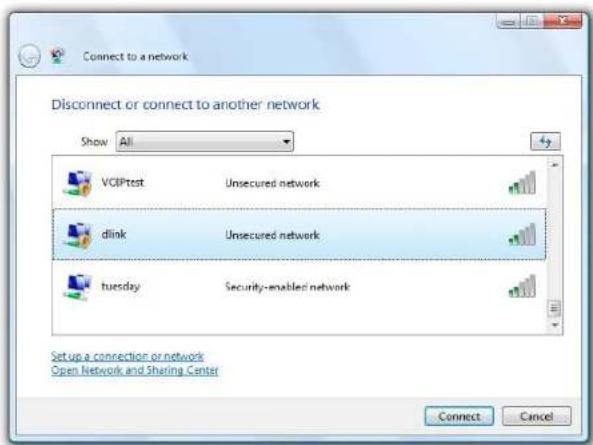
text_image
Connect to a network Disconnect or connect to another network Show All VoIPtest Unsecured network dink Unsecured network tuesday Security-enabled network Setup a connection or network Open Network and Sharing Center Connect Cancel3. Enter the same security key or passphrase that is on your router and click Connect.
It may take 20-30 seconds to connect to the wireless network. If the connection fails, please verify that the security settings are correct. The key or passphrase must be exactly the same as on the wireless router.

text_image
Connect to a network Type the network security key or passphrase for Candy The person who setup the network can give you the key or passphrase. Security key or passphrase: □ Display characters If you have a USB Flash drive with network settings for Candy, insert it now. Connect CancelConnect Using WCN 2.0
The router supports Wi-Fi protection, referred to as WCN 2.0 in Windows Vista ^® . The following instructions for setting this up depends on whether you are using Windows Vista ^® to configure the router or third party software.
When you first set up the router, Wi-Fi protection is disabled and unconfigured. To enjoy the benefits of Wi-Fi protection, the router must be both enabled and configured. There are three basic methods to accomplish this: use Windows Vista's built-in support for WCN 2.0, use software provided by a third party, or manually configure.
If you are running Windows Vista®, log into the router and click the Enable checkbox in the Advanced > Wi-Fi Protected Setup window. Use the Current PIN that is displayed in the PIN Settings section of Advanced > Wi-Fi Protected Setup window or choose to click the Generate New PIN button or Reset PIN to Default button.
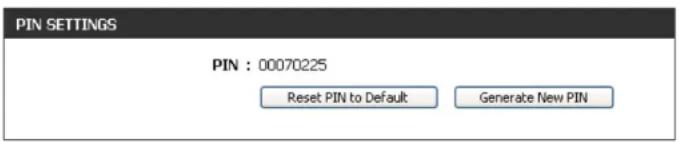
text_image
PIN SETTINGS PIN : 00070225 Reset PIN to Default Generate New PINIf you are using third party software to set up Wi-Fi Protection, carefully follow the directions. When you are finished, proceed to the next section to set up the newly-configured router.
Using Windows® XP
Windows® XP users may use the built-in wireless utility (Zero Configuration Utility). The following instructions are for Service Pack 2 users. If you are using another company's utility or Windows® 2000, please refer to the user manual of your wireless adapter for help with connecting to a wireless network. Most utilities will have a "site survey" option similar to the Windows® XP utility as seen below.
If you receive the Wireless Networks Detected bubble, click on the center of the bubble to access the utility.
or
Right-click on the wireless computer icon in your system tray (lower-right corner next to the time). Select View Available Wireless Networks.
The utility will display any available wireless networks in your area. Click on a network (displayed using the SSID) and click the Connect button.
If you get a good signal but cannot access the Internet, check you TCP/IP settings for your wireless adapter. Refer to the Networking Basics section in this manual for more information.

text_image
(a) Wireless networks detected One or more wireless networks are in range of this computer. To see the list and connect, click this message.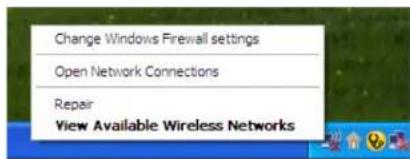
text_image
Change Windows Firewall settings Open Network Connections Repair View Available Wireless Networks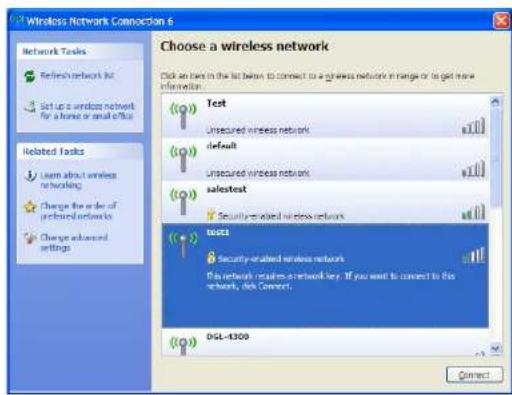
text_image
Wireless Network Connection 6 Choose a wireless network Click an link in the list below to connect to a wireless network in range or to get new information. Test Unsecured wireless network default Unsecured wireless network salestest Security-enabled wireless network SQL2 Security-enabled wireless network This network enables a network key. If you want to connect to this network, do it Connect. DGL-1300 ConnectConfigure WPA-PSK
It is recommended to enable WEP on your wireless router or access point before configuring your wireless adapter. If you are joining an existing network, you will need to know the WEP key being used.
-
Open the Windows® XP Wireless Utility by right-clicking on the wireless computer icon in your system tray (lower-right corner of screen). Select View Available Wireless Networks.
-
Highlight the wireless network (SSID) you would like to connect to and click Connect.
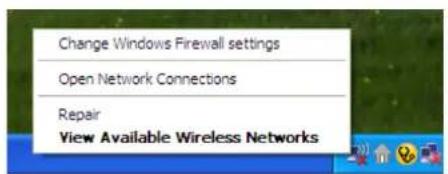
text_image
Change Windows Firewall settings Open Network Connections Repair View Available Wireless Networks
text_image
Wireless Network Connection 6 Choose a wireless network Click an item in the let below to connect to a wireless network in range or to get more information. Network Tasks Refresh network list Set up a wireless network for a home or anal office Related Tasks Learn about wireless networking Change the order of preferred networks Change advanced settings Test Unsecured wireless network default Unsecured wireless network salestest Security-enabled wireless network test1 Security-enabled wireless network This network requires a network key. If you want to connect to this network, click Connect. DGL-4300 ConnectSection 5 - Connecting to a Wireless Network
3. The Wireless Network Connection box will appear. Enter the WPA-PSK passphrase and click Connect.
It may take 20-30 seconds to connect to the wireless network. If the connection fails, please verify that the WPA-PSK settings are correct. The WPA-PSK passphrase must be exactly the same as on the wireless router.

text_image
Wireless Network Connection The network 'test1' requires a network key (also called a WEP key or WPA key). A network key helps prevent unknown intruders from connecting to this network. Type the key, and then click Connect. Network key: Confirm network keys: Connect CancelTroubleshooting
This chapter provides solutions to problems that can occur during the installation and operation of the DIR-412. Read the following descriptions if you are having problems. (The examples below are illustrated in Windows ^ XP. If you have a different operating system, the screen shots on your computer will look similar to the following examples.)
1. Why can't I access the web-based configuration utility?
When entering the IP address of the D-Link router (192.168.0.1 for example), you are not connecting to a website on the Internet or have to be connected to the Internet. The device has the utility built-in to a ROM chip in the device itself. Your computer must be on the same IP subnet to connect to the web-based utility.
- Make sure you have an updated Java-enabled web browser. We recommend the following:
- Internet Explorer 6.0 or higher
• Netscape 8 or higher - Mozilla 1.7.12 (5.0) or higher
- Opera 8.5 or higher
- Safari 1.2 or higher (with Java 1.3.1 or higher)
- Camino 0.8.4 or higher
-
Firefox 1.5 or higher
-
Verify physical connectivity by checking for solid link lights on the device. If you do not get a solid link light, try using a different cable or connect to a different port on the device if possible. If the computer is turned off, the link light may not be on.
- Disable any Internet security software running on the computer. Software firewalls such as Zone Alarm, Black Ice, Sygate, Norton Personal Firewall, and Windows® XP firewall may block access to the configuration pages. Check the help files included with your firewall software for more information on disabling or configuring it.
- Configure your Internet settings:
- Go to Start > Settings > Control Panel. Double-click the Internet Options Icon. From the Security tab, click the button to restore the settings to their defaults.
- Click the Connection tab and set the dial-up option to Never Dial a Connection. Click the LAN Settings button. Make sure nothing is checked. Click OK.
- Go to the Advanced tab and click the button to restore these settings to their defaults. Click OK three times.
-
Close your web browser (if open) and open it.
-
Access the web management. Open your web browser and enter the IP address of your D-Link router in the address bar. This should open the login page for your the web management.
- If you still cannot access the configuration, unplug the power to the router for 10 seconds and plug back in. Wait about 30 seconds and try accessing the configuration. If you have multiple computers, try connecting using a different computer.
2. What can I do if I forgot my password?
If you forgot your password, you must reset your router. Unfortunately this process will change all your settings back to the factory defaults.
To reset the router, locate the reset button (hole) on the rear panel of the unit. With the router powered on, use a paperclip to hold the button down for 10 seconds. Release the button and the router will go through its reboot process. Wait about 30 seconds to access the router. The default IP address is 192.168.0.1. When logging in, the username is admin and leave the password box empty.
3. Why can't I connect to certain sites or send and receive e-mails when connecting through my router?
If you are having a problem sending or receiving e-mail, or connecting to secure sites such as eBay, banking sites, and Hotmail, we suggest lowering the MTU in increments of ten (Ex. 1492, 1482, 1472, etc).
Note: AOL DSL+ users must use MTU of 1400.
To find the proper MTU Size, you'll have to do a special ping of the destination you're trying to go to. A destination could be another computer, or a URL.
- Click on Start and then click Run.
- Windows® 95, 98, and Me users type in command (Windows® NT, 2000, and XP users type in cmd) and press Enter (or click OK).
- Once the window opens, you'll need to do a special ping. Use the following syntax:
ping [url] [-f] [-l] [MTU value]
Example: ping yahoo.com -f -l 1472

text_image
C:\>ping yahoo.com -f -l 1482 Pinging yahoo.com [66.94.234.13] with 1482 bytes of data: Packet needs to be fragmented but DF set. Packet needs to be fragmented but DF set. Packet needs to be fragmented but DF set. Packet needs to be fragmented but DF set. Ping statistics for 66.94.234.13: Packets: Sent = 4, Received = 0, Lost = 4 (100% loss), Approximate round trip times in milli-seconds: Minimum = 0ms, Maximum = 0ms, Average = 0ms C:\>ping yahoo.com -f -l 1472 Pinging yahoo.com [66.94.234.13] with 1472 bytes of data: Reply from 66.94.234.13: bytes=1472 time=93ms TTL=52 Reply from 66.94.234.13: bytes=1472 time=109ms TTL=52 Reply from 66.94.234.13: bytes=1472 time=125ms TTL=52 Reply from 66.94.234.13: bytes=1472 time=203ms TTL=52 Ping statistics for 66.94.234.13: Packets: Sent = 4, Received = 4, Lost = 0 (0% loss), Approximate round trip times in milli-seconds: Minimum = 93ms, Maximum = 203ms, Average = 132ms C:\>You should start at 1472 and work your way down by 10 each time. Once you get a reply, go up by 2 until you get a fragmented packet. Take that value and add 28 to the value to account for the various TCP/IP headers. For example, lets say that 1452 was the proper value, the actual MTU size would be 1480, which is the optimum for the network we're working with (1452+28=1480).
Once you find your MTU, you can now configure your router with the proper MTU size.
To change the MTU rate on your router follow the steps below:
- Open your browser, enter the IP address of your router (192.168.0.1) and click OK.
- Enter your username (admin) and password (blank by default). Click OK to enter the web configuration page for the device.
- Click on Setup>Internet and then click Manual Internet Connection Setup.
- To change the MTU enter the number in the MTU field and click Save Settings to save your settings.
- Test your e-mail. If changing the MTU does not resolve the problem, continue changing the MTU in increments of ten.
Wireless Basics
D-Link wireless products are based on industry standards to provide easy-to-use and compatible high-speed wireless connectivity within your home, business or public access wireless networks. Strictly adhering to the IEEE standard, the D-Link wireless family of products will allow you to securely access the data you want, when and where you want it. You will be able to enjoy the freedom that wireless networking delivers.
A wireless local area network (WLAN) is a cellular computer network that transmits and receives data with radio signals instead of wires. Wireless LANs are used increasingly in both home and office environments, and public areas such as airports, coffee shops and universities. Innovative ways to utilize WLAN technology are helping people to work and communicate more efficiently. Increased mobility and the absence of cabling and other fixed infrastructure have proven to be beneficial for many users.
Wireless users can use the same applications they use on a wired network. Wireless adapter cards used on laptop and desktop systems support the same protocols as Ethernet adapter cards.
Under many circumstances, it may be desirable for mobile network devices to link to a conventional Ethernet LAN in order to use servers, printers or an Internet connection supplied through the wired LAN. A Wireless Router is a device used to provide this link.
What is Wireless?
Wireless or Wi-Fi technology is another way of connecting your computer to the network without using wires. Wi-Fi uses radio frequency to connect wirelessly, so you have the freedom to connect computers anywhere in your home or office network.
Why D-Link Wireless?
D-Link is the worldwide leader and award winning designer, developer, and manufacturer of networking products. D-Link delivers the performance you need at a price you can afford. D-Link has all the products you need to build your network.
How does wireless work?
Wireless works similar to how cordless phone work, through radio signals to transmit data from one point A to point B. But wireless technology has restrictions as to how you can access the network. You must be within the wireless network range area to be able to connect your computer. There are two different types of wireless networks Wireless Local Area Network (WLAN), and Wireless Personal Area Network (WPAN).
Wireless Local Area Network (WLAN)
In a wireless local area network, a device called an Access Point (AP) connects computers to the network. The access point has a small antenna attached to it, which allows it to transmit data back and forth over radio signals. With an indoor access point as seen in the picture, the signal can travel up to 300 feet. With an outdoor access point the signal can reach out up to 30 miles to serve places like manufacturing plants, industrial locations, college and high school campuses, airports, golf courses, and many other outdoor venues.
Wireless Personal Area Network (WPAN)
Bluetooth is the industry standard wireless technology used for WPAN. Bluetooth devices in WPAN operate in a range up to 30 feet away.
Compared to WLAN the speed and wireless operation range are both less than WLAN, but in return it doesn't use nearly as much power which makes it ideal for personal devices, such as mobile phones, PDAs, headphones, laptops, speakers, and other devices that operate on batteries.
Who uses wireless?
Wireless technology as become so popular in recent years that almost everyone is using it, whether it's for home, office, business, D-Link has a wireless solution for it.
Home
• Gives everyone at home broadband access
- Surf the web, check e-mail, instant message, and etc
- Gets rid of the cables around the house
- Simple and easy to use
Small Office and Home Office
- Stay on top of everything at home as you would at office
- Remotely access your office network from home
- Share Internet connection and printer with multiple computers
- No need to dedicate office space
Where is wireless used?
Wireless technology is expanding everywhere not just at home or office. People like the freedom of mobility and it's becoming so popular that more and more public facilities now provide wireless access to attract people. The wireless connection in public places is usually called "hotspots".
Using a D-Link Cardbus Adapter with your laptop, you can access the hotspot to connect to Internet from remote locations like: Airports, Hotels, Coffee Shops, Libraries, Restaurants, and Convention Centers.
Wireless network is easy to setup, but if you're installing it for the first time it could be quite a task not knowing where to start. That's why we've put together a few setup steps and tips to help you through the process of setting up a wireless network.
Tips
Here are a few things to keep in mind, when you install a wireless network.
Centralize your router or Access Point
Make sure you place the router/access point in a centralized location within your network for the best performance. Try to place the router/access point as high as possible in the room, so the signal gets dispersed throughout your home. If you have a two-story home, you may need a repeater to boost the signal to extend the range.
Eliminate Interference
Place home appliances such as cordless telephones, microwaves, and televisions as far away as possible from the router/access point. This would significantly reduce any interference that the appliances might cause since they operate on same frequency.
Security
Don't let you next-door neighbors or intruders connect to your wireless network. Secure your wireless network by turning on the WPA or WEP security feature on the router. Refer to product manual for detail information on how to set it up.
Wireless Modes
There are basically two modes of networking:
- Infrastructure – All wireless clients will connect to an access point or wireless router.
- Ad-Hoc – Directly connecting to another computer, for peer-to-peer communication, using wireless network adapters on each computer, such as two or more DIR-412 wireless network Cardbus adapters.
An Infrastructure network contains an Access Point or wireless router. All the wireless devices, or clients, will connect to the wireless router or access point.
An Ad-Hoc network contains only clients, such as laptops with wireless cardbus adapters. All the adapters must be in Ad-Hoc mode to communicate.
Networking Basics
Check your IP address
After you install your adapter, by default, the TCP/IP settings should be set to obtain an IP address from a DHCP server (i.e. wireless router) automatically. To verify your IP address, please follow the steps below.
Click on Start > Run. In the run box type cmd and click OK. (Windows Vista® users type cmd in the Start Search box.)
At the prompt, type ipconfig and press Enter.
This will display the IP address, subnet mask, and the default gateway of your adapter.
If the address is 0.0.0.0, check your adapter installation, security settings, and the settings on your router. Some firewall software programs may block a DHCP request on newly installed adapters.
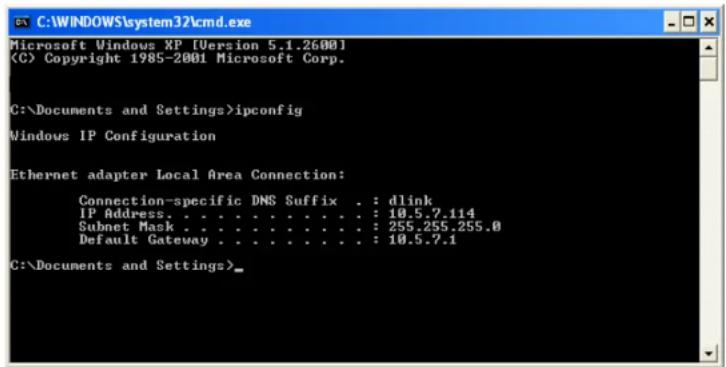
text_image
C:\WINDOWS\system32\cmd.exe Microsoft Windows XP [Version 5.1.2600] (C) Copyright 1985-2001 Microsoft Corp. C:\Documents and Settings>ipconfig Windows IP Configuration Ethernet adapter Local Area Connection: Connection-specific DNS Suffix . : dlink IP Address . . . . . . . . . . . . . . : 10.5.7.114 Subnet Mask . . . . . . . . . . . . . : 255.255.255.0 Default Gateway . . . . . . . . . . . . : 10.5.7.1 C:\Documents and Settings>Statically Assign an IP address
If you are not using a DHCP capable gateway/router, or you need to assign a static IP address, please follow the steps below:
Step 1
Windows Vista® - Click on Start > Control Panel > Network and Internet > Network and Sharing Center > Manage Network Connections.
Windows® XP - Click on Start > Control Panel > Network Connections.
Windows® 2000 - From the desktop, right-click My Network Places > Properties.
Step 2
Right-click on the Local Area Connection which represents your network adapter and select Properties.
Step 3
Highlight Internet Protocol (TCP/IP) and click Properties.
Step 4
Click Use the following IP address and enter an IP address that is on the same subnet as your network or the LAN IP address on your router.
Example: If the router's LAN IP address is 192.168.0.1, make your IP address 192.168.0.X where X is a number between 2 and 99. Make sure that the number you choose is not in use on the network. Set Default Gateway the same as the LAN IP address of your router (192.168.0.1).
Set Primary DNS the same as the LAN IP address of your router (192.168.0.1). The Secondary DNS is not needed or you may enter a DNS server from your ISP.
Step 5
Click OK twice to save your settings.
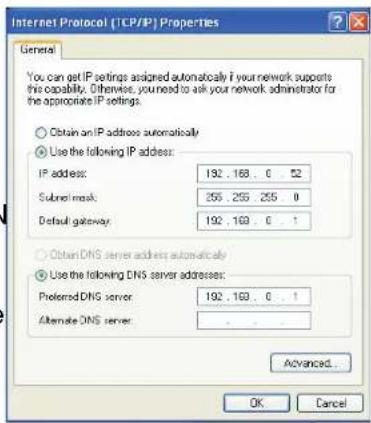
text_image
Internet Protocol (TCP/IP) Properties General You can get IP settings assigned automatically if your network supports this capability. Otherwise, you need to ask your network administrator for the appropriate IP settings. Obtain an IP address automatically Use the following IP address: IP address: 192 . 168 . 0 . 52 Subnet mask: 255 . 255 . 255 . 0 Default gateway: 192 . 169 . 0 . 1 Obtain DNS server address automatically Use the following DNS server addresses: Preferred DNS server: 192 . 169 . 0 . 1 Alternate DNS server: Advanced... OK CancelTechnical Specifications
Standards
- IEEE 802.11n (draft 2.0)
- IEEE 802.11b/g
- IEEE 802.3
- IEEE 802.3u
Security
- WEP (64/128 bit)
• WPA-PSK/WPA2-PSK
• WPS (PIN/PBC)
• 802.1X
Wireless Signal Rates\*
- 54Mbps • 48Mbps
- 36Mbps • 24Mbps
- 18Mbps • 12Mbps
• 11Mbps • 9Mbps - 6Mbps • 5.5Mbps
- 2Mbps
MCS (0-7)
• 130Mbps (270) • 117Mbps (243)
• 104Mbps (216) • 78Mbps (162)
• 66Mbps (135) • 58.5Mbps (121.5)
• 52Mbps (108) • 39Mbps (81)
• 26Mbps (54) • 19.5Mbps (40.5)
• 12Mbps (27) • 6.5Mbps (13.5)
Frequency Range
• 2.4GHz to 2.483GHz
Transmitter Output Power
- 17dBm (+/- 2dB) at 11Mbps, 5.5Mbps, 2Mbps, and 1Mbps at 77^ (25°C)
LEDs
- Power
- Internet
- WLAN - Ethernet
• WPS
Operating Temperature
• 32^ F to 104^ F ( 0^ C to 40^ C)
Operating Humidity
• 10%-95% non-condensing
Storage Humidity
- 5% -95% non-condensing
Safety & Emissions
• NCC
• CSA International
- FCC Class B
- CE Class B
Dimensions
• Width = 4.76 inches (121mm)
• Height = 1.06 inches (27mm)
- Depth = 3.86 inches (97.92mm)
Warranty
• 1 Year Limited
^A Maximum wireless signal rate derived from IEEE Standard 802.11g and Draft 802.11n specifications. Actual data throughput will vary. Network conditions and environmental factors, including volume of network traffic, building materials and construction, and network overhead, lower actual data throughput rate. Environmental factors will adversely affect wireless signal range.
Copyright ©2009 by D-Link Corporation/D-Link Systems, Inc. All rights reserved.
CE Mark Warning:
This is a Class B product. In a domestic environment, this product may cause radio interference, in which case the user may be required to take adequate measures.
FCC Statement:
This equipment has been tested and found to comply with the limits for a Class B digital device, pursuant to Part 15 of the FCC Rules. These limits are designed to provide reasonable protection against harmful interference in a residential installation. This equipment generates, uses and can radiate radio frequency energy and, if not installed and used in accordance with the instructions, may cause harmful interference to radio communications. However, there is no guarantee that interference will not occur in a particular installation. If this equipment does cause harmful interference to radio or television reception, which can be determined by turning the equipment off and on, the user is encouraged to try to correct the interference by one of the following measures:
- Reorient or relocate the receiving antenna.
- Increase the separation between the equipment and receiver.
- Connect the equipment into an outlet on a circuit different from that to which the receiver is connected.
- Consult the dealer or an experienced radio/TV technician for help.
For detailed warranty information applicable to products purchased outside the United States, please contact the corresponding local D-Link office.
FCC Caution:
Any changes or modifications not expressly approved by the party responsible for compliance could void the user's authority to operate this equipment.
IEEE 802.11b or 802.11g operation of this product in the U.S.A. is firmware-limited to channels 1 through 11.
This device complies with Part 15 of the FCC Rules. Operation is subject to the following two conditions:
(1) This device may not cause harmful interference.
(2) This device must accept any interference received, including interference that may cause undesired operation.
IMPORTANT NOTE:
FCC Radiation Exposure Statement:
This equipment complies with FCC radiation exposure limits set forth for an uncontrolled environment. This equipment should be installed and operated with a minimum distance of 20cm between the radiator and your body.
This transmitter must not be co-located or operating in conjunction with any other antenna or transmitter.
The following three 3G card have passed the co-located EMC/RF exposure test with this device and may be used with this device. Other 3G cards may or may not comply with the FCC regulations. Please consult the manufacturer before purchase.
The EUT could be applied with one 3G 1XEV-DO Card and the following three different models could be chosen. Therefore emission tests are added for simultaneous transmission between wireless LAN and 3G 1XEV-DO function. The emission tests have been performed at the poorest channel of both WLAN and 3G 1XEV-DO, and recorded in the report.
| Interface Brand Name Model Name FCC ID | |
| 3G USB HUAWEI E220 QISE | 220 |
| 3G USB HUAWEI E169 QISE | 169 |
| 3G USB HUAWEI E180 QISE | 180 |