Aspire 5920G Series - Keyboard ACER - Free user manual and instructions
Find the device manual for free Aspire 5920G Series ACER in PDF.


User questions about Aspire 5920G Series ACER
0 question about this device. Answer the ones you know or ask your own.
Ask a new question about this device
Download the instructions for your Keyboard in PDF format for free! Find your manual Aspire 5920G Series - ACER and take your electronic device back in hand. On this page are published all the documents necessary for the use of your device. Aspire 5920G Series by ACER.
USER MANUAL Aspire 5920G Series ACER
Aspire 5920G Series Service Guide
Service guide files and updates are available on the ACER/CSD web; for more information, please refer to http://csd.acer.com.tw
PRINTED IN TAIWAN
Revision History
Please refer to the table below for the updates made on Aspire Chapla service guide.
| Date Chapter Updates | ||
Copyright
Copyright © 2007 by Acer Incorporated. All rights reserved. No part of this publication may be reproduced, transmitted, transcribed, stored in a retrieval system, or translated into any language or computer language, in any form or by any means, electronic, mechanical, magnetic, optical, chemical, manual or otherwise, without the prior written permission of Acer Incorporated.
Disclaimer
The information in this guide is subject to change without notice.
Acer Incorporated makes no representations or warranties, either expressed or implied, with respect to the contents hereof and specifically disclaims any warranties of merchantability or fitness for any particular purpose. Any Acer Incorporated software described in this manual is sold or licensed "as is". Should the programs prove defective following their purchase, the buyer (and not Acer Incorporated, its distributor, or its dealer) assumes the entire cost of all necessary servicing, repair, and any incidental or consequential damages resulting from any defect in the software.
Acer is a registered trademark of Acer Corporation.
Intel is a registered trademark of Intel Corporation.
Pentium and Pentium II/III are trademarks of Intel Corporation.
Other brand and product names are trademarks and/or registered trademarks of their respective holders.
Conventions
The following conventions are used in this manual:
| SCREEN MESSAGES | Denotes actual messages that appear on screen. |
| NOTE Gives bits and pieces of additional information related to the current topic. | |
| WARNING Alerts you to any damage that might result from doing or not doing specific actions. | |
| CAUTION Gives precautionary measures to avoid possible hardware or software problems. | |
| IMPORTANT Reminds you to do specific actions relevant to the accomplishment of procedures. | |
Preface
Before using this information and the product it supports, please read the following general information.
-
This Service Guide provides you with all technical information relating to the BASIC CONFIGURATION decided for Acer's "global" product offering. To better fit local market requirements and enhance product competitiveness, your regional office MAY have decided to extend the functionality of a machine (e.g. add-on card, modem, or extra memory capability). These LOCALIZED FEATURES will NOT be covered in this generic service guide. In such cases, please contact your regional offices or the responsible personnel/channel to provide you with further technical details.
-
Please note WHEN ORDERING FRU PARTS, that you should check the most up-to-date information available on your regional web or channel. If, for whatever reason, a part number change is made, it will not be noted in the printed Service Guide. For ACER-AUTHORIZED SERVICE PROVIDERS, your Acer office may have a DIFFERENT part number code to those given in the FRU list of this printed Service Guide. You MUST use the list provided by your regional Acer office to order FRU parts for repair and service of customer machines.
Features
Below is a brief summary of the computer's many features:
Operating system
□ Genuine Windows ^® Vista ^TM Capable
□ Genuine Windows ^® Vista ^TM Home Basic / Home Premium / Ultimate / Business Edition
□ Genuine Windows ^® XP Home / Professional Edition (Service Pack 2)
□ Genuine Windows ^® XP Media Center / Tablet Edition
□ Genuine Windows ^® 2000 (Service Pack 4)
NOTE: Windows ^® Vista ^TM Capable PCs come with Windows ^® XP installed, and can be upgraded to Windows ^® Vista ^TM . For more information on Windows ^® Vista ^TM and how to upgrade, go to: Microsoft.com/windowsvista.
Platform and memory
Intel ^® Mobile Merom mobile technology, featuring:
Intel® Core™ Duo processor (4 MB L2 cache, 1.66/1.83/2/2.16 GHz, 800 MHz FSB) or higher
Intel® PM965 Chipset
☐ Integrated Intel ^ PRO/Wireless 3945ABGN network connection (dual-band tri-mode 802.11a/b/g/n) Wi-Fi CERTIFIED ^TM solution, supporting Acer SignalUp ^TM wireless technology
Core logic: Intel ^® Santa Rose Platform, Crestline 965GM+ICH8M (north bridge+ south bridge)
☐ Up to 2GB of DDR2 533/677 MHz memory, upgradeable to 4GB using two soDIMM modules (dual-channel support)
Display and graphics
☐ 15.4" WXGA+ high-brightness Acer CrystalBrite ™ TFT LCD, 1680 x 1050 pixel resolution, 6 lamps
☐ 16 ms typical of/off and 8 ms average gray-to-gray response time
☐ Simultaneous multi-window viewing via Acer Vista ™ supported
□ Supporting NVIDIA ^ PureVideo ^TM technology (WMV HD, High-Definition MPEG-2 Hardware Acceleration, integrated HDTV encoder) dual-link DVI, Microsoft ^ DirectX ^ 10, Shader Model 4.0, OpenEXR High Dynamic Range (HDR) technology, Unified Shader Architecture, Geometry Instancing 2.0, SGI OpenGL ^ 2.0 Optimizations and support, SmartDimmer ^TM Technology and PCI Express ^
☐ Dual independent display
☐ 16.7 million colors (20.1" LCD model)
☐ 16.2 million colors (19" LCD model)
☐ MPEG-2/DVD hardware-assisted capability
☐ S-video/TV-out (NTSC/PAL) support
☐ Acer Arcade ^TM featuring Acer CinemaVision ^TM and Acer ClearVision technologies
Audio
Intel ^® High Definition audio support
☐ Two built-in Acer 3DSonic stereo speakers (1W)
Realtek ALC268 Audio Code with Dolby®
☐ Sound Blaster Pro ™ and MS Sound compatible
□ Built-in microphone
□ VoIP-enabled
Storage subsystem
☐ One or two 60/80/100/120 GB Serial ATA hard disk drive, supporting Ultra DMA100 S.M.A.R.T / Hybrid HDD
☐ Optical drive options: DVD-Super Multi double-layer drive, Blue-ray drive (slot-load)
☐ 5-in-1 card reader, supporting Secure Digital (SD), MultiMediaCard (MMC), Memory Stick ^® (MS), Memory Stick PRO ^TM (MS PRO), xD-Picture Card ^TM (xD)
□ Supports 3G SIM Card
Input devices
☐ 88/89-key keyboard with 101/102 key emulation
☐ Touchpad with 4-way scroll button
Six Media keys
☐ Four easy-launch buttons
Communication
☐ Acer Video Conference, featuring Voice and Video over Internet Protocol (VVoIP) support via Acer OrbiCam™ and optional Acer Bluetooth® VoIP phone
☐ Acer OrbiCam ^TM 0.3 megapixel CMOS camera, featuring:
- 30 degree ergonomic rotation
- Acer VisageOn™ technology
Acer PrimaLite™ technology
Modem: 56K V.90/V.92 WWDAA modem; wake-on-ring ready support by S3
☐ LAN: gigabit Ethernet; wake-on-LAN ready
☐ WPAN: Bluetooth ^ 2.0+EDR (Enhanced Data Rate)
Integrated Kedron-n 3945abg network connection (dual-band tri-mode 802.11a/b/g/n) Wi-Fi CERTIFIED™ solution, supporting Acer SignalUp™ wireless technology
Mini Cards
☐ Two mini card slots (one supports a wireless module, the other a TV, 3G, or MPEG decoder module)
□ 3G SIM card support
I/O Ports
☐ PC Card slot (one Type II)
☐ 5-in-1 card reader (SD/MMC/MS/MS PRO/xD)
☐ Four USB 2.0 ports
□ Two mini card slots
HDMI port
□ IEEE 1394 port
□ Fast infrared (FIR) port
☐ External display (VGA) port
☐ S-video/TV-out (NTSC/PAL) port
☐ Headphones/speaker/line-out port with S/PDIF support
□ Microphone-in jack
Line-in jack
☐ Ethernet (RJ-45) port
□ Modem (RJ-11) port
☐ DC-in jack for AC adaptor
☐ 3G SIM Card slot (optional)
□ TV-in port (optional)
☐ RF-in port (optional)
Environment
□ Temperature:
Operating: 5°C to 35°C
Non-operating: -20°C to 65°C
☐ Humidity (non-condensing):
Operating: 20%\~80%
Non-operating: 20%\~80%
System Block Diagram

flowchart
graph TD
    A["CLOCK GENERATOR SELGO: SLG65PSN8S 92"] --> B["NB Crestline PM965"]
    C["Merom 479 uFCPGA"] -->|FSB 687/800 MHz| B
    D["CPU Thermal Sensor 92"] --> B
    E["TVOUT CRT 919"] --> F["HDD (SA TA) 924"]
    G["TF T LCD Panel VXGA WXSGA+ WUXGA 918"] --> F
    H["ODD (PA TA) 924"] --> I["SATAO SATA1 PATA USB 2.0 A2868"]
    J["Bluetooth 921"] --> K["Int MIC 921"]
    L["USB Port x 4 925"] --> K
    M["CCD 921"] --> K
    N["Audio Amplifier 921"] --> O["Azala Audio Controller ALC2688888 926"]
    P["Speaker 927"] --> Q["MIC Jack 927"]
    R["Phone Jack 927"] --> S["LLine In 927"]
    T["MDC 1.5 904"] --> U["SPI ROM 931"]
    V["Touch Pad 920"] --> W["VR 926"]
    X["K/B COON 930"] --> Y["CIR 921"]
    Z["PCI-Express 16X Lan DV1 LVDS VGA/TV out"] --> AA["PCI-Express"]
    AB["DDRII SO-DIMM0 SO-DIMM1 926"] --> AC["Dual Channel DDR2 S33467 MHz"]
    AD["MXM-NB38P-GS (nVidia) VRAM 256M VRAM 512M 917"] --> AE["PCI-Bus"]
    AF["1394 +Cardreader Controller R5C832/833 923"] --> AG["IEEE 1394 Port 923"]
    AH["BROADCOM 10/100/1G LAN 5787M 920"] --> AI["Media Card Reader 925"]
    AJ["Transformer 920"] --> AK["PCI-EQ 920"]
    AL["Fan Header 921,930"] --> AM["RJ45 921"]
    AN["VCORE(ISL6262A) 932"] --> AO["+1.2V/+1.25V/(1.5V/2V) 937"]
    AP["5V/3.3V (ISL6236) 932"] --> AQ["BATTERYCHARGER (ISL6251) 932"]
    AR["DISCHARGE 937"] --> AS["+1.8V / +1.05V 935,34"]
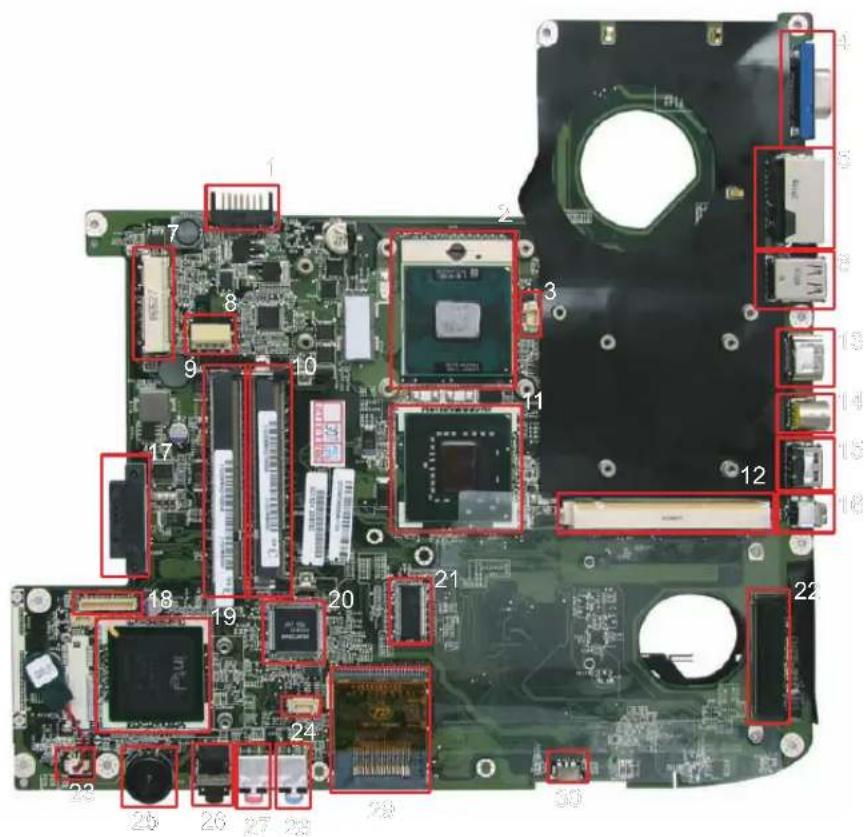
Board Layout
Top View
text_image
Labeled diagram of an electronic circuit board with numbered components and red bounding boxes highlighting specific areas.1 CN15 Battery Connector 16 CN26 IEEE 1394 Connector
2 U22 CPU Socket 17 CN28 Optical Disk Drive Connector
3 CN20 Fan Connector 18 CN30
4 CN13 VGA Jack 19 U34 South Bridge
5 CN14 Ethernet Controller 20 U32 Audio Codec
6 CN18 USB Connector 21 U31
7 CN19 Wireless LAN Card Connector 22 CN32 SATA HDD Connector
8 PJ1 DC-IN Connector 23 CN39
9 CN25 DIMM Socket 24 CN35 Speaker Connector
10 CN23 DIMM Socket 25 VR1 Volume Dial
11 U29 North Bridge
26 CN30 Headphones/Speaker/Line-out Jack
12 U30
27 CN37 Microphone-in Jack
13 CN21 HDMI Connector
28 CN36 Line-in Jack
14 CN22 S-Video Connector
29 CN38 5-in-1 Card Reader
15 CN23 USB Connector 30 U37 Infrared Sensor
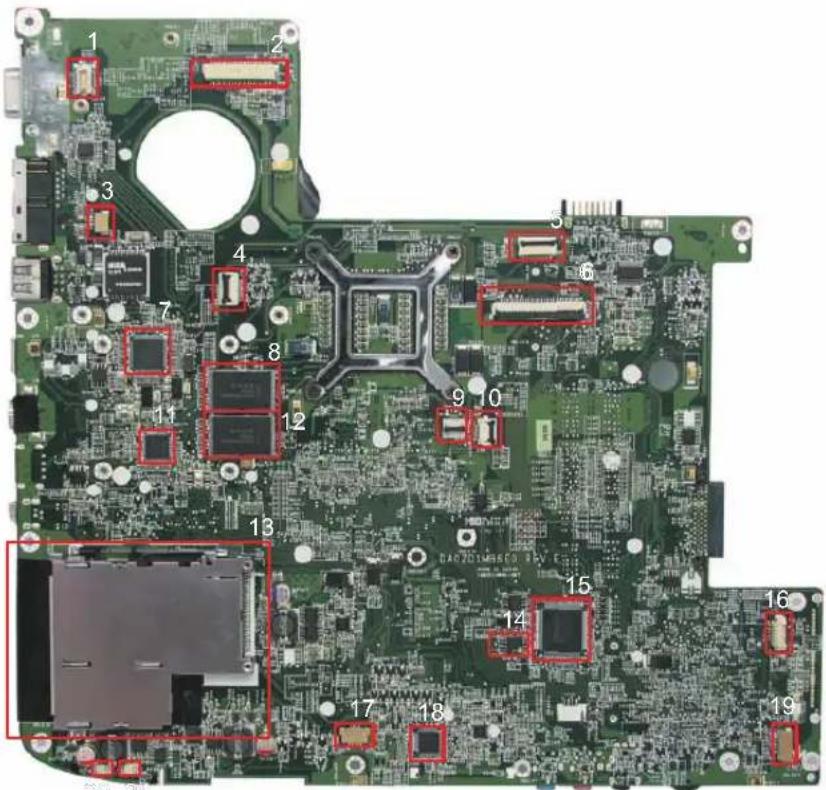
Bottom View
text_image
Labeled diagram of a computer motherboard with numbered components and red annotations highlighting specific areas.1 CN2 12 U7 DDR2 SDRAM IC
2 CN1 LCD Connector 13 CN9 Card Bus Socket
3 CN3 MDC Connector 14 U11
4 CN5 Email Board Connector 15 U10
Touchpad Connector
Winbond
5 CN4 Power Board Connector 16 CN16 Subwoofer Connector
6 CN6 Keyboard Connector 17 CN11 MSC Connector
7 U4 Audio Codec 18 U19
8 U6 DDR2 SDRAM IC 19 CN12
9 CN7 Bluetooth Connector
20 LED2
HDD LED
10 CN8 Wireless Connector
21 LED3
Battery LED
11
U8
Your Acer Notebook tour
After knowing your computer features, let us show you around your new Aspire computer.
Front View

text_image
1 2 3 4 5 6 7 8 9 10 11 12 13 14 15 16| # Icon Item Description | ||
| 1 Built-in camera 0.3 megapixel web camera for video | communication. | |
| 2 Microphone Internal microphone for sound recording. | ||
| 3 Power button Turn the computer on and off. | ||
| 4 Speaker Left and right speakers deliver stereo audio | output. | |
5 Wireless communication | button/indicator | Enables/disables the wireless function.Indicates the status of wireless LAN communication. |
| 6 WWW/E-mail buttons Button to launch your internet browser and e-mail reader. | ||
7 | Bluetooth®communication button/indicator | Enables/disables the Bluetooth®function.Indicates the status of Bluetooth communication. |
| 8 Keyboard For entering data into your computer. | ||
| 9 Touchpad Touch-sensitive pointing device which | functions like a computer mouse. | |
| 10 4-way scroll button To scroll up, down, left, and right. | ||
| 11 Status indicators Light-Emitting Diodes (LEDs) that light up | to show the status of the computer's functions and components. | |
| 12 Click buttons (left and right) | The left and right buttons function like the left and right mouse buttons. | |
| 13 Display screen Also called Liquid-Crystal Display (LCD), | displays computer output. | |
| 14 Empowering button Launches the Empowering Technology | toolbar. | |
| 15 Media buttons To play, pause, record, rewind, fast forward | or stop playback / recording. | |
| 16 Palmrest Comfortable support area for your hands | when you use the computer. | |
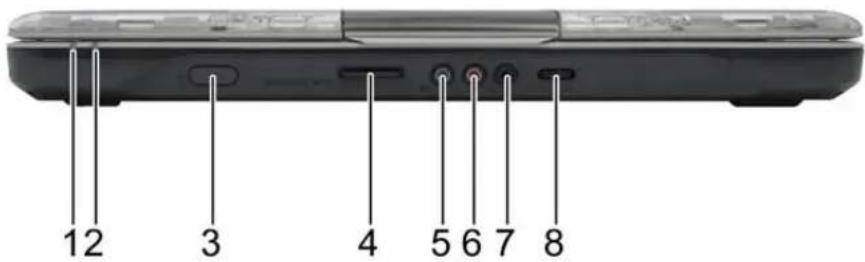
Closed Front View
text_image
12 3 4 5 6 7 8| # | Icon | Item | Description | |
1 Power indicator  | Indicator | Indicates the computer's power status. | ||
| 2 Battery indicator [HOXH] | Indicator | Indicates the computer's battery status. | ||
3 Infrared port  | Interface with infrared devices (e.g, infrared printer and IR-aware computer). | |||
4 5-in-1 card reader  | Accepts | Secure Digital (SD), | MultiMediaCard (MMC), Memory Stick (MS), Memory Stick PRO (MS PRO), xD-Picture Card (xD). | |
| 5 Line-in | jack Accepts audio line-in  | devices (e.g., audio | CD player, stereo walkman). | |
| 6 Microphone-in jack Accepts input from external microphones. | ||||
| 7 Headphones/speaker/[x27k] | line-out jack with S/PDIF support | Connects to audio line-out devices (e.g., speakers, headphones). | ||
| 8 Volume | control Increases and decreases the volume. | |||
Left View

text_image
1 2 3 4 5 6 7 8 9| # Icon Item Description | |||
1 External display (VGA) port Connects to a display device (e.g., external monitor, LCD projector). port Connects to a display device (e.g., external monitor, LCD projector). | |||
2 Ethernet (RJ-45) Connects to an | Ethernet 10/100/1000- | based network (for selected models). | |
3 Modem (RJ-11) port Connects to | a phone line. | ||
4 2 USB 2.0 ports Connect to USB | 2.0 devices (e.g., USB | mouse, USB camera). | |
| 5 HDMI port Connects to a television or display device | with HDMI input. | ||
6 S-video /TV-out (NTSC/ PAL) port Connects to a television or display device with S-video input. PAL) port Connects to a television or display device with S-video input. | |||
7 USB 2.0 port Connect to USB 2.0 devices (e.g., USB devices (e.g., USB | device(s) | mouse, USB camera). | |
8 4-pin IEEE 1394 port  Connects to IEEE 1394 devices. Connects to IEEE 1394 devices. | |||
9 PC Card slot  Accepts one Type II PC Card. Accepts one Type II PC Card. | |||
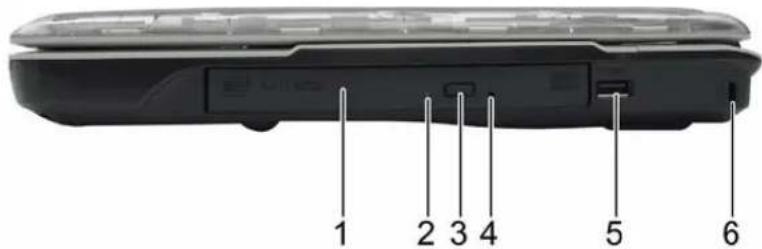
Right View
text_image
1 2 3 4 5 6| # Icon Item Description | |||
| 1 Optical | drive Internal optical drive; accepts CDs or DVDs | (slot) | (slot-load or tray-load depending on model). |
| 2 Optical | disk access | indicator | Lights up when the optical drive is active. |
| 3 Optical | drive eject | button | Ejects the optical disk from the drive. |
| 4 Emergency | eject hole Ejects the optical drive tray when the optical drive tray when the optical drive tray when the optical drive tray when the optical drive tray when the optical drive tray when the optical drive tray when the optical drive tray when the optical drive tray when the optical drive tray when the optical drive tray when the optical drive tray when the optical drive tray when the optical drive tray when the optical drive tray when the optical drive tray when the optical drive tray when the optical drive tray when the optical drive tray when the optical drive tray when the optical drive tray with the optical drive tray with the optical drive tray with the optical drive tray with the optical drive tray with the optical drive tray with the optical drive tray with the optical drive tray with the optical drive tray with the optical drive tray with the optical drive tray with the optical drive tray with the optical drive tray with the optical drive tray with the optical drive tray with the optical drive tray with the optical drive tray with the optical drive tray with the optical drive tray with the optical drive tray with the optical drive tray, computer is turned off. | ||
| 5 USB 2.0 | port Connect to USB 2.0  devices (e.g., USB devices) devices (e.g., USB devices) | mouse, USB camera). | |
| 6 Kensington lock slot connects to a Kensington-compatible computer security lock. | |||
Rear view

natural_image
Top-down view of a black electronic device with a labeled component (no visible text or symbols)| # Icon Item Description | ||
| 1 DC-in jack Connects to an AC adapter. | ||
Base view

text_image
1 2 3 4 5 6 7| # Item Description | ||
| 1 Battery | bay Houses the computer's battery pack. | |
| 2 Battery | lock Locks the battery in position. | |
| 3 Battery | release latch Releases the battery for removal. | |
| 4 Ventilation | slots and cooling fan | Enable the computer to stay cool, even after prolonged use.Note: Do not cover or obstruct the opening of the fan. |
| 5 System | fan Enables the motheboard to stay cool, even after prolonged use.Note: Do not cover or obstruct the opening of the fan. | |
| 6 Memory | compartment Houses the computer's main memory. | |
| 7 Hard disk | bay Houses the computer's hard disk (secured with screws) | |
Indicators
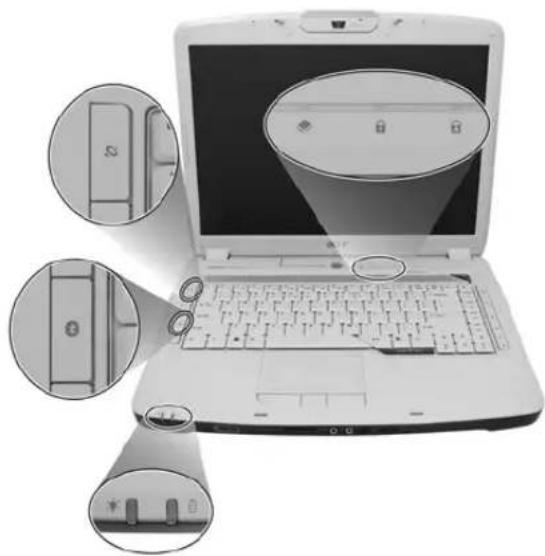
The computer has several easy-to-read status indicators.
natural_image
Laptop keyboard with three inset diagrams showing front, side, and top views of the keyboard (no text or symbols present)The front panel indicators are visible even when the computer cover is closed up.
| Icon Function | Description | |
| HDD Indicates when the hard disc or optical drive is active. | ||
| Num lock Lights when Num Lock is activated. | ||
| Cap lock Lights when Cap Lock is activated | ||
| Power Lights up when the computer is on. | ||
| Battery Lights up when the battery is being charged. | ||
| Bluetooth Indicates the status of Bluetooth communication. | ||
| Wireless LAN Indicates the status of wireless LAN communication. | ||
NOTE: 1. Charging: The light shows amber when the battery is charging. 2. Fully charged: The light shows green when in AC mode.
Easy-Launch Buttons
To the right of the keyboard there are three easy-launch buttons: Web browser, mail, and one user-programmable button. You can also find an Empowering Key "Located above the keyboard.
Press “e” to run the Acer Empowering Technology. The mail and Web browser buttons are pre-set to email and Internet programs, but can be reset by users. To set the Web browser, mail and programmable buttons, run the Acer Launch Manager.

text_image
ACF Del Home| Launch key Default application | |
| e | Acer Empowering Technology (user-programmable) |
| Web browser Internet browser (user-programmable) | |
| Mail Email application (user-programmable) | |
| P User-programmable | |
Touchpad Basics
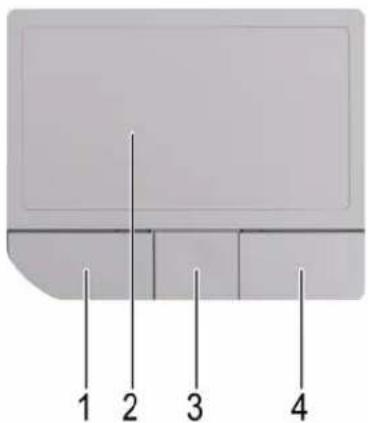
The following teaches you how to use the touchpad:
text_image
1 2 3 4☐ Move your finger across the touchpad (2) to move the cursor.
☐ Press the left (1) and right (4) buttons located beneath the touchpad to perform selection and execution functions. These two buttons are similar to the left and right buttons on a mouse. Tapping on the touchpad is the same as clicking the left button.
☐ Use the fingerprinter (3) to enroll the computer with registered fingerprint. This recognition device helps prevent unauthorized access by others.
| Function | Left Button (1) | Right Button (4) | Main touchpad (2) | Fingerprinter (3) |
| Execute Click twice quickly Tap twice (at the | same speed as double-clicking the mouse button) | |||
| Select Click once | Tap once | |||
| Drag | Click and hold, then use finger on the touchpad to drag the cursor. | Tap twice (at the same speed as double-clicking a mouse button); rest your finger on the touchpad on the second tap and drag the cursor. | ||
| Access context menu | Click once | |||
| Log in with authorized fingerprint | Swipe your finger over the fingerprint. |
NOTE: When using the touchpad, keep it - and your fingers - dry and clean. The touchpad is sensitive to finger movements; hence, the lighter the touch, the better the response. Tapping too hard will not increase the touchpad's responsiveness.
Using the Keyboard
The keyboard has full-sized keys and an embedded keypad, separate cursor keys, one Windows key and twelve function keys.
Lock Keys and embedded numeric keypad
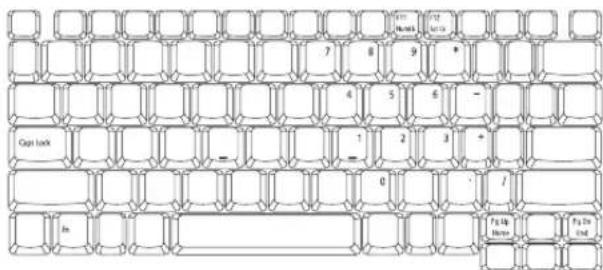
The keyboard has three lock keys which you can toggle on and off.
text_image
Open Lock 7 8 9 4 5 6 - 1 2 3 - 0 In Put Up Home Put Down End| Lock Key Description | |
| Caps Lock When Caps Lock is on, all alphabetic characters typed are in uppercase. | |
| Num lock++ | When Num Lock is on, the embedded keypad is in numeric mode. The keys function as a calculator (complete with the arithmetic operators +, -, *, and /). Use this mode when you need to do a lot of numeric data entry. A better solution would be to connect an external keypad. |
| Scroll lock++ | When Scroll Lock is on, the screen moves one line up or down when you press the up or down arrow keys respectively. Scroll Lock does not work with some applications. |
The embedded numeric keypad functions like a desktop numeric keypad. It is indicated by small characters located on the upper right corner of the keycaps. To simplify the keyboard legend, cursor-control key symbols are not printed on the keys.
| Desired Access Num L | Lock On Num Lock Off | |
| Number keys on embedded keypad | Type numbers in a normal manner. | |
| Cursor-control keys on embedded keypad | Holdwhile using cursor-control keys. | Holdwhile using cursor-control keys. |
| Main keyboard keys Holdwhile typing letters on embedded keypad. | Type the letters in a normal manner. | |
Windows Keys
The keyboard has one key that performs Windows-specific functions.
| Key Icon Description | ||
Windows key Presed alone, this key has the same effect as clicking on the Windows Start button; it launches the Start menu. It can also be used with other keys to provide a variety of function:[05xx]:Tab> Activates next taskbar button. :E> Opens the My Computer window[D460]:F1> Opens Help and Support. :E> Opens the My Computer window[D460]:F1> Opens Help and Support. :F> Opens the Search: All Files dialog box.[YD70]:R> Opens the Run dialog box. :F> Opens the Search: All Files dialog box.[YD70]:R> Opens the Run dialog box. +Minimizes all windows.+ +Minimizes all windows.+  .M> Undoes the minimize all windows action. .M> Undoes the minimize all windows action. | ||
 Application key Application key | This key has the same effect as clicking the right mouse button; it opens the application's context menu. | |
Application key
Hot Keys
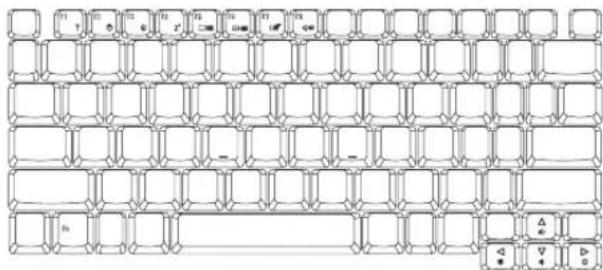
The computer employs hotkeys or key combinations to access most of the computer's controls like screen brightness, volume output, and the BIOS utility.
To activate hot keys, press and hold the
text_image
Diagram of a grid-based computer keyboard layout with labeled keys and control buttons| Hot Key Icon Function Description | |||
| + | Hot key help Displays help on hot keys. | ||
| + | Acer eSettings Launches the Acer eSettings in Acer eManager. | ||
| + | Acer ePower [2x87] | Launches the Acer ePower Management in Acer Empowering Technology. See “Acer Empowering Technology” on page 18. | |
| + | Sleep Puts the computer in Sleep mode. | ||
| Hot Key | Icon | Function | Description |
Display toggle Switch  | ches display output between the display screen, external monitor (if connected) and both. | ||
Screen blank Turns  | the display screen backlight off to save power. Press any key to return. | ||
Touchpad toggle Turns  | turns the internal touchpad on and off. | ||
Speaker toggle Turns  | the speakers on and off. | ||
 | Volume up | Increases the speaker volume. | |
 | Volume down | Decreases the speaker volume. | |
 | Brightness up | Increases the screen brightness. | |
 | Brightness down | Decreases the screen brightness | |
Special Key
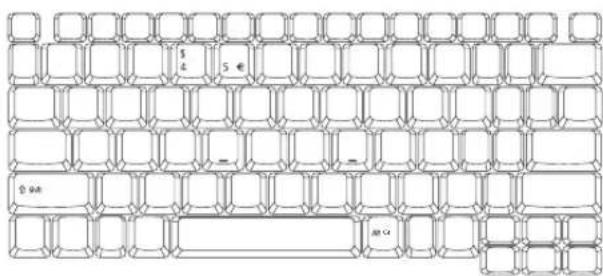
You can locate the Euro symbol and US dollar sign at the upper-center of your keyboard.
To type:
text_image
5 € 4 5 € - - 6 mm 80 €The Euro symbol
- Open a text editor or word processor.
- Hold
and then press the <5> symbol at the upper-center of the keyboard.
NOTE: Some fonts and software do not support the Euro symbol. Please refer to www.microsoft.com/ typography/faq/faq12.htm for more information.
The US dollar sign
- Open a text editor or word processor.
- Hold
and then press the <4> key at the upper-center of the keyboard.
NOTE: This function varies by the operating system version.
Acer Empowering Technology
Acer's innovative Empowering Technology makes it easy for you to access frequently used functions and manage your new Acer notebook. It features the following handy utilities:
□ Acer eNet Management hooks up to location-based networks intelligently.
☐ Acer ePower Management extends battery power via versatile usage profiles.
☐ Acer ePresentation Management connects to a projector and adjusts display settings conveniently.
☐ Acer eDataSecurity Management protects data with passwords and advanced encryption algorithms.
☐ Acer eLock Management limits access to external storage media.
☐ Acer eRecovery Management backs up and recovers data flexibly, reliably and completely.
☐ Acer eSettings Management accesses system information and adjusts settings easily.
☐ Acer ePerformance Management improves system performance by optimizing disk space, memory and registry settings.

natural_image
Toolbar with icons representing global security, media, privacy, security, gear, and other functions (no text or labels visible)For more information, press the < 2 key to launch the Empowering Technology toolbar, then click on the appropriate utility and select the Help or Tutorial function.
Empowering Technology password
Before using Acer eLock Management and Acer eRecovery Management, you must initialize the Empowering Technology password. Right-click on the Empowering Technology toolbar and select "Password Setup" to do so. If you do not initialize the Empowering Technology password, you will be prompted to do so when running Acer eLock Management or Acer eRecovery Management for the first time.
Acer eNet Management

Acer eNet Management helps you to quickly and easily connect to both wired and wireless networks in a variety of locations. To access this utility, either click on the “Acer eNet Management” icon on your notebook, or start the program from the Start menu. You also have the option to set Acer eNet Management to start automatically when you boot up your PC.
Acer eNet Management automatically detects the best settings for a new location, while offering you the freedom to manually adjust the settings to match your needs.

text_image
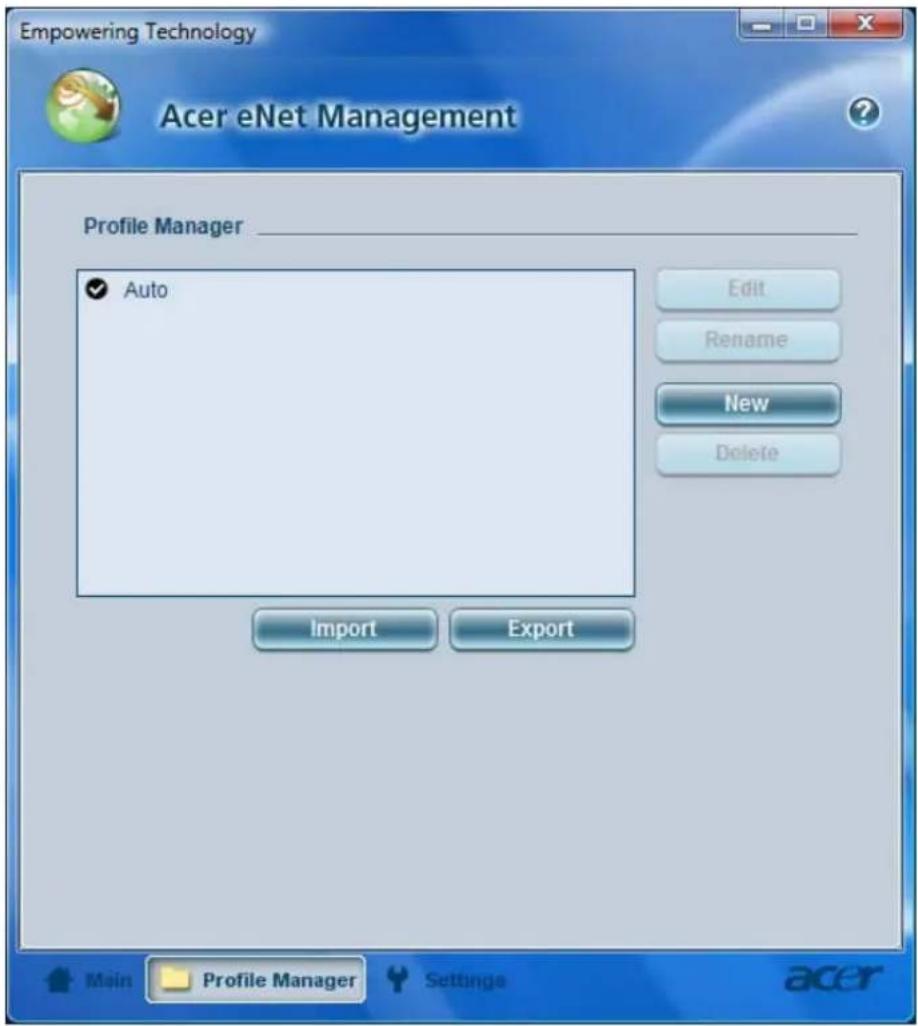
Empowering Technology Acer eNet Management Current Profile: Auto VPN Save WLAN ✓ Connected Wi-Fi in Range: 2 Wi-Fi Network(s) Wi-Fi Network: HG2414 60% Connection Speed: 11 Mbps Disconnect LAN ✗ Disconnected Main Profile Manager Settings acerAcer eNet Management can save network settings for a location to a profile, and automatically switch to the appropriate profile when you move from one location to another. Settings stored include network connection settings (IP and DNS settings, wireless AP details, etc.), as well as default printer settings.
Security and safety concerns mean that Acer eNet Management does not store username and password information.
text_image
Empowering Technology Acer eNet Management Profile Manager ✓ Auto Edit Rename New Delete Import Export Main Profile Manager Settings acerAcer ePower Management

Acer ePower Management features a straightforward user interface. To launch it, select Acer ePower Management from the Empowering Technology interface.
AC Mode (Adapter mode)
The default setting is "Maximum Performance." You can adjust CPU speed, LCD brightness and other settings, or click on buttons to turn the following functions on/off: Wireless LAN, Bluetooth, CardBus, FireWire (1394), Wired LAN and Optical Device if supported.
DC Mode (Battery mode)
There are three pre-defined profiles - Balanced, Power Saver, and High Performance. You can also define the power plan optimized for your needs.
To create new power plan
- Select a predefined power plan and click the “+” icon shown on the lower left-hand side.
- Enter the name for the newly created power plan.
- Select one of the predefined power plan that is closest to what you want.
- Change the display and sleep settings as desired.
- Click "OK" to apply the setting.
- A new power plan is created.
Battery status
For real-time battery life estimates based on current usage, refer to the time shown in the "Remaining Battery Life" field.

text_image
Empowering Technology Acer ePower Management Power Plan: Balanced Remaining Battery Life: ~ 3 Hours 49 Mins On Battery Plugged In More Power Options CPU speed High LCD brightness 50% Turn off the display 15 Mins Put the computer to sleep 30 Mins Hardware On Off On Off Wireless LAN CardBus Wired LAN FireWire (1394) Bluetooth Power Plan: Restore Apply Main acerFor additional power options, click "More Power option".
Acer ePresentation Management

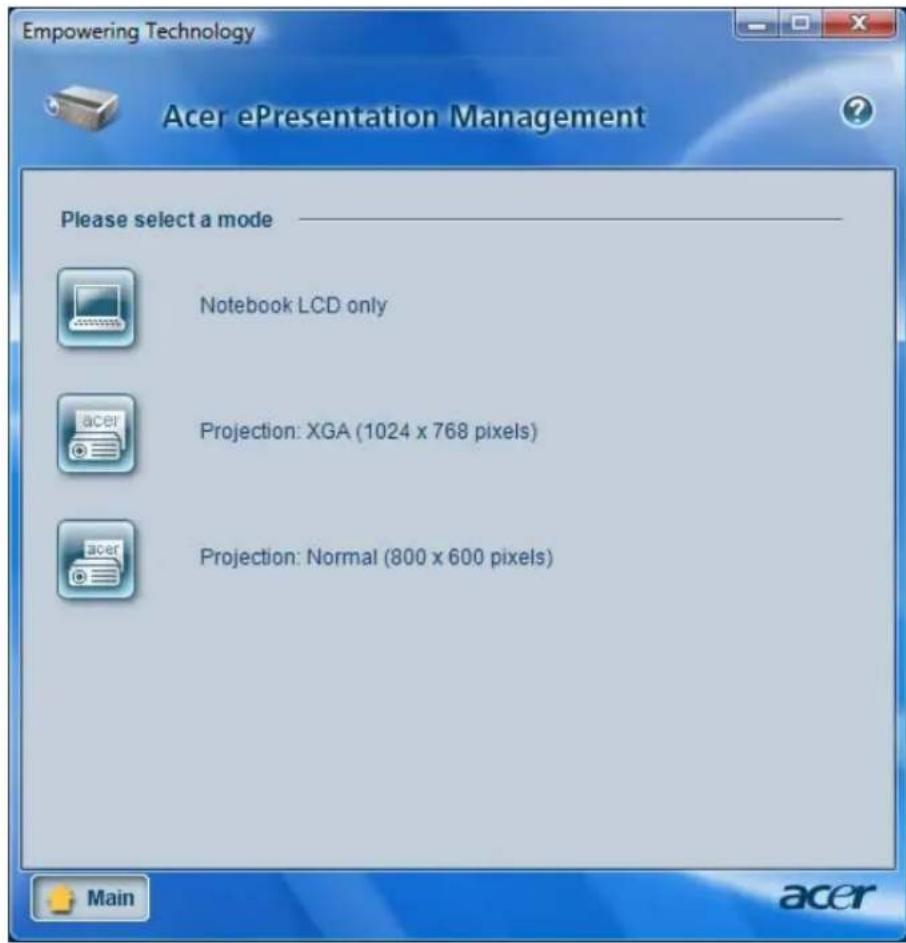
Acer ePresentation Management lets you project your computer's display to an external device or project using the hot key: Fn + F5. If auto-detection hardware is implemented in the system, your system display will be automatically switched out when an external display is connected to the system.
text_image
Empowering Technology Acer ePresentation Management Please select a mode ____ Notebook LCD only Projection: XGA (1024 x 768 pixels) Projection: Normal (800 x 600 pixels) Main acerAcer eDataSecurity Management

Acer eDataSecurity Management is handy file encryption utility that protects your files from being accessed by unauthorized persons. It is conveniently integrated with Windows explorer as a shell extension for quick and easy data encryption/decryption and also supports on-the-fly file encryption for MSN Messenger and Microsoft Outlook.
The Acer eDataSecurity Management setup wizard will prompt you for a supervisor password and default encryption. This encryption will be used to encrypt files by default, or you can choose to enter your won file-specific password when encrypting a file.
NOTE: The password used encrypt a file is the unique key that the system needs to decrypt it. If you lose the password, the supervisor password is the only other key capable of decrypting the file. If you lose both passwords, there will be no way to decrypt your encrypted file! Be sure to safeguard all related passwords!

text_image
Acer eDataSecurity Management Initialize Supervisor Password The Supervisor Password serves two purposes: (1) To grant access to the Personal Secure Disk. (2) To provide you with a "last resort" to decrypt any files previously encrypted... Please record and keep it in a secure place, and never disclose it to anyone else. Fingerprint profile is not initialized yet. Password replacement by Fingerprint disabled. Initialize Supervisor Password Enter Supervisor Password: **** Confirm password: **** Next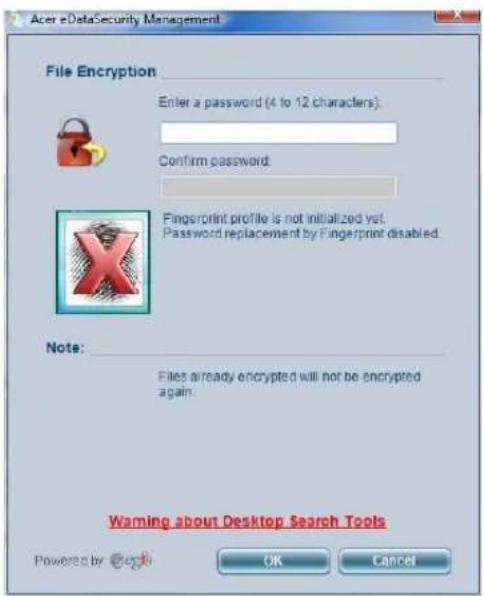
text_image
Acer eDataSecurity Management File Encryption Enter a password (4 to 12 characters). Confirm password: Fingerprint profile is not initialized yet. Password replacement by Fingerprint disabled. Note: Files already encrypted will not be encrypted again. Warning about Desktop Search Tools Powered by Dogio OK Cancel
text_image
Acer eDataSecurity Management File Decryption ____ Password: Open the file after decryption You should only open a file that is from a safe and reliable source. Fingerprint profile is not initialized yet. Password replacement by Fingerprint disabled. Note: If you forget the password, you can use the Supervisor Password instead. Warning about Desktop Search Tools Powered by @eng& OK CancelAcer eLock Management

Acer eLock Management is a security utility that allows you to lock your removable data, optical and floppy drives to ensure that data cannot be stolen while your notebook is unattended.
☐ Removable data devices - includes USB disk drives, USB pen drives, USB flash drives, USB MP3 drives, USB memory card readers, IEEE 1394 disk drives and any other removable disk drives that can be mounted as a file system when plugged into the system.
☐ Optical drive devices - includes any kind of CD-ROM or DVD-ROM drives.
☐ Floppy disk drives - 3.5-inch disks only.
□ Interfaces - includes serial ports, parallel port, infrared (IR), and Bluetooth.
To activate Acer eLock Management, a password must be set first. Once set, you can apply locks to any of the devices. Lock(s) will immediately be set without any reboot necessary, and will remain locked after rebooting, until unlocked.
NOTE: If you lose your password, there is no method to reset it except by reformatting your notebook or taking your notebook to an Acer Customer Service Center. Be sure to remember or write down your password.

text_image
Empowering Technology Acer eLock Management Device Name Locked Unlocked Removable Storage Devices ○ ○ Optical Drive Devices ○ ○ Floppy Drive Devices ○ ○ Apply Removable Storage Devices, e.g. USB flash/HDD, 1394 HDD, card reader Devices acerAcer eRecovery Management

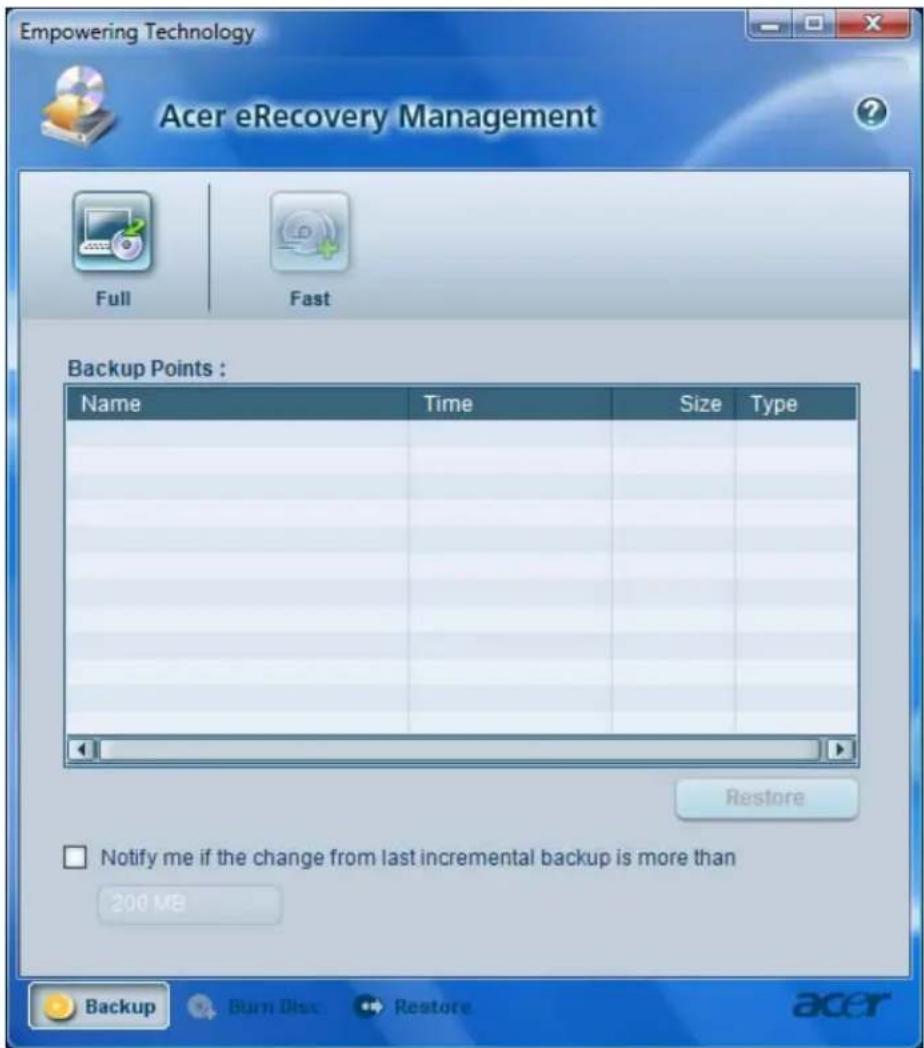
Acer eRecovery Management is a powerful utility that does away with the need for recovery disks provided by the manufacturer. The Acer eRecovery Management utility occupies space in a hidden partition on your system's HDD. User-created backups are stored on D:\ drive. Acer eRecovery Management provides you with:
☐ Password protection.
□ Recovery of applications and drivers.
☐ Image/data backup:
□ Back up to HDD (set recovery point).
□ Back up to CD/DVD.
☐ Image/data recovery tools:
☐ Recover from a hidden partition (factory defaults).
☐ Recover from the HDD (most recent user-defined recovery point).
□ Recover from CD/DVD.
text_image
Empowering Technology Acer eRecovery Management Full Fast Backup Points : Name Time Size Type Restore Notify me if the change from last incremental backup is more than 200 MB Backup Burn Disc Restore acerFor more information, please refer to "Acer eRecovery Management"
NOTE: If your computer did not come with a Recovery CD or System CD, please use Acer eRecovery Management's "System backup to optical disk" feature to burn a backup image to CD or DVD. To ensure the best results when recovering your system using a CD or Acer eRecovery Management, detach all peripherals (except the external Acer ODD, if your computer has one), including your Acer ezDock.
Acer eSettings Management

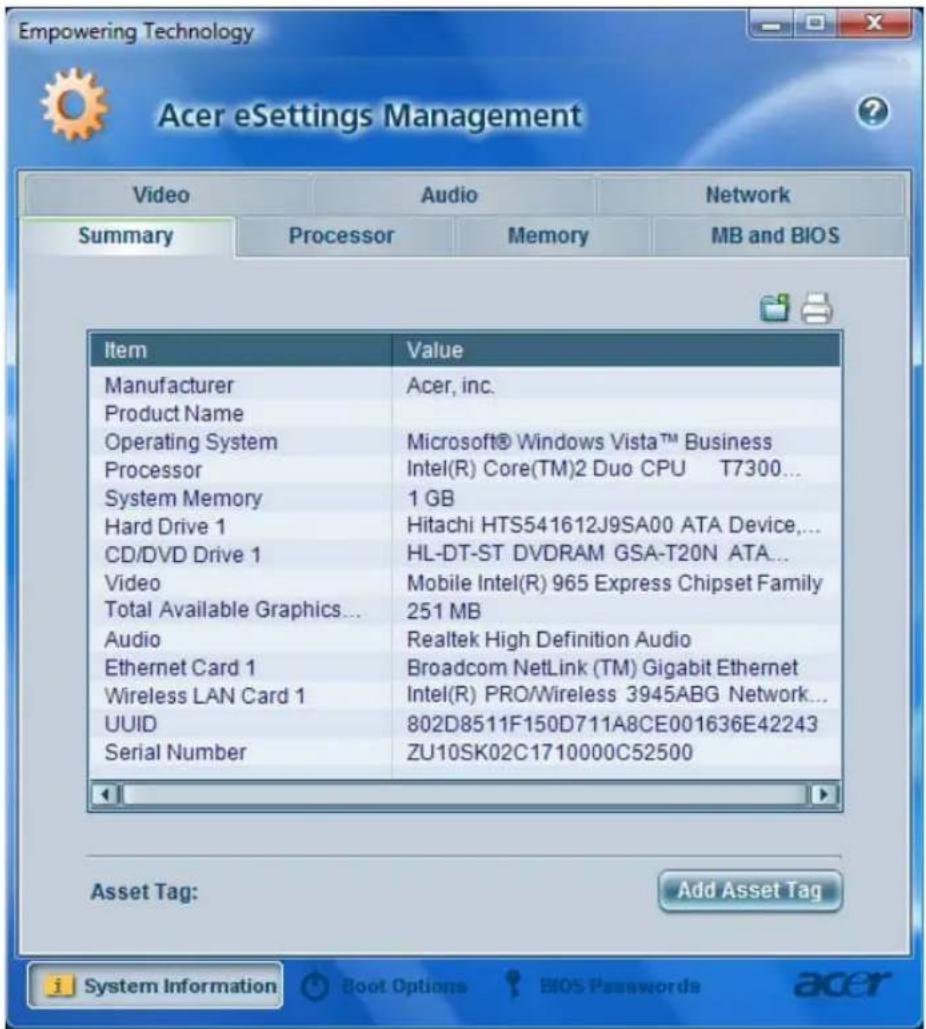
Acer eSettings Management allows you to inspect hardware specifications and to monitor the system health status. Furthermore, Acer eSettings Management enables you to optimize your Windows operating system, so your computer runs faster, smoother and better.
Acer eSettings Management also:
☐ Provides a simple graphical user interface for navigating.
□ Displays general system status and advanced monitoring for power users.
text_image
Empowering Technology Acer eSettings Management Video Audio Network Summary Processor Memory MB and BIOS Item Value Manufacturer Acer, inc. Product Name Operating System Microsoft® Windows Vista™ Business Processor Intel(R) Core(TM)2 Duo CPU T7300... System Memory 1 GB Hard Drive 1 Hitachi HTS541612J9SA00 ATA Device,... CD/DVD Drive 1 HL-DT-ST DVDRAM GSA-T20N ATA... Video Mobile Intel(R) 965 Express Chipset Family Total Available Graphics... 251 MB Audio Realtek High Definition Audio Ethernet Card 1 Broadcom NetLink (TM) Gigabit Ethernet Wireless LAN Card 1 Intel(R) PRO/Wireless 3945ABG Network... UUID 802D8511F150D711A8CE001636E42243 Serial Number ZU10SK02C1710000C52500 Asset Tag: Add Asset Tag i System Information Boot Options BIOS Passwords acerGetting to know your Acer OrbiCam

text_image
12 3 3| No. Item | |
| 1 Lens | |
| 2 Power indicator | |
| 3 Rubber grip (selected models only) | |
Launching the Acer OrbiCam
To launch the Acer OrbiCam, double click on the Acer OrbiCam icon on the screen.
OR
Click Start > All programs > Acer > Acer OrbiCam. The Acer OrbiCam capture window appears.
text_image
AcerObScam 40x400 acerChanging the Acer OrbiCam resolution
To change the capture resolution, click the displayed resolution button to select the desired resolution.
Using the Acer OrbiCam as webcam
The Acer OrbiCam is automatically selected as the capture device of any instant messenger (IM) application. To use the Acer OrbiCam as a webcam, open the IM service, then select the video/webcam feature. You can now broadcast from your location to an IM partner anywhere in the world.
Using the System Utilities
NOTE: The system utilities work under Microsoft Windows XP only.
Acer GridVista (dual-display compatible)
NOTE: This feature is only available on certain models.
To enable the dual monitor feature of the notebook, first ensure that the second monitor is connected, then select Start, Control Panel, Display and click on Settings. Select the secondary monitor (2) icon in the display box and then click the check box Extend my windows desktop onto this monitor. Finally, click Apply to confirm the new settings and click OK to complete the process.

text_image
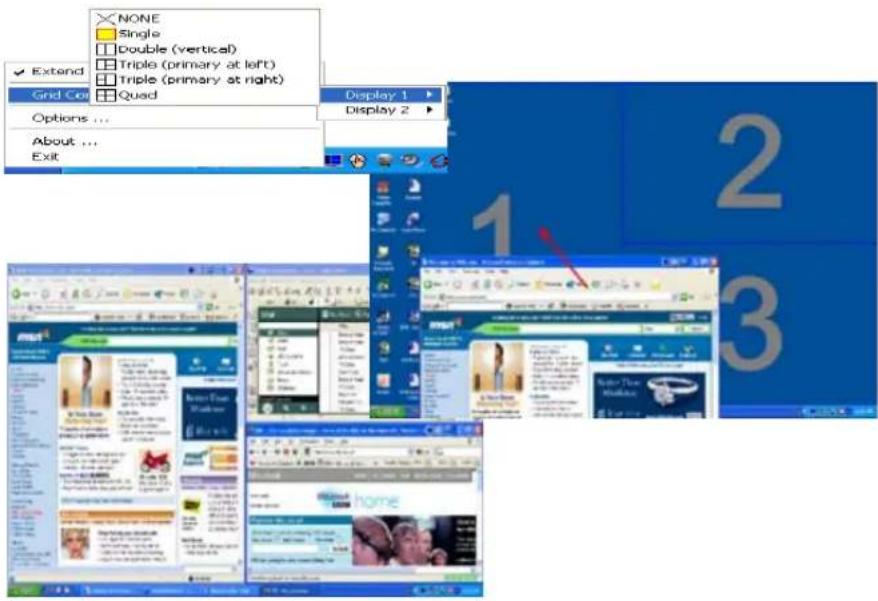
Display Properties Themes Desktop Screen Saver Appearance Settings Drag the monitor icons to match the physical arrangement of your monitors. 1 2 Display: 2. (Multiple Monitors) on Screen resolution More Less 1280 by 1024 pixels Color quality Highest (32 bit) Use this device as the primary monitor Extend my Windows desktop onto this monitor. Identify Troubleshoot... Advanced OK Cancel ApplyAcer GridVista is a handy utility that offers four pre-defined display settings so you can view multiple windows on the same screen. To access this function, please go to Start > All Programs and click on Acer GridVista. You may choose any one of the four display settings indicated below:

text_image
1 2 1 2 1 3 1 3 3 2 2 4Double (vertical), Triple (primary at left), Triple (primary at right), or Quad Acer Gridvista is dual-display compatible, allowing two displays to be partitioned independently.
Acer Gridvista is dual-display compatible, allowing two displays to be partitioned independently.
AcerGridVista is simple to set up:
- Run Acer GridVista and select your preferred screen configuration for each display from the task bar
- Drag and drop each window into the appropriate grid.
- Enjoy the convenience of a well-organized desktop.
text_image
NONE Single Double (vertical) Triple (primary at left) Triple (primary at right) Quad Options ... About ... Exit Display 1 Display 2 1 2 3NOTE: Please ensure that the resolution setting of the second monitor is set to the manufacturer's recommended value.
Launch Manager
text_image
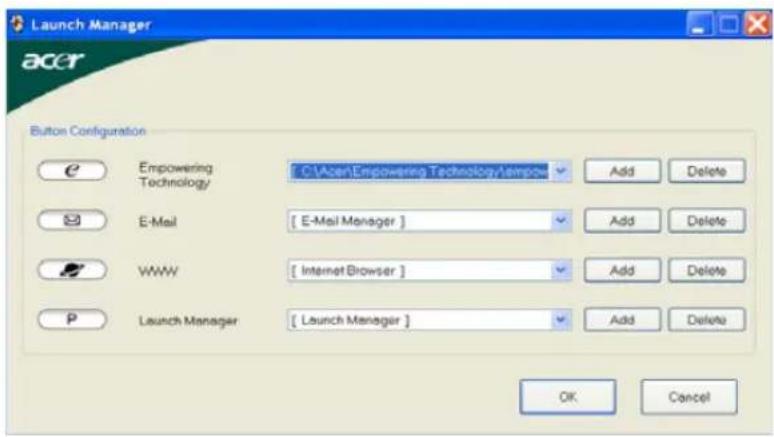
Launch Manager acer Button Configuration Empowering Technology C:\Acer\Empowering Technology\tempow Add Delete E-Mail [ E-Mail Manager ] Add Delete WWW [ Internet Browser ] Add Delete Launch Manager [ Launch Manager ] Add Delete OK CancelLaunch Manager allows you to set the four easy-launch buttons (see their locations mentioned in "Easy-Launch Buttons"). You can access the Launch Manager by clicking Start > All Programs > Launch Manager to start the application.
Hardware Specifications and Configurations
Processor
| Item Specification | |
| CPU type | Intel® CoreTM Duo processor (4 MB L2 cache, 1.66/1.83/2/2.16 GHz, 800 MHz FSB) or higher |
| Core logic | Intel® PM965 Chipset |
| CPU package Intel 479 pin Micro-FCPGA | |
| CPU core voltage 0.725~1.25V | |
CPU Fan True Value Table
| TEST Condition: 35W@Ambient 35 degree C | |||
| CPU Temperature Fan Speed Acoustic Level | |||
| Core 0 Core 1 (rpm) (dBA) | |||
| 86 86 3700 39 | |||
| 88 88 3450 36.5 | |||
| 91 91 3150 34.5 | |||
| 95 95 2800 31 | |||
BIOS
| Item Specification | |
| BIOS vendor Phoenix | |
| BIOS Version | |
| BIOS ROM type Flash ROM | |
| BIOS ROM size | 1MB |
| BIOS package 8 pin SOIC | |
| Supported protocols | ACPI 1.0b/2.0/3.0, PCI 2.2, System/HDD Password Security Control, INT 13h Extensions, PnP BIOS 1.0a, SMBIOS 2.4, Simple Boot Flag 1.0, Boot Block, PCI Bus Power Management Interface Specification, USB1.1/2.0, IEEE 1394 1.0, USB/1394 CD-ROM Boot Up support, PC Card 95 (PCMCIA 3.0 Compliant Device), IrDA 1.0, Intel AC97 CNR Specification, WfM 2.0, PXE (Preboot Execution Environment), BIS 1.0 (Boot Integrity Service Application Program Interface), PC99a and Mobile PC2001 Compliant, Intel Enhanced SpeedStep Technology |
| BIOS password control | Set by setup manual |
NOTE: If you need to check PXE version, press F2 to enter BIOS then enable boot from LAN function. After that, power off the system and remove the HDD. Last, reboot the laptop. Then you will see PXE version displaying on the screen.
Second Level Cache
| Item Specification | |
| Cache controller | Built-in CPU |
| Cache size | 4MB |
| 1st level cache control | Always enabled |
| 2st level cache control | Always enabled |
| Cache scheme control | Fixed in write-back |
System Memory
| Item Specification | |
| Memory controller | Built-in Intel® PM965 |
| Memory size 0MB (no on-board memory) | |
| DIMM socket number 2 sockets | |
| Supports memory size per socket 2GB | |
| Supports maximum memory size 4GB (by two 1024MB SO-DIMM module) | |
| Supports DIMM type DDR 2 Synchronous DRAM | |
| Supports DIMM Speed 533/667 MHz | |
| Supports DIMM voltage 1.8V and 0.9V | |
| Supports DIMM package 200-pin soDIMM | |
| Memory module combinations | You can install memory modules in any combinations as long as they match the above specifications. |
Memory Combinations
| Slot 1 Slot 2 Total Memory | ||
| 0MB | 128MB | 128MB |
| 0MB | 256MB | 256MB |
| 0MB | 512MB | 512MB |
| 0MB | 1024MB | 1024MB |
| 0MB | 2048MB | 2048MB |
| 128MB | 128MB | 256MB |
| 128MB | 256MB | 384MB |
| 128MB | 512MB | 640MB |
| 128MB | 1024MB | 1152MB |
| 128MB | 2048MB | 2176MB |
| 256MB | 128MB | 384MB |
| 256MB | 256MB | 512MB |
| 256MB | 512MB | 768MB |
| 256MB | 1024MB | 1280MB |
| 256MB | 2048MB | 2304MB |
| 512MB | 128MB | 640MB |
| 512MB | 256MB | 768MB |
| 512MB | 512MB | 1024MB |
| 512MB | 1024MB | 1536MB |
| 512MB | 2048MB | 2560MB |
| 1024MB | 0MB | 1024MB |
| 1024MB | 128MB | 1152MB |
| 1024MB | 256MB | 1280MB |
| 1024MB | 512MB | 1536MB |
| 1024MB | 1024MB | 2048MB |
| 1024MB | 2048MB | 3072MB |
| 2048MB | 2048MB | 4096MB |
NOTE: Above table lists some system memory configurations. You may combine DIMMs with various capacities to form other combinations. On above table, the configuration of slot 1 and slot 2 could be reversed.
LAN Interface
| Item Specification | |
| Chipset Broadcom 5787M | |
| Supports LAN protocol 10/100/1000 Ethernet | Giga LAN |
| LAN connector type RJ45 | |
| LAN connector location Left side | |
| Features Integrated 10/100/1000 BASE-T transceiver | Wake on LAN support compliant with ACPI 2.0PCI v1.168pin-QFN package |
Modem Interface
| Item Specification | |
| Data modem data baud rate (bps) 56K | |
| Supports modem protocol V.92 | |
| Modem connector type RJ11 | |
| Modem connector location Right side |
Bluetooth Interface
| Item Specification | |
| Chipset FOXCON T60H928.01 Bluetooth miniUSB module | |
| Data throughput 723 bps (full speed data rate) | |
| Protocol Bluetooth 2.0+EDR | |
| Interface | USB 1.1 |
| Connector type | USB |
Wireless Module 802.11a/b/g/n
| Item Specification | |
| Chipset Kedron-n 3945abg | |
| Data throughput 11~54 Mbps | |
| Protocol 802.11b/g & abgn | |
| Interface | PCI |
Hard Disk Drive Interface
| Item | |||
| Vendor & Model Name | Seagate 40G ST9402112AToshiba MK4025GASHitachi HTS421240H9AT00WD WD400UE-22HCT0Samsung M40MP0402H | Seagate ST96812ASeagate ST960821AToshiba MK6025GASHGST HTS541260H9AT00WD WD600UE-22HCT0 | TOSHIBA MK8025GASHITACHI HTS421280H9AT00SEAGATE ST9808210ASEAGATE ST98823ATOSHIBA MK8026GAXHGST HTS541280H9AT00WD WD800UE-22HCT0 |
| Capacity (MB) | 40000 | 60000 | 80000 |
| Bytes per sector | 512 | 512 | 512 |
| Data heads | 2 | 3 (for Hitachi and Seagate)4 (for Toshiba) | 4 (for Hitachi)3 (for Seagate) |
Hard Disk Drive Interface
| Item | |||
| Drive Format | |||
| D | i | s | k |
| Spindle speed (RPM) | 4200 RPM 4200 RPM 4200 RPM | ||
| Performance Specifications | |||
| Buffer size 204 | 8KB 8192KB 8192KB | ||
| Interface ATA/ATAPI-6; ATA-6 ATA/ATAPI-6; ATA-6 ATA/ATA-6; ATA-6 | |||
| Max. media transfer rate (disk-buffer, Mbytes/s) | 372 350 350 | ||
| Data transfer rate (host~buffer, Mbytes/s) | 100 MB/Sec. Ultra DMA mode-5 | 100 MB/Sec. Ultra DMA mode-5 | 100 MB/Sec. Ultra DMA mode-5 |
| DC Power Requirements | |||
| Voltage tolerance | 5V(DC) +/- 5% 5V(DC) +/- 5% | 5V(DC) +/- 5% | |
DVD-Dual Interface
| Item Specification | ||
| Vendor & model name LITEON SO$W-833S PIONEER DVR-K16RA | ||
| Performance Specification With CD | Diskette With DVD Diskette | |
| Transfer rate (KB/sec) | Sustained: Max 3.6Mbytes/sec | Sustained: Max 10.8Mbytes/sec |
| Buffer Memory 2MB | ||
| Interface | Enhanced IDE(ATAPI) compatible | |
| Applicable disc format | Support disc formats1. Reads data in each CD-ROM, CD-ROM XA, CD-1, Video CD, CD-Extra and CD-Text2. Reads data in Photo CD (single and Multi-session)3. Reads standard CD-DA4. Reads and writes CD-R discs5. Reads and writes CD-RW discs6. Reads and writes in each DVD+R/RW (Ver. 1.1)7. Reads data in each DVD-ROM and DVD-R (Ver. 2.0 for Authoring)8. Reads and writes in each DVD-R (Ver. 2.0 for general), DVD-RW and DVD+R/RW (Ver1.1) | |
| Loading mechanism | Load: ManualRelease: (a) Electrical Release (Release Button)(b) Release by ATAPI command(c) Emergency Release | |
| Power Requirement | ||
| Input Voltage | 5 V +/- 5 % (Operating) | |
Audio Interface
| Item | Specification |
| Audio Controller | Realtek ALC888S |
| Audio onboard or optional | Built-in |
Audio Interface
| Item Specification | |
| Mono or Stereo Stereo | |
| Resolution 18 bit stereo full duplex | |
| Compatibility HD audio Interface; S/PDIF output for PCM or AC-3 content | |
| Sampling rate 44.1k/48k/96k/192kHz sample rate | |
| Internal microphone Yes | |
| Internal speaker / Quantity Yes/2(1.5W speakers) | |
| Supports PnP DMA channel DMA channel 0 | DMA channel 1 |
| Supports PnP IRQ IRQ10, IRQ11 | |
USB Port
| Item Specification | |
| Chipset Built-in ICH8M | |
| USB Compliancy Level 2.0 | |
| OHCI USB 1.1 and USB 2.0 Host controller | |
| Number of USB port 4 | |
| Location | One on the left side; three on the rear side |
| Serial port function control | Enable/Disable by BIOS Setup |
PCMCIA Port
| Item Specification | |
| PCMCIA controller | TI PCI 7412 |
| Supports card type | Type-II |
| Number of slots | One type-II |
| Access location | Left side |
| Supports ZV (Zoomed Video) port | No ZV support |
| Supports 32 bit CardBus | Yes |
System Board Major Chips
| Item | Controller |
| Core logic | IIntel® PM965 Chipset |
| LAN | Broadcom 5787M |
| USB 2.0 | Built in ICH8M |
| Super I/O controller | NS 87383 |
| MODEM | Built-in ICH7-M |
| Bluetooth | Built-in ICH7-M |
| Wireless 802.11 a+b+g+n | Kedron-n 3945 |
| PCMCIA | TI PCI 7412 |
| Audio | Realtek ALC888S |
Keyboard
| Item Specification | |
| Keyboard controller | KBC8769LDG |
Keyboard
| Item | Specification |
| Total number of keypads 88-/89-key | |
| Windows logo key Yes | |
| Internal & external keyboard work simultaneously | Plug USB keyboard to the USB port directly: Yes |
Battery
| Item Specification | |
| Vendor & model name BATTERY PACK SANYO | LI-ION 8CELL2.4, 4800MAHBATTERY PACK SONY LI-ION8CELL2.4, 4800MAHBATTERY PACK SIMPLO LI-ION 8CELL2.4, 4800MAHBATTERY PACK PANASONICLI-ION 8 CELL2.4, 4800MAH |
| Battery Type Li-ion | |
| Pack capacity 4000mAh/4800 mAH | |
| Number of battery cell 8 | |
| Package configuration 4 cells in series, 2 series in parallel | |
| Normal voltage 11.1V | |
| Charge voltage 16.8+-0.2v | |
LCD 15.4" inch
| Item Specification | ||||
| Vendor & model name SAMSUNG | LTN190-M2-000 NON-GLARE | CMO M190A1-L01 NON-GLARE | SAMSUNG LTM190-M2-L01-G GLARE TYPE | CMO M190A1-L03 GLARE TYPE |
| Screen Diagonal (mm) | 19.1 inches | 19.1 inches | 19.1 inches | 19.1 inches |
| Active Area (mm) | 304.1x228.1 | 304.1x228.1 | 304.1x228.1 | |
| Display resolution (pixels) | 1440x900WXGA+ | 1440x900WXGA+ | 1440x900WXGA+ | 1440x900WXGA+ |
| Pixel Pitch | 0.297x0.297 | 0.099x0.297 | 0.297x0.297 | |
| Pixel Arrangement | R.G.B. Vertical Stripe | R.G.B. Vertical Stripe | R.G.B. Vertical Stripe | R.G.B. Vertical Stripe |
| Display Mode | Normally White | Normally White | Normally White | Normally White |
| Typical White Luminance (cd/m2) also called Brightness | 300 | 300 | 300 | 300 |
| Luminance Uniformity | N/A | N/A | 70 | 70 |
| Contrast Ratio | 300 | 300 | 250 | 250 |
| Response Time (Optical Rise Time/Fall Time)msec | 8 | 8 | 8 | 8 |
| Nominal Input Voltage VDD | +3.3V Typ. | +3.3V | 3.3V | 3.3V |
| Typical Power Consumption (watt) | 5.6/5.7 | 3.96 | N/A | N/A |
| Weight 550 570 | 600 | 600 | ||
| Physical Size(mm) | 317.3x242.0x6.0 | 317.3x242.0x5.9 | 317.3x242.0x6.5 | 317.3x242.0x6.5 |
| Electrical Interface | 1 channel LVDS | 1 channel LVDS | 1 channel LVDS | 1 channel LVDS |
LCD 15.4" inch
| Item | Specification | |||
| Support Color 262K colors | (RGB 6-bit data driver) | 262,144 262,144 | 262,144 | |
| Viewing Angle (degree) | ||||
| Horizontal: Right/Left | 40/40 | 45/45 | 40/40 | 40/40 |
| Vertical: Upper/Lower | 10/30 | 15/35 | 20/40 | 20/40 |
| Temperature Range(°C) | ||||
| Operating | 0 to +50 | 0 to +50 | 0 to +50 | 0 to +50 |
| Storage (shipping) | -20 to +60 | -25 to +60 | -20 to +60 | -20 to +60 |
LCD Inverter
| Item Specification | |
| Vendor & model name Darfon/V189-301GP | |
| Brightness conditions N/A | |
| Input voltage (V) 9~21 | |
| Input current (mA) 2.56 (max) | |
| Output voltage (V, rms) 780V (2000V for kick off) | |
| Output current (mA, rms) 6.5 (max) | |
| Output voltage frequency (k Hz) 65K Hz (max) |
AC Adaptor
| Item Specification | |
| Input rating 90V AC to 264V AC, 47Hz to 63Hz | |
| Maximum input AC current 1.7A | |
| Inrush current 220A@115VAC | 220A@230VAC |
| Efficiency | 82% min. @115VAC input full load |
System Power Management
| ACPI mode | Power Management |
| Mech. Off (G3) | All devices in the system are turned off completely. |
| Soft Off (G2/S5) | OS initiated shutdown. All devices in the system are turned off completely. |
| Working (G0/S0) | Individual devices such as the CPU and hard disc may be power managed in this state. |
| Suspend to RAM (S3) | CPU set power downVGA SuspendPCMCIA SuspendAudio Power DownHard Disk Power DownCD-ROM Power DownSuper I/O Low Power mode |
| Save to Disk (S4) | Also called Hibernation Mode. System saves all system states and data onto the disc prior to power off the whole system. |
BIOS Setup Utility
The BIOS Setup Utility is a hardware configuration program built into your computer's BIOS (Basic Input/Output System).
Your computer is already properly configured and optimized, and you do not need to run this utility. However, if you encounter configuration problems, you may need to run Setup. Please also refer to Chapter 4 Troubleshooting when problem arises.
To activate the BIOS Utility, press F2 during POST (when "Press
Press ☐ to enter setup. The default parameter of F12 Boot Menu is set to "disabled". If you want to change boot device without entering BIOS Setup Utility, please set the parameter to "enabled".
Press
| Phoenix TrustedCore(tm) Setup Utility | ||||
| Information | Main | Security | Boot | Exit |
| CPU Type : | Intel (R) Core(TM)2 Duo CPU | T7300 @ 2.00GHz | ||
| CPU Speed : | 2000 MHz | |||
| IDE1 Model Name : | ST980811AS | |||
| IDE1 Serial Number : | xxxxxxxxxxxxxxxxxxxxxx | |||
| ATAPI Model Name : | Optiarc DVD RW AD-7530A | |||
| System BIOS Version: v0.2412 | ||||
| VGA BIOS Version: | nVidia 0.84.41.00.08 | |||
| Serial Number: | xxxxxxxxxxxxxxxxxxxxxx | |||
| Asset Tag Number: | ||||
| Produce Name: | ||||
| Manufacturer Name: Acer | ||||
| UUID: | xxxxxxxxxxxxxxxxxxxxxxxxxxxxxx | |||
Navigating the BIOS Utility
There are six menu options: Info., Main, System Devices, Security, Boot, and Exit.
Follow these instructions:
☐ To choose a menu, use the cursor left/right keys (←→).
☐ To choose a parameter, use the cursor up/down keys (↑↓).
☐ To change the value of a parameter, press F5 or F6.
☐ A plus sign (+) indicates the item has sub-items. Press ENTER to expand this item.
☐ Press ESC while you are in any of the menu options to go to the Exit menu.
In any menu, you can load default settings by pressing F9. You can also press F9 to save any changes made and exit the BIOS Setup Utility.
NOTE: You can change the value of a parameter if it is enclosed in square brackets. Navigation keys for a particular menu are shown on the bottom of the screen. Help for parameters are found in the Item Specific Help part of the screen. Read this carefully when making changes to parameter values. Please note that system information is subject to different models.
Information
| Phoenix TrustedCore(tm) Setup Utility | ||||
| Information | Main | Security | Boot | Exit |
| CPU Type:CPU Speed:IDE1 Model Name:IDE1 Serial Number:ATAPI Model Name:System BIOS Version:VGA BIOS Version:Serial Number:Asset Tag Number:Produce Name:Manufacturer Name:UUID: | Intel (R) Core(TM)2 Duo CPU2000 MHzST980811ASxxxxxxxxxxxxxxxxxxxxxxOptiarc DVD RW AD-7530Av0.2412nVidia 0.84.41.00.08xxxxxxxxxxxxxxxxxxxxxxAcerxxxxxxxxxxxxxxxxxxxxxxxxxxxxxx | T7300 @ 2.00GHz | ||
| F1 Help ↑↓ Select Item F5/F6 Change Values F9 Setup DefaultsEsc Exit ↔ Select Menu Enter Select ▶ Sub-Menu F10 Save and Exit | ||||
NOTE: The system information is subject to different models.
| Parameter Description | |
| CPU Type / CPU Speed This | field shows the CPU type and speed of the system. |
| IDE1 Model Name This field | shows the model name of HDD installed on primary IDE master. |
| IDE1 Serial Number | This field displays the serial number of HDD installed on primary IDE master. |
| ATAPI Model Name This field | displays the model number of the installed ATAPI drive. |
| System BIOS Version Displays system BIOS version. | |
| VGA BIOS Version This field | displays the VGA firmware version of the system. |
| Serial Number This field displays the serial number of this unit. | |
| Asset Tag Number This field | displays the asset tag number of the system. |
| Product Name This field shows product name of the system. | |
| Manufacturer Name This field | displays the manufacturer of this system. |
| UUID Number This will be visible only when an internal LAN device is presenting. UUID=32bytes | |
Main
The Main screen displays a summary of your computer hardware information, and also includes basic setup parameters. It allows the user to specify standard IBM PC AT system parameters.
| Phoenix TrustedCore(tm) Setup Utility | ||||
| Information | Main | Security | Boot | Exit |
| System Time: [19:03:49]System Date: [04/25/2007]System Memory: 640 KB Extended Memory: 1022 MB Video Memory: 512MBQuiet Boot: [Enabled]Power On Display: [Auto]Network Boot: [Enabled]F12 Boot Menu: [Disabled]D2D Recovery: [Enabled] | Item Specific Help | |||
| ,, orselects field. | ||||
NOTE: The screen above is for your reference only. Actual values may differ.
The table below describes the parameters in this screen. Settings in boldface are the default and suggested parameter settings.
| Parameter Description | on Format/Option | |
| System Time Sets the system | time. The hours are displayed with 24-hour format. | Format: HH:MM:SS (hour:minute:second) System Time |
| System Date Sets the system | date. Format MM/DD/YYYY (month/day/ | year) System Date |
| System Memory This field reports the memory size of the system. Memory size is fixed to 640MB | ||
| Extended Memory This field reports the memory size of the extended memory in the system. Extended Memory size=Total memory size-1MB | ||
| Video Memory Shows the Video memory size. | ||
| Quiet Boot Determines if Customer Logo will be displayed or not; shows Summary Screen is disabled or enabled. Enabled: Customer Logo is displayed, and Summary Screen is disabled. Disabled: Customer Logo is not displayed, and Summary Screen is enabled. | Option: Enabled or Disabled | |
| Power on display Auto: During power process, the system will detect if any display device is connected on external video port. If any external display device is connected, the power on display will be in CRT (or projector) only mode. Otherwise it will be in LCD only mode. Both: Simultaneously enable both the integrated LCD screen and the system's external video port (for an external CRT or projector). | Option: Auto or Both | |
| Network Boot Enables, disables the system boot from LAN (remote server). | Option: Enabled or Disabled | |
| F12 Boot Menu Enables, disables Boot Menu during POST. | Option: Disabled or Enabled | |
| D2D Recovery | Enables, disables D2D Recovery function. The function allows the user to create a hidden partition on hard disc drive to store operation system and restore the system to factory defaults. | Option: Enabled or Disabled |
NOTE: The sub-items under each device will not be shown if the device control is set to disable or auto. This is because the user is not allowed to control the settings in these cases.
Security
The Security screen contains parameters that help safeguard and protect your computer from unauthorized use.
| Phoenix TrustedCore(tm) Setup Utility | ||||
| Information | Main | Security | Boot | Exit |
| Supervisor Password Is : ClearUser Password Is : ClearHard Disk Password Status :ClearSet Supervisor Password [Enter]Set User Password [Enter]Set Hard Disk Password [Enter]Password on boot : [Disabled] | Item Specific Help | |||
| Supervisor Password controls accesses to the setup utility. | ||||
| F1 Help ↑↓ Select Item F5/F6 Change Values F9 Setup DefaultsEsc Exit ↔ Select Menu Enter Select ▶ Sub-Menu F10 Save and Exit | ||||
The table below describes the parameters in this screen. Settings in boldface are the default and suggested parameter settings.
| Parameter Description | Option | |
| Supervisor Password is Shows | the setting of the Supervisor password | Clear or Set |
| User Password is Shows the setting of the user password. | Clear or Set | |
| Hard Disk Password Status Shows the setting of the hard disk password. | Clear or Set | |
| Set Supervisor Password Press | Enter to set the supervisor password.When set, this password protects the BIOS Setup Utility from unauthorized access. The user can not either enter the Setup menu nor change the value of parameters. | |
| Set User Password Press Enter | to set the user password. When user password is set, this password protects the BIOS Setup Utility from unauthorized access. The user can enter Setup menu only and does not have right to change the value of parameters. | |
| Set Hard Disk Password Press | Enter to set the hard disk password.When set, this password protects the BIOS Setup Utility from unauthorized access. The user can not either enter the Setup menu nor change the value of parameters. | |
| Password on Boot Defines whether a password is required or not while the events defined in this group happened. The following sub-options are all requires the Supervisor password for changes and should be grayed out if the user password was used to enter setup. | Disabled or Enabled | |
NOTE: When you are prompted to enter a password, you have three tries before the system halts. Don't forget your password. If you forget your password, you may have to return your notebook computer to your dealer to reset it.
Setting a Password
Follow these steps as you set the supervisor, user, or hard disk password:
- Use the ☐ and ☐ keys to highlight the Set Supervisor Password parameter and press the ENTER key. The Set Supervisor Password box appears:
| Set Supervisor Password | |
| Enter New Password | [ ] |
| Confirm New Password | [ ] |
- Type a password in the "Enter New Password" field. The password length can not exceed 8 alphanumeric characters (A-Z, a-z, 0-9, not case sensitive). Retype the password in the "Confirm New Password" field.
IMPORTANT: Be very careful when typing your password because the characters do not appear on the screen.
-
Press ENTER . After setting the password, the computer sets the Supervisor Password parameter to "Set".
-
If desired, you can opt to enable the Password on boot parameter.
-
When you are done, press ☐ to save the changes and exit the BIOS Setup Utility.
Removing a Password
Follow these steps:
- Use the ☐ and ☐ keys to highlight the Set Supervisor Password parameter and press the ☐ key. The Set Supervisor Password box appears:
Set Supervisor Password
Enter current password [ ]
Enter New Password [ ]
Confirm New Password [ ]
-
Type the current password in the Enter Current Password field and press ENTER.
-
Press [Note] twice without typing anything in the Enter New Password and Confirm New Password fields. The computer then sets the Supervisor Password parameter to "Clear".
-
When you have changed the settings, press ☐ to save the changes and exit the BIOS Setup Utility.
Changing a Password
- Use the ☐ and ☐ keys to highlight the Set Supervisor Password parameter and press the ☐ key. The Set Supervisor Password box appears:
Set Supervisor Password
Enter current password [ ]
Enter New Password [ ]
Confirm New Password [ ]
-
Type the current password in the Enter Current Password field and press ENTER.
-
Type a password in the Enter New Password field. Retype the password in the Confirm New Password field.
-
Press ENTER . After setting the password, the computer sets the Supervisor Password parameter to "Set".
-
If desired, you can enable the Password on boot parameter.
-
When you are done, press 📄 to save the changes and exit the BIOS Setup Utility.
If the verification is OK, the screen will display as following.
Setup Notice
Changes have been saved.
[ continue]
The password setting is complete after the user presses 📄.
If the current password entered does not match the actual current password, the screen will show you the Setup Warning.
Setup Warning
Invalid password
Re-enter Password
[ continue]
If the new password and confirm new password strings do not match, the screen will display the following message.
Setup Warning
Password do not match
Re-enter Password
Boot
This menu allows the user to decide the order of boot devices to load the operating system. Bootable devices include the diskette drive in module bay, the onboard hard disk drive, and the CD-ROM in module bay.
| Phoenix TrustedCore(tm) Setup Utility | ||||
| Information | Main | Security | Boot | Exit |
| Boot priority order:1: PCI BEV : MBA v9.4.5 Slot 08002: USB FDC :3: IDE HDD: ST980811AS-(S1)4: IDE CD : Optiarc DVD RW AD-7530A-(P5: USB HDD :6: USB CDROM :7: USB KEY :8:Excluded from boot order : | Item Specific HelpKeys used to view orconfigure devices :Up and Down arrowsselect a device.<+> and <-> movesthe device up or down.andspecifiesthe device fixed orremovable.exclude or includethe device to boot.enables ordisables a device.<1 - 4> Loads defaultboot sequence. | |||
| F1 Help ↑ Select Item F5/F6 Change Values F9 Setup DefaultsEsc Exit ↔ Select Menu Enter Select ▶ Sub-Menu F10 Save and Exit | ||||
Exit
The Exit screen contains parameters that help safeguard and protect your computer from unauthorized use.
| Phoenix TrustedCore(tm) Setup Utility | |||||
| Information | Main | Security | Boot | Exit | |
| Exit Saving ChangesExit Discarding ChangesLoad Setup DefaultsDiscard ChangesSave Changes | Item Specific Help | ||||
| Exit System Setup and save your changes to CMOS. | |||||
| F1 Help ↑↓ Select Item F5/F6 Change Values F9 Setup DefaultsEsc Exit ↔ Select Menu Enter Select ▶ Sub-Menu F10 Save and Exit | |||||
The table below describes the parameters in this screen.
| Parameter Description | |
| Exit Saving Changes Exit System Setup and save your changes to CMOS. | |
| Exit Discarding Changes Exit utility without saving setup data to CMOS. | |
| Load Setup Default Load default values for all SETUP item. | |
| Discard Changes Load previous values from CMOS for all SETUP items. | |
| Save Changes Save Setup Data to CMOS. |
BIOS Flash Utility
The BIOS flash memory update is required for the following conditions:
□ New versions of system programs
□ New features or options
☐ Restore a BIOS when it becomes corrupted.
Use the Phlash utility to update the system BIOS flash ROM.
NOTE: If you do not have a crisis recovery diskette at hand, then you should create a Crisis Recovery Diskette before you use the Phlash utility.
NOTE: Do not install memory-related drivers (XMS, EMS, DPMI) when you use the Phlash.
NOTE: Please use the AC adaptor power supply when you run the Phlash utility. If the battery pack does not contain enough power to finish BIOS flash, you may not boot the system because the BIOS is not completely loaded.
Follow the steps below to run the Phlash.
- Prepare a bootable diskette.
-
Copy the flash utilities to the bootable diskette.
-
Then boot the system from the bootable diskette. The flash utility has auto-execution function.
Machine Disassembly and Replacement
This chapter contains step-by-step procedures on how to disassemble the notebook computer for maintenance and troubleshooting.
To disassemble the computer, you need the following tools:
☐ Wrist grounding strap and conductive mat for preventing electrostatic discharge
☐ Small Philips screw driver
□ Philips screwdriver
☐ Plastic flat head screw driver
Tweezers
NOTE: The screws for the different components vary in size. During the disassembly process, group the screws with the corresponding components to avoid mismatch when putting back the components. When you remove the stripe cover, please be careful not to scrape the cover.
General Information
Before You Begin
Before proceeding with the disassembly procedure, make sure that you do the following:
- Turn off the power to the system and all peripherals.
- Unplug the AC adapter and all power and signal cables from the system.
- Remove the battery pack.
Disassembly Procedure Flowchart
The flowchart on the succeeding page gives you a graphic representation on the entire disassembly sequence and instructs you on the components that need to be removed during servicing. For example, if you want to remove the system board, you must first remove the keyboard, then disassemble the inside assembly frame in that order.

flowchart
graph TD
    A["Start"] --> B["Battery Pack"]
    B --> C{D*5 F*1}
    B --> D{F*1}
    B --> E{F*2}
    C --> F["Thermal Door"]
    D --> G["Mimi Cover"]
    E --> H["HDD Door"]
    F --> I["System Fan Memory"]
    F --> J["ODD Module"]
    G --> K["HDD Bracket"]
    H --> L["HDD"]
    I --> M["Thermal Module"]
    J --> N["CPU"]
    K --> O["Middle Cover"]
    L --> O
    O --> P["Keyboard"]
    P --> Q["LCD Module"]
    Q --> R["C*8 upper case assembly to lower case assembly on bottom side"]
    Q --> S["C*2 upper case assembly to lower case assembly on upper side"]
    R --> T["Lower Case Assembly"]
    S --> U["Upper Case Assembly"]
    T --> V["Modem Board"]
    T --> W["Switch Board (for AS models)"]
    V --> X["F*1"]
    W --> Y["F*2"]
    X --> Z["Main Board"]
    Y --> AA["F*2"]
    Z --> AB["Speaker Set"]
    AA --> AC["Lower Case"]
    U --> AD["Touchpad Bracket"]
    AD --> AE["Touchpad"]
    AD --> AF["Touchpad FFC"]

flowchart
graph TD
    A["LCD Module"] -->|B*4| B["LCD Bezel"]
    B -->|G*1 for 15" G*2 for 15.4"| C["LCD Inverter"]
    C -->|B*2| D["LCD Panel"]
    C --> E["LCD Assembly"]
    D -->|G*2 for 15.4"| F["Wireless Antenna Set"]
    E --> G["LCD Cable"]
    E --> H["LCD Bracket Sets"]
    H -->|F*8 (4 on left; 4 on right)| I["LCD"]
Screw List
| Item Description Part Number | |
| A SCREW M2.5*3(NL) 86.TAVV5.001 | |
| B SCREW M2.5*6(NL) 86.TAVV5.002 | |
| C SCREW M2.5*10(NL) 86.TAVV5.003 | |
| D SCREW M2.5*15(NL) 86.TAVV5.004 | |
| E SCREW M2*2.2 86.TAVV5.005 | |
| F SCREW M2*3(NL) 86.TAVV5.006 | |
| G SCREW M2*4 86.TAVV5.007 | |
| H SCREW M3*4(NL) 86.TAVV5.008 | |
| I SCREW D-SUB 4#X40* 1/5-NI (NL) 86.TAVV5.009 |
Removing the Battery Pack
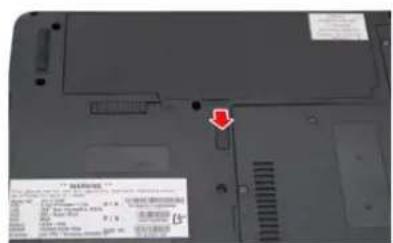
- Unlock the battery lock (move the battery lock to the right).
- Slide the battery release latch then remove the battery.
text_image
Laptop screen showing a red arrow pointing to a component with text labels and a small label box containing Chinese characters.
text_image
Laptop screen with red arrows pointing to a component, showing status bar and file detailsRemoving the HDD Modules/ODD Module/Memory/Wireless LAN Card/VGA Board/Thermal Module and the LCD Module
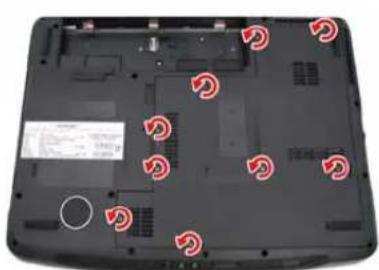
To access the internal laptop components, you have to first remove the back panel.
- Remove the nine screws fastening the back panel.
- Lift the back panel up as shown.
natural_image
Laptop back with visible circuit breakouts and red circular annotations on the rear panel (no text or symbols)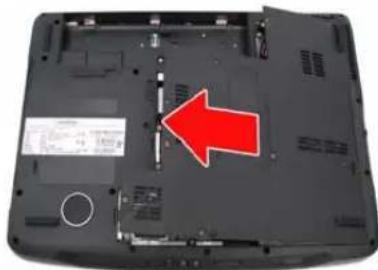
natural_image
Laptop back with a red arrow pointing to the front panel area (no visible text or symbols)Removing the HDD Module
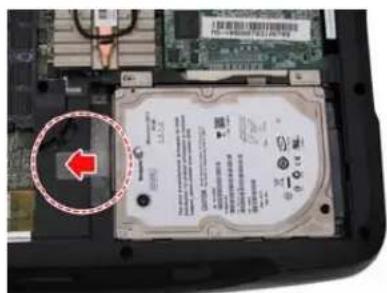
- Pull out the HDD tab.
- Pull up the HDD module by the two brackets as shown.
- Pull out the HDD module as shown
natural_image
Laptop rear view showing a hard disk drive with a red arrow pointing to its side (no visible text or symbols)
text_image
Laptop rear panel showing a CD drive with red arrows pointing to its top and sides of the circuit board.
natural_image
Laptop keyboard with a red arrow pointing to the front panel, showing internal components and circuitry (no readable text or symbols)Removing the ODD Module
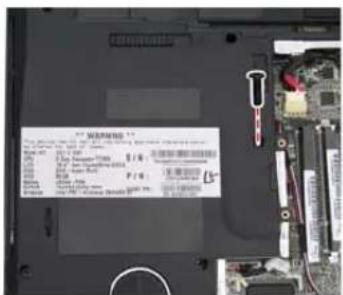
- Remove the screw fastening the ODD module.
- Use a flat screwdriver to gently push out the ODD module.
text_image
Laptop screen with attached hardware and a magnified inset showing a close-up of a device's interior with red arrows pointing to the left side.Removing the Memory and Wireless LAN Card
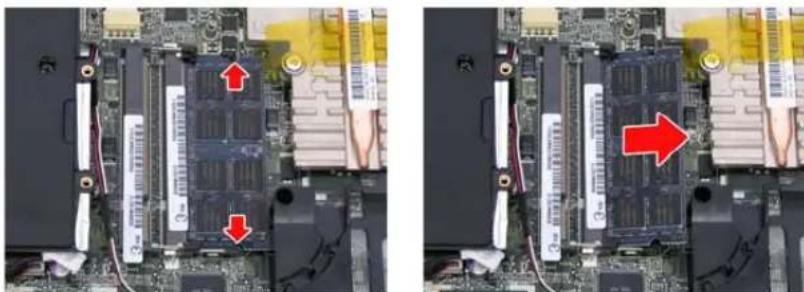
-
Pull out the snaps securing the memory in place. The memory will pop up.
-
Remove the memory from the DIMM socket (If the notebook has two memory, then repeat this step).
natural_image
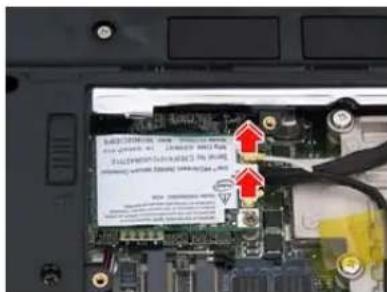
Two views of a computer motherboard showing internal components with red arrows indicating specific areas (no text or symbols present)- Disconnect the main and auxiliary antenna from the wireless LAN card.
- Remove the two screws fastening the wireless LAN card.
- Take out the wireless LAN card from the main unit.
text_image
Laptop screen showing internal circuit board with warning labels and red arrows indicating points of interest
text_image
Laptop screen showing internal circuit board with warning labels and a warning sign in Chinese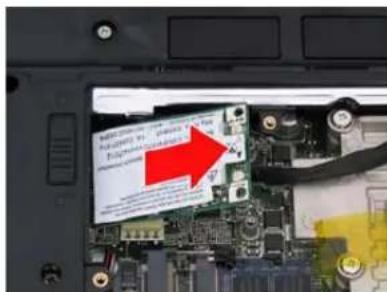
text_image
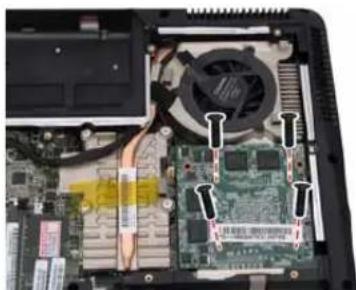
Close-up of a computer motherboard with a red arrow pointing to a component labeled 'Part 1' and 'Part 2'.Removing the VGA Board and Thermal Module
- Remove the four screws fastening the VGA board.
- Take out the VGA board from the main unit.
- Disconnect the system fan cable as shown.
natural_image
Interior view of a computer motherboard showing CPU socket, heatsink, and circuit board (no visible text or labels)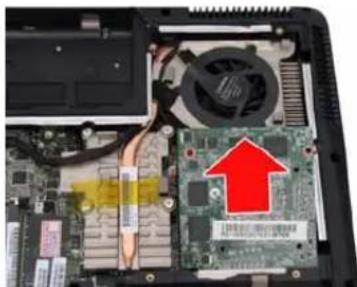
natural_image
Interior view of a laptop computer showing the circuit board with a red upward arrow indicating a component (no text or symbols visible)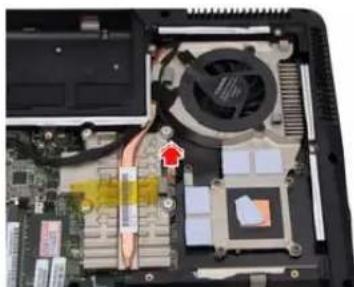
natural_image
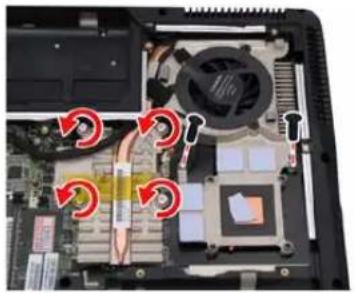
Interior view of a computer motherboard showing CPU socket, heatsink, and drive mechanism (no text or symbols visible)- Unscrew the four spring screws and remove the two screws fastening the thermal module.
- Remove one screw from inside the battery compartment.
- Lift the lower case and take out the thermal module from the main unit.
natural_image
Laptop interior showing internal CPU socket and heat sink with red arrows indicating rotation or move (no text or symbols)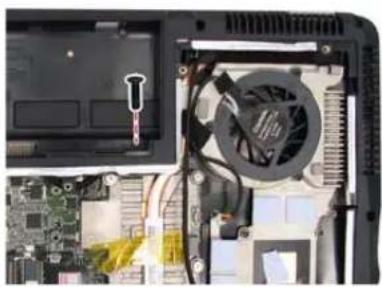
natural_image
Close-up of a computer motherboard with visible CPU socket and fan (no text or symbols)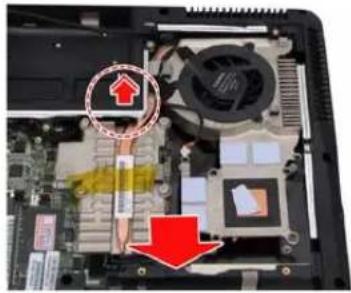
natural_image
Close-up of a computer motherboard showing CPU socket, heatsink, and drive mechanism (no text or symbols visible)Removing the Keyboard and LCD Module
- Disconnect the speaker, DC-In, and system fan cables.
- Turn the notebook over and gently pry up the keyboard as shown.
- Lift the keyboard up and towards you.
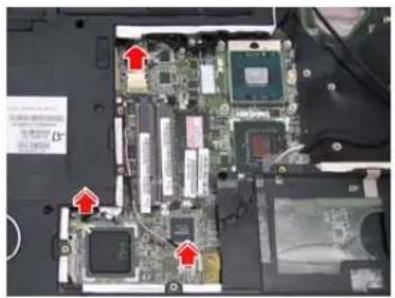
natural_image
Laptop CPU board with visible circuitry and memory components (no readable text or symbols)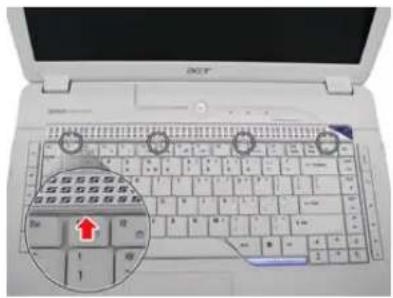
text_image
Laptop keyboard with control buttons and a red arrow pointing to the right button, likely indicating a function or operation.
natural_image
Laptop keyboard with a red upward arrow pointing to the left side of the key (no text or symbols visible)-
Disconnect the keyboard cable from the main board and remove the keyboard from the main unit.
-
Disconnect the media button, Bluetooth and Wireless cables.
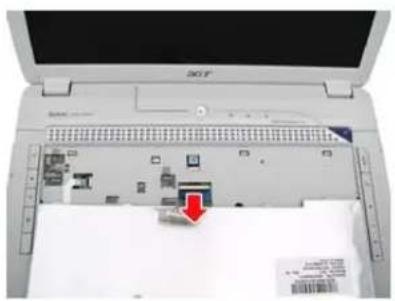
natural_image
Laptop keyboard with visible internal components and a red arrow pointing to a component (no text or symbols)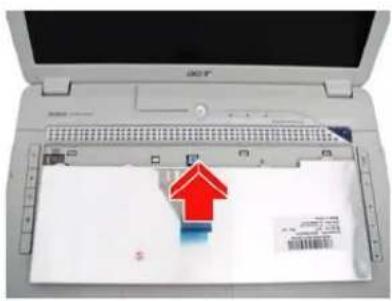
natural_image
Laptop keyboard with a red upward arrow and a small barcode on the screen (no readable text or symbols)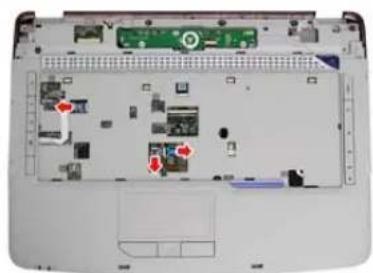
natural_image
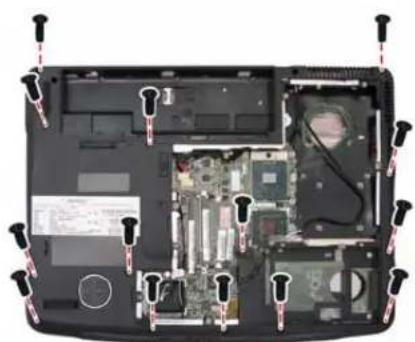
Laptop keyboard with visible circuit board and multiple electronic components (no text or symbols)- Turn the notebook over again and remove the fourteen screws securing the lower case assembly to the upper case assembly.
- Remove the power board cover as shown.
- Disconnect the LCD module and microphone cables.
natural_image
Laptop interior showing internal circuit board and memory components (no visible text or labels)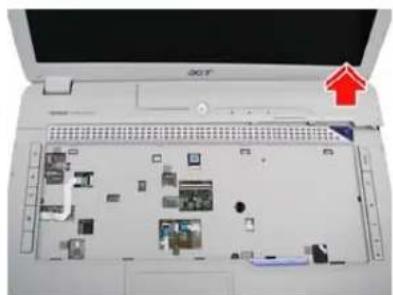
natural_image
Laptop keyboard with open circuit board and scattered image thumbnails (no readable text or symbols)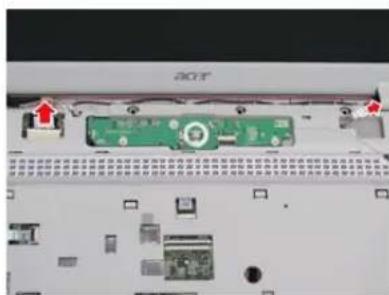
natural_image
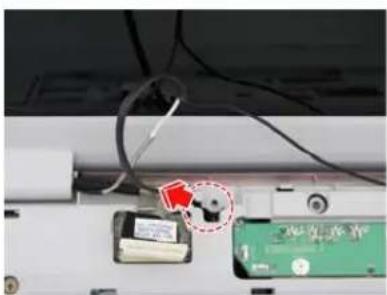
Laptop keyboard with visible circuit board and indicator lights (no text or symbols)- Pull out the wireless LAN antennas from the cable holders as shown.
- Remove the four screws securing the hinges.
- Detach the LCD module from the main unit.
natural_image
Close-up of electronic components with a red circle highlighting a component, no visible text or symbols
natural_image
Laptop keyboard with visible circuit board and internal components (no text or symbols)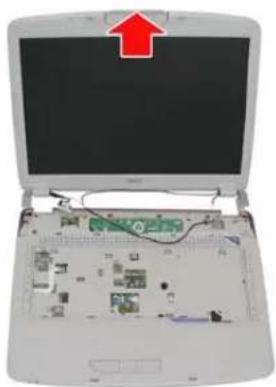
natural_image
Laptop with open circuit board showing internal components and a red arrow pointing to the top screen (no text or symbols visible)Disassembling the Main Unit
Separate the Main Unit Into the Upper and the Lower Case Assembly
-
Remove the two screws fastening the upper case assembly to the lower case assembly.
-
Carefully detach the upper case assembly from the lower case assembly.

natural_image
Interior view of a laptop showing the circuit board and keyboard (no text or symbols visible)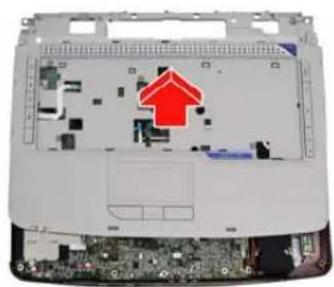
natural_image
Laptop with visible circuit board and a red upward arrow overlay (no text or symbols)Disassembling the Lower Case Assembly
Removing the Power Board
-
Remove the three screws fastening the power board.
-
Disconnect the power board cable as shown.
-
Remove the power board.
-
Disconnect the cable from the power board.
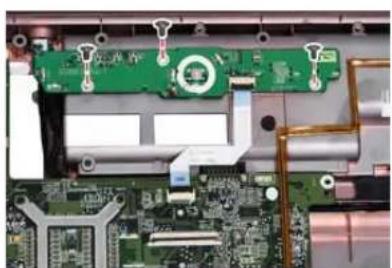
natural_image
Close-up of an electronic circuit board with green components and wiring (no visible text or symbols)
natural_image
Close-up of a computer motherboard showing green circuit board, RAM slots, and a red arrow pointing to a component (no visible text or symbols)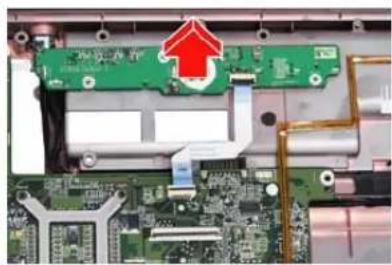
natural_image
Close-up of a computer motherboard with visible circuit board and connectors (no text or symbols)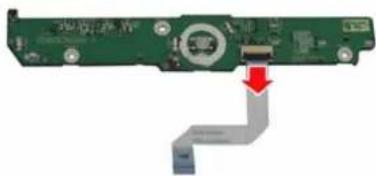
natural_image
Green circuit board with connector and cable, no visible text or symbolsRemoving the Bluetooth Module
-
Disconnect the bluetooth cable from the main board.
-
Remove the two screws fastening the bluetooth module.
-
Remove the bluetooth module and disconnect the cable from the module.
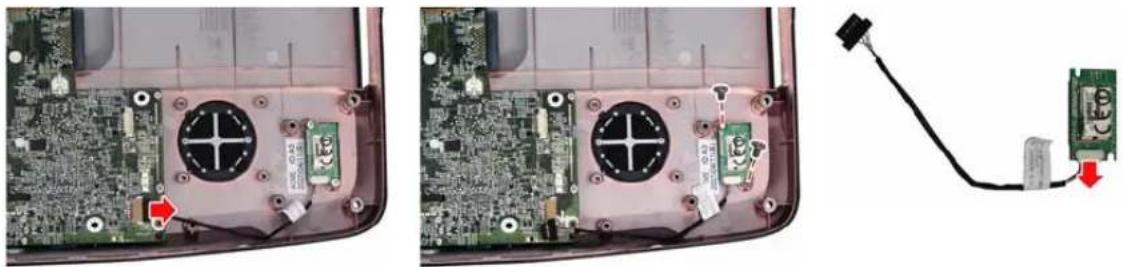
Removing the Subwoofer
- Disconnect the subwoofer cable from the main board.
- Remove the four screws fastening the subwoofer.
- Remove the subwoofer.
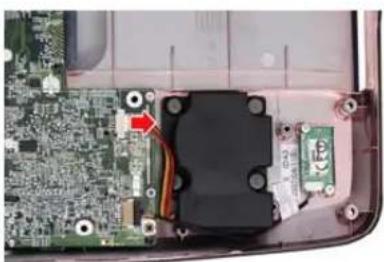
natural_image
Interior view of an electronic device showing a circuit board, battery pack, and wiring (no visible text or symbols)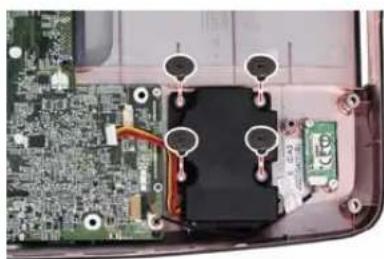
natural_image
Interior view of a computer motherboard showing a circuit board, battery pack, and electronic components (no visible text or symbols)Removing the MDC Card Module
- Disconnect the MDC card cable from the main board.
- Remove the two screws fastening the MDC card module.
- Remove the MDC card module.
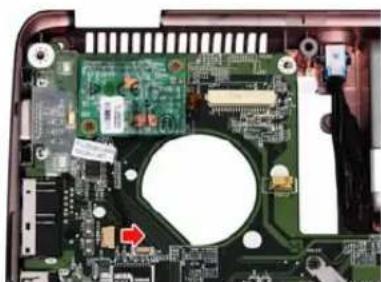
natural_image
Close-up of an open computer motherboard showing internal components and a red arrow pointing to a component (no text or symbols visible)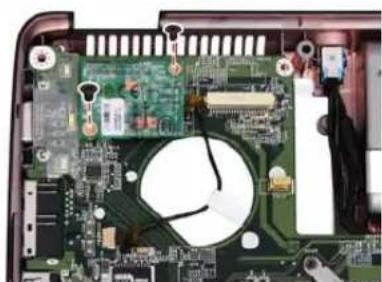
natural_image
Interior view of an electronic circuit board with visible components and wiring (no text or symbols)Removing the USB Board
- Remove the screw fastening the USB board.
- Lift the USB board and disconnect the USB board cable.
- Remove the USB board.
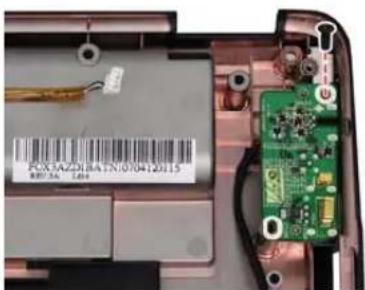
natural_image
Close-up of a computer motherboard showing a green circuit board and a barcode on the left (no readable text or symbols)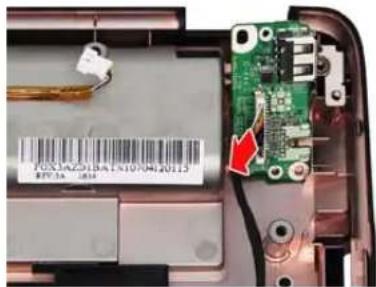
text_image
POSTACOBAL1000012013 SP71A 2013Removing the CPU
- Use a flat screwdriver to release the CPU lock (Turn counter clockwise).
- Remove the CPU from the CPU socket carefully.
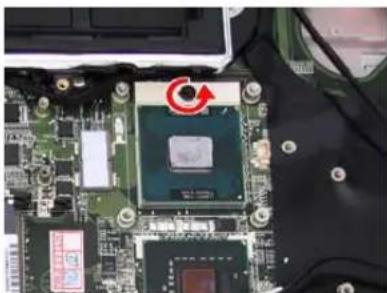
natural_image
Close-up of a computer motherboard with a CPU socket and a red circular arrow indicating a component (no visible text or symbols)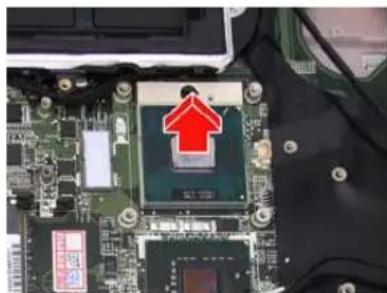
natural_image
Close-up of a computer motherboard with a red upward arrow indicating a component (no visible text or symbols)Removing the Main Board
- Remove the MSC cable and the screw fastening the main board to the lower case.
- Remove the main board.
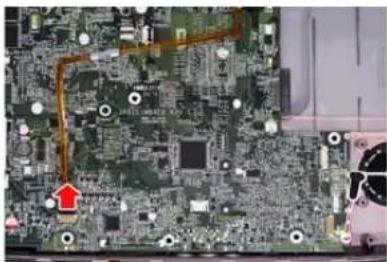
natural_image
Close-up of a computer motherboard with visible circuitry and connectors (no readable text or symbols)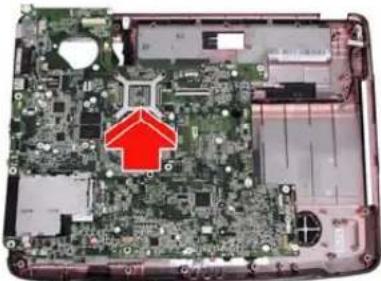
natural_image
Laptop with exposed circuit board and a red upward arrow indicating a location (no text or symbols)Removing the DC Cable and Jack
-
Turn over the lower case and use a flat screwdriver to gently push the DC jack upwards.
-
Turn the lower case over again and remove the DC cable and jack.
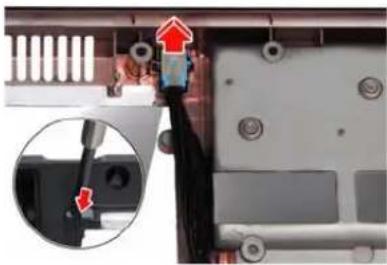
natural_image
Close-up of a mechanical component with a highlighted cable and red arrows indicating direction (no text or symbols)Disassembling the Upper Case Assembly
Removing the Email Board
-
Remove the protective mylar sheet covering the email board.
-
Disconnect the email board cable and remove the screw fastening the email board.
-
Remove the email board.
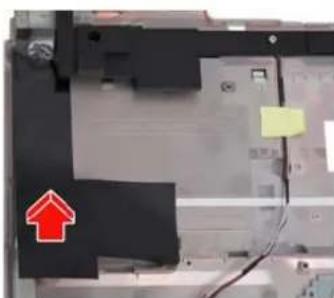
natural_image
Close-up of a mechanical or electronic component with a red upward arrow and yellow sticky note (no visible text or symbols)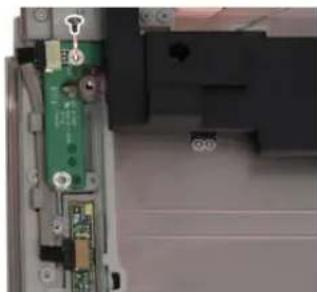
natural_image
Close-up of a green circuit board component with connectors and a black plastic housing (no visible text or symbols)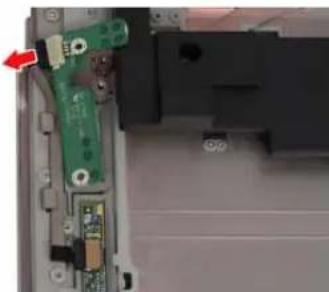
natural_image
Close-up of a green circuit board component being inserted into a device casing, with a red arrow pointing to the component (no visible text or symbols)Removing the Touchpad Board
-
Disconnect the touchpad cables.
-
Remove the two screws fastening the touchpad board.
-
Remove the touchpad board.
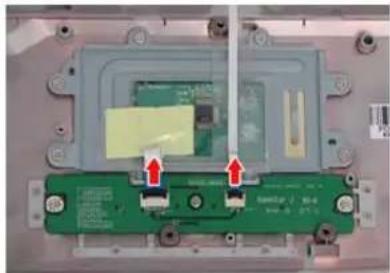
natural_image
Close-up of a green electronic circuit board with red arrows pointing to components (no visible text or symbols)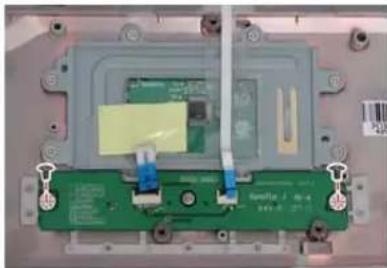
natural_image
Close-up of a green electronic circuit board with visible components and connectors (no readable text or symbols)Removing the Launch Key Board
-
Remove the four screws fastening the launch key board.
-
Disconnect the launch key board cable as shown.
-
Remove the launch key board and disconnect the cable.
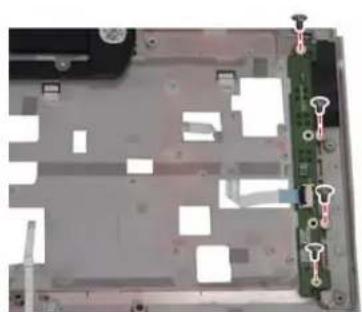
natural_image
Top-down view of a computer motherboard showing circuit boards, connectors, and a green circuit board (no text or symbols visible)
natural_image
Close-up of a computer motherboard with visible circuit board and connectors (no text or symbols)
natural_image
Close-up of a black electronic device with a red arrow pointing to a cable or connector (no visible text or symbols)Removing the Speaker
-
Remove the speaker cable from the upper case.
-
Remove the four screws fastening the speaker.
-
Remove the speaker.

natural_image
Two views of a laptop chassis showing internal components and wiring (no text or symbols visible)Disassembling the LCD Module
- Remove the six screw rubbers as shown.
- Then remove the six screws fastening the LCD bezel.
- Detach the LCD bezel from the LCD module carefully.
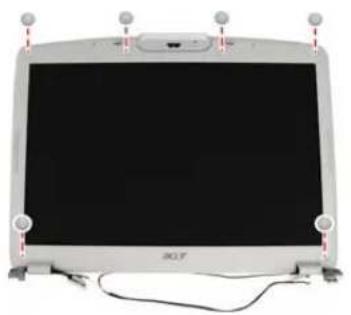
natural_image
Front view of a modern electronic device with a black screen and attached cables (no visible text or symbols)
natural_image
Front view of a white electronic device with black screen and red connectors (no visible text or symbols)
natural_image
Illustration of a flat-screen computer monitor with a red upward arrow on top (no text or symbols)- Remove the six screws holding the LCD.
- Detach the two inverter cable connectors from the inverter board.
- Disconnect the CCD cable connector from the CCD board.
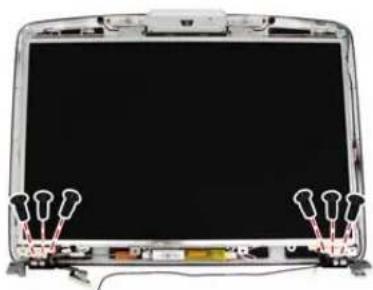
natural_image
Front view of a flat-screen computer with visible ports and connectors (no text or symbols)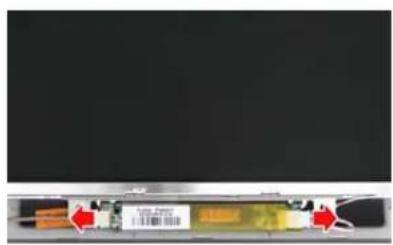
text_image
Close-up of a device panel with visible labels and red arrows pointing to features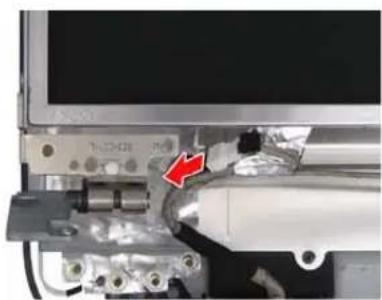
natural_image
Close-up of a mechanical device with a red arrow pointing to a damaged component (no visible text or symbols)- Take out the LCD from the LCD panel.
- Remove the two screws fastening the left LCD bracket and detach it.
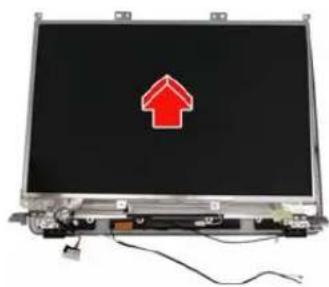
natural_image
Computer monitor with a red upward arrow on the screen, mounted on a black base with visible wiring (no text or symbols)
natural_image
Close-up of a black rectangular electronic device mounted on a metal frame with mounting clips (no visible text or symbols)-
Remove the two screws fastening the right LCD bracket and detach it.
-
Disconnect the LCD cable from the LCD.
-
Detach the CMOS cable from the LCD cover and remove the CMOS module.

text_image
Technical diagram showing assembly steps of a laptop with labeled components and red arrows indicating motion or adjustment.Disassembling the External Modules
Disassembling the HDD Module
- Remove the four screws holding the HDD (hard disk drive) case; two on each side.
- Carefully take out the hard disk drive from the HDD case.
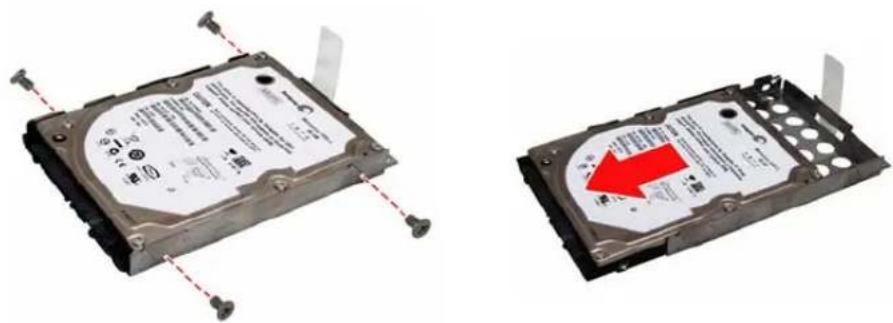
natural_image
Two views of a hard disk drive showing top and front views with mounting hardware (no text or symbols visible)Disassembling the ODD Module
- Remove the two screws holding the optical bracket.
- Then remove the optical bracket from the optical disk drive.
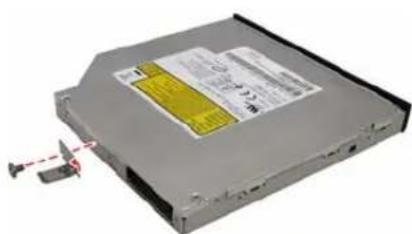
natural_image
Exterior view of a gray internal computer drive (no visible text or labels)Troubleshooting
Use the following procedure as a guide for computer problems.
NOTE: The diagnostic tests are intended to test only Acer products. Non-Acer products, prototype cards, or modified options can give false errors and invalid system responses.
- Obtain the failing symptoms in as much detail as possible.
- Verify the symptoms by attempting to re-create the failure by running the diagnostic test or by repeating the same operation.
- Use the following table with the verified symptom to determine which page to go to.
| Symptoms (Verified) Go To | |
| Power failure (The power indicator does not go on or stay on). | “Power System Check” on page 69 |
| POST does not complete. No beep or error codes are indicated. | “Power-On Self-Test (POST) Error Message” on page 72“Undetermined Problems” on page 84 |
| POST detects an error and displayed messages on screen. | “Error Message List” on page 73 |
| Other symptoms (i.e. LCD display problems or others). | “Power-On Self-Test (POST) Error Message” on page 72 |
| Symptoms cannot be re-created (intermittent problems). | Use the customer-reported symptoms and go to “Power-On Self-Test (POST) Error Message” on page 72“Intermittent Problems” on page 83“Undetermined Problems” on page 84 |
System Check Procedures
External Diskette Drive Check
Do the following to isolate the problem to a controller, driver, or diskette. A write-enabled, diagnostic diskette is required.
NOTE: Make sure that the diskette does not have more than one label attached to it. Multiple labels can cause damage to the drive or cause the drive to fail.
Do the following to select the test device:
- Boot from the diagnostics diskette and start the diagnostics program.
- See if FDD Test is passed as the program runs to FDD Test.
- Follow the instructions in the message window.
If an error occurs with the internal diskette drive, reconnect the diskette connector on the system board.
If the error still remains:
- Reconnect the external diskette drive/DVD-ROM module.
- Replace the external diskette drive/CD-ROM module.
- Replace the main board.
External CD-ROM Drive Check
Do the following to isolate the problem to a controller, drive, or CD-ROM. Make sure that the CD-ROM does not have any label attached to it. The label can cause damage to the drive or can cause the drive to fail.
Do the following to select the test device:
- Boot from the diagnostics diskette and start the diagnostics program.
- See if CD-ROM Test is passed when the program runs to CD-ROM Test.
- Follow the instructions in the message window.
If an error occurs, reconnect the connector on the System board. If the error still remains:
- Reconnect the external diskette drive/CD-ROM module.
- Replace the external diskette drive/CD-ROM module.
- Replace the main board.
Keyboard or Auxiliary Input Device Check
Remove the external keyboard if the internal keyboard is to be tested.
If the internal keyboard does not work or an unexpected character appears, make sure that the flexible cable extending from the keyboard is correctly seated in the connector on the system board.
If the keyboard cable connection is correct, run the Keyboard Test.
If the tests detect a keyboard problem, do the following one at a time to correct the problem. Do not replace a non-defective FRU:
- Reconnect the keyboard cables.
- Replace the keyboard.
- Replace the main board.
The following auxiliary input devices are supported by this computer:
□ Numeric keypad
External keyboard
If any of these devices do not work, reconnect the cable connector and repeat the failing operation.
Memory check
Memory errors might stop system operations, show error messages on the screen, or hang the system.
- Boot from the diagnostics diskette and start the doagmpstotics program (please refer to main board).
- Go to the diagnostic memory in the test items.
- Press F2 in the test items.
- Follow the instructions in the message window.
NOTE: Make sure that the DIMM is fully installed into the connector. A loose connection can cause an error.
Power System Check
To verify the symptom of the problem, power on the computer using each of the following power sources:
- Remove the battery pack.
- Connect the power adapter and check that power is supplied.
- Disconnect the power adapter and install the charged battery pack; then check that power is supplied by the battery pack.
If you suspect a power problem, see the appropriate power supply check in the following list:
☐ "Check the Power Adapter" on page 70
☐ "Check the Battery Pack" on page 71
Check the Power Adapter
Unplug the power adapter cable from the computer and measure the output voltage at the plug of the power adapter cable. See the following figure:
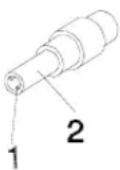
Pin 1: +19 to +20.5V Pin 2: 0V, Ground
- If the voltage is not correct, replace the power adapter.
- If the voltage is within the range, do the following:
☐ Replace the System board.
☐ If the problem is not corrected, see “Undetermined Problems” on page 84.
☐ If the voltage is not correct, go to the next step.
NOTE: An audible noise from the power adapter does not always indicate a defect.
- If the power-on indicator does not light up, check the power cord of the power adapter for correct continuity and installation.
- If the operational charge does not work, see "Check the Battery Pack" on page 71.
Check the Battery Pack
To check the battery pack, do the following:
From Software:
- Check out the Power Management in Control Panel
- In Power Meter, confirm that if the parameters shown in the screen for Current Power Source and Total Battery Power Remaining are correct.
- Repeat the steps 1 and 2, for both battery and adapter.
- This helps you identify first the problem is on recharging or discharging.
From Hardware:
- Power off the computer.
- Remove the battery pack and measure the voltage between battery terminals 1(+) and 6(ground). See the following figure
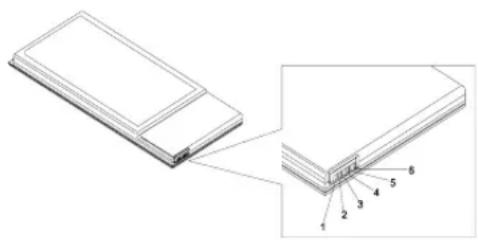
natural_image
Technical line drawing of a rectangular electronic component with internal structure, shown from two orthographic views (no text or symbols)- If the voltage is still less than 7.5 Vdc after recharging, replace the battery.
To check the battery charge operation, use a discharged battery pack or a battery pack that has less than 50% of the total power remaining when installed in the computer.
If the battery status indicator does not light up, remove the battery pack and let it return to room temperature. Re-install the battery pack.
If the charge indicator still does not light up, replace the battery pack. If the charge indicator still does not light up, replace the DC/DC charger board.
Touchpad Check
If the touchpad doesn't work, do the following actions one at a time to correct the problem. Do not replace a non-defective FRU:
- Reconnect the touchpad cables.
- Replace the touchpad.
- Replace the system board.
After you use the touchpad, the pointer drifts on the screen for a short time. This self-acting pointer movement can occur when a slight, steady pressure is applied to the touchpad pointer. This symptom is not a hardware problem. No service actions are necessary if the pointer movement stops in a short period of time.
Power-On Self-Test (POST) Error Message
The POST error message index lists the error message and their possible causes. The most likely cause is listed first.
NOTE: Perform the FRU replacement or actions in the sequence shown in FRU/Action column, if the FRU replacement does not solve the problem, put the original part back in the computer. Do not replace a non-defective FRU.
This index can also help you determine the next possible FRU to be replaced when servicing a computer.
If the symptom is not listed, see "Undetermined Problems" on page 84.
The following lists the error messages that the BIOS displays on the screen and the error symptoms classified by function.
NOTE: Most of the error messages occur during POST. Some of them display information about a hardware device, e.g., the amount of memory installed. Others may indicate a problem with a device, such as the way it has been configured.
NOTE: If the system fails after you make changes in the BIOS Setup Utility menus, reset the computer, enter Setup and install Setup defaults or correct the error.
Index of Error Messages
Error Code List
| Error Codes Error Messages | |
| 006 Equipment Configuration Error | Causes:1. CPU BIOS Update Code Mismatch2. IDE Primary Channel Master Drive Error (THe causes will be shown before “Equipment Configuration Error”) |
| 010 Memory Error at xxxx:xxxx:xxxxh (R:xxxxh, W:xxxxh) | |
| 070 Real Time Clock Error | |
| 071 CMOS Battery Bad | |
| 072 CMOS Checksum Error | |
| 110 System disabled. | Incorrect password is specified. |
| <No error code> Battery critical LOW | In this situation BIOS will issue 4 short beeps then shut down system, no message will show. |
| <No error code> Thermal critical High | In this situation BIOS will shut down system, not show message. |
Error Message List
| Error Messages FRU/Action in Sequence | |
| Failure Fixed Disk Reconnect hard disk drive connector. “Load Default Settings” in BIOS Setup Utility. Hard disk drive System board | |
| Stuck Key see “Keyboard or Auxiliary Input Device | Check” on page 68. |
| Keyboard error see “Keyboard or Auxiliary Input Device Check” on page 68. | |
| Keyboard Controller Failed see “Keyboard or Auxiliary Input Device Check” on page 68. | |
| Keyboard locked - Unlock key switch Unlock external keyboard | |
| Monitor type does not match CMOS - Run Setup Run “Load Default Settings” in BIOS Setup Utility. | |
| Shadow RAM Failed at offset: nnnn BIOS ROM | System board |
| System RAM Failed at offset: nnnn | DIMM System board |
| Extended RAM Failed at offset: nnnn | DIMM System board |
| System battery is dead - Replace and run Setup | Replace RTC battery and Run BIOS Setup Utility to reconfigure system time, then reboot system. |
| System CMOS checksum bad - Default configuration used | RTC battery Run BIOS Setup Utility to reconfigure system time, then reboot system. |
| System timer error | RTC battery Run BIOS Setup Utility to reconfigure system time, then reboot system. System board |
Error Message List
| Error Messages | FRU/Action in Sequence |
| Real time clock error RTC battery | Run BIOS Setup Utility to reconfigure system time, then reboot system.System board |
| Previous boot incomplete - Default configuration used | Run “Load Default Settings” in BIOS Setup Utility.RTC batterySystem board |
| Memory size found by POST differed from CMOS | Run “Load Default Settings” in BIOS Setup Utility.DIMMSystem board |
| Diskette drive A error Check the drive is defined w | th the proper diskette type in BIOSSetup UtilitySee “External Diskette Drive Check” on page 68. |
| Incorrect Drive A type - run SETUP | Check the drive is defined with the proper diskette type in BIOSSetup Utility |
| System cache error - Cache disabled System board | |
| CPU ID: System board | |
| DMA Test Failed DIMM | System board |
| Software NMI Failed DIMM | System board |
| Fail-Safe Timer NMI Failed DIMM | System board |
| Device Address Conflict Run “Load Default Settings” in BIOS Setup Utility.RTC batterySystem board | |
| Allocation Error for device Run “Load Default Settings” in BIOS Setup Utility.RTC batterySystem board | |
| Failing Bits: nnnn DIMM | BIOS ROMSystem board |
| Fixed Disk n None | |
| Invalid System Configuration Data | BIOS ROMSystem board |
| I/O device IRQ conflict | Run “Load Default Settings” in BIOS Setup Utility.RTC batterySystem board |
| Operating system not found | Enter Setup and see if fixed disk and drive A: are properly identified.Diskette driveHard disk driveSystem board |
Error Message List
| No beep Error Messages FRU/Action | in Sequence |
| No beep, power-on indicator turns off and LCD is blank. | Power source (battery pack and power adapter). See “Power System Check” on page 69..Ensure every connector is connected tightly and correctly.Reconnect the DIMM.LED board.System board. |
| No beep, power-on indicator turns on and LCD is blank. | Power source (battery pack and power adapter). See “Power System Check” on page 69..Reconnect the LCD connectorHard disk driveLCD inverter IDLCD cableLCD InverterLCDSystem board |
| No beep, power-on indicator turns on and LCD is blank. But you can see POST on an external CRT. | Reconnect the LCD connectors.LCD inverter IDLCD cableLCD inverterLCDSystem board |
| No beep, power-on indicator turns on and a blinking cursor shown on LCD during POST. | Ensure every connector is connected tightly and correctly.System board |
| No beep during POST but system runs correctly. | SpeakerSystem board |
Phoenix BIOS Beep Codes
| Code Beeps POST | Routine Description | |
| 02h Verify Real Mode | ||
| 03h Disable Non-Maskable Interrupt (NMI) | ||
| 04h Get CPU type | ||
| 06h Initialize system hardware | ||
| 08h Initialize chipset with initial POST values | ||
| 09h Set IN POST flag | ||
| 0Ah Initialize CPU registers | ||
| 0Bh Enable CPU cache | ||
| 0Ch Initialize caches to initial POST values | ||
| 0Eh Initialize I/O component | ||
| 0Fh Initialize the local bus IDE | ||
| 10h Initialize Power Management | ||
| 11h Load alternate registers with initial POST values | values | |
| 12h Restore CPU control word during warm boot | ||
| 13h Initialize PCI Bus Mastering devices | ||
| 14h Initialize keyboard controller | ||
| 16h 1-2-2-3 BIOS ROM checksum | ||
| 17h Initialize cache before memory autosize | ||
| 18h 8254 timer initialization | ||
| 1Ah 8237 DMA controller initialization | ||
| 1Ch Reset Programmable Interrupt Controller | ||
| 20h 1-3-1-1 Test DRAM refresh | ||
| 22h 1-3-1-3 Test 8742 Keyboard Controller | ||
| 24h Set ES segment register to 4 GB | ||
| 26h Enable A20 line | ||
| 28h Autosize DRAM | ||
| 29h Initialize POST Memory Manager | ||
| 2Ah Clear 215 KB base RAM | ||
| 2Ch 1-3-4-1 RAM failure on address line xxxx | ||
| 2Eh 1-3-4-3 RAM failure on data bits xxxx of low byte of memory bus | ||
| 2Fh Enable cache before system BIOS shadow | ||
| 30h 1-4-1-1 RAM failure on data bits xxxx of high byte of memory bus | ||
| 32h Test CPU bus-clock frequency | ||
| 33h Initialize Phoenix Dispatch Manager | ||
| 36h Warm start shut down | ||
| 38h Shadow system BIOS ROM | ||
| 3Ah Autosize cache | ||
| 3Ch Advanced configuration of chipset registers | ||
| 3Dh Load alternate registers with CMOS values | ||
| 42h Initialize interrupt vectors | ||
| 45h POST device initialization | ||
| Code Beeps POST Routine Description | ||
| 46h 2-1-2-3 Check ROM copyright notice | ||
| 48h Check video configuration against CMOS | ||
| 49h Initialize PCI bus and devices | ||
| 4Ah Initialize all video adapters in system | ||
| 4Bh QuietBoot start (optional) | ||
| 4Ch Shadow video BIOS ROM | ||
| 4Eh Display BIOS copyright notice | ||
| 50h Display CPU type and speed | ||
| 51h Initialize EISA board | ||
| 52h Test keyboard | ||
| 54h Set key click if enabled | ||
| 58h 2-2-3-1 Test for unexpected interrupts | ||
| 59h Initialize POST display service | ||
| 5Ah Display prompt “Press F2 to enter SETUP” | ||
| 5Bh Disable CPU cache | ||
| 5Ch Test RAM between 512 and 640 KB | ||
| 60h Test extended memory | ||
| 62h Test extended memory address lines | ||
| 64h Jump to User Patch1 | ||
| 66h Configure advanced cache registers | ||
| 67h Initialize Multi Processor APIC | ||
| 68h Enable external and CPU caches | ||
| 69h Setup System Management Mode (SMM) area | ||
| 6Ah Display external L2 cache size | ||
| 6Bh Load custom defaults (optional) | ||
| 6Ch Display shadow-area message | ||
| 6Eh Display possible high address for UMB | recovery | |
| 70h Display error messages | ||
| 72h Check for configuration errors | ||
| 76h Check for keyboard errors | ||
| 7Ch Set up hardware interrupt vectors | ||
| 7Eh Initialize coprocessor if present | ||
| 80h Disable onboard Super I/O ports and IRQs | ||
| 81h Late POST device initialization | ||
| 82h Detect and install external RS232 ports | ||
| 83h Configure non-MCD IDE controllers | ||
| 84h Detect and install external parallel ports | ||
| 85h Initialize PC-compatible PnP ISA devices | ||
| 86h Re-initialize onboard I/O ports | ||
| 87h Configure Motherboard Configurable Devices | (optional) | |
| 88h Initialize BIOS Area | ||
| 89h Enable Non-Maskable Interrupts (NMIs) | ||
| 8Ah Initialize Extended BIOS Data Area | ||
| 8Bh Test and initialize PS/2 mouse | ||
| 8Ch Initialize floppy controller | ||
| 8Fh Determine number of ATA drives (optional) | ||
| 90h Initialize hard-disk controllers | ||
| 91h Initialize local-bus hard-disk controllers | ||
| 92h Jump to UserPatch2 | ||
| 93h Build MPTABLE for multi-processor boards | ||
| 95h Install CD ROM for boot | ||
| 96h Clear huge ES segment register | ||
| 97h Fixup Multi Processor table | ||
| 98h 1-2 Search for option ROMs. One long, two short | beeps on checksum failure. | |
| 99h Check for SMART drive (optional) | ||
| 9Ah Shadow option ROMs | ||
| 9Ch Set up Power Management | ||
| 9Dh Initialize security engine (optional) | ||
| 9Eh Enable hardware interrupts | ||
| 9Fh Determine number of ATA and SCSI drives | ||
| A0h Set time of day | ||
| A2h Check key lock | ||
| A4h Initialize Typematic rate | ||
| A8h Erase F2 prompt | ||
| AAh Scan for F2 key stroke | ||
| ACh Enter SETUP | ||
| AEh Clear Boot flag | ||
| B0h Check for errors | ||
| B2h POST done- prepare to boot operating system | ||
| B4h 1 One short beep before boot | ||
| B5h Terminate QuietBoot (optional) | ||
| B6h Check password (optional) | ||
| B9h Prepare Boot | ||
| BAh Initialize DMI parameters | ||
| BBh Initialize PnP Option ROMs | ||
| BCh Clear parity checkers | ||
| BDh Display MultiBoot menu | ||
| BEh Clear screen (optional) | ||
| BFh Check virus and backup reminders | ||
| C0h Try to boot with INT 19 | ||
| C1h Initialize POST Error Manager (PEM) | ||
| C2h Initialize error logging | ||
| C3h Initialize error display function | ||
| C4h Initialize system error handler | ||
| C5h PnPnd dual CMOS (optional) | ||
| C6h Initialize notebook docking (optional) | ||
| C7h Initialize notebook docking late | ||
| C8h Force check (optional) | ||
| C9h Extended checksum (optional) | ||
| Code Beeps POST | Routine Description | |
| D2h Unknown interrupt | ||
| Code Beeps | ||
| E0h Initialize the chipset | ||
| E1h Initialize the bridge | ||
| E2h Initialize the CPU | ||
| E3h Initialize the system timer | ||
| E4h Initialize system I/O | ||
| E5h Check force recovery boot | ||
| E6h Checksum BIOS ROM | ||
| E7h Go to BIOS | ||
| E8h Set Huge Segment | ||
| E9h Initialize Multi Processor | ||
| EAh Initialize OEM special code | ||
| EBh Initialize PIC and DMA | ||
| ECH Initialize Memory type | ||
| EDh Initialize Memory size | ||
| EEh Shadow Boot Block | ||
| EFh System memory test | ||
| F0h Initialize interrupt vectors | ||
| F1h Initialize Run Time Clock | ||
| F2h Initialize video | ||
| F3h Initialize System Management Mode | ||
| F4h 1 Output one beep before boot | ||
| F5h Boot to Mini DOS | ||
| F6h Clear Huge Segment | ||
| F7h Boot to Full DOS |
Index of Symptom-to-FRU Error Message
LCD-Related Symptoms
| Symptom / Error Action in Sequence | |
| LCD backlight doesn't workLCD is too darkLCD brightness cannot be adjustedLCD contrast cannot be adjusted | Enter BIOS Utility to execute “Load Setup Default Settings”, then reboot system.Reconnect the LCD connectors spacecraft (if contrast and brightness function key doesn't work).LCD inverter IDLCD cableLCD inverterLCDSystem board |
| Unreadable LCD screenMissing pels in charactersAbnormal screenWrong color displayed | Reconnect the LCD connectorLCD inverter IDLCD cableLCD inverterLCDSystem board |
| LCD has extra horizontal or vertical lines displayed. | LCD inverter IDLCD inverterLCD cableLCDSystem board |
Indicator-Related Symptoms
| Symptom / Error Action in Sequence | |
| Indicator incorrectly remains off or on, but system runs correctly | Reconnect the inverter boardInverter boardSystem board |
Power-Related Symptoms
| Symptom / Error Action in Sequence | |
| Power shuts down during operation Power source | (battery pack and power adapter). See “Power System Check” on page 69.Battery packPower adapterHard drive & battery connection boardSystem board |
| The system doesn’t power-on. Power source (battery pack and power adapter). See “Power System Check” on page 69.Battery packPower adapterHard drive & battery connection boardSystem board | |
| The system doesn’t power-off. Power source (battery pack and power adapter). See “Power System Check” on page 69.Hold and press the power switch for more than 4 seconds.System board | |
Power-Related Symptoms
| Symptom / Error Action in Sequence | |
| Battery can’t be charged See “Check the Battery Pack” on page 71.Battery packSystem board |
PCMCIA-Related Symptoms
| Symptom / Error Action in Sequence | |
| System cannot detect the PC Card (PCMCIA) PC | MCIA slot assemblySystem board |
| PCMCIA slot pin is damaged. PCMCIA slot assembly | |
Memory-Related Symptoms
| Symptom / Error Action in Sequence | |
| Memory count (size) appears different from actual size. | Enter BIOS Setup Utility to execute “Load Default Settings, then reboot system.DIMMSystem board |
Speaker-Related Symptoms
| Symptom / Error Action in Sequence | |
| In Windows, multimedia programs, no sound comes from the computer. | Audio driverSpeakerSystem board |
| Internal speakers make noise or emit no sound. | SpeakerSystem board |
Power Management-Related Symptoms
| Symptom / Error Action in Sequence | |
| The system will not enter hibernation See “Save to | Disk (S4)” on page 45. Keyboard (if control is from the keyboard) Hard disk drive System board |
| The system doesn’t enter hibernation mode and four short beeps every minute. | Press Fn+F4and see if the computer enters hibernation mode. Touchpad Keyboard Hard disk connection board Hard disk drive System board |
| The system doesn’t enter standby mode after closing the LCD | See “Save to Disk (S4)” on page 45. LCD cover switch System board |
| The system doesn’t resume from hibernation mode. | See “Save to Disk (S4)” on page 45. Hard disk connection board Hard disk drive System board |
| The system doesn’t resume from standby mode after opening the LCD. | See “Save to Disk (S4)” on page 45. LCD cover switch System board |
Power Management-Related Symptoms
| Symptom / Error Action in Sequence | |
| Battery fuel gauge in Windows doesn’t go higher than 90%. | Remove battery pack and let it cool for 2 hours.Refresh battery (continue use battery until power off, then charge battery).Battery packSystem board |
| System hangs intermittently. Reconnect hard disk/ | CD-ROM drives.Hard disk connection boardSystem board |
Peripheral-Related Symptoms
| Symptom / Error Action in Sequence | |
| System configuration does not match the installed devices. | Enter BIOS Setup Utility to execute “Load Default Settings”, then reboot system.Reconnect hard disk/CD-ROM/diskette drives. |
| External display does not work correctly. Press Fn | +F5, LCD/CRT/Both display switchingSystem board |
| USB does not work correctly System board | |
| Print problems. Ensure the “Parallel Port” in the “O | nboard Devices Configuration” ofBIOS Setup Utility is set to Enabled.Onboard Devices ConfigurationRun printer self-test.Printer driverPrinter cablePrinterSystem Board |
| Serial or parallel port device problems. | Ensure the “Serial Port” in the Devices Configuration” of BIOS Setup Utility is set to Enabled.Device driverDevice cableDeviceSystem board |
Keyboard/Touchpad-Related Symptoms
| Symptom / Error Action in Sequence | |
| Keyboard (one or more keys) does not work. Reconnect the keyboard cable. | |
| Touchpad does not work. Reconnect touchpad cable. | |
Modem-Related Symptoms
| Symptom / Error Action in Sequence | |
| Internal modem does not work correctly. Modem phone port | modem combo boardSystem board |
NOTE: If you cannot find a symptom or an error in this list and the problem remains, see "Undetermined Problems" on page 84.
Intermittent Problems
Intermittent system hang problems can be caused by a variety of reasons that have nothing to do with a hardware defect, such as: cosmic radiation, electrostatic discharge, or software errors. FRU replacement should be considered only when a recurring problem exists.
When analyzing an intermittent problem, do the following:
-
Run the advanced diagnostic test for the system board in loop mode at least 10 times.
-
If no error is detected, do not replace any FRU.
-
If any error is detected, replace the FRU. Rerun the test to verify that there are no more errors.
Undetermined Problems
The diagnostic problems does not identify which adapter or device failed, which installed devices are incorrect, whether a short circuit is suspected, or whether the system is inoperative.
Follow these procedures to isolate the failing FRU (do not isolate non-defective FRU).
NOTE: Verify that all attached devices are supported by the computer.
NOTE: Verify that the power supply being used at the time of the failure is operating correctly. (See "Power System Check" on page 69.)
- Power-off the computer.
- Visually check them for damage. If any problems are found, replace the FRU.
- Remove or disconnect all of the following devices:
□ Non-Acer devices
☐ Printer, mouse, and other external devices
Battery pack
□ Hard disk drive
DIMM
□ CD-ROM/Diskette drive Module
PC Cards
- Power-on the computer.
- Determine if the problem has changed.
- If the problem does not recur, reconnect the removed devices one at a time until you find the failing FRU.
- If the problem remains, replace the following FRU one at a time. Do not replace a non-defective FRU:
□ System board
LCD assembly
Jumper and Connector Locations
Top View
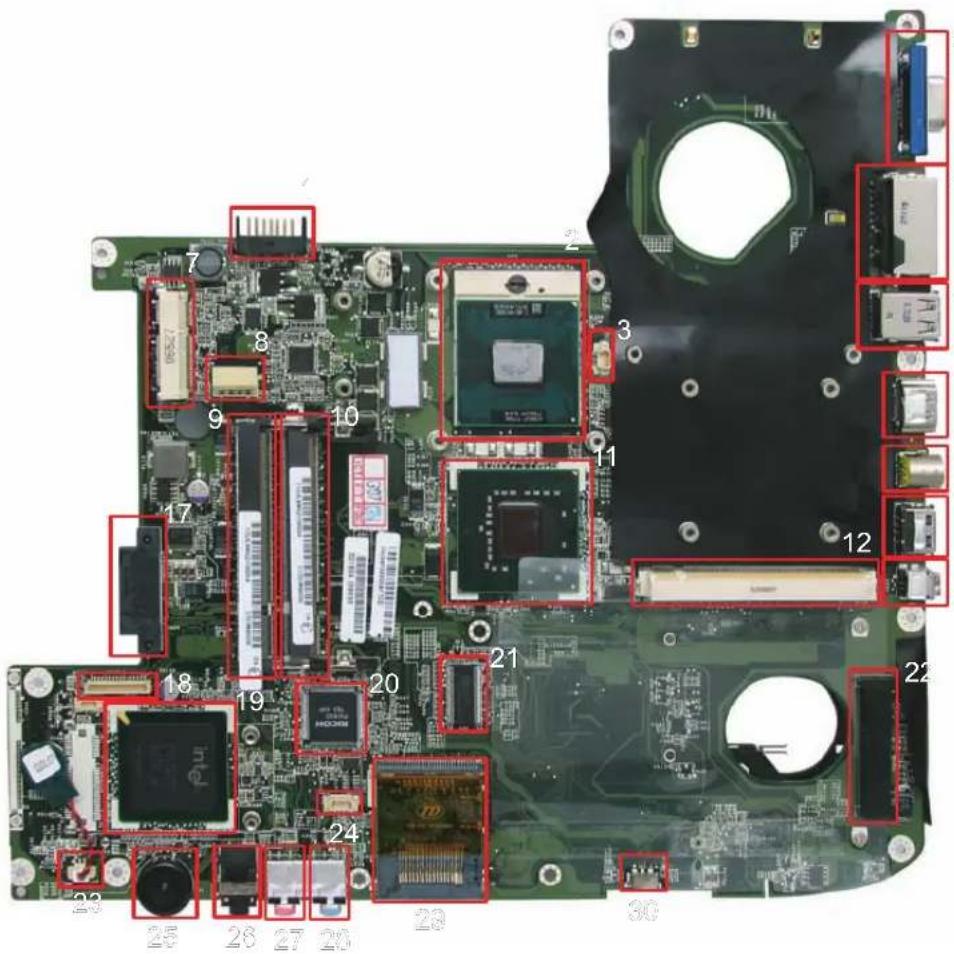
text_image
Labeled diagram of a computer motherboard with numbered components, highlighting internal hardware and component layouts.1 CN15 Battery Connector 16 CN26 IEEE 1394 Connector
2 U22 CPU Socket 17 CN28 Optical Disk Drive Connector
3 CN20 Fan Connector 18 CN30
4 CN13 VGA Jack 19 U34 South Bridge
5 CN14 Ethernet Controller 20 U32 Audio Codec
6 CN18 USB Connector 21 U31
7 CN19 Wireless LAN Card Connector 22 CN32 SATA HDD Connector
8 PJ1 DC-IN Connector 23 CN39
9 CN25 DIMM Socket 24 CN35 Speaker Connector
10 CN23 DIMM Socket 25 VR1 Volume Dial
11 U29 North Bridge
26 CN30 Headphones/Speaker/Line-out Jack
12 U30
27 CN37 Microphone-in Jack
13 CN21 HDMI Connector
28 CN36 Line-in Jack
14 CN22 S-Video Connector
29 CN38 5-in-1 Card Reader
15 CN23 USB Connector 30 U37 Infrared Sensor
Bottom View
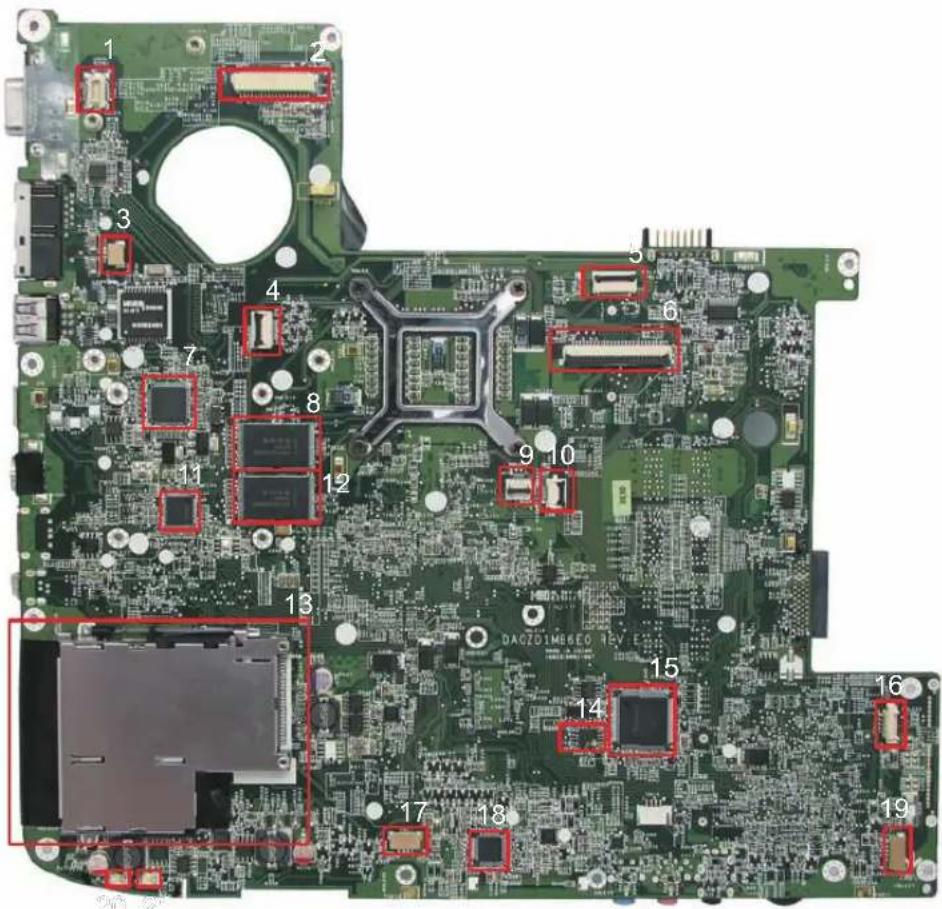
text_image
Labeled diagram of a green printed circuit board with numbered components and red annotations highlighting specific areas.1 CN2 12 U7 DDR2 SDRAM IC
2 CN1 LCD Connector 13 CN9 Card Bus Socket
3 CN3 MDC Connector 14 U11
4 CN5 Email Board Connector 15 U10
Touchpad Connector
Winbond
5 CN4 Power Board Connector 16 CN16 Subwoofer Connector
6 CN6 Keyboard Connector 17 CN11 MSC Connector
7 U4 Audio Codec 18 U19
8 U6 DDR2 SDRAM IC 19 CN12
9 CN7 Bluetooth Connector
20 LED2
HDD LED
10 CN8 Wireless Connector
21 LED3
Battery LED
11 U8
FRU (Field Replaceable Unit) List
This chapter gives you the FRU (Field Replaceable Unit) listing in global configurations of Aspire Chapla. Refer to this chapter whenever ordering for parts to repair or for RMA (Return Merchandise Authorization).
Please note that WHEN ORDERING FRU PARTS, you should check the most up-to-date information available on your regional web or channel. For whatever reasons a part number change is made, it will not be noted on the printed Service Guide. For ACER AUTHORIZED SERVICE PROVIDERS, your Acer office may have a DIFFERENT part number code from those given in the FRU list of this printed Service Guide. You MUST use the local FRU list provided by your regional Acer office to order FRU parts for repair and service of customer machines.
NOTE: To scrap or to return the defective parts, you should follow the local government ordinance or regulations on how to dispose it properly, or follow the rules set by your regional Acer office on how to return it.
Aspire Chapla Exploded Diagram
| Category | No. | Part Name and Description | Acer Part No. |
| ADAPTER | |||
 | ADAPTER 65W 3 PIN Delta SADP-65KB DBRF LF | AP.06501.010 | |
| ADAPTER LSE - 65W, SLS0335A1957LF YELLOW LF | AP.06506.004 | ||
| ADAPTER 65W 3 PIN LITE-ON PA1650-02 QY LF | AP.06503.013 | ||
| BATTERY | |||
 | Battery SANYO TM-2007A Li-Ion 3S2P6 cell 4000mAh Main COMMON Y Cell, IC8030 | BT.00603.039 | |
| Battery SONY TM-2007A Li-Ion 3S2P6cell 4000mAh Main COMMON G4E (LIP6233ACPC SY6) | BT.00604.017 | ||
| Battery SANYO TM-2007A Li-Ion 3S2P6 cell 4800mAh Main COMMON IC8030 | BT.00603.040 | ||
| Battery LI-ION MYNA 2 6CELL2.4 (SONYPACK 4,800MAH) | BT.00604.005 | ||
| Battery SONY TM-2007A Li-Ion 3S3PSONY 9 cell 7200mAh Main COMMON | BT.00904.003 | ||
| BOARD | |||
 | MODEM BOARD FOXCONNT60M951.00 | 54.TG607.001 | |
 | BLUETOOTH MODULE (T60H928.01) 54 | TAXV7.001 | |
| MINI PCI WIRELESS BOARD 802.11 A/B/G MOW1 INTEL MM872612 | KI.GLN01.001 | ||
| MINI PCI WIRELESS BOARD 802.11 A/B/G MOW2 INTEL MM872659 | KI.GLN01.002 | ||
| MINI PCI WIRELESS BOARD 802.11 A/B/G ROW INTEL MM874511 | KI.GLN01.003 | ||
| MINI PCI WIRELESS BOARD 802.11 A/B/G JPN | KI.GLN01.004 | ||
 | WIRELESS LAN BOARD 802.11BGINTEL 3945BG | KI.GLN01.005 | |
| INTEL WIRELESS WIFI LINK 4965ANG MOW1 (MM#886224) | KI.KDN01.001 | ||
| INTEL WIRELESS WIFI LINK 4965ANG MOW2 (MM#886220) | KI.KDN01.002 | ||
| INTEL WIRELESS WIFI LINK 4965ANG ROW (MM#886434) | KI.KDN01.003 | ||
| INTEL WIRELESS WIFI LINK 4965ANG JP (MM#886437) | KI.KDN01.004 | ||
| WIRELESS LAN CARD FOXCONNT60h976.00 MINI | 54.AZL07.001 | ||
 | FUNCTION BOARD 55.TG607.001 | ||
 | TOUCHPAD BOARD W/FINGER PRINT 55.TG607.002 | ||
 | USB BOARD 55.TG607.003 | ||
 | LED BOARD 55.TG607.004 | ||
| CABLE | |||
| PWR CORD V943B30001218008 DANISH 3P | 27.A03V7.006 | ||
| PWR CORD(ISR)1.8M 3PBLK FZ010008-038 | 27.A50V7.002 | ||
| PWR CORD V50CB3T3012180QD TW-110V,3P | 27.A99V7.002 | ||
| POWER CORD(SWI)1.8M 3PBLACK FZ010008-011 | 27.A99V7.004 | ||
| POWER CORD(IT) 1.8M 3PBLACK FZ010008-008 | 27.A99V7.005 | ||
| POWER CORD(S.A) 1.8M 3BLACK FZ010008-006 | 27.T48V7.001 | ||
| POWER CORD US 3PIN ROHS 27.TAXV7.001 | |||
| POWER CORD(EU) 1.8M 3PBLACK FM010008-010 | 27.TATV7.001 | ||
| POWER CORD(UK) 1.8M 3PBLACK FP010008-013 | 27.TATV7.003 | ||
| BLUETOOTH CABLE 50.TG607.001 | |||
| FFC CABLE - FUNCTION/B TO MB 50.TG607.002 | |||
| FFC CABLE - LED/B TO MB 50.TG607.003 | |||
| FINGER PRINT/TP BOARD CABLE 50.TG607.004 | |||
| PWR CORD V943B30001218008 DANISH 3P | 27.A03V7.006 | ||
| PWR CORD(ISR)1.8M 3PBLK FZ0I0008-038 | 27.A50V7.002 | ||
| PWR CORD V50CB3T3012180QD TW-110V,3P | 27.A99V7.002 | ||
| POWER CORD(SWI)1.8M 3PBLACK FZ010008-011 | 27.A99V7.004 | ||
| POWER CORD(IT) 1.8M 3PBLACK FZ010008-008 | 27.A99V7.005 | ||
| POWER CORD(S.A) 1.8M 3BLACK FZ010008-006 | 27.T48V7.001 | ||
| POWER CORD US 3PIN ROHS 27.TAXV7.001 | |||
| POWER CORD(EU) 1.8M 3PBLACK FM010008-010 | 27.TATV7.001 | ||
| POWER CORD(UK) 1.8M 3PBLACK FP010008-013 | 27.TATV7.003 | ||
| BLUETOOTH CABLE 50.TG607.001 | |||
| FFC CABLE - FUNCTION/B TO MB 50.TG607.002 | |||
| FFC CABLE - LED/B TO MB 50.TG607.003 | |||
| FINGER PRINT/TP BOARD CABLE 50.TG607.004 | |||
| Category | No. | Part Name and Description | Acer Part No. |
| CASE/COVER/BRACKET ASSEMBLY | |||
 | MIDDLE COVER 42.TG607.001 | ||
 | UPPER CASE FOR FP W/TP, TP CABLE | 60.TG607.001 | |
 | LOWER CASE W/ SPEAKER, MODEM CABLE | 60.TG607.002 | |
 | BASE ODD CAP 42.TG607.002 | ||
 | BASE DUCK RUBBER 42.TG607.003 | ||
 | RAM DOOR 42.TG607.004 | ||
 | TP BRACKET 33.TG607.003 | ||
 | DUMMY PCMCIA CARD 42.TDY07.003 | ||
 | DUMMY 4 IN 1 CARD 42.TG607.005 | ||
| CPU/PROCESSOR | |||
 | CPU Intel Core2Dual T7100 PGA 1.8G 2M 800 SLA4A | KC.71001.DTP | |
| CPU Intel Core2Dual T7300 PGA 2.0G 4M 800 SLA45 | KC.73001.DTP | ||
| CPU Intel Core2Dual T7500 PGA 2.2G 4M 800 SLA44 | KC.75001.DTP | ||
| CPU Intel Core2Dual T77500 PGA 2.4G 4M 800 SLA44 | KC.77001.DTP | ||
| COMBO MODULE | |||
 | DVD/CDRW COMBO MODULE 6M.TG607.007 | ||
| DVD/CDRW COMBO DRIVE 24X SONY CRX880A LF W/O BEZEL | KO.0240E.005 | ||
| DVD/CDRW COMBO DRIVE 24X HLDS GCC-T10N PATA LF W/O BEZEL | KO.0240D.005 | ||
| ODD BRACKET 33.TG607.004 | |||
 | DVD/CDRW COMBO BEZEL 42.TG607.006 | ||
| DVD-RW DRIVE | |||
 | DVD/RW SUPER MULTI MODULE 6M.TG607.008 | ||
| DVD SUPER MULTI TRAY IN HLDS GSA-T20N LF W/O BEZEL | KU.0080D.027 | ||
| DVD SUPER MULTI TRAY IN PANASONIC UJ-850 U LF W/O BEZEL | KU.00807.055 | ||
| DVD SUPER MULTI TRAY IN PHILIPS DS-8A1P LF W/O BEZEL | KU.0080D.027 | ||
| OPTICAL BRACKET 33.TG607.004 | |||
 | DVD SUPER MULTI BEZEL 42.TG607.007 | ||
| HDD/HARD DISK DRIVE | |||
 | 80GB HGST 2.5" 5400RPM SATA HTS541680J9SA00 SURUGA-B LF F/W: C70P | KH.08007.021 | |
| 80GB TOSHIBA 2.5" 5400rpm 80GB MK8037GSX Gemini BS SATA LF F/W:DL230J | KH.08004.010 | ||
| 80GB WD 2.5" 5400rpm 80GB WD800BEVS-22RST0 ML80 SATA LF F/W:04.01G04 | KH.08008.033 | ||
| 120GB HGST 2.5" 5400RPM SATA HTS541612J9SA00 SURUGA-B LF F/W: C70P | KH.12007.010 | ||
| 120GB TOSHIBA 2.5" 5400rpm 120GB MK1237GSX Gemini BS SATA LF F/W:DL130J | KH.12004.006 | ||
| 120GB WD 2.5" 5400rpm 120GB WD1200BEVS-22RST0 ML80 SATA LF F/W:04.01G04 | KH.12008.018 | ||
| HDD SEAGATE 2.5" 5400rpm 120GB ST9120822AS(9S1133-190) Venus SATA LF F/W:3.ALD | KH.12001.031 | ||
| 160GB HGST 2.5" 5400RPM SATA HTS541616J9SA00 SURUGA-B LF F/W: C70P | KH.16007.011 | ||
| 160GB TOSHIBA 2.5" 5400rpm 160GB MK1637GSX Gemini BS SATA LF F/W: DL030J | KH.16004.001 | ||
| 160GB WD 2.5" 5400rpm 160GB WD1600BEVS-22RST0 ML80 SATA LF F/W:04.01G04 | KH.16008.019 | ||
| HDD SEAGATE 2.5" 5400rpm 160GB ST9160821AS(9S1134-190) Venus SATA LF F/W:3.ALD | KH.16001.026 | ||
| HDD TOSHIBA 2.5" 4200rpm 200GB MK2035GSS Gemini SATA LF F/W:DK022A | KH.20004.001 | ||
 | HDD COVER ASSY 42.TG607.008 | ||
| KEYBOARD | |||
 | Keyboard 12KB-FV1 Chapla Internal Standard 84KS Black US International (change +/-/ location) | KB.INT00.171 | |
| Keyboard 12KB-FV1 Chapla Internal Standard 84KS Black US International Hebrew (change +/-/ location) | KB.INT00.172 | ||
| Keyboard 12KB-FV1 Chapla Internal Standard 85KS Black UK (change +/-/ location) | KB.INT00.173 | ||
| Keyboard 12KB-FV1 Chapla Internal Standard 85KS Black Turkish (change +/-/ location) | KB.INT00.174 | ||
| Keyboard 12KB-FV1 Chapla Internal Standard 84KS Black Thailand (change +/-/ location) | KB.INT00.175 | ||
| Keyboard 12KB-FV1 Chapla Internal Standard 85KS Black Swiss/G (change +/-/ location) | KB.INT00.176 | ||
| Keyboard 12KB-FV1 Chapla Internal Standard 85KS Black Swedish (change +/-/ location) | KB.INT00.177 | ||
| Keyboard 12KB-FV1 Chapla Internal Standard 85KS Black Spanish (change +/-/ location) | KB.INT00.178 | ||
| Keyboard 12KB-FV1 Chapla Internal Standard 85KS Black Slovak (change +/-/ location) | KB.INT00.180 | ||
| Keyboard 12KB-FV1 Chapla Internal Standard 85KS Black SLO/CRO (change +/-/ location) | KB.INT00.181 | ||
| Keyboard 12KB-FV1 Chapla Internal Standard 84KS Black Russian (change +/-/ location) | KB.INT00.182 | ||
| Keyboard 12KB-FV1 Chapla Internal Standard 85KS Black Portuguese (change +/-/ location) | KB.INT00.183 | ||
| Keyboard 12KB-FV1 Chapla Internal Standard 85KS Black Norwegian (change +/-/ location) | KB.INT00.185 | ||
| Keyboard 12KB-FV1 Chapla Internal Standard 84KS Black Korean (change +/-/ location) | KB.INT00.187 | ||
| Keyboard 12KB-FV1 Chapla Internal Standard 88KS Black Japanese (change +/-/ location) | KB.INT00.188 | ||
| Keyboard 12KB-FV1 Chapla Internal Standard 85KS Black Italian (change +/-/ location) | KB.INT00.189 | ||
| Keyboard 12KB-FV1 Chapla Internal Standard 85KS Black Hungarian (change +/-/ location) | KB.INT00.192 | ||
| Keyboard 12KB-FV1 Chapla Internal Standard 84KS Black Greek (change +/-/ location) | KB.INT00.193 | ||
| Keyboard 12KB-FV1 Chapla Internal Standard 85KS Black German (change +/-/ location) | KB.INT00.194 | ||
| Keyboard 12KB-FV1 Chapla Internal Standard 85KS Black French (change +/-/ location) | KB.INT00.195 | ||
| Keyboard 12KB-FV1 Chapla Internal Standard 85KS Black Dutch (change +/-/ location) | KB.INT00.197 | ||
| Keyboard 12KB-FV1 Chapla Internal Standard 85KS Black Danish (change +/-/ location) | KB.INT00.198 | ||
| Keyboard 12KB-FV1 Chapla Internal Standard 85KS Black Czech (change +/-/ location) | KB.INT00.199 | ||
| Keyboard 12KB-FV1 Chapla Internal Standard 84KS Black Traditional Chinese (change +/-/ location) | KB.INT00.201 | ||
| Keyboard 12KB-FV1 Chapla Internal Standard 85KS Black Canadian French (change +/-/ location) | KB.INT00.202 | ||
| Keyboard 12KB-FV1 Chapla Internal Standard 85KS Black Brazilian Portuguese (change +/-/ location) | KB.INT00.202 | ||
| Keyboard 12KB-FV1 Chapla Internal Standard 85KS Black Belgium (change +/-/ location) | KB.INT00.204 | ||
| Keyboard 12KB-FV1 Chapla Internal Standard 84KS Black Arabic/English (change +/-/ location) | KB.INT00.205 | ||
| Keyboard 12KB-FV1 Chapla Internal Standard 84KS Black Israel (change +/-/ location) | KB.INT00.190 | ||
| Keyboard 12KB-FV1 Chapla Internal Standard 85KS Black Slovenia (change +/-/ location) | KB.INT00.179 | ||
| Keyboard 12KB-FV1 Chapla Internal Standard 85KS Black Polish (change +/-/ location) | KB.INT00.184 | ||
| Keyboard 12KB-FV1 Chapla Internal Standard 85KS Black Luxembourgish (change +/-/ location) | KB.INT00.186 | ||
| Keyboard 12KB-FV1 Chapla Internal Standard 85KS Black Irish (change +/-/ location) | KB.INT00.191 | ||
| Keyboard 12KB-FV1 Chapla Internal Standard 85KS Black Finnish (change +/-/ location) | KB.INT00.196 | ||
| LCD | |||
| LCD MODULE 12.1 WXGA W/ ANTENNA 3 WIRE W/0.3M CCD | 6M.TG607.001 | ||
| LCD 12.1 IN. TFT WXGA NON-GLARE AU B121EW03-V5 LF 185NIT 25MS | LK.12105.009 | ||
 | LCD INVERTER BOARD 19.TG607.001 | ||
 | LCD CABLE 50.TG607.006 | ||
 | LCD COVER ASSY W/ANTENNA 3 WIRE W/0.3M CCD BISON | 60.TG607.003 | |
| LCD COVER ASSY W/ANTENNA 3 WIRE W/0.3M CCD SUYIN | 60.TG607.004 | ||
 | LCD BEZEL ASSY W/LOGO W/CCD 60.TG607.005 | ||
| LCD BRACKET W/HINGE - L 33.TG607.001 | |||
| LCD BRACKET W/HINGE - R 33.TG607.002 | |||
| LCD MODULE 12.1 WXGA W/ANTENNA 2 WIRE W/CCD | 6M.TG607.002 | ||
| LCD 12.1 IN. TFT WXGA NON-GLARE AU B121EW03-V5 LF 185NIT 25MS | LK.12105.009 | ||
| LCD INVERTER BOARD 19.TG607.001 | |||
| LCD CABLE 50.TG607.006 | |||
| LCD COVER ASSY W/ANTENNA 2 WIRE W/0.3M CCD BISON | 60.TG607.006 | ||
| LCD COVER ASSY W/ANTENNA 2 WIRE W/0.3M CCD SUYIN | 60.TG607.007 | ||
| LCD BEZEL ASSY W/LOGO W/CCD 60.TG607.005 | |||
| LCD BRACKET W/HINGE - L 33.TG607.001 | |||
| LCD BRACKET W/HINGE - R 33.TG607.002 | |||
| LCD MODULE 12.1 WXGA W/O ANTENNA W/0.3M CCD | 6M.TG607.003 | ||
| LCD 12.1 IN. TFT WXGA NON-GLARE AU B121EW03-V5 LF 185NIT 25MS | LK.12105.009 | ||
| LCD INVERTER BOARD 19.TG607.001 | |||
| LCD CABLE 50.TG607.006 | |||
| LCD COVER ASSY W/O ANTENNA W/0.3M CCD BISON | 60.TG607.008 | ||
| LCD COVER ASSY W/O ANTENNA W/0.3M CCD SUYIN | 60.TG607.009 | ||
| LCD BEZEL ASSY W/LOGO W/CCD 60.TG607.005 | |||
| LCD BRACKET W/HINGE - L 33.TG607.001 | |||
| LCD BRACKET W/HINGE - R 33.TG607.002 | |||
| LCD 12.1 IN. TFT WXGA NON-GLARE AU B121EW03-V5 LF 185NIT 25MS | LK.12105.009 | ||
| LCD INVERTER BOARD 19.TG607.001 | |||
| LCD CABLE 50.TG607.006 | |||
| LCD BRACKET W/HINGE - R 33.TG607.002 | |||
| LCD MODULE 12.1 WXGAG W/ANTENNA 3 WIRE W/ CCD | 6M.TG607.004 | ||
| LCD 12.1 IN. TFT WXGAG GLARE AUB121EW03-V4 LF 185NIT 25MS | LK.12105.008 | ||
| LCD INVERTER BOARD 19.TG607.001 | |||
| LCD CABLE 50.TG607.006 | |||
| LCD COVER ASSY W/ANTENNA 3WIRE W/0.3M CCD BISON | 60.TG607.003 | ||
| LCD COVER ASSY W/ANTENNA 3WIRE W/0.3M CCD SUYIN | 60.TG607.004 | ||
| LCD BEZEL ASSY W/LOGO W/CCD 60.TG607.005 | |||
| LCD BRACKET W/HINGE - L 33.TG607.001 | |||
| LCD BRACKET W/HINGE - R 33.TG607.002 | |||
| LCD MODULE 12.1 WXGAG W/ANTENNA 2 WIRE W/CCD | 6M.TG607.005 | ||
| LCD 12.1 IN. TFT WXGAG GLARE AUB121EW03-V4 LF 185NIT 25MS | LK.12105.008 | ||
| LCD INVERTER BOARD 19.TG607.001 | |||
| LCD CABLE 50.TG607.006 | |||
| LCD COVER ASSY W/ANTENNA 2WIRE W/0.3M CCD BISON | 60.TG607.006 | ||
| LCD COVER ASSY W/ANTENNA 2WIRE W/0.3M CCD SUYIN | 60.TG607.007 | ||
| LCD BEZEL ASSY W/LOGO W/CCD 60.TG607.005 | |||
| LCD BRACKET W/HINGE - L 33.TG607.001 | |||
| LCD BRACKET W/HINGE - R 33.TG607.002 | |||
| LCD MODULE12.1 WXGAG W/OANTENNA W/0.3M CCD | 6M.TG607.006 | ||
| LCD 12.1 IN. TFT WXGAG GLARE AUB121EW03-V4 LF 185NIT 25MS | LK.12105.008 | ||
| LCD INVERTER BOARD 19.TG607.001 | |||
| LCD CABLE 50.TG607.006 | |||
| LCD COVER ASSY W/O ANTENNA W/0.3M CCD BISON | 60.TG607.008 | ||
| LCD COVER ASSY W/O ANTENNA W/0.3M CCD SUYIN | 60.TG607.009 | ||
| LCD BEZEL ASSY W/LOGO W/CCD 60.TG607.005 | |||
| LCD BRACKET W/HINGE - L 33.TG607.001 | |||
| LCD BRACKET W/HINGE - R 33.TG607.002 | |||
| LCD 12.1 IN. TFT WXGAG GLARE AUB121EW03-V4 LF 185NIT 25MS | LK.12105.008 | ||
| LCD INVERTER BOARD 19.TG607.001 | |||
| LCD CABLE 50.TG607.006 | |||
| LCD BRACKET W/HINGE - L 33.TG607.001 | |||
| LCD BRACKET W/HINGE - R 33.TG607.002 | |||
| LCD 12.1 IN. TFT WXGAG GLARE AU B121EW03-V4 LF 185NIT 25MS | LK.12105.008 | ||
| LCD INVERTER BOARD 19.TG607.001 | |||
| LCD CABLE 50.TG607.006 | |||
| LCD BRACKET W/HINGE - L 33.TG607.001 | |||
| LCD BRACKET W/HINGE - R 33.TG607.002 | |||
| MAINBOARD | |||
 | MAINBOARD 965GM SATA UMA W/ CARD READER W/O CPU MEMORY | MB.TG606.001 | |
| MEMORY | |||
 | 512MB HYNIX DDRII 667 512MB HYMP564S64CP6-Y5 LF | KN.5120G.019 | |
| 512MB NANYA DDRII 667 512MB NT512T64UH8B0FN-3C LF | KN.51203.032 | ||
| Memory SAMSUNG SO-DIMM DDRII 667 512MB M470T6554EZ3-CE6 LF | KN.5120B.023 | ||
| 1GB HYNIX DDRII 667 1GB HYMP512S64CP8-Y5 LF | KN.1GB0G.006 | ||
| 1GB NANYA DDRII 667 1GB NT1GT64U8HB0BN-3C (0.09U) | KN.1GB03.014 | ||
| 1GB SAMSUNG DDRII 667 1GB M470T2953EZ3-CE6 LF | KN.1GB0B.011 | ||
| HEATSINK | |||
 | THERMAL MODULE 60.TG607.010 | ||
| MISCELLANEOUS | |||
| NAME PLATE - TM6292 40.TG607.001 | |||
| CCD | |||
 | CCD MODULE 0.3M BISON 57.TG607.001 | ||
| CCD MODULE 0.3M SUYIN 57.TG607.002 | |||
| SPEAKER | |||
| SPEAKER ASSY 23.TG607.001 | |||
| SCERW | |||
| SCREW M2.0*3.0-I-NI-NYLOK 86.A08V7 | 005 | ||
| SCREW M3*0.5+3.5I 86.TDY07.003 | |||
| SCREW M1.6*4.0-I (NI)(NYLOK) 86.FR6V | 7.003 | ||
| SCREW M2.0*6-I-BNI(NYLOK) 86.TG607 | 001 | ||
| SCREW M2.0*1.8 I (NI)(NYLOK) 86.TG607 | 7.002 | ||
| SCREW M2.0*1.5-I(NI)(ANTI-LOOSE) 86. | TG607.003 | ||
| SCREW M2*5-I(BZN)(NYLOK) 86.TG607 | 004 | ||