DME4io-ES - Mixing console YAMAHA - Free user manual and instructions
Find the device manual for free DME4io-ES YAMAHA in PDF.


User questions about DME4io-ES YAMAHA
0 question about this device. Answer the ones you know or ask your own.
Ask a new question about this device
Download the instructions for your Mixing console in PDF format for free! Find your manual DME4io-ES - YAMAHA and take your electronic device back in hand. On this page are published all the documents necessary for the use of your device. DME4io-ES by YAMAHA.
USER MANUAL DME4io-ES YAMAHA
DIGITAL MIXING ENGINE SATELLITE
DME8i-ES / DME8o-ES / DME4io-ES
Owner's Manual
text_image
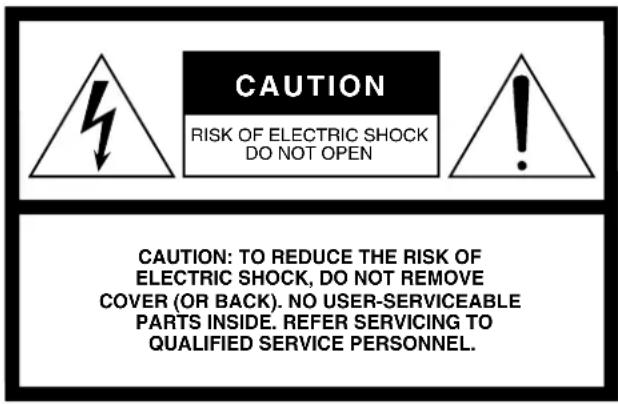
CAUTION RISK OF ELECTRIC SHOCK DO NOT OPEN CAUTION: TO REDUCE THE RISK OF ELECTRIC SHOCK, DO NOT REMOVE COVER (OR BACK). NO USER-SERVICEABLE PARTS INSIDE. REFER SERVICING TO QUALIFIED SERVICE PERSONNEL.The above warning is located on the top of the unit.
Explanation of Graphical Symbols
The lightning flash with arrowhead symbol within an equilateral triangle is intended to alert the user to the presence of uninsulated “dangerous voltage” within the product’s enclosure that may be of sufficient magnitude to constitute a risk of electric shock to persons.

The exclamation point within an equilateral triangle is intended to alert the user to the presence of important operating and maintenance (servicing) instructions in the literature accompanying the product.
IMPORTANT SAFETY INSTRUCTIONS
1 Read these instructions.
2 K eep these instructions.
3 Heed all warnings.
4 Follow all instructions.
5 Do not use this apparatus near water.
6 Clean only with dry cloth.
7 Do not block any ventilation openings. Install in accordance with the manufacturer's instructions.
8 Do not install near any heat sources such as radiators, heat registers, stoves, or other apparatus (including amplifiers) that produce heat.
9 Do not defeat the safety purpose of the polarized or grounding-type plug. A polarized plug has two blades with one wider than the other. A grounding type plug has two blades and a third grounding prong. The wide blade or the third prong are provided for your safety. If the provided plug does not fit into your outlet, consult an electrician for replacement of the obsolete outlet.
10 Protect the power cord from being walked on or pinched particularly at plugs, convenience receptacles, and the point where they exit from the apparatus.
11 Only use attachments/accessories specified by the manufacturer.
12 Use only with the cart, stand, tripod, bracket, or table specified by the manufacturer, or sold with the apparatus. When a cart is used, use caution when moving the cart/apparatus combination to avoid injury from tip-over.
13 Unplug this apparatus during lightning storms or when unused for long periods of time.
14 Refer all servicing to qualified service personnel. Servicing is required when the apparatus has been damaged in any way, such as power-supply cord or plug is damaged, liquid has been spilled or objects have fallen into the apparatus, the apparatus has been exposed to rain or moisture, does not operate normally, or has been dropped.

WARNING
TO REDUCE THE RISK OF FIRE OR ELECTRIC SHOCK, DO NOT EXPOSE THIS APPARATUS TO RAIN OR MOISTURE.
(98-6500)
This product contains a battery that contains perchlorate material.
Perchlorate Material—special handling may apply,
See www.dtsc.ca.gov/hazardouswaste/perchlorate.
FCC INFORMATION (U.S.A.)
1. IMPORTANT NOTICE: DO NOT MODIFY THIS UNIT!
This product, when installed as indicated in the instructions contained in this manual, meets FCC requirements. Modifications not expressly approved by Yamaha may void your authority, granted by the FCC, to use the product.
2. IMPORTANT: When connecting this product to accessories and/or another product use only high quality shielded cables. Cable/s supplied with this product MUST be used. Follow all installation instructions. Failure to follow instructions could void your FCC authorization to use this product in the USA.
3. NOTE: This product has been tested and found to comply with the requirements listed in FCC Regulations, Part 15 for Class "B" digital devices. Compliance with these requirements provides a reasonable level of assurance that your use of this product in a residential environment will not result in harmful interference with other electronic devices. This equipment generates/uses radio frequencies and, if not installed and used according to the instructions found in the users manual, may cause interference harmful to the operation of other electronic devices. Compliance with FCC regulations does
not guarantee that interference will not occur in all installations. If this product is found to be the source of interference, which can be determined by turning the unit "OFF" and "ON", please try to eliminate the problem by using one of the following measures:
Relocate either this product or the device that is being affected by the interference.
Utilize power outlets that are on different branch (circuit breaker or fuse) circuits or install AC line filter/s.
In the case of radio or TV interference, relocate/reorient the antenna. If the antenna lead-in is 300 ohm ribbon lead, change the lead-in to co-axial type cable.
If these corrective measures do not produce satisfactory results, please contact the local retailer authorized to distribute this type of product. If you can not locate the appropriate retailer, please contact Yamaha Corporation of America, Electronic Service Division, 6600 Orangethorpe Ave, Buena Park, CA90620
The above statements apply ONLY to those products distributed by Yamaha Corporation of America or its subsidiaries.
* This applies only to products distributed by YAMAHA CORPORATION OF AMERICA. (class B)
COMPLIANCE INFORMATION STATEMENT (DECLARATION OF CONFORMITY PROCEDURE)
Responsible Party : Yamaha Corporation of America
Address : 6600 Orangethorpe Ave., Buena Park, Calif. 90620
Telephone : 714-522-9011
Type of Equipment : DIGITAL MIXING ENGINE SATELLITE
Model Name : DME8i-ES/DME8o-ES/DME4io-ES
This device complies with Part 15 of the FCC Rules.
Operation is subject to the following two conditions:
1) this device may not cause harmful interference, and
2) this device must accept any interference received including interference that may cause undesired operation.
See user manual instructions if interference to radio reception is suspected.
* This applies only to products distributed by
YAMAHA CORPORATION OF AMERICA.
(FCC DoC)
NEDERLAND / THE NETHERLANDS
IMPORTANT NOTICE FOR THE UNITED KINGDOM Connecting the Plug and Cord
WARNING: THIS APPARATUS MUST BE EARTHED
IMPORTANT. The wires in this mains lead are coloured in accordance with the following code:
GREEN-AND-YELLOW : EARTH
BLUE : NEUTRAL
BROWN : LIVE
As the colours of the wires in the mains lead of this apparatus may not correspond with the coloured markings identifying the terminals in your plug proceed as follows:
The wire which is coloured GREEN-and-YELLOW must be connected to the terminal in the plug which is marked by the letter E or by the safety earth symbol 📍 or colored GREEN or GREEN-and-YELLOW.
The wire which is coloured BLUE must be connected to the terminal which is marked with the letter N or coloured BLACK.
The wire which is coloured BROWN must be connected to the terminal which is marked with the letter L or coloured RED.
PRECAUTIONS
PLEASE READ CAREFULLY BEFORE PROCEEDING
* Please keep this manual in a safe place for future reference.

WARNING
Always follow the basic precautions listed below to avoid the possibility of serious injury or even death from electrical shock, short-circuiting, damages, fire or other hazards. These precautions include, but are not limited to, the following:
Power supply/Power cord
- Only use the voltage specified as correct for the device. The required voltage is printed on the name plate of the device.
- Use only the included power cord.
If you intend to use the device in an area other than in the one you purchased, the included power cord may not be compatible. Please check with your Yamaha dealer. - Do not place the power cord near heat sources such as heaters or radiators, and do not excessively bend or otherwise damage the cord, place heavy objects on it, or place it in a position where anyone could walk on, trip over, or roll anything over it.
- Be sure to connect to an appropriate outlet with a protective grounding connection. Improper grounding can result in electrical shock.
Do not open
- Do not open the device or attempt to disassemble the internal parts or modify them in any way. The device contains no user-serviceable parts. If it should appear to be malfunctioning, discontinue use immediately and have it inspected by qualified Yamaha service personnel.
Water warning
- Do not expose the device to rain, use it near water or in damp or wet conditions, or place containers on it containing liquids which might spill into any openings.
- Never insert or remove an electric plug with wet hands.
If you notice any abnormality
- If the power cord or plug becomes frayed or damaged, or if there is a sudden loss of sound during use of the device, or if any unusual smells or smoke should appear to be caused by it, immediately turn off the power switch, disconnect the electric plug from the outlet, and have the device inspected by qualified Yamaha service personnel.
- If this device should be dropped or damaged, immediately turn off the power switch, disconnect the electric plug from the outlet, and have the device inspected by qualified Yamaha service personnel.

CAUTION
Always follow the basic precautions listed below to avoid the possibility of physical injury to you or others, or damage to the device or other property. These precautions include, but are not limited to, the following:
Power supply/Power cord
- Remove the electric plug from the outlet when the device is not to be used for extended periods of time, or during electrical storms.
- When removing the electric plug from the device or an outlet, always hold the plug itself and not the cord. Pulling by the cord can damage it.
Location
- Before moving the device, remove all connected cables.
- When setting up the device, make sure that the AC outlet you are using is easily accessible. If some trouble or malfunction occurs, immediately turn off the power switch and disconnect the plug from the outlet. Even when the power switch is turned off, electricity is still flowing to the product all the minimum level. When you are not using the product for a long time, make sure to unplug the power cord from the wall AC outlet.
- If this device is to be mounted in an EIA-standard rack, leave the back of the rack open and make sure that it is at least 10 cm away from walls or surfaces. Also, if this device is to be mounted with devices that tend to generate heat, such as power amplifiers, be sure to keep an adequate gap between this device and the heat-generating devices or install ventilation panels to prevent high temperatures from developing inside this device.
Inadequate ventilation can result in overheating, possibly causing damage to the device(s), or even fire.
- If several of the devices are mounted in an EIA-compliant rack, carefully read the section "Precautions for Using a Rack-mounted DME Satellite" on page 17
- A void setting all equalizer controls and faders to their maximum. Depending on the condition of the connected devices, doing so may cause feedback and may damage the speakers.
- Do not expose the device to excessive dust or vibrations, or extreme cold or heat (such as in direct sunlight, near a heater, or in a car during the day) to prevent the possibility of panel disfiguration or damage to the internal components.
- Do not place the device in an unstable position where it might accidentally fall over.
- Do not block the vents. This device has ventilation holes at the rear to prevent the internal temperature from becoming too high. In particular, do not place the device on its side or upside down. Inadequate ventilation can result in overheating, possibly causing damage to the device(s), or even fire.
- Do not use the device in the vicinity of a TV, radio, stereo equipment, mobile phone, or other electric devices. Doing so may result in noise, both in the device itself and in the TV or radio next to it.
Connections
- Before connecting the device to other devices, turn off the power for all devices. Before turning the power on or off for all devices, set all volume levels to minimum.
Handling caution
- Do not insert your fingers or hands in any gaps or openings on the device.
- Condensation can occur in the device due to rapid, drastic changes in ambient temperature—when the device is moved from one location to another, or air conditioning is turned on or off, for example. Using the device while condensation is present can cause damage. If there is reason to believe that condensation might have occurred, leave the device for several hours without turning on the power until the condensation has completely dried out.
- A void inserting or dropping foreign objects (paper, plastic, metal, etc.) into any gaps or openings on the device. If this happens, turn off the power immediately and unplug the power cord from the AC outlet. Then have the device inspected by qualified Yamaha service personnel.
- Do not use the device for a long period of time at a high or uncomfortable volume level, since this can cause permanent hearing loss. If you experience any hearing loss or ringing in the ears, consult a physician.
- Do not rest your weight on the device or place heavy objects on it, and avoid use excessive force on the buttons, switches or connectors.
Backup battery
- This device has a built-in backup battery that maintains data in internal memory even when the device's power is switched off. The backup battery will eventually become depleted, however, and when that happens the contents of the internal memory will be lost.* To prevent loss of data be sure to replace the backup battery before it becomes fully depleted. When the backup battery charge becomes low, the [ERROR] indicator on the front panel blinks (For details, refer to "Error Messages" on page 38).
In this case, do not turn off the power and immediately transfer any data you want to save to a computer or other external storage device, then have qualified Yamaha service personnel replace the backup battery. The average life of the internal backup battery is approximately 5 years, depending on operating conditions.
* Data items maintained in the internal memory by the backup battery are as follows:
- Current scene parameters and number.
• Device parameters (HA, UTILITY, Master Mute/Level, etc.). - Event log.
Data items other than those described above are stored in memory that does not require backup power, and will be retained even if the backup battery fails.
Do not turn the [POWER] switch on and off repeatedly and rapidly. Be sure to wait six seconds or more between turning the power to the unit off and then on.
The rubber feet included in this package can be attached to the speaker to prevent slippage when it is to be used on a slippery surface.
Yamaha cannot be held responsible for damage caused by improper use or modifications to the device, or data that is lost or destroyed.
Always turn the power off when the device is not in use.
The performance of components with moving contacts, such as switches, volume controls, and connectors, deteriorates over time. Consult qualified Yamaha service personnel about replacing defective components.
- Copying of the commercially available musical data including but not limited to MIDI data and/or audio data is strictly prohibited except for your personal use.
- The illustrations in this owner's manual are for instructional purposes, and may appear somewhat different from the actual equipment.
- EtherSound is a trademark of Digigram SA.
- Ethernet is a trademark of Xerox Corporation.
- All other trademarks are the property of their respective holders and are hereby acknowledged.
Contents
Foreword 7
Accessories (Please make sure the following items are included in the package.).... 7
Options.... 7
About the Product Names.... 7
About the Firmware Version 7
Preparation.... 7
Connecting the AC power cord.... 7
Turning the power on and off 7
Introduction to the DME Satellite 8
Differences between DME8i-ES, DME8o-ES, and DME4io-ES 8
DME Satellite Features 8
Audio System Network 9
Glossary for the DME Satellite.... 9
Signal Types.... 11
System Examples.... 12
About DME Designer.... 13
Controls and Connectors 14
Front Panel 14
Caution when turning the power off 15
Rear Panel.... 16
Precautions for Using a Rack-mounted DME Satellite.. 17
Connecting to a Computer 18
USB Connection.... 18
Network Settings.... 19
Ethernet Connection ([NETWORK] Connector)...... 20
Audio I/O Connection 24
Digital Audio Connection (EtherSound Connectors).... 24
Analog Audio Connection ([INPUT] & [OUTPUT] Connectors) 25
Connecting to an External Device.... 26
Remote Connection ([REMOTE] Connector)...... 26
Controlling external head amplifiers from the DME Satellite 26
Controlling a DME Satellite's internal head amps from a digital mixer 27
Controlling the DME Satellite from an external device..... 27
EtherSound Connection (EtherSound Connectors)...... 28
Controlling DME Satellite's internal head amps from a digital mixer 28
Network Connection ([NETWORK] Connectors) ..... 29
GPI Connection ([GPI] Connector).... 30
Other Functions.... 31
Initializing the DME Satellite.... 31
References 32
Options 32
ICP1....32
CP4SW, CP4SF, and CP1SF.... 32
Troubleshooting.... 33
Component.... 33
MIDI Data Format 34
-
MIDI functions on the DME8i-ES, DME8o-ES, and DME4io-ES 34
-
MIDI Data Flow 34
-
MIDI Setup.... 34
-
MIDI Format 35
MIDI Implementation Chart 37
Display Messages.... 38
Error Messages.... 38
Warning Messages 38
General Specifications 39
Electrical Characteristics.... 39
Input/Output Characteristics 42
[NETWORK] Connector (100Base-TX Ethernet, RJ-45) 43
Dimensions 44
Index 45
Foreword
Thank you for choosing a Yamaha DME8i-ES/DME8o-ES/DME4io-ES Digital Mixing Engine Satellite.
In order to take full advantage of the features and performance provided by the DME8i-ES/DME8o-ES/DME4io-ES, we urge you to read this owner's manual thoroughly before connecting or using the unit. Keep this manual in a safe place for future reference.
Accessories (Please make sure the following items are included in the package.)
- DME8i-ES/DME8o-ES/DME4io-ES Owner's Manual (this document)
• A C power cord
• E uroblock plug (16P) x 1
• E uroblock plug (3P) x 8
• R ubber feet x 4
Options
Control Panels
• ICP1 Intelligent Control Panel
- CP4SW Control Panel
- CP4SF Control Panel
- CP1SF Control Panel
NOTE
For more information on your Control Panel, refer to the owner's manual that came with the Control Panel, as well as the DME Designer Owner's Manual.
About the Product Names
In this manual, models DME8i-ES, DME8o-ES, and DME4io-ES are all called "DME Satellite," and models DME64N and DME24N, DME8i-C/DME8o-C/DME4io-C and the DME Satellite are categorized as the DME series.
About the Firmware Version
You can check the version number of the DME Satellite firmware by using the DME Designer application software. You can also download the latest firmware from the following Yamaha website.
http://www.yamahaproaudio.com/downloads/
Preparation
Connecting the AC power cord

Be sure to turn all devices OFF before connecting AC mains power.
First plug the female-connector end of the AC cord into the [AC IN] socket on the rear panel of the DME Satellite, then plug the male plug into an appropriate AC mains outlet.
Be sure to use the voltage specified for the device.
Turning the power on and off

To prevent the initial power-on surge from generating a large noise spike or damaging your speaker system, turn the devices on in the following order: audio sources, mixer (such as M7CL or PM5D), DME Satellite, and finally power amplifiers.
Reverse this order when turning power off.
- Press the [POWER] switch to turn on the power to the DME Satellite.
- Press the [POWER] switch again to turn off the power.
NOTE
The DME Satellite remembers scene settings when you turn off the power.
When you turn on the power to the DME Satellite, it will start up with the same scene settings.
You can use the “Last Mem. Resume” setting in DME Designer to set up the DME Satellite so that at the startup it will recall the scene selected before you turned off the power to the device.

- Do NOT turn off the power to the DME Satellite while it is receiving data from DME Designer or while it is being manipulated from an external device. Otherwise, a malfunction may occur.
- Even when the power switch is turned off, electricity is still flowing to the product all the minimum level. When you are not using the product for a long time, make sure to unplug the power cord from the wall AC outlet.
Introduction to the DME Satellite
Differences between DME8i-ES, DME8o-ES, and DME4io-ES
The differences between these three models are as follows:
DME8i-ES
This model features 8-channel analog inputs.
DME8o-ES
This model features 8-channel analog outputs.
DME4io-ES
This model features 4-channel analog inputs and 4-channel analog outputs.
DME Satellite Features
In addition to basic mixing and matrix output functions, the DME Satellite includes a equalizers, compressors, delay, etc. – that can be patched together via DME Designer to configure just about any audio system you need. The EtherSound connectors on the device enable you to remotely control analog inputs and outputs by transferring digital audio signals via a network.
The following steps summarize the process for setting up the DME Satellite for use: (For details, refer to the “DME Setup Manual”.)
- Install USB-MIDI Driver, DME Designer and DME-N Network Driver.
- Set up the network from DME Designer (page 19).
- Connect devices.
• Network connection
Ethernet connection (page 20)
USB connection (page 18)
- EtherSound connection (page 28)
In order to route inputs and outputs, you'll need the "AVS-ESMonitor" application software made by the AuviTran SARL.
You can download this from the following website.
http://www.auvitran.com/view.php?products_AVS-ESMonitor.php
• Analog connection (page 25)
- External device connection
Remote connection (page 26)
GPI connection (page 30)
- Make network settings on your computer.
- Create a configuration using DME Designer, then transfer it to the DME Satellite.
Audio System Network
Multiple DME series units that are interconnected in a network via Ethernet function as a single audio system.
In a DME audio system, a group of the same models that can be operated in sync is called a “device group;” audio processing divisions that accommodate multiple device groups are called “zones;” and the entire area serviced by the acoustic system is called an “area.”
Each device group always includes one DME series unit that functions as the “group master” and controls all other DME series units in the same device group.
If a computer is connected to the network, you can use the computer to control an entire device group via the group master.
Glossary for the DME Satellite
This section explains terminology specific to the DME Satellite.
Components and parameters
The individual audio processing modules (equalizers, compressors, etc.) are called "components."
External head amplifier control modules are also available as components.
Changing the parameters of components enables control over the operation of the components.
Configuration
A "configuration" is a complete set of components for constructing an audio system.
Each configuration determines the audio function(s) of the corresponding DME Satellite unit.
All parameter sets included with each component in a configuration are called "preset parameters."
One DME Satellite unit has a number of configurations, and a configuration has a number of preset parameters.
User Defined buttons (User Defined parameters)
Assigning parameters to be User Defined parameters enables you to control the device from the ICP1 and the DME64N/DME24N.
Refer to the "DME Designer Owner's Manual" for details.
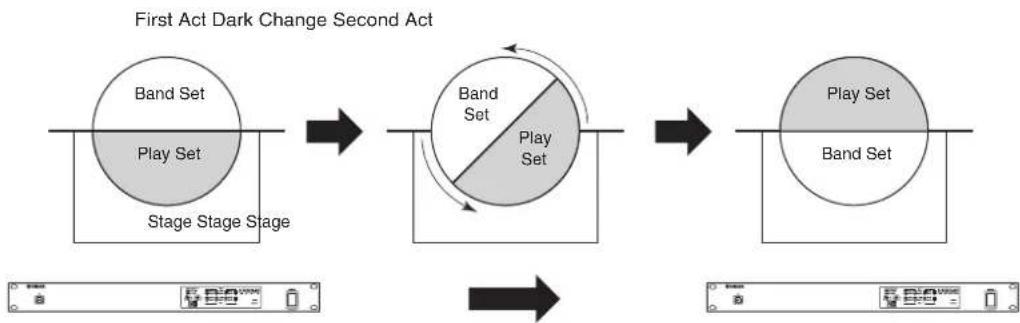
Scene
A combination of all configuration and preset parameters is called a "scene."
Scenes can be recalled from an ICP1, GPI device, other external controllers, DME64N/DME24N, or computer.
Up to 999 scenes can be stored for each device group.
Scene structure

flowchart
graph LR
    A["Scene 1"] --> B["Matrix Mixer"]
    C["Scene 2"] --> B
    D["..."] --> B
    E["Scene 999"] --> B
    B --> F["Configuration"]
    F --> G["Ex.: Gate"]
    F --> H["Attack"]
    F --> I["Decay"]
    F --> J["Range"]
    F --> K["Threshold"]
    F --> L["Key in"]
    F --> M["Hold"]
    N["Component ="] --> O["Ex.: Gate"]
    N --> P["Attack"]
    N --> Q["Decay"]
    N --> R["Range"]
    N --> S["Threshold"]
    N --> T["Key in"]
    N --> U["Hold"]
Scene change
flowchart
graph LR
    A["Stage Stage Stage"] --> B["Play Set"]
    B --> C["Play Set"]
    C --> D["Play Set"]
    D --> E["Play Set"]
    style A fill:#f9f,stroke:#333
    style B fill:#ccf,stroke:#333
    style C fill:#cfc,stroke:#333
    style D fill:#fcc,stroke:#333
    subgraph First Act Dark Change Second Act
        A
        B
        C
    end
Scene 1 Scene Recall Scene 2
Signal Types
DME Satellite audio system signals can be broadly categorized as follows.
1 Audio
Analog and digital signals are input and output between the DME Satellite, other DME series units, and other audio devices. Analog signals are input and output via the [INPUT]/[OUTPUT] jacks. Digital signals are input and output via the EtherSound jacks.
2 Control signals within a device group
Device group control signals control all DME series devices in the group.
There are two types of device group control signals, as follows:
• Control signals between the computer and the group master DME series unit
• Control signals between the group master DME series unit and the other DME series units
You can use the DME Designer application to control the entire device group, such as sending components to the devices and setting the parameters as required.
3 Control signals between devices outside the device group
These signals provide communication and control between individual devices.
Included in this category are MIDI messages transferred between [USB] connectors, GPI signals transferred between [GPI] connectors, and remote head amp control signals handled via the [REMOTE] connector.
Type of signals handled by the DME Satellite
| Connector Audio Signal | Device Control | Reference Page | |
| [USB] Connector — | Control signals between computer and DME SatelliteMIDI messages | page 18 | |
| [NETWORK] Connector — | Control signals between computer and DME SatelliteControl signals between DME SatellitesControl signals with a controller such as an AMX or Crestron | page 20page 29 | |
| EtherSound Connector | Up to 16 channels of input and output. | Internal head amp control signals with a digital mixerControl signals with AVS-ESMonitor | page 24page 28 |
| [GPI] Connector — | GPI control signals between GPI device (GPI controller, etc.) and DME series unit | page 30 | |
| [REMOTE] Connector — | Control signals to/from an external device (such as AD8HR head amplifier)Control signals for a digital mixer and internal head ampControl signals with a controller such as an AMX or CrestronMIDI messages | page 26 | |
| [INPUT]/[OUTPUT]Connectors (audio in/out) | The number of I/O channels depends on model. | — page 25 |
System Examples
Multiple DME Satellite units: Large-scale system

flowchart
graph TD
    subgraph_Space_A["Space A"]
        A["Computer"] --> B["ICP1"]
        B --> C["Hub"]
        C --> D["Primary Master"]
        D --> E["M7CL"]
        E --> F["EtherSound compatible I/O card × 2"]
    end

    subgraph_Space_B["Space B"]
        G["Hub"] --> H["DME8i-ES"]
        H --> I["Analog In"]
        H --> J["DME8i-ES"]
        J --> K["Analog In"]
        J --> L["DME4io-ES"]
        L --> M["Analog In"]
        L --> N["Analog Out"]
    end

    subgraph_Space_C["Space C"]
        O["Hub"] --> P["DME8o-ES"]
        P --> Q["Analog Out"]
        P --> R["DME8o-ES"]
        R --> S["Analog Out"]
        R --> T["DME8o-ES"]
        T --> U["Analog Out"]
    end

    subgraph_Space_D["Space D"]
        V["Hub"] --> W["DME8i-ES"]
        W --> X["Analog In"]
        W --> Y["DME4io-ES"]
        Y --> Z["Analog In"]
        Y --> AA["DME8o-ES"]
        AA --> AB["Analog Out"]
        AA --> AC["Analog Out"]
    end

    A --> C
    C --> D
    D --> V
    V --> V
    style Space_A fill:#f9f,stroke:#333
    style Space_B fill:#ccf,stroke:#333
    style Space_C fill:#cfc,stroke:#333
    style Space_D fill:#fcc,stroke:#333
NOTE
- Connect the computer to the [IN] connector of the first daisy-chained EtherSound device. This connector can also be used in common with the same network as Ethernet Control.
- Units following the [OUT] connector of the first EtherSound device cannot be used in common with the same network as Ethernet Control.
About DME Designer
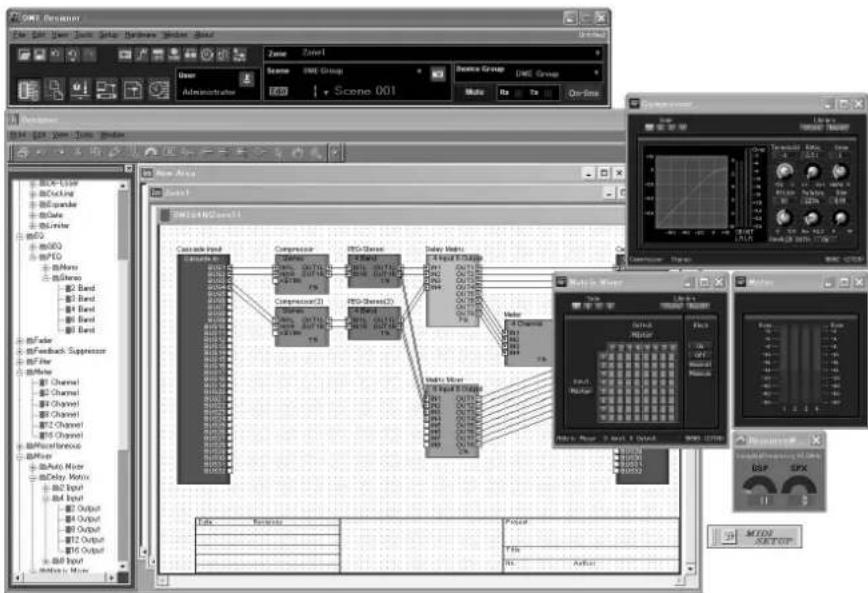
DME Designer software enables you to integrate, configure, and control the DME series system from a connected computer.
You can build the DME series audio system using graphic blocks in DME Designer that are displayed on the computer monitor.
The DME series settings, configuration, and parameter data are transferred from the computer to the DME series unit via the USB or Ethernet connection.
DME series settings, configuration, and parameter data is sent via USB or Ethernet to the connected DME series unit. After the data is transmitted, you can disconnect the DME series unit from the computer and use it as an independent processor.
You can also connect it to a computer and control it in realtime from DME Designer.
If multiple DME series units are connected in the network, DME Designer enables you to build a configuration that includes those units.
Please download the DME Designer application, driver, DME setup manual, and DME Designer owner's manual at the following URL:
http://www.yamahaproaudio.com/
Refer to the “Connecting to a Computer” (page 18) for more information on connecting a computer to the DME Satellite. For details on how to install DME Designer and the drivers that are required for connection, refer to the “DME Setup Manual”.
Refer to the DME Designer Owner's Manual for setup and operation instructions.
flowchart
graph TD
    A["User"] --> B["Compressor"]
    B --> C["MPROM"]
    C --> D["I/O"]
    D --> E["Output"]
    style A fill:#f9f,stroke:#333
    style B fill:#ccf,stroke:#333
    style C fill:#cfc,stroke:#333
    style D fill:#fcc,stroke:#333
    style E fill:#ffc,stroke:#333
Controls and Connectors
Front Panel
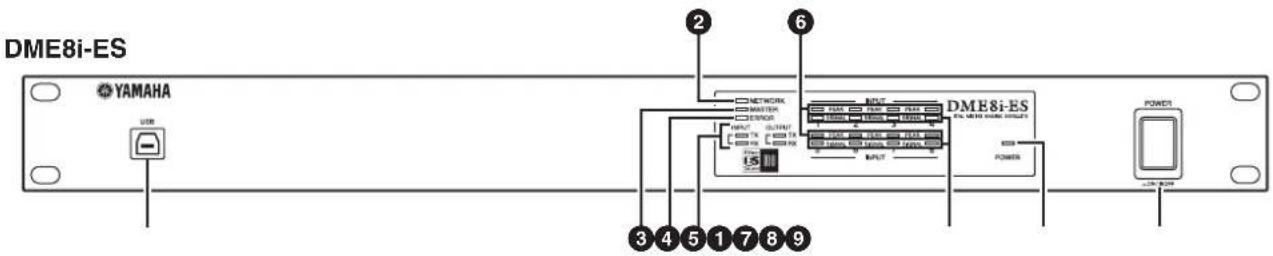
text_image
DME8i-ES YAMAHA USB 2 6 NETWORK MASTER ERROR OUTPUT DATA DATA DATA DATA DATA DATA DATA DATA DATA DATA DATA DATA DATA DATA DATA DATA DATA DATA DATA DATA DATA DATA DATA DATA DATA DATA DATA DATA DATA DATA DME8i-ES DME8i-ES POWER1
text_image
DME8o-ES YAMAHA USB 2 6 DME8o-ES POWER 3 4 5 1 7 8 9
text_image
DME4io-ES YAMAHA USB 2 6 NETWORK MASTER ERROR MAIN OUTPUT TX TX IS DME4io-ES TEL. ENI. DIME GROUP POWER 3 4 5 1 7 8 9①[USB] Connector
Use this connector to connect the DME Satellite to the computer's USB port. If you plan to use a USB connection, you must first install the USB-MIDI Driver on your computer. Refer to the "DME Setup Manual" (PDF file) for installation instructions.
Be sure to follow the procedure below when you make a USB connection with a computer. Otherwise, the computer and/or DME Satellite may freeze, resulting in damages or loss of data.
If the computer or DME Satellite freezes, turn the power to the DME Satellite off and then on, then restart the computer.
![YAMAHA DME4io-ES - ①[USB] Connector - 1](/content/2026/06/1230034/images/3c4bc7bb3b33f0ad3c7ff60f4d4464ea8703cb23c0daf3cd1d62be2819045686.jpg)
- Before you connect the DME Satellite to the computer via USB, cancel the computer's energy saving mode (such as Suspend, Sleep, or Stand-by mode).
- Before turning on the power to the DME Satellite, first connect its [USB] connector to the computer's USB port.
-
Before turning the power to the unit on or off, and before connecting or disconnecting the USB cable, take the following actions:
-
Q uit all open applications.
- Make sure that the DME Satellite is NOT transferring any data.
- Be sure to wait six seconds or more between turning the power to the unit on and then off (or off and then on), or between connecting and disconnecting (or vice versa) the USB cable.
②[NETWORK] Indicator
Lights orange while data communication is occurring via the [USB] or [NETWORK] connector.
③[MASTER] Indicator
Lights green when the device is operating as the group master. The indicator is turned off if the device is operating as a slave.
You can assign the group master in DME Designer.
④[ERROR] Indicator
Lights when an error occurs. The [PEAK] indicators reflect the type of error. The [ERROR] indicator flashes when the battery charge is getting low.
⑤[TX/RX] Indicator
These indicate the communication status of the signals from the EtherSound connector to the network. The transmission status is shown by the [TX] indicator, and the reception status by the [RX] indicator. The indicator will blink when signals are being sent correctly. The indicator will be dark if no cable is connected to the EtherSound connector, or if communication is not occurring successfully.
INPUT: Indicates the communication status of the EtherSound [IN] connector.
OUTPUT: Indicates the communication status of the EtherSound [OUT] connector.
⑥[PEAK] Indicators
Light red when the signal level at the corresponding built-in analog audio inputs or outputs ([INPUT] or [OUTPUT] connectors) reaches or exceeds -3 dBFS. They also indicate an error number or status.
⑦[ SIGNAL] Indicators
Light green when the signal level at the corresponding built-in analog audio inputs or outputs ([INPUT] or [OUTPUT] connectors) reaches or exceeds -40 dBFS. They also indicate the status, for example, of the initialization process.
NOTE
Remove the transparent protective film that was applied to the indicator panel prior to shipment from the factory.
⑧[POWER] Indicator
This will light when you turn the power on.
⑨[POWER] Switch
Turns main power to the device on and off. The DME Satellite will start up with the same scene settings that were active when it shut down. You can use the "Last Mem. Resume" setting in DME Designer to set up the DME Satellite so that at startup it will recall the scene selected before you turned off the power to the device.
![YAMAHA DME4io-ES - ⑨[POWER] Switch - 1](/content/2026/06/1230034/images/8f08bf6f8efc7297006f935039346331aef2242333d627660222093f9456b39d.jpg)
- I f "Last Mem. Resume" is set to ON, the unit will back up data to the internal memory periodically. In this case, do not turn off the power to the unit within five (5) seconds after you operate any parameters.
Caution when turning the power off
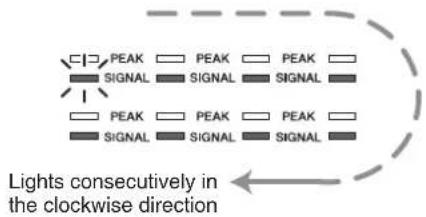
Do not turn off the power while the front panel [SIGNAL] indicators are lighting consecutively in the clockwise direction.
text_image
PEAK PEAK PEAK SIGNAL SIGNAL SIGNAL PEAK PEAK PEAK SIGNAL SIGNAL SIGNAL Lights consecutively in the clockwise directionThis indicates that data is being written into internal memory, and part of the data may be damaged if you turn off the power at this time. Data writing will occur during the following operations.
• While shifting to on-line operation
• While storing or recalling or deleting scene memory
• While saving changes to the Utility settings
- While using the DME File Storage function to transmit/receive or delete files
- While updating the firmware, or while reverting to the previous firmware following a failed update
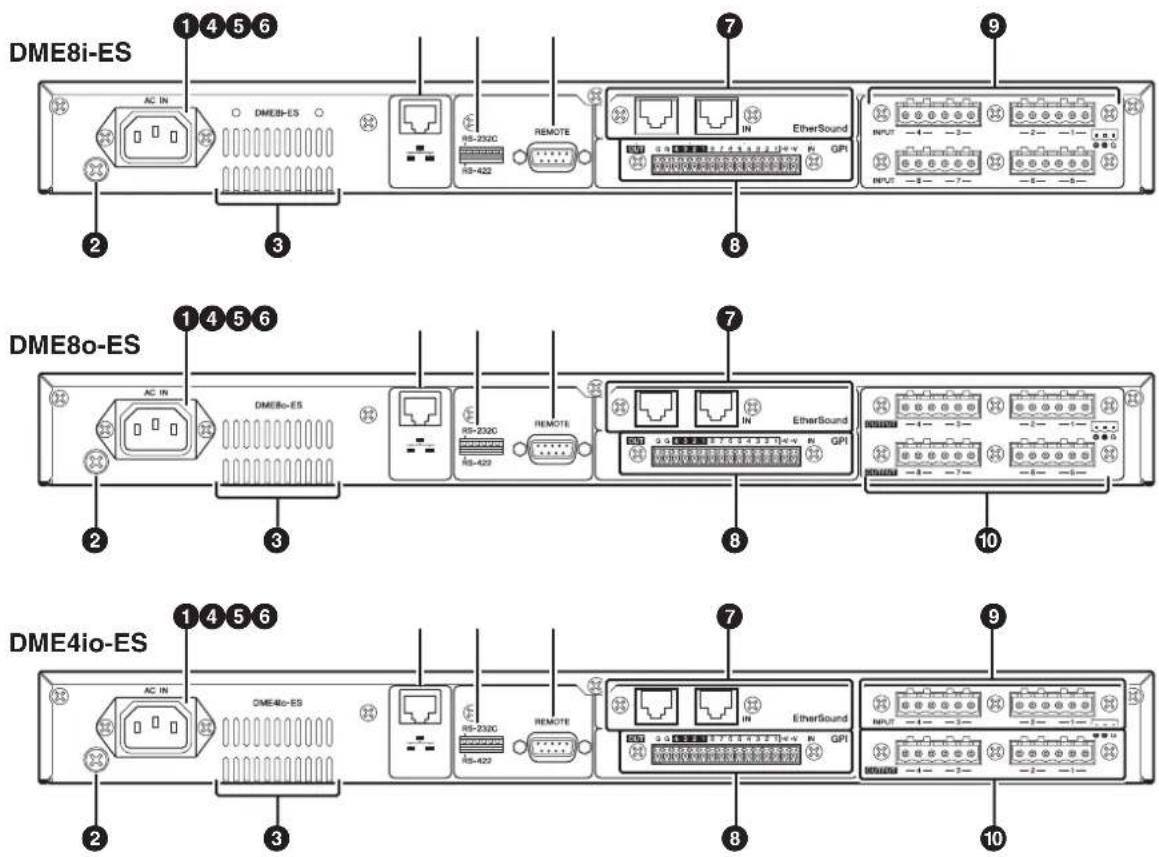
Rear Panel
text_image
DME8i-ES 1 4 5 6 AC IN DME8b-ES RS-232C RES-422 REMOTE 7 IN EtherSound INPUT -1 -2 -3 -4 -5 -6 -7 -8 -9 DME8o-ES 1 4 5 6 AC IN DME8o-ES RS-232C RES-422 REMOTE 7 IN EtherSound INPUT -1 -2 -3 -4 -5 -6 -7 -8 -9 DME4io-ES 1 4 5 6 AC IN DME4io-ES RS-232C RES-422 REMOTE 7 IN EtherSound INPUT -1 -2 -3 -4 -5 -6 -7 -8 -9 DME4io-ES①[AC IN] Connector
Connect to the AC mains using the supplied AC power cord. First connect the power cord to the DME Satellite, then insert the power cord plug into an AC outlet.
![YAMAHA DME4io-ES - ①[AC IN] Connector - 1](/content/2026/06/1230034/images/6a47b9d96f8145a405d0223db92a795142e69c49977257bb492a2ab5010561d6.jpg)
Even when the power switch is turned off, electricity is still flowing to the product all the minimum level. When you are not using the product for a long time, make sure to unplug the power cord from the wall AC outlet.
②Ground Screw
The supplied AC power cable is a 3-wire type, so if the AC outlet used is properly earthed the DME Satellite will be earthed as well. Hum and interference may by further reduced in some cases by also connecting the earth screw to an earth point.
③Cooling vent
The DME Satellite contains a cooling fan. The cooling air is exhausted here, so please be careful not to block this vent.
④[NETWORK] Connector
This is a 100Base-TX/10Base-T Ethernet connector for connection to a computer or to another DME series unit in the network. See "Ethernet Connection ([NETWORK] Connector)" on page 20 for connection details.
NOTE
Use a STP (Shielded Twisted Pair) cable for this connection to prevent electromagnetic interference.
⑤Dip Switch
This 6-bit dip switch enables you to select the [REMOTE] connector function or initialize the DME Satellite, depending on its setting at the startup of the device. To switch between RS-232C and RS-422 for the [REMOTE] connector function, turn off the power to the device, set the dip switch as shown below, then turn on the power to the device again. See page 31 for the DME Satellite initialization procedure.
RS-232C RS-422


If you do not plan to initialize the DME Satellite, set all dip switch bits (excluding one bit for the RS-422 setting) in the upper position.
⑥[REMOTE] Connector
This 9-pin D-SUB connector allows connection to a Yamaha AD824 or AD8HR remote head amplifier or an RS-232C/RS-422 compatible controller such as those from AMX or Crestron. You can also connect a Yamaha PM5D or DM2000 and control the internal head amps of the DME8i-ES/DME4io-ES. See "Remote Connection ([REMOTE] Connector)" on page 26 for connection details.
⑦EtherSound [IN]/[OUT] Connectors
These connectors input and output audio signals and control signals between devices. Use an Ethernet cable (CAT5e or higher category) to daisy-chain multiple DME Satellite units.
For more about EtherSound connections, refer to pages 24 and 28.
NOTE
- The communication status of the EtherSound [IN]/[OUT] jacks is shown by the front panel [TX/RX] indicators.
- U se a STP (Shielded Twisted Pair) cable to prevent electromagnetic interference.
8[GPI] Connector
This Euroblock connector provides access to the unit's GPI (General Purpose Interface) interface for transfer of control signals to and from external equipment. It features 8-port input and 4-port output. The +V terminals have an output voltage of 5 volts. The IN terminal detects voltage changes from 0V to 5V. The OUT terminals output either signal "L" or "H" at a TTL level. (See page 30.)
⑨[INPUT] Connectors
These Euroblock connectors receive 8-channel analog audio signals on the DME8i-ES.
These Euroblock connectors receive 4-channel analog audio signals on the DME4io-ES.
NOTE
- The PAD will be internally switched on or off when the gain of the DME8i-ES/DME4io-ES internal head amp is adjusted between -6 dB and -5 dB. Keep in mind that noise may be generated if there is a difference between the Hot and Cold output impedance of the external device connected to the INPUT connector when using phantom power.
⑩[OUTPUT] Connectors
These Euroblock connectors output 8-channel analog audio signals on the DME8o-ES.
These Euroblock connectors output 4-channel analog audio signals on the DME4io-ES.
Precautions for Using a Rack-mounted DME Satellite
If several DME Satellite units (or a DME Satellite unit together with other devices) are installed in a poorly-ventilated rack, the heat generated by each unit may raise the temperature inside the rack, preventing the DME Satellite from performing as designed. When mounting DME Satellite units in a rack, please leave one rack space vacant for every two units. You can attach a ventilation panel to this space or leave it open to prevent excessive heat build-up.
If the temperature inside the rack is expected to rise above 40 degrees Celsius or 104 degrees Fahrenheit (or if the ambient temperature outside the rack is expected to rise above 30 degrees Celsius or 86 Fahrenheit), install a fan kit in the top row of the rack. The fan must provide airflow of 1.6m^3/min or more and static pressure of 5mmH_2O or more.
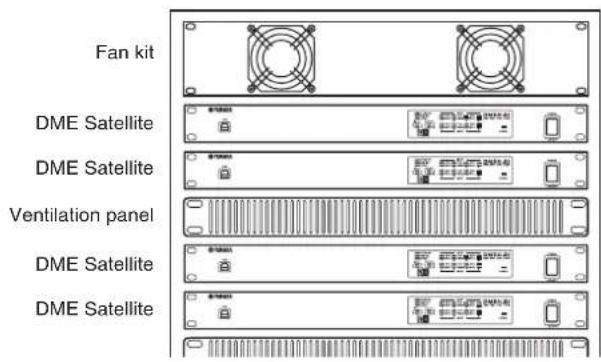
text_image
Fan kit DME Satellite DME Satellite Ventilation panel DME Satellite DME SatelliteConnecting to a Computer
USB Connection
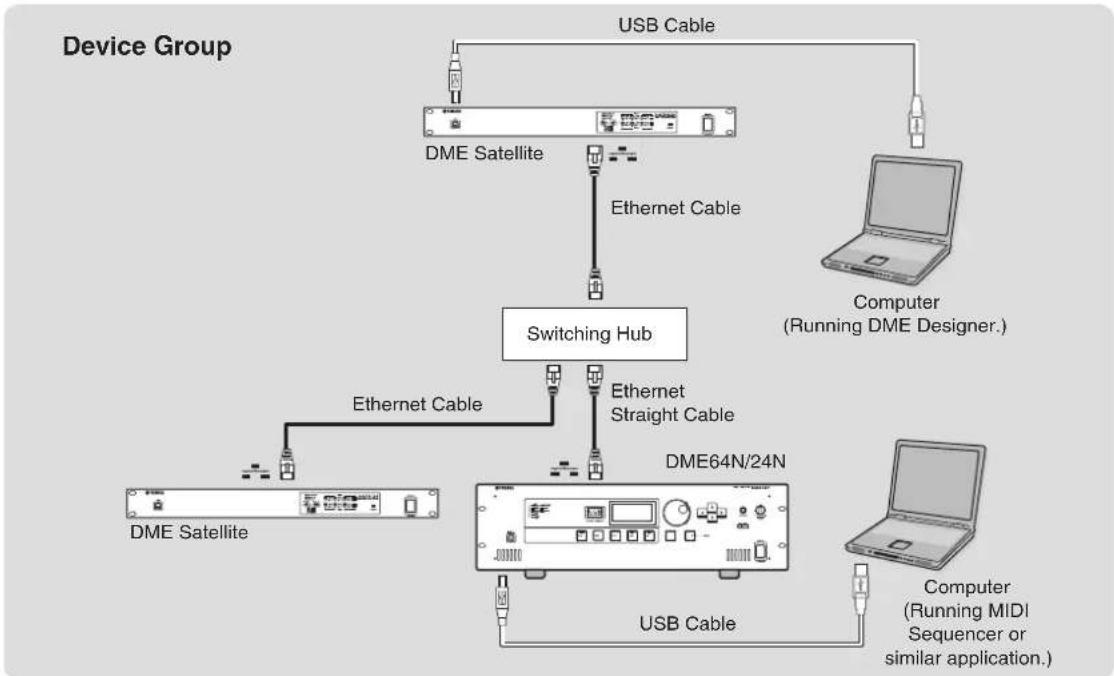
To connect multiple DME Satellite units to a network, you must assign appropriate IP addresses and make other network settings on all units. To achieve this, you need to connect the [USB] connector of one of the DME Satellite units to the USB port of the computer using USB cables, install USB-MIDI Driver and DME Designer on the computer, then assign the IP addresses to the DME Satellite units from DME Designer.
NOTE
- Refer to the "DME Setup Manual" (PDF file) for details on installing USB-MIDI Driver and DME Designer.
- Make sure that the USB-MIDI Driver's THRU setting is "OFF."
- Refer to "Network Settings" on page 19 for more information on assigning IP addresses from DME Designer.
USB connections can be used in the following three ways:
(1) Set up the network (e.g., assign a unique IP address to each DME Satellite) from DME Designer.
(2) Control the DME Satellite from DME Designer.
(3) Connect to any individual DME Satellite and control that DME Satellite unit by transmitting MIDI commands from a MIDI sequencer or similar software.
NOTE
- The computer on which DME Designer is running can be connected to either the group master or a slave DME series unit. In this case, set the DME Satellite as the group master.
- The correspondence between the MIDI commands to be received/transmitted and the scene parameters can be set up using DME Designer.
• The USB port being used by DME Designer is not available for use by a MIDI sequencer or other application.
flowchart
graph TD
    A["Device Group"] --> B["USB Cable"]
    B --> C["DME Satellite"]
    B --> D["Ethernet Cable"]
    D --> E["Switching Hub"]
    E --> F["DME Satellite"]
    E --> G["Ethernet Cable"]
    G --> H["DME64N/24N"]
    H --> I["USB Cable"]
    I --> J["Computer (Running MIDI Sequencer or similar application)."]
    K["Computer (Running DME Designer.)"] --> B
Network Settings
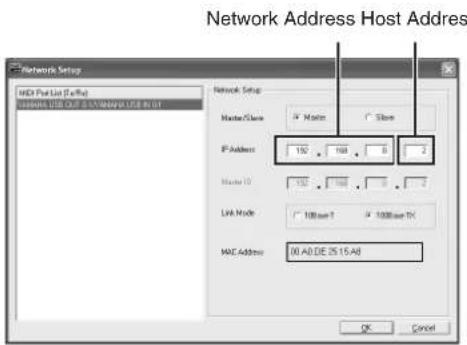
Use DME Designer to specify the IP address, master/slave, and master ID settings as follows.
Setting the IP address
text_image
Network Address Host Address HDD Pin List (FFR) HDD USB Client (USB) Release USB to 01 Network Setup Master/Slave IP Address 150 168 8 2 Master ID 150 168 8 2 LVA Mode 100bit 100bit TX MAC Address 00 A0 DE 25 15 A0 OK CancelEach group of digits between periods in an IP address is called an “octet.” These groups of digits are called “1st octet,” “2nd octet,” etc., starting from the left-most digit group.
You cannot specify 0, 127, or 223 through 255 for the 1st octet of the network address.
You can specify the following range of values for the 4th octet.
Master: 2-253
Slave : 3-253
NOTE
- S ubnet mask is fixed at 255.255.255.0.
• The network address of Gateway is the same as that of IP address. The host address of Gateway is automatically set to 254. - Assign each of DME series units a unique IP address so that there are no duplicates. Assigning duplicate IP addresses may cause serious network problems.
- You cannot make any network settings while using the DME Designer application on-line. To make network settings, first set DME Designer off-line. Refer to the DME Designer Owner's Manual for details.
Master and slave setting
Each device group must have one master. All other devices in the group are assigned as slave.
The fourth octet of a slave DME Satellite's master ID must be the same value as the fourth octet of the group master DME Satellite's IP address.
NOTE
When using a DME Satellite together with the DME64N/24N, you must assign the DME Satellite (including the DME8i-C/DME8o-C/DME4io-C) as the master. If you assign the DM64N/24N as the device group master, you will be unable to synchronize using DME Designer.
Ethernet Connection ([NETWORK] Connector)
To control the DME Satellite from the computer via Ethernet, use an Ethernet cable to connect the [NETWORK] connector on the rear panel of the DME Satellite to the computer, then install DME-N Network Driver.
NOTE
- Refer to the "DME Setup Manual" (PDF file) for details on installing DME-N Network Driver.
- Appropriate IP addresses must first be assigned to all devices connected to an Ethernet network. Connect your computer to one of the DME Satellite units via USB, then assign the IP addresses from DME Designer (page 18).
Two DME Satellite units directly connected via Ethernet

text_image
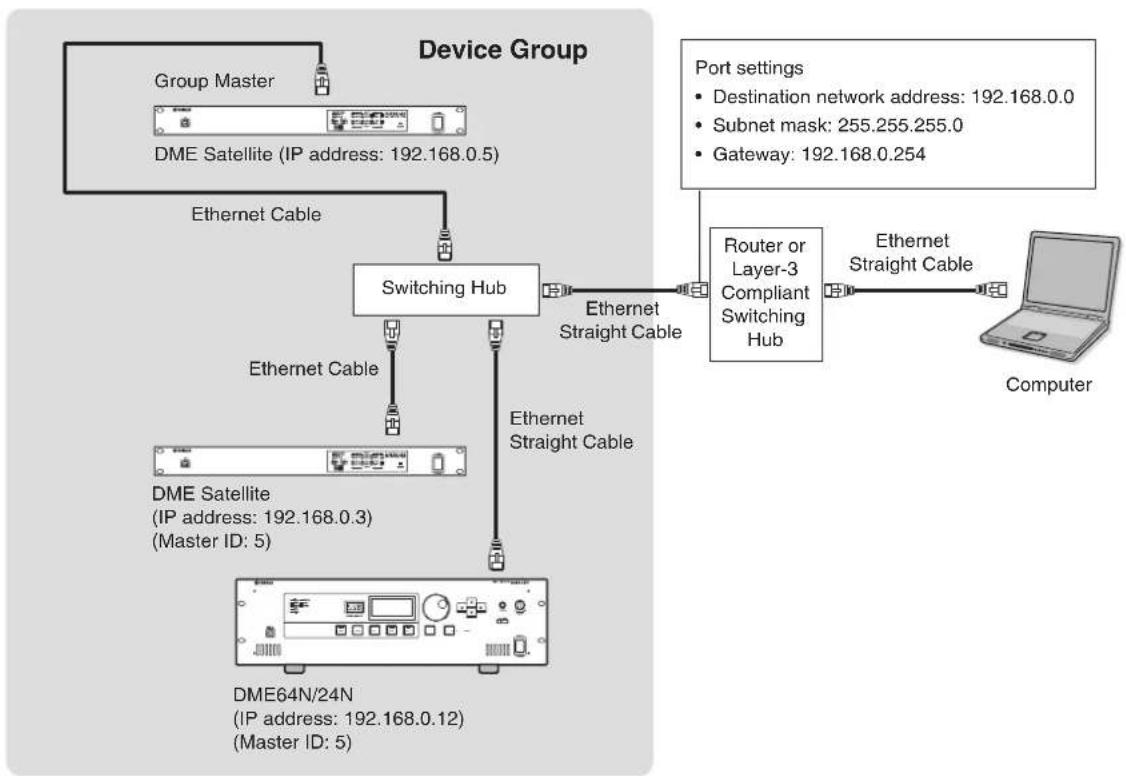
DME Satellite Ethernet Cable DME Satellite USB CableYou can connect devices in the same device group directly to each other using Ethernet cables, without connecting them to a switching hub. If they are DME Satellite units, you can use either crossover cables or straight cables. In this case, from DME Designer set Link Mode on both units to the same setting. Devices in different subnet (different network address) groups can be connected via a router or layer-3 compliant switching hub.
HINT
Since the DME Satellite supports Auto MDI/MDI-X, it will automatically detect whether the connected cable is of the straight type or crossover type, and will configure itself to create the optimal connection. Therefore, you can use either a straight or crossover cable.
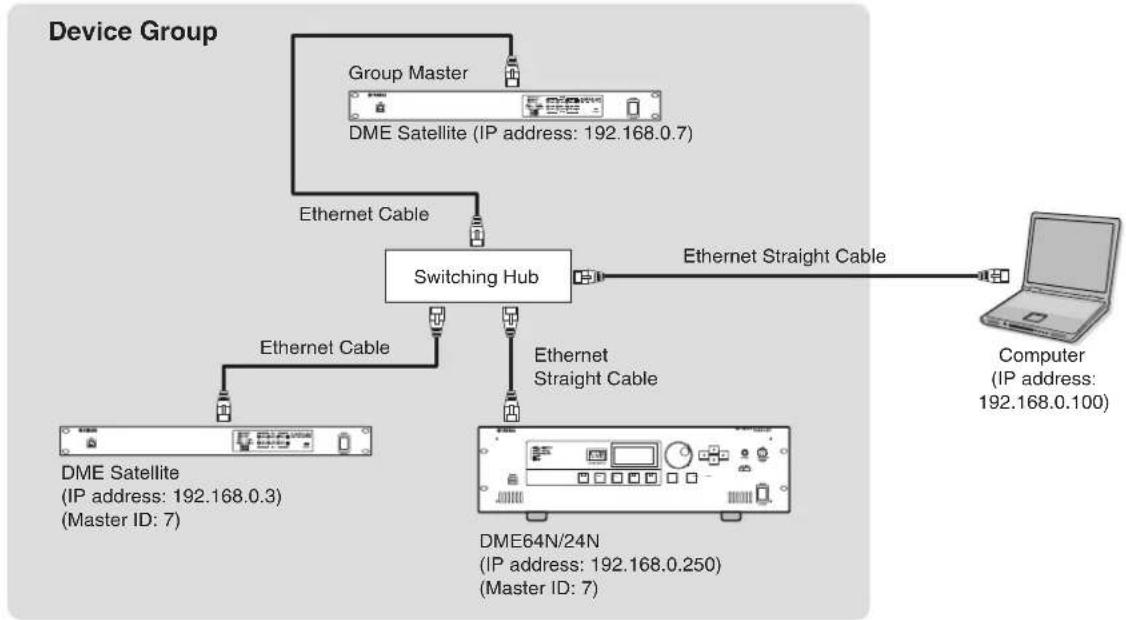
Control from a computer in the same subnet group
flowchart
graph TD
    A["Device Group"] --> B["Switching Hub"]
    B --> C["Group Master"]
    B --> D["Ethernet Cable"]
    B --> E["Ethernet Straight Cable"]
    B --> F["Computer (IP address: 192.168.0.100)"]
    B --> G["DME Satellite (IP address: 192.168.0.3) (Master ID: 7)"]
    B --> H["DME64N/24N (IP address: 192.168.0.250) (Master ID: 7)"]
NOTE
• The IP addresses in the diagram are examples.
- U se a switching hub that is compatible with 100Base-TX/10Base-T network speeds.
The maximum length of a cable between a switching hub and the DME Satellite is 100 meters. Due to the quality of cables and switching hub performance, however, proper operation at the maximum length cannot be guaranteed in some cases. Use a STP (Shielded Twisted Pair) cable to prevent electromagnetic interference.
- If you are using multiple DME series units, set Link Mode on each unit to the same setting. Yamaha recommends that you select 100Base-TX for the Link Mode setting.
- You can also connect a supported controller such as the AMX or Crestron, and control the DME Satellite remotely. For details, refer to “Connecting to an External Device” on page 26.
Control from a computer with a different subnet
flowchart
graph TD
    A["Device Group"] --> B["Group Master"]
    B --> C["DME Satellite (IP address: 192.168.0.5)"]
    C --> D["Ethernet Cable"]
    D --> E["Switching Hub"]
    E --> F["Ethernet Straight Cable"]
    F --> G["DME Satellite (IP address: 192.168.0.3) (Master ID: 5)"]
    G --> H["DME64N/24N (IP address: 192.168.0.12) (Master ID: 5)"]
    H --> I["Switching Hub"]
    I --> J["Ethernet Straight Cable"]
    J --> K["Router or Layer-3 Compliant Switching Hub"]
    K --> L["Computer"]
    M["Port settings"] --> N["Destination network address: 192.168.0.0"]
    M --> O["Subnet mask: 255.255.255.0"]
    M --> P["Gateway: 192.168.0.254"]
    K --> Q["Ethernet Straight Cable"]
Connecting multiple device groups

flowchart
graph TD
    subgraph Device Group 1 Device Group 2
        A["Group Master"] --> B["DME Satellite (IP address: 192.168.0.2)"]
        B --> C["Ethernet Cable"]
        C --> D["Switching Hub"]
        D --> E["Switching Hub"]
        E --> F["Group Master"]
        F --> G["DME Satellite (IP address: 192.168.0.3)"]
        G --> H["Ethernet Cable"]
        H --> I["Switching Hub"]
        I --> J["Switching Hub"]
        J --> K["Group Master"]
        K --> L["DME Satellite (IP address: 192.168.0.3)"]
        L --> M["Ethernet Cable"]
        M --> N["Switching Hub"]
        N --> O["Switching Hub"]
        O --> P["Group Master"]
        P --> Q["DME Satellite (IP address: 192.168.0.200) (Master ID: 3)"]
        Q --> R["Ethernet Cable"]
        R --> S["Switching Hub"]
        S --> T["Switching Hub"]
        T --> U["Group Master"]
        U --> V["DME Satellite (IP address: 192.168.0.10) (Master ID: 3)"]
        V --> W["Ethernet Cable"]
        W --> X["Switching Hub"]
        X --> Y["Switching Hub"]
        Y --> Z["Group Master"]
    end
    subgraph Device Group 2
        AA["Computer (IP address: 192.168.0.1)"]
    end
Audio I/O Connection
Digital Audio Connection (EtherSound Connectors)
You can use the DME Satellite's EtherSound connector to input and output digital audio signals, control signals, and word clock signals. When connecting DME Satellites, make daisy-chain connections between the EtherSound [OUT] connector → [IN] connector, and the [OUT] connector → [IN] connector.
Audio signals and word clock signals can also be input and output between EtherSound compatible devices and devices such as mixers in which the MY16-ES64 card has been installed. Input and output of audio signals and word clock signals can be specified using the "AVS-ESMonitor" application software made by AuviTran SARL. For details on interface cards and application software, refer to the appropriate Owner's Manual.
About AVS-ESMonitor
AVS-ESMonitor is application software made by the AuviTran SARL for the purpose of monitoring and controlling an EtherSound system. It allows you to make various EtherSound settings such as input/output routing.
For details, refer to the following website. http://www.auvitran.com/view.php?products_AVS-ESMonitor.php
Example: Connection to EtherSound devices
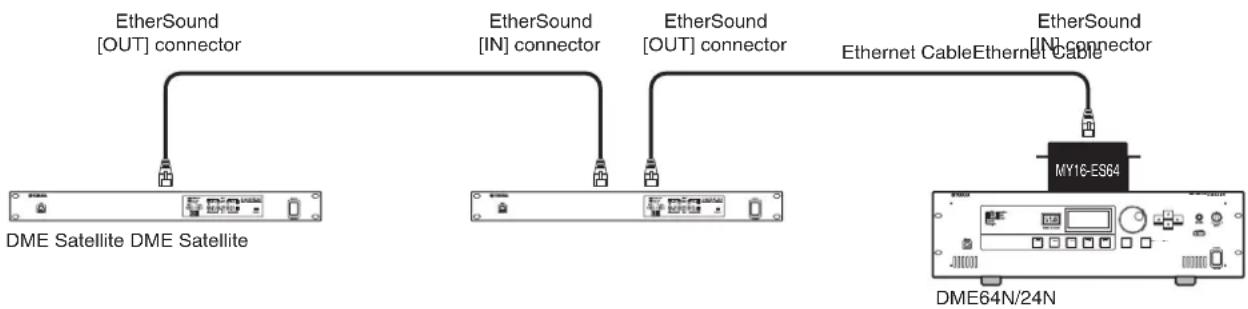
flowchart
graph LR
    A["DME Satellite DME Satellite"] --> B["EtherSound [OUT"] connector]
    A --> C["EtherSound [IN"] connector]
    A --> D["EtherSound [OUT"] connector]
    A --> E["EtherSound [IN"] connector]
    A --> F["EtherSound [IN"] Cable]
    A --> G["MY16-ES64"]
    G --> H["DME64N/24N"]
NOTE
- DME Satellites and the MY16-ES64 can transmit and receive control data such as for internal head amps via EtherSound. However in some cases, it may not be possible to transmit or receive control data depending on the device in which the MY card is installed. For details, refer to the operating manual of the device in which the card is installed.
- For details on EtherSound specifications and the length of the cables that can be used, refer to the following website. http://www.ethcrsound.com/
Analog Audio Connection ([INPUT] & [OUTPUT] Connectors)
The DME Satellite can directly input and output audio signals via the [INPUT] and [OUTPUT] connectors. Wire the supplied Euroblock plugs (3P) as shown below. You can use DME Designer to set the head amplifier gain and turn the phantom power on and off for each [INPUT] connector.
Euroblock plug connection
Please be sure to use the supplied Euroblock plugs. If you lose them, contact your nearest Yamaha dealer.
NOTE
Use a slotted screwdriver with a blade width of about 3 millimeters to secure the cables to the (3P) Euroblock plug. Use a slotted screwdriver with a blade width of about 2 millimeters to secure the cables to the (16P) Euroblock plug to connect to the [GPI] connector.

Cable preparation
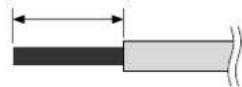
- To prepare the cable for attachment to a Euroblock connector, strip the wire as shown in the illustration, and use stranded wire to make connections. With a Euroblock connection, the stranded wire may be prone to breakage because of metal fatigue due to the weight of the cable or due to vibration. When rack-mounting your equipment, use a lacing bar when possible to bundle and fasten the cables.
- I f cables will be frequently connected and disconnected, as in the case of a portable installation, we recommend that you use ferrules with insulation sleeves. Use a ferrule whose conductor portion has an external diameter of 1.6 mm (1.3 mm for GPI) or less, and a length of approximately 7 mm (5 mm for GPI) (such as the AI0,5-6WH made by the Phoenix Contact corporation).
approx.7 mm (5 mm for GPI)

text_image
approx.7 mm (5 mm for GPI) 1.6 mm (1.3 mm for GPI) or less
If you use stranded wire, do not tin (plate with solder) the exposed end.
1. Loosen terminal screws.
2. Insert cables.
3. Securely tighten terminal screws.
Pull the cables (not too strongly) to confirm that they are securely connected.
4. Insert the Euroblock plug into the Euroblock connector on the rear panel.
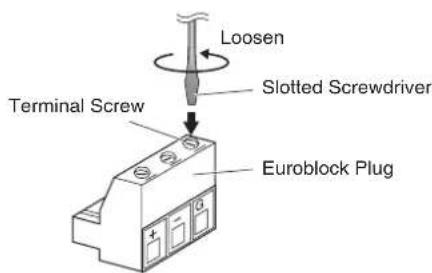
text_image
Terminal Screw Slotted Screwdriver Euroblock Plug Loosen
natural_image
Simple line drawing of a three-pin electrical connector with wires (no text or symbols)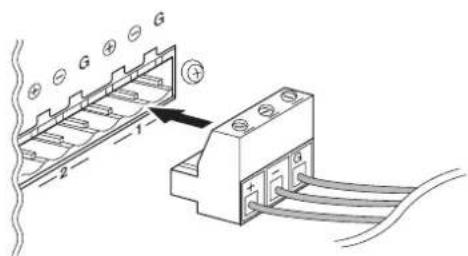
text_image
Diagram showing electrical connection with labeled components and a magnified view of a terminal block with terminals G and I.Connecting to an External Device
Remote Connection ([REMOTE] Connector)
The [REMOTE] connector of the DME Satellite can be connected to remotely-controllable Yamaha AD8HR or AD824 head amplifiers (pre-amps), digital mixers, or RS-232C compatible controllers (such as those from AMX or Crestron). The [REMOTE] connector also transmits and receives MIDI messages.
Controlling external head amplifiers from the DME Satellite
You can remotely control the AD8HR or AD824 head amplifier settings from DME Designer. Up to eight AD8HR/AD824 head amplifiers can be connected.
Be sure to set the dip switch on the rear panel of the DME Satellite to "RS-422" (page 16) when connecting to AD8HR or AD824 remote head amplifiers. Do not change the dip switch setting to any position other than to "RS-422" while the devices are connected to prevent possible damage to the device(s).
When connecting to a combination of AD8HR and AD824 head amplifiers, be sure to place the AD8HR units closest to the DME Satellite in the chain, otherwise the AD8HR or AD824 unit(s) may not be properly recognized by the DME Satellite.

flowchart
graph TD
    A["DME Satellite"] --> B["D-SUB 9-pin Cable (Interlink Crossover)"]
    B --> C["Set to RS-422 REMOTE"]
    B --> D["HA REMOTE 2HA REMOTE 1 HA REMOTE 1 HA REMOTE 2"]
    B --> E["AD8HR AD8HR"]
    E --> F["COM PC/RS-422 COM RS-422 COM PC/RS-422 COM PC/RS-422"]
    E --> G["AD824 AD824 AD824"]
NOTE
Only control signals are transmitted and received via the REMOTE connection. Audio connections must be made separately.
Controlling a DME Satellite's internal head amps from a digital mixer
The internal head amp settings of a DME8i-ES or DME4io-ES can be remotely controlled from a digital mixer such as the Yamaha PM5D or DM2000.
Connect the digital mixer to the DME series' [REMOTE] connector, and use an Ethernet cable to make connections between the [NETWORK] connectors of the DME series.
From the digital mixer, DME series units can be controlled as an AD8HR. The gain and the phantom power (+48V) can be controlled.

flowchart
graph TD
    A["Digital Mixer"] --> B["D-MESatellite"]
    A --> C["Ethernet Cable"]
    A --> D["Switching Hub"]
    A --> E["Remote Remote"]
    B --> F["Switching Hub"]
    C --> F
    D --> F
    E --> F
NOTE
- Only one mixer can be connected within each device group.
- The digital mixer can be connected to any DME series unit, whether it is the group master or a slave unit.
- The ID number of the DME series unit being remotely controlled is specified from DME Designer. For details on making this setting, refer to the “DME Designer Owner’s Manual.”
- If the connection between DME series units is broken, it will no longer be possible to communicate with DME units of an ID number that follows the disconnected DME.
- The variable range of GAIN differs between the AD8HR and the DME Satellite. You cannot use the mixer to specify a value that exceeds the variable range of the DME Satellite.
Controlling the DME Satellite from an external device
You can remotely control the DME Satellite from a connected RS-232C or RS-422 compatible controller, such as those from AMX or Crestron.
Be sure to set the dip switch on the rear panel of the DME Satellite correctly (page 16) in accordance with a connected RS-232C or RS-422 compatible remote controller. Do not change the dip switch setting to any other position while the devices are connected to prevent possible damage to the device(s).
NOTE
- The port used for remote control is specified from DME Designer. For details on making this setting, refer to the “DME Designer Owner’s Manual.”
- Refer to "DME Remote Control Protocol Specifications" on the Yamaha web site for more information on communication protocols used to control the DME Satellite from an external device (such as those from AMX or Crestron). http://www.yamahaproaudio.com/
EtherSound Connection (EtherSound Connectors)
You can use the EtherSound connector to control the DME Satellite's internal head amp or other functionality.
Controlling DME Satellite's internal head amps from a digital mixer
The internal head amp settings of a DME8i-ES or DME4io-ES can be remotely controlled from a digital mixer such as the Yamaha PM5D or DM2000.
Connect the digital mixer using a D-sub 9-pin cable to the MY16-ES64 card, and use EtherSound to make connections between the MY16-ES64 card and DME series. Use an Ethernet cable connected to the [NETWORK] connectors to make connections between DME series units.
The gain and the phantom power (+48V) can be controlled from the digital mixer.

flowchart
graph TD
    A["Digital Mixer"] -->|D-Sub 9-pin| B["My16-ES64"]
    A -->|EtherSound| C["DME8i-ES"]
    A -->|EtherSound| D["My16-EX"]
    C --> E["Switching Hub"]
    D --> E
    B --> F["DME8i-ES"]
    B --> G["DME4io-ES"]
    C --> H["DME8i-ES"]
    C --> I["DME4io-ES"]
    D --> J["DME8i-ES"]
    D --> K["DME4io-ES"]
    E --> L["Switching Hub"]
    F --> M["Switching Hub"]
    G --> N["Switching Hub"]
    H --> O["Switching Hub"]
    I --> P["Switching Hub"]
    J --> Q["Switching Hub"]
    K --> R["Switching Hub"]
NOTE
- Only one mixer can be connected within each device group.
• The digital mixer can be connected to any DME series unit, whether it is the group master or a slave unit. - Control signal settings are made using AuviTran's "AVS-ESMonitor" application software. Refer to the DME Designer manual for details.
- The ID number of the DME series unit being remotely controlled is specified from DME Designer. For details on making this setting, refer to the “DME Designer Owner’s Manual.”
- If the connection between DME series units is broken, it will no longer be possible to communicate with DME units of an ID number that follows the disconnected DME.
- For details on controlling the head amps from a digital mixer not equipped with a [REMOTE] connector, refer to the mixer's owner's manuals.
Network Connection ([NETWORK] Connectors)
You can connect a controller such as the AMX or Crestron to DME Satellites via Ethernet, and remotely control multiple DME Satellite units.
NOTE
- The port used for remote control is specified from DME Designer. For details on making this setting, refer to the “DME Designer Owner’s Manual.”
- Refer to “DME Remote Control Protocol Specifications” on the Yamaha web site for more information on communication protocols used to control the DME Satellite from an external device (such as those from AMX or Crestron). http://www.yamahaproaudio.com/
GPI Connection ([GPI] Connector)
A GPI (General Purpose Interface) device (GPI controller, etc.) can be connected to the rear panel [GPI] connectors to enable the transfer of a variety of control signals. Optional CP4SW, CP4SF, and CP1SF Control Panels can be also connected via GPI.
The DME Satellite features 8-port GPI input and 4-port GPI output. The +V terminals have an output voltage of 5 volts. The IN terminal detects voltage changes from 0V to 5V. The OUT terminals output either signal "L" or "H" at a TTL level.
The parameters for each GPI input and output are assigned via the DME Designer application.
Euroblock connectors are used for all GPI input and output connections. Euroblock connection methods are described in “Euroblock plug connection” on page 25 in this manual.
NOTE
- For more information on the CP4SW, CP4SF, and CP1SF Control Panels, refer to the CP4SW/CP4SF/ CP1SF Owner's Manual.
- You can use DME Designer to set up the system so that scene recall operations and User Defined parameter control can be carried out from connected GPI control devices. Refer to the DME Designer Owner's Manual for details.
Example: Controlling the DME Satellite from a switch box
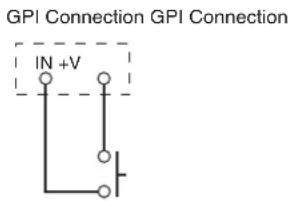
text_image
GPI Connection GPI Connection IN +VExample: Controlling the DME Satellite via a 10k ohm linear taper potentiometer.
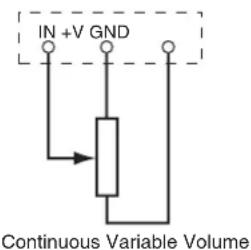
text_image
IN +V GND Continuous Variable VolumeExample: Lighting LED indicators on the external devices from the DME Satellite
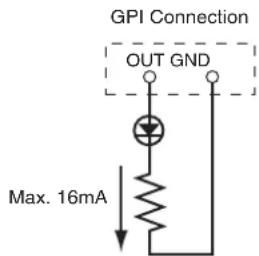
text_image
GPI Connection OUT GND Max. 16mA
Make sure that the current between the OUT and GND [GPI] connectors is less than 16mA.
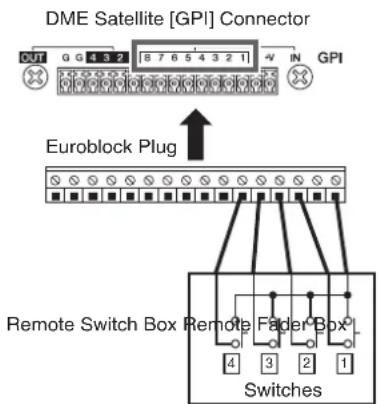
text_image
DME Satellite [GPI] Connector GUT G G 4 3 2 18 7 6 5 4 3 2 1 -V IN GPI Euroblock Plug Remote Switch Box Remote Fader Box L Switches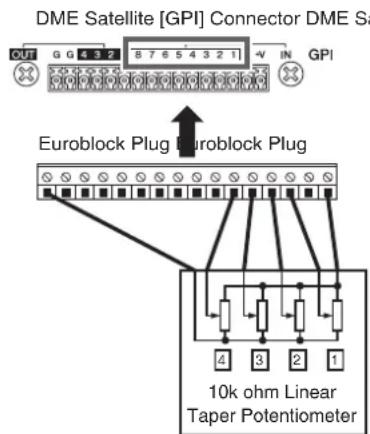
text_image
DME Satellite [GPI] Connector DME S G G 4 3 2 8 7 6 5 4 3 2 1 V IN GPI Euroblock Plug Euroblock Plug 10k ohm Linear Taper Potentiometer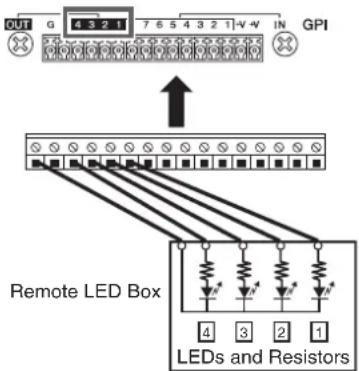
text_image
OUT G 4 3 2 1 7 6 5 4 3 2 1 V -V IN GPI Remote LED Box 4 3 2 1 LEDs and ResistorsNOTE
You can use DME Designer to adjust the input calibration parameters for the [GPI] connector.
Other Functions
Initializing the DME Satellite
You can initialize the DME Satellite internal memory.
Select one of the following initialization types:
Initialize DME:
All scenes, preset parameter settings and WAVE files except components and files saved via the File Storage function will be deleted. The Utility settings will be set to default values.
Delete All Data:
All stored component, scene, preset parameter settings, WAVE files, and files saved via the File Storage function will be deleted. The Utility settings will be set to default. Use this initialization type if the internal data is damaged or corrupted. After initialization, transfer necessary components from DME Designer.
1. While the DME Satellite is turned off, set the dip switch on the rear panel to the following position, then turn on the power to the unit.
RS-232C

RS-422
Initialize DME:
RS-232C

RS-422
Delete All Data:
Four [PEAK] indicators on the upper row on the front panel light up during the initialization process. Four [SIGNAL] indicators on the lower row of the front panel flash when the initialization process is complete. Four [PEAK] indicators on the lower row of the front panel flash if the initialization process fails.

Do NOT turn off the power to the DME Satellite during the initialization process to prevent possible damage to the device.
2. When initialization is complete, reset the dip switch to its previous position (page 16), then turn off and on the power to the unit.

Be sure to reset the dip switch to the previous position to prevent possible damage to the device.
References
Options
The ICP1, CP4SW, CP1SF, and CP4SF controllers are available as options for remote external control of the DME series. The ICP1 connects via Ethernet, while the CP4SW, CP1SF, and CP4SF connect via the GPI interface. For more information on installing your Control Panel and connecting it to a DME series unit, refer to the owner's manual that came with the Control Panel. For more information on settings, refer to the DME Designer Owner's Manual.
ICP1
This controller connects to a DME series unit via Ethernet. Like the DME series units, a unique IP address must be assigned to each controller unit. Data is transmitted and received via Ethernet cables.
You can assign and control any function of all DME series units in the same device group via the controller.
Up to four parameter sets can be assigned to six function keys (F1 - F6) located above and under the LCD. You can control up to 24 parameters by selecting a display page using the [HOME] key.

text_image
YAMAHA F1 F2 F3 HOME SCENE F4/UTILITY F5 F6/MUTE CANCEL ENTER INTELLIGENT CONTROL PANEL ICP1CP4SW, CP4SF, and CP1SF
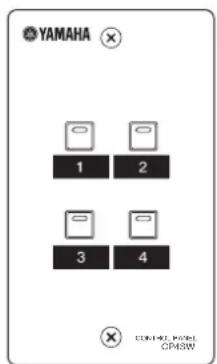
These controllers connect to DME series units via the [GPI] connectors. These controllers control only the DME series units to which they are directly connected. The controller switches enable you to turn the parameter settings On and Off. The switch LEDs enable you to check the parameter status. The faders enable you to control the parameter values.
text_image
©YAMAHA 1 2 3 4 × UCM-HEM MODEL CP48W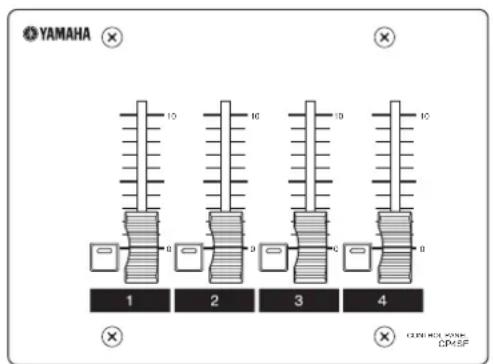
text_image
©YAMAHA 10 16 10 10 0 0 0 3 4 CPMSP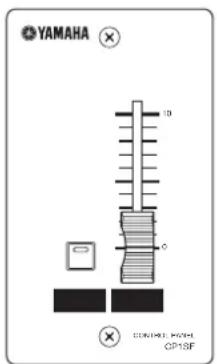
text_image
YAMAHA D O CONTROL GPS15F GPS15FTroubleshooting
| The device does not turn on, or the panel LEDs do not light up. | Connect the power cord properly (page 7).Make sure that the [POWER] switch is turned ON (page 15).If the device still does not turn on, contact a Yamaha dealer. |
| No communication between the DME Satellite and the DME Designer application software. | Connect the cable properly (page 18, 20).Make sure that USB-MIDI Driver has been installed correctly.If the [NETWORK] connector is being used for connection, make sure that you have set the DME-N Network Driver correctly.The DME Designer version should be 3.0 or later.Make the Port setting. |
| No audio input is present. | Connect the cable properly.Check to see if signals are being received from an external device.Did you use AVS-ESMonitor to make EtherSound settings such as routing?Set the gain of the internal head amplifier or external head amplifier to an appropriate level. |
| No audio is output. | Connect the cable properly.Did you use AVS-ESMonitor to make EtherSound settings such as routing?Make sure that the output level set in DME Designer is not too low.Make sure that the Mute setting in DME Designer is set to Off.Y ou may have designed a scene in DME Designer that mutes audio output.Y ou may have tried to use a configuration at 96 kHz that does not support 96 kHz. |
| The selected scene changes unexpectedly. | Use DME Designer to check the MIDI Program Change assignments.Use DME Designer to check the GPI input assignments. |
| MIDI messages cannot be transmitted or received. | Make sure that the power to the MIDI device is turned on.Set the MIDI port properly.Set the receive and transmit channels properly. |
| Scenes cannot be recalled via MIDI Program Change messages. | Use DME Designer to change the setting so that the required MIDI Program Change messages will be received properly.Make the appropriate Program Change Table settings via DME Designer. |
| Parameters cannot be controlled via MIDI Control Change messages. | Use DME Designer to set the parameters correctly to allow Control Change message reception.Make the appropriate MIDI Control Change Table settings via DME Designer. |
| Parameters cannot be edited via MIDI Parameter Change messages. | Use DME Designer to set the parameters correctly to allow Parameter Change message reception.Make the appropriate MIDI Parameter Change Table settings via DME Designer. |
Component
Refer to the DME Designer Owner's Manual for more information on each component.
MIDI Data Format
1. MIDI functions on the DME8i-ES, DME8o-ES, and DME4io-ES
1.1 Scene Change
Scene recall occurs according to the "MIDI Program Change Table" assignments when appropriate MIDI Bank Select MSB/LSB and Program Change messages are received by the DME8i-ES/DME8o-ES/DME4io-ES.
When a scene recall operation is carried out via DME Designer, corresponding MIDI Bank Select MSB/LSB and Program Change messages are also transmitted by the DME8i-ES/DME8o-ES/DME4io-ES as specified by the "MIDI Program Change Table" assignments.
Transmission does not occur while configurations are being switched.
1.2 Parameter Control
MIDI Control Change and Parameter Change messages transmitted to the DME8i-ES/DME8o-ES/DME4io-ES can be used to control parameters according to the "MIDI Control Change Table" and "MIDI Parameter Change Table" assignments.
When a parameter is edited via DME Designer, corresponding MIDI Control Change and Parameter Change messages are also transmitted by the DME8i-ES/DME8o-ES/DME4io-ES as specified by the "MIDI Control Change Table" and "MIDI Parameter Change Table" assignments.
"MIDI Program Change Table," "MIDI Control Change Table," and "MIDI Parameter Change Table" assignments can be made via DME Designer. Refer to the DME Designer Owner's Manual for details.
2. MIDI Data Flow

flowchart
graph TD
    A["MIDI IN"] --> B{MIDI EX CH}
    B -->|SW1| C["Bank Select MSB/LSB Program Change (Scope Recall)"]
    B -->|SW2| D["Control Change (Parameter Bolt)"]
    B -->|SW3| E["Parameter Change (Parameter Bolt)"]
    B -->|SW4| F["Rank Select MSB/LSB Program Change (Echo Back)"]
    B -->|SW5| G["Control Change (Echo Sack)"]
    B -->|SW6| H["Parameter Change (Echo Sack)"]
    B -->|SW7| I{MIDI Tx CH}
    I -->|XIDI OUT| J["KIDI THU"]
    I -->|SW8| K["Control Change"]
    I -->|SW9| L["Parameter Change"]
SW1: Program Change Rx Switch [On/Off]
SW2: Control Change Rx Switch [On/Off]
SW3: Parameter Change Rx Switch [On/Off]
SW4: Program Change Echo Back Switch [On/Off]
SW5: Control Change Echo Back Switch [On/Off]
SW6: Parameter Change Echo Back Switch [On/Off]
SW7: Program Change Tx Switch [On/Off]
SW8: Control Change Tx Switch [On/Off]
SW9: Parameter Change
MIDI Rx CH: MIDI Rx Channel (1-16)
MIDI Tx CH: MIDI Tx Channel (1-16)
3. MIDI Setup
Specifies basic MIDI operation. Use DME Designer to make the setting.
3.1 Host Select
Selects the input/output ports to be used for MIDI communication.
3.2 MIDI Tx Channel
Specifies the MIDI transmit channel (1 - 16).
3.3 MIDI Rx Channel
Specifies the MIDI receive channel (1 - 16).
3.4 MIDI Tx Switch
Program Change Tx Switch: turns Bank Select MSB, LSB, and Program Change transmission on or off. Control Change Tx Switch: turns Control Change transmission on or off. Parameter Change Tx Switch: turns Parameter Change transmission on or off.
3.5 MIDI Rx Switch
Program Change Rx Switch: turns Bank Select MSB, LSB, and Program Change reception on or off. Control Change Rx Switch: turns Control Change reception on or off. Parameter Change Rx Switch: turns Parameter Change reception on or off.
3.6 MIDI Omni Switch
Program Change Omni Switch: turns the Bank Select MSB, LSB, and Program Change omni mode on or off. Control Change Omni Switch: turns the Control Change omni mode on or off.
3.7 MIDI Echo Back Switch
Program Change Echo Back Switch: turns Bank Select MSB, LSB, and Program Change echo back on or off. Control Change Echo Back Switch: turns Control Change echo back on or off. Parameter Change Echo Back Switch: turns Parameter Change echo back on or off.
4. MIDI Format
Number Format Notation
Numbers ending with "h" are in hexadecimal format, while numbers ending with "b" are binary format.
Characters "A" through "F" in hexadecimal numbers represent decimal values 10 through 15. Other lower-case characters (usually "n" or "x") can represent any number.
MIDI Format Chart (Rx: receive, Tx: transmit)
| Command Rx/Tx Function | |||
| Channel Message | Control Change (Bnh) | Rx/Tx | Editing the parameters |
| Program Change (Cnn) | Rx/Tx Scene Recall | ||
| System Real-time Message | TIMING CLOCK (F8h) | Rx | MIDI ClockReceive |
| ACTIVE SENSING (FEh) | Rx | MIDI CableCheck | |
| System Exclusive Message | Parameter Change | Rx/Tx | Editing the parameters |
4.1 Program Change (Cnh)
Receive
When the "Program Change Rx Switch" is on, Program Change messages are received on the MIDI channel specified by the "MIDI Rx Channel" parameter.
If the "Program Change Omni Switch" is also on, however, Program Change messages will be received on all MIDI channels regardless of the "MIDI Rx Channel" setting.
When a Program Change message is received, the scene assigned to the received program number in the "MIDI Program Change Table" is recalled.
The effective Bank Select, Program Change range is as follows:
| Bank Select MSB: 0 | |
| Bank Select LSB: 0-7 | |
| Program Change No.: | 0-127 |
Transmit
When the "Program Change Tx Switch" is on and a scene is switched from DME Designer, the corresponding Program Change number will be transmitted as specified by the "MIDI Program Change Table" and "MIDI Tx Channel" settings.
If multiple Program Change numbers are assigned to a single scene, the Bank Select MSB/LSB and Program Change number corresponding to the lowest number will be transmitted.
Bank Select MSB
| Status | Bnh (1101nnnnb) | Control Change |
| Data 00h | (00000000b) | Control Change No. 0 (Bank Select MSB) |
| Data nnh | (0nnnnnnnb) | Control Value (Bank Select MSB No.) |
Bank Select LSB
| Status | Bnh (1101nnnnb) | Control Change |
| Data 20h | (00100000b) | Control Change No. 32 (Bank Select LSB) |
| nnh (0nnnnnnnb) | Control Value (Bank Select LSB No.) |
Program Change No.
| Status | Cnh (1100nnnnb) | Program Change |
| Data | nnh (0nnnnnnnb) | Program Change No. (0-127) |
4.2 Active Sensing (FEh)
Receive
MIDI communication will be initialized if no data is received within 300 ms after reception (Running Status, etc., will be cleared).
Active Sensing
| Status | FEh (1111110b) | Active Sensing |
4.3 Control Change (Bnh)
Receive
When the "Control Change Rx Switch" is on, Control Change messages are received on the MIDI channel specified by the "MIDI Rx Channel" parameter.
If the "Control Change Omni Switch" is also on, however, Control Change messages will be received on all MIDI channels regardless of the "MIDI Rx Channel" setting.
Control Change parameter resolution is 128 regardless of the effective range of the parameter.
For finer settings use Parameter Change.
Transmit
When the "Control Change Tx Switch" is on and a parameter is edited via DME Designer, appropriate Control Change data will be transmitted as specified by the "MIDI Control Change Table" and "MIDI Tx Channel" settings.
Refer to "Supplementary Information 1" for cases in which multiple messages are assigned to a single parameter.
| Status | Bnh (1011nnrnb) | Control Change |
| Data cch | (0cccccccb) | Control Change No. (1-31,33-95,102-119) |
| vvh (0vvvvvvvb) | Control Value (0-127) |
4.4 Parameter Change (F0h - F7h)
Receive
When the "Parameter Change Rx Switch" is On, Parameter Change messages are received on the MIDI channel specified by the "Device ID (Rx Ch)" parameter.
Transmit
When the “Parameter Change Tx Switch” is On and a parameter is edited via DME Designer, appropriate Parameter Change data will be transmitted as specified by the “MIDI Parameter Change Table” and “MIDI Tx Channel” settings.
Refer to "Supplementary Information 1" for cases in which multiple messages are assigned to a single parameter.
Refer to “Supplementary Information 2” for information on setting Parameter Data values.
| Status F0h | (11110000b) System Exclusive Message | |
| ID No. 43h | (01000011b) Manufacturer's ID No.(YAMAHA) | |
| DEVICE ID. | lxh (0001xxxxb) Rx/Tx Channel (0-15) | |
| GROUP ID. 3 | Eh (00111110b) Digital Mixer | |
| MODEL ID. 1 | 0h (00010000b) Device Code (DME) | |
| Parameter Address | aah (0aaaaaaaab) Parameter Address High | |
| aah (0aaaaaaaab) Parameter Address Low | ||
| Parameter Data Value | ddh (0ddddddddb) data 0 | |
| ddh (0ddddddddb) data 1 | ||
| ddh (0ddddddddb) data 2 | ||
| ddh (0ddddddddb) data 3 | ||
| ddh (0ddddddddb) data 4 | ||
| BOX F7h (11110111b) End of Exclusive | ||
Supplementary Information 1
Messages Transmitted When Multiple Messages are Assigned to the Same Parameter
The DME8i-ES/DME8o-ES/DME4io-ES MIDI transmit messages are specified via the “MIDI Control Change Table” and “MIDI Parameter Change Table.”
(The "MIDI Control Change Table" and "MIDI Parameter Change Table" can be set up via DME Designer.)
Multiple messages can be assigned to a single parameter, but the DME8i-ES/DME8o-ES/DME4io-ES will only transmit one of the assigned messages.
The transmitted messages are as follows:
- If a Control Change message and a Parameter Change message are assigned to the same parameter → the Control Change message will be transmitted.
- If multiple Control Change numbers are assigned to the same parameter → the smallest Control Change number message will be transmitted.
- If multiple Parameter Change numbers are assigned to the same parameter → the smallest Parameter Change number message will be transmitted.
Supplementary Information 2
Setting the Parameter Change Message Parameter Data Values The Parameter change parameter values are expressed as 32-bit integers with or without parity.
- A parity bit (positive:0, negative:1) is added above the most significant value bit (bit 31).
- Fractional parameters will be converted according to the integer table.
- For integers with parity, negative numbers are expressed as the 2's complement.
| 0 | 0 | parity | bit31 | bit30 | bit29 | bit28 | bit27 | bit26 | bit25 | bit24 | bit23 | bit22 | bit21 | bit20 | bit19 | bit18 | bit17 | bit16 | bit15 | bit14 | bit13 | bit12 | bit11 | bit10 | bit9 | bit8 | bit7 | bit6 | bit5 | bit4 | bit3 | bit2 | bit1 | bit0 |
| data 0 data | 1 data 2 data 3 data 4 | |||||||||||||||||||||||||||||||||
Example:
• Decimal value 1000 → Hexadecimal value 3E8h
| Positive | 0 | 0 | 0 | 0 | 0 | 0 | 0 | 3 | EB |
| ↓ | ↓ | ↓ | ↓ | ↓ | ↓ | ↓ | ↓ | ↓ | ↓ |
| 0 0 0 0 0 0 0 0 0 0 0 0 0 0 0 0 0 0 0 0 1 1 1 1 1 1 0 1 0 0 0 | |||||||||
| ↓ | ↓ | ↓ | ↓ | ↓ | ↓ | ↓ | ↓ | ↓ | ↓ |
| data 0 = 00h data 1 = 00h data 2 = 00h data 3 = 07h data 4 = 68h | |||||||||
- Decimal value 1000 Hexadecimal value FFFFFC18h (2's complement of 3E8h)
| Negative | F | F | F | F | C | 1 | |||||||||||||||||||||||||||||||
| 0 | 0 | 1 | 1 | 1 | 1 | 1 | 1 | 1 | 1 | 1 | 1 | 1 | 1 | 1 | 1 | 1 | 1 | 1 | 1 | 1 | 1 | 1 | 1 | 0 | 0 | 0 | 0 | 0 | 1 | 1 | 0 | 0 | 0 | ||||
| data 0 = 1Fh data 1 = 7Fh data 2 = 7Fh data 3 = 78h data 4 = 18h | |||||||||||||||||||||||||||||||||||||
MIDI Implementation Chart
YAMAHA [Digital Mixing Engine Satellite] Date :14-FEB-2007
Model DME8i-ES, DME8o-ES, DME4io-ES MIDI Implementation Chart Version : 1.0
| TransmittedFunction... Recognized Remarks | |||
| Basic Default Channel Changed | 1 - 161 - 16 | 1 - 161 - 16 | Memorized |
| Mode Default Messages Altered | ××********** | ××× | |
| Note Number : True voice | ×********** | ×× | |
| Velocity Note ON Note OFF | ×× | ×× | |
| After Key's Touch Ch's | ×× | ×× | |
| Pitch Bend | × | × | |
| 0,321-31,33-95,102-119Control Change | ○ *1○ *2 | ○ *1○ *2 | Bank Select Assignable |
| Prog Change : True # | ○ 0 - 127 *1********** | ○ 0 - 127 *10 - 127 | |
| System Exclusive | ○ *3 | ○ *3 | Assignable |
| : Song Pos. Common : Song Sel. : Tune | ××× | ××× | |
| System : Clock Real Time : Commands | ×× | ×× | |
| : All Sound Off Aux : Reset All Cntrls : Local ON/OFF Mes- : All Notes OFF sages: Active Sense : Reset | ××××××× | ×××××○× | |
| Notes:*1 transmit/receive if program change switch is on.*2 transmit/receive if control change switch is on.*3 transmit/receive if parameter change switch is on. | |||
Mode 1 : OMNI ON, POLY
Mode 2 : OMNI ON ,MONO
O : Yes
Mode 3 : OMNI OFF, POLY
Mode 4 : OMNI OFF, MONO
× : No
Display Messages
The [ERROR] and [PEAK] indicators on the front panel of the DME Satellite indicate error and warning messages.
Error Messages
| Indicator Error Action | ||
| FlashingLit ┌─NETWORK ┌─PEAK ┌─PEAK ┌─PEAK ┌─ERROR ┌─/□/□/□/□/□/□/□/□/□/□/□/□/□/□/□/□/□/□/□/□/□/□/□/□/□/□/□/□/□/□/□/□/□/□/□/□/□/□/□/□/□/□/□/□/□/□/□/□/□/□/ | A system error has occurred. Execute the “Initialize DME” operation, then restart it. If the error indicators are still indicating the error, execute the “Delete All Data” initialization. If the problem persists, contact a Yamaha dealer. | |
| FlashingLit ┌─NETWORK ┌─PEAK ┌─PEAK ┌─PEAK ┌─ERROR ┌─/□/□/□/□/□/□/□/□/□/□/□/□/□/□/□/□/□/□/□/□/□/□/□/□/□/□/□/□/□/□/□/□/□/ | Data inside the internal flash memory has been erased. The firmware update operation may have failed. Use DME Designer to execute the Recovery update operation. If the problem persists, contact a Yamaha dealer. | |
| FlashingLit ┌─NETWORK ┌─PEAK ┌─PEAK ┌─PEAK ┌─ERROR ┌─/□/□/□/□/□/□/□/□/□/□/□/□/□/□/□/□/□/□/□/□/□/□/□/□/□/□/□/□ | The internal battery is completely discharged or not installed. If you turn off the power to the unit, the current settings will be lost and reset to the default values. Stop operating the unit, and contact a Yamaha dealer regarding battery replacement. | |
| FlashingLit ┌─NETWORK ┌─PEAK ┌─PEAK ┌─PEAK ┌─ERROR ┌─/□/□/□/□/□/□/□/□/□/□/□/□/□/□/□/□/□/□/□/□/□/□/□/□/□/□/□/□/□/□/□/□/□ | A scene recall attempt has failed. Use DME Designer to recall the scene again. If the problem persists, contact a Yamaha dealer. | |
| FlashingLit ┌─NETWORK ┌─PEAK ┌─PEAK ┌─PEAK ┌─ERROR ┌─/□/□/□/□/□/□/□/□/□/□/□/□/□/□/□/□/□/□/□/□/□/□/□/□/□/□/□/□ | Audio is not input or output and is muted due to insufficient DSP resources. This error sometimes occurs if you try to operate a configuration at 96 kHz that has been created with a word clock of 48 kHz. To operate a configuration at any word clock setting, use DME Designer to create a configuration with the word clock set to 96 kHz. | |
| FlashingLit ┌─NETWORK ┌─PEAK ┌─PEAK ┌─PEAK ┌─ERROR ┌─/□/□/□/□/□/□/□/□/□/□/□/□/□/□/□/□/□/□/□/□/□/□/□/□/□/□/□/□/□/□/□/□/□/ | ||
| FlashingLit ┌─NETWORK ┌─PEAK ┌─PEAK ┌─PEAK ┌─ERROR ┌─/□/□/□/□/□/□/□/□/□/□/□/□/□/□/□/□/□/□/□/□/□/□/□/□/□/□/□/□/□/□/□/□/ | ||
Warning Messages
| Indicator Error Action | ||
| Flashing rapidly NETWORK AASTER ERROR OUTPUT RX RX PEAK PEAK PEAK SIGNAL SIGNAL SIGNAL | The internal battery is almost discharged. Your data may be lost. | If you turn off the power to the unit, the current settings may be lost and reset to the default values. Stop operating the unit, and contact a Yamaha dealer regarding battery replacement. |
| Flashing slow NETWORK AASTER ERROR OUTPUT RX RX PEAK PEAK PEAK SIGNAL SIGNAL | The backup battery voltage is low. | This does not affect the operation of the unit. However, if you continue using the unit, the settings may be lost and reset to the default values. Contact a Yamaha dealer regarding battery replacement at your earliest convenience. |
General Specifications
| Sampling Frequency | External Clock | Normal Rate: 44.1/48 kHz (±0.1%)Double Rate: 88.2/96 kHz (±0.1%) |
| Internal Clock | Normal Rate: 48 kHz (±50ppm)Double Rate: 96 kHz (±50ppm) | |
| Maximum Voltage Gain | Gain: -60dB, RL:600Ω, 64dB INPUT to OUTPUT | |
| Miscellaneous | Power Consumption 40W | |
| Dimensions (HxDxW) 44x36 | 1x480 mm | |
| Net Weight 4.5kg | ||
| Temperature range | operating: 5 to 40°Cstorage: -20 to 60°C | |
| Include Accessories | AC Power cord, Mini Euro plug(16P)x1, Euro plug(3P)x8, Owner's Manual,Rubber feetx4 | |
Electrical Characteristics
Output impedance of signal generator: 150 Ω
DME8i-ES : Measured with DME8o-ES
DME8o-ES : Measured with DME8i-ES
DME4io-ES: Measured with DME4io-ES
Frequency Response fs=48kHz@20Hz-20kHz, reference to the nominal output level @1kHz
fs=96kHz@20Hz-40kHz, reference to the nominal output level @1kHz
| Input Output | RL CONDITIONS | MIN TYP | MAX UNITS | ||||
| INPUT 1-8 | OUTPUT 1-8 | 600Ω | input level: -60dBu, GAIN: -60dB | -1.5 | 0.0 | +0.5 | dB |
| input level: +10dBu, GAIN: +10dB | -1.5 | 0.0 | +0.5 | dB |
| Input Output | RL CONDITIONS | MIN TYP | MAX UNITS | ||||
| INPUT 1-8 | OUTPUT 1-8 | 600Ω | input level: +10dBu, GAIN: +10dB | -1.5 | 0.0 | +0.5 | dB |
| Input Output | RL CONDITIONS | MIN TYP | MAX UNITS | ||||
| INPUT 1-4 | OUTPUT 1-4 | 600Ω | input level: -60dBu, GAIN: -60dB | -1.5 | 0.0 | +0.5 | dB |
| input level: +10dBu, GAIN: +10dB | -1.5 | 0.0 | +0.5 | dB |
Gain Error @1kHz
| Input Output | RL CONDITIONS | MIN TYP | MAX UNITS | ||||
| INPUT 1-8 | OUTPUT 1-8 | 600Ω | input level: -60dBu, GAIN: -60dB → output level: +4.0dBu (typ.) | -2.0 | 0 | +2.0 | dB |
| input level: +10dBu, GAIN: +10dB → output level: +4.0dBu (typ.) | -2.0 | 0 | +2.0 | dB |
| Input Output | RL CONDITIONS | MIN TYP | MAX UNITS | ||||
| INPUT 1-8 OUTPUT | 1-8 600Ω | input level: +10dBu, GAIN: +10dB → output level: +4.0dBu (typ.) | -2.0 0 | +2.0 dB |
| Input Output | RL CONDITIONS | MIN TYP | MAX UNITS | ||||
| INPUT 1-4 OUTPUT | 1-4 600Ω | input level: -60dBu, GAIN: -60dB → output level: +4.0dBu (typ.) | -2.0 0 | +2.0 dB | |||
| input level: +10dBu, GAIN: +10dB → output level: +4.0dBu (typ.) | -2.0 0 | +2.0 dB |
Total Harmonic Distortion fs=48kHz or 96kHz
| Input Output | RL CONDITIONS | MIN TYP | MAX UNITS | ||||
| INPUT 1-8 OUTPUT | 1-8 600Ω | +4dB@20Hz -20kHz (fs=48kHz),20Hz-40kHz (fs=96kHz), GAIN: -60dB | 0.1 | % | |||
| +4dB@20Hz-20kHz (fs=48kHz),20Hz-40kHz (fs=96kHz), GAIN: +10dB | 0.05 | % | |||||
| +22dB@1kHz, GAIN: +10dB | 0.015(fs=48kHz)0.007(fs=96kHz) | % |
| Input Output | RL CONDITIONS | MIN TYP | MAX | UNITS | ||||
| INPUT 1-8 OUTPUT | 1-8 600Ω | +4dB@20Hz-20kHz (fs=48kHz),20Hz-40kHz (fs=96kHz), GAIN: +10dB | 0.05 | % | ||||
| +22dB@1kHz, GAIN: +10dB | 0.015(fs=48kHz)0.007(fs=96kHz) | % | ||||||
| Input Output | RL CONDITIONS | MIN TYP | MAX UNITS | ||||
| INPUT 1-4 OUTPUT | 1-4 600Ω | +4dB@20Hz-20kHz (fs=48kHz),20Hz-40kHz (fs=96kHz), GAIN: -60dB | 0.1 | % | |||
| +4dB@20Hz-20kHz (fs=48kHz),20Hz-40kHz (fs=96kHz), GAIN: +10dB | 0.05 | % | |||||
| +22dB@1kHz, GAIN: +10dB | 0.015(fs=48kHz)0.007(fs=96kHz) | % |
* Total Harmonic Distortion is measured with a 18dB/octave filter @80kHz.
Hum&Noise fs=48kHz or 96kHz, EIN=Equivalent Input Noise
| Input Output | RL CONDITIONS | MIN TYP | MAX UNITS | ||||
| INPUT 1-8 OUTPUT 1-8 600Ω | Rs=150Ω, GAIN: -60dBAll input & output level controls: 0dB | -128EIN | -127EIN | dBu | |||
| -64 dBu | |||||||
| Rs=150Ω, GAIN: +10dBAll input & output level controls: 0dB | -82 -79 dBu | ||||||
| Input Output | RL CONDITIONS | MIN TYP | MAX UNITS | ||||
| INPUT 1-8 OUTPUT | 1-8 600Ω | Rs=150Ω, GAIN: +10dBAll input & output level controls: 0dB | -82 | -79 dBu |
| Input Output | RL CONDITIONS | MIN TYP | MAX UNITS | ||||
| INPUT 1-4 OUTPUT | 1-4 600Ω | Rs=150Ω, GAIN: -60dBAll input & output level controls: 0dB | -128EIN | -127EIN | dBu | ||
| -64 dBu | |||||||
| Rs=150Ω, GAIN: +10dBAll input & output level controls: 0dB | -82 -79 dBu | ||||||
* Hum & Noise are measured with a 6dB/octave filter @12.7kHz; equivalent to a 20kHz filter with infinite dB/octave attenuation.
Dynamic Range fs=48kHz or 96kHz
| Input Output | RL CONDITIONS | MIN TYP | MAX UNITS | ||||
| INPUT 1-8 | OUTPUT 1-8 | 600Ω | GAIN: +10dB | 106 | dB |
| Input Output | RL CONDITIONS | MIN TYP | MAX UNITS | ||||
| INPUT 1-4 | OUTPUT 1-4 | 600Ω | GAIN: +10dB | 106 | dB |
* Dynamic range are measured with a 6dB/octave filter @12.7kHz; equivalent to a 20kHz filter with infinite dB/octave attenuation.
Crosstalk@1kHz reference to the level of output N
| from | to | CONDITIONS MIN TYP MAX UNITS | |||
| INPUT N | OUTPUT (N-1) or (N+1) | N = 1-8, GAIN: +10dB | -80 dB |
| from | to | CONDITIONS MIN TYP MAX UNITS | |||
| INPUT N | OUTPUT (N-1) or (N+1) | N = 1-4, GAIN: +10dB | -80 | dB |
* Crosstalk is measured with a 18dB/octave filter @80kHz
LED Level Meter
| METERING POINT CONDITIONS | MIN TYP MAX UNITS | ||||
| INPUT 1–8 | PEAK red LED: ON -3 dBFs | ||||
| SIGNAL green LED: ON -40 dBFs |
| METERING POINT CONDITIONS MIN TYP MAX UNITS | |||||
| OUTPUT 1-8 | PEAK red LED: ON -3 dBFs | ||||
| SIGNAL green LED: ON -40 dBFs | |||||
| METERING POINT CONDITIONS MIN TYP MAX UNITS | |||||
| INPUT 1-4OUTPUT 1-4 | PEAK red LED:ON -3 dBFs | ||||
| SIGNAL green LED:ON -40 dBFs | |||||
Signal Delay
| from to CONDITIONS | NS MIN TYP MAX UNITS | |||||
| Analog input of Primary Master | Analog output of the slave | via EtherSound @ 48kHz | 2 | msec |
Input/Output Characteristics
ANALOG INPUT CHARACTERISTICS
| Input Terminals | GAIN | Actual Load Impedance | For Use With Nominal | Input Level Connector | ||
| Nominal | Max.before clip | |||||
| -60dB | 3kΩ | 50-600Ω Mics & 600Ω Lines | -60dBu (0.775mV) | -40dBu (7.75mV) | EUROBLOCK (5.08mm pitch) | |
| +10dB | +10dBu (2.45V) | +30dBu (24.5V) | ||||
*1. In these specifications, 0dBu is referenced to 0.775 Vrms.
*2. All AD converters are 24-bit linear, 128-times oversampling (Fs=48kHz)/64-times oversampling (Fs=96kHz).
*3.+48V DC (Phantom power) is supplied to CH INPUT EUROBLOCK connectors via each individual software controlled switch.
ANALOG OUTPUT CHARACTERISTICS
| Output Terminals | Actual Source Impedance | For Use With Nominal | Output level | Connector | |
| Nominal | Max. before clip | ||||
| 75Ω | 600Ω Lines | +4dBu (1.23 V) | +24dBu(12.28V) | EUROBLOCK (5.08mm pitch) | |
*1. In these specifications, 0dBu is referenced to 0.775 Vrms.
*2. All DA converters are 24-bit linear, 128-times oversampling (Fs=48kHz)/64-times oversampling (Fs=96kHz).
DIGITAL INPUT & OUTPUT CHARACTERISTICS
| Terminal | Format | Data length | Level | Audio | Connector |
| EtherSound | EtherSound | 24bit | 100Base-TX | 16ch input/16ch output @ 48kHz8ch input/8ch output @ 96kHz | RJ-45x2 |
CONTROL I/O CHARACTERISTICS
| Terminal Format | Level Connector | |||
| GPI | IN - 0-5V | EUROBLOCK *1(3.5mm pitch) | ||
| OUT - TTL | ||||
| +V - 5V | ||||
| Ethernet IEEE802.3 10Base-T/100Base-TX RJ-45 | ||||
| USB USB 1.1 Function - | Type B | |||
| REMOTE | RS-232C/RS-422 | RS-232C/RS-422 | D-SUB 9P (Male) | |
*1 Inputs: 8 channels, Outputs: 4 channels Inputs: Not apply 2 wire Fader mode Outputs: Imax/pin = 16mA Outputs: VH = 2.5V(min.), VL = 0.6V(max.)
[NETWORK] Connector (100Base-TX Ethernet, RJ-45)
| Pin | Connection |
| 1 | TxD+ |
| 2 | TxD- |
| 3 | RxD+ |
| 4 | Unused |
| 5 | Unused |
| 6 | RxD- |
| 7 | Unused |
| 8 | Unused |
Dimensions

text_image
440 480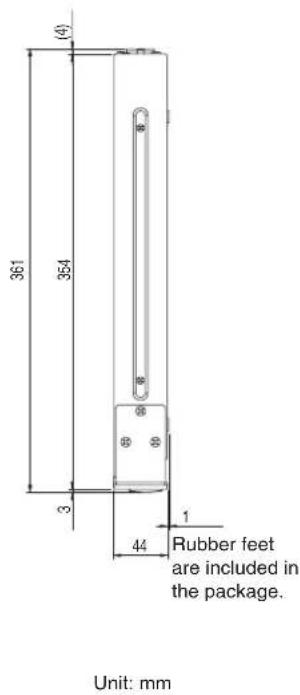
text_image
(4) 361 354 3 44 1 Rubber feet are included in the package. Unit: mm* Specifications and descriptions in this owner's manual are for information purpose only. Yamaha Corp. reserves the right to charge or modify products or specifications at any time without prior notice. Since specifications, equipment or options may not be the same in every locale, please check with your Yamaha dealer.
European models
Purchaser/User Information specified in EN55103-1 and EN55103-2.
Inrush Current: 35A
Conforms to Environments: E1,E2,E3 and E4.
Index
A
About DME Designer ....13
[AC IN] Connector ....16
Analog Audio Connection ....25
area 9
C
Components 9
Configuration 9
CP4SW, CP4SF, and CP1SF .....32
D
Delete All Data 31
device group 9
Digital Audio Connection .....24
Dimensions 44
Dip Switch ....16
Display Messages ....38
DME4io-ES 8
DME8i-ES 8
DME8o-ES 8
E
Electrical Characteristics ....39
[ERROR] Indicator ....15
Error Messages 38
Ethernet Connection ....20
EtherSound Connection .....28
EtherSound Connectors .....24, 28
EtherSound [IN]/[OUT] Connectors 17
Euroblock plug connection .....25
F
Firmware Version ......7
G
General Specifications ....39
GPI Connection ....30
[GPI] Connector ....17
Ground Screw 16
group master 9
|
ICP1 32
Initialize DME ....31
Initializing ....31
[INPUT] & [OUTPUT] Connectors 25
[INPUT] Connectors ....17
Input/Output Characteristics .....42
M
Master and slave setting 19
[MASTER] Indicator 14
MIDI Data Format 34
MIDI Implementation Chart ...... 37
N
[NETWORK] Connector ..... 16, 43
[NETWORK] Indicator 14
Network Settings 19
0
octet 19
Options 32
[OUTPUT] Connectors .... 17
P
parameters 9
[PEAK] Indicators 15
[POWER] Indicator 15
[POWER] Switch 15
Precautions for Using a Rack-mounted DME Satellite 17
preset parameters 9
R
Remote Connection 26
[REMOTE] Connector ..... 17
RS-232C 16
RS-422 16
S
Scene 10
Setting the IP address 19
[SIGNAL] Indicators 15
Signal Types 11
Straight and Crossover Cable Wiring 44
System Examples 12
T
Troubleshooting 33
[TX/RX] Indicator 15
U
USB Connection 18
[USB] Connector 14
User Defined buttons (User Defined parameters) 9
W
Warning Messages 38
Z
zones 9
MEMO
For details of products, please contact your nearest Yamaha representative or the authorized distributor listed below.
Yamaha Canada Music Ltd. 135 Milner Avenue, Scarborough, Ontario, M1S 3R1, Canada Tel: 416-298-1311
U.S.A.
Yamaha Corporation of America 6600 Orangethorpe Ave., Buena Park, Calif. 90620, U.S.A. Tel: 714-522-9011
CENTRAL & SOUTH AMERICA
MEXICO
PANAMA AND OTHER LATIN
AMERICAN COUNTRIES/
CARIBBEAN COUNTRIES
Yamaha Music Europe GmbH Branch Switzerland in Zürich Seefeldstrasse 94, 8008 Zürich, Switzerland Tel: 01-383 3990
AUSTRIA
Yamaha Music Europe GmbH Branch Austria Schleiergasse 20, A-1100 Wien, Austria Tel: 01-60203900
CZECH REPUBLIC/SLOVAKIA/
HUNGARY/SLOVENIA
Yamaha Music Europe GmbH Branch Austria Schleiergasse 20, A-1100 Wien, Austria Tel: 01-602039025
POLAND
Yamaha Music Europe GmbH
YS Copenhagen Liaison Office Generatorvej 6A, DK-2730 Herlev, Denmark Tel: 44 92 49 00
NORWAY
Yamaha Music (Russia) Room 37, bld. 7, Kievskaya street, Moscow, 121059, Russia Tel:495 626 5005
OTHER EUROPEAN COUNTRIES
Yamaha Music Europe GmbH Siemensstraße 22-34, 25462 Rellingen, Germany Tel: +49-4101-3030
AFRICA
Yamaha Corporation, Asia-Pacific Sales & Marketing Group Nakazawa-cho 10-1, Naka-ku, Hamamatsu, Japan 430-8650 Tel: +81-53-460-2303
MIDDLE EAST
TURKEY/CYPRUS
Yamaha Music Europe GmbH Siemensstraße 22-34, 25462 Rellingen, Germany Tel: 04101-3030
OTHER COUNTRIES
Yamaha Music Gulf FZE LOB 16-513, P.O.Box 17328, Jubel Ali, Dubai, United Arab Emirates Tel: +971-4-881-5868
ASIA
THE PEOPLE'S REPUBLIC OF CHINA
Yamaha Music & Electronics (China) Co., Ltd. 2F, Yunhedasha, 1818 Xinzha-lu, Jingan-qu, Shanghai, China Tel: 021-6247-2211
INDIA
Yamaha Music India Pvt. Ltd. 5F Ambience Corporate Tower Ambience Mall Complex Ambience Island, NH-8, Gurgaon-122001, Haryana, India Tel: 0124-466-5551
INDONESIA
PT. Yamaha Music Indonesia (Distributor) PT. Nusantik Gedung Yamaha Music Center, Jalan Jend. Ga Subroto Kav. 4, Jakarta 12930, Indonesia Tel: 21-520-2577
KOREA
Yamaha Music Korea Ltd. 8F, 9F, Dongsung Bldg. 158-9 Samsung-Dong, Kangnam-Gu, Seoul, Korea Tel: 080-004-0022
MALAYSIA
Yamaha Music Malaysia, Sdn., Bhd. Lot 8, Jalan Perbandaran, 47301 Kelana Jaya, Petaling Jaya, Selangor, Malaysia Tel: 3-78030900
SINGAPORE
Yamaha Music Asia Pte., Ltd.
03-11 A-Z Building
140 Paya Lebor Road, Singapore 409015 Tel: 747-4374
TAIWAN
Yamaha KHS Music Co., Ltd. 3F, #6, Sec.2, Nan Jing E. Rd. Taipei. Taiwan 104, R.O.C. Tel: 02-2511-8688
THAILAND
Siam Music Yamaha Co., Ltd. 4, 6, 15 and 16 ^th floor, Siam Motors Building, 891/1 Rama 1 Road, Wangmai, Pathumwan, Bangkok 10330, Thailand Tel: 02-215-2626
OTHER ASIAN COUNTRIES
Yamaha Corporation, Asia-Pacific Sales & Marketing Group Nakazawa-cho 10-1, Naka-ku, Hamamatsu, Japan 430-8650 Tel: +81-53-460-2303
OCEANIA
AUSTRALIA
Yamaha Music Australia Pty. Ltd. Level 1, 99 Queensbridge Street, Southbank, Victoria 3006, Australia Tel: 3-9693-5111
COUNTRIES AND TRUST
TERRITORIES IN PACIFIC OCEAN
Yamaha Corporation, Asia-Pacific Sales & Marketing Group Nakazawa-cho 10-1, Naka-ku, Hamamatsu, Japan 430-8650 Tel: +81-53-460-2303

YAMAHA
Yamaha Pro Audio global web site:
http://www.yamahaproaudio.com/
Yamaha Manual Library
© 2007-2010 Yamaha Corporation
008IPTO-D0
Printed in Japan
WK01190