
EO 3850(MAISON) - Convection Oven DELONGHI - Free user manual and instructions
Find the device manual for free EO 3850(MAISON) DELONGHI in PDF.


| Product type | Convection oven |
| Brand | DELONGHI |
| Model | EO 3850(MAISON) |
| Power supply | See rating plate (voltage and max power) |
| Power consumption (CENELEC HD 376) | 0.22 kWh to reach 200°C, 0.78 kWh to maintain 200°C for 1h |
| Cooking functions | Defrosting, keep warm, convection cooking (1 or 2 levels), traditional cooking, grill, rotisserie (if equipped) |
| Temperature range | 60°C to 240°C (cooking), special position for defrosting and grill |
| Timer | Up to 120 minutes with automatic shut-off and alarm |
| Thermostat indicator light | Lights up during heating, goes off when set temperature is reached |
| Interior light | On during operation, replaceable bulb (type T300°C) |
| Supplied accessories | Metal grid, drip tray, crumb tray, lasagna dish (depending on model), spit with supports (depending on model) |
| Positioning guides | 3 levels (guides 1, 2, 3) for grid and drip tray |
| Cleaning and maintenance | Accessories dishwasher safe; interior cleanable with damp cloth; upper heating element tiltable for cleaning the ceiling |
| Safety | Automatic shut-off with timer; do not immerse; hot outer surface during operation; unplug before cleaning |
| Installation | Horizontal surface at least 85 cm from floor, out of reach of children |
| Compliance | EC Directives 89/336 (electromagnetic compatibility) and 89/109 (food contact) |
| Warning | Preheating recommended; do not use if door is damaged; have the cable replaced by a professional |
Frequently Asked Questions - EO 3850(MAISON) DELONGHI
User questions about EO 3850(MAISON) DELONGHI
0 question about this device. Answer the ones you know or ask your own.
Ask a new question about this device
Download the instructions for your Convection Oven in PDF format for free! Find your manual EO 3850(MAISON) - DELONGHI and take your electronic device back in hand. On this page are published all the documents necessary for the use of your device. EO 3850(MAISON) by DELONGHI.
USER MANUAL EO 3850(MAISON) DELONGHI
1.1 Description of the oven and the accessories 16 1.2 Summary of operation 17 1.3 Specifications 19 1.4 Warnings 19
CHAPTER 2 USE OF THE OVEN AND REFERENCE COOKING TIMES
2.1 Use of the controls 20 2.2 Tips on use 21 2.3 How to set the functions 21
Defrosting 21 - Keeping food warm 21 - Convection oven cooking 22 - Traditional oven cooking 23 Grilling and cooking au gratin 24 Grilling with the turnspit (if fitted) 26
CHAPTER 3 CLEANING AND MAINTENANCE 27
ELECTRICAL CONNECTION (UK ONLY)
A) If your appliance comes fitted with a plug, it will incorporate a 13 Amp fuse. If it does not fit your socket, the plug should be cut off from the mains lead, and an appropriate plug fitted, as below.
WARNING: Very carefully dispose of the cut off plug after removing the fuse: do not insert in a 13 Amp socket elsewhere in the house as this could cause a shock hazard.
With alternative plugs not incorporating a fuse, the circuit must be protected by a 15 Amp fuse.
WARNING - THIS APPLIANCE MUST BE EARTHED
IMPORTANT
The wires in the mains lead are coloured in accordance with the following code:
Green and yellow:
Blue:
Brown:
Earth
Neutral
Live

If the plug is a moulded-on type, the fuse cover must be re-fitted when changing the fuse using a 13 Amp Asta approved fuse to BS 1362. In the event of losing the fuse cover, the plug must NOT be used until a replacement fuse cover can be obtained from your nearest electrical dealer. The colour of the correct replacement fuse cover is that as marked on the base of the plug.
B) If your appliance is not fitted with a plug, please follow the instructions provided below:
As the colours of the wires in the mains lead may not correspond with the coloured markings identifying the terminals in your plug, proceed as follows:
The green and yellow wire must be connected to the terminal in the plug marked with the letter E or the earth symbol ½ or coloured green or green and yellow.
The blue wire must be connected to the terminal marked with the letter N or coloured black.
The brown wire must be connected to the terminal marked with the letter L or coloured red.
CHAPTER 1 - GENERAL
1.1 - DESCRIPTION OF THE OVEN AND THE ACCESSORIES
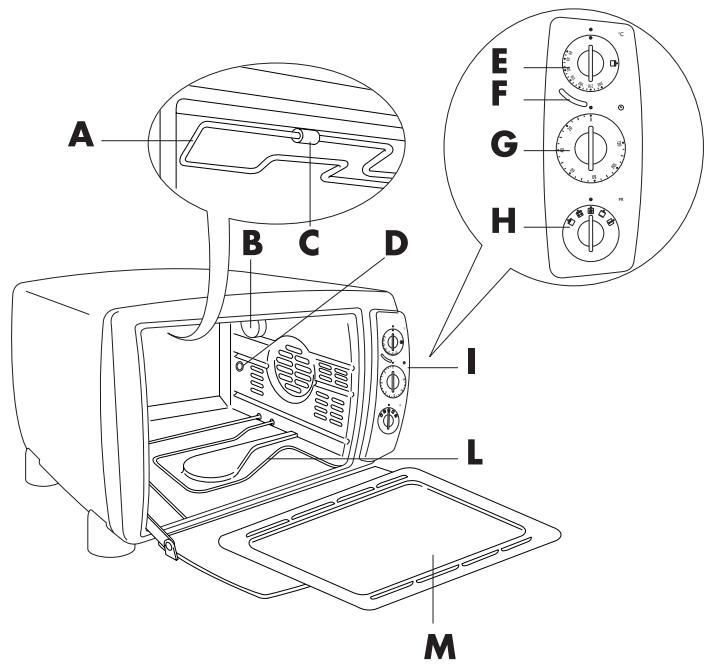
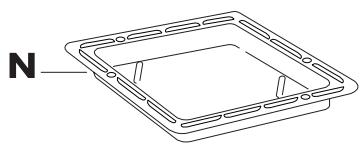
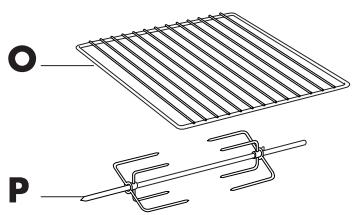
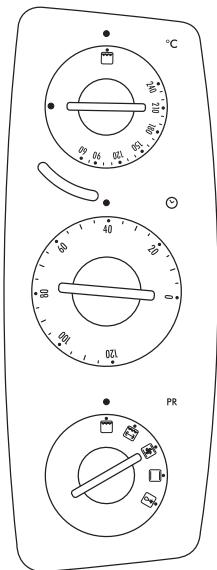
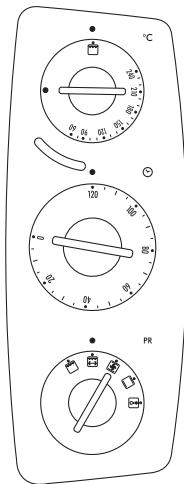
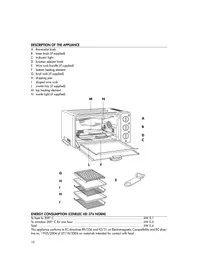
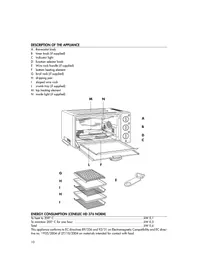
A Top heating element B Oven light C Heating element hook D Turnspit mount (if fitted) E Thermostat knob F Thermostat pilot light G On/off and timer knob H Function selector knob
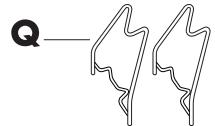
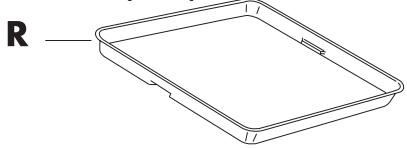
Control panel L Bottom heating element M Crumb tray N Dripping pan O Wire rack P Spit (if supplied) Q Spit supports (if supplied) R Lasagne pan (if supplied)
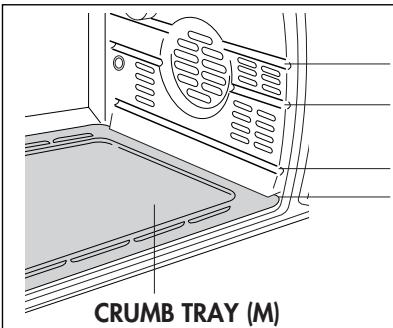
Guide 1
Guide 2
Guide 3
Guide for crumb tray only
To ensure the correct operation of the appliance and achieve excellent results when cooking, ALWAYS place the crumb tray (M) in position at the bottom of the oven.
1.2 - SUMMARY OF OPERATION
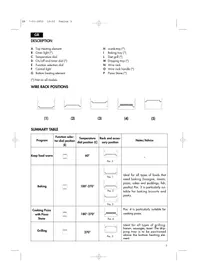
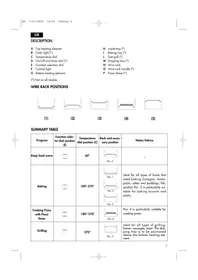
| PROGRAM | FUNCTION SELECTOR KNOB SETTING | THERMOSTAT KNOB SETTING | POSITION OF WIRE RACK AND ACCESSORIES | GUIDES | NOTES/TIPS |
| DEFROSTING | ● | 1 2 3 | Place the food being defrosted directly onto the wire rack. The drip-ping pan is used to collect any drops of fat and water. | ||
| KEEPING FOOD WARM | 60° | 1 2 3 | 60° If the food needs to be kept warm for longer than 20-30 minutes, it should be covered with tinfoil, to prevent it from becoming too dry. | ||
| CONVECTION OVEN COOKING (ONE LEVEL) | 60°-240° (see table on page 22) | or alternatively | 1 2 3 1 2 3 | Ideal for cooking meat, poultry, roast potatoes, bread and leavened cakes. Use the dripping pan, sliding it directly into the guides, or the lasagne pan, if supplied, resting it on the wire rack. | |
| CONVECTION OVEN COOKING (TWO LEVELS) | 1 2 3 | For simultaneous cooking on two levels, position the accessories as shown in the figure to the side. Ideal for cooking foods that need to be turned/stirred during cooking. | |||
| TRADITIONAL OVEN COOKING | 60°-240° (see table on page 23) | or alternatively | 1 2 3 1 2 3 | Ideal for cooking pizza, lasagne, pasta au gratin, fish and stuffed vegeta- bles (capsicums, cour- gettes, etc.). Use the dripping pan, sliding it directly into the guides, or the lasagne pan, if supplied, resting it on the wire rack. | |
| GRILLING AND COOKING AU GRATIN | 1 2 3 | Ideal for all types of tra- ditional grill; hamburg- ers, frankfurters, kebabs, toast, etc. Place the food directly on the wire rack. The dripping pan is used to collect any drops of fat. | |||
| 1 2 3 | Ideal for dishes that need to be cooked au gratin (e.g. coquilles Saint- Jacques, etc.). In this case, the container (with the food inside) should be placed on the wire rack. | ||||
| GRILLING WITH THE TURNSPIT (IF FITTED) | 1 2 3 | Ideal for cooking chick- ens, fowl in general, roast pork, etc. A glass of water can be poured into the dripping pan to make cleaning easier and prevent smoke being produced by the burning fat. |
Chapter 1 - General
1.3 - SPECIFICATIONS
Operating voltage . . . see rating label
Maximum power absorbed see rating label
POWER CONSUMPTION (CENELEC STANDARD HD 376)
To reach 200°C 0.22 KWh
To maintain 200°C for one hour 0.78 KWh
Total 1 KWh
This appliance complies with EEC Directive 89/336 on electromagnetic compatibility. The materials and objects that come into contact with food products comply with the provisions of EEC Directive 89/109 and Italian decree law no. 108, dated January 25, 1992.
1.4 - WARNINGS
- This oven has been designed to cook food. It must not be used for other purposes and must not be modified or tampered with in any way.
- The appliance is not intended for use by young children or infirm persons without supervision. Young children should be supervised to ensure that they do not play with the appliance.
- Before using the oven, make sure it has not been damaged during transport.
- Position the oven on a horizontal surface at a height of at least 85 cm out of the reach of children.
- The temperature of the door or the outer surface may be high when the appliance is operating: only touch the plastic knobs and handles. Do not place anything on top of the oven while in use.
- Before using the oven for the first time, remove all the packaging and paper material inside, such as protective boards, booklets, plastic bags, etc. Before plugging the oven into the power socket, make sure that:
- the mains power supply corresponds to the value shown on the rating plate, fitted to the rear of the appliance;
- the power socket has a rating of at least 10A and is properly earthed; the manufacturer declines all liability if this safety standard is not observed.
- Wash all the accessories thoroughly before use.
- The following must be kept in mind when the door is open:
- do not apply excessive force with heavy objects or by pulling the handle downwards.
- never place heavy containers or hot pans just taken out of the oven on the open door.
- Never move the oven when it is in operation.
- If the supply cord is damaged, it must be replaced by the manufacturer or its service agent or a similarly qualified person in order to avoid a hazard.
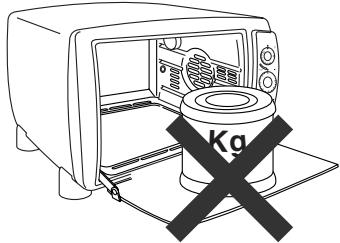
WARNING: Once having removed the appliance from the packaging, check that the door is intact. As the door is made from glass, it is fragile, and should be replaced if visibly chipped, scored or scratched. Furthermore, when using, cleaning or moving the appliance, do not slam or bang the door or pour cold liquids on the glass when the appliance is hot.
Before using the oven for the first time, operate it empty with the thermostat set to maximum for at least 15 minutes, to eliminate the "new" smell and any smoke from the protective material applied to the heating elements before transport. The room must be ventilated during this operation.
CHAPTER 2 - USE OF THE OVEN AND REFERENCE COOKING TIMES
2.1 - USE OF THE CONTROLS
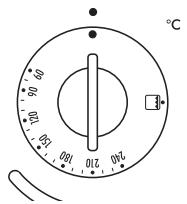
THERMOSTAT KNOB (E)
Select the desired temperature as follows:
- Defrosting: Thermostat knob in position "●".
- Keeping food warm: Thermostat knob set to 60°C.
- Convection oven or traditional oven cooking: Thermostat knob set from 60°C to 240°C.
- All types of grilling and cooking with the turnspit (if fitted): Thermostat knob in position
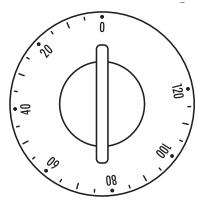
ON/OFF AND TIMER KNOB (G)
- To switch the oven on and to set the cooking time: Turn the knob clockwise to the desired time (max. 120 minutes). A bell will ring when the set time has elapsed, and the oven will automatically switch itself off.
- To switch the oven off: Turn the knob to position "0".
When setting times of less than 10 minutes, first turn the knob all the way round, and then set the desired time.
FUNCTION SELECTOR KNOB (H)
This knob is used to select from the available cooking functions, as follows:
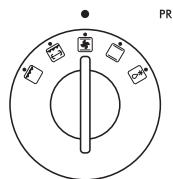
(fan on only)
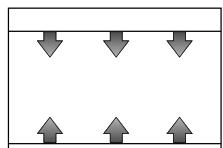
TRADITIONAL OVEN COOKING
(top heating element and bottom heating element on only)
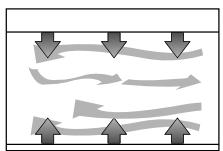
CONVECTION OVEN COOKING, KEEPING FOOD WARM
(top heating element, bottom heating element and fan on)
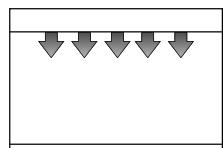

GRILLING
TURNSPIT (IF FITTED)
(top heating element on only, at maximum power)
THERMOSTAT PILOT LIGHT (F)
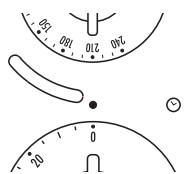
The light comes on to indicate that the oven is heating up, and goes off when the oven has reached the set temperature. The pilot light is always off during the DEFROSTING function.
2.2 - GENERAL ADVICE
- When cooking using the convection oven, traditional oven or grill functions, the oven should always be preheated to the set temperature for best results.
- The cooking times depend on the quality of the products, the temperature of the food, and individual tastes. The times given in the table are only intended as a guide and may need to be varied. They do not take into account the time required to preheat the oven.
- When cooking frozen food, follow the recommendations on the package.
2.3 - HOW TO SET THE FUNCTIONS
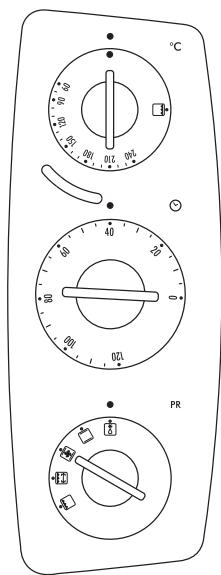
DEFROSTING
Place the wire rack in guide no. 2 and the dripping pan in guide no. 3, as shown in the figure on page 17.
The food being defrosted should be placed directly on the wire rack.
If this is not possible for practical reasons (such as in the case of minced meat, which once defrosted may fall between the openings in the wire rack), place the food on a dinner plate, and then place the plate on the wire rack (in this case, the dripping pan is not required).
Turn the function selector knob (H) to position . Turn the thermostat knob (E) to position "●".
Turn the ON/OFF and timer knob (G) to the desired time. A bell will ring when defrosting is complete.
N.B. the defrosting times are reduced significantly with this function.
KEEPING FOOD WARM
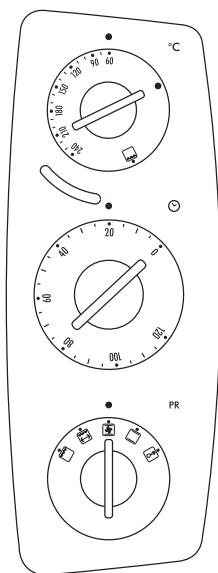
Place the dripping pan or the wire rack with a pan on top (the lasagne pan, if supplied, may also be used) in guide no. 3, as shown in the figure on page 17. This function is used to keep the food warm until serving. The food should not be left in the oven too long, as it may become too dry (to avoid this, cover the pan with tin-foil or baking paper).
Turn the function selector knob (H) to position. Turn the thermostat knob (E) to 60°C.
Turn the ON/OFF and timer knob (G) to the desired time. A bell will ring when the set time has elapsed; if the food being kept warm is served before the end of the set time, manually turn the ON/OFF and timer knob (G) to position "0".
Chapter 2 - Use of the oven and reference cooking times
CONVECTION OVEN COOKING
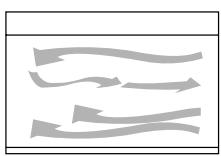
This function is ideal for cooking great savoury pies, all types of meat-based main dishes (apart from small fowl), roast potatoes and cakes in general. It is also suitable for simultaneous cooking on two different levels.
How to use the function:
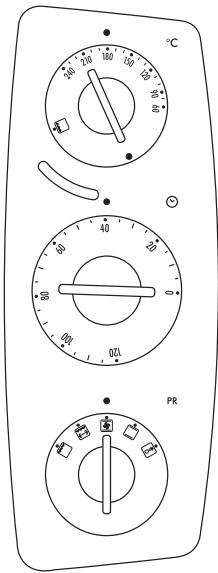
Turn the function selector knob (H) to position
Select the desired temperature using the thermostat knob (E).
Turn the ON/OFF and timer knob (G) to the time desired.
Wait for the oven to reach the set temperature (the pilot light goes off), then place the dish containing the food on the wire rack (previously placed in the oven), or, if the food is in the dripping pan, place the pan directly into the guide (refer carefully to the table below). A bell will ring when the set time has elapsed.
| RECIPCE | QUANTITY | THERMOSTAT KNOB | TIME | WIRE RACK/DRIP- PING PAN POSITION | OBSERVATIONS AND TIPS |
| SAVOURY PIE | 600 g | 180°C | 35 min. | 3 | Use a cake tin |
| CHICKEN PIECES | 1000 g | 200°C | 60 min. | 3 | Place directly in the dripping pan (N) |
| WHOLE CHICKEN | 1500 g | 200°C | 90 min. | 3 | Pierce with a fork to drain the fat |
| ROAST PORK | 1500 g | 200°C | 90 min. | 3 | Leave a little fat around the edges to prevent it from becoming too dry |
| MEAT LOAF | 1000 g | 200°C | 60 min. | 3 | Place directly in the dripping pan (N) |
| ROAST POTATOES | 1000 g | 200°C | 45 min. | 2 | Turn 2 or 3 times during cooking |
| SPONGE CAKE | 700 g | 180°C | 35 min. | 3 | Use a mold with hinge |
| PLUM CAKE | 900 g | 160°C | 90 min. | 3 | Use a rectangular mold |
| BISCUITS | 400 g | 180°C | 20 min. | 2 | Place directly in the dripping pan (N) |
| TART | 1000 g | 180°C | 35 min. | 2 | A round mold can be used, placed on the wire rack (O), or alternatively directly the dripping pan (N) |
| DOUGHNUT | 700 g | 180°C | 40 min. | 3 | Use a mold with hinge |
Add around 5 minutes to the cooking time for preheating.
Chapter 2 - Use of the oven and reference cooking times
TRADITIONAL OVEN COOKING
This function is ideal for cooking great pizzas, lasagne, first courses au gratin, small fowl, all types of fish, stuffed vegetables au gratin and some types of cakes.
How to use the function:
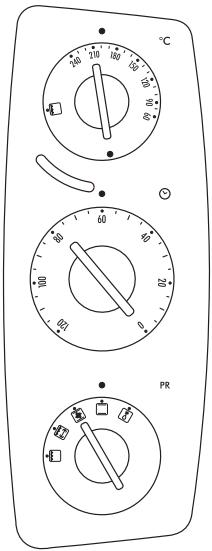
Turn the function selector knob (H) to position
Select the desired temperature using the thermostat knob (E).
Turn the ON/OFF and timer knob (G) to the desired time.
Wait for the oven to reach the set temperature (the pilot light goes off), then place the dish containing the food on the wire rack (previously placed in the oven), or, if the food is in the dripping pan, place the pan directly into the guide (refer carefully to the table below). A bell will ring when the set time has elapsed.
| RECIPPE | QUANTITY | THERMOSTAT KNOB | TIME | WIRE RACK/DRIP- PING PAN POSITION | OBSERVATIONS AND TIPS |
| FRESH PIZZA | 400 g | 200°C | 25 min. | 3 | Use the dripping pan (N) |
| FROZEN PIZZA | 250 g | 220°C | 8 min. | 2 | Can be placed directly on the wire rack (O) or on the dripping pan (N) |
| FROZEN PIZZA | 450 g | 220°C | 13 min. | 2 | Can be placed directly on the wire rack (O) or on the dripping pan (N) |
| LASAGNE | 1500 g | 200°C | 40 min. | 3 | Place the lasagne pan (if supplied) or a baking pan directly on the wire rack (O) |
| CANNELLONI | 2300 g | 200°C | 40 min. | 3 | Place the lasagne pan (if supplied) or a baking pan directly on the wire rack (O) |
| BAKED BREAM | 1000 g | 190°C | 60 min. | 3 | Can be cooked directly on the drip- ping pan (N) |
| TROUT BAKED IN FOIL | 800 g | 200°C | 60 min. | 3 | Place in the dripping pan (N), wrapped in tinfoil |
| AUBERGINES WITH PARMESAN | 1700 g | 200°C | 35 min. | 2 | Place the baking pan on the wire rack (O) |
| COURGETTES WITH TUNA | 1000 g | 200°C | 50 min. | 2 | Use the dripping pan (N): add oil, tomatoes and water |
| POTATOES AU GRATIN | 1500 g | 200°C | 50 min. | 2 | Place the baking pan on the wire rack (O) |
| APPLE PIE | 1000 g | 190°C | 90 min. | 3 | Place the cake tin on the wire rack (O) |
| MUFFINS | 600 g | 200°C | 20 min. | 2 | Place the muffin cups directly on the dripping pan |
Add around 5 minutes to the cooking time for preheating.
GRILLING AND COOKING AU GRATIN
This function is ideal for grilling hamburgers, chops, frankfurters, sausages, etc. In addition, this function may be used for browning foods: gnocchi alla romana, coquilles Saint-Jacques, etc.
How to use the function:
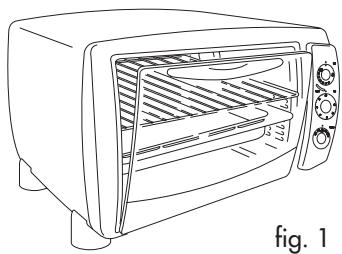
Fit the wire rack (O) in the upper guide (1) and the dripping pan (N) in the centre guide (2), as shown in Figure 1. A glass of water can be poured into the dripping pan (N) to make cleaning easier, and prevent smoke being produced by the burning fat.
Turn the function selector knob (H) to position
Turn the thermostat knob (E) to position
Turn the ON/OFF and timer knob (G) to the desired time.
Preheat the oven for 5 minutes, with the door slightly ajar (as highlighted in Figure 1).
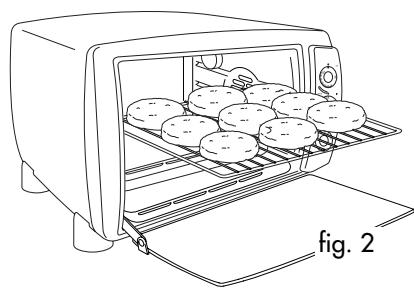
Once the preheating time is complete, place the food being grilled directly on the wire rack (Figure 2) and close the door, leaving it ajar, as shown in Figure 3; remember to turn the food half way through cooking.
Important: for best results, place the food on the wire rack (O), leaving an empty space of around 2cm near the door (see Figure 2).
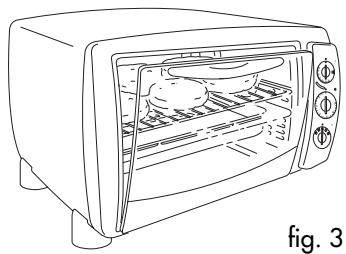
In the case of food that has already been cooked or is to be cooked au gratin, place the container directly on the wire rack in the centre guide (2); the door must be left ajar as shown in Figure 4). A bell will ring when the set cooking time has elapsed; if cooking is completed before the end of the set time, manually turn the ON/OFF and timer knob (G) to position "0".
fig. 4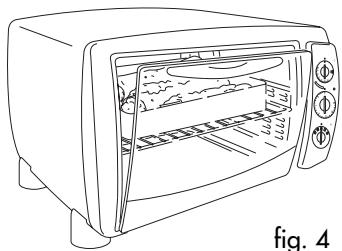
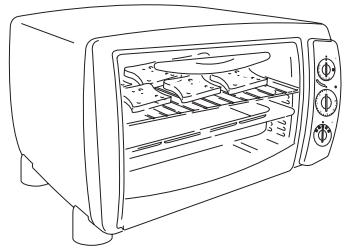
To correctly toast bread, place the slices as shown in the figure to the side, that is, leaving 2 cm of free space at the ends of the wire rack.
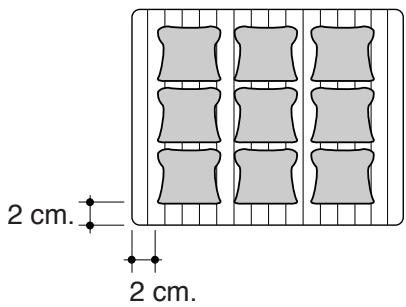
FOR TOASTING BREAD ONLY; the oven door must be closed completely (as shown in the figure to the side)
The table below provides some useful tips for preparing great grilled food.
| RECIPCE | QUANTITY | THERMOSTAT KNOB | TIME | OBSERVATIONS AND TIPS |
| PORK CHOPS (4) | 600 g | 20 min. | Turn after approx. 12 minutes | |
| SAUSAGES (12) | 1200 g | 25 min. | Pierce with a fork to drain the fat. Turn after approx. 15 minutes | |
| HAMBURGERS (6) | 700 g | 20 min. | Turn after approx. 12 minutes | |
| FRANKFURTERS (6) | 500 g | 10 min. | Turn after approx. 3-4 minutes | |
| KEBABBS (4) | 650 g | 25 min. | Turn after approx. 15 minutes | |
| TOAST | 9 slices | 3,5 min. | Turn half way throughasting | |
| GNOCCHI ALLA ROMANA | 1500 g | 15 min. | Place the baking pan on the wire rack, positioned in the centre guide (2) |
Chapter 2 - Use of the oven and reference cooking times
GRILLING WITH THE TURNSPIT (IF FITTED)
This function is ideal for cooking chickens on the spit, fowl in general, roast pork and veal.
Operate as follows:
fig. 5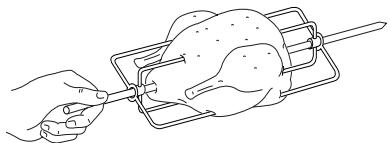
Place the food on the spit (P) and hold it firm using the forks (for best results, tie the meat using kitchen string).
fig. 7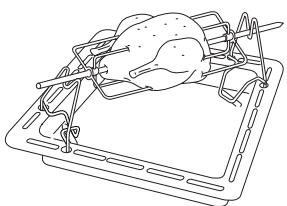
Place the spit on the supports.
fig. 9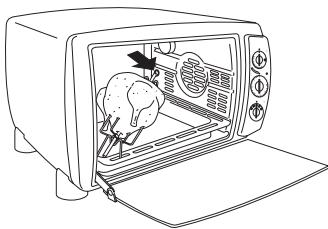
Once the dripping pan is in place, push the spit into the turnspit mount (D), tilting the spit supports (Q) to the right.
The oven does not need to be preheated for this function.
Turn the function selector knob (H) to position [E].
Turn the thermostat knob (E) to position

Turn the ON/OFF and timer knob (G) to the desired time.
If the cooking time is longer than 2 hours, remember to reset the timer.
Once cooking is complete, manually turn the ON/OFF and timer knob (G) to position "0".
fig. 6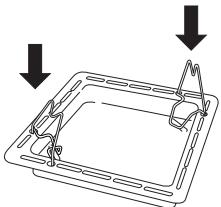
Place the spit supports (Q) on the dripping pan, in the holes provided.
fig. 8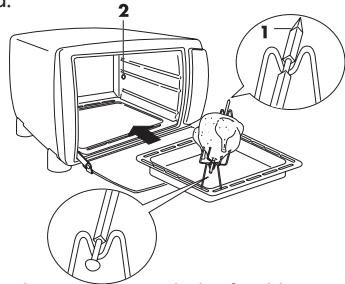
Slide the dripping pan with the food being cooked into the lower guide (3), tilting the spit supports (Q) to the left. Make sure the point of the spit 1 is facing forwards and is correctly inserted into the hole 2.
fig. 10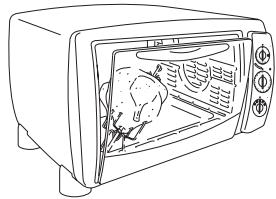
Close the door, leaving it slightly ajar, as highlighted in the figure (half-open).
CHAPTER 3 - CLEANING AND MAINTENANCE
Frequent cleaning will prevent the formation of smoke and bad smells during cooking.
Before performing any cleaning operations, always unplug the appliance from the power socket.
Never immerse the appliance in water; do not wash it by spraying it with water.
The wire rack, dripping pan, crumb tray, lasagne pan (if supplied) and spit (if supplied) are washed like normal dishes, by hand or in the dishwasher.
Always use a damp sponge to clean the outer surface. Avoid using abrasive products that may damage the surface finish (enamel or paint). Make sure water or liquid soap does not infiltrate through the slits on the right-hand side of the oven.
To clean the inside of the oven, never use corrosive products and do not scrape the walls with sharp objects or blades. Only use non-abrasive liquid detergents.
Do not attempt to push forks, knives or sharp objects into the openings on the right-hand side and the rear of the oven.
Remove the crumb tray (M) by pulling it outwards (see Fig. 11). In case of difficulty, wet the outside parts of the tray. Remove any dirt with a damp cloth. Dry thoroughly and then put the tray back in place.
To make the inside ceiling of the oven easier to clean, the top heating element (A) needs to be lowered by pulling the heating element hook towards the door (C) (see Figures 12 and 13).
IMPORTANT: after cleaning, fasten the heating element back in place (Fig. 14). The oven must not be used when the heating element is in the lowered position.
OVEN LIGHT
The oven light (B) is always on when the oven is on. To replace the bulb, proceed as follows:
- unplug the appliance from the power socket
- unscrew the protective glass cover (X), by turning it anti-clockwise, and replace the bulb (Y) with a new one of the same type (see Fig. 15). Replace the protective glass cover (X).
Only use bulbs suitable for ovens (T300°C)
N.B. The oven can still be used even if the bulb is burnt out
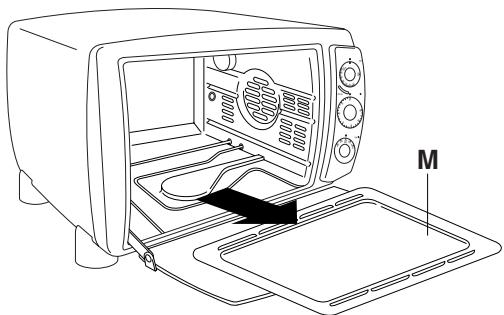
fig. 11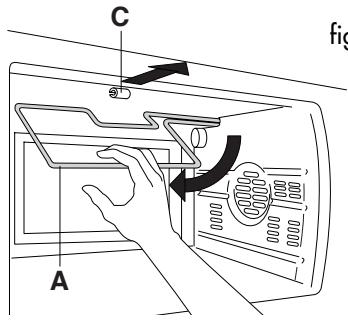
fig. 12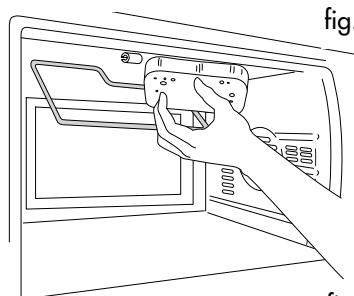
fig. 13 fig. 14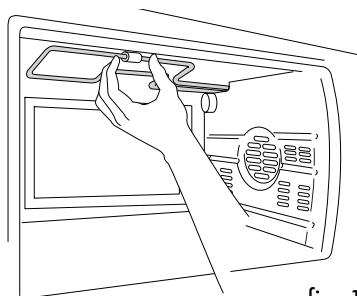
fig. 15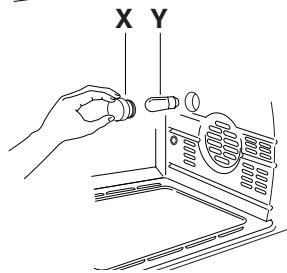
- CHAPTER 2 USE OF THE OVEN AND REFERENCE COOKING TIMES
- ELECTRICAL CONNECTION (UK ONLY)
- WARNING - THIS APPLIANCE MUST BE EARTHED
- IMPORTANT
- CHAPTER 1 - GENERAL
- DESCRIPTION OF THE OVEN AND THE ACCESSORIES
- SUMMARY OF OPERATION
- SPECIFICATIONS
- POWER CONSUMPTION (CENELEC STANDARD HD 376)
- WARNINGS
- CHAPTER 2 - USE OF THE OVEN AND REFERENCE COOKING TIMES
- USE OF THE CONTROLS
- THERMOSTAT KNOB (E)
- ON/OFF AND TIMER KNOB (G)
- FUNCTION SELECTOR KNOB (H)
- TRADITIONAL OVEN COOKING
- CONVECTION OVEN COOKING, KEEPING FOOD WARM
- GRILLING
- TURNSPIT (IF FITTED)
- THERMOSTAT PILOT LIGHT (F)
- GENERAL ADVICE
- HOW TO SET THE FUNCTIONS
- DEFROSTING
- KEEPING FOOD WARM
- CONVECTION OVEN COOKING
- HOW TO USE THE FUNCTION
- GRILLING AND COOKING AU GRATIN
- GRILLING WITH THE TURNSPIT (IF FITTED)
- OPERATE AS FOLLOWS
- CHAPTER 3 - CLEANING AND MAINTENANCE
- OVEN LIGHT
Brand : DELONGHI
Model : EO 3850(MAISON)
Category : Convection Oven