
F18433 - Deep fryer DELONGHI - Free user manual and instructions
Find the device manual for free F18433 DELONGHI in PDF.


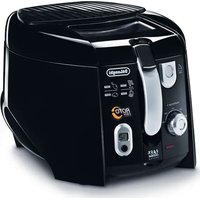
| Product type | Electric deep fryer |
| Brand | DELONGHI |
| Model | F18433 |
| Minimum oil capacity | 1 liter |
| Maximum oil capacity | 1.5 liters |
| Max fresh fries capacity | 1.2 kg |
| Max frozen fries capacity | 1 kg |
| Control type | Rotary thermostat with off |
| Heating indicator light | Yes (indicator light) |
| Timer | On some models (battery-operated electronic, clothing clip) |
| Anti-odor filter | Yes, replaceable (visible through peephole) |
| Removable tank | Yes, with non-stick coating |
| Basket | With sliding handle and rotation system |
| Safety | Thermal cut-off, mandatory grounding plug |
| Oil drainage | Via hose (on some models) or by removing the tank |
| Oil filtration | Possible with supplied filter (on some models) |
| Tank cleaning | Dishwasher safe (except lid) |
| Basket cleaning | Dishwasher safe |
Frequently Asked Questions - F18433 DELONGHI
User questions about F18433 DELONGHI
0 question about this device. Answer the ones you know or ask your own.
Ask a new question about this device
Download the instructions for your Deep fryer in PDF format for free! Find your manual F18433 - DELONGHI and take your electronic device back in hand. On this page are published all the documents necessary for the use of your device. F18433 by DELONGHI.
USER MANUAL F18433 DELONGHI
Read this manual thoroughly before installing and using the appliance. This is the only way to ensure best results and maximum safety for the user.
DESCRIPTION
(see drawing on page 3)
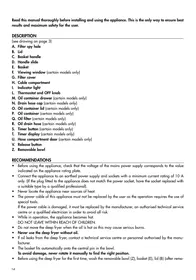
A. Filter spy hole B. Lid C. Basket handle D. Handle slide E. Basket F. Viewing window (certain models only) G. Filter cover H. Cable compartment I. Indicator light L. Thermostat and OFF knob M. Oil container drawer (certain models only) N. Drain hose cap (certain models only) O. Oil container lid (certain models only) P. Oil container (certain models only) Q. Oil filter (certain models only) R. Oil drain hose (certain models only) S. Timer button (certain models only) T. Timer display (certain models only) U. Hose compartment door (certain models only) V. Release button Z. Removable bowl
RECOMMENDATIONS
- Before using the appliance, check that the voltage of the mains power supply corresponds to the value indicated on the appliance rating plate.
- Connect the appliance to an earthed power supply and sockets with a minimum current rating of 10 A only. (If the plug fitted to the appliance does not match the power socket, have the socket replaced with a suitable type by a qualified professional).
- Never locate the appliance near sources of heat.
- The power cable of this appliance must not be replaced by the user as the operation requires the use of special tools. If the power cable is damaged, it must be replaced by the manufacturer, an authorised technical service centre or a qualified electrician in order to avoid all risk. • While in operation, the appliance becomes hot. DO NOT LEAVE WITHIN REACH OF CHILDREN.
- Do not move the deep fryer when the oil is hot as this may cause serious burns. • Never use the deep fryer without oil.
- If oil leaks from the deep fryer, contact a technical service centre or personnel authorised by the manufacturer.
- The basket fits automatically onto the central pin in the bowl. To avoid damage, never rotate it manually to find the right position.
- Before using the deep fryer for the first time, wash the removable bowl (Z), basket (E), lid (B) (after removing the filters) and oil saver set (O, P and Q) in hot water and washing up liquid.
ving the filters) and oil saver set (O, P and Q) in hot water and washing up liquid.
To empty the water, use the oil drain hose (if present) as shown in fig. 14.
At the end of the operation, dry everything thoroughly and remove any water left in the bottom of the bowl and inside the oil drain hose.
This prevents dangerous splashes of hot oil during operation.
- During operation, the drain hose must always be closed and in its compartment.
- The appliance must not be used by children or unfit persons without supervision. - Do not allow children to play with the appliance.
- Never move the appliance while the oil is still hot.
- Move the appliance by the handles provided. (Never move the appliance using the basket handle).
- It is normal for the appliance to give off a "new" smell when used for the first time. Ventilate the room.
- Materials and accessories coming into contact with food conform to EEC directive 89/109.
- Great care must be taken when removing or replacing the removable bowl (Z), tilting it to match the housing.
Never move the bowl until the oil and appliance are cold. Once the bowl is in place, make sure it is positioned correctly otherwise it could be damaged when the lid (B) is closed.
OPERATING INSTRUCTIONS
FILLING WITH OIL OR FAT
- Raise the basket into the top position by pulling the handle upwards (C) (fig. 1).
ALWAYS raise and lower the basket with the lid closed.
- Open the lid (B) by pressing the button (V) (fig. 2).
- Remove the basket by pulling upwards (fig. 3).
- Pour the oil into the container - 1.5 litres maximum capacity (1.3 kg of fat) or 1 litre minimum capacity (1 kg of fat).
IMPORTANT: The level of oil should always be between the maximum and minimum marks.
Never use the deep fryer with the oil below the "min" level as this could cause the thermal cutout to trip. To replace it, contact an authorised service centre.
For best results, use good quality peanut oil.
Never mix different oils together. If you are using solid fat, cut into small pieces to avoid the deep fryer heating up without liquid for the first few minutes. The temperature must be set to 150°C until the fat has melted completely. You can then set the required temperature.
STARTING FRYING
- Place the food to be fried in the basket. Never over fill (1.2 kg max. of fresh potatoes). To obtain more even frying you should concentrate the food around the edge of the basket, with less food at the centre.
- Place the basket in the bowl in the raised position (fig. 3) and close the lid, pressing lightly until it clips into place. To avoid splashes of hot oil, always close the lid before lowering the basket.
- Turn the thermostat knob (L) to the required temperature (fig. 4).
When the set temperature is reached, the indicator light (I) goes out.
- As soon as the light has gone out, immerse the basket in the oil by pushing the slide (D) on the basket handle backwards and slowly lowering the basket itself.
- It is normal for a considerable quantity of very hot steam to be given off from the filter cover (G) immediately after the basket has been lowered.
- Immediately after immersing the food in the oil, when cooking begins, the inside surface of the viewing window (F) (if present) mists up then clears gradually.
- It is normal for drops of condensation to form near the basket handle while the appliance is in operation.
MODELS WITH ELECTRONIC TIMER
- Set the cooking time by pressing the button (S). The minutes set appear on the display (T).
- Immediately afterwards, the numbers begin to flash. This means the cooking time has begun. The last minute is displayed in seconds.
- If you make a mistake, you can set the new cooking time by holding the button down for more than two seconds. When the display has reset, repeat the operation from point 1.
- The timer indicates the end of cooking time with two series of beeps separated by a 20 second gap. To turn off the signal, just press the timer button (S).
The timer can be attached to your clothes using the special clip.
IMPORTANT: the timer does not turn the appliance off
REPLACING THE TIMER BATTERY
- Remove the timer from its housing (fig. 16).
- Remove the back cover with a screwdriver (fig. 17).
- Turn the battery cover (fig. 18) anticlockwise until it is released.
- Replace the battery with another of the same kind. • Re-assemble the timer.
If the appliance is replaced or eliminated, the battery must be removed and disposed of in conformity with current legislation as it is harmful to the environment.
END OF FRYING
When the set cooking time has elapsed, raise the basket (E) and check that the food is cooked to the required colour. In models with viewing window (F), you can check the food by looking through the window without lifting the lid. If you decide the food is sufficiently cooked, turn the appliance off by rotating the thermostat knob (L) to the "0" position until you hear the internal switch click.
Drain excess oil by leaving the basket in the raised position inside the deep fryer.
FILTERING THE OIL OR FAT
You should filter the oil or fat each time you fry, especially if you cook food in breadcrumbs or flour.
Food particles left in the liquid tend to burn and may cause the oil or fat to deteriorate more rapidly.
Make sure the oil is sufficiently cold (wait about two hours).
Move the deep fryer towards the edge of the work top (fig. 5).
To avoid the appliance falling while the oil is being filtered, make sure the "U" feet are always resting on the work top (fig. 5).
MODELS WITHOUT DRAIN HOSE (R) AND OIL CONTAINER (P)
- Open the fryer lid (B) and remove the bowl (Z) (fig. 24), holding it by the handles. Empty the bowl.
- Remove any residues left in the bowl with a sponge or absorbent paper. Put the removable bowl (Z) back in place.
- Put the basket (E) back in the raised position and place one of the filters provided in the bottom (fig. 20).
Filters can be obtained from your local dealer or one of our service centres.
- Then pour the oil or fat back into the deep fryer very slowly to avoid it overflowing from the filter (fig. 21).
N.B.: The filtered oil can be kept inside the deep fryer.
However, if you will not be frying again for some time, you should keep the oil in the dark in a closed container to avoid it deteriorating. It is good practice to separate oil used for frying fish and oil used for frying other food. If you use lard or solid fat, do not allow it to cool down excessively or it will solidify.
MODELS WITH DRAIN HOSE (R) (FLEXIBLE OR RIGID DEPENDING ON MODEL) AND WITHOUT OIL CONTAINER (P)
- Open the deep fryer lid (B) and remove the basket (E).
- Open the door (U) as shown in fig. 22.
- Remove the drain hose (R).
- Remove the cap (N) and at the same time squeeze the hose (if present) with two fingers to avoid the oil or fat running out until the hose is placed over a container (fig. 22).
If the fryer has a rigid tube, remove the cap (N) and direct into a container (fig. 22).
- Run off the oil or fat into a container (fig. 23).
Always empty the oil before removing the bowl from the fryer.
- Remove any deposits left in the bowl using a sponge or absorbent paper or wash the bowl as described in the "Cleaning" chapter.
- To put the bowl back, open the hose compartment door, then replace the bowl, tilting it and with the hose in a horizontal position and the cap on. Put the hose back in its housing, then close the door (fig. 24).
- Put the basket back in the raised position and place one of the filters provided in the bottom of the basket (fig. 20).
Filters are available from your local dealer or one of our service centres.
- Then pour the oil or fat back into the deep fryer very slowly to avoid it overflowing from the filter (fig. 21).
N.B.: The filtered oil can be kept inside the deep fryer. However, if you will not be frying again for some time, you should keep the oil in the dark in a closed container to avoid it deteriorating. It is good practice to separate oil used for frying fish and oil used for frying other food. If you are using fat, make sure it does not cool down excessively or it will solidify.
MODELS WITH DRAIN HOSE (R) (FLEXIBLE OR RIGID DEPENDING ON MODEL) AND OIL CONTAINER (P)
- Pull the drawer (M) outwards as shown in fig. 6.
- Place the oil container (P) without the lid (O) in the special housing (fig. 7).
- Remove the basket.
- Open the door (U) as shown in fig. 8.
- Place the oil filter (Q) on the container (fig. 8).
- Extract the drain hose (R), remove the cap (N) and at the same time squeeze the hose (if present) with two fingers to avoid the oil or fat running out until the hose is placed over the filter (Q) (fig. 9).
If the fryer has a rigid tube, remove the cap (N) and place it over the filter (fig. 9).
- Run off the oil into the oil container (P), making sure the oil does not leak out of the apertures (X) (fig. 15). These apertures avoid the oil overflowing from the filter tray if it runs out too fast or if the filter is blocked.
In this case, filtering will not be optimum.
If the oil is particularly "dirty", make sure it does not overflow from the filter. Always empty the oil before removing the bowl from the fryer.
When you have finished, close the drain hose with the cap, replace it in its housing and close the door.
- When you have finished, close the drain hose with the cap, replace it in its housing, and close the door.
- Remove any residues left in the bowl with a sponge or absorbent paper. Alternatively, wash the bowl as described in the "Cleaning" chapter.
- To put the bowl back, open the hose compartment door, then replace the bowl, tilting it and with the hose in a horizontal position and the cap on. Put the hose back in its housing and then close the door (fig. 24).
- Store the container with the lid in place (O) to keep the oil in the best condition possible for the next use.
- Put the drawer back in position.
- Remove any deposits left in the bowl using a sponge or absorbent paper.
If you are using fat, make sure it does not cool down excessively or it will solidify.
REPLACING THE ANTI-ODOUR FILTER
With time, the anti-odour filters inside the lid will lose their efficiency.
When the filter changes colour (visible through the spy hole (A, fig. 10) in the inside cover), this indicates the filter must be replaced. To replace, remove the plastic filter cover (G) (fig. 11).
IMPORTANT: The white filter must rest against the metal part (fig. 12) and the coloured part must face upwards (towards the black filter).
Replace the filter cover, making sure the front clips are inserted correctly as shown in fig. 12.
CLEANING
Before cleaning, always unplug from the mains socket.
Never immerse the deep fryer in water and never place it under running tap water.
If water gets into the appliance, it could cause electric shock.
After leaving to cool down for about two hours, empty the oil or fat as described in the paragraph "filtering the oil or fat".
Remove the lid as shown in fig. 10.
To remove the lid, proceed as follows: push it backwards (see arrow "1", fig. 10) and at the same time pull it upwards (see arrow "2", fig. 19).
Never immerse the lid in water without removing the filters first.
To clean the bowl, proceed as follows:
- Remove the bowl from the fryer by lifting it gently (see figure 24) and wash it with hot water and washing-up liquid using a soft sponge. Never use abrasive detergents or sponges as they could damage the non-stick surface of the bowl. The bowl with the hose can be washed in a dishwasher. Make sure the drainage hose is not knocked as this could jeopardise correct operation.
- Use the brush provided to clean the inside of the oil drainage hose (fig. 13). Always extract the hose before using the brush.
- You should check the hose regularly. If it appears damaged, it must be replaced by authorised personnel. Contact an authorised service centre for the address of your local dealer.
- Clean the basket regularly, taking care to remove all residues. The basket and handgrip can be washed in a dishwasher.
- Dry the outside of the deep fryer with a soft damp cloth to eliminate splashes and drips of oil or condensation.
- After washing, dry thoroughly. Eliminate all water left in the bottom of the bowl or inside the oil drainage hose. This avoids dangerous splashes of hot oil while the fryer is operating.
- To put the bowl back, open the hose compartment door, then replace the bowl, tilting it and with the hose in a horizontal position and the cap on. Put the hose back in its housing and then close the door (fig. 24).
- Never empty the fryer by tilting or upturning it (fig. 19).
MODEL WITH NON-STICK BOWL
Never use abrasive objects or detergents to clean the bowl. Clean with a soft cloth and neutral detergent only.
COOKING TIPS
HOW LONG THE OIL OR FAT LASTS
The level of oil or fat must never fall below the minimum. Every now and then it must be completely changed. The life of the oil or fat depends on what foods are being fried.
Food coated in breadcrumbs, for example, dirties the oil more than simple frying.
As with any deep fryer, the oil deteriorates after being heated a number of times! Even if used and filtered correctly, it should therefore be changed completely on a regular basis.
You should ideally change the oil completely after frying for 5/8 times and always in the event of:
- unpleasant smells
- smoke during frying • if the oil becomes dark coloured.
Thanks to the rotating basket, the appliance fries with little oil. This means you save about half the oil used by other deep fryers on the market.
CORRECT FRYING
- You should always respect the recommend temperature for the recipe being followed.
If the temperature is too low, the oil will be absorbed.
If the temperature is too high, a crust will form immediately on the outside and the inside of the food will remain raw.
- The food being fried must not be immersed in the oil until the oil has reached the correct temperature and the light has gone off.
• Never over fill the basket
This could cause a sudden drop in the temperature of the oil and therefore greasier and less uniform frying.
- If you fry small quantities of food, the temperature of the oil must be set lower than that indicated to avoid the oil boiling fiercely.
- Make sure the food is sliced into thin, even pieces. If the slices are too thick, the food will not be well cooked inside, despite its appearance, while even slices will be perfectly cooked at the same time.
- Dry the food thoroughly before immersing it in the oil or fat, as moist foods will be less crispy after cooking (especially potatoes).
Foods with a high water content (fish, meat, vegetables) should ideally be coated in breadcrumbs or flour before frying. Make sure to remove excess flour or breadcrumbs before immersing the food in the oil.
FRYING NON-FROZEN FOOD
| Food | Max. quantity (g) | Temperature (°C) | Time (minutes) | |
| POTATO CHIPS | Recommended quantity for best results with 1.5 litres of oil | 600 | 190 | 10-12 |
| Maximum quantity with 1.1 litre of oil | 1000 | 190 | 18-20 | |
| Maximum quantity with 1.5 litres of oil | 1200 | 190 | 20-22 | |
| FISH | Squid | 500 | 160 | 9-10 |
| Scallops | 500 | 160 | 9-10 | |
| Scampi tails | 600 | 160 | 7-10 | |
| Sardines | 500-600 | 170 | 8-10 | |
| Cuttlefish | 500 | 160 | 8-10 | |
| Sole (3) | 500-600 | 160 | 6-7 | |
| MEAT | Beef cutlets (2) | 250 | 170 | 5-6 |
| Chicken cutlets (3) | 300 | 170 | 6-7 | |
| Meat balls (8 - 10) | 400 | 160 | 7-9 | |
| VEGETABLES | Artichokes | 250 | 150 | 10-12 |
| Cauliflower | 400 | 160 | 8-9 | |
| Mushrooms | 400 | 150 | 9-10 | |
| Aubergines | 300 | 170 | 11-12 | |
| Courgettes | 200 | 170 | 8-10 | |
Cooking times and temperatures are approximate and must be adjusted according to quantity and personal tastes.
FRYING FROZEN FOOD
- Frozen foods are stored at very low temperatures.
They therefore lower the temperature of the oil or fat drastically.
For best results, never exceed the maximum recommended quantities indicated in the following table.
- Frozen foods are often covered with a layer of ice. This should be removed before cooking by shaking the basket. Immerse the basket in the oil very slowly to prevent the oil from boiling over.
Cooking times are approximate and must be adjusted according to the initial temperature of the food being fried and the temperatures indicated on the food packaging.
| Food | Max. quantity (g) | Temperature (°C) | Time (minutes) | |
| POTATO CHIPS | Recommended quantity for best results with 1.5 litres of oil | 200 (*) | 190 | 4-6 |
| Maximum quantity with 1.1 litres of oil | 600 | 190 | 13-15 | |
| Maximum quantity with 1.5 litres of oil | 1000 | 190 | 18-20 | |
| POTATO CROQUETTES | 500 | 190 | 7-8 | |
| FISH | Fish fingers | 300 | 190 | 4-6 |
| Shrimps | 300 | 190 | 4-6 | |
| MEAT | Chicken cutlets (3) | 200 | 180 | 6-8 |
IMPORTANT SAFEGUARD: Before immersing the basket, make sure the lid is tightly closed.
(*) Recommended quantity for best frying results.
You can, of course, fry a larger quantity of frozen potato chips, but they will be greasier as a result of the sudden drop in oil temperature on immersion.
| FAULT | CAUSE | SOLUTION |
| Unpleasant smells | The anti-odour filter is saturated.The oil has deteriorated.The cooking liquid is unsuitable. | Replace the filter.Replace the oil or fat.Use good quality peanut oil. |
| Oil overflows | The oil has deteriorated and produces too much foam.You have immersed food which is not sufficiently dry in the hot oil.Basket immersed too rapidly.The oil level in the deep fryer is over the maximum limit. | Replace the oil or fat.Dry the food well.Immerse slowly.Reduce the quantity of oil inside the bowl. |
| The oil does not heat up | The thermal cutout may have tripped. | Contact the Service Centre (the device must be replaced). |
| Only half the basket is fried correctly | The basket is not rotating during cooking. | Clean the bottom of the bowl.Clean the wheel ring in the basket. |


- DESCRIPTION
- RECOMMENDATIONS
- OPERATING INSTRUCTIONS
- FILLING WITH OIL OR FAT
- STARTING FRYING
- MODELS WITH ELECTRONIC TIMER
- REPLACING THE TIMER BATTERY
- END OF FRYING
- FILTERING THE OIL OR FAT
- MODELS WITHOUT DRAIN HOSE (R) AND OIL CONTAINER (P)
- MODELS WITH DRAIN HOSE (R) (FLEXIBLE OR RIGID DEPENDING ON MODEL) AND WITHOUT OIL CONTAINER (P)
- MODELS WITH DRAIN HOSE (R) (FLEXIBLE OR RIGID DEPENDING ON MODEL) AND OIL CONTAINER (P)
- REPLACING THE ANTI-ODOUR FILTER
- CLEANING
- MODEL WITH NON-STICK BOWL
- COOKING TIPS
- HOW LONG THE OIL OR FAT LASTS
- CORRECT FRYING
- FRYING FROZEN FOOD
- IMPORTANT SAFEGUARD: BEFORE IMMERSING THE BASKET, MAKE SURE THE LID IS TIGHTLY CLOSED
Brand : DELONGHI
Model : F18433
Category : Deep fryer