
AA30-4F010 - Unspecified Daytronic - Free user manual and instructions
Find the device manual for free AA30-4F010 Daytronic in PDF.


| Product Type | 4-Channel LVDT Conditioner Card |
| Model | AA30-4F010 |
| Brand | Daytronic |
| Transducer Compatibility | 5- or 7-wire LVDTs, 3- or 5-wire variable reluctance transducers |
| Number of Input Channels | 4 |
| Excitation Frequency | 3280 Hz |
| Excitation Voltage | Nominal 3 VAC (rms) per channel |
| Filter Type | Fixed 10 Hz (3-pole modified Butterworth) |
| Analog Output | ±5 VDC per channel (filtered or prefiltered selectable) |
| Power Consumption | Maximum 165 mA from conditioner card slot |
| Dimensions (Card) | Standard Daytronic modular card (approx. 6.5 x 4.5 in) |
| Weight | Approx. 0.5 lb |
| Operating Temperature | 0 to 50 °C (typical) |
| Storage Temperature | -20 to 70 °C (typical) |
| Humidity | 0 to 95% non-condensing |
| Input Ranges (rms full-scale) | 70, 140, 280, 410 mV/V (standard); 820 mV/V, 1.64 V/V (long-stroke) |
| Common-Mode Rejection Ratio | DC: infinite; 60 Hz: -120 dB; 3 kHz: -60 dB |
| Gain Accuracy | ±0.02% of full scale after calibration |
| Offset Stability vs. Temperature | ±0.20 ppm/°C |
| Hot-Pluggable | Yes |
| ESD Precautions Required | Yes |
| Field-Replaceable Parts | Filter tiles (only) |
| Maintenance | Periodic cleaning with dry cloth; avoid moisture |
| Certifications | CE (typical for Daytronic industrial cards) |
Frequently Asked Questions - AA30-4F010 Daytronic
User questions about AA30-4F010 Daytronic
0 question about this device. Answer the ones you know or ask your own.
Ask a new question about this device
Download the instructions for your Unspecified in PDF format for free! Find your manual AA30-4F010 - Daytronic and take your electronic device back in hand. On this page are published all the documents necessary for the use of your device. AA30-4F010 by Daytronic.
USER MANUAL AA30-4F010 Daytronic
The AA30-4 is a four-channel conditioner for measurement of displacement, force, pressure, and other parameters obtained with a linear variable differential transformer (LVDT) or variable reluctance transducer.
Based on the synchronous carrier-demodulator principle, the AA30-4 supplies regulated, remotely sensed AC excitation for each active transducer channel—thus allowing direct measurement of thickness (when two separate inputs are summed) or of taper (when their difference is calculated). It then demodulates, filters, and amplifies the resulting signals to produce system outputs precisely proportional to LVDT core displacement. The AA30-4 automatically adjusts to the signal phase shift of the transducer in use, thereby insuring optimum sensitivity and linearity.
Unlike the Model 10A30-2C or 10A31-4, the Model AA30-4 does not require special cabling to accommodate "long-stroke" LVDT's (full-scale range of ±1 inch or greater). Also, the AA30-4's enhanced linearity correction lets it accommodate a wider range of displacement transducers.
Like most Daytronic "Advanced Analog" ("AA") cards, the AA30-4 features optional PROGRAMMABLE LOW-PASS ACTIVE FILTERING for the removal of unwanted high-frequency measurement-signal components. Selectable analog filtering is offered for the AA30-4 from 0.2 through 200 Hz in 16 steps—or, if desired, a fixed filter of either 10 or 50 Hz for all channels may be specified at the time of order. When the AA30-4 is used in System 10, its filter cutoff values are set by means of an on-board 16-position switch for each channel.
A nominal ±5-V ANALOG OUTPUT is produced by each active AA30-4 input channel, for purposes of real-time signal monitoring. Each of these “Auxiliary Outputs” is available on a corresponding mainframe wire-wrap pin. Each output may be individually set, if desired, to represent the prefiltered value of the corresponding input.*
Separate excitation for each channel uses remote sensing of excitation voltage and is slaved to a common System Reference Voltage. The result is consistently stable ratio-metric measurement, unaffected by possible power-supply drift. A "Slave Excitation" input is available if the user wishes to provide an external excitation voltage and frequency instead of the AA30-4's internal supply.**
The AA30-4 is manufactured using the latest surface-mount technology, resulting in the highest immunity to shock and vibration. As explained in Section 2, I/O connections are via secure, clearly labelled screw terminals in a special AA30-4 CONNECTOR ASSEMBLY.
Fig. 1 Model AA30-4 Modular Card Components

flowchart
graph LR
    A["I/O Connector"] --> B["Filter Chans. 3 & 4"]
    A --> C["Filter Chans. 1 & 2"]
    D["FOR FUTURE USE"] --> E[" "]
Fig. 1 shows the stand-off circuit boards (or "tiles") that provide the analog filtering for an AA30-4 card's data channels. FILTER TILES (ONLY) MAY BE INSTALLED OR REMOVED BY THE USER, IN THE FIELD. CONTACT THE DAYTRONIC SERVICE DEPARTMENT FOR COMPLETE INSTRUCTIONS.
THE FOLLOWING AA30-4 VERSIONS ARE CURRENTLY AVAILABLE:
- Model AA30-4F010—Four input channels, with FIXED 10-Hz FILTERING for each
- Model AA30-4F050—Four input channels, with FIXED 50-Hz FILTERING for each
- Model AA30-4F1—Four input channels, with "F1" PROGRAMMABLE FILTERING for each*
ADDITIONAL AA30-4 SPECIFICATIONS
Transducer Types: 5- or 7-wire LVDT's capable of 3280-Hz operation and having primary impedance of 80 Ω or greater (all Daytronic LVDT transducers are suitable); 3- or 5-wire variable reluctance transducers
Input Ranges (rms, full-scale): Automatically selected—on an individual channel basis—when the channel is configured; for System 10 channel "type" codes assigned to AA30-4 data channels, see Table 1, below
Standard: 70, 140, 280, or 410 mV/V
Long-Stroke: 820 mV/V or 1.64 V/V
On-Board Excitation (per channel): Nominal 3 V-AC (rms) at 3280 Hz; 37.5 mA (rms), maximum, for each voltage, subject to 120 mA total current draw for all 4 channels
Amplifier (per channel):
Normal-Mode Range: ±6 V operating; ±12 V without instrument damage
Common-Mode Range: ±5 V operating; ±12 V without instrument damage
Common-Mode Rejection Ratio: DC: infinite; at 60 Hz: -120 dB; at 3 kHz: -60 dB
Input Impedance: Differential: 200 kΩ; Common-Mode: 125 kΩ
Offset: Initial: ±1% of full scale; vs. temperature: ±0.20 ppm/°C; vs. time: ±0.01% of full scale/month
Gain Accuracy: ±0.02% of full scale, following calibration
* "F1" is currently the only programmable filter tile that applies to the Model AA30-4.
Gain Stability: vs. temperature: ±50 ppm/°C; vs. time: ±20 ppm/month
Filter (per channel): 3-pole modified Butterworth
"F1" Programmable Filtering (all four channels): Switch- or software-selectable to one of 16 different cutoff frequencies: 0.2; 0.4; 0.8; 1.0; 1.6; 2.0; 4.0; 5.0; 8.0; 10; 20; 25; 40; 50; 100; or 200 Hz (see Table 2)
Fixed Filtering (all four channels): 10 or 50 Hz (see Table 3)
Auxiliary Outputs: Nominal ±5 V-DC signals available on mainframe wire-wrap pins ^* ; individually jumper-selectable to represent either the filtered or prefiltered reading of the channel; “prefiltered” outputs have the following response characteristics: -3 dB at 300 Hz; -60 dB at 4.4 kHz; Step-Response Settling Time (Full-Scale Output): To 1% of final value: 2 msec; to 0.1% of final value: 2.5 msec; to 0.02% of final value: 3 msec.
Power-Supply Slot Allotment: Maximum consumption of supply current from the Conditioner Card Slot is 165 mA
Table 1 AA30-4 "Type" Codes
| Full-Scale Channel Input (RMS) Type Code |
| 70 mV/V 5A |
| 140 mV/V 5B |
| 280 mV/V 5C |
| 410 mV/V 5D |
| 820 mV/V 5E |
| 1.64 V/V 5F |
Table 2 "F1" Programmable Filter Characteristics for "AA" Cards
| Bandwidth Step-Response Settling Time | |||||
| Selected Response Response to 1% of to 0.1% of to 0.02% of | |||||
| Frequency (Hz) | at -3 dB (Hz) | at -60 dB (Hz) | final value (msec) | final value (msec) | final value |
| 0.2 | 0.2 | 3.9 | 3500 | 4250 | 4750 |
| 0.4 | 0.4 | 7.8 | 1750 | 2125 | 2375 |
| 0.8 | 0.8 | 16 | 875 | 1063 | 1188 |
| 1.0 | 1.0 | 20 | 700 | 850 | 950 |
| 1.6 | 1.6 | 31 | 438 | 531 | 594 |
| 2.0 | 2.0 | 39 | 350 | 425 | 475 |
| 4.0 | 4.0 | 78 | 175 | 213 | 238 |
| 5.0 | 5.0 | 98 | 140 | 170 | 190 |
| 8.0 | 8.0 | 156 | 88 | 106 | 119 |
| 10.0 | 10.0 | 195 | 70 | 85 | 95 |
| 20.0 | 20.0 | 390 | 35 | 43 | 48 |
| 25.0 | 25.0 | 488 | 28 | 34 | 38 |
| 40.0 | 40.0 | 780 | 18 | 21 | 24 |
| 50.0 | 50.0 | 975 | 14 | 17 | 19 |
| 100.0 | 100.0 | 1950 | 7.0 | 8.5 | 9.5 |
| 200.0 | 200.0 | 3900 | 3.5 | 4.3 | 4.8 |
Table 3 Fixed Filter Characteristics for "AA" Cards
| Bandwidth Step-Response Settling Time | |||||
| Response Response to 1% of to 0.1% of to 0.02% of Filter at -3 dB at -60 dB final value final value final value Designation (Hz) (Hz) (msec) (msec) (msec) | |||||
| “F010” | 10 | 195 | 70 | 85 | 95 |
| “F050” | 50 | 975 | 14 | 17 | 19 |
2 CONNECTIONS
2.a TRANSDUCER CONNECTIONS
The Model AA30-4's rear I/O CONNECTOR mates with the special AA30 CONDITIONER CONNECTOR, via the cable connections shown in Fig. 4. Mounted on the internal board of the connector assembly (shown in Fig. 2) is a block of nine clearly labelled screw terminals for each of the AA30-4's four input channels.
To access the connector board, simply remove the screws that hold together both halves of the connector housing. Use the two internal clamp bars to secure transducer cables once all leads have been connected.
The connector assembly's mounting screws are designed to secure the connector to the rear of the system mainframe and to provide a solid GROUND CONNECTION for cable "shields" via the two L-shaped ground lugs. An offset in the mounting holes ensures that the connector cannot be attached upside down.
With regard to AA30-4 cabling, please note the following:
a. 5-wire LVDT cabling (Fig. 4(a)) or 3-wire variable reluctance transducer cabling (Fig. 4(c)) is to be used when the cable is under 20 feet in length. In this case, the +SENSE and -SENSE lines are tied to the corresponding EXCITATION lines at the CONDITIONER CONNECTOR.
7-wire LVDT cabling (Fig. 4(b)) or 5-wire variable reluctance transducer cabling (Fig. 4(d)) is to be used when the cable is 20 feet or longer. In this case, the +SENSE and -SENSE lines are tied to the corresponding EXCITATION lines at the transducer.
b. For each LVDT transducer connected to the AA30-4, you may either
- connect the “center wire” that joins both series-opposed secondary coils to the conditioner connector’s CENTER WIRE Terminal, as shown in Figs. 4(a) and 4(b); or, alternatively (to simplify the overall cabling),
- connect the transducer center wire to the CABLE SHIELD at the transducer end, instead of bringing this line through a cable shield to the conditioner connector's CENTER WIRE Terminal.
c. Unlike the Models 10A30-2C and 10A31-4, the Model AA30-4 does not require special connections for input of "long-stroke" LVDT signals (full-scale range of ±1 inch or greater).
d. When wiring a variable reluctance transducer to the AA30-4, you must install a 10-kilohm "half-bridge completion" resistor between the -SIGNAL Terminal and each of the two EXCITATION lines, as shown in Figs. 4(c) and 4(d).
IMPORTANT: The ±EXCITATION, ±SENSE, ±SIGNAL, and CENTER WIRE terminals for an UNUSED LVDT INPUT CHANNEL should be jumpered as shown in Fig. 3, below. If an input is left open, high-frequency oscillation can result, which can in turn produce significant interchannel crosstalk, and possibly inaccurate data readings.
Fig. 2 Model AA30-4 Connector Assembly Board
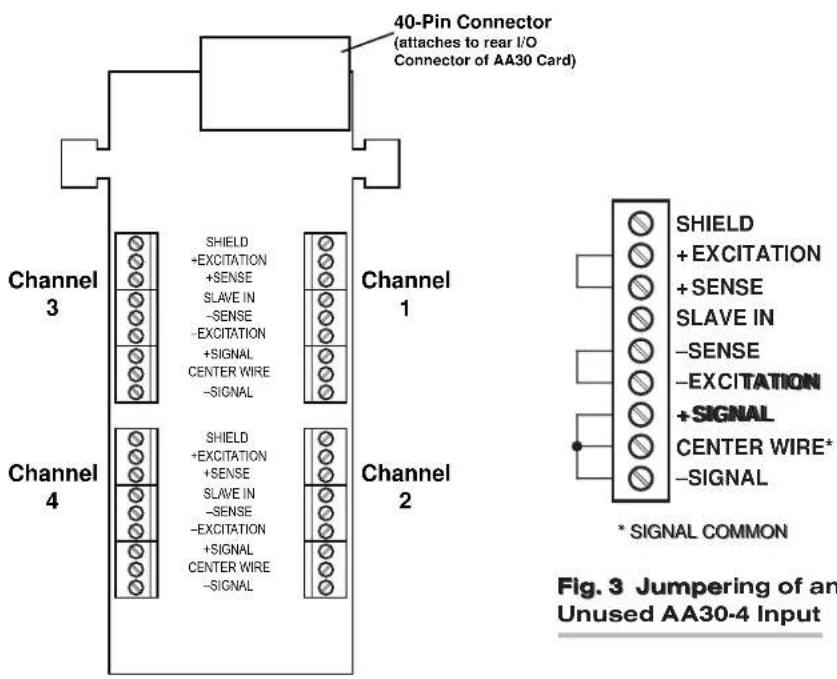
Fig. 4 Model AA30-4 Transducer Cabling

flowchart
graph TD
    A["Primary Coil"] --> B["Channel 1"]
    B --> C["SEC. 1"]
    B --> D["SEC. 2"]
    B --> E["SECONDARY COILS"]
    C --> F["+ Excitation"]
    D --> G["+ Signal"]
    E --> H["+ Signal Common"]
    F --> I["See Fig. 5"]
    G --> I
    H --> I
    I --> J["SHIELD + EXCITATION + SENSE SLAVE IN -SENSE -EXCITATION + SIGNAL CENTER WIRE* -SIGNAL * SIGNAL COMMON"]
    style A fill:#f9f,stroke:#333
    style J fill:#ccf,stroke:#333
Fig. 4(a) 5-Wire LVDT Cabling (under 20 ft. in length)
Channel 1, 2, 3, or 4:

flowchart
graph TD
    A["PRIMARY COIL"] --> B["SECS. 1"]
    A --> C["SECS. 2"]
    B --> D["SIGNAL COMMON"]
    C --> D
    D --> E["+SIGNAL -SIGNAL"]
    D --> F["+EXCITATION -EXCITATION"]
    G["AA30-4 CONDITIONER CONNECTOR"] --> H["SHIELD + EXCITATION + SENSE SLAVE IN -SENSE -EXCITATION + SIGNAL CENTER WIRE* -SIGNAL"]
    H --> I["See Fig. 5"]
    I --> J["• SIGNAL COMMON"]
Fig. 4(b) 7-Wire LVDT Cabling (20 ft. or longer)

Fig. 4(c) 3-Wire Variable Reluctance Transducer Cabling (under 20 ft. in length)
Channel 1, 2, 3, or 4:

Fig. 4(d) 5-Wire Variable Reluctance Transducer Cabling (20 ft. or longer)
2.b CONNECTION OF EXTERNAL EXCITATION SOURCE
An external excitation supply furnished by the user can be optionally applied to each active AA30-4 channel, in place of the card's on-board 3280-Hz, 3-VAC (rms) reference. The external excitation must be 2 to 6 kHz, 2 to 3.5 V-AC (rms sine wave), referenced to "center wire" (Signal Common).
As shown in Fig. 5, below, the excitation source's positive lead will connect directly to the "SLAVE IN" terminal of each channel to which it is applied, with the negative lead connecting directly to the "CENTER WIRE" terminal. It is strongly recommended that all AA30-4 channels be "slaved" to the same sine-wave signal source, in order to prevent harmonic "beating" with another frequency.
As explained in Section 3.a, an appropriate jumper setting must be made for each channel that is being "slaved" to an external excitation source.

3
SETUP AND/OR OPERATING CONSIDERATIONS
3.a SELECTION OF EXCITATION SOURCE
To enable the "SLAVE" input of a specific AA30-4 channel in order to apply an external AC excitation source to that channel, you should
- Remove the AA30-4 card from its mainframe slot. For "Card Insertion and Removal," see Manual Section 1.B. Since the AA30-4 is "hot-pluggable," you need NOT turn off mainframe power before removing the card.
- Refer to Fig. 6, below, and locate the EXCITATION PROGRAMMING JUMPER PINS. One "minijumper" is provided for each channel's set of three jumper pins.
- Position the jumper for each channel as shown in Fig. 6 to interconnect the pair of pins corresponding to the desired excitation source for that channel. You will need to use a small pair of needle-nosed pliers to move the jumper.
- Reinsert the AA30-4 card in its mainframe slot.
3.b SELECTION OF ANALOG FILTERING
NOTE: If your AA30-4 card is equipped with FIXED ANALOG FILTERING, you may ignore this manual section.
When using an AA30-4 with PROGRAMMABLE ANALOG FILTERING in System 10, you may set an individual corner frequency for the analog filter of each active input channel, ^* as follows:
Fig. 6 Model AA30-4 Programming Jumper Pins and Filter Selection Switches

* The analog filter setting for an UNUSED channel is immaterial, and will not affect operation of the AA30-4.
a. Remove the AA30-4 card from its slot (see Section 3.a, Step 1, above).
b. Refer to Fig. 6 and locate the 16-position FILTER SELECTION SWITCHES located between the main card and the Filter Tiles.
c. Referring to Table 4, below, set each channel's switch for the desired frequency. You will need to use a small screwdriver (or equivalent tool) to set the switch to the appropriate number/letter.
d. Reinsert the AA30-4 card.
NOTE: In addition to the normal-mode analog filtering supplied by the AA30-4 card, System 10 can provide additional processor-controlled DIGITAL SMOOTHING on a per-channel basis. For each individual channel, you may indicate the desired amount of digital smoothing by applying a FILTER (FIL) command to that channel (see Manual Section 2.G.2).
Table 4 Model AA30-4 Filter Switch Settings
| Cutoff Frequency Switch Setting |
| 0.2 Hz 7 |
| 0.4 Hz 6 |
| 0.8 Hz 5 |
| 1.0 Hz 3 |
| 1.6 Hz 4 |
| 2.0 Hz 2 |
| 4.0 Hz 1 |
| 5.0 Hz F |
| 8.0 Hz 0 |
| 10 Hz E |
| 20 Hz D |
| 25 Hz B |
| 40 Hz C |
| 50 Hz A |
| 100 Hz 9 |
| 200 Hz 8 |
3.c SELECTION OF ANALOG OUTPUT MODES
As mentioned in Section 1, each AA30-4 channel's ±5-V ANALOG OUTPUT can be set to represent either the filtered or prefiltered reading of that channel. To set the output mode for each of your AA30-4's active input channels, ^* you should
-
Remove the AA30-4 card from its slot (see Section 3.a, Step 1, above).
-
Refer to Fig. 6 and locate the OUTPUT MODE PROGRAMMING JUMPER PINS beneath the AA30-4's Filter Tiles. One "minijumper" is provided for each channel's set of three jumper pins.
-
Position the jumper for each channel as shown in Fig. 6 to interconnect the pair of pins that corresponds to the desired output mode for that channel. You will need to use a small pair of needle-nosed pliers to move the jumper.
-
Reinsert the AA30-4 card in its mainframe slot.
* The output mode setting for an UNUSED channel is immaterial, and will not affect operation of the AA30-4.
3.d CONFIGURATION AND CALIBRATION
For initial configuration of ANALOG INPUT CHANNELS dedicated to a specific Model AA30-4 card when used in System 10, see the general remarks on System 10 "real-channel" configuration in Manual Section 1.G.1 and elsewhere in the System 10 Guidebook. For AA30-4 channel "type" codes, see Table 1, above.
In System 10, a relatively linear Model AA30-4 channel normally employs TWO-POINT (DEADWEIGHT) CALIBRATION.* See Manual Section 1.G.5 for a general discussion of this conventional "zero and span" calibration technique. Note, however, the following special procedure that applies to an LVDT-based Channel No. "x":
- Make sure the channel has been properly "typed" and "located" (see Manual Section 1.G.2).
- Turn ON the system EEPROM SWITCH and enter a command of
$$ \text { BEE } x = 0 [ \mathrm{CR} ] $$
This command sets an initial ZERO OFFSET ("b" term) of zero for Channel No. x.
-
Observing a "live" reading of the channel, mechanically adjust the fixture and physical position of the LVDT until the lowest reading occurs. This is the LVDT's "electrical null" point.
-
With the transducer still in "null" position, enter a command of
$$ Z R O \times [ C R ] $$
-
Displace the LVDT probe by a precisely known distance, preferably between 80% and 100% of the transducer's nominal full-scale rating.
-
Command
$$ F R C x = z [ C R ] $$
where “z” is the exact value of the displacement produced in Step 5, expressed in appropriate engineering units (the precision of the final measurement will match that of the entered “z” value).
- Repeat Steps 4, 5, and 6, if necessary, until the LVDT's zero and span points coincide with the calibration block or micrometer reference being used.
4 DIAGNOSTIC WIRE-WRAP PINS
As a special diagnostic and service tool, the five pins shown in Fig. 7 are directly accessible from the front of an installed AA30-4 card. These pins allow voltmeter or oscilloscope observation of data-channel output signals. THEIR USE IS INTENDED PRIMARILY FOR TRAINED SERVICE TECHNICIANS. With regard to the on-board diagnostic pins, please note the following:
- PROPER ESD PRACTICE SHOULD BE OBSERVED WHEN MAKING CONTACT WITH AN AA30-4 BOARD INSTALLED IN A "LIVE" DAYTRONIC SYSTEM MAINFRAME. ALWAYS GROUND YOURSELF TO THE MAINFRAME CHASSIS BEFORE TOUCHING THE BOARD.
- THE ANALOG SIGNAL PRESENT AT EACH ACTIVE "CHANNEL" PIN REPRESENTS EIGHT TENTHS (0.8) OF THAT CHANNEL'S NOMINAL CALL-BUS VOLTAGE. For a channel delivering a standard full-scale (+5-V) output, the corresponding diagnostic pin will therefore register +4 V.
- THE ANALOG SIGNAL PRESENT AT EACH ACTIVE "CHANNEL" PIN REPRESENTS THE FILTERED CHANNEL OUTPUT, AND IS NOT AFFECTED BY THE ANALOG OUTPUT MODE CURRENTLY SELECTED FOR THAT CHANNEL (see Section 3.c).
- THE "SLOT CALL" PIN DELIVERS A LOGIC SIGNAL THAT MAY BE USED TO SYNCHRONIZE AN OSCILLOSCOPE FOR TIMING ANALYSIS OF THE AA30-4 CARD.
Fig. 7 Diagnostic Wire-Wrap Pins

AA30-4 QUAD LVDT CARD


- ADDITIONAL AA30-4 SPECIFICATIONS
- CONNECTIONS
- 2.a TRANSDUCER CONNECTIONS
- 2.b CONNECTION OF EXTERNAL EXCITATION SOURCE
- 3
- SETUP AND/OR OPERATING CONSIDERATIONS
- 3.a SELECTION OF EXCITATION SOURCE
- 3.b SELECTION OF ANALOG FILTERING
- 3.c SELECTION OF ANALOG OUTPUT MODES
- 3.d CONFIGURATION AND CALIBRATION
- DIAGNOSTIC WIRE-WRAP PINS
- AA30-4 QUAD LVDT CARD
Brand : Daytronic
Model : AA30-4F010
Category : Unspecified