
AA41-2F1 - Unspecified Daytronic - Free user manual and instructions
Find the device manual for free AA41-2F1 Daytronic in PDF.


| Brand | Daytronic |
| Model | AA41-2F1 |
| Product Type | Two-Channel Frequency Conditioner Card |
| Number of Input Channels | Two |
| Input Signal Types | Any AC or unipolar pulse signal, grounded or floating |
| Input Voltage Ranges (Selectable) | 0.1–2 V, 0.5–10 V, 2.5–50 V, or 10–200 V peak |
| Frequency Ranges (Full Scale) | 250, 500, 1000, 2000, 4000, 8000, 16000, or 32000 Hz |
| Excitation | Nominal ±5 V-DC, ±50 mA total (all channels) |
| Amplifier Specifications | Normal-mode range: ±200 V; Common-mode range: ±50 V operating (±100 V without damage); CMRR: -100 dB at DC and 60 Hz; Input impedance: 200 kΩ differential, 125 kΩ common-mode; Offset: ±0.02% of full scale initial, ±20 ppm/°C, ±10 ppm/month; Gain accuracy: ±0.02%; Gain stability: ±50 ppm/°C, ±50 ppm/month |
| Filter Type | 3-pole modified Butterworth; programmable (F1 tile) or fixed 10/50 Hz |
| Programmable Filter Cutoff Frequencies | 0.2, 0.4, 0.8, 1.0, 1.6, 2.0, 4.0, 5.0, 8.0, 10, 20, 25, 40, 50, 100, or 200 Hz |
| Auxiliary Outputs | Nominal ±5 V-DC (filtered channel outputs) on mainframe wire-wrap pins |
| Power Consumption | Maximum 120 mA from Conditioner Card Slot |
| Connector Type | Screw terminals on special AA41 Connector Assembly |
| Diagnostic Pins | Five front-accessible pins for service technicians; channel outputs at 0.8× nominal voltage |
| Technology | Surface-mount for high immunity to shock and vibration |
| Hot-Pluggable | Yes |
Frequently Asked Questions - AA41-2F1 Daytronic
User questions about AA41-2F1 Daytronic
0 question about this device. Answer the ones you know or ask your own.
Ask a new question about this device
Download the instructions for your Unspecified in PDF format for free! Find your manual AA41-2F1 - Daytronic and take your electronic device back in hand. On this page are published all the documents necessary for the use of your device. AA41-2F1 by Daytronic.
USER MANUAL AA41-2F1 Daytronic
PLEASE NOTE: In this manual, "AA41" will be used to refer to BOTH the two-channel Model AA41-2 AND the four-channel Model AA41-4, in cases where it is not necessary to distinguish them.
1 GENERAL DESCRIPTION AND SPECIFICATIONS
The Models AA41-2 and AA41-4 are two- and four-channel conditioners (respectively) for measuring rpm, flow, and other phenomena that can be sensed by pulse transformer transducers with 2-wire isolated windings (tachometer pickups, turbine flowmeters, etc.), transistor or logic-circuit drivers, "zero-velocity" (true digital output) sensors, and similar frequency-generating transducers.
The AA41 accepts a wide range of waveshapes and voltage levels. A “Smart Schmitt” threshold level for each input channel may be individually selected via internal jumper connections, depending on the expected peak voltage input: 0.1-2 V; 0.5-10 V; 2.5-50 V; or 10-200 V. This ensures reliable triggering when the input is at the low end of the voltage range. All ranges are protected against an overload of up to 200 V. Nominal ±5 V-DC excitation is supplied for use with a “zero-velocity” sensor.
Standard AA-card "F1" programmable filter tiles let you tailor the dynamic frequency range and signal response of each AA41 channel to your application's requirements.* Setting a frequency channel's programmable filter to the 1.6-Hz cutoff provides the following input ranges:
- 10% to 100% of full scale for a range of 250 or 500Hz
- 2% to 100% of full scale for a range of 1 or 2 kHz
- 1% to 100% of full scale for a range of 4, 8, 16, or 32 kHz
If a faster response is more important than dynamic range, you may select a higher "F1" bandwidth value (see Table 2). However, programmable filter settings above 25 Hz are not recommended for use with the AA41, because of inadequate usable dynamic frequency range. When the card is used in System 10, its filter cutoff values are set by means of an on-board 16-position switch for each channel.
Capacitive coupling of 0.1 or 10 microfarads is provided for low-frequency inputs, to eliminate false triggering by signal noise and/or any positive or negative DC offset that exists for the frequency signal.** A special trigger-level control guarantees reliable triggering when the input is at the low end of the frequency range, while a precise
* Or, if desired, a fixed filter of either 10 or 50 Hz for all channels may be specified at the time of order.
** Noise suppression is always recommended when using a magnetic pickup as the frequency source.
2.4576-MHz crystal frequency reference ensures accuracy of all calibration, whether "CALCULATED" or "TWO-POINT (DEADWEIGHT)."
A nominal ±5-V ANALOG OUTPUT is produced by each active AA41 input channel, for purposes of real-time signal monitoring. Each of these “Auxiliary Outputs” is available on a corresponding mainframe wire-wrap pin. Note that the AA41’s Auxiliary Outputs represent filtered (“postfilter”) channel outputs only (unlike most other “AA” cards).
The AA41 is manufactured using the latest surface-mount technology, resulting in the highest immunity to shock and vibration. As explained in Section 2, I/O connections are via secure, clearly labelled screw terminals in a special AA41 CONNECTOR ASSEMBLY.
Fig. 1 Model AA41-2 / AA41-4 Modular Card Components

flowchart
graph LR
    A["I/O Connector"] --> B["Conditioner Tile Chans. 3 & 4 (Model AA41-4 Only)"]
    A --> C["Filter Chans. 3 & 4 (Model AA41-4 Only)"]
    A --> D["Filter Chans. 1 & 2"]
    E["FOR FUTURE USE"] --> F[" "]
Fig. 1 shows the stand-off circuit boards (or “tiles”) that provide the analog filtering for an AA41 card’s data channels.
WARNING
THE CONDITIONER TILE FOR CHANNELS 3 AND 4 OF A MODEL AA41-4 IS TO BE INSTALLED OR REMOVED ONLY BY A QUALIFIED TECHNICIAN, SINCE SUBSEQUENT REALIGNMENT OF THE AA41 CARD IS REQUIRED. FILTER TILES, HOWEVER, MAY BE INSTALLED OR REMOVED BY THE USER, IN THE FIELD. CONTACT THE DAYTRONIC SERVICE DEPARTMENT FOR COMPLETE INSTRUCTIONS.
THE FOLLOWING AA41-2 / AA41-4 VERSIONS ARE CURRENTLY AVAILABLE:
- Model AA41-2F010—Two input channels, with FIXED 10-Hz FILTERING for each
- Model AA41-2F050—Two input channels, with FIXED 50-Hz FILTERING for each
- Model AA41-2F1—Two input channels, with "F1" PROGRAMMABLE FILTERING for each*
- Model AA41-4F010—Four input channels, with FIXED 10-Hz FILTERING for each
- Model AA41-4F050—Four input channels, with FIXED 50-Hz FILTERING for each
- Model AA41-4F1—Four input channels, with "F1" PROGRAMMABLE FILTERING for each*
ADDITIONAL AA41-2 / AA41-4 SPECIFICATIONS
Number of Input Channels: Two for Model AA41-2; four for Model AA41-4
Inputs:
Type: Any AC or unipolar pulse signal, grounded or floating, irrespective of waveform
Threshold Level: Accommodates signals from 100 mV to 200 V
Frequency Ranges: Nominal 250, 500, 1000, 2000, 4000, 8000, 16000, or 32000 Hz, full-scale, with dynamic frequency range dependent on the selected analog filtering (see Table 2, below); automatically selected—on an individual channel basis—when the channel is configured; for the System 10 channel “type” codes assigned to AA41 data channels, see Table 1, below
Excitation: Nominal 10 (i.e., ±5) V-DC; ±50 mA, total (all channels)
Amplifier (per channel):
Normal-Mode Range: ±200 V operating and without instrument damage
Common-Mode Range: ±50 V operating; ±100 V without instrument damage
Common-Mode Rejection Ratio: DC and at 60 Hz: -100 dB
Input Impedance: Differential: 200 kΩ; Common-Mode: 125 kΩ
Offset: Initial: ±0.02% of full scale; vs. temperature: ±20 ppm/°C; vs. time: ±10 ppm/month
Gain Accuracy: ±0.02% of full scale
Gain Stability: vs. temperature: ±50 ppm/°C; vs. time: ±50 ppm/month
Filter (per channel): 3-pole modified Butterworth
"F1" Programmable Filtering (all four channels): Switch- or software-selectable to one of 16 different cutoff frequencies: 0.2; 0.4; 0.8; 1.0; 1.6; 2.0; 4.0; 5.0; 8.0; 10; 20; 25; 40; 50; 100; or 200 Hz (see Table 2)
Fixed Filtering (all four channels): 10 or 50 Hz (see Table 3)
Auxiliary Outputs: Nominal ±5 V-DC signals representing filtered channel readings (only) available on mainframe wire-wrap pins*
Power-Supply Slot Allotment: Maximum consumption of supply and excitation current from the Conditioner Card Slot is 120 mA
Table 1 AA41 "Type" Codes
Full-Scale Channel Input Type Code
| 250 Hz 40 |
| 500 Hz 41 |
| 1000 Hz 42 |
| 2000 Hz 43 |
| 4000 Hz 44 |
| 8000 Hz 45 |
| 16000 Hz 46 |
| 32000 Hz 47 |
Table 2 "F1" Programmable Filter Characteristics for "AA" Cards
| Bandwidth Step-Response Settling Time | |||||
| Selected Response Response to 1% of to 0.1% of to 0.02% of Frequency at -3 dB at -60 dB final value final value final value | |||||
| (Hz) | (Hz) | (Hz) | (msec) (msec) (msec) | ||
| 0.2 | 0.2 | 3.9 | 3500 | 4250 | 4750 |
| 0.4 | 0.4 | 7.8 | 1750 | 2125 | 2375 |
| 0.8 | 0.8 | 16 | 875 | 1063 | 1188 |
| 1.0 | 1.0 | 20 | 700 | 850 | 950 |
| 1.6 | 1.6 | 31 | 438 | 531 | 594 |
| 2.0 | 2.0 | 39 | 350 | 425 | 475 |
| 4.0 | 4.0 | 78 | 175 | 213 | 238 |
| 5.0 | 5.0 | 98 | 140 | 170 | 190 |
| 8.0 | 8.0 | 156 | 88 | 106 | 119 |
| 10.0 | 10.0 | 195 | 70 | 85 | 95 |
| 20.0 | 20.0 | 390 | 35 | 43 | 48 |
| 25.0 | 25.0 | 488 | 28 | 34 | 38 |
| 40.0 | 40.0 | 780 | 18 | 21 | 24 |
| 50.0 | 50.0 | 975 | 14 | 17 | 19 |
| 100.0 | 100.0 | 1950 | 7.0 | 8.5 | 9.5 |
| 200.0 | 200.0 | 3900 | 3.5 | 4.3 | 4.8 |
Table 3 Fixed Filter Characteristics for "AA" Cards
| Filter Designation | Bandwidth Step-Response Settling Time | ||||
| Response Response to 1% of to 0.1% of to 0.02% of at -3 dB at -60 dB final value final value final value (msec) | |||||
| (Hz) | (Hz) | (msec) | (msec) | (msec) | |
| “F010” | 10 | 195 | 70 | 85 | 95 |
| “F050” | 50 | 975 | 14 | 17 | 19 |
2 TRANSDUCER CONNECTIONS
2.a STANDARD CABLING
The Model AA41's rear I/O CONNECTOR mates with the special AA41 CONDITIONER CONNECTOR, via the cable connections shown in Fig. 3. Mounted on the internal board of the connector assembly (shown in Fig. 2) is a block of ten clearly labelled screw terminals for each of the AA41's four possible input channels.
To access the connector board, simply remove the screws that hold together both halves of the connector housing. Use the two internal clamp bars to secure transducer cables once all leads have been connected.
The connector assembly's mounting screws are designed to secure the connector to the rear of the system mainframe and to provide a solid GROUND CONNECTION for cable "shields" via the two L-shaped ground lugs. An offset in the mounting holes ensures that the connector cannot be attached upside down.
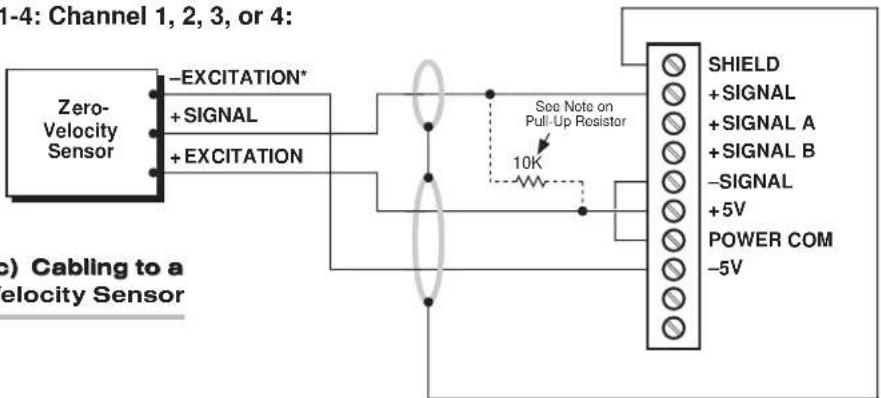
Fig. 3(a) shows recommended cabling for intrinsically grounded transistor or logic-circuit drivers; Fig. 3(b), for pulse transformer transducers with two-wire isolated windings (tachometers, turbine flowmeters, etc.); and Fig. 3(c), for “zero-velocity” (true digital output) sensors requiring 10-V excitation.
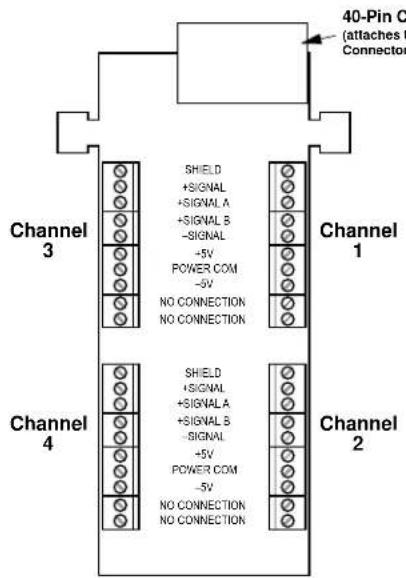
Fig. 2 Model AA41 Connector Assembly Board
2.b SPECIAL CABLING
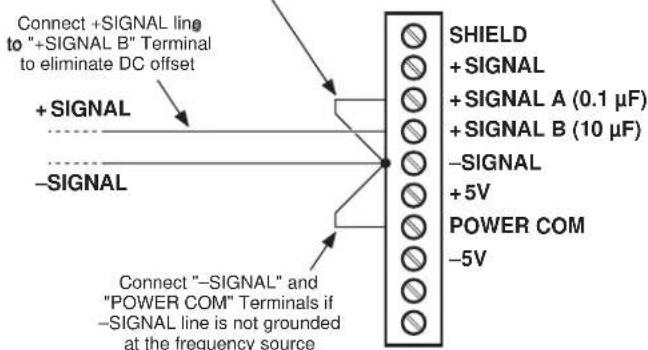
Fig. 4 summarizes three kinds of special AA41 connections you might need to establish for a given AA41 channel:
UNGROUNDED FREQUENCY SOURCE
For floating-source inputs and inputs from zero-velocity sensors, where the -SIGNAL is not grounded at the frequency source, the -SIGNAL terminal should be tied directly to POWER COMMON. This connection is also shown in Figs. 3(b) and 3(c).
Fig. 3 Model AA41 Transducer Cabling

Fig. 3(a) Cabling to a Grounded Frequency Source
AA41-2: Channel 1 or 2:
AA41-4: Channel 1, 2, 3, or 4:
AA41 CONDITIONER CONNECTOR

Fig. 3(b) Cabling to an Ungrounded Frequency Source
AA41-2: Channel 1 or 2:
AA41-4: Channel 1, 2, 3, or 4:
AA41 CONDITIONER CONNECTOR
flowchart
graph LR
    A["Zero-Velocity Sensor"] -->|+SIGNAL| B["See Note on Pull-Up Resistor"]
    A -->|+EXCITATION| B
    B --> C["SHIELD"]
    B --> D["+SIGNAL"]
    B --> E["+SIGNAL A"]
    B --> F["+SIGNAL B"]
    B --> G["-SIGNAL"]
    B --> H["+5V"]
    B --> I["POWER COM"]
    B --> J["-5V"]
    style A fill:#f9f,stroke:#333
    style B fill:#ccf,stroke:#333
Fig. 3(c) Cabling to a Zero-Velocity Sensor
Connect "-SIGNAL" and "+SIGNAL A" Terminals for suppression of high-frequency noise (if source is a magnetic pickup)
Fig. 4
Special AA41 I/O Connections
ELIMINATION OF DC OFFSET
Each AA41 input channel is supplied with two capacitive-coupled inputs: “+SIGNAL A” provides 0.1-microfarad capacitance, while “+SIGNAL B” provides 10-microfarad capacitance. These special inputs may be used with either floating or grounded configurations; they would not normally be used with zero-velocity sensors requiring 10-V excitation (see Fig. 3(c)).
Fig. 4 shows how the larger (10- F) capacitive coupling can be used to eliminate any positive or negative DC offset that exists for an AA41 channel's frequency signal. Simply connect the +SIGNAL line from the frequency source to the “+SIGNAL B” terminal instead of to the normal +SIGNAL terminal. The capacitor is here in series with the +SIGNAL input and allows only AC to pass.
SUPPRESSION OF HIGH-FREQUENCY NOISE IN LOW-FREQUENCY INPUT
False triggering can sometimes occur, especially at the low-frequency input range, because of stray pickup of frequencies outside the common-mode range. Capacitive coupling of the frequency input to ground can in such cases serve to suppress unwanted signal noise. This noise suppression is always recommended when using a MAGNETIC PICKUP as the frequency source.
Thus, if you find a channel's frequency reading to be unacceptably unstable or "noisy," you should tie that channel's -SIGNAL terminal to the "+SIGNAL A" terminal while maintaining the normal +SIGNAL connection.
2.c Pull-Up RESISTOR
When used with an open-collector type sensor, an AA41 channel requires a pull-up resistor (typically 10 k ) between the +SIGNAL and the corresponding +5 V-DC EXCI-TATION.
3 SETUP AND/OR OPERATING CONSIDERATIONS
3.a SELECTION OF INPUT VOLTAGE RANGE
Perform the following steps to select the proper peak voltage input range for each active AA41 channel.* At the same time, you will be setting the trigger level for that channel, thereby ensuring reliable triggering when the input is at the low end of the voltage range. EACH AA41 CHANNEL IS PRESET AT THE FACTORY FOR AN INPUT VOLTAGE RANGE OF 2.5 - 50 V. If you require a different range, you should
- Remove the AA41 card from its mainframe slot. For "Card Insertion and Removal," see Manual Section 1.B. Since the AA41 is "hot-pluggable," you need NOT turn off mainframe power before removing the card.
- Refer to Fig. 5, below, and locate the INPUT VOLTAGE PROGRAMMING JUMPER PINS located on the rear edge of the card. For an AA41-4, the pins for Channels 3 and 4 are on the underside of the Conditioner Tile. One "minijumper" is provided for each channel's set of three jumper pins.
* The input voltage range setting for an UNUSED channel is immaterial, and will not affect operation of the AA41.
Fig. 5 Model AA41 Programming Jumper Pins and Filter Selection Switches

-
Position the jumper for each channel as shown in Fig. 5 to interconnect the pair of pins corresponding to the desired input voltage range for that channel. You will need to use a small pair of needle-nosed pliers to move the jumper.
-
Reinsert the AA41 card in its mainframe slot.
3.b SELECTION OF ANALOG FILTERING
NOTE: If your AA41 card is equipped with FIXED ANALOG FILTERING, you may ignore this manual section.
When using an AA41 with PROGRAMMABLE ANALOG FILTERING in System 10, you may set an individual corner frequency for the analog filter of each active input channel,* as follows:
a. Remove the AA41 card from its slot (see Section 3.a, Step 1, above).
b. Refer to Fig. 5 and locate the 16-position FILTER SELECTION SWITCHES located between the main card and the Filter Tile(s).
c. Referring to Table 4, below, set each channel's switch for the desired frequency. You will need to use a small screwdriver (or equivalent tool) to set the switch to the appropriate number/letter.
d. Reinsert the AA41 card.
NOTE: In addition to the normal-mode analog filtering supplied by the AA41 card, System 10 can provide additional processor-controlled DIGITAL SMOOTHING on a per-channel basis. For each individual channel, you may indicate the desired amount of digital smoothing by applying a FILTER (FIL) command to that channel (see Manual Section 2.G.2).
Table 4 Model AA41 Filter Switch Settings
| Cutoff Frequency Switch Setting |
| 0.2 Hz 7 |
| 0.4 Hz 6 |
| 0.8 Hz 5 |
| 1.0 Hz 3 |
| 1.6 Hz 4 |
| 2.0 Hz 2 |
| 4.0 Hz 1 |
| 5.0 Hz F |
| 8.0 Hz 0 |
| 10 Hz E |
| 20 Hz D |
| 25 Hz B |
| 40 Hz C |
| 50 Hz A |
| 100 Hz 9 |
| 200 Hz 8 |
3.c CONFIGURATION AND CALIBRATION
For initial configuration of ANALOG INPUT CHANNELS dedicated to a specific Model AA41 card when used in System 10, see the general remarks on System 10 "real-channel" configuration in Manual Section 1.G.1 and elsewhere in the System 10 Guidebook. For AA41 channel "type" codes, see Table 1, above.
In System 10, you can use three calibration methods with the Model AA41:
ABSOLUTE CALIBRATION
Described in Manual Section 1.G.3.b, this method is applicable only when the AA41 is being used to measure frequency itself (in Hz). In this case, the user need only specify an appropriate SCALING FACTOR ("m" coefficient), once the AA41-based input channel has been properly configured.
Thus, to calibrate an AA41-based Channel No. "x," you need only turn ON the system EEPROM SWITCH and then apply the following SCALING FACTOR (EMM) command:
EMM x = m [CR]
where “m” equals the full-scale range corresponding to the channel’s present TYPE designation, expressed to the precision desired for the channel’s data readings. Channel “type” codes and associated full-scale ranges are given in Table 1, above. If, for example, a frequency-measuring AA41 channel is “typed” as “43” (corresponding to a full scale of 2000 Hz) and you want the channel to read tenths of a hertz, you would enter an “m” value of “2000.0.”
Note that “absolute” calibration of an AA41-based channel yields an accuracy of ±0.02% of full scale.
CALCULATED CALIBRATION
This is generally the most convenient means of calibrating an AA41 channel, when the full-scale rating of the frequency source (or the highest frequency expected to be measured) is accurately known.
Thus, to calibrate an AA41-based Channel No. "x," you need only turn ON the system EEPROM SWITCH and then apply the following FREQUENCY CALIBRATION (FRQ) command:
$$ \text { FRQ } x = i, u [ \text { CR } ] $$
For “i,” enter the manufacturer-supplied full-scale rating of the frequency source (or the highest frequency expected to be measured), in hertz. For “u,” enter the corresponding value of the measured phenomenon, expressed in the desired engineering units. You need not zero the channel in this case. The FRQ command will only work if Channel No. x has been assigned the proper “type” code (see Table 1).
Note that a channel calibrated by the FRQ command will report measurement data to a precision matching that of the entered "u" value. If, for example, you're measuring "liters per minute," and enter a "u" of "750," then all subsequent channel readings will be rounded to the nearest liter per minute. If the entry is "750.0," then all readings will be rounded to the nearest tenth of a liter per minute.
Two-Point (Deadweight) Calibration
Using the standard ZERO (ZRO) and FORCE (FRC) commands, this conventional "zero and span" method can be applied to an AA41 channel if the full-scale rating of the frequency source is unknown, and if the channel's received frequency input is an analog of another parameter—such as Gallons Per Minute—which has one or more independently and accurately known calibration values. The mainframe's EEPROM Write Protect Switch must be ON for the ZRO and FRC commands to be effective. See Manual Section 1.G.5 for a general discussion of this calibration technique.
4 DIAGNOSTIC WIRE-WRAP PINS
As a special diagnostic and service tool, the five pins shown in Fig. 6 are directly accessible from the front of an installed AA41 card. These pins allow voltmeter or oscilloscope observation of data-channel output signals. THEIR USE IS INTENDED PRIMARILY FOR TRAINED SERVICE TECHNICIANS. With regard to the on-board diagnostic pins, please note the following:
- PROPER ESD PRACTICE SHOULD BE OBSERVED WHEN MAKING CONTACT WITH AN AA41 BOARD INSTALLED IN A "LIVE" DAYTRONIC SYSTEM MAINFRAME. ALWAYS GROUND YOURSELF TO THE MAINFRAME CHASSIS BEFORE TOUCHING THE BOARD.
- THE ANALOG SIGNAL PRESENT AT EACH ACTIVE "CHANNEL" PIN REPRESENTS EIGHT TENTHS (0.8) OF THAT CHANNEL'S NOMINAL CALL-BUS VOLTAGE (WHICH, FOR THE AA41 IS ALWAYS THE FILTERED CHANNEL OUTPUT). For a channel delivering a standard full-scale (+5-V) output, the corresponding diagnostic pin will therefore register +4 V.
- THE "SLOT CALL" PIN DELIVERS A LOGIC SIGNAL THAT MAY BE USED TO SYNCHRONIZE AN OSCILLOSCOPE FOR TIMING ANALYSIS OF THE AA41 CARD.
- THE "CHANNEL 3" AND "CHANNEL 4" PINS ARE ONLY ACTIVE FOR AN AA41-4 CARD.
Fig. 6 Diagnostic Wire-Wrap Pins

AA41-2 / AA41-4 DUAL / QUAD FREQUENCY CARD


- GENERAL DESCRIPTION AND SPECIFICATIONS
- WARNING
- ADDITIONAL AA41-2 / AA41-4 SPECIFICATIONS
- Inputs:
- Amplifier (per channel):
- Filter (per channel): 3-pole modified Butterworth
- TRANSDUCER CONNECTIONS
- 2.a STANDARD CABLING
- 2.b SPECIAL CABLING
- UNGROUNDED FREQUENCY SOURCE
- ELIMINATION OF DC OFFSET
- SUPPRESSION OF HIGH-FREQUENCY NOISE IN LOW-FREQUENCY INPUT
- 2.c Pull-Up RESISTOR
- SETUP AND/OR OPERATING CONSIDERATIONS
- 3.a SELECTION OF INPUT VOLTAGE RANGE
- 3.b SELECTION OF ANALOG FILTERING
- 3.c CONFIGURATION AND CALIBRATION
- ABSOLUTE CALIBRATION
- EMM x = m [CR]
- CALCULATED CALIBRATION
- Two-Point (Deadweight) Calibration
- DIAGNOSTIC WIRE-WRAP PINS
- AA41-2 / AA41-4 DUAL / QUAD FREQUENCY CARD
Brand : Daytronic
Model : AA41-2F1
Category : Unspecified