Elston 10290 - Fan HONEYWELL - Free user manual and instructions
Find the device manual for free Elston 10290 HONEYWELL in PDF.


User questions about Elston 10290 HONEYWELL
0 question about this device. Answer the ones you know or ask your own.
Ask a new question about this device
Download the instructions for your Fan in PDF format for free! Find your manual Elston 10290 - HONEYWELL and take your electronic device back in hand. On this page are published all the documents necessary for the use of your device. Elston 10290 by HONEYWELL.
USER MANUAL Elston 10290 HONEYWELL
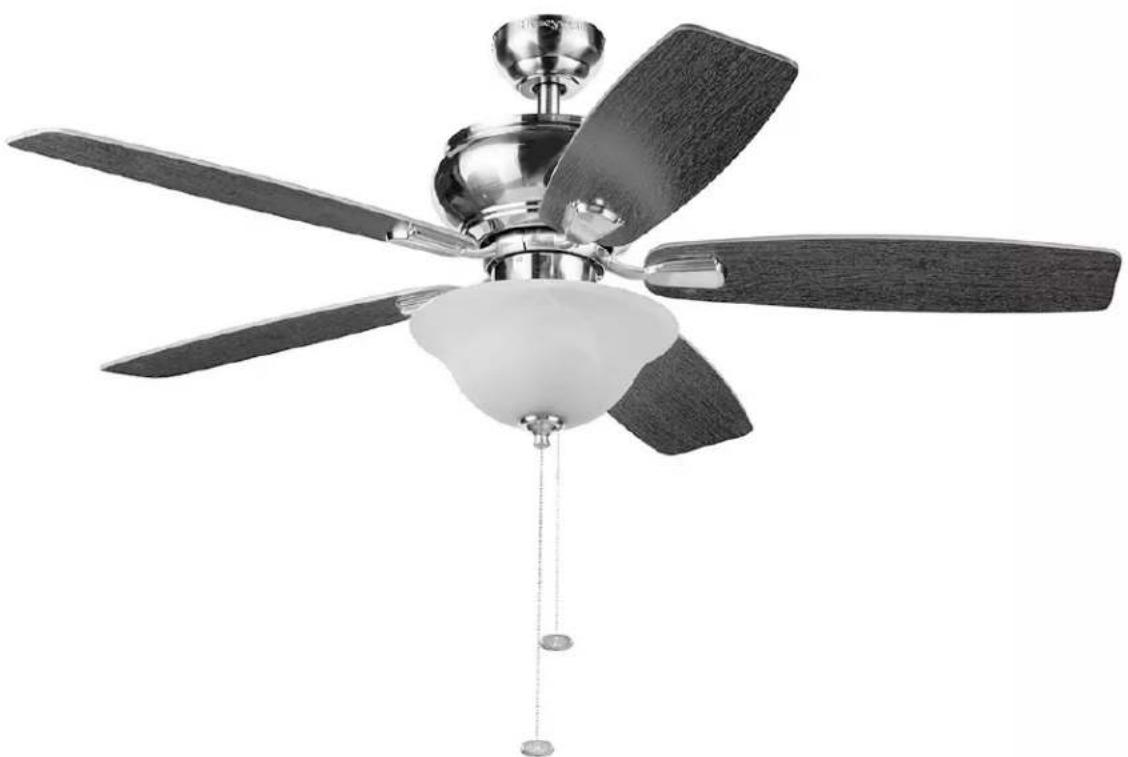
ELSTON 52" CEILING FAN
MODEL #10290
Español p. 21
natural_image
Black and white photo of a modern office ceiling fan with four blades and a hanging propeller (no text or symbols visible)


Questions, problems, missing parts? Before returning to your retailer, call our customer service department at 1-877-361-3883, Monday - Thursday, 8 am - 6 pm, EST and Friday, 8 am - 5 pm, EST.
WELCOME
TABLE OF CONTENTS
Care and Maintenance 2
Package Contents .... 3
Safety Information 4
Mounting Options 5
Mounting Bracket Installation 6
Standard or Angle Mounting Instructions .....7
Closemount Instructions....10
Wiring 11
Canopy Installation....12
Blade Installation 13
Light Kit Installation 14
Operating Instructions 17
Replacement Parts List 18
Troubleshooting 19
Limited Lifetime Warranty....20
ATTACH YOUR RECEIPT HERE
Serial Number
Purchase Date
PREPARATION
Before beginning the assembly of this product, ensure that all parts are present. Compare all parts with the package contents list and hardware contents list. If any part is missing or damaged, do not attempt to assemble the product.
After opening the top of the carton, remove the mounting hardware package from the foam inserts, then remove the motor from the packaging and place it on a soft surface, such as a carpet, to avoid damage to the finish.
Estimated Assembly Time: Under 120 minutes
Tools Required for Assembly (not included): Electrical Tape, Phillips Screwdriver, Pliers, Safety Glasses, Step Ladder, and Wire Strippers
Helpful Tools (not included): AC Tester Light, Tape Measure, Wiring Handbook, and Wire Cutters
CARE AND MAINTENANCE
At least twice each year, lower the canopy to check the downrod assembly, and then tighten all screws on the fan. Clean the motor housing with only a soft brush or lint-free cloth to avoid scratching the finish. Clean the blades with a lint-free cloth.
Important: Shut off the main power supply before you begin any maintenance tasks. Do not use water or a damp cloth to clean the ceiling fan.
FAN WEIGHT
The net weight of this fan is: 18.62 lbs. (8,45 kg).
PACKAGE CONTENTS
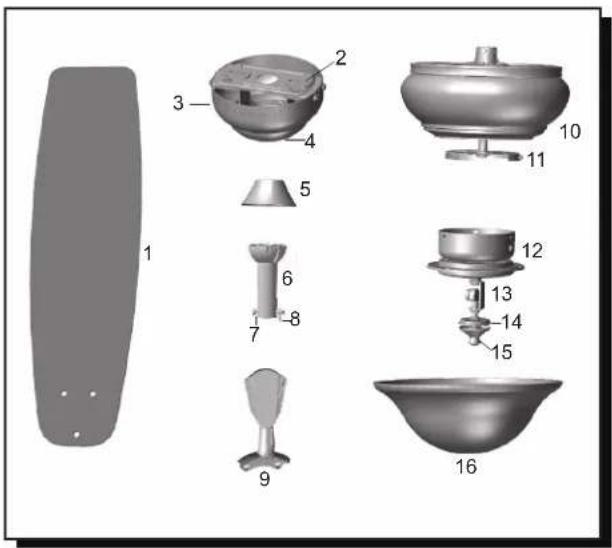
Unpack your fan and check the contents. You should have the following items:
- Blade (5)
- Mounting Bracket
- Canopy
- Canopy Cover
- Yoke Cover
- Downrod
- Downrod Pin
- Downrod Clip
- Blade Arm (5)
- Motor Housing
- Fitter Plate
- Switch Housing
- LED Light Kit
- Finial Cap
- Finial
- Glass Bowl
-
Owner's Manual
-
Hardware bag containing (not shown): Mounting hardware, blade attachment hardware, pull chain extensions, wire connectors, etc.
text_image
Exploded view diagram of a mechanical component with numbered parts for identificationSAFETY INFORMATION
Please read and understand this entire manual before attempting to assemble, operate, or install the product.
- Before you begin installing the fan, disconnect the power by removing fuses or turning off the circuit breakers.
- Make sure that all electrical connections comply with local codes, ordinances, the National Electrical Code, and ANSI/NFPA 70-199. Hire a qualified electrician or consult a do-it-yourself wiring handbook if you are unfamiliar with installing electrical wiring.
- Make sure the installation site you choose allows a minimum clearance of 7 ft. (2,13 m) from the blades to the floor and at least 30 in. (76 cm) from the end of the blades to any obstruction.
! DANGER !
When using an existing outlet box, make sure the outlet box is securely attached to the building structure and can support the full weight of the fan. Failure to do this can result in serious injury or death. The stability of the outlet box is essential in minimizing wobble and noise in the fan after installation is complete.
WARNING
To reduce the risk of fire or electric shock, do not use the fan with any solid-state speed-control device or control the fan speed with a full-range dimmer switch.
! WARNING !
To reduce the risk of fire, electric shock, or personal injury, do not bend the blade arms when installing them, balancing the blades, or cleaning the fan. Do not insert objects between the rotating fan blades.
! WARNING !
To reduce the risk of fire, electric shock, or personal injury, mount the fan to an outlet box marked "ACCEPTABLE FOR FAN SUPPORT" and use the mounting screws provided with the outlet box. Most outlet boxes commonly used for the support of lighting fixtures are not acceptable for fan support and may need to be replaced. Consult a qualified electrician if in doubt. Secure the outlet box directly to the building structure. The outlet box and its support must be able to support the moving weight of the fan, at least 35 lbs. (15,88 kg).
! CAUTION !
Be sure the outlet box is properly grounded or that a ground (green or bare) wire is present.
CAUTION
Read all instructions and safety information before installing your new fan. Review the accompanying assembly diagrams.
MOUNTING OPTIONS
-
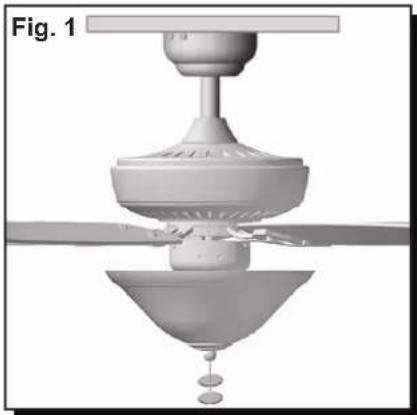
Your fan has 3 mounting options:
-
Standard (Fig. 1)
- Angle (Fig. 2)
- Closemount (Fig. 3)
Note: The fans in figures 1 through 3 are not the actual fan in your package, they are representation of the 3 different mounting options.
Important: If using the angle mount, check to ensure the ceiling angle is not steeper than 16^ .
Standard mounting is best suited for ceilings 8 ft. or higher. For taller ceilings you may want to use a longer downrod (sold separately).
Angle mounting is best suited for angled or vaulted ceilings. A longer downrod is sometimes necessary to ensure proper blade clearance.
Closemount is more suitable for ceilings lower than 8 ft. (2,44 m) high.
- Ensure the blades of the fan are at least 30 in. (76 cm) from any obstruction.
- Check the downrod length to ensure the blades will be at least 7 ft. (2,14 m) above your floor.
natural_image
3D rendering of a ceiling fan assembly with a conical base and propeller (no text or symbols visible)
natural_image
3D rendering of a ceiling fan with a propeller and cooling tower, labeled Fig. 2 (no text or symbols on the diagram itself)
natural_image
3D rendering of a ceiling fan assembly with a conical base and propeller (no text or symbols visible)MOUNTING BRACKET INSTALLATION
- Turn off the circuit breakers and wall switch leading to the fan wire leads (Fig. 4).

WARNING

Failure to disconnect the power supply prior to installation may result in serious injury or death.
- Loosen all four preassembled mounting bracket screws, then completely remove the two mounting bracket screws from the round holes of canopy. Set aside for later use. Detach mounting bracket from canopy. (Fig. 5).

Mounting Bracket Screw
- Secure the mounting bracket to the outlet box using screws, spring washers, and flat washers provided with the outlet box (not included) (Fig. 6).
Note: It is very important to use proper hardware when installing the mounting bracket, as it supports the fan.
Important: If using the angle mount, ensure the open end of the mounting bracket is installed facing the higher point of the ceiling.

text_image
Fig. 4 OFF OFF ON ON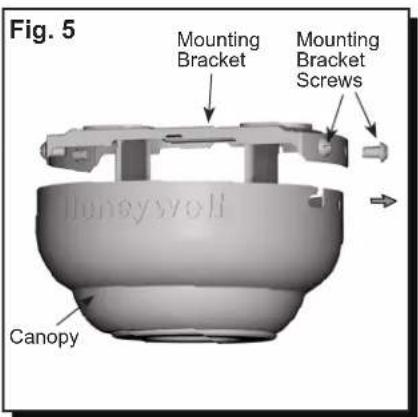
text_image
Fig. 5 Mounting Bracket Mounting Bracket Screws Canopy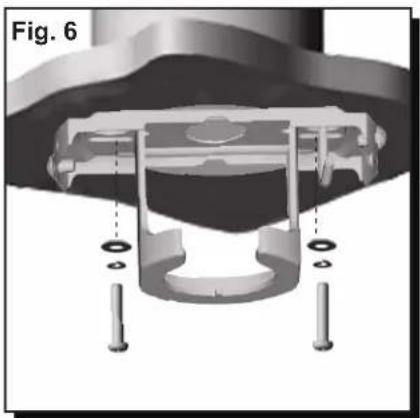
natural_image
Cross-sectional diagram of a mechanical assembly with no visible text or symbolsSTANDARD OR ANGLE MOUNTING INSTRUCTIONS
-
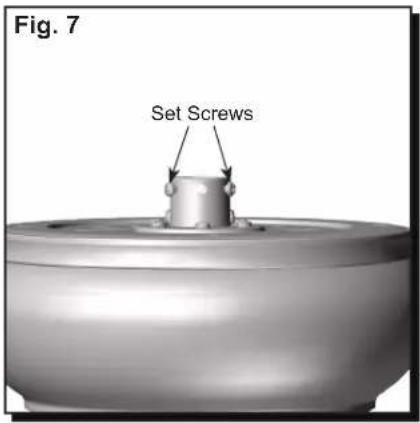
Partially loosen the set screws in the yoke at the top of the motor assembly (Fig. 7).
-
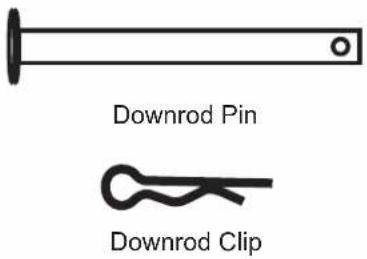
Remove the downrod clip and downrod pin from the downrod (Fig. 8).
text_image
Downrod Pin Downrod Clip- Feed the wires from the motor assembly through the yoke cover, canopy, and out the top of the downrod (Fig. 9).
text_image
Fig. 7 Set Screws
text_image
Fig. 8 Downrod Clip Downrod Pin
text_image
Fig. 9 Canopy Yoke Cover DownrodSTANDARD OR ANGLE MOUNTING INSTRUCTIONS
- Slide the downrod into the yoke of the motor assembly, align the holes, and reinstall the downrod pin and downrod clip. Then secure with set screws (Fig. 10).
- Depending on the length of downrod you use, you may need to shorten the wires to simplify the wiring process. Pull the wires all the way through the top of the downrod and measure 8 in. of lead wire, and use wire cutters (not included) to remove the excess wire (Fig. 11).
- If you cut back the lead wire in Step 11, strip 1/2 in. of insulation from the end of each wire. Twist the stripped ends of each strand of wire (Fig. 12).
Note: If you did not cut back the lead wires in Step 11, Step 12 is not necessary and you may proceed to Step 13 instead.

text_image
Fig. 10 Downrod Downrod Clip Downrod Pin Yoke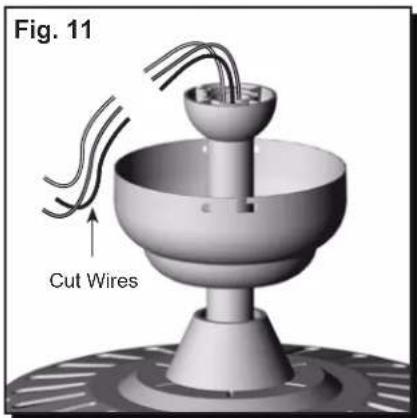
text_image
Fig. 11 Cut Wires
text_image
Fig. 12 Stripped WiresSTANDARD OR ANGLE MOUNTING INSTRUCTIONS
- Install the ball end of the downrod into the mounting bracket opening. Align the slot in the ball with the tab in the mounting bracket. The downrod should not rotate if installed correctly (Fig. 13).

WARNING

Failure to align the slot in the downrod with the tab on the mounting bracket could cause the fan to fall, which could result in serious injury or death.

text_image
Fig. 13 Mounting Bracket Tab Slot Downrod BallCLOSEMOUNT INSTRUCTIONS
- Remove the canopy cover from the bottom of the canopy (Fig. 14).
Helpful Hint: The downrod, yoke cover and canopy cover are not used in this type of installation.
- Align the canopy with the holes in the top of motor assembly. Then, secure the canopy to the top of the motor assembly using the three closemount screws from the hardware bag (Fig. 15).

Closemount Screw
- Lift the fan and place the hole in the canopy on the mounting bracket hook during the wiring process (Fig. 16).

text_image
Fig. 14 Canopy Cover Canopy
text_image
Fig. 15 Closemount Screws
text_image
Fig. 16 Hook CanopyWIRING

CAUTION

Be sure outlet box is properly grounded or that a ground (green or bare) wire is present.

WARNING

If house wires are different colors than referred to in the following steps, consult a professional electrician to determine wiring. Incorrect wire connection can damage the fan and could cause fire or injury.

WARNING

Ensure black and white wire connections are on opposite sides of the outlet box.
-
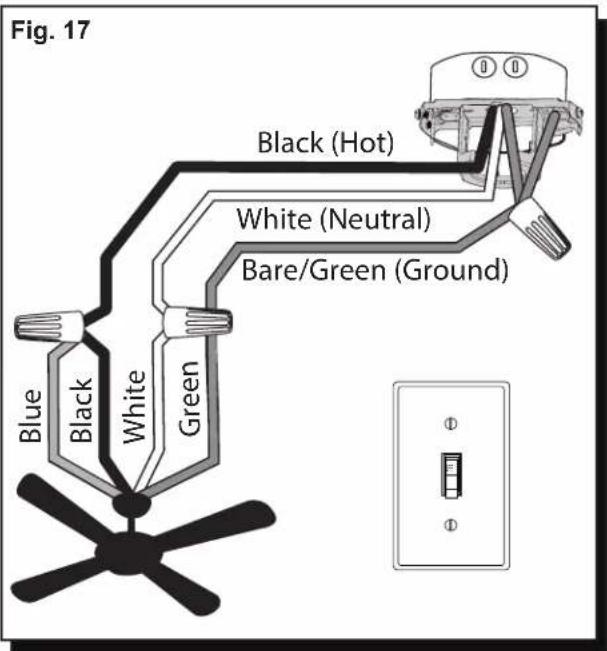
Connect supply and fan wires according to the diagram (Fig. 17) and these steps:
-
Connect the Green wires from the fan and mounting bracket to the Bare/Green (ground) supply wire.
- Connect the Black and Blue wire from the fan to the Black (hot) supply wire.
- Connect the White wire from the fan to the White (neutral) supply wire.
Secure all wiring connections with wire connectors and push all connected wires back into the outlet box. Note: The black fan wire is power for fan. The blue fan wire is power for the light. The white wire from the fan is common/neutral. The green wires from the fan and mounting bracket are ground wires.
- (Optional) If a second hot power wire is available from outlet box, connect it to the blue (light power) wire from the fan for separate light and fan control (Fig. 18).

Wire Connector
text_image
Fig. 17 Black (Hot) White (Neutral) Bare/Green (Ground) Blue Black White Green
text_image
Fig. 18 Second Wire (live) Black (live) White (neutral) Bare/Green (ground) Blue Black White GreenCANOPY INSTALLATION
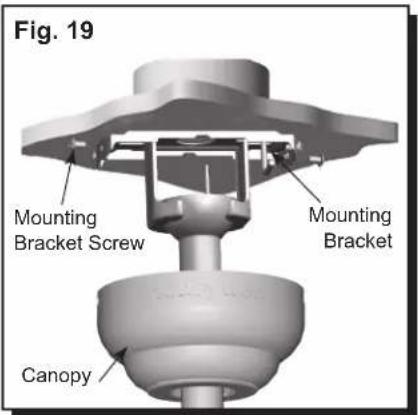
- Lift the canopy up so the partially installed mounting bracket screws are engaged in the J-slots on each side of the canopy. Rotate the canopy clockwise and install the previously removed mounting bracket screws from Step 5 (Fig. 19). Tighten all the mounting bracket screws.

Mounting Bracket Screw
text_image
Fig. 19 Mounting Bracket Screw Mounting Bracket CanopyBLADE INSTALLATION
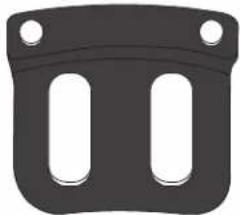
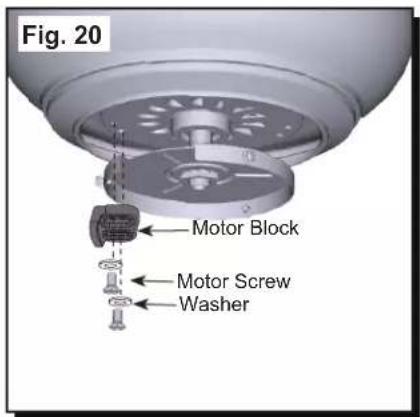
- Remove motor screws, motor blocks and washers from underside of the motor assembly. Discard the motor blocks and washers but keep the motor screws for blade arm attachment. (Fig. 20).
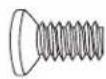
Motor Screw
natural_image
Simple black plastic component with two side holes and a top mounting (no text or symbols)Motor Block Washer
- Partially insert the blade screws along with the blade washers through the blade and into the blade arm. Tighten each blade screw with a Phillips screwdriver starting with the one in the middle. Repeat this step for the remaining blades and blade arms (Fig. 21).
Helpful Hint: A cutout in the fitter plate allows easy access to the motor screw holes.
- Insert two previously removed motor screws through one blade arm and blade isolator and into the motor assembly. Tighten motor screws securely. Repeat for the remaining blade arms, making sure to completely secure each blade arm before proceeding to the next (Fig. 22).

Motor Screw
text_image
Fig. 20 Motor Block Motor Screw Washer
text_image
Fig. 21 Blade Screw Blade Washer Blade Blade Arm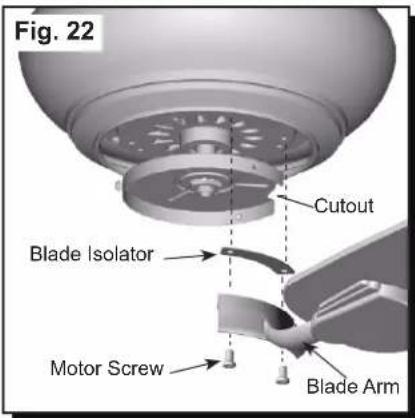
text_image
Fig. 22 Cutout Blade Isolator Motor Screw Blade ArmLIGHT KIT INSTALLATION
23. To install the fan with the LED light kit:
Remove the three fitter plate screws from fitter plate. Then connect the 9-pin connector from the motor assembly to the 9-pin connector from the LED light kit. Ensure the plugs are connected tightly (Fig. 23).

Fitter Plate Screw
- Align holes in the switch housing with holes in the fitter plate. Re-insert the previously removed fitter plate screws. Use a Phillips screwdriver to secure all screws (Fig. 24).

Fitter Plate Screw
- Remove the preassembled rubber washer, hex nut, finial cap, and finial from the LED light kit (Fig. 25).

text_image
Fig. 23 Fitter Plate 9-pin Connector Switch Housing Fitter Plate Screw LED Light Kit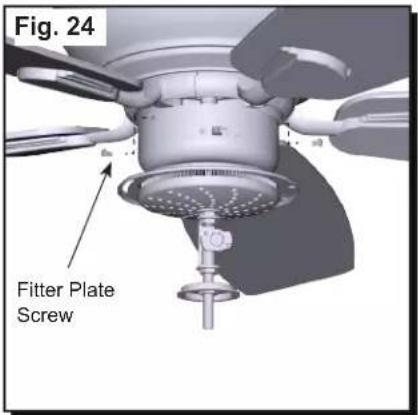
text_image
Fig. 24 Fitter Plate Screw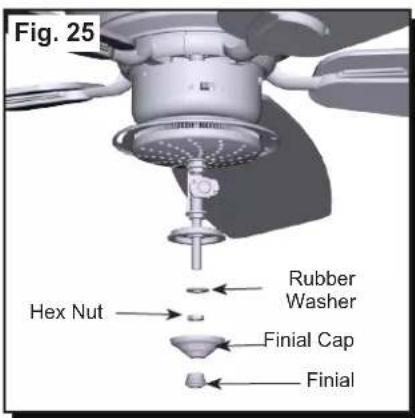
text_image
Fig. 25 Hex Nut Rubber Washer Finial Cap FinialLIGHT KIT INSTALLATION
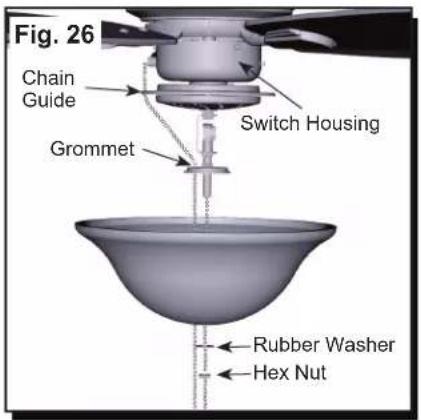
- Feed the fan pull chain from the switch housing through chain guide and the grommet in the light kit and then through the off-center hole in the glass bowl. Then, feed the pull chain from the light kit through the center hole in the glass bowl, rubber washer and hex nut (Fig. 26).
- Lift the glass bowl and rubber washer over the threaded rod. Screw the hex nut onto the threaded rod to secure the glass bowl. Feed the pull chains through the appropriate holes in the finial cap. Lift the finial cap up until it is flush with the glass bowl and secure with the finial (Fig. 27).
Proceed to step 30.
text_image
Fig. 26 Chain Guide Switch Housing Grommet Rubber Washer Hex Nut
text_image
Fig. 27 Rubber Washer Nut Finial Cap FinialLIGHT KIT INSTALLATION
-
(Optional) To install the fan without the light kit: Unscrew the hex nut and washer from the threaded rod in the switch housing to remove the LED light kit and wiring (Fig. 28).
-
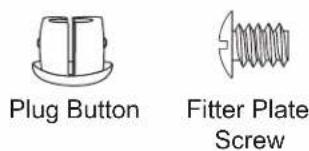
Remove the three fitter plate screws from the fitter plate. Align holes in the switch housing with holes in the fitter plate. Re-insert the previously removed fitter plate screws. Use a Phillips screwdriver to secure all screws. Plug the hole in the bottom of the switch housing with the plug button (Fig. 29).
text_image
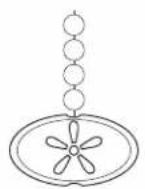
Plug Button Fitter Plate Screw- Attach the pull chain extension(s) to the fan and light pull chain (if applicable) (Fig. 30).
Light Pull ChainFan Pull Chain

text_image
Fig. 28 Hex Nut Washer Switch Housing LED Light Kit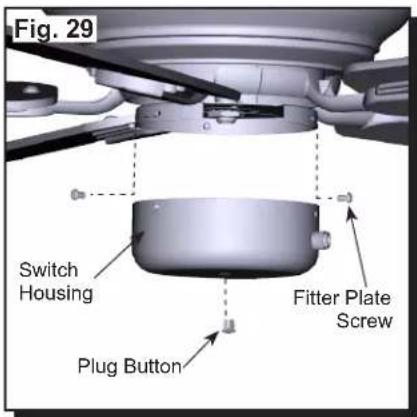
text_image
Fig. 29 Switch Housing Plug Button Fitter Plate Screw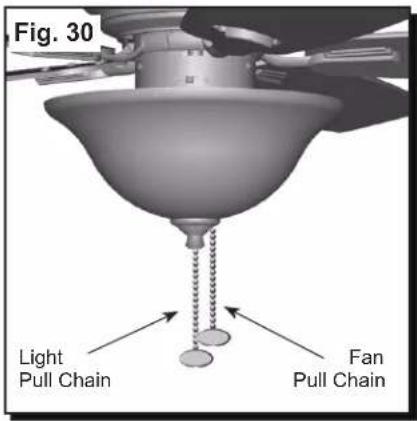
text_image
Fig. 30 Light Pull Chain Fan Pull ChainOPERATING INSTRUCTIONS
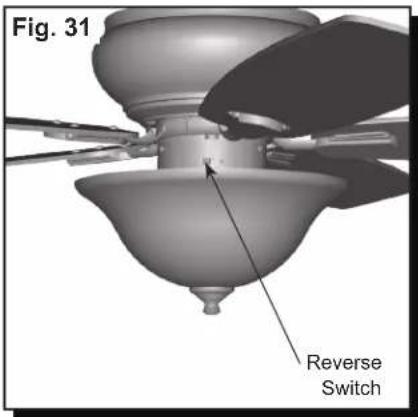
- Using a ceiling fan will allow you to raise your thermostat in the summer and lower your thermostat in the winter without sacrificing comfort (Fig. 31).
Important: Wait for the fan to stop before moving the reverse switch. The reverse switch must be set either completely left or right in order for the fan to function correctly. If the reverse switch is set in the middle position, the fan will not operate.
-
In warmer weather, push the reverse switch left, which will result in downward airflow creating a wind chill effect (Fig. 32).
-
In cooler weather, push the reverse switch right and the fan to low, which will result in upward airflow that can help move stagnant, hot air off the ceiling area. By mixing the air, the heat may not have to run as often and may yield energy savings (Fig. 33).
text_image
Fig. 31 Reverse Switch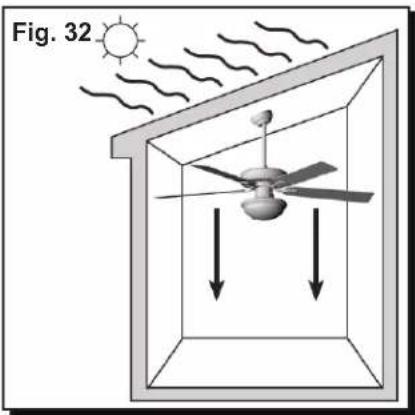
text_image
Fig. 32
natural_image
Diagram of a ceiling fan with airflow arrows indicating airflow direction (no text or symbols)REPLACEMENT PARTS LIST
For replacement parts, call the customer service department at 1-877-361-3883, 8 a.m. - 6 p.m., EST, Monday - Thursday, 8 a.m. - 5 p.m., EST, Friday.
| PIECE DESCRIPTION | MODEL 10290PART # | |
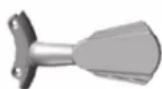
| A Blade | Arm 10290-A | |
| B Blade | 10290-B | |
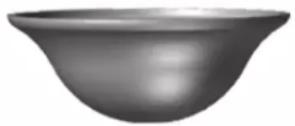
| C Glass | Bowl 10290-C | |
| D | Hardware bag (not shown)contains: Mounting hardware,blade attachment hardware,pull chain extensions, wireconnectors, etc. | 10290-D |
A

natural_image
Gray elongated object with three small white dots on the side (no text or symbols)B
C
TROUBLESHOOTING
At least twice each year, lower the canopy to check the downrod assembly, and then tighten all screws on the fan. Clean the motor housing with only a soft brush or lint-free cloth to avoid scratching the finish. Clean the blades with a lint-free cloth. You may occasionally apply a light coat of furniture polish to wood blades for added protection.
Important: Shut off the main power supply before you begin any maintenance tasks. Do not use water or a damp cloth to clean the ceiling fan.
Problem: The fan does not move
- Turn the power on or check the fuse.
- Turn the power off. Loosen the canopy and check all connections.
- Check that the connectors from the light kit fitter and fan are connected properly.
- Disable the power supply to the fan motor and re-start the motor.
Problem: The fan is noisy.
- Check and tighten all screws that hold the fan blades to the blade arms and the motor.
- Check for cracked blade. Replace blade, if necessary.
Problem: There is excessive wobbling
- Check and tighten all screws that hold the fan blades to the blade arms and the blade arms to the motor.
- Switch one blade with a blade from the opposite side. Or balance the fan using a balancing kit.
- Turn off the power. Loosen the canopy and verify that the mounting bracket is secure to the electrical outlet box.
- The bracket must be flush without movement against the outlet box.
Problem: The fan operates correctly, but the lights are not working (if applicable).
- Ensure the 9-pin connectors in the light kit fitter are connected properly.
- Turn the power off and check all connections at the ceiling outlet box.
LIMITED LIFETIME WARRANTY
Subject to the limitations set forth below, Hong Kong China Electric appliance Company (HKC) warrants the fan motor for this ceiling fan to be free from defects in workmanship and material for the life of the product. HKC warrants the light kit LED luminaire to be free from defects in workmanship and material for a period of five years. Also, subject to the limitations below, HKC warrants all ceiling fan parts (“ceiling fan parts” excludes the motor and parts made in whole or in part with glass) to be free from defects in workmanship and material for a period of one year after the date of purchase by the original purchaser at retail.
All claims must be made by the original purchaser, whether such purchaser purchased the product through a store or contractor. Ceiling fan part defects must be reported within the first year from the date of purchase. Parts made in whole or in part with glass and the finishes of metal and other surfaces are not warranted.
Purchasers are responsible for all costs of removing and reinstalling the product. Any damage to any part caused by ordinary wear and tear, accident, misuse, or improper installation, is not covered by this warranty. HKC assumes no responsibility whatsoever for fan installation. Any service performed by a non-licensed electrician will render the warranty invalid.
HKC's sole responsibility shall be to repair or replace the motor, parts, or product within the terms stated above. HKC SHALL NOT BE LIABLE FOR ANY LOSS OR DAMAGE OF ANY KIND, INCLUDING ANY INCIDENTAL OR CONSEQUENTIAL DAMAGES RESULTING DIRECTLY OR INDIRECTLY, FROM ANY BREACH OF WARRANTY, EXPRESS OR IMPLIED, OR ANY OTHER FAILURE OF THIS PRODUCT. SOME STATES DO NOT ALLOW THE EXCLUSION OR LIMITATION OF INCIDENTAL OR CONSEQUENTIAL DAMAGES SO THIS LIMITATION MAY NOT APPLY TO YOU.
IF THE ORIGINAL PURCHASER CEASES TO OWN THE FAN, THIS WARRANTY IS VOIDED.
Should the purchaser encounter a problem with your fan related to defects in workmanship or materials within the warranty period associated with the defective part, HKC agrees to replace the defective part without charge, or at its option, to replace the ceiling fan with a comparable or superior model.
HKC'S WARRANTIES ARE LIMITED TO THE WRITTEN WARRANTIES SET OUT IN THIS HKC CEILING FAN LIMITED LIFETIME WARRANTY. ALL OTHER EXPRESS AND IMPLIED WARRANTIES, INCLUDING, WITHOUT LIMITATION, THE IMPLIED WARRANTY OF FITNESS FOR A PARTICULAR PURPOSE AND THE IMPLIED WARRANTY OF MERCHANTABILITY ARE DISCLAIMED. SOME STATES DO NOT ALLOW THE DISCLAIMER OF IMPLIED WARRANTIES, SO THIS DISCLAIMER MAY NOT APPLY TO YOU.
To obtain warranty service, please write down your model number and call Customer Service at 1-877-361-3883 Monday - Thursday, 8 am - 6 pm, EST and Friday, 8 am - 5 pm, EST. Please have a copy of the receipt as proof of purchase.
The Honeywell Trademark is used under license from Honeywell International Inc. Honeywell International Inc. makes no representations or warranties with respect to this product. This product is manufactured for:
Hong Kong China Electric Appliance Manufacture Co., Ltd.
3350 Players Club Parkway, Suite 225
Memphis, TN 38125
1-877-361-3883