
K60DLT - Aaaa Vulcan - Free user manual and instructions
Find the device manual for free K60DLT Vulcan in PDF.


| Product Type | Direct Steam Kettle (Tilting) |
| Brand | Vulcan |
| Model | K60DLT |
| Capacity | 60 gallons (227 liters) |
| Working Capacity | 60 gallons (227 liters) |
| Dimensions (W x D x H) | 29.5 x 23.9 x 38.1 in (749 x 607 x 968 mm) |
| Overall Width | 29.5 in (749 mm) |
| Overall Depth | 23.9 in (607 mm) |
| Overall Height | 38.1 in (968 mm) |
| Height to Pour Lip (Tilted) | 45.7 in (1161 mm) |
| Kettle Diameter (Inside) | 26.8 in (683 mm) |
| Kettle Depth | 19.7 in (500 mm) |
| Draw-off Valve Height | 14.9 in (380 mm) |
| Power Source | Steam (direct steam, no electrical required) |
| Max Steam Pressure (Nameplate) | 50 PSI (as per relief valve) |
| Steam Inlet Connection | 1.5 in (standard pipe size) |
| Construction Material | Stainless steel (300 series austenitic) |
| Jacket Type | 2/3 jacketed |
| Mounting | Floor-mounted with adjustable flanged feet |
| Draw-off Valve | 2-inch plug or compression draw-off valve |
| Optional Accessories | Lid, spring assist lid cover, 2-inch plug draw-off |
| Cleaning Recommendation | Non-abrasive tools, mild non-chloride detergents |
| Safety Feature | Pressure relief valve (50 PSI) with manual test ring |
| Certification | NSF-approved sealant required at floor mounting |
Frequently Asked Questions - K60DLT Vulcan
User questions about K60DLT Vulcan
0 question about this device. Answer the ones you know or ask your own.
Ask a new question about this device
Download the instructions for your Aaaa in PDF format for free! Find your manual K60DLT - Vulcan and take your electronic device back in hand. On this page are published all the documents necessary for the use of your device. K60DLT by Vulcan.
USER MANUAL K60DLT Vulcan
natural_image
Exterior view of a stainless steel industrial mixer vessel with three legs and a handle (no text or symbols visible)K40DL
For additional information on Vulcan-Hart or to locate an authorized parts and service provider in your area, visit our website at www.vulcanequipment.com
IMPORTANT FOR YOUR SAFETY
THIS MANUAL HAS BEEN PREPARED FOR PERSONNEL QUALIFIED TO INSTALL PLUMBING AND MUST BE ABLE TO PERFORM THE INITIAL FIELD START-UP AND ADJUSTMENTS OF THE EQUIPMENT COVERED BY THIS MANUAL.
⚠ WARNING Improper installation, adjustment, alteration, service or maintenance can cause property damage, injury or death. Read the installation, operating and maintenance instructions thoroughly before installing or servicing this equipment.
IN THE EVENT OF A POWER FAILURE, DO NOT ATTEMPT TO OPERATE THIS DEVICE.
RETAIN THIS INSTRUCTION MANUAL FOR FUTURE REFERENCE
CONTENTS
GENERAL 4
INSTALLATION ....5
Unpacking....5
Installation Codes and Standards....5
Location....6
Stationary Kettle 6
Tilting Kettle 7
Installation Procedure....8
Steam Supply Connection....8
Initial Start-Up....9
OPERATION....10
STAINLESS STEEL EQUIPMENT CARE AND CLEANING 11
CLEANING....13
Compression Draw-Off Valve Cleaning Instructions 13
Plug Valve Cleaning Instructions....14
MAINTENANCE 15
Service....15
TROUBLESHOOTING 15
DIRECT STEAM KETTLES
INSTALLATION, OPERATION AND MAINTENANCE OF KDL AND KDLT SERIES DIRECT STEAM KETTLES
SAVE THESE INSTRUCTIONS FOR FUTURE USE
GENERAL
Vulcan direct steam 2/3 jacketed kettles are produced with quality workmanship and material. Proper installation, usage and maintenance will result in many years of satisfactory performance. It is suggested that you thoroughly read this entire manual and carefully follow all of the instructions provided.

natural_image
Two stainless steel industrial mixing vessels with handles and legs, one labeled 'VULCAN' (no additional text or symbols visible)Model K40DL Model K40DLT (SHOWN WITH OPTIONAL 2" PLUG DRAW-OFF) (SHOWN WITH OPTIONAL LID AND 2" PLUG DRAW-OFF)
| MODEL CHART | |||
| Model Gallons | Quarts | Liters | |
| K20DL & K20DLT | 20 80 76 | ||
| K40DL & K40DLT | 40 160 152 | ||
| K60DL & K60DLT | 60 240 228 | ||
INSTALLATION
UNPACKING
This kettle was inspected before leaving the factory. The transportation company assumes full responsibility for safe delivery upon acceptance of the shipment.
Immediately after unpacking, check for possible shipping damage. If kettle damage is found, save the packaging material and contact the carrier within 15 days of delivery. Freight damage is not covered under Vulcan Warranty.
INSTALLATION CODES AND STANDARDS
In the United States, Vulcan kettles must be installed in accordance with:
- State and local codes
- NFPA Standard NFPA-96, Vapor Removal from Cooking Equipment, latest edition, available from the National Fire Protection Association, Batterymarch Park, Quincy, MA 02269
DIRECT STEAM KETTLES
LOCATION
⚠ WARNING Plumbing connections must comply with applicable sanitary, safety and plumbing codes.
Stationary Kettle
Position the kettle in its final location. Check that there are sufficient clearances for operating and servicing the kettle, and proper clearance of the cover when raised. The kettle draw-off valve should be located near a floor drain.

| MODEL | TRUE WORKING CAPACITY | A | B | C | D | E | F | G | H | J | K | L | M | N |
| K20DL | 20 gallons | 21.6 In. | 15.2 In. | 31.9 In. | 28.8 In. | 15.7 In. | 16.0 In. | 14.7 In. | 9.3 In. | 24.5 In. | 56.8 In. | 14.3 In. | 23.0 In. | 8.3 In. |
| 76 liters | 549 mm | 386 mm | 809 mm | 732 mm | 399 mm | 406 mm | 373 mm | 236 mm | 622 mm | 1441 mm | 363 mm | 586 mm | 211 mm | |
| K40DL | 40 gallons | 25.8 In. | 21.2 In. | 37.1 In. | 32.9 In. | 17.5 In. | 17.7 In. | 14.0 In. | 10.5 In. | 25.0 In. | 66.0 In. | 13.5 In. | 24.8 In. | 10.5 In. |
| 152 liters | 656 mm | 538 mm | 942 mm | 836 mm | 445 mm | 450 mm | 356 mm | 267 mm | 635 mm | 1676mm | 343 mm | 632 mm | 267 mm | |
| K60DL | 60 gallons | 29.5 In. | 23.9 In. | 39.4 In. | 36.9 In. | 19.3 In. | 19.7 In. | 13.5 In. | 8.0 In. | 26.5 In. | 72.5 In. | 13.0 In. | 27.5 In. | 12.2 In. |
| 227 liters | 749 mm | 607 mm | 1001 mm | 937 mm | 490 mm | 500 mm | 340 mm | 203 mm | 673 mm | 1842 mm | 330 mm | 700 mm | 310 mm |
Tilting Kettle
Position the kettle in its final installed location to provide drainage directly below pour path, with sufficient rear clearance from the wall to allow the kettle to tilt completely without obstruction.

= FLOOL DRAIN FOR
DRAW-OFF VALVE
AND POUR PATH
SHOWN WITH OPTIONAL DRAW-OFF VALVE AND SPRING ASSIST LID COVER
| MODEL | TRUE WORKING CAPACITY | A | B | C | D | E | F | G | H | J | K | L | M | N |
| K20DLT | 20 gallons | 21.6 In. | 15.2 In. | 35.7 In. | 37.8 In. | 21.3 In. | 16.0 In. | 18.4 In. | 11.9 In. | 20.7 In. | 61.3 In. | 17.7 In. | 28.5 In. | 9.9 In. |
| 76 liters | 549 mm | 386 mm | 907 mm | 960 mm | 543 mm | 406 mm | 467 mm | 302 mm | 523 mm | 1557 mm | 451 mm | 726 mm | 252 mm | |
| K40DLT | 40 gallons | 25.8 In. | 21.2 In. | 36.1 In. | 41.8 In. | 24.0 In. | 17.7 In. | 12.8 In. | 7.5 In. | 18.6 In. | 65.8 In. | 12.1 In. | 30.3 In. | 12.1 In. |
| 152 liters | 656 mm | 538 mm | 917 mm | 1062 mm | 610 mm | 451 mm | 325 mm | 191 mm | 473 mm | 1671 mm | 308 mm | 772 mm | 308 mm | |
| K60DLT | 60 gallons | 29.5 In. | 23.9 In. | 38.1 In. | 45.7 In. | 26.8 In. | 19.7 In. | 15.6 In. | 10.9 In. | 19.8 In. | 72.3 In. | 14.9 In. | 33.0 In. | 13.8 In. |
| 227 liters | 749 mm | 607 mm | 968 mm | 1161 mm | 683 mm | 500 mm | 398 mm | 276 mm | 503 mm | 1836 mm | 380 mm | 841 mm | 352 mm |
DIRECT STEAM KETTLES
INSTALLATION PROCEDURE
Make sure the kettle is in its final location before performing the installation procedure.
It may be necessary to increase the height of the kettle when leveling to clear the draw-off valve on tilting kettles. Use the adjustable flange feet to increase the height of the kettle.
- Place a spirit level on the rim of the kettle with the cover open. Adjust the feet to level the kettle left-to-right and front-to-back.
- Mark anchoring hole locations through the flanged feet, then move the kettle out of the way.
- With hole location marked, drill holes for expansion plugs for appropriate-sized lag bolts.
- Reposition the kettle and verify that the kettle is level.
- Bolt the kettle down and apply an NSF-approved silicone sealant around the bolt heads and flange making contact with floor surface. Wipe off excess sealant immediately.
STEAM SUPPLY CONNECTION
The steam line plumbing diagram (Fig. 1) is a generic representation of the recommended steam supply.
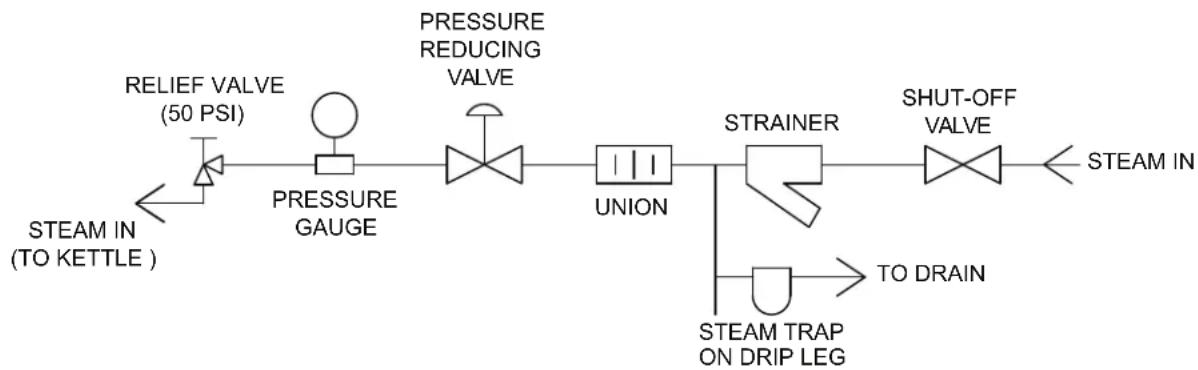
flowchart
graph LR
    A["STEAM IN (TO KETTLE)"] --> B["RELIEF VALVE (50 PSI)"]
    B --> C["PRESSURE GAUGE"]
    C --> D["PRESSURE REDUCING VALVE"]
    D --> E["UNION"]
    E --> F["STRainer"]
    F --> G["SHUT-OFF VALVE"]
    G --> H["STEAM IN"]
    F --> I["STEAM TRAP ON DRIP LEG"]
    I --> J["TO DRAIN"]
Fig. 1
If the incoming steam pressure is greater than kettle maximum operating pressure stamped on the nameplate, install a pressure-reducing valve (not supplied) on the line before the steam inlet to the kettle.
Connect steam supply line (see chart) pipe size to the kettle inlet fitting making sure there is a steam control valve strainer. The steam supply line must be as large as the steam inlet fitting.
The relief valve on the kettle must not be closed off as it is set to relieve excess pressure in the kettle.
If the steam is heavy with condensate, install a steam trap before the pressure regulator valve. To ensure rapid heat-up of heavy loads, a ball float type steam trap is recommended. Steam trap should be sized for flow-rate and differential pressure. The steam supply line must be sized to maintain pressure and flow (see chart).
A steam line pressure gauge (not supplied) is recommended to determine the actual steam pressure being supplied to the kettle.
Install the steam shut-off valve at a convenient location near the kettle on the incoming steam line.
| Maximum Flow Rate of Dry Steam in Pounds per Hour | ||||||
| Supply Pressure | Standard Pipe Size | |||||
| ^1/_2 " | ^3/_4 " | 1 | " ^1/_4 " | 1 1^1/_2 " | 2 | |
| 5 PSIG 20 40 | 70 140 | 210 380 | ||||
| 10 PSIG 30 60 | 110 220 | 320 600 | ||||
| 15 PSIG 40 80 | 150 290 | 430 n/a | ||||
| 20 PSIG 50 100 | 180 360 | 530 r/a | ||||
| 25 PSIG 60 120 | 220 430 | n/a n/a | ||||
| 30 PSIG 70 140 | 250 500 | n/a n/a | ||||
| 35 PSIG 80 160 | 290 570 | n/a n/a | ||||
| 50 PSIG 100 | 380 210 | n/a n/a | ||||
Chart values are based on 100' of clean iron pipe. Steam losses due to elbows, reductions, heat loss or condensing steam were not considered.
Connect the kettle condensate return line (Fig. 2) to an open drain or to a boiler condensate return line. Boiler condensate return lines must have a check valve (not supplied).

flowchart
graph LR
    A["FROM KETTLE"] --> B["STRainer"]
    B --> C["STEAM TRAP"]
    C --> D["CHECK VALVE"]
    D --> E["TO DRAIN OR BOILER CONDENSATE RETURN"]
Fig. 2
INITIAL START-UP
- Pour a small amount of water into the kettle.
- Open the steam inlet valve.
- When the water begins to boil, inspect all of the fittings to ensure that there are no leaks.
- Check the safety valve by pulling the ring far enough to allow steam to escape. Let the valve snap back into place to reseat the valve so it will not leak.
- Shut down the unit by closing the steam inlet valve.
- Open the draw-off valve to ensure that it functions from fully opened to fully closed position. If it functions properly, then the kettle is ready for use.
OPERATION
WARNING The kettle and its parts are hot. Use care when operating, cleaning or servicing the kettle.
Food products with milk or egg base should be placed into a cold kettle before cooking. Avoid sudden contact of these food products to a hot kettle surface because they stick to the surface.
- Verify that the draw-off valve is closed.
- Fill kettle with product to the desired level.
- Slowly turn the steam control valve to the fully open position.
- The water should boil in 3 to 4 minutes per gallon. If it does not, then check incoming pressure to determine that pressure is adequate to operate the kettle.
- Regulate the steam control valve according to the desired temperature.
STAINLESS STEEL EQUIPMENT CARE AND CLEANING
(Supplied courtesy of NAFEM. For more information, visit their web site at www.nafem.org)
Contrary to popular belief, stainless steels ARE susceptible to rusting.
Corrosion on metals is everywhere. It is recognized quickly on iron and steel as unsightly yellow/orange rust. Such metals are called “active” because they actively corrode in a natural environment when their atoms combine with oxygen to form rust.
Stainless steels are passive metals because they contain other metals, like chromium, nickel and manganese that stabilize the atoms. 400 series stainless steels are called ferritic, contain chromium, and are magnetic; 300 series stainless steels are called austenitic, contain chromium and nickel; and 200 series stainless, also austenitic, contains manganese, nitrogen and carbon. Austenitic types of stainless are not magnetic, and generally provide greater resistance to corrosion than ferritic types.
With 12-30 percent chromium, an invisible passive film covers the steel's surface acting as a shield against corrosion. As long as the film is intact and not broken or contaminated, the metal is passive and stain-less. If the passive film of stainless steel has been broken, equipment starts to corrode. At its end, it rusts.
Enemies of Stainless Steel
There are three basic things which can break down stainless steel's passivity layer and allow corrosion to occur.
- Mechanical abrasion
- Deposits and water
- Chlorides
Mechanical abrasion means those things that will scratch a steel surface. Steel pads, wire brushes and scrapers are prime examples.
Water comes out of the faucet in varying degrees of hardness. Depending on what part of the country you live in, you may have hard or soft water. Hard water may leave spots, and when heated leave deposits behind that if left to sit, will break down the passive layer and rust stainless steel. Other deposits from food preparation and service must be properly removed.
Chlorides are found nearly everywhere. They are in water, food and table salt. One of the worst chloride perpetrators can come from household and industrial cleaners.
So what does all this mean? Don't Despair!
Here are a few steps that can help prevent stainless steel rust.
1. Use the proper tools.
When cleaning stainless steel products, use non-abrasive tools. Soft cloths and plastic scouring pads will not harm steel's passive layer. Stainless steel pads also can be used but the scrubbing motion must be in the direction of the manufacturers' polishing marks.
2. Clean with the polish lines.
Some stainless steel comes with visible polishing lines or “grain.” When visible lines are present, always scrub in a motion parallel to the lines. When the grain cannot be seen, play it safe and use a soft cloth or plastic scouring pad.
3. Use alkaline, alkaline chlorinated or non-chloride containing cleaners.
While many traditional cleaners are loaded with chlorides, the industry is providing an ever-increasing choice of non-chloride cleaners. If you are not sure of chloride content in the cleaner used, contact your cleaner supplier. If your present cleaner contains chlorides, ask your supplier if they have an alternative. Avoid cleaners containing quaternary salts; it also can attack stainless steel and cause pitting and rusting.
DIRECT STEAM KETTLES
4. Treat your water.
Though this is not always practical, softening hard water can do much to reduce deposits. There are certain filters that can be installed to remove distasteful and corrosive elements. To insure proper water treatment, call a treatment specialist.
5. Keep your food equipment clean.
Use alkaline, alkaline chlorinated or non-chloride cleaners at recommended strength. Clean frequently to avoid build-up of hard, stubborn stains. If you boil water in stainless steel equipment, remember the single most likely cause of damage is chlorides in the water. Heating cleaners that contain chlorides have a similar effect.
6. Rinse, rinse, rinse.
If chlorinated cleaners are used, rinse and wipe equipment and supplies dry immediately. The sooner you wipe off standing water, especially when it contains cleaning agents, the better. After wiping equipment down, allow it to air dry; oxygen helps maintain the stainless steel's passivity film.
7. Never use hydrochloric acid (muriatic acid) on stainless steel.
8. Regularly restore/passivate stainless steel.
| Job Cleaning Agent Comments | ||
| Routine cleaning Soap, ammonia,detergent, Medallion | Apply with soft cloth or sponge. | |
| Fingerprints and smears | Arcal 20, Lac-O-Nu Ecoshine | Provides barrier film |
| Stubborn stains and discoloration | Cameo, Talc, Zud,First Impression | Rub in direction of polish lines. |
| Grease and fatty acids,blood, burnt-on foods | Easy-off, DeGrease It Oven Aid | Excellent removalon all fi nishes |
| Grease and Oil Any good commercialdetergent | Apply with soft cloth or sponge. | |
| Restoration/Passivation Benefit t | Super Sheen | |
Review
- Stainless steels rust when passivity (film-shield) breaks down as a result of scrapes, scratches, deposits and chlorides.
- Stainless steel rust starts with pits and cracks.
- Use the proper tools. Do not use steel pads, wire brushes or scrapers to clean stainless steel.
- Use non-chlorinated cleaners at recommended concentrations. Use only chloridefree cleaners.
- Soften your water. Use filters and softeners whenever possible.
- Wipe off cleaning agent(s) and standing water as soon as possible. Prolonged contact causes eventual problems.
To learn more about chloride-stress corrosion and how to prevent it, contact the equipment manufacturer or cleaning materials supplier.
Developed by Packer Engineering, Naperville, Ill., an independent testing laboratory.
CLEANING
WARNING The kettle and its parts are hot. Use care when operating, cleaning or servicing the kettle.
The kettle interior and exterior should be thoroughly washed after each use when a different food is to be cooked next or when cooking is completed for the day. If the unit is used continuously through the day, it should be cleaned and sanitized once every 12 hours.
Empty the kettle. Close draw-off valve and add water to the kettle for cleaning to prevent residue from drying and sticking to the inside of the kettle.
- Never use harsh or corrosive cleaning chemicals.
- Never scrape the inside of the kettle with abrasive cleansers, metal tools or steel scouring pads, which will scratch the surface, spoil the appearance and make it more difficult to thoroughly clean.
- Add mild, non-chlorine, non-chloride, and non-bleach detergent and scrub the kettle interior with a nylon brush.
- Loosen stuck-on food by allowing it to soak at a low temperature setting.
- Thoroughly rinse the interior and dry with a soft cloth.
- Rinse the exterior and dry with a soft cloth.
COMPRESSION DRAW-OFF VALVE CLEANING INSTRUCTIONS
Daily After Use
Remove draw-off valve stem assembly for cleaning (Fig. 3).
- Turn the valve handle counterclockwise until it stops.
- Pull the valve handle back until it stops.
- Turn large hex nut counterclockwise until the valve stem assembly is loose.
- Pull the assembly straight out of the valve body.
- Remove wing nut and handle. Unscrew valve stem from bonnet.
-
Wash valve body and stem assembly with mild soap and water, and then rinse. Make sure all food residue is removed from inside valve body.
-
Leave assembly apart to air dry.
Install draw-off valve assembly:
-
Apply PetroGel lubricant to valve stem threads, "O" ring, rubber plug face and large hex nut threads.
-
Thread the valve stem into bonnet till valve stem can be pulled through bonnet.
-
Insert valve stem into valve body.
-
Install large hex nut hand tight.
-
Install valve handle, lock washer and wing nut onto the valve stem.
-
Turn valve handle clockwise until closed. Do not overtighten.

Fig. 3
DIRECT STEAM KETTLES
PLUG VALVE CLEANING INSTRUCTIONS
Daily After Use
Remove draw-off valve plug for cleaning (Fig. 4).
- Unscrew the retaining ring and remove it and the bottom washer.
- Pull the valve plug straight up to remove from valve body.
- Wash valve body, plug, washer and retaining ring with mild soap and water, and then rinse.
- Leave assembly apart to air dry.
Care should be taken not to scratch, ding or dent the valve plug to prevent valve leakage.
If multiple kettles are in use, care should be taken to keep each plug separate and returned to its original valve body.
Install draw-off valve plug.
- Apply PetroGel lubricant to valve plug face.
- Holding the valve handle, slide the plug down into the valve body.
- Install the bottom washer, making sure to align the key with the groove in the valve plug.
- Install the retaining ring and hand tighten.

Fig. 4
If the valve is hard to open, then the ring has been overtightened.
MAINTENANCE
SERVICE
To obtain service and parts information concerning this unit, contact the Vulcan-Hart Service Agency in your area (refer to listing supplied with the kettle), or contact the Vulcan-Hart Service Department at the address or phone number shown on the front cover of this manual.
Parts and service are also available at www.vulcanequipment.com.
TROUBLESHOOTING
| Problem Possible Causes / Suggested Corrective Action | |
| Unit not Heating Verify incoming | steam supply valve is open and pressure-reducing valve is open. |
| Blocked/plugged steam trap of strainer. Contact building maintenance or authorized service company. | |
| Noisy (crackling) Will not harm the kettle. It is an indication that there is condensate in the steam supply line and a steam trap should be installed in the supply line before the kettle. Turn kettle off and open drain valve on bottom of kettle to drain water out. Close valve and turn on steam control valve. | |
| Pressure relief valve leaking steam | Incoming steam supply too high or faulty pressure relief valve. Contact building maintenance or authorized service company. |
DIRECT STEAM KETTLES
- IMPORTANT FOR YOUR SAFETY
- CONTENTS
- GENERAL 4
- INSTALLATION ....5
- OPERATION....10
- STAINLESS STEEL EQUIPMENT CARE AND CLEANING 11
- CLEANING....13
- MAINTENANCE 15
- TROUBLESHOOTING 15
- INSTALLATION, OPERATION AND MAINTENANCE OF KDL AND KDLT SERIES DIRECT STEAM KETTLES
- GENERAL
- INSTALLATION
- UNPACKING
- INSTALLATION CODES AND STANDARDS
- LOCATION
- Stationary Kettle
- Tilting Kettle
- DIRECT STEAM KETTLES
- INSTALLATION PROCEDURE
- STEAM SUPPLY CONNECTION
- INITIAL START-UP
- OPERATION
- WARNING The kettle and its parts are hot. Use care when operating, cleaning or servicing the kettle.
- STAINLESS STEEL EQUIPMENT CARE AND CLEANING
- Enemies of Stainless Steel
- So what does all this mean? Don't Despair!
- Use the proper tools.
- Clean with the polish lines.
- Use alkaline, alkaline chlorinated or non-chloride containing cleaners.
- Treat your water.
- Keep your food equipment clean.
- Rinse, rinse, rinse.
- Never use hydrochloric acid (muriatic acid) on stainless steel.
- Regularly restore/passivate stainless steel.
- Review
- CLEANING
- COMPRESSION DRAW-OFF VALVE CLEANING INSTRUCTIONS
- Daily After Use
- PLUG VALVE CLEANING INSTRUCTIONS
- MAINTENANCE
- SERVICE
Brand : Vulcan
Model : K60DLT
Category : Aaaa