
ACB72 - Grill WOLF - Free user manual and instructions
Find the device manual for free ACB72 WOLF in PDF.


| Product Type | Professional Countertop Gas Grill |
| Brand | Wolf (Vulcan) |
| Model | ACB72 |
| Width | 183 cm (72 inches) |
| Depth | 76 cm (30 inches) estimated |
| Height | 64 cm (25 inches) estimated |
| Weight | Approximately 272 kg (600 lb) |
| Power Supply | Natural gas or propane (field convertible) |
| Natural Gas Consumption | 221,000 BTU/h (64.8 kW) |
| LPG Consumption | 208,000 BTU/h (61.0 kW) |
| Number of Burners | 13 independent burners |
| Grate Material | Cast iron, reversible (flat or sloped surface) |
| Radiant Elements | Molded, removable for cleaning |
| Crumble Tray | Removable, accessible from front |
| Deflector Plate | Removable, with holes for debris passage |
| Smoker Box | Optional accessory, built-in wood trays |
| Ignition | Adjustable individual pilot lights |
| Pressure Regulator | Built-in, preset for natural gas (25 cm WC) or propane (28 cm WC) |
| Noise Level | Not applicable (silent in normal operation) |
| Maintenance | Daily cleaning of grates and crumb tray; annual lubrication of valves |
| Safety | Manual gas shutoff, leak detection recommended, do not block ventilation |
| Installation | Under ventilation hood, minimum 8 cm clearance from non-combustible walls |
| Warranty | Contact Vulcan customer service (1-800-814-2028) |
Frequently Asked Questions - ACB72 WOLF
User questions about ACB72 WOLF
0 question about this device. Answer the ones you know or ask your own.
Ask a new question about this device
Download the instructions for your Grill in PDF format for free! Find your manual ACB72 - WOLF and take your electronic device back in hand. On this page are published all the documents necessary for the use of your device. ACB72 by WOLF.
USER MANUAL ACB72 WOLF
natural_image
Exterior view of a stainless steel heat exchanger or cooling unit with multiple ports and a black cover (no visible text or symbols)VACB36
VACB25
VACB36
VACB47
VACB60
VACB72

natural_image
Exterior view of a stainless steel grater with heat exchangers and cooling fins (no text or symbols visible)ACB36
ACB25
ACB36
ACB47
ACB60
ACB72
For additional information on Vulcan or to locate an authorized parts and service provider in your area, visit our website at www.vulcanequipment.com
IMPORTANT FOR YOUR SAFETY
THIS MANUAL HAS BEEN PREPARED FOR PERSONNEL QUALIFIED TO INSTALL GAS EQUIPMENT, WHO SHOULD PERFORM THE INITIAL FIELD START-UP AND ADJUSTMENTS OF THE EQUIPMENT COVERED BY THIS MANUAL.
POST IN A PROMINENT LOCATION THE INSTRUCTIONS TO BE FOLLOWED IN THE EVENT THE SMELL OF GAS IS DETECTED. THIS INFORMATION CAN BE OBTAINED FROM THE LOCAL GAS SUPPLIER.
IMPORTANT
IN THE EVENT A GAS ODOR IS DETECTED, SHUT DOWN UNITS AT MAIN SHUTOFF VALVE AND CONTACT THE LOCAL GAS COMPANY OR GAS SUPPLIER FOR SERVICE.
FOR YOUR SAFETY
DO NOT STORE OR USE GASOLINE OR OTHER FLAMMABLE VAPORS OR LIQUIDS IN THE VICINITY OF THIS OR ANY OTHER APPLIANCE.
WARNING
Improper installation, adjustment, alteration, service or maintenance can cause property damage, injury, or death. Read the installation, operating and maintenance instructions thoroughly before installing or servicing this equipment.
IN THE EVENT OF A POWER FAILURE, DO NOT ATTEMPT TO OPERATE THIS DEVICE.
INSTALLATION, OPERATION AND CARE OF GAS COUNTERTOP CHARBROILERS
GENERAL
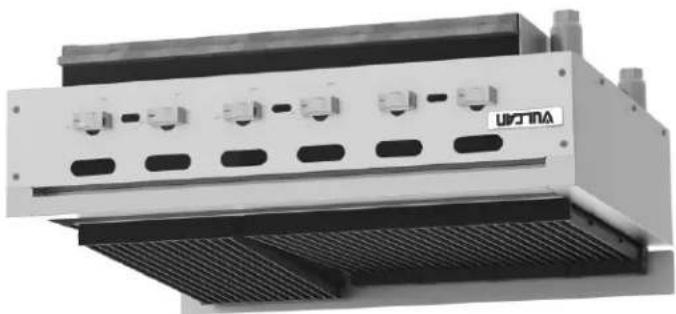
Vulcan/Wolf Gas Countertop Charbroilers are designed for commercial use only and feature fast, efficient gas heat. Each burner is controlled by an adjustable gas valve. Cast radiants are located directly above each burner to maintain uniform temperature. Radiants are easily removed for cleaning when cool.
Heavy-duty cast iron top grates are reversible to allow all or part of the cooking grid surface to be level or sloped. A crumb tray is provided to collect fat run-off and debris; it opens to the front for inspection or cleaning.
| Model | Number of Burners | Natural Gas BTU/hr Input Rating | LP Gas BTU/hr Input Rating |
| VACB25 / ACB25 | 4 | 68,000 | 64,000 |
| VACB36 / ACB36 | 6 | 102,000 | 96,000 |
| VACB48 / ACB48 | 8 | 136,000 | 128,000 |
| VACB60 / ACB60 | 11 | 187,000 | 176,000 |
| VACB72 / ACB72 | 13 | 221,000 | 208,000 |
INSTALLATION
UNPACKING
This charbroiler was inspected before leaving the factory. The carrier assumes full responsibility for the safe delivery upon acceptance of the shipment. Check for possible shipping damage immediately after receipt.
If the charbroiler is found to be damaged, complete the following steps:
- Carrier must be notified within 5 business days of receipt.
- Carrier's local terminal must be notified immediately upon discovery (note time, date, and who was spoken to), and follow up and confirm with written or electronic communication.
- All original packing materials must be kept for inspection purposes.
- The charbroiler cannot have been moved, installed, or modified.
- Notify Vulcan Customer Service immediately at 800-814-2028.
Carefully unpack your charbroiler and make sure that no parts are discarded with packaging material. A pressure regulator designed to operate with the broiler has been supplied and must be installed before the charbroiler is placed into service (Refer to GAS PRESSURE REGULATOR INSTALLATION in this manual).
Before installing, verify that the type of gas (natural or propane) and the clearance dimensions agree with the specifications on the rating plate which is located on the lower front corner on the right side.
LOCATION
The installation location must be kept free and clear of combustibles. Do not obstruct the flow of combustion and ventilation air. DO NOT install the charbroiler adjacent to fryers unless following the provisions detailed by local codes and/or the applicable sections of ANSI-Z223.1/NFPA #54 (latest edition) and NFPA #96 (latest edition) in the United States of America or CAN/CSA 149.1 (latest edition) and CAN/CSA149.2 (latest edition) in Canada.
Sufficient air should be allowed to enter the room to compensate for the amount of air removed by any ventilating system and for combustion of the gas burners. Do not obstruct the air flow into and around the appliance. Do not obstruct the flow of flue gases through and above the broiler's top grate. Position the broiler in its final location. Check that there are sufficient clearances to service the broiler and to make the required gas supply connection(s). Provide 24" clearance at the front for cleaning, maintenance, service and proper operation.
This broiler is for use in non-combustible locations only. Installation in combustible locations is prohibited unless following the provisions detailed by local codes and/or the applicable sections of ANSI-Z223.1/NFPA #54 (latest edition) and NFPA #96 (latest edition) in the United States of America or CAN/CSA 149.1 (latest edition) and CAN/CSA149.2 (latest edition) in Canada and approved by the authority having jurisdiction.
Minimum clearances to non-combustible walls are 3" to the rear and 3" to the sides.
INSTALLATION CODES AND STANDARDS
The Charbroiler must be installed in accordance with:
In the United States of America:
-
State and local codes.
-
National Fuel Gas Code, ANSI-Z223.1/NFPA #54 (latest edition). This shall include but not be limited to: NFPA #54 Section 10.3.5.2 for Venting. Copies may be obtained from The American Gas Association Accredited Standards Committee Z223, @ 400 N. Capital St. NW, Washington, DC 20001 or the Secretary Standards Council, NFPA, 1 Batterymarch Park Quincy, MA 02169-7471
NOTE: In the Commonwealth of Massachusetts
All gas appliances vented through a ventilation hood or exhaust system equipped with a damper or with a power means of exhaust shall comply with 248 CMR.
- NFPA Standard # 96 Vapor Removal from Cooking Equipment, latest edition, available from the National Fire Protection Association, Batterymarch Park, Quincy, MA 02269.
In Canada:
- Local codes.
- CAN/CSA-B149.1 Natural Gas Installation (latest edition)
- CAN/CSA-B149.2 Propane Installation Code (latest edition), available from the Canadian Gas Association, 178 Rexdale Blvd., Etobicoke, Ontario, Canada M9W 1R3
KEY COMPONENTS
WARNING The charbroiler and its parts are hot. Use care when operating, cleaning or servicing the charbroiler.
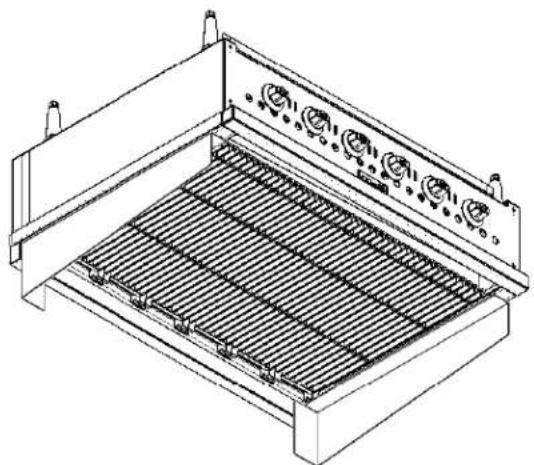
Grate – The grates can be utilized flat or sloped for operational flexibility.
Deflector Tray – The deflector tray is the removable pan with holes in it. The deflector tray deflects heat back toward the cooking surface while allowing debris to pass through the holes and into the crumb tray below. The deflector tray should always be in place above the crumb tray when operating.
NOTICE Never cover the
deflector tray holes with foil or allow the deflector tray holes to become blocked with debris. This will cause a buildup of heat that can potentially damage and warp components of the charbroiler.
Crumb tray – The crumb tray is the removable pan without holes in it. The crumb tray catches any debris that passes thru the deflector tray and should always be installed beneath the deflector tray. (Fig. 1).
Supercharger Burner Divider -
These act as dividers between cooking zones to offer flexibility in cooking and help direct heat upwards to provide for a even heating pattern. You may remove some or all of the supercharger burner dividers at your discretion if you find your production method works better without them. The super charger burner dividers are installed by inserting the hooks thru corresponding slots at the front (Fig. 2) and the back rests in the super charger guide to the rear. (Fig. 3).
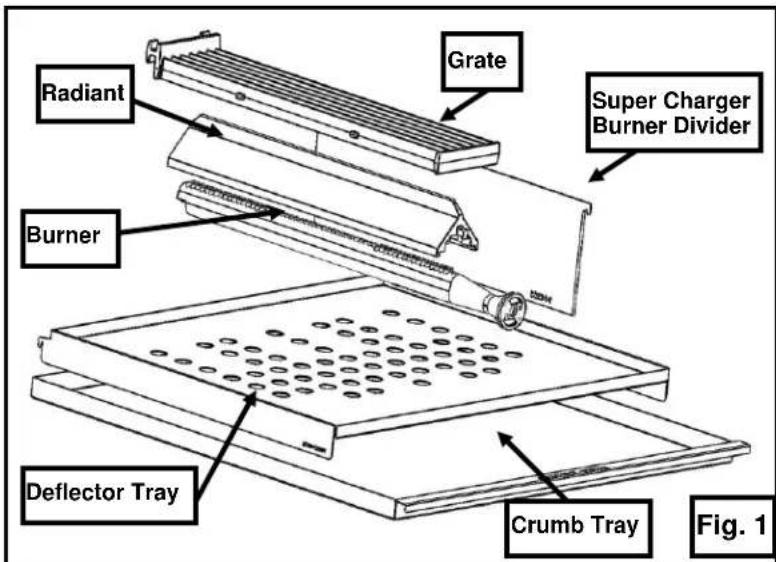

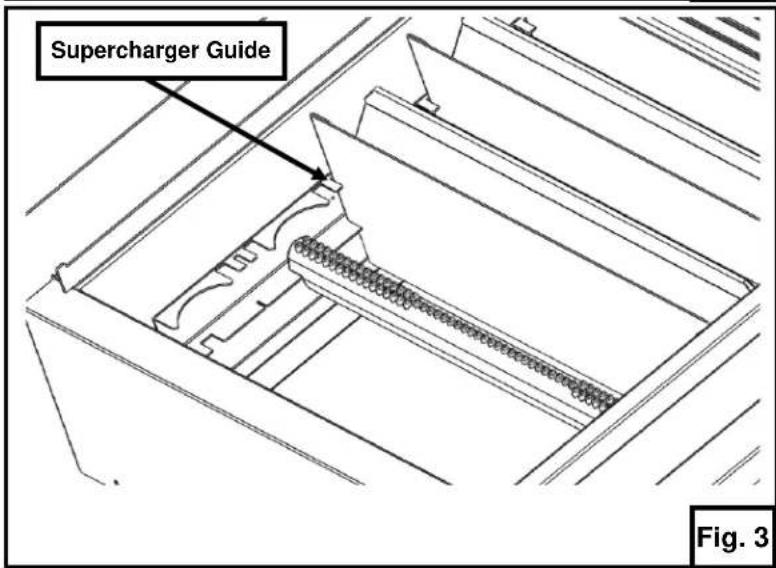
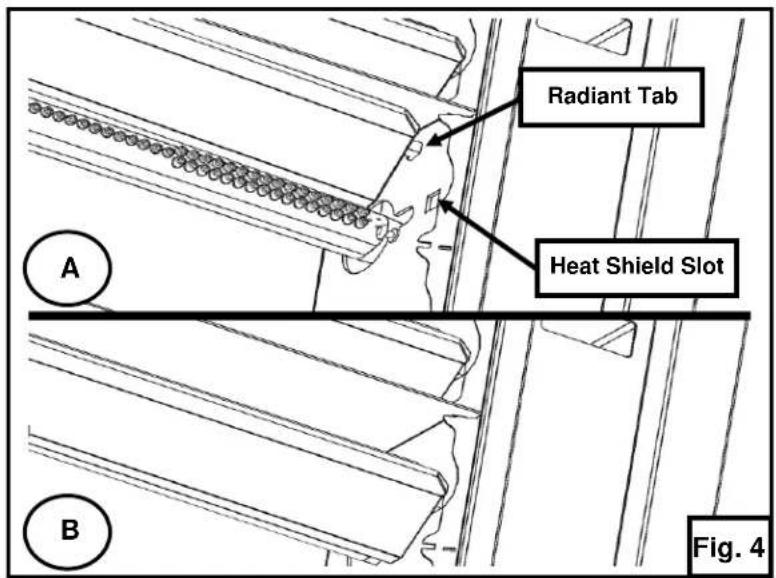
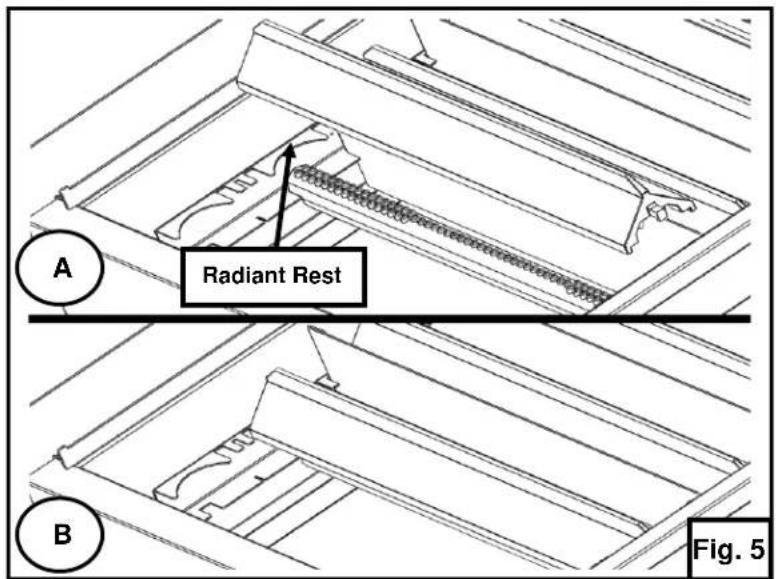
Radiant – The charbroiler must never be operated without the radiants in place. They protect the burner from food drippings and heat up to provide an even heating pattern. The radiants are installed by inserting the tab thru the corresponding slot in the heat shield to the front (Fig. 4-A) and the back of the radiants set on the radiant rest to the rear (Fig. 5-A).
Burner – The burner shutter should engage the orifice to the front (Fig. 6) and rest in the burner slot to the rear of the unit.
Proper burner shutter adjustment is important for optimal charbroiler performance. The burner shutters should only be adjusted with all radiants in place. The shutter will typically be about 50% open for natural gas and 80 to 100% open for LP. A properly adjusted burner should exhibit solid blue flames that are touching the burner. All traces of yellow should be adjusted out of the burner flame for natural gas and only a slight yellow tipping should be observed on LP gas. Large, yellow tipped flames typically indicate not enough air and the burner shutters should be opened slightly. Floating flames (not touching the burner) typically indicate too much air and the shutter should be closed slightly.

LEVELING
It is important that the charbroiler is level front to back and left to right. Areas of uneven heat distribution will occur on an unlevel unit. The charbroiler is equipped with adjustable legs. Turn the feet at the bottom of the legs to adjust to level. The unit should be rechecked for level anytime it has been moved.
VENTILATION HOOD
The broiler must be installed under a suitable ventilation hood. For safe operation and proper ventilation, keep the space between the charbroiler and vent hood free from any obstructions.
GAS CONNECTION
The data plate on the lower right side of the charbroiler indicates the type of gas your unit is equipped to burn. DO NOT connect to any other gas type.
⚠ WARNING All gas supply connections and any joint compound must be resistant to the action of propane gases.
Purge the supply line to clean out any dust, dirt, or any foreign matter before connecting the line to the unit.
Codes require that a gas shut-off valve be installed in the gas line ahead of the charbroiler. The gas supply line must be at least the equivalent of 34 " iron pipe.
60" and 72" models have a gas inlet at each end of the unit. The unit will arrive from the factory with a metal cap on one end and a plastic dust cover on the other. You may move the metal cap to the other end and use which ever connection point is most convenient to the available supply outlet. The plastic dust cover must be replaced with a metal pipe cap if you do not use that location as the gas inlet. Do not connect both of the available charbroiler gas inlets to the gas supply.
A pressure regulator is supplied and must be installed outside of the broiler when making the gas supply connection. Standard orifices are set for 5"WC (Water Column) for Natural Gas — 10"WC (Water Column) for Propane. Use the ^1/8 pipe tap on the burner manifold for checking pressure. Make sure the gas piping is clean and free of obstructions, dirt, and piping compound.
An adequate gas supply is necessary. Undersized or low pressure lines will restrict the volume of gas required for satisfactory performance. A minimum supply pressure of 7" W.C. for natural gas and 11" W.C. for propane gas is recommended. With all units operating simultaneously, the manifold pressure on all units should not show any appreciable drop.
When testing the gas supply piping system, if test pressures exceed 12 psig (3.45 kPa), the charbroiler and its individual shutoff valve must be disconnected from the gas supply piping system. When test pressures are 12 psig (3.45 kPa) or less, the charbroiler must
be isolated from the gas supply piping system by closing its individual manual shut-off valve during any pressure testing of the system.
WARNING
Prior to lighting, check all joints in the gas supply line for leaks.
Use soap and water solution. Do not use an open flame.
GAS PRESSURE REGULATOR INSTALLATION
Gas regulator pressure is preset at 5" Water Column (W.C.) for natural gas, and 10" W.C. for propane gas. Minor adjustments may be required based on site specific gas pressure.
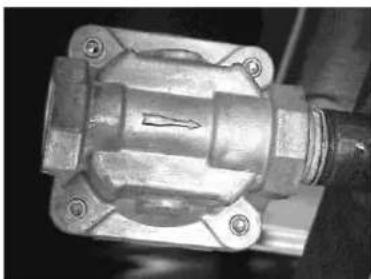
Install the regulator as close to the broiler on the gas supply line as possible. Make sure that the arrow on the underside of the regulator is oriented in the direction of gas flow to the broiler (Fig. 7) and the regulator is positioned with the vent plug and adjustment screw upright (Fig. 8).
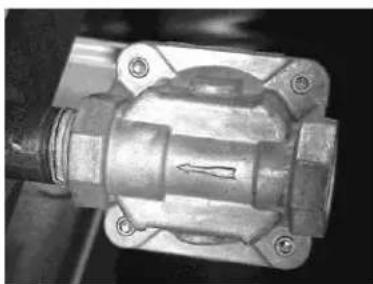
natural_image
Close-up of a metallic mechanical component with bolt holes and internal features (no visible text or symbols)Fig. 7
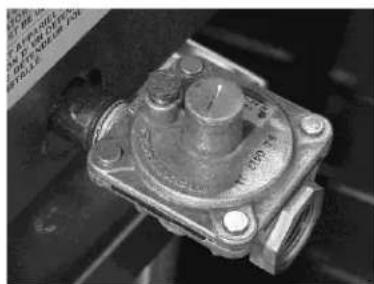
natural_image
Close-up of a metallic industrial valve component with bolts and housing (no visible text or symbols)Fig. 8
The supply pressure (upstream of the regulator) should be 7-9" W.C. for natural gas and 11-12" W.C. for propane gas. At no time should the charbroiler be connected to supply pressure greater than 12 psig (3.45 kPa) or 14" W.C.
CASTER EQUIPPED CHARBROILERS
Charbroilers mounted on stands with casters must use a flexible connector (not supplied) that complies with the Standard for Connectors for Movable Gas Appliances, ANSI Z21.69 • CSA 6.16 and a quick-disconnect device that complies with the Standard for Quick-Disconnect Devices for use With Gas Fuel, ANSI-Z21.41 • CSA 6.9. In addition, adequate means must be provided to limit movement of the broiler without depending on the connector and the quick-disconnect device or its associated piping to limit broiler movement. Attach the restraining device at the rear of the charbroiler. If disconnection of the restraint is necessary, turn off the gas supply before disconnection. Reconnect the restraint prior to turning the gas supply on and return the charbroiler to its installation position.

OPERATION
WARNING
The charbroiler and its parts are hot. Use care when operating, using the charbroiler.
Pilot Control Valves - The pilot control valves are located between the burner control knobs and accessed thru slots in the front panel (Fig. 10). There is one pilot and corresponding adjustment screw for every burner.
Using a flathead screwdriver, turn the slotted, hex-head pilot adjustment screw clockwise to decrease the flame and counter clockwise to increase the flame. Standing pilots should be adjusted to provide a slight yellow tip on the flame.
Burner Control Valves – There is one valve for each burner. To initially light the burners, the knobs should be turned to the “MAX” setting then adjusted to the desire setting as needed.
The burners will be off when the control knob is turned all the way to the right and pointing to "OFF". The burners will be at maximum setting when turned all the way to the left and pointing to "MAX". A medium burner setting can be achieved by adjusting the knob approximately half way between the "OFF" and "MAX" marks. See Fig. 11.
The charbroiler is a free vented appliance. All products of combustion and the heat generated by the burners passes through the grates. When food products are placed on the grates, this blocks the venting and causes a temperature build-up.

flowchart
graph TD
    A["Burner Control Valve"] --> B["Pilot Sight Holes"]
    B --> C["Pilot Control Valve"]
    C --> D["OFF"]
    D --> E["MAX"]
    style A fill:#f9f,stroke:#333
    style B fill:#f9f,stroke:#333
    style C fill:#ccf,stroke:#333
    style D fill:#cfc,stroke:#333
    style E fill:#fcc,stroke:#333

OFF
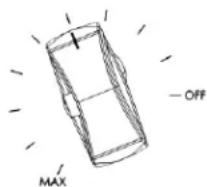
MEDIUM
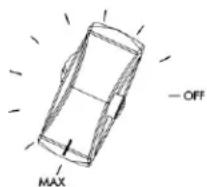
MAXIMUM
Fig. 11
TO COMPLETELY SHUTDOWN THE BURNERS AND PILOT LIGHTS
For complete shutdown: Turn the main gas supply valve OFF. Make sure all individual burner valves are OFF.
PREHEATING THE CHARBROILER
Allow the charbroiler to preheat for 30 minutes. Rub grates with cooking oil before using.
LIGHTING THE GAS PILOT
- Turn the main gas shut-off valve and the individual burner gas valves OFF. Wait 5 minutes.
- Turn the main gas shut-off valve ON.
- Light each pilot using an outside ignition source. Pass the ignition source through the pilot access hole in the front panel and ignite the pilot (Fig. 12). The end of the ignition source will need to be at least 7" long so it can extend pass the front panel to reach the pilot inside.
- While viewing through the pilot access hole, adjust the corresponding pilot valve screw until the pilot has a slight yellow tip
- Repeat steps 3-4 until all pilots are lit.
- To light the burners, turn the individual burners valves ON (MAX setting) after all pilots are lit. (Fig. 13). If the burners fail to light, turn all burner valves and the main gas shut-off valve to the OFF position and contact an authorized service agency.

flowchart
graph TD
    A["Pilot"] --> B["Pilot Access Hole"]
    C["Pilot Valve"] --> D["Pilot Access Hole"]
    style A fill:#f9f,stroke:#333
    style B fill:#ccf,stroke:#333
    style C fill:#cfc,stroke:#333
    style D fill:#fcc,stroke:#333
    note right of C
        MAX
        OFF
        Max
        MAX
        MAX
        MAX
    end
    subgraph Figure 12
        direction TB
        A --> B --> C
        C --> D
    end

CLEANING
WARNING
The charbroiler and its parts are hot. Use care when operating, cleaning or servicing the charbroiler.
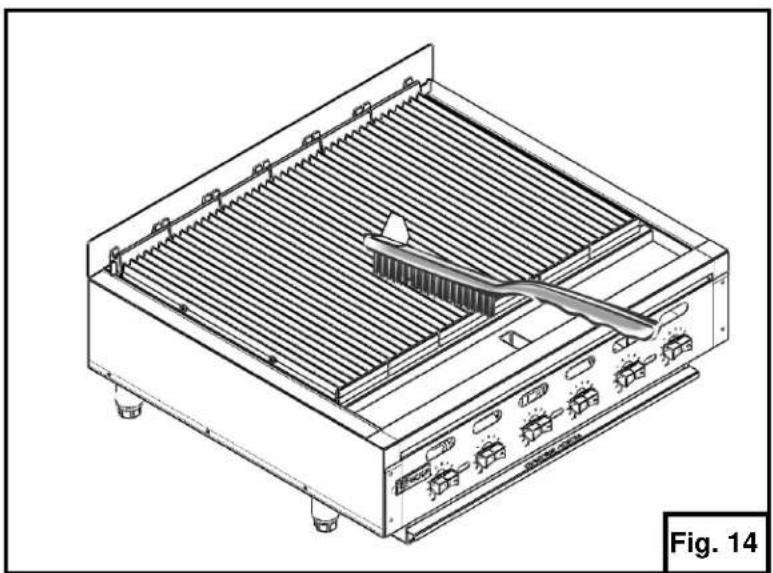
Scrape top grates during broiling with a wire brush to keep the grates clean. Do not allow debris to accumulate on the grates. (Fig. 14)
natural_image
Technical line drawing of a rack-mounted electronic device with heat exchangers and cooling fins (no text or symbols)Top grates may be immersed in strong commercial cleaning compound overnight. In the morning, rinse with hot water to remove any residues of cleaning compound. Thoroughly dry and apply cooking oil to prevent rusting.
Stainless steel surfaces may be cleaned using damp cloth with mild detergent and water solution.
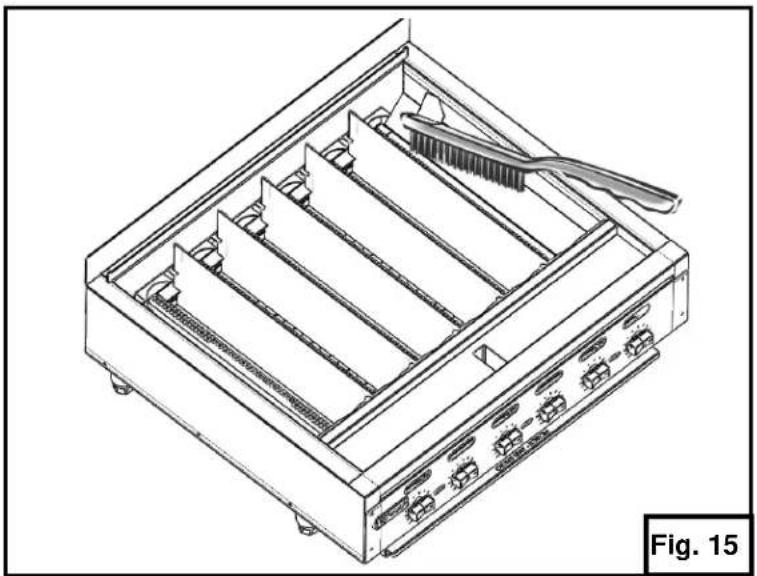
Daily, when cool, remove top grates and radiants to clean places where fat, grease, or food can accumulate. (Fig. 15)
Deflector trays and crumb trays should be emptied and cleaned regularly when cool. Ensure that the rear hooks of the deflector tray are over the back edge of the crumb tray as shown in Fig. 16 when reassembled.
natural_image
Technical line drawing of a multi-compartment electronic device with internal compartments and a handle (no text or symbols)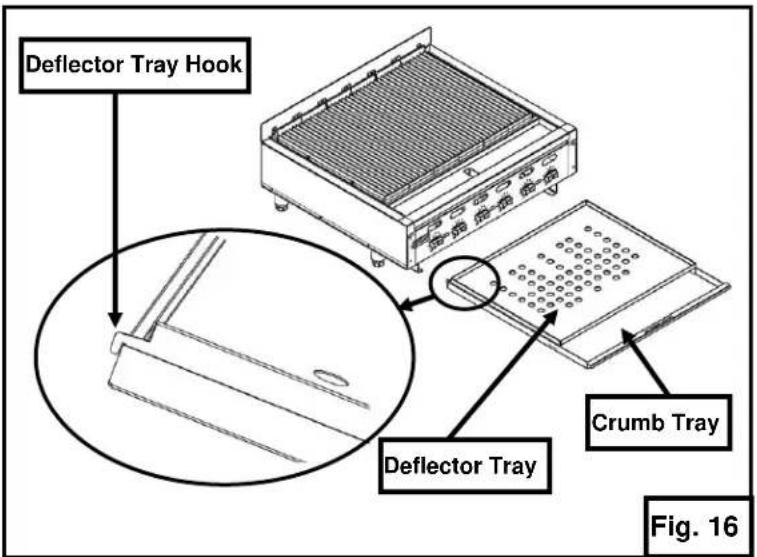
NOTICE Never cover the surface of the charbroiler with pans or other objects in attempt to "burn off" or clean debris from unit. This will cause a buildup of heat that can potentially damage and warp components of the charbroiler.
NOTICE Never cover the deflector tray holes with foil or allow the deflector tray holes to become blocked with debris. This will cause a buildup of heat that can potentially damage and warp components of the charbroiler.
MAINTENANCE
WARNING The charbroiler and its parts are hot. Use care when operating, cleaning or servicing the charbroiler.
VENT SYSTEM
At least twice a year the exhaust hood (venting system) must be examined and cleaned.
LUBRICATION
All valves, at the first sign of sticking, should be lubricated by a trained technician using high temperature grease.
SERVICE
Contact your local Service Agency for any repairs or adjustments needed on this equipment. For a complete listing of service and parts depots refer to www.vulcanequipment.com. When calling for service, the following information should be available from the appliance identification plate: Model Number and Serial Number.
TROUBLE SHOOTING
| Uneven heating, sides burning | A. Burner valves improperly adjustedB. Fluctuating gas pressureC. Improperly adjusted burner |
| Too much top heat | A. Burner valves adjusted too highB. Faulty ventilationC. Overrated gas pressureD. Improperly adjusted burner |
| Uneven heat side to side | A. Burner valves improperly adjustedB. Appliance is not level side to sideC. Improperly adjusted burnerD. Deflector tray and/or crumb tray improperly maintained or not installed correctly. |
| Uneven heat front to back | A. Appliance is not level front to backB. Faulty ventilationC. Improperly adjusted burnerD. Deflector tray and/or crumb tray improperly maintained or not installed correctly. |
| Pilot outage | A. Pilot flame is set too low. Adjust pilot to allow more gas flow.B. Obstruction in pilot orificeC. Low gas pressure |
| Yellow burner flames | A. Open burners shutters until flames are blue and touching burner |
| Lifting burner flames | A. Close burner shutters until flames touch burner and are not yellow. |
| Fluctuating gas pressure | A. Checked for clogged vent on regulator |
ACCESSORY INSTALLATION
WARNING
The charbroiler and its parts are hot. Use care when operating, ing the charbroiler.


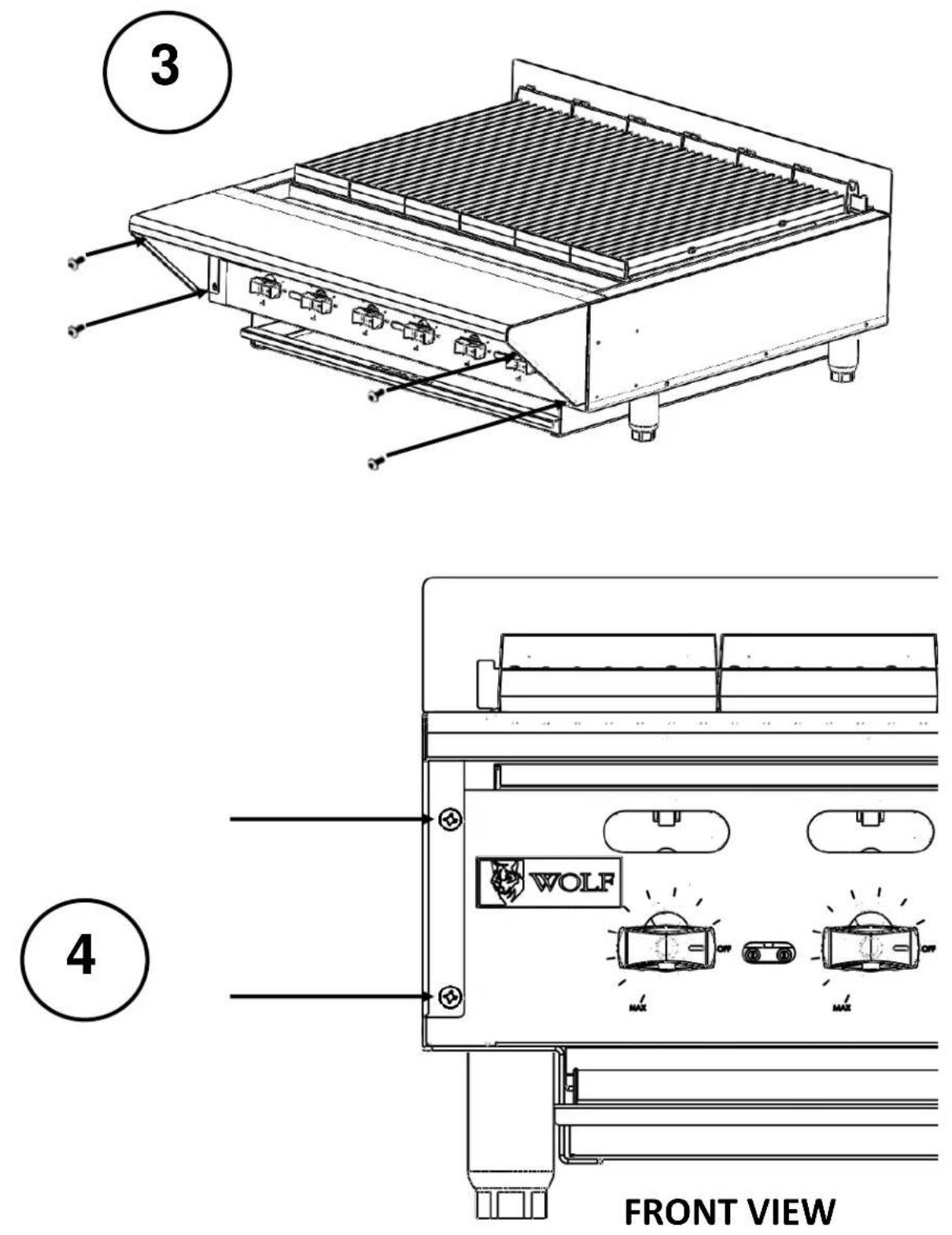
SPLASH ACCESSORY INSTALLATION
WARNING The charbroiler and its parts are hot. Use care when operating, cleaning or servicing the charbroiler.

natural_image
Line drawing of a 3D rectangular grater with multiple side-mounted cooling fins (no text or symbols)

natural_image
Line drawing of a rectangular grater with multiple side outlets and a horizontal cooling rack (no text or symbols)

natural_image
Technical line drawing of a mechanical assembly with mounting brackets and a central circular component (no text or symbols)BACK VIEW
WARNING The charbroiler and its parts are hot. Use care when operating, cleaning or servicing the charbroiler.
- Remove all charbroiler radiants and top grates.
- Remove the legs, crumb tray and heat deflector trays.
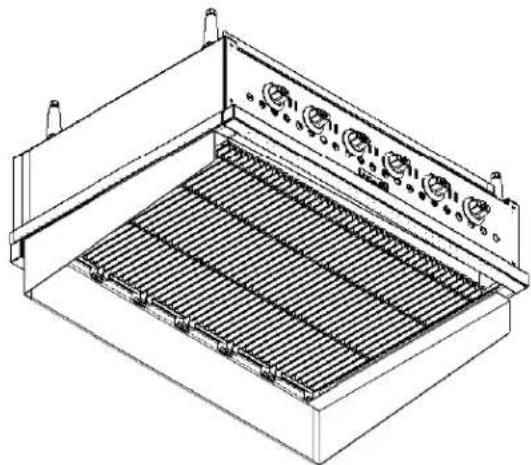
- Set charbroiler in place so that the threaded leg attachment points of the charbroiler align with the holes in the top of the wood smoker box.
- Secure the charbroiler in place with four 5/8"-11 X 3/4"L hex head bolts and 5/8" washers. The bolts should pass through the top of the wood smoker box and into the charbroiler leg attachment points. If applicable, secure the two frame halves together with three 1/4"-20 x 3/4"L bolts, washers and lock nuts.
- Reinstall charbroiler burners, radiants and top grates.
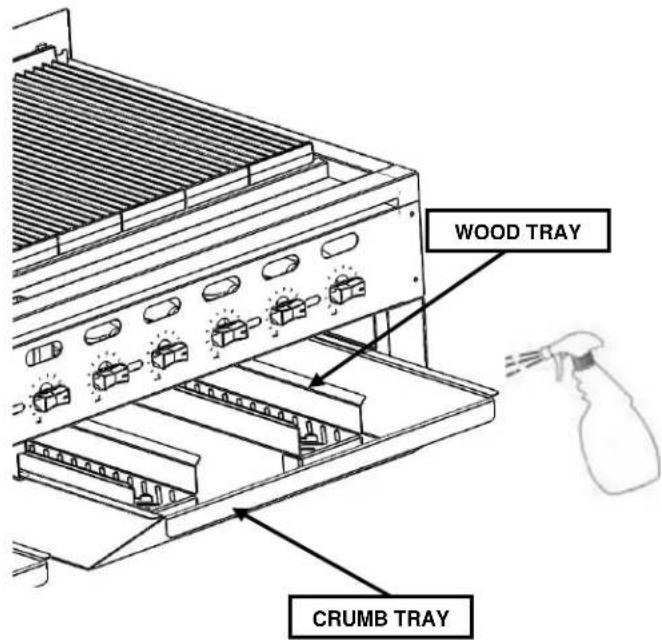
WOOD SMOKER BOX CLEANING
- Daily, when unit is cool, empty burned debris from the trays.
- Clean wood trays and crumb trays.
WARNING Use caution when disposing of burned debris from wood trays. Ensure contents are completely cooled. Discard into approved, flammable proof containers only.
BOTTOM VIEW OF CHARBROILER

WARNING The charbroiler and its parts are hot. Use care when operating, cleaning or servicing the charbroiler.
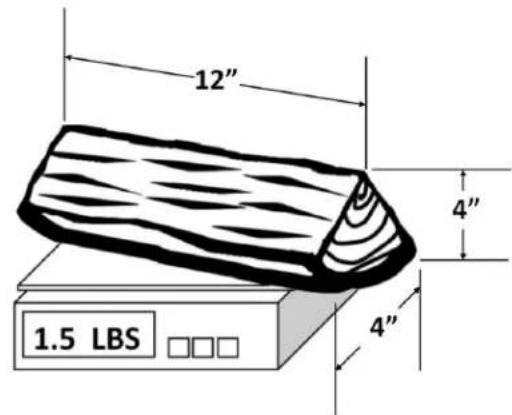
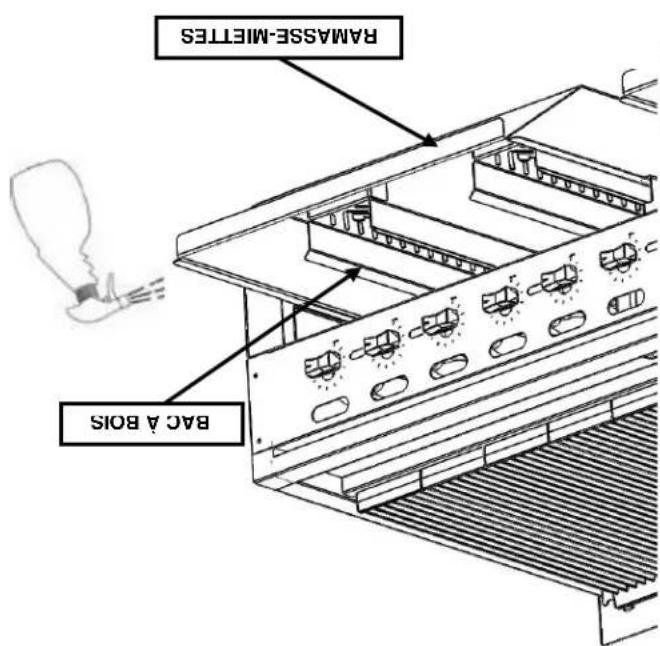
- The recommended wood size is approximately 12" long by 4" in diameter and 1-1/2 lb in weight each. Wood blocks could be used, not to exceed 4" x 4" cross-section or totaling more than 14" in total length. Hardwoods are recommended. (Soaking wood for \~24 hours is recommended for best results)
- Place one piece of wood in each wood tray. Center the wood(front to back) on the wood tray.
- Ensure that the wood trays are pushed all the way in before lighting the charbroiler burners. After adding wood, the charbroiler will need to heat \~30 minutes before smoking begins to occur.
- Wood will need to be replenished approximately every 3 hrs. when burner valves are set to the full ON position. This may vary with different applications. Wood should only be replaced after it breaks down and falls through the wood tray grates.
- Keep a trigger pump type water bottle on hand to wet down flare ups on the wood. To get nominal performance, wood should be allowed to burn as embers. If flames are observed, spray down with water bottle just enough to extinguish the visible flames.
NOTICE Do not put wood in tray without tray grates in place.
NOTICE Do not use wood of a larger dimension or replenish more than recommended or necessary. This will cause a buildup of heat that can potentially damage and warp components of the charbroiler.
NOTES

natural_image
Technical line drawing of a multi-panel rack-mounted device with no visible text or symbols
natural_image
Technical line drawing of a rectangular enclosure with circular holes and a mesh base (no text or symbols)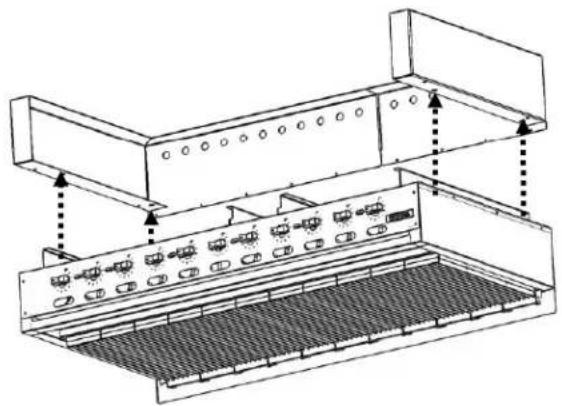
natural_image
Technical line drawing of a mechanical assembly with mounting brackets and internal components (no text or symbols)
VUE DE DESSOUZ DU GRIL A BARREAUX
natural_image
Technical line drawing of a mechanical assembly with two horizontal plates and mounting brackets (no text or symbols)
natural_image
Technical line drawing of a rectangular industrial or storage unit with internal grating and mounting brackets (no text or symbols)
natural_image
Technical line drawing of a mechanical device with grid-like internal structure and mounting brackets (no text or symbols)natural_image
Technical line drawing of a mechanical device with heat exchangers and cooling fins (no text or symbols)
natural_image
Technical line drawing of a multi-chamber refrigerator with internal compartments and ventilation slots (no text or symbols)natural_image
Technical line drawing of a rack-mounted server or appliance with heat exchangers and a handle (no text or symbols)natural_image
Close-up of a mechanical component with no visible text or symbolsFig.7
natural_image
Close-up of a metallic mechanical component with bolted joints and internal channels (no visible text or symbols)- La norme NFA no. 96 Vapor Remeval from Cooking Equipment, derivière édition, di s- ponibie aures de la National Fire Protection Association, Batterymarch Park, Quincy,
natural_image
Exterior view of a white industrial control panel with multiple dials and ventilation grilles (no visible text or symbols)VACB36
VACB72
VACB60
VACB47
VACBB36
VACB25
natural_image
Exterior view of a white industrial control unit with multiple slots and cooling fins (no visible text or symbols)MODELS
MANUEL D'INSTALLATION ET DE FONCTOINNEMENT GRILS AU GAZ
WOLF



- IMPORTANT FOR YOUR SAFETY
- IMPORTANT
- FOR YOUR SAFETY
- WARNING
- INSTALLATION, OPERATION AND CARE OF GAS COUNTERTOP CHARBROILERS
- GENERAL
- INSTALLATION
- UNPACKING
- LOCATION
- INSTALLATION CODES AND STANDARDS
- The Charbroiler must be installed in accordance with:
- NOTE: In the Commonwealth of Massachusetts
- KEY COMPONENTS
- LEVELING
- VENTILATION HOOD
- GAS CONNECTION
- ⚠ WARNING All gas supply connections and any joint compound must be resistant to the action of propane gases.
- GAS PRESSURE REGULATOR INSTALLATION
- CASTER EQUIPPED CHARBROILERS
- OPERATION
- TO COMPLETELY SHUTDOWN THE BURNERS AND PILOT LIGHTS
- PREHEATING THE CHARBROILER
- LIGHTING THE GAS PILOT
- CLEANING
- MAINTENANCE
- VENT SYSTEM
- LUBRICATION
- SERVICE
- ACCESSORY INSTALLATION
- SPLASH ACCESSORY INSTALLATION
- WARNING The charbroiler and its parts are hot. Use care when operating, cleaning or servicing the charbroiler.
- NOTES
- MANUEL D'INSTALLATION ET DE FONCTOINNEMENT GRILS AU GAZ
Brand : WOLF
Model : ACB72
Category : Grill